
Instruction
- Total number of questions : 20
- Time allotted : 30:00 Minutes:Seconds.
- Each question carry 1 mark, no negative marks.
- DO NOT refresh the page.
- All the best
Quantitative Aptitude [ Question No: 1 To 8 ] :
There are five types of envelop and four types of stamps in a Post office. How many ways are there to buy an envelope and stamp?
A book contains 10 chapters. Each chapter has a different number of pages, ranging from 20 to 30. The first chapter starts on page 1 and each chapter starts on a new page. What is the largest possible number of chapters that can begin on odd page numbers ?
A day can only be cloudy or sunny. The probability of a day being cloudy is 0.5, independent of the condition on other days. What is the probability that in any given four days, there will be three cloudy days and one sunny day?
The median of the following set of numbers: 154, 130, 144, 137, 156, 146, 138, 149, 160, 138 is:
In Cricket League, in first round every team plays a match with every other team. 9 teams participated in the Cricket league. How many matches were played in the first round?
In a 100 m race, A can beat B by 25 m and B can beat C by 4 m. In the same race, A can beat C by :
Two trains are traveling in the same direction at speeds of 50 kmph and 20 kmph respectively If the faster train passes the driver in the slower train in 20 seconds, What is the length of the faster train?
Pipe A can fill a tank in 5 hours, pipe B in 10 hours and pipe C in 30 hours. If all the pipes are open, in how many hours will the tank be filled ?
Reasoning [ Question No: 9 To 11 ] :
Direction for [ Question No: 9 To 9 ] :
In each question below is given a statement followed by two assumptions numbered I and II. You have to consider the statement and the following assumptions and decide which of the assumptions is implicit in the statement.
Give answer
- (A) If only assumption I is implicit
- (B) If only assumption II is implicit
- (C) If either I or II is implicit
- (D) If neither I nor II is implicit
- (E) If both I and II are implicit.
Statement: The party president has directed that no member of the party will give press briefing or interviews to governments and private T.V. channels about the discussion in scheduled meeting of the party.
Assumptions:
1. Party members will observe this directive of the president.
2. The general public will not come to know about the happenings in the scheduled meeting of the party.
Continue:
Z1, Y2, X3, W4, ?
If tuesday falls on 4th of month, then which day will fall three days after the 24th ?
English Language [ Question No: 12 To 15 ] :
Direction for [ Question No: 12 To 12 ] :
Directions : Read the given passage carefully and answer the questions that follow :
In July 1921, Tagore returned home from Europe. He was alarmed to find that many members of the staff at Santiniketan had enthusiastically embraced the non-co-operation movement, thus giving themselves up to 'narrow nationalist ideas that were already out of date'. In the first week of September, Gandhi met Tagore at his family home in Calcutta. They had a long and argumentative conversation about non-co-operation. C. F. Andrews, who was present, wrote that they had 'a difference of temperament so wide that it was extremely difficult to arrive at a common intellectual standing, though the moral ties of friendship remained entirely unbroken…'. Tagore later recalled that he had told Gandhi that 'the whole world is suffering today from the cult of a selfish and short-sighted nationalism. India has all down her history offered hospitality to the invader of whatever nation, creed or colour. I have come to believe that, as Indians, we not only have much to learn from the West but that we also have something to contribute. We dare not therefore shut the West out. But we still have to learn among ourselves how, through education, to collaborate and achieve a common understanding'.
Gandhi's answer is not recorded. But apparently Tagore was not satisfied, since he chose to make his criticisms public in the influential Calcutta journal Modern Review. In his recent travels in the West, said Tagore, he had met many people who sought 'to achieve the unity of man, by destroying the bondage of nationalism'. He had 'watched the faces of European students all aglow with the hope of a united mankind…'. Then he returned home, to be confronted with a political movement suffused with negativity. Are 'we alone to be content with telling the beads of negation', asked Tagore, 'harping on other's faults and proceeding with the erection of Swaraj on a foundation of quarrelsomeness?'
Gandhi responded immediately, defending the non-co-operation movement as 'a refusal to co-operate with the English administrators on their own terms. We say to them, "Come and co-operate with us on our terms, and it will be well for us, for you and the world". … A drowning man cannot save others. In order to be fit to save others, we must try to save ourselves. Indian nationalism is not exclusive, nor aggressive, nor destructive. It is health-giving, religious and therefore humanitarian. India must learn to live before she can aspire to die for humanity. The mice which helplessly find themselves between the cat's teeth acquire no merit from their enforced sacrifice.'
According to Mahatma Gandhi, which adjective was not a suitable characteristic of Indian nationalism ?
Direction for [ Question No: 13 To 13 ] :
On the surface, the conquest of the Aztec empire by Herman Cortes is one of the most amazing military accomplishments in history. With a small fighting force numbering in the hundreds, Cortes led the Spanish explorers into victory against an Aztec population that many believe topped 21 million. In light of such a seemingly impossible victory, the obvious question is: how did a small group of foreign fighters manage to topple one of the world's strongest, wealthiest, and most successful military empires?
Several factors led to Cortes' success. First, the Spanish exploited animosity toward the Aztecs among rival groups and convinced thousands of locals to fight. In one account of a battle, it is recorded that at least 200,000 natives fought with Cortes. Next, the Spanish possessed superior military equipment in the form of European cannons, guns, and crossbows, leading to effective and efficient disposal of Aztec defenses. For example, Spanish cannons quickly defeated large Aztec walls that had protected the empire against big and less technically advanced armies.
Despite the Spanish advantages, the Aztecs probably could have succeeded in defending their capital city of Tenochtitlan had they leveraged their incredible population base to increase their army's size and ensured that no rogue cities would ally with Cortes. In order to accomplish this later goal, Aztec leader Motecuhzoma needed to send envoys to neighboring cities telling their inhabitants about the horrors of Spanish conquest and the inevitability of Spanish betrayal.
In addition, the Aztecs should have exploited the fact that the battle was taking place on their territory. No reason existed for the Aztecs to consent to a conventional battle, which heavily favored the Spanish. Motecuhzoma's forces should have thought outside the box and allowed Cortes into the city, only to subsequently use hundreds of thousands of fighters to prevent escape and proceed in surprise "door-to-door" combat. With this type of battle, the Aztecs would have largely thwarted Spanish technological supremacy. However, in the end, the superior weaponry of the Spanish, the pent-up resentment of Aztec rivals, the failure of Aztec diplomacy, and the lack of an unconventional Aztec war plan led to one of the most surprising military outcomes in the past one thousand years.
Which of the following best characterizes the main point the author is trying to convey in the passage?
Direction for [ Question No: 14 To 14 ] :
In questions given below out of four alternatives, choose the one which can be substituted for the given word/sentence.
Direction for [ Question No: 15 To 15 ] :
In each of the following questions, out of the given alternatives,choose the one which best expresses the meaning of the given word.
Computer Awareness [ Question No: 16 To 20 ] :
How many select lines are required for an 8-to-1 multiplexer ?
Function which is placed between FOR statements and other repeated statements is classified as
The high level language program before ready to be executed must go through various process except
What is the resolution of a monitor measured in?
To edit the text within the boxes of an organization chart, you
Total number of questions : 20
Number of answered questions : 0
Number of unanswered questions : 20
Quantitative Aptitude [ Question No: 1 To 8 ] :
There are five types of envelop and four types of stamps in a Post office. How many ways are there to buy an envelope and stamp?
Your Answer : (Not Answered)
Correct Answer : A
There are 20 ways.
Choosing one envelope (5 ways) and one stamp (4 ways) are independent choices, so by the multiplication principle the number of ways to buy one of each is
\[ 5 \times 4 = 20 \]
9 is 5 + 4, the count of ways to buy an envelope or a stamp, not both, which is the common slip. 45 and 54 fit no step.
A book contains 10 chapters. Each chapter has a different number of pages, ranging from 20 to 30. The first chapter starts on page 1 and each chapter starts on a new page. What is the largest possible number of chapters that can begin on odd page numbers ?
Your Answer : (Not Answered)
Correct Answer : B
At most 8 chapters can begin on odd pages.
Chapter 1 starts on page 1. A chapter with an even number of pages keeps the next chapter on the same parity; a chapter with an odd number of pages flips it.
The lengths are ten different numbers from 20 to 30. Only six of those are even (20, 22, 24, 26, 28, 30), so among chapters 1 to 9, whose lengths decide where chapters 2 to 10 start, at least three must have odd lengths.
Best arrangement: chapters 1 to 6 even, so chapters 1 to 7 all start on odd pages; chapter 7 odd (chapter 8 starts even), chapter 8 odd (chapter 9 back to odd), chapter 9 odd (chapter 10 starts even). That is 7 + 1 = 8 odd starts.
9 would allow at most two odd-length chapters among the first nine, which needs seven even lengths, and only six exist. 6 and 5 are possible but not the largest.
A day can only be cloudy or sunny. The probability of a day being cloudy is 0.5, independent of the condition on other days. What is the probability that in any given four days, there will be three cloudy days and one sunny day?
Your Answer : (Not Answered)
Correct Answer : A
The probability is 1/4.
Each day is cloudy with probability 1/2, independently, so the number of cloudy days in four is binomial. Exactly three cloudy days can happen in C(4, 3) = 4 ways (the sunny day can be any of the four):
\[ \begin{aligned} P &= \binom{4}{3}\left(\tfrac{1}{2}\right)^{3}\left(\tfrac{1}{2}\right)^{1} \\ &= 4 \times \tfrac{1}{16} = \tfrac{1}{4} \end{aligned} \]
3/8 is the probability of exactly two cloudy days, C(4, 2)/16 = 6/16, and is the usual slip. 3/4 and 2/3 do not come from any count of the 16 equally likely weather sequences.
The median of the following set of numbers: 154, 130, 144, 137, 156, 146, 138, 149, 160, 138 is:
Your Answer : (Not Answered)
Correct Answer : A
The median is 145.0.
Arrange the ten numbers in order: 130, 137, 138, 138, 144, 146, 149, 154, 156, 160. With an even count, the median is the mean of the 5th and 6th values:
\[ \text{median} = \frac{144 + 146}{2} = 145.0 \]
145.2 is the arithmetic mean of the set (1452 divided by 10), not the median. 151.0 is the mean of 146 and 156, values taken from the unsorted list, and 146.0 is just the 6th value on its own.
In Cricket League, in first round every team plays a match with every other team. 9 teams participated in the Cricket league. How many matches were played in the first round?
Your Answer : (Not Answered)
Correct Answer : A
Every pair of teams meets once, and the order within a pair is irrelevant.
\[ {}^{9}C_{2} = \frac{9 \times 8}{2} = 36 \]
Counting ordered pairs would give 72, treating "A versus B" and "B versus A" as different matches.
In a 100 m race, A can beat B by 25 m and B can beat C by 4 m. In the same race, A can beat C by :
Your Answer : (Not Answered)
Correct Answer : C
Chain the two comparisons through B.
\[ A\,100 : B\,75, \qquad B\,100 : C\,96 \]
When A runs 100, B runs 75; and when B runs 75, C runs
\[ 75 \times \frac{96}{100} = 72 \text{ m} \]
\[ \text{A beats C by } 100 - 72 = 28 \text{ m} \]
The two margins do not simply add to 29 - B's 4 m lead over C is measured over 100 m, but B only runs 75 m in this race.
Two trains are traveling in the same direction at speeds of 50 kmph and 20 kmph respectively If the faster train passes the driver in the slower train in 20 seconds, What is the length of the faster train?
Your Answer : (Not Answered)
Correct Answer : D
Passing the driver - a single point - means covering only the faster train's own length.
\[ \text{relative speed} = 50 - 20 = 30 \text{ kmph} = 30 \times \frac{5}{18} = \frac{25}{3} \text{ m/s} \]
\[ L = \frac{25}{3} \times 20 = \frac{500}{3} = 166.67 \approx 166 \text{ m} \]
Had it passed the whole slower train, both lengths would have counted.
Pipe A can fill a tank in 5 hours, pipe B in 10 hours and pipe C in 30 hours. If all the pipes are open, in how many hours will the tank be filled ?
Your Answer : (Not Answered)
Correct Answer : D
Part filled by A in 1 hour = 1/5
Part filled by B in 1 hour = 1/10
Part filled by C in 1 hour = 1/30
Part filled by (A+B+C) in 1 hour =
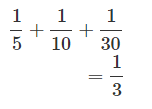
So all pipes will fill the tank in 3 hours.
Reasoning [ Question No: 9 To 11 ] :
Direction for [ Question No: 9 To 9 ] :
In each question below is given a statement followed by two assumptions numbered I and II. You have to consider the statement and the following assumptions and decide which of the assumptions is implicit in the statement.
Give answer
- (A) If only assumption I is implicit
- (B) If only assumption II is implicit
- (C) If either I or II is implicit
- (D) If neither I nor II is implicit
- (E) If both I and II are implicit.
Statement: The party president has directed that no member of the party will give press briefing or interviews to governments and private T.V. channels about the discussion in scheduled meeting of the party.
Assumptions:
1. Party members will observe this directive of the president.
2. The general public will not come to know about the happenings in the scheduled meeting of the party.
Your Answer : (Not Answered)
Correct Answer : E
Clearly, the party president lays down the policies for its members. So, I is implicit. Also, when no party member would publicly reveal the happenings in the meeting, nobody will come to know. So, II is also implicit.
Continue:
Z1, Y2, X3, W4, ?
Your Answer : (Not Answered)
Correct Answer : C
Correct answer: V5
The letters run backwards from the end of the alphabet - Z, Y, X, W, then V - while the numbers count up 1, 2, 3, 4, then 5. So the next term is V5.
If tuesday falls on 4th of month, then which day will fall three days after the 24th ?
Your Answer : (Not Answered)
Correct Answer : D
Correct answer: thursday
If the 4th is a Tuesday, the 24th is twenty days later, and \( 20 = 14 + 6 \), so it falls six days on from Tuesday - a Monday. Three days after that is the 27th: Thursday.
English Language [ Question No: 12 To 15 ] :
Direction for [ Question No: 12 To 12 ] :
Directions : Read the given passage carefully and answer the questions that follow :
In July 1921, Tagore returned home from Europe. He was alarmed to find that many members of the staff at Santiniketan had enthusiastically embraced the non-co-operation movement, thus giving themselves up to 'narrow nationalist ideas that were already out of date'. In the first week of September, Gandhi met Tagore at his family home in Calcutta. They had a long and argumentative conversation about non-co-operation. C. F. Andrews, who was present, wrote that they had 'a difference of temperament so wide that it was extremely difficult to arrive at a common intellectual standing, though the moral ties of friendship remained entirely unbroken…'. Tagore later recalled that he had told Gandhi that 'the whole world is suffering today from the cult of a selfish and short-sighted nationalism. India has all down her history offered hospitality to the invader of whatever nation, creed or colour. I have come to believe that, as Indians, we not only have much to learn from the West but that we also have something to contribute. We dare not therefore shut the West out. But we still have to learn among ourselves how, through education, to collaborate and achieve a common understanding'.
Gandhi's answer is not recorded. But apparently Tagore was not satisfied, since he chose to make his criticisms public in the influential Calcutta journal Modern Review. In his recent travels in the West, said Tagore, he had met many people who sought 'to achieve the unity of man, by destroying the bondage of nationalism'. He had 'watched the faces of European students all aglow with the hope of a united mankind…'. Then he returned home, to be confronted with a political movement suffused with negativity. Are 'we alone to be content with telling the beads of negation', asked Tagore, 'harping on other's faults and proceeding with the erection of Swaraj on a foundation of quarrelsomeness?'
Gandhi responded immediately, defending the non-co-operation movement as 'a refusal to co-operate with the English administrators on their own terms. We say to them, "Come and co-operate with us on our terms, and it will be well for us, for you and the world". … A drowning man cannot save others. In order to be fit to save others, we must try to save ourselves. Indian nationalism is not exclusive, nor aggressive, nor destructive. It is health-giving, religious and therefore humanitarian. India must learn to live before she can aspire to die for humanity. The mice which helplessly find themselves between the cat's teeth acquire no merit from their enforced sacrifice.'
According to Mahatma Gandhi, which adjective was not a suitable characteristic of Indian nationalism ?
Your Answer : (Not Answered)
Correct Answer : D
The unsuitable adjective was aggressive.
Gandhi's reply says 'Indian nationalism is not exclusive, nor aggressive, nor destructive. It is health-giving, religious and therefore humanitarian.' So 'religious' and 'humanitarian' are characteristics he claims for it, and 'inclusive' is the opposite of the 'exclusive' he rejects.
Only 'aggressive' is a quality he denies, which is why the question asks for the adjective that was not suitable.
Direction for [ Question No: 13 To 13 ] :
On the surface, the conquest of the Aztec empire by Herman Cortes is one of the most amazing military accomplishments in history. With a small fighting force numbering in the hundreds, Cortes led the Spanish explorers into victory against an Aztec population that many believe topped 21 million. In light of such a seemingly impossible victory, the obvious question is: how did a small group of foreign fighters manage to topple one of the world's strongest, wealthiest, and most successful military empires?
Several factors led to Cortes' success. First, the Spanish exploited animosity toward the Aztecs among rival groups and convinced thousands of locals to fight. In one account of a battle, it is recorded that at least 200,000 natives fought with Cortes. Next, the Spanish possessed superior military equipment in the form of European cannons, guns, and crossbows, leading to effective and efficient disposal of Aztec defenses. For example, Spanish cannons quickly defeated large Aztec walls that had protected the empire against big and less technically advanced armies.
Despite the Spanish advantages, the Aztecs probably could have succeeded in defending their capital city of Tenochtitlan had they leveraged their incredible population base to increase their army's size and ensured that no rogue cities would ally with Cortes. In order to accomplish this later goal, Aztec leader Motecuhzoma needed to send envoys to neighboring cities telling their inhabitants about the horrors of Spanish conquest and the inevitability of Spanish betrayal.
In addition, the Aztecs should have exploited the fact that the battle was taking place on their territory. No reason existed for the Aztecs to consent to a conventional battle, which heavily favored the Spanish. Motecuhzoma's forces should have thought outside the box and allowed Cortes into the city, only to subsequently use hundreds of thousands of fighters to prevent escape and proceed in surprise "door-to-door" combat. With this type of battle, the Aztecs would have largely thwarted Spanish technological supremacy. However, in the end, the superior weaponry of the Spanish, the pent-up resentment of Aztec rivals, the failure of Aztec diplomacy, and the lack of an unconventional Aztec war plan led to one of the most surprising military outcomes in the past one thousand years.
Which of the following best characterizes the main point the author is trying to convey in the passage?
Your Answer : (Not Answered)
Correct Answer : B
Correct answer: Spanish victory was neither as impressive nor as surprising as it may first appear
The passage opens with on the surface, which signals that the impression is about to be corrected, and then supplies the corrections: two hundred thousand native allies, cannon and crossbows against walls, and a set of Aztec failures. Each of those reduces the size of the achievement rather than celebrating it.
Direction for [ Question No: 14 To 14 ] :
In questions given below out of four alternatives, choose the one which can be substituted for the given word/sentence.
Your Answer : (Not Answered)
Correct Answer : B
It is a feud.
A feud is a long-running hostility between families or groups, often passed down the generations. A skirmish is a brief clash and a quarrel a single dispute; enmity is the feeling rather than the fighting.
Direction for [ Question No: 15 To 15 ] :
In each of the following questions, out of the given alternatives,choose the one which best expresses the meaning of the given word.
Your Answer : (Not Answered)
Correct Answer : C
It is secretive.
Privy means sharing in the knowledge of something secret - privy to the plan. Revealed and unconcealed are its opposites.
Computer Awareness [ Question No: 16 To 20 ] :
How many select lines are required for an 8-to-1 multiplexer ?
Your Answer : (Not Answered)
Correct Answer : A
Correct answer: 3
A multiplexer with \(2^n\) data inputs needs \(n\) select lines to address them. Since \(2^3 = 8\), three select lines are required to choose one of the eight inputs.
Function which is placed between FOR statements and other repeated statements is classified as
Your Answer : (Not Answered)
Correct Answer : B
Correct answer: DO function
In a FOR loop the statements to be repeated are introduced by DO and run once for each value of the loop variable. GO and WHILE belong to other constructions.
The high level language program before ready to be executed must go through various process except
Your Answer : (Not Answered)
Correct Answer : D
Correct answer: Controlling
A high level program is translated into object code, linked with the libraries it uses, and loaded into memory before it can run. Controlling is not a stage in that sequence, which is why it is the exception.
What is the resolution of a monitor measured in?
Your Answer : (Not Answered)
Correct Answer : B
Correct answer: Pixels
Resolution is the number of pixels a display shows, quoted as width by height - 1920 × 1080 for Full HD, 3840 × 2160 for 4K. A pixel is the smallest addressable point of the image. The distractors each measure something else about a monitor, and the set is worth keeping apart. Hertz measures the refresh rate, how many times a second the image is redrawn - 60 Hz is standard and higher rates give smoother motion. Inches measure the screen size, taken diagonally. Bytes measure data, not display. What actually determines sharpness is neither resolution nor size alone but pixel density, in pixels per inch: the same 1920 × 1080 looks crisp on a 15-inch laptop and coarse on a 32-inch monitor. Aspect ratio is the shape, 16:9 being usual, and response time in milliseconds is how quickly a pixel changes, which matters for fast-moving images.
To edit the text within the boxes of an organization chart, you
Your Answer : (Not Answered)
Correct Answer : A
Correct answer: select the box and text, then make changes
In an organization chart you must first click the box to select it and then click into its text before typing; selecting the box alone gives you the shape, and there is no text to highlight until the box is active. That is why only the option naming both steps is correct.
Marks
Total number of questions : 20
Number of answered questions : 0
Number of unanswered questions : 20