
Instruction
- Total number of questions : 20
- Time allotted : 30:00 Minutes:Seconds.
- Each question carry 1 mark, no negative marks.
- DO NOT refresh the page.
- All the best
Quantitative Aptitude [ Question No: 1 To 17 ] :
In a mixture of 150 L, the ratio of milk to water is 2:1. What amount of water should be further added to the mixture so as to make the ratio of the milk to water 1:2 respectively?
Neha's father's age is 5 years more than three times Neha's age. Neha's father is 44 years old, then Neha's age will be :
Radhika sold her treadmill on OLX to a customer at a loss of 6% to the original cost. If she had sold it for Rs. 1250/- more, she would have gained 4%. What is the original cost of the treadmill?
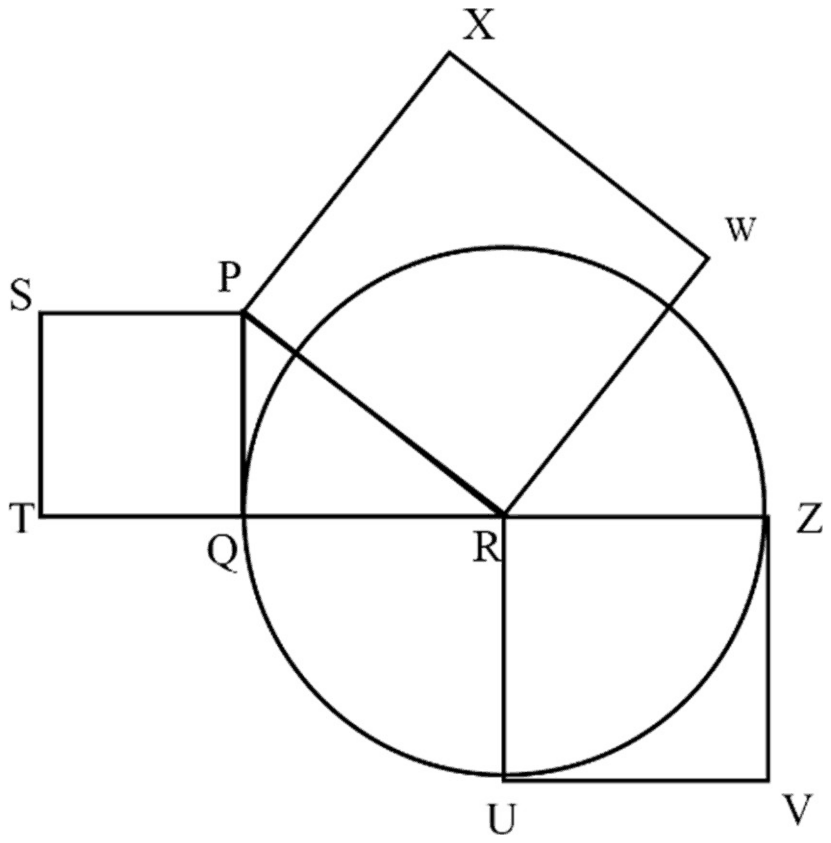
In the following diagram, the point R is the center of the circle. The lines PQ and ZV are tangential to the circle. The relation among the areas of the squares, PXWR, RUVZ and SPQT is
The sum of the interior angles of a polygon is 1440°. How many sides does the polygon have?
If an angle is its own complement, what is its measure?
From the top of a temple near a river the angles of depression of both the banks of river are 45° & 30°. If the height of the temple is 100 m then find out the width of the river.
The collection of one or more outcomes from an experiment is called
How many times in a day, are the hands of a clock in straight line but opposite in direction?
A can run 20 m while B runs 25 m. In a km race, B beats A by:
Value of sin 2π⁄3 considering radian is
A property decreases in value every year at the rate of 6 1/4% of its value at the beginning of the year its value at the end of 3 years was Rs.21093. Find its value at the beginning of the first year?
By factorizing 54x - 45y, answer must be
\((\frac{x^{b}}{x^{c}})^{(b+c-a)}.(\frac{x^{c}}{x^{a}})^{(c+a-b)}.(\frac{x^{a}}{x^{b}})^{(a+b-c)}=?\)
The present average age of a family of five members is 26 years. If the present age of the youngest member in the family is ten years, then what was the average age of the family at the time of the birth of the youngest member ? (Assume no death occurred in the family since the birth of the youngest
The sum of the ages of a father and son is \(45\) years. Five years ago, the product of their ages was four times the father's age at that time. The present age of father and son
If the product of two numbers is 84942 and their H.C.F. is 33, find their L.C.M.
Engineering Mathematics [ Question No: 18 To 19 ] :
How does the determinant of a product relate to those of its factors?
The curve \( y = \dfrac{2x + 1}{x - 3} \) has asymptotes
Numerical Methods [ Question No: 20 To 20 ] :
The value of
\[ \Delta^{10}[(1 - x)(1 - 2x^{2})(1 - 3x^{3})(1 - 4x^{4})] \]
is :
Total number of questions : 20
Number of answered questions : 0
Number of unanswered questions : 20
Quantitative Aptitude [ Question No: 1 To 17 ] :
In a mixture of 150 L, the ratio of milk to water is 2:1. What amount of water should be further added to the mixture so as to make the ratio of the milk to water 1:2 respectively?
Your Answer : (Not Answered)
Correct Answer : C
The water to be added is 150 L.
The 150 L mixture in the ratio 2:1 has 100 L of milk and 50 L of water. The milk stays at 100 L, and for a milk to water ratio of 1:2 the water must be twice the milk:
\[ \begin{aligned} \text{water needed} &= 2 \times 100 = 200\ \text{L} \\ \text{to add} &= 200 - 50 = 150\ \text{L} \end{aligned} \]
200 L is the total water required, not the amount to add, and 50 L or 100 L would leave the milk still in excess of half the water.
Neha's father's age is 5 years more than three times Neha's age. Neha's father is 44 years old, then Neha's age will be :
Your Answer : (Not Answered)
Correct Answer : B
Neha is 13 years old.
Let Neha's age be \(n\). Her father's age is five more than three times hers:
\[ \begin{aligned} 3n + 5 &= 44 \\ 3n &= 39 \\ n &= 13 \end{aligned} \]
Check: three times 13 is 39, and 39 + 5 = 44. The option 39 years is the value of \(3n\), a step short of the answer. 12 years would give a father of 41, and 8 years a father of 29.
Radhika sold her treadmill on OLX to a customer at a loss of 6% to the original cost. If she had sold it for Rs. 1250/- more, she would have gained 4%. What is the original cost of the treadmill?
Your Answer : (Not Answered)
Correct Answer : A
The original cost of the treadmill is Rs. 12,500.
Selling at a 6% loss and selling at a 4% gain differ by 10% of the cost price, and that difference is the extra Rs. 1,250.
\[ \begin{aligned} (4\% + 6\%) \times C &= 1250 \\ 0.10\,C &= 1250 \\ C &= 12500 \end{aligned} \]
Check: a 6% loss gives Rs. 11,750 and a 4% gain gives Rs. 13,000, which differ by Rs. 1,250. Note that 11,750 and 13,000 among the options are those two selling prices, not the cost.
In the following diagram, the point R is the center of the circle. The lines PQ and ZV are tangential to the circle. The relation among the areas of the squares, PXWR, RUVZ and SPQT is
Your Answer : (Not Answered)
Correct Answer : B
The relation is Area of SPQT = Area of PXWR − Area of RUVZ.
PQ is tangent to the circle at Q, so the radius RQ is perpendicular to PQ and triangle PQR is right-angled at Q. By Pythagoras, \(PR^{2} = PQ^{2} + QR^{2}\).
The square PXWR is built on PR, so its area is \(PR^{2}\). The square SPQT is built on PQ, area \(PQ^{2}\). The square RUVZ has sides RU and RZ, both radii, so its area is \(QR^{2}\) (QR is also a radius). Hence
\[ PQ^{2} = PR^{2} - QR^{2} \]
that is SPQT = PXWR − RUVZ. The three areas cannot all be equal, since PR is the hypotenuse and longer than both PQ and QR; the other two options subtract the wrong pair.
The sum of the interior angles of a polygon is 1440°. How many sides does the polygon have?
Your Answer : (Not Answered)
Correct Answer : C
The formula for the sum of the interior angles of an n-sided polygon is (n-2) × 180°.
(n-2) × 180° = 1440°
n - 2 = 1440 / 180
n - 2 = 8
n = 10.
The polygon has 10 sides (a decagon).
If an angle is its own complement, what is its measure?
Your Answer : (Not Answered)
Correct Answer : B
\[ x = 90 - x \quad\Longrightarrow\quad 2x = 90 \]
\[ x = 45^{\circ} \]
An angle that is its own supplement would be 90° instead.
From the top of a temple near a river the angles of depression of both the banks of river are 45° & 30°. If the height of the temple is 100 m then find out the width of the river.
Your Answer : (Not Answered)
Correct Answer : B
The temple stands on one bank, so the river's width is the gap between the two sight lines - the difference of the horizontal distances.
\[ d_{45} = \frac{100}{\tan 45^{\circ}} = 100 \text{ m} \]
\[ d_{30} = \frac{100}{\tan 30^{\circ}} = 100\sqrt{3} \text{ m} \]
\[ \text{width} = 100\sqrt{3} - 100 = 100(\sqrt{3} - 1) \text{ m} \]
That is roughly 73.2 m. The nearer bank gives the steeper \( 45^{\circ} \) depression, the far bank the shallower \( 30^{\circ} \).
The collection of one or more outcomes from an experiment is called
Your Answer : (Not Answered)
Correct Answer : B
An event is any subset of the sample space - one outcome or a collection of them.
Rolling an even number, for example, is the event \( \{2, 4, 6\} \).
Probability is the number assigned to an event, and a random variable is a function from outcomes to numbers - neither is the collection itself.
How many times in a day, are the hands of a clock in straight line but opposite in direction?
Your Answer : (Not Answered)
Correct Answer : B
The hands of a clock point in opposite directions (in the same straight line) 11 times in every 12 hours. (Because between 5 and 7 they point in opposite directions at 6 o'clcok only).
So, in a day, the hands point in the opposite directions 22 times.
A can run 20 m while B runs 25 m. In a km race, B beats A by:
Your Answer : (Not Answered)
Correct Answer : B
In these problems the two runners are compared by the distances they cover in the same time, so their speeds are in the ratio of those distances.
\[ A : B = 20 : 25 \]
In a 1000 m race B finishes first, and in that time A covers
\[ 1000 \times \frac{20}{25} = 800 \text{ m} \]
\[ \text{B beats A by } 1000 - 800 = 200 \text{ m} \]
Value of sin 2π⁄3 considering radian is
Your Answer : (Not Answered)
Correct Answer : D
Convert to degrees first.
\[ \frac{2\pi}{3} = \frac{2 \times 180^{\circ}}{3} = 120^{\circ} \]
\[ \sin 120^{\circ} = \sin(180^{\circ} - 120^{\circ}) = \sin 60^{\circ} = \frac{\sqrt{3}}{2} = 0.866 \]
Sine never exceeds 1, so any option above it can be discarded immediately.
A property decreases in value every year at the rate of 6 1/4% of its value at the beginning of the year its value at the end of 3 years was Rs.21093. Find its value at the beginning of the first year?
Your Answer : (Not Answered)
Correct Answer : A
A yearly fall of \( 6\tfrac{1}{4}\% = \tfrac{1}{16} \) leaves \( \tfrac{15}{16} \) of the value each year.
\[ P \times \left(\frac{15}{16}\right)^{3} = 21093 \]
\[ P = 21093 \times \frac{16^{3}}{15^{3}} = 21093 \times \frac{4096}{3375} \]
\[ = \text{Rs. } 25{,}600.24 \]
Depreciation is compound too, so the value must be divided by the yearly factor - adding back three lots of 6.25% would give a different and smaller figure.
By factorizing 54x - 45y, answer must be
Your Answer : (Not Answered)
Correct Answer : A
Both terms share a factor of 9.
\[ 54x - 45y = 9 \times 6x - 9 \times 5y = 9(6x - 5y) \]
9 is the highest common factor of 54 and 45; taking out 3 alone would leave \( 3(18x - 15y) \), which is not fully factorised.
\((\frac{x^{b}}{x^{c}})^{(b+c-a)}.(\frac{x^{c}}{x^{a}})^{(c+a-b)}.(\frac{x^{a}}{x^{b}})^{(a+b-c)}=?\)
Your Answer : (Not Answered)
Correct Answer : B
Given exp. = \(x^{(b-c)(b+c-a)}.x^{(c-a)(c+a-b)}.x^{(a-b)(a+b-c)}\)
\(=x^{(b-c)(b+c)-a(b-c)}.x^{(c-a)(c+a)-b(c-a)}.x^{(a-b)(a+b)-c(a-b)}\)
\(= x^{(b^{2}-c^{2}+c^{2}-a^{2}+a^{2}-b^{2})}\)
\(= (x^{0}xx^{0})\)
\(= (1\times1)=1\)
The present average age of a family of five members is 26 years. If the present age of the youngest member in the family is ten years, then what was the average age of the family at the time of the birth of the youngest member ? (Assume no death occurred in the family since the birth of the youngest
Your Answer : (Not Answered)
Correct Answer : C
Present total age of the members = 26(5) = 130 years
Present age of the youngest member = 10 years
Present total age of the remaining four members = 130 - 10 = 120 years
Their average age at the time of the birth of the youngest member = \(\frac{120-(4*10)}{4}\)
= 30 - 10 = 20 years
The sum of the ages of a father and son is \(45\) years. Five years ago, the product of their ages was four times the father's age at that time. The present age of father and son
Your Answer : (Not Answered)
Correct Answer : C
Let son's age \(=x\) years.
Then father's age\(=(45-x)\) years.
\(\Rightarrow\) \((x-5)(45-x-5) = 4(45- x - 5)\)
\(\Rightarrow\) \((x-5)=4\)
\(\Rightarrow\) \(x=9\)
Their ages are \(36\) years and \(9\) years.
If the product of two numbers is 84942 and their H.C.F. is 33, find their L.C.M.
Your Answer : (Not Answered)
Correct Answer : A
\(H.C.F. \times L.C.M. = 84942\), because we know
Product of two numbers = Product of H.C.F. and L.C.M.
\(L.C.M. = 84942 \div 33\)
\(= 2574\)
Engineering Mathematics [ Question No: 18 To 19 ] :
How does the determinant of a product relate to those of its factors?
Your Answer : (Not Answered)
Correct Answer : C
The multiplicative property holds for square matrices of the same order and is one of the most useful facts about determinants. It immediately shows that a product is singular if either factor is, and it gives the determinant of an inverse as the reciprocal.
The curve \( y = \dfrac{2x + 1}{x - 3} \) has asymptotes
Your Answer : (Not Answered)
Correct Answer : D
The denominator vanishes at \( x = 3 \), giving a vertical asymptote. For the horizontal one, divide through by \( x \):
\[ \lim_{x \to \pm\infty} \frac{2x+1}{x-3} \;=\; \lim_{x \to \pm\infty} \frac{2 + 1/x}{1 - 3/x} \;=\; 2. \]
So \( y = 2 \) is approached at both ends, the ratio of the leading coefficients
Numerical Methods [ Question No: 20 To 20 ] :
The value of
\[ \Delta^{10}[(1 - x)(1 - 2x^{2})(1 - 3x^{3})(1 - 4x^{4})] \]
is :
Your Answer : (Not Answered)
Correct Answer : A
The value is 24 × 10!.
The product is a polynomial of degree \(1 + 2 + 3 + 4 = 10\). Its leading term comes from multiplying the leading terms:
\[ (-x)(-2x^{2})(-3x^{3})(-4x^{4}) = 24x^{10} \]
The tenth forward difference of a polynomial of degree 10 is constant and depends only on the leading term: with unit step, \(\Delta^{10}x^{10} = 10!\). The lower-degree terms vanish under \(\Delta^{10}\). So
\[ \Delta^{10}[\ldots] = 24 \times 10! \]
12 would come from a sign or product slip in the leading coefficient, and 8! from the wrong degree.
Marks
Total number of questions : 20
Number of answered questions : 0
Number of unanswered questions : 20