
Instruction
- Total number of questions : 20
- Time allotted : 30:00 Minutes:Seconds.
- Each question carry 1 mark, no negative marks.
- DO NOT refresh the page.
- All the best
Organic Chemistry [ Question No: 1 To 4 ] :
The major product of the following reaction is :

The IUPAC name of the compound \(HOCH_{2}(CH_{2})_{3}CH_{2}COCH_{3}\) is
The O-H bond length in methanol is
Which of the following is a electron donating group?
Physics [ Question No: 5 To 11 ] :
The de-Broglie wavelength of electron accelerated by potential V is proportional to
The equivalent resistance between points A and B for the following combination of resistors is
If an infinitely long uniformly charged wire produces an electric field of intensity E at a distance of d from it, then the linear charge density λ of the wire is
Which one of the following materials has the highest modulus of elasticity?
A couple produces a
The area under the curve drawn between the force F and time t is
The buoyant force on an object immersed in liquid acts in :
Mathematics [ Question No: 12 To 15 ] :
\(\displaystyle\sum_{n=1}^{2025} i^{n}(1 + i), i^{2} = -1\) ,is equal to
\(2^{11}\sin\left(\dfrac{x}{2^{10}}\right)\cos\left(\dfrac{x}{2}\right)\)\(\cos\left(\dfrac{x}{2^{2}}\right)\cos\left(\dfrac{x}{2^{3}}\right)\)\(...\cos\left(\dfrac{x}{2^{10}}\right)\) is equal to
If \(|f(x_{1}) - f(x_{2})| \leq (x_{1} - x_{2})^{2}, x_{1}, x_{2} \in \mathbb{R}\) and if \(f(0) = 2026\) , then \(f(2025)\) is equal to
Let \(\vec{a}, \vec{b}, \vec{c}\) be any three vectors and m, n be scalars. Which one of the following is not true?
Physical Chemistry [ Question No: 16 To 16 ] :
Symmetry operations of the four C2 axes perpendicular to the principal axis belong to the same class in the point group(s)
Inorganic Chemistry [ Question No: 17 To 20 ] :
The species with the lowest Valence Electron (VE) count is :
The observed magnetic moment for the complex Cs2[CoCl4] is 4.59 B.M. The magnetic moment can be best explained by :
Which one of the statements is not the limitation of valence bond theory of complexes?
From a carboxymethyl-cellulose column at pH 6.0, arginine, valine and glutamic acid will elute in the order
Total number of questions : 20
Number of answered questions : 0
Number of unanswered questions : 20
Organic Chemistry [ Question No: 1 To 4 ] :
The major product of the following reaction is :
Your Answer : (Not Answered)
Correct Answer : D
The keyed product is the open-chain amino ketone CH3COCH2CH(NH2)CH3, option D.
The weakest bond of an isoxazole is the N-O bond, and H2 over Pd/C cleaves it. Opening the ring gives a β-amino enone (an enaminone), and with the hydrogenation continuing the C=C and C=N are reduced as well, so the carbonyl and an amine on a saturated chain remain. That is D, 4-aminopentan-2-one. The options A, B and C all keep the N-O bond, which a Pd/H2 reduction does not leave intact: B is the unchanged starting material, and A and C are ring-saturated isoxazolines that would themselves be opened by the same conditions.
The enaminone intermediate is not offered, so D is the best of the choices; whether the reduction stops at the enaminone depends on conditions, and the key reads it as going all the way.
The IUPAC name of the compound \(HOCH_{2}(CH_{2})_{3}CH_{2}COCH_{3}\) is
Your Answer : (Not Answered)
Correct Answer : A
The IUPAC name is 7-Hydroxyheptan-2-one.
The chain HO-CH2-CH2-CH2-CH2-CH2-CO-CH3 has seven carbons. The ketone has priority over the alcohol, so it takes the suffix '-one' and the lowest locant: numbering from the CH3 end puts C=O at C2 and the OH at C7, named as a 'hydroxy' prefix.
'2-Oxoheptan-7-ol' and '5-Oxoheptan-2-ol' make the alcohol the principal group. 1-Hydroxyheptan-2-one and 6-hydroxyheptan-3-one describe different compounds.
The O-H bond length in methanol is
Your Answer : (Not Answered)
Correct Answer : C
The O-H bond length in methanol is 96 pm.
In methanol the oxygen is sp3 hybridised. The textbook structure gives the O-H bond as 96 pm and the C-O bond as 142 pm, with a C-O-H angle of 108.9°. The O-H bond is short because hydrogen is a very small atom.
142 pm and 141 pm are close to the C-O bond length, and 136 pm is close to the C-O bond in phenol. 109 pm is a typical C-H bond length. None of these is the O-H bond.
Which of the following is a electron donating group?
Your Answer : (Not Answered)
Correct Answer : B
The electron donating group is \(-CH_{3}\).
A methyl group pushes electron density towards the atom it is attached to through its +I (inductive) effect and through hyperconjugation with its C-H bonds. That is why it activates a benzene ring and increases the stability of carbocations.
\(-NO_{2}\), \(-COOH\) and \(-CN\) are electron withdrawing, by both the inductive and the resonance effects, and deactivate the ring.
\(-OC_{6}H_{5}\) is the one that needs care. Its oxygen has lone pairs that can be donated by resonance, but they are shared with a second ring and the oxygen is also inductively withdrawing, so the two effects nearly cancel and it is at best a weak donor. The question asks for the standard donating group and the key gives \(-CH_{3}\); that is the better answer, because it donates in every context while the phenoxy group does not.
Physics [ Question No: 5 To 11 ] :
The de-Broglie wavelength of electron accelerated by potential V is proportional to
Your Answer : (Not Answered)
Correct Answer : C
The wavelength is proportional to \(\frac{1}{\sqrt{V}}\).
An electron accelerated through potential V gains kinetic energy eV, so its momentum is \(p = \sqrt{2meV}\). By de Broglie's relation:
\[ \lambda = \frac{h}{p} = \frac{h}{\sqrt{2meV}} \]
so λ varies as V-1/2 (about 1.227/√V nm for V in volts). It is not proportional to V or √V, which would make faster electrons have longer waves, nor to 1/V, which drops the square root.
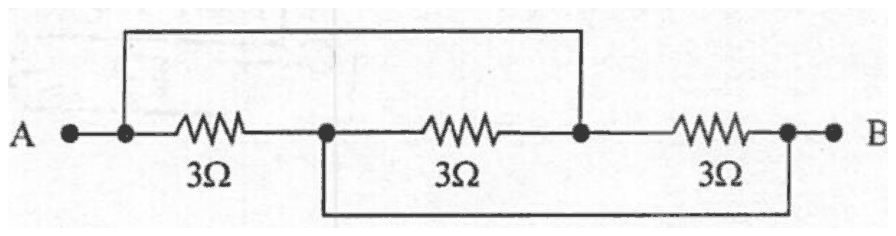
The equivalent resistance between points A and B for the following combination of resistors is
Your Answer : (Not Answered)
Correct Answer : A
The equivalent resistance is 1 Ω.
Label the junctions: P between the first and second resistors, Q between the second and third. One wire joins A to Q, so A and Q are the same node; the other joins P to B, so P and B are the same node. Then:
- the first resistor runs from A to P, that is from A to B;
- the second runs from P to Q, that is from B to A;
- the third runs from Q to B, that is from A to B.
All three 3 Ω resistors are connected between A and B in parallel, so R = 3/3 = 1 Ω. 9 Ω ignores the wires and treats them as in series.
If an infinitely long uniformly charged wire produces an electric field of intensity E at a distance of d from it, then the linear charge density λ of the wire is
Your Answer : (Not Answered)
Correct Answer : D
The linear charge density is \(\lambda = 2\pi\epsilon_{0}Ed\).
By Gauss's law, the field of an infinitely long uniformly charged wire at distance \(d\) is
\[ \begin{aligned} E &= \frac{\lambda}{2\pi\epsilon_{0}d} \\ \lambda &= 2\pi\epsilon_{0}Ed \end{aligned} \]
The other options drop or misplace the factor \(2\pi\), which comes from the curved surface area \(2\pi dl\) of the Gaussian cylinder.
Which one of the following materials has the highest modulus of elasticity?
Your Answer : (Not Answered)
Correct Answer : A
The highest modulus of elasticity belongs to steel.
Young's modulus of steel is about 200 GPa (2 × 10¹¹ N m-2). Copper is about 110 to 120 GPa, brass about 100 GPa, and aluminium and glass about 70 GPa.
That is why steel stretches less than these materials under the same stress and is preferred in structures such as bridges and cables. It is a common misconception that rubber or soft metals are 'more elastic'; in physics the stiffest material has the highest modulus.
A couple produces a
Your Answer : (Not Answered)
Correct Answer : D
A couple produces rotational motion.
A couple is a pair of equal, opposite, parallel forces whose lines of action do not coincide. Their vector sum is zero, so they produce no net force and no translation of the centre of mass. Their moments add, however, giving a net torque, so the body turns. Turning a tap or a steering wheel with two hands applies a couple.
Linear and translational motion need a net force, which a couple does not provide. A couple does not by itself produce vibrations.
The area under the curve drawn between the force F and time t is
Your Answer : (Not Answered)
Correct Answer : B
The area under a force-time graph is the impulse.
Impulse is defined as force multiplied by the time for which it acts, or for a varying force \(J = \int F\,dt\), which is exactly the area between the curve and the time axis. By Newton's second law, this area also equals the change in momentum of the body.
Work done is the area under a force-displacement graph, not force-time. Power is the rate of doing work, kinetic energy is \(\tfrac{1}{2}mv^{2}\), and torque is force times a perpendicular distance; none of these is a product of force and time.
The buoyant force on an object immersed in liquid acts in :
Your Answer : (Not Answered)
Correct Answer : B
The buoyant force acts in the upward direction.
Pressure in a liquid increases with depth, so the push on the bottom of an immersed object is greater than the push on its top. The net force, the buoyant force, therefore acts upwards, and by Archimedes' principle it equals the weight of the liquid displaced.
The sideways pressures cancel, so the force is not parallel to the surface, and it opposes the object's weight rather than acting downwards or in all directions.
Mathematics [ Question No: 12 To 15 ] :
\(\displaystyle\sum_{n=1}^{2025} i^{n}(1 + i), i^{2} = -1\) ,is equal to
Your Answer : (Not Answered)
Correct Answer : B
The sum equals \(i - 1\).
Take out the common factor \((1 + i)\). The powers of i repeat with period 4 and each block of four sums to 0 (\(i - 1 - i + 1 = 0\)). Since \(2025 = 4 \times 506 + 1\), only the last term survives:
\[ \begin{aligned} \sum_{n=1}^{2025} i^{n} &= i^{2025} = i \\ i(1 + i) &= i + i^{2} = i - 1 \end{aligned} \]
\(i + 1\) forgets that \(i^{2} = -1\), and the other options come from leaving an extra term or a sign in the cycle.
The trick in all such sums is that \(i + i^{2} + i^{3} + i^{4} = 0\), so only the remainder of the number of terms on division by 4 matters.
\(2^{11}\sin\left(\dfrac{x}{2^{10}}\right)\cos\left(\dfrac{x}{2}\right)\)\(\cos\left(\dfrac{x}{2^{2}}\right)\cos\left(\dfrac{x}{2^{3}}\right)\)\(...\cos\left(\dfrac{x}{2^{10}}\right)\) is equal to
Your Answer : (Not Answered)
Correct Answer : B
The expression equals \(2\sin x\).
Use \(\sin\theta\cos\theta = \frac{1}{2}\sin 2\theta\) repeatedly, starting from the smallest angle:
\[ \begin{aligned} \sin\tfrac{x}{2^{10}}\cos\tfrac{x}{2^{10}} &= \tfrac{1}{2}\sin\tfrac{x}{2^{9}} \\ \tfrac{1}{2}\sin\tfrac{x}{2^{9}}\cos\tfrac{x}{2^{9}} &= \tfrac{1}{2^{2}}\sin\tfrac{x}{2^{8}} \end{aligned} \]
Each of the 10 cosines halves the product and doubles the angle, so the product of the sine and all ten cosines is \(\frac{1}{2^{10}}\sin x\). Multiplying by \(2^{11}\):
\[ 2^{11} \times \frac{\sin x}{2^{10}} = 2\sin x \]
Treating \(2^{11}\) as cancelling exactly would give \(\sin x\); it leaves one factor of 2 over.
If \(|f(x_{1}) - f(x_{2})| \leq (x_{1} - x_{2})^{2}, x_{1}, x_{2} \in \mathbb{R}\) and if \(f(0) = 2026\) , then \(f(2025)\) is equal to
Your Answer : (Not Answered)
Correct Answer : D
\(f(2025)\) is 2026.
Divide the condition by \(|x_{1} - x_{2}|\) for \(x_{1} \neq x_{2}\):
\[ \begin{aligned} \left|\frac{f(x_{1}) - f(x_{2})}{x_{1} - x_{2}}\right| \\ &\leq |x_{1} - x_{2}| \end{aligned} \]
Letting \(x_{2} \to x_{1}\), the right side tends to 0, so \(f'(x_{1}) = 0\) for every \(x_{1}\). A function with zero derivative everywhere is constant, so \(f(2025) = f(0) = 2026\). The other options assume \(f\) changes, which the condition forbids.
Let \(\vec{a}, \vec{b}, \vec{c}\) be any three vectors and m, n be scalars. Which one of the following is not true?
Your Answer : (Not Answered)
Correct Answer : D
The statement that is not true is \(m(\vec{a}.\vec{b}) = m\vec{a}.m\vec{b}\).
A scalar can be taken out of a dot product only once: \((m\vec{a}).(m\vec{b}) = m^{2}(\vec{a}.\vec{b})\). So the right side is m times too large unless m is 0 or 1.
The other statements are standard laws: vector addition is associative; scalar multiplication distributes over a sum of vectors and over a sum of scalars; and \(m(\vec{a} \times \vec{b}) = (m\vec{a}) \times \vec{b}\), because the scalar is applied to one factor of the cross product, not both.
Physical Chemistry [ Question No: 16 To 16 ] :
Symmetry operations of the four C2 axes perpendicular to the principal axis belong to the same class in the point group(s)
Your Answer : (Not Answered)
Correct Answer : B
The four perpendicular C2 axes fall in one class only in D4d.
In D4 and D4h, the four C2 axes perpendicular to the C4 axis are of two kinds: two (C2′) pass through opposite vertices of the square and two (C2″) bisect its edges. No operation of the group carries one kind into the other, so the character tables list them as 2C2′ and 2C2″, two separate classes.
In D4d the S8 operation rotates by 45 degrees and reflects, which carries each C2 axis into its neighbour. All four are then conjugate, and the character table lists them together as 4C2′. So D4h and D4d together is wrong too.
Inorganic Chemistry [ Question No: 17 To 20 ] :
The species with the lowest Valence Electron (VE) count is :
Your Answer : (Not Answered)
Correct Answer : C
The lowest count is [AuCl4]−, with 16 valence electrons.
Count the metal d electrons plus two electrons from each ligand donor:
- [AuCl4]−: Au(III) is d8, plus 4 × 2 = 8, total 16. Square planar d8 complexes are the classic stable 16-electron species.
- [V(CO)6]−: V(−I) is d6, plus 6 × 2 = 12, total 18.
- [Zn(en)3]2+: Zn(II) is d10, plus 6 donor N × 2 = 12, total 22.
- The six-coordinate Cu(II) amine complex: d9 plus 12, total 21.
So the gold complex has the fewest valence electrons.
The observed magnetic moment for the complex Cs2[CoCl4] is 4.59 B.M. The magnetic moment can be best explained by :
Your Answer : (Not Answered)
Correct Answer : C
The keyed answer is orbital contribution to the magnetic moment.
[CoCl4]2− is tetrahedral Co(II), d7, e4t23, with three unpaired electrons. The spin-only moment is:
\[ \mu_{s} = \sqrt{n(n+2)} = \sqrt{15} = 3.87\ \text{B.M.} \]
The observed 4.59 B.M. is well above this, so the spin-only value cannot explain it. The excess is an orbital contribution: the 4A2 ground state has none of its own, but spin-orbit coupling mixes in the excited 4T2 state, which does, giving \(\mu = \mu_{s}(1 - 4\lambda/\Delta)\) with negative λ for a more-than-half-filled shell. The key names the result, the orbital contribution, rather than the coupling that brings it in. Temperature independent paramagnetism is far too small to add 0.7 B.M.
Which one of the statements is not the limitation of valence bond theory of complexes?
Your Answer : (Not Answered)
Correct Answer : C
The statement that is not a limitation is It explains the colour exhibited by coordination compounds.
Valence bond theory in fact does not explain the colour of coordination compounds; that is one of its well-known limitations, and crystal field theory explains colour through d-d transitions. A statement that VBT explains colour cannot be listed as a limitation.
The other four are its recognised limitations: no quantitative account of thermodynamic stability or magnetic data, no distinction between weak and strong ligands, and no exact prediction of tetrahedral or square planar structures for 4-coordinate complexes.
From a carboxymethyl-cellulose column at pH 6.0, arginine, valine and glutamic acid will elute in the order
Your Answer : (Not Answered)
Correct Answer : D
The order of elution is glutamic acid, valine, arginine.
Carboxymethyl-cellulose carries -CH2COO- groups, so it is a cation exchanger: it holds positively charged molecules and lets negative ones through. What matters is each amino acid's net charge at pH 6.0, which follows from its isoelectric point:
- glutamic acid, pI about 3.2: net negative, repelled by the column, elutes first;
- valine, pI about 6.0: near zero net charge, weakly held, elutes next;
- arginine, pI about 10.8: net positive, bound strongly, elutes last.
The orders starting with arginine would be right for an anion exchanger such as DEAE-cellulose, which is the usual confusion here.
Marks
Total number of questions : 20
Number of answered questions : 0
Number of unanswered questions : 20