
Instruction
- Total number of questions : 20
- Time allotted : 30:00 Minutes:Seconds.
- Each question carry 1 mark, no negative marks.
- DO NOT refresh the page.
- All the best
Quantitative Aptitude [ Question No: 1 To 7 ] :
Direction for [ Question No: 1 To 1 ] :
The stacked bar chart below shows the production of three different crops (Wheat, Rice, and Maize) in a state over six years (in lakh tonnes). Study the chart to answer the questions.
What was the total production of all three crops combined in the year 2018?
A cone of height 24 cm and radius of base 6 cm is made up of a modelling clay. It is reshaped into the form of a sphere. What is the radius of sphere
On a certain sum, the difference between compound interest and simple interest at 10% p.a. for 2 years is ₹ 126. Find the sum. (in ₹).
If |9y−6| =3, then y2 −4y/3 is _______.
The value of \(\sin(2A)\) is given by:
If the length is increased by 25%, by what percent the width of a rectangle should be decreased so as to keep the area same.
Simplfy: \(b - [b -(a+b) - {b - (b - a+b)} + 2a]\)
Reasoning [ Question No: 8 To 12 ] :
Direction for [ Question No: 8 To 8 ] :
Self-medication has evolved rapidly over the years to provide symptomatic relief for minor ailments. One can safely define responsible self-medication, as the informed and rationale choice of consumers, to treat themselves and their family members with appropriate, affordable drugs of acceptable quality. Responsible self-medication can help prevent and treat symptoms and ailments that do not require medical consultation. Moreover, it also reduces the increasing pressure on medical, services for the relief of minor ailments, especially when financial and human resources are limited. Worldwide, more and more governments are accepting the self-medication concept. Self-medication is a fact of life. With its broad use and social acceptance, no health policy should ignore self-medication. Rather, health policy should ask how this momentum can be leveraged to help achieve its objective.
Self-medication reduces considerably pressure on health care system of any country.
Direction for [ Question No: 9 To 9 ] :
In each question below is given a statement followed by two conclusions numbered I and II. You have to assume everything in the statement to be true, then consider the two conclusions together and decide which of them logically follows beyond a reasonable doubt from the information given in the statement.
Give answer:
- (A) If only conclusion I follows
- (B) If only conclusion II follows
- (C) If either I or II follows
- (D) If neither I nor II follows and
- (E) If both I and II follow.
Statements: Population increase coupled with depleting resources is going to be the scenario of many developing countries in days to come.
Conclusions:
1. The population of developing countries will not continue to increase in future.
2. It will be very difficult for the governments of developing countries to provide its people decent quality of life.
Direction for [ Question No: 10 To 10 ] :
In this type of question, some words are given. You have to arrange these words in a meaningful order. The order may be according to age, size and need etc.
Arrange the words given below in a meaningful sequence
1. Cutting 2. Dish 3. Vegetable 4. Market 5. Cooking
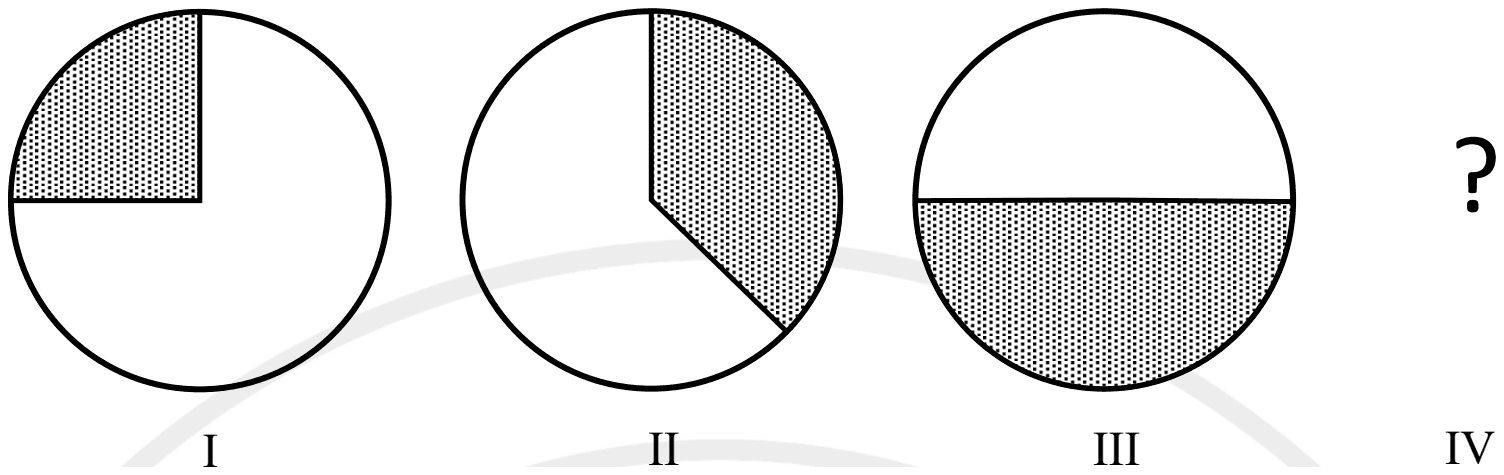
The figures I, II and III are parts of a sequence. Which one of the following options comes next in the sequence at IV?
If - means x, x means +, + means 4, and + means then 40x 12 + 3- 6 + 60 = ?
English Language [ Question No: 13 To 17 ] :
Direction for [ Question No: 13 To 13 ] :
Read the passage given below and answer the questions that follow :
Soon some idea struck her and she went to the window and hollered, 'Roopa! Roopa!' After calling out for Roopa, she had a look at the things that she had brought for her. Roopa had to sit for her home science examination the next day and Tarawati had collected things like some kitchen items, a bucket, a mug and a stool that Roopa required for the practical examination.
While looking at the things that she had collected for Roopa, Tarawati recalled her husband who had died a few years ago. She remembered him berating her for not treating Roopa well. 'Roopa's mother! Do not think only sons deserve all love and care and not daughters'. I'm determined to give Roopa good education so that she leads a happy and meaningful life. You are not educated yourself. That's probably why you don't want her to be educated. This is not fair on your part. You must change your views and let her grow and flower into a happy, confident individual.'
Thinking of her husband's admonition on this account, Tarawati felt emotional. The fact of the matter was that Roopa's parents differed on Roopa's upbringing and fought with each other on the issue. The fight continued for days together and often it was Roopa who intervened to broker peace between them. On his death-bed too, Roopa's father had cried and pleaded with her to treat Roopa in a nice manner. Hugging Roopa, he had told Tarawati, 'Take care of Roopa. Give her good education and let her decide the course of her life herself.' While recalling the interaction, tears rolled down Tarawati's eyes.
Meanwhile, the evening shadows were getting darker. Tarawati was exhausted and had a headache too. She looked at her dust-laden feet and then around the room. In order to bring some semblance of order, she forced herself to get up and get going. Then she called her daughter again, Roopa! Roopa!'.
The next day, Roopa had to appear in her examination in __________.
Direction for [ Question No: 14 To 14 ] :
Directions : Read the passage given below and answer the questions that follow by selecting the correct / most appropriate options.
If asked, "What matters are related to health i.e. health decisions ?" most of us would answer - hospitals, doctors and pills. Yet we are all making a whole range of decisions about our health which go beyond this limited area of doctors, pills etc. For example, whether or not to smoke, take exercise, wear a seat belt, drive a motor bike, drink alcohol regularly etc. The way we reach decisions and form attitudes about our health is only just beginning to be understood.
The main paradox is why people consistently do things which are known to be very hazardous. Two interesting examples of this are smoking and not wearing seat belts. Addiction makes smokers keep on smoking and whether to wear a seat belt or not is affected by safety considerations. Taken together both these examples show how people reach decisions about their health. Understanding this process is crucial. Only then can we effectively change public attitude towards voluntary activities like smoking.
Smokers run the risk of contracting heart disease, several times more as compared to non-smokers. Even lung cancer. Despite extensive press campaigns which have regularly told smokers and car drivers the grave risks they are running, the number of smokers and non-wearers of seat belts has remained much the same. Although the numbers of deaths from road accidents and smoking are well publicized, they have aroused little public interest.
If we give smokers the real figures of deaths caused by smoking, will it affect their views on the dangers of smoking ? Unfortunately not. Many of the real figures are in the form of probable estimates, and evidence shows that people are very bad at understanding this kind of information.
Study the following statements :
(a) Though it is very dangerous, some people don't quit smoking.
(b) Whether or not to drink alcohol is not a health decision.
Direction for [ Question No: 15 To 15 ] :
In the following section the sentences have been given in Direct or Indirect speech. From the given alternatives, choose the most appropriate sentence that best suits the given sentence in Indirect or Direct speech.
He said to interviewer, "Could you please repeat the question?"
Direction for [ Question No: 16 To 16 ] :
In response to the increasing environmental damage wrought by poachers, authorities placed a ban on ivory in the 1980s. Although the ban resulted in an initial decrease in the sale and trade of illegal ivory and a concurrent increase in the elephant population, more pressing needs caused most Western nations to withdraw funding for poaching prevention programs. Without significant financial support, poorer countries were unable to effectively combat poachers. The resulting explosion in the ivory trade has seen prices increase to nearly 10 times the $45 per pound price at the beginning of the decade.
Unfortunately, the countries with the worst poaching problems have also tended to be the ones least able to combat the problem due to unstable political systems, corruption, lack of comprehensive enforcement programs, or some combination of all these factors. One primary hindrance to better enforcement of the ivory ban came from an inability to definitively identify the country of origin of illegal ivory.
Countries used this uncertainty to avoid responsibility for curbing illegal poaching in their territories by attempting to blame other countries for the oversights in enforcement. Now, though, zoologists have perfected a new DNA identification system. First, scientists gathered genetic data from the population of African elephants, an arduous effort that ultimately resulted in a detailed DNA-based map of the distribution of African elephants. Then, the researchers developed a method to extract DNA evidence from ivory, allowing them to match the ivory with elephant populations on the map. Zoologists hope this new method will pinpoint the exact origin of poached ivory and force countries to accept their responsibility in enforcing the ban.
The passage suggests which of the following about the DNA-based map created by zoologists?
Match List-I with List-II :
| List-I Word | List-II Synonyms |
|---|---|
| (a) accomplish | (i) rude |
| (b) cordial | (ii) foolish |
| (c) arrogant | (iii) achieve |
| (d) absurd | (iv) friendly |
Choose the most appropriate answer from the options given below :
General Awareness / General Knowledge (GK) [ Question No: 18 To 20 ] :
President can make proclamation of Emergency under :
June 1 is observed as-
The Damodar Valley Corporation was modelled on which foreign project?
Total number of questions : 20
Number of answered questions : 0
Number of unanswered questions : 20
Quantitative Aptitude [ Question No: 1 To 7 ] :
Direction for [ Question No: 1 To 1 ] :
The stacked bar chart below shows the production of three different crops (Wheat, Rice, and Maize) in a state over six years (in lakh tonnes). Study the chart to answer the questions.
What was the total production of all three crops combined in the year 2018?
Your Answer : (Not Answered)
Correct Answer : B
Add the three segments of the 2018 bar.
\[ \text{wheat } 60 + \text{rice } 50 + \text{maize } 50 = 160 \text{ lakh tonnes} \]
A cone of height 24 cm and radius of base 6 cm is made up of a modelling clay. It is reshaped into the form of a sphere. What is the radius of sphere
Your Answer : (Not Answered)
Correct Answer : A
The radius of the sphere is 6 cm.
Reshaping keeps the volume of clay the same:
\[ \begin{aligned} \tfrac{1}{3}\pi (6)^{2}(24) &= \tfrac{4}{3}\pi r^{3} \\ 288\pi &= \tfrac{4}{3}\pi r^{3} \\ r^{3} &= 216, \quad r = 6\ \text{cm} \end{aligned} \]
It happens to equal the base radius of the cone. The other radii give far more clay than there is: a sphere of radius 8 cm already has a volume of about \(683\pi\) cm³, against the cone's \(288\pi\).
On a certain sum, the difference between compound interest and simple interest at 10% p.a. for 2 years is ₹ 126. Find the sum. (in ₹).
Your Answer : (Not Answered)
Correct Answer : B
The sum is ₹ 12,600.
For 2 years, the difference between compound and simple interest is the interest on the first year's interest:
\[ \begin{aligned} CI - SI &= P \left(\tfrac{R}{100}\right)^{2} \\ 126 &= P \times 0.01 \\ P &= 12600 \end{aligned} \]
Check: on ₹ 12,600 at 10%, simple interest for 2 years is ₹ 2,520 and compound interest is ₹ 2,646, a difference of ₹ 126.
If |9y−6| =3, then y2 −4y/3 is _______.
Your Answer : (Not Answered)
Correct Answer : C
The value is \(-\frac{1}{3}\).
\(|9y - 6| = 3\) gives \(9y - 6 = 3\) or \(9y - 6 = -3\), so \(y = 1\) or \(y = \frac{1}{3}\). Evaluate \(y^{2} - \frac{4y}{3}\) for each:
\[ \begin{aligned} y = 1 &: 1 - \tfrac{4}{3} = -\tfrac{1}{3} \\ y = \tfrac{1}{3} &: \tfrac{1}{9} - \tfrac{4}{9} = -\tfrac{1}{3} \end{aligned} \]
Both roots give the same value, so the expression is well defined and equals \(-\frac{1}{3}\). The value \(+\frac{1}{3}\) is a sign slip, 0 would need \(y = \frac{4}{3}\), and 'undefined' would only apply if the two roots gave different values.
The value of \(\sin(2A)\) is given by:
Your Answer : (Not Answered)
Correct Answer : C
The double-angle identity for sine is
\[ \sin 2A = 2\sin A \cos A \]
The option \( \cos^{2}A - \sin^{2}A \) is \( \cos 2A \), the companion identity - the pair most easily transposed.
If the length is increased by 25%, by what percent the width of a rectangle should be decreased so as to keep the area same.
Your Answer : (Not Answered)
Correct Answer : B
The area must stay fixed, so the two factors have to multiply to 1.
\[ 1.25 \times (1 - d) = 1 \quad\Longrightarrow\quad 1 - d = \frac{1}{1.25} = 0.8 \]
\[ d = 0.2 = 20\% \]
A 25% rise is undone by a 20%, not a 25%, fall, because the reduction applies to the larger figure. The general rule is
\[ d = \frac{x}{100 + x} \times 100 = \frac{25}{125} \times 100 = 20\% \]
Simplfy: \(b - [b -(a+b) - {b - (b - a+b)} + 2a]\)
Your Answer : (Not Answered)
Correct Answer : D
\(b-[b-(a+b)-{b-(b-a+b)}+2a]\)
\(=b-[b-a-b-{b-(2b-a)}+2a]\)
\(=b-[-a-{b-2b+a}+2a]\)
\(=b-[-a-{-b+a}+2a]\)
\(=b-[-a+b-a+2a]\)
\(=b-[-2a+b+2a]\)
\(=b-b\)
\(=0\)
Reasoning [ Question No: 8 To 12 ] :
Direction for [ Question No: 8 To 8 ] :
Self-medication has evolved rapidly over the years to provide symptomatic relief for minor ailments. One can safely define responsible self-medication, as the informed and rationale choice of consumers, to treat themselves and their family members with appropriate, affordable drugs of acceptable quality. Responsible self-medication can help prevent and treat symptoms and ailments that do not require medical consultation. Moreover, it also reduces the increasing pressure on medical, services for the relief of minor ailments, especially when financial and human resources are limited. Worldwide, more and more governments are accepting the self-medication concept. Self-medication is a fact of life. With its broad use and social acceptance, no health policy should ignore self-medication. Rather, health policy should ask how this momentum can be leveraged to help achieve its objective.
Self-medication reduces considerably pressure on health care system of any country.
Your Answer : (Not Answered)
Correct Answer : A
Correct answer: Definitely true
The passage states this among the benefits: responsible self-medication reduces the increasing pressure on medical services for the relief of minor ailments, especially where financial and human resources are limited. That is the claim the statement makes, and the passage frames it as a general proposition rather than one confined to a particular country.
Direction for [ Question No: 9 To 9 ] :
In each question below is given a statement followed by two conclusions numbered I and II. You have to assume everything in the statement to be true, then consider the two conclusions together and decide which of them logically follows beyond a reasonable doubt from the information given in the statement.
Give answer:
- (A) If only conclusion I follows
- (B) If only conclusion II follows
- (C) If either I or II follows
- (D) If neither I nor II follows and
- (E) If both I and II follow.
Statements: Population increase coupled with depleting resources is going to be the scenario of many developing countries in days to come.
Conclusions:
1. The population of developing countries will not continue to increase in future.
2. It will be very difficult for the governments of developing countries to provide its people decent quality of life.
Your Answer : (Not Answered)
Correct Answer : B
Correct answer: Only conclusion II follows
Conclusion I contradicts the statement, which expressly foresees the population increasing. Conclusion II is what a rising population and shrinking resources together imply - that providing a decent standard of living will be hard. Only II follows.
Direction for [ Question No: 10 To 10 ] :
In this type of question, some words are given. You have to arrange these words in a meaningful order. The order may be according to age, size and need etc.
Arrange the words given below in a meaningful sequence
1. Cutting 2. Dish 3. Vegetable 4. Market 5. Cooking
Your Answer : (Not Answered)
Correct Answer : C
Correct answer: 4, 3, 1, 5, 2
The words run in order of the steps in preparing a meal: Market → Vegetable → Cutting → Cooking → Dish.
The figures I, II and III are parts of a sequence. Which one of the following options comes next in the sequence at IV?
Your Answer : (Not Answered)
Correct Answer : B
The next figure is (B).
Two things change from figure to figure. The shaded sector grows by 45° each time: 90° in I, 135° in II and 180° in III, so IV must shade 225°. And the sector's starting edge turns 90° clockwise each time: I starts at 9 o'clock, II at 12 o'clock and III at 3 o'clock, so IV must start at 6 o'clock.
A 225° sector running clockwise from 6 o'clock covers the left side and the top and ends at about half past one, leaving 135° unshaded on the right. That is option (B).
(A) shades only a half, like III. (C) shades a sector of about 135°, and (D) shades the right side, the mirror image of the required figure.
If - means x, x means +, + means 4, and + means then 40x 12 + 3- 6 + 60 = ?
Your Answer : (Not Answered)
Correct Answer : D
Correct answer: None of these
Substituting turns the expression into one whose value falls outside every figure offered, so the answer is none of them. The stem’s list of definitions has been damaged - one sign appears against two different operations - but on any consistent reading of it the result is a value the three numbered options do not contain.
English Language [ Question No: 13 To 17 ] :
Direction for [ Question No: 13 To 13 ] :
Read the passage given below and answer the questions that follow :
Soon some idea struck her and she went to the window and hollered, 'Roopa! Roopa!' After calling out for Roopa, she had a look at the things that she had brought for her. Roopa had to sit for her home science examination the next day and Tarawati had collected things like some kitchen items, a bucket, a mug and a stool that Roopa required for the practical examination.
While looking at the things that she had collected for Roopa, Tarawati recalled her husband who had died a few years ago. She remembered him berating her for not treating Roopa well. 'Roopa's mother! Do not think only sons deserve all love and care and not daughters'. I'm determined to give Roopa good education so that she leads a happy and meaningful life. You are not educated yourself. That's probably why you don't want her to be educated. This is not fair on your part. You must change your views and let her grow and flower into a happy, confident individual.'
Thinking of her husband's admonition on this account, Tarawati felt emotional. The fact of the matter was that Roopa's parents differed on Roopa's upbringing and fought with each other on the issue. The fight continued for days together and often it was Roopa who intervened to broker peace between them. On his death-bed too, Roopa's father had cried and pleaded with her to treat Roopa in a nice manner. Hugging Roopa, he had told Tarawati, 'Take care of Roopa. Give her good education and let her decide the course of her life herself.' While recalling the interaction, tears rolled down Tarawati's eyes.
Meanwhile, the evening shadows were getting darker. Tarawati was exhausted and had a headache too. She looked at her dust-laden feet and then around the room. In order to bring some semblance of order, she forced herself to get up and get going. Then she called her daughter again, Roopa! Roopa!'.
The next day, Roopa had to appear in her examination in __________.
Your Answer : (Not Answered)
Correct Answer : A
The next day Roopa had to appear in her Home Science examination.
The first paragraph says directly: 'Roopa had to sit for her home science examination the next day', and Tarawati had collected kitchen items, a bucket, a mug and a stool for the practical. Chemistry, Biology and English are not mentioned anywhere in the passage, so each of them is a guess with no support in the text.
Direction for [ Question No: 14 To 14 ] :
Directions : Read the passage given below and answer the questions that follow by selecting the correct / most appropriate options.
If asked, "What matters are related to health i.e. health decisions ?" most of us would answer - hospitals, doctors and pills. Yet we are all making a whole range of decisions about our health which go beyond this limited area of doctors, pills etc. For example, whether or not to smoke, take exercise, wear a seat belt, drive a motor bike, drink alcohol regularly etc. The way we reach decisions and form attitudes about our health is only just beginning to be understood.
The main paradox is why people consistently do things which are known to be very hazardous. Two interesting examples of this are smoking and not wearing seat belts. Addiction makes smokers keep on smoking and whether to wear a seat belt or not is affected by safety considerations. Taken together both these examples show how people reach decisions about their health. Understanding this process is crucial. Only then can we effectively change public attitude towards voluntary activities like smoking.
Smokers run the risk of contracting heart disease, several times more as compared to non-smokers. Even lung cancer. Despite extensive press campaigns which have regularly told smokers and car drivers the grave risks they are running, the number of smokers and non-wearers of seat belts has remained much the same. Although the numbers of deaths from road accidents and smoking are well publicized, they have aroused little public interest.
If we give smokers the real figures of deaths caused by smoking, will it affect their views on the dangers of smoking ? Unfortunately not. Many of the real figures are in the form of probable estimates, and evidence shows that people are very bad at understanding this kind of information.
Study the following statements :
(a) Though it is very dangerous, some people don't quit smoking.
(b) Whether or not to drink alcohol is not a health decision.
Your Answer : (Not Answered)
Correct Answer : A
Statement (a) is right and (b) is wrong, so the answer is (a) is right and (b) is wrong.
The passage says people consistently do things known to be very hazardous, smoking being one, because addiction keeps smokers smoking; so (a) is right. Its list of health decisions includes 'drink alcohol regularly', so whether to drink alcohol is a health decision, and (b), which denies this, is wrong.
Direction for [ Question No: 15 To 15 ] :
In the following section the sentences have been given in Direct or Indirect speech. From the given alternatives, choose the most appropriate sentence that best suits the given sentence in Indirect or Direct speech.
He said to interviewer, "Could you please repeat the question?"
Your Answer : (Not Answered)
Correct Answer : C
Correct answer: He requested the interviewer to repeat the question
Could you please…? is a request in the form of a question, and a request is reported with requested… to + infinitive rather than with if. The politeness marker please is carried by the verb requested and is not repeated.
Direction for [ Question No: 16 To 16 ] :
In response to the increasing environmental damage wrought by poachers, authorities placed a ban on ivory in the 1980s. Although the ban resulted in an initial decrease in the sale and trade of illegal ivory and a concurrent increase in the elephant population, more pressing needs caused most Western nations to withdraw funding for poaching prevention programs. Without significant financial support, poorer countries were unable to effectively combat poachers. The resulting explosion in the ivory trade has seen prices increase to nearly 10 times the $45 per pound price at the beginning of the decade.
Unfortunately, the countries with the worst poaching problems have also tended to be the ones least able to combat the problem due to unstable political systems, corruption, lack of comprehensive enforcement programs, or some combination of all these factors. One primary hindrance to better enforcement of the ivory ban came from an inability to definitively identify the country of origin of illegal ivory.
Countries used this uncertainty to avoid responsibility for curbing illegal poaching in their territories by attempting to blame other countries for the oversights in enforcement. Now, though, zoologists have perfected a new DNA identification system. First, scientists gathered genetic data from the population of African elephants, an arduous effort that ultimately resulted in a detailed DNA-based map of the distribution of African elephants. Then, the researchers developed a method to extract DNA evidence from ivory, allowing them to match the ivory with elephant populations on the map. Zoologists hope this new method will pinpoint the exact origin of poached ivory and force countries to accept their responsibility in enforcing the ban.
The passage suggests which of the following about the DNA-based map created by zoologists?
Your Answer : (Not Answered)
Correct Answer : A
Correct answer: Its assemblage involved a great deal of work on the part of zoologists
The passage calls the gathering of genetic data from the African elephant population an arduous effort. What the map can do about responsibility or precision is not claimed in those terms, and nothing is said about updating it.
Match List-I with List-II :
| List-I Word | List-II Synonyms |
|---|---|
| (a) accomplish | (i) rude |
| (b) cordial | (ii) foolish |
| (c) arrogant | (iii) achieve |
| (d) absurd | (iv) friendly |
Choose the most appropriate answer from the options given below :
Your Answer : (Not Answered)
Correct Answer : B
The correct matching is (a)-(iii), (b)-(iv), (c)-(i), (d)-(ii).
- Accomplish means achieve, to complete something successfully (iii).
- Cordial means warm and friendly (iv).
- Arrogant means proud in a way that is rude to others (i).
- Absurd means foolish or ridiculous (ii).
Each of the other options pairs at least one word with a meaning that is unrelated, such as 'accomplish' with 'friendly'.
General Awareness / General Knowledge (GK) [ Question No: 18 To 20 ] :
President can make proclamation of Emergency under :
Your Answer : (Not Answered)
Correct Answer : D
The President proclaims a national emergency under Article 352.
The ground is war, external aggression or armed rebellion, and since the 44th Amendment the proclamation requires the written advice of the Cabinet. Article 356 covers President's rule in a state and Article 360 a financial emergency.
June 1 is observed as-
Your Answer : (Not Answered)
Correct Answer : D
1 June is observed as International Children's Day.
The date has been kept since 1950, chiefly in the former socialist countries and in much of Asia. The UN's own Universal Children's Day is 20 November, and India keeps Children's Day on 14 November.
The Damodar Valley Corporation was modelled on which foreign project?
Your Answer : (Not Answered)
Correct Answer : B
Correct answer: The Tennessee Valley Authority
The Damodar Valley Corporation, established in 1948, was modelled on the American Tennessee Valley Authority and was India’s first multipurpose river valley project. The Damodar was called the sorrow of Bengal for its devastating floods, and the corporation was created to control them while also generating power, providing irrigation and supporting navigation and afforestation - the integrated basin-wide approach the TVA had pioneered in the 1930s. It operates a series of dams across Jharkhand and West Bengal, including Tilaiya, Konar, Maithon and Panchet, together with thermal stations, and it supplies the industrial belt around Durgapur, Bokaro and Asansol - a region built on the coal of the Damodar valley fields. Its record is mixed. Flood control has been only partly achieved, since fewer dams were built than planned and siltation has reduced storage. It nonetheless set the pattern for Bhakra Nangal, Hirakud and the other projects of the period.
Marks
Total number of questions : 20
Number of answered questions : 0
Number of unanswered questions : 20