
Instruction
- Total number of questions : 20
- Time allotted : 30:00 Minutes:Seconds.
- Each question carry 1 mark, no negative marks.
- DO NOT refresh the page.
- All the best
Design of Machine Elements [ Question No: 1 To 20 ] :
The stress factor "K" used for design of closed coil helical spring is expressed as :
(Where C = spring index)
For bolts of uniform strength, the shank diameter is made equal to :
Which bolt is used in machine tool tables in which T-slots are cut to accommodate the T-heads ?
Match List - I with List - II :
| List - I | List - II |
|---|---|
| (a) Muff Coupling | (i) To transmit power between two parallel shafts |
| (b) Flange Coupling | (ii) To transmit power between two intersecting shafts with flexibility |
| (c) Oldham's Coupling | (iii) For rigid connection between two aligned shafts for power transmission |
| (d) Hooke's joint | (iv) For flexible connection between two shafts with some misalignment for transmitting power |
Choose the most appropriate answer from the options given below :
The piston rod and the crosshead in a steam engine are usually connected by means of :
Match List - I with List - II :
| List - I | List - II |
|---|---|
| (a) Unwin's formulae | (i) Bearing |
| (b) Wahl Factor | (ii) Rivets |
| (c) Reynold's equation | (iii) Gears |
| (d) Lewis form factor | (iv) Springs |
Choose the most appropriate answer from the options given below :
The angular contact bearing are designed to take which of the following type of load?
Which bearing withstand load is parallel to its axis?
The endurance limit of a specific grade of steel is same as its yield strength. The ultimate strength of this grade of steel is twice of its yield strength. A component made of this steel is loaded in tension and unloaded periodically. It is required that the component does NOT fail for at least \(10^{6}\) loading cycles, as per the Soderberg law. Considering a factor of safety of 2, the maximum applied tensile principal stress is
The S-N curve from a fatigue test for steel is shown. Which one of the options gives the endurance limit?
A fillet welded joint is subjected to transverse loading F as shown in the figure. Both legs of the fillets are of 10 mm size and the weld length is 30 mm. If the allowable shear stress of the weld is 94 MPa, considering the minimum throat area of the weld, the maximum allowable transverse load in kN is

Pre-tensioning of a bolted joint is used to
A shaft carries a helical spur gear. Which one of the following bearings can NOT be used to support it?
A self-aligning ball bearing has a basic dynamic load rating (C10, for 106 revolutions) of 35 kN. If the equivalent radial load on the bearing is 45 kN, the expected life (in 106 revolutions) is
For an Oldham coupling used between two shafts, which among the following statements are correct?
I. Torsional load is transferred along shaft axis.
II. A velocity ratio of 1:2 between shafts is obtained without using gears.
III. Bending load is transferred transverse to shaft axis.
IV. Rotation is transferred along shaft axis.
Consider the schematic of a riveted lap joint subjected to tensile load F, as shown below. Let d be the diameter of the rivets, and Sf be the maximum permissible tensile stress in the plates. What should be the minimum value for the thickness of the plates to guard against tensile failure of the plates? Assume the plates to be identical.
Which bearing type is best suited to handle misalignment between the shaft and the housing?
In the context of fatigue failure, the S-N curve of a material represents the relation between:
Which type of flexible coupling can compensate for all types of misalignments but can contribute to vibration in well-aligned units?
Identify the power transmission device from the figure below.

Total number of questions : 20
Number of answered questions : 0
Number of unanswered questions : 20
Design of Machine Elements [ Question No: 1 To 20 ] :
The stress factor "K" used for design of closed coil helical spring is expressed as :
(Where C = spring index)
Your Answer : (Not Answered)
Correct Answer : D
The Wahl stress factor is \(K = \frac{4C - 1}{4C - 4} + \frac{0.615}{C}\).
In a helical spring the maximum shear stress is \(\tau = K \frac{8WD}{\pi d^{3}}\). The Wahl factor K allows for two effects the simple torsion formula misses: the direct shear from the axial load, and the higher stress on the inside of the coil caused by its curvature.
The first term, \(\frac{4C - 1}{4C - 4}\), carries the curvature effect and the second, \(\frac{0.615}{C}\), the direct shear. With a typical spring index C = 6 the factor is about 1.25.
The other options invert or rearrange the fraction. \(\frac{4C - 4}{4C - 1}\) is less than 1, which would mean the spring is stressed less than the simple formula says, the opposite of what the factor corrects.
For bolts of uniform strength, the shank diameter is made equal to :
Your Answer : (Not Answered)
Correct Answer : D
The shank is made equal to the minor diameter of the threads.
In an ordinary bolt, the threaded portion has the smallest area, at the root (minor or core) diameter, so under a shock load the stress and the strain energy concentrate there. A bolt of uniform strength has its shank turned down, or bored hollow, to the same area as the thread core. The stress is then the same along the whole length, and the long shank can absorb more strain energy before failure.
Making the shank equal to the nominal or major diameter is the ordinary bolt, which is what the design avoids. The pitch diameter is still larger than the core, so the shank would remain stiffer and lower-stressed than the threads.
Which bolt is used in machine tool tables in which T-slots are cut to accommodate the T-heads ?
Your Answer : (Not Answered)
Correct Answer : D
Machine tool tables use the T-headed bolt.
Machine tool tables have T-shaped slots cut along them. The head of a T-bolt slides into the slot and is held under its lips, so the bolt can be positioned anywhere along the slot to clamp a workpiece or fixture, and the head cannot turn.
A countersunk-headed bolt sits flush in a conical recess, a hook bolt is used where a hole cannot be drilled through one of the parts, and an eye-bolt is used for lifting heavy machines. None of them is designed to locate in a T-slot.
Match List - I with List - II :
| List - I | List - II |
|---|---|
| (a) Muff Coupling | (i) To transmit power between two parallel shafts |
| (b) Flange Coupling | (ii) To transmit power between two intersecting shafts with flexibility |
| (c) Oldham's Coupling | (iii) For rigid connection between two aligned shafts for power transmission |
| (d) Hooke's joint | (iv) For flexible connection between two shafts with some misalignment for transmitting power |
Choose the most appropriate answer from the options given below :
Your Answer : (Not Answered)
Correct Answer : D
The key's answer is (a)-(iii), (b)-(i), (c)-(iv), (d)-(ii).
Two pairs are certain and decide it. A muff coupling is a rigid sleeve keyed over the ends of two aligned shafts (a-iii), and a Hooke's joint connects two shafts whose axes intersect at an angle (d-ii). Only option D has both.
D also pairs Oldham's coupling with (iv): it is a flexible coupling that accepts some misalignment, specifically a small lateral offset between parallel shafts. That leaves the flange coupling against (i), which is loose wording, since a flange coupling rigidly joins two collinear shafts. The option set contains no perfectly exact pairing, and D is the one consistent with the two certain matches.
The piston rod and the crosshead in a steam engine are usually connected by means of :
Your Answer : (Not Answered)
Correct Answer : B
The piston rod and crosshead are joined by a cotter joint.
A cotter joint connects two rods that carry an axial load, tension or compression, which is exactly what the piston rod transmits to the crosshead in a steam engine. The tapered cotter draws the parts tight and can be knocked out for dismantling.
A knuckle joint is used where the two rods need some angular movement, as in valve rods and tie bars. A universal joint connects intersecting shafts that transmit torque, and a plain pin joint would allow rotation that the piston rod-crosshead connection must not have.
Match List - I with List - II :
| List - I | List - II |
|---|---|
| (a) Unwin's formulae | (i) Bearing |
| (b) Wahl Factor | (ii) Rivets |
| (c) Reynold's equation | (iii) Gears |
| (d) Lewis form factor | (iv) Springs |
Choose the most appropriate answer from the options given below :
Your Answer : (Not Answered)
Correct Answer : A
The correct matching is (a)-(ii), (b)-(iv), (c)-(i), (d)-(iii).
- Unwin's formula, \(d = 6\sqrt{t}\) (mm), gives the rivet diameter from the plate thickness: rivets (a-ii).
- The Wahl factor corrects the shear stress in a helical spring for curvature and direct shear (b-iv).
- Reynolds' equation governs the pressure in a hydrodynamic oil film, the basis of journal bearing design (c-i).
- The Lewis form factor appears in the Lewis equation for the bending strength of gear teeth (d-iii).
The other options give the Wahl factor to gears or Unwin's formula to bearings, neither of which is where they are used.
The angular contact bearing are designed to take which of the following type of load?
Your Answer : (Not Answered)
Correct Answer : D
Angular contact bearings are designed to take axial thrust and radial load together.
The raceways are offset so that the line of contact through each ball makes an angle with the bearing axis. A load along that line has both a radial and an axial component, so the bearing carries a combined load, with axial thrust in one direction; they are often fitted in pairs to take thrust both ways, as in machine tool spindles.
A bearing for radial load alone is a plain deep groove or roller bearing, and one for axial thrust alone is a thrust bearing. 'Axial and vertical thrust' is not a meaningful pair, since vertical describes an orientation, not a type of load.
Which bearing withstand load is parallel to its axis?
Your Answer : (Not Answered)
Correct Answer : B
The bearing that carries load parallel to its axis is the thrust bearing.
A load along the shaft axis is an axial or thrust load, and thrust bearings, such as ball and roller thrust bearings and the thrust collars on lathe spindles, are built to take it.
Needle bearings are roller bearings with thin rollers for radial loads in small spaces. Plain bearings (bushes) and split bearings, which are plain bearings made in two halves so they can be fitted around a shaft, also carry radial load, that is, load at right angles to the axis.
The endurance limit of a specific grade of steel is same as its yield strength. The ultimate strength of this grade of steel is twice of its yield strength. A component made of this steel is loaded in tension and unloaded periodically. It is required that the component does NOT fail for at least \(10^{6}\) loading cycles, as per the Soderberg law. Considering a factor of safety of 2, the maximum applied tensile principal stress is
Your Answer : (Not Answered)
Correct Answer : B
The maximum stress is half of the endurance limit.
Loading in tension and unloading gives a repeated cycle from 0 to \(\sigma\), so \(\sigma_{a} = \sigma_{m} = \sigma/2\). Soderberg's line with factor of safety N reads \(\sigma_{a}/S_{e} + \sigma_{m}/S_{y} = 1/N\). With \(S_{e} = S_{y}\):
\[ \begin{aligned} \frac{\sigma/2}{S_{e}} + \frac{\sigma/2}{S_{e}} &= \frac{1}{2} \\ \sigma &= S_{e}/2 \end{aligned} \]
The ultimate strength plays no part in Soderberg's criterion, which uses yield. One-fourth applies the factor of safety twice, the endurance limit itself ignores it, and twice the endurance limit exceeds the yield strength.
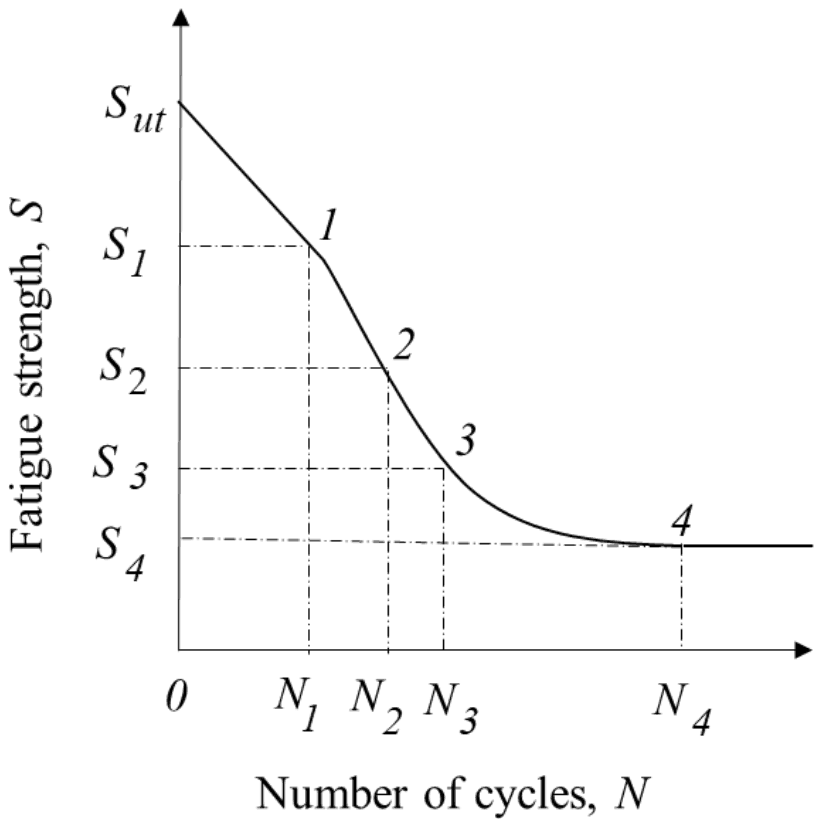
The S-N curve from a fatigue test for steel is shown. Which one of the options gives the endurance limit?
Your Answer : (Not Answered)
Correct Answer : D
The endurance limit is \(S_{4}\).
For steel, the S-N curve falls as the number of cycles rises and then levels off into a horizontal line, here from point 4 at about \(N_{4}\) cycles onward. The stress at that horizontal part is the endurance limit: a specimen loaded below it can survive an unlimited number of cycles.
\(S_{ut}\), where the curve meets the stress axis, is the ultimate tensile strength, the stress that breaks the specimen in a single loading. \(S_{2}\) and \(S_{3}\) are fatigue strengths at finite lives \(N_{2}\) and \(N_{3}\): the specimen fails after that many cycles, so they are not limits below which life is unlimited.
A fillet welded joint is subjected to transverse loading F as shown in the figure. Both legs of the fillets are of 10 mm size and the weld length is 30 mm. If the allowable shear stress of the weld is 94 MPa, considering the minimum throat area of the weld, the maximum allowable transverse load in kN is
Your Answer : (Not Answered)
Correct Answer : C
The key's answer is 19.93 kN.
For a fillet weld with equal legs of size s, the minimum throat is \(t = s\cos 45^{\circ} = 0.707s\). The key's value comes from taking the stated weld length of 30 mm as the total length of weld resisting the load:
\[ \begin{aligned} A &= 0.707 \times 10 \times 30 = 212.1\ \text{mm}^{2} \\ F &= 94 \times 212.1 = 19\,937\ \text{N} \approx 19.93\ \text{kN} \end{aligned} \]
The figure shows a fillet along the edge of each plate. If each of the two fillets were itself 30 mm long, the throat area and the load would double, to about 39.9 kN, which is not among the options, so the question intends 30 mm as the whole length of weld.
Using the full leg size of 10 mm instead of the throat gives 28.2 kN, also not offered; the other options do not follow from the throat-area method.
Pre-tensioning of a bolted joint is used to
Your Answer : (Not Answered)
Correct Answer : C
Pre-tensioning is used to increase stiffness of the bolted joint.
Tightening the bolt clamps the members together under compression. Under external load, the clamped members unload while the bolt carries only a fraction of the load, so the joint deflects much less than a loose one, stays closed and resists separation and leakage. The bolt also sees a smaller alternating load, which improves its fatigue life.
Pre-tension does not aim to strain-harden the bolt head, and it does not prevent yielding at the thread root; excessive pre-tension can in fact cause yielding there. It increases, not decreases, the joint's effective stiffness.
A shaft carries a helical spur gear. Which one of the following bearings can NOT be used to support it?
Your Answer : (Not Answered)
Correct Answer : C
The bearing that can NOT be used is the straight roller bearing.
A helical gear produces an axial (thrust) force as well as radial load, because its teeth are inclined to the axis. A straight (cylindrical) roller bearing carries radial load only and has essentially no thrust capacity.
Angular contact bearings and tapered roller bearings are designed for combined radial and axial loads, and a double-row ball bearing also takes moderate thrust in both directions.
A self-aligning ball bearing has a basic dynamic load rating (C10, for 106 revolutions) of 35 kN. If the equivalent radial load on the bearing is 45 kN, the expected life (in 106 revolutions) is
Your Answer : (Not Answered)
Correct Answer : A
The expected life is below 0.5 million revolutions.
For ball bearings the load-life relation uses the exponent 3:
\[ \begin{aligned} L_{10} &= \left(\frac{C}{P}\right)^{3} = \left(\frac{35}{45}\right)^{3} \\ &= 0.778^{3} = 0.47 \times 10^{6}\ \text{rev} \end{aligned} \]
The load exceeds the basic dynamic rating, so the life must be less than the rated 106 revolutions, and the cube makes it fall below half. Using the roller-bearing exponent 10/3 would give 0.43, still below 0.5. The range 0.5 to 0.8 corresponds to forgetting the cube (C/P = 0.78), and the larger ranges are impossible when P exceeds C.
For an Oldham coupling used between two shafts, which among the following statements are correct?
I. Torsional load is transferred along shaft axis.
II. A velocity ratio of 1:2 between shafts is obtained without using gears.
III. Bending load is transferred transverse to shaft axis.
IV. Rotation is transferred along shaft axis.
Your Answer : (Not Answered)
Correct Answer : B
The correct statements are I and IV.
An Oldham coupling joins two parallel shafts whose axes are slightly offset. A central disc with perpendicular tongues slides in slots on the two flanges, so torque and rotation are passed from one shaft to the other along the shaft axis (I and IV).
The shafts turn at the same speed, a velocity ratio of 1:1, so statement II (1:2) is wrong. The coupling is meant to accommodate lateral misalignment while transmitting torque, not to carry bending load across the shaft axis, so statement III is not among the correct ones. That leaves I and IV.
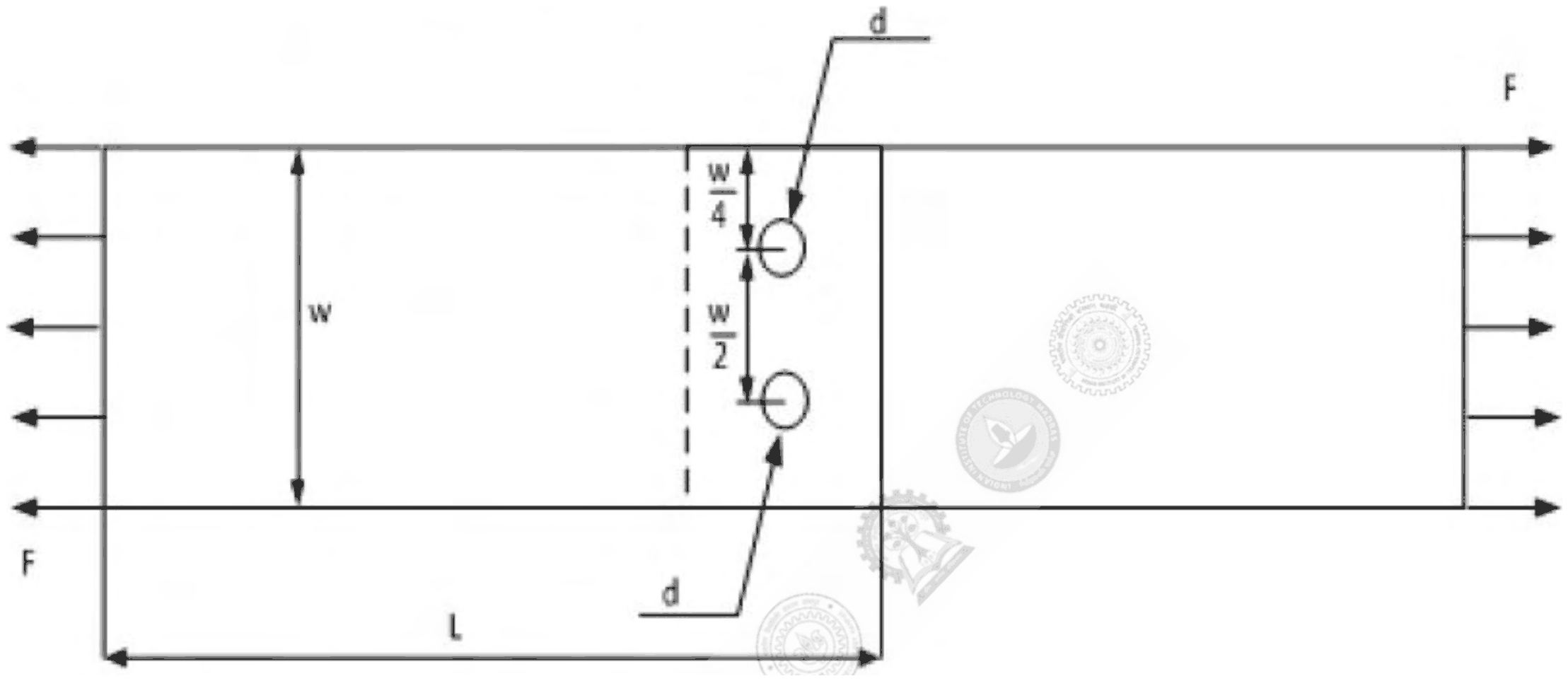
Consider the schematic of a riveted lap joint subjected to tensile load F, as shown below. Let d be the diameter of the rivets, and Sf be the maximum permissible tensile stress in the plates. What should be the minimum value for the thickness of the plates to guard against tensile failure of the plates? Assume the plates to be identical.
Your Answer : (Not Answered)
Correct Answer : A
The minimum plate thickness is \(\frac{F}{S_{f}(W - 2d)}\).
The weakest tensile section of each plate is the line through the rivet holes. Two rivets of diameter d lie in that row, so the net width there is W - 2d, and the whole load F passes through it:
\[ \begin{aligned} S_{f}\,t\,(W - 2d) &\ge F \\ t &\ge \frac{F}{S_{f}(W - 2d)} \end{aligned} \]
F/(SfW) ignores the holes (the gross section). W - d removes only one hole, and 2F/(SfW) doubles the load without removing any holes.
Which bearing type is best suited to handle misalignment between the shaft and the housing?
Your Answer : (Not Answered)
Correct Answer : A
A spherical roller bearing is best suited to handle misalignment between the shaft and the housing, because its outer race has a spherical surface that allows the rollers to adjust. Thrust ball bearings carry axial loads, angular contact ball bearings carry combined loads and are sensitive to misalignment, and needle roller bearings need good alignment, so they are not suited to misalignment.
Self-aligning ball and spherical roller bearings tolerate misalignment of about 1.5 to 3 degrees, while other types tolerate only a fraction of a degree.
In the context of fatigue failure, the S-N curve of a material represents the relation between:
Your Answer : (Not Answered)
Correct Answer : C
The S-N curve shows the relation between stress amplitude and the number of cycles to failure. It is plotted from fatigue tests at different stress levels and is used to find the endurance limit. The stress intensity factor belongs to fracture mechanics, strain amplitude is used in low cycle fatigue (the strain-life curve), and elastic modulus is a constant property of the material, so the other options are wrong.
On the S-N curve the stress amplitude is plotted against the number of cycles on a logarithmic axis, and for steels the curve flattens at the endurance limit.
Which type of flexible coupling can compensate for all types of misalignments but can contribute to vibration in well-aligned units?
Your Answer : (Not Answered)
Correct Answer : C
The key gives the jaw coupling as the flexible coupling that can compensate for all types of misalignment but can add vibration in well aligned units. A jaw coupling has an elastomer spider between two jaws that absorbs shock and allows a small angular, parallel and axial misalignment. A screw coupling is not a flexible type, and diaphragm and disc couplings are torsionally stiff and cope with some misalignment but are not given in the key for this description.
Identify the power transmission device from the figure below.
Your Answer : (Not Answered)
Correct Answer : D
The picture shows a universal coupling (Hooke's joint), where two forked yokes are joined by a cross-shaped pin so that the shafts can transmit power while their axes are inclined at an angle. A socket coupling is a plain sleeve for two collinear shafts and a sprocket is a toothed wheel for a chain, not a coupling. The Oldham coupling joins two parallel shafts whose axes are offset slightly, using a central sliding disc.
Marks
Total number of questions : 20
Number of answered questions : 0
Number of unanswered questions : 20