
Instruction
- Total number of questions : 20
- Time allotted : 30:00 Minutes:Seconds.
- Each question carry 1 mark, no negative marks.
- DO NOT refresh the page.
- All the best
Engineering Mechanics [ Question No: 1 To 20 ] :
If a particle is subjected to a system of coplanar and concurrent forces in X-Y plane, the vector equation must satisfy :
The second moment of a circular area about the diameter is given by : ( 'D' is the diameter)
The moment of inertia of semicircular Lamina with radius r about its centroidal axis parallel to axis x-x i.e. Ixx is :
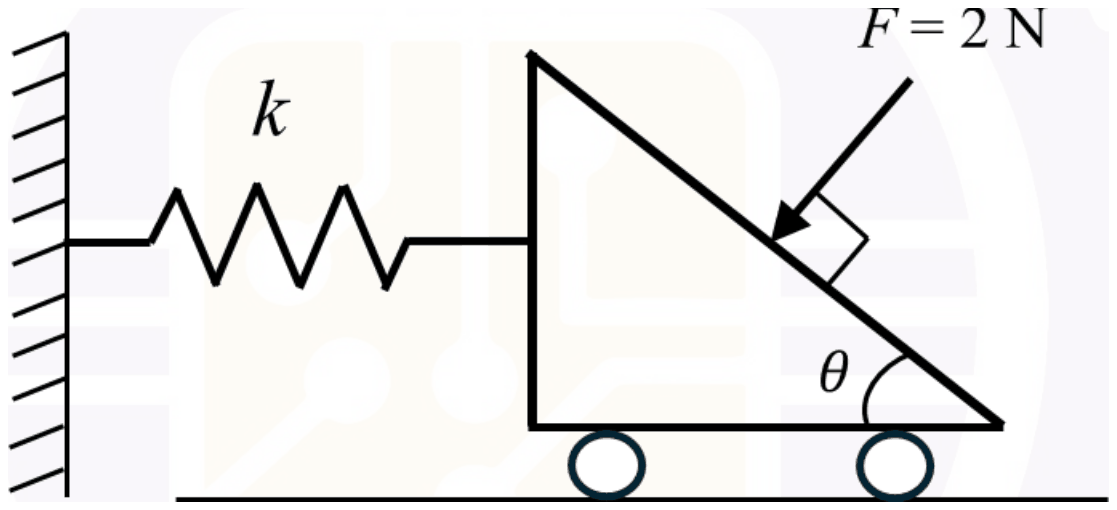
The force (F) acting on the block, as shown in the figure is 2 N. The stiffness of the spring (k) is 100 N/m.
Assume that the block is in static equilibrium and its mass is negligible.
If the static deflection of the spring \((\Delta)\) is 0.01 m, which one of the following is the corresponding angle \((\theta)\) in radians?
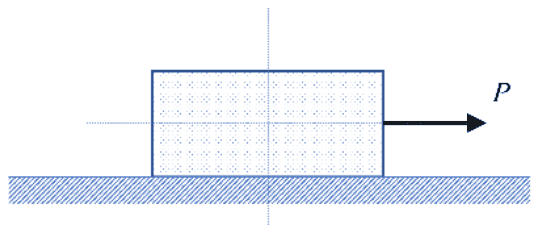
A block of weight \(W\), placed on a surface, is subjected to a horizontal force \(P\) as shown in the figure. The line of action of force \(P\) passes through the center-of-gravity of the block. The magnitude of \(P\) is such that the block remains at rest. If \(N\) is the resultant normal reaction exerted by the surface, and \(F\) is the frictional force acting on the bottom surface of the block, then which of the following represents the correct free body diagram of the block?
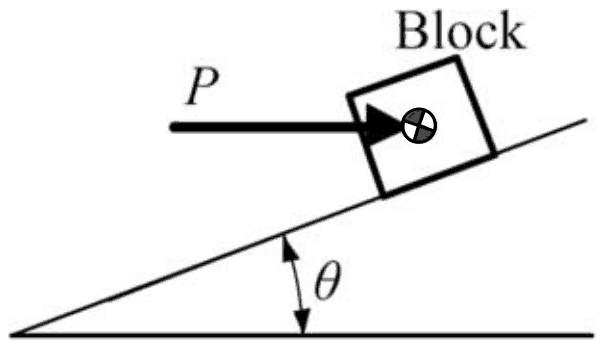
A horizontal effort P is applied to raise a block of weight W on a rough surface inclined at an angle θ with the horizontal. If \(\mu_{s}\) is the coefficient of static friction between the block and the surface, the minimum effort P required to impend the upward motion of the block along the surface is
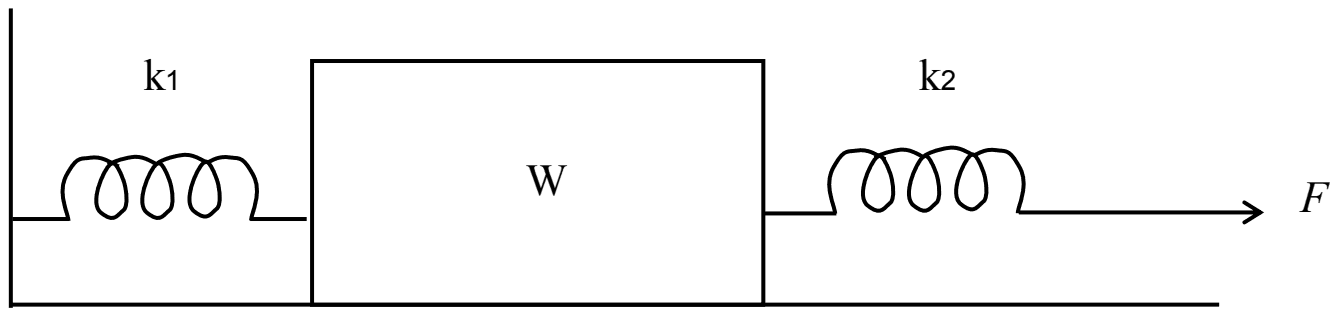
A block of weight W, connected to two springs with spring constants \(k_{1}\) and \(k_{2}\), rests initially on a horizontal frictional surface. The coefficient of static friction between the block and the surface is \(\mu\). Both springs are initially undeformed. The magnitude of force F, applied to the second spring, is now gradually increased. The block will start to slide when F becomes
A horizontal disk has a radial frictionless slot in which a small block is confined to slide. The disk turns anticlockwise about its centre with a constant angular velocity of 3 rad/s. If the block slides along the slot with a constant speed of 0.2 m/s relative to the slot, then the magnitude of Coriolis acceleration in \(\text{m/s}^{2}\) is
Two axial members, namely OP and OQ, are pin joined at O as shown in the figure. A force F acts at point P along the positive x direction and a force \(\sqrt{3}F\) acts at point Q along the positive y direction.
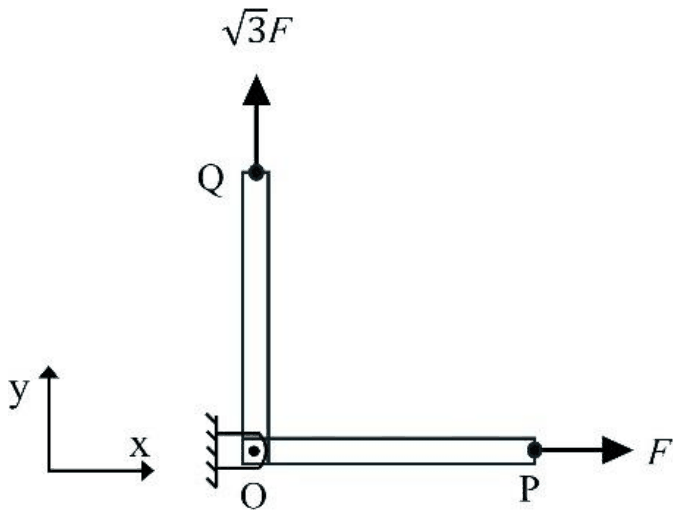
The resultant of the applied forces makes an angle \(\theta\) (anticlockwise from the positive x-axis).
The value of \(\theta\) is ___.
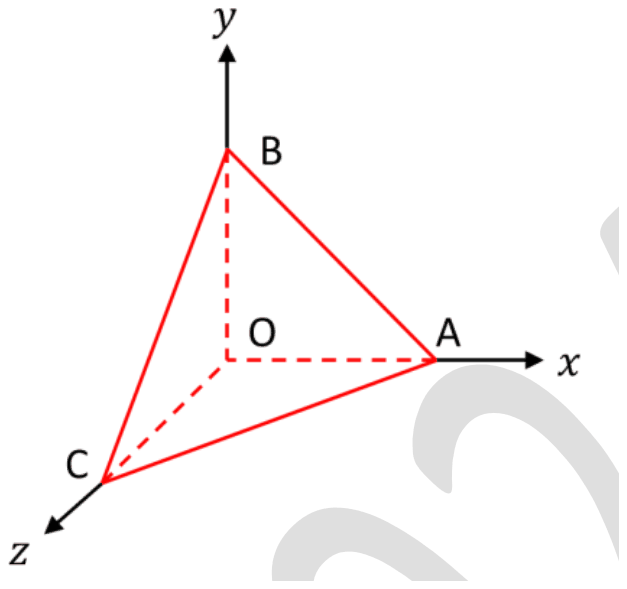
A rigid massless tetrahedron is placed such that vertex O is at the origin and the other three vertices A, B, and C lie on the coordinate axes as shown in the figure. The body is acted on by three point loads, of which one is acting at A along \(x\)-axis and another at point B along \(y\)-axis. For the body to be in equilibrium, the third point load acting at point O must be
An ice-skater starts spinning during her performance. As she retracts her arms and legs closer to her body, her angular velocity _________________.
The options show frames consisting of rigid bars connected by pin joints. Which one of the frames is non-rigid?
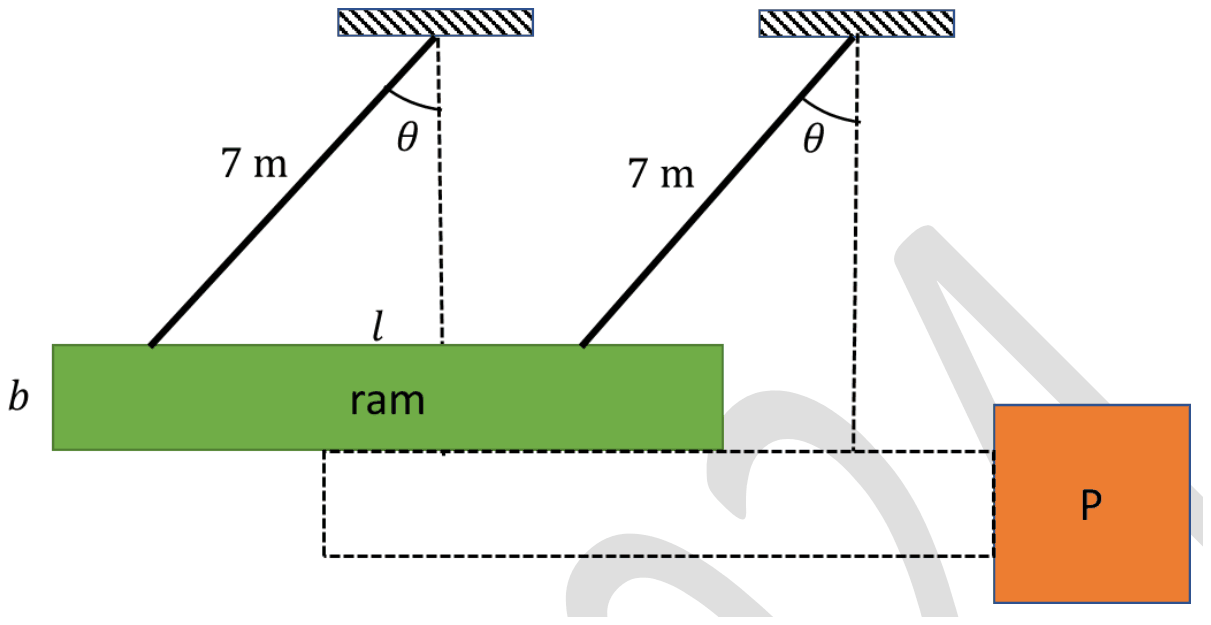
A ram in the form of a rectangular body of size \(l = 9\) m and \(b = 2\) m is suspended by two parallel ropes of lengths 7 m. Assume the center-of-mass of the body is at its geometric center and \(g = 9.81\) m/s2. For striking the object P with a horizontal velocity of 5 m/s, what is the angle \(\theta\) with the vertical from which the ram should be released from rest?
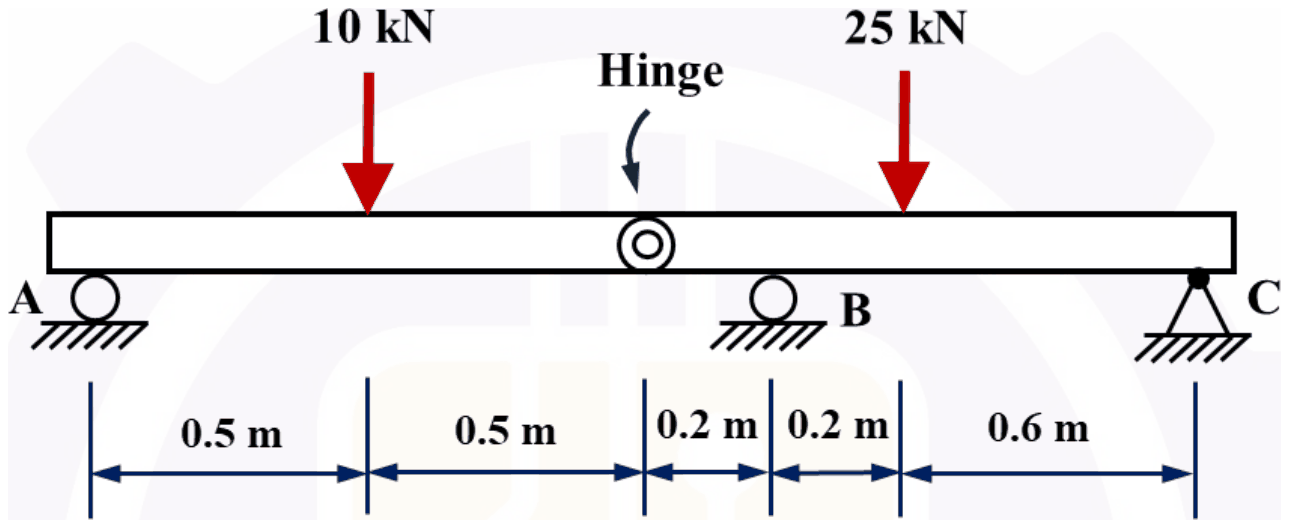
Two structural members are connected by a hinge and they are externally loaded as shown in the figure below. A and B are roller supports, and C is a pin support. Neglecting the mass of the members, the magnitude of the vertical reaction force at C in kN is
A bar of uniform cross section and weighing 100 N is held horizontally using two massless and inextensible strings S1 and S2 as shown in the figure.
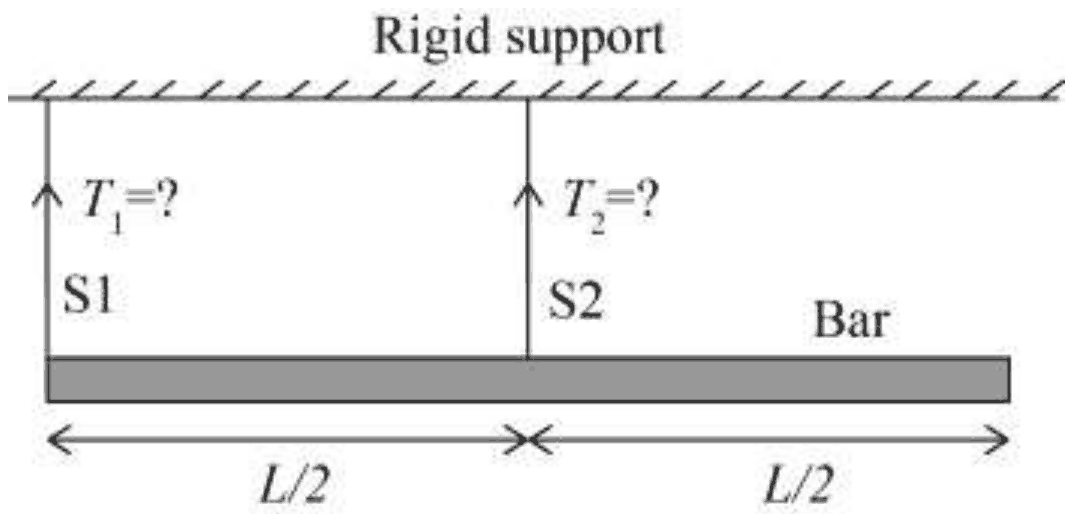
The tensions in the strings are
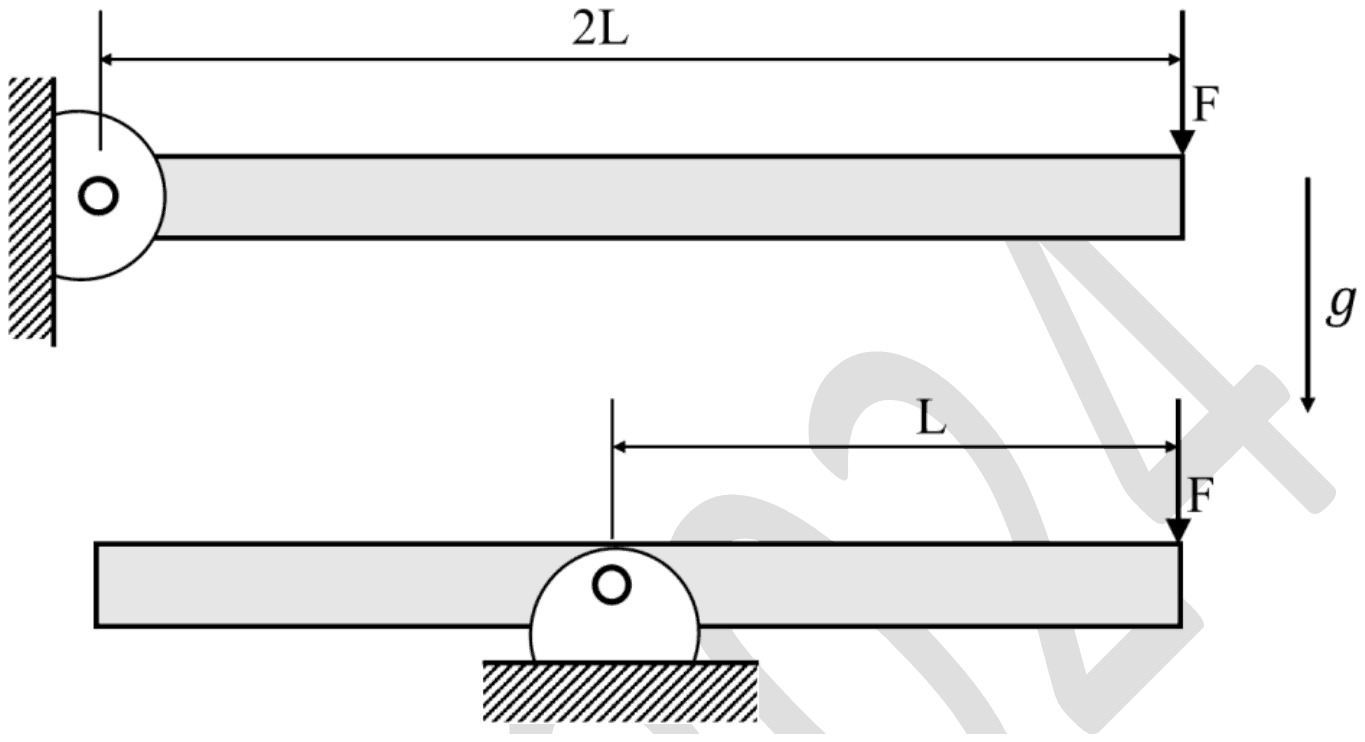
Two identical rigid slender bars of length 2L and mass \(m\) are acted upon by a transverse force F at one of the ends as shown in the figure. In the first case, the bar is pinned at the other end. In the second case, the bar is pinned at its mid-point. What should be the magnitude of the force F such that the resulting angular accelerations of the two bars are equal?
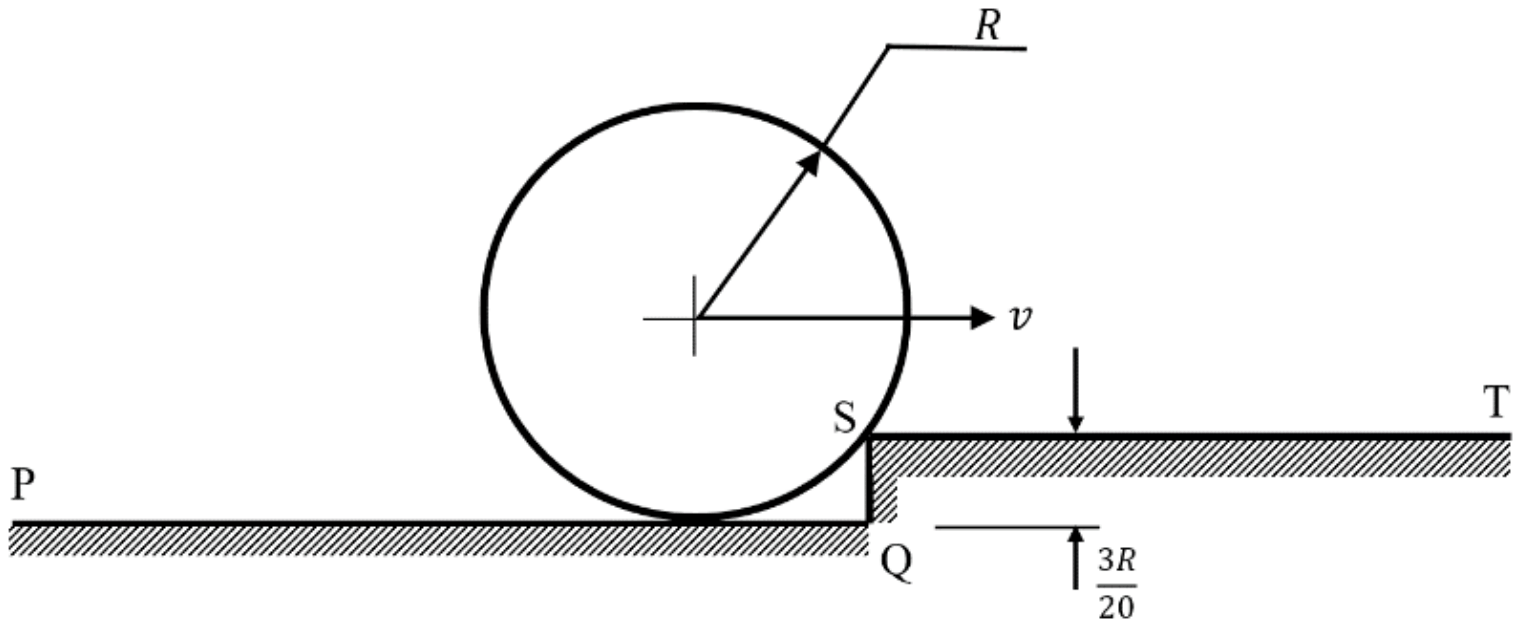
A solid uniform rigid disk of mass \(m\) and radius \(R\) rolls without slipping along a horizontal surface PQ. The speed of the center of the disk is \(v\). The disk then strikes a hurdle of height \(\frac{3R}{20}\) at point S. During the impact, there is no rebound or slip at S and no impulse from the surface PQ. The magnitude of the velocity of the center of the disk immediately after the impact is
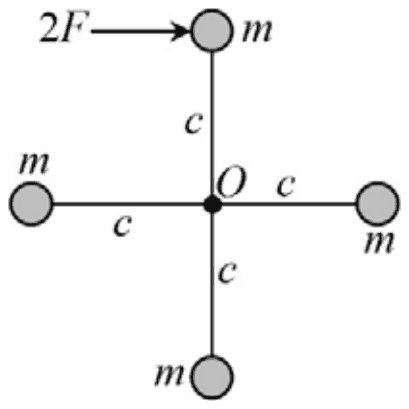
The assembly of four masses connected by rigid mass-less rods is kept on a smooth horizontal floor as shown in the figure. Under the applied force \(2F\), the magnitude of angular acceleration of the assembly at the instant shown is
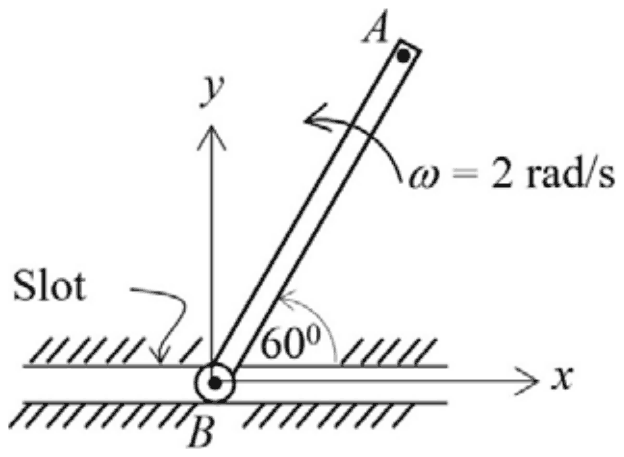
End \(B\) of the 2 m long rigid rod \(AB\) is constrained to move horizontally in the slot as shown in the figure and has a velocity of 1.0 i m/s. The angular velocity of the rod at the instant shown is 2 rad/s. The unit vectors along \(x\) and \(y\) directions are denoted respectively as i and j. The velocity of point \(A\) in m/s is then given by
Consider two forces \(\vec{A}\) and \(\vec{B}\) of magnitudes A and B and their resultant force \(\vec{R}\) has magnitude R. If the B is doubled, then R is also doubled. Similarly, if B is reversed, then also R is doubled. Then the ratio A : B : R is:
Total number of questions : 20
Number of answered questions : 0
Number of unanswered questions : 20
Engineering Mechanics [ Question No: 1 To 20 ] :
If a particle is subjected to a system of coplanar and concurrent forces in X-Y plane, the vector equation must satisfy :
Your Answer : (Not Answered)
Correct Answer : D
The particle must satisfy both \(\Sigma f_{x} = 0\) and \(\Sigma f_{y} = 0\).
For a particle in equilibrium under coplanar concurrent forces, the vector sum of the forces must be zero, \(\Sigma \vec{F} = 0\). In the X-Y plane that one vector equation splits into two scalar equations, one along each axis.
If only \(\Sigma f_{x} = 0\) held, a resultant along Y would remain, and the particle would accelerate in that direction; the same is true the other way round. The first option, with \(\Sigma f_{y} \neq 0\), describes a particle that is not in equilibrium at all. No moment equation is needed, because concurrent forces all pass through one point.
The second moment of a circular area about the diameter is given by : ( 'D' is the diameter)
Your Answer : (Not Answered)
Correct Answer : D
The second moment of area about a diameter is \(\frac{\pi D^{4}}{64}\).
The polar moment about the centre is \(J = \frac{\pi D^{4}}{32}\). By the perpendicular axis theorem it equals the sum of the moments about two perpendicular diameters, which are equal by symmetry.
\[ I_{d} = \frac{J}{2} = \frac{\pi D^{4}}{64} \]
\(\pi D^{4}/32\) is the polar moment, the usual trap. \(\pi D^{4}/4\) and \(\pi D^{4}/16\) do not correspond to the second moment of a circle about any of these axes.
The moment of inertia of semicircular Lamina with radius r about its centroidal axis parallel to axis x-x i.e. Ixx is :
Your Answer : (Not Answered)
Correct Answer : C
The moment of inertia is \(0.11\, r^4\).
About its diameter, a semicircle has \(I = \frac{\pi r^4}{8}\). Its centroid lies \(\bar{y} = \frac{4r}{3\pi}\) from the diameter, so the parallel axis theorem gives the centroidal value:
\[ \begin{aligned} I_{xx} &= \frac{\pi r^4}{8} - \frac{\pi r^2}{2}\left(\frac{4r}{3\pi}\right)^2 \\ &= 0.3927r^4 - 0.2829r^4 \\ &= 0.11\, r^4 \end{aligned} \]
0.22 r4 is twice the value, and 0.055 r4 half of it. Forgetting to subtract the parallel axis term would leave 0.39 r4, which is not offered.
The force (F) acting on the block, as shown in the figure is 2 N. The stiffness of the spring (k) is 100 N/m.
Assume that the block is in static equilibrium and its mass is negligible.
If the static deflection of the spring \((\Delta)\) is 0.01 m, which one of the following is the corresponding angle \((\theta)\) in radians?
Your Answer : (Not Answered)
Correct Answer : D
The angle is \(\theta = \frac{\pi}{6}\).
The force F is normal to the sloping face, which makes angle \(\theta\) with the horizontal base, so F makes the same angle \(\theta\) with the vertical. Its horizontal component pushes the block towards the wall and is resisted by the spring; the vertical component is taken by the floor.
\[ \begin{aligned} F\sin\theta &= k\Delta = 100 \times 0.01 = 1\ \text{N} \\ \sin\theta &= \frac{1}{2},\ \theta = \frac{\pi}{6} \end{aligned} \]
Using the cosine instead of the sine gives \(\pi/3\), the complementary angle. \(\pi/4\) and \(\pi/5\) give horizontal components of 1.41 N and 1.18 N, which do not match the spring force of 1 N.
A block of weight \(W\), placed on a surface, is subjected to a horizontal force \(P\) as shown in the figure. The line of action of force \(P\) passes through the center-of-gravity of the block. The magnitude of \(P\) is such that the block remains at rest. If \(N\) is the resultant normal reaction exerted by the surface, and \(F\) is the frictional force acting on the bottom surface of the block, then which of the following represents the correct free body diagram of the block?
Your Answer : (Not Answered)
Correct Answer : B
The correct free body diagram is (B).
A free body diagram shows the block alone, with every external force: W at the centre of gravity, P through the centre of gravity, friction F at the base opposing P, and the normal reaction N. Horizontal balance gives F = P and vertical balance N = W.
F acts at the base, below the line of P, so P and F form a couple that tends to tip the block forward. To balance it, N must act at a point shifted forward of W's line, in the direction of P, by \(x = Ph/W\) for P at height h. Diagram (B) shows this shift.
In (A) N and W are collinear, leaving the P-F couple unbalanced. In (C) N is shifted the wrong way. (D) draws the supporting surface, which a free body diagram must leave out, and has N in line with W.
A horizontal effort P is applied to raise a block of weight W on a rough surface inclined at an angle θ with the horizontal. If \(\mu_{s}\) is the coefficient of static friction between the block and the surface, the minimum effort P required to impend the upward motion of the block along the surface is
Your Answer : (Not Answered)
Correct Answer : B
The minimum effort is \(W\left(\frac{\mu_{s} + \tan\theta}{1 - \mu_{s}\tan\theta}\right)\).
When upward motion impends, friction \(\mu_{s}N\) acts down the slope. Resolve along and normal to the incline for the horizontal force P:
\[ \begin{aligned} P\cos\theta &= W\sin\theta + \mu_{s}N \\ N &= W\cos\theta + P\sin\theta \end{aligned} \]
Substituting and dividing by \(\cos\theta\) gives \(P(1 - \mu_{s}\tan\theta) = W(\tan\theta + \mu_{s})\), the keyed expression (equal to \(W\tan(\theta + \phi)\) with \(\tan\phi = \mu_{s}\)).
The expressions with \(\mu_{s} - \tan\theta\) belong to a block about to slide down, and the one with \(1 + \mu_{s}\tan\theta\) in the denominator gets the sign of the normal-force contribution of P wrong.
A block of weight W, connected to two springs with spring constants \(k_{1}\) and \(k_{2}\), rests initially on a horizontal frictional surface. The coefficient of static friction between the block and the surface is \(\mu\). Both springs are initially undeformed. The magnitude of force F, applied to the second spring, is now gradually increased. The block will start to slide when F becomes
Your Answer : (Not Answered)
Correct Answer : A
The block starts to slide when F = \(\mu W\).
Spring \(k_{2}\) transmits the full pull F to the block, whatever its stiffness, since it is massless and in series with the applied force. Spring \(k_{1}\) is tied to the wall and is undeformed at the start; it can only exert a force once the block moves and stretches it.
So while the block is at rest, static friction alone resists F, and slipping begins when F reaches the limiting friction \(\mu W\). The options with stiffness ratios would apply only if the block had already been displaced, so that \(k_{1}\) were carrying part of the load.
A horizontal disk has a radial frictionless slot in which a small block is confined to slide. The disk turns anticlockwise about its centre with a constant angular velocity of 3 rad/s. If the block slides along the slot with a constant speed of 0.2 m/s relative to the slot, then the magnitude of Coriolis acceleration in \(\text{m/s}^{2}\) is
Your Answer : (Not Answered)
Correct Answer : A
The Coriolis acceleration is 1.2 \(\text{m/s}^{2}\).
For a body moving with velocity \(v\) relative to a frame rotating at \(\omega\), with \(v\) perpendicular to the rotation axis, the Coriolis component is \(2\omega v\):
\[ \begin{aligned} a_{c} &= 2\omega v = 2 \times 3 \times 0.2 \\ &= 1.2\ \text{m/s}^{2} \end{aligned} \]
0.6 omits the factor 2, 2.4 doubles it again, and 0.3 is neither. The direction is perpendicular to the slot, but the question asks only for the magnitude.
Two axial members, namely OP and OQ, are pin joined at O as shown in the figure. A force F acts at point P along the positive x direction and a force \(\sqrt{3}F\) acts at point Q along the positive y direction.
The resultant of the applied forces makes an angle \(\theta\) (anticlockwise from the positive x-axis).
The value of \(\theta\) is ___.
Your Answer : (Not Answered)
Correct Answer : C
The resultant makes an angle of 60° with the positive x-axis.
The two forces are perpendicular, F along x and \(\sqrt{3}F\) along y. Their resultant has components (F, \(\sqrt{3}F\)), so:
\[ \begin{aligned} \tan\theta &= \frac{\sqrt{3}F}{F} = \sqrt{3} \\ \theta &= 60^{\circ},\quad |R| = 2F \end{aligned} \]
30° is the angle the resultant makes with the y-axis, a slip from swapping the components. 45° would need equal components, and 75° has no basis.
A rigid massless tetrahedron is placed such that vertex O is at the origin and the other three vertices A, B, and C lie on the coordinate axes as shown in the figure. The body is acted on by three point loads, of which one is acting at A along \(x\)-axis and another at point B along \(y\)-axis. For the body to be in equilibrium, the third point load acting at point O must be
Your Answer : (Not Answered)
Correct Answer : B
The third load must act in the x - y plane but not along x or y axis.
The load at A acts along the x-axis and A lies on that axis, so its line of action passes through O. Likewise the load at B acts along the y-axis, through O. The third load acts at O itself. All three lines pass through O, so the moments about O are zero automatically, and equilibrium needs only the forces to sum to zero:
\[ \mathbf{F}_{O} = -(F_{A}\,\hat{i} + F_{B}\,\hat{j}) \]
With both given loads non-zero, this force has x and y components and no z component: it lies in the x-y plane but along neither axis. A force along the z-axis, or in the y-z or z-x planes, would leave an unbalanced component in x or y.
An ice-skater starts spinning during her performance. As she retracts her arms and legs closer to her body, her angular velocity _________________.
Your Answer : (Not Answered)
Correct Answer : A
Her angular velocity increases.
The ice exerts almost no torque about the vertical axis, so the skater's angular momentum \(L = I\omega\) is conserved. Pulling her arms and legs in brings mass closer to the axis and reduces her moment of inertia I, so \(\omega\) must increase to keep \(I\omega\) constant.
A decrease would happen if she extended her limbs. The angular velocity would stay the same only if I were unchanged, and it would go to zero only under an external braking torque.
The options show frames consisting of rigid bars connected by pin joints. Which one of the frames is non-rigid?
Your Answer : (Not Answered)
Correct Answer : C
The non-rigid frame is (C).
A pin-jointed frame is rigid when it is built up from triangles, each new joint fixed by two bars to points already fixed. In frame (C) the left bay has a diagonal and the right bay is braced by crossing bars through a central pin, but the middle bay is a plain quadrilateral with no diagonal. Four bars pinned at their ends form a mechanism: the middle bay can sway into a parallelogram, carrying the right bay with it, so the frame as a whole is not rigid.
Frame (A) is two triangles sharing a bar. Frame (B) is a chain of triangles, each sharing an edge with the last, closed by a final triangle at the bottom right. Frame (D) has a diagonal in every bay. All three are rigid.
A ram in the form of a rectangular body of size \(l = 9\) m and \(b = 2\) m is suspended by two parallel ropes of lengths 7 m. Assume the center-of-mass of the body is at its geometric center and \(g = 9.81\) m/s2. For striking the object P with a horizontal velocity of 5 m/s, what is the angle \(\theta\) with the vertical from which the ram should be released from rest?
Your Answer : (Not Answered)
Correct Answer : C
The ram should be released from 35.1°.
Because the two ropes are equal and parallel, the ram does not rotate: it moves in curvilinear translation, every point travelling on a circle of radius 7 m. Its size (9 m by 2 m) therefore does not enter. When released from angle \(\theta\), its centre of mass falls by \(7(1 - \cos\theta)\), and energy conservation gives the speed at the bottom:
\[ \begin{aligned} v^{2} &= 2gL(1 - \cos\theta) \\ 1 - \cos\theta &= \frac{25}{2 \times 9.81 \times 7} = 0.1820 \\ \cos\theta &= 0.8180 \Rightarrow \theta = 35.1^{\circ} \end{aligned} \]
The larger angles would give striking speeds well above 5 m/s; for example 67.1° corresponds to about 9.2 m/s.
Two structural members are connected by a hinge and they are externally loaded as shown in the figure below. A and B are roller supports, and C is a pin support. Neglecting the mass of the members, the magnitude of the vertical reaction force at C in kN is
Your Answer : (Not Answered)
Correct Answer : A
The vertical reaction at C is 5 kN.
The hinge transmits no moment, so treat the left member A-hinge first. It is 1 m long with the 10 kN load at its middle, so A and the hinge each carry 5 kN. The hinge therefore pushes 5 kN down on the right member.
The right member runs from the hinge to C (1.0 m), with roller B 0.2 m from the hinge and the 25 kN load 0.4 m from the hinge. Take moments about B:
\[ \begin{aligned} R_{C}(0.8) &= 25(0.2) - 5(0.2) = 4 \\ R_{C} &= 5\ \text{kN} \end{aligned} \]
Then \(R_{B} = 30 - 5 = 25\) kN. Answers of 10, 15 or 20 come from treating the beam as one continuous member, ignoring the hinge's zero-moment condition.
A bar of uniform cross section and weighing 100 N is held horizontally using two massless and inextensible strings S1 and S2 as shown in the figure.
The tensions in the strings are
Your Answer : (Not Answered)
Correct Answer : B
The tensions are T1 = 0 N and T2 = 100 N.
The bar is uniform, so its 100 N weight acts at its midpoint, and string S2 is attached exactly there. Take moments about the midpoint: T2 has no moment arm, the weight has none either, and T1 acts L/2 away. For rotational equilibrium T1 × L/2 = 0, so T1 = 0, and vertical balance then gives T2 = 100 N.
Splitting the weight 75/25 or 25/75 would be right only if the strings were placed elsewhere, and T1 = 100 N with T2 = 0 would leave the weight with a moment about S1, so the bar would rotate.
Two identical rigid slender bars of length 2L and mass \(m\) are acted upon by a transverse force F at one of the ends as shown in the figure. In the first case, the bar is pinned at the other end. In the second case, the bar is pinned at its mid-point. What should be the magnitude of the force F such that the resulting angular accelerations of the two bars are equal?
Your Answer : (Not Answered)
Correct Answer : B
The force must be \(\frac{mg}{2}\).
Both bars are horizontal with F acting downward at the free end, so gravity adds to F in the end-pinned case but has no moment about the centre pin in the second case.
\[ \begin{aligned} \alpha_1 &= \frac{2FL + mgL}{\tfrac{4}{3}mL^{2}} = \frac{3(2F + mg)}{4mL} \\ \alpha_2 &= \frac{FL}{\tfrac{1}{3}mL^{2}} = \frac{3F}{mL} \end{aligned} \]
using \(I = m(2L)^{2}/3\) about an end and \(I = m(2L)^{2}/12\) about the centre. Setting \(\alpha_1 = \alpha_2\) gives \(2F + mg = 4F\), so \(F = mg/2\).
Ignoring gravity would make the two accelerations unequal for any F, and mg, mg/4 and mg/6 do not satisfy the balance above.
A solid uniform rigid disk of mass \(m\) and radius \(R\) rolls without slipping along a horizontal surface PQ. The speed of the center of the disk is \(v\). The disk then strikes a hurdle of height \(\frac{3R}{20}\) at point S. During the impact, there is no rebound or slip at S and no impulse from the surface PQ. The magnitude of the velocity of the center of the disk immediately after the impact is
Your Answer : (Not Answered)
Correct Answer : D
The speed of the centre after impact is \(0.9v\).
The impulse at S passes through S, and there is no impulse from PQ, so angular momentum about S is conserved during the impact. Before impact the centre moves horizontally at \(v\), at height \(R - \frac{3R}{20} = \frac{17R}{20}\) above S, and the disk spins at \(\omega = v/R\):
\[ \begin{aligned} H_{S} &= mv\tfrac{17R}{20} + \tfrac{1}{2}mR^{2}\tfrac{v}{R} \\ &= \tfrac{27}{20}mvR \end{aligned} \]
After impact the disk pivots about S without slip or rebound, with moment of inertia about S of \(\frac{1}{2}mR^{2} + mR^{2} = \frac{3}{2}mR^{2}\):
\[ \begin{aligned} \tfrac{3}{2}mR^{2}\omega' &= \tfrac{27}{20}mvR \\ \omega' &= 0.9\tfrac{v}{R}, \quad v' = \omega' R = 0.9v \end{aligned} \]
Leaving out the spin term \(\frac{1}{2}mR^{2}\omega\) would give only about \(0.57v\); the disk's own rotation carries angular momentum into the impact, which is why the speed falls by only a tenth. 0.1v, 0.3v and 0.7v would all require angular momentum about S to be lost, which the stated conditions rule out.
The assembly of four masses connected by rigid mass-less rods is kept on a smooth horizontal floor as shown in the figure. Under the applied force \(2F\), the magnitude of angular acceleration of the assembly at the instant shown is
Your Answer : (Not Answered)
Correct Answer : B
The angular acceleration is \(\frac{F}{2mc}\).
On a smooth floor the assembly is free. Its centre of mass is at O, and the moment of inertia about O is that of four masses at distance c:
\[ \begin{aligned} I_{O} &= 4mc^{2} \\ \tau_{O} &= 2F \cdot c \\ \alpha &= \frac{2Fc}{4mc^{2}} = \frac{F}{2mc} \end{aligned} \]
The force also accelerates the centre of mass, at \(2F/4m\), but that does not change the rotation about the centre of mass. \(F/(mc)\) uses only two of the masses in the inertia, and \(2F/(3mc)\) and \(F/(3mc)\) do not match the inertia \(4mc^{2}\) of four equal masses.
End \(B\) of the 2 m long rigid rod \(AB\) is constrained to move horizontally in the slot as shown in the figure and has a velocity of 1.0 i m/s. The angular velocity of the rod at the instant shown is 2 rad/s. The unit vectors along \(x\) and \(y\) directions are denoted respectively as i and j. The velocity of point \(A\) in m/s is then given by
Your Answer : (Not Answered)
Correct Answer : A
The velocity of A is \((1 - 2\sqrt{3})\)i + 2j m/s.
The rod makes 60° with the x-axis and is 2 m long, so the position of A relative to B is
\[ \begin{aligned} \mathbf{r}_{A/B} &= 2\cos 60^{\circ}\,\mathbf{i} + 2\sin 60^{\circ}\,\mathbf{j} \\ &= \mathbf{i} + \sqrt{3}\mathbf{j} \end{aligned} \]
It turns anticlockwise, \(\boldsymbol{\omega} = 2\mathbf{k}\):
\[ \begin{aligned} \mathbf{v}_{A} &= \mathbf{v}_{B} + \boldsymbol{\omega} \times \mathbf{r}_{A/B} \\ &= \mathbf{i} + 2\mathbf{k} \times (\mathbf{i} + \sqrt{3}\mathbf{j}) \\ &= \mathbf{i} + 2\mathbf{j} - 2\sqrt{3}\mathbf{i} \end{aligned} \]
\(-2\sqrt{3}\)i + 2j leaves out the velocity of B, and the options with \(-2\)j take the rotation as clockwise.
Consider two forces \(\vec{A}\) and \(\vec{B}\) of magnitudes A and B and their resultant force \(\vec{R}\) has magnitude R. If the B is doubled, then R is also doubled. Similarly, if B is reversed, then also R is doubled. Then the ratio A : B : R is:
Your Answer : (Not Answered)
Correct Answer : B
Let \(\theta\) be the angle between the vectors and \(c = \cos\theta\). Then \(R^2 = A^2 + B^2 + 2ABc\). Doubling B gives \(4R^2 = A^2 + 4B^2 + 4ABc\), and reversing B gives \(4R^2 = A^2 + B^2 - 2ABc\). Subtracting the last two: \(3B^2 + 6ABc = 0\), so \(2ABc = -B^2\).
\[ \begin{aligned} R^2 = A^2 + B^2 - B^2 = A^2 \Rightarrow R = A \\ 4A^2 = A^2 + B^2 + B^2 \Rightarrow B^2 \\ &= \tfrac{3}{2}A^2 \end{aligned} \]So \(A : B : R = 1 : \sqrt{3/2} : 1 = \sqrt{2} : \sqrt{3} : \sqrt{2}\). The ratios 2:3:2 and 2:1:3 are not consistent with R equal to A.
Marks
Total number of questions : 20
Number of answered questions : 0
Number of unanswered questions : 20