
Instruction
- Total number of questions : 19
- Time allotted : 28:30 Minutes:Seconds.
- Each question carry 1 mark, no negative marks.
- DO NOT refresh the page.
- All the best
Flight Mechanics [ Question No: 1 To 19 ] :
A general aviation airplane is flying at an altitude of 5000 m. The indicated airspeed is 250 km/h. Assume that there are no instrument errors and position errors. Neglecting compressibility effects, which one of the following options is FALSE?
As per the International Standard Atmosphere model, which one of the following options about density variation with increase in altitude in the isothermal layer is correct?
Which one of the following figures represents the drag polar of a general aviation aircraft?
Consider a general aviation airplane with weight 10 kN and a wing planform area of 15 m2. The drag coefficient of the airplane is given as \(C_{D} = C_{D_{0}} + KC_{L}^{2}\) with \(C_{D_{0}} = 0.025\) and \(K = 0.05\). For level flight at an altitude where the density is 0.60 kg/m3 and thrust 1 kN, the maximum cruise speed is
(rounded off to the nearest integer)
An ideal glider has drag characteristics given by \(C_{D} = C_{D_{0}} + C_{D_{i}}\), where \(C_{D_{i}} = KC_{L}^{2}\) is the induced drag coefficient, \(C_{L}\) is the lift coefficient, and \(K\) is a constant. For maximum range of the glider, the ratio \(C_{D_{0}}/C_{D_{i}}\) is
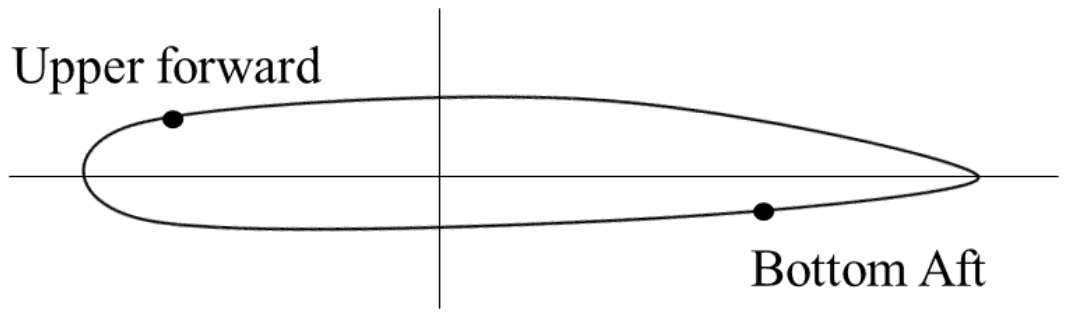
Consider the four basic symmetrical flight loading conditions corresponding to the corners of a typical V-n diagram. For one of these flight loading conditions, it is observed that (i) the compressive bending stresses have a maximum value in the bottom aft region (see figure) of the wing cross-section; and (ii) the tensile bending stresses are maximum in the upper forward region (see figure) of the wing cross-section. For the preceding observations, select the corresponding flight loading condition from the options given.
The highest limit load factor experienced by a civil transport aircraft is in the range
A jet aircraft is initially flying steady and level at its maximum endurance condition. For the aircraft to fly steady and level, but faster at the same altitude, the pilot should
The load factor of an aircraft turning at a constant altitude is 2. The coefficient of lift required for turning flight as compared to level flight at the same speed will be
Indicated airspeed is used by a pilot during
During an aircraft cruising flight, the altitude above the ground is usually measured using
The pitch angle and the angle of attack for a fixed wing aircraft are equal during
In an aircraft, the dive manoeuvre can be initiated by
An aircraft in a steady climb suddenly experiences a 10% drop in thrust. After a new equilibrium is reached at the same speed, the new rate of climb is
An airplane requires a longer ground roll to lift-off on hot summer days because
During the ground roll manoeuvre of an aircraft, the force(s) acting on it parallel to the direction of motion
Consider a conventional subsonic fixed-wing airplane. \(e\) is the Oswald efficiency factor and \(AR\) is the aspect ratio. Corresponding to the minimum \(\left(\frac{C_{D}}{C_{L}^{3/2}}\right)\), which of the following relations is true?
For a conventional airplane in straight, level, constant velocity flight condition, which of the following condition(s) is/are possible on Euler angles \((\phi, \theta, \psi)\), angle of attack \((\alpha)\) and the sideslip angle \((\beta)\)?
The service ceiling of an airplane is the altitude
Total number of questions : 19
Number of answered questions : 0
Number of unanswered questions : 19
Flight Mechanics [ Question No: 1 To 19 ] :
A general aviation airplane is flying at an altitude of 5000 m. The indicated airspeed is 250 km/h. Assume that there are no instrument errors and position errors. Neglecting compressibility effects, which one of the following options is FALSE?
Your Answer : (Not Answered)
Correct Answer : C
The FALSE statement is The true airspeed is 250 km/h.
With no instrument or position errors, calibrated airspeed equals indicated airspeed, 250 km/h. Neglecting compressibility, equivalent airspeed equals calibrated airspeed, also 250 km/h. True airspeed is related to equivalent airspeed through the density ratio:
\[ V_{true} = \frac{V_{e}}{\sqrt{\rho/\rho_{0}}} \]
At 5000 m the air density is well below sea-level density (about 60% of it), so the true airspeed is larger than 250 km/h, roughly 320 km/h. That makes 'true airspeed is greater than 250 km/h' true and 'true airspeed is 250 km/h' false.
As per the International Standard Atmosphere model, which one of the following options about density variation with increase in altitude in the isothermal layer is correct?
Your Answer : (Not Answered)
Correct Answer : D
In the isothermal layer, density decreases exponentially with altitude.
Combine hydrostatic balance with the ideal gas law at constant temperature \(T\):
\[ \begin{aligned} dp &= -\rho g\,dh, \quad p = \rho R T \\ \frac{d\rho}{\rho} &= -\frac{g}{RT}\,dh \\ \rho &= \rho_{1}e^{-g(h - h_{1})/RT} \end{aligned} \]
In the ISA this layer runs from 11 km to 20 km at 216.65 K. Density does not stay constant, since the pressure keeps falling; it cannot increase with height; and a linear decrease belongs to neither pressure nor density in this layer. Even in the gradient layer below, the decrease follows a power law, not a straight line.
Which one of the following figures represents the drag polar of a general aviation aircraft?
Your Answer : (Not Answered)
Correct Answer : D
The drag polar of a general aviation aircraft is sketch (D).
The drag polar plots lift coefficient against drag coefficient, \(C_{D} = C_{D,min} + K(C_{L} - C_{L,min\,drag})^{2}\): a parabola lying on its side and opening toward higher \(C_{D}\). Drag never falls to zero, because of skin friction and form drag. A general aviation aircraft has a cambered wing, so its least drag occurs at a small positive \(C_{L}\), and at zero lift \(C_{D}\) is a little above that minimum. Sketch (D) shows exactly this: the curve starts on the \(C_{D}\) axis away from the origin, bends back to its least drag at a small positive \(C_{L}\), and then rises to the right.
Sketches (B) and (C) pass through the origin, implying zero drag at zero lift, and (A) reaches zero drag at a high lift coefficient, both impossible. (A) and (C) also curve the wrong way for a polar.
Consider a general aviation airplane with weight 10 kN and a wing planform area of 15 m2. The drag coefficient of the airplane is given as \(C_{D} = C_{D_{0}} + KC_{L}^{2}\) with \(C_{D_{0}} = 0.025\) and \(K = 0.05\). For level flight at an altitude where the density is 0.60 kg/m3 and thrust 1 kN, the maximum cruise speed is
(rounded off to the nearest integer)
Your Answer : (Not Answered)
Correct Answer : A
The maximum cruise speed is 87 m/s.
In level flight thrust equals drag and lift equals weight. Writing \(q\) for the dynamic pressure, \(C_{L} = W/(qS)\), so
\[ \begin{aligned} T &= qSC_{D_{0}} + \frac{KW^{2}}{qS} \\ 1000 &= 0.375q + \frac{333333}{q} \end{aligned} \]
using \(S = 15\), \(C_{D_{0}} = 0.025\), \(K = 0.05\) and \(W = 10^{4}\) N. This is a quadratic in \(q\):
\[ \begin{aligned} 0.375q^{2} - 1000q + 333333 &= 0 \\ q &= \frac{1000 \pm 707.1}{0.75} \\ q_{max} &= 2276\ \text{Pa} \end{aligned} \]
\[ \begin{aligned} V_{max} &= \sqrt{2q_{max}/\rho} \\ &= \sqrt{2 \times 2276 / 0.60} = 87\ \text{m/s} \end{aligned} \]
The smaller root, \(q = 390.5\) Pa, gives 36 m/s, the minimum speed at which 1 kN of thrust can hold level flight, which is the trap in the options. 30 m/s and 101 m/s do not satisfy the thrust-drag balance.
An ideal glider has drag characteristics given by \(C_{D} = C_{D_{0}} + C_{D_{i}}\), where \(C_{D_{i}} = KC_{L}^{2}\) is the induced drag coefficient, \(C_{L}\) is the lift coefficient, and \(K\) is a constant. For maximum range of the glider, the ratio \(C_{D_{0}}/C_{D_{i}}\) is
Your Answer : (Not Answered)
Correct Answer : A
For maximum range of a glider the ratio is 1.
A glider has no thrust, so in a steady glide its glide angle satisfies \(\tan\gamma = D/L = C_{D}/C_{L}\). The range from a given height is greatest when the glide angle is smallest, that is, at maximum \(L/D\), or minimum \(C_{D}/C_{L}\).
\[ \begin{aligned} \frac{C_{D}}{C_{L}} &= \frac{C_{D_{0}}}{C_{L}} + KC_{L} \\ \frac{d}{dC_{L}} &: -\frac{C_{D_{0}}}{C_{L}^{2}} + K = 0 \\ C_{D_{0}} &= KC_{L}^{2} = C_{D_{i}} \end{aligned} \]
So zero-lift drag equals induced drag and the ratio is 1. The option 1/3 is the condition for minimum sinking speed (maximum \(C_{L}^{3/2}/C_{D}\)), where the induced drag is three times the zero-lift drag; the option 3 is that relation turned upside down, and 3/2 matches neither. None of them gives maximum range.
Consider the four basic symmetrical flight loading conditions corresponding to the corners of a typical V-n diagram. For one of these flight loading conditions, it is observed that (i) the compressive bending stresses have a maximum value in the bottom aft region (see figure) of the wing cross-section; and (ii) the tensile bending stresses are maximum in the upper forward region (see figure) of the wing cross-section. For the preceding observations, select the corresponding flight loading condition from the options given.
Your Answer : (Not Answered)
Correct Answer : D
The observations correspond to the negative low angle of attack condition.
At a corner of the V-n diagram the resultant aerodynamic force on the wing is the vector sum of lift and drag. At a high angle of attack it tilts forward relative to the chord, so it bends the wing about an axis that puts the extreme stresses in the forward upper and aft lower corners of the section. At a low angle of attack (high speed) it tilts aft, so the extreme stresses move to the aft upper and forward lower corners.
Negative load factor bends the wing downward, so the upper surface is in tension and the lower surface in compression. Combining the two: at negative low angle of attack, the compression peaks in the bottom aft region and the tension in the upper forward region, exactly as observed.
Positive load factor puts the upper surface in compression, so both positive cases are ruled out. Negative high angle of attack puts the peak compression in the bottom forward region and the peak tension in the upper aft region, the mirror of what is described.
The highest limit load factor experienced by a civil transport aircraft is in the range
Your Answer : (Not Answered)
Correct Answer : B
The highest limit load factor of a civil transport lies in the range 2.0 - 5.0.
Airworthiness rules for transport aircraft set the positive limit manoeuvring load factor at about 2.5 for large airliners, rising to about 3.8 for lighter aircraft. These aircraft are not designed for violent manoeuvres, so their limit loads sit just above 2 and well below 5.
0.0 - 2.0 is too low, because steady level flight alone is 1 and even a modest turn or gust exceeds 2. 5.0 - 8.0 belongs to aerobatic aircraft, and 8.0 - 10.0 to combat aircraft, which are built for high-g manoeuvring.
A jet aircraft is initially flying steady and level at its maximum endurance condition. For the aircraft to fly steady and level, but faster at the same altitude, the pilot should
Your Answer : (Not Answered)
Correct Answer : C
The pilot should increase thrust and reduce angle of attack.
For a jet, fuel flow is roughly proportional to thrust, so maximum endurance is flown at minimum drag, the speed of maximum L/D. Flying faster than that speed raises the drag, so steady flight at the higher speed needs more thrust.
Lift must still equal weight: \(W = \frac{1}{2}\rho V^{2}SC_{L}\). At the same altitude, a higher V needs a smaller \(C_{L}\), that is, a smaller angle of attack.
More thrust alone, with the same angle of attack, would give more lift than weight as the speed rose, so the aircraft would climb. Increasing the angle of attack makes that worse. Reducing the angle of attack alone loses lift without the thrust to hold the higher speed, so the aircraft would descend.
The load factor of an aircraft turning at a constant altitude is 2. The coefficient of lift required for turning flight as compared to level flight at the same speed will be
Your Answer : (Not Answered)
Correct Answer : C
The lift coefficient required is double that for level flight.
The load factor is \(n = L/W\), so in a turn with n = 2 the wing must produce twice the aircraft's weight in lift. Lift is \(L = \frac{1}{2}\rho V^{2} S C_{L}\). At the same speed, altitude and wing area, everything except \(C_{L}\) is unchanged, so \(C_{L}\) must double.
'Same' ignores the extra lift a level turn needs. 'Half' has the ratio inverted, and 'four times' would be right only if the speed were halved at the same lift, since lift varies with the square of speed.
Indicated airspeed is used by a pilot during
Your Answer : (Not Answered)
Correct Answer : A
Indicated airspeed is used during take-off.
Indicated airspeed reflects the dynamic pressure on the aircraft, which is what sets the aerodynamic forces. So the speeds that matter for take-off, such as the rotation and lift-off speeds and the stall speed, are given in indicated airspeed and stay the same whatever the airfield's altitude or temperature.
Navigation needs true airspeed and ground speed, not indicated airspeed. Engine RPM is set from engine instruments, and the elevator angle is a control input, not something read from an airspeed.
During an aircraft cruising flight, the altitude above the ground is usually measured using
Your Answer : (Not Answered)
Correct Answer : B
In cruise, altitude is usually measured using static pressure.
The barometric altimeter reads the static pressure of the surrounding air and converts it to altitude through the standard atmosphere. All aircraft carry one, and flight levels in cruise are pressure altitudes.
Dynamic pressure is what the airspeed indicator measures, not altitude. Radar altimeters measure height above the ground but are used mainly at low height, on approach and landing, not in normal cruise. Laser range finders are not the standard instrument for aircraft altitude.
The pitch angle and the angle of attack for a fixed wing aircraft are equal during
Your Answer : (Not Answered)
Correct Answer : A
The pitch angle equals the angle of attack in wings level constant altitude flight.
The pitch angle is the sum of the angle of attack and the flight path angle: \(\theta = \alpha + \gamma\). In level flight at constant altitude the flight path is horizontal, so \(\gamma = 0\) and \(\theta = \alpha\).
In an unaccelerated climb \(\gamma \gt 0\), so the pitch angle exceeds the angle of attack. In an unaccelerated descent, and on a landing approach, \(\gamma \lt 0\), so the pitch angle is less than the angle of attack.
In an aircraft, the dive manoeuvre can be initiated by
Your Answer : (Not Answered)
Correct Answer : C
A dive is initiated by generating a nose down pitch rate.
To enter a dive the flight path must be bent downward, which needs the aircraft to rotate nose down. The pilot pushes the stick forward, the elevator produces a nose-down pitching moment and the resulting pitch rate lowers the nose and the flight path angle.
Reducing thrust alone makes the aircraft slow down or descend gently at its trim speed, not dive. Reducing angle of attack alone is a consequence of the pitch change, not a way of starting it, and increasing thrust tends to make the aircraft climb or accelerate.
An aircraft in a steady climb suddenly experiences a 10% drop in thrust. After a new equilibrium is reached at the same speed, the new rate of climb is
Your Answer : (Not Answered)
Correct Answer : B
The new rate of climb is lower by more than 10%.
Rate of climb depends on excess power: \(R/C = (T - D)V/W\). At the same speed and weight, drag is unchanged, so only the thrust term moves.
A 10% drop in thrust removes \(0.1T\) from the excess thrust \(T - D\). Because \(T - D\) is smaller than \(T\), losing \(0.1T\) is more than 10% of the excess. For example, if \(D = 0.6T\), the excess falls from \(0.4T\) to \(0.3T\), a 25% drop in rate of climb.
'Exactly 10%' would only be true if there were no drag, and 'less than 10%' gets the direction of the effect wrong.
An airplane requires a longer ground roll to lift-off on hot summer days because
Your Answer : (Not Answered)
Correct Answer : A
The reason is that the thrust is directly proportional to free-stream density.
Hot air is less dense. An engine's thrust falls with air density (in the simple model it is taken as directly proportional to it), so on a hot day the aircraft accelerates more slowly. The thinner air also raises the speed needed to make lift equal weight, so the aircraft must reach a higher speed with less thrust, and the ground roll lengthens.
Thrust does not depend on the aircraft's weight. The lift-off distance is inversely related to density (it grows as density falls), not directly proportional to it. Runway friction is not what changes on a hot day; the density of the air is.
During the ground roll manoeuvre of an aircraft, the force(s) acting on it parallel to the direction of motion
Your Answer : (Not Answered)
Correct Answer : D
The forces along the direction of motion are thrust, drag and a part of both weight and lift.
On the ground roll the aircraft is pushed forward by thrust and held back by aerodynamic drag, but also by rolling friction at the wheels. The friction force is \(\mu(W - L)\): it depends on the part of the weight not yet carried by the wing, so both weight and lift enter the force balance along the runway.
\[ m\frac{dV}{dt} = T - D - \mu(W - L) \]
Thrust alone or drag alone leaves out the opposing forces, and 'thrust and drag' leaves out wheel friction, which is what brings weight and lift into the horizontal balance.
Consider a conventional subsonic fixed-wing airplane. \(e\) is the Oswald efficiency factor and \(AR\) is the aspect ratio. Corresponding to the minimum \(\left(\frac{C_{D}}{C_{L}^{3/2}}\right)\), which of the following relations is true?
Your Answer : (Not Answered)
Correct Answer : B
The relation is \(\frac{C_{D}}{C_{L}^{2}} = \frac{4}{3\pi eAR}\).
With the parabolic drag polar \(C_{D} = C_{D0} + KC_{L}^{2}\), \(K = 1/(\pi eAR)\), minimise \(C_{D}/C_{L}^{3/2}\) by setting its derivative with respect to \(C_{L}\) to zero:
\[ \begin{aligned} C_{L}^{3/2}(2KC_{L}) &= \tfrac{3}{2}C_{L}^{1/2}(C_{D0} + KC_{L}^{2}) \\ C_{D0} &= \tfrac{1}{3}KC_{L}^{2} \\ C_{D} &= \tfrac{4}{3}KC_{L}^{2} \end{aligned} \]
Dividing by \(C_{L}^{2}\) gives \(4/(3\pi eAR)\). This is the condition for maximum endurance of a propeller airplane, where induced drag is three times zero-lift drag. \(C_{D}/C_{L}^{2} = 1/(\pi eAR)\) would mean zero parasite drag, and the other two forms do not follow from the polar.
For a conventional airplane in straight, level, constant velocity flight condition, which of the following condition(s) is/are possible on Euler angles \((\phi, \theta, \psi)\), angle of attack \((\alpha)\) and the sideslip angle \((\beta)\)?
Your Answer : (Not Answered)
Correct Answer : A
The possible set is \(\phi = 0, \theta = 2^{o}, \psi = 0, \alpha = 2^{o}, \beta = 0\).
In straight, level, constant-velocity flight the wings are level (\(\phi = 0\)), the flight path is horizontal so the pitch angle equals the angle of attack (\(\gamma = \theta - \alpha = 0\)), and a conventional airplane flies with no sideslip (\(\beta = 0\)). The heading \(\psi\) can be any constant value. The first set meets every condition.
A 5-degree bank with zero sideslip tilts the lift vector and turns the airplane, and \(\theta = 0\) with \(\alpha = 2^{o}\) would mean a descent, so the second set is neither straight nor level. The third and fourth sets have a 5-degree sideslip with the wings level, which leaves an unbalanced side force, and the fourth also has \(\theta - \alpha = 3^{o}\), a climb. The official key accepts only the first set.
The service ceiling of an airplane is the altitude
Your Answer : (Not Answered)
Correct Answer : D
The service ceiling is the altitude at which the maximum rate of climb is 100 ft/min.
The maximum rate of climb falls as altitude increases because excess power shrinks. The altitude where it reaches zero is the absolute ceiling, the theoretical limit of sustained level flight. Because that limit is approached only asymptotically, a practical ceiling is defined where the airplane can still climb at 100 ft/min (about 0.5 m/s).
"Beyond which the airplane cannot sustain level flight" describes the absolute ceiling. 100 m/min is about 330 ft/min, the wrong standard. The altitude for maximum power required is not a ceiling definition at all.
Marks
Total number of questions : 19
Number of answered questions : 0
Number of unanswered questions : 19