
Instruction
- Total number of questions : 20
- Time allotted : 30:00 Minutes:Seconds.
- Each question carry 1 mark, no negative marks.
- DO NOT refresh the page.
- All the best
Fluid Machinery [ Question No: 1 To 20 ] :
Chances of occurrence of cavitation are high when :
Pelton turbines are:
The discharge through a single-acting reciprocating pump is:
(When Symbols have their usual meanings)
Air vessel in a reciprocating pump is used to:
A centrifugal pump running at 500 rpm and at its maximum efficiency is delivering a head of 30 m at a flow of 60 liters per minute. If the rpm is changed to 1000, then the head H in meters and flow rate Q in liters per minute at maximum efficiency are estimated to be :
Ratio of isentropic work to Euler's work in centrifugal air compressor is known as :
The component of torque converter that allows torque multiplication is:
Fluid flow machine are using the principle of either (1) supplying energy to the fluid or (2) extracting energy from the fluid.Some fluid flow machine are combination of both (1) and (2) they are classified as:
Which one of the following is correct for hydraulic coupling?
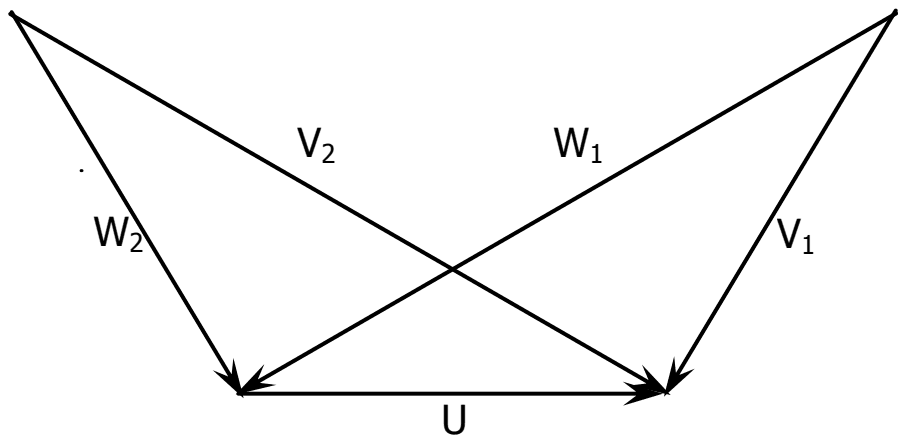
The velocity triangles at the inlet and exit of the rotor of a turbomachine are shown. V denotes the absolute velocity of the fluid, W denotes the relative velocity of the fluid and U denotes the blade velocity. Subscripts 1 and 2 refer to inlet and outlet respectively. If V2 = W1 and V1 = W2, then the degree of reaction is
A single acting reciprocating pump discharges 3.5 litres of water per second at 40 rpm. The pump has a piston diameter of 150 mm and a stroke of 300 mm. The percentage slip is
If the impeller speed of a centrifugal pump is doubled, the power consumption will be?
Which one of the following is NOT a rotating machine?
Which one of the following is a WRONG statement?
A pumping device that combines the advantages of both centrifugal and reciprocating pumps is known as
Which of the following is NOT a consequence of cavitation in pumps?
One main difference between centrifugal and reciprocating compressors is:
Which of the following turbines is most suitable for high head and low flow rate applications?
The classification of hydraulic turbines according to the type of energy at the inlet of the turbine includes ______.
Which of the following is true?
Total number of questions : 20
Number of answered questions : 0
Number of unanswered questions : 20
Fluid Machinery [ Question No: 1 To 20 ] :
Chances of occurrence of cavitation are high when :
Your Answer : (Not Answered)
Correct Answer : A
Cavitation is most likely when the pressure falls below the vapour pressure.
When the local pressure in a flowing liquid drops below its vapour pressure at that temperature, vapour bubbles form. Carried into regions of higher pressure, they collapse violently, causing pitting, noise, vibration and loss of efficiency. In pumps this happens at the impeller eye, and in turbines at the runner outlet and draft tube.
High pressure suppresses cavitation, and a lower temperature lowers the vapour pressure, which also makes it less likely. Cavitation occurs when the Thoma parameter falls below its critical value, so a high Thoma parameter means safety, not danger.
Pelton turbines are:
Your Answer : (Not Answered)
Correct Answer : A
Pelton turbines are tangential flow turbines.
In a Pelton wheel the water jet strikes the buckets along the tangent to the runner's circumference. It is an impulse turbine used for high heads and low discharge.
The Francis turbine is a radial (inward) or mixed flow reaction turbine, and the Kaplan and propeller turbines are axial flow.
The discharge through a single-acting reciprocating pump is:
(When Symbols have their usual meanings)
Your Answer : (Not Answered)
Correct Answer : D
The discharge is \(Q = ALN / 60\).
A single-acting pump delivers one cylinder volume, area A times stroke L, per revolution. At N revolutions per minute that is ALN per minute, and dividing by 60 gives the discharge per second.
\[ Q = \frac{A L N}{60} \]
\(2ALN/60\) is for a double-acting pump, which delivers on both strokes, and the forms without 60 give a per-minute figure.
Air vessel in a reciprocating pump is used to:
Your Answer : (Not Answered)
Correct Answer : A
An air vessel is used to obtain a continuous supply of water at uniform rate.
An air vessel is a closed chamber with compressed air, fitted near the pump on the suction and delivery pipes. It stores water when the pump delivers more than the mean flow and releases it when the pump delivers less, smoothing the flow. It also reduces the acceleration head, which saves work and allows higher speeds.
It does not by itself raise or lower the static suction or delivery head, so options B, C and D are wrong.
A centrifugal pump running at 500 rpm and at its maximum efficiency is delivering a head of 30 m at a flow of 60 liters per minute. If the rpm is changed to 1000, then the head H in meters and flow rate Q in liters per minute at maximum efficiency are estimated to be :
Your Answer : (Not Answered)
Correct Answer : C
At 1000 rpm the pump gives H = 120 m and Q = 120 litres per minute.
For the same pump running at its point of maximum efficiency, the affinity laws say that discharge varies as the speed and head as the square of the speed.
\[ \begin{aligned} \frac{Q_2}{Q_1} &= \frac{N_2}{N_1} = \frac{1000}{500} = 2 \\ Q_2 &= 2 \times 60 = 120\ \text{L/min} \end{aligned} \]
\[ \begin{aligned} \frac{H_2}{H_1} &= \left(\frac{N_2}{N_1}\right)^{2} = 4 \\ H_2 &= 4 \times 30 = 120\ \text{m} \end{aligned} \]
H = 60 m comes from scaling the head linearly with speed, Q = 30 halves the flow instead of doubling it, and Q = 480 cubes the speed ratio, which is the law for power, not for flow.
Ratio of isentropic work to Euler's work in centrifugal air compressor is known as :
Your Answer : (Not Answered)
Correct Answer : D
The ratio is the pressure coefficient.
In a centrifugal compressor, Euler's work is the work actually done on the air by the impeller, while the isentropic work is the minimum work needed for the same pressure rise. Their ratio, the pressure coefficient, shows how much of the impeller's work goes into raising the pressure.
The slip factor is the ratio of the actual whirl velocity to the ideal whirl velocity at the impeller tip. The work factor (power input factor) allows for losses such as friction and windage, and the degree of reaction is the share of the pressure rise that takes place in the impeller.
The component of torque converter that allows torque multiplication is:
Your Answer : (Not Answered)
Correct Answer : C
Torque multiplication comes from the stator.
In a torque converter the stator is a fixed set of curved blades between the turbine and the impeller. It turns the fluid leaving the turbine so that it re-enters the impeller in the direction of rotation, helping to drive it. The stator's reaction is what lets the output torque exceed the input torque at low speed ratios.
The impeller (pump) and turbine are also present in a fluid coupling, which cannot multiply torque. The free wheel (one-way clutch) only lets the stator spin freely once multiplication is no longer needed.
Fluid flow machine are using the principle of either (1) supplying energy to the fluid or (2) extracting energy from the fluid.Some fluid flow machine are combination of both (1) and (2) they are classified as:
Your Answer : (Not Answered)
Correct Answer : C
They are classified as torque converters.
A torque converter contains a pump (impeller) that supplies energy to the fluid and a turbine that extracts energy from it, together with a stator, all in one casing. It therefore combines both principles, as do fluid couplings.
A compressor only supplies energy to the fluid, while a hydraulic turbine and a windmill only extract energy from it, so each uses just one of the two principles.
Which one of the following is correct for hydraulic coupling?
Your Answer : (Not Answered)
Correct Answer : B
A hydraulic coupling connects two shafts rotating at about the same speed.
A fluid coupling has a pump impeller on the driving shaft and a runner on the driven shaft, facing each other in a casing filled with oil. It transmits torque smoothly, but with a small slip, typically about 2 to 4 per cent, so the driven shaft runs at nearly the same speed as the driver.
It cannot multiply torque, since the output torque equals the input torque; that needs a torque converter with a stator, so option (C) is wrong. It is not designed to join shafts at substantially different speeds, and coupling a pump to its motor 'for efficient operation' is not its defining use.
The velocity triangles at the inlet and exit of the rotor of a turbomachine are shown. V denotes the absolute velocity of the fluid, W denotes the relative velocity of the fluid and U denotes the blade velocity. Subscripts 1 and 2 refer to inlet and outlet respectively. If V2 = W1 and V1 = W2, then the degree of reaction is
Your Answer : (Not Answered)
Correct Answer : C
The degree of reaction is 0.5.
The degree of reaction is the share of the stage's energy change that takes place in the rotor as a change of relative kinetic energy. With the same blade speed U at inlet and exit:
\[ R = \frac{W_2^2-W_1^2}{(V_1^2-V_2^2)+(W_2^2-W_1^2)} \]
Substituting \(W_{2}=V_{1}\) and \(W_{1}=V_{2}\) makes the two brackets equal, so R = 1/2. The velocity triangles are mirror images, the signature of a 50 % reaction stage such as Parsons' turbine.
0 would be an impulse stage (no change in relative speed) and 1 a stage with no change in absolute kinetic energy; 0.25 matches neither condition.
A single acting reciprocating pump discharges 3.5 litres of water per second at 40 rpm. The pump has a piston diameter of 150 mm and a stroke of 300 mm. The percentage slip is
Your Answer : (Not Answered)
Correct Answer : A
The keyed slip is 0.85%.
The theoretical discharge of a single acting pump is swept volume per stroke times strokes per second:
\[ \begin{aligned} Q_{th} &= \tfrac{\pi}{4}(0.15)^{2}(0.3)\tfrac{40}{60} \\ &= 0.003534\ \text{m}^{3}/\text{s} \approx 3.53\ \text{L/s} \\ \text{slip} &= \frac{3.53 - 3.5}{3.53} \times 100 \\ &\approx 0.85\% \end{aligned} \]
The key rounds the theoretical discharge to 3.53 L/s before taking the difference; carrying more digits (3.534 L/s) gives about 0.97%, which is still nearest to 0.85 among the options. 3.53 is the theoretical discharge in L/s, not the slip, and 1.97 and 6.05 do not come from this data.
If the impeller speed of a centrifugal pump is doubled, the power consumption will be?
Your Answer : (Not Answered)
Correct Answer : D
The power consumption becomes eight times.
The affinity laws for a centrifugal pump of fixed impeller diameter give
\[ \begin{aligned} Q &\propto N \\ H &\propto N^{2} \\ P &\propto N^{3} \end{aligned} \]
Doubling the speed N doubles the discharge, multiplies the head by four and the power by \(2^{3} = 8\).
'Doubled' is the change in discharge and 'Four times' the change in head, so both mix up the laws. Power cannot stay the same when the pump is doing more work at a higher speed.
Which one of the following is NOT a rotating machine?
Your Answer : (Not Answered)
Correct Answer : C
The jet pump is not a rotating machine.
A jet pump (ejector) has no moving parts: a high-velocity motive jet of fluid entrains the fluid to be pumped through momentum exchange in a mixing chamber and diffuser.
The others all rotate. A centrifugal pump uses a rotating impeller. A gear pump carries fluid round in the spaces between meshing rotating gears. A vane pump has a rotor with sliding vanes turning in an eccentric casing.
Which one of the following is a WRONG statement?
Your Answer : (Not Answered)
Correct Answer : B
The WRONG statement is that the net positive suction head should be more than the theoretical atmospheric pressure.
Cavitation is avoided when the available NPSH exceeds the NPSH required by the pump, a value given by the manufacturer and usually a few metres. It has nothing to do with exceeding atmospheric pressure (about 10.3 m of water); with a suction lift the available NPSH is always less than atmospheric head.
The other statements are correct: the head at zero flow is the shutoff head; by the affinity laws head varies as speed squared; and turbine (deep-well) pumps are multistage centrifugal pumps, so they behave more like centrifugal than propeller pumps.
A pumping device that combines the advantages of both centrifugal and reciprocating pumps is known as
Your Answer : (Not Answered)
Correct Answer : D
The device is the rotary pump.
Rotary pumps (gear, vane, lobe and screw pumps) are positive displacement machines like the reciprocating pump: they trap a fixed volume per revolution, are self-priming and deliver against high pressure. Like the centrifugal pump, however, they rotate continuously, so they are compact, have no valves and give a nearly steady flow without the pulsation of a piston pump. That combination is why textbooks describe them as having the advantages of both.
An air lift pump raises water by injecting compressed air into the rising pipe. A hydraulic ram uses the water hammer of a large flow to lift a small part of it, with no external power. A jet pump uses a high-velocity jet in an ejector, usually supplied by a centrifugal pump, to draw water from a deep well.
Which of the following is NOT a consequence of cavitation in pumps?
Your Answer : (Not Answered)
Correct Answer : B
An increase in pump discharge pressure is not a consequence of cavitation. Cavitation is the formation and collapse of vapour bubbles in a pump when the local pressure falls below the vapour pressure. It causes noise and vibration, a fall in efficiency and head, and pitting on the impeller surface, so options A, C and D are consequences, and the discharge pressure falls and not rises.
Cavitation also lowers the head and flow because vapour bubbles fill part of the impeller passages, the opposite of a rise in discharge pressure.
One main difference between centrifugal and reciprocating compressors is:
Your Answer : (Not Answered)
Correct Answer : C
The main difference between centrifugal and reciprocating compressors is the principle by which they increase the pressure of air. A reciprocating compressor traps a volume of air and reduces it by a piston, so it is a positive displacement machine, while a centrifugal compressor raises the velocity of air by an impeller and converts this kinetic energy into pressure in a diffuser. Both compress the same kinds of gas, both handle inlet air by drawing it in, and both need lubrication in some form.
Which of the following turbines is most suitable for high head and low flow rate applications?
Your Answer : (Not Answered)
Correct Answer : D
The Pelton turbine is the most suitable for high head and low flow rate. It is an impulse turbine that works with a jet of water at high velocity from a high head, and so it needs a small quantity of water. The Kaplan turbine is for low head and high flow rate and the Francis turbine for medium head and medium flow rate, so they do not suit high head with low flow. The first option as printed is not a standard turbine name.
Specific speed confirms this: a Pelton wheel has a low specific speed, a Francis turbine a medium one and a Kaplan turbine a high one, so high head with low flow points to the Pelton wheel.
The classification of hydraulic turbines according to the type of energy at the inlet of the turbine includes ______.
Your Answer : (Not Answered)
Correct Answer : A
On the basis of the type of energy at the inlet, hydraulic turbines are divided into impulse turbines (inlet energy is all kinetic) and reaction turbines (both pressure and kinetic energy at the inlet). So reaction turbines is the answer. Medium-head is a classification by head, tangential flow and mixed flow are classifications by the direction of flow through the runner, so they do not describe the type of energy at the inlet.
Which of the following is true?
Your Answer : (Not Answered)
Correct Answer : A
Specific speed rises from impulse to reaction turbines and with the flow rate. The Pelton wheel has the lowest specific speed (a high head, low flow machine), the Francis turbine is in the medium range, and the Kaplan turbine has the highest, being used for low heads and large discharges. So the Francis specific speed is less than that of the Kaplan turbine. The options that put Kaplan below Francis or below Pelton, or Francis below Pelton, reverse this order.
Marks
Total number of questions : 20
Number of answered questions : 0
Number of unanswered questions : 20