
Instruction
- Total number of questions : 20
- Time allotted : 30:00 Minutes:Seconds.
- Each question carry 1 mark, no negative marks.
- DO NOT refresh the page.
- All the best
Fluid Mechanics [ Question No: 1 To 20 ] :
If Cv , Cc , Cd and Cr are the hydraulic coefficients of an orifice , then :
Where, Cv= coefficient of velocity
Cc = Coefficient of contraction
Cd = coefficient of discharge
Cr = coefficient of retention
Mach Number (Ma) for incompressible flow is :
Which of the following is the unit of kinemetic viscosity?
A solid body of uniform specific gravity floats in a deep liquid pool. Take \(B\), \(G\), and \(M\) as the centre of buoyancy, centre of gravity, and metacentre of the body, respectively.
Which one of the following options is correct for the stable floatation of the body in the pool when the body is given a small tilt angle?
Group-I indicates different properties of fluid and Group-II defines their basic dimensions in terms of Force (F), Length (L), and Time (T).
| Group-I | Group-II | ||
|---|---|---|---|
| P | Dynamic viscosity | 1 | FL−4T2 |
| Q | Surface tension | 2 | FL−2T |
| R | Density | 3 | FL−1 |
Which one of the following options identifies the correct match between Group-I and Group-II?
Which one of the following figures shows the CORRECT dependence of apparent viscosity (\(\eta\)) on rate of shear strain (\(du/dy\)) for pseudoplastic fluids?
A two-dimensional incompressible flow field is defined as,
\[ \vec{V}(x, y) = (Axy)\,\hat{i} + (By^{2})\,\hat{j} \]
where, \(A\) and \(B\) are constants. The dynamic viscosity of the Newtonian fluid is \(\mu\). In the absence of body force, which among the following expressions represents the pressure gradient at the location (5, 0) in the concerned flow field?
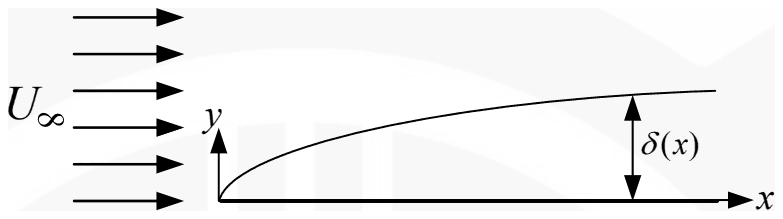
Consider a steady, laminar, and incompressible flow over a flat plate, as shown in the figure. With freestream velocity \(U_{\infty}\) and kinematic viscosity \(\nu_{1}\), the boundary layer thickness at a distance \(x_{1}\) from the leading edge is \(\delta_{1}\). If the kinematic viscosity of the fluid is increased by a factor of four \((\nu_{2} = 4\nu_{1})\), the boundary layer thickness \((\delta_{2})\) at \(x_{1}\) with same \(U_{\infty}\) will be equal to
A doublet is the resulting flow pattern when a sink and a source of equal strength are brought together.
Which one of the following options correctly represents the nature of the product of the strength and the distance between them during approach?
For a potential flow, the fluid velocity is given by \(\vec{V}(x, y) = u\hat{i} + v\hat{j}\). The slope of the potential line at \((x, y)\) is
For incompressible, laminar, fully-developed flow through a circular pipe, Darcy friction factor and Fanning friction factor are represented as \(f\) and \(C_f\), respectively. Which one of the following options is correct?
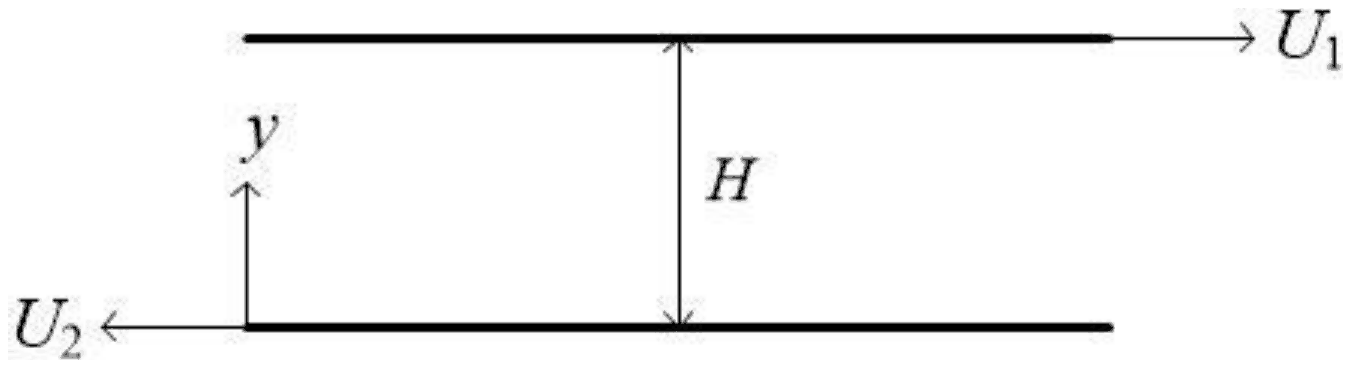
Consider steady fully-developed incompressible flow of a Newtonian fluid between two infinite parallel flat plates. The plates move in the opposite directions, as shown in the figure. In the absence of body force and pressure gradient, the ratio of shear stress at the top surface (\(y = H\)) to that at the bottom surface (\(y = 0\)) is
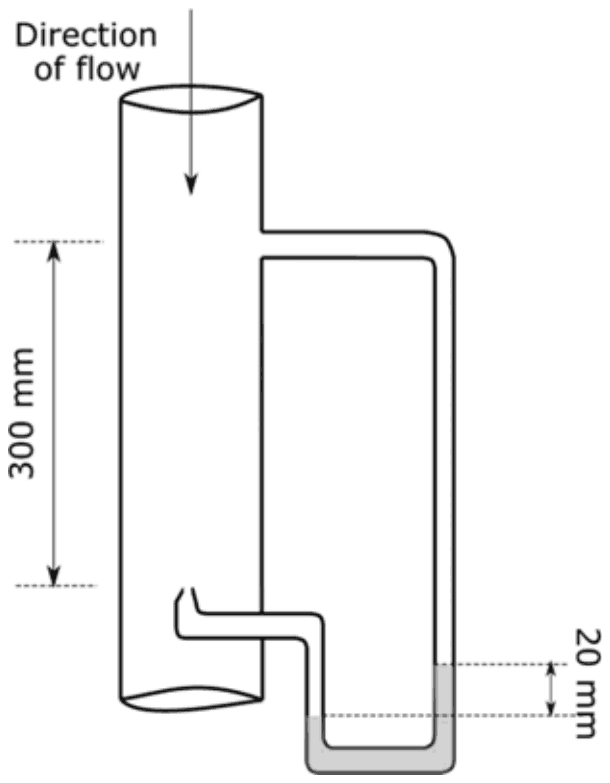
Consider an inviscid flow through a smooth pipe which has a pitot-static tube arrangement as shown. Find the centre-line velocity in the pipe.
Consider that the density of the fluid is 1000 kg/m3, acceleration due to gravity is 10 m/s2, and the specific gravity of the manometric fluid is 11.
The velocity of an air stream is 20 m/s. The densities of mercury and air are 13600 kg/m3 and 1.2 kg/m3, respectively. The gravitational acceleration may be taken as 10 m/s2. When a Pitot-static tube is placed in the stream, assuming the flow to be incompressible and frictionless, the difference between the stagnation and static pressure in the flow field (in mm Hg) would approximately be
Match the devices in Column I with the characteristics in Column II.
| Column I | Column II |
|---|---|
| P. orifice meter | 1. high head loss and low cost |
| Q. venturi meter | 2. high head loss and high cost |
| 3. low head loss and high cost | |
| 4. low head loss and low cost |
The pressure drop through a well-designed constriction is to be used for measuring the velocity of flow through a circular pipe. If the pressure drop from a 0.1 m diameter section to a 0.05 m diameter section of the pipe is 7.5 kPa, the velocity in m s-1 in the 0.1 m diameter section of the pipe is ____________.
(Take density of liquid = 1000 kg m-3)
In a laboratory experiment using a scaled down model to measure scour at a bridge pier, the Froude number is important. The ratio of the prototype length to the model length is 100. If the velocity of the model is 1 m \(\text{s}^{-1}\), the velocity (in m \(\text{s}^{-1}\)) of the prototype is
The ratio of inertial forces to viscous forces is knows as ___________.
The upward buoyant force exerted on a body immersed in a fluid, whether fully or partially submerged, is equal to the weight of the fluid that the body displaces. This statement is known as:
In the field of fluid dynamics, what describes the tendency of a fluid to resist motion or deformation due to internal friction?
Total number of questions : 20
Number of answered questions : 0
Number of unanswered questions : 20
Fluid Mechanics [ Question No: 1 To 20 ] :
If Cv , Cc , Cd and Cr are the hydraulic coefficients of an orifice , then :
Where, Cv= coefficient of velocity
Cc = Coefficient of contraction
Cd = coefficient of discharge
Cr = coefficient of retention
Your Answer : (Not Answered)
Correct Answer : B
The correct relation is \(C_d = C_c \times C_v\).
Actual discharge is the actual area of the jet at the vena contracta times the actual velocity there. The area is \(C_c\) times the orifice area and the velocity \(C_v\) times the theoretical velocity, so
\[ \begin{aligned} Q_{act} &= (C_c a)(C_v \sqrt{2gH}) \\ C_d &= \frac{Q_{act}}{a\sqrt{2gH}} = C_c C_v \end{aligned} \]
The coefficients multiply, so a sum as in the first option is wrong, and \(C_c = C_v/C_d\) inverts the relation (it should be \(C_c = C_d/C_v\)). The relation offered for \(C_r\) is not a standard result.
Mach Number (Ma) for incompressible flow is :
Your Answer : (Not Answered)
Correct Answer : D
Flow is treated as incompressible when Ma < 0.3.
Below a Mach number of about 0.3, the density of a gas changes by only a few per cent as it flows, so it can be treated as incompressible with little error. Above that, compressibility effects become significant and must be included.
Ma = 0.3 is the boundary rather than the region, and Ma > 0.3 or Ma > 0.4 describe flows where compressibility can no longer be ignored.
Which of the following is the unit of kinemetic viscosity?
Your Answer : (Not Answered)
Correct Answer : C
The unit of kinematic viscosity is the Stoke.
Kinematic viscosity is dynamic viscosity divided by density, so its dimensions are length squared per time. In SI it is m2/s; in the CGS system it is cm2/s, called the stoke, after George Stokes: 1 stoke = 10-4 m2/s.
The poise is the CGS unit of dynamic viscosity (g/cm·s), the usual trap. The pascal is the unit of pressure or stress, and the faraday is a quantity of electric charge, so neither measures viscosity.
A solid body of uniform specific gravity floats in a deep liquid pool. Take \(B\), \(G\), and \(M\) as the centre of buoyancy, centre of gravity, and metacentre of the body, respectively.
Which one of the following options is correct for the stable floatation of the body in the pool when the body is given a small tilt angle?
Your Answer : (Not Answered)
Correct Answer : A
\(\overline{MG}\) is the metacentric height and \(G\) should lie below \(M\).
When a floating body tilts slightly, the centre of buoyancy shifts and the buoyant force acts along a line that crosses the body's centre line at the metacentre M. The metacentric height is the distance GM from the centre of gravity to the metacentre.
If M is above G, the weight and buoyancy form a couple that rotates the body back upright: stable equilibrium. If M were below G, the couple would increase the tilt.
MB is the metacentric radius (\(I/V\)), not the metacentric height. Whether B lies above or below M does not decide stability; for most floating bodies B is below G and still stable, because what matters is the position of G relative to M.
Group-I indicates different properties of fluid and Group-II defines their basic dimensions in terms of Force (F), Length (L), and Time (T).
| Group-I | Group-II | ||
|---|---|---|---|
| P | Dynamic viscosity | 1 | FL−4T2 |
| Q | Surface tension | 2 | FL−2T |
| R | Density | 3 | FL−1 |
Which one of the following options identifies the correct match between Group-I and Group-II?
Your Answer : (Not Answered)
Correct Answer : D
The match is P-2, Q-3, R-1.
In the FLT system, mass has dimensions \(FL^{-1}T^{2}\) (from \(F = ma\)).
- Dynamic viscosity is shear stress divided by velocity gradient: \(FL^{-2} / T^{-1} = FL^{-2}T\), item 2.
- Surface tension is force per unit length: \(FL^{-1}\), item 3.
- Density is mass per unit volume: \(FL^{-1}T^{2}/L^{3} = FL^{-4}T^{2}\), item 1.
The other options misplace at least one of these; for instance P-1 gives viscosity the dimensions of density.
Which one of the following figures shows the CORRECT dependence of apparent viscosity (\(\eta\)) on rate of shear strain (\(du/dy\)) for pseudoplastic fluids?
Your Answer : (Not Answered)
Correct Answer : B
The correct plot is (B), apparent viscosity falling as the shear rate rises.
A pseudoplastic fluid is shear-thinning: in the power-law model \(\tau = K(du/dy)^{n}\) its index is \(n \lt 1\), so the apparent viscosity \(\eta = K(du/dy)^{n-1}\) decreases with increasing shear rate. Polymer solutions, paints and blood behave this way.
Plot (A), a constant viscosity, describes a Newtonian fluid. Plots (C) and (D), viscosity rising with shear rate, describe a dilatant (shear-thickening) fluid with \(n \gt 1\), such as a dense starch suspension.
A two-dimensional incompressible flow field is defined as,
\[ \vec{V}(x, y) = (Axy)\,\hat{i} + (By^{2})\,\hat{j} \]
where, \(A\) and \(B\) are constants. The dynamic viscosity of the Newtonian fluid is \(\mu\). In the absence of body force, which among the following expressions represents the pressure gradient at the location (5, 0) in the concerned flow field?
Your Answer : (Not Answered)
Correct Answer : C
The pressure gradient is \(\mu A(-\hat{j})\).
Incompressibility fixes \(B\):
\[ \begin{aligned} \frac{\partial u}{\partial x} + \frac{\partial v}{\partial y} &= Ay + 2By = 0 \\ \Rightarrow B &= -\frac{A}{2} \end{aligned} \]
The steady Navier-Stokes equation gives \(\nabla p = -\rho(\vec{V}\cdot\nabla)\vec{V} + \mu\nabla^{2}\vec{V}\). At (5, 0) both velocity components vanish (\(u = 5A \cdot 0 = 0\), \(v = 0\)), so the convective term is zero there. The viscous term:
\[ \begin{aligned} \nabla^{2}u &= \nabla^{2}(Axy) = 0 \\ \nabla^{2}v &= \nabla^{2}(By^{2}) = 2B = -A \end{aligned} \]
So \(\nabla p = \mu(0\,\hat{i} - A\,\hat{j}) = \mu A(-\hat{j})\).
Options with an \(\hat{i}\) component wrongly take \(\nabla^{2}(Axy)\) as non-zero, or keep \(B\) without applying continuity.
Consider a steady, laminar, and incompressible flow over a flat plate, as shown in the figure. With freestream velocity \(U_{\infty}\) and kinematic viscosity \(\nu_{1}\), the boundary layer thickness at a distance \(x_{1}\) from the leading edge is \(\delta_{1}\). If the kinematic viscosity of the fluid is increased by a factor of four \((\nu_{2} = 4\nu_{1})\), the boundary layer thickness \((\delta_{2})\) at \(x_{1}\) with same \(U_{\infty}\) will be equal to
Your Answer : (Not Answered)
Correct Answer : C
The new thickness is \(2\delta_{1}\).
For a laminar flat-plate boundary layer (Blasius):
\[ \begin{aligned} \delta &\approx \frac{5x}{\sqrt{Re_{x}}} = 5\sqrt{\frac{\nu x}{U_{\infty}}} \\ &\propto \sqrt{\nu} \end{aligned} \]
At the same x and U, multiplying the kinematic viscosity by 4 multiplies the thickness by \(\sqrt{4} = 2\).
\(4\delta_{1}\) assumes thickness proportional to viscosity, \(\delta_{1}/2\) has the dependence inverted, and \(\delta_{1}\) ignores viscosity altogether. A more viscous fluid diffuses momentum further from the wall, so the layer thickens.
A doublet is the resulting flow pattern when a sink and a source of equal strength are brought together.
Which one of the following options correctly represents the nature of the product of the strength and the distance between them during approach?
Your Answer : (Not Answered)
Correct Answer : A
The product remains always constant.
A doublet is the limit of a source and a sink of strength \(m\) a distance \(a\) apart as \(a \to 0\). If \(m\) stayed fixed, the two would simply cancel. To keep a finite flow pattern, the strength is increased as the distance shrinks so that the product \(m a\), the doublet strength, is held constant throughout the approach.
A decreasing product would make the pattern vanish, an increasing one would make it blow up, and 'first increases and then decreases' does not describe any limiting process used to define the doublet.
For a potential flow, the fluid velocity is given by \(\vec{V}(x, y) = u\hat{i} + v\hat{j}\). The slope of the potential line at \((x, y)\) is
Your Answer : (Not Answered)
Correct Answer : C
The slope is \(-\frac{u}{v}\).
Along a potential (equipotential) line \(\phi\) is constant, so
\[ \begin{aligned} d\phi &= \frac{\partial\phi}{\partial x}dx + \frac{\partial\phi}{\partial y}dy \\ &= u\,dx + v\,dy = 0 \end{aligned} \]
giving \(\frac{dy}{dx} = -\frac{u}{v}\).
\(\frac{v}{u}\) is the slope of a streamline, which is tangent to the velocity. The two slopes multiply to \(-1\), the familiar result that streamlines and equipotentials cross at right angles. \(\frac{u}{v}\) and \(-\frac{v}{u}\) have the right pieces in the wrong arrangement.
For incompressible, laminar, fully-developed flow through a circular pipe, Darcy friction factor and Fanning friction factor are represented as \(f\) and \(C_f\), respectively. Which one of the following options is correct?
Your Answer : (Not Answered)
Correct Answer : D
The relation is \(f = 4C_f\).
The Darcy factor appears in the head-loss equation \(h_f = f\frac{L}{D}\frac{V^{2}}{2g}\), while the Fanning factor is the wall shear stress scaled by dynamic pressure, \(C_f = \tau_w/(\tfrac{1}{2}\rho V^{2})\). A force balance on the pipe gives \(\tau_w = \frac{D}{4}\frac{\Delta p}{L}\), from which \(f = 4C_f\).
For laminar flow this reads \(f = 64/Re\) and \(C_f = 16/Re\). The other ratios (0.25, 0.5, 2) do not match these definitions.
Consider steady fully-developed incompressible flow of a Newtonian fluid between two infinite parallel flat plates. The plates move in the opposite directions, as shown in the figure. In the absence of body force and pressure gradient, the ratio of shear stress at the top surface (\(y = H\)) to that at the bottom surface (\(y = 0\)) is
Your Answer : (Not Answered)
Correct Answer : A
The ratio is 1.
With no pressure gradient and no body force, the x-momentum equation for fully developed flow reduces to
\[ \mu\frac{d^{2}u}{dy^{2}} = 0 \]
so the velocity is linear in \(y\) (Couette flow). With \(u(0) = -U_{2}\) and \(u(H) = U_{1}\), \(u = -U_{2} + (U_{1} + U_{2})\frac{y}{H}\), and the shear stress
\[ \tau = \mu\frac{du}{dy} = \frac{\mu(U_{1} + U_{2})}{H} \]
is the same at every \(y\), including both walls. Their ratio is therefore 1, whatever the plate speeds.
The options built from \(U_{1}\) and \(U_{2}\) would require a stress that varies across the gap, which happens only when a pressure gradient adds a parabolic part to the profile.
Consider an inviscid flow through a smooth pipe which has a pitot-static tube arrangement as shown. Find the centre-line velocity in the pipe.
Consider that the density of the fluid is 1000 kg/m3, acceleration due to gravity is 10 m/s2, and the specific gravity of the manometric fluid is 11.
Your Answer : (Not Answered)
Correct Answer : A
The centre-line velocity is 2 m/s.
The pitot tube reads the stagnation pressure and the static tap the static pressure. In the manometer the difference in piezometric head shows up as the 20 mm deflection of the manometric fluid; the 300 mm vertical spacing between the two openings is accounted for by the fluid columns in the connecting lines and does not appear in the result. So
\[ \begin{aligned} \frac{1}{2}\rho V^{2} &= (\rho_{m} - \rho) g h \\ &= (11000 - 1000)(10)(0.02) = 2000\ \text{Pa} \\ V &= \sqrt{\frac{2 \times 2000}{1000}} = 2\ \text{m/s} \end{aligned} \]
Using the full manometric density 11000 instead of the difference gives about 2.1 m/s, and 3, 5 and 7 m/s do not follow from a 20 mm reading with these densities.
The velocity of an air stream is 20 m/s. The densities of mercury and air are 13600 kg/m3 and 1.2 kg/m3, respectively. The gravitational acceleration may be taken as 10 m/s2. When a Pitot-static tube is placed in the stream, assuming the flow to be incompressible and frictionless, the difference between the stagnation and static pressure in the flow field (in mm Hg) would approximately be
Your Answer : (Not Answered)
Correct Answer : B
The pressure difference is about 1.76 mm Hg.
A Pitot-static tube reads the dynamic pressure, the difference between stagnation and static pressure:
\[ \begin{aligned} \Delta p &= \tfrac{1}{2}\rho_{air}V^{2} = \tfrac{1}{2}(1.2)(20)^{2} = 240\ \text{Pa} \\ h &= \frac{\Delta p}{\rho_{Hg}g} = \frac{240}{13600 \times 10} \\ &= 1.76 \times 10^{-3}\ \text{m} = 1.76\ \text{mm} \end{aligned} \]
1760 is the same column expressed in micrometres, a units slip. 0.57 is the reciprocal of 1.76, and \(0.57 \times 10^{-5}\) compounds that with a wrong power of ten.
Match the devices in Column I with the characteristics in Column II.
| Column I | Column II |
|---|---|
| P. orifice meter | 1. high head loss and low cost |
| Q. venturi meter | 2. high head loss and high cost |
| 3. low head loss and high cost | |
| 4. low head loss and low cost |
Your Answer : (Not Answered)
Correct Answer : D
The match is P - 1; Q - 3.
An orifice meter is just a thin plate with a hole clamped between flanges, so it is cheap to make and install. But the jet contracts sharply (the vena contracta) and then expands abruptly, so much of the pressure drop is never recovered: high head loss, low cost.
A venturi meter has a smooth converging section, a throat and a long gradual diffuser that recovers most of the pressure, so its permanent head loss is low; but it is long and precisely machined, so it is expensive. Options pairing the orifice with high cost or the venturi with low cost or high loss reverse these features.
The pressure drop through a well-designed constriction is to be used for measuring the velocity of flow through a circular pipe. If the pressure drop from a 0.1 m diameter section to a 0.05 m diameter section of the pipe is 7.5 kPa, the velocity in m s-1 in the 0.1 m diameter section of the pipe is ____________.
(Take density of liquid = 1000 kg m-3)
Your Answer : (Not Answered)
Correct Answer : B
The velocity in the 0.1 m section is 1.0 m/s.
The constriction acts as a venturi meter. Continuity links the two velocities: the diameter halves, so the area falls to a quarter and \(V_{2} = 4V_{1}\). Bernoulli’s equation between the two sections then gives
\[ \begin{aligned} \Delta p &= \tfrac{1}{2}\rho(V_{2}^{2} - V_{1}^{2}) = \tfrac{1}{2}\rho(16 - 1)V_{1}^{2} \\ 7500 &= 500 \times 15 V_{1}^{2} \\ V_{1} &= 1.0\ \text{m/s} \end{aligned} \]
The throat velocity is 4.0 m/s. A value of 0.5 or 1.5 would give pressure drops of 1.9 kPa or 16.9 kPa, and 2.0 m/s would need 30 kPa.
In a laboratory experiment using a scaled down model to measure scour at a bridge pier, the Froude number is important. The ratio of the prototype length to the model length is 100. If the velocity of the model is 1 m \(\text{s}^{-1}\), the velocity (in m \(\text{s}^{-1}\)) of the prototype is
Your Answer : (Not Answered)
Correct Answer : C
The prototype velocity is 10 m \(\text{s}^{-1}\).
Froude similarity requires equal \(V/\sqrt{gL}\) in model and prototype. With the same \(g\):
\[ \begin{aligned} V_{p} &= V_{m}\sqrt{L_{p}/L_{m}} \\ &= 1\times\sqrt{100} = 10\ \text{m/s} \end{aligned} \]
100 scales velocity with length directly, as Reynolds or geometric reasoning might suggest, and 0.1 inverts the ratio. 1 would hold only for a full-scale model.
The ratio of inertial forces to viscous forces is knows as ___________.
Your Answer : (Not Answered)
Correct Answer : B
The ratio of inertial to viscous forces is the Reynolds number, \(Re = \rho VL/\mu\).
It decides whether a flow is laminar (low \(Re\), viscous forces dominate) or turbulent (high \(Re\), inertia dominates), as in pipe flow, where the change happens at about \(Re = 2300\).
The Froude number compares inertial forces with gravity forces and governs open-channel and free-surface flow. The power number relates the power drawn by an impeller or agitator to the fluid density, rotational speed and impeller diameter. The Biot number is a heat-transfer group comparing conduction resistance inside a body with convection resistance at its surface. None of these involves viscosity in the way the question describes.
The upward buoyant force exerted on a body immersed in a fluid, whether fully or partially submerged, is equal to the weight of the fluid that the body displaces. This statement is known as:
Your Answer : (Not Answered)
Correct Answer : D
The statement that the upward buoyant force on a body immersed in a fluid equals the weight of the fluid displaced is Archimedes' principle. Newton's third law is about action and reaction, Bernoulli's principle is about pressure and speed in flow, and Pascal's principle is about transmission of pressure in a confined fluid, so only Archimedes' principle fits the statement.
The same principle gives the condition for floating: a body floats when the weight of fluid it displaces equals its own weight, so the buoyant force balances its weight.
In the field of fluid dynamics, what describes the tendency of a fluid to resist motion or deformation due to internal friction?
Your Answer : (Not Answered)
Correct Answer : C
Viscosity is the property of a fluid that resists motion or deformation because of internal friction between its layers. Surface tension is the force at the surface of a liquid, elasticity is the tendency to return to the original shape, and density is mass per unit volume, so none of these measures the resistance to flow of the fluid.
Marks
Total number of questions : 20
Number of answered questions : 0
Number of unanswered questions : 20