
Instruction
- Total number of questions : 20
- Time allotted : 30:00 Minutes:Seconds.
- Each question carry 1 mark, no negative marks.
- DO NOT refresh the page.
- All the best
Heat Transfer [ Question No: 1 To 20 ] :
The Nusselt number in natural convection heat transfer is a function of Prandtl number and __________.
Most unsteady heat flow occurs:
A brick wall (k = 0.9 W/mk) of thickness 0.18 m separates the warm air in a room from the cold ambient air, on a particular winter day, the outside air temperature is -5°C and the room needs to be maintained at 27°C.The heat transfer coefficient associated with outside air is 20 W/m2k. Neglecting the corrective resistance of the air inside the room, the heat loss in (W/m2) ,is:
For a current carrying wire of 20mm diameter exposed to air (h = 20W/m2K), maximum heat dissipation occurs when thickness of insulation (0.5 W/mK) is :
For laminar flow conditions the thickness of thermal boundary layer increases with its distance from the leading edge in proportion to:
Match List - I and List II :
| List - I | List - II |
|---|---|
| (a) Stanton number | (i) natural convection |
| (b) Grashof number | (ii) mass transfer |
| (c) Peclet number | (iii) forced convection |
| (d) Schmidt number | (iv) forced convection for small Prandtl number fluids |
Choose the most appropriate answer from the options given below :
Which of the following has least value of Thermal Conductivity ?
The monochromatic emissivity of a white body at all wavelengths and temperatures is equal to-
Which one of the following configurations has the highest fin effectiveness?
The peak wavelength of radiation emitted by a black body at a temperature of 2000 K is 1.45 µm. If the peak wavelength of emitted radiation changes to 2.90 µm, then the temperature (in K) of the black body is
Which of the following non-dimensional terms is an estimate of Nusselt number?
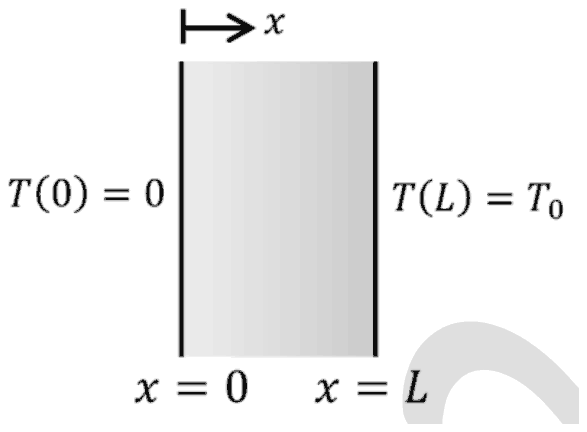
A plane, solid slab of thickness \(L\), shown in the figure, has thermal conductivity \(k\) that varies with the spatial coordinate \(x\) as \(k = A + Bx\), where \(A\) and \(B\) are positive constants (\(A \gt 0, B \gt 0\)). The slab walls are maintained at fixed temperatures of \(T(x = 0) = 0\) and \(T(x = L) = T_{0} \gt 0\). The slab has no internal heat sources. Considering one-dimensional heat transfer, which one of the following plots qualitatively depicts the steady-state temperature distribution within the slab?
A 2 mm diameter electric wire is insulated with 2 mm thick plastic. The plastic has a thermal conductivity of 0.5 W.m−1.K−1. The wire is exposed to air at 320 K and outside convective heat transfer coefficient is 25 W.m−2.K−1. Wire surface temperature is constant at 420 K and remains unaffected by the covering. Assuming steady state heat transfer conditions, the ratio of heat loss per metre of wire length with insulation to that without insulation is nearest to
(Take π = 3.14)
Water (Cp = 4.18 kJ/kg.K) at 80°C enters a counterflow heat exchanger with a mass flow rate of 0.5 kg/s. Air (Cp = 1 kJ/kg.K) enters at 30°C with a mass flow rate of 2.09 kg/s. If the effectiveness of the heat exchanger is 0.8, the LMTD (in °C) is
Dimensionless parameter among the following options is
View factor of a large cylinder of 10 cm in radius and 60 cm in length from a coaxial smaller cylinder of 5 cm radius and the same length is 0.34. View factor of the larger cylinder of itself (concave inner surface) is 0.25. The view factor of the larger cylinder with respect to either annular end is
Two small parallel plane square surfaces, each measuring 4 mm × 4 mm are placed 0.5 m apart (centre to centre) with 30° angle between the radial distance and both the surface normals. The view factor between the two surfaces is
What is the advantage of removable bundle, U-tube type heat exchanger?
Identify the application of straight tube, fixed tubesheet heat exchangers?
Identify the correct statement for conduction?
Total number of questions : 20
Number of answered questions : 0
Number of unanswered questions : 20
Heat Transfer [ Question No: 1 To 20 ] :
The Nusselt number in natural convection heat transfer is a function of Prandtl number and __________.
Your Answer : (Not Answered)
Correct Answer : D
In natural convection, Nusselt number is a function of Prandtl number and Grashof number.
Natural convection is driven by buoyancy from density differences, and the Grashof number, \(Gr = \frac{g\beta\Delta T L^{3}}{\nu^{2}}\), measures buoyancy against viscous forces. So the correlations take the form \(Nu = f(Gr, Pr)\), often written through the Rayleigh number \(Ra = Gr \cdot Pr\).
In forced convection the flow is imposed, and Nu is a function of the Reynolds number and Pr. The Stanton number is another way of expressing the forced-convection result, and the Biot number belongs to conduction with surface convection, not to convection correlations.
Most unsteady heat flow occurs:
Your Answer : (Not Answered)
Correct Answer : B
The most unsteady heat flow occurs during annealing of castings.
In annealing, a casting is heated to a set temperature, held there, and then cooled slowly in the furnace. Its temperature changes with time throughout, so the heat flow in it is transient (unsteady).
Heat flow through a refrigerator wall, through the walls of a furnace in continuous operation, or through insulated pipes carrying steam settles to a steady state, with temperatures at each point that do not change with time.
A brick wall (k = 0.9 W/mk) of thickness 0.18 m separates the warm air in a room from the cold ambient air, on a particular winter day, the outside air temperature is -5°C and the room needs to be maintained at 27°C.The heat transfer coefficient associated with outside air is 20 W/m2k. Neglecting the corrective resistance of the air inside the room, the heat loss in (W/m2) ,is:
Your Answer : (Not Answered)
Correct Answer : C
The heat loss is \(128\ \text{W/m}^{2}\).
Neglecting the inside air resistance, the heat passes through the wall and the outside air film in series. Per square metre:
\[ \begin{aligned} R &= \frac{0.18}{0.9} + \frac{1}{20} = 0.20 + 0.05 = 0.25 \\ q &= \frac{27 - (-5)}{0.25} = \frac{32}{0.25} = 128 \end{aligned} \]
Using the wall resistance alone gives \(32/0.2 = 160\), which forgets the outside film. 88 and 110 do not follow from these resistances.
For a current carrying wire of 20mm diameter exposed to air (h = 20W/m2K), maximum heat dissipation occurs when thickness of insulation (0.5 W/mK) is :
Your Answer : (Not Answered)
Correct Answer : D
The insulation thickness for maximum heat dissipation is 15 mm.
For a cylinder, heat loss is greatest when the outer radius of the insulation equals the critical radius:
\[ \begin{aligned} r_{c} &= \frac{k}{h} = \frac{0.5}{20} = 0.025\ \text{m} = 25\ \text{mm} \\ t &= r_{c} - r = 25 - 10 = 15\ \text{mm} \end{aligned} \]
The wire's radius is 10 mm, half its 20 mm diameter. 25 mm is the critical radius itself, not the thickness, and 30 mm and 20 mm come from using the diameter in place of the radius.
For laminar flow conditions the thickness of thermal boundary layer increases with its distance from the leading edge in proportion to:
Your Answer : (Not Answered)
Correct Answer : B
The thermal boundary layer grows in proportion to \(x^{1/2}\).
For laminar flow over a flat plate the velocity boundary layer thickness is \(\delta \approx 5x/\sqrt{Re_{x}}\), and since \(Re_{x} = ux/\nu\),
\[ \delta \propto \frac{x}{\sqrt{x}} = x^{1/2} \]
The thermal boundary layer is \(\delta_{t} \approx \delta\,Pr^{-1/3}\), a constant multiple of \(\delta\), so it too grows as \(x^{1/2}\). Linear growth would apply to neither, and the powers 1/3 and 1/4 do not describe laminar growth on a flat plate.
Match List - I and List II :
| List - I | List - II |
|---|---|
| (a) Stanton number | (i) natural convection |
| (b) Grashof number | (ii) mass transfer |
| (c) Peclet number | (iii) forced convection |
| (d) Schmidt number | (iv) forced convection for small Prandtl number fluids |
Choose the most appropriate answer from the options given below :
Your Answer : (Not Answered)
Correct Answer : C
The correct matching is (a)-(iii), (b)-(i), (c)-(iv), (d)-(ii).
- Stanton number, \(St = Nu/(Re\,Pr)\), is used in forced convection (a-iii).
- Grashof number, buoyancy over viscous force, governs natural convection (b-i).
- Peclet number, \(Pe = Re\,Pr\), is used in forced convection where Pr is small, as in liquid metals (c-iv).
- Schmidt number, momentum diffusivity over mass diffusivity, belongs to mass transfer (d-ii).
Two pairs are enough: Grashof with natural convection and Schmidt with mass transfer appear together only in this option. The options starting (a)-(ii) give Stanton to mass transfer, which is wrong.
Which of the following has least value of Thermal Conductivity ?
Your Answer : (Not Answered)
Correct Answer : B
Air has the least thermal conductivity.
Gases conduct heat far less well than liquids or solids because their molecules are widely spaced. Still air has a conductivity of about 0.026 W/m K, which is why trapped air is the working ingredient of most insulators.
Rubber and plastics are around 0.1 to 0.2 W/m K, and water about 0.6 W/m K, all several times higher than air. That is why foamed plastics and wool insulate better than the solid material: they trap air.
The monochromatic emissivity of a white body at all wavelengths and temperatures is equal to-
Your Answer : (Not Answered)
Correct Answer : A
The emissivity of a white body is zero.
In radiation terms a white body is an ideal surface that reflects all the radiation falling on it, so its absorptivity is zero. By Kirchhoff's law emissivity equals absorptivity, so its emissivity is zero at every wavelength and temperature.
An emissivity of 1 describes a black body, and a constant value between 0 and 1, such as 0.6, describes a grey body. The range 0.1 to 0.4 describes no ideal body.
Which one of the following configurations has the highest fin effectiveness?
Your Answer : (Not Answered)
Correct Answer : A
The key's answer is thin, closely spaced fins.
Fin effectiveness compares the heat transferred with the fin to the heat transferred from the bare base area it occupies. For a long fin:
\[ \varepsilon = \sqrt{\frac{kP}{hA_{c}}} \]
A thin fin has a large perimeter P for a small cross-section Ac, so each fin is more effective. Spacing them closely puts more fins, and so more surface, on a given base area.
Thick fins have a smaller P/Ac ratio and so lower effectiveness, and wide spacing wastes base area. Very close spacing can starve the gaps of air flow in practice, but the standard answer to this question takes thin and closely spaced as best.
The peak wavelength of radiation emitted by a black body at a temperature of 2000 K is 1.45 µm. If the peak wavelength of emitted radiation changes to 2.90 µm, then the temperature (in K) of the black body is
Your Answer : (Not Answered)
Correct Answer : B
The temperature is 1000 K.
Wien's displacement law says the peak wavelength is inversely proportional to absolute temperature, \(\lambda_{\max}T = \text{constant}\):
\[ \begin{aligned} T_{2} &= T_{1}\frac{\lambda_{1}}{\lambda_{2}} \\ &= 2000 \times \frac{1.45}{2.90} = 1000\ \text{K} \end{aligned} \]
The constant here is 1.45 × 2000 = 2900 µm K, the familiar Wien constant. Doubling the peak wavelength halves the temperature; 4000 K treats the relation as direct, and 500 K and 8000 K square the ratio, as if confusing it with a power law.
Which of the following non-dimensional terms is an estimate of Nusselt number?
Your Answer : (Not Answered)
Correct Answer : C
The Nusselt number is a non-dimensional temperature gradient.
At a wall, the convective flux equals the conduction flux through the fluid in contact with it, \(h(T_{s} - T_{\infty}) = -k_{f}\,\partial T/\partial y\) at the wall. Writing \(\theta = (T - T_{s})/(T_{\infty} - T_{s})\) and \(y^{*} = y/L\),
\[ \begin{aligned} Nu &= \frac{hL}{k_{f}} \\ &= \frac{\partial \theta}{\partial y^{*}}\Big|_{y^{*} = 0} \end{aligned} \]
so Nu is the dimensionless temperature gradient at the surface.
The other descriptions are other groups. Internal conduction resistance of a solid over the external convective resistance is the Biot number, \(hL/k_{s}\), which uses the solid's conductivity. Advection over conduction is the Peclet number, \(Re \times Pr\). A non-dimensional velocity gradient at the wall relates to the skin friction coefficient, not to the Nusselt number.
A plane, solid slab of thickness \(L\), shown in the figure, has thermal conductivity \(k\) that varies with the spatial coordinate \(x\) as \(k = A + Bx\), where \(A\) and \(B\) are positive constants (\(A \gt 0, B \gt 0\)). The slab walls are maintained at fixed temperatures of \(T(x = 0) = 0\) and \(T(x = L) = T_{0} \gt 0\). The slab has no internal heat sources. Considering one-dimensional heat transfer, which one of the following plots qualitatively depicts the steady-state temperature distribution within the slab?
Your Answer : (Not Answered)
Correct Answer : B
The temperature distribution is plot (B): rising steeply near x = 0 and flattening towards x = L.
With no heat sources, the steady heat flux through the slab is the same at every x:
\[ \begin{aligned} q &= -k\frac{dT}{dx} = \text{constant} \\ \frac{dT}{dx} &= \frac{\text{const}}{A + Bx} \end{aligned} \]
Since T rises from 0 to \(T_{0}\), the slope is positive, and because k = A + Bx grows with x, the slope gets smaller as x increases. The profile is therefore steep where the conductivity is low and gentle where it is high: a curve that is concave down.
The straight line (A) is the constant-conductivity case. Plot C has the slope increasing with x, which would need k to decrease. Plot D has a temperature that falls in the middle, which would need heat to flow both ways at once, impossible without sources.
A 2 mm diameter electric wire is insulated with 2 mm thick plastic. The plastic has a thermal conductivity of 0.5 W.m−1.K−1. The wire is exposed to air at 320 K and outside convective heat transfer coefficient is 25 W.m−2.K−1. Wire surface temperature is constant at 420 K and remains unaffected by the covering. Assuming steady state heat transfer conditions, the ratio of heat loss per metre of wire length with insulation to that without insulation is nearest to
(Take π = 3.14)
Your Answer : (Not Answered)
Correct Answer : A
The ratio is about 2.58: the insulation more than doubles the heat loss.
Bare wire, radius 1 mm, loses heat by convection only:
\[ \begin{aligned} q_{0} &= h(2\pi r_{1})\Delta T \\ &= 25(2)(3.14)(0.001)(100) = 15.7\ \text{W/m} \end{aligned} \]
Insulated wire, outer radius 3 mm, has conduction and convection resistances in series (per metre):
\[ \begin{aligned} R &= \frac{\ln(3/1)}{2\pi k} + \frac{1}{h\,2\pi r_{2}} \\ &= \frac{1.0986}{3.14} + \frac{1}{0.471} = 0.350 + 2.123 \\ &= 2.473\ \text{K.m/W} \\ q &= \frac{100}{2.473} = 40.4\ \text{W/m} \end{aligned} \]
\[ \frac{q}{q_{0}} = \frac{40.4}{15.7} = 2.58 \]
The reason is the critical radius of insulation, \(k/h = 0.5/25 = 20\) mm. Below it, adding insulation increases the outer surface faster than it adds resistance, so the loss rises. 0.39 is the inverse ratio, which would be right only if insulation always reduced heat loss.
Water (Cp = 4.18 kJ/kg.K) at 80°C enters a counterflow heat exchanger with a mass flow rate of 0.5 kg/s. Air (Cp = 1 kJ/kg.K) enters at 30°C with a mass flow rate of 2.09 kg/s. If the effectiveness of the heat exchanger is 0.8, the LMTD (in °C) is
Your Answer : (Not Answered)
Correct Answer : C
The LMTD is 10 °C.
The heat capacity rates are equal:
\[ \begin{aligned} C_{w} &= 0.5 \times 4.18 = 2.09\ \text{kW/K} \\ C_{a} &= 2.09 \times 1 = 2.09\ \text{kW/K} \end{aligned} \]
With effectiveness 0.8 and a maximum temperature difference of 80 - 30 = 50 °C, each stream changes by 0.8 × 50 = 40 °C: water leaves at 40 °C and air at 70 °C. In a counterflow exchanger with equal capacity rates, the temperature difference is the same at both ends, 80 - 70 = 40 - 30 = 10 °C, so the LMTD equals that constant difference.
40 °C is the temperature change of each stream, 20 °C and 5 °C have no basis here. A check: Q = 2.09 × 40 = 83.6 kW, and UA = Q/LMTD = 8.36 kW/K, so NTU = 4 and \(\varepsilon = 4/5 = 0.8\).
Dimensionless parameter among the following options is
Your Answer : (Not Answered)
Correct Answer : A
The dimensionless one is heat exchanger effectiveness.
Effectiveness is the actual heat transfer rate divided by the maximum possible rate for the same inlet conditions, \(\varepsilon = q/q_{max}\). Both are in watts, so the ratio has no unit and lies between 0 and 1.
The others all carry units. Humid heat is the heat needed to warm 1 kg of dry air and its vapour by 1 K, in kJ.kg−1.K−1. Humid volume is the volume of moist air per kg of dry air, in m3.kg−1. The overall heat transfer coefficient is in W.m−2.K−1.
View factor of a large cylinder of 10 cm in radius and 60 cm in length from a coaxial smaller cylinder of 5 cm radius and the same length is 0.34. View factor of the larger cylinder of itself (concave inner surface) is 0.25. The view factor of the larger cylinder with respect to either annular end is
Your Answer : (Not Answered)
Correct Answer : B
The view factor from the large cylinder to either annular end is 0.29.
Call the small cylinder 1 and the large cylinder's inner surface 2. The given 0.34 is \(F_{12}\), from the small cylinder to the large one. Reciprocity converts it, using the area ratio \(A_{1}/A_{2} = r_{1}/r_{2} = 5/10\) for equal lengths:
\[ \begin{aligned} F_{21} &= \frac{A_{1}}{A_{2}}F_{12} = 0.5 \times 0.34 = 0.17 \\ F_{21} + F_{22} + 2F_{2,\text{end}} &= 1 \\ 2F_{2,\text{end}} &= 1 - 0.17 - 0.25 = 0.58 \\ F_{2,\text{end}} &= 0.29 \end{aligned} \]
The summation rule over the enclosure, with two identical annular ends, gives the answer. 0.17 is \(F_{21}\) itself, and using 0.34 directly without reciprocity gives \((1 - 0.34 - 0.25)/2 \approx 0.21\), not offered. 0.33 and 0.42 match no consistent working.
Two small parallel plane square surfaces, each measuring 4 mm × 4 mm are placed 0.5 m apart (centre to centre) with 30° angle between the radial distance and both the surface normals. The view factor between the two surfaces is
Your Answer : (Not Answered)
Correct Answer : A
The view factor is \(1.53 \times 10^{-5}\).
For two small surfaces far apart compared with their size, the view factor reduces to the differential-area form:
\[ \begin{aligned} F_{12} &= \frac{A_{2}\cos\theta_{1}\cos\theta_{2}}{\pi r^{2}} \\ &= \frac{(16 \times 10^{-6})(0.866)(0.866)}{\pi (0.5)^{2}} \\ &= \frac{1.2 \times 10^{-5}}{0.7854} \\ &= 1.53 \times 10^{-5} \end{aligned} \]
Leaving out the cosines gives \(2.04 \times 10^{-5}\), and keeping only one cosine factor gives the distractor \(1.76 \times 10^{-5}\). The values of order \(10^{-3}\) are far too large for two 4 mm squares half a metre apart, which can intercept only a tiny fraction of each other's radiation.
What is the advantage of removable bundle, U-tube type heat exchanger?
Your Answer : (Not Answered)
Correct Answer : D
The advantage of a removable bundle U-tube type heat exchanger is that the shell circuit can be inspected and mechanically cleaned, since the whole bundle can be pulled out. A single tube pass is not possible in a U-tube exchanger, because the fluid has to go down one limb and back up the other. The tube wall thickness at the U-bend is thinner and not thicker, and the tubes in the nest cannot be easily replaced individually, so the other statements are not advantages.
Identify the application of straight tube, fixed tubesheet heat exchangers?
Your Answer : (Not Answered)
Correct Answer : A
The key says that oil coolers are an application of straight tube, fixed tubesheet heat exchangers. In this type the tubes are welded to tubesheets fixed in the shell, so the outside of the tubes cannot be cleaned mechanically, and the type is used where the shell side fluid is clean, as with oil. A fluid that is flammable or toxic in the tubes, or a cooler with water inside the tubes, is not the keyed application, and jacket water coolers are not the keyed application either.
Identify the correct statement for conduction?
Your Answer : (Not Answered)
Correct Answer : C
In solids, conduction may be attributed to atomic activity in the form of lattice vibrations, along with the movement of free electrons in metals. This is the statement the key accepts. Conduction is a microscopic mechanism and not a macroscopic form, in fluids it occurs from collisions and diffusion of molecules in their random motion, and the basic equation of conduction is Fourier's law, not Maxwell's law. The second option is also a textbook statement but the key names the third.
Marks
Total number of questions : 20
Number of answered questions : 0
Number of unanswered questions : 20