
Instruction
- Total number of questions : 20
- Time allotted : 30:00 Minutes:Seconds.
- Each question carry 1 mark, no negative marks.
- DO NOT refresh the page.
- All the best
Immunology [ Question No: 1 To 20 ] :
Severe combined immuno deficiency (SCID) mice do not have :
Of the following which is not involved in steady state regulation of hematopoiesis ?
If a naive T cell recognizes an antigen-MHC complex on an appropriate antigen-presenting cell or target cell, it will be activated, initiating :
Peptide antigens assemble with class I MHC, aided by :
Peptide antigen assemble with class 1 MHC aided by :
Transplantation of stem cell populations from genetically identical donor to the recipient is said to be :
Antibody titer refers to the :
Naturally acquired active immunity would be most likely acquired through which of the following processes ?
Peptide-binding cleft in MHC-I is formed by
Which one of the following tissues/organs is least likely to experience graft rejection when transplanted from a person to an unrelated person?
Which one of the following is the most sensitive immunoassay?
Match the test in Group I with its application in Group II
| Group I | Group II |
|---|---|
| P. Oakley-Fulthorpe test | 1. IgM detection |
| Q. Limulus amoebocyte lysate test | 2. Determining antigen-antibody specificity |
| R. Weil-Felix reaction test | 3. Endotoxin detection |
| S. Complement-fixation test | 4. Rickettsial infection diagnosis |
The adaptive immune response in an animal involves the generation of antibodies against an invading bacterial pathogen. The following graph represents antibody titer levels in a mammal exposed twice to the pathogen.
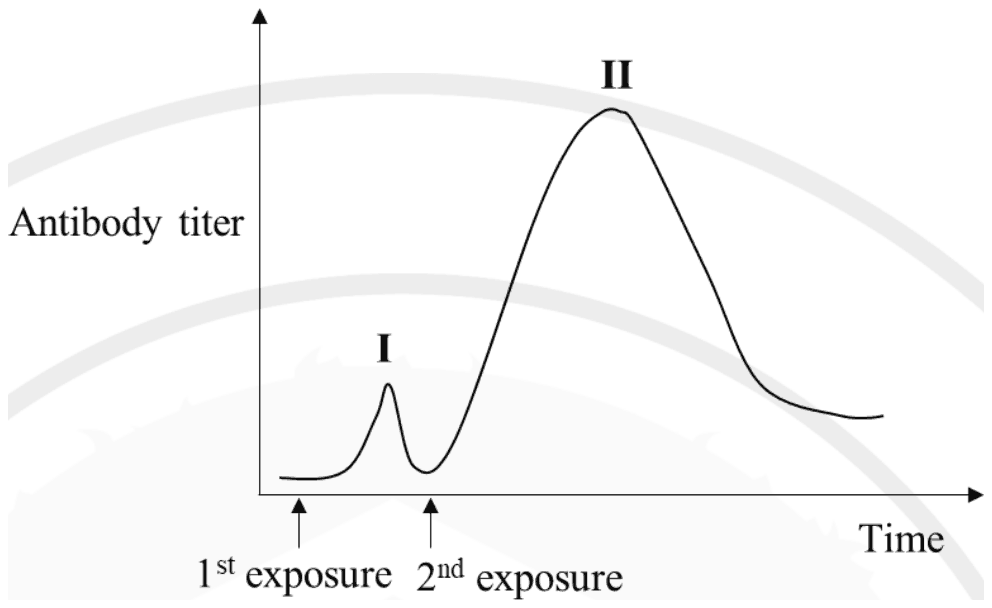
Which one of the following options correctly pairs antibodies to peak I and peak II in the graph?
Phagocytosis was first described by
Which one of the following leukocytes is the most abundant in a healthy human?
Which of the immune cells listed below are agranular?
P. Eosinophils
Q. Mast cells
R. Monocytes
S. T-cells
Identify the INCORRECT statement about the immunoglobulins (Ig)
Immunoglobulins are classified into the following isotypes: IgG, IgM, IgA, IgD, IgE. What region of the immunoglobulin is used to determine this classification?
The most abundant class of immunoglobulins in serum is __________.
Antibody coated pathogens are recognized by effector cells through
Total number of questions : 20
Number of answered questions : 0
Number of unanswered questions : 20
Immunology [ Question No: 1 To 20 ] :
Severe combined immuno deficiency (SCID) mice do not have :
Your Answer : (Not Answered)
Correct Answer : A
SCID mice lack B and T cells.
The original SCID mutation in mice is in the Prkdc gene, which encodes the DNA-dependent protein kinase needed for V(D)J recombination. Without it, neither immunoglobulin nor T cell receptor genes can be rearranged, so functional B and T lymphocytes do not develop and adaptive immunity is absent. This is why SCID mice accept human tissue and are used as hosts for xenografts.
Eosinophils, basophils and neutrophils are myeloid granulocytes that do not rearrange antigen-receptor genes, so they develop normally in SCID mice.
Of the following which is not involved in steady state regulation of hematopoiesis ?
Your Answer : (Not Answered)
Correct Answer : D
The item not involved is Mesangial cells.
Mesangial cells are specialised cells of the kidney glomerulus that support the capillary loops; they have nothing to do with blood-cell production.
The other three are the standard mechanisms of steady-state haematopoiesis: control of the levels and types of cytokines made by bone-marrow stromal cells; cytokines with haematopoietic activity made by other cells, such as activated T cells and macrophages; and removal of cells by controlled induction of cell death (apoptosis), which balances production.
If a naive T cell recognizes an antigen-MHC complex on an appropriate antigen-presenting cell or target cell, it will be activated, initiating :
Your Answer : (Not Answered)
Correct Answer : A
The response initiated is a primary response.
A naive T cell has never met its antigen. When it first recognises its antigen-MHC complex on an antigen-presenting cell (with co-stimulation), it proliferates and differentiates into effector and memory cells; that first encounter is the primary immune response.
A secondary response is mounted by memory cells when the same antigen returns, faster and stronger. Prophylactic describes preventive measures such as vaccination, not a stage of the response, and degranulation of mast cells is an IgE-mediated effector event, not T-cell activation.
Peptide antigens assemble with class I MHC, aided by :
Your Answer : (Not Answered)
Correct Answer : A
Peptides assemble with class I MHC aided by chaperone molecules.
Class I heavy chains fold in the endoplasmic reticulum with the help of chaperones: calnexin first, then the peptide-loading complex of calreticulin, ERp57 and tapasin, which links the empty MHC molecule to the TAP transporter that brings cytosolic peptides into the ER. Once a peptide binds, the complex is released to the cell surface.
Immunoglobulins and T cell receptors recognise antigen but play no part in loading class I molecules, and cytokines are secreted signalling proteins (interferon-gamma raises MHC expression but does not assemble the complex).
Peptide antigen assemble with class 1 MHC aided by :
Your Answer : (Not Answered)
Correct Answer : A
Assembly is aided by chaperone molecules.
In the endoplasmic reticulum, newly made MHC class I heavy chains are held by the chaperones calnexin and then calreticulin, and with tapasin and ERp57 form the peptide-loading complex beside the TAP transporter. Only when a suitable peptide is loaded does the MHC molecule, with β2-microglobulin, leave for the cell surface.
Immunoglobulins are antibodies, the T-cell receptor recognises the finished peptide-MHC complex at the cell surface, and cytokines are signalling molecules; none helps load the peptide.
Transplantation of stem cell populations from genetically identical donor to the recipient is said to be :
Your Answer : (Not Answered)
Correct Answer : B
The transplant is syngeneic.
A syngeneic graft is one between genetically identical individuals, such as identical twins or animals of the same inbred strain. Because donor and recipient share the same tissue antigens, the graft is not rejected.
An autologous graft (printed 'Autologus') uses the patient's own cells, an allogeneic graft comes from a genetically different member of the same species, and a xenogeneic graft comes from another species.
Antibody titer refers to the :
Your Answer : (Not Answered)
Correct Answer : D
Antibody titer is the highest dilution of antibody suitable to give a positive result in a test system.
A serum is diluted serially, for example 1:10, 1:20, 1:40 and so on, and each dilution is tested in an assay such as agglutination, haemagglutination inhibition or ELISA. The titer is the last dilution still giving a detectable positive reaction, usually reported as its reciprocal, such as 320. It is a relative measure used to compare samples, for example to show a rise in antibody between two samples in an infection.
It is not the absolute amount or the exact concentration of antibody, which need quantitative assays against a standard, and it is not avidity, the overall binding strength of a multivalent antibody.
Naturally acquired active immunity would be most likely acquired through which of the following processes ?
Your Answer : (Not Answered)
Correct Answer : D
Naturally acquired active immunity comes from infection with a disease-causing organism followed by recovery.
Immunity is active when the body's own immune system makes the antibodies and memory cells, and natural when the antigen is met in ordinary life rather than given deliberately. Recovering from an infection such as measles fulfils both conditions and usually gives long-lasting protection.
Vaccination is active but artificially acquired, since the antigen is given on purpose. Drinking colostrum and the transfer of antibodies around birth, across the placenta, give naturally acquired passive immunity: the antibodies are ready-made by the mother, and the protection fades within months.
Peptide-binding cleft in MHC-I is formed by
Your Answer : (Not Answered)
Correct Answer : A
The peptide-binding cleft of MHC class I is formed by the \(\alpha 1\) and \(\alpha 2\) domains.
The MHC I heavy chain has three extracellular domains. The \(\alpha 1\) and \(\alpha 2\) domains together build a platform of eight β-strands topped by two long α-helices, and the groove between the helices holds a peptide of about 8 to 10 residues for display to CD8+ T cells.
The \(\alpha 3\) domain and the separate light chain \(\beta 2\)-microglobulin are immunoglobulin-like domains that sit beneath the platform and support it; \(\alpha 3\) is also where CD8 binds. Neither forms the cleft, so the options pairing \(\alpha 1\) or \(\alpha 2\) with \(\alpha 3\) or \(\beta 2\)-microglobulin are wrong. (In MHC II the cleft is built from \(\alpha 1\) and \(\beta 1\), one from each chain.)
Which one of the following tissues/organs is least likely to experience graft rejection when transplanted from a person to an unrelated person?
Your Answer : (Not Answered)
Correct Answer : B
The least likely to be rejected is the cornea.
The cornea is avascular and has no lymphatic drainage, so donor antigens are poorly presented to the recipient's immune system, and the eye is an immune-privileged site. Corneal grafts between unrelated people therefore usually succeed without close tissue matching.
Kidney and heart transplants are vascularised organs that need HLA matching and lifelong immunosuppression. Bone marrow needs close HLA matching too, and carries the added risk of graft-versus-host disease.
Which one of the following is the most sensitive immunoassay?
Your Answer : (Not Answered)
Correct Answer : D
The most sensitive of these is the radioimmunoassay.
A radioimmunoassay measures an antigen by its competition with a radiolabelled antigen for a limited amount of antibody. Because radioactivity can be counted very precisely, the method detects antigens at picogram levels, which is why Yalow and Berson's RIA was used to measure hormones such as insulin in blood.
Immunoelectrophoresis and radial immunodiffusion rely on visible precipitin lines or rings, which form only at much higher (microgram) concentrations of antigen. Immunofluorescence is used mainly to locate antigens in cells and tissues and is not a quantitative assay of comparable sensitivity.
Match the test in Group I with its application in Group II
| Group I | Group II |
|---|---|
| P. Oakley-Fulthorpe test | 1. IgM detection |
| Q. Limulus amoebocyte lysate test | 2. Determining antigen-antibody specificity |
| R. Weil-Felix reaction test | 3. Endotoxin detection |
| S. Complement-fixation test | 4. Rickettsial infection diagnosis |
Your Answer : (Not Answered)
Correct Answer : A
The match is P-2, Q-3, R-4, S-1.
- The Oakley-Fulthorpe test is a double immunodiffusion in tubes, used to examine antigen-antibody reactions and their specificity.
- The Limulus amoebocyte lysate test, which clots in the presence of lipopolysaccharide, detects bacterial endotoxin.
- The Weil-Felix reaction uses Proteus antigens that cross-react with rickettsial antibodies, so it is used to diagnose rickettsial infections.
- The complement-fixation test detects antibodies that fix complement; IgM fixes complement most efficiently, which is the pairing the key adopts.
Each of the other options misplaces at least one of the three unambiguous pairings: LAL with endotoxin, Weil-Felix with rickettsiae, and Oakley-Fulthorpe with antigen-antibody specificity.
The adaptive immune response in an animal involves the generation of antibodies against an invading bacterial pathogen. The following graph represents antibody titer levels in a mammal exposed twice to the pathogen.
Which one of the following options correctly pairs antibodies to peak I and peak II in the graph?
Your Answer : (Not Answered)
Correct Answer : B
The pairing is Peak I - IgM; Peak II - IgG.
Peak I is the primary response, after the first exposure: it is small and appears after a lag, and its antibody is mainly IgM, the first class made by naive B cells. During that response B cells undergo class switching and form memory cells.
Peak II is the secondary response. Memory B cells respond quickly to the second exposure and produce a much larger and longer-lasting titre, made up mainly of high-affinity IgG.
IgG first and IgM second reverses the order of class switching. IgE is the antibody of allergy and anti-parasite responses, not of the primary response to a bacterium. IgG for both peaks ignores the IgM that dominates a primary response.
Phagocytosis was first described by
Your Answer : (Not Answered)
Correct Answer : A
Phagocytosis was first described by Elie Metchnikoff.
In the 1880s Metchnikoff observed mobile cells in starfish larvae engulfing foreign particles, and went on to show that white blood cells engulf and digest bacteria. He named the process phagocytosis and founded the cellular theory of immunity, sharing the 1908 Nobel Prize with Paul Ehrlich.
Ehrlich championed the humoral (antibody) side of immunity. Robert Hooke described cells in cork in 1665, and Robert Koch established the germ theory of disease with his postulates; neither described phagocytosis.
Which one of the following leukocytes is the most abundant in a healthy human?
Your Answer : (Not Answered)
Correct Answer : D
The most abundant leukocytes are neutrophils.
In a healthy adult, neutrophils make up roughly 50-70 percent of circulating white blood cells. They are the first phagocytes to reach a site of bacterial infection and are the main cells in pus.
Lymphocytes come second but are not offered. Monocytes form only about 2-8 percent, eosinophils about 1-4 percent, and basophils under 1 percent, making basophils the rarest of all.
Which of the immune cells listed below are agranular?
P. Eosinophils
Q. Mast cells
R. Monocytes
S. T-cells
Your Answer : (Not Answered)
Correct Answer : C
The agranular cells are R and S only, monocytes and T-cells.
Leukocytes are classed by whether their cytoplasm carries prominent stained granules. The agranulocytes are the lymphocytes, which include T-cells and B-cells, and the monocytes, which mature into macrophages.
Eosinophils (P) are granulocytes, with large granules that stain with eosin. Mast cells (Q) are tissue cells packed with histamine-containing granules. Any option including P or Q is therefore wrong.
Identify the INCORRECT statement about the immunoglobulins (Ig)
Your Answer : (Not Answered)
Correct Answer : C
The incorrect statement is IgD is the most abundant immunoglobulin.
IgG is the most abundant immunoglobulin in serum, about three quarters of the total. IgD is present only in trace amounts in serum; its main role is as an antigen receptor on the surface of mature naive B cells, alongside IgM.
The other statements are correct. Secreted IgM is a pentamer joined by a J chain. IgA in secretions such as saliva, tears and breast milk is a dimer. IgE binds to mast cells and basophils and triggers the release of histamine in allergic reactions.
Immunoglobulins are classified into the following isotypes: IgG, IgM, IgA, IgD, IgE. What region of the immunoglobulin is used to determine this classification?
Your Answer : (Not Answered)
Correct Answer : A
The isotype is decided by the constant region of the heavy chain only.
There are five kinds of heavy-chain constant region, gamma, mu, alpha, delta and epsilon, and they define IgG, IgM, IgA, IgD and IgE. The heavy-chain constant region also sets each class's effector functions, such as complement fixation by IgM or mast-cell binding by IgE. Class switching changes only this region while the antigen-binding site stays the same.
The light-chain constant region comes in two types, kappa and lambda, and either can pair with any isotype, so it plays no part. The variable regions of both chains form the antigen-binding site and decide specificity, not class.
The most abundant class of immunoglobulins in serum is __________.
Your Answer : (Not Answered)
Correct Answer : D
The most abundant serum immunoglobulin is IgG.
IgG makes up about three-quarters of the immunoglobulin in normal serum. It is the main antibody of the secondary immune response, it is the only class that crosses the placenta, and it neutralises toxins and opsonises microbes.
IgA is the main antibody of secretions (saliva, tears, milk) but is less abundant in serum. IgM is the large pentamer of the primary response, at around a tenth of the total, and IgD is present only in trace amounts, mainly on B cells.
Antibody coated pathogens are recognized by effector cells through
Your Answer : (Not Answered)
Correct Answer : B
Antibody-coated pathogens are recognised through the F\(_{C}\) receptor.
An antibody binds the pathogen with its Fab arms, leaving the Fc (constant) tail pointing outward. Phagocytes, NK cells, mast cells and other effector cells carry Fc receptors that bind this tail, which triggers opsonic phagocytosis or antibody-dependent cell-mediated cytotoxicity.
CD4 and CD8 are co-receptors on T cells that bind MHC class II and class I molecules. The IFN-γ receptor binds a cytokine. None of them recognises antibody bound to a microbe.
Marks
Total number of questions : 20
Number of answered questions : 0
Number of unanswered questions : 20