
Instruction
- Total number of questions : 20
- Time allotted : 30:00 Minutes:Seconds.
- Each question carry 1 mark, no negative marks.
- DO NOT refresh the page.
- All the best
Mathematical Physics [ Question No: 1 To 20 ] :
The complex Fourier transform of \(e^{-|x|}\) is :
Fourier series for the function
\[ f(\theta) = \begin{cases} +1 & 0 \lt \theta \lt \pi \\ -1 & \pi \lt \theta \lt 2\pi \end{cases} \]
there are :
\(I = \int_{c} \frac{z^{2}\,dz}{(z^{2}+1)(z^{2}+4)}\), in the z-plane.
Here c is a contour as shown : the closed contour made of the real axis from -R to R and the semicircular arc of radius R about Z = 0 in the upper half-plane, with the points i and 2i marked inside it.
then :
Unit vector perpendicular to \(\bar{A} = 2\hat{i} - \hat{j} + \hat{k}\) and \(\bar{B} = 3\hat{i} + 4\hat{j} - \hat{k}\) is :
If \(\overline{A} = x\hat{e}_{x} + y\hat{e}_{y} + z\hat{e}_{j}\), then \(\nabla^{2}\overline{A}\) will be :
\(\frac{d^{2} f}{dx^{2}} + 2 \operatorname{sech}^{2} x\, f - f = 0.\)
One of the solution is :
The inverse Fourier transform of \(e^{-|k|}\) is :
Value of \(\oint_{c} \frac{dz}{(z+2)}\), \(c : |z| = 1\) is :
A piecewise regular function \(f(x)\) is shown in the figure. It is expanded in Fourier series given by
\[ \begin{aligned} f(x) = \frac{a_{0}}{2} &+ \sum_{n=1}^{\infty} a_{n}\cos(nx) \\ &+ \sum_{n=1}^{\infty} b_{n}\sin(nx), \end{aligned} \]
where \(a_{0}, a_{n}, b_{n}\)’s are the Fourier coefficients.
Which of the following options is correct?
The function \(f(x) = \begin{cases} x, & -\pi \lt x \lt 0 \\ -x, & 0 \lt x \lt \pi \end{cases}\) is expanded as a Fourier series of the form \(a_{0} + \sum_{n=1}^{\infty} a_{n}\cos(nx) + \sum_{n=1}^{\infty} b_{n}\sin(nx)\). Which of the following is true?
Consider the function \(f(z) = \frac{1}{z^{2}(z-2)^{3}}\) of a complex variable \(z\). The residues of the function at \(z = 0\) and \(z = 2\), respectively, are
Consider the complex function
\[ f(z) = \frac{z^{2}\sin z}{(z - \pi)^{4}} . \]
At \(z = \pi\), which of the following options is(are) CORRECT?
Consider the ordinary differential equation
\[ y'' - 2xy' + 4y = 0 \]
and its solution \(y(x) = a + bx + cx^{2}\). Then
What is the maximum number of free independent real parameters specifying an \(n\)-dimensional orthogonal matrix?
A curve is given by \(\vec{r}(t) = t\hat{\imath} + t^{2}\hat{\jmath} + t^{3}\hat{k}\). The unit vector of the tangent to the curve at \(t = 1\) is
Sketch of a two-dimensional vector field \(\vec{V}\) is shown below. Here, length and arrow head of the arrows denote magnitude and direction of the vector field, respectively. Which of the following statements is correct for \(\vec{\nabla} \times \vec{V}\) ?
Consider a two dimensional Cartesian coordinate system in which a rank 2 contravariant tensor is represented by the matrix \(\begin{pmatrix} 0 & 1 \\ 1 & 0 \end{pmatrix}\). The coordinate system is rotated anticlockwise by an acute angle \(\theta\) with the origin fixed. Which one of the following matrices represents the tensor in the new coordinate system?
Amongst electrical resistivity (\(\rho\)), thermal conductivity (\(\kappa\)), specific heat (\(C\)), Young’s modulus (\(Y\)), and magnetic susceptibility (\(\chi\)), which quantities show a sharp change at the superconducting transition temperature?
Consider the transformation to a new set of coordinates \((\xi, \eta)\) from rectangular Cartesian coordinates \((x, y)\), where \(\xi = 2x + 3y\) and \(\eta = 3x - 2y\). In the \((\xi, \eta)\) coordinate system, the area element dxdy is
The scale factors corresponding to the covariant metric tensor \(g_{ij}\) in spherical polar coordinates are
Total number of questions : 20
Number of answered questions : 0
Number of unanswered questions : 20
Mathematical Physics [ Question No: 1 To 20 ] :
The complex Fourier transform of \(e^{-|x|}\) is :
Your Answer : (Not Answered)
Correct Answer : A
The complex Fourier transform is \(\frac{2}{1 + n^{2}}\).
Using \(F(n) = \int_{-\infty}^{\infty} f(x)e^{inx}dx\) and splitting the range at zero, where \(|x|\) changes sign:
\[ \begin{aligned} F(n) &= \int_{-\infty}^{0} e^{(1 + in)x}dx \\ &\quad + \int_{0}^{\infty} e^{-(1 - in)x}dx \\ &= \frac{1}{1 + in} + \frac{1}{1 - in} \\ &= \frac{2}{1 + n^{2}} \end{aligned} \]
The paper uses the convention without the factor \(1/\sqrt{2\pi}\). With it, the result would be \(\sqrt{2/\pi}/(1 + n^{2})\), which is not offered. The other numerators come from dropping one of the two halves (1) or mishandling the constants (4 or \(\pi\)).
Fourier series for the function
\[ f(\theta) = \begin{cases} +1 & 0 \lt \theta \lt \pi \\ -1 & \pi \lt \theta \lt 2\pi \end{cases} \]
there are :
Your Answer : (Not Answered)
Correct Answer : D
The series contains odd sine terms only.
The square wave is an odd function about \(\theta = 0\) (shifting the second half to \(-\pi \lt \theta \lt 0\) gives \(f(-\theta) = -f(\theta)\)), so every cosine coefficient and the constant term vanish. For the sine coefficients:
\[ \begin{aligned} b_{n} &= \frac{2}{\pi}\int_{0}^{\pi}\sin n\theta\,d\theta \\ &= \frac{2}{n\pi}(1 - \cos n\pi) \end{aligned} \]
This is \(4/n\pi\) for odd n and 0 for even n, giving \(f = \frac{4}{\pi}(\sin\theta + \frac{1}{3}\sin 3\theta + \dots)\). 'Sine terms only' is incomplete because the even harmonics are absent, and the cosine options fail the odd symmetry.
\(I = \int_{c} \frac{z^{2}\,dz}{(z^{2}+1)(z^{2}+4)}\), in the z-plane.
Here c is a contour as shown : the closed contour made of the real axis from -R to R and the semicircular arc of radius R about Z = 0 in the upper half-plane, with the points i and 2i marked inside it.
then :
Your Answer : (Not Answered)
Correct Answer : D
The integral is \(I = \pi/3\).
The integrand has simple poles at \(z = \pm i\) and \(z = \pm 2i\); the contour encloses \(z = i\) and \(z = 2i\). Their residues are:
\[ \begin{aligned} \text{Res}_{z=i} &= \frac{i^{2}}{(2i)(i^{2}+4)} = \frac{-1}{6i} \\ \text{Res}_{z=2i} &= \frac{(2i)^{2}}{(4i)((2i)^{2}+1)} = \frac{1}{3i} \end{aligned} \]
\[ \begin{aligned} I &= 2\pi i\left(\frac{-1}{6i} + \frac{2}{6i}\right) \\ &= \frac{2\pi i}{6i} = \frac{\pi}{3} \end{aligned} \]
The option \(-\pi/3\) is the contribution of the pole at i alone, missing the pole at 2i; \(\pi/6\) is half the correct value; and 0 would hold only if the contour enclosed no pole.
Unit vector perpendicular to \(\bar{A} = 2\hat{i} - \hat{j} + \hat{k}\) and \(\bar{B} = 3\hat{i} + 4\hat{j} - \hat{k}\) is :
Your Answer : (Not Answered)
Correct Answer : A
The unit vector is \(\frac{-3\hat{i} + 5\hat{j} + 11\hat{k}}{\sqrt{155}}\).
A vector perpendicular to both is their cross product:
\[ \begin{aligned} \bar{A} \times \bar{B} &= \hat{i}[(-1)(-1) - (1)(4)] \\ &\quad - \hat{j}[(2)(-1) - (1)(3)] \\ &\quad + \hat{k}[(2)(4) - (-1)(3)] \\ &= -3\hat{i} + 5\hat{j} + 11\hat{k} \end{aligned} \]
Its magnitude is \(\sqrt{9 + 25 + 121} = \sqrt{155}\), and dividing by it gives the unit vector. A quick check: its dot product with \(\bar{A}\) is \(-6 - 5 + 11 = 0\).
The other options fail that check; for example \((\hat{i} - \hat{j} + 2\hat{k})\cdot\bar{A} = 2 + 1 + 2 = 5\), so it is not perpendicular to \(\bar{A}\).
If \(\overline{A} = x\hat{e}_{x} + y\hat{e}_{y} + z\hat{e}_{j}\), then \(\nabla^{2}\overline{A}\) will be :
Your Answer : (Not Answered)
Correct Answer : C
The Laplacian of the field is 0.
The field is the position vector, \(\overline{A} = x\hat{e}_{x} + y\hat{e}_{y} + z\hat{e}_{z}\) (the paper prints the last unit vector as \(\hat{e}_{j}\)). In Cartesian coordinates the vector Laplacian acts on each component separately, and each component is linear in the coordinates:
\[ \nabla^{2}x = \nabla^{2}y = \nabla^{2}z = 0 \]
so \(\nabla^{2}\overline{A} = 0\). The value 3 is the divergence \(\nabla \cdot \overline{A}\), a common confusion; 1 and -3 do not arise from either operation.
\(\frac{d^{2} f}{dx^{2}} + 2 \operatorname{sech}^{2} x\, f - f = 0.\)
One of the solution is :
Your Answer : (Not Answered)
Correct Answer : A
One solution is sech x.
Try \(f = \operatorname{sech} x\). Using \((\operatorname{sech} x)' = -\operatorname{sech} x \tanh x\) and \((\tanh x)' = \operatorname{sech}^{2} x\):
\[ \begin{aligned} f' &= -\operatorname{sech} x \tanh x \\ f'' &= \operatorname{sech} x \tanh^{2} x - \operatorname{sech}^{3} x \end{aligned} \]
Substituting:
\[ \begin{aligned} &f'' + 2\operatorname{sech}^{2}x\, f - f \\ &= \operatorname{sech} x\,(\tanh^{2} x + \operatorname{sech}^{2} x - 1) = 0 \end{aligned} \]
since \(\tanh^{2} x + \operatorname{sech}^{2} x = 1\). The same substitution with \(\operatorname{sech}^{2} x\), \(\tanh x\) or \(\operatorname{sech}^{3} x\) leaves terms that do not cancel; for example \(f = \tanh x\) has \(f'' = -2\operatorname{sech}^{2}x\tanh x\), which cancels the middle term and leaves \(-\tanh x \neq 0\).
The inverse Fourier transform of \(e^{-|k|}\) is :
Your Answer : (Not Answered)
Correct Answer : A
The inverse transform is \(\frac{1}{\pi}\frac{1}{1+x^{2}}\).
With the convention \(f(x) = \frac{1}{2\pi}\int F(k) e^{ikx} dk\), split the integral at \(k = 0\):
\[ \begin{aligned} f(x) &= \frac{1}{2\pi}\Big[\int_{0}^{\infty} e^{-k(1-ix)}dk + \int_{0}^{\infty} e^{-k(1+ix)}dk\Big] \\ &= \frac{1}{2\pi}\Big[\frac{1}{1-ix} + \frac{1}{1+ix}\Big] \\ &= \frac{1}{2\pi}\cdot\frac{2}{1+x^{2}} = \frac{1}{\pi}\frac{1}{1+x^{2}} \end{aligned} \]
This is the Lorentzian (Cauchy) profile. A Gaussian \(e^{-x^{2}}\) is the transform of a Gaussian, not of \(e^{-|k|}\); \(e^{-|x|}\) simply copies the input; and \(1/(1+x)\) is not even an even function, while the transform of an even function must be even.
Value of \(\oint_{c} \frac{dz}{(z+2)}\), \(c : |z| = 1\) is :
Your Answer : (Not Answered)
Correct Answer : B
The integral is zero.
The integrand \(1/(z+2)\) has a single simple pole, at \(z = -2\). The contour is the unit circle \(|z| = 1\), and since \(|-2| = 2 \gt 1\) the pole lies outside it. Inside and on the contour the function is analytic, so by Cauchy's theorem
\[ \oint_{|z|=1} \frac{dz}{z+2} = 0 \]
The value \(2\pi i\) would be the answer only if the pole were enclosed (residue 1 times \(2\pi i\)); \(-2\pi i\) is that with the contour traversed clockwise, and \(\pi i\) arises for a pole lying on a contour, in the principal-value sense. None of these applies here.
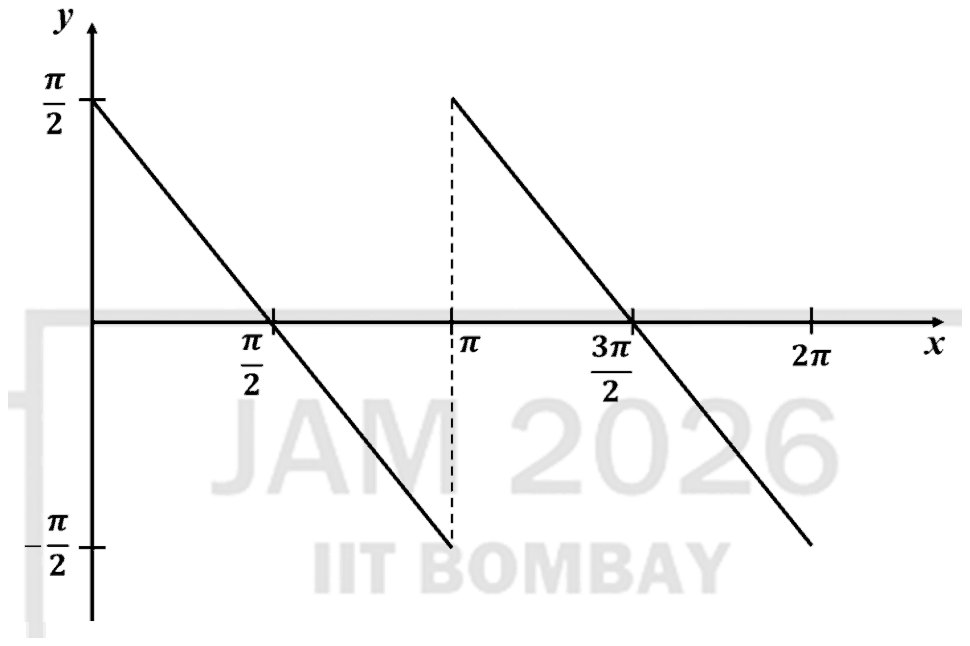
A piecewise regular function \(f(x)\) is shown in the figure. It is expanded in Fourier series given by
\[ \begin{aligned} f(x) = \frac{a_{0}}{2} &+ \sum_{n=1}^{\infty} a_{n}\cos(nx) \\ &+ \sum_{n=1}^{\infty} b_{n}\sin(nx), \end{aligned} \]
where \(a_{0}, a_{n}, b_{n}\)’s are the Fourier coefficients.
Which of the following options is correct?
Your Answer : (Not Answered)
Correct Answer : B
The correct option is that all \(a_n\) are zero.
On \(0 < x < \pi\) the graph is \(f(x) = \frac{\pi}{2} - x\), repeated with period \(\pi\). Shifting one period back, on \(-\pi < x < 0\) it is \(f(x) = -\frac{\pi}{2} - x\). So for \(0 < x < \pi\):
\[ f(-x) = -\tfrac{\pi}{2} + x = -f(x) \]
The function is odd. The cosine coefficients \(a_n = \frac{1}{\pi}\int_{-\pi}^{\pi} f(x)\cos nx\,dx\) integrate an odd function over a symmetric interval, so every one of them, \(a_0\) included, is zero; only sine terms survive.
Since \(a_0\) is twice the average value and the sawtooth averages to zero, \(a_0 = 3\pi\) and \(a_0 = 3\pi/2\) are wrong. The \(b_n\) cannot all vanish, or \(f\) would be identically zero.
The function \(f(x) = \begin{cases} x, & -\pi \lt x \lt 0 \\ -x, & 0 \lt x \lt \pi \end{cases}\) is expanded as a Fourier series of the form \(a_{0} + \sum_{n=1}^{\infty} a_{n}\cos(nx) + \sum_{n=1}^{\infty} b_{n}\sin(nx)\). Which of the following is true?
Your Answer : (Not Answered)
Correct Answer : A
The answer is \(a_{0} \neq 0, b_{n} = 0\).
The function equals \(-|x|\): it is even, since \(f(-x) = f(x)\). An even function has no sine terms, so every \(b_{n} = 0\).
The constant term is the mean value over the period:
\[ \begin{aligned} a_{0} &= \frac{1}{2\pi}\int_{-\pi}^{\pi} (-|x|)\,dx \\ &= -\frac{\pi}{2} \neq 0 \end{aligned} \]
Treating the function as odd (because each piece is linear in x) would wrongly give \(a_{0} = 0\) and nonzero \(b_{n}\).
Consider the function \(f(z) = \frac{1}{z^{2}(z-2)^{3}}\) of a complex variable \(z\). The residues of the function at \(z = 0\) and \(z = 2\), respectively, are
Your Answer : (Not Answered)
Correct Answer : C
The residues are \(-\frac{3}{16}\) and \(\frac{3}{16}\).
At \(z = 0\) (a pole of order 2), the residue is the first derivative of \(\frac{1}{(z-2)^{3}}\) at 0. At \(z = 2\) (order 3), it is half the second derivative of \(\frac{1}{z^{2}}\) at 2:
\[ \begin{aligned} \text{Res}_{0} &= \left.\frac{-3}{(z-2)^{4}}\right|_{0} = -\frac{3}{16} \\ \text{Res}_{2} &= \frac{1}{2}\left.\frac{6}{z^{4}}\right|_{2} = \frac{3}{16} \end{aligned} \]
Check: the function falls off as \(z^{-5}\), so the residues must sum to zero, as they do. The options with \(\frac{3}{8}\) forget the factor \(\frac{1}{2!}\) or the power of 2 in the denominator.
Consider the complex function
\[ f(z) = \frac{z^{2}\sin z}{(z - \pi)^{4}} . \]
At \(z = \pi\), which of the following options is(are) CORRECT?
Your Answer : (Not Answered)
Correct Answer : B
The correct statement is the order of the pole is 3; it is the only option the key accepts in this multiple-select question.
Put \(w = z - \pi\). Near \(z = \pi\), \(\sin z = -\sin w = -w + \frac{w^{3}}{6} - \ldots\) has a simple zero, which cancels one power of the \((z - \pi)^{4}\) in the denominator, while \(z^{2} \rightarrow \pi^{2} \neq 0\). So
\[ f(z) \approx \frac{-\pi^{2}}{(z - \pi)^{3}} \]
and the pole is of order 3, not 4.
The residue is the coefficient of \(w^{3}\) in \(z^{2}\sin z = (\pi^{2} + 2\pi w + w^{2})(-w + w^{3}/6 - \ldots)\), which is
\[ \text{Res} = \frac{\pi^{2}}{6} - 1 \approx 0.64 \]
so neither \(\pi/6\) nor \(2\pi/3\) is the residue.
Consider the ordinary differential equation
\[ y'' - 2xy' + 4y = 0 \]
and its solution \(y(x) = a + bx + cx^{2}\). Then
Your Answer : (Not Answered)
Correct Answer : B
The coefficients satisfy \(c = -2a \ne 0\) and \(b = 0\).
Substitute \(y = a + bx + cx^{2}\), \(y' = b + 2cx\), \(y'' = 2c\):
\[ \begin{aligned} 2c - 2x(b + 2cx) + 4(a + bx + cx^{2}) \\ = (2c + 4a) + 2bx = 0 \end{aligned} \]
The \(x^{2}\) terms cancel. For this to vanish for all \(x\), \(b = 0\) and \(c = -2a\), so the solution is \(a(1 - 2x^{2})\), proportional to the Hermite polynomial \(H_{2}\). The option with \(a = 0\) and \(c = -2b\) fails the constant term, \(b = -2a\) with \(c = 0\) fails because \(b\) must vanish, and \(c = 2a\) has the wrong sign.
What is the maximum number of free independent real parameters specifying an \(n\)-dimensional orthogonal matrix?
Your Answer : (Not Answered)
Correct Answer : C
The number is \(\frac{n(n - 1)}{2}\).
An \(n \times n\) real matrix has \(n^{2}\) entries. Orthogonality, \(O^{T}O = I\), imposes one condition for each entry of the symmetric matrix \(O^{T}O\), that is \(\frac{n(n + 1)}{2}\) independent conditions. The free parameters are
\[ n^{2} - \frac{n(n + 1)}{2} = \frac{n(n - 1)}{2} \]
For \(n = 2\) this gives 1 (a rotation angle) and for \(n = 3\) it gives 3 (the Euler angles), as expected. \(\frac{n(n + 1)}{2}\) is the number of constraints, not of free parameters, and \((n - 1)^{2}\) and \(n(n - 2)\) fail the \(n = 2\) and \(n = 3\) checks.
A curve is given by \(\vec{r}(t) = t\hat{\imath} + t^{2}\hat{\jmath} + t^{3}\hat{k}\). The unit vector of the tangent to the curve at \(t = 1\) is
Your Answer : (Not Answered)
Correct Answer : D
The unit tangent is \(\frac{\hat{\imath} + 2\hat{\jmath} + 3\hat{k}}{\sqrt{14}}\).
The tangent is the derivative of the position vector, divided by its length:
\[ \begin{aligned} \frac{d\vec{r}}{dt} &= \hat{\imath} + 2t\hat{\jmath} + 3t^{2}\hat{k} \\ \text{at } t = 1: &\ \hat{\imath} + 2\hat{\jmath} + 3\hat{k} \\ \left|\,\cdot\,\right| &= \sqrt{1 + 4 + 9} = \sqrt{14} \end{aligned} \]
The first option is the position vector itself normalised, not its derivative. The others use wrong coefficients for the \(t^{2}\) and \(t^{3}\) terms; for example \(\hat{\imath} + 2\hat{\jmath} + 2\hat{k}\) forgets that \(d(t^{3})/dt = 3t^{2}\).
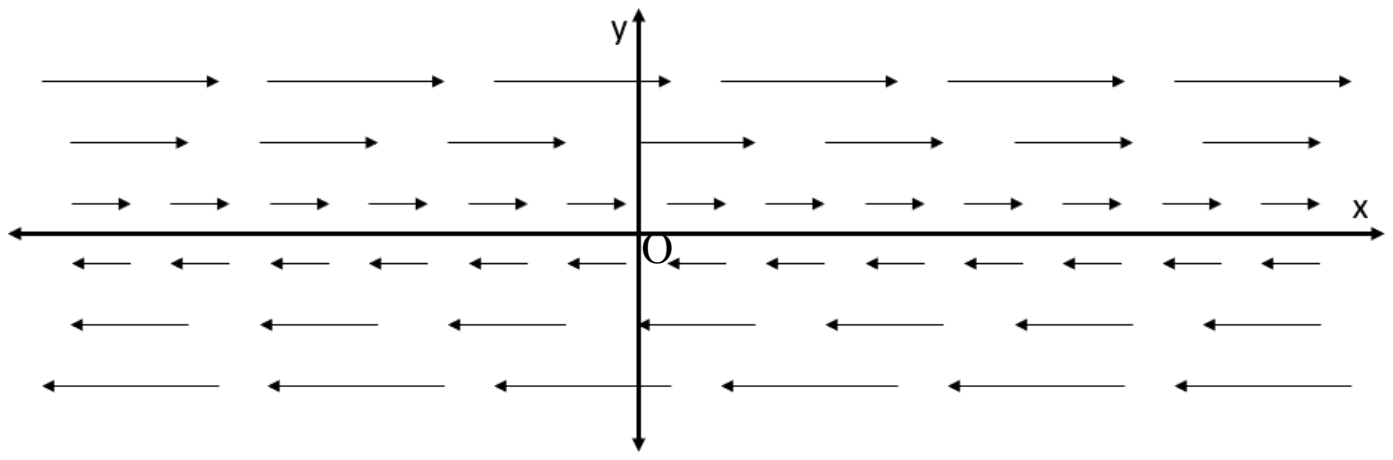
Sketch of a two-dimensional vector field \(\vec{V}\) is shown below. Here, length and arrow head of the arrows denote magnitude and direction of the vector field, respectively. Which of the following statements is correct for \(\vec{\nabla} \times \vec{V}\) ?
Your Answer : (Not Answered)
Correct Answer : C
The curl is non-zero and points into the plane.
The sketch shows a shear field: \(\vec{V} = V_{x}(y)\hat{x}\), with \(V_{x}\) positive above the x axis, negative below it, and growing with \(|y|\). Take it as \(V_{x} = ky\) with k > 0. Then
\[ \begin{aligned} \vec{\nabla} \times \vec{V} &= \left(\frac{\partial V_{y}}{\partial x} - \frac{\partial V_{x}}{\partial y}\right)\hat{z} \\ &= (0 - k)\hat{z} = -k\hat{z} \end{aligned} \]
With x to the right and y up, \(-\hat{z}\) points into the page. A paddle wheel placed anywhere would turn clockwise, because the flow above it is faster to the right than the flow below. The curl is the same everywhere, so it is not zero and does not reverse across the x axis, and its direction is into, not out of, the plane.
Consider a two dimensional Cartesian coordinate system in which a rank 2 contravariant tensor is represented by the matrix \(\begin{pmatrix} 0 & 1 \\ 1 & 0 \end{pmatrix}\). The coordinate system is rotated anticlockwise by an acute angle \(\theta\) with the origin fixed. Which one of the following matrices represents the tensor in the new coordinate system?
Your Answer : (Not Answered)
Correct Answer : B
The tensor becomes matrix (B):
\[ \begin{pmatrix} \sin 2\theta & \cos 2\theta \\ \cos 2\theta & -\sin 2\theta \end{pmatrix} \]
A rank 2 contravariant tensor transforms as \(T' = R\,T\,R^{T}\). For axes rotated anticlockwise by \(\theta\),
\[ R = \begin{pmatrix} \cos\theta & \sin\theta \\ -\sin\theta & \cos\theta \end{pmatrix} \]
First
\[ R\,T = \begin{pmatrix} \sin\theta & \cos\theta \\ \cos\theta & -\sin\theta \end{pmatrix} \]
then multiplying by \(R^{T}\) gives the entries \(2\sin\theta\cos\theta = \sin 2\theta\), \(\cos^{2}\theta - \sin^{2}\theta = \cos 2\theta\) (twice) and \(-\sin 2\theta\).
A quick check: the original matrix is symmetric with zero trace, and a rotation preserves both properties. Only matrix (B) is symmetric and traceless; (A) and (C) are not symmetric, and the last has trace \(\sin 2\theta - \cos 2\theta\).
Amongst electrical resistivity (\(\rho\)), thermal conductivity (\(\kappa\)), specific heat (\(C\)), Young’s modulus (\(Y\)), and magnetic susceptibility (\(\chi\)), which quantities show a sharp change at the superconducting transition temperature?
Your Answer : (Not Answered)
Correct Answer : B
The quantities that change sharply are \(\rho, C, \chi\).
- Resistivity drops abruptly to zero at \(T_{c}\), the defining property of a superconductor.
- Specific heat shows a discontinuous jump at \(T_{c}\), the signature of a second-order phase transition.
- Magnetic susceptibility changes abruptly to \(\chi = -1\), perfect diamagnetism, because of the Meissner effect.
Thermal conductivity does not jump at \(T_{c}\); it changes gradually below it as electrons condense into pairs that carry no entropy. Young’s modulus, a lattice property, is essentially unaffected. So options including \(\kappa\) or \(Y\) are wrong, and only \(\rho, C, \chi\) matches.
Consider the transformation to a new set of coordinates \((\xi, \eta)\) from rectangular Cartesian coordinates \((x, y)\), where \(\xi = 2x + 3y\) and \(\eta = 3x - 2y\). In the \((\xi, \eta)\) coordinate system, the area element dxdy is
Your Answer : (Not Answered)
Correct Answer : A
The area element is \(\frac{1}{13}\,d\xi\,d\eta\).
Areas transform with the Jacobian of the change of variables:
\[ \begin{aligned} \frac{\partial(\xi, \eta)}{\partial(x, y)} &= \begin{vmatrix} 2 & 3 \\ 3 & -2 \end{vmatrix} = -13 \\ d\xi\,d\eta &= 13\,dx\,dy \\ dx\,dy &= \tfrac{1}{13}\,d\xi\,d\eta \end{aligned} \]
Only the absolute value of the Jacobian matters for an area. The trap is to use 13 directly instead of its inverse; the options 5 and 3/5 come from adding coefficients instead of taking the determinant.
The scale factors corresponding to the covariant metric tensor \(g_{ij}\) in spherical polar coordinates are
Your Answer : (Not Answered)
Correct Answer : D
The scale factors are \(1, r, r\sin\theta\).
The line element in spherical polar coordinates is
\[ \begin{aligned} ds^{2} &= dr^{2} + r^{2}d\theta^{2} \\ &\quad + r^{2}\sin^{2}\theta\,d\phi^{2} \end{aligned} \]
so the covariant metric is diagonal with \(g_{rr} = 1\), \(g_{\theta\theta} = r^{2}\), \(g_{\phi\phi} = r^{2}\sin^{2}\theta\). The scale (Lamé) factors are the square roots, \(h_{i} = \sqrt{g_{ii}}\): 1, \(r\) and \(r\sin\theta\).
\(1, r^{2}, r^{2}\sin^{2}\theta\) are the metric components themselves, not the scale factors. \(1, r^{2}, \sin^{2}\theta\) is a garbled version of them, and 1, 1, 1 belongs to Cartesian coordinates.
Marks
Total number of questions : 20
Number of answered questions : 0
Number of unanswered questions : 20