
Instruction
- Total number of questions : 20
- Time allotted : 30:00 Minutes:Seconds.
- Each question carry 1 mark, no negative marks.
- DO NOT refresh the page.
- All the best
Mechanical Vibrations [ Question No: 1 To 20 ] :
Direction for [ Question No: 1 To 1 ] :
A spring mass damper system (mass \(m\), stiffness \(k\), and damping coefficient \(c\)) excited by a force \(F(t) = B\sin\omega t\), where \(B\), \(\omega\) and \(t\) are the amplitude, frequency and time, respectively, is shown in the figure. Four different responses of the system (marked as (i) to (iv)) are shown just to the right of the system figure. In the figures of the responses, \(A\) is the amplitude of response shown in red color and the dashed lines indicate its envelope. The responses represent only the qualitative trend and those are not drawn to any specific scale.
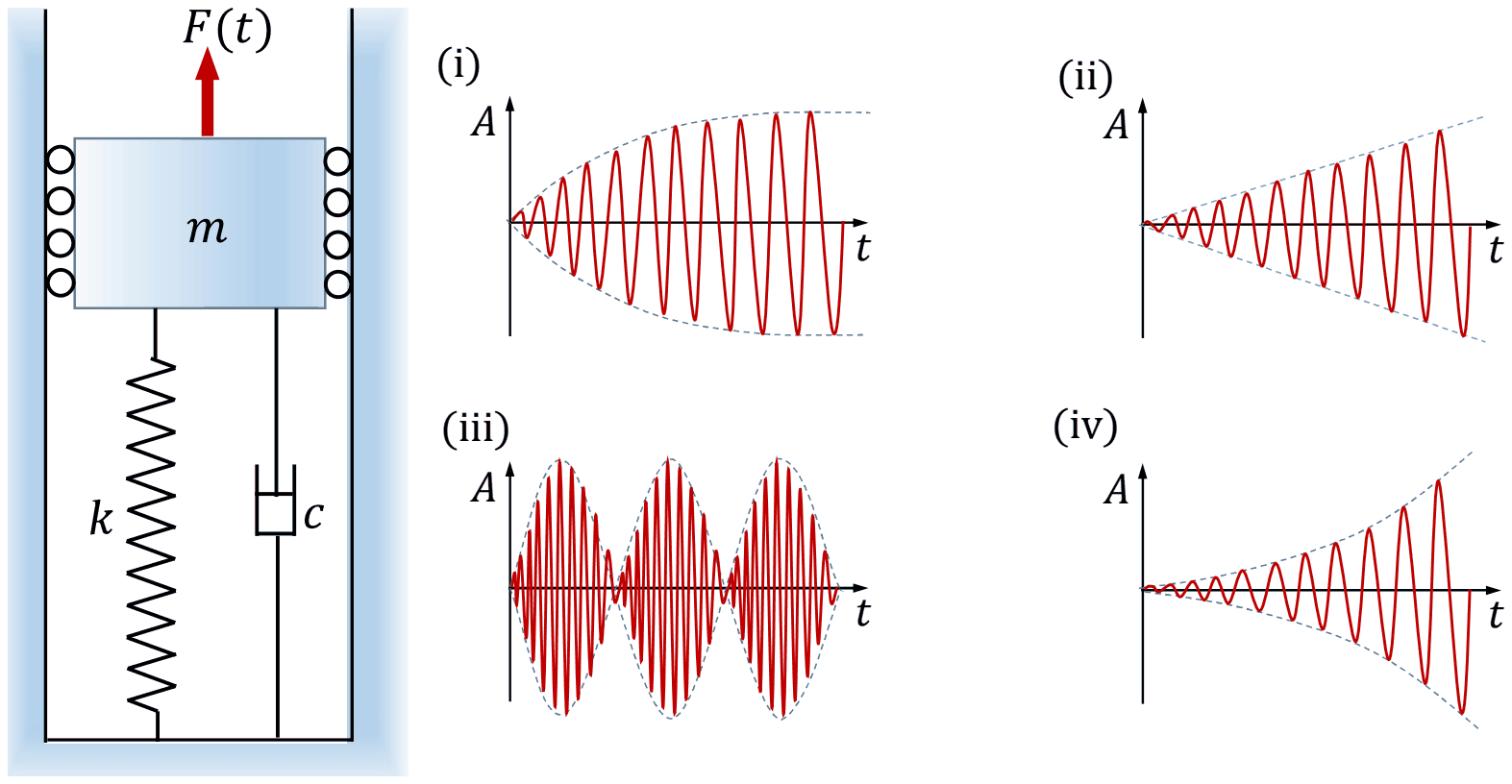
Four different parameter and forcing conditions are mentioned below.
(P) \(c \gt 0\) and \(\omega = \sqrt{k/m}\)
(Q) \(c \lt 0\) and \(\omega \ne 0\)
(R) \(c = 0\) and \(\omega = \sqrt{k/m}\)
(S) \(c = 0\) and \(\omega \cong \sqrt{k/m}\)
Which one of the following options gives correct match (indicated by arrow →) of the parameter and forcing conditions to the responses?
What will be the natural frequency of the system as shown in figure ? Take EI = Flexural Rigidity.

Consider a spring-mass system with mass \(m\) and spring stiffness \(k\) as shown in the illustration. At time \(t = 0\), the mass is displaced by \(P\) units and the velocity of the mass is zero. The displacement of the mass, \(x(t)\), is measured from the equilibrium position.
[The illustration shows a horizontal spring \(k\) fixed to a wall at its left end and attached to the mass \(m\) at its right end, with \(x(t)\) measured to the right.]
Which one of the following functions represent \(x(t)\)?
A mass \(M\) is hung from a frictionless, massless pulley. The pulley is suspended by using an inextensible, massless rope of which one end is directly fixed to a support, and the other end is connected to the support through a linear spring of stiffness constant \(k\) (see figure). The natural frequency of this system is
(Figure: both strands of the rope hang vertically from the support, the left one fixed directly and the right one through the spring, with the mass hanging from the pulley axle.)
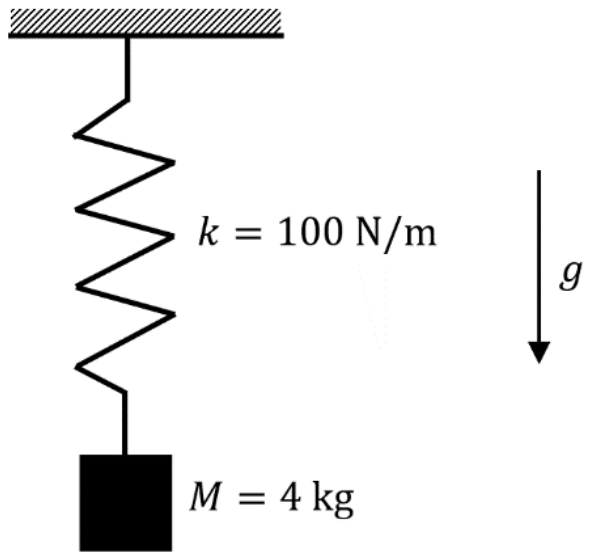
A spring mass system is shown in the figure below. Take the acceleration due to gravity as \(g = 9.81\ \text{m/s}^{2}\). The static deflection due to weight and the time period of oscillations, respectively, are
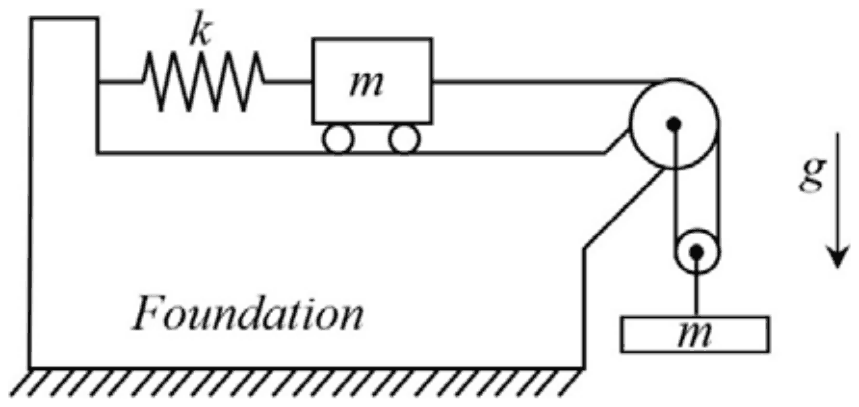
A spring-mass system having a mass \(m\) and spring constant \(k\), placed horizontally on a foundation, is connected to a vertically hanging mass \(m\) with the help of an inextensible string. Ignore the friction in the pulleys and also the inertia of pulleys, string and spring. Gravity is acting vertically downward as shown. The natural frequency of the system in rad/s is
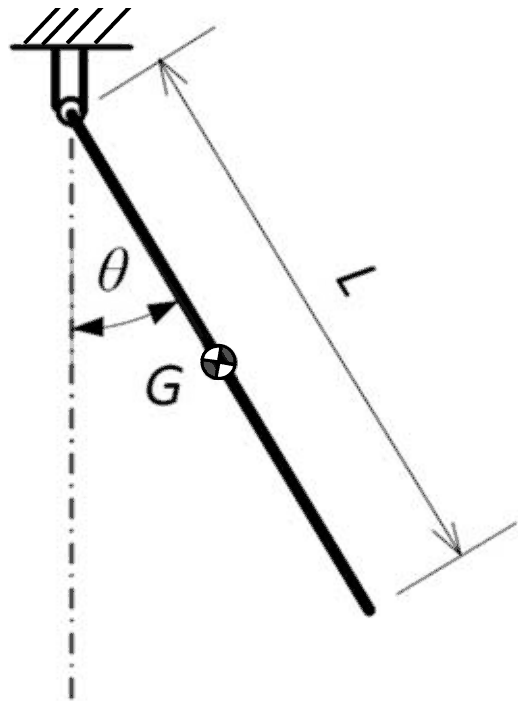
A rigid uniform rod with mass m, length L and center of gravity G is freely suspended from a hinge as shown in the figure. The rod is given a small angular displacement θ in the counter-clockwise direction from the position in which it hangs vertically (θ = 0). If g is the acceleration due to gravity, the natural frequency of oscillations (in rad/s) is
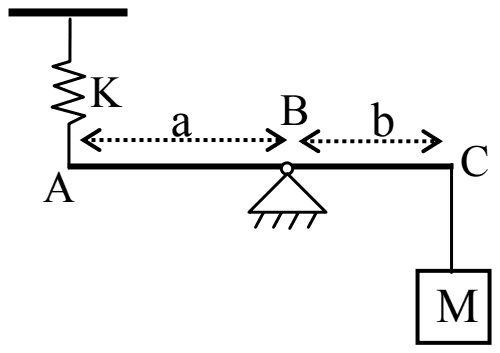
For small oscillations, the natural frequency of the system in terms of K, a, b and M is (assuming ideal joints and mass-less rigid rod ABC)
A rocket in the atmosphere is accelerating upwards with acceleration a m/s2. The natural frequency of a spring-mass system (with mass m kg and spring constant k N/m), suspended vertically inside the rocket, is (take g m/s2 to be the acceleration due to gravity)
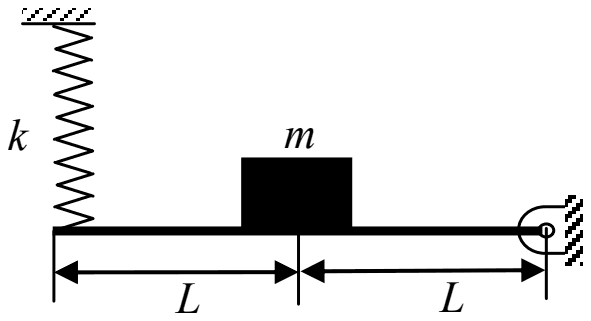
A concentrated mass m is attached at the centre of a rod of length 2L as shown in the figure. The rod is kept in a horizontal equilibrium position by a spring of stiffness k. For very small amplitude of vibration, neglecting the weights of the rod and spring, the undamped natural frequency of the system is
Consider a forced single degree-of-freedom system governed by
\[ \begin{aligned} &\ddot{x}(t) + 2\zeta\omega_{n}\dot{x}(t) + \omega_{n}^{2}x(t) \\ &= \omega_{n}^{2}\cos(\omega t), \end{aligned} \]
where \(\zeta\) and \(\omega_{n}\) are the damping ratio and undamped natural frequency of the system, respectively, while \(\omega\) is the forcing frequency. The amplitude of the forced steady state response of this system is given by \([(1 - r^{2})^{2} + (2\zeta r)^{2}]^{-1/2}\), where \(r = \omega/\omega_{n}\). The peak amplitude of this response occurs at a frequency \(\omega = \omega_{p}\). If \(\omega_{d}\) denotes the damped natural frequency of this system, which one of the following options is true?
The equation of motion for a spring-mass system excited by a harmonic force is
\[ M\ddot{x} + Kx = F\cos(\omega t), \]
where \(M\) is the mass, \(K\) is the spring stiffness, \(F\) is the force amplitude and \(\omega\) is the angular frequency of excitation. Resonance occurs when \(\omega\) is equal to
For a single degree of freedom spring-mass-damper system subjected to harmonic forcing, the part of the motion (response) that decays due to damping is known as:
In a single degree of freedom vibrating system with only viscous damping, the critical damping coefficient is 350 N s/m and the damping coefficient is 35 N s/m.
The logarithmic decrement of the vibrating system is
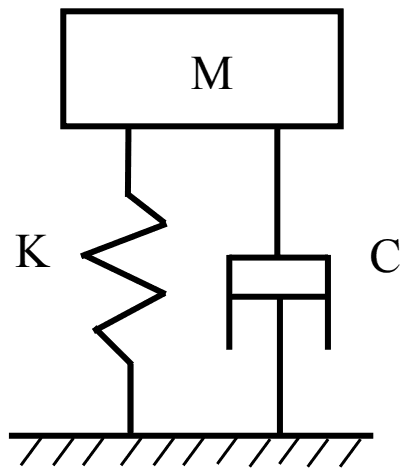
In a single degree of freedom underdamped spring-mass-damper system as shown in the figure, an additional damper is added in parallel such that the system still remains underdamped. Which one of the following statements is ALWAYS true?
The damping ratio for a viscously damped spring mass system, governed by the relationship \(m\frac{d^{2}x}{dt^{2}} + c\frac{dx}{dt} + kx = F(t)\), is given by
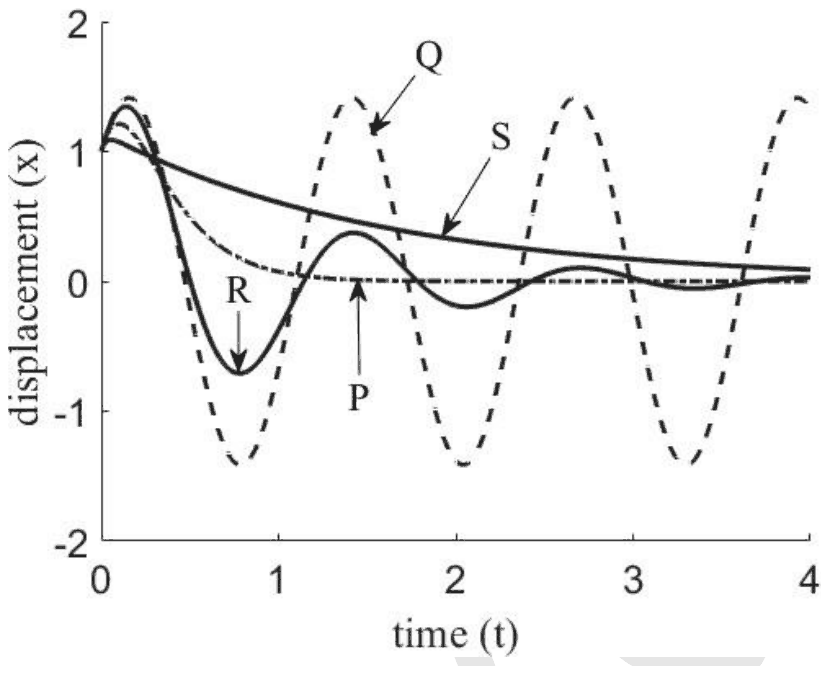
Consider the free vibration responses P, Q, R and S (shown in the figure) of a single degree of freedom spring-mass-damper system with the same initial conditions. For the different damping cases listed below, which one of the following options is correct?
1. Overdamped
2. Underdamped
3. Critically damped
4. Undamped
The boundary condition of a rod under longitudinal vibration is changed from fixed-fixed to fixed-free. The fundamental natural frequency of the rod is now k times the original frequency, where k is
A spring-mass system is viscously damped with a viscous damping constant c. The energy dissipated per cycle when the system is undergoing a harmonic vibration \(XCos\omega_{d}t\) is given by
The logarithmic decrement measured for a viscously damped single degree of freedom system is 0.125. The value of the damping factor in % is closest to
Total number of questions : 20
Number of answered questions : 0
Number of unanswered questions : 20
Mechanical Vibrations [ Question No: 1 To 20 ] :
Direction for [ Question No: 1 To 1 ] :
A spring mass damper system (mass \(m\), stiffness \(k\), and damping coefficient \(c\)) excited by a force \(F(t) = B\sin\omega t\), where \(B\), \(\omega\) and \(t\) are the amplitude, frequency and time, respectively, is shown in the figure. Four different responses of the system (marked as (i) to (iv)) are shown just to the right of the system figure. In the figures of the responses, \(A\) is the amplitude of response shown in red color and the dashed lines indicate its envelope. The responses represent only the qualitative trend and those are not drawn to any specific scale.
Four different parameter and forcing conditions are mentioned below.
(P) \(c \gt 0\) and \(\omega = \sqrt{k/m}\)
(Q) \(c \lt 0\) and \(\omega \ne 0\)
(R) \(c = 0\) and \(\omega = \sqrt{k/m}\)
(S) \(c = 0\) and \(\omega \cong \sqrt{k/m}\)
Which one of the following options gives correct match (indicated by arrow →) of the parameter and forcing conditions to the responses?
Your Answer : (Not Answered)
Correct Answer : C
The match is (P) → (i), (Q) → (iv), (R) → (ii), (S) → (iii).
- (P) \(c \gt 0\), \(\omega = \sqrt{k/m}\): damped resonance. The amplitude grows and then settles at a finite steady value, \(B/(c\omega)\), because damping removes energy as fast as the force supplies it. That is response (i), whose envelope levels off.
- (Q) \(c \lt 0\): negative damping feeds energy in, so the free response grows exponentially whatever the forcing frequency. That is (iv), whose envelope curves outwards.
- (R) \(c = 0\), \(\omega = \sqrt{k/m}\): undamped resonance. The particular solution is \(x \propto t\cos\omega_{n}t\), so the amplitude grows linearly without limit. That is (ii), with straight-line envelopes.
- (S) \(c = 0\), \(\omega \cong \sqrt{k/m}\): forcing close to, but not at, the natural frequency. The free and forced vibrations drift in and out of phase, producing beats. That is (iii).
The other options swap these pairs; the quickest check is that the beat pattern (iii) can only belong to the near-resonance case (S), which leaves only one option.
What will be the natural frequency of the system as shown in figure ? Take EI = Flexural Rigidity.
Your Answer : (Not Answered)
Correct Answer : D
The natural frequency is \(f_n = \frac{1}{2\pi}\sqrt{\frac{192EI}{m L^{3}}}\).
The beam is fixed at both ends with the mass at mid-span. The central deflection of such a beam under a load W is \(\delta = \frac{WL^3}{192EI}\), so its stiffness at the centre is
\[ \begin{aligned} k &= \frac{W}{\delta} = \frac{192EI}{L^3} \\ f_n &= \frac{1}{2\pi}\sqrt{\frac{k}{m}} = \frac{1}{2\pi}\sqrt{\frac{192EI}{mL^3}} \end{aligned} \]
The options with \(\frac{1}{\pi}\) drop the factor 2 that converts angular frequency to frequency in hertz, and 92 is not the stiffness coefficient of any standard beam case. A simply supported beam would give 48 in place of 192.
Consider a spring-mass system with mass \(m\) and spring stiffness \(k\) as shown in the illustration. At time \(t = 0\), the mass is displaced by \(P\) units and the velocity of the mass is zero. The displacement of the mass, \(x(t)\), is measured from the equilibrium position.
[The illustration shows a horizontal spring \(k\) fixed to a wall at its left end and attached to the mass \(m\) at its right end, with \(x(t)\) measured to the right.]
Which one of the following functions represent \(x(t)\)?
Your Answer : (Not Answered)
Correct Answer : D
The motion is \(x(t) = P\cos\left(\sqrt{k/m}\,t\right)\).
An undamped spring-mass system obeys \(m\ddot{x} + kx = 0\), whose general solution is a sum of a cosine and a sine at the natural frequency \(\omega_{n} = \sqrt{k/m}\):
\[ \begin{aligned} x(t) &= A\cos\omega_{n}t + B\sin\omega_{n}t \\ x(0) &= A = P \\ \dot{x}(0) &= B\omega_{n} = 0 \Rightarrow B = 0 \end{aligned} \]
So only the cosine term survives, with amplitude P.
The sine-only answer starts at zero displacement, not at P. The sum \(P\cos + P\sin\) starts at P but with velocity \(P\omega_{n}\), not zero. The answer with P/2 on each term starts at only half the given displacement and also has a non-zero initial velocity.
A mass \(M\) is hung from a frictionless, massless pulley. The pulley is suspended by using an inextensible, massless rope of which one end is directly fixed to a support, and the other end is connected to the support through a linear spring of stiffness constant \(k\) (see figure). The natural frequency of this system is
(Figure: both strands of the rope hang vertically from the support, the left one fixed directly and the right one through the spring, with the mass hanging from the pulley axle.)
Your Answer : (Not Answered)
Correct Answer : A
The natural frequency is \(\sqrt{\frac{4k}{M}}\).
If the mass moves down by x, the pulley moves down by x too, and both rope strands lengthen by x. The rope is inextensible, so the whole extra length 2x comes from the spring, whose tension rises by \(T = 2kx\). Both strands carry this tension, so the restoring force on the pulley and mass is
\[ \begin{aligned} F &= 2T = 4kx \\ k_{eq} &= 4k, \quad \omega_n = \sqrt{\frac{4k}{M}} \end{aligned} \]
\(\sqrt{2k/M}\) counts either the doubled spring extension or the two strands, but not both. \(\sqrt{k/M}\) treats the spring as if attached directly to the mass, and \(\sqrt{k/(2M)}\) inverts the mechanical advantage.
A spring mass system is shown in the figure below. Take the acceleration due to gravity as \(g = 9.81\ \text{m/s}^{2}\). The static deflection due to weight and the time period of oscillations, respectively, are
Your Answer : (Not Answered)
Correct Answer : A
The answer is 0.392 m and 1.26 s.
At static equilibrium the spring force balances the weight:
\[ \begin{aligned} \delta_{st} &= \frac{Mg}{k} = \frac{4 \times 9.81}{100} \\ &= 0.392\ \text{m} \end{aligned} \]
The natural period depends only on mass and stiffness:
\[ \begin{aligned} T &= 2\pi\sqrt{\frac{M}{k}} = 2\pi\sqrt{0.04} \\ &= 2\pi \times 0.2 = 1.26\ \text{s} \end{aligned} \]
(Equivalently \(T = 2\pi\sqrt{\delta_{st}/g}\), the same 1.26 s.) 0.626 m is \(\sqrt{0.392}\), a stray square root, and 3.52 s does not follow from \(2\pi\sqrt{M/k}\) with these values.
A spring-mass system having a mass \(m\) and spring constant \(k\), placed horizontally on a foundation, is connected to a vertically hanging mass \(m\) with the help of an inextensible string. Ignore the friction in the pulleys and also the inertia of pulleys, string and spring. Gravity is acting vertically downward as shown. The natural frequency of the system in rad/s is
Your Answer : (Not Answered)
Correct Answer : D
The natural frequency is \(\sqrt{\frac{4k}{5m}}\).
The string runs from the cart over the fixed pulley, down around the movable pulley that carries the hanging mass, and up to a fixed point. When the cart moves x, the hanging mass moves x/2. With gravity only shifting the equilibrium, the energies are
\[ \begin{aligned} T &= \frac{1}{2}m\dot{x}^{2} + \frac{1}{2}m\left(\frac{\dot{x}}{2}\right)^{2} = \frac{1}{2}\cdot\frac{5m}{4}\dot{x}^{2} \\ V &= \frac{1}{2}kx^{2} \\ \omega_{n} &= \sqrt{\frac{k}{5m/4}} = \sqrt{\frac{4k}{5m}} \end{aligned} \]
\(\sqrt{k/(2m)}\) treats both masses as moving x, and \(\sqrt{4k/(3m)}\) and \(\sqrt{k/(3m)}\) do not correspond to the effective mass \(5m/4\).
A rigid uniform rod with mass m, length L and center of gravity G is freely suspended from a hinge as shown in the figure. The rod is given a small angular displacement θ in the counter-clockwise direction from the position in which it hangs vertically (θ = 0). If g is the acceleration due to gravity, the natural frequency of oscillations (in rad/s) is
Your Answer : (Not Answered)
Correct Answer : C
The natural frequency is \(\sqrt{\frac{3g}{2L}}\).
The rod is a compound pendulum. Its moment of inertia about the hinge at one end is \(mL^{2}/3\), and gravity acts at G, a distance \(L/2\) from the hinge. For small angles
\[ \begin{aligned} \frac{mL^{2}}{3}\ddot{\theta} + mg\frac{L}{2}\theta &= 0 \\ \omega_{n}^{2} &= \frac{mgL/2}{mL^{2}/3} = \frac{3g}{2L} \end{aligned} \]
\(\sqrt{g/L}\) treats the rod as a point mass at the tip, and \(\sqrt{2g/L}\) as a point mass at G; both ignore the rod's distributed inertia. \(\sqrt{6g/L}\) would follow from using the moment of inertia about G, \(mL^{2}/12\), instead of about the hinge.
For small oscillations, the natural frequency of the system in terms of K, a, b and M is (assuming ideal joints and mass-less rigid rod ABC)
Your Answer : (Not Answered)
Correct Answer : D
The natural frequency is \(\sqrt{\dfrac{Ka^{2}}{Mb^{2}}}\).
Let the rod turn through a small angle \(\theta\) about B. The spring at A stretches by \(a\theta\) and the mass at C moves by \(b\theta\). Taking moments about B (gravity only sets the static equilibrium):
\[ \begin{aligned} Mb^{2}\ddot{\theta} + Ka^{2}\theta &= 0 \\ \omega_{n} &= \sqrt{\frac{Ka^{2}}{Mb^{2}}} \end{aligned} \]
In effect the spring acts at C with stiffness \(K(a/b)^{2}\). \(\sqrt{K/M}\) ignores the lever, \(\sqrt{Ka/(Mb)}\) uses the ratio only once, and \(\sqrt{Kb^{2}/(Ma^{2})}\) inverts it.
A rocket in the atmosphere is accelerating upwards with acceleration a m/s2. The natural frequency of a spring-mass system (with mass m kg and spring constant k N/m), suspended vertically inside the rocket, is (take g m/s2 to be the acceleration due to gravity)
Your Answer : (Not Answered)
Correct Answer : B
The natural frequency is \(\sqrt{k/m}\), unchanged by the rocket's acceleration.
In the rocket's frame the mass feels an effective gravity \(g + a\). That only shifts the static equilibrium position: the spring stretches by \(m(g + a)/k\) instead of \(mg/k\). Measuring displacement x from the new equilibrium, the equation of motion is still
\[ \begin{aligned} m\ddot{x} + kx &= 0 \\ \omega_{n} &= \sqrt{\frac{k}{m}} \end{aligned} \]
because a constant force does not change the restoring stiffness. The options with a reduced stiffness \(\bar{k}\), with \(g/a\), or with \(1 - a/g\) all wrongly let a constant acceleration alter the frequency. A pendulum's frequency would change, since its restoring force comes from gravity; a spring's does not.
A concentrated mass m is attached at the centre of a rod of length 2L as shown in the figure. The rod is kept in a horizontal equilibrium position by a spring of stiffness k. For very small amplitude of vibration, neglecting the weights of the rod and spring, the undamped natural frequency of the system is
Your Answer : (Not Answered)
Correct Answer : D
The natural frequency is \(\sqrt{\frac{4k}{m}}\).
The rod is hinged at its right end, the mass sits at distance L from the hinge, and the spring acts at distance 2L. For a small rotation \(\theta\) about the hinge, the mass moves \(L\theta\) and the spring stretches \(2L\theta\). Taking moments about the hinge:
\[ \begin{aligned} mL^{2}\ddot{\theta} + k(2L)^{2}\theta &= 0 \\ \omega_{n}^{2} &= \frac{4kL^{2}}{mL^{2}} = \frac{4k}{m} \end{aligned} \]
\(\sqrt{k/m}\) treats the spring as if it were attached at the mass; \(\sqrt{2k/m}\) and \(\sqrt{k/2m}\) use the lever ratio 2 without squaring it, or invert it. The spring's lever arm enters squared because it affects both the spring force and that force's moment.
Consider a forced single degree-of-freedom system governed by
\[ \begin{aligned} &\ddot{x}(t) + 2\zeta\omega_{n}\dot{x}(t) + \omega_{n}^{2}x(t) \\ &= \omega_{n}^{2}\cos(\omega t), \end{aligned} \]
where \(\zeta\) and \(\omega_{n}\) are the damping ratio and undamped natural frequency of the system, respectively, while \(\omega\) is the forcing frequency. The amplitude of the forced steady state response of this system is given by \([(1 - r^{2})^{2} + (2\zeta r)^{2}]^{-1/2}\), where \(r = \omega/\omega_{n}\). The peak amplitude of this response occurs at a frequency \(\omega = \omega_{p}\). If \(\omega_{d}\) denotes the damped natural frequency of this system, which one of the following options is true?
Your Answer : (Not Answered)
Correct Answer : A
The correct order is \(\omega_{p} \lt \omega_{d} \lt \omega_{n}\).
Minimising \((1 - r^{2})^{2} + (2\zeta r)^{2}\) with respect to \(r^{2}\) gives the peak of the amplitude curve:
\[ \begin{aligned} r_{p}^{2} &= 1 - 2\zeta^{2} \Rightarrow \omega_{p} = \omega_{n}\sqrt{1 - 2\zeta^{2}} \\ \omega_{d} &= \omega_{n}\sqrt{1 - \zeta^{2}} \end{aligned} \]
For any damping \(0 \lt \zeta \lt 1/\sqrt{2}\), \(1 - 2\zeta^{2} \lt 1 - \zeta^{2} \lt 1\), so the peak lies below the damped natural frequency, which lies below the undamped one.
\(\omega_{p} = \omega_{d}\) is a common confusion: the free vibration oscillates at \(\omega_{d}\), but the forced amplitude peaks lower. The peak equals \(\omega_{n}\) only with no damping and never exceeds it, which rules out the last two options.
The equation of motion for a spring-mass system excited by a harmonic force is
\[ M\ddot{x} + Kx = F\cos(\omega t), \]
where \(M\) is the mass, \(K\) is the spring stiffness, \(F\) is the force amplitude and \(\omega\) is the angular frequency of excitation. Resonance occurs when \(\omega\) is equal to
Your Answer : (Not Answered)
Correct Answer : D
Resonance occurs at \(\omega = \sqrt{K/M}\).
Resonance is excitation at the natural frequency of the undamped system. The free equation \(M\ddot{x} + Kx = 0\) gives \(\omega_{n} = \sqrt{K/M}\) in rad/s, and the forced amplitude \(F/(K - M\omega^{2})\) grows without limit as \(\omega\) approaches it.
\(\frac{1}{2\pi}\sqrt{K/M}\) is the same natural frequency in hertz, but \(\omega\) is an angular frequency, so the units do not match. \(2\pi\sqrt{K/M}\) multiplies where it should not, and \(\sqrt{M/K}\) is inverted (it has units of time).
For a single degree of freedom spring-mass-damper system subjected to harmonic forcing, the part of the motion (response) that decays due to damping is known as:
Your Answer : (Not Answered)
Correct Answer : A
The decaying part of the response is the transient response.
Under harmonic forcing, the motion is the sum of two parts. The complementary solution is the system's free vibration, which carries a factor \(e^{-\zeta\omega_{n}t}\) and so dies away with time because of damping: this is the transient. The particular solution oscillates at the forcing frequency with constant amplitude for as long as the force acts: this is the steady-state response.
So the steady-state (non-transient) part is precisely the part that does not decay, and 'harmonic response' describes the forced oscillation at the driving frequency, again the part that persists.
In a single degree of freedom vibrating system with only viscous damping, the critical damping coefficient is 350 N s/m and the damping coefficient is 35 N s/m.
The logarithmic decrement of the vibrating system is
Your Answer : (Not Answered)
Correct Answer : A
The logarithmic decrement is about 0.63.
The damping ratio is \(\zeta = c/c_{c} = 35/350 = 0.1\). Then
\[ \begin{aligned} \delta &= \frac{2\pi\zeta}{\sqrt{1 - \zeta^{2}}} \\ &= \frac{0.6283}{0.995} = 0.631 \end{aligned} \]
For light damping \(\delta \approx 2\pi\zeta = 0.628\) anyway. 1.26 and 1.89 are two and three times the correct value, and 0.32 is half of it, as if \(\pi\zeta\) were used.
In a single degree of freedom underdamped spring-mass-damper system as shown in the figure, an additional damper is added in parallel such that the system still remains underdamped. Which one of the following statements is ALWAYS true?
Your Answer : (Not Answered)
Correct Answer : C
The statement that is always true is that the time period of free oscillations will increase.
A second damper in parallel adds to the damping coefficient, so the damping ratio ζ rises while the mass and stiffness, and hence the natural frequency ωn, are unchanged. The damped frequency is \(\omega_{d} = \omega_{n}\sqrt{1-\zeta^{2}}\), which falls as ζ rises, so the damped period \(2\pi/\omega_{d}\) gets longer. Because the system stays underdamped, it still oscillates, and this holds whatever the size of the extra damper.
Transmissibility does not change one way always: more damping lowers it for frequency ratios below √2 but raises it above √2. So neither transmissibility option is always true, and a shorter period is the opposite of the correct effect.
The damping ratio for a viscously damped spring mass system, governed by the relationship \(m\frac{d^{2}x}{dt^{2}} + c\frac{dx}{dt} + kx = F(t)\), is given by
Your Answer : (Not Answered)
Correct Answer : B
The damping ratio is \(\frac{c}{2\sqrt{km}}\).
The damping ratio is the actual damping coefficient divided by the critical damping coefficient, the value at which the system just stops oscillating:
\[ \begin{aligned} c_{c} &= 2\sqrt{km} = 2m\omega_{n} \\ \zeta &= \frac{c}{c_{c}} = \frac{c}{2\sqrt{km}} \end{aligned} \]
\(c/\sqrt{km}\) is twice the damping ratio. The square-root forms are dimensionally wrong: c/(mk) has units of s3/kg, so its square root is not a pure number.
Consider the free vibration responses P, Q, R and S (shown in the figure) of a single degree of freedom spring-mass-damper system with the same initial conditions. For the different damping cases listed below, which one of the following options is correct?
1. Overdamped
2. Underdamped
3. Critically damped
4. Undamped
Your Answer : (Not Answered)
Correct Answer : C
The matching is P - 3, Q - 4, R - 2, S - 1.
- Q oscillates with a constant amplitude that never decays: undamped (4).
- R oscillates about zero with a shrinking amplitude: underdamped (2).
- P returns to zero without crossing it and faster than any non-oscillating curve: critically damped (3).
- S also creeps back without oscillating, but much more slowly than P: overdamped (1).
The key distinction is between P and S. Critical damping is the smallest damping that prevents oscillation and gives the quickest non-oscillatory return; more damping than that (overdamping) only slows the return. Options that call P overdamped and S critically damped have them the wrong way round, and those that swap Q and R confuse constant with decaying oscillation.
The boundary condition of a rod under longitudinal vibration is changed from fixed-fixed to fixed-free. The fundamental natural frequency of the rod is now k times the original frequency, where k is
Your Answer : (Not Answered)
Correct Answer : A
The fundamental frequency becomes 1/2 of the original, so k = 1/2.
For longitudinal vibration of a uniform rod with wave speed \(c = \sqrt{E/\rho}\), the fundamental frequencies are
\[ \begin{aligned} f_{\text{fixed-fixed}} &= \frac{c}{2L} \\ f_{\text{fixed-free}} &= \frac{c}{4L} \end{aligned} \]
A fixed-fixed rod vibrates in its first mode as half a wavelength, a fixed-free rod as a quarter wavelength, so the wavelength doubles and the frequency halves.
The values 2 and \(\sqrt{2}\) wrongly say the frequency rises when a support is removed; removing a constraint always lowers the fundamental frequency. \(1/\sqrt{2}\) would apply if stiffness halved with mass unchanged, which is not what happens here.
A spring-mass system is viscously damped with a viscous damping constant c. The energy dissipated per cycle when the system is undergoing a harmonic vibration \(XCos\omega_{d}t\) is given by
Your Answer : (Not Answered)
Correct Answer : A
The energy dissipated per cycle is \(\pi c\omega_{d}X^{2}\).
The damping force is \(c\dot{x}\), so the energy lost over one cycle of \(x = X\cos\omega_{d}t\) is
\[ \begin{aligned} W_{d} &= \oint c\dot{x}\,dx = \int_{0}^{2\pi/\omega_{d}} c\dot{x}^{2}\,dt \\ &= c\omega_{d}^{2}X^{2}\int_{0}^{2\pi/\omega_{d}}\sin^{2}\omega_{d}t\,dt \\ &= \pi c\omega_{d}X^{2} \end{aligned} \]
Energy must scale with amplitude squared and with the damping constant, so \(\pi\omega_{d}X^{2}\) (no c) and the two forms linear in X cannot be right, and \(\omega_{d}^{2}\) has the wrong dimensions for energy.
The logarithmic decrement measured for a viscously damped single degree of freedom system is 0.125. The value of the damping factor in % is closest to
Your Answer : (Not Answered)
Correct Answer : D
The damping factor is closest to 2.0%.
Logarithmic decrement \(\delta\) and damping factor \(\zeta\) are related by
\[ \begin{aligned} \delta &= \frac{2\pi\zeta}{\sqrt{1 - \zeta^{2}}} \\ \zeta &\approx \frac{\delta}{2\pi} = \frac{0.125}{6.283} \\ &= 0.0199 \approx 2\% \end{aligned} \]
The exact form \(\zeta = \delta/\sqrt{4\pi^{2} + \delta^{2}}\) gives the same 1.99%. 1.0% is what dividing by \(4\pi\) instead of \(2\pi\) gives, and 0.5% and 1.5% are smaller and larger than any reading of the formula allows.
Marks
Total number of questions : 20
Number of answered questions : 0
Number of unanswered questions : 20