
Instruction
- Total number of questions : 19
- Time allotted : 28:30 Minutes:Seconds.
- Each question carry 1 mark, no negative marks.
- DO NOT refresh the page.
- All the best
Metal Casting and Welding [ Question No: 1 To 19 ] :
The flame starts burning away from the tip, this can be corrected by which of following way:
The selection of nozzle for pipe welding depends upon:
What is the function of a gas regulator during a gas welding operation?
Which of the following combination provide highest temperature?
Backfire, a small explosion of flame occurring at the tip torch in oxy-acetylene process is due to :
Neutral flame is used to weld metals like......
Acetelyne is stored in gas cylinder in.......
Oxidising flame is used to weld metals like.......
Which flame is suitable for cutting operations?
In relation to metal casting defects, match the following
| Defect | Description | ||
| P | Dross | I | Shallow blow found on a flat casting surface |
| Q | Scab | II | Lighter impurities appearing on the top surface of a casting |
| R | Scar | III | A rough, thin layer of metal, protruding above the casting surface, on top of a thin layer of sand |
Match the mold elements in the casting process with the most suitable function
| Mold element | Function | ||
| P | Blind riser | I | Casting with internal cavity |
| Q | Chill | II | Molten metal reservoir |
| R | Skim bob | III | Nucleating agent |
| S | Core | IV | Assisting in faster heat removal from melt |
| T | Insulating sleeve | V | Removal of impurities |
| U | Inoculant | VI | Increasing the solidification time |
The allowance provided to a pattern for easy withdrawal from a sand mold is
The most suitable electrode material used for joining low alloy steels using Gas Metal Arc Welding (GMAW) process is
In a DC arc welding operation, the voltage-arc length characteristic was obtained as \(V_{arc}=20+5l\) where the arc length l was varied between 5 mm and 7 mm. Here Varc denotes the arc voltage in Volts. The arc current was varied from 400 A to 500 A. Assuming linear power source characteristic, the open circuit voltage and the short circuit current for the welding operation are
The type of weld represented by the shaded region in the figure is
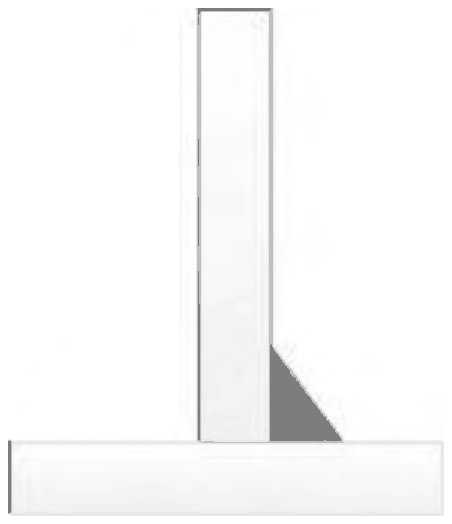
In an arc welding process, welding speed is doubled. Assuming all other process parameters to be constant, the cross sectional area of the weld bead will
Which welding process employs a continuously fed electrode and uses both an external gas source and a granular flux to protect the weld pool?
Which type of pattern allowance is provided to compensate for the contraction of the metal as it cools from the pouring temperature to the room temperature?
Which property of moulding sand ensures that the sand retains its shape and hardness at high temperatures when the molten metal is poured into the mould?
Total number of questions : 19
Number of answered questions : 0
Number of unanswered questions : 19
Metal Casting and Welding [ Question No: 1 To 19 ] :
The flame starts burning away from the tip, this can be corrected by which of following way:
Your Answer : (Not Answered)
Correct Answer : A
The fault is corrected by reducing the pressure of the gases.
A flame that burns away from the tip (lifting off) shows that the gas is leaving the nozzle faster than the flame can burn back to it. The usual cause is too high a gas pressure for the nozzle size, so lowering the pressure brings the flame back onto the tip.
Cooling the torch and cleaning the orifice are remedies for backfire and flashback, where the flame burns back into the tip. Reducing only the oxygen would change the flame's character rather than its speed.
The selection of nozzle for pipe welding depends upon:
Your Answer : (Not Answered)
Correct Answer : B
The nozzle is selected according to the pipe wall thickness.
In gas welding the nozzle (tip) size sets how much gas, and so how much heat, the flame delivers. The heat needed depends on how much metal must be melted through, which for a pipe is its wall thickness: a thicker wall needs a larger nozzle.
The groove angle affects the joint preparation and the amount of filler, and the pipe diameter affects how the joint is welded around, but neither sets the flame size the way the wall thickness does. So 'All of the above' is wrong.
What is the function of a gas regulator during a gas welding operation?
Your Answer : (Not Answered)
Correct Answer : D
A gas regulator is used to set the working pressure.
Gas cylinders store oxygen at very high pressure. The regulator reduces this cylinder pressure to a steady, much lower working pressure suited to the torch and keeps it constant as the cylinder empties.
Mixing the gases in the right proportion happens in the blowpipe (torch). The type of flame is adjusted with the torch valves, which also control the volume of gas flowing; the regulator's job is the pressure.
Which of the following combination provide highest temperature?
Your Answer : (Not Answered)
Correct Answer : C
The highest temperature comes from oxy-acetylene.
An oxy-acetylene flame reaches about 3,100 °C to 3,300 °C, the hottest of the common fuel-gas flames, which is why it is the standard gas for welding steel. Acetylene releases a great deal of heat on burning because of its triple bond, and pure oxygen avoids diluting the flame with nitrogen.
Oxy-hydrogen (about 2,800 °C) and oxy-LPG (about 2,800 °C to 2,900 °C) are cooler. Air-acetylene is much cooler still, because the nitrogen in the air absorbs heat.
Backfire, a small explosion of flame occurring at the tip torch in oxy-acetylene process is due to :
Your Answer : (Not Answered)
Correct Answer : D
Backfire can be caused by any of the above.
Backfire is a sharp pop at the torch tip, with the flame going out and perhaps relighting. It happens when the gas mixture leaves the tip more slowly than the flame burns back towards it, or when the tip is disturbed. Each listed cause does this: gas pressure set too low makes the gas flow too slow, an overheated nozzle ignites the mixture inside the tip, and carbon deposits blocking the orifice disturb the flow.
Because all three are recognised causes, no single option is complete on its own.
Neutral flame is used to weld metals like......
Your Answer : (Not Answered)
Correct Answer : A
The neutral flame is used to weld steel.
A neutral flame burns oxygen and acetylene in roughly equal proportions. It neither adds carbon to the metal nor oxidises it, which is what mild steel and most ferrous work need, so it is the standard welding flame.
Copper and brass go with the oxidising flame. The list in the last option, aluminium, stainless steel, zinc die casting, nickel and monel, is the textbook list for the carburising (reducing) flame, and carburised steel is not the neutral flame's typical application.
Acetelyne is stored in gas cylinder in.......
Your Answer : (Not Answered)
Correct Answer : B
The paper's answer is in liquid form.
Acetylene cannot safely be stored as a compressed gas: above about 15 psi (1 bar gauge) it can decompose explosively. Cylinders are therefore packed with a porous filler soaked in liquid acetone, and the acetylene is dissolved in the acetone, which can hold many times its own volume of the gas. This dissolved acetylene, held in a liquid, is what the key means by liquid form.
Storing it as free compressed gas is exactly what must be avoided, and it is never stored as a solid, so the remaining options are wrong.
Oxidising flame is used to weld metals like.......
Your Answer : (Not Answered)
Correct Answer : B
An oxidising flame is used for copper and brass.
An oxidising flame has excess oxygen. When brass is welded, its zinc tends to boil off; the slight excess of oxygen forms a thin oxide film on the pool that holds the zinc in. The textbook list for the oxidising flame is therefore brass, bronze and copper-based alloys.
Steel is welded with the neutral flame, because excess oxygen would burn the steel and make the weld porous and brittle. The metals in the last option are those listed for the carburising (reducing) flame, which keeps oxygen away from metals that oxidise easily.
Which flame is suitable for cutting operations?
Your Answer : (Not Answered)
Correct Answer : C
The flame associated with cutting is the oxidising flame.
Oxy-fuel cutting works by oxidation: the steel is heated to its ignition temperature and then a jet of pure oxygen burns it, the molten oxide being blown out of the cut. The cutting operation is therefore an oxygen-rich, oxidising process, which is the textbook basis for this answer. In practice the small preheating flames are often set close to neutral, but the cut itself is made by an excess of oxygen.
A carburising flame, with excess acetylene, adds carbon and is used for hard-facing and some non-ferrous work, not cutting. The neutral flame is the general welding flame for steel.
In relation to metal casting defects, match the following
| Defect | Description | ||
| P | Dross | I | Shallow blow found on a flat casting surface |
| Q | Scab | II | Lighter impurities appearing on the top surface of a casting |
| R | Scar | III | A rough, thin layer of metal, protruding above the casting surface, on top of a thin layer of sand |
Your Answer : (Not Answered)
Correct Answer : A
The correct matching is P-II, Q-III, R-I.
Dross consists of lighter impurities, oxides and slag, that float and appear on the top surface of a casting (II). A scab is a rough, thin layer of metal protruding above the casting surface over a thin layer of sand, where the mould face has lifted and metal has run behind it (III). A scar is a shallow blow found on a flat casting surface (I).
Every other option assigns at least one of these definitions to the wrong defect; for example, describing dross as a rough metal layer over sand confuses it with a scab.
Match the mold elements in the casting process with the most suitable function
| Mold element | Function | ||
| P | Blind riser | I | Casting with internal cavity |
| Q | Chill | II | Molten metal reservoir |
| R | Skim bob | III | Nucleating agent |
| S | Core | IV | Assisting in faster heat removal from melt |
| T | Insulating sleeve | V | Removal of impurities |
| U | Inoculant | VI | Increasing the solidification time |
Your Answer : (Not Answered)
Correct Answer : A
The correct matching is P-II, Q-IV, R-V, S-I, T-VI, U-III.
A blind riser is a reservoir of molten metal that feeds shrinkage (II). A chill is a metal insert that removes heat faster to promote directional solidification (IV). A skim bob traps slag and dross in the gating (V). A core forms internal cavities (I). An insulating sleeve round a riser keeps it molten longer, increasing its solidification time (VI). An inoculant is added to the melt as a nucleating agent (III).
Each other option misplaces at least two elements: for example, giving the chill the job of removing impurities, or the core the job of removing impurities.
The allowance provided to a pattern for easy withdrawal from a sand mold is
Your Answer : (Not Answered)
Correct Answer : D
It is the shake allowance.
Before a pattern is lifted out of the sand, it is rapped or shaken so that it loosens, which slightly enlarges the mould cavity. The shake (rapping) allowance compensates for that enlargement; because it acts the opposite way to the other allowances, the pattern is made slightly smaller to allow for it.
The finishing (machining) allowance provides extra metal for machining, the shrinkage allowance makes up for contraction on cooling, and the distortion allowance counteracts warping of irregular castings. None of them is about withdrawing the pattern.
The most suitable electrode material used for joining low alloy steels using Gas Metal Arc Welding (GMAW) process is
Your Answer : (Not Answered)
Correct Answer : C
The most suitable electrode material is low alloy steel.
GMAW (MIG/MAG welding) uses a continuously fed consumable wire electrode, which melts and becomes the filler metal in the joint. For low alloy steels the wire is chosen to match the base metal's composition and strength, so a low alloy steel wire is used.
Tungsten is the non-consumable electrode of gas tungsten arc (TIG) welding, not GMAW. Copper is used for contact tips and resistance-welding electrodes, and cadmium has no use as a welding electrode; neither would give a sound steel weld.
In a DC arc welding operation, the voltage-arc length characteristic was obtained as \(V_{arc}=20+5l\) where the arc length l was varied between 5 mm and 7 mm. Here Varc denotes the arc voltage in Volts. The arc current was varied from 400 A to 500 A. Assuming linear power source characteristic, the open circuit voltage and the short circuit current for the welding operation are
Your Answer : (Not Answered)
Correct Answer : C
The open circuit voltage is 95 V and the short circuit current 950 A.
A longer arc needs more voltage and so draws less current from a drooping source. The two operating points are:
\[ \begin{aligned} l = 5:\ V &= 45\ \text{V},\ I = 500\ \text{A} \\ l = 7:\ V &= 55\ \text{V},\ I = 400\ \text{A} \end{aligned} \]
A linear source characteristic through both points has slope \(-10/100 = -0.1\) V/A:
\[ \begin{aligned} V &= V_{oc} - 0.1I \\ 45 &= V_{oc} - 50 \Rightarrow V_{oc} = 95\ \text{V} \\ I_{sc} &= 95/0.1 = 950\ \text{A} \end{aligned} \]
Pairing the short arc with the low current instead gives a rising line that has no meaningful open circuit voltage, and 45 V is just the arc voltage at 5 mm. 75 V and 150 V do not pass through both operating points.
The type of weld represented by the shaded region in the figure is
Your Answer : (Not Answered)
Correct Answer : C
The shaded weld is a fillet weld.
The figure shows a T-joint, one plate standing on another at right angles, with a triangular weld bead filling the corner between them. A weld of roughly triangular cross-section laid in the corner of a T, lap or corner joint is a fillet weld, the most common type.
A groove weld is laid in a prepared gap between the edges of the parts. Spot welds are small resistance-welded nuggets between overlapping sheets. A plug weld fills a hole in one plate to join it to the plate beneath. None of these forms a triangle in a corner.
In an arc welding process, welding speed is doubled. Assuming all other process parameters to be constant, the cross sectional area of the weld bead will
Your Answer : (Not Answered)
Correct Answer : D
The bead cross-section will reduce by 50%.
With all other parameters fixed, the volume of filler deposited per unit time is constant. The bead area times the welding speed equals that deposition rate, so the cross-sectional area is inversely proportional to the travel speed:
\[ A_{2} = A_{1}\frac{v_{1}}{v_{2}} = \frac{A_{1}}{2} \]
The heat input per unit length (VI/v) also halves for the same reason. A 25% reduction would correspond to a speed increase of one third, and the bead cannot grow when the same metal is spread over a longer length.
Which welding process employs a continuously fed electrode and uses both an external gas source and a granular flux to protect the weld pool?
Your Answer : (Not Answered)
Correct Answer : C
Flux-cored arc welding employs a continuously fed electrode and uses both an external gas source and a granular flux for protecting the weld pool in the key. The electrode is a tube filled with flux. Gas metal arc welding uses a continuously fed wire and an external gas, but no flux, plasma arc welding uses a tungsten electrode and a plasma gas, and electro gas welding is used for vertical joints with a separate gas shield.
The difference from gas metal arc welding is the flux core in the wire, which forms slag over the weld metal.
Which type of pattern allowance is provided to compensate for the contraction of the metal as it cools from the pouring temperature to the room temperature?
Your Answer : (Not Answered)
Correct Answer : D
The shrinkage allowance is provided to compensate for the contraction of the metal as it cools from the pouring temperature to the room temperature. The pattern is made larger than the casting by this amount. The draft allowance is a taper given for easy removal of the pattern, the machining allowance is extra material for finishing, and the distortion allowance is for warping in casting, so only the shrinkage allowance fits.
The allowance depends on the metal, about 1 percent for cast iron and about 2 percent for steel, and pattern makers use a shrink rule to build it in.
Which property of moulding sand ensures that the sand retains its shape and hardness at high temperatures when the molten metal is poured into the mould?
Your Answer : (Not Answered)
Correct Answer : B
Refractoriness is the property of moulding sand that makes it retain its shape and strength at the high temperature of molten metal without melting or fusing. Adhesiveness is the ability to stick to other materials such as the moulding box, permeability is the ability to let gases escape, and cohesiveness is the ability of sand grains to stick together. So refractoriness is the property in question.
Silica sand is widely used because it fuses at about 1700 degrees Celsius, well above the pouring temperature of cast iron.
Marks
Total number of questions : 19
Number of answered questions : 0
Number of unanswered questions : 19