
Instruction
- Total number of questions : 20
- Time allotted : 30:00 Minutes:Seconds.
- Each question carry 1 mark, no negative marks.
- DO NOT refresh the page.
- All the best
Molecular Biology [ Question No: 1 To 20 ] :
Lac repressor is an example of :
A linear DNA is 100% labelled at one end and has 3 restriction sites for EcoRI. If it is digested by EcoRI so that possible fragments are produced, how many of these fragments will be labelled and how many non-labelled ?
The DNA profiling technique which demonstrates the similarity between different animal species with reference to some specific proteins coding sequences is known as :
The tryptophan operon in Escherichia coli demonstrates level of regulation called .................. by the termination of transcription if tryptophan is abundant in cells.
A hybrid operon was constructed by fusing the structural genes of trp operon and promoter region of lac operon. Efficient expression of this chimeric operon will require :
The ability of a site to control adjacent genes in DNA sequence irrespective of the presence of the alleles is called as :
A transcription unit is 8000 nucleotides long. If only 15% of this unit is exon, calculate the approximate molecular weight of the protein encoded :
Which one of the following enzymes can alter the linking number of covalently closed circular form of DNA ?
Which of the statements regarding DNA replication is correct ?
DNA repair mechanisms are able to distinguish newly synthesized DNA strands from older strands because :
Mutation in which one of the following proteins will inhibit recognition of mismatched base pairs during DNA repair ?
X-rays induce mutagenic changes by :
Mechanism of gene regulation does not include :
The glycosyl bond conformation in z-form of DNA is :
In affinity chromatography heparin columns are used for purification of which of the following ?
Recruitment of epigenetic factors on DNA can be detected by :
Which of the following molecules binds with greater affinity to calcium hydroxy apatite column ?
In prokaryotes, the sequence in mRNA that is recognized by the small subunit of ribosome during its translation is known as :
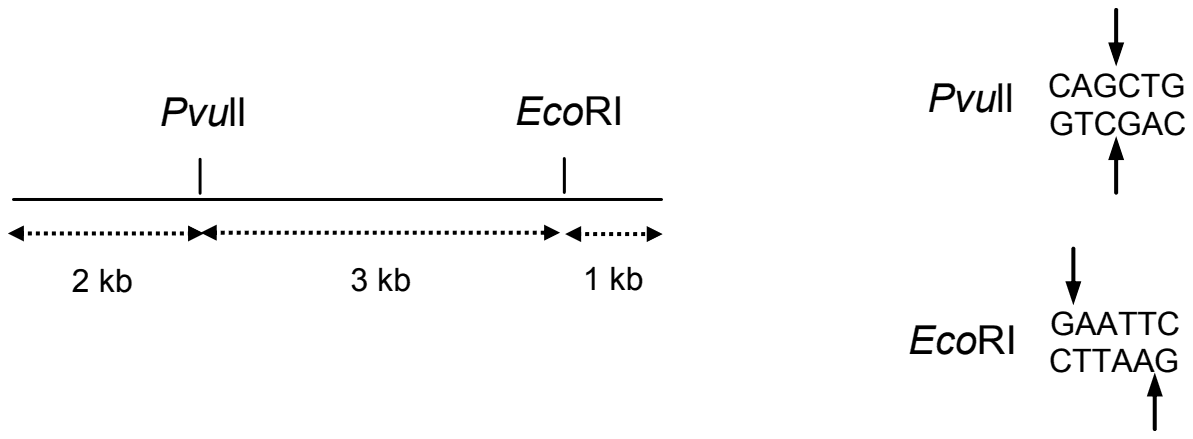
The figure below is a schematic of a linear double stranded DNA containing the indicated restriction sites. The DNA was completely digested with PvuII and EcoRI. The products were purified and added to an appropriately buffered reaction mixture containing dNTP mix, α-32P dATP, and Klenow fragment of E. coli DNA polymerase I. The Klenow reaction products were analyzed by gel electrophoresis and autoradiography. Which of the following products depicts the expected result?
Codon bias is correlated with the relative frequencies of which one of the following types of RNA?
Total number of questions : 20
Number of answered questions : 0
Number of unanswered questions : 20
Molecular Biology [ Question No: 1 To 20 ] :
Lac repressor is an example of :
Your Answer : (Not Answered)
Correct Answer : B
The lac repressor is an example of the helix turn helix motif.
Like many bacterial regulators (the lambda and trp repressors, CAP), the lac repressor binds DNA through two alpha-helices joined by a short turn; the second, recognition helix lies in the major groove of the operator.
The helix loop helix motif belongs to eukaryotic factors such as MyoD and Myc, where it mainly mediates dimerisation. Zinc fingers, C2H2 (as in TFIIIA) and C2C2 (as in the steroid receptors), are also eukaryotic DNA-binding domains and do not occur in the lac repressor.
A linear DNA is 100% labelled at one end and has 3 restriction sites for EcoRI. If it is digested by EcoRI so that possible fragments are produced, how many of these fragments will be labelled and how many non-labelled ?
Your Answer : (Not Answered)
Correct Answer : A
There will be 4 labelled and 6 unlabelled fragments.
Three EcoRI sites divide the molecule into 4 segments. 'Possible fragments' means every fragment a partial digest can give, any run of adjacent segments. With \(n\) segments the count is:
\[ \frac{n(n+1)}{2} = \frac{4 \times 5}{2} = 10 \]
A fragment is labelled only if it includes the labelled end. Those are the runs starting at that end: segment 1, segments 1-2, 1-3 and 1-4, so 4 are labelled and \(10 - 4 = 6\) are not.
A complete digest would give only 4 fragments, 1 labelled. Options with 6 labelled reverse the count, and 3 and 3 or 3 and 5 have no consistent total.
The DNA profiling technique which demonstrates the similarity between different animal species with reference to some specific proteins coding sequences is known as :
Your Answer : (Not Answered)
Correct Answer : A
The technique is the zoo blot.
A zoo blot is a Southern blot carrying DNA from several different animal species, probed with a cloned gene or DNA fragment from one species. Hybridisation in many species shows that the sequence is conserved, which suggests it is a protein-coding gene; it was used, for example, in identifying the gene for Duchenne muscular dystrophy.
'Garden blot', 'phylogenetic blot' and 'animal profiling' are not names of a blotting technique; they play on the idea of comparing species.
The tryptophan operon in Escherichia coli demonstrates level of regulation called .................. by the termination of transcription if tryptophan is abundant in cells.
Your Answer : (Not Answered)
Correct Answer : C
The level of regulation is attenuation.
The trp leader region encodes a short peptide containing two tryptophan codons. When tryptophan is plentiful, the ribosome translates the leader quickly, which lets the transcript fold into a terminator hairpin, and RNA polymerase stops before the structural genes. When tryptophan is scarce, the ribosome stalls and an alternative antiterminator hairpin forms instead.
Corepression is the other control of the trp operon: the repressor, with tryptophan bound, blocks transcription from starting. It acts at initiation, not by terminating transcription. 'Activation' and 'termination' are not the names of this regulatory level.
A hybrid operon was constructed by fusing the structural genes of trp operon and promoter region of lac operon. Efficient expression of this chimeric operon will require :
Your Answer : (Not Answered)
Correct Answer : D
Expression needs the presence of lactose and absence of glucose.
The structural genes come from the trp operon, but their transcription is now controlled by the lac promoter region. That region responds to two signals: lactose (as allolactose) removes the lac repressor, and the absence of glucose raises cAMP so that CAP-cAMP can activate transcription.
Glucose keeps cAMP low and so blocks efficient expression, and without lactose the repressor stays bound. Tryptophan is irrelevant, because the trp promoter and operator that respond to it are no longer present.
The ability of a site to control adjacent genes in DNA sequence irrespective of the presence of the alleles is called as :
Your Answer : (Not Answered)
Correct Answer : B
Such a site is called a Cis acting site.
A cis-acting element, such as a promoter or an operator, is a stretch of DNA that controls only the genes physically adjacent to it on the same molecule. Because it is not a diffusible product, a second copy elsewhere in the cell cannot rescue or override it, so its effect holds irrespective of the other alleles present; this is what cis-trans tests detect.
A trans-acting factor is a diffusible product, usually a protein such as a repressor, that acts on any copy of its target. 'Overlapping site' and 'cis-trans acting site' are not the terms for this property.
A transcription unit is 8000 nucleotides long. If only 15% of this unit is exon, calculate the approximate molecular weight of the protein encoded :
Your Answer : (Not Answered)
Correct Answer : C
The protein is about 44 kDa.
Only the exons are translated. Three nucleotides code for one amino acid, and an average amino acid residue weighs about 110 Da:
\[ \begin{aligned} \text{exon} &= 0.15 \times 8000 = 1200 \text{ nt} \\ \text{residues} &= 1200 / 3 = 400 \\ \text{mass} &= 400 \times 110 = 44000 \text{ Da} \end{aligned} \]
1200 kDa mistakes the number of nucleotides for kilodaltons. 40 kDa uses 100 Da per residue, and 100 kDa ignores the fact that only 15% of the unit is exon.
Which one of the following enzymes can alter the linking number of covalently closed circular form of DNA ?
Your Answer : (Not Answered)
Correct Answer : D
The enzyme is Gyrase.
The linking number of a covalently closed circle can change only if a strand is cut, passed through and resealed. DNA gyrase, a type II topoisomerase, cuts both strands, passes a duplex segment through the break and reseals it, introducing negative supercoils and changing the linking number by 2 in each cycle, using ATP.
Primase makes RNA primers and DNA polymerase extends DNA; neither breaks and rejoins a closed circle. Ligase seals nicks, but a covalently closed circle has none to seal.
Which of the statements regarding DNA replication is correct ?
Your Answer : (Not Answered)
Correct Answer : D
The correct statement is that synthesis of the leading strand requires one RNA primer.
Once primase lays down a single RNA primer at the origin, DNA polymerase III can extend the leading strand continuously in the 5' to 3' direction as the fork moves, so no further primers are needed. The lagging strand, by contrast, needs a new primer for every Okazaki fragment.
Option A describes the lagging strand, not the leading strand. Polymerase does not cap the 5' end of DNA; capping is a modification of eukaryotic mRNA. The replicative helicase DnaB is a hexamer of six identical subunits, not five.
DNA repair mechanisms are able to distinguish newly synthesized DNA strands from older strands because :
Your Answer : (Not Answered)
Correct Answer : B
They can tell them apart because old strands are methylated while new strands are not.
In E. coli, Dam methylase methylates the adenine in every GATC sequence, but only after a short delay. Just behind the replication fork the parental strand is methylated and the daughter strand is not yet. The mismatch repair proteins (MutS, MutL, MutH) use this to nick and repair the unmethylated, newly made strand, which is the one carrying the error.
Both strands contain cytosine. 'Heavy' strands refer to the 15N labelling of the Meselson-Stahl experiment, not to anything a cell can detect. The reverse methylation pattern is wrong.
Mutation in which one of the following proteins will inhibit recognition of mismatched base pairs during DNA repair ?
Your Answer : (Not Answered)
Correct Answer : B
The protein is MutS.
In E. coli mismatch repair, MutS is the protein that scans newly replicated DNA and binds to a mismatched base pair or small loop. MutL then joins it and activates MutH, which nicks the unmethylated new strand at a nearby GATC site; UvrD helicase unwinds the nicked strand so that it can be removed and resynthesised.
So a mutant MutS cannot recognise the mismatch at all. Mutations in MutH, MutL or UvrD block later steps of the repair, not the recognition.
X-rays induce mutagenic changes by :
Your Answer : (Not Answered)
Correct Answer : D
X-rays induce mutations chiefly by chromosomal breakage.
X-rays are ionising radiation: they knock electrons from atoms, producing free radicals that break the sugar-phosphate backbone. Double-strand breaks lead to deletions, inversions, translocations and other chromosomal aberrations, the hallmark of radiation damage that H.J. Muller first exploited in 1927.
Transitions and transversions are base substitutions caused mainly by base analogues, deaminating and alkylating agents, and frameshifts by intercalating agents such as acridines. X-rays can cause point mutations too, but breakage is their characteristic effect.
Mechanism of gene regulation does not include :
Your Answer : (Not Answered)
Correct Answer : D
Gene regulation does not include the rate of replication.
Gene expression can be controlled at every step from DNA to protein: the rate at which a gene is transcribed (promoters, enhancers, transcription factors, chromatin), the processing of the primary transcript (capping, splicing, alternative splicing, polyadenylation), the stability and lifetime of the mRNA, and translation and protein modification after that.
Replication copies the whole genome once per cell cycle, and how fast it runs does not set how much a particular gene is expressed. That is why the rate of replication is the odd one out, while the other three options are standard levels of gene regulation.
The glycosyl bond conformation in z-form of DNA is :
Your Answer : (Not Answered)
Correct Answer : B
In Z-DNA the glycosyl bond is anti for pyrimidines and syn for purines.
Z-DNA is a left-handed double helix formed by alternating purine-pyrimidine sequences such as (CG)n, especially at high salt. Its repeating unit is a dinucleotide because the two kinds of nucleotide adopt different conformations: the pyrimidines (C) keep the usual anti conformation about the glycosyl bond, while the purines (G) flip to syn. This alternation gives the backbone its zigzag course, from which Z-DNA is named.
In B-DNA and A-DNA all bases are anti, so 'anti for both' describes the right-handed forms. The options with pyrimidines syn reverse the arrangement, and 'syn for both' occurs in neither form.
In affinity chromatography heparin columns are used for purification of which of the following ?
Your Answer : (Not Answered)
Correct Answer : D
Heparin columns are used to purify DNA polymerases.
Heparin is a strongly negatively charged sulphated polysaccharide that resembles the phosphate backbone of nucleic acids. Proteins that bind DNA, such as DNA polymerases, restriction enzymes and many transcription factors, therefore bind heparin and can be eluted with a salt gradient. Heparin also binds coagulation factors and lipoprotein lipases.
The other targets use different ligands. NAD+-dependent dehydrogenases are purified on dye columns such as Cibacron Blue or on 5'-AMP agarose. Glycoproteins are captured by lectins such as concanavalin A, and eukaryotic mRNA by oligo(dT) cellulose, which binds the poly(A) tail.
Recruitment of epigenetic factors on DNA can be detected by :
Your Answer : (Not Answered)
Correct Answer : C
Recruitment of epigenetic factors on DNA is detected by chromatin immunoprecipitation followed by PCR (ChIP-PCR).
In ChIP, proteins are cross-linked to the DNA they are bound to in living cells, usually with formaldehyde. The chromatin is sheared, and an antibody against the factor of interest, such as a histone-modifying enzyme or a modified histone, pulls down the protein with its attached DNA. After reversing the cross-links, PCR (or sequencing, in ChIP-seq) shows which DNA regions the factor occupied.
Plain immunoprecipitation and immunoblotting detect the protein but not where on the DNA it sits. Immunofluorescence shows where the protein is in the nucleus, not which sequences it binds.
Which of the following molecules binds with greater affinity to calcium hydroxy apatite column ?
Your Answer : (Not Answered)
Correct Answer : D
The molecule that binds hydroxyapatite with greatest affinity is ds-DNA.
Hydroxyapatite, a crystalline calcium phosphate, binds nucleic acids through their phosphate backbones. In double-stranded DNA the phosphates are held in a rigid, regular array that interacts with the crystal surface over many contacts, so ds-DNA binds most strongly and needs a higher phosphate concentration to be eluted than single-stranded DNA. This is the basis for separating ds-DNA from ss-DNA in reassociation (Cot) studies.
ss-DNA and RNA, with flexible, irregular backbones, bind more weakly, and a small molecule such as ATP binds least.
In prokaryotes, the sequence in mRNA that is recognized by the small subunit of ribosome during its translation is known as :
Your Answer : (Not Answered)
Correct Answer : B
The sequence is the Shine-Dalgarno sequence.
In bacteria a purine-rich sequence (consensus AGGAGG) lies a few nucleotides upstream of the start codon on the mRNA. It pairs with a complementary sequence at the 3' end of the 16S rRNA in the small (30S) ribosomal subunit, which positions the ribosome so that the initiation codon sits in the P site.
AUG is the start codon itself, read by the initiator tRNA rather than recognised by base-pairing with rRNA. UAG is a stop codon. The Pribnow box (TATAAT) is a promoter element in DNA recognised by RNA polymerase, not a sequence in mRNA.
The figure below is a schematic of a linear double stranded DNA containing the indicated restriction sites. The DNA was completely digested with PvuII and EcoRI. The products were purified and added to an appropriately buffered reaction mixture containing dNTP mix, α-32P dATP, and Klenow fragment of E. coli DNA polymerase I. The Klenow reaction products were analyzed by gel electrophoresis and autoradiography. Which of the following products depicts the expected result?
Your Answer : (Not Answered)
Correct Answer : A
The expected result is (A): labelled bands at 3 kb and 1 kb only.
Digestion gives three fragments: 2 kb (left end to PvuII), 3 kb (PvuII to EcoRI) and 1 kb (EcoRI to right end). PvuII cuts CAG/CTG in the middle, leaving blunt ends. EcoRI cuts G/AATTC, leaving a 5' overhang of AATT with a recessed 3' end opposite it.
Klenow fragment fills in a recessed 3' end using the overhang as template; filling in the AATT overhang incorporates two dA residues, including the labelled α-32P dATP. Blunt ends offer nothing to fill. So only fragments carrying an EcoRI end become labelled: the 3 kb and the 1 kb fragments. The 2 kb fragment has a blunt PvuII end and the original end of the DNA, so it stays unlabelled and is invisible on the autoradiograph, which rules out B, C and D.
Codon bias is correlated with the relative frequencies of which one of the following types of RNA?
Your Answer : (Not Answered)
Correct Answer : D
Codon bias correlates with the relative abundance of tRNA.
Synonymous codons for the same amino acid are not used equally. In highly expressed genes the preferred codons are those read by the most abundant tRNA species in the cell, which speeds and improves the accuracy of translation. Codon usage tables and tRNA gene copy numbers track each other across organisms.
mRNA carries the codons but its abundance does not explain which synonym is preferred. rRNA forms the ribosome and is the same for every codon, and siRNA acts in gene silencing, not in decoding.
Marks
Total number of questions : 20
Number of answered questions : 0
Number of unanswered questions : 20