
Instruction
- Total number of questions : 20
- Time allotted : 30:00 Minutes:Seconds.
- Each question carry 1 mark, no negative marks.
- DO NOT refresh the page.
- All the best
Nuclear Physics [ Question No: 1 To 20 ] :
In the energy levels predicted by shell model, the labelled energy states and the corresponding nucleon number, starting from the lowest to higher energy levels are as follows :
(i) 1s1/2 − 2 Nucleons
(ii) 1p3/2 − 4 Nucleons
(iii) 1p1/2 − 2 Nucleons
(iv) 1d5/2 − 6 Nucleons
The estimated groundstate spins of \( {}^{27}_{13}\text{Al} \) and \( {}^{11}_{5}\text{B} \) nuclei are :
The following nuclear reaction
\[ \pi^{+} + n \rightarrow K^{\circ} + P \]
is examined on the basis of conservation laws of charge, Baryon number, strangeness and third component of Isospin. It is observed that the reaction cannot be induced due to non-conservation of the :
Energetic particle \( K^{-} \) interacts with proton and induces the following reaction
\[ P+K^{-}\to\Omega^{-}+K^{0}+K^{+}+\pi^{+}+\pi^{-} \]
By assigning strangeness number to all other particles, the estimated strangeness of \( \Omega^{-} \) particle is :
An excited nucleus decayed from an energy level having spin and parity of 3+ to another energy level having spin and parity of O+ by emitting a beta particle. The above beta-decay has the prominent decay mode of :
The radioactive \( {}^{210}_{84}\text{Po} \) emits alpha particles through the following decay process :
\[ \begin{aligned} {}^{210}_{84}\text{Po} &\rightarrow {}^{206}_{82}\text{Pb} \\ &+ {}^{4}_{2}\text{He} \end{aligned} \]
(Alpha Particle)
The height of the potential barrier experienced by the alpha particle emitted from radioactive nuclei \( {}^{210}_{84}\text{Po} \) is equal to :
A radioactive isotope sample has a decay constant \(\lambda = 2.31 \times 10^{-4}\) year-1. Initially the sample contains \(8000 \times 10^{15}\) atoms. The sample decays to 25% of its initial value. The number of years it takes to decay to this stage is closest to ___
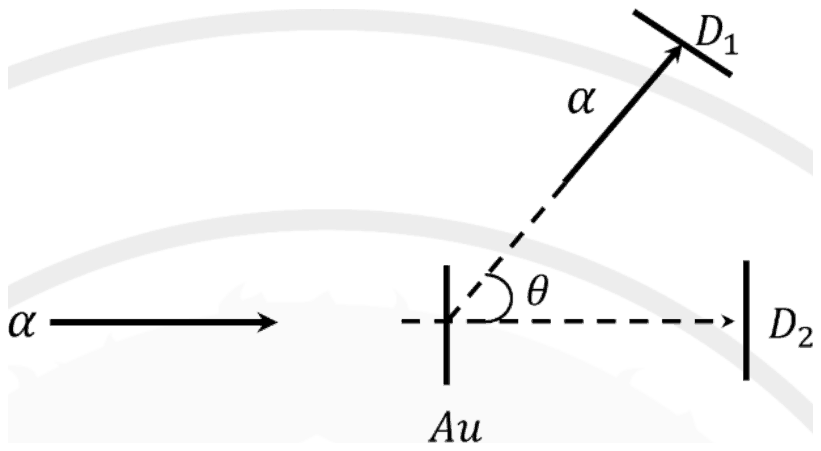
An \(\alpha\) particle is scattered from an Au target at rest as shown in the figure. \(D_{1}\) and \(D_{2}\) are the detectors to detect the scattered \(\alpha\) particle at an angle \(\theta\) and along the beam direction, respectively, as shown. The signals from \(D_{1}\) and \(D_{2}\) are converted to logic signals and fed to logic gates. When a particle is detected, the signal is 1 and is 0 otherwise. Which one of the following circuits detects the particle scattered at the angle \(\theta\) only?
Binding energy and rest mass energy of a two-nucleon bound state are denoted by \(B\) and \(mc^{2}\), respectively, where \(c\) is the speed of light. The minimum energy of a photon required to dissociate the bound state is
Consider the induced nuclear fission reaction
\({}_{92}U^{235} + n \rightarrow {}_{37}Rb^{93} + {}_{55}Cs^{141} + 2n\)
where neutron momenta in both initial and final states are negligible. The ratio of the kinetic energies (KE) of the daughter nuclei, \(\dfrac{KE({}_{37}Rb^{93})}{KE({}_{55}Cs^{141})}\) is ___________
The nuclear energy levels of mirror nuclei are similar. Using this empirical fact alone, the nuclear force can be said to be independent of which one of the following properties of the nucleons?
If nucleons in a nucleus are considered to be confined in a three-dimensional cubical box, then the first four magic numbers are
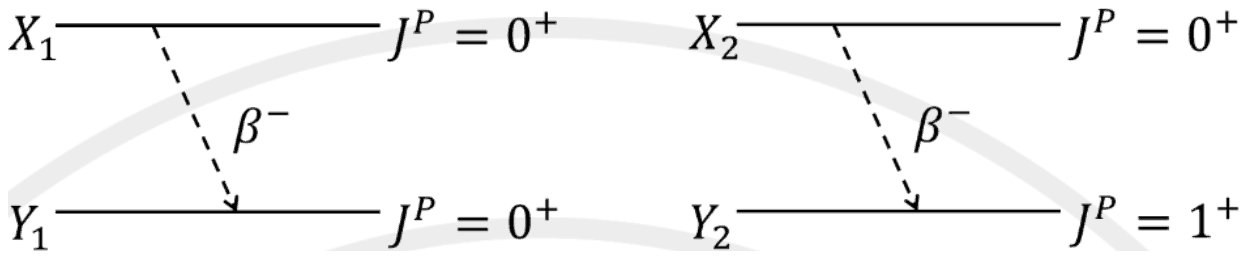
Consider two hypothetical nuclei \(X_{1}\) and \(X_{2}\) undergoing \(\beta\) decay, resulting in nuclei \(Y_{1}\) and \(Y_{2}\), respectively. The decay scheme and the corresponding \(J^{P}\) values of the nuclei are given in the figure. Which of the following option(s) is/are correct? (\(J\) is the total angular momentum and \(P\) is parity)
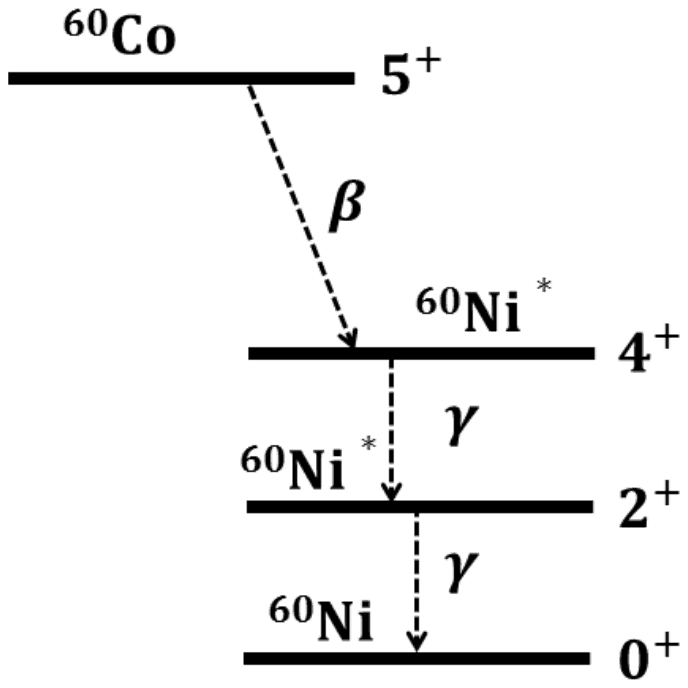
A 60Co nucleus emits a β-particle and is converted to 60Ni* with \(J^{P} = 4^{+}\), which in turn decays to the 60Ni ground state with \(J^{P} = 0^{+}\) by emitting two photons in succession, as shown in the figure. Which one of the following statements is CORRECT?
Which one of the following is an allowed process?
Which one of the following baryons has strangeness quantum number \(S = -1\)?
Let P, Q and R be three different nuclei. Which one of the following nuclear processes is possible?
Under parity and time reversal transformations, which of the following statements is(are) TRUE about the electric dipole moment p and the magnetic dipole moment μ?
The \(\Xi^{0*}\) particle is a member of the Baryon decuplet with isospin state \(|I, I_{3}\rangle = |\frac{1}{2}, \frac{1}{2}\rangle\) and strangeness quantum number -2. In the quark model, which one of the following is the flavour part of the \(\Xi^{0*}\) wavefunction?
In the decay, \(\mu^{+} \rightarrow e^{+} + \nu_{e} + X\), what is \(X\)?
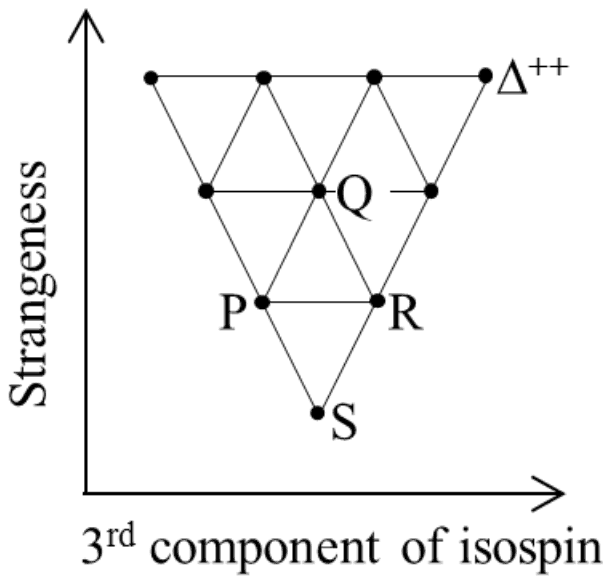
The elementary particle \(\Xi^{0}\) is placed in the baryon decuplet, shown below, at
Total number of questions : 20
Number of answered questions : 0
Number of unanswered questions : 20
Nuclear Physics [ Question No: 1 To 20 ] :
In the energy levels predicted by shell model, the labelled energy states and the corresponding nucleon number, starting from the lowest to higher energy levels are as follows :
(i) 1s1/2 − 2 Nucleons
(ii) 1p3/2 − 4 Nucleons
(iii) 1p1/2 − 2 Nucleons
(iv) 1d5/2 − 6 Nucleons
The estimated groundstate spins of \( {}^{27}_{13}\text{Al} \) and \( {}^{11}_{5}\text{B} \) nuclei are :
Your Answer : (Not Answered)
Correct Answer : B
The spins are \( \frac{3}{2} \) for \( ^{11}_{5}\text{B} \) and \( \frac{5}{2} \) for \( ^{27}_{13}\text{Al} \).
In the shell model, paired nucleons contribute nothing, so an odd-A nucleus takes the spin of its single unpaired nucleon.
- \( ^{11}\text{B} \): 5 protons and 6 neutrons. The neutrons fill 1s1/2 (2) and 1p3/2 (4) completely. The protons put 2 in 1s1/2 and 3 in 1p3/2, so the odd proton is in 1p3/2: spin \( \frac{3}{2} \).
- \( ^{27}\text{Al} \): 13 protons and 14 neutrons. The neutrons fill up to 1d5/2 exactly (2 + 4 + 2 + 6). The protons put 8 in the first three levels and 5 in 1d5/2, so the odd proton is in 1d5/2: spin \( \frac{5}{2} \).
The other options give spins of levels the odd proton does not occupy, or, like \( \frac{11}{2} \), values not available in these shells.
The following nuclear reaction
\[ \pi^{+} + n \rightarrow K^{\circ} + P \]
is examined on the basis of conservation laws of charge, Baryon number, strangeness and third component of Isospin. It is observed that the reaction cannot be induced due to non-conservation of the :
Your Answer : (Not Answered)
Correct Answer : D
The reaction fails on strangeness and the third component of isospin.
Check each quantity, initial against final, for \( \pi^{+} + n \rightarrow K^{0} + p \):
- Charge: \( +1 + 0 = 0 + 1 \), conserved.
- Baryon number: \( 0 + 1 = 0 + 1 \), conserved.
- Strangeness: \( 0 + 0 \ne +1 + 0 \), violated.
- Isospin \( I_{3} \): \( +1 - \frac{1}{2} = +\frac{1}{2} \) against \( -\frac{1}{2} + \frac{1}{2} = 0 \), violated.
Since charge and baryon number are both conserved, every option naming either of them is wrong. A strong reaction must conserve both strangeness and I3, so it cannot occur.
Energetic particle \( K^{-} \) interacts with proton and induces the following reaction
\[ P+K^{-}\to\Omega^{-}+K^{0}+K^{+}+\pi^{+}+\pi^{-} \]
By assigning strangeness number to all other particles, the estimated strangeness of \( \Omega^{-} \) particle is :
Your Answer : (Not Answered)
Correct Answer : B
The strangeness of the \( \Omega^{-} \) is −3.
Strangeness is conserved in this strong interaction. The proton and the pions have \( S = 0 \), the \( K^{-} \) has \( S = -1 \), and the \( K^{0} \) and \( K^{+} \) each have \( S = +1 \):
\[ \begin{aligned} 0 + (-1) &= S_{\Omega} + 1 + 1 + 0 + 0 \\ S_{\Omega} &= -3 \end{aligned} \]
This agrees with the quark content of the \( \Omega^{-} \), sss, three strange quarks. +3 has the wrong sign, and ±2 would follow from leaving out one of the two kaons.
An excited nucleus decayed from an energy level having spin and parity of 3+ to another energy level having spin and parity of O+ by emitting a beta particle. The above beta-decay has the prominent decay mode of :
Your Answer : (Not Answered)
Correct Answer : B
The decay is a second forbidden Gamow-Teller transition.
The spin changes by ΔJ = 3 (from 3 to 0, the paper's O+ being 0+), and the parity does not change (+ to +). The classification is:
- Allowed: ΔJ = 0, ±1, no parity change (Fermi for ΔJ = 0 with no spin flip, Gamow-Teller for ΔJ = 0, ±1).
- First forbidden: parity changes, ΔJ up to 2.
- Second forbidden: no parity change, ΔJ = 2 or 3.
ΔJ = 3 with no parity change needs two units of orbital angular momentum plus the electron and neutrino spins aligned, which is a second forbidden (unique) Gamow-Teller decay. An allowed Fermi or Gamow-Teller decay cannot change J by 3, and a first forbidden decay requires a parity change.
The radioactive \( {}^{210}_{84}\text{Po} \) emits alpha particles through the following decay process :
\[ \begin{aligned} {}^{210}_{84}\text{Po} &\rightarrow {}^{206}_{82}\text{Pb} \\ &+ {}^{4}_{2}\text{He} \end{aligned} \]
(Alpha Particle)
The height of the potential barrier experienced by the alpha particle emitted from radioactive nuclei \( {}^{210}_{84}\text{Po} \) is equal to :
Your Answer : (Not Answered)
Correct Answer : A
The barrier height is about 26 MeV.
The barrier is the Coulomb energy of the alpha particle (charge 2e) touching the daughter nucleus (charge 82e). With \( e^{2}/4\pi\epsilon_{0} = 1.44 \) MeV fm and \( r_{0} \approx 1.2 \) fm:
\[ \begin{aligned} R &= 1.2\,(206^{1/3} + 4^{1/3}) \approx 9.0\ \text{fm} \\ V &= \frac{1.44 \times 2 \times 82}{9.0} \approx 26\ \text{MeV} \end{aligned} \]
The alpha particles of Po-210 have only about 5·3 MeV, far below this, which is why alpha decay proceeds by quantum tunnelling. 40, 42 and 80 MeV would need a much smaller contact radius.
A radioactive isotope sample has a decay constant \(\lambda = 2.31 \times 10^{-4}\) year-1. Initially the sample contains \(8000 \times 10^{15}\) atoms. The sample decays to 25% of its initial value. The number of years it takes to decay to this stage is closest to ___
Your Answer : (Not Answered)
Correct Answer : B
The time is closest to 6000 years.
Radioactive decay follows \(N = N_{0}e^{-\lambda t}\). Decaying to 25% means \(N/N_{0} = 1/4\):
\[ \begin{aligned} t &= \frac{\ln 4}{\lambda} = \frac{1.386}{2.31 \times 10^{-4}} \\ &\approx 6000\ \text{years} \end{aligned} \]
Equivalently, the half-life is \(0.693/\lambda = 3000\) years, and falling to a quarter takes two half-lives. 3000 is one half-life, the time to 50%. The initial number of atoms does not matter.
An \(\alpha\) particle is scattered from an Au target at rest as shown in the figure. \(D_{1}\) and \(D_{2}\) are the detectors to detect the scattered \(\alpha\) particle at an angle \(\theta\) and along the beam direction, respectively, as shown. The signals from \(D_{1}\) and \(D_{2}\) are converted to logic signals and fed to logic gates. When a particle is detected, the signal is 1 and is 0 otherwise. Which one of the following circuits detects the particle scattered at the angle \(\theta\) only?
Your Answer : (Not Answered)
Correct Answer : A
The required circuit is (A): \(D_{1}\) AND (NOT \(D_{2}\)).
'Scattered at angle \(\theta\) only' means \(D_{1}\) fires and \(D_{2}\) does not. The output must be 1 exactly when \(D_{1} = 1\) and \(D_{2} = 0\), which is \(D_{1}\cdot\overline{D_{2}}\): invert \(D_{2}\) and AND it with \(D_{1}\).
(B) gives \(\overline{D_{1}}D_{2}\), which selects the unscattered particles going straight to \(D_{2}\). (C) is a NOR, \(\overline{D_{1} + D_{2}}\), which is 1 only when neither detector fires. (D), \(D_{1} + \overline{D_{2}}\), is also 1 when nothing is detected at all.
Binding energy and rest mass energy of a two-nucleon bound state are denoted by \(B\) and \(mc^{2}\), respectively, where \(c\) is the speed of light. The minimum energy of a photon required to dissociate the bound state is
Your Answer : (Not Answered)
Correct Answer : B
The minimum photon energy is \(B\left(1 + \dfrac{B}{2mc^{2}}\right)\).
The photon must supply the binding energy B and also the recoil kinetic energy of the products, because its momentum E/c must be conserved. At threshold the two nucleons move off together with total momentum E/c and total rest energy mc2 + B. Energy conservation with the bound state at rest:
\[ \begin{aligned} E + mc^{2} &= \sqrt{(mc^{2} + B)^{2} + E^{2}} \\ E &= B + \frac{B^{2}}{2mc^{2}} = B\left(1 + \frac{B}{2mc^{2}}\right) \end{aligned} \]
B alone ignores the recoil. The minus sign would make the threshold smaller than the binding energy, which energy conservation forbids, and B - mc2 is negative for any real nucleus.
Consider the induced nuclear fission reaction
\({}_{92}U^{235} + n \rightarrow {}_{37}Rb^{93} + {}_{55}Cs^{141} + 2n\)
where neutron momenta in both initial and final states are negligible. The ratio of the kinetic energies (KE) of the daughter nuclei, \(\dfrac{KE({}_{37}Rb^{93})}{KE({}_{55}Cs^{141})}\) is ___________
Your Answer : (Not Answered)
Correct Answer : B
The ratio of kinetic energies is 141/93.
The initial momentum is negligible, and so is the neutrons' momentum afterwards, so the two fragments fly apart with equal and opposite momenta of magnitude p. Non-relativistically KE = p2/2M, so with the same p the kinetic energy is inversely proportional to the mass:
\[ \begin{aligned} \frac{KE_{Rb}}{KE_{Cs}} &= \frac{M_{Cs}}{M_{Rb}} \\ &\approx \frac{141}{93} \end{aligned} \]
The lighter rubidium nucleus carries more energy. 93/141 inverts the ratio, 1 would need equal masses, and 0 would mean one fragment stays at rest, which momentum conservation forbids.
The nuclear energy levels of mirror nuclei are similar. Using this empirical fact alone, the nuclear force can be said to be independent of which one of the following properties of the nucleons?
Your Answer : (Not Answered)
Correct Answer : C
The nuclear force is independent of the nucleons' charge.
Mirror nuclei, such as \(^{3}\)H and \(^{3}\)He or \(^{13}\)C and \(^{13}\)N, have their proton and neutron numbers interchanged. Once the Coulomb energy is allowed for, their energy levels are nearly identical, which shows that the nn and pp interactions are the same: the strong force does not distinguish a proton from a neutron. This is charge symmetry, part of the wider idea of charge independence.
Swapping protons and neutrons leaves spins and parities of the nucleons unchanged, so mirror nuclei say nothing about dependence on spin or parity; and the tiny proton-neutron mass difference is not what the comparison tests.
If nucleons in a nucleus are considered to be confined in a three-dimensional cubical box, then the first four magic numbers are
Your Answer : (Not Answered)
Correct Answer : C
The first four magic numbers are 2, 8, 14, 20.
In a cubical box the levels are \(E \propto n_{x}^{2} + n_{y}^{2} + n_{z}^{2}\) with each \(n \ge 1\). Count the distinct arrangements (degeneracy), and double for the two spin states:
- (1,1,1), sum 3: 1 state, 2 nucleons, total 2.
- (2,1,1) and permutations, sum 6: 3 states, 6 nucleons, total 8.
- (2,2,1), sum 9: 3 states, 6 nucleons, total 14.
- (3,1,1), sum 11: 3 states, 6 nucleons, total 20.
Shell closures, the magic numbers in this model, are therefore 2, 8, 14, 20. The sequence 2, 8, 20, 28 is the observed set from the real nuclear shell model with spin-orbit coupling, which a simple box does not reproduce.
Consider two hypothetical nuclei \(X_{1}\) and \(X_{2}\) undergoing \(\beta\) decay, resulting in nuclei \(Y_{1}\) and \(Y_{2}\), respectively. The decay scheme and the corresponding \(J^{P}\) values of the nuclei are given in the figure. Which of the following option(s) is/are correct? (\(J\) is the total angular momentum and \(P\) is parity)
Your Answer : (Not Answered)
Correct Answer : B
The correct option is \(X_{1} \to Y_{1}\) is a Fermi transition and \(X_{2} \to Y_{2}\) is a Gamow-Teller transition.
In allowed beta decay there is no change of parity, and the selection rules depend on how the electron and neutrino spins combine. In a Fermi transition their spins are antiparallel (total 0), so \(\Delta J = 0\). In a Gamow-Teller transition they are parallel (total 1), so \(\Delta J = 0, \pm 1\), except that \(0 \to 0\) is forbidden.
\(0^{+} \to 0^{+}\) (\(X_{1} \to Y_{1}\)) cannot be Gamow-Teller, so it is a pure Fermi transition. \(0^{+} \to 1^{+}\) (\(X_{2} \to Y_{2}\)) has \(\Delta J = 1\), which a Fermi transition cannot provide, so it is pure Gamow-Teller.
That rules out every other combination. (This is a multiple-select question; the key accepts this option alone.)
A 60Co nucleus emits a β-particle and is converted to 60Ni* with \(J^{P} = 4^{+}\), which in turn decays to the 60Ni ground state with \(J^{P} = 0^{+}\) by emitting two photons in succession, as shown in the figure. Which one of the following statements is CORRECT?
Your Answer : (Not Answered)
Correct Answer : C
The correct statement is \(2^{+} \rightarrow 0^{+}\) is an electric quadrupole transition.
A photon of multipolarity \(L\) must satisfy \(|J_{i} - J_{f}| \le L \le J_{i} + J_{f}\) (and \(L \ge 1\)). An electric \(EL\) transition changes parity by \((-1)^{L}\) and a magnetic \(ML\) transition by \((-1)^{L+1}\).
For \(2^{+} \rightarrow 0^{+}\), only \(L = 2\) is allowed, and there is no parity change, so it must be E2, electric quadrupole. M2 would need a parity change.
For \(4^{+} \rightarrow 2^{+}\), \(L\) runs from 2 to 6 with no parity change, so the allowed multipoles are E2, M3, E4, M5, E6, and E2 dominates. An electric octupole (E3) or a magnetic quadrupole (M2) would both change parity, so the first two statements are wrong, as is the last.
Which one of the following is an allowed process?
Your Answer : (Not Answered)
Correct Answer : A
The allowed process is \(\pi^{-} + p \to \pi^{0} + n\).
This charge exchange reaction conserves charge (−1 + 1 = 0 + 0), baryon number (1 = 1), and isospin and strangeness, so it proceeds by the strong interaction and is observed.
\(\pi^{0} \to 3\gamma\) is forbidden by charge conjugation: the \(\pi^{0}\) has C = +1, and each photon carries C = −1, so three photons have C = −1. \(p + \bar{p} \to \Lambda^{0} + \Lambda^{0}\) has baryon number 0 before and 2 after (and strangeness 0 before, −2 after). \(p + \bar{p} \to \gamma\) cannot conserve both energy and momentum: in the centre of mass frame the total momentum is zero, but a single photon always carries momentum.
Which one of the following baryons has strangeness quantum number \(S = -1\)?
Your Answer : (Not Answered)
Correct Answer : A
The baryon with \(S = -1\) is \(\Sigma^{*0}\).
Strangeness counts strange quarks, each contributing \(S = -1\). The \(\Sigma^{*0}\) (the spin-3/2 partner of the \(\Sigma^{0}\)) has quark content \(uds\), one strange quark, so \(S = -1\).
The neutron (\(udd\)) and the \(\Delta^{0}\) (\(udd\)) contain no strange quark and have \(S = 0\). The \(\Xi^{*0}\) (\(uss\)) has two strange quarks and \(S = -2\).
Let P, Q and R be three different nuclei. Which one of the following nuclear processes is possible?
Your Answer : (Not Answered)
Correct Answer : A
The possible process is \(\nu_{e} + {}_{z}P^{A} \rightarrow {}_{z+1}Q^{A} + e^{-}\).
This is neutrino capture, the inverse of beta decay: inside the nucleus a neutron absorbs the electron neutrino and turns into a proton, emitting an electron (νe + n → p + e-). Charge is conserved (0 + z = z + 1 - 1), the mass number is unchanged, and the lepton number (+1 on both sides) and electron flavour are conserved.
Producing a positron with a neutrino would violate lepton number: the left side has +1 and the right side -1. Creating an e+e- pair leaves the neutrino's lepton number unaccounted for, and the last option destroys the neutrino and creates only a photon, again violating lepton number.
Under parity and time reversal transformations, which of the following statements is(are) TRUE about the electric dipole moment p and the magnetic dipole moment μ?
Your Answer : (Not Answered)
Correct Answer : A
The true statement is p is odd under parity and μ is odd under time reversal; it is the only one the key accepts in this multiple-select question.
The electric dipole moment \(\mathbf{p} = \sum q\mathbf{r}\) is built from position vectors. Parity sends \(\mathbf{r} \rightarrow -\mathbf{r}\), so \(\mathbf{p}\) is odd under parity; time reversal leaves positions unchanged, so \(\mathbf{p}\) is even under T.
The magnetic dipole moment comes from circulating currents or spin, \(\boldsymbol{\mu} \propto \mathbf{r} \times \mathbf{v}\) or \(\propto \mathbf{S}\), an axial vector like angular momentum. It is even under parity (both factors change sign) but odd under time reversal, since reversing time reverses every velocity and spin.
So 'μ is even under time reversal' and 'p is even under parity' are both false, which rules out the other three statements.
The \(\Xi^{0*}\) particle is a member of the Baryon decuplet with isospin state \(|I, I_{3}\rangle = |\frac{1}{2}, \frac{1}{2}\rangle\) and strangeness quantum number -2. In the quark model, which one of the following is the flavour part of the \(\Xi^{0*}\) wavefunction?
Your Answer : (Not Answered)
Correct Answer : B
The flavour wavefunction is \(\frac{1}{\sqrt{3}}(uss + sus + ssu)\).
Strangeness -2 means two strange quarks; with total isospin projection +1/2 the third quark is a \(u\). The baryon decuplet is the totally symmetric flavour multiplet of SU(3) (its spin part is symmetric too, and colour supplies the antisymmetry), so the state must be the symmetric sum of all distinct orderings of \(u, s, s\), normalised by \(1/\sqrt{3}\).
The two \(1/\sqrt{2}\) options leave out the \(sus\) ordering, so they are neither symmetric nor complete; \(uss - ssu\) is also antisymmetric under exchange of the first and third quarks. The option with \(-sus\) is not symmetric under exchanging neighbouring quarks.
In the decay, \(\mu^{+} \rightarrow e^{+} + \nu_{e} + X\), what is \(X\)?
Your Answer : (Not Answered)
Correct Answer : D
\(X\) is the muon antineutrino, \(\bar{\nu}_{\mu}\).
The decay is \(\mu^{+} \to e^{+} + \nu_{e} + \bar{\nu}_{\mu}\). Check the lepton family numbers. On the left, \(\mu^{+}\) has muon number \(L_{\mu} = -1\) and electron number \(L_{e} = 0\). On the right, \(e^{+}\) has \(L_{e} = -1\) and \(\nu_{e}\) has \(L_{e} = +1\), cancelling, so the remaining particle must carry \(L_{\mu} = -1\) and no charge: the muon antineutrino.
A photon carries no lepton number, so \(\gamma\) leaves \(L_{\mu}\) unbalanced. \(\bar{\nu}_{e}\) would make \(L_{e} = -1\) and leave \(L_{\mu}\) unbalanced. \(\nu_{\mu}\) has \(L_{\mu} = +1\), the wrong sign; it is the partner in the \(\mu^{-}\) decay.
The elementary particle \(\Xi^{0}\) is placed in the baryon decuplet, shown below, at
Your Answer : (Not Answered)
Correct Answer : C
\(\Xi^{0}\) is at point R.
In this drawing strangeness increases upward and the third component of isospin, \(I_{3}\), to the right. The top row, with \(\Delta^{++}\) at the right end, is the four \(\Delta\) baryons with \(S = 0\). Going down, the rows are the three \(\Sigma^{*}\) (\(S = -1\)), the two \(\Xi^{*}\) (\(S = -2\)) and the single \(\Omega^{-}\) (\(S = -3\)) at the bottom.
The \(\Xi\) row holds P and R. The two members have \(I_{3} = -\tfrac{1}{2}\) (\(\Xi^{-}\)) and \(I_{3} = +\tfrac{1}{2}\) (\(\Xi^{0}\)); charge \(Q = I_{3} + (B + S)/2\) gives \(Q = 0\) for the right-hand one, so \(\Xi^{0}\) is R and \(\Xi^{-}\) is P.
Q is the \(\Sigma^{*0}\) in the middle of the second row, and S is the \(\Omega^{-}\).
Marks
Total number of questions : 20
Number of answered questions : 0
Number of unanswered questions : 20