
Instruction
- Total number of questions : 20
- Time allotted : 30:00 Minutes:Seconds.
- Each question carry 1 mark, no negative marks.
- DO NOT refresh the page.
- All the best
Operations Research [ Question No: 1 To 20 ] :
Compute the maximal flow through the following network :

A canteen has a single cash counter. A customer has to buy coupons from the cash counter before getting the food items. Customers arrive at the counter according to a Poisson process with rate of 2 per 5 minutes. It takes 1.5 minutes on average to buy coupons. What is the long-run probability that the cash counter is free ?
Which of the following statements is true ?
Which of the following is not true regarding the Karmarkar's algorithm ?
Which of the following characteristics of dynamic programming is not true ?
The dynamic programming approach to an optimization problem gives the recurrence equation for optimal solution as :
\[ f_k(b_k) = \min_{0 \lt x \le b} \{x^{2} + f_{k-1}(b_{k-1})\} \]
for \(k \gt 1\); and \(f_1(b_1) = (b_2 - x)^{2}\). Then, \(f_3(15) =\)
By the principle of optimality, the minimum value of \(y_{1}^{2} + y_{2}^{2}\) s.t. \(y_{1}y_{2} = c, y_{1} \ge 0, y_{2} \ge 0\) is :
In the inventory model \(S = Q - u.t\) with \(Q = 1000\), \(u = 40\) and \(t = 10\), the current stock level is :
In the model \(S = Q - ut\), a stock out will occur when :
Consider the LPP :
Minimize \(Z = 4x_{1} + 6x_{2} + 18x_{3}\)
Subject to : \(x_{1} + 3x_{2} \ge 3\),
\(x_{2} + 2x_{3} \ge 5\)
and \(x_{1}, x_{2}, x_{3} \ge 0\).
Then, which of the following is not a constraint in the corresponding dual problem ? (Assume that \(w_{1}\) and \(w_{2}\) are the dual variables.)
The assignment cost of assigning any one operator to any one machine is given in the following table :
| Machines | Operators | |||
|---|---|---|---|---|
| I | II | III | IV | |
| U | 10 | 5 | 13 | 15 |
| V | 3 | 9 | 18 | 3 |
| W | 10 | 7 | 3 | 2 |
| X | 5 | 11 | 9 | 7 |
The optimal assignment is :
Consider the following Linear Programming Problem :
A company produces two types of hats say A and B. Each type A hat requires twice as much labour as type B. If all the hats are of type B only, the company can produce 500 hats a day. The market limits the sale of type A and type B hats to 150 and 250 respectively. If the profit earned on type A hat is ₹ 8 and type B hat is ₹ 5, how many hats of each type should be produced so as to maximize the profit ?
The primal and dual of this problem is :
Which of the following statements is true with respect to the optimal solution of an LP problem ?
The payoff value for which each player in a game always selects the same strategy is known as :
A quadratic programming problem is given as follows :
Max. : \(Z_{x} = 2x_{1} + 3x_{2} - 2x_{1}^{2}\)
Subject to :
\(x_{1} + 4x_{2} \le 4\)
\(x_{1} + x_{2} \le 2\)
\(x_{1}, x_{2} \ge 0\).
If we apply Wolfe's method to solve, then the correct Kuhn-Tucker condition will be :
The problem :
Max. : \(Z = 3x_{1} + 2x_{2}\)
Subject to :
\(x_{1} - x_{2} \le 1\),
\(x_{1} + x_{2} \ge 3\)
\(x_{1}, x_{2} \ge 0\)
has :
Which one of the options given represents the feasible region of the linear programming model:
\(\mathit{Maximize}\ 45X_{1} + 60X_{2}\)
\(X_{1} \le 45\)
\(X_{2} \le 50\)
\(10X_{1} + 10X_{2} \ge 600\)
\(25X_{1} + 5X_{2} \le 750\)
An objective function \(Z\) of primal variables (\(x_{1}\) and \(x_{2}\)) is described below:
Minimize \(Z = 0.07x_{1} + 0.05x_{2}\)
subject to \(0.1x_{1} \ge 0.4\)
\(0.1x_{2} \ge 0.6\)
\(0.1x_{1} + 0.2x_{2} \ge 2.0\)
\(0.2x_{1} + 0.1x_{2} \ge 1.8\)
\(x_{1}, x_{2} \ge 0\)
\(W\) is the objective function of the dual of \(Z\). \(k_{1}, k_{2}, k_{3}\), and \(k_{4}\) represent the corresponding dual variables. Which one of the following options represents the correct form of \(W\)?
In a linear programming problem, if a resource is not fully utilized, the shadow price of that resource is
The following table gives the unit transportation costs, the supply at each origin and the demand of each destination for a transportation problem.
| Origin / Destination | D1 | D2 | D3 | D4 | Supply |
| O1 | 3 | 4 | 8 | 7 | 60 |
| O2 | 7 | 3 | 7 | 6 | 80 |
| O3 | 3 | 9 | 3 | 4 | 100 |
| Demand | 40 | 70 | 50 | 80 |
Let \(x_{ij}\) denote the number of units to be transported from origin \(i\) to destination \(j\). If the u-v method is applied to improve the basic feasible solution given by \(x_{12} = 60,\ x_{22} = 10,\ x_{23} = 50,\ x_{24} = 20,\ x_{31} = 40\) and \(x_{34} = 60\), then the variables entering and leaving the basis, respectively, are
Total number of questions : 20
Number of answered questions : 0
Number of unanswered questions : 20
Operations Research [ Question No: 1 To 20 ] :
Compute the maximal flow through the following network :
Your Answer : (Not Answered)
Correct Answer : A
The maximal flow is 70 units.
The two arcs leaving the source, S-1 (40) and S-2 (30), form a cut of capacity 70, so no flow can exceed 70. A flow of 70 can be achieved:
- S to 1: 40, sent on as 30 to node 3, 5 to node 4 and 5 to node 2.
- S to 2: 30, plus 5 from node 1, so 35 goes on to node 4.
- Node 4 receives 5 + 35 = 40: 30 goes to N and 10 to node 3 on the undirected arc 3-4 (capacity 25).
- Node 3 receives 30 + 10 = 40 and sends it to N (capacity 50).
The flow into N is 40 + 30 = 70, equal to the cut, so by the max-flow min-cut theorem it is maximal. 75 exceeds the cut; 60 and 65 stop short of a flow that is achievable.
A canteen has a single cash counter. A customer has to buy coupons from the cash counter before getting the food items. Customers arrive at the counter according to a Poisson process with rate of 2 per 5 minutes. It takes 1.5 minutes on average to buy coupons. What is the long-run probability that the cash counter is free ?
Your Answer : (Not Answered)
Correct Answer : C
The probability that the counter is free is \(1 - \dfrac{1.5}{2.5}\).
Treat the counter as an M/M/1 (or M/G/1) queue. The arrival rate is \(\lambda = 2/5 = 0.4\) per minute and the mean service time is 1.5 minutes, so the traffic intensity is
\[ \rho = \lambda \times 1.5 = 0.6 = \frac{1.5}{2.5} \]
In the long run the server is busy a fraction \(\rho\) of the time, so it is free with probability \(1 - \rho = 0.4\). 2.5 minutes is the mean time between arrivals. \(1 - 1.5/5\) wrongly uses 5 minutes as the inter-arrival time, \(1 - 1.5/2\) uses the arrival count, and 0 would mean the counter is always busy.
Which of the following statements is true ?
Your Answer : (Not Answered)
Correct Answer : D
The true statement is that the simplex method approaches the solution by moving from corner to corner along the edges.
The simplex method starts at a vertex (basic feasible solution) of the feasible region and at each step moves along an edge to an adjacent vertex with a better objective value, stopping when no neighbouring vertex is better.
It is not guaranteed to solve every problem: it can only report infeasibility or unboundedness, and without anti-cycling rules it can cycle. Searching through the interior of the region is what Karmarkar's interior-point algorithm (1984) does, so the second and third statements have the two methods the wrong way round.
Which of the following is not true regarding the Karmarkar's algorithm ?
Your Answer : (Not Answered)
Correct Answer : C
The statement that is not true is constraints are assumed to be non-homogeneous.
Karmarkar's projective algorithm works with a problem in a special canonical form: minimise \(c'x\) subject to homogeneous constraints \(Ax = 0\), \(\sum x_{j} = 1\), \(x \ge 0\). The centre of the simplex, \(x = (1/n, \ldots, 1/n)\), is assumed to satisfy \(Ax = 0\), and the algorithm starts from this interior point, moving through the interior rather than along the edges.
So (A) and (B) describe it, and, being a polynomial-time interior point method, it typically needs far fewer iterations on large problems (D). Non-homogeneous constraints are not part of its assumptions.
Which of the following characteristics of dynamic programming is not true ?
Your Answer : (Not Answered)
Correct Answer : C
The statement that is not true is that linear programming problems cannot be solved using dynamic programming.
Linear programmes can be solved by dynamic programming: each variable is treated as a stage and the remaining resources as the state, and the recursion works through the variables one at a time. It is usually less efficient than the simplex method, but it is possible, and textbooks include such examples.
The other statements are the defining features of dynamic programming: the problem is split into stages (A), each stage has a number of states (B), and the optimal solution is built from optimal solutions of sub-problems, Bellman's principle of optimality (D).
The dynamic programming approach to an optimization problem gives the recurrence equation for optimal solution as :
\[ f_k(b_k) = \min_{0 \lt x \le b} \{x^{2} + f_{k-1}(b_{k-1})\} \]
for \(k \gt 1\); and \(f_1(b_1) = (b_2 - x)^{2}\). Then, \(f_3(15) =\)
Your Answer : (Not Answered)
Correct Answer : C
The value is f3(15) = 75, option C.
The printed recurrence leaves out the transition between stages. I read it as \(b_{k-1} = b_k - x\), which is what makes the printed line \(f_1(b_1) = (b_2 - x)^{2}\) consistent: it is \(f_1\) evaluated at \(b_1 = b_2 - x\), that is \(f_1(b) = b^{2}\). This is the problem of minimising \(x_1^{2} + x_2^{2} + x_3^{2}\) subject to \(x_1 + x_2 + x_3 = 15\).
\[ \begin{aligned} f_1(b) &= b^{2} \\ f_2(b) &= \min_x \{x^{2} + (b-x)^{2}\} = \frac{b^{2}}{2} \quad (x = b/2) \\ f_3(b) &= \min_x \{x^{2} + \tfrac{(b-x)^{2}}{2}\} = \frac{b^{2}}{3} \quad (x = b/3) \end{aligned} \]
Hence \(f_3(15) = 225/3 = 75\): each of the three variables equals 5, and \(3 \times 25 = 75\). Option A (25) is one term only, and 112.5 is \(15^{2}/2\), the two-stage value \(f_2(15)\).
By the principle of optimality, the minimum value of \(y_{1}^{2} + y_{2}^{2}\) s.t. \(y_{1}y_{2} = c, y_{1} \ge 0, y_{2} \ge 0\) is :
Your Answer : (Not Answered)
Correct Answer : B
The minimum value is \(2c\).
For non-negative \(y_{1}, y_{2}\),
\[ \begin{aligned} &y_{1}^{2} + y_{2}^{2} - 2y_{1}y_{2} \\ &= (y_{1} - y_{2})^{2} \ge 0 \end{aligned} \]
so \(y_{1}^{2} + y_{2}^{2} \ge 2y_{1}y_{2} = 2c\), with equality when \(y_{1} = y_{2} = \sqrt{c}\). (Dynamic programming gives the same: with \(y_{2} = c/y_{1}\), minimise \(y_{1}^{2} + c^{2}/y_{1}^{2}\), which is least at \(y_{1}^{2} = c\).) The options in \(c^{2}\) have the wrong dimension: if \(y\) is doubled, \(c\) quadruples and the minimum must quadruple too.
In the inventory model \(S = Q - u.t\) with \(Q = 1000\), \(u = 40\) and \(t = 10\), the current stock level is :
Your Answer : (Not Answered)
Correct Answer : D
The current stock level is 600.
In this model Q is the stock at the start, \(u\) the rate of usage per unit time and \(t\) the time elapsed, so the stock remaining is
\[ S = Q - ut = 1000 - 40 \times 10 = 600 \]
400 is the quantity used, not the stock left; 1000 ignores the usage, and 1200 adds the usage instead of subtracting it.
In the model \(S = Q - ut\), a stock out will occur when :
Your Answer : (Not Answered)
Correct Answer : C
A stock-out occurs when \(t = Q/u\).
In \(S = Q - ut\), the stock starts at Q and is used at the constant rate \(u\). It runs out when \(S = 0\):
\[ Q - ut = 0 \Rightarrow t = \frac{Q}{u} \]
At \(t = 0\) the stock is full, \(u/Q\) inverts the ratio (it is the fraction of the order used per unit time), and \(Q = S\) holds only at \(t = 0\).
Consider the LPP :
Minimize \(Z = 4x_{1} + 6x_{2} + 18x_{3}\)
Subject to : \(x_{1} + 3x_{2} \ge 3\),
\(x_{2} + 2x_{3} \ge 5\)
and \(x_{1}, x_{2}, x_{3} \ge 0\).
Then, which of the following is not a constraint in the corresponding dual problem ? (Assume that \(w_{1}\) and \(w_{2}\) are the dual variables.)
Your Answer : (Not Answered)
Correct Answer : C
The statement that is not a dual constraint is \(3w_{1} + w_{2} \ge 6\).
For a minimisation primal with \(\ge\) constraints and non-negative variables, the dual is to maximise \(3w_{1} + 5w_{2}\) subject to one \(\le\) constraint per primal variable:
- \(x_{1}\): \(w_{1} \le 4\)
- \(x_{2}\): \(3w_{1} + w_{2} \le 6\)
- \(x_{3}\): \(2w_{2} \le 18\), i.e. \(w_{2} \le 9\)
- \(w_{1}, w_{2} \ge 0\)
The constraint for \(x_{2}\) is \(3w_{1} + w_{2} \le 6\); option C has the inequality reversed, so it is not a constraint of the dual. The others are.
The assignment cost of assigning any one operator to any one machine is given in the following table :
| Machines | Operators | |||
|---|---|---|---|---|
| I | II | III | IV | |
| U | 10 | 5 | 13 | 15 |
| V | 3 | 9 | 18 | 3 |
| W | 10 | 7 | 3 | 2 |
| X | 5 | 11 | 9 | 7 |
The optimal assignment is :
Your Answer : (Not Answered)
Correct Answer : B
The optimal assignment is U \(\to\) II, V \(\to\) IV, W \(\to\) III, X \(\to\) I, at a total cost of 16.
Hungarian method. Subtract each row minimum (5, 3, 2, 5):
U: 5, 0, 8, 10; V: 0, 6, 15, 0; W: 8, 5, 1, 0; X: 0, 6, 4, 2.
Column minima are 0, 0, 1, 0; subtracting 1 from column III gives U: 5, 0, 7, 10; V: 0, 6, 14, 0; W: 8, 5, 0, 0; X: 0, 6, 3, 2. A full set of independent zeros is U-II, V-IV, W-III, X-I, so this assignment is optimal, with cost \(5 + 3 + 3 + 5 = 16\) (the total reduction \(15 + 1\)).
The other options cost far more: U-II, V-III, W-I, X-IV costs \(5 + 18 + 10 + 7 = 40\); U-III, V-IV, W-II, X-I costs \(13 + 3 + 7 + 5 = 28\); U-IV, V-II, W-III, X-I costs \(15 + 9 + 3 + 5 = 32\).
Consider the following Linear Programming Problem :
A company produces two types of hats say A and B. Each type A hat requires twice as much labour as type B. If all the hats are of type B only, the company can produce 500 hats a day. The market limits the sale of type A and type B hats to 150 and 250 respectively. If the profit earned on type A hat is ₹ 8 and type B hat is ₹ 5, how many hats of each type should be produced so as to maximize the profit ?
The primal and dual of this problem is :
Your Answer : (Not Answered)
Correct Answer : B
The correct pair is option B: the primal with \(\le\) constraints and the dual minimise \(500y_1 + 150y_2 + 250y_3\) subject to \(2y_1 + y_2 \ge 8\) and \(y_1 + y_3 \ge 5\).
Let \(x_1, x_2\) be the type A and type B hats. Labour: an A hat takes twice a B hat and 500 B hats fill a day, so \(2x_1 + x_2 \le 500\). Market limits give \(x_1 \le 150\) and \(x_2 \le 250\). Profit is \(Z = 8x_1 + 5x_2\).
For a maximisation primal with \(\le\) constraints, the dual is a minimisation with one variable per constraint (\(y_1, y_2, y_3\)), objective coefficients from the right-hand sides (500, 150, 250), and \(\ge\) constraints, one per primal variable, with the profits 8 and 5 on the right: column of \(x_1\) gives \(2y_1 + y_2 \ge 8\), column of \(x_2\) gives \(y_1 + y_3 \ge 5\).
Option A has the dual inequalities the wrong way round. Option C swaps the roles of costs and right-hand sides and drops a dual variable, and the primal and dual of this problem are not the same.
Which of the following statements is true with respect to the optimal solution of an LP problem ?
Your Answer : (Not Answered)
Correct Answer : C
The true statement is if an optimal solution exists, at least one optimal solution lies at a corner of the feasible set.
This is the fundamental theorem of linear programming: if the feasible region has extreme points and the objective attains its optimum, it attains it at some extreme point (basic feasible solution). That is why the simplex method searches only the corners.
The others fail. An LP may be infeasible or unbounded, so not every LP has an optimum. The optimum need not occur 'only' at extreme points: with alternative optima, every point of an edge between two optimal corners is optimal (as in Q9). And a feasible solution is optimal only by coincidence.
The payoff value for which each player in a game always selects the same strategy is known as :
Your Answer : (Not Answered)
Correct Answer : C
Such a payoff is called both a saddle point and an equilibrium point.
In a two-person zero-sum game with a pure-strategy solution, the payoff at the intersection of the optimal row and column is the minimum of its row and the maximum of its column. Maximin equals minimax there, neither player gains by deviating, and so each player always selects the same pure strategy.
Game theory texts call this payoff the saddle point (after the shape of the payoff surface) and also the equilibrium point (because neither player has an incentive to move). Since both names are standard, choosing only one of them is incomplete, and 'none of the above' is wrong.
A quadratic programming problem is given as follows :
Max. : \(Z_{x} = 2x_{1} + 3x_{2} - 2x_{1}^{2}\)
Subject to :
\(x_{1} + 4x_{2} \le 4\)
\(x_{1} + x_{2} \le 2\)
\(x_{1}, x_{2} \ge 0\).
If we apply Wolfe's method to solve, then the correct Kuhn-Tucker condition will be :
Your Answer : (Not Answered)
Correct Answer : D
The conditions are \(4x_{1} = 2 - \lambda_{1} - \lambda_{2} + \mu_{1}\) and \(3 + \mu_{2} = 4\lambda_{1} + \lambda_{2}\).
Attach multipliers \(\lambda_{1}, \lambda_{2} \ge 0\) to the constraints \(x_{1} + 4x_{2} \le 4\) and \(x_{1} + x_{2} \le 2\), and \(\mu_{1}, \mu_{2} \ge 0\) to \(x_{1}, x_{2} \ge 0\). Stationarity of the Lagrangian for a maximum requires \(\nabla Z = \sum\lambda_{i}\nabla g_{i} - \mu\):
\[ \begin{aligned} 2 - 4x_{1} &= \lambda_{1} + \lambda_{2} - \mu_{1} \\ 3 &= 4\lambda_{1} + \lambda_{2} - \mu_{2} \end{aligned} \]
Rearranged, these are exactly option D. The other options attach the wrong coefficients: the objective has no \(x_{2}^{2}\) term, so no equation can contain \(x_{2}\) or \(4x_{2}\) (options A, B and C), and option C also has the wrong sign on the constant 2.
The problem :
Max. : \(Z = 3x_{1} + 2x_{2}\)
Subject to :
\(x_{1} - x_{2} \le 1\),
\(x_{1} + x_{2} \ge 3\)
\(x_{1}, x_{2} \ge 0\)
has :
Your Answer : (Not Answered)
Correct Answer : D
The problem has an unbounded solution.
The feasible region is not empty: (2, 1) satisfies \(2 - 1 \le 1\) and \(2 + 1 \ge 3\). But it is not bounded. Take \(x_{1} = 0\) and let \(x_{2}\) grow: \(0 - x_{2} \le 1\) and \(0 + x_{2} \ge 3\) hold for every \(x_{2} \ge 3\), while \(Z = 2x_{2}\) increases without limit. So Z has no finite maximum.
An LP is classified by what happens to its optimum. Feasible points exist, but 'feasible solution' does not describe the outcome; 'optimum solution' and 'feasible but not optimum' do not fit either, since there is no maximum to attain. The standard classification of this problem is unbounded.
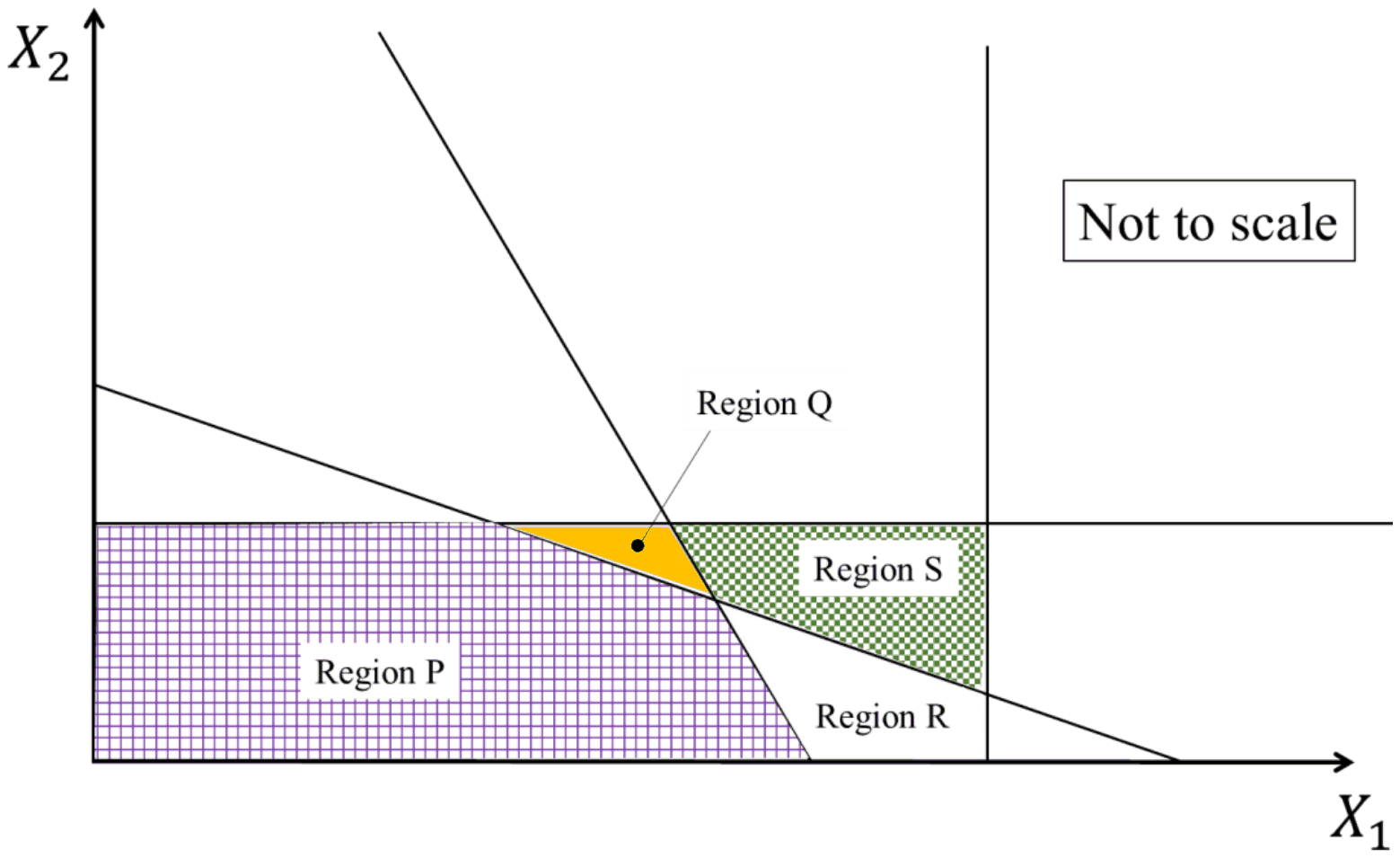
Which one of the options given represents the feasible region of the linear programming model:
\(\mathit{Maximize}\ 45X_{1} + 60X_{2}\)
\(X_{1} \le 45\)
\(X_{2} \le 50\)
\(10X_{1} + 10X_{2} \ge 600\)
\(25X_{1} + 5X_{2} \le 750\)
Your Answer : (Not Answered)
Correct Answer : B
The feasible region is Region Q.
Simplify the constraints: \(10X_{1} + 10X_{2} \ge 600\) is \(X_{1} + X_{2} \ge 60\), and \(25X_{1} + 5X_{2} \le 750\) is \(5X_{1} + X_{2} \le 150\). A feasible point must lie
- below the horizontal line \(X_{2} = 50\);
- on or above the gently sloping line \(X_{1} + X_{2} = 60\) (intercept 60 on each axis);
- on or left of the steep line \(5X_{1} + X_{2} = 150\) (intercept 30 on the \(X_{1}\) axis), which already keeps \(X_{1} \le 30 \lt 45\).
These meet in a small triangle with corners (10, 50), (20, 50) and (22.5, 37.5), the shaded Region Q.
Region P lies below \(X_{1} + X_{2} = 60\), so it breaks the \(\ge 600\) constraint. Region S lies to the right of the steep line, breaking \(25X_{1} + 5X_{2} \le 750\). Region R breaks both.
An objective function \(Z\) of primal variables (\(x_{1}\) and \(x_{2}\)) is described below:
Minimize \(Z = 0.07x_{1} + 0.05x_{2}\)
subject to \(0.1x_{1} \ge 0.4\)
\(0.1x_{2} \ge 0.6\)
\(0.1x_{1} + 0.2x_{2} \ge 2.0\)
\(0.2x_{1} + 0.1x_{2} \ge 1.8\)
\(x_{1}, x_{2} \ge 0\)
\(W\) is the objective function of the dual of \(Z\). \(k_{1}, k_{2}, k_{3}\), and \(k_{4}\) represent the corresponding dual variables. Which one of the following options represents the correct form of \(W\)?
Your Answer : (Not Answered)
Correct Answer : A
The correct dual is the one with constraints \(0.1k_{1} + 0.1k_{3} + 0.2k_{4} \le 0.07\) and \(0.1k_{2} + 0.2k_{3} + 0.1k_{4} \le 0.05\).
For a minimisation primal with \(\ge\) constraints and non-negative variables, the dual maximises \(b^{T}k\) subject to \(A^{T}k \le c\), \(k \ge 0\). The objective uses the right-hand sides 0.4, 0.6, 2.0, 1.8, which all options share.
Each dual constraint comes from one primal variable's column. Column \(x_{1}\) has coefficients 0.1, 0, 0.1, 0.2 and cost 0.07; column \(x_{2}\) has 0, 0.1, 0.2, 0.1 and cost 0.05. That gives exactly the keyed pair.
The second option puts \(k_{2}\) in the \(x_{1}\) constraint in place of \(k_{3}\). The third and fourth swap the right-hand sides 0.07 and 0.05 between the columns.
In a linear programming problem, if a resource is not fully utilized, the shadow price of that resource is
Your Answer : (Not Answered)
Correct Answer : C
The shadow price is zero.
A shadow price is the increase in the optimal objective value from one more unit of a resource. If some of the resource is already left over at the optimum, an extra unit would only add to the slack and could not improve the objective. This is complementary slackness: a constraint with positive slack has a zero dual value.
A positive (or, for minimisation, negative) shadow price is possible only for a binding resource, one that is fully used. An infinite shadow price has no meaning for a resource that is not even fully used.
The following table gives the unit transportation costs, the supply at each origin and the demand of each destination for a transportation problem.
| Origin / Destination | D1 | D2 | D3 | D4 | Supply |
| O1 | 3 | 4 | 8 | 7 | 60 |
| O2 | 7 | 3 | 7 | 6 | 80 |
| O3 | 3 | 9 | 3 | 4 | 100 |
| Demand | 40 | 70 | 50 | 80 |
Let \(x_{ij}\) denote the number of units to be transported from origin \(i\) to destination \(j\). If the u-v method is applied to improve the basic feasible solution given by \(x_{12} = 60,\ x_{22} = 10,\ x_{23} = 50,\ x_{24} = 20,\ x_{31} = 40\) and \(x_{34} = 60\), then the variables entering and leaving the basis, respectively, are
Your Answer : (Not Answered)
Correct Answer : A
The entering variable is \(x_{11}\) and the leaving variable is \(x_{24}\): \(x_{11}\) and \(x_{24}\).
Find \(u_{i}, v_{j}\) from \(u_{i} + v_{j} = c_{ij}\) on the basic cells, with \(u_{1} = 0\): \(v_{2} = 4\), \(u_{2} = -1\), \(v_{3} = 8\), \(v_{4} = 7\), \(u_{3} = -3\), \(v_{1} = 6\).
Reduced costs \(c_{ij} - u_{i} - v_{j}\) on the non-basic cells:
\[ \begin{aligned} x_{11} &: 3 - 0 - 6 = -3 \\ x_{33} &: 3 + 3 - 8 = -2 \\ x_{13}, x_{14} &: 0 \\ x_{21} &: 2,\quad x_{32}: 8 \end{aligned} \]
The most negative is \(x_{11}\), so it enters. Its loop is \(x_{11}(+), x_{12}(-), x_{22}(+), x_{24}(-), x_{34}(+), x_{31}(-)\). The minus cells hold 60, 20 and 40, so \(\theta = 20\) and \(x_{24}\) leaves.
The options entering \(x_{13}\) or \(x_{14}\) are wrong because those cells have zero reduced cost and would not lower the cost, and \(x_{33}\), at -2, is less negative than \(x_{11}\), at -3.
Marks
Total number of questions : 20
Number of answered questions : 0
Number of unanswered questions : 20