
Instruction
- Total number of questions : 20
- Time allotted : 30:00 Minutes:Seconds.
- Each question carry 1 mark, no negative marks.
- DO NOT refresh the page.
- All the best
Organic Chemistry [ Question No: 1 To 20 ] :
The IUPAC name of the following compound is :

Which statement is correct for the following four molecules ?

The major product formed in the following reaction is :

The major products formed in the following reaction is :

The major product of the following reaction is :

An organic compound having molecular formula C6H11BrO2 exhibits the following peaks in 1H-NMR spectrum : δ 4.1(2H, q, J = 7.5 Hz), 4.0(2H, t, J = 7.5 Hz), 1.5-2.2(4H, m), 1.25(3H, t, J = 7.5 Hz). The structure of the compound is :
The number of chemically non-equivalent protons expected in 1H-NMR spectrum of 2-pinene is :

The major product of the following reaction is :

The correct statement for the following structures is that they are :

The major product formed in the following reaction is :

The correct reagents to effect the following conversion are :

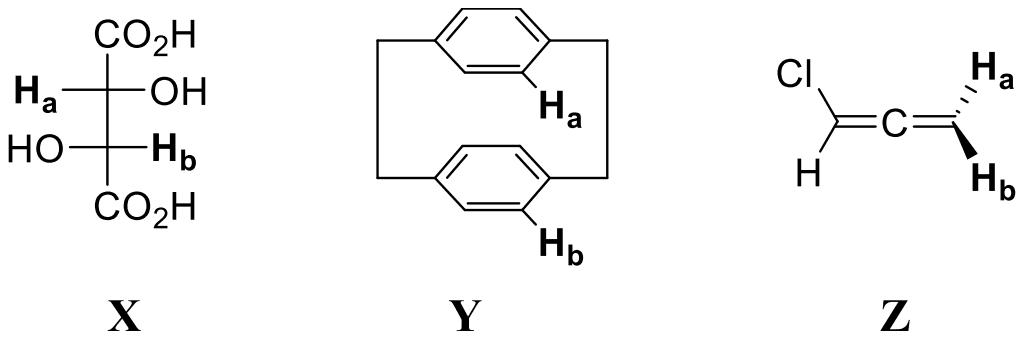
The topicity relationship of Ha and Hb in X, Y and Z are, respectively,
The relative ease of dehydration of the following alcohols is
(i) Propan-2-ol (ii) Propan-1-ol (iii) 2-Methylpropan-2-ol
The major products formed by heating C6H5CH2-O-C6H5 with HI are
Which of the following compound has the highest boiling point?
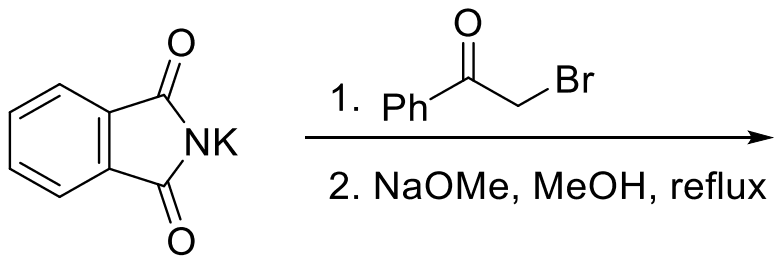
The major product formed in the given reaction sequence is
Which of the following is a commercial method of manufacture of benzaldehyde?
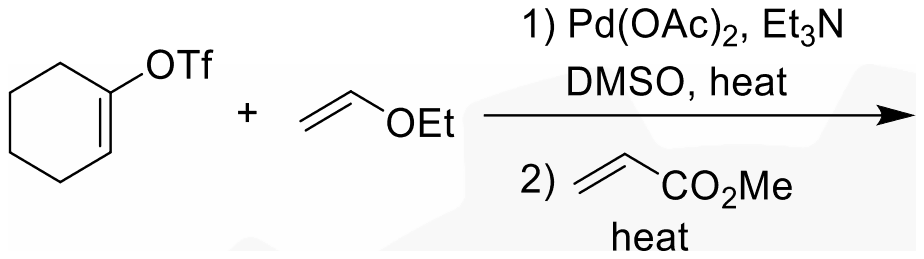
The major product formed in the following reaction sequence is
The order of reactivity of the following compounds towards SN2 displacement reaction is
(i) 2-Bromo-2-methylbutane (ii) 1-Bromopentane (iii) 2-Bromopentane
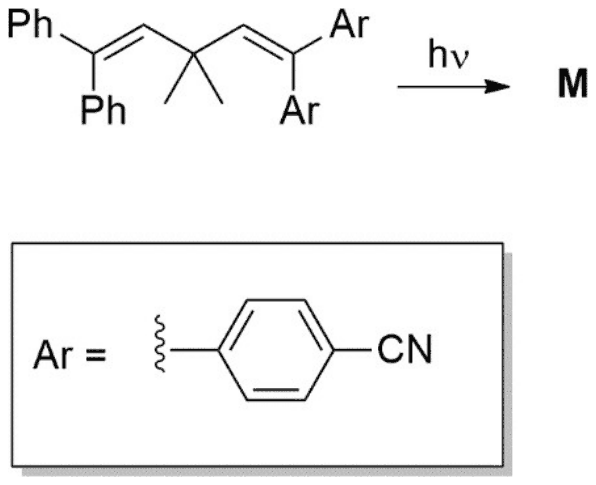
The major product M in the following reaction is
Total number of questions : 20
Number of answered questions : 0
Number of unanswered questions : 20
Organic Chemistry [ Question No: 1 To 20 ] :
The IUPAC name of the following compound is :
Your Answer : (Not Answered)
Correct Answer : A
The name is 6-bromo-3-chloro-4-methylcyclohexene, option A.
In a cyclohexene the double bond carbons are C-1 and C-2, so numbering is fixed to pass through them first. The substituents can then be numbered in either direction around the ring. Going one way gives locants 3, 5 and 6, and the other way gives 3, 4 and 6; the lower set, 3,4,6, is chosen. That puts chlorine at C-3, methyl at C-4 and bromine at C-6, and the prefixes are listed alphabetically: bromo, chloro, methyl.
B uses the higher set 3,5,6; C and D name the ring as an 'ene' with the double bond at C-2, which breaks the rule that the double bond gets locant 1.
Which statement is correct for the following four molecules ?
Your Answer : (Not Answered)
Correct Answer : C
The correct statement is I, II, III and IV are chiral.
All four molecules are sulfoxides. A sulfoxide sulfur carries an oxygen, two different carbon groups (here the aromatic ring carbon and the vinylic C2) and a lone pair, in a pyramidal arrangement that does not invert at room temperature. So each sulfur is a stereogenic centre, and none of the molecules has a mirror plane through it.
That is why even I and III are chiral, although C4 in each carries two identical groups (two Cl in I, two CH3 in III) and is not a stereocentre. II and IV have a stereogenic C4 as well as the sulfur. The options listing only some of the molecules overlook the sulfoxide stereocentre.
The major product formed in the following reaction is :
Your Answer : (Not Answered)
Correct Answer : A
The keyed product is 9,10-dibromo-9,10-dihydrophenanthrene, option A.
The 9,10 bond of phenanthrene has much more double-bond character than any other bond, because both its carbons belong to only one of the three rings and breaking it leaves two intact benzene rings. Br2 in CCl4 therefore adds across it like an alkene (via a bromonium ion) rather than substituting on a benzene ring; no Lewis acid such as Fe or AlCl3 is present, so ring substitution (B and D, at C-3 and C-2) is not expected.
9-Bromophenanthrene (C) is what the dibromide gives on heating, by loss of HBr, and is the product when the reaction is run hot; the stem names no heating, so the addition product is the answer the key takes.
The major products formed in the following reaction is :
Your Answer : (Not Answered)
Correct Answer : D
The answer is (D): M is 1,2-dimethyl-1,4-cyclohexadiene and N is 1,2-dimethylcyclohexene.
Birch reduction (Na in liquid NH3 with an alcohol) reduces a benzene ring to a non-conjugated 1,4-cyclohexadiene. With electron-donating alkyl groups, protonation occurs at the unsubstituted positions, so the methyl-bearing carbons stay on a double bond: M is 1,2-dimethyl-1,4-cyclohexadiene.
Wilkinson's catalyst is very sensitive to steric hindrance and hydrogenates the less substituted double bond first. In M, one C=C is disubstituted (CH=CH) and the other tetrasubstituted, carrying both methyls. Only the CH=CH is reduced, leaving N = 1,2-dimethylcyclohexene.
(B) has the right M but reduces the wrong double bond. (A) and (C) give conjugated dienes, which the Birch reduction does not give.
The major product of the following reaction is :
Your Answer : (Not Answered)
Correct Answer : A
The product is benzaldehyde (A); this is the Rosenmund reduction.
Hydrogen over palladium reduces the acid chloride C-Cl bond to C-H:
\[ \begin{aligned} &\mathrm{C_{6}H_{5}COCl + H_{2}} \\ &\xrightarrow{\mathrm{Pd/BaSO_{4}}} \mathrm{C_{6}H_{5}CHO + HCl} \end{aligned} \]
Normally the aldehyde would be reduced further. Supporting the palladium on barium sulfate and adding a poison such as quinoline (often with sulfur) deactivates the catalyst just enough that the reaction stops at the aldehyde.
Benzyl alcohol (C) and toluene (D) are the products of over-reduction, which the poisoned catalyst is designed to prevent. Benzoic anhydride (B) would come from the acid chloride reacting with a carboxylate, not from hydrogenation.
An organic compound having molecular formula C6H11BrO2 exhibits the following peaks in 1H-NMR spectrum : δ 4.1(2H, q, J = 7.5 Hz), 4.0(2H, t, J = 7.5 Hz), 1.5-2.2(4H, m), 1.25(3H, t, J = 7.5 Hz). The structure of the compound is :
Your Answer : (Not Answered)
Correct Answer : C
The structure is (C), ethyl 4-bromobutanoate, Br-CH2CH2CH2-CO-OCH2CH3.
The quartet at 4.1 (2H) and triplet at 1.25 (3H) with the same J show an ethyl ester, OCH2CH3. The remaining 2H triplet and the 4H multiplet need a chain of three CH2 groups: the triplet is the CH2 at one end of the chain (the key assigns it to CH2Br), and the multiplet is the two inner CH2 groups.
(A) and (B) contain a CH bearing Br and would show a methine signal and, for (A), a methyl doublet. (D) has no ethyl ester: it would show no quartet and its CH3 would be part of a propyl group.
The number of chemically non-equivalent protons expected in 1H-NMR spectrum of 2-pinene is :
Your Answer : (Not Answered)
Correct Answer : B
2-Pinene (α-pinene) shows 10 kinds of non-equivalent protons.
Count the environments in this chiral, unsymmetrical bicyclic alkene:
- the vinyl H on C-3: 1
- the methyl on the double bond: 1
- the two methyls of the gem-dimethyl bridge, one syn and one anti to the double bond: 2
- the bridgehead H on C-1 and the bridgehead H on C-5: 2
- the two diastereotopic H on the allylic CH2 (C-4): 2
- the two diastereotopic H on the CH2 bridge (C-7): 2
That totals 10. Answers of 7 or 6 come from treating the gem-dimethyls or the CH2 protons as equivalent, which they are not in this rigid ring system.
The major product of the following reaction is :
Your Answer : (Not Answered)
Correct Answer : C
The major product is (C), PhCO-C(OEt)=CH2.
This is a carbonylative Stille coupling. Pd(0) inserts into the C-I bond of iodobenzene, CO inserts into the Pd-Ph bond to give an acyl-palladium species, the 1-ethoxyvinyl group transfers from tin to palladium, and reductive elimination joins the acyl and vinyl groups, giving an aryl vinyl ketone in which the vinyl carbon still carries OEt.
(A) is the direct Stille product without CO insertion, which the CO atmosphere suppresses. (B) has no carbonyl and no vinyl group, and (D), an ester, would need CO inserted next to oxygen.
The correct statement for the following structures is that they are :
Your Answer : (Not Answered)
Correct Answer : D
The two structures are structural isomers.
Read each Newman projection carbon by carbon. In the left one, the front carbon carries two CH3 groups and one H, and the rear carbon carries three H atoms. That is (CH3)2CH-CH3, 2-methylpropane (isobutane). In the right one, each carbon carries two H atoms and one CH3 group, which is CH3CH2-CH2CH3, butane.
Both are C4H10, but their atoms are connected differently, which is what makes them structural (chain) isomers.
Conformational isomers would be the same molecule turned about a single bond, and enantiomers must be chiral mirror images; neither butane nor isobutane is chiral. 'Not isomers' is wrong because the molecular formula is the same.
The major product formed in the following reaction is :
Your Answer : (Not Answered)
Correct Answer : A
The product is the secondary alcohol A, from a [2,3]-Wittig rearrangement.
BuLi/tBuOK removes a proton from the O-CH2 of the methallyl group, the position that is both α to oxygen and allylic. The carbanion then undergoes a concerted [2,3]-sigmatropic shift through a five-membered transition state: it bonds to the far alkene carbon of the pentenyl group (the one bearing the methyl), the O-C bond breaks, and the pentenyl double bond shifts to the carbon next to the former ether carbon.
The result is CH2=C(Me)-CH(OH)-CH(Me)-CH=CH-Me, with the new alkene E and the chirality of the ether carbon transferred to the new stereocentres. B is the ketone, which would need an oxidation. C and D are tertiary alcohols, which would require the migrating carbon to bond to the ether carbon itself, as in a [1,2]-shift.
The correct reagents to effect the following conversion are :
Your Answer : (Not Answered)
Correct Answer : A
The reagents are (i) NaBH4, CeCl3, MeOH; (ii) m-CPBA, CH2Cl2, 0°C.
The Luche reduction (NaBH4/CeCl3 in methanol) reduces the enone by 1,2-addition to the allylic alcohol, cyclohex-2-en-1-ol, leaving the C=C intact. m-CPBA then epoxidises the alkene, and the allylic OH directs it to its own face by hydrogen bonding to the peracid, giving the cis epoxy alcohol drawn.
Alkaline H2O2 (option B, step ii) is a nucleophilic epoxidation suited to electron-poor enones, not to the allylic alcohol. Options C and D epoxidise first and then reduce with LiAlH4, which would also open the epoxide, so neither gives the epoxy alcohol.
The topicity relationship of Ha and Hb in X, Y and Z are, respectively,
Your Answer : (Not Answered)
Correct Answer : B
The relationships are Homotopic, Enantiotopic and Enantiotopic.
- X is a chiral tartaric acid: in the Fischer projection the two hydrogens lie on opposite sides (and so do the two OH groups). This molecule has a C2 axis that exchanges the two CH(OH) carbons, so Ha and Hb are interchanged by a rotation: homotopic.
- Y is [2.2]paracyclophane. Ha on the upper ring and Hb on the lower ring sit at the same position relative to the bridges, so the mirror plane between the two rings maps one onto the other, but no rotation does: enantiotopic.
- Z, ClCH=C=CHaHb, is an allene whose CH2 plane is perpendicular to the plane of the CHCl end. That CHCl plane is a mirror plane bisecting the H-C-H angle and exchanging Ha and Hb, and no axis does so: enantiotopic.
Calling X diastereotopic would fit meso-tartaric acid, not the chiral isomer drawn. Calling Y homotopic or Z homotopic overlooks that only a reflection relates the two hydrogens.
The relative ease of dehydration of the following alcohols is
(i) Propan-2-ol (ii) Propan-1-ol (iii) 2-Methylpropan-2-ol
Your Answer : (Not Answered)
Correct Answer : E
The order is (iii) \(\gt\) (i) \(\gt\) (ii).
Acid-catalysed dehydration goes through a carbocation, so its ease follows carbocation stability: tertiary \(\gt\) secondary \(\gt\) primary. 2-Methylpropan-2-ol is tertiary, propan-2-ol is secondary and propan-1-ol is primary.
The tertiary alcohol dehydrates with dilute acid at a lower temperature, while the primary alcohol needs concentrated acid and a higher temperature. Every other option puts the primary alcohol ahead of a more substituted one.
The major products formed by heating C6H5CH2-O-C6H5 with HI are
Your Answer : (Not Answered)
Correct Answer : E
The products are C6H5CH2I and C6H5OH.
HI cleaves ethers by protonating the oxygen and then letting iodide attack a carbon. The O-phenyl bond has partial double bond character (the oxygen's lone pair is delocalised into the ring), and iodide cannot attack an sp2 ring carbon, so that bond survives and phenol is formed. The iodide attacks the benzylic CH2 instead, giving benzyl iodide.
Options giving iodobenzene, benzene or toluene would need the strong aryl C-O bond to break or the benzyl group to be reduced, which does not happen with HI under these conditions.
Which of the following compound has the highest boiling point?
Your Answer : (Not Answered)
Correct Answer : B
The highest boiling point is that of propan-1-ol.
These compounds have similar molar masses (44 to 60 g/mol), so the type of intermolecular force decides the order. Propan-1-ol molecules form hydrogen bonds through their O-H groups, the strongest attraction here, so it boils at 97°C.
Propanal (49°C) and acetone (56°C) have only dipole-dipole attractions, methoxymethane (−24°C) is a weakly polar ether, and n-butane (about 0°C) has only dispersion forces.
The major product formed in the given reaction sequence is
Your Answer : (Not Answered)
Correct Answer : B
The major product is (B), 3-benzoylisoquinoline-1,4-diol.
Step 1 is a Gabriel alkylation: potassium phthalimide displaces bromide from phenacyl bromide to give N-phenacylphthalimide. Step 2 is the Gabriel-Colman rearrangement. Methoxide opens one imide carbonyl, and the enolate of the now acidic CH2 (flanked by nitrogen and the benzoyl group) attacks the remaining ester carbonyl, closing a six-membered ring. The result is the isoquinoline skeleton with OH groups at C1 and C4 (the enol and lactam tautomers drawn as diols) and the benzoyl group at C3.
(A) is a quinoline, with the nitrogen attached to the benzene ring, which this ring expansion cannot give since nitrogen stays between the two former carbonyl carbons. (C) and (D) are indole and oxindole products with an N-phenacyl group, which would need loss of a carbon from the phthalimide.
Which of the following is a commercial method of manufacture of benzaldehyde?
Your Answer : (Not Answered)
Correct Answer : D
The commercial method is side chain chlorination of toluene followed by hydrolysis.
Chlorinating toluene in the side chain gives benzal chloride, C6H5CHCl2, which is hydrolysed to benzaldehyde. This is the method used industrially.
The other routes are laboratory methods: the Rosenmund reduction of benzoyl chloride, the Etard reaction with chromyl chloride, oxidation with chromic oxide in acetic anhydride (CrO3, though the option prints Cr2O3), and the Gattermann-Koch reaction with CO and HCl.
The major product formed in the following reaction sequence is
Your Answer : (Not Answered)
Correct Answer : D
The major product is (D).
- Heck reaction. With a vinyl triflate and Pd(OAc)2/Et3N in DMSO, the reaction runs through a cationic palladium intermediate. With an electron-rich alkene such as ethyl vinyl ether this pathway puts the new C-C bond on the α-carbon (the one carrying OEt), giving the 2-ethoxy-1,3-diene, 1-(1-ethoxyvinyl)cyclohexene.
- Diels-Alder. The diene adds methyl acrylate. A diene with a donor at C2 gives the 'para' (1,4) adduct: the CH2 end of the diene bonds to the CH2 of the acrylate, and the ring carbon bonds to the carbon carrying CO2Me.
In the product the new double bond lies between the carbon carrying OEt and the ring-fusion carbon, and the CO2Me sits on the carbon attached to the other ring-fusion carbon, 1,4 to the OEt carbon. That is (D).
(C) has the right enol ether but the 'meta' (1,3) placement of the ester. (A) and (B) have the OEt on an sp3 carbon, which would come from β-arylation (a 1-ethoxydiene), not from the α-selective cationic Heck reaction.
The order of reactivity of the following compounds towards SN2 displacement reaction is
(i) 2-Bromo-2-methylbutane (ii) 1-Bromopentane (iii) 2-Bromopentane
Your Answer : (Not Answered)
Correct Answer : C
The order is (ii) > (iii) > (i).
\(S_{N}2\) requires backside attack at the carbon bearing the halogen, so it is fastest where that carbon is least hindered: primary > secondary > tertiary.
1-Bromopentane (ii) is primary, 2-bromopentane (iii) secondary, and 2-bromo-2-methylbutane (i) tertiary, which hardly reacts by \(S_{N}2\). The reverse order describes \(S_{N}1\) reactivity, which follows carbocation stability.
The major product M in the following reaction is
Your Answer : (Not Answered)
Correct Answer : A
M is (A): the two 4-cyanophenyl groups end up on the cyclopropane ring and the two phenyls on the vinyl group.
The 1,4-diene with a central quaternary carbon undergoes the di-pi-methane rearrangement. On irradiation the two C=C units bond across C3 to form a cyclopropyl-dicarbinyl diradical; one of the cyclopropane bonds then opens to give a 1,3-diradical, which closes to the vinylcyclopropane. The diarylmethylene end that becomes part of the new three-membered ring is the one whose odd electron was better stabilised in the opening step.
The cyclopropane bond that opens is the one that leaves the odd electron on the Ar2C carbon, because 4-cyanophenyl groups delocalise a radical better than phenyls. The Ph2C radical centre instead forms the new double bond, so Ph2C becomes the vinyl terminus and the Ar2C carbon closes into the cyclopropane, as in (A).
(C) is the opposite regiochemistry. (B) mixes one Ar and one Ph on each end, which would need the groups to exchange between carbons. (D) separates the two Ar groups onto different ring carbons and moves a methyl, which this rearrangement cannot do.
Marks
Total number of questions : 20
Number of answered questions : 0
Number of unanswered questions : 20