
Instruction
- Total number of questions : 20
- Time allotted : 30:00 Minutes:Seconds.
- Each question carry 1 mark, no negative marks.
- DO NOT refresh the page.
- All the best
Polymer Chemistry [ Question No: 1 To 20 ] :
Direction for [ Question No: 1 To 2 ] :
A polymer mixture contains three monodisperse polystyrene samples A, B and C of molecular weights 10000, 20000 and 30000 g mol-1, respectively.
If the mixture contains equal masses of A, B and C, then the number average molecular weight, \(\overline{M_{n}}\) will be
If the mixture contains equal number of molecules of A, B and C, the weight average molecular weight, \(\overline{M_{w}}\) will be
In the study of solution of a polymer, the plot of \(\frac{\pi}{C}\) versus 'C' results into the information of :
Step reaction polymerization proceeds by :
The expression for the rate of chain initiation in addition polymerization is :
In case of radical polymerization, the kinetic chain length is given by expression :
\(\nu = \dfrac{k_{p}[M][I]^{-1/2}}{2k_{t}f^{1/2}(k_{d}/k_{t})^{1/2}}\)
increase in the initiator concentration eventually leads to :
Which one of the following polymerization methods is used for the synthesis of butyl rubber?
Discoloration and loss of mechanical strength of plastic chairs exposed to sunlight for several days is due to
Under which combination of conditions does the glass transition of a polymer increase?
Which one of the following permits the direct determination of intrinsic viscosity of a polymer solution for known molecular weight of the polymer?
From the dynamic mechanical analysis of a polymer sample with a phase angle of 30°, the relationship between storage modulus (E') and loss modulus (E'') can be expressed as
Storage modulus and tan δ of a polymer are experimentally measured by
In a three-point bending mode for flexural test of a polymer sample with the following data:
load applied in the mid-span = 80 kg
width of the specimen = 3 cm
depth of the specimen = 2 cm
length of the specimen = 30 cm
the flexural strength will be
If the flow curves of two viscous fluids are represented by
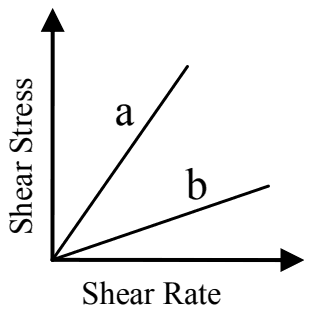
then, the viscosity plots of the fluids will be
Which one of the following polymers occurs naturally?
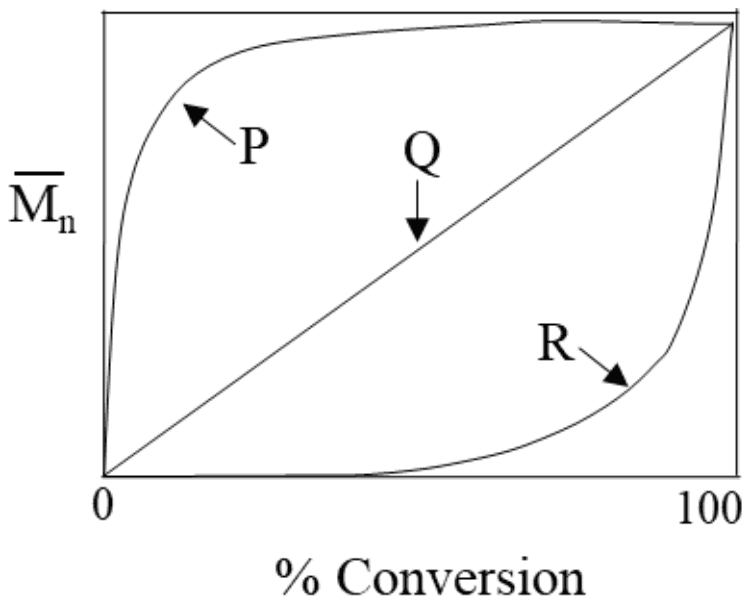
Choose the correct option that best correlates the graphs with the polymerization methods.
Match the following:
| P. Butyl rubber | 1. Metallocene polymerization |
| Q. Cold SBR | 2. Cationic polymerization |
| R. Poly(ethylene terephthalate) | 3. Redox polymerization |
| S. Polypropylene | 4. Condensation polymerization |
For a polydisperse polymer, the viscosity-average molecular weight \((\bar{M}_{v})\) becomes equal to the weight-average molecular weight \((\bar{M}_{w})\), when the Mark-Houwink constant a is ___.
A certain polymer synthesized in the laboratory shows that all the chains have same number of repeat units (i.e., same degree of polymerization). The relationship between weight-average (\(\bar{M}_w\)), number-average (\(\bar{M}_n\)), and z-average (\(\bar{M}_z\)) molecular weights for this polymer can be expressed as
Resol is produced by reaction of ___.
Total number of questions : 20
Number of answered questions : 0
Number of unanswered questions : 20
Polymer Chemistry [ Question No: 1 To 20 ] :
Direction for [ Question No: 1 To 2 ] :
A polymer mixture contains three monodisperse polystyrene samples A, B and C of molecular weights 10000, 20000 and 30000 g mol-1, respectively.
If the mixture contains equal masses of A, B and C, then the number average molecular weight, \(\overline{M_{n}}\) will be
Your Answer : (Not Answered)
Correct Answer : A
The number average molecular weight is \(1.64 \times 10^{4}\) g mol-1.
With equal masses w of each, the number of moles of each is w/M:
\[ \begin{aligned} \overline{M_{n}} &= \frac{\sum w_{i}}{\sum w_{i}/M_{i}} = \frac{3}{\frac{1}{10000} + \frac{1}{20000} + \frac{1}{30000}} \\ &= \frac{3}{1.833 \times 10^{-4}} = 1.64 \times 10^{4} \end{aligned} \]
This is the harmonic mean of the three masses. It is pulled below the simple average of 20000 because, at equal mass, there are more of the light molecules. The larger options do not account for that.
If the mixture contains equal number of molecules of A, B and C, the weight average molecular weight, \(\overline{M_{w}}\) will be
Your Answer : (Not Answered)
Correct Answer : C
The weight average molecular weight is \(2.33 \times 10^{4}\) g mol-1.
With equal numbers of molecules, take one of each:
\[ \begin{aligned} \overline{M_{w}} &= \frac{\sum N_{i}M_{i}^{2}}{\sum N_{i}M_{i}} = \frac{(1 + 4 + 9) \times 10^{8}}{(1 + 2 + 3) \times 10^{4}} \\ &= \frac{14 \times 10^{8}}{6 \times 10^{4}} = 2.33 \times 10^{4} \end{aligned} \]
The number average for this mixture is simply 20000, and \(\overline{M_{w}}\) is higher because it weights the heavier molecules more. 1.93 and 2.13 fall too close to the number average, and 2.53 overweights the heaviest component.
In the study of solution of a polymer, the plot of \(\frac{\pi}{C}\) versus 'C' results into the information of :
Your Answer : (Not Answered)
Correct Answer : A
The plot gives Mn as reciprocal of intercept and polymer-solvent interaction constant as slope.
For a dilute polymer solution, the osmotic pressure follows a virial equation:
\[ \begin{aligned} \frac{\pi}{C} &= RT \\ &\times \left(\frac{1}{\overline{M}_{n}} + A_{2}C + \cdots\right) \end{aligned} \]
A plot of π/C against C is a straight line at low concentration. Its intercept at C = 0 is RT/Mn, so the number-average molar mass is found from the reciprocal of the intercept. Its slope is RTA2, where the second virial coefficient A2 measures polymer-solvent interaction (positive in a good solvent, zero at the theta temperature).
The other options assign Mn to the slope, or call the slope concentration, which is the axis variable, not a result.
Step reaction polymerization proceeds by :
Your Answer : (Not Answered)
Correct Answer : B
Step reaction polymerization proceeds by condensation polymerization.
In step-growth polymerization any two molecules carrying reactive functional groups (monomer, dimer or longer oligomer) can react with each other, and the chains build up stepwise. The usual examples, polyesters and polyamides such as nylon-6,6, link the monomers through a reaction that eliminates a small molecule such as water, which is why step-growth and condensation polymerization are commonly equated.
Addition polymerization, and its anionic and cationic forms, are chain-growth processes: an active centre (a radical, anion or cation) adds monomer units one after another to a single growing chain, and high polymer forms from the start of the reaction.
The expression for the rate of chain initiation in addition polymerization is :
Your Answer : (Not Answered)
Correct Answer : C
The rate of initiation is 2fkd[I].
In free-radical polymerisation the initiator I decomposes with rate constant kd into two radicals, and only a fraction f (the initiator efficiency) of them start chains; the rest are lost to side reactions or cage recombination. So
\[ R_{i} = 2fk_{d}[\mathrm{I}] \]
kd[I] is only the rate of initiator decomposition, fkd[I] forgets that each molecule gives two radicals, and kd[I]/2 halves where it should double.
In case of radical polymerization, the kinetic chain length is given by expression :
\(\nu = \dfrac{k_{p}[M][I]^{-1/2}}{2k_{t}f^{1/2}(k_{d}/k_{t})^{1/2}}\)
increase in the initiator concentration eventually leads to :
Your Answer : (Not Answered)
Correct Answer : B
Increasing the initiator concentration leads to a low molecular weight polymer.
The expression shows the kinetic chain length proportional to [I]−1/2: the more initiator, the shorter the average chain. More initiator produces more radicals at once, and since termination is bimolecular between radicals, chains meet and terminate sooner, so each chain adds fewer monomer units.
The rate of polymerization rises as [I]1/2, so the reaction does depend on the initiator (option C is wrong) and does speed up, but option D describes the rate rather than what the chain-length expression shows; the question is about the polymer formed. A higher molecular weight (option A) is the opposite of what the inverse square-root dependence gives.
Which one of the following polymerization methods is used for the synthesis of butyl rubber?
Your Answer : (Not Answered)
Correct Answer : C
Butyl rubber is made by cationic polymerization.
Butyl rubber is a copolymer of isobutylene with a few per cent of isoprene. Isobutylene carries two electron-donating methyl groups on one carbon, which stabilise a carbocation, so it polymerises readily by a cationic mechanism, using a Lewis acid such as AlCl3 with a trace of water as co-initiator, in methyl chloride at about -100 °C.
The same electron-rich double bond makes anionic polymerization impractical. Ring opening needs a cyclic monomer, and condensation polymerization needs monomers with two reactive functional groups that release a small molecule, neither of which applies to isobutylene.
Discoloration and loss of mechanical strength of plastic chairs exposed to sunlight for several days is due to
Your Answer : (Not Answered)
Correct Answer : C
The damage is due to photo-degradation.
Ultraviolet radiation in sunlight carries enough energy to break chemical bonds in polymer chains, or to excite chromophores and impurities that then generate free radicals. Chain scission and the new chromophoric groups that form cause yellowing or fading, surface chalking and embrittlement, so the chairs discolour and lose strength.
Oxidation usually accompanies the process (photo-oxidation), but the trigger is light, which is what the situation describes. Thermal degradation needs much higher temperatures than outdoor sunlight gives, and 'hydrophilic degradation' is not a recognised degradation mechanism for such plastics.
Under which combination of conditions does the glass transition of a polymer increase?
Your Answer : (Not Answered)
Correct Answer : D
The glass transition rises with an increase in chain length and decrease in plasticizer content.
The glass transition temperature is set by how easily chain segments can move. Anything that adds free volume or lubricates the chains lowers it; anything that removes free volume or restricts motion raises it.
- Longer chains (higher molecular weight) have fewer chain ends per unit volume. Chain ends carry extra free volume, so fewer of them raises Tg.
- Plasticizers are small molecules that sit between chains and increase free volume, so less plasticizer raises Tg.
Every other option includes a change that lowers Tg: more plasticizer, less cross-linking, more branching (which adds chain ends) or weaker inter-chain interactions.
Which one of the following permits the direct determination of intrinsic viscosity of a polymer solution for known molecular weight of the polymer?
Your Answer : (Not Answered)
Correct Answer : D
The relation is the Mark-Houwink equation.
The Mark-Houwink (Mark-Houwink-Sakurada) equation links intrinsic viscosity directly to molecular weight:
\[ [\eta] = K M^{a} \]
where K and a are constants for a given polymer, solvent and temperature. With M known, \([\eta]\) follows at once; used the other way, it is how viscometry gives the viscosity-average molecular weight.
The Flory-Huggins equation describes the free energy of mixing of a polymer solution, not its viscosity. Newton's law of viscosity only defines viscosity as shear stress over shear rate. The Williams-Landel-Ferry equation describes how viscosity or relaxation times shift with temperature above the glass transition.
From the dynamic mechanical analysis of a polymer sample with a phase angle of 30°, the relationship between storage modulus (E') and loss modulus (E'') can be expressed as
Your Answer : (Not Answered)
Correct Answer : A
The relation is E' = \(\sqrt{3}\) E''.
In dynamic mechanical analysis the loss tangent is the ratio of loss to storage modulus, \(\tan\delta = E''/E'\). With \(\delta = 30^{\circ}\):
\[ \begin{aligned} \frac{E''}{E'} &= \tan 30^{\circ} = \frac{1}{\sqrt{3}} \\ E' &= \sqrt{3}E'' \end{aligned} \]
\(E'' = \sqrt{3}E'\) is the case \(\delta = 60^{\circ}\). The two options with a factor 2 use \(\sin\) or \(\cos\) of 30° (0.5 and \(\sqrt{3}/2\)) instead of the tangent.
Storage modulus and tan δ of a polymer are experimentally measured by
Your Answer : (Not Answered)
Correct Answer : D
They are measured by dynamic mechanical thermal analysis (DMTA, or DMA).
DMTA applies a small oscillating stress or strain and records the response over a range of temperature or frequency. The in-phase part gives the storage modulus E′, the out-of-phase part the loss modulus E″, and their ratio is tan δ, whose peak marks the glass transition.
Differential scanning calorimetry measures heat flow, thermogravimetric analysis measures mass change, and thermomechanical analysis measures dimensional change under a static load. None of them measures a modulus under oscillating load.
In a three-point bending mode for flexural test of a polymer sample with the following data:
load applied in the mid-span = 80 kg
width of the specimen = 3 cm
depth of the specimen = 2 cm
length of the specimen = 30 cm
the flexural strength will be
Your Answer : (Not Answered)
Correct Answer : B
The flexural strength is about 29.4 MPa.
For three-point bending of a rectangular bar, the maximum stress at mid-span is \(\sigma = 3FL/(2bd^{2})\), with the 30 cm length taken as the span and the 80 kg load as a force of 784.8 N:
\[ \begin{aligned} \sigma &= \frac{3(784.8)(0.30)}{2(0.03)(0.02)^{2}} \\ &= \frac{706.3}{2.4 \times 10^{-5}} = 2.94 \times 10^{7}\ \text{Pa} \end{aligned} \]
that is 29.4 MPa. Using a rectangular section with width and depth swapped gives about 19.6 MPa, and forgetting to convert kilograms to newtons gives 3 MPa; neither is offered, and the other options do not follow from the formula.
If the flow curves of two viscous fluids are represented by
then, the viscosity plots of the fluids will be
Your Answer : (Not Answered)
Correct Answer : A
The viscosity plots are (A): two horizontal lines, with a above b.
Both flow curves are straight lines through the origin, so shear stress is proportional to shear rate: both fluids are Newtonian. Their viscosity, the slope \(\tau/\dot{\gamma}\), is a constant that does not change with shear rate, so each plots as a horizontal line on a viscosity against shear rate graph.
Fluid a has the steeper flow curve, so it has the higher viscosity and its line lies above b's. Plot (C) reverses the order. Plots (B) and (D) show viscosity rising with shear rate, which describes shear-thickening fluids, not straight-line flow curves through the origin.
Which one of the following polymers occurs naturally?
Your Answer : (Not Answered)
Correct Answer : C
The natural polymer is cellulose.
Cellulose, a linear polysaccharide of β-1,4-linked glucose units, is made by plants and is the main structural material of cell walls, cotton and wood.
The others are synthetic. Bakelite is a phenol-formaldehyde thermoset, the first fully synthetic plastic. Teflon is polytetrafluoroethylene, made from tetrafluoroethylene. Perspex is poly(methyl methacrylate), the acrylic glass made by polymerising methyl methacrylate.
Choose the correct option that best correlates the graphs with the polymerization methods.
Your Answer : (Not Answered)
Correct Answer : B
The correct correlation is P - chain growth; Q - living polymerization; R - step growth.
Chain growth (P): each chain starts, grows to full length in a fraction of a second and terminates. High molecular weight chains appear from the very start, so \(\overline{M}_{n}\) jumps up at low conversion and then stays roughly constant while more monomer is converted into more chains.
Living polymerization (Q): all chains start together and there is no termination, so every chain keeps growing as monomer is consumed. \(\overline{M}_{n}\) rises linearly with conversion.
Step growth (R): any two species can react, so monomers first form dimers, trimers and short oligomers. By the Carothers equation \(\overline{X}_{n} = 1/(1 - p)\), high molecular weight appears only at very high conversion, near 99%, hence the sharp rise at the end.
Options assigning the linear line to chain growth, or the late rise to chain growth, contradict these mechanisms.
Match the following:
| P. Butyl rubber | 1. Metallocene polymerization |
| Q. Cold SBR | 2. Cationic polymerization |
| R. Poly(ethylene terephthalate) | 3. Redox polymerization |
| S. Polypropylene | 4. Condensation polymerization |
Your Answer : (Not Answered)
Correct Answer : D
The match is P-2; Q-3; R-4; S-1.
- Butyl rubber is made by cationic copolymerisation of isobutylene with a little isoprene, using a Lewis acid initiator at very low temperature.
- Cold SBR is emulsion-polymerised at about 5 °C, which needs a redox initiator system to generate radicals at that temperature.
- PET is a polyester made by condensation polymerisation of terephthalic acid (or its dimethyl ester) with ethylene glycol.
- Polypropylene is made by coordination polymerisation, including with metallocene catalysts that control its tacticity.
Options assigning metallocene catalysts to butyl rubber or SBR, or condensation to polypropylene, mismatch the chemistry of at least two polymers.
For a polydisperse polymer, the viscosity-average molecular weight \((\bar{M}_{v})\) becomes equal to the weight-average molecular weight \((\bar{M}_{w})\), when the Mark-Houwink constant a is ___.
Your Answer : (Not Answered)
Correct Answer : D
\(\bar{M}_{v} = \bar{M}_{w}\) when a = 1.0.
The viscosity-average molecular weight is defined through the Mark-Houwink exponent a:
\[ \bar{M}_v^{\,a} = \frac{\sum N_i M_i^{1+a}}{\sum N_i M_i} \]
With a = 1 this becomes \(\sum N_{i}M_{i}^{2}/\sum N_{i}M_{i}\), which is exactly the weight average. For the usual values of a, between 0.5 (theta solvent) and 0.8 (good solvent), \(\bar{M}_{v}\) lies between the number and weight averages, closer to the weight average, so 0.5 and 0.7 do not make them equal; 0.1 is an unrealistic exponent for flexible coils.
A certain polymer synthesized in the laboratory shows that all the chains have same number of repeat units (i.e., same degree of polymerization). The relationship between weight-average (\(\bar{M}_w\)), number-average (\(\bar{M}_n\)), and z-average (\(\bar{M}_z\)) molecular weights for this polymer can be expressed as
Your Answer : (Not Answered)
Correct Answer : B
For this polymer \(\bar{M}_z = \bar{M}_w = \bar{M}_n\).
If every chain has the same degree of polymerization, every chain has the same molar mass M. Each average is a ratio of moments of the distribution, for example \(\bar{M}_w = \sum n_iM_i^{2}/\sum n_iM_i\), and with only one value of M every such ratio equals M. The polymer is monodisperse, with dispersity \(\bar{M}_w/\bar{M}_n = 1\).
The order \(\bar{M}_z \gt \bar{M}_w \gt \bar{M}_n\) holds for any polydisperse sample, not this one. The reverse order and the mixed inequality can never occur.
Resol is produced by reaction of ___.
Your Answer : (Not Answered)
Correct Answer : A
Resol is made from phenol with an excess of formaldehyde in presence of a base catalyst.
Under basic conditions with excess formaldehyde (typically a formaldehyde to phenol ratio above 1), phenol is methylolated at several positions, giving a low-molecular-weight resin rich in reactive methylol groups. Resols are 'one-stage' resins: on heating they cure by themselves without any added crosslinker.
Excess phenol with an acid catalyst gives novolac, a 'two-stage' resin that needs hexamethylenetetramine to cure. Excess phenol with base, or excess formaldehyde with acid, are not the standard routes to either, and an equimolar mixture at neutral pH reacts only slowly.
Marks
Total number of questions : 20
Number of answered questions : 0
Number of unanswered questions : 20