
Instruction
- Total number of questions : 20
- Time allotted : 30:00 Minutes:Seconds.
- Each question carry 1 mark, no negative marks.
- DO NOT refresh the page.
- All the best
Polymer Technology [ Question No: 1 To 20 ] :
Direction for [ Question No: 1 To 1 ] :
In tensile testing of carbon fiber reinforced epoxy composite samples, the following data were recorded:
gauge length = 4 cm
cross-section = 0.8 cm × 0.3 cm
increase in gauge length at the break point = 0.03 cm
breaking load = 50 kg
The Young's modulus of the composite is
In a polymer recycling plant, polymer “X” was depolymerized by glycolysis in the presence of ethylene glycol and a suitable catalyst. The glycolysis reaction yielded the following compound:
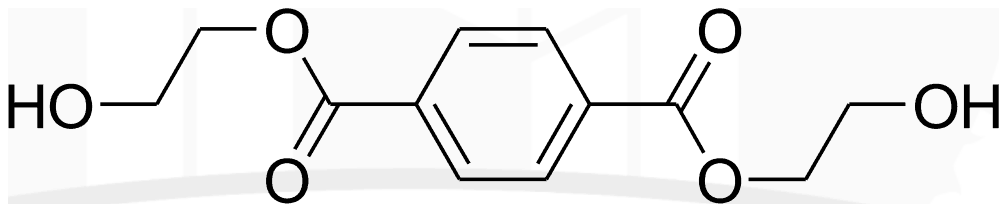
Identify the polymer “X” from the following options.
Feedstock recycling of poly(ethylene terephthalate) is carried out by
Flexible PVC tubes are used for watering. If some organic solvents are passed through this tube, it becomes stiff. This is due to the fact that the organic solvents
In a rubber sample with a Mooney viscosity of 60 ML(1+4) 100 °C, the number 4 signifies
Rubbers are a class of polymer known for
If a solid elastomer ball of weight 100 g is allowed to free fall from a height of 10 m and it rebounds back to a height of 8 m, the hysteresis loss is
Select the correct option to match the Product with the most appropriate Processing technique from the table given below:
| Product | Processing technique | ||
|---|---|---|---|
| P | Fibre-reinforced pressure vessel | I | Rotomoulding |
| Q | Overhead water tank | II | Thermoforming |
| R | Blister package for medicine | III | Filament winding |
| S | Plastic carry bag | IV | Blown film extrusion |
Injection molding is typically used to make plastic parts. If the pressure at the gate is monitored as a function of time during the injection of a thermoplastic polymer, identify the profile that best describes this event.
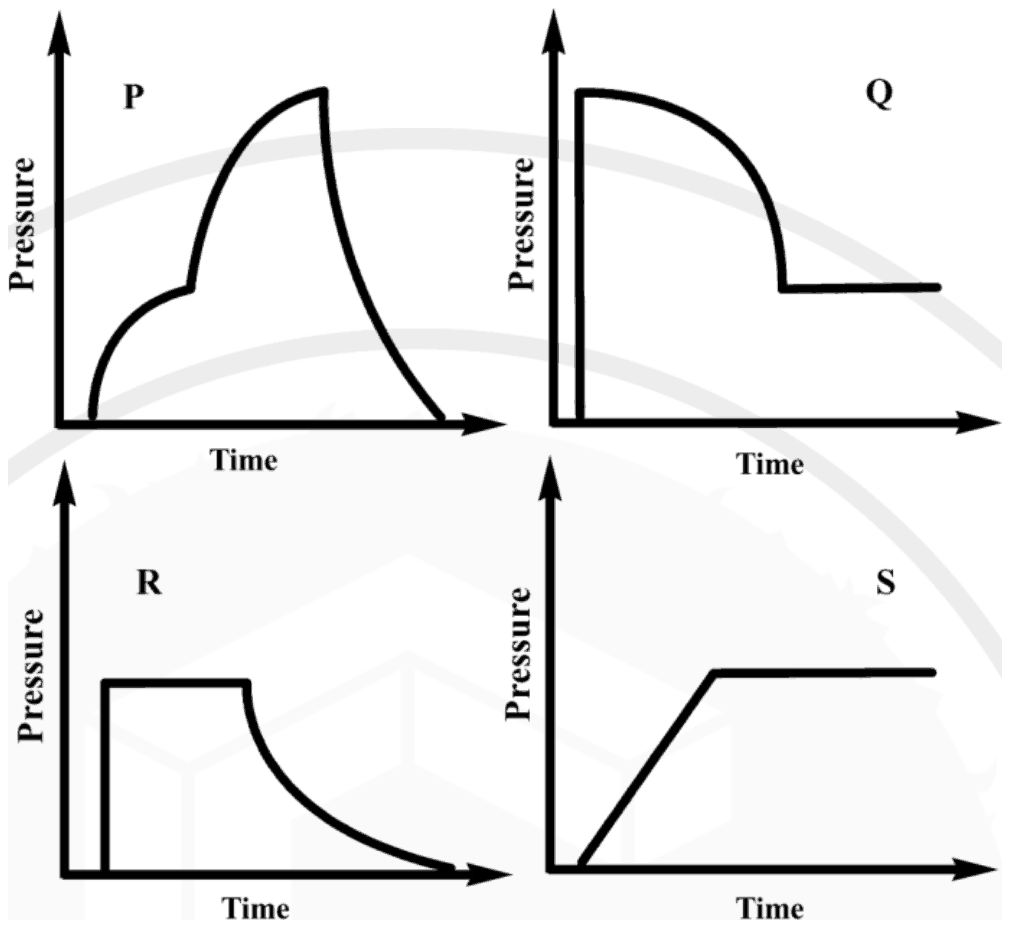
Match the Product with the most appropriate Processing Technique employed.
| Product | Processing Technique | ||
|---|---|---|---|
| P | Rainboots | 1 | Blow molding |
| Q | Disposable plastic cups | 2 | Calendering |
| R | Soft drink bottles | 3 | Rotational molding |
| S | Flexible films | 4 | Thermoforming |
A high molecular weight polymer passes through different zones from the hopper to the die in an extruder. Among the options given, identify the correct match between the zones and their key functions.
| Zones | Key functions | ||
|---|---|---|---|
| P | Metering zone | 1 | High shear forces for effective mixing |
| Q | Compression zone | 2 | Receives the charge or feed |
| R | Feed zone | 3 | Melts the charge or feed through heat conducted by the heating element |
| S | Working zone | 4 | The charge or feed acquires a constant flow rate imparted by the helical flight of the screw |
Weather resistance of high impact polystyrene can be improved by blending polystyrene with
Which one of the following solvent environments will likely result in swelling of solid polystyrene?
Match the following:
| P. Plastic egg container | 1. Injection moulding |
| Q. Water tank | 2. Extrusion |
| R. Chair | 3. Rotational moulding |
| S. Cable | 4. Thermoforming |
Match the following processing operations with their respective tools:
| Processing operations | Tools |
|---|---|
| P. Injection molding | 1. Parison mold |
| Q. Twin screw extrusion | 2. Sprue-runner system |
| R. Blow molding | 3. Mixing head |
| S. Reaction injection molding | 4. Kneading blocks |
Select the correct option to match the Compound/Additive to its most suitable Function from the table given below:
| Compound/Additive | Function | ||
|---|---|---|---|
| P | Azocarbonamide | I | Flame retardant |
| Q | 2-(2-hydroxyphenyl)-benzotriazole | II | Coupling agent |
| R | (3-Aminopropyl)triethoxysilane | III | Blowing agent |
| S | Ammonium polyphosphate | IV | UV-absorber |
Match the following:
| P. Flame retardant | 1. 4-Methyl-2,6-di-t-butyl phenol |
| Q. UV absorber | 2. Azocarbonamide |
| R. Blowing agent | 3. Phenyl salisylate |
| S. Antioxidant | 4. Aluminium trihydrate |
Match the following compounding ingredients in plastic technology with their respective functions:
| Compounding ingredients | Functions |
|---|---|
| P. Tricresyl phosphate | 1. Filler |
| Q. Calcium carbonate | 2. UV stabilizer |
| R. Azodicarbonamide | 3. Plasticizer |
| S. o-Hydroxybenzophenone | 4. Blowing agent |
Thermoplastic Polyurethane and Polyamide 6 both contain amide linkages, but when compared to Polyurethane, Polyamide 6 shows higher melting point due to _______________.
Most engineering polymers have heat distortion temperature (HDT) in excess of
Total number of questions : 20
Number of answered questions : 0
Number of unanswered questions : 20
Polymer Technology [ Question No: 1 To 20 ] :
Direction for [ Question No: 1 To 1 ] :
In tensile testing of carbon fiber reinforced epoxy composite samples, the following data were recorded:
gauge length = 4 cm
cross-section = 0.8 cm × 0.3 cm
increase in gauge length at the break point = 0.03 cm
breaking load = 50 kg
The Young's modulus of the composite is
Your Answer : (Not Answered)
Correct Answer : D
The Young's modulus is \(2.77 \times 10^{4}\) kg/cm2.
Since the curve is linear up to the break, the modulus is the breaking stress over the breaking strain:
\[ \begin{aligned} \varepsilon &= \frac{0.03}{4} = 0.0075 \\ E &= \frac{208.3}{0.0075} = 2.78 \times 10^{4}\ \text{kg/cm}^{2} \end{aligned} \]
which is the key's \(2.77 \times 10^{4}\) within rounding. The lower options would require a larger strain or a smaller stress than the data give.
In a polymer recycling plant, polymer “X” was depolymerized by glycolysis in the presence of ethylene glycol and a suitable catalyst. The glycolysis reaction yielded the following compound:
Identify the polymer “X” from the following options.
Your Answer : (Not Answered)
Correct Answer : A
Polymer X is poly(ethylene terephthalate).
The product shown is bis(2-hydroxyethyl) terephthalate (BHET): a benzene ring carrying two ester groups in the para positions, each esterified with a 2-hydroxyethyl group. PET is the polyester of terephthalic acid and ethylene glycol, and glycolysis with excess ethylene glycol breaks its ester links by transesterification, returning exactly this monomer-like diester. BHET can be repolymerised to PET, which is why glycolysis is a standard chemical recycling route for bottles.
Polystyrene and ABS are addition polymers with all-carbon backbones and no ester groups to cleave, and PVC contains chlorine, which appears nowhere in the product.
Feedstock recycling of poly(ethylene terephthalate) is carried out by
Your Answer : (Not Answered)
Correct Answer : C
Feedstock recycling of PET is carried out by hydrolysis.
Feedstock (chemical) recycling breaks a polymer back into its monomers or other chemicals. PET is a polyester, and its ester links can be cleaved by water (hydrolysis) to give terephthalic acid and ethylene glycol, which can be purified and repolymerized. Related routes are glycolysis and methanolysis.
Hydrogenation and dehydrogenation add or remove hydrogen and do not depolymerize a polyester. Ozonation attacks carbon-carbon double bonds, which PET's backbone lacks.
Flexible PVC tubes are used for watering. If some organic solvents are passed through this tube, it becomes stiff. This is due to the fact that the organic solvents
Your Answer : (Not Answered)
Correct Answer : B
The solvents remove plasticizer and raise \(T_{g}\).
Rigid PVC has a glass transition temperature around 80 °C. Flexible PVC tubing contains a large amount of plasticizer (typically a phthalate), whose small molecules sit between the chains, add free volume and lower \(T_{g}\) below room temperature. Organic solvents dissolve and leach out this plasticizer, so \(T_{g}\) rises back towards that of unplasticized PVC and the tube turns stiff.
Plasticizing PVC would lower \(T_{g}\) and make the tube softer, not stiffer. Removing plasticizer cannot lower \(T_{g}\), and the solvent does not chemically react with PVC.
In a rubber sample with a Mooney viscosity of 60 ML(1+4) 100 °C, the number 4 signifies
Your Answer : (Not Answered)
Correct Answer : C
The 4 is the time in minutes after starting the motor when the measurement is taken.
In the notation ML(1+4) 100 °C, M is Mooney, L the large rotor, 1 the preheating time in minutes, 4 the running time in minutes after the rotor is started, at which the reading is taken, and 100 °C the test temperature. 60 is the Mooney viscosity in Mooney units.
So 4 is not the preheating time (that is the 1), not the number of samples, and not a shear rate: the Mooney viscometer runs its rotor at a fixed speed (2 rpm) that the notation does not state.
Rubbers are a class of polymer known for
Your Answer : (Not Answered)
Correct Answer : D
Rubbers are known for low intermolecular forces.
An elastomer needs long, flexible chains that can uncoil when stretched and recoil when released. That requires weak forces between the chains, so the chains move freely at room temperature: rubbers are amorphous and well above their glass transition temperature (natural rubber's Tg is about -70 °C).
High intermolecular forces, a high Tg or crystallinity all restrict chain mobility and give rigid plastics or fibres instead. Strongly polar, hydrogen-bonded nylons, for instance, crystallise into fibres.
If a solid elastomer ball of weight 100 g is allowed to free fall from a height of 10 m and it rebounds back to a height of 8 m, the hysteresis loss is
Your Answer : (Not Answered)
Correct Answer : C
The hysteresis loss is 1.96 J.
The energy lost in the impact is the difference between the potential energy at the drop height and at the rebound height. It is dissipated as heat by internal friction in the rubber, which is what hysteresis means:
\[ \begin{aligned} \Delta E &= mg(h_{1} - h_{2}) = 0.1 \times 9.8 \times (10 - 8) \\ &= 1.96\ \text{J} \end{aligned} \]
9.80 J is the full potential energy at 10 m, and 19.60 J doubles it. 0.98 J would be the loss for a 1 m drop in height. The rebound resilience here is 8/10 = 80 percent.
Select the correct option to match the Product with the most appropriate Processing technique from the table given below:
| Product | Processing technique | ||
|---|---|---|---|
| P | Fibre-reinforced pressure vessel | I | Rotomoulding |
| Q | Overhead water tank | II | Thermoforming |
| R | Blister package for medicine | III | Filament winding |
| S | Plastic carry bag | IV | Blown film extrusion |
Your Answer : (Not Answered)
Correct Answer : D
The correct matching is P-III ; Q-I ; R-II ; S-IV.
- Fibre-reinforced pressure vessel: filament winding wraps resin-impregnated fibres round a rotating mandrel in a pattern chosen to carry the hoop and axial stresses (III).
- Overhead water tank: rotomoulding tumbles powder in a heated mould to make large, seamless hollow parts (I).
- Blister package: thermoforming shapes a heated sheet into the pockets (II).
- Plastic carry bag: blown film extrusion inflates an extruded tube into thin film (IV).
Option A swaps the tank and the blister pack, and the others assign the pressure vessel to processes that cannot place continuous fibres.
Injection molding is typically used to make plastic parts. If the pressure at the gate is monitored as a function of time during the injection of a thermoplastic polymer, identify the profile that best describes this event.
Your Answer : (Not Answered)
Correct Answer : C
The best description is profile P.
During injection the pressure at the gate goes through three stages:
- Filling: as melt flows into the cavity the pressure rises gradually, since the flow length and resistance keep increasing.
- Packing: once the cavity is full the melt is compressed and extra material is packed in to make up for shrinkage, so the pressure climbs steeply to its peak.
- Holding and cooling: the gate freezes, the part cools and shrinks, and the pressure decays back toward zero.
Profile P shows exactly this: a first rise, a sharper rise to a peak, and then decay to zero. Q and R begin with an instant jump that ignores the filling stage, and S levels off without ever decaying, as if the part never cooled.
Match the Product with the most appropriate Processing Technique employed.
| Product | Processing Technique | ||
|---|---|---|---|
| P | Rainboots | 1 | Blow molding |
| Q | Disposable plastic cups | 2 | Calendering |
| R | Soft drink bottles | 3 | Rotational molding |
| S | Flexible films | 4 | Thermoforming |
Your Answer : (Not Answered)
Correct Answer : B
The match is P-3; Q-4; R-1; S-2.
- Rainboots, hollow one-piece products, are made by rotational molding, in which powder tumbles inside a heated rotating mould and coats its walls.
- Disposable plastic cups are formed from heated sheet drawn into a cup-shaped mould: thermoforming.
- Soft drink bottles are made by blow molding, inflating a preform against the mould.
- Flexible films and sheets are produced by calendering, squeezing the melt between heated rolls.
The other options misplace at least one product: blow molding cannot make an open cup, and calendering makes flat film, not bottles or boots.
A high molecular weight polymer passes through different zones from the hopper to the die in an extruder. Among the options given, identify the correct match between the zones and their key functions.
| Zones | Key functions | ||
|---|---|---|---|
| P | Metering zone | 1 | High shear forces for effective mixing |
| Q | Compression zone | 2 | Receives the charge or feed |
| R | Feed zone | 3 | Melts the charge or feed through heat conducted by the heating element |
| S | Working zone | 4 | The charge or feed acquires a constant flow rate imparted by the helical flight of the screw |
Your Answer : (Not Answered)
Correct Answer : A
The correct match is P-4; Q-3; R-2; S-1.
- Feed zone (R): under the hopper, it receives the charge and conveys the solid pellets forward (2).
- Compression zone (Q): the channel depth decreases, compacting the material while heat from the barrel heaters and shear melts it (3).
- Metering zone (P): a shallow, constant-depth section that pumps the melt at a steady rate set by the screw flights, giving uniform output to the die (4).
- Working zone (S): in the paper's scheme, the section where high shear works and mixes the melt to make it uniform (1).
The other options swap these roles; for example, a feed zone cannot melt or mix the charge, because the polymer there is still solid pellets being conveyed.
Weather resistance of high impact polystyrene can be improved by blending polystyrene with
Your Answer : (Not Answered)
Correct Answer : C
Blend with ethylene propylene rubber.
Ordinary high impact polystyrene is toughened with polybutadiene-type rubber, whose backbone double bonds are attacked by oxygen, ozone and ultraviolet light, so the material yellows and embrittles outdoors. Ethylene propylene rubber has a saturated backbone with no such double bonds, so a polystyrene toughened with it keeps its impact strength on weathering.
Styrene butadiene rubber, natural rubber and nitrile rubber all contain backbone unsaturation from butadiene or isoprene, so they share the weakness that causes the problem.
Which one of the following solvent environments will likely result in swelling of solid polystyrene?
Your Answer : (Not Answered)
Correct Answer : D
Polystyrene swells in benzene.
A polymer swells or dissolves in a solvent with a similar solubility parameter, 'like dissolves like'. Polystyrene is a non-polar hydrocarbon with phenyl side groups, and benzene is a non-polar aromatic hydrocarbon with a closely matching solubility parameter, so it penetrates the chains and swells the solid.
Dilute NaOH, a weak HCl solution of pH 6 and distilled water are all aqueous and highly polar. Water's solubility parameter is far from that of polystyrene, and polystyrene has no groups that react with dilute acid or base, so none of them swells it.
Match the following:
| P. Plastic egg container | 1. Injection moulding |
| Q. Water tank | 2. Extrusion |
| R. Chair | 3. Rotational moulding |
| S. Cable | 4. Thermoforming |
Your Answer : (Not Answered)
Correct Answer : D
The match is P-4; Q-3; R-1; S-2.
- A plastic egg container is a thin shaped sheet, made by thermoforming: a heated sheet is drawn over a mould.
- A water tank is large, hollow and seamless, made by rotational moulding, where powder is tumbled in a heated rotating mould.
- A chair is a solid, detailed, rigid part, made by injection moulding.
- A cable sheath is a continuous profile, applied by extrusion (crosshead extrusion over the wire).
The other options give water tanks to injection moulding, which cannot make such large hollow vessels, or cables to a batch process.
Match the following processing operations with their respective tools:
| Processing operations | Tools |
|---|---|
| P. Injection molding | 1. Parison mold |
| Q. Twin screw extrusion | 2. Sprue-runner system |
| R. Blow molding | 3. Mixing head |
| S. Reaction injection molding | 4. Kneading blocks |
Your Answer : (Not Answered)
Correct Answer : B
The match is P-2, Q-4, R-1, S-3.
- Injection moulding feeds the melt from the nozzle to the cavities through a sprue and runner system.
- Twin screw extruders use kneading blocks on the screws to mix and disperse fillers and additives.
- Blow moulding inflates a tube of molten plastic, the parison, inside a mould.
- Reaction injection moulding meets two liquid reactants (as for polyurethane) at high pressure in a mixing head just before the mould.
The other options swap these tools between processes, for example giving a parison mould to injection moulding or kneading blocks to blow moulding.
Select the correct option to match the Compound/Additive to its most suitable Function from the table given below:
| Compound/Additive | Function | ||
|---|---|---|---|
| P | Azocarbonamide | I | Flame retardant |
| Q | 2-(2-hydroxyphenyl)-benzotriazole | II | Coupling agent |
| R | (3-Aminopropyl)triethoxysilane | III | Blowing agent |
| S | Ammonium polyphosphate | IV | UV-absorber |
Your Answer : (Not Answered)
Correct Answer : B
The correct matching is P-III ; Q-IV ; R-II ; S-I.
- Azodicarbonamide decomposes on heating to release nitrogen and other gases, so it is a chemical blowing agent for foams (III).
- 2-(2-Hydroxyphenyl)benzotriazoles absorb UV light and dissipate it as heat, protecting the polymer: a UV absorber (IV).
- (3-Aminopropyl)triethoxysilane bonds to glass or mineral surfaces through its silanol groups and to the polymer through its amine: a coupling agent (II).
- Ammonium polyphosphate is an intumescent flame retardant (I).
Option A swaps the blowing agent and the UV absorber, and the others misplace the silane or the phosphate.
Match the following:
| P. Flame retardant | 1. 4-Methyl-2,6-di-t-butyl phenol |
| Q. UV absorber | 2. Azocarbonamide |
| R. Blowing agent | 3. Phenyl salisylate |
| S. Antioxidant | 4. Aluminium trihydrate |
Your Answer : (Not Answered)
Correct Answer : B
The match is P-4; Q-3; R-2; S-1.
- Aluminium trihydrate is a flame retardant: on heating it decomposes endothermically and releases water vapour, cooling the polymer and diluting flammable gases.
- Phenyl salicylate (salol) absorbs ultraviolet light and is used as a UV absorber.
- Azodicarbonamide decomposes on heating to nitrogen and other gases, so it is a chemical blowing agent for foams.
- 4-Methyl-2,6-di-t-butyl phenol is butylated hydroxytoluene (BHT), a hindered phenol antioxidant.
The other options assign BHT or azodicarbonamide to roles they do not play.
Match the following compounding ingredients in plastic technology with their respective functions:
| Compounding ingredients | Functions |
|---|---|
| P. Tricresyl phosphate | 1. Filler |
| Q. Calcium carbonate | 2. UV stabilizer |
| R. Azodicarbonamide | 3. Plasticizer |
| S. o-Hydroxybenzophenone | 4. Blowing agent |
Your Answer : (Not Answered)
Correct Answer : A
The match is P-3, Q-1, R-4, S-2.
- Tricresyl phosphate is a plasticiser, used especially in PVC, where it also adds flame retardance.
- Calcium carbonate is the most common inexpensive filler.
- Azodicarbonamide decomposes on heating to release nitrogen and other gases, so it is a chemical blowing agent for foams.
- o-Hydroxybenzophenones absorb ultraviolet light and release it harmlessly as heat, so they are UV stabilisers.
The other options mismatch these well-known roles, for example making azodicarbonamide a plasticiser or calcium carbonate a blowing agent.
Thermoplastic Polyurethane and Polyamide 6 both contain amide linkages, but when compared to Polyurethane, Polyamide 6 shows higher melting point due to _______________.
Your Answer : (Not Answered)
Correct Answer : A
The reason given by the key is higher molecular rigidity.
Polyamide 6 has an amide group after every five methylene units, regularly spaced along an otherwise simple chain. These groups make the chain stiffer and let neighbouring chains line up and hydrogen bond in a regular pattern, so the crystals melt at about 220 °C.
A thermoplastic polyurethane links its urethane groups through an extra oxygen (-NH-CO-O-), which rotates easily, and it contains long flexible soft segments of polyether or polyester. Its chains are therefore more flexible, pack less regularly and melt lower.
Lower rigidity would lower the melting point, not raise it. Branching disrupts packing and also lowers it. Both polymers are thermoplastics, so differences in crosslinking are not what separates their melting points.
Most engineering polymers have heat distortion temperature (HDT) in excess of
Your Answer : (Not Answered)
Correct Answer : D
Most engineering polymers have an HDT above 80°C.
The heat distortion (deflection) temperature is the temperature at which a standard bar deflects by a set amount under a set load. Engineering plastics such as nylons, polycarbonate, acetal, PBT and PET are expected to carry load at elevated service temperatures, and their HDTs typically range from about 80 to well over 100°C.
An HDT of only 0 or 20°C would mean a part could not bear load at room temperature, and -80°C is a glass transition region typical of rubbers, not engineering thermoplastics.
Marks
Total number of questions : 20
Number of answered questions : 0
Number of unanswered questions : 20