
Instruction
- Total number of questions : 12
- Time allotted : 18:00 Minutes:Seconds.
- Each question carry 1 mark, no negative marks.
- DO NOT refresh the page.
- All the best
Production Planning and Control [ Question No: 1 To 12 ] :
Which one of the following is NOT a decision taken during the aggregate production planning stage?
Four jobs are on order in a factory. As on day 20 of the production calendar, the corresponding due date and work remaining to complete these jobs (in days) are given in the table below.
| Job | Due date | Work remaining (in days) |
| M | 26 | 5 |
| N | 24 | 10 |
| O | 28 | 10 |
| P | 31 | 5 |
Which job(s) has/have critical ratio less than unity?
Parts P1-P7 are machined first on a milling machine and then polished at a separate machine. Using the information in the following table, the minimum total completion time required for carrying out both the operations for all 7 parts is __________ hours.
| Part No. | Milling (hours) | Polishing (hours) |
|---|---|---|
| P1 | 8 | 6 |
| P2 | 3 | 2 |
| P3 | 3 | 4 |
| P4 | 4 | 6 |
| P5 | 5 | 7 |
| P6 | 6 | 4 |
| P7 | 2 | 1 |
A company orders gears in conditions identical to those considered in the economic order quantity (EOQ) model in inventory control. The annual demand is 8000 gears, the cost per order is 300 rupees, and the holding cost is 12 rupees per month per gear. The company uses an order size that is 25% more than the optimal order quantity determined by the EOQ model. The percentage change in the total cost of ordering and holding inventory from that associated with the optimal order quantity is
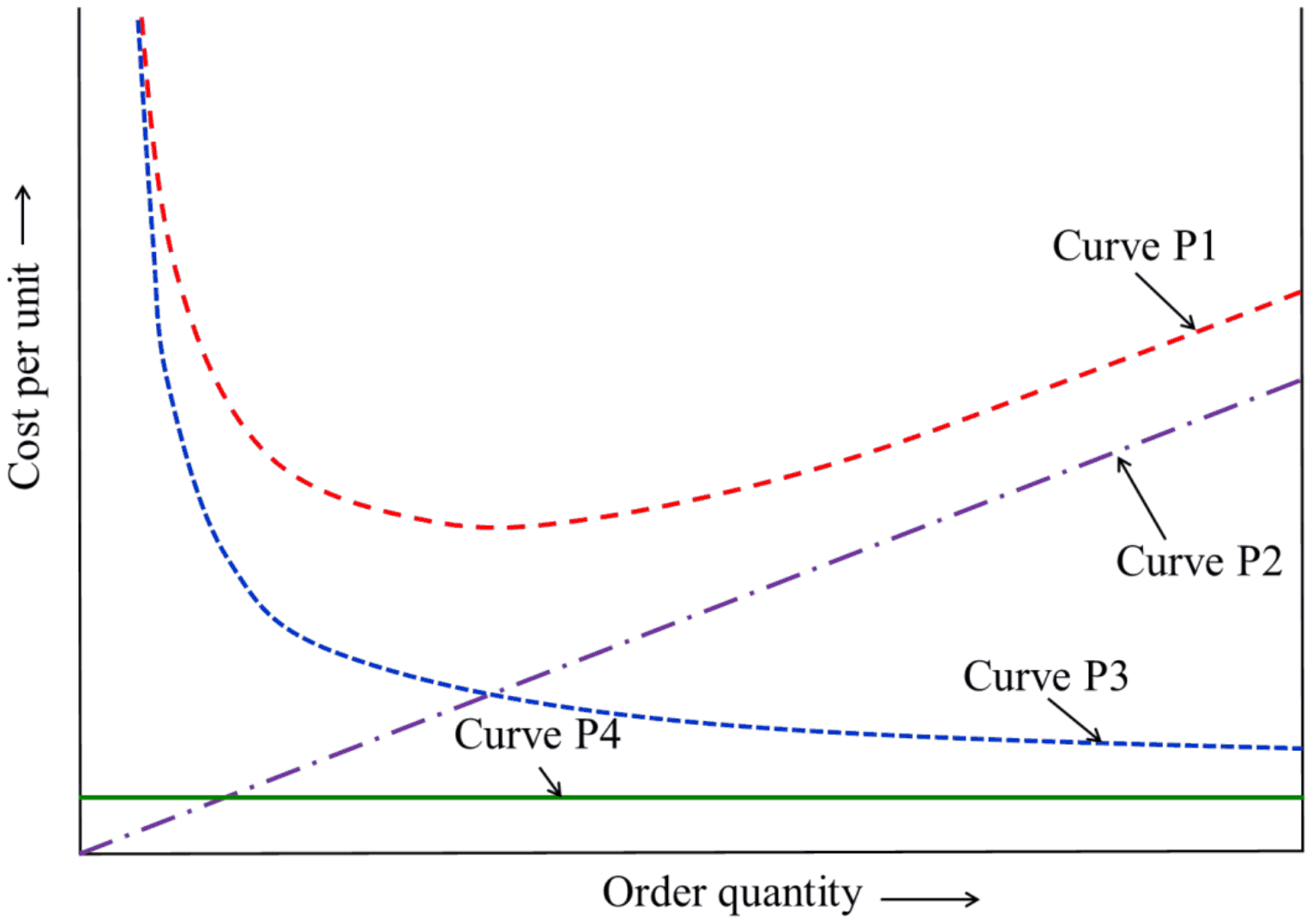
With reference to the Economic Order Quantity (EOQ) model, which one of the options given is correct?
A local tyre distributor expects to sell approximately 9600 steel belted radial tyres next year. Annual carrying cost is Rs. 16 per tyre and ordering cost is Rs. 75. The economic order quantity of the tyres is
Which one of the following is NOT a form of inventory?
Considering the actual demand and the forecast for a product given in the table below, the mean forecast error and the mean absolute deviation, respectively, are
| Period | 1 | 2 | 3 | 4 | 5 | 6 | 7 | 8 | 9 | 10 |
| Actual demand | 425 | 415 | 420 | 430 | 427 | 418 | 422 | 416 | 426 | 421 |
| Forecast | 427 | 422 | 416 | 422 | 423 | 420 | 419 | 418 | 430 | 415 |
The time series forecasting method that gives equal weightage to each of the m most recent observations is
Which of the following forecasting models gives more weight to recent data and is typically used when a trend or pattern exists in the data?
Which of the following best describes the EOQ model's main objective?
In a Manufacturing Resource Planning system, which component ensures that materials and products are available for production and delivery to customers while maintaining the lowest possible level of inventory?
Total number of questions : 12
Number of answered questions : 0
Number of unanswered questions : 12
Production Planning and Control [ Question No: 1 To 12 ] :
Which one of the following is NOT a decision taken during the aggregate production planning stage?
Your Answer : (Not Answered)
Correct Answer : A
Scheduling of machines is not an aggregate planning decision.
Aggregate production planning works at a medium-term horizon, typically 3 to 18 months, and in aggregate units for a whole product family. Its decisions are how much to produce in each period (the production rate), how large a workforce to commit, how much inventory to carry forward, and whether to use overtime or subcontracting.
Assigning particular jobs to particular machines is short-term detailed scheduling, done much later, after the master production schedule and material requirements plan are set. The other three options are exactly the variables aggregate planning trades off against each other.
Four jobs are on order in a factory. As on day 20 of the production calendar, the corresponding due date and work remaining to complete these jobs (in days) are given in the table below.
| Job | Due date | Work remaining (in days) |
| M | 26 | 5 |
| N | 24 | 10 |
| O | 28 | 10 |
| P | 31 | 5 |
Which job(s) has/have critical ratio less than unity?
Your Answer : (Not Answered)
Correct Answer : A
The jobs with critical ratio below one are Job N and Job O.
Critical ratio = (time remaining until due date) / (work remaining). On day 20:
\[ \begin{aligned} M &: (26 - 20)/5 = 1.2 \\ N &: (24 - 20)/10 = 0.4 \\ O &: (28 - 20)/10 = 0.8 \\ P &: (31 - 20)/5 = 2.2 \end{aligned} \]
A ratio below 1 means the job is behind schedule. Only N and O qualify. M and P are ahead of schedule, so the options containing them are wrong.
Parts P1-P7 are machined first on a milling machine and then polished at a separate machine. Using the information in the following table, the minimum total completion time required for carrying out both the operations for all 7 parts is __________ hours.
| Part No. | Milling (hours) | Polishing (hours) |
|---|---|---|
| P1 | 8 | 6 |
| P2 | 3 | 2 |
| P3 | 3 | 4 |
| P4 | 4 | 6 |
| P5 | 5 | 7 |
| P6 | 6 | 4 |
| P7 | 2 | 1 |
Your Answer : (Not Answered)
Correct Answer : B
The minimum total completion time is 33 hours.
Two machines in a fixed order is the case solved by Johnson's rule: parts whose milling time is less than their polishing time go first, in increasing order of milling time; the rest go last, in decreasing order of polishing time.
- Milling less than polishing: P3 (3, 4), P4 (4, 6), P5 (5, 7), in that order.
- The rest, by decreasing polishing time: P1 (6), P6 (4), P2 (2), P7 (1).
Sequence P3, P4, P5, P1, P6, P2, P7. Milling ends at 3, 7, 12, 20, 26, 29, 31 hours. Each polishing job starts at the later of its milling end and the previous polishing end:
| Part | Polish start | Polish end |
|---|---|---|
| P3 | 3 | 7 |
| P4 | 7 | 13 |
| P5 | 13 | 20 |
| P1 | 20 | 26 |
| P6 | 26 | 30 |
| P2 | 30 | 32 |
| P7 | 32 | 33 |
The last part finishes polishing at 33 hours. 31 is only the total milling time, which ignores the final part's polishing; no sequence can finish in 30 or 32, since Johnson's rule gives the minimum.
A company orders gears in conditions identical to those considered in the economic order quantity (EOQ) model in inventory control. The annual demand is 8000 gears, the cost per order is 300 rupees, and the holding cost is 12 rupees per month per gear. The company uses an order size that is 25% more than the optimal order quantity determined by the EOQ model. The percentage change in the total cost of ordering and holding inventory from that associated with the optimal order quantity is
Your Answer : (Not Answered)
Correct Answer : A
The total cost rises by 2.5%.
In the EOQ model the total of ordering and holding cost, as a fraction of its minimum, depends only on the ratio of the order size to the optimal size \(Q^{*}\):
\[ \begin{aligned} \frac{TC(Q)}{TC(Q^{*})} &= \frac{1}{2}\left(\frac{Q}{Q^{*}} + \frac{Q^{*}}{Q}\right) \\ &= \frac{1}{2}\left(1.25 + 0.8\right) = 1.025 \end{aligned} \]
so the cost is 2.5% higher. The demand and cost figures fix \(Q^{*}\) (about 183 gears with a holding cost of 144 rupees per gear per year), but the percentage change does not depend on them. The cost curve is flat near its minimum, which is why a 25% error in order size costs only 2.5%; 12.5% is half the 25% change in order size and ignores that flatness, and 0 or 5% do not follow from the formula.
With reference to the Economic Order Quantity (EOQ) model, which one of the options given is correct?
Your Answer : (Not Answered)
Correct Answer : A
The correct labelling is Curve P1: Total cost, Curve P2: Holding cost, Curve P3: Setup cost, and Curve P4: Production cost.
In the EOQ model, with order quantity Q, annual demand D, setup cost S per order and holding cost H per unit per year:
- holding cost rises in a straight line with Q, since average stock is Q/2: the dash-dot line P2 through the origin;
- setup (ordering) cost falls as D/Q, steeply at first and then flattening: the hyperbola-like curve P3;
- production or purchase cost per unit does not depend on the order quantity: the flat line P4;
- total cost, the sum of these, is U-shaped with its minimum near where the holding and setup curves cross, at the EOQ: P1.
Every other option gives a straight or flat curve the name of a cost that must curve, or swaps the U-shaped total with a component.
A local tyre distributor expects to sell approximately 9600 steel belted radial tyres next year. Annual carrying cost is Rs. 16 per tyre and ordering cost is Rs. 75. The economic order quantity of the tyres is
Your Answer : (Not Answered)
Correct Answer : C
The economic order quantity is 300 tyres.
With annual demand D, ordering cost per order \(C_{o}\) and carrying cost per unit per year \(C_{h}\):
\[ \begin{aligned} EOQ &= \sqrt{\frac{2DC_{o}}{C_{h}}} \\ &= \sqrt{\frac{2 \times 9600 \times 75}{16}} \\ &= \sqrt{90000} = 300 \end{aligned} \]
At this quantity the annual ordering cost (32 orders × Rs. 75 = Rs. 2400) equals the annual carrying cost (150 average tyres × Rs. 16 = Rs. 2400), which is the check. 212 is what you get by dropping the factor 2, and 64 comes from inverting the cost ratio; 1200 does not follow from the formula.
Which one of the following is NOT a form of inventory?
Your Answer : (Not Answered)
Correct Answer : D
The item that is NOT inventory is CNC milling machines.
Inventory is stock held to be converted into, or sold as, product: raw materials waiting to be processed, work-in-process partly through production, and finished goods awaiting sale. All three appear on the books as current assets.
CNC milling machines are the equipment that does the processing. They are capital goods (fixed assets) used over many years and are not consumed in or sold as the product, so they are not inventory. (A machine-tool maker's unsold machines would be its finished goods, but the question is about the machines as production equipment.)
Considering the actual demand and the forecast for a product given in the table below, the mean forecast error and the mean absolute deviation, respectively, are
| Period | 1 | 2 | 3 | 4 | 5 | 6 | 7 | 8 | 9 | 10 |
| Actual demand | 425 | 415 | 420 | 430 | 427 | 418 | 422 | 416 | 426 | 421 |
| Forecast | 427 | 422 | 416 | 422 | 423 | 420 | 419 | 418 | 430 | 415 |
Your Answer : (Not Answered)
Correct Answer : B
The mean forecast error is 0.8 and the mean absolute deviation is 4.2: 0.8 and 4.2.
The errors (actual minus forecast) for periods 1 to 10 are \(-2, -7, 4, 8, 4, -2, 3, -2, -4, 6\).
\[ \begin{aligned} \text{MFE} &= \tfrac{8}{10} = 0.8 \\ \text{MAD} &= \tfrac{2+7+4+8+4+2+3+2+4+6}{10} = \tfrac{42}{10} = 4.2 \end{aligned} \]
42.0 is the sum of absolute errors before dividing by 10, and 8.0 the sum of errors; the other options use these totals in place of the means.
The time series forecasting method that gives equal weightage to each of the m most recent observations is
Your Answer : (Not Answered)
Correct Answer : A
The method is the moving average method.
A simple moving average forecasts the next period as the arithmetic mean of the last m observations, so each of those m values gets the same weight, 1/m, and older data get none.
Exponential smoothing, in all its forms (with a linear trend, or triple smoothing for trend and seasonality), gives weights that decline geometrically with the age of the data, the most recent observation weighted most heavily. A Kalman filter is a recursive state estimator whose weighting (the Kalman gain) depends on the noise statistics, not an equal weighting.
Which of the following forecasting models gives more weight to recent data and is typically used when a trend or pattern exists in the data?
Your Answer : (Not Answered)
Correct Answer : A
Exponential smoothing is the forecasting model that gives more weight to recent data, with weights falling exponentially for older data, and it is used when a trend or pattern is present. The simple moving average gives equal weights to the data of the period, and the Delphi method is a qualitative method that takes expert opinion. The weighted moving average also gives more weight to recent data, but the key names exponential smoothing as the model with the pattern.
Which of the following best describes the EOQ model's main objective?
Your Answer : (Not Answered)
Correct Answer : D
The main objective of the EOQ (economic order quantity) model is to minimise the total inventory costs. It finds the order size at which the sum of the ordering cost and the holding cost is least. The model does not aim at maximising sales, minimising lead time or maximising stock availability, which would raise holding cost.
In a Manufacturing Resource Planning system, which component ensures that materials and products are available for production and delivery to customers while maintaining the lowest possible level of inventory?
Your Answer : (Not Answered)
Correct Answer : B
The component that ensures materials and products are available for production and delivery to customers, while keeping the lowest possible inventory, is the Master Production Schedule in the key. The MPS states what is to be made, in what quantity and when, and the rest of the planning (material requirements, capacity requirements) is derived from it. Capacity requirement planning checks capacity, inventory control tracks stock, and a bill of materials lists the parts of a product, so none of them is the keyed answer.
Marks
Total number of questions : 12
Number of answered questions : 0
Number of unanswered questions : 12