
Instruction
- Total number of questions : 20
- Time allotted : 30:00 Minutes:Seconds.
- Each question carry 1 mark, no negative marks.
- DO NOT refresh the page.
- All the best
Quantum Mechanics [ Question No: 1 To 20 ] :
A particle with incoming wave vector k, after being scattered by the potential \(V(r) = \frac{c}{r^{2}}\), c real, goes out with wave vector k'. The differential scattering cross-section, calculated in the first Born approximation, depends on q = |k − k'|, as
Spin-orbit coupling leads to :
In scattering theory of spherically symmetric potential, the incident particles on z-axis are represented by :
Validity of first-Born approximation for central force potential is :
If H is a Hermitian operator, the following is "always" true :
For a one-dimensional harmonic oscillator, \(a^{+}\) and a are raising and lowering operators and \(|n\rangle\) is the nth energy eigenstate. Then \(a^{+}a|n + 1\rangle\) is equal to :
A particle of mass m is confined in a three-dimensional cubical box of size L. The number of eigenstates of the Hamiltonian with energy \(\frac{19\hbar^{2}\pi^{2}}{mL^{2}}\) is :
Out of the following particles, all having the same kinetic energy, which has the longest wavelength ?
A system described by the Hamiltonian
\[ H = \begin{pmatrix} 5 & 2 & 0 \\ 2 & 5 & 0 \\ 0 & 0 & 2 \end{pmatrix} \]
is perturbed by
\[ H' = \varepsilon \begin{pmatrix} 1 & 1 & 1 \\ 1 & 1 & -1 \\ 1 & -1 & 1 \end{pmatrix} \]
where (\(\varepsilon \ll 1\)). A pair of eigenvalues of the perturbed system is :
The following Pauli spin matrices
\[ \sigma_{x} = \begin{bmatrix} 0 & 1 \\ 1 & 0 \end{bmatrix} \]
and
\[ \sigma_{y} = \begin{bmatrix} 0 & -i \\ i & 0 \end{bmatrix} \]
The orbital angular momentum of a single 2s electron is (h is the Planck's constant) :
Given \([x_{i}, p_{j}] = i\hbar\delta_{ij}\), i, j = 1, 2, 3, \([x_{1}, p_{1}^{3}]\) is :
A particle is scattered from a potential \(V(\vec{r}) = g\delta^{3}(\vec{r})\), where \(g\) is a positive constant. Using the first Born approximation, the angular \((\theta, \phi)\) dependence of differential scattering cross section \(\frac{d\sigma}{d\Omega}\) is
Consider the Pauli matrices \(\sigma_{x} = \begin{pmatrix} 0 & 1 \\ 1 & 0 \end{pmatrix}\), \(\sigma_{y} = \begin{pmatrix} 0 & -i \\ i & 0 \end{pmatrix}\), \(\sigma_{z} = \begin{pmatrix} 1 & 0 \\ 0 & -1 \end{pmatrix}\).
The value of \(\text{Tr}(\sigma_{z}\,[\sigma_{x}, \sigma_{y}])\) is
Consider two non-identical spin \(\frac{1}{2}\) particles labelled 1 and 2 in the spin product state \(|\tfrac{1}{2}, \tfrac{1}{2}\rangle |\tfrac{1}{2}, -\tfrac{1}{2}\rangle\). The Hamiltonian of the system is
\[ H = \frac{4\lambda}{\hbar^{2}}\vec{S}_{1}\cdot\vec{S}_{2} , \]
where \(\vec{S}_{1}\) and \(\vec{S}_{2}\) are the spin operators of particles 1 and 2, respectively, and \(\lambda\) is a constant with appropriate dimensions. What is the expectation value of \(H\) in the above state?
The potential of a quantum harmonic oscillator is modified from \(\frac{1}{2}kx^{2}\) to \(\frac{1}{2}kx^{2} + 3ax\), where \(k\) and \(a\) are constants and x is the position variable. When, the values of \(a = 2\) and \(k = 1\), which of the following options gives the change in the ground state energy?
(\(a\) and \(k\) are in appropriate units)
The Hamiltonian for a quantum particle of mass \(m\) is given below, where \(\omega \lt \Omega\). The Schrödinger equation for this system can be solved exactly using the orthogonal transformations: \(x = \frac{x_{1} - x_{2}}{\sqrt{2}}\) and \(y = \frac{x_{1} + x_{2}}{\sqrt{2}}\).
\[ \begin{aligned} H = &-\frac{\hbar^{2}}{2m}\left[\frac{\partial^{2}}{\partial x^{2}} + \frac{\partial^{2}}{\partial y^{2}}\right] \\ &+ \frac{1}{2}m\Omega^{2}(x^{2} + y^{2}) + m\omega^{2}xy \end{aligned} \]
The ground state energy of this system is
A particle of mass m is in a one dimensional potential
\[ V(x) = \begin{cases} 0, & 0 \lt x \lt L \\ \infty, & \text{otherwise} \end{cases} \]
At some instant its wave function is given by
\[ \begin{aligned} \psi(x) &= \frac{1}{\sqrt{3}}\psi_{1}(x) \\ &\quad + i\sqrt{\frac{2}{3}}\psi_{2}(x), \end{aligned} \]
where \(\psi_{1}(x)\) and \(\psi_{2}(x)\) are the ground and the first excited states, respectively. Identify the correct statement.
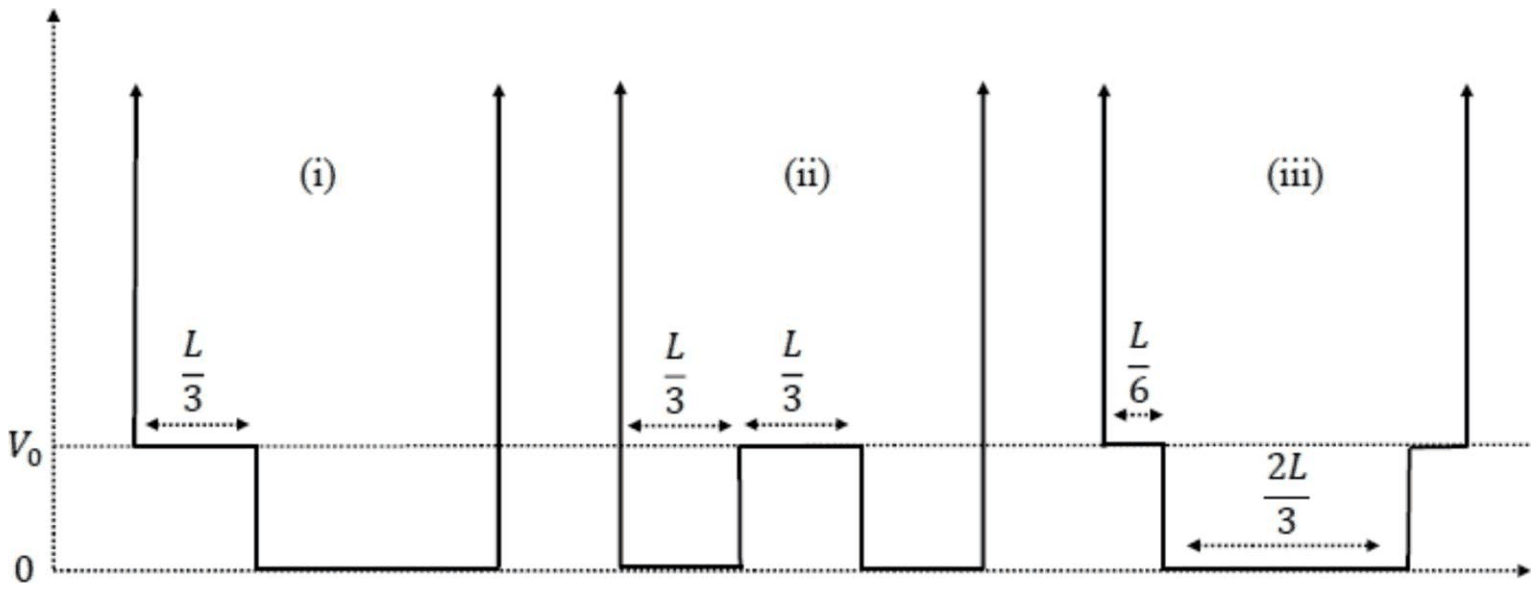
Consider a particle in three different boxes of width \(L\). The potential inside the boxes vary as shown in figures (i), (ii) and (iii) with \(V_{0} \ll \frac{\hbar^{2}\pi^{2}}{2mL^{2}}\). The corresponding ground-state energies of the particle are \(E_{1}\), \(E_{2}\) and \(E_{3}\), respectively. Then
Let \(T_{g}\) and \(T_{e}\) be the kinetic energies of the electron in the ground and the third excited states of a hydrogen atom, respectively. According to the Bohr model, the ratio \(T_{g}/T_{e}\) is
Total number of questions : 20
Number of answered questions : 0
Number of unanswered questions : 20
Quantum Mechanics [ Question No: 1 To 20 ] :
A particle with incoming wave vector k, after being scattered by the potential \(V(r) = \frac{c}{r^{2}}\), c real, goes out with wave vector k'. The differential scattering cross-section, calculated in the first Born approximation, depends on q = |k − k'|, as
Your Answer : (Not Answered)
Correct Answer : A
The cross-section goes as \(1/q^{2}\).
In the first Born approximation, for a central potential the scattering amplitude is
\[ \begin{aligned} f(q) &= -\frac{2m}{\hbar^{2}q}\int_{0}^{\infty} rV(r)\sin(qr)\,dr \\ &= -\frac{2mc}{\hbar^{2}q}\int_{0}^{\infty}\frac{\sin qr}{r}\,dr \\ &= -\frac{2mc}{\hbar^{2}q}\cdot\frac{\pi}{2} \end{aligned} \]
The remaining integral is \(\pi/2\) for any \(q \gt 0\), so \(f \propto 1/q\) and \(d\sigma/d\Omega = |f|^{2} \propto 1/q^{2}\).
\(1/q^{4}\) is the Rutherford dependence of the Coulomb potential \(1/r\), not of \(1/r^{2}\). \(1/q\) is the amplitude, not the cross-section, and \(1/q^{3/2}\) does not arise.
Spin-orbit coupling leads to :
Your Answer : (Not Answered)
Correct Answer : B
Spin-orbit coupling leads to the Anomalous Zeeman effect.
Spin-orbit coupling combines L and S into J, splitting levels into fine-structure components with different Landé g factors. In a weak magnetic field each J level splits into \(2J + 1\) sublevels spaced by \(g_{J}\mu_{B}B\), and because \(g_{J}\) differs between levels, the lines split into more than three components: the anomalous Zeeman effect.
The normal Zeeman effect (three lines) is seen when spin plays no part (singlet states). The Stark effect is due to an electric field, and hyperfine splitting comes from coupling with the nuclear spin.
In scattering theory of spherically symmetric potential, the incident particles on z-axis are represented by :
Your Answer : (Not Answered)
Correct Answer : A
The incident particles are represented by \(A\exp(ikz)\).
In scattering theory the wave function far from the target is written as an incoming plane wave plus an outgoing spherical wave:
\[ \begin{aligned} \psi &\approx Ae^{ikz} \\ &\quad + Af(\theta)\frac{e^{ikr}}{r} \end{aligned} \]
The plane wave \(Ae^{ikz}\) describes the beam of incident particles travelling along the z-axis with momentum \(\hbar k\), with uniform probability density.
A factor 1/r belongs to the spherical scattered wave, whose amplitude falls with distance so that probability flux is conserved through larger spheres; \(1/r^{2}\) and a factor r have no place in the incident beam.
Validity of first-Born approximation for central force potential is :
Your Answer : (Not Answered)
Correct Answer : C
The first Born approximation is valid for large incident energy and weak scattering potential.
The Born approximation replaces the true wave inside the potential by the incident plane wave. That is accurate only if the potential distorts the wave little, which requires a weak potential, and if the particle passes quickly, which a high energy ensures. A common criterion is \(|V|a/\hbar v \ll 1\), where \(a\) is the range and \(v\) the speed.
A strong potential at low energy is the opposite regime, where partial-wave methods are used. The approximation is not universal, so 'any central potential' and 'independent of energy and potential' are wrong.
If H is a Hermitian operator, the following is "always" true :
Your Answer : (Not Answered)
Correct Answer : A
It is always true that H has real diagonal matrix elements.
A Hermitian operator satisfies \(H_{ij} = H_{ji}^{*}\). Setting \(i = j\) gives \(H_{ii} = H_{ii}^{*}\), so every diagonal element is real, in any basis.
The others are not guaranteed. Diagonal elements can be negative (for example \(-\sigma_{z}\)). Off-diagonal elements are complex in general, and can be real, as in \(\sigma_{x}\). The trace is the sum of real eigenvalues and need not be zero (the identity is Hermitian).
For a one-dimensional harmonic oscillator, \(a^{+}\) and a are raising and lowering operators and \(|n\rangle\) is the nth energy eigenstate. Then \(a^{+}a|n + 1\rangle\) is equal to :
Your Answer : (Not Answered)
Correct Answer : D
\(a^{+}a|n + 1\rangle = (n + 1)|n + 1\rangle\).
The product \(a^{+}a\) is the number operator N, and the energy eigenstates are its eigenstates: \(N|m\rangle = m|m\rangle\). Step by step:
\[ \begin{aligned} a|n + 1\rangle &= \sqrt{n + 1}\,|n\rangle \\ a^{+}\sqrt{n + 1}\,|n\rangle &= \sqrt{n + 1}\sqrt{n + 1}\,|n + 1\rangle \end{aligned} \]
giving \((n + 1)|n + 1\rangle\). The state is unchanged, so options ending in \(|n\rangle\) are wrong. \(n|n + 1\rangle\) applies the eigenvalue of the wrong state, and \(\sqrt{n(n + 1)}\) mixes the factors from two different steps.
A particle of mass m is confined in a three-dimensional cubical box of size L. The number of eigenstates of the Hamiltonian with energy \(\frac{19\hbar^{2}\pi^{2}}{mL^{2}}\) is :
Your Answer : (Not Answered)
Correct Answer : D
There are 9 eigenstates with this energy.
The levels of a cubical box are
\[ \begin{aligned} E &= \frac{\pi^{2}\hbar^{2}}{2mL^{2}} \\ &\quad\times(n_{x}^{2} + n_{y}^{2} + n_{z}^{2}) \end{aligned} \]
so \(19\hbar^{2}\pi^{2}/mL^{2}\) needs \(n_{x}^{2} + n_{y}^{2} + n_{z}^{2} = 38\) with positive integers. The only ways to write 38 as a sum of three positive squares are
\[ \begin{aligned} 38 &= 36 + 1 + 1 \quad (6, 1, 1) \\ 38 &= 25 + 9 + 4 \quad (5, 3, 2) \end{aligned} \]
(6, 1, 1) can be arranged in 3 ways and (5, 3, 2) in 3! = 6 ways, giving 3 + 6 = 9 states. Stopping at one of the two sets gives 3 or 6, not an offered option; 10 and 4 come from miscounting the arrangements.
Out of the following particles, all having the same kinetic energy, which has the longest wavelength ?
Your Answer : (Not Answered)
Correct Answer : B
The longest wavelength belongs to an electron.
The de Broglie wavelength of a particle with kinetic energy K is
\[ \lambda = \frac{h}{p} = \frac{h}{\sqrt{2mK}} \]
At the same kinetic energy, \(\lambda \propto 1/\sqrt{m}\), so the lightest particle has the longest wavelength. The electron is about 1836 times lighter than a proton, so its wavelength is about 43 times longer. The proton and neutron have nearly equal masses and wavelengths, and the alpha particle, about four times heavier still, has the shortest.
A system described by the Hamiltonian
\[ H = \begin{pmatrix} 5 & 2 & 0 \\ 2 & 5 & 0 \\ 0 & 0 & 2 \end{pmatrix} \]
is perturbed by
\[ H' = \varepsilon \begin{pmatrix} 1 & 1 & 1 \\ 1 & 1 & -1 \\ 1 & -1 & 1 \end{pmatrix} \]
where (\(\varepsilon \ll 1\)). A pair of eigenvalues of the perturbed system is :
Your Answer : (Not Answered)
Correct Answer : C
A pair of eigenvalues is 3, 7 + 2\(\varepsilon\).
The unperturbed H has a 2 by 2 block with eigenvalues 7 and 3 and eigenvectors \((1, 1, 0)/\sqrt{2}\) and \((1, -1, 0)/\sqrt{2}\), plus the eigenvalue 2 with \((0, 0, 1)\). First-order shifts are the diagonal elements of H' in this basis:
\[ \begin{aligned} E_{7} &: \tfrac{1}{2}(1 + 1 + 1 + 1)\varepsilon = 2\varepsilon \\ E_{3} &: \tfrac{1}{2}(1 - 1 - 1 + 1)\varepsilon = 0 \\ E_{2} &: H'_{33} = \varepsilon \end{aligned} \]
So the levels become 7 + 2\(\varepsilon\), 3 and 2 + \(\varepsilon\). Only the third option lists two of them; 3 + 2\(\varepsilon\) gives the shift of the 7 level to the 3 level, and 2 + 2\(\varepsilon\) doubles the shift of the lowest level.
The following Pauli spin matrices
\[ \sigma_{x} = \begin{bmatrix} 0 & 1 \\ 1 & 0 \end{bmatrix} \]
and
\[ \sigma_{y} = \begin{bmatrix} 0 & -i \\ i & 0 \end{bmatrix} \]
Your Answer : (Not Answered)
Correct Answer : B
The Pauli matrices anti-commute.
Multiplying them both ways:
\[ \sigma_{x}\sigma_{y} = \begin{bmatrix} i & 0 \\ 0 & -i \end{bmatrix} = i\sigma_{z} \]
\[ \sigma_{y}\sigma_{x} = \begin{bmatrix} -i & 0 \\ 0 & i \end{bmatrix} = -i\sigma_{z} \]
So \(\sigma_{x}\sigma_{y} + \sigma_{y}\sigma_{x} = 0\): they anti-commute. They do not commute (their commutator is \(2i\sigma_{z}\), not zero), and they are not inverses of each other, since their product is \(i\sigma_{z}\), not the identity; each is its own inverse.
The orbital angular momentum of a single 2s electron is (h is the Planck's constant) :
Your Answer : (Not Answered)
Correct Answer : D
The orbital angular momentum of a 2s electron is zero.
The magnitude of orbital angular momentum is \( \sqrt{l(l+1)}\,\frac{h}{2\pi} \), and an s electron has \( l = 0 \) whatever its principal quantum number, so the result is 0. The 2 in 2s is n, which does not enter.
\( h/2\pi \) is the Bohr-model value \( n\hbar \) for \( n = 1 \), which the quantum theory replaces. \( h\sqrt{2}/2\pi \) is the value for a p electron (\( l = 1 \)), and \( h/4\pi \) is the size of the spin component, not of orbital motion.
Given \([x_{i}, p_{j}] = i\hbar\delta_{ij}\), i, j = 1, 2, 3, \([x_{1}, p_{1}^{3}]\) is :
Your Answer : (Not Answered)
Correct Answer : C
The commutator is \(3i\hbar p_{1}^{2}\).
Use the product rule \([A, BC] = [A, B]C + B[A, C]\) with \([x_{1}, p_{1}] = i\hbar\), a number that commutes with everything:
\[ \begin{aligned} [x_{1}, p_{1}^{3}] &= [x_{1}, p_{1}]p_{1}^{2} + p_{1}[x_{1}, p_{1}]p_{1} \\ &\quad + p_{1}^{2}[x_{1}, p_{1}] \\ &= 3i\hbar\, p_{1}^{2} \end{aligned} \]
In general \([x, p^{n}] = n i\hbar p^{n-1}\), which is \(i\hbar\, \partial(p^{n})/\partial p\). The option \((i\hbar)^{3}p_{1}\) multiplies the commutator three times instead of adding three terms, \(i\hbar^{2}p_{1}\) has the wrong power of p, and zero would apply only to different components such as \([x_{1}, p_{2}^{3}]\).
A particle is scattered from a potential \(V(\vec{r}) = g\delta^{3}(\vec{r})\), where \(g\) is a positive constant. Using the first Born approximation, the angular \((\theta, \phi)\) dependence of differential scattering cross section \(\frac{d\sigma}{d\Omega}\) is
Your Answer : (Not Answered)
Correct Answer : D
The cross section is independent of both \(\theta\) and \(\phi\).
In the first Born approximation the scattering amplitude is the Fourier transform of the potential at the momentum transfer \(\vec{q}\):
\[ \begin{aligned} f(\theta) &= -\frac{m}{2\pi\hbar^{2}}\int e^{-i\vec{q}\cdot\vec{r}}\, g\delta^{3}(\vec{r})\, d^{3}r \\ &= -\frac{mg}{2\pi\hbar^{2}} \end{aligned} \]
The delta function picks out \(\vec{r} = 0\), where the exponential is 1, so \(f\) is a constant and \(\frac{d\sigma}{d\Omega} = |f|^{2} = \frac{m^{2}g^{2}}{4\pi^{2}\hbar^{4}}\) is isotropic.
Any \(\phi\) dependence would need a potential that is not spherically symmetric, and \(\theta\) dependence enters only through \(q = 2k\sin(\theta/2)\), which drops out for a point interaction.
Consider the Pauli matrices \(\sigma_{x} = \begin{pmatrix} 0 & 1 \\ 1 & 0 \end{pmatrix}\), \(\sigma_{y} = \begin{pmatrix} 0 & -i \\ i & 0 \end{pmatrix}\), \(\sigma_{z} = \begin{pmatrix} 1 & 0 \\ 0 & -1 \end{pmatrix}\).
The value of \(\text{Tr}(\sigma_{z}\,[\sigma_{x}, \sigma_{y}])\) is
Your Answer : (Not Answered)
Correct Answer : C
The trace is \(4i\).
The Pauli matrices satisfy \([\sigma_{x}, \sigma_{y}] = 2i\sigma_{z}\), and \(\sigma_{z}^{2} = I\):
\[ \begin{aligned} \sigma_{z}[\sigma_{x}, \sigma_{y}] &= 2i\,\sigma_{z}^{2} = 2i\,I \\ \text{Tr}(2i\,I) &= 2i \times 2 = 4i \end{aligned} \]
Directly: \(\sigma_{x}\sigma_{y} = \text{diag}(i, -i)\) and \(\sigma_{y}\sigma_{x} = \text{diag}(-i, i)\), so the commutator is \(\text{diag}(2i, -2i)\); multiplying by \(\sigma_{z}\) gives \(\text{diag}(2i, 2i)\). 2i forgets that the trace of the 2 by 2 identity is 2, and i and i/2 drop the factor 2 of the commutator as well.
Consider two non-identical spin \(\frac{1}{2}\) particles labelled 1 and 2 in the spin product state \(|\tfrac{1}{2}, \tfrac{1}{2}\rangle |\tfrac{1}{2}, -\tfrac{1}{2}\rangle\). The Hamiltonian of the system is
\[ H = \frac{4\lambda}{\hbar^{2}}\vec{S}_{1}\cdot\vec{S}_{2} , \]
where \(\vec{S}_{1}\) and \(\vec{S}_{2}\) are the spin operators of particles 1 and 2, respectively, and \(\lambda\) is a constant with appropriate dimensions. What is the expectation value of \(H\) in the above state?
Your Answer : (Not Answered)
Correct Answer : A
The expectation value is \(-\lambda\).
Write the dot product with raising and lowering operators:
\[ \begin{aligned} \vec{S}_{1}\cdot\vec{S}_{2} &= S_{1z}S_{2z} \\ &\quad + \tfrac{1}{2}(S_{1+}S_{2-} + S_{1-}S_{2+}) \end{aligned} \]
In the product state \(|\uparrow\rangle|\downarrow\rangle\), the flip terms turn the state into \(|\downarrow\rangle|\uparrow\rangle\) (or zero), which is orthogonal to it, so their expectation vanishes. Only the \(z\) term survives:
\[ \begin{aligned} \langle H \rangle &= \frac{4\lambda}{\hbar^{2}}\left(\frac{\hbar}{2}\right)\left(-\frac{\hbar}{2}\right) \\ &= -\lambda \end{aligned} \]
\(+\lambda\) is the value for parallel spins (the triplet \(|\uparrow\uparrow\rangle\)). \(-3\lambda\) would be the singlet, and \(\pm 2\lambda\) do not follow from the spin algebra.
The potential of a quantum harmonic oscillator is modified from \(\frac{1}{2}kx^{2}\) to \(\frac{1}{2}kx^{2} + 3ax\), where \(k\) and \(a\) are constants and x is the position variable. When, the values of \(a = 2\) and \(k = 1\), which of the following options gives the change in the ground state energy?
(\(a\) and \(k\) are in appropriate units)
Your Answer : (Not Answered)
Correct Answer : D
The ground state energy changes by \(-18\).
Completing the square shows the new potential is the same oscillator, shifted sideways and downwards:
\[ \begin{aligned} \tfrac{1}{2}kx^{2} + 3ax &= \tfrac{1}{2}k\left(x + \tfrac{3a}{k}\right)^{2} \\ &\quad - \tfrac{9a^{2}}{2k} \end{aligned} \]
The shift in \(x\) does not change the spectrum, since \(k\) and so \(\omega\) are unchanged; every level, including the ground state \(\frac{1}{2}\hbar\omega\), drops by the constant \(\frac{9a^2}{2k}\).
\[ \begin{aligned} \Delta E &= -\frac{9a^{2}}{2k} \\ &= -\frac{9 \times 4}{2 \times 1} = -18 \end{aligned} \]
The shift grows with the square of the linear coefficient \(3a\), so the smaller options each leave out part of \(\frac{9a^2}{2k}\). The result is exact, not a first-order estimate, because a linear term in a harmonic potential can be removed completely.
The Hamiltonian for a quantum particle of mass \(m\) is given below, where \(\omega \lt \Omega\). The Schrödinger equation for this system can be solved exactly using the orthogonal transformations: \(x = \frac{x_{1} - x_{2}}{\sqrt{2}}\) and \(y = \frac{x_{1} + x_{2}}{\sqrt{2}}\).
\[ \begin{aligned} H = &-\frac{\hbar^{2}}{2m}\left[\frac{\partial^{2}}{\partial x^{2}} + \frac{\partial^{2}}{\partial y^{2}}\right] \\ &+ \frac{1}{2}m\Omega^{2}(x^{2} + y^{2}) + m\omega^{2}xy \end{aligned} \]
The ground state energy of this system is
Your Answer : (Not Answered)
Correct Answer : A
The ground state energy is \(\frac{\hbar}{2}[\sqrt{\Omega^{2}-\omega^{2}}+\sqrt{\Omega^{2}+\omega^{2}}]\).
The rotation keeps the kinetic term and \(x^{2} + y^{2} = x_{1}^{2} + x_{2}^{2}\), while \(xy = \frac{1}{2}(x_{1}^{2} - x_{2}^{2})\). The potential separates into two independent oscillators:
\[ \begin{aligned} V &= \tfrac{1}{2}m\Omega^{2}(x_{1}^{2} + x_{2}^{2}) + \tfrac{1}{2}m\omega^{2}(x_{1}^{2} - x_{2}^{2}) \\ &= \tfrac{1}{2}m(\Omega^{2} + \omega^{2})x_{1}^{2} + \tfrac{1}{2}m(\Omega^{2} - \omega^{2})x_{2}^{2} \end{aligned} \]
The normal-mode frequencies are \(\sqrt{\Omega^{2} \pm \omega^{2}}\) (real because \(\omega \lt \Omega\)), and the ground state has \(\frac{1}{2}\hbar\) times each. The option without the factor \(\frac{1}{2}\) counts a full quantum per mode, and the options with \(\Omega^{2} \pm \Omega\omega\) under the roots do not match the normal-mode frequencies, since the coupling term is \(m\omega^{2}xy\), with no factor of \(\Omega\).
A particle of mass m is in a one dimensional potential
\[ V(x) = \begin{cases} 0, & 0 \lt x \lt L \\ \infty, & \text{otherwise} \end{cases} \]
At some instant its wave function is given by
\[ \begin{aligned} \psi(x) &= \frac{1}{\sqrt{3}}\psi_{1}(x) \\ &\quad + i\sqrt{\frac{2}{3}}\psi_{2}(x), \end{aligned} \]
where \(\psi_{1}(x)\) and \(\psi_{2}(x)\) are the ground and the first excited states, respectively. Identify the correct statement.
Your Answer : (Not Answered)
Correct Answer : A
The answer is \(\langle x \rangle = \frac{L}{2}\); \(\langle E \rangle = \frac{\hbar^{2}}{2m}\frac{3\pi^{2}}{L^{2}}\).
Energy: the states have \(E_{n} = \frac{n^{2}\pi^{2}\hbar^{2}}{2mL^{2}}\), and the probabilities are \(\frac{1}{3}\) and \(\frac{2}{3}\):
\[ \begin{aligned} \langle E \rangle &= \tfrac{1}{3}E_{1} + \tfrac{2}{3}(4E_{1}) = 3E_{1} \\ &= \frac{\hbar^{2}}{2m}\frac{3\pi^{2}}{L^{2}} \end{aligned} \]
Position: each stationary state alone has \(\langle x \rangle = L/2\). The cross term is proportional to \(2\,\text{Re}(c_{1}^{*}c_{2})\int \psi_{1}x\psi_{2}\,dx\), and since \(c_{1}^{*}c_{2} = i\sqrt{2}/3\) is purely imaginary, it vanishes at this instant. So \(\langle x \rangle = L/2\).
The \(\frac{2L}{3}\) options mistake the probability weights for positions, and \(8\pi^{2}\) is \(2E_{2}\), double counting the excited state.
Consider a particle in three different boxes of width \(L\). The potential inside the boxes vary as shown in figures (i), (ii) and (iii) with \(V_{0} \ll \frac{\hbar^{2}\pi^{2}}{2mL^{2}}\). The corresponding ground-state energies of the particle are \(E_{1}\), \(E_{2}\) and \(E_{3}\), respectively. Then
Your Answer : (Not Answered)
Correct Answer : A
The order is \(E_{2} \gt E_{1} \gt E_{3}\).
Because \(V_{0}\) is small compared with the ground-state energy, first-order perturbation theory applies: each energy rises by \(V_{0}\) times the probability of finding the particle in the raised region. The ground state \(\psi = \sqrt{2/L}\sin(\pi x/L)\) is largest at the centre of the well and small near the walls.
- Box (ii) raises the middle third, where the particle is most likely to be: probability about 0.61.
- Box (i) raises one outer third: \(\frac{1}{3} - \frac{\sin(2\pi/3)}{2\pi} \approx 0.20\).
- Box (iii) raises the outer sixth at each end, where the wavefunction is smallest: \(2\left(\frac{1}{6} - \frac{\sin(\pi/3)}{2\pi}\right) \approx 0.06\).
So \(E_{2} \gt E_{1} \gt E_{3}\). Boxes (i) and (iii) raise the same total width, \(L/3\), so a reading that ignores where the step sits would make \(E_{1} = E_{3}\); the other orders get the position dependence backwards.
Let \(T_{g}\) and \(T_{e}\) be the kinetic energies of the electron in the ground and the third excited states of a hydrogen atom, respectively. According to the Bohr model, the ratio \(T_{g}/T_{e}\) is
Your Answer : (Not Answered)
Correct Answer : D
The ratio is 16.
In the Bohr model the kinetic energy of the electron in the nth orbit is \(T_{n} = \frac{13.6}{n^{2}}\) eV, so it falls as \(1/n^{2}\). The ground state is \(n = 1\); the first, second and third excited states are \(n = 2, 3, 4\).
\[ \frac{T_{g}}{T_{e}} = \frac{1/1^{2}}{1/4^{2}} = 16 \]
Taking the third excited state as \(n = 3\) gives 9, the commonest slip. 4 and 3 come from using \(n\) instead of \(n^{2}\).
Marks
Total number of questions : 20
Number of answered questions : 0
Number of unanswered questions : 20