
Instruction
- Total number of questions : 20
- Time allotted : 30:00 Minutes:Seconds.
- Each question carry 1 mark, no negative marks.
- DO NOT refresh the page.
- All the best
Reasoning [ Question No: 1 To 20 ] :
Direction for [ Question No: 1 To 1 ] :
Directions : Shown below is a layout of major streets in a city :
(The layout shows five points A, B, C, D and E joined by the streets A-B, A-C, B-C, B-D, C-D, C-E and D-E.)
Two days (Thursday and Friday) are left for campaigning before a major election, and the city administration has received requests from five political parties for taking out their processions along the following routes.
Congress : A-C-D-E
BJP : A-B-D-E
SP : A-B-C-E
BSP : B-C-E
CPM : A-C-D
Street B-D cannot be used for a political procession on Thursday due to a religious procession. The district administration has a policy of not allowing more than one procession to pass along the same street on the same day. However, the administration must allow all parties to take out their procession during these two days.
Which of the following is not true ?
Direction for [ Question No: 2 To 2 ] :
Refer to the data and answer the following question.
Five friends, named Ajay, Bhushan, Chandru, Dinesh and Eknath, each belonging to a different profession, play Cricket, Tennis, Hockey, Polo and Squash, not necessarily in the same order. We know that:
1. Ajay plays Tennis and he is not a Professor
2. Dinesh is not a Doctor
3. The Writer plays Squash and the Doctor plays Cricket
4. Bhushan does not play Squash
5. Eknath is the Manager and does not play Polo
6. The 5th person is an Architect
Which game is played by the Manager?
Direction for [ Question No: 3 To 3 ] :
Study the following information carefully and answer the questions given below.
P, Q, R, S, T, V, W and Z are sitting round a circle facing the centre. T is second to the right of R, who is third to the right of P. S is second to the left of P and fourth to the right of Q. Z is third to the right of V, who is not an immediate neighbour of P.
Who is on the immediate left of Z?
Direction for [ Question No: 4 To 4 ] :
Eight People A, B, C, D, E, F, G and H are sitting in a straight line, all of them facing the same direction. Each one of them has birthdays in different months - January, February, April, May, July, September, October and December but not necessarily in the same order.
G sits third to the right of the person whose birthday is in July. The person whose birthday is in December sits second to the right of G. A and E are immediate neighbors of each other and neither of them have their birthdays either in July or December and they are not immediate neighbor of G.
H sits third to the right of the person whose birthday is in January. Neither A nor E join in January. H’s birthday is not in December. Only two people sit between E and the person whose birthday is in October.
The person whose birthday is in February sits to the immediate left of D. Only one person sits between E and B. C has his birthday in one of the months before October. E’s birthday is in a month after May. G’s birthday is after A’s.
Who is sitting second to left of G?
Direction for [ Question No: 5 To 5 ] :
Each question given below consists of a statement, followed by two arguments numbered I and II. You have to decide which of the arguments is a 'strong' argument and which is a 'weak' argument. Give answer: (A) If only argument I is strong (B) If only argument II is strong (C) If either I or II is strong (D) If neither I nor II is strong (E) If both I and II are strong.
Statement: Should India engage into a dialogue with neighbouring countries to stop cross border tension?
Arguments:
1. Yes. This is the only way to reduce the cross border terrorism and stop loss of innocent lives.
2. No. Neighbouring countries cannot be relied upon in such matters, they may still engage in subversive activities
Direction for [ Question No: 6 To 7 ] :
Each question given below consists of a statement, followed by two arguments numbered I and II. You have to decide which of the arguments is a 'strong' argument and which is a 'weak' argument.
Give answer:
- (A) If only argument I is strong
- (B) If only argument II is strong
- (C) If either I or II is strong
- (D) If neither I nor II is strong and
- (E) If both I and II are strong.
Statement: Should income tax be abolished in India?
Arguments:
1. Yes. It is an unnecessary burden on the wage earners.
2. No. It is a good source of revenue
Statement: Should young entrepreneurs be encouraged?
Arguments:
1. Yes. They will help in industrial development of the country.
2. Yes. They will reduce the burden on employment market.
Direction for [ Question No: 8 To 8 ] :
There are five friends --- Sachin, Kunal, Mohit, Anuj and Rohan.
Sachin is shorter than Kunal but taller than Rohan.
Mohit is the tallest.
Anuj is a little shorter than Kunal and little taller than Sachin.
If they stand in the order of their heights, who will be in the middle ?
Direction for [ Question No: 9 To 9 ] :
Madhu and Shobha are good in Dramatics and Computer Science.
Anjali and Madhu are good in Computer Science and Physics.
Anjali, Poonam and Nisha are good in Physics and Mathematics.
Poonam and Shobha are good in History and Dramatics.
Who is good in Computer Science, History and Dramatics
Direction for [ Question No: 10 To 10 ] :
A word arrangement machine, when given an input line of words, rearranges them following a particular rule in each step. The following is an illustration of input and the steps rearrangement. (and Step VII is the last step for this input)
As per the rules followed in the above steps, find out in the given questions the appropriate step for the given input.
Input :- Go for to Though By easy To Access at
Step I :- Access Go for th Though By easy To at
Step II :- Access at Go for to Though By easy To
Step III :- Access at By Go for to Though easy To
Step IV :- Access at By easy Go for to Though To
Step V :- Access at By easy for Go to Though To
Step VI :- Access at By easy for Go Though to To
Step VII :- Access at By easy for Go Though To to
The Step II of an input is as follows :
and Do pet to on that
Which of the following would definitely be the input ?
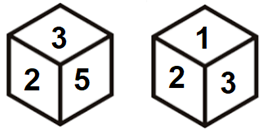
Two different positions of the same dice are shown. Select the number that will be on the face opposite to the one having 1.
Four letter-cluster pairs have been given, out of which three are alike in some manner and one is different. Select the one that is different.
The series below can be extended once the rule behind it is found. Work out the rule and supply the missing number.
2, 10, 50, 250, ?
Let a, b, c, d be propositions. Assume that the equivalence a ↔ (b v ˥b) and b ↔ c hold. Then truth value of the formula ( a ^ b) → ((a ^ c) v d) is always
A library always has
Which one of the following is always with 'Bargain'?
A scenery always has
Pointing to a photograph Lata says, "He is the son of the only son of my grandfather." How is the man in the photograph related to Lata?
Rahul`s mother is the only daughter of Monika`s father. How is Monika`s husband related to Rahul ?
A man pointing to a photograph says, "The lady in the photograph is my nephew's maternal grandmother." How is the lady in the photograph related to the man's sister who has no other sister ?
Total number of questions : 20
Number of answered questions : 0
Number of unanswered questions : 20
Reasoning [ Question No: 1 To 20 ] :
Direction for [ Question No: 1 To 1 ] :
Directions : Shown below is a layout of major streets in a city :
(The layout shows five points A, B, C, D and E joined by the streets A-B, A-C, B-C, B-D, C-D, C-E and D-E.)
Two days (Thursday and Friday) are left for campaigning before a major election, and the city administration has received requests from five political parties for taking out their processions along the following routes.
Congress : A-C-D-E
BJP : A-B-D-E
SP : A-B-C-E
BSP : B-C-E
CPM : A-C-D
Street B-D cannot be used for a political procession on Thursday due to a religious procession. The district administration has a policy of not allowing more than one procession to pass along the same street on the same day. However, the administration must allow all parties to take out their procession during these two days.
Which of the following is not true ?
Your Answer : (Not Answered)
Correct Answer : D
The statement that is not true is Congress and BSP can take out their processions on the same day.
List the streets each route uses. Congress: A-C, C-D, D-E. BJP: A-B, B-D, D-E. SP: A-B, B-C, C-E. BSP: B-C, C-E. CPM: A-C, C-D.
BJP uses B-D, closed on Thursday, so BJP must go on Friday. SP shares A-B with BJP, so SP goes on Thursday. BSP shares B-C and C-E with SP, so BSP goes on Friday. Congress shares D-E with BJP, so Congress goes on Thursday, and CPM, sharing A-C and C-D with Congress, goes on Friday.
Thursday: Congress and SP. Friday: BJP, BSP and CPM. No street is used twice on either day.
Congress is forced onto Thursday and BSP onto Friday, so they cannot march on the same day.
The other three statements are true: Congress and SP both march on Thursday; CPM shares streets with Congress and so cannot be on Thursday; and BJP, which needs street B-D, can only march on Friday.
Direction for [ Question No: 2 To 2 ] :
Refer to the data and answer the following question.
Five friends, named Ajay, Bhushan, Chandru, Dinesh and Eknath, each belonging to a different profession, play Cricket, Tennis, Hockey, Polo and Squash, not necessarily in the same order. We know that:
1. Ajay plays Tennis and he is not a Professor
2. Dinesh is not a Doctor
3. The Writer plays Squash and the Doctor plays Cricket
4. Bhushan does not play Squash
5. Eknath is the Manager and does not play Polo
6. The 5th person is an Architect
Which game is played by the Manager?
Your Answer : (Not Answered)
Correct Answer : C
The Manager plays Hockey.
The Manager is Eknath (clue 5), who does not play Polo. Squash belongs to the Writer and Cricket to the Doctor, both of whom are other people, and Ajay plays Tennis. Of the five games only Hockey remains, so Eknath plays Hockey.
Squash and Tennis are taken by the Writer and Ajay, and the answer is fully determined, so 'Cannot be determined' is wrong.
Direction for [ Question No: 3 To 3 ] :
Study the following information carefully and answer the questions given below.
P, Q, R, S, T, V, W and Z are sitting round a circle facing the centre. T is second to the right of R, who is third to the right of P. S is second to the left of P and fourth to the right of Q. Z is third to the right of V, who is not an immediate neighbour of P.
Who is on the immediate left of Z?
Your Answer : (Not Answered)
Correct Answer : C
Correct answer: S
Facing the centre, each person’s left is the next seat clockwise and their right the next seat anticlockwise. Fix P; R sits three to P’s right, T two to R’s right, S two to P’s left and Q four to S’s left. Of the two ways of placing V with Z three seats to V’s left, only one keeps V off P’s shoulder, and W takes the seat left over. Clockwise the circle reads P → Z → S → T → V → R → Q → W.
Z’s left is the next seat clockwise, and S occupies it. P is on Z’s right.
Direction for [ Question No: 4 To 4 ] :
Eight People A, B, C, D, E, F, G and H are sitting in a straight line, all of them facing the same direction. Each one of them has birthdays in different months - January, February, April, May, July, September, October and December but not necessarily in the same order.
G sits third to the right of the person whose birthday is in July. The person whose birthday is in December sits second to the right of G. A and E are immediate neighbors of each other and neither of them have their birthdays either in July or December and they are not immediate neighbor of G.
H sits third to the right of the person whose birthday is in January. Neither A nor E join in January. H’s birthday is not in December. Only two people sit between E and the person whose birthday is in October.
The person whose birthday is in February sits to the immediate left of D. Only one person sits between E and B. C has his birthday in one of the months before October. E’s birthday is in a month after May. G’s birthday is after A’s.
Who is sitting second to left of G?
Your Answer : (Not Answered)
Correct Answer : D
Correct answer: B
All eight face the same way, so “right” means the same direction for every clue. E’s birthday falls after May, yet E has neither July nor December, and E cannot be the October person because two people sit between them - so E is September. G sits three places right of the July person and December sits two places right of G, which locks July, G and December into seats n, n+3 and n+5; H sits three places right of the January person. Adding February immediately left of D, one person between E and B, and A beside E but clear of G, exactly one line survives:
1 A (April) · 2 E (September) · 3 C (July) · 4 B (January) · 5 F (October) · 6 G (May) · 7 H (February) · 8 D (December)
G is in seat 6. Counting leftwards, F is first and B, in seat 4, is second to G’s left.
Direction for [ Question No: 5 To 5 ] :
Each question given below consists of a statement, followed by two arguments numbered I and II. You have to decide which of the arguments is a 'strong' argument and which is a 'weak' argument. Give answer: (A) If only argument I is strong (B) If only argument II is strong (C) If either I or II is strong (D) If neither I nor II is strong (E) If both I and II are strong.
Statement: Should India engage into a dialogue with neighbouring countries to stop cross border tension?
Arguments:
1. Yes. This is the only way to reduce the cross border terrorism and stop loss of innocent lives.
2. No. Neighbouring countries cannot be relied upon in such matters, they may still engage in subversive activities
Your Answer : (Not Answered)
Correct Answer : A
Clearly, peaceful settlement through mutual agreement is the best option, whatever be the issue. So, argument I holds strong. Moreover, the problem indicated in II can be curbed by constant check and vigilance. So, II seems to be vague.
Direction for [ Question No: 6 To 7 ] :
Each question given below consists of a statement, followed by two arguments numbered I and II. You have to decide which of the arguments is a 'strong' argument and which is a 'weak' argument.
Give answer:
- (A) If only argument I is strong
- (B) If only argument II is strong
- (C) If either I or II is strong
- (D) If neither I nor II is strong and
- (E) If both I and II are strong.
Statement: Should income tax be abolished in India?
Arguments:
1. Yes. It is an unnecessary burden on the wage earners.
2. No. It is a good source of revenue
Your Answer : (Not Answered)
Correct Answer : B
Income -tax is levied so that every citizen can contribute a share of his earning towards the infrastructural development of the nation. So, argument I seems to be vague. However, income-tax is no doubt a good source of revenue for the government. Hence, argument II holds strong.
Statement: Should young entrepreneurs be encouraged?
Arguments:
1. Yes. They will help in industrial development of the country.
2. Yes. They will reduce the burden on employment market.
Your Answer : (Not Answered)
Correct Answer : E
Clearly, encouraging the young entrepreneurs will open up the field for the establishment of new industries. Thus, it shall help in industrial development and not only employ the entrepreneurs but create more job opportunities for others as well. So, both the arguments hold strong.
Direction for [ Question No: 8 To 8 ] :
There are five friends --- Sachin, Kunal, Mohit, Anuj and Rohan.
Sachin is shorter than Kunal but taller than Rohan.
Mohit is the tallest.
Anuj is a little shorter than Kunal and little taller than Sachin.
If they stand in the order of their heights, who will be in the middle ?
Your Answer : (Not Answered)
Correct Answer : D
Let us denote the five boys by the first letter of their names, namely S, K, M A and R.
Then,
R < S < K < M and S < A < K.
R < S < A < K < M.
Anuj is in the middle. So, the answer is (d).
Direction for [ Question No: 9 To 9 ] :
Madhu and Shobha are good in Dramatics and Computer Science.
Anjali and Madhu are good in Computer Science and Physics.
Anjali, Poonam and Nisha are good in Physics and Mathematics.
Poonam and Shobha are good in History and Dramatics.
Who is good in Computer Science, History and Dramatics
Your Answer : (Not Answered)
Correct Answer : C
The given information can be analyzed as under:
|
|
Dramatics |
Computer Sc. |
Physics |
History |
Mathematics |
|
Madhu |
X |
X |
X |
|
|
|
Shobha |
X |
X |
|
X |
|
|
Anjali |
|
X |
X |
X |
X |
|
Poonam |
X |
|
X |
X |
|
|
Nisha |
|
|
X |
X |
X |
Shobha is good in Computer Science, History, and Dramatics
Direction for [ Question No: 10 To 10 ] :
A word arrangement machine, when given an input line of words, rearranges them following a particular rule in each step. The following is an illustration of input and the steps rearrangement. (and Step VII is the last step for this input)
As per the rules followed in the above steps, find out in the given questions the appropriate step for the given input.
Input :- Go for to Though By easy To Access at
Step I :- Access Go for th Though By easy To at
Step II :- Access at Go for to Though By easy To
Step III :- Access at By Go for to Though easy To
Step IV :- Access at By easy Go for to Though To
Step V :- Access at By easy for Go to Though To
Step VI :- Access at By easy for Go Though to To
Step VII :- Access at By easy for Go Though To to
The Step II of an input is as follows :
and Do pet to on that
Which of the following would definitely be the input ?
Your Answer : (Not Answered)
Correct Answer : E
Correct answer: None of these
The machine moves words into alphabetical order one position at a time, and it skips any word already standing in its correct place - which is why “Go” is never moved in the illustration. The six words sort to and, Do, on, pet, that, to, so Step II must have the first two in place with the rest in their original order. Only the third option leaves the tail as “pet to on that”, but starting from “Do and pet to on that” Step I alone already produces the given line, and Step II would then move “on” into third place and give something different. No option works, so the answer is none of these.
Two different positions of the same dice are shown. Select the number that will be on the face opposite to the one having 1.
Your Answer : (Not Answered)
Correct Answer : C
Faces 2 and 3 appear in both views, so they are the clue. In the first view the 2 is on the left, the 3 is on top and the 5 is on the right; in the second view the 2 is still on the left, the 3 has moved to the right and the 1 is on top. So the cube has been turned about the axis through the face 2: the face that was on top (3) has gone to the right, the face that was on the right (5) has gone to the bottom, and the face that was at the back has come to the top, which is the 1. The face at the back was the one opposite to 5, so 1 is opposite to 5. The answer is 5, option (C).
Four letter-cluster pairs have been given, out of which three are alike in some manner and one is different. Select the one that is different.
Your Answer : (Not Answered)
Correct Answer : C
Three of the pairs follow the rule 'opposite letters, then swap each pair of letters'. BOLD gives opposite letters Y L O W, and swapping the pairs gives L Y W O, which is LYWO. ABLE gives Z Y O V, and swapping gives Y Z V O, which is YZVO. BAIL gives Y Z R O, and swapping gives Z Y O R, which is ZYOR.
ARMY has the opposite letters Z I N B. Swapping the pairs should give I Z B N, but the option has IZNB, in which the second pair is not swapped. So ARMY : IZNB is the one that is different.
The series below can be extended once the rule behind it is found. Work out the rule and supply the missing number.
2, 10, 50, 250, ?
Your Answer : (Not Answered)
Correct Answer : A
Correct answer: 1250
The terms are multiplied rather than added to. Dividing each by its predecessor gives the same result throughout: 10 over 2 is 5, and 50 over 10 is 5, so the ratio is 5. Multiplying the last term, 250 times 5 is 1250. As a check, dividing the answer by 5 returns 250, which is the last term shown. Geometric series overtake arithmetic ones rapidly, which is often the visual clue that a ratio rather than a difference is at work.
Let a, b, c, d be propositions. Assume that the equivalence a ↔ (b v ˥b) and b ↔ c hold. Then truth value of the formula ( a ^ b) → ((a ^ c) v d) is always
Your Answer : (Not Answered)
Correct Answer : A
Correct answer: True
The first equivalence makes a equivalent to \( b \lor \lnot b \), which is a tautology, so a is always true. Now suppose the antecedent \( a \land b \) holds; then b is true, and since \( b \leftrightarrow c \), c is true too, so \( a \land c \) is true and the consequent holds. The implication is therefore true in every case.
A library always has
Your Answer : (Not Answered)
Correct Answer : B
Correct answer: Books
The question asks what is always present, not what usually is. A library is by definition a collection of books or other written material, so books are what make it one - nothing without them is a library. The others are common but not necessary. Many libraries have computers, but a village reading room with a shelf of books is still a library. A separate reading room is a convenience, and small collections have none. And a librarian is a person employed to run a library, not part of the definition - a private library kept by its owner has no librarian at all.
Which one of the following is always with 'Bargain'?
Your Answer : (Not Answered)
Correct Answer : A
Correct answer: Exchange
The question asks what is always present, not what usually is. To bargain is to settle the terms of an exchange; with nothing passing each way there is nothing to bargain over. Lavishness, triviality and eloquence have nothing to do with it.
A scenery always has
Your Answer : (Not Answered)
Correct Answer : D
Correct answer: Composition
The question asks what is always present, not what usually is. A scenery - a view or its picture - is an arrangement of parts, so it must have a composition. Paints belong to a painting, and mountains and rivers are only some of the things a scene may contain.
Pointing to a photograph Lata says, "He is the son of the only son of my grandfather." How is the man in the photograph related to Lata?
Your Answer : (Not Answered)
Correct Answer : A
Correct answer: Brother
The only son of my grandfather is Lata’s father, so the man in the photograph is his son - Lata’s brother.
Rahul`s mother is the only daughter of Monika`s father. How is Monika`s husband related to Rahul ?
Your Answer : (Not Answered)
Correct Answer : B
Correct answer: Father
The only daughter of Monika’s father is Monika herself. She is therefore Rahul’s mother, and her husband is Rahul’s father.
A man pointing to a photograph says, "The lady in the photograph is my nephew's maternal grandmother." How is the lady in the photograph related to the man's sister who has no other sister ?
Your Answer : (Not Answered)
Correct Answer : C
Correct answer: Mother
The man’s nephew is his sister’s son, so that boy’s maternal grandmother is the mother of the man’s sister - which is the man’s own mother. The lady is therefore the sister’s mother.
Marks
Total number of questions : 20
Number of answered questions : 0
Number of unanswered questions : 20