
Instruction
- Total number of questions : 20
- Time allotted : 30:00 Minutes:Seconds.
- Each question carry 1 mark, no negative marks.
- DO NOT refresh the page.
- All the best
Solid State Physics [ Question No: 1 To 20 ] :
If there are p atoms in the primitive cell, the phonon dispersion relation will have :
A flux quantum (fluxoid) is approximately equal to 2 × 10\(^{-7}\) gauss-cm\(^{2}\). A type II superconductor is placed in a small magnetic field, which is then slowly increased till the field starts penetrating the superconductor. The strength of the field at this point is (2/\(\pi\)) × 10\(^{5}\) gauss. The penetration depth of this superconductor is :
In a p-type semiconductor, the Fermi level lies 0.4 eV above the valence band. If the concentration of the acceptor atoms is trippled and kT = 0.03 eV, the new position of the Fermi level will be :
The kinetic energy of a free electron at a corner of the first Brillouin zone of a two-dimensional square lattice is larger than that of an electron at the midpoint of a side of the zone by a factor b. The value of b is :
Fermi level in a solid is a direct measure of :
If the interatomic potential energy function can be expressed as
\[ U(R) = -\frac{A}{R^{6}} + \frac{B}{R^{12}}, \]
where A and B are constants, the atomic spacing \(R_{0}\) for which the potential energy is a minimum is given by :
Atomic weight and density of gold are 197 and 1.9 × 10⁴ kg/m3 respectively. If the velocity of sound in it is 2100 m/s, the Debye temperature for gold will be :
A single crystal of copper contains a low angle tilt boundary on (001) plane with a tilt axis parallel to [010]. The tilt angle, if the spacing of the dislocation in the boundary is 3 × 10⁻⁶ m and their Burgers vector is 0.4 × 10⁻⁹ m, is :
In a simple cubic crystal of lattice spacing a = 3 Å, a positive edge dislocation 1 mm long climbs down by 1 \(\mu\)m. The number of vacancies created or lost in the crystal is :
The primitive translational vectors of the body centered lattice are given by
\[ \vec{a} = \frac{a}{2}(\hat{i} + \hat{j} - \hat{k}), \]
\[ \vec{b} = \frac{a}{2}(-\hat{i} + \hat{j} + \hat{k}), \]
\[ \vec{c} = \frac{a}{2}(\hat{i} - \hat{j} + \hat{k}), \]
where a is the side of the conventional unit cube and \(\hat{i}, \hat{j}, \hat{k}\) are orthogonal unit vectors parallel to the cube edges. The volume of the reciprocal lattice of bcc cell is :
A rare gas inter-atomic potential is given by \( U(r) = \frac{A}{r^{12}} - \frac{B}{r^{6}} \), where A and B are material parameters. What is the spring constant for displacement of atoms in the harmonic limit, if the given equilibrium separation \( r_{0} \) is 1 au :
An X-ray diffraction pattern of cubic crystal of lattice parameter a = 3·16 Å is obtained using a monochromatic X-ray beam of wavelength 1·54 Å. The first line is obtained at θ = 20·3. The Miller indices (hkl value) of the corresponding diffracting plane is :
(Note : sin 20·3 = 0·34, sin 40·6 = 0·64)
For a metal \(C_{V} = \alpha T + \beta T^{3}\) at low temperatures. The entropy is :
Consider one mole of a monovalent metal at absolute zero temperature, obeying the free electron model. Its Fermi energy is \(E_{F}\). The energy corresponding to the filling of \(\frac{N_{A}}{2}\) electrons, where \(N_{A}\) is the Avogadro number, is \(2^{n}E_{F}\). The value of \(n\) is
A neutron beam with a wave vector \(\vec{k}\) and an energy 20.4 meV diffracts from a crystal with an outgoing wave vector \(\vec{k}'\). One of the diffraction peaks is observed for the reciprocal lattice vector \(G\) of magnitude 3.14 Å-1. What is the diffraction angle in degrees (rounded off to the nearest integer) that \(\vec{k}\) makes with the plane? (Use mass of neutron = 1.67 × 10⁻²⁷ Kg)
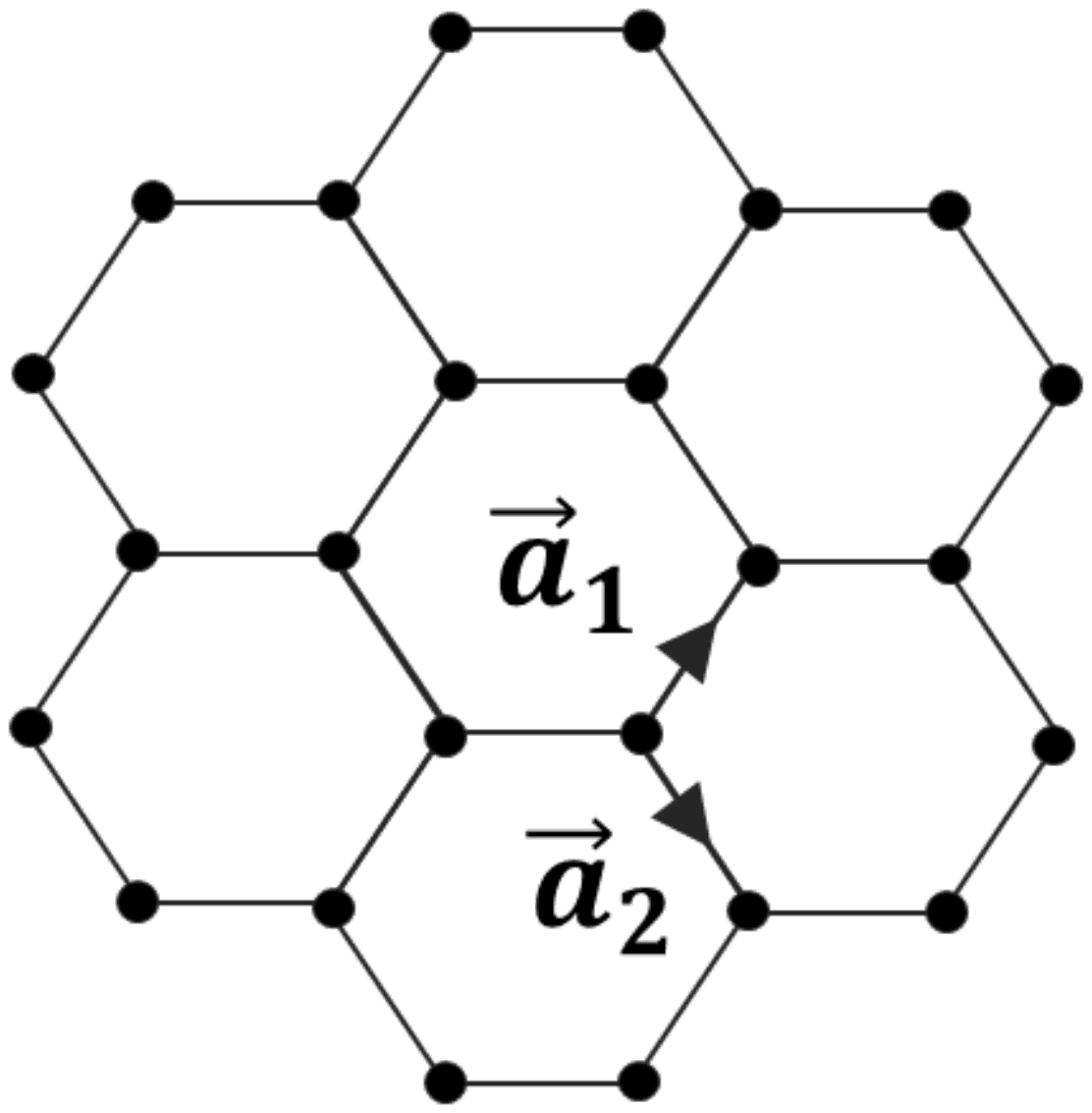
Graphene is a two dimensional material, in which carbon atoms are arranged in a honeycomb lattice with lattice constant \(a\). As shown in the figure, \(\vec{a}_{1}\) and \(\vec{a}_{2}\) are two lattice vectors. Which one of the following is the area of the first Brillouin zone for this lattice?
At \(T = 0\) K, which of the following diagram represents the occupation probability \(P(E)\) of energy states of electrons in a BCS type superconductor?
At low temperatures (\(T\)), the specific heat of common metals is described by (with \(\alpha\) and \(\beta\) as constants)
For a two-dimensional hexagonal lattice with lattice constant \(a\), the atomic density is
A compound consists of three ions X, Y and Z. The Z ions are arranged in an FCC arrangement. The X ions occupy \(\frac{1}{6}\) of the tetrahedral voids and the Y ions occupy \(\frac{1}{3}\) of the octahedral voids. Which one of the following is the CORRECT chemical formula of the compound?
Total number of questions : 20
Number of answered questions : 0
Number of unanswered questions : 20
Solid State Physics [ Question No: 1 To 20 ] :
If there are p atoms in the primitive cell, the phonon dispersion relation will have :
Your Answer : (Not Answered)
Correct Answer : B
There are 3p - 3 optical phonon branches.
With p atoms in the primitive cell, each atom can move in three directions, so there are 3p normal modes for every wave vector, that is 3p branches in all. Three of them are acoustic branches (one longitudinal and two transverse), in which the whole cell moves together and the frequency goes to zero at long wavelengths. The remaining branches are optical:
\[ 3p - 3 \]
A monatomic lattice (p = 1) therefore has no optical branches, and a diatomic one such as NaCl has three. '3' counts the acoustic branches, '3p' all of them, and '3p - 1' has no basis.
A flux quantum (fluxoid) is approximately equal to 2 × 10\(^{-7}\) gauss-cm\(^{2}\). A type II superconductor is placed in a small magnetic field, which is then slowly increased till the field starts penetrating the superconductor. The strength of the field at this point is (2/\(\pi\)) × 10\(^{5}\) gauss. The penetration depth of this superconductor is :
Your Answer : (Not Answered)
Correct Answer : B
The penetration depth is 100 Å.
The field at which flux first penetrates is the lower critical field, estimated in the question's model as one flux quantum spread over an area of about \(\pi\lambda^{2}\):
\[ \begin{aligned} H_{c1} &\approx \frac{\Phi_{0}}{\pi\lambda^{2}} \\ \lambda^{2} &= \frac{\Phi_{0}}{\pi H_{c1}} \end{aligned} \]
\[ \begin{aligned} \lambda^{2} &= \frac{2 \times 10^{-7}}{\pi \times (2/\pi) \times 10^{5}} \\ &= 10^{-12}\ \text{cm}^{2} \end{aligned} \]
so \(\lambda = 10^{-6}\) cm = 100 Å. The factor \(2/\pi\) in the field is chosen to cancel the \(\pi\), which shows this is the intended relation.
In a p-type semiconductor, the Fermi level lies 0.4 eV above the valence band. If the concentration of the acceptor atoms is trippled and kT = 0.03 eV, the new position of the Fermi level will be :
Your Answer : (Not Answered)
Correct Answer : D
The Fermi level moves down to 0.367 eV above the valence band.
In a p-type semiconductor with full ionisation, \(p \approx N_{A}\) and \(E_{F} - E_{V} = kT\,\text{ln}(N_{V}/N_{A})\). Tripling \(N_{A}\) lowers this by \(kT\,\text{ln}\,3\):
\[ \begin{aligned} \Delta &= 0.03 \times \text{ln}\,3 = 0.03 \times 1.099 \\ &= 0.033\ \text{eV} \\ E_{F} - E_{V} &= 0.400 - 0.033 = 0.367\ \text{eV} \end{aligned} \]
More acceptors make the material more strongly p-type, so the Fermi level moves closer to the valence band, which rules out 0.525 eV. 0.250 eV and 0.100 eV are far too large a shift for a threefold change in doping.
The kinetic energy of a free electron at a corner of the first Brillouin zone of a two-dimensional square lattice is larger than that of an electron at the midpoint of a side of the zone by a factor b. The value of b is :
Your Answer : (Not Answered)
Correct Answer : B
The factor is b = 2.
For a square lattice of side a, the first Brillouin zone is a square with corners at \((\pm\pi/a, \pm\pi/a)\) and side midpoints at \((\pm\pi/a, 0)\) and \((0, \pm\pi/a)\). A free electron's kinetic energy is \(\hbar^{2}k^{2}/2m\), so
\[ \begin{aligned} k_{corner}^{2} &= 2\left(\frac{\pi}{a}\right)^{2} \\ k_{mid}^{2} &= \left(\frac{\pi}{a}\right)^{2} \\ b &= \frac{k_{corner}^{2}}{k_{mid}^{2}} = 2 \end{aligned} \]
\(\sqrt{2}\) is the ratio of the wave vectors, not of the energies; 4 and 8 square that ratio once or twice too often.
Fermi level in a solid is a direct measure of :
Your Answer : (Not Answered)
Correct Answer : D
The Fermi level is a direct measure of the chemical potential of electrons.
In the Fermi-Dirac distribution \(f(E) = \frac{1}{e^{(E - \mu)/k_{B}T} + 1}\), the Fermi level is the chemical potential \(\mu\): the energy at which the occupation probability is one half, and the energy needed to add one electron to the system. At absolute zero it equals the Fermi energy, the highest occupied level. Two materials in contact exchange electrons until their Fermi levels line up, which is what a common chemical potential means.
The Fermi level is not a current, a temperature or a resistivity, although it shifts slightly with temperature and helps decide how many carriers conduct.
If the interatomic potential energy function can be expressed as
\[ U(R) = -\frac{A}{R^{6}} + \frac{B}{R^{12}}, \]
where A and B are constants, the atomic spacing \(R_{0}\) for which the potential energy is a minimum is given by :
Your Answer : (Not Answered)
Correct Answer : B
The equilibrium spacing is \(R_{0} = (2B/A)^{1/6}\).
The minimum of U(R) is where its derivative vanishes:
\[ \begin{aligned} \frac{dU}{dR} &= \frac{6A}{R^{7}} - \frac{12B}{R^{13}} = 0 \\ R^{6} &= \frac{2B}{A} \end{aligned} \]
so \(R_{0} = (2B/A)^{1/6}\). This is the Lennard-Jones form, with an attractive \(R^{-6}\) van der Waals term and a repulsive \(R^{-12}\) term. The other options do not have the dimension of a length; \(A^{2}/4B\) is the depth of the well, \(-U_{min}\).
Atomic weight and density of gold are 197 and 1.9 × 10⁴ kg/m3 respectively. If the velocity of sound in it is 2100 m/s, the Debye temperature for gold will be :
Your Answer : (Not Answered)
Correct Answer : B
The Debye temperature is about 240 K.
First the number of atoms per unit volume, then the Debye wave number \(k_{D} = (6\pi^{2}n)^{1/3}\), and \(\theta_{D} = \hbar v k_{D}/k_{B}\):
\[ \begin{aligned} n &= \frac{1.9 \times 10^{4} \times 6.02 \times 10^{23}}{0.197} \\ &= 5.8 \times 10^{28}\ \text{m}^{-3} \\ k_{D} &= (6\pi^{2}n)^{1/3} = 1.51 \times 10^{10}\ \text{m}^{-1} \\ \frac{\hbar v}{k_{B}} &= \frac{1.055 \times 10^{-34}}{1.38 \times 10^{-23}} \times 2100 \\ &= 1.60 \times 10^{-8}\ \text{K m} \\ \theta_{D} &= 1.60 \times 10^{-8} \times 1.51 \times 10^{10} \\ &\approx 242\ \text{K} \end{aligned} \]
The atomic weight 197 must be converted to 0.197 kg/mol. The other values do not follow from this sound speed; the tabulated Debye temperature of gold, about 165 K, is lower because a single sound speed overestimates it.
A single crystal of copper contains a low angle tilt boundary on (001) plane with a tilt axis parallel to [010]. The tilt angle, if the spacing of the dislocation in the boundary is 3 × 10⁻⁶ m and their Burgers vector is 0.4 × 10⁻⁹ m, is :
Your Answer : (Not Answered)
Correct Answer : D
The tilt angle is \(1.33 \times 10^{-4}\) rad.
A low-angle tilt boundary is a wall of edge dislocations. If their Burgers vector is b and their spacing D, the misorientation across the boundary is, for small angles,
\[ \begin{aligned} \theta &\approx \frac{b}{D} = \frac{0.4 \times 10^{-9}}{3 \times 10^{-6}} \\ &= 1.33 \times 10^{-4}\ \text{rad} \end{aligned} \]
The crystallographic planes given, (001) and [010], describe the geometry of the boundary but are not needed for the angle. The other values do not follow from \(b/D\); for example \(2.00 \times 10^{-4}\) would need a spacing of 2 \(\mu\)m.
In a simple cubic crystal of lattice spacing a = 3 Å, a positive edge dislocation 1 mm long climbs down by 1 \(\mu\)m. The number of vacancies created or lost in the crystal is :
Your Answer : (Not Answered)
Correct Answer : A
The number of vacancies is 1.10 × 10\(^{10}\).
When an edge dislocation climbs, the edge of its extra half-plane gains or loses a row of atoms for every lattice spacing it moves. Climbing down extends the half-plane, and each added atom leaves a vacancy behind. The number of atoms per row and the number of rows are:
\[ \begin{aligned} \frac{L}{a} &= \frac{10^{-3}}{3 \times 10^{-10}} = 3.33 \times 10^{6} \\ \frac{h}{a} &= \frac{10^{-6}}{3 \times 10^{-10}} = 3.33 \times 10^{3} \end{aligned} \]
Their product is \(1.11 \times 10^{10}\), option A. The larger options would need the climb to be counted over an area or volume much greater than the plane swept by the dislocation line.
The primitive translational vectors of the body centered lattice are given by
\[ \vec{a} = \frac{a}{2}(\hat{i} + \hat{j} - \hat{k}), \]
\[ \vec{b} = \frac{a}{2}(-\hat{i} + \hat{j} + \hat{k}), \]
\[ \vec{c} = \frac{a}{2}(\hat{i} - \hat{j} + \hat{k}), \]
where a is the side of the conventional unit cube and \(\hat{i}, \hat{j}, \hat{k}\) are orthogonal unit vectors parallel to the cube edges. The volume of the reciprocal lattice of bcc cell is :
Your Answer : (Not Answered)
Correct Answer : B
The volume is \(2(2\pi/a)^{3}\).
The volume of the primitive cell is the scalar triple product of the given vectors. For the bcc lattice it is half the conventional cube:
\[ \begin{aligned} V_{c} &= \vec{a}\cdot(\vec{b} \times \vec{c}) \\ &= \frac{a^{3}}{2} \end{aligned} \]
The reciprocal lattice cell has volume \((2\pi)^{3}/V_{c}\):
\[ \begin{aligned} V^{*} &= \frac{(2\pi)^{3}}{a^{3}/2} \\ &= 2\left(\frac{2\pi}{a}\right)^{3} \end{aligned} \]
The option \(\frac{1}{2}a^{3}\) is the direct-lattice primitive cell, not its reciprocal. The reciprocal of bcc is an fcc lattice, and the other options do not give its cell volume.
A rare gas inter-atomic potential is given by \( U(r) = \frac{A}{r^{12}} - \frac{B}{r^{6}} \), where A and B are material parameters. What is the spring constant for displacement of atoms in the harmonic limit, if the given equilibrium separation \( r_{0} \) is 1 au :
Your Answer : (Not Answered)
Correct Answer : A
The spring constant is 156A − 42B.
In the harmonic limit the spring constant is the curvature of the potential at equilibrium, \( k = U''(r_{0}) \):
\[ \begin{aligned} U'(r) &= -\frac{12A}{r^{13}} + \frac{6B}{r^{7}} \\ U''(r) &= \frac{156A}{r^{14}} - \frac{42B}{r^{8}} \end{aligned} \]
Setting \( r_{0} = 1 \) gives \( 156A - 42B \). The forms in 12 and 6 are the first derivative, which is the force (and vanishes at equilibrium), not the stiffness, and 42A − 156B swaps the coefficients.
An X-ray diffraction pattern of cubic crystal of lattice parameter a = 3·16 Å is obtained using a monochromatic X-ray beam of wavelength 1·54 Å. The first line is obtained at θ = 20·3. The Miller indices (hkl value) of the corresponding diffracting plane is :
(Note : sin 20·3 = 0·34, sin 40·6 = 0·64)
Your Answer : (Not Answered)
Correct Answer : A
The plane is (110).
From Bragg's law in first order, the spacing of the diffracting planes is
\[ \begin{aligned} d &= \frac{\lambda}{2\sin\theta} = \frac{1.54}{2 \times 0.34} \\ &= 2.265\ \text{\AA} \end{aligned} \]
For a cubic crystal \( d = a/\sqrt{h^{2} + k^{2} + l^{2}} \), so
\[ \begin{aligned} \sqrt{h^{2} + k^{2} + l^{2}} &= \frac{3.16}{2.265} \\ &= 1.395 \approx \sqrt{2} \end{aligned} \]
The only integers with \( h^{2} + k^{2} + l^{2} = 2 \) are 1, 1, 0. The other planes give different spacings: (100) gives 3.16 Å, (200) gives 1.58 Å and (220) gives 1.12 Å. A first line from (110) is what a body-centred cubic lattice produces.
For a metal \(C_{V} = \alpha T + \beta T^{3}\) at low temperatures. The entropy is :
Your Answer : (Not Answered)
Correct Answer : C
The entropy is \(\alpha T + \frac{\beta T^{3}}{3}\).
At constant volume \(dS = C_{V}\,dT/T\). Integrating from absolute zero, where S = 0 by the third law:
\[ \begin{aligned} S &= \int_{0}^{T}\frac{\alpha T' + \beta T'^{3}}{T'}\,dT' \\ &= \int_{0}^{T}(\alpha + \beta T'^{2})\,dT' \\ &= \alpha T + \frac{\beta T^{3}}{3} \end{aligned} \]
The \(\alpha T\) term is the electronic contribution and the \(T^{3}\) term the Debye lattice contribution. The options \(\alpha + 3\beta T^{2}\) and \(\alpha T + 3\beta T^{2}\) differentiate instead of integrating, and \(\alpha + \beta T^{3}/3\) does not vanish at T = 0.
Consider one mole of a monovalent metal at absolute zero temperature, obeying the free electron model. Its Fermi energy is \(E_{F}\). The energy corresponding to the filling of \(\frac{N_{A}}{2}\) electrons, where \(N_{A}\) is the Avogadro number, is \(2^{n}E_{F}\). The value of \(n\) is
Your Answer : (Not Answered)
Correct Answer : A
The value is \(n = -\frac{2}{3}\).
In the free electron model the Fermi energy depends on the electron density as \(E_{F} \propto N^{2/3}\) (for a fixed volume), since \(E_{F} = \frac{\hbar^{2}}{2m}(3\pi^{2}N/V)^{2/3}\). Filling only half the electrons gives
\[ E = E_{F}\left(\frac{1}{2}\right)^{2/3} = 2^{-2/3}E_{F} \]
so \(n = -\frac{2}{3}\). The energy must be less than \(E_{F}\), which rules out \(+\frac{2}{3}\); \(-\frac{1}{3}\) and \(-1\) use the wrong power of the density.
A neutron beam with a wave vector \(\vec{k}\) and an energy 20.4 meV diffracts from a crystal with an outgoing wave vector \(\vec{k}'\). One of the diffraction peaks is observed for the reciprocal lattice vector \(G\) of magnitude 3.14 Å-1. What is the diffraction angle in degrees (rounded off to the nearest integer) that \(\vec{k}\) makes with the plane? (Use mass of neutron = 1.67 × 10⁻²⁷ Kg)
Your Answer : (Not Answered)
Correct Answer : B
The angle is 30°.
Find the neutron's wave number from its energy:
\[ \begin{aligned} E &= 20.4\ \text{meV} = 3.27 \times 10^{-21}\ \text{J} \\ p &= \sqrt{2mE} = 3.30 \times 10^{-24}\ \text{kg m/s} \\ k &= p/\hbar \approx 3.13\ \mathring{\mathrm{A}}^{-1} \end{aligned} \]
Elastic diffraction requires \(\vec{k}' - \vec{k} = \vec{G}\), which with \(|\vec{k}'| = |\vec{k}|\) is Bragg's law in the form \(G = 2k\sin\theta\), where \(\theta\) is the angle between \(\vec{k}\) and the reflecting planes:
\[ \begin{aligned} \sin\theta &= \frac{3.14}{2 \times 3.13} \approx 0.50 \\ \theta &= 30^{\circ} \end{aligned} \]
60° is the total scattering angle \(2\theta\), not the angle with the planes; 15° and 45° do not satisfy the Bragg condition.
Graphene is a two dimensional material, in which carbon atoms are arranged in a honeycomb lattice with lattice constant \(a\). As shown in the figure, \(\vec{a}_{1}\) and \(\vec{a}_{2}\) are two lattice vectors. Which one of the following is the area of the first Brillouin zone for this lattice?
Your Answer : (Not Answered)
Correct Answer : A
The area is \(\frac{8\pi^{2}}{3\sqrt{3}a^{2}}\), with \(a\) read, as in the figure, as the carbon-carbon spacing.
The arrows \(\vec{a}_{1}\) and \(\vec{a}_{2}\) in the figure each join one carbon atom to a neighbouring atom, so the length \(a\) here is the C-C distance. The honeycomb's true Bravais lattice is triangular, with primitive vectors of length \(\sqrt{3}a\) at 60° to each other, so the real-space unit cell has area
\[ \begin{aligned} A_{cell} &= (\sqrt{3}a)^{2}\sin 60^{\circ} \\ &= \frac{3\sqrt{3}}{2}a^{2} \end{aligned} \]
The first Brillouin zone has area \((2\pi)^{2}/A_{cell}\):
\[ \begin{aligned} A_{BZ} &= \frac{4\pi^{2} \times 2}{3\sqrt{3}a^{2}} \\ &= \frac{8\pi^{2}}{3\sqrt{3}a^{2}} \end{aligned} \]
If \(a\) were instead the length of the primitive vectors, the same steps would give \(8\pi^{2}/\sqrt{3}a^{2}\); the key follows the figure's labelling. The options with \(4\pi^{2}\) drop the factor 2 that comes from \(\sin 60^{\circ} = \sqrt{3}/2\).
At \(T = 0\) K, which of the following diagram represents the occupation probability \(P(E)\) of energy states of electrons in a BCS type superconductor?
Your Answer : (Not Answered)
Correct Answer : A
The correct diagram is (A): \(P(E)\) is 1 well below \(E_{F}\) and falls smoothly to 0 across \(E_{F}\).
In the BCS ground state, electrons pair up and the occupation of a state of energy \(\xi\) measured from \(E_{F}\) is
\[ \begin{aligned} v_{k}^{2} &= \frac{1}{2}\left(1 - \frac{\xi}{E}\right), \\ E &= \sqrt{\xi^{2} + \Delta^{2}} \end{aligned} \]
Even at \(T = 0\) this goes smoothly from 1 to 0 over an energy range of order the gap \(\Delta\), passing through \(\frac{1}{2}\) at \(E_{F}\). It looks like a Fermi function at finite temperature, though its origin is pairing, not thermal excitation.
The sharp step (B) is a normal metal at \(T = 0\). The rising curve (C) is inverted, giving occupied states above \(E_{F}\) and empty ones below, and the peak (D) would leave deep states unoccupied.
At low temperatures (\(T\)), the specific heat of common metals is described by (with \(\alpha\) and \(\beta\) as constants)
Your Answer : (Not Answered)
Correct Answer : A
The low-temperature specific heat of a metal is \(\alpha T + \beta T^{3}\).
Two contributions add. The conduction electrons give a term linear in \(T\), because only the electrons within about \(k_{B}T\) of the Fermi level can be excited. The lattice vibrations give the Debye \(T^{3}\) law at temperatures well below the Debye temperature. At the lowest temperatures the linear electronic term dominates, and a plot of \(C/T\) against \(T^{2}\) is a straight line.
\(\beta T^{3}\) alone describes an insulator, with no free electrons. \(\exp(-\alpha/T)\) is the behaviour of a system with an energy gap, such as the Einstein model or a superconductor. There is no \(T^{5}\) term in the specific heat; a \(T^{5}\) law belongs to the electron-phonon resistivity.
For a two-dimensional hexagonal lattice with lattice constant \(a\), the atomic density is
Your Answer : (Not Answered)
Correct Answer : C
The key's answer is \(\frac{4}{3\sqrt{3}a^{2}}\), which treats the hexagonal lattice as a honeycomb of regular hexagons of side \(a\).
In that reading, atoms sit at the corners of hexagons of side \(a\). Each corner is shared by three hexagons, so one hexagon holds \(6 \times \frac{1}{3} = 2\) atoms, and its area is \(\frac{3\sqrt{3}}{2}a^{2}\):
\[ \begin{aligned} n &= \frac{2}{\frac{3\sqrt{3}}{2}a^{2}} \\ &= \frac{4}{3\sqrt{3}a^{2}} \approx \frac{0.77}{a^{2}} \end{aligned} \]
Strictly, the honeycomb is not a Bravais lattice; the triangular Bravais lattice with spacing \(a\) has density \(\frac{2}{\sqrt{3}a^{2}}\), which is not among the options, so the paper intends the honeycomb arrangement. \(\frac{1}{3\sqrt{3}a^{2}}\) counts only one-third of an atom per hexagon, and the other options use wrong areas.
A compound consists of three ions X, Y and Z. The Z ions are arranged in an FCC arrangement. The X ions occupy \(\frac{1}{6}\) of the tetrahedral voids and the Y ions occupy \(\frac{1}{3}\) of the octahedral voids. Which one of the following is the CORRECT chemical formula of the compound?
Your Answer : (Not Answered)
Correct Answer : B
The formula is \(\mathrm{XYZ_{3}}\).
An FCC unit cell holds 4 lattice points, here 4 Z ions. It contains 8 tetrahedral voids and 4 octahedral voids.
\[ \begin{aligned} X &= \frac{1}{6} \times 8 = \frac{4}{3}, \quad Y = \frac{1}{3} \times 4 = \frac{4}{3} \\ X : Y : Z &= \frac{4}{3} : \frac{4}{3} : 4 = 1 : 1 : 3 \end{aligned} \]
The other formulas do not follow from these counts; they come from miscounting the ions or voids per cell, for example forgetting that an FCC cell has twice as many tetrahedral as octahedral voids.
Marks
Total number of questions : 20
Number of answered questions : 0
Number of unanswered questions : 20