
Instruction
- Total number of questions : 20
- Time allotted : 30:00 Minutes:Seconds.
- Each question carry 1 mark, no negative marks.
- DO NOT refresh the page.
- All the best
Strength of Materials [ Question No: 1 To 20 ] :
The strength of the beam mainly depends upon :
A solid circular shaft is subjected to pure torsion. The ratio of maximum shear stress to maximum normal stress at any point would be :
Bending moment 'M' and Torque 'T' are applied on a solid circular shaft. If the maximum bending stress is equal to the maximum shear stress developed ,'M' is equal to:
The stress induced in a body due to suddenly applied load compared to, when it is applied gradually is :
Strain energy per unit volume is given by, where τ is shear stress and G is modulus of rigidity
Resilience of a material becomes important when it is subjected to :
Hook's law holds good up to -
Volumetric strain is defined as which of the following?
The maximum slope at the free end of cantilever beam having uniformly distributed load 'w' through out its length is given by:
In the limitation of Euler's formula, the critical stress σc which is defined as an average stress over the cross-section for a standard case is -
A thin cylinder (thickness, t and diameter, d) with closed ends is subjected to an internal pressure, p. The ratio of hoop stress to longitudinal stress developed in the wall of the cylinder is
A circular shaft ABC of diameter, d and length, L is fixed at end A. It is subjected to the torsional moments at point B and point C as shown in the figure. The ratio of angle of twists at point B to point C is
An L-shaped elastic member ABC with slender arms AB and BC of uniform cross-section is clamped at end A and connected to a pin at end C. The pin remains in continuous contact with and is constrained to move in a smooth horizontal slot. The section modulus of the member is same in both the arms. The end C is subjected to a horizontal force \(P\) and all the deflections are in the plane of the figure. Given the length AB is \(4a\) and length BC is \(a\), the magnitude and direction of the normal force on the pin from the slot, respectively, are
A point in a beam experiences a tensile stress (due to bending) of 50 N/mm2 and a shear stress of 20 N/mm2. The principal stresses are
The state of stress at a point under plane stress condition is
σxx = 40 MPa, σyy = 100 MPa and τxy = 40 MPa.
The radius of the Mohr’s circle representing the given state of stress in MPa is
For a long slender column of uniform cross section, the ratio of critical buckling load for the case with both ends clamped to the case with both ends hinged is
A uniform symmetric cross-section cantilever beam of length \(L\) is subjected to a transverse force \(P\) at the free end, as shown in the figure. The Young’s modulus of the material is E and the moment of inertia is I. Ignoring the contributions due to transverse shear, the strain energy stored in the beam is _____.
A simply supported beam of span L is subjected to a couple Mo at a distance a from support A. Among the four options (Option-I to Option-IV) shown, the correct shear force diagram of the beam is
The Poisson’s ratio for a perfectly incompressible linear elastic material is
The three-dimensional stress-strain relationship for an isotropic material is given as
\[ \begin{Bmatrix} \sigma_{xx} \\ \sigma_{yy} \\ \sigma_{zz} \\ \tau_{yz} \\ \tau_{xz} \\ \tau_{xy} \end{Bmatrix} = \begin{bmatrix} P & Q & Q & 0 & 0 & 0 \\ Q & P & Q & 0 & 0 & 0 \\ Q & Q & P & 0 & 0 & 0 \\ 0 & 0 & 0 & R & 0 & 0 \\ 0 & 0 & 0 & 0 & R & 0 \\ 0 & 0 & 0 & 0 & 0 & R \end{bmatrix} \begin{Bmatrix} \varepsilon_{xx} \\ \varepsilon_{yy} \\ \varepsilon_{zz} \\ \gamma_{yz} \\ \gamma_{xz} \\ \gamma_{xy} \end{Bmatrix} \]
where, P, Q and R are the three elastic constants, σ and τ represent normal and shear stresses and ε and γ represent normal and engineering shear strains. Which one of the following options is correct?
Total number of questions : 20
Number of answered questions : 0
Number of unanswered questions : 20
Strength of Materials [ Question No: 1 To 20 ] :
The strength of the beam mainly depends upon :
Your Answer : (Not Answered)
Correct Answer : D
The strength of a beam mainly depends on its section modulus.
The moment of resistance a beam can develop is \(M = \sigma Z\), where \(\sigma\) is the allowable bending stress and \(Z = I/y_{max}\) is the section modulus. For a given material, the larger the section modulus, the greater the bending moment the beam can carry, which is why I-sections place material far from the neutral axis.
The bending moment is the load's effect on the beam, not the beam's strength. The weight and the position of the centre of gravity do not set the resisting moment.
A solid circular shaft is subjected to pure torsion. The ratio of maximum shear stress to maximum normal stress at any point would be :
Your Answer : (Not Answered)
Correct Answer : D
The ratio is 1 : 1.
Pure torsion puts every element in a state of pure shear, with shear stress \(\tau\) on its faces and no direct stress. The principal stresses for pure shear are \(\sigma_{1} = +\tau\) and \(\sigma_{2} = -\tau\), acting on planes at 45° to the shaft axis.
So the maximum normal stress equals the maximum shear stress, and the ratio is 1 : 1. This is why a brittle shaft, weak in tension, fails in torsion along a 45° helix, while a ductile shaft shears across its section. The ratios 2 : 1 and 1 : 2 belong to simple tension, where the maximum shear is half the normal stress.
Bending moment 'M' and Torque 'T' are applied on a solid circular shaft. If the maximum bending stress is equal to the maximum shear stress developed ,'M' is equal to:
Your Answer : (Not Answered)
Correct Answer : B
M is equal to T/2.
For a solid circular shaft of diameter d, the maximum bending stress and maximum torsional shear stress are
\[ \begin{aligned} \sigma_b &= \frac{32M}{\pi d^3}, \quad \tau = \frac{16T}{\pi d^3} \\ \sigma_b = \tau &\Rightarrow 32M = 16T \Rightarrow M = \tfrac{T}{2} \end{aligned} \]
M = T would hold only if the section moduli in bending and torsion were equal, but the polar section modulus is twice the bending one. 2T reverses the ratio.
The stress induced in a body due to suddenly applied load compared to, when it is applied gradually is :
Your Answer : (Not Answered)
Correct Answer : D
The stress under a suddenly applied load is two times that under a gradually applied load.
A load P applied gradually does work \(\frac{1}{2}P\delta\), giving stress \(\sigma = \frac{P}{A}\). Applied suddenly, the full load acts through the whole extension and does work \(P\delta\), which is stored as strain energy:
\[ \begin{aligned} P\delta &= \frac{\sigma^{2}}{2E} A L, \quad \delta = \frac{\sigma L}{E} \\ \sigma &= \frac{2P}{A} \end{aligned} \]
So the suddenly applied load produces twice the stress, and twice the extension, of the same load applied slowly. 'Four times' would be confusing stress with strain energy, which goes as the square of stress. 'Same' and 'half' ignore the extra work done by a load that arrives all at once.
Strain energy per unit volume is given by, where τ is shear stress and G is modulus of rigidity
Your Answer : (Not Answered)
Correct Answer : B
The strain energy per unit volume is \(\frac{\tau^{2}}{2G}\).
Under pure shear the energy stored is the area under the shear stress-strain line, half of stress times strain. With \(\gamma = \tau/G\):
\[ u = \frac{1}{2}\tau\gamma = \frac{\tau^{2}}{2G} \]
This is the shear counterpart of \(\sigma^{2}/2E\) for direct stress. \(\tau^{2}/4G\) is the average for a solid circular shaft in torsion, where the stress varies from zero at the centre, not the value at a point. \(\tau/4G\) has the wrong dimensions, and \(2\tau^{2}/3G\) matches no standard case.
Resilience of a material becomes important when it is subjected to :
Your Answer : (Not Answered)
Correct Answer : B
Resilience matters most under shock loading.
Resilience is the strain energy a material absorbs within the elastic limit and gives back when unloaded. A suddenly applied or impact load has to be absorbed as energy, so a part's ability to take a shock without permanent deformation depends on its resilience. Springs and parts that take impact are chosen for it.
Fatigue depends on endurance under repeated stress, thermal stresses on expansion and restraint, and pure static loading on strength, not on stored energy.
Hook's law holds good up to -
Your Answer : (Not Answered)
Correct Answer : B
The key's answer is elastic limit.
Hooke's law says stress is proportional to strain. Strictly it holds up to the limit of proportionality, which lies just below the elastic limit; for most metals the two are so close that textbooks commonly state that Hooke's law holds up to the elastic limit.
Proportional limit is not an option. Beyond the elastic limit, at the yield point and up to breaking, the material deforms plastically and stress is no longer proportional to strain, so those options are wrong.
Volumetric strain is defined as which of the following?
Your Answer : (Not Answered)
Correct Answer : C
Volumetric strain is \(\frac{\delta V}{V}\).
Strain is always a change divided by the original value. Volumetric strain is the change in volume divided by the original volume, a dimensionless ratio. For small strains it equals the sum of the three linear strains, \(e_v = e_x + e_y + e_z\).
\(\frac{V}{\delta V}\) is the reciprocal, and the forms with m (mass) are not strains at all, since they mix mass with volume.
The maximum slope at the free end of cantilever beam having uniformly distributed load 'w' through out its length is given by:
Your Answer : (Not Answered)
Correct Answer : C
The slope at the free end is \(\frac{wl^{3}}{6EI}\).
For a cantilever with a uniformly distributed load w per unit length over its whole length l, the bending moment at distance x from the free end is \(wx^{2}/2\). Integrating the curvature from the fixed end, where the slope is zero:
\[ \begin{aligned} \theta &= \int_{0}^{l} \frac{wx^{2}}{2EI}\,dx \\ &= \frac{wl^{3}}{6EI} \end{aligned} \]
\(wl^{3}/3EI\) is the deflection form for a point load W (as \(Wl^{3}/3EI\)), not a slope. \(wl^{4}/8EI\) is the deflection under this load, and \(wl^{3}/8EI\) borrows its 8 for the slope. \(5wl^{3}/48EI\) matches no standard cantilever result.
In the limitation of Euler's formula, the critical stress σc which is defined as an average stress over the cross-section for a standard case is -
Your Answer : (Not Answered)
Correct Answer : B
The critical stress is \(\sigma_{c} = \pi^{2} E / (l_{e}/K)^{2}\).
Euler's critical load is \(P = \pi^{2} EI / l_{e}^{2}\). Dividing by the area A and writing \(I = AK^{2}\), where K is the least radius of gyration:
\[ \begin{aligned} \sigma_{c} &= \frac{P}{A} = \frac{\pi^{2} E A K^{2}}{A\, l_{e}^{2}} \\ &= \frac{\pi^{2} E}{(l_{e}/K)^{2}} \end{aligned} \]
The ratio \(l_{e}/K\) is the slenderness ratio. The first option keeps I, which belongs in the load, not the stress. The options with \(K/l_{e}\) invert the slenderness ratio, which would make stress rise with length.
A thin cylinder (thickness, t and diameter, d) with closed ends is subjected to an internal pressure, p. The ratio of hoop stress to longitudinal stress developed in the wall of the cylinder is
Your Answer : (Not Answered)
Correct Answer : D
The ratio is 2:1.
For a thin cylinder with closed ends, a force balance on a longitudinal section gives the hoop stress, and one on a transverse section gives the longitudinal stress:
\[ \begin{aligned} \sigma_{h} &= \frac{pd}{2t} \\ \sigma_{l} &= \frac{pd}{4t} \end{aligned} \]
so \(\sigma_{h}/\sigma_{l} = 2\). The hoop stress is the larger, which is why thin pipes split along their length. 1:2 inverts the ratio, and 1:1 would hold only for a thin sphere, where the stress is \(pd/4t\) in every direction.
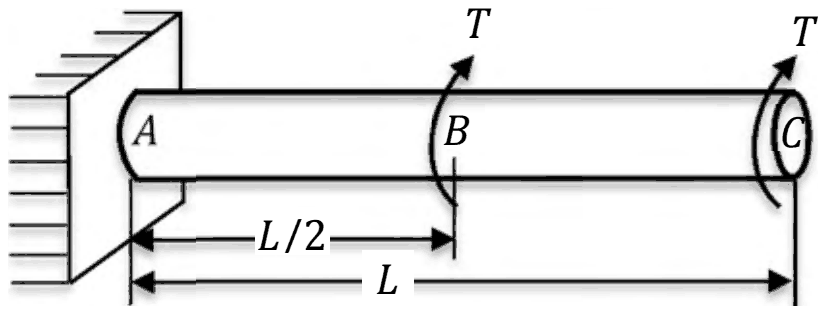
A circular shaft ABC of diameter, d and length, L is fixed at end A. It is subjected to the torsional moments at point B and point C as shown in the figure. The ratio of angle of twists at point B to point C is
Your Answer : (Not Answered)
Correct Answer : D
The ratio is 1 : 1.5.
Both torques T act in the same sense. Segment AB carries the total torque \(2T\), and segment BC carries only T. With \(\theta = TL/(GJ)\) for each segment:
\[ \begin{aligned} \theta_{B} &= \frac{2T(L/2)}{GJ} = \frac{TL}{GJ} \\ \theta_{C} &= \theta_{B} + \frac{T(L/2)}{GJ} = \frac{1.5\,TL}{GJ} \end{aligned} \]
so \(\theta_{B} : \theta_{C} = 1 : 1.5\). 1 : 2 is what you get by letting each segment carry only T, and 1.5 : 1 inverts the ratio; the twist at the free end can never be smaller than at B when both torques act the same way.
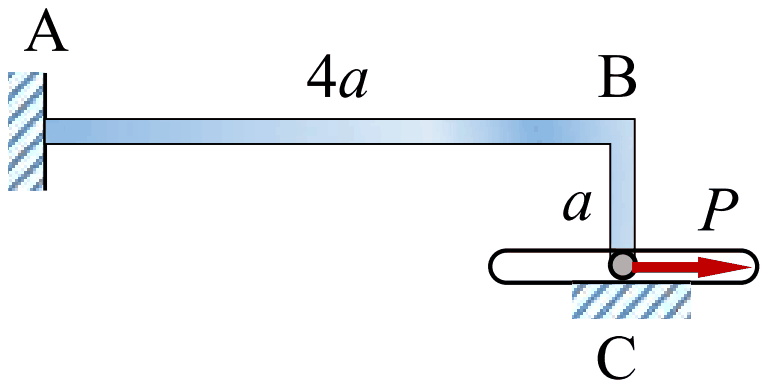
An L-shaped elastic member ABC with slender arms AB and BC of uniform cross-section is clamped at end A and connected to a pin at end C. The pin remains in continuous contact with and is constrained to move in a smooth horizontal slot. The section modulus of the member is same in both the arms. The end C is subjected to a horizontal force \(P\) and all the deflections are in the plane of the figure. Given the length AB is \(4a\) and length BC is \(a\), the magnitude and direction of the normal force on the pin from the slot, respectively, are
Your Answer : (Not Answered)
Correct Answer : A
The slot pushes on the pin with \(3P/8\), downwards.
The member is statically indeterminate: the slot supplies an unknown vertical force \(R\) at C (taken upwards). Since C cannot move vertically, Castigliano's theorem gives \(\partial U/\partial R = 0\). Take A at the origin, B at \((4a, 0)\) and C at \((4a, -a)\).
- In BC, at distance \(s\) above C, the bending moment is \(Ps\); \(R\) acts along BC and causes no bending there.
- In AB, at distance \(u\) from B, the moment is \(Ru + Pa\).
\[ \begin{aligned} \frac{\partial U}{\partial R} &= \frac{1}{EI}\int_{0}^{4a}(Ru + Pa)\,u\,du = 0 \\ R\frac{64a^{3}}{3} + 8Pa^{3} &= 0 \Rightarrow R = -\frac{3P}{8} \end{aligned} \]
The negative sign means the force on the pin acts downwards, with magnitude \(3P/8\). Upward forces, or magnitudes such as \(P/4\) and \(3P/4\), would leave C with a vertical deflection the slot does not allow.
A point in a beam experiences a tensile stress (due to bending) of 50 N/mm2 and a shear stress of 20 N/mm2. The principal stresses are
Your Answer : (Not Answered)
Correct Answer : C
The principal stresses are 57 N/mm2 tension and 7 N/mm2 compression.
In a beam the bending stress acts along the axis and the transverse normal stress is zero, so
\[ \begin{aligned} \sigma_{1,2} &= \frac{\sigma}{2} \pm \sqrt{\left(\frac{\sigma}{2}\right)^{2} + \tau^{2}} \\ &= 25 \pm \sqrt{625 + 400} = 25 \pm 32.0 \end{aligned} \]
giving 57 N/mm2 (tension) and -7 N/mm2 (compression). The other pairs either reverse which stress is tensile or use \(\sigma\) instead of \(\sigma/2\) in the formula. Principal stresses can only be zero if both the normal and shear stress vanish.
The state of stress at a point under plane stress condition is
σxx = 40 MPa, σyy = 100 MPa and τxy = 40 MPa.
The radius of the Mohr’s circle representing the given state of stress in MPa is
Your Answer : (Not Answered)
Correct Answer : B
The radius of Mohr's circle is 50 MPa.
The radius equals the maximum in-plane shear stress:
\[ \begin{aligned} R &= \sqrt{\left(\frac{\sigma_{xx}-\sigma_{yy}}{2}\right)^{2}+\tau_{xy}^{2}} \\ &= \sqrt{(-30)^{2}+40^{2}} = 50\ \text{MPa} \end{aligned} \]
The centre of the circle is at \((40+100)/2 = 70\) MPa, so the principal stresses are 120 and 20 MPa.
40 is the shear stress alone, 60 is the full difference of the normal stresses without halving, and 100 is one of the normal stresses, not a radius.
For a long slender column of uniform cross section, the ratio of critical buckling load for the case with both ends clamped to the case with both ends hinged is
Your Answer : (Not Answered)
Correct Answer : C
The ratio is 4.
Euler's buckling load is \(P_{cr} = \pi^{2}EI/L_{e}^{2}\), where Le is the effective length. A column hinged at both ends has \(L_{e}=L\); one clamped at both ends has \(L_{e}=L/2\). So:
\[ \frac{P_{clamped}}{P_{hinged}} = \frac{L^{2}}{(L/2)^{2}} = 4 \]
A ratio of 2 compares the effective lengths rather than their squares, and 8 has no basis in the Euler formula. 1 would mean end fixity does not matter, but clamping the ends shortens the buckled half-wave and so raises the load.
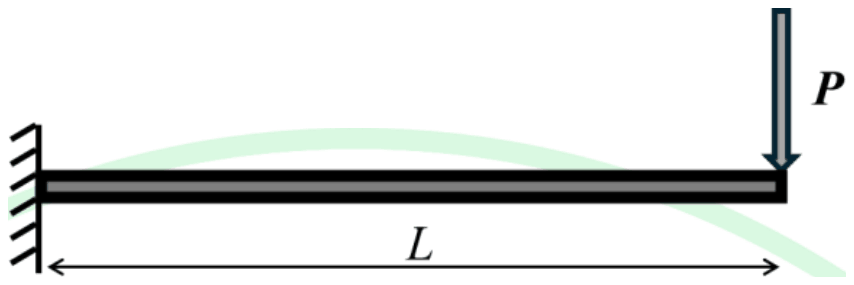
A uniform symmetric cross-section cantilever beam of length \(L\) is subjected to a transverse force \(P\) at the free end, as shown in the figure. The Young’s modulus of the material is E and the moment of inertia is I. Ignoring the contributions due to transverse shear, the strain energy stored in the beam is _____.
Your Answer : (Not Answered)
Correct Answer : A
The strain energy is \(P^{2}L^{3}/6EI\).
Measuring x from the free end, the bending moment is \(M = Px\). The bending strain energy is
\[ \begin{aligned} U &= \int_{0}^{L}\frac{M^{2}}{2EI}\,dx = \frac{P^{2}}{2EI}\int_{0}^{L}x^{2}\,dx \\ &= \frac{P^{2}L^{3}}{6EI} \end{aligned} \]
Check: the tip deflection is \(\delta = PL^{3}/3EI\), and the work done by a gradually applied load is \(\frac{1}{2}P\delta = P^{2}L^{3}/6EI\), the same. \(PL^{3}/3EI\) is the deflection, not an energy, and \(PL^{3}/6EI\) lacks a factor P. \(P^{2}L^{3}/3EI\) is \(P\delta\), which forgets the factor \(\frac{1}{2}\).
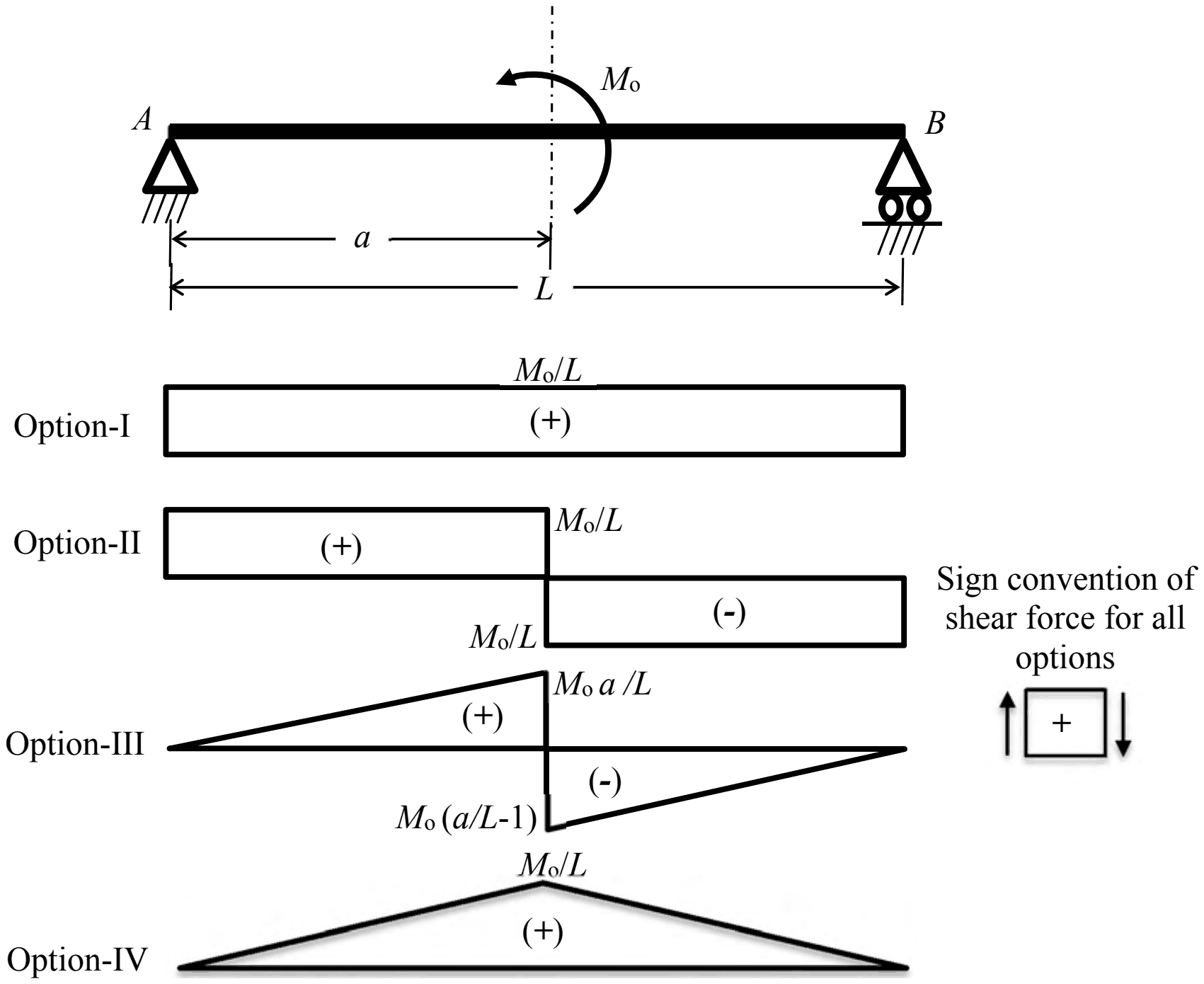
A simply supported beam of span L is subjected to a couple Mo at a distance a from support A. Among the four options (Option-I to Option-IV) shown, the correct shear force diagram of the beam is
Your Answer : (Not Answered)
Correct Answer : A
The shear force diagram is Option-I, a constant \(M_{o}/L\) of positive sign.
A couple has no net vertical force, so the support reactions form an equal and opposite pair. Taking moments about B for the counter-clockwise couple gives \(R_{A} = M_{o}/L\) upward and \(R_{B} = M_{o}/L\) downward. These are the only vertical forces, and a concentrated couple changes the bending moment, not the shear force, so the shear is \(M_{o}/L\) along the whole span. With the sign convention shown (upward force on the left face positive) it is positive.
Option II shows a jump in shear at the couple, which only a concentrated force can cause. Options III and IV show sloping shear, which needs a distributed load, and none acts on the beam. The jump at the couple belongs in the bending moment diagram instead.
The Poisson’s ratio for a perfectly incompressible linear elastic material is
Your Answer : (Not Answered)
Correct Answer : B
Poisson's ratio for a perfectly incompressible material is 0.5.
Under small strains the volumetric strain in uniaxial loading is \(\varepsilon(1 - 2\nu)\). An incompressible material has zero volume change for any load, which requires \(1 - 2\nu = 0\), so \(\nu = 0.5\). Equivalently, the bulk modulus \(K = E/[3(1 - 2\nu)]\) becomes infinite.
\(\nu = 0\) means no lateral contraction at all (cork is close to this). For an isotropic linear elastic material \(\nu\) cannot exceed 0.5, so 1 and infinity are impossible.
The three-dimensional stress-strain relationship for an isotropic material is given as
\[ \begin{Bmatrix} \sigma_{xx} \\ \sigma_{yy} \\ \sigma_{zz} \\ \tau_{yz} \\ \tau_{xz} \\ \tau_{xy} \end{Bmatrix} = \begin{bmatrix} P & Q & Q & 0 & 0 & 0 \\ Q & P & Q & 0 & 0 & 0 \\ Q & Q & P & 0 & 0 & 0 \\ 0 & 0 & 0 & R & 0 & 0 \\ 0 & 0 & 0 & 0 & R & 0 \\ 0 & 0 & 0 & 0 & 0 & R \end{bmatrix} \begin{Bmatrix} \varepsilon_{xx} \\ \varepsilon_{yy} \\ \varepsilon_{zz} \\ \gamma_{yz} \\ \gamma_{xz} \\ \gamma_{xy} \end{Bmatrix} \]
where, P, Q and R are the three elastic constants, σ and τ represent normal and shear stresses and ε and γ represent normal and engineering shear strains. Which one of the following options is correct?
Your Answer : (Not Answered)
Correct Answer : A
The correct relation is \(R = \frac{P - Q}{2}\).
For an isotropic material, Hooke's law in Lamé form, with similar equations for the other components, is
\[ \begin{aligned} \sigma_{xx} &= (\lambda + 2\mu)\varepsilon_{xx} \\ &\quad + \lambda(\varepsilon_{yy} + \varepsilon_{zz}) \\ \tau_{yz} &= \mu\gamma_{yz} \end{aligned} \]
Comparing with the matrix, \(P = \lambda + 2\mu\), \(Q = \lambda\) and \(R = \mu\),
so \(P - Q = 2\mu = 2R\), giving \(R = (P - Q)/2\). This is the isotropy condition: of the three constants only two are independent.
\((Q - P)/2\) would make the shear modulus negative, since \(P \gt Q\) for any real material. The two options for \(Q\) rearrange the relation incorrectly; the correct rearrangement is \(Q = P - 2R\).
Marks
Total number of questions : 20
Number of answered questions : 0
Number of unanswered questions : 20