
Instruction
- Total number of questions : 14
- Time allotted : 21:00 Minutes:Seconds.
- Each question carry 1 mark, no negative marks.
- DO NOT refresh the page.
- All the best
Structural Geology [ Question No: 1 To 14 ] :
What is the name of an erosional surface that separates two sets of sedimentary layers with non-parallel planes ?
Larger parallel shortening during folding results in :
Hercynian Orogeny has taken place during the late :
Which of the following is not true for reunion and kilanea volcanoes
Seismicity is at very high frequency at which of the following compound to the others :
Which one of the following is the oldest thrust of Himalaya ?
The high grade metamorphic rocks are brought over the low grade metamorphic rocks of Lesser Himalaya by a major thrust called :
A cylinder of length 'L' and diameter 'D' when subjected to a tensile stress parallel to L would be elongated in length, but the same time shortened in diameter and is expressed by :
In a single layer of an anticline, the dip isogons converge towards the inner surface (core). Which one of the following statements is correct for the curvature of the inner surface of this folded layer?
If P, Q, R, and S refer to Rainfall induced landslide, Bolide impact, Milankovitch cycle, and Supercontinent cycle, respectively, then which one of the following correctly represents the decreasing order of their duration?
Choose the correct statement about Moho.
Match the geographic locations listed in Column 1 to the geodynamic features listed in Column 2.
| Column 1 | Column 2 |
|---|---|
| P. Iceland | i. Triple junction |
| Q. Afar | ii. Plume-ridge interaction |
| R. Hawaii | iii. Subduction zone |
| S. Aleutian Islands | iv. Plume |
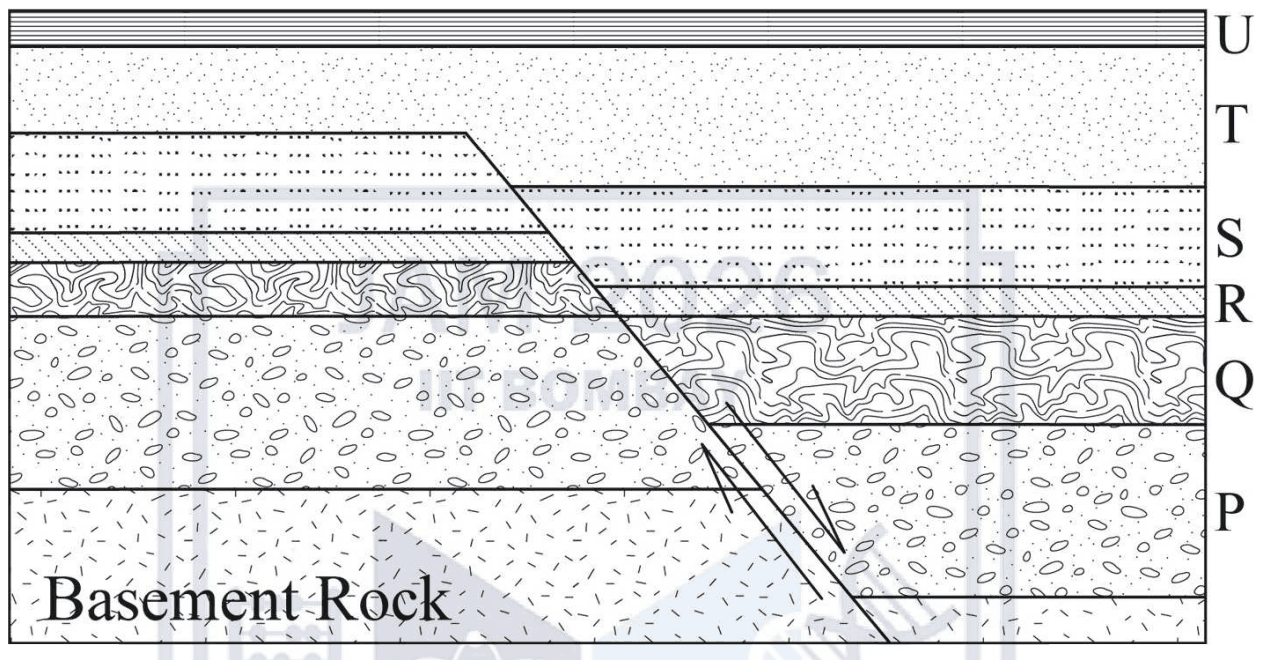
The schematic shows a geological cross-section of a faulted region of sedimentary rocks (beds P to U). Assuming continuous sedimentation, select the beds that record the earliest activation and the latest reactivation of the fault.
The rake (pitch) of slickenlines exposed on a moderately dipping fault plane is the angle between
Total number of questions : 14
Number of answered questions : 0
Number of unanswered questions : 14
Structural Geology [ Question No: 1 To 14 ] :
What is the name of an erosional surface that separates two sets of sedimentary layers with non-parallel planes ?
Your Answer : (Not Answered)
Correct Answer : D
It is an angular unconformity.
An angular unconformity forms when older layers are tilted or folded, eroded, and then covered by younger layers deposited flat. The erosion surface therefore separates two sets of beds that are not parallel to each other.
A nonconformity is an erosion surface between sedimentary rocks and underlying igneous or metamorphic rock, not between two sedimentary sets. Cross-bedding is inclined layering within a single bed, not an erosional surface, and a formation is a mappable unit of rock, not a surface.
Larger parallel shortening during folding results in :
Your Answer : (Not Answered)
Correct Answer : B
Large layer-parallel shortening results in buckling.
When a competent layer embedded in weaker material is compressed parallel to its length, it shortens a little and then becomes unstable and deflects into folds with a characteristic wavelength. This buckling (buckle folding) is the main mechanism for folds formed by shortening along the layering.
Convolute folds are small, contorted folds formed in soft sediment by loading or dewatering, not by tectonic shortening. Fracturing is brittle failure rather than folding, and flow folding happens in very ductile rock where layers have little competence contrast, so the layers do not buckle.
Hercynian Orogeny has taken place during the late :
Your Answer : (Not Answered)
Correct Answer : A
The Hercynian orogeny took place during the late Carboniferous.
The Hercynian (Variscan) orogeny was the mountain building that accompanied the assembly of Pangaea, as Gondwana collided with Laurussia. Its main phase was in the late Carboniferous, continuing into the early Permian, and it formed the old mountain belts of central and western Europe and, in North America, the Alleghanian phase of the Appalachians.
The Cambrian is far too early, the Devonian is the time of the earlier Caledonian-Acadian events, and the Precambrian predates the Palaeozoic orogenies altogether.
Which of the following is not true for reunion and kilanea volcanoes
Your Answer : (Not Answered)
Correct Answer : B
The untrue statement is that both are located on respective mid-oceanic ridges.
Kilauea, on the island of Hawaii, sits in the middle of the Pacific plate thousands of kilometres from any ridge, and Reunion's Piton de la Fournaise sits on the African plate in the western Indian Ocean, away from the Central Indian Ridge. Both are intraplate hotspot volcanoes.
The other statements are true: both are attributed to mantle plumes, both are among the world's most active volcanoes, and both erupt basaltic (basic) magma, which the paper calls 'basic magnetism'.
Seismicity is at very high frequency at which of the following compound to the others :
Your Answer : (Not Answered)
Correct Answer : C
Seismicity is most frequent at Subduction zones.
Convergent margins where one plate sinks beneath another produce the great majority of the world's earthquakes, and almost all of the largest ones, including every event of magnitude 9. They also host intermediate and deep earthquakes down to about 700 km along the sinking slab (the Wadati-Benioff zone).
Mid-ocean ridges (where MORB is erupted) and other extensional plate boundaries produce many but mostly shallow, moderate earthquakes. Volcanoes produce local swarms, far less in total than subduction zones.
Which one of the following is the oldest thrust of Himalaya ?
Your Answer : (Not Answered)
Correct Answer : B
The oldest Himalayan thrust is the Main Central Thrust.
Deformation in the Himalaya has stepped southwards with time towards the foreland. The Main Central Thrust, which carries the Higher Himalayan crystallines over the Lesser Himalaya, was active mainly in the early Miocene, about 23-20 million years ago. The Main Boundary Thrust, bringing the Lesser Himalaya over the Siwaliks, came later, and the Himalayan Frontal Thrust, at the southern edge of the Siwaliks, is the youngest and is active today.
The Main Boundary Fault is another name used for the Main Boundary Thrust, so it is younger than the MCT as well.
The high grade metamorphic rocks are brought over the low grade metamorphic rocks of Lesser Himalaya by a major thrust called :
Your Answer : (Not Answered)
Correct Answer : D
The thrust is the Main Central Thrust.
The Main Central Thrust (MCT) carries the high-grade gneisses and schists of the Higher (Greater) Himalayan Crystallines southward over the low-grade metasediments of the Lesser Himalaya, which is why metamorphic grade appears inverted near it.
The Main Boundary Thrust lies further south and brings Lesser Himalayan rocks over the Siwaliks. The Indus Suture Zone marks where the Indian and Asian plates joined, north of the Himalaya proper, and 'Lesser Himalayan Thrust' is not the name of this structure.
A cylinder of length 'L' and diameter 'D' when subjected to a tensile stress parallel to L would be elongated in length, but the same time shortened in diameter and is expressed by :
Your Answer : (Not Answered)
Correct Answer : B
The behaviour is expressed by Poisson's Ratio.
When a bar is stretched along its length it also contracts sideways. Poisson's ratio is the ratio of the lateral (transverse) strain to the longitudinal strain:
\[ \nu = -\frac{\Delta D / D}{\Delta L / L} \]
For most rocks it lies between about 0.2 and 0.35. The rigidity modulus relates shear stress to shear strain, tensile strength is the stress at which a material breaks in tension, and 'stretching constant' is not a standard elastic modulus, so none of them describes the paired lengthening and narrowing.
In a single layer of an anticline, the dip isogons converge towards the inner surface (core). Which one of the following statements is correct for the curvature of the inner surface of this folded layer?
Your Answer : (Not Answered)
Correct Answer : A
The inner surface has the greater curvature: curvature of the inner surface > curvature of the outer surface.
Dip isogons join points of equal dip on the two surfaces of a folded layer. In Ramsay's classification, isogons converging towards the core define Class 1 folds, in which the outer arc is more gently curved than the inner arc. In Class 1B, the parallel fold, the layer keeps a constant thickness, so the inner arc has the smaller radius and therefore the larger curvature; Classes 1A and 1C show the same inequality.
Equal curvature on both surfaces describes Class 2, the similar fold, whose isogons are parallel. A greater curvature on the outer surface describes Class 3, whose isogons diverge towards the core. The median surface is not what the question compares.
If P, Q, R, and S refer to Rainfall induced landslide, Bolide impact, Milankovitch cycle, and Supercontinent cycle, respectively, then which one of the following correctly represents the decreasing order of their duration?
Your Answer : (Not Answered)
Correct Answer : A
The decreasing order of duration is S, R, P, Q.
- Supercontinent cycle (S): about 300 to 500 million years from one assembly to the next.
- Milankovitch cycle (R): orbital cycles of about 23,000, 41,000 and 100,000 years.
- Rainfall induced landslide (P): the failure itself takes seconds to hours, and a slow slide may move for days.
- Bolide impact (Q): the impact and crater excavation last seconds to a few minutes.
Every option begins correctly with S except one, so the question turns on the last three. Option D puts the landslide before the Milankovitch cycle, and option C puts the impact before both, which inverts events lasting minutes against cycles lasting tens of thousands of years.
Choose the correct statement about Moho.
Your Answer : (Not Answered)
Correct Answer : B
The correct statement is that the seismic Moho lies at shallower depths relative to the petrologic Moho.
The seismic Moho is where P wave velocity jumps to mantle values of about 8 km/s. The petrologic Moho is the base of the rocks that crystallised from crustal magma. In ophiolites the lowest crustal rocks are ultramafic cumulates, dunite and pyroxenite settled out of the magma chamber; they are crust by origin but have mantle-like seismic velocities. So the velocity jump comes at the top of these cumulates, while the petrologic Moho lies below them, at the contact with tectonized mantle harzburgite.
That rules out the statements that the two coincide or that the petrologic Moho is the shallower one. The layered gabbro sits above the ultramafic cumulates, so the petrologic Moho lies below the layered gabbro, not above it.
Match the geographic locations listed in Column 1 to the geodynamic features listed in Column 2.
| Column 1 | Column 2 |
|---|---|
| P. Iceland | i. Triple junction |
| Q. Afar | ii. Plume-ridge interaction |
| R. Hawaii | iii. Subduction zone |
| S. Aleutian Islands | iv. Plume |
Your Answer : (Not Answered)
Correct Answer : B
The correct matching is P-ii; Q-i; R-iv; S-iii.
- Iceland: a mantle plume sits beneath the Mid-Atlantic Ridge, so it is the classic case of plume-ridge interaction (ii).
- Afar: the Red Sea, Gulf of Aden and East African rifts meet there in a triple junction (i).
- Hawaii: an intraplate hotspot chain over a plume in the middle of the Pacific plate (iv).
- Aleutian Islands: an island arc above the subduction of the Pacific plate under the North American plate (iii).
Options pairing Iceland with the triple junction, Hawaii with subduction, or Afar with the plume all swap two of these settings.
The schematic shows a geological cross-section of a faulted region of sedimentary rocks (beds P to U). Assuming continuous sedimentation, select the beds that record the earliest activation and the latest reactivation of the fault.
Your Answer : (Not Answered)
Correct Answer : A
The beds that record the earliest activation and the latest reactivation are Q and T.
A fault that moves while sediment is being laid down (a growth fault) leaves a tell-tale signature: a bed deposited during movement is thicker on the downthrown block, because the sea floor there is lower and takes more sediment, while a bed deposited when the fault is quiet has the same thickness on both sides. The fault here dips to the right and the right-hand block is the downthrown one.
Bed P, the lowest in the sequence, has the same thickness on both sides and is simply offset, so it was laid down before the fault moved. Bed Q is the first bed that is clearly thicker on the downthrown side, so it records the earliest activation. Beds R and S are of equal thickness on both sides, which means the fault was inactive while they were deposited. Bed T is thicker on the downthrown block again, which marks a later reactivation, and the fault tip dies out inside T. Bed U covers the fault and is of uniform thickness, so the movement had stopped by then.
The other options pair Q or T with a bed that does not change thickness (P, R) or with the sealing bed U, so they are wrong.
The rake (pitch) of slickenlines exposed on a moderately dipping fault plane is the angle between
Your Answer : (Not Answered)
Correct Answer : B
Rake (pitch) is the angle between the strike of the fault plane and the slickenlines, measured on the fault plane.
Rake describes a line that lies within a plane, so it is measured in that plane, from the horizontal strike line to the lineation, between 0° and 180°. A rake near 0° or 180° means strike-slip movement, and a rake near 90° means dip-slip movement.
The angle between magnetic north and strike, on a horizontal surface, is the strike azimuth of the plane. An angle measured in a vertical plane is a plunge, which describes the line relative to the horizontal rather than within the fault plane. Trend and plunge are the two coordinates of the lineation itself; the angle between them is not a defined measurement.
Marks
Total number of questions : 14
Number of answered questions : 0
Number of unanswered questions : 14