
Instruction
- Total number of questions : 20
- Time allotted : 30:00 Minutes:Seconds.
- Each question carry 1 mark, no negative marks.
- DO NOT refresh the page.
- All the best
Theory of Machines [ Question No: 1 To 20 ] :
The function of a dynamometer is :
The groove angle of the pulley for V-belt drive is usually:
The maximum fluctuation of energy in a flywheel is equal to :
Where, I = moment of inertia of flywheel
ω = Mean speed
ω1 = Maximum speed
ω2 = Minimum speed
K = coefficient of fluctuation of speed
A fly wheel absorbs energy during those periods of crank rotation when -
In a Wilson-Hartnell governor , the balls are connected by :
Static balancing involves balancing of :
Static balancing involves balancing of:
The total number of instantaneous centres for a mechanism containing 'n' links is given by :
The total number of instantaneous centre for a mechanism consisting of 'n' links is :
The primary unbalanced force in reciprocating masses are :
A spur gear transmits 10 kW at a pitch line velocity of 10 m/s. The tangential force between the driver and follower is :
For a gear train the speed ratio is:
The gears employed for connecting two non-intersecting and non-parallel i.e. non-coplanar shafts are:
The rotor of an aeroplane engine has a mass moment of inertia 1.0 kg \(\text{m}^{2}\). The engine rotates at a speed of 500 RPM in the clockwise direction if viewed from the front of the aeroplane. If the aeroplane while flying at 1200 km/hr turns with a radius of 2 km at same elevation, then the magnitude of the gyroscopic moment exerted by the rotor on the aeroplane structure in N m is
Worm gearsets are used for transmitting rotary motion between
In a disc clutch, the inside and outside radii of the clutch plate are 50 and 100 mm, respectively. If the axial force exerted on the disc is 4 kN, the maximum pressure experienced by the clutch plate in N mm-2 under uniform wear conditions is
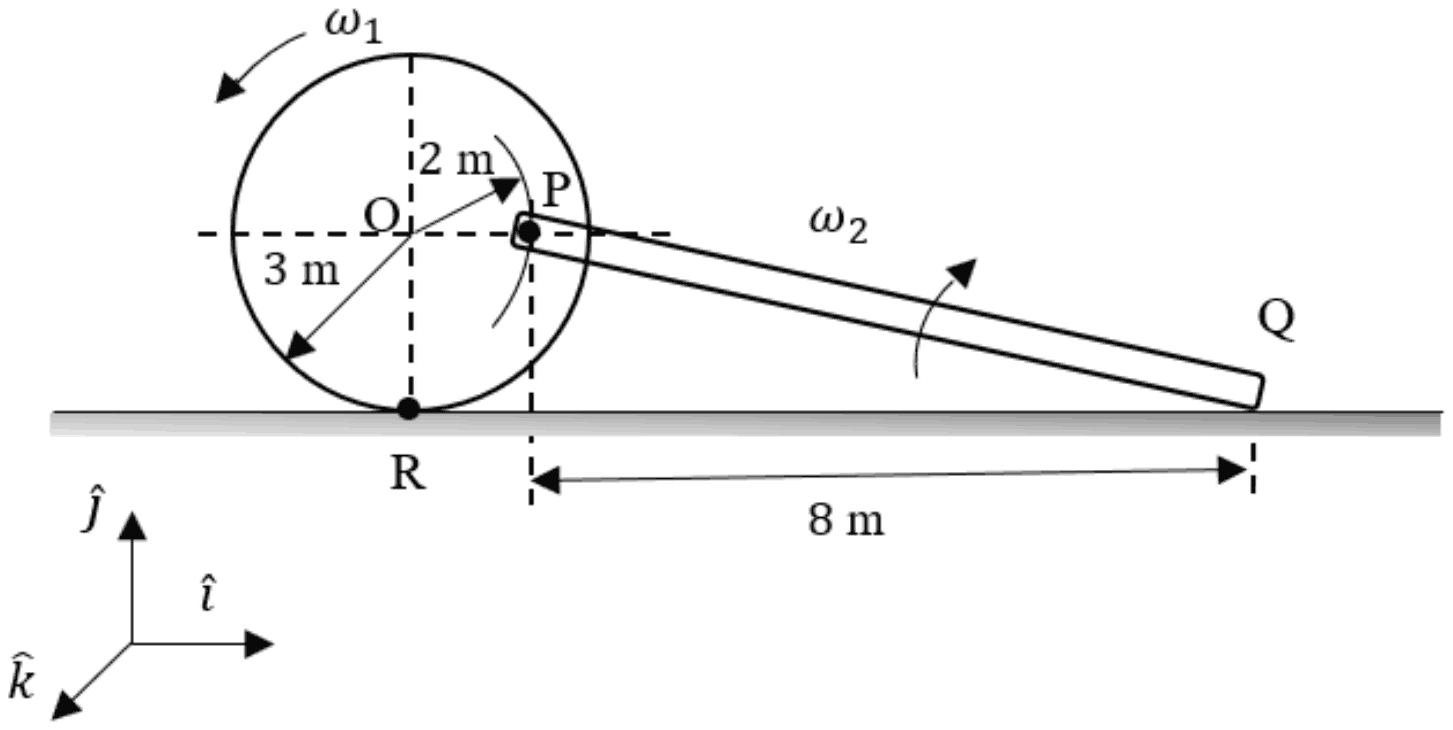
The figure shows a wheel rolling without slipping on a horizontal plane with angular velocity \(\omega_{1}\). A rigid bar PQ is pinned to the wheel at P while the end Q slides on the floor.
What is the angular velocity \(\omega_{2}\) of the bar PQ?
In the mechanism given below, if the angular velocity of the eccentric circular disc is 1 rad/s, the angular velocity (rad/s) of the follower link for the instant shown in the figure is
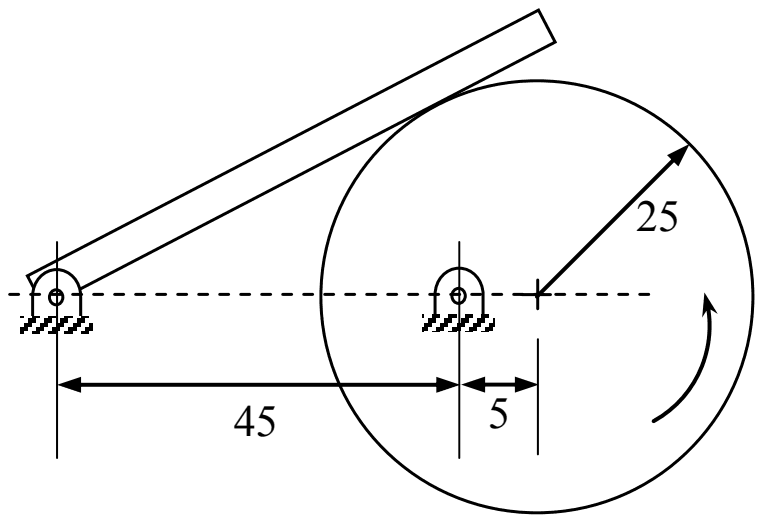
Note: All dimensions are in mm.
Which of the following is a type of dead weight governor?
Which among the following, generally have high value of coefficient of fluctuation speed for flywheel?
Total number of questions : 20
Number of answered questions : 0
Number of unanswered questions : 20
Theory of Machines [ Question No: 1 To 20 ] :
The function of a dynamometer is :
Your Answer : (Not Answered)
Correct Answer : D
A dynamometer is used to measure power of an engine.
A dynamometer absorbs or transmits the engine's output while measuring the torque T at a known speed N, and the brake power follows as \(P = \frac{2\pi N T}{60}\). Rope brakes, Prony brakes, hydraulic and eddy current dynamometers all work on this principle.
Balancing to reduce vibration is done with balancing masses, fuel supply is regulated by the governor and the fuel system, and brakes in an automobile stop the vehicle rather than measuring anything.
The groove angle of the pulley for V-belt drive is usually:
Your Answer : (Not Answered)
Correct Answer : C
The groove angle is usually 32° - 38°.
A V-belt pulley groove is made with an included angle of about 30 to 40 degrees, commonly specified between 32 and 38 degrees. The belt wedges into the groove, which increases the normal reaction and so the friction it can transmit.
Angles of 20 to 32 degrees would make the belt jam in the groove, and 38 to 45 degrees would lose the wedging action that gives a V-belt its grip.
The maximum fluctuation of energy in a flywheel is equal to :
Where, I = moment of inertia of flywheel
ω = Mean speed
ω1 = Maximum speed
ω2 = Minimum speed
K = coefficient of fluctuation of speed
Your Answer : (Not Answered)
Correct Answer : B
The maximum fluctuation of energy is \(I\omega(\omega_{1} - \omega_{2})\).
The fluctuation is the change in kinetic energy between the maximum and minimum speeds:
\[ \begin{aligned} \Delta E &= \tfrac{1}{2}I(\omega_{1}^{2} - \omega_{2}^{2}) \\ &= I \frac{\omega_{1} + \omega_{2}}{2} (\omega_{1} - \omega_{2}) \\ &= I\omega(\omega_{1} - \omega_{2}) \end{aligned} \]
using \(\omega = \frac{\omega_{1} + \omega_{2}}{2}\). Since \(K = \frac{\omega_{1} - \omega_{2}}{\omega}\), this is also \(I\omega^{2}K\), or 2EK with E the mean kinetic energy.
Option C has a stray factor of one quarter on \(I\omega^{2}K\). The products \(I\omega_{1}\omega_{2}\) and \(2I\omega^{2}\omega_{1}\) are not energy differences at all; the second is not even dimensionally an energy.
A fly wheel absorbs energy during those periods of crank rotation when -
Your Answer : (Not Answered)
Correct Answer : C
A flywheel absorbs energy when the turning moment is greater than the resisting moment.
When the engine's turning moment exceeds the load's resisting moment, the surplus energy speeds the flywheel up and is stored as kinetic energy. When the turning moment falls below the resisting moment, the flywheel slows and gives that energy back, which keeps speed fluctuation within limits.
When the moments are equal there is no excess to absorb, and a flywheel cannot absorb energy throughout the cycle, as it must also release it.
In a Wilson-Hartnell governor , the balls are connected by :
Your Answer : (Not Answered)
Correct Answer : C
The balls are connected by two springs in parallel.
The Wilson-Hartnell governor is a radial, spring-loaded governor. Its two balls are tied together by main springs placed on either side of the spindle; both springs act on the balls at the same time, sharing the load, which is a parallel arrangement. An auxiliary spring acting through a lever is used to adjust the equilibrium speed while the governor is running.
A single spring, springs in series or four springs do not describe this arrangement.
Static balancing involves balancing of :
Your Answer : (Not Answered)
Correct Answer : A
Static balancing involves balancing of forces.
A system is statically balanced when the resultant of the centrifugal forces of the rotating masses is zero, so the combined centre of mass lies on the axis of rotation. The shaft then stays at rest in any angular position.
Balancing the couples as well is dynamic balancing, needed when the masses lie in different planes. 'Masses' is loose wording; what is balanced is the force they produce.
Static balancing involves balancing of:
Your Answer : (Not Answered)
Correct Answer : A
Static balancing involves balancing of forces.
A rotor is statically balanced when its centre of mass lies on the axis of rotation, so that the resultant of the centrifugal forces is zero: \(\sum m r = 0\). It will then stay at rest in any angular position.
Balancing the couples as well, \(\sum m r l = 0\), is the further condition for dynamic balance, so 'couples' and 'forces and couples both' describe dynamic balancing. 'Masses' is too vague: it is the forces their eccentricity creates that are balanced.
The total number of instantaneous centres for a mechanism containing 'n' links is given by :
Your Answer : (Not Answered)
Correct Answer : A
The number of instantaneous centres is \(\frac{n(n-1)}{2}\).
Every pair of links in a mechanism has one instantaneous centre. The number of pairs that can be formed from n links is the number of combinations of n taken two at a time.
\[ N = \frac{n(n-1)}{2} \]
A four-bar chain therefore has 6 instantaneous centres. \(n(n-1)\) counts each pair twice, and \((n-1)\) and \((n-1)/2\) undercount.
The total number of instantaneous centre for a mechanism consisting of 'n' links is :
Your Answer : (Not Answered)
Correct Answer : A
The total number of instantaneous centres is \(\frac{n(n-1)}{2}\).
Every pair of links in a mechanism has one instantaneous centre, so the number of centres is the number of ways of choosing two links from n:
\[ N = \binom{n}{2} = \frac{n(n-1)}{2} \]
A four-bar chain, for example, has \(\frac{4 \times 3}{2} = 6\) instantaneous centres. The options n, \(\frac{n}{2}\) and \(\frac{n-1}{2}\) do not count the pairs; for four links they give 4, 2 and 1.5, and a count of centres cannot be fractional.
The primary unbalanced force in reciprocating masses are :
Your Answer : (Not Answered)
Correct Answer : B
The primary unbalanced force is directly proportional to crank radius.
For a reciprocating mass m driven by a crank of radius r at angular speed \(\omega\), the primary unbalanced force is
\[ F_{p} = m \omega^{2} r \cos\theta \]
It is linear in r: doubling the crank radius doubles the force at any given speed and crank angle. It is proportional to the square of the speed, not of the radius, which is the trap in option C. The secondary force, \(m\omega^{2}r\frac{\cos 2\theta}{n}\), is also proportional to r, but is smaller by the ratio n of connecting rod length to crank radius.
A spur gear transmits 10 kW at a pitch line velocity of 10 m/s. The tangential force between the driver and follower is :
Your Answer : (Not Answered)
Correct Answer : A
The tangential force is 1 kN.
Power transmitted is the tangential force times the pitch line velocity, \(P = F_{t} v\):
\[ \begin{aligned} F_{t} &= \frac{P}{v} = \frac{10 \times 10^{3}\ \text{W}}{10\ \text{m/s}} \\ &= 1000\ \text{N} = 1\ \text{kN} \end{aligned} \]
The options 1 N, 10 N and 100 N come from losing factors of 10 in the units, most often from forgetting that 10 kW is 10,000 W. As a check, 1 kN moving at 10 m/s does 10,000 J of work every second, which is the 10 kW given.
For a gear train the speed ratio is:
Your Answer : (Not Answered)
Correct Answer : D
The speed ratio is inversely proportional to train value.
For a gear train, the speed ratio is the speed of the driver divided by the speed of the driven gear, and the train value is defined the other way round, the speed of the driven gear divided by the speed of the driver. So
\[ \text{train value} = \frac{1}{\text{speed ratio}} \]
The two are reciprocals, which is an inverse proportion, not a direct one. Nothing in the definitions involves a square, so both 'square' options are wrong.
The gears employed for connecting two non-intersecting and non-parallel i.e. non-coplanar shafts are:
Your Answer : (Not Answered)
Correct Answer : B
The gears are spiral gears.
Spiral gears (crossed helical gears) connect shafts that neither intersect nor are parallel. Their teeth are helical and the shaft axes cross at an angle, often 90 degrees, with point contact between the teeth.
Bevel gears connect intersecting shafts, and mitre gears are bevel gears of equal size at right angles. Helical gears in their usual form connect parallel shafts. None of them suits non-coplanar shafts in this classification.
The rotor of an aeroplane engine has a mass moment of inertia 1.0 kg \(\text{m}^{2}\). The engine rotates at a speed of 500 RPM in the clockwise direction if viewed from the front of the aeroplane. If the aeroplane while flying at 1200 km/hr turns with a radius of 2 km at same elevation, then the magnitude of the gyroscopic moment exerted by the rotor on the aeroplane structure in N m is
Your Answer : (Not Answered)
Correct Answer : A
The gyroscopic moment is about 8.73 N m.
The spin speed is \(\omega = 2\pi(500)/60 = 52.36\) rad/s. The precession rate is the aeroplane's angular velocity in the turn, \(\omega_{p} = v/R\), with \(v = 1200/3.6 = 333.3\) m/s:
\[ \begin{aligned} \omega_{p} &= 333.3/2000 = 0.1667\ \text{rad/s} \\ C &= I\omega\omega_{p} = 1.0 \times 52.36 \times 0.1667 = 8.73\ \text{N m} \end{aligned} \]
17.46 and 26.19 are two and three times the value, and 4.37 half of it. The clockwise sense of rotation decides the direction of the moment (nose up or down), not its size.
Worm gearsets are used for transmitting rotary motion between
Your Answer : (Not Answered)
Correct Answer : A
Worm gears connect non-parallel and non-intersecting shafts.
The worm and wheel axes are usually at right angles and offset from each other, so they neither meet nor run parallel. This skew arrangement is what allows large speed reductions in one stage.
Intersecting shafts are connected by bevel gears, and parallel shafts by spur or helical gears. Non-parallel intersecting shafts are again the bevel-gear case, not the worm's.
In a disc clutch, the inside and outside radii of the clutch plate are 50 and 100 mm, respectively. If the axial force exerted on the disc is 4 kN, the maximum pressure experienced by the clutch plate in N mm-2 under uniform wear conditions is
Your Answer : (Not Answered)
Correct Answer : C
The maximum pressure is about 0.25 N mm-2.
Under uniform wear the product of pressure and radius is constant, \(p\,r = C\), so the pressure is greatest at the inner radius. The axial force fixes C:
\[ \begin{aligned} F &= 2\pi C (r_{o} - r_{i}) \\ C &= \frac{4000}{2\pi(100 - 50)} = 12.73\ \text{N/mm} \\ p_{max} &= \frac{C}{r_{i}} = \frac{12.73}{50} = 0.255 \end{aligned} \]
0.17 is the uniform pressure answer, \(4000 / [\pi(100^{2} - 50^{2})] = 0.17\), which applies to a new clutch rather than a worn one. 0.13 is the uniform wear pressure at the outer radius (\(12.73/100\)), the minimum, not the maximum.
The figure shows a wheel rolling without slipping on a horizontal plane with angular velocity \(\omega_{1}\). A rigid bar PQ is pinned to the wheel at P while the end Q slides on the floor.
What is the angular velocity \(\omega_{2}\) of the bar PQ?
Your Answer : (Not Answered)
Correct Answer : D
The angular velocity of the bar is \(\omega_{2} = 0.25\omega_{1}\).
Rolling without slipping makes the contact point R the instantaneous centre of the wheel. Take R as the origin: O is at (0, 3) and P, 2 m from O along the horizontal through O, is at (2, 3). So
\[ \begin{aligned} v_{P} &= \omega_{1}\,RP = \omega_{1}\sqrt{2^{2} + 3^{2}} \\ &= \sqrt{13}\,\omega_{1} \end{aligned} \]
and \(v_{P}\) is perpendicular to RP. Q, 8 m to the right of P, is at (10, 0) and slides along the floor, so its velocity is horizontal. The instantaneous centre I of the bar lies on the normal to each velocity: on the line RP extended, and on the vertical through Q. The line RP is \(y = 1.5x\), so at \(x = 10\) it gives I = (10, 15).
\[ \begin{aligned} IP &= \sqrt{8^{2} + 12^{2}} = 4\sqrt{13} \\ \omega_{2} &= \frac{v_{P}}{IP} \\ &= \frac{\sqrt{13}\,\omega_{1}}{4\sqrt{13}} \\ &= 0.25\,\omega_{1} \end{aligned} \]
The ratio is fixed by the geometry alone: the bar's centre I is four times as far from P as the wheel's centre R is, so the bar turns at a quarter of the wheel's rate. \(\omega_{2} = \omega_{1}\) would need the two centres equally far from P, and \(2\omega_{1}\) and \(0.5\omega_{1}\) do not match the distances in the figure.
In the mechanism given below, if the angular velocity of the eccentric circular disc is 1 rad/s, the angular velocity (rad/s) of the follower link for the instant shown in the figure is
Note: All dimensions are in mm.
Your Answer : (Not Answered)
Correct Answer : B
The follower turns at 0.1 rad/s.
The common normal at the point where the link touches the disc is perpendicular to the link and passes through the disc's geometric centre. In the position shown, that centre lies on the line joining the two fixed pivots, so it is the instantaneous centre shared by the disc and the follower. Measured from the pivots, it is 5 mm from the disc pivot and 45 + 5 = 50 mm from the follower pivot. By the angular velocity ratio theorem:
\[ \begin{aligned} \frac{\omega_{f}}{\omega_{d}} &= \frac{5}{50} \\ \omega_{f} &= 0.1 \times 1 = 0.1\ \text{rad/s} \end{aligned} \]
10.0 is the same ratio inverted (50/5), which would make the follower turn faster than the disc driving it. 0.05 and 5.0 do not correspond to the distances in the figure.
Which of the following is a type of dead weight governor?
Your Answer : (Not Answered)
Correct Answer : B
The Porter governor is a type of dead weight governor, in which a central dead weight is placed on the sleeve and acts as a load. The Pickering governor is a spring controlled type that is used for small speed variations and the Hartnell and Hartung governors are spring loaded types, so only the Porter governor is a dead weight type.
Which among the following, generally have high value of coefficient of fluctuation speed for flywheel?
Your Answer : (Not Answered)
Correct Answer : A
Automobile engines of normal speed are given as having a high coefficient of fluctuation of speed in the key. The coefficient of fluctuation of speed for a flywheel is the ratio of the change in speed to the mean speed. Machines that need smooth running, such as machine tools, weaving machines and belt driven generators, are given smaller values, because a smaller value means a more uniform speed.
Marks
Total number of questions : 20
Number of answered questions : 0
Number of unanswered questions : 20