
Instruction
- Total number of questions : 20
- Time allotted : 30:00 Minutes:Seconds.
- Each question carry 1 mark, no negative marks.
- DO NOT refresh the page.
- All the best
Thermodynamics [ Question No: 1 To 20 ] :
Direction for [ Question No: 1 To 1 ] :
Notation used:
P : pressure, V : volume, T : temperature, s : specific entropy, h : specific enthalpy, Cp : molar heat capacity at constant pressure, Cv : molar heat capacity at constant volume, R : universal gas constant
For a reversible isothermal expansion of one mole of an ideal gas from state 1 to state 2, the magnitude of work done is
Direction for [ Question No: 2 To 2 ] :
Notation used:
P : pressure, V : volume, T : temperature, s : specific entropy, h : specific enthalpy, Cp : molar heat capacity at constant pressure, Cv : molar heat capacity at constant volume, R : universal gas constant
When a fixed mass of air-water vapour mixture is heated at constant pressure,
During a change of phase :
Choose the most appropriate answer from the options given below :
For Saturated steam, the Dryness fraction is :
Heat and work are :
The thermal efficiency of an air standard Brayton cycle in terms of pressure ratio rp and Y is given by:
Consider any substance whose mass specific heat capacity at constant pressure and mass specific heat capacity at constant volume are \(c_{P}\) and \(c_{V}\), respectively. If the gas constant is R, which ONE of the following relations is CORRECT for the substance at all conditions?
Adiabatic bulk modulus of a substance is defined as
Which one of the following statements regarding a Rankine cycle is FALSE?
Which ONE of the following statements is CORRECT?
The Clausius inequality holds good for
A rigid closed tank having a volume of 2 m3 contains 0.1 m3 of saturated liquid water and 1.9 m3 of saturated water vapor at 100 kPa. Heat is transferred to the tank until the final tank pressure reaches 2 MPa.
Following data for water is given:
At 100 kPa: \(v_{f}\) = 0.001043 m3/kg, \(v_{g}\) = 1.694 m3/kg, \(u_{f}\) = 417.33 kJ/kg, \(u_{g}\) = 2506.06 kJ/kg
At 2 MPa: \(v_{f}\) = 0.001177 m3/kg, \(v_{g}\) = 0.09963 m3/kg, \(u_{f}\) = 906.42 kJ/kg, \(u_{g}\) = 2600.26 kJ/kg
The magnitude of heat transfer in this process is
An ideal Diesel cycle has a compression ratio of 20 and cut-off ratio of 1.5. At the beginning of the compression stroke, air is at 100 kPa, 300 K. Use the cold-air-standard assumptions with property value \(c_{p}\) = 1.005 kJ/kg-K. Assume \(c_{p}/c_{v}\) = 1.4. For this cycle, the net work output per unit mass is
Which one of the following makes an ideal air-standard Stirling cycle?
\(\delta Q\) and \(\delta W\) are the heat and work interactions of a system with its surroundings, and \(dU\) is the change in the internal energy of the system. For an adiabatic process in a closed, constant pressure combustor, which one of the following options is correct?
For an ideal gas with constant properties undergoing a quasi-static process, which one of the following represents the change of entropy (Δs) from state 1 to 2?
Consider an ideal gas of entropy \(S\), molar specific heat \(C_{v}\), pressure \(P\) and volume \(V\).
Which of the following options is/are true?
A cylinder of volume 0.1 m3 is filled with nitrogen at 10 MPa and 300 K. Consider nitrogen to be an ideal gas. The cylinder develops a leak and nitrogen escapes to atmosphere which is at 0.1 MPa. After sometime, the pressure in the cylinder reduces to 5 MPa. Assuming the cylinder and the leaked gas temperature remains constant at 300 K, the work done (in MJ) by nitrogen gas is
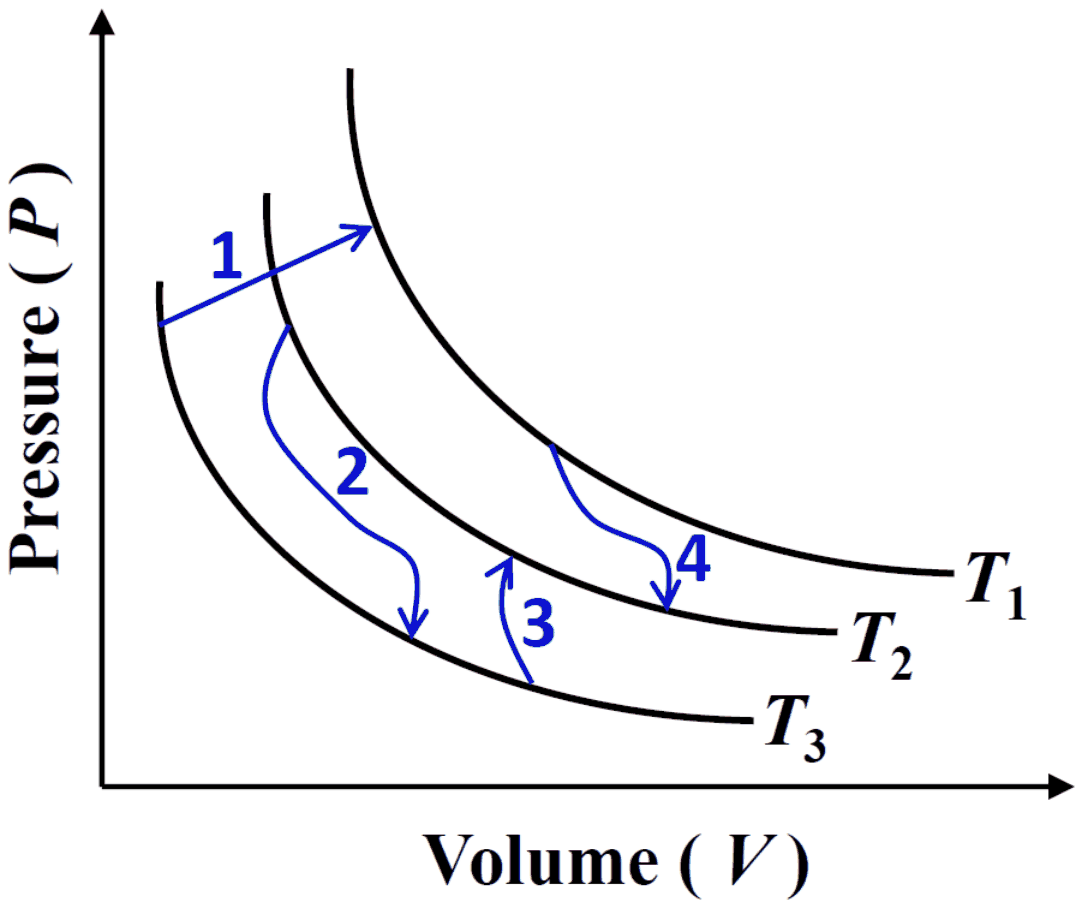
The figure shows four different processes labeled 1, 2, 3, and 4 for the same closed system containing an ideal gas. The curves labeled \(T_1\), \(T_2\), and \(T_3\) are isotherms. For which one of the these four processes, the magnitude of internal energy change is the highest?
An ideal gas mixture consists of 80% N2 and 20% O2 on mass basis. If the total pressure is 300 kPa, then the partial pressure of N2 (in kPa) is
(Molecular weights of N2 = 28 kg/kmol and O2 = 32 kg/kmol)
Total number of questions : 20
Number of answered questions : 0
Number of unanswered questions : 20
Thermodynamics [ Question No: 1 To 20 ] :
Direction for [ Question No: 1 To 1 ] :
Notation used:
P : pressure, V : volume, T : temperature, s : specific entropy, h : specific enthalpy, Cp : molar heat capacity at constant pressure, Cv : molar heat capacity at constant volume, R : universal gas constant
For a reversible isothermal expansion of one mole of an ideal gas from state 1 to state 2, the magnitude of work done is
Your Answer : (Not Answered)
Correct Answer : A
The work is \(RT\ln\left(\frac{P_{1}}{P_{2}}\right)\).
For one mole of ideal gas at constant temperature, \(P = RT/V\), so
\[ \begin{aligned} W &= \int_{V_{1}}^{V_{2}} P\,dV = RT\ln\frac{V_{2}}{V_{1}} \\ &= RT\ln\frac{P_{1}}{P_{2}} \end{aligned} \]
since \(P_{1}V_{1} = P_{2}V_{2}\) along an isotherm. That same equality makes \(P_{2}V_{2} - P_{1}V_{1} = 0\), so that option gives zero, as does option D, though an expansion clearly does work. \(R\ln(V_{1}/V_{2})\) lacks the temperature (it has the units of entropy, not work) and is negative for an expansion.
Direction for [ Question No: 2 To 2 ] :
Notation used:
P : pressure, V : volume, T : temperature, s : specific entropy, h : specific enthalpy, Cp : molar heat capacity at constant pressure, Cv : molar heat capacity at constant volume, R : universal gas constant
When a fixed mass of air-water vapour mixture is heated at constant pressure,
Your Answer : (Not Answered)
Correct Answer : B
On heating at constant pressure, relative humidity decreases, but specific humidity remains unchanged.
Specific humidity is the mass of water vapour per unit mass of dry air. Heating a fixed mass of mixture adds no water and removes none, so it stays the same, and at constant total pressure the vapour partial pressure stays the same too.
Relative humidity is the vapour partial pressure divided by the saturation pressure at the mixture's temperature. The saturation pressure rises steeply with temperature, so the relative humidity falls. That is why heated air feels drier. Any option in which specific humidity changes is wrong, since no moisture is added or condensed.
During a change of phase :
Choose the most appropriate answer from the options given below :
Your Answer : (Not Answered)
Correct Answer : B
During a change of phase, both pressure and temperature remain constant.
For a pure substance, pressure and temperature are not independent during a phase change: each saturation pressure has one saturation temperature. Water boiling at 1.01325 bar stays at 100°C until all the liquid has evaporated, and the heat supplied goes into latent heat, not a rise in temperature.
So if the pressure is held constant, the temperature is constant too, and vice versa. The options in which only one of them is constant, or both change, contradict this coupling of saturation pressure and temperature.
For Saturated steam, the Dryness fraction is :
Your Answer : (Not Answered)
Correct Answer : C
For saturated steam the dryness fraction is one.
The dryness fraction x is the mass of dry steam divided by the total mass of the wet mixture. Dry saturated steam, steam at the saturation temperature with no water droplets in it, has x = 1.
x = 0 is saturated water, liquid at the boiling point with no vapour. A value between zero and one is wet steam. A value greater than one has no meaning, because once all the liquid has evaporated, further heating produces superheated steam, which is described by its degree of superheat rather than by x.
Heat and work are :
Your Answer : (Not Answered)
Correct Answer : A
Heat and work are path functions.
The heat and work transferred between two states depend on the process followed, not only on the end states. Their differentials are inexact, written δQ and δW, and they cannot be evaluated as a difference of end values.
Properties such as pressure, temperature and internal energy are point functions, depending only on the state. Since heat and work are not properties at all, they are neither intensive nor extensive properties.
The thermal efficiency of an air standard Brayton cycle in terms of pressure ratio rp and Y is given by:
Your Answer : (Not Answered)
Correct Answer : D
The efficiency is option D, \(1 - \frac{1}{r_{p}^{(\gamma-1)/\gamma}}\), which the paper prints with y and Y both standing for \(\gamma\).
For the Brayton cycle the temperature ratio across isentropic compression is \(T_{2}/T_{1} = r_{p}^{(\gamma-1)/\gamma}\), and the efficiency is one minus its reciprocal.
\[ \eta = 1 - \frac{1}{r_{p}^{(\gamma - 1)/\gamma}} \]
The form \(1 - 1/r^{\gamma-1}\) is the Otto cycle efficiency, where r is a compression ratio, so A is the trap. B and C use exponents that do not come from the isentropic relation.
Consider any substance whose mass specific heat capacity at constant pressure and mass specific heat capacity at constant volume are \(c_{P}\) and \(c_{V}\), respectively. If the gas constant is R, which ONE of the following relations is CORRECT for the substance at all conditions?
Your Answer : (Not Answered)
Correct Answer : C
The relation true for every substance is \(c_{P} \ge c_{V}\).
The general thermodynamic relation is:
\[ c_{P}-c_{V} = \frac{Tv\beta^{2}}{\kappa_{T}} \]
Temperature, specific volume and the isothermal compressibility \(\kappa_{T}\) are always positive, and \(\beta^{2}\) cannot be negative, so the difference is never negative. It is zero when the expansivity \(\beta\) is zero, for example liquid water at 4 °C, or for an idealised incompressible substance.
So \(c_{P} \gt c_{V}\) fails in those cases, \(c_{P} - c_{V} = R\) holds only for an ideal gas, and \(c_{P} = c_{V}\) holds only in the special cases just named.
Adiabatic bulk modulus of a substance is defined as
Your Answer : (Not Answered)
Correct Answer : D
The adiabatic bulk modulus is \(-v\left(\frac{\partial P}{\partial v}\right)_{s}\).
A bulk modulus measures the pressure increase needed per fractional decrease in volume, \(K = -v\frac{\partial P}{\partial v}\), with the minus sign making it positive because volume falls as pressure rises. 'Adiabatic' for a reversible process means constant entropy, so the derivative is taken at constant \(s\).
\(-v(\partial P/\partial v)_{T}\) is the isothermal bulk modulus. The forms \(-\frac{1}{v}(\partial v/\partial P)\) are compressibilities, the reciprocals of bulk moduli: isothermal at constant \(T\) and isentropic at constant \(s\).
Which one of the following statements regarding a Rankine cycle is FALSE?
Your Answer : (Not Answered)
Correct Answer : D
The false statement is Cycle efficiency increases as boiler pressure decreases.
Raising the boiler pressure raises the average temperature at which heat is added, so Rankine cycle efficiency increases with boiler pressure (the practical limit being the moisture content at the turbine exit). Lowering the boiler pressure does the opposite.
The other statements are true. Superheating raises the mean temperature of heat addition and so increases efficiency. The turbine exhausts into the condenser, where the steam is saturated, so the turbine outlet pressure is the saturation pressure at the condenser temperature. And lowering the condenser pressure lowers the temperature of heat rejection, which increases efficiency.
Which ONE of the following statements is CORRECT?
Your Answer : (Not Answered)
Correct Answer : D
The correct statement is Temperature (T), pressure (P), and specific volume (v) are intensive properties.
An intensive property does not depend on the amount of substance. Temperature and pressure clearly do not, and specific volume is volume per unit mass, which makes it intensive even though volume itself is extensive.
The other statements are false. For an ideal gas, enthalpy depends on temperature only. U, S and H are state (point) functions, not path functions. Heat and work are the path functions: their values depend on the process, not just on the end states.
The Clausius inequality holds good for
Your Answer : (Not Answered)
Correct Answer : B
The Clausius inequality holds for any cycle.
The inequality states that for a system going through a complete cycle,
\[ \oint \frac{\delta Q}{T} \le 0 \]
with equality for a reversible cycle and strict inequality for an irreversible one. It is a statement about cycles, reversible or not, and it is what leads to the definition of entropy.
It is not stated for an arbitrary process, which need not return to its starting state. Restricting it to reversible processes or reversible cycles throws away the inequality, which matters precisely for irreversible cycles.
A rigid closed tank having a volume of 2 m3 contains 0.1 m3 of saturated liquid water and 1.9 m3 of saturated water vapor at 100 kPa. Heat is transferred to the tank until the final tank pressure reaches 2 MPa.
Following data for water is given:
At 100 kPa: \(v_{f}\) = 0.001043 m3/kg, \(v_{g}\) = 1.694 m3/kg, \(u_{f}\) = 417.33 kJ/kg, \(u_{g}\) = 2506.06 kJ/kg
At 2 MPa: \(v_{f}\) = 0.001177 m3/kg, \(v_{g}\) = 0.09963 m3/kg, \(u_{f}\) = 906.42 kJ/kg, \(u_{g}\) = 2600.26 kJ/kg
The magnitude of heat transfer in this process is
Your Answer : (Not Answered)
Correct Answer : D
The heat transfer is about 77470 kJ.
The tank is rigid, so no work is done and \(Q = U_{2} - U_{1}\). Find the masses first:
\[ \begin{aligned} m_{f} &= \frac{0.1}{0.001043} = 95.88\ \text{kg} \\ m_{g} &= \frac{1.9}{1.694} = 1.12\ \text{kg} \\ m &= 97.00\ \text{kg} \end{aligned} \]
\[ \begin{aligned} U_{1} &= 95.88(417.33) + 1.12(2506.06) \\ &\approx 42823\ \text{kJ} \end{aligned} \]
The specific volume stays \(v = 2/97.00 = 0.02062\) m3/kg. At 2 MPa:
\[ \begin{aligned} x_{2} &= \frac{0.02062 - 0.001177}{0.09963 - 0.001177} = 0.1975 \\ u_{2} &= 906.42 + 0.1975(1693.84) = 1240.9 \\ U_{2} &= 97.00 \times 1240.9 \approx 120367\ \text{kJ} \end{aligned} \]
So \(Q \approx 120367 - 42823 \approx 77500\) kJ, which matches the keyed 77470 kJ within the rounding of the table values. The other options are well short of the energy needed to take nearly 97 kg of mostly liquid water from 100 kPa to a wet mixture at 2 MPa, as the working shows.
An ideal Diesel cycle has a compression ratio of 20 and cut-off ratio of 1.5. At the beginning of the compression stroke, air is at 100 kPa, 300 K. Use the cold-air-standard assumptions with property value \(c_{p}\) = 1.005 kJ/kg-K. Assume \(c_{p}/c_{v}\) = 1.4. For this cycle, the net work output per unit mass is
Your Answer : (Not Answered)
Correct Answer : A
The net work output is about 335 kJ/kg.
With \(c_{v} = 1.005/1.4 = 0.7179\) kJ/kg-K, follow the cycle:
\[ \begin{aligned} T_{2} &= 300 \times 20^{0.4} = 994.3\ \text{K} \\ T_{3} &= 1.5\,T_{2} = 1491.5\ \text{K} \\ T_{4} &= T_{3}\left(\tfrac{1.5}{20}\right)^{0.4} = 529.2\ \text{K} \end{aligned} \]
Heat is added at constant pressure and rejected at constant volume:
\[ \begin{aligned} q_{in} &= 1.005(1491.5 - 994.3) = 499.7 \\ q_{out} &= 0.7179(529.2 - 300) = 164.6 \\ w_{net} &= 499.7 - 164.6 \approx 335\ \text{kJ/kg} \end{aligned} \]
The distractors are the intermediate quantities: 500 kJ/kg is the heat added and 165 kJ/kg the heat rejected. The thermal efficiency, \(335/500 = 0.67\), is a check.
Which one of the following makes an ideal air-standard Stirling cycle?
Your Answer : (Not Answered)
Correct Answer : C
The ideal Stirling cycle is two reversible isotherms and two reversible isochores.
The working gas is compressed isothermally at the low temperature, heated at constant volume, expanded isothermally at the high temperature and cooled at constant volume. With an ideal regenerator, the heat given up in the constant-volume cooling is stored and returned in the constant-volume heating, so the cycle reaches the Carnot efficiency.
Two isobars and two adiabatics make the Brayton (Joule) cycle. Two isotherms and two isobars make the Ericsson cycle. Isentropic compression, constant-volume heat addition, isentropic expansion and constant-volume heat rejection describe the Otto cycle.
\(\delta Q\) and \(\delta W\) are the heat and work interactions of a system with its surroundings, and \(dU\) is the change in the internal energy of the system. For an adiabatic process in a closed, constant pressure combustor, which one of the following options is correct?
Your Answer : (Not Answered)
Correct Answer : D
The correct statement is \(|\delta W| = |dU| \neq 0\) and \(|\delta Q| = 0\).
The process is adiabatic, so \(\delta Q = 0\) by definition. At constant pressure the gases expand as combustion releases chemical energy, so the system does boundary work \(\delta W = p\,dV \neq 0\). The first law for the closed system then gives
\[ dU = \delta Q - \delta W = -\delta W \]
so \(|dU| = |\delta W| \neq 0\) (equivalently, the enthalpy is unchanged, \(dH = dU + p\,dV = 0\)). Options with \(|\delta Q| \neq 0\) contradict 'adiabatic', and options with \(\delta W = 0\) ignore the expansion work at constant pressure.
For an ideal gas with constant properties undergoing a quasi-static process, which one of the following represents the change of entropy (Δs) from state 1 to 2?
Your Answer : (Not Answered)
Correct Answer : A
The correct expression is \(\Delta s = C_{p}\ln\frac{T_{2}}{T_{1}} - R\ln\frac{P_{2}}{P_{1}}\).
From the Gibbs relation \(T\,ds = dh - v\,dP\), with \(dh = C_{p}\,dT\) and \(v = RT/P\) for an ideal gas:
\[ \begin{aligned} ds &= C_{p}\frac{dT}{T} - R\frac{dP}{P} \\ \Delta s &= C_{p}\ln\frac{T_{2}}{T_{1}} - R\ln\frac{P_{2}}{P_{1}} \end{aligned} \]
The volume form is \(\Delta s = C_{V}\ln\frac{T_{2}}{T_{1}} + R\ln\frac{V_{2}}{V_{1}}\). Option D has \(R\ln(V_{1}/V_{2})\), which reverses the sign of the volume term. Options B and C put a heat capacity where R belongs.
Consider an ideal gas of entropy \(S\), molar specific heat \(C_{v}\), pressure \(P\) and volume \(V\).
Which of the following options is/are true?
Your Answer : (Not Answered)
Correct Answer : A
The only true statement is that the internal energy of the gas depends only on the temperature.
An ideal gas has no forces between its molecules, so its internal energy has no dependence on how far apart they are: \(U = nC_vT\), a function of temperature alone. That is what Joule's free-expansion experiment shows, and it rules out the statement that \(U\) depends on pressure as well.
With \(C_v\) constant the entropy is
\[ S = nC_v \ln T + nR \ln V + \text{constant} \]
It depends on \(T\) as well as \(V\), and contains an additive constant, so \(S\) is not proportional to \(\ln V\). \(S = 0\) is false too: the ideal gas model gives a finite entropy that grows with \(T\) and \(V\), and the third law's zero applies to a perfect crystal at absolute zero.
A cylinder of volume 0.1 m3 is filled with nitrogen at 10 MPa and 300 K. Consider nitrogen to be an ideal gas. The cylinder develops a leak and nitrogen escapes to atmosphere which is at 0.1 MPa. After sometime, the pressure in the cylinder reduces to 5 MPa. Assuming the cylinder and the leaked gas temperature remains constant at 300 K, the work done (in MJ) by nitrogen gas is
Your Answer : (Not Answered)
Correct Answer : C
The work done by the nitrogen is 0.5 MJ.
Take all the nitrogen, inside and outside the cylinder, as the system. The cylinder walls do not move, so the only boundary that moves is where the escaping gas pushes back the atmosphere at 0.1 MPa. The work is that constant pressure times the volume the escaped gas occupies.
At constant temperature, \(pV\) of the gas is proportional to its amount. Half the gas escapes (10 MPa falls to 5 MPa), and at 0.1 MPa it occupies:
\[ \begin{aligned} V_{esc} &= \frac{(10 - 5) \times 0.1}{0.1} = 5\ \text{m}^{3} \\ W &= p_{atm}V_{esc} = 0.1\ \text{MPa} \times 5 = 0.5\ \text{MJ} \end{aligned} \]
1 MJ is the initial \(pV\) of the whole charge (10 MPa × 0.1 m3), not a work. 0.1 MJ and 10 MJ do not match the volume pushed out against the atmosphere.
The figure shows four different processes labeled 1, 2, 3, and 4 for the same closed system containing an ideal gas. The curves labeled \(T_1\), \(T_2\), and \(T_3\) are isotherms. For which one of the these four processes, the magnitude of internal energy change is the highest?
Your Answer : (Not Answered)
Correct Answer : A
The largest internal energy change is in Process 1.
For an ideal gas, internal energy depends only on temperature, \(\Delta U = mc_v\Delta T\), so the process spanning the largest temperature change has the largest \(|\Delta U|\). Isotherms further from the origin are at higher temperature, so \(T_1 \gt T_2 \gt T_3\).
Process 1 runs from the \(T_3\) isotherm to the \(T_1\) isotherm, crossing both gaps. Processes 2 and 3 run between \(T_2\) and \(T_3\), and process 4 between \(T_1\) and \(T_2\), each spanning only one gap. Since \(T_1 - T_3 = (T_1 - T_2) + (T_2 - T_3)\), process 1's change exceeds each of the others, whatever the paths look like.
An ideal gas mixture consists of 80% N2 and 20% O2 on mass basis. If the total pressure is 300 kPa, then the partial pressure of N2 (in kPa) is
(Molecular weights of N2 = 28 kg/kmol and O2 = 32 kg/kmol)
Your Answer : (Not Answered)
Correct Answer : A
The partial pressure of N2 is 246.15 kPa.
Partial pressure follows the mole fraction, not the mass fraction. Per kilogram of mixture:
\[ \begin{aligned} n_{N_{2}} &= 0.8/28 = 0.02857,\quad n_{O_{2}} = 0.2/32 = 0.00625 \\ y_{N_{2}} &= \frac{0.02857}{0.03482} = 0.8205 \\ p_{N_{2}} &= 0.8205 \times 300 = 246.15\ \text{kPa} \end{aligned} \]
Using the mass fraction directly gives 240 kPa, which is not offered. The other options do not follow from the given composition.
Marks
Total number of questions : 20
Number of answered questions : 0
Number of unanswered questions : 20