
Andaman Nicobar Group C 2023: Tribal Welfare Officer, Andaman Adim Janjati Vikas Samiti

Text of page 1
1.


Economic Anthropology studies


A.


Import


B.


Money


C.


Economic Administration of Primitive societies


D.

Text of page 2
Market


Answer: (C)


2.


Political Anthropology studies all types of


A.


Political administration


B.


Historical administration


C.

Text of page 3
Cultural administration


D.


Legal administration


Answer: (A)


3.


Linguistics Anthropology studies


A.


Plants and Animals


B.

Text of page 4
Mountains ranges


C.


Ocean


D.


Languages of different societies


Answer: (D)


4.


Scientific method is a systematic study of subject matter with a/an


A.

Text of page 5
Vast scope


B.


Limited scope


C.


Open scope


D.


Co-incident scope


Answer: (B)

Text of page 6
5.


In social research, the first method normally applied is


A.


Verification


B.


Recording


C.


Observation


D.

Text of page 7
Classification


Answer: (C)


6.


Scientific Principles are


A.


Localized


B.


Random


C.

Text of page 8
Always wrong


D.


Universal


Answer: (D)


7.


All methods of social anthropology are


A.


Scientific


B.

Text of page 9
Historical


C.


Primitive


D.


Not accepted


Answer: (A)


8.


Social Anthropology is a


A.

Text of page 10
Recent field of studies


B.


Things of the past


C.


Science


D.


Future knowledge


Answer: (C)

Text of page 11
9.


According to Ralph Piddington the primary trait of Primitive societies is


A.


Illiteracy


B.


Pictorial


C.


Curving


D.

Text of page 12
Statue


Answer: (A)


10.


The Primitive Societies’ Technological level of development is


A.


Very advance


B.


Very low

Text of page 13
C.


Moderate


D.


Speedy


Answer: (B)


11.


The Primitive Societies are


A.


Large communities

Text of page 14
B.


Dying communities


C.


Little communities


D.


Growing communities


Answer: (C)


12.


The primitive societies are fast changing in the present day world due to

Text of page 15
A.


Cultural contact


B.


Invention


C.


Health care


D.


Mode of transportation


Answer: (A)

Text of page 16
13.


The most important reason for the attention of Social Anthropologist to the study of primitive societies
is


A.


Methodological


B.


Current affairs


C.


An eye opener

Text of page 17
D.


Experimentation


Answer: (A)


14.


The need for studying Social Anthropology in India is


A.


Urgent


B.

Text of page 18
Less important


C.


Forgotten


D.


Slowing down


Answer: (A)


15.


Social Anthropology makes for sympathetic understanding of

Text of page 19
A.


Modern people


B.


Urban dwellers


C.


Primitive and tribal in isolation


D.


Mediaval people


Answer: (C)

Text of page 20
16.


If proper research is done among tribal people, the implementation of these development programmes
would yield


A.


Unwanted results


B.


No result now


C.


Fruitful results

Text of page 21
D.


Future inventions scope


Answer: (C)


17.


Anthropology therefore, accepts and uses the general principles of


A.


Biology


B.


Mathematic

Text of page 22
C.


Philosophy


D.


Physics


Answer: (A)


18.


Anthropology is a large and


A.

Text of page 23
Specific subject


B.


Diversified subject


C.


Narrow subject


D.


Unwanted subject


Answer: (B)

Text of page 24
19.


It is unanimously agreed all over the world that one of the architects of Sociology is


A.


Mahatma Gandhi


B.


Nehru


C.


Shah Jahan


D.

Text of page 25
Emile Durkheim


Answer: (D)


20.


The 19th century social anthropologists were greatly influenced by -


A.


Charles Darwin


B.


Plato

Text of page 26
C.


Aristotle


D.


Newton


Answer: (A)


21.


Bronislaw Malinowski studies the people of


A.


Gond

Text of page 27
B.


Trobriand Islanders


C.


Toda


D.


Bhil


Answer: (B)


22.

Text of page 28
The Primitives had been living in a state of


A.


Township


B.


Civilized society


C.


Nature


D.


Plenty

Text of page 29
Answer: (C)


23.


The study of Primitive people would bring out


A.


A new world of life


B.


New methodology


C.


New technology

Text of page 30
D.


Old culture


Answer: (A)


24.


In food-gathering societies, the status of male and female is


A.


Not equal


B.


Almost equal

Text of page 31
C.


So much different


D.


Not the issue


Answer: (B)


25.


Sagotra and Sapravara marriages are forbidden by


A.


Muslim law

Text of page 32
B.


Christian marriage


C.


Hindu Dharma Shastra


D.


Buddhist law


Answer: (C)


26.

Text of page 33
Family is an important and primary unit of any


A.


Social organization


B.


Religious organization


C.


Cultural organization


D.


Scientific organization

Text of page 34
Answer: (A)


27.


It is the family which rears and brings up


A.


Grand parents


B.


Non family members


C.

Text of page 35
A child


D.


Strangers.


Answer: (C)


28.


I.P Desai made a break through by stating that the Indian family essentially


A.


Nuclear family


B.

Text of page 36
A joint family


C.


Agricultural family


D.


Traders family


Answer: (B)


29.


The family is a social group characterized by common


A.

Text of page 37
Language


B.


Kitchen


C.


Bank account


D.


Residence


Answer: (D)

Text of page 38
30.


The structure of the family varies from


A.


Their colour of skin


B.


Their occupation


C.


Society to Society


D.

Text of page 39
House to house


Answer: (C)


31.


According to Strauss, the prime condition of a family is


A.


Building


B.


Family


C.

Text of page 40
Agricultural land


D.


Forest


Answer: (B)


32.


True family is a Universal


A.


Social Institution


B.

Text of page 41
Educational institution


C.


Cultural institution


D.


Religious institution.


Answer: (A)


33.


In bilateral family form, family descent is stressed from

Text of page 42
A.


Only mother


B.


Both the parents


C.


Only father


D.


None of all mentioned


Answer: (B)

Text of page 43
34.


Family is universal institution and it is created to fulfill some basic needs of


A.


Parents


B.


Boys


C.


Girls


D.

Text of page 44
Mankind


Answer: (D)


35.


In Social Anthropology, generally, when we talk about family, we have to look at it in the context of


A.


Modern life


B.


Medieval life


C.

Text of page 45
Rural life


D.


Primitive life


Answer: (D)


36.


Talcott Parsons calls the nuclear family


A.


Group of people

Text of page 46
B.


Isolated family


C.


Small family


D.


Traditional family


Answer: (B)


37.


Settled agriculture and corresponding organized communities gave rise to

Text of page 47
A.


Parliament formation


B.


Health care formation


C.


State formation


D.


Supply chain formation


Answer: (C)

Text of page 48
38.


Modern sociological analysis of formal organisation began with the work of


(a)


G. C. Homan


(b)


Robert Redfield


(c)


Max Weber

Text of page 49
(d)


Ross


Answer: (C)


39.


An act is considered legitimate or morally acceptable when it is in harmony with


(a)


Norms


(b)
Text of page 50
Accepted values


(c)


Folkways


(d)


Mores


Answer: (B)


40.


Which among the following is not true regarding value?

Text of page 51
(a)


Values guide a person’s behaviour


(b)


Values guide a person’s judgment


(c)


Values are unimportant parts of culture.


(d)


Values are an important part of every culture.

Text of page 52
Answer: (C)


41.


Which among the following is not true regarding norm?


(a)


A norm is a rule


(b)


A norm is a standard for action


(c)

Text of page 53
A norm is a pattern for action


(d)


A norm is a value


Answer: (D)


42.


The concept of Folkways and Mores are forwarded by


(a)


Maclver

Text of page 54
(b)


H.M. Johnson


(c)


Morgan


(d)


W.G Sumner


Answer: (D)


43.

Text of page 55
refers to norms that are looked on by the members of society as not being extremely important
and may be violated without any severe punishment,


(a)


Mores


(b)


Values


(c)


Norms


(d)

Text of page 56
Folkways


Answer: (D)


44.


Who was of the opinion that strict adherence to the norms of society itself produces a type of deviance?


(a)


Howard Becker


(b)

Text of page 57
Parsons


(c)


Robert M. Williams


(d)


Sutherland


Answer: (B)


45.


Non-conformity to social norms is called

Text of page 58
(a)


Social change


(b)


Deviance


(c)


Social conflict


(d)


Struggle

Text of page 59
Answer: (B)


46.


According to Sumner ‘Mores’ are


(a)


Popular habits and tradition


(b)


Tradition


(c)

Text of page 60
Customs


(d)


Culture of society


Answer: (A)


47.


A form of social interaction wherein two or more persons work together to gain a common end is called


(a)


Association

Text of page 61
(b)


Cooperation


(c)


Organisation


(d)


Accommodation


Answer: (B)


48.

Text of page 62
Accommodation is essentially a process of


(a)


Adjustment


(b)


Cooperation


(c)


Group formation


(d)

Text of page 63
Competition


Answer: (A)


49.


A person cannot become a functioning member of his group if he/she did not   himself /
her to its environment.


(a)


Associate


(b)


Adjust

Text of page 64
(c)


Accommodate


(d)


Assimilate


Answer: (C)


50.


Who has classified accommodation in two types?


(a)

Text of page 65
Park and Burgess


(b)


Park & Redfield


(c)


Robert Redfield


(d)


R. E. Park


Answer: (A)


51.

Text of page 66
There are two types of accommodation, namely


(a)


Acclimatisation and Naturalisation


(b)


Assimilation and Acculturation


(c)


Association and Organisation


(d)

Text of page 67
Assimilation and Naturalisation


Answer: (A)


52.


Acclimatisation refers to


(a)


Coming to term with new climate, type of soil, weather, air


(b)


Coming to term with new political situation


(c)

Text of page 68
Coming to term with new economic situation


(d)


Coming to term with new educational and learning situation


Answer: (A)


53.


Naturalisation refers to


(a)


Coming to term with new political situation

Text of page 69
(b)


Coming to term with new economic situation


(c)


Coming to term with new social milieu such as folkway, mores, etc


(d)


Coming to term with new educational and learning situation


Answer: (C)


54.

Text of page 70
“Without social life could hardly go on. It checks conflict and enables persons and groups to establish and maintain cooperation”. (a) Competition (b) Accommodation (c) Association (d)

Text of page 71
Organisation


Answer: (B)


55.


“Process of uniting of formerly separate groups into one group with obliteration of separate
group differences and identification” is known as


(a)


Competition


(b)


Assimilation

Text of page 72
(c)


Integration


(d)


Acclimatisation


Answer: (C)


56.


           defined competition as the most elementary type of the four major forms of interaction. It is
an aspect of human struggle which is universal, continuous and impersonal.
Text of page 73
(a)


Park and Burgress


(b)


Saint Simon


(c)


Ross


(d)


Albion Small

Text of page 74
Answer: (A)


57.


“Interaction without social contact” is


(a)


Integration


(b)


Assimilation


(c)


Competition

Text of page 75
(d)


Association


Answer: (C)


58.


Who is to perform what function is determined by


(a)


Competition


(b)

Text of page 76
Conflict


(c)


Association


(d)


Bargaining


Answer: (A)


59.


Who has defined Culture as ‘a body of shared understandings”?

Text of page 77
(a)


Redfield


(b)


Taylor


(c)


Frazer


(d)


Herskowits


Answer: (A)

Text of page 78
60.


The book ‘The Fok Culture of Yucatan’ is written by


(a)


Oscar Lewis


(b)


R.E. Park


(c)


Redfield

Text of page 79
(d)


Geddess


Answer: (A)


61.


Who considered Culture ‘as essentially a response to human needs’?


(a)


Redfield


(b)

Text of page 80
Radcliffe Brown


(c)


Malinowski


(d)


Herskowits


Answer: (C)


62.


“A Scientific Theory of Culture’ is the work of

Text of page 81
(a)


Frazer


(b)


Radcliffe Brown


(c)


Malinowski


(d)


Redfield

Text of page 82
Answer: (C)


63.


Established modes of thought and action is called


(a)


Culture


(b)


Personality


(c)

Text of page 83
Behaviour


(d)


Customs


Answer: (D)


64.


The term ‘Diffusion’ as used by anthropologists refers to the spread of elements of


(a)


Customs

Text of page 84
(b)


Way of life


(c)


Culture


(d)


Norm


Answer: (C)


65.

Text of page 85
Which book is considered to be the ‘Bible of Sociology’?


(a)


‘Folkways’


(b)


‘Mind and Society’


(c)


‘Sociological Tradition’


(d)

Text of page 86
‘Masters of Sociology’


Answer: (A)


66.


The Book “Folkways” was written in the year


(a)


1857


(b)


1906

Text of page 87
(c)


1887


(d)


1916


Answer: (B)


67.


The Book ‘Folkways’ was written by


(a)

Text of page 88
W.G. Sumner


(b)


Pareto


(c)


Maclver


(d)


Redfield

Text of page 89
Answer: (A)


68.


Which among the following statements regarding Folkways is not true?


(a)


Folkways result from the frequent repetition of acts


(b)


Folkways are habits in the individual


(c)

Text of page 90
Folkways are customs in the group.


(d)


Folkways are traditions.


Answer: (D)


69.


The expectations between a focal position and a number of different counter positions make up


(a)


Multiple roles

Text of page 91
(b)


Plural role


(c)


Role set


(d)


Role relation


Answer: (C)


70.

Text of page 92
Merton has proposed his theory of role-set in his book


(a)


‘Social Theory and Social Structure’


(b)


’Sociological Theories’


(c)


‘New Trends in Sociology’


(d)

Text of page 93
’Challenges Before Sociology’


Answer: (A)


71.


What is the importance of the Principle of evaluation in welfare administration?


A)


It ensures effective service delivery


B)


It establishes professional responsibility


C)

Text of page 94
It guides social change


D)


It promotes continuous improvement


Answer: (D)


72.


Which principle emphasizes the importance of clearly defined goals and purposes of an agency?


A)


The Principle of agency purpose


B)

Text of page 95
The Principle of cultural setting


C)


The Principle of organization


D)


The Principle of resource utilization


Answer: (A)


73.


What is the importance of the Principle of delegation in welfare administration?


A)

Text of page 96
It promotes effective communication


B)


It encourages transformational leadership


C)


It establishes professional responsibility


D)


It ensures efficient use of resources


Answer: (D)


74

Text of page 97
Which principle emphasizes the importance of high professional standards of practice and accountability?


A)


The Principle of social work values


B)


The Principle of professional responsibility


C)


The Principle of agency totality


D)

Text of page 98
The Principle of growth


Answer: (B)


75


What is the significance of the Principle of agency totality in welfare administration?


A)


It emphasizes the importance of effective communication


B)


It encourages transformational leadership


C)

Text of page 99
It guides social change


D)


It stresses the importance of understanding the agency and its functioning in its totality


Answer: (D)


76


The principle of management may be used to ensure speed in food production


(A)


Unity


(B)

Text of page 100
Work stability


(C)


Unitary command


(D)


Division of work


Answer: (D)


77


The temperature maintained in dry storage room is   °C.

Text of page 101
(A)


25 – 30


(B)


20 – 25


(C)


15 – 20


(D)


05 – 10
Text of page 102
Answer: (D)


78


Egg yolk comprise about   % of fat.


(A)


10 – 25


(B)


25 – 33


(C)

Text of page 103
51 – 74


(D)


75 – 90


Answer: (B)


79


High content of glycogen is present in


(A)


Mussels


(B)
Text of page 104
Mollusks


(C)


Oysters


(D)


Scallops


Answer: (C)


80


Driving and withering of greens results in reduction of   vitamins.


(A)

Text of page 105
Vitamin D


(B)


Vitamin C


(C)


Vitamin B


(D)


Vitamin A


Answer: (C)

Text of page 106
81.


what is the Criminal Law Amendment Act also popularly known as?


A.


anti-rape act


B.


anti- violence act


C.


anti-dowry act


D.
Text of page 107
acid attack act


Answer: (A)


82.


Right to Education is given under article   of Indian Constitution


A.


article 21a


B.


article 32a


C.

Text of page 108
article 14a


D.


article 17 a


Answer: (A)


83.


When is Removal of human organs not authorized?


A.


in presence of witnesses the donor authorizes removal of organs on his death


B.

Text of page 109
if relative of deceased person has no objection for removal of organs for therapeutic reasons


C.


the prohibition on removal of organs is authorized only on confirmation of death by certified medical
experts


D.


person with authority believes that a near relative is likely to claim the body of an unidentified person.


Answer: (D)


84.

Text of page 110
Sale of Cigarettes And Other Tobacco Products Around Educational Institutions Rules, 2004 does not
envisage


A.


extends to the whole of india


B.


applicable from first day of december 2004.


C.


display of board – prohibiting sale


D.


distance of 100 yard from inner compound of the institute

Text of page 111
Answer: (D)


85.


Jan Lokpal Bill 2011 aims to


A.


effectively deter complaints


B.


provide right to vote


C.

Text of page 112
compensate citizen grievances and protect whistle blowers


D.


provide defective information system


Answer: (C)


86.


White collar crime includes


A.


embezzlement and tax fraud


B.

Text of page 113
pollution


C.


mislabelling


D.


violation of health and safety regulations


Answer: (A)


87.


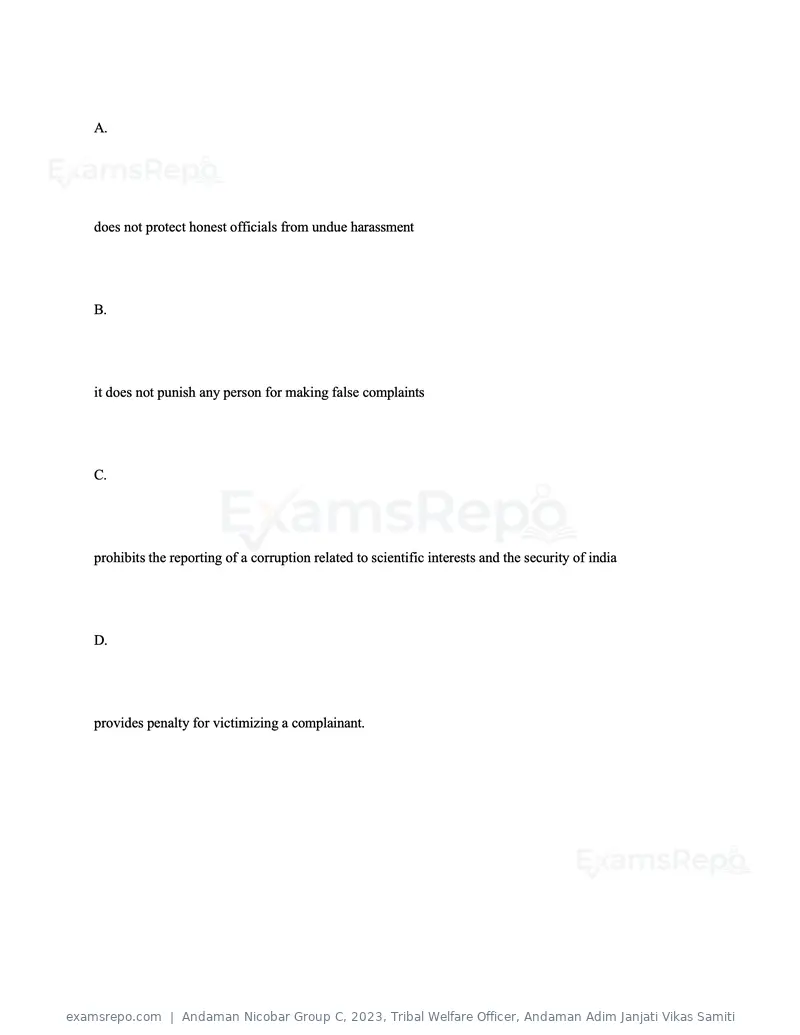
Key feature of Whistle Blowers Protection Bill
Text of page 114
A.


does not protect honest officials from undue harassment


B.


it does not punish any person for making false complaints


C.


prohibits the reporting of a corruption related to scientific interests and the security of india


D.


provides penalty for victimizing a complainant.
Text of page 115
Answer: (C)


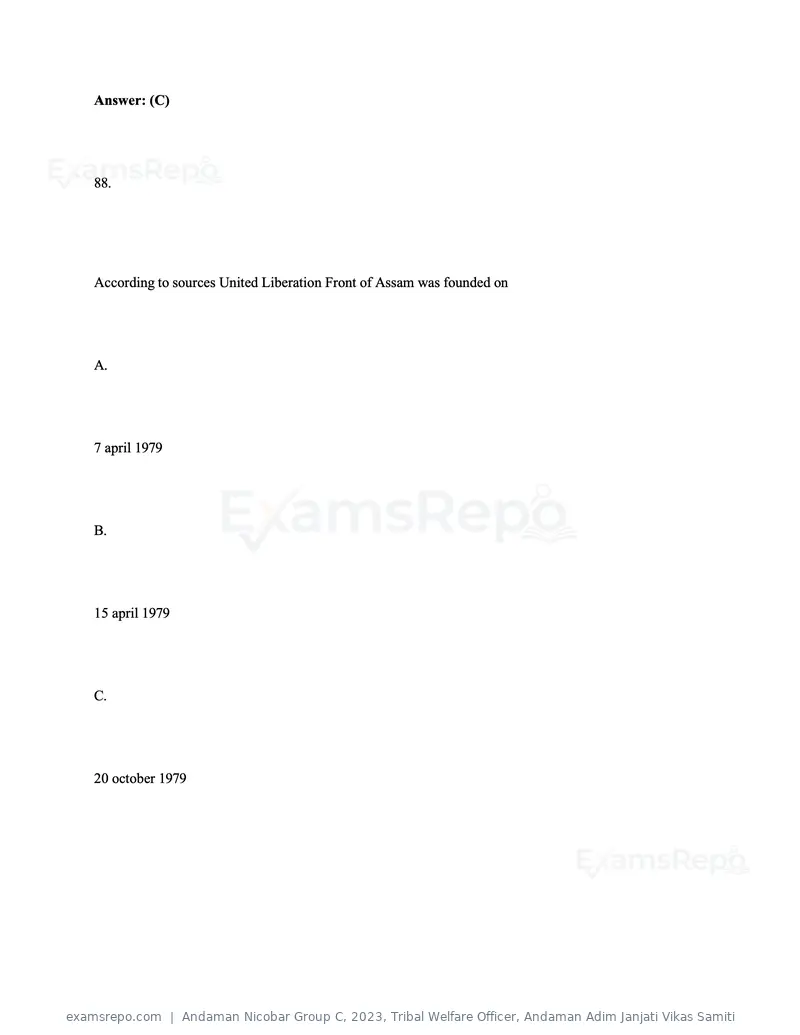
88.


According to sources United Liberation Front of Assam was founded on


A.


7 april 1979


B.


15 april 1979


C.


20 october 1979

Text of page 116
D.


12 november 1979


Answer: (A)


89.


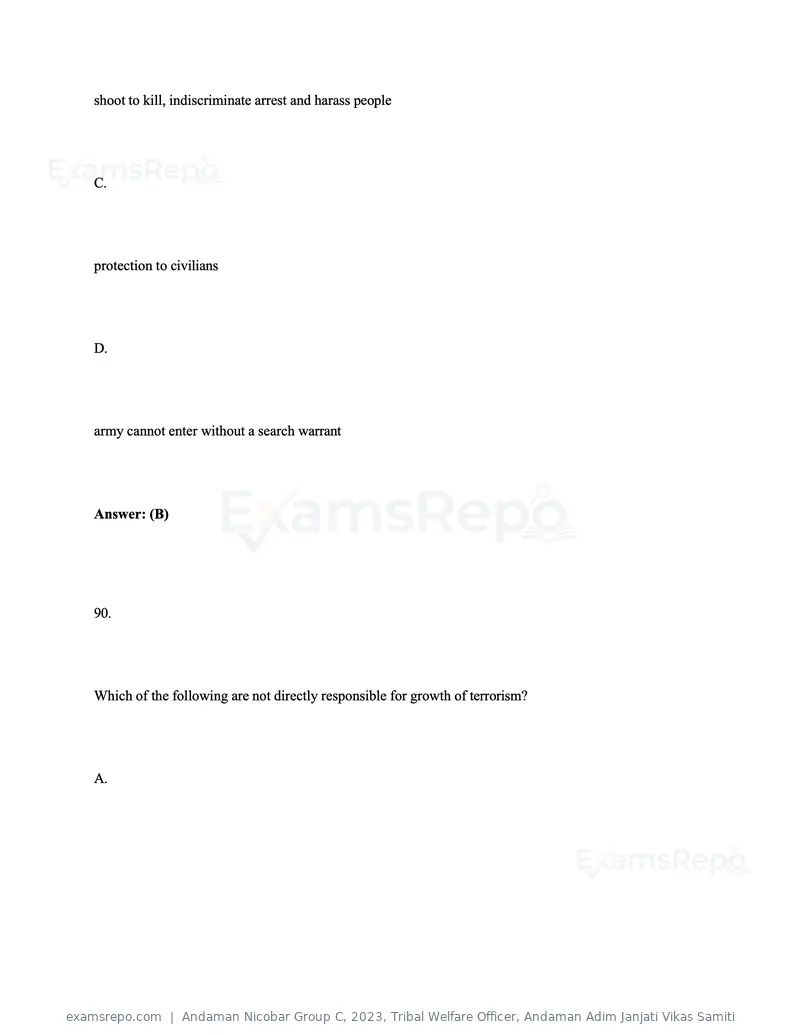
AFSPA gives armed forces the power to


A.


secure due to imposition of afspa


B.
Text of page 117
shoot to kill, indiscriminate arrest and harass people


C.


protection to civilians


D.


army cannot enter without a search warrant


Answer: (B)


90.


Which of the following are not directly responsible for growth of terrorism?


A.

Text of page 118
political instability


B.


extremism


C.


regional disputes


D.


unemployment


Answer: (D)


91.
Text of page 119
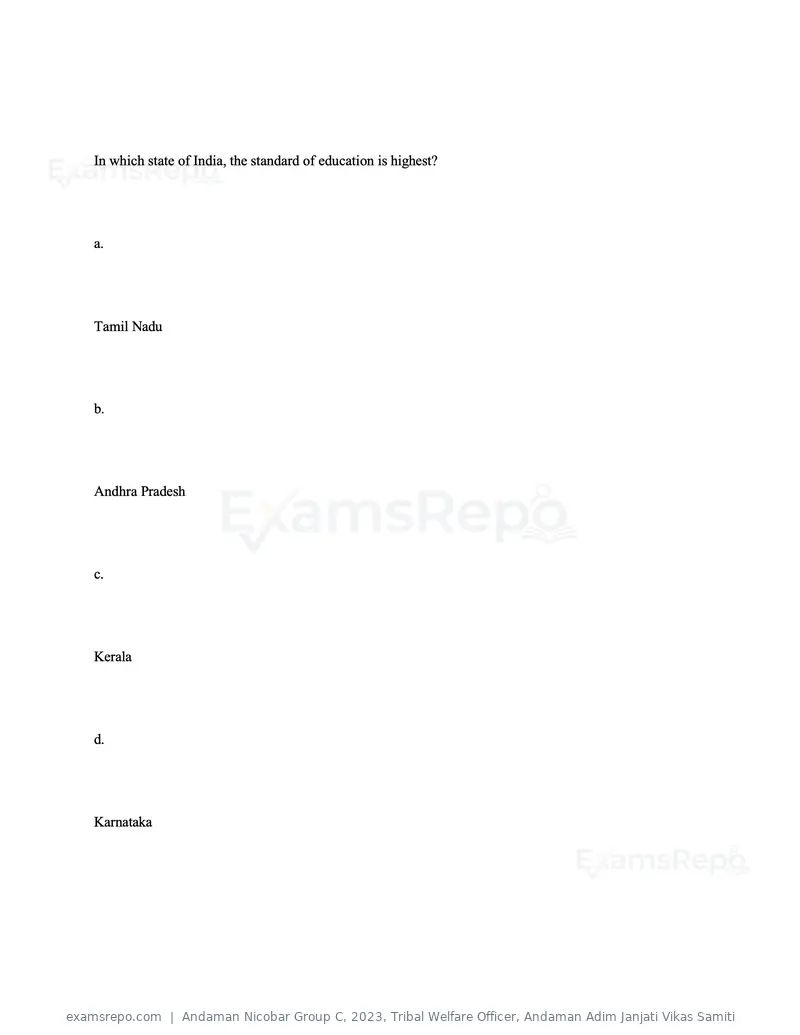
In which state of India, the standard of education is highest?


a.


Tamil Nadu


b.


Andhra Pradesh


c.


Kerala


d.


Karnataka

Text of page 120
Answer: (C)


92.


Which phase is the phase of real training?


a.


Initial phase


b.


Training phase


c.

Text of page 121
Post-training phase


d.


Follow up phase


Answer: (B)


93.


“Seed Capital Scheme” is being operated by?


a.


IDBI


b.

Text of page 122
SIDC


c.


ICICI


d.


IFCI


Answer: (A)


94.


Calcutta “Y” Self- Employment Centre targets unemployed youthsbetween?


a.

Text of page 123
18 to 30 years


b.


16 to 25 years


c.


18 to 25 years


d.


20 to 30 years


Answer: (A)


95.
Text of page 124
In the 1995 – 96 periods what percentage of the total entrepreneurs werewomen entrepreneurs?


a.


10 %


b.


11.2%


c.


13%


d.


9%
Text of page 125
Answer: (B)


96


Which of the following social movements is most closely associated with the social work profession?


A.


Civil rights movement


B.


Women's rights movement


C.


Anti-war movement
Text of page 126
D.


Social welfare movement


Answer: (D)


97


Which of the following is a social work initiative that is addressing the social and emotional impact of the
COVID-19 pandemic?


A.


The War on Poverty


B.
Text of page 127
The Great Society


C.


Medicaid


D.


The CARES Act


Answer: (D)


98


Which of the following is NOT one of Freud's three personality components?


A.

Text of page 128
Id


B.


Ego


C.


Superego


D.


Libido


Answer: (D)

Text of page 129
99


What is the id?


A.


The rational, conscious part of the personality


B.


The impulsive, unconscious part of the personality


C.


The moralistic, superego part of the personality


D.

Text of page 130
The mediating part of the personality


Answer: (B)


100


What is the ego?


A.


The rational, conscious part of the personality


B.


The impulsive, unconscious part of the personality

Text of page 131
C.


The moralistic, superego part of the personality


D.


The mediating part of the personality


Answer: (A)
Official key not published for this paper.
Page 1 of 131
Source: Andaman and Nicobar Administration. Question paper published by Andaman and Nicobar Administration.