Machine-translated by Google. Questions are authored in English.
Top

CBSE Junior Engineer 2024: Junior Engineer, CBSE Recruitment Examination, Tier 1, booklet code D1
  • Paper code: RAS-24/JER
  • Series: D1
  • Language: Bilingual
  • 40 pages
CBSE Junior Engineer 2024 question paper, Junior Engineer, CBSE Recruitment Examination 2024, Tier 1, booklet code D1, page 1 of 40
Page 1 of 40
Text of page 1
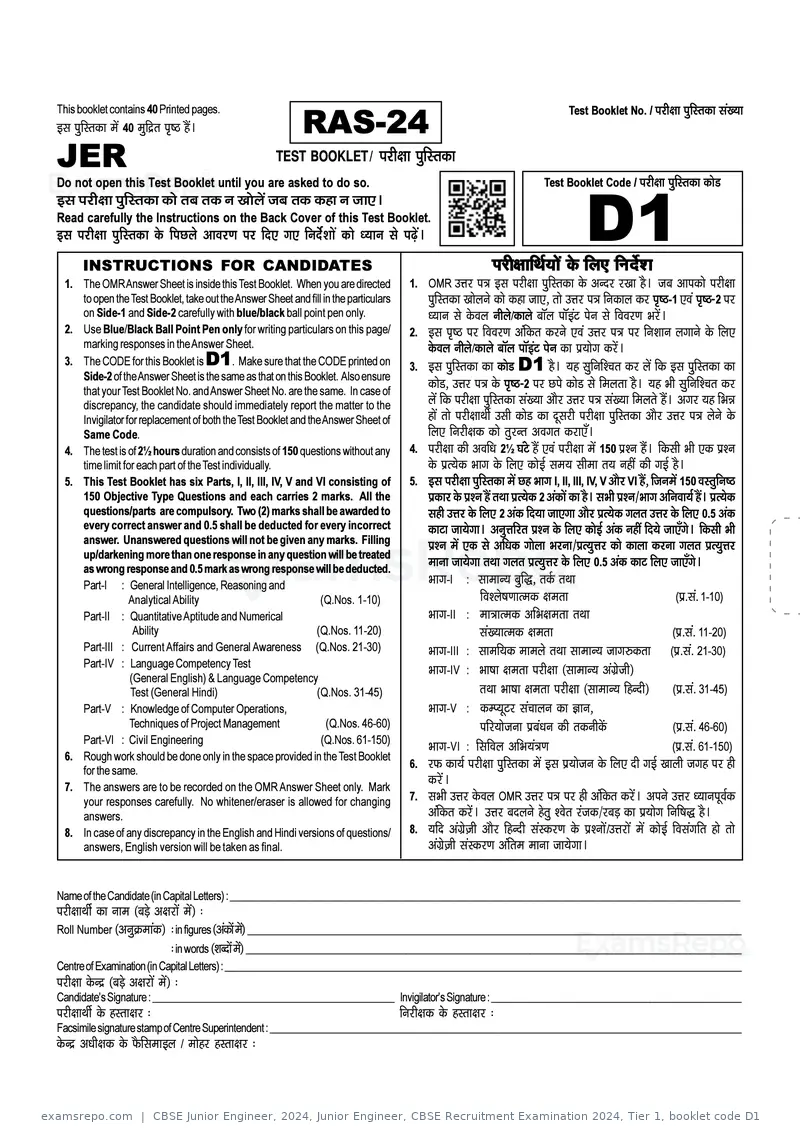
This booklet contains 40 Printed pages.                                                                                            Test Booklet No. / ¬⁄UˡÊÊ ¬ÈÁSÃ∑§Ê ‚¥ÅÿÊ
ß‚ ¬ÈÁSÃ∑§Ê ◊¥ 40 ◊ÈÁŒ˝Ã ¬Îc∆U „Ò¥–                         RAS-24
JER                                                    TEST BOOKLET / ¬⁄UˡÊÊ ¬ÈÁSÃ∑§Ê
Do not open this Test Booklet until you are asked to do so.                                                                 Test Booklet Code / ¬⁄UˡÊÊ ¬ÈÁSÃ∑§Ê ∑§Ê«U
ß‚ ¬⁄UˡÊÊ ¬ÈÁSÃ∑§Ê ∑§Ê Ã’ Ã∑§ Ÿ πÊ‹¥ ¡’ Ã∑§ ∑§„Ê Ÿ ¡Ê∞–
Read carefully the Instructions on the Back Cover of this Test Booklet.
ß‚ ¬⁄UˡÊÊ ¬ÈÁSÃ∑§Ê ∑§ Á¬¿U‹ •Êfl⁄UáÊ ¬⁄U ÁŒ∞ ª∞ ÁŸŒ¸‡ÊÊ¥ ∑§Ê äÿÊŸ ‚ ¬…∏¥–
       INSTRUCTIONS FOR CANDIDATES
                                                                                                                                        D1
                                                                                                               ¬⁄UˡÊÊÁÕ¸ÿÊ¥ ∑§ Á‹∞ ÁŸŒ¸‡Ê
  1. The OMR Answer Sheet is inside this Test Booklet. When you are directed             1. OMR ©ûÊ⁄U ¬òÊ ß‚ ¬⁄UˡÊÊ ¬ÈÁSÃ∑§Ê ∑§ •ãŒ⁄U ⁄UπÊ „Ò–              ¡’ •ʬ∑§Ê ¬⁄UˡÊÊ
     to open the Test Booklet, take out the Answer Sheet and fill in the particulars        ¬ÈÁSÃ∑§Ê πÊ‹Ÿ ∑§Ê ∑§„Ê ¡Ê∞, ÃÊ ©ûÊ⁄U ¬òÊ ÁŸ∑§Ê‹ ∑§⁄U ¬Îc∆U-1 ∞fl¥ ¬Îc∆-U2 ¬⁄U
     on Side-1 and Side-2 carefully with blue/black ball point pen only.                    äÿÊŸ ‚ ∑§fl‹ ŸË‹/∑§Ê‹ ’ÊÚ‹ ¬ÊÚߥ≈U ¬Ÿ ‚ Áflfl⁄UáÊ ÷⁄¥U–
  2. Use Blue/Black Ball Point Pen only for writing particulars on this page/            2. ß‚ ¬Îc∆U ¬⁄U Áflfl⁄UáÊ •¥Á∑§Ã ∑§⁄UŸ ∞fl¥ ©ûÊ⁄U ¬òÊ ¬⁄U ÁŸ‡ÊÊŸ ‹ªÊŸ ∑§ Á‹∞
     marking responses in the Answer Sheet.                                                 ∑§fl‹ ŸË‹/∑§Ê‹ ’ÊÚ‹ ¬ÊÚߥ≈U ¬Ÿ ∑§Ê ¬˝ÿÊª ∑§⁄¥U–
  3. The CODE for this Booklet is D1. Make sure that the CODE printed on                 3. ß‚ ¬ÈÁSÃ∑§Ê ∑§Ê ∑§Ê«U D1 „Ò– ÿ„ ‚ÈÁŸÁ‡øÃ ∑§⁄U ‹¥ Á∑§ ß‚ ¬ÈÁSÃ∑§Ê ∑§Ê
     Side-2 of the Answer Sheet is the same as that on this Booklet. Also ensure
     that your Test Booklet No. and Answer Sheet No. are the same. In case of
                                                                                            ∑§Ê«U, ©ûÊ⁄U ¬òÊ ∑§ ¬Îc∆U-2 ¬⁄U ¿U¬ ∑§Ê«U ‚ Á◊‹ÃÊ „Ò– ÿ„ ÷Ë ‚ÈÁŸÁ‡øÃ ∑§⁄U
     discrepancy, the candidate should immediately report the matter to the                 ‹¥ Á∑§ ¬⁄UˡÊÊ ¬ÈÁSÃ∑§Ê ‚¥ÅÿÊ •ÊÒ⁄U ©ûÊ⁄U ¬òÊ ‚¥ÅÿÊ Á◊‹Ã „Ò¥– •ª⁄U ÿ„ Á÷ÛÊ
     Invigilator for replacement of both the Test Booklet and the Answer Sheet of           „Ê¥ ÃÊ ¬⁄UˡÊÊÕ˸ ©‚Ë ∑§Ê«U ∑§Ê ŒÍ‚⁄UË ¬⁄UˡÊÊ ¬ÈÁSÃ∑§Ê •ÊÒ⁄U ©ûÊ⁄U ¬òÊ ‹Ÿ ∑§
     Same Code.                                                                             Á‹∞ ÁŸ⁄UˡÊ∑§ ∑§Ê ÃÈ⁄Uãà •flªÃ ∑§⁄UÊ∞°–
  4. The test is of 2½ hours duration and consists of 150 questions without any          4. ¬⁄UˡÊÊ ∑§Ë •flÁœ 2½ ÉÊ¥≈ „Ò¥ ∞fl¥ ¬⁄UˡÊÊ ◊¥ 150 ¬˝‡Ÿ „¥Ò– Á∑§‚Ë ÷Ë ∞∑§ ¬˝‡Ÿ
     time limit for each part of the Test individually.                                     ∑§ ¬˝àÿ∑§ ÷ʪ ∑§ Á‹∞ ∑§Ê߸ ‚◊ÿ ‚Ë◊Ê Ãÿ Ÿ„Ë¥ ∑§Ë ªß¸ „Ò–
  5. This Test Booklet has six Parts, I, II, III, IV, V and VI consisting of             5. ß‚ ¬⁄UˡÊÊ ¬ÈÁSÃ∑§Ê ◊¥ ¿U„ ÷ʪ I, II, III, IV, V •ÊÒ⁄U VI „Ò¥, Á¡Ÿ◊¥ 150 flSÃÈÁŸc∆U
     150 Objective Type Questions and each carries 2 marks. All the                         ¬˝∑§Ê⁄U ∑§ ¬˝‡Ÿ „Ò¥ ÃÕÊ ¬˝àÿ∑§ 2 •¥∑§Ê¥ ∑§Ê „Ò– ‚÷Ë ¬˝‡Ÿ/÷ʪ •ÁŸflÊÿ¸ „Ò¥– ¬˝àÿ∑§
     questions/parts are compulsory. Two (2) marks shall be awarded to                      ‚„Ë ©ûÊ⁄U ∑§ Á‹∞ 2 •¥∑§ ÁŒÿÊ ¡Ê∞ªÊ •ÊÒ⁄U ¬˝àÿ∑§ ª‹Ã ©ûÊ⁄U ∑§ Á‹∞ 0.5 •¥∑§
     every correct answer and 0.5 shall be deducted for every incorrect                     ∑§Ê≈UÊ ¡ÊÿªÊ– •ŸÈûÊÁ⁄Uà ¬˝‡Ÿ ∑§ Á‹∞ ∑§Ê߸ •¥∑§ Ÿ„Ë¥ ÁŒÿ ¡Ê∞°ª– Á∑§‚Ë ÷Ë
     answer. Unanswered questions will not be given any marks. Filling                      ¬˝‡Ÿ ◊¥ ∞∑§ ‚ •Áœ∑§ ªÊ‹Ê ÷⁄UŸÊ/¬˝àÿÈûÊ⁄U ∑§Ê ∑§Ê‹Ê ∑§⁄UŸÊ ª‹Ã ¬˝àÿÈûÊ⁄U
     up/darkening more than one response in any question will be treated
     as wrong response and 0.5 mark as wrong response will be deducted.
                                                                                            ◊ÊŸÊ ¡ÊÿªÊ ÃÕÊ ª‹Ã ¬˝àÿÈûÊ⁄U ∑§ Á‹∞ 0.5 •¥∑§ ∑§Ê≈U Á‹∞ ¡Ê∞°ª–
     Part-I : General Intelligence, Reasoning and                                           ÷ʪ-I : ‚Ê◊Êãÿ ’ÈÁh, Ã∑¸§ ÃÕÊ
                  Analytical Ability                             (Q.Nos. 1-10)                              Áfl‡‹·áÊÊà◊∑§ ˇÊ◊ÃÊ                                  (¬˝.‚¥. 1-10)
     Part-II : Quantitative Aptitude and Numerical                                          ÷ʪ-II : ◊ÊòÊÊà◊∑§ •Á÷ˇÊ◊ÃÊ ÃÕÊ
                   Ability                                      (Q.Nos. 11-20)                              ‚¥ÅÿÊà◊∑§ ˇÊ◊ÃÊ                                     (¬˝.‚¥. 11-20)
     Part-III : Current Affairs and General Awareness (Q.Nos. 21-30)                        ÷ʪ-III : ‚Ê◊Áÿ∑§ ◊Ê◊‹ ÃÕÊ ‚Ê◊Êãÿ ¡ÊªL§∑§ÃÊ (¬˝.‚¥. 21-30)
     Part-IV : Language Competency Test
                  (General English) & Language Competency
                                                                                            ÷ʪ-IV : ÷Ê·Ê ˇÊ◊ÃÊ ¬⁄UˡÊÊ (‚Ê◊Êãÿ •¥ª˝¡Ë)
                  Test (General Hindi)                          (Q.Nos. 31-45)                              ÃÕÊ ÷Ê·Ê ˇÊ◊ÃÊ ¬⁄UˡÊÊ (‚Ê◊Êãÿ Á„ãŒË) (¬˝.‚¥. 31-45)
     Part-V : Knowledge of Computer Operations,                                             ÷ʪ-V : ∑§êåÿÍ≈U⁄U ‚¥øÊ‹Ÿ ∑§Ê ôÊÊŸ,
                  Techniques of Project Management                 (Q.Nos. 46-60)                           ¬Á⁄UÿÊ¡ŸÊ ¬˝’¥œŸ ∑§Ë Ã∑§ŸË∑¥§§                    (¬˝.‚¥. 46-60)
     Part-VI : Civil Engineering                                 (Q.Nos. 61-150)
                                                                                            ÷ʪ-VI : Á‚Áfl‹ •Á÷ÿ¥òÊáÊ                                            (¬˝.‚¥. 61-150)
  6. Rough work should be done only in the space provided in the Test Booklet
                                                                                         6. ⁄U»§ ∑§Êÿ¸ ¬⁄UˡÊÊ ¬ÈÁSÃ∑§Ê ◊¥ ß‚ ¬˝ÿÊ¡Ÿ ∑§ Á‹∞ ŒË ªß¸ πÊ‹Ë ¡ª„ ¬⁄U „Ë
     for the same.
  7. The answers are to be recorded on the OMR Answer Sheet only. Mark
                                                                                            ∑§⁄¥U–
     your responses carefully. No whitener/eraser is allowed for changing                7. ‚÷Ë ©ûÊ⁄U ∑§fl‹ OMR ©ûÊ⁄U ¬òÊ ¬⁄U „Ë •¥Á∑§Ã ∑§⁄¥U– •¬Ÿ ©ûÊ⁄U äÿÊŸ¬Ífl¸∑§
     answers.                                                                               •¥Á∑§Ã ∑§⁄¥U– ©ûÊ⁄U ’Œ‹Ÿ „ÃÈ ‡flà ⁄¥U¡∑§/⁄U’«∏ ∑§Ê ¬˝ÿÊª ÁŸÁ·h „Ò–
  8. In case of any discrepancy in the English and Hindi versions of questions/          8. ÿÁŒ •¥ª˝$¡Ë •ÊÒ⁄U Á„ãŒË ‚¥S∑§⁄UáÊ ∑§ ¬˝‡ŸÊ¥/©ûÊ⁄UÊ¥ ◊¥ ∑§Ê߸ Áfl‚¥ªÁà „Ê ÃÊ
     answers, English version will be taken as final.                                       •¥ª˝$¡Ë ‚¥S∑§⁄UáÊ •¥ÁÃ◊ ◊ÊŸÊ ¡ÊÿªÊ–


Name of the Candidate (in Capital Letters) : ___________________________________________________________________________________________________
¬⁄UˡÊÊÕ˸ ∑§Ê ŸÊ◊ (’«∏ •ˇÊ⁄UÊ¥ ◊¥) —
Roll Number (•ŸÈ∑˝§◊Ê¥∑§) — in figures (•¥∑§Ê¥ ◊¥) ________________________________________________________________________________________________
                            — in words (‡ÊéŒÊ¥ ◊¥) ________________________________________________________________________________________________
Centre of Examination (in Capital Letters) : _____________________________________________________________________________________________________
¬⁄UˡÊÊ ∑§ãŒ˝ (’«∏ •ˇÊ⁄UÊ¥ ◊¥) —
Candidate’s Signature : _______________________________________________ Invigilator’s Signature : _________________________________________________
¬⁄UˡÊÊÕ˸ ∑§ „SÃÊˇÊ⁄U —                                                              ÁŸ⁄UˡÊ∑§ ∑§ „SÃÊˇÊ⁄U —
Facsimile signature stamp of Centre Superintendent : ____________________________________________________________________________________________
∑§ãŒ˝ •œËˇÊ∑§ ∑§ »Ò§Á‚◊Êß‹ / ◊Ê„⁄U „SÃÊˇÊ⁄U —
CBSE Junior Engineer 2024 question paper, Junior Engineer, CBSE Recruitment Examination 2024, Tier 1, booklet code D1, page 2 of 40
Page 2 of 40
Text of page 2
RAS24JERRAS24JERRAS24JERRAS24JERRAS24JERRAS24JERRAS24JERRAS24JERRAS24JERRAS24JERRAS24JERRAS24JERRAS24JERRAS24JERRAS24JERRAS24JERRAS24JERRAS24JERRAS24JERRAS24JERRAS24JERRAS24JERRAS24JERRAS24JERRAS24JERRAS24JERRAS24JERRAS24JERRAS24JERRAS24JERRAS24JERRAS24JERRAS24JERRAS24JERRAS24JERRAS24JERRAS24JERRAS24JERRAS24JERRAS24JERRAS24JERRAS24JER


                                        PART - I / ÷ʪ - I
    General Intelligence, Reasoning and Analytical Ability / ‚Ê◊Êãÿ ’ÈÁh, Ã∑¸§ ÃÕÊ Áfl‡‹·áÊÊà◊∑§ ˇÊ◊ÃÊ
RAS24JERRAS24JERRAS24JERRAS24JERRAS24JERRAS24JERRAS24JERRAS24JERRAS24JERRAS24JERRAS24JERRAS24JERRAS24JERRAS24JERRAS24JERRAS24JERRAS24JERRAS24JERRAS24JERRAS24JERRAS24JERRAS24JERRAS24JERRAS24JERRAS24JERRAS24JERRAS24JERRAS24JERRAS24JERRAS24JERRAS24JERRAS24JERRAS24JERRAS24JERRAS24JERRAS24JERRAS24JERRAS24JERRAS24JERRAS24JERRAS24JERRAS24JER


1.                Study the following diagram carefully and answer the question.


                  The triangle stands for players who play Hockey, circle for who play Football, square for who play
                  Badminton and rectangle for who play Cricket.
                  Based on the above diagram, which one of the following statement is definitely true ?
                  (1) All Football players play Cricket also.
                  (2) All Cricket players, play Badminton and Hockey.
                  (3) All Football players play Hockey also.
                  (4) All Football players play Badminton.
                  ŸËø ÁŒ∞ •Ê⁄Uπ ∑§Ê •äÿÿŸ ∑§ËÁ¡∞ •ÊÒ⁄U ¬˝‡Ÿ ∑§Ê ©ûÊ⁄U ŒËÁ¡∞ —


                  ÁòÊ÷È¡ ©Ÿ Áπ‹ÊÁ«∏ÿÊ¥ ∑§Ê Œ‡ÊʸÃÊ „Ò ¡Ê „ÊÚ∑§Ë π‹Ã „¥Ò, flÎûÊ ¡Ê »È§≈U’ÊÚ‹ π‹Ã „¥Ò, flª¸ ¡Ê ’Ò«UÁ◊ã≈UŸ π‹Ã „Ò¥ •ÊÒ⁄U •Êÿà ¡Ê
                  Á∑˝§∑§≈U π‹Ã „Ò¥–
                  ™§¬⁄U ÁŒ∞ •Ê⁄Uπ ∑§ •ÊœÊ⁄U ¬⁄U ÁŸêŸÁ‹Áπà ◊¥ ‚ ∑§ÊÒŸ ‚Ê ∑§ÕŸ ‚àÿ „Ò?
                  (1) ‚÷Ë »È§≈U’ÊÚ‹ Áπ‹Ê«∏Ë Á∑˝§∑§≈U ÷Ë π‹Ã „Ò¥–
                  (2) ‚÷Ë Á∑˝§∑§≈U Áπ‹Ê«∏Ë, ’Ò«UÁ◊ã≈UŸ •ÊÒ⁄U „ÊÚ∑§Ë ÷Ë π‹Ã „¥Ò–
                  (3) ‚÷Ë »È§≈U’ÊÚ‹ Áπ‹Ê«∏Ë „ÊÚ∑§Ë ÷Ë π‹Ã „Ò¥–
                  (4) ‚÷Ë »È§≈U’ÊÚ‹ Áπ‹Ê«∏Ë ’Ò«UÁ◊ã≈UŸ ÷Ë π‹Ã „Ò¥–

2.                X is the father of Z, but Z is not his son. M is the daughter of Z. N is the spouse of X. Y is the
                  brother of Z. P is the son of Y.
                  Who is the son of N ?
                  X, Z ∑§Ê Á¬ÃÊ „Ò ‹Á∑§Ÿ Z ©‚∑§Ê ¬ÈòÊ Ÿ„Ë¥ „Ò– M, Z ∑§Ë ¬ÈòÊË „Ò– N, X ∑§Ë ¬àŸË „Ò– Y, Z ∑§Ê ÷Ê߸ „Ò– P, Y ∑§Ê ¬ÈòÊ „Ò–
                  N ∑§Ê ¬ÈòÊ ∑§ÊÒŸ „Ò?
                  (1)               Z                                                        (2)               P                                                       (3)                M                                                       (4)                Y
RAS24JERRAS24JERRAS24JERRAS24JERRAS24JERRAS24JERRAS24JERRAS24JERRAS24JERRAS24JERRAS24JERRAS24JERRAS24JERRAS24JERRAS24JERRAS24JERRAS24JERRAS24JERRAS24JERRAS24JERRAS24JERRAS24JERRAS24JERRAS24JERRAS24JERRAS24JERRAS24JERRAS24JERRAS24JERRAS24JERRAS24JERRAS24JERRAS24JERRAS24JERRAS24JERRAS24JERRAS24JERRAS24JERRAS24JERRAS24JERRAS24JERRAS24JER


RAS-24 / JER                                                                                                                                                         2                                                                                                                                                                D1
CBSE Junior Engineer 2024 question paper, Junior Engineer, CBSE Recruitment Examination 2024, Tier 1, booklet code D1, page 3 of 40
Page 3 of 40
Text of page 3
3.                In a certain code language ‘973’ means ‘Leaves are green’, ‘728’ means ‘Green is beautiful’ and ‘83’
                  means ‘Beautiful leaves’, then in the same language what is the code for ‘Beautiful green leaves’ ?
                  Á∑§‚Ë ∑ͧ≈U ÷Ê·Ê ◊¥ ‘973’ ∑§Ê •Õ¸ „Ò ‘Leaves are green’, ‘728’ ∑§Ê •Õ¸ „Ò ‘Green is beautiful’ •ÊÒ⁄U ‘83’ ∑§Ê •Õ¸
                  ‘Beautiful leaves’ „Ò, ÃÊ ß‚Ë ∑ͧ≈U ÷Ê·Ê ◊¥ ‘Beautiful green leaves’ ∑§Ê ∑ͧ≈U ÄÿÊ „ÊªÊ?
                  (1)               982                                                      (2)               827                                                     (3)                873                                                     (4)                392

4.                Given below is a question followed by two statements numbered I and II, each containing some
                  information. You have to decide which of the statements is/are sufficient to answer the question.
                  Read both the statements and decide the appropriate answer.
                  Mamta, Prabha, Anita and Komal are four friends. Who among them is the tallest ?
                  Statements :     I.   Prabha is taller than Mamta and Komal but shorter than Anita.
                                   II. Mamta is shorter than Prabha and Anita but taller than Komal.
                  (1) Statement II alone is sufficient to answer the question, while statement I alone is not sufficient.
                  (2) Either statement I alone or statement II is sufficient to answer the question.
                  (3) Both statements I and II together are necessary to answer the question.
                  (4) Statement I alone is sufficient to answer the question, while statement II alone is not sufficient.
                  ŸËø ∞∑§ ¬˝‡Ÿ ∑§ ’ÊŒ ŒÊ ∑§ÕŸ I •ÊÒ⁄U II, ¬˝àÿ∑§ ∑ȧ¿U ¡ÊŸ∑§Ê⁄UË ‚Á„à ÁŒ∞ ª∞ „Ò¥– •ʬ∑§Ê ÿ„ Ãÿ ∑§⁄UŸÊ „Ò Á∑§
                  ∑§ÊÒŸ ‚Ê/∑§ÊÒŸ ‚ ∑§ÕŸ ¬˝‡Ÿ ∑§Ê ©ûÊ⁄U ŒŸ „ÃÈ ¬ÿʸåà „Ò/„Ò¥– ŒÊŸÊ¥ ∑§ÕŸÊ¥ ∑§Ê ¬Á…∏∞ •ÊÒ⁄U ©ÁøÃ ©ûÊ⁄U Ãÿ ∑§ËÁ¡∞–
                  ◊◊ÃÊ, ¬˝÷Ê, •ÁŸÃÊ •ÊÒ⁄U ∑§Ê◊‹ øÊ⁄U ‚„Á‹ÿʰ „Ò¥– ©Ÿ◊¥ ‚ ∑§ÊÒŸ ‚’‚ ‹¥’Ë „Ò?
                  ∑§ÕŸ :         I.     ¬˝÷Ê, ◊◊ÃÊ •ÊÒ⁄U ∑§Ê◊‹ ‚ ‹¥’Ë „Ò ‹Á∑§Ÿ, •ÁŸÃÊ ‚ ¿UÊ≈UË „Ò–
                                 II. ◊◊ÃÊ, ¬˝÷Ê •ÊÒ⁄U •ÁŸÃÊ ‚ ¿UÊ≈UË „Ò ‹Á∑§Ÿ ∑§Ê◊‹ ‚ ‹¥’Ë „Ò–
                  (1) ∑§ÕŸ II •∑§‹ „Ë ¬˝‡Ÿ ∑§Ê ©ûÊ⁄U ŒŸ „ÃÈ ¬ÿʸåà „Ò ¡’Á∑§ ∑§ÕŸ I •∑§‹ ¬ÿʸåà Ÿ„Ë¥ „Ò–
                  (2) ÿÊ ÃÊ ∑§ÕŸ I •∑§‹ ÿÊ ∑§ÕŸ II •∑§‹ ¬˝‡Ÿ ∑§Ê ©ûÊ⁄U ŒŸ „ÃÈ ¬ÿʸåà „Ò–
                  (3) ŒÊŸÊ¥ ∑§ÕŸ I •ÊÒ⁄ II ∞∑§ ‚ÊÕ Á◊‹∑§⁄U ¬˝‡Ÿ ∑§Ê ©ûÊ⁄U ŒŸ ∑§ Á‹∞ •Êfl‡ÿ∑§ „Ò¥–
                  (4) ∑§ÕŸ I •∑§‹ „Ë ¬˝‡Ÿ ∑§Ê ©ûÊ⁄U ŒŸ „ÃÈ ¬ÿʸåà „Ò ¡’Á∑§ ∑§ÕŸ II •∑§‹ ¬ÿʸåà Ÿ„Ë¥ „Ò–

5.                If the second half of the English alphabet is written in the reverse order, which letter will be ninth
                  to the right of the twelfth letter from the left end ?
                  ÿÁŒ •¥ª˝¡Ë fláʸ◊Ê‹Ê ∑§ Á¬¿U‹ •Êœ fláÊÊZ ∑§Ê Áfl¬⁄UËà (©À≈UÊ) Á‹π ÁŒÿÊ ¡Ê∞ ÃÊ ’Êÿ¥ ‚ ’Ê⁄U„fl¥ fláʸ ∑§ ŒÊÿ¥ ‚ ŸÊÒ¥fl SÕÊŸ
                  ¬⁄U ∑§ÊÒŸ ‚Ê fláʸ „ÊªÊ?
                  (1)               C                                                        (2)               S                                                       (3)                F                                                       (4)                P

6.                Abhinav travels 100 km towards North, from there he travels 60 km towards South, then he
                  travels 30 km towards East. How far and in which direction is he with reference to his starting
                  point ?
                  (1) 70 km, East                      (2) 60 km, South
                  (3) 90 km, East                      (4) 50 km, North-East
                  •Á÷Ÿfl 100 Á∑§.◊Ë. ©ûÊ⁄U ∑§Ë •Ê⁄U ¡ÊÃÊ „Ò, fl„ʰ ‚ ŒÁˇÊáÊ ÁŒ‡ÊÊ ◊¥ 60 Á∑§.◊Ë. ¡ÊÃÊ „Ò– Á»§⁄U 30 Á∑§.◊Ë. ¬Ífl¸ ∑§Ë •Ê⁄U ¡ÊÃÊ
                  „Ò– flÊ •Ê⁄¥UÁ÷∑§ Á’ãŒÈ ‚ Á∑§ÃŸË ŒÍ⁄UË ¬⁄U •ÊÒ⁄U Á∑§‚ ÁŒ‡ÊÊ ◊¥ „Ò?
                  (1) 70 Á∑§.◊Ë., ¬Ífl¸                                 (2) 60 Á∑§.◊Ë., ŒÁˇÊáÊ
                  (3) 90 Á∑§.◊Ë., ¬Ífl¸                                 (4) 50 Á∑§.◊Ë., ©ûÊ⁄U-¬Ífl¸
RAS24JERRAS24JERRAS24JERRAS24JERRAS24JERRAS24JERRAS24JERRAS24JERRAS24JERRAS24JERRAS24JERRAS24JERRAS24JERRAS24JERRAS24JERRAS24JERRAS24JERRAS24JERRAS24JERRAS24JERRAS24JERRAS24JERRAS24JERRAS24JERRAS24JERRAS24JERRAS24JERRAS24JERRAS24JERRAS24JERRAS24JERRAS24JERRAS24JERRAS24JERRAS24JERRAS24JERRAS24JERRAS24JERRAS24JERRAS24JERRAS24JERRAS24JER


RAS-24 / JER                                                                                                                                                         3                                                                                                                                                                D1
CBSE Junior Engineer 2024 question paper, Junior Engineer, CBSE Recruitment Examination 2024, Tier 1, booklet code D1, page 4 of 40
Page 4 of 40
Text of page 4
7.                Find the mirror image of the following figure when the mirror is placed at ‘AB’ line as shown
                  below :

                  ŸËø ÁŒ∞ ª∞ ÁøòÊ ∑§Ê Œ¬¸áÊ ¬˝ÁÃÁ’ê’ ôÊÊà ∑§⁄¥U; ¡’ Œ¬¸áÊ ∑§Ê ŸËø ÁŒπÊ∞ •ŸÈ‚Ê⁄U ‘AB’ ⁄UπÊ ¬⁄U ⁄UπÊ ¡Ê∞–


                  (1)                                                                        (2)                                                                       (3)                                                                        (4)


8.                A statement is followed by two Assumptions numbered I and II. Consider the statement and
                  assumptions and decide which of the given assumptions is/are implicit in the statement.
                  Statement                                     :         Children are influenced more by their teachers now-a-days.
                  Assumptions : I.                                                           Children spent a large amount of time in school.
                                                                          II.                The children consider teachers as their models.
                  (1)               Only Assumption I is implicit.
                  (2)               Only Assumption II is implicit.
                  (3)               Both Assumptions I and II are implicit.
                  (4)               Neither Assumption I nor II is implicit.

                  ∞∑§ ∑§ÕŸ ∑§ ¬‡øÊØ ŒÊ ¬Ífl¸œÊ⁄UáÊÊÿ¥ I •ÊÒ⁄U II ŒË ªß¸ „Ò¥– ∑§ÕŸ •ÊÒ⁄U ¬Ífl¸œÊ⁄UáÊÊ•Ê¥ ¬⁄U ÁfløÊ⁄U ∑§⁄¥U •ÊÒ⁄U ÿ„ ÁŸáʸÿ ‹¥ Á∑§
                  ∑§ÊÒŸ ‚Ë/‚ ¬Ífl¸œÊ⁄UáÊÊ ∑§ÕŸ ◊¥ •¥ÃÁŸ¸Á„à „Ò/„Ò¥?
                  ∑§ÕŸ                                 —                  •Ê¡∑§‹ ’ëø •¬Ÿ •äÿʬ∑§Ê¥ ‚ ’„Èà ¬˝÷ÊÁflà „ÊÃ „Ò¥–
                  ¬Ífl¸œÊ⁄UáÊÊ∞° :                                         I.                 ’ëø, ÁfllÊ‹ÿ ◊¥ ’„Èà •Áœ∑§ ‚◊ÿ Á’ÃÊÃ „Ò¥–
                                                                          II.                ’ëø, •äÿʬ∑§Ê¥ ∑§Ê •¬ŸÊ •ÊŒ‡Ê¸ ◊ÊŸÃ „Ò¥–
                  (1)               ∑§fl‹ ¬Ífl¸œÊ⁄UáÊÊ I •ãÃÁŸ¸Á„à „Ò¥–
                  (2)               ∑§fl‹ ¬Ífl¸œÊ⁄UáÊÊ II •ãÃÁŸ¸Á„à „Ò–
                  (3)               ŒÊŸÊ¥ ¬Ífl¸œÊ⁄UáÊÊ∞° I •ÊÒ⁄U II •ãÃÁŸ¸Á„à „Ò¥–
                  (4)               Ÿ ÃÊ ¬Ífl¸œÊ⁄UáÊÊ I Ÿ „Ë II •ãÃÁŸ¸Á„à „Ò–
RAS24JERRAS24JERRAS24JERRAS24JERRAS24JERRAS24JERRAS24JERRAS24JERRAS24JERRAS24JERRAS24JERRAS24JERRAS24JERRAS24JERRAS24JERRAS24JERRAS24JERRAS24JERRAS24JERRAS24JERRAS24JERRAS24JERRAS24JERRAS24JERRAS24JERRAS24JERRAS24JERRAS24JERRAS24JERRAS24JERRAS24JERRAS24JERRAS24JERRAS24JERRAS24JERRAS24JERRAS24JERRAS24JERRAS24JERRAS24JERRAS24JERRAS24JER


RAS-24 / JER                                                                                                                                                         4                                                                                                                                                                D1
CBSE Junior Engineer 2024 question paper, Junior Engineer, CBSE Recruitment Examination 2024, Tier 1, booklet code D1, page 5 of 40
Page 5 of 40
Text of page 5
9.                In this question, three statements are followed by two conclusions, numbered I and II. Find out
                  which conclusion(s) is/are definitely true, based on the given statements ?
                  Statements                                  :           E=L, L ≤ G, G > Q
                  Conclusions :                                           I.                 G/E
                                                                          II.                L≤Q
                  (1)               Only conclusion II is true.
                  (2)               Either conclusion I or conclusion II is true.
                  (3)               Both conclusions I and II are true.
                  (4)               Only conclusion I is true.

                  ß‚ ¬˝‡Ÿ ◊¥ ÃËŸ ∑§ÕŸÊ¥ ∑§ ’ÊŒ ŒÊ ÁŸc∑§·¸ I •ÊÒ⁄U II ÁŒ∞ ª∞ „Ò¥– ÁŒ∞ ª∞ ∑§ÕŸÊ¥ ∑§ •ÊœÊ⁄U ¬⁄U ¬ÃÊ ‹ªÊß∞ Á∑§ ∑§ÊÒŸ ‚Ê/
                  ∑§ÊÒŸ ‚ ÁŸc∑§·¸ ÁŸÁ‡øÃ M§¬ ‚ ‚àÿ „Ò/„Ò¥?
                  ∑§ÕŸ :                               E=L, L ≤ G, G > Q

                  ÁŸc∑§·¸ —                            I.                 G/E
                                                       II.                L≤Q

                  (1)               ∑§fl‹ ÁŸc∑§·¸ II ‚àÿ „Ò–
                  (2)               ÿÊ ÃÊ ÁŸc∑§·¸ I ÿÊ ÁŸc∑§·¸ II ‚àÿ „Ò–
                  (3)               ÁŸc∑§·¸ I •ÊÒ⁄U II ŒÊŸÊ¥ ‚àÿ „Ò¥–
                  (4)               ∑§fl‹ ÁŸc∑§·¸ I ‚àÿ „Ò–


10.               J, M, N, T, P, Q and S are sitting in a circle facing at the centre. P is the neighbour of J and T. S is
                  not between Q and N. Q is to the immediate right of J. What is the position of Q ?
                  (1)               Third to the left of N
                  (2)               To the immediate left of J
                  (3)               To the immediate right of M
                  (4)               Third to the right of T

                  J, M, N, T, P, Q •ÊÒ⁄U S ∞∑§ flÎà ◊¥ ∑§ãŒ˝ ∑§Ë •Ê⁄U ◊Ȱ„ ∑§⁄U∑§ ’Ò∆U „¥Ò– P, J •ÊÒ⁄U T ∑§Ê ¬«∏Ê‚Ë „Ò– S, Q •ÊÒ⁄U N ∑§ ’Ëø
                  ◊¥ Ÿ„Ë¥ ’Ò∆UÊ „Ò– Q ∆UË∑§ ’ª‹ ◊¥ J ∑§ ŒÊßZ •Ê⁄U ’Ò∆UÊ „Ò– Q Á∑§‚ SÕÊŸ ¬⁄U ’Ò∆UÊ „Ò?
                  (1)               N ∑§ ’ÊßZ •Ê⁄U ÃË‚⁄U SÕÊŸ ¬⁄U

                  (2)               J ∑§ ’ª‹ ◊¥ ’ÊßZ •Ê⁄U

                  (3)               M ∑§ ’ª‹ ◊¥ ŒÊßZ •Ê⁄U

                  (4)               T ∑§ ŒÊßZ •Ê⁄U ÃË‚⁄U SÕÊŸ ¬⁄U
RAS24JERRAS24JERRAS24JERRAS24JERRAS24JERRAS24JERRAS24JERRAS24JERRAS24JERRAS24JERRAS24JERRAS24JERRAS24JERRAS24JERRAS24JERRAS24JERRAS24JERRAS24JERRAS24JERRAS24JERRAS24JERRAS24JERRAS24JERRAS24JERRAS24JERRAS24JERRAS24JERRAS24JERRAS24JERRAS24JERRAS24JERRAS24JERRAS24JERRAS24JERRAS24JERRAS24JERRAS24JERRAS24JERRAS24JERRAS24JERRAS24JERRAS24JER


RAS-24 / JER                                                                                                                                                         5                                                                                                                                                                D1
CBSE Junior Engineer 2024 question paper, Junior Engineer, CBSE Recruitment Examination 2024, Tier 1, booklet code D1, page 6 of 40
Page 6 of 40
Text of page 6
RAS24JERRAS24JERRAS24JERRAS24JERRAS24JERRAS24JERRAS24JERRAS24JERRAS24JERRAS24JERRAS24JERRAS24JERRAS24JERRAS24JERRAS24JERRAS24JERRAS24JERRAS24JERRAS24JERRAS24JERRAS24JERRAS24JERRAS24JERRAS24JERRAS24JERRAS24JERRAS24JERRAS24JERRAS24JERRAS24JERRAS24JERRAS24JERRAS24JERRAS24JERRAS24JERRAS24JERRAS24JERRAS24JERRAS24JERRAS24JERRAS24JERRAS24JER


                                                   PART - II / ÷ʪ - II
                     Quantitative Aptitude and Numerical Ability / ◊ÊòÊÊà◊∑§ •Á÷ˇÊ◊ÃÊ ÃÕÊ ‚¥ÅÿÊà◊∑§ ˇÊ◊ÃÊ
RAS24JERRAS24JERRAS24JERRAS24JERRAS24JERRAS24JERRAS24JERRAS24JERRAS24JERRAS24JERRAS24JERRAS24JERRAS24JERRAS24JERRAS24JERRAS24JERRAS24JERRAS24JERRAS24JERRAS24JERRAS24JERRAS24JERRAS24JERRAS24JERRAS24JERRAS24JERRAS24JERRAS24JERRAS24JERRAS24JERRAS24JERRAS24JERRAS24JERRAS24JERRAS24JERRAS24JERRAS24JERRAS24JERRAS24JERRAS24JERRAS24JERRAS24JER


11.               A and B started partnership and invested ` 16,000 and ` 12,000 respectively. After 3 months,
                  A withdrew ` 5,000 while B invested ` 5,000 more. After 3 more months; C joins the business with
                  a capital of ` 21,000. The share of B exceeds that of C, out of a total profit of ` 26,400 after that one
                  year by :

                  ŒÊ √ÿÁÄÃÿÊ¥ ‘A’ •ÊÒ⁄U ‘B’ Ÿ ∞∑§ ‚ʤÊŒÊ⁄UË ¬˝Ê⁄Uê÷ ∑§⁄UÃ ‚◊ÿ ∑˝§◊‡Ê— ` 16,000 fl ` 12,000 ‹ªÊ∞– ÃËŸ ◊„ËŸ ’ÊŒ ‘A’ Ÿ
                  ` 5,000 ÁŸ∑§Ê‹ Á‹∞ ¡’Á∑§ ‘B’ Ÿ ` 5,000 •ÊÒ⁄U ‹ªÊ ÁŒ∞– •’ ÃËŸ ◊„ËŸ ’ÊŒ ‘C’ ÷Ë √ÿʬÊ⁄U ◊¥ ` 21,000 ‹ªÊ∑§⁄U
                  ‚ʤÊŒÊ⁄U „Ê ªÿÊ– ‘B’ ∑§Ê Á„S‚Ê ‘C’ ∑§ Á„S‚ ‚ Á∑§ÃŸÊ •Áœ∑§ „ÊªÊ ÿÁŒ ‹Ê÷ ∑§Ë ∑ȧ‹ ⁄UÊÁ‡Ê ∞∑§ fl·¸ ’ÊŒ ` 26,400 ⁄U„Ë
                  „Ê?
                  (1)               ` 4,200                                                  (2)               ` 3,600                                                 (3)                ` 2,800                                                 (4)                ` 3,800


12.               Find the value of :

                  ÁŸêŸÁ‹Áπà ∑§Ê ◊ÊŸ ôÊÊà ∑§⁄¥U —
                        1    1 4  1
                   2      + 1 ÷ ×2 −1
                        4    3 9  4
                  (1)               6                                                        (2)               9                                                       (3)                8                                                       (4)                12


13.               X and Y can do some work in 30 days. While Y and Z can do the same work in 24 days and Z and
                  X in 20 days. They all work together for 10 days when Y and Z leave. How many days more X will
                  work to finish that work ?
                  (1)               36 days                                                  (2)               18 days                                                 (3)                24 days                                                 (4)                32 days

                  ŒÊ √ÿÁÄà X ÃÕÊ Y Á◊‹∑§⁄U Á∑§‚Ë ∑§Ê◊ ∑§Ê 30 ÁŒŸ ◊¥ ¬Í⁄UÊ ∑§⁄UÃ „Ò¥ ¡’Á∑§ Y •ÊÒ⁄U Z Á◊‹∑§⁄U ©‚Ë ∑§Ê◊ ∑§Ê 24 ÁŒŸ ◊¥ ÃÕÊ
                  Z •ÊÒ⁄U X Á◊‹∑§⁄U 20 ÁŒŸ ◊¥ ¬Í⁄UÊ ∑§⁄UÃ „Ò¥– ÿ ‚’ Á◊‹∑§⁄U 10 ÁŒŸ ∑§Ê◊ ∑§⁄UÃ „Ò¥– ß‚∑§ ’ÊŒ Y •ÊÒ⁄U Z ∑§Ê◊ ¿UÊ«∏ ŒÃ „Ò¥–
                  •’ X ∑§Ê ‡Ê· ∑§Ê◊ ¬Í⁄UÊ ∑§⁄UŸ ◊¥ Á∑§ÃŸ ÁŒŸ ‹ª¥ª?
                  (1)               36 ÁŒŸ                                                   (2)               18 ÁŒŸ                                                  (3)                24 ÁŒŸ                                                  (4)                32 ÁŒŸ


14.               Three persons walking around a circular track complete their respective single revolutions in
                  32 seconds, 40 seconds and 72 seconds respectively. After how many minutes they will be again
                  together at the common starting point ?
                  (1)               12 minutes                                               (2)               24 minutes                                              (3)                18 minutes                                              (4)                36 minutes

                  ÃËŸ √ÿÁÄà ∞∑§ flÎûÊÊ∑§Ê⁄U ¬Á⁄U¬Õ ¬⁄U ÉÊÍ◊Ã „Ò¥– ©ã„¥ ∞∑§ ¬Í⁄UÊ øÄ∑§⁄U ‹ªÊŸ ◊¥ ∑˝§◊‡Ê— 32, 40 •ÊÒ⁄U 72 ‚Ò∑§ã«U ‹ªÃ „Ò¥– •’
                  fl Á∑§ÃŸË Á◊Ÿ≈U ’ÊŒ Á»§⁄U ‚Ê◊Êãÿ ¬˝Ê⁄¥UÁ÷∑§ Á’ãŒÈ ¬⁄U Á◊‹¥ª?
                  (1)               12 Á◊Ÿ≈                                                  (2)               24 Á◊Ÿ≈                                                 (3)                18 Á◊Ÿ≈                                                 (4)                36 Á◊Ÿ≈
RAS24JERRAS24JERRAS24JERRAS24JERRAS24JERRAS24JERRAS24JERRAS24JERRAS24JERRAS24JERRAS24JERRAS24JERRAS24JERRAS24JERRAS24JERRAS24JERRAS24JERRAS24JERRAS24JERRAS24JERRAS24JERRAS24JERRAS24JERRAS24JERRAS24JERRAS24JERRAS24JERRAS24JERRAS24JERRAS24JERRAS24JERRAS24JERRAS24JERRAS24JERRAS24JERRAS24JERRAS24JERRAS24JERRAS24JERRAS24JERRAS24JERRAS24JER


RAS-24 / JER                                                                                                                                                         6                                                                                                                                                                D1
CBSE Junior Engineer 2024 question paper, Junior Engineer, CBSE Recruitment Examination 2024, Tier 1, booklet code D1, page 7 of 40
Page 7 of 40
Text of page 7
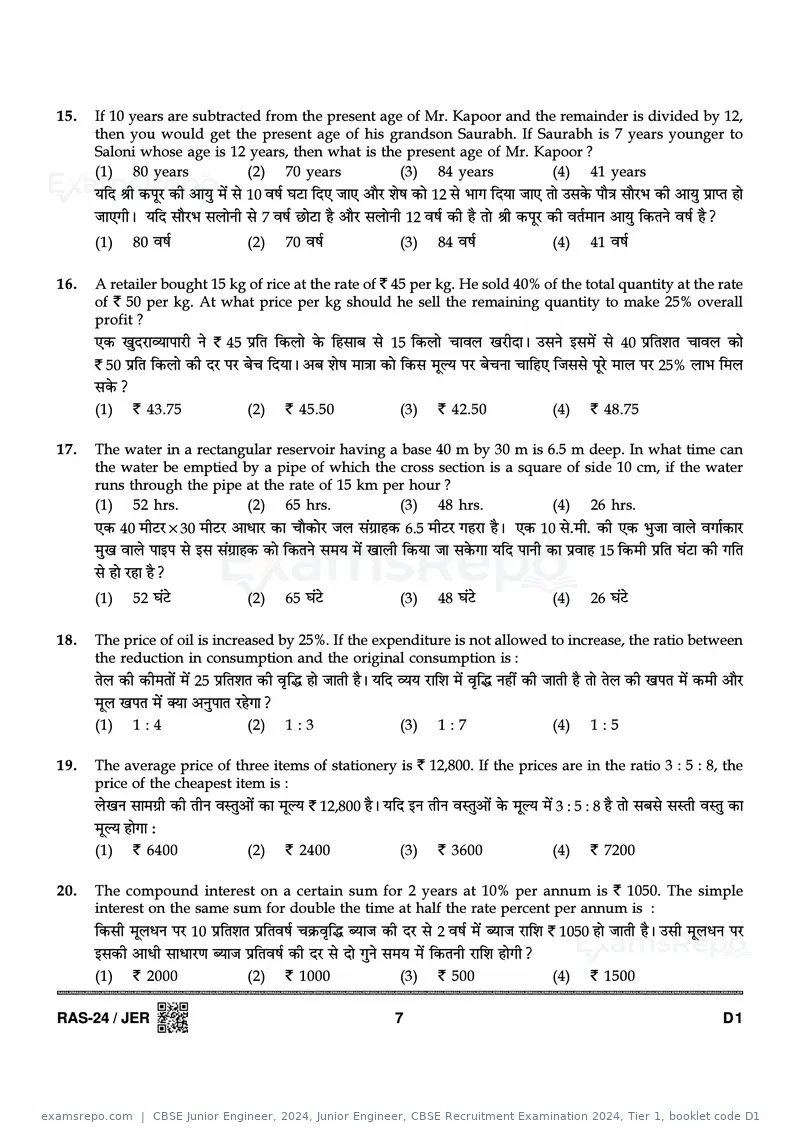
15.               If 10 years are subtracted from the present age of Mr. Kapoor and the remainder is divided by 12,
                  then you would get the present age of his grandson Saurabh. If Saurabh is 7 years younger to
                  Saloni whose age is 12 years, then what is the present age of Mr. Kapoor ?
                  (1) 80 years            (2) 70 years           (3) 84 years          (4) 41 years
                  ÿÁŒ üÊË ∑§¬Í⁄U ∑§Ë •ÊÿÈ ◊¥ ‚ 10 fl·¸ ÉÊ≈UÊ ÁŒ∞ ¡Ê∞ •ÊÒ⁄U ‡Ê· ∑§Ê 12 ‚ ÷ʪ ÁŒÿÊ ¡Ê∞ ÃÊ ©‚∑§ ¬ÊÒòÊ ‚ÊÒ⁄U÷ ∑§Ë •ÊÿÈ ¬˝Êåà „Ê
                  ¡Ê∞ªË– ÿÁŒ ‚ÊÒ⁄U÷ ‚‹ÊŸË ‚ 7 fl·¸ ¿UÊ≈UÊ „Ò •ÊÒ⁄U ‚‹ÊŸË 12 fl·¸ ∑§Ë „Ò ÃÊ üÊË ∑§¬Í⁄U ∑§Ë flø◊ÊŸ •ÊÿÈ Á∑§ÃŸ fl·¸ „Ò?
                  (1) 80 fl·¸                     (2) 70 fl·¸                    (3) 84 fl·¸                 (4) 41 fl·¸

16.               A retailer bought 15 kg of rice at the rate of ` 45 per kg. He sold 40% of the total quantity at the rate
                  of ` 50 per kg. At what price per kg should he sell the remaining quantity to make 25% overall
                  profit ?
                  ∞∑§ πÈŒ⁄UÊ√ÿʬÊ⁄UË Ÿ ` 45 ¬˝Áà Á∑§‹Ê ∑§ Á„‚Ê’ ‚ 15 Á∑§‹Ê øÊfl‹ π⁄Uˌʖ ©‚Ÿ ß‚◊¥ ‚ 40 ¬˝ÁÇÊà øÊfl‹ ∑§Ê
                  ` 50 ¬˝Áà Á∑§‹Ê ∑§Ë Œ⁄U ¬⁄U ’ø ÁŒÿÊ– •’ ‡Ê· ◊ÊòÊÊ ∑§Ê Á∑§‚ ◊ÍÀÿ ¬⁄U ’øŸÊ øÊÁ„∞ Á¡‚‚ ¬Í⁄U ◊Ê‹ ¬⁄U 25% ‹Ê÷ Á◊‹
                  ‚∑§?
                  (1)               ` 43.75                                                  (2)               ` 45.50                                                 (3)                ` 42.50                                                 (4)                ` 48.75

17.               The water in a rectangular reservoir having a base 40 m by 30 m is 6.5 m deep. In what time can
                  the water be emptied by a pipe of which the cross section is a square of side 10 cm, if the water
                  runs through the pipe at the rate of 15 km per hour ?
                  (1) 52 hrs.           (2) 65 hrs.            (3) 48 hrs.            (4) 26 hrs.
                  ∞∑§ 40 ◊Ë≈U⁄U×30 ◊Ë≈U⁄U •ÊœÊ⁄U ∑§Ê øÊÒ∑§Ê⁄U ¡‹ ‚¥ª˝Ê„∑§ 6.5 ◊Ë≈U⁄ ª„⁄UÊ „Ò– ∞∑§ 10 ‚.◊Ë. ∑§Ë ∞∑§ ÷È¡Ê flÊ‹ flªÊ¸∑§Ê⁄U
                  ◊Èπ flÊ‹ ¬Ê߬ ‚ ß‚ ‚¥ª˝Ê„∑§ ∑§Ê Á∑§ÃŸ ‚◊ÿ ◊¥ πÊ‹Ë Á∑§ÿÊ ¡Ê ‚∑§ªÊ ÿÁŒ ¬ÊŸË ∑§Ê ¬˝flÊ„ 15 Á∑§◊Ë ¬˝Áà ÉÊ¥≈UÊ ∑§Ë ªÁÃ
                  ‚ „Ê ⁄U„Ê „Ò?
                  (1) 52 ÉÊ¥≈U             (2) 65 ÉÊ¥≈U                 (3) 48 ÉÊ¥≈U              (4) 26 ÉÊ¥≈U

18.               The price of oil is increased by 25%. If the expenditure is not allowed to increase, the ratio between
                  the reduction in consumption and the original consumption is :
                  Ã‹ ∑§Ë ∑§Ë◊ÃÊ¥ ◊¥ 25 ¬˝ÁÇÊà ∑§Ë flÎÁh „Ê ¡ÊÃË „Ò– ÿÁŒ √ÿÿ ⁄UÊÁ‡Ê ◊¥ flÎÁh Ÿ„Ë¥ ∑§Ë ¡ÊÃË „Ò ÃÊ Ã‹ ∑§Ë π¬Ã ◊¥ ∑§◊Ë •ÊÒ⁄U
                  ◊Í‹ π¬Ã ◊¥ ÄÿÊ •ŸÈ¬Êà ⁄U„ªÊ?
                  (1)               1:4                                                      (2)               1:3                                                     (3)                1:7                                                     (4)                1:5

19.               The average price of three items of stationery is ` 12,800. If the prices are in the ratio 3 : 5 : 8, the
                  price of the cheapest item is :
                  ‹πŸ ‚Ê◊ª˝Ë ∑§Ë ÃËŸ flSÃÈ•Ê¥ ∑§Ê ◊ÍÀÿ ` 12,800 „Ò– ÿÁŒ ߟ ÃËŸ flSÃÈ•Ê¥ ∑§ ◊ÍÀÿ ◊¥ 3 : 5 : 8 „Ò ÃÊ ‚’‚ ‚SÃË flSÃÈ ∑§Ê
                  ◊ÍÀÿ „ÊªÊ —
                  (1)               ` 6400                                                   (2)               ` 2400                                                  (3)                ` 3600                                                  (4)                ` 7200

20.               The compound interest on a certain sum for 2 years at 10% per annum is ` 1050. The simple
                  interest on the same sum for double the time at half the rate percent per annum is :
                  Á∑§‚Ë ◊Í‹œŸ ¬⁄U 10 ¬˝ÁÇÊà ¬˝ÁÃfl·¸ ø∑˝§flÎÁh éÿÊ¡ ∑§Ë Œ⁄U ‚ 2 fl·¸ ◊¥ éÿÊ¡ ⁄UÊÁ‡Ê ` 1050 „Ê ¡ÊÃË „Ò– ©‚Ë ◊Í‹œŸ ¬⁄U
                  ß‚∑§Ë •ÊœË ‚ÊœÊ⁄UáÊ éÿÊ¡ ¬˝ÁÃfl·¸ ∑§Ë Œ⁄U ‚ ŒÊ ªÈŸ ‚◊ÿ ◊¥ Á∑§ÃŸË ⁄UÊÁ‡Ê „ÊªË?
                  (1)               ` 2000                                                   (2)               ` 1000                                                  (3)                ` 500                                                   (4)                ` 1500
RAS24JERRAS24JERRAS24JERRAS24JERRAS24JERRAS24JERRAS24JERRAS24JERRAS24JERRAS24JERRAS24JERRAS24JERRAS24JERRAS24JERRAS24JERRAS24JERRAS24JERRAS24JERRAS24JERRAS24JERRAS24JERRAS24JERRAS24JERRAS24JERRAS24JERRAS24JERRAS24JERRAS24JERRAS24JERRAS24JERRAS24JERRAS24JERRAS24JERRAS24JERRAS24JERRAS24JERRAS24JERRAS24JERRAS24JERRAS24JERRAS24JERRAS24JER


RAS-24 / JER                                                                                                                                                         7                                                                                                                                                                D1
CBSE Junior Engineer 2024 question paper, Junior Engineer, CBSE Recruitment Examination 2024, Tier 1, booklet code D1, page 8 of 40
Page 8 of 40
Text of page 8
RAS24JERRAS24JERRAS24JERRAS24JERRAS24JERRAS24JERRAS24JERRAS24JERRAS24JERRAS24JERRAS24JERRAS24JERRAS24JERRAS24JERRAS24JERRAS24JERRAS24JERRAS24JERRAS24JERRAS24JERRAS24JERRAS24JERRAS24JERRAS24JERRAS24JERRAS24JERRAS24JERRAS24JERRAS24JERRAS24JERRAS24JERRAS24JERRAS24JERRAS24JERRAS24JERRAS24JERRAS24JERRAS24JERRAS24JERRAS24JERRAS24JERRAS24JER


                                                             PART - III / ÷ʪ - III
                                 Current Affairs and General Awareness / ‚Ê◊Áÿ∑§ ◊Ê◊‹ ÃÕÊ ‚Ê◊Êãÿ ¡ÊªL§∑§ÃÊ
RAS24JERRAS24JERRAS24JERRAS24JERRAS24JERRAS24JERRAS24JERRAS24JERRAS24JERRAS24JERRAS24JERRAS24JERRAS24JERRAS24JERRAS24JERRAS24JERRAS24JERRAS24JERRAS24JERRAS24JERRAS24JERRAS24JERRAS24JERRAS24JERRAS24JERRAS24JERRAS24JERRAS24JERRAS24JERRAS24JERRAS24JERRAS24JERRAS24JERRAS24JERRAS24JERRAS24JERRAS24JERRAS24JERRAS24JERRAS24JERRAS24JERRAS24JER


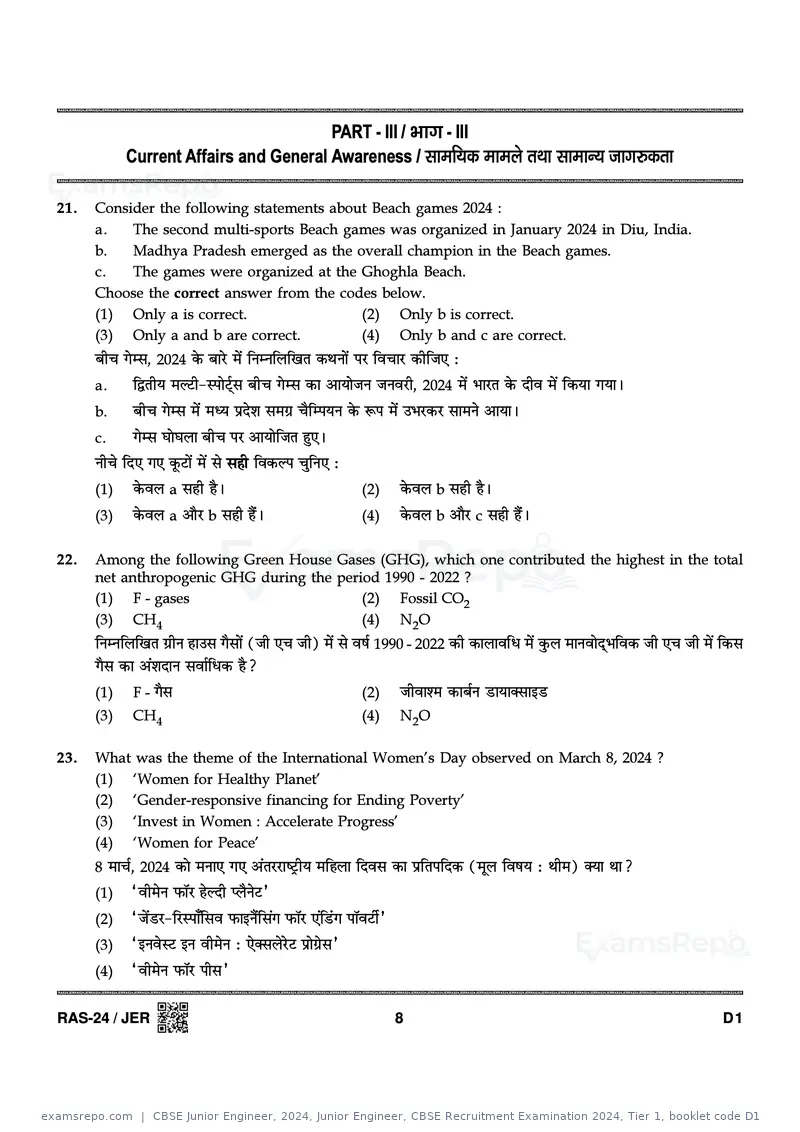
21.               Consider the following statements about Beach games 2024 :
                  a.   The second multi-sports Beach games was organized in January 2024 in Diu, India.
                  b.   Madhya Pradesh emerged as the overall champion in the Beach games.
                  c.   The games were organized at the Ghoghla Beach.
                  Choose the correct answer from the codes below.
                  (1) Only a is correct.                (2) Only b is correct.
                  (3) Only a and b are correct.         (4) Only b and c are correct.
                  ’Ëø ªê‚, 2024 ∑§ ’Ê⁄U ◊¥ ÁŸêŸÁ‹Áπà ∑§ÕŸÊ¥ ¬⁄U ÁfløÊ⁄U ∑§ËÁ¡∞ —
                  a.     ÁmÃËÿ ◊À≈UË-S¬Ê≈¸˜U‚ ’Ëø ªê‚ ∑§Ê •ÊÿÊ¡Ÿ ¡Ÿfl⁄UË, 2024 ◊¥ ÷Ê⁄Uà ∑§ ŒËfl ◊¥ Á∑§ÿÊ ªÿÊ–
                  b.     ’Ëø ªê‚ ◊¥ ◊äÿ ¬˝Œ‡Ê ‚◊ª˝ øÒÁê¬ÿŸ ∑§ M§¬ ◊¥ ©÷⁄U∑§⁄U ‚Ê◊Ÿ •ÊÿÊ–
                  c.     ªê‚ ÉÊÊÉÊ‹Ê ’Ëø ¬⁄U •ÊÿÊÁ¡Ã „È∞–
                  ŸËø ÁŒ∞ ª∞ ∑ͧ≈UÊ¥ ◊¥ ‚ ‚„Ë Áfl∑§À¬ øÈÁŸ∞ —
                  (1) ∑§fl‹ a ‚„Ë „Ò–                             (2) ∑§fl‹ b ‚„Ë „Ò–
                  (3) ∑§fl‹ a •ÊÒ⁄U b ‚„Ë „Ò¥–                    (4) ∑§fl‹ b •ÊÒ⁄U c ‚„Ë „Ò¥–

22.               Among the following Green House Gases (GHG), which one contributed the highest in the total
                  net anthropogenic GHG during the period 1990 - 2022 ?
                  (1) F - gases                        (2) Fossil CO2
                  (3) CH 4                             (4) N2O
                  ÁŸêŸÁ‹Áπà ª˝ËŸ „Ê©‚ ªÒ‚Ê¥ (¡Ë ∞ø ¡Ë) ◊¥ ‚ fl·¸ 1990 - 2022 ∑§Ë ∑§Ê‹ÊflÁœ ◊¥ ∑ȧ‹ ◊ÊŸflÊŒ˜÷Áfl∑§ ¡Ë ∞ø ¡Ë ◊¥ Á∑§‚
                  ªÒ‚ ∑§Ê •¥‡ÊŒÊŸ ‚flʸÁœ∑§ „Ò?
                  (1) F - ªÒ‚                                   (2) ¡Ëflʇ◊ ∑§Ê’¸Ÿ «UÊÿÊÄ‚Êß«U
                  (3)               CH 4                                                                                                             (4)               N 2O

23.               What was the theme of the International Women’s Day observed on March 8, 2024 ?
                  (1) ‘Women for Healthy Planet’
                  (2) ‘Gender-responsive financing for Ending Poverty’
                  (3) ‘Invest in Women : Accelerate Progress’
                  (4) ‘Women for Peace’
                  8 ◊Êø¸, 2024 ∑§Ê ◊ŸÊ∞ ª∞ •¥Ã⁄U⁄UÊc≈˛UËÿ ◊Á„‹Ê ÁŒfl‚ ∑§Ê ¬˝ÁìÁŒ∑§ (◊Í‹ Áfl·ÿ — ÕË◊) ÄÿÊ ÕÊ?
                  (1)               “flË◊Ÿ »§ÊÚ⁄U „ÀŒË å‹ÒŸ≈U”
                  (2)               “¡¥«U⁄U-Á⁄US¬Ê°Á‚fl »§ÊߟҥÁ‚¥ª »§ÊÚ⁄U ∞¥Á«¥Uª ¬ÊÚfl≈U˸”
                  (3)               “ߟflS≈U ߟ flË◊Ÿ — ∞Ä‚‹⁄U≈U ¬˝Êª˝‚”
                  (4)               “flË◊Ÿ »§ÊÚ⁄U ¬Ë‚”
RAS24JERRAS24JERRAS24JERRAS24JERRAS24JERRAS24JERRAS24JERRAS24JERRAS24JERRAS24JERRAS24JERRAS24JERRAS24JERRAS24JERRAS24JERRAS24JERRAS24JERRAS24JERRAS24JERRAS24JERRAS24JERRAS24JERRAS24JERRAS24JERRAS24JERRAS24JERRAS24JERRAS24JERRAS24JERRAS24JERRAS24JERRAS24JERRAS24JERRAS24JERRAS24JERRAS24JERRAS24JERRAS24JERRAS24JERRAS24JERRAS24JERRAS24JER


RAS-24 / JER                                                                                                                                                         8                                                                                                                                                                D1
CBSE Junior Engineer 2024 question paper, Junior Engineer, CBSE Recruitment Examination 2024, Tier 1, booklet code D1, page 9 of 40
Page 9 of 40
Text of page 9
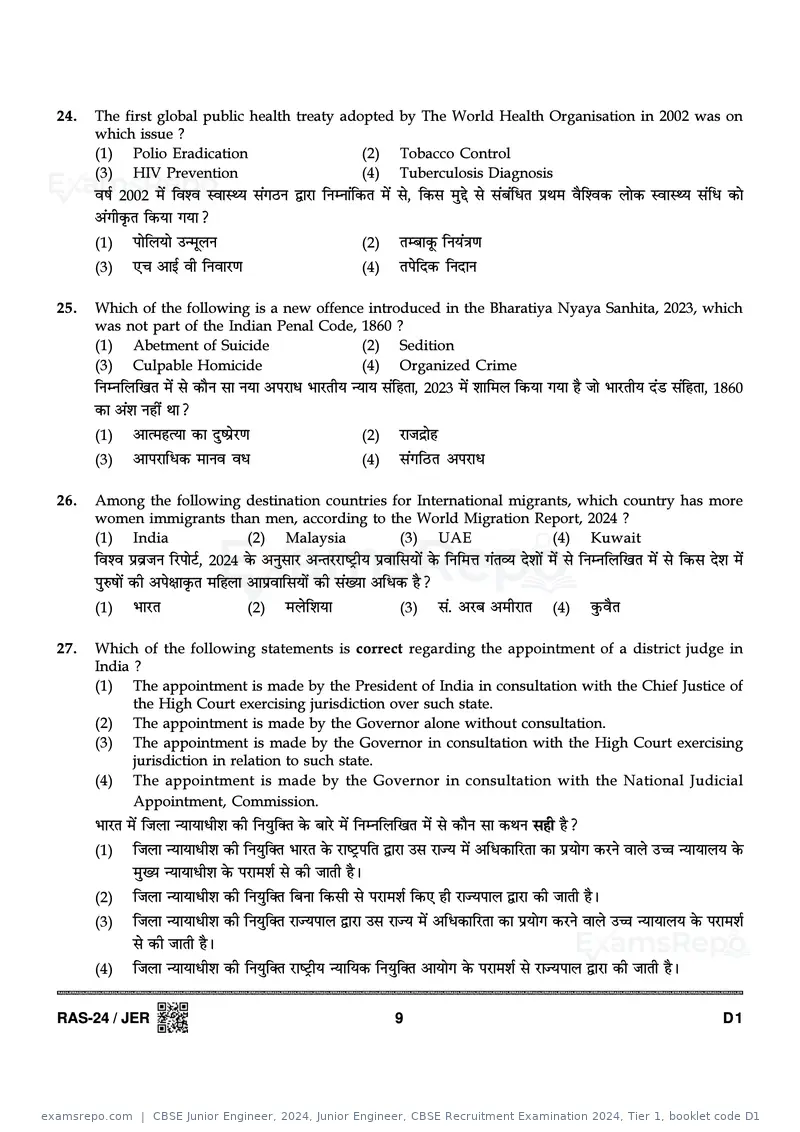
24.               The first global public health treaty adopted by The World Health Organisation in 2002 was on
                  which issue ?
                  (1) Polio Eradication                    (2) Tobacco Control
                  (3) HIV Prevention                       (4) Tuberculosis Diagnosis
                  fl·¸ 2002 ◊¥ Áfl‡fl SflÊSâÿ ‚¥ª∆UŸ mÊ⁄UÊ ÁŸêŸÊ¥Á∑§Ã ◊¥ ‚, Á∑§‚ ◊Èg ‚ ‚¥’¥ÁœÃ ¬˝Õ◊ flÒÁ‡fl∑§ ‹Ê∑§ SflÊSâÿ ‚¥Áœ ∑§Ê
                  •¥ªË∑Χà Á∑§ÿÊ ªÿÊ?
                  (1) ¬ÊÁ‹ÿÊ ©ã◊Í‹Ÿ                           (2) Ãê’Ê∑ͧ ÁŸÿ¥òÊáÊ
                  (3) ∞ø •Ê߸ flË ÁŸflÊ⁄UáÊ                       (4) ìÁŒ∑§ ÁŸŒÊŸ

25.               Which of the following is a new offence introduced in the Bharatiya Nyaya Sanhita, 2023, which
                  was not part of the Indian Penal Code, 1860 ?
                  (1) Abetment of Suicide                (2) Sedition
                  (3) Culpable Homicide                  (4) Organized Crime
                  ÁŸêŸÁ‹Áπà ◊¥ ‚ ∑§ÊÒŸ ‚Ê ŸÿÊ •¬⁄UÊœ ÷Ê⁄UÃËÿ ãÿÊÿ ‚¥Á„ÃÊ, 2023 ◊¥ ‡ÊÊÁ◊‹ Á∑§ÿÊ ªÿÊ „Ò ¡Ê ÷Ê⁄UÃËÿ Œ¥«U ‚¥Á„ÃÊ, 1860
                  ∑§Ê •¥‡Ê Ÿ„Ë¥ ÕÊ?
                  (1) •Êà◊„àÿÊ ∑§Ê ŒÈc¬˝⁄UáÊ                    (2) ⁄UÊ¡Œ˝Ê„
                  (3) •ʬ⁄UÊÁœ∑§ ◊ÊŸfl flœ                         (4) ‚¥ªÁ∆U à •¬⁄UÊœ

26.               Among the following destination countries for International migrants, which country has more
                  women immigrants than men, according to the World Migration Report, 2024 ?
                  (1) India           (2) Malaysia           (3) UAE                (4) Kuwait
                  Áfl‡fl ¬˝fl˝¡Ÿ Á⁄U¬Ê≈¸U, 2024 ∑§ •ŸÈ‚Ê⁄U •ãÃ⁄U⁄UÊc≈˛UËÿ ¬˝flÊÁ‚ÿÊ¥ ∑§ ÁŸÁ◊ûÊ ª¥Ã√ÿ Œ‡ÊÊ¥ ◊¥ ‚ ÁŸêŸÁ‹Áπà ◊¥ ‚ Á∑§‚ Œ‡Ê ◊¥
                  ¬ÈL§·Ê¥ ∑§Ë •¬ˇÊÊ∑Χà ◊Á„‹Ê •ʬ˝flÊÁ‚ÿÊ¥ ∑§Ë ‚¥ÅÿÊ •Áœ∑§ „Ò?
                  (1) ÷Ê⁄Uà                     (2) ◊‹Á‡ÊÿÊ                  (3) ‚¥. •⁄U’ •◊Ë⁄UÊà (4) ∑ȧflÒÃ

27.               Which of the following statements is correct regarding the appointment of a district judge in
                  India ?
                  (1) The appointment is made by the President of India in consultation with the Chief Justice of
                        the High Court exercising jurisdiction over such state.
                  (2) The appointment is made by the Governor alone without consultation.
                  (3) The appointment is made by the Governor in consultation with the High Court exercising
                        jurisdiction in relation to such state.
                  (4) The appointment is made by the Governor in consultation with the National Judicial
                        Appointment, Commission.
                  ÷Ê⁄Uà ◊¥ Á¡‹Ê ãÿÊÿÊœË‡Ê ∑§Ë ÁŸÿÈÁÄà ∑§ ’Ê⁄U ◊¥ ÁŸêŸÁ‹Áπà ◊¥ ‚ ∑§ÊÒŸ ‚Ê ∑§ÕŸ ‚„Ë „Ò?
                  (1) Á¡‹Ê ãÿÊÿÊœË‡Ê ∑§Ë ÁŸÿÈÁÄà ÷Ê⁄Uà ∑§ ⁄UÊc≈˛U¬Áà mÊ⁄UÊ ©‚ ⁄UÊíÿ ◊¥ •Áœ∑§ÊÁ⁄UÃÊ ∑§Ê ¬˝ÿÊª ∑§⁄UŸ flÊ‹ ©ìÊ ãÿÊÿÊ‹ÿ ∑§
                         ◊ÈÅÿ ãÿÊÿÊœË‡Ê ∑§ ¬⁄UÊ◊‡Ê¸ ‚ ∑§Ë ¡ÊÃË „Ò–
                  (2) Á¡‹Ê ãÿÊÿÊœË‡Ê ∑§Ë ÁŸÿÈÁÄà Á’ŸÊ Á∑§‚Ë ‚ ¬⁄UÊ◊‡Ê¸ Á∑§∞ „Ë ⁄UÊíÿ¬Ê‹ mÊ⁄UÊ ∑§Ë ¡ÊÃË „Ò–
                  (3) Á¡‹Ê ãÿÊÿÊœË‡Ê ∑§Ë ÁŸÿÈÁÄà ⁄UÊíÿ¬Ê‹ mÊ⁄UÊ ©‚ ⁄UÊíÿ ◊¥ •Áœ∑§ÊÁ⁄UÃÊ ∑§Ê ¬˝ÿÊª ∑§⁄UŸ flÊ‹ ©ìÊ ãÿÊÿÊ‹ÿ ∑§ ¬⁄UÊ◊‡Ê¸
                         ‚ ∑§Ë ¡ÊÃË „Ò–
                  (4) Á¡‹Ê ãÿÊÿÊœË‡Ê ∑§Ë ÁŸÿÈÁÄà ⁄UÊc≈˛UËÿ ãÿÊÁÿ∑§ ÁŸÿÈÁÄà •ÊÿÊª ∑§ ¬⁄UÊ◊‡Ê¸ ‚ ⁄UÊíÿ¬Ê‹ mÊ⁄UÊ ∑§Ë ¡ÊÃË „Ò–
RAS24JERRAS24JERRAS24JERRAS24JERRAS24JERRAS24JERRAS24JERRAS24JERRAS24JERRAS24JERRAS24JERRAS24JERRAS24JERRAS24JERRAS24JERRAS24JERRAS24JERRAS24JERRAS24JERRAS24JERRAS24JERRAS24JERRAS24JERRAS24JERRAS24JERRAS24JERRAS24JERRAS24JERRAS24JERRAS24JERRAS24JERRAS24JERRAS24JERRAS24JERRAS24JERRAS24JERRAS24JERRAS24JERRAS24JERRAS24JERRAS24JERRAS24JER


RAS-24 / JER                                                                                                                                                         9                                                                                                                                                                D1
CBSE Junior Engineer 2024 question paper, Junior Engineer, CBSE Recruitment Examination 2024, Tier 1, booklet code D1, page 10 of 40
Page 10 of 40
Text of page 10
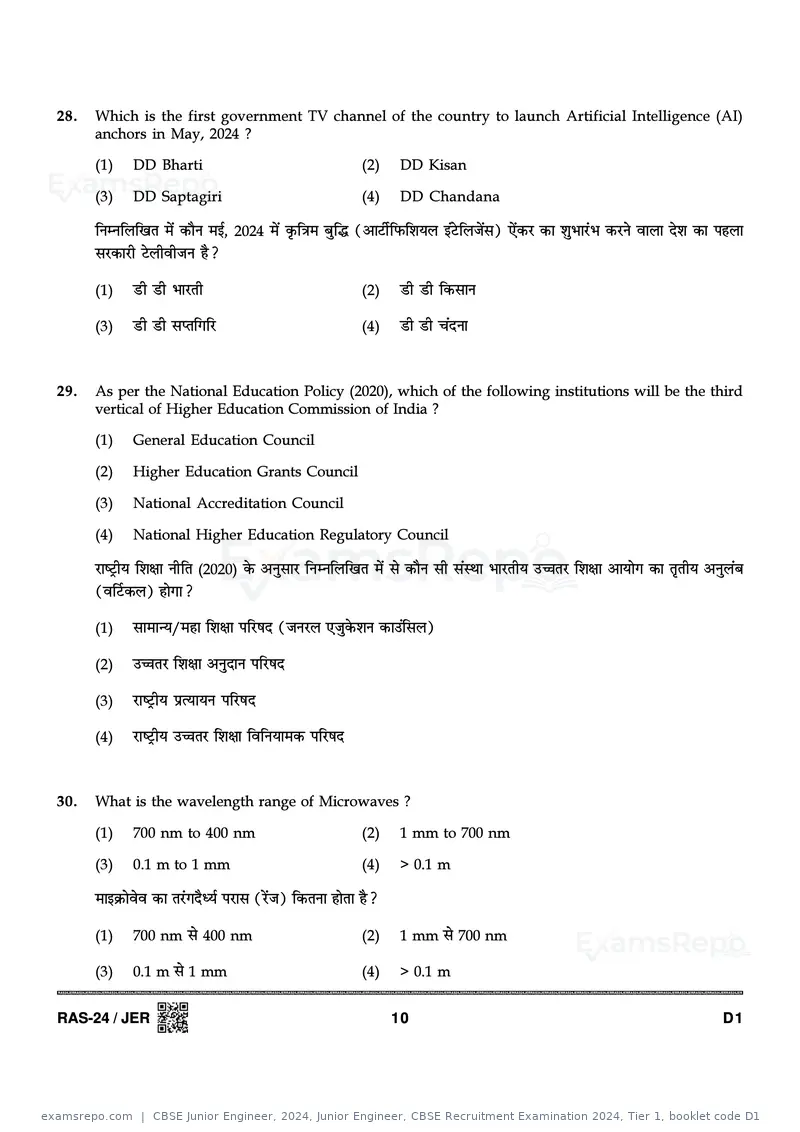
28.               Which is the first government TV channel of the country to launch Artificial Intelligence (AI)
                  anchors in May, 2024 ?

                  (1)               DD Bharti                                                                                                        (2)               DD Kisan

                  (3)               DD Saptagiri                                                                                                     (4)               DD Chandana

                  ÁŸêŸÁ‹Áπà ◊¥ ∑§ÊÒŸ ◊߸, 2024 ◊¥ ∑ΧÁòÊ◊ ’ÈÁh (•Ê≈U˸Á»§Á‡Êÿ‹ ߥ≈UÁ‹¡¥‚) ∞¥∑§⁄U ∑§Ê ‡ÊÈ÷Ê⁄¥U÷ ∑§⁄UŸ flÊ‹Ê Œ‡Ê ∑§Ê ¬„‹Ê
                  ‚⁄U∑§Ê⁄UË ≈U‹ËflË¡Ÿ „Ò?
                  (1)               «UË «UË ÷Ê⁄UÃË                                                                                                   (2)               «UË «UË Á∑§‚ÊŸ
                  (3)               «UË «UË ‚åÃÁªÁ⁄U                                                                                                 (4)               «UË «UË ø¥ŒŸÊ


29.               As per the National Education Policy (2020), which of the following institutions will be the third
                  vertical of Higher Education Commission of India ?

                  (1)               General Education Council

                  (2)               Higher Education Grants Council

                  (3)               National Accreditation Council

                  (4)               National Higher Education Regulatory Council

                  ⁄UÊc≈˛UËÿ Á‡ÊˇÊÊ ŸËÁà (2020) ∑§ •ŸÈ‚Ê⁄U ÁŸêŸÁ‹Áπà ◊¥ ‚ ∑§ÊÒŸ ‚Ë ‚¥SÕÊ ÷Ê⁄UÃËÿ ©ìÊÃ⁄U Á‡ÊˇÊÊ •ÊÿÊª ∑§Ê ÃÎÃËÿ •ŸÈ‹¥’
                  (flÁ≈¸U∑§‹) „ÊªÊ?
                  (1)               ‚Ê◊Êãÿ/◊„Ê Á‡ÊˇÊÊ ¬Á⁄U·Œ (¡Ÿ⁄U‹ ∞¡È∑§‡ÊŸ ∑§Ê©¥Á‚‹)
                  (2)               ©ìÊÃ⁄U Á‡ÊˇÊÊ •ŸÈŒÊŸ ¬Á⁄U·Œ
                  (3)               ⁄UÊc≈˛UËÿ ¬˝àÿÊÿŸ ¬Á⁄U·Œ
                  (4)               ⁄UÊc≈˛UËÿ ©ìÊÃ⁄U Á‡ÊˇÊÊ ÁflÁŸÿÊ◊∑§ ¬Á⁄U·Œ


30.               What is the wavelength range of Microwaves ?

                  (1)               700 nm to 400 nm                                                                                                 (2)               1 mm to 700 nm

                  (3)               0.1 m to 1 mm                                                                                                    (4)               > 0.1 m

                  ◊Êß∑˝§Êflfl ∑§Ê Ã⁄¥UªŒÒäÿ¸ ¬⁄UÊ‚ (⁄¥U¡) Á∑§ÃŸÊ „ÊÃÊ „Ò?
                  (1)               700 nm ‚ 400 nm                                                                                                 (2)               1 mm ‚ 700 nm

                  (3)               0.1 m ‚ 1 mm                                                                                                    (4)               > 0.1 m
RAS24JERRAS24JERRAS24JERRAS24JERRAS24JERRAS24JERRAS24JERRAS24JERRAS24JERRAS24JERRAS24JERRAS24JERRAS24JERRAS24JERRAS24JERRAS24JERRAS24JERRAS24JERRAS24JERRAS24JERRAS24JERRAS24JERRAS24JERRAS24JERRAS24JERRAS24JERRAS24JERRAS24JERRAS24JERRAS24JERRAS24JERRAS24JERRAS24JERRAS24JERRAS24JERRAS24JERRAS24JERRAS24JERRAS24JERRAS24JERRAS24JERRAS24JER


RAS-24 / JER                                                                                                                                                       10                                                                                                                                                                 D1
CBSE Junior Engineer 2024 question paper, Junior Engineer, CBSE Recruitment Examination 2024, Tier 1, booklet code D1, page 11 of 40
Page 11 of 40
Text of page 11
RAS24JERRAS24JERRAS24JERRAS24JERRAS24JERRAS24JERRAS24JERRAS24JERRAS24JERRAS24JERRAS24JERRAS24JERRAS24JERRAS24JERRAS24JERRAS24JERRAS24JERRAS24JERRAS24JERRAS24JERRAS24JERRAS24JERRAS24JERRAS24JERRAS24JERRAS24JERRAS24JERRAS24JERRAS24JERRAS24JERRAS24JERRAS24JERRAS24JERRAS24JERRAS24JERRAS24JERRAS24JERRAS24JERRAS24JERRAS24JERRAS24JERRAS24JER


                                  PART - IV / ÷ʪ - IV
 Language Competency Test (General English) & Language Competency Test (General Hindi) /
                                                        ÷Ê·Ê ˇÊ◊ÃÊ ¬⁄UˡÊÊ (‚Ê◊Êãÿ •¥ª˝¡Ë) ÃÕÊ ÷Ê·Ê ˇÊ◊ÃÊ ¬⁄UˡÊÊ (‚Ê◊Êãÿ Á„ãŒË)
RAS24JERRAS24JERRAS24JERRAS24JERRAS24JERRAS24JERRAS24JERRAS24JERRAS24JERRAS24JERRAS24JERRAS24JERRAS24JERRAS24JERRAS24JERRAS24JERRAS24JERRAS24JERRAS24JERRAS24JERRAS24JERRAS24JERRAS24JERRAS24JERRAS24JERRAS24JERRAS24JERRAS24JERRAS24JERRAS24JERRAS24JERRAS24JERRAS24JERRAS24JERRAS24JERRAS24JERRAS24JERRAS24JERRAS24JERRAS24JERRAS24JERRAS24JER


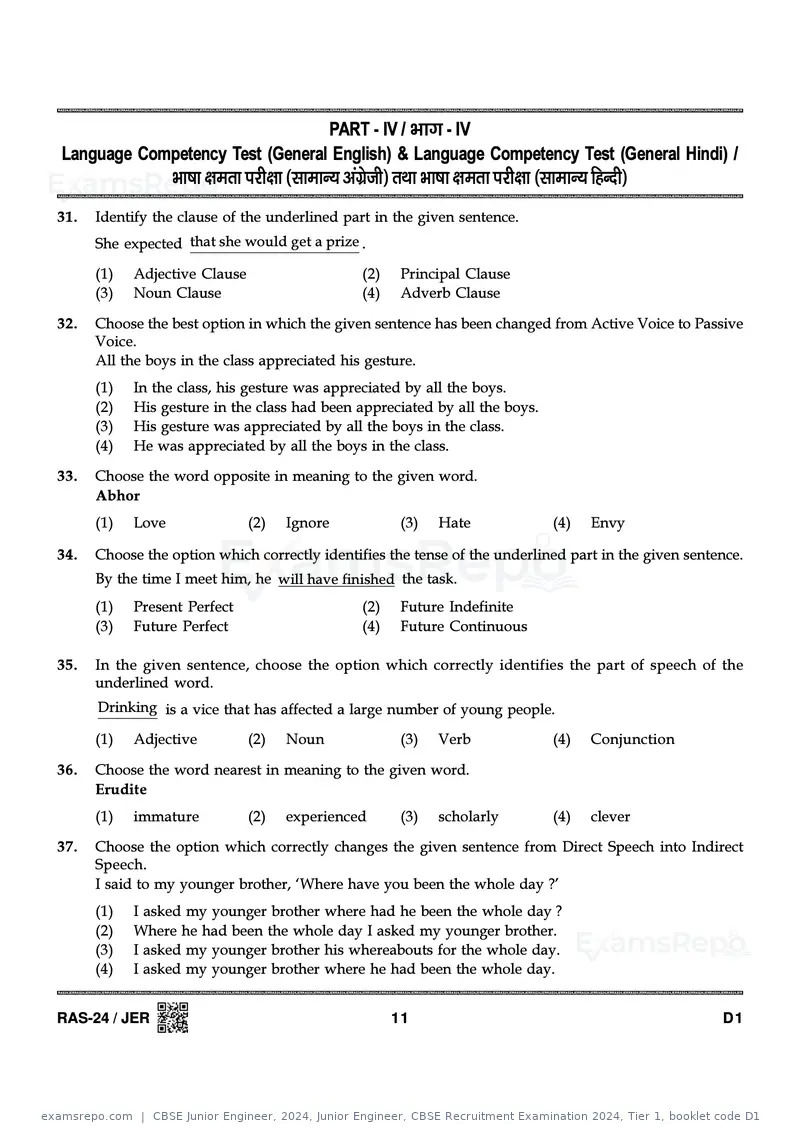
31.               Identify the clause of the underlined part in the given sentence.
                  She expected that she would get a prize .

                  (1)                Adjective Clause                                                                                                (2)                Principal Clause
                  (3)                Noun Clause                                                                                                     (4)                Adverb Clause

32.               Choose the best option in which the given sentence has been changed from Active Voice to Passive
                  Voice.
                  All the boys in the class appreciated his gesture.
                  (1)                In the class, his gesture was appreciated by all the boys.
                  (2)                His gesture in the class had been appreciated by all the boys.
                  (3)                His gesture was appreciated by all the boys in the class.
                  (4)                He was appreciated by all the boys in the class.

33.               Choose the word opposite in meaning to the given word.
                  Abhor
                  (1)                Love                                                    (2)               Ignore                                                   (3)               Hate                                                     (4)               Envy

34.               Choose the option which correctly identifies the tense of the underlined part in the given sentence.
                  By the time I meet him, he will have finished the task.
                  (1)                Present Perfect                                                                                                 (2)                Future Indefinite
                  (3)                Future Perfect                                                                                                  (4)                Future Continuous

35.               In the given sentence, choose the option which correctly identifies the part of speech of the
                  underlined word.
                   Drinking is a vice that has affected a large number of young people.

                  (1)                Adjective                                               (2)               Noun                                                     (3)               Verb                                                     (4)               Conjunction

36.               Choose the word nearest in meaning to the given word.
                  Erudite
                  (1)                immature                                                (2)               experienced                                              (3)               scholarly                                                (4)               clever

37.               Choose the option which correctly changes the given sentence from Direct Speech into Indirect
                  Speech.
                  I said to my younger brother, ‘Where have you been the whole day ?’
                  (1)                I asked my younger brother where had he been the whole day ?
                  (2)                Where he had been the whole day I asked my younger brother.
                  (3)                I asked my younger brother his whereabouts for the whole day.
                  (4)                I asked my younger brother where he had been the whole day.
RAS24JERRAS24JERRAS24JERRAS24JERRAS24JERRAS24JERRAS24JERRAS24JERRAS24JERRAS24JERRAS24JERRAS24JERRAS24JERRAS24JERRAS24JERRAS24JERRAS24JERRAS24JERRAS24JERRAS24JERRAS24JERRAS24JERRAS24JERRAS24JERRAS24JERRAS24JERRAS24JERRAS24JERRAS24JERRAS24JERRAS24JERRAS24JERRAS24JERRAS24JERRAS24JERRAS24JERRAS24JERRAS24JERRAS24JERRAS24JERRAS24JERRAS24JER


RAS-24 / JER                                                                                                                                                       11                                                                                                                                                                 D1
CBSE Junior Engineer 2024 question paper, Junior Engineer, CBSE Recruitment Examination 2024, Tier 1, booklet code D1, page 12 of 40
Page 12 of 40
Text of page 12
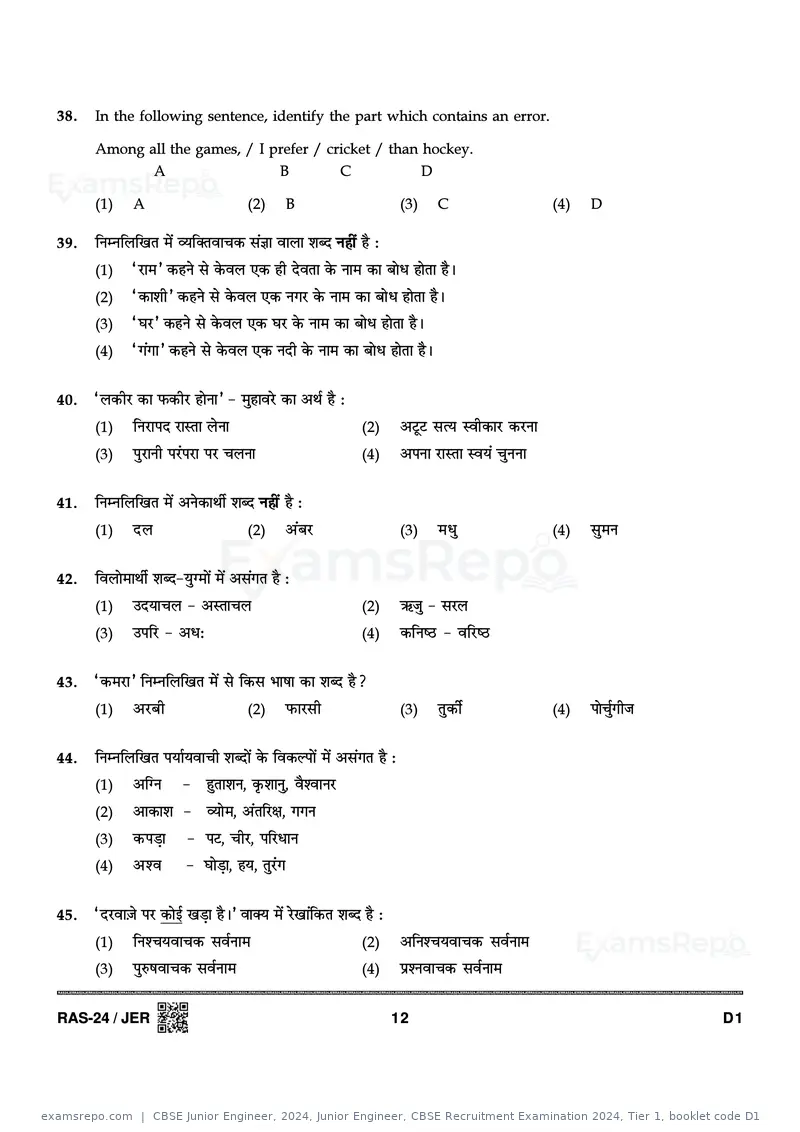
38.               In the following sentence, identify the part which contains an error.

                  Among all the games, / I prefer / cricket / than hockey.
                         A                  B         C            D

                  (1)               A                                                        (2)               B                                                       (3)                C                                                       (4)                D

39.               ÁŸêŸÁ‹Áπà ◊¥ √ÿÁÄÃflÊø∑§ ‚¥ôÊÊ flÊ‹Ê ‡ÊéŒ Ÿ„Ë¥ „Ò —
                  (1) “⁄UÊ◊” ∑§„Ÿ ‚ ∑§fl‹ ∞∑§ „Ë ŒflÃÊ ∑§ ŸÊ◊ ∑§Ê ’Êœ „ÊÃÊ „Ò–
                  (2) “∑§Ê‡ÊË” ∑§„Ÿ ‚ ∑§fl‹ ∞∑§ Ÿª⁄U ∑§ ŸÊ◊ ∑§Ê ’Êœ „ÊÃÊ „Ò–
                  (3) “ÉÊ⁄U” ∑§„Ÿ ‚ ∑§fl‹ ∞∑§ ÉÊ⁄U ∑§ ŸÊ◊ ∑§Ê ’Êœ „ÊÃÊ „Ò–
                  (4) “ª¥ªÊ” ∑§„Ÿ ‚ ∑§fl‹ ∞∑§ ŸŒË ∑§ ŸÊ◊ ∑§Ê ’Êœ „ÊÃÊ „Ò–


40.               “‹∑§Ë⁄U ∑§Ê »§∑§Ë⁄U „ÊŸÊ” - ◊È„Êfl⁄U ∑§Ê •Õ¸ „Ò —
                  (1) ÁŸ⁄UʬŒ ⁄UÊSÃÊ ‹ŸÊ                                                                                                            (2)               •≈ÍU≈U ‚àÿ SflË∑§Ê⁄U ∑§⁄UŸÊ
                  (3) ¬È⁄UÊŸË ¬⁄¥U¬⁄UÊ ¬⁄U ø‹ŸÊ                                                                                                      (4)               •¬ŸÊ ⁄UÊSÃÊ Sflÿ¥ øÈŸŸÊ

41.               ÁŸêŸÁ‹Áπà ◊¥ •Ÿ∑§ÊÕ˸ ‡ÊéŒ Ÿ„Ë¥ „Ò —
                  (1) Œ‹                     (2) •¥’⁄U                                                                                                                 (3)                ◊œÈ                                                     (4)                ‚È◊Ÿ

42.               Áfl‹Ê◊ÊÕ˸ ‡ÊéŒ-ÿÈÇ◊Ê¥ ◊¥ •‚¥ªÃ „Ò —
                  (1) ©ŒÿÊø‹ - •SÃÊø‹                                                                                                                (2)               ´§¡È - ‚⁄U‹
                  (3) ©¬Á⁄U - •œ—                                                                                                                    (4)               ∑§ÁŸc∆U - flÁ⁄Uc∆U

43.               “∑§◊⁄UÊ” ÁŸêŸÁ‹Áπà ◊¥ ‚ Á∑§‚ ÷Ê·Ê ∑§Ê ‡ÊéŒ „Ò?
                  (1) •⁄U’Ë                   (2) »§Ê⁄U‚Ë                                                                                                              (3)                ÃÈ∑§Ë¸                                                  (4)                ¬ÊøȨ̀ªË¡

44.               ÁŸêŸÁ‹Áπà ¬ÿʸÿflÊøË ‡ÊéŒÊ¥ ∑§ Áfl∑§À¬Ê¥ ◊¥ •‚¥ªÃ „Ò —
                  (1) •ÁÇŸ - „ÈÃʇʟ, ∑Χ‡ÊÊŸÈ, flÒ‡flÊŸ⁄U
                  (2) •Ê∑§Ê‡Ê - √ÿÊ◊, •¥ÃÁ⁄UˇÊ, ªªŸ
                  (3) ∑§¬«∏Ê - ¬≈U, øË⁄U, ¬Á⁄UœÊŸ
                  (4) •‡fl       - ÉÊÊ«∏Ê, „ÿ, ÃÈ⁄¥Uª

45.               “Œ⁄UflÊ$¡ ¬⁄U ∑§Ê߸ π«∏Ê „Ò–” flÊÄÿ ◊¥ ⁄UπÊ¥Á∑§Ã ‡ÊéŒ „Ò —
                  (1) ÁŸ‡øÿflÊø∑§ ‚fl¸ŸÊ◊                                  (2) •ÁŸ‡øÿflÊø∑§ ‚fl¸ŸÊ◊
                  (3) ¬ÈL§·flÊø∑§ ‚fl¸ŸÊ◊                                  (4) ¬˝‡ŸflÊø∑§ ‚fl¸ŸÊ◊
RAS24JERRAS24JERRAS24JERRAS24JERRAS24JERRAS24JERRAS24JERRAS24JERRAS24JERRAS24JERRAS24JERRAS24JERRAS24JERRAS24JERRAS24JERRAS24JERRAS24JERRAS24JERRAS24JERRAS24JERRAS24JERRAS24JERRAS24JERRAS24JERRAS24JERRAS24JERRAS24JERRAS24JERRAS24JERRAS24JERRAS24JERRAS24JERRAS24JERRAS24JERRAS24JERRAS24JERRAS24JERRAS24JERRAS24JERRAS24JERRAS24JERRAS24JER


RAS-24 / JER                                                                                                                                                       12                                                                                                                                                                 D1
CBSE Junior Engineer 2024 question paper, Junior Engineer, CBSE Recruitment Examination 2024, Tier 1, booklet code D1, page 13 of 40
Page 13 of 40
Text of page 13
RAS24JERRAS24JERRAS24JERRAS24JERRAS24JERRAS24JERRAS24JERRAS24JERRAS24JERRAS24JERRAS24JERRAS24JERRAS24JERRAS24JERRAS24JERRAS24JERRAS24JERRAS24JERRAS24JERRAS24JERRAS24JERRAS24JERRAS24JERRAS24JERRAS24JERRAS24JERRAS24JERRAS24JERRAS24JERRAS24JERRAS24JERRAS24JERRAS24JERRAS24JERRAS24JERRAS24JERRAS24JERRAS24JERRAS24JERRAS24JERRAS24JERRAS24JER


                                                       PART - V / ÷ʪ - V
                              Knowledge of Computer Operations, Techniques of Project Management /
                                                                                          ∑§êåÿÍ≈U⁄U ‚¥øÊ‹Ÿ ∑§Ê ôÊÊŸ, ¬Á⁄UÿÊ¡ŸÊ ¬˝’¥œŸ ∑§Ë Ã∑§ŸË∑¥§
RAS24JERRAS24JERRAS24JERRAS24JERRAS24JERRAS24JERRAS24JERRAS24JERRAS24JERRAS24JERRAS24JERRAS24JERRAS24JERRAS24JERRAS24JERRAS24JERRAS24JERRAS24JERRAS24JERRAS24JERRAS24JERRAS24JERRAS24JERRAS24JERRAS24JERRAS24JERRAS24JERRAS24JERRAS24JERRAS24JERRAS24JERRAS24JERRAS24JERRAS24JERRAS24JERRAS24JERRAS24JERRAS24JERRAS24JERRAS24JERRAS24JERRAS24JER


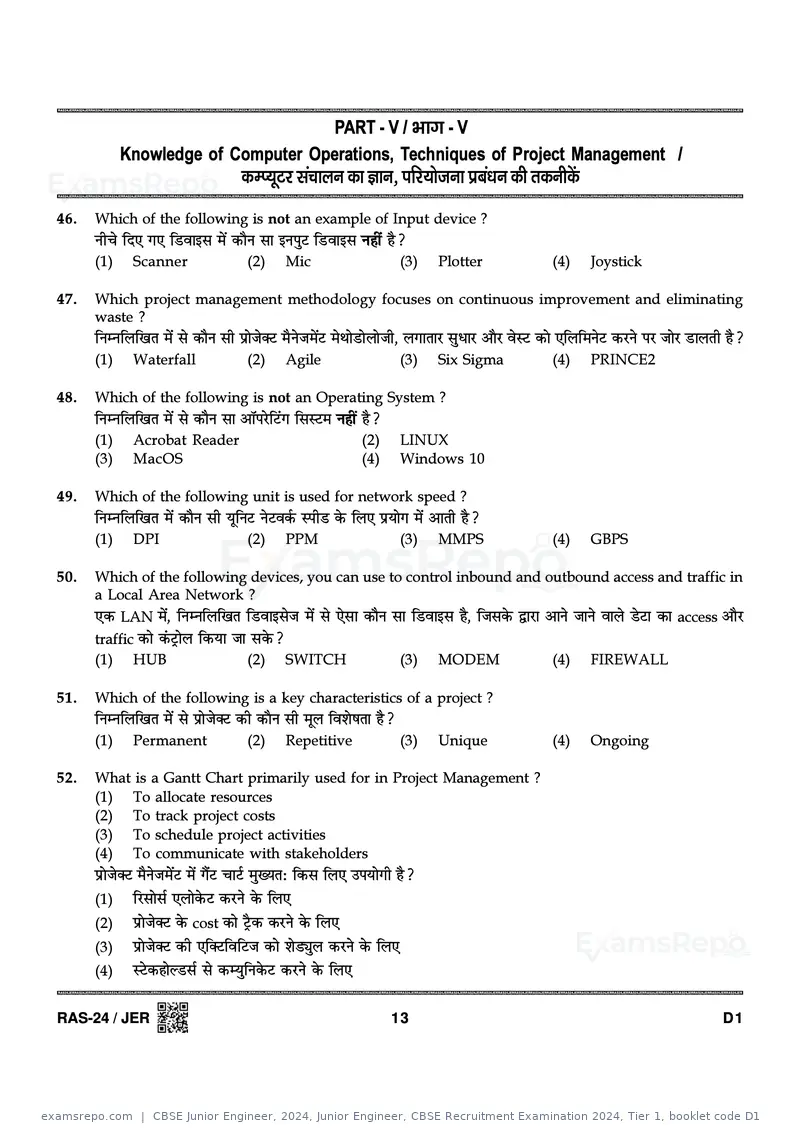
46.               Which of the following is not an example of Input device ?
                  ŸËø ÁŒ∞ ª∞ Á«UflÊß‚ ◊¥ ∑§ÊÒŸ ‚Ê ßŸ¬È≈U Á«UflÊß‚ Ÿ„Ë¥ „Ò?
                  (1)               Scanner                                                  (2)               Mic                                                     (3)                Plotter                                                 (4)                Joystick

47.               Which project management methodology focuses on continuous improvement and eliminating
                  waste ?
                  ÁŸêŸÁ‹Áπà ◊¥ ‚ ∑§ÊÒŸ ‚Ë ¬˝Ê¡Ä≈U ◊ÒŸ¡◊¥≈U ◊ÕÊ«UÊ‹Ê¡Ë, ‹ªÊÃÊ⁄U ‚ÈœÊ⁄U •ÊÒ⁄U flS≈U ∑§Ê ∞Á‹Á◊Ÿ≈U ∑§⁄UŸ ¬⁄U ¡Ê⁄U «UÊ‹ÃË „Ò?
                  (1)               Waterfall                                                (2)               Agile                                                   (3)                Six Sigma                                               (4)                PRINCE2

48.               Which of the following is not an Operating System ?
                  ÁŸêŸÁ‹Áπà ◊¥ ‚ ∑§ÊÒŸ ‚Ê •ÊÚ¬⁄UÁ≈¥Uª Á‚S≈U◊ Ÿ„Ë¥ „Ò?
                  (1)               Acrobat Reader                                                                                                   (2)               LINUX
                  (3)               MacOS                                                                                                            (4)               Windows 10

49.               Which of the following unit is used for network speed ?
                  ÁŸêŸÁ‹Áπà ◊¥ ∑§ÊÒŸ ‚Ë ÿÍÁŸ≈U Ÿ≈Ufl∑¸§ S¬Ë«U ∑§ Á‹∞ ¬˝ÿÊª ◊¥ •ÊÃË „Ò?
                  (1)               DPI                                                      (2)               PPM                                                     (3)                MMPS                                                    (4)                GBPS

50.               Which of the following devices, you can use to control inbound and outbound access and traffic in
                  a Local Area Network ?
                  ∞∑§ LAN ◊¥, ÁŸêŸÁ‹Áπà Á«UflÊß‚¡ ◊¥ ‚ ∞‚Ê ∑§ÊÒŸ ‚Ê Á«UflÊß‚ „Ò, Á¡‚∑§ mÊ⁄UÊ •ÊŸ ¡ÊŸ flÊ‹ «U≈UÊ ∑§Ê access •ÊÒ⁄U
                  traffic ∑§Ê ∑¥§≈˛UÊ‹ Á∑§ÿÊ ¡Ê ‚∑§?
                  (1) HUB                        (2) SWITCH                                                                                                            (3)                MODEM                                                   (4)                FIREWALL

51.               Which of the following is a key characteristics of a project ?
                  ÁŸêŸÁ‹Áπà ◊¥ ‚ ¬˝Ê¡Ä≈U ∑§Ë ∑§ÊÒŸ ‚Ë ◊Í‹ Áfl‡Ê·ÃÊ „Ò?
                  (1)               Permanent                                                (2)               Repetitive                                              (3)                Unique                                                  (4)                Ongoing

52.               What is a Gantt Chart primarily used for in Project Management ?
                  (1) To allocate resources
                  (2) To track project costs
                  (3) To schedule project activities
                  (4) To communicate with stakeholders
                  ¬˝Ê¡Ä≈U ◊ÒŸ¡◊¥≈U ◊¥ ªÒ¥≈U øÊ≈¸U ◊ÈÅÿ× Á∑§‚ Á‹∞ ©¬ÿÊªË „Ò?
                  (1) Á⁄U‚Ê‚¸ ∞‹Ê∑§≈U ∑§⁄UŸ ∑§ Á‹∞
                  (2) ¬˝Ê¡Ä≈U ∑§ cost ∑§Ê ≈˛ÒU∑§ ∑§⁄UŸ ∑§ Á‹∞
                  (3) ¬˝Ê¡Ä≈U ∑§Ë ∞ÁÄ≈UÁflÁ≈U¡ ∑§Ê ‡Ê«KÈ‹ ∑§⁄UŸ ∑§ Á‹∞
                  (4) S≈U∑§„ÊÀ«U‚¸ ‚ ∑§êÿÈÁŸ∑§≈U ∑§⁄UŸ ∑§ Á‹∞
RAS24JERRAS24JERRAS24JERRAS24JERRAS24JERRAS24JERRAS24JERRAS24JERRAS24JERRAS24JERRAS24JERRAS24JERRAS24JERRAS24JERRAS24JERRAS24JERRAS24JERRAS24JERRAS24JERRAS24JERRAS24JERRAS24JERRAS24JERRAS24JERRAS24JERRAS24JERRAS24JERRAS24JERRAS24JERRAS24JERRAS24JERRAS24JERRAS24JERRAS24JERRAS24JERRAS24JERRAS24JERRAS24JERRAS24JERRAS24JERRAS24JERRAS24JER


RAS-24 / JER                                                                                                                                                       13                                                                                                                                                                 D1
CBSE Junior Engineer 2024 question paper, Junior Engineer, CBSE Recruitment Examination 2024, Tier 1, booklet code D1, page 14 of 40
Page 14 of 40
Text of page 14
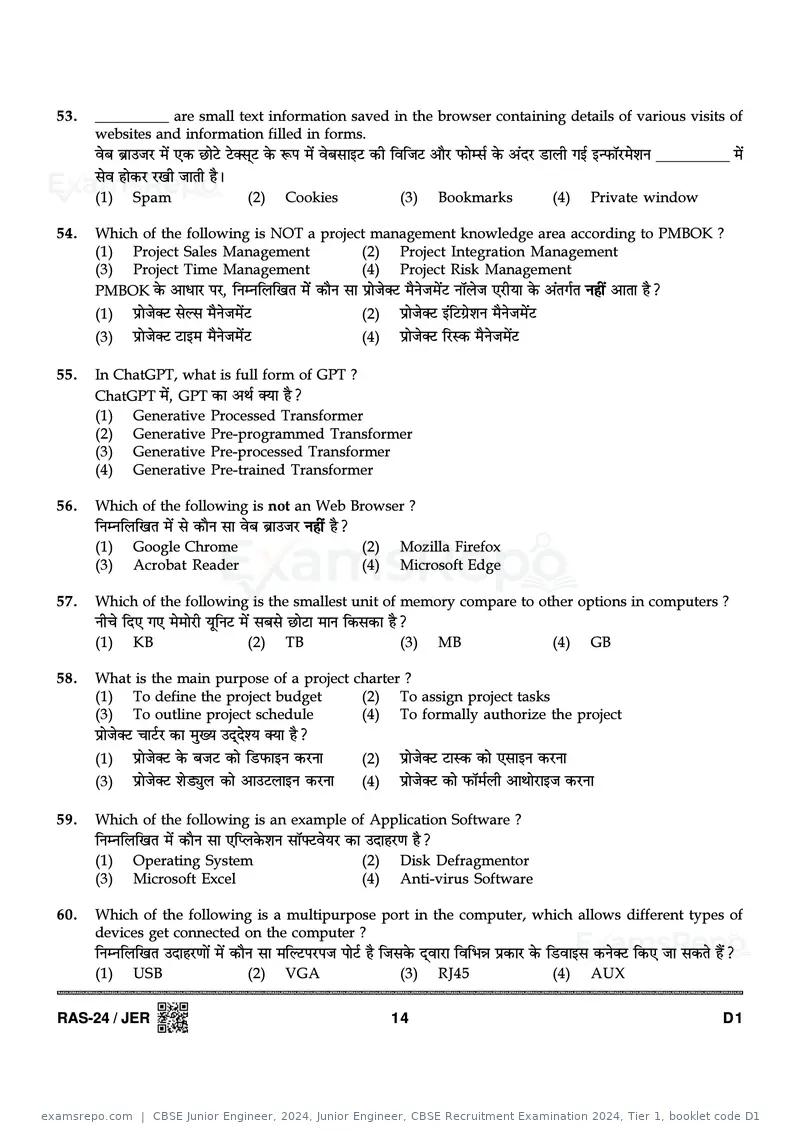
53.               __________ are small text information saved in the browser containing details of various visits of
                  websites and information filled in forms.
                  fl’ ’˝Ê©¡⁄U ◊¥ ∞∑§ ¿UÊ≈U ≈UÄ‚˜≈U ∑§ M§¬ ◊¥ fl’‚Êß≈U ∑§Ë ÁflÁ¡≈U •ÊÒ⁄U »§Êꂸ ∑§ •¥Œ⁄U «UÊ‹Ë ªß¸ ßã»§ÊÚ⁄U◊‡ÊŸ __________ ◊¥
                  ‚fl „Ê∑§⁄U ⁄UπË ¡ÊÃË „Ò–
                  (1)               Spam                                                     (2)               Cookies                                                 (3)                Bookmarks                                               (4)                Private window

54.               Which of the following is NOT a project management knowledge area according to PMBOK ?
                  (1) Project Sales Management                 (2) Project Integration Management
                  (3) Project Time Management                  (4) Project Risk Management
                  PMBOK ∑§ •ÊœÊ⁄U ¬⁄U, ÁŸêŸÁ‹Áπà ◊¥ ∑§ÊÒŸ ‚Ê ¬˝Ê¡Ä≈U ◊ÒŸ¡◊¥≈U ŸÊÚ‹¡ ∞⁄UËÿÊ ∑§ •¥Ãª¸Ã Ÿ„Ë¥ •ÊÃÊ „Ò?
                  (1)               ¬˝Ê¡Ä≈U ‚À‚ ◊ÒŸ¡◊¥≈U                                                                                        (2)               ¬˝Ê¡Ä≈U ߥÁ≈Uª˝‡ÊŸ ◊ÒŸ¡◊¥≈U
                  (3)               ¬˝Ê¡Ä≈U ≈UÊß◊ ◊ÒŸ¡◊¥≈U                                                                                       (4)               ¬˝Ê¡Ä≈U Á⁄US∑§ ◊ÒŸ¡◊¥≈U

55.               In ChatGPT, what is full form of GPT ?
                  ChatGPT ◊¥, GPT ∑§Ê •Õ¸ ÄÿÊ „Ò?
                  (1) Generative Processed Transformer
                  (2) Generative Pre-programmed Transformer
                  (3) Generative Pre-processed Transformer
                  (4) Generative Pre-trained Transformer

56.               Which of the following is not an Web Browser ?
                  ÁŸêŸÁ‹Áπà ◊¥ ‚ ∑§ÊÒŸ ‚Ê fl’ ’˝Ê©¡⁄U Ÿ„Ë¥ „Ò?
                  (1)               Google Chrome                                                                                                    (2)               Mozilla Firefox
                  (3)               Acrobat Reader                                                                                                   (4)               Microsoft Edge

57.               Which of the following is the smallest unit of memory compare to other options in computers ?
                  ŸËø ÁŒ∞ ª∞ ◊◊Ê⁄UË ÿÍÁŸ≈U ◊¥ ‚’‚ ¿UÊ≈UÊ ◊ÊŸ Á∑§‚∑§Ê „Ò?
                  (1)               KB                                                       (2)               TB                                                      (3)                MB                                                      (4)                GB

58.               What is the main purpose of a project charter ?
                  (1) To define the project budget       (2) To assign project tasks
                  (3) To outline project schedule        (4) To formally authorize the project
                  ¬˝Ê¡Ä≈U øÊ≈¸U⁄U ∑§Ê ◊ÈÅÿ ©Œ˜Œ‡ÿ ÄÿÊ „Ò?
                  (1) ¬˝Ê¡Ä≈U ∑§ ’¡≈U ∑§Ê Á«U»§Êߟ ∑§⁄UŸÊ                                                                                        (2)               ¬˝Ê¡Ä≈U ≈UÊS∑§ ∑§Ê ∞‚Êߟ ∑§⁄UŸÊ
                  (3) ¬˝Ê¡Ä≈U ‡Ê«KÈ‹ ∑§Ê •Ê©≈U‹Êߟ ∑§⁄UŸÊ                                                                                        (4)               ¬˝Ê¡Ä≈U ∑§Ê »§ÊÚ◊¸‹Ë •ÊÕÊ⁄UÊß¡ ∑§⁄UŸÊ

59.               Which of the following is an example of Application Software ?
                  ÁŸêŸÁ‹Áπà ◊¥ ∑§ÊÒŸ ‚Ê ∞Áå‹∑§‡ÊŸ ‚ÊÚç≈Uflÿ⁄U ∑§Ê ©ŒÊ„⁄UáÊ „Ò?
                  (1)               Operating System                                                                                                 (2)               Disk Defragmentor
                  (3)               Microsoft Excel                                                                                                  (4)               Anti-virus Software

60.               Which of the following is a multipurpose port in the computer, which allows different types of
                  devices get connected on the computer ?
                  ÁŸêŸÁ‹Áπà ©ŒÊ„⁄UáÊÊ¥ ◊¥ ∑§ÊÒŸ ‚Ê ◊ÁÀ≈U¬⁄U¬¡ ¬Ê≈¸U „Ò Á¡‚∑§ Œ˜flÊ⁄UÊ ÁflÁ÷ÛÊ ¬˝∑§Ê⁄U ∑§ Á«UflÊß‚ ∑§ŸÄ≈U Á∑§∞ ¡Ê ‚∑§Ã „Ò¥?
                  (1)               USB                                                      (2)               VGA                                                     (3)                RJ45                                                    (4)                AUX
RAS24JERRAS24JERRAS24JERRAS24JERRAS24JERRAS24JERRAS24JERRAS24JERRAS24JERRAS24JERRAS24JERRAS24JERRAS24JERRAS24JERRAS24JERRAS24JERRAS24JERRAS24JERRAS24JERRAS24JERRAS24JERRAS24JERRAS24JERRAS24JERRAS24JERRAS24JERRAS24JERRAS24JERRAS24JERRAS24JERRAS24JERRAS24JERRAS24JERRAS24JERRAS24JERRAS24JERRAS24JERRAS24JERRAS24JERRAS24JERRAS24JERRAS24JER


RAS-24 / JER                                                                                                                                                       14                                                                                                                                                                 D1
CBSE Junior Engineer 2024 question paper, Junior Engineer, CBSE Recruitment Examination 2024, Tier 1, booklet code D1, page 15 of 40
Page 15 of 40
Text of page 15
RAS24JERRAS24JERRAS24JERRAS24JERRAS24JERRAS24JERRAS24JERRAS24JERRAS24JERRAS24JERRAS24JERRAS24JERRAS24JERRAS24JERRAS24JERRAS24JERRAS24JERRAS24JERRAS24JERRAS24JERRAS24JERRAS24JERRAS24JERRAS24JERRAS24JERRAS24JERRAS24JERRAS24JERRAS24JERRAS24JERRAS24JERRAS24JERRAS24JERRAS24JERRAS24JERRAS24JERRAS24JERRAS24JERRAS24JERRAS24JERRAS24JERRAS24JER


                                                                                                                   PART - VI / ÷ʪ - VI
                                                                                                            Civil Engineering / Á‚Áfl‹ •Á÷ÿ¥òÊáÊ
RAS24JERRAS24JERRAS24JERRAS24JERRAS24JERRAS24JERRAS24JERRAS24JERRAS24JERRAS24JERRAS24JERRAS24JERRAS24JERRAS24JERRAS24JERRAS24JERRAS24JERRAS24JERRAS24JERRAS24JERRAS24JERRAS24JERRAS24JERRAS24JERRAS24JERRAS24JERRAS24JERRAS24JERRAS24JERRAS24JERRAS24JERRAS24JERRAS24JERRAS24JERRAS24JERRAS24JERRAS24JERRAS24JERRAS24JERRAS24JERRAS24JERRAS24JER


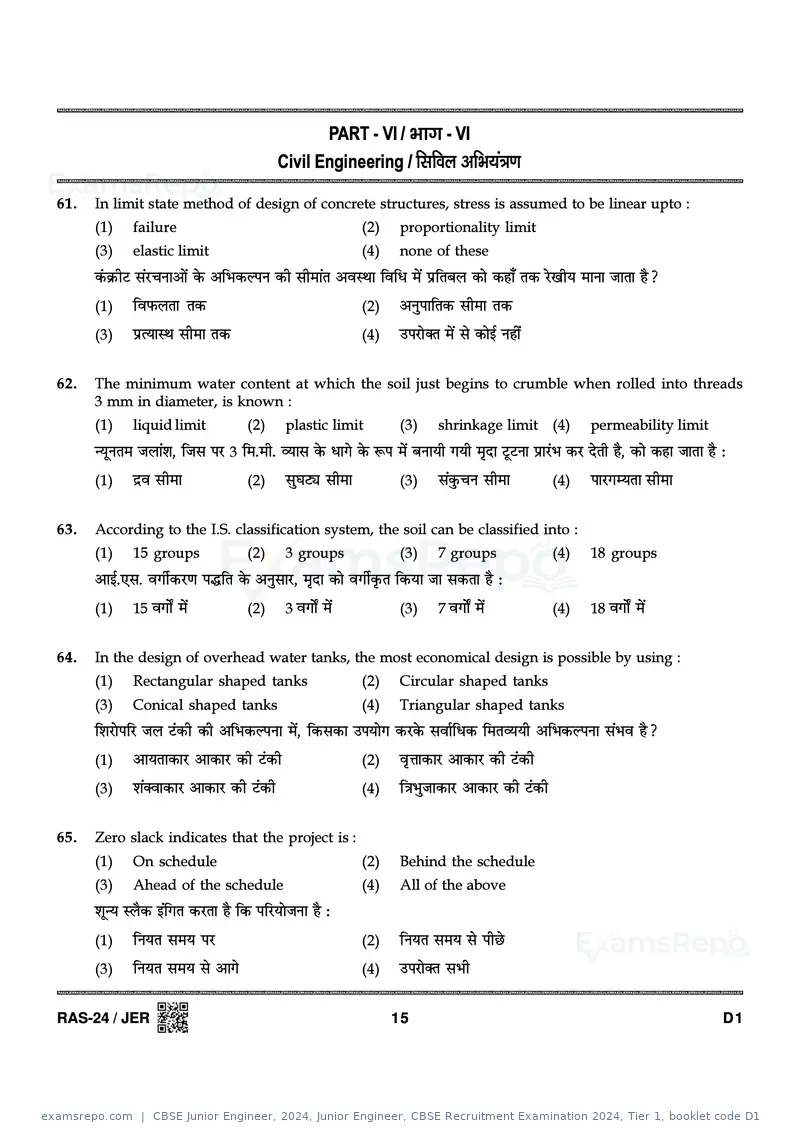
61.               In limit state method of design of concrete structures, stress is assumed to be linear upto :
                  (1)               failure                                                                                                          (2)               proportionality limit
                  (3)               elastic limit                                                                                                    (4)               none of these
                  ∑¥§∑˝§Ë≈U ‚¥⁄UøŸÊ•Ê¥ ∑§ •Á÷∑§À¬Ÿ ∑§Ë ‚Ë◊ʥà •flSÕÊ ÁflÁœ ◊¥ ¬˝ÁÃ’‹ ∑§Ê ∑§„ʰ Ã∑§ ⁄UπËÿ ◊ÊŸÊ ¡ÊÃÊ „Ò?
                  (1)               Áfl»§‹ÃÊ Ã∑§                                                                                                      (2)               •ŸÈ¬ÊÁÃ∑§ ‚Ë◊Ê Ã∑§
                  (3)               ¬˝àÿÊSÕ ‚Ë◊Ê Ã∑§                                                                                                 (4)               ©¬⁄UÊÄà ◊¥ ‚ ∑§Ê߸ Ÿ„Ë¥

62.               The minimum water content at which the soil just begins to crumble when rolled into threads
                  3 mm in diameter, is known :
                  (1)               liquid limit                                             (2)               plastic limit                                           (3)                shrinkage limit (4)                                                        permeability limit
                  ãÿÍŸÃ◊ ¡‹Ê¥‡Ê, Á¡‚ ¬⁄U 3 Á◊.◊Ë. √ÿÊ‚ ∑§ œÊª ∑§ M§¬ ◊¥ ’ŸÊÿË ªÿË ◊ÎŒÊ ≈ÍU≈UŸÊ ¬˝Ê⁄¥U÷ ∑§⁄U ŒÃË „Ò, ∑§Ê ∑§„Ê ¡ÊÃÊ „Ò —
                  (1)               Œ˝fl ‚Ë◊Ê                                                 (2)               ‚ÈÉÊ≈K ‚Ë◊Ê                                             (3)                ‚¥∑ȧøŸ ‚Ë◊Ê                                            (4)                ¬Ê⁄UªêÿÃÊ ‚Ë◊Ê

63.               According to the I.S. classification system, the soil can be classified into :
                  (1)               15 groups                                                (2)               3 groups                                                (3)                7 groups                                                (4)                18 groups
                  •Ê߸.∞‚. flªË¸∑§⁄UáÊ ¬hÁà ∑§ •ŸÈ‚Ê⁄U, ◊ÎŒÊ ∑§Ê flªË¸∑Χà Á∑§ÿÊ ¡Ê ‚∑§ÃÊ „Ò —
                  (1)               15 flªÊZ ◊¥                                             (2)               3 flªÊZ ◊¥                                             (3)                7 flªÊZ ◊¥                                             (4)                18 flªÊZ ◊¥


64.               In the design of overhead water tanks, the most economical design is possible by using :
                  (1)               Rectangular shaped tanks                                                                                         (2)               Circular shaped tanks
                  (3)               Conical shaped tanks                                                                                             (4)               Triangular shaped tanks
                  Á‡Ê⁄UÊ¬Á⁄U ¡‹ ≈¥U∑§Ë ∑§Ë •Á÷∑§À¬ŸÊ ◊¥, Á∑§‚∑§Ê ©¬ÿÊª ∑§⁄U∑§ ‚flʸÁœ∑§ Á◊Ã√ÿÿË •Á÷∑§À¬ŸÊ ‚¥÷fl „Ò?
                  (1)               •ÊÿÃÊ∑§Ê⁄U •Ê∑§Ê⁄U ∑§Ë ≈¥U∑§Ë                                                                                    (2)               flÎûÊÊ∑§Ê⁄U •Ê∑§Ê⁄U ∑§Ë ≈¥U∑§Ë
                  (3)               ‡Ê¥ÄflÊ∑§Ê⁄U •Ê∑§Ê⁄U ∑§Ë ≈¥U∑§Ë                                                                                   (4)               ÁòÊ÷È¡Ê∑§Ê⁄U •Ê∑§Ê⁄U ∑§Ë ≈¥U∑§Ë

65.               Zero slack indicates that the project is :
                  (1)               On schedule                                                                                                      (2)               Behind the schedule
                  (3)               Ahead of the schedule                                                                                            (4)               All of the above
                  ‡ÊÍãÿ S‹Ò∑§ ߥÁªÃ ∑§⁄UÃÊ „Ò Á∑§ ¬Á⁄UÿÊ¡ŸÊ „Ò —
                  (1)               ÁŸÿà ‚◊ÿ ¬⁄U                                                                                                     (2)               ÁŸÿà ‚◊ÿ ‚ ¬Ë¿U
                  (3)               ÁŸÿà ‚◊ÿ ‚ •ʪ                                                                                                 (4)               ©¬⁄UÊÄà ‚÷Ë
RAS24JERRAS24JERRAS24JERRAS24JERRAS24JERRAS24JERRAS24JERRAS24JERRAS24JERRAS24JERRAS24JERRAS24JERRAS24JERRAS24JERRAS24JERRAS24JERRAS24JERRAS24JERRAS24JERRAS24JERRAS24JERRAS24JERRAS24JERRAS24JERRAS24JERRAS24JERRAS24JERRAS24JERRAS24JERRAS24JERRAS24JERRAS24JERRAS24JERRAS24JERRAS24JERRAS24JERRAS24JERRAS24JERRAS24JERRAS24JERRAS24JERRAS24JER


RAS-24 / JER                                                                                                                                                       15                                                                                                                                                                 D1
CBSE Junior Engineer 2024 question paper, Junior Engineer, CBSE Recruitment Examination 2024, Tier 1, booklet code D1, page 16 of 40
Page 16 of 40
Text of page 16
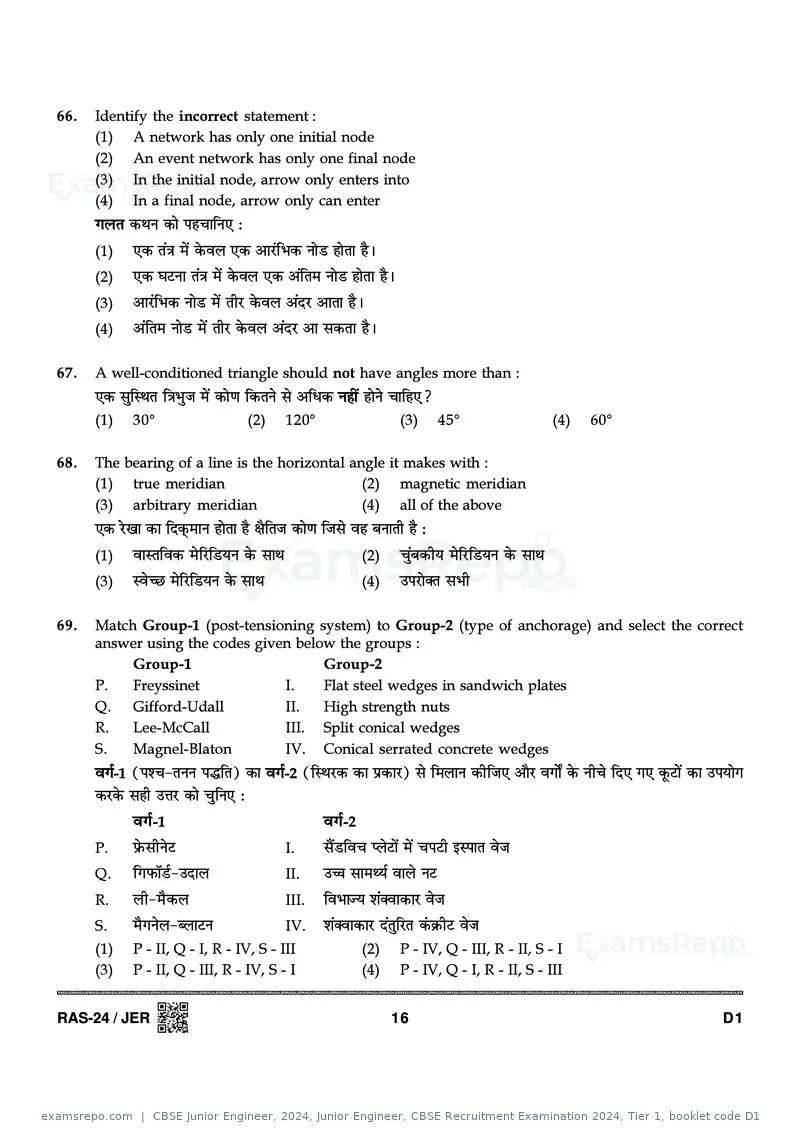
66.               Identify the incorrect statement :
                  (1) A network has only one initial node
                  (2) An event network has only one final node
                  (3) In the initial node, arrow only enters into
                  (4) In a final node, arrow only can enter
                  ª‹Ã ∑§ÕŸ ∑§Ê ¬„øÊÁŸ∞ —
                  (1) ∞∑§ Ã¥òÊ ◊¥ ∑§fl‹ ∞∑§ •Ê⁄¥UÁ÷∑§ ŸÊ«U „ÊÃÊ „Ò–
                  (2) ∞∑§ ÉÊ≈UŸÊ Ã¥òÊ ◊¥ ∑§fl‹ ∞∑§ •¥ÁÃ◊ ŸÊ«U „ÊÃÊ „Ò–
                  (3) •Ê⁄¥UÁ÷∑§ ŸÊ«U ◊¥ ÃË⁄U ∑§fl‹ •¥Œ⁄U •ÊÃÊ „Ò–
                  (4) •¥ÁÃ◊ ŸÊ«U ◊¥ ÃË⁄U ∑§fl‹ •¥Œ⁄U •Ê ‚∑§ÃÊ „Ò–

67.               A well-conditioned triangle should not have angles more than :
                  ∞∑§ ‚ÈÁSÕà ÁòÊ÷È¡ ◊¥ ∑§ÊáÊ Á∑§ÃŸ ‚ •Áœ∑§ Ÿ„Ë¥ „ÊŸ øÊÁ„∞?
                  (1)               308                                                      (2)               1208                                                    (3)                458                                                     (4)                608

68.               The bearing of a line is the horizontal angle it makes with :
                  (1) true meridian                         (2) magnetic meridian
                  (3) arbitrary meridian                    (4) all of the above
                  ∞∑§ ⁄UπÊ ∑§Ê ÁŒ∑˜§◊ÊŸ „ÊÃÊ „Ò ˇÊÒÁá ∑§ÊáÊ Á¡‚ fl„ ’ŸÊÃË „Ò —
                  (1) flÊSÃÁfl∑§ ◊Á⁄UÁ«UÿŸ ∑§ ‚ÊÕ                     (2) øÈ¥’∑§Ëÿ ◊Á⁄UÁ«UÿŸ ∑§ ‚ÊÕ
                  (3) Sflë¿U ◊Á⁄UÁ«UÿŸ ∑§ ‚ÊÕ                       (4) ©¬⁄UÊÄà ‚÷Ë

69.               Match Group-1 (post-tensioning system) to Group-2 (type of anchorage) and select the correct
                  answer using the codes given below the groups :
                       Group-1                     Group-2
                  P.   Freyssinet            I.    Flat steel wedges in sandwich plates
                  Q. Gifford-Udall           II.   High strength nuts
                  R.   Lee-McCall            III. Split conical wedges
                  S.   Magnel-Blaton         IV. Conical serrated concrete wedges
                  flª¸-1 (¬‡ø-ߟ ¬hÁÃ) ∑§Ê flª¸-2 (ÁSÕ⁄U∑§ ∑§Ê ¬˝∑§Ê⁄U) ‚ Á◊‹ÊŸ ∑§ËÁ¡∞ •ÊÒ⁄U flªÊZ ∑§ ŸËø ÁŒ∞ ª∞ ∑ͧ≈UÊ¥ ∑§Ê ©¬ÿÊª
                  ∑§⁄U∑§ ‚„Ë ©ûÊ⁄U ∑§Ê øÈÁŸ∞ —
                          flª¸-1                       flª¸-2
                  P.      »˝§‚ËŸ≈U             I.   ‚Ò¥«UÁflø å‹≈UÊ¥ ◊¥ ø¬≈UË ßS¬Êà fl¡
                  Q. Áª»§ÊÚ«¸U-©ŒÊ‹              II.  ©ìÊ ‚Ê◊âÿ¸ flÊ‹ Ÿ≈U
                  R.      ‹Ë-◊Ò∑§‹               III. Áfl÷Êíÿ ‡Ê¥ÄflÊ∑§Ê⁄U fl¡
                  S.      ◊ÒªŸ‹-é‹Ê≈UŸ          IV. ‡Ê¥ÄflÊ∑§Ê⁄U Œ¥ÃÈÁ⁄Uà ∑¥§∑˝§Ë≈U fl¡
                  (1)               P - II, Q - I, R - IV, S - III                                                                                   (2)               P - IV, Q - III, R - II, S - I
                  (3)               P - II, Q - III, R - IV, S - I                                                                                   (4)               P - IV, Q - I, R - II, S - III
RAS24JERRAS24JERRAS24JERRAS24JERRAS24JERRAS24JERRAS24JERRAS24JERRAS24JERRAS24JERRAS24JERRAS24JERRAS24JERRAS24JERRAS24JERRAS24JERRAS24JERRAS24JERRAS24JERRAS24JERRAS24JERRAS24JERRAS24JERRAS24JERRAS24JERRAS24JERRAS24JERRAS24JERRAS24JERRAS24JERRAS24JERRAS24JERRAS24JERRAS24JERRAS24JERRAS24JERRAS24JERRAS24JERRAS24JERRAS24JERRAS24JERRAS24JER


RAS-24 / JER                                                                                                                                                       16                                                                                                                                                                 D1
CBSE Junior Engineer 2024 question paper, Junior Engineer, CBSE Recruitment Examination 2024, Tier 1, booklet code D1, page 17 of 40
Page 17 of 40
Text of page 17
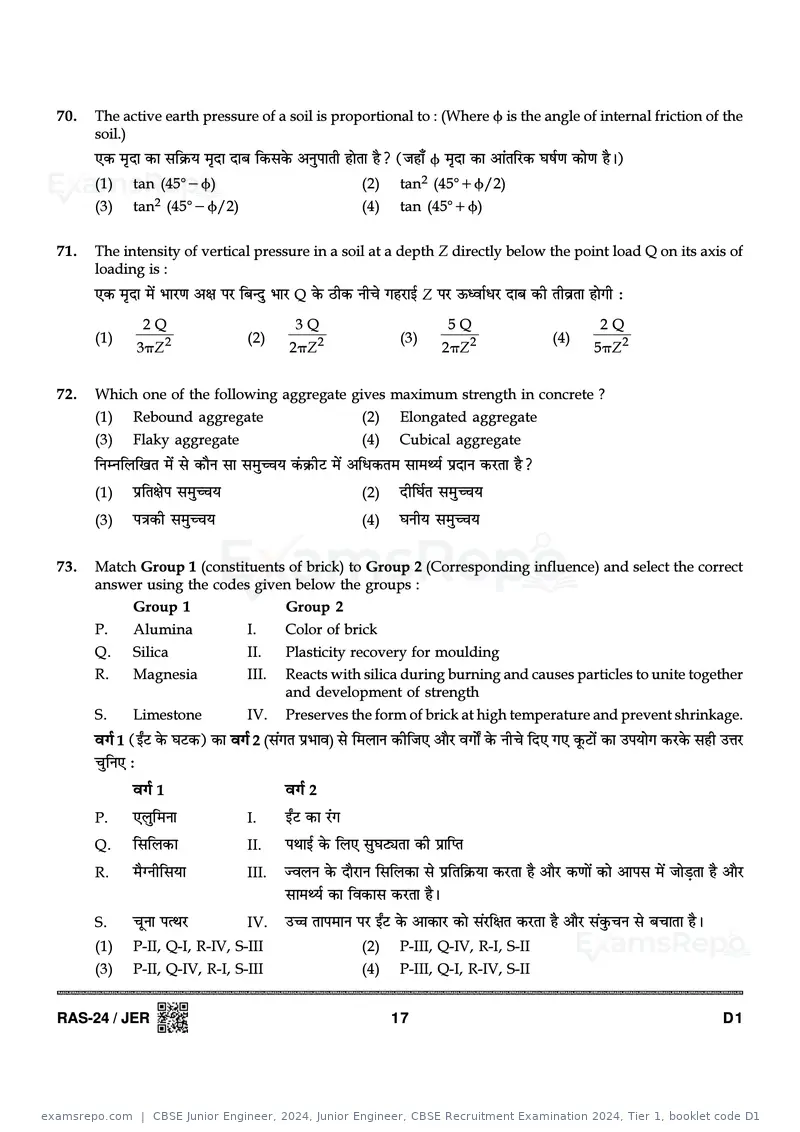
70.               The active earth pressure of a soil is proportional to : (Where φ is the angle of internal friction of the
                  soil.)
                  ∞∑§ ◊ÎŒÊ ∑§Ê ‚Á∑˝§ÿ ◊ÎŒÊ ŒÊ’ Á∑§‚∑§ •ŸÈ¬ÊÃË „ÊÃÊ „Ò? (¡„ʰ φ ◊ÎŒÊ ∑§Ê •Ê¥ÃÁ⁄U∑§ ÉÊ·¸áÊ ∑§ÊáÊ „Ò–)
                  (1)               tan (458−φ)                                                                                                      (2)               tan2 (458+φ/2)
                  (3)               tan2 (458−φ/2)                                                                                                   (4)               tan (458+φ)


71.               The intensity of vertical pressure in a soil at a depth Z directly below the point load Q on its axis of
                  loading is :
                  ∞∑§ ◊ÎŒÊ ◊¥ ÷Ê⁄UáÊ •ˇÊ ¬⁄U Á’ãŒÈ ÷Ê⁄U Q ∑§ ∆UË∑§ ŸËø ª„⁄UÊ߸ Z ¬⁄U ™§äflʸœ⁄U ŒÊ’ ∑§Ë ÃËfl˝ÃÊ „ÊªË —
                                         2Q                                                                         3Q                                                                         5Q                                                                         2Q
                  (1)                               2                                        (2)                               2                                       (3)                                2                                       (4)
                                      3πZ                                                                        2 πZ                                                                       2 πZ                                                                       5πZ 2


72.               Which one of the following aggregate gives maximum strength in concrete ?
                  (1)               Rebound aggregate                                                                                                (2)               Elongated aggregate
                  (3)               Flaky aggregate                                                                                                  (4)               Cubical aggregate
                  ÁŸêŸÁ‹Áπà ◊¥ ‚ ∑§ÊÒŸ ‚Ê ‚◊Èëøÿ ∑¥§∑˝§Ë≈U ◊¥ •Áœ∑§Ã◊ ‚Ê◊âÿ¸ ¬˝ŒÊŸ ∑§⁄UÃÊ „Ò?
                  (1) ¬˝ÁÃˇÊ¬ ‚◊Èëøÿ                              (2) ŒËÁÉʸà ‚◊Èëøÿ
                  (3) ¬òÊ∑§Ë ‚◊Èëøÿ                                (4) ÉÊŸËÿ ‚◊Èëøÿ


73.               Match Group 1 (constituents of brick) to Group 2 (Corresponding influence) and select the correct
                  answer using the codes given below the groups :
                                    Group 1                                                                    Group 2
                  P.                Alumina                                                  I.                Color of brick
                  Q.                Silica                                                   II.               Plasticity recovery for moulding
                  R.                Magnesia                                                 III.              Reacts with silica during burning and causes particles to unite together
                                                                                                               and development of strength
                  S.                Limestone                                                IV.               Preserves the form of brick at high temperature and prevent shrinkage.
                  flª¸ 1 (ßZ≈U ∑§ ÉÊ≈U∑§) ∑§Ê flª¸ 2 (‚¥ªÃ ¬˝÷Êfl) ‚ Á◊‹ÊŸ ∑§ËÁ¡∞ •ÊÒ⁄U flªÊZ ∑§ ŸËø ÁŒ∞ ª∞ ∑ͧ≈UÊ¥ ∑§Ê ©¬ÿÊª ∑§⁄U∑§ ‚„Ë ©ûÊ⁄U
                  øÈÁŸ∞ —
                         flª¸ 1                          flª¸ 2
                  P.     ∞‹ÈÁ◊ŸÊ                I.      ßZ≈U ∑§Ê ⁄¥Uª
                  Q. Á‚Á‹∑§Ê                    II.     ¬ÕÊ߸ ∑§ Á‹∞ ‚ÈÉÊ≈KÃÊ ∑§Ë ¬˝ÊÁåÃ
                  R.     ◊ÒÇŸËÁ‚ÿÊ              III. ífl‹Ÿ ∑§ ŒÊÒ⁄UÊŸ Á‚Á‹∑§Ê ‚ ¬˝ÁÃÁ∑˝§ÿÊ ∑§⁄UÃÊ „Ò •ÊÒ⁄U ∑§áÊÊ¥ ∑§Ê •ʬ‚ ◊¥ ¡Ê«∏ÃÊ „Ò •ÊÒ⁄U
                                                        ‚Ê◊âÿ¸ ∑§Ê Áfl∑§Ê‚ ∑§⁄UÃÊ „Ò–
                  S.     øÍŸÊ ¬àÕ⁄U             IV. ©ìÊ Ãʬ◊ÊŸ ¬⁄U ßZ≈U ∑§ •Ê∑§Ê⁄U ∑§Ê ‚¥⁄UÁˇÊà ∑§⁄UÃÊ „Ò •ÊÒ⁄U ‚¥∑ȧøŸ ‚ ’øÊÃÊ „Ò–
                  (1)               P-II, Q-I, R-IV, S-III                                                                                           (2)               P-III, Q-IV, R-I, S-II
                  (3)               P-II, Q-IV, R-I, S-III                                                                                           (4)               P-III, Q-I, R-IV, S-II
RAS24JERRAS24JERRAS24JERRAS24JERRAS24JERRAS24JERRAS24JERRAS24JERRAS24JERRAS24JERRAS24JERRAS24JERRAS24JERRAS24JERRAS24JERRAS24JERRAS24JERRAS24JERRAS24JERRAS24JERRAS24JERRAS24JERRAS24JERRAS24JERRAS24JERRAS24JERRAS24JERRAS24JERRAS24JERRAS24JERRAS24JERRAS24JERRAS24JERRAS24JERRAS24JERRAS24JERRAS24JERRAS24JERRAS24JERRAS24JERRAS24JERRAS24JER


RAS-24 / JER                                                                                                                                                       17                                                                                                                                                                 D1
CBSE Junior Engineer 2024 question paper, Junior Engineer, CBSE Recruitment Examination 2024, Tier 1, booklet code D1, page 18 of 40
Page 18 of 40
Text of page 18
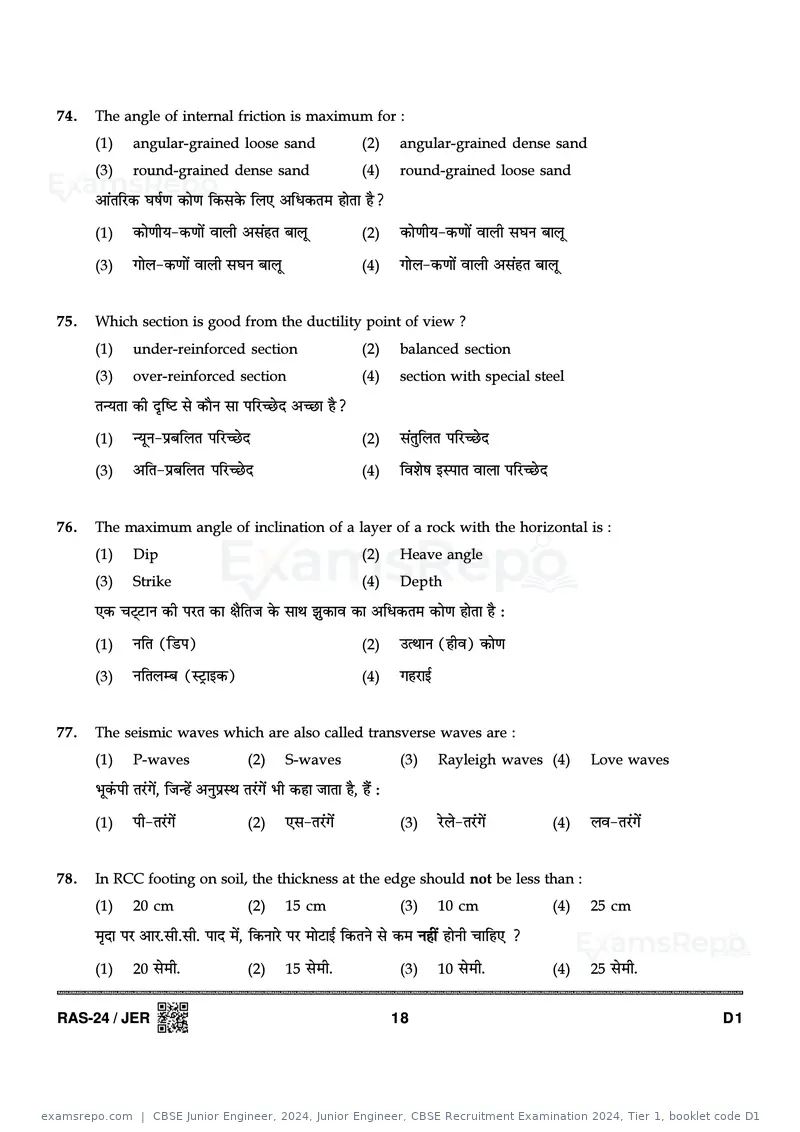
74.               The angle of internal friction is maximum for :
                  (1)               angular-grained loose sand                                                                                       (2)               angular-grained dense sand
                  (3)               round-grained dense sand                                                                                         (4)               round-grained loose sand

                  •Ê¥ÃÁ⁄U∑§ ÉÊ·¸áÊ ∑§ÊáÊ Á∑§‚∑§ Á‹∞ •Áœ∑§Ã◊ „ÊÃÊ „Ò?
                  (1)               ∑§ÊáÊËÿ-∑§áÊÊ¥ flÊ‹Ë •‚¥„à ’Ê‹Í                                                                                 (2)               ∑§ÊáÊËÿ-∑§áÊÊ¥ flÊ‹Ë ‚ÉÊŸ ’Ê‹Í
                  (3)               ªÊ‹-∑§áÊÊ¥ flÊ‹Ë ‚ÉÊŸ ’Ê‹Í                                                                                      (4)               ªÊ‹-∑§áÊÊ¥ flÊ‹Ë •‚¥„à ’Ê‹Í

75.               Which section is good from the ductility point of view ?
                  (1)               under-reinforced section                                                                                         (2)               balanced section
                  (3)               over-reinforced section                                                                                          (4)               section with special steel

                  ÃãÿÃÊ ∑§Ë ŒÎÁc≈ ‚ ∑§ÊÒŸ ‚Ê ¬Á⁄Uë¿UŒ •ë¿UÊ „Ò?U
                  (1)               ãÿÍŸ-¬˝’Á‹Ã ¬Á⁄Uë¿UŒ                                                                                            (2)               ‚¥ÃÈÁ‹Ã ¬Á⁄Uë¿UŒ
                  (3)               •ÁÃ-¬˝’Á‹Ã ¬Á⁄Uë¿UŒ                                                                                             (4)               Áfl‡Ê· ßS¬Êà flÊ‹Ê ¬Á⁄Uë¿UŒ

76.               The maximum angle of inclination of a layer of a rock with the horizontal is :
                  (1)               Dip                                                                                                              (2)               Heave angle
                  (3)               Strike                                                                                                           (4)               Depth

                  ∞∑§ ø≈˜≈U ÊŸ ∑§Ë ¬⁄Uà ∑§Ê ˇÊÒÁá ∑§ ‚ÊÕ ¤ÊÈ∑§Êfl ∑§Ê •Áœ∑§Ã◊ ∑§ÊáÊ „ÊÃÊ „Ò —
                  (1)               ŸÁà (Á«U¬)                                                                                                       (2)               ©àÕÊŸ („Ëfl) ∑§ÊáÊ
                  (3)               ŸÁÃ‹ê’ (S≈˛UÊß∑§)                                                                                                (4)               ª„⁄UÊ߸

77.               The seismic waves which are also called transverse waves are :
                  (1)               P-waves                                                  (2)               S-waves                                                 (3)                Rayleigh waves (4)                                                         Love waves

                  ÷Í∑¥§¬Ë Ã⁄¥Uª¥, Á¡ã„¥ •ŸÈ¬˝SÕ Ã⁄¥Uª¥ ÷Ë ∑§„Ê ¡ÊÃÊ „Ò, „Ò¥ —
                  (1)               ¬Ë-Ã⁄¥Uª¥                                               (2)               ∞‚-Ã⁄¥Uª¥                                              (3)                ⁄U‹-Ã⁄¥Uª¥                                           (4)                ‹fl-Ã⁄¥Uª¥

78.               In RCC footing on soil, the thickness at the edge should not be less than :
                  (1)               20 cm                                                    (2)               15 cm                                                   (3)                10 cm                                                   (4)                25 cm

                  ◊ÎŒÊ ¬⁄U •Ê⁄U.‚Ë.‚Ë. ¬ÊŒ ◊¥, Á∑§ŸÊ⁄U ¬⁄U ◊Ê≈UÊ߸ Á∑§ÃŸ ‚ ∑§◊ Ÿ„Ë¥ „ÊŸË øÊÁ„∞ ?
                  (1)               20 ‚◊Ë.                                                 (2)               15 ‚◊Ë.                                                (3)                10 ‚◊Ë.                                                (4)                25 ‚◊Ë.
RAS24JERRAS24JERRAS24JERRAS24JERRAS24JERRAS24JERRAS24JERRAS24JERRAS24JERRAS24JERRAS24JERRAS24JERRAS24JERRAS24JERRAS24JERRAS24JERRAS24JERRAS24JERRAS24JERRAS24JERRAS24JERRAS24JERRAS24JERRAS24JERRAS24JERRAS24JERRAS24JERRAS24JERRAS24JERRAS24JERRAS24JERRAS24JERRAS24JERRAS24JERRAS24JERRAS24JERRAS24JERRAS24JERRAS24JERRAS24JERRAS24JERRAS24JER


RAS-24 / JER                                                                                                                                                       18                                                                                                                                                                 D1
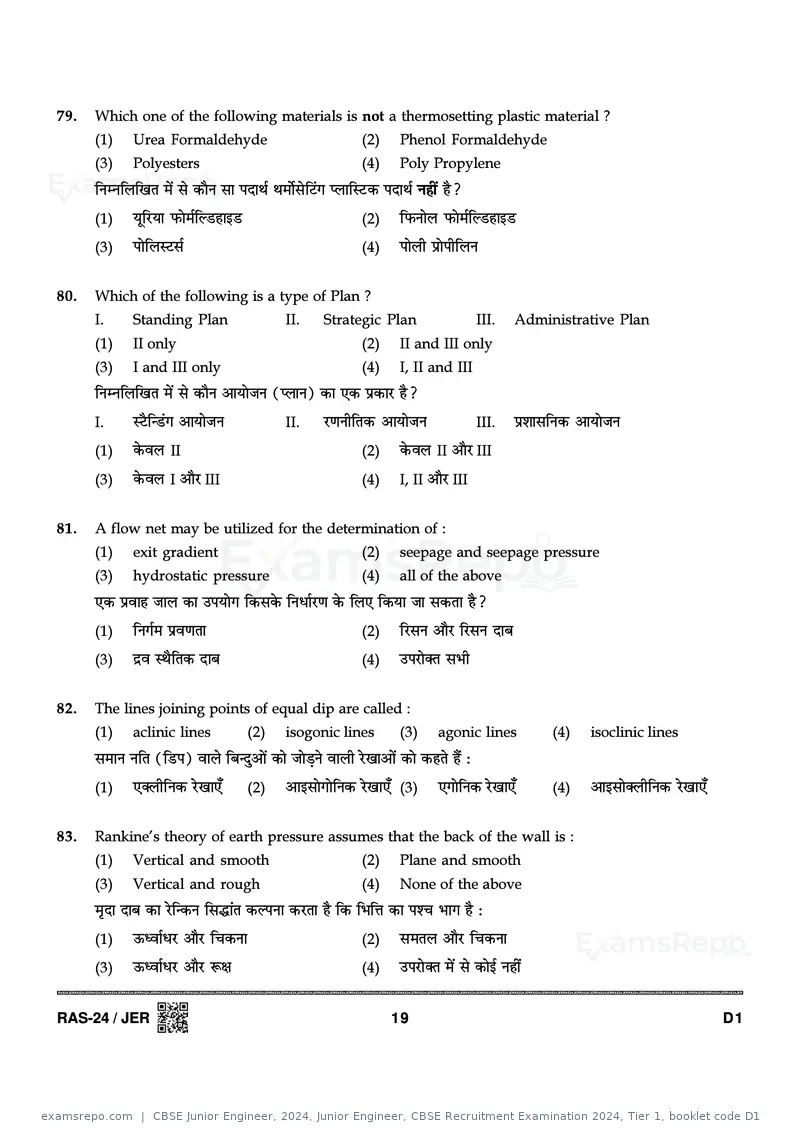
CBSE Junior Engineer 2024 question paper, Junior Engineer, CBSE Recruitment Examination 2024, Tier 1, booklet code D1, page 19 of 40
Page 19 of 40
Text of page 19
79.               Which one of the following materials is not a thermosetting plastic material ?
                  (1)               Urea Formaldehyde                                                                                                (2)               Phenol Formaldehyde
                  (3)               Polyesters                                                                                                       (4)               Poly Propylene
                  ÁŸêŸÁ‹Áπà ◊¥ ‚ ∑§ÊÒŸ ‚Ê ¬ŒÊÕ¸ Õ◊Ê¸‚Á≈¥Uª å‹ÊÁS≈U ∑§ ¬ŒÊÕ¸ Ÿ„Ë¥ „Ò?
                  (1)               ÿÍÁ⁄UÿÊ »§Ê◊¸ÁÀ«U„Êß«U                                                                                          (2)               Á»§ŸÊ‹ »§Ê◊¸ÁÀ«U„Êß«U
                  (3)               ¬ÊÁ‹S≈U‚¸                                                                                                       (4)               ¬Ê‹Ë ¬˝Ê¬ËÁ‹Ÿ

80.               Which of the following is a type of Plan ?
                  I.                Standing Plan                                                              II.                Strategic Plan                                                             III.               Administrative Plan
                  (1)               II only                                                                                                          (2)               II and III only
                  (3)               I and III only                                                                                                   (4)               I, II and III
                  ÁŸêŸÁ‹Áπà ◊¥ ‚ ∑§ÊÒŸ •ÊÿÊ¡Ÿ (å‹ÊŸ) ∑§Ê ∞∑§ ¬˝∑§Ê⁄U „Ò?
                  I.                S≈ÒUÁã«¥Uª •ÊÿÊ¡Ÿ                                                         II.                ⁄UáÊŸËÁÃ∑§ •ÊÿÊ¡Ÿ                                                         III.               ¬˝‡ÊÊ‚ÁŸ∑§ •ÊÿÊ¡Ÿ
                  (1)               ∑§fl‹ II                                                                                                         (2)               ∑§fl‹ II •ÊÒ⁄U III
                  (3)               ∑§fl‹ I •ÊÒ⁄U III                                                                                                (4)               I, II •ÊÒ⁄U III


81.               A flow net may be utilized for the determination of :
                  (1)               exit gradient                                                                                                    (2)               seepage and seepage pressure
                  (3)               hydrostatic pressure                                                                                             (4)               all of the above
                  ∞∑§ ¬˝flÊ„ ¡Ê‹ ∑§Ê ©¬ÿÊª Á∑§‚∑§ ÁŸœÊ¸⁄UáÊ ∑§ Á‹∞ Á∑§ÿÊ ¡Ê ‚∑§ÃÊ „Ò?
                  (1)               ÁŸª¸◊ ¬˝fláÊÃÊ                                                                                                    (2)               Á⁄U‚Ÿ •ÊÒ⁄U Á⁄U‚Ÿ ŒÊ’
                  (3)               Œ˝fl SÕÒÁÃ∑§ ŒÊ’                                                                                                  (4)               ©¬⁄UÊÄàÊ ‚÷Ë

82.               The lines joining points of equal dip are called :
                  (1)               aclinic lines                                            (2)               isogonic lines                                          (3)                agonic lines                                            (4)                isoclinic lines
                  ‚◊ÊŸ ŸÁà (Á«U¬) flÊ‹ Á’ãŒÈ•Ê¥ ∑§Ê ¡Ê«∏Ÿ flÊ‹Ë ⁄UπÊ•Ê¥ ∑§Ê ∑§„Ã „Ò¥ —
                  (1)               ∞Ä‹ËÁŸ∑§ ⁄UπÊ∞°                                         (2)               •Êß‚ÊªÊÁŸ∑§ ⁄UπÊ∞° (3)                                                  ∞ªÊÁŸ∑§ ⁄UπÊ∞°                                        (4)                •Êß‚ÊÄ‹ËÁŸ∑§ ⁄UπÊ∞°

83.               Rankine’s theory of earth pressure assumes that the back of the wall is :
                  (1)               Vertical and smooth                                                                                              (2)               Plane and smooth
                  (3)               Vertical and rough                                                                                               (4)               None of the above
                  ◊ÎŒÊ ŒÊ’ ∑§Ê ⁄UÁã∑§Ÿ Á‚hʥà ∑§À¬ŸÊ ∑§⁄UÃÊ „Ò Á∑§ Á÷ÁûÊ ∑§Ê ¬‡ø ÷ʪ „Ò —
                  (1)               ™§äflʸœ⁄U •ÊÒ⁄U Áø∑§ŸÊ                                                                                           (2)               ‚◊Ë •ÊÒ⁄U Áø∑§ŸÊ
                  (3)               ™§äflʸœ⁄U •ÊÒ⁄U M§ˇÊ                                                                                             (4)               ©¬⁄UÊÄàÊ ◊¥ ‚ ∑§Ê߸ Ÿ„Ë¥
RAS24JERRAS24JERRAS24JERRAS24JERRAS24JERRAS24JERRAS24JERRAS24JERRAS24JERRAS24JERRAS24JERRAS24JERRAS24JERRAS24JERRAS24JERRAS24JERRAS24JERRAS24JERRAS24JERRAS24JERRAS24JERRAS24JERRAS24JERRAS24JERRAS24JERRAS24JERRAS24JERRAS24JERRAS24JERRAS24JERRAS24JERRAS24JERRAS24JERRAS24JERRAS24JERRAS24JERRAS24JERRAS24JERRAS24JERRAS24JERRAS24JERRAS24JER


RAS-24 / JER                                                                                                                                                       19                                                                                                                                                                 D1
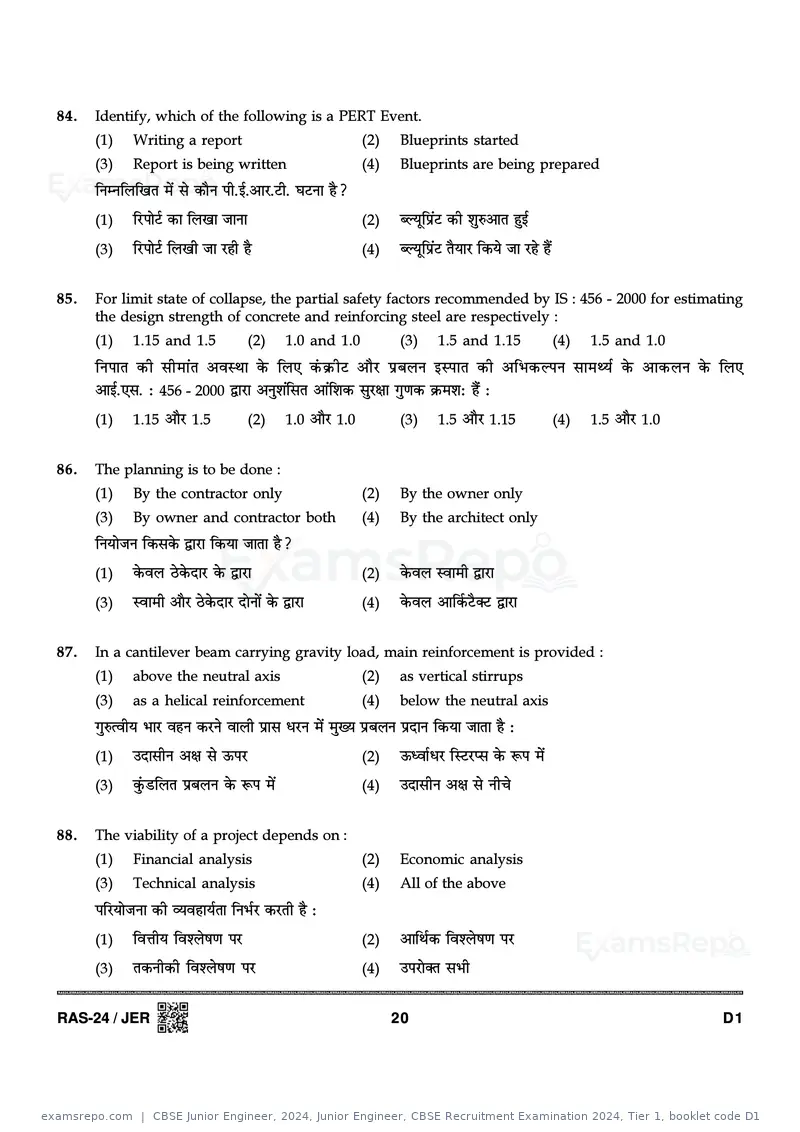
CBSE Junior Engineer 2024 question paper, Junior Engineer, CBSE Recruitment Examination 2024, Tier 1, booklet code D1, page 20 of 40
Page 20 of 40
Text of page 20
84.               Identify, which of the following is a PERT Event.
                  (1)               Writing a report                                                                                                 (2)               Blueprints started
                  (3)               Report is being written                                                                                          (4)               Blueprints are being prepared
                  ÁŸêŸÁ‹Áπà ◊¥ ‚ ∑§ÊÒŸ ¬Ë.߸.•Ê⁄U.≈UË. ÉÊ≈UŸÊ „Ò?
                  (1)               Á⁄U¬Ê≈¸U ∑§Ê Á‹πÊ ¡ÊŸÊ                                                                                          (2)               éÀÿÍÁ¬˝¥≈U ∑§Ë ‡ÊÈL§•Êà „È߸
                  (3)               Á⁄U¬Ê≈¸U Á‹πË ¡Ê ⁄U„Ë „Ò                                                                                        (4)               éÀÿÍÁ¬˝¥≈U ÃÒÿÊ⁄U Á∑§ÿ ¡Ê ⁄U„ „Ò¥

85.               For limit state of collapse, the partial safety factors recommended by IS : 456 - 2000 for estimating
                  the design strength of concrete and reinforcing steel are respectively :
                  (1)               1.15 and 1.5                                             (2)               1.0 and 1.0                                             (3)                1.5 and 1.15                                            (4)                1.5 and 1.0
                  ÁŸ¬Êà ∑§Ë ‚Ë◊ʥà •flSÕÊ ∑§ Á‹∞ ∑¥§∑˝§Ë≈U •ÊÒ⁄U ¬˝’‹Ÿ ßS¬Êà ∑§Ë •Á÷∑§À¬Ÿ ‚Ê◊âÿ¸ ∑§ •Ê∑§‹Ÿ ∑§ Á‹∞
                  •Ê߸.∞‚. — 456 - 2000 mÊ⁄UÊ •ŸÈ‡Ê¥Á‚à •Ê¥Á‡Ê∑§ ‚È⁄UˇÊÊ ªÈáÊ∑§ ∑˝§◊‡Ê— „Ò¥ —
                  (1)               1.15 •ÊÒ⁄U 1.5                                           (2)               1.0 •ÊÒ⁄U 1.0                                           (3)                1.5 •ÊÒ⁄U 1.15                                          (4)                1.5 •ÊÒ⁄U 1.0


86.               The planning is to be done :
                  (1)               By the contractor only                                                                                           (2)               By the owner only
                  (3)               By owner and contractor both                                                                                     (4)               By the architect only
                  ÁŸÿÊ¡Ÿ Á∑§‚∑§ mÊ⁄UÊ Á∑§ÿÊ ¡ÊÃÊ „Ò?
                  (1)               ∑§fl‹ ∆U∑§ŒÊ⁄U ∑§ mÊ⁄UÊ                                                                                       (2)               ∑§fl‹ SflÊ◊Ë mÊ⁄UÊ
                  (3)               SflÊ◊Ë •ÊÒ⁄U ∆U∑§ŒÊ⁄U ŒÊŸÊ¥ ∑§ mÊ⁄UÊ                                                                         (4)               ∑§fl‹ •ÊÁ∑¸§≈ÒUÄ≈U mÊ⁄UÊ

87.               In a cantilever beam carrying gravity load, main reinforcement is provided :
                  (1)               above the neutral axis                                                                                           (2)               as vertical stirrups
                  (3)               as a helical reinforcement                                                                                       (4)               below the neutral axis
                  ªÈL§àflËÿ ÷Ê⁄U fl„Ÿ ∑§⁄UŸ flÊ‹Ë ¬˝Ê‚ œ⁄UŸ ◊¥ ◊ÈÅÿ ¬˝’‹Ÿ ¬˝ŒÊŸ Á∑§ÿÊ ¡ÊÃÊ „Ò —
                  (1)               ©ŒÊ‚ËŸ •ˇÊ ‚ ™§¬⁄U                                                                                              (2)               ™§äflʸœ⁄U ÁS≈U⁄Uå‚ ∑§ M§¬ ◊¥
                  (3)               ∑È¥§«UÁ‹Ã ¬˝’‹Ÿ ∑§ M§¬ ◊¥                                                                                      (4)               ©ŒÊ‚ËŸ •ˇÊ ‚ ŸËø

88.               The viability of a project depends on :
                  (1)               Financial analysis                                                                                               (2)               Economic analysis
                  (3)               Technical analysis                                                                                               (4)               All of the above
                  ¬Á⁄UÿÊ¡ŸÊ ∑§Ë √ÿfl„Êÿ¸ÃÊ ÁŸ÷¸⁄U ∑§⁄UÃË „Ò —
                  (1)               ÁflûÊËÿ Áfl‡‹·áÊ ¬⁄U                                                                                              (2)               •ÊÁÕ¸∑§ Áfl‡‹·áÊ ¬⁄U
                  (3)               Ã∑§ŸË∑§Ë Áfl‡‹·áÊ ¬⁄U                                                                                            (4)               ©¬⁄UÊÄà ‚÷Ë
RAS24JERRAS24JERRAS24JERRAS24JERRAS24JERRAS24JERRAS24JERRAS24JERRAS24JERRAS24JERRAS24JERRAS24JERRAS24JERRAS24JERRAS24JERRAS24JERRAS24JERRAS24JERRAS24JERRAS24JERRAS24JERRAS24JERRAS24JERRAS24JERRAS24JERRAS24JERRAS24JERRAS24JERRAS24JERRAS24JERRAS24JERRAS24JERRAS24JERRAS24JERRAS24JERRAS24JERRAS24JERRAS24JERRAS24JERRAS24JERRAS24JERRAS24JER


RAS-24 / JER                                                                                                                                                       20                                                                                                                                                                 D1
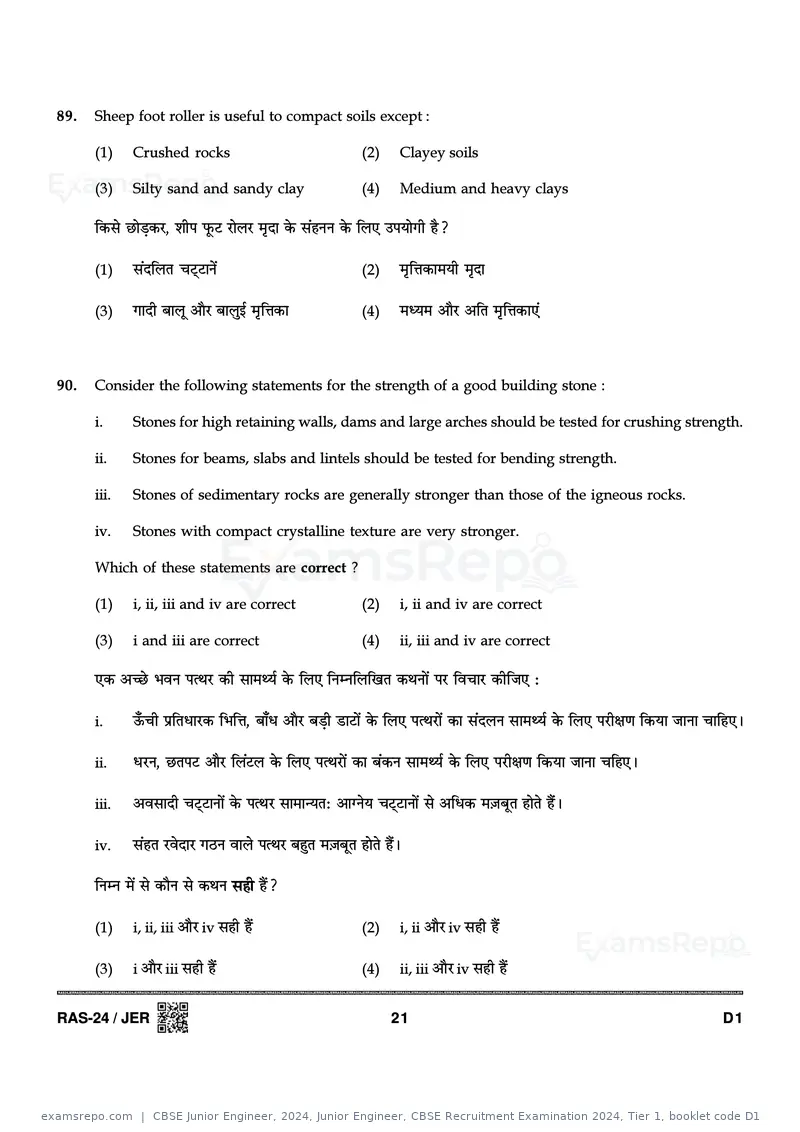
CBSE Junior Engineer 2024 question paper, Junior Engineer, CBSE Recruitment Examination 2024, Tier 1, booklet code D1, page 21 of 40
Page 21 of 40
Text of page 21
89.               Sheep foot roller is useful to compact soils except :

                  (1)               Crushed rocks                                                                                                    (2)               Clayey soils

                  (3)               Silty sand and sandy clay                                                                                        (4)               Medium and heavy clays

                  Á∑§‚ ¿UÊ«∏∑§⁄U, ‡Êˬ »Í§≈U ⁄UÊ‹⁄U ◊ÎŒÊ ∑§ ‚¥„ŸŸ ∑§ Á‹∞ ©¬ÿÊªË „Ò?

                  (1)               ‚¥ŒÁ‹Ã ø≈˜U≈UÊŸ¥                                                                                                (2)               ◊ÎÁûÊ∑§Ê◊ÿË ◊ÎŒÊ

                  (3)               ªÊŒË ’Ê‹Í •ÊÒ⁄U ’Ê‹È߸ ◊ÎÁûÊ∑§Ê                                                                                  (4)               ◊äÿ◊ •ÊÒ⁄U •Áà ◊ÎÁûÊ∑§Ê∞¥


90.               Consider the following statements for the strength of a good building stone :

                  i.                Stones for high retaining walls, dams and large arches should be tested for crushing strength.

                  ii.               Stones for beams, slabs and lintels should be tested for bending strength.

                  iii.              Stones of sedimentary rocks are generally stronger than those of the igneous rocks.

                  iv.               Stones with compact crystalline texture are very stronger.

                  Which of these statements are correct ?

                  (1)               i, ii, iii and iv are correct                                                                                    (2)               i, ii and iv are correct

                  (3)               i and iii are correct                                                                                            (4)               ii, iii and iv are correct

                  ∞∑§ •ë¿U ÷flŸ ¬àÕ⁄U ∑§Ë ‚Ê◊âÿ¸ ∑§ Á‹∞ ÁŸêŸÁ‹Áπà ∑§ÕŸÊ¥ ¬⁄U ÁfløÊ⁄U ∑§ËÁ¡∞ —

                  i.                ™°§øË ¬˝ÁÜÊ⁄U∑§ Á÷ÁûÊ, ’ʰœ •ÊÒ⁄U ’«∏Ë «UÊ≈UÊ¥ ∑§ Á‹∞ ¬àÕ⁄UÊ¥ ∑§Ê ‚¥Œ‹Ÿ ‚Ê◊âÿ¸ ∑§ Á‹∞ ¬⁄UˡÊáÊ Á∑§ÿÊ ¡ÊŸÊ øÊÁ„∞–

                  ii.               œ⁄UŸ, ¿Uì≈U •ÊÒ⁄U Á‹¥≈U‹ ∑§ Á‹∞ ¬àÕ⁄UÊ¥ ∑§Ê ’¥∑§Ÿ ‚Ê◊âÿ¸ ∑§ Á‹∞ ¬⁄UˡÊáÊ Á∑§ÿÊ ¡ÊŸÊ øÁ„∞–

                  iii.              •fl‚ÊŒË ø≈˜U≈UÊŸÊ¥ ∑§ ¬àÕ⁄U ‚Ê◊Êãÿ× •ÊÇŸÿ ø≈˜U≈UÊŸÊ¥ ‚ •Áœ∑§ ◊$¡’Íà „ÊÃ „Ò¥–

                  iv.               ‚¥„à ⁄UflŒÊ⁄U ª∆UŸ flÊ‹ ¬àÕ⁄U ’„Èà ◊$¡’Íà „ÊÃ „¥Ò–

                  ÁŸêŸ ◊¥ ‚ ∑§ÊÒŸ ‚ ∑§ÕŸ ‚„Ë „Ò¥?

                  (1)               i, ii, iii •ÊÒ⁄U iv ‚„Ë „Ò¥                                                                                      (2)               i, ii •ÊÒ⁄U iv ‚„Ë „Ò¥

                  (3)               i •ÊÒ⁄U iii ‚„Ë „Ò¥                                                                                              (4)               ii, iii •ÊÒ⁄U iv ‚„Ë „Ò¥
RAS24JERRAS24JERRAS24JERRAS24JERRAS24JERRAS24JERRAS24JERRAS24JERRAS24JERRAS24JERRAS24JERRAS24JERRAS24JERRAS24JERRAS24JERRAS24JERRAS24JERRAS24JERRAS24JERRAS24JERRAS24JERRAS24JERRAS24JERRAS24JERRAS24JERRAS24JERRAS24JERRAS24JERRAS24JERRAS24JERRAS24JERRAS24JERRAS24JERRAS24JERRAS24JERRAS24JERRAS24JERRAS24JERRAS24JERRAS24JERRAS24JERRAS24JER


RAS-24 / JER                                                                                                                                                       21                                                                                                                                                                 D1
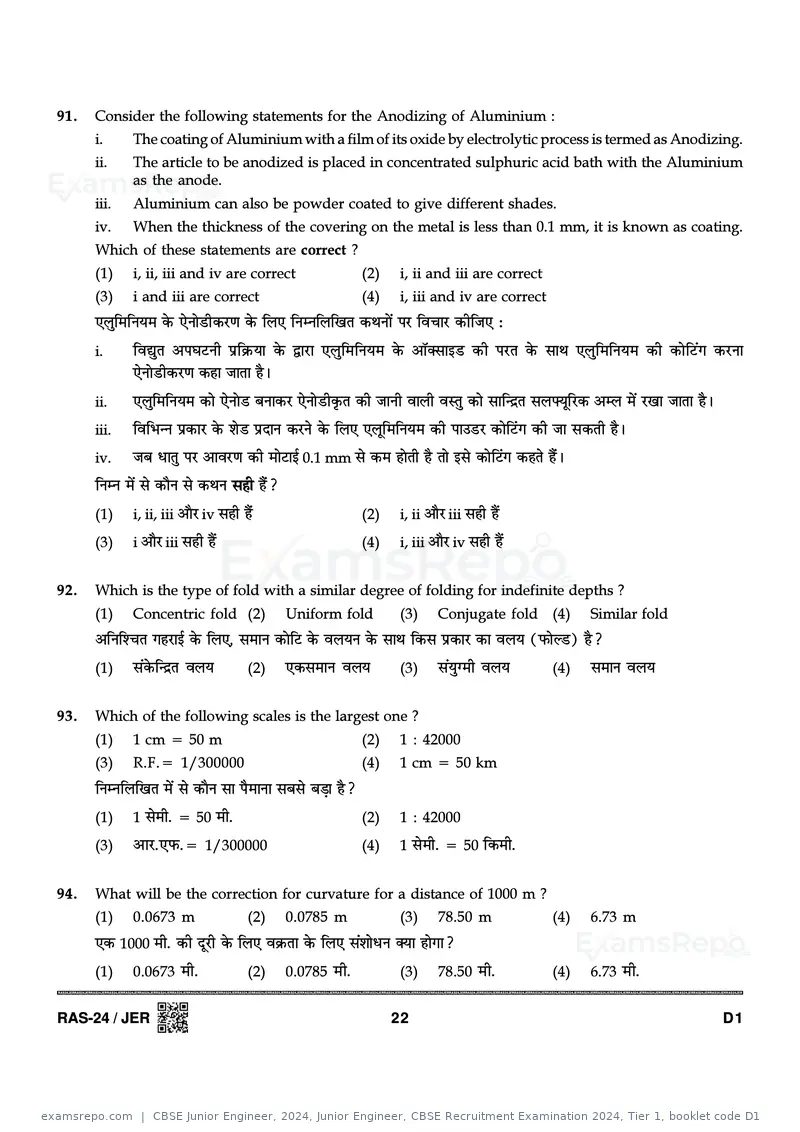
CBSE Junior Engineer 2024 question paper, Junior Engineer, CBSE Recruitment Examination 2024, Tier 1, booklet code D1, page 22 of 40
Page 22 of 40
Text of page 22
91.               Consider the following statements for the Anodizing of Aluminium :
                  i.                The coating of Aluminium with a film of its oxide by electrolytic process is termed as Anodizing.
                  ii.               The article to be anodized is placed in concentrated sulphuric acid bath with the Aluminium
                                    as the anode.
                  iii.              Aluminium can also be powder coated to give different shades.
                  iv.               When the thickness of the covering on the metal is less than 0.1 mm, it is known as coating.
                  Which of these statements are correct ?
                  (1)               i, ii, iii and iv are correct                                                                                    (2)               i, ii and iii are correct
                  (3)               i and iii are correct                                                                                            (4)               i, iii and iv are correct
                  ∞‹ÈÁ◊ÁŸÿ◊ ∑§ ∞ŸÊ«UË∑§⁄UáÊ ∑§ Á‹∞ ÁŸêŸÁ‹Áπà ∑§ÕŸÊ¥ ¬⁄U ÁfløÊ⁄U ∑§ËÁ¡∞ —
                  i.    ÁfllÈà •¬ÉÊ≈UŸË ¬˝Á∑˝§ÿÊ ∑§ mÊ⁄UÊ ∞‹ÈÁ◊ÁŸÿ◊ ∑§ •ÊÚÄ‚Êß«U ∑§Ë ¬⁄Uà ∑§ ‚ÊÕ ∞‹ÈÁ◊ÁŸÿ◊ ∑§Ë ∑§ÊÁ≈U¥ª ∑§⁄UŸÊ
                        ∞ŸÊ«UË∑§⁄UáÊ ∑§„Ê ¡ÊÃÊ „Ò–
                  ii.   ∞‹ÈÁ◊ÁŸÿ◊ ∑§Ê ∞ŸÊ«U ’ŸÊ∑§⁄U ∞ŸÊ«UË∑Χà ∑§Ë ¡ÊŸË flÊ‹Ë flSÃÈ ∑§Ê ‚ÊÁãŒ˝Ã ‚‹çÿÍÁ⁄U∑§ •ê‹ ◊¥ ⁄UπÊ ¡ÊÃÊ „Ò–
                  iii. ÁflÁ÷㟠¬˝∑§Ê⁄U ∑§ ‡Ê«U ¬˝ŒÊŸ ∑§⁄UŸ ∑§ Á‹∞ ∞‹ÍÁ◊ÁŸÿ◊ ∑§Ë ¬Ê©«U⁄U ∑§ÊÁ≈¥Uª ∑§Ë ¡Ê ‚∑§ÃË „Ò–
                  iv. ¡’ œÊÃÈ ¬⁄U •Êfl⁄UáÊ ∑§Ë ◊Ê≈UÊ߸ 0.1 mm ‚ ∑§◊ „ÊÃË „Ò ÃÊ ß‚ ∑§ÊÁ≈¥Uª ∑§„Ã „Ò¥–
                  ÁŸêŸ ◊¥ ‚ ∑§ÊÒŸ ‚ ∑§ÕŸ ‚„Ë „Ò¥?
                  (1) i, ii, iii •ÊÒ⁄U iv ‚„Ë „Ò¥                    (2) i, ii •ÊÒ⁄U iii ‚„Ë „Ò¥
                  (3) i •ÊÒ⁄U iii ‚„Ë „Ò¥                            (4) i, iii •ÊÒ⁄U iv ‚„Ë „Ò¥


92.               Which is the type of fold with a similar degree of folding for indefinite depths ?
                  (1)               Concentric fold (2)                                                        Uniform fold                                            (3)                Conjugate fold (4)                                                         Similar fold
                  •ÁŸÁ‡øÃ ª„⁄UÊ߸ ∑§ Á‹∞, ‚◊ÊŸ ∑§ÊÁ≈U ∑§ fl‹ÿŸ ∑§ ‚ÊÕ Á∑§‚ ¬˝∑§Ê⁄U ∑§Ê fl‹ÿ (»§ÊÀ«U) „Ò?
                  (1) ‚¥∑§ÁãŒ˝Ã fl‹ÿ        (2) ∞∑§‚◊ÊŸ fl‹ÿ            (3) ‚¥ÿÈÇ◊Ë fl‹ÿ            (4) ‚◊ÊŸ fl‹ÿ


93.               Which of the following scales is the largest one ?
                  (1)               1 cm = 50 m                                                                                                      (2)               1 : 42000
                  (3)               R.F.= 1/300000                                                                                                   (4)               1 cm = 50 km
                  ÁŸêŸÁ‹Áπà ◊¥ ‚ ∑§ÊÒŸ ‚Ê ¬Ò◊ÊŸÊ ‚’‚ ’«∏Ê „Ò?
                  (1) 1 ‚◊Ë. = 50 ◊Ë.                           (2)                                                                                                   1 : 42000
                  (3) •Ê⁄U.∞»§.= 1/300000                        (4)                                                                                                   1 ‚◊Ë. = 50 Á∑§◊Ë.


94.               What will be the correction for curvature for a distance of 1000 m ?
                  (1)               0.0673 m                                                 (2)               0.0785 m                                                (3)                78.50 m                                                 (4)                6.73 m
                  ∞∑§ 1000 ◊Ë. ∑§Ë ŒÍ⁄UË ∑§ Á‹∞ fl∑˝§ÃÊ ∑§ Á‹∞ ‚¥‡ÊÊœŸ ÄÿÊ „ÊªÊ?
                  (1) 0.0673 ◊Ë.               (2) 0.0785 ◊Ë.             (3) 78.50 ◊Ë.                                                                                                                                                           (4)                6.73 ◊Ë.
RAS24JERRAS24JERRAS24JERRAS24JERRAS24JERRAS24JERRAS24JERRAS24JERRAS24JERRAS24JERRAS24JERRAS24JERRAS24JERRAS24JERRAS24JERRAS24JERRAS24JERRAS24JERRAS24JERRAS24JERRAS24JERRAS24JERRAS24JERRAS24JERRAS24JERRAS24JERRAS24JERRAS24JERRAS24JERRAS24JERRAS24JERRAS24JERRAS24JERRAS24JERRAS24JERRAS24JERRAS24JERRAS24JERRAS24JERRAS24JERRAS24JERRAS24JER


RAS-24 / JER                                                                                                                                                       22                                                                                                                                                                 D1
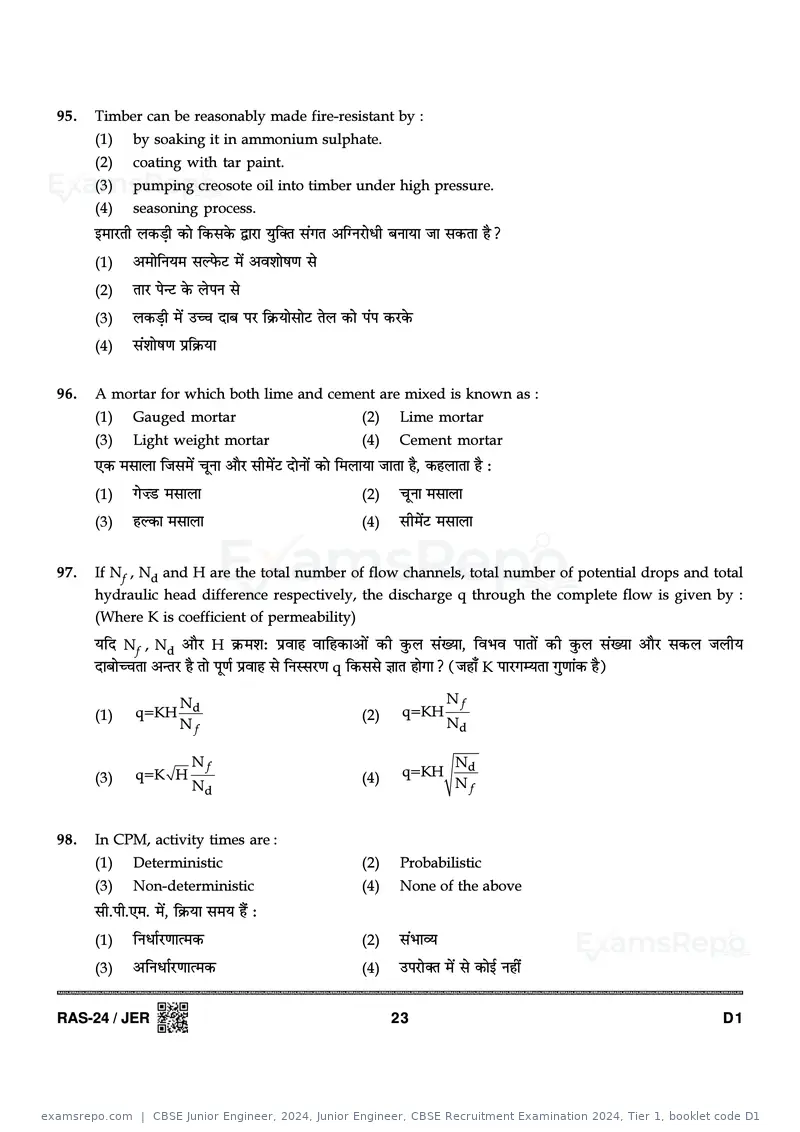
CBSE Junior Engineer 2024 question paper, Junior Engineer, CBSE Recruitment Examination 2024, Tier 1, booklet code D1, page 23 of 40
Page 23 of 40
Text of page 23
95.               Timber can be reasonably made fire-resistant by :
                  (1)               by soaking it in ammonium sulphate.
                  (2)               coating with tar paint.
                  (3)               pumping creosote oil into timber under high pressure.
                  (4)               seasoning process.
                  ß◊Ê⁄UÃË ‹∑§«∏Ë ∑§Ê Á∑§‚∑§ mÊ⁄UÊ ÿÈÁÄà ‚¥ªÃ •ÁÇŸ⁄UÊœË ’ŸÊÿÊ ¡Ê ‚∑§ÃÊ „Ò?
                  (1) •◊ÊÁŸÿ◊ ‚À»§≈U ◊¥ •fl‡ÊÊ·áÊ ‚
                  (2) ÃÊ⁄U ¬ã≈U ∑§ ‹¬Ÿ ‚
                  (3) ‹∑§«∏Ë ◊¥ ©ëø ŒÊ’ ¬⁄U Á∑˝§ÿÊ‚Ê≈U Ã‹ ∑§Ê ¬¥¬ ∑§⁄U∑§
                  (4) ‚¥‡ÊÊ·áÊ ¬˝Á∑˝§ÿÊ


96.               A mortar for which both lime and cement are mixed is known as :
                  (1)               Gauged mortar                                                                                                    (2)               Lime mortar
                  (3)               Light weight mortar                                                                                              (4)               Cement mortar
                  ∞∑§ ◊‚Ê‹Ê Á¡‚◊¥ øÍŸÊ •ÊÒ⁄U ‚Ë◊¥≈U ŒÊŸÊ¥ ∑§Ê Á◊‹ÊÿÊ ¡ÊÃÊ „Ò, ∑§„‹ÊÃÊ „Ò —
                  (1) ªï«U ◊‚Ê‹Ê                                      (2) øÍŸÊ ◊‚Ê‹Ê
                  (3) „À∑§Ê ◊‚Ê‹Ê                                      (4) ‚Ë◊¥≈U ◊‚Ê‹Ê


97.               If Nf , Nd and H are the total number of flow channels, total number of potential drops and total
                  hydraulic head difference respectively, the discharge q through the complete flow is given by :
                  (Where K is coefficient of permeability)
                  ÿÁŒ Nf , Nd •ÊÒ⁄U H ∑˝§◊‡Ê— ¬˝flÊ„ flÊÁ„∑§Ê•Ê¥ ∑§Ë ∑ȧ‹ ‚¥ÅÿÊ, Áfl÷fl ¬ÊÃÊ¥ ∑§Ë ∑ȧ‹ ‚¥ÅÿÊ •ÊÒ⁄U ‚∑§‹ ¡‹Ëÿ
                  ŒÊ’ÊëøÃÊ •ãÃ⁄U „Ò ÃÊ ¬Íáʸ ¬˝flÊ„ ‚ ÁŸS‚⁄UáÊ q Á∑§‚‚ ôÊÊà „ÊªÊ? (¡„ʰ K ¬Ê⁄UªêÿÃÊ ªÈáÊÊ¥∑§ „Ò)
                                                           Nd                                                                                                                                 Nf
                  (1)                 q=KH                                                                                                           (2)                 q=KH
                                                           Nf                                                                                                                                 Nd

                                                                 Nf                                                                                                                                Nd
                  (3)                 q=K H                                                                                                          (4)                 q=KH
                                                                 Nd                                                                                                                                Nf


98.               In CPM, activity times are :
                  (1)               Deterministic                                                                                                    (2)               Probabilistic
                  (3)               Non-deterministic                                                                                                (4)               None of the above
                  ‚Ë.¬Ë.∞◊. ◊¥, Á∑˝§ÿÊ ‚◊ÿ „Ò¥ —
                  (1) ÁŸœÊ¸⁄UáÊÊà◊∑§                                                                                                                 (2)               ‚¥÷Ê√ÿ
                  (3) •ÁŸœÊ¸⁄UáÊÊà◊∑§                                                                                                                (4)               ©¬⁄UÊÄà ◊¥ ‚ ∑§Ê߸ Ÿ„Ë¥
RAS24JERRAS24JERRAS24JERRAS24JERRAS24JERRAS24JERRAS24JERRAS24JERRAS24JERRAS24JERRAS24JERRAS24JERRAS24JERRAS24JERRAS24JERRAS24JERRAS24JERRAS24JERRAS24JERRAS24JERRAS24JERRAS24JERRAS24JERRAS24JERRAS24JERRAS24JERRAS24JERRAS24JERRAS24JERRAS24JERRAS24JERRAS24JERRAS24JERRAS24JERRAS24JERRAS24JERRAS24JERRAS24JERRAS24JERRAS24JERRAS24JERRAS24JER


RAS-24 / JER                                                                                                                                                       23                                                                                                                                                                 D1
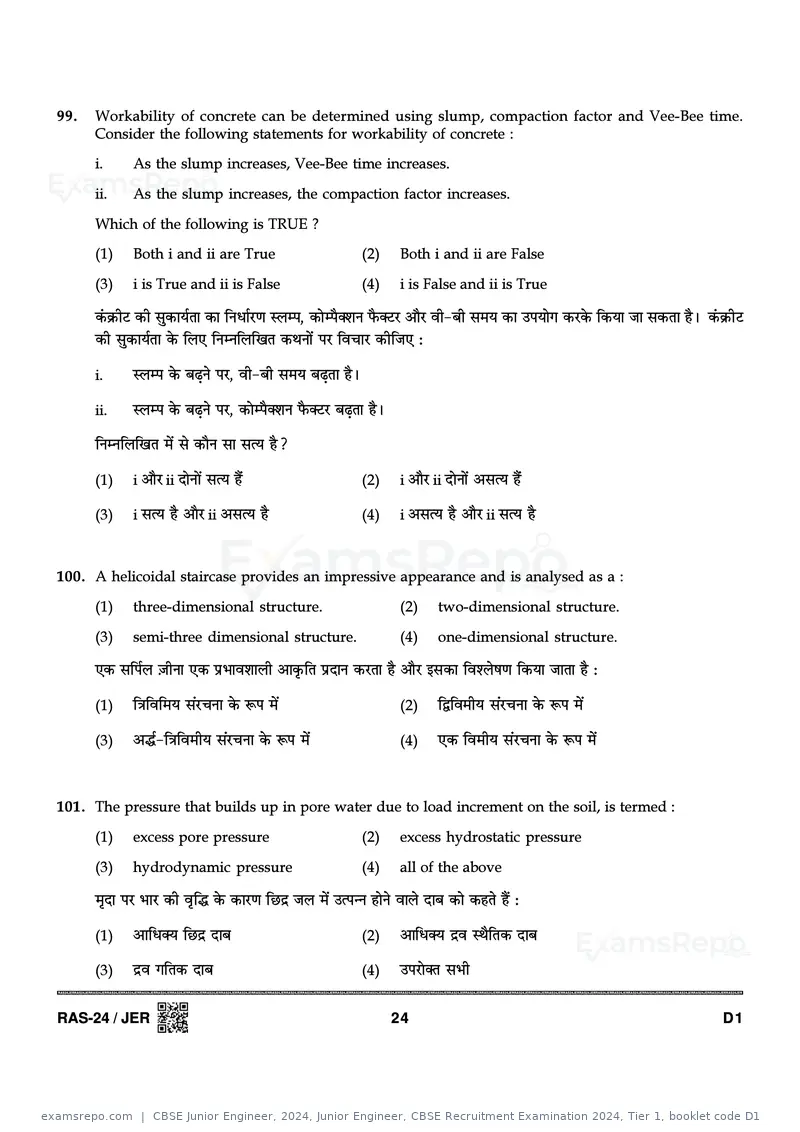
CBSE Junior Engineer 2024 question paper, Junior Engineer, CBSE Recruitment Examination 2024, Tier 1, booklet code D1, page 24 of 40
Page 24 of 40
Text of page 24
99.               Workability of concrete can be determined using slump, compaction factor and Vee-Bee time.
                  Consider the following statements for workability of concrete :

                  i.                As the slump increases, Vee-Bee time increases.

                  ii.               As the slump increases, the compaction factor increases.

                  Which of the following is TRUE ?

                  (1)               Both i and ii are True                                                                                           (2)               Both i and ii are False

                  (3)               i is True and ii is False                                                                                        (4)               i is False and ii is True

                  ∑¥§∑˝§Ë≈U ∑§Ë ‚È∑§Êÿ¸ÃÊ ∑§Ê ÁŸœÊ¸⁄UáÊ S‹ê¬, ∑§Êê¬Òćʟ »Ò§Ä≈U⁄U •ÊÒ⁄U flË-’Ë ‚◊ÿ ∑§Ê ©¬ÿÊª ∑§⁄U∑§ Á∑§ÿÊ ¡Ê ‚∑§ÃÊ „Ò– ∑¥§∑˝§Ë≈U
                  ∑§Ë ‚È∑§Êÿ¸ÃÊ ∑§ Á‹∞ ÁŸêŸÁ‹Áπà ∑§ÕŸÊ¥ ¬⁄U ÁfløÊ⁄U ∑§ËÁ¡∞ —
                  i.                S‹ê¬ ∑§ ’…∏Ÿ ¬⁄U, flË-’Ë ‚◊ÿ ’…∏ÃÊ „Ò–
                  ii.               S‹ê¬ ∑§ ’…∏Ÿ ¬⁄U, ∑§Êê¬Òćʟ »Ò§Ä≈U⁄U ’…∏ÃÊ „Ò–
                  ÁŸêŸÁ‹Áπà ◊¥ ‚ ∑§ÊÒŸ ‚Ê ‚àÿ „Ò?
                  (1)               i •ÊÒ⁄U ii ŒÊŸÊ¥ ‚àÿ „Ò¥                                                                                       (2)               i •ÊÒ⁄U ii ŒÊŸÊ¥ •‚àÿ „Ò¥

                  (3)               i ‚àÿ „Ò •ÊÒ⁄U ii •‚àÿ „Ò                                                                                        (4)               i •‚àÿ „Ò •ÊÒ⁄U ii ‚àÿ „Ò


100. A helicoidal staircase provides an impressive appearance and is analysed as a :

                  (1)               three-dimensional structure.                                                                                                       (2)                two-dimensional structure.

                  (3)               semi-three dimensional structure.                                                                                                  (4)                one-dimensional structure.

                  ∞∑§ ‚Á¬¸‹ $¡ËŸÊ ∞∑§ ¬˝÷Êfl‡ÊÊ‹Ë •Ê∑ΧÁà ¬˝ŒÊŸ ∑§⁄UÃÊ „Ò •ÊÒ⁄U ß‚∑§Ê Áfl‡‹·áÊ Á∑§ÿÊ ¡ÊÃÊ „Ò —
                  (1)               ÁòÊÁflÁ◊ÿ ‚¥⁄UøŸÊ ∑§ M§¬ ◊¥                                                                                                       (2)                ÁmÁfl◊Ëÿ ‚¥⁄UøŸÊ ∑§ M§¬ ◊¥
                  (3)               •h¸-ÁòÊÁfl◊Ëÿ ‚¥⁄UøŸÊ ∑§ M§¬ ◊¥                                                                                                   (4)                ∞∑§ Áfl◊Ëÿ ‚¥⁄UøŸÊ ∑§ M§¬ ◊¥


101. The pressure that builds up in pore water due to load increment on the soil, is termed :

                  (1)               excess pore pressure                                                                                             (2)               excess hydrostatic pressure

                  (3)               hydrodynamic pressure                                                                                            (4)               all of the above

                  ◊ÎŒÊ ¬⁄U ÷Ê⁄U ∑§Ë flÎÁh ∑§ ∑§Ê⁄UáÊ Á¿UŒ˝ ¡‹ ◊¥ ©à¬ãŸ „ÊŸ flÊ‹ ŒÊ’ ∑§Ê ∑§„Ã „Ò¥ —
                  (1)               •ÊÁœÄÿ Á¿UŒ˝ ŒÊ’                                                                                                 (2)               •ÊÁœÄÿ Œ˝fl SÕÒÁÃ∑§ ŒÊ’
                  (3)               Œ˝fl ªÁÃ∑§ ŒÊ’                                                                                                    (4)               ©¬⁄UÊÄà ‚÷Ë
RAS24JERRAS24JERRAS24JERRAS24JERRAS24JERRAS24JERRAS24JERRAS24JERRAS24JERRAS24JERRAS24JERRAS24JERRAS24JERRAS24JERRAS24JERRAS24JERRAS24JERRAS24JERRAS24JERRAS24JERRAS24JERRAS24JERRAS24JERRAS24JERRAS24JERRAS24JERRAS24JERRAS24JERRAS24JERRAS24JERRAS24JERRAS24JERRAS24JERRAS24JERRAS24JERRAS24JERRAS24JERRAS24JERRAS24JERRAS24JERRAS24JERRAS24JER


RAS-24 / JER                                                                                                                                                       24                                                                                                                                                                 D1
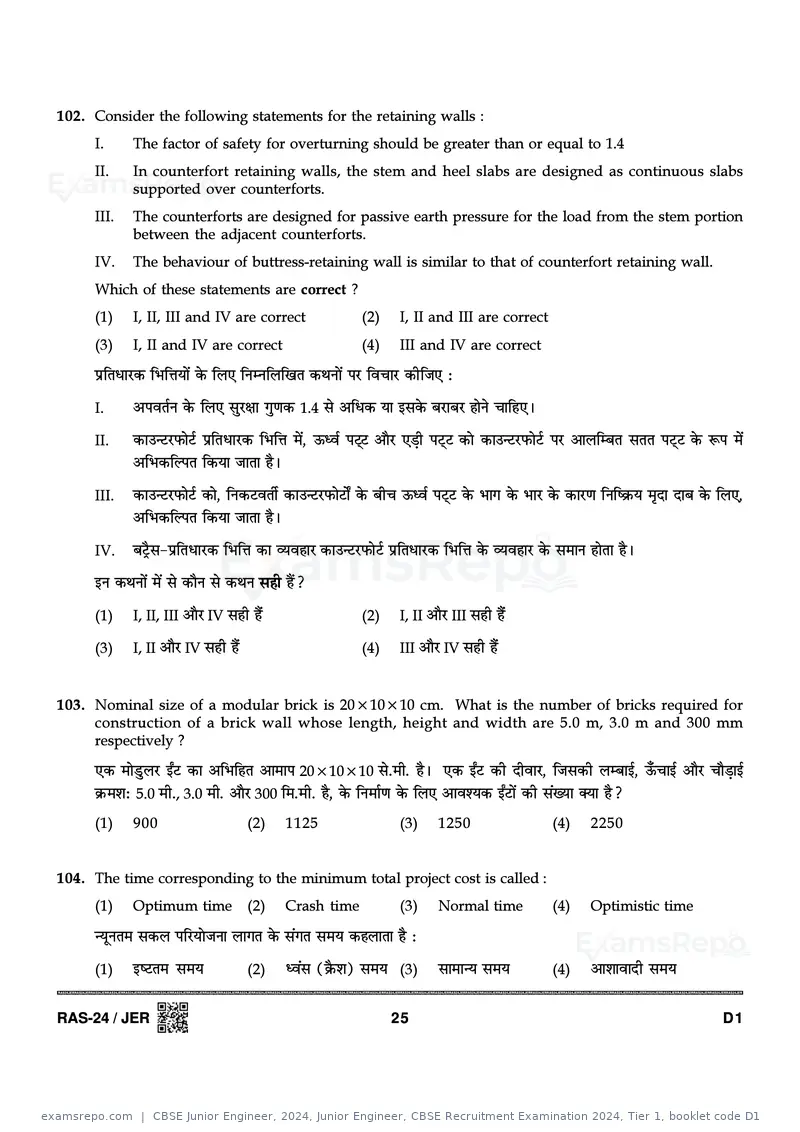
CBSE Junior Engineer 2024 question paper, Junior Engineer, CBSE Recruitment Examination 2024, Tier 1, booklet code D1, page 25 of 40
Page 25 of 40
Text of page 25
102. Consider the following statements for the retaining walls :
                  I.                The factor of safety for overturning should be greater than or equal to 1.4
                  II.               In counterfort retaining walls, the stem and heel slabs are designed as continuous slabs
                                    supported over counterforts.
                  III.              The counterforts are designed for passive earth pressure for the load from the stem portion
                                    between the adjacent counterforts.
                  IV.               The behaviour of buttress-retaining wall is similar to that of counterfort retaining wall.
                  Which of these statements are correct ?
                  (1)               I, II, III and IV are correct                                                                                    (2)               I, II and III are correct
                  (3)               I, II and IV are correct                                                                                         (4)               III and IV are correct

                  ¬˝ÁÜÊ⁄U∑§ Á÷ÁûÊÿÊ¥ ∑§ Á‹∞ ÁŸêŸÁ‹Áπà ∑§ÕŸÊ¥ ¬⁄U ÁfløÊ⁄U ∑§ËÁ¡∞ —
                  I.                •¬fløŸ ∑§ Á‹∞ ‚È⁄UˇÊÊ ªÈáÊ∑§ 1.4 ‚ •Áœ∑§ ÿÊ ß‚∑§ ’⁄UÊ’⁄U „ÊŸ øÊÁ„∞–
                  II.               ∑§Ê©ã≈U⁄U»§Ê≈¸U ¬˝ÁÜÊ⁄U∑§ Á÷ÁûÊ ◊¥, ™§äfl¸ ¬≈˜≈ •ÊÒ⁄U ∞«∏Ë ¬≈˜U≈ ∑§Ê ∑§Ê©ã≈U⁄U»§Ê≈¸U ¬⁄U •Ê‹Áê’à ‚Ãà ¬≈˜U≈ ∑§ M§¬ ◊¥
                                    •Á÷∑§ÁÀ¬Ã Á∑§ÿÊ ¡ÊÃÊ „Ò– U U
                  III.              ∑§Ê©ã≈U⁄U»§Ê≈¸U ∑§Ê, ÁŸ∑§≈UflÃ˸ ∑§Ê©ã≈U⁄U»§Ê≈UÊZ ∑§ ’Ëø ™§äfl¸ ¬≈˜U≈U ∑§ ÷ʪ ∑§ ÷Ê⁄U ∑§ ∑§Ê⁄UáÊ ÁŸÁc∑˝§ÿ ◊ÎŒÊ ŒÊ’ ∑§ Á‹∞,
                                    •Á÷∑§ÁÀ¬Ã Á∑§ÿÊ ¡ÊÃÊ „Ò–
                  IV.               ’≈˛ÒU‚-¬˝ÁÜÊ⁄U∑§ Á÷ÁûÊ ∑§Ê √ÿfl„Ê⁄ ∑§Ê©ã≈U⁄U»§Ê≈¸U ¬˝ÁÜÊ⁄U∑§ Á÷ÁûÊ ∑§ √ÿfl„Ê⁄U ∑§ ‚◊ÊŸ „ÊÃÊ „Ò–
                  ߟ ∑§ÕŸÊ¥ ◊¥ ‚ ∑§ÊÒŸ ‚ ∑§ÕŸ ‚„Ë „Ò¥?
                  (1)               I, II, III •ÊÒ⁄U IV ‚„Ë „Ò¥                                                                                      (2)               I, II •ÊÒ⁄U III ‚„Ë „Ò¥

                  (3)               I, II •ÊÒ⁄U IV ‚„Ë „Ò¥                                                                                           (4)               III •ÊÒ⁄U IV ‚„Ë „Ò¥


103. Nominal size of a modular brick is 20×10×10 cm. What is the number of bricks required for
     construction of a brick wall whose length, height and width are 5.0 m, 3.0 m and 300 mm
     respectively ?

                  ∞∑§ ◊Ê«ÈU‹⁄U ßZ≈U ∑§Ê •Á÷Á„à •Ê◊ʬ 20×10×10 ‚.◊Ë. „Ò– ∞∑§ ßZ≈U ∑§Ë ŒËflÊ⁄U, Á¡‚∑§Ë ‹ê’Ê߸, ™°§øÊ߸ •ÊÒ⁄U øÊÒ«∏Ê߸
                  ∑˝§◊‡Ê— 5.0 ◊Ë., 3.0 ◊Ë. •ÊÒ⁄ 300 Á◊.◊Ë. „Ò, ∑§ ÁŸ◊ʸáÊ ∑§ Á‹∞ •Êfl‡ÿ∑§ ßZ≈UÊ¥ ∑§Ë ‚¥ÅÿÊ ÄÿÊ „Ò?
                  (1)               900                                                      (2)               1125                                                    (3)                1250                                                    (4)                2250


104. The time corresponding to the minimum total project cost is called :
                  (1)               Optimum time                                             (2)               Crash time                                              (3)                Normal time                                             (4)                Optimistic time

                  ãÿÍŸÃ◊ ‚∑§‹ ¬Á⁄UÿÊ¡ŸÊ ‹ÊªÃ ∑§ ‚¥ªÃ ‚◊ÿ ∑§„‹ÊÃÊ „Ò —
                  (1)               ßc≈UÃ◊ ‚◊ÿ                                               (2)               äfl¥‚ (∑˝Ò§‡Ê) ‚◊ÿ (3)                                                      ‚Ê◊Êãÿ ‚◊ÿ                                              (4)                •ʇÊÊflÊŒË ‚◊ÿ
RAS24JERRAS24JERRAS24JERRAS24JERRAS24JERRAS24JERRAS24JERRAS24JERRAS24JERRAS24JERRAS24JERRAS24JERRAS24JERRAS24JERRAS24JERRAS24JERRAS24JERRAS24JERRAS24JERRAS24JERRAS24JERRAS24JERRAS24JERRAS24JERRAS24JERRAS24JERRAS24JERRAS24JERRAS24JERRAS24JERRAS24JERRAS24JERRAS24JERRAS24JERRAS24JERRAS24JERRAS24JERRAS24JERRAS24JERRAS24JERRAS24JERRAS24JER


RAS-24 / JER                                                                                                                                                       25                                                                                                                                                                 D1
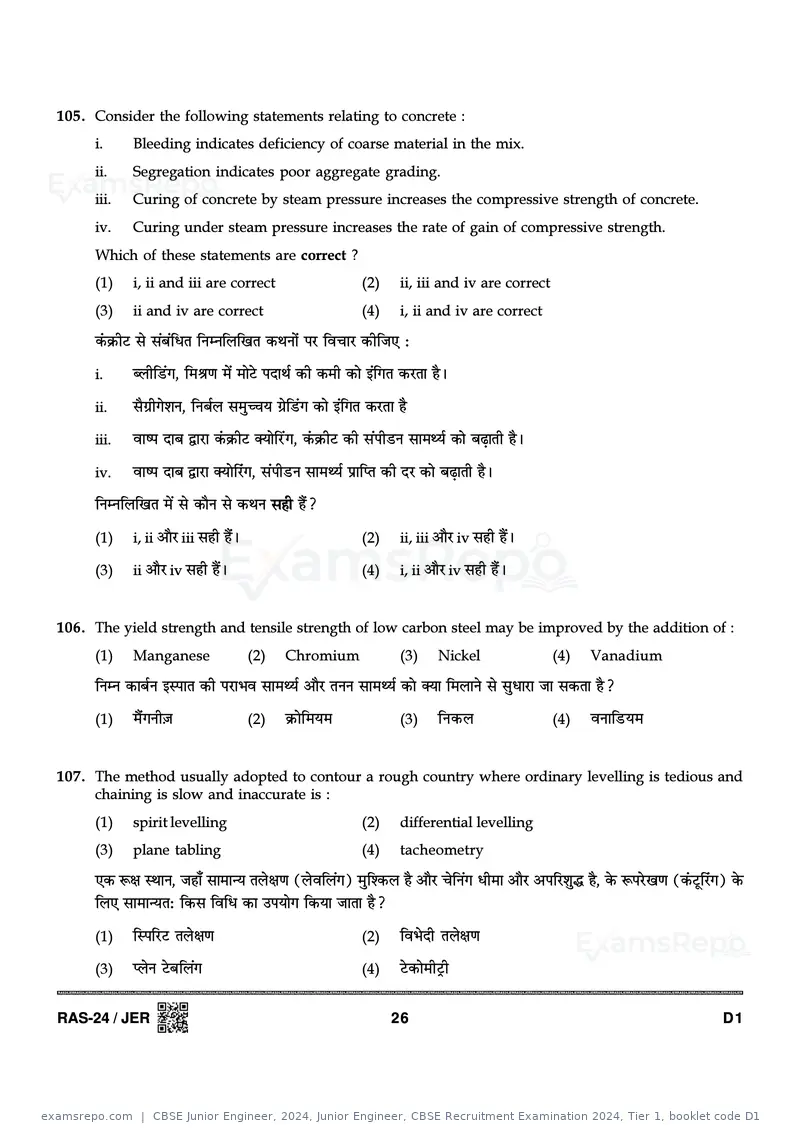
CBSE Junior Engineer 2024 question paper, Junior Engineer, CBSE Recruitment Examination 2024, Tier 1, booklet code D1, page 26 of 40
Page 26 of 40
Text of page 26
105. Consider the following statements relating to concrete :
                  i.                Bleeding indicates deficiency of coarse material in the mix.
                  ii.               Segregation indicates poor aggregate grading.
                  iii.              Curing of concrete by steam pressure increases the compressive strength of concrete.
                  iv.               Curing under steam pressure increases the rate of gain of compressive strength.
                  Which of these statements are correct ?
                  (1)               i, ii and iii are correct                                                                                        (2)               ii, iii and iv are correct
                  (3)               ii and iv are correct                                                                                            (4)               i, ii and iv are correct

                  ∑¥§∑˝§Ë≈U ‚ ‚¥’¥ÁœÃ ÁŸêŸÁ‹Áπà ∑§ÕŸÊ¥ ¬⁄U ÁfløÊ⁄U ∑§ËÁ¡∞ —
                  i.                é‹ËÁ«¥Uª, Á◊üÊáÊ ◊¥ ◊Ê≈U ¬ŒÊÕ¸ ∑§Ë ∑§◊Ë ∑§Ê ߥÁªÃ ∑§⁄UÃÊ „Ò–
                  ii.               ‚Òª˝Ëª‡ÊŸ, ÁŸ’¸‹ ‚◊Èëøÿ ª˝Á«¥Uª ∑§Ê ߥÁªÃ ∑§⁄UÃÊ „Ò
                  iii.              flÊc¬ ŒÊ’ mÊ⁄UÊ ∑¥§∑˝§Ë≈U ÄÿÊÁ⁄U¥Uª, ∑¥§∑˝§Ë≈U ∑§Ë ‚¥¬Ë«UŸ ‚ÊêÊâÿ¸ ∑§Ê ’…∏ÊÃË „Ò–
                  iv.               flÊc¬ ŒÊ’ mÊ⁄UÊ ÄÿÊÁ⁄¥Uª, ‚¥¬Ë«UŸ ‚Ê◊âÿ¸ ¬˝ÊÁåà ∑§Ë Œ⁄U ∑§Ê ’…∏ÊÃË „Ò–
                  ÁŸêŸÁ‹Áπà ◊¥ ‚ ∑§ÊÒŸ ‚ ∑§ÕŸ ‚„Ë „Ò¥?
                  (1)               i, ii •ÊÒ⁄U iii ‚„Ë „Ò¥–                                                                                         (2)               ii, iii •ÊÒ⁄U iv ‚„Ë „Ò¥–

                  (3)               ii •ÊÒ⁄U iv ‚„Ë „Ò¥–                                                                                             (4)               i, ii •ÊÒ⁄U iv ‚„Ë „Ò¥–


106. The yield strength and tensile strength of low carbon steel may be improved by the addition of :
                  (1)               Manganese                                                (2)               Chromium                                                (3)                Nickel                                                  (4)                Vanadium

                  ÁŸêŸ ∑§Ê’¸Ÿ ßS¬Êà ∑§Ë ¬⁄UÊ÷fl ‚Ê◊âÿ¸ •ÊÒ⁄U ߟ ‚Ê◊âÿ¸ ∑§Ê ÄÿÊ Á◊‹ÊŸ ‚ ‚ÈœÊ⁄UÊ ¡Ê ‚∑§ÃÊ „Ò?
                  (1)               ◊Ò¥ªŸË$¡                                                 (2)               ∑˝§ÊÁ◊ÿ◊                                               (3)                ÁŸ∑§‹                                                   (4)                flŸÊÁ«Uÿ◊


107. The method usually adopted to contour a rough country where ordinary levelling is tedious and
     chaining is slow and inaccurate is :
                  (1)               spirit levelling                                                                                                 (2)               differential levelling
                  (3)               plane tabling                                                                                                    (4)               tacheometry

                  ∞∑§ M§ˇÊ SÕÊŸ, ¡„ʰ ‚Ê◊Êãÿ ËˇÊáÊ (‹flÁ‹¥ª) ◊ÈÁ‡∑§‹ „Ò •ÊÒ⁄U øÁŸ¥ª œË◊Ê •ÊÒ⁄U •¬Á⁄U‡ÊÈh „Ò, ∑§ M§¬⁄UπáÊ (∑¥§≈ÍUÁ⁄¥Uª) ∑§
                  Á‹∞ ‚Ê◊Êãÿ× Á∑§‚ ÁflÁœ ∑§Ê ©¬ÿÊª Á∑§ÿÊ ¡ÊÃÊ „Ò?
                  (1)               ÁS¬Á⁄U≈U ËˇÊáÊ                                                                                                 (2)               Áfl÷ŒË ËˇÊáÊ
                  (3)               å‹Ÿ ≈U’Á‹¥ª                                                                                                    (4)               ≈U∑§Ê◊Ë≈˛UË
RAS24JERRAS24JERRAS24JERRAS24JERRAS24JERRAS24JERRAS24JERRAS24JERRAS24JERRAS24JERRAS24JERRAS24JERRAS24JERRAS24JERRAS24JERRAS24JERRAS24JERRAS24JERRAS24JERRAS24JERRAS24JERRAS24JERRAS24JERRAS24JERRAS24JERRAS24JERRAS24JERRAS24JERRAS24JERRAS24JERRAS24JERRAS24JERRAS24JERRAS24JERRAS24JERRAS24JERRAS24JERRAS24JERRAS24JERRAS24JERRAS24JERRAS24JER


RAS-24 / JER                                                                                                                                                       26                                                                                                                                                                 D1
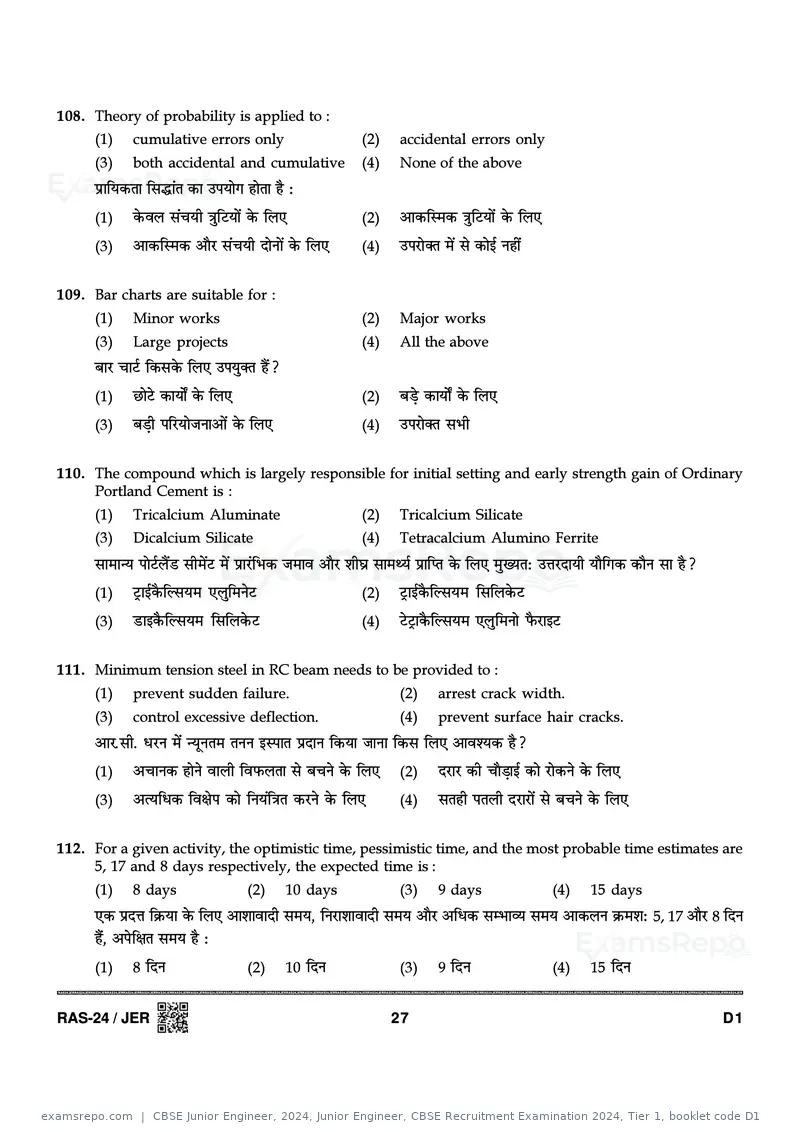
CBSE Junior Engineer 2024 question paper, Junior Engineer, CBSE Recruitment Examination 2024, Tier 1, booklet code D1, page 27 of 40
Page 27 of 40
Text of page 27
108. Theory of probability is applied to :
                  (1)               cumulative errors only                                                                                           (2)               accidental errors only
                  (3)               both accidental and cumulative                                                                                   (4)               None of the above
                  ¬˝ÊÁÿ∑§ÃÊ Á‚hʥà ∑§Ê ©¬ÿÊª „ÊÃÊ „Ò —
                  (1) ∑§fl‹ ‚¥øÿË òÊÈÁ≈UÿÊ¥ ∑§ Á‹∞                                                                                                 (2)               •Ê∑§ÁS◊∑§ òÊÈÁ≈UÿÊ¥ ∑§ Á‹∞
                  (3)               •Ê∑§ÁS◊∑§ •ÊÒ⁄U ‚¥øÿË ŒÊŸÊ¥ ∑§ Á‹∞                                                                            (4)               ©¬⁄UÊÄà ◊¥ ‚ ∑§Ê߸ Ÿ„Ë¥

109. Bar charts are suitable for :
                  (1)               Minor works                                                                                                      (2)               Major works
                  (3)               Large projects                                                                                                   (4)               All the above
                  ’Ê⁄U øÊ≈¸U Á∑§‚∑§ Á‹∞ ©¬ÿÈÄà „Ò¥?
                  (1) ¿UÊ≈U ∑§ÊÿÊZ ∑§ Á‹∞                                                                                                        (2)               ’«∏U ∑§ÊÿÊZ ∑§ Á‹∞
                  (3)               ’«∏Ë ¬Á⁄UÿÊ¡ŸÊ•Ê¥ ∑§ Á‹∞                                                                                      (4)               ©¬⁄UÊÄà ‚÷Ë

110. The compound which is largely responsible for initial setting and early strength gain of Ordinary
     Portland Cement is :
                  (1)               Tricalcium Aluminate                                                                                             (2)               Tricalcium Silicate
                  (3)               Dicalcium Silicate                                                                                               (4)               Tetracalcium Alumino Ferrite
                  ‚Ê◊Êãÿ ¬Ê≈¸U‹Ò¥«U ‚Ë◊¥≈U ◊¥ ¬˝Ê⁄¥UÁ÷∑§ ¡◊Êfl •ÊÒ⁄U ‡ÊËÉÊ˝ ‚Ê◊âÿ¸ ¬˝ÊÁåà ∑§ Á‹∞ ◊ÈÅÿ× ©ûÊ⁄UŒÊÿË ÿÊÒÁª∑§ ∑§ÊÒŸ ‚Ê „Ò?
                  (1) ≈˛UÊ߸∑Ò§ÁÀ‚ÿ◊ ∞‹ÈÁ◊Ÿ≈U                             (2) ≈˛UÊ߸∑Ò§ÁÀ‚ÿ◊ Á‚Á‹∑§≈U
                  (3)               «UÊß∑Ò§ÁÀ‚ÿ◊ Á‚Á‹∑§≈U                                                                                           (4)               ≈U≈˛UÊ∑Ò§ÁÀ‚ÿ◊ ∞‹ÈÁ◊ŸÊ »Ò§⁄UÊß≈U

111. Minimum tension steel in RC beam needs to be provided to :
                  (1)               prevent sudden failure.                                                                                                            (2)                arrest crack width.
                  (3)               control excessive deflection.                                                                                                      (4)                prevent surface hair cracks.
                  •Ê⁄.U‚Ë. œ⁄UŸ ◊¥ ãÿÍŸÃ◊ ߟ ßS¬Êà ¬˝ŒÊŸ Á∑§ÿÊ ¡ÊŸÊ Á∑§‚ Á‹∞ •Êfl‡ÿ∑§ „Ò?
                  (1) •øÊŸ∑§ „ÊŸ flÊ‹Ë Áfl»§‹ÃÊ ‚ ’øŸ ∑§ Á‹∞ (2) Œ⁄UÊ⁄U ∑§Ë øÊÒ«∏Ê߸ ∑§Ê ⁄UÊ∑§Ÿ ∑§ Á‹∞
                  (3)               •àÿÁœ∑§ ÁflˇÊ¬ ∑§Ê ÁŸÿ¥ÁòÊà ∑§⁄UŸ ∑§ Á‹∞                                                                                        (4)                ‚Ã„Ë ¬Ã‹Ë Œ⁄UÊ⁄UÊ¥ ‚ ’øŸ ∑§ Á‹∞

112. For a given activity, the optimistic time, pessimistic time, and the most probable time estimates are
     5, 17 and 8 days respectively, the expected time is :
                  (1)               8 days                                                   (2)               10 days                                                 (3)                9 days                                                  (4)                15 days
                  ∞∑§ ¬˝ŒûÊ Á∑˝§ÿÊ ∑§ Á‹∞ •ʇÊÊflÊŒË ‚◊ÿ, ÁŸ⁄UʇÊÊflÊŒË ‚◊ÿ •ÊÒ⁄U •Áœ∑§ ‚ê÷Ê√ÿ ‚◊ÿ •Ê∑§‹Ÿ ∑˝§◊‡Ê— 5, 17 •ÊÒ⁄U 8 ÁŒŸ
                  „Ò¥, •¬ÁˇÊà ‚◊ÿ „Ò —
                  (1)               8 ÁŒŸ                                                    (2)               10 ÁŒŸ                                                  (3)                9 ÁŒŸ                                                   (4)                15 ÁŒŸ
RAS24JERRAS24JERRAS24JERRAS24JERRAS24JERRAS24JERRAS24JERRAS24JERRAS24JERRAS24JERRAS24JERRAS24JERRAS24JERRAS24JERRAS24JERRAS24JERRAS24JERRAS24JERRAS24JERRAS24JERRAS24JERRAS24JERRAS24JERRAS24JERRAS24JERRAS24JERRAS24JERRAS24JERRAS24JERRAS24JERRAS24JERRAS24JERRAS24JERRAS24JERRAS24JERRAS24JERRAS24JERRAS24JERRAS24JERRAS24JERRAS24JERRAS24JER


RAS-24 / JER                                                                                                                                                       27                                                                                                                                                                 D1
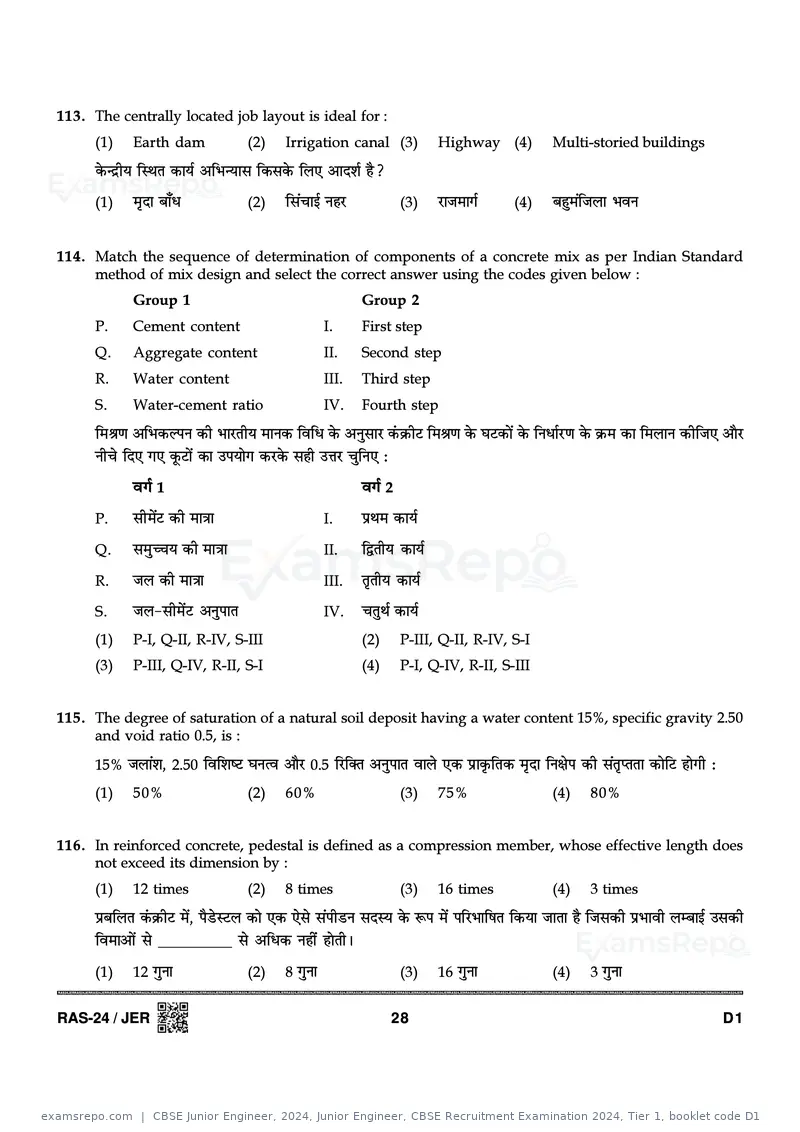
CBSE Junior Engineer 2024 question paper, Junior Engineer, CBSE Recruitment Examination 2024, Tier 1, booklet code D1, page 28 of 40
Page 28 of 40
Text of page 28
113. The centrally located job layout is ideal for :
                  (1)               Earth dam                                                (2)               Irrigation canal (3)                                                       Highway (4)                                             Multi-storied buildings
                  ∑§ãŒ˝Ëÿ ÁSÕà ∑§Êÿ¸ •Á÷ãÿÊ‚ Á∑§‚∑§ Á‹∞ •ÊŒ‡Ê¸ „Ò?
                  (1)               ◊ÎŒÊ ’ʰœ                                                (2)               Á‚¥øÊ߸ Ÿ„⁄U                                            (3)                ⁄UÊ¡◊ʪ¸                              (4)               ’„È◊¥Á¡‹Ê ÷flŸ

114. Match the sequence of determination of components of a concrete mix as per Indian Standard
     method of mix design and select the correct answer using the codes given below :
                                    Group 1                                                                                                          Group 2
                  P.                Cement content                                                                                I.                 First step
                  Q.                Aggregate content                                                                             II.                Second step
                  R.                Water content                                                                                 III.               Third step
                  S.                Water-cement ratio                                                                            IV.                Fourth step
                  Á◊üÊáÊ •Á÷∑§À¬Ÿ ∑§Ë ÷Ê⁄UÃËÿ ◊ÊŸ∑§ ÁflÁœ ∑§ •ŸÈ‚Ê⁄U ∑¥§∑˝§Ë≈U Á◊üÊáÊ ∑§ ÉÊ≈U∑§Ê¥ ∑§ ÁŸœÊ¸⁄UáÊ ∑§ ∑˝§◊ ∑§Ê Á◊‹ÊŸ ∑§ËÁ¡∞ •ÊÒ⁄U
                  ŸËø ÁŒ∞ ª∞ ∑ͧ≈UÊ¥ ∑§Ê ©¬ÿÊª ∑§⁄U∑§ ‚„Ë ©ûÊ⁄U øÈÁŸ∞ —
                                    flª¸ 1                                                                                                            flª¸ 2
                  P.                ‚Ë◊¥≈U ∑§Ë ◊ÊòÊÊ                                                                             I.                 ¬˝Õ◊ ∑§Êÿ¸
                  Q.                ‚◊Èëøÿ ∑§Ë ◊ÊòÊÊ                                                                              II.                ÁmÃËÿ ∑§Êÿ¸
                  R.                ¡‹ ∑§Ë ◊ÊòÊÊ                                                                                  III.               ÃÎÃËÿ ∑§Êÿ¸
                  S.                ¡‹-‚Ë◊¥≈U •ŸÈ¬Êà                                                                             IV.                øÃÈÕ¸ ∑§Êÿ¸
                  (1)               P-I, Q-II, R-IV, S-III                                                                                           (2)               P-III, Q-II, R-IV, S-I
                  (3)               P-III, Q-IV, R-II, S-I                                                                                           (4)               P-I, Q-IV, R-II, S-III


115. The degree of saturation of a natural soil deposit having a water content 15%, specific gravity 2.50
     and void ratio 0.5, is :
                  15% ¡‹Ê¥‡Ê, 2.50 ÁflÁ‡Êc≈U ÉÊŸàfl •ÊÒ⁄U 0.5 Á⁄UÁÄà •ŸÈ¬Êà flÊ‹ ∞∑§ ¬˝Ê∑ΧÁÃ∑§ ◊ÎŒÊ ÁŸˇÊ¬ ∑§Ë ‚¥ÃÎåÃÃÊ ∑§ÊÁ≈U „ÊªË —
                  (1)               50%                                                      (2)               60%                                                     (3)                75%                                                     (4)                80%


116. In reinforced concrete, pedestal is defined as a compression member, whose effective length does
     not exceed its dimension by :
                  (1)               12 times                                                 (2)               8 times                                                 (3)                16 times                                                (4)                3 times
                  ¬˝’Á‹Ã ∑¥§∑˝§Ë≈U ◊¥, ¬Ò«US≈U‹ ∑§Ê ∞∑§ ∞‚ ‚¥¬Ë«UŸ ‚ŒSÿ ∑§ M§¬ ◊¥ ¬Á⁄U÷ÊÁ·Ã Á∑§ÿÊ ¡ÊÃÊ „Ò Á¡‚∑§Ë ¬˝÷ÊflË ‹ê’Ê߸ ©‚∑§Ë
                  Áfl◊Ê•Ê¥ ‚ __________ ‚ •Áœ∑§ Ÿ„Ë¥ „ÊÃË–
                  (1)               12 ªÈŸÊ                                                  (2)               8 ªÈŸÊ                                                  (3)                16 ªÈŸÊ                                                 (4)                3 ªÈŸÊ
RAS24JERRAS24JERRAS24JERRAS24JERRAS24JERRAS24JERRAS24JERRAS24JERRAS24JERRAS24JERRAS24JERRAS24JERRAS24JERRAS24JERRAS24JERRAS24JERRAS24JERRAS24JERRAS24JERRAS24JERRAS24JERRAS24JERRAS24JERRAS24JERRAS24JERRAS24JERRAS24JERRAS24JERRAS24JERRAS24JERRAS24JERRAS24JERRAS24JERRAS24JERRAS24JERRAS24JERRAS24JERRAS24JERRAS24JERRAS24JERRAS24JERRAS24JER


RAS-24 / JER                                                                                                                                                       28                                                                                                                                                                 D1
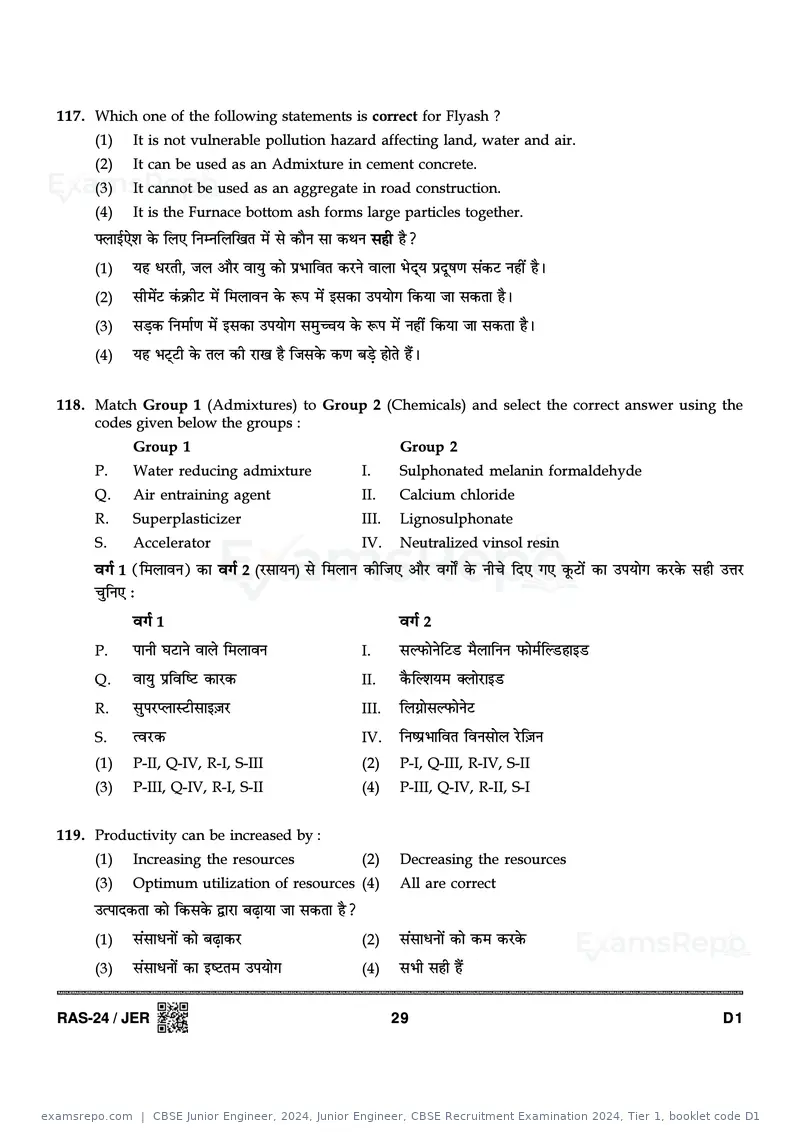
CBSE Junior Engineer 2024 question paper, Junior Engineer, CBSE Recruitment Examination 2024, Tier 1, booklet code D1, page 29 of 40
Page 29 of 40
Text of page 29
117. Which one of the following statements is correct for Flyash ?
                  (1)               It is not vulnerable pollution hazard affecting land, water and air.
                  (2)               It can be used as an Admixture in cement concrete.
                  (3)               It cannot be used as an aggregate in road construction.
                  (4)               It is the Furnace bottom ash forms large particles together.
                  ç‹Ê߸∞‡Ê ∑§ Á‹∞ ÁŸêŸÁ‹Áπà ◊¥ ‚ ∑§ÊÒŸ ‚Ê ∑§ÕŸ ‚„Ë „Ò?
                  (1)               ÿ„ œ⁄UÃË, ¡‹ •ÊÒ⁄U flÊÿÈ ∑§Ê ¬˝÷ÊÁflà ∑§⁄UŸ flÊ‹Ê ÷Œ˜ÿ ¬˝ŒÍ·áÊ ‚¥∑§≈U Ÿ„Ë¥ „Ò–
                  (2)               ‚Ë◊¥≈U ∑¥§∑˝§Ë≈U ◊¥ Á◊‹ÊflŸ ∑§ M§¬ ◊¥ ß‚∑§Ê ©¬ÿÊª Á∑§ÿÊ ¡Ê ‚∑§ÃÊ „Ò–
                  (3)               ‚«∏∑§ ÁŸ◊ʸáÊ ◊¥ ß‚∑§Ê ©¬ÿÊª ‚◊Èëøÿ ∑§ M§¬ ◊¥ Ÿ„Ë¥ Á∑§ÿÊ ¡Ê ‚∑§ÃÊ „Ò–
                  (4)               ÿ„ ÷≈˜U≈UË ∑§ Ë ∑§Ë ⁄UÊπ „Ò Á¡‚∑§ ∑§áÊ ’«∏ „ÊÃ „Ò¥–

118. Match Group 1 (Admixtures) to Group 2 (Chemicals) and select the correct answer using the
     codes given below the groups :
                                    Group 1                                                                                                                            Group 2
                  P.                Water reducing admixture                                                                                         I.                Sulphonated melanin formaldehyde
                  Q.                Air entraining agent                                                                                             II.               Calcium chloride
                  R.                Superplasticizer                                                                                                 III.              Lignosulphonate
                  S.                Accelerator                                                                                                      IV.               Neutralized vinsol resin
                  flª¸ 1 (Á◊‹ÊflŸ) ∑§Ê flª¸ 2 (⁄U‚ÊÿŸ) ‚ Á◊‹ÊŸ ∑§ËÁ¡∞ •ÊÒ⁄U flªÊZ ∑§ ŸËø ÁŒ∞ ª∞ ∑ͧ≈UÊ¥ ∑§Ê ©¬ÿÊª ∑§⁄U∑§ ‚„Ë ©ûÊ⁄U
                  øÈÁŸ∞ —
                                    flª¸ 1                                                                                                                              flª¸ 2
                  P.                ¬ÊŸË ÉÊ≈UÊŸ flÊ‹ Á◊‹ÊflŸ                                                                                         I.                ‚À»§ÊŸÁ≈U«U ◊Ò‹ÊÁŸŸ »§Ê◊¸ÁÀ«U„Êß«U
                  Q.                flÊÿÈ ¬˝ÁflÁc≈U ∑§Ê⁄U∑§                                                                                            II.               ∑Ò§ÁÀ‡Êÿ◊ Ä‹Ê⁄UÊß«U
                  R.                ‚Ȭ⁄Uå‹ÊS≈UË‚Êß$¡⁄U                                                                                              III.              Á‹ªAÊ‚À»§ÊŸ≈U
                  S.                àfl⁄U∑§                                                                                                           IV.               ÁŸc¬˝÷ÊÁflà ÁflŸ‚Ê‹ ⁄UÁ$¡Ÿ
                  (1)               P-II, Q-IV, R-I, S-III                                                                                           (2)               P-I, Q-III, R-IV, S-II
                  (3)               P-III, Q-IV, R-I, S-II                                                                                           (4)               P-III, Q-IV, R-II, S-I


119. Productivity can be increased by :
                  (1)               Increasing the resources                                                                                         (2)               Decreasing the resources
                  (3)               Optimum utilization of resources (4)                                                                                               All are correct
                  ©à¬ÊŒ∑§ÃÊ ∑§Ê Á∑§‚∑§ mÊ⁄UÊ ’…∏ÊÿÊ ¡Ê ‚∑§ÃÊ „Ò?
                  (1)               ‚¥‚ÊœŸÊ¥ ∑§Ê ’…∏Ê∑§⁄                                                                                           (2)               ‚¥‚ÊœŸÊ¥ ∑§Ê ∑§◊ ∑§⁄U∑§
                  (3)               ‚¥‚ÊœŸÊ¥ ∑§Ê ßc≈UÃ◊ ©¬ÿÊª                                                                                      (4)               ‚÷Ë ‚„Ë „Ò¥
RAS24JERRAS24JERRAS24JERRAS24JERRAS24JERRAS24JERRAS24JERRAS24JERRAS24JERRAS24JERRAS24JERRAS24JERRAS24JERRAS24JERRAS24JERRAS24JERRAS24JERRAS24JERRAS24JERRAS24JERRAS24JERRAS24JERRAS24JERRAS24JERRAS24JERRAS24JERRAS24JERRAS24JERRAS24JERRAS24JERRAS24JERRAS24JERRAS24JERRAS24JERRAS24JERRAS24JERRAS24JERRAS24JERRAS24JERRAS24JERRAS24JERRAS24JER


RAS-24 / JER                                                                                                                                                       29                                                                                                                                                                 D1
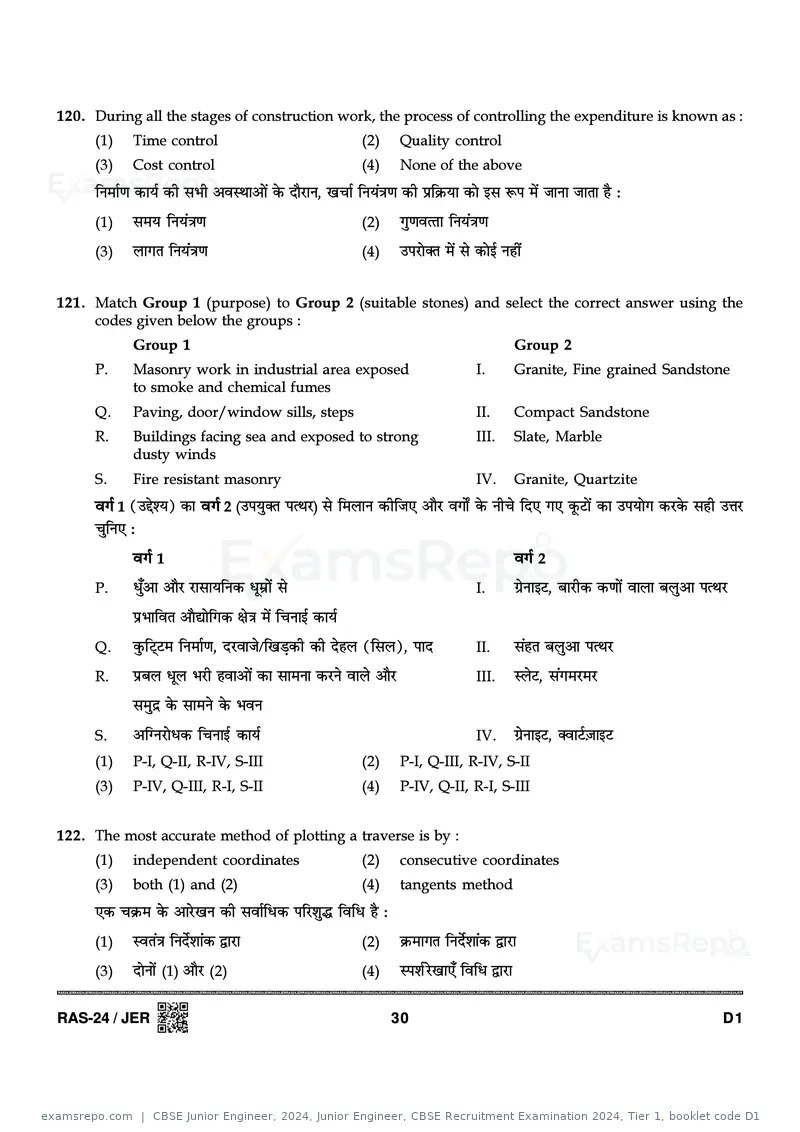
CBSE Junior Engineer 2024 question paper, Junior Engineer, CBSE Recruitment Examination 2024, Tier 1, booklet code D1, page 30 of 40
Page 30 of 40
Text of page 30
120. During all the stages of construction work, the process of controlling the expenditure is known as :
                  (1)               Time control                                                                                                     (2)               Quality control
                  (3)               Cost control                                                                                                     (4)               None of the above
                  ÁŸ◊ʸáÊ ∑§Êÿ¸ ∑§Ë ‚÷Ë •flSÕÊ•Ê¥ ∑§ ŒÊÒ⁄UÊŸ, πøÊ¸ ÁŸÿ¥òÊáÊ ∑§Ë ¬˝Á∑˝§ÿÊ ∑§Ê ß‚ M§¬ ◊¥ ¡ÊŸÊ ¡ÊÃÊ „Ò —
                  (1)               ‚◊ÿ ÁŸÿ¥òÊáÊ                                                                                                     (2)               ªÈáÊflàÃÊ ÁŸÿ¥òÊáÊ
                  (3)               ‹ÊªÃ ÁŸÿ¥òÊáÊ                                                                                                    (4)               ©¬⁄UÊÄà ◊¥ ‚ ∑§Ê߸ Ÿ„Ë¥

121. Match Group 1 (purpose) to Group 2 (suitable stones) and select the correct answer using the
     codes given below the groups :
                                    Group 1                                                                                                                                                                                     Group 2
                  P.                Masonry work in industrial area exposed                                                                                                                                  I.                 Granite, Fine grained Sandstone
                                    to smoke and chemical fumes
                  Q.                Paving, door/window sills, steps                                                                                                                                         II.                Compact Sandstone
                  R.                Buildings facing sea and exposed to strong                                                                                                                               III.               Slate, Marble
                                    dusty winds
                  S.                Fire resistant masonry                                                                                                                                                   IV.                Granite, Quartzite
                  flª¸ 1 (©g‡ÿ) ∑§Ê flª¸ 2 (©¬ÿÈÄà ¬àÕ⁄U) ‚ Á◊‹ÊŸ ∑§ËÁ¡∞ •ÊÒ⁄U flªÊZ ∑§ ŸËø ÁŒ∞ ª∞ ∑ͧ≈UÊ¥ ∑§Ê ©¬ÿÊª ∑§⁄U∑§ ‚„Ë ©ûÊ⁄U
                  øÈÁŸ∞ —
                                    flª¸ 1                                                                                                                                                                                       flª¸ 2
                  P.                œÈ°•Ê •ÊÒ⁄U ⁄UÊ‚ÊÿÁŸ∑§ œÍ◊˝Ê¥ ‚                                                                                                                                        I.                 ª˝ŸÊß≈U, ’Ê⁄UË∑§ ∑§áÊÊ¥ flÊ‹Ê ’‹È•Ê ¬àÕ⁄U
                                    ¬˝÷ÊÁflà •ÊÒlÊÁª∑§ ˇÊòÊ ◊¥ ÁøŸÊ߸ ∑§Êÿ¸
                  Q.                ∑ȧÁ≈˜U≈U◊ ÁŸ◊ʸáÊ, Œ⁄UflÊ¡/Áπ«∏∑§Ë ∑§Ë Œ„‹ (Á‚‹), ¬ÊŒ                                                                                                                  II.                ‚¥„à ’‹È•Ê ¬àÕ⁄U
                  R.                ¬˝’‹ œÍ‹ ÷⁄UË „flÊ•Ê¥ ∑§Ê ‚Ê◊ŸÊ ∑§⁄UŸ flÊ‹ •ÊÒ⁄U                                                                                                                        III.               S‹≈U, ‚¥ª◊⁄U◊⁄U
                                    ‚◊ÈŒ˝ ∑§ ‚Ê◊Ÿ ∑§ ÷flŸ
                  S.                •ÁÇŸ⁄UÊœ∑§ ÁøŸÊ߸ ∑§Êÿ¸                                                                                                                                                 IV.                ª˝ŸÊß≈U, ÄflÊ≈¸U$¡Êß≈U
                  (1)               P-I, Q-II, R-IV, S-III                                                                                           (2)               P-I, Q-III, R-IV, S-II
                  (3)               P-IV, Q-III, R-I, S-II                                                                                           (4)               P-IV, Q-II, R-I, S-III


122. The most accurate method of plotting a traverse is by :
                  (1)               independent coordinates                                                                                          (2)               consecutive coordinates
                  (3)               both (1) and (2)                                                                                                 (4)               tangents method
                  ∞∑§ ø∑˝§◊ ∑§ •Ê⁄UπŸ ∑§Ë ‚flʸÁœ∑§ ¬Á⁄U‡ÊÈh ÁflÁœ „Ò —
                  (1)               SflÃ¥òÊ ÁŸŒ¸‡ÊÊ¥∑§ mÊ⁄UÊ                                                                                         (2)               ∑˝§◊ʪà ÁŸŒ¸‡ÊÊ¥∑§ mÊ⁄UÊ
                  (3)               ŒÊŸÊ¥ (1) •ÊÒ⁄U (2)                                                                                            (4)               S¬‡Ê¸ ⁄UπÊ∞° ÁflÁœ mÊ⁄UÊ
RAS24JERRAS24JERRAS24JERRAS24JERRAS24JERRAS24JERRAS24JERRAS24JERRAS24JERRAS24JERRAS24JERRAS24JERRAS24JERRAS24JERRAS24JERRAS24JERRAS24JERRAS24JERRAS24JERRAS24JERRAS24JERRAS24JERRAS24JERRAS24JERRAS24JERRAS24JERRAS24JERRAS24JERRAS24JERRAS24JERRAS24JERRAS24JERRAS24JERRAS24JERRAS24JERRAS24JERRAS24JERRAS24JERRAS24JERRAS24JERRAS24JERRAS24JER


RAS-24 / JER                                                                                                                                                       30                                                                                                                                                                 D1
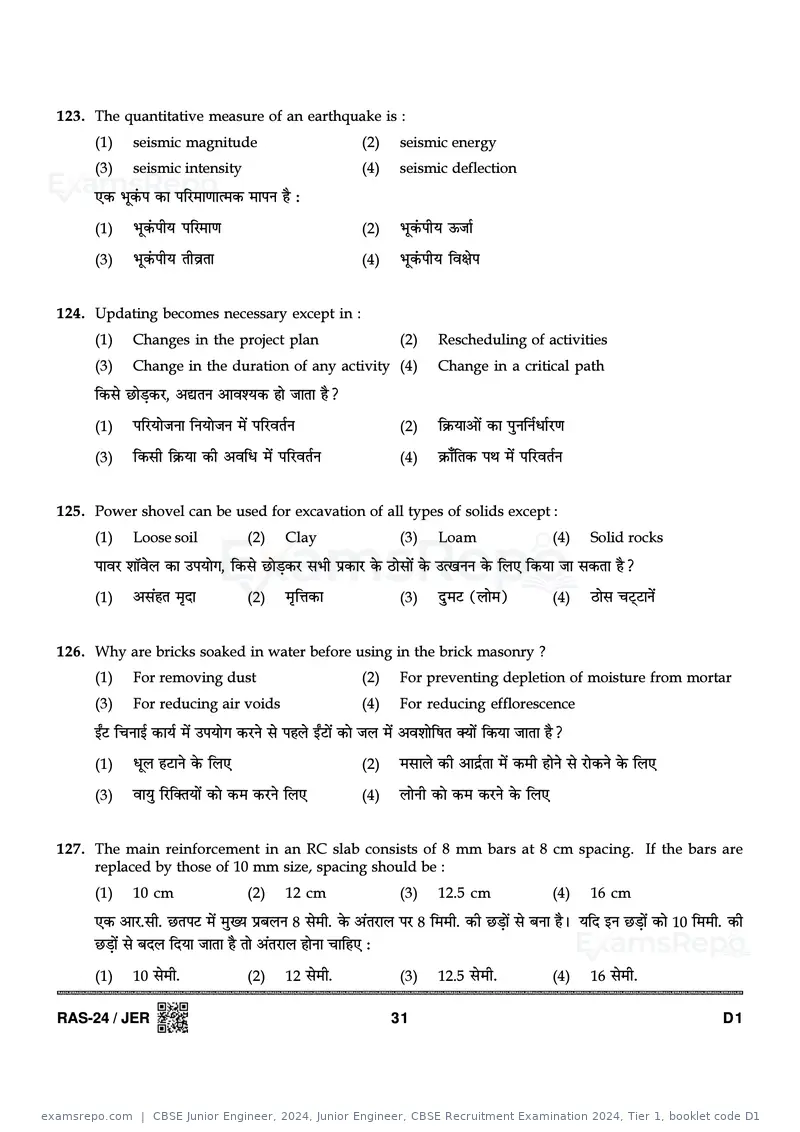
CBSE Junior Engineer 2024 question paper, Junior Engineer, CBSE Recruitment Examination 2024, Tier 1, booklet code D1, page 31 of 40
Page 31 of 40
Text of page 31
123. The quantitative measure of an earthquake is :
                  (1)               seismic magnitude                                                                                                (2)               seismic energy
                  (3)               seismic intensity                                                                                                (4)               seismic deflection
                  ∞∑§ ÷Í∑¥§¬ ∑§Ê ¬Á⁄U◊ÊáÊÊà◊∑§ ◊ʬŸ „Ò —
                  (1)               ÷Í∑¥§¬Ëÿ ¬Á⁄◊ÊáÊ                                                                                                 (2)               ÷Í∑¥§¬Ëÿ ™§¡Ê¸
                  (3)               ÷Í∑¥§¬Ëÿ ÃËfl˝ÃÊ                                                                                                  (4)               ÷Í∑¥§¬Ëÿ ÁflˇÊ¬

124. Updating becomes necessary except in :
                  (1)               Changes in the project plan                                                                                                        (2)                Rescheduling of activities
                  (3)               Change in the duration of any activity (4)                                                                                                            Change in a critical path
                  Á∑§‚ ¿UÊ«∏∑§⁄U, •lß •Êfl‡ÿ∑§ „Ê ¡ÊÃÊ „Ò?
                  (1)               ¬Á⁄UÿÊ¡ŸÊ ÁŸÿÊ¡Ÿ ◊¥ ¬Á⁄UfløŸ                                                                                                    (2)                Á∑˝§ÿÊ•Ê¥ ∑§Ê ¬ÈŸÁŸ¸œÊ¸⁄UáÊ
                  (3)               Á∑§‚Ë Á∑˝§ÿÊ ∑§Ë •flÁœ ◊¥ ¬Á⁄UfløŸ                                                                                                 (4)                ∑˝§Ê°ÁÃ∑§ ¬Õ ◊¥ ¬Á⁄UfløŸ

125. Power shovel can be used for excavation of all types of solids except :
                  (1)               Loose soil                                               (2)               Clay                                                    (3)                Loam                                                    (4)                Solid rocks
                  ¬Êfl⁄U ‡ÊÊÚfl‹ ∑§Ê ©¬ÿÊª, Á∑§‚ ¿UÊ«∏∑§⁄U ‚÷Ë ¬˝∑§Ê⁄U ∑§ ∆UÊ‚Ê¥ ∑§ ©àπŸŸ ∑§ Á‹∞ Á∑§ÿÊ ¡Ê ‚∑§ÃÊ „Ò?
                  (1)               •‚¥„à ◊ÎŒÊ                                               (2)               ◊ÎÁûÊ∑§Ê                                                (3)                ŒÈU◊≈U (‹Ê◊)                                           (4)                ∆UÊ‚ ø≈˜U≈UÊŸ¥

126. Why are bricks soaked in water before using in the brick masonry ?
                  (1)               For removing dust                                                                                                (2)               For preventing depletion of moisture from mortar
                  (3)               For reducing air voids                                                                                           (4)               For reducing efflorescence
                  ßZ≈U ÁøŸÊ߸ ∑§Êÿ¸ ◊¥ ©¬ÿÊª ∑§⁄UŸ ‚ ¬„‹ ßZ≈UÊ¥ ∑§Ê ¡‹ ◊¥ •fl‡ÊÊÁ·Ã ÄÿÊ¥ Á∑§ÿÊ ¡ÊÃÊ „Ò?
                  (1)               œÍ‹ „≈UÊŸ ∑§ Á‹∞                                                                                               (2)               ◊‚Ê‹ ∑§Ë •ÊŒ˝¸ÃÊ ◊¥ ∑§◊Ë „ÊŸ ‚ ⁄UÊ∑§Ÿ ∑§ Á‹∞
                  (3)               flÊÿÈ Á⁄UÁÄÃÿÊ¥ ∑§Ê ∑§◊ ∑§⁄UŸ Á‹∞                                                                              (4)               ‹ÊŸË ∑§Ê ∑§◊ ∑§⁄UŸ ∑§ Á‹∞

127. The main reinforcement in an RC slab consists of 8 mm bars at 8 cm spacing. If the bars are
     replaced by those of 10 mm size, spacing should be :
                  (1)               10 cm                                                    (2)               12 cm                                                   (3)                12.5 cm                                                 (4)                16 cm
                  ∞∑§ •Ê⁄U.‚Ë. ¿Uì≈U ◊¥ ◊ÈÅÿ ¬˝’‹Ÿ 8 ‚◊Ë. ∑§ •¥Ã⁄UÊ‹ ¬⁄U 8 Á◊◊Ë. ∑§Ë ¿U«∏Ê¥ ‚ ’ŸÊ „Ò– ÿÁŒ ߟ ¿U«∏Ê¥ ∑§Ê 10 Á◊◊Ë. ∑§Ë
                  ¿U«∏Ê¥ ‚ ’Œ‹ ÁŒÿÊ ¡ÊÃÊ „Ò ÃÊ •¥Ã⁄UÊ‹ „ÊŸÊ øÊÁ„∞ —
                  (1)               10 ‚◊Ë.                                                 (2)               12 ‚◊Ë.                                                (3)                12.5 ‚◊Ë.                                              (4)                16 ‚◊Ë.
RAS24JERRAS24JERRAS24JERRAS24JERRAS24JERRAS24JERRAS24JERRAS24JERRAS24JERRAS24JERRAS24JERRAS24JERRAS24JERRAS24JERRAS24JERRAS24JERRAS24JERRAS24JERRAS24JERRAS24JERRAS24JERRAS24JERRAS24JERRAS24JERRAS24JERRAS24JERRAS24JERRAS24JERRAS24JERRAS24JERRAS24JERRAS24JERRAS24JERRAS24JERRAS24JERRAS24JERRAS24JERRAS24JERRAS24JERRAS24JERRAS24JERRAS24JER


RAS-24 / JER                                                                                                                                                       31                                                                                                                                                                 D1
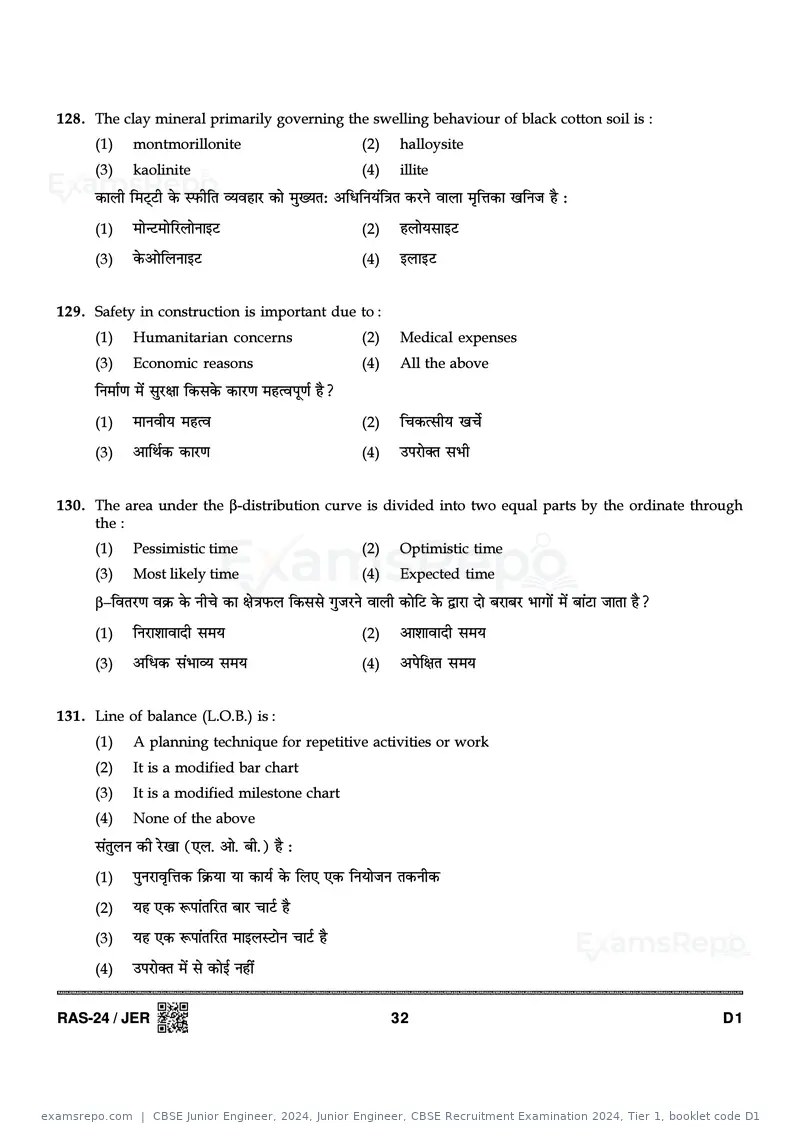
CBSE Junior Engineer 2024 question paper, Junior Engineer, CBSE Recruitment Examination 2024, Tier 1, booklet code D1, page 32 of 40
Page 32 of 40
Text of page 32
128. The clay mineral primarily governing the swelling behaviour of black cotton soil is :
                  (1)               montmorillonite                                                                                                  (2)               halloysite
                  (3)               kaolinite                                                                                                        (4)               illite
                  ∑§Ê‹Ë Á◊≈˜U≈UË ∑§ S»§ËÁà √ÿfl„Ê⁄U ∑§Ê ◊ÈÅÿ× •ÁœÁŸÿ¥ÁòÊà ∑§⁄UŸ flÊ‹Ê ◊ÎÁûÊ∑§Ê πÁŸ¡ „Ò —
                  (1)               ◊Êã≈U◊ÊÁ⁄U‹ÊŸÊß≈U                                                                                             (2)               „‹Êÿ‚Êß≈U
                  (3)               ∑§•ÊÁ‹ŸÊß≈U                                                                                                    (4)               ß‹Êß≈U

129. Safety in construction is important due to :
                  (1)               Humanitarian concerns                                                                                            (2)               Medical expenses
                  (3)               Economic reasons                                                                                                 (4)               All the above
                  ÁŸ◊ʸáÊ ◊¥ ‚È⁄UˇÊÊ Á∑§‚∑§ ∑§Ê⁄UáÊ ◊„àfl¬Íáʸ „Ò?
                  (1)               ◊ÊŸflËÿ ◊„àfl                                                                                                      (2)               Áø∑§à‚Ëÿ πø¸
                  (3)               •ÊÁÕ¸∑§ ∑§Ê⁄UáÊ                                                                                                  (4)               ©¬⁄UÊÄà ‚÷Ë

130. The area under the β-distribution curve is divided into two equal parts by the ordinate through
     the :
                  (1)               Pessimistic time                                                                                                 (2)               Optimistic time
                  (3)               Most likely time                                                                                                 (4)               Expected time
                  β−ÁflÃ⁄UáÊ fl∑˝§ ∑§ ŸËø ∑§Ê ˇÊòÊ»§‹ Á∑§‚‚ ªÈ¡⁄UŸ flÊ‹Ë ∑§ÊÁ≈U ∑§ mÊ⁄UÊ ŒÊ ’⁄UÊ’⁄U ÷ʪÊ¥ ◊¥ ’Ê¥≈UÊ ¡ÊÃÊ „Ò?

                  (1)               ÁŸ⁄UʇÊÊflÊŒË ‚◊ÿ                                                                                                 (2)               •ʇÊÊflÊŒË ‚◊ÿ
                  (3)               •Áœ∑§ ‚¥÷Ê√ÿ ‚◊ÿ                                                                                                 (4)               •¬ÁˇÊà ‚◊ÿ

131. Line of balance (L.O.B.) is :
                  (1)               A planning technique for repetitive activities or work
                  (2)               It is a modified bar chart
                  (3)               It is a modified milestone chart
                  (4)               None of the above
                  ‚¥ÃÈ‹Ÿ ∑§Ë ⁄UπÊ (∞‹. •Ê. ’Ë.) „Ò —
                  (1)               ¬ÈŸ⁄UÊflÎÁûÊ∑§ Á∑˝§ÿÊ ÿÊ ∑§Êÿ¸ ∑§ Á‹∞ ∞∑§ ÁŸÿÊ¡Ÿ Ã∑§ŸË∑§
                  (2)               ÿ„ ∞∑§ M§¬Ê¥ÃÁ⁄Uà ’Ê⁄U øÊ≈¸U „Ò
                  (3)               ÿ„ ∞∑§ M§¬Ê¥ÃÁ⁄Uà ◊Êß‹S≈UÊŸ øÊ≈¸U „Ò
                  (4)               ©¬⁄UÊÄà ◊¥ ‚ ∑§Ê߸ Ÿ„Ë¥
RAS24JERRAS24JERRAS24JERRAS24JERRAS24JERRAS24JERRAS24JERRAS24JERRAS24JERRAS24JERRAS24JERRAS24JERRAS24JERRAS24JERRAS24JERRAS24JERRAS24JERRAS24JERRAS24JERRAS24JERRAS24JERRAS24JERRAS24JERRAS24JERRAS24JERRAS24JERRAS24JERRAS24JERRAS24JERRAS24JERRAS24JERRAS24JERRAS24JERRAS24JERRAS24JERRAS24JERRAS24JERRAS24JERRAS24JERRAS24JERRAS24JERRAS24JER


RAS-24 / JER                                                                                                                                                       32                                                                                                                                                                 D1
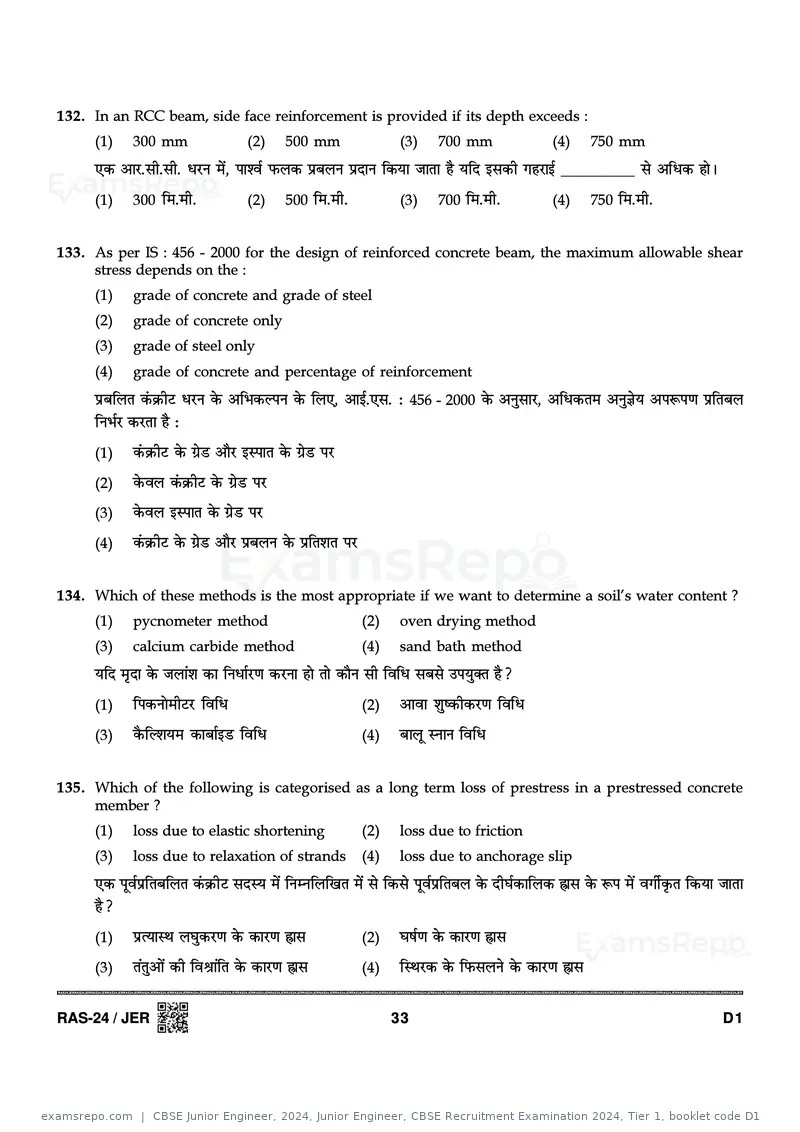
CBSE Junior Engineer 2024 question paper, Junior Engineer, CBSE Recruitment Examination 2024, Tier 1, booklet code D1, page 33 of 40
Page 33 of 40
Text of page 33
132. In an RCC beam, side face reinforcement is provided if its depth exceeds :
                  (1)               300 mm                                                   (2)               500 mm                                                  (3)                700 mm                                                  (4)                750 mm
                  ∞∑§ •Ê⁄U.‚Ë.‚Ë. œ⁄UŸ ◊¥, ¬Ê‡fl¸ »§‹∑§ ¬˝’‹Ÿ ¬˝ŒÊŸ Á∑§ÿÊ ¡ÊÃÊ „Ò ÿÁŒ ß‚∑§Ë ª„⁄UÊ߸ __________ ‚ •Áœ∑§ „Ê–
                  (1)               300 UÁ◊.◊Ë.                                              (2)               500 Á◊.◊Ë.                                              (3)                700 Á◊.◊Ë.                                              (4)                750 Á◊.◊Ë.


133. As per IS : 456 - 2000 for the design of reinforced concrete beam, the maximum allowable shear
     stress depends on the :
                  (1)               grade of concrete and grade of steel
                  (2)               grade of concrete only
                  (3)               grade of steel only
                  (4)               grade of concrete and percentage of reinforcement
                  ¬˝’Á‹Ã ∑¥§∑˝§Ë≈U œ⁄UŸ ∑§ •Á÷∑§À¬Ÿ ∑§ Á‹∞, •Ê߸.∞‚. — 456 - 2000 ∑§ •ŸÈ‚Ê⁄U, •Áœ∑§Ã◊ •ŸÈôÊÿ •¬M§¬áÊ ¬˝ÁÃ’‹
                  ÁŸ÷¸⁄U ∑§⁄UÃÊ „Ò —
                  (1)               ∑¥§∑˝§Ë≈U ∑§ ª˝«U •ÊÒ⁄U ßS¬Êà ∑§ ª˝«U ¬⁄U
                  (2)               ∑§fl‹ ∑¥§∑˝§Ë≈U ∑§ ª˝«U ¬⁄U
                  (3)               ∑§fl‹ ßS¬Êà ∑§ ª˝«U ¬⁄U
                  (4)               ∑¥§∑˝§Ë≈U ∑§ ª˝«U •ÊÒ⁄U ¬˝’‹Ÿ ∑§ ¬˝ÁÇÊà ¬⁄U

134. Which of these methods is the most appropriate if we want to determine a soil’s water content ?
                  (1)               pycnometer method                                                                                                (2)               oven drying method
                  (3)               calcium carbide method                                                                                           (4)               sand bath method
                  ÿÁŒ ◊ÎŒÊ ∑§ ¡‹Ê¥‡Ê ∑§Ê ÁŸœÊ¸⁄UáÊ ∑§⁄UŸÊ „Ê ÃÊ ∑§ÊÒŸ ‚Ë ÁflÁœ ‚’‚ ©¬ÿÈÄà „Ò?
                  (1)               Á¬∑§ŸÊ◊Ë≈U⁄U ÁflÁœ                                                                                               (2)               •ÊflÊ ‡ÊÈc∑§Ë∑§⁄UáÊ ÁflÁœ
                  (3)               ∑Ò§ÁÀ‡Êÿ◊ ∑§Ê’ʸ߫U ÁflÁœ                                                                                         (4)               ’Ê‹Í SŸÊŸ ÁflÁœ

135. Which of the following is categorised as a long term loss of prestress in a prestressed concrete
     member ?
                  (1)               loss due to elastic shortening                                                                                   (2)               loss due to friction
                  (3)               loss due to relaxation of strands                                                                                (4)               loss due to anchorage slip
                  ∞∑§ ¬Ífl¸¬˝ÁÃ’Á‹Ã ∑¥§∑˝§Ë≈U ‚ŒSÿ ◊¥ ÁŸêŸÁ‹Áπà ◊¥ ‚ Á∑§‚ ¬Ífl¸¬˝ÁÃ’‹ ∑§ ŒËÉʸ∑§ÊÁ‹∑§ OÊ‚ ∑§ M§¬ ◊¥ flªË¸∑Χà Á∑§ÿÊ ¡ÊÃÊ
                  „Ò?
                  (1)               ¬˝àÿÊSÕ ‹ÉÊÈ∑§⁄UáÊ ∑§ ∑§Ê⁄UáÊ OÊ‚                                                                               (2)               ÉÊ·¸áÊ ∑§ ∑§Ê⁄UáÊ OÊ‚
                  (3)               Ã¥ÃÈ•Ê¥ ∑§Ë Áflo˝Ê¥Áà ∑§ ∑§Ê⁄UáÊ OÊ‚                                                                            (4)               ÁSÕ⁄U∑§ ∑§ Á»§‚‹Ÿ ∑§ ∑§Ê⁄UáÊ OÊ‚
RAS24JERRAS24JERRAS24JERRAS24JERRAS24JERRAS24JERRAS24JERRAS24JERRAS24JERRAS24JERRAS24JERRAS24JERRAS24JERRAS24JERRAS24JERRAS24JERRAS24JERRAS24JERRAS24JERRAS24JERRAS24JERRAS24JERRAS24JERRAS24JERRAS24JERRAS24JERRAS24JERRAS24JERRAS24JERRAS24JERRAS24JERRAS24JERRAS24JERRAS24JERRAS24JERRAS24JERRAS24JERRAS24JERRAS24JERRAS24JERRAS24JERRAS24JER


RAS-24 / JER                                                                                                                                                       33                                                                                                                                                                 D1
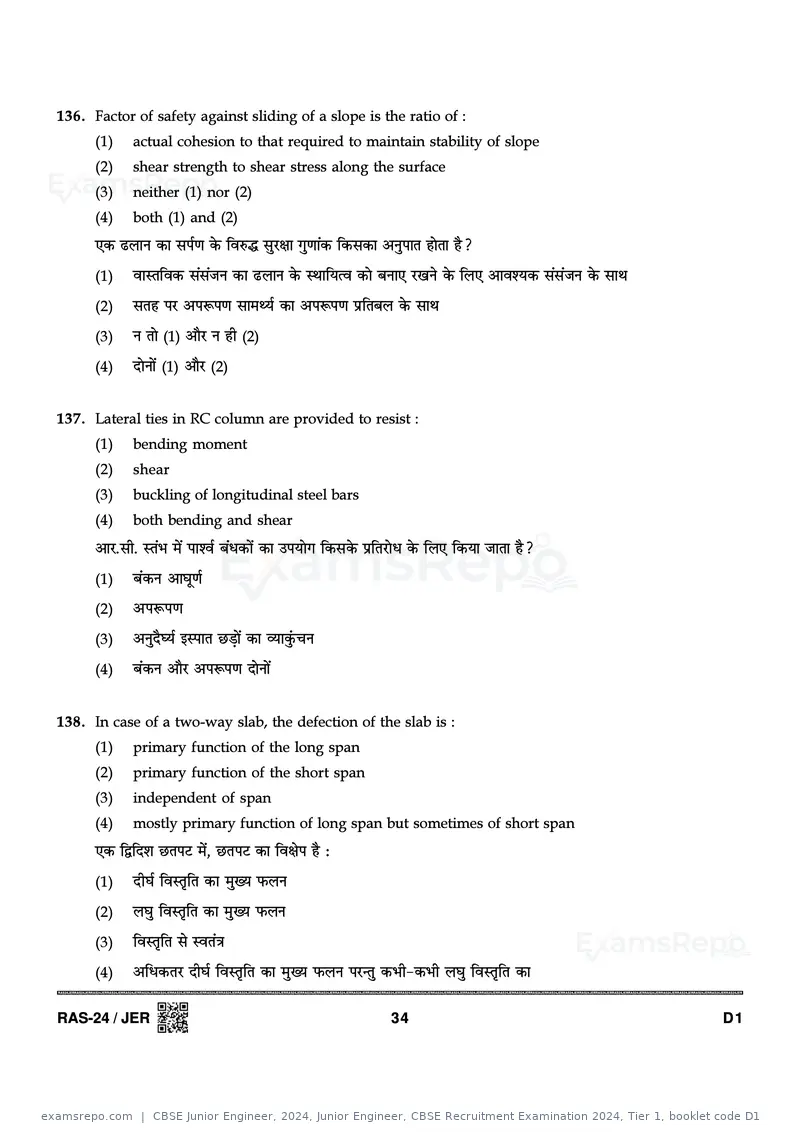
CBSE Junior Engineer 2024 question paper, Junior Engineer, CBSE Recruitment Examination 2024, Tier 1, booklet code D1, page 34 of 40
Page 34 of 40
Text of page 34
136. Factor of safety against sliding of a slope is the ratio of :
                  (1)               actual cohesion to that required to maintain stability of slope
                  (2)               shear strength to shear stress along the surface
                  (3)               neither (1) nor (2)
                  (4)               both (1) and (2)
                  ∞∑§ …U‹ÊŸ ∑§Ê ‚¬¸áÊ ∑§ ÁflL§h ‚È⁄UˇÊÊ ªÈáÊÊ¥∑§ Á∑§‚∑§Ê •ŸÈ¬Êà „ÊÃÊ „Ò?
                  (1)               flÊSÃÁfl∑§ ‚¥‚¥¡Ÿ ∑§Ê …U‹ÊŸ ∑§ SÕÊÁÿàfl ∑§Ê ’ŸÊ∞ ⁄UπŸ ∑§ Á‹∞ •Êfl‡ÿ∑§ ‚¥‚¥¡Ÿ ∑§ ‚ÊÕ
                  (2)               ‚Ä ¬⁄U •¬M§¬áÊ ‚Ê◊âÿ¸ ∑§Ê •¬M§¬áÊ ¬˝ÁÃ’‹ ∑§ ‚ÊÕ
                  (3)               Ÿ ÃÊ (1) •ÊÒ⁄U Ÿ „Ë (2)
                  (4)               ŒÊŸÊ¥ (1) •ÊÒ⁄U (2)

137. Lateral ties in RC column are provided to resist :
                  (1)               bending moment
                  (2)               shear
                  (3)               buckling of longitudinal steel bars
                  (4)               both bending and shear
                  •Ê⁄U.‚Ë. SÃ¥÷ ◊¥ ¬Ê‡fl¸ ’¥œ∑§Ê¥ ∑§Ê ©¬ÿÊª Á∑§‚∑§ ¬˝ÁÃ⁄UÊœ ∑§ Á‹∞ Á∑§ÿÊ ¡ÊÃÊ „Ò?
                  (1)               ’¥∑§Ÿ •ÊÉÊÍáʸ
                  (2)               •¬M§¬áÊ
                  (3)               •ŸÈŒÒÉÿ¸ ßS¬Êà ¿U«∏Ê¥ ∑§Ê √ÿÊ∑È¥§øŸ
                  (4)               ’¥∑§Ÿ •ÊÒ⁄U •¬M§¬áÊ ŒÊŸÊ¥

138. In case of a two-way slab, the defection of the slab is :
                  (1)               primary function of the long span
                  (2)               primary function of the short span
                  (3)               independent of span
                  (4)               mostly primary function of long span but sometimes of short span
                  ∞∑§ ÁmÁŒ‡Ê ¿Uì≈U ◊¥, ¿Uì≈U ∑§Ê ÁflˇÊ¬ „Ò —
                  (1)               ŒËÉʸ ÁflSÃÎÁà ∑§Ê ◊ÈÅÿ »§‹Ÿ
                  (2)               ‹ÉÊÈ ÁflSÃÎÁà ∑§Ê ◊ÈÅÿ »§‹Ÿ
                  (3)               ÁflSÃÎÁà ‚ SflÃ¥òÊ
                  (4)               •Áœ∑§Ã⁄U ŒËÉʸ ÁflSÃÎÁà ∑§Ê ◊ÈÅÿ »§‹Ÿ ¬⁄UãÃÈ ∑§÷Ë-∑§÷Ë ‹ÉÊÈ ÁflSÃÎÁà ∑§Ê
RAS24JERRAS24JERRAS24JERRAS24JERRAS24JERRAS24JERRAS24JERRAS24JERRAS24JERRAS24JERRAS24JERRAS24JERRAS24JERRAS24JERRAS24JERRAS24JERRAS24JERRAS24JERRAS24JERRAS24JERRAS24JERRAS24JERRAS24JERRAS24JERRAS24JERRAS24JERRAS24JERRAS24JERRAS24JERRAS24JERRAS24JERRAS24JERRAS24JERRAS24JERRAS24JERRAS24JERRAS24JERRAS24JERRAS24JERRAS24JERRAS24JERRAS24JER


RAS-24 / JER                                                                                                                                                       34                                                                                                                                                                 D1
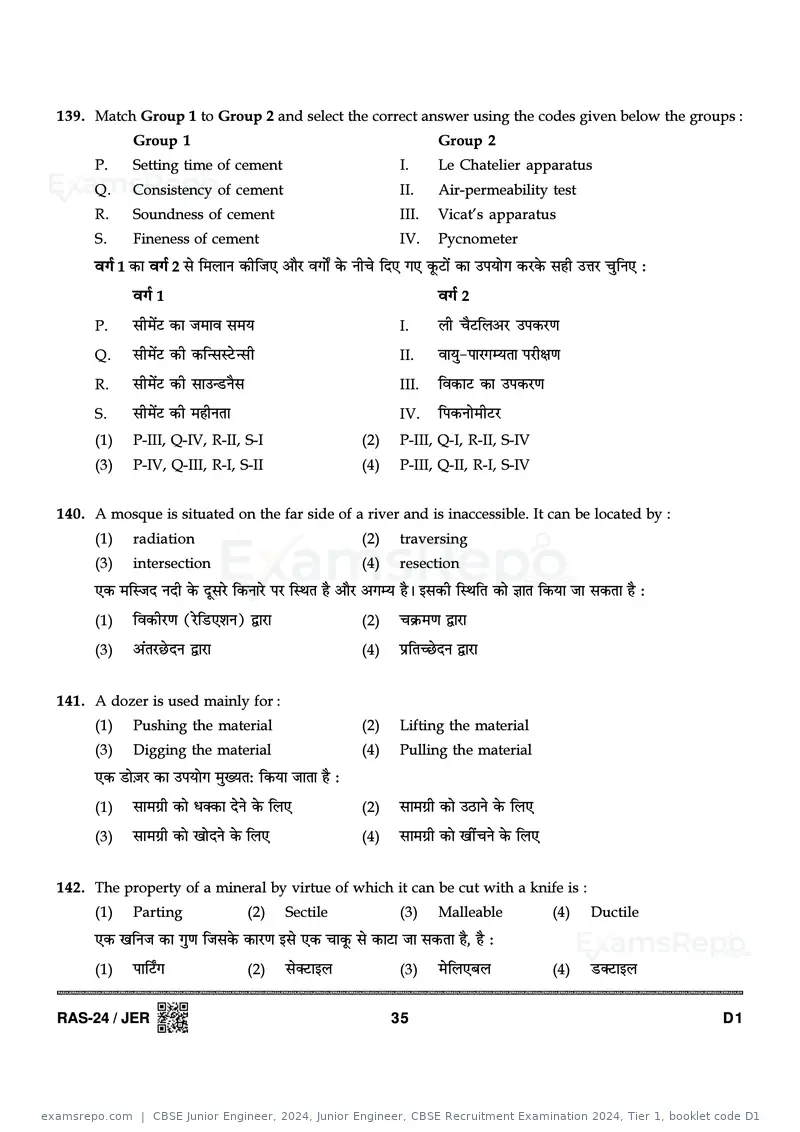
CBSE Junior Engineer 2024 question paper, Junior Engineer, CBSE Recruitment Examination 2024, Tier 1, booklet code D1, page 35 of 40
Page 35 of 40
Text of page 35
139. Match Group 1 to Group 2 and select the correct answer using the codes given below the groups :
                                    Group 1                                                                                                                                               Group 2
                  P.                Setting time of cement                                                                                                             I.                 Le Chatelier apparatus
                  Q.                Consistency of cement                                                                                                              II.                Air-permeability test
                  R.                Soundness of cement                                                                                                                III.               Vicat’s apparatus
                  S.                Fineness of cement                                                                                                                 IV.                Pycnometer
                  flª¸ 1 ∑§Ê flª¸ 2 ‚ Á◊‹ÊŸ ∑§ËÁ¡∞ •ÊÒ⁄U flªÊZ ∑§ ŸËø ÁŒ∞ ª∞ ∑ͧ≈UÊ¥ ∑§Ê ©¬ÿÊª ∑§⁄U∑§ ‚„Ë ©ûÊ⁄U øÈÁŸ∞ —
                                    flª¸ 1                                                                                                                                                 flª¸ 2
                  P.                ‚Ë◊¥≈U ∑§Ê ¡◊Êfl ‚◊ÿ                                                                                                               I.                 ‹Ë øÒ≈UÁ‹•⁄U ©¬∑§⁄UáÊ
                  Q.                ‚Ë◊¥≈U ∑§Ë ∑§Áã‚S≈U ã‚Ë                                                                                                          II.                flÊÿÈ-¬Ê⁄ªêÿÃÊ ¬⁄UˡÊáÊ
                  R.                ‚Ë◊¥≈U ∑§Ë ‚Ê©ã«UŸÒ‚                                                                                                              III.               Áfl∑§Ê≈U ∑§Ê ©¬∑§⁄UáÊ
                  S.                ‚Ë◊¥≈U ∑§Ë ◊„ËŸÃÊ                                                                                                                 IV.                Á¬∑§ŸÊ◊Ë≈U⁄U
                  (1)               P-III, Q-IV, R-II, S-I                                                                                           (2)               P-III, Q-I, R-II, S-IV
                  (3)               P-IV, Q-III, R-I, S-II                                                                                           (4)               P-III, Q-II, R-I, S-IV


140. A mosque is situated on the far side of a river and is inaccessible. It can be located by :
                  (1)               radiation                                                                                                        (2)               traversing
                  (3)               intersection                                                                                                     (4)               resection
                  ∞∑§ ◊ÁS¡Œ ŸŒË ∑§ ŒÍ‚⁄U Á∑§ŸÊ⁄U ¬⁄U ÁSÕà „Ò •ÊÒ⁄U •ªêÿ „Ò– ß‚∑§Ë ÁSÕÁà ∑§Ê ôÊÊà Á∑§ÿÊ ¡Ê ‚∑§ÃÊ „Ò —
                  (1)               Áfl∑§Ë⁄UáÊ (⁄UÁ«U∞‡ÊŸ) mÊ⁄UÊ                                                                                     (2)               ø∑˝§◊áÊ mÊ⁄UÊ
                  (3)               •¥Ã⁄U¿UŒŸ mÊ⁄UÊ                                                                                                 (4)               ¬˝ÁÃë¿UŒŸ mÊ⁄UÊ

141. A dozer is used mainly for :
                  (1)               Pushing the material                                                                                             (2)               Lifting the material
                  (3)               Digging the material                                                                                             (4)               Pulling the material
                  ∞∑§ «UÊ$¡⁄U ∑§Ê ©¬ÿÊª ◊ÈÅÿ× Á∑§ÿÊ ¡ÊÃÊ „Ò —
                  (1)               ‚Ê◊ª˝Ë ∑§Ê œÄ∑§Ê ŒŸ ∑§ Á‹∞                                                                                   (2)               ‚Ê◊ª˝Ë ∑§Ê ©∆UÊŸ ∑§ Á‹∞
                  (3)               ‚Ê◊ª˝Ë ∑§Ê πÊŒŸ ∑§ Á‹∞                                                                                       (4)               ‚Ê◊ª˝Ë ∑§Ê πË¥øŸ ∑§ Á‹∞

142. The property of a mineral by virtue of which it can be cut with a knife is :
                  (1)               Parting                                                  (2)               Sectile                                                 (3)                Malleable                                               (4)                Ductile
                  ∞∑§ πÁŸ¡ ∑§Ê ªÈáÊ Á¡‚∑§ ∑§Ê⁄UáÊ ß‚ ∞∑§ øÊ∑ͧ ‚ ∑§Ê≈UÊ ¡Ê ‚∑§ÃÊ „Ò, „Ò —
                  (1)               ¬ÊÁ≈ZUª                                                  (2)               ‚Ä≈UÊß‹                                                (3)                ◊Á‹∞’‹                                                 (4)                «UÄ≈UÊß‹
RAS24JERRAS24JERRAS24JERRAS24JERRAS24JERRAS24JERRAS24JERRAS24JERRAS24JERRAS24JERRAS24JERRAS24JERRAS24JERRAS24JERRAS24JERRAS24JERRAS24JERRAS24JERRAS24JERRAS24JERRAS24JERRAS24JERRAS24JERRAS24JERRAS24JERRAS24JERRAS24JERRAS24JERRAS24JERRAS24JERRAS24JERRAS24JERRAS24JERRAS24JERRAS24JERRAS24JERRAS24JERRAS24JERRAS24JERRAS24JERRAS24JERRAS24JER


RAS-24 / JER                                                                                                                                                       35                                                                                                                                                                 D1
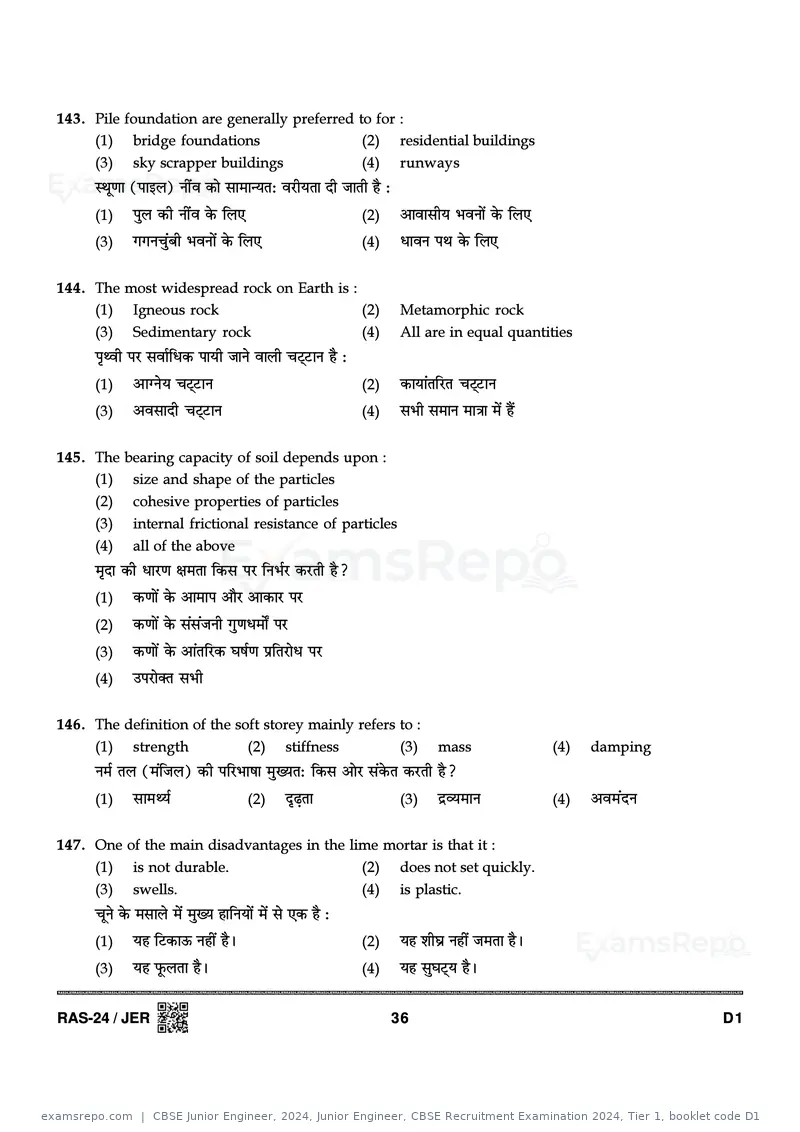
CBSE Junior Engineer 2024 question paper, Junior Engineer, CBSE Recruitment Examination 2024, Tier 1, booklet code D1, page 36 of 40
Page 36 of 40
Text of page 36
143. Pile foundation are generally preferred to for :
     (1) bridge foundations                   (2) residential buildings
     (3) sky scrapper buildings               (4) runways
                  SÕÍáÊÊ (¬Êß‹) ŸË¥fl ∑§Ê ‚Ê◊Êãÿ× fl⁄UËÿÃÊ ŒË ¡ÊÃË „Ò —
                  (1) ¬È‹ ∑§Ë ŸË¥fl ∑§ Á‹∞                       (2) •ÊflÊ‚Ëÿ ÷flŸÊ¥ ∑§ Á‹∞
                  (3) ªªŸøÈ¥’Ë ÷flŸÊ¥ ∑§ Á‹∞                    (4) œÊflŸ ¬Õ ∑§ Á‹∞


144. The most widespread rock on Earth is :
     (1) Igneous rock                       (2)                                                                                                                        Metamorphic rock
     (3) Sedimentary rock                   (4)                                                                                                                        All are in equal quantities
                  ¬ÎâflË ¬⁄U ‚flʸÁœ∑§ ¬ÊÿË ¡ÊŸ flÊ‹Ë ø≈˜≈U ÊŸ „Ò —
                  (1) •ÊÇŸÿ ø≈˜≈U ÊŸ                                                                                                                (2)               ∑§ÊÿÊ¥ÃÁ⁄Uà ø≈˜≈U ÊŸ
                  (3) •fl‚ÊŒË ø≈˜≈U ÊŸ                                                                                                                (4)               ‚÷Ë ‚◊ÊŸ ◊ÊòÊÊ ◊¥ „Ò¥

145. The bearing capacity of soil depends upon :
     (1) size and shape of the particles
     (2) cohesive properties of particles
     (3) internal frictional resistance of particles
                  (4)               all of the above
                  ◊ÎŒÊ ∑§Ë œÊ⁄UáÊ ˇÊ◊ÃÊ Á∑§‚ ¬⁄U ÁŸ÷¸⁄U ∑§⁄UÃË „Ò?
                  (1) ∑§áÊÊ¥ ∑§ •Ê◊ʬ •ÊÒ⁄U •Ê∑§Ê⁄U ¬⁄U
                  (2) ∑§áÊÊ¥ ∑§ ‚¥‚¥¡ŸË ªÈáÊœ◊ÊZ ¬⁄U
                  (3) ∑§áÊÊ¥ ∑§ •Ê¥ÃÁ⁄U∑§ ÉÊ·¸áÊ ¬˝ÁÃ⁄UÊœ ¬⁄U
                  (4) ©¬⁄UÊÄà ‚÷Ë


146. The definition of the soft storey mainly refers to :
     (1) strength            (2) stiffness           (3)                                                                                                                                  mass                                                    (4)                damping
                  Ÿ◊¸ Ë (◊¥Á¡‹) ∑§Ë ¬Á⁄U÷Ê·Ê ◊ÈÅÿ× Á∑§‚ •Ê⁄U ‚¥∑§Ã ∑§⁄UÃË „Ò?
                  (1) ‚Ê◊âÿ¸              (2) ŒÎ…∏ÃÊ                  (3) Œ˝√ÿ◊ÊŸ                                                                                                                                                                 (4)                •fl◊¥ŒŸ

147. One of the main disadvantages in the lime mortar is that it :
                  (1)               is not durable.                                                                                                  (2)               does not set quickly.
                  (3)               swells.                                                                                                          (4)               is plastic.
                  øÍŸ ∑§ ◊‚Ê‹ ◊¥ ◊ÈÅÿ „ÊÁŸÿÊ¥ ◊¥ ‚ ∞∑§ „Ò —
                  (1) ÿ„ Á≈U∑§Ê™§ Ÿ„Ë¥ „Ò–                                                                                                           (2)               ÿ„ ‡ÊËÉÊ˝ Ÿ„Ë¥ ¡◊ÃÊ „Ò–
                  (3) ÿ„ »Í§‹ÃÊ „Ò–                                                                                                                  (4)               ÿ„ ‚ÈÉÊ≈˜Uÿ „Ò–
RAS24JERRAS24JERRAS24JERRAS24JERRAS24JERRAS24JERRAS24JERRAS24JERRAS24JERRAS24JERRAS24JERRAS24JERRAS24JERRAS24JERRAS24JERRAS24JERRAS24JERRAS24JERRAS24JERRAS24JERRAS24JERRAS24JERRAS24JERRAS24JERRAS24JERRAS24JERRAS24JERRAS24JERRAS24JERRAS24JERRAS24JERRAS24JERRAS24JERRAS24JERRAS24JERRAS24JERRAS24JERRAS24JERRAS24JERRAS24JERRAS24JERRAS24JER


RAS-24 / JER                                                                                                                                                       36                                                                                                                                                                 D1
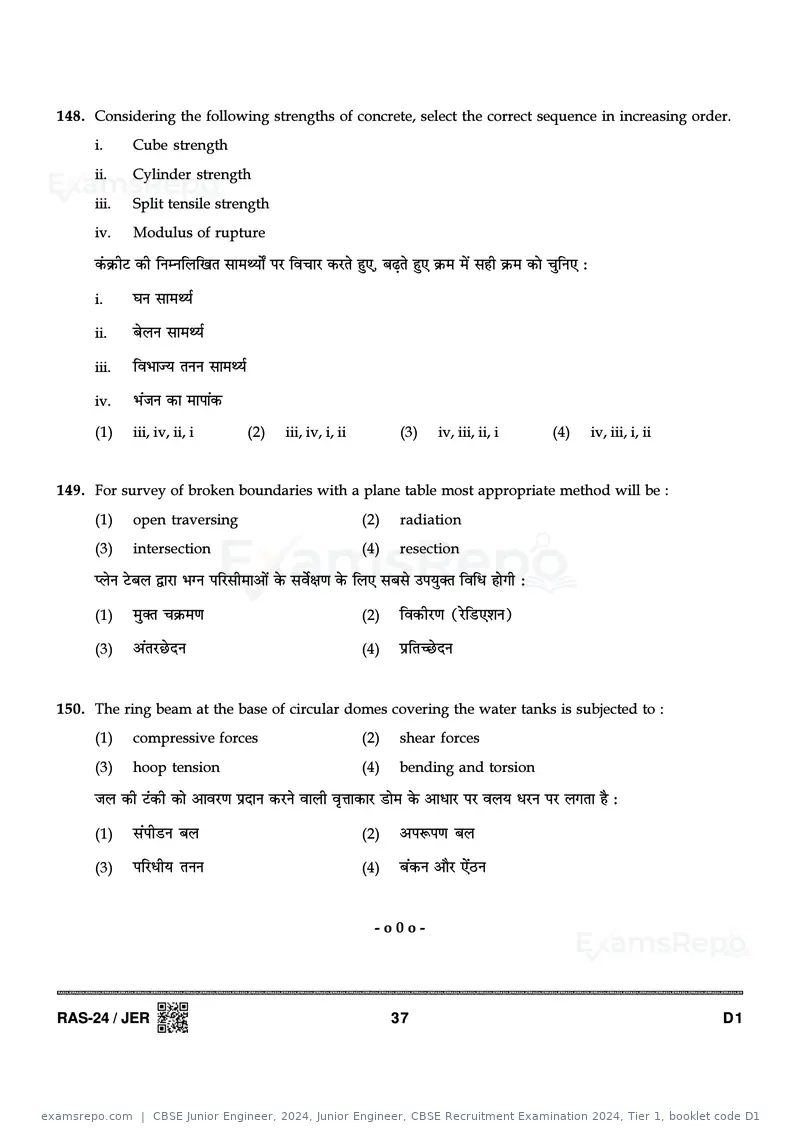
CBSE Junior Engineer 2024 question paper, Junior Engineer, CBSE Recruitment Examination 2024, Tier 1, booklet code D1, page 37 of 40
Page 37 of 40
Text of page 37
148. Considering the following strengths of concrete, select the correct sequence in increasing order.
                  i.                Cube strength
                  ii.               Cylinder strength
                  iii.              Split tensile strength
                  iv.               Modulus of rupture

                  ∑¥§∑˝§Ë≈U ∑§Ë ÁŸêŸÁ‹Áπà ‚Ê◊âÿÊZ ¬⁄U ÁfløÊ⁄U ∑§⁄UÃ „È∞, ’…∏Ã „È∞ ∑˝§◊ ◊¥ ‚„Ë ∑˝§◊ ∑§Ê øÈÁŸ∞ —
                  i.                ÉÊŸ ‚Ê◊âÿ¸
                  ii.               ’‹Ÿ ‚Ê◊âÿ¸
                  iii.              Áfl÷Êíÿ ߟ ‚Ê◊âÿ¸
                  iv.               ÷¥¡Ÿ ∑§Ê ◊ʬʥ∑§
                  (1)               iii, iv, ii, i                                           (2)               iii, iv, i, ii                                          (3)                iv, iii, ii, i                                          (4)                iv, iii, i, ii


149. For survey of broken boundaries with a plane table most appropriate method will be :
                  (1)               open traversing                                                                                                  (2)               radiation
                  (3)               intersection                                                                                                     (4)               resection

                  å‹Ÿ ≈U’‹ mÊ⁄UÊ ÷ÇŸ ¬Á⁄U‚Ë◊Ê•Ê¥ ∑§ ‚fl¸ˇÊáÊ ∑§ Á‹∞ ‚’‚ ©¬ÿÈÄà ÁflÁœ „ÊªË —
                  (1)               ◊ÈÄà ø∑˝§◊áÊ                                                                                                     (2)               Áfl∑§Ë⁄UáÊ (⁄UÁ«U∞‡ÊŸ)
                  (3)               •¥Ã⁄U¿UŒŸ                                                                                                       (4)               ¬˝ÁÃë¿UŒŸ


150. The ring beam at the base of circular domes covering the water tanks is subjected to :
                  (1)               compressive forces                                                                                               (2)               shear forces
                  (3)               hoop tension                                                                                                     (4)               bending and torsion

                  ¡‹ ∑§Ë ≈¥U∑§Ë ∑§Ê •Êfl⁄UáÊ ¬˝ŒÊŸ ∑§⁄UŸ flÊ‹Ë flÎûÊÊ∑§Ê⁄U «UÊ◊ ∑§ •ÊœÊ⁄U ¬⁄U fl‹ÿ œ⁄UŸ ¬⁄U ‹ªÃÊ „Ò —
                  (1)               ‚¥¬Ë«UŸ ’‹                                                                                                       (2)               •¬M§¬áÊ ’‹
                  (3)               ¬Á⁄UœËÿ ߟ                                                                                                      (4)               ’¥∑§Ÿ •ÊÒ⁄U ∞¥∆UŸ


                                                                                                                                                           -o0o-


RAS24JERRAS24JERRAS24JERRAS24JERRAS24JERRAS24JERRAS24JERRAS24JERRAS24JERRAS24JERRAS24JERRAS24JERRAS24JERRAS24JERRAS24JERRAS24JERRAS24JERRAS24JERRAS24JERRAS24JERRAS24JERRAS24JERRAS24JERRAS24JERRAS24JERRAS24JERRAS24JERRAS24JERRAS24JERRAS24JERRAS24JERRAS24JERRAS24JERRAS24JERRAS24JERRAS24JERRAS24JERRAS24JERRAS24JERRAS24JERRAS24JERRAS24JER


RAS-24 / JER                                                                                                                                                       37                                                                                                                                                                 D1
CBSE Junior Engineer 2024 question paper, Junior Engineer, CBSE Recruitment Examination 2024, Tier 1, booklet code D1, page 38 of 40
Page 38 of 40
Text of page 38
SPACE FOR ROUGH WORK / ⁄U»§ ∑§Êÿ¸ ∑§ Á‹∞ ¡ª„


RAS24JERRAS24JERRAS24JERRAS24JERRAS24JERRAS24JERRAS24JERRAS24JERRAS24JERRAS24JERRAS24JERRAS24JERRAS24JERRAS24JERRAS24JERRAS24JERRAS24JERRAS24JERRAS24JERRAS24JERRAS24JERRAS24JERRAS24JERRAS24JERRAS24JERRAS24JERRAS24JERRAS24JERRAS24JERRAS24JERRAS24JERRAS24JERRAS24JERRAS24JERRAS24JERRAS24JERRAS24JERRAS24JERRAS24JERRAS24JERRAS24JERRAS24JER


RAS-24 / JER                                                                                                                                                       38                                                                                                                                                                 D1
CBSE Junior Engineer 2024 question paper, Junior Engineer, CBSE Recruitment Examination 2024, Tier 1, booklet code D1, page 39 of 40
Page 39 of 40
Text of page 39
SPACE FOR ROUGH WORK / ⁄U»§ ∑§Êÿ¸ ∑§ Á‹∞ ¡ª„


RAS24JERRAS24JERRAS24JERRAS24JERRAS24JERRAS24JERRAS24JERRAS24JERRAS24JERRAS24JERRAS24JERRAS24JERRAS24JERRAS24JERRAS24JERRAS24JERRAS24JERRAS24JERRAS24JERRAS24JERRAS24JERRAS24JERRAS24JERRAS24JERRAS24JERRAS24JERRAS24JERRAS24JERRAS24JERRAS24JERRAS24JERRAS24JERRAS24JERRAS24JERRAS24JERRAS24JERRAS24JERRAS24JERRAS24JERRAS24JERRAS24JERRAS24JER


RAS-24 / JER                                                                                                                                                       39                                                                                                                                                                 D1
CBSE Junior Engineer 2024 question paper, Junior Engineer, CBSE Recruitment Examination 2024, Tier 1, booklet code D1, page 40 of 40
Page 40 of 40
Text of page 40
READ THE FOLLOWING INSTRUCTIONS CAREFULLY :                                                                                                                                                     ÁŸêŸÁ‹Áπà ÁŸŒ¸‡ÊÊ¥ ∑§Ê äÿÊŸ ‚ ¬…∏¥ —
   1. The manner in which the different questions are to be answered has been                                                                                               1.  Á¡‚ ¬˝∑§Ê⁄U ‚ ÁflÁ÷ÛÊ ¬˝‡ŸÊ¥ ∑§ ©ûÊ⁄U ÁŒ∞ ¡ÊŸ „Ò¥ ©‚∑§Ê fláʸŸ ¬⁄UˡÊÊ
      explained in the Test Booklet which you should read carefully before actually                                                                                             ¬ÈÁSÃ∑§Ê ◊¥ Á∑§ÿÊ ªÿÊ „Ò, Á¡‚ •ʬ ¬˝‡ŸÊ¥ ∑§Ê ©ûÊ⁄U ŒŸ ‚ ¬„‹ äÿÊŸ ‚ ¬…∏
      answering the questions.                                                                                                                                                  ‹¥–
   2. Out of the four alternatives for each question, only one circle for the correct                                                                                       2. ¬˝àÿ∑§ ¬˝‡Ÿ ∑§ Á‹∞ ÁŒ∞ ª∞ øÊ⁄U Áfl∑§À¬Ê¥ ◊¥ ‚ ‚„Ë ©ûÊ⁄U ∑§ Á‹∞ OMR
      answer is to be darkened completely with Blue / Black Ball Point Pen on                                                                                                   ©ûÊ⁄U ¬òÊ ∑§ ¬Îc∆U-2 ¬⁄U ∑§fl‹ ∞∑§ flÎûÊ ∑§Ê „Ë ¬Í⁄UË Ã⁄U„ ŸË‹/∑§Ê‹ ’ÊÚ‹ ¬ÊÚßã≈U
      Side-2 of the OMR Answer Sheet. The answer once marked is not liable                                                                                                      ¬Ÿ ‚ ÷⁄¥U– ∞∑§ ’Ê⁄U ©ûÊ⁄U •¥Á∑§Ã ∑§⁄UŸ ∑§ ’ÊŒ ©‚ ’Œ‹Ê Ÿ„Ë¥ ¡Ê ‚∑§ÃÊ
      to be changed. In case more than one circle is darkened, the question                                                                                                     „Ò– ∞∑§ ‚ •Áœ∑§ flÎûÊ ∑§Ê ∑§Ê‹Ê ∑§⁄UŸ ¬⁄U ¬˝‡Ÿ ∑§Ê ◊ÍÀÿÊ¥∑§Ÿ Ÿ„Ë¥ Á∑§ÿÊ
      will not be assessed.
                                                                                                                                                                                ¡Ê∞ªÊ–
   3. The candidates should ensure that the Answer Sheet is not folded. Do not                                                                                              3. ¬⁄UˡÊÊÕ˸ ‚ÈÁŸÁ‡øÃ ∑§⁄¥U Á∑§ ß‚ ©ûÊ⁄U ¬òÊ ∑§Ê ◊Ê«∏Ê Ÿ ¡Ê∞ ∞fl¥ ©‚ ¬⁄U ∑§Ê߸
      make any stray marks on the Answer Sheet. Do not write your Roll No.                                                                                                      •ãÿ ÁŸ‡ÊÊŸ Ÿ ‹ªÊ∞°– ¬⁄UˡÊÊÕ˸ •¬ŸÊ •ŸÈ∑˝§◊Ê¥∑§ ©ûÊ⁄U-¬òÊ ◊¥ ÁŸœÊ¸Á⁄UÃ
      anywhere else except in the specified space in the Answer Sheet.
                                                                                                                                                                                SÕÊŸ ∑§ •ÁÃÁ⁄UÄà •ãÿòÊ Ÿ Á‹π¥–
   4. Handle the Test Booklet and Answer Sheet with care, as under no                                                                                                       4. ¬⁄UˡÊÊ ¬ÈÁSÃ∑§Ê ∞fl¥ ©ûÊ⁄U ¬òÊ ∑§Ê äÿÊŸ¬Ífl¸∑§ ¬˝ÿÊª ∑§⁄¥U, ÄÿÊ¥Á∑§ Á∑§‚Ë ÷Ë
      circumstances (except for discrepancy in Test Booklet Code or Number                                                                                                      ¬Á⁄UÁSÕÁà ◊¥ (∑§fl‹ ¬⁄UˡÊÊ ¬ÈÁSÃ∑§Ê ∞fl¥ ©ûÊ⁄U ¬òÊ ∑§ ∑§Ê«U ÿÊ ‚¥ÅÿÊ ◊¥
      and Answer Sheet Code or Number), another set will be provided.                                                                                                           Á÷ãŸÃÊ ∑§Ë ÁSÕÁà ∑§Ê ¿UÊ«∏∑§⁄U) ŒÍ‚⁄UË ¬⁄UˡÊÊ ¬ÈÁSÃ∑§Ê ©¬‹éœ Ÿ„Ë¥ ∑§⁄UÊÿË
   5. The candidates will write the correct Test Booklet Code and Number as                                                                                                     ¡Ê∞ªË–
      given in the Test Booklet/Answer Sheet in the Attendance Sheet.                                                                                                       5. ¬⁄UˡÊÊ ¬ÈÁSÃ∑§Ê/©ûÊ⁄U ¬òÊ ◊¥ ÁŒ∞ ª∞ ¬⁄UˡÊÊ ¬ÈÁSÃ∑§Ê ∑§Ê«U fl ‚¥ÅÿÊ ∑§Ê
   6. A machine will read the coded information in the OMR Answer Sheet.                                                                                                        ¬⁄UˡÊÊÕ˸ ‚„Ë Ã⁄UË∑§ ‚ ©¬ÁSÕÁÃ-¬òÊ ◊¥ Á‹π¥–
      Hence, no information should be left incomplete and it should not be different                                                                                        6. OMR ©ûÊ⁄U ¬òÊ ◊¥ ∑§ÊÁ«Uà ¡ÊŸ∑§Ê⁄UË ∑§Ê ∞∑§ ◊‡ÊËŸ ¬…∏ªË– ß‚Á‹∞ ∑§Ê߸
      from the information given in the Admit Card.                                                                                                                             ÷Ë ‚ÍøŸÊ •œÍ⁄UË Ÿ ¿UÊ«∏¥ •ÊÒ⁄U ÿ„ ¬˝fl‡Ê-¬òÊ ◊¥ ŒË ªß¸ ‚ÍøŸÊ ‚ Á÷㟠Ÿ„Ë¥
   7. Candidates are not allowed to carry any textual material, printed or written                                                                                              „ÊŸË øÊÁ„∞–
      bits of papers, pager, mobile phone, electronic device or any other material                                                                                          7. ¬⁄UˡÊÊÕ˸ mÊ⁄UÊ ¬⁄UˡÊÊ „ÊÚ‹/∑§ˇÊ ◊¥ ¬˝fl‡Ê-¬òÊ ∑§ Á‚flÊÿ Á∑§‚Ë ¬˝∑§Ê⁄U ∑§Ë
      except the Admit Card inside the examination hall/room.                                                                                                                   ¬Ê∆K-‚Ê◊ª˝Ë, ◊ÈÁŒ˝Ã ÿÊ „SÃÁ‹Áπà ∑§Êª$¡ ∑§Ë ¬Áø¸ÿʰ, ¬¡⁄U, ◊Ê’Êß‹
   8. Mobile phones, wireless communication devices (even in switched off                                                                                                       »§ÊŸ, ß‹Ä≈˛UÊÚÁŸ∑§ ©¬∑§⁄UáÊ ÿÊ Á∑§‚Ë •ãÿ ¬˝∑§Ê⁄U ∑§Ë ‚Ê◊ª˝Ë ∑§Ê ‹ ¡ÊŸ ÿÊ
      mode) and the other banned items should not be brought in the examination                                                                                                 ©¬ÿÊª ∑§⁄UŸ ∑§Ë •ŸÈ◊Áà Ÿ„Ë¥ „Ò–
      halls/rooms. Failing to comply with this instruction, it will be considered as                                                                                        8. ◊Ê’Êß‹ »§ÊŸ, ’ÃÊ⁄U ‚¥øÊ⁄U ÿÈÁÄÃÿʰ (ÁSflø •ÊÚ»§ •flSÕÊ ◊¥ ÷Ë) •ÊÒ⁄U •ãÿ
      using unfair means in the examination and action will be taken against them                                                                                               ¬˝ÁÃ’¥ÁœÃ flSÃÈ∞° ¬⁄UˡÊÊ „ÊÚ‹/∑§ˇÊ ◊¥ Ÿ„Ë¥ ‹Ê߸ ¡ÊŸË øÊÁ„∞– ß‚ ‚ÍøŸÊ ∑§Ê
      including cancellation of examination.
                                                                                                                                                                                ¬Ê‹Ÿ Ÿ „ÊŸ ¬⁄U ß‚ ¬⁄UˡÊÊ ◊¥ •ŸÈÁøÃ ‚ÊœŸÊ¥ ∑§Ê ¬˝ÿÊª ◊ÊŸÊ ¡Ê∞ªÊ •ÊÒ⁄U
   9. Each candidate must show on demand his/her Admit Card to the Invigilator.                                                                                                 ©Ÿ∑§ ÁflL§h ∑§Êÿ¸flÊ„Ë ∑§Ë ¡Ê∞ªË, Á¡‚◊¥ ©Ÿ∑§Ë ¬⁄UˡÊÊ ⁄Ug ∑§⁄UŸÊ ‡ÊÊÁ◊‹
   10. No candidate, without special permission of the Centre Superintendent or                                                                                                 „Ò–
       Invigilator, should leave his/her seat.                                                                                                                              9. ¬Í¿U ¡ÊŸ ¬⁄U ¬˝àÿ∑§ ¬⁄UˡÊÊÕ˸, ÁŸ⁄UˡÊ∑§ ∑§Ê •¬ŸÊ ¬˝fl‡Ê-¬òÊ ÁŒπÊ∞°–
   11. The candidates should not leave the Examination Hall/Room without handing                                                                                            10. ∑§ãŒ˝ •œËˇÊ∑§ ÿÊ ÁŸ⁄UˡÊ∑§ ∑§Ë Áfl‡Ê· •ŸÈ◊Áà ∑§ Á’ŸÊ ∑§Ê߸ ¬⁄UˡÊÊÕ˸
       over their Answer Sheet to the Invigilator on duty and sign the Attendance                                                                                               •¬ŸÊ SÕÊŸ Ÿ ¿UÊ«∏¥–
       Sheet twice. Cases where candidate has not signed the Attendance Sheet                                                                                               11. ∑§Êÿ¸⁄Uà ÁŸ⁄UˡÊ∑§ ∑§Ê •¬ŸÊ ©ûÊ⁄U ¬òÊ ÁŒ∞ Á’ŸÊ ∞fl¥ ©¬ÁSÕÁÃ-¬òÊ ¬⁄U ŒÈ’Ê⁄UÊ
       second time will be deemed not to have handed over the Answer Sheet and                                                                                                  „SÃÊˇÊ⁄U Á∑§∞ Á’ŸÊ ¬⁄UˡÊÊÕ˸ ¬⁄UˡÊÊ „ÊÚ‹/∑§ˇÊ Ÿ„Ë¥ ¿UÊ«∏¥ª– ÿÁŒ Á∑§‚Ë
       dealt with as an unfair means case. The candidates are also required to                                                                                                  ¬⁄UˡÊÊÕ˸ Ÿ ŒÍ‚⁄UË ’Ê⁄U ©¬ÁSÕÁÃ-¬òÊ ¬⁄U „SÃÊˇÊ⁄U Ÿ„Ë¥ Á∑§∞, ÃÊ ÿ„ ◊ÊŸÊ
       put their left hand THUMB impression in the space provided in the
                                                                                                                                                                                ¡Ê∞ªÊ Á∑§ ©‚Ÿ ©ûÊ⁄U ¬òÊ Ÿ„Ë¥ ‹ÊÒ≈UÊÿÊ „Ò •ÊÒ⁄U ÿ„ •ŸÈÁøÃ ‚ÊœŸ ∑§Ê
       Attendance Sheet.
                                                                                                                                                                                ◊Ê◊‹Ê ◊ÊŸÊ ¡Ê∞ªÊ– ¬⁄UˡÊÊÕ˸ •¬Ÿ ’Ê∞° „ÊÕ ∑§ •¥ªÍ∆U ∑§Ê ÁŸ‡ÊÊŸ ©¬ÁSÕÁÃ-
   12. Use of Electronic/Manual Calculator is prohibited.                                                                                                                       ¬òÊ ◊¥ ÁŒ∞ ª∞ SÕÊŸ ¬⁄U •fl‡ÿ ‹ªÊ∞°–
   13. The candidates are governed by all Rules and Regulations of the Examining                                                                                            12. ß‹Ä≈˛UÊÚÁŸ∑§/„SÃøÊÁ‹Ã ¬Á⁄U∑§‹∑§ ∑§Ê ©¬ÿÊª flÁ¡¸Ã „Ò–
       Body with regard to their conduct in the Examination Hall/Room. All cases                                                                                            13. ¬⁄UˡÊÊ „ÊÚ‹/∑§ˇÊ ◊¥ •Êø⁄UáÊ ∑§ Á‹∞ ¬⁄UˡÊÊÕ˸ ¬⁄UˡÊáÊ ‚¥SÕÊ ∑§ ‚÷Ë
       of unfair means will be dealt with as per Rules and Regulations of the                                                                                                   ÁŸÿ◊Ê¥ ∞fl¥ ÁflÁŸÿ◊Ê¥ mÊ⁄UÊ ÁŸÿÁ◊à „Ò¥– •ŸÈÁøÃ ‚ÊœŸÊ¥ ∑§ ‚÷Ë ◊Ê◊‹Ê¥ ∑§Ê
       Examining Body.
                                                                                                                                                                                »Ò§‚‹Ê ¬⁄UˡÊáÊ ‚¥SÕÊ ∑§ ÁŸÿ◊Ê¥ ∞fl¥ ÁflÁŸÿ◊Ê¥ ∑§ •ŸÈ‚Ê⁄U „ÊªÊ–
   14. No part of the Test Booklet and Answer Sheet shall be detached under any                                                                                             14. Á∑§‚Ë ÷Ë ¬Á⁄UÁSÕÁà ◊¥ ¬⁄UˡÊÊ ¬ÈÁSÃ∑§Ê •ÊÒ⁄U ©ûÊ⁄U ¬òÊ ∑§Ê ∑§Ê߸ ÷ʪ •‹ª
       circumstances.                                                                                                                                                           Ÿ ∑§⁄¥U–
   15. On completion of the test, the candidate must hand over the Answer                                                                                                   15. ¬⁄UˡÊÊ ‚ê¬ãŸ „ÊŸ ¬⁄U, ¬⁄UˡÊÊÕ˸ „ÊÚ‹/∑§ˇÊ ¿UÊ«∏Ÿ ‚ ¬Ífl¸ ©ûÊ⁄U ¬òÊ ÁŸ⁄UˡÊ∑§
       Sheet to the Invigilator in the Hall / Room. The candidates are                                                                                                          ∑§Ê •fl‡ÿ ‚ÊÒ¥¬ Œ¥– ¬⁄UˡÊÊÕ˸ •¬Ÿ ‚ÊÕ ß‚ ¬⁄UˡÊÊ ¬ÈÁSÃ∑§Ê ∑§Ê ‹ ¡Ê ‚∑§Ã
       allowed to take away this Test Booklet with them.                                                                                                                        „Ò¥–
RAS24JERRAS24JERRAS24JERRAS24JERRAS24JERRAS24JERRAS24JERRAS24JERRAS24JERRAS24JERRAS24JERRAS24JERRAS24JERRAS24JERRAS24JERRAS24JERRAS24JERRAS24JERRAS24JERRAS24JERRAS24JERRAS24JERRAS24JERRAS24JERRAS24JERRAS24JERRAS24JERRAS24JERRAS24JERRAS24JERRAS24JERRAS24JERRAS24JERRAS24JERRAS24JERRAS24JERRAS24JERRAS24JERRAS24JERRAS24JERRAS24JERRAS24JER


RAS-24 / JER                                                                                                                                                       40                                                                                                                                                                 D1
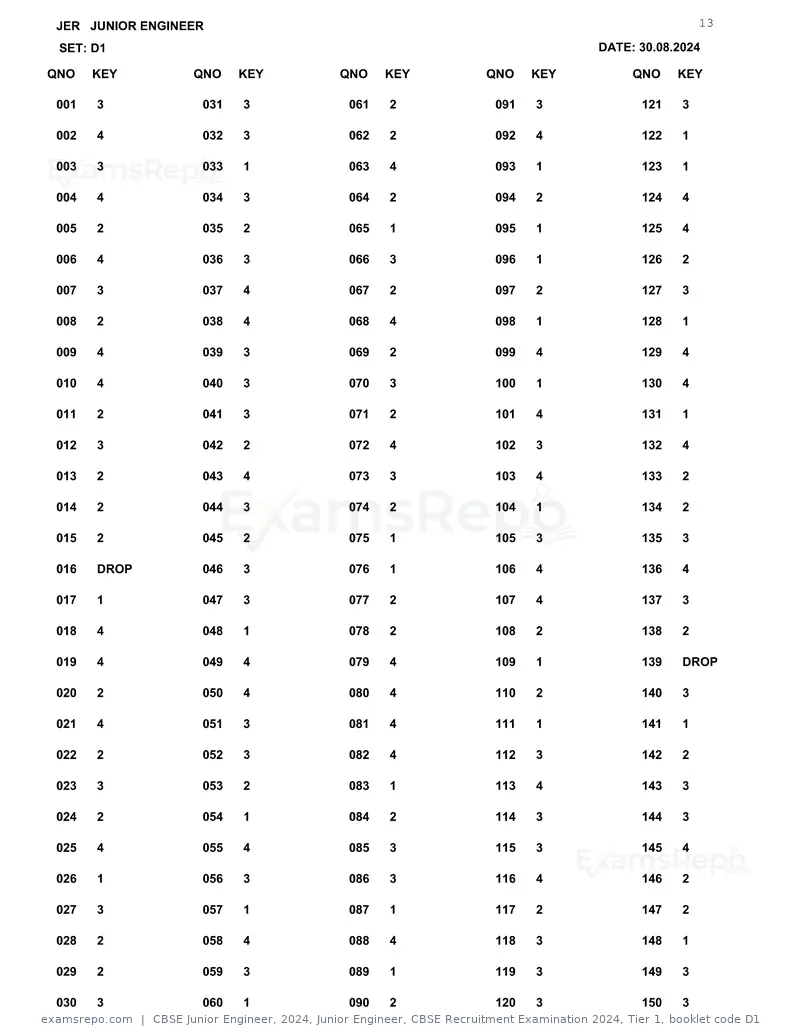
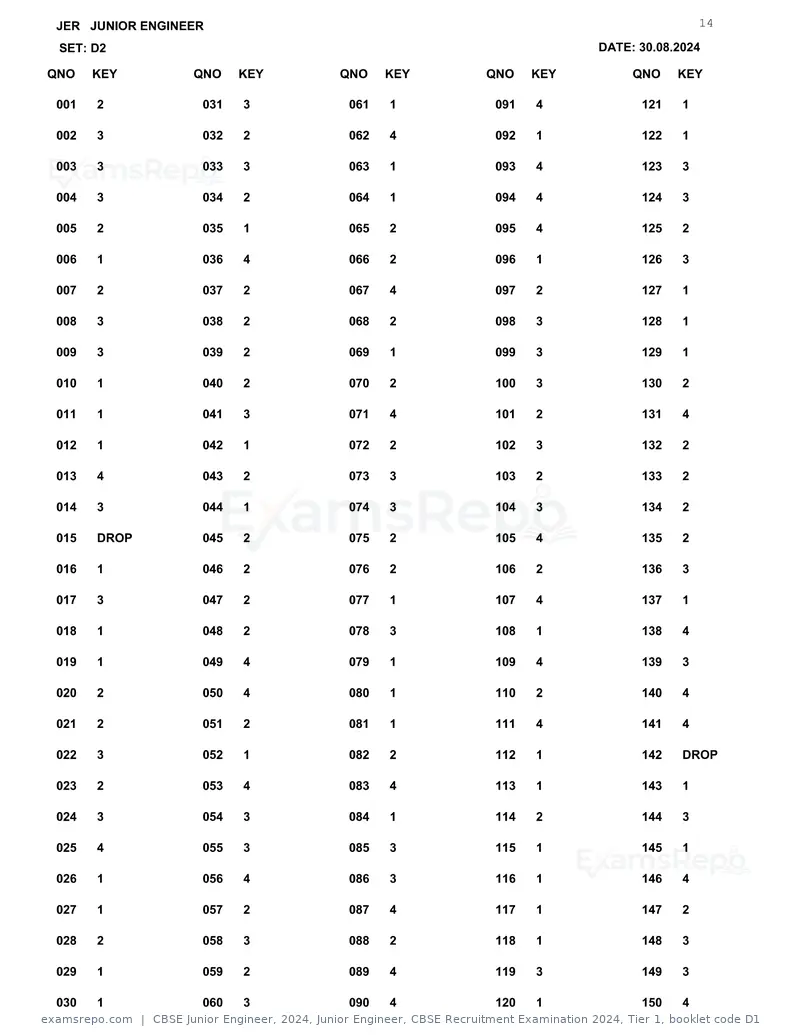
Page 1 of 40

Source: Central Board of Secondary Education. Question paper published by Central Board of Secondary Education.

Other years