
CTET 2024: December, Paper 2 (14Dec), set D

Text of page 1
Main Test Booklet No. / ◊ÈÅÿ ¬⁄UˡÊÊ ¬ÈÁSÃ∑§Ê ‚¥ÅÿÊ
This booklet contains 80 Printed pages.
ß‚ ¬ÈÁSÃ∑§Ê ◊¥ 80 ◊ÈÁŒ˝Ã ¬Îc∆U „Ò¥– SED-24-II
PAPER-II / ¬˝‡Ÿ-¬òÊ-II
MAIN TEST BOOKLET / ◊ÈÅÿ ¬⁄UˡÊÊ ¬ÈÁSÃ∑§Ê
Do not open this Test Booklet until you are asked to do so. Main Test Booklet Code / ◊ÈÅÿ ¬⁄UˡÊÊ ¬ÈÁSÃ∑§Ê ∑§Ê«U
ß‚ ¬⁄UˡÊÊ ¬ÈÁSÃ∑§Ê ∑§Ê Ã’ Ã∑§ Ÿ πÊ‹¥ ¡’ Ã∑§ ∑§„Ê Ÿ ¡Ê∞–
Read carefully the Instructions on the Back Cover of this Test Booklet.
ß‚ ¬⁄UˡÊÊ ¬ÈÁSÃ∑§Ê ∑§ Á¬¿U‹ •Êfl⁄UáÊ ¬⁄U ÁŒ∞ ª∞ ÁŸŒ¸‡ÊÊ¥ ∑§Ê äÿÊŸ ‚ ¬…∏¥–
INSTRUCTIONS FOR CANDIDATES
D
¬⁄UˡÊÊÁÕ¸ÿÊ¥ ∑§ Á‹∞ ÁŸŒ¸‡Ê
1. The OMR Answer Sheet is inside this Test Booklet. When you are directed 1. OMR ©ûÊ⁄U ¬òÊ ß‚ ¬⁄UˡÊÊ ¬ÈÁSÃ∑§Ê ∑§ •ãŒ⁄U ⁄UπÊ „Ò– ¡’ •Ê¬∑§Ê ¬⁄UˡÊÊ
to open the Test Booklet, take out the Answer Sheet and fill in the particulars ¬ÈÁSÃ∑§Ê πÊ‹Ÿ ∑§Ê ∑§„Ê ¡Ê∞, ÃÊ ©ûÊ⁄U ¬òÊ ÁŸ∑§Ê‹ ∑§⁄U ¬Îc∆U-1 ∞fl¥ ¬Îc∆-U2 ¬⁄U
on Side-1 and Side-2 carefully with blue/black ball point pen only. äÿÊŸ ‚ ∑§fl‹ ŸË‹/∑§Ê‹ ’ÊÚ‹ ¬ÊÚߥ≈U ¬Ÿ ‚ Áflfl⁄UáÊ ÷⁄¥U–
2. The test is of 2½ hours duration and consists of 150 questions. There is no 2. ¬⁄UˡÊÊ ∑§Ë •flÁœ 2½ ÉÊ¥≈ „Ò¥ ∞fl¥ ¬⁄UˡÊÊ ◊¥ 150 ¬˝‡Ÿ „Ò¥– ∑§Ê߸ ´§áÊÊà◊∑§
negative marking. •¥∑§Ÿ Ÿ„Ë¥ „Ò–
3. Use Blue/Black Ball Point Pen only for writing particulars on this page/
3. ß‚ ¬Îc∆U ¬⁄U Áflfl⁄UáÊ •¥Á∑§Ã ∑§⁄UŸ ∞fl¥ •Ê∞◊•Ê⁄U ©ûÊ⁄U ¬òÊ ¬⁄U ÁŸ‡ÊÊŸ
marking responses in the OMR Answer Sheet.
4. The CODE for this Booklet is D. Make sure that the CODE printed on
‹ªÊŸ ∑§ Á‹∞ ∑§fl‹ ŸË‹/∑§Ê‹ ’ÊÚ‹ ¬ÊÚߥ≈U ¬Ÿ ∑§Ê ¬˝ÿʪ ∑§⁄¥U–
Side-2 of the OMR Answer Sheet is the same as that on this Booklet. Also 4. ß‚ ¬ÈÁSÃ∑§Ê ∑§Ê ∑§Ê«U D „Ò– ÿ„ ‚ÈÁŸÁ‡øà ∑§⁄U ‹¥ Á∑§ ß‚ ¬ÈÁSÃ∑§Ê ∑§Ê
ensure that your Test Booklet No. and OMR Answer Sheet No. are the ∑§Ê«U, •Ê∞◊•Ê⁄U ©ûÊ⁄U ¬òÊ ∑§ ¬Îc∆U-2 ¬⁄U ¿U¬ ∑§Ê«U ‚ Á◊‹ÃÊ „Ò– ÿ„ ÷Ë
same. In case of discrepancy, the candidate should immediately report the ‚ÈÁŸÁ‡øà ∑§⁄U ‹¥ Á∑§ ¬⁄UˡÊÊ ¬ÈÁSÃ∑§Ê ‚¥ÅÿÊ •ÊÒ⁄U •Ê∞◊•Ê⁄U ©ûÊ⁄U ¬òÊ ‚¥ÅÿÊ
matter to the Invigilator for replacement of both the Test Booklet and the OMR Á◊‹Ã „Ò¥– •ª⁄U ÿ„ Á÷ÛÊ „Ê¥ ÃÊ ¬⁄UˡÊÊÕ˸ ŒÍ‚⁄UË ¬⁄UˡÊÊ ¬ÈÁSÃ∑§Ê •ÊÒ⁄U
Answer Sheet. •Ê∞◊•Ê⁄U ©ûÊ⁄U ¬òÊ ‹Ÿ ∑§ Á‹∞ ÁŸ⁄UˡÊ∑§ ∑§Ê ÃÈ⁄Uãà •flªÃ ∑§⁄UÊ∞°–
5. This Test Booklet has five Parts, I, II, III, IV and V, consisting of 150 5. ß‚ ¬⁄UˡÊÊ ¬ÈÁSÃ∑§Ê ◊¥ ¬Ê°ø ÷ʪ I, II, III, IV •ÊÒ⁄U V „Ò¥, Á¡Ÿ◊¥ 150 flSÃÈÁŸc∆U
Objective Type Questions and each carries 1 mark : ¬˝‡Ÿ „Ò¥, ÃÕÊ ¬˝àÿ∑§ 1 •¥∑§ ∑§Ê „Ò —
Part-I : Child Development and Pedagogy (Q.Nos. 1-30) ÷ʪ-I : ’Ê‹ Áfl∑§Ê‚ fl Á‡ÊˇÊʇÊÊSòÊ (¬˝‡Ÿ ‚¥. 1-30)
Part-II : Mathematics and Science (Q.Nos. 31-90)
÷ʪ-II : ªÁáÊà fl ÁflôÊÊŸ (¬˝‡Ÿ ‚¥. 31-90)
Part-III : Social Studies/Social Science (Q.Nos. 31-90)
Part-IV : Language-I (English/Hindi) (Q.Nos. 91-120)
÷ʪ-III : ‚Ê◊ÊÁ¡∑§ •äÿÿŸ/‚Ê◊ÊÁ¡∑§ ÁflôÊÊŸ (¬˝‡Ÿ ‚¥. 31-90)
Part-V : Language-II (English/Hindi) (Q.Nos. 121-150)
÷ʪ-IV : ÷Ê·Ê-I (•¥ª˝$¡Ë/Á„ãŒË) (¬˝‡Ÿ ‚¥. 91-120)
6. Candidates have to do questions 31 to 90 EITHER from Part-II (Mathematics ÷ʪ-V : ÷Ê·Ê-II (•¥ª˝$¡Ë/Á„ãŒË) (¬˝‡Ÿ ‚¥. 121-150)
and Science) OR from Part-III (Social Studies/Social Science) as filled by 6. ¬⁄UˡÊÊÁÕ¸ÿÊ¥ ∑§Ê ¬˝‡Ÿ 31 ‚ 90 ÿÊ ÃÊ ÷ʪ-II (ªÁáÊà fl ÁflôÊÊŸ) ÿÊ ÷ʪ-III
the candidates in their online application form. (‚Ê◊ÊÁ¡∑§ •äÿÿŸ/‚Ê◊ÊÁ¡∑§ ÁflôÊÊŸ) ‚ ∑§⁄UŸ „Ò¥– ¡Ò‚Ê Á∑§ ¬⁄UˡÊÊÕ˸ Ÿ
7. Part-IV contains 30 questions for Language-I and Part-V contains 30 questions •¬Ÿ •ÊÚŸ‹Êߟ •ÊflŒŸ ¬òÊ ◊¥ ÷⁄UÊ „Ò¥–
for Language-II. In this Test Booklet, only questions pertaining to English 7. ÷ʪ-IV ◊¥ ÷Ê·Ê-I ∑§ Á‹∞ 30 ¬˝‡Ÿ •ÊÒ⁄U ÷ʪ-V ◊¥ ÷Ê·Ê-II ∑§ Á‹∞ 30 ¬˝‡Ÿ
and Hindi language have been given. In case the language/s you have ÁŒ∞ ª∞ „Ò¥– ß‚ ¬⁄UˡÊÊ ¬ÈÁSÃ∑§Ê ◊¥ ∑§fl‹ •¥ª˝$¡Ë fl Á„ãŒË ÷Ê·Ê ‚ ‚¥’¥ÁœÃ
opted for as Language-I and/or Language-II is a language other than ¬˝‡Ÿ ÁŒ∞ ª∞ „Ò¥– ÿÁŒ ÷Ê·Ê-I •ÊÒ⁄U/ÿÊ ÷Ê·Ê-II ◊¥ •Ê¬∑§ mÊ⁄UÊ øÈŸË ªß¸
English or Hindi, please ask for a Supplement (Language) Test
÷Ê·Ê(∞°) •¥ª˝$¡Ë ÿÊ Á„ãŒË ∑§ •‹ÊflÊ „Ò/„Ò¥ ÃÊ ∑Χ¬ÿÊ D ∑§Ê«U flÊ‹Ë ©‚ ÷Ê·Ê
Booklet of D Code that contains questions on that language. The
languages being answered must tally with the languages opted for
flÊ‹Ë ¬Á⁄UÁ‡Êc≈U (÷Ê·Ê) ¬⁄UˡÊÊ ¬ÈÁSÃ∑§Ê ◊Ê°ª ‹ËÁ¡∞– Á¡Ÿ ÷Ê·Ê•Ê¥ ∑§ ¬˝‡ŸÊ¥ ∑§
in your Application Form. No change in languages is allowed. ©ûÊ⁄U •Ê¬ Œ ⁄U„ „Ò¥ fl„ •ÊflŒŸ ¬òÊ ◊¥ øÈŸË ªß¸ ÷Ê·Ê•Ê¥ ‚ •fl‡ÿ ◊‹ πÊŸË
8. Candidates are required to attempt questions in Language-II øÊÁ„∞– ÷Ê·Ê•Ê¥ ∑§Ê ¬Á⁄UfløŸ •ŸÈ◊ãÿ Ÿ„Ë¥ „Ò–
(Part-V) in a language other than the one chosen as Language-I 8. ¬⁄UˡÊÊÕ˸ ÷Ê·Ê-II (÷ʪ-V) ∑§ Á‹∞, ÷Ê·Ê ‚ÍøË ‚ ∞‚Ë ÷Ê·Ê øÈŸ¥ ¡Ê ©Ÿ∑§
(Part-IV) from the list of languages. mÊ⁄UÊ ÷Ê·Ê-I (÷ʪ-IV) ◊¥ øÈŸË ªß¸ ÷Ê·Ê ‚ Á÷ÛÊ „Ê–
9. Rough work should be done only in the space provided in the Test Booklet 9. ⁄U»§ ∑§Êÿ¸ ¬⁄UˡÊÊ ¬ÈÁSÃ∑§Ê ◊¥ ß‚ ¬˝ÿÊ¡Ÿ ∑§ Á‹∞ ŒË ªß¸ πÊ‹Ë ¡ª„ ¬⁄U „Ë
for the same. ∑§⁄¥U–
10. The answers are to be recorded on the OMR Answer Sheet only. Mark 10. ‚÷Ë ©ûÊ⁄U ∑§fl‹ OMR ©ûÊ⁄U ¬òÊ ¬⁄U „Ë •¥Á∑§Ã ∑§⁄¥U– •¬Ÿ ©ûÊ⁄U äÿÊŸ¬Ífl¸∑§
your responses carefully. No whitener is allowed for changing answers. •¥Á∑§Ã ∑§⁄¥U– ©ûÊ⁄U ’Œ‹Ÿ „ÃÈ ‡flà ⁄¥U¡∑§ ∑§Ê ¬˝ÿʪ ÁŸÁ·h „Ò–
11. In case of any discrepancy in the English and Hindi versions of questions/ 11. ÿÁŒ •¥ª˝$¡Ë •ÊÒ⁄U Á„ãŒË ‚¥S∑§⁄UáÊ ∑§ ¬˝‡ŸÊ¥/©ûÊ⁄UÊ¥ ◊¥ ∑§Ê߸ Áfl‚¥ªÁà „Ê ÃÊ
answers, English version will be taken as final. •¥ª˝$¡Ë ‚¥S∑§⁄UáÊ •¥ÁÃ◊ ◊ÊŸÊ ¡ÊÿªÊ–
Name of the Candidate (in Capital Letters) : ___________________________________________________________________________________________________
¬⁄UˡÊÊÕ˸ ∑§Ê ŸÊ◊ (’«∏ •ˇÊ⁄UÊ¥ ◊¥) —
Roll Number (•ŸÈ∑˝§◊Ê¥∑§) — in figures (•¥∑§Ê¥ ◊¥) ________________________________________________________________________________________________
— in words (‡ÊéŒÊ¥ ◊¥) ________________________________________________________________________________________________
Centre of Examination (in Capital Letters) : _____________________________________________________________________________________________________
¬⁄UˡÊÊ ∑§ãŒ˝ (’«∏ •ˇÊ⁄UÊ¥ ◊¥) —
Candidate’s Signature : _______________________________________________ Invigilator’s Signature : _________________________________________________
¬⁄UˡÊÊÕ˸ ∑§ „SÃÊˇÊ⁄U — ÁŸ⁄UˡÊ∑§ ∑§ „SÃÊˇÊ⁄U —
Facsimile signature stamp of Centre Superintendent : ____________________________________________________________________________________________
!SED-24-II!
Text of page 2
PART - I / ÷ʪ - I
CHILD DEVELOPMENT AND PEDAGOGY / ’Ê‹ Áfl∑§Ê‚ fl Á‡ÊˇÊʇÊÊSòÊ
Direction : Answer the following questions (Q. Nos. 1 to 30) by selecting the correct/most appropriate options.
ÁŸŒ¸‡Ê — ÁŸêŸÁ‹Áπà ¬˝‡ŸÊ¥ (¬˝. ‚¥ÅÿÊ 1 ‚ 30) ∑§ ©ûÊ⁄U ŒŸ ∑§ Á‹∞ ‚„Ë/‚’‚ ©¬ÿÈÄà Áfl∑§À¬ øÈÁŸ∞–
1. Which of these statements would advocates of progressive education agree with ?
(1) Children are a distinct life-stage that hold importance because of ‘what they would become
as adults’ rather than ‘what they are as children’.
(2) Children are naturally ‘good’ and society corrupts them.
(3) Children are naturally ‘uncivilized’ and socialization is necessary to make them moral human
beings.
(4) Children are born in a social, cultural, economic context and this background influences
their development.
¬˝ªÁÇÊË‹ Á‡ÊˇÊÊ ∑§ Á„◊ÊÿÃË ßŸ◊¥ ‚ Á∑§‚ ∑§ÕŸ ‚ ‚„◊à „Ê¥ª?
(1) ’ø¬Ÿ ∞∑§ •‹ª ¡ËflŸ-ø⁄UáÊ „Ò Á¡‚◊¥ “’ëø ∑§ M§¬ ◊¥ fl ÄÿÊ „Ò¥” ∑§ ’¡Êÿ “fl flÿS∑§Ê¥ ∑§ M§¬ ◊¥ ÄÿÊ ’Ÿ¥ª” $íÿÊŒÊ
◊„àfl ⁄UπÃÊ „Ò–
(2) ’ëø SflÊ÷ÊÁfl∑§ M§¬ ‚ “•ë¿U” „Êà „Ò¥ •ÊÒ⁄U ‚◊Ê¡ ©ã„¥ ÷˝c≈ ∑§⁄UÃÊ „Ò–U
(3) ’ëø SflÊ÷ÊÁfl∑§ M§¬ ‚ “•‚èÿ” „Êà „Ò¥ •ÊÒ⁄U ©ã„¥ ŸÒÁÃ∑§ ◊ÊŸfl ’ŸÊŸ ∑§ Á‹∞ ‚◊Ê¡Ë∑§⁄UáÊ •Êfl‡ÿ∑§ „Ò–
(4) ’ëø ∞∑§ ‚Ê◊ÊÁ¡∑§, ‚Ê¥S∑ΧÁÃ∑§, •ÊÁÕ¸∑§ ‚¥Œ÷¸ ◊¥ ¬ÒŒÊ „Êà „Ò¥ •ÊÒ⁄U ÿ„ ¬Îc∆U÷ÍÁ◊ ©Ÿ∑§ Áfl∑§Ê‚ ∑§Ê ¬˝÷ÊÁflà ∑§⁄UÃË „Ò–
2. Changes in emotion, self-perception and interpersonal relationships with families, peers and friends
are studied under __________ domain of development.
(1) Psycho-social (2) Physical (3) Cognitive (4) Linguistic
Áfl∑§Ê‚ ∑§ __________ •ÊÿÊ◊ ∑§ Äà ÷ÊflŸÊ•Ê¥, •Êà◊-œÊ⁄UáÊÊ ÃÕÊ ¬Á⁄UflÊ⁄UÊ¥, ‚ÊÁÕÿÊ¥ •ÊÒ⁄U ŒÊSÃÊ¥ ∑§ ‚ÊÕ ¬Ê⁄US¬Á⁄U∑§
‚¥’¥œÊ¥ ◊¥ ¬Á⁄UfløŸ ∑§Ê •äÿÿŸ Á∑§ÿÊ ¡ÊÃÊ „Ò–
(1) ◊ŸÊ-‚Ê◊ÊÁ¡∑§ (2) ÷ÊÒÁÃ∑§ (3) ‚¥ôÊÊŸÊà◊∑§ (4) ÷Ê·Ê߸
3. The behaviours, interests, attitudes, skills and personality traits that a culture considers appropriate
for specific gender are referred to as __________ and are __________.
(1) Gender identity; genetically determined
(2) Gender roles; culturally defined
(3) Gender roles; genetically determined
(4) Gender identity; culturally defined
√ÿfl„Ê⁄U, L§ÁøÿÊ°, ŒÎÁc≈∑§ÊáÊ, ∑§Ê҇ʋ •ÊÒ⁄U √ÿÁÄÃàfl ‹ˇÊáÊ Á¡ã„¥ ∞∑§ ‚¥S∑ΧÁà ÁflÁ‡Êc≈ ¡¥«U⁄U ∑§ Á‹∞ ©¬ÿÈÄà ◊ÊŸÃË „Ò, ©ã„¥
__________ ∑§ M§¬ ◊¥ ‚¥ŒÁ÷¸Ã Á∑§ÿÊ ¡ÊÃÊ „Ò •ÊÒ⁄ ÿ„U __________ „Êà „Ò¥–U
(1) ¡¥«U⁄U ¬„øÊŸ; •ÊŸÈfl¥Á‡Ê∑§ M§¬ ‚ ÁŸœÊ¸Á⁄UÃ
(2) ¡¥«U⁄U ÷ÍÁ◊∑§Ê∞°; ‚Ê¥S∑ΧÁÃ∑§ M§¬ ‚ ¬Á⁄U÷ÊÁ·Ã
(3) ¡¥«U⁄U ÷ÍÁ◊∑§Ê∞°; •ÊŸÈfl¥Á‡Ê∑§ M§¬ ‚ ÁŸœÊ¸Á⁄UÃ
(4) ¡¥«U⁄U ¬„øÊŸ; ‚Ê¥S∑ΧÁÃ∑§ M§¬ ‚ ¬Á⁄U÷ÊÁ·Ã
P-II !SED-24-II! 2 D
Text of page 3
4. Assertion (A) : In an inclusive classroom, all curriculum adaptations should be directed to lower
the educational standards for ‘Special children’.
Reason (R) : ‘Special children’ do not have any potential for learning in mainstream classroom.
Choose the correct option.
(1) Both (A) and (R) are false.
(2) Both (A) and (R) are true and (R) is the correct explanation of (A).
(3) Both (A) and (R) are true but (R) is not the correct explanation of (A).
(4) (A) is true but (R) is false.
•Á÷∑§ÕŸ (A) : ∞∑§ ‚◊Êfl‡ÊË ∑§ˇÊÊ ◊¥, ‚÷Ë ¬Ê∆Køÿʸ •ŸÈ∑ͧ‹Ÿ ∑§ ‡ÊÒÁˇÊ∑§ ◊ÊŸ∑§Ê¥ ∑§Ê “Áfl‡Ê· ’ëøÊ¥” ∑§ Á‹∞
ÁŸêŸSÃ⁄U ∑§⁄UŸ ∑§ Á‹∞ ÁŸŒ¸Á‡Êà Á∑§ÿÊ ¡ÊŸÊ øÊÁ„∞–
∑§Ê⁄UáÊ (R) : “Áfl‡Ê· ’ëøÊ¥” ∑§Ë ◊ÈÅÿœÊ⁄UÊ ∑§Ë ∑§ˇÊÊ ◊¥ ‚ËπŸ ∑§Ë ∑§Ê߸ ‚¥÷ÊflŸÊ Ÿ„Ë¥ „Ò–
‚„Ë Áfl∑§À¬ øÈŸ¥–
(1) (A) •ÊÒ⁄U (R) ŒÊŸÊ¥ ª‹Ã „Ò¥–
(2) (A) •ÊÒ⁄U (R) ŒÊŸÊ¥ ‚„Ë „Ò¥ •ÊÒ⁄U (A) ∑§Ë (R) ‚„Ë √ÿÊÅÿÊ ∑§⁄UÃÊ „Ò–
(3) (A) •ÊÒ⁄U (R) ŒÊŸÊ¥ ‚„Ë „Ò¥ ‹Á∑§Ÿ (A) ∑§Ë (R) ‚„Ë √ÿÊÅÿÊ Ÿ„Ë¥ ∑§⁄UÃÊ „Ò–
(4) (A) ‚„Ë „Ò ‹Á∑§Ÿ (R) ª‹Ã „Ò–
5. As per Jean Piaget’s theory of Cognitive Development :
(1) Previous knowledge doesn’t play any role in the process of learning.
(2) Biological factors such as maturation don’t play any role in cognitive development.
(3) Learning experiences depend on children’s current level of cognitive functioning.
(4) Memorization should be prioritized over learning through experience.
¡ËŸ Á¬ÿÊ¡ ∑§ ‚¥ôÊÊŸÊà◊∑§ Áfl∑§Ê‚ ∑§ Á‚hʥà ∑§ •ŸÈ‚Ê⁄U —
(1) ¬Ífl¸ ôÊÊŸ ‚ËπŸ ∑§Ë ¬˝Á∑˝§ÿÊ ◊¥ ∑§Ê߸ ÷ÍÁ◊∑§Ê Ÿ„Ë¥ ÁŸ÷ÊÃÊ „Ò–
(2) ¬Á⁄U¬ÄflÃÊ ¡Ò‚ ¡ÒÁfl∑§ ∑§Ê⁄U∑§ ‚¥ôÊÊŸÊà◊∑§ Áfl∑§Ê‚ ◊¥ ∑§Ê߸ ÷ÍÁ◊∑§Ê Ÿ„Ë¥ ÁŸ÷Êà „Ò¥–
(3) ‚ËπŸ ∑§ •ŸÈ÷fl ’ëøÊ¥ ∑§ ‚¥ôÊÊŸÊà◊∑§ Á∑˝§ÿÊ•Ê¥ ∑§ flø◊ÊŸ SÃ⁄U ¬⁄U ÁŸ÷¸⁄U ∑§⁄Uà „Ò¥–
(4) •ŸÈ÷flÊ¥ ∑§ ◊Êäÿ◊ ‚ ‚ËπŸ ∑§ ’¡Ê∞ ÿÊŒ ∑§⁄UŸ ∑§Ë ¬˝Á∑˝§ÿÊ ∑§Ê ¬˝ÊÕÁ◊∑§ÃÊ ŒË ¡ÊŸË øÊÁ„∞–
6. Lev Vygotsky views cognitive development as :
(1) effective adoption to the environment process
(2) a collaborative process
(3) an individual activity
(4) a unified process
‹fl flÊÿªÊàS∑§Ë ‚¥ôÊÊŸÊà◊∑§ Áfl∑§Ê‚ ∑§Ê Á∑§‚ M§¬ ◊¥ Œπà „Ò¥?
(1) ¬ÿʸfl⁄UáÊ ∑§Ê ¬˝÷ÊflË M§¬ ‚ •¬ŸÊŸ ∑§Ë ¬˝Á∑˝§ÿÊ
(2) ∞∑§ ‚„ÿʪÊà◊∑§ ¬˝Á∑˝§ÿÊ
(3) ∞∑§ √ÿÁÄêà Á∑˝§ÿÊ
(4) ∞∑§ ∞∑§Ë∑Χà ¬˝Á∑˝§ÿÊ
P-II !SED-24-II! 3 D
Text of page 4
7. While proposing the relationship between language and thinking process, Lev Vygotsky
conceptualized language as a/an :
(1) Independent domain which is not related to cognition.
(2) cultural tool which facilitates cognition in multiple ways.
(3) form of egocentric speech used to only fulfill basic needs.
(4) hinderance to the development of cognitive abilities.
÷Ê·Ê •ÊÒ⁄U ‚Êø ¬˝Á∑˝§ÿÊ ∑§ ’Ëø ‚¥’¥œ ∑§Ê ¬˝SÃÊfl ⁄Uπà „È∞, ‹fl flÊÿªÊàS∑§Ë Ÿ ÁŸêŸÁ‹Áπà ◊¥ ‚ Á∑§‚ M§¬ ◊¥ ÷Ê·Ê ∑§Ê
•flœÊ⁄UáÊÊ’h Á∑§ÿÊ?
(1) ÷Ê·Ê ∑§Ê ∞∑§ SflÃ¥òÊ ˇÊòÊ „Ò ¡ÊÁ∑§ ‚¥ôÊÊŸ ‚ ‚¥’¥ÁœÃ Ÿ„Ë¥ „Ò–
(2) ÷Ê·Ê ∞∑§ ‚Ê¥S∑ΧÁÃ∑§ ©¬∑§⁄UáÊ „Ò ¡Ê ‚¥ôÊÊŸ ∑§Ê ∑§ß¸ Ã⁄UË∑§Ê¥ ‚ ‚Ȫ◊ ’ŸÊÃË „Ò–
(3) ÷Ê·Ê •Êà◊∑¥§ÁŒ˝Ã ÷Ê·Ê ∑§Ê ∞∑§ M§¬ „Ò Á¡‚∑§Ê ¬˝ÿʪ ∑§fl‹ ’ÈÁŸÿÊŒË ¡M§⁄UÃÊ¥ ∑§Ê ¬Í⁄UÊ ∑§⁄UŸ ∑§ Á‹∞ Á∑§ÿÊ ¡ÊÃÊ „Ò–
(4) ÷Ê·Ê ‚¥ôÊÊŸÊà◊∑§ ˇÊ◊ÃÊ•Ê¥ ∑§ Áfl∑§Ê‚ ◊¥ ’ÊœÊ «UÊ‹ÃË „Ò–
8. Which of the following is an example of a performance goal orientation ?
(1) A student studies hard to further her own growth.
(2) A student studies hard to achieve a deep understanding of a topic.
(3) A student studies hard to get a good grade and be better than others.
(4) A student studies hard to learn as much as possible from the teacher.
ÁŸêŸ ◊¥ ‚ ∑§ÊÒŸ ‚Ê ¬˝Œ‡Ê¸Ÿ ‹ˇÿ •Á÷ÁflãÿÊ‚ ∑§Ê ∞∑§ ©ŒÊ„⁄UáÊ „Ò?
(1) ∞∑§ ¿UÊòÊ •¬ŸË ‚◊¤Ê ∑§Ê •Êª ’…∏ÊŸ ∑§ Á‹∞ ∑§«∏Ë ◊„ŸÃ ∑§⁄UÃÊ „Ò–
(2) ∞∑§ ¿UÊòÊ Á∑§‚Ë Áfl·ÿ ∑§Ë ª„⁄UË ‚◊¤Ê „ÊÁ‚‹ ∑§⁄UŸ ∑§ Á‹∞ ∑§Á∆UŸ •äÿÿŸ ∑§⁄UÃÊ „Ò–
(3) ∞∑§ ¿UÊòÊ •ë¿UÊ ª˝«U ¬ÊŸ •ÊÒ⁄U ŒÍ‚⁄UÊ¥ ‚ ’„Ã⁄U „ÊŸ ∑§ Á‹∞ ∑§«∏Ë ◊„ŸÃ ∑§⁄UÃÊ „Ò–
(4) ∞∑§ ¿UÊòÊ Á‡ÊˇÊ∑§ ‚ •Áœ∑§ ‚ •Áœ∑§ ‚ËπŸ ∑§ Á‹∞ ∑§Á∆UŸ •äÿÿŸ ∑§⁄UÃÊ „Ò–
9. Following Lev Vygotsky’s ideas, a teacher should :
(1) practice reciprocal teaching with her students.
(2) discourage the use of cultural tools by students.
(3) disseminate the knowledge to be memorized by the students.
(4) encourage students to compete with each other.
‹fl flÊÿªÊàS∑§Ë ∑§ Á‚hʥà ∑§Ê ¬Ê‹Ÿ ∑§⁄Uà „È∞, ∞∑§ Á‡ÊˇÊ∑§ ∑§Ê —
(1) •¬Ÿ ÁfllÊÁÕ¸ÿÊ¥ ∑§ ‚ÊÕ ¬Ê⁄US¬Á⁄U∑§ •äÿʬŸ ∑§Ê ¬Ê‹Ÿ ∑§⁄UŸÊ øÊÁ„∞–
(2) ÁfllÊÁÕ¸ÿÊ¥ mÊ⁄UÊ ‚Ê¥S∑ΧÁÃ∑§ ©¬∑§⁄UáÊÊ¥ ∑§ ©¬ÿʪ ∑§Ê „ÃÊà‚ÊÁ„à ∑§⁄UŸÊ øÊÁ„∞–
(3) ÁfllÊÁÕ¸ÿÊ¥ mÊ⁄UÊ ∑¥§∆USÕ Á∑§∞ ¡ÊŸ flÊ‹ ôÊÊŸ ∑§Ê ¬˝‚Ê⁄U ∑§⁄UŸÊ øÊÁ„∞–
(4) ÁfllÊÁÕ¸ÿÊ¥ ∑§Ê ∞∑§ ŒÍ‚⁄U ∑§ ‚ÊÕ ¬˝ÁÃS¬œÊ¸ ∑§⁄UŸ ∑§ Á‹∞ ¬˝Êà‚ÊÁ„à ∑§⁄UŸÊ øÊÁ„∞–
P-II !SED-24-II! 4 D
Text of page 5
10. Which of the following are effective strategies to teach new concepts ?
(i) Presenting examples
(ii) Presenting non-examples
(iii) Promoting thinking about relationships amongst concepts.
(iv) Giving a definition and encouraging students to rote memorize it.
(1) (iii), (iv), (i) (2) (i), (ii) (3) (i), (iii) (4) (i), (ii), (iii)
Ÿß¸ •flœÊ⁄UáÊÊ•Ê¥ ∑§Ê ¬…∏ÊŸ ∑§ Á‹∞ ÁŸêŸÁ‹Áπà ◊¥ ‚ ∑§ÊÒŸ ‚Ë ¬˝÷ÊflË ⁄UáÊŸËÁÃÿÊ° „Ò¥?
(i) ©ŒÊ„⁄UáÊ ¬˝SÃÈà ∑§⁄UŸÊ
(ii) ªÒ⁄U-©ŒÊ„⁄UáÊ ¬˝SÃÈà ∑§⁄UŸÊ
(iii) •flœÊ⁄UáÊÊ•Ê¥ ∑§ ’Ëø ‚¥’¥œÊ¥ ∑§ ’Ê⁄U ◊¥ ‚Êø ∑§Ê ’…∏ÊflÊ ŒŸÊ–
(iv) ∞∑§ ¬Á⁄U÷Ê·Ê ŒŸÊ •ÊÒ⁄U ¿UÊòÊÊ¥ ∑§Ê ß‚ ÿÊŒ ∑§⁄UŸ ∑§ Á‹∞ ¬˝Êà‚ÊÁ„à ∑§⁄UŸÊ–
(1) (iii), (iv), (i) (2) (i), (ii) (3) (i), (iii) (4) (i), (ii), (iii)
11. In which of the following method teacher and student interchange their roles ?
(1) Reciprocal teaching (2) Conditioned learning
(3) Receptive learning (4) Expository teaching
ÁŸêŸÁ‹Áπà ◊¥ ‚ Á∑§‚ ÁflÁœ ◊¥ Á‡ÊˇÊ∑§ •ÊÒ⁄U ÁfllÊÕ˸ •¬ŸË ÷ÍÁ◊∑§Ê•Ê¥ ∑§Ê ÁflÁŸ◊ÿ ∑§⁄Uà „Ò¥?
(1) ¬Ê⁄US¬Á⁄U∑§ •äÿʬŸ (2) •ŸÈ∑ͧÁ‹Ã •Áœª◊
(3) ª˝„áʇÊË‹ •Áœª◊ (4) fláʸŸÊà◊∑§ •äÿʬŸ
12. Fiza analyzes that she has more problems in learning topic X than in learning topic Z because she
is interested in topic Z and is paying focused attention to it. Which of the following construct
describes Fiza’s abilities to analyze her thinking ?
(1) Cognitive conflict (2) Metacognition (3) Memory (4) Cognition
Á$»§$¡Ê Ÿ Áfl‡‹·áÊ Á∑§ÿÊ Á∑§ ©‚ Áfl·ÿ Z ‚ËπŸ ∑§Ë ÃÈ‹ŸÊ ◊¥ Áfl·ÿ X ‚ËπŸ ◊¥ •Áœ∑§ ‚◊SÿÊ∞° „Ò¥ ÄÿÊ¥Á∑§ fl„ Áfl·ÿ Z
◊¥ L§Áø ⁄UπÃË „Ò •ÊÒ⁄U ©‚ ¬⁄U äÿÊŸ ∑¥§ÁŒ˝Ã ∑§⁄U ⁄U„Ë „Ò– ÁŸêŸÁ‹Áπà ◊¥ ‚ ∑§ÊÒŸ‚Ë ‚¥⁄UøŸÊ Á$»§$¡Ê ∑§Ë ‚Êø ∑§Ê Áfl‡‹·áÊ ∑§⁄UŸ
∑§Ë ˇÊ◊ÃÊ ∑§Ê fláʸŸ ∑§⁄UÃÊ „Ò?
(1) ‚¥ôÊÊŸÊà◊∑§ ‚¥ÉÊ·¸ (2) •Áœ‚¥ôÊÊŸ (3) S◊ÎÁà (4) ‚¥ôÊÊŸ
13. Howard Gardner’s theory of multiple intelligence proposes that :
(1) Intelligence can successfully predict academic success.
(2) Intelligences change over time.
(3) Intelligence is primarily inherited.
(4) Intelligence can be measured accurately and predicated precisely.
„ÊÚfl«¸U ªÊ«¸UŸ⁄U ∑§ ’„È’ÈÁh Á‚hʥà ∑§Ê ¬˝SÃÊfl „Ò Á∑§ —
(1) ’ÈÁh◊ûÊÊ •∑§ÊŒÁ◊∑§ ‚»§‹ÃÊ ∑§Ê ‚»§‹ÃʬÍfl¸∑§ •ŸÈ◊ÊŸ ‹ªÊ ‚∑§ÃË „Ò–
(2) ’ÈÁh ‚◊ÿ ∑§ ‚ÊÕ ’Œ‹ÃË „Ò–
(3) ’ÈÁh ◊ÈÅÿ M§¬ ‚ •ÊŸÈflŸÁ‡Ê∑§ Áfl⁄UÊ‚Ã ◊¥ Á◊‹ÃË „Ò–
(4) ’ÈÁh ∑§Ê ‚≈UË∑§ M§¬ ‚ ◊Ê¬Ê ¡Ê ‚∑§ÃÊ „Ò •ÊÒ⁄U ‚≈UË∑§ M§¬ ‚ Áflœÿ Á∑§ÿÊ ¡Ê ‚∑§ÃÊ „Ò–
P-II !SED-24-II! 5 D
Text of page 6
14. While there exists a possibility of intra-group individual differences, yet most students with
Autism :
(1) perform superior skills of imaginative play.
(2) acquire advanced socio-emotional reciprocity.
(3) demonstrate advanced communication skills.
(4) express strict adherence to routine or steps.
„Ê‹Ê°Á∑§ •¥Ã⁄U-‚◊Í„ √ÿÁÄêà Á÷ãŸÃÊ•Ê¥ ∑§Ë ‚¥÷ÊflŸÊ ◊ÊÒ¡ÍŒ „Ò, Á»§⁄U ÷Ë Sfl‹ËŸÃÊ flÊ‹ •Áœ∑§Ê¥‡Ê ÁfllÊÕ˸ —
(1) ∑§À¬ŸÊ‡ÊË‹ π‹ ∑§ ©ëøÃ⁄ ∑§Ê҇ʋʥ ∑§Ê ¬˝Œ‡Ê¸Ÿ ∑§⁄Uà „Ò¥U–
(2) ©ãŸÃ ‚Ê◊ÊÁ¡∑§-÷ÊflŸÊà◊∑§ ¬Ê⁄US¬Á⁄U∑§ÃÊ ∑§Ë ©¬‹Áéœ ¬˝Êåà ∑§⁄Uà „Ò¥–
(3) ©ãŸÃ ‚¥flÊŒ ∑§ ∑§Ê҇ʋ ¬˝ŒÁ‡Ê¸Ã ∑§⁄Uà „Ò¥–
(4) ÁŒŸøÿʸ ÿÊ ø⁄UáÊÊ¥ ∑§Ê ‚ÅÃË ‚ ¬Ê‹Ÿ ∑§⁄Uà „Ò¥–
15. Assertion (A) : Creating an environment of fear and stress keeps students ‘on their’ toes and
facilitates meaningful learning.
Reason (R) : Learning is governed only by extrinsic factors.
Choose the correct option.
(1) Both (A) and (R) are false.
(2) Both (A) and (R) are true and (R) is the correct explanation of (A).
(3) Both (A) and (R) are true but (R) is not the correct explanation of (A).
(4) (A) is true but (R) is false.
•Á÷∑§ÕŸ (A) : ÷ÿ •ÊÒ⁄U ßÊfl ∑§Ê flÊÃÊfl⁄UáÊ ’ŸÊŸÊ ¿UÊòÊÊ¥ ∑§Ê ‚øà •ÊÒ⁄U „⁄UŒ◊ ÃÒÿÊ⁄U ⁄UπÃÊ „Ò •ÊÒ⁄U ‚ÊÕ¸∑§ ‚ËπŸ ∑§Ê
‚È‚ÊÁœÃ ∑§⁄UÃÊ „Ò–
∑§Ê⁄UáÊ (R) : •Áœª◊ ∑§fl‹ ’Ê„⁄UË ∑§Ê⁄U∑§Ê¥ mÊ⁄UÊ ÁŸÿ¥ÁòÊà „ÊÃÊ „Ò–
‚„Ë Áfl∑§À¬ øÈŸ¥–
(1) (A) •ÊÒ⁄U (R) ŒÊŸÊ¥ ª‹Ã „Ò¥–
(2) (A) •ÊÒ⁄U (R) ŒÊŸÊ¥ ‚„Ë „Ò¥ •ÊÒ⁄U (A) ∑§Ë (R) ‚„Ë √ÿÊÅÿÊ ∑§⁄UÃÊ „Ò–
(3) (A) •ÊÒ⁄U (R) ŒÊŸÊ¥ ‚„Ë „Ò¥ ‹Á∑§Ÿ (A) ∑§Ë (R) ‚„Ë √ÿÊÅÿÊ Ÿ„Ë¥ ∑§⁄UÃÊ „Ò–
(4) (A) ‚„Ë „Ò ‹Á∑§Ÿ (R) ª‹Ã „Ò–
P-II !SED-24-II! 6 D
Text of page 7
16. An example of ‘class inclusion’ :
Assertion (A) : Lokesh has trouble with classifying one concept (Delhi) as a subset of another
(India).
Reason (R) : Understanding how emotions affect memory and learning can lead to self-
regulated learning.
Choose the correct option.
(1) Both (A) and (R) are false.
(2) Both (A) and (R) are true and (R) is the correct explanation of (A).
(3) Both (A) and (R) are true but (R) is not the correct explanation of (A).
(4) (A) is true but (R) is false.
“flª¸ ‚◊Êfl‡ÊŸ” ∑§Ê ∞∑§ ©ŒÊ„⁄UáÊ —
•Á÷∑§ÕŸ (A) : ‹Ê∑§‡Ê ∑§Ê ∞∑§ ‚¥∑§À¬ŸÊ (ÁŒÀ‹Ë) ∑§Ê ŒÍ‚⁄UË ‚¥∑§À¬ŸÊ (÷Ê⁄UÃ) ∑§ ©¬-‚◊Í„ ∑§ M§¬ ◊¥ flªË¸∑ΧÃ
∑§⁄UŸ ◊¥ ¬⁄U‡ÊÊŸË „ÊÃË „Ò–
∑§Ê⁄UáÊ (R) : ÿ„ ‚◊¤ÊŸÊ Á∑§ ÷ÊflŸÊ∞° S◊ÎÁà •ÊÒ⁄U ‚ËπŸ ∑§Ê ∑Ò§‚ ¬˝÷ÊÁflà ∑§⁄UÃË „Ò¥, Sfl-ÁflÁŸÿÁ◊à ‚ËπŸ ∑§Ê
‚¥‚ÊÁœÃ ∑§⁄U ‚∑§ÃÊ „Ò–
‚„Ë Áfl∑§À¬ øÈŸ¥–
(1) (A) •ÊÒ⁄U (R) ŒÊŸÊ¥ ª‹Ã „Ò¥–
(2) (A) •ÊÒ⁄U (R) ŒÊŸÊ¥ ‚„Ë „Ò¥ •ÊÒ⁄U (A) ∑§Ë (R) ‚„Ë √ÿÊÅÿÊ ∑§⁄UÃÊ „Ò–
(3) (A) •ÊÒ⁄U (R) ŒÊŸÊ¥ ‚„Ë „Ò¥ ‹Á∑§Ÿ (A) ∑§Ë (R) ‚„Ë √ÿÊÅÿÊ Ÿ„Ë¥ ∑§⁄UÃÊ „Ò–
(4) (A) ‚„Ë „Ò ‹Á∑§Ÿ (R) ª‹Ã „Ò–
17. Which of the following statement aptly describes the purpose of a diagnostic assessment ?
(1) To identify the areas where students may need additional support or instruction.
(2) To give students the opportunity to critically assess the work of their peers.
(3) To identify the attitude patterns of students and design a career guidance programme as per
their needs.
(4) To provide feedback to the teacher about their teaching methods.
ÁŸêŸÁ‹Áπà ◊¥ ‚ ∑§ÊÒŸ-‚Ê ∑§ÕŸ ŸÒŒÊÁŸ∑§ •Ê∑§‹Ÿ ∑§ ©g‡ÿ ∑§Ê ©¬ÿÈÄà fláʸŸ ∑§⁄UÃÊ „Ò?
(1) ©Ÿ ˇÊòÊÊ¥ ∑§Ë ¬„øÊŸ ∑§⁄UŸÊ ¡„Ê° ÁfllÊÁÕ¸ÿÊ¥ ∑§Ê •ÁÃÁ⁄UÄà ‚„ÊÿÃÊ ÿÊ ÁŸŒ¸‡Ê ∑§Ë •Êfl‡ÿ∑§ÃÊ „Ê ‚∑§ÃË „Ò–
(2) ÁfllÊÁÕ¸ÿÊ¥ ∑§Ê •¬Ÿ ‚„∑§Á◊¸ÿÊ¥ ∑§ ∑§Ê◊ ∑§Ê ‚◊Ê‹ÊøŸÊà◊∑§ •Ê∑§‹Ÿ ∑§⁄UŸ ∑§Ê •fl‚⁄U ¬˝ŒÊŸ ∑§⁄UŸÊ–
(3) ÁfllÊÁÕ¸ÿÊ¥ ∑§ •Á÷flÎÁûÊ SflM§¬ ∑§Ë ¬„øÊŸ ∑§⁄UŸÊ •ÊÒ⁄U ©Ÿ∑§Ë •Êfl‡ÿ∑§ÃÊ•Ê¥ ∑§ •ŸÈ‚Ê⁄U ∞∑§ √ÿÊfl‚ÊÁÿ∑§ ÁŸŒ¸‡ÊŸ
∑§Êÿ¸∑˝§◊ ÃÒÿÊ⁄U ∑§⁄UŸÊ–
(4) Á‡ÊˇÊ∑§Ê¥ ∑§Ê ©Ÿ∑§ Á‡ÊˇÊáÊ ÁflÁœÿÊ¥ ∑§ ’Ê⁄U ◊¥ ¬˝ÁìÈÁc≈U ¬˝ŒÊŸ ∑§⁄UŸÊ–
P-II !SED-24-II! 7 D
Text of page 8
18. Ten year old Kakuli is struggling with a difficult math problem. What can her teacher do to
enhance her problem-solving skills ?
(1) Give severe punishment so that it is not repeated in future
(2) Give her the solution to the problem
(3) Tell her to skip the problem and move on to the next one
(4) Encourage her to keep trying and offer scaffolding when needed
Œ‚ ‚Ê‹ ∑§Ë ∑§Ê∑ȧ‹Ë ªÁáÊà ∑§ ∞∑§ ∑§Á∆UŸ ‚flÊ‹ ‚ ¡Í¤Ê ⁄U„Ë „Ò– ©‚∑§ ‚◊SÿÊ ‚◊ʜʟ ∑§Ê҇ʋ ∑§Ê ’…∏ÊŸ ∑§ Á‹∞ ©‚∑§Ë
Á‡ÊÁˇÊ∑§Ê ÄÿÊ ∑§⁄U ‚∑§ÃË „Ò?
(1) ∑§«∏Ë ‚ ∑§«∏Ë ‚¡Ê Œ¥ ÃÊÁ∑§ ÷Áflcÿ ◊¥ ∞‚Ê ŒÊ’Ê⁄UÊ Ÿ „Ê
(2) ©‚ ‚◊SÿÊ ∑§Ê ‚◊ʜʟ Œ¥
(3) ©‚ ‚◊SÿÊ ∑§Ê ¿UÊ«∏Ÿ •ÊÒ⁄U •ª‹ ∞∑§ ¬⁄U ¡ÊŸ ∑§ Á‹∞ ∑§„¥
(4) ∑§ÊÁ‡Ê‡Ê ∑§⁄Uà ⁄U„Ÿ ∑§ Á‹∞ ©‚ ¬˝Êà‚ÊÁ„à ∑§⁄¥U •ÊÒ⁄U ¡M§⁄Uà ¬«∏Ÿ ¬⁄U •Ê‹ê’Ÿ ¬˝ŒÊŸ ∑§⁄U¥
19. Jean Piaget perceives __________ to be __________. Lev-Vygotsky believes __________ to be
__________.
(1) Private speech, effective in self-regulation; egocentric speech, a sign of cognitive immaturity
(2) Egocentric speech, a sign of cognitive immaturity; private speech, effective in self-regulation
(3) Egocentric speech, effective in self-regulation; private speech, a sign of cognitive immaturity
(4) Private speech, a sign of cognitive immaturity; egocentric speech, effective in self-regulation
¡ËŸ Á¬ÿÊ¡ __________ ∑§Ê __________ ◊ÊŸÃÊ „Ò– ‹fl flÊÿªÊàS∑§Ë __________ ∑§Ê __________ ◊ÊŸÃÊ „Ò–
(1) ÁŸ¡Ë flÊ∑˜§, •Êà◊-ÁflÁŸÿÁ◊à ◊¥ ¬˝÷ÊflË; •Êà◊∑§ÁãŒ˝Ã flÊ∑˜§, ‚¥ôÊÊŸÊà◊∑§ •¬Á⁄U¬ÄflÃÊ ∑§Ê ‚¥∑§Ã
(2) •Êà◊∑§ÁãŒ˝Ã flÊ∑˜§, ‚¥ôÊÊŸÊà◊∑§ •¬Á⁄U¬ÄflÃÊ ∑§Ê ‚¥∑§Ã; ÁŸ¡Ë flÊ∑˜§, Sfl-ÁflÁŸÿÁ◊à ◊¥ ¬˝÷ÊflË
(3) •Êà◊∑§ÁãŒ˝Ã flÊ∑˜§, Sfl-ÁflÁŸÿÁ◊à ◊¥ ¬˝÷ÊflË; ÁŸ¡Ë flÊ∑˜§, ‚¥ôÊÊŸÊà◊∑§ •¬Á⁄U¬ÄflÃÊ ∑§Ê ‚¥∑§Ã
(4) ÁŸ¡Ë flÊ∑˜§, ‚¥ôÊÊŸÊà◊∑§ •¬Á⁄U¬ÄflÃÊ ∑§Ê ‚¥∑§Ã; •Êà◊∑§ÁãŒ˝Ã flÊ∑˜§, •Êà◊-ÁflÁŸÿÁ◊à ◊¥ ¬˝÷ÊflË
20. Universal design for learning does NOT involve :
(1) Practicing forms of labelling and categorization of learners.
(2) Giving all learners various ways of acquiring information and knowledge.
(3) Providing all learners alternatives for demonstrating what the learners know.
(4) Tapping into all learners’ interests and offering challenges accordingly.
•Áœª◊ ∑§ ‚Êfl¸÷ÊÒÁ◊∑§ •Á÷∑§À¬ ◊¥ ÄÿÊ ‡ÊÊÁ◊‹ Ÿ„Ë¥ „Ò?
(1) Á‡ÊˇÊÊÁÕ¸ÿÊ¥ ∑§ ŸÊ◊Ë∑§⁄UáÊ •ÊÒ⁄U flªË¸∑§⁄UáÊ ∑§ ÁflÁ÷㟠M§¬Ê¥ ∑§Ê ‹ÊªÍ ∑§⁄UŸÊ–
(2) ‚÷Ë Á‡ÊˇÊÊÁÕ¸ÿÊ¥ ∑§Ê ‚ÍøŸÊ •ÊÒ⁄U ôÊÊŸ ¬˝Êåà ∑§⁄UŸ ∑§ ÁflÁ÷㟠Ã⁄UË∑§ ŒŸÊ–
(3) Á‡ÊˇÊÊÕ˸ ¡Ê ¡ÊŸÃ „Ò¥ ©‚ ¬˝ŒÁ‡Ê¸Ã ∑§⁄UŸ ∑§ Á‹∞ ‚÷Ë Á‡ÊˇÊÊÁÕ¸ÿÊ¥ ∑§Ê Áfl∑§À¬ ¬˝ŒÊŸ ∑§⁄UŸÊ–
(4) ‚÷Ë Á‡ÊˇÊÊÁÕ¸ÿÊ¥ ∑§ Á„ÃÊ¥ ◊¥ ∑§Êÿ¸ ∑§⁄UŸÊ •ÊÒ⁄U ÃŒŸÈ‚Ê⁄U øÈŸÊÒÁÃÿÊ¥ ∑§Ë ¬‡Ê∑§‡Ê ∑§⁄UŸÊ–
P-II !SED-24-II! 8 D
Text of page 9
21. Which of the following statements about Lawrence Kohlberg’s theory is correct ?
(1) It takes into account effects of culture and gender on moral reasoning.
(2) It does not specify exact stages for progression of moral development in children.
(3) It is based on the study done through experimental methods.
(4) It presents conflicting situations to children.
‹ÊÚ⁄¥U‚ ∑§Ê„‹’ª¸ ∑§ Á‚hʥà ∑§ ’Ê⁄U ◊¥ ÁŸêŸÁ‹Áπà ◊¥ ‚ ∑§ÊÒŸ ‚Ê ∑§ÕŸ ‚„Ë „Ò?
(1) ÿ„ ŸÒÁÃ∑§ Ã∑¸§ ¬⁄U ‚¥S∑ΧÁà •ÊÒ⁄U ¡¥«U⁄U ∑§ ¬˝÷Êfl ∑§Ê äÿÊŸ ◊¥ ⁄UπÃÊ „Ò–
(2) ÿ„ ’ëøÊ¥ ◊¥ ŸÒÁÃ∑§ Áfl∑§Ê‚ ∑§Ë ¬˝ªÁà ∑§ ‚≈UË∑§ •flSÕÊ•Ê¥ ∑§Ê ÁŸÁŒ¸c≈ Ÿ„Ë¥ ∑§⁄UÃÊ „Ò–U
(3) ÿ„ ¬˝ÊÿÊÁª∑§ ÁflÁœÿÊ¥ mÊ⁄UÊ Á∑§∞ ª∞ •äÿÿŸ ¬⁄U •ÊœÊÁ⁄Uà „Ò–
(4) ÿ„ ’ëøÊ¥ ∑§Ê ŒÈÁflœÊà◊∑§ ÁSÕÁÃÿÊ° ¬˝SÃÈà ∑§⁄UÃÊ „Ò–
22. Assertion (A) : Each child finds opportunities to play, experiment and discover their world.
Reason (R) : Childhood is a universal construct.
Choose the correct option.
(1) Both (A) and (R) are false.
(2) Both (A) and (R) are true and (R) is the correct explanation of (A).
(3) Both (A) and (R) are true but (R) is not the correct explanation of (A).
(4) (A) is true but (R) is false.
•Á÷∑§ÕŸ (A) : ¬˝àÿ∑§ ’ëø ∑§Ê π‹Ÿ, ¬˝ÿʪ ∑§⁄UŸ •ÊÒ⁄U •¬ŸË ŒÈÁŸÿÊ ∑§Ë πÊ¡ ∑§⁄UŸ ∑§ •fl‚⁄U Á◊‹Ã „Ò¥–
∑§Ê⁄UáÊ (R) : ’ø¬Ÿ ∞∑§ ‚Êfl¸÷ÊÒÁ◊∑§ ÁŸ◊ʸáÊ „Ò–
‚„Ë Áfl∑§À¬ øÈŸ¥–
(1) (A) •ÊÒ⁄U (R) ŒÊŸÊ¥ ª‹Ã „Ò¥–
(2) (A) •ÊÒ⁄U (R) ŒÊŸÊ¥ ‚„Ë „Ò¥ •ÊÒ⁄U (A) ∑§Ë (R) ‚„Ë √ÿÊÅÿÊ ∑§⁄UÃÊ „Ò–
(3) (A) •ÊÒ⁄U (R) ŒÊŸÊ¥ ‚„Ë „Ò¥ ‹Á∑§Ÿ (A) ∑§Ë (R) ‚„Ë √ÿÊÅÿÊ Ÿ„Ë¥ ∑§⁄UÃÊ „Ò–
(4) (A) ‚„Ë „Ò ‹Á∑§Ÿ (R) ª‹Ã „Ò–
23. Which of the following is an example of a question that promotes analytical thinking ?
(1) Who was the leader of Germany during World War II ?
(2) In which year did World War II end ?
(3) Which countries were directly involved in the World War II ?
(4) Which factors contributed to the outbreak of World War II ?
ÁŸêŸ ◊¥ ‚ ∑§ÊÒŸ ‚Ê ∞∑§ ∞‚ ¬˝‡Ÿ ∑§Ê ©ŒÊ„⁄UáÊ „Ò ¡Ê ÁflfløŸÊà◊∑§ ‚Êø ∑§Ê ’…∏ÊflÊ ŒÃÊ „Ò?
(1) ÁmÃËÿ Áfl‡fl ÿÈh ∑§ ŒÊÒ⁄UÊŸ ¡◊¸ŸË ∑§Ê ŸÃÊ ∑§ÊÒŸ ÕÊ?
(2) ÁmÃËÿ Áfl‡fl ÿÈh Á∑§‚ fl·¸ ‚◊Êåà „È•Ê ÕÊ?
(3) ÁmÃËÿ Áfl‡fl ÿÈh ◊¥ ∑§ÊÒŸ ‚ Œ‡Ê ¬˝àÿˇÊ M§¬ ‚ ‡ÊÊÁ◊‹ Õ?
(4) ÁmÃËÿ Áfl‡fl ÿÈh ∑§ »Ò§‹Ÿ ◊¥ Á∑§Ÿ ∑§Ê⁄U∑§Ê¥ ∑§Ê ÿʪŒÊŸ ÕÊ?
P-II !SED-24-II! 9 D
Text of page 10
24. While engaging students who are visually challenged, teachers should use __________ which
__________.
(1) Frequency modulated transmission devices; are an auditory system.
(2) Braille, is a tactile system.
(3) Braille, is an auditory system.
(4) Frequency modulated transmission devices; are a tactile system.
©Ÿ ’ëøÊ¥ ∑§Ê Á¡ã„¥ ŒÎÁc≈-’ÊÁœÃÊ „Ò ©ã„¥ ‡ÊÊÁ◊‹ ∑§⁄Uà ‚◊ÿ, Á‡ÊˇÊ∑§Ê¥ ∑§Ê __________ ∑§Ê ©¬ÿʪ ∑§⁄UŸÊ øÊÁ„∞ ¡Ê
__________ –U
(1) •ÊflÎÁûÊ ‚¥ª˝Ê„∑§ ‚¥ø⁄UáÊ ©¬∑§⁄UáÊ; üÊfláÊ Ã¥òÊ „Ò¥–
(2) ’˝‹; ∞∑§ S¬‡Ê¸ ¬˝áÊÊ‹Ë „Ò–
(3) ’˝‹; ∞∑§ üÊfláÊ ¬˝áÊÊ‹Ë „Ò–
(4) •ÊflÎÁûÊ ‚¥ª˝Ê„∑§ ‚¥ø⁄UáÊ ©¬∑§⁄UáÊ; S¬‡Ê¸ Ã¥òÊ „Ò¥–
25. You are a teacher who wants to encourage your students to think critically and creatively. Which
of the following strategies is most likely to foster this type of thinking ?
(1) Lecturing on the topic and providing students with detailed notes.
(2) Assigning a project in which students must memorize and present information on a topic.
(3) Providing students with open-ended questions to come up with their own solutions.
(4) Giving students multiple-choice tests to assess their knowledge.
•Ê¬ ∞∑§ Á‡ÊˇÊ∑§ „Ò¥ ¡Ê •¬Ÿ ¿UÊòÊÊ¥ ∑§Ê •Ê‹ÊøŸÊà◊∑§ •ÊÒ⁄U ⁄UøŸÊà◊∑§ M§¬ ‚ ‚ÊøŸ ∑§ Á‹∞ ¬˝Êà‚ÊÁ„à ∑§⁄UŸÊ øÊ„Ã „Ò¥–
ÁŸêŸÁ‹Áπà ◊¥ ‚ ∑§ÊÒŸ ‚Ë ⁄UáÊŸËÁà ߂ ¬˝∑§Ê⁄U ∑§Ë Áø¥ÃŸ ∑§Ê ’…∏ÊflÊ ŒŸ ∑§Ë ‚’‚ •Áœ∑§ ‚¥÷ÊflŸÊ „Ò?
(1) Áfl·ÿ ¬⁄U √ÿÊÅÿÊŸ ŒŸÊ •ÊÒ⁄U ¿UÊòÊÊ¥ ∑§Ê ÁflSÃÎà ŸÊ≈˜‚ ¬˝ŒÊŸ ∑§⁄UŸÊ–
(2) ∞∑§ ¬Á⁄UÿÊ¡ŸÊ ‚ÊÒ¥¬ŸÊ Á¡‚◊¥ ¿UÊòÊÊ¥ ∑§Ê Á∑§‚Ë Áfl·ÿ ¬⁄U ¡ÊŸ∑§Ê⁄UË ∑§Ê ÿÊŒ ⁄UπŸÊ •ÊÒ⁄U ¬˝SÃÈà ∑§⁄UŸÊ „Ê–
(3) ¿UÊòÊÊ¥ ∑§Ê ©Ÿ∑§ •¬Ÿ ‚◊ʜʟ πÊ¡Ÿ ∑§ Á‹∞ πÈ‹ Á‚⁄U flÊ‹ ¬˝‡Ÿ ¬˝ŒÊŸ ∑§⁄UŸÊ–
(4) ¿UÊòÊÊ¥ ∑§Ê ©Ÿ∑§ ôÊÊŸ ∑§Ê •Ê∑§‹Ÿ ∑§⁄UŸ ∑§ Á‹∞ ’„ÈÁfl∑§À¬Ë ¬⁄UˡÊáÊ ŒŸÊ–
26. Which of the following is an example of assessment for student’s learning ?
(1) A rubric given to students at the beginning of a project, outlining what they need to do to
achieve a certain grade.
(2) A final exam that covers all the material learned throughout the term.
(3) A quiz and brainstorming at the beginning of class to check for prior knowledge.
(4) A standardized test used to compare students across the country.
ÁŸêŸ ◊¥ ‚ ∑§ÊÒŸ ÁfllÊÁÕ¸ÿÊ¥ ◊¥ ‚ËπŸ ∑§ Á‹∞ •Ê∑§‹Ÿ ∑§Ê ∞∑§ ©ŒÊ„⁄UáÊ „Ò?
(1) ∞∑§ ¬Á⁄UÿÊ¡ŸÊ ∑§Ë ‡ÊÈL§•Êà ◊¥ ¿UÊòÊÊ¥ ∑§Ê ÁŒÿÊ ªÿÊ M§Á’˝∑§, ÿ„ ⁄UπÊ¥Á∑§Ã ∑§⁄Uà „È∞ Á∑§ ©ã„¥ ∞∑§ ÁŸÁ‡øà ª˝«U ¬˝ÊåÃ
∑§⁄UŸ ∑§ Á‹∞ ÄÿÊ ∑§⁄UŸÊ øÊÁ„∞–
(2) ∞∑§ •¥ÁÃ◊ ¬⁄UˡÊÊ Á¡‚◊¥ ¬Í⁄U ‚òÊ ◊¥ ‚ËπË ªß¸ ‚÷Ë ‚Ê◊ª˝Ë ‡ÊÊÁ◊‹ „ÊÃË „Ò–
(3) ¬Ífl¸ ôÊÊŸ ∑§Ë ¡Ê°ø ∑§ Á‹∞ ∑§ˇÊÊ ∑§Ë ‡ÊÈL§•Êà ◊¥ ∞∑§ ¬˝‡ŸÊûÊ⁄UË •ÊÒ⁄U ÁfløÊ⁄U-◊¥ÕŸ–
(4) Œ‡Ê ÷⁄U ∑§ ¿UÊòÊÊ¥ ∑§Ë ÃÈ‹ŸÊ ∑§⁄UŸ ∑§ Á‹∞ ∞∑§ ◊ÊŸ∑§Ë∑Χà ¬⁄UˡÊáÊ–
P-II !SED-24-II! 10 D
Text of page 11
27. Assertion (A) : As compared to boys, girls have an innate tendency to be affected more by social
and cultural factors.
Reason (R) : Girls are genetically more sensitive and emotionally weaker than boys, making it
more likely for them to conform to societal expectations.
Choose the correct option.
(1) Both (A) and (R) are false.
(2) Both (A) and (R) are true and (R) is the correct explanation of (A).
(3) Both (A) and (R) are true but (R) is not the correct explanation of (A).
(4) (A) is true but (R) is false.
•Á÷∑§ÕŸ (A) : ‹«∏∑§Ê¥ ∑§Ë ÃÈ‹ŸÊ ◊¥ ‹«∏Á∑§ÿÊ¥ ◊¥ ‚Ê◊ÊÁ¡∑§ •ÊÒ⁄U ‚Ê¥S∑ΧÁÃ∑§ ∑§Ê⁄U∑§Ê¥ ‚ •Áœ∑§ ¬˝÷ÊÁflà „ÊŸ ∑§Ë
¡ã◊¡Êà ¬˝flÎÁûÊ „ÊÃË „Ò–
∑§Ê⁄UáÊ (R) : ‹«∏Á∑§ÿÊ° •ÊŸÈfl¥Á‡Ê∑§ M§¬ ‚ ‹«∏∑§Ê¥ ∑§Ë ÃÈ‹ŸÊ ◊¥ •Áœ∑§ ‚¥flŒŸ‡ÊË‹ •ÊÒ⁄U ÷ÊflŸÊà◊∑§ M§¬ ‚ ∑§◊¡Ê⁄U
„ÊÃË „Ò¥, Á¡‚∑§ ∑§Ê⁄UáÊ ©Ÿ∑§Ë ‚Ê◊ÊÁ¡∑§ •¬ˇÊÊ•Ê¥ ∑§ •ŸÈM§¬ „ÊŸ ∑§Ë ‚¥÷ÊflŸÊ •Áœ∑§ „Ê ¡ÊÃË „Ò–
‚„Ë Áfl∑§À¬ øÈŸ¥–
(1) (A) •ÊÒ⁄U (R) ŒÊŸÊ¥ ª‹Ã „Ò¥–
(2) (A) •ÊÒ⁄U (R) ŒÊŸÊ¥ ‚„Ë „Ò¥ •ÊÒ⁄U (A) ∑§Ë (R) ‚„Ë √ÿÊÅÿÊ ∑§⁄UÃÊ „Ò–
(3) (A) •ÊÒ⁄U (R) ŒÊŸÊ¥ ‚„Ë „Ò¥ ‹Á∑§Ÿ (A) ∑§Ë (R) ‚„Ë √ÿÊÅÿÊ Ÿ„Ë¥ ∑§⁄UÃÊ „Ò–
(4) (A) ‚„Ë „Ò ‹Á∑§Ÿ (R) ª‹Ã „Ò–
28. Assertion (A) : 12-year Amana gets scared every time the teacher asks her to answer or solve the
maths problem on the blackboard because she fears that the teacher will scold
her and she would be embarrassed.
Reason (R) : When students feel unsafe and anxious their learning is adversely affected.
Choose the correct option.
(1) Both (A) and (R) are false.
(2) Both (A) and (R) are true and (R) is the correct explanation of (A).
(3) Both (A) and (R) are true but (R) is not the correct explanation of (A).
(4) (A) is true but (R) is false.
•Á÷∑§ÕŸ (A) : 12 ‚Ê‹ ∑§Ë •◊ÊŸÊ „⁄U ’Ê⁄U «U⁄U ¡ÊÃË „Ò ¡’ Á‡ÊÁˇÊ∑§Ê ©‚ é‹Ò∑§’Ê«¸U ¬⁄U ªÁáÊà ∑§Ë ‚◊SÿÊ ∑§Ê ¡flÊ’
ŒŸ ÿÊ „‹ ∑§⁄UŸ ∑§ Á‹∞ ∑§„ÃË „Ò ÄÿÊ¥Á∑§ ©‚ «U⁄U „Ò Á∑§ Á‡ÊÁˇÊ∑§Ê ©‚ «UÊ°≈¥UªË •ÊÒ⁄U fl„ ‡ÊÁ◊ZŒÊ „ʪ˖
∑§Ê⁄UáÊ (R) : ¡’ ¿UÊòÊ •‚È⁄UÁˇÊà •ÊÒ⁄U Áø¥ÁÃà ◊„‚Í‚ ∑§⁄Uà „Ò¥ ÃÊ ©Ÿ∑§Ë Á‡ÊˇÊÊ ¬⁄U ¬˝ÁÃ∑ͧ‹ ¬˝÷Êfl ¬«∏ÃÊ „Ò–
‚„Ë Áfl∑§À¬ øÈŸ¥–
(1) (A) •ÊÒ⁄U (R) ŒÊŸÊ¥ ª‹Ã „Ò–
(2) (A) •ÊÒ⁄U (R) ŒÊŸÊ¥ ‚„Ë „Ò¥ •ÊÒ⁄U (A) ∑§Ë (R) ‚„Ë √ÿÊÅÿÊ ∑§⁄UÃÊ „Ò–
(3) (A) •ÊÒ⁄U (R) ŒÊŸÊ¥ ‚„Ë „Ò¥ ‹Á∑§Ÿ (A) ∑§Ë (R) ‚„Ë √ÿÊÅÿÊ Ÿ„Ë¥ ∑§⁄UÃÊ „Ò–
(4) (A) ‚„Ë „Ò ‹Á∑§Ÿ (R) ª‹Ã „Ò–
P-II !SED-24-II! 11 D
Text of page 12
29. A teacher wants to enable meaningful and analytical learning in her class by providing opportunities
for students to connect their prior knowledge to new concepts. Which of the following teaching
strategies would be most effective ?
(1) Providing students with a step-by-step guide on how to complete a task related to the new
material.
(2) Lecturing on new material and providing students with a list of key terms to memorize.
(3) Assign students to read the textbook chapter and answer questions at the end.
(4) Ask students to share their own experiences related to the new material and then connect
them to the topic.
∞∑§ Á‡ÊÁˇÊ∑§Ê ¿UÊòÊÊ¥ ∑§Ê ©Ÿ∑§ ¬Ífl¸ ôÊÊŸ ∑§Ê Ÿß¸ ‚¥∑§À¬ŸÊ•Ê¥ ‚ ¡Ê«∏Ÿ ∑§ •fl‚⁄U ¬˝ŒÊŸ ∑§⁄U∑§ •¬ŸË ∑§ˇÊÊ ◊¥ ‚ÊÕ¸∑§ ‚ËπŸ fl
ÁflfløŸÊà◊∑§ ‚Êø ∑§Ê ‚ˇÊ◊ ’ŸÊŸÊ øÊ„ÃË „Ò– ÁŸêŸÁ‹Áπà ◊¥ ‚ ∑§ÊÒŸ ‚Ë Á‡ÊˇÊáÊ ⁄UáÊŸËÁà ‚’‚ ¬˝÷ÊflË „ʪË?
(1) ¿UÊòÊÊ¥ ∑§Ê Ÿß¸ ‚Ê◊ª˝Ë ‚ ‚¥’¥ÁœÃ ∑§Êÿ¸ ∑§Ê ¬Í⁄UÊ ∑§⁄UŸ ∑§ Ã⁄UË∑§ ∑§ ’Ê⁄U ◊¥ ø⁄UáÊ-Œ⁄U-ø⁄UáÊ ◊ʪ¸ŒÁ‡Ê¸∑§Ê ¬˝ŒÊŸ ∑§⁄UŸÊ–
(2) Ÿß¸ ‚Ê◊ª˝Ë ¬⁄U √ÿÊÅÿÊŸ ŒŸÊ •ÊÒ⁄U ¿UÊòÊÊ¥ ∑§Ê ÿÊŒ ∑§⁄UŸ ∑§ Á‹∞ ◊„àfl¬Íáʸ ‡ÊéŒÊ¥ ∑§Ë ‚ÍøË ¬˝ŒÊŸ ∑§⁄UŸÊ–
(3) ÁfllÊÁÕ¸ÿÊ¥ ∑§Ê ¬Ê∆K¬ÈSÃ∑§ ∑§ •äÿÊÿ ∑§Ê ¬…∏Ÿ •ÊÒ⁄U •¥Ã ◊¥ ¬˝‡ŸÊ¥ ∑§ ©ûÊ⁄U ŒŸ ∑§ Á‹∞ ∑§„ŸÊ–
(4) ¿UÊòÊÊ¥ ‚ Ÿß¸ ‚Ê◊ª˝Ë ‚ ‚¥’¥ÁœÃ •¬Ÿ Sflÿ¥ ∑§ •ŸÈ÷fl ‚ʤÊÊ ∑§⁄UŸ ∑§ Á‹∞ ∑§„ŸÊ •ÊÒ⁄U Á»§⁄U ©ã„¥ Áfl·ÿ ‚ ¡Ê«∏ŸÊ–
30. In an inclusive classroom the teacher :
(1) Tries to encourage children to do better by promoting competitive spirit.
(2) Identifies ‘deficits’ in children and correctly labels them.
(3) Segregates children based on differing academic capabilities.
(4) Modifies the curriculum and pedagogical strategies to suit varied needs of children.
∞∑§ ‚◊Êfl‡ÊË ∑§ˇÊÊ ◊¥ Á‡ÊˇÊ∑§ —
(1) ¬˝ÁÃS¬œÊ¸ ∑§Ë ÷ÊflŸÊ ∑§Ê ’…∏ÊflÊ Œ∑§⁄U ’ëøÊ¥ ∑§Ê ’„Ã⁄U ∑§⁄UŸ ∑§ Á‹∞ ¬˝Êà‚ÊÁ„à ∑§⁄UŸ ∑§Ë ∑§ÊÁ‡Ê‡Ê ∑§⁄UÃÊ „Ò–
(2) ’ëøÊ¥ ◊¥ “∑§Á◊ÿÊ¥” ∑§Ë ¬„øÊŸ ∑§⁄UÃÊ „Ò •ÊÒ⁄U ©Ÿ∑§Ê ‚„Ë …¥Uª ‚ ŸÊ◊Ë∑§⁄UáÊ ∑§⁄UÃÊ „Ò–
(3) •‹ª-•‹ª ‡ÊÒˇÊÁáÊ∑§ ˇÊ◊ÃÊ•Ê¥ ∑§ •ÊœÊ⁄U ¬⁄U ’ëøÊ¥ ∑§Ê •‹ª ∑§⁄UÃÊ „Ò–
(4) ’ëøÊ¥ ∑§Ë ÁflÁ÷㟠•Êfl‡ÿ∑§ÃÊ•Ê¥ ∑§ •ŸÈM§¬ ¬Ê∆Køÿʸ •ÊÒ⁄U ‡ÊÒˇÊÁáÊ∑§ ⁄UáÊŸËÁÃÿÊ¥ ∑§Ê ‚¥‡ÊÊÁœÃ ∑§⁄UÃÊ „Ò–
P-II !SED-24-II! 12 D
Text of page 13
IMPORTANT / ◊„ûfl¬Íáʸ
Candidates have to do questions 31 to 90 EITHER from Part - II (Mathematics and Science) OR from
Part - III (Social Studies / Social Science).
¬⁄UˡÊÊÁÕ¸ÿÊ¥ ∑§Ê ¬˝‡Ÿ 31 ‚ 90 ÿÊ ÃÊ ÷ʪ - II (ªÁáÊà fl ÁflôÊÊŸ) ÿÊ ÷ʪ - III (‚Ê◊ÊÁ¡∑§ •äÿÿŸ / ‚Ê◊ÊÁ¡∑§
ÁflôÊÊŸ) ‚ ∑§⁄UŸ „Ò¥–
PART - II / ÷ʪ - II
MATHEMATICS AND SCIENCE / ªÁáÊà fl ÁflôÊÊŸ
Direction : Answer the following questions by selecting the correct/most appropriate options.
ÁŸŒ¸‡Ê — ÁŸêŸÁ‹Áπà ¬˝‡ŸÊ¥ ∑§ ©ûÊ⁄U ŒŸ ∑§ Á‹∞ ‚„Ë/‚’‚ ©¬ÿÈÄà Áfl∑§À¬ øÈÁŸ∞–
31. Which of the following numbers is written in the standard form ?
ÁŸêŸ ◊¥ ‚ ∑§ÊÒŸ-‚Ë ‚¥ÅÿÊ ◊ÊŸ∑§ M§¬ ◊¥ Á‹πË ªß¸ „Ò?
(1) 83.7×10 −9 (2) 45×10 3 (3) 8.5×10 −12 (4) 0.6×10 15
32. In a pentagon ABCDE, ∠A=(2x+98), ∠B=(2x+18), ∠C=(2x−18), ∠D=(2x+58) and
∠E=(2x−48). Then, value of (2x+108) is :
Á∑§‚Ë ¬¥ ø ÷È ¡ ABCDE ◊ ¥ ; ∠A=(2x+98), ∠B=(2x+18), ∠C=(2x−18), ∠D=(2x+58) •ÊÒ ⁄ U
∠E=(2x−48) „Ò– Ã’, (2x+108) ∑§Ê ◊ÊŸ „Ò —
(1) 1248 (2) 1148 (3) 1168 (4) 1188
33. Which one of the following is the most appropriate feature of mathematics textbooks at elementary
level ?
(1) Concepts should be presented from concrete to abstract
(2) The language of the book must be highly precise and technical
(3) Books must contain a lot of similar questions to practice
(4) Concepts should be presented from complex to simple
¬˝Ê⁄¥UÁ÷∑§ SÃ⁄U ¬⁄U ªÁáÊà ∑§Ë ¬Ê∆K¬ÈSÃ∑§Ê¥ ◊¥ ÁŸêŸÁ‹Áπà ◊¥ ‚ ∑§ÊÒŸ-‚Ë Áfl‡Ê·ÃÊ ‚’‚ ©¬ÿÈÄà „Ò?
(1) •flœÊ⁄UáÊÊ•Ê¥ ∑§Ê ∆UÊ‚ ‚ •◊Íø ∑§Ë •Ê⁄U ¬˝SÃÈà Á∑§ÿÊ ¡ÊŸÊ øÊÁ„∞
(2) ¬ÈSÃ∑§ ∑§Ë ÷Ê·Ê •àÿÁœ∑§ ‚≈UË∑§ •ÊÒ⁄U Ã∑§ŸË∑§Ë „ÊŸË øÊÁ„∞
(3) Á∑§ÃÊ’Ê¥ ◊¥ •èÿÊ‚ ∑§⁄UŸ ∑§ Á‹∞ ’„Èà ‚Ê⁄U ‚◊ÊŸ ¬˝‡Ÿ „ÊŸ øÊÁ„∞
(4) •flœÊ⁄UáÊÊ•Ê¥ ∑§Ê ¡Á≈U‹ ‚ ‚⁄U‹ ∑§Ë •Ê⁄U ¬˝SÃÈà Á∑§ÿÊ ¡ÊŸÊ øÊÁ„∞
SPACE FOR ROUGH WORK / ⁄U»§ ∑§Êÿ¸ ∑§ Á‹∞ ¡ª„
P-II !SED-24-II! 13 D
Text of page 14
34. A sum of ` 8000 becomes ` 9500 at 7.5% p.a. in x years at simple interest. What will be the
amount of the sum in same time at 20% p.a, if interest is compounded yearly ?
` 8000 ∑§Ë ∞∑§ ⁄UÊÁ‡Ê 7.5% flÊÁ·¸∑§ Œ⁄U ‚ x fl·¸ ◊¥ ‚ÊœÊ⁄UáÊ éÿÊ¡ ¬⁄U ` 9500 „Ê ¡ÊÃË „Ò– ©‚Ë ⁄UÊÁ‡Ê ∑§Ê 20% flÊÁ·¸∑§ Œ⁄U
‚ ©ÃŸ „Ë ‚◊ÿ ◊¥ Á∑§ÃŸÊ Á◊üÊœŸ „ʪÊ, ÿÁŒ éÿÊ¡ flÊÁ·¸∑§ ‚¥ÿÊÁ¡Ã „ÊÃÊ „Ò?
(1) ` 13824 (2) ` 11616 (3) ` 12144 (4) ` 12672
35. The two corresponding angles formed by the intersection of two parallel lines by a transversal are
(3x−208) and (5x−608). Then, the value of (4x+308) is :
Á∑§‚Ë ÁÃÿ¸∑§ mÊ⁄UÊ ŒÊ ‚◊Ê¥Ã⁄U ⁄UπÊ•Ê¥ ∑§ ¬˝ÁÃë¿UŒŸ ‚ ’Ÿ ŒÊ ‚¥ªÃ ∑§ÊáÊ (3x−208) •ÊÒ⁄U (5x−608) „Ò¥– Ã’, (4x+308)
∑§Ê ◊ÊŸ „Ò —
(1) 1508 (2) 908 (3) 1108 (4) 1308
36. Which of the following is used to record students’ problem solving ability, measurement ability
and experimentation ability ?
(1) Teacher Diary (2) Cumulative Record
(3) Report Card (4) Anecdotal Record
ÁŸêŸÁ‹Áπà ◊¥ ‚ Á∑§‚∑§Ê ©¬ÿʪ ÁfllÊÁÕ¸ÿÊ¥ ◊¥ ‚◊SÿÊ-‚◊ʜʟ ∑§Ë ÿÊÇÿÃÊ, ◊ʬŸ ∑§Ë ÿÊÇÿÃÊ, ¬˝ÿʪÊà◊∑§ ÿÊÇÿÃÊ •ÊÁŒ
∑§Ê Á⁄U∑§Ê«¸U ⁄UπŸ ∑§ Á‹∞ Á∑§ÿÊ ¡ÊÃÊ „Ò?
(1) Á‡ÊˇÊ∑§ «UÊÿ⁄UË (2) ‚¥øÿË Á⁄U∑§Ê«¸U
(3) Á⁄U¬Ê≈¸U ∑§Ê«¸U (4) ©¬ÊÅÿÊŸÊà◊∑§ Á⁄U∑§Ê«¸U
37. The distance between the parallel sides AB and CD of a trapezium ABCD is 12 cm. If AB<CD,
CD=24 cm and AD=BC=13 cm, then area of the trapezium (in cm2) is :
Á∑§‚Ë ‚◊‹¥’ ABCD ∑§Ë ‚◊Ê¥Ã⁄U ÷È¡Ê•Ê¥ AB •ÊÒ⁄U CD ∑§ ’Ëø ∑§Ë ŒÍ⁄UË 12 cm „Ò– ÿÁŒ AB<CD, CD=24 cm ÃÕÊ
AD=BC=13 cm „Ò, ÃÊ ß‚ ‚◊‹¥’ ∑§Ê ˇÊòÊ»§‹ (cm2 ◊¥) ÁŸêŸ „Ò —
(1) 228 (2) 123.5 (3) 114 (4) 247
SPACE FOR ROUGH WORK / ⁄U»§ ∑§Êÿ¸ ∑§ Á‹∞ ¡ª„
P-II !SED-24-II! 14 D
Text of page 15
38. Following data shows the number of wickets taken by a player in last 11 matches played by
him/her :
1, 0, 2, 4, 0, 3, 1, 1, 2, 4, 1
What is the difference between the mean and mode of the above data ?
ÁŸêŸ •Ê°∑§«∏ ∞∑§ Áπ‹Ê«∏Ë mÊ⁄UÊ ©‚∑§ mÊ⁄UÊ π‹ ª∞ Á¬¿U‹ 11 ◊ÒøÊ¥ ◊¥ Á‹∞ ª∞ ÁflÁ∑§≈UÊ¥ ∑§Ë ‚¥ÅÿÊ∞° Œ‡Êʸà „¥Ò —
1, 0, 2, 4, 0, 3, 1, 1, 2, 4, 1
ߟ •Ê°∑§«∏Ê¥ ∑§ ◊Êäÿ •ÊÒ⁄U ’„È‹∑§ ∑§Ê •¥Ã⁄U ÄÿÊ „Ò?
8 7 8 10
(1) (2) (3) (4)
9 11 11 9
39. A nine-digit number 565x9274y is divisible by number 88. Then, the value of (2x+3y) is :
∞∑§ ŸÊÒ-•¥∑§Ëÿ ‚¥ÅÿÊ 565x9274y, ‚¥ÅÿÊ 88 ‚ Áfl÷Êíÿ „Ò– Ã’, (2x+3y) ∑§Ê ◊ÊŸ „Ò —
(1) 22 (2) 26 (3) 25 (4) 24
40. Many occupations such as accountancy, banking, shop-keeping, tailoring etc. requires mathematics
directly or indirectly. This is an explanation of __________ value of Mathematics.
(1) Professional (2) Disciplinary (3) Cultural (4) Utilitarian
’„Èà ‚ √ÿfl‚Êÿ ¡Ò‚ Á∑§ ‹πʇÊÊSòÊ (Á„‚Ê’-Á∑§ÃÊ’), ’Ò¥Á∑¥§ª, ŒÈ∑§ÊŸŒÊ⁄UË, Á‚‹Ê߸ ∑§Ê ∑§Ê◊ ßàÿÊÁŒ ◊¥ ¬˝àÿˇÊ ÿÊ ¬⁄UÊˇÊ M§¬
‚ ªÁáÊà ∑§Ë •Êfl‡ÿ∑§ÃÊ „ÊÃË „Ò– ÿ„ ªÁáÊà ∑§ __________ ◊ÍÀÿ ∑§Ë √ÿÊÅÿÊ „Ò–
(1) √ÿÊfl‚ÊÁÿ∑§ (2) Áfl·ÿÊà◊∑§ (3) ‚Ê¥S∑ΧÁÃ∑§ (4) ©¬ÿÊÁªÃÊflÊŒË
41. O is a point on line AB. Rays OC and OD are drawn on the same side of AB such that OC ⊥ OD,
∠AOC=x and ∠BOD=3x. Then, ∠BOD is equal to :
⁄UπÊ AB ¬⁄U ÁSÕà O ∞∑§ Á’¥ŒÈ „Ò– AB ∑§ ∞∑§ „Ë •Ê⁄U ŒÊ Á∑§⁄UáÊ¥ OC •ÊÒ⁄ ODU ß‚ ¬˝∑§Ê⁄U πË¥øË ªß¸ „Ò¥ Á∑§ OC ⊥ OD „Ò,
∠AOC=x •ÊÒ⁄ ∠BOD=3x „Ò– Ã’, ∠BOD ’⁄UÊ’⁄U „Ò —
1ᑻ 1ᑻ
(1) 67 (2) 22 (3) 458 (4) 608
2 2
SPACE FOR ROUGH WORK / ⁄U»§ ∑§Êÿ¸ ∑§ Á‹∞ ¡ª„
P-II !SED-24-II! 15 D
Text of page 16
42. For teaching addition of integers at the upper primary stage which of the following is least useful ?
(1) use of chart paper (2) use of stairs
(3) use of lift (4) use of number line
©ëø ¬˝ÊÕÁ◊∑§ SÃ⁄U ¬⁄U ¬ÍáÊÊZ∑§Ê¥ ∑§Ê ¡Ê«∏ ¬…∏ÊŸ ∑§ Á‹∞ ÁŸêŸÁ‹Áπà ◊¥ ‚ ÄÿÊ ‚’‚ ∑§◊ ‹Ê÷ŒÊÿ∑§ „Ò?
(1) øÊ≈¸U ¬¬⁄U ∑§Ê ©¬ÿʪ (2) ‚ËÁ…∏ÿÊ¥ ∑§Ê ©¬ÿʪ
(3) Á‹ç≈U ∑§Ê ©¬ÿʪ (4) ‚¥ÅÿÊ ⁄UπÊ ∑§Ê ©¬ÿʪ
43. If x = k, is the solution of the equation :
x−4 5−x 11k + 18
−1= + x , then what is the value of ?
7 3 11k − 12
ÿÁŒ x = k, ‚◊Ë∑§⁄UáÊ
x−4 5−x 11k + 18
−1= + x ∑§Ê „‹ „Ò, ÃÊ ∑§Ê ÄÿÊ ◊ÊŸ „ʪÊ?
7 3 11k − 12
4 1 3 5
(1) (2) (3) (4)
9 2 4 8
44. Meenu wrote some numbers on the blackboard and arranged them in ascending order as
2 < 7 < 9 < 12. She then multiplied each number by − .
1
2
Identify the correct statement regarding the above situation.
(1) Number of terms in the ascending order will change.
(2) Ascending order of numbers will still remain the same.
(3) Mean of the numbers will remain the same.
(4) Ascending order will now be changed to descending order.
◊ËŸÍ Ÿ ‡ÿÊ◊¬^ ¬⁄U ∑ȧ¿U ‚¥ÅÿÊ∞° Á‹π∑§⁄U ©Ÿ∑§Ê ’…∏à ∑˝§◊ ◊¥ √ÿflÁSÕà ∑§⁄U∑§ ß‚ ¬˝∑§Ê⁄U Á‹πÊ 2 < 7 < 9 < 12 – Á»§⁄U
©‚Ÿ ¬˝àÿ∑§ ‚¥ÅÿÊ ∑§Ê −
1
‚ ªÈáÊÊ ∑§⁄U ÁŒÿÊ–
2
©¬ÿȸÄà ¬Á⁄UÁSÕÁà ◊¥ ÁŸêŸÁ‹Áπà ∑§ÕŸÊ¥ ◊¥ ‚ ‚„Ë ∑§ÕŸ ¬„øÊÁŸ∞–
(1) •Ê⁄UÊ„Ë ∑˝§◊ ◊¥ ¬ŒÊ¥ ∑§Ë ‚¥ÅÿÊ ’Œ‹ ¡Ê∞ªË–
(2) ‚¥ÅÿÊ•Ê¥ ∑§Ê •Ê⁄UÊ„Ë ∑˝§◊ •÷Ë ÷Ë ÿ„Ë ⁄U„ªÊ–
(3) ‚¥ÅÿÊ•Ê¥ ∑§Ê ◊Êäÿ ‚◊ÊŸ ⁄U„ªÊ–
(4) •Ê⁄UÊ„Ë ∑˝§◊ ’Œ‹ ∑§⁄U •fl⁄UÊU„Ë ∑˝§◊ „Ê ¡Ê∞ªÊ–
SPACE FOR ROUGH WORK / ⁄U»§ ∑§Êÿ¸ ∑§ Á‹∞ ¡ª„
P-II !SED-24-II! 16 D
Text of page 17
45. Which of the following represents the most important capabilities of learners to be assessed in
mathematics ?
(a) Ability to use abstractions to perceive relationships
(b) Ability to memorize all the formulae given in textbook
(c) Ability to apply mathematical concepts to solve problems related to daily life situations
(d) Ability to score full marks in mathematics
Choose the correct option.
(1) (b) and (d) (2) (a) and (c) (3) (a) and (d) (4) (b), (c) and (d)
ÁŸêŸÁ‹Áπà ◊¥ ‚ ÄÿÊ ªÁáÊà ◊¥ •Ê°∑§ ¡ÊŸ flÊ‹Ë ÁfllÊÁÕ¸ÿÊ¥ ∑§Ë ‚’‚ ◊„ûfl¬Íáʸ ˇÊ◊ÃÊ•Ê¥ ∑§Ê ÁŸM§Á¬Ã ∑§⁄UÃÊ „Ò?
(a) ‚¥’¥œÊ¥ ∑§Ê ‚◊¤ÊŸ ∑§ Á‹∞ •◊ÍøÃÊ ∑§Ê ©¬ÿʪ ∑§⁄UŸ ∑§Ë ˇÊ◊ÃÊ
(b) ¬Ê∆K¬ÈSÃ∑§ ◊¥ ÁŒ∞ ‚÷Ë ‚ÍòÊÊ¥ ∑§Ê ÿÊŒ ∑§⁄UŸ ∑§Ë ˇÊ◊ÃÊ
(c) ŒÒÁŸ∑§ ¡ËflŸ ∑§Ë ¬Á⁄UÁSÕÁÃÿÊ¥ ‚ ‚¥’¥ÁœÃ ‚◊SÿÊ•Ê¥ ∑§Ê „‹ ∑§⁄UŸ ∑§ Á‹∞ ªÁáÊÃËÿ •flœÊ⁄UáÊÊ•Ê¥ ∑§Ê •ŸÈ¬˝ÿʪ ∑§⁄UŸ
∑§Ë ˇÊ◊ÃÊ
(d) ªÁáÊà ◊¥ ¬Í⁄U •¥∑§ ¬˝Êåà ∑§⁄UŸ ∑§Ë ˇÊ◊ÃÊ
‚„Ë Áfl∑§À¬ øÈŸ¥–
(1) (b) •ÊÒ⁄U (d) (2) (a) •ÊÒ⁄U (c) (3) (a) •ÊÒ⁄U (d) (4) (b), (c) •ÊÒ⁄U (d)
46. The cost price of an article is ` 750. It is sold for ` 608 by giving 24% discount on its marked price.
Had it been sold on its marked price, then what would have been the profit percent ?
Á∑§‚Ë flSÃÈ ∑§Ê ∑˝§ÿ ◊ÍÀÿ ` 750 „Ò– ß‚ ß‚∑§ •¥Á∑§Ã ◊ÍÀÿ ¬⁄U 24% ∑§Ë ¿ÍU≈U Œ∑§⁄U ` 608 ◊¥ ’øÊ ªÿÊ– ÿÁŒ ß‚ flSÃÈ ∑§Ê
ß‚∑§ •¥Á∑§Ã ◊ÍÀÿ ¬⁄U ’øÊ ¡ÊÃÊ, ÃÊ Á∑§ÃŸÊ ‹Ê÷ ¬˝ÁÇÊà ¬˝Êåà „ÊÃÊ?
2 1
(1) 6 % (2) 5% (3) 6% (4) 5 %
3 3
SPACE FOR ROUGH WORK / ⁄U»§ ∑§Êÿ¸ ∑§ Á‹∞ ¡ª„
P-II !SED-24-II! 17 D
Text of page 18
47. The value of 31096÷(2704÷2)+0.6738+0.63+0.059−0.79 is equal to :
31096÷(2704÷2)+0.6738+0.63+0.059−0.79 ∑§Ê ◊ÊŸ ’⁄UÊ’⁄U „Ò —
(1) 24.5728 (2) 23.6728 (3) 23.5728 (4) 24.6728
48. Cards bearing numbers 12, 13, 14, ... , 70, 71 (one number on one card) are kept in a box and then
a card is drawn from the box without looking into it. What is the probability that the card drawn
has the number which is not a prime ?
‚¥ÅÿÊ∞° 12, 13, 14, ... , 70, 71 ∑§Ê«UÊZ ¬⁄U Á‹π ∑§⁄U ∞∑§ Á«Ué’ ◊¥ ⁄Uπ ŒË ¡ÊÃË „Ò¥ (∞∑§ ∑§Ê«¸U ¬⁄U ∞∑§ ‚¥ÅÿÊ) ÃÕÊ Á»§⁄U ß‚
Á«Ué’ ◊¥ ‚ Á’ŸÊ •¥Œ⁄U Œπ, ∞∑§ ∑§Ê«¸U ÁŸ∑§Ê‹Ê ¡ÊÃÊ „Ò– ß‚∑§Ë ÄÿÊ ¬˝ÊÁÿ∑§ÃÊ „Ò Á∑§ ÁŸ∑§Ê‹ ª∞ ∑§Ê«¸U ¬⁄U ∞∑§ ∞‚Ë ‚¥ÅÿÊ „Ò,
¡Ê •÷Êíÿ Ÿ„Ë¥ „ÒÒ?
45 1 15 3
(1) (2) (3) (4)
59 4 59 4
49. Which one of the following is a teacher-centred method of teaching mathematics ?
(1) Group Discussion Method (2) Problem solving Method
(3) Lecture Method (4) Heuristic Method
ÁŸêŸÁ‹Áπà ◊¥ ‚ ∑§ÊÒŸ ‚Ë ªÁáÊà Á‡ÊˇÊáÊ ∑§Ë ∞∑§ Á‡ÊˇÊ∑§-∑§¥ÁŒ˝Ã ÁflÁœ „Ò?
(1) ‚Ê◊ÍÁ„∑§ ¬Á⁄Uøøʸ ÁflÁœ (2) ‚◊SÿÊ ‚◊ʜʟ ÁflÁœ
(3) √ÿÊÅÿÊŸ ÁflÁœ (4) Sfl× ‡ÊÊœ (sÍÁ⁄UÁS≈U∑§) ÁflÁœ
22
50. The distance covered (in metres) by a wheel of radius 25 cm in 350 rounds is (use π= ):
7
22
ÁòÊíÿÊ 25 cm flÊ‹ ∞∑§ ¬Á„∞ mÊ⁄UÊ 350 øÄ∑§⁄U ‹ªÊŸ ◊¥ Ãÿ ∑§Ë ªß¸ ŒÍ⁄UË (◊Ë≈U⁄UÊ¥ ◊¥) „Ò (π= 7 ∑§Ê ©¬ÿʪ ∑§ËÁ¡∞) —
(1) 1100 (2) 275 (3) 550 (4) 825
SPACE FOR ROUGH WORK / ⁄U»§ ∑§Êÿ¸ ∑§ Á‹∞ ¡ª„
P-II !SED-24-II! 18 D
Text of page 19
51. One of the factors of 20pq2+4pq+45pr2−60pqr−6rp is :
20pq2+4pq+45pr2−60pqr−6rp ∑§ ªÈáÊŸπ¥«UÊ¥ ◊¥ ‚ ∞∑§ ªÈáÊŸπ¥«U ÁŸêŸ „Ò —
(1) 15p−10r+2 (2) 2r−3q
(3) 2q−3r (4) 10p−15r+2
52. Which of the following statement is correct about assessment ?
(1) Formative Assessment is used after the course completion to assign the grades.
(2) Assessment as learning generates opportunities for self-assessment and peer assessment.
(3) Summative Assessment helps to know to what extent the instructional objectives have been
achieved while teaching a concept.
(4) ‘Assessment for learning’ is a process with no scope of giving feedback.
•Ê∑§‹Ÿ ∑§ Á‹∞ ÁŸêŸÁ‹Áπà ◊¥ ‚ ∑§ÊÒŸ-‚Ê ∑§ÕŸ ‚„Ë „Ò?
(1) ¬Ê∆˜Uÿ∑˝§◊ ¬Í⁄UÊ „ÊŸ ∑§ ’ÊŒ ª˝«U ŒŸ ∑§ Á‹∞ ⁄UøŸÊà◊∑§ •Ê∑§‹Ÿ ∑§Ê ©¬ÿʪ Á∑§ÿÊ ¡ÊÃÊ „Ò–
(2) •Áœª◊ ∑§ M§¬ ◊¥ ◊ÍÀÿÊ¥∑§Ÿ, Sfl-◊ÍÀÿÊ¥∑§Ÿ •ÊÒ⁄U ‚„∑§◊˸ ◊ÍÀÿÊ¥∑§Ÿ ∑§ •fl‚⁄U ©à¬ãŸ ∑§⁄UÃÊ „Ò–
(3) ÿʪÊà◊∑§ •Ê∑§‹Ÿ ÿ„ ¡ÊŸŸ ◊¥ ◊ŒŒ ∑§⁄UÃÊ „Ò Á∑§ Á∑§‚Ë •flœÊ⁄UáÊÊ ∑§ Á‡ÊˇÊáÊ ∑§ ŒÊÒ⁄UÊŸ ÁŸŒ¸‡ÊÊà◊∑§ ©g‡ÿÊ¥ ∑§Ê Á∑§‚
„Œ Ã∑§ ¬˝Êåà Á∑§ÿÊ ªÿÊ „Ò–
(4) “•Áœª◊ ∑§ Á‹∞ •Ê∑§‹Ÿ” ∞∑§ ∞‚Ë ¬˝Á∑˝§ÿÊ „Ò Á¡‚◊¥ ¬˝ÁìÈÁc≈ ¬˝ŒÊŸ ∑§⁄UŸ ∑§Ê ∑§Ê߸ •fl‚⁄U Ÿ„Ë¥ „ÊÃÊ–
SPACE FOR ROUGH WORK / ⁄U»§ ∑§Êÿ¸ ∑§ Á‹∞ ¡ª„
P-II !SED-24-II! 19 D
Text of page 20
53. On the basis of the information given in the statement, which of the suggested course of action
logically follows ?
Statement : Anamika does conceptual error while solving problems on mensuration.
Course of Action :
(I) Teacher gives a lot of hands-on and visual practice to Anamika.
(II) Teacher provides the scope of discussion while giving open-ended questions.
Choose the correct option.
(1) Both course of action (I) and (II)
(2) Only course of action (I)
(3) Only course of action (II)
(4) Neither course of action (I) nor course of action (II)
∑§ÕŸ ◊¥ ŒË ªß¸ ¡ÊŸ∑§Ê⁄UË ∑§ •ÊœÊ⁄U ¬⁄U, ∑§ÊÒŸ ‚Ë ‚ȤÊÊ߸ ªß¸ ∑§Êÿ¸flÊ߸ ÃÊÁ∑¸§∑§ M§¬ ‚ •ŸÈ¬Ê‹Ÿ ∑§⁄UÃË „Ò?
∑§ÕŸ — ˇÊòÊÁ◊Áà ∑§Ë ‚◊SÿÊ•Ê¥ ∑§Ê „‹ ∑§⁄Uà ‚◊ÿ •ŸÊÁ◊∑§Ê •flœÊ⁄UáÊÊà◊∑§ òÊÈÁ≈U ∑§⁄UÃË „Ò–
∑§Êÿ¸flÊ߸ —
(I) Á‡ÊÁˇÊ∑§Ê •ŸÊÁ◊∑§Ê ∑§Ê ’„Èà ‚Ê⁄U √ÿÊfl„ÊÁ⁄U∑§ •ÊÒ⁄U ŒÎ‡ÿÊà◊∑§ •èÿÊ‚ ∑§⁄UŸ ∑§ Á‹∞ ŒÃË „Ò¥–
(II) Á‡ÊÁˇÊ∑§Ê πÈ‹ Á‚⁄U flÊ‹ ¬˝‡Ÿ Œ∑§⁄U øøʸ ∑§ •fl‚⁄U ¬˝ŒÊŸ ∑§⁄UÃË „Ò–
‚„Ë Áfl∑§À¬ øÈŸ¥–
(1) ∑§Êÿ¸flÊ߸ (I) •ÊÒ⁄U (II) ŒÊŸÊ¥
(2) ∑§fl‹ ∑§Êÿ¸flÊ߸ (I)
(3) ∑§fl‹ ∑§Êÿ¸flÊ߸ (II)
(4) Ÿ ÃÊ ∑§Êÿ¸flÊ߸ (I) •ÊÒ⁄U Ÿ „Ë ∑§Êÿ¸flÊ߸ (II)
SPACE FOR ROUGH WORK / ⁄U»§ ∑§Êÿ¸ ∑§ Á‹∞ ¡ª„
P-II !SED-24-II! 20 D
Text of page 21
54. PQRS is a parallelogram in which PQ=(4x+1) cm, QR=26 cm, RS=25 cm and PS=(3y−1) cm.
Then, the value of (3x+2y) (in cm) is :
PQRS ∞∑§ ‚◊Ê¥Ã⁄U øÃÈ÷ȸ¡ „Ò, Á¡‚◊¥ PQ=(4x+1) cm, QR=26 cm, RS=25 cm •ÊÒ⁄U PS=(3y−1) cm „Ò– Ã’,
(3x+2y) ∑§Ê ◊ÊŸ (cm ◊¥) „Ò —
(1) 39 (2) 35 (3) 36 (4) 38
−7 −1
55. Which of the following rational numbers lie between and ?
10 4
−7 −1
ÁŸêŸ ◊¥ ‚ ∑§ÊÒŸ-‚Ë ¬Á⁄U◊ÿ ‚¥ÅÿÊ∞° 10 •ÊÒ⁄U 4
∑§ ’Ëø ◊¥ ÁSÕà „Ò¥?
5 −2 −3 −3 −1
(1) , , (2) , 0,
−8 3 5 5 5
−2 −3 −3 5 2 −3
(3) , , (4) , ,
3 5 4 −8 3 5
56. If x is the smallest number which is to be subtracted from 2605 to make it a perfect square, then the
value of (4x+7) is :
ÿÁŒ x fl„ ãÿÍŸÃ◊ ‚¥ÅÿÊ „Ò, Á¡‚ 2605 ◊¥ ‚ ÉÊ≈UÊŸ ¬⁄U fl„ ¬Íáʸ flª¸ „Ê ¡ÊÃË „Ò, ÃÊ (4x+7) ∑§Ê ◊ÊŸ „Ò —
(1) 31 (2) 11 (3) 23 (4) 27
57. Let A = 3x2−8x+11, B = −2x2+12x, C = −4x2+7 and D = x2−x−11.
If (A+B+C)−D = px2+qx+r, then the value of (p+q+r) is :
◊ÊŸÊ Á∑§ A = 3x2−8x+11, B = −2x2+12x, C = −4x2+7 •ÊÒ⁄U D = x2−x−11 „Ò–
ÿÁŒ (A+B+C)−D = px2+qx+r „Ò, ÃÊ (p+q+r) ∑§Ê ◊ÊŸ „Ò —
(1) 31 (2) 27 (3) 28 (4) 30
SPACE FOR ROUGH WORK / ⁄U»§ ∑§Êÿ¸ ∑§ Á‹∞ ¡ª„
P-II !SED-24-II! 21 D
Text of page 22
58. Nitu is always confused in identifying the transformations. Her mathematics teacher helped her
by giving one simple word for each transformation namely : Reflection, Rotation, Translation and
Enlargement.
Which of the following represents the correct sequence of meaning of each transformation as
given above ?
(1) Flip, Slide, Turn and Bigger Figure
(2) Turn, Slide, Flip and Bigger Figure
(3) Flip, Turn, Slide and Bigger Figure
(4) Slide, Flip, Turn and Bigger Figure
ŸËÃÍ „◊‡ÊÊ ¬Á⁄UfløŸÊ¥ (≈˛UÊ¥‚»§Ê⁄U◊‡ÊŸ) ∑§Ë ¬„øÊŸ ∑§⁄UŸ ◊¥ ©‹¤ÊŸ ◊¥ ⁄U„ÃË „Ò– ©‚∑§Ë ªÁáÊà ∑§Ë Á‡ÊÁˇÊ∑§Ê Ÿ ©‚ ¬˝àÿ∑§
¬Á⁄UfløŸ ∑§ Á‹∞ ∞∑§ ‚⁄U‹ ‡ÊéŒ Œ∑§⁄U ©‚∑§Ë ◊ŒŒ ∑§Ë ¡Ê Á∑§ „Ò — ¬Á⁄UfløŸ, ¬˝ÁÃÁ’ê’, ⁄UÊ≈U‡ÊŸ, SÕÊŸÊãÃÁ⁄Uà •ÊÒ⁄U •Êflœ¸Ÿ–
™§¬⁄U ÁŒ∞ ª∞ „⁄U ¬Á⁄UfløŸ ∑§ •Õ¸ ∑§Ê ÁŸêŸÁ‹Áπà ◊¥ ‚ ∑§ÊÒŸ-‚Ê ‚„Ë ∑˝§◊ ◊¥ ÁŸM§Á¬Ã ∑§⁄UÃÊ „Ò?
(1) ¬‹≈UŸÊ, Á»§‚‹ŸÊ, ÉÊÈ◊ÊŸÊ •ÊÒ⁄U ’«∏Ê •Ê∑§Ê⁄
(2) ÉÊÈ◊ÊŸÊ, Á»§‚‹ŸÊ, ¬‹≈UŸÊ •ÊÒ⁄U ’«∏Ê •Ê∑§Ê⁄U
(3) ¬‹≈UŸÊ, ÉÊÈ◊ÊŸÊ, Á»§‚‹ŸÊ •ÊÒ⁄U ’«∏Ê •Ê∑§Ê⁄
(4) Á»§‚‹ŸÊ, ¬‹≈UŸÊ, ÉÊÈ◊ÊŸÊ •ÊÒ⁄U ’«∏Ê •Ê∑§Ê⁄
59. For which of the following measurements, the construction of triangle ABC can be done ?
ÁŸêŸ ◊¥ ‚ Á∑§Ÿ ◊ʬŸÊ¥ ∑§ Á‹∞, ÁòÊ÷È¡ ABC ∑§Ë ⁄UøŸÊ ∑§Ë ¡Ê ‚∑§ÃË „Ò?
(1) AB = 5 cm, BC = 6 cm, ∠ABC = 1308, ∠BAC = 258
(2) AB = 3 cm, BC = 4 cm, AC = 7 cm
(3) AB = 8 cm, BC = 4 cm, ∠BCA=908, ∠ABC =608
(4) ∠ACB = 1208, ∠ABC = 258, AC = BC = 4 cm
SPACE FOR ROUGH WORK / ⁄U»§ ∑§Êÿ¸ ∑§ Á‹∞ ¡ª„
P-II !SED-24-II! 22 D
Text of page 23
60. A solid cube of side 12 cm is cut into small solid cubes of side 4 cm each. What will be the relation
between the total surface area of the original cube and the new total surface area of the small
cubes so formed ?
(1) New total surface area will be thrice the original total surface area.
1
(2) New total surface area will be of the original total surface area.
2
(3) New total surface area will be twice the original total surface area.
1
(4) New total surface area will be of the original total surface area.
3
12 cm ÷È¡Ê flÊ‹ ∞∑§ ∆UÊ‚ ÉÊŸ ∑§Ê ¿UÊ≈U ∆UÊ‚ ÉÊŸÊ¥ ◊¥ ∑§Ê≈UÊ ¡ÊÃÊ „Ò, Á¡Ÿ◊¥ ‚ ¬˝àÿ∑§ ∑§Ë ÷È¡Ê 4 cm „Ò– ¬˝Ê⁄¥UÁ÷∑§ ÉÊŸ ∑§
∑ȧ‹ ¬Îc∆UËÿ ˇÊòÊ»§‹ ÃÕÊ ß‚ ¬˝∑§Ê⁄U ’Ÿ Ÿ∞ ¿UÊ≈U ÉÊŸÊ¥ ∑§ ∑ȧ‹ ¬Îc∆UËÿ ˇÊòÊ»§‹ ∑§ ’Ëø ÄÿÊ ‚¥’¥œ „ʪÊ?
(1) ŸÿÊ ∑ȧ‹ ¬Îc∆UËÿ ˇÊòÊ»§‹ ¬˝Ê⁄¥UÁ÷∑§ ∑ȧ‹ ¬Îc∆UËÿ ˇÊòÊ»§‹ ∑§Ê ÁÃªÈŸÊ „Ê ¡Ê∞ªÊ–
1
(2) ŸÿÊ ∑ȧ‹ ¬Îc∆UËÿ ˇÊòÊ»§‹ ¬˝Ê⁄¥UÁ÷∑§ ∑ȧ‹ ¬Îc∆UËÿ ˇÊòÊ»§‹ ∑§Ê 2 „Ê ¡Ê∞ªÊ–
(3) ŸÿÊ ∑ȧ‹ ¬Îc∆UËÿ ˇÊòÊ»§‹ ¬˝Ê⁄¥UÁ÷∑§ ∑ȧ‹ ¬Îc∆UËÿ ˇÊòÊ»§‹ ∑§Ê ŒÈªÈŸÊ „Ê ¡Ê∞ªÊ–
1
(4) ŸÿÊ ∑ȧ‹ ¬Îc∆UËÿ ˇÊòÊ»§‹ ¬˝Ê⁄¥UÁ÷∑§ ∑ȧ‹ ¬Îc∆UËÿ ˇÊòÊ»§‹ ∑§Ê 3 „Ê ¡Ê∞ªÊ–
SPACE FOR ROUGH WORK / ⁄U»§ ∑§Êÿ¸ ∑§ Á‹∞ ¡ª„
P-II !SED-24-II! 23 D
Text of page 24
Direction : Answer the following questions by selecting the correct/most appropriate options.
ÁŸŒ¸‡Ê — ÁŸêŸÁ‹Áπà ¬˝‡ŸÊ¥ ∑§ ©ûÊ⁄U ŒŸ ∑§ Á‹∞ ‚„Ë/‚’‚ ©¬ÿÈÄà Áfl∑§À¬ øÈÁŸ∞–
61. Assertion (A) : Achievement in STEM related courses is influenced by gender.
Reason (R) : Problem solving strategies used by boys and girls are different.
(1) Both (A) and (R) are false.
(2) Both (A) and (R) are true and (R) is correct explanation of (A).
(3) Both (A) and (R) are true but (R) is not correct explanation of (A).
(4) (A) is true and (R) is false.
•Á÷∑§ÕŸ (A) : STEM (S≈◊) ‚¥’¥œË ¬Ê∆K∑˝§◊Ê¥ ◊¥ ©¬‹Áéœ Á‹¥ª(¡¥«U⁄U) mÊ⁄UÊ ¬˝÷ÊÁflà „ÊÃË „Ò–
Ã∑¸§ (R) : ‹«∏∑§ ∞fl¥ ‹«∏Á∑§ÿÊ¥ mÊ⁄UÊ ¬˝ÿʪ ∑§Ë ªß¸ ‚◊SÿÊ ‚◊ʜʟ ⁄UáÊŸËÁÃÿÊ° Á÷㟠„ÊÃË „Ò¥–
(1) (A) •ÊÒ⁄U (R) ŒÊŸÊ¥ ª‹Ã „Ò¥
(2) (A) •ÊÒ⁄U (R) ŒÊŸÊ¥ ‚„Ë „Ò¥ ÃÕÊ (R), (A) ∑§Ë ‚„Ë √ÿÊÅÿÊ „Ò
(3) (A) •ÊÒ⁄U (R) ŒÊŸÊ¥ ‚„Ë „Ò¥ ¬⁄UãÃÈ (R), (A) ∑§Ë ‚„Ë √ÿÊÅÿÊ Ÿ„Ë¥ „Ò
(4) (A) ‚„Ë „Ò ÃÕÊ (R) ª‹Ã „Ò
62. (A) is a technique of vegetative propagation in which a part of the stem or a young branch
of a plant is pulled and buried in moist soil, such that the branch is still attached to the Parent
Plant. After some time, roots develop in the buried part and it grows into a new plant. (B)
is an example of plant usually grown through this technique.
(A) and (B) respectively are :
(1) Layering, Jasmine (2) Cutting, Potato
(3) Grafting, Rose (4) Budding, Hydra
(A) ∑§ÊÁÿ∑§ ¬˝flœ¸Ÿ ∑§Ë ∞∑§ ¬˝ÁflÁœ (Ã∑§ŸË∑§) „Ò, Á¡‚◊¥ ß (SÃ¥÷) ∑§ ∞∑§ ÷ʪ •ÕflÊ ¬ÊŒ¬ (¬ÊÒœ) ∑§Ë ÃL§áÊ
‡ÊÊπÊ ∑§Ê πË¥ø ∑§⁄U •ÊŒ˝¸ ◊ÎŒÊ ◊¥ ß‚ ¬˝∑§Ê⁄U (ªÊ«∏) Œ’Ê ÁŒÿÊ ¡ÊÃÊ „Ò Á∑§ fl„ ‡ÊÊπÊ •¬Ÿ ¡Ÿ∑§ ¬ÊŒ¬ (¬ÊÒœ) ‚ Á»§⁄U ÷Ë
¡È«∏Ë ⁄U„– ∑ȧ¿U ‚◊ÿ ¬‡øÊÃ, ªÊ«∏ ª∞ ÷ʪ ◊¥ ¡«∏ Áfl∑§Á‚à „Ê ¡ÊÃË „Ò¥ ÃÕÊ ÿ„ ∞∑§ Ÿ∞ ¬ÊŒ¬ (¬ÊÒœ) ◊¥ Áfl∑§Á‚à „Ê ¡ÊÃÊ
„Ò– (B) ‚Ê◊Êãÿ× ß‚ ¬˝ÁflÁœ (Ã∑§ŸË∑§) ∑§ ◊Êäÿ◊ ‚ ©ªÊ∞ ¬ÊŒ¬ (¬ÊÒœ) ∑§Ê ©ŒÊ„⁄UáÊ „Ò–
(A) •ÊÒ⁄U (B) ∑˝§◊‡Ê— „Ò —
(1) ¬⁄Uß, ø◊‹Ë (2) ∑§Ã¸Ÿ, •Ê‹Í
(3) ⁄UʬáÊ, ªÈ‹Ê’ (4) ◊È∑ȧ‹Ÿ, „Êß«˛UÊ
P-II !SED-24-II! 24 D
Text of page 25
63. Which of the following statements are true ?
(A) Crystallisation is a chemical change.
(B) Photosynthesis is a chemical change.
(C) Ripening of fruit is a physical change.
(D) Formation of curd from milk is a chemical change.
(1) (C) and (D) (2) (A) and (B) (3) (B) and (D) (4) (B) and (C)
ÁŸêŸÁ‹Áπà ◊¥ ‚ ∑§ÊÒŸ-‚ ∑§ÕŸ ‚„Ë „Ò¥ ?
(A) Á∑˝§S≈U‹Ÿ (Á∑˝§S≈U‹Ë∑§⁄áÊ) ∞∑§ ⁄UÊ‚ÊÿÁŸ∑§ ¬Á⁄UfløŸ „Ò–
(B) ¬˝∑§Ê‡Ê-‚¥‡‹·áÊ ∞∑§ ⁄UÊ‚ÊÿÁŸ∑§ ¬Á⁄UfløŸ „Ò–
(C) »§‹ ∑§Ê ¬ÄflŸ ∞∑§ ÷ÊÒÁÃ∑§ ¬Á⁄UfløŸ „Ò–
(D) ŒÍœ ‚ Œ„Ë ’ŸŸÊ ∞∑§ ⁄UÊ‚ÊÿÁŸ∑§ ¬Á⁄UfløŸ „Ò–
(1) (C) •ÊÒ⁄ (D) (2) (A) •ÊÒ⁄ (B) (3) (B) •ÊÒ⁄ (D) (4) (B) •ÊÒ⁄ (C)
64. Which of the following strategies would support inquiry oriented science teaching ?
(1) Explaining the difference between real and apparent weight
(2) Define and explain Archimede’s principle
(3) Demonstrating the loss in weight of an object when immersed in water
(4) Engaging students in floating and sinking activities
ÁŸêŸÁ‹Áπà ◊¥ ‚ ∑§ÊÒŸ ‚Ë ⁄UáÊŸËÁà ¡Ê°ø-¬«∏ÃÊ‹ ©ã◊Èπ ÁflôÊÊŸ Á‡ÊˇÊáÊ ∑§Ê ‚◊Õ¸Ÿ ∑§⁄UªË?
(1) flÊSÃÁfl∑§ ∞fl¥ •Ê÷Ê‚Ë ÷Ê⁄U ∑§ ’Ëø ∑§ ÷Œ ‚◊¤ÊÊŸÊ
(2) •ÊÁ∑¸§Á◊«UË¡ Á‚äŒÊ¥Ã ∑§Ê ¬Á⁄U÷ÊÁ·Ã ∞fl¥ √ÿÊÅÿÊ ∑§⁄UŸÊ
(3) ¡‹ ◊¥ «ÈU’ÊŸ ¬⁄U Á∑§‚Ë flSÃÈ ∑§ ÷Ê⁄U ÉÊ≈UŸ ∑§Ê ¬˝ŒÁ‡Ê¸Ã ∑§⁄UŸÊ
(4) ÁfllÊÁÕ¸ÿÊ¥ ∑§Ê ÃÒ⁄UŸ ∞fl¥ «ÍU’Ÿ ‚ ‚¥’¥ÁœÃ ªÁÃÁflÁœÿÊ¥ ◊¥ ‚¥Á‹# (‹ªÊŸÊ) ⁄UπŸÊ
65. (A) hormone regulater Carbohydrate, protein and fat metabolism in our body. It is secreted
by (B) gland and (C) in our diet impacts the functioning of this gland.
(A), (B), (C) respectively are :
(1) Growth hormone, Pitutary, Proteins (2) Insulin, Pancreas, Sugar
(3) Adrenaline, Adrenal, Salts (4) Thyroxine, Thyroid, Iodine
(A) „Ê◊ʸŸ „◊Ê⁄U ‡Ê⁄UË⁄U ◊¥ ∑§Ê’ʸ„Êß«˛U≈U, ¬˝Ê≈UËŸ ÃÕÊ fl‚Ê ©¬Ê¬øÿ ∑§Ê ÁŸÿ¥ÁòÊà ∑§⁄UÃÊ „Ò– ÿ„ (B) ª˝¥ÁÕ mÊ⁄UÊ
dÊÁflà „ÊÃÊ „Ò ÃÕÊ „◊Ê⁄U •Ê„Ê⁄U ◊¥ (C) ß‚ ª˝¥ÁÕ ∑§ ∑§Ê◊∑§Ê¡ ∑§Ê ¬˝÷ÊÁflà ∑§⁄UÃÊ „Ò–
(A), (B), (C) ∑˝§◊‡Ê— „Ò¥ —
(1) flÎÁh∑§⁄U „Ê◊ʸŸ, ¬ËÿÍ·, ¬˝Ê≈UËŸ (2) ßã‚ÈÁ‹Ÿ, •ÇŸÊ‡Êÿ, ‡Ê∑¸§⁄UÊ
(3) ∞Á«˛UŸË‹Ÿ, ∞Á«˛UŸ‹ (•ÁœflÎÄ∑§), ‹fláÊ (4) ÕÊÿ⁄ÊÚÁÄ‚Ÿ, ÕÊß⁄UÊÚß«U, •ÊÿÊ«UËŸ
P-II !SED-24-II! 25 D
Text of page 26
66. Which of the following statements is/are true regarding relative reactivity of metals ?
(A) Zinc is more reactive than Iron but less reactive than Aluminium.
(B) Sodium is more reactive than Potassium and Calcium.
(C) Aluminium is more reactive than Magnesium.
(1) Only (C) (2) (A) and (B) (3) Only (A) (4) (B) and (C)
œÊÃÈ•Ê¥ ∑§Ë •Ê¬ÁˇÊ∑§ •Á÷Á∑˝§ÿʇÊË‹ÃÊ ∑§ ‚¥’¥œ ◊¥ ÁŸêŸÁ‹Áπà ◊¥ ‚ ∑§ÊÒŸ ‚Ê/‚ ∑§ÕŸ ‚„Ë „Ò/„Ò¥?
(A) Á¡¥∑§ (¡SÃ), ‹Ê„ ‚ •Áœ∑§ •Á÷Á∑˝§ÿʇÊË‹ „Ò ¬⁄UãÃÈ ∞‹ÈÁ◊ÁŸÿ◊ ‚ ∑§◊ •Á÷Á∑˝§ÿʇÊË‹ „Ò–
(B) ‚ÊÁ«Uÿ◊, ¬Ê≈ÒUÁ‡Êÿ◊ •ÊÒ⁄U ∑Ò§ÁÀ‚ÿ◊ ‚ •Áœ∑§ •Á÷Á∑˝§ÿʇÊË‹ „Ò–
(C) ∞‹ÈÁ◊ÁŸÿ◊, ◊ÒÇŸËÁ‡Êÿ◊ ‚ •Áœ∑§ •Á÷Á∑˝§ÿʇÊË‹ „Ò–
(1) ∑§fl‹ (C) (2) (A) •ÊÒ⁄ (B) (3) ∑§fl‹ (A) (4) (B) •ÊÒ⁄ (C)
67. Which of the following represents correct matching set in the context of aquatic plants ?
Adaptation Purpose
(a) Large circular leaves (i) helpful in protecting against decay
(b) Waxy coating (ii) helpful in offering resistance to water currents
(c) Stems have large tunnels (iii) helpful in providing buoyancy
and holes
(d) Ribbon like leaves (iv) helpful in staying afloat
(1) (a) - (iii), (b) - (i), (c) - (iv), (d) - (ii)
(2) (a) - (iii), (b) - (iv), (c) - (ii), (d) - (i)
(3) (a) - (ii), (b) - (iii), (c) - (i), (d) - (iv)
(4) (a) - (ii), (b) - (iv), (c) - (iii), (d) - (i)
ÁŸêŸÁ‹Áπà ◊¥ ‚ ∑§ÊÒŸ ‚Ê ¡‹Ëÿ ¬ÊŒ¬Ê¥ (¬ÊҜʥ) ∑§ ‚¥Œ÷¸ ◊¥ ‚„Ë ‚È◊‹Ÿ ‚◊ÈìÊÿ ∑§Ê ÁŸM§Á¬Ã ∑§⁄UÃÊ „Ò?
•ŸÈ∑ͧ‹Ÿ ©g‡ÿ
(a) ’΄Ø flÎûÊËÿ ¬áʸ (i) ˇÊÿ ‚ ‚È⁄UÁˇÊà „ÊÃË „Ò
(b) ◊Ê◊Ë •Êfl⁄UáÊ (ii) ¡‹ œÊ⁄UÊ•Ê¥ ‚ ¬˝ÁÃ⁄UÊœ (ŒÃÊ) ¬˝SÃÈà „ÊÃÊ „Ò
(c) ßʥ (SÃ¥÷Ê¥) ◊¥ ’΄Ø (iii) ©àå‹Êfl∑§ÃÊ ¬˝ŒÊŸ „ÊÃË „Ò
‚È⁄¥Uª¥ •ÊÒ⁄U Á¿UŒ˝ „Êà „Ò¥
(d) »§Ëà (Á⁄U’Ÿ) ¡Ò‚ ¬áʸ (iv) ÁÃ⁄UÃÊ (ÃÒ⁄UÃ) ⁄U„Ÿ ◊¥ ‚„ÊÿÃÊ „ÊÃË „Ò
(1) (a) - (iii), (b) - (i), (c) - (iv), (d) - (ii)
(2) (a) - (iii), (b) - (iv), (c) - (ii), (d) - (i)
(3) (a) - (ii), (b) - (iii), (c) - (i), (d) - (iv)
(4) (a) - (ii), (b) - (iv), (c) - (iii), (d) - (i)
P-II !SED-24-II! 26 D
Text of page 27
68. The following activity is done in the class VII :
Students are given four iron bars out of which two are bar magnets. They are asked to identify the
bar magnets. Which of the following process skills can be promoted through this activity ?
(1) Observation, Estimation, Experimentation, Controlling variables.
(2) Observation, Formulating hypothesis, Measuring
(3) Observation, Classification, Inferring
(4) Observation, Classification, Communication, Measurement
∑§ˇÊÊ VII ◊¥ ÁŸêŸÁ‹Áπà ªÁÃÁflÁœ ∑§Ë ªß¸ —
ÁfllÊÁÕ¸ÿÊ¥ ∑§Ê øÊ⁄U ‹Ê„ Œ¥«U ÁŒ∞ ª∞ Á¡Ÿ◊¥ ‚ ŒÊ Œ¥«U ø¥È’∑§ „Ò¥– ©ã„¥ Œ¥«U ø¥È’∑§ ∑§Ë ¬„øÊŸ ∑§⁄UŸ ∑§ Á‹∞ ∑§„Ê ªÿÊ– ß‚
ªÁÃÁflÁœ ∑§ ◊Êäÿ◊ ‚ ÁŸêŸÁ‹Áπà ◊¥ ‚ ∑§ÊÒŸ ‚ ¬˝Á∑˝§ÿÊ ∑§Ê҇ʋʥ ∑§Ê ¬˝Êà‚ÊÁ„à Á∑§ÿÊ ¡Ê ‚∑§ÃÊ „Ò?
(1) ¬˝ˇÊáÊ (•fl‹Ê∑§Ÿ), •ŸÈ◊ÊŸ, ¬˝ÿʪ, ø⁄UÊ¥ ∑§Ê ÁŸÿÁãòÊà ∑§⁄UŸÊ
(2) ¬˝ˇÊáÊ (•fl‹Ê∑§Ÿ), ¬Á⁄U∑§À¬ŸÊ ’ŸÊŸÊ, ◊ʬŸÊ
(3) ¬˝ˇÊáÊ (•fl‹Ê∑§Ÿ), flªË¸∑§⁄UáÊ, ÁŸc∑§·¸ ÁŸ∑§Ê‹ŸÊ
(4) ¬˝ˇÊáÊ (•fl‹Ê∑§Ÿ), flªË¸∑§⁄UáÊ, ‚¥¬˝·áÊ (‚¥øÊ⁄UáÊ), ◊ʬ
69. Which of the following should not be the purpose of open book assessment in Science ?
(1) To give opportunity to explore the book
(2) To reduce the fear of assessment in learners
(3) To gauge conceptual understanding of learners
(4) To score more marks in tests
ÁŸêŸÁ‹Áπà ◊¥ ‚ ∑§ÊÒŸ ‚Ê ÁflôÊÊŸ ◊¥ πÈ‹Ë ¬ÈSÃ∑§ •Ê∑§‹Ÿ ∑§Ê ©g‡ÿ Ÿ„Ë¥ „ÊŸÊ øÊÁ„∞?
(1) ¬ÈSÃ∑§ ∑§ •ãfl·áÊ ∑§ •fl‚⁄U ¬˝ŒÊŸ ∑§⁄UŸÊ
(2) •Áœª◊∑§Ãʸ•Ê¥ ◊¥ •Ê∑§‹Ÿ ∑§ ÷ÿ ∑§Ê ∑§◊ ∑§⁄UŸÊ
(3) •Áœª◊∑§Ãʸ•Ê¥ ∑§Ë •flœÊ⁄UáÊÊà◊∑§ ‚◊¤Ê ∑§Ê ◊ʬŸÊ
(4) ¬⁄UˡÊÊ•Ê¥ ◊¥ •Áœ∑§ •¥∑§ ‹ÊŸÊ
70. The density of medium A is more than medium B but less than medium C. In which medium does
the sound travels fastest ?
(1) Can’t be inferred from this information (2) A
(3) B (4) C
◊Êäÿ◊ A ∑§Ê ÉÊŸàfl B ∑§ ÉÊŸàfl ‚ •Áœ∑§ „Ò Á∑§ãÃÈ ◊Êäÿ◊ C ∑§ ÉÊŸàfl ‚ ∑§◊ „Ò– Á∑§‚ ◊Êäÿ◊ ◊¥ äflÁŸ ‚’‚ Ã$¡ ªÁÃ
∑§⁄UªË?
(1) ß‚ ‚ÍøŸÊ ‚ ÁŸc∑§·¸ Ÿ„Ë¥ ÁŸ∑§Ê‹Ê ¡Ê ‚∑§ÃÊ (2) A
(3) B (4) C
P-II !SED-24-II! 27 D
Text of page 28
71. Complete the following table :
Atomic number Mass number No. of electrons No. of protons No. of neutrons
9 A B C 10
D 24 E 12 F
A, B, C, D, E, F respectively are :
(1) 9, 9, 10, 24, 12, 12 (2) 19, 10, 9, 12, 12, 12
(3) 19, 9, 9, 12, 12, 12 (4) 9, 10, 9, 24, 12, 12
ÁŸêŸÁ‹Áπà ‚Ê⁄UáÊË ∑§Ê ¬Í⁄UÊ ∑§ËÁ¡∞ —
¬⁄U◊ÊáÊÈ g§»`m Œ˝√ÿ◊ÊŸ g§»`m ß‹Ä≈U˛ ÊÚŸ ∑§Ë g§»`m ¬˝Ê≈UÊÚŸ ∑§Ë g§»`m ãÿÍ≈U˛ ÊÚŸ ∑§Ë g§»`m
9 A B C 10
D 24 E 12 F
A, B, C, D, E, F ∑˝§◊‡Ê— „Ò¥ —
(1) 9, 9, 10, 24, 12, 12 (2) 19, 10, 9, 12, 12, 12
(3) 19, 9, 9, 12, 12, 12 (4) 9, 10, 9, 24, 12, 12
72. Assertion (A) : Convex mirrors are used as rearview-mirrors in vehicles.
Reason (R1): They form erect and enlarged image.
Reason (R2): They have wider field of view.
(1) (A) is true but neither (R1) nor (R2) are correct explanation for (A).
(2) (A) is true and both (R1) and (R2) are correct explanations for (A).
(3) (A) is true and only (R1) is correct explanation for (A).
(4) (A) is true and only (R2) is correct explanation for (A).
•Á÷∑§ÕŸ (A) : •fl◊Èπ (©ûÊ‹) Œ¬¸áÊÊ¥ ∑§Ê ©¬ÿʪ flÊ„ŸÊ¥ ◊¥ ¬‡øŒ‡Ê¸Ÿ-Œ¬¸áÊÊ¥ (Á⁄Uÿ⁄U√ÿÍ-Á◊⁄U⁄U) ∑§ M§¬ ◊¥ „ÊÃÊ „Ò–
Ã∑¸§ (R1) : fl ™§äfl¸‡ÊË·¸ ∞fl¥ ÁflflÁ䌸à ¬˝ÁÃÁ’ê’ ’ŸÊà „¥Ò–
Ã∑¸§ (R2) : ©Ÿ∑§Ê √ÿʬ∑§ ŒÎÁCˇÊòÊ „ÊÃÊ „Ò–
(1) (A) ‚„Ë „Ò ¬⁄UãÃÈ (R1) •ÊÒ⁄U (R2) ŒÊŸÊ¥ „Ë (A) ∑§Ë ‚„Ë √ÿÊÅÿÊ∞° Ÿ„Ë¥ „Ò–
(2) (A) ‚„Ë „Ò ÃÕÊ (R1) •ÊÒ⁄U (R2) ŒÊŸÊ¥ (A) ∑§ Á‹∞ ‚„Ë √ÿÊÅÿÊ∞° „Ò¥–U
(3) (A) ‚„Ë „Ò ÃÕÊ ∑§fl‹ (R1) „Ë (A) ∑§Ë ‚„Ë √ÿÊÅÿÊ „Ò–
(4) (A) ‚„Ë „Ò ÃÕÊ ∑§fl‹ (R2) „Ë (A) ∑§Ë ‚„Ë √ÿÊÅÿÊ „Ò–
73. S1 - Self pollination can take place only in bisexual flowers.
S2 - Cross pollination can take place only in Unisexual flowers.
(1) S1 is false and S2 is true (2) Both S1 and S2 are true
(3) Both S1 and S2 are false (4) S1 is true and S2 is false
S1 - Sfl¬⁄UʪáÊ ∑§fl‹ ÁmÁ‹¥ªË ¬Èc¬Ê¥ (»Í§‹Ê¥) ◊¥ „Ê ‚∑§ÃÊ „Ò–
S2 - ¬⁄U-¬⁄UʪáÊ ∑§fl‹ ∞∑§Á‹¥ªË ¬Èc¬Ê¥ (»Í§‹Ê¥) ◊¥ „Ê ‚∑§ÃÊ „Ò–
(1) S1 ª‹Ã „Ò ÃÕÊ S2 ‚„Ë „Ò (2) S1 •ÊÒ⁄U S2 ŒÊŸÊ¥ ‚„Ë „Ò¥
(3) S1 •ÊÒ⁄ US2 ŒÊŸÊ¥ ª‹Ã „Ò¥ (4) S1 ‚„Ë „Ò ÃÕÊ S2 ª‹Ã „Ò
P-II !SED-24-II! 28 D
Text of page 29
74. Which of the following statements is true ?
(1) Soil with low water holding capacity has good aeration and high percolation rate.
(2) Soil with low water holding capacity has poor aeration and high percolation rate.
(3) Soil with low water holding capacity has good aeration and low percolation rate.
(4) Soil with low water holding capacity has poor aeration and low percolation rate.
ÁŸêŸÁ‹Áπà ◊¥ ‚ ∑§ÊÒŸ ‚Ê ∑§ÕŸ ‚„Ë „Ò?
(1) ÁŸêŸ ¡‹-œÊ⁄U∑§ ˇÊ◊ÃÊ flÊ‹Ë ◊ÎŒÊ ∑§Ê ©ûÊ◊ flÊß „ÊÃÊ „Ò ÃÕÊ ©ìÊ •¥Ã—‚˝fláÊ Œ⁄U „ÊÃË „Ò–
(2) ÁŸêŸ ¡‹-œÊ⁄U∑§ ˇÊ◊ÃÊ flÊ‹Ë ◊ÎŒÊ ∑§Ê ∑§◊¡Ê⁄U flÊß „ÊÃÊ „Ò ÃÕÊ ©ìÊ •¥Ã—dfláÊ Œ⁄U „ÊÃË „Ò–
(3) ÁŸêŸ ¡‹-œÊ⁄U∑§ ˇÊ◊ÃÊ flÊ‹Ë ◊ÎŒÊ ∑§Ê ©ûÊ◊ flÊß „ÊÃÊ „Ò ÃÕÊ ÁŸêŸ •¥Ã—dfláÊ Œ⁄U „ÊÃË „Ò–
(4) ÁŸêŸ ¡‹-œÊ⁄U∑§ ˇÊ◊ÃÊ flÊ‹Ë ◊ÎŒÊ ∑§Ê ∑§◊¡Ê⁄U flÊß „ÊÃÊ „Ò ÃÕÊ ÁŸêŸ •¥Ã—dfláÊ Œ⁄U „ÊÃË „Ò–
75. Which of the following statements are not true regarding compounds ?
(A) Compounds show the properties of constituent substances.
(B) Only elements can react to form compounds.
(C) The composition of each compound is always fixed.
(D) Compounds can be separated by physical and chemical methods.
(1) (A), (C), (D) (2) (A), (B), (C) (3) (B), (C), (D) (4) (A), (B), (D)
ÁŸêŸÁ‹Áπà ◊¥ ‚ ∑§ÊÒŸ ‚ ∑§ÕŸ ÿÊÒÁª∑§ ∑§ ‚¥’¥œ ◊¥ ‚„Ë Ÿ„Ë¥ „Ò¥ ?
(A) ÿÊÒÁª∑§ ‚¥ÉÊ≈U∑§ ¬ŒÊÕÊZ ∑§ ªÈáÊÊ¥ ∑§Ê Œ‡Êʸà „Ò¥–
(B) ∑§fl‹ Ãàfl „Ë ÿÊÒÁª∑§ ’ŸÊŸ ∑§ Á‹∞ •Á÷Á∑˝§ÿÊ ∑§⁄U ‚∑§Ã „Ò¥–
(C) ¬˝àÿ∑§ ÿÊÒÁª∑§ ∑§Ê ‚¥ÿÊ¡Ÿ ‚ŒÒfl ÁSÕ⁄U (ÁŸÁ‡øÃ) „ÊÃÊ „Ò–
(D) ÿÊÒÁª∑§Ê¥ ∑§Ê ÷ÊÒÁÃ∑§ ∞fl¥ ⁄UÊ‚ÊÿÁŸ∑§ ÁflÁœÿÊ¥ mÊ⁄UÊ „Ë ¬ÎÕ∑§ Á∑§ÿÊ ¡Ê ‚∑§ÃÊ „Ò–
(1) (A), (C), (D) (2) (A), (B), (C) (3) (B), (C), (D) (4) (A), (B), (D)
76. Which of the following statements are true in the context of respiration in whales and
dolphins ?
(A) They cannot use dissolved Oxygen.
(B) They have gills.
(C) They have large nostrils.
(D) They often come up to the water surface to breathe.
(1) (A), (B), (D) (2) (A), (B), (C) (3) (A), (C), (D) (4) (B), (C), (D)
ÁŸêŸÁ‹Áπà ◊¥ ‚ ∑§ÊÒŸ ‚ ∑§ÕŸ √„‹ •ÊÒ⁄U «UÊÚÁÀ»§Ÿ ◊¥ ‡fl‚Ÿ ∑§ ‚¥Œ÷¸ ◊¥ ‚„Ë „Ò¥?
(A) fl Áfl‹ËŸ •ÊÚÄ‚Ë¡Ÿ ∑§Ê ©¬ÿʪ Ÿ„Ë¥ ∑§⁄U ‚∑§ÃË „Ò¥–
(B) ©Ÿ∑§ ¬Ê‚ Áª‹ (Ä‹Ê◊) „Êà „Ò¥–
(C) ©Ÿ∑§ ¬Ê‚ ’΄Ø ŸÊ‚ÊmÊ⁄U „Êà „Ò¥–
(D) fl ¬˝Êÿ— ¡‹-¬ÎD ¬⁄U ‡flÊ‚ ‹Ÿ ∑§ Á‹∞ •ÊÃË „Ò¥–
(1) (A), (B), (D) (2) (A), (B), (C) (3) (A), (C), (D) (4) (B), (C), (D)
P-II !SED-24-II! 29 D
Text of page 30
77. Which of the following have the most scope for promoting Art integrated learning in Science ?
(1) Journal writing, Field trips
(2) Portfolios, Anecdotal records
(3) Projects, Portfolios
(4) Anecdotal records, Journal writing
ÁflôÊÊŸ ◊¥ ∑§‹Ê ∞∑§Ë∑Χà •Áœª◊ ∑§Ê ’…∏ÊflÊ ŒŸ ∑§Ë ‚¥÷ÊflŸÊ ÁŸêŸ ◊¥ ‚ Á∑§‚ ◊¥ ‚’‚ •Áœ∑§ „Ò?
(1) ¡Ÿ¸‹ ‹πŸ, ˇÊòÊ ÷˝◊áÊÊ¥ mÊ⁄UÊ
(2) ¬Ê≈¸U»§ÊÁ‹ÿÊ¥, ©¬ÊÅÿÊŸÊà◊∑§ ¬˝‹πÊ¥ mÊ⁄UÊ
(3) ¬˝ÊÿÊ¡ŸÊ•Ê¥ (¬Á⁄UÿÊ¡ŸÊ•Ê¥), ¬Ê≈¸U»§ÊÁ‹ÿÊ¥ mÊ⁄UÊ
(4) ©¬ÊÅÿÊŸÊà◊∑§ ¬˝‹πÊ¥, ¡Ÿ¸‹ ‹πŸ mÊ⁄UÊ
78. Assertion (A) : Nichrome is used as a heating element in devices like electric toaster and electric
geyser.
Reason (R) : Nichrome has high melting point and low resistivity.
(1) Both (A) and (R) are false
(2) Both (A) and (R) are true and (R) is correct explanation for (A)
(3) Both (A) and (R) are true but (R) is not correct explanation for (A)
(4) (A) is true and (R) is false
•Á÷∑§ÕŸ (A) : ÁŸ∑˝§Ê◊ ∑§Ê ¬˝ÿʪ ÁfllÈÃ-≈UÊS≈U⁄U •ÊÒ⁄U ÁfllÈà ªË$¡⁄U ¡Ò‚ ÿ¥òÊÊ¥ ◊¥ ÃʬŸ Ãàfl ∑§ M§¬ ◊¥ „ÊÃÊ „Ò–
Ã∑¸§ (R) : ÁŸ∑˝§Ê◊ ∑§Ê ©ìÊ ª‹ŸÊ¥∑§ •ÊÒ⁄U ÁŸêŸ ¬˝ÁÃ⁄UÊœ∑§ÃÊ „ÊÃË „Ò–
(1) (A) •ÊÒ⁄U (R) ŒÊŸÊ¥ ª‹Ã „Ò¥–
(2) (A) •ÊÒ⁄U (R) ŒÊŸÊ¥ ‚„Ë „Ò¥ ÃÕÊ (R), (A) ∑§Ë ‚„Ë √ÿÊÅÿÊ „Ò–
(3) (A) •ÊÒ⁄U (R) ŒÊŸÊ¥ ‚„Ë „Ò¥ ¬⁄UãÃÈ (R), (A) ∑§Ë ‚„Ë √ÿÊÅÿÊ Ÿ„Ë¥ „Ò–
(4) (A) ‚„Ë „Ò ÃÕÊ (R) ª‹Ã „Ò–
79. Which of the following statements is/are true regarding the function of bile juice in human digestive
system ?
(A) It makes the partly digested food coming from stomach alkaline.
(B) It helps in digestion of fats.
(1) Both (A) and (B) are false (2) (A) is true and (B) is false
(3) (A) is false and (B) is true (4) Both (A) and (B) are true
◊ÊŸfl ¬Êø∑§Ã¥òÊ ◊¥ Á¬ûÊ ⁄U‚ ∑§ ∑§Êÿ¸ ∑§ ‚¥’¥œ ◊¥ ÁŸêŸÁ‹Áπà ◊¥ ‚ ∑§ÊÒŸ ‚Ê/‚ ∑§ÕŸ ‚„Ë „Ò/„Ò¥?
(A) ÿ„ •Ê◊ʇÊÿ ‚ •Êà „È∞ •Ê¥Á‡Ê∑§ M§¬ ‚ ¬ø ÷Ê¡Ÿ ∑§Ê ˇÊÊ⁄UËÿ ’ŸÊ ŒÃÊ „Ò–
(B) ÿ„ fl‚Ê ∑§ ¬ÊøŸ ◊¥ ‚„ÊÿÃÊ ∑§⁄UÃÊ „Ò–
(1) (A) •ÊÒ⁄U (B) ŒÊŸÊ¥ ª‹Ã „Ò¥ (2) (A) ‚„Ë „Ò ÃÕÊ (B) ª‹Ã „Ò
(3) (A) ª‹Ã „Ò ÃÕÊ (B) ‚„Ë „Ò (4) (A) •ÊÒ⁄U (B) ŒÊŸÊ¥ ‚„Ë „Ò¥
P-II !SED-24-II! 30 D
Text of page 31
80. On the basis of the following information identify the substances which give flame on burning :
Substance State Vapourises on burning
A Solid No
B Liquid Yes
C Solid Yes
D Liquid No
(1) C and D (2) A and D (3) A and B (4) B and C
ÁŸêŸÁ‹Áπà ‚ÍøŸÊ ∑§ •ÊœÊ⁄U ¬⁄U ©Ÿ ¬ŒÊÕÊZ ∑§Ë ¬„øÊŸ ∑§ËÁ¡∞ ¡Ê ¡‹Ÿ ¬⁄U íflÊ‹Ê ŒÃ „Ò¥ —
¬ŒÊÕ¸ •flSÕÊ ¡‹Ÿ ¬⁄U ’Êc¬ ’ŸÃÊ „Ò
A ∆UÊ‚ Ÿ„Ë¥
B Œ˝fl (Ã⁄U‹) „Ê°
C ∆UÊ‚ „Ê°
D Œ˝fl (Ã⁄U‹) Ÿ„Ë¥
(1) C •ÊÒ⁄U D (2) A •ÊÒ⁄U D (3) A •ÊÒ⁄U B (4) B •ÊÒ⁄U C
81. Assertion (A) : Arteries have thick and elastic walls as compared to veins.
Reason (R) : The pressure of blood flow in arteries is low as compared to veins.
(1) Both (A) and (R) are false.
(2) Both (A) and (R) are true and (R) is correct explanation for (A).
(3) Both (A) and (R) are true but (R) is not correct explanation for (A).
(4) (A) is true and (R) is false.
•Á÷∑§ÕŸ (A) : Á‡Ê⁄UÊ•Ê¥ ∑§Ë ÃÈ‹ŸÊ ◊¥ œ◊ÁŸÿÊ¥ ∑§Ë ◊Ê≈UË •ÊÒ⁄U ¬˝àÿÊSÕ Á÷ÁûÊÿÊ° „ÊÃË „Ò¥–
Ã∑¸§ (R) : Á‡Ê⁄UÊ•Ê¥ ∑§Ë ÃÈ‹ŸÊ ◊¥ œ◊ÁŸÿÊ¥ ◊¥ ⁄UQ§ ¬˝flÊ„ ∑§Ê ŒÊ’ ∑§◊ (ÁŸêŸ) „ÊÃÊ „Ò–
(1) (A) •ÊÒ⁄U (R) ŒÊŸÊ¥ ª‹Ã „Ò¥–
(2) (A) •ÊÒ⁄U (R) ŒÊŸÊ¥ ‚„Ë „Ò¥ ÃÕÊ (R), (A) ∑§Ë ‚„Ë √ÿÊÅÿÊ „Ò–
(3) (A) •ÊÒ⁄U (R) ŒÊŸÊ¥ ‚„Ë „Ò¥ ¬⁄UãÃÈ (R), (A) ∑§Ë ‚„Ë √ÿÊÅÿÊ Ÿ„Ë¥ „Ò–
(4) (A) ‚„Ë „Ò ÃÕÊ (R) ª‹Ã „Ò–
82. The buoyant force on an object immersed in liquid acts in :
(1) Parallel to liquid surface (2) Upward direction
(3) Downward direction (4) All direction
Œ˝fl ◊¥ «Í’ (ÁŸ◊Áí¡Ã) Á’ê’ ¬⁄U ©àå‹ÊflŸ ’‹ ∑§Êÿ¸ ∑§⁄UÃÊ „Ò —
(1) Ã⁄U‹ ‚Ä ‚ ‚◊Ê¥Ã⁄ (2) ™§äfl¸◊ÈπË ÁŒ‡ÊÊ ◊¥
(3) •œÊ◊ÈπË ÁŒ‡ÊÊ ◊¥ (4) ‚÷Ë ÁŒ‡ÊÊ•Ê¥ ◊¥
P-II !SED-24-II! 31 D
Text of page 32
83. Which of the following questions is a divergent question ?
(1) What would happen to gravity if the size of earth is reduced to half ?
(2) Why does a ball thrown up comes down ?
(3) What if there was no gravity on the earth ?
(4) How does gravity vary with the altitude ?
ÁŸêŸ ◊¥ ‚ ∑§ÊÒŸ ‚ ¬˝‡Ÿ •¬‚Ê⁄UË „Ò¥?
(1) •ª⁄U ¬ÎâflË ∑§Ê •Ê∑§Ê⁄U ◊¥ •ÊœÊ ∑§⁄U ÁŒÿÊ ¡Ê∞ ÃÊ ªÈL§àfl (ªÈL§àflÊ∑§·¸áÊ) ∑Ò§‚ ¬˝÷ÊÁflà „ʪÊ?
(2) ÄÿÊ¥ ™§¬⁄U ∑§Ë •Ê⁄U »¥§∑§Ë ªß¸ ª¥Œ ŸËø •ÊÃË „Ò?
(3) ÄÿÊ „ÊÃÊ •ª⁄U ¬ÎâflË ¬⁄U ∑§Ê߸ ªÈL§àfl (ªÈL§àflÊ∑§·¸áÊ) Ÿ„Ë¥ „ÊÃÊ?
(4) ∑Ò§‚ ™§°øÊ߸ ∑§ ‚ÊÕ ªÈL§àfl (ªÈL§àflÊ∑§·¸áÊ) ’Œ‹ ¡ÊÃÊ „Ò?
84. When a ray of light enters from medium A to medium B, its speed decreases and on further entering
into medium C, its speed increases.
Which of the following conclusions can be drawn from this ?
(1) Refractive index of A, B, C cannot be compared from above information
(2) Refractive index of A is more than B and C
(3) Refractive index of A is less than B but equal to C
(4) Refractive index of A and C are less than B
¡’ ¬˝∑§Ê‡Ê ∑§Ë Á∑§⁄UáÊ ◊Êäÿ◊ A ‚ ◊Êäÿ◊ B ◊¥ ¬˝fl‡Ê ∑§⁄UÃË „Ò Ã’ ©‚∑§Ë øÊ‹ (ªÁÃ) ÉÊ≈UÃË „Ò •ÊÒ⁄U •Êª ◊Êäÿ◊ C ◊¥
¬˝fl‡Ê ∑§⁄UŸ ¬⁄U ©‚∑§Ë øÊ‹ (ªÁÃ) ’…∏ÃË „Ò–
ß‚‚ ÁŸêŸÁ‹Áπà ◊¥ ‚ ∑§ÊÒŸ ‚Ê ÁŸc∑§·¸ ÁŸ∑§Ê‹Ê ¡Ê ‚∑§ÃÊ „Ò?
(1) A, B, C ∑§ •¬fløŸÊ¥∑§ ∑§Ë ÃÈ‹ŸÊ ©¬⁄UÊQ§ ‚ÍøŸÊ ∑§ •ÊœÊ⁄U ¬⁄U Ÿ„Ë¥ ∑§Ë ¡Ê ‚∑§ÃË „Ò
(2) A ∑§Ê •¬fløŸÊ¥∑§ B •ÊÒ⁄U C ‚ •Áœ∑§ „Ò
(3) A ∑§Ê •¬fløŸÊ¥∑§ B ‚ ∑§◊ „Ò ¬⁄UãÃÈ C ∑§ ‚◊ÊŸ „Ò
(4) A •ÊÒ⁄U C ∑§ •¬fløŸÊ¥∑§ B ‚ ∑§◊ „Ò¥
85. Which of the following statements is correct ?
S1 : The normal temperature of the human body is 378C.
S2 : Heat flows from a body at a higher temperature to a body at lower temperature.
(1) S1 is inference and S2 is observation
(2) Both S1 and S2 are observation
(3) Both S1 and S2 are inferences
(4) S1 is observation and S2 is inference
ÁŸêŸÁ‹Áπà ◊¥ ‚ ∑§ÊÒŸ-‚Ê ∑§ÕŸ ‚„Ë „Ò?
S1 : ◊ÊŸfl ‡Ê⁄UË⁄U ∑§Ê ‚Ê◊Êãÿ Ãʬ◊ÊŸ 378C „Ò–
S2 : ™§c◊Ê ©ìÊ Ãʬ◊ÊŸ flÊ‹ ‡Ê⁄UË⁄U ‚ ÁŸêŸ Ãʬ◊ÊŸ flÊ‹ ‡Ê⁄UË⁄U ∑§Ë •Ê⁄U ¬˝flÊÁ„à „ÊÃË „Ò–
(1) S1 •ŸÈ◊ÊŸ „Ò ÃÕÊ S2 •fl‹Ê∑§Ÿ (¬˝ˇÊáÊ) „Ò–
(2) S1 •ÊÒ⁄U S2 ŒÊŸÊ¥ •fl‹Ê∑§Ÿ (¬˝ˇÊáÊ) „Ò¥–
(3) S1 •ÊÒ⁄U S2 ŒÊŸÊ¥ •ŸÈ◊ÊŸ „Ò¥–
(4) S1 •fl‹Ê∑§Ÿ (¬˝ˇÊáÊ) „Ò ÃÕÊ S2 •ŸÈ◊ÊŸ „Ò–
P-II !SED-24-II! 32 D

Text of page 34
89. Children of all age groups have various ideas which may be different from science concepts. Which
of the following statements are true regarding these ideas ?
(A) These ideas are usually stable
(B) They are formed due to observable phenomenon
(C) They tend to follow similar developmental pattern
(D) They are easy to modify
(E) They are often domain specific
(1) (A), (B), (C), (E) (2) (A), (B), (C)
(3) (B), (C), (D) (4) (A), (B), (C), (D)
‚÷Ë •ÊÿÈ flª¸ ∑§ ’ìÊÊ¥ ∑§Ë ÁflÁ÷ÛÊ œÊ⁄UáÊÊ∞° „ÊÃË „Ò¥ ¡ÊÁ∑§ ÁflôÊÊŸ •flœÊ⁄UáÊÊ•Ê¥ ‚ Á÷ÛÊ „Ê ‚∑§ÃË „Ò¥– ÁŸêŸÁ‹Áπà ◊¥ ‚ ߟ
œÊ⁄UáÊÊ•Ê¥ ∑§ ‚¥’¥œ ◊¥ ∑§ÊÒŸ ‚ ∑§ÕŸ ‚„Ë „Ò¥?
(A) ÿ œÊ⁄UáÊÊ∞° ‚Ê◊Êãÿ× ÁSÕ⁄U „ÊÃË „Ò¥–
(B) ÿ ¬˝ÁˇÊà (•ŸÈ¬Ê‹ŸËÿ) ¬Á⁄UÉÊ≈UŸÊ•Ê¥ ∑§ ∑§Ê⁄UáÊ ’ŸÃË „Ò¥–
(C) ÿ ‚◊ÊŸ Áfl∑§Ê‚Êà◊∑§ ¬˝ÁÃM§¬ ∑§Ê ¬Ê‹Ÿ ∑§⁄UÃË „Ò¥–
(D) ©ã„¥ ‚⁄U‹ÃÊ ‚ ¬Á⁄UflÁøà Á∑§ÿÊ ¡Ê ‚∑§ÃÊ „Ò–
(E) fl ¬˝Êÿ— ¬˝÷Êfl-ˇÊòÊ («UÊ◊Ÿ) ÁflÁ‡ÊC „ÊÃË „Ò¥–
(1) (A), (B), (C), (E) (2) (A), (B), (C)
(3) (B), (C), (D) (4) (A), (B), (C), (D)
90. Read the following statements in the context of Laws and theories in Science :
S1 : Laws are generalisation statement whereas theories are explanations.
S2 : Laws are very old and theories are contemporary.
S3 : Laws can’t be changed whereas theories are subject to change.
(1) S3 is true whereas S1 and S2 are false
(2) S1 is true; S2 and S3 are false
(3) S1 and S2 are true whereas S3 is false
(4) S1 and S3 are true whereas S2 is false
ÁflôÊÊŸ ◊¥ ÁŸÿ◊Ê¥ ∞fl¥ Á‚äŒÊ¥ÃÊ¥ ∑§ ‚¥Œ÷¸ ◊¥ ÁŸêŸÁ‹Áπà ∑§ÕŸÊ¥ ∑§Ê ¬Á…∏∞ —
S1 : ÁŸÿ◊ ‚Ê◊ÊãÿË∑§⁄UáÊ ∑§ÕŸ „Ò¥ ¡’Á∑§ Á‚äŒÊ¥Ã √ÿÊÅÿÊ∞° „Ò¥–
S2 : ÁŸÿ◊ ’„Èà ¬È⁄UÊŸ „Ò¥ •ÊÒ⁄U Á‚äŒÊ¥Ã ‚◊∑§Ê‹ËŸ „Ò¥–
S3 : ÁŸÿ◊ ’Œ‹ Ÿ„Ë¥ ¡Ê ‚∑§Ã „Ò¥ ¡’Á∑§ Á‚äŒÊ¥Ã ¬Á⁄UfløŸ ∑§ •ÊœËŸ „Ò¥–
(1) S3 ‚„Ë „Ò ¡’Á∑§ S1 •ÊÒ⁄ US2 ª‹Ã „Ò¥
(2) S1 ‚„Ë „Ò; S2 •ÊÒ⁄U S3 ª‹Ã „Ò¥
(3) S1 •ÊÒ⁄U S2 ‚„Ë „Ò¥ ¡’Á∑§ S3 ª‹Ã „Ò
(4) S1 •ÊÒ⁄U S3 ‚„Ë „Ò¥ ¡’Á∑§ S2 ª‹Ã „Ò
P-II !SED-24-II! 34 D
Text of page 35
IMPORTANT / ◊„ûfl¬Íáʸ —
Candidates have to do questions 31 to 90 EITHER from Part - II (Mathematics and Science) OR from
Part - III (Social Studies / Social Science).
¬⁄UˡÊÊÁÕ¸ÿÊ¥ ∑§Ê ¬˝‡Ÿ 31 ‚ 90 ÿÊ ÃÊ ÷ʪ - II (ªÁáÊà fl ÁflôÊÊŸ) ÿÊ ÷ʪ - III (‚Ê◊ÊÁ¡∑§ •äÿÿŸ / ‚Ê◊ÊÁ¡∑§
ÁflôÊÊŸ) ‚ ∑§⁄UŸ „Ò¥–
PART - III / ÷ʪ - III
SOCIAL STUDIES / SOCIAL SCIENCE - ‚Ê◊ÊÁ¡∑§ •äÿÿŸ / ‚Ê◊ÊÁ¡∑§ ÁflôÊÊŸ
Direction : Answer the following questions by selecting the correct/most appropriate options.
ÁŸŒ¸‡Ê — ÁŸêŸÁ‹Áπà ¬˝‡ŸÊ¥ ∑§ ©ûÊ⁄U ŒŸ ∑§ Á‹∞ ‚„Ë/‚’‚ ©¬ÿÈÄà Áfl∑§À¬ øÈÁŸ∞ —
31. Which of the following Kingdoms was established by Kadamba Mayurasharman ?
(1) Madhya Pradesh (2) Karnataka (3) Rajasthan (4) Gujarat
ÁŸêŸÁ‹Áπà ◊¥ ‚ ∑§ÊÒŸ ‚Ê ⁄UÊíÿ ∑§Œ¥’ ◊ÿÍ⁄U‡Ê◊¸áÊ Ÿ SÕÊÁ¬Ã Á∑§ÿÊ ÕÊ?
(1) ◊äÿ ¬˝Œ‡Ê (2) ∑§ŸÊ¸≈U∑§ (3) ⁄UÊ¡SÕÊŸ (4) ªÈ¡⁄UÊÃ
32. Which of the following statements is/are correct about planets ?
(A) They are lit by the light of the stars.
(B) They are made up of only rocks.
(C) All planets have their moons.
Options :
(1) All (A), (B) and (C) (2) Only (A)
(3) Only (A) and (B) (4) Only (B) and (C)
ª˝„Ê¥ ∑§ ’Ê⁄U ◊¥ ÁŸêŸÁ‹Áπà ◊¥ ‚ ∑§ÊÒŸ‚Ê/‚ ∑§ÕŸ ‚„Ë „Ò/„Ò¥?
(A) fl ÃÊ⁄UÊ¥ ∑§ ¬˝∑§Ê‡Ê ‚ ¬˝∑§ÊÁ‡Êà „Êà „Ò¥–
(B) fl ∑§fl‹ ø^ÊŸÊ¥ ‚ ’Ÿ „Êà „Ò¥–
(C) ‚÷Ë ª˝„Ê¥ ∑§ •¬Ÿ øÊ°Œ „Êà „Ò¥–
Áfl∑§À¬ —
(1) (A), (B) ÃÕÊ (C) ‚÷Ë (2) ∑§fl‹ (A)
(3) ∑§fl‹ (A) ÃÕÊ (B) (4) ∑§fl‹ (B) ÃÕÊ (C)
P-II !SED-24-II! 35 D
Text of page 36
33. The most important factor that influences the distribution of temperature on earth is :
(1) Crowded high rise buildings
(2) Insolation or Incoming Solar Radiation
(3) Seasons
(4) Asphalt of roads
¬ÎâflË ¬⁄U ¡Ê Ãʬ◊ÊŸ ∑§ ÁflÃ⁄UáÊ ∑§Ê ¬˝÷ÊÁflà ∑§⁄UÃÊ „Ò, fl„ ◊„ûfl¬Íáʸ ∑§Ê⁄U∑§ „Ò —
(1) ÷Ë«∏ flÊ‹ ™°§ø ÷flŸ
(2) •ÊìŸ •ÕflÊ ‚Íÿ¸ ‚ •ÊŸ flÊ‹Ë Áfl∑§⁄UáÊ
(3) ´§ÃÈ∞°
(4) •S»§ÊÀ≈U ‚ ’ŸË ‚«∏∑¥§
34. Consider the following statements on non-Brahman movement and choose the valid option :
(a) The movement came from non-Brahman castes that had acquired access to education.
(b) The movement argued that the Aryans were the indigenous people.
(c) The movement came from non-Brahman castes with wealth and influence.
Options :
(1) Only (b) is valid. (2) Only (a) and (c) are valid.
(3) Only (b) and (c) are valid. (4) Only (c) is valid.
ªÒ⁄U-’˝ÊrÊáÊ •Ê¥ŒÊ‹Ÿ ¬⁄U ÁŸêŸÁ‹Áπà ∑§ÕŸÊ¥ ¬⁄U ÁfløÊ⁄U ∑§ËÁ¡∞ •ÊÒ⁄U flÒœ Áfl∑§À¬ øÈÁŸ∞ —
(a) ÿ„ •Ê¥ŒÊ‹Ÿ ªÒ⁄U-’˝ÊrÊáÊ ¡ÊÁÃÿÊ¥ ‚ •ÊÿÊ Á¡ã„Ê¥Ÿ Á‡ÊˇÊÊ Ã∑§ ¬„È°ø ¬˝Êåà ∑§⁄U ‹Ë ÕË–
(b) •Ê¥ŒÊ‹Ÿ Ÿ Ã∑¸§ ÁŒÿÊ Á∑§ •Êÿ¸ ‹Êª ◊Í‹ ‹Êª Õ–
(c) •Ê¥ŒÊ‹Ÿ ©Ÿ ªÒ⁄U-’˝ÊrÊáÊ ¡ÊÁÃÿÊ¥ ‚ •ÊÿÊ Á¡Ÿ∑§ ¬Ê‚ œŸ ∞fl¥ ¬˝÷Èàfl ÕÊ–
Áfl∑§À¬ —
(1) ∑§fl‹ (b) flÒœ „Ò– (2) ∑§fl‹ (a) •ÊÒ⁄U (c) flÒœ „Ò¥–
(3) ∑§fl‹ (b) •ÊÒ⁄U (c) flÒœ „Ò¥– (4) ∑§fl‹ (c) flÒœ „Ò–
35. Who among the following worked with leather workers in Central India and also started Satnami
Movement ?
(1) U.B. Phadke (2) Jyotirao Phule (3) Ghasidas (4) Haridas Thakur
ÁŸêŸÁ‹Áπà ◊¥ ‚ Á∑§‚Ÿ ◊äÿ ÷Ê⁄Uà ◊¥ ø◊«∏ ∑§Ê ∑§Ê◊ ∑§⁄UŸ flÊ‹Ê¥ ∑§ ‚ÊÕ ∑§Ê◊ Á∑§ÿÊ ÃÕÊ ‚ßÊ◊Ë •Ê¥ŒÊ‹Ÿ ∑§Ë ‡ÊÈL§•ÊÃ
÷Ë ∑§Ë ?
(1) ÿÍ.’Ë. »§«∑§ (2) íÿÊÁÃ⁄UÊfl »È§‹ (3) ÉÊʂˌʂ (4) „⁄Uˌʂ ∆UÊ∑ȧ⁄U
P-II !SED-24-II! 36 D
Text of page 37
36. What type of winds are Land and Sea breeze ?
(1) Permanent winds (2) Cyclone
(3) Local winds (4) Seasonal winds
Á∑§‚ ¬˝∑§Ê⁄U ∑§Ë ¬flŸ¥, SÕ‹ ∞fl¥ ‚◊ÈŒ˝Ë ‚◊Ë⁄U „ÊÃË „Ò¥?
(1) SÕÊÿË ¬flŸ¥ (2) ø∑˝§flÊÃ
(3) SÕÊŸËÿ ¬flŸ¥ (4) ◊ÊÒ‚◊Ë ¬flŸ¥
37. While teaching in a Social Science class, a student asks you - ’how can we measure the distance
between longitudes on Equator ?’ What answer will be correct for such calculation ?
(1) Dividing the double length of Equator with 90.
(2) Dividing the total length of Equator with 180.
(3) Dividing the total length of Equator with 360.
(4) Dividing the half length of Equator with 360.
‚Ê◊ÊÁ¡∑§ ÁflôÊÊŸ ¬…∏Êà „È∞ ∑§ˇÊÊ ◊¥ ∞∑§ ¿UÊòÊ •Ê¬‚ ¬Í¿UÃÊ „Ò - “Áfl·Èflà ⁄UπÊ ¬⁄U „◊ ‚÷Ë Œ‡ÊÊ¥Ã⁄UÊ¥ ∑§ ’Ëø ∑§Ë ŒÍ⁄UË ∑§Ê ◊ʬŸ
∑Ò§‚ ∑§⁄U ‚∑§Ã „Ò¥?” ß‚ ◊ʬŸ „ÃÈ ∑§ÊÒŸ‚Ê ©ûÊ⁄U ‚„Ë „ʪÊ?
(1) Áfl·Èflà ⁄UπÊ ∑§Ë ŒÈªÈŸË ‹ê’Ê߸ ∑§Ê 90 ‚ Áfl÷ÊÁ¡Ã ∑§⁄UŸÊ–
(2) Áfl·Èflà ⁄UπÊ ∑§Ë ‹ê’Ê߸ ∑§Ê 180 ‚ Áfl÷ÊÁ¡Ã ∑§⁄UŸÊ–
(3) Áfl·Èflà ⁄UπÊ ∑§Ë ‹ê’Ê߸ ∑§Ê 360 ‚ Áfl÷ÊÁ¡Ã ∑§⁄UŸÊ–
(4) Áfl·Èflà ⁄UπÊ ∑§Ë •ÊœË ‹ê’Ê߸ ∑§Ê 360 ‚ Áfl÷ÊÁ¡Ã ∑§⁄UŸÊ–
38. Which of the following is the correct sequence of rock cycle ?
(1) Igneous Rock, Magma, Metamorphic Rock
(2) Sedimentary Rock, Metamorphic Rock, Magma
(3) Igneous Rock, Metamorphic Rock, Sedimentary Rock
(4) Magma, Metamorphic Rock, Sedimentary Rock
ÁŸêŸÁ‹Áπà ◊¥ ‚ ‡ÊÒ‹ ø∑˝§ ∑§Ê ‚„Ë ∑˝§◊ ÄÿÊ „Ò?
(1) •ÊÇŸÿ ‡ÊÒ‹, ◊ÒÇ◊Ê, ∑§ÊÿÊ¥ÃÁ⁄Uà ‡ÊÒ‹
(2) •fl‚ÊŒË ‡ÊÒ‹, ∑§ÊÿÊ¥ÃÁ⁄Uà ‡ÊÒ‹, ◊ÒÇ◊Ê
(3) •ÊÇŸÿ ‡ÊÒ‹, ∑§ÊÿÊ¥ÃÁ⁄Uà ‡ÊÒ‹, •fl‚ÊŒË ‡ÊÒ‹
(4) ◊ÒÇ◊Ê, ∑§ÊÿÊ¥ÃÁ⁄Uà ‡ÊÒ‹, •fl‚ÊŒË ‡ÊÒ‹
P-II !SED-24-II! 37 D
Text of page 38
39. Match the following and choose the appropriate option.
A B
(a) Punch marked coins (i) Stamped glazed pottery
(b) Northern Black polished ware (ii) Tall double handled jars
(c) Amphorae (iii) Extremely fine pottery
(d) Arretine ware (iv) Stamped with symbols using dyes
(1) (a) - (iv), (b) - (i), (c) - (iii), (d) - (ii)
(2) (a) - (iv), (b) - (i), (c) - (ii), (d) - (iii)
(3) (a) - (iv), (b) - (iii), (c) - (ii), (d) - (i)
(4) (a) - (iv), (b) - (ii), (c) - (iii), (d) - (i)
ÁŸêŸÁ‹Áπà ∑§Ê ‚È◊‹ ∑§ËÁ¡∞ ÃÕÊ ©¬ÿÈÄà Áfl∑§À¬ ∑§Ê øÿŸ ∑§ËÁ¡∞ —
A B
(a) •Ê„à Á‚Ä∑§ (i) ◊È„⁄U ‹ª ø◊∑§ŒÊ⁄U ’øŸ
(b) ©ûÊ⁄UË ∑§Ê‹ ø◊∑§Ë‹ ¬ÊòÊ (ii) ‹¥’Ê ŒÊ„⁄U „àÕ flÊ‹Ê ¬ÊòÊ
(c) ∞¥»§Ê⁄UÊ (iii) Á◊^Ë ∑§ ’„Èà „Ë ¬Ã‹ •ÊÒ⁄U ‚¥ÈŒ⁄U ’øŸ
(d) ∞⁄UÁ≈UŸ flÿ⁄U (iv) «UÊ߸ ∑§ ¬˝ÿʪ ‚ Áøã„Ê¥ ∑§Ë ◊È„⁄U ‹ª „È∞
(1) (a) - (iv), (b) - (i), (c) - (iii), (d) - (ii)
(2) (a) - (iv), (b) - (i), (c) - (ii), (d) - (iii)
(3) (a) - (iv), (b) - (iii), (c) - (ii), (d) - (i)
(4) (a) - (iv), (b) - (ii), (c) - (iii), (d) - (i)
40. Read the statements (A) and (R) carefully and choose the correct option.
(A) : Using resources carefully and giving them time to get renewed is called resource conservation.
(R) : Balancing the need to use resources and also conserve them for the future is called sustainable
development.
Options :
(1) (A) is false but (R) is true.
(2) Both the statements (A) and (R) are true and (R) explains (A).
(3) Both the statements (A) and (R) are true but (R) does not explain (A).
(4) (A) is true but (R) is false.
∑§ÕŸÊ¥ (A) ÃÕÊ (R) ∑§Ê äÿÊŸ ‚ ¬…∏¥ ÃÕÊ ÁŸêŸÁ‹Áπà ◊¥ ‚ ‚„Ë Áfl∑§À¬ øÈŸ¥ —
(A) : ‚¥‚ÊœŸÊ¥ ∑§Ê ‚Ã∑¸§ÃʬÍfl¸∑§ ©¬ÿʪ ∑§⁄UŸÊ •ÊÒ⁄U ©ã„¥ ŸflË∑§⁄UáÊ ∑§ Á‹∞ ‚◊ÿ ŒŸÊ, ‚¥‚ÊœŸ ‚¥⁄UˇÊáÊ ∑§„‹ÊÃÊ „Ò–
(R) : ‚¥‚ÊœŸÊ¥ ∑§Ê ©¬ÿʪ ∑§⁄UŸ ∑§Ë •Êfl‡ÿ∑§ÃÊ •ÊÒ⁄U ÷Áflcÿ ∑§ Á‹∞ ©Ÿ∑§ ‚¥⁄UˇÊáÊ ◊¥ ‚¥ÃÈ‹Ÿ ’ŸÊ∞ ⁄UπŸÊ, ‚ÃجʷáÊËÿ
Áfl∑§Ê‚ ∑§„‹ÊÃÊ „Ò–
Áfl∑§À¬ —
(1) (A) ª‹Ã „Ò Á∑§ãÃÈU (R) ‚„Ë „Ò–
(2) ŒÊŸÊ¥ ∑§ÕŸ (A) ∞fl¥U (R) ‚„Ë „Ò¥ ÃÕÊU (R), (A) ∑§Ë √ÿÊÅÿÊ ∑§⁄ÃÊ „Ò–
(3) ŒÊŸÊ¥ ∑§ÕŸ (A) ∞fl¥U (R) ‚„Ë „Ò¥ Á∑§ãÃÈ (R), (A) ∑§Ë √ÿÊÅÿÊ Ÿ„Ë¥ ∑§⁄ÃÊ „Ò–
(4) (A) ‚„Ë „Ò Á∑§ãÃÈ (R) ª‹Ã „Ò–
P-II !SED-24-II! 38 D
Text of page 39
41. Which one of the following is incorrect ?
(1) The dissatisfaction with British rule intensified in 1870s and 1880s.
(2) The Arms Act was passed in 1878, disallowing Indians from possessing arms.
(3) The Vernacular Press Act was passed in 1880, to support the Government.
(4) In 1883, there was a furore over the attempt by the Government to introduce the Ilbert Bill.
ÁŸêŸÁ‹Áπà ◊¥ ‚ ∑§ÊÒŸ ‚Ê ‚„Ë Ÿ„Ë¥ „Ò?
(1) 1870 •ÊÒ⁄U 1880 ∑§ Œ‡Ê∑§Ê¥ ◊¥ Á’˝Á≈U‡Ê ‡ÊÊ‚Ÿ ∑§ ¬˝Áà •‚¥ÃÊ· •ÊÒ⁄U íÿÊŒÊ ª„⁄UÊ „È•Ê–
(2) 1878 ◊¥ •Êꂸ ∞Ä≈ ¬ÊÁ⁄Uà Á∑§ÿÊ ªÿÊ Á¡‚∑§ ¡Á⁄U∞ ÷Ê⁄UÃËÿÊ¥ mÊ⁄UÊ •¬Ÿ ¬Ê‚ „ÁÕÿÊ⁄U ⁄UπŸ ∑§Ê •Áœ∑§Ê⁄U ¿UËŸ Á‹ÿÊ
ªÿÊ–U
(3) ‚⁄U∑§Ê⁄U ∑§Ê ‚◊Õ¸Ÿ ∑§⁄UŸ ∑§ Á‹∞ 1880 ◊¥ flŸÊ¸ÄÿÍ‹⁄ ¬˝‚ ∞Ä≈ ¬ÊÁ⁄Uà Á∑§ÿÊ ªÿÊ ÕÊ–U
(4) 1883 ◊¥ ‚⁄U∑§Ê⁄U Ÿ ßÀ’≈¸U Á’‹ ‹ÊªÍ ∑§⁄UŸ ∑§Ê ¬˝ÿÊ‚ Á∑§ÿÊ Á¡‚ ‹∑§⁄U ∑§Ê»§Ë „¥ªÊ◊Ê „È•Ê–
42. Consider the following statements about grasslands and choose the correct option.
(A) Climate plays an important role in the formation of grasslands.
(B) Annual rainfall is moderate in Prairies while velds could face drought in winter months.
(C) The vegetation cover is sparse in Velds.
(D) Velds lie in the Northern Hemisphere while Prairies in the Southern Hemisphere.
Options :
(1) All (A), (B), (C) and (D) are correct.
(2) Only (A), (B) and (C) are correct.
(3) Only (B), (C) and (D) are correct.
(4) Only (A), (C) and (D) are correct.
ÉÊÊ‚ ∑§ ◊Ҍʟʥ ∑§ ’Ê⁄U ◊¥ ÁŒ∞ ª∞ ÁŸêŸ ∑§ÕŸÊ¥ ¬⁄U ÁfløÊ⁄U ∑§ËÁ¡∞ ÃÕÊ ‚„Ë Áfl∑§À¬ ∑§Ê øÿŸ ∑§ËÁ¡∞–
(A) ÉÊÊ‚ ∑§ ◊Ҍʟʥ ∑§ ÁŸ◊ʸáÊ ◊¥ ¡‹flÊÿÈ ∞∑§ ◊„àfl¬Íáʸ ÷ÍÁ◊∑§Ê ÁŸ÷ÊÃË „Ò–
(B) ¬˝ÿ⁄UË¡˜ ◊¥ flÊÁ·¸∑§ fl·Ê¸ ◊äÿ◊ SÃ⁄U ∑§Ë „ÊÃË „Ò ¡’Á∑§ flÀ«˜U‚ ◊¥ ‚ÁŒ¸ÿÊ¥ ∑§ ◊„ËŸ ◊¥ ‚ÍπÊ ¬«∏ ‚∑§ÃÊ „Ò–
(C) flÀ«˜U‚ ◊¥ flŸS¬Áà •Êfl⁄UáÊ Áfl⁄U‹ „Ò–
(D) flÀ«˜‚ ©ûÊ⁄UË ªÊ‹Êh¸ ◊¥ ¬ÊÿÊ ¡ÊÃÊ „Ò ¡’Á∑§ ¬˝ÿ⁄UË¡˜ ŒÁˇÊáÊË ªÊ‹Êh¸ ◊¥–
Áfl∑§À¬ —
(1) (A), (B) (C) ÃÕÊ (D) ‚÷Ë ‚„Ë „Ò¥–
(2) ∑§fl‹ (A), (B) ÃÕÊ (C) ‚„Ë „Ò¥–
(3) ∑§fl‹ (B), (C) ÃÕÊ (D) ‚„Ë „Ò¥–
(4) ∑§fl‹ (A), (C) ÃÕÊ (D) ‚„Ë „Ò¥–
P-II !SED-24-II! 39 D
Text of page 40
43. According to the Uttaramerur inscription, who could become a member of a Sabha ?
(A) The owners of land from which land revenue is collected.
(B) They should be between 25 and 70 years of age.
(C) They should have their own houses.
(D) They should have knowledge of the Vedas.
Options :
(1) Only (A), (C) and (D) (2) Only (A)
(3) Only (A) and (B) (4) Only (A) and (D)
©ûÊ⁄U◊M§⁄U •Á÷‹π ∑§ •ŸÈ‚Ê⁄U ‚÷Ê ∑§Ê ‚ŒSÿ ∑§ÊÒŸ „Ê ‚∑§ÃÊ ÕÊ?
(A) ∞‚Ë ÷ÍÁ◊ ∑§Ê SflÊ◊Ë ¡„Ê° ‚ ÷Í⁄UÊ¡Sfl fl‚Í‹Ê ¡ÊÃÊ ÕÊ–
(B) ©Ÿ∑§Ë ©◊˝ 25 •ÊÒ⁄U 70 ∑§ ’Ëø „ÊŸË øÊÁ„∞–
(C) ©Ÿ∑§ ¬Ê‚ •¬ŸÊ ÉÊ⁄U „ÊŸÊ øÊÁ„∞–
(D) ©ã„¥ flŒÊ¥ ∑§Ê ôÊÊŸ „ÊŸÊ øÊÁ„∞–
Áfl∑§À¬ —
(1) ∑§fl‹ (A), (C) •ÊÒ⁄U (D) (2) ∑§fl‹ (A)
(3) ∑§fl‹ (A) •ÊÒ⁄U (B) (4) ∑§fl‹ (A) •ÊÒ⁄U (D)
44. _______ refers to a situation where a person does not have resources and opportunities that are
available to other persons.
(1) Dispossession (2) Hierarchy (3) Diversification (4) Inequality
_______ ∞∑§ ÁSÕÁà ∑§Ê ‚¥Œ÷¸ ŒÃË „Ò ¡„Ê° Á∑§‚Ë √ÿÁÄà ∑§ ¬Ê‚ fl ‚¥‚ÊœŸ •ÊÒ⁄U •fl‚⁄U Ÿ„Ë¥ „Êà ¡Ê •ãÿ √ÿÁÄÃÿÊ¥ ∑§Ê
©¬‹éœ „Ò¥–
(1) ’Œπ‹Ë (2) ‚ʬÊÁŸ∑§Ë (3) ÁflÁflœË∑§⁄UáÊ (4) •‚◊ÊŸÃÊ
P-II !SED-24-II! 40 D
Text of page 41
45. Which of the following are correctly matched ?
Agricultural Practices Description
(A) Subsistence Farming - Practiced to meet the needs of farmer’s own family
(B) Intensive Subsistence Agriculture - Prevalent in the thickly populated areas
(C) Shifting Cultivation - People and animals move from place to place
Choose the correct option.
(1) All (A), (B) and (C) (2) (A) and (B)
(3) (B) and (C) (4) (A) and (C)
ÁŸêŸ ◊¥ ‚ ∑§ÊÒŸ-‚ ÿÈÇ◊ ‚„Ë ‚È◊Á‹Ã „Ò¥?
∑ΧÁ· ¬hÁà fláʸŸ
(A) ÁŸflʸ„ ∑ΧÁ· - ∑Χ·∑§ ¬Á⁄UflÊ⁄U ∑§Ë •Êfl‡ÿ∑§ÃÊ•Ê¥ ∑§Ê ¬Í⁄UÊ ∑§⁄UŸ ∑§ Á‹∞ ∑§Ë ¡ÊÃË „Ò–
(B) ª„Ÿ ÁŸflʸ„ ∑ΧÁ· - ‚ÉÊŸ ¡Ÿ‚¥ÅÿÊ flÊ‹ ˇÊòÊÊ¥ ◊¥ ¬˝øÁ‹Ã „ÊÃË „Ò–
(C) SÕÊŸÊ¥Ã⁄UË ∑ΧÁ· - √ÿÁÄà •ÊÒ⁄U ¬‡ÊÈ ∞∑§ SÕÊŸ ‚ ŒÍ‚⁄U SÕÊŸ ¬⁄U ¡Êà „Ò¥–
‚„Ë Áfl∑§À¬ ∑§Ê øÈŸÊfl ∑§ËÁ¡∞–
(1) (A), (B) •ÊÒ⁄U (C) ‚÷Ë (2) (A) ÃÕÊ (B)
(3) (B) ÃÕÊ (C) (4) (A) ÃÕÊ (C)
46. Read the statements (A) and (R) and choose the appropriate option.
(A) : Raja Rammohan Roy founded a reform association known as the Brahmo Sabha in Calcutta.
(R) : He felt that changes were necessary in society and unjust practices needed to be done away
with.
Options :
(1) Both (A) and (R) are false.
(2) Both (A) and (R) are true and (R) is the correct explanation of (A).
(3) Both (A) and (R) are true but (R) is not the correct explanation of (A).
(4) (A) is true but (R) is false.
ÁŒ∞ ª∞ ∑§ÕŸÊ¥ (A) •ÊÒ⁄U (R) ∑§Ê ¬…¥U •ÊÒ⁄U ©¬ÿÈÄà Áfl∑§À¬ øÈŸ¥ —
(A) — ⁄UÊ¡Ê ⁄UÊ◊◊Ê„Ÿ ⁄UÊÚÿ Ÿ ∑§‹∑§ûÊÊ ◊¥ ’˝rÊÊ¥ ‚÷Ê ∑§ ŸÊ◊ ‚ ∞∑§ ‚ÈœÊ⁄UflÊŒË ‚¥ª∆UŸ ’ŸÊÿÊ ÕÊ–
(R) — fl„ ◊ÊŸÃ Õ Á∑§ ‚◊Ê¡ ◊¥ ¬Á⁄UfløŸ ‹ÊŸÊ •ÊÒ⁄U •ãÿÊÿ¬Íáʸ ÃÊÒ⁄U-Ã⁄UË∑§Ê¥ ‚ ¿ÈU≈U∑§Ê⁄UÊ ¬ÊŸÊ ¡M§⁄UË „Ò–
Áfl∑§À¬ —
(1) (A) •ÊÒ⁄U (R) ŒÊŸÊ¥ ª‹Ã „Ò¥–
(2) (A) •ÊÒ⁄U (R) ŒÊŸÊ¥ ‚„Ë „Ò¥ •ÊÒ⁄U (A) ∑§Ë (R) ‚„Ë √ÿÊÅÿÊ ∑§⁄UÃÊ „Ò–
(3) (A) •ÊÒ⁄U (R) ŒÊŸÊ¥ ‚„Ë „Ò¥ ‹Á∑§ŸU (A) ∑§Ë (R) ‚„Ë √ÿÊÅÿÊ Ÿ„Ë¥ ∑§⁄UÃÊ „Ò–
(4) (A) ‚„Ë „Ò ‹Á∑§Ÿ (R) ª‹Ã „Ò–
P-II !SED-24-II! 41 D
Text of page 42
47. Match the following and choose the appropriate option.
A B
(a) Grihapatis (i) Landless Labourers
(b) Shrenis (ii) Independent farmers
(c) Adimai (iii) Coastal Settlement
(d) Arikamedu (iv) Craft persons
(1) (a) - (ii), (b) - (iv), (c) - (i), (d) - (iii)
(2) (a) - (iv), (b) - (i), (c) - (iii), (d) - (ii)
(3) (a) - (i), (b) - (ii), (c) - (iv), (d) - (iii)
(4) (a) - (iii), (b) - (iv), (c) - (ii), (d) - (i)
ÁŸêŸÁ‹Áπà ∑§Ê Á◊‹ÊŸ ∑§ËÁ¡∞ ÃÕÊ ©¬ÿÈÄà Áfl∑§À¬ øÈŸ¥ —
A B
(a) ªÎ„¬Áà (i) ÷ÍÁ◊„ËŸ ◊¡ŒÍ⁄U
(b) üÊáÊË (ii) SflÃ¥òÊ ∑Χ·∑§
(c) •ÁŒ◊߸ (iii) Ã≈UËÿ ÁŸflÊ‚
(d) •Á⁄U∑§Ê◊«ÈU (iv) Á‡ÊÀ¬∑§Ê⁄U
(1) (a) - (ii), (b) - (iv), (c) - (i), (d) - (iii)
(2) (a) - (iv), (b) - (i), (c) - (iii), (d) - (ii)
(3) (a) - (i), (b) - (ii), (c) - (iv), (d) - (iii)
(4) (a) - (iii), (b) - (iv), (c) - (ii), (d) - (i)
48. World Environment Day is celebrated every year on which one of the following days ?
(1) 5th August (2) 5th May (3) 5th June (4) 5th July
ÁŸêŸÁ‹Áπà ◊¥ ‚ Á∑§‚ ÁŒŸ ¬˝àÿ∑§ fl·¸ ¬ÿʸfl⁄UáÊ ÁŒfl‚ ◊ŸÊÿÊ ¡ÊÃÊ „Ò?
(1) 5 •ªSà (2) 5 ◊߸ (3) 5 ¡ÍŸ (4) 5 ¡È‹Ê߸
49. Which of the following is true about common property resources ?
(A) These are owned by government.
(B) These are owned by private companies.
(C) These are owned by communities.
Options :
(1) Only (A) and (C) (2) Only (A) and (B)
(3) Only (B) (4) Only (B) and (C)
‚ʤÊË ‚¥¬ÁûÊ ‚¥‚ÊœŸÊ¥ ∑§ ’Ê⁄U ◊¥ ÁŸêŸ ◊¥ ‚ ÄÿÊ ‚„Ë „Ò?
(A) ߟ ¬⁄U ‚⁄U∑§Ê⁄U ∑§Ê SflÊÁ◊àfl „ÊÃÊ „Ò–
(B) ߟ ¬⁄ ÁŸ¡Ë ∑§ê¬ÁŸÿÊ¥ ∑§Ê SflÊÁ◊àfl „ÊÃÊ „Ò–U
(C) ߟ ¬⁄U ‚◊ÈŒÊÿÊ¥ ∑§Ê SflÊÁ◊àfl „ÊÃÊ „Ò–
Áfl∑§À¬ —
(1) ∑§fl‹ (A) fl (C) (2) ∑§fl‹ (A) fl (B)
(3) ∑§fl‹ (B) (4) ∑§fl‹ (B) fl (C)
P-II !SED-24-II! 42 D
Text of page 43
50. Maps can be best used for ___________.
(1) Marking places where people have lived at different points in history
(2) Arranging sequence of events in history
(3) Elaborating on the most important events in history
(4) Studying lives of people living in different times in a logical sequence
◊ÊŸÁøòÊ ∑§Ê ‚„Ë ßSÃ◊Ê‹ ÁŸêŸ ◊¥ ‚ Á∑§‚ Á‹∞ „Ê ‚∑§ÃÊ „Ò?
(1) ßÁÄʂ ◊¥ •‹ª-•‹ª ‚◊ÿ ◊¥ ⁄U„Ÿ flÊ‹ ‹ÊªÊ¥ ∑§ SÕÊŸÊ¥ ∑§Ê ÁøÁã„à ∑§⁄UŸ „ÃÈ
(2) ßÁÄʂ ◊¥ ÉÊ≈UŸÊ•Ê¥ ∑§Ê ∑˝§◊’h ∑§⁄UŸ „ÃÈ
(3) ßÁÄʂ ◊¥ ‚’‚ ¡M§⁄UË ÉÊ≈UŸÊ ∑§Ê ÁflSÃÎà ∑§⁄UŸ „ÃÈ
(4) •‹ª ‚◊ÿ ¬⁄U ⁄U„Ÿ flÊ‹ ‹ÊªÊ¥ ∑§ ¡ËflŸ ∑§Ê Ã∑¸§‚¥ªÃ Ã⁄UË∑§ ‚ ¬…∏Ÿ „ÃÈ
51. Which of the following statements are true about the development of cotton industries in the late
18th and early 19th century colonised India ?
(a) Indian textile industry had to compete with British textiles in the European and American
markets.
(b) British market was now available for Indian textiles.
(c) Exporting textile goods to England became increasingly difficult.
(d) Bengal weavers were worst hit as English and European companies stopped buying Indian
textile.
Options :
(1) (c) and (d) only (2) (a), (c) and (d) only
(3) (b), (c) and (d) only (4) (a) and (b) only
•∆UÊ⁄U„flË¥ ‡ÊÃÊéŒË ∑§ •¥Ã ◊¥ •ÊÒ⁄U ©ãŸË‚flË¥ ‡ÊÃÊéŒË ∑§ ¬˝Ê⁄¥U÷ ◊¥ ÷Ê⁄UÃËÿ ©¬ÁŸfl‡Ê ◊¥ Áfl∑§Á‚à ‚ÍÃË ∑§¬«∏Ê ©lʪʥ ∑§ ‚¥Œ÷¸
◊¥ ÁŸêŸÁ‹Áπà ◊¥ ‚ ∑§ÊÒŸ ‚ ∑§ÕŸ ‚àÿ „Ò¥?
(a) ÷Ê⁄UÃËÿ ∑§¬«∏Ê ©lʪ ∑§Ê ÿÍ⁄UʬËÿ •ÊÒ⁄U •◊Á⁄U∑§Ë ’Ê$¡Ê⁄UÊ¥ ◊¥ Á’˝Á≈U‡Ê ∑§¬«∏Ê ©lʪʥ ‚ ¬˝ÁÃS¬œÊ¸ ∑§⁄UŸË ¬«∏Ë–
(b) ÷Ê⁄UÃËÿ ∑§¬«∏Ê¥ ∑§ Á‹∞ •’ Á’˝Á≈U‡Ê ’Ê$¡Ê⁄U ©¬‹éœ ÕÊ–
(c) ∑§¬«∏ ∑§Ë flSÃÈ•Ê¥ ∑§Ê ߥNjҥ«U Ã∑§ ÁŸÿʸà ∑§⁄UŸÊ ‹ªÊÃÊ⁄U ∑§Á∆UŸ „ÊÃÊ ªÿÊ–
(d) ’¥ªÊ‹ ∑§ ’ÈŸ∑§⁄UÊ¥ ∑§Ê ‚’‚ •Áœ∑§ ŸÈ∑§‚ÊŸ „È•Ê ÄÿÊ¥Á∑§ •¥ª˝¡Ë •ÊÒ⁄U ÿÍ⁄UʬËÿ ∑¥§¬ÁŸÿÊ¥ Ÿ ÷Ê⁄UÃËÿ ∑§¬«∏Ê π⁄UËŒŸÊ
’¥Œ ∑§⁄U ÁŒÿÊ–
Áfl∑§À¬ —
(1) ∑§fl‹ (c) •ÊÒ⁄U (d) (2) ∑§fl‹ (a), (c) •ÊÒ⁄U (d)
(3) ∑§fl‹ (b), (c) •ÊÒ⁄U (d) (4) ∑§fl‹ (a) •ÊÒ⁄U (b)
P-II !SED-24-II! 43 D
Text of page 44
52. Consider the following statements (A) and (R) and choose the correct option.
(A) : The Prairies are also known as the ‘Granaries of the world’.
(R) : Scientific methods of cultivation and use of tractors, harvesters and combines has made
South Africa a surplus food producer.
Options :
(1) Both (A) and (R) are false
(2) Both (A) and (R) are true and (R) is the correct explanation of (A)
(3) Both (A) and (R) are true but (R) is not the correct explanation of (A)
(4) (A) is true but (R) is false
ÁŸêŸÁ‹Áπà ∑§ÕŸÊ¥ (A) ÃÕÊ (R) ¬⁄U ÁfløÊ⁄U ∑§ËÁ¡∞ ÃÕÊ ‚„Ë Áfl∑§À¬ ∑§Ê øÿŸ ∑§ËÁ¡∞ —
(A) : ¬˝ÿ⁄UË¡˜ ∑§Ê “ŒÈÁŸÿÊ ∑§Ê •ãŸ ÷¥«UÊ⁄U” ∑§ M§¬ ◊¥ ÷Ë ¡ÊŸÊ ¡ÊÃÊ „Ò–
(R) : πÃË ∑§ flÒôÊÊÁŸ∑§ Ã⁄UË∑§Ê¥ •ÊÒ⁄U ≈˛ÒUÄ≈U⁄ fl ∑¥§’Ê߸Ÿ ◊‡ÊËŸÊ¥ ∑§ ©¬ÿʪ Ÿ ŒÁˇÊáÊ •»˝§Ë∑§Ê ∑§Ê •Áœ‡Ê· πÊl ©à¬ÊŒ∑§ Œ‡Ê
’ŸÊ ÁŒÿÊ „Ò–U
Áfl∑§À¬ —
(1) ŒÊŸÊ¥ (A) ÃÕÊU (R) ª‹Ã „Ò¥–
(2) ŒÊŸÊ¥ (A) ÃÕÊU (R) ‚„Ë „Ò¥, ÃÕÊU (R), (A) ∑§Ë ‚„Ë √ÿÊÅÿÊ „Ò–
(3) ŒÊŸÊ¥ (A) ÃÕÊU (R) ‚„Ë „Ò¥, Á∑§ãÃÈ (R), (A) ∑§Ë ‚„Ë √ÿÊÅÿÊ Ÿ„Ë¥ „Ò–
(4) (A) ‚„Ë „Ò Á∑§ãÃÈ (R) ª‹Ã „Ò–
53. Diversity came with something new and different due to __________.
(1) Homogeneous population (2) Intermixing of cultures
(3) Genetic composition (4) Similarities and identical traits
ÁflÁflœÃÊ ∑ȧ¿U ŸÿÊ •ÊÒ⁄U •‹ª ‹∑§⁄U •ÊÃË „Ò -
(1) ‚¡ÊÃËÿ ¡Ÿ‚¥ÅÿÊ ∑§ ∑§Ê⁄UáÊ (2) ‚¥S∑ΧÁÃÿÊ¥ ∑§ ¬⁄US¬⁄U Á◊üÊáÊ ∑§ ∑§Ê⁄UáÊ
(3) •ÊŸÈfl¥Á‡Ê∑§ ⁄UøŸÊ ∑§ ∑§Ê⁄UáÊ (4) ‚◊ÊŸÃÊ•Ê¥ •ÊÒ⁄U ‚◊ÊŸ ‹ˇÊáÊÊ¥ ∑§ ∑§Ê⁄UáÊ
P-II !SED-24-II! 44 D
Text of page 45
54. Reservation of seats in legislation and in Government jobs was granted by the Indian Constitution
to :
(A) Compensate for low grades and marks scored in School and University examinations, because
of which people were not able to compete.
(B) Compensate for years of historical suppression and educational deprivation.
(C) Appease people for political support and rally as vote banks.
Options :
(1) Both (B) and (C) (2) Only (A)
(3) Only (B) (4) Both (A) and (C)
÷Ê⁄UÃËÿ ‚¥ÁflœÊŸ mÊ⁄UÊ ÁflœÊÁÿ∑§Ê ◊¥ ‚Ë≈UÊ¥ ÃÕÊ ‚⁄U∑§Ê⁄UË ŸÊÒ∑§Á⁄UÿÊ¥ ◊¥ •Ê⁄UˇÊáÊ ÁŒÿÊ ªÿÊ —
(A) ÁŸêŸ üÊáÊË ÃÕÊ S∑ͧ‹ ∞fl¥ ◊„ÊÁfllÊ‹ÿË ¬⁄UˡÊÊ•Ê¥ ◊¥ ∑§◊ •¥∑§Ê¥ ∑§Ë ˇÊÁìÍÁø „ÃÈ, ÄÿÊ¥Á∑§ ß‚ ∑§Ê⁄UáÊ ‚ ‹Êª ¬˝ÁÃS¬œÊ¸
∑§⁄UŸ ÿÊÇÿ Ÿ„Ë¥ Õ–
(B) fl·ÊZ ∑§ ∞ÁÄÊÁ‚∑§ Œ◊Ÿ ÃÕÊ ‡ÊÒˇÊÁáÊ∑§ fl¥ÁøÃÊ ∑§ ˇÊÁìÍÁø „ÃÈ–
(C) flÊ≈U ’Ò¥∑§ ∑§ M§¬ ◊¥ ⁄UÊ¡ŸËÁÃ∑§ ‚◊Õ¸Ÿ ÃÕÊ ⁄ÒU‹Ë ∑§ Á‹∞ ‹ÊªÊ¥ ∑§Ê ÃÈc≈ ∑§⁄UŸ „ÃÈ–U
Áfl∑§À¬ —
(1) (B) •ÊÒ⁄ (C) ŒÊŸÊ¥ (2) ∑§fl‹ (A)
(3) ∑§fl‹ (B) (4) (A) •ÊÒ⁄U (C) ŒÊŸÊ¥
55. Read the statements (A) and (R) considering the art forms in colonial India.
Assertion (A) : Colonial rule introduced several new art forms, styles and techniques.
Reason (R) : These were creatively adapted by Indian artists for local patrons and markets.
Choose the correct option.
(1) Both (A) and (R) are false.
(2) Both (A) and (R) are true and (R) is the correct explanation of (A).
(3) Both (A) and (R) are true but (R) is not the correct explanation of (A).
(4) (A) is true but (R) is false.
•ÊÒ¬ÁŸflÁ‡Ê∑§ ÷Ê⁄Uà ◊¥ ÁflÁ÷㟠∑§‹Ê M§¬Ê¥ ∑§ ‚¥Œ÷¸ ◊¥ ∑§ÕŸ (A) ∞fl¥ (R) ∑§Ê ¬…∏¥ —
•Á÷∑§ÕŸ (A) : •ÊÒ¬ÁŸflÁ‡Ê∑§ ‡ÊÊ‚Ÿ ◊¥ ∑§ß¸ Ã⁄U„ ∑§ Ÿ∞ ∑§‹Ê M§¬Ê¥, ‡ÊÒÁ‹ÿÊ¥ •ÊÒ⁄U Ã∑§ŸË∑§Ê¥ ∑§Ê ‚ÍòʬÊà „È•Ê–
∑§Ê⁄UáÊ (R) : ßã„¥ ÷Ê⁄UÃËÿ ∑§‹Ê∑§Ê⁄UÊ¥ Ÿ •¬Ÿ SÕÊŸËÿ ª˝Ê„∑§Ê¥ •ÊÒ⁄U ’Ê$¡Ê⁄U ∑§ Á„‚Ê’ ‚ •¬ŸÊ∑§⁄U Ÿß¸ ‡ÊÄ‹ ŒË–
‚„Ë Áfl∑§À¬ øÈŸ¥–
(1) (A) •ÊÒ⁄U (R) ŒÊŸÊ¥ ª‹Ã „Ò¥–
(2) (A) •ÊÒ⁄U (R) ŒÊŸÊ¥ ‚„Ë „Ò¥ •ÊÒ⁄U (A) ∑§Ë (R) ‚„Ë √ÿÊÅÿÊ ∑§⁄UÃÊ „Ò–
(3) (A) •ÊÒ⁄U (R) ŒÊŸÊ¥ ‚„Ë „Ò¥ ‹Á∑§ŸU (A) ∑§Ë (R) ‚„Ë √ÿÊÅÿÊ Ÿ„Ë¥ ∑§⁄UÃÊ „Ò–
(4) (A) ‚„Ë „Ò ‹Á∑§Ÿ (R) ª‹Ã „Ò–
P-II !SED-24-II! 45 D
Text of page 46
56. Neolithic sites are different than Palaeolithic sites because of the following :
(i) Mortars and pestles were used for grinding grains.
(ii) Pots were used for cooking food.
(iii) Cloth was woven using different kinds of material.
(iv) Use of stone tools began.
Choose the correct option.
(1) (i), (ii) and (iv) only (2) (i) and (ii) only
(3) (i), (ii) and (iii) only (4) (i) and (iv) only
ÁŸêŸÁ‹Áπà ◊¥ ‚ Á∑§Ÿ ∑§Ê⁄UáÊÊ¥ ‚ Ÿfl¬Ê·ÊáÊ ÿȪ˟SÕ‹ ¬È⁄UʬʷÊáÊ ÿȪ˟SÕ‹Ê¥ ‚ Á÷㟠„Ò¥ —
(i) •Êπ‹Ë •ÊÒ⁄U ◊Í‚‹ ∑§Ê ¬˝ÿʪ •ŸÊ¡ ∑§Ê ¬Ë‚Ÿ ∑§ Á‹∞ Á∑§ÿÊ ¡ÊÃÊ ÕÊ–
(ii) ’øŸÊ¥ ∑§Ê ¬˝ÿʪ πÊŸÊ ’ŸÊŸ ∑§ Á‹∞ Á∑§ÿÊ ¡ÊÃÊ ÕÊ–
(iii) ÁflÁ÷㟠¬˝∑§Ê⁄U ∑§Ë øË¡Ê¥ ‚ ∑§¬«∏ ’ÈŸ ¡Êà Ֆ
(iv) ¬àÕ⁄U ∑§ •ÊÒ$¡Ê⁄UÊ¥ ∑§Ê ¬˝ÿʪ •Ê⁄¥U÷ „Ê ªÿÊ–
‚„Ë Áfl∑§À¬ ∑§Ê øÿŸ ∑§ËÁ¡∞–
(1) ∑§fl‹ (i), (ii) •ÊÒ⁄U (iv) (2) ∑§fl‹ (i) •ÊÒ⁄U (ii)
(3) ∑§fl‹ (i), (ii) •ÊÒ⁄U (iii) (4) ∑§fl‹ (i) •ÊÒ⁄U (iv)
57. Read the given Assertion (A) and Reason (R) statements and choose the appropriate option.
th
Assertion (A) : By the late 19 century, the craft of iron smelting declined and in most villages,
furnaces fell into disuse.
Reason (R) : The iron smelters had to pay a very high tax to the Forest Department that reduced
their income.
Choose the correct option.
(1) Both (A) and (R) are false.
(2) Both (A) and (R) are true and (R) is the correct explanation of (A).
(3) Both (A) and (R) are true but (R) is not the correct explanation of (A).
(4) (A) is true but (R) is false.
ÁŒ∞ ª∞ •Á÷∑§ÕŸ (A) ∞fl¥ ∑§Ê⁄UáÊ (R) ∑§Ê ¬…∏¥ •ÊÒ⁄U ©¬ÿÈÄà Áfl∑§À¬ øÈÁŸ∞ —
•Á÷∑§ÕŸ (A) : ©ãŸË‚flË¥ ‡ÊÃÊéŒË ∑§ •¥Ã Ã∑§ ‹Ê„ ∑§ ¬˝ª‹Ÿ ∑§Ë ∑§‹Ê ∑§Ê ¬ÃŸ „Ê ªÿÊ •ÊÒ⁄U •Áœ∑§Ê¥‡Ê ªÊ°flÊ¥ ◊¥ ÷Á^ÿÊ°
•ŸÈ¬ÿÊÁªÃ „Ê ªß¥¸–
∑§Ê⁄UáÊ (R) : ‹Ê„Ê ¬˝ªÊ‹∑§ ∑§Ê ¡¥ª‹ Áfl÷ʪ ∑§Ê ∞∑§ ©ëø ∑§⁄U ∑§Ê ÷ȪÃÊŸ ∑§⁄UŸÊ ¬«∏ÃÊ ÕÊ Á¡‚Ÿ ©Ÿ∑§Ë •Êÿ ∑§◊
∑§⁄U ŒË–
‚„Ë Áfl∑§À¬ øÈŸ¥–
(1) (A) •ÊÒ⁄U (R) ŒÊŸÊ¥ ª‹Ã „Ò¥–
(2) (A) •ÊÒ⁄U (R) ŒÊŸÊ¥ ‚„Ë „Ò¥ •ÊÒ⁄U (A) ∑§Ë (R) ‚„Ë √ÿÊÅÿÊ ∑§⁄UÃÊ „Ò–
(3) (A) •ÊÒ⁄U (R) ŒÊŸÊ¥ ‚„Ë „Ò¥ ‹Á∑§ŸU (A) ∑§Ë (R) ‚„Ë √ÿÊÅÿÊ Ÿ„Ë¥ ∑§⁄UÃÊ „Ò–
(4) (A) ‚„Ë „Ò ‹Á∑§Ÿ (R) ª‹Ã „Ò–
P-II !SED-24-II! 46 D
Text of page 47
58. Who among the following are elected members of the Local Governments ?
(A) Ward member (B) Panchayat President
(C) Secretary (D) Ward Councillor
Options :
(1) (A), (B) and (D) only (2) (A) and (B) only
(3) (A) and (D) only (4) (A), (B) and (C) only
ÁŸêŸÁ‹Áπà ◊¥ ‚ ∑§ÊÒŸ SÕÊŸËÿ ‡ÊÊ‚Ÿ ∑§Ê øÈŸÊ „È•Ê ‚ŒSÿ „ÊÃÊ „Ò?
(A) flÊ«¸U ¬¥ø (B) ‚⁄U¬¥ø
(C) ‚Áøfl (D) flÊ«¸U ¬Ê·¸Œ
Áfl∑§À¬ —
(1) ∑§fl‹ (A), (B) •ÊÒ⁄U (D) (2) ∑§fl‹ (A) •ÊÒ⁄U (B)
(3) ∑§fl‹ (A) •ÊÒ⁄U (D) (4) ∑§fl‹ (A), (B) •ÊÒ⁄U (C)
59. On which of the following dates Gandhiji asked the Indian people to observe a day of non-violent
opposition to the ‘Rowlatt Act’?
(1) 6 December 1919 (2) 6 April 1919
(3) 13 April 1919 (4) 15 December 1919
ÁŸêŸÁ‹Áπà ◊¥ ‚ Á∑§‚ ÃÊ⁄UËπ ∑§Ê ªÊ°œË¡Ë Ÿ ÷Ê⁄UÃËÿ ‹ÊªÊ¥ ∑§Ê “⁄UÊÚ‹≈U ∞Ä≈” ∑§ •Á„¥‚∑§ Áfl⁄UÊœ ∑§Ê ÁŒŸ ◊ŸÊŸ ∑§Ê ∑§„Ê ÕÊ?
(1) 6 ÁŒ‚ê’⁄ 1919 (2) 6 •¬˝Ò‹ 1919
(3) 13 •¬˝Ò‹ 1919 (4) 15 ÁŒ‚ê’⁄U 1919
60. When it is 1:00 p.m. at Greenwich, what time will it be at 60U8 West and 60U8 East respectively ?
(1) 9:00 p.m. and 5:00 a.m. (2) 5:00 p.m. and 9:00 a.m.
(3) 9:00 a.m. and 5:00 p.m. (4) 5:00 a.m. and 9:00 p.m.
¡’ ª˝ËŸÁflø ¬⁄U 1:00 •¬⁄UÊ„˜Ÿ ∑§Ê ‚◊ÿ „ÊªÊ Ã’ ª˝ËŸÁflø ∑§ 60U8 ¬Á‡ø◊ ÃÕÊ 60U8 ¬Ífl¸ ◊¥ ∑˝§◊‡Ê— ÄÿÊ ‚◊ÿ „ʪÊ?
(1) 9:00 •¬⁄UÊ„˜Ÿ ÃÕÊ 5:00 ¬Íflʸ„˜Ÿ (2) 5:00 •¬⁄UÊ„˜Ÿ ÃÕÊ 9:00 ¬Íflʸ„˜Ÿ
(3) 9:00 ¬Íflʸ„˜Ÿ ÃÕÊ 5:00 •¬⁄UÊ„˜Ÿ (4) 5:00 ¬Íflʸ„˜Ÿ ÃÕÊ 9:00 •¬⁄UÊ„˜Ÿ
P-II !SED-24-II! 47 D
Text of page 48
61. Consider the statements (A) and (B) and choose the correct option of the following.
Statement (A) : Summative assessment monitors the learner’s progress throughout the teaching-
learning process.
Statement (B) : Formative assessment is conducted at the end of the course.
(1) (A) is false but (B) is true. (2) Both (A) and (B) are true.
(3) Both (A) and (B) are false. (4) (A) is true but (B) is false.
∑§ÕŸ (A) •ÊÒ⁄U (B) ¬⁄U ÁfløÊ⁄U ∑§ËÁ¡∞ ÃÕÊ ÁŸêŸÁ‹Áπà ◊¥ ‚ ‚„Ë Áfl∑§À¬ ∑§Ê øÿŸ ∑§ËÁ¡∞–
∑§ÕŸ (A) : ÿʪÊà◊∑§ •Ê°∑§‹Ÿ, Á‡ÊˇÊáÊ-•Áœª◊ ¬˝Á∑˝§ÿÊ ∑§ ‡ÊÈM§ ‚ •¥Ã Ã∑§ ÁfllÊÕ˸ ∑§Ë ¬˝ªÁà ∑§Ê ÁŸ⁄UˡÊáÊ ∑§⁄UÃÊ „Ò–
∑§ÕŸ (B) : ⁄UøŸÊà◊∑§ •Ê°∑§‹Ÿ ¬Ê∆K∑˝§◊ ∑§ •¥Ã ◊¥ „ÊÃÊ „Ò–
(1) (A) ª‹Ã „Ò ¬⁄UãÃÈ (B) ‚„Ë „Ò– (2) (A) •ÊÒ⁄U (B) ŒÊŸÊ¥ ‚„Ë „Ò¥–
(3) (A) •ÊÒ⁄U (B) ŒÊŸÊ¥ ª‹Ã „Ò¥– (4) (A) ‚„Ë „Ò ¬⁄UãÃÈ (B) ª‹Ã „Ò–
62. Which of the following questions promote critical thinking ?
(A) What are the different ways through which the Government can take steps to provide
healthcare for all ? Discuss.
(B) Examine the statement : As compared to Amazon, pollution in river Ganga will affect human
life greatly.
(C) Differentiate between the physiography of Brazil and India.
(D) Describe important features of Himalayas.
(E) What was the role of the Zamindar in Mughal administration ?
Options :
(1) Only (B), (C), (D) and (E) (2) Only (A) and (B)
(3) Only (B) and (C) (4) Only (A), (B), (C) and (D)
ÁŸêŸÁ‹Áπà ◊¥ ‚ ∑§ÊÒŸ ‚ ¬˝‡Ÿ •Ê‹ÊøŸÊà◊∑§ Áø¥ÃŸ ∑§Ê ’…∏ÊflÊ ŒÃ „Ò¥?
(A) fl ÁflÁ÷㟠Ã⁄UË∑§ ÄÿÊ „Ò¥ Á¡Ÿ∑§ mÊ⁄UÊ ‚⁄U∑§Ê⁄U ‚÷Ë ∑§Ê SflÊSâÿ ‚flÊ∞° ¬˝ŒÊŸ ∑§⁄UŸ „ÃÈ ∑§Œ◊ ©∆UÊ ‚∑§ÃË „Ò? øøʸ
∑§ËÁ¡∞–
(B) •◊¡Ÿ ∑§Ë ÃÈ‹ŸÊ ◊¥ ª¥ªÊ ŸŒË ◊¥ ¬˝ŒÍ·áÊ ◊ÊŸfl ¡ËflŸ ∑§Ê √ÿʬ∑§ M§¬ ‚ ¬˝÷ÊÁflà ∑§⁄UªÊ– ∑§ÕŸ ∑§Ë ¡Ê°ø ∑§ËÁ¡∞ —
(C) ’˝Ê$¡Ë‹ ∞fl¥ ÷Ê⁄Uà ∑§Ë ÷Í-•Ê∑ΧÁà ∑§ ’Ëø ÷Œ ∑§ËÁ¡∞–
(D) Á„◊Ê‹ÿ ∑§Ë ◊„àfl¬Íáʸ Áfl‡Ê·ÃÊ•Ê¥ ∑§Ê fláʸŸ ∑§ËÁ¡∞–
(E) ◊Ȫ‹ ¬˝‡ÊÊ‚Ÿ ◊¥ ¡◊Ë¥ŒÊ⁄U ∑§Ë ÷ÍÁ◊∑§Ê ÄÿÊ ÕË?
Áfl∑§À¬ —
(1) ∑§fl‹ (B), (C), (D) •ÊÒ⁄U (E) (2) ∑§fl‹ (A) •ÊÒ⁄U (B)
(3) ∑§fl‹ (B) •ÊÒ⁄U (C) (4) ∑§fl‹ (A), (B), (C) •ÊÒ⁄U (D)
P-II !SED-24-II! 48 D
Text of page 49
63. Select the reason behind the low wages paid for agricultural labourers.
(1) They are satisfied with wages prevailing in the market.
(2) They are not skilled.
(3) They depend on land owners for a regular work.
(4) Most of them do not have their own land.
πÁÄ⁄U ◊¡ŒÍ⁄UÊ¥ ∑§Ê ŒË ¡ÊŸ flÊ‹Ë ∑§◊ ◊¡ŒÍ⁄UË ∑§ ∑§Ê⁄UáÊ ∑§Ê øÈŸÊfl ∑§⁄¥U–
(1) fl ’Ê¡Ê⁄U ◊¥ Á◊‹ ⁄U„Ë ◊¡ŒÍ⁄UË ‚ ‚¥ÃÈc≈ „Ò¥–U
(2) fl ∑ȧ‡Ê‹ Ÿ„Ë¥ „Êà „Ò¥–
(3) fl ∞∑§ ÁŸÿÁ◊à ∑§Ê◊ ∑§ Á‹∞ ÷ÍÁ◊ ◊ÊÁ‹∑§Ê¥ ¬⁄U ÁŸ÷¸⁄U „Êà „Ò¥–
(4) ©Ÿ◊¥ ‚ •Áœ∑§Ê¥‡Ê ‹ÊªÊ¥ ∑§ ¬Ê‚ •¬ŸË ¡◊ËŸ Ÿ„Ë¥ „ÊÃË „Ò–
64. Social Science curricular activities can be made more engaging for students by __________.
(1) reducing critical thinking and discussion in favour of lectures.
(2) incorporating technology and multimedia resources.
(3) focusing only on the most important historical events and figures.
(4) emphasizing memorization of facts and figures.
¿UÊòÊÊ¥ ∑§ Á‹∞ ‚Ê◊ÊÁ¡∑§ ÁflôÊÊŸ ¬Ê∆K∑˝§◊ ∑§ ªÁÃÁflÁœÿÊ¥ ∑§Ê •ÊÒ⁄U •Áœ∑§ •Ê∑§·¸∑§ ’ŸÊÿÊ ¡Ê ‚∑§ÃÊ „Ò —
(1) √ÿÊÅÿÊŸ ∑§ ¬ˇÊ ◊¥ •Ê‹ÊøŸÊà◊∑§ ‚Êø •ÊÒ⁄U øøʸ ∑§Ê ∑§◊ ∑§⁄UŸ ‚–
(2) ¬˝ÊÒlÊÁª∑§Ë •ÊÒ⁄U ◊À≈UË◊ËÁ«UÿÊ ‚¥‚ÊœŸÊ¥ ∑§Ê ‡ÊÊÁ◊‹ ∑§⁄UŸ ‚–
(3) ∑§fl‹ ‚’‚ ◊„àfl¬Íáʸ ∞ÁÄÊÁ‚∑§ ÉÊ≈UŸÊ•Ê¥ •ÊÒ⁄U •Ê°∑§«∏Ê¥ ¬⁄U äÿÊŸ ∑¥§ÁŒ˝Ã ∑§⁄UŸ ‚–
(4) ÃâÿÊ¥ •ÊÒ⁄U •Ê°∑§«∏Ê¥ ∑§Ê ÿÊŒ ∑§⁄UŸ ¬⁄U ¡Ê⁄U ŒŸ ‚–
65. Match the following and choose the correct option.
A B
(A) Narration charts (i) steps in a process
(B) Relationship charts (ii) data in the form of table
(C) Flow charts (iii) historical development
(D) Tabulation charts (iv) show cause-and-effect relationships
(1) (A)-(ii), (B)-(iii), (C)-(iv), (D)-(i)
(2) (A)-(iii), (B)-(iv), (C)-(i), (D)-(ii)
(3) (A)-(iv), (B)-(ii), (C)-(i), (D)-(iii)
(4) (A)-(iv), (B)-(iii), (C)-(ii), (D)-(i)
ÁŸêŸ ∑§Ê Á◊‹ÊŸ ∑§⁄U •ÊÒ⁄U ‚„Ë Áfl∑§À¬ ∑§Ê øÈŸÊfl ∑§⁄¥U -
A B
(A) Áflfl⁄UáÊ øÊ≈¸U (i) ∞∑§ ¬˝Á∑˝§ÿÊ ∑§ ø⁄UáÊ
(B) ‚¥’¥œ øÊ≈¸U (ii) ÃÊÁ‹∑§Ê ∑§ M§¬ ◊¥ «U≈UÊ
(C) ç‹Ê øÊ≈¸ (iii) ∞ÁÄÊÁ‚∑§ Áfl∑§Ê‚
(D) ‚Ê⁄UáÊË∑§⁄UáÊ øÊ≈¸U (iv) ∑§Êÿ¸-∑§Ê⁄UáÊ ‚¥’¥œÊ¥ ∑§Ê Œ‡ÊʸÃÊ „Ò
(1) (A)-(ii), (B)-(iii), (C)-(iv), (D)-(i)
(2) (A)-(iii), (B)-(iv), (C)-(i), (D)-(ii)
(3) (A)-(iv), (B)-(ii), (C)-(i), (D)-(iii)
(4) (A)-(iv), (B)-(iii), (C)-(ii), (D)-(i)
P-II !SED-24-II! 49 D
Text of page 50
66. The Independence of Judiciary implies :
(1) the judiciary can work under the pressure of legislature, if required.
(2) the legislature and the executive cannot interfere in the work of the judiciary.
(3) the judiciary can direct the legislature to frame appropriate laws.
(4) the judiciary can direct the executive to implement the laws properly.
ãÿÊÿ¬ÊÁ‹∑§Ê ∑§Ë SflÃ¥òÊÃÊ Œ‡ÊʸÃË „Ò —
(1) •ª⁄U •Êfl‡ÿ∑§ÃÊ „Ê ÃÊ ãÿÊÿ¬ÊÁ‹∑§Ê, ÁflœÊÁÿ∑§Ê ∑§ Œ’Êfl ◊¥ ∑§Ê◊ ∑§⁄U ‚∑§ÃË „Ò–
(2) ÁflœÊÁÿ∑§Ê •ÊÒ⁄U ∑§Êÿ¸¬ÊÁ‹∑§Ê, ãÿÊÿ¬ÊÁ‹∑§Ê ∑§ ∑§Ê◊ ◊¥ „SÃˇÊ¬ Ÿ„Ë¥ ∑§⁄U ‚∑§ÃË „Ò¥–
(3) ãÿÊÿ¬ÊÁ‹∑§Ê, ÁflœÊÁÿ∑§Ê ∑§Ê ©¬ÿÈÄà ∑§ÊŸÍŸ ∑§Ê …UÊ°øÊ ÃÒÿÊ⁄U ∑§⁄UŸ ∑§Ê ÁŸŒ¸‡Ê Œ ‚∑§ÃË „Ò–
(4) ãÿÊÿ¬ÊÁ‹∑§Ê, ∑§Êÿ¸¬ÊÁ‹∑§Ê ∑§Ê ‚„Ë M§¬ ‚ ∑§ÊŸÍŸÊ¥ ∑§Ê ∑§ÊÿʸÁãflà ∑§⁄UŸ ∑§Ê ÁŸŒ¸‡Ê Œ ‚∑§ÃË „Ò–
67. Which one of the following statements is correct regarding the nature of Social Science ?
(A) Social Science is a dynamic subject that generates debate and discussion.
(B) In Social Science only individual human relations are considered and not the accounts of
individual actions.
(C) Social Science is primarily interdisciplinary subject with a focus on discovery and
experimentation.
(D) The scope of Social Science is very narrow and hence it is fit to teach it only at the primary
level.
Options :
(1) (A) and (B) only (2) (A) and (C) only
(3) (C) and (D) only (4) (A), (B) and (C) only
‚Ê◊ÊÁ¡∑§ ÁflôÊÊŸ Áfl·ÿ ∑§Ë ¬˝∑ΧÁà ∑§ ‚¥’¥œ ◊¥ ÁŸêŸ ◊¥ ‚ ∑§ÊÒŸ ‚Ê ∑§ÕŸ ‚„Ë „Ò?
(A) ‚Ê◊ÊÁ¡∑§ ÁflôÊÊŸ ∞∑§ ªàÿÊà◊∑§ Áfl·ÿ „Ò ¡Ê flÊŒ-ÁflflÊŒ •ÊÒ⁄U ¬Á⁄Uøøʸ ∑§Ê ©à¬ãŸ ∑§⁄UÃÊ „Ò–
(B) ‚Ê◊ÊÁ¡∑§ ÁflôÊÊŸ ◊¥ ∑§fl‹ √ÿÁÄêà ◊ÊŸflËÿ ‚¥’¥œÊ¥ ¬⁄U ÁfløÊ⁄U Á∑§ÿÊ ¡ÊÃÊ „Ò Ÿ Á∑§ √ÿÁÄêà ∑§ÊÿÊZ ∑§ ‹π ¡Êπ ¬⁄U
ÁfløÊ⁄U Á∑§ÿÊ ¡ÊÃÊ „Ò–
(C) ‚Ê◊ÊÁ¡∑§ ÁflôÊÊŸ ◊ÈÅÿ M§¬ ‚ •ãÃÁfl¸·ÿË „Ò Á¡‚∑§Ê ∑¥§Œ˝ Á’ãŒÈ πÊ¡ •ÊÒ⁄U ¬˝ÿʪ „Ò–
(D) ‚Ê◊ÊÁ¡∑§ ÁflôÊÊŸ ∑§Ê ˇÊòÊ ’„Èà „Ë ‚¥∑ȧÁøà „Ò ß‚Á‹∞ ÿ„ ∑§fl‹ ¬˝ÊÕÁ◊∑§ SÃ⁄U ¬⁄U ¬…∏ÊŸ ∑§ ÿÊÇÿ „Ò–
Áfl∑§À¬ —
(1) ∑§fl‹ (A) •ÊÒ⁄U (B) (2) ∑§fl‹ (A) •ÊÒ⁄U (C)
(3) ∑§fl‹ (C) •ÊÒ⁄U (D) (4) ∑§fl‹ (A), (B) •ÊÒ⁄U (C)
P-II !SED-24-II! 50 D
Text of page 51
68. Sixty-Percent weightage is given by the teacher to open-ended questions in a Social Science question
paper. Which skill does the teacher want to test among students through this strategy ?
(A) Writing skills only
(B) Intrapersonal skills
(C) Logical thinking and creative skills
(D) Application and presentation skills
Options :
(1) (B), (C) and (D) only (2) (A) and (B) only
(3) (C) and (D) only (4) (A), (B) and (C) only
Á‡ÊˇÊ∑§ mÊ⁄UÊ ‚Ê◊ÊÁ¡∑§ ÁflôÊÊŸ ∑§ ¬˝‡Ÿ ¬òÊ ◊¥ 60% ÷Ê⁄U πÈ‹Ë ⁄UÊÿ flÊ‹ ¬˝‡ŸÊ¥ ∑§Ê ÁŒÿÊ ¡ÊÃÊ „Ò– ß‚ ŸËÁà ∑§ ◊Êäÿ◊ ‚
Á‡ÊˇÊ∑§ ¿UÊòÊÊ¥ ∑§ Á∑§‚ ∑§Ê҇ʋ ∑§Ê ¡Ê°øŸÊ øÊ„ÃÊ „Ò?
(A) ∑§fl‹ ‹πŸ ∑§Ê҇ʋ
(B) •¥ÃflÒ¸ÿÁÄÃ∑§ ∑§Ê҇ʋ
(C) ÃÊÁ∑¸§∑§ Áø¥ÃŸ ∞fl¥ ‚ΡŸÊà◊∑§ ∑§Ê҇ʋ
(D) •ŸÈ¬˝ÿʪÊà◊∑§ ∞fl¥ ¬˝SÃÈÃË ∑§Ê҇ʋ
Áfl∑§À¬ —
(1) ∑§fl‹ (B), (C) •ÊÒ⁄ (D) (2) ∑§fl‹ (A) •ÊÒ⁄ (B)
(3) ∑§fl‹ (C) •ÊÒ⁄ (D) (4) ∑§fl‹ (A), (B) •ÊÒ⁄ (C)
69. Which of the following aspect is considered in the Right to Education Act, 2009 as part of evaluation
procedures ?
(A) Confirm with the values enshrined in the Indian Constitution
(B) Examination should involve mainly summative assessment
(C) Development of the physical abilities of learners to the fullest extent
(D) Examinations are conducted within the school premises
Options :
(1) (A) and (C) only (2) (A), (B) and (C) only
(3) (A), (C) and (D) only (4) (A) and (B) only
ÁŸêŸÁ‹Áπà ◊¥ ‚ Á∑§‚ ¬ˇÊ ¬⁄U Á‡ÊˇÊÊ ∑§Ê •Áœ∑§Ê⁄U •ÁœÁŸÿ◊, 2009 ◊¥ ◊ÍÀÿÊ¥∑§Ÿ ∑§Êÿ¸ ÁflÁœÿÊ¥ ∑§ ÷ʪ ∑§ M§¬ ◊¥ ÁfløÊ⁄U
Á∑§ÿÊ ªÿÊ „Ò?
(A) ÷Ê⁄UÃËÿ ‚¥ÁflœÊŸ ◊¥ ¬˝ÁÃc∆ÊÁ¬Ã ◊ÍÀÿÊ¥ ∑§Ê •ŸÈ◊ÊŒŸ ∑§⁄UŸÊU
(B) ¬⁄UˡÊÊ ◊¥ ◊ÈÅÿ× ÿʪÊà◊∑§ •Ê°∑§‹Ÿ ∑§Ê ‚Áê◊Á‹Ã Á∑§ÿÊ ¡ÊŸÊ øÊÁ„∞
(C) ÁfllÊÁÕ¸ÿÊ¥ ∑§Ë ‡ÊÊ⁄UËÁ⁄U∑§ ˇÊ◊ÃÊ•Ê¥ ∑§Ê ¬Íáʸ ‚Ë◊Ê Ã∑§ Áfl∑§Ê‚
(D) ¬⁄UˡÊÊ∞° S∑ͧ‹ ¬Á⁄U‚⁄U ◊¥ „Ë „ÊÃË „Ò¥
Áfl∑§À¬ —
(1) ∑§fl‹ (A) •ÊÒ⁄U (C) (2) ∑§fl‹ (A), (B) •ÊÒ⁄U (C)
(3) ∑§fl‹ (A), (C) •ÊÒ⁄U (D) (4) ∑§fl‹ (A) •ÊÒ⁄U (B)
P-II !SED-24-II! 51 D
Text of page 52
70. Read the statements (A) and (B) and choose the appropriate option.
Statement (A) : Contemporary challenges to the principle of a democratic society are conflicts
such as those between individual rights and social responsibilities.
Statement (B) : Within a social science classroom, conflict resolution approach could be used to
engage students to study ‘Problems of democracy’.
(1) (A) is false but (B) is true. (2) Both (A) and (B) are true.
(3) Both (A) and (B) are false. (4) (A) is true but (B) is false.
∑§ÕŸ (A) •ÊÒ⁄U (B) ∑§Ê ¬Á…∏∞ ÃÕÊ ©¬ÿÈÄà Áfl∑§À¬ ∑§Ê øÿŸ ∑§ËÁ¡∞–
∑§ÕŸ (A) : ‹Ê∑§ÃÊ¥ÁòÊ∑§ ‚◊Ê¡ ∑§ Á‚hÊ¥ÃÊ¥ ∑§Ë ‚◊∑§Ê‹ËŸ øÈŸÊÒÁÃÿÊ° „Ò¥ ¡Ò‚ Á∑§ √ÿÁÄêà •Áœ∑§Ê⁄U •ÊÒ⁄U ‚Ê◊ÊÁ¡∑§
©ûÊ⁄UŒÊÁÿàflÊ¥ ∑§ ’Ëø ÁflflÊŒ–
∑§ÕŸ (B) : ‚Ê◊ÊÁ¡∑§ ÁflôÊÊŸ ∑§ˇÊÊ ∑§ ÷ËÃ⁄U, ‹Ê∑§Ã¥òÊ ∑§Ë ‚◊SÿÊ•Ê¥ ∑§ •äÿÿŸ ◊¥ ÁfllÊÁÕ¸ÿÊ¥ ∑§Ê ‚¥‹ÇŸ ⁄UπŸ ∑§ Á‹∞
ÁflflÊŒ ‚◊ʜʟ ©¬Êª◊ ∑§Ê ¬˝ÿʪ Á∑§ÿÊ ¡Ê ‚∑§ÃÊ „Ò–
(1) (A) ª‹Ã „Ò ‹Á∑§Ÿ (B) ‚„Ë „Ò– (2) (A) •ÊÒ⁄U (B) ŒÊŸÊ¥ ‚„Ë „Ò¥–
(3) (A) •ÊÒ⁄U (B) ŒÊŸÊ¥ ª‹Ã „Ò¥– (4) (A) ‚„Ë „Ò ‹Á∑§ŸU (B) ª‹Ã „Ò–
71. Indian Constitution lays down _________.
(1) norms for participation of people into social movements that seek to challenge the Government
(2) the national curriculum framework
(3) the basic laws or rules that have to be followed by everyone
(4) the structure of religious institutions
÷Ê⁄UÃËÿ ‚¥ÁflœÊŸ ÁŸœÊ¸Á⁄Uà ∑§⁄UÃÊ „Ò -
(1) ‚Ê◊ÊÁ¡∑§ •Ê¥ŒÊ‹ŸÊ¥ ◊¥ ©Ÿ ‹ÊªÊ¥ ¡Ê ‚⁄U∑§Ê⁄U ∑§Ê øÈŸÊÒÃË ŒŸÊ øÊ„Ã „Ò¥, ∑§Ë ÷ʪˌÊ⁄UË ∑§ Á‹∞ ÁŸÿ◊–
(2) ⁄UÊc≈˛UËÿ ¬Ê∆˜Uÿøÿʸ M§¬⁄UπÊ
(3) ’ÈÁŸÿÊŒË ∑§ÊŸÍŸ ÿÊ ÁŸÿ◊ Á¡Ÿ∑§Ê ¬Ê‹Ÿ ‚÷Ë ∑§Ê ∑§⁄UŸÊ „ÊÃÊ „Ò–
(4) œÊÁ◊¸∑§ ‚¥SÕÊŸÊ¥ ∑§Ë ‚¥⁄UøŸÊ–
P-II !SED-24-II! 52 D
Text of page 53
72. The objective of establishing Panchayati Raj institutions in India was to achieve __________.
(A) Participatory governance (B) Cultural homogeneity
(C) Democratic decentralization (D) Religious diversity
Choose the correct option.
(1) (A) and (C) (2) (A) and (B) (3) (B) and (C) (4) (C) and (D)
÷Ê⁄Uà ◊¥ ¬¥øÊÿÃË ⁄UÊ¡ ‚¥SÕÊŸÊ¥ ∑§Ë SÕʬŸÊ ∑§⁄UŸ ∑§Ê ©g‡ÿ _________ ©¬ÊÁ¡¸Ã ∑§⁄UŸÊ ÕÊ–
(A) ‚„÷ÊÁªÃÊ mÊ⁄UÊ ‡ÊÊ‚Ÿ (B) ‚Ê¥S∑ΧÁÃ∑§ ∞∑§M§¬ÃÊ (‚◊Ê¥ªÃÊ)
(C) ‹Ê∑§ÃÊ¥ÁòÊ∑§ Áfl∑¥§Œ˝Ë∑§⁄UáÊ (D) œÊÁ◊¸∑§ ÁflÁflœÃÊ
‚„Ë Áfl∑§À¬ ∑§Ê øÿŸ ∑§ËÁ¡∞–
(1) (A) •ÊÒ⁄ (C) (2) (A) •ÊÒ⁄ (B) (3) (B) •ÊÒ⁄ (C) (4) (C) •ÊÒ⁄ (D)
73. Which of the following topics are highly appropriate for middle level students ?
(A) Contribution of Mahatma Gandhi in history.
(B) Economic development of India.
(C) Status of Women in present scenario.
(D) Reasons for population growth.
Options :
(1) (A), (C) and (D) only (2) (A) and (C) only
(3) (A) and (D) only (4) (B), (C) and (D) only
ÁŸêŸÁ‹Áπà ◊¥ ‚ ∑§ÊÒŸ ‚ Áfl·ÿ Á◊Á«U‹ S∑ͧ‹ ÁfllÊÁÕ¸ÿÊ¥ ∑§ Á‹∞ •Áà ©¬ÿÈÄà „Ò¥?
(A) ßÁÄʂ ◊¥ ◊„Êà◊Ê ªÊ¥œË ∑§Ê ÿʪŒÊŸ
(B) ÷Ê⁄Uà ∑§Ê •ÊÁÕ¸∑§ Áfl∑§Ê‚
(C) flø◊ÊŸ ¬Á⁄UŒÎ‡ÿ ◊¥ ◊Á„‹Ê•Ê¥ ∑§Ë ÁSÕÁÃ
(D) ¡Ÿ‚¥ÅÿÊ flÎÁh ∑§ ∑§Ê⁄UáÊ
Áfl∑§À¬ —
(1) ∑§fl‹ (A), (C) •ÊÒ⁄ (D) (2) ∑§fl‹ (A) •ÊÒ⁄ (C)
(3) ∑§fl‹ (A) •ÊÒ⁄ (D) (4) ∑§fl‹ (B), (C) •ÊÒ⁄ (D)
P-II !SED-24-II! 53 D
Text of page 54
74. How can a Social Studies teacher develop social values among students ?
(i) Developing sense of discipline
(ii) Behaving in the appropriate manner in school/class
(iii) Asking Students to watch commercial movies
(iv) Follow appropriate democratic values in class/school setting
Choose the correct option.
(1) Only (iii) and (iv) (2) Only (i) and (iii)
(3) Only (i), (ii) and (iii) (4) Only (i), (ii) and (iv)
∞∑§ ‚Ê◊ÊÁ¡∑§ ÁflôÊÊŸ Á‡ÊˇÊ∑§ ÁfllÊÁÕ¸ÿÊ¥ ◊¥ Á∑§‚ ¬˝∑§Ê⁄U ‚Ê◊ÊÁ¡∑§ ◊ÍÀÿÊ¥ ∑§Ê Áfl∑§Á‚à ∑§⁄U ‚∑§ÃÊ „Ò?
(i) •ŸÈ‡ÊÊ‚Ÿ ∑§ ÷Êfl ∑§Ê Áfl∑§Ê‚ ∑§⁄U∑§
(ii) S∑ͧ‹/∑§ˇÊÊ ◊¥ ©¬ÿÈÄà M§¬ ‚ √ÿfl„Ê⁄U ∑§⁄U∑§
(iii) ÁfllÊÁÕ¸ÿÊ¥ ∑§Ê √ÿÊfl‚ÊÁÿ∑§ Á»§À◊ ŒπŸ ∑§ Á‹∞ ∑§„ŸÊ
(iv) ∑§ˇÊÊ/S∑ͧ‹ ¬Á⁄Ufl‡Ê ◊¥ ©¬ÿÈÄà ‹Ê∑§ÃÊ¥ÁòÊ∑§ ◊ÍÀÿÊ¥ ∑§Ê ¬Ê‹Ÿ ∑§⁄U∑§
‚„Ë Áfl∑§À¬ ∑§Ê øÈŸÊfl ∑§⁄¥U–
(1) ∑§fl‹ (iii) •ÊÒ⁄U (iv) (2) ∑§fl‹ (i) •ÊÒ⁄U (iii)
(3) ∑§fl‹ (i), (ii) •ÊÒ⁄U (iii) (4) ∑§fl‹ (i), (ii) •ÊÒ⁄U (iv)
75. Which one of the following teaching methods are suitable to overcome the teaching challenges
faced in Social Sciences ?
(A) From Specific to General (B) From Complex to General
(C) From Known to Unknown (D) From Analysis to Synthesis
Choose the correct option.
(1) (A), (B) and (D) (2) (A), (B) and (C)
(3) (B), (C) and (D) (4) (A), (C) and (D)
ÁŸêŸÁ‹Áπà ◊¥ ‚ ∑§ÊÒŸ ‚Ë Á‡ÊˇÊáÊ ÁflÁœÿÊ° ‚Ê◊ÊÁ¡∑§ ÁflôÊÊŸ ◊¥ •Ê ⁄U„Ë øÈŸÊÒÁÃÿÊ¥ ‚ ¬Ê⁄U ¬ÊŸ (ÁŸ¬≈UŸ) „ÃÈ ©¬ÿÈÄà „Ò¥?
(A) ÁflÁ‡Êc≈ ‚ ‚Ê◊Êãÿ Ã∑§U (B) ¡Á≈U‹ ‚ ‚Ê◊Êãÿ Ã∑§U
(C) ôÊÊà ‚ •ôÊÊà Ã∑§U (D) Áfl‡‹·áÊ ‚ ‚¥‡‹·áÊ Ã∑§
‚„Ë Áfl∑§À¬ ∑§Ê øÿŸ ∑§ËÁ¡∞–
(1) (A), (B) •ÊÒ⁄ (D) (2) (A), (B) •ÊÒ⁄ (C)
(3) (B), (C) •ÊÒ⁄ (D) (4) (A), (C) •ÊÒ⁄ (D)
P-II !SED-24-II! 54 D
Text of page 55
76. What does it mean to use the dialectic approach to teaching in the Social Science classroom ?
(1) Using maps and atlases to enrich students’ understanding of Geography
(2) Using dialogue between student and teacher as the main method of knowledge generation
(3) Using drama in the classroom to generate interest in students
(4) Using examples and analogies to clarify abstract concepts
‚Ê◊ÊÁ¡∑§ ÁflôÊÊŸ ∑§ˇÊÊ ◊¥ Á‡ÊˇÊáÊ ◊¥ m¥mÊà◊∑§ ©¬Êª◊ ∑§ ¬˝ÿʪ ‚ ÄÿÊ ÃÊà¬ÿ¸ „Ò?
(1) ÁfllÊÁÕ¸ÿÊ¥ ∑§Ë ÷ͪʋ ∑§Ë ‚◊¤Ê ∑§Ê ‚◊ÎäŒ ’ŸÊŸ „ÃÈ ◊ÊŸÁøòÊÊ¥ ∞fl¥ ∞≈U‹‚Ê¥ ∑§Ê ¬˝ÿʪ ∑§⁄UŸÊ
(2) ôÊÊŸ ∑§ Áfl∑§Ê‚ ∑§Ë ◊ÈÅÿ ÁflÁœ ∑§ M§¬ ◊¥ ÁfllÊÕ˸ •ÊÒ⁄U Á‡ÊˇÊ∑§ ∑§ ’Ëø flÊÃʸ ∑§Ê ¬˝ÿʪ ∑§⁄UŸÊ
(3) ÁfllÊÁÕ¸ÿÊ¥ ◊¥ L§Áø ©à¬ãŸ ∑§⁄UŸ „ÃÈ ∑§ˇÊÊ ◊¥ «˛UÊ◊ ∑§Ê ¬˝ÿʪ ∑§⁄UŸÊ
(4) •◊Íø •flœÊ⁄UáÊÊ•Ê¥ ∑§Ê S¬c≈ ∑§⁄UŸ „ÃÈ ©ŒÊ„⁄UáÊÊ¥ ∞fl¥ ‚ʌ·ÿÊ¥ ∑§Ê ¬˝ÿʪ ∑§⁄UŸÊ U
77. Which of the following questions asked by the teacher come under the category of exploratory and
critical questions ?
(A) What is the southernmost part of the Himalayas called ?
(B) Is the Sun a star ? Why ?
(C) Why does more population reside in the Northern plains ?
(D) Between which two countries is the Pak Water Treaty located ?
Options :
(1) (C) only (2) (B) and (C)
(3) (B) only (4) (A), (B), (C) and (D)
∑§ˇÊÊ ◊¥ Á‡ÊˇÊ∑§ mÊ⁄UÊ ¬Í¿U ª∞ ÁŸêŸ ◊¥ ‚ ∑§ÊÒŸ ‚ ¬˝‡Ÿ •ãfl·áÊÊà◊∑§ •ÊÒ⁄U •Ê‹ÊøŸÊà◊∑§ ¬˝‡Ÿ ∑§Ë üÊáÊË ◊¥ •Êà „¥Ò?
(A) Á„◊Ê‹ÿ ∑§ ‚’‚ ŒÁˇÊáÊË ÷ʪ ∑§Ê ÄÿÊ ∑§„Ê ¡ÊÃÊ „Ò?
(B) ÄÿÊ ‚Íÿ¸ ∞∑§ ÃÊ⁄UÊ „Ò? ÄÿÊ¥?
(C) ©ûÊ⁄UË ◊Ҍʟ ◊¥ •Áœ∑§ ¡Ÿ‚¥ÅÿÊ ÁŸflÊ‚ ÄÿÊ¥ ∑§⁄UÃË „Ò?
(D) ¬Ê∑§ ¡‹ ‚¥Áœ Á∑§Ÿ ŒÊ Œ‡ÊÊ¥ ∑§ ’Ëø ÁSÕà „Ò?
Áfl∑§À¬ —
(1) ∑§fl‹ (C) (2) (B) •ÊÒ⁄U (C)
(3) ∑§fl‹ (B) (4) (A), (B), (C) •ÊÒ⁄U (D)
P-II !SED-24-II! 55 D
Text of page 56
78. Small workshops and factories prefer to employ casual workers because _________.
(A) state has already taken care of workers’ benefits
(B) they can be fired without any prior notice
(C) most of them are not literate
(D) they could be paid lowest possible wages
Options :
(1) (A) and (C) (2) (A) and (B) (3) (B) and (D) (4) (C) and (D)
¿UÊ≈UË ∑§Êÿ¸‡ÊÊ‹Ê∞° •ÊÒ⁄U ∑§Ê⁄UπÊŸ •ÁŸÿÁ◊à üÊÁ◊∑§Ê¥ ∑§Ê ⁄UÊ¡ªÊ⁄U ŒŸ ◊¥ Ã⁄U¡Ë„ ŒÃ „Ò¥ ÄÿÊ¥Á∑§ _________–
(A) ⁄UÊíÿ Ÿ ¬„‹ „Ë üÊÁ◊∑§Ê¥ ∑§ ‹Ê÷ ∑§Ê ÅÿÊ‹ ⁄UπÊ „È•Ê „Ò
(B) ©ã„¥ Á’ŸÊ Á∑§‚Ë ¬Ífl¸ ŸÊÁ≈U‚ ∑§ ŸÊÒ∑§⁄UË ‚ ÁŸ∑§Ê‹Ê ¡Ê ‚∑§ÃÊ „Ò
(C) ©Ÿ◊¥ ‚ •Áœ∑§Ê¥‡Ê Á‡ÊÁˇÊà Ÿ„Ë¥ „Êà „Ò¥
(D) ©ã„¥ ãÿÍŸÃ◊ ‚¥÷ÊÁflà flß ÁŒÿÊ ¡Ê ‚∑§ÃÊ „Ò
Áfl∑§À¬ —
(1) (A) •ÊÒ⁄U (C) (2) (A) •ÊÒ⁄U (B) (3) (B) •ÊÒ⁄U (D) (4) (C) •ÊÒ⁄U (D)
79. Nelson Mandela spent 28 years of imprisonment along with thousands of black and coloured
people.
(1) to raise voice against King and royal monarchy.
(2) for opposing apartheid and struggle against policies of segregation.
(3) to get punishment for offence.
(4) to get powerful positions in Government.
ŸÀ‚Ÿ ◊¥«U‹Ê Ÿ ∑Ò§Œ ∑§ 28 fl·¸ „¡Ê⁄UÊ¥ •‡flà ‹ÊªÊ¥ ∑§ ‚ÊÕ Á’ÃÊ∞ -
(1) ⁄UÊ¡Ê •ÊÒ⁄U ⁄UÊ¡‡ÊÊ„Ë ∑§ Áπ‹Ê»§ •ÊflÊ$¡ ©∆UÊŸ ∑§ Á‹∞–
(2) ⁄¥Uª ÷Œ ∑§Ê Áfl⁄UÊœ ∑§⁄UŸ •ÊÒ⁄U •‹ªÊfl ∑§Ë ŸËÁÃÿÊ¥ ∑§ Áπ‹Ê»§ ‚¥ÉÊ·¸ ∑§⁄UŸ ∑§ Á‹∞–
(3) •¬⁄UÊœ ∑§ Á‹∞ ‚¡Ê ¬ÊŸ ∑§ Á‹∞–
(4) ‚⁄U∑§Ê⁄UË ‚ûÊÊœÊ⁄UË ¬ŒÊ¥ ∑§Ë ¬˝ÊÁåà ∑§ Á‹∞–
P-II !SED-24-II! 56 D
Text of page 57
80. Which of the following is an incorrect statement about Gram Sabha ?
(1) The Gram Sabha Secretary keeps a record of the Gram Sabha meeting proceedings.
(2) The work of the Gram Panchayat has to be approved by the Gram Sabha.
(3) The Gram Sabha Secretary is an elected person.
(4) The Gram Sabha Secretary is responsible for calling the meeting of Gram Sabha and Gram
Panchayat.
ª˝Ê◊ ‚÷Ê ∑§ ’Ê⁄U ◊¥ ÁŸêŸ ◊¥ ‚ ∑§ÊÒŸ-‚Ê ∑§ÕŸ ª‹Ã „Ò?
(1) ª˝Ê◊ ‚÷Ê ∑§ ‚Áøfl ∑§Ê ∑§Êÿ¸ ª˝Ê◊ ‚÷Ê ∑§Ë ’Ò∆U∑§ •ÊÒ⁄U ©‚◊¥ „È߸ øøʸ fl ÁŸáʸÿÊ¥ ∑§Ê Á⁄U∑§Ê«¸U ⁄UπŸÊ „ÊÃÊ „Ò–
(2) ª˝Ê◊ ¬¥øÊÿà ∑§ ∑§Êÿ¸ ∑§Ê ª˝Ê◊ ‚÷Ê ‚ SflË∑ΧÁà ‹ŸË ¬«∏ÃË „Ò–
(3) ª˝Ê◊ ‚÷Ê ∑§Ê ‚Áøfl ∞∑§ ÁŸflʸÁøà √ÿÁÄà „ÊÃÊ „Ò–
(4) ª˝Ê◊ ‚÷Ê ∑§ ‚Áøfl ∑§Ê ∑§Ê◊ ª˝Ê◊ ‚÷Ê •ÊÒ⁄U ª˝Ê◊ ¬¥øÊÿà ∑§Ë ’Ò∆U∑§ ’È‹ÊŸ ∑§Ê „Ò–
81. Which of the following emerged as an important religion in modern Adivasi history, during the
nineteenth century ?
(1) Islam (2) Buddhism (3) Christianity (4) Hinduism
©ãŸË‚flË¥ ‡ÊÃÊéŒË ∑§ ŒÊÒ⁄UÊŸ •ÊœÈÁŸ∑§ •ÊÁŒflÊ‚Ë ßÁÄʂ ◊¥ ∑§ÊÒŸ ‚Ê œ◊¸ ∞∑§ ’„Èà „Ë ◊„àfl¬Íáʸ œ◊¸ ∑§ M§¬ ◊¥ ©÷⁄UÊ ?
(1) ßS‹Ê◊ (2) ’ÊÒh œ◊¸ (3) ߸‚Ê߸ œ◊¸ (4) Á„ãŒÈàfl
82. Consider the following statements (A) and (B).
(A) The Government of India Act 1909, allowed for some elected representation system in India.
(B) Through Government of India Act 1909 all adults were given the right to vote.
Choose the correct option.
(1) Neither (A) nor (B) is true (2) Only (A) is true
(3) Only (B) is true (4) Both (A) and (B) are true
ÁŸêŸ ∑§ÕŸÊ¥ (A) ÃÕÊ (B) ∑§Ê ¬Á…∏∞–
(A) 1909 ◊¥ ’Ÿ ªflŸ¸◊¥≈U •ÊÚ»§ ߥÁ«UÿÊ ∞Ä≈U Ÿ ∑ȧ¿U „Œ Ã∑§ ÷Ê⁄Uà ◊¥ ÁŸflʸÁøà ¬˝ÁÃÁŸÁœàfl ∑§Ë √ÿflSÕÊ ∑§Ê ◊¥¡Í⁄UË ŒË ÕË–
(B) 1909 ∑§ ªflŸ¸◊¥≈U •ÊÚ»§ ߥÁ«UÿÊ ∞Ä≈ mÊ⁄UÊ ‚÷Ë flÿS∑§Ê¥ ∑§Ê flÊ≈U «UÊ‹Ÿ ∑§Ê •Áœ∑§Ê⁄U ÁŒÿÊ ªÿÊ–
‚„Ë Áfl∑§À¬ ∑§Ê øÿŸ ∑§ËÁ¡∞–
(1) Ÿ ÃÊ (A) ‚„Ë „Ò •ÊÒ⁄U Ÿ „Ë (B) ‚„Ë „Ò– (2) ∑§fl‹ (A) ‚„Ë „Ò–
(3) ∑§fl‹ (B) ‚„Ë „Ò– (4) (A) ÃÕÊ (B) ŒÊŸÊ¥ ‚„Ë „Ò¥–
P-II !SED-24-II! 57 D
Text of page 58
83. Critical thinking is important in Social Science because :
(A) It helps students to pass exam.
(B) It allows students to guess the correct answer
(C) It helps students memorize information more easily
(D) It prepare students for higher-level-thinking
(E) It promotes problem-solving abilities
Choose the correct option :
(1) Only (D) and (E) (2) Only (A) and (B)
(3) (A), (B) and (C) (4) Only (A), (B), (C) and (E)
‚Ê◊ÊÁ¡∑§ ÁflôÊÊŸ ◊¥ ‚◊Ê‹ÊøŸÊà◊∑§ ‚Êø ◊„ûfl¬Íáʸ „Ò ÄÿÊ¥Á∑§ —
(A) ÿ„ ¿UÊòÊÊ¥ ∑§Ê ¬⁄UˡÊÊ ¬Ê‚ ∑§⁄UŸ ◊¥ ◊ŒŒ ∑§⁄UÃË „Ò–
(B) ÿ„ ¿UÊòÊÊ¥ ∑§Ê ‚„Ë ©ûÊ⁄U ∑§Ê •ŸÈ◊ÊŸ ‹ªÊŸ ∑§Ë •ŸÈ◊Áà ŒÃË „Ò–
(C) ÿ„ ¿UÊòÊÊ¥ ∑§Ê •Áœ∑§ •Ê‚ÊŸË ‚ ¡ÊŸ∑§Ê⁄UË ÿÊŒ ⁄UπŸ ◊¥ ◊ŒŒ ∑§⁄UÃË „Ò–
(D) ÿ„ ¿UÊòÊÊ¥ ∑§Ê ©ëø SÃ⁄UËÿ ‚Êø ∑§ Á‹∞ ÃÒÿÊ⁄U ∑§⁄UÃË „Ò–
(E) ÿ„ ‚◊SÿÊ-‚◊ʜʟ ∑§⁄UŸ ∑§Ë ˇÊ◊ÃÊ ∑§Ê ¬˝Êà‚ÊÁ„à ∑§⁄UÃË „Ò–
‚„Ë Áfl∑§À¬ ∑§Ê øÿŸ ∑§⁄¥U —
(1) ∑§fl‹ (D) •ÊÒ⁄U (E) (2) ∑§fl‹ (A) •ÊÒ⁄U (B)
(3) (A), (B) •ÊÒ⁄U (C) (4) ∑§fl‹ (A), (B), (C) •ÊÒ⁄U (E)
84. Which would be the best teaching pedagogy to understand the trends in poverty in Indian States
and Union Territories ?
(1) Brainstorming (2) Field trip
(3) Debate (4) Secondary data analysis
÷Ê⁄UÃËÿ ⁄UÊíÿÊ¥ •ÊÒ⁄U ∑¥§Œ˝‡ÊÊÁ‚à ¬˝Œ‡ÊÊ¥ ◊¥ ÁŸœ¸ŸÃÊ ∑§Ë ¬˝flÎÁûÊÿÊ¥ ∞fl¥ ©Ÿ∑§ ÃÈ‹ŸÊà◊∑§ •äÿÿŸ ∑§Ê ‚◊¤ÊÊŸ „ÃÍ ‚flʸûÊ◊ Á‡ÊˇÊáÊ
•Áœª◊ ¬˝áÊÊ‹Ë ∑§ÊÒŸ ‚Ë „ʪË?
(1) ÁfløÊ⁄UÊfl‡Ê ¬˝Á∑˝§ÿÊ (’˝ŸS≈˛UÊÚÁ◊¥ª) (2) ˇÊòÊ ÷˝◊áÊ
(3) flÊŒ-ÁflflÊŒ (4) ÁmÃËÿ∑§ •Ê¥∑§«∏Ê¥ ∑§Ê Áfl‡‹·áÊ
P-II !SED-24-II! 58 D
Text of page 59
85. Which of the following questions assess the evaluation aspect of cognitive abilities ?
(A) Poshan Abhiyan is an important programme to improve the nutrition level of Indian children.
Examine the statement with evidences.
(B) Colonial rule in India for two centuries left India with irreversible social change in India. Do
you agree with this statement ? Explain.
(C) Describe the important features of Jan Dhan Yojana.
(D) Poverty and unemployment in India has declined in the post 1991 India. Justify this statement.
Options :
(1) Only (C) and (D) (2) Only (A) and (B)
(3) Only (A), (B) and (C) (4) Only (B), (C) and (D)
ÁŸêŸÁ‹Áπà ◊¥ ‚ ∑§ÊÒŸ ‚ ¬˝‡Ÿ ‚¥ôÊÊŸÊà◊∑§ ˇÊ◊ÃÊ•Ê¥ ∑§ ◊ÍÀÿÊ¥∑§Ÿ ¬ˇÊ ∑§Ê •Ê°∑§Ã „Ò¥?
(A) ¬Ê·áÊ •Á÷ÿÊŸ ÷Ê⁄UÃËÿ ’ëøÊ¥ ∑§ ¬Ê·áÊ SÃ⁄U ∑§Ê ‚ÈœÊ⁄UŸ „ÃÈ ∞∑§ ◊„àfl¬Íáʸ ∑§Êÿ¸∑˝§◊ „Ò– ‚ÊˇÿÊ¥ ‚Á„à ∑§ÕŸ ∑§Ë ¡Ê°ø
∑§ËÁ¡∞–
(B) ŒÊ ‡ÊÃÊÁéŒÿÊ¥ ∑§ ÷Ê⁄Uà ◊¥ •ÊÒ¬ÁŸflÁ‡Ê∑§ ‡ÊÊ‚Ÿ Ÿ ÷Ê⁄Uà ∑§Ê •ÁŸflàÿ¸ ‚Ê◊ÊÁ¡∑§ ¬Á⁄UfløŸ ∑§Ë ÁSÕÁà ◊¥ ¿UÊ«∏ ÁŒÿÊ „Ò–
ÄÿÊ •Ê¬ ß‚ ∑§ÕŸ ‚ ‚„◊à „Ò¥? √ÿÊÅÿÊ ∑§ËÁ¡∞–
(C) ¡Ÿ œŸ ÿÊ¡ŸÊ ∑§Ë ◊„ûfl¬Íáʸ Áfl‡Ê·ÃÊ•Ê¥ ∑§Ê fláʸŸ ∑§ËÁ¡∞–
(D) 1991 ∑§ ©ûÊ⁄UÊh¸ ◊¥ ÷Ê⁄Uà ◊¥ ª⁄UË’Ë •ÊÒ⁄U ’⁄UÊ$¡ªÊ⁄UË ◊¥ Áª⁄UÊfl≈U •Ê߸ „Ò– ∑§ÕŸ ∑§Ê •ÊÒÁøàÿ Á‚h ∑§ËÁ¡∞–
Áfl∑§À¬ —
(1) ∑§fl‹ (C) •ÊÒ⁄U (D) (2) ∑§fl‹ (A) •ÊÒ⁄U (B)
(3) ∑§fl‹ (A), (B) •ÊÒ⁄U (C) (4) ∑§fl‹ (B), (C) •ÊÒ⁄U (D)
86. The teacher divides the children of her class into 4 groups and gives them to write the names of the
sources of water and then discusses the sources of water with each group. Which of the following
he/she is attempting first as part of 5E approach to lesson plan ?
(1) Engage (2) Explore (3) Evaluate (4) Explain
Á‡ÊÁˇÊ∑§Ê •¬ŸË ∑§ˇÊÊ ∑§ ’ëøÊ¥ ∑§Ê 4 ‚◊Í„ ◊¥ Áfl÷ÊÁ¡Ã ∑§⁄U∑§ ¡‹ ∑§ dÊÃÊ¥ ∑§ ŸÊ◊ Á‹πŸ ∑§Ê ŒÃË „Ò •ÊÒ⁄U ©‚∑§ ’ÊŒ ¬˝àÿ∑§
‚◊Í„ ‚ ¡‹ ∑§ dÊÃÊ¥ ¬⁄U øøʸ ∑§⁄UÊÃË „Ò– ¬Ê∆UÿÊ¡ŸÊ ∑§ 5 ߸ ©¬Êª◊ ∑§ Äà fl„ ÁŸêŸ ◊¥ ‚ ∑§ÊÒŸ ‚Ê ‚’‚ ¬„‹ ¬˝ÿÊ‚
∑§⁄UªË?
(1) ‚¥‹ÇŸ ∑§⁄UŸÊ (2) •ãfl·áÊ ∑§⁄UŸÊ (3) ◊ÍÀÿÊ¥∑§Ÿ ∑§⁄UŸÊ (4) ÁflSÃÊ⁄U ∑§⁄UŸÊ
P-II !SED-24-II! 59 D
Text of page 60
87. A teacher wants students to understand the functioning of governmental bodies like Village
Panchayat. Which of the following source of data collection will provide first-hand and authentic
information ?
(1) Textbook (2) Newspaper articles
(3) Field trip (4) Biography
∞∑§ Á‡ÊÁˇÊ∑§Ê øÊ„ÃË „Ò Á∑§ ¿UÊòÊ ª˝Ê◊ ¬¥øÊÿà ¡Ò‚ ‚⁄U∑§Ê⁄UË ÁŸ∑§ÊÿÊ¥ ∑§ ∑§Ê◊∑§Ê¡ ∑§Ê ‚◊¤Ê¥– ÁŸêŸÁ‹Áπà ◊¥ ‚ ∑§ÊÒŸ-‚Ê
•Ê°∑§«¥U-‚¥ª˝„áÊ ∑§Ê dÊà ¬˝àÿˇÊ •ÊÒ⁄U ¬˝Ê◊ÊÁáÊ∑§ ¡ÊŸ∑§Ê⁄UË ¬˝ŒÊŸ ∑§⁄UªÊ?
(1) ¬Ê∆K¬ÈSÃ∑§ (2) •π’Ê⁄UË ‹π
(3) •äÿÿŸ ÿÊòÊÊ (4) ¡ËflŸË
88. A belief that science requires a technical mind and girls and women are not capable of dealing
with technical things signifies :
(1) Ignorance (2) Stereotype (3) Casteism (4) Illiteracy
∞∑§ œÊ⁄UáÊÊ Á∑§ ÁflôÊÊŸ ∑§ Á‹∞ ∞∑§ Ã∑§ŸË∑§Ë ÁŒ◊ʪ ∑§Ë •Êfl‡ÿ∑§ÃÊ „ÊÃË „Ò •ÊÒ⁄U ‹«∏Á∑§ÿÊ° ÃÕÊ ◊Á„‹Ê∞° Ã∑§ŸË∑§Ë øË$¡Ê¥ ‚
ÁŸ¬≈UŸ ◊¥ ‚ˇÊ◊ Ÿ„Ë¥ „Ò, ÿ„ Œ‡ÊʸÃË „Ò —
(1) •ôÊÊŸÃÊ (2) M§Á…∏’h œÊ⁄UáÊÊ (3) ¡ÊÁÃflÊŒ (4) ÁŸ⁄UˇÊ⁄UÃÊ
89. In a field trip which is the first skill to be developed among students ?
(1) Reasoning skill (2) Analytical skill
(3) Observation skill (4) Experimentation skill
∞∑§ ˇÊòÊËÿ-÷˝◊áÊ ∑§ Á‹∞ ÁfllÊÁÕ¸ÿÊ¥ ◊¥ Á∑§‚ ∑§Ê҇ʋ ∑§Ê ¬„‹ Áfl∑§Á‚à ∑§⁄UŸÊ øÊÁ„ÿ?
(1) Ã∑¸§ ∑§Ê҇ʋ (2) Áfl‡‹·áÊ ∑§Ê҇ʋ
(3) •fl‹Ê∑§Ÿ ∑§Ê҇ʋ (4) ¬˝ÿʪ ∑§Ê҇ʋ
90. Rohit found that some children in his class could not explain the position of latitude and longitude
lines on the map. What should Rohit do to help children acquire this competency ?
(1) Applied research (2) Case study
(3) Empirical research (4) Action research
⁄UÊÁ„à Ÿ ¬ÊÿÊ Á∑§ ©‚∑§Ë ∑§ˇÊÊ ∑§ ∑ȧ¿U ’ëø ◊ÊŸÁøòÊ ¬⁄U •ˇÊÊ¥‡Ê fl Œ‡ÊÊãÃ⁄U ⁄UπÊ•Ê¥ ∑§Ë ÁSÕÁà ∑§Ê S¬c≈ Ÿ„Ë¥ ∑§⁄U ¬Êà „Ò¥–
’ëøÊ¥ ∑§Ê ß‚◊¥ ‚ˇÊ◊ ’ŸÊŸ ◊¥ ◊ŒŒ ∑§⁄UŸ ∑§ Á‹∞ ⁄UÊÁ„à ∑§Ê ÄÿÊ ∑§⁄UŸÊ øÊÁ„∞?U
(1) ¬˝ÊÿÊÁª∑§ •ŸÈ‚¥œÊŸ (2) ∑§‚ •äÿÿŸ
(3) •ÊŸÈ÷ÊÁfl∑§ •ŸÈ‚¥œÊŸ (4) Á∑˝§ÿÊà◊∑§ •ŸÈ‚¥œÊŸ
P-II !SED-24-II! 60 D
Text of page 61
PART - IV
                                     LANGUAGE - I : ENGLISH
IMPORTANT : Candidates should attempt questions from Part-IV (Q. No. 91-120), if they have opted
            for ENGLISH as LANGUAGE-I only.

Read the passage given below and answer the questions (91 - 99) that follow :
1.    Colours have a deeper significance for a home than one can imagine. For if used right, they can
      give a perfect look. In today’s time, when there is an abundance of everything but space, colour
      plays an important role in creating the right ambience and perhaps the space that you crave for.
      Besides having a tremendous potential to create mood through sheer appeal to the senses, right
      use of colours actually helps you create the spacious feeling.
2.    For instance, instead of using a plain monotonous colour on all four walls, if you get a little
      imaginative, perhaps a little bold, you can create a sense of space within those four walls. One of
      the ways would be to blend light and dark colours. Or to paint two opposite sides in a lighter
      shade than the other two. Colour can add height to your room too. For instance, if the room is
      painted white and the upholstery of your furniture is in deep blue tone, the false ceilings could be
      painted in a light blue shade. Think out of the box to give even more interesting effects to your
      room.
3.    Whatever your choice is, there are options in the market to help you realise your needs. These days
      you get special patterned stencils to decorate walls with interesting patterns like flowers, leaves,
      birds etc. Some people draw an entire scenery on one side of the wall to give the feeling of bringing
      the outdoors inside. The choices are many, so are the creative ways. Just let your imagination flow.
      Every room reflects the personality of the occupant, hence it is important to pay attention to every
      detail. Your walls are your canvases, freshly painted and all bare. Go ahead, splash colours and
      watch the effect unfold.


91.   The word opposite in meaning to the underlined word in the given sentence is :
      ‘Right use of colours actually helps you create the spacious feeling’.
      (1)   special            (2)   cramped            (3)   airy           (4)   fresh


92.   Identify the parts of speech of the underlined words in the sentence given below :
      ‘Right use of colours actually helps you create the spacious feeling ’.
      (1)   conjunction, verb                   (2)     adverb, noun
      (3)   verb, adverb                        (4)     preposition, verb


93.   As mentioned by the writer in para 2, some ways by which you can break the monotony of the
      room is :
      (1)   by blending light and dark shades
      (2)   painting all the 4 walls in plain colours
      (3)   both (1) and (2)
      (4)   (1) is correct, but not (2)


P-II !SED-24-II!                                      61                                                D
Text of page 62
94.   ‘To think out of the box’ does not mean to think :
      (1)   traditionally                        (2)    creatively and imaginatively
      (3)   about novel ideas                    (4)    in unusual ways


95.   According to the writer, it is important to pay attention to the colour scheme of your home
      because :
      (1)   the monotonous shades add life to the rooms
      (2)   the ambience created makes it look boring
      (3)   it reflects the personality of the owner
      (4)   the walls reveal the secrets of your life


96.   Read the following statements :
      (A)   Colours if used creatively can give the perfect look to a room.
      (B)   Space is abundant nowadays.
      (C)   The right colour combination on walls and the roof creates a spacious feeling.
      (1)   (A) and (C) are incorrect, (B) is correct
      (2)   (A) and (C) are correct, (B) is incorrect
      (3)   (B) and (C) are correct, (A) is incorrect
      (4)   (A), (B) and (C) are all correct


97.   Complete the given word analogy :
      monotonous : dull :: ambience : ?      .


      (1)   weather           (2)     room              (3)   temperature     (4)      aura


98.   Some people draw colourful sceneries on their home walls to :
      (1)   blend dark and light colours
      (2)   give a deeper significance to their home
      (3)   bring nature into their homes
      (4)   create a sense of space


99.   As mentioned by the writer in para 1, In today’s times, what is a modern day home owner longing
      for ?
      (1)   Imagination                          (2)    Colours
      (3)   Space                                (4)    Sheer appeal

P-II !SED-24-II!                                        62                                        D
Text of page 63
Read the poem given below and answer the questions (100 - 105) that follow :
     Between my finger and my thumb
     The squat pen rests: snug as a gun.
     Under my window, a clean rasping sound
     When the spade sings into gravelly ground.
          My father, digging, I look down
          Till his straining rump among the flowerbeds
          Bends low, comes up twenty years away
          Stooping in rhythm through potato drills,
     Where he was digging
     The coarse boot nestled on the lug, the shaft
     Against the inside knee was levered firmly.
     He rooted out tall tops, buried the bright edge deep.
          To scatter new potatoes that we picked,
          Loving their cool hardness in our hands.

100. The poetic devices in line 2 and line 4 are :
     (1) metaphor and simile                   (2)    metaphor and personification
     (3) hyperbole and metaphor                (4)    simile and alliteration

101. What is the overall tone of the poem ?
     (1) nostalgic and admiration           (2)       annoyance and anger
     (3) pitiful and sympathetic            (4)       disgust and animosity

102. Complete the word analogy :
     coarse : rough :: snug : ?    .


     (1) comfortable         (2) lazy                 (3)   perfect           (4)   lethal

103. How does the speaker’s father feel about his son’s choice of career ?
     (1) He is ambivalent towards the choice.
     (2) The poem doesn’t make it clear.
     (3) He wishes, his son choose a more practical path.
     (4) He is glad his son is not a farmer.

104. In the second stanza, the poet is observing :
     (1) potato growers in the countryside
     (2) a gardener tending flower beds
     (3) his father digging potatoes
     (4) farmers in the fields

105. ‘. . . . . loving their cool hardness in our hands’. What is the speaker referring to the given line ?
     (1) the potato drills                        (2) the gun
     (3) the handles of the spade                 (4) the potatoes

P-II !SED-24-II!                                     63                                                  D
Text of page 64
106. ‘Authenticity of materials’ refers to :
     (1) materials which children bring from home.
     (2) materials written by the teacher for her class.
     (3) materials written or developed by people in authority.
     (4) materials written or developed in real life content.

107. Aparna, a learner of class V understands that listening involves listening to each sound, words,
     then sentences to get the meaning of the speech or an audio. Which approach/strategy she believes
     in for learning to listen ?
     (1) It is neither top-down nor bottom-up approach
     (2) Top-down approach
     (3) Bottom-up approach
     (4) Both top-down and bottom-up approach

108. What is ‘systemic competence’ in language learning ?
     (1) Understanding that all human have a systems of many languages.
     (2) Understanding and applying that language works as a system.
     (3) Understanding and applying that languages have a grammatical system.
     (4) Understanding that all languages have a common structural system.

109. Here is text or some statements. Find out which language register does this text represent ?
           The Indian Constitution recognises every person as equal. This means that every individual
     in the country, including male and female, person from all castes, religions, tribes, educational and
     economic background are recognised as equal. This is not to say that inequity ceases to exist. It
     doesn’t. But at least, in democratic India, the principle of the equality of all persons is recognised.
     (1) Scientific register                   (2) Politic register
     (3) Social Science register               (4) Legal register

110. A teacher of class VI does a warm up activity to connect their previous knowledge and experience
     with the text they would read. She asks her learners to look at the illustrations of the reading text
     (the story) before she begin to teach the text. What does she want her learners to do ?
     (1) Make them understand the illustrations.
     (2) Visualize the story through the illustrations.
     (3) Appreciate the illustrations.
     (4) Make prediction about the reading text.

111. A continuous record of instances of learning by the learners is known as :
     (1) Diagnostic test
     (2) Portfolio
     (3) Continuous Comprehensive Assessment
     (4) Proficiency assessment

112. Which of the following are known as receptive skills ?
     (1) Listening and reading             (2) Listening and writing
     (3) Reading and speaking              (4) Speaking and writing


P-II !SED-24-II!                                    64                                                   D
Text of page 65
113. Many Indians who go abroad for jobs learn the language of the place. What is this motivation
     known as ?
     (1) It is neither instrumental nor integrative motivation.
     (2) Both integrative and instrumental motivation.
     (3) Integrative motivation.
     (4) Instrumental motivation.

114. Which of the following language is NOT a classical language ?
     (1) Hindi             (2) Tamil             (3) Sanskrit               (4)   Telugu

115. Which of the following is NOT true of the National Education Policy (NEP) 2020 on the study of
     foreign languages ?
     (1) French is one of the language recommended to be studied as an additional option.
     (2) Study of foreign languages as an additional option during the secondary stage.
     (3) Study of foreign languages included as one of the languages under the three language formula.
     (4) Foreign language does not include in the three languages studied under three language
           formula.

116. Which of the following refers to ‘Knowing about language’?
     (1) Strategic competence               (2) Declarative knowledge
     (3) Procedural knowledge               (4) Grammatical knowledge

117. A teacher of class VI develops the following task for a speaking activity.
     Speak five sentences about desert and its climatic conditions.
     Is it a good task or not a good task ? Select from option your response and reason for the same.
     (1) It is not a good task because it lacks context as there is no input for speaking about desert and
            its conditions.
     (2) It is a good task because the learners may have studied about desert in their geography class
            and will have inputs to speak.
     (3) It is a good task because it makes the learner to talk about something i.e the desert.
     (4) It is not a good task because some of the learners may not know about desert.

118. Which of the following statements is true of a dialect of a language ?
     (1) Sometime different social group may speak different dialects of the same language.
     (2) Dialects of language vary from region to region.
     (3) Speakers of different dialects of one language can understand the other dialect speaker.
     (4) A dialect is a bigger category and language is a smaller category.

119. Which of the following tasks promotes integrated learning skills ?
     (1) Writing an article                 (2) Role play
     (3) Assignment                         (4) Project work

120. What is the following strategy in the context grammar teaching known as ?
     Introducing language item in contexts, making learners notice the language items, enabling them
     to use in real life contexts and drawing the attention of learner to the form by discovering it.
     (1) Consciousness Raising                (2) Creating a Schema
     (3) Deductive method                     (4) Discovery methods

P-II !SED-24-II!                                   65                                                  D
Text of page 66
÷ʪ - IV
÷Ê·Ê - I : Á„ãŒË
◊„àfl¬Íáʸ — ¬⁄UˡÊÊÕ˸ ÷ʪ-IV (¬˝.‚¥. 91 ‚ 120) ∑§ ¬˝‡ŸÊ¥ ∑§ ©ûÊ⁄U ∑§fl‹ Ã÷Ë Œ¥ ÿÁŒ ©ã„Ê¥Ÿ ÷Ê·Ê-I ∑§Ê Áfl∑§À¬
Á„ãŒË øÈŸÊ „Ê–
ŸËø ÁŒ∞ ª∞ ªlÊ¥‡Ê ∑§Ê ¬…∏∑§⁄U ¬Í¿U ª∞ ¬˝‡ŸÊ¥ (91 - 99) ∑§ ‚’‚ ©¬ÿÈÄà ©ûÊ⁄U flÊ‹ Áfl∑§À¬ ∑§Ê øÈÁŸ∞ —
Á‡ÊˇÊÊ ∞∑§ ‚ΡŸÊà◊∑§ ‚Ê◊ÊÁ¡∑§ ∞fl¥ ‚Ê¥S∑ΧÁÃ∑§ ∑§Êÿ¸ „Ò– fl„ ∞∑§ Ã⁄U$»§ ◊ÊÒÁπ∑§ ∞fl¥ Á‹Áπà ‚Ê¥S∑ΧÁÃ∑§ ¬⁄¥U¬⁄UÊ ∑§Ë flÊ„∑§
„ÊÃË „Ò– Á∑¥§ÃÈ ŒÍ‚⁄UË •Ê⁄U fl„ ‚¥S∑ΧÁà ∑§Ë ÁŸ◊ʸòÊË ÷Ë „Ò– ÄÿÊ¥Á∑§ fl„ ¬˝øÁ‹Ã ‚¥S∑ΧÁà ◊¥ ∑ȧ¿U ŸÿÊ ¡Ê«∏ÃË „Ò ÃÕÊ ∑ȧ¿U ¬È⁄UÊŸË øË¡Ê¥ ∑§Ê
ÉÊ≈UÊÃË „Ò ÿÊ ©Ÿ∑§Ê SflM§¬ ’Œ‹ÃË „Ò– øÍ°Á∑§ ∑§Ê߸ ÷Ë ‚¥S∑ΧÁà Á∑§‚Ë Œ‡Ê∑§Ê‹ ∑§ ‚ʬˇÊ „ÊÃË „Ò, ß‚Á‹∞ Á‡ÊˇÊÊ ‚’‚ ¬„‹ Ÿ∞ ÿȪ
∑§ Á‹∞ ŸÿË ‚¥S∑ΧÁà Áfl∑§Á‚à ∑§⁄Ÿ ∑§Ê ∑§Ê◊ ∑§⁄UÃË „Ò– fl„ ‚◊Ê¡ ◊¥ ¬˝øÁ‹Ã ¬⁄¥U¬⁄UÊ•Ê¥, ⁄UËÁÃ-Á⁄UflÊ¡Ê¥ ∑§Ê $¡Ê⁄UË ⁄UπŸ ∑§ ¬„‹ ©Ÿ∑§
•ÊÒÁøàÿ ∑§ ’Ê⁄U ◊¥ ‚ÊøŸ ∑§Ë ¬˝⁄UáÊÊ ÷Ë ŒÃË „Ò– ‚Ê¥S∑ΧÁÃ∑§ ∑§◊¸ ∑§ M§¬ ◊¥ Á‡ÊˇÊÊ ∑§Ê ŒπŸ ‚ ÿ„ ’Êà Sfl× S¬c≈U „Ê ¡ÊÃË „Ò Á∑§
‚¥S∑ΧÁà Ÿ ÃÊ ∞∑§Ê∑§Ë „ÊÃË „Ò, Ÿ ©‚ ’Ê„⁄UË ¬˝÷Êfl ‚ ⁄UÊ∑§Ê ¡Ê ‚∑§ÃÊ „Ò •ÊÒ⁄U Ÿ ©‚∑§Ê ¬˝÷Êfl ŒÍ‚⁄U ‚◊Ê¡ ¬⁄U ¬«∏Ÿ ‚ ’øÊÿÊ ¡Ê
‚∑§ÃÊ „Ò– ‚¥S∑ΧÁà •¬Ÿ Sfl÷Êfl ◊¥ •ÊŒÊŸ-¬˝ŒÊŸ ∑§Ë ¬˝Á∑˝§ÿÊ „Ò, ÿ„ „◊‡ÊÊ ¬˝ªÁÇÊË‹ •ÊÒ⁄U ª˝„áʇÊË‹ „Ò–
91. “‚¥S∑ΧÁà ¬⁄U Ã⁄U„-Ã⁄U„ ∑§ ¬˝÷Êfl ¬«∏à „Ò¥” ÿ„ ’Êà ∑Ò§‚ ‚◊¤ÊË ¡Ê ‚∑§ÃË „Ò?
(1) Á‡ÊˇÊÊ ∑§Ê ¬ÎÕ∑§ M§¬ ‚ ŒπÊ ¡Ê∞–
(2) ¡’ Á‡ÊˇÊÊ ∑§Ê œ◊¸ ‚ ¡Ê«∏∑§⁄U ŒπÊ ¡Ê∞–
(3) ¡’ Á‡ÊˇÊÊ ∑§Ê ‚¥S∑ΧÁà ‚ •‹ª ∑§⁄U∑§ ŒπÊ ¡Ê∞–
(4) ¡’ Á‡ÊˇÊÊ ∑§Ê ‚¥S∑ΧÁà ‚ ¡Ê«∏∑§⁄U ŒπÊ ¡Ê∞–
92. ߟ◊¥ ‚ ∑§ÊÒŸ-‚Ê ‡ÊéŒ ‚◊Í„Ê¥ ‚ Á÷㟠„Ò?
(1) •ÊŒÊŸ-¬˝ŒÊŸ (2) ◊ÊÒÁπ∑§ ¬⁄¥U¬⁄UÊ (3) ¬˝øÁ‹Ã ⁄UËÁà (4) ‚Ê¥S∑ΧÁÃ∑§ ∑§◊¸
93. ªlÊ¥‡Ê ∑§ •ŸÈ‚Ê⁄U ∑§ÊÒŸ-‚Ê flÊÄÿ ‚„Ë „Ò?
(1) ‚¥S∑ΧÁà „◊‡ÊÊ ¬˝ªÁÇÊË‹ „Ò–
(2) ‚¥S∑ΧÁà ∑§Ë ◊ÈÅÿ Áfl‡Ê·ÃÊ ©‚∑§Ê ∞∑§Ê∑§Ë¬Ÿ „Ò–
(3) ‚¥S∑ΧÁà ◊¥ Á∑§‚Ë ÷Ë ¬˝∑§Ê⁄U ∑§Ê •ÊŒÊŸ-¬˝ŒÊŸ Ÿ„Ë¥ „ÊÃÊ „Ò–
(4) ‚¥S∑ΧÁà ◊¥ ªÁÇÊË‹ÃÊ ∑§Ê •÷Êfl „Ò–
94. Á∑§‚ ‡ÊéŒ ◊¥ “ß∑§” ¬˝àÿÿ ∑§Ê ¬˝ÿʪ „È•Ê „Ò?
(1) ‚¥’¥ÁœÃ (2) ‚Ê◊ÊÁ¡∑§ (3) ‚ΡŸÊà◊∑§ (4) ¬˝øÁ‹Ã
95. ““∑§Ê߸ ÷Ë ‚¥S∑ΧÁà Á∑§‚Ë Œ‡Ê∑§Ê‹ ∑§ ‚ʬˇÊ „ÊÃË „Ò–”” ß‚ flÊÄÿ ‚ •Ê‡Êÿ „Ò —
(1) ‚¥S∑ΧÁà Á∑§‚Ë ÷Ë Ã⁄U„ ‚ ¬˝÷ÊÁflà Ÿ„Ë¥ „ÊÃË „Ò–
(2) ‚¥S∑ΧÁà •ÊÒ⁄U Œ‡Ê ◊¥ ÉÊÁŸc∆U ‚¥’¥œ „Ò–
(3) ‚¥S∑ΧÁà ‚◊ÿ ∞fl¥ SÕÊŸ ∑§ •ŸÈ‚Ê⁄U Sflÿ¥ ◊¥ ¬Á⁄UfløŸ ‹ÊÃË „Ò–
(4) ‚¥S∑ΧÁà Œ‡Ê •ÊÒ⁄U ∑§Ê‹ ◊¥ •¥Ã⁄U ∑§⁄UÃË „Ò–
96. ¬˝øÁ‹Ã ¬⁄¥U¬⁄UÊ•Ê¥ ∑§ •ÊÒÁøàÿ ∑§ ’Ê⁄U ◊¥ ‚ÊøŸ ∑§Ë ¬˝⁄UáÊÊ ∑§ÊÒŸ ŒÃÊ „Ò?
(1) œ◊¸ (2) Á‡ÊˇÊÊ (3) ¬ÈSÃ∑¥§ (4) ¬ÿʸfl⁄UáÊ
97. ÁŸêŸÁ‹Áπà ◊¥ ‚ ∑§ÊÒŸ-‚Ê ‡ÊéŒ ∑§Ê⁄U∑§ Áøq Ÿ„Ë¥ „Ò?
(1) ∑§ Á‹∞ (2) ∑§Ë (3) ÃÕÊ (4) ‚
P-II !SED-24-II! 66 D
Text of page 67
98. Á‡ÊˇÊÊ ‚¥S∑ΧÁà ∑§Ë ÁŸ◊ʸòÊË „Ò, ÄÿÊ¥Á∑§ —
(1) fl„ ¬⁄¥U¬⁄UÊ•Ê¥ ∑§Ê íÿÊ¥ ∑§Ê àÿÊ¥ SflË∑§Ê⁄UÃË „Ò– (2) fl„ ◊ÊÒ¡ÍŒÊ ‚¥S∑ΧÁà ◊¥ ∑ȧ¿U ŸflËŸÃÊ ‹ÊÃË „Ò–
(3) fl„ ¬⁄¥U¬⁄UÊ•Ê¥ ∑§Ê M§…∏ M§¬ ŒÃË „Ò– (4) fl„ ⁄UËÁÃ-Á⁄UflÊ¡ ∑§Ë ¬Á⁄UøÊÿ∑§ „Ò–
99. Á‡ÊˇÊÊ ∑§Ê Á∑§‚ ¬˝∑§Ê⁄U ∑§ ∑§Êÿ¸ ∑§ M§¬ ◊¥ ŒπÊ ªÿÊ „Ò?
(1) ÷ÊÒÁÃ∑§ (2) •ÊÁÕ¸∑§ (3) ⁄UÊ¡ŸÒÁÃ∑§ (4) ‚Ê¥S∑ΧÁÃ∑§
ÁŸêŸÁ‹Áπà ¬lÊ¥‡Ê ∑§Ê ¬…∏∑§⁄U ¬Í¿U ª∞ ¬˝‡ŸÊ¥ (100 - 105) ∑§ ‚’‚ ©¬ÿÈÄà ©ûÊ⁄U flÊ‹ Áfl∑§À¬ ∑§Ê øÈÁŸ∞ :
∑§‹◊, •Ê¡ ©Ÿ∑§Ë ¡ÿ ’Ê‹–
¡‹Ê •ÁSÕÿÊ° ’Ê⁄UË-’Ê⁄UË
Á¿U≈U∑§Ê߸ Á¡ŸŸ ÁøŸªÊ⁄UË,
¡Ê ø…∏ ª∞ ¬Èáÿ flŒË ¬⁄U Á‹∞ Á’ŸÊ ª⁄UŒŸ ∑§Ê ◊Ê‹–
∑§‹◊, •Ê¡ ©Ÿ∑§Ë ¡ÿ ’Ê‹–
¡Ê •ªÁáÊà ‹ÉÊÈ ŒË¬ „◊Ê⁄U,
ÃÍ»§ÊŸÊ¥ ◊¥ ∞∑§ Á∑§ŸÊ⁄U,
¡‹-¡‹∑§⁄U ’È¤Ê ª∞ Á∑§‚Ë ÁŒŸ ◊Ê°ªÊ Ÿ„Ë¥ SŸ„ ◊È°„ πÊ‹–
∑§‹◊, •Ê¡ ©Ÿ∑§Ë ¡ÿ ’Ê‹–
¬Ë∑§⁄U Á¡Ÿ∑§Ë ‹Ê‹ Á‡ÊπÊ∞°
©ª‹ ⁄U„Ë¥ ‹Í-‹¬≈U ÁŒ‡ÊÊ∞°
Á¡Ÿ∑§ Á‚¥„ŸÊŒ ‚ ‚„◊Ë œ⁄UÃË ⁄U„Ë •÷Ë Ã∑§ «UÊ‹–
∑§‹◊, •Ê¡ ©Ÿ∑§Ë ¡ÿ ’Ê‹–
100. ¬lÊ¥‡Ê ◊¥ “Á‚¥„ŸÊŒ” ‡ÊéŒ ‚ •Ê‡Êÿ „Ò -
(1) ‚◊flà Sfl⁄U (2) Á‚¥„ ∑§Ë ª¡¸ŸÊ (3) ‹‹∑§Ê⁄U (4) ÿÈh äflÁŸ
101. “∑§‹◊, •Ê¡ ©Ÿ∑§Ë ¡ÿ ’Ê‹” ¬¥ÁÄà ‚ ÄÿÊ •Á÷¬˝Êÿ „Ò?
(1) Á‹πŸ ∑§Ë •¬ˇÊÊ ’Ê‹∑§⁄U ªÈáʪʟ Á∑§ÿÊ ¡Ê∞– (2) ¡ÿ-¡ÿ∑§Ê⁄U ∑§ ŸÊ⁄U ‹ªÊ∞ ¡Ê∞°–
(3) Œ‡Ê ∑§ Á‹∞ ‚◊Á¬¸Ã ‹ÊªÊ¥ ∑§ Á‹∞ Á‹πÊ ¡Ê∞– (4) ‚÷Ë ∑§ Á‹∞ ¬˝‡Ê¥‚Ê ∑§ ‡ÊéŒ Á‹π ¡Ê∞°–
102. Á÷㟠‡ÊéŒ ‚◊Í„ ∑§Ë ¬„øÊŸ ∑§⁄¥U–
(1) ¬Èáÿ flŒË (2) ‹ÉÊÈ ŒË¬ (3) ‹Ê‹ Á‡ÊπÊ∞° (4) ¡‹Ê •ÁSÕÿÊ°
103. ß‚ ¬lÊ¥‡Ê ◊¥ ∑§ÊÒŸ-‚Ë ÷ÊflŸÊ •Á÷√ÿÄà „È߸ „Ò?
(1) ¬Êπ¥«U Áfl⁄UÊœ (2) Œ‡Ê¬˝◊ (3) ‚◊Ê¡ ‚ÈœÊ⁄U (4) ¬˝∑ΧÁà ¬˝◊
104. “Á¿U≈U∑§Ê߸ Á¡ŸŸ ÁøŸªÊ⁄UË,” ¬¥ÁÄà ◊¥ ⁄UπÊ¥Á∑§Ã ‡ÊéŒ Á∑§‚∑§ Á‹∞ ¬˝ÿÈÄà „È•Ê „Ò?
(1) SflÃ¥òÊÊ ‚ŸÊŸË (2) ⁄UÊ¡ŸËÁÃôÊ (3) •äÿʬ∑§ (4) ‚Ê◊ÊÁ¡∑§ ∑§Êÿ¸∑§Ãʸ
105. “ÁŸSflÊÕ¸ ÷Êfl ‚ •¬Ÿ ¬˝ÊáÊÊ¥ ∑§Ê ’Á‹ŒÊŸ ∑§⁄U ÁŒÿÊ”
ÿ„ ÷Êfl Á∑§‚ ¬¥ÁÄà ◊¥ ◊ÈπÁ⁄Uà „È•Ê „Ò?
(1) ∑§‹◊, •Ê¡ ©Ÿ∑§Ë ¡ÿ ’Ê‹–
(2) Á∑§‚Ë ÁŒŸ ◊Ê°ªÊ Ÿ„Ë¥ SŸ„ ◊È°„ πÊ‹–
(3) ‚„◊Ë œ⁄UÃË ⁄U„Ë •÷Ë Ã∑§ «UÊ‹–
(4) ¡Ê ø…∏ ª∞ ¬Èáÿ flŒË ¬⁄U Á‹∞ Á’ŸÊ ª⁄UŒŸ ∑§Ê ◊Ê‹–
P-II !SED-24-II! 67 D
Text of page 68
106. “‚Ê◊ª˝Ë ∑§Ë ¬˝Ê◊ÊÁáÊ∑§ÃÊ” Á∑§‚‚ ‚¥’¥ÁœÃ „Ò?
(1) fl„ ‚Ê◊ª˝Ë ¡Ê ’ìÊ ÉÊ⁄U ‚ ‹∑§⁄U •Êà „Ò¥
(2) •äÿʬ∑§ mÊ⁄UÊ •¬ŸË ∑§ˇÊÊ ∑§ Á‹∞ Á‹πË ªß¸ ‚Ê◊ª˝Ë
(3) ‚ûÊÊ‚ËŸ ‹ÊªÊ¥ mÊ⁄UÊ Áfl∑§Á‚à ÿÊ Á‹Áπà ‚Ê◊ª˝Ë
(4) ¡ËflŸ ∑§ flÊSÃÁfl∑§ ‚¥Œ÷ÊZ ◊¥ Áfl∑§Á‚à ÿÊ Á‹Áπà ‚Ê◊ª˝Ë
107. •¬áÊʸ, ∑§ˇÊÊ ¬Ê°ø ∑§Ë Á‡ÊˇÊÊÕ˸ ÿ„ ‚◊¤ÊÃË „Ò Á∑§ Á∑§‚Ë •ÊÁ«UÿÊ ÿÊ ’ÊÃøËà ∑§Ê •Õ¸ ‚◊¤ÊŸ ∑§ Á‹∞ üÊfláÊ ◊¥ ¬˝àÿ∑§ äflÁŸ,
‡ÊéŒÊ¥ Á»§⁄U flÊÄÿÊ¥ ∑§Ê ‚ÈŸŸÊ ‡ÊÊÁ◊‹ „Ò– fl„ üÊfláÊ •Áœª◊ ∑§ Á∑§‚ ©¬Êª◊/ÿÈÁÄà ◊¥ Áfl‡flÊ‚ ⁄UπÃË „Ò?
(1) ÿ„ Ÿ ÃÊ ≈UÊÚ¬ «UÊ©Ÿ „Ò •ÊÒ⁄U Ÿ „Ë ’ÊÚ≈U◊-•¬ ©¬Êª◊ „Ò (2) ‡ÊË·¸ •œÊ◊ÈπË ©¬Êª◊ (≈UÊÚ¬ «UÊ©Ÿ)
(3) •œÊ ‡ÊË·¸◊ÈπË ©¬Êª◊ (’ÊÚ≈U◊-•¬) (4) ≈UÊÚ¬ «UÊ©Ÿ •ÊÒ⁄U ’ÊÚ≈U◊-•¬ ŒÊŸÊ¥ ©¬Êª◊
108. ÷Ê·Ê •Áœª◊ ◊¥ “‚flÊZªË (Á‚S≈UÁ◊∑§) ŒˇÊÃÊ” ÄÿÊ „Ò?
(1) ß‚ ’Êà ∑§Ë ‚◊¤Ê Á∑§ ‚÷Ë ◊ŸÈcÿÊ¥ ∑§ ¬Ê‚ ’„Èà ‚Ë ÷Ê·Ê•Ê¥ ∑§Ë √ÿflSÕÊ∞° „Ò¥–
(2) ß‚ ’Êà ∑§Ê ‚◊¤ÊŸÊ •ÊÒ⁄U ¬˝ÿʪ ◊¥ ‹ÊŸÊ Á∑§ ÷Ê·Ê ∞∑§ √ÿflSÕÊ ∑§ M§¬ ◊¥ ∑§Êÿ¸ ∑§⁄UÃË „Ò–
(3) ß‚ ’Êà ∑§Ê ‚◊¤ÊŸÊ •ÊÒ⁄U ¬˝ÿʪ ◊¥ ‹ÊŸÊ Á∑§ ÷Ê·Ê•Ê¥ ∑§Ë ∞∑§ √ÿÊ∑§⁄UÁáÊ∑§ √ÿflSÕÊ „Ò–
(4) ß‚ ’Êà ∑§Ê ‚◊¤ÊŸÊ Á∑§ ‚÷Ë ÷Ê·Ê•Ê¥ ∑§Ë ∞∑§ ‚Ê◊Êãÿ ‚¥⁄UøŸÊà◊∑§ √ÿflSÕÊ „Ò–
109. ÿ„Ê° ∞∑§ ¬Ê∆K ‚Ê◊ª˝Ë ÿÊ ∑ȧ¿U ∑§ÕŸ „Ò¥– ¬ÃÊ ‹ªÊß∞ Á∑§ ÿ„ ¬Ê∆K ‚Ê◊ª˝Ë Á∑§‚ ÷Ê·Ê ¬˝ÿÈÁÄà (⁄UÁ¡S≈U⁄U) ∑§Ê ¬˝ÁÃÁŸÁœàfl ∑§⁄U
⁄U„Ë „Ò?
“÷Ê⁄Uà ∑§Ê ‚¥ÁflœÊŸ ¬˝àÿ∑§ √ÿÁÄà ∑§Ê ‚◊ÊŸ M§¬ ‚ ŒπÃÊ „Ò– ß‚∑§Ê ÃÊà¬ÿ¸ ÿ„ „È•Ê Á∑§ Œ‡Ê ◊¥ ¬˝àÿ∑§ √ÿÁÄÃ, ◊Á„‹Ê •ÊÒ⁄U
¬ÈL§·, ‚÷Ë œ◊ÊZ, ¡ÊÁÃÿÊ¥, •ÊÁŒflÊ‚Ë, ‡ÊÒÁˇÊ∑§ •ÊÒ⁄U •ÊÁÕ¸∑§ ¬˝c∆U÷ÍÁ◊ ∑§, ‚÷Ë ∑§Ê ‚◊ÊŸ M§¬ ‚ ŒπŸÊ– ß‚∑§Ê ÃÊà¬ÿ¸ ÿ„
Ÿ„Ë¥ „Ò Á∑§ •‚◊ÊŸÃÊ ‚◊Êåà „Ê øÈ∑§Ë „Ò– •‚◊ÊŸÃÊ Ÿ„Ë¥ „ÊŸË øÊÁ„∞– ∑§◊ ‚ ∑§◊ ‹Ê∑§ÃÊ¥ÁòÊ∑§ ÷Ê⁄Uà ◊¥ ‚÷Ë √ÿÁÄÃÿÊ¥ ∑§Ë
‚◊ÊŸÃÊ ∑§Ê Á‚hÊãà ◊ÊÿŸ ⁄UπÃÊ „Ò–”
(1) flÒôÊÊÁŸ∑§ ¬˝ÿÈÁÄà (2) ⁄UÊ¡ŸËÁÃ∑§ ¬˝ÿÈÁÄÃ
(3) ‚Ê◊ÊÁ¡∑§ ÁflôÊÊŸ ¬˝ÿÈÁÄà (4) ∑§ÊŸÍŸË ¬˝ÿÈÁÄÃ
110. ∑§ˇÊÊ ¿U„ ∑§Ë •äÿʬ∑§ •Ê¡ ¬…∏Ë ¡ÊŸ flÊ‹Ë ÷Ê·Ê ‚Ê◊ª˝Ë ∑§Ê Á‡ÊˇÊÊÁÕ¸ÿÊ¥ ∑§ ¬Ífl¸ ôÊÊŸ •ÊÒ⁄U •ŸÈ÷fl ‚ ¡Ê«∏Ÿ ∑§ Á‹∞
“flÊ◊¸ •¬” ªÁÃÁflÁœ ∑§⁄UflÊÃË „Ò– ¬Ê∆K ‚Ê◊ª˝Ë ¬…∏ÊŸÊ ‡ÊÈM§ ∑§⁄UŸ ‚ ¬„‹ Á‡ÊˇÊÊÁÕ¸ÿÊ¥ ∑§Ê ¬Ê∆K ‚Ê◊ª˝Ë (∑§„ÊŸË) ∑§ ÁøòÊ
ŒπŸ ∑§ Á‹∞ ∑§„ÃË „Ò– fl„ •¬Ÿ Á‡ÊˇÊÊÁÕ¸ÿÊ¥ ‚ ÄÿÊ ∑§⁄UflÊŸÊ øÊ„ÃË „Ò?
(1) ÁøòÊÊ¥ ∑§Ê ‚◊¤ÊŸ ∑§Ë ˇÊ◊ÃÊ Áfl∑§Á‚à ∑§⁄UŸÊ
(2) ÁøòÊÊ¥ ∑§ ◊Êäÿ◊ ‚ ∑§„ÊŸË ∑§Ë ◊Ÿ ◊¥ ∑§À¬ŸÊ ∑§⁄U ¬ÊŸÊ
(3) ÁøòÊÊ¥ ∑§Ë ‚⁄UÊ„ŸÊ ∑§⁄UŸÊ
(4) ¬Ê∆K ‚Ê◊ª˝Ë ∑§ ’Ê⁄U ◊¥ •ŸÈ◊ÊŸ ‹ªÊŸÊ
111. Á‡ÊˇÊÊÁÕ¸ÿÊ¥ mÊ⁄UÊ „È∞ •Áœª◊ ∑§ ©ŒÊ„⁄UáÊÊ¥ ∑§Ê ‚Ãà M§¬ ⁄UπÊ ªÿÊ Á⁄U∑§Ê«¸U ÄÿÊ ∑§„‹Ê∞ªÊ?
(1) ÁŸŒÊŸÊà◊∑§ ¬⁄UˡÊáÊ (2) ¬Ê≈¸U»§ÊÁ‹ÿÊ
(3) ‚Ãà ‚Ê⁄UªÁ÷¸Ã •Ê∑§‹Ÿ (4) ÁŸ¬ÈáÊÃÊ •Ê∑§‹Ÿ
112. ÁŸêŸÁ‹Áπà ◊¥ ‚ Á∑§ã„¥ ª˝„áʇÊË‹ (Á⁄U‚Áå≈Ufl) ∑§Ê҇ʋʥ ∑§ M§¬ ◊¥ ¡ÊŸÊ ¡Ê∞ªÊ?
(1) üÊfláÊ •ÊÒ⁄U ¬∆UŸ (2) üÊfláÊ •ÊÒ⁄U ‹πŸ (3) ¬∆UŸ •ÊÒ⁄U ’Ê‹ŸÊ (4) ’Ê‹ŸÊ •ÊÒ⁄U ‹πŸ
P-II !SED-24-II! 68 D
Text of page 69
113. ’„Èà ‚ ÷Ê⁄UÃËÿ ¡Ê ŸÊÒ∑§⁄UË ∑§ Á‹∞ ÁflŒ‡Ê ¡Êà „Ò¥, fl ©‚ SÕÊŸ ∑§Ë ÷Ê·Ê ‚Ëπà „Ò¥– ß‚ ¬˝⁄UáÊÊ ∑§Ê ÄÿÊ ∑§„Ê ¡Ê∞ªÊ?
(1) ÿ„ Ÿ ÃÊ ÿÊ¥ÁòÊ∑§ „Ò •ÊÒ⁄U Ÿ „Ë ‚◊Ê∑§‹ŸÊà◊∑§ „Ò
(2) ‚◊Ê∑§‹ŸÊà◊∑§ •ÊÒ⁄U ÿÊÁãòÊ∑§ ŒÊŸÊ¥ ¬˝∑§Ê⁄U ∑§Ë ¬˝⁄UáÊÊ
(3) ‚◊Ê∑§‹ŸÊà◊∑§ ¬˝⁄UáÊÊ
(4) ÿÊ¥ÁòÊ∑§ ¬˝⁄UáÊÊ
114. ÁŸêŸÁ‹Áπà ◊¥ ‚ ∑§ÊÒŸ-‚Ë ‡ÊÊSòÊËÿ ÷Ê·Ê Ÿ„Ë¥ „Ò?
(1) Á„¥ŒË (2) ÃÁ◊‹ (3) ‚¥S∑Χà (4) ËȪÍ
115. ÁŸêŸÁ‹Áπà ◊¥ ‚ ∑§ÊÒŸ-‚Ê ÁflŒ‡ÊË ÷Ê·Ê•Ê¥ ∑§ •äÿÿŸ ∑§ ‚¥’¥œ ◊¥ ⁄UÊc≈˛UËÿ Á‡ÊˇÊÊ ŸËÁà 2020 ∑§ ¬Á⁄U¬˝ˇÿ ◊¥ ‚„Ë Ÿ„Ë¥ „Ò?
(1) »˝Ò¥§ø ∑§Ê ∞∑§ •ÁÃÁ⁄UÄà Áfl∑§À¬ ∑§ M§¬ ◊¥ •ŸÈ‡Ê¥Á‚à Á∑§ÿÊ ªÿÊ „Ò–
(2) ◊ÊäÿÁ◊∑§ ø⁄UáÊ ∑§ ŒÊÒ⁄UÊŸ ∞∑§ •ÁÃÁ⁄UÄà Áfl∑§À¬ ∑§ M§¬ ◊¥ ÁflŒ‡ÊË ÷Ê·Ê•Ê¥ ∑§Ê •äÿÿŸ–
(3) ÁòÊ÷Ê·Ê ‚ÍòÊ ∑§ •ãê¸Ã ÷Ê·Ê•Ê¥ ◊¥ ‚ ∞∑§ ∑§ M§¬ ◊¥ ÁflŒ‡ÊË ÷Ê·Ê•Ê¥ ∑§Ê •äÿÿŸ–
(4) ÁflŒ‡ÊË ÷Ê·Ê ∑§Ê ÁòÊ÷Ê·Ê ‚ÍòÊ ∑§ •ãê¸Ã •äÿÿŸ ∑§Ë ¡Ê ⁄U„Ë ÃËŸ ÷Ê·Ê•Ê¥ ◊¥ ‡ÊÊÁ◊‹ Ÿ„Ë¥ Á∑§ÿÊ ªÿÊ „Ò–
116. ÁŸêŸÁ‹Áπà ◊¥ ‚ ∑§ÊÒŸ-‚Ê “÷Ê·Ê ∑§ ’Ê⁄U ◊¥ ¡ÊŸŸÊ” ‚ ‚¥’¥ÁœÃ „Ò¥?
(1) ÿÈÁÄì⁄U∑§ ŒˇÊÃÊ (2) ÉÊÊ·áÊÊà◊∑§ ôÊÊŸ (3) ¬˝Á∑˝§ÿÊà◊∑§ ôÊÊŸ (4) √ÿÊ∑§⁄Uáʬ⁄U∑§ ôÊÊŸ
117. ∑§ˇÊÊ ¿U„ ∑§Ë •äÿÊÁ¬∑§Ê ’Ê‹Ÿ ‚ ‚¥’¥ÁœÃ Á∑§‚Ë ªÁÃÁflÁœ ∑§ Á‹∞ ÁŸêŸÁ‹Áπà ∑§Êÿ¸ ÃÒÿÊ⁄U ∑§⁄UÃË „Ò -
““⁄UÁªSÃÊŸ •ÊÒ⁄U ©‚∑§Ë ¡‹flÊÿÈ ÁSÕÁà ∑§ ’Ê⁄U ◊¥ ∑§Ê߸ ¬Ê°ø flÊÄÿ ’ÊÁ‹∞–””
ÄÿÊ ÿ„ ∞∑§ •ë¿UÊ ÿÊ •ë¿UÊ ∑§Êÿ¸ Ÿ„Ë¥ „Ò? •¬Ÿ ©ûÊ⁄U •ÊÒ⁄U ©ûÊ⁄U ∑§ ∑§Ê⁄UáÊ ∑§Ê øÿŸ ∑§⁄¥U–
(1) ÿ„ ∞∑§ •ë¿UÊ ∑§Êÿ¸ Ÿ„Ë¥ „Ò ÄÿÊ¥Á∑§ ß‚◊¥ ‚¥Œ÷¸ ∑§Ë ∑§◊Ë „Ò ÄÿÊ¥Á∑§ ©ã„¥ ⁄UÁªSÃÊŸ •ÊÒ⁄U ©‚∑§Ë ÁSÕÁÃÿÊ¥ ∑§ ’Ê⁄U ◊¥ ∑ȧ¿U
Ÿ„Ë¥ ’ÃÊÿÊ ªÿÊ „Ò–
(2) ÿ„ ∞∑§ •ë¿UÊ ∑§Êÿ¸ „Ò ÄÿÊ¥Á∑§ Á‡ÊˇÊÊÁÕ¸ÿÊ¥ Ÿ ÷ͪʋ ∑§Ë Á∑§ÃÊ’ ◊¥ ⁄UÁªSÃÊŸ ∑§ ’Ê⁄U ◊¥ ¬…∏Ê „ʪÊ, ß‚Á‹∞ ©Ÿ∑§ ¬Ê‚
’Ê‹Ÿ ∑§ Á‹∞ ‚Ê◊ª˝Ë „Ò–
(3) ÿ„ ∞∑§ •ë¿UÊ ∑§Êÿ¸ „Ò, ÄÿÊ¥Á∑§ ÿ„ Á‡ÊˇÊÊÕ˸ ∑§Ê ∑ȧ¿U ’Ê‹Ÿ ∑§ Á‹∞ ÃÒÿÊ⁄U ∑§⁄UÃÊ „Ò, ÿ„ ⁄UÁªSÃÊŸ „Ò–
(4) ÿ„ •ë¿UÊ ∑§Êÿ¸ Ÿ„Ë¥ „Ò ÄÿÊ¥Á∑§ ∑ȧ¿U Á‡ÊˇÊÊÕ˸ ⁄UÁªSÃÊŸ ∑§ ’Ê⁄U ◊¥ Ÿ„Ë¥ ¡ÊŸÃ „Ê¥ª–
118. ÁŸêŸÁ‹Áπà ◊¥ ‚ ∑§ÊÒŸ-‚Ê ∑§ÕŸ ÷Ê·Ê ∑§Ë ’Ê‹Ë ∑§ ’Ê⁄U ◊¥ ‚„Ë „Ò?
(1) ∑§÷Ë-∑§÷Ë ÁflÁ÷㟠‚Ê◊ÊÁ¡∑§ ‚◊Í„Ê¥ ∑§ ‹Êª ∞∑§ ÷Ê·Ê ∑§Ë ÁflÁ÷㟠’ÊÁ‹ÿÊ° ’Ê‹Ã „Ò¥–
(2) ÷Ê·Ê ∑§Ë ’ÊÁ‹ÿÊ° ∞∑§ ˇÊòÊ ‚ ŒÍ‚⁄U ˇÊòÊ ◊¥ Á÷ãŸ-Á÷㟠„ÊÃË „Ò¥–
(3) ∞∑§ ÷Ê·Ê ∑§Ë ÁflÁ÷㟠’ÊÁ‹ÿÊ° ’Ê‹Ÿ flÊ‹ ŒÍ‚⁄UË ’Ê‹Ë ’Ê‹Ÿ flÊ‹ ∑§Ë ’Êà ‚◊¤Ê ¬Êà „Ò–
(4) ’Ê‹Ë ∞∑§ ’«∏Ë üÊáÊË „Ò •ÊÒ⁄U ÷Ê·Ê ÃÈ‹ŸÊà◊∑§ M§¬ ‚ ¿UÊ≈UË üÊáÊË ◊¥ •ÊÃË „Ò–
119. ÁŸêŸÁ‹Áπà ◊¥ ‚ ∑§ÊÒŸ-‚Ê ∑§Êÿ¸ ‚◊Á∑§Ã •Áœª◊ ∑§Ê҇ʋʥ ∑§Ê ‚◊ÈãŸÃ ∑§⁄UÃÊ „Ò?
(1) ∑§Ê߸ ∞∑§ •Ê‹π (•ÊÁ≈¸U∑§‹) Á‹πŸÊ (2) ⁄UÊ‹ å‹
(3) ¬˝ŒûÊ ∑§Êÿ¸ (4) ¬Á⁄UÿÊ¡ŸÊ ∑§Êÿ¸
120. ÁŸêŸÁ‹Áπà ◊¥ ‚ ∑§ÊÒŸ-‚Ë ÿÈÁÄà “‚¥Œ÷¸ ◊¥ √ÿÊ∑§⁄UáÊ Á‡ÊˇÊáÊ” ‚ ‚¥’¥ÁœÃ „Ò?
‚¥Œ÷¸ ◊¥ ÷Ê·Ê ∑§Ë ‚Ê◊ª˝Ë ¬˝SÃÈà ∑§⁄UŸÊ Á‡ÊˇÊÊÁÕ¸ÿÊ¥ ∑§Ê äÿÊŸ ÷Ê·Ê ∑§Ë ‚Ê◊ª˝Ë ∑§Ë •Ê⁄U ÁŒ‹ÊŸÊ, ¡ËflŸ ∑§Ë flÊSÃÁfl∑§
¬Á⁄UÁSÕÁÃÿÊ¥ ◊¥ ÷Ê·Ê ¬˝ÿʪ ∑§ ÿÊÇÿ ’ŸÊŸÊ •ÊÒ⁄U Á‡ÊˇÊÊÁÕ¸ÿÊ¥ ∑§Ê äÿÊŸ πÊ¡-’ËŸ ∑§ mÊ⁄UÊ ©‚∑§ ÁŸÿ◊Ê¥ ∑§Ë •Ê⁄U ÁŒ‹ÊŸÊ–
(1) ‚øßÃÊ ¡ÊªÎà ∑§⁄UŸÊ (2) S∑§Ë◊Ê ∑§Ê ‚ΡŸ (3) ÁŸª◊ŸÊà◊∑§ ÁflÁœ (4) πÊ¡-’ËŸ ÁflÁœ
P-II !SED-24-II! 69 D
Text of page 70
PART - V
                                   LANGUAGE - II : ENGLISH
     IMPORTANT : Candidates should attempt questions from Part-V (Q. No. 121-150), if they
                 have opted for ENGLISH as LANGUAGE-II only.


Read the passage given below and answer the questions (121 - 128) that follow :

1.    Surrounded by verdant forests, natural springs, and blue hills, Netarhat is Jharkhand’s best-kept
      secret, located in the district of Latehar, at a distance of about 151 km from the capital city of
      Ranchi. This quaint hill station brings solace and gives visitors much-deserved refuge from the
      hustle and bustle of cities. It is located at an altitude of 3696 feet, allowing people to enjoy magnificent
      views. Fabulous sunrises and stunning sunsets leave the visitors awestruck. Explore the surreal
      beauty of this beautiful place, also known as “Queen of Chota Nagpur”, and return refreshed and
      rejuvenated.

2.    With its shimmering waters, sparkling reflections, cool air, and breathtaking scenery, Netarhat
      lake offers serenity to its visitors. It is an ideal spot for picnics, and the lake’s tranquil waters tempt
      you to go boating as well. Get closer to nature with the most beautiful forests in Jharkhand, and
      the pine forests. Netarhat, with its pretty lakes, shady valleys, mountain villages and thick evergreen
      forests filled with gorgeous pine trees, provides a panoramic scene to the visitors. The pine forests
      surrounded by mists in winter, make any traveller feel as though they have been transported to
      another world entirely.

3.    The most well-known location is the Sunrise Point which offers a spectacular view of the sunrising
      that resembles an oil painting. Visitors cannot help but be struck by the sun’s rays as they emerge
      from valleys covered in lush vegetation and cluster of tall trees. The most picturesque view of the
      sunrise is visible from Hotel Prabhat Vihar, situated 17 km from Bazaar Haat. Netarhat certainly is
      a perfect getaway in the heart of nature. Guest houses provide cosy accommodations and a heavenly
      dining pallete to its visitors.


121. Read the following statements :

      (A)   Netarhat is located at a height of 3696 feet.

      (B)   It is referred to as the ‘Queen of Chota Nagpur’.

      (C)   Netarhat is blessed with verdant banyan forests.

      (1)   (A), (B) and (C) are all correct

      (2)   (A) and (C) are correct, (B) is incorrect

      (3)   (B) and (C) are correct, (A) is incorrect

      (4)   (A) and (B) are correct, (C) is incorrect


P-II !SED-24-II!                                        70                                                     D
Text of page 71
122. The underlined word in the phrase ‘this quaint hill station brings solace ....’ implies :
     (1)   it brings peace and comfort
     (2)   it makes you breathless
     (3)   it makes you visit the place year after year
     (4)   it evokes curiosity


123. As mentioned in para 1,
     the quaint hill station, Netarhat gives peace and calm to visitors because :
     (1)   they can go paragliding from hill tops
     (2)   they can be away from hectic city life
     (3)   they can go fishing in the lake waters
     (4)   they can enjoy train rides


124. Complete the given word analogy :
     gorgeous : beautiful :: tranquil : ?    .


     (1)   blue-green        (2)   misty               (3)   peaceful           (4)   choppy


125. The Sunrise Point offers visitors a breathtaking view of :
     (1)   the sunrise       (2)   an oil painting     (3)   lush vegetation (4)      Both (1) and (3)


126. Identify the parts of speech of the underlined words in the given sentence :

     ‘Fabulous sunrises and stunning sunsets leave the visitors awestruck .
     (1)   verb, adjective   (2)   noun, adjective (3)       verb, adverb       (4)   noun, adverb


127. Which one of the following scenic views is not found in Netarhat ?
     (1)   scintillating views of sunrises       (2)   refugee camps
     (3)   beautiful sunrises and sunsets        (4)   clusters of tall pine trees


128. The phrase ‘hustle and bustle of cities’ implies :
     (1)   busy and noisy cities
     (2)   beauty and eye catching views of cities
     (3)   stunning sights and scenes of cities
     (4)   peace and calm of cities

P-II !SED-24-II!                                       71                                                D
Text of page 72
Read the passage given below and answer the questions (129 - 135) that follow :
1.   It was Somi’s idea that we meet at the pool in ten years time. “When we are men, we must come
     back to this place, ten years from today,” he said. “Rusty, at midday on 5 April 1964, we must
     return to the pool, no matter where we are, or what we are doing. Promise?” It was a school boy’s
     pledge, and made in deadly earnest. As boys, we usually mean the things we say. . And so we
     shook hands on it and dived back into the water.
2.   The pool had been discovered by me a few months earlier. I remember that it was going to rain...
     I could see the rain moving across the foothills, and I could smell it on the breeze. But instead of
     turning homewards, I pushed my way through the leaves and brambles that grew across the
     forest path. I had heard the murmur of water and I wanted to see and touch it. Sliding down the
     rockface into a small ravine, I found a stream running over a bed of shingle. Water trickled down
     from the hillside, from amongst ferns and grasses and wild primroses. The rocks beside the stream
     were smooth, and some of them were grey and some yellow. A small waterfall came down the
     rocks and formed a deep pool of apple-green water.
3.   When I saw the pool, I ran back to town to tell the others. Anil and Somi were my closest friends.
     Anil lived in a crowded lane of the Dilaram Bazaar. He was wild and a little dangerous, subject to
     moods and impulses. Somi was sensitive and gentle in his ways, but common with Anil he had a
     sense of fun and an instinct for adventure. The pool was my own discovery, and I was proud of it.
     “We’ll call it Rusty pool”, said Somi.

129. Identify the parts of speech of the underlined words in the given sentence :
      ‘He was wild and a little dangerous , subject to moods and impulses’.
      (1)   adjective, noun                     (2)   adverb, adjective
      (3)   adjective, adjective                (4)   adverb, noun

130. Who among the three friends proposed the idea of meeting at the pool ten years hence ?
     (1) Somi and Rusty (2) Anil                (3) Somi               (4) Rusty

131. Which one of the following options does not describe the pool in the stream ?
     (1) water trickling among fern and grasses
     (2) rough rocks on the bed
     (3) trickling waterfall down the rocks
     (4) apple-green colour of the water

132. Which word can be the nearest synonym for the word ‘instinct’ ?
     (1) hatred     (2) affinity         (3) premonition         (4)        inclination

133. What brought the three boys together ?
     (1) their spirit of adventure          (2)       their swimming talents
     (3) their earnest attitudes            (4)       their childhood mischiefs

134. ‘. . . . . a pledge made in deadly earnest’ implies :
     (1) a promise not to be kept
     (2) being suspicious about someone’s intention
     (3) to wish for the death of someone
     (4) a promise in complete seriousness


P-II !SED-24-II!                                      72                                              D
Text of page 73
135. Complete the word analogy given below :
     crowded : deserted :: vigour : ?   .


     (1) lethargy           (2) heaviness          (3)   strength        (4)   weakness

136. Ashwin knows Odia from his birth and he studies English and Hindi. Based on this statement, find
     which of the following statement is NOT true ?
     (1) His English learning is language acquisition.
     (2) His Odia learning is language acquisition.
     (3) His Hindi learning is language learning.
     (4) His English learning is language learning.

137. Instrumental motivation is when :
     (1) a person learns the language for writing a book.
     (2) a person learns the language for utilitarian reason like employment.
     (3) a person learns the language for being closer to the native speakers of the language.
     (4) a person learns the language for their communities religious and social functions.

138. Kripa and Karan are twins and speak a particular dialect of Manipuri. However they differ in
     their speech. What is their individual special way of speaking the dialect known as ?
     (1) Manipuri           (2) Idiolect            (3) Dialect           (4) Speech act

139. What is the status given to the English language in the Indian Constitution ?
     (1) Language of statutory bodies         (2) Official language
     (3) Associate Official language          (4) Foreign language

140. A test which aims to identify an individual student’s specific areas of weakness and strength is
     known as :
     (1) Formative test (2) Objective test        (3) Validity test       (4) Diagnostic test

141. Aditi knows the rules of past perfect tense. But can’t use in a context. What knowledge does she
     possess ?
     (1) Application of knowledge            (2) Language acquisition device
     (3) Procedural knowledge                (4) Declarative knowledge

142. Which of the following is NOT true of language ?
     (1) Some languages can only convey science and engineering better
     (2) Language expresses identity
     (3) Language is a repository of history
     (4) Language contributes to the sum of human knowledge

143. What are the stages involved in designing and doing a Project Work in language classroom ?
     (1) Teacher and learners can design and do the project work any way they want to.
     (2) Forming groups, planning, collection of data, interpretation of data, writing the draft,
          identifying the topic, and finalization of the report.
     (3) Forming groups, identifying the topic, planning, collection of data, interpretation of data,
          writing the draft and finalization of the report.
     (4) Forming groups, identifying the topic, planning, collection of data, writing the draft,
          interpretation of data, and finalization of the report.


P-II !SED-24-II!                                  73                                              D
Text of page 74
144. Top-down approach to listening involves :
     (1) Listening to each sound, words, phrases, clauses and sentences.
     (2) Paying attention to the specific details.
     (3) Listening to the gist of the speech, text or the audio.
     (4) Listening to overall message of the text, speech or the audio.

145. A teacher of Class VII wanted to give a writing task of writing a description of a person. She went
     out of the classroom and brought a Hawker to her classroom with his basket. She requested him to
     be there for about seven minutes and then asked her learners to work in pair and write a description
     of the person.
     What do you think the hawker in this activity known as ?
     (1) Materials                           (2) Teaching Assistant
     (3) A Hawker                            (4) A participant in the activity

146. A teacher of class VII wants her learners to read the short text with an understanding of power
     and identity of the people and community presented in the text. What does the teacher aim to
     promote among learners ?
     (1) Literary skills                     (2) Language literacy
     (3) Critical literacy                   (4) Analytical reading

147. Which of the following is TRUE of the study of classical language as advocated by National Education
     Policy (NEP) 2020 ?
     (1) Study of classical language as a core language at the secondary stage.
     (2) Study of classical language as an additional option during secondary stage.
     (3) Study of classical language as an option under three language formula.
     (4) Study of classical language during the preparatory stage.

148. Here is a text. Read and find out which language register does the text belong to ?
           Suddenly, after the revolution, it seemed possible to change this. In many parts of the world
     including Europe and Asia, new ideas about individual rights and who controlled social power
     began to be discussed. In India, Raja Rammohan Roy and Derozio talked of the significance of the
     French Revolution. The developments in the colonies, in turn, reshaped these ideas of societal
     change.
     (1) Revolution register                   (2) Science register
     (3) Political register                    (4) Social Science register

149. Subash, a teacher of class VIII regrets, “Language assessment generally does not give importance
     to receptive skills.” What does he mean by ‘receptive skills’?
     (1) Speaking and writing                  (2) Listening and writing
     (3) Speaking and reading                  (4) Listening and reading

150. Learner understands and applies that language works as a system.
     (1) Strategic competence               (2) Communicative competence
     (3) Systemic competence                (4) Sociolinguistic competence


P-II !SED-24-II!                                   74                                                 D
Text of page 75
÷ʪ - V
÷Ê·Ê - II : Á„ãŒË
◊„àfl¬Íáʸ — ¬⁄UˡÊÊÕ˸ ÷ʪ-V (¬˝.‚¥. 121 ‚ 150) ∑§ ¬˝‡ŸÊ¥ ∑§ ©ûÊ⁄U ∑§fl‹ Ã÷Ë Œ¥ ÿÁŒ ©ã„Ê¥Ÿ ÷Ê·Ê-II ∑§Ê Áfl∑§À¬
Á„ãŒË øÈŸÊ „Ê–
ÁŸêŸÁ‹Áπà ªlÊ¥‡Ê ∑§Ê ¬…∏∑§⁄U ¬Í¿U ª∞ ¬˝‡ŸÊ¥ (121 - 128) ∑§ ‚’‚ ©¬ÿÈÄà ©ûÊ⁄U flÊ‹ Áfl∑§À¬ ∑§Ê øÈÁŸ∞ :
∞∑§ SflÃ¥òÊ •ÊÒ⁄ ¡ŸÃÊ¥ÁòÊ∑§ ‚◊Ê¡ ∑§ Á‹∞ ‚Ê◊Êãÿ ‚¥S∑ΧÁà ∑§Ê ¬ÊÁ·Ã ∑§⁄Ÿ flÊ‹Ë ©ìÊSÃ⁄UËÿ Á‡ÊˇÊÊ ’„Èà •Êfl‡ÿ∑§ „Ò– ÿ„
Ã÷Ë ‚¥÷fl „Ò ¡’ Á‡ÊˇÊÊ ’„Èà ‚ ∑§Êÿ¸∑§‹Ê¬Ê¥ ∑§Ê •ÊÿÊ¡Ÿ ∑§⁄U– ÿ„ ‚’ “ÁfllÊ‹ÿ” ¡Ò‚Ë ‚¥SÕÊ ◊¥ ‚¥÷fl „Ê ‚∑§ÃÊ „Ò– ÁfllÊ‹ÿ
Á‡ÊˇÊÊ ‚ ¡È«∏Ë ŸËÁÃÿÊ¥ ∑§Ê ∑§ÊÿʸÁãflà ∑§⁄Uà „Ò¥– ¡ËflŸ ∑§Ë ªÈáÊflûÊÊ ∑§ ‚¥Œ÷¸ ◊¥ Á‡ÊˇÊÊ ∑§Ê ∞∑§ ÁflÁ‡Êc≈U SÕÊŸ „Ò– ÿ„ ◊ÊŸfl ¡ËflŸ ∑§
ÁflÁ÷㟠¬ˇÊÊ¥ ¬⁄U ’„È•ÊÿÊ◊Ë ¬˝÷Êfl «UÊ‹ÃË „Ò– Á‡ÊˇÊÊ ∑§Ê ∑§Êÿ¸ Á‡ÊˇÊÊÕ˸ ∑§Ê ÷ÿ ‚ ◊ÈÁÄà ÁŒ‹ÊŸÊ „Ò– ÁfllÊ‹ÿ ÿ„ ∑§Ê◊ ∑§⁄U ‚∑§ÃÊ „Ò–
ÁfllÊ‹ÿ ◊¥ Á‡ÊˇÊÊ ∑§Ê flÊÃÊfl⁄UáÊ ’ìÊÊ¥ ∑§Ê ¡ÊŸ∑§Ê⁄UË ŒŸ, Á‹πŸÊ-¬…∏ŸÊ Á‚πÊŸ Ã∑§ ‚ËÁ◊à ⁄UπŸ ∑§ ’¡Ê∞ ©ã„¥ Sfl× ‚ËπŸ ∑§
Á‹∞ ’…∏ÊflÊ ŒŸ flÊ‹Ê „Ê Á¡‚‚ ©Ÿ◊¥ ÁflÁ÷㟠‚¥S∑ΧÁÃÿÊ¥ ∑§Ë ‚◊¤Ê ¬ÒŒÊ „ʪ˖
121. ÁfllÊ‹ÿ ∑§Ê ¬Á⁄Ufl‡Ê ∑Ò§‚Ê „ÊŸÊ øÊÁ„∞?
(1) Á‹πŸÊ Á‚πÊŸ flÊ‹Ê– (2) ¡ÊŸ∑§Ê⁄UË ŒŸ flÊ‹Ê–
(3) ¬…∏ŸÊ Á‚πÊŸ flÊ‹Ê– (4) Sfl× •Áœª◊ ∑§Ê ’…∏ÊflÊ ŒŸ flÊ‹Ê–
122. “ÁfllÊ‹ÿ” ∑§ ‚¥Œ÷¸ ◊¥ ∑§ÊÒŸ-‚Ë ’Êà ‚„Ë „Ò?
(1) ÁfllÊ‹ÿ Sfl-•Áœª◊ ∑§Ê ¬˝Á⁄Uà Ÿ„Ë¥ ∑§⁄Uà „Ò¥–
(2) ÁfllÊ‹ÿ ◊¥ Á‡ÊˇÊÊ ¡Ò‚Ê ∑§Êÿ¸ ‚¥÷fl Ÿ„Ë¥ „Ò–
(3) ÁfllÊ‹ÿ œ◊¸ ‚ ¡È«∏Ë ŸËÁÃÿÊ¥ ∑§Ê ∑§ÊÿʸÁãflà Ÿ„Ë¥ ∑§⁄Uà „Ò¥–
(4) ÁfllÊ‹ÿ ’ìÊÊ¥ ¬⁄U ’„È•ÊÿÊ◊Ë ¬˝÷Êfl Ÿ„Ë¥ «UÊ‹Ã „Ò¥–
123. Á‡ÊˇÊÊ Á∑§‚ ¬˝∑§Ê⁄U ‚ ‚¥S∑ΧÁà ∑§Ê ¬ÊÁ·Ã ∑§⁄UŸ flÊ‹Ë ’Ÿ ‚∑§ÃË „Ò?
(1) ’ìÊÊ¥ ∑§ Á‹∞ ’„Èà ‚ ∑§Êÿ¸∑§‹Ê¬Ê¥ ∑§Ê •ÊÿÊ¡Ÿ ∑§⁄U∑§ (2) ’ìÊÊ¥ ∑§Ê Ã⁄U„-Ã⁄U„ ∑§Ë ‚ÍøŸÊ∞° Œ∑§⁄U
(3) ’ìÊÊ¥ ◊¥ ¬∆UŸ-‹πŸ ∑§Ê ∑§Ê҇ʋ Áfl∑§Á‚à ∑§⁄U∑§ (4) ’ìÊÊ¥ ∑§Ê ÁfllÊ‹ÿ ◊¥ ŸÊ◊Ê¥Á∑§Ã ∑§⁄U∑§
124. “ÁfllÊ‹ÿ” ∑§Ê ‚¥Áœ Áflë¿UŒ „ÊªÊ -
(1) Áfll + •‹ÿ (2) ÁfllÊ + •Ê‹ÿ (3) ÁfllÊ + •‹ÿ (4) Áfll + •Ê‹ÿ
125. ªlÊ¥‡Ê ∑§ •ŸÈ‚Ê⁄U Á‡ÊˇÊÊÕ˸ ∑§Ê ÷ÿ ‚ ◊ÈÁÄà ÁŒ‹ÊŸ ∑§Ê ∑§Êÿ¸ Á∑§‚∑§Ê „Ò?
(1) ŸËÁà (2) ‚◊Ê¡ (3) ‚¥S∑ΧÁà (4) Á‡ÊˇÊÊ
126. ∑§ÊÒŸ-‚Ê ‡ÊéŒ Á÷㟠„Ò?
(1) SflÃ¥òÊ (2) Á‡ÊˇÊÊ (3) ‚¥S∑ΧÁà (4) ‚◊Ê¡
127. ¡ŸÃÊ¥ÁòÊ∑§ ‚◊Ê¡ ∑§ Á‹∞ Á∑§‚ Ã⁄U„ ∑§Ë Á‡ÊˇÊÊ ∑§Ë •Êfl‡ÿ∑§ÃÊ „Ò?
(1) ¡ÊŸ∑§Ê⁄UË ŒŸ flÊ‹Ë– (2) ‚¥S∑ΧÁà ∑§Ê ‚¥flh¸Ÿ ∑§⁄UŸ flÊ‹Ë–
(3) flª¸ ÷Œ ¬ÒŒÊ ∑§⁄UŸ flÊ‹Ë– (4) •Ê¡ËÁfl∑§Ê ∑§ •fl‚⁄U ŒŸ flÊ‹Ë–
128. “¡ŸÃÊ¥ÁòÊ∑§” ◊¥ ∑§ÊÒŸ ‚Ê ¬˝àÿÿ „Ò?
(1) à (2) ∑§ (3) ßà (4) ß∑§
P-II !SED-24-II! 75 D
Text of page 76
ÁŸêŸÁ‹Áπà ªlÊ¥‡Ê ∑§Ê ¬…∏∑§⁄U ¬Í¿U ª∞ ¬˝‡ŸÊ¥ (129 - 135) ∑§ ‚’‚ ©¬ÿÈÄà ©ûÊ⁄U flÊ‹ Áfl∑§À¬ ∑§Ê øÈÁŸ∞ :
ÁflÁ÷㟠÷Ê·Ê•Ê¥ ◊¥ ‚ÊÁ„àÿ ∑§Ë ÁflÁ‡Êc≈U ÁflœÊ ∑§ M§¬ ◊¥ ‚¥S◊⁄UáÊ ∑§Ê ◊„àfl¬Íáʸ SÕÊŸ „Ò– Á„ãŒË ◊¥ ÷Ë ‚¥S◊⁄UáÊ Á‹πŸ ∑§Ë ∞∑§
‚ÈŒËÉʸ ¬⁄¥U¬⁄UÊ „Ò– ¡Ÿ◊Ÿ ∑§Ë ¡ËflŸ-ÿÊòÊÊ ∑§Ë •¥Ã⁄¥Uª ¿UÁflÿÊ¥ ∑§Ê ‚¥S◊⁄UáÊ ∑§„ ‚∑§Ã „Ò¥– ‚¥S◊⁄UáÊÊ¥ ◊¥, ¡ËflŸ ◊¥ •ÊŸ flÊ‹ √ÿÁÄÃÿÊ¥,
¬ÊòÊÊ¥, SÕÊŸÊ¥ •ÊÒ⁄ ÉÊ≈UŸÊ•Ê¥ ∑§Ë •¥Ã⁄¥Uª ¿UÁflÿÊ° ¬˝SÃÈà ∑§Ë ¡ÊÃË „Ò– ß‚ËÁ‹∞ ß‚◊¥ ‚ÊœÊ⁄UáÊ ‚ ‚ÊœÊ⁄UáÊ •ÊÒ⁄U ◊„àfl¬Íáʸ ‚ ◊„àfl¬Íáʸ ¬ÊòÊ
•ÊÒ⁄U ¬˝‚¥ª ‡ÊÊÁ◊‹ „Êà „Ò¥– ∑§ß¸ ’Ê⁄U ‚ÊÁ„àÿ∑§Ê⁄U •¬Ÿ ‚¥S◊⁄UáÊ ∑§Ê ∞∑§ √ÿʬ∑§ ÿÕÊÕ¸ ‚ „Ë ¡Ê«∏∑§⁄U ⁄Uπà „Ò¥ ÃÊ ∑§ß¸ ’Ê⁄U ©‚◊¥ •¬ŸË
∑§À¬ŸÊ ∑§Ê ÷Ë ¬È≈U ÷⁄U ŒÃ „Ò¥– ∑ȧ¿U ‚ÊÁ„àÿ∑§Ê⁄U •¬Ÿ ‚¥S◊⁄UáÊ ∑§ ◊Êäÿ◊ ‚ ◊ÊŸflËÿ ‚⁄UÊ∑§Ê⁄UÊ¥ ∑§Ê ÷Ë •Á÷√ÿÄà ∑§⁄Uà „Ò¥–U
129. “‚ÈŒËÉʸ” ∑§Ê •Õ¸ „Ò -
(1) ’„Èà ‹¥’Ê (2) •Áà ©ûÊ◊ (3) •Áà ÁŸ¬ÈáÊ (4) •Áà ‚¥ÈŒ⁄U
130. ªlÊ¥‡Ê ∑§ •ŸÈ‚Ê⁄U ‚¥S◊⁄UáÊ ÄÿÊ „Ò?
(1) ÁflÁ‡Êc≈U ÁfløÊ⁄U Œ‡Ê¸Ÿ (2) S◊ÎÁÃÿÊ¥ ∑§Ê ‚¥∑§‹Ÿ
(3) ¡ËflŸ ÿÊòÊÊ ∑§Ë •¥Ã⁄¥Uª ¿UÁflÿÊ° (4) ‡ÊéŒÊ¥ ∑§Ê ‚⁄U‚ ¬˝ÿʪ
131. ∑ȧ¿U ‚ÊÁ„àÿ∑§Ê⁄U ‚¥S◊⁄UáÊ ∑§ ◊Êäÿ◊ ‚ ÄÿÊ •Á÷√ÿÄà ∑§⁄Uà „Ò¥?
(1) ‚¥ÉÊ·¸‡ÊË‹ÃÊ (2) ◊ÊŸflËÿ ‚⁄UÊ∑§Ê⁄U
(3) ‚◊Ê¡flÊŒË ŒÎÁc≈U∑§ÊáÊ (4) flÒôÊÊÁŸ∑§ øßÊ
132. Á÷㟠‡ÊéŒ ‚◊Í„ ∑§Ë ¬„øÊŸ ∑§⁄¥U -
(1) √ÿʬ∑§ ÿÕÊÕ¸ (2) ¡ËflŸ ÿÊòÊÊ (3) ‚ÈŒËÉʸ ¬⁄¥U¬⁄UÊ (4) •¥Ã⁄¥Uª ¿UÁfl
133. ‚¥S◊⁄UáÊ ◊¥ ‚ÊœÊ⁄UáÊ ‚ ‹∑§⁄U ◊„àfl¬Íáʸ ¬ÊòÊ •ÊÒ⁄U ¬˝‚¥ª ‡ÊÊÁ◊‹ „Êà „Ò¥, ÄÿÊ¥Á∑§ -
(1) ß‚◊¥ ¡ËflŸ ◊¥ •ÊŸ flÊ‹ Á∑§‚Ë ÷Ë ¬ÊòÊ, ¬˝‚¥ª, ÉÊ≈UŸÊ ∑§Ê ÁøòÊáÊ „ÊÃÊ „Ò–
(2) ÿ„ ‚ÊœÊ⁄UáÊ ‚ÊÁ„àÿ∑§Ê⁄U mÊ⁄UÊ Á‹π ¡Êà „Ò¥–
(3) ÿ„ ÁflÁ‡Êc≈U ‚ÊÁ„àÿ∑§Ê⁄U mÊ⁄UÊ Á‹π ¡Êà „Ò¥–
(4) ß‚◊¥ ÁflÁ‡Êc≈U ÉÊ≈UŸÊ•Ê¥ fl ¬ÊòÊÊ¥ ∑§Ê „Ë ÁøòÊáÊ Á∑§ÿÊ ¡ÊÃÊ „Ò–
134. ¬˝SÃÈà ªlÊ¥‡Ê ‚ÊÁ„àÿ ∑§Ë Á∑§‚ ÁflœÊ ∑§ ’Ê⁄U ◊¥ „Ò?
(1) ÁŸ’¥œ (2) ¡ËflŸË (3) ∑§„ÊŸË (4) ‚¥S◊⁄UáÊ
135. ªlÊ¥‡Ê ∑§ ‚¥Œ÷¸ ◊¥ ∑§ÊÒŸ-‚Ê flÊÄÿ ‚„Ë Ÿ„Ë¥ „Ò?
(1) ‚¥S◊⁄UáÊ ◊¥ ‚ÊœÊ⁄UáÊ fl ÁflÁ‡Êc≈U „⁄U Ã⁄U„ ∑§ ¬˝‚¥ª ‡ÊÊÁ◊‹ „Êà „Ò¥–
(2) ‚ÊÁ„àÿ∑§Ê⁄U ‚¥S◊⁄UáÊ ◊¥ •¬ŸË ∑§À¬ŸÊ ∑§Ê ÷Ë ¬È≈U ÷⁄U ŒÃ „Ò¥–
(3) ‚¥S◊⁄UáÊ ∑§Ê ÁflÁ‡Êc≈U ÁflœÊ ∑§ M§¬ ◊¥ ◊„àfl¬Íáʸ SÕÊŸ „Ò–
(4) ‚¥S◊⁄UáÊ ∑§fl‹ Á„¥ŒË ‚ÊÁ„àÿ ∑§Ë „Ë ÁflœÊ „Ò–
136. •Á‡flŸ ¡ã◊ ‚ „Ë ©Á«∏ÿÊ ÷Ê·Ê ¡ÊŸÃÊ „Ò– ©‚Ÿ •¥ª˝¡Ë •ÊÒ⁄U Á„¥ŒË ÷Ë ¬…∏Ë „Ò– ß‚ ∑§ÕŸ ∑§ •ÊœÊ⁄U ¬⁄U ¬ÃÊ ‹ªÊß∞ Á∑§
∑§ÊÒŸ-‚Ê ∑§ÕŸ ‚„Ë Ÿ„Ë¥ „Ò?
(1) ©‚∑§Ê •¥ª˝¡Ë •Áœª◊ ÷Ê·Ê •¡¸Ÿ „Ò– (2) ©‚∑§Ê ©Á«∏ÿÊ •Áœª◊ ÷Ê·Ê •¡¸Ÿ „Ò–
(3) ©‚∑§Ê Á„¥ŒË •Áœª◊ ÷Ê·Ê •Áœª◊ „Ò– (4) ©‚∑§Ê •¥ª˝¡Ë •Áœª◊ ÷Ê·Ê •Áœª◊ „Ò–
P-II !SED-24-II! 76 D
Text of page 77
137. ÿÊ¥ÁòÊ∑§ (ߥS≈˛ÂU◊¥≈U‹) ¬˝⁄UáÊÊ ∑§’ „ÊÃË „Ò?
(1) ∞∑§ √ÿÁÄà ¬ÈSÃ∑§ Á‹πŸ ∑§ Á‹∞ ÷Ê·Ê ‚ËπÃÊ „Ò–
(2) ¡’ ∑§Ê߸ √ÿÁÄà ©¬ÿÊÁªÃÊ ∑§ ∑§Ê⁄UáÊ ‚ ÷Ê·Ê ‚ËπÃÊ „Ò, ¡Ò‚ Á∑§ ⁄UÊ¡ªÊ⁄U ∑§ Á‹∞–
(3) ¡’ ∑§Ê߸ √ÿÁÄà Á∑§‚Ë ÷Ê·Ê ∑§Ê ß‚Á‹∞ ‚ËπÃÊ „Ò, Á¡‚ ‚ Á∑§ fl„ ©‚ ÷Ê·Ê ∑§ ‚„¡Êà flÄÃÊ ∑§ Ÿ$¡ŒË∑§ •Ê ‚∑§–
(4) ¡’ ∑§Ê߸ √ÿÁÄà •¬Ÿ ‚◊ÈŒÊÿ ∑§ œÊÁ◊¸∑§ •ÊÒ⁄U ‚Ê◊ÊÁ¡∑§ ©à‚flÊ¥ (∑§ÊÿÊZ) ∑§ Á‹∞ ÷Ê·Ê ‚ËπÃÊ „Ò–
138. ∑Χ¬Ê •ÊÒ⁄U ∑§áʸ ¡È«∏flÊ° „Ò •ÊÒ⁄U ◊ÁáʬÈ⁄UË ∑§Ë Áfl‡Ê· ’Ê‹Ë ’Ê‹Ã „Ò¥– „Ê‹Ê°Á∑§ ©Ÿ∑§ ’Ê‹Ÿ ◊¥ ÁflÁ÷ãŸÃÊ „Ò– ’Ê‹Ë ’Ê‹Ÿ ∑§ ©Ÿ∑§
√ÿÁÄêà Áfl‡Ê· Ã⁄UË∑§ ∑§Ê Á∑§‚ M§¬ ◊¥ ¡ÊŸÊ ¡Ê∞ªÊ?
(1) ◊ÁáʬÈ⁄UË (2) √ÿÁÄà ÷Ê·Ê (•ÊßÁ«UÿÊ‹ÒÄ≈U)
(3) ’Ê‹Ë (4) flÊ∑˜§ Á∑˝§ÿÊ
139. ÷Ê⁄Uà ∑§ ‚¥ÁflœÊŸ ◊¥ •¥ª˝¡Ë ÷Ê·Ê ∑§Ë ÄÿÊ ÁSÕÁà „Ò?
(1) flÒœÊÁŸ∑§ ÁŸ∑§ÊÿÊ¥ ∑§Ë ÷Ê·Ê (2) ⁄UÊ¡∑§Ëÿ (•ÊÚÁ$»§Á‡Êÿ‹) ÷Ê·Ê
(3) ‚„ ⁄UÊ¡∑§Ëÿ ÷Ê·Ê (4) ÁflŒ‡ÊË ÷Ê·Ê
140. ∞∑§ ∞‚Ê ¬⁄UˡÊáÊ Á¡‚∑§Ê ©g‡ÿ ÁfllÊÕ˸ Áfl‡Ê· ∑§ ∑§◊¡Ê⁄U •ÊÒ⁄U ¬˝’‹ ¬ˇÊ ∑§ ÁflÁ‡Êc≈U ˇÊòÊÊ¥ ∑§Ë ¬„øÊŸ ∑§⁄UŸÊ „Ò, ÄÿÊ
∑§„‹ÊÃÊ „Ò?
(1) ⁄UøŸÊà◊∑§ ¬⁄UˡÊáÊ (2) flSÃÈÁŸc∆U ¬⁄UˡÊáÊ (3) flÒœÃÊ ¬⁄UˡÊáÊ (4) ÁŸŒÊŸÊà◊∑§ ¬⁄UˡÊáÊ
141. •ÁŒÁà ÷ÍÃ∑§Ê‹ ∑§ ÁŸÿ◊ ¡ÊŸÃË „Ò– ¬⁄UãÃÈ ‚¥Œ÷¸ ∑§ •ŸÈ‚Ê⁄U ©Ÿ∑§Ê ¬˝ÿʪ Ÿ„Ë¥ ∑§⁄U ¬ÊÃË „Ò– ©‚∑§ ¬Ê‚ Á∑§‚ ¬˝∑§Ê⁄U ∑§Ê ôÊÊŸ
„Ò?
(1) ôÊÊŸ ∑§Ê •ŸÈ¬˝ÿʪ (2) ÷Ê·Ê •¡¸Ÿ ©¬∑§⁄UáÊ
(3) ¬˝Á∑˝§ÿÊà◊∑§ ôÊÊŸ (4) ÉÊÊ·áÊÊà◊∑§ ôÊÊŸ
142. ÷Ê·Ê ∑§ ’Ê⁄U ◊¥ ∑§ÊÒŸ-‚Ê ‚„Ë Ÿ„Ë¥ „Ò?
(1) ∑ȧ¿U ÷Ê·Ê∞° ∑§fl‹ ÁflôÊÊŸ •ÊÒ⁄U •Á÷ÿÊÁãòÊ∑§Ë ∑§Ê „Ë ’„Ã⁄U M§¬ ‚ ‚ê¬˝Á·Ã ∑§⁄U ‚∑§ÃË „Ò
(2) ÷Ê·Ê ¬„øÊŸ •Á÷√ÿÄà ∑§⁄UÃË „Ò
(3) ÷Ê·Ê ßÁÄʂ ∑§Ê π$¡ÊŸÊ „Ò
(4) ÷Ê·Ê ◊ÊŸfl ôÊÊŸ ∑§ ∑ȧ‹ ÿʪ ◊¥ ÿʪŒÊŸ ŒÃË „Ò
143. ÷Ê·Ê ∑§Ë ∑§ˇÊÊ ◊¥ ¬Á⁄UÿÊ¡ŸÊ ∑§Êÿ¸ ∑§Ë •Á÷∑§À¬ŸÊ ∑§⁄UŸ •ÊÒ⁄U ©‚ Á∑˝§ÿÊÁãflà ∑§⁄UŸ ◊¥ ÄÿÊ-ÄÿÊ ø⁄UáÊ ‚¥‹ÇŸ „Ò¥?
(1) •äÿʬ∑§ •ÊÒ⁄U Á‡ÊˇÊÊÕ˸ Á◊‹∑§⁄U •¬ŸË ßë¿UÊŸÈ‚Ê⁄U •¬Ÿ Ã⁄UË∑§ ‚ ¬Á⁄UÿÊ¡ŸÊ ∑§Êÿ¸ ∑§Ë •Á÷∑§À¬ŸÊ •ÊÒ⁄U Á∑˝§ÿÊãflÿŸ
∑§⁄U ‚∑§Ã „Ò–
(2) ‚◊Í„ ’ŸÊŸÊ, ÿÊ¡ŸÊ ’ŸÊŸÊ, •Ê°∑§«∏Ê¥ ∑§Ê ‚¥ª˝„Ë∑§⁄UáÊ, •Ê°∑§«∏Ê¥ ∑§Ë √ÿÊÅÿÊ, ¬˝ÊM§¬ ‹πŸ, ≈UÊÚÁ¬∑§ ∑§Ë ¬„øÊŸ •ÊÒ⁄U
Á⁄U¬Ê≈¸U ‹πŸ–
(3) ‚◊Í„ ’ŸÊŸÊ, ≈ÊÚÁ¬∑§ ∑§Ë ¬„øÊŸ, ÿÊ¡ŸÊ ’ŸÊŸÊ, •Ê°∑§«∏Ê¥ ∑§Ê ‚¥ª˝„Ë∑§⁄UáÊ, •Ê°∑§«∏Ê¥ ∑§Ë √ÿÊÅÿÊ, ¬˝ÊM§¬ ‹πŸ •ÊÒ⁄U
Á⁄U¬Ê≈¸U »§Êߟ‹ ∑§⁄UŸÊ–
(4) ‚◊Í„ ’ŸÊŸÊ, ≈UÊÚÁ¬∑§ ∑§Ë ¬„øÊŸ, ÿÊ¡ŸÊ ’ŸÊŸÊ, •Ê°∑§«∏Ê¥ ∑§Ê ‚¥ª˝„Ë∑§⁄UáÊ, ¬˝ÊM§¬ ‹πŸ, •Ê°∑§«∏Ê¥ ∑§Ë √ÿÊÅÿÊ •ÊÒ⁄U
Á⁄U¬Ê≈¸U »§Êߟ‹ ∑§⁄UŸÊ–
P-II !SED-24-II! 77 D
Text of page 78
144. üÊfláÊ ∑§ ‡ÊË·¸ •œÊ◊ÈπË ©¬Êª◊ (≈UÊÚ¬ «UÊ©Ÿ) ◊¥ ÄÿÊ ‡ÊÊÁ◊‹ „Ò?
(1) ¬˝àÿ∑§ äflÁŸ, ‡ÊéŒ, flÊÄÿÊ¥‡Ê, ©¬flÊÄÿ •ÊÒ⁄U flÊÄÿÊ¥ ∑§Ê ‚ÈŸŸÊ
(2) ÁflÁ‡Êc≈U fláʸŸÊ¥ ∑§Ë •Ê⁄U äÿÊŸ ŒŸÊ
(3) flÊ∑˜§, ‚Ê◊ª˝Ë ÿÊ •ÊÁ«UÿÊ ∑§ ‚Ê⁄UÊ¥‡Ê (Á¡S≈U) ∑§Ê ‚ÈŸŸÊ
(4) ‚Ê◊ª˝Ë, flÊ∑˜§ ÿÊ •ÊÁ«UÿÊ ∑§ ‚◊ª˝ ‚¥Œ‡Ê ∑§Ê ‚ÈŸŸÊ
145. ∑§ˇÊÊ ‚Êà ∑§Ë •äÿÊÁ¬∑§Ê Á∑§‚Ë ∞∑§ √ÿÁÄà ∑§ fláʸŸ ‚ ‚¥’¥ÁœÃ ‹πŸ ∑§Êÿ¸ ŒŸÊ øÊ„ÃË „Ò– fl„ ∑§ˇÊÊ ‚ ’Ê„⁄U ªß¸ •ÊÒ⁄U
•¬ŸË ∑§ˇÊÊ ◊¥ ∞∑§ »§⁄UË flÊ‹ ∑§Ê ©‚∑§ ‚Ê◊ÊŸ ‚Á„à ‹∑§⁄U •Ê߸– ©‚Ÿ ©‚ »§⁄UË flÊ‹ ‚ ∑§„Ê Á∑§ fl„ ∑§ˇÊÊ ◊¥ ∑§Ê߸ ‚ÊÃ∑§
Á◊Ÿ≈U ∑§ Á‹∞ L§∑§ Á»§⁄U Á‡ÊˇÊÊÁÕ¸ÿÊ¥ ∑§Ê ŒÊ-ŒÊ ∑§ ¡Ê«∏Ê¥ ◊¥ ©‚ √ÿÁÄà ∑§Ê fláʸŸ Á‹πŸ ∑§ Á‹∞ ∑§„Ê– fl„ »§⁄UË flÊ‹Ê ß‚
ªÁÃÁflÁœ ◊¥ Á∑§‚ M§¬ ◊¥ ¡ÊŸÊ ¡Ê∞ªÊ?
(1) ‚Ê◊ª˝Ë (2) Á‡ÊˇÊáÊ ‚„Êÿ∑§
(3) »§⁄UË flÊ‹Ê (4) ªÁÃÁflÁœ ∑§Ê ∞∑§ ¬˝ÁÃ÷ʪË
146. ∑§ˇÊÊ ‚Êà ∑§Ë ∞∑§ •äÿʬ∑§ •¬Ÿ Á‡ÊˇÊÊÁÕ¸ÿÊ¥ ∑§Ê ∞∑§ ‹ÉÊÈ ¬∆UŸ ‚Ê◊ª˝Ë ¬…∏Ÿ ∑§ Á‹∞ ŒÃË „Ò, Á¡‚∑§ ◊Êäÿ◊ ‚ fl ¬Ê∆K
‚Ê◊ª˝Ë ◊¥ ¬˝SÃÈà ‹Êª •ÊÒ⁄U ‚◊ÈŒÊÿ ∑§Ë ‚ûÊÊ fl ¬„øÊŸ ∑§ ’Ê⁄U ◊¥ ‚◊¤Ê ’ŸÊ ‚∑§– •äÿʬ∑§ Á‡ÊˇÊÊÁÕ¸ÿÊ¥ ◊¥ Á∑§‚ ’Êà ∑§Ê
‚◊ÈãŸÃ ∑§⁄UŸÊ øÊ„ÃË „Ò?
(1) ‚ÊÁ„Áàÿ∑§ ∑§Ê҇ʋ (2) ÷Ê·Ê ‚ÊˇÊ⁄UÃÊ
(3) ‚◊Ê‹ÊøŸÊà◊∑§ ‚ÊˇÊ⁄UÃÊ (4) Áfl‡‹·áÊÊà◊∑§ ¬∆UŸ
147. ÁŸêŸÁ‹Áπà ◊¥ ‚ ∑§ÊÒŸ-‚Ê ∑§ÕŸ ⁄UÊc≈˛UËÿ Á‡ÊˇÊÊ ŸËÁà 2020 ∑§ mÊ⁄UÊ ‡ÊÊSòÊËÿ ÷Ê·Ê•Ê¥ ∑§ •äÿÿŸ ∑§ ’Ê⁄U ◊¥ ‚„Ë „Ò?
(1) ◊ÊäÿÁ◊∑§ ø⁄UáÊ ◊¥ ∞∑§ ∑§ãŒ˝∑§ (∑§Ê⁄U) ÷Ê·Ê ∑§ M§¬ ◊¥ ‡ÊÊSòÊËÿ ÷Ê·Ê ∑§Ê •äÿÿŸ
(2) ◊ÊäÿÁ◊∑§ ø⁄UáÊ ∑§ ŒÊÒ⁄UÊŸ ∞∑§ •ÁÃÁ⁄UÄà Áfl∑§À¬ ∑§ M§¬ ◊¥ ‡ÊÊSòÊËÿ ÷Ê·Ê ∑§Ê •äÿÿŸ
(3) ÁòÊ÷Ê·Ê ‚ÍòÊ ∑§ •ãê¸Ã ∞∑§ Áfl∑§À¬ ∑§ M§¬ ◊¥ ‡ÊÊSòÊËÿ ÷Ê·Ê ∑§Ê •äÿÿŸ
(4) Á¬˝¬˝≈U⁄UË ø⁄UáÊ ∑§ ŒÊÒ⁄UÊŸ ‡ÊÊSòÊËÿ ÷Ê·Ê ∑§Ê •äÿÿŸ
148. ÿ„Ê° ∞∑§ ¬Ê∆K ‚Ê◊ª˝Ë ŒË ªß¸ „Ò– ¬ÃÊ ‹ªÊß∞ Á∑§ ÿ„ ¬Ê∆K ‚Ê◊ª˝Ë ÷Ê·Ê ∑§Ë Á∑§‚ ¬˝ÿÈÁÄà (⁄UÁ¡S≈U⁄U) ‚ ‚¥’¥ÁœÃ „Ò?
““•øÊŸ∑§, ∑˝§ÊÁãà ∑§ ’ÊŒ, ∞‚Ê ‚¥÷fl ‹ªŸ ‹ªÊ Á∑§ ’Œ‹Êfl •Ê∞ªÊ– Áfl‡fl ∑§ ∑§ß¸ ÷ʪʥ ◊¥ ÿ„Ê° Ã∑§ Á∑§ ÿÍ⁄Uʬ •ÊÒ⁄U ∞Á‡ÊÿÊ
◊¥ ÷Ë √ÿÁÄà ∑§ •Áœ∑§Ê⁄UÊ¥ ∑§ ’Ê⁄U ◊¥ Ÿ∞-Ÿ∞ ÁfløÊ⁄U ‚Ê◊Ÿ •ÊŸ ‹ª •ÊÒ⁄U Á¡Ÿ∑§ ÁŸÿãòÊáÊ ◊¥ ‚Ê◊ÊÁ¡∑§ ‚ûÊÊ ÕË, ©Ÿ∑§Ë ÷Ë
øøʸ „ÊŸ ‹ªË– ÷Ê⁄Uà ◊¥ ⁄UÊ¡Ê ⁄UÊ◊ ◊Ê„Ÿ ⁄UÊÿ •ÊÒ⁄U ÁŒ⁄UÊÁ¡ÿÊ Ÿ »˝Ò¥§ø ∑˝§ÊÁãà ∑§ ◊„àfl ∑§ ’Ê⁄U ◊¥ ’Êà ∑§Ë– ‚Ê◊ÊÁ¡∑§ ¬Á⁄UfløŸ
∑§ ߟ ÁfløÊ⁄UÊ¥ ∑§Ê ∞∑§ ŸÿÊ SflM§¬ ÁŒÿÊ ªÿÊ–””
(1) ∑˝§ÊÁãà ¬˝ÿÈÁÄà (2) ÁflôÊÊŸ ¬˝ÿÈÁÄÃ
(3) ⁄UÊ¡ŸËÁÃ∑§ ¬˝ÿÈÁÄà (4) ‚Ê◊ÊÁ¡∑§ ÁflôÊÊŸ ¬˝ÿÈÁÄÃ
149. ∑§ˇÊÊ •Ê∆U ∑§ •äÿʬ∑§ ‚È÷Ê· ∑§Ê ∑§ß¸ ’Ê⁄U ŒÈπ „ÊÃÊ „Ò Á∑§ ÷Ê·Ê •Ê∑§‹Ÿ ª˝Ês‡ÊË‹ (Á⁄U‚Áå≈U fl) ∑§Ê҇ʋʥ ∑§Ê ◊„àfl Ÿ„Ë¥ ŒÃÊ
„Ò– ª˝Ês‡ÊË‹ ∑§Ê҇ʋʥ ‚ ©Ÿ∑§Ê ÄÿÊ ÃÊà¬ÿ¸ „Ò?
(1) ’Ê‹ŸÊ •ÊÒ⁄U ‹πŸ (2) üÊfláÊ •ÊÒ⁄U ‹πŸ (3) ’Ê‹ŸÊ •ÊÒ⁄U ¬∆UŸ (4) üÊfláÊ •ÊÒ⁄U ¬∆UŸ
150. Á‡ÊˇÊÊÕ˸ ©‚ ÷Ê·Ê ∑§Ê ‚◊¤Êà •ÊÒ⁄U √ÿfl„Ê⁄U ◊¥ ‹Êà „Ò¥ ¡Ê ∞∑§ √ÿflSÕÊ ∑§Ë Ã⁄U„ ∑§Êÿ¸ ∑§⁄UÃË „Ò —
(1) ÿÈÁÄì⁄U∑§ ŒˇÊÃÊ (2) ‚ê¬˝·áÊÊà◊∑§ ŒˇÊÃÊ
(3) ‚flÊZªË (Á‚S≈UÁ◊∑§) ŒˇÊÃÊ (4) ‚Ê◊ÊÁ¡∑§ ÷ÊÁ·∑§ ŒˇÊÃÊ
-oOo-
P-II !SED-24-II! 78 D
Text of page 79
SPACE FOR ROUGH WORK / ⁄U»§ ∑§Êÿ¸ ∑§ Á‹∞ ¡ª„ P-II !SED-24-II! 79 D

Text of page 80
READ THE FOLLOWING INSTRUCTIONS CAREFULLY : ÁŸêŸÁ‹Áπà ÁŸŒ¸‡ÊÊ¥ ∑§Ê äÿÊŸ ‚ ¬…∏¥ —
1. The manner in which the different questions are to be answered has been Á¡‚ ¬˝∑§Ê⁄U ‚ ÁflÁ÷ÛÊ ¬˝‡ŸÊ¥ ∑§ ©ûÊ⁄U ÁŒ∞ ¡ÊŸ „Ò¥ ©‚∑§Ê fláʸŸ ¬⁄UˡÊÊ
1.
explained in the Test Booklet which you should read carefully before actually ¬ÈÁSÃ∑§Ê ◊¥ Á∑§ÿÊ ªÿÊ „Ò, Á¡‚ •Ê¬ ¬˝‡ŸÊ¥ ∑§Ê ©ûÊ⁄U ŒŸ ‚ ¬„‹ äÿÊŸ ‚ ¬…∏
answering the questions. ‹¥–
2. Out of the four alternatives for each question, only one circle for the correct 2. ¬˝àÿ∑§ ¬˝‡Ÿ ∑§ Á‹∞ ÁŒ∞ ª∞ øÊ⁄U Áfl∑§À¬Ê¥ ◊¥ ‚ ‚„Ë ©ûÊ⁄U ∑§ Á‹∞ OMR
answer is to be darkened completely with Blue / Black Ball Point Pen on ©ûÊ⁄U ¬òÊ ∑§ ¬Îc∆U-2 ¬⁄U ∑§fl‹ ∞∑§ flÎûÊ ∑§Ê „Ë ¬Í⁄UË Ã⁄U„ ŸË‹/∑§Ê‹ ’ÊÚ‹ ¬ÊÚßã≈U
Side-2 of the OMR Answer Sheet. The answer once marked is not liable ¬Ÿ ‚ ÷⁄¥U– ∞∑§ ’Ê⁄U ©ûÊ⁄U •¥Á∑§Ã ∑§⁄UŸ ∑§ ’ÊŒ ©‚ ’Œ‹Ê Ÿ„Ë¥ ¡Ê ‚∑§ÃÊ
to be changed.
„Ò–
3. The candidates should ensure that the OMR Answer Sheet is not folded. Do 3. ¬⁄UˡÊÊÕ˸ ‚ÈÁŸÁ‡øà ∑§⁄¥U Á∑§ ß‚ •Ê∞◊•Ê⁄U ©ûÊ⁄U ¬òÊ ∑§Ê ◊Ê«∏Ê Ÿ ¡Ê∞ ∞fl¥
not make any stray marks on the OMR Answer Sheet. Do not write your
©‚ ¬⁄U ∑§Ê߸ •ãÿ ÁŸ‡ÊÊŸ Ÿ ‹ªÊ∞°– ¬⁄UˡÊÊÕ˸ •¬ŸÊ •ŸÈ∑˝§◊Ê¥∑§ •Ê∞◊•Ê⁄U
Roll No. anywhere else except in the specified space in the Answer Sheet.
©ûÊ⁄U-¬òÊ ◊¥ ÁŸœÊ¸Á⁄Uà SÕÊŸ ∑§ •ÁÃÁ⁄UÄà •ãÿòÊ Ÿ Á‹π¥–
4. Handle the Test Booklet and OMR Answer Sheet with care, as under no
4. ¬⁄UˡÊÊ ¬ÈÁSÃ∑§Ê ∞fl¥ •Ê∞◊•Ê⁄U ©ûÊ⁄U ¬òÊ ∑§Ê äÿÊŸ¬Ífl¸∑§ ¬˝ÿʪ ∑§⁄¥U, ÄÿÊ¥Á∑§
circumstances (except for discrepancy in Test Booklet Code or Number
and OMR Answer Sheet Code or Number), another set will be provided.
Á∑§‚Ë ÷Ë ¬Á⁄UÁSÕÁà ◊¥ (∑§fl‹ ¬⁄UˡÊÊ ¬ÈÁSÃ∑§Ê ∞fl¥ •Ê∞◊•Ê⁄U ©ûÊ⁄U ¬òÊ ∑§
∑§Ê«U ÿÊ ‚¥ÅÿÊ ◊¥ Á÷ãŸÃÊ ∑§Ë ÁSÕÁà ∑§Ê ¿UÊ«∏∑§⁄U) ŒÍ‚⁄UË ¬⁄UˡÊÊ ¬ÈÁSÃ∑§Ê
5. The candidates will write the correct Test Booklet Code and Number as ©¬‹éœ Ÿ„Ë¥ ∑§⁄UÊÿË ¡Ê∞ªË–
given in the Test Booklet/OMR Answer Sheet in the Attendance Sheet.
5. ¬⁄UˡÊÊ ¬ÈÁSÃ∑§Ê/•Ê∞◊•Ê⁄U ©ûÊ⁄U ¬òÊ ◊¥ ÁŒ∞ ª∞ ¬⁄UˡÊÊ ¬ÈÁSÃ∑§Ê ∑§Ê«U fl
6. A machine will read the coded information in the OMR Answer Sheet. ‚¥ÅÿÊ ∑§Ê ¬⁄UˡÊÊÕ˸ ‚„Ë Ã⁄UË∑§ ‚ ©¬ÁSÕÁÃ-¬òÊ ◊¥ Á‹π¥–
Hence, no information should be left incomplete and it should not be different
6. OMR ©ûÊ⁄U ¬òÊ ◊¥ ∑§ÊÁ«Uà ¡ÊŸ∑§Ê⁄UË ∑§Ê ∞∑§ ◊‡ÊËŸ ¬…∏ªË– ß‚Á‹∞ ∑§Ê߸
from the information given in the Admit Card.
÷Ë ‚ÍøŸÊ •œÍ⁄UË Ÿ ¿UÊ«∏¥ •ÊÒ⁄U ÿ„ ¬˝fl‡Ê-¬òÊ ◊¥ ŒË ªß¸ ‚ÍøŸÊ ‚ Á÷㟠Ÿ„Ë¥
7. Candidates are not allowed to carry any textual material, printed or written, „ÊŸË øÊÁ„∞–
bits of papers, pager, mobile phone, electronic device or any other material
except the Admit Card inside the examination hall/room. 7. ¬⁄UˡÊÊÕ˸ mÊ⁄UÊ ¬⁄UˡÊÊ „ÊÚ‹/∑§ˇÊ ◊¥ ¬˝fl‡Ê-¬òÊ ∑§ Á‚flÊÿ Á∑§‚Ë ¬˝∑§Ê⁄U ∑§Ë
¬Ê∆K-‚Ê◊ª˝Ë, ◊ÈÁŒ˝Ã ÿÊ „SÃÁ‹ÁπÃ, ∑§Êª$¡ ∑§Ë ¬Áø¸ÿÊ°, ¬¡⁄U, ◊Ê’Êß‹
8. Mobile phones, wireless communication devices (even in switched off
»§ÊŸ, ß‹Ä≈˛UÊÚÁŸ∑§ ©¬∑§⁄UáÊ ÿÊ Á∑§‚Ë •ãÿ ¬˝∑§Ê⁄U ∑§Ë ‚Ê◊ª˝Ë ∑§Ê ‹ ¡ÊŸ ÿÊ
mode) and the other banned items should not be brought in the examination
halls/rooms. Failing to comply with this instruction, it will be considered as
©¬ÿʪ ∑§⁄UŸ ∑§Ë •ŸÈ◊Áà Ÿ„Ë¥ „Ò–
using unfair means in the examination and action will be taken against the 8. ◊Ê’Êß‹ »§ÊŸ, ’ÃÊ⁄U ‚¥øÊ⁄U ÿÈÁÄÃÿÊ° (ÁSflø •ÊÚ»§ •flSÕÊ ◊¥ ÷Ë) •ÊÒ⁄U •ãÿ
candidate including cancellation of examination. ¬˝ÁÃ’¥ÁœÃ flSÃÈ∞° ¬⁄UˡÊÊ „ÊÚ‹/∑§ˇÊ ◊¥ Ÿ„Ë¥ ‹Ê߸ ¡ÊŸË øÊÁ„∞– ß‚ ‚ÍøŸÊ ∑§Ê
9. Each candidate must show on demand his/her Admit Card to the Invigilator. ¬Ê‹Ÿ Ÿ „ÊŸ ¬⁄U ß‚ ¬⁄UˡÊÊ ◊¥ •ŸÈÁøà ‚ÊœŸÊ¥ ∑§Ê ¬˝ÿʪ ◊ÊŸÊ ¡Ê∞ªÊ •ÊÒ⁄U
¬⁄UˡÊÊÕ˸ ÁflL§h ∑§Êÿ¸flÊ„Ë ∑§Ë ¡Ê∞ªË, ¬⁄UˡÊÊ ⁄Ug ∑§⁄UŸ ‚Á„Ö
10. No candidate, without special permission of the Centre Superintendent or
Invigilator, should leave his/her seat. 9. ¬Í¿U ¡ÊŸ ¬⁄U ¬˝àÿ∑§ ¬⁄UˡÊÊÕ˸, ÁŸ⁄UˡÊ∑§ ∑§Ê •¬ŸÊ ¬˝fl‡Ê-¬òÊ ÁŒπÊ∞°–
10. ∑§ãŒ˝ •œËˇÊ∑§ ÿÊ ÁŸ⁄UˡÊ∑§ ∑§Ë Áfl‡Ê· •ŸÈ◊Áà ∑§ Á’ŸÊ ∑§Ê߸ ¬⁄UˡÊÊÕ˸
11. The candidates should not leave the Examination Hall/Room without handing
over their OMR Answer Sheet to the Invigilator on duty and sign the
•¬ŸÊ SÕÊŸ Ÿ ¿UÊ«∏¥–
Attendance Sheet twice. Cases where candidate has not signed the 11. ∑§Êÿ¸⁄Uà ÁŸ⁄UˡÊ∑§ ∑§Ê •¬ŸÊ •Ê∞◊•Ê⁄U ©ûÊ⁄U ¬òÊ ÁŒ∞ Á’ŸÊ ∞fl¥ ©¬ÁSÕÁÃ-
Attendance Sheet second time will be deemed not to have handed over the ¬òÊ ¬⁄U ŒÈ’Ê⁄UÊ „SÃÊˇÊ⁄U Á∑§∞ Á’ŸÊ ¬⁄UˡÊÊÕ˸ ¬⁄UˡÊÊ „ÊÚ‹/∑§ˇÊ Ÿ„Ë¥ ¿UÊ«∏¥ª–
OMR Answer Sheet and dealt with as an unfair means case. The candidates ÿÁŒ Á∑§‚Ë ¬⁄UˡÊÊÕ˸ Ÿ ŒÍ‚⁄UË ’Ê⁄U ©¬ÁSÕÁÃ-¬òÊ ¬⁄U „SÃÊˇÊ⁄U Ÿ„Ë¥ Á∑§∞, ÃÊ
are also required to put their left hand THUMB impression in the ÿ„ ◊ÊŸÊ ¡Ê∞ªÊ Á∑§ ©‚Ÿ •Ê∞◊•Ê⁄U ©ûÊ⁄U ¬òÊ Ÿ„Ë¥ ‹ÊÒ≈UÊÿÊ „Ò •ÊÒ⁄U ÿ„
space provided in the Attendance Sheet.
•ŸÈÁøà ‚ÊœŸ ∑§Ê ◊Ê◊‹Ê ◊ÊŸÊ ¡Ê∞ªÊ– ¬⁄UˡÊÊÕ˸ •¬Ÿ ’Ê∞° „ÊÕ ∑§ •¥ªÍ∆U
12. Use of Electronic/Manual Calculator is prohibited. ∑§Ê ÁŸ‡ÊÊŸ ©¬ÁSÕÁÃ-¬òÊ ◊¥ ÁŒ∞ ª∞ SÕÊŸ ¬⁄U •fl‡ÿ ‹ªÊ∞°–
13. The candidates are governed by all Rules and Regulations of the Examining 12. ß‹Ä≈˛UÊÚÁŸ∑§/„SÃøÊÁ‹Ã ¬Á⁄U∑§‹∑§ ∑§Ê ©¬ÿʪ flÁ¡¸Ã „Ò–
Body with regard to their conduct in the Examination Hall/Room. All cases 13. ¬⁄UˡÊÊ „ÊÚ‹/∑§ˇÊ ◊¥ •Êø⁄UáÊ ∑§ Á‹∞ ¬⁄UˡÊÊÕ˸ ¬⁄UˡÊáÊ ‚¥SÕÊ ∑§ ‚÷Ë
of unfair means will be dealt with as per Rules and Regulations of the ÁŸÿ◊Ê¥ ∞fl¥ ÁflÁŸÿ◊Ê¥ mÊ⁄UÊ ÁŸÿÁ◊à „Ò¥– •ŸÈÁøà ‚ÊœŸÊ¥ ∑§ ‚÷Ë ◊Ê◊‹Ê¥ ∑§Ê
Examining Body.
»Ò§‚‹Ê ¬⁄UˡÊáÊ ‚¥SÕÊ ∑§ ÁŸÿ◊Ê¥ ∞fl¥ ÁflÁŸÿ◊Ê¥ ∑§ •ŸÈ‚Ê⁄U „ʪʖ
14. No part of the Test Booklet and OMR Answer Sheet shall be detached under 14. Á∑§‚Ë ÷Ë ¬Á⁄UÁSÕÁà ◊¥ ¬⁄UˡÊÊ ¬ÈÁSÃ∑§Ê •ÊÒ⁄U •Ê∞◊•Ê⁄U ©ûÊ⁄U ¬òÊ ∑§Ê ∑§Ê߸
any circumstances.
÷ʪ •‹ª Ÿ ∑§⁄¥U–
15. On completion of the test, the candidate must hand over the OMR 15. ¬⁄UˡÊÊ ‚ê¬ãŸ „ÊŸ ¬⁄U, ¬⁄UˡÊÊÕ˸ „ÊÚ‹/∑§ˇÊ ¿UÊ«∏Ÿ ‚ ¬Ífl¸ •Ê∞◊•Ê⁄U ©ûÊ⁄U ¬òÊ
Answer Sheet to the Invigilator in the Hall / Room. The candidates
ÁŸ⁄UˡÊ∑§ ∑§Ê •fl‡ÿ ‚ÊÒ¥¬ Œ¥– ¬⁄UˡÊÊÕ˸ •¬Ÿ ‚ÊÕ ß‚ ¬⁄UˡÊÊ ¬ÈÁSÃ∑§Ê ∑§Ê ‹
are allowed to take away this Test Booklet with them.
¡Ê ‚∑§Ã „Ò¥–
P-II !SED-24-II! 80 D
Text of page 1
CTET DEC-2024 KEY EXAM-14/12/2024 Date. 08/01/2025   Page No.   1
Set :- D PAPER-II (MATH)
--------------------------------------------------
| QNO ANS | QNO ANS | QNO ANS | QNO ANS |
--------------------------------------------------
|   1   4   | 26    1   | 51    3   | 76    3 |
--------------------------------------------------
|   2   1   | 27    1   | 52    2   | 77    3 |
--------------------------------------------------
|   3   2   | 28    2   | 53    1   | 78    4 |
--------------------------------------------------
|   4   1   | 29    4   | 54    3   | 79    4 |
--------------------------------------------------
|   5   3   | 30    4   | 55    1   | 80    4 |
--------------------------------------------------
|   6   2   | 31    3   | 56    3   | 81    4 |
--------------------------------------------------
|   7   2   | 32    3   | 57    4   | 82    2 |
--------------------------------------------------
|   8   3   | 33    1   | 58    3   | 83    3 |
--------------------------------------------------
|   9   1   | 34    4   | 59    3   | 84    4 |
--------------------------------------------------
| 10    4   | 35    3   | 60    1   | 85    3 |
--------------------------------------------------
| 11    1   | 36    4   | 61    1   | 86    3 |
--------------------------------------------------
| 12    2   | 37    1   | 62    1   | 87    4 |
--------------------------------------------------
| 13    2   | 38    3   | 63    3   | 88    4 |
--------------------------------------------------
| 14    4   | 39    2   | 64    4   | 89    1 |
--------------------------------------------------
| 15    1   | 40    4   | 65    4   | 90    2 |
--------------------------------------------------
| 16    3   | 41    1   | 66    3   |          |
--------------------------------------------------
| 17    1   | 42    1   | 67    1   |          |
--------------------------------------------------
| 18    4   | 43    4   | 68    3   |          |
--------------------------------------------------
| 19    2   | 44    4   | 69    4   |          |
--------------------------------------------------
| 20    1   | 45    2   | 70    4   |          |
--------------------------------------------------
| 21    4   | 46    1   | 71    3   |          |
--------------------------------------------------
| 22    1   | 47    3   | 72    4   |          |
--------------------------------------------------
| 23    4   | 48    4   | 73    4   |          |
--------------------------------------------------
| 24    2   | 49    3   | 74    1   |          |
--------------------------------------------------
| 25    3   | 50    3   | 75    4   |          |
--------------------------------------------------
A=1,2/B=1,3/C=1,4/D=2,3/E=2,4/F=3,4/Z=ALL
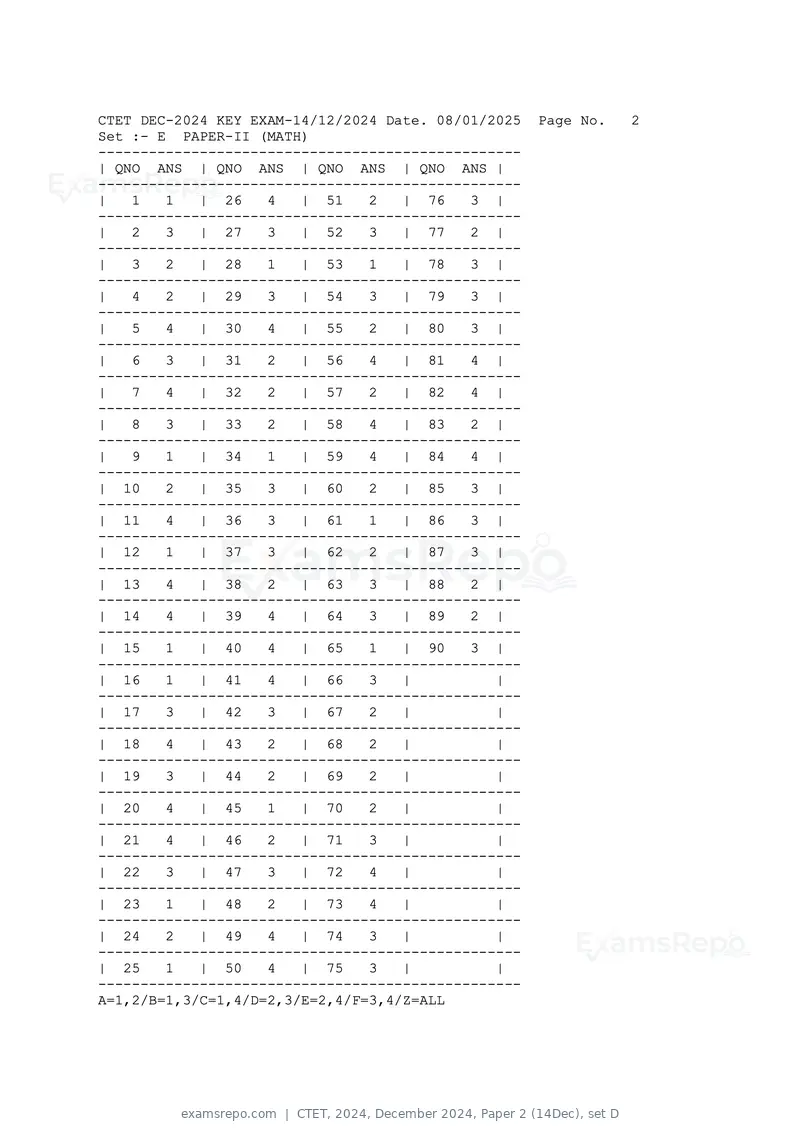
Text of page 2
CTET DEC-2024 KEY EXAM-14/12/2024 Date. 08/01/2025   Page No.   2
Set :- E PAPER-II (MATH)
--------------------------------------------------
| QNO ANS | QNO ANS | QNO ANS | QNO ANS |
--------------------------------------------------
|   1   1   | 26    4   | 51    2   | 76    3 |
--------------------------------------------------
|   2   3   | 27    3   | 52    3   | 77    2 |
--------------------------------------------------
|   3   2   | 28    1   | 53    1   | 78    3 |
--------------------------------------------------
|   4   2   | 29    3   | 54    3   | 79    3 |
--------------------------------------------------
|   5   4   | 30    4   | 55    2   | 80    3 |
--------------------------------------------------
|   6   3   | 31    2   | 56    4   | 81    4 |
--------------------------------------------------
|   7   4   | 32    2   | 57    2   | 82    4 |
--------------------------------------------------
|   8   3   | 33    2   | 58    4   | 83    2 |
--------------------------------------------------
|   9   1   | 34    1   | 59    4   | 84    4 |
--------------------------------------------------
| 10    2   | 35    3   | 60    2   | 85    3 |
--------------------------------------------------
| 11    4   | 36    3   | 61    1   | 86    3 |
--------------------------------------------------
| 12    1   | 37    3   | 62    2   | 87    3 |
--------------------------------------------------
| 13    4   | 38    2   | 63    3   | 88    2 |
--------------------------------------------------
| 14    4   | 39    4   | 64    3   | 89    2 |
--------------------------------------------------
| 15    1   | 40    4   | 65    1   | 90    3 |
--------------------------------------------------
| 16    1   | 41    4   | 66    3   |          |
--------------------------------------------------
| 17    3   | 42    3   | 67    2   |          |
--------------------------------------------------
| 18    4   | 43    2   | 68    2   |          |
--------------------------------------------------
| 19    3   | 44    2   | 69    2   |          |
--------------------------------------------------
| 20    4   | 45    1   | 70    2   |          |
--------------------------------------------------
| 21    4   | 46    2   | 71    3   |          |
--------------------------------------------------
| 22    3   | 47    3   | 72    4   |          |
--------------------------------------------------
| 23    1   | 48    2   | 73    4   |          |
--------------------------------------------------
| 24    2   | 49    4   | 74    3   |          |
--------------------------------------------------
| 25    1   | 50    4   | 75    3   |          |
--------------------------------------------------
A=1,2/B=1,3/C=1,4/D=2,3/E=2,4/F=3,4/Z=ALL
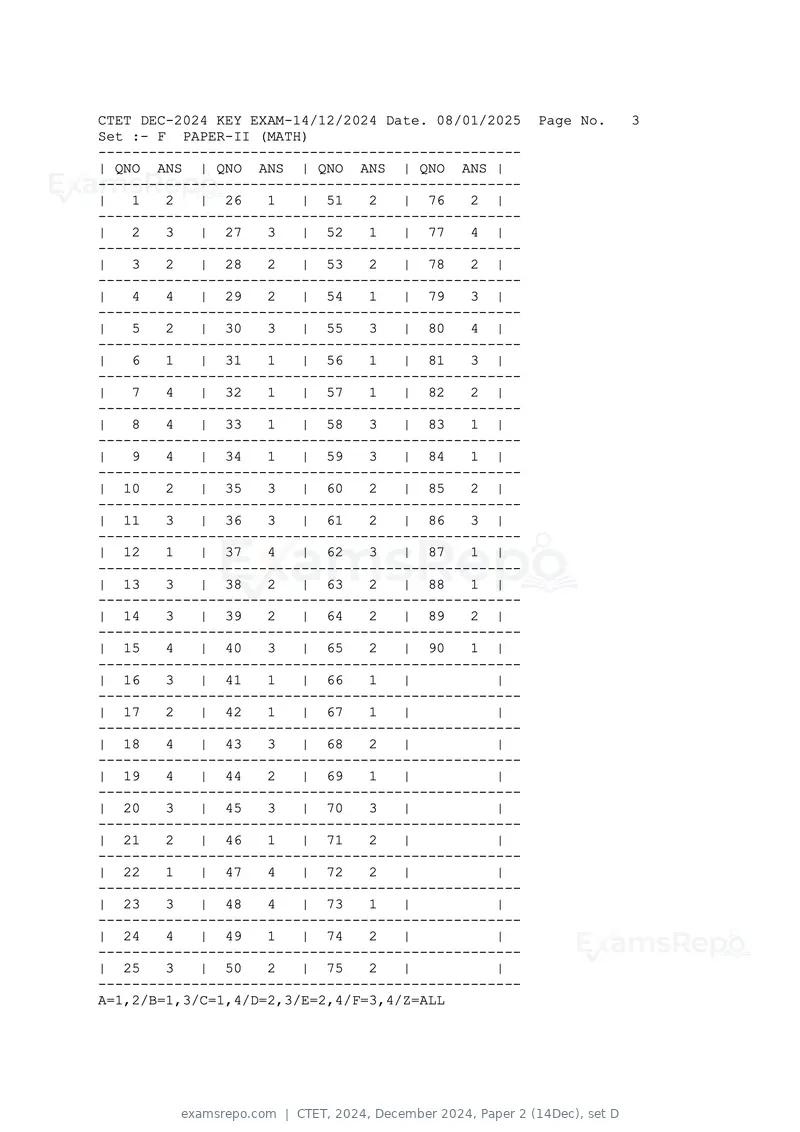
Text of page 3
CTET DEC-2024 KEY EXAM-14/12/2024 Date. 08/01/2025   Page No.   3
Set :- F PAPER-II (MATH)
--------------------------------------------------
| QNO ANS | QNO ANS | QNO ANS | QNO ANS |
--------------------------------------------------
|   1   2   | 26    1   | 51    2   | 76    2 |
--------------------------------------------------
|   2   3   | 27    3   | 52    1   | 77    4 |
--------------------------------------------------
|   3   2   | 28    2   | 53    2   | 78    2 |
--------------------------------------------------
|   4   4   | 29    2   | 54    1   | 79    3 |
--------------------------------------------------
|   5   2   | 30    3   | 55    3   | 80    4 |
--------------------------------------------------
|   6   1   | 31    1   | 56    1   | 81    3 |
--------------------------------------------------
|   7   4   | 32    1   | 57    1   | 82    2 |
--------------------------------------------------
|   8   4   | 33    1   | 58    3   | 83    1 |
--------------------------------------------------
|   9   4   | 34    1   | 59    3   | 84    1 |
--------------------------------------------------
| 10    2   | 35    3   | 60    2   | 85    2 |
--------------------------------------------------
| 11    3   | 36    3   | 61    2   | 86    3 |
--------------------------------------------------
| 12    1   | 37    4   | 62    3   | 87    1 |
--------------------------------------------------
| 13    3   | 38    2   | 63    2   | 88    1 |
--------------------------------------------------
| 14    3   | 39    2   | 64    2   | 89    2 |
--------------------------------------------------
| 15    4   | 40    3   | 65    2   | 90    1 |
--------------------------------------------------
| 16    3   | 41    1   | 66    1   |          |
--------------------------------------------------
| 17    2   | 42    1   | 67    1   |          |
--------------------------------------------------
| 18    4   | 43    3   | 68    2   |          |
--------------------------------------------------
| 19    4   | 44    2   | 69    1   |          |
--------------------------------------------------
| 20    3   | 45    3   | 70    3   |          |
--------------------------------------------------
| 21    2   | 46    1   | 71    2   |          |
--------------------------------------------------
| 22    1   | 47    4   | 72    2   |          |
--------------------------------------------------
| 23    3   | 48    4   | 73    1   |          |
--------------------------------------------------
| 24    4   | 49    1   | 74    2   |          |
--------------------------------------------------
| 25    3   | 50    2   | 75    2   |          |
--------------------------------------------------
A=1,2/B=1,3/C=1,4/D=2,3/E=2,4/F=3,4/Z=ALL
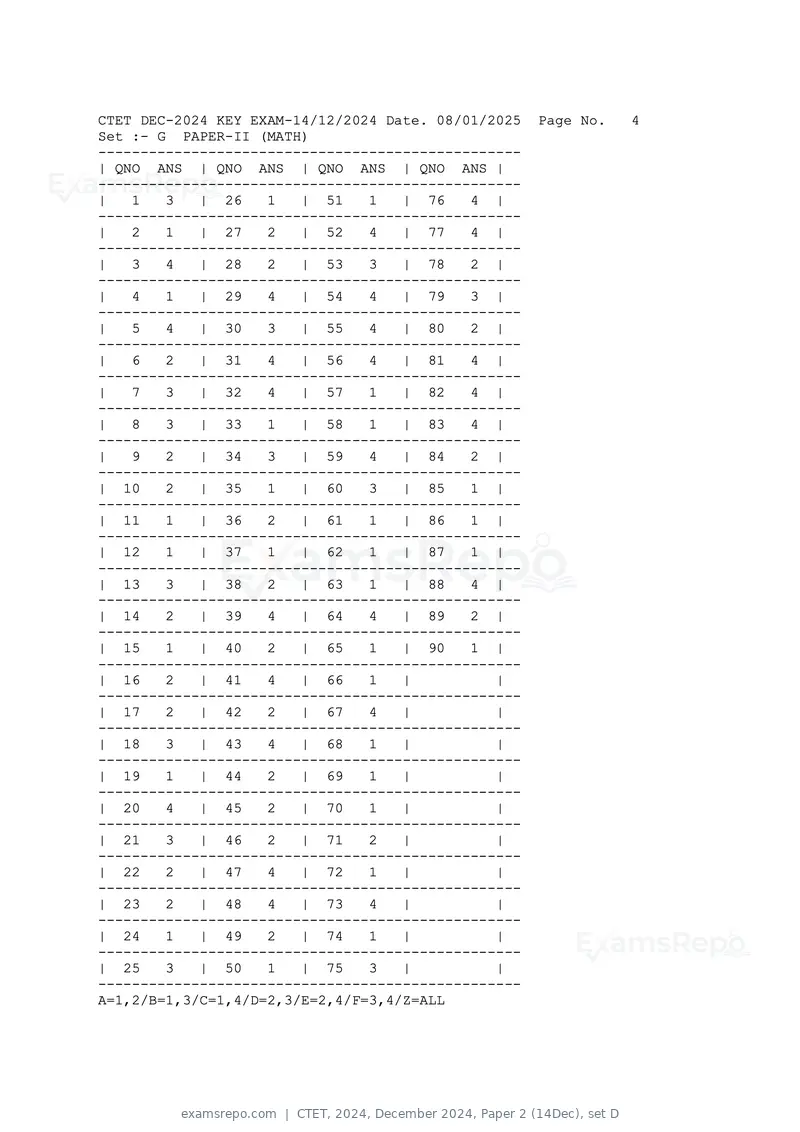
Text of page 4
CTET DEC-2024 KEY EXAM-14/12/2024 Date. 08/01/2025   Page No.   4
Set :- G PAPER-II (MATH)
--------------------------------------------------
| QNO ANS | QNO ANS | QNO ANS | QNO ANS |
--------------------------------------------------
|   1   3   | 26    1   | 51    1   | 76    4 |
--------------------------------------------------
|   2   1   | 27    2   | 52    4   | 77    4 |
--------------------------------------------------
|   3   4   | 28    2   | 53    3   | 78    2 |
--------------------------------------------------
|   4   1   | 29    4   | 54    4   | 79    3 |
--------------------------------------------------
|   5   4   | 30    3   | 55    4   | 80    2 |
--------------------------------------------------
|   6   2   | 31    4   | 56    4   | 81    4 |
--------------------------------------------------
|   7   3   | 32    4   | 57    1   | 82    4 |
--------------------------------------------------
|   8   3   | 33    1   | 58    1   | 83    4 |
--------------------------------------------------
|   9   2   | 34    3   | 59    4   | 84    2 |
--------------------------------------------------
| 10    2   | 35    1   | 60    3   | 85    1 |
--------------------------------------------------
| 11    1   | 36    2   | 61    1   | 86    1 |
--------------------------------------------------
| 12    1   | 37    1   | 62    1   | 87    1 |
--------------------------------------------------
| 13    3   | 38    2   | 63    1   | 88    4 |
--------------------------------------------------
| 14    2   | 39    4   | 64    4   | 89    2 |
--------------------------------------------------
| 15    1   | 40    2   | 65    1   | 90    1 |
--------------------------------------------------
| 16    2   | 41    4   | 66    1   |          |
--------------------------------------------------
| 17    2   | 42    2   | 67    4   |          |
--------------------------------------------------
| 18    3   | 43    4   | 68    1   |          |
--------------------------------------------------
| 19    1   | 44    2   | 69    1   |          |
--------------------------------------------------
| 20    4   | 45    2   | 70    1   |          |
--------------------------------------------------
| 21    3   | 46    2   | 71    2   |          |
--------------------------------------------------
| 22    2   | 47    4   | 72    1   |          |
--------------------------------------------------
| 23    2   | 48    4   | 73    4   |          |
--------------------------------------------------
| 24    1   | 49    2   | 74    1   |          |
--------------------------------------------------
| 25    3   | 50    1   | 75    3   |          |
--------------------------------------------------
A=1,2/B=1,3/C=1,4/D=2,3/E=2,4/F=3,4/Z=ALL
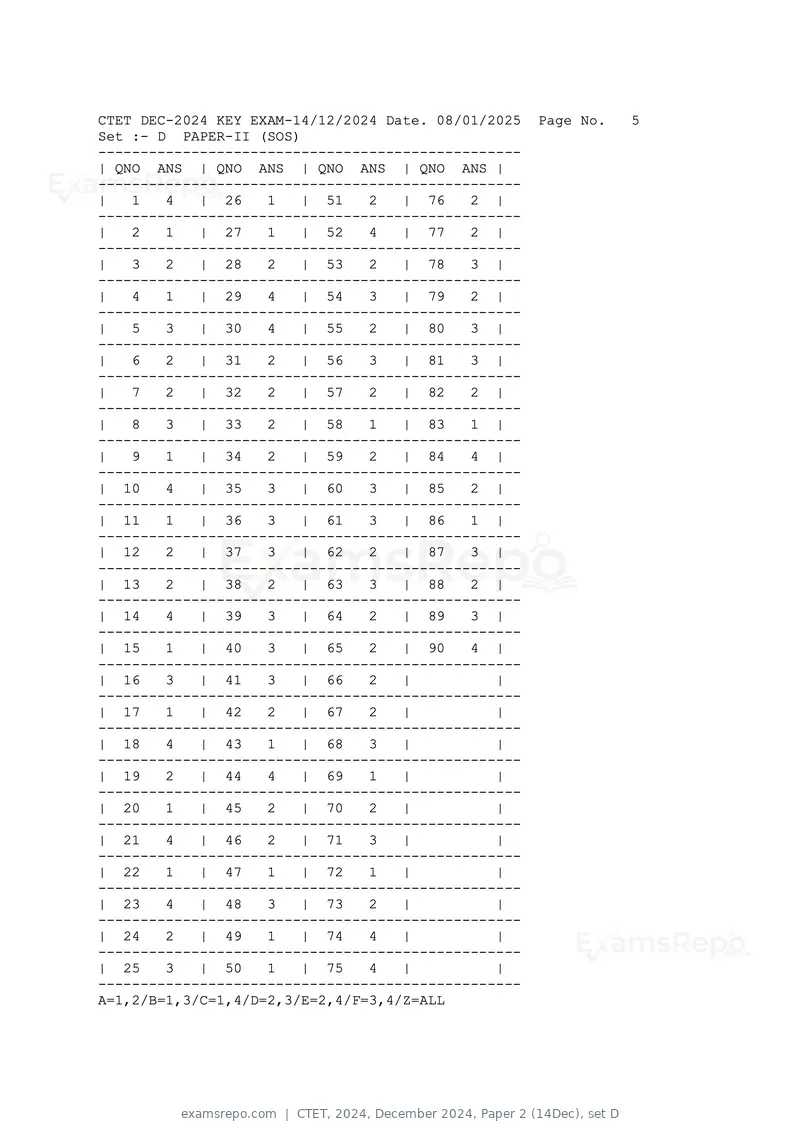
Text of page 5
CTET DEC-2024 KEY EXAM-14/12/2024 Date. 08/01/2025   Page No.   5
Set :- D PAPER-II (SOS)
--------------------------------------------------
| QNO ANS | QNO ANS | QNO ANS | QNO ANS |
--------------------------------------------------
|   1   4   | 26    1   | 51    2   | 76    2 |
--------------------------------------------------
|   2   1   | 27    1   | 52    4   | 77    2 |
--------------------------------------------------
|   3   2   | 28    2   | 53    2   | 78    3 |
--------------------------------------------------
|   4   1   | 29    4   | 54    3   | 79    2 |
--------------------------------------------------
|   5   3   | 30    4   | 55    2   | 80    3 |
--------------------------------------------------
|   6   2   | 31    2   | 56    3   | 81    3 |
--------------------------------------------------
|   7   2   | 32    2   | 57    2   | 82    2 |
--------------------------------------------------
|   8   3   | 33    2   | 58    1   | 83    1 |
--------------------------------------------------
|   9   1   | 34    2   | 59    2   | 84    4 |
--------------------------------------------------
| 10    4   | 35    3   | 60    3   | 85    2 |
--------------------------------------------------
| 11    1   | 36    3   | 61    3   | 86    1 |
--------------------------------------------------
| 12    2   | 37    3   | 62    2   | 87    3 |
--------------------------------------------------
| 13    2   | 38    2   | 63    3   | 88    2 |
--------------------------------------------------
| 14    4   | 39    3   | 64    2   | 89    3 |
--------------------------------------------------
| 15    1   | 40    3   | 65    2   | 90    4 |
--------------------------------------------------
| 16    3   | 41    3   | 66    2   |          |
--------------------------------------------------
| 17    1   | 42    2   | 67    2   |          |
--------------------------------------------------
| 18    4   | 43    1   | 68    3   |          |
--------------------------------------------------
| 19    2   | 44    4   | 69    1   |          |
--------------------------------------------------
| 20    1   | 45    2   | 70    2   |          |
--------------------------------------------------
| 21    4   | 46    2   | 71    3   |          |
--------------------------------------------------
| 22    1   | 47    1   | 72    1   |          |
--------------------------------------------------
| 23    4   | 48    3   | 73    2   |          |
--------------------------------------------------
| 24    2   | 49    1   | 74    4   |          |
--------------------------------------------------
| 25    3   | 50    1   | 75    4   |          |
--------------------------------------------------
A=1,2/B=1,3/C=1,4/D=2,3/E=2,4/F=3,4/Z=ALL
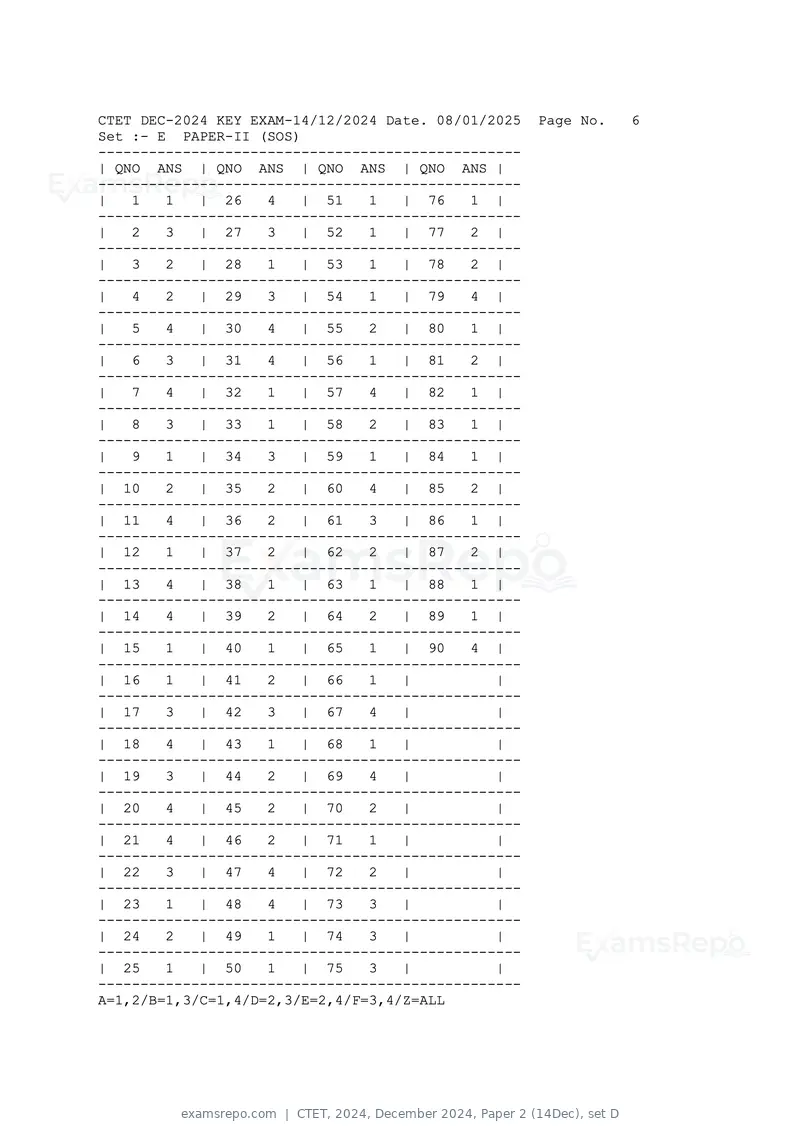
Text of page 6
CTET DEC-2024 KEY EXAM-14/12/2024 Date. 08/01/2025   Page No.   6
Set :- E PAPER-II (SOS)
--------------------------------------------------
| QNO ANS | QNO ANS | QNO ANS | QNO ANS |
--------------------------------------------------
|   1   1   | 26    4   | 51    1   | 76    1 |
--------------------------------------------------
|   2   3   | 27    3   | 52    1   | 77    2 |
--------------------------------------------------
|   3   2   | 28    1   | 53    1   | 78    2 |
--------------------------------------------------
|   4   2   | 29    3   | 54    1   | 79    4 |
--------------------------------------------------
|   5   4   | 30    4   | 55    2   | 80    1 |
--------------------------------------------------
|   6   3   | 31    4   | 56    1   | 81    2 |
--------------------------------------------------
|   7   4   | 32    1   | 57    4   | 82    1 |
--------------------------------------------------
|   8   3   | 33    1   | 58    2   | 83    1 |
--------------------------------------------------
|   9   1   | 34    3   | 59    1   | 84    1 |
--------------------------------------------------
| 10    2   | 35    2   | 60    4   | 85    2 |
--------------------------------------------------
| 11    4   | 36    2   | 61    3   | 86    1 |
--------------------------------------------------
| 12    1   | 37    2   | 62    2   | 87    2 |
--------------------------------------------------
| 13    4   | 38    1   | 63    1   | 88    1 |
--------------------------------------------------
| 14    4   | 39    2   | 64    2   | 89    1 |
--------------------------------------------------
| 15    1   | 40    1   | 65    1   | 90    4 |
--------------------------------------------------
| 16    1   | 41    2   | 66    1   |          |
--------------------------------------------------
| 17    3   | 42    3   | 67    4   |          |
--------------------------------------------------
| 18    4   | 43    1   | 68    1   |          |
--------------------------------------------------
| 19    3   | 44    2   | 69    4   |          |
--------------------------------------------------
| 20    4   | 45    2   | 70    2   |          |
--------------------------------------------------
| 21    4   | 46    2   | 71    1   |          |
--------------------------------------------------
| 22    3   | 47    4   | 72    2   |          |
--------------------------------------------------
| 23    1   | 48    4   | 73    3   |          |
--------------------------------------------------
| 24    2   | 49    1   | 74    3   |          |
--------------------------------------------------
| 25    1   | 50    1   | 75    3   |          |
--------------------------------------------------
A=1,2/B=1,3/C=1,4/D=2,3/E=2,4/F=3,4/Z=ALL
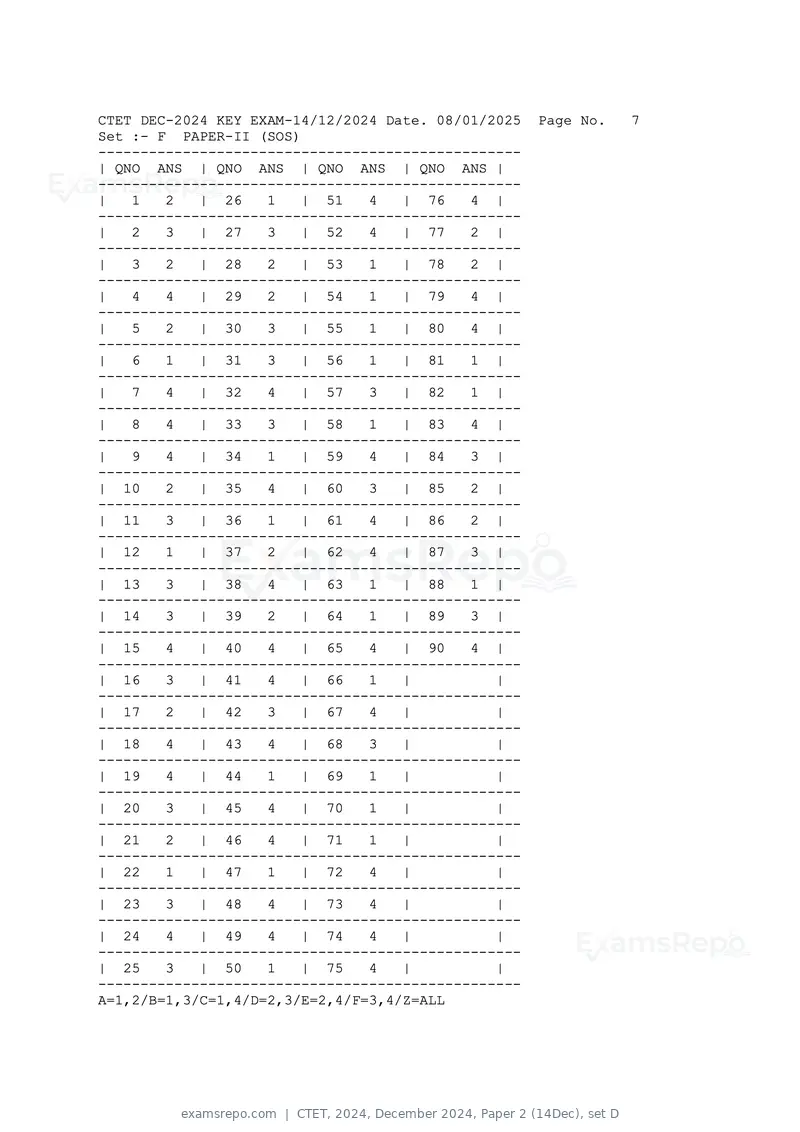
Text of page 7
CTET DEC-2024 KEY EXAM-14/12/2024 Date. 08/01/2025   Page No.   7
Set :- F PAPER-II (SOS)
--------------------------------------------------
| QNO ANS | QNO ANS | QNO ANS | QNO ANS |
--------------------------------------------------
|   1   2   | 26    1   | 51    4   | 76    4 |
--------------------------------------------------
|   2   3   | 27    3   | 52    4   | 77    2 |
--------------------------------------------------
|   3   2   | 28    2   | 53    1   | 78    2 |
--------------------------------------------------
|   4   4   | 29    2   | 54    1   | 79    4 |
--------------------------------------------------
|   5   2   | 30    3   | 55    1   | 80    4 |
--------------------------------------------------
|   6   1   | 31    3   | 56    1   | 81    1 |
--------------------------------------------------
|   7   4   | 32    4   | 57    3   | 82    1 |
--------------------------------------------------
|   8   4   | 33    3   | 58    1   | 83    4 |
--------------------------------------------------
|   9   4   | 34    1   | 59    4   | 84    3 |
--------------------------------------------------
| 10    2   | 35    4   | 60    3   | 85    2 |
--------------------------------------------------
| 11    3   | 36    1   | 61    4   | 86    2 |
--------------------------------------------------
| 12    1   | 37    2   | 62    4   | 87    3 |
--------------------------------------------------
| 13    3   | 38    4   | 63    1   | 88    1 |
--------------------------------------------------
| 14    3   | 39    2   | 64    1   | 89    3 |
--------------------------------------------------
| 15    4   | 40    4   | 65    4   | 90    4 |
--------------------------------------------------
| 16    3   | 41    4   | 66    1   |          |
--------------------------------------------------
| 17    2   | 42    3   | 67    4   |          |
--------------------------------------------------
| 18    4   | 43    4   | 68    3   |          |
--------------------------------------------------
| 19    4   | 44    1   | 69    1   |          |
--------------------------------------------------
| 20    3   | 45    4   | 70    1   |          |
--------------------------------------------------
| 21    2   | 46    4   | 71    1   |          |
--------------------------------------------------
| 22    1   | 47    1   | 72    4   |          |
--------------------------------------------------
| 23    3   | 48    4   | 73    4   |          |
--------------------------------------------------
| 24    4   | 49    4   | 74    4   |          |
--------------------------------------------------
| 25    3   | 50    1   | 75    4   |          |
--------------------------------------------------
A=1,2/B=1,3/C=1,4/D=2,3/E=2,4/F=3,4/Z=ALL
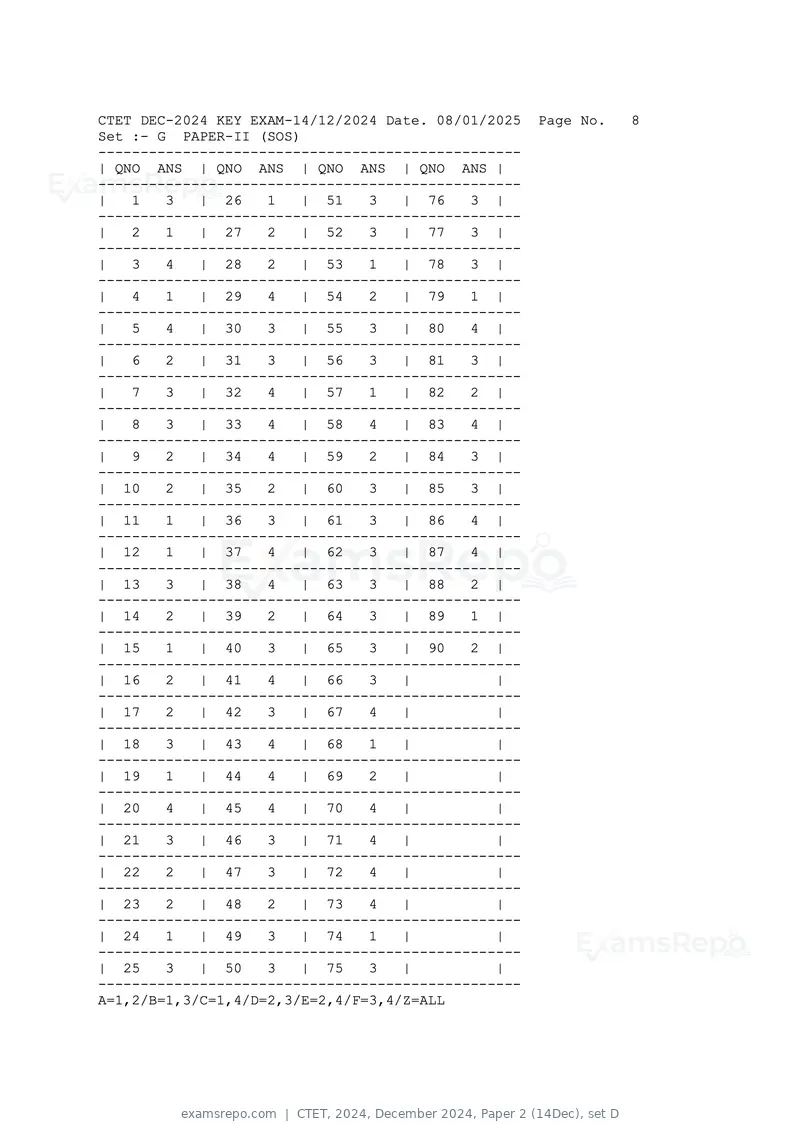
Text of page 8
CTET DEC-2024 KEY EXAM-14/12/2024 Date. 08/01/2025   Page No.   8
Set :- G PAPER-II (SOS)
--------------------------------------------------
| QNO ANS | QNO ANS | QNO ANS | QNO ANS |
--------------------------------------------------
|   1   3   | 26    1   | 51    3   | 76    3 |
--------------------------------------------------
|   2   1   | 27    2   | 52    3   | 77    3 |
--------------------------------------------------
|   3   4   | 28    2   | 53    1   | 78    3 |
--------------------------------------------------
|   4   1   | 29    4   | 54    2   | 79    1 |
--------------------------------------------------
|   5   4   | 30    3   | 55    3   | 80    4 |
--------------------------------------------------
|   6   2   | 31    3   | 56    3   | 81    3 |
--------------------------------------------------
|   7   3   | 32    4   | 57    1   | 82    2 |
--------------------------------------------------
|   8   3   | 33    4   | 58    4   | 83    4 |
--------------------------------------------------
|   9   2   | 34    4   | 59    2   | 84    3 |
--------------------------------------------------
| 10    2   | 35    2   | 60    3   | 85    3 |
--------------------------------------------------
| 11    1   | 36    3   | 61    3   | 86    4 |
--------------------------------------------------
| 12    1   | 37    4   | 62    3   | 87    4 |
--------------------------------------------------
| 13    3   | 38    4   | 63    3   | 88    2 |
--------------------------------------------------
| 14    2   | 39    2   | 64    3   | 89    1 |
--------------------------------------------------
| 15    1   | 40    3   | 65    3   | 90    2 |
--------------------------------------------------
| 16    2   | 41    4   | 66    3   |          |
--------------------------------------------------
| 17    2   | 42    3   | 67    4   |          |
--------------------------------------------------
| 18    3   | 43    4   | 68    1   |          |
--------------------------------------------------
| 19    1   | 44    4   | 69    2   |          |
--------------------------------------------------
| 20    4   | 45    4   | 70    4   |          |
--------------------------------------------------
| 21    3   | 46    3   | 71    4   |          |
--------------------------------------------------
| 22    2   | 47    3   | 72    4   |          |
--------------------------------------------------
| 23    2   | 48    2   | 73    4   |          |
--------------------------------------------------
| 24    1   | 49    3   | 74    1   |          |
--------------------------------------------------
| 25    3   | 50    3   | 75    3   |          |
--------------------------------------------------
A=1,2/B=1,3/C=1,4/D=2,3/E=2,4/F=3,4/Z=ALL
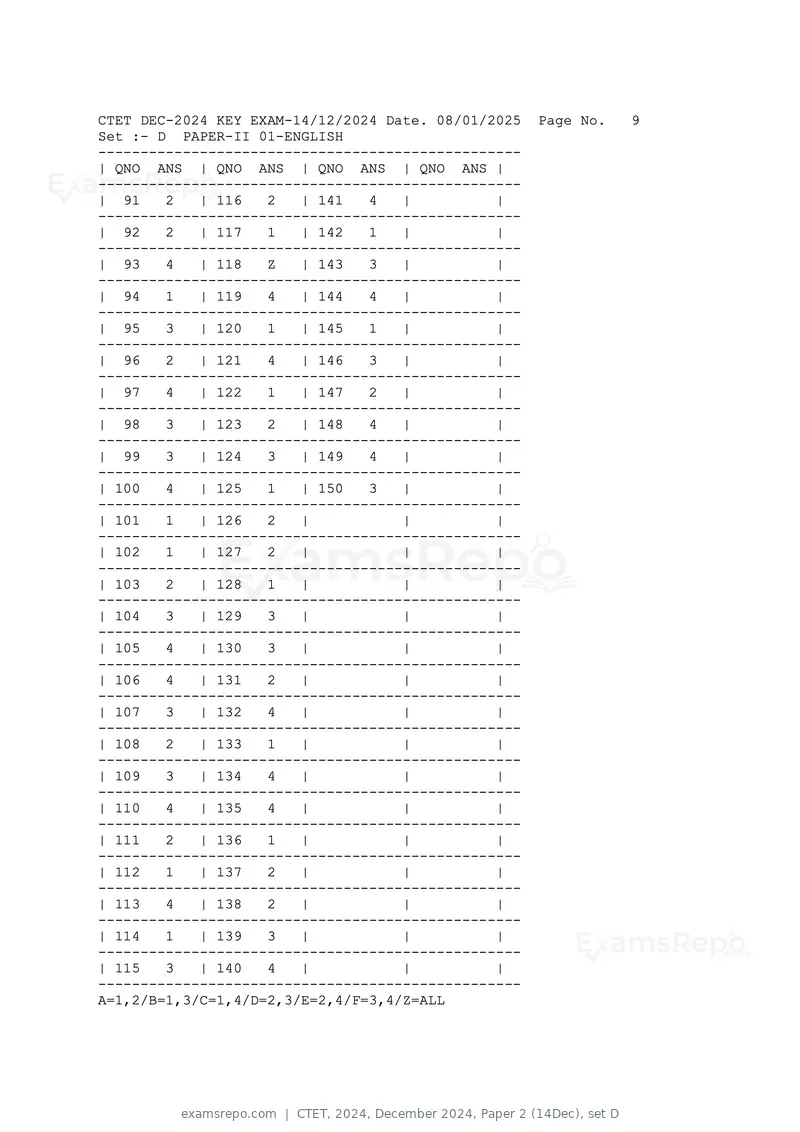
Text of page 9
CTET DEC-2024 KEY EXAM-14/12/2024 Date. 08/01/2025   Page No.   9
Set :- D PAPER-II 01-ENGLISH
--------------------------------------------------
| QNO ANS | QNO ANS | QNO ANS | QNO ANS |
--------------------------------------------------
| 91    2   | 116   2   | 141   4   |          |
--------------------------------------------------
| 92    2   | 117   1   | 142   1   |          |
--------------------------------------------------
| 93    4   | 118   Z   | 143   3   |          |
--------------------------------------------------
| 94    1   | 119   4   | 144   4   |          |
--------------------------------------------------
| 95    3   | 120   1   | 145   1   |          |
--------------------------------------------------
| 96    2   | 121   4   | 146   3   |          |
--------------------------------------------------
| 97    4   | 122   1   | 147   2   |          |
--------------------------------------------------
| 98    3   | 123   2   | 148   4   |          |
--------------------------------------------------
| 99    3   | 124   3   | 149   4   |          |
--------------------------------------------------
| 100   4   | 125   1   | 150   3   |          |
--------------------------------------------------
| 101   1   | 126   2   |           |          |
--------------------------------------------------
| 102   1   | 127   2   |           |          |
--------------------------------------------------
| 103   2   | 128   1   |           |          |
--------------------------------------------------
| 104   3   | 129   3   |           |          |
--------------------------------------------------
| 105   4   | 130   3   |           |          |
--------------------------------------------------
| 106   4   | 131   2   |           |          |
--------------------------------------------------
| 107   3   | 132   4   |           |          |
--------------------------------------------------
| 108   2   | 133   1   |           |          |
--------------------------------------------------
| 109   3   | 134   4   |           |          |
--------------------------------------------------
| 110   4   | 135   4   |           |          |
--------------------------------------------------
| 111   2   | 136   1   |           |          |
--------------------------------------------------
| 112   1   | 137   2   |           |          |
--------------------------------------------------
| 113   4   | 138   2   |           |          |
--------------------------------------------------
| 114   1   | 139   3   |           |          |
--------------------------------------------------
| 115   3   | 140   4   |           |          |
--------------------------------------------------
A=1,2/B=1,3/C=1,4/D=2,3/E=2,4/F=3,4/Z=ALL

Text of page 10
CTET DEC-2024 KEY EXAM-14/12/2024 Date. 08/01/2025   Page No.   10
Set :- E PAPER-II 01-ENGLISH
--------------------------------------------------
| QNO ANS | QNO ANS | QNO ANS | QNO ANS |
--------------------------------------------------
| 91    4   | 116   2   | 141   3   |          |
--------------------------------------------------
| 92    3   | 117   3   | 142   3   |          |
--------------------------------------------------
| 93    1   | 118   4   | 143   2   |          |
--------------------------------------------------
| 94    4   | 119   4   | 144   4   |          |
--------------------------------------------------
| 95    2   | 120   4   | 145   2   |          |
--------------------------------------------------
| 96    1   | 121   4   | 146   1   |          |
--------------------------------------------------
| 97    2   | 122   1   | 147   4   |          |
--------------------------------------------------
| 98    2   | 123   1   | 148   3   |          |
--------------------------------------------------
| 99    1   | 124   4   | 149   3   |          |
--------------------------------------------------
| 100   4   | 125   3   | 150   4   |          |
--------------------------------------------------
| 101   3   | 126   2   |           |          |
--------------------------------------------------
| 102   4   | 127   1   |           |          |
--------------------------------------------------
| 103   2   | 128   1   |           |          |
--------------------------------------------------
| 104   3   | 129   3   |           |          |
--------------------------------------------------
| 105   1   | 130   4   |           |          |
--------------------------------------------------
| 106   2   | 131   2   |           |          |
--------------------------------------------------
| 107   3   | 132   1   |           |          |
--------------------------------------------------
| 108   1   | 133   2   |           |          |
--------------------------------------------------
| 109   1   | 134   3   |           |          |
--------------------------------------------------
| 110   Z   | 135   3   |           |          |
--------------------------------------------------
| 111   3   | 136   3   |           |          |
--------------------------------------------------
| 112   4   | 137   1   |           |          |
--------------------------------------------------
| 113   2   | 138   1   |           |          |
--------------------------------------------------
| 114   3   | 139   2   |           |          |
--------------------------------------------------
| 115   1   | 140   2   |           |          |
--------------------------------------------------
A=1,2/B=1,3/C=1,4/D=2,3/E=2,4/F=3,4/Z=ALL

Text of page 11
CTET DEC-2024 KEY EXAM-14/12/2024 Date. 08/01/2025   Page No.   11
Set :- F PAPER-II 01-ENGLISH
--------------------------------------------------
| QNO ANS | QNO ANS | QNO ANS | QNO ANS |
--------------------------------------------------
| 91    4   | 116   3   | 141   4   |          |
--------------------------------------------------
| 92    4   | 117   4   | 142   2   |          |
--------------------------------------------------
| 93    1   | 118   3   | 143   2   |          |
--------------------------------------------------
| 94    4   | 119   4   | 144   2   |          |
--------------------------------------------------
| 95    1   | 120   3   | 145   4   |          |
--------------------------------------------------
| 96    4   | 121   3   | 146   1   |          |
--------------------------------------------------
| 97    2   | 122   2   | 147   3   |          |
--------------------------------------------------
| 98    3   | 123   4   | 148   2   |          |
--------------------------------------------------
| 99    1   | 124   1   | 149   1   |          |
--------------------------------------------------
| 100   2   | 125   4   | 150   3   |          |
--------------------------------------------------
| 101   3   | 126   4   |           |          |
--------------------------------------------------
| 102   3   | 127   1   |           |          |
--------------------------------------------------
| 103   2   | 128   3   |           |          |
--------------------------------------------------
| 104   1   | 129   3   |           |          |
--------------------------------------------------
| 105   4   | 130   1   |           |          |
--------------------------------------------------
| 106   2   | 131   2   |           |          |
--------------------------------------------------
| 107   3   | 132   1   |           |          |
--------------------------------------------------
| 108   1   | 133   2   |           |          |
--------------------------------------------------
| 109   1   | 134   4   |           |          |
--------------------------------------------------
| 110   2   | 135   2   |           |          |
--------------------------------------------------
| 111   1   | 136   4   |           |          |
--------------------------------------------------
| 112   Z   | 137   2   |           |          |
--------------------------------------------------
| 113   2   | 138   1   |           |          |
--------------------------------------------------
| 114   4   | 139   1   |           |          |
--------------------------------------------------
| 115   2   | 140   3   |           |          |
--------------------------------------------------
A=1,2/B=1,3/C=1,4/D=2,3/E=2,4/F=3,4/Z=ALL

Text of page 12
CTET DEC-2024 KEY EXAM-14/12/2024 Date. 08/01/2025   Page No.   12
Set :- G PAPER-II 01-ENGLISH
--------------------------------------------------
| QNO ANS | QNO ANS | QNO ANS | QNO ANS |
--------------------------------------------------
| 91    4   | 116   2   | 141   1   |          |
--------------------------------------------------
| 92    2   | 117   3   | 142   4   |          |
--------------------------------------------------
| 93    3   | 118   4   | 143   2   |          |
--------------------------------------------------
| 94    1   | 119   1   | 144   1   |          |
--------------------------------------------------
| 95    3   | 120   1   | 145   1   |          |
--------------------------------------------------
| 96    3   | 121   3   | 146   3   |          |
--------------------------------------------------
| 97    4   | 122   2   | 147   2   |          |
--------------------------------------------------
| 98    4   | 123   4   | 148   1   |          |
--------------------------------------------------
| 99    4   | 124   1   | 149   1   |          |
--------------------------------------------------
| 100   1   | 125   1   | 150   3   |          |
--------------------------------------------------
| 101   1   | 126   3   |           |          |
--------------------------------------------------
| 102   2   | 127   2   |           |          |
--------------------------------------------------
| 103   2   | 128   3   |           |          |
--------------------------------------------------
| 104   3   | 129   1   |           |          |
--------------------------------------------------
| 105   4   | 130   4   |           |          |
--------------------------------------------------
| 106   4   | 131   1   |           |          |
--------------------------------------------------
| 107   Z   | 132   1   |           |          |
--------------------------------------------------
| 108   2   | 133   2   |           |          |
--------------------------------------------------
| 109   2   | 134   3   |           |          |
--------------------------------------------------
| 110   3   | 135   4   |           |          |
--------------------------------------------------
| 111   1   | 136   3   |           |          |
--------------------------------------------------
| 112   2   | 137   4   |           |          |
--------------------------------------------------
| 113   3   | 138   4   |           |          |
--------------------------------------------------
| 114   1   | 139   2   |           |          |
--------------------------------------------------
| 115   4   | 140   4   |           |          |
--------------------------------------------------
A=1,2/B=1,3/C=1,4/D=2,3/E=2,4/F=3,4/Z=ALL

Text of page 13
CTET DEC-2024 KEY EXAM-14/12/2024 Date. 08/01/2025   Page No.   13
Set :- D PAPER-II 02-HINDI
--------------------------------------------------
| QNO ANS | QNO ANS | QNO ANS | QNO ANS |
--------------------------------------------------
| 91    4   | 116   2   | 141   4   |          |
--------------------------------------------------
| 92    1   | 117   1   | 142   1   |          |
--------------------------------------------------
| 93    1   | 118   Z   | 143   3   |          |
--------------------------------------------------
| 94    2   | 119   4   | 144   4   |          |
--------------------------------------------------
| 95    3   | 120   1   | 145   1   |          |
--------------------------------------------------
| 96    2   | 121   4   | 146   3   |          |
--------------------------------------------------
| 97    3   | 122   3   | 147   2   |          |
--------------------------------------------------
| 98    2   | 123   1   | 148   4   |          |
--------------------------------------------------
| 99    4   | 124   2   | 149   4   |          |
--------------------------------------------------
| 100   3   | 125   4   | 150   3   |          |
--------------------------------------------------
| 101   3   | 126   1   |           |          |
--------------------------------------------------
| 102   4   | 127   2   |           |          |
--------------------------------------------------
| 103   2   | 128   4   |           |          |
--------------------------------------------------
| 104   1   | 129   1   |           |          |
--------------------------------------------------
| 105   4   | 130   3   |           |          |
--------------------------------------------------
| 106   4   | 131   2   |           |          |
--------------------------------------------------
| 107   3   | 132   2   |           |          |
--------------------------------------------------
| 108   2   | 133   1   |           |          |
--------------------------------------------------
| 109   3   | 134   4   |           |          |
--------------------------------------------------
| 110   4   | 135   4   |           |          |
--------------------------------------------------
| 111   2   | 136   1   |           |          |
--------------------------------------------------
| 112   1   | 137   2   |           |          |
--------------------------------------------------
| 113   4   | 138   2   |           |          |
--------------------------------------------------
| 114   1   | 139   3   |           |          |
--------------------------------------------------
| 115   3   | 140   4   |           |          |
--------------------------------------------------
A=1,2/B=1,3/C=1,4/D=2,3/E=2,4/F=3,4/Z=ALL

Text of page 14
CTET DEC-2024 KEY EXAM-14/12/2024 Date. 08/01/2025   Page No.   14
Set :- E PAPER-II 02-HINDI
--------------------------------------------------
| QNO ANS | QNO ANS | QNO ANS | QNO ANS |
--------------------------------------------------
| 91    1   | 116   2   | 141   3   |          |
--------------------------------------------------
| 92    2   | 117   3   | 142   3   |          |
--------------------------------------------------
| 93    1   | 118   4   | 143   2   |          |
--------------------------------------------------
| 94    4   | 119   4   | 144   4   |          |
--------------------------------------------------
| 95    2   | 120   4   | 145   2   |          |
--------------------------------------------------
| 96    3   | 121   2   | 146   1   |          |
--------------------------------------------------
| 97    3   | 122   4   | 147   4   |          |
--------------------------------------------------
| 98    1   | 123   1   | 148   3   |          |
--------------------------------------------------
| 99    4   | 124   3   | 149   3   |          |
--------------------------------------------------
| 100   3   | 125   3   | 150   4   |          |
--------------------------------------------------
| 101   2   | 126   1   |           |          |
--------------------------------------------------
| 102   2   | 127   3   |           |          |
--------------------------------------------------
| 103   4   | 128   4   |           |          |
--------------------------------------------------
| 104   3   | 129   3   |           |          |
--------------------------------------------------
| 105   1   | 130   4   |           |          |
--------------------------------------------------
| 106   2   | 131   2   |           |          |
--------------------------------------------------
| 107   3   | 132   1   |           |          |
--------------------------------------------------
| 108   1   | 133   4   |           |          |
--------------------------------------------------
| 109   1   | 134   3   |           |          |
--------------------------------------------------
| 110   Z   | 135   1   |           |          |
--------------------------------------------------
| 111   3   | 136   3   |           |          |
--------------------------------------------------
| 112   4   | 137   1   |           |          |
--------------------------------------------------
| 113   2   | 138   1   |           |          |
--------------------------------------------------
| 114   3   | 139   2   |           |          |
--------------------------------------------------
| 115   1   | 140   2   |           |          |
--------------------------------------------------
A=1,2/B=1,3/C=1,4/D=2,3/E=2,4/F=3,4/Z=ALL

Text of page 15
CTET DEC-2024 KEY EXAM-14/12/2024 Date. 08/01/2025   Page No.   15
Set :- F PAPER-II 02-HINDI
--------------------------------------------------
| QNO ANS | QNO ANS | QNO ANS | QNO ANS |
--------------------------------------------------
| 91    2   | 116   3   | 141   4   |          |
--------------------------------------------------
| 92    4   | 117   4   | 142   2   |          |
--------------------------------------------------
| 93    2   | 118   3   | 143   2   |          |
--------------------------------------------------
| 94    3   | 119   4   | 144   2   |          |
--------------------------------------------------
| 95    1   | 120   3   | 145   4   |          |
--------------------------------------------------
| 96    3   | 121   2   | 146   1   |          |
--------------------------------------------------
| 97    1   | 122   2   | 147   3   |          |
--------------------------------------------------
| 98    4   | 123   3   | 148   2   |          |
--------------------------------------------------
| 99    4   | 124   2   | 149   1   |          |
--------------------------------------------------
| 100   1   | 125   4   | 150   3   |          |
--------------------------------------------------
| 101   1   | 126   3   |           |          |
--------------------------------------------------
| 102   2   | 127   4   |           |          |
--------------------------------------------------
| 103   2   | 128   1   |           |          |
--------------------------------------------------
| 104   3   | 129   3   |           |          |
--------------------------------------------------
| 105   4   | 130   1   |           |          |
--------------------------------------------------
| 106   2   | 131   2   |           |          |
--------------------------------------------------
| 107   3   | 132   3   |           |          |
--------------------------------------------------
| 108   1   | 133   4   |           |          |
--------------------------------------------------
| 109   1   | 134   4   |           |          |
--------------------------------------------------
| 110   2   | 135   2   |           |          |
--------------------------------------------------
| 111   1   | 136   4   |           |          |
--------------------------------------------------
| 112   Z   | 137   2   |           |          |
--------------------------------------------------
| 113   2   | 138   1   |           |          |
--------------------------------------------------
| 114   4   | 139   1   |           |          |
--------------------------------------------------
| 115   2   | 140   3   |           |          |
--------------------------------------------------
A=1,2/B=1,3/C=1,4/D=2,3/E=2,4/F=3,4/Z=ALL

Text of page 16
CTET DEC-2024 KEY EXAM-14/12/2024 Date. 08/01/2025   Page No.   16
Set :- G PAPER-II 02-HINDI
--------------------------------------------------
| QNO ANS | QNO ANS | QNO ANS | QNO ANS |
--------------------------------------------------
| 91    4   | 116   2   | 141   1   |          |
--------------------------------------------------
| 92    3   | 117   3   | 142   4   |          |
--------------------------------------------------
| 93    2   | 118   4   | 143   2   |          |
--------------------------------------------------
| 94    4   | 119   1   | 144   1   |          |
--------------------------------------------------
| 95    3   | 120   1   | 145   1   |          |
--------------------------------------------------
| 96    1   | 121   2   | 146   3   |          |
--------------------------------------------------
| 97    1   | 122   1   | 147   2   |          |
--------------------------------------------------
| 98    3   | 123   3   | 148   1   |          |
--------------------------------------------------
| 99    2   | 124   1   | 149   1   |          |
--------------------------------------------------
| 100   4   | 125   1   | 150   3   |          |
--------------------------------------------------
| 101   1   | 126   2   |           |          |
--------------------------------------------------
| 102   4   | 127   4   |           |          |
--------------------------------------------------
| 103   1   | 128   3   |           |          |
--------------------------------------------------
| 104   3   | 129   1   |           |          |
--------------------------------------------------
| 105   2   | 130   2   |           |          |
--------------------------------------------------
| 106   4   | 131   3   |           |          |
--------------------------------------------------
| 107   Z   | 132   1   |           |          |
--------------------------------------------------
| 108   2   | 133   2   |           |          |
--------------------------------------------------
| 109   2   | 134   3   |           |          |
--------------------------------------------------
| 110   3   | 135   4   |           |          |
--------------------------------------------------
| 111   1   | 136   3   |           |          |
--------------------------------------------------
| 112   2   | 137   4   |           |          |
--------------------------------------------------
| 113   3   | 138   4   |           |          |
--------------------------------------------------
| 114   1   | 139   2   |           |          |
--------------------------------------------------
| 115   4   | 140   4   |           |          |
--------------------------------------------------
A=1,2/B=1,3/C=1,4/D=2,3/E=2,4/F=3,4/Z=ALL

Text of page 17
CTET DEC-2024 KEY EXAM-14/12/2024 Date. 08/01/2025   Page No.   17
Set :- D PAPER-II 03-ASSAMESE
--------------------------------------------------
| QNO ANS | QNO ANS | QNO ANS | QNO ANS |
--------------------------------------------------
| 91    3   | 116   2   | 141   4   |          |
--------------------------------------------------
| 92    2   | 117   1   | 142   1   |          |
--------------------------------------------------
| 93    1   | 118   Z   | 143   3   |          |
--------------------------------------------------
| 94    4   | 119   4   | 144   4   |          |
--------------------------------------------------
| 95    3   | 120   1   | 145   1   |          |
--------------------------------------------------
| 96    3   | 121   4   | 146   3   |          |
--------------------------------------------------
| 97    2   | 122   4   | 147   2   |          |
--------------------------------------------------
| 98    1   | 123   4   | 148   4   |          |
--------------------------------------------------
| 99    4   | 124   1   | 149   4   |          |
--------------------------------------------------
| 100   3   | 125   2   | 150   3   |          |
--------------------------------------------------
| 101   3   | 126   3   |           |          |
--------------------------------------------------
| 102   4   | 127   2   |           |          |
--------------------------------------------------
| 103   3   | 128   3   |           |          |
--------------------------------------------------
| 104   4   | 129   4   |           |          |
--------------------------------------------------
| 105   1   | 130   1   |           |          |
--------------------------------------------------
| 106   4   | 131   3   |           |          |
--------------------------------------------------
| 107   3   | 132   3   |           |          |
--------------------------------------------------
| 108   2   | 133   2   |           |          |
--------------------------------------------------
| 109   3   | 134   4   |           |          |
--------------------------------------------------
| 110   4   | 135   4   |           |          |
--------------------------------------------------
| 111   2   | 136   1   |           |          |
--------------------------------------------------
| 112   1   | 137   2   |           |          |
--------------------------------------------------
| 113   4   | 138   2   |           |          |
--------------------------------------------------
| 114   1   | 139   3   |           |          |
--------------------------------------------------
| 115   3   | 140   4   |           |          |
--------------------------------------------------
A=1,2/B=1,3/C=1,4/D=2,3/E=2,4/F=3,4/Z=ALL

Text of page 18
CTET DEC-2024 KEY EXAM-14/12/2024 Date. 08/01/2025   Page No.   18
Set :- E PAPER-II 03-ASSAMESE
--------------------------------------------------
| QNO ANS | QNO ANS | QNO ANS | QNO ANS |
--------------------------------------------------
| 91    3   | 116   2   | 141   3   |          |
--------------------------------------------------
| 92    1   | 117   3   | 142   3   |          |
--------------------------------------------------
| 93    2   | 118   4   | 143   2   |          |
--------------------------------------------------
| 94    1   | 119   4   | 144   4   |          |
--------------------------------------------------
| 95    2   | 120   4   | 145   2   |          |
--------------------------------------------------
| 96    2   | 121   3   | 146   1   |          |
--------------------------------------------------
| 97    3   | 122   2   | 147   4   |          |
--------------------------------------------------
| 98    4   | 123   1   | 148   3   |          |
--------------------------------------------------
| 99    1   | 124   2   | 149   3   |          |
--------------------------------------------------
| 100   3   | 125   3   | 150   4   |          |
--------------------------------------------------
| 101   2   | 126   4   |           |          |
--------------------------------------------------
| 102   2   | 127   2   |           |          |
--------------------------------------------------
| 103   3   | 128   3   |           |          |
--------------------------------------------------
| 104   4   | 129   3   |           |          |
--------------------------------------------------
| 105   2   | 130   1   |           |          |
--------------------------------------------------
| 106   2   | 131   4   |           |          |
--------------------------------------------------
| 107   3   | 132   2   |           |          |
--------------------------------------------------
| 108   1   | 133   3   |           |          |
--------------------------------------------------
| 109   1   | 134   3   |           |          |
--------------------------------------------------
| 110   Z   | 135   2   |           |          |
--------------------------------------------------
| 111   3   | 136   3   |           |          |
--------------------------------------------------
| 112   4   | 137   1   |           |          |
--------------------------------------------------
| 113   2   | 138   1   |           |          |
--------------------------------------------------
| 114   3   | 139   2   |           |          |
--------------------------------------------------
| 115   1   | 140   2   |           |          |
--------------------------------------------------
A=1,2/B=1,3/C=1,4/D=2,3/E=2,4/F=3,4/Z=ALL

Text of page 19
CTET DEC-2024 KEY EXAM-14/12/2024 Date. 08/01/2025   Page No.   19
Set :- F PAPER-II 03-ASSAMESE
--------------------------------------------------
| QNO ANS | QNO ANS | QNO ANS | QNO ANS |
--------------------------------------------------
| 91    1   | 116   3   | 141   4   |          |
--------------------------------------------------
| 92    1   | 117   4   | 142   2   |          |
--------------------------------------------------
| 93    2   | 118   3   | 143   2   |          |
--------------------------------------------------
| 94    4   | 119   4   | 144   2   |          |
--------------------------------------------------
| 95    1   | 120   3   | 145   4   |          |
--------------------------------------------------
| 96    1   | 121   1   | 146   1   |          |
--------------------------------------------------
| 97    4   | 122   2   | 147   3   |          |
--------------------------------------------------
| 98    2   | 123   1   | 148   2   |          |
--------------------------------------------------
| 99    3   | 124   2   | 149   1   |          |
--------------------------------------------------
| 100   1   | 125   4   | 150   3   |          |
--------------------------------------------------
| 101   1   | 126   2   |           |          |
--------------------------------------------------
| 102   2   | 127   3   |           |          |
--------------------------------------------------
| 103   3   | 128   2   |           |          |
--------------------------------------------------
| 104   2   | 129   4   |           |          |
--------------------------------------------------
| 105   1   | 130   3   |           |          |
--------------------------------------------------
| 106   2   | 131   2   |           |          |
--------------------------------------------------
| 107   3   | 132   2   |           |          |
--------------------------------------------------
| 108   1   | 133   1   |           |          |
--------------------------------------------------
| 109   1   | 134   1   |           |          |
--------------------------------------------------
| 110   2   | 135   2   |           |          |
--------------------------------------------------
| 111   1   | 136   4   |           |          |
--------------------------------------------------
| 112   Z   | 137   2   |           |          |
--------------------------------------------------
| 113   2   | 138   1   |           |          |
--------------------------------------------------
| 114   4   | 139   1   |           |          |
--------------------------------------------------
| 115   2   | 140   3   |           |          |
--------------------------------------------------
A=1,2/B=1,3/C=1,4/D=2,3/E=2,4/F=3,4/Z=ALL

Text of page 20
CTET DEC-2024 KEY EXAM-14/12/2024 Date. 08/01/2025   Page No.   20
Set :- G PAPER-II 03-ASSAMESE
--------------------------------------------------
| QNO ANS | QNO ANS | QNO ANS | QNO ANS |
--------------------------------------------------
| 91    4   | 116   2   | 141   1   |          |
--------------------------------------------------
| 92    1   | 117   3   | 142   4   |          |
--------------------------------------------------
| 93    3   | 118   4   | 143   2   |          |
--------------------------------------------------
| 94    3   | 119   1   | 144   1   |          |
--------------------------------------------------
| 95    4   | 120   1   | 145   1   |          |
--------------------------------------------------
| 96    4   | 121   1   | 146   3   |          |
--------------------------------------------------
| 97    1   | 122   4   | 147   2   |          |
--------------------------------------------------
| 98    2   | 123   2   | 148   1   |          |
--------------------------------------------------
| 99    1   | 124   2   | 149   1   |          |
--------------------------------------------------
| 100   4   | 125   1   | 150   3   |          |
--------------------------------------------------
| 101   2   | 126   4   |           |          |
--------------------------------------------------
| 102   4   | 127   1   |           |          |
--------------------------------------------------
| 103   1   | 128   3   |           |          |
--------------------------------------------------
| 104   4   | 129   1   |           |          |
--------------------------------------------------
| 105   1   | 130   1   |           |          |
--------------------------------------------------
| 106   4   | 131   4   |           |          |
--------------------------------------------------
| 107   Z   | 132   1   |           |          |
--------------------------------------------------
| 108   2   | 133   3   |           |          |
--------------------------------------------------
| 109   2   | 134   4   |           |          |
--------------------------------------------------
| 110   3   | 135   2   |           |          |
--------------------------------------------------
| 111   1   | 136   3   |           |          |
--------------------------------------------------
| 112   2   | 137   4   |           |          |
--------------------------------------------------
| 113   3   | 138   4   |           |          |
--------------------------------------------------
| 114   1   | 139   2   |           |          |
--------------------------------------------------
| 115   4   | 140   4   |           |          |
--------------------------------------------------
A=1,2/B=1,3/C=1,4/D=2,3/E=2,4/F=3,4/Z=ALL
Text of page 21
CTET DEC-2024 KEY EXAM-14/12/2024 Date. 08/01/2025   Page No.   21
Set :- D PAPER-II 04-BENGALI
--------------------------------------------------
| QNO ANS | QNO ANS | QNO ANS | QNO ANS |
--------------------------------------------------
| 91    2   | 116   2   | 141   4   |          |
--------------------------------------------------
| 92    3   | 117   1   | 142   1   |          |
--------------------------------------------------
| 93    4   | 118   Z   | 143   3   |          |
--------------------------------------------------
| 94    3   | 119   4   | 144   4   |          |
--------------------------------------------------
| 95    1   | 120   1   | 145   1   |          |
--------------------------------------------------
| 96    3   | 121   4   | 146   3   |          |
--------------------------------------------------
| 97    4   | 122   3   | 147   2   |          |
--------------------------------------------------
| 98    2   | 123   1   | 148   4   |          |
--------------------------------------------------
| 99    4   | 124   3   | 149   4   |          |
--------------------------------------------------
| 100   3   | 125   3   | 150   3   |          |
--------------------------------------------------
| 101   3   | 126   3   |           |          |
--------------------------------------------------
| 102   4   | 127   2   |           |          |
--------------------------------------------------
| 103   4   | 128   2   |           |          |
--------------------------------------------------
| 104   1   | 129   4   |           |          |
--------------------------------------------------
| 105   2   | 130   3   |           |          |
--------------------------------------------------
| 106   4   | 131   2   |           |          |
--------------------------------------------------
| 107   3   | 132   3   |           |          |
--------------------------------------------------
| 108   2   | 133   1   |           |          |
--------------------------------------------------
| 109   3   | 134   4   |           |          |
--------------------------------------------------
| 110   4   | 135   4   |           |          |
--------------------------------------------------
| 111   2   | 136   1   |           |          |
--------------------------------------------------
| 112   1   | 137   2   |           |          |
--------------------------------------------------
| 113   4   | 138   2   |           |          |
--------------------------------------------------
| 114   1   | 139   3   |           |          |
--------------------------------------------------
| 115   3   | 140   4   |           |          |
--------------------------------------------------
A=1,2/B=1,3/C=1,4/D=2,3/E=2,4/F=3,4/Z=ALL

Text of page 22
CTET DEC-2024 KEY EXAM-14/12/2024 Date. 08/01/2025   Page No.   22
Set :- E PAPER-II 04-BENGALI
--------------------------------------------------
| QNO ANS | QNO ANS | QNO ANS | QNO ANS |
--------------------------------------------------
| 91    2   | 116   2   | 141   3   |          |
--------------------------------------------------
| 92    3   | 117   3   | 142   3   |          |
--------------------------------------------------
| 93    2   | 118   4   | 143   2   |          |
--------------------------------------------------
| 94    4   | 119   4   | 144   4   |          |
--------------------------------------------------
| 95    4   | 120   4   | 145   2   |          |
--------------------------------------------------
| 96    1   | 121   2   | 146   1   |          |
--------------------------------------------------
| 97    3   | 122   2   | 147   4   |          |
--------------------------------------------------
| 98    1   | 123   1   | 148   3   |          |
--------------------------------------------------
| 99    2   | 124   1   | 149   3   |          |
--------------------------------------------------
| 100   3   | 125   3   | 150   4   |          |
--------------------------------------------------
| 101   2   | 126   2   |           |          |
--------------------------------------------------
| 102   2   | 127   3   |           |          |
--------------------------------------------------
| 103   4   | 128   4   |           |          |
--------------------------------------------------
| 104   1   | 129   3   |           |          |
--------------------------------------------------
| 105   3   | 130   4   |           |          |
--------------------------------------------------
| 106   2   | 131   2   |           |          |
--------------------------------------------------
| 107   3   | 132   1   |           |          |
--------------------------------------------------
| 108   1   | 133   3   |           |          |
--------------------------------------------------
| 109   1   | 134   3   |           |          |
--------------------------------------------------
| 110   Z   | 135   2   |           |          |
--------------------------------------------------
| 111   3   | 136   3   |           |          |
--------------------------------------------------
| 112   4   | 137   1   |           |          |
--------------------------------------------------
| 113   2   | 138   1   |           |          |
--------------------------------------------------
| 114   3   | 139   2   |           |          |
--------------------------------------------------
| 115   1   | 140   2   |           |          |
--------------------------------------------------
A=1,2/B=1,3/C=1,4/D=2,3/E=2,4/F=3,4/Z=ALL

Text of page 23
CTET DEC-2024 KEY EXAM-14/12/2024 Date. 08/01/2025   Page No.   23
Set :- F PAPER-II 04-BENGALI
--------------------------------------------------
| QNO ANS | QNO ANS | QNO ANS | QNO ANS |
--------------------------------------------------
| 91    4   | 116   3   | 141   4   |          |
--------------------------------------------------
| 92    1   | 117   4   | 142   2   |          |
--------------------------------------------------
| 93    2   | 118   3   | 143   2   |          |
--------------------------------------------------
| 94    1   | 119   4   | 144   2   |          |
--------------------------------------------------
| 95    3   | 120   3   | 145   4   |          |
--------------------------------------------------
| 96    4   | 121   4   | 146   1   |          |
--------------------------------------------------
| 97    2   | 122   2   | 147   3   |          |
--------------------------------------------------
| 98    1   | 123   1   | 148   2   |          |
--------------------------------------------------
| 99    4   | 124   3   | 149   1   |          |
--------------------------------------------------
| 100   1   | 125   4   | 150   3   |          |
--------------------------------------------------
| 101   1   | 126   3   |           |          |
--------------------------------------------------
| 102   2   | 127   1   |           |          |
--------------------------------------------------
| 103   4   | 128   1   |           |          |
--------------------------------------------------
| 104   3   | 129   3   |           |          |
--------------------------------------------------
| 105   2   | 130   1   |           |          |
--------------------------------------------------
| 106   2   | 131   2   |           |          |
--------------------------------------------------
| 107   3   | 132   2   |           |          |
--------------------------------------------------
| 108   1   | 133   1   |           |          |
--------------------------------------------------
| 109   1   | 134   4   |           |          |
--------------------------------------------------
| 110   2   | 135   2   |           |          |
--------------------------------------------------
| 111   1   | 136   4   |           |          |
--------------------------------------------------
| 112   Z   | 137   2   |           |          |
--------------------------------------------------
| 113   2   | 138   1   |           |          |
--------------------------------------------------
| 114   4   | 139   1   |           |          |
--------------------------------------------------
| 115   2   | 140   3   |           |          |
--------------------------------------------------
A=1,2/B=1,3/C=1,4/D=2,3/E=2,4/F=3,4/Z=ALL

Text of page 24
CTET DEC-2024 KEY EXAM-14/12/2024 Date. 08/01/2025   Page No.   24
Set :- G PAPER-II 04-BENGALI
--------------------------------------------------
| QNO ANS | QNO ANS | QNO ANS | QNO ANS |
--------------------------------------------------
| 91    2   | 116   2   | 141   1   |          |
--------------------------------------------------
| 92    4   | 117   3   | 142   4   |          |
--------------------------------------------------
| 93    4   | 118   4   | 143   2   |          |
--------------------------------------------------
| 94    1   | 119   1   | 144   1   |          |
--------------------------------------------------
| 95    4   | 120   1   | 145   1   |          |
--------------------------------------------------
| 96    3   | 121   2   | 146   3   |          |
--------------------------------------------------
| 97    1   | 122   3   | 147   2   |          |
--------------------------------------------------
| 98    3   | 123   4   | 148   1   |          |
--------------------------------------------------
| 99    4   | 124   3   | 149   1   |          |
--------------------------------------------------
| 100   4   | 125   1   | 150   3   |          |
--------------------------------------------------
| 101   3   | 126   4   |           |          |
--------------------------------------------------
| 102   4   | 127   4   |           |          |
--------------------------------------------------
| 103   1   | 128   3   |           |          |
--------------------------------------------------
| 104   1   | 129   1   |           |          |
--------------------------------------------------
| 105   2   | 130   1   |           |          |
--------------------------------------------------
| 106   4   | 131   4   |           |          |
--------------------------------------------------
| 107   Z   | 132   1   |           |          |
--------------------------------------------------
| 108   2   | 133   2   |           |          |
--------------------------------------------------
| 109   2   | 134   3   |           |          |
--------------------------------------------------
| 110   3   | 135   4   |           |          |
--------------------------------------------------
| 111   1   | 136   3   |           |          |
--------------------------------------------------
| 112   2   | 137   4   |           |          |
--------------------------------------------------
| 113   3   | 138   4   |           |          |
--------------------------------------------------
| 114   1   | 139   2   |           |          |
--------------------------------------------------
| 115   4   | 140   4   |           |          |
--------------------------------------------------
A=1,2/B=1,3/C=1,4/D=2,3/E=2,4/F=3,4/Z=ALL

Text of page 25
CTET DEC-2024 KEY EXAM-14/12/2024 Date. 08/01/2025   Page No.   25
Set :- D PAPER-II 05-GARO
--------------------------------------------------
| QNO ANS | QNO ANS | QNO ANS | QNO ANS |
--------------------------------------------------
| 91    2   | 116   2   | 141   4   |          |
--------------------------------------------------
| 92    4   | 117   1   | 142   1   |          |
--------------------------------------------------
| 93    3   | 118   Z   | 143   3   |          |
--------------------------------------------------
| 94    1   | 119   4   | 144   4   |          |
--------------------------------------------------
| 95    4   | 120   1   | 145   1   |          |
--------------------------------------------------
| 96    3   | 121   3   | 146   3   |          |
--------------------------------------------------
| 97    3   | 122   4   | 147   2   |          |
--------------------------------------------------
| 98    3   | 123   3   | 148   4   |          |
--------------------------------------------------
| 99    4   | 124   3   | 149   4   |          |
--------------------------------------------------
| 100   4   | 125   1   | 150   3   |          |
--------------------------------------------------
| 101   4   | 126   3   |           |          |
--------------------------------------------------
| 102   2   | 127   4   |           |          |
--------------------------------------------------
| 103   2   | 128   2   |           |          |
--------------------------------------------------
| 104   3   | 129   3   |           |          |
--------------------------------------------------
| 105   3   | 130   2   |           |          |
--------------------------------------------------
| 106   4   | 131   4   |           |          |
--------------------------------------------------
| 107   3   | 132   3   |           |          |
--------------------------------------------------
| 108   2   | 133   2   |           |          |
--------------------------------------------------
| 109   3   | 134   3   |           |          |
--------------------------------------------------
| 110   4   | 135   1   |           |          |
--------------------------------------------------
| 111   2   | 136   1   |           |          |
--------------------------------------------------
| 112   1   | 137   2   |           |          |
--------------------------------------------------
| 113   4   | 138   2   |           |          |
--------------------------------------------------
| 114   1   | 139   3   |           |          |
--------------------------------------------------
| 115   3   | 140   4   |           |          |
--------------------------------------------------
A=1,2/B=1,3/C=1,4/D=2,3/E=2,4/F=3,4/Z=ALL

Text of page 26
CTET DEC-2024 KEY EXAM-14/12/2024 Date. 08/01/2025   Page No.   26
Set :- E PAPER-II 05-GARO
--------------------------------------------------
| QNO ANS | QNO ANS | QNO ANS | QNO ANS |
--------------------------------------------------
| 91    4   | 116   2   | 141   3   |          |
--------------------------------------------------
| 92    2   | 117   3   | 142   3   |          |
--------------------------------------------------
| 93    2   | 118   4   | 143   2   |          |
--------------------------------------------------
| 94    3   | 119   4   | 144   4   |          |
--------------------------------------------------
| 95    3   | 120   4   | 145   2   |          |
--------------------------------------------------
| 96    1   | 121   3   | 146   1   |          |
--------------------------------------------------
| 97    3   | 122   2   | 147   4   |          |
--------------------------------------------------
| 98    2   | 123   3   | 148   3   |          |
--------------------------------------------------
| 99    3   | 124   1   | 149   3   |          |
--------------------------------------------------
| 100   1   | 125   2   | 150   4   |          |
--------------------------------------------------
| 101   3   | 126   2   |           |          |
--------------------------------------------------
| 102   3   | 127   1   |           |          |
--------------------------------------------------
| 103   2   | 128   2   |           |          |
--------------------------------------------------
| 104   2   | 129   4   |           |          |
--------------------------------------------------
| 105   1   | 130   1   |           |          |
--------------------------------------------------
| 106   2   | 131   1   |           |          |
--------------------------------------------------
| 107   3   | 132   3   |           |          |
--------------------------------------------------
| 108   1   | 133   2   |           |          |
--------------------------------------------------
| 109   1   | 134   2   |           |          |
--------------------------------------------------
| 110   Z   | 135   2   |           |          |
--------------------------------------------------
| 111   3   | 136   3   |           |          |
--------------------------------------------------
| 112   4   | 137   1   |           |          |
--------------------------------------------------
| 113   2   | 138   1   |           |          |
--------------------------------------------------
| 114   3   | 139   2   |           |          |
--------------------------------------------------
| 115   1   | 140   2   |           |          |
--------------------------------------------------
A=1,2/B=1,3/C=1,4/D=2,3/E=2,4/F=3,4/Z=ALL

Text of page 27
CTET DEC-2024 KEY EXAM-14/12/2024 Date. 08/01/2025   Page No.   27
Set :- F PAPER-II 05-GARO
--------------------------------------------------
| QNO ANS | QNO ANS | QNO ANS | QNO ANS |
--------------------------------------------------
| 91    4   | 116   3   | 141   4   |          |
--------------------------------------------------
| 92    1   | 117   4   | 142   2   |          |
--------------------------------------------------
| 93    2   | 118   3   | 143   2   |          |
--------------------------------------------------
| 94    2   | 119   4   | 144   2   |          |
--------------------------------------------------
| 95    2   | 120   3   | 145   4   |          |
--------------------------------------------------
| 96    3   | 121   4   | 146   1   |          |
--------------------------------------------------
| 97    1   | 122   1   | 147   3   |          |
--------------------------------------------------
| 98    3   | 123   1   | 148   2   |          |
--------------------------------------------------
| 99    1   | 124   1   | 149   1   |          |
--------------------------------------------------
| 100   2   | 125   2   | 150   3   |          |
--------------------------------------------------
| 101   2   | 126   1   |           |          |
--------------------------------------------------
| 102   4   | 127   1   |           |          |
--------------------------------------------------
| 103   1   | 128   2   |           |          |
--------------------------------------------------
| 104   1   | 129   4   |           |          |
--------------------------------------------------
| 105   4   | 130   4   |           |          |
--------------------------------------------------
| 106   2   | 131   1   |           |          |
--------------------------------------------------
| 107   3   | 132   1   |           |          |
--------------------------------------------------
| 108   1   | 133   1   |           |          |
--------------------------------------------------
| 109   1   | 134   2   |           |          |
--------------------------------------------------
| 110   2   | 135   3   |           |          |
--------------------------------------------------
| 111   1   | 136   4   |           |          |
--------------------------------------------------
| 112   Z   | 137   2   |           |          |
--------------------------------------------------
| 113   2   | 138   1   |           |          |
--------------------------------------------------
| 114   4   | 139   1   |           |          |
--------------------------------------------------
| 115   2   | 140   3   |           |          |
--------------------------------------------------
A=1,2/B=1,3/C=1,4/D=2,3/E=2,4/F=3,4/Z=ALL

Text of page 28
CTET DEC-2024 KEY EXAM-14/12/2024 Date. 08/01/2025   Page No.   28
Set :- G PAPER-II 05-GARO
--------------------------------------------------
| QNO ANS | QNO ANS | QNO ANS | QNO ANS |
--------------------------------------------------
| 91    1   | 116   2   | 141   1   |          |
--------------------------------------------------
| 92    2   | 117   3   | 142   4   |          |
--------------------------------------------------
| 93    1   | 118   4   | 143   2   |          |
--------------------------------------------------
| 94    4   | 119   1   | 144   1   |          |
--------------------------------------------------
| 95    4   | 120   1   | 145   1   |          |
--------------------------------------------------
| 96    3   | 121   4   | 146   3   |          |
--------------------------------------------------
| 97    1   | 122   3   | 147   2   |          |
--------------------------------------------------
| 98    4   | 123   4   | 148   1   |          |
--------------------------------------------------
| 99    3   | 124   1   | 149   1   |          |
--------------------------------------------------
| 100   1   | 125   4   | 150   3   |          |
--------------------------------------------------
| 101   4   | 126   4   |           |          |
--------------------------------------------------
| 102   1   | 127   1   |           |          |
--------------------------------------------------
| 103   3   | 128   1   |           |          |
--------------------------------------------------
| 104   3   | 129   4   |           |          |
--------------------------------------------------
| 105   4   | 130   4   |           |          |
--------------------------------------------------
| 106   4   | 131   4   |           |          |
--------------------------------------------------
| 107   Z   | 132   2   |           |          |
--------------------------------------------------
| 108   2   | 133   3   |           |          |
--------------------------------------------------
| 109   2   | 134   1   |           |          |
--------------------------------------------------
| 110   3   | 135   3   |           |          |
--------------------------------------------------
| 111   1   | 136   3   |           |          |
--------------------------------------------------
| 112   2   | 137   4   |           |          |
--------------------------------------------------
| 113   3   | 138   4   |           |          |
--------------------------------------------------
| 114   1   | 139   2   |           |          |
--------------------------------------------------
| 115   4   | 140   4   |           |          |
--------------------------------------------------
A=1,2/B=1,3/C=1,4/D=2,3/E=2,4/F=3,4/Z=ALL

Text of page 29
CTET DEC-2024 KEY EXAM-14/12/2024 Date. 08/01/2025   Page No.   29
Set :- D PAPER-II 06-GUJARATI
--------------------------------------------------
| QNO ANS | QNO ANS | QNO ANS | QNO ANS |
--------------------------------------------------
| 91    4   | 116   2   | 141   4   |          |
--------------------------------------------------
| 92    4   | 117   1   | 142   1   |          |
--------------------------------------------------
| 93    2   | 118   Z   | 143   3   |          |
--------------------------------------------------
| 94    4   | 119   4   | 144   4   |          |
--------------------------------------------------
| 95    4   | 120   1   | 145   1   |          |
--------------------------------------------------
| 96    3   | 121   2   | 146   3   |          |
--------------------------------------------------
| 97    1   | 122   4   | 147   2   |          |
--------------------------------------------------
| 98    4   | 123   1   | 148   4   |          |
--------------------------------------------------
| 99    4   | 124   2   | 149   4   |          |
--------------------------------------------------
| 100   3   | 125   4   | 150   3   |          |
--------------------------------------------------
| 101   1   | 126   3   |           |          |
--------------------------------------------------
| 102   3   | 127   4   |           |          |
--------------------------------------------------
| 103   4   | 128   4   |           |          |
--------------------------------------------------
| 104   1   | 129   4   |           |          |
--------------------------------------------------
| 105   2   | 130   4   |           |          |
--------------------------------------------------
| 106   4   | 131   4   |           |          |
--------------------------------------------------
| 107   3   | 132   3   |           |          |
--------------------------------------------------
| 108   2   | 133   4   |           |          |
--------------------------------------------------
| 109   3   | 134   4   |           |          |
--------------------------------------------------
| 110   4   | 135   1   |           |          |
--------------------------------------------------
| 111   2   | 136   1   |           |          |
--------------------------------------------------
| 112   1   | 137   2   |           |          |
--------------------------------------------------
| 113   4   | 138   2   |           |          |
--------------------------------------------------
| 114   1   | 139   3   |           |          |
--------------------------------------------------
| 115   3   | 140   4   |           |          |
--------------------------------------------------
A=1,2/B=1,3/C=1,4/D=2,3/E=2,4/F=3,4/Z=ALL

Text of page 30
CTET DEC-2024 KEY EXAM-14/12/2024 Date. 08/01/2025   Page No.   30
Set :- E PAPER-II 06-GUJARATI
--------------------------------------------------
| QNO ANS | QNO ANS | QNO ANS | QNO ANS |
--------------------------------------------------
| 91    3   | 116   2   | 141   3   |          |
--------------------------------------------------
| 92    4   | 117   3   | 142   3   |          |
--------------------------------------------------
| 93    2   | 118   4   | 143   2   |          |
--------------------------------------------------
| 94    2   | 119   4   | 144   4   |          |
--------------------------------------------------
| 95    3   | 120   4   | 145   2   |          |
--------------------------------------------------
| 96    3   | 121   3   | 146   1   |          |
--------------------------------------------------
| 97    3   | 122   2   | 147   4   |          |
--------------------------------------------------
| 98    3   | 123   3   | 148   3   |          |
--------------------------------------------------
| 99    3   | 124   3   | 149   3   |          |
--------------------------------------------------
| 100   2   | 125   1   | 150   4   |          |
--------------------------------------------------
| 101   2   | 126   1   |           |          |
--------------------------------------------------
| 102   4   | 127   4   |           |          |
--------------------------------------------------
| 103   4   | 128   4   |           |          |
--------------------------------------------------
| 104   1   | 129   4   |           |          |
--------------------------------------------------
| 105   3   | 130   3   |           |          |
--------------------------------------------------
| 106   2   | 131   3   |           |          |
--------------------------------------------------
| 107   3   | 132   3   |           |          |
--------------------------------------------------
| 108   1   | 133   3   |           |          |
--------------------------------------------------
| 109   1   | 134   3   |           |          |
--------------------------------------------------
| 110   Z   | 135   2   |           |          |
--------------------------------------------------
| 111   3   | 136   3   |           |          |
--------------------------------------------------
| 112   4   | 137   1   |           |          |
--------------------------------------------------
| 113   2   | 138   1   |           |          |
--------------------------------------------------
| 114   3   | 139   2   |           |          |
--------------------------------------------------
| 115   1   | 140   2   |           |          |
--------------------------------------------------
A=1,2/B=1,3/C=1,4/D=2,3/E=2,4/F=3,4/Z=ALL

Text of page 31
CTET DEC-2024 KEY EXAM-14/12/2024 Date. 08/01/2025   Page No.   31
Set :- F PAPER-II 06-GUJARATI
--------------------------------------------------
| QNO ANS | QNO ANS | QNO ANS | QNO ANS |
--------------------------------------------------
| 91    2   | 116   3   | 141   4   |          |
--------------------------------------------------
| 92    1   | 117   4   | 142   2   |          |
--------------------------------------------------
| 93    2   | 118   3   | 143   2   |          |
--------------------------------------------------
| 94    2   | 119   4   | 144   2   |          |
--------------------------------------------------
| 95    2   | 120   3   | 145   4   |          |
--------------------------------------------------
| 96    2   | 121   2   | 146   1   |          |
--------------------------------------------------
| 97    3   | 122   4   | 147   3   |          |
--------------------------------------------------
| 98    2   | 123   1   | 148   2   |          |
--------------------------------------------------
| 99    2   | 124   4   | 149   1   |          |
--------------------------------------------------
| 100   1   | 125   2   | 150   3   |          |
--------------------------------------------------
| 101   3   | 126   3   |           |          |
--------------------------------------------------
| 102   1   | 127   4   |           |          |
--------------------------------------------------
| 103   4   | 128   2   |           |          |
--------------------------------------------------
| 104   3   | 129   2   |           |          |
--------------------------------------------------
| 105   2   | 130   2   |           |          |
--------------------------------------------------
| 106   2   | 131   2   |           |          |
--------------------------------------------------
| 107   3   | 132   2   |           |          |
--------------------------------------------------
| 108   1   | 133   1   |           |          |
--------------------------------------------------
| 109   1   | 134   2   |           |          |
--------------------------------------------------
| 110   2   | 135   3   |           |          |
--------------------------------------------------
| 111   1   | 136   4   |           |          |
--------------------------------------------------
| 112   Z   | 137   2   |           |          |
--------------------------------------------------
| 113   2   | 138   1   |           |          |
--------------------------------------------------
| 114   4   | 139   1   |           |          |
--------------------------------------------------
| 115   2   | 140   3   |           |          |
--------------------------------------------------
A=1,2/B=1,3/C=1,4/D=2,3/E=2,4/F=3,4/Z=ALL
Text of page 32
CTET DEC-2024 KEY EXAM-14/12/2024 Date. 08/01/2025   Page No.   32
Set :- G PAPER-II 06-GUJARATI
--------------------------------------------------
| QNO ANS | QNO ANS | QNO ANS | QNO ANS |
--------------------------------------------------
| 91    1   | 116   2   | 141   1   |          |
--------------------------------------------------
| 92    1   | 117   3   | 142   4   |          |
--------------------------------------------------
| 93    1   | 118   4   | 143   2   |          |
--------------------------------------------------
| 94    2   | 119   1   | 144   1   |          |
--------------------------------------------------
| 95    4   | 120   1   | 145   1   |          |
--------------------------------------------------
| 96    1   | 121   2   | 146   3   |          |
--------------------------------------------------
| 97    1   | 122   1   | 147   2   |          |
--------------------------------------------------
| 98    1   | 123   3   | 148   1   |          |
--------------------------------------------------
| 99    2   | 124   4   | 149   1   |          |
--------------------------------------------------
| 100   4   | 125   3   | 150   3   |          |
--------------------------------------------------
| 101   3   | 126   4   |           |          |
--------------------------------------------------
| 102   2   | 127   1   |           |          |
--------------------------------------------------
| 103   4   | 128   1   |           |          |
--------------------------------------------------
| 104   1   | 129   1   |           |          |
--------------------------------------------------
| 105   2   | 130   1   |           |          |
--------------------------------------------------
| 106   4   | 131   4   |           |          |
--------------------------------------------------
| 107   Z   | 132   2   |           |          |
--------------------------------------------------
| 108   2   | 133   1   |           |          |
--------------------------------------------------
| 109   2   | 134   1   |           |          |
--------------------------------------------------
| 110   3   | 135   1   |           |          |
--------------------------------------------------
| 111   1   | 136   3   |           |          |
--------------------------------------------------
| 112   2   | 137   4   |           |          |
--------------------------------------------------
| 113   3   | 138   4   |           |          |
--------------------------------------------------
| 114   1   | 139   2   |           |          |
--------------------------------------------------
| 115   4   | 140   4   |           |          |
--------------------------------------------------
A=1,2/B=1,3/C=1,4/D=2,3/E=2,4/F=3,4/Z=ALL

Text of page 33
CTET DEC-2024 KEY EXAM-14/12/2024 Date. 08/01/2025   Page No.   33
Set :- D PAPER-II 07-KANNADA
--------------------------------------------------
| QNO ANS | QNO ANS | QNO ANS | QNO ANS |
--------------------------------------------------
| 91    3   | 116   2   | 141   4   |          |
--------------------------------------------------
| 92    2   | 117   1   | 142   1   |          |
--------------------------------------------------
| 93    1   | 118   Z   | 143   3   |          |
--------------------------------------------------
| 94    3   | 119   4   | 144   4   |          |
--------------------------------------------------
| 95    1   | 120   1   | 145   1   |          |
--------------------------------------------------
| 96    4   | 121   4   | 146   3   |          |
--------------------------------------------------
| 97    3   | 122   1   | 147   2   |          |
--------------------------------------------------
| 98    3   | 123   4   | 148   4   |          |
--------------------------------------------------
| 99    3   | 124   2   | 149   4   |          |
--------------------------------------------------
| 100   4   | 125   3   | 150   3   |          |
--------------------------------------------------
| 101   3   | 126   2   |           |          |
--------------------------------------------------
| 102   1   | 127   2   |           |          |
--------------------------------------------------
| 103   2   | 128   4   |           |          |
--------------------------------------------------
| 104   1   | 129   2   |           |          |
--------------------------------------------------
| 105   2   | 130   3   |           |          |
--------------------------------------------------
| 106   4   | 131   1   |           |          |
--------------------------------------------------
| 107   3   | 132   1   |           |          |
--------------------------------------------------
| 108   2   | 133   2   |           |          |
--------------------------------------------------
| 109   3   | 134   4   |           |          |
--------------------------------------------------
| 110   4   | 135   4   |           |          |
--------------------------------------------------
| 111   2   | 136   1   |           |          |
--------------------------------------------------
| 112   1   | 137   2   |           |          |
--------------------------------------------------
| 113   4   | 138   2   |           |          |
--------------------------------------------------
| 114   1   | 139   3   |           |          |
--------------------------------------------------
| 115   3   | 140   4   |           |          |
--------------------------------------------------
A=1,2/B=1,3/C=1,4/D=2,3/E=2,4/F=3,4/Z=ALL

Text of page 34
CTET DEC-2024 KEY EXAM-14/12/2024 Date. 08/01/2025   Page No.   34
Set :- E PAPER-II 07-KANNADA
--------------------------------------------------
| QNO ANS | QNO ANS | QNO ANS | QNO ANS |
--------------------------------------------------
| 91    2   | 116   2   | 141   3   |          |
--------------------------------------------------
| 92    2   | 117   3   | 142   3   |          |
--------------------------------------------------
| 93    3   | 118   4   | 143   2   |          |
--------------------------------------------------
| 94    1   | 119   4   | 144   4   |          |
--------------------------------------------------
| 95    4   | 120   4   | 145   2   |          |
--------------------------------------------------
| 96    2   | 121   4   | 146   1   |          |
--------------------------------------------------
| 97    2   | 122   1   | 147   4   |          |
--------------------------------------------------
| 98    2   | 123   1   | 148   3   |          |
--------------------------------------------------
| 99    1   | 124   3   | 149   3   |          |
--------------------------------------------------
| 100   4   | 125   3   | 150   4   |          |
--------------------------------------------------
| 101   3   | 126   1   |           |          |
--------------------------------------------------
| 102   2   | 127   3   |           |          |
--------------------------------------------------
| 103   4   | 128   3   |           |          |
--------------------------------------------------
| 104   1   | 129   3   |           |          |
--------------------------------------------------
| 105   1   | 130   1   |           |          |
--------------------------------------------------
| 106   2   | 131   2   |           |          |
--------------------------------------------------
| 107   3   | 132   4   |           |          |
--------------------------------------------------
| 108   1   | 133   1   |           |          |
--------------------------------------------------
| 109   1   | 134   3   |           |          |
--------------------------------------------------
| 110   Z   | 135   4   |           |          |
--------------------------------------------------
| 111   3   | 136   3   |           |          |
--------------------------------------------------
| 112   4   | 137   1   |           |          |
--------------------------------------------------
| 113   2   | 138   1   |           |          |
--------------------------------------------------
| 114   3   | 139   2   |           |          |
--------------------------------------------------
| 115   1   | 140   2   |           |          |
--------------------------------------------------
A=1,2/B=1,3/C=1,4/D=2,3/E=2,4/F=3,4/Z=ALL

Text of page 35
CTET DEC-2024 KEY EXAM-14/12/2024 Date. 08/01/2025   Page No.   35
Set :- F PAPER-II 07-KANNADA
--------------------------------------------------
| QNO ANS | QNO ANS | QNO ANS | QNO ANS |
--------------------------------------------------
| 91    1   | 116   3   | 141   4   |          |
--------------------------------------------------
| 92    2   | 117   4   | 142   2   |          |
--------------------------------------------------
| 93    1   | 118   3   | 143   2   |          |
--------------------------------------------------
| 94    4   | 119   4   | 144   2   |          |
--------------------------------------------------
| 95    3   | 120   3   | 145   4   |          |
--------------------------------------------------
| 96    1   | 121   2   | 146   1   |          |
--------------------------------------------------
| 97    1   | 122   2   | 147   3   |          |
--------------------------------------------------
| 98    1   | 123   4   | 148   2   |          |
--------------------------------------------------
| 99    1   | 124   3   | 149   1   |          |
--------------------------------------------------
| 100   2   | 125   4   | 150   3   |          |
--------------------------------------------------
| 101   1   | 126   2   |           |          |
--------------------------------------------------
| 102   3   | 127   4   |           |          |
--------------------------------------------------
| 103   4   | 128   3   |           |          |
--------------------------------------------------
| 104   3   | 129   4   |           |          |
--------------------------------------------------
| 105   4   | 130   1   |           |          |
--------------------------------------------------
| 106   2   | 131   2   |           |          |
--------------------------------------------------
| 107   3   | 132   4   |           |          |
--------------------------------------------------
| 108   1   | 133   3   |           |          |
--------------------------------------------------
| 109   1   | 134   3   |           |          |
--------------------------------------------------
| 110   2   | 135   2   |           |          |
--------------------------------------------------
| 111   1   | 136   4   |           |          |
--------------------------------------------------
| 112   Z   | 137   2   |           |          |
--------------------------------------------------
| 113   2   | 138   1   |           |          |
--------------------------------------------------
| 114   4   | 139   1   |           |          |
--------------------------------------------------
| 115   2   | 140   3   |           |          |
--------------------------------------------------
A=1,2/B=1,3/C=1,4/D=2,3/E=2,4/F=3,4/Z=ALL

Text of page 36
CTET DEC-2024 KEY EXAM-14/12/2024 Date. 08/01/2025   Page No.   36
Set :- G PAPER-II 07-KANNADA
--------------------------------------------------
| QNO ANS | QNO ANS | QNO ANS | QNO ANS |
--------------------------------------------------
| 91    2   | 116   2   | 141   1   |          |
--------------------------------------------------
| 92    4   | 117   3   | 142   4   |          |
--------------------------------------------------
| 93    3   | 118   4   | 143   2   |          |
--------------------------------------------------
| 94    4   | 119   1   | 144   1   |          |
--------------------------------------------------
| 95    1   | 120   1   | 145   1   |          |
--------------------------------------------------
| 96    4   | 121   1   | 146   3   |          |
--------------------------------------------------
| 97    4   | 122   1   | 147   2   |          |
--------------------------------------------------
| 98    4   | 123   3   | 148   1   |          |
--------------------------------------------------
| 99    1   | 124   3   | 149   1   |          |
--------------------------------------------------
| 100   1   | 125   1   | 150   3   |          |
--------------------------------------------------
| 101   3   | 126   3   |           |          |
--------------------------------------------------
| 102   4   | 127   2   |           |          |
--------------------------------------------------
| 103   2   | 128   3   |           |          |
--------------------------------------------------
| 104   3   | 129   1   |           |          |
--------------------------------------------------
| 105   2   | 130   3   |           |          |
--------------------------------------------------
| 106   4   | 131   2   |           |          |
--------------------------------------------------
| 107   Z   | 132   1   |           |          |
--------------------------------------------------
| 108   2   | 133   3   |           |          |
--------------------------------------------------
| 109   2   | 134   2   |           |          |
--------------------------------------------------
| 110   3   | 135   4   |           |          |
--------------------------------------------------
| 111   1   | 136   3   |           |          |
--------------------------------------------------
| 112   2   | 137   4   |           |          |
--------------------------------------------------
| 113   3   | 138   4   |           |          |
--------------------------------------------------
| 114   1   | 139   2   |           |          |
--------------------------------------------------
| 115   4   | 140   4   |           |          |
--------------------------------------------------
A=1,2/B=1,3/C=1,4/D=2,3/E=2,4/F=3,4/Z=ALL

Text of page 37
CTET DEC-2024 KEY EXAM-14/12/2024 Date. 08/01/2025   Page No.   37
Set :- D PAPER-II 08-KHASI
--------------------------------------------------
| QNO ANS | QNO ANS | QNO ANS | QNO ANS |
--------------------------------------------------
| 91    4   | 116   2   | 141   4   |          |
--------------------------------------------------
| 92    1   | 117   1   | 142   1   |          |
--------------------------------------------------
| 93    1   | 118   Z   | 143   3   |          |
--------------------------------------------------
| 94    4   | 119   4   | 144   4   |          |
--------------------------------------------------
| 95    3   | 120   1   | 145   1   |          |
--------------------------------------------------
| 96    1   | 121   3   | 146   3   |          |
--------------------------------------------------
| 97    3   | 122   1   | 147   2   |          |
--------------------------------------------------
| 98    3   | 123   2   | 148   4   |          |
--------------------------------------------------
| 99    4   | 124   4   | 149   4   |          |
--------------------------------------------------
| 100   4   | 125   2   | 150   3   |          |
--------------------------------------------------
| 101   3   | 126   2   |           |          |
--------------------------------------------------
| 102   3   | 127   4   |           |          |
--------------------------------------------------
| 103   1   | 128   1   |           |          |
--------------------------------------------------
| 104   4   | 129   3   |           |          |
--------------------------------------------------
| 105   2   | 130   1   |           |          |
--------------------------------------------------
| 106   4   | 131   4   |           |          |
--------------------------------------------------
| 107   3   | 132   4   |           |          |
--------------------------------------------------
| 108   2   | 133   3   |           |          |
--------------------------------------------------
| 109   3   | 134   3   |           |          |
--------------------------------------------------
| 110   4   | 135   2   |           |          |
--------------------------------------------------
| 111   2   | 136   1   |           |          |
--------------------------------------------------
| 112   1   | 137   2   |           |          |
--------------------------------------------------
| 113   4   | 138   2   |           |          |
--------------------------------------------------
| 114   1   | 139   3   |           |          |
--------------------------------------------------
| 115   3   | 140   4   |           |          |
--------------------------------------------------
A=1,2/B=1,3/C=1,4/D=2,3/E=2,4/F=3,4/Z=ALL

Text of page 38
CTET DEC-2024 KEY EXAM-14/12/2024 Date. 08/01/2025   Page No.   38
Set :- E PAPER-II 08-KHASI
--------------------------------------------------
| QNO ANS | QNO ANS | QNO ANS | QNO ANS |
--------------------------------------------------
| 91    3   | 116   2   | 141   3   |          |
--------------------------------------------------
| 92    2   | 117   3   | 142   3   |          |
--------------------------------------------------
| 93    4   | 118   4   | 143   2   |          |
--------------------------------------------------
| 94    1   | 119   4   | 144   4   |          |
--------------------------------------------------
| 95    2   | 120   4   | 145   2   |          |
--------------------------------------------------
| 96    3   | 121   4   | 146   1   |          |
--------------------------------------------------
| 97    3   | 122   1   | 147   4   |          |
--------------------------------------------------
| 98    2   | 123   3   | 148   3   |          |
--------------------------------------------------
| 99    4   | 124   4   | 149   3   |          |
--------------------------------------------------
| 100   2   | 125   2   | 150   4   |          |
--------------------------------------------------
| 101   3   | 126   3   |           |          |
--------------------------------------------------
| 102   2   | 127   2   |           |          |
--------------------------------------------------
| 103   3   | 128   1   |           |          |
--------------------------------------------------
| 104   1   | 129   1   |           |          |
--------------------------------------------------
| 105   4   | 130   2   |           |          |
--------------------------------------------------
| 106   2   | 131   4   |           |          |
--------------------------------------------------
| 107   3   | 132   3   |           |          |
--------------------------------------------------
| 108   1   | 133   2   |           |          |
--------------------------------------------------
| 109   1   | 134   2   |           |          |
--------------------------------------------------
| 110   Z   | 135   3   |           |          |
--------------------------------------------------
| 111   3   | 136   3   |           |          |
--------------------------------------------------
| 112   4   | 137   1   |           |          |
--------------------------------------------------
| 113   2   | 138   1   |           |          |
--------------------------------------------------
| 114   3   | 139   2   |           |          |
--------------------------------------------------
| 115   1   | 140   2   |           |          |
--------------------------------------------------
A=1,2/B=1,3/C=1,4/D=2,3/E=2,4/F=3,4/Z=ALL
Text of page 39
CTET DEC-2024 KEY EXAM-14/12/2024 Date. 08/01/2025   Page No.   39
Set :- F PAPER-II 08-KHASI
--------------------------------------------------
| QNO ANS | QNO ANS | QNO ANS | QNO ANS |
--------------------------------------------------
| 91    2   | 116   3   | 141   4   |          |
--------------------------------------------------
| 92    3   | 117   4   | 142   2   |          |
--------------------------------------------------
| 93    2   | 118   3   | 143   2   |          |
--------------------------------------------------
| 94    3   | 119   4   | 144   2   |          |
--------------------------------------------------
| 95    1   | 120   3   | 145   4   |          |
--------------------------------------------------
| 96    1   | 121   3   | 146   1   |          |
--------------------------------------------------
| 97    1   | 122   1   | 147   3   |          |
--------------------------------------------------
| 98    2   | 123   4   | 148   2   |          |
--------------------------------------------------
| 99    1   | 124   2   | 149   1   |          |
--------------------------------------------------
| 100   2   | 125   2   | 150   3   |          |
--------------------------------------------------
| 101   1   | 126   4   |           |          |
--------------------------------------------------
| 102   1   | 127   2   |           |          |
--------------------------------------------------
| 103   4   | 128   3   |           |          |
--------------------------------------------------
| 104   2   | 129   1   |           |          |
--------------------------------------------------
| 105   3   | 130   3   |           |          |
--------------------------------------------------
| 106   2   | 131   1   |           |          |
--------------------------------------------------
| 107   3   | 132   1   |           |          |
--------------------------------------------------
| 108   1   | 133   2   |           |          |
--------------------------------------------------
| 109   1   | 134   2   |           |          |
--------------------------------------------------
| 110   2   | 135   4   |           |          |
--------------------------------------------------
| 111   1   | 136   4   |           |          |
--------------------------------------------------
| 112   Z   | 137   2   |           |          |
--------------------------------------------------
| 113   2   | 138   1   |           |          |
--------------------------------------------------
| 114   4   | 139   1   |           |          |
--------------------------------------------------
| 115   2   | 140   3   |           |          |
--------------------------------------------------
A=1,2/B=1,3/C=1,4/D=2,3/E=2,4/F=3,4/Z=ALL

Text of page 40
CTET DEC-2024 KEY EXAM-14/12/2024 Date. 08/01/2025   Page No.   40
Set :- G PAPER-II 08-KHASI
--------------------------------------------------
| QNO ANS | QNO ANS | QNO ANS | QNO ANS |
--------------------------------------------------
| 91    4   | 116   2   | 141   1   |          |
--------------------------------------------------
| 92    1   | 117   3   | 142   4   |          |
--------------------------------------------------
| 93    2   | 118   4   | 143   2   |          |
--------------------------------------------------
| 94    4   | 119   1   | 144   1   |          |
--------------------------------------------------
| 95    2   | 120   1   | 145   1   |          |
--------------------------------------------------
| 96    1   | 121   3   | 146   3   |          |
--------------------------------------------------
| 97    1   | 122   2   | 147   2   |          |
--------------------------------------------------
| 98    4   | 123   1   | 148   1   |          |
--------------------------------------------------
| 99    1   | 124   2   | 149   1   |          |
--------------------------------------------------
| 100   1   | 125   4   | 150   3   |          |
--------------------------------------------------
| 101   3   | 126   3   |           |          |
--------------------------------------------------
| 102   4   | 127   2   |           |          |
--------------------------------------------------
| 103   4   | 128   1   |           |          |
--------------------------------------------------
| 104   2   | 129   4   |           |          |
--------------------------------------------------
| 105   1   | 130   4   |           |          |
--------------------------------------------------
| 106   4   | 131   1   |           |          |
--------------------------------------------------
| 107   Z   | 132   3   |           |          |
--------------------------------------------------
| 108   2   | 133   4   |           |          |
--------------------------------------------------
| 109   2   | 134   1   |           |          |
--------------------------------------------------
| 110   3   | 135   2   |           |          |
--------------------------------------------------
| 111   1   | 136   3   |           |          |
--------------------------------------------------
| 112   2   | 137   4   |           |          |
--------------------------------------------------
| 113   3   | 138   4   |           |          |
--------------------------------------------------
| 114   1   | 139   2   |           |          |
--------------------------------------------------
| 115   4   | 140   4   |           |          |
--------------------------------------------------
A=1,2/B=1,3/C=1,4/D=2,3/E=2,4/F=3,4/Z=ALL
Text of page 41
CTET DEC-2024 KEY EXAM-14/12/2024 Date. 08/01/2025   Page No.   41
Set :- D PAPER-II 09-MALAYALAM
--------------------------------------------------
| QNO ANS | QNO ANS | QNO ANS | QNO ANS |
--------------------------------------------------
| 91    3   | 116   2   | 141   4   |          |
--------------------------------------------------
| 92    3   | 117   1   | 142   1   |          |
--------------------------------------------------
| 93    3   | 118   Z   | 143   3   |          |
--------------------------------------------------
| 94    1   | 119   4   | 144   4   |          |
--------------------------------------------------
| 95    1   | 120   1   | 145   1   |          |
--------------------------------------------------
| 96    3   | 121   4   | 146   3   |          |
--------------------------------------------------
| 97    4   | 122   3   | 147   2   |          |
--------------------------------------------------
| 98    3   | 123   4   | 148   4   |          |
--------------------------------------------------
| 99    4   | 124   3   | 149   4   |          |
--------------------------------------------------
| 100   3   | 125   1   | 150   3   |          |
--------------------------------------------------
| 101   4   | 126   4   |           |          |
--------------------------------------------------
| 102   3   | 127   3   |           |          |
--------------------------------------------------
| 103   2   | 128   3   |           |          |
--------------------------------------------------
| 104   2   | 129   3   |           |          |
--------------------------------------------------
| 105   3   | 130   3   |           |          |
--------------------------------------------------
| 106   4   | 131   2   |           |          |
--------------------------------------------------
| 107   3   | 132   1   |           |          |
--------------------------------------------------
| 108   2   | 133   1   |           |          |
--------------------------------------------------
| 109   3   | 134   4   |           |          |
--------------------------------------------------
| 110   4   | 135   2   |           |          |
--------------------------------------------------
| 111   2   | 136   1   |           |          |
--------------------------------------------------
| 112   1   | 137   2   |           |          |
--------------------------------------------------
| 113   4   | 138   2   |           |          |
--------------------------------------------------
| 114   1   | 139   3   |           |          |
--------------------------------------------------
| 115   3   | 140   4   |           |          |
--------------------------------------------------
A=1,2/B=1,3/C=1,4/D=2,3/E=2,4/F=3,4/Z=ALL

Text of page 42
CTET DEC-2024 KEY EXAM-14/12/2024 Date. 08/01/2025   Page No.   42
Set :- E PAPER-II 09-MALAYALAM
--------------------------------------------------
| QNO ANS | QNO ANS | QNO ANS | QNO ANS |
--------------------------------------------------
| 91    4   | 116   2   | 141   3   |          |
--------------------------------------------------
| 92    3   | 117   3   | 142   3   |          |
--------------------------------------------------
| 93    2   | 118   4   | 143   2   |          |
--------------------------------------------------
| 94    3   | 119   4   | 144   4   |          |
--------------------------------------------------
| 95    4   | 120   4   | 145   2   |          |
--------------------------------------------------
| 96    2   | 121   2   | 146   1   |          |
--------------------------------------------------
| 97    3   | 122   3   | 147   4   |          |
--------------------------------------------------
| 98    2   | 123   2   | 148   3   |          |
--------------------------------------------------
| 99    2   | 124   2   | 149   3   |          |
--------------------------------------------------
| 100   2   | 125   3   | 150   4   |          |
--------------------------------------------------
| 101   2   | 126   2   |           |          |
--------------------------------------------------
| 102   3   | 127   1   |           |          |
--------------------------------------------------
| 103   1   | 128   3   |           |          |
--------------------------------------------------
| 104   2   | 129   1   |           |          |
--------------------------------------------------
| 105   1   | 130   4   |           |          |
--------------------------------------------------
| 106   2   | 131   2   |           |          |
--------------------------------------------------
| 107   3   | 132   1   |           |          |
--------------------------------------------------
| 108   1   | 133   2   |           |          |
--------------------------------------------------
| 109   1   | 134   3   |           |          |
--------------------------------------------------
| 110   Z   | 135   4   |           |          |
--------------------------------------------------
| 111   3   | 136   3   |           |          |
--------------------------------------------------
| 112   4   | 137   1   |           |          |
--------------------------------------------------
| 113   2   | 138   1   |           |          |
--------------------------------------------------
| 114   3   | 139   2   |           |          |
--------------------------------------------------
| 115   1   | 140   2   |           |          |
--------------------------------------------------
A=1,2/B=1,3/C=1,4/D=2,3/E=2,4/F=3,4/Z=ALL

Text of page 43
CTET DEC-2024 KEY EXAM-14/12/2024 Date. 08/01/2025   Page No.   43
Set :- F PAPER-II 09-MALAYALAM
--------------------------------------------------
| QNO ANS | QNO ANS | QNO ANS | QNO ANS |
--------------------------------------------------
| 91    1   | 116   3   | 141   4   |          |
--------------------------------------------------
| 92    1   | 117   4   | 142   2   |          |
--------------------------------------------------
| 93    2   | 118   3   | 143   2   |          |
--------------------------------------------------
| 94    1   | 119   4   | 144   2   |          |
--------------------------------------------------
| 95    3   | 120   3   | 145   4   |          |
--------------------------------------------------
| 96    3   | 121   1   | 146   1   |          |
--------------------------------------------------
| 97    2   | 122   2   | 147   3   |          |
--------------------------------------------------
| 98    3   | 123   2   | 148   2   |          |
--------------------------------------------------
| 99    1   | 124   1   | 149   1   |          |
--------------------------------------------------
| 100   1   | 125   1   | 150   3   |          |
--------------------------------------------------
| 101   2   | 126   2   |           |          |
--------------------------------------------------
| 102   1   | 127   1   |           |          |
--------------------------------------------------
| 103   1   | 128   1   |           |          |
--------------------------------------------------
| 104   4   | 129   3   |           |          |
--------------------------------------------------
| 105   4   | 130   1   |           |          |
--------------------------------------------------
| 106   2   | 131   2   |           |          |
--------------------------------------------------
| 107   3   | 132   1   |           |          |
--------------------------------------------------
| 108   1   | 133   3   |           |          |
--------------------------------------------------
| 109   1   | 134   4   |           |          |
--------------------------------------------------
| 110   2   | 135   4   |           |          |
--------------------------------------------------
| 111   1   | 136   4   |           |          |
--------------------------------------------------
| 112   Z   | 137   2   |           |          |
--------------------------------------------------
| 113   2   | 138   1   |           |          |
--------------------------------------------------
| 114   4   | 139   1   |           |          |
--------------------------------------------------
| 115   2   | 140   3   |           |          |
--------------------------------------------------
A=1,2/B=1,3/C=1,4/D=2,3/E=2,4/F=3,4/Z=ALL

Text of page 44
CTET DEC-2024 KEY EXAM-14/12/2024 Date. 08/01/2025   Page No.   44
Set :- G PAPER-II 09-MALAYALAM
--------------------------------------------------
| QNO ANS | QNO ANS | QNO ANS | QNO ANS |
--------------------------------------------------
| 91    2   | 116   2   | 141   1   |          |
--------------------------------------------------
| 92    2   | 117   3   | 142   4   |          |
--------------------------------------------------
| 93    4   | 118   4   | 143   2   |          |
--------------------------------------------------
| 94    1   | 119   1   | 144   1   |          |
--------------------------------------------------
| 95    4   | 120   1   | 145   1   |          |
--------------------------------------------------
| 96    4   | 121   1   | 146   3   |          |
--------------------------------------------------
| 97    1   | 122   4   | 147   2   |          |
--------------------------------------------------
| 98    4   | 123   4   | 148   1   |          |
--------------------------------------------------
| 99    3   | 124   1   | 149   1   |          |
--------------------------------------------------
| 100   4   | 125   1   | 150   3   |          |
--------------------------------------------------
| 101   4   | 126   1   |           |          |
--------------------------------------------------
| 102   1   | 127   4   |           |          |
--------------------------------------------------
| 103   4   | 128   4   |           |          |
--------------------------------------------------
| 104   3   | 129   1   |           |          |
--------------------------------------------------
| 105   3   | 130   4   |           |          |
--------------------------------------------------
| 106   4   | 131   2   |           |          |
--------------------------------------------------
| 107   Z   | 132   3   |           |          |
--------------------------------------------------
| 108   2   | 133   2   |           |          |
--------------------------------------------------
| 109   2   | 134   3   |           |          |
--------------------------------------------------
| 110   3   | 135   4   |           |          |
--------------------------------------------------
| 111   1   | 136   3   |           |          |
--------------------------------------------------
| 112   2   | 137   4   |           |          |
--------------------------------------------------
| 113   3   | 138   4   |           |          |
--------------------------------------------------
| 114   1   | 139   2   |           |          |
--------------------------------------------------
| 115   4   | 140   4   |           |          |
--------------------------------------------------
A=1,2/B=1,3/C=1,4/D=2,3/E=2,4/F=3,4/Z=ALL

Text of page 45
CTET DEC-2024 KEY EXAM-14/12/2024 Date. 08/01/2025   Page No.   45
Set :- D PAPER-II 10-MANIPURI
--------------------------------------------------
| QNO ANS | QNO ANS | QNO ANS | QNO ANS |
--------------------------------------------------
| 91    4   | 116   2   | 141   4   |          |
--------------------------------------------------
| 92    4   | 117   1   | 142   1   |          |
--------------------------------------------------
| 93    3   | 118   Z   | 143   3   |          |
--------------------------------------------------
| 94    2   | 119   4   | 144   4   |          |
--------------------------------------------------
| 95    2   | 120   1   | 145   1   |          |
--------------------------------------------------
| 96    4   | 121   3   | 146   3   |          |
--------------------------------------------------
| 97    2   | 122   2   | 147   2   |          |
--------------------------------------------------
| 98    2   | 123   3   | 148   4   |          |
--------------------------------------------------
| 99    4   | 124   3   | 149   4   |          |
--------------------------------------------------
| 100   3   | 125   1   | 150   3   |          |
--------------------------------------------------
| 101   4   | 126   4   |           |          |
--------------------------------------------------
| 102   4   | 127   3   |           |          |
--------------------------------------------------
| 103   2   | 128   3   |           |          |
--------------------------------------------------
| 104   3   | 129   3   |           |          |
--------------------------------------------------
| 105   1   | 130   4   |           |          |
--------------------------------------------------
| 106   4   | 131   4   |           |          |
--------------------------------------------------
| 107   3   | 132   4   |           |          |
--------------------------------------------------
| 108   2   | 133   2   |           |          |
--------------------------------------------------
| 109   3   | 134   4   |           |          |
--------------------------------------------------
| 110   4   | 135   3   |           |          |
--------------------------------------------------
| 111   2   | 136   1   |           |          |
--------------------------------------------------
| 112   1   | 137   2   |           |          |
--------------------------------------------------
| 113   4   | 138   2   |           |          |
--------------------------------------------------
| 114   1   | 139   3   |           |          |
--------------------------------------------------
| 115   3   | 140   4   |           |          |
--------------------------------------------------
A=1,2/B=1,3/C=1,4/D=2,3/E=2,4/F=3,4/Z=ALL

Text of page 46
CTET DEC-2024 KEY EXAM-14/12/2024 Date. 08/01/2025   Page No.   46
Set :- E PAPER-II 10-MANIPURI
--------------------------------------------------
| QNO ANS | QNO ANS | QNO ANS | QNO ANS |
--------------------------------------------------
| 91    1   | 116   2   | 141   3   |          |
--------------------------------------------------
| 92    1   | 117   3   | 142   3   |          |
--------------------------------------------------
| 93    3   | 118   4   | 143   2   |          |
--------------------------------------------------
| 94    3   | 119   4   | 144   4   |          |
--------------------------------------------------
| 95    1   | 120   4   | 145   2   |          |
--------------------------------------------------
| 96    3   | 121   1   | 146   1   |          |
--------------------------------------------------
| 97    3   | 122   3   | 147   4   |          |
--------------------------------------------------
| 98    1   | 123   2   | 148   3   |          |
--------------------------------------------------
| 99    3   | 124   2   | 149   3   |          |
--------------------------------------------------
| 100   3   | 125   2   | 150   4   |          |
--------------------------------------------------
| 101   2   | 126   2   |           |          |
--------------------------------------------------
| 102   3   | 127   1   |           |          |
--------------------------------------------------
| 103   2   | 128   2   |           |          |
--------------------------------------------------
| 104   4   | 129   2   |           |          |
--------------------------------------------------
| 105   1   | 130   1   |           |          |
--------------------------------------------------
| 106   2   | 131   3   |           |          |
--------------------------------------------------
| 107   3   | 132   3   |           |          |
--------------------------------------------------
| 108   1   | 133   2   |           |          |
--------------------------------------------------
| 109   1   | 134   3   |           |          |
--------------------------------------------------
| 110   Z   | 135   3   |           |          |
--------------------------------------------------
| 111   3   | 136   3   |           |          |
--------------------------------------------------
| 112   4   | 137   1   |           |          |
--------------------------------------------------
| 113   2   | 138   1   |           |          |
--------------------------------------------------
| 114   3   | 139   2   |           |          |
--------------------------------------------------
| 115   1   | 140   2   |           |          |
--------------------------------------------------
A=1,2/B=1,3/C=1,4/D=2,3/E=2,4/F=3,4/Z=ALL

Text of page 47
CTET DEC-2024 KEY EXAM-14/12/2024 Date. 08/01/2025   Page No.   47
Set :- F PAPER-II 10-MANIPURI
--------------------------------------------------
| QNO ANS | QNO ANS | QNO ANS | QNO ANS |
--------------------------------------------------
| 91    2   | 116   3   | 141   4   |          |
--------------------------------------------------
| 92    2   | 117   4   | 142   2   |          |
--------------------------------------------------
| 93    2   | 118   3   | 143   2   |          |
--------------------------------------------------
| 94    2   | 119   4   | 144   2   |          |
--------------------------------------------------
| 95    4   | 120   3   | 145   4   |          |
--------------------------------------------------
| 96    3   | 121   1   | 146   1   |          |
--------------------------------------------------
| 97    4   | 122   1   | 147   3   |          |
--------------------------------------------------
| 98    4   | 123   2   | 148   2   |          |
--------------------------------------------------
| 99    4   | 124   1   | 149   1   |          |
--------------------------------------------------
| 100   1   | 125   1   | 150   3   |          |
--------------------------------------------------
| 101   2   | 126   1   |           |          |
--------------------------------------------------
| 102   2   | 127   1   |           |          |
--------------------------------------------------
| 103   3   | 128   4   |           |          |
--------------------------------------------------
| 104   1   | 129   4   |           |          |
--------------------------------------------------
| 105   4   | 130   2   |           |          |
--------------------------------------------------
| 106   2   | 131   2   |           |          |
--------------------------------------------------
| 107   3   | 132   1   |           |          |
--------------------------------------------------
| 108   1   | 133   2   |           |          |
--------------------------------------------------
| 109   1   | 134   2   |           |          |
--------------------------------------------------
| 110   2   | 135   1   |           |          |
--------------------------------------------------
| 111   1   | 136   4   |           |          |
--------------------------------------------------
| 112   Z   | 137   2   |           |          |
--------------------------------------------------
| 113   2   | 138   1   |           |          |
--------------------------------------------------
| 114   4   | 139   1   |           |          |
--------------------------------------------------
| 115   2   | 140   3   |           |          |
--------------------------------------------------
A=1,2/B=1,3/C=1,4/D=2,3/E=2,4/F=3,4/Z=ALL
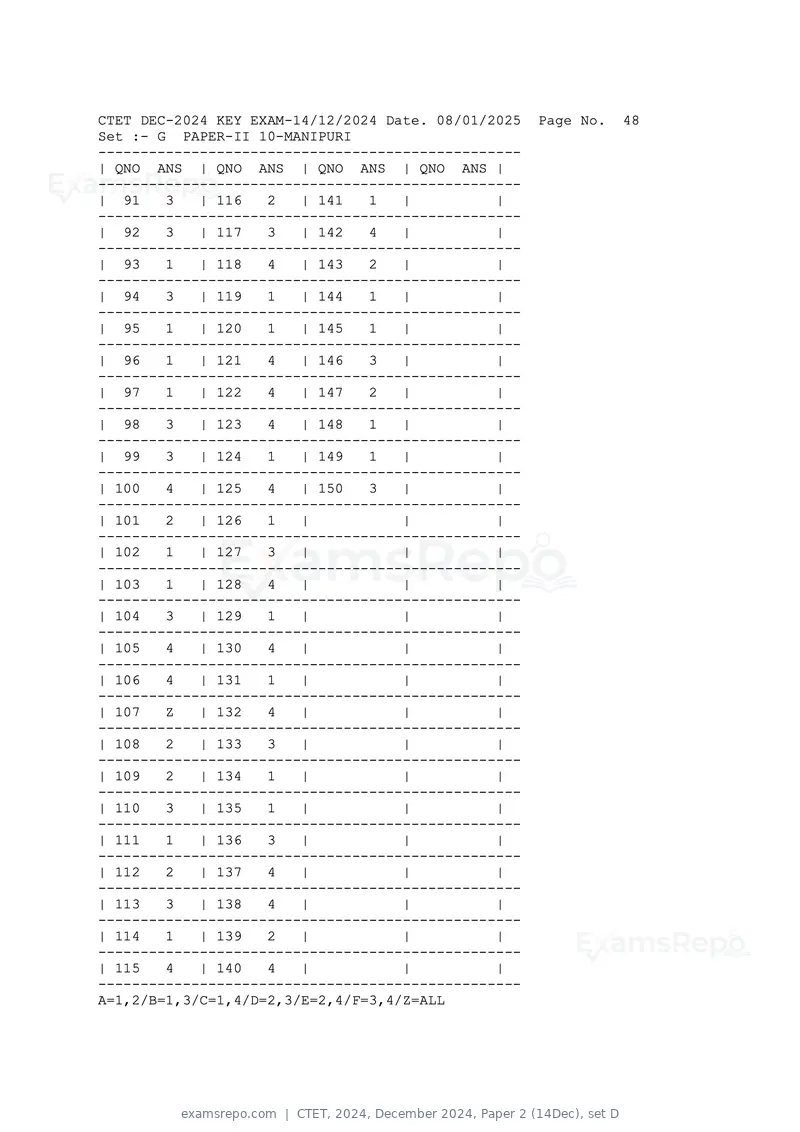
Text of page 48
CTET DEC-2024 KEY EXAM-14/12/2024 Date. 08/01/2025   Page No.   48
Set :- G PAPER-II 10-MANIPURI
--------------------------------------------------
| QNO ANS | QNO ANS | QNO ANS | QNO ANS |
--------------------------------------------------
| 91    3   | 116   2   | 141   1   |          |
--------------------------------------------------
| 92    3   | 117   3   | 142   4   |          |
--------------------------------------------------
| 93    1   | 118   4   | 143   2   |          |
--------------------------------------------------
| 94    3   | 119   1   | 144   1   |          |
--------------------------------------------------
| 95    1   | 120   1   | 145   1   |          |
--------------------------------------------------
| 96    1   | 121   4   | 146   3   |          |
--------------------------------------------------
| 97    1   | 122   4   | 147   2   |          |
--------------------------------------------------
| 98    3   | 123   4   | 148   1   |          |
--------------------------------------------------
| 99    3   | 124   1   | 149   1   |          |
--------------------------------------------------
| 100   4   | 125   4   | 150   3   |          |
--------------------------------------------------
| 101   2   | 126   1   |           |          |
--------------------------------------------------
| 102   1   | 127   3   |           |          |
--------------------------------------------------
| 103   1   | 128   4   |           |          |
--------------------------------------------------
| 104   3   | 129   1   |           |          |
--------------------------------------------------
| 105   4   | 130   4   |           |          |
--------------------------------------------------
| 106   4   | 131   1   |           |          |
--------------------------------------------------
| 107   Z   | 132   4   |           |          |
--------------------------------------------------
| 108   2   | 133   3   |           |          |
--------------------------------------------------
| 109   2   | 134   1   |           |          |
--------------------------------------------------
| 110   3   | 135   1   |           |          |
--------------------------------------------------
| 111   1   | 136   3   |           |          |
--------------------------------------------------
| 112   2   | 137   4   |           |          |
--------------------------------------------------
| 113   3   | 138   4   |           |          |
--------------------------------------------------
| 114   1   | 139   2   |           |          |
--------------------------------------------------
| 115   4   | 140   4   |           |          |
--------------------------------------------------
A=1,2/B=1,3/C=1,4/D=2,3/E=2,4/F=3,4/Z=ALL

Text of page 49
CTET DEC-2024 KEY EXAM-14/12/2024 Date. 08/01/2025   Page No.   49
Set :- D PAPER-II 11-MARATHI
--------------------------------------------------
| QNO ANS | QNO ANS | QNO ANS | QNO ANS |
--------------------------------------------------
| 91    2   | 116   2   | 141   4   |          |
--------------------------------------------------
| 92    3   | 117   1   | 142   1   |          |
--------------------------------------------------
| 93    2   | 118   Z   | 143   3   |          |
--------------------------------------------------
| 94    4   | 119   4   | 144   4   |          |
--------------------------------------------------
| 95    4   | 120   1   | 145   1   |          |
--------------------------------------------------
| 96    2   | 121   3   | 146   3   |          |
--------------------------------------------------
| 97    2   | 122   2   | 147   2   |          |
--------------------------------------------------
| 98    4   | 123   1   | 148   4   |          |
--------------------------------------------------
| 99    2   | 124   3   | 149   4   |          |
--------------------------------------------------
| 100   3   | 125   3   | 150   3   |          |
--------------------------------------------------
| 101   2   | 126   3   |           |          |
--------------------------------------------------
| 102   2   | 127   2   |           |          |
--------------------------------------------------
| 103   4   | 128   1   |           |          |
--------------------------------------------------
| 104   2   | 129   1   |           |          |
--------------------------------------------------
| 105   1   | 130   2   |           |          |
--------------------------------------------------
| 106   4   | 131   4   |           |          |
--------------------------------------------------
| 107   3   | 132   2   |           |          |
--------------------------------------------------
| 108   2   | 133   3   |           |          |
--------------------------------------------------
| 109   3   | 134   2   |           |          |
--------------------------------------------------
| 110   4   | 135   4   |           |          |
--------------------------------------------------
| 111   2   | 136   1   |           |          |
--------------------------------------------------
| 112   1   | 137   2   |           |          |
--------------------------------------------------
| 113   4   | 138   2   |           |          |
--------------------------------------------------
| 114   1   | 139   3   |           |          |
--------------------------------------------------
| 115   3   | 140   4   |           |          |
--------------------------------------------------
A=1,2/B=1,3/C=1,4/D=2,3/E=2,4/F=3,4/Z=ALL

Text of page 50
CTET DEC-2024 KEY EXAM-14/12/2024 Date. 08/01/2025   Page No.   50
Set :- E PAPER-II 11-MARATHI
--------------------------------------------------
| QNO ANS | QNO ANS | QNO ANS | QNO ANS |
--------------------------------------------------
| 91    3   | 116   2   | 141   3   |          |
--------------------------------------------------
| 92    1   | 117   3   | 142   3   |          |
--------------------------------------------------
| 93    1   | 118   4   | 143   2   |          |
--------------------------------------------------
| 94    2   | 119   4   | 144   4   |          |
--------------------------------------------------
| 95    3   | 120   4   | 145   2   |          |
--------------------------------------------------
| 96    1   | 121   1   | 146   1   |          |
--------------------------------------------------
| 97    1   | 122   2   | 147   4   |          |
--------------------------------------------------
| 98    3   | 123   1   | 148   3   |          |
--------------------------------------------------
| 99    2   | 124   4   | 149   3   |          |
--------------------------------------------------
| 100   1   | 125   2   | 150   4   |          |
--------------------------------------------------
| 101   2   | 126   2   |           |          |
--------------------------------------------------
| 102   1   | 127   3   |           |          |
--------------------------------------------------
| 103   1   | 128   4   |           |          |
--------------------------------------------------
| 104   4   | 129   3   |           |          |
--------------------------------------------------
| 105   3   | 130   2   |           |          |
--------------------------------------------------
| 106   2   | 131   1   |           |          |
--------------------------------------------------
| 107   3   | 132   3   |           |          |
--------------------------------------------------
| 108   1   | 133   4   |           |          |
--------------------------------------------------
| 109   1   | 134   1   |           |          |
--------------------------------------------------
| 110   Z   | 135   1   |           |          |
--------------------------------------------------
| 111   3   | 136   3   |           |          |
--------------------------------------------------
| 112   4   | 137   1   |           |          |
--------------------------------------------------
| 113   2   | 138   1   |           |          |
--------------------------------------------------
| 114   3   | 139   2   |           |          |
--------------------------------------------------
| 115   1   | 140   2   |           |          |
--------------------------------------------------
A=1,2/B=1,3/C=1,4/D=2,3/E=2,4/F=3,4/Z=ALL

Text of page 51
CTET DEC-2024 KEY EXAM-14/12/2024 Date. 08/01/2025   Page No.   51
Set :- F PAPER-II 11-MARATHI
--------------------------------------------------
| QNO ANS | QNO ANS | QNO ANS | QNO ANS |
--------------------------------------------------
| 91    4   | 116   3   | 141   4   |          |
--------------------------------------------------
| 92    4   | 117   4   | 142   2   |          |
--------------------------------------------------
| 93    4   | 118   3   | 143   2   |          |
--------------------------------------------------
| 94    1   | 119   4   | 144   2   |          |
--------------------------------------------------
| 95    2   | 120   3   | 145   4   |          |
--------------------------------------------------
| 96    2   | 121   3   | 146   1   |          |
--------------------------------------------------
| 97    4   | 122   1   | 147   3   |          |
--------------------------------------------------
| 98    2   | 123   1   | 148   2   |          |
--------------------------------------------------
| 99    2   | 124   3   | 149   1   |          |
--------------------------------------------------
| 100   1   | 125   4   | 150   3   |          |
--------------------------------------------------
| 101   4   | 126   3   |           |          |
--------------------------------------------------
| 102   4   | 127   1   |           |          |
--------------------------------------------------
| 103   3   | 128   4   |           |          |
--------------------------------------------------
| 104   4   | 129   1   |           |          |
--------------------------------------------------
| 105   2   | 130   4   |           |          |
--------------------------------------------------
| 106   2   | 131   4   |           |          |
--------------------------------------------------
| 107   3   | 132   3   |           |          |
--------------------------------------------------
| 108   1   | 133   4   |           |          |
--------------------------------------------------
| 109   1   | 134   2   |           |          |
--------------------------------------------------
| 110   2   | 135   2   |           |          |
--------------------------------------------------
| 111   1   | 136   4   |           |          |
--------------------------------------------------
| 112   Z   | 137   2   |           |          |
--------------------------------------------------
| 113   2   | 138   1   |           |          |
--------------------------------------------------
| 114   4   | 139   1   |           |          |
--------------------------------------------------
| 115   2   | 140   3   |           |          |
--------------------------------------------------
A=1,2/B=1,3/C=1,4/D=2,3/E=2,4/F=3,4/Z=ALL

Text of page 52
CTET DEC-2024 KEY EXAM-14/12/2024 Date. 08/01/2025   Page No.   52
Set :- G PAPER-II 11-MARATHI
--------------------------------------------------
| QNO ANS | QNO ANS | QNO ANS | QNO ANS |
--------------------------------------------------
| 91    1   | 116   2   | 141   1   |          |
--------------------------------------------------
| 92    1   | 117   3   | 142   4   |          |
--------------------------------------------------
| 93    4   | 118   4   | 143   2   |          |
--------------------------------------------------
| 94    3   | 119   1   | 144   1   |          |
--------------------------------------------------
| 95    3   | 120   1   | 145   1   |          |
--------------------------------------------------
| 96    3   | 121   2   | 146   3   |          |
--------------------------------------------------
| 97    3   | 122   2   | 147   2   |          |
--------------------------------------------------
| 98    1   | 123   4   | 148   1   |          |
--------------------------------------------------
| 99    2   | 124   3   | 149   1   |          |
--------------------------------------------------
| 100   4   | 125   4   | 150   3   |          |
--------------------------------------------------
| 101   2   | 126   4   |           |          |
--------------------------------------------------
| 102   3   | 127   3   |           |          |
--------------------------------------------------
| 103   3   | 128   3   |           |          |
--------------------------------------------------
| 104   1   | 129   3   |           |          |
--------------------------------------------------
| 105   3   | 130   2   |           |          |
--------------------------------------------------
| 106   4   | 131   3   |           |          |
--------------------------------------------------
| 107   Z   | 132   1   |           |          |
--------------------------------------------------
| 108   2   | 133   4   |           |          |
--------------------------------------------------
| 109   2   | 134   1   |           |          |
--------------------------------------------------
| 110   3   | 135   3   |           |          |
--------------------------------------------------
| 111   1   | 136   3   |           |          |
--------------------------------------------------
| 112   2   | 137   4   |           |          |
--------------------------------------------------
| 113   3   | 138   4   |           |          |
--------------------------------------------------
| 114   1   | 139   2   |           |          |
--------------------------------------------------
| 115   4   | 140   4   |           |          |
--------------------------------------------------
A=1,2/B=1,3/C=1,4/D=2,3/E=2,4/F=3,4/Z=ALL

Text of page 53
CTET DEC-2024 KEY EXAM-14/12/2024 Date. 08/01/2025   Page No.   53
Set :- D PAPER-II 12-MIZO
--------------------------------------------------
| QNO ANS | QNO ANS | QNO ANS | QNO ANS |
--------------------------------------------------
| 91    1   | 116   2   | 141   4   |          |
--------------------------------------------------
| 92    3   | 117   1   | 142   1   |          |
--------------------------------------------------
| 93    3   | 118   Z   | 143   3   |          |
--------------------------------------------------
| 94    2   | 119   4   | 144   4   |          |
--------------------------------------------------
| 95    3   | 120   1   | 145   1   |          |
--------------------------------------------------
| 96    2   | 121   3   | 146   3   |          |
--------------------------------------------------
| 97    4   | 122   2   | 147   2   |          |
--------------------------------------------------
| 98    1   | 123   1   | 148   4   |          |
--------------------------------------------------
| 99    3   | 124   4   | 149   4   |          |
--------------------------------------------------
| 100   4   | 125   2   | 150   3   |          |
--------------------------------------------------
| 101   3   | 126   3   |           |          |
--------------------------------------------------
| 102   2   | 127   4   |           |          |
--------------------------------------------------
| 103   1   | 128   2   |           |          |
--------------------------------------------------
| 104   1   | 129   1   |           |          |
--------------------------------------------------
| 105   2   | 130   1   |           |          |
--------------------------------------------------
| 106   4   | 131   4   |           |          |
--------------------------------------------------
| 107   3   | 132   3   |           |          |
--------------------------------------------------
| 108   2   | 133   2   |           |          |
--------------------------------------------------
| 109   3   | 134   3   |           |          |
--------------------------------------------------
| 110   4   | 135   3   |           |          |
--------------------------------------------------
| 111   2   | 136   1   |           |          |
--------------------------------------------------
| 112   1   | 137   2   |           |          |
--------------------------------------------------
| 113   4   | 138   2   |           |          |
--------------------------------------------------
| 114   1   | 139   3   |           |          |
--------------------------------------------------
| 115   3   | 140   4   |           |          |
--------------------------------------------------
A=1,2/B=1,3/C=1,4/D=2,3/E=2,4/F=3,4/Z=ALL

Text of page 54
CTET DEC-2024 KEY EXAM-14/12/2024 Date. 08/01/2025   Page No.   54
Set :- E PAPER-II 12-MIZO
--------------------------------------------------
| QNO ANS | QNO ANS | QNO ANS | QNO ANS |
--------------------------------------------------
| 91    1   | 116   2   | 141   3   |          |
--------------------------------------------------
| 92    3   | 117   3   | 142   3   |          |
--------------------------------------------------
| 93    1   | 118   4   | 143   2   |          |
--------------------------------------------------
| 94    3   | 119   4   | 144   4   |          |
--------------------------------------------------
| 95    2   | 120   4   | 145   2   |          |
--------------------------------------------------
| 96    4   | 121   1   | 146   1   |          |
--------------------------------------------------
| 97    2   | 122   2   | 147   4   |          |
--------------------------------------------------
| 98    4   | 123   3   | 148   3   |          |
--------------------------------------------------
| 99    2   | 124   1   | 149   3   |          |
--------------------------------------------------
| 100   1   | 125   2   | 150   4   |          |
--------------------------------------------------
| 101   3   | 126   3   |           |          |
--------------------------------------------------
| 102   2   | 127   2   |           |          |
--------------------------------------------------
| 103   4   | 128   4   |           |          |
--------------------------------------------------
| 104   1   | 129   2   |           |          |
--------------------------------------------------
| 105   4   | 130   1   |           |          |
--------------------------------------------------
| 106   2   | 131   4   |           |          |
--------------------------------------------------
| 107   3   | 132   3   |           |          |
--------------------------------------------------
| 108   1   | 133   4   |           |          |
--------------------------------------------------
| 109   1   | 134   2   |           |          |
--------------------------------------------------
| 110   Z   | 135   2   |           |          |
--------------------------------------------------
| 111   3   | 136   3   |           |          |
--------------------------------------------------
| 112   4   | 137   1   |           |          |
--------------------------------------------------
| 113   2   | 138   1   |           |          |
--------------------------------------------------
| 114   3   | 139   2   |           |          |
--------------------------------------------------
| 115   1   | 140   2   |           |          |
--------------------------------------------------
A=1,2/B=1,3/C=1,4/D=2,3/E=2,4/F=3,4/Z=ALL

Text of page 55
CTET DEC-2024 KEY EXAM-14/12/2024 Date. 08/01/2025   Page No.   55
Set :- F PAPER-II 12-MIZO
--------------------------------------------------
| QNO ANS | QNO ANS | QNO ANS | QNO ANS |
--------------------------------------------------
| 91    3   | 116   3   | 141   4   |          |
--------------------------------------------------
| 92    4   | 117   4   | 142   2   |          |
--------------------------------------------------
| 93    1   | 118   3   | 143   2   |          |
--------------------------------------------------
| 94    1   | 119   4   | 144   2   |          |
--------------------------------------------------
| 95    1   | 120   3   | 145   4   |          |
--------------------------------------------------
| 96    3   | 121   4   | 146   1   |          |
--------------------------------------------------
| 97    2   | 122   1   | 147   3   |          |
--------------------------------------------------
| 98    4   | 123   1   | 148   2   |          |
--------------------------------------------------
| 99    3   | 124   2   | 149   1   |          |
--------------------------------------------------
| 100   2   | 125   2   | 150   3   |          |
--------------------------------------------------
| 101   1   | 126   3   |           |          |
--------------------------------------------------
| 102   4   | 127   2   |           |          |
--------------------------------------------------
| 103   4   | 128   4   |           |          |
--------------------------------------------------
| 104   3   | 129   4   |           |          |
--------------------------------------------------
| 105   3   | 130   3   |           |          |
--------------------------------------------------
| 106   2   | 131   1   |           |          |
--------------------------------------------------
| 107   3   | 132   3   |           |          |
--------------------------------------------------
| 108   1   | 133   1   |           |          |
--------------------------------------------------
| 109   1   | 134   2   |           |          |
--------------------------------------------------
| 110   2   | 135   1   |           |          |
--------------------------------------------------
| 111   1   | 136   4   |           |          |
--------------------------------------------------
| 112   Z   | 137   2   |           |          |
--------------------------------------------------
| 113   2   | 138   1   |           |          |
--------------------------------------------------
| 114   4   | 139   1   |           |          |
--------------------------------------------------
| 115   2   | 140   3   |           |          |
--------------------------------------------------
A=1,2/B=1,3/C=1,4/D=2,3/E=2,4/F=3,4/Z=ALL

Text of page 56
CTET DEC-2024 KEY EXAM-14/12/2024 Date. 08/01/2025   Page No.   56
Set :- G PAPER-II 12-MIZO
--------------------------------------------------
| QNO ANS | QNO ANS | QNO ANS | QNO ANS |
--------------------------------------------------
| 91    4   | 116   2   | 141   1   |          |
--------------------------------------------------
| 92    3   | 117   3   | 142   4   |          |
--------------------------------------------------
| 93    4   | 118   4   | 143   2   |          |
--------------------------------------------------
| 94    1   | 119   1   | 144   1   |          |
--------------------------------------------------
| 95    3   | 120   1   | 145   1   |          |
--------------------------------------------------
| 96    2   | 121   2   | 146   3   |          |
--------------------------------------------------
| 97    4   | 122   3   | 147   2   |          |
--------------------------------------------------
| 98    2   | 123   1   | 148   1   |          |
--------------------------------------------------
| 99    3   | 124   2   | 149   1   |          |
--------------------------------------------------
| 100   1   | 125   4   | 150   3   |          |
--------------------------------------------------
| 101   3   | 126   4   |           |          |
--------------------------------------------------
| 102   4   | 127   3   |           |          |
--------------------------------------------------
| 103   3   | 128   1   |           |          |
--------------------------------------------------
| 104   2   | 129   4   |           |          |
--------------------------------------------------
| 105   2   | 130   2   |           |          |
--------------------------------------------------
| 106   4   | 131   4   |           |          |
--------------------------------------------------
| 107   Z   | 132   4   |           |          |
--------------------------------------------------
| 108   2   | 133   3   |           |          |
--------------------------------------------------
| 109   2   | 134   1   |           |          |
--------------------------------------------------
| 110   3   | 135   2   |           |          |
--------------------------------------------------
| 111   1   | 136   3   |           |          |
--------------------------------------------------
| 112   2   | 137   4   |           |          |
--------------------------------------------------
| 113   3   | 138   4   |           |          |
--------------------------------------------------
| 114   1   | 139   2   |           |          |
--------------------------------------------------
| 115   4   | 140   4   |           |          |
--------------------------------------------------
A=1,2/B=1,3/C=1,4/D=2,3/E=2,4/F=3,4/Z=ALL

Text of page 57
CTET DEC-2024 KEY EXAM-14/12/2024 Date. 08/01/2025   Page No.   57
Set :- D PAPER-II 13-NEPALI
--------------------------------------------------
| QNO ANS | QNO ANS | QNO ANS | QNO ANS |
--------------------------------------------------
| 91    4   | 116   2   | 141   4   |          |
--------------------------------------------------
| 92    3   | 117   1   | 142   1   |          |
--------------------------------------------------
| 93    1   | 118   Z   | 143   3   |          |
--------------------------------------------------
| 94    1   | 119   4   | 144   4   |          |
--------------------------------------------------
| 95    1   | 120   1   | 145   1   |          |
--------------------------------------------------
| 96    3   | 121   3   | 146   3   |          |
--------------------------------------------------
| 97    4   | 122   2   | 147   2   |          |
--------------------------------------------------
| 98    4   | 123   4   | 148   4   |          |
--------------------------------------------------
| 99    3   | 124   2   | 149   4   |          |
--------------------------------------------------
| 100   4   | 125   4   | 150   3   |          |
--------------------------------------------------
| 101   2   | 126   4   |           |          |
--------------------------------------------------
| 102   2   | 127   1   |           |          |
--------------------------------------------------
| 103   3   | 128   3   |           |          |
--------------------------------------------------
| 104   4   | 129   3   |           |          |
--------------------------------------------------
| 105   1   | 130   2   |           |          |
--------------------------------------------------
| 106   4   | 131   3   |           |          |
--------------------------------------------------
| 107   3   | 132   4   |           |          |
--------------------------------------------------
| 108   2   | 133   1   |           |          |
--------------------------------------------------
| 109   3   | 134   4   |           |          |
--------------------------------------------------
| 110   4   | 135   3   |           |          |
--------------------------------------------------
| 111   2   | 136   1   |           |          |
--------------------------------------------------
| 112   1   | 137   2   |           |          |
--------------------------------------------------
| 113   4   | 138   2   |           |          |
--------------------------------------------------
| 114   1   | 139   3   |           |          |
--------------------------------------------------
| 115   3   | 140   4   |           |          |
--------------------------------------------------
A=1,2/B=1,3/C=1,4/D=2,3/E=2,4/F=3,4/Z=ALL

Text of page 58
CTET DEC-2024 KEY EXAM-14/12/2024 Date. 08/01/2025   Page No.   58
Set :- E PAPER-II 13-NEPALI
--------------------------------------------------
| QNO ANS | QNO ANS | QNO ANS | QNO ANS |
--------------------------------------------------
| 91    4   | 116   2   | 141   3   |          |
--------------------------------------------------
| 92    3   | 117   3   | 142   3   |          |
--------------------------------------------------
| 93    2   | 118   4   | 143   2   |          |
--------------------------------------------------
| 94    1   | 119   4   | 144   4   |          |
--------------------------------------------------
| 95    4   | 120   4   | 145   2   |          |
--------------------------------------------------
| 96    3   | 121   1   | 146   1   |          |
--------------------------------------------------
| 97    2   | 122   3   | 147   4   |          |
--------------------------------------------------
| 98    3   | 123   4   | 148   3   |          |
--------------------------------------------------
| 99    2   | 124   2   | 149   3   |          |
--------------------------------------------------
| 100   1   | 125   2   | 150   4   |          |
--------------------------------------------------
| 101   3   | 126   1   |           |          |
--------------------------------------------------
| 102   1   | 127   4   |           |          |
--------------------------------------------------
| 103   3   | 128   3   |           |          |
--------------------------------------------------
| 104   4   | 129   2   |           |          |
--------------------------------------------------
| 105   2   | 130   4   |           |          |
--------------------------------------------------
| 106   2   | 131   1   |           |          |
--------------------------------------------------
| 107   3   | 132   2   |           |          |
--------------------------------------------------
| 108   1   | 133   2   |           |          |
--------------------------------------------------
| 109   1   | 134   3   |           |          |
--------------------------------------------------
| 110   Z   | 135   3   |           |          |
--------------------------------------------------
| 111   3   | 136   3   |           |          |
--------------------------------------------------
| 112   4   | 137   1   |           |          |
--------------------------------------------------
| 113   2   | 138   1   |           |          |
--------------------------------------------------
| 114   3   | 139   2   |           |          |
--------------------------------------------------
| 115   1   | 140   2   |           |          |
--------------------------------------------------
A=1,2/B=1,3/C=1,4/D=2,3/E=2,4/F=3,4/Z=ALL

Text of page 59
CTET DEC-2024 KEY EXAM-14/12/2024 Date. 08/01/2025   Page No.   59
Set :- F PAPER-II 13-NEPALI
--------------------------------------------------
| QNO ANS | QNO ANS | QNO ANS | QNO ANS |
--------------------------------------------------
| 91    2   | 116   3   | 141   4   |          |
--------------------------------------------------
| 92    1   | 117   4   | 142   2   |          |
--------------------------------------------------
| 93    1   | 118   3   | 143   2   |          |
--------------------------------------------------
| 94    1   | 119   4   | 144   2   |          |
--------------------------------------------------
| 95    3   | 120   3   | 145   4   |          |
--------------------------------------------------
| 96    1   | 121   1   | 146   1   |          |
--------------------------------------------------
| 97    2   | 122   1   | 147   3   |          |
--------------------------------------------------
| 98    3   | 123   2   | 148   2   |          |
--------------------------------------------------
| 99    2   | 124   4   | 149   1   |          |
--------------------------------------------------
| 100   2   | 125   3   | 150   3   |          |
--------------------------------------------------
| 101   4   | 126   2   |           |          |
--------------------------------------------------
| 102   4   | 127   4   |           |          |
--------------------------------------------------
| 103   3   | 128   4   |           |          |
--------------------------------------------------
| 104   2   | 129   3   |           |          |
--------------------------------------------------
| 105   1   | 130   4   |           |          |
--------------------------------------------------
| 106   2   | 131   2   |           |          |
--------------------------------------------------
| 107   3   | 132   1   |           |          |
--------------------------------------------------
| 108   1   | 133   2   |           |          |
--------------------------------------------------
| 109   1   | 134   1   |           |          |
--------------------------------------------------
| 110   2   | 135   1   |           |          |
--------------------------------------------------
| 111   1   | 136   4   |           |          |
--------------------------------------------------
| 112   Z   | 137   2   |           |          |
--------------------------------------------------
| 113   2   | 138   1   |           |          |
--------------------------------------------------
| 114   4   | 139   1   |           |          |
--------------------------------------------------
| 115   2   | 140   3   |           |          |
--------------------------------------------------
A=1,2/B=1,3/C=1,4/D=2,3/E=2,4/F=3,4/Z=ALL

Text of page 60
CTET DEC-2024 KEY EXAM-14/12/2024 Date. 08/01/2025   Page No.   60
Set :- G PAPER-II 13-NEPALI
--------------------------------------------------
| QNO ANS | QNO ANS | QNO ANS | QNO ANS |
--------------------------------------------------
| 91    2   | 116   2   | 141   1   |          |
--------------------------------------------------
| 92    2   | 117   3   | 142   4   |          |
--------------------------------------------------
| 93    4   | 118   4   | 143   2   |          |
--------------------------------------------------
| 94    1   | 119   1   | 144   1   |          |
--------------------------------------------------
| 95    4   | 120   1   | 145   1   |          |
--------------------------------------------------
| 96    1   | 121   1   | 146   3   |          |
--------------------------------------------------
| 97    4   | 122   4   | 147   2   |          |
--------------------------------------------------
| 98    1   | 123   3   | 148   1   |          |
--------------------------------------------------
| 99    1   | 124   4   | 149   1   |          |
--------------------------------------------------
| 100   1   | 125   4   | 150   3   |          |
--------------------------------------------------
| 101   2   | 126   1   |           |          |
--------------------------------------------------
| 102   3   | 127   3   |           |          |
--------------------------------------------------
| 103   3   | 128   2   |           |          |
--------------------------------------------------
| 104   4   | 129   1   |           |          |
--------------------------------------------------
| 105   1   | 130   4   |           |          |
--------------------------------------------------
| 106   4   | 131   1   |           |          |
--------------------------------------------------
| 107   Z   | 132   4   |           |          |
--------------------------------------------------
| 108   2   | 133   2   |           |          |
--------------------------------------------------
| 109   2   | 134   4   |           |          |
--------------------------------------------------
| 110   3   | 135   3   |           |          |
--------------------------------------------------
| 111   1   | 136   3   |           |          |
--------------------------------------------------
| 112   2   | 137   4   |           |          |
--------------------------------------------------
| 113   3   | 138   4   |           |          |
--------------------------------------------------
| 114   1   | 139   2   |           |          |
--------------------------------------------------
| 115   4   | 140   4   |           |          |
--------------------------------------------------
A=1,2/B=1,3/C=1,4/D=2,3/E=2,4/F=3,4/Z=ALL

Text of page 61
CTET DEC-2024 KEY EXAM-14/12/2024 Date. 08/01/2025   Page No.   61
Set :- D PAPER-II 14-ODIA
--------------------------------------------------
| QNO ANS | QNO ANS | QNO ANS | QNO ANS |
--------------------------------------------------
| 91    2   | 116   2   | 141   4   |          |
--------------------------------------------------
| 92    1   | 117   1   | 142   1   |          |
--------------------------------------------------
| 93    2   | 118   Z   | 143   3   |          |
--------------------------------------------------
| 94    4   | 119   4   | 144   4   |          |
--------------------------------------------------
| 95    2   | 120   1   | 145   1   |          |
--------------------------------------------------
| 96    4   | 121   4   | 146   3   |          |
--------------------------------------------------
| 97    4   | 122   2   | 147   2   |          |
--------------------------------------------------
| 98    4   | 123   4   | 148   4   |          |
--------------------------------------------------
| 99    1   | 124   4   | 149   4   |          |
--------------------------------------------------
| 100   4   | 125   3   | 150   3   |          |
--------------------------------------------------
| 101   3   | 126   1   |           |          |
--------------------------------------------------
| 102   2   | 127   3   |           |          |
--------------------------------------------------
| 103   3   | 128   3   |           |          |
--------------------------------------------------
| 104   4   | 129   3   |           |          |
--------------------------------------------------
| 105   2   | 130   2   |           |          |
--------------------------------------------------
| 106   4   | 131   3   |           |          |
--------------------------------------------------
| 107   3   | 132   4   |           |          |
--------------------------------------------------
| 108   2   | 133   1   |           |          |
--------------------------------------------------
| 109   3   | 134   4   |           |          |
--------------------------------------------------
| 110   4   | 135   3   |           |          |
--------------------------------------------------
| 111   2   | 136   1   |           |          |
--------------------------------------------------
| 112   1   | 137   2   |           |          |
--------------------------------------------------
| 113   4   | 138   2   |           |          |
--------------------------------------------------
| 114   1   | 139   3   |           |          |
--------------------------------------------------
| 115   3   | 140   4   |           |          |
--------------------------------------------------
A=1,2/B=1,3/C=1,4/D=2,3/E=2,4/F=3,4/Z=ALL

Text of page 62
CTET DEC-2024 KEY EXAM-14/12/2024 Date. 08/01/2025   Page No.   62
Set :- E PAPER-II 14-ODIA
--------------------------------------------------
| QNO ANS | QNO ANS | QNO ANS | QNO ANS |
--------------------------------------------------
| 91    3   | 116   2   | 141   3   |          |
--------------------------------------------------
| 92    3   | 117   3   | 142   3   |          |
--------------------------------------------------
| 93    3   | 118   4   | 143   2   |          |
--------------------------------------------------
| 94    2   | 119   4   | 144   4   |          |
--------------------------------------------------
| 95    1   | 120   4   | 145   2   |          |
--------------------------------------------------
| 96    1   | 121   1   | 146   1   |          |
--------------------------------------------------
| 97    4   | 122   4   | 147   4   |          |
--------------------------------------------------
| 98    3   | 123   2   | 148   3   |          |
--------------------------------------------------
| 99    4   | 124   2   | 149   3   |          |
--------------------------------------------------
| 100   1   | 125   3   | 150   4   |          |
--------------------------------------------------
| 101   3   | 126   3   |           |          |
--------------------------------------------------
| 102   2   | 127   3   |           |          |
--------------------------------------------------
| 103   3   | 128   3   |           |          |
--------------------------------------------------
| 104   1   | 129   2   |           |          |
--------------------------------------------------
| 105   2   | 130   4   |           |          |
--------------------------------------------------
| 106   2   | 131   1   |           |          |
--------------------------------------------------
| 107   3   | 132   2   |           |          |
--------------------------------------------------
| 108   1   | 133   2   |           |          |
--------------------------------------------------
| 109   1   | 134   3   |           |          |
--------------------------------------------------
| 110   Z   | 135   3   |           |          |
--------------------------------------------------
| 111   3   | 136   3   |           |          |
--------------------------------------------------
| 112   4   | 137   1   |           |          |
--------------------------------------------------
| 113   2   | 138   1   |           |          |
--------------------------------------------------
| 114   3   | 139   2   |           |          |
--------------------------------------------------
| 115   1   | 140   2   |           |          |
--------------------------------------------------
A=1,2/B=1,3/C=1,4/D=2,3/E=2,4/F=3,4/Z=ALL

Text of page 63
CTET DEC-2024 KEY EXAM-14/12/2024 Date. 08/01/2025   Page No.   63
Set :- F PAPER-II 14-ODIA
--------------------------------------------------
| QNO ANS | QNO ANS | QNO ANS | QNO ANS |
--------------------------------------------------
| 91    4   | 116   3   | 141   4   |          |
--------------------------------------------------
| 92    2   | 117   4   | 142   2   |          |
--------------------------------------------------
| 93    3   | 118   3   | 143   2   |          |
--------------------------------------------------
| 94    3   | 119   4   | 144   2   |          |
--------------------------------------------------
| 95    4   | 120   3   | 145   4   |          |
--------------------------------------------------
| 96    2   | 121   1   | 146   1   |          |
--------------------------------------------------
| 97    2   | 122   2   | 147   3   |          |
--------------------------------------------------
| 98    2   | 123   3   | 148   2   |          |
--------------------------------------------------
| 99    2   | 124   3   | 149   1   |          |
--------------------------------------------------
| 100   2   | 125   1   | 150   3   |          |
--------------------------------------------------
| 101   1   | 126   2   |           |          |
--------------------------------------------------
| 102   4   | 127   2   |           |          |
--------------------------------------------------
| 103   4   | 128   4   |           |          |
--------------------------------------------------
| 104   2   | 129   3   |           |          |
--------------------------------------------------
| 105   1   | 130   4   |           |          |
--------------------------------------------------
| 106   2   | 131   2   |           |          |
--------------------------------------------------
| 107   3   | 132   1   |           |          |
--------------------------------------------------
| 108   1   | 133   2   |           |          |
--------------------------------------------------
| 109   1   | 134   1   |           |          |
--------------------------------------------------
| 110   2   | 135   1   |           |          |
--------------------------------------------------
| 111   1   | 136   4   |           |          |
--------------------------------------------------
| 112   Z   | 137   2   |           |          |
--------------------------------------------------
| 113   2   | 138   1   |           |          |
--------------------------------------------------
| 114   4   | 139   1   |           |          |
--------------------------------------------------
| 115   2   | 140   3   |           |          |
--------------------------------------------------
A=1,2/B=1,3/C=1,4/D=2,3/E=2,4/F=3,4/Z=ALL

Text of page 64
CTET DEC-2024 KEY EXAM-14/12/2024 Date. 08/01/2025   Page No.   64
Set :- G PAPER-II 14-ODIA
--------------------------------------------------
| QNO ANS | QNO ANS | QNO ANS | QNO ANS |
--------------------------------------------------
| 91    3   | 116   2   | 141   1   |          |
--------------------------------------------------
| 92    1   | 117   3   | 142   4   |          |
--------------------------------------------------
| 93    2   | 118   4   | 143   2   |          |
--------------------------------------------------
| 94    1   | 119   1   | 144   1   |          |
--------------------------------------------------
| 95    1   | 120   1   | 145   1   |          |
--------------------------------------------------
| 96    3   | 121   1   | 146   3   |          |
--------------------------------------------------
| 97    2   | 122   4   | 147   2   |          |
--------------------------------------------------
| 98    1   | 123   1   | 148   1   |          |
--------------------------------------------------
| 99    2   | 124   3   | 149   1   |          |
--------------------------------------------------
| 100   1   | 125   1   | 150   3   |          |
--------------------------------------------------
| 101   3   | 126   2   |           |          |
--------------------------------------------------
| 102   4   | 127   3   |           |          |
--------------------------------------------------
| 103   3   | 128   4   |           |          |
--------------------------------------------------
| 104   4   | 129   1   |           |          |
--------------------------------------------------
| 105   1   | 130   4   |           |          |
--------------------------------------------------
| 106   4   | 131   1   |           |          |
--------------------------------------------------
| 107   Z   | 132   4   |           |          |
--------------------------------------------------
| 108   2   | 133   2   |           |          |
--------------------------------------------------
| 109   2   | 134   4   |           |          |
--------------------------------------------------
| 110   3   | 135   3   |           |          |
--------------------------------------------------
| 111   1   | 136   3   |           |          |
--------------------------------------------------
| 112   2   | 137   4   |           |          |
--------------------------------------------------
| 113   3   | 138   4   |           |          |
--------------------------------------------------
| 114   1   | 139   2   |           |          |
--------------------------------------------------
| 115   4   | 140   4   |           |          |
--------------------------------------------------
A=1,2/B=1,3/C=1,4/D=2,3/E=2,4/F=3,4/Z=ALL
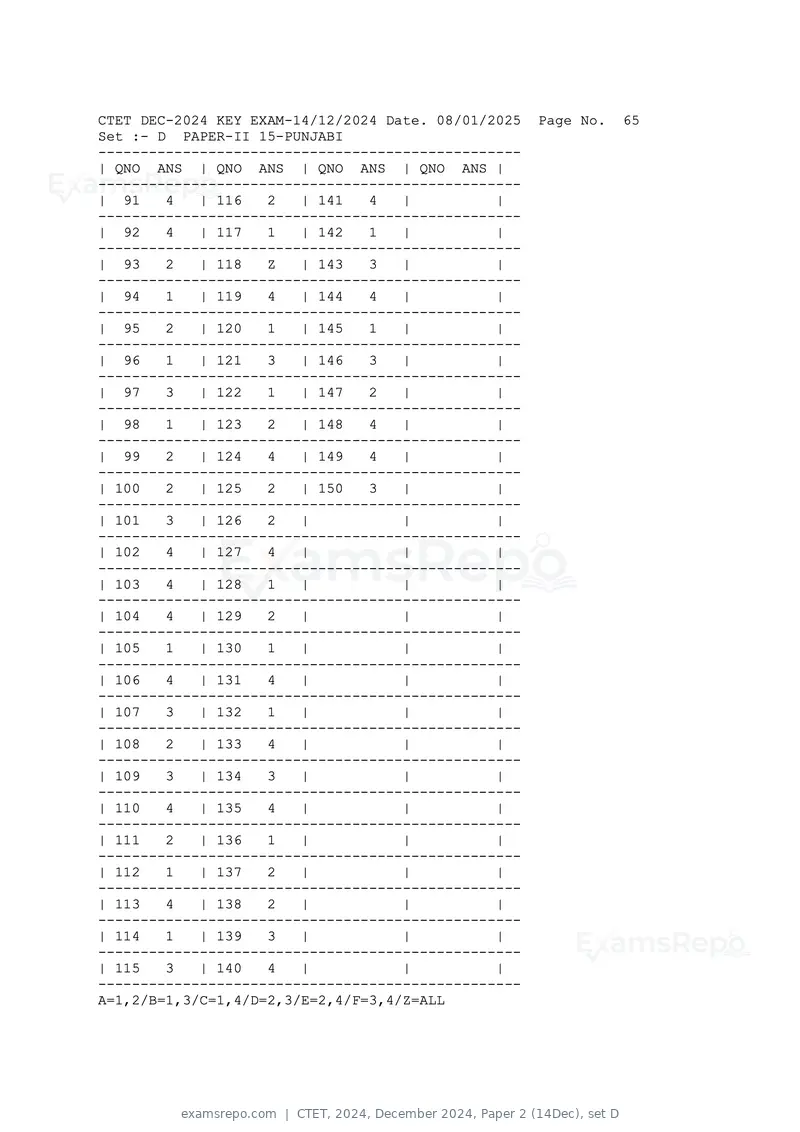
Text of page 65
CTET DEC-2024 KEY EXAM-14/12/2024 Date. 08/01/2025   Page No.   65
Set :- D PAPER-II 15-PUNJABI
--------------------------------------------------
| QNO ANS | QNO ANS | QNO ANS | QNO ANS |
--------------------------------------------------
| 91    4   | 116   2   | 141   4   |          |
--------------------------------------------------
| 92    4   | 117   1   | 142   1   |          |
--------------------------------------------------
| 93    2   | 118   Z   | 143   3   |          |
--------------------------------------------------
| 94    1   | 119   4   | 144   4   |          |
--------------------------------------------------
| 95    2   | 120   1   | 145   1   |          |
--------------------------------------------------
| 96    1   | 121   3   | 146   3   |          |
--------------------------------------------------
| 97    3   | 122   1   | 147   2   |          |
--------------------------------------------------
| 98    1   | 123   2   | 148   4   |          |
--------------------------------------------------
| 99    2   | 124   4   | 149   4   |          |
--------------------------------------------------
| 100   2   | 125   2   | 150   3   |          |
--------------------------------------------------
| 101   3   | 126   2   |           |          |
--------------------------------------------------
| 102   4   | 127   4   |           |          |
--------------------------------------------------
| 103   4   | 128   1   |           |          |
--------------------------------------------------
| 104   4   | 129   2   |           |          |
--------------------------------------------------
| 105   1   | 130   1   |           |          |
--------------------------------------------------
| 106   4   | 131   4   |           |          |
--------------------------------------------------
| 107   3   | 132   1   |           |          |
--------------------------------------------------
| 108   2   | 133   4   |           |          |
--------------------------------------------------
| 109   3   | 134   3   |           |          |
--------------------------------------------------
| 110   4   | 135   4   |           |          |
--------------------------------------------------
| 111   2   | 136   1   |           |          |
--------------------------------------------------
| 112   1   | 137   2   |           |          |
--------------------------------------------------
| 113   4   | 138   2   |           |          |
--------------------------------------------------
| 114   1   | 139   3   |           |          |
--------------------------------------------------
| 115   3   | 140   4   |           |          |
--------------------------------------------------
A=1,2/B=1,3/C=1,4/D=2,3/E=2,4/F=3,4/Z=ALL

Text of page 66
CTET DEC-2024 KEY EXAM-14/12/2024 Date. 08/01/2025   Page No.   66
Set :- E PAPER-II 15-PUNJABI
--------------------------------------------------
| QNO ANS | QNO ANS | QNO ANS | QNO ANS |
--------------------------------------------------
| 91    4   | 116   2   | 141   3   |          |
--------------------------------------------------
| 92    2   | 117   3   | 142   3   |          |
--------------------------------------------------
| 93    4   | 118   4   | 143   2   |          |
--------------------------------------------------
| 94    2   | 119   4   | 144   4   |          |
--------------------------------------------------
| 95    1   | 120   4   | 145   2   |          |
--------------------------------------------------
| 96    3   | 121   4   | 146   1   |          |
--------------------------------------------------
| 97    1   | 122   1   | 147   4   |          |
--------------------------------------------------
| 98    4   | 123   3   | 148   3   |          |
--------------------------------------------------
| 99    3   | 124   4   | 149   3   |          |
--------------------------------------------------
| 100   3   | 125   2   | 150   4   |          |
--------------------------------------------------
| 101   1   | 126   3   |           |          |
--------------------------------------------------
| 102   2   | 127   2   |           |          |
--------------------------------------------------
| 103   3   | 128   1   |           |          |
--------------------------------------------------
| 104   4   | 129   3   |           |          |
--------------------------------------------------
| 105   3   | 130   3   |           |          |
--------------------------------------------------
| 106   2   | 131   4   |           |          |
--------------------------------------------------
| 107   3   | 132   3   |           |          |
--------------------------------------------------
| 108   1   | 133   1   |           |          |
--------------------------------------------------
| 109   1   | 134   2   |           |          |
--------------------------------------------------
| 110   Z   | 135   4   |           |          |
--------------------------------------------------
| 111   3   | 136   3   |           |          |
--------------------------------------------------
| 112   4   | 137   1   |           |          |
--------------------------------------------------
| 113   2   | 138   1   |           |          |
--------------------------------------------------
| 114   3   | 139   2   |           |          |
--------------------------------------------------
| 115   1   | 140   2   |           |          |
--------------------------------------------------
A=1,2/B=1,3/C=1,4/D=2,3/E=2,4/F=3,4/Z=ALL

Text of page 67
CTET DEC-2024 KEY EXAM-14/12/2024 Date. 08/01/2025   Page No.   67
Set :- F PAPER-II 15-PUNJABI
--------------------------------------------------
| QNO ANS | QNO ANS | QNO ANS | QNO ANS |
--------------------------------------------------
| 91    2   | 116   3   | 141   4   |          |
--------------------------------------------------
| 92    3   | 117   4   | 142   2   |          |
--------------------------------------------------
| 93    4   | 118   3   | 143   2   |          |
--------------------------------------------------
| 94    2   | 119   4   | 144   2   |          |
--------------------------------------------------
| 95    4   | 120   3   | 145   4   |          |
--------------------------------------------------
| 96    2   | 121   3   | 146   1   |          |
--------------------------------------------------
| 97    1   | 122   1   | 147   3   |          |
--------------------------------------------------
| 98    3   | 123   4   | 148   2   |          |
--------------------------------------------------
| 99    3   | 124   2   | 149   1   |          |
--------------------------------------------------
| 100   4   | 125   2   | 150   3   |          |
--------------------------------------------------
| 101   1   | 126   4   |           |          |
--------------------------------------------------
| 102   2   | 127   2   |           |          |
--------------------------------------------------
| 103   3   | 128   3   |           |          |
--------------------------------------------------
| 104   2   | 129   2   |           |          |
--------------------------------------------------
| 105   2   | 130   3   |           |          |
--------------------------------------------------
| 106   2   | 131   1   |           |          |
--------------------------------------------------
| 107   3   | 132   4   |           |          |
--------------------------------------------------
| 108   1   | 133   3   |           |          |
--------------------------------------------------
| 109   1   | 134   2   |           |          |
--------------------------------------------------
| 110   2   | 135   2   |           |          |
--------------------------------------------------
| 111   1   | 136   4   |           |          |
--------------------------------------------------
| 112   Z   | 137   2   |           |          |
--------------------------------------------------
| 113   2   | 138   1   |           |          |
--------------------------------------------------
| 114   4   | 139   1   |           |          |
--------------------------------------------------
| 115   2   | 140   3   |           |          |
--------------------------------------------------
A=1,2/B=1,3/C=1,4/D=2,3/E=2,4/F=3,4/Z=ALL

Text of page 68
CTET DEC-2024 KEY EXAM-14/12/2024 Date. 08/01/2025   Page No.   68
Set :- G PAPER-II 15-PUNJABI
--------------------------------------------------
| QNO ANS | QNO ANS | QNO ANS | QNO ANS |
--------------------------------------------------
| 91    3   | 116   2   | 141   1   |          |
--------------------------------------------------
| 92    2   | 117   3   | 142   4   |          |
--------------------------------------------------
| 93    1   | 118   4   | 143   2   |          |
--------------------------------------------------
| 94    4   | 119   1   | 144   1   |          |
--------------------------------------------------
| 95    2   | 120   1   | 145   1   |          |
--------------------------------------------------
| 96    1   | 121   3   | 146   3   |          |
--------------------------------------------------
| 97    3   | 122   2   | 147   2   |          |
--------------------------------------------------
| 98    2   | 123   1   | 148   1   |          |
--------------------------------------------------
| 99    2   | 124   2   | 149   1   |          |
--------------------------------------------------
| 100   3   | 125   4   | 150   3   |          |
--------------------------------------------------
| 101   2   | 126   3   |           |          |
--------------------------------------------------
| 102   4   | 127   2   |           |          |
--------------------------------------------------
| 103   1   | 128   1   |           |          |
--------------------------------------------------
| 104   1   | 129   4   |           |          |
--------------------------------------------------
| 105   1   | 130   3   |           |          |
--------------------------------------------------
| 106   4   | 131   2   |           |          |
--------------------------------------------------
| 107   Z   | 132   1   |           |          |
--------------------------------------------------
| 108   2   | 133   1   |           |          |
--------------------------------------------------
| 109   2   | 134   1   |           |          |
--------------------------------------------------
| 110   3   | 135   2   |           |          |
--------------------------------------------------
| 111   1   | 136   3   |           |          |
--------------------------------------------------
| 112   2   | 137   4   |           |          |
--------------------------------------------------
| 113   3   | 138   4   |           |          |
--------------------------------------------------
| 114   1   | 139   2   |           |          |
--------------------------------------------------
| 115   4   | 140   4   |           |          |
--------------------------------------------------
A=1,2/B=1,3/C=1,4/D=2,3/E=2,4/F=3,4/Z=ALL

Text of page 69
CTET DEC-2024 KEY EXAM-14/12/2024 Date. 08/01/2025   Page No.   69
Set :- D PAPER-II 16-SANSKRIT
--------------------------------------------------
| QNO ANS | QNO ANS | QNO ANS | QNO ANS |
--------------------------------------------------
| 91    4   | 116   2   | 141   4   |          |
--------------------------------------------------
| 92    2   | 117   1   | 142   1   |          |
--------------------------------------------------
| 93    1   | 118   Z   | 143   3   |          |
--------------------------------------------------
| 94    4   | 119   4   | 144   4   |          |
--------------------------------------------------
| 95    2   | 120   1   | 145   1   |          |
--------------------------------------------------
| 96    3   | 121   4   | 146   3   |          |
--------------------------------------------------
| 97    Z   | 122   3   | 147   2   |          |
--------------------------------------------------
| 98    3   | 123   4   | 148   4   |          |
--------------------------------------------------
| 99    1   | 124   2   | 149   4   |          |
--------------------------------------------------
| 100   4   | 125   1   | 150   3   |          |
--------------------------------------------------
| 101   4   | 126   2   |           |          |
--------------------------------------------------
| 102   2   | 127   1   |           |          |
--------------------------------------------------
| 103   3   | 128   4   |           |          |
--------------------------------------------------
| 104   1   | 129   4   |           |          |
--------------------------------------------------
| 105   2   | 130   1   |           |          |
--------------------------------------------------
| 106   4   | 131   3   |           |          |
--------------------------------------------------
| 107   3   | 132   2   |           |          |
--------------------------------------------------
| 108   2   | 133   2   |           |          |
--------------------------------------------------
| 109   3   | 134   4   |           |          |
--------------------------------------------------
| 110   4   | 135   2   |           |          |
--------------------------------------------------
| 111   2   | 136   1   |           |          |
--------------------------------------------------
| 112   1   | 137   2   |           |          |
--------------------------------------------------
| 113   4   | 138   2   |           |          |
--------------------------------------------------
| 114   1   | 139   3   |           |          |
--------------------------------------------------
| 115   3   | 140   4   |           |          |
--------------------------------------------------
A=1,2/B=1,3/C=1,4/D=2,3/E=2,4/F=3,4/Z=ALL

Text of page 70
CTET DEC-2024 KEY EXAM-14/12/2024 Date. 08/01/2025   Page No.   70
Set :- E PAPER-II 16-SANSKRIT
--------------------------------------------------
| QNO ANS | QNO ANS | QNO ANS | QNO ANS |
--------------------------------------------------
| 91    3   | 116   2   | 141   3   |          |
--------------------------------------------------
| 92    Z   | 117   3   | 142   3   |          |
--------------------------------------------------
| 93    2   | 118   4   | 143   2   |          |
--------------------------------------------------
| 94    1   | 119   4   | 144   4   |          |
--------------------------------------------------
| 95    1   | 120   4   | 145   2   |          |
--------------------------------------------------
| 96    3   | 121   2   | 146   1   |          |
--------------------------------------------------
| 97    4   | 122   1   | 147   4   |          |
--------------------------------------------------
| 98    2   | 123   4   | 148   3   |          |
--------------------------------------------------
| 99    1   | 124   3   | 149   3   |          |
--------------------------------------------------
| 100   1   | 125   3   | 150   4   |          |
--------------------------------------------------
| 101   3   | 126   1   |           |          |
--------------------------------------------------
| 102   3   | 127   1   |           |          |
--------------------------------------------------
| 103   4   | 128   3   |           |          |
--------------------------------------------------
| 104   1   | 129   1   |           |          |
--------------------------------------------------
| 105   2   | 130   1   |           |          |
--------------------------------------------------
| 106   2   | 131   4   |           |          |
--------------------------------------------------
| 107   3   | 132   2   |           |          |
--------------------------------------------------
| 108   1   | 133   3   |           |          |
--------------------------------------------------
| 109   1   | 134   3   |           |          |
--------------------------------------------------
| 110   Z   | 135   1   |           |          |
--------------------------------------------------
| 111   3   | 136   3   |           |          |
--------------------------------------------------
| 112   4   | 137   1   |           |          |
--------------------------------------------------
| 113   2   | 138   1   |           |          |
--------------------------------------------------
| 114   3   | 139   2   |           |          |
--------------------------------------------------
| 115   1   | 140   2   |           |          |
--------------------------------------------------
A=1,2/B=1,3/C=1,4/D=2,3/E=2,4/F=3,4/Z=ALL

Text of page 71
CTET DEC-2024 KEY EXAM-14/12/2024 Date. 08/01/2025   Page No.   71
Set :- F PAPER-II 16-SANSKRIT
--------------------------------------------------
| QNO ANS | QNO ANS | QNO ANS | QNO ANS |
--------------------------------------------------
| 91    2   | 116   3   | 141   4   |          |
--------------------------------------------------
| 92    1   | 117   4   | 142   2   |          |
--------------------------------------------------
| 93    3   | 118   3   | 143   2   |          |
--------------------------------------------------
| 94    4   | 119   4   | 144   2   |          |
--------------------------------------------------
| 95    4   | 120   3   | 145   4   |          |
--------------------------------------------------
| 96    1   | 121   2   | 146   1   |          |
--------------------------------------------------
| 97    Z   | 122   2   | 147   3   |          |
--------------------------------------------------
| 98    2   | 123   4   | 148   2   |          |
--------------------------------------------------
| 99    1   | 124   1   | 149   1   |          |
--------------------------------------------------
| 100   2   | 125   3   | 150   3   |          |
--------------------------------------------------
| 101   2   | 126   2   |           |          |
--------------------------------------------------
| 102   4   | 127   4   |           |          |
--------------------------------------------------
| 103   4   | 128   1   |           |          |
--------------------------------------------------
| 104   3   | 129   4   |           |          |
--------------------------------------------------
| 105   1   | 130   3   |           |          |
--------------------------------------------------
| 106   2   | 131   2   |           |          |
--------------------------------------------------
| 107   3   | 132   2   |           |          |
--------------------------------------------------
| 108   1   | 133   4   |           |          |
--------------------------------------------------
| 109   1   | 134   1   |           |          |
--------------------------------------------------
| 110   2   | 135   4   |           |          |
--------------------------------------------------
| 111   1   | 136   4   |           |          |
--------------------------------------------------
| 112   Z   | 137   2   |           |          |
--------------------------------------------------
| 113   2   | 138   1   |           |          |
--------------------------------------------------
| 114   4   | 139   1   |           |          |
--------------------------------------------------
| 115   2   | 140   3   |           |          |
--------------------------------------------------
A=1,2/B=1,3/C=1,4/D=2,3/E=2,4/F=3,4/Z=ALL

Text of page 72
CTET DEC-2024 KEY EXAM-14/12/2024 Date. 08/01/2025   Page No.   72
Set :- G PAPER-II 16-SANSKRIT
--------------------------------------------------
| QNO ANS | QNO ANS | QNO ANS | QNO ANS |
--------------------------------------------------
| 91    3   | 116   2   | 141   1   |          |
--------------------------------------------------
| 92    1   | 117   3   | 142   4   |          |
--------------------------------------------------
| 93    3   | 118   4   | 143   2   |          |
--------------------------------------------------
| 94    Z   | 119   1   | 144   1   |          |
--------------------------------------------------
| 95    4   | 120   1   | 145   1   |          |
--------------------------------------------------
| 96    1   | 121   1   | 146   3   |          |
--------------------------------------------------
| 97    2   | 122   1   | 147   2   |          |
--------------------------------------------------
| 98    4   | 123   3   | 148   1   |          |
--------------------------------------------------
| 99    1   | 124   1   | 149   1   |          |
--------------------------------------------------
| 100   1   | 125   1   | 150   3   |          |
--------------------------------------------------
| 101   3   | 126   3   |           |          |
--------------------------------------------------
| 102   1   | 127   4   |           |          |
--------------------------------------------------
| 103   3   | 128   2   |           |          |
--------------------------------------------------
| 104   4   | 129   1   |           |          |
--------------------------------------------------
| 105   2   | 130   1   |           |          |
--------------------------------------------------
| 106   4   | 131   3   |           |          |
--------------------------------------------------
| 107   Z   | 132   3   |           |          |
--------------------------------------------------
| 108   2   | 133   3   |           |          |
--------------------------------------------------
| 109   2   | 134   4   |           |          |
--------------------------------------------------
| 110   3   | 135   2   |           |          |
--------------------------------------------------
| 111   1   | 136   3   |           |          |
--------------------------------------------------
| 112   2   | 137   4   |           |          |
--------------------------------------------------
| 113   3   | 138   4   |           |          |
--------------------------------------------------
| 114   1   | 139   2   |           |          |
--------------------------------------------------
| 115   4   | 140   4   |           |          |
--------------------------------------------------
A=1,2/B=1,3/C=1,4/D=2,3/E=2,4/F=3,4/Z=ALL

Text of page 73
CTET DEC-2024 KEY EXAM-14/12/2024 Date. 08/01/2025   Page No.   73
Set :- D PAPER-II 17-TAMIL
--------------------------------------------------
| QNO ANS | QNO ANS | QNO ANS | QNO ANS |
--------------------------------------------------
| 91    3   | 116   2   | 141   4   |          |
--------------------------------------------------
| 92    3   | 117   1   | 142   1   |          |
--------------------------------------------------
| 93    1   | 118   Z   | 143   3   |          |
--------------------------------------------------
| 94    2   | 119   4   | 144   4   |          |
--------------------------------------------------
| 95    2   | 120   1   | 145   1   |          |
--------------------------------------------------
| 96    4   | 121   3   | 146   3   |          |
--------------------------------------------------
| 97    4   | 122   2   | 147   2   |          |
--------------------------------------------------
| 98    3   | 123   4   | 148   4   |          |
--------------------------------------------------
| 99    4   | 124   4   | 149   4   |          |
--------------------------------------------------
| 100   4   | 125   2   | 150   3   |          |
--------------------------------------------------
| 101   3   | 126   2   |           |          |
--------------------------------------------------
| 102   2   | 127   1   |           |          |
--------------------------------------------------
| 103   3   | 128   2   |           |          |
--------------------------------------------------
| 104   2   | 129   3   |           |          |
--------------------------------------------------
| 105   4   | 130   2   |           |          |
--------------------------------------------------
| 106   4   | 131   3   |           |          |
--------------------------------------------------
| 107   3   | 132   2   |           |          |
--------------------------------------------------
| 108   2   | 133   4   |           |          |
--------------------------------------------------
| 109   3   | 134   2   |           |          |
--------------------------------------------------
| 110   4   | 135   3   |           |          |
--------------------------------------------------
| 111   2   | 136   1   |           |          |
--------------------------------------------------
| 112   1   | 137   2   |           |          |
--------------------------------------------------
| 113   4   | 138   2   |           |          |
--------------------------------------------------
| 114   1   | 139   3   |           |          |
--------------------------------------------------
| 115   3   | 140   4   |           |          |
--------------------------------------------------
A=1,2/B=1,3/C=1,4/D=2,3/E=2,4/F=3,4/Z=ALL

Text of page 74
CTET DEC-2024 KEY EXAM-14/12/2024 Date. 08/01/2025   Page No.   74
Set :- E PAPER-II 17-TAMIL
--------------------------------------------------
| QNO ANS | QNO ANS | QNO ANS | QNO ANS |
--------------------------------------------------
| 91    1   | 116   2   | 141   3   |          |
--------------------------------------------------
| 92    3   | 117   3   | 142   3   |          |
--------------------------------------------------
| 93    3   | 118   4   | 143   2   |          |
--------------------------------------------------
| 94    1   | 119   4   | 144   4   |          |
--------------------------------------------------
| 95    1   | 120   4   | 145   2   |          |
--------------------------------------------------
| 96    2   | 121   1   | 146   1   |          |
--------------------------------------------------
| 97    3   | 122   1   | 147   4   |          |
--------------------------------------------------
| 98    2   | 123   4   | 148   3   |          |
--------------------------------------------------
| 99    2   | 124   1   | 149   3   |          |
--------------------------------------------------
| 100   1   | 125   2   | 150   4   |          |
--------------------------------------------------
| 101   3   | 126   3   |           |          |
--------------------------------------------------
| 102   2   | 127   2   |           |          |
--------------------------------------------------
| 103   1   | 128   3   |           |          |
--------------------------------------------------
| 104   3   | 129   2   |           |          |
--------------------------------------------------
| 105   2   | 130   3   |           |          |
--------------------------------------------------
| 106   2   | 131   1   |           |          |
--------------------------------------------------
| 107   3   | 132   2   |           |          |
--------------------------------------------------
| 108   1   | 133   2   |           |          |
--------------------------------------------------
| 109   1   | 134   1   |           |          |
--------------------------------------------------
| 110   Z   | 135   1   |           |          |
--------------------------------------------------
| 111   3   | 136   3   |           |          |
--------------------------------------------------
| 112   4   | 137   1   |           |          |
--------------------------------------------------
| 113   2   | 138   1   |           |          |
--------------------------------------------------
| 114   3   | 139   2   |           |          |
--------------------------------------------------
| 115   1   | 140   2   |           |          |
--------------------------------------------------
A=1,2/B=1,3/C=1,4/D=2,3/E=2,4/F=3,4/Z=ALL
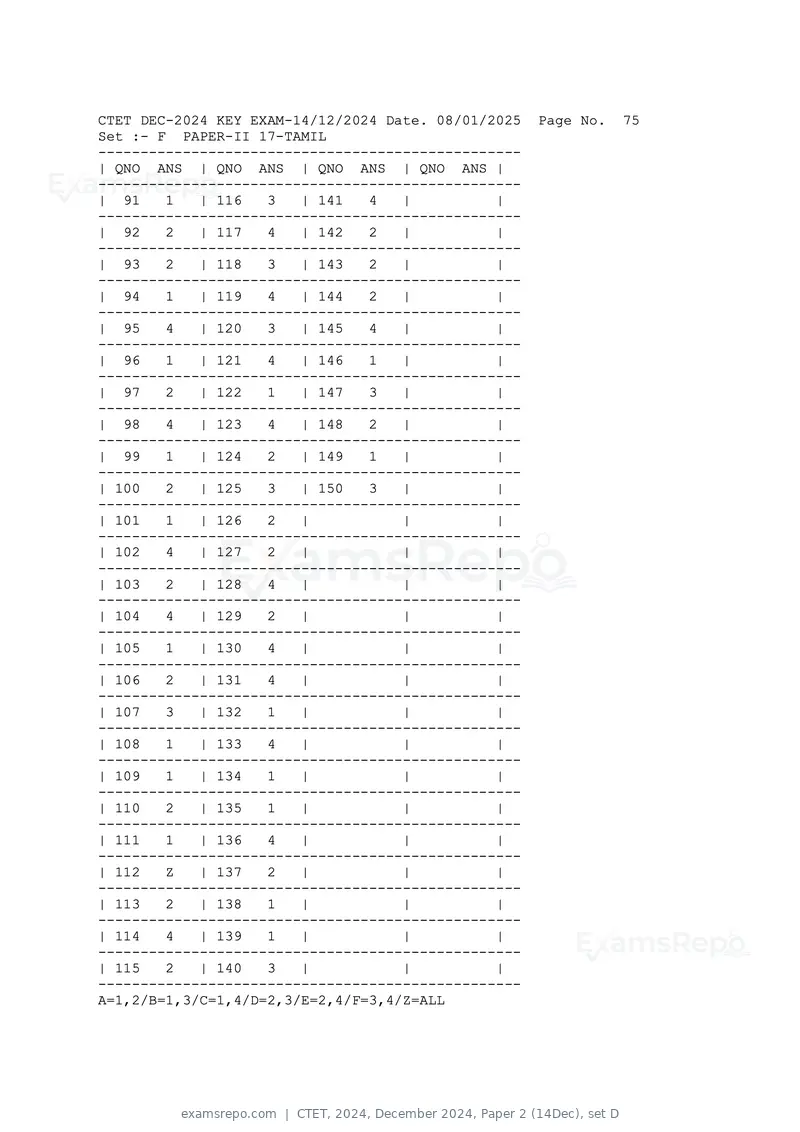
Text of page 75
CTET DEC-2024 KEY EXAM-14/12/2024 Date. 08/01/2025   Page No.   75
Set :- F PAPER-II 17-TAMIL
--------------------------------------------------
| QNO ANS | QNO ANS | QNO ANS | QNO ANS |
--------------------------------------------------
| 91    1   | 116   3   | 141   4   |          |
--------------------------------------------------
| 92    2   | 117   4   | 142   2   |          |
--------------------------------------------------
| 93    2   | 118   3   | 143   2   |          |
--------------------------------------------------
| 94    1   | 119   4   | 144   2   |          |
--------------------------------------------------
| 95    4   | 120   3   | 145   4   |          |
--------------------------------------------------
| 96    1   | 121   4   | 146   1   |          |
--------------------------------------------------
| 97    2   | 122   1   | 147   3   |          |
--------------------------------------------------
| 98    4   | 123   4   | 148   2   |          |
--------------------------------------------------
| 99    1   | 124   2   | 149   1   |          |
--------------------------------------------------
| 100   2   | 125   3   | 150   3   |          |
--------------------------------------------------
| 101   1   | 126   2   |           |          |
--------------------------------------------------
| 102   4   | 127   2   |           |          |
--------------------------------------------------
| 103   2   | 128   4   |           |          |
--------------------------------------------------
| 104   4   | 129   2   |           |          |
--------------------------------------------------
| 105   1   | 130   4   |           |          |
--------------------------------------------------
| 106   2   | 131   4   |           |          |
--------------------------------------------------
| 107   3   | 132   1   |           |          |
--------------------------------------------------
| 108   1   | 133   4   |           |          |
--------------------------------------------------
| 109   1   | 134   1   |           |          |
--------------------------------------------------
| 110   2   | 135   1   |           |          |
--------------------------------------------------
| 111   1   | 136   4   |           |          |
--------------------------------------------------
| 112   Z   | 137   2   |           |          |
--------------------------------------------------
| 113   2   | 138   1   |           |          |
--------------------------------------------------
| 114   4   | 139   1   |           |          |
--------------------------------------------------
| 115   2   | 140   3   |           |          |
--------------------------------------------------
A=1,2/B=1,3/C=1,4/D=2,3/E=2,4/F=3,4/Z=ALL
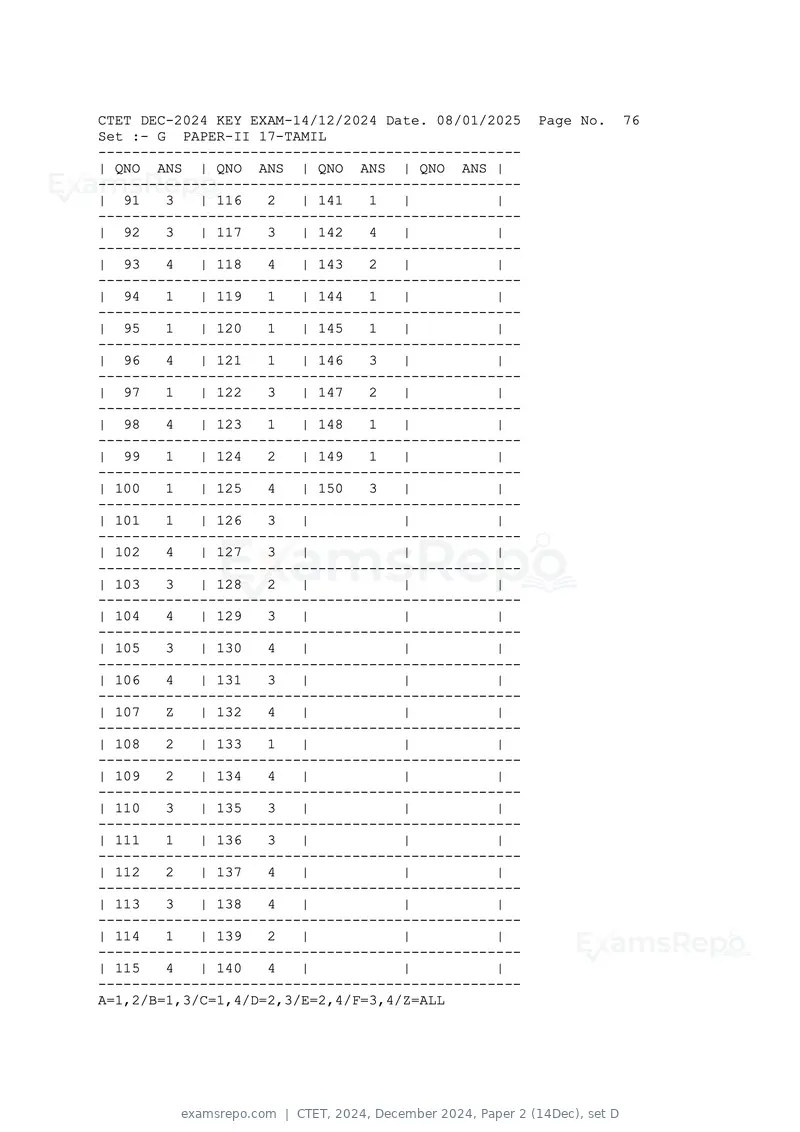
Text of page 76
CTET DEC-2024 KEY EXAM-14/12/2024 Date. 08/01/2025   Page No.   76
Set :- G PAPER-II 17-TAMIL
--------------------------------------------------
| QNO ANS | QNO ANS | QNO ANS | QNO ANS |
--------------------------------------------------
| 91    3   | 116   2   | 141   1   |          |
--------------------------------------------------
| 92    3   | 117   3   | 142   4   |          |
--------------------------------------------------
| 93    4   | 118   4   | 143   2   |          |
--------------------------------------------------
| 94    1   | 119   1   | 144   1   |          |
--------------------------------------------------
| 95    1   | 120   1   | 145   1   |          |
--------------------------------------------------
| 96    4   | 121   1   | 146   3   |          |
--------------------------------------------------
| 97    1   | 122   3   | 147   2   |          |
--------------------------------------------------
| 98    4   | 123   1   | 148   1   |          |
--------------------------------------------------
| 99    1   | 124   2   | 149   1   |          |
--------------------------------------------------
| 100   1   | 125   4   | 150   3   |          |
--------------------------------------------------
| 101   1   | 126   3   |           |          |
--------------------------------------------------
| 102   4   | 127   3   |           |          |
--------------------------------------------------
| 103   3   | 128   2   |           |          |
--------------------------------------------------
| 104   4   | 129   3   |           |          |
--------------------------------------------------
| 105   3   | 130   4   |           |          |
--------------------------------------------------
| 106   4   | 131   3   |           |          |
--------------------------------------------------
| 107   Z   | 132   4   |           |          |
--------------------------------------------------
| 108   2   | 133   1   |           |          |
--------------------------------------------------
| 109   2   | 134   4   |           |          |
--------------------------------------------------
| 110   3   | 135   3   |           |          |
--------------------------------------------------
| 111   1   | 136   3   |           |          |
--------------------------------------------------
| 112   2   | 137   4   |           |          |
--------------------------------------------------
| 113   3   | 138   4   |           |          |
--------------------------------------------------
| 114   1   | 139   2   |           |          |
--------------------------------------------------
| 115   4   | 140   4   |           |          |
--------------------------------------------------
A=1,2/B=1,3/C=1,4/D=2,3/E=2,4/F=3,4/Z=ALL
Text of page 77
CTET DEC-2024 KEY EXAM-14/12/2024 Date. 08/01/2025   Page No.   77
Set :- D PAPER-II 18-TELUGU
--------------------------------------------------
| QNO ANS | QNO ANS | QNO ANS | QNO ANS |
--------------------------------------------------
| 91    1   | 116   2   | 141   4   |          |
--------------------------------------------------
| 92    3   | 117   1   | 142   1   |          |
--------------------------------------------------
| 93    1   | 118   Z   | 143   3   |          |
--------------------------------------------------
| 94    2   | 119   4   | 144   4   |          |
--------------------------------------------------
| 95    1   | 120   1   | 145   1   |          |
--------------------------------------------------
| 96    3   | 121   4   | 146   3   |          |
--------------------------------------------------
| 97    3   | 122   1   | 147   2   |          |
--------------------------------------------------
| 98    4   | 123   2   | 148   4   |          |
--------------------------------------------------
| 99    4   | 124   2   | 149   4   |          |
--------------------------------------------------
| 100   3   | 125   4   | 150   3   |          |
--------------------------------------------------
| 101   2   | 126   4   |           |          |
--------------------------------------------------
| 102   2   | 127   1   |           |          |
--------------------------------------------------
| 103   2   | 128   2   |           |          |
--------------------------------------------------
| 104   4   | 129   4   |           |          |
--------------------------------------------------
| 105   3   | 130   2   |           |          |
--------------------------------------------------
| 106   4   | 131   2   |           |          |
--------------------------------------------------
| 107   3   | 132   2   |           |          |
--------------------------------------------------
| 108   2   | 133   1   |           |          |
--------------------------------------------------
| 109   3   | 134   1   |           |          |
--------------------------------------------------
| 110   4   | 135   4   |           |          |
--------------------------------------------------
| 111   2   | 136   1   |           |          |
--------------------------------------------------
| 112   1   | 137   2   |           |          |
--------------------------------------------------
| 113   4   | 138   2   |           |          |
--------------------------------------------------
| 114   1   | 139   3   |           |          |
--------------------------------------------------
| 115   3   | 140   4   |           |          |
--------------------------------------------------
A=1,2/B=1,3/C=1,4/D=2,3/E=2,4/F=3,4/Z=ALL

Text of page 78
CTET DEC-2024 KEY EXAM-14/12/2024 Date. 08/01/2025   Page No.   78
Set :- E PAPER-II 18-TELUGU
--------------------------------------------------
| QNO ANS | QNO ANS | QNO ANS | QNO ANS |
--------------------------------------------------
| 91    1   | 116   2   | 141   3   |          |
--------------------------------------------------
| 92    2   | 117   3   | 142   3   |          |
--------------------------------------------------
| 93    2   | 118   4   | 143   2   |          |
--------------------------------------------------
| 94    1   | 119   4   | 144   4   |          |
--------------------------------------------------
| 95    4   | 120   4   | 145   2   |          |
--------------------------------------------------
| 96    4   | 121   4   | 146   1   |          |
--------------------------------------------------
| 97    3   | 122   3   | 147   4   |          |
--------------------------------------------------
| 98    3   | 123   4   | 148   3   |          |
--------------------------------------------------
| 99    2   | 124   1   | 149   3   |          |
--------------------------------------------------
| 100   1   | 125   3   | 150   4   |          |
--------------------------------------------------
| 101   2   | 126   1   |           |          |
--------------------------------------------------
| 102   1   | 127   4   |           |          |
--------------------------------------------------
| 103   3   | 128   1   |           |          |
--------------------------------------------------
| 104   2   | 129   3   |           |          |
--------------------------------------------------
| 105   1   | 130   4   |           |          |
--------------------------------------------------
| 106   2   | 131   1   |           |          |
--------------------------------------------------
| 107   3   | 132   1   |           |          |
--------------------------------------------------
| 108   1   | 133   3   |           |          |
--------------------------------------------------
| 109   1   | 134   4   |           |          |
--------------------------------------------------
| 110   Z   | 135   1   |           |          |
--------------------------------------------------
| 111   3   | 136   3   |           |          |
--------------------------------------------------
| 112   4   | 137   1   |           |          |
--------------------------------------------------
| 113   2   | 138   1   |           |          |
--------------------------------------------------
| 114   3   | 139   2   |           |          |
--------------------------------------------------
| 115   1   | 140   2   |           |          |
--------------------------------------------------
A=1,2/B=1,3/C=1,4/D=2,3/E=2,4/F=3,4/Z=ALL

Text of page 79
CTET DEC-2024 KEY EXAM-14/12/2024 Date. 08/01/2025   Page No.   79
Set :- F PAPER-II 18-TELUGU
--------------------------------------------------
| QNO ANS | QNO ANS | QNO ANS | QNO ANS |
--------------------------------------------------
| 91    3   | 116   3   | 141   4   |          |
--------------------------------------------------
| 92    1   | 117   4   | 142   2   |          |
--------------------------------------------------
| 93    2   | 118   3   | 143   2   |          |
--------------------------------------------------
| 94    1   | 119   4   | 144   2   |          |
--------------------------------------------------
| 95    3   | 120   3   | 145   4   |          |
--------------------------------------------------
| 96    1   | 121   4   | 146   1   |          |
--------------------------------------------------
| 97    1   | 122   2   | 147   3   |          |
--------------------------------------------------
| 98    4   | 123   2   | 148   2   |          |
--------------------------------------------------
| 99    2   | 124   4   | 149   1   |          |
--------------------------------------------------
| 100   1   | 125   3   | 150   3   |          |
--------------------------------------------------
| 101   4   | 126   4   |           |          |
--------------------------------------------------
| 102   4   | 127   4   |           |          |
--------------------------------------------------
| 103   1   | 128   3   |           |          |
--------------------------------------------------
| 104   2   | 129   3   |           |          |
--------------------------------------------------
| 105   4   | 130   4   |           |          |
--------------------------------------------------
| 106   2   | 131   3   |           |          |
--------------------------------------------------
| 107   3   | 132   2   |           |          |
--------------------------------------------------
| 108   1   | 133   4   |           |          |
--------------------------------------------------
| 109   1   | 134   4   |           |          |
--------------------------------------------------
| 110   2   | 135   2   |           |          |
--------------------------------------------------
| 111   1   | 136   4   |           |          |
--------------------------------------------------
| 112   Z   | 137   2   |           |          |
--------------------------------------------------
| 113   2   | 138   1   |           |          |
--------------------------------------------------
| 114   4   | 139   1   |           |          |
--------------------------------------------------
| 115   2   | 140   3   |           |          |
--------------------------------------------------
A=1,2/B=1,3/C=1,4/D=2,3/E=2,4/F=3,4/Z=ALL
Text of page 80
CTET DEC-2024 KEY EXAM-14/12/2024 Date. 08/01/2025   Page No.   80
Set :- G PAPER-II 18-TELUGU
--------------------------------------------------
| QNO ANS | QNO ANS | QNO ANS | QNO ANS |
--------------------------------------------------
| 91    2   | 116   2   | 141   1   |          |
--------------------------------------------------
| 92    3   | 117   3   | 142   4   |          |
--------------------------------------------------
| 93    4   | 118   4   | 143   2   |          |
--------------------------------------------------
| 94    4   | 119   1   | 144   1   |          |
--------------------------------------------------
| 95    4   | 120   1   | 145   1   |          |
--------------------------------------------------
| 96    2   | 121   3   | 146   3   |          |
--------------------------------------------------
| 97    1   | 122   3   | 147   2   |          |
--------------------------------------------------
| 98    1   | 123   3   | 148   1   |          |
--------------------------------------------------
| 99    1   | 124   4   | 149   1   |          |
--------------------------------------------------
| 100   4   | 125   1   | 150   3   |          |
--------------------------------------------------
| 101   4   | 126   1   |           |          |
--------------------------------------------------
| 102   3   | 127   2   |           |          |
--------------------------------------------------
| 103   3   | 128   2   |           |          |
--------------------------------------------------
| 104   3   | 129   2   |           |          |
--------------------------------------------------
| 105   1   | 130   1   |           |          |
--------------------------------------------------
| 106   4   | 131   3   |           |          |
--------------------------------------------------
| 107   Z   | 132   1   |           |          |
--------------------------------------------------
| 108   2   | 133   2   |           |          |
--------------------------------------------------
| 109   2   | 134   3   |           |          |
--------------------------------------------------
| 110   3   | 135   3   |           |          |
--------------------------------------------------
| 111   1   | 136   3   |           |          |
--------------------------------------------------
| 112   2   | 137   4   |           |          |
--------------------------------------------------
| 113   3   | 138   4   |           |          |
--------------------------------------------------
| 114   1   | 139   2   |           |          |
--------------------------------------------------
| 115   4   | 140   4   |           |          |
--------------------------------------------------
A=1,2/B=1,3/C=1,4/D=2,3/E=2,4/F=3,4/Z=ALL

Text of page 81
CTET DEC-2024 KEY EXAM-14/12/2024 Date. 08/01/2025   Page No.   81
Set :- D PAPER-II 19-TIBETAN
--------------------------------------------------
| QNO ANS | QNO ANS | QNO ANS | QNO ANS |
--------------------------------------------------
| 91    2   | 116   2   | 141   4   |          |
--------------------------------------------------
| 92    3   | 117   1   | 142   1   |          |
--------------------------------------------------
| 93    4   | 118   Z   | 143   3   |          |
--------------------------------------------------
| 94    4   | 119   4   | 144   4   |          |
--------------------------------------------------
| 95    4   | 120   1   | 145   1   |          |
--------------------------------------------------
| 96    2   | 121   3   | 146   3   |          |
--------------------------------------------------
| 97    1   | 122   4   | 147   2   |          |
--------------------------------------------------
| 98    4   | 123   2   | 148   4   |          |
--------------------------------------------------
| 99    3   | 124   1   | 149   4   |          |
--------------------------------------------------
| 100   2   | 125   2   | 150   3   |          |
--------------------------------------------------
| 101   3   | 126   1   |           |          |
--------------------------------------------------
| 102   4   | 127   1   |           |          |
--------------------------------------------------
| 103   4   | 128   2   |           |          |
--------------------------------------------------
| 104   4   | 129   2   |           |          |
--------------------------------------------------
| 105   1   | 130   2   |           |          |
--------------------------------------------------
| 106   4   | 131   4   |           |          |
--------------------------------------------------
| 107   3   | 132   4   |           |          |
--------------------------------------------------
| 108   2   | 133   2   |           |          |
--------------------------------------------------
| 109   3   | 134   3   |           |          |
--------------------------------------------------
| 110   4   | 135   4   |           |          |
--------------------------------------------------
| 111   2   | 136   1   |           |          |
--------------------------------------------------
| 112   1   | 137   2   |           |          |
--------------------------------------------------
| 113   4   | 138   2   |           |          |
--------------------------------------------------
| 114   1   | 139   3   |           |          |
--------------------------------------------------
| 115   3   | 140   4   |           |          |
--------------------------------------------------
A=1,2/B=1,3/C=1,4/D=2,3/E=2,4/F=3,4/Z=ALL

Text of page 82
CTET DEC-2024 KEY EXAM-14/12/2024 Date. 08/01/2025   Page No.   82
Set :- E PAPER-II 19-TIBETAN
--------------------------------------------------
| QNO ANS | QNO ANS | QNO ANS | QNO ANS |
--------------------------------------------------
| 91    3   | 116   2   | 141   3   |          |
--------------------------------------------------
| 92    4   | 117   3   | 142   3   |          |
--------------------------------------------------
| 93    1   | 118   4   | 143   2   |          |
--------------------------------------------------
| 94    4   | 119   4   | 144   4   |          |
--------------------------------------------------
| 95    3   | 120   4   | 145   2   |          |
--------------------------------------------------
| 96    1   | 121   3   | 146   1   |          |
--------------------------------------------------
| 97    2   | 122   4   | 147   4   |          |
--------------------------------------------------
| 98    3   | 123   4   | 148   3   |          |
--------------------------------------------------
| 99    2   | 124   1   | 149   3   |          |
--------------------------------------------------
| 100   3   | 125   2   | 150   4   |          |
--------------------------------------------------
| 101   1   | 126   4   |           |          |
--------------------------------------------------
| 102   2   | 127   2   |           |          |
--------------------------------------------------
| 103   3   | 128   1   |           |          |
--------------------------------------------------
| 104   4   | 129   3   |           |          |
--------------------------------------------------
| 105   3   | 130   1   |           |          |
--------------------------------------------------
| 106   2   | 131   1   |           |          |
--------------------------------------------------
| 107   3   | 132   3   |           |          |
--------------------------------------------------
| 108   1   | 133   1   |           |          |
--------------------------------------------------
| 109   1   | 134   2   |           |          |
--------------------------------------------------
| 110   Z   | 135   3   |           |          |
--------------------------------------------------
| 111   3   | 136   3   |           |          |
--------------------------------------------------
| 112   4   | 137   1   |           |          |
--------------------------------------------------
| 113   2   | 138   1   |           |          |
--------------------------------------------------
| 114   3   | 139   2   |           |          |
--------------------------------------------------
| 115   1   | 140   2   |           |          |
--------------------------------------------------
A=1,2/B=1,3/C=1,4/D=2,3/E=2,4/F=3,4/Z=ALL

Text of page 83
CTET DEC-2024 KEY EXAM-14/12/2024 Date. 08/01/2025   Page No.   83
Set :- F PAPER-II 19-TIBETAN
--------------------------------------------------
| QNO ANS | QNO ANS | QNO ANS | QNO ANS |
--------------------------------------------------
| 91    4   | 116   3   | 141   4   |          |
--------------------------------------------------
| 92    4   | 117   4   | 142   2   |          |
--------------------------------------------------
| 93    1   | 118   3   | 143   2   |          |
--------------------------------------------------
| 94    1   | 119   4   | 144   2   |          |
--------------------------------------------------
| 95    2   | 120   3   | 145   4   |          |
--------------------------------------------------
| 96    4   | 121   4   | 146   1   |          |
--------------------------------------------------
| 97    3   | 122   1   | 147   3   |          |
--------------------------------------------------
| 98    2   | 123   3   | 148   2   |          |
--------------------------------------------------
| 99    2   | 124   2   | 149   1   |          |
--------------------------------------------------
| 100   4   | 125   3   | 150   3   |          |
--------------------------------------------------
| 101   1   | 126   4   |           |          |
--------------------------------------------------
| 102   2   | 127   3   |           |          |
--------------------------------------------------
| 103   3   | 128   2   |           |          |
--------------------------------------------------
| 104   2   | 129   4   |           |          |
--------------------------------------------------
| 105   2   | 130   4   |           |          |
--------------------------------------------------
| 106   2   | 131   1   |           |          |
--------------------------------------------------
| 107   3   | 132   4   |           |          |
--------------------------------------------------
| 108   1   | 133   2   |           |          |
--------------------------------------------------
| 109   1   | 134   2   |           |          |
--------------------------------------------------
| 110   2   | 135   2   |           |          |
--------------------------------------------------
| 111   1   | 136   4   |           |          |
--------------------------------------------------
| 112   Z   | 137   2   |           |          |
--------------------------------------------------
| 113   2   | 138   1   |           |          |
--------------------------------------------------
| 114   4   | 139   1   |           |          |
--------------------------------------------------
| 115   2   | 140   3   |           |          |
--------------------------------------------------
A=1,2/B=1,3/C=1,4/D=2,3/E=2,4/F=3,4/Z=ALL
Text of page 84
CTET DEC-2024 KEY EXAM-14/12/2024 Date. 08/01/2025   Page No.   84
Set :- G PAPER-II 19-TIBETAN
--------------------------------------------------
| QNO ANS | QNO ANS | QNO ANS | QNO ANS |
--------------------------------------------------
| 91    1   | 116   2   | 141   1   |          |
--------------------------------------------------
| 92    1   | 117   3   | 142   4   |          |
--------------------------------------------------
| 93    4   | 118   4   | 143   2   |          |
--------------------------------------------------
| 94    2   | 119   1   | 144   1   |          |
--------------------------------------------------
| 95    3   | 120   1   | 145   1   |          |
--------------------------------------------------
| 96    3   | 121   3   | 146   3   |          |
--------------------------------------------------
| 97    4   | 122   3   | 147   2   |          |
--------------------------------------------------
| 98    1   | 123   2   | 148   1   |          |
--------------------------------------------------
| 99    4   | 124   2   | 149   1   |          |
--------------------------------------------------
| 100   3   | 125   4   | 150   3   |          |
--------------------------------------------------
| 101   2   | 126   2   |           |          |
--------------------------------------------------
| 102   4   | 127   1   |           |          |
--------------------------------------------------
| 103   1   | 128   2   |           |          |
--------------------------------------------------
| 104   1   | 129   4   |           |          |
--------------------------------------------------
| 105   1   | 130   3   |           |          |
--------------------------------------------------
| 106   4   | 131   1   |           |          |
--------------------------------------------------
| 107   Z   | 132   1   |           |          |
--------------------------------------------------
| 108   2   | 133   3   |           |          |
--------------------------------------------------
| 109   2   | 134   1   |           |          |
--------------------------------------------------
| 110   3   | 135   3   |           |          |
--------------------------------------------------
| 111   1   | 136   3   |           |          |
--------------------------------------------------
| 112   2   | 137   4   |           |          |
--------------------------------------------------
| 113   3   | 138   4   |           |          |
--------------------------------------------------
| 114   1   | 139   2   |           |          |
--------------------------------------------------
| 115   4   | 140   4   |           |          |
--------------------------------------------------
A=1,2/B=1,3/C=1,4/D=2,3/E=2,4/F=3,4/Z=ALL

Text of page 85
CTET DEC-2024 KEY EXAM-14/12/2024 Date. 08/01/2025   Page No.   85
Set :- D PAPER-II 20-URDU
--------------------------------------------------
| QNO ANS | QNO ANS | QNO ANS | QNO ANS |
--------------------------------------------------
| 91    4   | 116   2   | 141   4   |          |
--------------------------------------------------
| 92    2   | 117   1   | 142   1   |          |
--------------------------------------------------
| 93    1   | 118   Z   | 143   3   |          |
--------------------------------------------------
| 94    2   | 119   4   | 144   4   |          |
--------------------------------------------------
| 95    2   | 120   1   | 145   1   |          |
--------------------------------------------------
| 96    3   | 121   2   | 146   3   |          |
--------------------------------------------------
| 97    2   | 122   3   | 147   2   |          |
--------------------------------------------------
| 98    3   | 123   2   | 148   4   |          |
--------------------------------------------------
| 99    2   | 124   3   | 149   4   |          |
--------------------------------------------------
| 100   2   | 125   1   | 150   3   |          |
--------------------------------------------------
| 101   2   | 126   3   |           |          |
--------------------------------------------------
| 102   2   | 127   3   |           |          |
--------------------------------------------------
| 103   3   | 128   2   |           |          |
--------------------------------------------------
| 104   3   | 129   2   |           |          |
--------------------------------------------------
| 105   2   | 130   3   |           |          |
--------------------------------------------------
| 106   4   | 131   3   |           |          |
--------------------------------------------------
| 107   3   | 132   2   |           |          |
--------------------------------------------------
| 108   2   | 133   2   |           |          |
--------------------------------------------------
| 109   3   | 134   2   |           |          |
--------------------------------------------------
| 110   4   | 135   2   |           |          |
--------------------------------------------------
| 111   2   | 136   1   |           |          |
--------------------------------------------------
| 112   1   | 137   2   |           |          |
--------------------------------------------------
| 113   4   | 138   2   |           |          |
--------------------------------------------------
| 114   1   | 139   3   |           |          |
--------------------------------------------------
| 115   3   | 140   4   |           |          |
--------------------------------------------------
A=1,2/B=1,3/C=1,4/D=2,3/E=2,4/F=3,4/Z=ALL

Text of page 86
CTET DEC-2024 KEY EXAM-14/12/2024 Date. 08/01/2025   Page No.   86
Set :- E PAPER-II 20-URDU
--------------------------------------------------
| QNO ANS | QNO ANS | QNO ANS | QNO ANS |
--------------------------------------------------
| 91    1   | 116   2   | 141   3   |          |
--------------------------------------------------
| 92    1   | 117   3   | 142   3   |          |
--------------------------------------------------
| 93    2   | 118   4   | 143   2   |          |
--------------------------------------------------
| 94    1   | 119   4   | 144   4   |          |
--------------------------------------------------
| 95    1   | 120   4   | 145   2   |          |
--------------------------------------------------
| 96    3   | 121   2   | 146   1   |          |
--------------------------------------------------
| 97    1   | 122   2   | 147   4   |          |
--------------------------------------------------
| 98    2   | 123   2   | 148   3   |          |
--------------------------------------------------
| 99    1   | 124   1   | 149   3   |          |
--------------------------------------------------
| 100   1   | 125   1   | 150   4   |          |
--------------------------------------------------
| 101   1   | 126   2   |           |          |
--------------------------------------------------
| 102   1   | 127   1   |           |          |
--------------------------------------------------
| 103   2   | 128   1   |           |          |
--------------------------------------------------
| 104   1   | 129   1   |           |          |
--------------------------------------------------
| 105   2   | 130   1   |           |          |
--------------------------------------------------
| 106   2   | 131   2   |           |          |
--------------------------------------------------
| 107   3   | 132   2   |           |          |
--------------------------------------------------
| 108   1   | 133   1   |           |          |
--------------------------------------------------
| 109   1   | 134   1   |           |          |
--------------------------------------------------
| 110   Z   | 135   1   |           |          |
--------------------------------------------------
| 111   3   | 136   3   |           |          |
--------------------------------------------------
| 112   4   | 137   1   |           |          |
--------------------------------------------------
| 113   2   | 138   1   |           |          |
--------------------------------------------------
| 114   3   | 139   2   |           |          |
--------------------------------------------------
| 115   1   | 140   2   |           |          |
--------------------------------------------------
A=1,2/B=1,3/C=1,4/D=2,3/E=2,4/F=3,4/Z=ALL

Text of page 87
CTET DEC-2024 KEY EXAM-14/12/2024 Date. 08/01/2025   Page No.   87
Set :- F PAPER-II 20-URDU
--------------------------------------------------
| QNO ANS | QNO ANS | QNO ANS | QNO ANS |
--------------------------------------------------
| 91    2   | 116   3   | 141   4   |          |
--------------------------------------------------
| 92    1   | 117   4   | 142   2   |          |
--------------------------------------------------
| 93    4   | 118   3   | 143   2   |          |
--------------------------------------------------
| 94    4   | 119   4   | 144   2   |          |
--------------------------------------------------
| 95    4   | 120   3   | 145   4   |          |
--------------------------------------------------
| 96    1   | 121   4   | 146   1   |          |
--------------------------------------------------
| 97    4   | 122   4   | 147   3   |          |
--------------------------------------------------
| 98    4   | 123   1   | 148   2   |          |
--------------------------------------------------
| 99    1   | 124   1   | 149   1   |          |
--------------------------------------------------
| 100   4   | 125   1   | 150   3   |          |
--------------------------------------------------
| 101   4   | 126   4   |           |          |
--------------------------------------------------
| 102   4   | 127   1   |           |          |
--------------------------------------------------
| 103   4   | 128   1   |           |          |
--------------------------------------------------
| 104   1   | 129   4   |           |          |
--------------------------------------------------
| 105   1   | 130   1   |           |          |
--------------------------------------------------
| 106   2   | 131   4   |           |          |
--------------------------------------------------
| 107   3   | 132   4   |           |          |
--------------------------------------------------
| 108   1   | 133   4   |           |          |
--------------------------------------------------
| 109   1   | 134   1   |           |          |
--------------------------------------------------
| 110   2   | 135   4   |           |          |
--------------------------------------------------
| 111   1   | 136   4   |           |          |
--------------------------------------------------
| 112   Z   | 137   2   |           |          |
--------------------------------------------------
| 113   2   | 138   1   |           |          |
--------------------------------------------------
| 114   4   | 139   1   |           |          |
--------------------------------------------------
| 115   2   | 140   3   |           |          |
--------------------------------------------------
A=1,2/B=1,3/C=1,4/D=2,3/E=2,4/F=3,4/Z=ALL

Text of page 88
CTET DEC-2024 KEY EXAM-14/12/2024 Date. 08/01/2025   Page No.   88
Set :- G PAPER-II 20-URDU
--------------------------------------------------
| QNO ANS | QNO ANS | QNO ANS | QNO ANS |
--------------------------------------------------
| 91    3   | 116   2   | 141   1   |          |
--------------------------------------------------
| 92    3   | 117   3   | 142   4   |          |
--------------------------------------------------
| 93    3   | 118   4   | 143   2   |          |
--------------------------------------------------
| 94    3   | 119   1   | 144   1   |          |
--------------------------------------------------
| 95    4   | 120   1   | 145   1   |          |
--------------------------------------------------
| 96    1   | 121   3   | 146   3   |          |
--------------------------------------------------
| 97    3   | 122   3   | 147   2   |          |
--------------------------------------------------
| 98    4   | 123   4   | 148   1   |          |
--------------------------------------------------
| 99    1   | 124   1   | 149   1   |          |
--------------------------------------------------
| 100   3   | 125   3   | 150   3   |          |
--------------------------------------------------
| 101   3   | 126   4   |           |          |
--------------------------------------------------
| 102   3   | 127   4   |           |          |
--------------------------------------------------
| 103   3   | 128   4   |           |          |
--------------------------------------------------
| 104   4   | 129   3   |           |          |
--------------------------------------------------
| 105   4   | 130   3   |           |          |
--------------------------------------------------
| 106   4   | 131   3   |           |          |
--------------------------------------------------
| 107   Z   | 132   3   |           |          |
--------------------------------------------------
| 108   2   | 133   3   |           |          |
--------------------------------------------------
| 109   2   | 134   4   |           |          |
--------------------------------------------------
| 110   3   | 135   4   |           |          |
--------------------------------------------------
| 111   1   | 136   3   |           |          |
--------------------------------------------------
| 112   2   | 137   4   |           |          |
--------------------------------------------------
| 113   3   | 138   4   |           |          |
--------------------------------------------------
| 114   1   | 139   2   |           |          |
--------------------------------------------------
| 115   4   | 140   4   |           |          |
--------------------------------------------------
A=1,2/B=1,3/C=1,4/D=2,3/E=2,4/F=3,4/Z=ALL

Text of page 89
CTET DEC-2024 KEY EXAM-15/12/2024 Date. 08/01/2025   Page No.   89
Set :- L PAPER-II (MAIN MATH)
--------------------------------------------------
| QNO ANS | QNO ANS | QNO ANS | QNO ANS |
--------------------------------------------------
|   1   2   | 26    1   | 51    2   | 76    1 |
--------------------------------------------------
|   2   1   | 27    2   | 52    3   | 77    3 |
--------------------------------------------------
|   3   3   | 28    3   | 53    1   | 78    3 |
--------------------------------------------------
|   4   Z   | 29    4   | 54    3   | 79    4 |
--------------------------------------------------
|   5   1   | 30    4   | 55    2   | 80    3 |
--------------------------------------------------
|   6   2   | 31    4   | 56    4   | 81    4 |
--------------------------------------------------
|   7   4   | 32    2   | 57    2   | 82    2 |
--------------------------------------------------
|   8   1   | 33    2   | 58    4   | 83    3 |
--------------------------------------------------
|   9   2   | 34    4   | 59    4   | 84    1 |
--------------------------------------------------
| 10    1   | 35    4   | 60    3   | 85    3 |
--------------------------------------------------
| 11    2   | 36    1   | 61    4   | 86    1 |
--------------------------------------------------
| 12    4   | 37    3   | 62    1   | 87    3 |
--------------------------------------------------
| 13    1   | 38    2   | 63    4   | 88    1 |
--------------------------------------------------
| 14    2   | 39    1   | 64    1   | 89    3 |
--------------------------------------------------
| 15    3   | 40    3   | 65    2   | 90    2 |
--------------------------------------------------
| 16    4   | 41    4   | 66    3   |          |
--------------------------------------------------
| 17    2   | 42    2   | 67    3   |          |
--------------------------------------------------
| 18    1   | 43    2   | 68    3   |          |
--------------------------------------------------
| 19    4   | 44    3   | 69    4   |          |
--------------------------------------------------
| 20    1   | 45    A   | 70    1   |          |
--------------------------------------------------
| 21    1   | 46    4   | 71    2   |          |
--------------------------------------------------
| 22    2   | 47    2   | 72    3   |          |
--------------------------------------------------
| 23    3   | 48    4   | 73    2   |          |
--------------------------------------------------
| 24    3   | 49    2   | 74    3   |          |
--------------------------------------------------
| 25    4   | 50    2   | 75    2   |          |
--------------------------------------------------
A=1,2/B=1,3/C=1,4/D=2,3/E=2,4/F=3,4/Z=ALL

Text of page 90
CTET DEC-2024 KEY EXAM-15/12/2024 Date. 08/01/2025   Page No.   90
Set :- M PAPER-II (MAIN MATH)
--------------------------------------------------
| QNO ANS | QNO ANS | QNO ANS | QNO ANS |
--------------------------------------------------
|   1   4   | 26    1   | 51    3   | 76    3 |
--------------------------------------------------
|   2   1   | 27    2   | 52    2   | 77    4 |
--------------------------------------------------
|   3   2   | 28    2   | 53    4   | 78    3 |
--------------------------------------------------
|   4   3   | 29    3   | 54    1   | 79    4 |
--------------------------------------------------
|   5   4   | 30    4   | 55    3   | 80    3 |
--------------------------------------------------
|   6   1   | 31    1   | 56    3   | 81    2 |
--------------------------------------------------
|   7   1   | 32    3   | 57    4   | 82    4 |
--------------------------------------------------
|   8   3   | 33    3   | 58    D   | 83    4 |
--------------------------------------------------
|   9   2   | 34    3   | 59    1   | 84    1 |
--------------------------------------------------
| 10    4   | 35    4   | 60    3   | 85    4 |
--------------------------------------------------
| 11    Z   | 36    2   | 61    2   | 86    1 |
--------------------------------------------------
| 12    2   | 37    4   | 62    4   | 87    3 |
--------------------------------------------------
| 13    3   | 38    3   | 63    2   | 88    4 |
--------------------------------------------------
| 14    1   | 39    1   | 64    4   | 89    2 |
--------------------------------------------------
| 15    2   | 40    3   | 65    3   | 90    4 |
--------------------------------------------------
| 16    3   | 41    1   | 66    1   |          |
--------------------------------------------------
| 17    2   | 42    1   | 67    2   |          |
--------------------------------------------------
| 18    3   | 43    4   | 68    1   |          |
--------------------------------------------------
| 19    1   | 44    1   | 69    2   |          |
--------------------------------------------------
| 20    2   | 45    3   | 70    3   |          |
--------------------------------------------------
| 21    3   | 46    3   | 71    4   |          |
--------------------------------------------------
| 22    4   | 47    1   | 72    4   |          |
--------------------------------------------------
| 23    1   | 48    1   | 73    4   |          |
--------------------------------------------------
| 24    3   | 49    2   | 74    1   |          |
--------------------------------------------------
| 25    2   | 50    4   | 75    2   |          |
--------------------------------------------------
A=1,2/B=1,3/C=1,4/D=2,3/E=2,4/F=3,4/Z=ALL

Text of page 91
CTET DEC-2024 KEY EXAM-15/12/2024 Date. 08/01/2025   Page No.   91
Set :- N PAPER-II (MAIN MATH)
--------------------------------------------------
| QNO ANS | QNO ANS | QNO ANS | QNO ANS |
--------------------------------------------------
|   1   3   | 26    3   | 51    2   | 76    3 |
--------------------------------------------------
|   2   2   | 27    4   | 52    2   | 77    2 |
--------------------------------------------------
|   3   3   | 28    1   | 53    3   | 78    3 |
--------------------------------------------------
|   4   3   | 29    2   | 54    1   | 79    4 |
--------------------------------------------------
|   5   4   | 30    4   | 55    4   | 80    1 |
--------------------------------------------------
|   6   1   | 31    1   | 56    3   | 81    1 |
--------------------------------------------------
|   7   1   | 32    F   | 57    1   | 82    1 |
--------------------------------------------------
|   8   2   | 33    2   | 58    2   | 83    2 |
--------------------------------------------------
|   9   3   | 34    4   | 59    4   | 84    3 |
--------------------------------------------------
| 10    4   | 35    2   | 60    4   | 85    4 |
--------------------------------------------------
| 11    1   | 36    4   | 61    1   | 86    1 |
--------------------------------------------------
| 12    2   | 37    4   | 62    1   | 87    4 |
--------------------------------------------------
| 13    2   | 38    4   | 63    2   | 88    1 |
--------------------------------------------------
| 14    4   | 39    1   | 64    1   | 89    4 |
--------------------------------------------------
| 15    3   | 40    3   | 65    2   | 90    3 |
--------------------------------------------------
| 16    1   | 41    1   | 66    4   |          |
--------------------------------------------------
| 17    Z   | 42    4   | 67    1   |          |
--------------------------------------------------
| 18    3   | 43    2   | 68    3   |          |
--------------------------------------------------
| 19    4   | 44    4   | 69    1   |          |
--------------------------------------------------
| 20    2   | 45    2   | 70    3   |          |
--------------------------------------------------
| 21    3   | 46    2   | 71    1   |          |
--------------------------------------------------
| 22    4   | 47    1   | 72    3   |          |
--------------------------------------------------
| 23    3   | 48    2   | 73    1   |          |
--------------------------------------------------
| 24    4   | 49    4   | 74    4   |          |
--------------------------------------------------
| 25    2   | 50    4   | 75    2   |          |
--------------------------------------------------
A=1,2/B=1,3/C=1,4/D=2,3/E=2,4/F=3,4/Z=ALL

Text of page 92
CTET DEC-2024 KEY EXAM-15/12/2024 Date. 08/01/2025   Page No.   92
Set :- O PAPER-II (MAIN MATH)
--------------------------------------------------
| QNO ANS | QNO ANS | QNO ANS | QNO ANS |
--------------------------------------------------
|   1   4   | 26    4   | 51    3   | 76    4 |
--------------------------------------------------
|   2   1   | 27    1   | 52    2   | 77    2 |
--------------------------------------------------
|   3   3   | 28    3   | 53    3   | 78    4 |
--------------------------------------------------
|   4   4   | 29    4   | 54    1   | 79    2 |
--------------------------------------------------
|   5   1   | 30    1   | 55    1   | 80    4 |
--------------------------------------------------
|   6   2   | 31    4   | 56    3   | 81    2 |
--------------------------------------------------
|   7   3   | 32    2   | 57    3   | 82    1 |
--------------------------------------------------
|   8   1   | 33    3   | 58    4   | 83    3 |
--------------------------------------------------
|   9   4   | 34    1   | 59    2   | 84    4 |
--------------------------------------------------
| 10    3   | 35    1   | 60    1   | 85    3 |
--------------------------------------------------
| 11    4   | 36    2   | 61    3   | 86    4 |
--------------------------------------------------
| 12    4   | 37    C   | 62    4   | 87    1 |
--------------------------------------------------
| 13    1   | 38    3   | 63    1   | 88    2 |
--------------------------------------------------
| 14    2   | 39    1   | 64    2   | 89    2 |
--------------------------------------------------
| 15    2   | 40    3   | 65    1   | 90    2 |
--------------------------------------------------
| 16    3   | 41    1   | 66    2   |          |
--------------------------------------------------
| 17    4   | 42    1   | 67    1   |          |
--------------------------------------------------
| 18    1   | 43    1   | 68    4   |          |
--------------------------------------------------
| 19    2   | 44    2   | 69    2   |          |
--------------------------------------------------
| 20    3   | 45    4   | 70    2   |          |
--------------------------------------------------
| 21    3   | 46    2   | 71    3   |          |
--------------------------------------------------
| 22    1   | 47    1   | 72    2   |          |
--------------------------------------------------
| 23    4   | 48    3   | 73    3   |          |
--------------------------------------------------
| 24    2   | 49    1   | 74    1   |          |
--------------------------------------------------
| 25    Z   | 50    3   | 75    2   |          |
--------------------------------------------------
A=1,2/B=1,3/C=1,4/D=2,3/E=2,4/F=3,4/Z=ALL
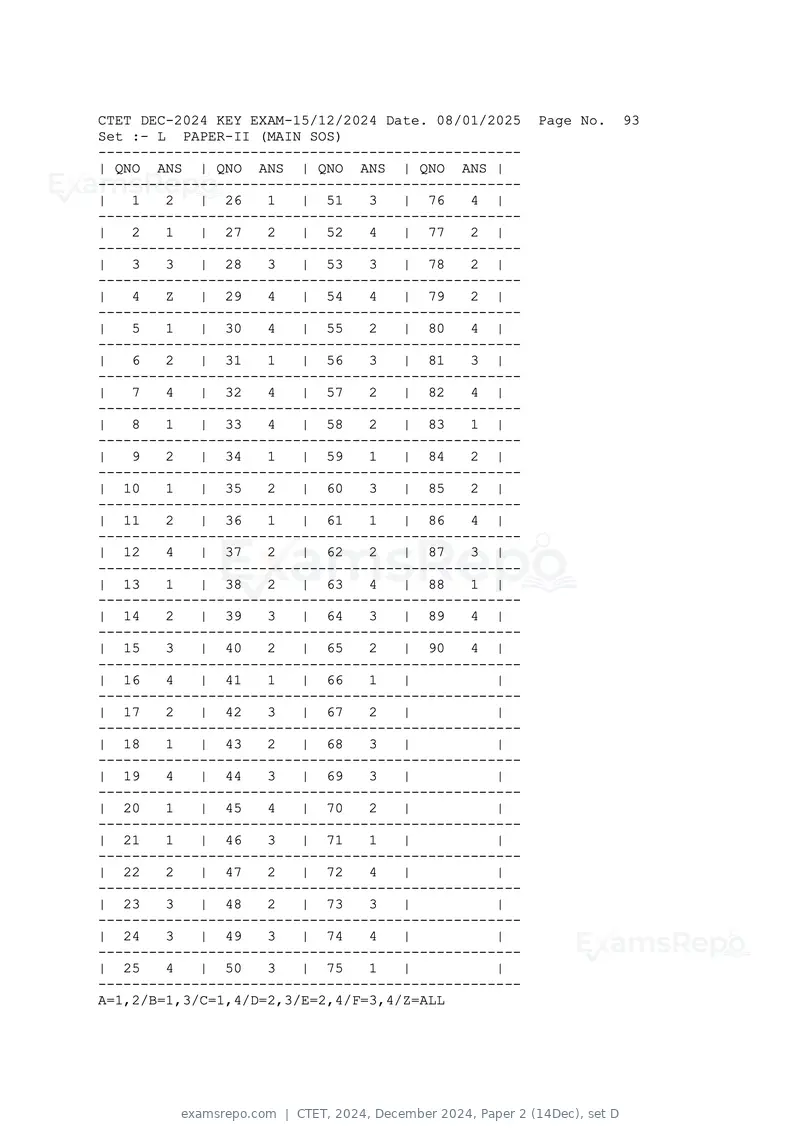
Text of page 93
CTET DEC-2024 KEY EXAM-15/12/2024 Date. 08/01/2025   Page No.   93
Set :- L PAPER-II (MAIN SOS)
--------------------------------------------------
| QNO ANS | QNO ANS | QNO ANS | QNO ANS |
--------------------------------------------------
|   1   2   | 26    1   | 51    3   | 76    4 |
--------------------------------------------------
|   2   1   | 27    2   | 52    4   | 77    2 |
--------------------------------------------------
|   3   3   | 28    3   | 53    3   | 78    2 |
--------------------------------------------------
|   4   Z   | 29    4   | 54    4   | 79    2 |
--------------------------------------------------
|   5   1   | 30    4   | 55    2   | 80    4 |
--------------------------------------------------
|   6   2   | 31    1   | 56    3   | 81    3 |
--------------------------------------------------
|   7   4   | 32    4   | 57    2   | 82    4 |
--------------------------------------------------
|   8   1   | 33    4   | 58    2   | 83    1 |
--------------------------------------------------
|   9   2   | 34    1   | 59    1   | 84    2 |
--------------------------------------------------
| 10    1   | 35    2   | 60    3   | 85    2 |
--------------------------------------------------
| 11    2   | 36    1   | 61    1   | 86    4 |
--------------------------------------------------
| 12    4   | 37    2   | 62    2   | 87    3 |
--------------------------------------------------
| 13    1   | 38    2   | 63    4   | 88    1 |
--------------------------------------------------
| 14    2   | 39    3   | 64    3   | 89    4 |
--------------------------------------------------
| 15    3   | 40    2   | 65    2   | 90    4 |
--------------------------------------------------
| 16    4   | 41    1   | 66    1   |          |
--------------------------------------------------
| 17    2   | 42    3   | 67    2   |          |
--------------------------------------------------
| 18    1   | 43    2   | 68    3   |          |
--------------------------------------------------
| 19    4   | 44    3   | 69    3   |          |
--------------------------------------------------
| 20    1   | 45    4   | 70    2   |          |
--------------------------------------------------
| 21    1   | 46    3   | 71    1   |          |
--------------------------------------------------
| 22    2   | 47    2   | 72    4   |          |
--------------------------------------------------
| 23    3   | 48    2   | 73    3   |          |
--------------------------------------------------
| 24    3   | 49    3   | 74    4   |          |
--------------------------------------------------
| 25    4   | 50    3   | 75    1   |          |
--------------------------------------------------
A=1,2/B=1,3/C=1,4/D=2,3/E=2,4/F=3,4/Z=ALL

Text of page 94
CTET DEC-2024 KEY EXAM-15/12/2024 Date. 08/01/2025   Page No.   94
Set :- M PAPER-II (MAIN SOS)
--------------------------------------------------
| QNO ANS | QNO ANS | QNO ANS | QNO ANS |
--------------------------------------------------
|   1   4   | 26    1   | 51    3   | 76    1 |
--------------------------------------------------
|   2   1   | 27    2   | 52    4   | 77    4 |
--------------------------------------------------
|   3   2   | 28    2   | 53    3   | 78    3 |
--------------------------------------------------
|   4   3   | 29    3   | 54    2   | 79    2 |
--------------------------------------------------
|   5   4   | 30    4   | 55    4   | 80    3 |
--------------------------------------------------
|   6   1   | 31    3   | 56    3   | 81    4 |
--------------------------------------------------
|   7   1   | 32    3   | 57    4   | 82    4 |
--------------------------------------------------
|   8   3   | 33    1   | 58    1   | 83    3 |
--------------------------------------------------
|   9   2   | 34    4   | 59    4   | 84    2 |
--------------------------------------------------
| 10    4   | 35    1   | 60    3   | 85    1 |
--------------------------------------------------
| 11    Z   | 36    2   | 61    3   | 86    4 |
--------------------------------------------------
| 12    2   | 37    3   | 62    4   | 87    1 |
--------------------------------------------------
| 13    3   | 38    3   | 63    4   | 88    2 |
--------------------------------------------------
| 14    1   | 39    1   | 64    4   | 89    1 |
--------------------------------------------------
| 15    2   | 40    4   | 65    1   | 90    3 |
--------------------------------------------------
| 16    3   | 41    2   | 66    4   |          |
--------------------------------------------------
| 17    2   | 42    1   | 67    1   |          |
--------------------------------------------------
| 18    3   | 43    1   | 68    3   |          |
--------------------------------------------------
| 19    1   | 44    2   | 69    4   |          |
--------------------------------------------------
| 20    2   | 45    1   | 70    3   |          |
--------------------------------------------------
| 21    3   | 46    1   | 71    3   |          |
--------------------------------------------------
| 22    4   | 47    2   | 72    2   |          |
--------------------------------------------------
| 23    1   | 48    3   | 73    4   |          |
--------------------------------------------------
| 24    3   | 49    2   | 74    2   |          |
--------------------------------------------------
| 25    2   | 50    3   | 75    3   |          |
--------------------------------------------------
A=1,2/B=1,3/C=1,4/D=2,3/E=2,4/F=3,4/Z=ALL

Text of page 95
CTET DEC-2024 KEY EXAM-15/12/2024 Date. 08/01/2025   Page No.   95
Set :- N PAPER-II (MAIN SOS)
--------------------------------------------------
| QNO ANS | QNO ANS | QNO ANS | QNO ANS |
--------------------------------------------------
|   1   3   | 26    3   | 51    4   | 76    1 |
--------------------------------------------------
|   2   2   | 27    4   | 52    4   | 77    1 |
--------------------------------------------------
|   3   3   | 28    1   | 53    2   | 78    1 |
--------------------------------------------------
|   4   3   | 29    2   | 54    1   | 79    2 |
--------------------------------------------------
|   5   4   | 30    4   | 55    3   | 80    1 |
--------------------------------------------------
|   6   1   | 31    1   | 56    2   | 81    2 |
--------------------------------------------------
|   7   1   | 32    4   | 57    2   | 82    4 |
--------------------------------------------------
|   8   2   | 33    3   | 58    3   | 83    1 |
--------------------------------------------------
|   9   3   | 34    4   | 59    2   | 84    4 |
--------------------------------------------------
| 10    4   | 35    1   | 60    2   | 85    4 |
--------------------------------------------------
| 11    1   | 36    1   | 61    3   | 86    3 |
--------------------------------------------------
| 12    2   | 37    4   | 62    4   | 87    1 |
--------------------------------------------------
| 13    2   | 38    3   | 63    3   | 88    3 |
--------------------------------------------------
| 14    4   | 39    2   | 64    4   | 89    4 |
--------------------------------------------------
| 15    3   | 40    1   | 65    4   | 90    2 |
--------------------------------------------------
| 16    1   | 41    2   | 66    1   |          |
--------------------------------------------------
| 17    Z   | 42    3   | 67    4   |          |
--------------------------------------------------
| 18    3   | 43    2   | 68    3   |          |
--------------------------------------------------
| 19    4   | 44    4   | 69    1   |          |
--------------------------------------------------
| 20    2   | 45    4   | 70    4   |          |
--------------------------------------------------
| 21    3   | 46    4   | 71    1   |          |
--------------------------------------------------
| 22    4   | 47    2   | 72    2   |          |
--------------------------------------------------
| 23    3   | 48    1   | 73    1   |          |
--------------------------------------------------
| 24    4   | 49    2   | 74    4   |          |
--------------------------------------------------
| 25    2   | 50    3   | 75    4   |          |
--------------------------------------------------
A=1,2/B=1,3/C=1,4/D=2,3/E=2,4/F=3,4/Z=ALL
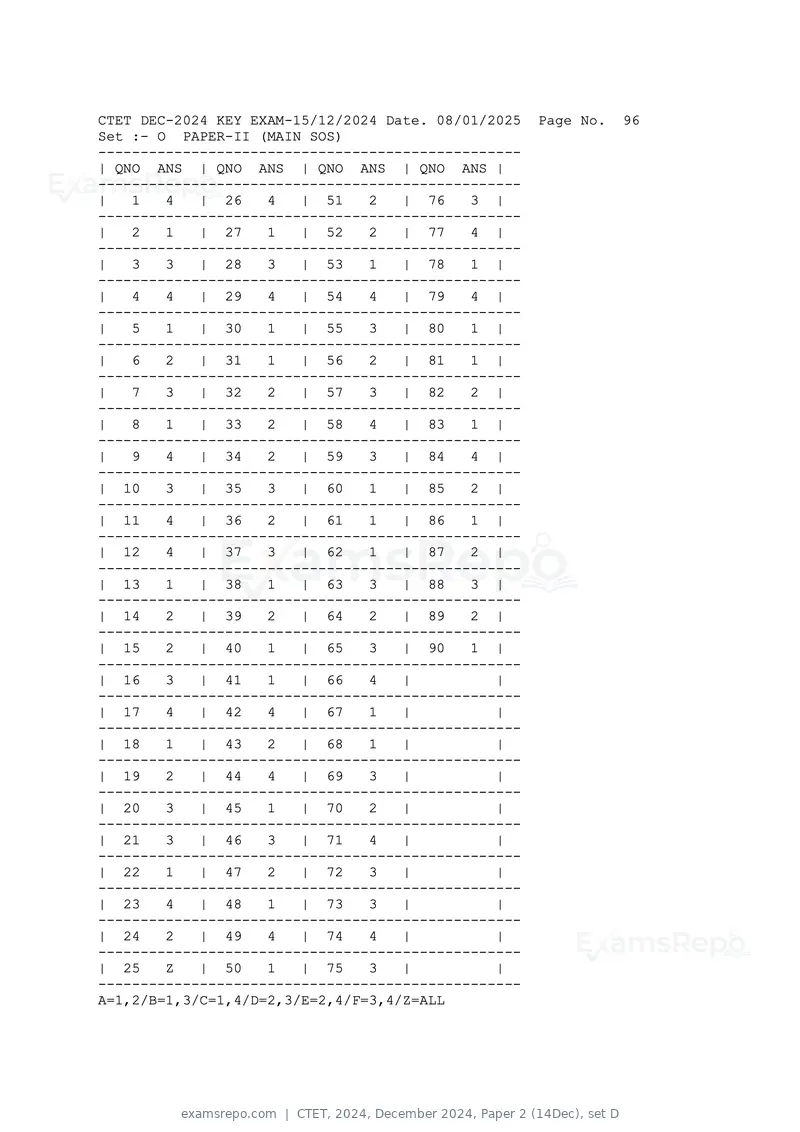
Text of page 96
CTET DEC-2024 KEY EXAM-15/12/2024 Date. 08/01/2025   Page No.   96
Set :- O PAPER-II (MAIN SOS)
--------------------------------------------------
| QNO ANS | QNO ANS | QNO ANS | QNO ANS |
--------------------------------------------------
|   1   4   | 26    4   | 51    2   | 76    3 |
--------------------------------------------------
|   2   1   | 27    1   | 52    2   | 77    4 |
--------------------------------------------------
|   3   3   | 28    3   | 53    1   | 78    1 |
--------------------------------------------------
|   4   4   | 29    4   | 54    4   | 79    4 |
--------------------------------------------------
|   5   1   | 30    1   | 55    3   | 80    1 |
--------------------------------------------------
|   6   2   | 31    1   | 56    2   | 81    1 |
--------------------------------------------------
|   7   3   | 32    2   | 57    3   | 82    2 |
--------------------------------------------------
|   8   1   | 33    2   | 58    4   | 83    1 |
--------------------------------------------------
|   9   4   | 34    2   | 59    3   | 84    4 |
--------------------------------------------------
| 10    3   | 35    3   | 60    1   | 85    2 |
--------------------------------------------------
| 11    4   | 36    2   | 61    1   | 86    1 |
--------------------------------------------------
| 12    4   | 37    3   | 62    1   | 87    2 |
--------------------------------------------------
| 13    1   | 38    1   | 63    3   | 88    3 |
--------------------------------------------------
| 14    2   | 39    2   | 64    2   | 89    2 |
--------------------------------------------------
| 15    2   | 40    1   | 65    3   | 90    1 |
--------------------------------------------------
| 16    3   | 41    1   | 66    4   |          |
--------------------------------------------------
| 17    4   | 42    4   | 67    1   |          |
--------------------------------------------------
| 18    1   | 43    2   | 68    1   |          |
--------------------------------------------------
| 19    2   | 44    4   | 69    3   |          |
--------------------------------------------------
| 20    3   | 45    1   | 70    2   |          |
--------------------------------------------------
| 21    3   | 46    3   | 71    4   |          |
--------------------------------------------------
| 22    1   | 47    2   | 72    3   |          |
--------------------------------------------------
| 23    4   | 48    1   | 73    3   |          |
--------------------------------------------------
| 24    2   | 49    4   | 74    4   |          |
--------------------------------------------------
| 25    Z   | 50    1   | 75    3   |          |
--------------------------------------------------
A=1,2/B=1,3/C=1,4/D=2,3/E=2,4/F=3,4/Z=ALL

Text of page 97
CTET DEC-2024 KEY EXAM-15/12/2024 Date. 08/01/2025   Page No.   97
Set :- L PAPER-II 01-ENGLISH
--------------------------------------------------
| QNO ANS | QNO ANS | QNO ANS | QNO ANS |
--------------------------------------------------
| 91    2   | 116   2   | 141   4   |          |
--------------------------------------------------
| 92    1   | 117   4   | 142   2   |          |
--------------------------------------------------
| 93    2   | 118   4   | 143   3   |          |
--------------------------------------------------
| 94    1   | 119   2   | 144   1   |          |
--------------------------------------------------
| 95    2   | 120   1   | 145   B   |          |
--------------------------------------------------
| 96    3   | 121   2   | 146   4   |          |
--------------------------------------------------
| 97    4   | 122   2   | 147   2   |          |
--------------------------------------------------
| 98    3   | 123   4   | 148   1   |          |
--------------------------------------------------
| 99    2   | 124   2   | 149   3   |          |
--------------------------------------------------
| 100   1   | 125   4   | 150   4   |          |
--------------------------------------------------
| 101   4   | 126   4   |           |          |
--------------------------------------------------
| 102   1   | 127   2   |           |          |
--------------------------------------------------
| 103   3   | 128   3   |           |          |
--------------------------------------------------
| 104   1   | 129   4   |           |          |
--------------------------------------------------
| 105   1   | 130   2   |           |          |
--------------------------------------------------
| 106   2   | 131   3   |           |          |
--------------------------------------------------
| 107   2   | 132   3   |           |          |
--------------------------------------------------
| 108   4   | 133   4   |           |          |
--------------------------------------------------
| 109   4   | 134   2   |           |          |
--------------------------------------------------
| 110   2   | 135   2   |           |          |
--------------------------------------------------
| 111   1   | 136   1   |           |          |
--------------------------------------------------
| 112   2   | 137   2   |           |          |
--------------------------------------------------
| 113   4   | 138   2   |           |          |
--------------------------------------------------
| 114   1   | 139   3   |           |          |
--------------------------------------------------
| 115   1   | 140   1   |           |          |
--------------------------------------------------
A=1,2/B=1,3/C=1,4/D=2,3/E=2,4/F=3,4/Z=ALL

Text of page 98
CTET DEC-2024 KEY EXAM-15/12/2024 Date. 08/01/2025   Page No.   98
Set :- M PAPER-II 01-ENGLISH
--------------------------------------------------
| QNO ANS | QNO ANS | QNO ANS | QNO ANS |
--------------------------------------------------
| 91    2   | 116   3   | 141   3   |          |
--------------------------------------------------
| 92    3   | 117   2   | 142   2   |          |
--------------------------------------------------
| 93    1   | 118   3   | 143   3   |          |
--------------------------------------------------
| 94    1   | 119   1   | 144   3   |          |
--------------------------------------------------
| 95    3   | 120   2   | 145   4   |          |
--------------------------------------------------
| 96    2   | 121   E   | 146   2   |          |
--------------------------------------------------
| 97    3   | 122   1   | 147   1   |          |
--------------------------------------------------
| 98    2   | 123   3   | 148   3   |          |
--------------------------------------------------
| 99    2   | 124   2   | 149   4   |          |
--------------------------------------------------
| 100   2   | 125   4   | 150   2   |          |
--------------------------------------------------
| 101   3   | 126   1   |           |          |
--------------------------------------------------
| 102   4   | 127   3   |           |          |
--------------------------------------------------
| 103   1   | 128   3   |           |          |
--------------------------------------------------
| 104   4   | 129   1   |           |          |
--------------------------------------------------
| 105   3   | 130   3   |           |          |
--------------------------------------------------
| 106   2   | 131   1   |           |          |
--------------------------------------------------
| 107   1   | 132   1   |           |          |
--------------------------------------------------
| 108   2   | 133   3   |           |          |
--------------------------------------------------
| 109   4   | 134   4   |           |          |
--------------------------------------------------
| 110   2   | 135   1   |           |          |
--------------------------------------------------
| 111   2   | 136   3   |           |          |
--------------------------------------------------
| 112   3   | 137   4   |           |          |
--------------------------------------------------
| 113   3   | 138   4   |           |          |
--------------------------------------------------
| 114   1   | 139   1   |           |          |
--------------------------------------------------
| 115   1   | 140   3   |           |          |
--------------------------------------------------
A=1,2/B=1,3/C=1,4/D=2,3/E=2,4/F=3,4/Z=ALL

Text of page 99
CTET DEC-2024 KEY EXAM-15/12/2024 Date. 08/01/2025   Page No.   99
Set :- N PAPER-II 01-ENGLISH
--------------------------------------------------
| QNO ANS | QNO ANS | QNO ANS | QNO ANS |
--------------------------------------------------
| 91    4   | 116   3   | 141   2   |          |
--------------------------------------------------
| 92    3   | 117   4   | 142   4   |          |
--------------------------------------------------
| 93    4   | 118   4   | 143   1   |          |
--------------------------------------------------
| 94    2   | 119   2   | 144   1   |          |
--------------------------------------------------
| 95    3   | 120   2   | 145   2   |          |
--------------------------------------------------
| 96    3   | 121   1   | 146   4   |          |
--------------------------------------------------
| 97    4   | 122   3   | 147   4   |          |
--------------------------------------------------
| 98    2   | 123   2   | 148   3   |          |
--------------------------------------------------
| 99    2   | 124   4   | 149   4   |          |
--------------------------------------------------
| 100   4   | 125   1   | 150   4   |          |
--------------------------------------------------
| 101   3   | 126   3   |           |          |
--------------------------------------------------
| 102   4   | 127   B   |           |          |
--------------------------------------------------
| 103   3   | 128   2   |           |          |
--------------------------------------------------
| 104   2   | 129   4   |           |          |
--------------------------------------------------
| 105   3   | 130   3   |           |          |
--------------------------------------------------
| 106   4   | 131   1   |           |          |
--------------------------------------------------
| 107   1   | 132   2   |           |          |
--------------------------------------------------
| 108   2   | 133   4   |           |          |
--------------------------------------------------
| 109   1   | 134   4   |           |          |
--------------------------------------------------
| 110   4   | 135   2   |           |          |
--------------------------------------------------
| 111   3   | 136   4   |           |          |
--------------------------------------------------
| 112   2   | 137   2   |           |          |
--------------------------------------------------
| 113   3   | 138   2   |           |          |
--------------------------------------------------
| 114   1   | 139   4   |           |          |
--------------------------------------------------
| 115   3   | 140   1   |           |          |
--------------------------------------------------
A=1,2/B=1,3/C=1,4/D=2,3/E=2,4/F=3,4/Z=ALL

Text of page 100
CTET DEC-2024 KEY EXAM-15/12/2024 Date. 08/01/2025   Page No. 100
Set :- O PAPER-II 01-ENGLISH
--------------------------------------------------
| QNO ANS | QNO ANS | QNO ANS | QNO ANS |
--------------------------------------------------
| 91    4   | 116   1   | 141   2   |          |
--------------------------------------------------
| 92    3   | 117   2   | 142   3   |          |
--------------------------------------------------
| 93    4   | 118   3   | 143   1   |          |
--------------------------------------------------
| 94    2   | 119   2   | 144   1   |          |
--------------------------------------------------
| 95    4   | 120   1   | 145   3   |          |
--------------------------------------------------
| 96    4   | 121   3   | 146   1   |          |
--------------------------------------------------
| 97    1   | 122   1   | 147   3   |          |
--------------------------------------------------
| 98    1   | 123   2   | 148   3   |          |
--------------------------------------------------
| 99    3   | 124   2   | 149   1   |          |
--------------------------------------------------
| 100   3   | 125   3   | 150   2   |          |
--------------------------------------------------
| 101   1   | 126   1   |           |          |
--------------------------------------------------
| 102   4   | 127   1   |           |          |
--------------------------------------------------
| 103   1   | 128   4   |           |          |
--------------------------------------------------
| 104   3   | 129   1   |           |          |
--------------------------------------------------
| 105   4   | 130   1   |           |          |
--------------------------------------------------
| 106   4   | 131   2   |           |          |
--------------------------------------------------
| 107   1   | 132   4   |           |          |
--------------------------------------------------
| 108   3   | 133   3   |           |          |
--------------------------------------------------
| 109   3   | 134   1   |           |          |
--------------------------------------------------
| 110   1   | 135   2   |           |          |
--------------------------------------------------
| 111   4   | 136   4   |           |          |
--------------------------------------------------
| 112   1   | 137   E   |           |          |
--------------------------------------------------
| 113   4   | 138   3   |           |          |
--------------------------------------------------
| 114   2   | 139   1   |           |          |
--------------------------------------------------
| 115   4   | 140   4   |           |          |
--------------------------------------------------
A=1,2/B=1,3/C=1,4/D=2,3/E=2,4/F=3,4/Z=ALL

Text of page 101
CTET DEC-2024 KEY EXAM-15/12/2024 Date. 08/01/2025   Page No. 101
Set :- L PAPER-II 02-HINDI
--------------------------------------------------
| QNO ANS | QNO ANS | QNO ANS | QNO ANS |
--------------------------------------------------
| 91    3   | 116   2   | 141   4   |          |
--------------------------------------------------
| 92    1   | 117   4   | 142   2   |          |
--------------------------------------------------
| 93    4   | 118   4   | 143   3   |          |
--------------------------------------------------
| 94    2   | 119   2   | 144   1   |          |
--------------------------------------------------
| 95    3   | 120   1   | 145   B   |          |
--------------------------------------------------
| 96    1   | 121   1   | 146   4   |          |
--------------------------------------------------
| 97    4   | 122   4   | 147   2   |          |
--------------------------------------------------
| 98    2   | 123   2   | 148   1   |          |
--------------------------------------------------
| 99    1   | 124   3   | 149   3   |          |
--------------------------------------------------
| 100   2   | 125   1   | 150   4   |          |
--------------------------------------------------
| 101   1   | 126   3   |           |          |
--------------------------------------------------
| 102   3   | 127   2   |           |          |
--------------------------------------------------
| 103   4   | 128   4   |           |          |
--------------------------------------------------
| 104   2   | 129   3   |           |          |
--------------------------------------------------
| 105   2   | 130   2   |           |          |
--------------------------------------------------
| 106   2   | 131   1   |           |          |
--------------------------------------------------
| 107   2   | 132   2   |           |          |
--------------------------------------------------
| 108   4   | 133   4   |           |          |
--------------------------------------------------
| 109   4   | 134   3   |           |          |
--------------------------------------------------
| 110   2   | 135   1   |           |          |
--------------------------------------------------
| 111   1   | 136   1   |           |          |
--------------------------------------------------
| 112   2   | 137   2   |           |          |
--------------------------------------------------
| 113   4   | 138   2   |           |          |
--------------------------------------------------
| 114   1   | 139   3   |           |          |
--------------------------------------------------
| 115   1   | 140   1   |           |          |
--------------------------------------------------
A=1,2/B=1,3/C=1,4/D=2,3/E=2,4/F=3,4/Z=ALL

Text of page 102
CTET DEC-2024 KEY EXAM-15/12/2024 Date. 08/01/2025   Page No. 102
Set :- M PAPER-II 02-HINDI
--------------------------------------------------
| QNO ANS | QNO ANS | QNO ANS | QNO ANS |
--------------------------------------------------
| 91    2   | 116   3   | 141   1   |          |
--------------------------------------------------
| 92    3   | 117   2   | 142   4   |          |
--------------------------------------------------
| 93    1   | 118   3   | 143   2   |          |
--------------------------------------------------
| 94    1   | 119   1   | 144   2   |          |
--------------------------------------------------
| 95    3   | 120   2   | 145   3   |          |
--------------------------------------------------
| 96    2   | 121   4   | 146   3   |          |
--------------------------------------------------
| 97    4   | 122   2   | 147   4   |          |
--------------------------------------------------
| 98    2   | 123   E   | 148   2   |          |
--------------------------------------------------
| 99    1   | 124   1   | 149   1   |          |
--------------------------------------------------
| 100   3   | 125   3   | 150   3   |          |
--------------------------------------------------
| 101   4   | 126   2   |           |          |
--------------------------------------------------
| 102   2   | 127   4   |           |          |
--------------------------------------------------
| 103   1   | 128   1   |           |          |
--------------------------------------------------
| 104   3   | 129   2   |           |          |
--------------------------------------------------
| 105   2   | 130   1   |           |          |
--------------------------------------------------
| 106   3   | 131   3   |           |          |
--------------------------------------------------
| 107   2   | 132   4   |           |          |
--------------------------------------------------
| 108   4   | 133   2   |           |          |
--------------------------------------------------
| 109   1   | 134   4   |           |          |
--------------------------------------------------
| 110   3   | 135   3   |           |          |
--------------------------------------------------
| 111   3   | 136   1   |           |          |
--------------------------------------------------
| 112   3   | 137   4   |           |          |
--------------------------------------------------
| 113   3   | 138   3   |           |          |
--------------------------------------------------
| 114   1   | 139   2   |           |          |
--------------------------------------------------
| 115   1   | 140   3   |           |          |
--------------------------------------------------
A=1,2/B=1,3/C=1,4/D=2,3/E=2,4/F=3,4/Z=ALL

Text of page 103
CTET DEC-2024 KEY EXAM-15/12/2024 Date. 08/01/2025   Page No. 103
Set :- N PAPER-II 02-HINDI
--------------------------------------------------
| QNO ANS | QNO ANS | QNO ANS | QNO ANS |
--------------------------------------------------
| 91    4   | 116   3   | 141   1   |          |
--------------------------------------------------
| 92    4   | 117   1   | 142   4   |          |
--------------------------------------------------
| 93    2   | 118   2   | 143   2   |          |
--------------------------------------------------
| 94    2   | 119   4   | 144   1   |          |
--------------------------------------------------
| 95    4   | 120   4   | 145   4   |          |
--------------------------------------------------
| 96    3   | 121   3   | 146   3   |          |
--------------------------------------------------
| 97    4   | 122   4   | 147   4   |          |
--------------------------------------------------
| 98    2   | 123   4   | 148   2   |          |
--------------------------------------------------
| 99    3   | 124   1   | 149   1   |          |
--------------------------------------------------
| 100   3   | 125   3   | 150   3   |          |
--------------------------------------------------
| 101   4   | 126   2   |           |          |
--------------------------------------------------
| 102   2   | 127   4   |           |          |
--------------------------------------------------
| 103   2   | 128   1   |           |          |
--------------------------------------------------
| 104   4   | 129   3   |           |          |
--------------------------------------------------
| 105   3   | 130   B   |           |          |
--------------------------------------------------
| 106   1   | 131   2   |           |          |
--------------------------------------------------
| 107   3   | 132   4   |           |          |
--------------------------------------------------
| 108   2   | 133   3   |           |          |
--------------------------------------------------
| 109   4   | 134   1   |           |          |
--------------------------------------------------
| 110   1   | 135   2   |           |          |
--------------------------------------------------
| 111   3   | 136   3   |           |          |
--------------------------------------------------
| 112   2   | 137   2   |           |          |
--------------------------------------------------
| 113   4   | 138   4   |           |          |
--------------------------------------------------
| 114   3   | 139   1   |           |          |
--------------------------------------------------
| 115   4   | 140   3   |           |          |
--------------------------------------------------
A=1,2/B=1,3/C=1,4/D=2,3/E=2,4/F=3,4/Z=ALL

Text of page 104
CTET DEC-2024 KEY EXAM-15/12/2024 Date. 08/01/2025   Page No. 104
Set :- O PAPER-II 02-HINDI
--------------------------------------------------
| QNO ANS | QNO ANS | QNO ANS | QNO ANS |
--------------------------------------------------
| 91    1   | 116   2   | 141   2   |          |
--------------------------------------------------
| 92    4   | 117   4   | 142   3   |          |
--------------------------------------------------
| 93    2   | 118   3   | 143   4   |          |
--------------------------------------------------
| 94    3   | 119   1   | 144   3   |          |
--------------------------------------------------
| 95    1   | 120   4   | 145   1   |          |
--------------------------------------------------
| 96    1   | 121   2   | 146   2   |          |
--------------------------------------------------
| 97    1   | 122   1   | 147   4   |          |
--------------------------------------------------
| 98    1   | 123   4   | 148   2   |          |
--------------------------------------------------
| 99    3   | 124   1   | 149   1   |          |
--------------------------------------------------
| 100   3   | 125   3   | 150   3   |          |
--------------------------------------------------
| 101   1   | 126   2   |           |          |
--------------------------------------------------
| 102   4   | 127   4   |           |          |
--------------------------------------------------
| 103   1   | 128   4   |           |          |
--------------------------------------------------
| 104   3   | 129   1   |           |          |
--------------------------------------------------
| 105   4   | 130   1   |           |          |
--------------------------------------------------
| 106   4   | 131   2   |           |          |
--------------------------------------------------
| 107   1   | 132   4   |           |          |
--------------------------------------------------
| 108   3   | 133   3   |           |          |
--------------------------------------------------
| 109   3   | 134   1   |           |          |
--------------------------------------------------
| 110   1   | 135   2   |           |          |
--------------------------------------------------
| 111   4   | 136   4   |           |          |
--------------------------------------------------
| 112   2   | 137   E   |           |          |
--------------------------------------------------
| 113   4   | 138   3   |           |          |
--------------------------------------------------
| 114   3   | 139   1   |           |          |
--------------------------------------------------
| 115   1   | 140   4   |           |          |
--------------------------------------------------
A=1,2/B=1,3/C=1,4/D=2,3/E=2,4/F=3,4/Z=ALL

Text of page 105
CTET DEC-2024 KEY EXAM-15/12/2024 Date. 08/01/2025   Page No. 105
Set :- L PAPER-II 03-ASSAMESE
--------------------------------------------------
| QNO ANS | QNO ANS | QNO ANS | QNO ANS |
--------------------------------------------------
| 91    2   | 116   2   | 141   4   |          |
--------------------------------------------------
| 92    3   | 117   4   | 142   2   |          |
--------------------------------------------------
| 93    2   | 118   4   | 143   3   |          |
--------------------------------------------------
| 94    4   | 119   2   | 144   1   |          |
--------------------------------------------------
| 95    1   | 120   1   | 145   B   |          |
--------------------------------------------------
| 96    1   | 121   3   | 146   4   |          |
--------------------------------------------------
| 97    1   | 122   2   | 147   2   |          |
--------------------------------------------------
| 98    3   | 123   1   | 148   1   |          |
--------------------------------------------------
| 99    1   | 124   3   | 149   3   |          |
--------------------------------------------------
| 100   3   | 125   1   | 150   4   |          |
--------------------------------------------------
| 101   2   | 126   2   |           |          |
--------------------------------------------------
| 102   4   | 127   3   |           |          |
--------------------------------------------------
| 103   1   | 128   4   |           |          |
--------------------------------------------------
| 104   4   | 129   4   |           |          |
--------------------------------------------------
| 105   1   | 130   3   |           |          |
--------------------------------------------------
| 106   2   | 131   3   |           |          |
--------------------------------------------------
| 107   2   | 132   1   |           |          |
--------------------------------------------------
| 108   4   | 133   1   |           |          |
--------------------------------------------------
| 109   4   | 134   4   |           |          |
--------------------------------------------------
| 110   2   | 135   3   |           |          |
--------------------------------------------------
| 111   1   | 136   1   |           |          |
--------------------------------------------------
| 112   2   | 137   2   |           |          |
--------------------------------------------------
| 113   4   | 138   2   |           |          |
--------------------------------------------------
| 114   1   | 139   3   |           |          |
--------------------------------------------------
| 115   1   | 140   1   |           |          |
--------------------------------------------------
A=1,2/B=1,3/C=1,4/D=2,3/E=2,4/F=3,4/Z=ALL

Text of page 106
CTET DEC-2024 KEY EXAM-15/12/2024 Date. 08/01/2025   Page No. 106
Set :- M PAPER-II 03-ASSAMESE
--------------------------------------------------
| QNO ANS | QNO ANS | QNO ANS | QNO ANS |
--------------------------------------------------
| 91    2   | 116   1   | 141   1   |          |
--------------------------------------------------
| 92    2   | 117   3   | 142   4   |          |
--------------------------------------------------
| 93    3   | 118   2   | 143   2   |          |
--------------------------------------------------
| 94    1   | 119   3   | 144   3   |          |
--------------------------------------------------
| 95    1   | 120   1   | 145   3   |          |
--------------------------------------------------
| 96    3   | 121   2   | 146   4   |          |
--------------------------------------------------
| 97    2   | 122   E   | 147   2   |          |
--------------------------------------------------
| 98    3   | 123   1   | 148   1   |          |
--------------------------------------------------
| 99    4   | 124   3   | 149   3   |          |
--------------------------------------------------
| 100   3   | 125   2   | 150   4   |          |
--------------------------------------------------
| 101   1   | 126   4   |           |          |
--------------------------------------------------
| 102   2   | 127   1   |           |          |
--------------------------------------------------
| 103   2   | 128   4   |           |          |
--------------------------------------------------
| 104   2   | 129   3   |           |          |
--------------------------------------------------
| 105   4   | 130   2   |           |          |
--------------------------------------------------
| 106   2   | 131   4   |           |          |
--------------------------------------------------
| 107   4   | 132   2   |           |          |
--------------------------------------------------
| 108   3   | 133   3   |           |          |
--------------------------------------------------
| 109   1   | 134   4   |           |          |
--------------------------------------------------
| 110   2   | 135   1   |           |          |
--------------------------------------------------
| 111   1   | 136   1   |           |          |
--------------------------------------------------
| 112   2   | 137   4   |           |          |
--------------------------------------------------
| 113   3   | 138   4   |           |          |
--------------------------------------------------
| 114   3   | 139   2   |           |          |
--------------------------------------------------
| 115   1   | 140   2   |           |          |
--------------------------------------------------
A=1,2/B=1,3/C=1,4/D=2,3/E=2,4/F=3,4/Z=ALL

Text of page 107
CTET DEC-2024 KEY EXAM-15/12/2024 Date. 08/01/2025   Page No. 107
Set :- N PAPER-II 03-ASSAMESE
--------------------------------------------------
| QNO ANS | QNO ANS | QNO ANS | QNO ANS |
--------------------------------------------------
| 91    4   | 116   4   | 141   4   |          |
--------------------------------------------------
| 92    4   | 117   2   | 142   1   |          |
--------------------------------------------------
| 93    2   | 118   3   | 143   2   |          |
--------------------------------------------------
| 94    2   | 119   2   | 144   2   |          |
--------------------------------------------------
| 95    4   | 120   3   | 145   1   |          |
--------------------------------------------------
| 96    3   | 121   3   | 146   1   |          |
--------------------------------------------------
| 97    4   | 122   4   | 147   3   |          |
--------------------------------------------------
| 98    2   | 123   4   | 148   3   |          |
--------------------------------------------------
| 99    3   | 124   1   | 149   2   |          |
--------------------------------------------------
| 100   3   | 125   3   | 150   1   |          |
--------------------------------------------------
| 101   4   | 126   2   |           |          |
--------------------------------------------------
| 102   2   | 127   4   |           |          |
--------------------------------------------------
| 103   2   | 128   1   |           |          |
--------------------------------------------------
| 104   4   | 129   3   |           |          |
--------------------------------------------------
| 105   3   | 130   B   |           |          |
--------------------------------------------------
| 106   4   | 131   2   |           |          |
--------------------------------------------------
| 107   1   | 132   4   |           |          |
--------------------------------------------------
| 108   4   | 133   3   |           |          |
--------------------------------------------------
| 109   2   | 134   1   |           |          |
--------------------------------------------------
| 110   3   | 135   2   |           |          |
--------------------------------------------------
| 111   3   | 136   1   |           |          |
--------------------------------------------------
| 112   3   | 137   4   |           |          |
--------------------------------------------------
| 113   1   | 138   3   |           |          |
--------------------------------------------------
| 114   3   | 139   1   |           |          |
--------------------------------------------------
| 115   1   | 140   3   |           |          |
--------------------------------------------------
A=1,2/B=1,3/C=1,4/D=2,3/E=2,4/F=3,4/Z=ALL

Text of page 108
CTET DEC-2024 KEY EXAM-15/12/2024 Date. 08/01/2025   Page No. 108
Set :- O PAPER-II 03-ASSAMESE
--------------------------------------------------
| QNO ANS | QNO ANS | QNO ANS | QNO ANS |
--------------------------------------------------
| 91    2   | 116   4   | 141   2   |          |
--------------------------------------------------
| 92    1   | 117   4   | 142   3   |          |
--------------------------------------------------
| 93    3   | 118   4   | 143   2   |          |
--------------------------------------------------
| 94    4   | 119   2   | 144   1   |          |
--------------------------------------------------
| 95    3   | 120   4   | 145   4   |          |
--------------------------------------------------
| 96    4   | 121   3   | 146   2   |          |
--------------------------------------------------
| 97    1   | 122   2   | 147   4   |          |
--------------------------------------------------
| 98    1   | 123   2   | 148   1   |          |
--------------------------------------------------
| 99    3   | 124   4   | 149   2   |          |
--------------------------------------------------
| 100   3   | 125   4   | 150   3   |          |
--------------------------------------------------
| 101   1   | 126   3   |           |          |
--------------------------------------------------
| 102   4   | 127   2   |           |          |
--------------------------------------------------
| 103   1   | 128   4   |           |          |
--------------------------------------------------
| 104   3   | 129   1   |           |          |
--------------------------------------------------
| 105   4   | 130   1   |           |          |
--------------------------------------------------
| 106   4   | 131   2   |           |          |
--------------------------------------------------
| 107   1   | 132   4   |           |          |
--------------------------------------------------
| 108   3   | 133   3   |           |          |
--------------------------------------------------
| 109   3   | 134   1   |           |          |
--------------------------------------------------
| 110   1   | 135   2   |           |          |
--------------------------------------------------
| 111   4   | 136   4   |           |          |
--------------------------------------------------
| 112   1   | 137   E   |           |          |
--------------------------------------------------
| 113   2   | 138   3   |           |          |
--------------------------------------------------
| 114   1   | 139   1   |           |          |
--------------------------------------------------
| 115   3   | 140   4   |           |          |
--------------------------------------------------
A=1,2/B=1,3/C=1,4/D=2,3/E=2,4/F=3,4/Z=ALL

Text of page 109
CTET DEC-2024 KEY EXAM-15/12/2024 Date. 08/01/2025   Page No. 109
Set :- L PAPER-II 04-BENGALI
--------------------------------------------------
| QNO ANS | QNO ANS | QNO ANS | QNO ANS |
--------------------------------------------------
| 91    1   | 116   2   | 141   4   |          |
--------------------------------------------------
| 92    3   | 117   4   | 142   2   |          |
--------------------------------------------------
| 93    2   | 118   4   | 143   3   |          |
--------------------------------------------------
| 94    4   | 119   2   | 144   1   |          |
--------------------------------------------------
| 95    3   | 120   1   | 145   B   |          |
--------------------------------------------------
| 96    1   | 121   2   | 146   4   |          |
--------------------------------------------------
| 97    2   | 122   1   | 147   2   |          |
--------------------------------------------------
| 98    4   | 123   3   | 148   1   |          |
--------------------------------------------------
| 99    3   | 124   4   | 149   3   |          |
--------------------------------------------------
| 100   3   | 125   3   | 150   4   |          |
--------------------------------------------------
| 101   1   | 126   4   |           |          |
--------------------------------------------------
| 102   4   | 127   2   |           |          |
--------------------------------------------------
| 103   2   | 128   1   |           |          |
--------------------------------------------------
| 104   3   | 129   2   |           |          |
--------------------------------------------------
| 105   1   | 130   2   |           |          |
--------------------------------------------------
| 106   2   | 131   3   |           |          |
--------------------------------------------------
| 107   2   | 132   1   |           |          |
--------------------------------------------------
| 108   4   | 133   4   |           |          |
--------------------------------------------------
| 109   4   | 134   3   |           |          |
--------------------------------------------------
| 110   2   | 135   1   |           |          |
--------------------------------------------------
| 111   1   | 136   1   |           |          |
--------------------------------------------------
| 112   2   | 137   2   |           |          |
--------------------------------------------------
| 113   4   | 138   2   |           |          |
--------------------------------------------------
| 114   1   | 139   3   |           |          |
--------------------------------------------------
| 115   1   | 140   1   |           |          |
--------------------------------------------------
A=1,2/B=1,3/C=1,4/D=2,3/E=2,4/F=3,4/Z=ALL

Text of page 110
CTET DEC-2024 KEY EXAM-15/12/2024 Date. 08/01/2025   Page No. 110
Set :- M PAPER-II 04-BENGALI
--------------------------------------------------
| QNO ANS | QNO ANS | QNO ANS | QNO ANS |
--------------------------------------------------
| 91    2   | 116   1   | 141   4   |          |
--------------------------------------------------
| 92    2   | 117   3   | 142   2   |          |
--------------------------------------------------
| 93    3   | 118   2   | 143   2   |          |
--------------------------------------------------
| 94    1   | 119   3   | 144   3   |          |
--------------------------------------------------
| 95    1   | 120   1   | 145   3   |          |
--------------------------------------------------
| 96    3   | 121   2   | 146   4   |          |
--------------------------------------------------
| 97    2   | 122   E   | 147   2   |          |
--------------------------------------------------
| 98    2   | 123   1   | 148   1   |          |
--------------------------------------------------
| 99    4   | 124   3   | 149   3   |          |
--------------------------------------------------
| 100   3   | 125   2   | 150   4   |          |
--------------------------------------------------
| 101   1   | 126   4   |           |          |
--------------------------------------------------
| 102   4   | 127   1   |           |          |
--------------------------------------------------
| 103   2   | 128   3   |           |          |
--------------------------------------------------
| 104   3   | 129   2   |           |          |
--------------------------------------------------
| 105   1   | 130   4   |           |          |
--------------------------------------------------
| 106   4   | 131   1   |           |          |
--------------------------------------------------
| 107   4   | 132   4   |           |          |
--------------------------------------------------
| 108   2   | 133   1   |           |          |
--------------------------------------------------
| 109   1   | 134   3   |           |          |
--------------------------------------------------
| 110   3   | 135   2   |           |          |
--------------------------------------------------
| 111   4   | 136   3   |           |          |
--------------------------------------------------
| 112   2   | 137   3   |           |          |
--------------------------------------------------
| 113   3   | 138   4   |           |          |
--------------------------------------------------
| 114   3   | 139   2   |           |          |
--------------------------------------------------
| 115   1   | 140   1   |           |          |
--------------------------------------------------
A=1,2/B=1,3/C=1,4/D=2,3/E=2,4/F=3,4/Z=ALL
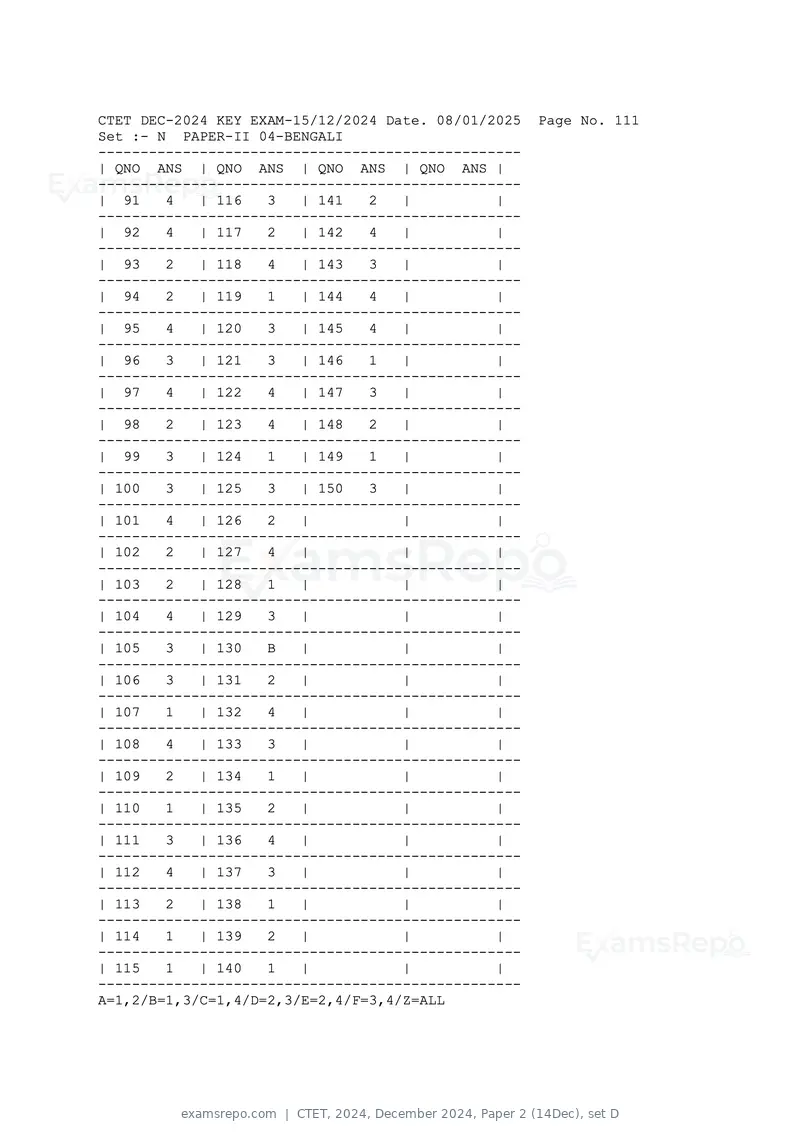
Text of page 111
CTET DEC-2024 KEY EXAM-15/12/2024 Date. 08/01/2025   Page No. 111
Set :- N PAPER-II 04-BENGALI
--------------------------------------------------
| QNO ANS | QNO ANS | QNO ANS | QNO ANS |
--------------------------------------------------
| 91    4   | 116   3   | 141   2   |          |
--------------------------------------------------
| 92    4   | 117   2   | 142   4   |          |
--------------------------------------------------
| 93    2   | 118   4   | 143   3   |          |
--------------------------------------------------
| 94    2   | 119   1   | 144   4   |          |
--------------------------------------------------
| 95    4   | 120   3   | 145   4   |          |
--------------------------------------------------
| 96    3   | 121   3   | 146   1   |          |
--------------------------------------------------
| 97    4   | 122   4   | 147   3   |          |
--------------------------------------------------
| 98    2   | 123   4   | 148   2   |          |
--------------------------------------------------
| 99    3   | 124   1   | 149   1   |          |
--------------------------------------------------
| 100   3   | 125   3   | 150   3   |          |
--------------------------------------------------
| 101   4   | 126   2   |           |          |
--------------------------------------------------
| 102   2   | 127   4   |           |          |
--------------------------------------------------
| 103   2   | 128   1   |           |          |
--------------------------------------------------
| 104   4   | 129   3   |           |          |
--------------------------------------------------
| 105   3   | 130   B   |           |          |
--------------------------------------------------
| 106   3   | 131   2   |           |          |
--------------------------------------------------
| 107   1   | 132   4   |           |          |
--------------------------------------------------
| 108   4   | 133   3   |           |          |
--------------------------------------------------
| 109   2   | 134   1   |           |          |
--------------------------------------------------
| 110   1   | 135   2   |           |          |
--------------------------------------------------
| 111   3   | 136   4   |           |          |
--------------------------------------------------
| 112   4   | 137   3   |           |          |
--------------------------------------------------
| 113   2   | 138   1   |           |          |
--------------------------------------------------
| 114   1   | 139   2   |           |          |
--------------------------------------------------
| 115   1   | 140   1   |           |          |
--------------------------------------------------
A=1,2/B=1,3/C=1,4/D=2,3/E=2,4/F=3,4/Z=ALL

Text of page 112
CTET DEC-2024 KEY EXAM-15/12/2024 Date. 08/01/2025   Page No. 112
Set :- O PAPER-II 04-BENGALI
--------------------------------------------------
| QNO ANS | QNO ANS | QNO ANS | QNO ANS |
--------------------------------------------------
| 91    2   | 116   2   | 141   2   |          |
--------------------------------------------------
| 92    4   | 117   4   | 142   3   |          |
--------------------------------------------------
| 93    3   | 118   1   | 143   1   |          |
--------------------------------------------------
| 94    1   | 119   3   | 144   4   |          |
--------------------------------------------------
| 95    2   | 120   2   | 145   2   |          |
--------------------------------------------------
| 96    4   | 121   1   | 146   3   |          |
--------------------------------------------------
| 97    1   | 122   1   | 147   2   |          |
--------------------------------------------------
| 98    1   | 123   2   | 148   3   |          |
--------------------------------------------------
| 99    3   | 124   4   | 149   1   |          |
--------------------------------------------------
| 100   3   | 125   3   | 150   4   |          |
--------------------------------------------------
| 101   1   | 126   2   |           |          |
--------------------------------------------------
| 102   4   | 127   4   |           |          |
--------------------------------------------------
| 103   1   | 128   4   |           |          |
--------------------------------------------------
| 104   3   | 129   1   |           |          |
--------------------------------------------------
| 105   4   | 130   1   |           |          |
--------------------------------------------------
| 106   4   | 131   2   |           |          |
--------------------------------------------------
| 107   1   | 132   4   |           |          |
--------------------------------------------------
| 108   3   | 133   3   |           |          |
--------------------------------------------------
| 109   3   | 134   1   |           |          |
--------------------------------------------------
| 110   1   | 135   2   |           |          |
--------------------------------------------------
| 111   4   | 136   4   |           |          |
--------------------------------------------------
| 112   4   | 137   E   |           |          |
--------------------------------------------------
| 113   2   | 138   3   |           |          |
--------------------------------------------------
| 114   1   | 139   1   |           |          |
--------------------------------------------------
| 115   3   | 140   4   |           |          |
--------------------------------------------------
A=1,2/B=1,3/C=1,4/D=2,3/E=2,4/F=3,4/Z=ALL

Text of page 113
CTET DEC-2024 KEY EXAM-15/12/2024 Date. 08/01/2025   Page No. 113
Set :- L PAPER-II 11-MARATHI
--------------------------------------------------
| QNO ANS | QNO ANS | QNO ANS | QNO ANS |
--------------------------------------------------
| 91    1   | 116   2   | 141   4   |          |
--------------------------------------------------
| 92    1   | 117   4   | 142   2   |          |
--------------------------------------------------
| 93    Z   | 118   4   | 143   3   |          |
--------------------------------------------------
| 94    3   | 119   2   | 144   1   |          |
--------------------------------------------------
| 95    3   | 120   1   | 145   B   |          |
--------------------------------------------------
| 96    1   | 121   2   | 146   4   |          |
--------------------------------------------------
| 97    2   | 122   4   | 147   2   |          |
--------------------------------------------------
| 98    1   | 123   1   | 148   1   |          |
--------------------------------------------------
| 99    3   | 124   4   | 149   3   |          |
--------------------------------------------------
| 100   2   | 125   3   | 150   4   |          |
--------------------------------------------------
| 101   4   | 126   4   |           |          |
--------------------------------------------------
| 102   1   | 127   2   |           |          |
--------------------------------------------------
| 103   4   | 128   1   |           |          |
--------------------------------------------------
| 104   1   | 129   3   |           |          |
--------------------------------------------------
| 105   4   | 130   1   |           |          |
--------------------------------------------------
| 106   2   | 131   3   |           |          |
--------------------------------------------------
| 107   2   | 132   4   |           |          |
--------------------------------------------------
| 108   4   | 133   1   |           |          |
--------------------------------------------------
| 109   4   | 134   2   |           |          |
--------------------------------------------------
| 110   2   | 135   2   |           |          |
--------------------------------------------------
| 111   1   | 136   1   |           |          |
--------------------------------------------------
| 112   2   | 137   2   |           |          |
--------------------------------------------------
| 113   4   | 138   2   |           |          |
--------------------------------------------------
| 114   1   | 139   3   |           |          |
--------------------------------------------------
| 115   1   | 140   1   |           |          |
--------------------------------------------------
A=1,2/B=1,3/C=1,4/D=2,3/E=2,4/F=3,4/Z=ALL

Text of page 114
CTET DEC-2024 KEY EXAM-15/12/2024 Date. 08/01/2025   Page No. 114
Set :- M PAPER-II 11-MARATHI
--------------------------------------------------
| QNO ANS | QNO ANS | QNO ANS | QNO ANS |
--------------------------------------------------
| 91    2   | 116   1   | 141   3   |          |
--------------------------------------------------
| 92    2   | 117   3   | 142   3   |          |
--------------------------------------------------
| 93    3   | 118   2   | 143   2   |          |
--------------------------------------------------
| 94    1   | 119   3   | 144   3   |          |
--------------------------------------------------
| 95    1   | 120   1   | 145   3   |          |
--------------------------------------------------
| 96    3   | 121   2   | 146   4   |          |
--------------------------------------------------
| 97    2   | 122   E   | 147   2   |          |
--------------------------------------------------
| 98    2   | 123   1   | 148   1   |          |
--------------------------------------------------
| 99    2   | 124   3   | 149   3   |          |
--------------------------------------------------
| 100   Z   | 125   2   | 150   4   |          |
--------------------------------------------------
| 101   4   | 126   4   |           |          |
--------------------------------------------------
| 102   4   | 127   1   |           |          |
--------------------------------------------------
| 103   2   | 128   3   |           |          |
--------------------------------------------------
| 104   3   | 129   1   |           |          |
--------------------------------------------------
| 105   2   | 130   2   |           |          |
--------------------------------------------------
| 106   4   | 131   1   |           |          |
--------------------------------------------------
| 107   3   | 132   4   |           |          |
--------------------------------------------------
| 108   1   | 133   1   |           |          |
--------------------------------------------------
| 109   2   | 134   3   |           |          |
--------------------------------------------------
| 110   1   | 135   2   |           |          |
--------------------------------------------------
| 111   2   | 136   4   |           |          |
--------------------------------------------------
| 112   1   | 137   2   |           |          |
--------------------------------------------------
| 113   3   | 138   4   |           |          |
--------------------------------------------------
| 114   3   | 139   1   |           |          |
--------------------------------------------------
| 115   1   | 140   2   |           |          |
--------------------------------------------------
A=1,2/B=1,3/C=1,4/D=2,3/E=2,4/F=3,4/Z=ALL

Text of page 115
CTET DEC-2024 KEY EXAM-15/12/2024 Date. 08/01/2025   Page No. 115
Set :- N PAPER-II 11-MARATHI
--------------------------------------------------
| QNO ANS | QNO ANS | QNO ANS | QNO ANS |
--------------------------------------------------
| 91    4   | 116   2   | 141   2   |          |
--------------------------------------------------
| 92    4   | 117   3   | 142   4   |          |
--------------------------------------------------
| 93    2   | 118   2   | 143   3   |          |
--------------------------------------------------
| 94    2   | 119   3   | 144   1   |          |
--------------------------------------------------
| 95    4   | 120   2   | 145   3   |          |
--------------------------------------------------
| 96    3   | 121   3   | 146   1   |          |
--------------------------------------------------
| 97    4   | 122   4   | 147   2   |          |
--------------------------------------------------
| 98    2   | 123   4   | 148   3   |          |
--------------------------------------------------
| 99    3   | 124   1   | 149   4   |          |
--------------------------------------------------
| 100   3   | 125   3   | 150   4   |          |
--------------------------------------------------
| 101   4   | 126   2   |           |          |
--------------------------------------------------
| 102   2   | 127   4   |           |          |
--------------------------------------------------
| 103   2   | 128   1   |           |          |
--------------------------------------------------
| 104   4   | 129   3   |           |          |
--------------------------------------------------
| 105   3   | 130   B   |           |          |
--------------------------------------------------
| 106   3   | 131   2   |           |          |
--------------------------------------------------
| 107   3   | 132   4   |           |          |
--------------------------------------------------
| 108   Z   | 133   3   |           |          |
--------------------------------------------------
| 109   1   | 134   1   |           |          |
--------------------------------------------------
| 110   1   | 135   2   |           |          |
--------------------------------------------------
| 111   3   | 136   4   |           |          |
--------------------------------------------------
| 112   4   | 137   2   |           |          |
--------------------------------------------------
| 113   3   | 138   3   |           |          |
--------------------------------------------------
| 114   1   | 139   2   |           |          |
--------------------------------------------------
| 115   4   | 140   1   |           |          |
--------------------------------------------------
A=1,2/B=1,3/C=1,4/D=2,3/E=2,4/F=3,4/Z=ALL

Text of page 116
CTET DEC-2024 KEY EXAM-15/12/2024 Date. 08/01/2025   Page No. 116
Set :- O PAPER-II 11-MARATHI
--------------------------------------------------
| QNO ANS | QNO ANS | QNO ANS | QNO ANS |
--------------------------------------------------
| 91    1   | 116   2   | 141   2   |          |
--------------------------------------------------
| 92    3   | 117   4   | 142   3   |          |
--------------------------------------------------
| 93    4   | 118   1   | 143   1   |          |
--------------------------------------------------
| 94    3   | 119   4   | 144   3   |          |
--------------------------------------------------
| 95    4   | 120   2   | 145   4   |          |
--------------------------------------------------
| 96    3   | 121   2   | 146   3   |          |
--------------------------------------------------
| 97    1   | 122   4   | 147   2   |          |
--------------------------------------------------
| 98    1   | 123   2   | 148   3   |          |
--------------------------------------------------
| 99    3   | 124   3   | 149   1   |          |
--------------------------------------------------
| 100   3   | 125   4   | 150   4   |          |
--------------------------------------------------
| 101   1   | 126   1   |           |          |
--------------------------------------------------
| 102   4   | 127   1   |           |          |
--------------------------------------------------
| 103   1   | 128   4   |           |          |
--------------------------------------------------
| 104   3   | 129   1   |           |          |
--------------------------------------------------
| 105   4   | 130   1   |           |          |
--------------------------------------------------
| 106   4   | 131   2   |           |          |
--------------------------------------------------
| 107   1   | 132   4   |           |          |
--------------------------------------------------
| 108   3   | 133   3   |           |          |
--------------------------------------------------
| 109   3   | 134   1   |           |          |
--------------------------------------------------
| 110   1   | 135   2   |           |          |
--------------------------------------------------
| 111   4   | 136   4   |           |          |
--------------------------------------------------
| 112   4   | 137   E   |           |          |
--------------------------------------------------
| 113   4   | 138   3   |           |          |
--------------------------------------------------
| 114   Z   | 139   1   |           |          |
--------------------------------------------------
| 115   2   | 140   4   |           |          |
--------------------------------------------------
A=1,2/B=1,3/C=1,4/D=2,3/E=2,4/F=3,4/Z=ALL

Text of page 117
CTET DEC-2024 KEY EXAM-15/12/2024 Date. 08/01/2025   Page No. 117
Set :- L PAPER-II 16-SANSKRIT
--------------------------------------------------
| QNO ANS | QNO ANS | QNO ANS | QNO ANS |
--------------------------------------------------
| 91    2   | 116   2   | 141   4   |          |
--------------------------------------------------
| 92    3   | 117   4   | 142   2   |          |
--------------------------------------------------
| 93    3   | 118   4   | 143   3   |          |
--------------------------------------------------
| 94    1   | 119   2   | 144   1   |          |
--------------------------------------------------
| 95    2   | 120   1   | 145   B   |          |
--------------------------------------------------
| 96    4   | 121   2   | 146   4   |          |
--------------------------------------------------
| 97    3   | 122   1   | 147   2   |          |
--------------------------------------------------
| 98    1   | 123   3   | 148   1   |          |
--------------------------------------------------
| 99    3   | 124   1   | 149   3   |          |
--------------------------------------------------
| 100   3   | 125   1   | 150   4   |          |
--------------------------------------------------
| 101   1   | 126   4   |           |          |
--------------------------------------------------
| 102   1   | 127   4   |           |          |
--------------------------------------------------
| 103   3   | 128   1   |           |          |
--------------------------------------------------
| 104   2   | 129   3   |           |          |
--------------------------------------------------
| 105   3   | 130   4   |           |          |
--------------------------------------------------
| 106   2   | 131   1   |           |          |
--------------------------------------------------
| 107   2   | 132   3   |           |          |
--------------------------------------------------
| 108   4   | 133   1   |           |          |
--------------------------------------------------
| 109   4   | 134   4   |           |          |
--------------------------------------------------
| 110   2   | 135   2   |           |          |
--------------------------------------------------
| 111   1   | 136   1   |           |          |
--------------------------------------------------
| 112   2   | 137   2   |           |          |
--------------------------------------------------
| 113   4   | 138   2   |           |          |
--------------------------------------------------
| 114   1   | 139   3   |           |          |
--------------------------------------------------
| 115   1   | 140   1   |           |          |
--------------------------------------------------
A=1,2/B=1,3/C=1,4/D=2,3/E=2,4/F=3,4/Z=ALL

Text of page 118
CTET DEC-2024 KEY EXAM-15/12/2024 Date. 08/01/2025   Page No. 118
Set :- M PAPER-II 16-SANSKRIT
--------------------------------------------------
| QNO ANS | QNO ANS | QNO ANS | QNO ANS |
--------------------------------------------------
| 91    2   | 116   1   | 141   1   |          |
--------------------------------------------------
| 92    2   | 117   3   | 142   3   |          |
--------------------------------------------------
| 93    3   | 118   2   | 143   2   |          |
--------------------------------------------------
| 94    1   | 119   3   | 144   3   |          |
--------------------------------------------------
| 95    1   | 120   1   | 145   3   |          |
--------------------------------------------------
| 96    3   | 121   2   | 146   4   |          |
--------------------------------------------------
| 97    2   | 122   E   | 147   2   |          |
--------------------------------------------------
| 98    3   | 123   1   | 148   1   |          |
--------------------------------------------------
| 99    4   | 124   3   | 149   3   |          |
--------------------------------------------------
| 100   4   | 125   2   | 150   4   |          |
--------------------------------------------------
| 101   2   | 126   4   |           |          |
--------------------------------------------------
| 102   3   | 127   1   |           |          |
--------------------------------------------------
| 103   1   | 128   3   |           |          |
--------------------------------------------------
| 104   4   | 129   2   |           |          |
--------------------------------------------------
| 105   2   | 130   4   |           |          |
--------------------------------------------------
| 106   4   | 131   2   |           |          |
--------------------------------------------------
| 107   4   | 132   2   |           |          |
--------------------------------------------------
| 108   2   | 133   1   |           |          |
--------------------------------------------------
| 109   2   | 134   1   |           |          |
--------------------------------------------------
| 110   4   | 135   2   |           |          |
--------------------------------------------------
| 111   3   | 136   4   |           |          |
--------------------------------------------------
| 112   4   | 137   1   |           |          |
--------------------------------------------------
| 113   3   | 138   2   |           |          |
--------------------------------------------------
| 114   3   | 139   4   |           |          |
--------------------------------------------------
| 115   1   | 140   2   |           |          |
--------------------------------------------------
A=1,2/B=1,3/C=1,4/D=2,3/E=2,4/F=3,4/Z=ALL

Text of page 119
CTET DEC-2024 KEY EXAM-15/12/2024 Date. 08/01/2025   Page No. 119
Set :- N PAPER-II 16-SANSKRIT
--------------------------------------------------
| QNO ANS | QNO ANS | QNO ANS | QNO ANS |
--------------------------------------------------
| 91    4   | 116   3   | 141   2   |          |
--------------------------------------------------
| 92    4   | 117   3   | 142   2   |          |
--------------------------------------------------
| 93    2   | 118   1   | 143   3   |          |
--------------------------------------------------
| 94    2   | 119   4   | 144   1   |          |
--------------------------------------------------
| 95    4   | 120   1   | 145   2   |          |
--------------------------------------------------
| 96    3   | 121   3   | 146   3   |          |
--------------------------------------------------
| 97    4   | 122   4   | 147   1   |          |
--------------------------------------------------
| 98    2   | 123   4   | 148   3   |          |
--------------------------------------------------
| 99    3   | 124   1   | 149   2   |          |
--------------------------------------------------
| 100   3   | 125   3   | 150   4   |          |
--------------------------------------------------
| 101   4   | 126   2   |           |          |
--------------------------------------------------
| 102   2   | 127   4   |           |          |
--------------------------------------------------
| 103   2   | 128   1   |           |          |
--------------------------------------------------
| 104   4   | 129   3   |           |          |
--------------------------------------------------
| 105   3   | 130   B   |           |          |
--------------------------------------------------
| 106   4   | 131   2   |           |          |
--------------------------------------------------
| 107   1   | 132   4   |           |          |
--------------------------------------------------
| 108   1   | 133   3   |           |          |
--------------------------------------------------
| 109   3   | 134   1   |           |          |
--------------------------------------------------
| 110   4   | 135   2   |           |          |
--------------------------------------------------
| 111   2   | 136   4   |           |          |
--------------------------------------------------
| 112   1   | 137   3   |           |          |
--------------------------------------------------
| 113   3   | 138   1   |           |          |
--------------------------------------------------
| 114   1   | 139   3   |           |          |
--------------------------------------------------
| 115   1   | 140   3   |           |          |
--------------------------------------------------
A=1,2/B=1,3/C=1,4/D=2,3/E=2,4/F=3,4/Z=ALL

Text of page 120
CTET DEC-2024 KEY EXAM-15/12/2024 Date. 08/01/2025   Page No. 120
Set :- O PAPER-II 16-SANSKRIT
--------------------------------------------------
| QNO ANS | QNO ANS | QNO ANS | QNO ANS |
--------------------------------------------------
| 91    2   | 116   1   | 141   2   |          |
--------------------------------------------------
| 92    4   | 117   3   | 142   3   |          |
--------------------------------------------------
| 93    4   | 118   2   | 143   1   |          |
--------------------------------------------------
| 94    2   | 119   4   | 144   4   |          |
--------------------------------------------------
| 95    1   | 120   2   | 145   2   |          |
--------------------------------------------------
| 96    2   | 121   2   | 146   4   |          |
--------------------------------------------------
| 97    1   | 122   3   | 147   4   |          |
--------------------------------------------------
| 98    1   | 123   4   | 148   3   |          |
--------------------------------------------------
| 99    3   | 124   2   | 149   3   |          |
--------------------------------------------------
| 100   3   | 125   4   | 150   4   |          |
--------------------------------------------------
| 101   1   | 126   3   |           |          |
--------------------------------------------------
| 102   4   | 127   1   |           |          |
--------------------------------------------------
| 103   1   | 128   4   |           |          |
--------------------------------------------------
| 104   3   | 129   1   |           |          |
--------------------------------------------------
| 105   4   | 130   1   |           |          |
--------------------------------------------------
| 106   4   | 131   2   |           |          |
--------------------------------------------------
| 107   1   | 132   4   |           |          |
--------------------------------------------------
| 108   3   | 133   3   |           |          |
--------------------------------------------------
| 109   3   | 134   1   |           |          |
--------------------------------------------------
| 110   1   | 135   2   |           |          |
--------------------------------------------------
| 111   4   | 136   4   |           |          |
--------------------------------------------------
| 112   1   | 137   E   |           |          |
--------------------------------------------------
| 113   2   | 138   3   |           |          |
--------------------------------------------------
| 114   2   | 139   1   |           |          |
--------------------------------------------------
| 115   4   | 140   4   |           |          |
--------------------------------------------------
A=1,2/B=1,3/C=1,4/D=2,3/E=2,4/F=3,4/Z=ALL

Text of page 121
CTET DEC-2024 KEY EXAM-15/12/2024 Date. 08/01/2025   Page No. 121
Set :- L PAPER-II 20-URDU
--------------------------------------------------
| QNO ANS | QNO ANS | QNO ANS | QNO ANS |
--------------------------------------------------
| 91    1   | 116   2   | 141   4   |          |
--------------------------------------------------
| 92    2   | 117   4   | 142   2   |          |
--------------------------------------------------
| 93    3   | 118   4   | 143   3   |          |
--------------------------------------------------
| 94    1   | 119   2   | 144   1   |          |
--------------------------------------------------
| 95    2   | 120   1   | 145   B   |          |
--------------------------------------------------
| 96    1   | 121   1   | 146   4   |          |
--------------------------------------------------
| 97    2   | 122   2   | 147   2   |          |
--------------------------------------------------
| 98    1   | 123   1   | 148   1   |          |
--------------------------------------------------
| 99    1   | 124   2   | 149   3   |          |
--------------------------------------------------
| 100   1   | 125   2   | 150   4   |          |
--------------------------------------------------
| 101   2   | 126   1   |           |          |
--------------------------------------------------
| 102   2   | 127   1   |           |          |
--------------------------------------------------
| 103   1   | 128   2   |           |          |
--------------------------------------------------
| 104   1   | 129   1   |           |          |
--------------------------------------------------
| 105   1   | 130   3   |           |          |
--------------------------------------------------
| 106   2   | 131   1   |           |          |
--------------------------------------------------
| 107   2   | 132   2   |           |          |
--------------------------------------------------
| 108   4   | 133   1   |           |          |
--------------------------------------------------
| 109   4   | 134   1   |           |          |
--------------------------------------------------
| 110   2   | 135   1   |           |          |
--------------------------------------------------
| 111   1   | 136   1   |           |          |
--------------------------------------------------
| 112   2   | 137   2   |           |          |
--------------------------------------------------
| 113   4   | 138   2   |           |          |
--------------------------------------------------
| 114   1   | 139   3   |           |          |
--------------------------------------------------
| 115   1   | 140   1   |           |          |
--------------------------------------------------
A=1,2/B=1,3/C=1,4/D=2,3/E=2,4/F=3,4/Z=ALL

Text of page 122
CTET DEC-2024 KEY EXAM-15/12/2024 Date. 08/01/2025 Page No. 122 Set :- M PAPER-II 20-URDU -------------------------------------------------- | QNO ANS | QNO ANS | QNO ANS | QNO ANS | -------------------------------------------------- | 91 2 | 116 1 | 141 2 | | -------------------------------------------------- | 92 2 | 117 3 | 142 2 | | -------------------------------------------------- | 93 3 | 118 2 | 143 2 | | -------------------------------------------------- | 94 1 | 119 3 | 144 3 | | -------------------------------------------------- | 95 1 | 120 1 | 145 3 | | -------------------------------------------------- | 96 3 | 121 2 | 146 4 | | -------------------------------------------------- | 97 2 | 122 E | 147 2 | | -------------------------------------------------- | 98 2 | 123 1 | 148 1 | | -------------------------------------------------- | 99 3 | 124 3 | 149 3 | | -------------------------------------------------- | 100 4 | 125 2 | 150 4 | | -------------------------------------------------- | 101 2 | 126 4 | | | -------------------------------------------------- | 102 3 | 127 1 | | | -------------------------------------------------- | 103 2 | 128 2 | | | -------------------------------------------------- | 104 3 | 129 3 | | | -------------------------------------------------- | 105 2 | 130 2 | | | -------------------------------------------------- | 106 2 | 131 3 | | | -------------------------------------------------- | 107 2 | 132 3 | | | -------------------------------------------------- | 108 3 | 133 2 | | | -------------------------------------------------- | 109 3 | 134 2 | | | -------------------------------------------------- | 110 2 | 135 3 | | | -------------------------------------------------- | 111 2 | 136 2 | | | -------------------------------------------------- | 112 2 | 137 4 | | | -------------------------------------------------- | 113 3 | 138 2 | | | -------------------------------------------------- | 114 3 | 139 3 | | | -------------------------------------------------- | 115 1 | 140 2 | | | -------------------------------------------------- A=1,2/B=1,3/C=1,4/D=2,3/E=2,4/F=3,4/Z=ALL

Text of page 123
CTET DEC-2024 KEY EXAM-15/12/2024 Date. 08/01/2025 Page No. 123 Set :- N PAPER-II 20-URDU -------------------------------------------------- | QNO ANS | QNO ANS | QNO ANS | QNO ANS | -------------------------------------------------- | 91 4 | 116 4 | 141 3 | | -------------------------------------------------- | 92 4 | 117 4 | 142 3 | | -------------------------------------------------- | 93 2 | 118 3 | 143 4 | | -------------------------------------------------- | 94 2 | 119 3 | 144 3 | | -------------------------------------------------- | 95 4 | 120 3 | 145 1 | | -------------------------------------------------- | 96 3 | 121 3 | 146 3 | | -------------------------------------------------- | 97 4 | 122 4 | 147 4 | | -------------------------------------------------- | 98 2 | 123 4 | 148 3 | | -------------------------------------------------- | 99 3 | 124 1 | 149 3 | | -------------------------------------------------- | 100 3 | 125 3 | 150 3 | | -------------------------------------------------- | 101 4 | 126 2 | | | -------------------------------------------------- | 102 2 | 127 4 | | | -------------------------------------------------- | 103 2 | 128 1 | | | -------------------------------------------------- | 104 4 | 129 3 | | | -------------------------------------------------- | 105 3 | 130 B | | | -------------------------------------------------- | 106 3 | 131 2 | | | -------------------------------------------------- | 107 4 | 132 4 | | | -------------------------------------------------- | 108 1 | 133 3 | | | -------------------------------------------------- | 109 3 | 134 1 | | | -------------------------------------------------- | 110 4 | 135 2 | | | -------------------------------------------------- | 111 3 | 136 3 | | | -------------------------------------------------- | 112 4 | 137 4 | | | -------------------------------------------------- | 113 3 | 138 3 | | | -------------------------------------------------- | 114 3 | 139 4 | | | -------------------------------------------------- | 115 3 | 140 4 | | | -------------------------------------------------- A=1,2/B=1,3/C=1,4/D=2,3/E=2,4/F=3,4/Z=ALL

Text of page 124
CTET DEC-2024 KEY EXAM-15/12/2024 Date. 08/01/2025 Page No. 124 Set :- O PAPER-II 20-URDU -------------------------------------------------- | QNO ANS | QNO ANS | QNO ANS | QNO ANS | -------------------------------------------------- | 91 4 | 116 1 | 141 2 | | -------------------------------------------------- | 92 1 | 117 4 | 142 3 | | -------------------------------------------------- | 93 1 | 118 1 | 143 4 | | -------------------------------------------------- | 94 4 | 119 4 | 144 1 | | -------------------------------------------------- | 95 4 | 120 4 | 145 4 | | -------------------------------------------------- | 96 4 | 121 4 | 146 1 | | -------------------------------------------------- | 97 1 | 122 2 | 147 1 | | -------------------------------------------------- | 98 1 | 123 4 | 148 4 | | -------------------------------------------------- | 99 3 | 124 1 | 149 4 | | -------------------------------------------------- | 100 3 | 125 4 | 150 1 | | -------------------------------------------------- | 101 1 | 126 4 | | | -------------------------------------------------- | 102 4 | 127 4 | | | -------------------------------------------------- | 103 1 | 128 4 | | | -------------------------------------------------- | 104 3 | 129 1 | | | -------------------------------------------------- | 105 4 | 130 1 | | | -------------------------------------------------- | 106 4 | 131 2 | | | -------------------------------------------------- | 107 1 | 132 4 | | | -------------------------------------------------- | 108 3 | 133 3 | | | -------------------------------------------------- | 109 3 | 134 1 | | | -------------------------------------------------- | 110 1 | 135 2 | | | -------------------------------------------------- | 111 4 | 136 4 | | | -------------------------------------------------- | 112 4 | 137 E | | | -------------------------------------------------- | 113 1 | 138 3 | | | -------------------------------------------------- | 114 2 | 139 1 | | | -------------------------------------------------- | 115 4 | 140 4 | | | -------------------------------------------------- A=1,2/B=1,3/C=1,4/D=2,3/E=2,4/F=3,4/Z=ALL
Page 1 of 80
Source: Central Board of Secondary Education. Question paper published by Central Board of Secondary Education.