
GATE AE 2016: Aerospace Engineering
Text of page 1
GATE 2016                                                                    General Aptitude – GA Set-8


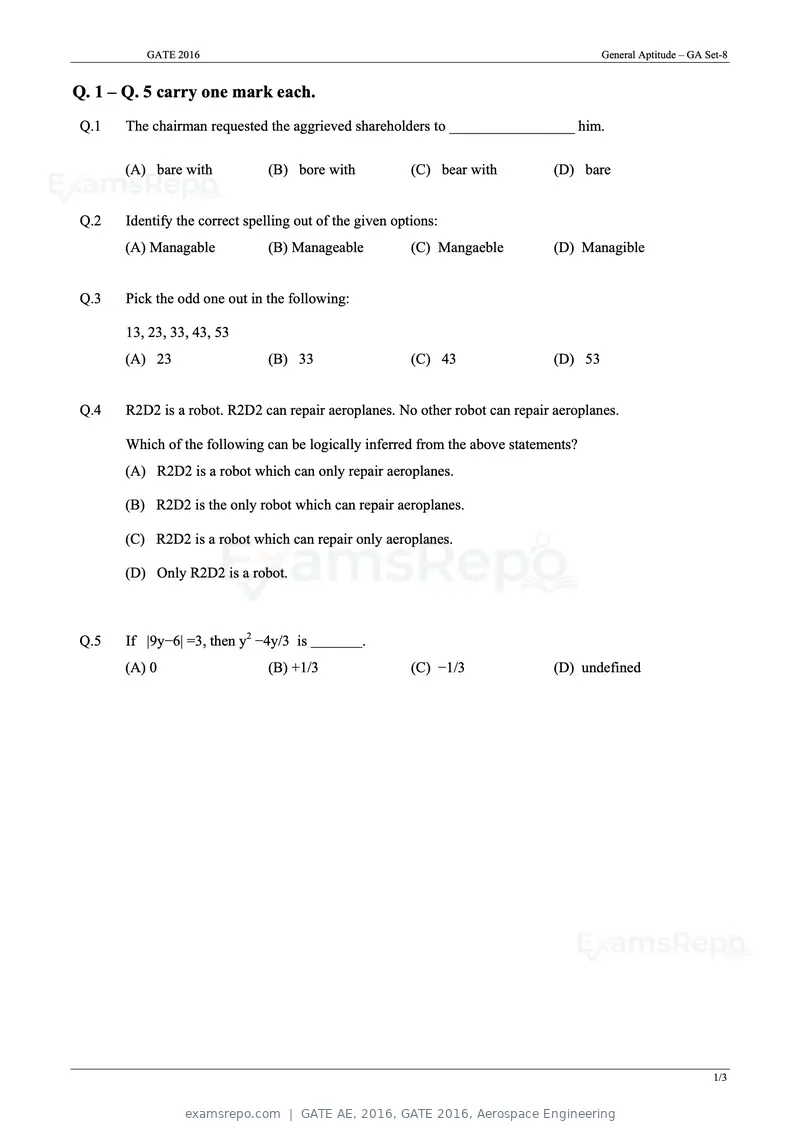
Q. 1 – Q. 5 carry one mark each.
Q.1    The chairman requested the aggrieved shareholders to _________________ him.

      (A) bare with             (B) bore with            (C) bear with        (D) bare


Q.2    Identify the correct spelling out of the given options:
      (A) Managable             (B) Manageable           (C) Mangaeble        (D) Managible


Q.3    Pick the odd one out in the following:

       13, 23, 33, 43, 53
      (A) 23                    (B) 33                   (C) 43               (D) 53


Q.4    R2D2 is a robot. R2D2 can repair aeroplanes. No other robot can repair aeroplanes.

       Which of the following can be logically inferred from the above statements?
      (A) R2D2 is a robot which can only repair aeroplanes.

      (B) R2D2 is the only robot which can repair aeroplanes.

      (C) R2D2 is a robot which can repair only aeroplanes.

      (D) Only R2D2 is a robot.


Q.5    If |9y−6| =3, then y2 −4y/3 is           .
      (A) 0                     (B) +1/3                 (C) −1/3             (D) undefined


                                                                                                              1/3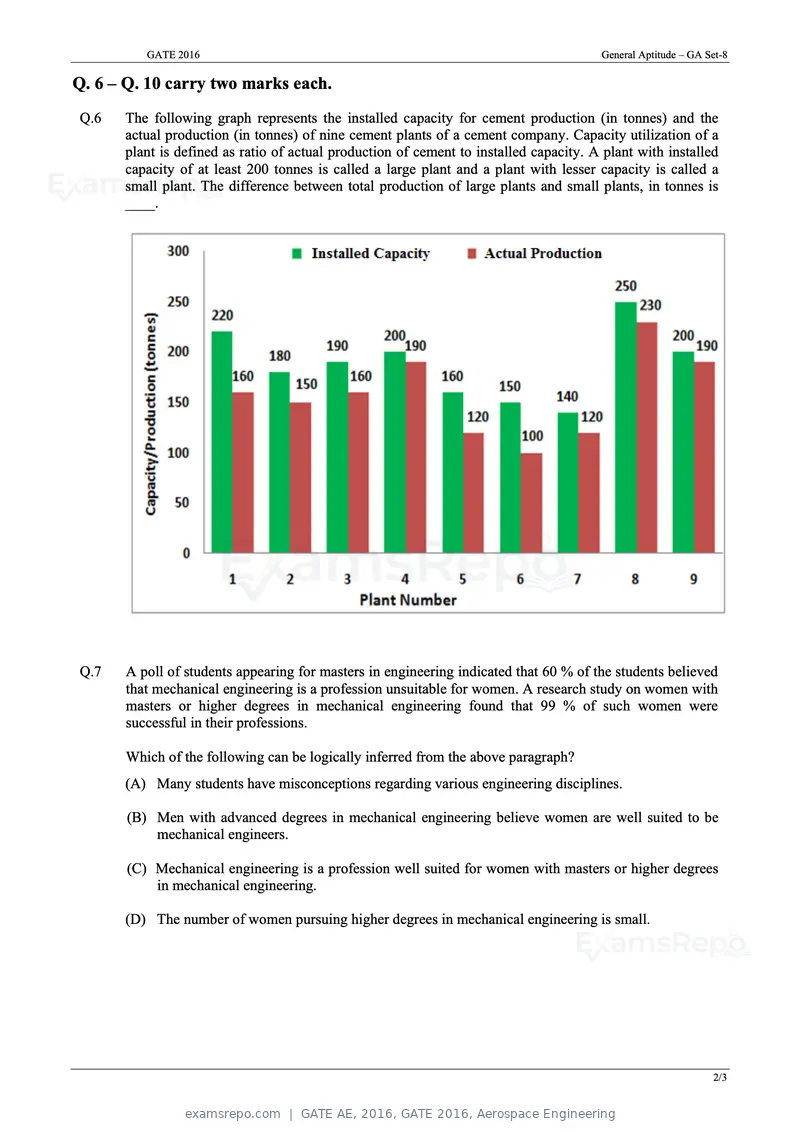
Text of page 2
GATE 2016                                                                    General Aptitude – GA Set-8

Q. 6 – Q. 10 carry two marks each.
Q.6   The following graph represents the installed capacity for cement production (in tonnes) and the
      actual production (in tonnes) of nine cement plants of a cement company. Capacity utilization of a
      plant is defined as ratio of actual production of cement to installed capacity. A plant with installed
      capacity of at least 200 tonnes is called a large plant and a plant with lesser capacity is called a
      small plant. The difference between total production of large plants and small plants, in tonnes is
      ____.


Q.7   A poll of students appearing for masters in engineering indicated that 60 % of the students believed
      that mechanical engineering is a profession unsuitable for women. A research study on women with
      masters or higher degrees in mechanical engineering found that 99 % of such women were
      successful in their professions.

      Which of the following can be logically inferred from the above paragraph?
      (A) Many students have misconceptions regarding various engineering disciplines.

       (B) Men with advanced degrees in mechanical engineering believe women are well suited to be
           mechanical engineers.

       (C) Mechanical engineering is a profession well suited for women with masters or higher degrees
           in mechanical engineering.

      (D) The number of women pursuing higher degrees in mechanical engineering is small.


                                                                                                              2/3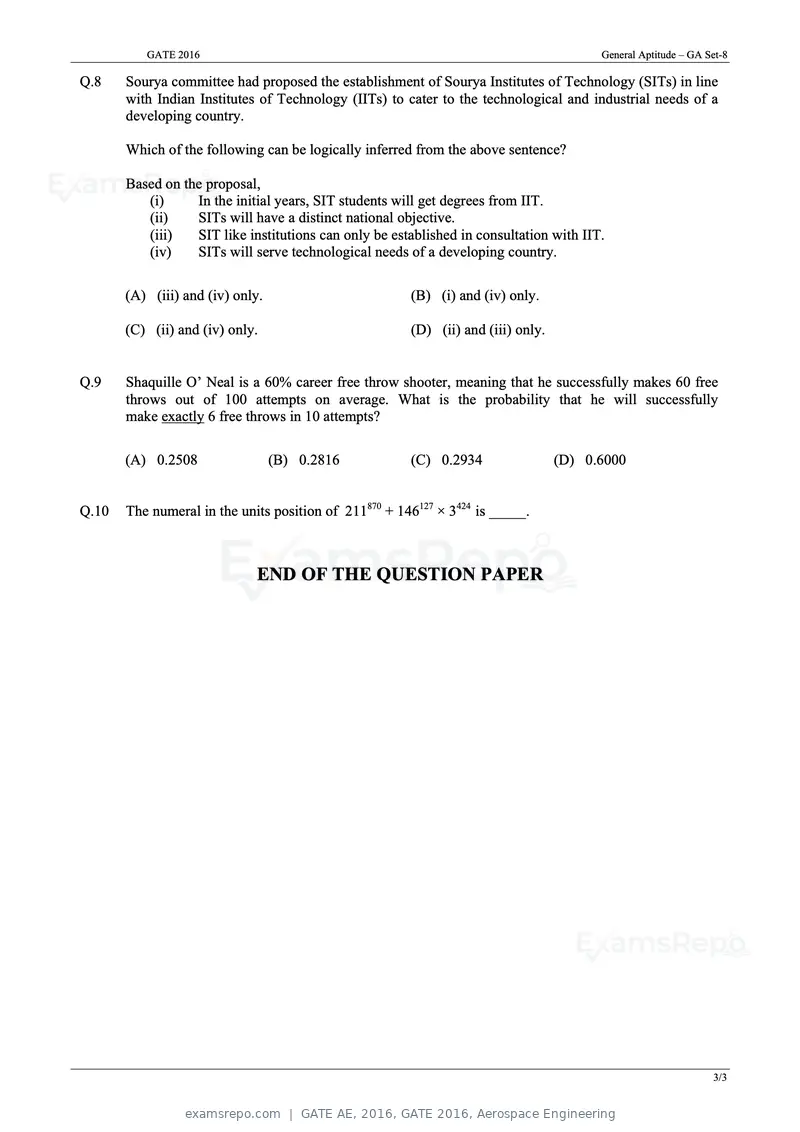
Text of page 3
GATE 2016                                                                     General Aptitude – GA Set-8

Q.8    Sourya committee had proposed the establishment of Sourya Institutes of Technology (SITs) in line
       with Indian Institutes of Technology (IITs) to cater to the technological and industrial needs of a
       developing country.

       Which of the following can be logically inferred from the above sentence?

       Based on the proposal,
          (i)     In the initial years, SIT students will get degrees from IIT.
          (ii)    SITs will have a distinct national objective.
          (iii)   SIT like institutions can only be established in consultation with IIT.
          (iv)    SITs will serve technological needs of a developing country.

       (A) (iii) and (iv) only.                        (B) (i) and (iv) only.

       (C) (ii) and (iv) only.                         (D) (ii) and (iii) only.


Q.9    Shaquille O’ Neal is a 60% career free throw shooter, meaning that he successfully makes 60 free
       throws out of 100 attempts on average. What is the probability that he will successfully
       make exactly 6 free throws in 10 attempts?

       (A) 0.2508                 (B) 0.2816           (C) 0.2934                 (D) 0.6000


Q.10   The numeral in the units position of 211870 + 146127 × 3424 is _____.


                             END OF THE QUESTION PAPER


                                                                                                               3/3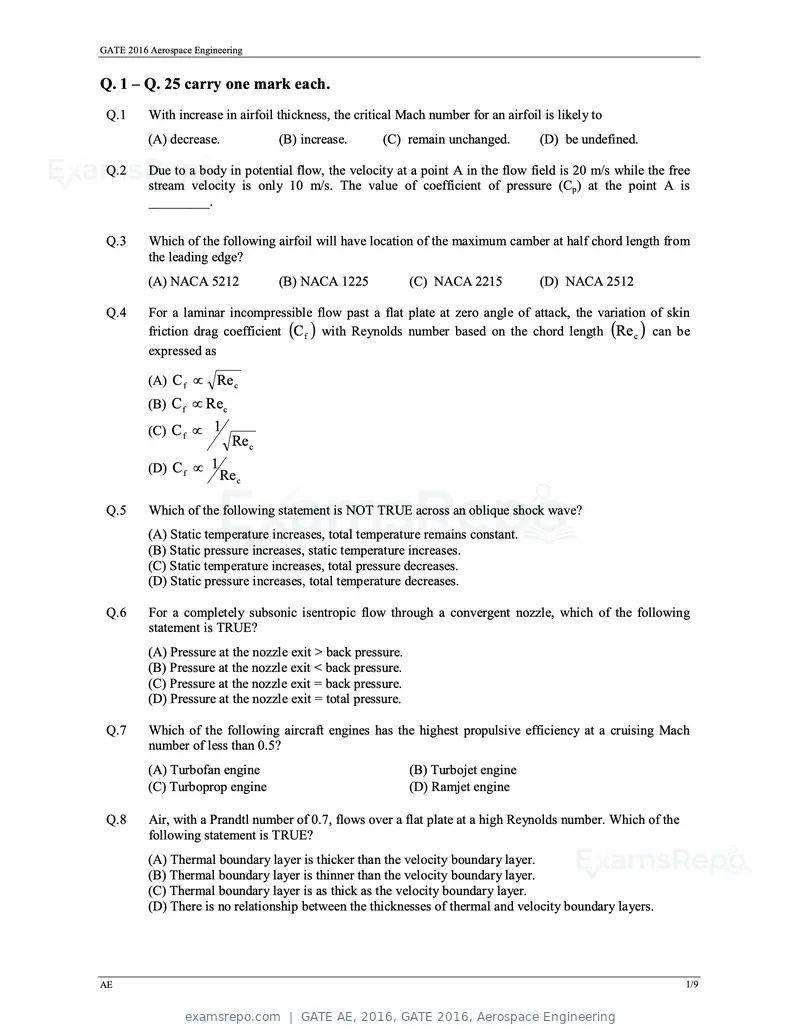
Text of page 4
GATE 2016 Aerospace Engineering
Q. 1 – Q. 25 carry one mark each.
Q.1 With increase in airfoil thickness, the critical Mach number for an airfoil is likely to
(A) decrease. (B) increase. (C) remain unchanged. (D) be undefined.
Q.2 Due to a body in potential flow, the velocity at a point A in the flow field is 20 m/s while the free
stream velocity is only 10 m/s. The value of coefficient of pressure (Cp ) at the point A is
_________.
Q.3 Which of the following airfoil will have location of the maximum camber at half chord length from
the leading edge?
(A) NACA 5212 (B) NACA 1225 (C) NACA 2215 (D) NACA 2512
Q.4 For a laminar incompressible flow past a flat plate at zero angle of attack, the variation of skin
friction drag coefficient C f with Reynolds number based on the chord length Re c can be
expressed as
(A) C f Re c
(B) C f Rec
(C) C f 1
Re c
(D) C f 1
Re c
Q.5 Which of the following statement is NOT TRUE across an oblique shock wave?
(A) Static temperature increases, total temperature remains constant.
(B) Static pressure increases, static temperature increases.
(C) Static temperature increases, total pressure decreases.
(D) Static pressure increases, total temperature decreases.
Q.6 For a completely subsonic isentropic flow through a convergent nozzle, which of the following
statement is TRUE?
(A) Pressure at the nozzle exit > back pressure.
(B) Pressure at the nozzle exit < back pressure.
(C) Pressure at the nozzle exit = back pressure.
(D) Pressure at the nozzle exit = total pressure.
Q.7 Which of the following aircraft engines has the highest propulsive efficiency at a cruising Mach
number of less than 0.5?
(A) Turbofan engine (B) Turbojet engine
(C) Turboprop engine (D) Ramjet engine
Q.8 Air, with a Prandtl number of 0.7, flows over a flat plate at a high Reynolds number. Which of the
following statement is TRUE?
(A) Thermal boundary layer is thicker than the velocity boundary layer.
(B) Thermal boundary layer is thinner than the velocity boundary layer.
(C) Thermal boundary layer is as thick as the velocity boundary layer.
(D) There is no relationship between the thicknesses of thermal and velocity boundary layers.
AE 1/9
Text of page 5
GATE 2016 Aerospace Engineering
Q.9 Consider an eigenvalue problem given by Ax= i x. If i represent the eigenvalues of the non-
singular square matrix A, then what will be the eigenvalues of matrix A2?
4 2 1/ 2 1/ 4
(A) i (B) i (C) i (D) i
Q.10 If A and B are both non-singular n n matrices, then which of the following statement is NOT
TRUE. Note: det represents the determinant of a matrix.
(A) det(AB) = det(A)det(B)
(B) det(A+B) = det(A) + det(B)
(C) det(AA-1) = 1
(D) det(AT) = det(A)
Q.11 The total number of material constants that are necessary and sufficient to describe the three
dimensional Hooke’s law for an isotropic material is ____.
Q.12 Determine the correctness or otherwise of the following statements, [a] and [r]:
[a]: In a plane stress problem, the shear strains along the thickness direction of a body are zero but
the normal strain along the thickness is not zero.
[r]: In a plane stress problem, Poisson effect induces the normal strain along the thickness direction
of the body.
(A) Both [a] and [r] are true and [r] is the correct reason for [a].
(B) Both [a] and [r] are true but [r] is not the correct reason for [a].
(C) Both [a] and [r] are false.
(D) [a] is true but [r] is false.
Q.13 Consider four thin-walled beams of different open cross-sections, as shown in the cases (i-iv). A
shear force of magnitude ‘F’ acts vertically downward at the location ‘P’ in all the beams. In which
of the following case, does the shear force induce bending and twisting?
Case (i) Case (ii) Case (iii) Case (iv)
(A) (i) (B) (ii)
(C) (iii) (D) (iv)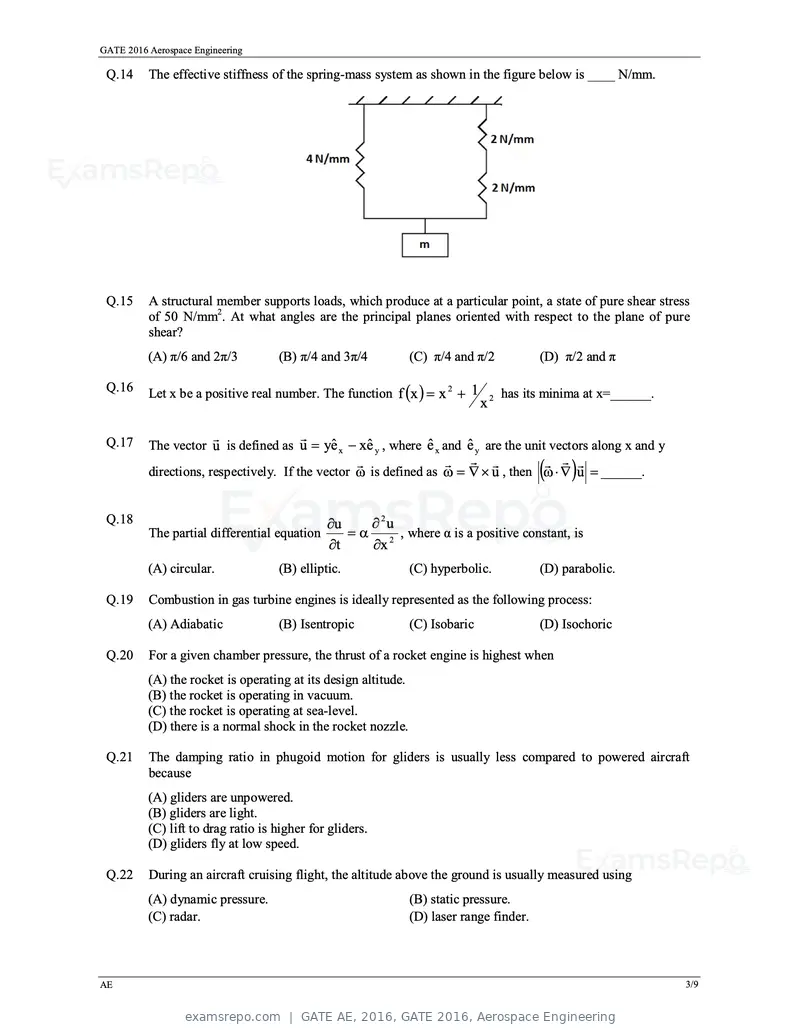
Text of page 6
GATE 2016 Aerospace Engineering
Q.14 The effective stiffness of the spring-mass system as shown in the figure below is ____ N/mm.
Q.15 A structural member supports loads, which produce at a particular point, a state of pure shear stress
of 50 N/mm2. At what angles are the principal planes oriented with respect to the plane of pure
shear?
(A) π/6 and 2π/3 (B) π/4 and 3π/4 (C) π/4 and π/2 (D) π/2 and π
Q.16 Let x be a positive real number. The function f x x 2 1 has its minima at x=______.
x2
Q.17
The vector u is defined as u yê x xê y , where ê x and ê y are the unit vectors along x and y
directions, respectively. If the vector is defined as u , then u ______.
Q.18 u 2u
The partial differential equation 2 , where α is a positive constant, is
t x
(A) circular. (B) elliptic. (C) hyperbolic. (D) parabolic.
Q.19 Combustion in gas turbine engines is ideally represented as the following process:
(A) Adiabatic (B) Isentropic (C) Isobaric (D) Isochoric
Q.20 For a given chamber pressure, the thrust of a rocket engine is highest when
(A) the rocket is operating at its design altitude.
(B) the rocket is operating in vacuum.
(C) the rocket is operating at sea-level.
(D) there is a normal shock in the rocket nozzle.
Q.21 The damping ratio in phugoid motion for gliders is usually less compared to powered aircraft
because
(A) gliders are unpowered.
(B) gliders are light.
(C) lift to drag ratio is higher for gliders.
(D) gliders fly at low speed.
Q.22 During an aircraft cruising flight, the altitude above the ground is usually measured using
(A) dynamic pressure. (B) static pressure.
(C) radar. (D) laser range finder.
AE 3/9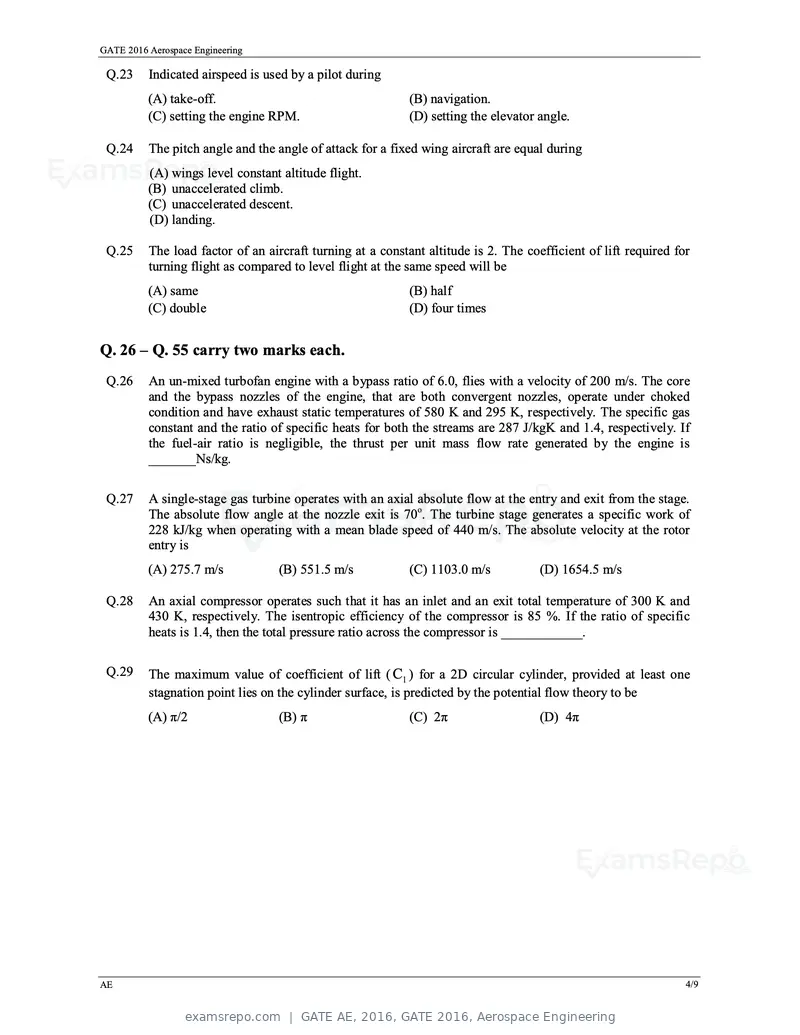
Text of page 7
GATE 2016 Aerospace Engineering

 Q.23     Indicated airspeed is used by a pilot during
          (A) take-off.                                     (B) navigation.
          (C) setting the engine RPM.                       (D) setting the elevator angle.

 Q.24     The pitch angle and the angle of attack for a fixed wing aircraft are equal during
          (A) wings level constant altitude flight.
          (B) unaccelerated climb.
          (C) unaccelerated descent.
          (D) landing.

 Q.25     The load factor of an aircraft turning at a constant altitude is 2. The coefficient of lift required for
          turning flight as compared to level flight at the same speed will be
          (A) same                                          (B) half
          (C) double                                        (D) four times


Q. 26 – Q. 55 carry two marks each.
 Q.26     An un-mixed turbofan engine with a bypass ratio of 6.0, flies with a velocity of 200 m/s. The core
          and the bypass nozzles of the engine, that are both convergent nozzles, operate under choked
          condition and have exhaust static temperatures of 580 K and 295 K, respectively. The specific gas
          constant and the ratio of specific heats for both the streams are 287 J/kgK and 1.4, respectively. If
          the fuel-air ratio is negligible, the thrust per unit mass flow rate generated by the engine is
          _______Ns/kg.

 Q.27     A single-stage gas turbine operates with an axial absolute flow at the entry and exit from the stage.
          The absolute flow angle at the nozzle exit is 70o. The turbine stage generates a specific work of
          228 kJ/kg when operating with a mean blade speed of 440 m/s. The absolute velocity at the rotor
          entry is
          (A) 275.7 m/s            (B) 551.5 m/s            (C) 1103.0 m/s           (D) 1654.5 m/s

 Q.28     An axial compressor operates such that it has an inlet and an exit total temperature of 300 K and
          430 K, respectively. The isentropic efficiency of the compressor is 85 %. If the ratio of specific
          heats is 1.4, then the total pressure ratio across the compressor is ____________.

 Q.29     The maximum value of coefficient of lift ( C l ) for a 2D circular cylinder, provided at least one
          stagnation point lies on the cylinder surface, is predicted by the potential flow theory to be
          (A) π/2                  (B) π                    (C) 2π                   (D) 4π


AE                                                                                                               4/9
Text of page 8
GATE 2016 Aerospace Engineering
Q.30 The nozzle AB, as shown below, leading to the test section of a low speed subsonic wind tunnel,
has a contraction ratio of 10:1. The pressure difference across the nozzle is maintained at 1000
N/m2 and the density of air is 1.23 kg/m3. Assuming one-dimensional, steady, inviscid flow, the
velocity in the test section as measured at point B is ___________ m/s.
Q.31 dC m
The rate of change of moment coefficient with respect to the angle of attack, , at half chord
d
point of a thin airfoil, as per approximations from the thin airfoil theory is
(A) π/4 radian-1 (B) π/2 radian-1 (C) π radian-1 (D) 2π radian-1
Q.32 An untwisted wing of elliptic planform and aspect ratio 6 consists of thin symmetric airfoil
sections. The coefficient of lift (CL) at 10 o angle of attack assuming inviscid incompressible flow
is
(A) π2/16 (B) π2/12 (C) π2/8 (D) π/2
Q.33 A gaseous mixture of air and fuel enters a constant area combustion chamber at a velocity of 100
m/s and at a static temperature of 300 K. The heat release due to combustion is 1000 kJ/kg. The
specific heat at constant pressure of the calorically perfect gas is 1000 J/kgK. The total temperature
of air-fuel mixture after combustion is ______ K.
Q.34 Consider 1-D, steady, inviscid, compressible flow through a convergent nozzle. The total
temperature and total pressure are To , Po respectively. The flow through the nozzle is choked with
a mass flow rate of
mo . If the total temperature is increased to 4To , with total pressure remaining
unchanged, then the mass flow rate through the nozzle
(A) remains unchanged.
(B) becomes half of
mo .
(C) becomes twice of
mo .
o.
(D) becomes four times of m
Q.35 d2y dy
Consider a second order linear ordinary differential equation 2
4 4 y 0 , with the
dx dx
dy
boundary conditions y( 0) 1; 1 . The value of y at x =1 is
dx x 0
(A) 0 (B) 1 (C) e (D) e2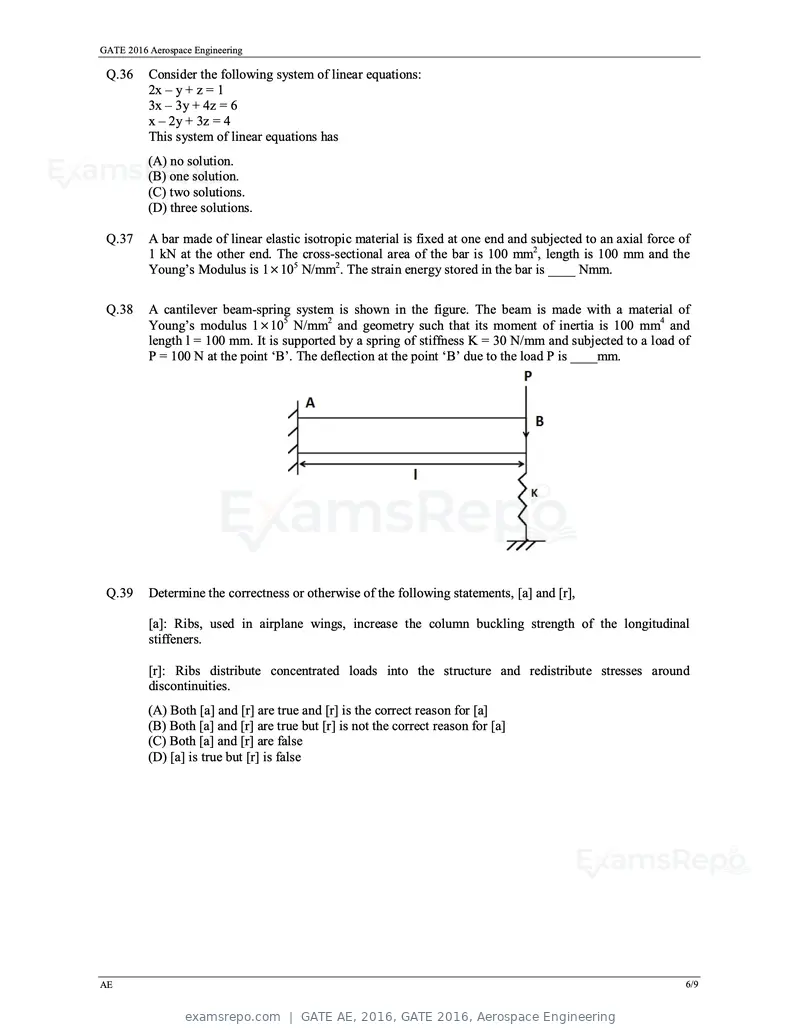
Text of page 9
GATE 2016 Aerospace Engineering
Q.36 Consider the following system of linear equations:
2x – y + z = 1
3x – 3y + 4z = 6
x – 2y + 3z = 4
This system of linear equations has
(A) no solution.
(B) one solution.
(C) two solutions.
(D) three solutions.
Q.37 A bar made of linear elastic isotropic material is fixed at one end and subjected to an axial force of
1 kN at the other end. The cross-sectional area of the bar is 100 mm2, length is 100 mm and the
Young’s Modulus is 1 105 N/mm2. The strain energy stored in the bar is ____ Nmm.
Q.38 A cantilever beam-spring system is shown in the figure. The beam is made with a material of
Young’s modulus 1 105 N/mm2 and geometry such that its moment of inertia is 100 mm4 and
length l = 100 mm. It is supported by a spring of stiffness K = 30 N/mm and subjected to a load of
P = 100 N at the point ‘B’. The deflection at the point ‘B’ due to the load P is ____mm.
Q.39 Determine the correctness or otherwise of the following statements, [a] and [r],
[a]: Ribs, used in airplane wings, increase the column buckling strength of the longitudinal
stiffeners.
[r]: Ribs distribute concentrated loads into the structure and redistribute stresses around
discontinuities.
(A) Both [a] and [r] are true and [r] is the correct reason for [a]
(B) Both [a] and [r] are true but [r] is not the correct reason for [a]
(C) Both [a] and [r] are false
(D) [a] is true but [r] is false
AE 6/9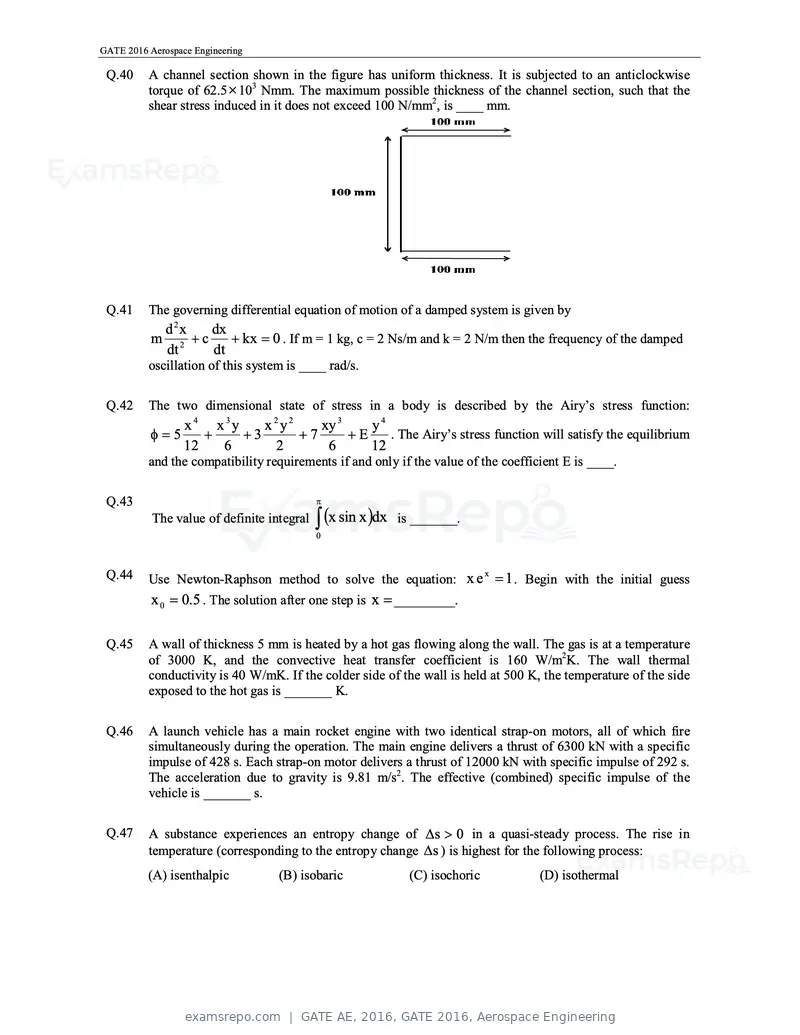
Text of page 10
GATE 2016 Aerospace Engineering
Q.40 A channel section shown in the figure has uniform thickness. It is subjected to an anticlockwise
torque of 62.5 103 Nmm. The maximum possible thickness of the channel section, such that the
shear stress induced in it does not exceed 100 N/mm2, is ____ mm.
Q.41 The governing differential equation of motion of a damped system is given by
d2x dx
m 2
c kx 0 . If m = 1 kg, c = 2 Ns/m and k = 2 N/m then the frequency of the damped
dt dt
oscillation of this system is ____ rad/s.
Q.42 The two dimensional state of stress in a body is described by the Airy’s stress function:
x4 x3y x 2y2 xy 3 y4
5 3 7 E . The Airy’s stress function will satisfy the equilibrium
12 6 2 6 12
and the compatibility requirements if and only if the value of the coefficient E is ____.
Q.43
The value of definite integral x sin x dx is _______.
0
Q.44 x
Use Newton-Raphson method to solve the equation: x e 1 . Begin with the initial guess
x 0 0.5 . The solution after one step is x _________.
Q.45 A wall of thickness 5 mm is heated by a hot gas flowing along the wall. The gas is at a temperature
of 3000 K, and the convective heat transfer coefficient is 160 W/m2K. The wall thermal
conductivity is 40 W/mK. If the colder side of the wall is held at 500 K, the temperature of the side
exposed to the hot gas is _______ K.
Q.46 A launch vehicle has a main rocket engine with two identical strap-on motors, all of which fire
simultaneously during the operation. The main engine delivers a thrust of 6300 kN with a specific
impulse of 428 s. Each strap-on motor delivers a thrust of 12000 kN with specific impulse of 292 s.
The acceleration due to gravity is 9.81 m/s2. The effective (combined) specific impulse of the
vehicle is _______ s.
Q.47 A substance experiences an entropy change of s 0 in a quasi-steady process. The rise in
temperature (corresponding to the entropy change s ) is highest for the following process:
(A) isenthalpic (B) isobaric (C) isochoric (D) isothermal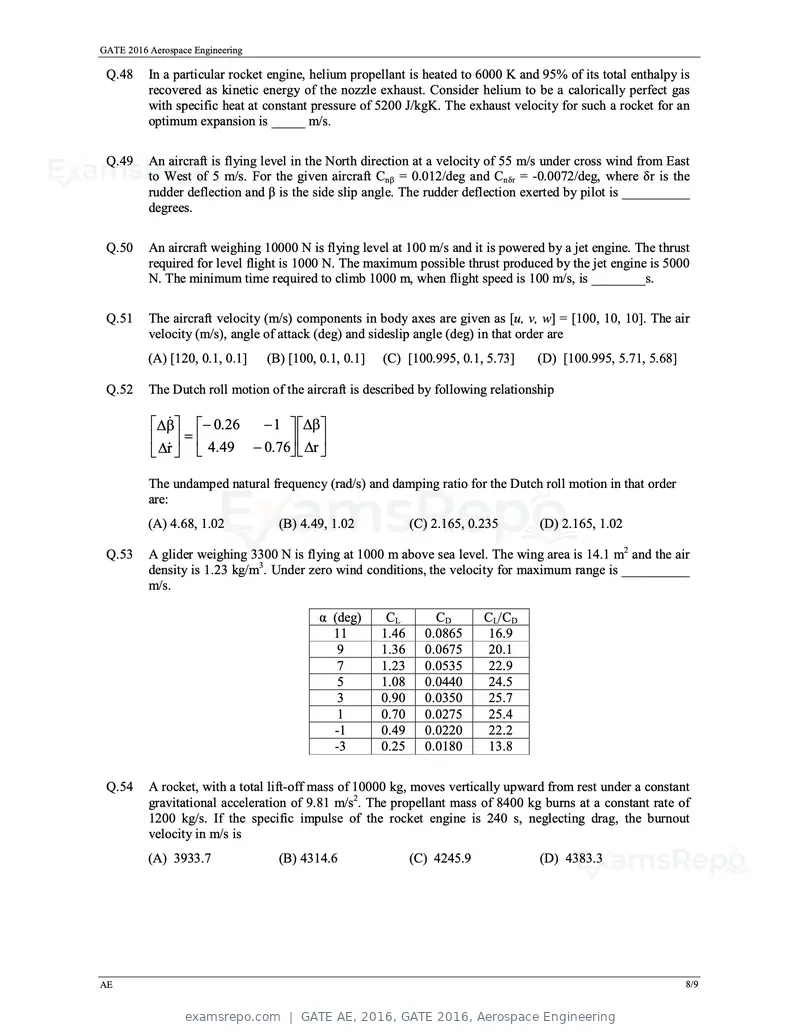
Text of page 11
GATE 2016 Aerospace Engineering
Q.48 In a particular rocket engine, helium propellant is heated to 6000 K and 95% of its total enthalpy is
recovered as kinetic energy of the nozzle exhaust. Consider helium to be a calorically perfect gas
with specific heat at constant pressure of 5200 J/kgK. The exhaust velocity for such a rocket for an
optimum expansion is _____ m/s.
Q.49 An aircraft is flying level in the North direction at a velocity of 55 m/s under cross wind from East
to West of 5 m/s. For the given aircraft Cnβ = 0.012/deg and Cnδr = -0.0072/deg, where δr is the
rudder deflection and β is the side slip angle. The rudder deflection exerted by pilot is __________
degrees.
Q.50 An aircraft weighing 10000 N is flying level at 100 m/s and it is powered by a jet engine. The thrust
required for level flight is 1000 N. The maximum possible thrust produced by the jet engine is 5000
N. The minimum time required to climb 1000 m, when flight speed is 100 m/s, is ________s.
Q.51 The aircraft velocity (m/s) components in body axes are given as [u, v, w] = [100, 10, 10]. The air
velocity (m/s), angle of attack (deg) and sideslip angle (deg) in that order are
(A) [120, 0.1, 0.1] (B) [100, 0.1, 0.1] (C) [100.995, 0.1, 5.73] (D) [100.995, 5.71, 5.68]
Q.52 The Dutch roll motion of the aircraft is described by following relationship
0.26 1
r 4.49 0.76 r
The undamped natural frequency (rad/s) and damping ratio for the Dutch roll motion in that order
are:
(A) 4.68, 1.02 (B) 4.49, 1.02 (C) 2.165, 0.235 (D) 2.165, 1.02
Q.53 A glider weighing 3300 N is flying at 1000 m above sea level. The wing area is 14.1 m2 and the air
density is 1.23 kg/m3. Under zero wind conditions, the velocity for maximum range is __________
m/s.
α (deg) CL CD CL/CD
11 1.46 0.0865 16.9
9 1.36 0.0675 20.1
7 1.23 0.0535 22.9
5 1.08 0.0440 24.5
3 0.90 0.0350 25.7
1 0.70 0.0275 25.4
-1 0.49 0.0220 22.2
-3 0.25 0.0180 13.8
Q.54 A rocket, with a total lift-off mass of 10000 kg, moves vertically upward from rest under a constant
gravitational acceleration of 9.81 m/s2. The propellant mass of 8400 kg burns at a constant rate of
1200 kg/s. If the specific impulse of the rocket engine is 240 s, neglecting drag, the burnout
velocity in m/s is
(A) 3933.7 (B) 4314.6 (C) 4245.9 (D) 4383.3
AE 8/9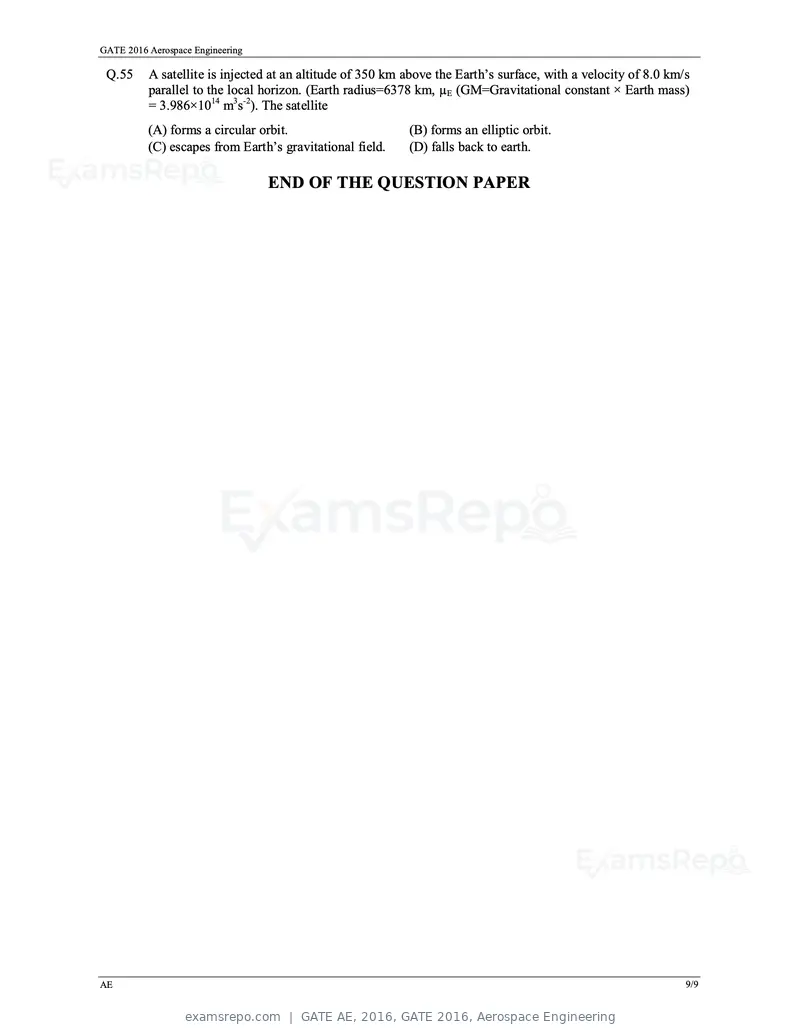
Text of page 12
GATE 2016 Aerospace Engineering

 Q.55     A satellite is injected at an altitude of 350 km above the Earth’s surface, with a velocity of 8.0 km/s
          parallel to the local horizon. (Earth radius=6378 km, µE (GM=Gravitational constant × Earth mass)
          = 3.986×10¹⁴ m3s-2). The satellite
          (A) forms a circular orbit.                      (B) forms an elliptic orbit.
          (C) escapes from Earth’s gravitational field.    (D) falls back to earth.

                                  END OF THE QUESTION PAPER


AE                                                                                                              9/9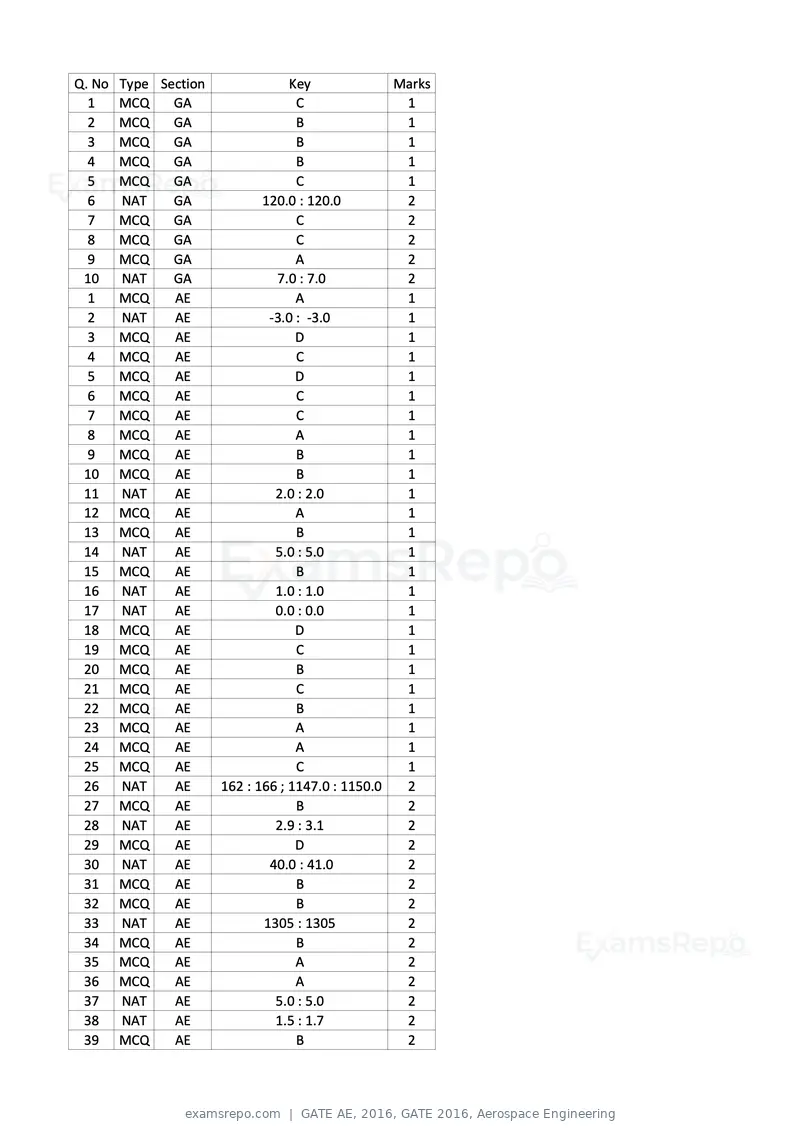
Text of page 13
Q. No Type Section               Key             Marks
  1   MCQ    GA                   C               1
  2   MCQ    GA                   B               1
  3   MCQ    GA                   B               1
  4   MCQ    GA                   B               1
  5   MCQ    GA                   C               1
  6   NAT    GA             120.0 : 120.0         2
  7   MCQ    GA                   C               2
  8   MCQ    GA                   C               2
  9   MCQ    GA                   A               2
 10   NAT    GA               7.0 : 7.0           2
  1   MCQ    AE                   A               1
  2   NAT    AE              -3.0 : -3.0          1
  3   MCQ    AE                   D               1
  4   MCQ    AE                   C               1
  5   MCQ    AE                   D               1
  6   MCQ    AE                   C               1
  7   MCQ    AE                   C               1
  8   MCQ    AE                   A               1
  9   MCQ    AE                   B               1
 10 MCQ      AE                   B               1
 11   NAT    AE               2.0 : 2.0           1
 12 MCQ      AE                   A               1
 13 MCQ      AE                   B               1
 14   NAT    AE               5.0 : 5.0           1
 15 MCQ      AE                   B               1
 16   NAT    AE               1.0 : 1.0           1
 17   NAT    AE               0.0 : 0.0           1
 18 MCQ      AE                   D               1
 19 MCQ      AE                   C               1
 20 MCQ      AE                   B               1
 21 MCQ      AE                   C               1
 22 MCQ      AE                   B               1
 23 MCQ      AE                   A               1
 24 MCQ      AE                   A               1
 25 MCQ      AE                   C               1
 26   NAT    AE      162 : 166 ; 1147.0 : 1150.0  2
 27 MCQ      AE                   B               2
 28   NAT    AE               2.9 : 3.1           2
 29 MCQ      AE                   D               2
 30   NAT    AE              40.0 : 41.0          2
 31 MCQ      AE                   B               2
 32 MCQ      AE                   B               2
 33   NAT    AE             1305 : 1305           2
 34 MCQ      AE                   B               2
 35 MCQ      AE                   A               2
 36 MCQ      AE                   A               2
 37   NAT    AE               5.0 : 5.0           2
 38   NAT    AE               1.5 : 1.7           2
 39 MCQ      AE                   B               2
Text of page 14
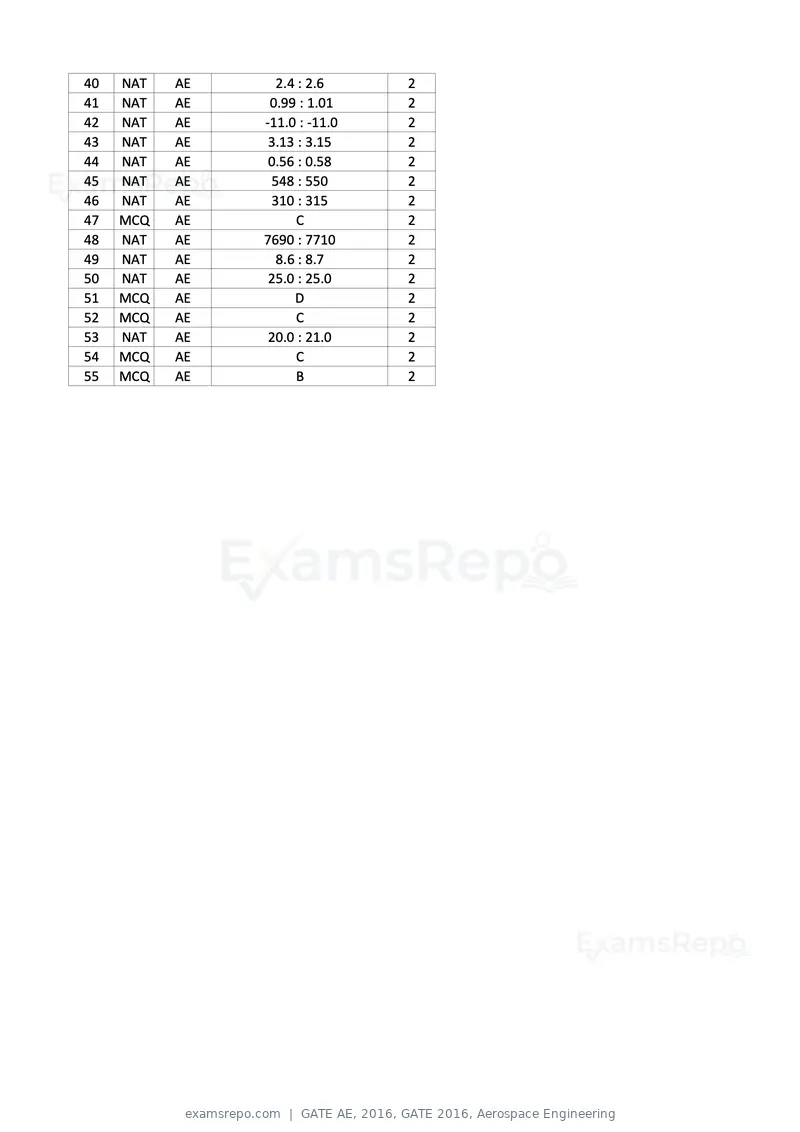
40   NAT   AE     2.4 : 2.6     2
41   NAT   AE    0.99 : 1.01    2
42   NAT   AE   -11.0 : -11.0   2
43   NAT   AE    3.13 : 3.15    2
44   NAT   AE    0.56 : 0.58    2
45   NAT   AE    548 : 550      2
46   NAT   AE    310 : 315      2
47   MCQ   AE        C          2
48   NAT   AE   7690 : 7710     2
49   NAT   AE     8.6 : 8.7     2
50   NAT   AE    25.0 : 25.0    2
51   MCQ   AE        D          2
52   MCQ   AE        C          2
53   NAT   AE    20.0 : 21.0    2
54   MCQ   AE        C          2
55   MCQ   AE        B          2
Official key not published for this paper.
Page 1 of 14
Source: GATE. Question paper published by GATE.