
GATE CE 2013: Civil Engineering
Text of page 1
2013                                                                                      CIVIL ENGINEERING - CE

                                      CE:CIVIL ENGINEERING
Duration: Three Hours                                                               Maximum Marks:100

Please read the following instructions carefully:

General Instructions:

       1. Total duration of examination is 180 minutes (3 hours).

       2. The clock will be set at the server. The countdown timer in the top right corner of screen will display
          the remaining time available for you to complete the examination. When the timer reaches zero, the
          examination will end by itself. You will not be required to end or submit your examination.

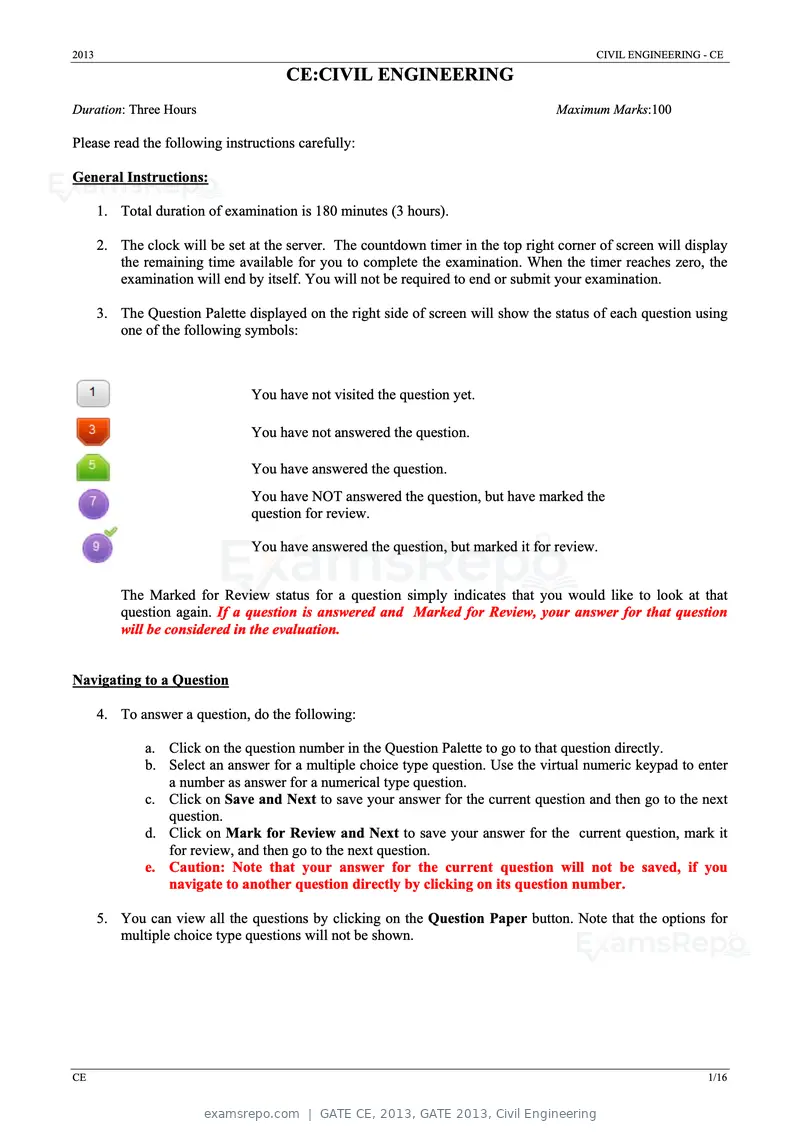
       3. The Question Palette displayed on the right side of screen will show the status of each question using
          one of the following symbols:


                                You have not visited the question yet.

                                You have not answered the question.

                                You have answered the question.
                                You have NOT answered the question, but have marked the
                                question for review.

                                You have answered the question, but marked it for review.


           The Marked for Review status for a question simply indicates that you would like to look at that
           question again. If a question is answered and Marked for Review, your answer for that question
           will be considered in the evaluation.


Navigating to a Question

       4. To answer a question, do the following:

               a. Click on the question number in the Question Palette to go to that question directly.
               b. Select an answer for a multiple choice type question. Use the virtual numeric keypad to enter
                  a number as answer for a numerical type question.
               c. Click on Save and Next to save your answer for the current question and then go to the next
                  question.
               d. Click on Mark for Review and Next to save your answer for the current question, mark it
                  for review, and then go to the next question.
               e. Caution: Note that your answer for the current question will not be saved, if you
                  navigate to another question directly by clicking on its question number.

       5. You can view all the questions by clicking on the Question Paper button. Note that the options for
          multiple choice type questions will not be shown.


CE                                                                                                           1/16
Text of page 2
2013                                                                                      CIVIL ENGINEERING - CE
Answering a Question

       6. Procedure for answering a multiple choice type question:
              a. To select your answer, click on the button of one of the options
              b. To deselect your chosen answer, click on the button of the chosen option again or click on the
                 Clear Response button
              c. To change your chosen answer, click on the button of another option
              d. To save your answer, you MUST click on the Save and Next button
              e. To mark the question for review, click on the Mark for Review and Next button. If an
                 answer is selected for a question that is Marked for Review, that answer will be considered
                 in the evaluation.

       7. Procedure for answering a numerical answer type question:
              a. To enter a number as your answer, use the virtual numerical keypad
              b. A fraction (eg.,-0.3 or -.3) can be entered as an answer with or without ‘0’ before the decimal
                 point
              c. To clear your answer, click on the Clear Response button
              d. To save your answer, you MUST click on the Save and Next button
              e. To mark the question for review, click on the Mark for Review and Next button. If an
                 answer is entered for a question that is Marked for Review, that answer will be considered
                 in the evaluation.

       8. To change your answer to a question that has already been answered, first select that question for
          answering and then follow the procedure for answering that type of question.

       9. Note that ONLY Questions for which answers are saved or marked for review after answering will be
          considered for evaluation.


CE                                                                                                           2/16
Text of page 3
2013                                                                                      CIVIL ENGINEERING - CE
Paper specific instructions:


       1. There are a total of 65 questions carrying 100 marks. Questions are of multiple choice type or
          numerical answer type. A multiple choice type question will have four choices for the answer with
          only one correct choice. For numerical answer type questions, the answer is a number and no choices
          will be given. A number as the answer should be entered using the virtual keyboard on the monitor.
       2. Questions Q.1 – Q.25 carry 1mark each. Questions Q.26 – Q.55 carry 2marks each. The 2marks
          questions include two pairs of common data questions and two pairs of linked answer questions. The
          answer to the second question of the linked answer questions depends on the answer to the first
          question of the pair. If the first question in the linked pair is wrongly answered or is not attempted,
          then the answer to the second question in the pair will not be evaluated.
       3. Questions Q.56 – Q.65 belong to General Aptitude (GA) section and carry a total of 15 marks.
          Questions Q.56 – Q.60 carry 1mark each, and questions Q.61 – Q.65 carry 2marks each.

       4. Questions not attempted will result in zero mark. Wrong answers for multiple choice type questions
          will result in NEGATIVE marks. For all 1 mark questions, ⅓ mark will be deducted for each wrong
          answer. For all 2 marks questions, ⅔ mark will be deducted for each wrong answer. However, in the
          case of the linked answer question pair, there will be negative marks only for wrong answer to the
          first question and no negative marks for wrong answer to the second question. There is no negative
          marking for questions of numerical answer type.

       5. Calculator is allowed. Charts, graph sheets or tables are NOT allowed in the examination hall.

       6. Do the rough work in the Scribble Pad provided.


CE                                                                                                           3/16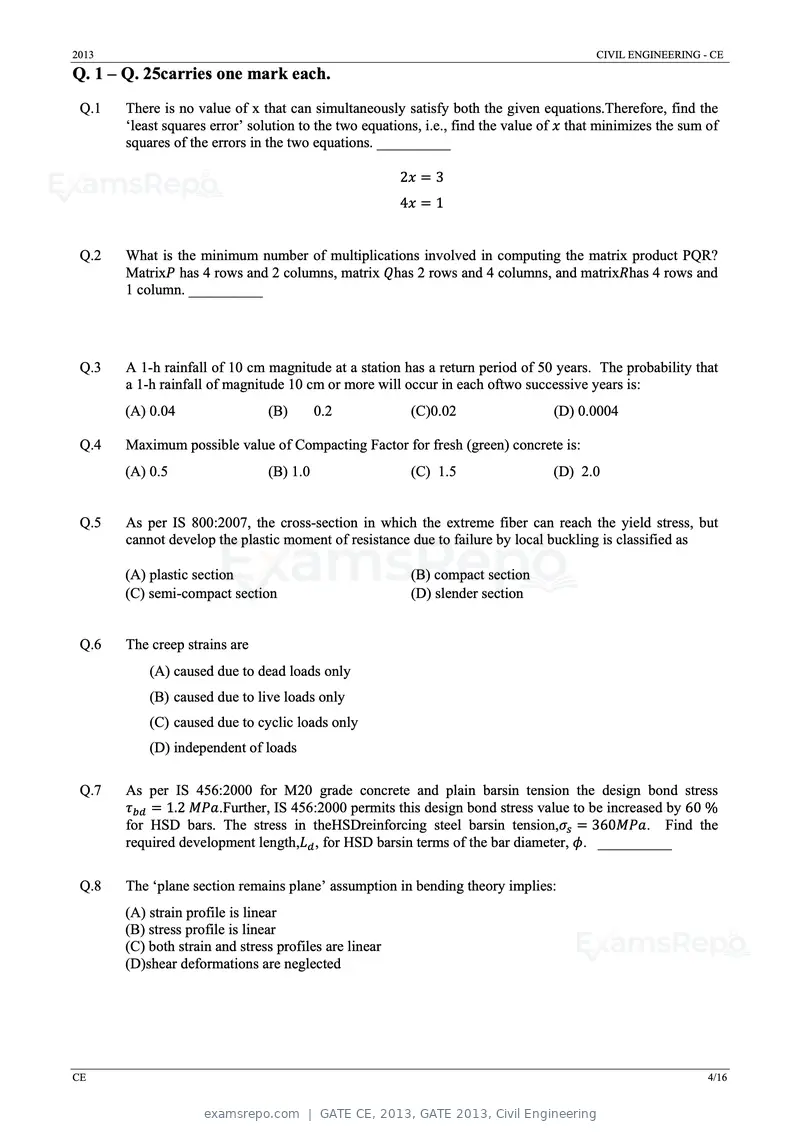
Text of page 4
2013                                                                                    CIVIL ENGINEERING - CE
Q. 1 – Q. 25carries one mark each.
 Q.1   There is no value of x that can simultaneously satisfy both the given equations.Therefore, find the
       ‘least squares error’ solution to the two equations, i.e., find the value of that minimizes the sum of
       squares of the errors in the two equations. __________

                                                        2      3
                                                        4      1


 Q.2   What is the minimum number of multiplications involved in computing the matrix product PQR?
       Matrix has 4 rows and 2 columns, matrix has 2 rows and 4 columns, and matrix has 4 rows and
       1 column. __________


 Q.3   A 1-h rainfall of 10 cm magnitude at a station has a return period of 50 years. The probability that
       a 1-h rainfall of magnitude 10 cm or more will occur in each oftwo successive years is:
       (A) 0.04                 (B)       0.2               (C)0.02               (D) 0.0004

 Q.4   Maximum possible value of Compacting Factor for fresh (green) concrete is:
       (A) 0.5                  (B) 1.0                     (C) 1.5               (D) 2.0


 Q.5   As per IS 800:2007, the cross-section in which the extreme fiber can reach the yield stress, but
       cannot develop the plastic moment of resistance due to failure by local buckling is classified as

       (A) plastic section                                  (B) compact section
       (C) semi-compact section                             (D) slender section


 Q.6   The creep strains are
           (A) caused due to dead loads only
           (B) caused due to live loads only
           (C) caused due to cyclic loads only
           (D) independent of loads

 Q.7   As per IS 456:2000 for M20 grade concrete and plain barsin tension the design bond stress
              1.2     .Further, IS 456:2000 permits this design bond stress value to be increased by 60 %
       for HSD bars. The stress in theHSDreinforcing steel barsin tension,           360       . Find the
       required development length, , for HSD barsin terms of the bar diameter, . __________

 Q.8   The ‘plane section remains plane’ assumption in bending theory implies:
       (A) strain profile is linear
       (B) stress profile is linear
       (C) both strain and stress profiles are linear
       (D)shear deformations are neglected


CE                                                                                                         4/16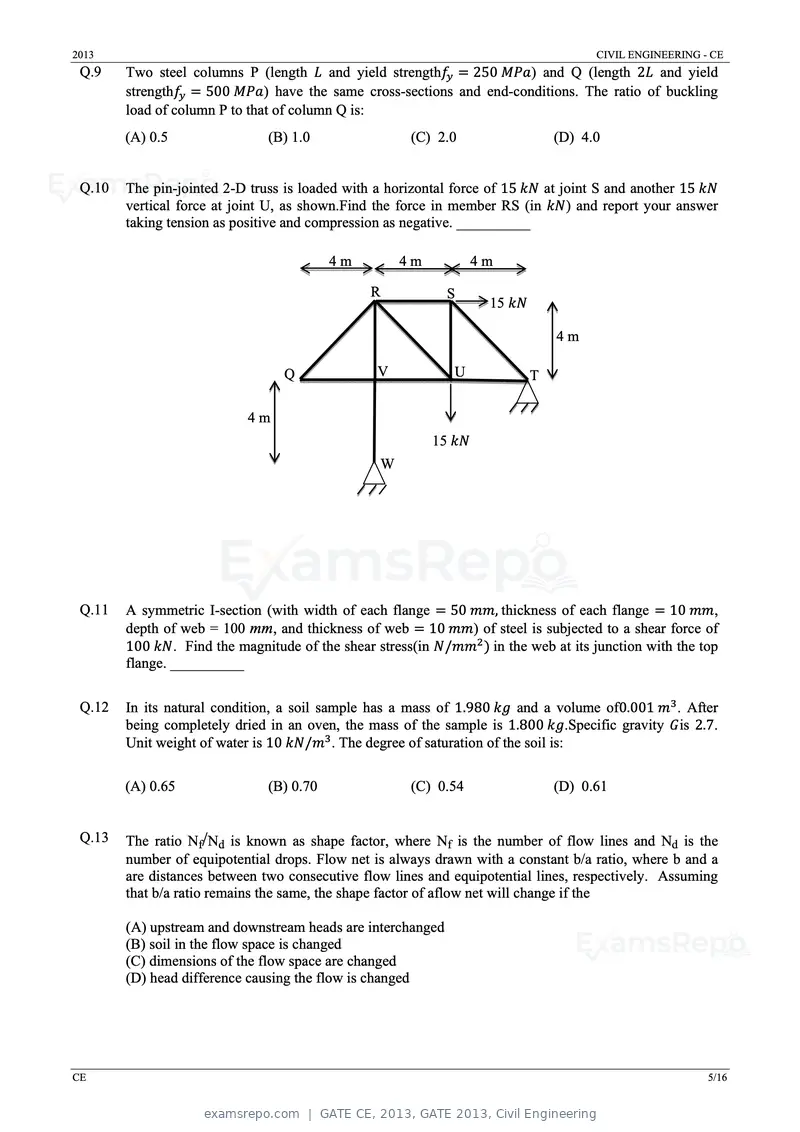
Text of page 5
2013                                                                                 CIVIL ENGINEERING - CE
 Q.9    Two steel columns P (length and yield strength          250      ) and Q (length 2 and yield
        strength     500       ) have the same cross-sections and end-conditions. The ratio of buckling
        load of column P to that of column Q is:
        (A) 0.5                (B) 1.0                 (C) 2.0                (D) 4.0


 Q.10   The pin-jointed 2-D truss is loaded with a horizontal force of 15   at joint S and another 15
        vertical force at joint U, as shown.Find the force in member RS (in     ) and report your answer
        taking tension as positive and compression as negative. __________

                                          4m          4m            4m

                                                R            S
                                                                     15

                                                                               4m

                                  Q              V              U         T

                            4m
                                                           15
                                                  W


 Q.11   A symmetric I-section (with width of each flange 50       , thickness of each flange 10          ,
        depth of web = 100 mm, and thickness of web 10        ) of steel is subjected to a shear force of
        100     . Find the magnitude of the shear stress(in /     in the web at its junction with the top
        flange. __________

 Q.12   In its natural condition, a soil sample has a mass of 1.980      and a volume of0.001 . After
        being completely dried in an oven, the mass of the sample is 1.800 .Specific gravity is 2.7.
        Unit weight of water is 10     / . The degree of saturation of the soil is:

        (A) 0.65               (B) 0.70                (C) 0.54               (D) 0.61


 Q.13   The ratio Nf/Nd is known as shape factor, where Nf is the number of flow lines and Nd is the
        number of equipotential drops. Flow net is always drawn with a constant b/a ratio, where b and a
        are distances between two consecutive flow lines and equipotential lines, respectively. Assuming
        that b/a ratio remains the same, the shape factor of aflow net will change if the

        (A) upstream and downstream heads are interchanged
        (B) soil in the flow space is changed
        (C) dimensions of the flow space are changed
        (D) head difference causing the flow is changed


CE                                                                                                      5/16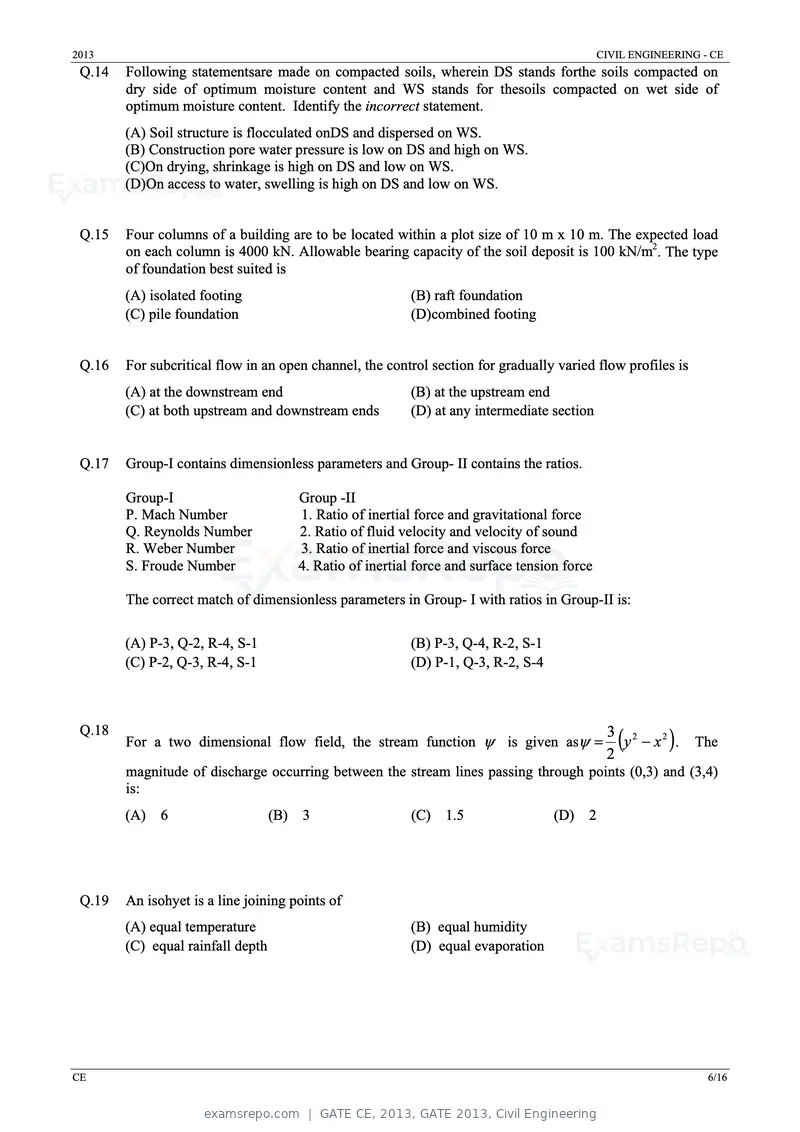
Text of page 6
2013 CIVIL ENGINEERING - CE
Q.14 Following statementsare made on compacted soils, wherein DS stands forthe soils compacted on
dry side of optimum moisture content and WS stands for thesoils compacted on wet side of
optimum moisture content. Identify the incorrect statement.
(A) Soil structure is flocculated onDS and dispersed on WS.
(B) Construction pore water pressure is low on DS and high on WS.
(C)On drying, shrinkage is high on DS and low on WS.
(D)On access to water, swelling is high on DS and low on WS.
Q.15 Four columns of a building are to be located within a plot size of 10 m x 10 m. The expected load
on each column is 4000 kN. Allowable bearing capacity of the soil deposit is 100 kN/m2. The type
of foundation best suited is
(A) isolated footing (B) raft foundation
(C) pile foundation (D)combined footing
Q.16 For subcritical flow in an open channel, the control section for gradually varied flow profiles is
(A) at the downstream end (B) at the upstream end
(C) at both upstream and downstream ends (D) at any intermediate section
Q.17 Group-I contains dimensionless parameters and Group- II contains the ratios.
Group-I Group -II
P. Mach Number 1. Ratio of inertial force and gravitational force
Q. Reynolds Number 2. Ratio of fluid velocity and velocity of sound
R. Weber Number 3. Ratio of inertial force and viscous force
S. Froude Number 4. Ratio of inertial force and surface tension force
The correct match of dimensionless parameters in Group- I with ratios in Group-II is:
(A) P-3, Q-2, R-4, S-1 (B) P-3, Q-4, R-2, S-1
(C) P-2, Q-3, R-4, S-1 (D) P-1, Q-3, R-2, S-4
Q.18
For a two dimensional flow field, the stream function is given as
3 2
2
y x 2 . The
magnitude of discharge occurring between the stream lines passing through points (0,3) and (3,4)
is:
(A) 6 (B) 3 (C) 1.5 (D) 2
Q.19 An isohyet is a line joining points of
(A) equal temperature (B) equal humidity
(C) equal rainfall depth (D) equal evaporation
CE 6/16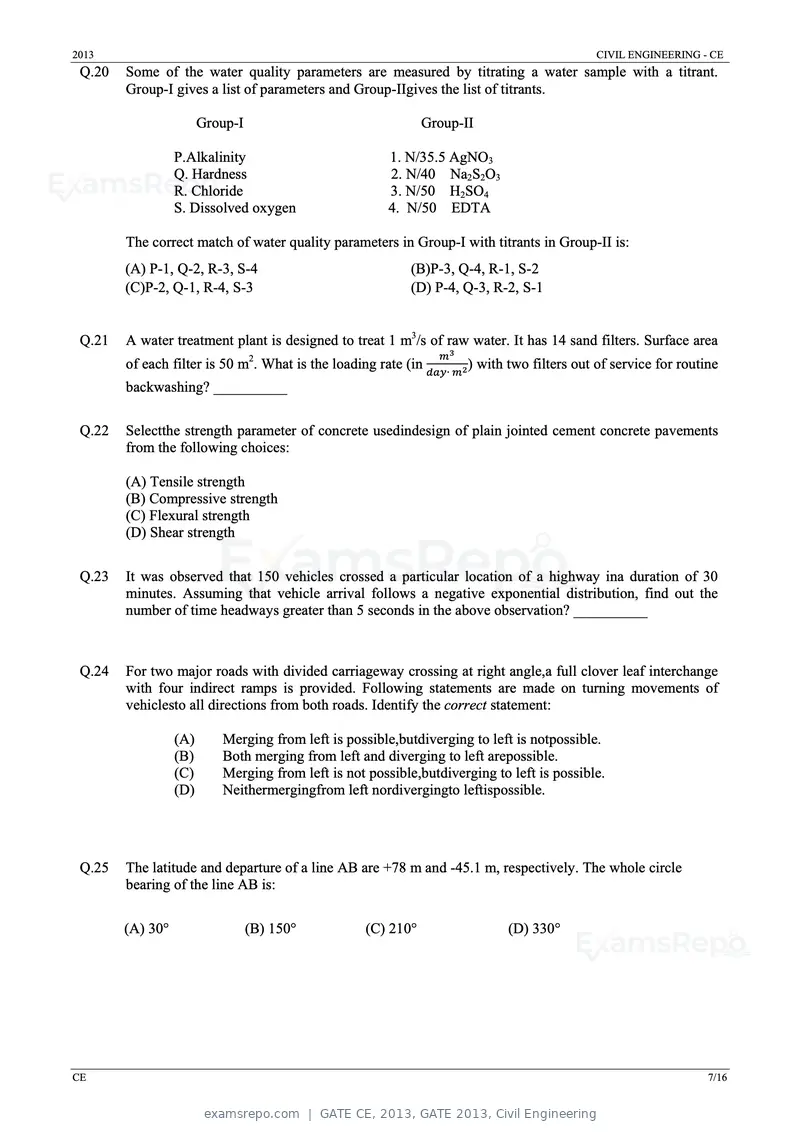
Text of page 7
2013                                                                                         CIVIL ENGINEERING - CE
 Q.20   Some of the water quality parameters are measured by titrating a water sample with a titrant.
        Group-I gives a list of parameters and Group-IIgives the list of titrants.

                        Group-I                                Group-II

                  P.Alkalinity                          1. N/35.5 AgNO3
                  Q. Hardness                           2. N/40 Na2S2O3
                  R. Chloride                           3. N/50 H2SO4
                  S. Dissolved oxygen                   4. N/50 EDTA

        The correct match of water quality parameters in Group-I with titrants in Group-II is:
        (A) P-1, Q-2, R-3, S-4                             (B)P-3, Q-4, R-1, S-2
        (C)P-2, Q-1, R-4, S-3                              (D) P-4, Q-3, R-2, S-1


 Q.21   A water treatment plant is designed to treat 1 m3/s of raw water. It has 14 sand filters. Surface area
        of each filter is 50 m2. What is the loading rate (in         ) with two filters out of service for routine
                                                                  ∙
        backwashing? __________

 Q.22   Selectthe strength parameter of concrete usedindesign of plain jointed cement concrete pavements
        from the following choices:

        (A) Tensile strength
        (B) Compressive strength
        (C) Flexural strength
        (D) Shear strength

 Q.23   It was observed that 150 vehicles crossed a particular location of a highway ina duration of 30
        minutes. Assuming that vehicle arrival follows a negative exponential distribution, find out the
        number of time headways greater than 5 seconds in the above observation? __________


 Q.24   For two major roads with divided carriageway crossing at right angle,a full clover leaf interchange
        with four indirect ramps is provided. Following statements are made on turning movements of
        vehiclesto all directions from both roads. Identify the correct statement:

                  (A)      Merging from left is possible,butdiverging to left is notpossible.
                  (B)      Both merging from left and diverging to left arepossible.
                  (C)      Merging from left is not possible,butdiverging to left is possible.
                  (D)      Neithermergingfrom left nordivergingto leftispossible.


 Q.25   The latitude and departure of a line AB are +78 m and -45.1 m, respectively. The whole circle
        bearing of the line AB is:

        (A) 30°                   (B) 150°          (C) 210°                 (D) 330°


CE                                                                                                               7/16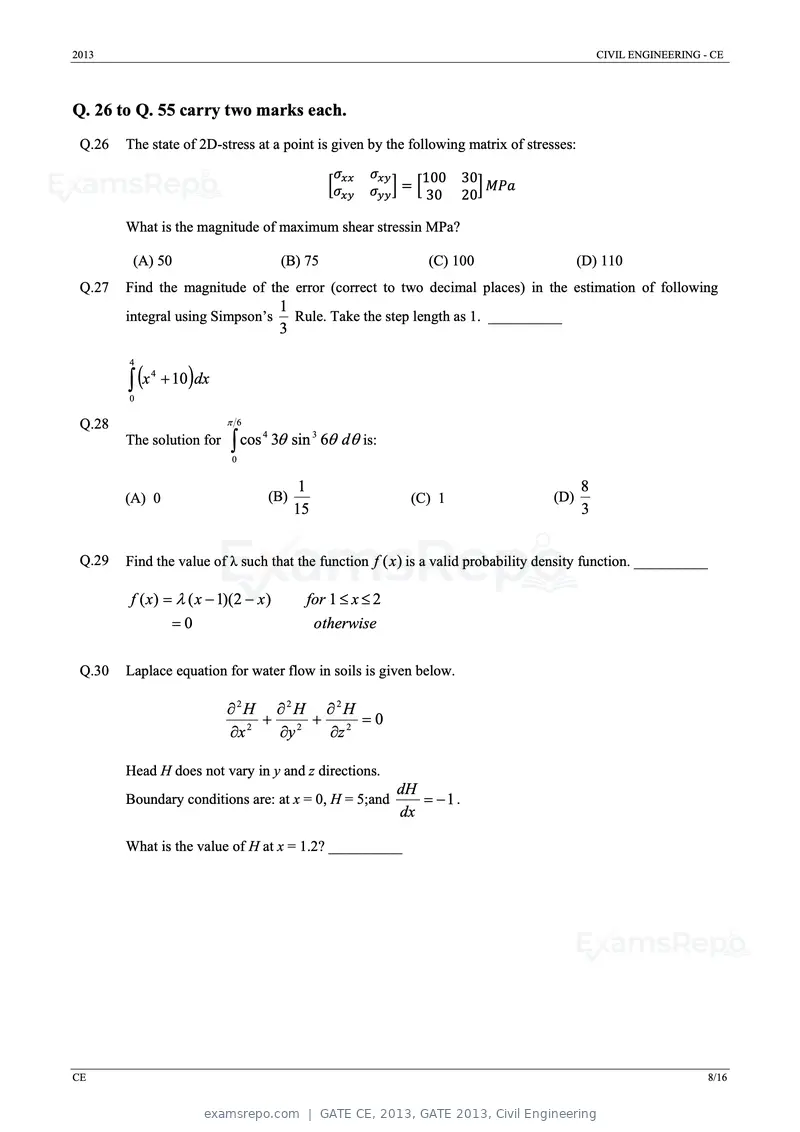
Text of page 8
2013 CIVIL ENGINEERING - CE
Q. 26 to Q. 55 carry two marks each.
Q.26 The state of 2D-stress at a point is given by the following matrix of stresses:
100 30
30 20
What is the magnitude of maximum shear stressin MPa?
(A) 50 (B) 75 (C) 100 (D) 110
Q.27 Find the magnitude of the error (correct to two decimal places) in the estimation of following
1
integral using Simpson’s Rule. Take the step length as 1. __________
3
4
x 10dx
4
0
Q.28 6
cos 3 sin 6 d is:
4 3
The solution for
0
1 8
(A) 0 (B) (C) 1 (D)
15 3
Q.29 Find the value of λ such that the function f (x ) is a valid probability density function. __________
f ( x) ( x 1)(2 x) for 1 x 2
0 otherwise
Q.30 Laplace equation for water flow in soils is given below.
2H 2H 2H
0
x 2 y 2 z 2
Head H does not vary in y and z directions.
dH
Boundary conditions are: at x = 0, H = 5;and 1 .
dx
What is the value of H at x = 1.2? __________
CE 8/16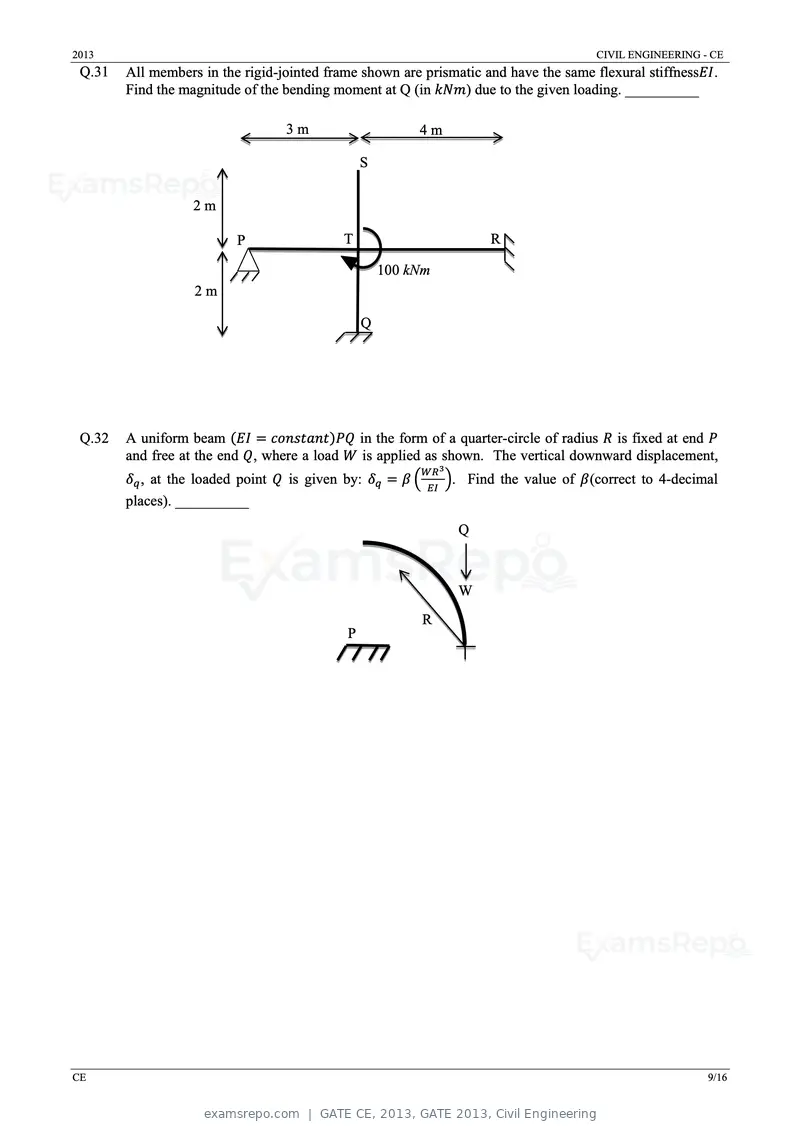
Text of page 9
2013                                                                                    CIVIL ENGINEERING - CE
 Q.31   All members in the rigid-jointed frame shown are prismatic and have the same flexural stiffness     .
        Find the magnitude of the bending moment at Q (in      ) due to the given loading. __________

                                   3m                       4m

                                                   S

                   2m

                          P                    T                       R

                                                       100 kNm
                   2m

                                                   Q


 Q.32   A uniform beam                             in the form of a quarter-circle of radius is fixed at end
        and free at the end   , where a load        is applied as shown. The vertical downward displacement,
           , at the loaded point   is given by:                  . Find the value of   (correct to 4-decimal
        places). __________
                                                                  Q


                                                                  W
                                                            R
                                               P


CE                                                                                                         9/16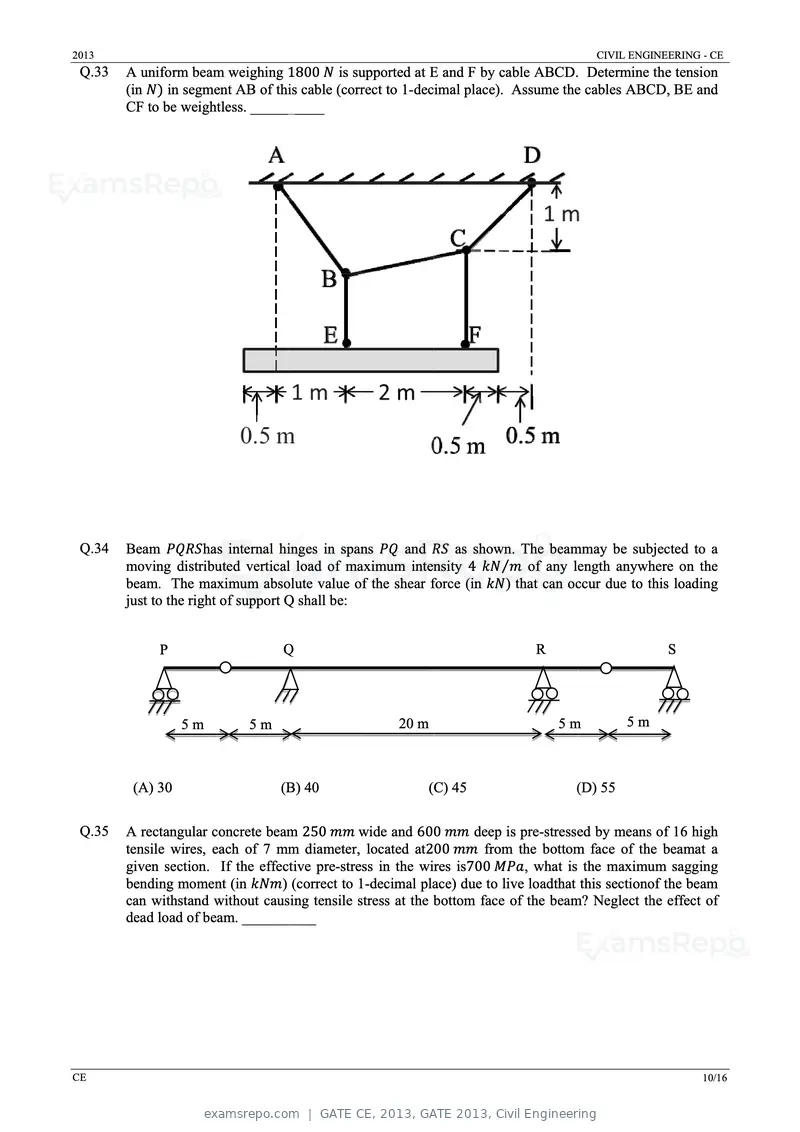
Text of page 10
2013                                                                                    CIVIL ENGINEERING - CE
 Q.33   A uniform beam weighing 1800 is supported at E and F by cable ABCD. Determine the tension
        (in    in segment AB of this cable (correct to 1-decimal place). Assume the cables ABCD, BE and
        CF to be weightless. __________


 Q.34   Beam           has internal hinges in spans and     as shown. The beammay be subjected to a
        moving distributed vertical load of maximum intensity 4    ⁄ of any length anywhere on the
        beam. The maximum absolute value of the shear force (in     ) that can occur due to this loading
        just to the right of support Q shall be:


             P                    Q                                          R                      S


                  5m         5m                       20 m                       5m          5m


         (A) 30                   (B) 40                   (C) 45                   (D) 55

 Q.35   A rectangular concrete beam 250         wide and 600       deep is pre-stressed by means of 16 high
        tensile wires, each of 7 mm diameter, located at200         from the bottom face of the beamat a
        given section. If the effective pre-stress in the wires is700       , what is the maximum sagging
        bending moment (in        ) (correct to 1-decimal place) due to live loadthat this sectionof the beam
        can withstand without causing tensile stress at the bottom face of the beam? Neglect the effect of
        dead load of beam. __________


CE                                                                                                        10/16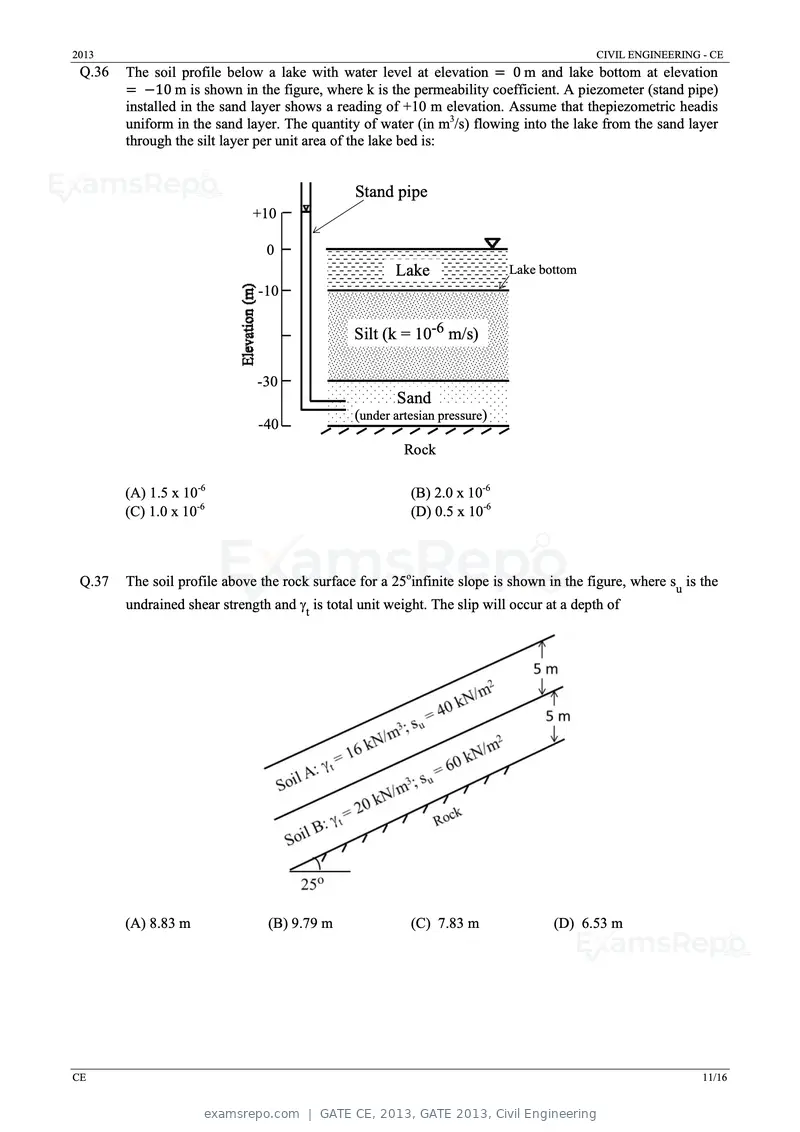
Text of page 11
2013 CIVIL ENGINEERING - CE
Q.36 The soil profile below a lake with water level at elevation 0 m and lake bottom at elevation
10 m is shown in the figure, where k is the permeability coefficient. A piezometer (stand pipe)
installed in the sand layer shows a reading of +10 m elevation. Assume that thepiezometric headis
uniform in the sand layer. The quantity of water (in m3/s) flowing into the lake from the sand layer
through the silt layer per unit area of the lake bed is:
Stand pipe
+10
0
Lake Lake bottom
-10
Silt (k = 10-6 m/s)
-30
Sand
(under artesian pressure)
-40
Rock
(A) 1.5 x 10⁻⁶ (B) 2.0 x 10⁻⁶
(C) 1.0 x 10⁻⁶ (D) 0.5 x 10⁻⁶
Q.37 The soil profile above the rock surface for a 25oinfinite slope is shown in the figure, where su is the
undrained shear strength and t is total unit weight. The slip will occur at a depth of
(A) 8.83 m (B) 9.79 m (C) 7.83 m (D) 6.53 m
CE 11/16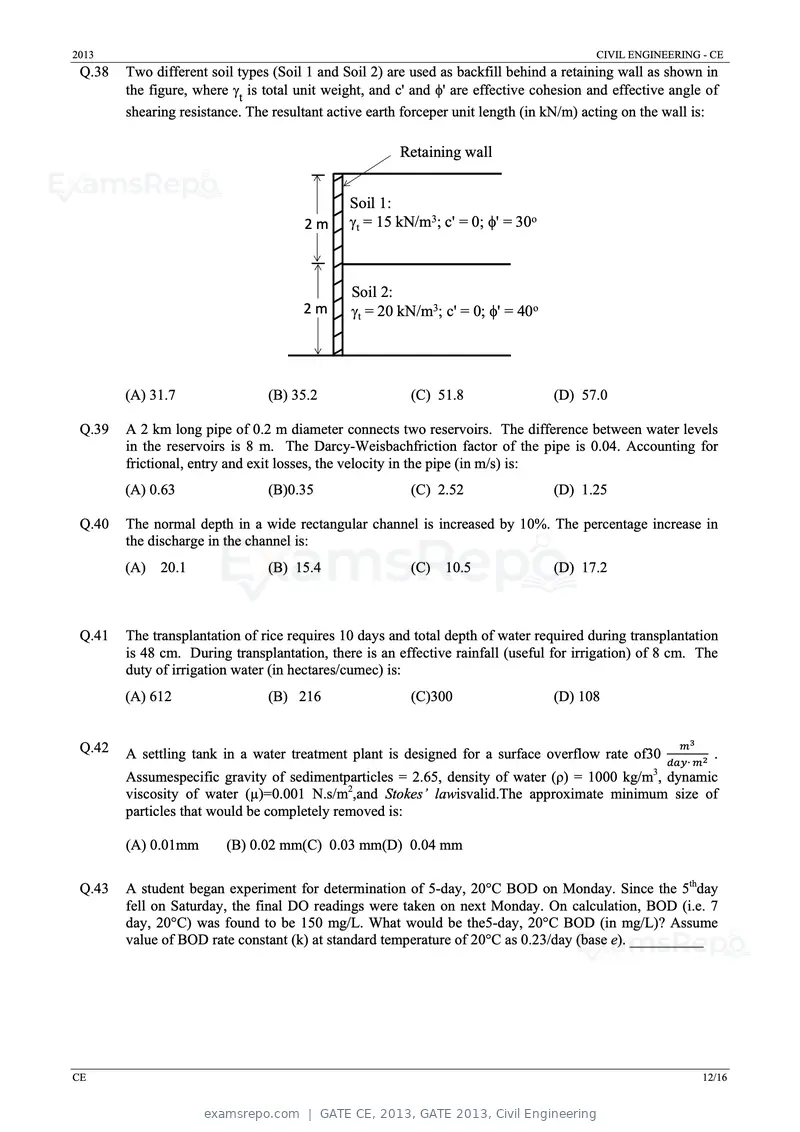
Text of page 12
2013 CIVIL ENGINEERING - CE
Q.38 Two different soil types (Soil 1 and Soil 2) are used as backfill behind a retaining wall as shown in
the figure, where t is total unit weight, and c' and ' are effective cohesion and effective angle of
shearing resistance. The resultant active earth forceper unit length (in kN/m) acting on the wall is:
Retaining wall
Soil 1:
2m t = 15 kN/m3; c' = 0; ' = 30o
Soil 2:
2m t = 20 kN/m3; c' = 0; ' = 40o
(A) 31.7 (B) 35.2 (C) 51.8 (D) 57.0
Q.39 A 2 km long pipe of 0.2 m diameter connects two reservoirs. The difference between water levels
in the reservoirs is 8 m. The Darcy-Weisbachfriction factor of the pipe is 0.04. Accounting for
frictional, entry and exit losses, the velocity in the pipe (in m/s) is:
(A) 0.63 (B)0.35 (C) 2.52 (D) 1.25
Q.40 The normal depth in a wide rectangular channel is increased by 10%. The percentage increase in
the discharge in the channel is:
(A) 20.1 (B) 15.4 (C) 10.5 (D) 17.2
Q.41 The transplantation of rice requires 10 days and total depth of water required during transplantation
is 48 cm. During transplantation, there is an effective rainfall (useful for irrigation) of 8 cm. The
duty of irrigation water (in hectares/cumec) is:
(A) 612 (B) 216 (C)300 (D) 108
Q.42 A settling tank in a water treatment plant is designed for a surface overflow rate of30 .
∙
Assumespecific gravity of sedimentparticles = 2.65, density of water (ρ) = 1000 kg/m3, dynamic
viscosity of water (µ)=0.001 N.s/m2,and Stokes’ lawisvalid.The approximate minimum size of
particles that would be completely removed is:
(A) 0.01mm (B) 0.02 mm(C) 0.03 mm(D) 0.04 mm
Q.43 A student began experiment for determination of 5-day, 20°C BOD on Monday. Since the 5thday
fell on Saturday, the final DO readings were taken on next Monday. On calculation, BOD (i.e. 7
day, 20°C) was found to be 150 mg/L. What would be the5-day, 20°C BOD (in mg/L)? Assume
value of BOD rate constant (k) at standard temperature of 20°C as 0.23/day (base e). __________
CE 12/16
Text of page 13
2013                                                                                         CIVIL ENGINEERING - CE
 Q.44   Elevation and temperature data for a place are tabulated below:

                                          Elevation, m           Temperature, °C
                                               4                     21.25
                                              444                    15.70

        Based on the above data, lapse rate can be referred as:
        (A) Super-adiabatic     (B) Neutral                 (C) Sub-adiabatic        (D) Inversion

 Q.45   The percent voids in mineral aggregate (VMA) and percent air voids (Vv) in a compacted
        cylindrical bituminous mix specimen are 15 and 4.5respectively. The percent voids filled with
        bitumen (VFB) for this specimen is:

        (A) 24                   (B) 30                      (C) 54                 (D) 70

 Q.46   Following bearings are observed while traversing with a compass.

        Line         Fore Bearing          Back Bearing
        AB             126°45´               308°00´
        BC              49°15´               227°30´
        CD             340°30´               161°45´
        DE            258°30´                 78°30´
        EA            212°30´                 31°45´

        After applying the correction due to local attraction, the corrected fore bearing of line BC will be:

        (A) 48°15´       (B)50°15´        (C) 49°45´         (D) 48°45´

 Q.47   A theodolite is set up at station A and a 3 m long staff is held vertically at station B. The depression
        angle reading at 2.5 m marking on the staffis 6°10´. The horizontal distance between A and B is
        2200 m. Height of instrument at station A is 1.1 m and R.L. of A is 880.88 m.Apply the curvature
        and refraction correction, and determine the R.L. of B (in m). __________

Common Data Questions
 Common Data for Questions 48 and 49:

 A propped cantilever made of a prismatic steel beam is subjected to a concentrated load P at mid span as
 shown.                                            P


                                                                                R

                                          1.5m                 1.5m


 Q.48   If load    80      ,find the reaction (in        ) (correct to 1-decimal place)using elastic analysis.
        __________


 Q.49   If the magnitude of load is increased till collapse and the plastic moment carrying capacity of steel
        beam section is 90       , determine reaction (in        )(correct to 1-decimal place) using plastic
        analysis. __________


CE                                                                                                               13/16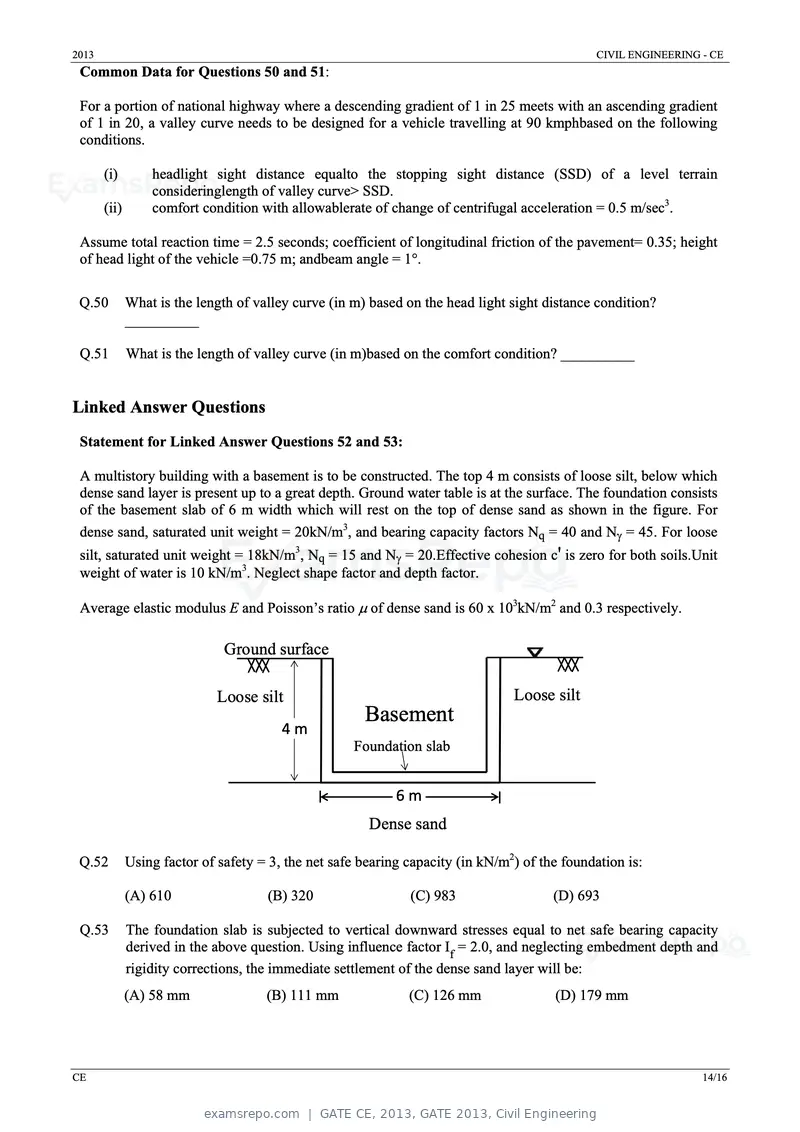
Text of page 14
2013 CIVIL ENGINEERING - CE
Common Data for Questions 50 and 51:
For a portion of national highway where a descending gradient of 1 in 25 meets with an ascending gradient
of 1 in 20, a valley curve needs to be designed for a vehicle travelling at 90 kmphbased on the following
conditions.
(i) headlight sight distance equalto the stopping sight distance (SSD) of a level terrain
consideringlength of valley curve> SSD.
(ii) comfort condition with allowablerate of change of centrifugal acceleration = 0.5 m/sec3.
Assume total reaction time = 2.5 seconds; coefficient of longitudinal friction of the pavement= 0.35; height
of head light of the vehicle =0.75 m; andbeam angle = 1°.
Q.50 What is the length of valley curve (in m) based on the head light sight distance condition?
__________
Q.51 What is the length of valley curve (in m)based on the comfort condition? __________
Linked Answer Questions
Statement for Linked Answer Questions 52 and 53:
A multistory building with a basement is to be constructed. The top 4 m consists of loose silt, below which
dense sand layer is present up to a great depth. Ground water table is at the surface. The foundation consists
of the basement slab of 6 m width which will rest on the top of dense sand as shown in the figure. For
dense sand, saturated unit weight = 20kN/m3, and bearing capacity factors Nq = 40 and N = 45. For loose
silt, saturated unit weight = 18kN/m3, Nq = 15 and N = 20.Effective cohesion c' is zero for both soils.Unit
weight of water is 10 kN/m3. Neglect shape factor and depth factor.
Average elastic modulus E and Poisson’s ratio of dense sand is 60 x 103kN/m2 and 0.3 respectively.
Ground surface
Loose silt Loose silt
Basement
4m
Foundation slab
6m
Dense sand
Q.52 Using factor of safety = 3, the net safe bearing capacity (in kN/m2) of the foundation is:
(A) 610 (B) 320 (C) 983 (D) 693
Q.53 The foundation slab is subjected to vertical downward stresses equal to net safe bearing capacity
derived in the above question. Using influence factor If = 2.0, and neglecting embedment depth and
rigidity corrections, the immediate settlement of the dense sand layer will be:
(A) 58 mm (B) 111 mm (C) 126 mm (D) 179 mm
CE 14/16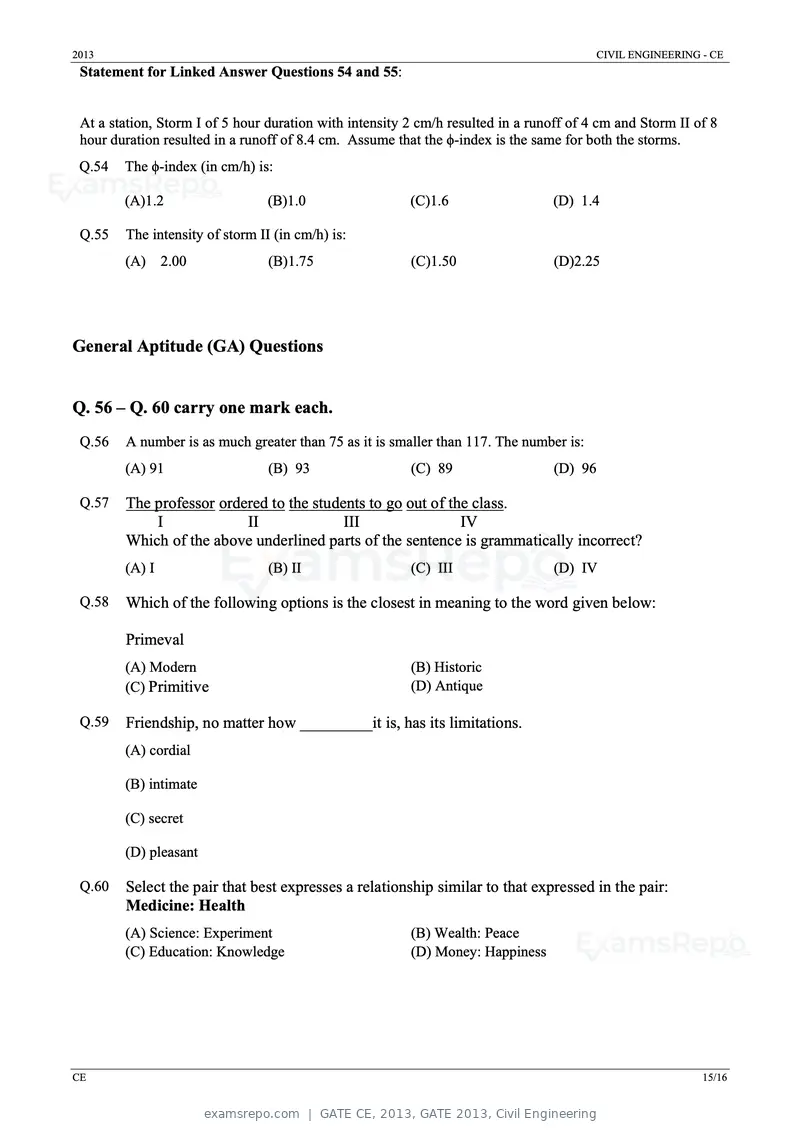
Text of page 15
2013                                                                                       CIVIL ENGINEERING - CE
 Statement for Linked Answer Questions 54 and 55:


 At a station, Storm I of 5 hour duration with intensity 2 cm/h resulted in a runoff of 4 cm and Storm II of 8
 hour duration resulted in a runoff of 8.4 cm. Assume that the ϕ-index is the same for both the storms.
 Q.54   The ϕ-index (in cm/h) is:

        (A)1.2                   (B)1.0                  (C)1.6                  (D) 1.4

 Q.55   The intensity of storm II (in cm/h) is:
        (A)     2.00             (B)1.75                 (C)1.50                  (D)2.25


General Aptitude (GA) Questions


Q. 56 – Q. 60 carry one mark each.
 Q.56   A number is as much greater than 75 as it is smaller than 117. The number is:
        (A) 91                   (B) 93                  (C) 89                   (D) 96

 Q.57   The professor ordered to the students to go out of the class.
            I             II              III                IV
        Which of the above underlined parts of the sentence is grammatically incorrect?
        (A) I                    (B) II                  (C) III                  (D) IV

 Q.58   Which of the following options is the closest in meaning to the word given below:

        Primeval
        (A) Modern                                       (B) Historic
        (C) Primitive                                    (D) Antique

 Q.59   Friendship, no matter how _________it is, has its limitations.
        (A) cordial

        (B) intimate

        (C) secret

        (D) pleasant

 Q.60   Select the pair that best expresses a relationship similar to that expressed in the pair:
        Medicine: Health
        (A) Science: Experiment                          (B) Wealth: Peace
        (C) Education: Knowledge                         (D) Money: Happiness


CE                                                                                                           15/16
Text of page 16
2013                                                                                       CIVIL ENGINEERING - CE
Q. 61 to Q. 65 carry two marks each.
 Q.61   X and Y are two positive real numbers such that 2             6 and     2    8. For which of the
        following values of , the function        ,       3         6 will give maximum value?
        (A) (4/3, 10/3)

        (B) (8/3, 20/3)

        (C) (8/3, 10/3)

        (D) (4/3, 20/3)

 Q.62   If |4    7|       5 then the values of 2 | |   |   | is:
        (A) 2, 1/3                 (B) 1/2, 3              (C) 3/2, 9             (D) 2/3, 9

 Q.63   Following table provides figures (in rupees) on annual expenditure of a firm for two years - 2010
        and 2011.

                                                Category            2010      2011
                                     Raw material                   5200      6240
                                     Power & fuel                   7000      9450
                                     Salary & wages                 9000     12600
                                     Plant & machinery              20000    25000
                                     Advertising                    15000    19500
                                     Research & Development         22000    26400

        In 2011, which of the following two categories have registered increase by same percentage?
        (A) Raw material and Salary & wages
        (B) Salary & wages and Advertising
        (C) Power & fuel and Advertising
        (D) Raw material and Research & Development

 Q.64   A firm is selling its product at Rs. 60 per unit. The total cost of production is Rs. 100 and firm is
        earning total profit of Rs. 500. Later, the total cost increased by 30%. By what percentage the price
        should be increased to maintained the same profit level.
        (A) 5                      (B) 10                  (C) 15                 (D) 30

 Q.65   Abhishek is elder to Savar.
        Savar is younger to Anshul.

        Which of the given conclusions is logically valid and is inferred from the above
        statements?
        (A) Abhishek is elder to Anshul
        (B) Anshul is elder to Abhishek
        (C) Abhishek and Anshul are of the same age
        (D) No conclusion follows


                                 END OF THE QUESTION PAPER

CE                                                                                                           16/16
Official key not published for this paper.
Page 1 of 16
Source: GATE. Question paper published by GATE.