
GATE CE 2014: Civil Engineering Session 2

Text of page 1
SESSION - 1
Text of page 2
GATE 2014: General Instructions during Examination

   1. Total duration of the GATE examination is 180 minutes.
   2. The clock will be set at the server. The countdown timer at the top right corner of
      screen will display the remaining time available for you to complete the examination.
      When the timer reaches zero, the examination will end by itself. You need not
      terminate the examination or submit your paper.
   3. Any useful data required for your paper can be viewed by clicking on the Useful
      Common Data button that appears on the screen.
   4. Use the scribble pad provided to you for any rough work. Submit the scribble pad at
      the end of the examination.
   5. You are allowed to use a non-programmable type calculator, however, sharing of
      calculators is not allowed.
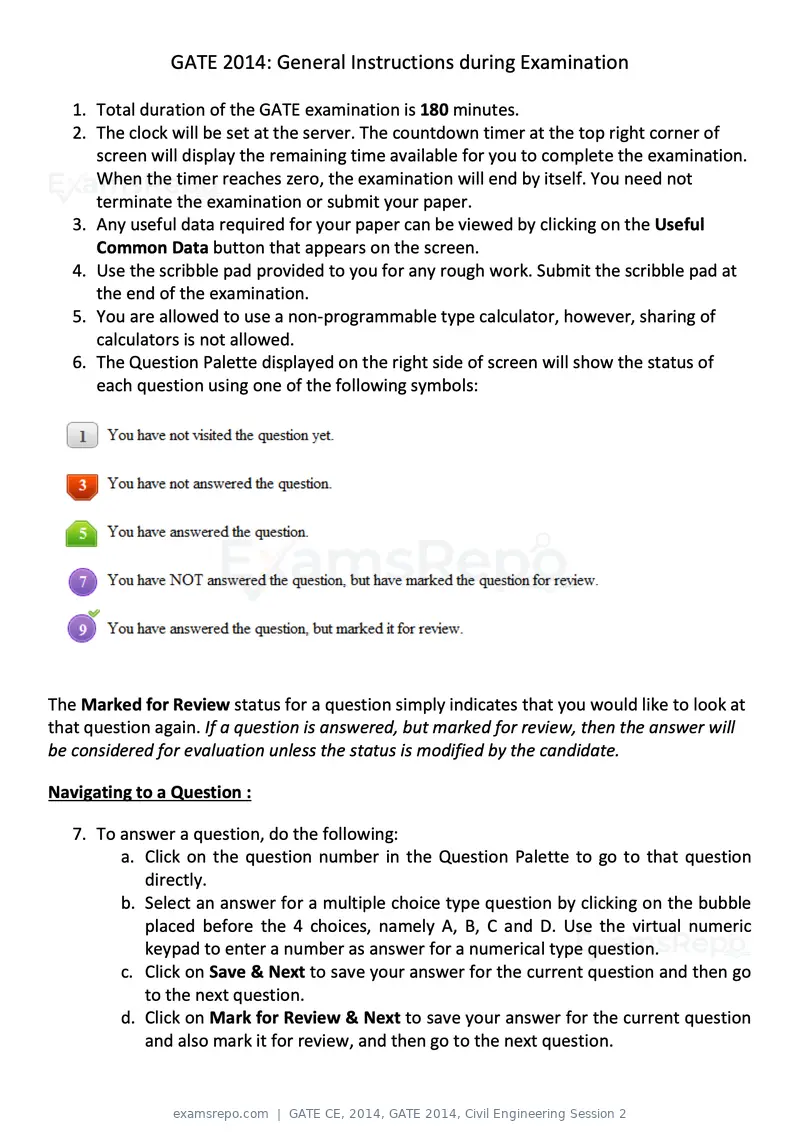
   6. The Question Palette displayed on the right side of screen will show the status of
      each question using one of the following symbols:


The Marked for Review status for a question simply indicates that you would like to look at
that question again. If a question is answered, but marked for review, then the answer will
be considered for evaluation unless the status is modified by the candidate.

Navigating to a Question :

   7. To answer a question, do the following:
         a. Click on the question number in the Question Palette to go to that question
            directly.
         b. Select an answer for a multiple choice type question by clicking on the bubble
            placed before the 4 choices, namely A, B, C and D. Use the virtual numeric
            keypad to enter a number as answer for a numerical type question.
         c. Click on Save & Next to save your answer for the current question and then go
            to the next question.
         d. Click on Mark for Review & Next to save your answer for the current question
            and also mark it for review, and then go to the next question.
Text of page 3
Caution: Note that your answer for the current question will not be saved, if you navigate
to another question directly by clicking on a question number without saving the answer to
the previous question.

You can view all the questions by clicking on the Question Paper button. This feature is
provided, so that if you want you can just see the entire question paper at a glance.

Answering a Question :

   8. Procedure for answering a multiple choice (MCQ) type question:
         a. Choose one answer from the 4 options (A,B,C,D) given below the question,
            click on the bubble placed before the chosen option.
         b. To deselect your chosen answer, click on the bubble of the chosen option again
            or click on the Clear Response button.
         c. To change your chosen answer, click on the bubble of another option.
         d. To save your answer, you MUST click on the Save & Next button.

   9. Procedure for answering a numerical answer type question:
         a. To enter a number as your answer, use the virtual numerical keypad.
         b. A fraction (e.g. -0.3 or -.3) can be entered as an answer with or without '0'
             before the decimal point. As many as four decimal points, e.g. 12.5435 or
             0.003 or -932.6711 or 12.82 can be entered.
         c. To clear your answer, click on the Clear Response button.
         d. To save your answer, you MUST click on the Save & Next button
   10. To mark a question for review, click on the Mark for Review & Next button. If an
      answer is selected (for MCQ) or entered (for numerical answer type) for a question
      that is Marked for Review, that answer will be considered in the evaluation unless
      the status is modified by the candidate.

   11. To change your answer to a question that has already been answered, first select
      that question for answering and then follow the procedure for answering that type of
      question.
   12. Note that ONLY Questions for which answers are saved or marked for review after
      answering will be considered for evaluation.


      Choosing a Section :

   13. Sections in this question paper are displayed on the top bar of the screen. Questions
      in a Section can be viewed by clicking on the name of that Section. The Section you
      are currently viewing will be highlighted.
   14. A checkbox is displayed for every optional Section, if any, in the Question Paper. To
      select the optional Section for answering, click on the checkbox for that Section.
   15. If the checkbox for an optional Section is not selected, the Save & Next button and
      the Mark for Review & Next button will NOT be enabled for that Section. You will
Text of page 4
only be able to see questions in this Section, but you will not be able to answer
      questions in the Section.
   16. After clicking the Save & Next button for the last question in a Section, you will
      automatically be taken to the first question of the next Section in sequence.
   17. You can move the mouse cursor over the name of a Section to view the answering
      status for that Section.


Changing the Optional Section :

   18. After answering the chosen optional Section, partially or completely, you can change
      the optional Section by selecting the checkbox for a new Section that you want to
      attempt. A warning message will appear along with a table showing the number of
      questions answered in each of the previously chosen optional Sections and a
      checkbox against each of these Sections. Click on a checkbox against a Section that
      you want to reset and then click on the RESET button. Note that RESETTING a Section
      will DELETE all the answers for questions in that Section. Hence, if you think that you
      may want to select this Section again later, you will have to note down your answers
      for questions in that Section. If you do not want to reset the Section and want to
      continue answering the previously chosen optional Section, then click on the BACK
      button.

   19. If you deselect the checkbox for an optional Section in the top bar, the following
      warning message will appear: "Deselecting the checkbox will DELETE all the answers
      for questions in this Section. Do you want to deselect this Section?” If you want to
      deselect, click on the RESET button. If you do not want to deselect, click on the BACK
      button.

   20. You can shuffle between different Sections or change the optional Sections any
      number of times.
Text of page 5
GATE 2014 Examination
                                          CE: Civil Engineering
Duration: 180 minutes                                                                        Maximum Marks: 100

Read the following instructions carefully.

    1. To login, enter your Registration Number and password provided to you. Kindly go through the various
       symbols used in the test and understand their meaning before you start the examination.
    2. Once you login and after the start of the examination, you can view all the questions in the question
       paper, by clicking on the View All Questions button in the screen.
    3. This question paper consists of 2 sections, General Aptitude (GA) for 15 marks and the subject
       specific GATE paper for 85 marks. Both these sections are compulsory.
       The GA section consists of 10 questions. Question numbers 1 to 5 are of 1-mark each, while question
       numbers 6 to 10 are of 2-mark each.
       The subject specific GATE paper section consists of 55 questions, out of which question numbers 1 to
       25 are of 1-mark each, while question numbers 26 to 55 are of 2-mark each.
    4. Depending upon the GATE paper, there may be useful common data that may be required for
       answering the questions. If the paper has such useful data, the same can be viewed by clicking on the
       Useful Common Data button that appears at the top, right hand side of the screen.
    5. The computer allotted to you at the examination center runs specialized software that permits only one
        answer to be selected for multiple-choice questions using a mouse and to enter a suitable number for
        the numerical answer type questions using the virtual keyboard and mouse.
    6. Your answers shall be updated and saved on a server periodically and also at the end of the
        examination. The examination will stop automatically at the end of 180 minutes.
    7. In each paper a candidate can answer a total of 65 questions carrying 100 marks.
    8. The question paper may consist of questions of multiple choice type (MCQ) and numerical answer
        type.
    9. Multiple choice type questions will have four choices against A, B, C, D, out of which only ONE is the
        correct answer. The candidate has to choose the correct answer by clicking on the bubble (⃝) placed
        before the choice.
    10. For numerical answer type questions, each question will have a numerical answer and there will not be
        any choices. For these questions, the answer should be enteredby using the virtual keyboard that
        appears on the monitor and the mouse.
    11. All questions that are not attempted will result in zero marks. However, wrong answers for multiple
        choice type questions (MCQ) will result in NEGATIVE marks. For all MCQ questions a wrong
        answer will result in deduction of⅓ marks for a 1-mark question and ⅔ marks for a 2-mark question.
    12. There is NO NEGATIVE MARKING for questions of NUMERICAL ANSWER TYPE.
    13. Non-programmable type Calculator is allowed. Charts, graph sheets, and mathematical tables are NOT
        allowed in the Examination Hall. You must use the Scribble pad provided to you at the examination
        centre for all your rough work. The Scribble Pad has to be returned at the end of the examination.

    Declaration by the candidate:

    “I have read and understood all the above instructions. I have also read and understood clearly the
    instructions given on the admit card and shall follow the same. I also understand that in case I am found to
    violate any of these instructions, my candidature is liable to be cancelled. I also confirm that at the start of
    the examination all the computer hardware allotted to me are in proper working condition”.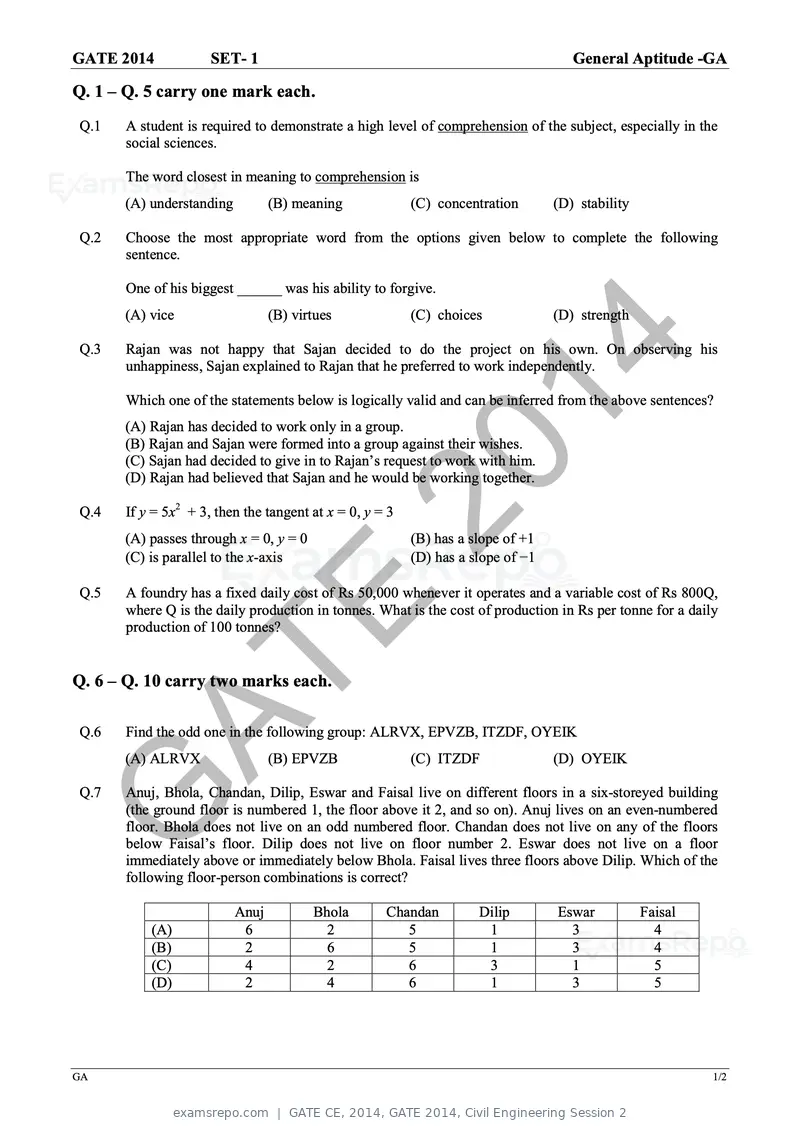
Text of page 6
GATE 2014             SET- 1                                                         General Aptitude -GA

Q. 1 – Q. 5 carry one mark each.
Q.1    A student is required to demonstrate a high level of comprehension of the subject, especially in the
       social sciences.

       The word closest in meaning to comprehension is
      (A) understanding          (B) meaning              (C) concentration       (D) stability

Q.2    Choose the most appropriate word from the options given below to complete the following
       sentence.

       One of his biggest ______ was his ability to forgive.
      (A) vice                   (B) virtues              (C) choices             (D) strength


                                           20
Q.3    Rajan was not happy that Sajan decided to do the project on his own. On observing his
       unhappiness, Sajan explained to Rajan that he preferred to work independently.

       Which one of the statements below is logically valid and can be inferred from the above sentences?


Q.4
                                             14
      (A) Rajan has decided to work only in a group.
      (B) Rajan and Sajan were formed into a group against their wishes.
      (C) Sajan had decided to give in to Rajan’s request to work with him.
      (D) Rajan had believed that Sajan and he would be working together.

       If y = 5x2 + 3, then the tangent at x = 0, y = 3
      (A) passes through x = 0, y = 0
      (C) is parallel to the x-axis
                                                          (B) has a slope of +1
                                                          (D) has a slope of −1

Q.5    A foundry has a fixed daily cost of Rs 50,000 whenever it operates and a variable cost of Rs 800Q,

                          E
       where Q is the daily production in tonnes. What is the cost of production in Rs per tonne for a daily
       production of 100 tonnes?


G
Q. 6 – Q. 10 carry two marks each.


 AT
Q.6


Q.7
       Find the odd one in the following group: ALRVX, EPVZB, ITZDF, OYEIK
      (A) ALRVX                  (B) EPVZB                (C) ITZDF               (D) OYEIK

       Anuj, Bhola, Chandan, Dilip, Eswar and Faisal live on different floors in a six-storeyed building
       (the ground floor is numbered 1, the floor above it 2, and so on). Anuj lives on an even-numbered
       floor. Bhola does not live on an odd numbered floor. Chandan does not live on any of the floors
       below Faisal’s floor. Dilip does not live on floor number 2. Eswar does not live on a floor
       immediately above or immediately below Bhola. Faisal lives three floors above Dilip. Which of the
       following floor-person combinations is correct?

                          Anuj          Bhola        Chandan         Dilip        Eswar           Faisal
           (A)             6              2             5             1             3               4
           (B)             2              6             5             1             3               4
           (C)             4              2             6             3             1               5
           (D)             2              4             6             1             3               5


GA                                                                                                         1/2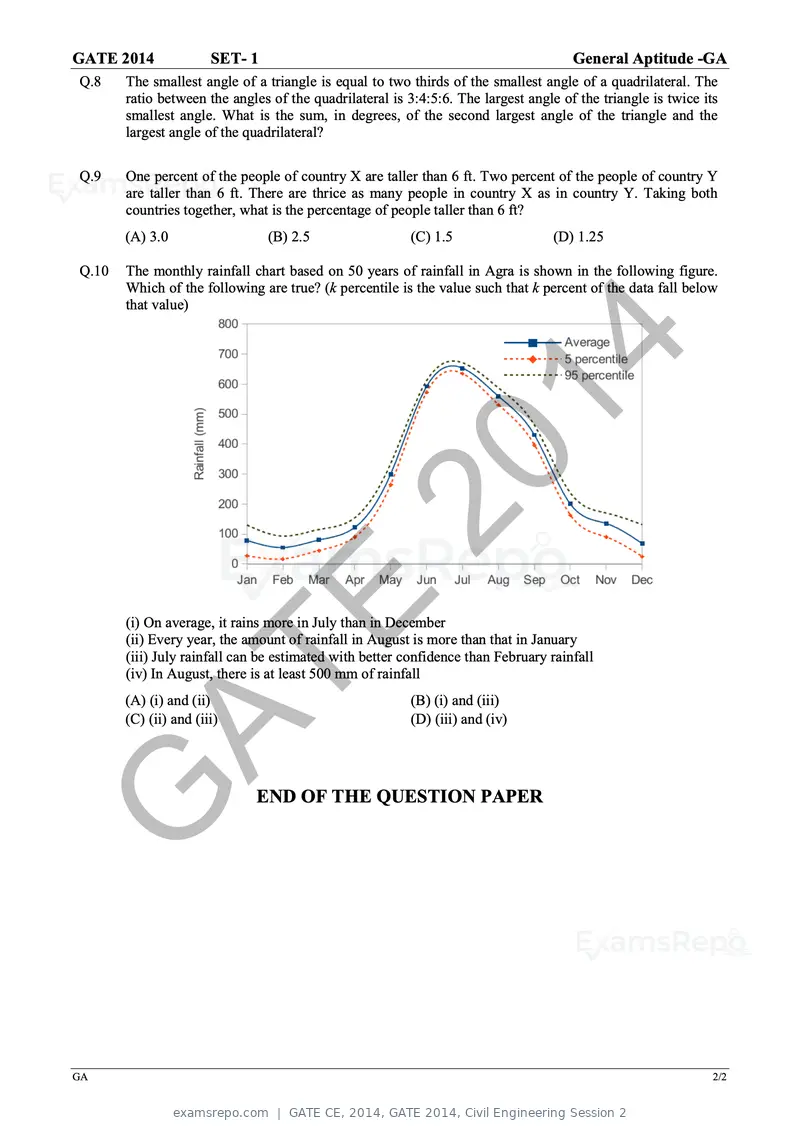
Text of page 7
GATE 2014              SET- 1                                                        General Aptitude -GA
Q.8    The smallest angle of a triangle is equal to two thirds of the smallest angle of a quadrilateral. The
       ratio between the angles of the quadrilateral is 3:4:5:6. The largest angle of the triangle is twice its
       smallest angle. What is the sum, in degrees, of the second largest angle of the triangle and the
       largest angle of the quadrilateral?

Q.9    One percent of the people of country X are taller than 6 ft. Two percent of the people of country Y
       are taller than 6 ft. There are thrice as many people in country X as in country Y. Taking both
       countries together, what is the percentage of people taller than 6 ft?
       (A) 3.0                  (B) 2.5                  (C) 1.5                  (D) 1.25

Q.10   The monthly rainfall chart based on 50 years of rainfall in Agra is shown in the following figure.
       Which of the following are true? (k percentile is the value such that k percent of the data fall below
       that value)


                                          2014
                            E
       (i) On average, it rains more in July than in December
       (ii) Every year, the amount of rainfall in August is more than that in January
       (iii) July rainfall can be estimated with better confidence than February rainfall


GAT
       (iv) In August, there is at least 500 mm of rainfall
       (A) (i) and (ii)
       (C) (ii) and (iii)


                             END OF THE QUESTION PAPER
                                                         (B) (i) and (iii)
                                                         (D) (iii) and (iv)


GA                                                                                                            2/2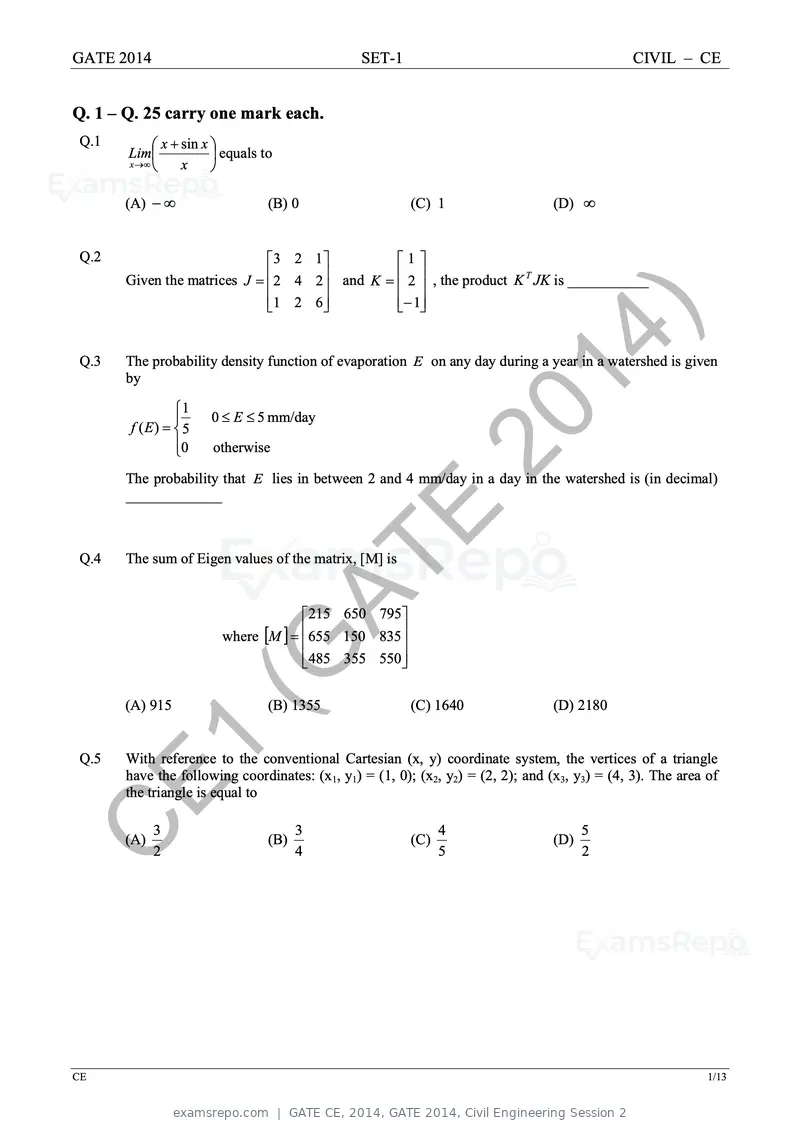
Text of page 8
GATE 2014 SET-1 CIVIL – CE
Q. 1 – Q. 25 carry one mark each.
Q.1 x + sin x
Lim equals to
x →∞ x
(A) − ∞ (B) 0 (C) 1 (D) ∞
Q.2 3 2 1 1
Given the matrices J = 2 4 2 and K = 2 , the product K T JK is ___________
1 2 6 − 1
)
Q.3
14
The probability density function of evaporation E on any day during a year in a watershed is given
by
1
0 ≤ E ≤ 5 mm/day
f (E) = 5
0 otherwise 20
The probability that E lies in between 2 and 4 mm/day in a day in the watershed is (in decimal)
_____________
Q.4 AT
The sum of Eigen values of the matrix, [M] is
E
215 650 795
where [M ] = 655 150 835
(A) 915
(G 485 355 550
(B) 1355 (C) 1640 (D) 2180
Q.5
E1With reference to the conventional Cartesian (x, y) coordinate system, the vertices of a triangle
have the following coordinates: (x1, y1) = (1, 0); (x2, y2) = (2, 2); and (x3, y3) = (4, 3). The area of
the triangle is equal to
C (A)
3
2
(B)
3
4
(C)
4
5
(D)
5
2
CE 1/13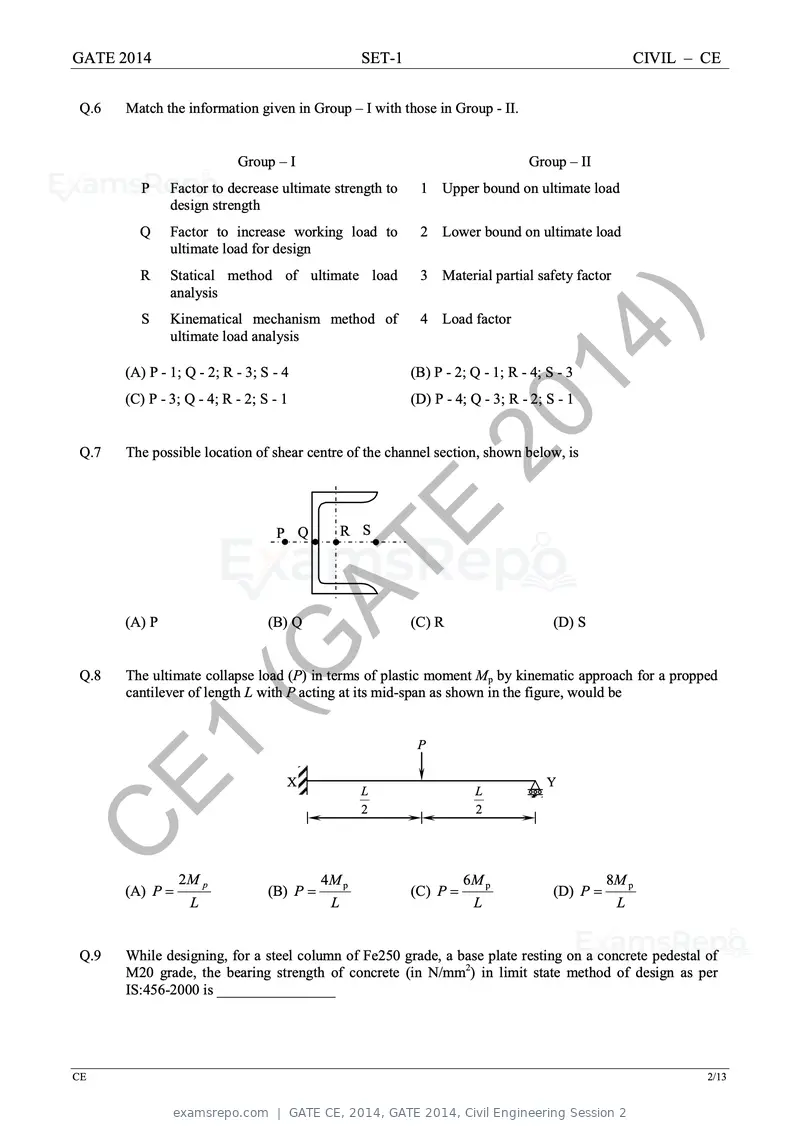
Text of page 9
GATE 2014                                         SET-1                                              CIVIL – CE


 Q.6   Match the information given in Group – I with those in Group - II.


                           Group – I                                           Group – II
         P     Factor to decrease ultimate strength to     1 Upper bound on ultimate load
               design strength
         Q     Factor to increase working load to          2 Lower bound on ultimate load
               ultimate load for design
         R     Statical method of ultimate load            3 Material partial safety factor
               analysis
         S     Kinematical mechanism method of
               ultimate load analysis
                                                           4 Load factor                   )
       (A) P - 1; Q - 2; R - 3; S - 4
       (C) P - 3; Q - 4; R - 2; S - 1
                                                                           14
                                                          (B) P - 2; Q - 1; R - 4; S - 3
                                                          (D) P - 4; Q - 3; R - 2; S - 1


 Q.7                                                           20
       The possible location of shear centre of the channel section, shown below, is


                                  AT
                                  P Q           R S


       (A) P                         E
                                 (B) Q                    (C) R                     (D) S


 Q.8
                    (G
       The ultimate collapse load (P) in terms of plastic moment Mp by kinematic approach for a propped
       cantilever of length L with P acting at its mid-span as shown in the figure, would be


     E1                             X
                                                  L
                                                  2
                                                           P


                                                                     L
                                                                     2
                                                                                   Y


C      (A) P =
                 2M p
                  L
                                 (B) P =
                                           4M p
                                            L
                                                          (C) P =
                                                                    6M p
                                                                     L
                                                                                    (D) P =
                                                                                              8M p
                                                                                               L


 Q.9   While designing, for a steel column of Fe250 grade, a base plate resting on a concrete pedestal of
       M20 grade, the bearing strength of concrete (in N/mm2) in limit state method of design as per
       IS:456-2000 is ________________


CE                                                                                                           2/13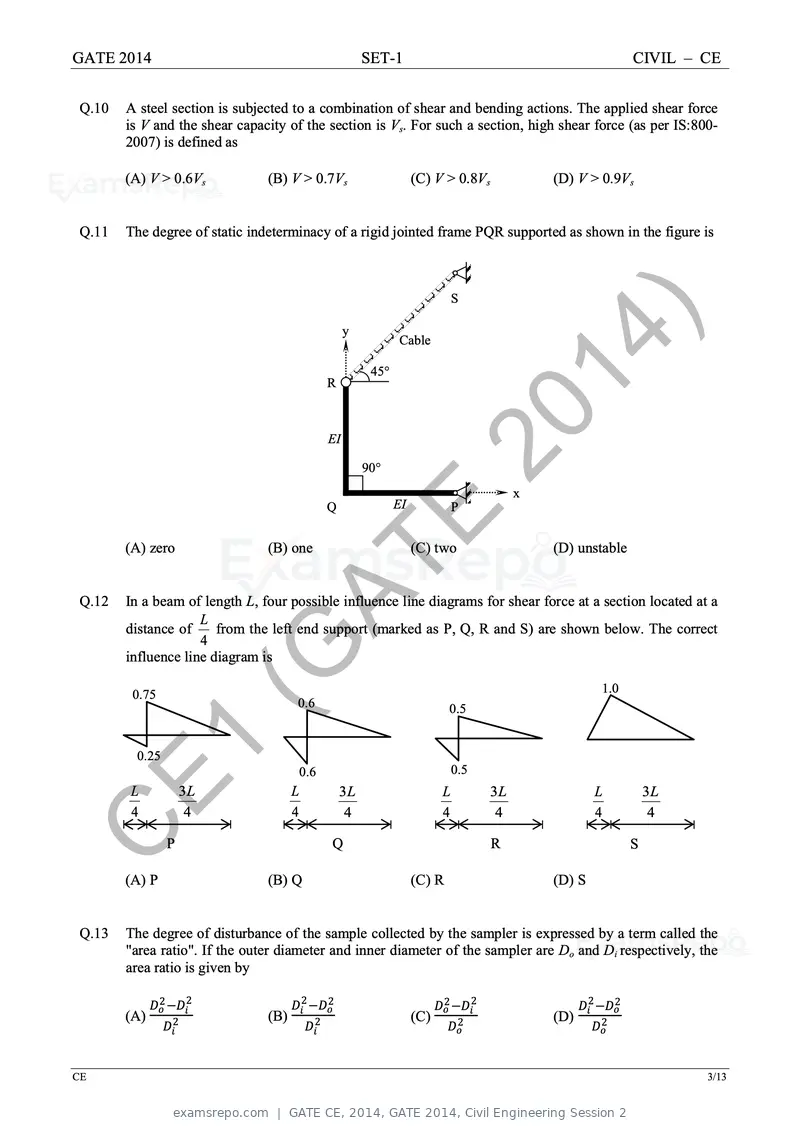
Text of page 10
GATE 2014                                                  SET-1                                                          CIVIL – CE


 Q.10   A steel section is subjected to a combination of shear and bending actions. The applied shear force
        is V and the shear capacity of the section is Vs. For such a section, high shear force (as per IS:800-
        2007) is defined as

        (A) V > 0.6Vs           (B) V > 0.7Vs                          (C) V > 0.8Vs                 (D) V > 0.9Vs


 Q.11   The degree of static indeterminacy of a rigid jointed frame PQR supported as shown in the figure is


                                                                                   S

                                                       y
                                                                                                            )
                                                  R
                                                            45°
                                                                  Cable

                                                                                                14
                                                  EI

                                                           90°
                                                                         20                      x
                                                  Q               EI               P


        (A) zero
                                 AT
                                (B) one                                (C) two                       (D) unstable


 Q.12
                                    E
        In a beam of length L, four possible influence line diagrams for shear force at a section located at a
        distance of
                     L
                     4
                        from the left end support (marked as P, Q, R and S) are shown below. The correct


                              (G
        influence line diagram is

         0.75
                                       0.6                                       0.5
                                                                                                                 1.0


     E1 L
        4
         0.25

                         3L
                          4
                                      L
                                      4
                                        0.6
                                                      3L
                                                       4
                                                                               L
                                                                               4
                                                                                   0.5
                                                                                            3L
                                                                                             4
                                                                                                               L
                                                                                                               4
                                                                                                                              3L
                                                                                                                               4

C       (A) P
                  P

                                (B) Q
                                                  Q

                                                                       (C) R
                                                                                            R

                                                                                                     (D) S
                                                                                                                          S


 Q.13   The degree of disturbance of the sample collected by the sampler is expressed by a term called the
        "area ratio". If the outer diameter and inner diameter of the sampler are Do and Di respectively, the
        area ratio is given by

              DDoo2 −DDii2            DDii2 −DDoo2                           DDoo2 −DDii2                  DDii2 −DDoo2
        (A)                     (B)                                    (C)                           (D)
                 DDii2                    DDii2                                 DDoo2                         DDoo2


CE                                                                                                                                 3/13
Text of page 11
GATE 2014                                        SET-1                                           CIVIL – CE


 Q.14   For a saturated cohesive soil, a triaxial test yields the angle of internal friction (φ) as zero. The
        conducted test is

        (A) Consolidated Drained (CD) test                (B) Consolidated Undrained (CU) test
        (C) Unconfined Compression (UC) test              (D) Unconsolidated Undrained (UU) test


 Q.15   The action of negative skin friction on the pile is to

        (A) increase the ultimate load on the pile
        (B) reduce the allowable load on the pile
        (C) maintain the working load on the pile
                                                                                        )
 Q.16
        (D) reduce the settlement of the pile
                                                                          14
        A long slope is formed in a soil with shear strength parameters: c' = 0 and φ' = 34°. A firm stratum

                                                             20
        lies below the slope and it is assumed that the water table may occasionally rise to the surface, with
        seepage taking place parallel to the slope. Use γsat = 18 kN/m3 and γw = 10 kN/m3. The maximum
        slope angle (in degrees) to ensure a factor of safety of 1.5, assuming a potential failure surface
        parallel to the slope, would be

        (A) 45.3

                                  AT
                                 (B) 44.7                 (C) 12.3                 (D) 11.3


 Q.17

                                     E
        An incompressible homogeneous fluid is flowing steadily in a variable diameter pipe having the
        large and small diameters as 15 cm and 5 cm, respectively. If the velocity at a section at the 15 cm
        diameter portion of the pipe is 2.5 m/s, the velocity of the fluid (in m/s) at a section falling in 5 cm
        portion of the pipe is ___________


 Q.18               (G
        A conventional flow duration curve is a plot between

        (A) Flow and percentage time flow is exceeded


     E1 (B) Duration of flooding and ground level elevation
        (C) Duration of water supply in a city and proportion of area receiving supply exceeding this
            duration
        (D) Flow rate and duration of time taken to empty a reservoir at that flow rate

CQ.19   In reservoirs with an uncontrolled spillway, the peak of the plotted outflow hydrograph

        (A) lies outside the plotted inflow hydrograph
        (B) lies on the recession limb of the plotted inflow hydrograph
        (C) lies on the peak of the inflow hydrograph
        (D) is higher than the peak of the plotted inflow hydrograph


CE                                                                                                            4/13
Text of page 12
GATE 2014                                         SET-1                                        CIVIL – CE


 Q.20   The dimension for kinematic viscosity is


        (A)
               L
                                  (B)
                                        L                       L2                (D)
                                                                                        ML
                                                          (C)
              MT                        T2                      T                       T


 Q.21   Some of the nontoxic metals normally found in natural water are

        (A) arsenic, lead and mercury                     (B) calcium, sodium and silver
        (C) cadmium, chromium and copper                  (D) iron, manganese and magnesium

                                                                                        )
 Q.22

                                                                          14
        The amount of CO2 generated (in kg) while completely oxidizing one kg of CH4 to the end products
        is ____________


 Q.23
                                                             20
        The minimum value of 15 minute peak hour factor on a section of a road is

        (A) 0.10                  (B) 0.20                (C) 0.25                (D) 0.33


 Q.24   The following statements are related to temperature stresses developed in concrete pavement slabs


                                   AT
        with free edges (without any restraint):


        P.

        Q.
                                      E
                   The temperature stresses will be zero during both day and night times if the pavement slab
                   is considered weightless
                   The temperature stresses will be compressive at the bottom of the slab during night time if
                   the self-weight of the pavement slab is considered
        R.
                      (G
                   The temperature stresses will be compressive at the bottom of the slab during day time if
                   the self-weight of the pavement slab is considered


        The TRUE statement(s) is(are)

     E1 (A) P only                (B) Q only              (C) P and Q only        (D) P and R only


CQ.25   The Reduced Levels (RLs) of the points P and Q are +49.600 m and +51.870 m respectively.
        Distance PQ is 20 m. The distance (in m from P) at which the +51.000 m contour cuts the line PQ
        is

        (A) 15.00                 (B) 12.33               (C) 3.52                (D) 2.27


CE                                                                                                          5/13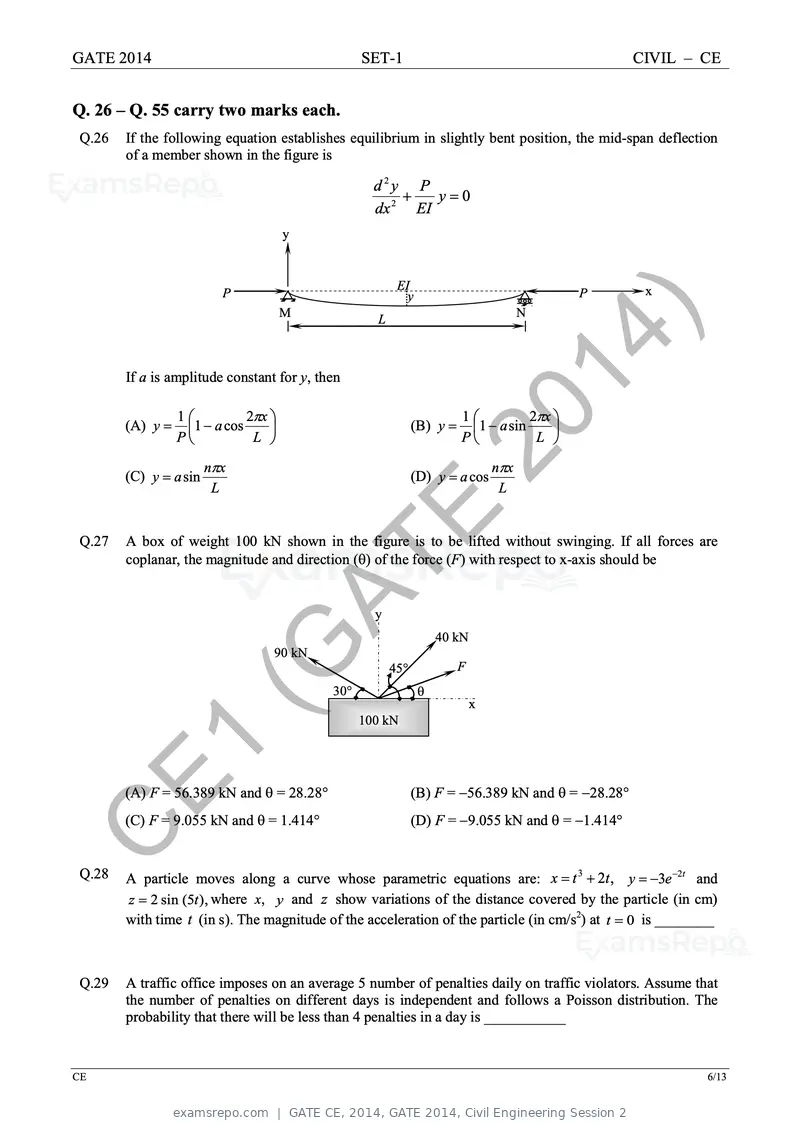
Text of page 13
GATE 2014 SET-1 CIVIL – CE
Q. 26 – Q. 55 carry two marks each.
Q.26 If the following equation establishes equilibrium in slightly bent position, the mid-span deflection
of a member shown in the figure is
d2y P
+ y=0
dx 2 EI
y
EI x
P y P
M L N
)
If a is amplitude constant for y, then
1 2πx 1
14 2πx
(A) y = 1 − a cos
P
(C) y = a sin
nπx
L
L
20
(B) y = 1 − a sin
P
(D) y = a cos
nπx
L
L
Q.27
AT
A box of weight 100 kN shown in the figure is to be lifted without swinging. If all forces are
coplanar, the magnitude and direction (θ) of the force (F) with respect to x-axis should be
E y
40 kN
(G 90 kN
30°
100 kN
45°
θ
F
x
E1 (A) F = 56.389 kN and θ = 28.28°
(C) F = 9.055 kN and θ = 1.414°
(B) F = −56.389 kN and θ = −28.28°
(D) F = −9.055 kN and θ = −1.414°
CQ.28 A particle moves along a curve whose parametric equations are: x = t 3 + 2t , y = −3e −2t and
z = 2 sin (5t ), where x, y and z show variations of the distance covered by the particle (in cm)
with time t (in s). The magnitude of the acceleration of the particle (in cm/s2) at t = 0 is ________
Q.29 A traffic office imposes on an average 5 number of penalties daily on traffic violators. Assume that
the number of penalties on different days is independent and follows a Poisson distribution. The
probability that there will be less than 4 penalties in a day is ___________
CE 6/13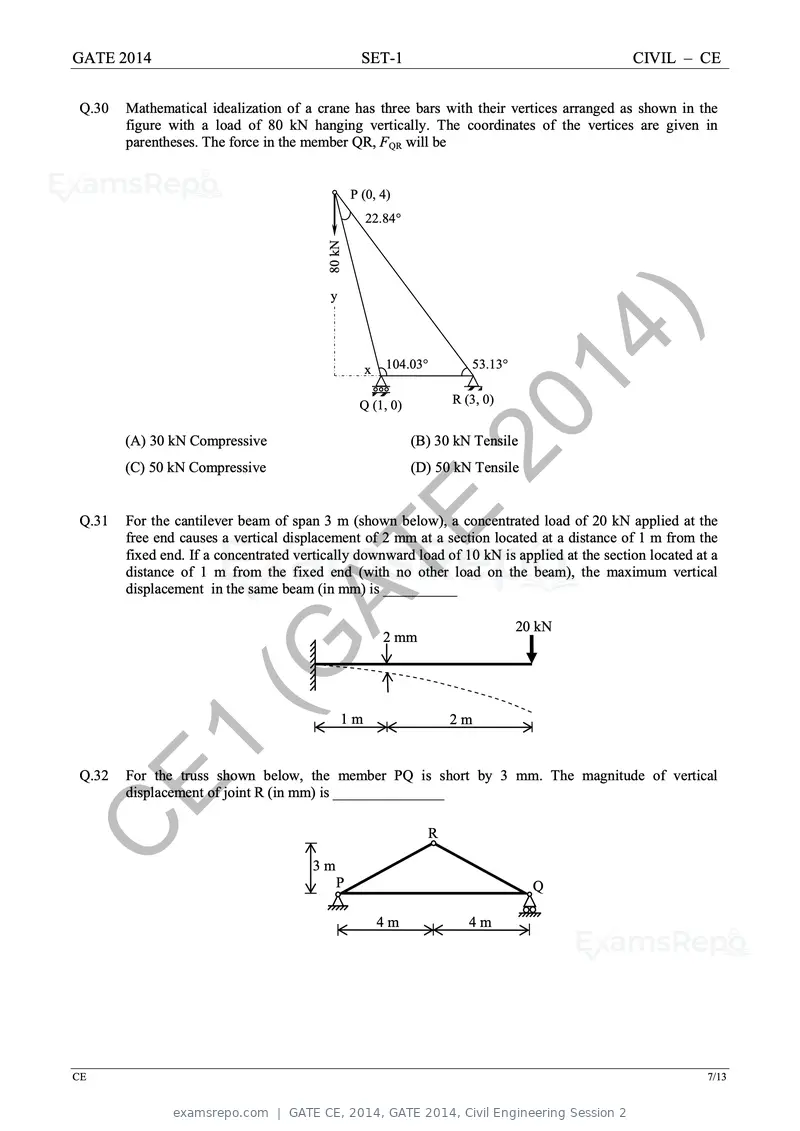
Text of page 14
GATE 2014                                           SET-1                                     CIVIL – CE


 Q.30   Mathematical idealization of a crane has three bars with their vertices arranged as shown in the
        figure with a load of 80 kN hanging vertically. The coordinates of the vertices are given in
        parentheses. The force in the member QR, FQR will be


                                                  P (0, 4)
                                                    22.84°


                                          80 kN

                                          y
                                                                                        )
                                                    x    104.03°


                                                   Q (1, 0)
                                                                       53.13°

                                                                    R (3, 0)
                                                                               14
        (A) 30 kN Compressive
        (C) 50 kN Compressive
                                                                   20
                                                              (B) 30 kN Tensile
                                                              (D) 50 kN Tensile


 Q.31

                                 AT
        For the cantilever beam of span 3 m (shown below), a concentrated load of 20 kN applied at the
        free end causes a vertical displacement of 2 mm at a section located at a distance of 1 m from the
        fixed end. If a concentrated vertically downward load of 10 kN is applied at the section located at a


                                    E
        distance of 1 m from the fixed end (with no other load on the beam), the maximum vertical
        displacement in the same beam (in mm) is __________


                                                        2 mm
                                                                                20 kN


                    (G                        1m                    2m


 Q.32E1 For the truss shown below, the member PQ is short by 3 mm. The magnitude of vertical
        displacement of joint R (in mm) is _______________


C                                      3m
                                            P
                                                                R


                                                                                  Q

                                                        4m             4m


CE                                                                                                         7/13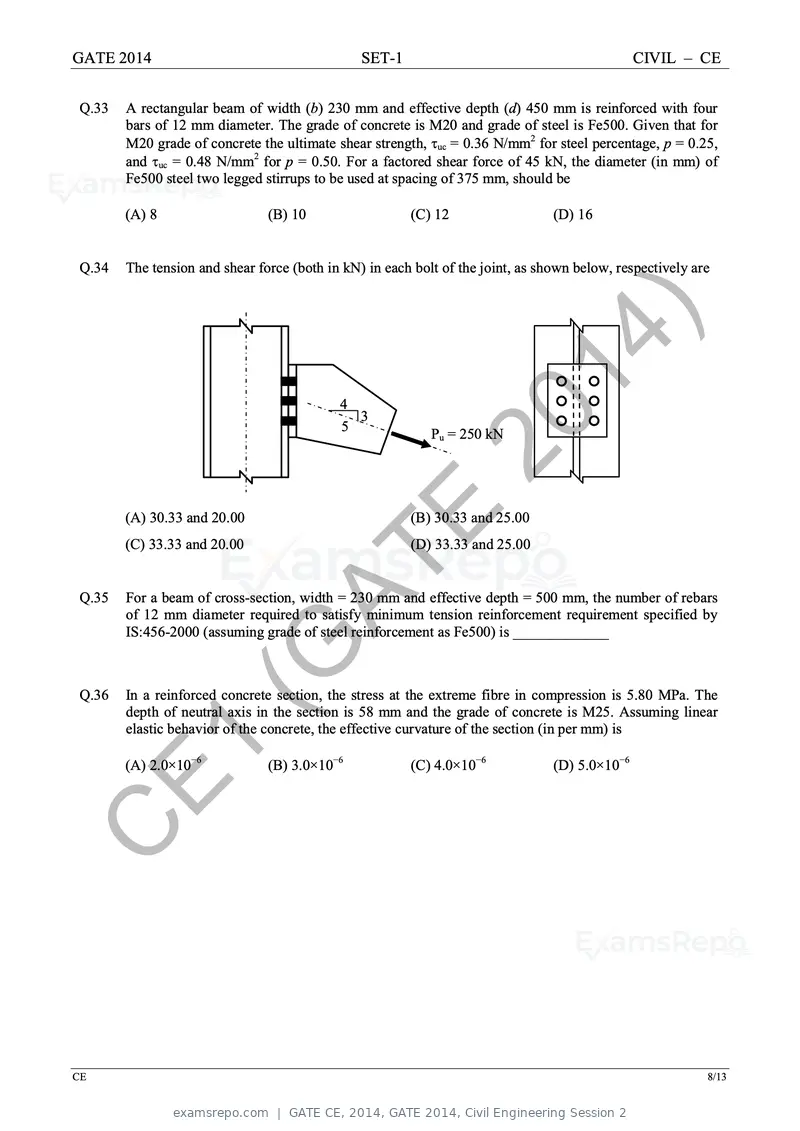
Text of page 15
GATE 2014                                       SET-1                                           CIVIL – CE


 Q.33   A rectangular beam of width (b) 230 mm and effective depth (d) 450 mm is reinforced with four
        bars of 12 mm diameter. The grade of concrete is M20 and grade of steel is Fe500. Given that for
        M20 grade of concrete the ultimate shear strength, τuc = 0.36 N/mm2 for steel percentage, p = 0.25,
        and τuc = 0.48 N/mm2 for p = 0.50. For a factored shear force of 45 kN, the diameter (in mm) of
        Fe500 steel two legged stirrups to be used at spacing of 375 mm, should be

        (A) 8                   (B) 10                  (C) 12                   (D) 16


 Q.34   The tension and shear force (both in kN) in each bolt of the joint, as shown below, respectively are


                                                                                      )
                                            4
                                                                          14
                                            5
                                                3

                                                           20
                                                            Pu = 250 kN


        (A) 30.33 and 20.00
        (C) 33.33 and 20.00
                                 AT                     (B) 30.33 and 25.00
                                                        (D) 33.33 and 25.00


 Q.35
                                    E
        For a beam of cross-section, width = 230 mm and effective depth = 500 mm, the number of rebars
        of 12 mm diameter required to satisfy minimum tension reinforcement requirement specified by
        IS:456-2000 (assuming grade of steel reinforcement as Fe500) is _____________


 Q.36
                    (G
        In a reinforced concrete section, the stress at the extreme fibre in compression is 5.80 MPa. The
        depth of neutral axis in the section is 58 mm and the grade of concrete is M25. Assuming linear
        elastic behavior of the concrete, the effective curvature of the section (in per mm) is


     E1 (A) 2.0×10⁻⁶            (B) 3.0×10⁻⁶            (C) 4.0×10⁻⁶             (D) 5.0×10⁻⁶


C

CE                                                                                                         8/13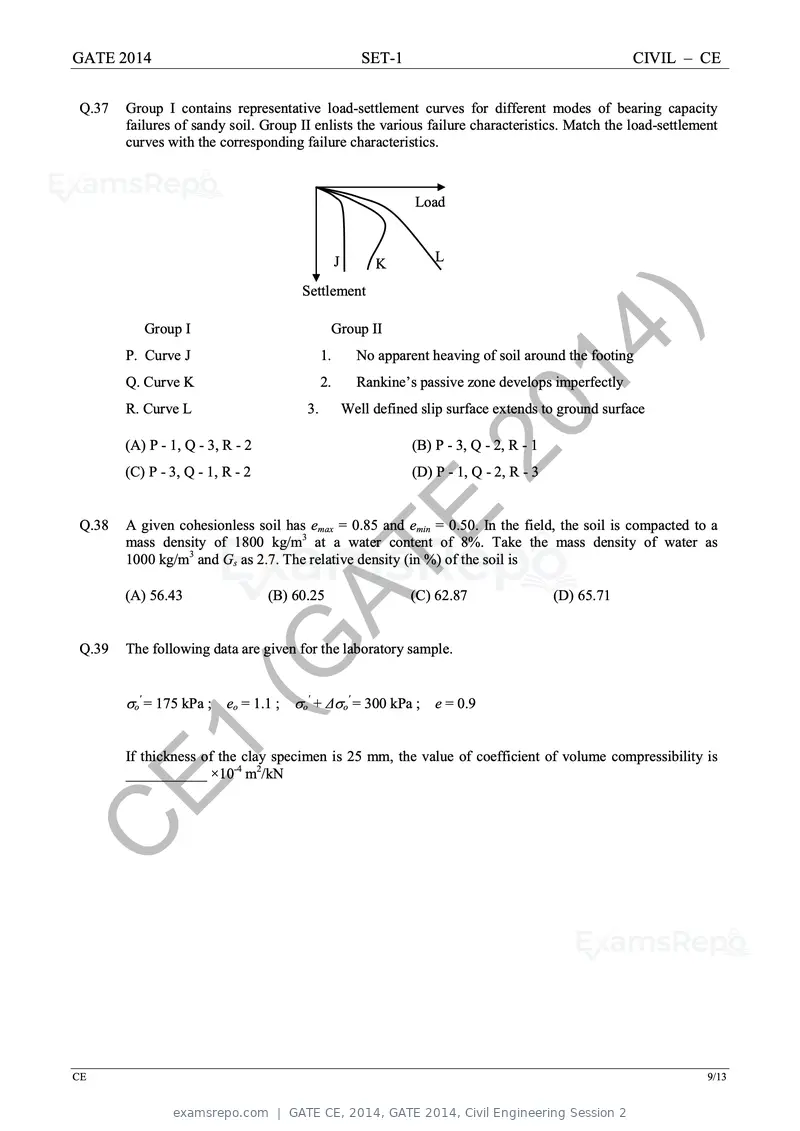
Text of page 16
GATE 2014                                                SET-1                                         CIVIL – CE


 Q.37   Group I contains representative load-settlement curves for different modes of bearing capacity
        failures of sandy soil. Group II enlists the various failure characteristics. Match the load-settlement
        curves with the corresponding failure characteristics.


                                                                  Load


                                                  J        K         L

                                       Settlement

           Group I                            Group II
                                                                                               )
        P. Curve J
        Q. Curve K
        R. Curve L                      3.
                                             1.
                                             2.
                                                                                  14
                                                        No apparent heaving of soil around the footing
                                                        Rankine’s passive zone develops imperfectly
                                                      Well defined slip surface extends to ground surface

        (A) P - 1, Q - 3, R - 2
        (C) P - 3, Q - 1, R - 2
                                                                    20
                                                                 (B) P - 3, Q - 2, R - 1
                                                                 (D) P - 1, Q - 2, R - 3


 Q.38

                                   AT
        A given cohesionless soil has emax = 0.85 and emin = 0.50. In the field, the soil is compacted to a
        mass density of 1800 kg/m3 at a water content of 8%. Take the mass density of water as
        1000 kg/m3 and Gs as 2.7. The relative density (in %) of the soil is

        (A) 56.43
                                      E
                                  (B) 60.25                      (C) 62.87                 (D) 65.71


 Q.39

                     (G
        The following data are given for the laboratory sample.


        σo' = 175 kPa ; eo = 1.1 ; σo' + Δσo' = 300 kPa ; e = 0.9


     E1 If thickness of the clay specimen is 25 mm, the value of coefficient of volume compressibility is
        ___________ ×10˗4 m2/kN


C

CE                                                                                                             9/13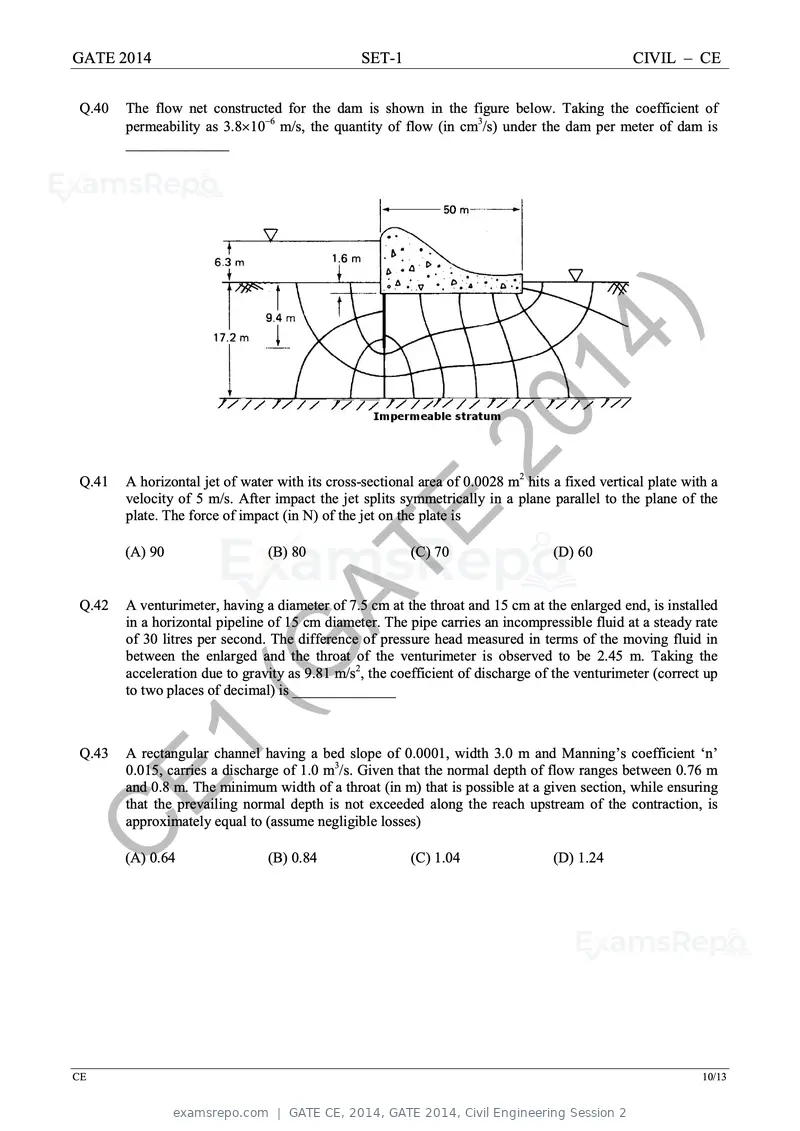
Text of page 17
GATE 2014                                       SET-1                                           CIVIL – CE


 Q.40   The flow net constructed for the dam is shown in the figure below. Taking the coefficient of
        permeability as 3.8×10⁻⁶ m/s, the quantity of flow (in cm3/s) under the dam per meter of dam is
        ______________


                                                                                       )
                                                                          14
 Q.41
                                                            20
        A horizontal jet of water with its cross-sectional area of 0.0028 m2 hits a fixed vertical plate with a
        velocity of 5 m/s. After impact the jet splits symmetrically in a plane parallel to the plane of the


                                 AT
        plate. The force of impact (in N) of the jet on the plate is

        (A) 90                  (B) 80                   (C) 70                   (D) 60


 Q.42
                                    E
        A venturimeter, having a diameter of 7.5 cm at the throat and 15 cm at the enlarged end, is installed
        in a horizontal pipeline of 15 cm diameter. The pipe carries an incompressible fluid at a steady rate
        of 30 litres per second. The difference of pressure head measured in terms of the moving fluid in


                    (G
        between the enlarged and the throat of the venturimeter is observed to be 2.45 m. Taking the
        acceleration due to gravity as 9.81 m/s2, the coefficient of discharge of the venturimeter (correct up
        to two places of decimal) is ______________


 Q.43
     E1 A rectangular channel having a bed slope of 0.0001, width 3.0 m and Manning’s coefficient ‘n’
        0.015, carries a discharge of 1.0 m3/s. Given that the normal depth of flow ranges between 0.76 m
        and 0.8 m. The minimum width of a throat (in m) that is possible at a given section, while ensuring
        that the prevailing normal depth is not exceeded along the reach upstream of the contraction, is
        approximately equal to (assume negligible losses)

C       (A) 0.64                (B) 0.84                 (C) 1.04                 (D) 1.24


CE                                                                                                          10/13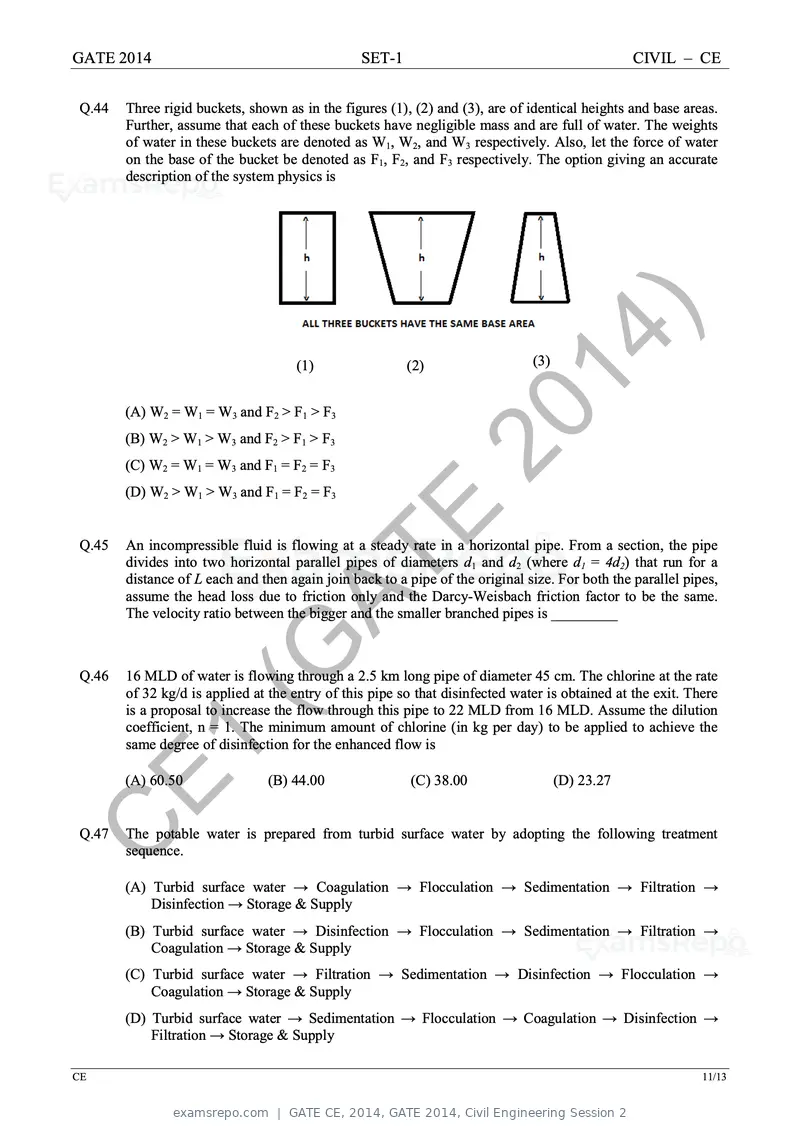
Text of page 18
GATE 2014                                        SET-1                                           CIVIL – CE


 Q.44   Three rigid buckets, shown as in the figures (1), (2) and (3), are of identical heights and base areas.
        Further, assume that each of these buckets have negligible mass and are full of water. The weights
        of water in these buckets are denoted as W1, W2, and W3 respectively. Also, let the force of water
        on the base of the bucket be denoted as F1, F2, and F3 respectively. The option giving an accurate
        description of the system physics is


                                                                                         )
                                     (1)


        (A) W2 = W1 = W3 and F2 > F1 > F3
                                                         (2)              14   (3)


        (B) W2 > W1 > W3 and F2 > F1 > F3
        (C) W2 = W1 = W3 and F1 = F2 = F3
        (D) W2 > W1 > W3 and F1 = F2 = F3
                                                               20
 Q.45
                                  AT
        An incompressible fluid is flowing at a steady rate in a horizontal pipe. From a section, the pipe
        divides into two horizontal parallel pipes of diameters d1 and d2 (where d1 = 4d2) that run for a


                                     E
        distance of L each and then again join back to a pipe of the original size. For both the parallel pipes,
        assume the head loss due to friction only and the Darcy-Weisbach friction factor to be the same.
        The velocity ratio between the bigger and the smaller branched pipes is _________


 Q.46
                    (G
        16 MLD of water is flowing through a 2.5 km long pipe of diameter 45 cm. The chlorine at the rate
        of 32 kg/d is applied at the entry of this pipe so that disinfected water is obtained at the exit. There
        is a proposal to increase the flow through this pipe to 22 MLD from 16 MLD. Assume the dilution
        coefficient, n = 1. The minimum amount of chlorine (in kg per day) to be applied to achieve the


     E1 same degree of disinfection for the enhanced flow is

        (A) 60.50               (B) 44.00                 (C) 38.00                  (D) 23.27


CQ.47   The potable water is prepared from turbid surface water by adopting the following treatment
        sequence.

        (A) Turbid surface water → Coagulation → Flocculation → Sedimentation → Filtration →
            Disinfection → Storage & Supply
        (B) Turbid surface water → Disinfection → Flocculation → Sedimentation → Filtration →
            Coagulation → Storage & Supply
        (C) Turbid surface water → Filtration → Sedimentation → Disinfection → Flocculation →
            Coagulation → Storage & Supply
        (D) Turbid surface water → Sedimentation → Flocculation → Coagulation → Disinfection →
            Filtration → Storage & Supply

CE                                                                                                           11/13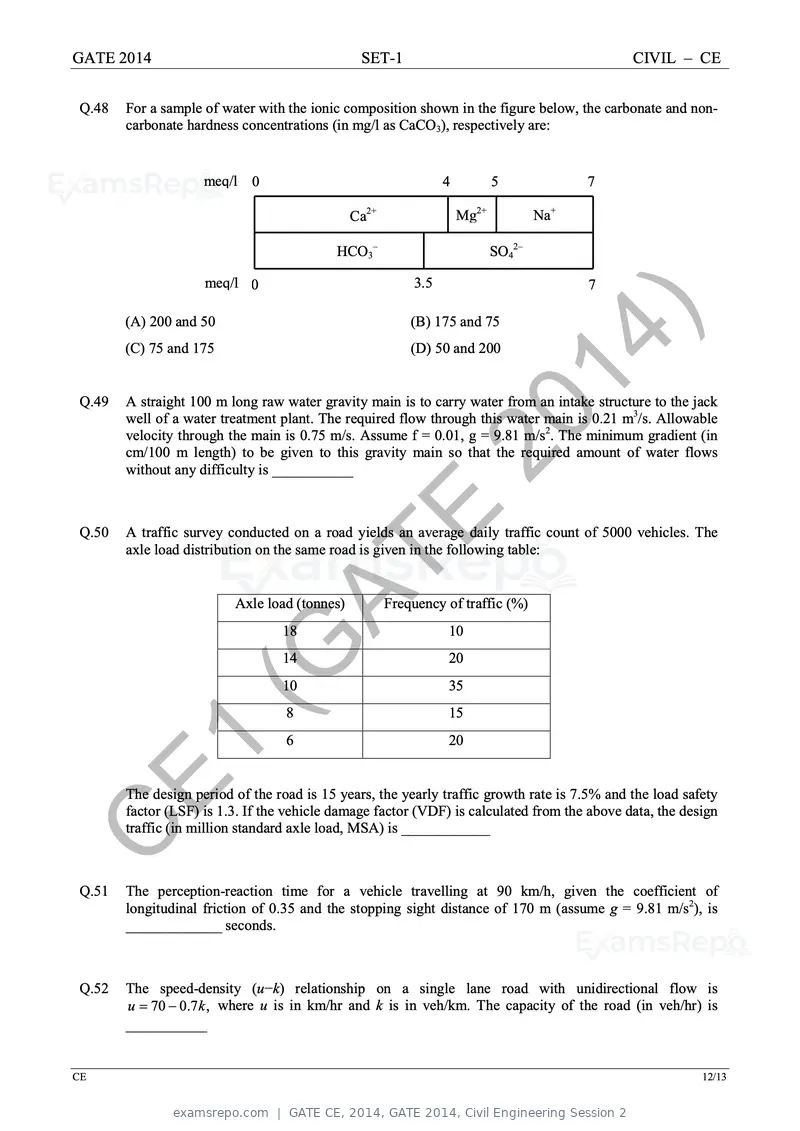
Text of page 19
GATE 2014                                       SET-1                                         CIVIL – CE


 Q.48   For a sample of water with the ionic composition shown in the figure below, the carbonate and non-
        carbonate hardness concentrations (in mg/l as CaCO3), respectively are:


                     meq/l 0                                    4          5             7

                                               Ca2+                 Mg2+           Na+

                                            HCO3–                          SO42–

                     meq/l 0                              3.5                            7

        (A) 200 and 50                                    (B) 175 and 75                 )
 Q.49
        (C) 75 and 175                                    (D) 50 and 200
                                                                               14
        A straight 100 m long raw water gravity main is to carry water from an intake structure to the jack


                                                             20
        well of a water treatment plant. The required flow through this water main is 0.21 m3/s. Allowable
        velocity through the main is 0.75 m/s. Assume f = 0.01, g = 9.81 m/s2. The minimum gradient (in
        cm/100 m length) to be given to this gravity main so that the required amount of water flows
        without any difficulty is ___________


 Q.50
                                 AT
        A traffic survey conducted on a road yields an average daily traffic count of 5000 vehicles. The
        axle load distribution on the same road is given in the following table:


                                    E
                          Axle load (tonnes)
                                  18
                                                      Frequency of traffic (%)
                                                                10


                    (G            14
                                  10
                                   8
                                                                20
                                                                35
                                                                15
                                   6                            20

     E1 The design period of the road is 15 years, the yearly traffic growth rate is 7.5% and the load safety
        factor (LSF) is 1.3. If the vehicle damage factor (VDF) is calculated from the above data, the design

CQ.51
        traffic (in million standard axle load, MSA) is ____________


        The perception-reaction time for a vehicle travelling at 90 km/h, given the coefficient of
        longitudinal friction of 0.35 and the stopping sight distance of 170 m (assume g = 9.81 m/s2), is
        _____________ seconds.


 Q.52   The speed-density (u−k) relationship on a single lane road with unidirectional flow is
        u = 70 − 0.7 k , where u is in km/hr and k is in veh/km. The capacity of the road (in veh/hr) is
        ___________


CE                                                                                                        12/13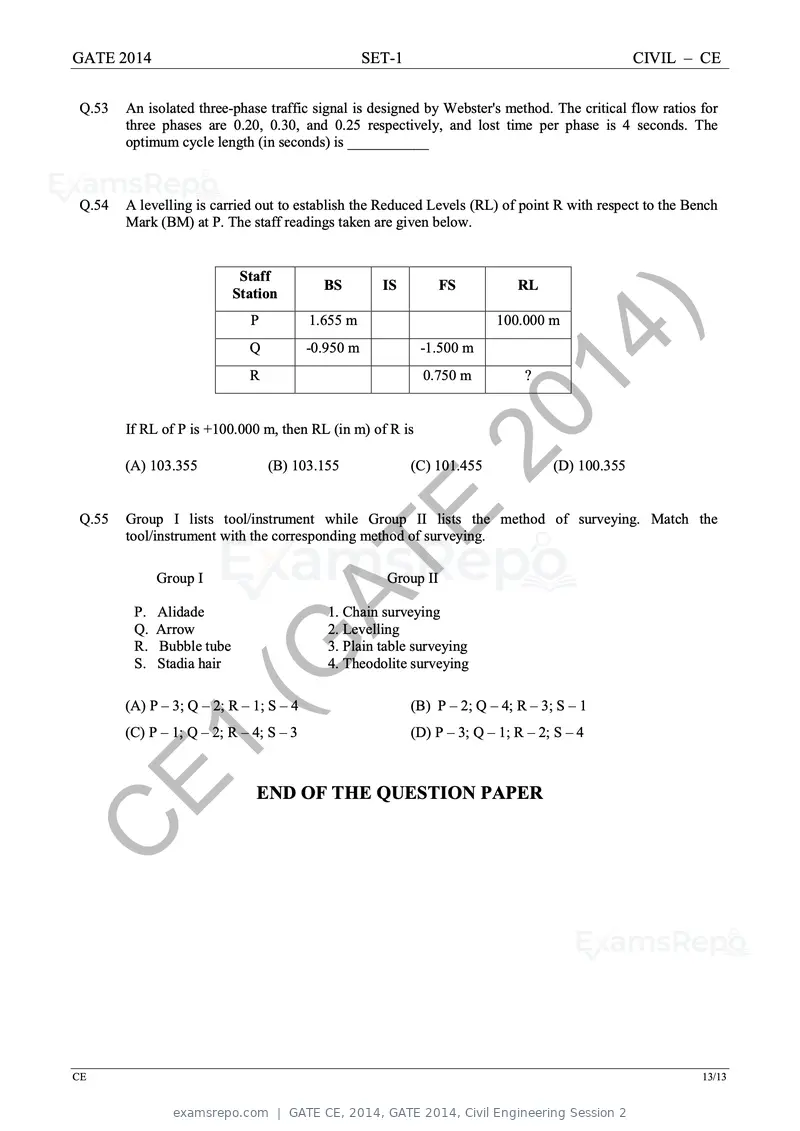
Text of page 20
GATE 2014                                           SET-1                                         CIVIL – CE


 Q.53   An isolated three-phase traffic signal is designed by Webster's method. The critical flow ratios for
        three phases are 0.20, 0.30, and 0.25 respectively, and lost time per phase is 4 seconds. The
        optimum cycle length (in seconds) is ___________


 Q.54   A levelling is carried out to establish the Reduced Levels (RL) of point R with respect to the Bench
        Mark (BM) at P. The staff readings taken are given below.


                           Staff
                                           BS         IS          FS          RL
                          Station
                             P           1.655 m                          100.000 m      )
                             Q
                             R
                                         -0.950 m            -1.500 m
                                                              0.750 m       14 ?


        If RL of P is +100.000 m, then RL (in m) of R is

        (A) 103.355              (B) 103.155
                                                               20
                                                            (C) 101.455             (D) 100.355


 Q.55

                                 AT
        Group I lists tool/instrument while Group II lists the method of surveying. Match the
        tool/instrument with the corresponding method of surveying.

             Group I

         P. Alidade
         Q. Arrow
                                    E                  Group II

                                            1. Chain surveying
                                            2. Levelling


                    (G
         R. Bubble tube
         S. Stadia hair

        (A) P – 3; Q – 2; R – 1; S – 4
        (C) P – 1; Q – 2; R – 4; S – 3
                                            3. Plain table surveying
                                            4. Theodolite surveying

                                                            (B) P – 2; Q – 4; R – 3; S – 1
                                                            (D) P – 3; Q – 1; R – 2; S – 4


     E1                       END OF THE QUESTION PAPER


C

CE                                                                                                       13/13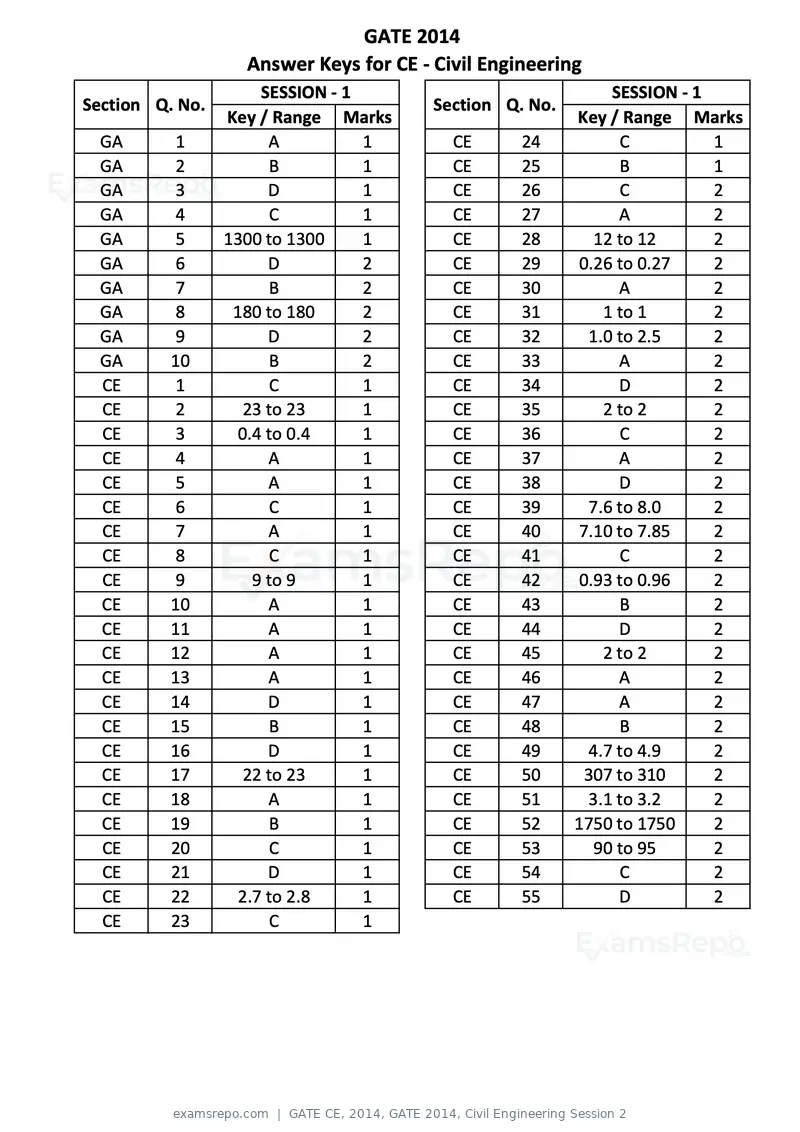
Text of page 21
GATE 2014
                   Answer Keys for CE ‐ Civil Engineering
                     SESSION ‐ 1                             SESSION ‐ 1
Section Q. No.                          Section Q. No.
                 Key / Range Marks                       Key / Range Marks
 GA       1           A          1        CE      24          C          1
 GA       2           B          1        CE      25          B          1
 GA       3           D          1        CE      26          C          2
 GA       4           C          1        CE      27          A          2
 GA       5      1300 to 1300    1        CE      28       12 to 12      2
 GA       6           D          2        CE      29     0.26 to 0.27    2
 GA       7           B          2        CE      30          A          2
 GA       8       180 to 180     2        CE      31        1 to 1       2
 GA       9           D          2        CE      32      1.0 to 2.5     2
 GA       10          B          2        CE      33          A          2
 CE       1           C          1        CE      34          D          2
 CE       2        23 to 23      1        CE      35        2 to 2       2
 CE       3       0.4 to 0.4     1        CE      36          C          2
 CE       4           A          1        CE      37          A          2
 CE       5           A          1        CE      38          D          2
 CE       6           C          1        CE      39      7.6 to 8.0     2
 CE       7           A          1        CE      40     7.10 to 7.85    2
 CE       8           C          1        CE      41          C          2
 CE       9         9 to 9       1        CE      42     0.93 to 0.96    2
 CE       10          A          1        CE      43          B          2
 CE       11          A          1        CE      44          D          2
 CE       12          A          1        CE      45        2 to 2       2
 CE       13          A          1        CE      46          A          2
 CE       14          D          1        CE      47          A          2
 CE       15          B          1        CE      48          B          2
 CE       16          D          1        CE      49      4.7 to 4.9     2
 CE       17       22 to 23      1        CE      50      307 to 310     2
 CE       18          A          1        CE      51      3.1 to 3.2     2
 CE       19          B          1        CE      52     1750 to 1750    2
 CE       20          C          1        CE      53       90 to 95      2
 CE       21          D          1        CE      54          C          2
 CE       22      2.7 to 2.8     1        CE      55          D          2
 CE       23          C          1
Text of page 22
SESSION - 2
Text of page 23
GATE 2014: General Instructions during Examination

   1. Total duration of the GATE examination is 180 minutes.
   2. The clock will be set at the server. The countdown timer at the top right corner of
      screen will display the remaining time available for you to complete the examination.
      When the timer reaches zero, the examination will end by itself. You need not
      terminate the examination or submit your paper.
   3. Any useful data required for your paper can be viewed by clicking on the Useful
      Common Data button that appears on the screen.
   4. Use the scribble pad provided to you for any rough work. Submit the scribble pad at
      the end of the examination.
   5. You are allowed to use a non-programmable type calculator, however, sharing of
      calculators is not allowed.
   6. The Question Palette displayed on the right side of screen will show the status of
      each question using one of the following symbols:


The Marked for Review status for a question simply indicates that you would like to look at
that question again. If a question is answered, but marked for review, then the answer will
be considered for evaluation unless the status is modified by the candidate.

Navigating to a Question :

   7. To answer a question, do the following:
         a. Click on the question number in the Question Palette to go to that question
            directly.
         b. Select an answer for a multiple choice type question by clicking on the bubble
            placed before the 4 choices, namely A, B, C and D. Use the virtual numeric
            keypad to enter a number as answer for a numerical type question.
         c. Click on Save & Next to save your answer for the current question and then go
            to the next question.
         d. Click on Mark for Review & Next to save your answer for the current question
            and also mark it for review, and then go to the next question.
Text of page 24
Caution: Note that your answer for the current question will not be saved, if you navigate
to another question directly by clicking on a question number without saving the answer to
the previous question.

You can view all the questions by clicking on the Question Paper button. This feature is
provided, so that if you want you can just see the entire question paper at a glance.

Answering a Question :

   8. Procedure for answering a multiple choice (MCQ) type question:
         a. Choose one answer from the 4 options (A,B,C,D) given below the question,
            click on the bubble placed before the chosen option.
         b. To deselect your chosen answer, click on the bubble of the chosen option again
            or click on the Clear Response button.
         c. To change your chosen answer, click on the bubble of another option.
         d. To save your answer, you MUST click on the Save & Next button.

   9. Procedure for answering a numerical answer type question:
         a. To enter a number as your answer, use the virtual numerical keypad.
         b. A fraction (e.g. -0.3 or -.3) can be entered as an answer with or without '0'
             before the decimal point. As many as four decimal points, e.g. 12.5435 or
             0.003 or -932.6711 or 12.82 can be entered.
         c. To clear your answer, click on the Clear Response button.
         d. To save your answer, you MUST click on the Save & Next button
   10. To mark a question for review, click on the Mark for Review & Next button. If an
      answer is selected (for MCQ) or entered (for numerical answer type) for a question
      that is Marked for Review, that answer will be considered in the evaluation unless
      the status is modified by the candidate.

   11. To change your answer to a question that has already been answered, first select
      that question for answering and then follow the procedure for answering that type of
      question.
   12. Note that ONLY Questions for which answers are saved or marked for review after
      answering will be considered for evaluation.


      Choosing a Section :

   13. Sections in this question paper are displayed on the top bar of the screen. Questions
      in a Section can be viewed by clicking on the name of that Section. The Section you
      are currently viewing will be highlighted.
   14. A checkbox is displayed for every optional Section, if any, in the Question Paper. To
      select the optional Section for answering, click on the checkbox for that Section.
   15. If the checkbox for an optional Section is not selected, the Save & Next button and
      the Mark for Review & Next button will NOT be enabled for that Section. You will
Text of page 25
only be able to see questions in this Section, but you will not be able to answer
      questions in the Section.
   16. After clicking the Save & Next button for the last question in a Section, you will
      automatically be taken to the first question of the next Section in sequence.
   17. You can move the mouse cursor over the name of a Section to view the answering
      status for that Section.


Changing the Optional Section :

   18. After answering the chosen optional Section, partially or completely, you can change
      the optional Section by selecting the checkbox for a new Section that you want to
      attempt. A warning message will appear along with a table showing the number of
      questions answered in each of the previously chosen optional Sections and a
      checkbox against each of these Sections. Click on a checkbox against a Section that
      you want to reset and then click on the RESET button. Note that RESETTING a Section
      will DELETE all the answers for questions in that Section. Hence, if you think that you
      may want to select this Section again later, you will have to note down your answers
      for questions in that Section. If you do not want to reset the Section and want to
      continue answering the previously chosen optional Section, then click on the BACK
      button.

   19. If you deselect the checkbox for an optional Section in the top bar, the following
      warning message will appear: "Deselecting the checkbox will DELETE all the answers
      for questions in this Section. Do you want to deselect this Section?” If you want to
      deselect, click on the RESET button. If you do not want to deselect, click on the BACK
      button.

   20. You can shuffle between different Sections or change the optional Sections any
      number of times.
Text of page 26
GATE 2014 Examination
                                          CE: Civil Engineering
Duration: 180 minutes                                                                        Maximum Marks: 100

Read the following instructions carefully.

    1. To login, enter your Registration Number and password provided to you. Kindly go through the various
       symbols used in the test and understand their meaning before you start the examination.
    2. Once you login and after the start of the examination, you can view all the questions in the question
       paper, by clicking on the View All Questions button in the screen.
    3. This question paper consists of 2 sections, General Aptitude (GA) for 15 marks and the subject
       specific GATE paper for 85 marks. Both these sections are compulsory.
       The GA section consists of 10 questions. Question numbers 1 to 5 are of 1-mark each, while question
       numbers 6 to 10 are of 2-mark each.
       The subject specific GATE paper section consists of 55 questions, out of which question numbers 1 to
       25 are of 1-mark each, while question numbers 26 to 55 are of 2-mark each.
    4. Depending upon the GATE paper, there may be useful common data that may be required for
       answering the questions. If the paper has such useful data, the same can be viewed by clicking on the
       Useful Common Data button that appears at the top, right hand side of the screen.
    5. The computer allotted to you at the examination center runs specialized software that permits only one
        answer to be selected for multiple-choice questions using a mouse and to enter a suitable number for
        the numerical answer type questions using the virtual keyboard and mouse.
    6. Your answers shall be updated and saved on a server periodically and also at the end of the
        examination. The examination will stop automatically at the end of 180 minutes.
    7. In each paper a candidate can answer a total of 65 questions carrying 100 marks.
    8. The question paper may consist of questions of multiple choice type (MCQ) and numerical answer
        type.
    9. Multiple choice type questions will have four choices against A, B, C, D, out of which only ONE is the
        correct answer. The candidate has to choose the correct answer by clicking on the bubble (⃝) placed
        before the choice.
    10. For numerical answer type questions, each question will have a numerical answer and there will not be
        any choices. For these questions, the answer should be enteredby using the virtual keyboard that
        appears on the monitor and the mouse.
    11. All questions that are not attempted will result in zero marks. However, wrong answers for multiple
        choice type questions (MCQ) will result in NEGATIVE marks. For all MCQ questions a wrong
        answer will result in deduction of⅓ marks for a 1-mark question and ⅔ marks for a 2-mark question.
    12. There is NO NEGATIVE MARKING for questions of NUMERICAL ANSWER TYPE.
    13. Non-programmable type Calculator is allowed. Charts, graph sheets, and mathematical tables are NOT
        allowed in the Examination Hall. You must use the Scribble pad provided to you at the examination
        centre for all your rough work. The Scribble Pad has to be returned at the end of the examination.

    Declaration by the candidate:

    “I have read and understood all the above instructions. I have also read and understood clearly the
    instructions given on the admit card and shall follow the same. I also understand that in case I am found to
    violate any of these instructions, my candidature is liable to be cancelled. I also confirm that at the start of
    the examination all the computer hardware allotted to me are in proper working condition”.
Text of page 27
GATE 2014             SET- 2                                                        General Aptitude -GA

Q. 1 – Q. 5 carry one mark each.
Q.1    Choose the most appropriate word from the options given below to complete the following
       sentence.

       A person suffering from Alzheimer’s disease                 short-term memory loss.
      (A) experienced                                  (B) has experienced
      (C) is experiencing                              (D) experiences

Q.2    Choose the most appropriate word from the options given below to complete the following
       sentence.

       ____________ is the key to their happiness; they are satisfied with what they have.


Q.3
      (A) Contentment          (B) Ambition
                                                             20
                                                       (C) Perseverance


                                                                14
                                                                                 (D) Hunger

       Which of the following options is the closest in meaning to the sentence below?

       “As a woman, I have no country.”
      (A) Women have no country.
      (B) Women are not citizens of any country.
      (C) Women’s solidarity knows no national boundaries.
      (D) Women of all countries have equal legal rights.
                                                                  )
Q.4                                                E
       In any given year, the probability of an earthquake greater than Magnitude 6 occurring in the
       Garhwal Himalayas is 0.04. The average time between successive occurrences of such earthquakes
       is ____ years.

                        (G
Q.5

                          AT
       The population of a new city is 5 million and is growing at 20% annually. How many years would
       it take to double at this growth rate?
      (A) 3-4 years            (B) 4-5 years           (C) 5-6 years             (D) 6-7 years


            02
Q. 6 – Q. 10 carry two marks each.


Q.6    In a group of four children, Som is younger to Riaz. Shiv is elder to Ansu. Ansu is youngest in the
       group. Which of the following statements is/are required to find the eldest child in the group?
     A Statements
               1. Shiv is younger to Riaz.

G              2. Shiv is elder to Som.
      (A) Statement 1by itself determines the eldest child.
      (B) Statement 2 by itself determines the eldest child.
      (C) Statements 1 and 2 are both required to determine the eldest child.
      (D) Statements 1 and 2 are not sufficient to determine the eldest child.


GA                                                                                                           1/2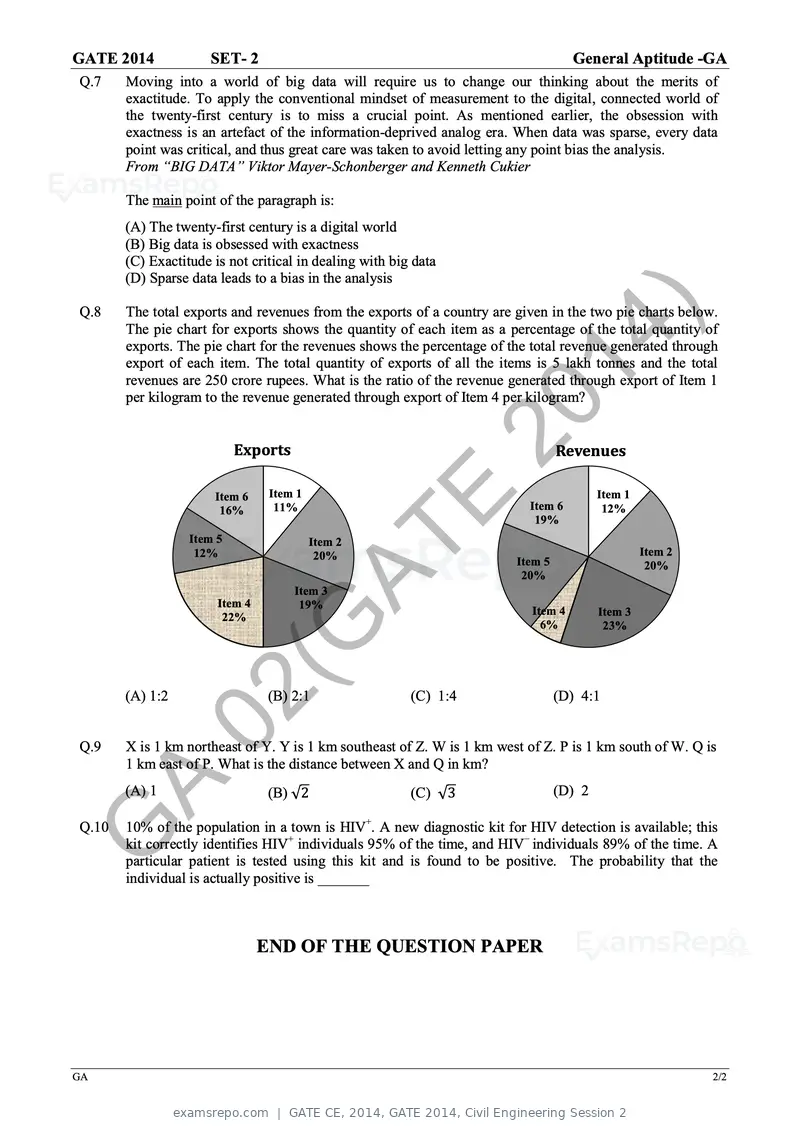
Text of page 28
GATE 2014             SET- 2                                                        General Aptitude -GA
Q.7    Moving into a world of big data will require us to change our thinking about the merits of
       exactitude. To apply the conventional mindset of measurement to the digital, connected world of
       the twenty-first century is to miss a crucial point. As mentioned earlier, the obsession with
       exactness is an artefact of the information-deprived analog era. When data was sparse, every data
       point was critical, and thus great care was taken to avoid letting any point bias the analysis.
       From “BIG DATA” Viktor Mayer-Schonberger and Kenneth Cukier

       The main point of the paragraph is:
       (A) The twenty-first century is a digital world
       (B) Big data is obsessed with exactness
       (C) Exactitude is not critical in dealing with big data
       (D) Sparse data leads to a bias in the analysis

Q.8


                                                                 20
       The total exports and revenues from the exports of a country are given in the two pie charts below.
       The pie chart for exports shows the quantity of each item as a percentage of the total quantity of
       exports. The pie chart for the revenues shows the percentage of the total revenue generated through


                                                                    14
       export of each item. The total quantity of exports of all the items is 5 lakh tonnes and the total
       revenues are 250 crore rupees. What is the ratio of the revenue generated through export of Item 1
       per kilogram to the revenue generated through export of Item 4 per kilogram?


                           Exports                                    )          Revenues

                      Item 6
                       16%
                                 Item 1
                                  11%
                                                     E                    Item 6
                                                                           19%
                                                                                         Item 1
                                                                                          12%


                           (G
                  Item 5                  Item 2
                   12%                     20%                                                    Item 2
                                                                        Item 5                     20%
                                                                         20%

                       Item 4
                        22%
                             AT      Item 3
                                      19%
                                                                           Item 4
                                                                             6%
                                                                                         Item 3
                                                                                          23%


Q.9
       (A) 1:2
               02               (B) 2:1                  (C) 1:4                 (D) 4:1


       X is 1 km northeast of Y. Y is 1 km southeast of Z. W is 1 km west of Z. P is 1 km south of W. Q is
       1 km east of P. What is the distance between X and Q in km?

     A (A) 1                    (B) √2                   (C) √3                  (D) 2

       10% of the population in a town is HIV+. A new diagnostic kit for HIV detection is available; this
G
Q.10
       kit correctly identifies HIV+ individuals 95% of the time, and HIV− individuals 89% of the time. A
       particular patient is tested using this kit and is found to be positive. The probability that the
       individual is actually positive is _______


                                END OF THE QUESTION PAPER


GA                                                                                                         2/2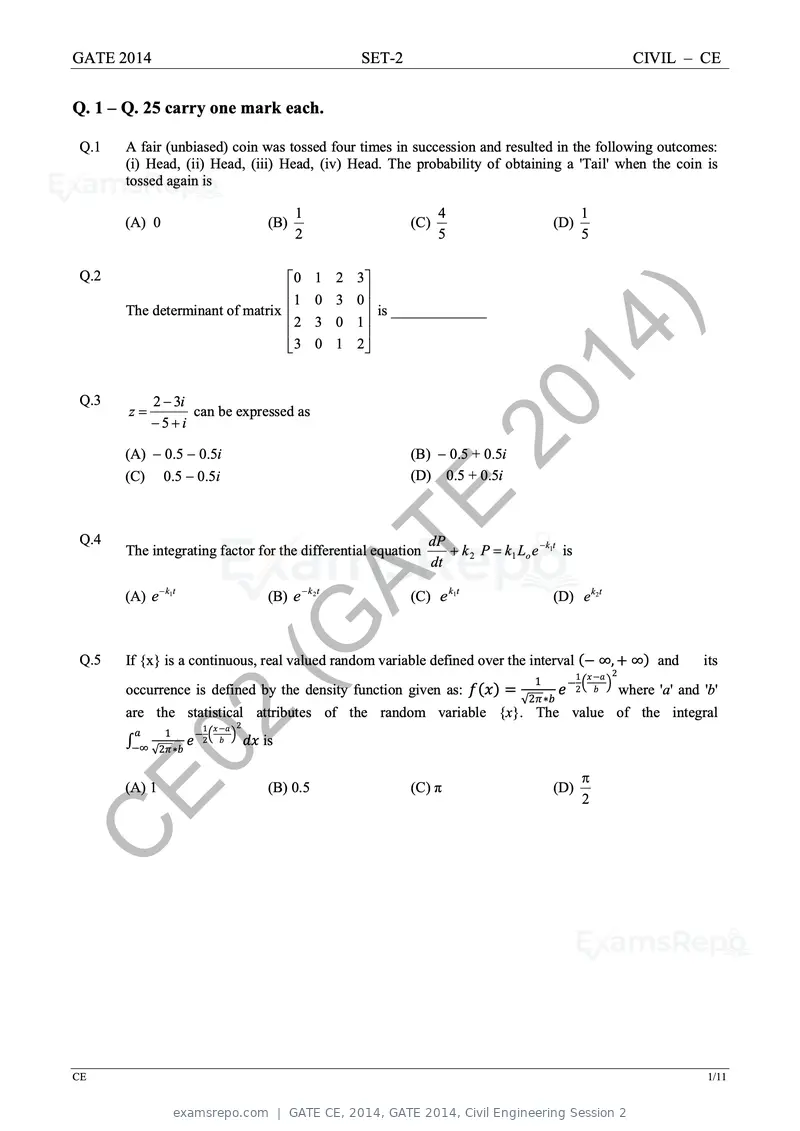
Text of page 29
GATE 2014 SET-2 CIVIL – CE
Q. 1 – Q. 25 carry one mark each.
Q.1 A fair (unbiased) coin was tossed four times in succession and resulted in the following outcomes:
(i) Head, (ii) Head, (iii) Head, (iv) Head. The probability of obtaining a 'Tail' when the coin is
tossed again is
1 4 1
(A) 0 (B) (C) (D)
2 5 5
Q.2 0 1 2 3
1 0 3 0
The determinant of matrix
2
3
3 0 1
0 1 2
is _____________
4)
Q.3
z=
2 − 3i
−5+i
can be expressed as
(A) − 0.5 − 0.5i
20 1
(B) − 0.5 + 0.5i
(C) 0.5 − 0.5i (D) 0.5 + 0.5i
E
Q.4
AT
The integrating factor for the differential equation
(A) e − k1t (B) e − k 2t
dP
dt
+ k 2 P = k1 Lo e − k1t is
(C) e k1t (D) e k2t
Q.5 (G
If {x} is a continuous, real valued random variable defined over the interval (− ∞, + ∞) and
occurrence is defined by the density function given as: ff(xx) =
1
√2ππ∗bb
ee
1 xx −aa 2
− �
2 bb
�
its
where 'a' and 'b'
are the statistical attributes of the random variable {x}. The value of the integral
aa 1 2 1 xx−aa 2
− �
∫−∞ √2ππ∗bb ee 2 bb
�
dddd is
E0(A) 1 (B) 0.5 (C) π (D)
π
2
C
CE 1/11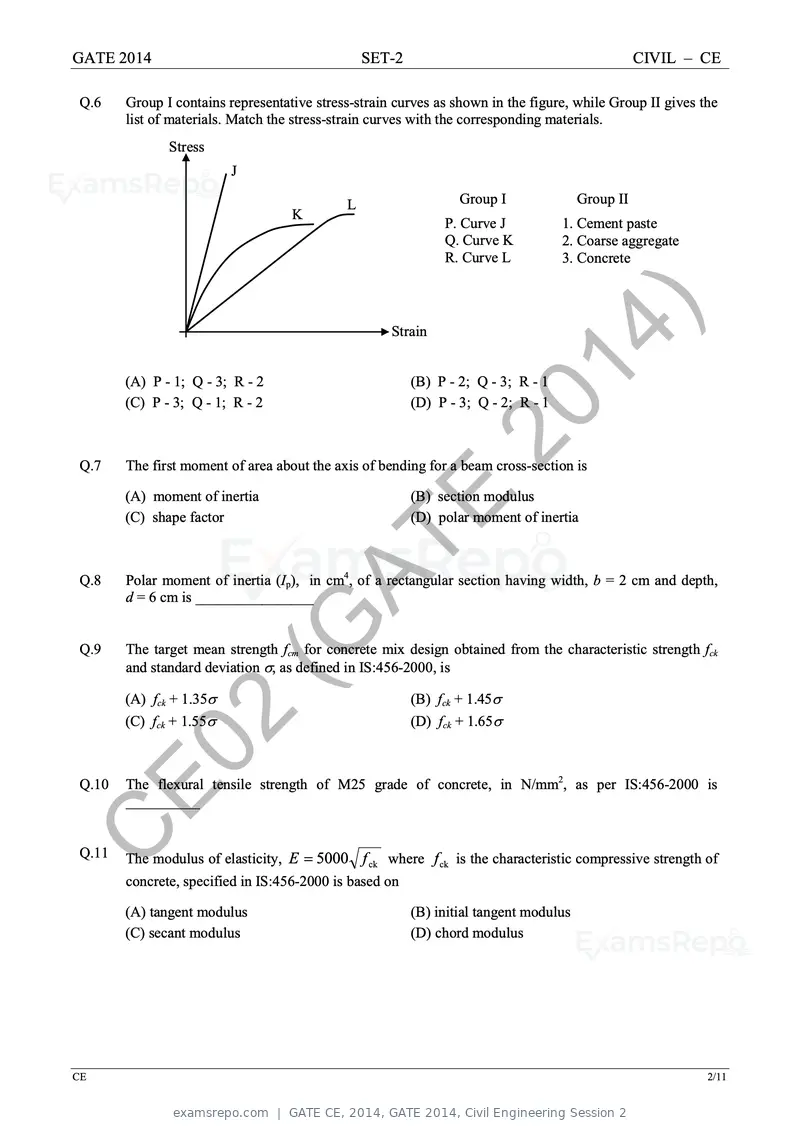
Text of page 30
GATE 2014                                        SET-2                                            CIVIL – CE

 Q.6    Group I contains representative stress-strain curves as shown in the figure, while Group II gives the
        list of materials. Match the stress-strain curves with the corresponding materials.
               Stress
                          J

                                             L                   Group I               Group II
                                    K
                                                              P. Curve J           1. Cement paste
                                                              Q. Curve K           2. Coarse aggregate
                                                              R. Curve L           3. Concrete


                                                     Strain                        4)
        (A) P - 1; Q - 3; R - 2
        (C) P - 3; Q - 1; R - 2                               20
                                                         (B) P - 2; Q - 3; R - 1
                                                         (D) P - 3; Q - 2; R - 1


                                                                 1
 Q.7    The first moment of area about the axis of bending for a beam cross-section is

        (A) moment of inertia
        (C) shape factor                           E     (B) section modulus
                                                         (D) polar moment of inertia


 Q.8                                 AT
        Polar moment of inertia (Ip), in cm4, of a rectangular section having width, b = 2 cm and depth,
        d = 6 cm is ________________


 Q.9
                          (G
        The target mean strength fcm for concrete mix design obtained from the characteristic strength fck
        and standard deviation σ, as defined in IS:456-2000, is

        (A) fck + 1.35σ                                  (B) fck + 1.45σ

               2
        (C) fck + 1.55σ                                  (D) fck + 1.65σ


 Q.10E0 The flexural tensile strength of M25 grade of concrete, in N/mm2, as per IS:456-2000 is
        __________


CQ.11   The modulus of elasticity, E = 5000 f ck where f ck is the characteristic compressive strength of
        concrete, specified in IS:456-2000 is based on

        (A) tangent modulus                              (B) initial tangent modulus
        (C) secant modulus                               (D) chord modulus


CE                                                                                                         2/11
Text of page 31
GATE 2014                                         SET-2                                             CIVIL – CE

 Q.12   The static indeterminacy of the two-span continuous beam with an internal hinge, shown below, is
        ______________


 Q.13   As per Indian Standard Soil Classification System (IS: 1498 - 1970), an expression for A-line is

        (A) Ip = 0.73 (wL − 20)                             (B) Ip = 0.70 (wL − 20)
        (C) Ip = 0.73 (wL − 10)                             (D) Ip = 0.70 (wL − 10)


 Q.14
                                                                                      4)
        The clay mineral primarily governing the swelling behavior of Black Cotton soil is


 Q.15
        (A) Halloysite            (B) Illite

                                                                 20
                                                            (C) Kaolinite


                                                                    1
                                                                                      (D) Montmorillonite


        The contact pressure for a rigid footing resting on clay at the centre and the edges are respectively

        (A) maximum and zero                                (B) maximum and minimum
        (C) zero and maximum                                (D) minimum and maximum
                                                      E
 Q.16
                                       AT
        A certain soil has the following properties: Gs = 2.71, n = 40% and w = 20%. The degree of
        saturation of the soil (rounded off to the nearest percent) is __________


 Q.17

                         (G
        A plane flow has velocity components u =
                                                        x
                                                       T1
                                                          , v=−
                                                                 y
                                                                T2
                                                                   and w = 0 along x, y and z directions

        respectively, where T1 (≠ 0) and T2 (≠ 0) are constants having the dimension of time. The given
        flow is incompressible if

                2
        (A) T1 = −T2
                                            T
                                  (B) T1 = − 2
                                             2
                                                            (C) T1 =
                                                                       T2
                                                                       2
                                                                                      (D) T1 = T2


 Q.18E0 Group I lists a few devices while Group II provides information about their uses. Match the devices
        with their corresponding use.


C         Group I

        P. Anemometer
                                                 Group II

                                               1. Capillary potential of soil water
        Q. Hygrometer                          2. Fluid velocity at a specific point in the flow stream
        R. Pitot Tube                          3. Water vapour content of air
        S. Tensiometer                         4. Wind speed

        (A) P - 1; Q -2; R - 3; S - 4                       (B) P - 2; Q - 1; R - 4; S- 3
        (C) P - 4; Q - 2; R - 1; S - 3                      (D) P - 4; Q - 3; R - 2; S - 1


CE                                                                                                              3/11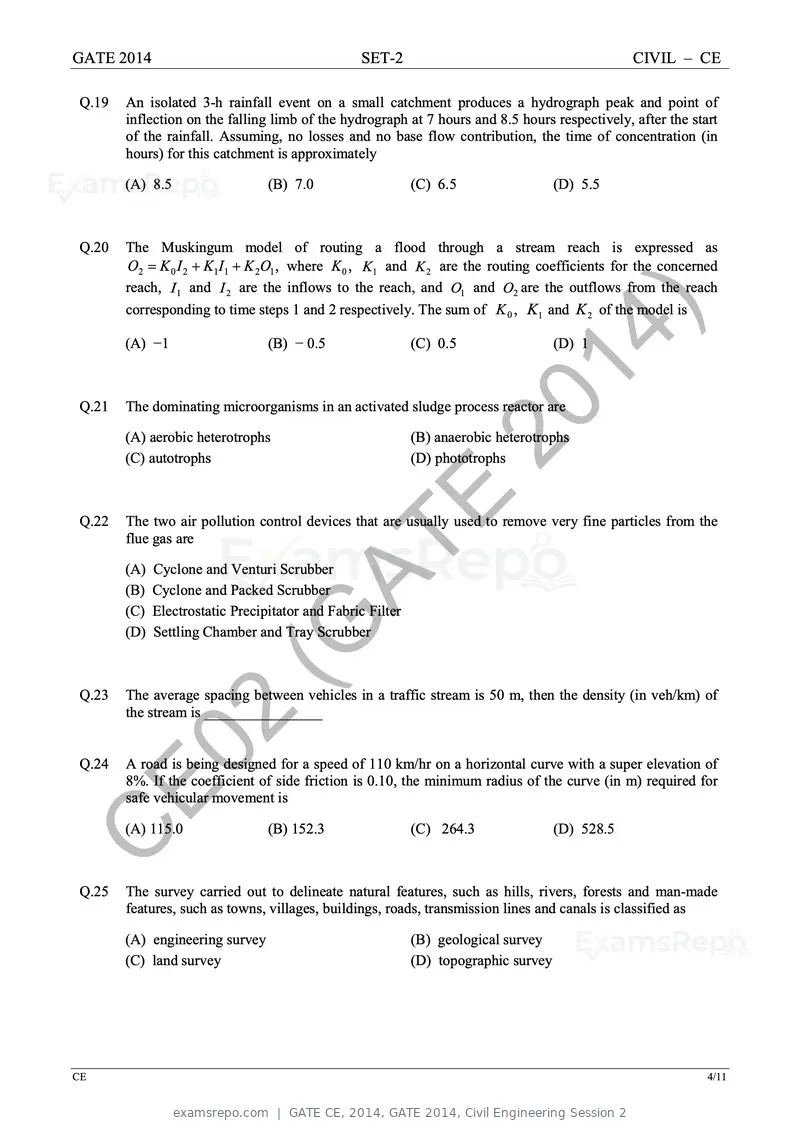
Text of page 32
GATE 2014                                        SET-2                                          CIVIL – CE

 Q.19   An isolated 3-h rainfall event on a small catchment produces a hydrograph peak and point of
        inflection on the falling limb of the hydrograph at 7 hours and 8.5 hours respectively, after the start
        of the rainfall. Assuming, no losses and no base flow contribution, the time of concentration (in
        hours) for this catchment is approximately

        (A) 8.5                  (B) 7.0                   (C) 6.5                  (D) 5.5


 Q.20   The Muskingum model of routing a flood through a stream reach is expressed as
        O2 = K 0 I 2 + K1 I1 + K 2O1 , where K 0 , K1 and K 2 are the routing coefficients for the concerned
        reach, I1 and I 2 are the inflows to the reach, and O1 and O2 are the outflows from the reach
        corresponding to time steps 1 and 2 respectively. The sum of K 0 , K1 and K 2 of the model is

        (A) −1                   (B) − 0.5                 (C) 0.5
                                                                                    4)
                                                                                    (D) 1


 Q.21                                                           20
        The dominating microorganisms in an activated sludge process reactor are

        (A) aerobic heterotrophs
                                                                   1
                                                           (B) anaerobic heterotrophs
        (C) autotrophs                                     (D) phototrophs


 Q.22                                               E
        The two air pollution control devices that are usually used to remove very fine particles from the
        flue gas are

                                      AT
        (A) Cyclone and Venturi Scrubber
        (B) Cyclone and Packed Scrubber
        (C) Electrostatic Precipitator and Fabric Filter


 Q.23
                         (G
        (D) Settling Chamber and Tray Scrubber


        The average spacing between vehicles in a traffic stream is 50 m, then the density (in veh/km) of
        the stream is ________________
                  2
 Q.24
     E0 A road is being designed for a speed of 110 km/hr on a horizontal curve with a super elevation of
        8%. If the coefficient of side friction is 0.10, the minimum radius of the curve (in m) required for
        safe vehicular movement is

        (A) 115.0                (B) 152.3                 (C) 264.3                (D) 528.5
CQ.25   The survey carried out to delineate natural features, such as hills, rivers, forests and man-made
        features, such as towns, villages, buildings, roads, transmission lines and canals is classified as

        (A) engineering survey                             (B) geological survey
        (C) land survey                                    (D) topographic survey


CE                                                                                                           4/11
Text of page 33
GATE 2014 SET-2 CIVIL – CE
Q. 26 – Q. 55 carry two marks each.
Q.26 xx αα −1
The expression limαα →0 is equal to
αα
(A) log xx (B) 0 (C) xx log xx (D) ∞
Q.27 An observer counts 240 veh/h at a specific highway location. Assume that the vehicle arrival at the
location is Poisson distributed, the probability of having one vehicle arriving over a 30-second time
interval is ____________
4)
Q.28 6
0 4 4
The rank of the matrix − 2 14 8 18 is _______________
14 − 14 0 − 10
20 1
Q.29 Water is flowing at a steady rate through a homogeneous and saturated horizontal soil strip of 10 m
E
length. The strip is being subjected to a constant water head (H) of 5 m at the beginning and 1 m at
the end. If the governing equation of flow in the soil strip is
d 2H
= 0 (where x is the distance
Q.30
AT dx 2
along the soil strip), the value of H (in m) at the middle of the strip is ___________
The values of axial stress (σ) in kN/m2, bending moment (M) in kNm, and shear force (V) in kN
(G
acting at point P for the arrangement shown in the figure are respectively
Cable Frictionless
Pulley
2 P Beam Q
E0 (0.2 m × 0.2 m)
3m
C 50 kN
(A) 1000, 75 and 25 (B) 1250, 150 and 50
(C) 1500, 225 and 75 (D) 1750, 300 and 100
CE 5/11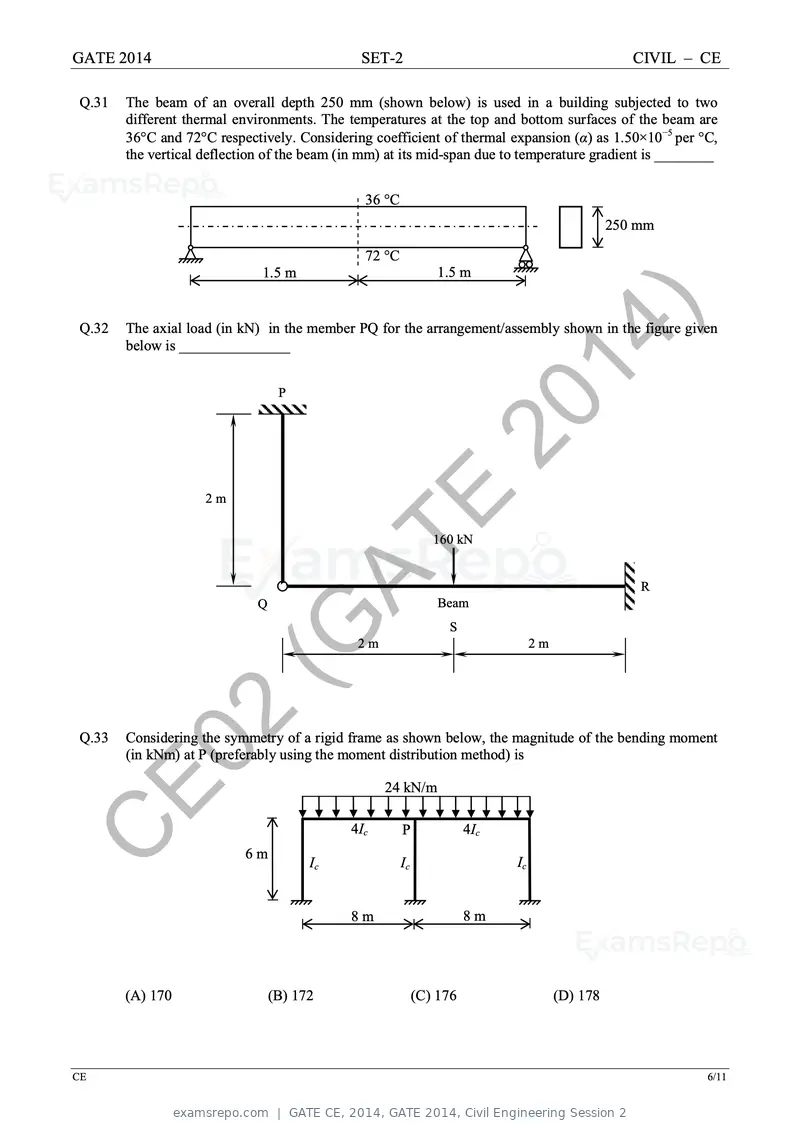
Text of page 34
GATE 2014                                      SET-2                                                CIVIL – CE

 Q.31   The beam of an overall depth 250 mm (shown below) is used in a building subjected to two
        different thermal environments. The temperatures at the top and bottom surfaces of the beam are
        36°C and 72°C respectively. Considering coefficient of thermal expansion (α) as 1.50×10⁻⁵ per °C,
        the vertical deflection of the beam (in mm) at its mid-span due to temperature gradient is ________


                                                36 °C
                                                                                                 250 mm

                                                72 °C
                              1.5 m                              1.5 m


 Q.32                                                                                  4)
        The axial load (in kN) in the member PQ for the arrangement/assembly shown in the figure given
        below is _______________


                                   P
                                                                  20 1
                     2m
                                                   E
                              Q
                                       AT                       160 kN


                                                                 Beam
                                                                                                     R


                          (G                  2m
                                                                  S
                                                                                  2m


 Q.33             2
        Considering the symmetry of a rigid frame as shown below, the magnitude of the bending moment


     E0 (in kNm) at P (preferably using the moment distribution method) is


                                             4Ic
                                                   24 kN/m

                                                        P              4Ic
C                           6m
                                        Ic              Ic                   Ic


                                             8m                        8m


        (A) 170                   (B) 172                    (C) 176                   (D) 178


CE                                                                                                          6/11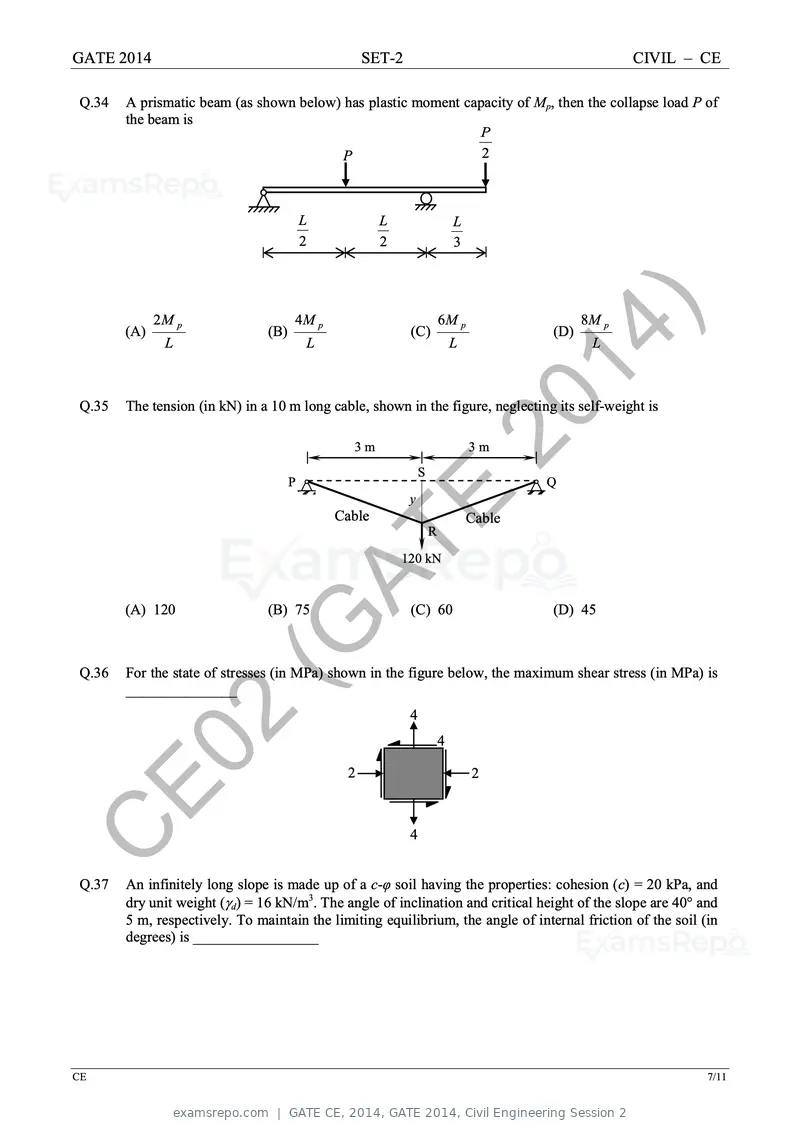
Text of page 35
GATE 2014                                          SET-2                                            CIVIL – CE

 Q.34   A prismatic beam (as shown below) has plastic moment capacity of Mp, then the collapse load P of
        the beam is
                                                                P
                                          P                     2


                                          L           L                    L
                                          2           2                    3


        (A)
              2M p
               L
                                (B)
                                      4M p
                                          L
                                                           (C)
                                                                       6M p
                                                                           L
                                                                                       4)
                                                                                       (D)
                                                                                             8M p
                                                                                              L


 Q.35                                                                      20
        The tension (in kN) in a 10 m long cable, shown in the figure, neglecting its self-weight is

                                                3m                            13m
                                                               S
                                      P                                                Q

                                              Cable   E    y

                                                                   R
                                                                               Cable


        (A) 120                 (B) 75
                                          AT              120 kN


                                                           (C) 60                      (D) 45


 Q.36
                         (G
        For the state of stresses (in MPa) shown in the figure below, the maximum shear stress (in MPa) is
        _______________

                2                                          4
                                                                       4

     E0                                        2                               2


CQ.37
                                                           4


        An infinitely long slope is made up of a c-φ soil having the properties: cohesion (c) = 20 kPa, and
        dry unit weight (γd) = 16 kN/m3. The angle of inclination and critical height of the slope are 40° and
        5 m, respectively. To maintain the limiting equilibrium, the angle of internal friction of the soil (in
        degrees) is _________________


CE                                                                                                           7/11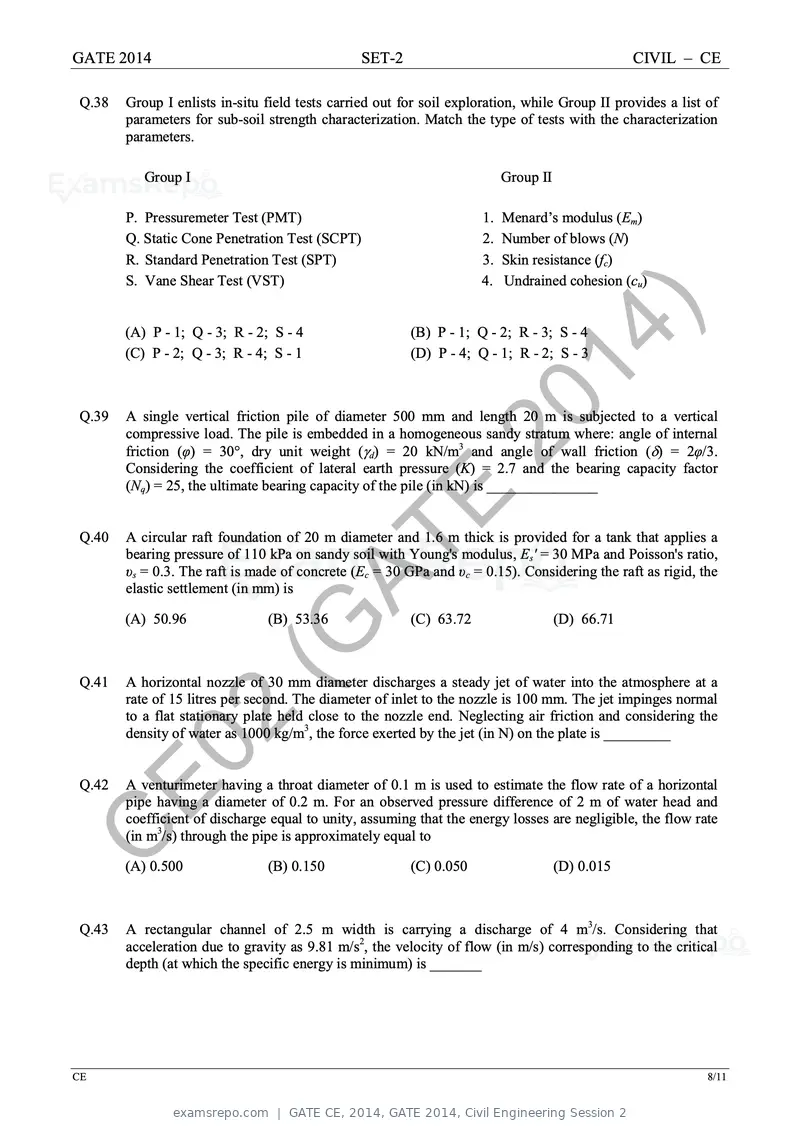
Text of page 36
GATE 2014                                       SET-2                                           CIVIL – CE

 Q.38   Group I enlists in-situ field tests carried out for soil exploration, while Group II provides a list of
        parameters for sub-soil strength characterization. Match the type of tests with the characterization
        parameters.

           Group I                                                       Group II

        P. Pressuremeter Test (PMT)                                  1. Menard’s modulus (Em)
        Q. Static Cone Penetration Test (SCPT)                       2. Number of blows (N)
        R. Standard Penetration Test (SPT)                           3. Skin resistance (fc)
        S. Vane Shear Test (VST)                                     4. Undrained cohesion (cu)


        (A) P - 1; Q - 3; R - 2; S - 4
        (C) P - 2; Q - 3; R - 4; S - 1
                                                                                    4)
                                                         (B) P - 1; Q - 2; R - 3; S - 4
                                                         (D) P - 4; Q - 1; R - 2; S - 3


 Q.39                                                          20 1
        A single vertical friction pile of diameter 500 mm and length 20 m is subjected to a vertical
        compressive load. The pile is embedded in a homogeneous sandy stratum where: angle of internal
        friction (φ) = 30°, dry unit weight (γd) = 20 kN/m3 and angle of wall friction (δ) = 2φ/3.
        Considering the coefficient of lateral earth pressure (K) = 2.7 and the bearing capacity factor
        (Nq) = 25, the ultimate bearing capacity of the pile (in kN) is _______________


 Q.40
                                                    E
        A circular raft foundation of 20 m diameter and 1.6 m thick is provided for a tank that applies a

                                      AT
        bearing pressure of 110 kPa on sandy soil with Young's modulus, Es' = 30 MPa and Poisson's ratio,
        υs = 0.3. The raft is made of concrete (Ec = 30 GPa and υc = 0.15). Considering the raft as rigid, the
        elastic settlement (in mm) is

        (A) 50.96               (B) 53.36                (C) 63.72                  (D) 66.71


 Q.41
                         (G
        A horizontal nozzle of 30 mm diameter discharges a steady jet of water into the atmosphere at a
        rate of 15 litres per second. The diameter of inlet to the nozzle is 100 mm. The jet impinges normal

                2
        to a flat stationary plate held close to the nozzle end. Neglecting air friction and considering the
        density of water as 1000 kg/m3, the force exerted by the jet (in N) on the plate is _________


 Q.42E0 A venturimeter having a throat diameter of 0.1 m is used to estimate the flow rate of a horizontal
        pipe having a diameter of 0.2 m. For an observed pressure difference of 2 m of water head and
        coefficient of discharge equal to unity, assuming that the energy losses are negligible, the flow rate

C       (in m3/s) through the pipe is approximately equal to

        (A) 0.500               (B) 0.150                (C) 0.050                  (D) 0.015


 Q.43   A rectangular channel of 2.5 m width is carrying a discharge of 4 m3/s. Considering that
        acceleration due to gravity as 9.81 m/s2, the velocity of flow (in m/s) corresponding to the critical
        depth (at which the specific energy is minimum) is _______


CE                                                                                                           8/11
Text of page 37
GATE 2014                                                  SET-2                               CIVIL – CE

 Q.44   Irrigation water is to be provided to a crop in a field to bring the moisture content of the soil from
        the existing 18% to the field capacity of the soil at 28%. The effective root zone of the crop is 70
        cm. If the densities of the soil and water are 1.3 g/cm3 and 1.0 g/cm3 respectively, the depth of
        irrigation water (in mm) required for irrigating the crop is ________


 Q.45   With reference to a standard Cartesian (x, y) plane, the parabolic velocity distribution profile of
        fully developed laminar flow in x-direction between two parallel, stationary and identical plates that
        are separated by distance, h, is given by the expression

                                                                    ℎ2 dddd          yy 2
                                                           uu = −            �1 − 4 � � �
                                                                    8μμ dddd         ℎ
                                                                                            4)
        In this equation, the y = 0 axis lies equidistant between the plates at a distance h/2 from the two
        plates, p is the pressure variable and µ is the dynamic viscosity term. The maximum and average
        velocities are, respectively


        (A) uummmmmm = −
                             ℎ 2 dddd
                             8μμ dddd
                                        and uuaaaaaaaaaaaaaa
                                                                   2
                                                               = uummmmmm
                                                                   3
                                                                          20 1
                         ℎ 2 dddd                              2
        (B) uummmmmm =              and uuaaaaaaaaaaaaaa   = uummmmmm
                         8μμ dddd                              3

        (C) uummmmmm = −
                             ℎ 2 dddd
                            8μμ dddd
                                        and uuaaaaaaaaaaaaaa
                                                               E   3
                                                               = uummmmmm
                                                                   8

        (D) uummmmmm =
                         ℎ 2 dddd
                         8μμ dddd           AT
                                    and uuaaaaaaaaaaaaaa
                                                               3
                                                           = uummmmmm
                                                               8


 Q.46
                           (G
        A suspension of sand like particles in water with particles of diameter 0.10 mm and below is
        flowing into a settling tank at 0.10 m3/s. Assume g = 9.81 m/s2, specific gravity of particles = 2.65,
        and kinematic viscosity of water =1.0105×10⁻² cm2/s. The minimum surface area (in m2) required
        for this settling tank to remove particles of size 0.06 mm and above with 100% efficiency is
        _______________
                2
 Q.47E0 A surface water treatment plant operates round the clock with a flow rate of 35 m3/min. The water
        temperature is 15 oC and jar testing indicated an alum dosage of 25 mg/l with flocculation at a Gt
        value of 4×10⁴ producing optimal results. The alum quantity required for 30 days (in kg) of

C       operation of the plant is ____________


 Q.48   An effluent at a flow rate of 2670 m3/d from a sewage treatment plant is to be disinfected. The
        laboratory data of disinfection studies with a chlorine dosage of 15 mg/l yield the model
         N t = N o e −0.145t where Nt = number of micro-organisms surviving at time t (in min.) and
        No = number of micro-organisms present initially (at t = 0). The volume of disinfection unit (in m3)
        required to achieve a 98% kill of micro-organisms is ______________


CE                                                                                                          9/11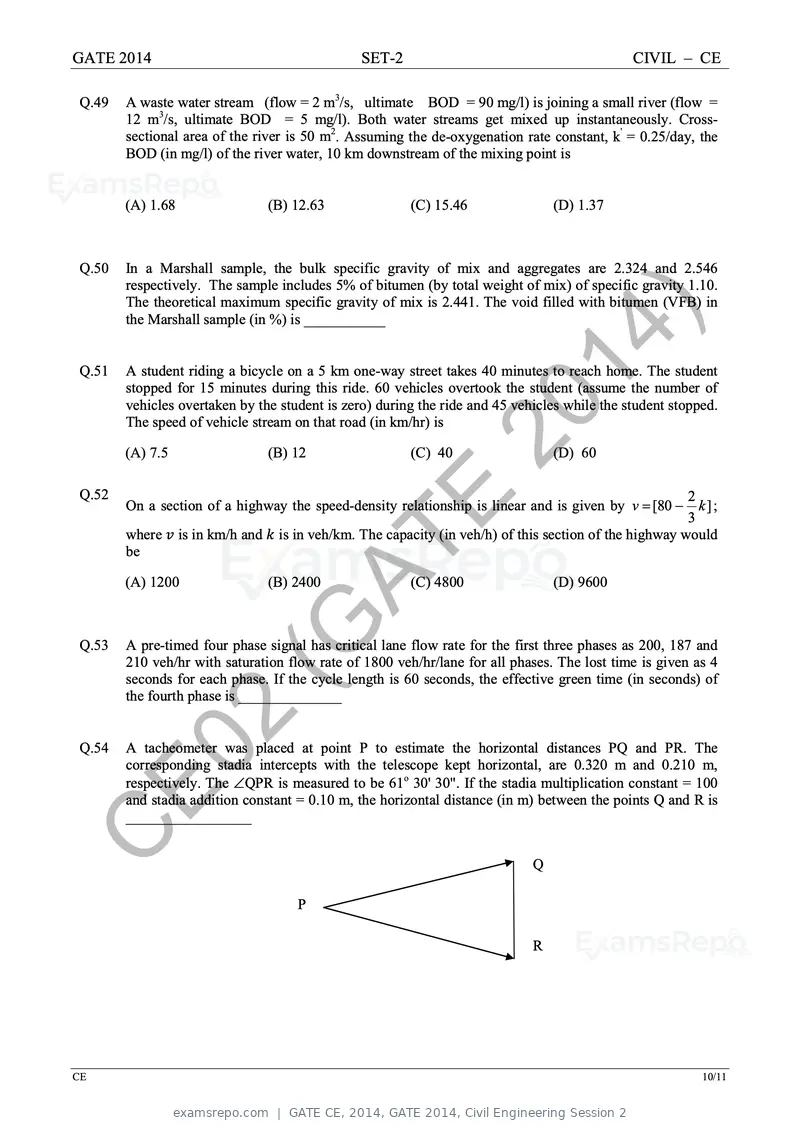
Text of page 38
GATE 2014                                       SET-2                                           CIVIL – CE

 Q.49   A waste water stream (flow = 2 m3/s, ultimate BOD = 90 mg/l) is joining a small river (flow =
        12 m3/s, ultimate BOD = 5 mg/l). Both water streams get mixed up instantaneously. Cross-
        sectional area of the river is 50 m2. Assuming the de-oxygenation rate constant, k' = 0.25/day, the
        BOD (in mg/l) of the river water, 10 km downstream of the mixing point is


        (A) 1.68                (B) 12.63                (C) 15.46                (D) 1.37


 Q.50   In a Marshall sample, the bulk specific gravity of mix and aggregates are 2.324 and 2.546
        respectively. The sample includes 5% of bitumen (by total weight of mix) of specific gravity 1.10.
        The theoretical maximum specific gravity of mix is 2.441. The void filled with bitumen (VFB) in
        the Marshall sample (in %) is ___________
                                                                                  4)
 Q.51

                                                               20
        A student riding a bicycle on a 5 km one-way street takes 40 minutes to reach home. The student
        stopped for 15 minutes during this ride. 60 vehicles overtook the student (assume the number of
        vehicles overtaken by the student is zero) during the ride and 45 vehicles while the student stopped.
        The speed of vehicle stream on that road (in km/hr) is

        (A) 7.5                 (B) 12                   (C) 40   1               (D) 60

 Q.52
                                                    E
        On a section of a highway the speed-density relationship is linear and is given by v = [80 −
                                                                                                         2
                                                                                                         3
                                                                                                           k] ;
        where vv is in km/h and kk is in veh/km. The capacity (in veh/h) of this section of the highway would
        be

        (A) 1200                      AT
                                (B) 2400                 (C) 4800                 (D) 9600


 Q.53
                         (G
        A pre-timed four phase signal has critical lane flow rate for the first three phases as 200, 187 and
        210 veh/hr with saturation flow rate of 1800 veh/hr/lane for all phases. The lost time is given as 4
        seconds for each phase. If the cycle length is 60 seconds, the effective green time (in seconds) of
        the fourth phase is ______________


 Q.54
                  2
        A tacheometer was placed at point P to estimate the horizontal distances PQ and PR. The

     E0 corresponding stadia intercepts with the telescope kept horizontal, are 0.320 m and 0.210 m,
        respectively. The ∠QPR is measured to be 61o 30' 30". If the stadia multiplication constant = 100
        and stadia addition constant = 0.10 m, the horizontal distance (in m) between the points Q and R is
        _________________

C                                                                             Q

                                     P

                                                                              R


CE                                                                                                          10/11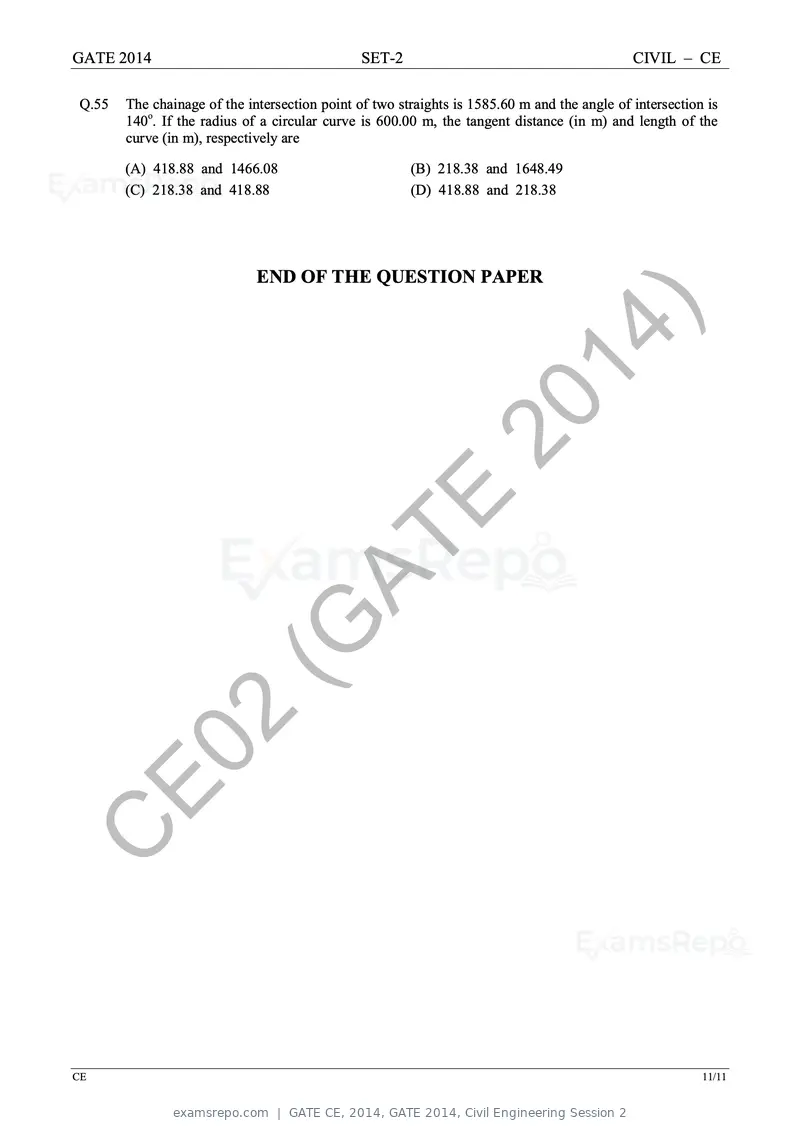
Text of page 39
GATE 2014                                       SET-2                                         CIVIL – CE

 Q.55   The chainage of the intersection point of two straights is 1585.60 m and the angle of intersection is
        140o. If the radius of a circular curve is 600.00 m, the tangent distance (in m) and length of the
        curve (in m), respectively are

        (A) 418.88 and 1466.08                          (B) 218.38 and 1648.49
        (C) 218.38 and 418.88                           (D) 418.88 and 218.38


                              END OF THE QUESTION PAPER

                                                                                 4)
                                                              20 1
                                                   E
                                     AT
                         (G
               2
     E0
C

CE                                                                                                        11/11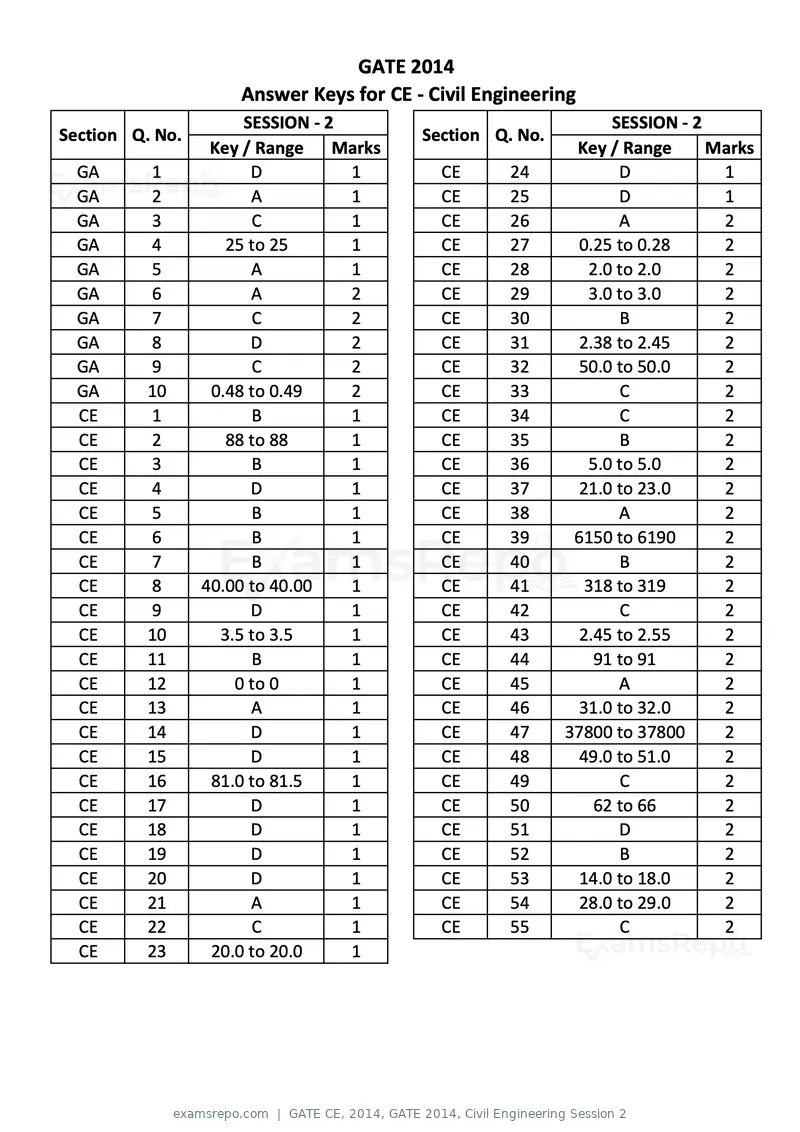
Text of page 40
GATE 2014
                     Answer Keys for CE ‐ Civil Engineering
                      SESSION ‐ 2                              SESSION ‐ 2
Section Q. No.                           Section Q. No.
                  Key / Range Marks                        Key / Range     Marks
 GA       1            D          1        CE      24           D           1
 GA       2            A          1        CE      25           D           1
 GA       3            C          1        CE      26           A           2
 GA       4         25 to 25      1        CE      27      0.25 to 0.28     2
 GA       5            A          1        CE      28       2.0 to 2.0      2
 GA       6            A          2        CE      29       3.0 to 3.0      2
 GA       7            C          2        CE      30           B           2
 GA       8            D          2        CE      31      2.38 to 2.45     2
 GA       9            C          2        CE      32      50.0 to 50.0     2
 GA       10      0.48 to 0.49    2        CE      33           C           2
 CE       1            B          1        CE      34           C           2
 CE       2         88 to 88      1        CE      35           B           2
 CE       3            B          1        CE      36       5.0 to 5.0      2
 CE       4            D          1        CE      37      21.0 to 23.0     2
 CE       5            B          1        CE      38           A           2
 CE       6            B          1        CE      39      6150 to 6190     2
 CE       7            B          1        CE      40           B           2
 CE       8      40.00 to 40.00   1        CE      41       318 to 319      2
 CE       9            D          1        CE      42           C           2
 CE       10       3.5 to 3.5     1        CE      43      2.45 to 2.55     2
 CE       11           B          1        CE      44        91 to 91       2
 CE       12         0 to 0       1        CE      45           A           2
 CE       13           A          1        CE      46      31.0 to 32.0     2
 CE       14           D          1        CE      47     37800 to 37800    2
 CE       15           D          1        CE      48      49.0 to 51.0     2
 CE       16      81.0 to 81.5    1        CE      49           C           2
 CE       17           D          1        CE      50        62 to 66       2
 CE       18           D          1        CE      51           D           2
 CE       19           D          1        CE      52           B           2
 CE       20           D          1        CE      53      14.0 to 18.0     2
 CE       21           A          1        CE      54      28.0 to 29.0     2
 CE       22           C          1        CE      55           C           2
 CE       23      20.0 to 20.0    1
Official key not published for this paper.
Page 1 of 40
Source: GATE. Question paper published by GATE.