
GATE CE 2025: Civil Engineering Session 2

Text of page 1
Civil Engineering (CE2)


General Aptitude
Q.1 – Q.5 Carry ONE mark Each

 Q.1     Even though I had planned to go skiing with my friends, I had to __________ at the
         last moment because of an injury.

         Select the most appropriate option to complete the above sentence.


 (A)     back up


 (B)     back of


 (C)     back on


 (D)     back out


 Q.2     The President, along with the Council of Ministers, ___________ to visit India next
         week.

         Select the most appropriate option to complete the above sentence.


 (A)     wish


 (B)     wishes


 (C)     will wish


 (D)     is wishing


                                        Page 1 of 37
Organising Institute: IIT Roorkee
Text of page 2
Civil Engineering (CE2)


 Q.3     An electricity utility company charges ₹ 7 per kWh (kilo watt-hour). If a 40-watt
         desk light is left on for 10 hours each night for 180 days, what would be the cost of
         energy consumption? If the desk light is on for 2 more hours each night for the 180
         days, what would be the percentage-increase in the cost of energy consumption?


 (A)     ₹ 604.8; 10%


 (B)     ₹ 504; 20%


 (C)     ₹ 604.8; 12%


 (D)     ₹ 720; 15%


                                         Page 2 of 37
Organising Institute: IIT Roorkee
Text of page 3
Civil Engineering (CE2)


 Q.4     In the context of the given figure, which one of the following options correctly
         represents the entries in the blocks labelled (i), (ii), (iii), and (iv), respectively?


                                    N        U           F          (i)


                                    21       14          9          6


                                    H         L         (ii)        O


                                    12      (iv)        15         (iii)


 (A)     Q, M, 12, and 8


 (B)     K, L, 10 and 14


 (C)     I, J, 10, and 8


 (D)     L, K, 12 and 8


                                         Page 3 of 37
Organising Institute: IIT Roorkee
Text of page 4
Civil Engineering (CE2)


 Q.5     A bag contains Violet (V), Yellow (Y), Red (R), and Green (G) balls. On counting
         them, the following results are obtained:

             (i)     The sum of Yellow balls and twice the number of Violet balls is 50.
             (ii)    The sum of Violet and Green balls is 50.
             (iii)   The sum of Yellow and Red balls is 50.
             (iv)    The sum of Violet and twice the number of Red balls is 50.

         Which one of the following Pie charts correctly represents the balls in the bag?


 (A)
                                                    V
                                                   10%

                                        G                     R
                                       40%                   20%


                                                   Y
                                                  30%


 (B)


                                       G
                                      30%               V
                                                       40%


                                         Y
                                        20%      R
                                                10%


                                        Page 4 of 37
Organising Institute: IIT Roorkee
Text of page 5
Civil Engineering (CE2)


 (C)

                                           G
                                          20%             V
                                                         30%
                                     Y
                                    10%

                                                 R
                                                40%


 (D)
                                             G
                                            10%        V
                                                      20%


                                       Y
                                      40%                 R
                                                         30%


                                          Page 5 of 37
Organising Institute: IIT Roorkee
Text of page 6
Civil Engineering (CE2)


Q.6 – Q.10 Carry TWO marks Each

 Q.6     “His life was divided between the books, his friends, and long walks. A solitary
         man, he worked at all hours without much method, and probably courted his fatal
         illness in this way. To his own name there is not much to show; but such was his
         liberality that he was continually helping others, and fruits of his erudition are
         widely scattered, and have gone to increase many a comparative stranger’s
         reputation.”

                                                           (From E.V. Lucas’s “A Funeral”)

         Based only on the information provided in the above passage, which one of the
         following statements is true?


 (A)     The solitary man described in the passage is dead.


 (B)     Strangers helped create a grand reputation for the solitary man described in the
         passage.


 (C)     The solitary man described in the passage found joy in scattering fruits.


 (D)     The solitary man worked in a court where he fell ill.


                                        Page 6 of 37
Organising Institute: IIT Roorkee
Text of page 7
Civil Engineering (CE2)


 Q.7     For the clock shown in the figure, if

         O* = O Q S Z P R T, and

         X* = X Z P W Y O Q ,

         then which one among the given options is most appropriate for P* ?


 (A)     P U W R T V X


 (B)     P R T O Q          S U


 (C)     P T V Q        S   U W


 (D)     P S U P       R    T V


                                         Page 7 of 37
Organising Institute: IIT Roorkee
Text of page 8
Civil Engineering (CE2)


 Q.8     Consider a five-digit number PQRST that has distinct digits P, Q, R, S, and T, and
         satisfies the following conditions:

                                                P<Q

                                              S>P>T

                                                R<T

         If integers 1 through 5 are used to construct such a number, the value of P is:


 (A)     1


 (B)     2


 (C)     3


 (D)     4


 Q.9     A business person buys potatoes of two different varieties P and Q, mixes them in
         a certain ratio and sells them at ₹ 192 per kg.

         The cost of the variety P is ₹ 800 for 5 kg.

         The cost of the variety Q is ₹ 800 for 4 kg.

         If the person gets 8% profit, what is the P:Q ratio (by weight)?


 (A)     5:4


 (B)     3:4


 (C)     3:2


 (D)     1:1


                                         Page 8 of 37
Organising Institute: IIT Roorkee
Text of page 9
Civil Engineering (CE2)


 Q.10    Three villages P, Q, and R are located in such a way that the distance PQ = 13 km,
         QR = 14 km, and RP = 15 km, as shown in the figure. A straight road joins Q and
         R. It is proposed to connect P to this road QR by constructing another road. What
         is the minimum possible length (in km) of this connecting road?

         Note: The figure shown is representative.


                            P


                13 km                  15 km


            Q                                          R
                            14 km


 (A)     10.5


 (B)     11.0


 (C)     12.0


 (D)     12.5


                                        Page 9 of 37
Organising Institute: IIT Roorkee
Text of page 10
Civil Engineering (CE2)


Q.11 – Q.35 Carry ONE mark Each


 Q.11    For the matrix [A] given below, the transpose is ______.


                2      3 4
         [A] = [1      4 5]
                4      3 2

          2 1     4
 (A)     [3 4     3]
          4 5     2
          4 3     2
 (B)     [5 4     1]
          2 3     4
          4 2     3
 (C)     [5 1     4]
          2 4     3
          2 3     4
 (D)     [1 4     5]
          4 3     2


 Q.12    Integration of ln(x) with x i.e.,


         ∫ ln(x) dx = ______.


 (A)     x. ln(x) − x + Constant


 (B)     x − ln(x) + Constant


 (C)     x. ln(x) + x + Constant


 (D) A. ln(x) − x + Constant


                                             Page 10 of 37
Organising Institute: IIT Roorkee
Text of page 11
Civil Engineering (CE2)


         Consider the following statements (P) and (Q):
 Q.13
         (P): Fly ash and ground granulated blast furnace slag can be used as mineral
         admixtures in concrete.
         (Q): As per IS 456:2000, the minimum moist curing period becomes higher when
         a mineral admixture is added to concrete.
         Identify the CORRECT option from choices given below.


 (A)     Both (P) and (Q) are TRUE.


 (B)     (P) is TRUE and (Q) is FALSE.


 (C)     (P) is FALSE and (Q) is TRUE.


 (D)     Both (P) and (Q) are FALSE.


                                       Page 11 of 37
Organising Institute: IIT Roorkee
Text of page 12
Civil Engineering (CE2)


 Q.14    Consider the pin-jointed truss shown in the figure. Influence line is drawn for the
         axial force in the member G-I, when a unit load travels on the bottom chord of the
         truss. Identify the CORRECT influence line from the following options:

         Note: Positive value corresponds to tension and negative value corresponds to
         compression in the member.


                        B               E              H              J        M

                                                                                               3m
                    C               F                                     K        N
                                                                                               3m
           A                                                                               P
                        D           G                  I              L        O
                                                 6@6 m = 36 m


 (A)
                            1.33
                                                   +
               A        D                                                              P


 (B)
                                            1.33
                                                           +
               A                        G                                              P


 (C)

                                             +             1.33

               A                                       I                               P


 (D)
                             1.33
                        +                                  I
               A                    G                                                  P
                                                               1.33       −


                                                 Page 12 of 37
Organising Institute: IIT Roorkee
Text of page 13
Civil Engineering (CE2)


 Q.15    The most suitable test for measuring the permeability of clayey soils in the
         laboratory is ______.


 (A)     Constant head test


 (B)     Pumping out test


 (C)     Hydrometer test


 (D)     Falling head test


 Q.16    A hydraulic jump occurs in an open channel when the slope of the channel
         changes from ______.


 (A)     MILD slope to STEEP slope


 (B)     STEEP slope to MILD slope


 (C)     MILD slope to ZERO slope


 (D)     STEEP slope to a STEEPER slope


                                        Page 13 of 37
Organising Institute: IIT Roorkee
Text of page 14
Civil Engineering (CE2)


 Q.17    The bacteria mainly responsible for crown corrosion in a sewer is ______.


 (A)     Methanogenic bacteria


 (B)     Denitrifying bacteria


 (C)     Sulphur reducing bacteria


 (D)     Pseudomonas bacteria


         The recommended minimum traffic growth rate and design period considered for
 Q.18    structural design of flexible pavements for national highways in India as per
         IRC 37:2018 is ______ percentage and ______ years, respectively.


 (A)     5, 20


 (B)     5, 30


 (C)     7, 20


 (D)     7, 30


                                       Page 14 of 37
Organising Institute: IIT Roorkee
Text of page 15
Civil Engineering (CE2)


 Q.19    After applying the correction for elevation and temperature, the runway length is
         700 m. The corrected runway length (in m) for an effective gradient of 1% is
         ______ (round off to the nearest integer).


 (A)     840


 (B)     700


 (C)     720


 (D)     740


 Q.20    The point where the road alignment changes from a tangent to a curve is known as
         ______.


 (A)     Point of deflection


 (B)     Point of intersection


 (C)     Point of curve


 (D)     Point of tangency


                                       Page 15 of 37
Organising Institute: IIT Roorkee
Text of page 16
Civil Engineering (CE2)
Q.21 Consider a velocity vector, ⃗V in (x, y, z) coordinates given below. Pick one or
more CORRECT statements(s) from the choices given below.
⃗ = ux + vy
V
(A) ⃗ = (∂v − ∂u) z
z-component of Curl of velocity; ∇ × V ∂x ∂y
∂u ∂v
(B) z-component of Curl of velocity; ∇ × ⃗V = (∂x − ∂y) z
∂u ∂v
(C) Divergence of velocity; ∇. ⃗V = (∂x + ∂y)
(D) ⃗ = (∂u + ∂v)
Divergence of velocity; ∇. V ∂y ∂x
Given that A and B are not null sets, which of the following statements regarding
Q.22
probability is/are CORRECT?
(A) P(AB) = P(A) P(B), if A and B are mutually exclusive.
(B) Conditional probability, P(A|B) = 1 if B A.
(C) P(AB) = P(A) + P(B), if A and B are mutually exclusive.
(D) P(AB) = 0, if A and B are independent.
Page 16 of 37
Organising Institute: IIT Roorkee
Text of page 17
Civil Engineering (CE2)


 Q.23    In the context of construction materials, which of the following statements is/are
         CORRECT?


 (A)     If the characteristic strength is defined as that value below which not more than
         50% results are expected to fall, the target mean strength in mix design will be
         taken same as the characteristic strength irrespective of the degree of quality
         control expected at the site.


 (B)     Ten percent fines value is a non-dimensional quantity.


 (C)     The stress-strain curve of concrete for 1-day duration of loading is associated with
         a smaller secant modulus of elasticity compared to the stress-strain curve of the
         same concrete for 10-minutes duration of loading.


 (D)     The increase of carbon in steel usually leads to an increase in its 0.2% proof stress.


 Q.24    Which of the following statements is/are INCORRECT?


         As the depth of the ground water table from the ground surface increases, the
 (A)
         effective stress in the soil decreases.


 (B)     Bulking of the moist sand is due to the capillary action in the sand.


 (C)     The effective stress in a liquified soil is almost zero.


         The earth pressure at any point in the soil, under all conditions, is always smaller
 (D)
         than the vertical effective stress at that point.


                                         Page 17 of 37
Organising Institute: IIT Roorkee
Text of page 18
Civil Engineering (CE2)


 Q.25    Pick one or more CORRECT statement(s) from the choices given below, in the
         context of upstream and downstream cut-offs provided below the concrete apron
         of weirs / barrages constructed across alluvial rivers.


 (A)     Cut-offs are provided to increase the rate of flow over the weir / barrage.


         Cut-offs are provided to increase the seepage length and prevent failure due to
 (B)
         piping.


 (C)     The bottom level of cut-offs mainly depends on the scour depth.


         Cut-offs are provided to ensure occurrence of hydraulic jump within the stilling
 (D)
         basin.


 Q.26    In the context of the effect of drainage density on the run-off generation and the
         hydrograph at the catchment outlet, all other factors remaining the same, pick one
         or more CORRECT statement(s) from the choices given below.


         Lower drainage density results in higher peak in flood hydrograph compared to
 (A)
         that when the drainage density is higher.


         Lower drainage density results in lower peak in flood hydrograph compared to
 (B)
         that when the drainage density is higher.


         Lower drainage density results in a flood hydrograph with a longer time base
 (C)
         compared to that when the drainage density is higher.


         Lower drainage density results in a flood hydrograph with a shorter time base
 (D)
         compared to that when the drainage density is higher.


                                        Page 18 of 37
Organising Institute: IIT Roorkee
Text of page 19
Civil Engineering (CE2)


 Q.27    Identify the treatment technology/technologies NOT recommended for highly
         biodegradable organic solid wastes.


 (A)     Biohydrogenation


 (B)     Anaerobic digestion


 (C)     Composting


 (D)     Open dumping


 Q.28    Which of the following statements is/are INCORRECT?


 (A)     Bitumen having lower softening point is preferred in warm climate regions.


 (B)     The viscosity of bitumen influences the mixing and compaction of bituminous mix.


         The air voids in the range of 3% to 5% are required to arrive at the optimum bitumen
 (C)     content.


 (D)     The purity of bitumen can be determined using Solubility Test.


                                          Page 19 of 37
Organising Institute: IIT Roorkee
Text of page 20
Civil Engineering (CE2)


 Q.29    The “order” of the following ordinary differential equation is ______.

                       6
         d3y     d2y    dy 4
              + ( 2) + ( ) + y = 0
         dx 3    dx     dx


 Q.30    The design shear strength of a reinforced concrete rectangular beam with a width
         of 250 mm and an effective depth of 500 mm, is 0.3 MPa. The torsional moment
         capacity of the section (in kN.m) under pure torsion, as per IS 456:2000, is
         ______ (round off to one decimal place).


 Q.31    From a flow-net diagram drawn under a concrete dam, following information are
         obtained: (i) The head difference between upstream and downstream side of the
         dam is 9 m. (ii) The total number of equipotential drops between upstream and
         downstream side of the dam is 10. (iii) The length of the field nearest to the toe of
         the dam in the downstream side is 1 m.

         If the soil below the dam is having a saturated unit weight of 21 kN/m3 and unit
         weight of water is 9.81 kN/m3, then the factor of safety against the quick condition
         will be ______ (round off to two decimal places).


 Q.32    A 6 m thick clay stratum has drainage at both its top and bottom surface due to the
         presence of sand strata. The time to complete 50% consolidation is 2 years. The
         coefficient of volume change (mv) is 1.51×10₋3 m2/kN and unit weight of water is
         9.81 kN/m3.

         The coefficient of permeability (in m/year) is ______ (round off to three decimal
         places).


                                        Page 20 of 37
Organising Institute: IIT Roorkee
Text of page 21
Civil Engineering (CE2)


 Q.33    Consider steady flow of water in the series pipe system shown below, with
         specified discharge. The diameters of Pipes A and B are 2 m and 1 m,
         respectively. The lengths of pipes A and B are 100 m and 200 m, respectively.
         Assume the Darcy-Weisbach friction coefficient, f as 0.01 for both the pipes.

         The ratio of head loss in Pipe-B to the head loss in Pipe-A is ______ (round off to
         the nearest integer).


 Q.34    Free residual chlorine concentration in water was measured to be 2 mg/l (as Cl 2).
         The pH of water is 8.5. By using the chemical equation given below, the HOCl
         concentration (in µmoles/l) in water is ________________ (round off to one
         decimal place).

                                    HOCl ⇌ H + + OCl− ,   pK = 7.50

         Atomic weight: Cl(35.5)


 Q.35    A surveyor measured the distance between two points on the plan drawn to a scale
         of 1 cm = 40 m and the result was 468 m. Later, it was discovered that the scale
         used was 1 cm = 20 m.

         The true distance between the points (in m) is ______ (round off to the nearest
         integer).


                                          Page 21 of 37
Organising Institute: IIT Roorkee
Text of page 22
Civil Engineering (CE2)


Q.36 – Q.65 Carry TWO marks Each


 Q.36    Pick the CORRECT solution for the following differential equation


         dy
            = e x−y
         dx

 (A)     y = ln(e x + Constant)


 (B)     ln(y) = x + Constant


 (C)     ln (y) = ln(e x ) + Constant


 (D)     y = x + Constant


 Q.37    A circular tube of thickness 10 mm and diameter 250 mm is welded to a flat plate
         using 5 mm fillet weld along the circumference. Assume Fe410 steel and shop
         welding.

         As per IS 800:2007, the torque that can be resisted by the weld (in kN.m) is ______
         (round off to one decimal place).


 (A)     65.1


 (B)     78.1


 (C)     156.2


 (D)     130.2


                                        Page 22 of 37
Organising Institute: IIT Roorkee
Text of page 23
Civil Engineering (CE2)


 Q.38    The figure shows a propped cantilever with uniform flexural rigidity EI (in N.m2)
         and subjected to a moment M (in N.m). Consider forces and displacements in the
         upward direction as positive.

         Find the upward reaction at the propped support B (in N) when this support settles
         by (−Δ), given in metres.


 (A)     3M 6EIΔ
            − 3
         2L   L

 (B)     8M 2EIΔ
            − 3
         3L   L

 (C)     3M 3EIΔ
            − 3
         2L   L

 (D)     M 8EIΔ
           − 3
         L   L


                                       Page 23 of 37
Organising Institute: IIT Roorkee
Text of page 24
Civil Engineering (CE2)


 Q.39    Let the state of stress at a point in a body be the difference of two plane states of
         stress shown in the figure. Consider all the possible planes perpendicular to the x-y
         plane and passing through that point. The magnitude of the maximum compressive
         stress on any such plane is kσ0 , where k is equal to _____ (round off to one decimal
         place).


                                                              3σ0


                             y                                       y
                  3σ0                    3σo                   45°
                                 x                                       x
                                                                                 3σo


 (A)     3.0


 (B)     2.1


 (C)     1.7


 (D)     1.5


                                        Page 24 of 37
Organising Institute: IIT Roorkee
Text of page 25
Civil Engineering (CE2)


 Q.40    Consider a reinforced concrete beam section of 350 mm width and 600 mm depth.
         The beam is reinforced with the tension steel of 800 mm2 area at an effective cover
         of 40 mm. Consider M20 concrete and Fe415 steel. Let the stress block considered
         for concrete in IS 456:2000 be replaced by an equivalent rectangular stress block,
         with no change in (a) the area of the stress block, (b) the design strength of concrete
         (at the strain of 0.0035), and (c) the location of neutral axis at flexural collapse. The
         ultimate moment of resistance of the beam (in kN.m) is __________________
         (round off to the nearest integer).


 (A)     170


 (B)     148


 (C)     125


 (D)     102


 Q.41    For a partially saturated soil deposit at a construction site, water content (w) is 15%,
         degree of saturation (S) is 67%, void ratio (e) is 0.6 and specific gravity of solids in
         the soil (Gs) is 2.67. Consider unit weight of water as 9.81 kN/m3.

         To fully saturate 5 m3 of this soil, the required weight of water (in kN) will be
         ______ (round off to the nearest integer).


 (A)     5


 (B)     6


 (C)     7


 (D)     8


                                         Page 25 of 37
Organising Institute: IIT Roorkee
Text of page 26
Civil Engineering (CE2)


         Consider flow in a long and very wide rectangular open channel. Width of the
 Q.42
         channel can be considered as infinity compared to the depth of flow. Uniform flow
         depth is 1.0 m. The bed slope of the channel is 0.0001. The Manning roughness
         coefficient value is 0.02. Acceleration due to gravity, g can be taken as 9.81 m/s2.
         The critical depth (in m) corresponding to the flow rate resulting from the above
         conditions is ______ (round off to one decimal place).

 (A)     0.4


 (B)     0.3


 (C)     0.6


 (D)     0.1


 Q.43    Match the following in Column I with Column II.


                            Column I                              Column II
               (1) Vehicle Damage Factor             A. Stability of subgrade soil
               (2) Passenger Car Unit                B. Capacity of a roadway
               (3) Perception Reaction Time          C. Design rigid pavement
               (4) California Bearing Ratio          D. Design flexible pavement
                                                     E. Stopping sight distance


 (A)     (1)-(D); (2)-(B); (3)-(E); (4)-(A)


 (B)     (1)-(C); (2)-(B); (3)-(D); (4)-(A)


 (C)     (1)-(D); (2)-(E); (3)-(B); (4)-(A)


 (D)     (1)-(D); (2)-(B); (3)-(A); (4)-(E)


                                         Page 26 of 37
Organising Institute: IIT Roorkee
Text of page 27
Civil Engineering (CE2)


 Q.44    Consider the function given below and pick one or more CORRECT statement(s)
         from the following choices.


                        15 2
         f(x) = x 3 −      x + 18x + 20
                         2

 (A)     f(x) has a local minimum at x = 3.


 (B)     f(x) has a local maximum at x = 3.


 (C)     f(x) has a local minimum at x = 2.


 (D)     f(x) has a local maximum at x = 2.


 Q.45    Pick the CORRECT eigen value(s) of the matrix [A] from the following choices.


         [A] = [6 8]
                4 2


 (A)     10


 (B)     4


 (C)     -2


 (D)     -10


                                       Page 27 of 37
Organising Institute: IIT Roorkee
Text of page 28
Civil Engineering (CE2)


 Q.46    In the pin-jointed truss shown in the figure, the members that carry zero force are
         identified. Which of the following options is/are zero-force members?


                                                            F       H
                              60 kN
                                           D
                               B

                                                        G           I
                      A        C            E


                                                        J           K


                                                        L           M


 (A)     BC


 (B)     EG


 (C)     FI


 (D)     JK


                                        Page 28 of 37
Organising Institute: IIT Roorkee
Text of page 29
Civil Engineering (CE2)


 Q.47    In the context of shear strength of soil, which of the following statements is/are
         CORRECT?


 (A)     The unconfined compression test is a special case of the unconsolidated-undrained
         (UU) triaxial tests.


 (B)     The shear strength parameters obtained from the consolidated-drained (CD) triaxial
         tests should be used to analyse rapid construction in clay.


 (C)     Vane shear test is commonly used for determining in situ undrained strength of
         saturated clay soils.


 (D)     In an unconsolidated-undrained (UU) triaxial tests, the angle of internal friction (φ)
         is equal to zero.


 Q.48    The drag force, FD on a sphere due to a fluid flowing past the sphere is a function of
         viscosity, µ, the mass density, ρ, the velocity of flow, V, and the diameter of the
         sphere, D.

         Pick the relevant (one or more) non-dimensional parameter(s) pertaining to the
         above process from the following list.


 (A)       FD
         ρV 2 D2


 (B)      ρFD
          V 2 D2


 (C)      ρVD
           μ


          μρ
 (D)
          VD


                                        Page 29 of 37
Organising Institute: IIT Roorkee
Text of page 30
Civil Engineering (CE2)


 Q.49    A compound has a general formula CaHbOcNd and molecular weight 187. A 935 mg/l
         solution of the compound is prepared in distilled deionized water. The Total Organic
         Carbon (TOC) is measured as 360 mg/l (as C). The Chemical Oxygen Demand
         (COD) and the Total Kjeldahl Nitrogen (TKN) are determined as 600 mg/l (as O2)
         and 140 mg/l (as N), respectively (as per the chemical equation given below). Which
         of the following options is/are CORRECT?

                             (4a + b − 2c − 3d)             b − 3d
          Ca H b O c N d +                      O2 → aCO2 +        H 2O + dNH3
                                     4                        2

         Atomic weight: C(12), H(1), O(16), N(14)


 (A)     a=6


 (B)     b=7


 (C)     c=5


 (D)     d=3


 Q.50    The free flow speed of a highway is 100 km/h and its capacity is 4000 vehicle/h.
         Assume speed density relation is linear.

         For a traffic volume of 2000 vehicle/h, choose all the possible speeds (in km/h)
         from the options given below (round off to two decimal places).


 (A)     85.36


 (B)     65.20


 (C)     14.64


 (D)     7.22


                                             Page 30 of 37
Organising Institute: IIT Roorkee
Text of page 31
Civil Engineering (CE2)


 Q.51    Consider a discrete random variable X whose probabilities are given below. The
         standard deviation of the random variable is ______ (round off to one decimal
         place).


           xi          1     2      4      8


           P(X = xi)   0.3   0.1    0.3    0.3


 Q.52    A steel beam supported by three parallel pin-jointed steel rods is shown in the
         figure. The moment of inertia of the beam is 8 × 107 mm4. Take modulus of
         elasticity of steel as 210 GPa. The beam is subjected to uniformly distributed load
         of 6.25 kN/m, including its self-weight.

         The axial force (in kN) in the centre rod CD is ______ (round off to one decimal
         place).


                                          Page 31 of 37
Organising Institute: IIT Roorkee
Text of page 32
Civil Engineering (CE2)


 Q.53    The figure shows a network diagram for a construction project. The activities A, B,
         C, D, E, and F are represented by arrows and their durations are in the figure.

         The total float available for the activity E in day(s) is equal to _____ (round off to
         the nearest integer).


 Q.54    A reinforced concrete beam has a support section with width of 300 mm and effective
         depth of 500 mm. The support section is reinforced with 3 bars of 20 mm diameter
         at the tension side. Two-legged vertical stirrups of 10 mm diameter and Fe415 steel
         at a spacing of 100 mm are provided as shear reinforcement. Assume that there is no
         possibility of diagonal compression failure at the section.

         As per IS 456:2000, the maximum shear resisted by the vertical stirrups (in kN), as
         per limit state design, is ___________ (round off to one decimal place).


                                         Page 32 of 37
Organising Institute: IIT Roorkee
Text of page 33
Civil Engineering (CE2)


 Q.55    The bank of a canal has the profile shown in the figure. The material is a
         homogeneous clay with a bulk unit weight of 20 kN/m3, undrained cohesion of
         30 kPa and it is fully saturated (φu = 0). For the trial slip circle shown, the area
         ABCDEA is 150 m2 and the centroid is at P. A tension crack (DE) of 2.5 m deep
         was also observed. Assume unit weight of water is 9.81 kN/m3 and consider 1 m
         run of the bank for the analysis.

         Considering the canal is empty and tension crack is completely filled with water,
         the factor of safety against slope failure of the bank is ______ (round off to two
         decimal places).


 Q.56    A designer used plate load test to obtain the value of the bearing capacity factor Nγ.
         A circular plate of 1 m diameter was placed on the surface of a dry sand layer
         extending very deep beneath the ground. The unit weight of the sand is
         16.66 kN/m3. The plate is loaded to failure at a pressure of 1500 kPa.

         Considering Terzaghi’s bearing capacity theory, the bearing capacity factor Nγ is
         ______ (round off to the nearest integer).


                                        Page 33 of 37
Organising Institute: IIT Roorkee
Text of page 34
Civil Engineering (CE2)


 Q.57    A 4 × 4 group pile, with each pile 20 m long and 500 mm in diameter, is installed
         in a square pattern in a clayey soil, as shown in the figure. The average unconfined
         compressive strength of the soil is 100 kN/m2, and the adhesion factor is 0.8.
         Neglect the bearing at the tip of the piles. For a group efficiency factor of 1.0, the
         centre to centre spacing (s) of the piles (in m) would be ________ (round off to two
         decimal places).


 Q.58    A 60 cm diameter well completely penetrates a confined aquifer of permeability
         5 × 10⁻⁴ m/s. The length of the strainer (spanning the entire thickness of the
         aquifer) is 10 m. The drawdown at the well under steady state pumping is 1.0 m.
         Assume that the radius of influence for this pumping is 300 m.

         The discharge from the well (in litres per minute) is ______ (round off to the
         nearest integer).


                                        Page 34 of 37
Organising Institute: IIT Roorkee
Text of page 35
Civil Engineering (CE2)


 Q.59    The peak of flood hydrograph due to a 3-hour duration storm in a catchment is
         180 m3/s. The total rainfall depth is 6.6 cm. It can be assumed that the average
         infiltration loss is 0.2 cm/h. There are no other losses. The base flow is constant at a
         value of 30 m3/s.

         The peak value of the 3-hour unit hydrograph for this catchment (in m3/s) is ______
         (round off to the nearest integer).


 Q.60    The shaft of a 6 m wide gate in the figure will fail at a moment of 3924 kN.m about
         the hinge P. The maximum value of water depth h (in m) that the gate can hold is
         ________________ (round off to the nearest integer).

         Note:

         Density of water = 1000 kg/m3

         Acceleration due to gravity = 9.81 m/s2


                          h

                                                               4m
                                                P              mm

                                                    3m
                                                    mm


                                         Page 35 of 37
Organising Institute: IIT Roorkee
Text of page 36
Civil Engineering (CE2)


 Q.61    The analyses results of a water sample are given below. The non-carbonate
         hardness of the water (in mg/L) as CaCO3 is ______ (in integer).

         Ca2+ = 150 mg/L as CaCO3
         Mg2+ = 40 mg/L as CaCO3
         Fe2+ = 10 mg/L as CaCO3
         Na+ = 50 mg/L as CaCO3
         K+ = 10 mg/L as CaCO3
         CO32- = 120 mg/L as CaCO3
         HCO3- = 30 mg/L as CaCO3
         Cl- = 50 mg/L as CaCO3; Other anions were not analysed.


 Q.62    A community generates 1 million litres/day (MLD) of wastewater. This wastewater
         is treated using activated sludge process (ASP). The working volume of the
         aeration tank of the ASP is 250 m3, and the biomass concentration in the tank is
         3000 mg/L. Analyses results showed that a biomass concentration of 10 mg/L is
         present in the treated effluent from the secondary sedimentation tank of the ASP.
         Sludge wastage from the system is at a rate of 5000 L/day with a biomass
         concentration of 10000 mg/L. The system is in steady state condition.

         The biological sludge residence time (BSRT) of the system (in days) is______
         (round off to one decimal place).


 Q.63    A settling chamber is used for the removal of discrete particulate matter from air
         with following conditions. Horizontal velocity of air = 0.2 m/s; Temperature of air
         stream = 77°C; Specific gravity of particle to be removed = 2.65;
         Chamber length = 12 m; Chamber height = 2 m;
         Viscosity of air at 77°C = 2.1 x 10⁻⁵ kg/m.s;
         Acceleration due to gravity (g) = 9.81 m/s2; Density of air at 77°C =1.0 kg/m3;
         Assume the density of water as 1000 kg/m3 and Laminar condition exists in the
         chamber.

         The minimum size of particle that will be removed with 100% efficiency in the
         settling chamber (in µm) is ______ (round off to one decimal place).


                                       Page 36 of 37
Organising Institute: IIT Roorkee
Text of page 37
Civil Engineering (CE2)


 Q.64    On a two-lane highway, a horizontal curve of radius 300 m is provided. The design
         speed is 80 km/h.

         If the longest wheelbase of vehicle expected on this highway is 7 m, then the extra
         widening required (in m) is ______ (round off to two decimal places).


 Q.65    If the Fore Bearing of the lines AB and BC are 60° and 122°, respectively, then the
         interior angle ∠ABC (in degrees) is ______ (round off to the nearest integer).


                                       Page 37 of 37
Organising Institute: IIT Roorkee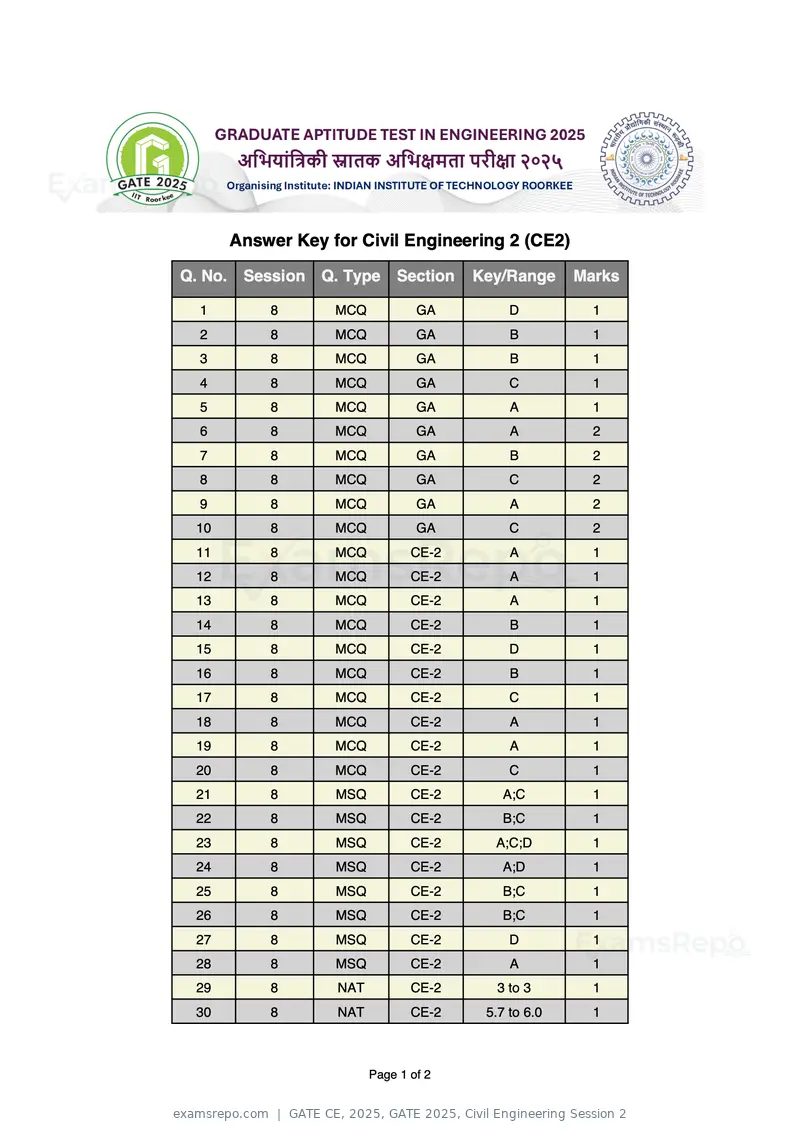
Text of page 1
Answer Key for Civil Engineering 2 (CE2)

Q. No. Session   Q. Type    Section   Key/Range     Marks

  1       8       MCQ           GA         D          1
  2       8       MCQ           GA         B          1
  3       8       MCQ           GA         B          1
  4       8       MCQ           GA         C          1
  5       8       MCQ           GA         A          1
  6       8       MCQ           GA         A          2
  7       8       MCQ           GA         B          2
  8       8       MCQ           GA         C          2
  9       8       MCQ           GA         A          2
 10       8       MCQ           GA         C          2
 11       8       MCQ          CE-2        A          1
 12       8       MCQ          CE-2        A          1
 13       8       MCQ          CE-2        A          1
 14       8       MCQ          CE-2        B          1
 15       8       MCQ          CE-2        D          1
 16       8       MCQ          CE-2        B          1
 17       8       MCQ          CE-2        C          1
 18       8       MCQ          CE-2        A          1
 19       8       MCQ          CE-2        A          1
 20       8       MCQ          CE-2        C          1
 21       8       MSQ          CE-2       A;C         1
 22       8       MSQ          CE-2       B;C         1
 23       8       MSQ          CE-2     A;C;D         1
 24       8       MSQ          CE-2       A;D         1
 25       8       MSQ          CE-2       B;C         1
 26       8       MSQ          CE-2       B;C         1
 27       8       MSQ          CE-2        D          1
 28       8       MSQ          CE-2        A          1
 29       8       NAT          CE-2     3 to 3        1
 30       8       NAT          CE-2    5.7 to 6.0     1


                        Page 1 of 2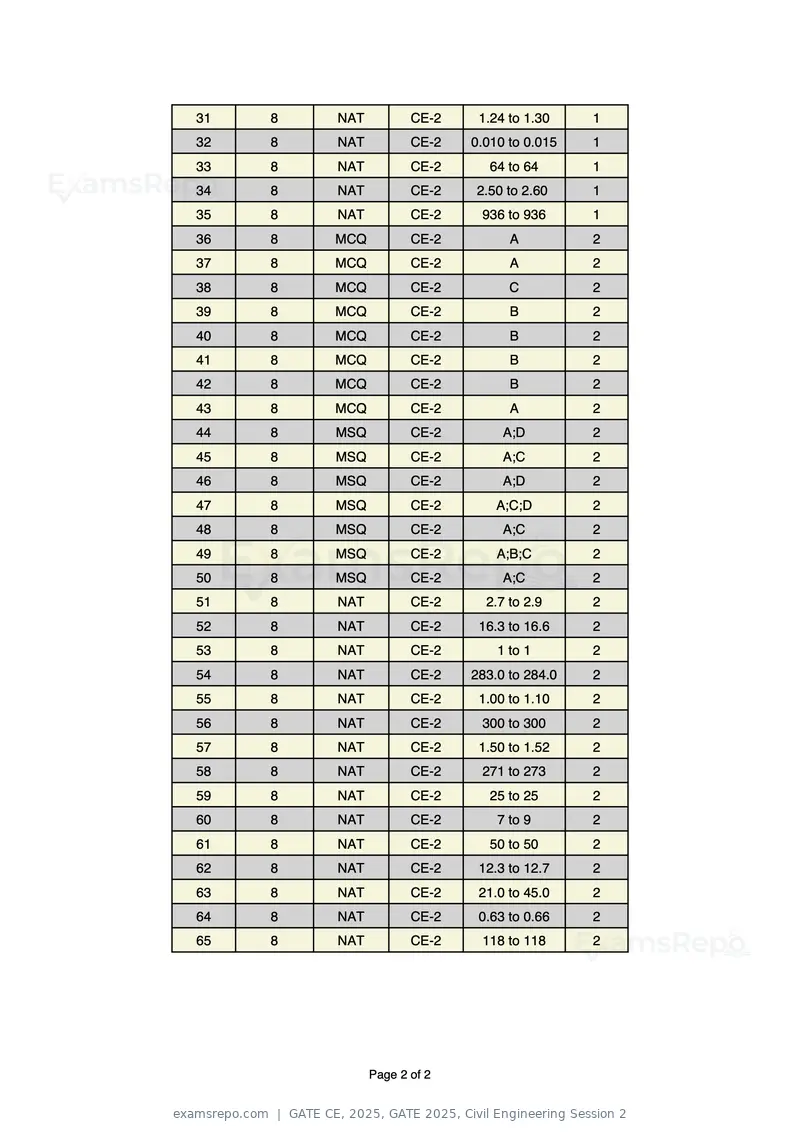
Text of page 2
31   8   NAT          CE-2    1.24 to 1.30    1
32   8   NAT          CE-2   0.010 to 0.015   1
33   8   NAT          CE-2      64 to 64      1
34   8   NAT          CE-2   2.50 to 2.60     1
35   8   NAT          CE-2    936 to 936      1
36   8   MCQ          CE-2         A          2
37   8   MCQ          CE-2         A          2
38   8   MCQ          CE-2         C          2
39   8   MCQ          CE-2         B          2
40   8   MCQ          CE-2         B          2
41   8   MCQ          CE-2         B          2
42   8   MCQ          CE-2         B          2
43   8   MCQ          CE-2         A          2
44   8   MSQ          CE-2        A;D         2
45   8   MSQ          CE-2        A;C         2
46   8   MSQ          CE-2        A;D         2
47   8   MSQ          CE-2       A;C;D        2
48   8   MSQ          CE-2        A;C         2
49   8   MSQ          CE-2       A;B;C        2
50   8   MSQ          CE-2        A;C         2
51   8   NAT          CE-2     2.7 to 2.9     2
52   8   NAT          CE-2    16.3 to 16.6    2
53   8   NAT          CE-2       1 to 1       2
54   8   NAT          CE-2   283.0 to 284.0   2
55   8   NAT          CE-2    1.00 to 1.10    2
56   8   NAT          CE-2    300 to 300      2
57   8   NAT          CE-2    1.50 to 1.52    2
58   8   NAT          CE-2    271 to 273      2
59   8   NAT          CE-2      25 to 25      2
60   8   NAT          CE-2       7 to 9       2
61   8   NAT          CE-2      50 to 50      2
62   8   NAT          CE-2    12.3 to 12.7    2
63   8   NAT          CE-2    21.0 to 45.0    2
64   8   NAT          CE-2    0.63 to 0.66    2
65   8   NAT          CE-2    118 to 118      2


               Page 2 of 2
Page 1 of 37
Source: GATE. Question paper published by GATE.