
GATE CH 2014: Chemical Engineering
Text of page 1
GATE 2014: General Instructions during Examination

   1. Total duration of the GATE examination is 180 minutes.
   2. The clock will be set at the server. The countdown timer at the top right corner of
      screen will display the remaining time available for you to complete the examination.
      When the timer reaches zero, the examination will end by itself. You need not
      terminate the examination or submit your paper.
   3. Any useful data required for your paper can be viewed by clicking on the Useful
      Common Data button that appears on the screen.
   4. Use the scribble pad provided to you for any rough work. Submit the scribble pad at
      the end of the examination.
   5. You are allowed to use a non-programmable type calculator, however, sharing of
      calculators is not allowed.
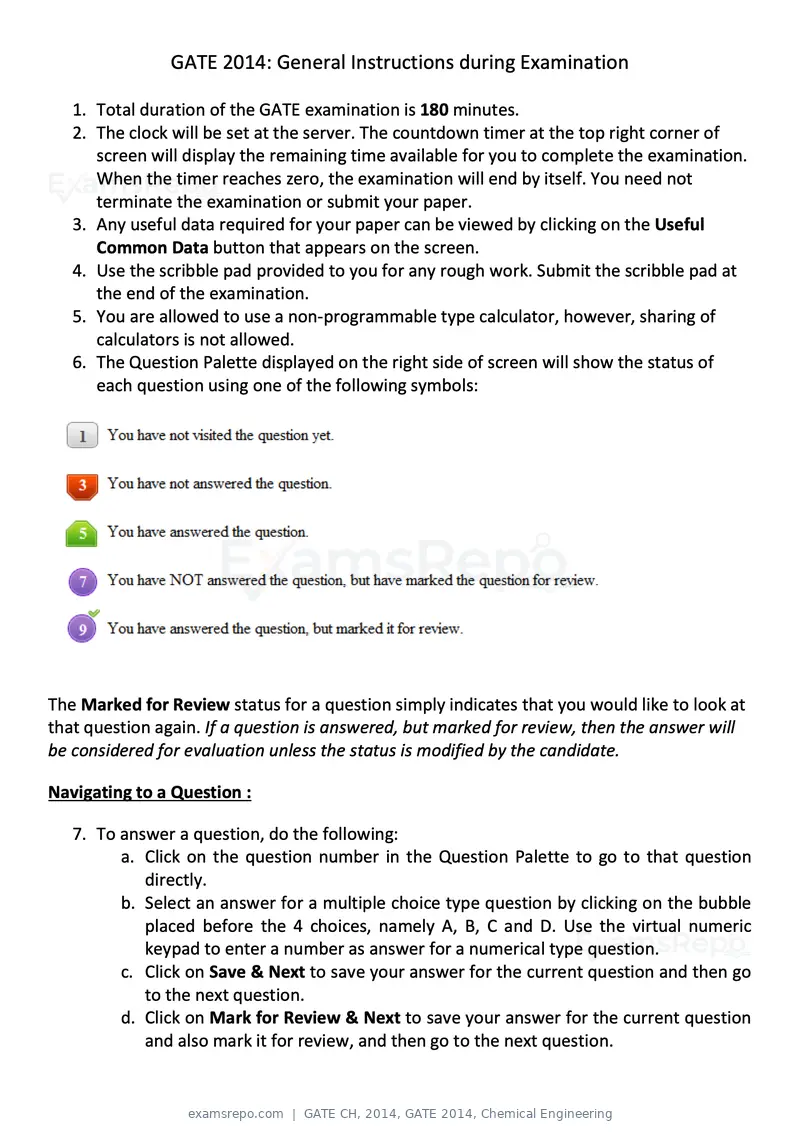
   6. The Question Palette displayed on the right side of screen will show the status of
      each question using one of the following symbols:


The Marked for Review status for a question simply indicates that you would like to look at
that question again. If a question is answered, but marked for review, then the answer will
be considered for evaluation unless the status is modified by the candidate.

Navigating to a Question :

   7. To answer a question, do the following:
         a. Click on the question number in the Question Palette to go to that question
            directly.
         b. Select an answer for a multiple choice type question by clicking on the bubble
            placed before the 4 choices, namely A, B, C and D. Use the virtual numeric
            keypad to enter a number as answer for a numerical type question.
         c. Click on Save & Next to save your answer for the current question and then go
            to the next question.
         d. Click on Mark for Review & Next to save your answer for the current question
            and also mark it for review, and then go to the next question.
Text of page 2
Caution: Note that your answer for the current question will not be saved, if you navigate
to another question directly by clicking on a question number without saving the answer to
the previous question.

You can view all the questions by clicking on the Question Paper button. This feature is
provided, so that if you want you can just see the entire question paper at a glance.

Answering a Question :

   8. Procedure for answering a multiple choice (MCQ) type question:
         a. Choose one answer from the 4 options (A,B,C,D) given below the question,
            click on the bubble placed before the chosen option.
         b. To deselect your chosen answer, click on the bubble of the chosen option again
            or click on the Clear Response button.
         c. To change your chosen answer, click on the bubble of another option.
         d. To save your answer, you MUST click on the Save & Next button.

   9. Procedure for answering a numerical answer type question:
         a. To enter a number as your answer, use the virtual numerical keypad.
         b. A fraction (e.g. -0.3 or -.3) can be entered as an answer with or without '0'
             before the decimal point. As many as four decimal points, e.g. 12.5435 or
             0.003 or -932.6711 or 12.82 can be entered.
         c. To clear your answer, click on the Clear Response button.
         d. To save your answer, you MUST click on the Save & Next button
   10. To mark a question for review, click on the Mark for Review & Next button. If an
      answer is selected (for MCQ) or entered (for numerical answer type) for a question
      that is Marked for Review, that answer will be considered in the evaluation unless
      the status is modified by the candidate.

   11. To change your answer to a question that has already been answered, first select
      that question for answering and then follow the procedure for answering that type of
      question.
   12. Note that ONLY Questions for which answers are saved or marked for review after
      answering will be considered for evaluation.


      Choosing a Section :

   13. Sections in this question paper are displayed on the top bar of the screen. Questions
      in a Section can be viewed by clicking on the name of that Section. The Section you
      are currently viewing will be highlighted.
   14. A checkbox is displayed for every optional Section, if any, in the Question Paper. To
      select the optional Section for answering, click on the checkbox for that Section.
   15. If the checkbox for an optional Section is not selected, the Save & Next button and
      the Mark for Review & Next button will NOT be enabled for that Section. You will
Text of page 3
only be able to see questions in this Section, but you will not be able to answer
      questions in the Section.
   16. After clicking the Save & Next button for the last question in a Section, you will
      automatically be taken to the first question of the next Section in sequence.
   17. You can move the mouse cursor over the name of a Section to view the answering
      status for that Section.


Changing the Optional Section :

   18. After answering the chosen optional Section, partially or completely, you can change
      the optional Section by selecting the checkbox for a new Section that you want to
      attempt. A warning message will appear along with a table showing the number of
      questions answered in each of the previously chosen optional Sections and a
      checkbox against each of these Sections. Click on a checkbox against a Section that
      you want to reset and then click on the RESET button. Note that RESETTING a Section
      will DELETE all the answers for questions in that Section. Hence, if you think that you
      may want to select this Section again later, you will have to note down your answers
      for questions in that Section. If you do not want to reset the Section and want to
      continue answering the previously chosen optional Section, then click on the BACK
      button.

   19. If you deselect the checkbox for an optional Section in the top bar, the following
      warning message will appear: "Deselecting the checkbox will DELETE all the answers
      for questions in this Section. Do you want to deselect this Section?” If you want to
      deselect, click on the RESET button. If you do not want to deselect, click on the BACK
      button.

   20. You can shuffle between different Sections or change the optional Sections any
      number of times.
Text of page 4
GATE 2014 Examination
                                      CH: Chemical Engineering
Duration: 180 minutes                                                                        Maximum Marks: 100

Read the following instructions carefully.

    1. To login, enter your Registration Number and password provided to you. Kindly go through the various
       symbols used in the test and understand their meaning before you start the examination.
    2. Once you login and after the start of the examination, you can view all the questions in the question
       paper, by clicking on the View All Questions button in the screen.
    3. This question paper consists of 2 sections, General Aptitude (GA) for 15 marks and the subject
       specific GATE paper for 85 marks. Both these sections are compulsory.
       The GA section consists of 10 questions. Question numbers 1 to 5 are of 1-mark each, while question
       numbers 6 to 10 are of 2-mark each.
       The subject specific GATE paper section consists of 55 questions, out of which question numbers 1 to
       25 are of 1-mark each, while question numbers 26 to 55 are of 2-mark each.
    4. Depending upon the GATE paper, there may be useful common data that may be required for
       answering the questions. If the paper has such useful data, the same can be viewed by clicking on the
       Useful Common Data button that appears at the top, right hand side of the screen.
    5. The computer allotted to you at the examination center runs specialized software that permits only one
        answer to be selected for multiple-choice questions using a mouse and to enter a suitable number for
        the numerical answer type questions using the virtual keyboard and mouse.
    6. Your answers shall be updated and saved on a server periodically and also at the end of the
        examination. The examination will stop automatically at the end of 180 minutes.
    7. In each paper a candidate can answer a total of 65 questions carrying 100 marks.
    8. The question paper may consist of questions of multiple choice type (MCQ) and numerical answer
        type.
    9. Multiple choice type questions will have four choices against A, B, C, D, out of which only ONE is the
        correct answer. The candidate has to choose the correct answer by clicking on the bubble (⃝) placed
        before the choice.
    10. For numerical answer type questions, each question will have a numerical answer and there will not be
        any choices. For these questions, the answer should be enteredby using the virtual keyboard that
        appears on the monitor and the mouse.
    11. All questions that are not attempted will result in zero marks. However, wrong answers for multiple
        choice type questions (MCQ) will result in NEGATIVE marks. For all MCQ questions a wrong
        answer will result in deduction of⅓ marks for a 1-mark question and ⅔ marks for a 2-mark question.
    12. There is NO NEGATIVE MARKING for questions of NUMERICAL ANSWER TYPE.
    13. Non-programmable type Calculator is allowed. Charts, graph sheets, and mathematical tables are NOT
        allowed in the Examination Hall. You must use the Scribble pad provided to you at the examination
        centre for all your rough work. The Scribble Pad has to be returned at the end of the examination.

    Declaration by the candidate:

    “I have read and understood all the above instructions. I have also read and understood clearly the
    instructions given on the admit card and shall follow the same. I also understand that in case I am found to
    violate any of these instructions, my candidature is liable to be cancelled. I also confirm that at the start of
    the examination all the computer hardware allotted to me are in proper working condition”.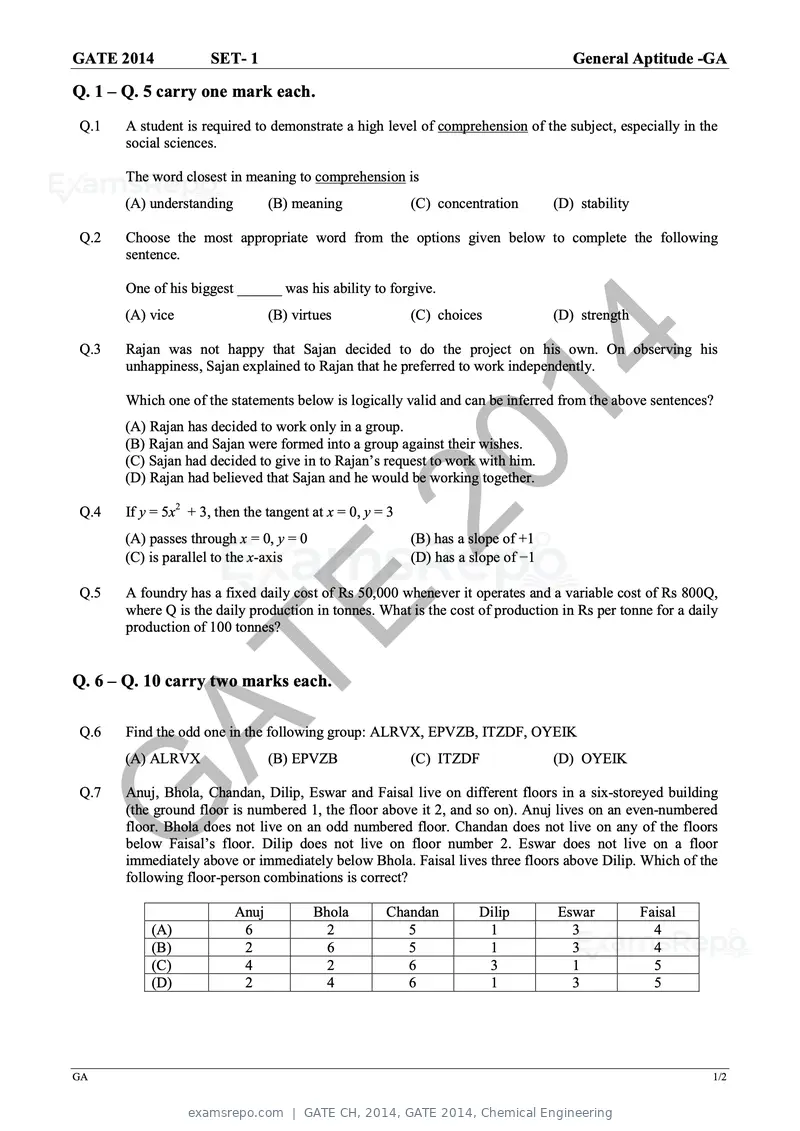
Text of page 5
GATE 2014             SET- 1                                                         General Aptitude -GA

Q. 1 – Q. 5 carry one mark each.
Q.1    A student is required to demonstrate a high level of comprehension of the subject, especially in the
       social sciences.

       The word closest in meaning to comprehension is
      (A) understanding          (B) meaning              (C) concentration       (D) stability

Q.2    Choose the most appropriate word from the options given below to complete the following
       sentence.

       One of his biggest ______ was his ability to forgive.
      (A) vice                   (B) virtues              (C) choices             (D) strength


                                           20
Q.3    Rajan was not happy that Sajan decided to do the project on his own. On observing his
       unhappiness, Sajan explained to Rajan that he preferred to work independently.

       Which one of the statements below is logically valid and can be inferred from the above sentences?


Q.4
                                             14
      (A) Rajan has decided to work only in a group.
      (B) Rajan and Sajan were formed into a group against their wishes.
      (C) Sajan had decided to give in to Rajan’s request to work with him.
      (D) Rajan had believed that Sajan and he would be working together.

       If y = 5x2 + 3, then the tangent at x = 0, y = 3
      (A) passes through x = 0, y = 0
      (C) is parallel to the x-axis
                                                          (B) has a slope of +1
                                                          (D) has a slope of −1

Q.5    A foundry has a fixed daily cost of Rs 50,000 whenever it operates and a variable cost of Rs 800Q,

                          E
       where Q is the daily production in tonnes. What is the cost of production in Rs per tonne for a daily
       production of 100 tonnes?


G
Q. 6 – Q. 10 carry two marks each.


 AT
Q.6


Q.7
       Find the odd one in the following group: ALRVX, EPVZB, ITZDF, OYEIK
      (A) ALRVX                  (B) EPVZB                (C) ITZDF               (D) OYEIK

       Anuj, Bhola, Chandan, Dilip, Eswar and Faisal live on different floors in a six-storeyed building
       (the ground floor is numbered 1, the floor above it 2, and so on). Anuj lives on an even-numbered
       floor. Bhola does not live on an odd numbered floor. Chandan does not live on any of the floors
       below Faisal’s floor. Dilip does not live on floor number 2. Eswar does not live on a floor
       immediately above or immediately below Bhola. Faisal lives three floors above Dilip. Which of the
       following floor-person combinations is correct?

                          Anuj          Bhola        Chandan         Dilip        Eswar           Faisal
           (A)             6              2             5             1             3               4
           (B)             2              6             5             1             3               4
           (C)             4              2             6             3             1               5
           (D)             2              4             6             1             3               5


GA                                                                                                         1/2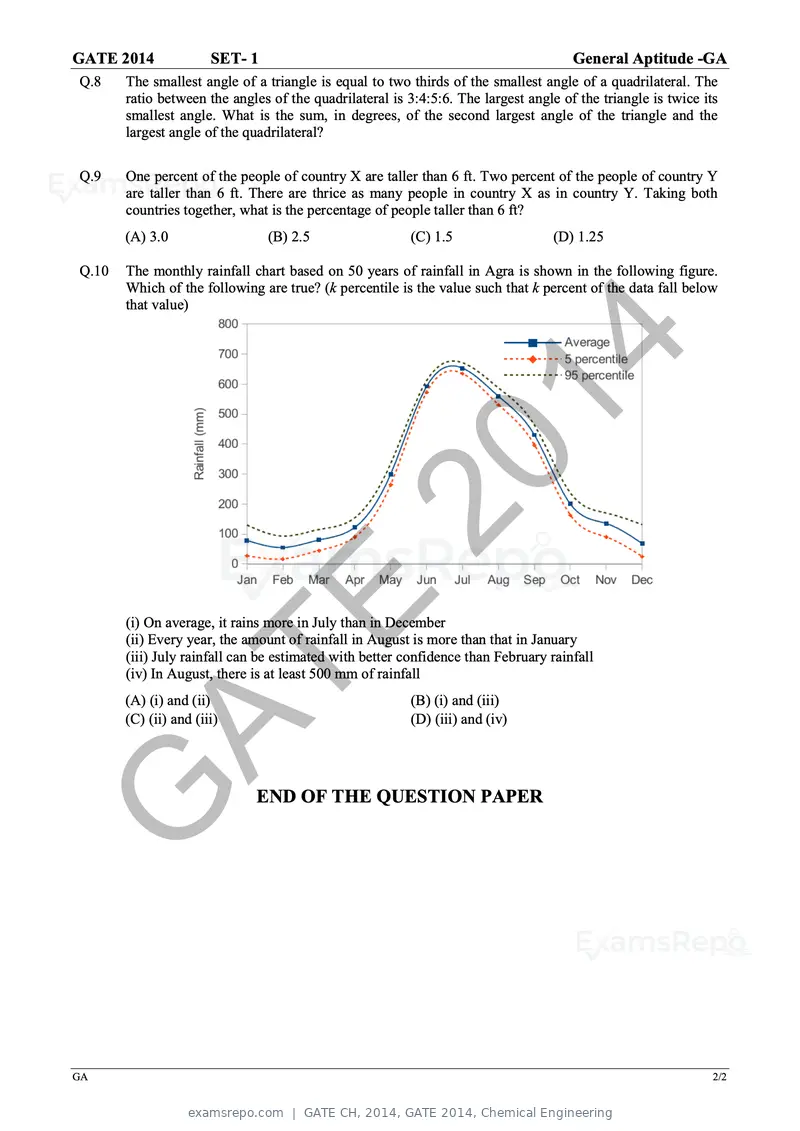
Text of page 6
GATE 2014              SET- 1                                                        General Aptitude -GA
Q.8    The smallest angle of a triangle is equal to two thirds of the smallest angle of a quadrilateral. The
       ratio between the angles of the quadrilateral is 3:4:5:6. The largest angle of the triangle is twice its
       smallest angle. What is the sum, in degrees, of the second largest angle of the triangle and the
       largest angle of the quadrilateral?

Q.9    One percent of the people of country X are taller than 6 ft. Two percent of the people of country Y
       are taller than 6 ft. There are thrice as many people in country X as in country Y. Taking both
       countries together, what is the percentage of people taller than 6 ft?
       (A) 3.0                  (B) 2.5                  (C) 1.5                  (D) 1.25

Q.10   The monthly rainfall chart based on 50 years of rainfall in Agra is shown in the following figure.
       Which of the following are true? (k percentile is the value such that k percent of the data fall below
       that value)


                                          2014
                            E
       (i) On average, it rains more in July than in December
       (ii) Every year, the amount of rainfall in August is more than that in January
       (iii) July rainfall can be estimated with better confidence than February rainfall


GAT
       (iv) In August, there is at least 500 mm of rainfall
       (A) (i) and (ii)
       (C) (ii) and (iii)


                             END OF THE QUESTION PAPER
                                                         (B) (i) and (iii)
                                                         (D) (iii) and (iv)


GA                                                                                                            2/2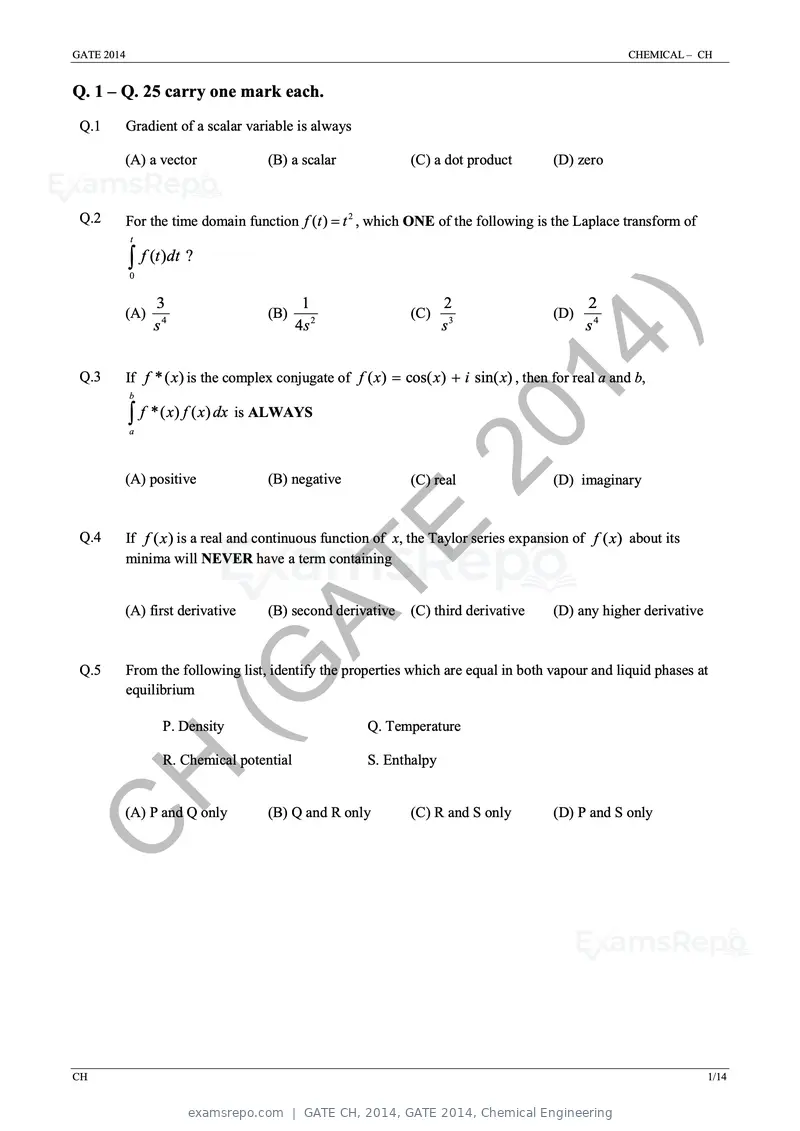
Text of page 7
GATE 2014                                                                                          CHEMICAL – CH


Q. 1 – Q. 25 carry one mark each.
 Q.1        Gradient of a scalar variable is always

        (A) a vector                (B) a scalar             (C) a dot product        (D) zero


 Q.2        For the time domain function f (t ) = t 2 , which ONE of the following is the Laplace transform of
            t

            ∫ f (t )dt ?
            0


                3                          1                        2                       2
        (A)                         (B)                      (C)                      (D)


 Q.3
                s4                        4s 2


                                                  =
            If f *( x) is the complex conjugate of f (
            b

            ∫ f *( x) f ( x) dx is ALWAYS
                                                              2014
                                                                    s3                      s4


                                                       x) cos( x) + i sin( x) , then for real a and b,


            a


        (A) positive                (B) negative                   )
                                                             (C) real                 (D) imaginary


 Q.4

                                 AT
            If f ( x) is a real and continuous function of x, the Taylor series expansion of f ( x) about its
            minima will NEVER have a term containing


        (A) first derivative
                                    E
                                    (B) second derivative    (C) third derivative     (D) any higher derivative


 Q.5

                     (G
            From the following list, identify the properties which are equal in both vapour and liquid phases at
            equilibrium

                  P. Density

                  R. Chemical potential
                                                      Q. Temperature

                                                      S. Enthalpy

     H  (A) P and Q only            (B) Q and R only         (C) R and S only         (D) P and S only

C

CH                                                                                                                1/14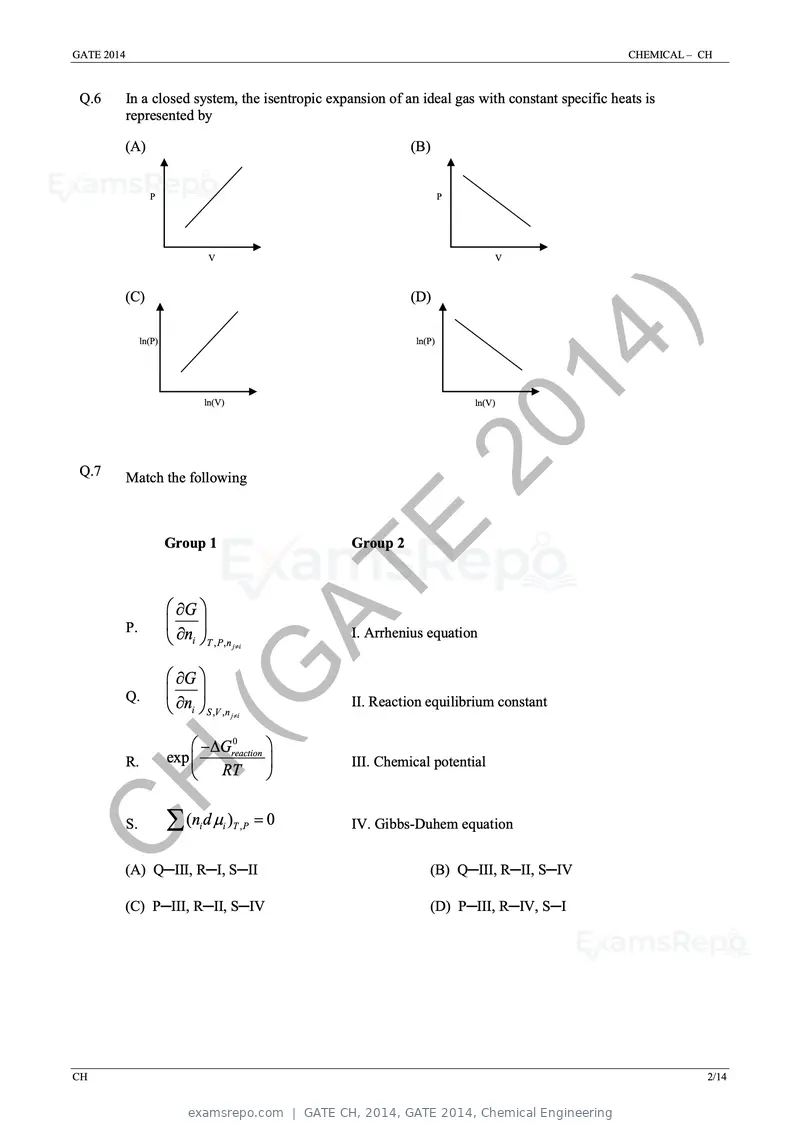
Text of page 8
GATE 2014 CHEMICAL – CH
Q.6 In a closed system, the isentropic expansion of an ideal gas with constant specific heats is
represented by
(A) (B)
P P
V V
(C) (D)
ln(P)
ln(V)
20
ln(P)
14 ln(V)
Q.7 Match the following )
Group 1
AT Group 2
P.
∂G
∂ni T , P ,n j≠i E I. Arrhenius equation
Q.
(G
∂G
∂ni S ,V ,n j≠i
−∆Greaction
exp
0
II. Reaction equilibrium constant
R. III. Chemical potential
RT
H ∑ (n d µ ) =0
C S.
(A) Q─III, R─I, S─II
i i T ,P IV. Gibbs-Duhem equation
(B) Q─III, R─II, S─IV
(C) P─III, R─II, S─IV (D) P─III, R─IV, S─I
CH 2/14
Text of page 9
GATE 2014                                                                                          CHEMICAL – CH


 Q.8        In order to achieve the same conversion under identical reaction conditions and feed flow rate for a
            non-autocatalytic reaction of positive order, the volume of an ideal CSTR is


            (A) always greater than that of an ideal PFR

            (B) always smaller than that of an ideal PFR

            (C) same as that of an ideal PFR

            (D) smaller than that of an ideal PFR only for first order reaction


 Q.9
                                                              20
            Integral of the time-weighted absolute error (ITAE) is expressed as


              ε (t )
                 ∞
                                          ε (t )
                                          ∞
                                                                14  ∞                     ∞

        (A) ∫                       (B) ∫                           ∫ t ε (t ) dt         ∫ t ε (t ) dt
                                                                   )
                                                                                               2
                     dt                          dt           (C)                   (D)
                 2                          t
            0
               t                        0                           0                     0


 Q.10       A unit IMPULSE response of a first order system with time constant τ and steady state gain K p is
            given by


                 1 et /τ         AT       K pe−t /τ                 τ K p e−t /τ          K p −t /τ


 Q.11
        (A)
                K pτ
                                    E
                                    (B)                       (C)                   (D)
                                                                                           τ
                                                                                             e

            In a completely opaque medium, if 50% of the incident monochromatic radiation is absorbed, then


                     (G
            which of the following statements are CORRECT?

            P. 50% of the incident radiation is reflected
            Q. 25% of the incident radiation is reflected
            R. 25% of the incident radiation is transmitted

     H      S. No incident radiation is transmitted


CQ.12
        (A) P and S only            (B) Q and R only          (C) P and Q only      (D) R and S only


            In case of a pressure driven laminar flow of a Newtonian fluid of viscosity (µ) through a horizontal
            circular pipe, the velocity of the fluid is proportional to


        (A)     µ                   (B)   µ 0.5               (C)   µ −1            (D)   µ − 0.5


CH                                                                                                             3/14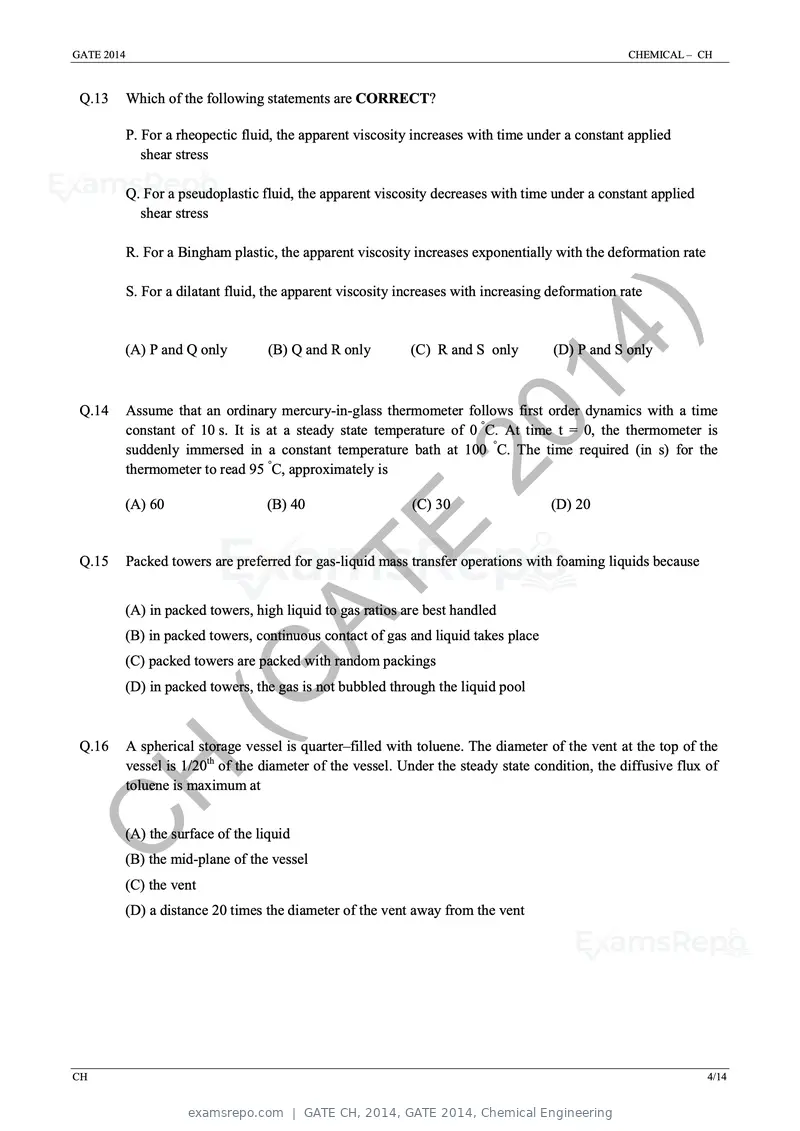
Text of page 10
GATE 2014                                                                                          CHEMICAL – CH


 Q.13       Which of the following statements are CORRECT?

            P. For a rheopectic fluid, the apparent viscosity increases with time under a constant applied
               shear stress

            Q. For a pseudoplastic fluid, the apparent viscosity decreases with time under a constant applied
              shear stress

            R. For a Bingham plastic, the apparent viscosity increases exponentially with the deformation rate

            S. For a dilatant fluid, the apparent viscosity increases with increasing deformation rate


 Q.14
        (A) P and Q only            (B) Q and R only
                                                             20
                                                             (C) R and S only


                                                               14
                                                                                      (D) P and S only


            Assume that an ordinary mercury-in-glass thermometer follows first order dynamics with a time


                                                                  )
            constant of 10 s. It is at a steady state temperature of 0 °C. At time t = 0, the thermometer is
            suddenly immersed in a constant temperature bath at 100 °C. The time required (in s) for the
            thermometer to read 95 °C, approximately is

        (A) 60                      (B) 40                   (C) 30                   (D) 20


 Q.15
                                 AT
            Packed towers are preferred for gas-liquid mass transfer operations with foaming liquids because


                                    E
        (A) in packed towers, high liquid to gas ratios are best handled
        (B) in packed towers, continuous contact of gas and liquid takes place
        (C) packed towers are packed with random packings


 Q.16
                   (G
        (D) in packed towers, the gas is not bubbled through the liquid pool


            A spherical storage vessel is quarter–filled with toluene. The diameter of the vent at the top of the
            vessel is 1/20th of the diameter of the vessel. Under the steady state condition, the diffusive flux of

     H      toluene is maximum at


C       (A) the surface of the liquid
        (B) the mid-plane of the vessel
        (C) the vent
        (D) a distance 20 times the diameter of the vent away from the vent


CH                                                                                                               4/14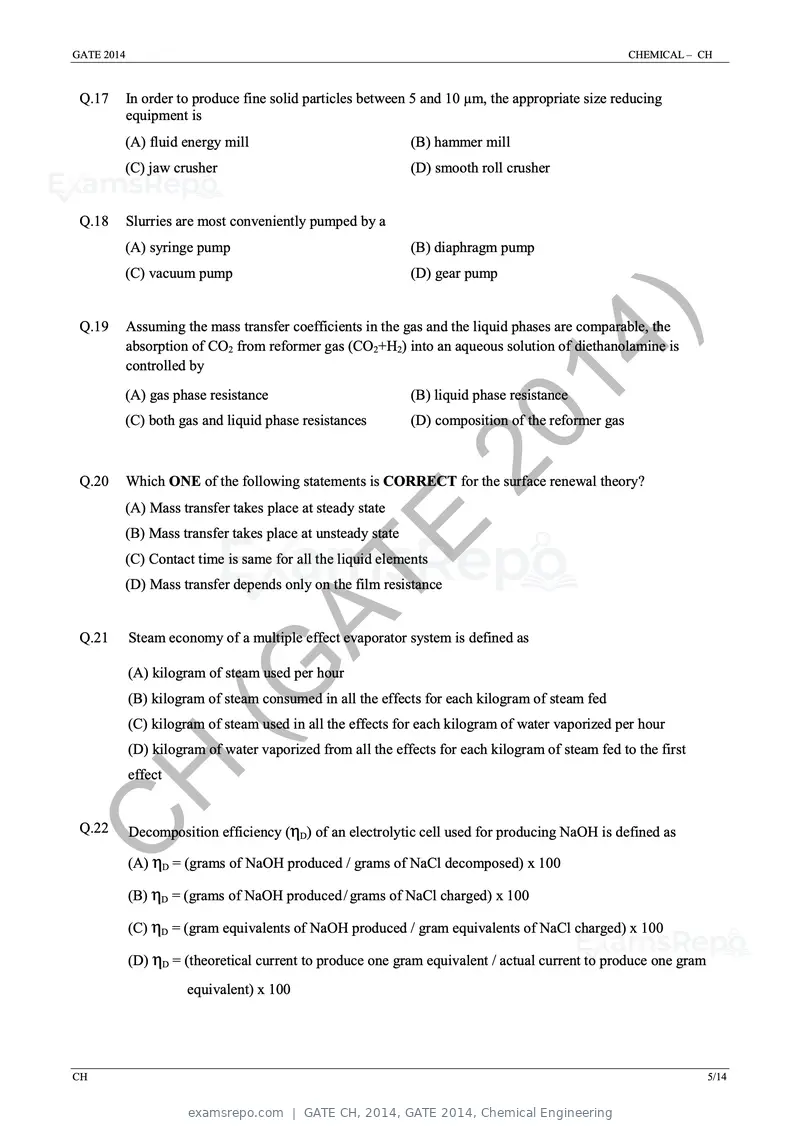
Text of page 11
GATE 2014                                                                                         CHEMICAL – CH


 Q.17       In order to produce fine solid particles between 5 and 10 µm, the appropriate size reducing
            equipment is
        (A) fluid energy mill                               (B) hammer mill
        (C) jaw crusher                                     (D) smooth roll crusher


 Q.18       Slurries are most conveniently pumped by a
        (A) syringe pump                                    (B) diaphragm pump
        (C) vacuum pump                                     (D) gear pump


 Q.19


                                                            20
            Assuming the mass transfer coefficients in the gas and the liquid phases are comparable, the
            absorption of CO2 from reformer gas (CO2+H2) into an aqueous solution of diethanolamine is
            controlled by
        (A) gas phase resistance
                                                              14
                                                            (B) liquid phase resistance


                                                                 )
        (C) both gas and liquid phase resistances           (D) composition of the reformer gas


 Q.20       Which ONE of the following statements is CORRECT for the surface renewal theory?
        (A) Mass transfer takes place at steady state


                                AT
        (B) Mass transfer takes place at unsteady state
        (C) Contact time is same for all the liquid elements


                                   E
        (D) Mass transfer depends only on the film resistance


 Q.21       Steam economy of a multiple effect evaporator system is defined as


                     (G
            (A) kilogram of steam used per hour
            (B) kilogram of steam consumed in all the effects for each kilogram of steam fed
            (C) kilogram of steam used in all the effects for each kilogram of water vaporized per hour
            (D) kilogram of water vaporized from all the effects for each kilogram of steam fed to the first


     H      effect


CQ.22       Decomposition efficiency (ηD) of an electrolytic cell used for producing NaOH is defined as

            (A) ηD = (grams of NaOH produced / grams of NaCl decomposed) x 100

            (B) ηD = (grams of NaOH produced / grams of NaCl charged) x 100

            (C) ηD = (gram equivalents of NaOH produced / gram equivalents of NaCl charged) x 100

            (D) ηD = (theoretical current to produce one gram equivalent / actual current to produce one gram
                      equivalent) x 100


CH                                                                                                              5/14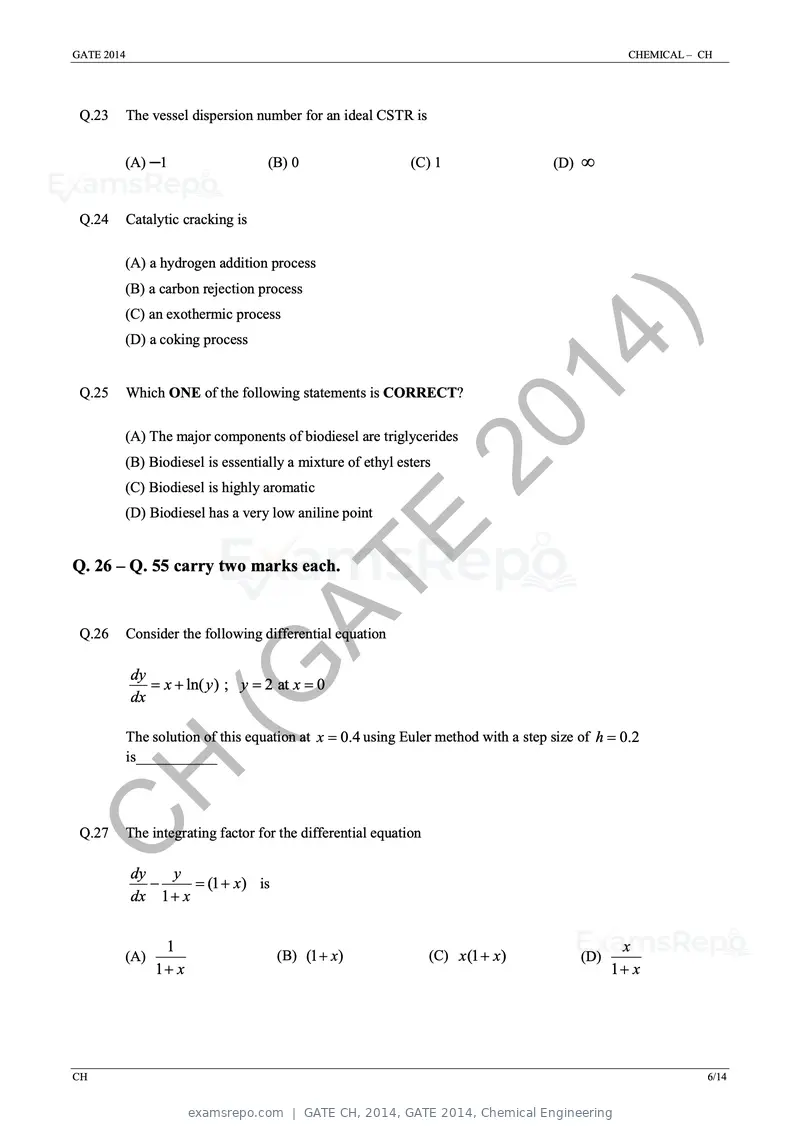
Text of page 12
GATE 2014                                                                                        CHEMICAL – CH


 Q.23       The vessel dispersion number for an ideal CSTR is


        (A) ─1                       (B) 0                    (C) 1                 (D) ∞


 Q.24       Catalytic cracking is

        (A) a hydrogen addition process
        (B) a carbon rejection process
        (C) an exothermic process


 Q.25
        (D) a coking process


            Which ONE of the following statements is CORRECT?
                                                              2014
        (A) The major components of biodiesel are triglycerides
        (B) Biodiesel is essentially a mixture of ethyl esters
        (C) Biodiesel is highly aromatic
        (D) Biodiesel has a very low aniline point
                                                                   )
Q. 26 – Q. 55 carry two marks each.
                                    AT
 Q.26                                  E
            Consider the following differential equation

            dy
            dx
               =
               x+
                   (G        =
                  ln( y ) ; y 2 at  =
                                   x 0


            The solution of this equation at x = 0.4 using Euler method with a step size of h = 0.2
            is___________

     H
CQ.27       The integrating factor for the differential equation

            dy
               −
                 y
            dx 1 + x
                     =+
                     (1 x) is


                  1                                                                             x
        (A)                           (B) (1 + x)                  (C) x(1 + x)          (D)
                 1+ x                                                                          1+ x


CH                                                                                                           6/14
Text of page 13
GATE 2014 CHEMICAL – CH
Q.28 d2y dy
The differential equation 2
+ x2 + x3 y e
= x
is a
dx dx
(A) non-linear differential equation of first degree
(B) linear differential equation of first degree
(C) linear differential equation of second degree
(D) non-linear differential equation of second degree
Q.29 Consider the following two normal distributions
= ) exp(−π x 2 )
f1 ( x
=
f2 ( x)
1
2π
1 2
exp −
4π
( x + 2 x + 1)
2014
If µ and σ denote the mean and standard deviation, respectively, then
(A) µ1 < µ 2 and σ 1 < σ 2
2
(C) µ1 > µ 2 and σ 1 < σ 2
2
2
2 )
(B) µ1 < µ 2 and σ 1 > σ 2
2 2
(D) µ1 > µ 2 and σ 1 > σ 2
2 2
Q.30
AT
In rolling of two fair dice, the outcome of an experiment is considered to be the sum of the numbers
appearing on the dice. The probability is highest for the outcome of ____________
Q.31
E
A spherical ball of benzoic acid (diameter = 1.5 cm) is submerged in a pool of still water. The
solubility and diffusivity of benzoic acid in water are 0.03 kmol/m3 and 1.25 x 10⁻⁹ m2/s
(G
respectively. Sherwood number is given as Sh = 2.0 + 0.6 Re0.5Sc0.33. The initial rate of dissolution
(in kmol/s) of benzoic acid approximately is
(A) 3.54×10⁻¹¹ (B) 3.54×10⁻¹² (C) 3.54×10⁻¹³ (D) 3.54×10⁻¹⁴
H
CQ.32 A wet solid of 100 kg is dried from a moisture content of 40 wt% to 10 wt%. The critical moisture
content is 15 wt% and the equilibrium moisture content is negligible. All moisture contents are on
dry basis. The falling rate is considered to be linear. It takes 5 hours to dry the material in the
constant rate period. The duration (in hours) of the falling rate period is ___________
CH 7/14
Text of page 14
GATE 2014 CHEMICAL – CH
Q.33 A brick wall of 20 cm thickness has thermal conductivity of 0.7 W m-1 K-1. An insulation of
thermal conductivity 0.2 W m-1 K-1 is to be applied on one side of the wall, so that the heat transfer
through the wall is reduced by 75%. The same temperature difference is maintained across the wall
before and after applying the insulation. The required thickness (in cm) of the insulation is
____________
Q.34 An oil with a flow rate of 1000 kg/h is to be cooled using water in a double-pipe counter-flow heat
exchanger from a temperature of 70 °C to 40 °C. Water enters the exchanger at 25 °C and leaves at
40 °C. The specific heats of oil and water are 2 kJ kg-1 K-1 and 4.2 kJ kg-1 K-1, respectively. The
20
overall heat transfer coefficient is 0.2 kW m-2 K-1. The minimum heat exchanger area (in m2)
required for this operation is ______________
14
Q.35
)
Which ONE of the following is CORRECT for an ideal gas in a closed system?
(A)
∂U ∂U
V = nR
∂V S
∂S V
(B) −
∂H
=
∂H
P nR
∂P S
∂S P
∂U ∂H ∂H ∂U
(C) V = nR
∂V S
AT
∂S P
(D) P = nR
∂P S
∂S V
Q.36
E
A binary distillation column is operating with a mixed feed containing 20 mol% vapour. If the feed
quality is changed to 80 mol% vapour, the change in the slope of the q-line is ________________
(G
Q.37 A homogeneous reaction ( R → P ) occurs in a batch reactor. The conversion of the reactant R is
67% after 10 minutes and 80% after 20 minutes. The rate equation for this reaction is
H (A) − rR =
k
(C) − rR =
k CR 3
(B) − rR =
k CR
(D) − rR =
2
k CR0.5
C
CH 8/14
Text of page 15
GATE 2014 CHEMICAL – CH
Q.38 A vapour phase catalytic reaction ( Q + R → S ) follows Rideal mechanism (R and S are not
adsorbed). Initially, the mixture contains only the reactants in equimolar ratio. The surface reaction
step is rate controlling. With constants a and b, the initial rate of reaction ( − ro ) in terms of total
pressure ( PT ) is given by
aPT aPT
(A) − ro = (B) − ro =
1 + bPT 1 + bPT2
aPT2 aPT2
(C) − ro = (D) − ro =
1 + bPT (1 + bPT ) 2
Q.39
20
An incompressible fluid is flowing through a contraction section of length L and has a 1-D (x-
direction) steady state velocity distribution,=
14
u u0 1 +
2x
L
. If u0 = 2 m/s and L = 3 m, the
Q.40
)
convective acceleration (in m/s2) of the fluid at L is _____________
Match the following
Group 1
AT Group 2
P.
Q.
R. E
Tank in series model
Liquid-liquid extraction
Optimum temperature progression
I.
II.
III.
Non-isothermal reaction
Mixer-settler
PFR with axial mixing
S.
(G
Thiele modulus
(A) P─II, Q─IV, R─I, S─III
IV. Solid catalyzed reaction
(B) P─I, Q─II, R─III, S─IV
H (C) P─III, Q─I, R─II, S─IV (D) P─III, Q─II, R─I, S─IV
CQ.41 Two elemental gases (A and B) are reacting to form a liquid (C) in a steady state process as per the
reaction A + B → C . The single-pass conversion of the reaction is only 20% and hence recycle is
used. The product is separated completely in pure form. The fresh feed has 49 mol% of A and B
each along with 2 mol% impurities. The maximum allowable impurities in the recycle stream is 20
mol%. The amount of purge stream (in moles) per 100 moles of the fresh feed is ___________
CH 9/14
Text of page 16
GATE 2014                                                                                       CHEMICAL – CH


 Q.42       Carbon monoxide (CO) is burnt in presence of 200% excess pure oxygen and the flame temperature
            achieved is 2298 K. The inlet streams are at 25 °C. The standard heat of formation (at 25 °C) of CO
            and CO2 are ─110 kJ mol-1 and ─390 kJ mol-1, respectively. The heat capacities (in J mol-1 K-1) of
            the components are

                            C pO = 25 + 14 ×10−3 T
                                2


                            C pCO = 25 + 42 ×10−3 T
                                    2


            where, T is the temperature in K. The heat loss (in kJ) per mole of CO burnt is_____________


 Q.43
                                                               20
            A cash flow of Rs. 12,000 per year is received at the end of each year (uniform periodic payment)
            for 7 consecutive years. The rate of interest is 9% per year compounded annually. The present


                                                                 14
            worth (in Rs.) of such cash flow at time zero is __________


 Q.44
                                                                    )
        A polymer plant with a production capacity of 10,000 tons per year has an overall yield of 70%, on
        mass basis (kg of product per kg of raw material). The raw material costs Rs. 50,000 per ton. A
        process modification is proposed to increase the overall yield to 75% with an investment of Rs. 12.5
        crore. In how many years can the invested amount be recovered with the additional profit?
        ___________

                                AT
 Q.45

                                   E
        A step change of magnitude 2 is introduced into a system having the following transfer function


                                                     G (s) =
                                                                   2
                                                               s + 2s + 4
                                                                2


                  (G
        The percent overshoot is ____________


     H
C

CH                                                                                                          10/14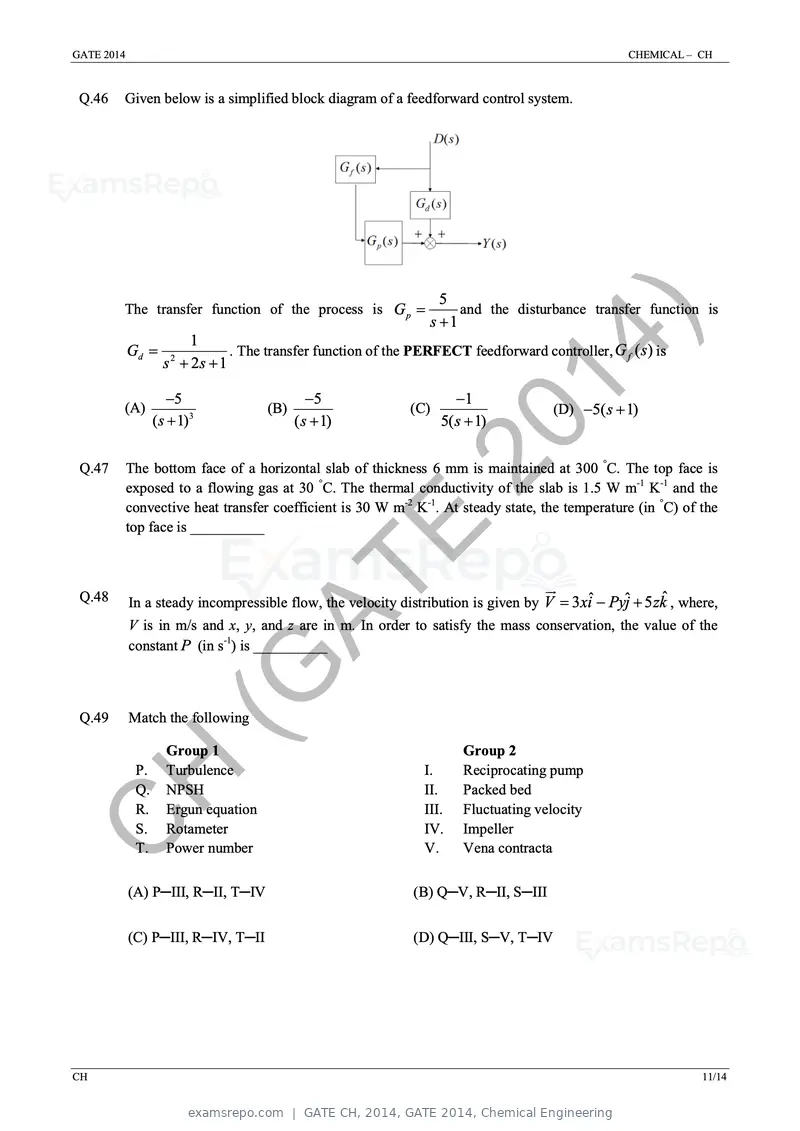
Text of page 17
GATE 2014 CHEMICAL – CH
Q.46 Given below is a simplified block diagram of a feedforward control system.
5
The transfer function of the process is G p = and the disturbance transfer function is
s +1
(A)
Gd =
1
s + 2s + 1
2
−5
( s + 1)3
20
. The transfer function of the PERFECT feedforward controller, G f ( s ) is
(B)
−5
( s + 1) 14
(C)
−1
5( s + 1)
(D) −5( s + 1)
Q.47 )
The bottom face of a horizontal slab of thickness 6 mm is maintained at 300 °C. The top face is
exposed to a flowing gas at 30 °C. The thermal conductivity of the slab is 1.5 W m-1 K-1 and the
convective heat transfer coefficient is 30 W m-2 K-1. At steady state, the temperature (in °C) of the
top face is __________
AT
Q.48
E
In a steady incompressible flow, the velocity distribution is given by V = 3 xiˆ − Pyjˆ + 5 zkˆ , where,
V is in m/s and x, y, and z are in m. In order to satisfy the mass conservation, the value of the
constant P (in s-1) is __________
Q.49
(G
Match the following
Group 1 Group 2
H P.
Q.
R.
Turbulence
NPSH
Ergun equation
I.
II.
III.
Reciprocating pump
Packed bed
Fluctuating velocity
C S.
T.
Rotameter
Power number
(A) P─III, R─II, T─IV
IV.
V.
Impeller
Vena contracta
(B) Q─V, R─II, S─III
(C) P─III, R─IV, T─II (D) Q─III, S─V, T─IV
CH 11/14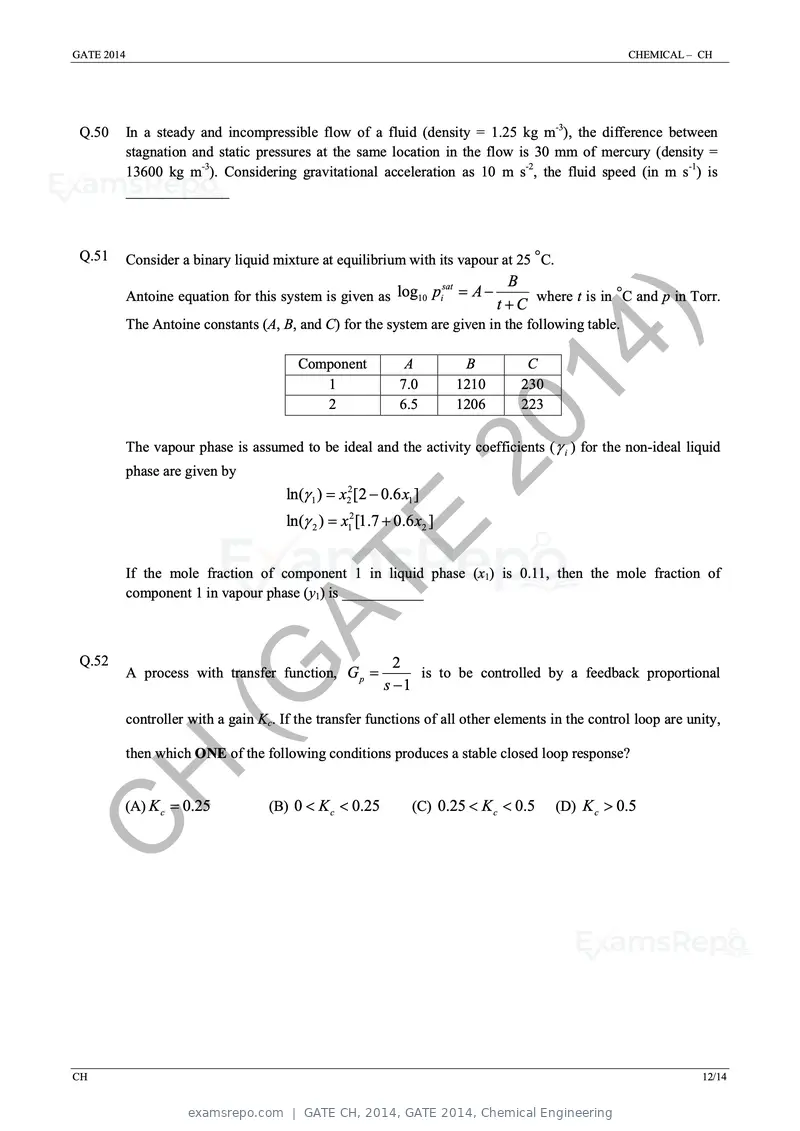
Text of page 18
GATE 2014                                                                                           CHEMICAL – CH


 Q.50       In a steady and incompressible flow of a fluid (density = 1.25 kg m-3), the difference between
            stagnation and static pressures at the same location in the flow is 30 mm of mercury (density =
            13600 kg m-3). Considering gravitational acceleration as 10 m s-2, the fluid speed (in m s-1) is
            ______________


 Q.51       Consider a binary liquid mixture at equilibrium with its vapour at 25 °C.
                                                                               B
            Antoine equation for this system is given as log10 pi = A −
                                                                 sat
                                                                                  where t is in °C and p in Torr.
                                                                             t +C


                                                               20
            The Antoine constants (A, B, and C) for the system are given in the following table.

                                          Component
                                             1
                                             2
                                                              A
                                                             7.0
                                                             6.5
                                                                 14
                                                                       B
                                                                      1210
                                                                      1206
                                                                                  C
                                                                                 230
                                                                                 223


                                                                    )
            The vapour phase is assumed to be ideal and the activity coefficients ( γ i ) for the non-ideal liquid
            phase are given by
                                        ln(γ
                                          =
                                        ln(γ
                                         =
                                             1) x22 [2 − 0.6 x1 ]
                                                x12 [1.7 + 0.6 x2 ]
                                             2)


                                 AT
            If the mole fraction of component 1 in liquid phase (x1) is 0.11, then the mole fraction of


 Q.52
                                    E
            component 1 in vapour phase (y1) is ___________


            A process with transfer function, G p =
                                                            2

                   (G                                     s −1
                                                               is to be controlled by a feedback proportional


            controller with a gain Kc. If the transfer functions of all other elements in the control loop are unity,

            then which ONE of the following conditions produces a stable closed loop response?


     H      (A) K c = 0.25           (B) 0 < K c < 0.25        (C) 0.25 < K c < 0.5     (D) K c > 0.5


C

CH                                                                                                               12/14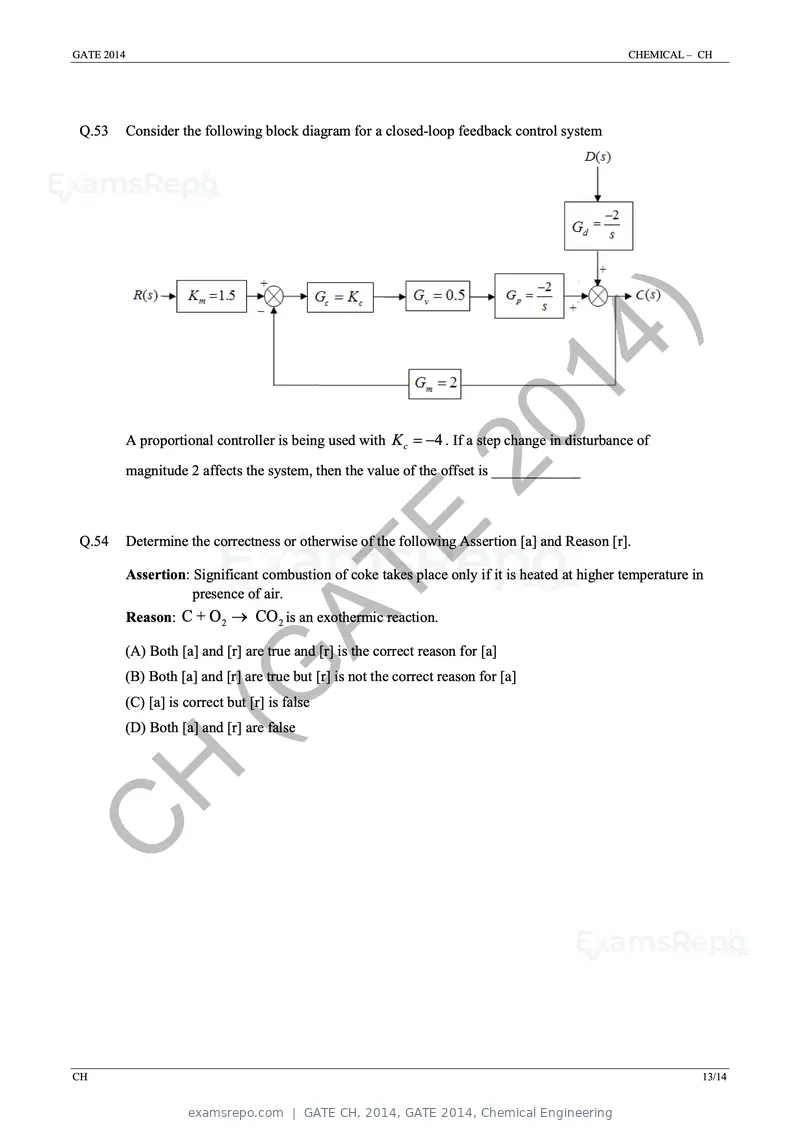
Text of page 19
GATE 2014                                                                                         CHEMICAL – CH


 Q.53       Consider the following block diagram for a closed-loop feedback control system


                                                                2014 )
            A proportional controller is being used with K c = −4 . If a step change in disturbance of

            magnitude 2 affects the system, then the value of the offset is ____________


 Q.54

                                   AT
            Determine the correctness or otherwise of the following Assertion [a] and Reason [r].

            Assertion: Significant combustion of coke takes place only if it is heated at higher temperature in


                                      E
                       presence of air.
            Reason: C + O 2 → CO 2 is an exothermic reaction.

            (A) Both [a] and [r] are true and [r] is the correct reason for [a]


                   (G
            (B) Both [a] and [r] are true but [r] is not the correct reason for [a]
            (C) [a] is correct but [r] is false
            (D) Both [a] and [r] are false


     H
C

CH                                                                                                            13/14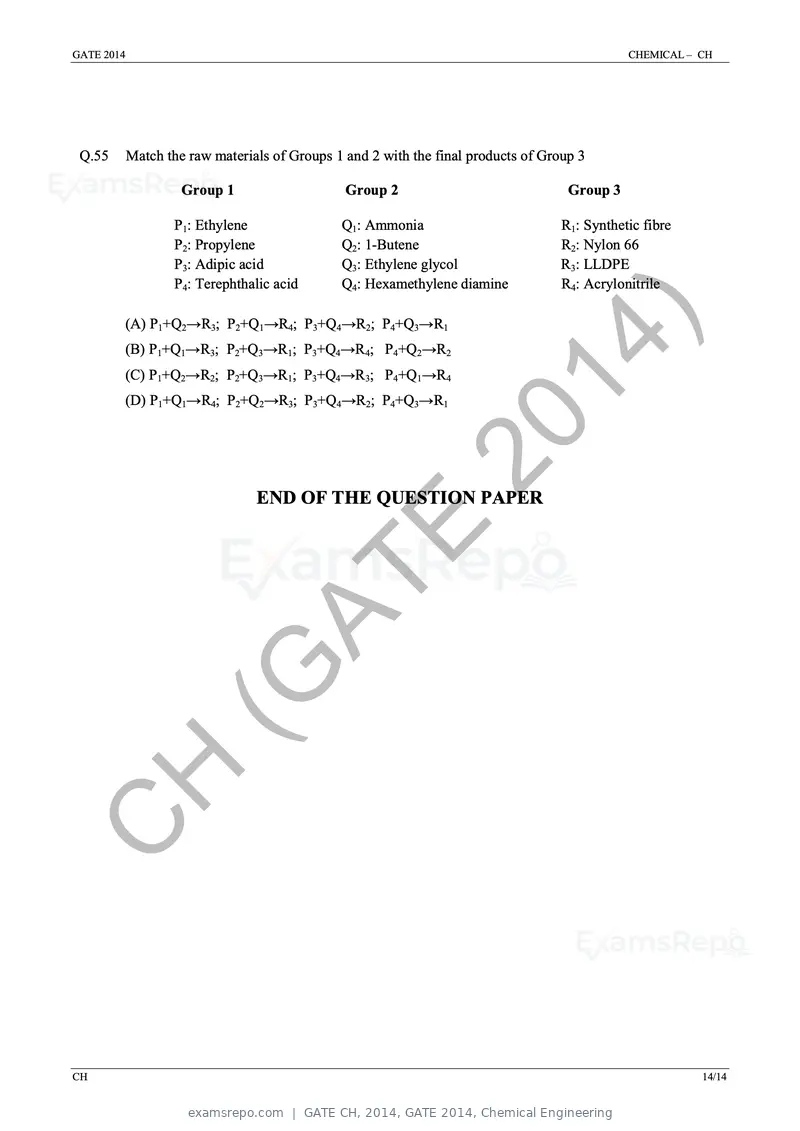
Text of page 20
GATE 2014                                                                                      CHEMICAL – CH


 Q.55       Match the raw materials of Groups 1 and 2 with the final products of Group 3

                     Group 1                    Group 2                              Group 3

                   P1: Ethylene                Q1: Ammonia                         R1: Synthetic fibre
                   P2: Propylene               Q2: 1-Butene                        R2: Nylon 66
                   P3: Adipic acid             Q3: Ethylene glycol                 R3: LLDPE
                   P4: Terephthalic acid       Q4: Hexamethylene diamine           R4: Acrylonitrile

            (A) P1+Q2→R3; P2+Q1→R4; P3+Q4→R2; P4+Q3→R1
            (B) P1+Q1→R3; P2+Q3→R1; P3+Q4→R4; P4+Q2→R2
            (C) P1+Q2→R2; P2+Q3→R1; P3+Q4→R3; P4+Q1→R4
            (D) P1+Q1→R4; P2+Q2→R3; P3+Q4→R2; P4+Q3→R1
                                                           2014
                                 END OF THE QUESTION PAPER
                                                                )
                                AT
                                   E
                  (G
     H
C

CH                                                                                                        14/14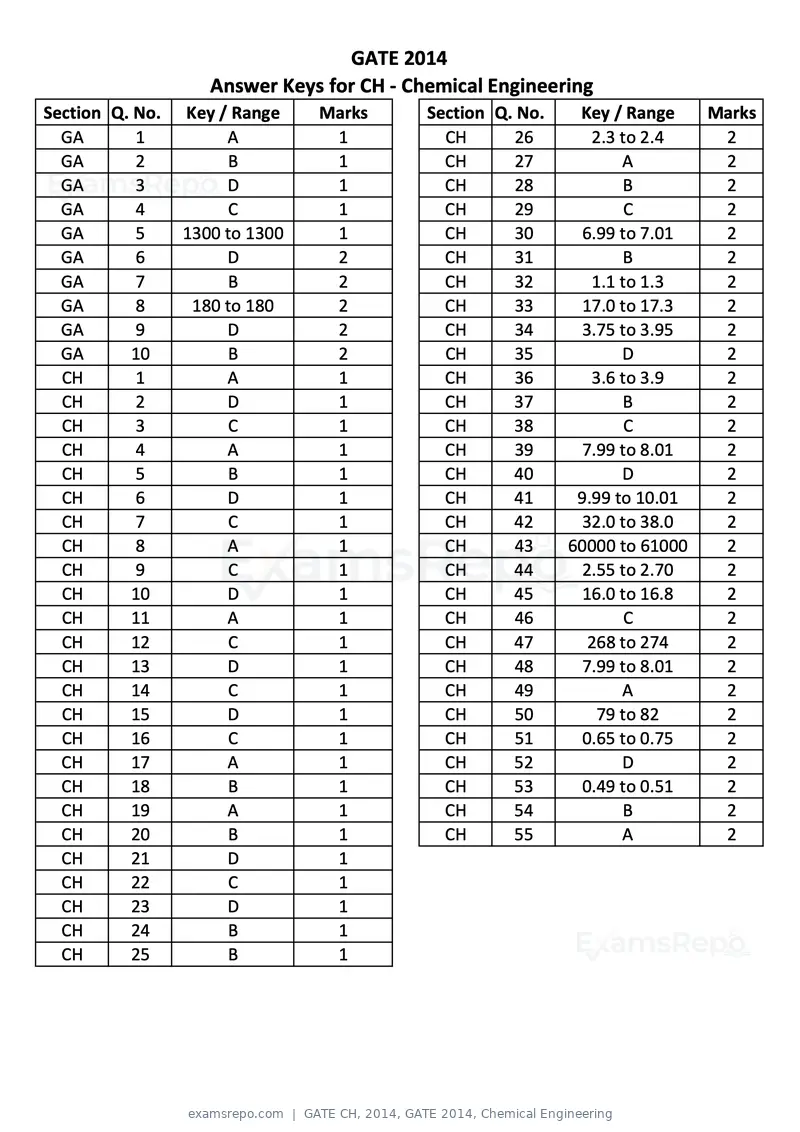
Text of page 21
GATE 2014
                    Answer Keys for CH ‐ Chemical Engineering
Section Q. No.   Key / Range    Marks      Section Q. No.    Key / Range     Marks
  GA       1          A          1           CH      26        2.3 to 2.4     2
  GA       2          B          1           CH      27            A          2
  GA       3          D          1           CH      28            B          2
  GA       4          C          1           CH      29             C         2
  GA       5     1300 to 1300    1           CH      30       6.99 to 7.01    2
  GA       6          D          2           CH      31            B          2
  GA       7          B          2           CH      32        1.1 to 1.3     2
  GA       8      180 to 180     2           CH      33       17.0 to 17.3    2
  GA       9          D          2           CH      34       3.75 to 3.95    2
  GA      10          B          2           CH      35            D          2
  CH       1          A          1           CH      36        3.6 to 3.9     2
  CH       2          D          1           CH      37            B          2
  CH       3          C          1           CH      38             C         2
  CH       4          A          1           CH      39       7.99 to 8.01    2
  CH       5          B          1           CH      40            D          2
  CH       6          D          1           CH      41      9.99 to 10.01    2
  CH       7          C          1           CH      42      32.0 to 38.0     2
  CH       8          A          1           CH      43     60000 to 61000    2
  CH       9          C          1           CH      44      2.55 to 2.70     2
  CH      10          D          1           CH      45      16.0 to 16.8     2
  CH      11          A          1           CH      46             C         2
  CH      12          C          1           CH      47       268 to 274      2
  CH      13          D          1           CH      48       7.99 to 8.01    2
  CH      14          C          1           CH      49            A          2
  CH      15          D          1           CH      50         79 to 82      2
  CH      16          C          1           CH      51       0.65 to 0.75    2
  CH      17          A          1           CH      52            D          2
  CH      18          B          1           CH      53      0.49 to 0.51     2
  CH      19          A          1           CH      54            B          2
  CH      20          B          1           CH      55            A          2
  CH      21          D          1
  CH      22          C          1
  CH      23          D          1
  CH      24          B          1
  CH      25          B          1
Official key not published for this paper.
Page 1 of 21
Source: GATE. Question paper published by GATE.