
GATE CH 2016: Chemical Engineering
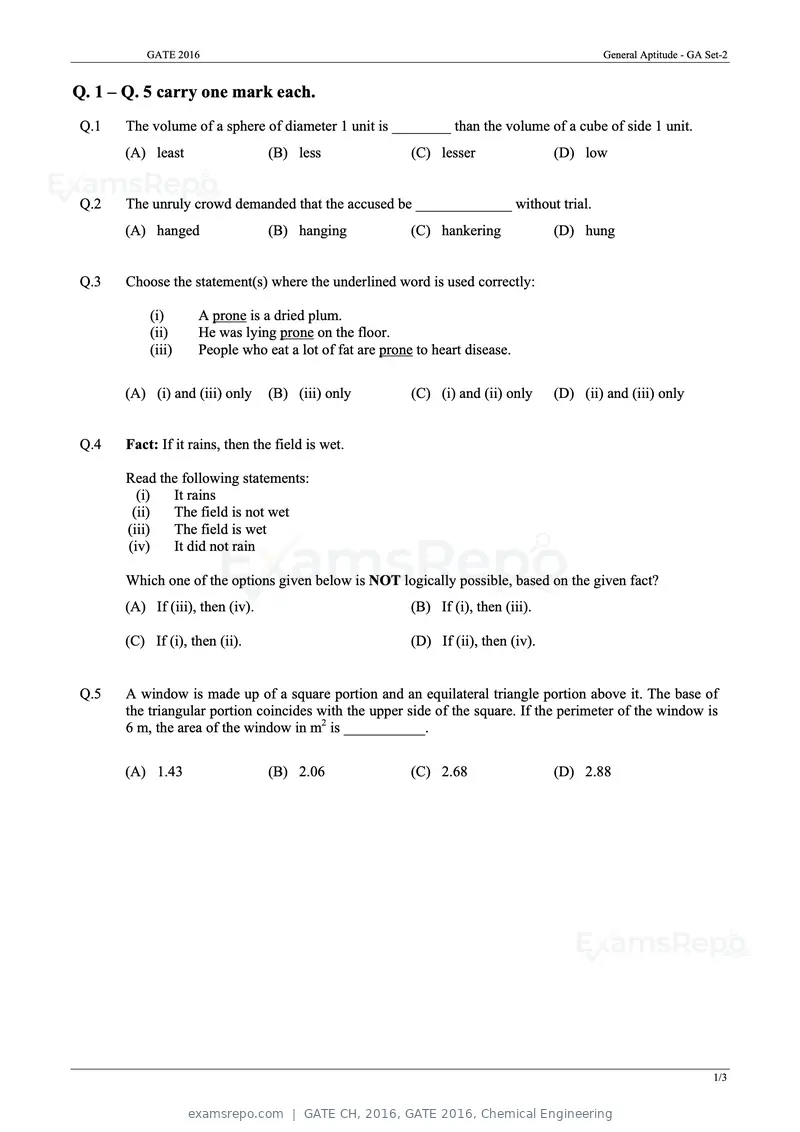
Text of page 1
GATE 2016                                                                        General Aptitude - GA Set-2


Q. 1 – Q. 5 carry one mark each.
Q.1    The volume of a sphere of diameter 1 unit is ________ than the volume of a cube of side 1 unit.
      (A) least                  (B) less                (C) lesser                (D) low


Q.2    The unruly crowd demanded that the accused be _____________ without trial.
      (A) hanged                 (B) hanging             (C) hankering             (D) hung


Q.3    Choose the statement(s) where the underlined word is used correctly:

           (i)      A prone is a dried plum.
           (ii)     He was lying prone on the floor.
           (iii)    People who eat a lot of fat are prone to heart disease.

      (A) (i) and (iii) only     (B) (iii) only          (C) (i) and (ii) only     (D) (ii) and (iii) only


Q.4    Fact: If it rains, then the field is wet.

       Read the following statements:
         (i)  It rains
        (ii)  The field is not wet
       (iii)  The field is wet
       (iv)   It did not rain

       Which one of the options given below is NOT logically possible, based on the given fact?
      (A) If (iii), then (iv).                           (B) If (i), then (iii).

      (C) If (i), then (ii).                             (D) If (ii), then (iv).


Q.5    A window is made up of a square portion and an equilateral triangle portion above it. The base of
       the triangular portion coincides with the upper side of the square. If the perimeter of the window is
       6 m, the area of the window in m2 is ___________.

      (A) 1.43                   (B) 2.06                (C) 2.68                  (D) 2.88


                                                                                                                  1/3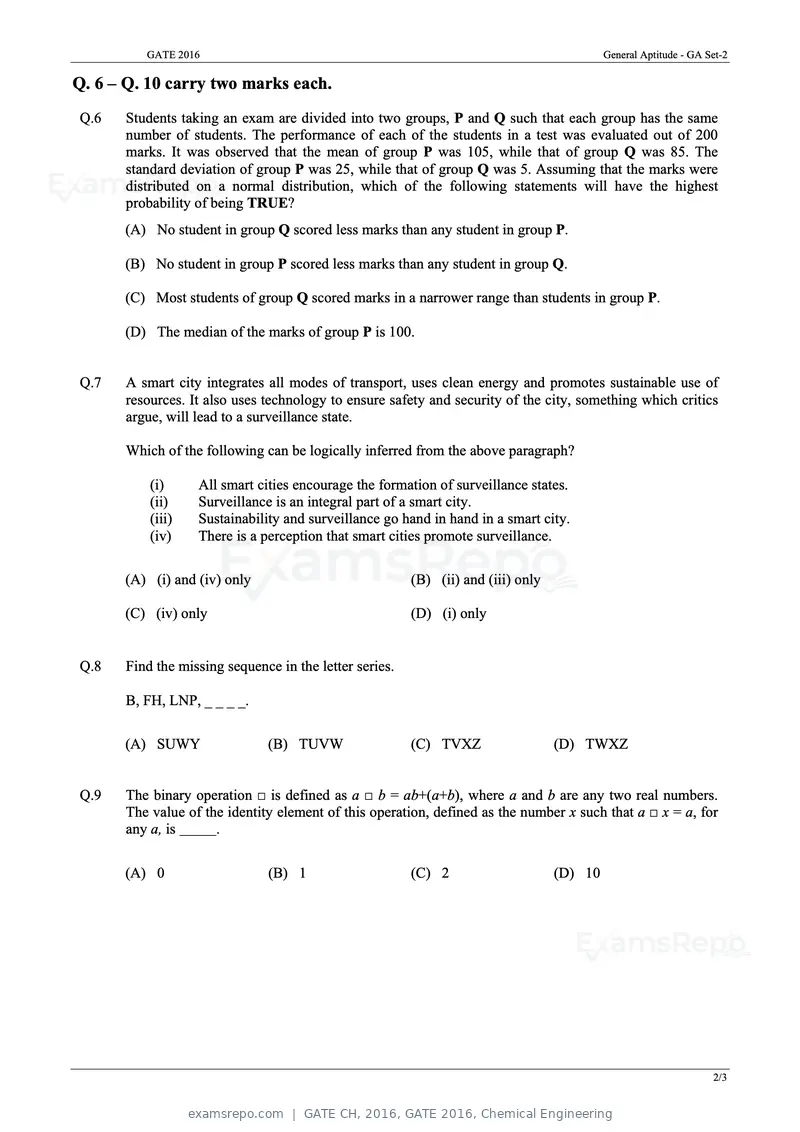
Text of page 2
GATE 2016                                                                         General Aptitude - GA Set-2

Q. 6 – Q. 10 carry two marks each.
Q.6   Students taking an exam are divided into two groups, P and Q such that each group has the same
      number of students. The performance of each of the students in a test was evaluated out of 200
      marks. It was observed that the mean of group P was 105, while that of group Q was 85. The
      standard deviation of group P was 25, while that of group Q was 5. Assuming that the marks were
      distributed on a normal distribution, which of the following statements will have the highest
      probability of being TRUE?
      (A) No student in group Q scored less marks than any student in group P.

      (B) No student in group P scored less marks than any student in group Q.

      (C) Most students of group Q scored marks in a narrower range than students in group P.

      (D) The median of the marks of group P is 100.


Q.7   A smart city integrates all modes of transport, uses clean energy and promotes sustainable use of
      resources. It also uses technology to ensure safety and security of the city, something which critics
      argue, will lead to a surveillance state.

      Which of the following can be logically inferred from the above paragraph?

          (i)     All smart cities encourage the formation of surveillance states.
          (ii)    Surveillance is an integral part of a smart city.
          (iii)   Sustainability and surveillance go hand in hand in a smart city.
          (iv)    There is a perception that smart cities promote surveillance.

      (A) (i) and (iv) only                             (B) (ii) and (iii) only

      (C) (iv) only                                     (D) (i) only


Q.8   Find the missing sequence in the letter series.

      B, FH, LNP, _ _ _ _.

      (A) SUWY                (B) TUVW                  (C) TVXZ                  (D) TWXZ


Q.9   The binary operation □ is defined as a □ b = ab+(a+b), where a and b are any two real numbers.
      The value of the identity element of this operation, defined as the number x such that a □ x = a, for
      any a, is      .

      (A) 0                   (B) 1                     (C) 2                     (D) 10


                                                                                                                  2/3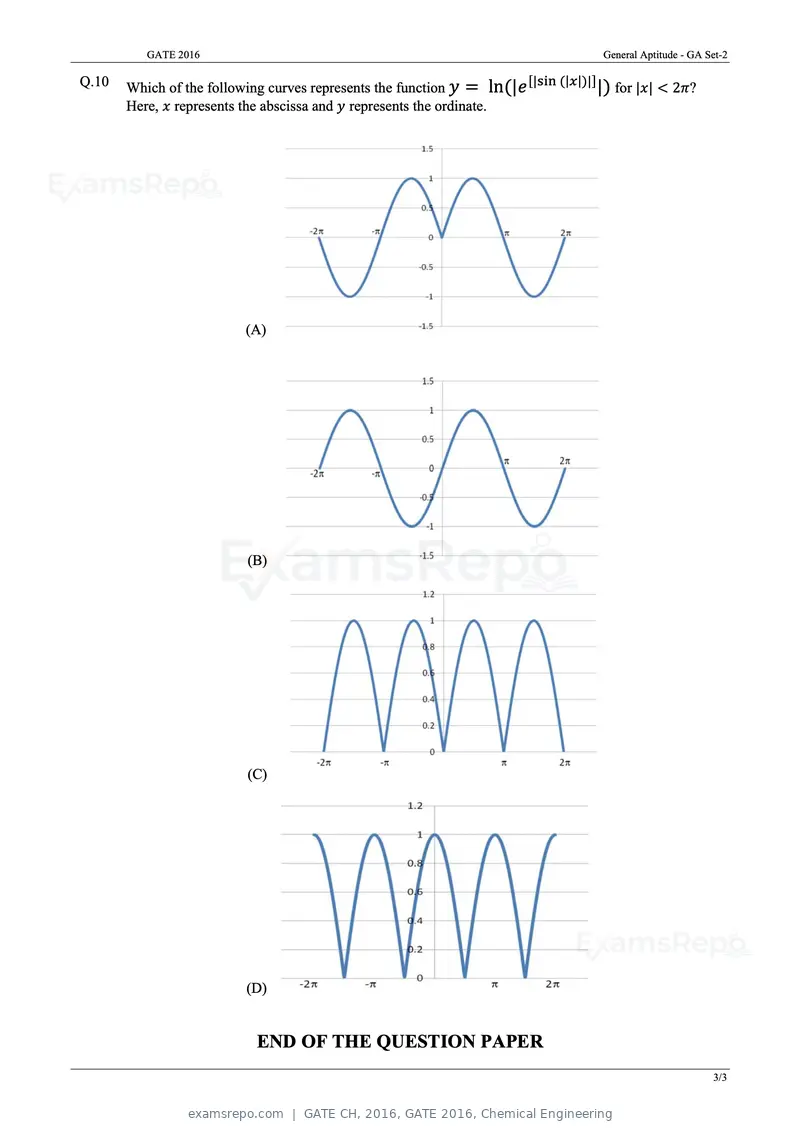
Text of page 3
GATE 2016                                                                General Aptitude - GA Set-2

Q.10                                                                  |   (| |)|
       Which of the following curves represents the function = ln(|                |) for | | < 2 ?
       Here, represents the abscissa and represents the ordinate.


                         (A)


                         (B)


                         (C)


                         (D)


                           END OF THE QUESTION PAPER
                                                                                                          3/3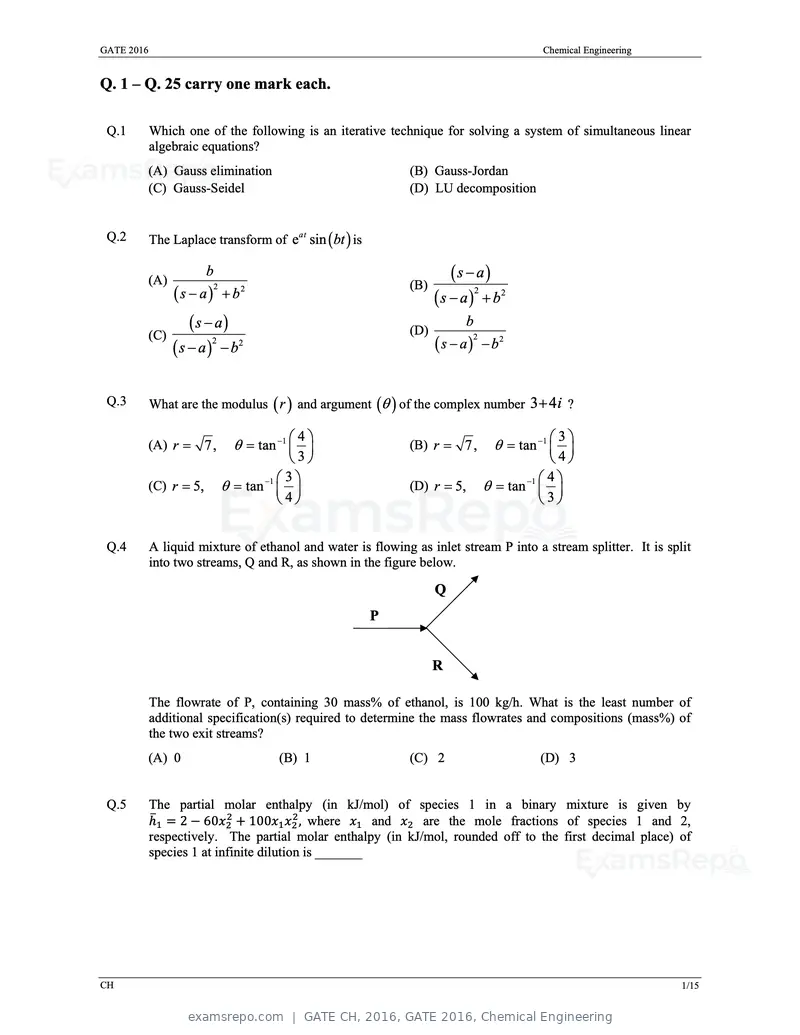
Text of page 4
GATE 2016 Chemical Engineering
Q. 1 – Q. 25 carry one mark each.
Q.1 Which one of the following is an iterative technique for solving a system of simultaneous linear
algebraic equations?
(A) Gauss elimination (B) Gauss-Jordan
(C) Gauss-Seidel (D) LU decomposition
Q.2 The Laplace transform of eat sin bt is
(A)
b s a
(B)
s a b2
2
s a b2
2
s a (D)
b
(C)
s a b2
2
s a b2
2
Q.3 What are the modulus r and argument of the complex number 3 4i ?
4 3
(A) r 7, tan 1 (B) r 7, tan 1
3
4
3 4
(C) r 5, tan 1 (D) r 5, tan 1
4 3
Q.4 A liquid mixture of ethanol and water is flowing as inlet stream P into a stream splitter. It is split
into two streams, Q and R, as shown in the figure below.
Q
P
R
The flowrate of P, containing 30 mass% of ethanol, is 100 kg/h. What is the least number of
additional specification(s) required to determine the mass flowrates and compositions (mass%) of
the two exit streams?
(A) 0 (B) 1 (C) 2 (D) 3
Q.5 The partial molar enthalpy (in kJ/mol) of species 1 in a binary mixture is given by
2 60 100 , where and are the mole fractions of species 1 and 2,
respectively. The partial molar enthalpy (in kJ/mol, rounded off to the first decimal place) of
species 1 at infinite dilution is _______
CH 1/15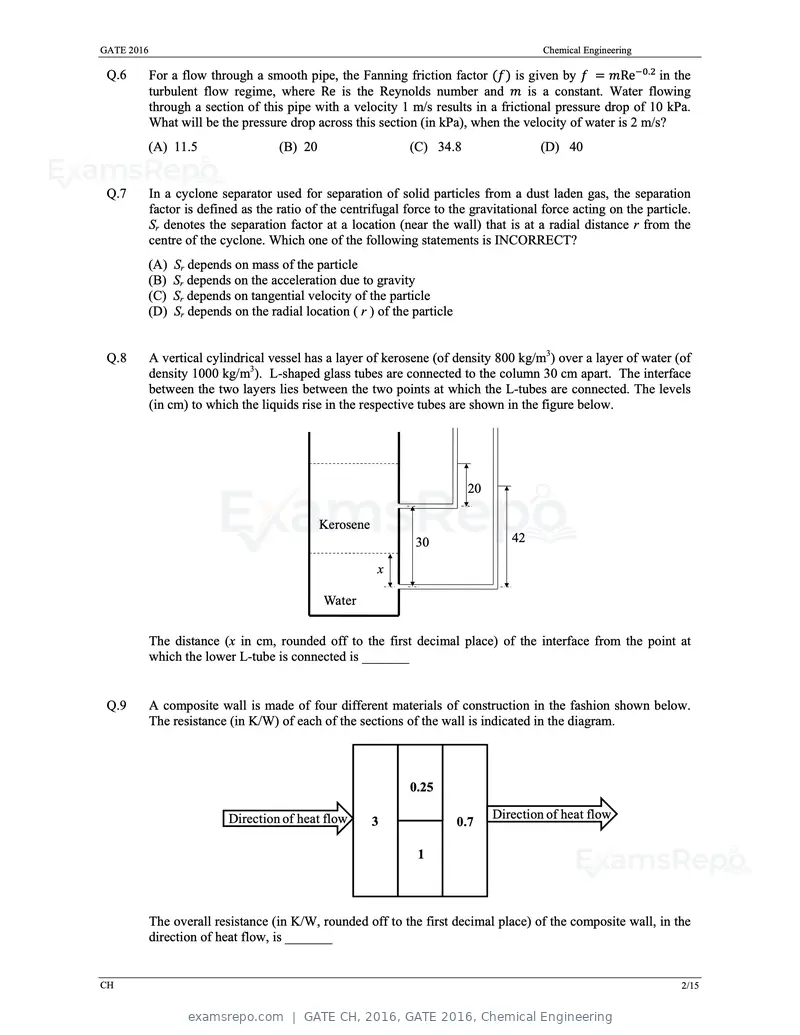
Text of page 5
GATE 2016                                                                                Chemical Engineering

 Q.6        For a flow through a smooth pipe, the Fanning friction factor        is given by         Re . in the
            turbulent flow regime, where Re is the Reynolds number and              is a constant. Water flowing
            through a section of this pipe with a velocity 1 m/s results in a frictional pressure drop of 10 kPa.
            What will be the pressure drop across this section (in kPa), when the velocity of water is 2 m/s?
            (A) 11.5                 (B) 20                    (C) 34.8                 (D) 40


 Q.7        In a cyclone separator used for separation of solid particles from a dust laden gas, the separation
            factor is defined as the ratio of the centrifugal force to the gravitational force acting on the particle.
            Sr denotes the separation factor at a location (near the wall) that is at a radial distance r from the
            centre of the cyclone. Which one of the following statements is INCORRECT?
            (A) Sr depends on mass of the particle
            (B) Sr depends on the acceleration due to gravity
            (C) Sr depends on tangential velocity of the particle
            (D) Sr depends on the radial location ( r ) of the particle


 Q.8        A vertical cylindrical vessel has a layer of kerosene (of density 800 kg/m3) over a layer of water (of
            density 1000 kg/m3). L-shaped glass tubes are connected to the column 30 cm apart. The interface
            between the two layers lies between the two points at which the L-tubes are connected. The levels
            (in cm) to which the liquids rise in the respective tubes are shown in the figure below.


                                                                           20

                                              Kerosene
                                                                30                 42

                                                         x

                                              Water


            The distance (x in cm, rounded off to the first decimal place) of the interface from the point at
            which the lower L-tube is connected is _______


 Q.9        A composite wall is made of four different materials of construction in the fashion shown below.
            The resistance (in K/W) of each of the sections of the wall is indicated in the diagram.


                                                               0.25

                           Direction of heat flow                               Direction of heat flow
                                                         3                0.7

                                                                1


            The overall resistance (in K/W, rounded off to the first decimal place) of the composite wall, in the
            direction of heat flow, is _______


CH                                                                                                                  2/15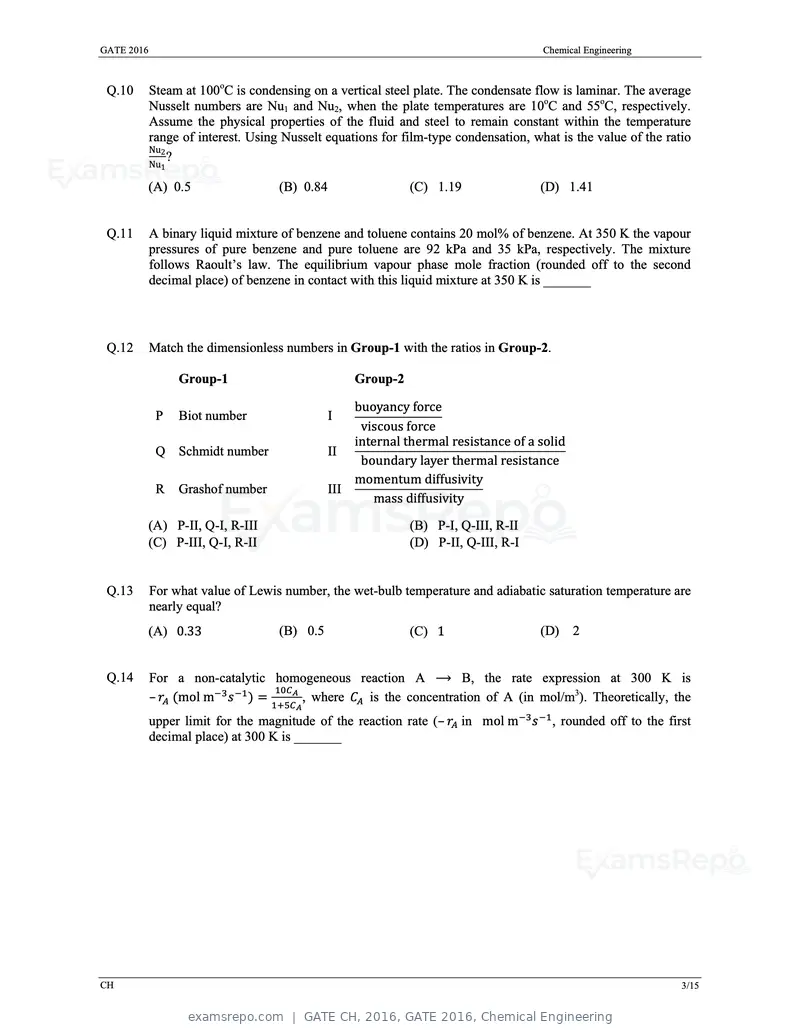
Text of page 6
GATE 2016                                                                            Chemical Engineering


 Q.10       Steam at 100oC is condensing on a vertical steel plate. The condensate flow is laminar. The average
            Nusselt numbers are Nu1 and Nu2, when the plate temperatures are 10oC and 55oC, respectively.
            Assume the physical properties of the fluid and steel to remain constant within the temperature
            range of interest. Using Nusselt equations for film-type condensation, what is the value of the ratio
            Nu2
                ?
            Nu1

            (A) 0.5                 (B) 0.84                 (C) 1.19               (D) 1.41


 Q.11       A binary liquid mixture of benzene and toluene contains 20 mol% of benzene. At 350 K the vapour
            pressures of pure benzene and pure toluene are 92 kPa and 35 kPa, respectively. The mixture
            follows Raoult’s law. The equilibrium vapour phase mole fraction (rounded off to the second
            decimal place) of benzene in contact with this liquid mixture at 350 K is _______


 Q.12       Match the dimensionless numbers in Group-1 with the ratios in Group-2.

                  Group-1                          Group-2

                                                   buoyancy force
             P    Biot number                  I
                                                    viscous force
                                                   internal thermal resistance of a solid
             Q Schmidt number                  II
                                                    boundary layer thermal resistance
                                                   momentum diffusivity
             R    Grashof number               III
                                                      mass diffusivity
            (A) P-II, Q-I, R-III                             (B) P-I, Q-III, R-II
            (C) P-III, Q-I, R-II                             (D) P-II, Q-III, R-I


 Q.13       For what value of Lewis number, the wet-bulb temperature and adiabatic saturation temperature are
            nearly equal?
            (A) 0.33                (B) 0.5                  (C) 1                  (D)     2


 Q.14       For a non-catalytic homogeneous reaction A ⟶ B, the rate expression at 300 K is
            –   mol m              , where    is the concentration of A (in mol/m3). Theoretically, the
            upper limit for the magnitude of the reaction rate (–     in mol m         , rounded off to the first
            decimal place) at 300 K is _______


CH                                                                                                             3/15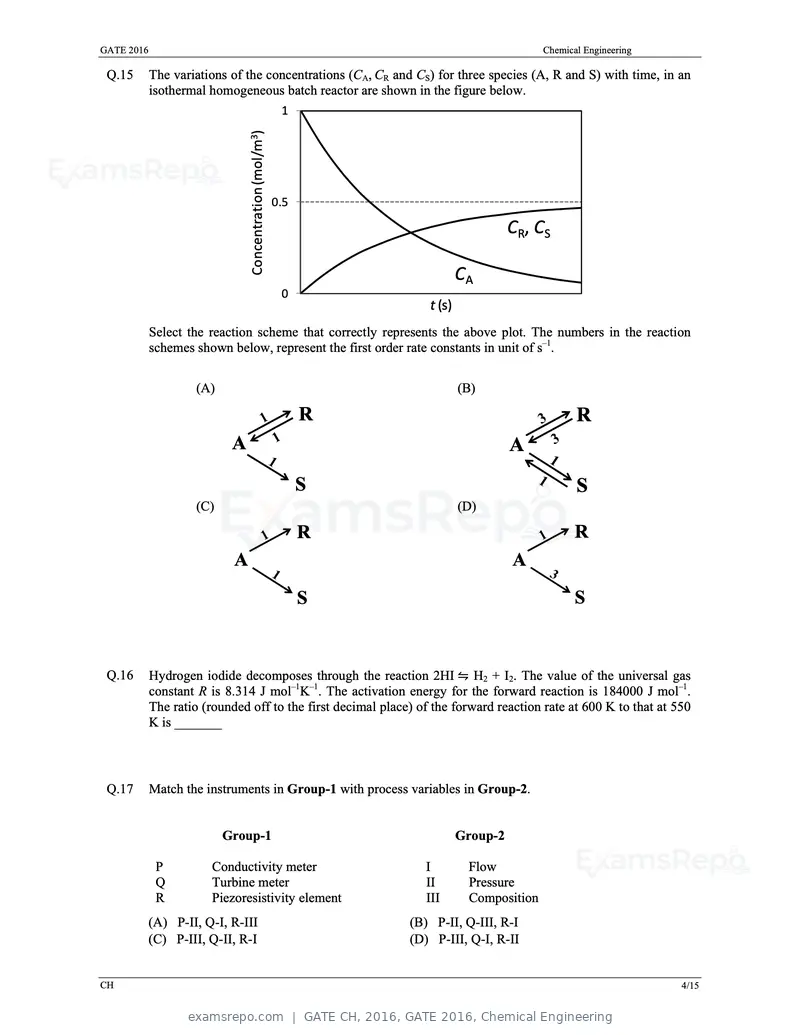
Text of page 7
GATE 2016                                                                                    Chemical Engineering

 Q.15       The variations of the concentrations (CA, CR and CS) for three species (A, R and S) with time, in an
            isothermal homogeneous batch reactor are shown in the figure below.
                                    1


                                Concentration (mol/m3)
                                                         0.5

                                                                                        CR, CS

                                                                              CA
                                                          0
                                                                      t (s)
            Select the reaction scheme that correctly represents the above plot. The numbers in the reaction
            schemes shown below, represent the first order rate constants in unit of s‒1.

                    (A)                                                       (B)

                                                               R                                    R
                           A                                                            A
                                                               S                                    S
                    (C)                                                       (D)

                                                               R                                    R
                            A                                                           A

                                                               S                                    S


 Q.16       Hydrogen iodide decomposes through the reaction 2HI ⇋ H2 + I2. The value of the universal gas
            constant R is 8.314 J mol‒1K‒1. The activation energy for the forward reaction is 184000 J mol‒1.
            The ratio (rounded off to the first decimal place) of the forward reaction rate at 600 K to that at 550
            K is _______


 Q.17       Match the instruments in Group-1 with process variables in Group-2.


                          Group-1                                             Group-2

             P         Conductivity meter                            I         Flow
             Q         Turbine meter                                 II        Pressure
             R         Piezoresistivity element                      III       Composition
            (A) P-II, Q-I, R-III                                   (B) P-II, Q-III, R-I
            (C) P-III, Q-II, R-I                                   (D) P-III, Q-I, R-II


CH                                                                                                                  4/15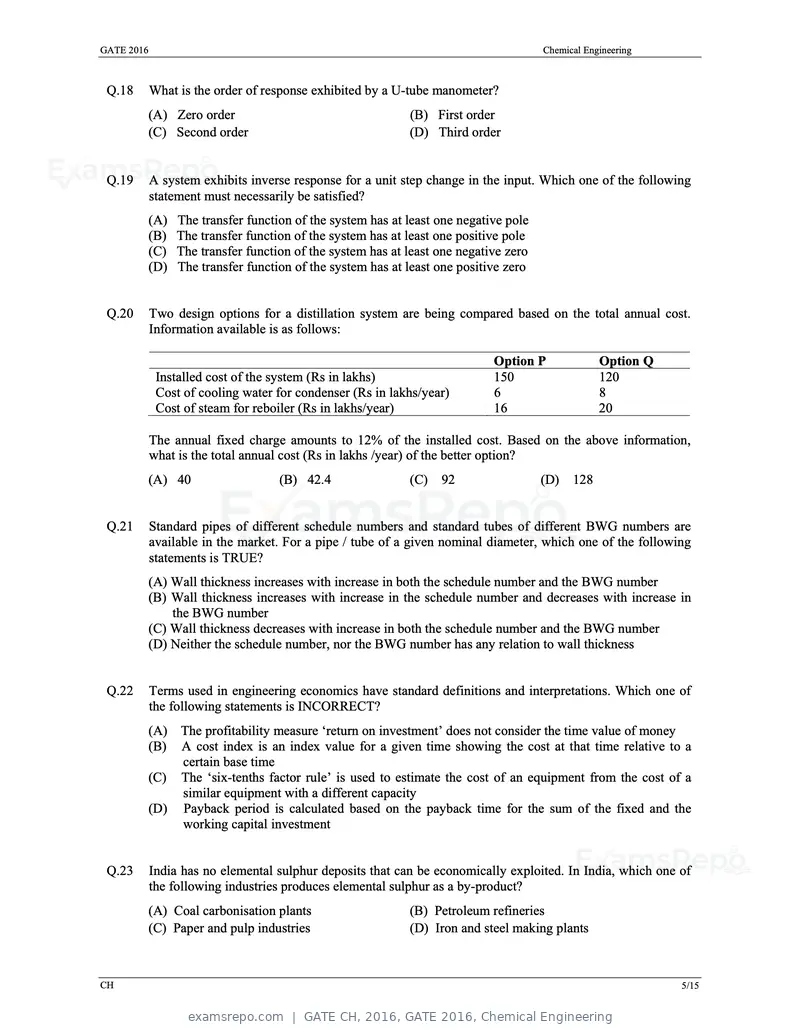
Text of page 8
GATE 2016                                                                            Chemical Engineering


 Q.18       What is the order of response exhibited by a U-tube manometer?
            (A) Zero order                                  (B) First order
            (C) Second order                                (D) Third order


 Q.19       A system exhibits inverse response for a unit step change in the input. Which one of the following
            statement must necessarily be satisfied?
            (A) The transfer function of the system has at least one negative pole
            (B) The transfer function of the system has at least one positive pole
            (C) The transfer function of the system has at least one negative zero
            (D) The transfer function of the system has at least one positive zero


 Q.20       Two design options for a distillation system are being compared based on the total annual cost.
            Information available is as follows:

                                                                           Option P              Option Q
             Installed cost of the system (Rs in lakhs)                    150                   120
             Cost of cooling water for condenser (Rs in lakhs/year)        6                     8
             Cost of steam for reboiler (Rs in lakhs/year)                 16                    20

            The annual fixed charge amounts to 12% of the installed cost. Based on the above information,
            what is the total annual cost (Rs in lakhs /year) of the better option?
            (A) 40                  (B) 42.4                (C)   92                 (D)   128


 Q.21       Standard pipes of different schedule numbers and standard tubes of different BWG numbers are
            available in the market. For a pipe / tube of a given nominal diameter, which one of the following
            statements is TRUE?
            (A) Wall thickness increases with increase in both the schedule number and the BWG number
            (B) Wall thickness increases with increase in the schedule number and decreases with increase in
                the BWG number
            (C) Wall thickness decreases with increase in both the schedule number and the BWG number
            (D) Neither the schedule number, nor the BWG number has any relation to wall thickness


 Q.22       Terms used in engineering economics have standard definitions and interpretations. Which one of
            the following statements is INCORRECT?
            (A)   The profitability measure ‘return on investment’ does not consider the time value of money
            (B)   A cost index is an index value for a given time showing the cost at that time relative to a
                  certain base time
            (C)   The ‘six-tenths factor rule’ is used to estimate the cost of an equipment from the cost of a
                  similar equipment with a different capacity
            (D)   Payback period is calculated based on the payback time for the sum of the fixed and the
                  working capital investment


 Q.23       India has no elemental sulphur deposits that can be economically exploited. In India, which one of
            the following industries produces elemental sulphur as a by-product?
            (A) Coal carbonisation plants                   (B) Petroleum refineries
            (C) Paper and pulp industries                   (D) Iron and steel making plants


CH                                                                                                          5/15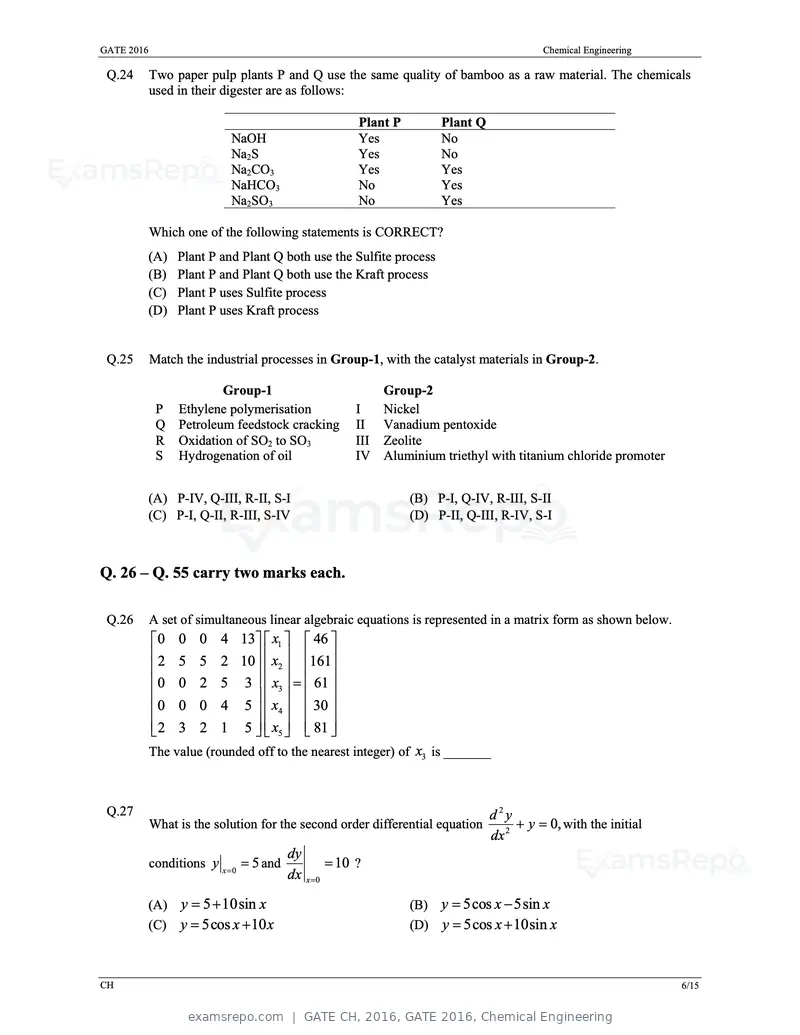
Text of page 9
GATE 2016 Chemical Engineering
Q.24 Two paper pulp plants P and Q use the same quality of bamboo as a raw material. The chemicals
used in their digester are as follows:
Plant P Plant Q
NaOH Yes No
Na2S Yes No
Na2CO3 Yes Yes
NaHCO3 No Yes
Na2SO3 No Yes
Which one of the following statements is CORRECT?
(A) Plant P and Plant Q both use the Sulfite process
(B) Plant P and Plant Q both use the Kraft process
(C) Plant P uses Sulfite process
(D) Plant P uses Kraft process
Q.25 Match the industrial processes in Group-1, with the catalyst materials in Group-2.
Group-1 Group-2
P Ethylene polymerisation I Nickel
Q Petroleum feedstock cracking II Vanadium pentoxide
R Oxidation of SO2 to SO3 III Zeolite
S Hydrogenation of oil IV Aluminium triethyl with titanium chloride promoter
(A) P-IV, Q-III, R-II, S-I (B) P-I, Q-IV, R-III, S-II
(C) P-I, Q-II, R-III, S-IV (D) P-II, Q-III, R-IV, S-I
Q. 26 – Q. 55 carry two marks each.
Q.26 A set of simultaneous linear algebraic equations is represented in a matrix form as shown below.
0 0 0 4 13 x1 46
2
5 5 2 10 x2 161
0 0 2 5 3 x3 61
0 0 0 4 5 x4 30
2 3 2 1 5 x5 81
The value (rounded off to the nearest integer) of x3 is _______
Q.27 d2y
What is the solution for the second order differential equation y 0, with the initial
dx 2
dy
conditions y x 0 5 and 10 ?
dx x 0
(A) y 5 10sin x (B) y 5cos x 5sin x
(C) y 5cos x 10 x (D) y 5cos x 10sin x
CH 6/15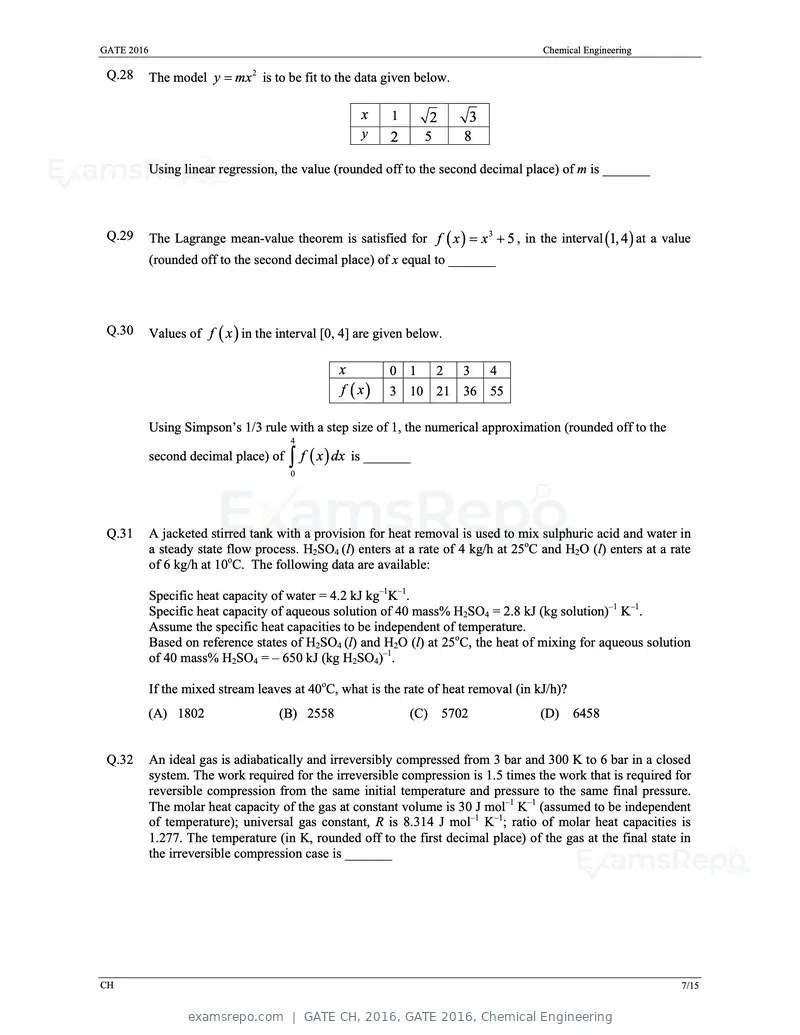
Text of page 10
GATE 2016 Chemical Engineering
Q.28 The model y mx 2 is to be fit to the data given below.
x 1 2 3
y 2 5 8
Using linear regression, the value (rounded off to the second decimal place) of m is _______
Q.29 The Lagrange mean-value theorem is satisfied for f x x 3 5 , in the interval 1, 4 at a value
(rounded off to the second decimal place) of x equal to _______
Q.30 Values of f x in the interval [0, 4] are given below.
x 0 1 2 3 4
f x 3 10 21 36 55
Using Simpson’s 1/3 rule with a step size of 1, the numerical approximation (rounded off to the
4
second decimal place) of f x dx is _______
0
Q.31 A jacketed stirred tank with a provision for heat removal is used to mix sulphuric acid and water in
a steady state flow process. H2SO4 (l) enters at a rate of 4 kg/h at 25oC and H2O (l) enters at a rate
of 6 kg/h at 10oC. The following data are available:
Specific heat capacity of water = 4.2 kJ kg‒1K‒1.
Specific heat capacity of aqueous solution of 40 mass% H2SO4 = 2.8 kJ (kg solution)‒1 K‒1.
Assume the specific heat capacities to be independent of temperature.
Based on reference states of H2SO4 (l) and H2O (l) at 25oC, the heat of mixing for aqueous solution
of 40 mass% H2SO4 = ‒ 650 kJ (kg H2SO4)‒1.
If the mixed stream leaves at 40oC, what is the rate of heat removal (in kJ/h)?
(A) 1802 (B) 2558 (C) 5702 (D) 6458
Q.32 An ideal gas is adiabatically and irreversibly compressed from 3 bar and 300 K to 6 bar in a closed
system. The work required for the irreversible compression is 1.5 times the work that is required for
reversible compression from the same initial temperature and pressure to the same final pressure.
The molar heat capacity of the gas at constant volume is 30 J mol‒1 K‒1 (assumed to be independent
of temperature); universal gas constant, R is 8.314 J mol‒1 K‒1; ratio of molar heat capacities is
1.277. The temperature (in K, rounded off to the first decimal place) of the gas at the final state in
the irreversible compression case is _______
CH 7/15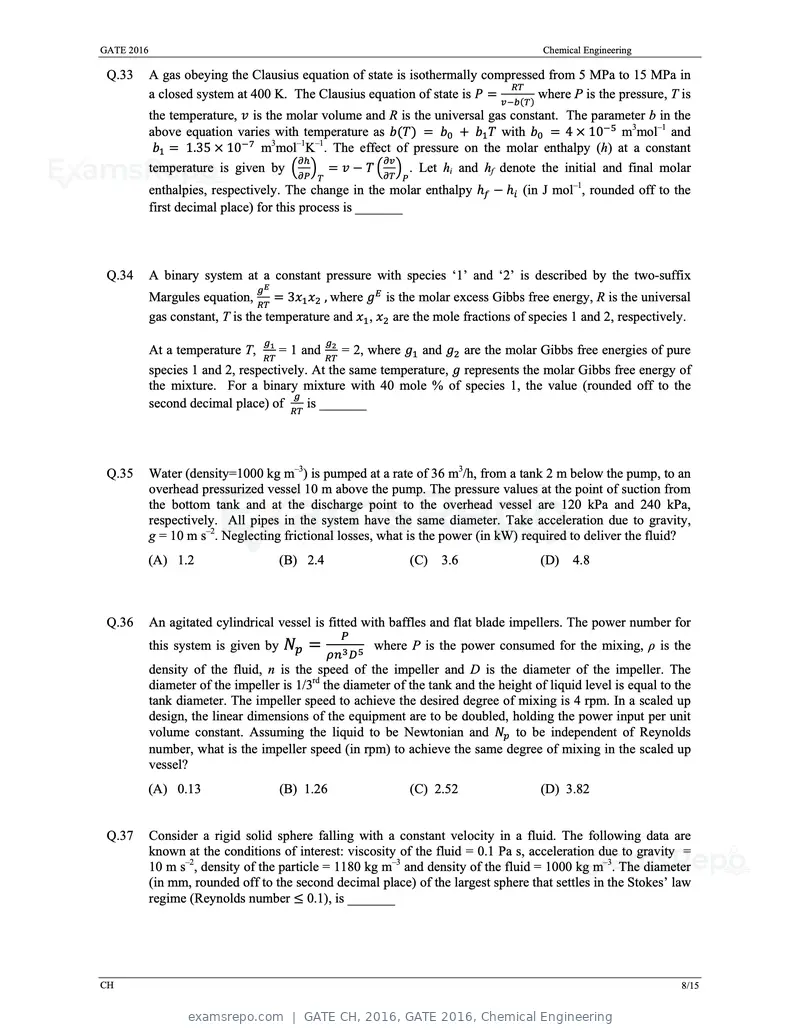
Text of page 11
GATE 2016                                                                               Chemical Engineering

 Q.33       A gas obeying the Clausius equation of state is isothermally compressed from 5 MPa to 15 MPa in
            a closed system at 400 K. The Clausius equation of state is           where P is the pressure, T is
            the temperature, is the molar volume and R is the universal gas constant. The parameter b in the
            above equation varies with temperature as                     with        4 10 m3mol‒1 and
                                 3    ‒1 ‒1
                   1.35 10 m mol K . The effect of pressure on the molar enthalpy (h) at a constant
            temperature is given by                      . Let hi and hf denote the initial and final molar
            enthalpies, respectively. The change in the molar enthalpy              (in J mol‒1, rounded off to the
            first decimal place) for this process is _______


 Q.34       A binary system at a constant pressure with species ‘1’ and ‘2’ is described by the two-suffix
            Margules equation,        3      , where is the molar excess Gibbs free energy, R is the universal
            gas constant, T is the temperature and , are the mole fractions of species 1 and 2, respectively.

            At a temperature T,     = 1 and     = 2, where    and   are the molar Gibbs free energies of pure
            species 1 and 2, respectively. At the same temperature, represents the molar Gibbs free energy of
            the mixture. For a binary mixture with 40 mole % of species 1, the value (rounded off to the
            second decimal place) of      is _______


 Q.35       Water (density=1000 kg m‒3) is pumped at a rate of 36 m3/h, from a tank 2 m below the pump, to an
            overhead pressurized vessel 10 m above the pump. The pressure values at the point of suction from
            the bottom tank and at the discharge point to the overhead vessel are 120 kPa and 240 kPa,
            respectively. All pipes in the system have the same diameter. Take acceleration due to gravity,
            g = 10 m s‒2. Neglecting frictional losses, what is the power (in kW) required to deliver the fluid?
            (A) 1.2                   (B) 2.4                 (C)   3.6                (D)    4.8


 Q.36       An agitated cylindrical vessel is fitted with baffles and flat blade impellers. The power number for
            this system is given by                    where P is the power consumed for the mixing, ρ is the
            density of the fluid, n is the speed of the impeller and D is the diameter of the impeller. The
            diameter of the impeller is 1/3rd the diameter of the tank and the height of liquid level is equal to the
            tank diameter. The impeller speed to achieve the desired degree of mixing is 4 rpm. In a scaled up
            design, the linear dimensions of the equipment are to be doubled, holding the power input per unit
            volume constant. Assuming the liquid to be Newtonian and              to be independent of Reynolds
            number, what is the impeller speed (in rpm) to achieve the same degree of mixing in the scaled up
            vessel?
            (A) 0.13                  (B) 1.26                (C) 2.52                 (D) 3.82


 Q.37       Consider a rigid solid sphere falling with a constant velocity in a fluid. The following data are
            known at the conditions of interest: viscosity of the fluid = 0.1 Pa s, acceleration due to gravity =
            10 m s‒2, density of the particle = 1180 kg m‒3 and density of the fluid = 1000 kg m‒3. The diameter
            (in mm, rounded off to the second decimal place) of the largest sphere that settles in the Stokes’ law
            regime (Reynolds number 0.1), is _______


CH                                                                                                                 8/15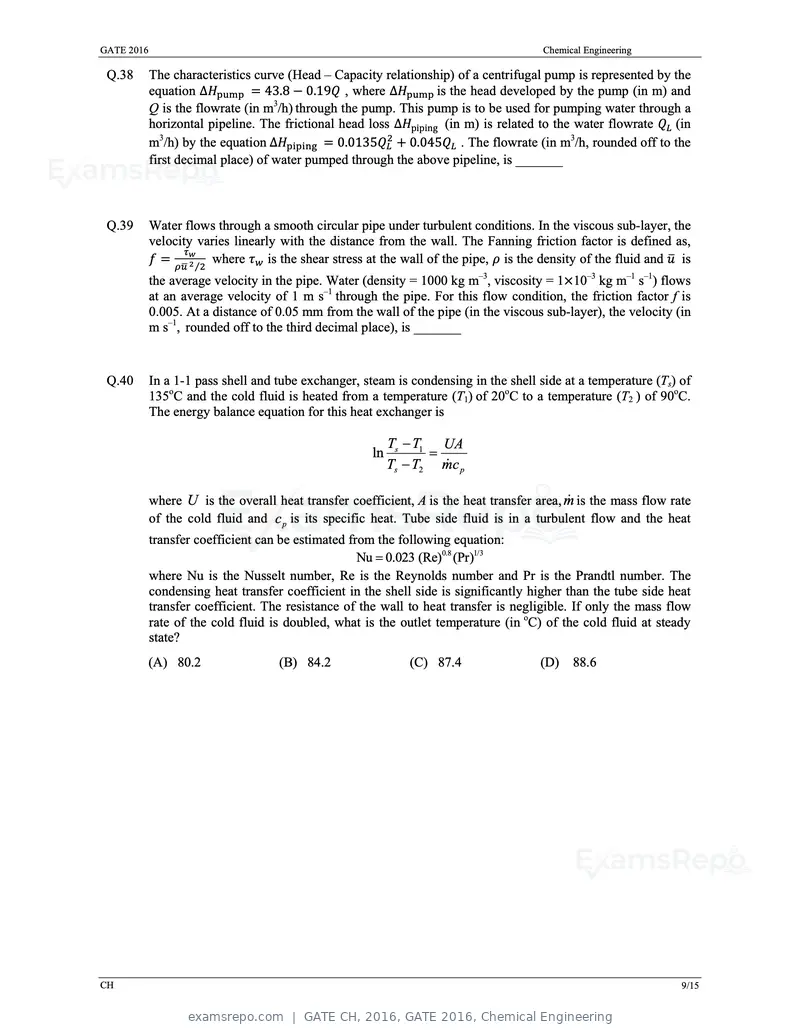
Text of page 12
GATE 2016 Chemical Engineering
Q.38 The characteristics curve (Head – Capacity relationship) of a centrifugal pump is represented by the
equation ∆ 43.8 0.19 , where ∆ is the head developed by the pump (in m) and
Q is the flowrate (in m3/h) through the pump. This pump is to be used for pumping water through a
horizontal pipeline. The frictional head loss ∆ piping (in m) is related to the water flowrate (in
m3/h) by the equation ∆ 0.0135 0.045 . The flowrate (in m3/h, rounded off to the
first decimal place) of water pumped through the above pipeline, is _______
Q.39 Water flows through a smooth circular pipe under turbulent conditions. In the viscous sub-layer, the
velocity varies linearly with the distance from the wall. The Fanning friction factor is defined as,
⁄
where is the shear stress at the wall of the pipe, is the density of the fluid and is
the average velocity in the pipe. Water (density = 1000 kg m‒3, viscosity = 1 10‒3 kg m‒1 s‒1) flows
at an average velocity of 1 m s‒1 through the pipe. For this flow condition, the friction factor f is
0.005. At a distance of 0.05 mm from the wall of the pipe (in the viscous sub-layer), the velocity (in
m s‒1, rounded off to the third decimal place), is _______
Q.40 In a 1-1 pass shell and tube exchanger, steam is condensing in the shell side at a temperature (Ts) of
135oC and the cold fluid is heated from a temperature (T1) of 20oC to a temperature (T2 ) of 90oC.
The energy balance equation for this heat exchanger is
Ts T1 UA
ln
Ts T2
mc p
is the mass flow rate
where U is the overall heat transfer coefficient, A is the heat transfer area, m
of the cold fluid and c p is its specific heat. Tube side fluid is in a turbulent flow and the heat
transfer coefficient can be estimated from the following equation:
Nu 0.023 (Re)0.8 (Pr)1/3
where Nu is the Nusselt number, Re is the Reynolds number and Pr is the Prandtl number. The
condensing heat transfer coefficient in the shell side is significantly higher than the tube side heat
transfer coefficient. The resistance of the wall to heat transfer is negligible. If only the mass flow
rate of the cold fluid is doubled, what is the outlet temperature (in oC) of the cold fluid at steady
state?
(A) 80.2 (B) 84.2 (C) 87.4 (D) 88.6
CH 9/15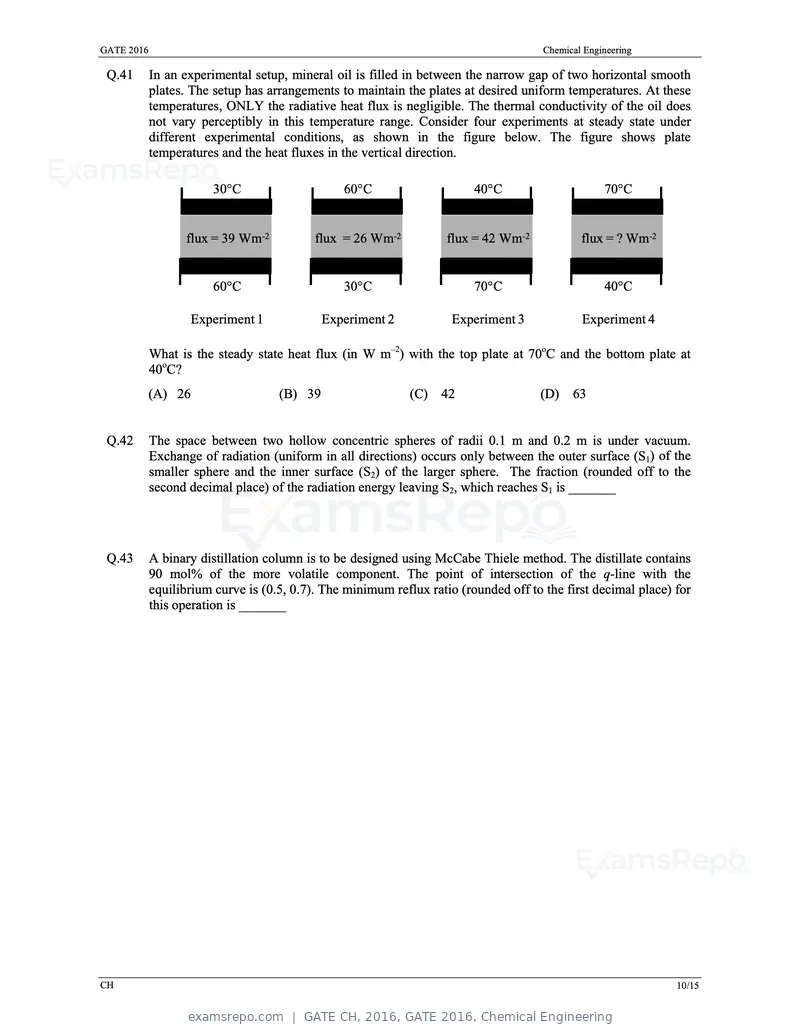
Text of page 13
GATE 2016 Chemical Engineering
Q.41 In an experimental setup, mineral oil is filled in between the narrow gap of two horizontal smooth
plates. The setup has arrangements to maintain the plates at desired uniform temperatures. At these
temperatures, ONLY the radiative heat flux is negligible. The thermal conductivity of the oil does
not vary perceptibly in this temperature range. Consider four experiments at steady state under
different experimental conditions, as shown in the figure below. The figure shows plate
temperatures and the heat fluxes in the vertical direction.
30C 60C 40C 70C
flux = 39 Wm-2 flux = 26 Wm-2 flux = 42 Wm-2 flux = ? Wm-2
60C 30C 70C 40C
Experiment 1 Experiment 2 Experiment 3 Experiment 4
What is the steady state heat flux (in W m‒2) with the top plate at 70oC and the bottom plate at
40oC?
(A) 26 (B) 39 (C) 42 (D) 63
Q.42 The space between two hollow concentric spheres of radii 0.1 m and 0.2 m is under vacuum.
Exchange of radiation (uniform in all directions) occurs only between the outer surface (S1) of the
smaller sphere and the inner surface (S2) of the larger sphere. The fraction (rounded off to the
second decimal place) of the radiation energy leaving S2, which reaches S1 is _______
Q.43 A binary distillation column is to be designed using McCabe Thiele method. The distillate contains
90 mol% of the more volatile component. The point of intersection of the q-line with the
equilibrium curve is (0.5, 0.7). The minimum reflux ratio (rounded off to the first decimal place) for
this operation is _______
CH 10/15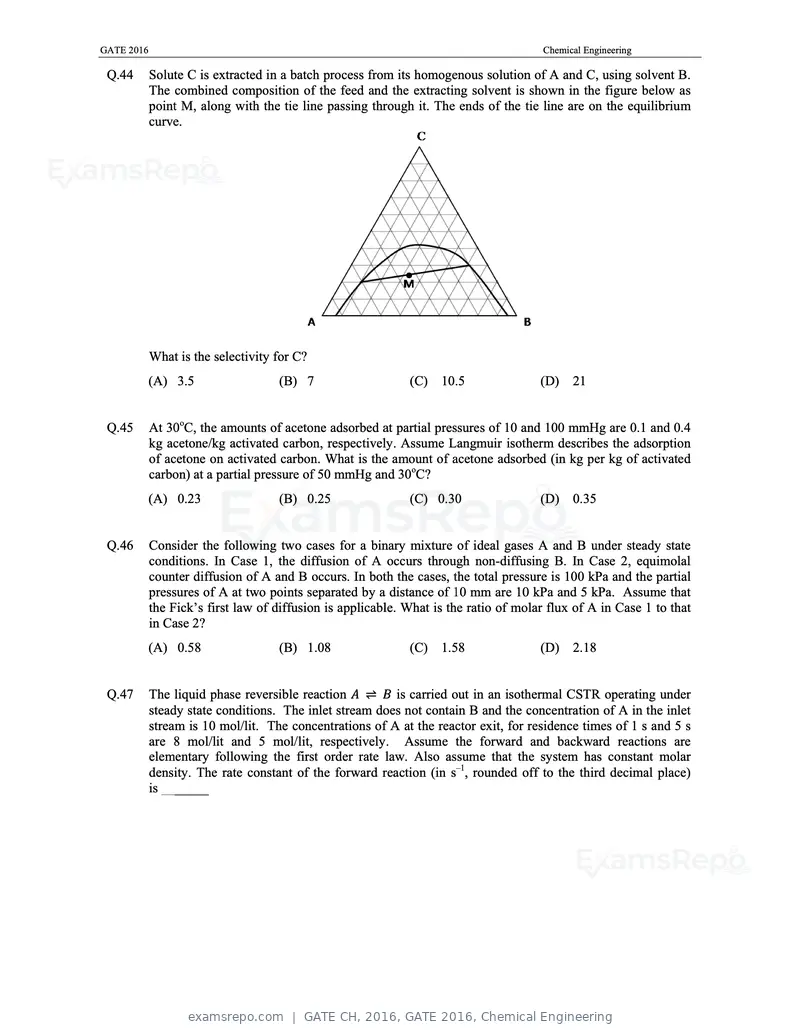
Text of page 14
GATE 2016                                                                             Chemical Engineering

 Q.44       Solute C is extracted in a batch process from its homogenous solution of A and C, using solvent B.
            The combined composition of the feed and the extracting solvent is shown in the figure below as
            point M, along with the tie line passing through it. The ends of the tie line are on the equilibrium
            curve.


            What is the selectivity for C?
            (A) 3.5                 (B) 7                    (C)   10.5               (D)   21


 Q.45       At 30oC, the amounts of acetone adsorbed at partial pressures of 10 and 100 mmHg are 0.1 and 0.4
            kg acetone/kg activated carbon, respectively. Assume Langmuir isotherm describes the adsorption
            of acetone on activated carbon. What is the amount of acetone adsorbed (in kg per kg of activated
            carbon) at a partial pressure of 50 mmHg and 30oC?
            (A) 0.23                (B) 0.25                 (C) 0.30                 (D)   0.35


 Q.46       Consider the following two cases for a binary mixture of ideal gases A and B under steady state
            conditions. In Case 1, the diffusion of A occurs through non-diffusing B. In Case 2, equimolal
            counter diffusion of A and B occurs. In both the cases, the total pressure is 100 kPa and the partial
            pressures of A at two points separated by a distance of 10 mm are 10 kPa and 5 kPa. Assume that
            the Fick’s first law of diffusion is applicable. What is the ratio of molar flux of A in Case 1 to that
            in Case 2?
            (A) 0.58                (B) 1.08                 (C)   1.58               (D)   2.18


 Q.47       The liquid phase reversible reaction ⇌ is carried out in an isothermal CSTR operating under
            steady state conditions. The inlet stream does not contain B and the concentration of A in the inlet
            stream is 10 mol/lit. The concentrations of A at the reactor exit, for residence times of 1 s and 5 s
            are 8 mol/lit and 5 mol/lit, respectively. Assume the forward and backward reactions are
            elementary following the first order rate law. Also assume that the system has constant molar
            density. The rate constant of the forward reaction (in s‒1, rounded off to the third decimal place)
            is _______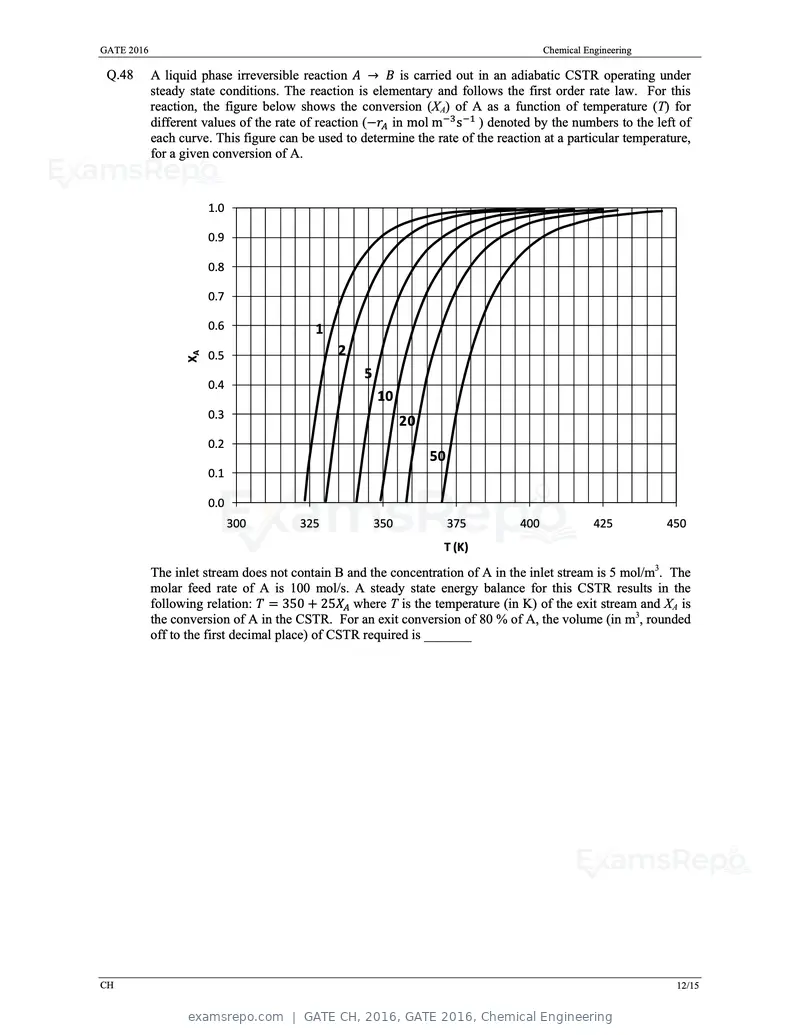
Text of page 15
GATE 2016                                                                              Chemical Engineering

 Q.48       A liquid phase irreversible reaction →        is carried out in an adiabatic CSTR operating under
            steady state conditions. The reaction is elementary and follows the first order rate law. For this
            reaction, the figure below shows the conversion (XA) of A as a function of temperature (T) for
            different values of the rate of reaction (  in mol m s ) denoted by the numbers to the left of
            each curve. This figure can be used to determine the rate of the reaction at a particular temperature,
            for a given conversion of A.


                       1.0

                       0.9

                       0.8

                       0.7

                       0.6                 1
                  XA   0.5                     2
                                                    5
                       0.4
                                                        10
                       0.3
                                                              20
                       0.2
                                                                   50
                       0.1

                       0.0
                             300        325             350             375      400              425         450
                                                                    T (K)
            The inlet stream does not contain B and the concentration of A in the inlet stream is 5 mol/m3. The
            molar feed rate of A is 100 mol/s. A steady state energy balance for this CSTR results in the
            following relation:       350 25 where T is the temperature (in K) of the exit stream and XA is
            the conversion of A in the CSTR. For an exit conversion of 80 % of A, the volume (in m3, rounded
            off to the first decimal place) of CSTR required is _______


CH                                                                                                             12/15
Text of page 16
GATE 2016                                                                              Chemical Engineering

 Q.49       A porous pellet with Pt dispersed in it is used to carry out a catalytic reaction. Following two
            scenarios are possible.

            Scenario 1: Pt present throughout the pores of the pellet is used for catalyzing the reaction.
            Scenario 2: Pt present only in the immediate vicinity of the external surface of the pellet is used for
            catalyzing the reaction.

            At a large value of Thiele modulus, which one of the following statements is TRUE?
            (A) Since the reaction rate is much greater than the diffusion rate, Scenario 1 occurs
            (B) Since the reaction rate is much greater than the diffusion rate , Scenario 2 occurs
            (C) Since the reaction rate is much lower than the diffusion rate, Scenario 1 occurs
            (D) Since the reaction rate is much lower than the diffusion rate, Scenario 2 occurs

 Q.50   A CSTR has a long inlet pipe. A tracer is injected at the entrance of the pipe. The E-curve obtained
        at the exit of the CSTR is shown in the figure below.


                                           0.06

                                           0.05

                                           0.04


                        E (t), 1/minutes
                                           0.03

                                           0.02

                                           0.01

                                           0.00
                                                  0   5 10 15 20 25 30 35 40 45 50 55 60 65 70 75 80
                                                                      Time (minutes)

        Assuming plug flow in the inlet pipe, the ratio (rounded off to the second decimal place) of the
        volume of the pipe to that of the CSTR is _______


 Q.51       A liquid flows through an “equal percentage” valve at a rate of 2 m3/h when the valve is 10% open.
            When the valve opens to 20% the flowrate increases to 3 m3/h. Assume that the pressure drop
            across the valve and the density of the liquid remain constant. When the valve opens to 50%, the
            flowrate (in m3/h, rounded off to the second decimal place) is_______


CH                                                                                                              13/15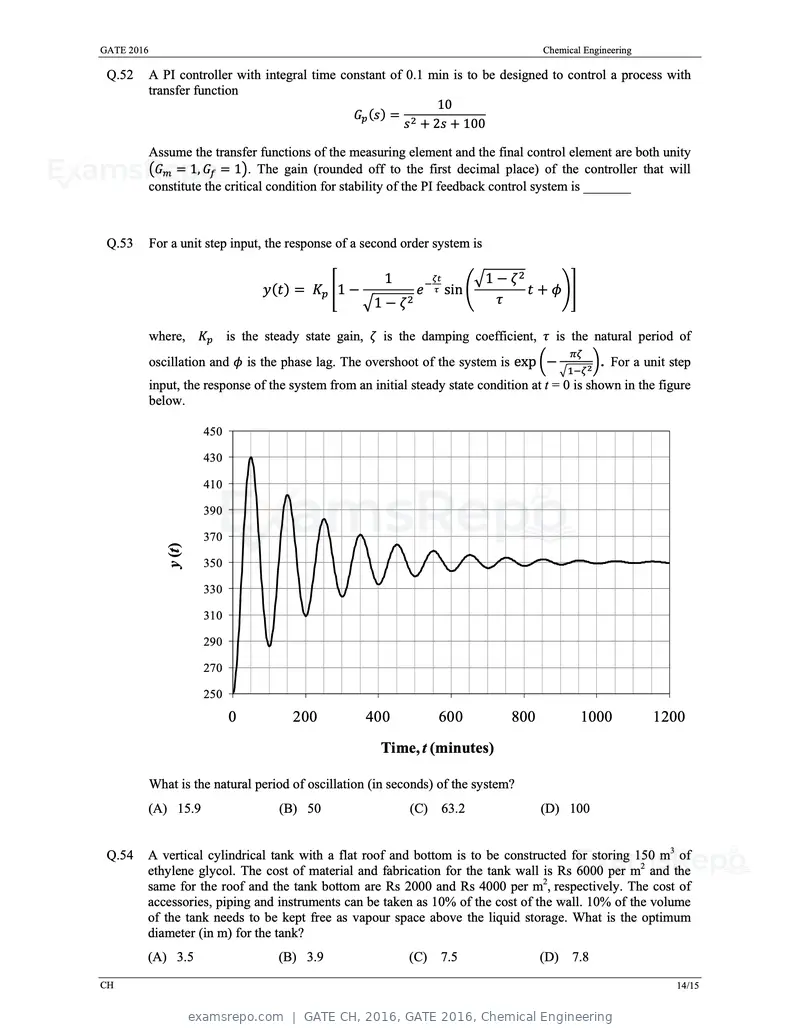
Text of page 17
GATE 2016                                                                                  Chemical Engineering

 Q.52       A PI controller with integral time constant of 0.1 min is to be designed to control a process with
            transfer function
                                                                10
                                                               2     100

            Assume the transfer functions of the measuring element and the final control element are both unity
                    1,       1 . The gain (rounded off to the first decimal place) of the controller that will
            constitute the critical condition for stability of the PI feedback control system is _______


 Q.53       For a unit step input, the response of a second order system is

                                                             1                1
                                                 1                     sin
                                                         1

            where,           is the steady state gain,       is the damping coefficient,     is the natural period of
            oscillation and      is the phase lag. The overshoot of the system is exp                  . For a unit step
            input, the response of the system from an initial steady state condition at t = 0 is shown in the figure
            below.

                       450

                       430

                       410

                       390

                       370
               y (t)   350

                       330

                       310

                       290

                       270

                       250
                             0           200             400           600         800             1000           1200

                                                          Time, t (minutes)

            What is the natural period of oscillation (in seconds) of the system?
            (A) 15.9                  (B) 50                     (C) 63.2                  (D) 100


 Q.54   A vertical cylindrical tank with a flat roof and bottom is to be constructed for storing 150 m3 of
        ethylene glycol. The cost of material and fabrication for the tank wall is Rs 6000 per m2 and the
        same for the roof and the tank bottom are Rs 2000 and Rs 4000 per m2, respectively. The cost of
        accessories, piping and instruments can be taken as 10% of the cost of the wall. 10% of the volume
        of the tank needs to be kept free as vapour space above the liquid storage. What is the optimum
        diameter (in m) for the tank?
        (A) 3.5                       (B) 3.9                    (C)   7.5                 (D) 7.8
CH                                                                                                                   14/15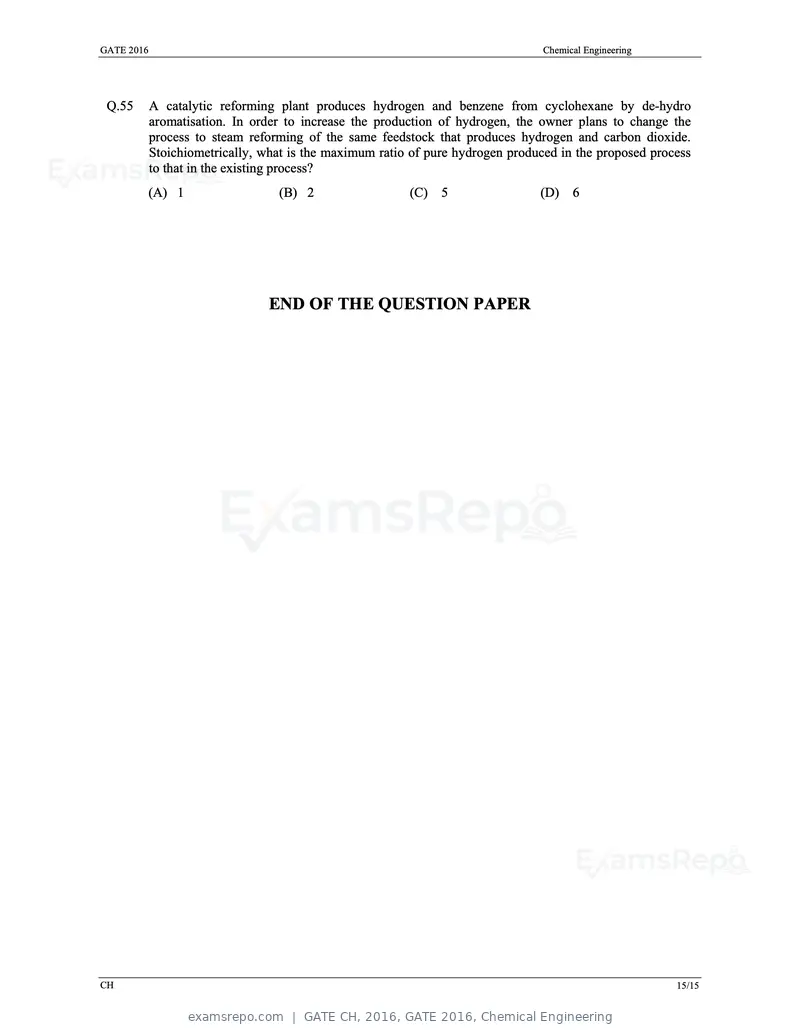
Text of page 18
GATE 2016                                                                        Chemical Engineering


 Q.55       A catalytic reforming plant produces hydrogen and benzene from cyclohexane by de-hydro
            aromatisation. In order to increase the production of hydrogen, the owner plans to change the
            process to steam reforming of the same feedstock that produces hydrogen and carbon dioxide.
            Stoichiometrically, what is the maximum ratio of pure hydrogen produced in the proposed process
            to that in the existing process?
            (A) 1                 (B) 2                  (C) 5                  (D)    6


                                 END OF THE QUESTION PAPER


CH                                                                                                      15/15
Text of page 19
Q. No Type Section       Key      Marks
  1   MCQ    GA           B        1
  2   MCQ    GA           A        1
  3   MCQ    GA           D        1
  4   MCQ    GA           C        1
  5   MCQ    GA           B        1
  6   MCQ    GA           C        2
  7   MCQ    GA           C        2
  8   MCQ    GA           C        2
  9   MCQ    GA           A        2
 10 MCQ      GA           C        2
  1   MCQ    CH           C        1
  2   MCQ    CH           A        1
  3   MCQ    CH           D        1
  4   MCQ    CH           B        1
  5   NAT    CH     -58.1 : -57.9  1
  6   MCQ    CH           C        1
  7   MCQ    CH           A        1
  8   NAT    CH      9.9 : 10.1    1
  9   NAT    CH     3.88 : 3.92    1
 10 MCQ      CH           C        1
 11   NAT    CH     0.39 : 0.41    1
 12 MCQ      CH           D        1
 13 MCQ      CH           C        1
 14   NAT    CH     1.99 : 2.01    1
 15 MCQ      CH           C        1
 16   NAT    CH     28.0 : 29.0    1
 17 MCQ      CH           D        1
 18 MCQ      CH           C        1
 19 MCQ      CH           D        1
 20 MCQ      CH           A        1
 21 MCQ      CH           B        1
 22 MCQ      CH           D        1
 23 MCQ      CH           B        1
 24 MCQ      CH           D        1
 25 MCQ      CH           A        1
 26   NAT    CH     14.9 : 15.1    2
 27 MCQ      CH           D        2
 28   NAT    CH     2.25 : 2.72    2
 29   NAT    CH       2.6 : 2.7    2
 30   NAT    CH     94.5 : 94.8    2
 31 MCQ      CH           A        2
 32   NAT    CH    371.0 : 375.0   2
 33   NAT    CH    399.9 : 400.1   2
 34   NAT    CH     1.63 : 1.67    2
 35 MCQ      CH           B        2
 36 MCQ      CH           C        2
 37   NAT    CH     2.05 : 2.25    2
 38   NAT    CH     48.5 : 49.5    2
 39   NAT    CH     0.12 : 0.13    2
Text of page 20
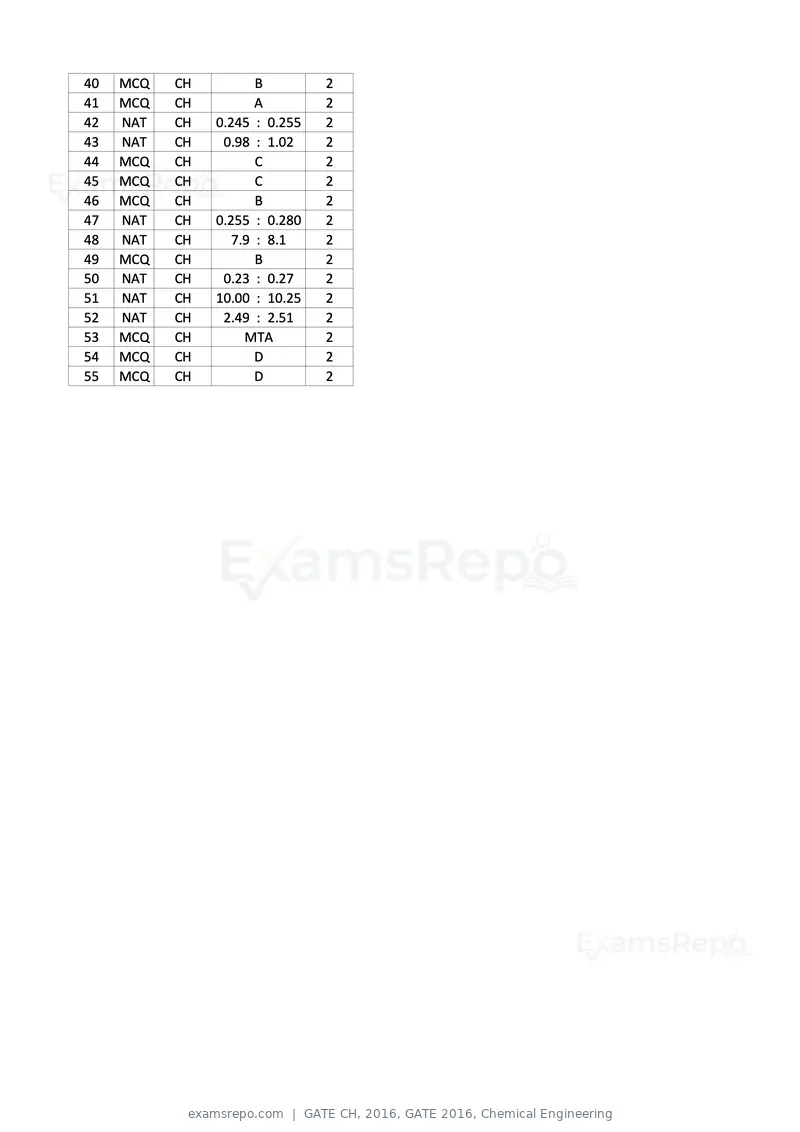
40   MCQ   CH          B        2
41   MCQ   CH          A        2
42   NAT   CH   0.245 : 0.255   2
43   NAT   CH    0.98 : 1.02    2
44   MCQ   CH          C        2
45   MCQ   CH          C        2
46   MCQ   CH          B        2
47   NAT   CH   0.255 : 0.280   2
48   NAT   CH      7.9 : 8.1    2
49   MCQ   CH          B        2
50   NAT   CH    0.23 : 0.27    2
51   NAT   CH   10.00 : 10.25   2
52   NAT   CH    2.49 : 2.51    2
53   MCQ   CH        MTA        2
54   MCQ   CH          D        2
55   MCQ   CH          D        2
Official key not published for this paper.
Page 1 of 20
Source: GATE. Question paper published by GATE.