
GATE CH 2018: Chemical Engineering
Text of page 1
GATE 2018                                                                 General Aptitude (GA) Set-4

Q. 1 – Q. 5 carry one mark each.
 Q.1   “When she fell down the _______, she received many _______ but little help.”

       The words that best fill the blanks in the above sentence are

       (A) stairs, stares                            (B) stairs, stairs
       (C) stares, stairs                            (D) stares, stares


 Q.2   “In spite of being warned repeatedly, he failed to correct his _________ behaviour.”

       The word that best fills the blank in the above sentence is

       (A) rational                 (B) reasonable   (C) errant              (D) good


 Q.3   For 0 ≤ x ≤ 2π, sin x and cos x are both decreasing functions in the interval ________.

                π                        π                    3π                  3π
       (A) (0, 2 )                  (B) ( 2 , π)     (C) (π, 2 )             (D) ( 2 , 2π)


 Q.4   The area of an equilateral triangle is √3. What is the perimeter of the triangle?

       (A) 2                        (B) 4            (C) 6                   (D) 8


 Q.5   Arrange the following three-dimensional objects in the descending order of their volumes:
         (i)  A cuboid with dimensions 10 cm, 8 cm and 6 cm
        (ii)  A cube of side 8 cm
       (iii)  A cylinder with base radius 7 cm and height 7 cm
       (iv)   A sphere of radius 7 cm

       (A) (i), (ii), (iii), (iv)
       (B) (ii), (i), (iv), (iii)
       (C) (iii), (ii), (i), (iv)
       (D) (iv), (iii), (ii), (i)


Q. 6 – Q. 10 carry two marks each.

 Q.6   An automobile travels from city A to city B and returns to city A by the same route. The
       speed of the vehicle during the onward and return journeys were constant at 60 km/h and
       90 km/h, respectively. What is the average speed in km/h for the entire journey?

       (A) 72                       (B) 73           (C) 74                  (D) 75


GA                                                                                                 1/2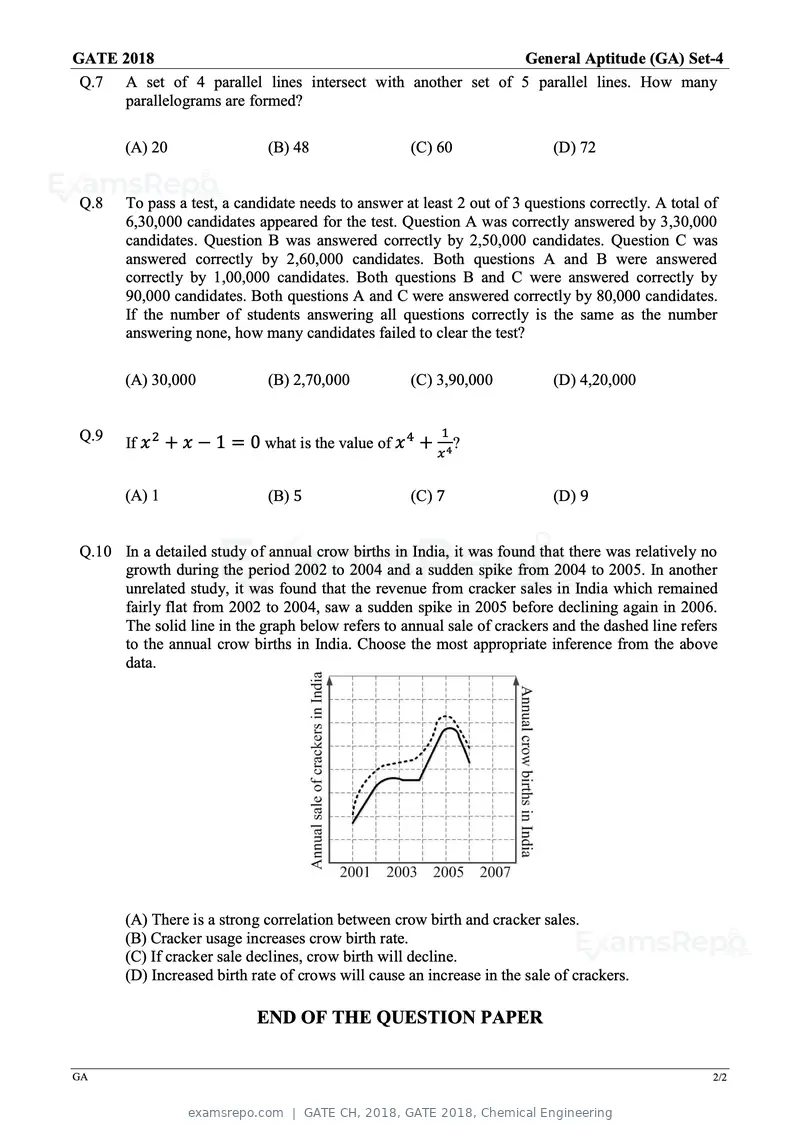
Text of page 2
GATE 2018                                                    General Aptitude (GA) Set-4
 Q.7 A set of 4 parallel lines intersect with another set of 5 parallel lines. How many
     parallelograms are formed?

       (A) 20                (B) 48                 (C) 60                 (D) 72


Q.8    To pass a test, a candidate needs to answer at least 2 out of 3 questions correctly. A total of
       6,30,000 candidates appeared for the test. Question A was correctly answered by 3,30,000
       candidates. Question B was answered correctly by 2,50,000 candidates. Question C was
       answered correctly by 2,60,000 candidates. Both questions A and B were answered
       correctly by 1,00,000 candidates. Both questions B and C were answered correctly by
       90,000 candidates. Both questions A and C were answered correctly by 80,000 candidates.
       If the number of students answering all questions correctly is the same as the number
       answering none, how many candidates failed to clear the test?

       (A) 30,000            (B) 2,70,000           (C) 3,90,000           (D) 4,20,000


                                                         1
Q.9    If x 2 + x − 1 = 0 what is the value of x 4 +          ?
                                                         x4


       (A) 1                 (B) 5                  (C) 7                  (D) 9


Q.10 In a detailed study of annual crow births in India, it was found that there was relatively no
     growth during the period 2002 to 2004 and a sudden spike from 2004 to 2005. In another
     unrelated study, it was found that the revenue from cracker sales in India which remained
     fairly flat from 2002 to 2004, saw a sudden spike in 2005 before declining again in 2006.
     The solid line in the graph below refers to annual sale of crackers and the dashed line refers
     to the annual crow births in India. Choose the most appropriate inference from the above
     data.


       (A) There is a strong correlation between crow birth and cracker sales.
       (B) Cracker usage increases crow birth rate.
       (C) If cracker sale declines, crow birth will decline.
       (D) Increased birth rate of crows will cause an increase in the sale of crackers.

                            END OF THE QUESTION PAPER


GA                                                                                                   2/2
Text of page 3
GATE 2018 CHEMICAL ENGINEERING
Q. 1 – Q. 25 carry one mark each.
Q.1 Consider the following two equations:
dx
x y 0
dt
dy
x0
dt
The above set of equations is represented by
d 2 y dy d 2 x dx
(A) y0 (B) y0
dt 2 dt dt 2 dt
d 2 y dy d 2 x dx
(C) y0 (D) y0
dt 2 dt dt 2 dt
Q.2 The fourth order Runge-Kutta (RK4) method to solve an ordinary differential equation
dy
f ( x, y ) is given as
dx
1
y ( x h) y ( x) k1 2k2 2k3 k4
6
k1 h f ( x, y )
h k
k2 h f x , y 1
2 2
h k
k3 h f x , y 2
2 2
k 4 h f x h, y k 3
For a special case when the function f depends solely on x, the above RK4 method reduces
to
(A) Euler’s explicit method (B) Trapezoidal rule
(C) Euler’s implicit method (D) Simpson’s 1/3 rule
Q.3 A watch uses two electronic circuits (ECs). Each EC has a failure probability of 0.1 in one
year of operation. Both ECs are required for functioning of the watch. The probability of
the watch functioning for one year without failure is
(A) 0.99 (B) 0.90 (C) 0.81 (D) 0.80
CH 1/17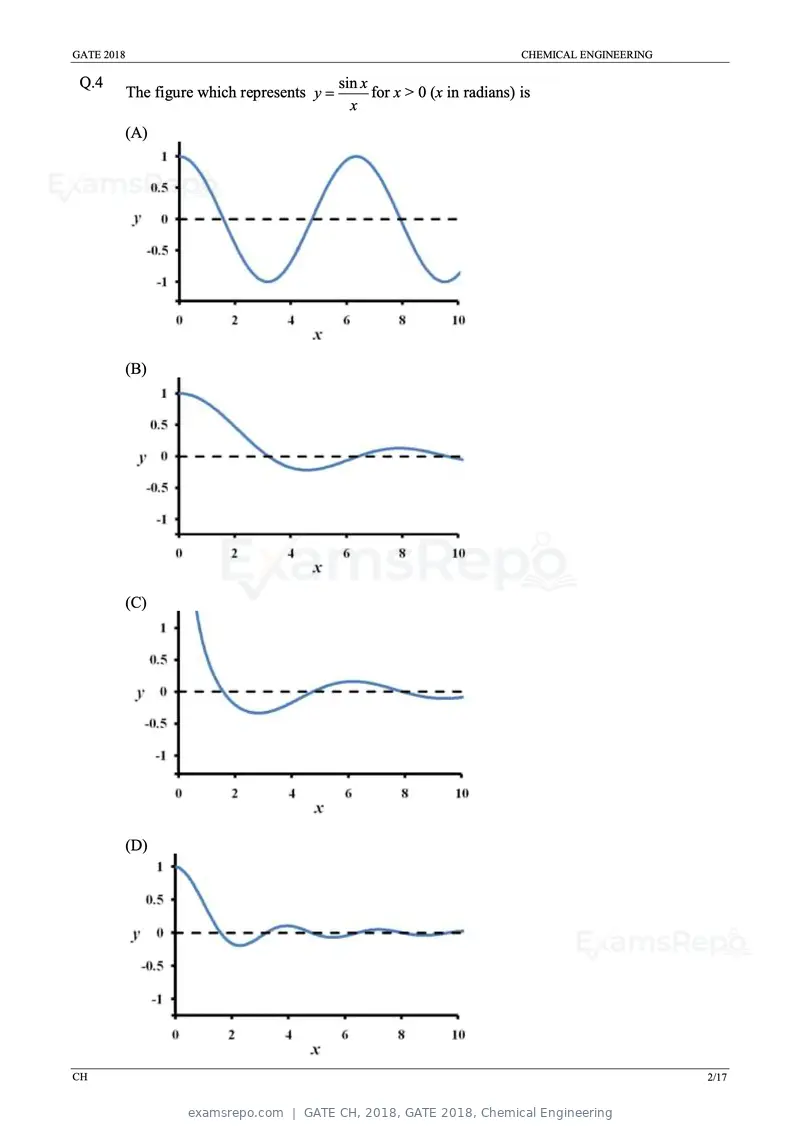
Text of page 4
GATE 2018 CHEMICAL ENGINEERING
Q.4 sin x
The figure which represents y for x > 0 (x in radians) is
x
(A)
(B)
(C)
(D)
CH 2/17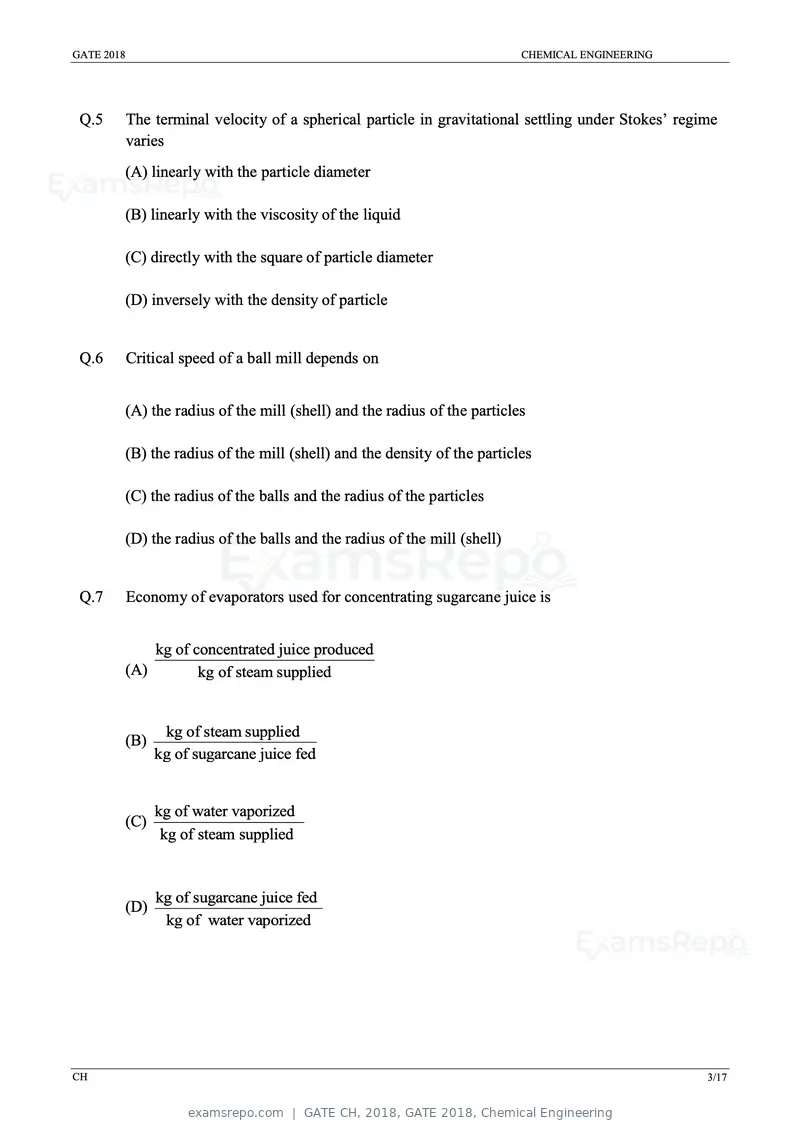
Text of page 5
GATE 2018                                                                CHEMICAL ENGINEERING


 Q.5        The terminal velocity of a spherical particle in gravitational settling under Stokes’ regime
            varies
        (A) linearly with the particle diameter

        (B) linearly with the viscosity of the liquid

        (C) directly with the square of particle diameter

        (D) inversely with the density of particle


 Q.6        Critical speed of a ball mill depends on


        (A) the radius of the mill (shell) and the radius of the particles

        (B) the radius of the mill (shell) and the density of the particles

        (C) the radius of the balls and the radius of the particles

        (D) the radius of the balls and the radius of the mill (shell)


 Q.7        Economy of evaporators used for concentrating sugarcane juice is


            kg of concentrated juice produced
        (A)        kg of steam supplied


                 kg of steam supplied
        (B)
                kg of sugarcane juice fed


                kg of water vaporized
        (C)
                 kg of steam supplied


                kg of sugarcane juice fed
        (D)
                 kg of water vaporized


CH                                                                                                    3/17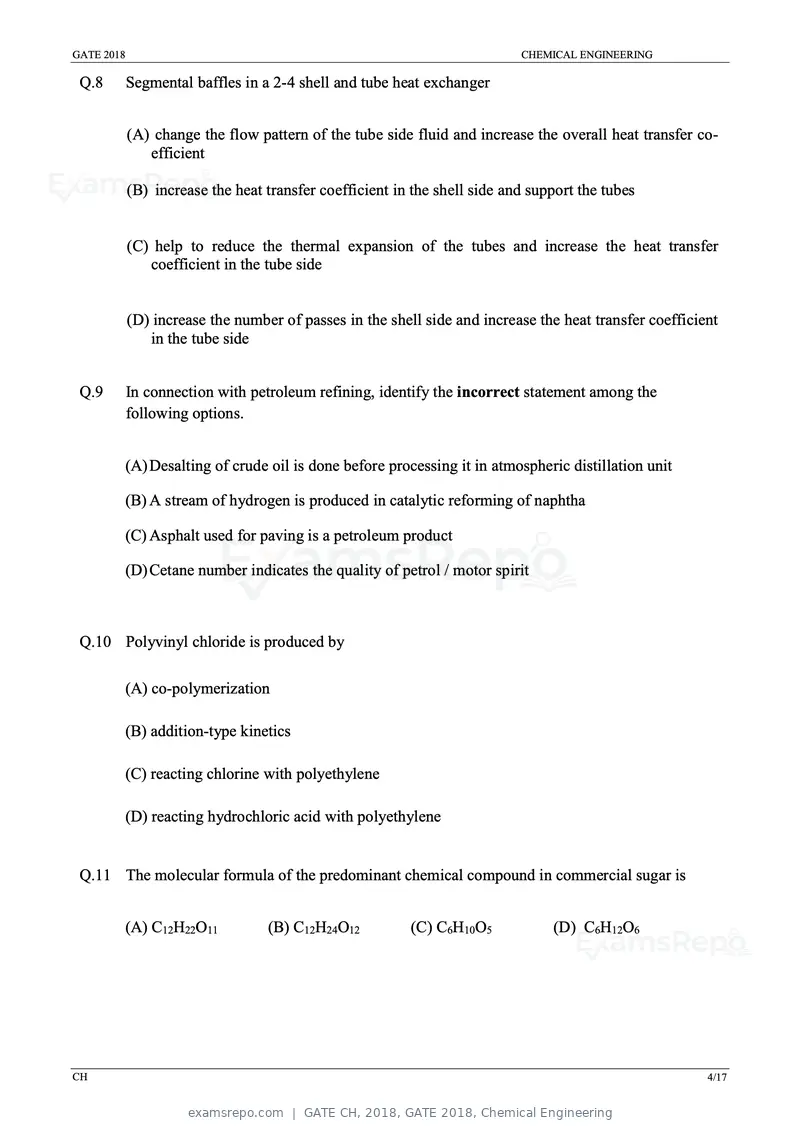
Text of page 6
GATE 2018                                                                  CHEMICAL ENGINEERING

 Q.8        Segmental baffles in a 2-4 shell and tube heat exchanger


            (A) change the flow pattern of the tube side fluid and increase the overall heat transfer co-
               efficient

            (B) increase the heat transfer coefficient in the shell side and support the tubes


            (C) help to reduce the thermal expansion of the tubes and increase the heat transfer
               coefficient in the tube side


            (D) increase the number of passes in the shell side and increase the heat transfer coefficient
               in the tube side


 Q.9        In connection with petroleum refining, identify the incorrect statement among the
            following options.


        (A) Desalting of crude oil is done before processing it in atmospheric distillation unit

        (B) A stream of hydrogen is produced in catalytic reforming of naphtha

        (C) Asphalt used for paving is a petroleum product

        (D) Cetane number indicates the quality of petrol / motor spirit


 Q.10 Polyvinyl chloride is produced by

        (A) co-polymerization

        (B) addition-type kinetics

        (C) reacting chlorine with polyethylene

        (D) reacting hydrochloric acid with polyethylene


 Q.11 The molecular formula of the predominant chemical compound in commercial sugar is


        (A) C12H22O11             (B) C12H24O12          (C) C6H10O5            (D) C6H12O6


CH                                                                                                      4/17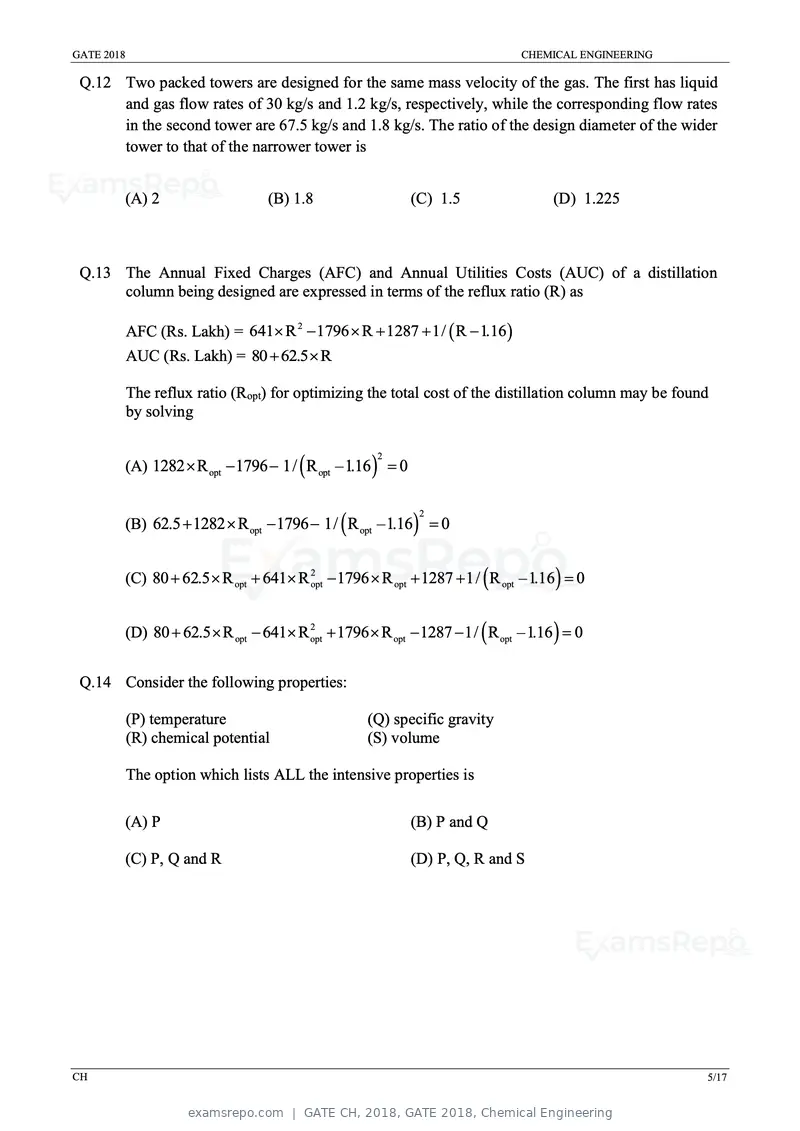
Text of page 7
GATE 2018 CHEMICAL ENGINEERING
Q.12 Two packed towers are designed for the same mass velocity of the gas. The first has liquid
and gas flow rates of 30 kg/s and 1.2 kg/s, respectively, while the corresponding flow rates
in the second tower are 67.5 kg/s and 1.8 kg/s. The ratio of the design diameter of the wider
tower to that of the narrower tower is
(A) 2 (B) 1.8 (C) 1.5 (D) 1.225
Q.13 The Annual Fixed Charges (AFC) and Annual Utilities Costs (AUC) of a distillation
column being designed are expressed in terms of the reflux ratio (R) as
AFC (Rs. Lakh) = 641 R 2 1796 R 1287 1/ R 1.16
AUC (Rs. Lakh) = 80 62.5 R
The reflux ratio (Ropt) for optimizing the total cost of the distillation column may be found
by solving
0
2
(A) 1282 R opt 1796 1/ R opt –1.16
0
2
(B) 62.5 1282 R opt 1796 1/ R opt –1.16
(C) 80 62.5 R opt 641 R opt
2
1796 R opt 1287 1/ R opt –1.16 0
(D) 80 62.5 R opt 641 R opt
2
1796 R opt 1287 1/ R opt –1.16 0
Q.14 Consider the following properties:
(P) temperature (Q) specific gravity
(R) chemical potential (S) volume
The option which lists ALL the intensive properties is
(A) P (B) P and Q
(C) P, Q and R (D) P, Q, R and S
CH 5/17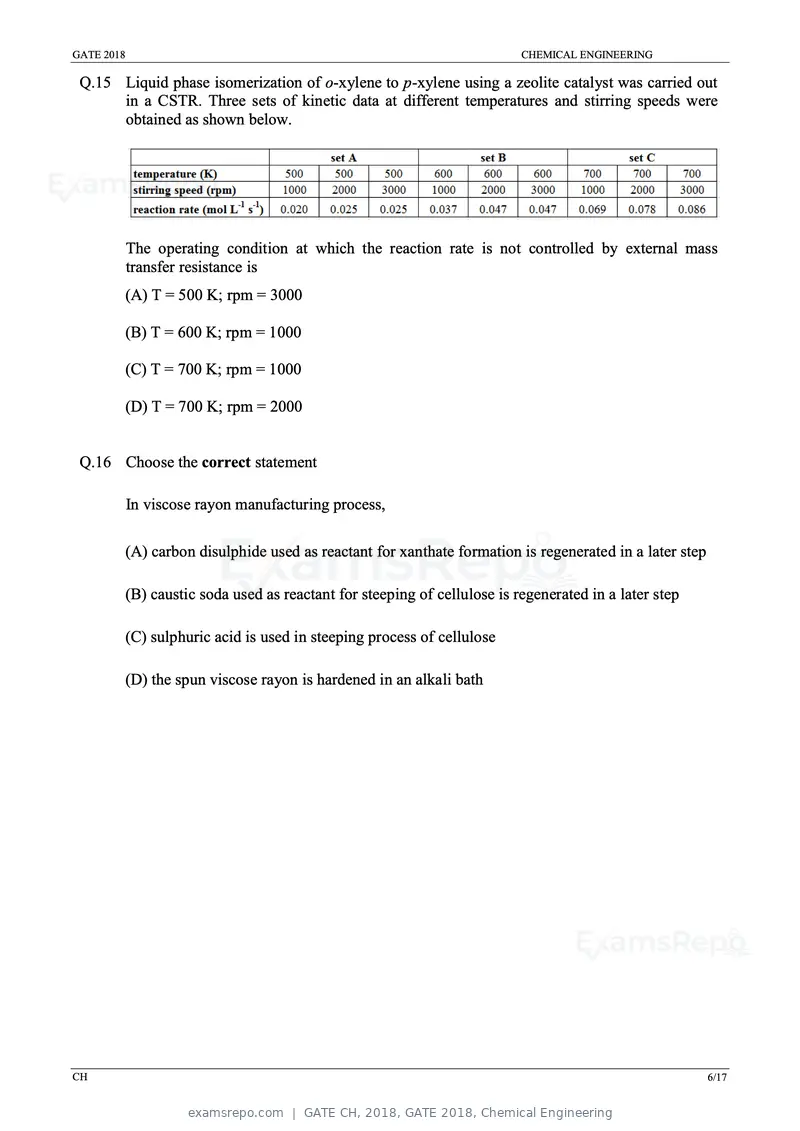
Text of page 8
GATE 2018                                                               CHEMICAL ENGINEERING

 Q.15 Liquid phase isomerization of o-xylene to p-xylene using a zeolite catalyst was carried out
      in a CSTR. Three sets of kinetic data at different temperatures and stirring speeds were
      obtained as shown below.


            The operating condition at which the reaction rate is not controlled by external mass
            transfer resistance is
        (A) T = 500 K; rpm = 3000

        (B) T = 600 K; rpm = 1000

        (C) T = 700 K; rpm = 1000

        (D) T = 700 K; rpm = 2000


 Q.16 Choose the correct statement

            In viscose rayon manufacturing process,

        (A) carbon disulphide used as reactant for xanthate formation is regenerated in a later step

        (B) caustic soda used as reactant for steeping of cellulose is regenerated in a later step

        (C) sulphuric acid is used in steeping process of cellulose

        (D) the spun viscose rayon is hardened in an alkali bath


CH                                                                                                     6/17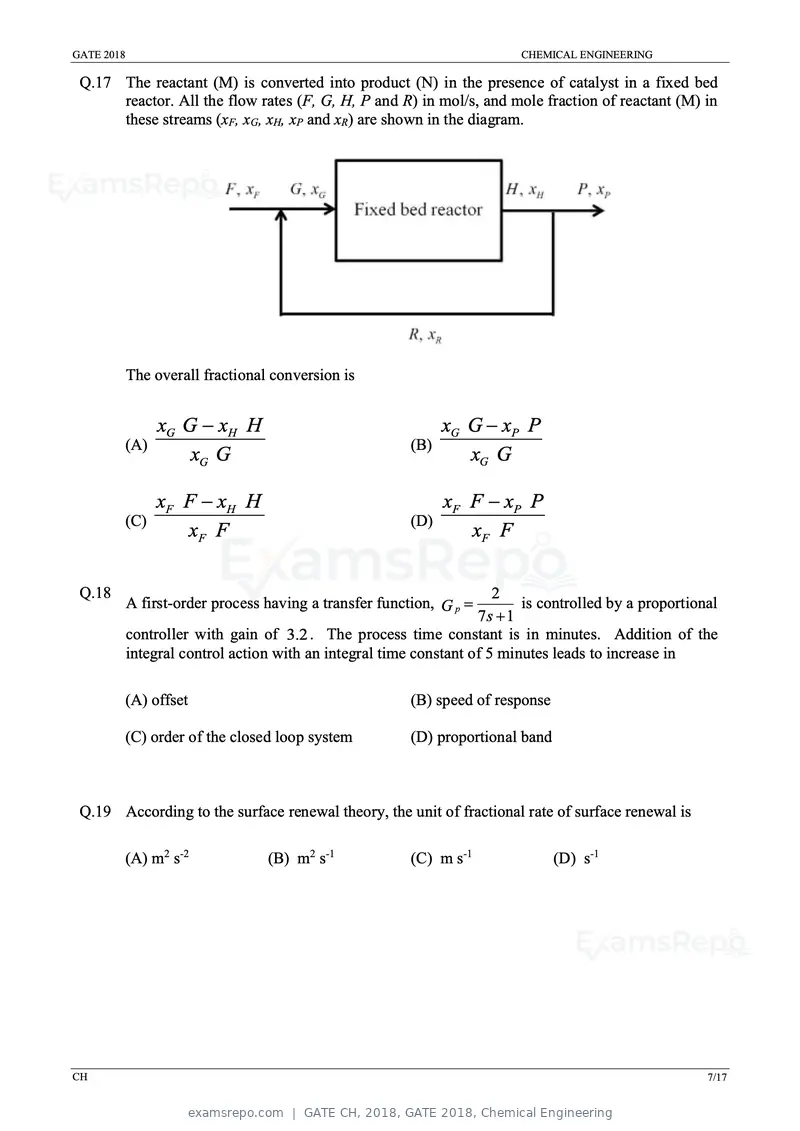
Text of page 9
GATE 2018 CHEMICAL ENGINEERING
Q.17 The reactant (M) is converted into product (N) in the presence of catalyst in a fixed bed
reactor. All the flow rates (F, G, H, P and R) in mol/s, and mole fraction of reactant (M) in
these streams (xF, xG, xH, xP and xR) are shown in the diagram.
The overall fractional conversion is
xG G xH H xG G xP P
(A) (B)
xG G xG G
xF F xH H xF F x P P
(C) (D)
xF F xF F
Q.18 2
A first-order process having a transfer function, G p is controlled by a proportional
7s 1
controller with gain of 3.2 . The process time constant is in minutes. Addition of the
integral control action with an integral time constant of 5 minutes leads to increase in
(A) offset (B) speed of response
(C) order of the closed loop system (D) proportional band
Q.19 According to the surface renewal theory, the unit of fractional rate of surface renewal is
(A) m2 s-2 (B) m2 s-1 (C) m s-1 (D) s-1
CH 7/17
Text of page 10
GATE 2018 CHEMICAL ENGINEERING
Q.20 For absorption of H2S from a mixture with hydrocarbon vapour into an aqueous
alkanolamine solution, the liquid phase mass transfer resistance is
(A) significantly higher than that of the gas phase
(B) negligible compared to that of the gas phase
(C) equal to that of the gas phase
(D) dependent on the gas phase mass transfer resistance
Q.21 For a chemical reaction, the ratio of rate constant at 500 K to that at 400 K is 2.5. Given R
= 8.314 J mol-1 K-1, the value of activation energy (in kJ/mol) is
(A) 10.5 (B) 12.0 (C) 15.2 (D) 18.4
Q.22 Pitot tube is used to measure
(A) liquid level in a tank
(B) flow velocity at a point
(C) angular deformation
(D) vorticity
Q.23 A venturi meter is installed to measure the flow rate of water in a 178 mm diameter (ID)
pipe. The throat diameter is 102 mm. The differential pressure measured using a
manometer is 154.3 kN/m2. The data given are:
discharge coefficient = 0.98; water density = 1000 kg/m3.
The volumetric flow rate of water (in m3/s) is _________.
Q.24 The ammonia (NH3) oxidation process occurs over a catalyst as
4 NH 3 5O2 6 H 2O 4 NO
Air is supplied such that oxygen (O2) is 20% in excess of that required for complete
conversion of NH3. The mole fraction of O2 in inlet gas mixture (NH3 + air) is ______
(rounded off to third decimal place)
CH 8/17
Text of page 11
GATE 2018 CHEMICAL ENGINEERING
Q.25 The initial water level in a tank is 4 m. When the valve located at the bottom is opened, the
dL
rate of change of water level (L) with respect to time (t) is, k t , where
dt
k 0.6 m s 3/2 . The level of water (in m) in the tank at time 0.5 s after opening the valve is
____________ (rounded off to second decimal place).
Q. 26 – Q. 55 carry two marks each.
Q.26 Match the equipment in Column A with the corresponding process in Column B
Column A Column B
(P) Centrifugal sifter (I) Mixing
(Q) Bowl mill (II) Sedimentation
(R) Gravity thickener (III) Screening
(S) Two-arm kneader (IV) Grinding
(A) P-I, Q-IV, R-II, S-III (B) P-III, Q-IV, R-II, S-I
(C) P-IV, Q-I, R-II, S-III (D) P-IV, Q-III, R-I, S-II
Q.27 In the year 2005, the cost of a shell and tube heat exchanger with 68 m 2 heat transfer area
was Rs. 12.6 Lakh. Chemical Engineering Index for cost in 2005 was 509.4 and now the
index is 575.4. Based on index of 0.6 for capacity scaling, the present cost (in Lakhs of
rupees) of a similar heat exchanger having 100 m2 heat transfer area is estimated to be
(A) 17.94 (B) 19.94 (C) 20.94 (D) 22.94
Q.28 A furnace installed at a cost of Rs. 24 Lakh is expected to serve its useful life of 5 years.
Salvage value of the furnace is Rs. 8 Lakh. The interest rate compounded annually is 8%.
The estimated capitalized cost (in Lakhs of rupees) is
(A) 30 (B) 34.09 (C) 34.9 (D) 58.09
CH 9/17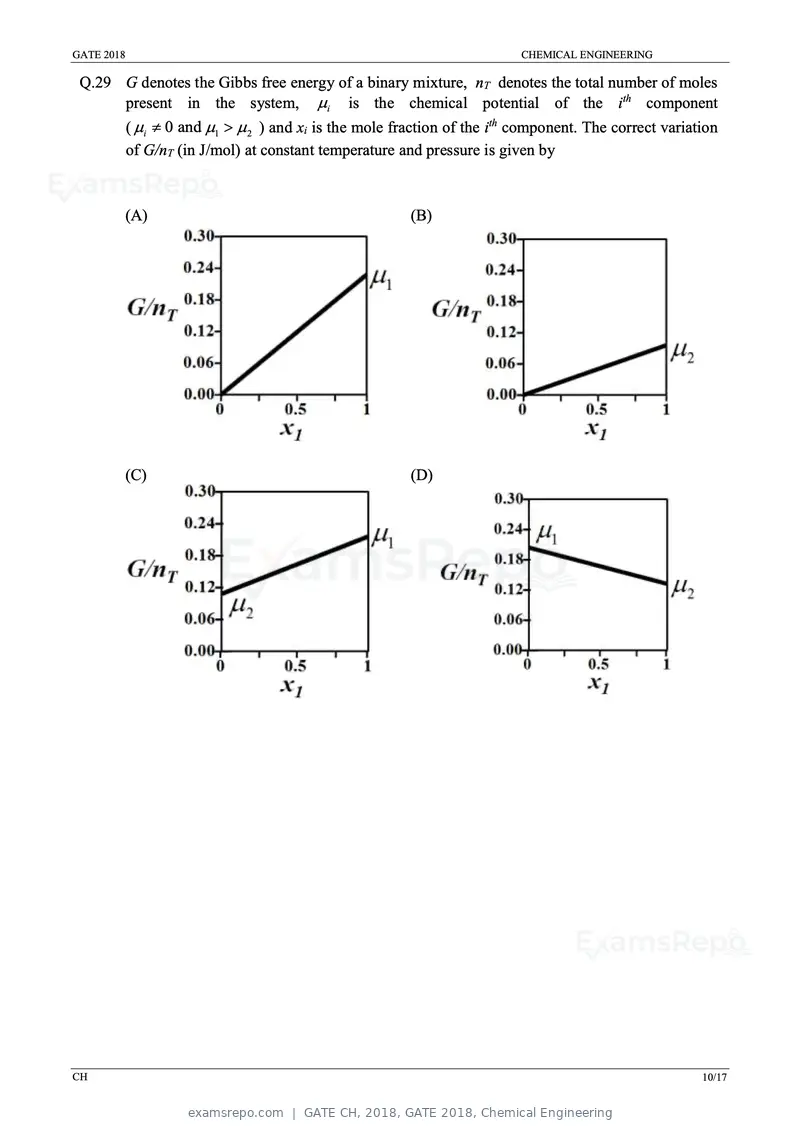
Text of page 12
GATE 2018 CHEMICAL ENGINEERING
Q.29 G denotes the Gibbs free energy of a binary mixture, nT denotes the total number of moles
present in the system, i is the chemical potential of the ith component
( i 0 and 1 2 ) and xi is the mole fraction of the ith component. The correct variation
of G/nT (in J/mol) at constant temperature and pressure is given by
(A) (B)
(C) (D)
CH 10/17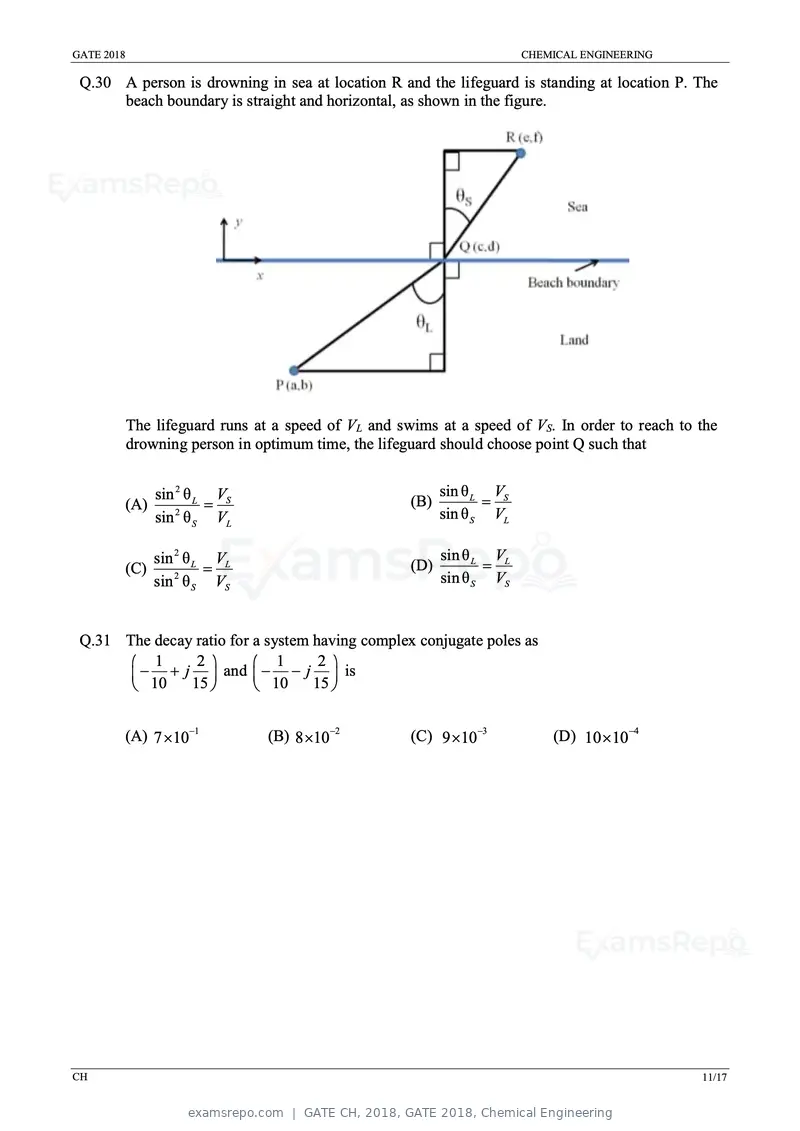
Text of page 13
GATE 2018 CHEMICAL ENGINEERING
Q.30 A person is drowning in sea at location R and the lifeguard is standing at location P. The
beach boundary is straight and horizontal, as shown in the figure.
The lifeguard runs at a speed of VL and swims at a speed of VS. In order to reach to the
drowning person in optimum time, the lifeguard should choose point Q such that
sin 2 θ L VS sin θ L VS
(A) (B)
sin 2 θ S VL sin θ S VL
sin 2 θ L VL sin θ L VL
(C) (D)
sin 2 θ S VS sin θ S VS
Q.31 The decay ratio for a system having complex conjugate poles as
1 2 1 2
j and j is
10 15 10 15
(A) 7 101 (B) 8 102 (C) 9 103 (D) 10 104
CH 11/17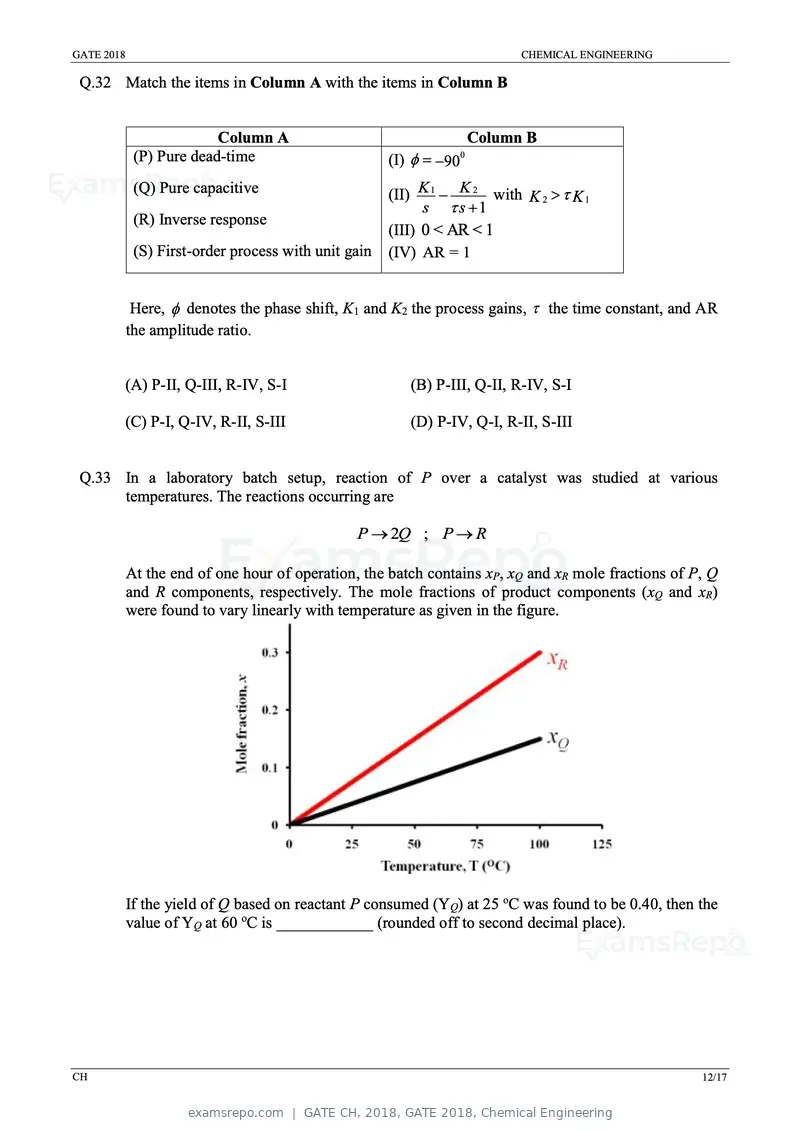
Text of page 14
GATE 2018 CHEMICAL ENGINEERING
Q.32 Match the items in Column A with the items in Column B
Column A Column B
(P) Pure dead-time (I) 90 0
(Q) Pure capacitive (II) K 1 K 2 with K 2 K 1
s s 1
(R) Inverse response
(III) 0 < AR < 1
(S) First-order process with unit gain (IV) AR = 1
Here, denotes the phase shift, K1 and K2 the process gains, the time constant, and AR
the amplitude ratio.
(A) P-II, Q-III, R-IV, S-I (B) P-III, Q-II, R-IV, S-I
(C) P-I, Q-IV, R-II, S-III (D) P-IV, Q-I, R-II, S-III
Q.33 In a laboratory batch setup, reaction of P over a catalyst was studied at various
temperatures. The reactions occurring are
P 2Q ; P R
At the end of one hour of operation, the batch contains xP, xQ and xR mole fractions of P, Q
and R components, respectively. The mole fractions of product components (xQ and xR)
were found to vary linearly with temperature as given in the figure.
If the yield of Q based on reactant P consumed (YQ) at 25 oC was found to be 0.40, then the
value of YQ at 60 oC is ____________ (rounded off to second decimal place).
CH 12/17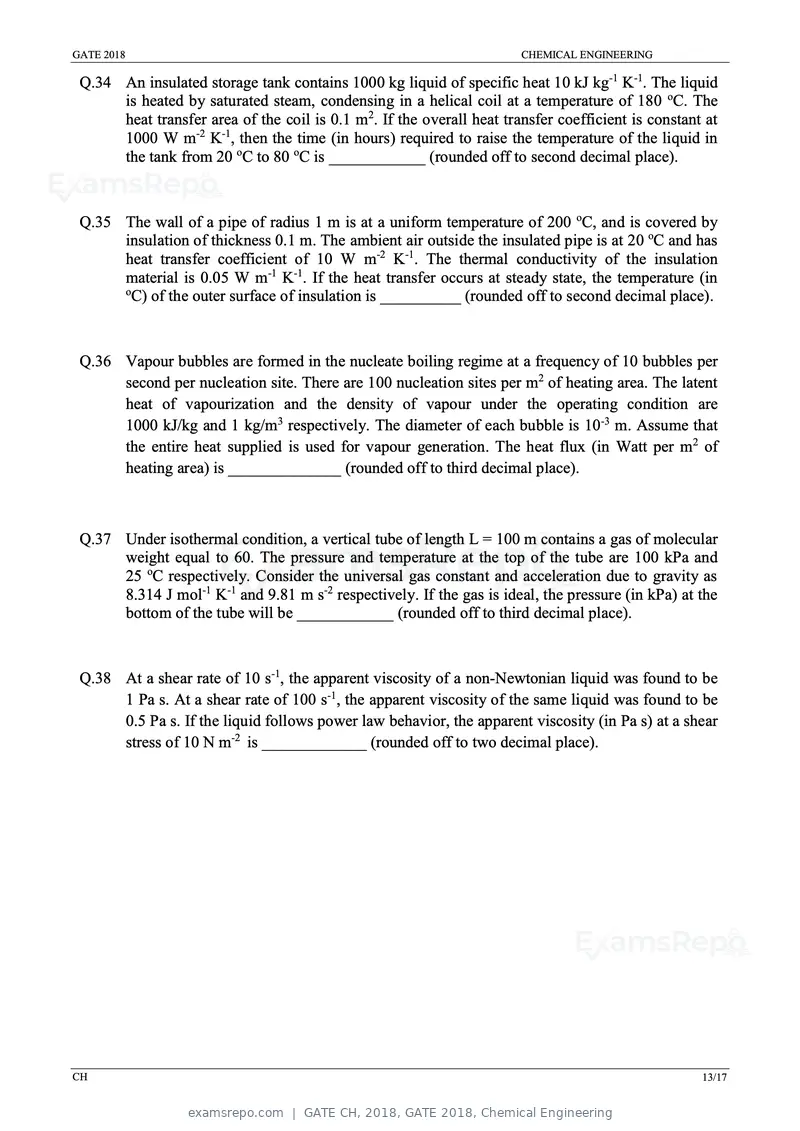
Text of page 15
GATE 2018                                                              CHEMICAL ENGINEERING

 Q.34 An insulated storage tank contains 1000 kg liquid of specific heat 10 kJ kg-1 K-1. The liquid
      is heated by saturated steam, condensing in a helical coil at a temperature of 180 oC. The
      heat transfer area of the coil is 0.1 m2. If the overall heat transfer coefficient is constant at
      1000 W m-2 K-1, then the time (in hours) required to raise the temperature of the liquid in
      the tank from 20 oC to 80 oC is ____________ (rounded off to second decimal place).


 Q.35 The wall of a pipe of radius 1 m is at a uniform temperature of 200 oC, and is covered by
      insulation of thickness 0.1 m. The ambient air outside the insulated pipe is at 20 oC and has
      heat transfer coefficient of 10 W m-2 K-1. The thermal conductivity of the insulation
      material is 0.05 W m-1 K-1. If the heat transfer occurs at steady state, the temperature (in
      o
       C) of the outer surface of insulation is __________ (rounded off to second decimal place).


 Q.36 Vapour bubbles are formed in the nucleate boiling regime at a frequency of 10 bubbles per
      second per nucleation site. There are 100 nucleation sites per m2 of heating area. The latent
      heat of vapourization and the density of vapour under the operating condition are
      1000 kJ/kg and 1 kg/m3 respectively. The diameter of each bubble is 10-3 m. Assume that
      the entire heat supplied is used for vapour generation. The heat flux (in Watt per m2 of
      heating area) is ______________ (rounded off to third decimal place).


 Q.37 Under isothermal condition, a vertical tube of length L = 100 m contains a gas of molecular
      weight equal to 60. The pressure and temperature at the top of the tube are 100 kPa and
      25 oC respectively. Consider the universal gas constant and acceleration due to gravity as
      8.314 J mol-1 K-1 and 9.81 m s-2 respectively. If the gas is ideal, the pressure (in kPa) at the
      bottom of the tube will be ____________ (rounded off to third decimal place).


 Q.38 At a shear rate of 10 s-1, the apparent viscosity of a non-Newtonian liquid was found to be
      1 Pa s. At a shear rate of 100 s-1, the apparent viscosity of the same liquid was found to be
      0.5 Pa s. If the liquid follows power law behavior, the apparent viscosity (in Pa s) at a shear
      stress of 10 N m-2 is _____________ (rounded off to two decimal place).


CH                                                                                                  13/17
Text of page 16
GATE 2018                                                            CHEMICAL ENGINEERING

 Q.39 A CSTR and a PFR of equal volume are connected in series as shown below to carry out a
      first-order, isothermal, liquid phase reaction

                                                  A→P


            The rate constant is 0.2 s-1. The space-time is 5 s for both the reactors. The overall
            fractional conversion of A is ____________ (rounded off to third decimal place).


 Q.40 The elementary second-order liquid phase reaction A + B → C + D is carried out in an
      isothermal plug flow reactor of 2 m3 volume. The inlet volumetric flow rate is 10 m3/h. The
      initial concentrations of both A and B are 2 kmol/m3. The rate constant is given as
      2.5 m3 kmol-1 h-1. The percentage conversion of A is ____________.


 Q.41 It is decided to extract A from a feed containing 20 mol% A and 80 mol% B in two ideal
      cross-current stages as shown below, using equal amount of pure solvent C in each stage.


            Components B and C are immiscible. 60% of A in the feed is extracted in Stage 1. The
            equilibrium relation is given by Y* = 1.5 X where,
            X = moles of A per mole of B in raffinate
            Y* = moles of A per mole of C in extract in equilibrium with raffinate

            The mol % of A in raffinate from Stage 2 is __________ (rounded off to second decimal
            place).


CH                                                                                             14/17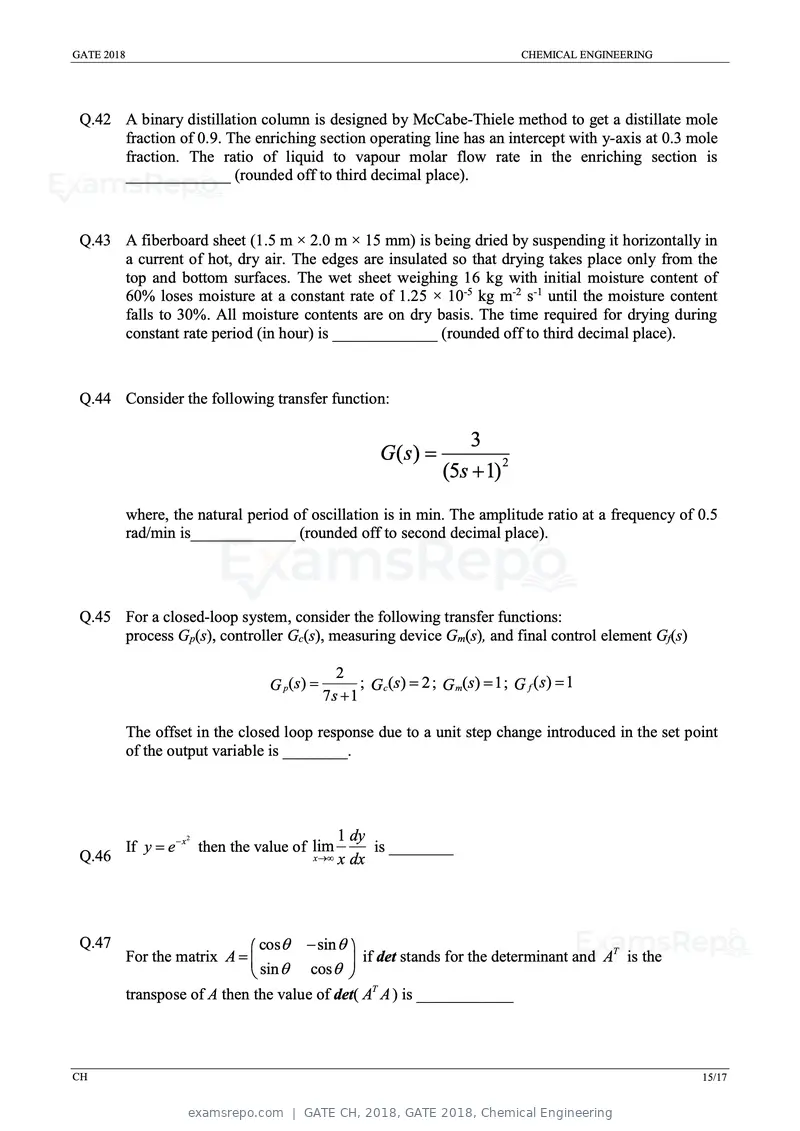
Text of page 17
GATE 2018 CHEMICAL ENGINEERING
Q.42 A binary distillation column is designed by McCabe-Thiele method to get a distillate mole
fraction of 0.9. The enriching section operating line has an intercept with y-axis at 0.3 mole
fraction. The ratio of liquid to vapour molar flow rate in the enriching section is
_____________ (rounded off to third decimal place).
Q.43 A fiberboard sheet (1.5 m × 2.0 m × 15 mm) is being dried by suspending it horizontally in
a current of hot, dry air. The edges are insulated so that drying takes place only from the
top and bottom surfaces. The wet sheet weighing 16 kg with initial moisture content of
60% loses moisture at a constant rate of 1.25 × 10⁻⁵ kg m-2 s-1 until the moisture content
falls to 30%. All moisture contents are on dry basis. The time required for drying during
constant rate period (in hour) is _____________ (rounded off to third decimal place).
Q.44 Consider the following transfer function:
3
G( s)
(5s 1)
2
where, the natural period of oscillation is in min. The amplitude ratio at a frequency of 0.5
rad/min is_____________ (rounded off to second decimal place).
Q.45 For a closed-loop system, consider the following transfer functions:
process Gp(s), controller Gc(s), measuring device Gm(s), and final control element Gf(s)
2
G p( s) ; G c(s) 2 ; G m(s) 1 ; G f ( s) 1
7s 1
The offset in the closed loop response due to a unit step change introduced in the set point
of the output variable is ________.
1 dy
If y e x then the value of lim
2
is ________
Q.46 x x dx
Q.47 cos sin
For the matrix A T
if det stands for the determinant and A is the
sin cos
transpose of A then the value of det( AT A ) is ____________
CH 15/17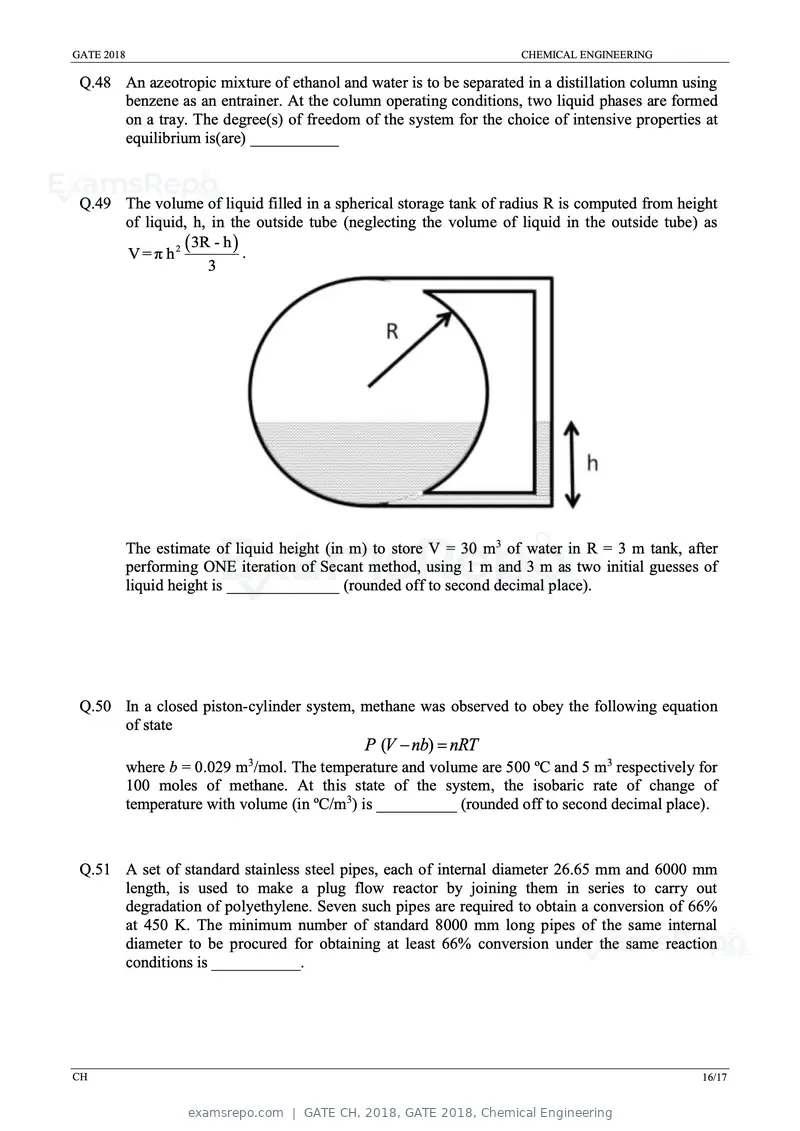
Text of page 18
GATE 2018 CHEMICAL ENGINEERING
Q.48 An azeotropic mixture of ethanol and water is to be separated in a distillation column using
benzene as an entrainer. At the column operating conditions, two liquid phases are formed
on a tray. The degree(s) of freedom of the system for the choice of intensive properties at
equilibrium is(are) ___________
Q.49 The volume of liquid filled in a spherical storage tank of radius R is computed from height
of liquid, h, in the outside tube (neglecting the volume of liquid in the outside tube) as
V = π h2
3R - h .
3
The estimate of liquid height (in m) to store V = 30 m3 of water in R = 3 m tank, after
performing ONE iteration of Secant method, using 1 m and 3 m as two initial guesses of
liquid height is ______________ (rounded off to second decimal place).
Q.50 In a closed piston-cylinder system, methane was observed to obey the following equation
of state
P (V nb) nRT
where b = 0.029 m /mol. The temperature and volume are 500 ºC and 5 m3 respectively for
3
100 moles of methane. At this state of the system, the isobaric rate of change of
temperature with volume (in ºC/m3) is __________ (rounded off to second decimal place).
Q.51 A set of standard stainless steel pipes, each of internal diameter 26.65 mm and 6000 mm
length, is used to make a plug flow reactor by joining them in series to carry out
degradation of polyethylene. Seven such pipes are required to obtain a conversion of 66%
at 450 K. The minimum number of standard 8000 mm long pipes of the same internal
diameter to be procured for obtaining at least 66% conversion under the same reaction
conditions is ___________.
CH 16/17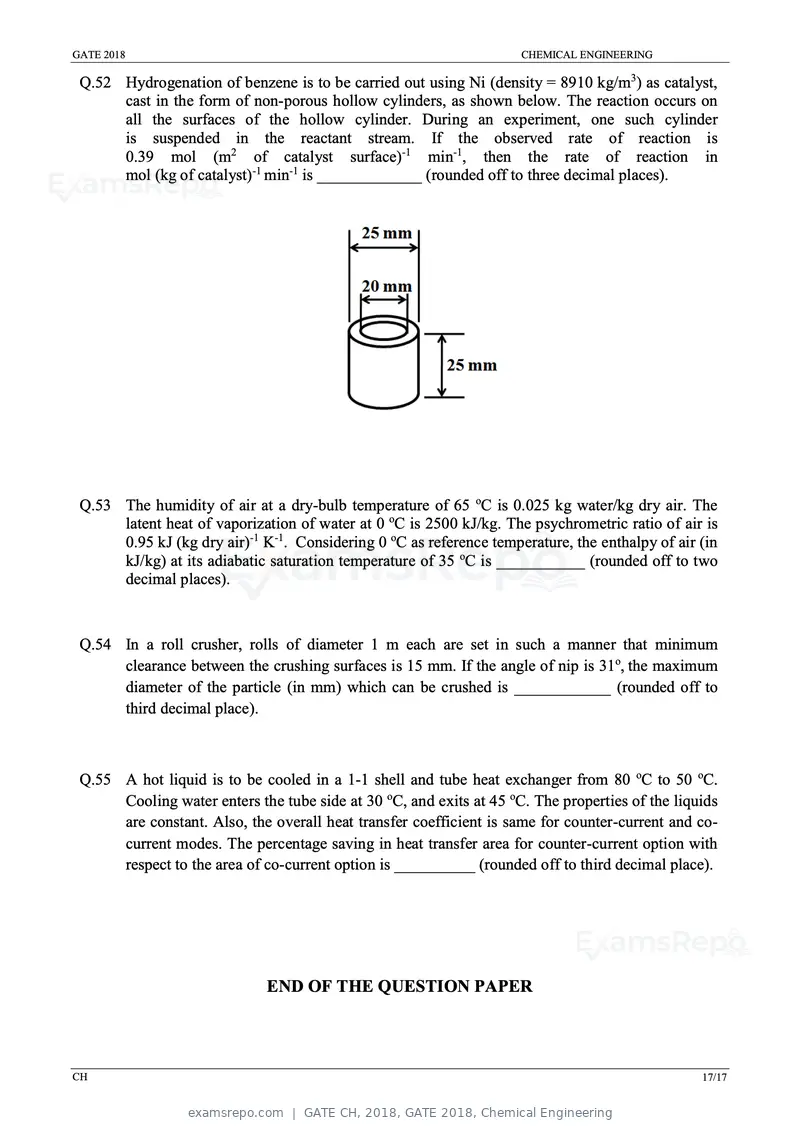
Text of page 19
GATE 2018                                                            CHEMICAL ENGINEERING

 Q.52 Hydrogenation of benzene is to be carried out using Ni (density = 8910 kg/m3) as catalyst,
      cast in the form of non-porous hollow cylinders, as shown below. The reaction occurs on
      all the surfaces of the hollow cylinder. During an experiment, one such cylinder
      is suspended in the reactant stream. If the observed rate of reaction is
      0.39 mol (m2 of catalyst surface)-1 min-1, then the rate of reaction in
      mol (kg of catalyst)-1 min-1 is _____________ (rounded off to three decimal places).


 Q.53 The humidity of air at a dry-bulb temperature of 65 oC is 0.025 kg water/kg dry air. The
      latent heat of vaporization of water at 0 oC is 2500 kJ/kg. The psychrometric ratio of air is
      0.95 kJ (kg dry air)-1 K-1. Considering 0 oC as reference temperature, the enthalpy of air (in
      kJ/kg) at its adiabatic saturation temperature of 35 oC is ___________ (rounded off to two
      decimal places).


 Q.54 In a roll crusher, rolls of diameter 1 m each are set in such a manner that minimum
      clearance between the crushing surfaces is 15 mm. If the angle of nip is 31o, the maximum
      diameter of the particle (in mm) which can be crushed is ____________ (rounded off to
      third decimal place).


 Q.55 A hot liquid is to be cooled in a 1-1 shell and tube heat exchanger from 80 oC to 50 oC.
      Cooling water enters the tube side at 30 oC, and exits at 45 oC. The properties of the liquids
      are constant. Also, the overall heat transfer coefficient is same for counter-current and co-
      current modes. The percentage saving in heat transfer area for counter-current option with
      respect to the area of co-current option is __________ (rounded off to third decimal place).


                              END OF THE QUESTION PAPER


CH                                                                                               17/17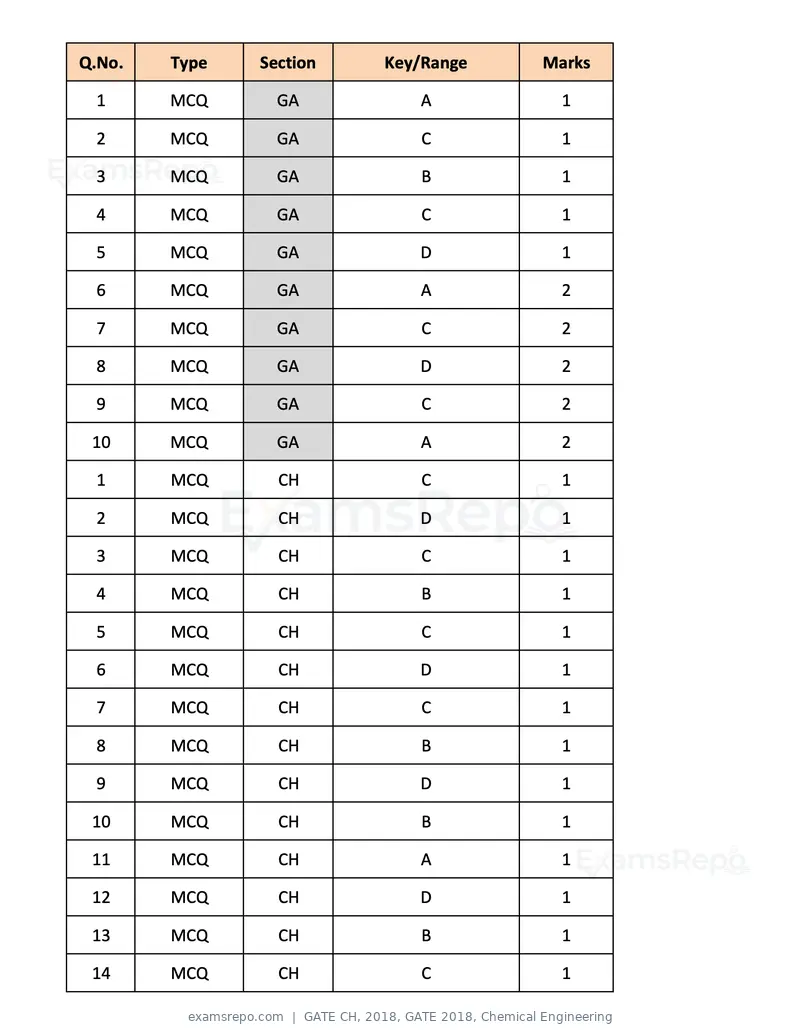
Text of page 20
Q.No.   Type   Section   Key/Range   Marks

 1      MCQ      GA         A          1

 2      MCQ      GA         C          1

 3      MCQ      GA         B          1

 4      MCQ      GA         C          1

 5      MCQ      GA         D          1

 6      MCQ      GA         A          2

 7      MCQ      GA         C          2

 8      MCQ      GA         D          2

 9      MCQ      GA         C          2

 10     MCQ      GA         A          2

 1      MCQ      CH         C          1

 2      MCQ      CH         D          1

 3      MCQ      CH         C          1

 4      MCQ      CH         B          1

 5      MCQ      CH         C          1

 6      MCQ      CH         D          1

 7      MCQ      CH         C          1

 8      MCQ      CH         B          1

 9      MCQ      CH         D          1

 10     MCQ      CH         B          1

 11     MCQ      CH         A          1

 12     MCQ      CH         D          1

 13     MCQ      CH         B          1

 14     MCQ      CH         C          1
Text of page 21
Q.No.   Type   Section     Key/Range        Marks

 15     MCQ      CH             A             1

 16     MCQ      CH             A             1

 17     MCQ      CH             D             1

 18     MCQ      CH             C             1

 19     MCQ      CH             D             1

 20     MCQ      CH             B             1

 21     MCQ      CH             C             1

 22     MCQ      CH             B             1

 23     NAT      CH       0.145 to 0.155      1

 24     NAT      CH       0.170 to 0.200      1

 25     NAT      CH         3.7 to 3.9        1

 26     MCQ      CH             B             2

 27     MCQ      CH             A             2

 28     MCQ      CH             D             2

 29     MCQ      CH             C             2

 30     MCQ      CH             D             2

 31     MCQ      CH             C             2

 32     MCQ      CH             D             2

 33     NAT      CH        0.40 to 0.40       2

 34     NAT      CH      12.75 to 13.25       2

 35     NAT      CH        27.8 to 28.6       2

 36     NAT      CH        0.51 to 0.54       2

 37     NAT      CH      102.37 to 102.44     2

 38     NAT      CH        0.98 to 1.02       2
Text of page 22
Q.No.   Type   Section     Key/Range          Marks

 39     NAT      CH        0.80 to 0.84         2

 40     NAT      CH          50 to 50           2

 41     NAT      CH        3.75 to 3.95         2

 42     NAT      CH        0.65 to 0.68         2

 43     NAT      CH        11.0 to 11.3         2

 44     NAT      CH        0.41 to 0.42         2

 45     NAT      CH         0.2 to 0.2          2

 46     NAT      CH           0 to 0            2

 47     NAT      CH           1 to 1            2

 48     NAT      CH      1 to 1 (or) 2 to 2     2

 49     NAT      CH        1.80 to 2.00         2

 50     NAT      CH         367 to 369          2

 51     NAT      CH           6 to 6            2

 52     NAT      CH      0.034 to 0.043         2

 53     NAT      CH         124 to 125          2

 54     NAT      CH          52 to 54           2

 55     NAT      CH        26.5 to 27.5         2
Official key not published for this paper.
Page 1 of 22
Source: GATE. Question paper published by GATE.