
GATE EC 2014: Electronics and Communication Engineering Session 4
Text of page 1
SESSION - 1
Text of page 2
GATE 2014: General Instructions during Examination

   1. Total duration of the GATE examination is 180 minutes.
   2. The clock will be set at the server. The countdown timer at the top right corner of
      screen will display the remaining time available for you to complete the examination.
      When the timer reaches zero, the examination will end by itself. You need not
      terminate the examination or submit your paper.
   3. Any useful data required for your paper can be viewed by clicking on the Useful
      Common Data button that appears on the screen.
   4. Use the scribble pad provided to you for any rough work. Submit the scribble pad at
      the end of the examination.
   5. You are allowed to use a non-programmable type calculator, however, sharing of
      calculators is not allowed.
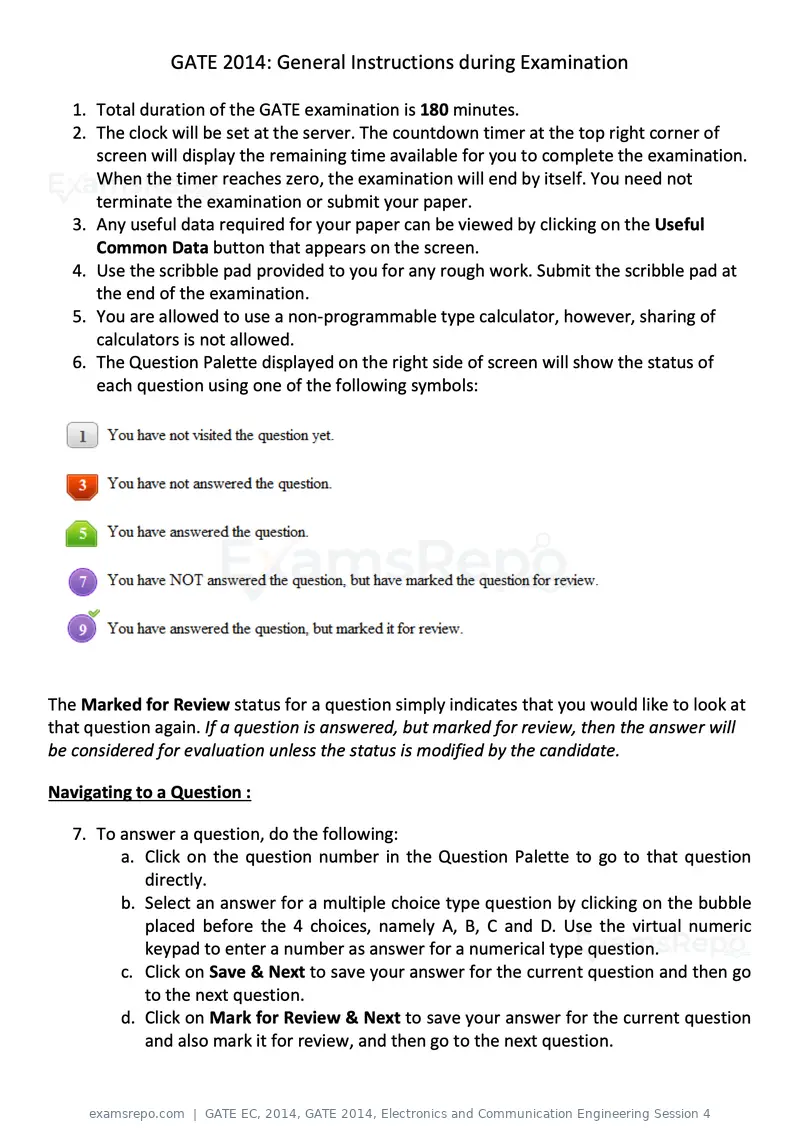
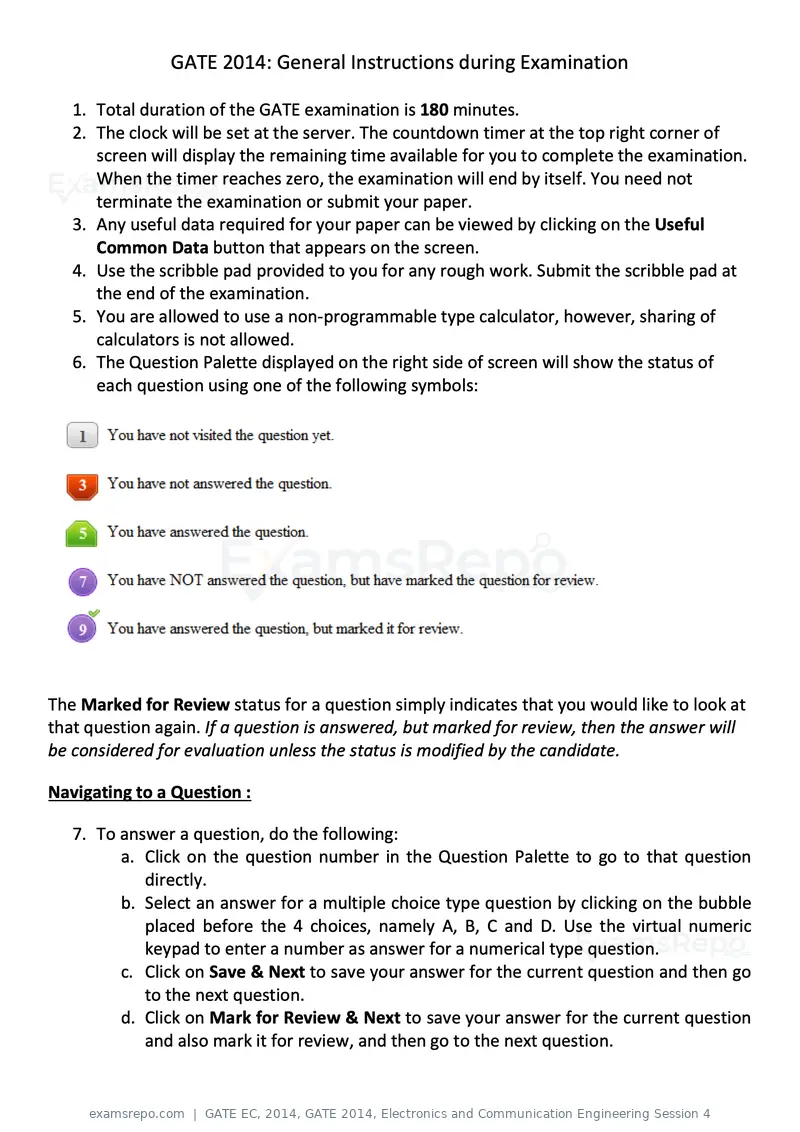
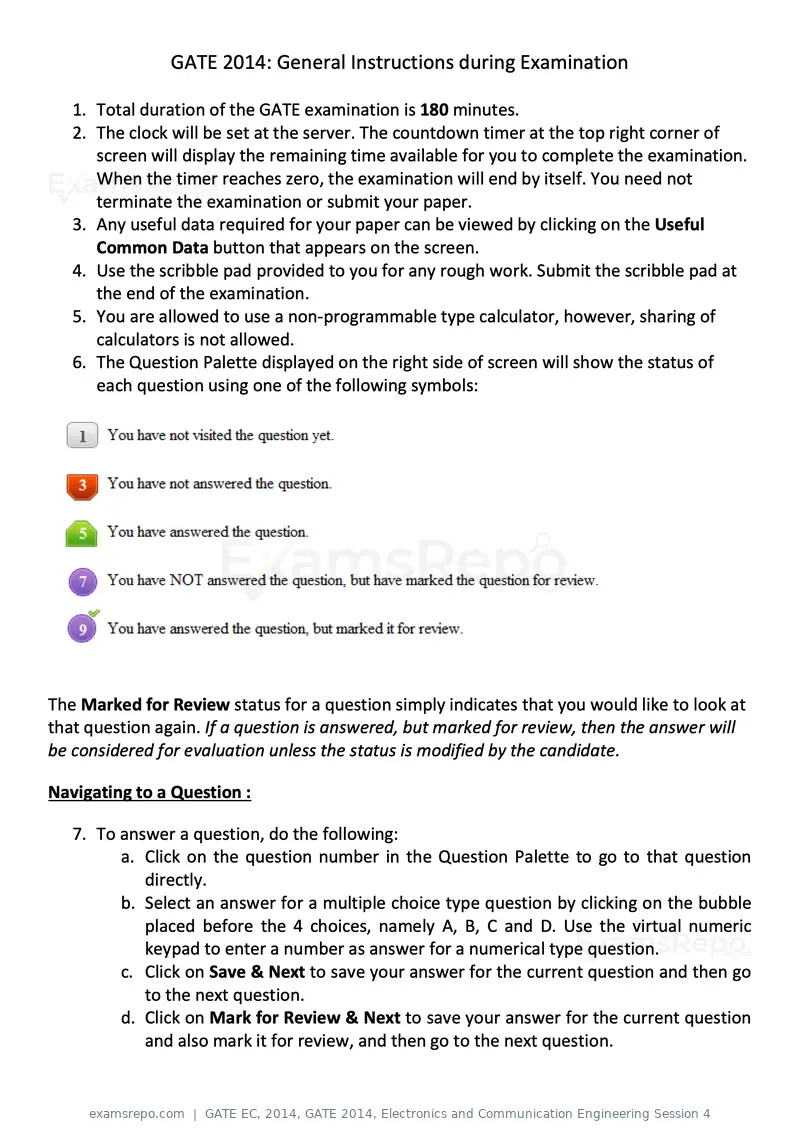
   6. The Question Palette displayed on the right side of screen will show the status of
      each question using one of the following symbols:


The Marked for Review status for a question simply indicates that you would like to look at
that question again. If a question is answered, but marked for review, then the answer will
be considered for evaluation unless the status is modified by the candidate.

Navigating to a Question :

   7. To answer a question, do the following:
         a. Click on the question number in the Question Palette to go to that question
            directly.
         b. Select an answer for a multiple choice type question by clicking on the bubble
            placed before the 4 choices, namely A, B, C and D. Use the virtual numeric
            keypad to enter a number as answer for a numerical type question.
         c. Click on Save & Next to save your answer for the current question and then go
            to the next question.
         d. Click on Mark for Review & Next to save your answer for the current question
            and also mark it for review, and then go to the next question.
Text of page 3
Caution: Note that your answer for the current question will not be saved, if you navigate
to another question directly by clicking on a question number without saving the answer to
the previous question.

You can view all the questions by clicking on the Question Paper button. This feature is
provided, so that if you want you can just see the entire question paper at a glance.

Answering a Question :

   8. Procedure for answering a multiple choice (MCQ) type question:
         a. Choose one answer from the 4 options (A,B,C,D) given below the question,
            click on the bubble placed before the chosen option.
         b. To deselect your chosen answer, click on the bubble of the chosen option again
            or click on the Clear Response button.
         c. To change your chosen answer, click on the bubble of another option.
         d. To save your answer, you MUST click on the Save & Next button.

   9. Procedure for answering a numerical answer type question:
         a. To enter a number as your answer, use the virtual numerical keypad.
         b. A fraction (e.g. -0.3 or -.3) can be entered as an answer with or without '0'
             before the decimal point. As many as four decimal points, e.g. 12.5435 or
             0.003 or -932.6711 or 12.82 can be entered.
         c. To clear your answer, click on the Clear Response button.
         d. To save your answer, you MUST click on the Save & Next button
   10. To mark a question for review, click on the Mark for Review & Next button. If an
      answer is selected (for MCQ) or entered (for numerical answer type) for a question
      that is Marked for Review, that answer will be considered in the evaluation unless
      the status is modified by the candidate.

   11. To change your answer to a question that has already been answered, first select
      that question for answering and then follow the procedure for answering that type of
      question.
   12. Note that ONLY Questions for which answers are saved or marked for review after
      answering will be considered for evaluation.


      Choosing a Section :

   13. Sections in this question paper are displayed on the top bar of the screen. Questions
      in a Section can be viewed by clicking on the name of that Section. The Section you
      are currently viewing will be highlighted.
   14. A checkbox is displayed for every optional Section, if any, in the Question Paper. To
      select the optional Section for answering, click on the checkbox for that Section.
   15. If the checkbox for an optional Section is not selected, the Save & Next button and
      the Mark for Review & Next button will NOT be enabled for that Section. You will
Text of page 4
only be able to see questions in this Section, but you will not be able to answer
      questions in the Section.
   16. After clicking the Save & Next button for the last question in a Section, you will
      automatically be taken to the first question of the next Section in sequence.
   17. You can move the mouse cursor over the name of a Section to view the answering
      status for that Section.


Changing the Optional Section :

   18. After answering the chosen optional Section, partially or completely, you can change
      the optional Section by selecting the checkbox for a new Section that you want to
      attempt. A warning message will appear along with a table showing the number of
      questions answered in each of the previously chosen optional Sections and a
      checkbox against each of these Sections. Click on a checkbox against a Section that
      you want to reset and then click on the RESET button. Note that RESETTING a Section
      will DELETE all the answers for questions in that Section. Hence, if you think that you
      may want to select this Section again later, you will have to note down your answers
      for questions in that Section. If you do not want to reset the Section and want to
      continue answering the previously chosen optional Section, then click on the BACK
      button.

   19. If you deselect the checkbox for an optional Section in the top bar, the following
      warning message will appear: "Deselecting the checkbox will DELETE all the answers
      for questions in this Section. Do you want to deselect this Section?” If you want to
      deselect, click on the RESET button. If you do not want to deselect, click on the BACK
      button.

   20. You can shuffle between different Sections or change the optional Sections any
      number of times.
Text of page 5
GATE 2014 Examination
                        EC: Electronics & Communications Engineering
Duration: 180 minutes                                                                        Maximum Marks: 100

Read the following instructions carefully.

    1. To login, enter your Registration Number and password provided to you. Kindly go through the various
       symbols used in the test and understand their meaning before you start the examination.
    2. Once you login and after the start of the examination, you can view all the questions in the question
       paper, by clicking on the View All Questions button in the screen.
    3. This question paper consists of 2 sections, General Aptitude (GA) for 15 marks and the subject
       specific GATE paper for 85 marks. Both these sections are compulsory.
       The GA section consists of 10 questions. Question numbers 1 to 5 are of 1-mark each, while question
       numbers 6 to 10 are of 2-mark each.
       The subject specific GATE paper section consists of 55 questions, out of which question numbers 1 to
       25 are of 1-mark each, while question numbers 26 to 55 are of 2-mark each.
    4. Depending upon the GATE paper, there may be useful common data that may be required for
       answering the questions. If the paper has such useful data, the same can be viewed by clicking on the
       Useful Common Data button that appears at the top, right hand side of the screen.
    5. The computer allotted to you at the examination center runs specialized software that permits only one
        answer to be selected for multiple-choice questions using a mouse and to enter a suitable number for
        the numerical answer type questions using the virtual keyboard and mouse.
    6. Your answers shall be updated and saved on a server periodically and also at the end of the
        examination. The examination will stop automatically at the end of 180 minutes.
    7. In each paper a candidate can answer a total of 65 questions carrying 100 marks.
    8. The question paper may consist of questions of multiple choice type (MCQ) and numerical answer
        type.
    9. Multiple choice type questions will have four choices against A, B, C, D, out of which only ONE is the
        correct answer. The candidate has to choose the correct answer by clicking on the bubble (⃝) placed
        before the choice.
    10. For numerical answer type questions, each question will have a numerical answer and there will not be
        any choices. For these questions, the answer should be enteredby using the virtual keyboard that
        appears on the monitor and the mouse.
    11. All questions that are not attempted will result in zero marks. However, wrong answers for multiple
        choice type questions (MCQ) will result in NEGATIVE marks. For all MCQ questions a wrong
        answer will result in deduction of⅓ marks for a 1-mark question and ⅔ marks for a 2-mark question.
    12. There is NO NEGATIVE MARKING for questions of NUMERICAL ANSWER TYPE.
    13. Non-programmable type Calculator is allowed. Charts, graph sheets, and mathematical tables are NOT
        allowed in the Examination Hall. You must use the Scribble pad provided to you at the examination
        centre for all your rough work. The Scribble Pad has to be returned at the end of the examination.

    Declaration by the candidate:

    “I have read and understood all the above instructions. I have also read and understood clearly the
    instructions given on the admit card and shall follow the same. I also understand that in case I am found to
    violate any of these instructions, my candidature is liable to be cancelled. I also confirm that at the start of
    the examination all the computer hardware allotted to me are in proper working condition”.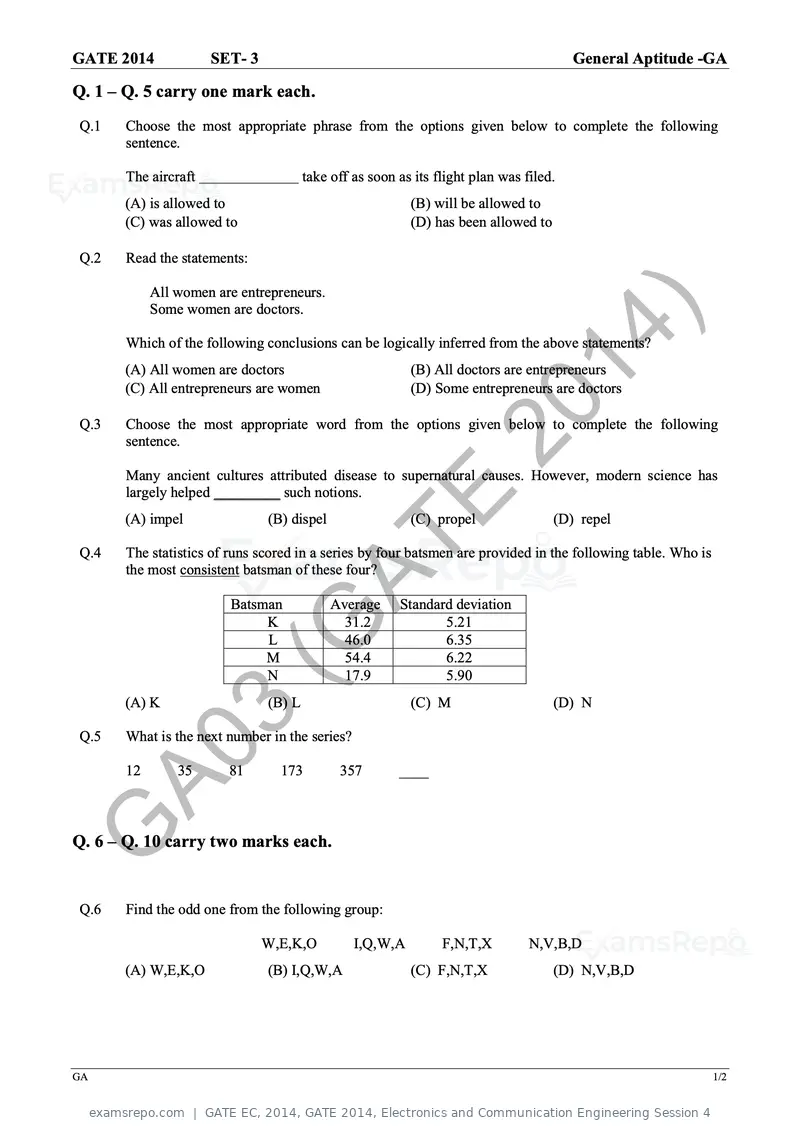
Text of page 6
GATE 2014             SET- 3                                                            General Aptitude -GA

Q. 1 – Q. 5 carry one mark each.
Q.1    Choose the most appropriate phrase from the options given below to complete the following
       sentence.

       The aircraft                    take off as soon as its flight plan was filed.
      (A) is allowed to                                   (B) will be allowed to
      (C) was allowed to                                  (D) has been allowed to

Q.2    Read the statements:

            All women are entrepreneurs.
            Some women are doctors.


                                                                 20
       Which of the following conclusions can be logically inferred from the above statements?
      (A) All women are doctors
      (C) All entrepreneurs are women
                                                                   14
                                                          (B) All doctors are entrepreneurs
                                                          (D) Some entrepreneurs are doctors

Q.3
                                                                      )
       Choose the most appropriate word from the options given below to complete the following
       sentence.

       Many ancient cultures attributed disease to supernatural causes. However, modern science has
       largely helped _________ such notions.
      (A) impel
                                       AT
                               (B) dispel                 (C) propel                (D) repel

Q.4

                                          E
       The statistics of runs scored in a series by four batsmen are provided in the following table. Who is
       the most consistent batsman of these four?

                         Batsman            Average     Standard deviation


      (A) K
                        (G    K
                              L
                              M
                              N
                               (B) L
                                              31.2
                                              46.0
                                              54.4
                                              17.9
                                                          (C) M
                                                               5.21
                                                               6.35
                                                               6.22
                                                               5.90
                                                                                    (D) N

Q.5
                3
       What is the next number in the series?


     A012       35      81       173         357        ____


G
Q. 6 – Q. 10 carry two marks each.


Q.6    Find the odd one from the following group:

                               W,E,K,O          I,Q,W,A         F,N,T,X         N,V,B,D
      (A) W,E,K,O              (B) I,Q,W,A                (C) F,N,T,X               (D) N,V,B,D


GA                                                                                                             1/2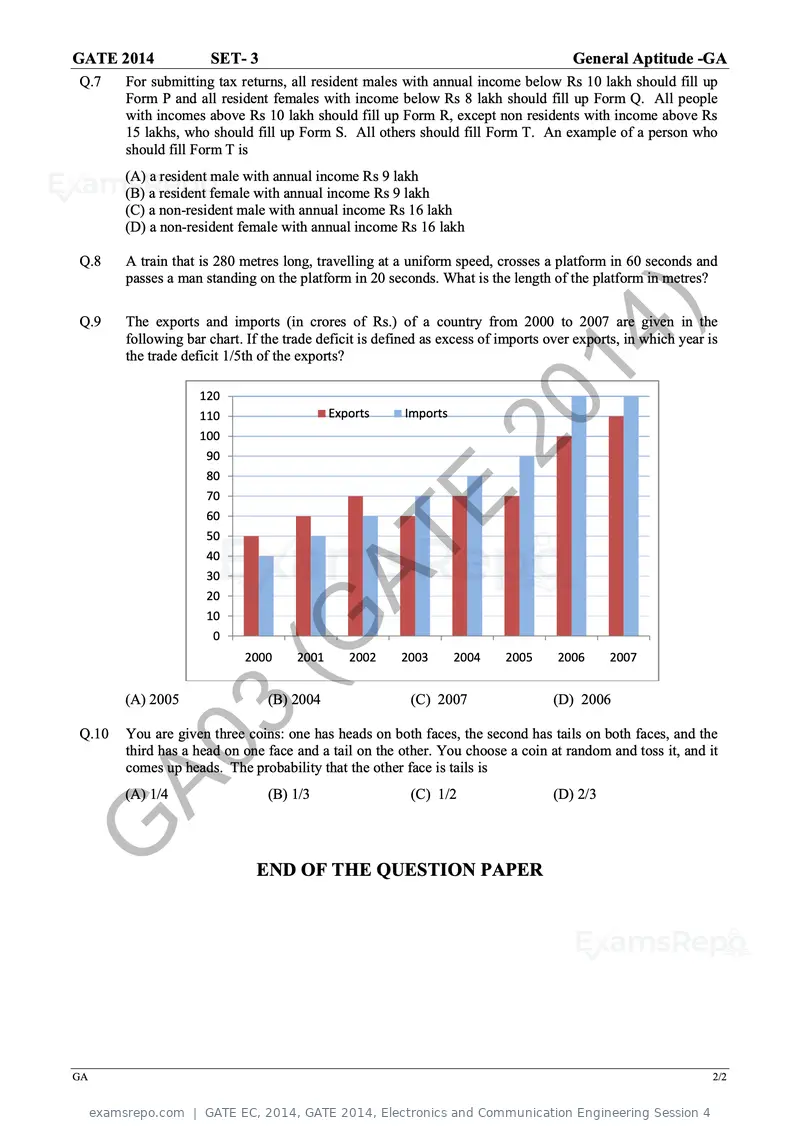
Text of page 7
GATE 2014            SET- 3                                                          General Aptitude -GA
Q.7    For submitting tax returns, all resident males with annual income below Rs 10 lakh should fill up
       Form P and all resident females with income below Rs 8 lakh should fill up Form Q. All people
       with incomes above Rs 10 lakh should fill up Form R, except non residents with income above Rs
       15 lakhs, who should fill up Form S. All others should fill Form T. An example of a person who
       should fill Form T is
       (A) a resident male with annual income Rs 9 lakh
       (B) a resident female with annual income Rs 9 lakh
       (C) a non-resident male with annual income Rs 16 lakh
       (D) a non-resident female with annual income Rs 16 lakh

Q.8    A train that is 280 metres long, travelling at a uniform speed, crosses a platform in 60 seconds and
       passes a man standing on the platform in 20 seconds. What is the length of the platform in metres?

Q.9

                                                               20
       The exports and imports (in crores of Rs.) of a country from 2000 to 2007 are given in the
       following bar chart. If the trade deficit is defined as excess of imports over exports, in which year is
       the trade deficit 1/5th of the exports?

                   120                                           14
                   110
                   100
                    90
                    80
                                            Exports     Imports

                                                                    )
                    70
                    60
                    50               AT
                    40
                    30
                    20
                    10
                                        E
       (A) 2005
                     0
                         (G2000      2001


                               (B) 2004
                                               2002    2003


                                                         (C) 2007
                                                                  2004   2005     2006


                                                                                  (D) 2006
                                                                                            2007


Q.10             3
       You are given three coins: one has heads on both faces, the second has tails on both faces, and the


     A0third has a head on one face and a tail on the other. You choose a coin at random and toss it, and it
       comes up heads. The probability that the other face is tails is
       (A) 1/4                 (B) 1/3                   (C) 1/2                  (D) 2/3


G                            END OF THE QUESTION PAPER


GA                                                                                                            2/2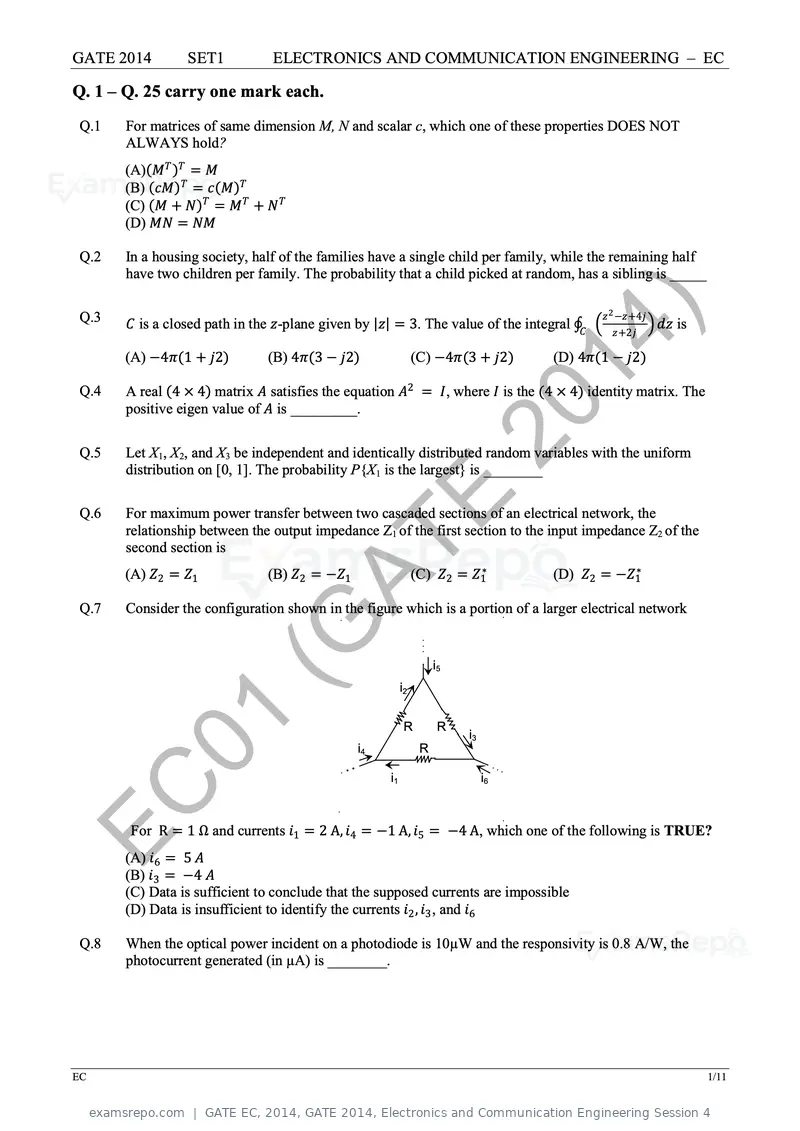
Text of page 8
GATE 2014         SET1            ELECTRONICS AND COMMUNICATION ENGINEERING – EC

Q. 1 – Q. 25 carry one mark each.
 Q.1   For matrices of same dimension M, N and scalar c, which one of these properties DOES NOT
       ALWAYS hold?
       (A)(MMTT )TT = MM
       (B) (cccc)TT = cc(MM)TT
       (C) (MM + NN)TT = MMTT + NN TT
       (D) MMMM = NNNN

 Q.2   In a housing society, half of the families have a single child per family, while the remaining half
       have two children per family. The probability that a child picked at random, has a sibling is _____

 Q.3                                                                                        ) zz 2 −zz+4jj
       CC is a closed path in the zz-plane given by |zz| = 3. The value of the integral ∮CC � zz+2jj � dddd is


 Q.4
       (A) −4ππ(1 + jj2)         (B) 4ππ(3 − jj2)
                                                                           20
                                                                 (C) −4ππ(3 + jj2)


                                                                             14
                                                                                     (D) 4ππ(1 − jj2)

       A real (4 × 4) matrix AA satisfies the equation AA2 = II, where II is the (4 × 4) identity matrix. The
       positive eigen value of AA is _________.

 Q.5   Let X1, X2, and X3 be independent and identically distributed random variables with the uniform
       distribution on [0, 1]. The probability P{X1 is the largest} is ________

 Q.6
                                        AT
       For maximum power transfer between two cascaded sections of an electrical network, the
       relationship between the output impedance Z1 of the first section to the input impedance Z2 of the


                                           E
       second section is
       (A) ZZ2 = ZZ1             (B) ZZ2 = −ZZ1                  (C) ZZ2 = ZZ1∗      (D) ZZ2 = −ZZ1∗

 Q.7   Consider the configuration shown in the figure which is a portion of a larger electrical network


                          (G                                i2
                                                                      i5


         01                                       i4

                                                       i1
                                                             R
                                                                  R
                                                                       R
                                                                           i3


                                                                                i6


EC      For R = 1 Ω and currents ii1 = 2 A, ii4 = −1 A, ii5 = −4 A, which one of the following is TRUE?
       (A) ii6 = 5 AA
       (B) ii3 = −4 AA
       (C) Data is sufficient to conclude that the supposed currents are impossible
       (D) Data is insufficient to identify the currents ii2 , ii3 , and ii6

 Q.8   When the optical power incident on a photodiode is 10µW and the responsivity is 0.8 A/W, the
       photocurrent generated (in µA) is ________.


EC                                                                                                               1/11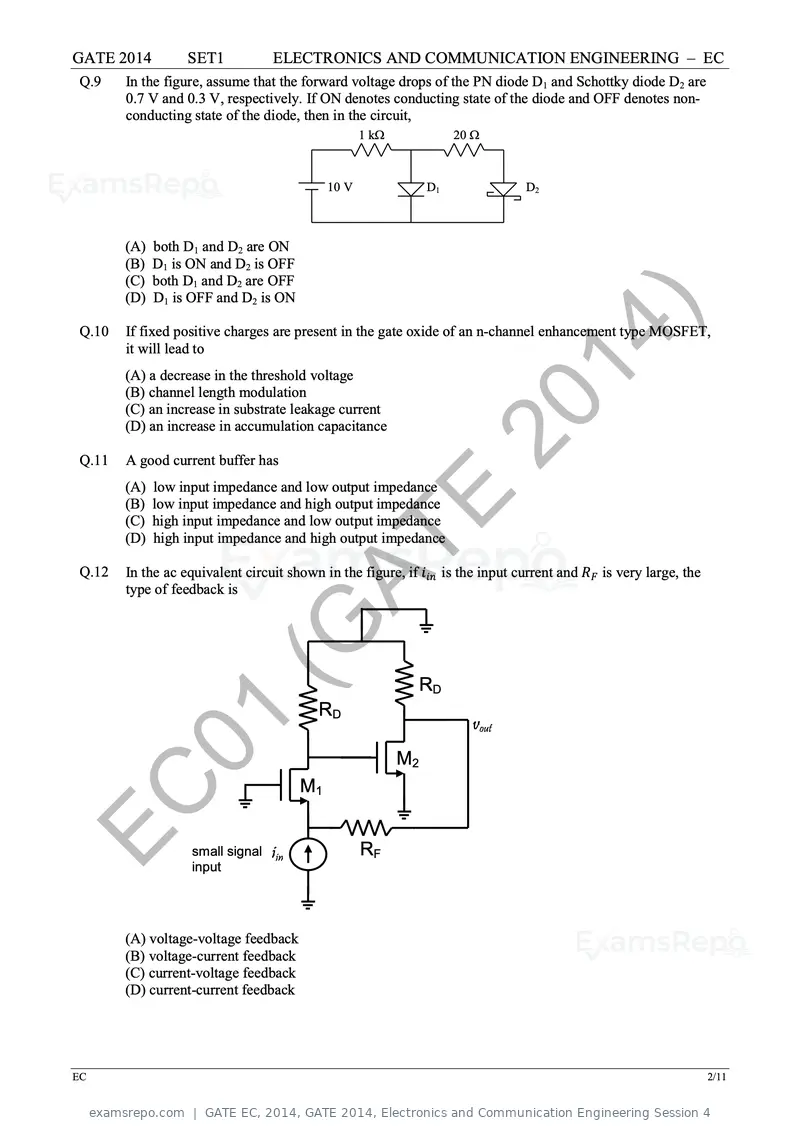
Text of page 9
GATE 2014          SET1            ELECTRONICS AND COMMUNICATION ENGINEERING – EC
 Q.9    In the figure, assume that the forward voltage drops of the PN diode D1 and Schottky diode D2 are
        0.7 V and 0.3 V, respectively. If ON denotes conducting state of the diode and OFF denotes non-
        conducting state of the diode, then in the circuit,
                                                     1 kΩ             20 Ω


                                              10 V               D1                D2


        (A) both D1 and D2 are ON
        (B) D1 is ON and D2 is OFF
        (C) both D1 and D2 are OFF
        (D) D1 is OFF and D2 is ON
                                                                                               )
                                                                      20
 Q.10   If fixed positive charges are present in the gate oxide of an n-channel enhancement type MOSFET,
        it will lead to
        (A) a decrease in the threshold voltage


 Q.11
        (B) channel length modulation
        (C) an increase in substrate leakage current
        (D) an increase in accumulation capacitance

        A good current buffer has
                                                                        14
        (A) low input impedance and low output impedance


                                         AT
        (B) low input impedance and high output impedance
        (C) high input impedance and low output impedance
        (D) high input impedance and high output impedance

 Q.12
                                            E
        In the ac equivalent circuit shown in the figure, if iiiiii is the input current and RRFF is very large, the
        type of feedback is


                           (G                                    RD
                                            RD
         01                              M1
                                                            M2
                                                                         vout


EC                  small signal
                    input
                                   iin               RF


        (A) voltage-voltage feedback
        (B) voltage-current feedback
        (C) current-voltage feedback
        (D) current-current feedback


EC                                                                                                                     2/11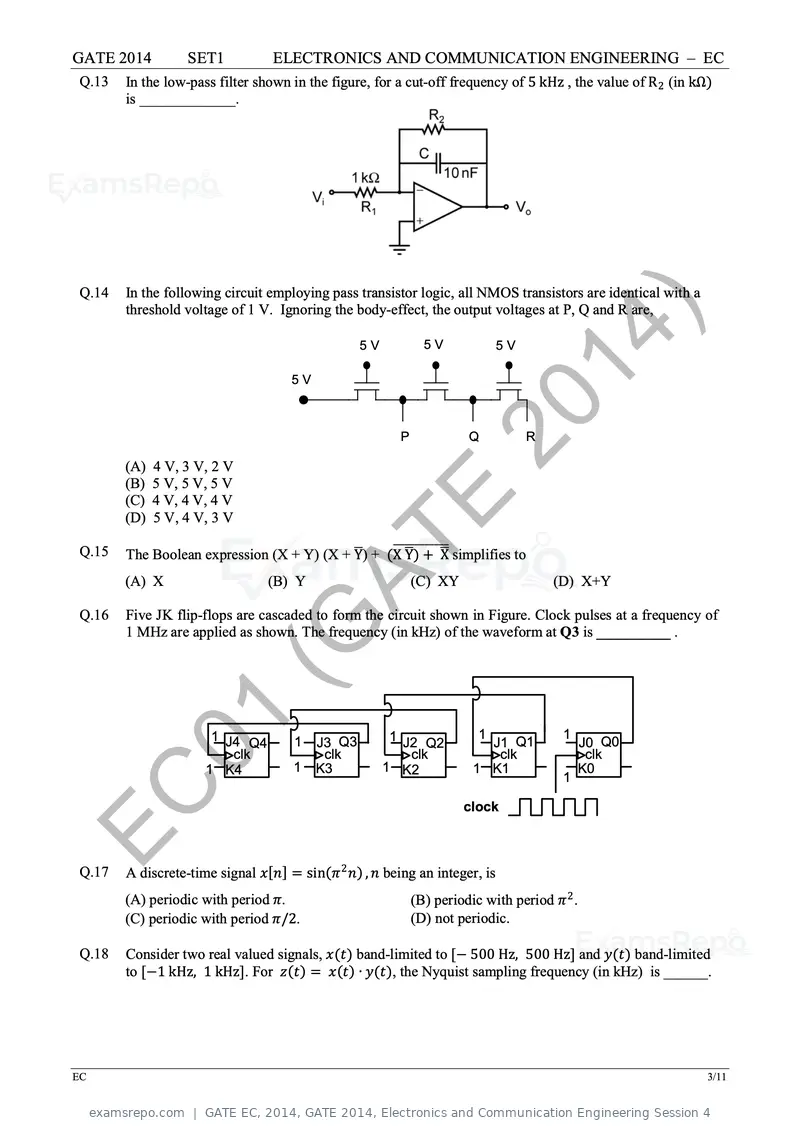
Text of page 10
GATE 2014          SET1            ELECTRONICS AND COMMUNICATION ENGINEERING – EC
 Q.13   In the low-pass filter shown in the figure, for a cut-off frequency of 5 kHz , the value of R 2 (in kΩ)
        is _____________.


 Q.14   In the following circuit employing pass transistor logic, all NMOS transistors are identical with a
        threshold voltage of 1 V. Ignoring the body-effect, the output voltages at P, Q and R are,)
                                       5V
                                                    5V            5V

                                                                       2014
                                                                                 5V


                                                            P             Q           R

        (A) 4 V, 3 V, 2 V
        (B) 5 V, 5 V, 5 V
        (C) 4 V, 4 V, 4 V
        (D) 5 V, 4 V, 3 V
                                        AT        �����������
 Q.15


 Q.16
                                           E
        The Boolean expression (X + Y) (X + �
        (A) X                      (B) Y
                                            Y) + (X �
                                                    Y) + �  X simplifies to
                                                                (C) XY                    (D) X+Y

        Five JK flip-flops are cascaded to form the circuit shown in Figure. Clock pulses at a frequency of

                           (G
        1 MHz are applied as shown. The frequency (in kHz) of the waveform at Q3 is __________ .


         01             1 J4

                       1 K4
                           clk
                              Q4       1
                                       1
                                            J3 Q3
                                             clk
                                            K3
                                                          1 J2

                                                         1 K2
                                                             clk
                                                                Q2
                                                                            1
                                                                             J1 Q1
                                                                              clk
                                                                           1 K1
                                                                                            1


                                                                                            1
                                                                                                J0 Q0
                                                                                                 clk
                                                                                                K0


EC
 Q.17
                                                                         clock


        A discrete-time signal xx[nn] = sin(ππ 2 nn) , nn being an integer, is
        (A) periodic with period ππ.                            (B) periodic with period ππ 2 .
        (C) periodic with period ππ/2.                          (D) not periodic.

 Q.18   Consider two real valued signals, xx(tt) band-limited to [− 500 Hz, 500 Hz] and yy(tt) band-limited
        to [−1 kHz, 1 kHz]. For zz(tt) = xx(tt) ∙ yy(tt), the Nyquist sampling frequency (in kHz) is ______.


EC                                                                                                            3/11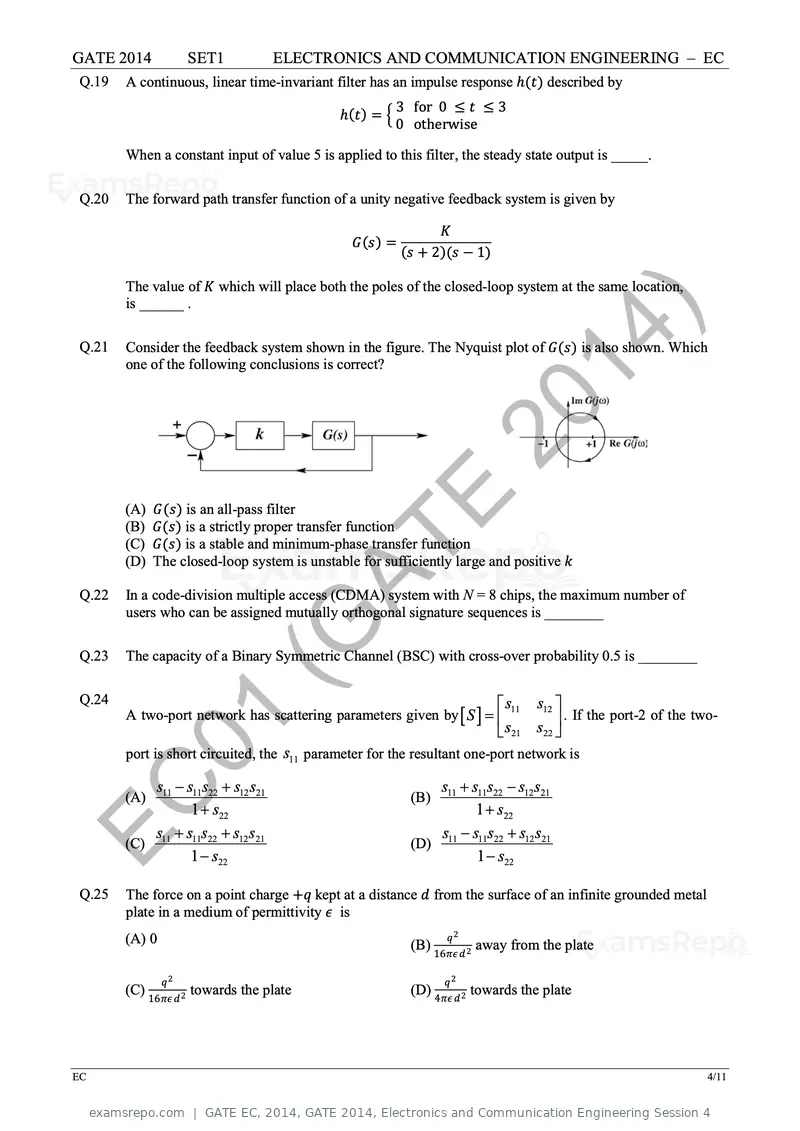
Text of page 11
GATE 2014 SET1 ELECTRONICS AND COMMUNICATION ENGINEERING – EC
Q.19 A continuous, linear time-invariant filter has an impulse response ℎ(tt) described by
3 for 0 ≤ tt ≤ 3
ℎ(tt) = �
0 otherwise
When a constant input of value 5 is applied to this filter, the steady state output is _____.
Q.20 The forward path transfer function of a unity negative feedback system is given by
KK
GG(ss) =
(ss + 2)(ss − 1)
The value of KK which will place both the poles of the closed-loop system at the same location,
is ______ .
)
Q.21
20
Consider the feedback system shown in the figure. The Nyquist plot of GG(ss) is also shown. Which
one of the following conclusions is correct?
14
(A) GG(ss) is an all-pass filter
AT
(B) GG(ss) is a strictly proper transfer function
(C) GG(ss) is a stable and minimum-phase transfer function
Q.22 E
(D) The closed-loop system is unstable for sufficiently large and positive kk
In a code-division multiple access (CDMA) system with N = 8 chips, the maximum number of
users who can be assigned mutually orthogonal signature sequences is ________
Q.23
Q.24
(G
The capacity of a Binary Symmetric Channel (BSC) with cross-over probability 0.5 is ________
s11 s12
A two-port network has scattering parameters given by [ S ] =
01 s21 s22
port is short circuited, the s11 parameter for the resultant one-port network is
s11 − s11s22 + s12 s21 s11 + s11s22 − s12 s21
. If the port-2 of the two-
EC (A)
1 + s22
s +s s +s s
(C) 11 11 22 12 21
1 − s22
(B)
1 + s22
s −s s +s s
(D) 11 11 22 12 21
1 − s22
Q.25 The force on a point charge +qq kept at a distance dd from the surface of an infinite grounded metal
plate in a medium of permittivity εε is
(A) 0 qq 2
(B) 16ππππ dd 2 away from the plate
qq 2 qq 2
(C) 16ππππ dd 2 towards the plate (D) 4ππππ dd 2 towards the plate
EC 4/11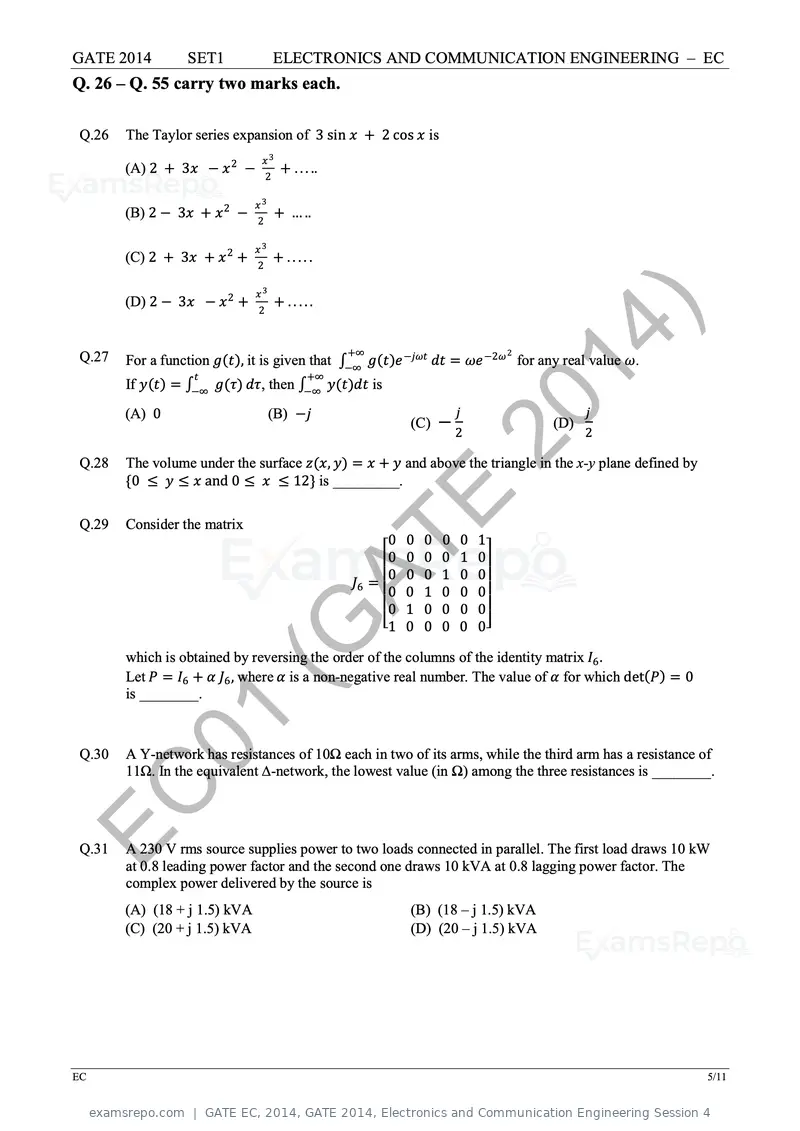
Text of page 12
GATE 2014           SET1                ELECTRONICS AND COMMUNICATION ENGINEERING – EC
Q. 26 – Q. 55 carry two marks each.

 Q.26   The Taylor series expansion of 3 sin xx + 2 cos xx is
                                   xx 3
        (A) 2 + 3xx − xx 2 −            + . . . ..
                                    2

                                 xx 3
        (B) 2 − 3xx + xx 2 − 2 + … ..

                                 xx 3
        (C) 2 + 3xx + xx 2 + 2 + . . . . .

                                 xx 3
        (D) 2 − 3xx − xx 2 + 2 + . . . . .
                                                                                                      )
 Q.27                                                +∞

                                                                      20          2
        For a function gg(tt), it is given that ∫−∞ gg(tt)ee −jjjjjj dddd = ωωee −2ωω for any real value ωω.
                     tt                        +∞
        If yy(tt) = ∫−∞ gg(ττ) dddd, then ∫−∞ yy(tt)dddd is
        (A) 0                           (B) −jj
                                                               (C) −    14
                                                                        jj
                                                                                           (D)
                                                                                                 jj
                                                                        2                        2

 Q.28   The volume under the surface zz(xx, yy) = xx + yy and above the triangle in the x-y plane defined by
        {0 ≤ yy ≤ xx and 0 ≤ xx ≤ 12} is _________.

 Q.29   Consider the matrix
                                             AT             0 0 0 0 0 1


                                                E          ⎡0 0 0 0 1 0⎤
                                                           ⎢
                                                     JJ6 = ⎢
                                                            0 0 0 1 0 0⎥
                                                           ⎢0 0 1 0 0 0⎥
                                                           ⎢0 1 0 0 0 0⎥
                                                           ⎣1 0 0 0 0 0⎦
                                                                        ⎥


                            (G
        which is obtained by reversing the order of the columns of the identity matrix II6 .
        Let PP = II6 + αα JJ6 , where αα is a non-negative real number. The value of αα for which det(PP) = 0
        is ________.


 Q.30
          01
        A Y-network has resistances of 10Ω each in two of its arms, while the third arm has a resistance of
        11Ω. In the equivalent ∆-network, the lowest value (in Ω) among the three resistances is ________.


EC
 Q.31   A 230 V rms source supplies power to two loads connected in parallel. The first load draws 10 kW
        at 0.8 leading power factor and the second one draws 10 kVA at 0.8 lagging power factor. The
        complex power delivered by the source is
        (A) (18 + j 1.5) kVA                                   (B) (18 – j 1.5) kVA
        (C) (20 + j 1.5) kVA                                   (D) (20 – j 1.5) kVA


EC                                                                                                              5/11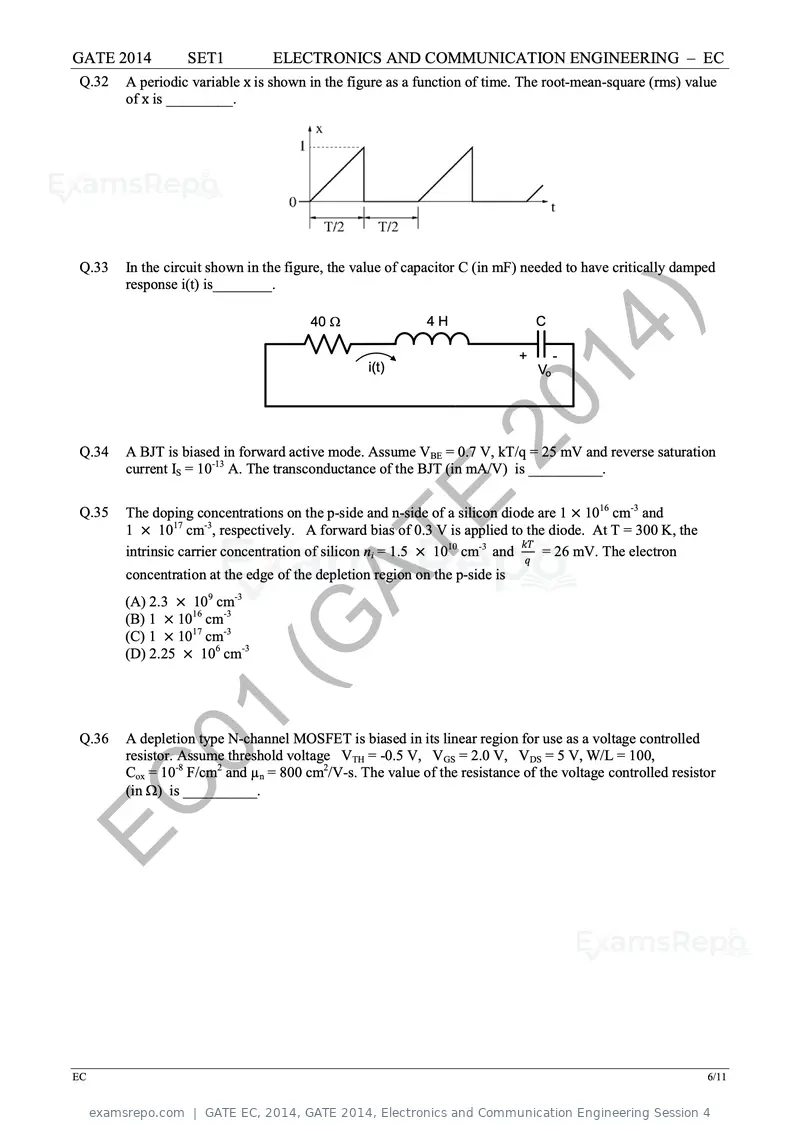
Text of page 13
GATE 2014         SET1           ELECTRONICS AND COMMUNICATION ENGINEERING – EC
 Q.32   A periodic variable x is shown in the figure as a function of time. The root-mean-square (rms) value
        of x is _________.


 Q.33   In the circuit shown in the figure, the value of capacitor C (in mF) needed to have critically damped
        response i(t) is________.

                                        40 Ω                4H                    C        )
                                                  i(t)
                                                               2014
                                                                             +
                                                                                  Vo
                                                                                       -


 Q.34   A BJT is biased in forward active mode. Assume VBE = 0.7 V, kT/q = 25 mV and reverse saturation
        current IS = 10-13 A. The transconductance of the BJT (in mA/V) is __________.

 Q.35

                                      AT
        The doping concentrations on the p-side and n-side of a silicon diode are 1 × 1016 cm-3 and
        1 × 1017 cm-3, respectively. A forward bias of 0.3 V is applied to the diode. At T = 300 K, the
                                                                            kkkk


                                         E
        intrinsic carrier concentration of silicon ni = 1.5 × 1010 cm-3 and
        concentration at the edge of the depletion region on the p-side is
        (A) 2.3 × 109 cm-3
        (B) 1 × 1016 cm-3
                                                                             qq
                                                                                 = 26 mV. The electron


        (C) 1 × 1017 cm-3
                         (G
        (D) 2.25 × 106 cm-3


 Q.36    01
        A depletion type N-channel MOSFET is biased in its linear region for use as a voltage controlled
        resistor. Assume threshold voltage VTH = -0.5 V, VGS = 2.0 V, VDS = 5 V, W/L = 100,
        Cox = 10-8 F/cm2 and µn = 800 cm2/V-s. The value of the resistance of the voltage controlled resistor
        (in Ω) is __________.

EC

EC                                                                                                         6/11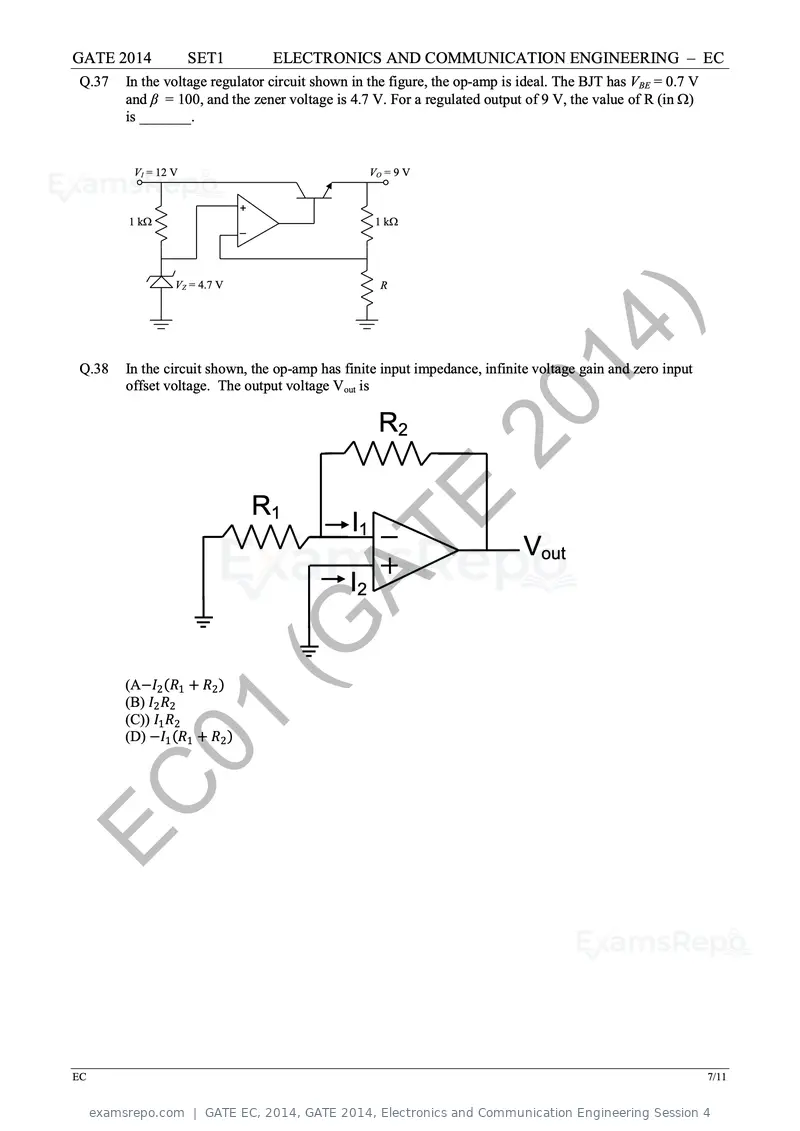
Text of page 14
GATE 2014            SET1            ELECTRONICS AND COMMUNICATION ENGINEERING – EC
 Q.37   In the voltage regulator circuit shown in the figure, the op-amp is ideal. The BJT has VBE = 0.7 V
        and β = 100, and the zener voltage is 4.7 V. For a regulated output of 9 V, the value of R (in Ω)
        is _______.


         VI = 12 V                                 VO = 9 V


                                +
        1 kΩ                                        1 kΩ
                                –


                 VZ = 4.7 V                          R

                                                                                       )
 Q.38
                                                              20
        In the circuit shown, the op-amp has finite input impedance, infinite voltage gain and zero input
        offset voltage. The output voltage Vout is

                                                                14
                                                    R2


                                    R1
                                         AT   I1
                                                                            Vout
                                            E I2


        (A−II2 (RR1 + RR2 )
        (B) II2 RR2
                              (G
          01
        (C)) II1 RR2
        (D) −II1 (RR1 + RR2 )


EC

EC                                                                                                           7/11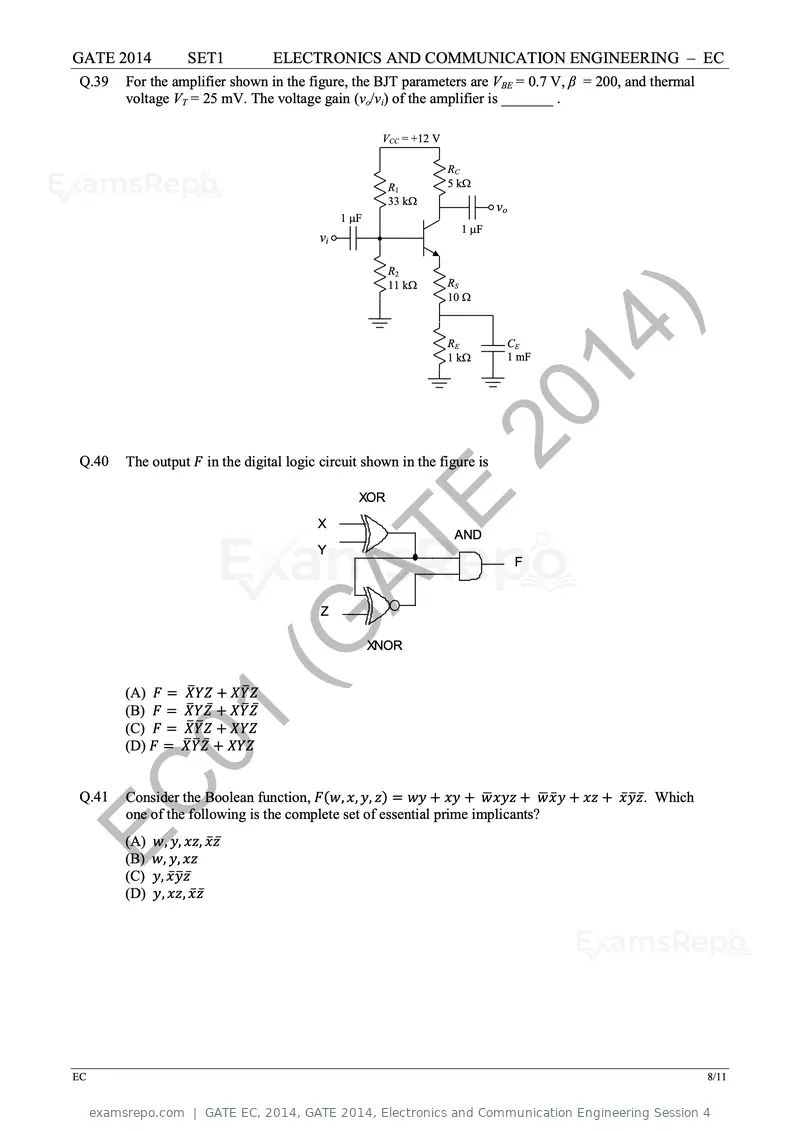
Text of page 15
GATE 2014               SET1           ELECTRONICS AND COMMUNICATION ENGINEERING – EC
 Q.39   For the amplifier shown in the figure, the BJT parameters are VBE = 0.7 V, β = 200, and thermal
        voltage VT = 25 mV. The voltage gain (vo/vi) of the amplifier is _______ .

                                                          VCC = +12 V

                                                                        RC
                                                              R1        5 kΩ
                                                              33 kΩ
                                                                                 vo
                                                  1 µF
                                                                          1 µF
                                             vi           •

                                                              R2
                                                              11 kΩ     RS
                                                                        10 Ω
                                                                                                  )
                                                                        20
                                                                        RE
                                                                        1 kΩ


                                                                          14
                                                                                   CE
                                                                                   1 mF


 Q.40   The output FF in the digital logic circuit shown in the figure is


                                         AT  X
                                                     XOR

                                                                         AND


                                            EY


                                             Z
                                                                                      F


        (A) FF = XX�YYYY + XXYY�ZZ
                                    (G                   XNOR


        (B) FF = XX�YYZZ̅ + XXYY�ZZ̅

          01
        (C) FF = XX�YY�ZZ + XXXXXX
        (D) FF = XX�YY�ZZ̅ + XXXXXX


EC
 Q.41   Consider the Boolean function, FF(ww, xx, yy, zz) = wwww + xxxx + ww
                                                                          �xxxxxx + ww
        one of the following is the complete set of essential prime implicants?
        (A) ww, yy, xxxx, xx̅ zz̅
        (B) ww, yy, xxxx
                                                                                    �xx̅ yy + xxxx + xx̅ yy�zz̅. Which


        (C) yy, xx̅ yy�zz̅
        (D) yy, xxxx, xx̅ zz̅


EC                                                                                                                       8/11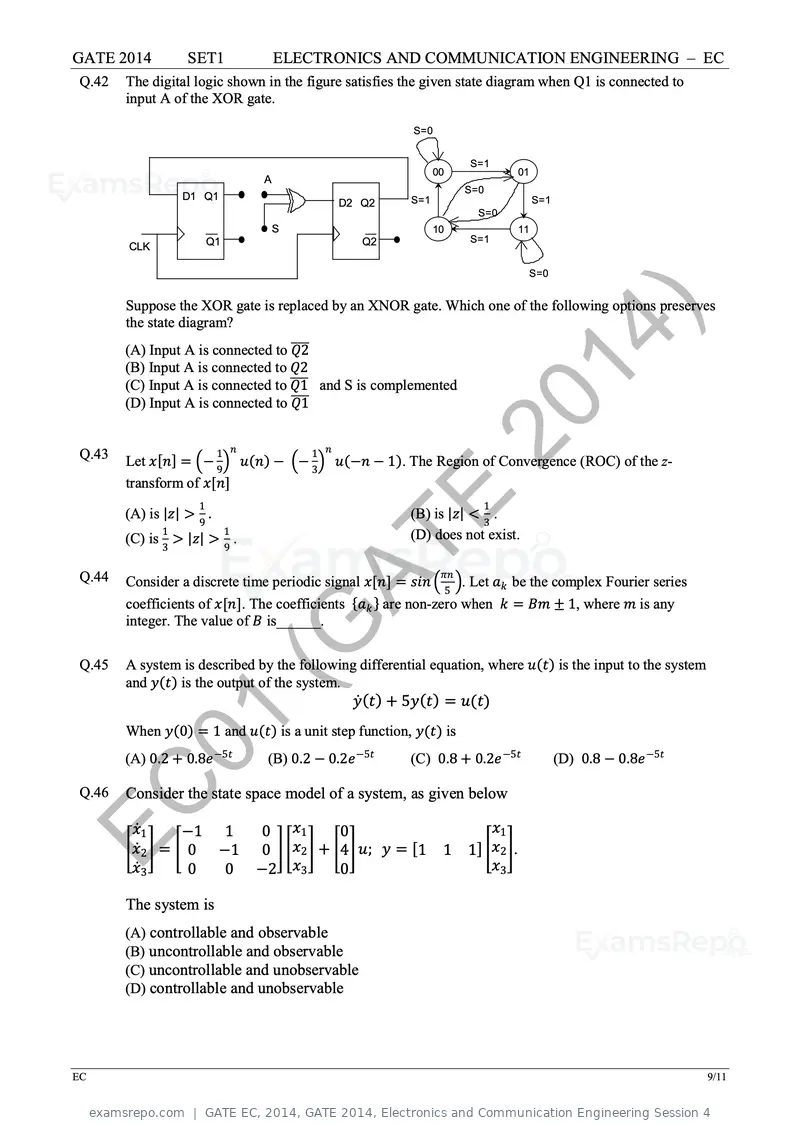
Text of page 16
GATE 2014           SET1               ELECTRONICS AND COMMUNICATION ENGINEERING – EC
 Q.42   The digital logic shown in the figure satisfies the given state diagram when Q1 is connected to
        input A of the XOR gate.

                                                              S=0


                                                                            S=1
                                                                    00              01
                                   A
                                                                            S=0
                   D1 Q1                                      S=1                        S=1
                                                  D2 Q2
                                                                              S=0
                                       S                            10              11
                          Q1                         Q2                     S=1
        CLK

                                                                                     S=0


        Suppose the XOR gate is replaced by an XNOR gate. Which one of the following options preserves
        the state diagram?                                                                           )
        (A) Input A is connected to ����
                                    QQ2
        (B) Input A is connected to QQ2
        (C) Input A is connected to ����
                                    QQ1 and S is complemented
        (D) Input A is connected to ����
                                    QQ1
                                                                         2014
 Q.43                       1 nn           1 nn
        Let xx[nn] = �− � uu(nn) − �− � uu(−nn − 1). The Region of Convergence (ROC) of the z-
                        9            3
        transform of xx[nn]
                      1
        (A) is |zz| > 9 .
               1
        (C) is 3 > |zz| > 9 .
                               1
                                           AT                                 1
                                                              (B) is |zz| < 3 .
                                                              (D) does not exist.

 Q.44
                                              E                      ππππ
        Consider a discrete time periodic signal xx[nn] = ssssss � 5 �. Let aakk be the complex Fourier series
        coefficients of xx[nn]. The coefficients {aakk } are non-zero when kk = BBBB ± 1, where mm is any
        integer. The value of BB is______.

 Q.45                          (G
        A system is described by the following differential equation, where uu(tt) is the input to the system
        and yy(tt) is the output of the system.
                                                   yẏ (tt) + 5yy(tt) = uu(tt)

          01
        When yy(0) = 1 and uu(tt) is a unit step function, yy(tt) is
        (A) 0.2 + 0.8ee −5tt       (B) 0.2 − 0.2ee −5tt       (C) 0.8 + 0.2ee −5tt             (D) 0.8 − 0.8ee −5tt


EC
 Q.46   Consider the state space model of a system, as given below

         xẋ 1      −1 1   0 xx1        0
        �xẋ 2 � = � 0 −1 0 � �xx2 � + �4� uu; yy = [1
         xẋ 3       0  0 −2 xx3        0
                                                                           xx1
                                                                     1 1] �xx2 �.
                                                                           xx3

        The system is
        (A) controllable and observable
        (B) uncontrollable and observable
        (C) uncontrollable and unobservable
        (D) controllable and unobservable


EC                                                                                                                    9/11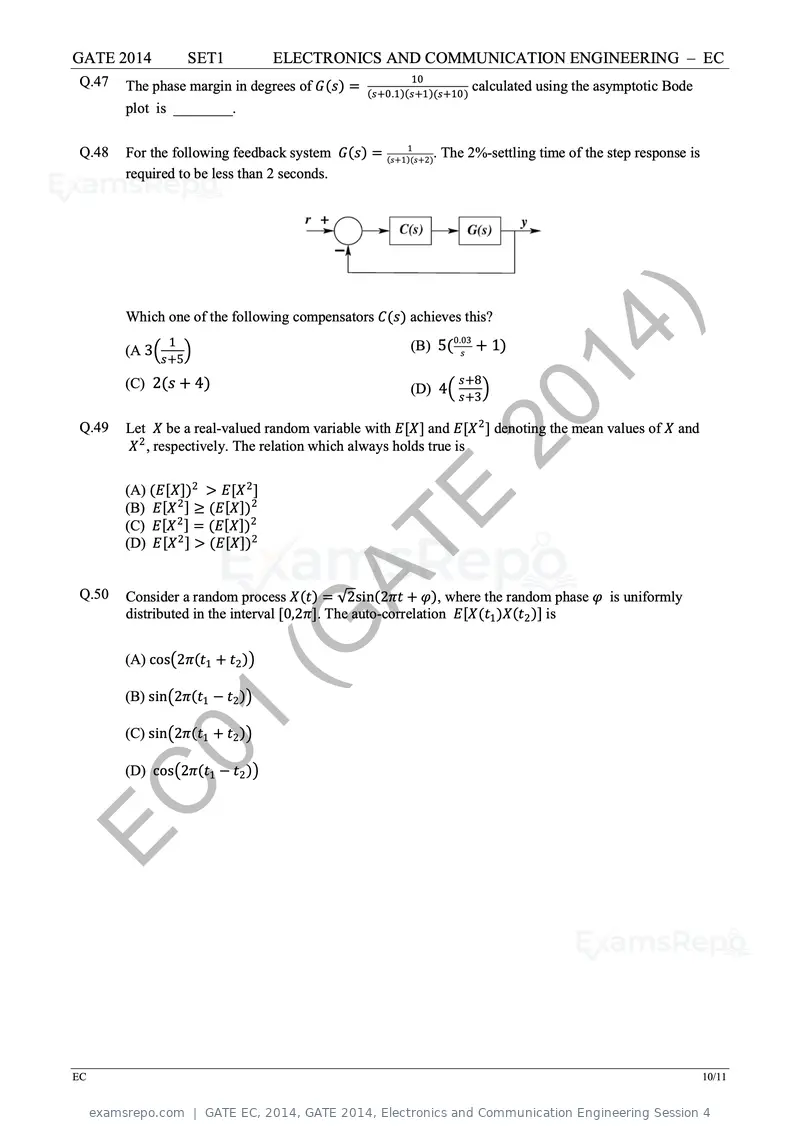
Text of page 17
GATE 2014          SET1             ELECTRONICS AND COMMUNICATION ENGINEERING – EC
 Q.47                                                     10
        The phase margin in degrees of GG(ss) = (ss+0.1)(ss+1)(ss+10) calculated using the asymptotic Bode
        plot is ________.

                                                        1
 Q.48   For the following feedback system GG(ss) = (ss+1)(ss+2). The 2%-settling time of the step response is
        required to be less than 2 seconds.


        Which one of the following compensators CC(ss) achieves this?                    )
        (A 3�
                1
              ss+5
                   �

        (C) 2(ss + 4)                                           20
                                                          (B) 5(0.03

                                                          (D) 4�
                                                                  ss


                                                                  14
                                                                     + 1)

                                                                   ss+8
                                                                   ss+3
                                                                        �

 Q.49   Let XX be a real-valued random variable with EE[XX] and EE[XX 2 ] denoting the mean values of XX and
        XX 2 , respectively. The relation which always holds true is

        (A) (EE[XX])2 > EE[XX 2 ]
        (B) EE[XX 2 ] ≥ (EE[XX])2
        (C) EE[XX 2 ] = (EE[XX])2
        (D) EE[XX 2 ] > (EE[XX])2     AT
 Q.50                                    E
        Consider a random process XX(tt) = √2sin(2ππππ + φφ), where the random phase φφ is uniformly
        distributed in the interval [0,2ππ]. The auto-correlation EE[XX(tt1 )XX(tt2 )] is


                           (G
        (A) cos�2ππ(tt1 + tt2 )�

        (B) sin�2ππ(tt1 − tt2 )�


          01
        (C) sin�2ππ(tt1 + tt2 )�

        (D) cos�2ππ(tt1 − tt2 )�


EC

EC                                                                                                              10/11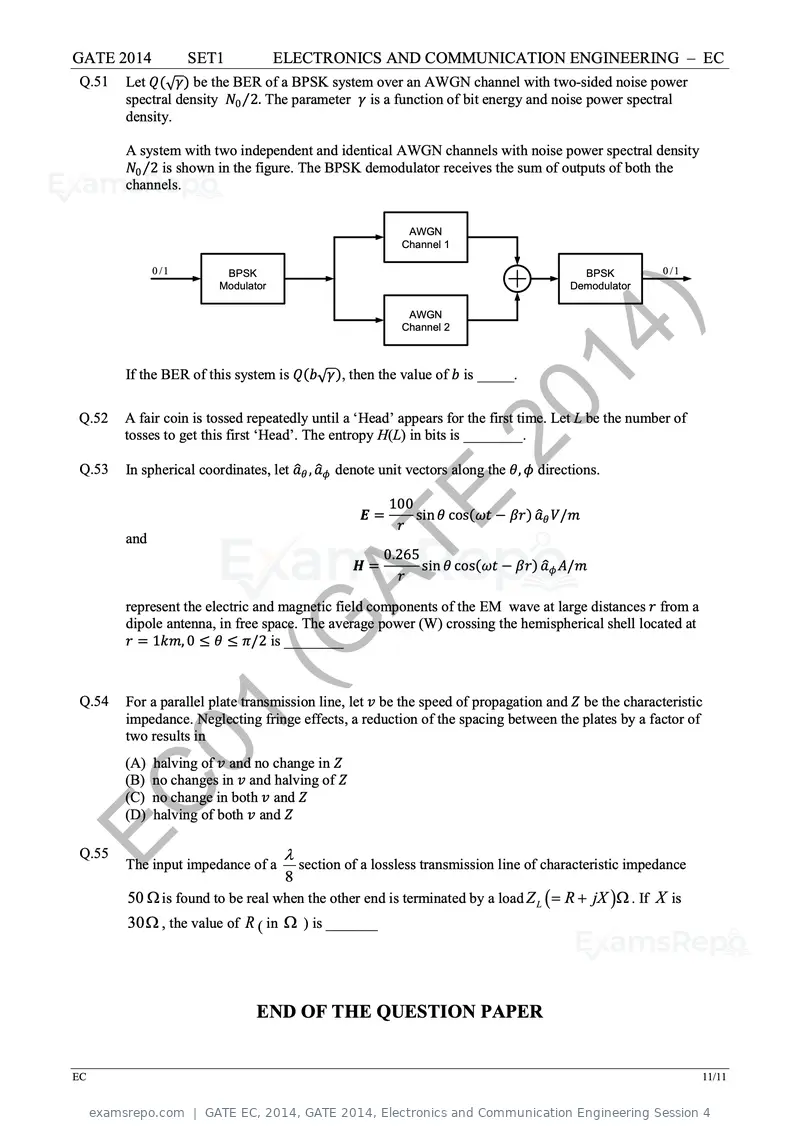
Text of page 18
GATE 2014            SET1             ELECTRONICS AND COMMUNICATION ENGINEERING – EC
 Q.51   Let QQ(√γγ) be the BER of a BPSK system over an AWGN channel with two-sided noise power
        spectral density NN0 ⁄2. The parameter γγ is a function of bit energy and noise power spectral
        density.

        A system with two independent and identical AWGN channels with noise power spectral density
        NN0 ⁄2 is shown in the figure. The BPSK demodulator receives the sum of outputs of both the
        channels.


                                                               AWGN
                                                              Channel 1

              0 /1         BPSK                                                                   BPSK        0 /1
                          Modulator                                                             Demodulator

                                                               AWGN
                                                              Channel 2
                                                                                                       )
Q.52
                                                                       20
        If the BER of this system is QQ(bb√γγ), then the value of bb is _____.


                                                                         14
        A fair coin is tossed repeatedly until a ‘Head’ appears for the first time. Let L be the number of
        tosses to get this first ‘Head’. The entropy H(L) in bits is ________.

 Q.53   In spherical coordinates, let aa�θθ , aa�φφ denote unit vectors along the θθ, φφ directions.


        and                                AT        EE =
                                                            100
                                                             rr
                                                                sin θθ cos(ωωωω − ββββ) aa�θθ VV/mm


                                              E     HH =
                                                           0.265
                                                             rr
                                                                 sin θθ cos(ωωωω − ββββ) aa�φφ AA/mm

        represent the electric and magnetic field components of the EM wave at large distances rr from a


 Q.54
                            (G
        dipole antenna, in free space. The average power (W) crossing the hemispherical shell located at
        rr = 1kkkk, 0 ≤ θθ ≤ ππ/2 is ________


        For a parallel plate transmission line, let vv be the speed of propagation and ZZ be the characteristic

         01
        impedance. Neglecting fringe effects, a reduction of the spacing between the plates by a factor of
        two results in
        (A) halving of vv and no change in ZZ
        (B) no changes in vv and halving of ZZ


EC
 Q.55
        (C) no change in both vv and ZZ
        (D) halving of both vv and ZZ


        The input impedance of a
                                       λ
                                    section of a lossless transmission line of characteristic impedance
                                  8
        50 Ω is found to be real when the other end is terminated by a load Z L ( =R + jX )Ω . If X is
        30Ω , the value of R ( in Ω ) is _______


                                 END OF THE QUESTION PAPER


EC                                                                                                                   11/11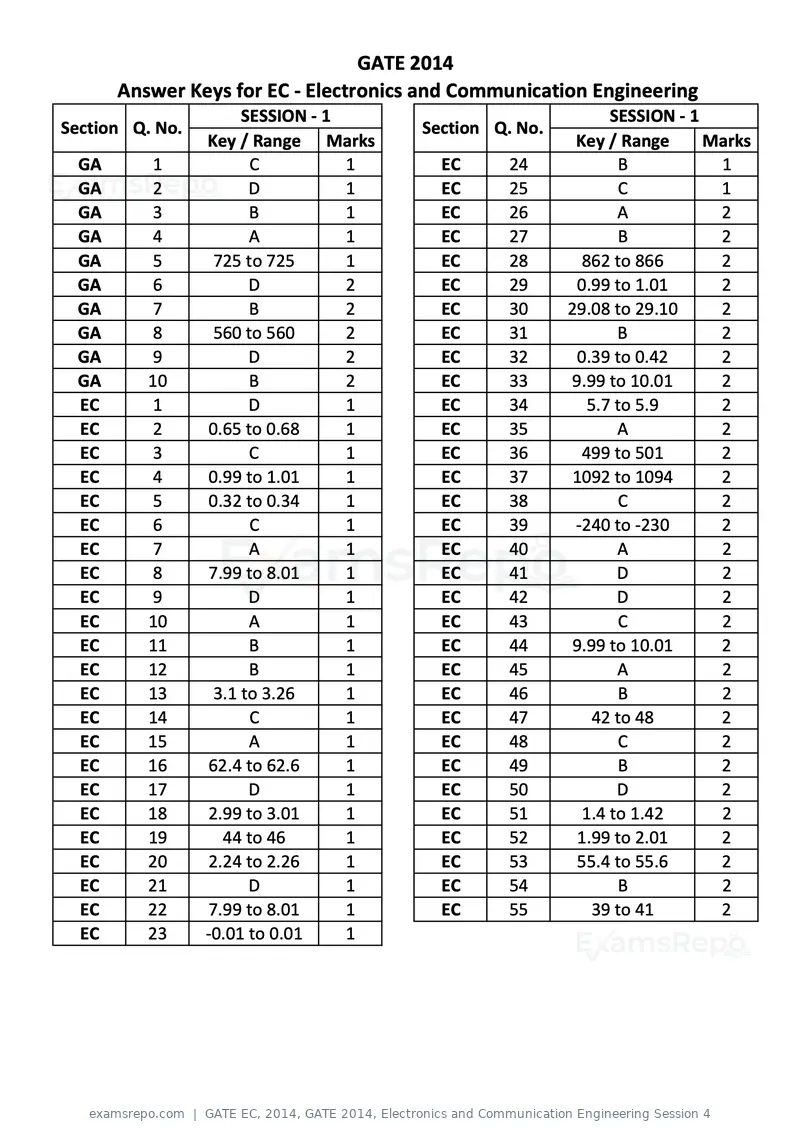
Text of page 19
GATE 2014
      Answer Keys for EC ‐ Electronics and Communication Engineering
                      SESSION ‐ 1                            SESSION ‐ 1
Section Q. No.                        Section Q. No.
                 Key / Range Marks                      Key / Range      Marks
 GA        1           C          1     EC      24             B          1
 GA        2           D          1     EC      25             C          1
 GA        3           B          1     EC      26            A           2
 GA        4           A          1     EC      27            B           2
 GA        5      725 to 725      1     EC      28       862 to 866       2
 GA        6           D          2     EC      29      0.99 to 1.01      2
 GA        7           B          2     EC      30     29.08 to 29.10     2
 GA        8      560 to 560      2     EC      31            B           2
 GA        9           D          2     EC      32      0.39 to 0.42      2
 GA       10           B          2     EC      33     9.99 to 10.01      2
 EC        1           D          1     EC      34        5.7 to 5.9      2
 EC        2     0.65 to 0.68     1     EC      35            A           2
 EC        3           C          1     EC      36       499 to 501       2
 EC        4     0.99 to 1.01     1     EC      37      1092 to 1094      2
 EC        5     0.32 to 0.34     1     EC      38             C          2
 EC        6           C          1     EC      39      ‐240 to ‐230      2
 EC        7           A          1     EC      40            A           2
 EC        8     7.99 to 8.01     1     EC      41            D           2
 EC        9           D          1     EC      42            D           2
 EC       10           A          1     EC      43             C          2
 EC       11           B          1     EC      44      9.99 to 10.01     2
 EC       12           B          1     EC      45            A           2
 EC       13      3.1 to 3.26     1     EC      46             B          2
 EC       14           C          1     EC      47         42 to 48       2
 EC       15           A          1     EC      48             C          2
 EC       16     62.4 to 62.6     1     EC      49            B           2
 EC       17           D          1     EC      50            D           2
 EC       18     2.99 to 3.01     1     EC      51       1.4 to 1.42      2
 EC       19       44 to 46       1     EC      52      1.99 to 2.01      2
 EC       20     2.24 to 2.26     1     EC      53      55.4 to 55.6      2
 EC       21           D          1     EC      54            B           2
 EC       22     7.99 to 8.01     1     EC      55         39 to 41       2
 EC       23     ‐0.01 to 0.01    1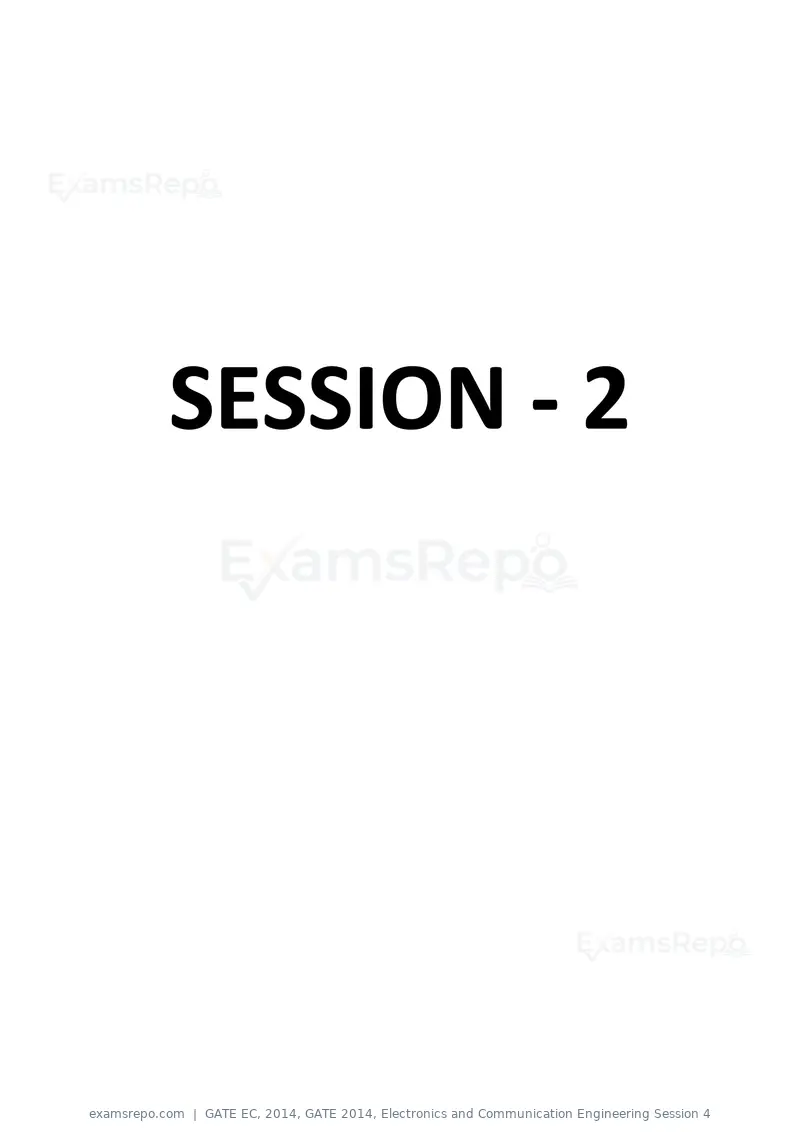
Text of page 20
SESSION - 2
Text of page 21
GATE 2014: General Instructions during Examination

   1. Total duration of the GATE examination is 180 minutes.
   2. The clock will be set at the server. The countdown timer at the top right corner of
      screen will display the remaining time available for you to complete the examination.
      When the timer reaches zero, the examination will end by itself. You need not
      terminate the examination or submit your paper.
   3. Any useful data required for your paper can be viewed by clicking on the Useful
      Common Data button that appears on the screen.
   4. Use the scribble pad provided to you for any rough work. Submit the scribble pad at
      the end of the examination.
   5. You are allowed to use a non-programmable type calculator, however, sharing of
      calculators is not allowed.
   6. The Question Palette displayed on the right side of screen will show the status of
      each question using one of the following symbols:


The Marked for Review status for a question simply indicates that you would like to look at
that question again. If a question is answered, but marked for review, then the answer will
be considered for evaluation unless the status is modified by the candidate.

Navigating to a Question :

   7. To answer a question, do the following:
         a. Click on the question number in the Question Palette to go to that question
            directly.
         b. Select an answer for a multiple choice type question by clicking on the bubble
            placed before the 4 choices, namely A, B, C and D. Use the virtual numeric
            keypad to enter a number as answer for a numerical type question.
         c. Click on Save & Next to save your answer for the current question and then go
            to the next question.
         d. Click on Mark for Review & Next to save your answer for the current question
            and also mark it for review, and then go to the next question.
Text of page 22
Caution: Note that your answer for the current question will not be saved, if you navigate
to another question directly by clicking on a question number without saving the answer to
the previous question.

You can view all the questions by clicking on the Question Paper button. This feature is
provided, so that if you want you can just see the entire question paper at a glance.

Answering a Question :

   8. Procedure for answering a multiple choice (MCQ) type question:
         a. Choose one answer from the 4 options (A,B,C,D) given below the question,
            click on the bubble placed before the chosen option.
         b. To deselect your chosen answer, click on the bubble of the chosen option again
            or click on the Clear Response button.
         c. To change your chosen answer, click on the bubble of another option.
         d. To save your answer, you MUST click on the Save & Next button.

   9. Procedure for answering a numerical answer type question:
         a. To enter a number as your answer, use the virtual numerical keypad.
         b. A fraction (e.g. -0.3 or -.3) can be entered as an answer with or without '0'
             before the decimal point. As many as four decimal points, e.g. 12.5435 or
             0.003 or -932.6711 or 12.82 can be entered.
         c. To clear your answer, click on the Clear Response button.
         d. To save your answer, you MUST click on the Save & Next button
   10. To mark a question for review, click on the Mark for Review & Next button. If an
      answer is selected (for MCQ) or entered (for numerical answer type) for a question
      that is Marked for Review, that answer will be considered in the evaluation unless
      the status is modified by the candidate.

   11. To change your answer to a question that has already been answered, first select
      that question for answering and then follow the procedure for answering that type of
      question.
   12. Note that ONLY Questions for which answers are saved or marked for review after
      answering will be considered for evaluation.


      Choosing a Section :

   13. Sections in this question paper are displayed on the top bar of the screen. Questions
      in a Section can be viewed by clicking on the name of that Section. The Section you
      are currently viewing will be highlighted.
   14. A checkbox is displayed for every optional Section, if any, in the Question Paper. To
      select the optional Section for answering, click on the checkbox for that Section.
   15. If the checkbox for an optional Section is not selected, the Save & Next button and
      the Mark for Review & Next button will NOT be enabled for that Section. You will
Text of page 23
only be able to see questions in this Section, but you will not be able to answer
      questions in the Section.
   16. After clicking the Save & Next button for the last question in a Section, you will
      automatically be taken to the first question of the next Section in sequence.
   17. You can move the mouse cursor over the name of a Section to view the answering
      status for that Section.


Changing the Optional Section :

   18. After answering the chosen optional Section, partially or completely, you can change
      the optional Section by selecting the checkbox for a new Section that you want to
      attempt. A warning message will appear along with a table showing the number of
      questions answered in each of the previously chosen optional Sections and a
      checkbox against each of these Sections. Click on a checkbox against a Section that
      you want to reset and then click on the RESET button. Note that RESETTING a Section
      will DELETE all the answers for questions in that Section. Hence, if you think that you
      may want to select this Section again later, you will have to note down your answers
      for questions in that Section. If you do not want to reset the Section and want to
      continue answering the previously chosen optional Section, then click on the BACK
      button.

   19. If you deselect the checkbox for an optional Section in the top bar, the following
      warning message will appear: "Deselecting the checkbox will DELETE all the answers
      for questions in this Section. Do you want to deselect this Section?” If you want to
      deselect, click on the RESET button. If you do not want to deselect, click on the BACK
      button.

   20. You can shuffle between different Sections or change the optional Sections any
      number of times.
Text of page 24
GATE 2014 Examination
                        EC: Electronics & Communications Engineering
Duration: 180 minutes                                                                        Maximum Marks: 100

Read the following instructions carefully.

    1. To login, enter your Registration Number and password provided to you. Kindly go through the various
       symbols used in the test and understand their meaning before you start the examination.
    2. Once you login and after the start of the examination, you can view all the questions in the question
       paper, by clicking on the View All Questions button in the screen.
    3. This question paper consists of 2 sections, General Aptitude (GA) for 15 marks and the subject
       specific GATE paper for 85 marks. Both these sections are compulsory.
       The GA section consists of 10 questions. Question numbers 1 to 5 are of 1-mark each, while question
       numbers 6 to 10 are of 2-mark each.
       The subject specific GATE paper section consists of 55 questions, out of which question numbers 1 to
       25 are of 1-mark each, while question numbers 26 to 55 are of 2-mark each.
    4. Depending upon the GATE paper, there may be useful common data that may be required for
       answering the questions. If the paper has such useful data, the same can be viewed by clicking on the
       Useful Common Data button that appears at the top, right hand side of the screen.
    5. The computer allotted to you at the examination center runs specialized software that permits only one
        answer to be selected for multiple-choice questions using a mouse and to enter a suitable number for
        the numerical answer type questions using the virtual keyboard and mouse.
    6. Your answers shall be updated and saved on a server periodically and also at the end of the
        examination. The examination will stop automatically at the end of 180 minutes.
    7. In each paper a candidate can answer a total of 65 questions carrying 100 marks.
    8. The question paper may consist of questions of multiple choice type (MCQ) and numerical answer
        type.
    9. Multiple choice type questions will have four choices against A, B, C, D, out of which only ONE is the
        correct answer. The candidate has to choose the correct answer by clicking on the bubble (⃝) placed
        before the choice.
    10. For numerical answer type questions, each question will have a numerical answer and there will not be
        any choices. For these questions, the answer should be enteredby using the virtual keyboard that
        appears on the monitor and the mouse.
    11. All questions that are not attempted will result in zero marks. However, wrong answers for multiple
        choice type questions (MCQ) will result in NEGATIVE marks. For all MCQ questions a wrong
        answer will result in deduction of⅓ marks for a 1-mark question and ⅔ marks for a 2-mark question.
    12. There is NO NEGATIVE MARKING for questions of NUMERICAL ANSWER TYPE.
    13. Non-programmable type Calculator is allowed. Charts, graph sheets, and mathematical tables are NOT
        allowed in the Examination Hall. You must use the Scribble pad provided to you at the examination
        centre for all your rough work. The Scribble Pad has to be returned at the end of the examination.

    Declaration by the candidate:

    “I have read and understood all the above instructions. I have also read and understood clearly the
    instructions given on the admit card and shall follow the same. I also understand that in case I am found to
    violate any of these instructions, my candidature is liable to be cancelled. I also confirm that at the start of
    the examination all the computer hardware allotted to me are in proper working condition”.
Text of page 25
GATE 2014             SET- 4                                                            General Aptitude -GA

Q. 1 – Q. 5 carry one mark each.
Q.1    Choose the most appropriate word from the options given below to complete the following
       sentence.

       Communication and interpersonal skills are                   important in their own ways.
      (A) each                  (B) both                  (C) all                    (D) either

Q.2    Which of the options given below best completes the following sentence?

       She will feel much better if she ________________.
      (A) will get some rest                              (B) gets some rest


Q.3
      (C) will be getting some rest

                                                                 20
                                                          (D) is getting some rest

       Choose the most appropriate pair of words from the options given below to complete the following
       sentence.

                                                                   14
Q.4
                                                                      )
       She could not _____ the thought of _________ the election to her bitter rival.
      (A) bear, loosing         (B) bare, loosing         (C) bear, losing           (D) bare, losing

       A regular die has six sides with numbers 1 to 6 marked on its sides. If a very large number of
       throws show the following frequencies of occurrence: 1 → 0.167; 2 → 0.167; 3 → 0.152; 4 →
       0.166; 5 → 0.168; 6 → 0.180. We call this die
      (A) irregular
                                      AT
                                (B) biased                (C) Gaussian               (D) insufficient

Q.5

                                         E
       Fill in the missing number in the series.

       2       3       6       15             157.5        630


                           (G
Q. 6 – Q. 10 carry two marks each.


Q.6            4
       Find the odd one in the following group


Q.7
     A0
      (A) Q,W,Z,B
                               Q,W,Z,B
                                (B) B,H,K,M
                                               B,H,K,M           W,C,G,J
                                                          (C) W,C,G,J
                                                                                M,S,V,X
                                                                                     (D) M,S,V,X

       Lights of four colors (red, blue, green, yellow) are hung on a ladder. On every step of the ladder
G      there are two lights. If one of the lights is red, the other light on that step will always be blue. If one
       of the lights on a step is green, the other light on that step will always be yellow. Which of the
       following statements is not necessarily correct?
      (A) The number of red lights is equal to the number of blue lights
      (B) The number of green lights is equal to the number of yellow lights
      (C) The sum of the red and green lights is equal to the sum of the yellow and blue lights
      (D) The sum of the red and blue lights is equal to the sum of the green and yellow lights

Q.8    The sum of eight consecutive odd numbers is 656. The average of four consecutive even numbers is
       87. What is the sum of the smallest odd number and second largest even number?


GA                                                                                                               1/2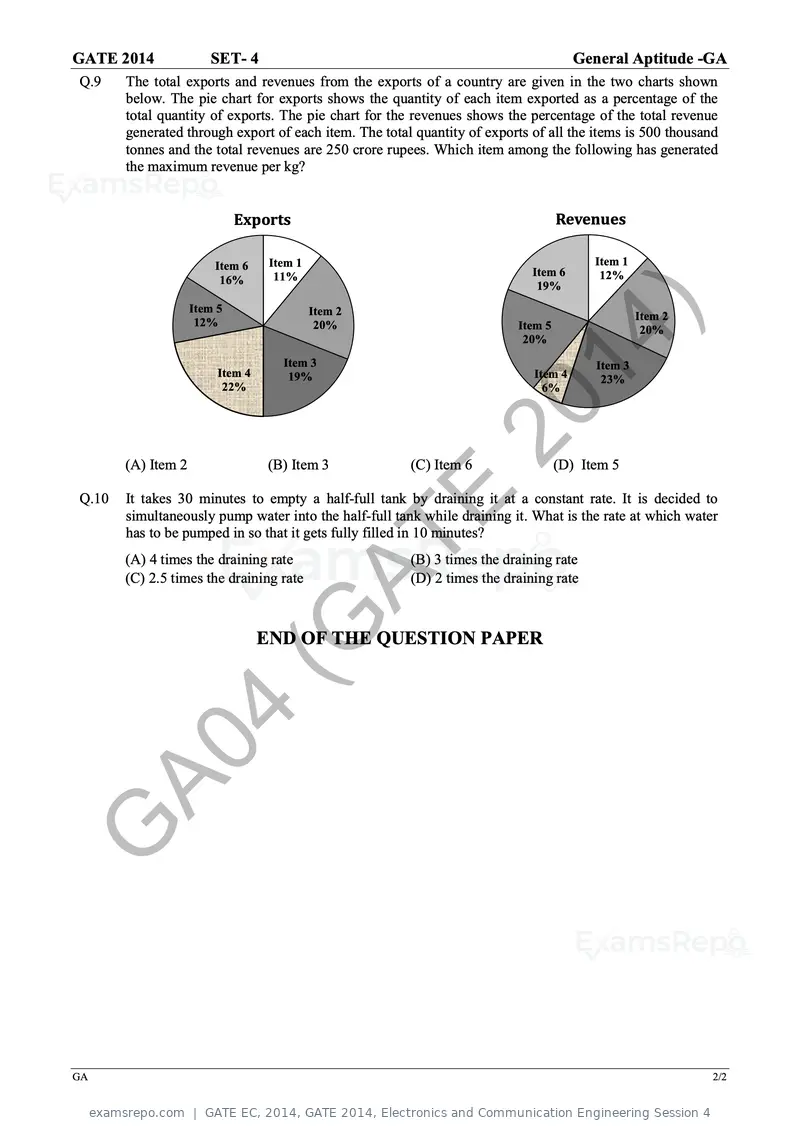
Text of page 26
GATE 2014              SET- 4                                                        General Aptitude -GA
Q.9    The total exports and revenues from the exports of a country are given in the two charts shown
       below. The pie chart for exports shows the quantity of each item exported as a percentage of the
       total quantity of exports. The pie chart for the revenues shows the percentage of the total revenue
       generated through export of each item. The total quantity of exports of all the items is 500 thousand
       tonnes and the total revenues are 250 crore rupees. Which item among the following has generated
       the maximum revenue per kg?


                             Exports                                              Revenues

                        Item 6     Item 1                                               Item 1
                                    11%                                     Item 6       12%
                         16%
                                                                             19%


                                                             20
                    Item 5                  Item 2                                               Item 2
                     12%                     20%                         Item 5                   20%
                                                                          20%

                         Item 4
                          22%
                                     Item 3
                                      19%

                                                               14 )
                                                                            Item 4
                                                                              6%
                                                                                        Item 3
                                                                                         23%


       (A) Item 2                 (B) Item 3           (C) Item 6                 (D) Item 5

Q.10

                                            AT
       It takes 30 minutes to empty a half-full tank by draining it at a constant rate. It is decided to
       simultaneously pump water into the half-full tank while draining it. What is the rate at which water
       has to be pumped in so that it gets fully filled in 10 minutes?
       (A) 4 times the draining rate
       (C) 2.5 times the draining rate
                                               E       (B) 3 times the draining rate
                                                       (D) 2 times the draining rate


                             (G   END OF THE QUESTION PAPER


               4
     A0
G

GA                                                                                                         2/2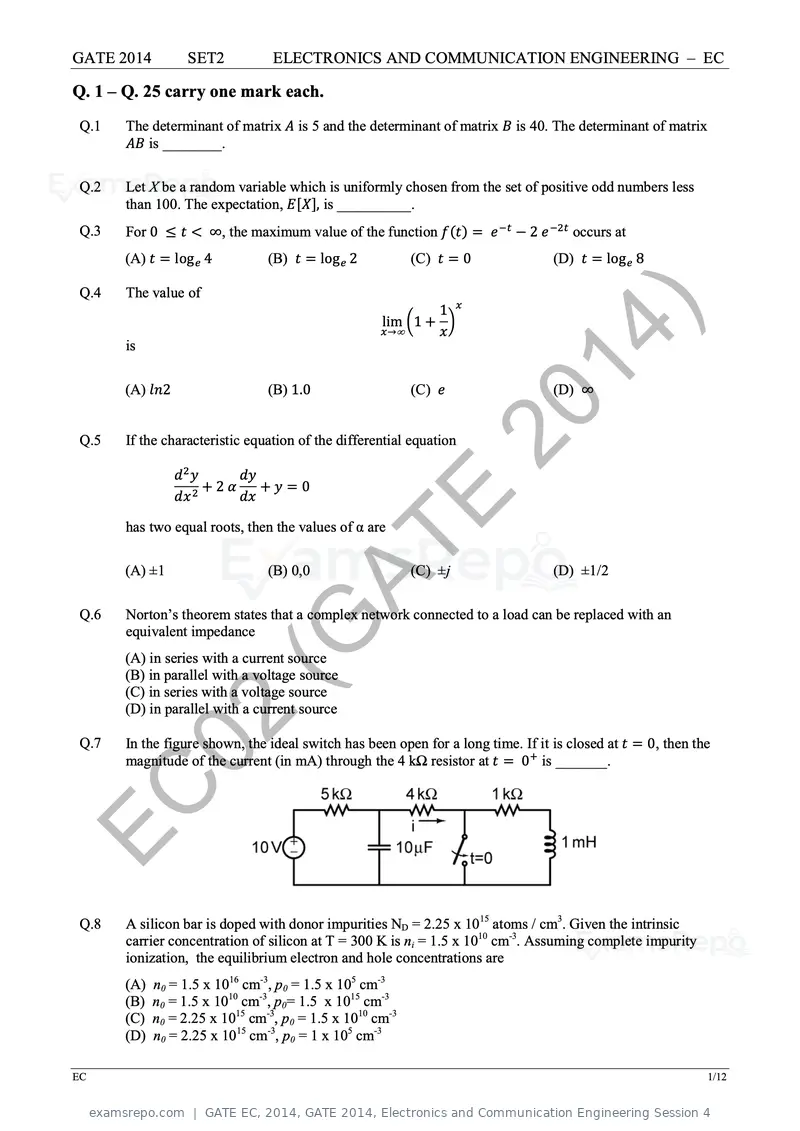
Text of page 27
GATE 2014         SET2           ELECTRONICS AND COMMUNICATION ENGINEERING – EC

Q. 1 – Q. 25 carry one mark each.
 Q.1   The determinant of matrix A is 5 and the determinant of matrix B is 40. The determinant of matrix
       AB is ________.

 Q.2   Let X be a random variable which is uniformly chosen from the set of positive odd numbers less
       than 100. The expectation, E[X], is __________.
 Q.3   For 0 ≤ t < ∞, the maximum value of the function f(t) = e −t − 2 e −2t occurs at
       (A) t = log e 4          (B) t = log e 2          (C) t = 0                (D) t = log e 8

 Q.4   The value of
                                                            1 x                         )
                                                    lim �1 + �
                                                    x→∞     x
       is

       (A) ln2                  (B) 1.0                  (C) e
                                                                 2014             (D) ∞


 Q.5   If the characteristic equation of the differential equation

                 d2 y     dy
                    2
                      +2α    +y =0
                 dx       dx


                                      AT
       has two equal roots, then the values of α are


 Q.6
       (A) ±1                   (B) 0,0
                                         E               (C) ±j                   (D) ±1/2

       Norton’s theorem states that a complex network connected to a load can be replaced with an


                         (G
       equivalent impedance
       (A) in series with a current source
       (B) in parallel with a voltage source
       (C) in series with a voltage source
       (D) in parallel with a current source

 Q.7        02
       In the figure shown, the ideal switch has been open for a long time. If it is closed at t = 0, then the
       magnitude of the current (in mA) through the 4 kΩ resistor at t = 0+ is _______.


EC
 Q.8   A silicon bar is doped with donor impurities ND = 2.25 x 10¹⁵ atoms / cm3. Given the intrinsic
       carrier concentration of silicon at T = 300 K is ni = 1.5 x 1010 cm-3. Assuming complete impurity
       ionization, the equilibrium electron and hole concentrations are
       (A) n0 = 1.5 x 1016 cm-3, p0 = 1.5 x 105 cm-3
       (B) n0 = 1.5 x 1010 cm-3, p0= 1.5 x 1015 cm-3
       (C) n0 = 2.25 x 1015 cm-3, p0 = 1.5 x 1010 cm-3
       (D) n0 = 2.25 x 1015 cm-3, p0 = 1 x 105 cm-3

EC                                                                                                           1/12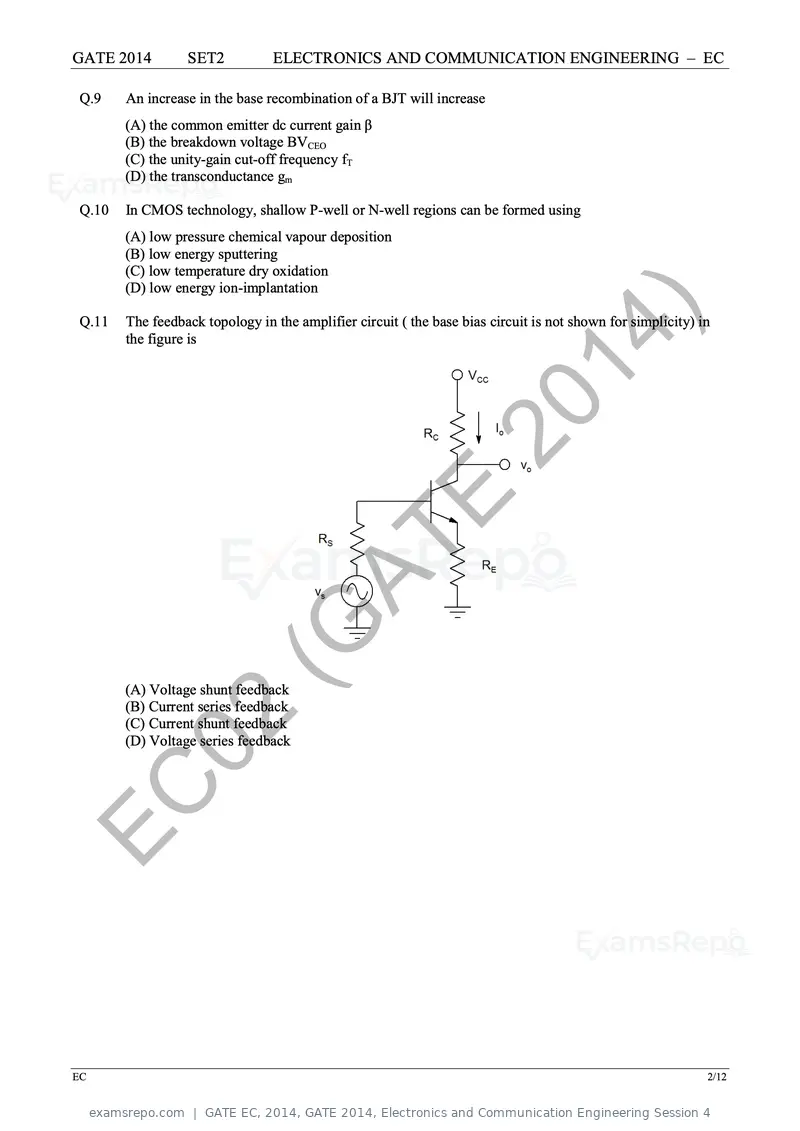
Text of page 28
GATE 2014         SET2           ELECTRONICS AND COMMUNICATION ENGINEERING – EC

 Q.9    An increase in the base recombination of a BJT will increase
        (A) the common emitter dc current gain β
        (B) the breakdown voltage BVCEO
        (C) the unity-gain cut-off frequency fT
        (D) the transconductance gm

 Q.10   In CMOS technology, shallow P-well or N-well regions can be formed using
        (A) low pressure chemical vapour deposition
        (B) low energy sputtering
        (C) low temperature dry oxidation
        (D) low energy ion-implantation

 Q.11                                                                                    )
        The feedback topology in the amplifier circuit ( the base bias circuit is not shown for simplicity) in
        the figure is

                                                               2014
                                      AT
                                         E
                         (G
        (A) Voltage shunt feedback
        (B) Current series feedback

         02
        (C) Current shunt feedback
        (D) Voltage series feedback


EC

EC                                                                                                           2/12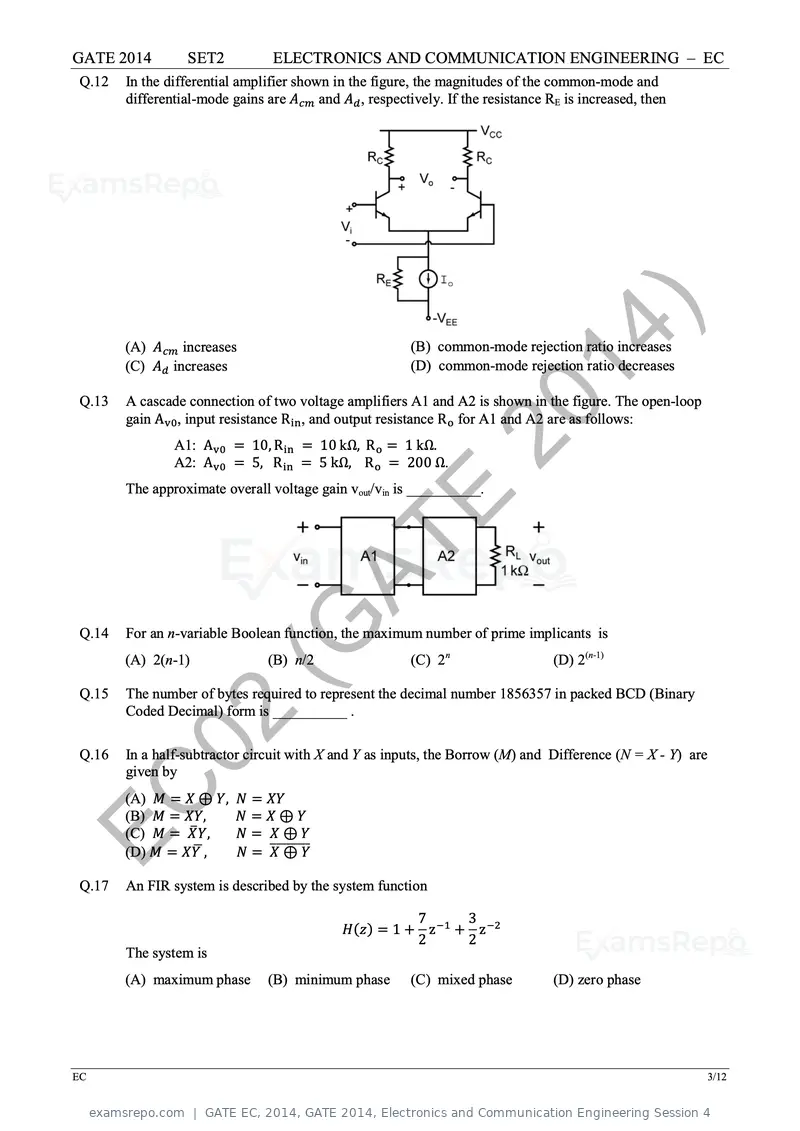
Text of page 29
GATE 2014         SET2           ELECTRONICS AND COMMUNICATION ENGINEERING – EC
 Q.12   In the differential amplifier shown in the figure, the magnitudes of the common-mode and
        differential-mode gains are Acm and Ad , respectively. If the resistance RE is increased, then


                                                                                         )
 Q.13
        (A) Acm increases
        (C) Ad increases
                                                               20
                                                         (B) common-mode rejection ratio increases
                                                         (D) common-mode rejection ratio decreases


                                                                 14
        A cascade connection of two voltage amplifiers A1 and A2 is shown in the figure. The open-loop
        gain Av0 , input resistance R in , and output resistance R o for A1 and A2 are as follows:
                A1: Av0 = 10, R in = 10 kΩ, R o = 1 kΩ.
                A2: Av0 = 5, R in = 5 kΩ, R o = 200 Ω.
        The approximate overall voltage gain vout/vin is __________.


                                      AT
                                         E
 Q.14


 Q.15
                         (G
        For an n-variable Boolean function, the maximum number of prime implicants is
        (A) 2(n-1)              (B) n/2                  (C) 2n                   (D) 2(n-1)

        The number of bytes required to represent the decimal number 1856357 in packed BCD (Binary
        Coded Decimal) form is __________ .

 Q.16
         02
        In a half-subtractor circuit with X and Y as inputs, the Borrow (M) and Difference (N = X - Y) are
        given by


EC      (A) M = X ⊕ Y, N = XY
        (B) M = XY,
        (C) M = X�Y,
                 �
        (D) M = XY ,
                       N =X⊕Y
                       N = X⊕Y
                       N = ��������
                           X⊕Y

 Q.17   An FIR system is described by the system function

                                                       7      3
                                             H(z) = 1 + z −1 + z −2
                                                       2      2
        The system is
        (A) maximum phase       (B) minimum phase        (C) mixed phase          (D) zero phase


EC                                                                                                       3/12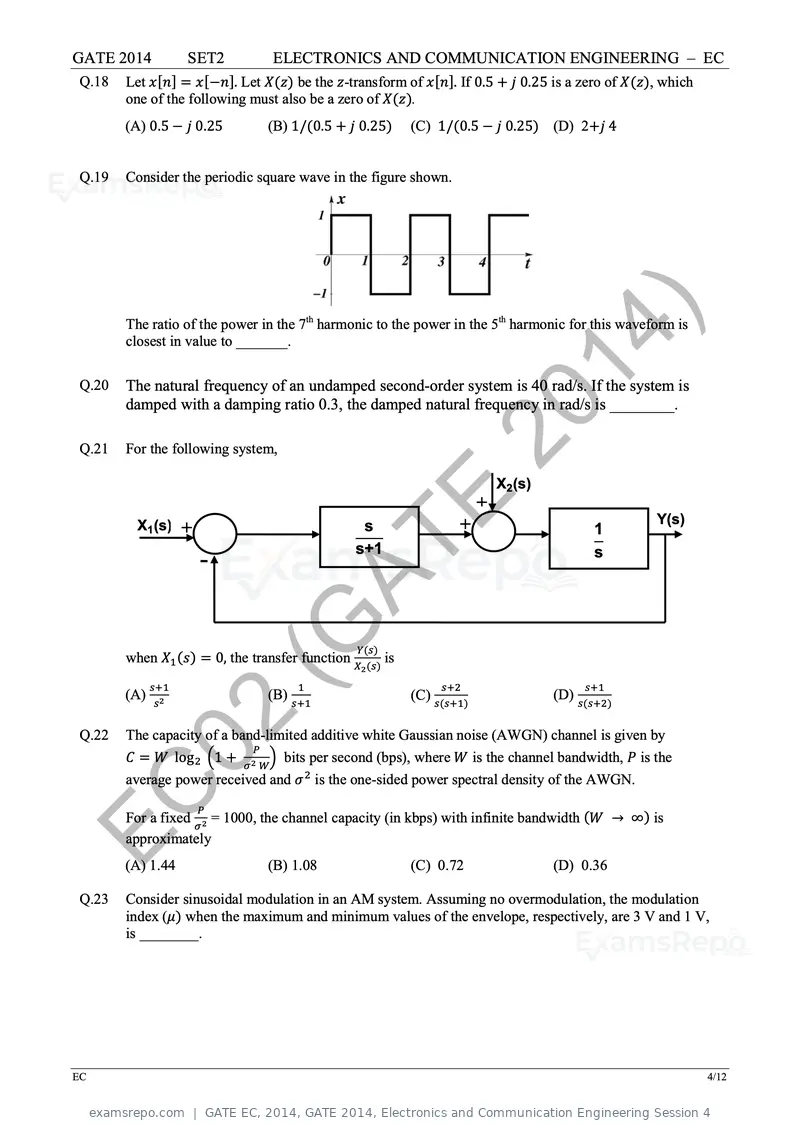
Text of page 30
GATE 2014          SET2          ELECTRONICS AND COMMUNICATION ENGINEERING – EC
 Q.18   Let x[n] = x[−n]. Let X(z) be the z-transform of x[n]. If 0.5 + j 0.25 is a zero of X(z), which
        one of the following must also be a zero of X(z).
        (A) 0.5 − j 0.25        (B) 1/(0.5 + j 0.25)      (C) 1/(0.5 − j 0.25) (D) 2+j 4


 Q.19   Consider the periodic square wave in the figure shown.


                                                                                          )
        The ratio of the power in the 7th harmonic to the power in the 5th harmonic for this waveform is


 Q.20
        closest in value to _______.

                                                                2014
        The natural frequency of an undamped second-order system is 40 rad/s. If the system is
        damped with a damping ratio 0.3, the damped natural frequency in rad/s is ________.

 Q.21   For the following system,

                                                                           X2 (s)

          X1 (s) +
                                      AT         s                +
                                                                       +
                                                                                          1
                                                                                                  Y(s)

                     -
                                         E      s+1                                       s


                           (G                   Y(s)
        when X1 (s) = 0, the transfer function X (s) is
            s+1
        (A) s2
                                      1
                                (B) s+1
                                                 2

                                                               s+2
                                                          (C) s(s+1)
                                                                                         s+1
                                                                                    (D) s(s+2)

 Q.22
         02
        The capacity of a band-limited additive white Gaussian noise (AWGN) channel is given by
                             P
        C = W log 2 �1 + σ2 W� bits per second (bps), where W is the channel bandwidth, P is the
        average power received and σ 2 is the one-sided power spectral density of the AWGN.


EC                   P
        For a fixed 2 = 1000, the channel capacity (in kbps) with infinite bandwidth (W → ∞) is
                   σ
        approximately
        (A) 1.44                (B) 1.08                  (C) 0.72                  (D) 0.36

 Q.23   Consider sinusoidal modulation in an AM system. Assuming no overmodulation, the modulation
        index (μ) when the maximum and minimum values of the envelope, respectively, are 3 V and 1 V,
        is ________.


EC                                                                                                         4/12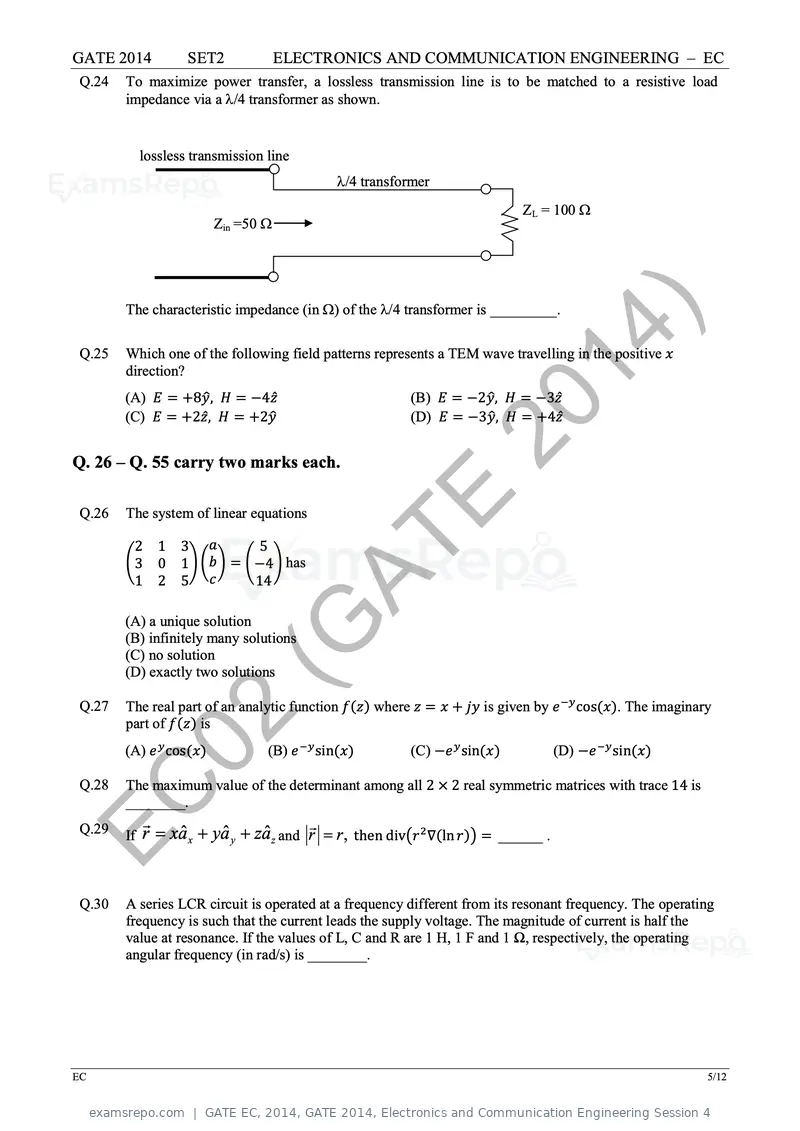
Text of page 31
GATE 2014 SET2 ELECTRONICS AND COMMUNICATION ENGINEERING – EC
Q.24 To maximize power transfer, a lossless transmission line is to be matched to a resistive load
impedance via a λ/4 transformer as shown.
lossless transmission line
λ/4 transformer
ZL = 100 Ω
Zin =50 Ω
The characteristic impedance (in Ω) of the λ/4 transformer is _________. )
Q.25
20
Which one of the following field patterns represents a TEM wave travelling in the positive x
direction?
(A) E = +8y�, H = −4ẑ
(C) E = +2ẑ , H = +2y�
14
(B) E = −2y�, H = −3ẑ
(D) E = −3y�, H = +4ẑ
Q. 26 – Q. 55 carry two marks each.
Q.26 The system of linear equations
2 1 3 a 5 AT
�3 0
1 2
1� �b� = �−4� has
5 c 14
(A) a unique solution
E
(G
(B) infinitely many solutions
(C) no solution
(D) exactly two solutions
Q.27 The real part of an analytic function f(z) where z = x + jy is given by e −y cos(x). The imaginary
Q.28
02
part of f(z) is
(A) e y cos(x) (B) e −y sin(x) (C) −e y sin(x) (D) −e −y sin(x)
The maximum value of the determinant among all 2 × 2 real symmetric matrices with trace 14 is
EC
Q.29
________.
If r = xaˆ x + yaˆ y + zaˆ z and r = r , then div�r 2 ∇(ln r)� = ______ .
Q.30 A series LCR circuit is operated at a frequency different from its resonant frequency. The operating
frequency is such that the current leads the supply voltage. The magnitude of current is half the
value at resonance. If the values of L, C and R are 1 H, 1 F and 1 Ω, respectively, the operating
angular frequency (in rad/s) is ________.
EC 5/12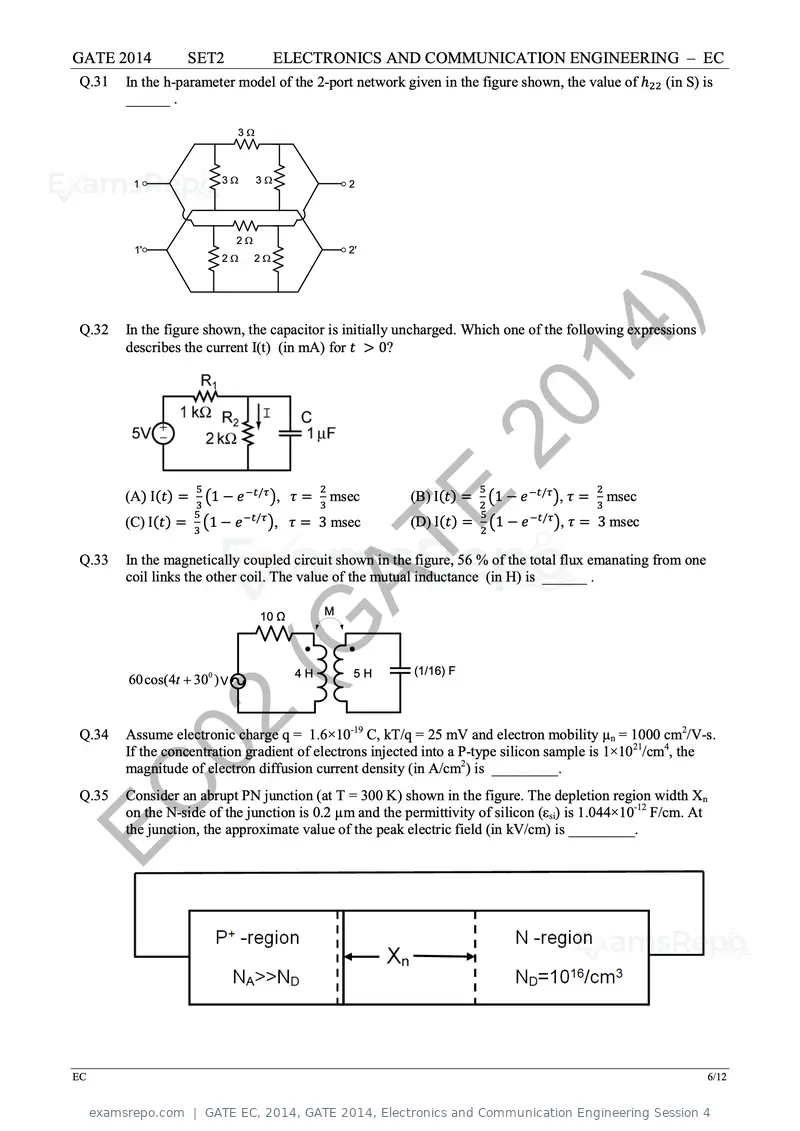
Text of page 32
GATE 2014         SET2                 ELECTRONICS AND COMMUNICATION ENGINEERING – EC
 Q.31   In the h-parameter model of the 2-port network given in the figure shown, the value of ℎ22 (in S) is
        ______ .

                             3Ω


         1              3Ω        3Ω              2


                             2Ω
         1'                                       2'
                        2Ω        2Ω


 Q.32
                                                                                        )
        In the figure shown, the capacitor is initially uncharged. Which one of the following expressions
        describes the current I(t) (in mA) for t > 0?

                                                                2014
                   5                          2                    5                    2
        (A) I(t) =   �1 − e −t/τ �,      τ=              (B) I(t) =  �1 − e −t/τ �, τ = 3 msec
                   3
                   5
        (C) I(t) = 3 �1 − e −t/τ �,
                                          AT  3
                                                msec
                                         τ = 3 msec
                                                                   2
                                                                   5
                                                         (D) I(t) = �1 − e −t/τ �, τ = 3 msec
                                                                   2

 Q.33

                                             E
        In the magnetically coupled circuit shown in the figure, 56 % of the total flux emanating from one
        coil links the other coil. The value of the mutual inductance (in H) is ______ .

                                  10 Ω        M


                         (G
        60cos(4t + 300 ) V               4H        5H     (1/16) F


 Q.34
         02
        Assume electronic charge q = 1.6×10⁻¹⁹ C, kT/q = 25 mV and electron mobility µn = 1000 cm2/V-s.
        If the concentration gradient of electrons injected into a P-type silicon sample is 1×10²¹/cm4, the
        magnitude of electron diffusion current density (in A/cm2) is _________.


EC
 Q.35   Consider an abrupt PN junction (at T = 300 K) shown in the figure. The depletion region width Xn
        on the N-side of the junction is 0.2 µm and the permittivity of silicon (εsi) is 1.044×10⁻¹² F/cm. At
        the junction, the approximate value of the peak electric field (in kV/cm) is _________.


EC                                                                                                           6/12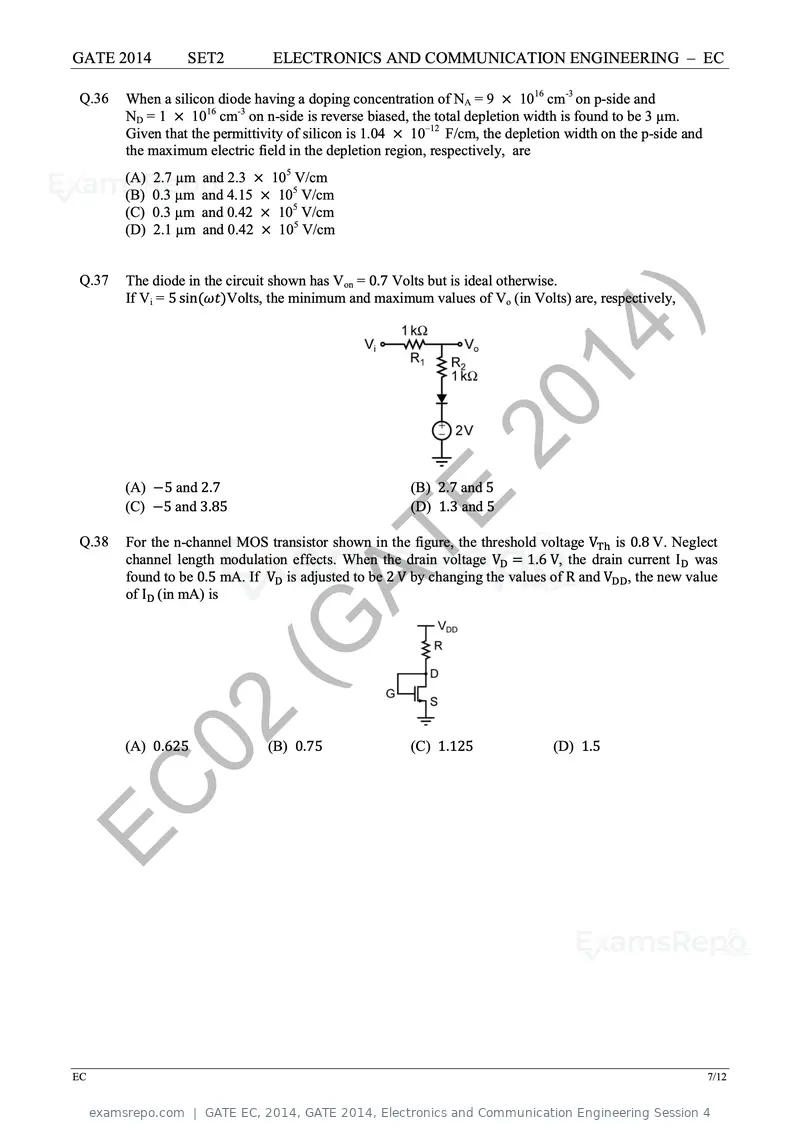
Text of page 33
GATE 2014         SET2           ELECTRONICS AND COMMUNICATION ENGINEERING – EC

 Q.36   When a silicon diode having a doping concentration of NA = 9 × 1016 cm-3 on p-side and
        ND = 1 × 1016 cm-3 on n-side is reverse biased, the total depletion width is found to be 3 µm.
        Given that the permittivity of silicon is 1.04 × 10⁻¹² F/cm, the depletion width on the p-side and
        the maximum electric field in the depletion region, respectively, are
        (A) 2.7 µm and 2.3 × 10⁵ V/cm
        (B) 0.3 µm and 4.15 × 10⁵ V/cm
        (C) 0.3 µm and 0.42 × 10⁵ V/cm
        (D) 2.1 µm and 0.42 × 10⁵ V/cm


 Q.37   The diode in the circuit shown has Von = 0.7 Volts but is ideal otherwise.
        If Vi = 5 sin(ωt)Volts, the minimum and maximum values of Vo (in Volts) are, respectively,
                                                                                       )
                                                              2014
        (A) −5 and 2.7                                  (B) 2.7 and 5


 Q.38
        (C) −5 and 3.85

                                     AT                 (D) 1.3 and 5

        For the n-channel MOS transistor shown in the figure, the threshold voltage VTh is 0.8 V. Neglect


                                        E
        channel length modulation effects. When the drain voltage VD = 1.6 V, the drain current ID was
        found to be 0.5 mA. If VD is adjusted to be 2 V by changing the values of R and VDD , the new value
        of ID (in mA) is


                         (G
         02
        (A) 0.625               (B) 0.75                (C) 1.125               (D) 1.5


EC

EC                                                                                                           7/12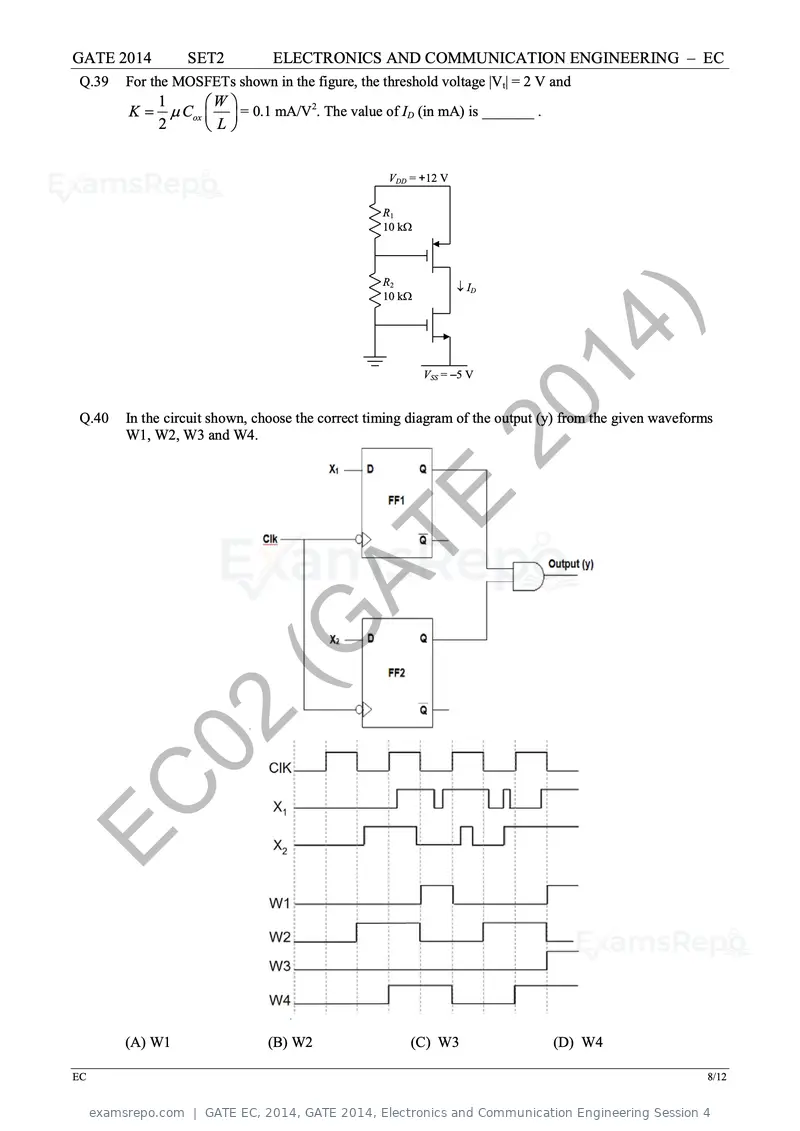
Text of page 34
GATE 2014 SET2 ELECTRONICS AND COMMUNICATION ENGINEERING – EC
Q.39 For the MOSFETs shown in the figure, the threshold voltage |Vt| = 2 V and
1 W
K= µ Cox = 0.1 mA/V2. The value of ID (in mA) is _______ .
2 L
VDD = +12 V
R1
10 kΩ
R2 ↓ ID
10 kΩ
)
Q.40
20
VSS = –5 V
14
In the circuit shown, choose the correct timing diagram of the output (y) from the given waveforms
W1, W2, W3 and W4.
AT
E
(G
02
EC
(A) W1 (B) W2 (C) W3 (D) W4
EC 8/12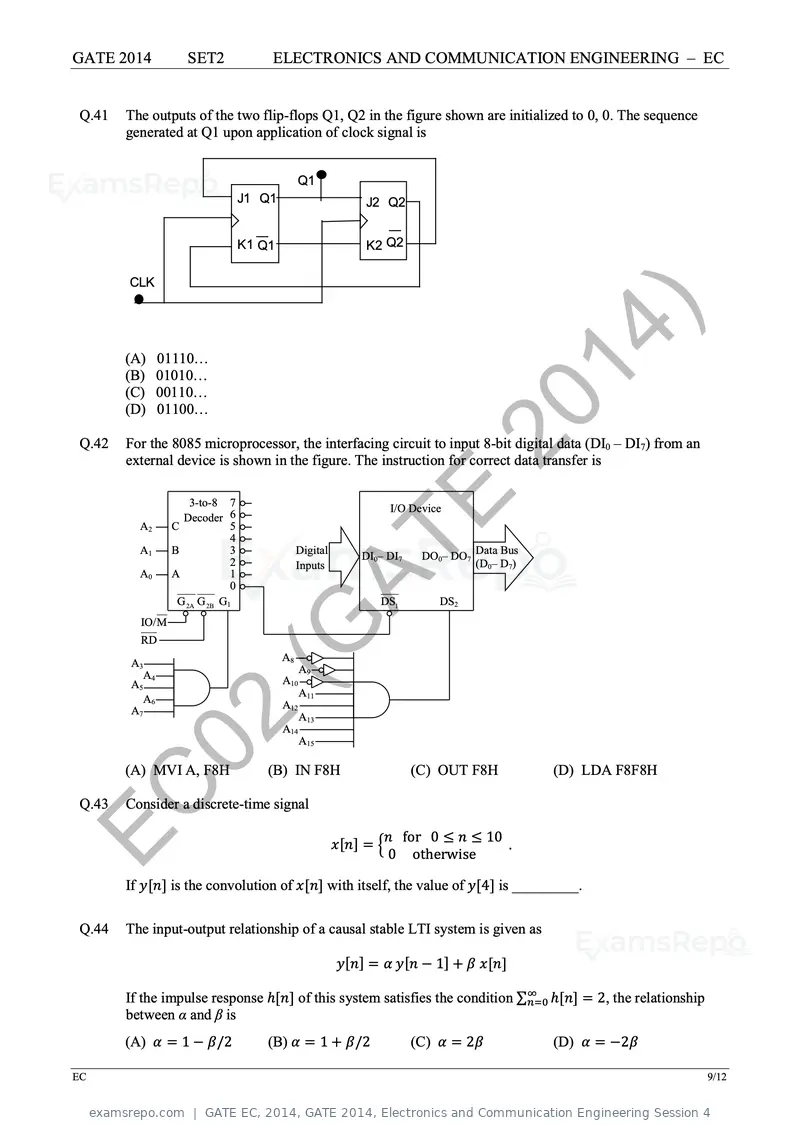
Text of page 35
GATE 2014           SET2              ELECTRONICS AND COMMUNICATION ENGINEERING – EC


 Q.41   The outputs of the two flip-flops Q1, Q2 in the figure shown are initialized to 0, 0. The sequence
        generated at Q1 upon application of clock signal is


                                               Q1
                                  J1 Q1                       J2 Q2


                                  K1 Q1                       K2 Q2

        CLK

                                                                                                 )
        (A)
        (B)
        (C)
        (D)
               01110…
               01010…
               00110…
               01100…
                                                                               2014
 Q.42   For the 8085 microprocessor, the interfacing circuit to input 8-bit digital data (DI0 – DI7) from an
        external device is shown in the figure. The instruction for correct data transfer is


          A2     C
                     3-to-8 7
                   Decoder 6
                              5
                              4                 AT                I/O Device


          A1

          A0
                 B

                 A

                  G 2A G 2B G1
                              3
                              2
                              1
                              0
                                                   E
                                               Digital
                                               Inputs
                                                             DI0– DI7


                                                                DS1
                                                                         DO0– DO7 Data Bus


                                                                            DS2
                                                                                  (D0– D7)


        A3
        A5
          IO/M
          RD


          A4

          A6
                             (G           A8

                                          A10

                                          A12
                                                A9

                                                A11
        A7


         02
        (A) MVI A, F8H
                                          A14


                                      (B) IN F8H
                                                A13

                                                A15

                                                                        (C) OUT F8H          (D) LDA F8F8H


EC
 Q.43   Consider a discrete-time signal

                                                         x[n] = �
                                                                 n for 0 ≤ n ≤ 10
                                                                  0 otherwise
                                                                                  .

        If y[n] is the convolution of x[n] with itself, the value of y[4] is _________.

 Q.44   The input-output relationship of a causal stable LTI system is given as

                                                         y[n] = α y[n − 1] + β x[n]

        If the impulse response ℎ[n] of this system satisfies the condition ∑∞
                                                                             n=0 ℎ[n] = 2, the relationship
        between α and β is
        (A) α = 1 − β/2               (B) α = 1 + β/2                   (C) α = 2β           (D) α = −2β

EC                                                                                                             9/12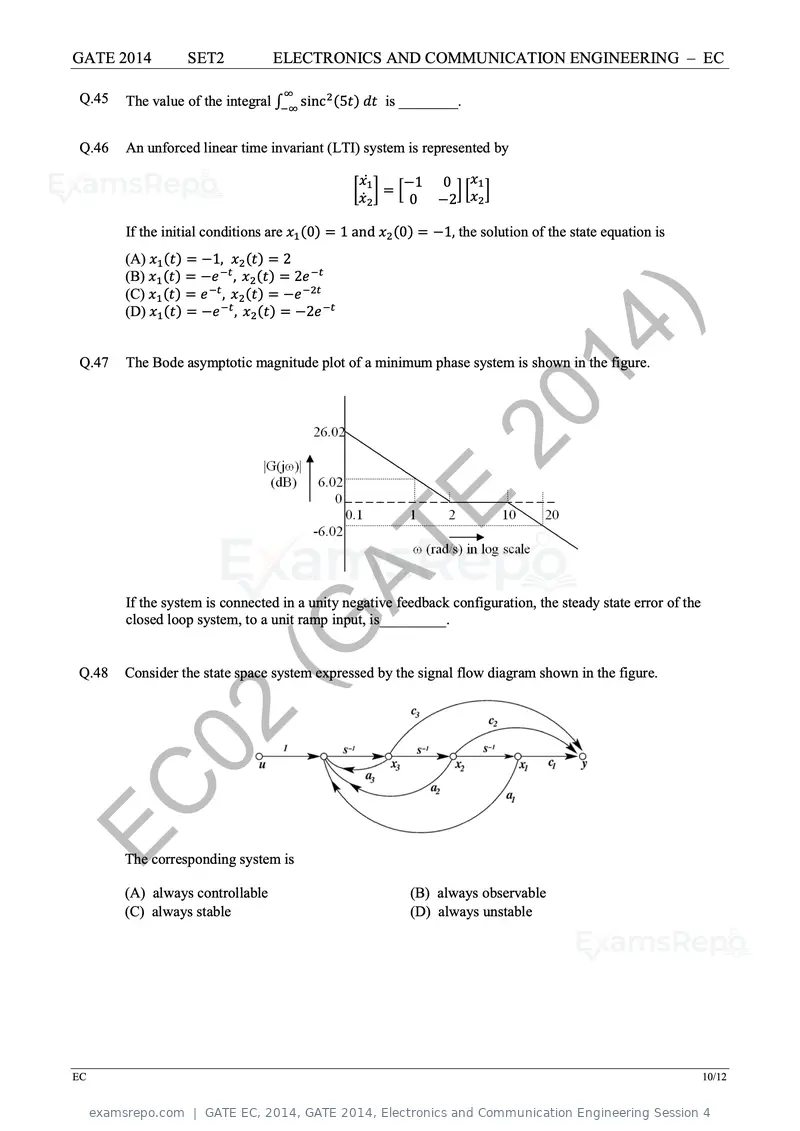
Text of page 36
GATE 2014         SET2            ELECTRONICS AND COMMUNICATION ENGINEERING – EC

                                   ∞
 Q.45   The value of the integral ∫−∞ sinc 2 (5t) dt is ________.


 Q.46   An unforced linear time invariant (LTI) system is represented by

                                                 ẋ      −1 0 x1
                                                � 1� = �     �� �
                                                 ẋ 2    0 −2 x2

        If the initial conditions are x1 (0) = 1 and x2 (0) = −1, the solution of the state equation is
        (A) x1 (t) = −1, x2 (t) = 2
        (B) x1 (t) = −e −t , x2 (t) = 2e −t
        (C) x1 (t) = e −t , x2 (t) = −e −2t
        (D) x1 (t) = −e −t , x2 (t) = −2e −t                                             )
 Q.47
                                                                20
        The Bode asymptotic magnitude plot of a minimum phase system is shown in the figure.


                                                                  14
                                       AT
                                          E
        If the system is connected in a unity negative feedback configuration, the steady state error of the
        closed loop system, to a unit ramp input, is_________.


Q.48
                         (G
        Consider the state space system expressed by the signal flow diagram shown in the figure.


         02
EC      The corresponding system is

        (A) always controllable                           (B) always observable
        (C) always stable                                 (D) always unstable


EC                                                                                                             10/12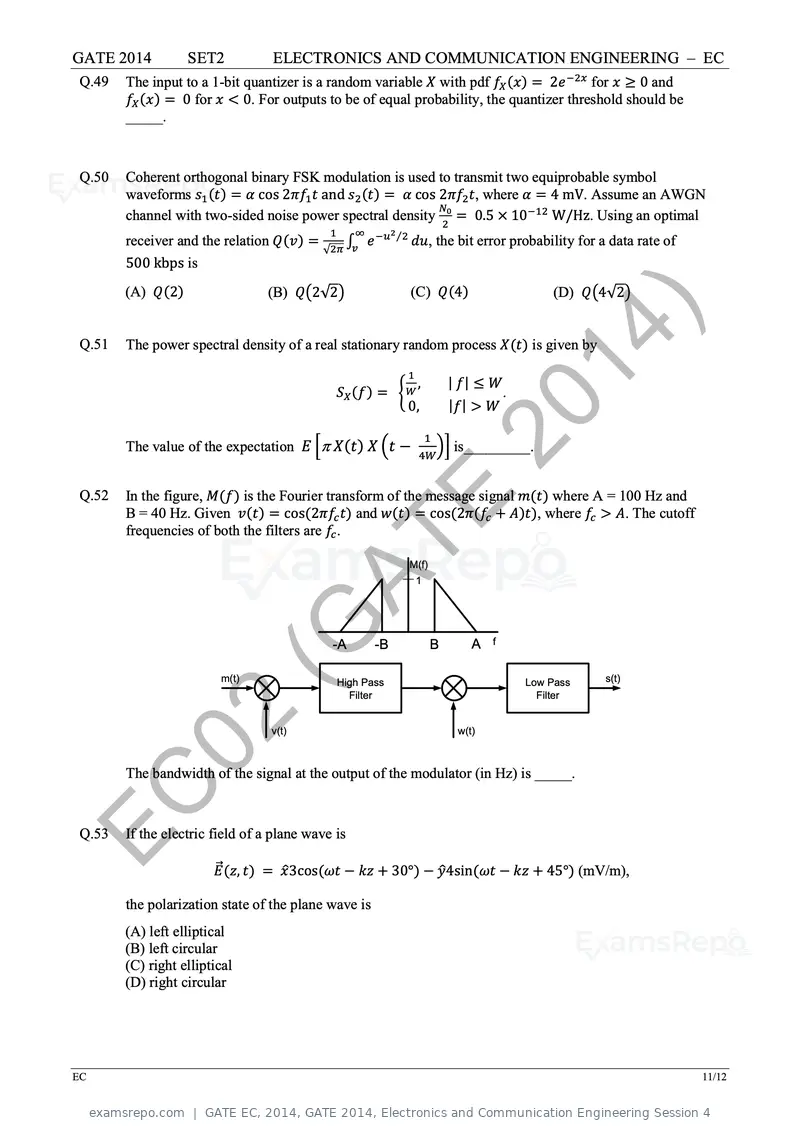
Text of page 37
GATE 2014          SET2           ELECTRONICS AND COMMUNICATION ENGINEERING – EC
 Q.49   The input to a 1-bit quantizer is a random variable X with pdf fX (x) = 2e −2x for x ≥ 0 and
        fX (x) = 0 for x < 0. For outputs to be of equal probability, the quantizer threshold should be
        _____.


 Q.50   Coherent orthogonal binary FSK modulation is used to transmit two equiprobable symbol
        waveforms s1 (t) = α cos 2πf1 t and s2 (t) = α cos 2πf2 t, where α = 4 mV. Assume an AWGN
                                                           N
        channel with two-sided noise power spectral density 0 = 0.5 × 10⁻¹² W/Hz. Using an optimal
                                                            2
                                            1    ∞    2
        receiver and the relation Q(v) =    2π
                                               ∫v e −u ⁄2 du, the bit error probability for a data rate of
                                           √
        500 kbps is
        (A) Q(2)                 (B) Q�2√2�                (C) Q(4)                           (D) Q�4√2�
                                                                                                    )
 Q.51

                                                                        20
        The power spectral density of a real stationary random process X(t) is given by


                                              SX (f) = �W
                                                        0,
                                                          ,
                                                           1


                                                                          14
                                                                        | f| ≤ W
                                                                        |f| > W
                                                                                     .


                                                                   1
        The value of the expectation E �π X(t) X �t −                  �� is_________.
                                                               4W


        In the figure, M(f) is the Fourier transform of the message signal m(t) where A = 100 Hz and


                                         AT
 Q.52
        B = 40 Hz. Given v(t) = cos(2πfc t) and w(t) = cos(2π(fc + A)t), where fc > A. The cutoff
        frequencies of both the filters are fc .


                                            E              M(f)
                                                               1


                           (G
                         m(t)
                                             -A       -B

                                              High Pass
                                                Filter
                                                                   B         A   f


                                                                                         Low Pass
                                                                                           Filter
                                                                                                    s(t)


          02                      v(t)                                    w(t)


        The bandwidth of the signal at the output of the modulator (in Hz) is _____.


EC
 Q.53   If the electric field of a plane wave is

                        E�⃗ (z, t) = x�3cos(ωt − kz + 30°) − y�4sin(ωt − kz + 45°) (mV/m),

        the polarization state of the plane wave is
        (A) left elliptical
        (B) left circular
        (C) right elliptical
        (D) right circular


EC                                                                                                           11/12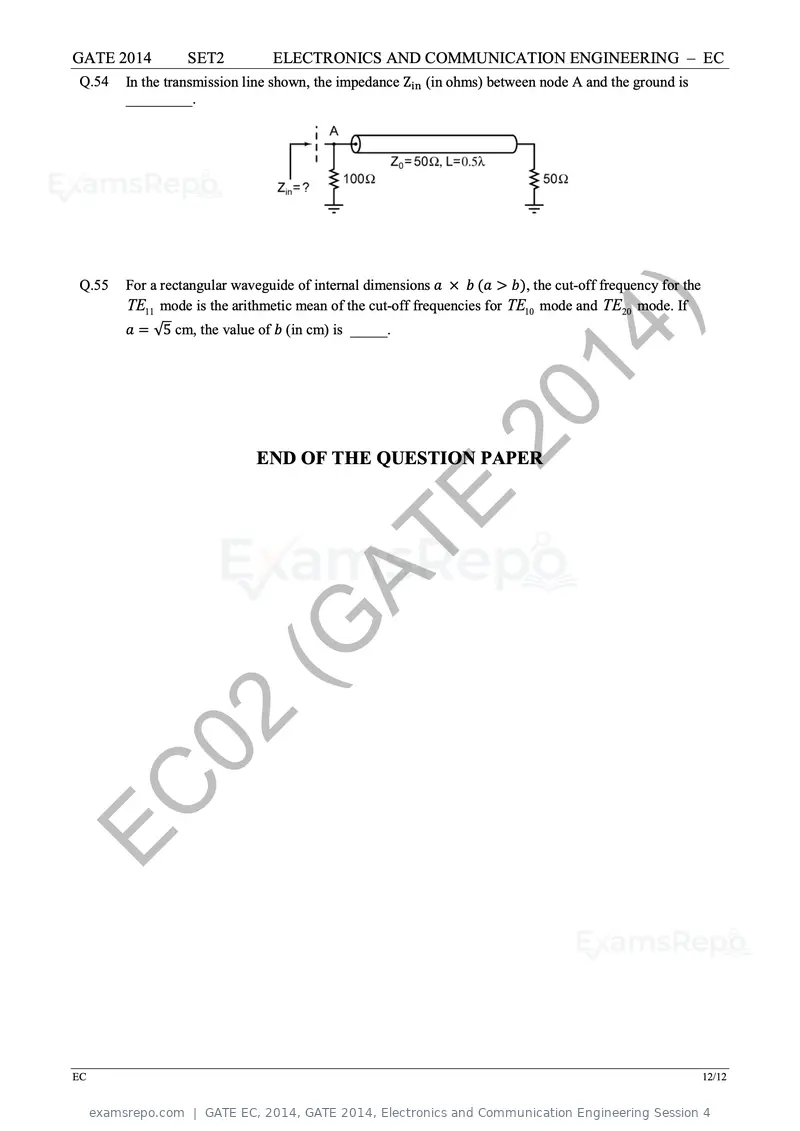
Text of page 38
GATE 2014         SET2          ELECTRONICS AND COMMUNICATION ENGINEERING – EC
 Q.54   In the transmission line shown, the impedance Zin (in ohms) between node A and the ground is
        _________.


 Q.55   For a rectangular waveguide of internal dimensions a × b (a > b), the cut-off frequency for the
        TE11 mode is the arithmetic mean of the cut-off frequencies for TE10 mode and TE20 mode. If
        a = √5 cm, the value of b (in cm) is _____.
                                                                                    )
                                                            2014
                             END OF THE QUESTION PAPER


                                    AT
                                       E
                         (G
         02
EC

EC                                                                                                        12/12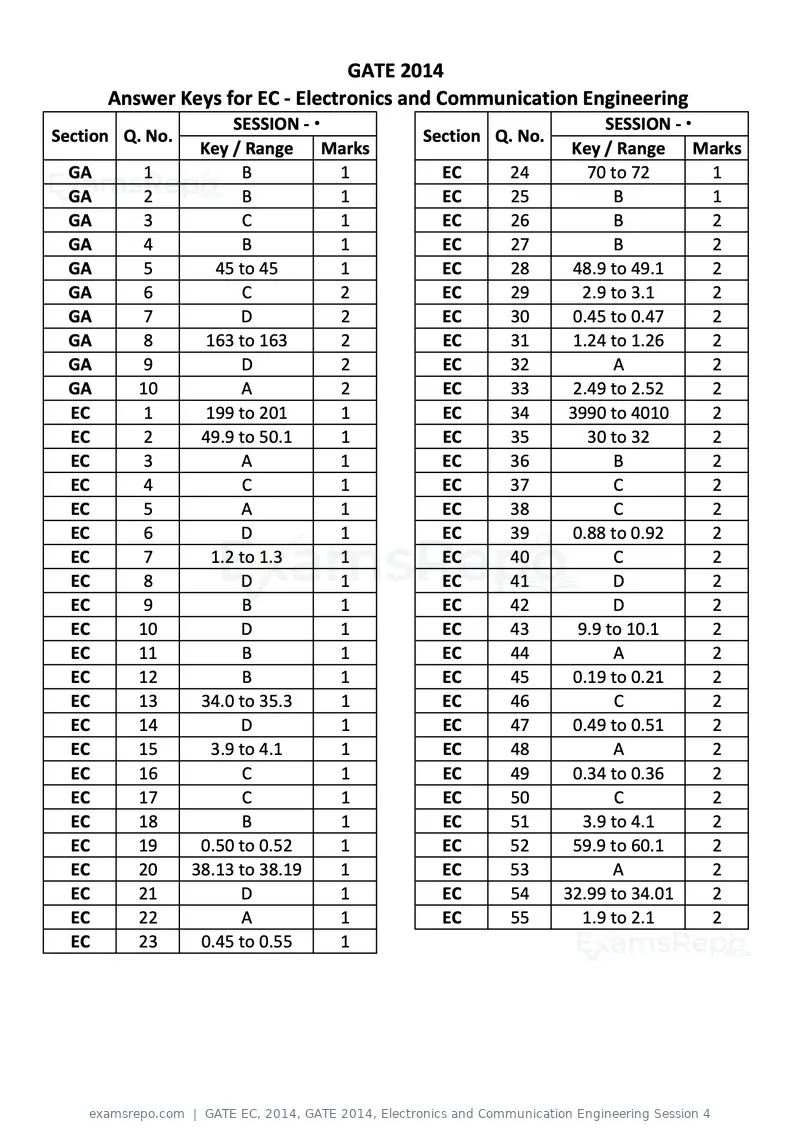
Text of page 39
GATE 2014
      Answer Keys for EC ‐ Electronics and Communication Engineering
                       SESSION ‐ Ϯ                            SESSION ‐ Ϯ
Section Q. No.                         Section Q. No.
                  Key / Range Marks                      Key / Range Marks
 GA        1            B          1     EC      24        70 to 72       1
 GA        2            B          1     EC      25            B          1
 GA        3            C          1     EC      26            B          2
 GA        4            B          1     EC      27            B          2
 GA        5        45 to 45       1     EC      28      48.9 to 49.1     2
 GA        6            C          2     EC      29        2.9 to 3.1     2
 GA        7            D          2     EC      30      0.45 to 0.47     2
 GA        8       163 to 163      2     EC      31      1.24 to 1.26     2
 GA        9            D          2     EC      32            A          2
 GA       10            A          2     EC      33      2.49 to 2.52     2
 EC        1       199 to 201      1     EC      34      3990 to 4010     2
 EC        2      49.9 to 50.1     1     EC      35         30 to 32      2
 EC       3             A          1     EC      36            B          2
 EC       4             C          1     EC      37            C          2
 EC       5             A          1     EC      38            C          2
 EC       6             D          1     EC      39      0.88 to 0.92     2
 EC       7        1.2 to 1.3      1     EC      40            C          2
 EC       8             D          1     EC      41            D          2
 EC       9             B          1     EC      42            D          2
 EC       10            D          1     EC      43       9.9 to 10.1     2
 EC       11            B          1     EC      44            A          2
 EC       12            B          1     EC      45      0.19 to 0.21     2
 EC       13      34.0 to 35.3     1     EC      46            C          2
 EC       14            D          1     EC      47      0.49 to 0.51     2
 EC       15        3.9 to 4.1     1     EC      48            A          2
 EC       16            C          1     EC      49      0.34 to 0.36     2
 EC       17            C          1     EC      50             C         2
 EC       18            B          1     EC      51        3.9 to 4.1     2
 EC       19      0.50 to 0.52     1     EC      52      59.9 to 60.1     2
 EC       20     38.13 to 38.19    1     EC      53            A          2
 EC       21            D          1     EC      54     32.99 to 34.01    2
 EC       22            A          1     EC      55        1.9 to 2.1     2
 EC       23      0.45 to 0.55     1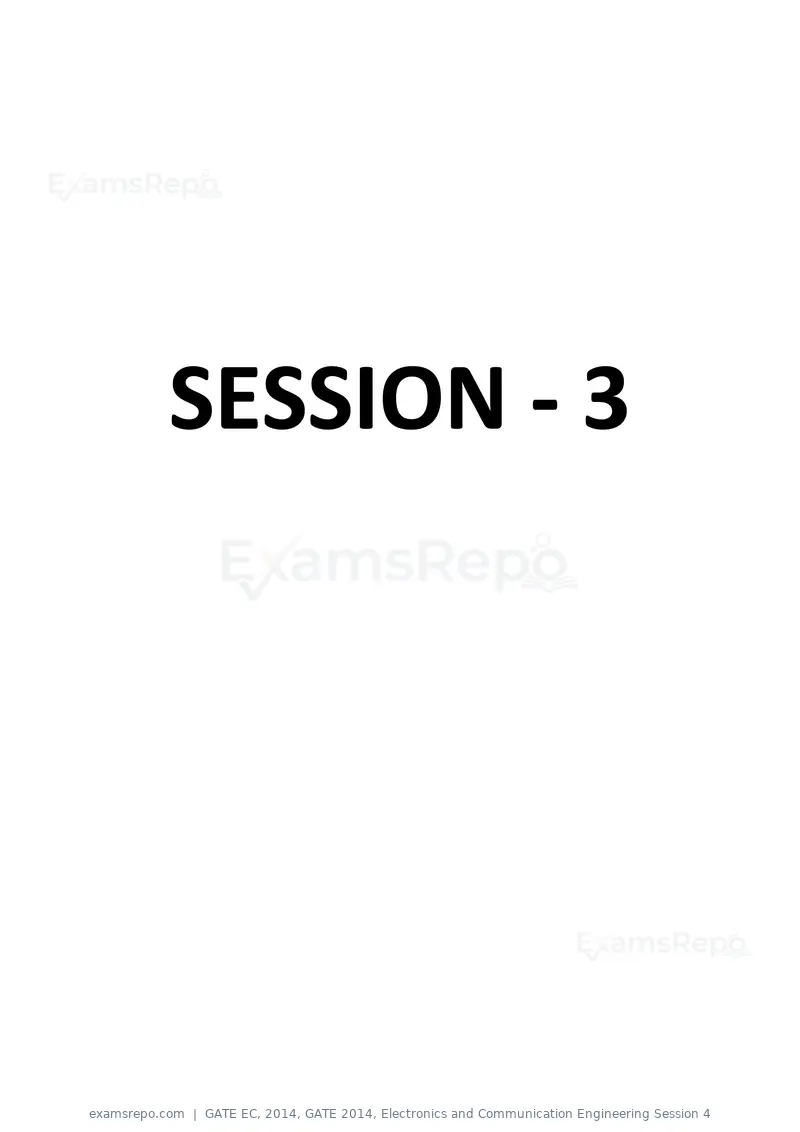
Text of page 40
SESSION - 3
Text of page 41
GATE 2014: General Instructions during Examination

   1. Total duration of the GATE examination is 180 minutes.
   2. The clock will be set at the server. The countdown timer at the top right corner of
      screen will display the remaining time available for you to complete the examination.
      When the timer reaches zero, the examination will end by itself. You need not
      terminate the examination or submit your paper.
   3. Any useful data required for your paper can be viewed by clicking on the Useful
      Common Data button that appears on the screen.
   4. Use the scribble pad provided to you for any rough work. Submit the scribble pad at
      the end of the examination.
   5. You are allowed to use a non-programmable type calculator, however, sharing of
      calculators is not allowed.
   6. The Question Palette displayed on the right side of screen will show the status of
      each question using one of the following symbols:


The Marked for Review status for a question simply indicates that you would like to look at
that question again. If a question is answered, but marked for review, then the answer will
be considered for evaluation unless the status is modified by the candidate.

Navigating to a Question :

   7. To answer a question, do the following:
         a. Click on the question number in the Question Palette to go to that question
            directly.
         b. Select an answer for a multiple choice type question by clicking on the bubble
            placed before the 4 choices, namely A, B, C and D. Use the virtual numeric
            keypad to enter a number as answer for a numerical type question.
         c. Click on Save & Next to save your answer for the current question and then go
            to the next question.
         d. Click on Mark for Review & Next to save your answer for the current question
            and also mark it for review, and then go to the next question.
Text of page 42
Caution: Note that your answer for the current question will not be saved, if you navigate
to another question directly by clicking on a question number without saving the answer to
the previous question.

You can view all the questions by clicking on the Question Paper button. This feature is
provided, so that if you want you can just see the entire question paper at a glance.

Answering a Question :

   8. Procedure for answering a multiple choice (MCQ) type question:
         a. Choose one answer from the 4 options (A,B,C,D) given below the question,
            click on the bubble placed before the chosen option.
         b. To deselect your chosen answer, click on the bubble of the chosen option again
            or click on the Clear Response button.
         c. To change your chosen answer, click on the bubble of another option.
         d. To save your answer, you MUST click on the Save & Next button.

   9. Procedure for answering a numerical answer type question:
         a. To enter a number as your answer, use the virtual numerical keypad.
         b. A fraction (e.g. -0.3 or -.3) can be entered as an answer with or without '0'
             before the decimal point. As many as four decimal points, e.g. 12.5435 or
             0.003 or -932.6711 or 12.82 can be entered.
         c. To clear your answer, click on the Clear Response button.
         d. To save your answer, you MUST click on the Save & Next button
   10. To mark a question for review, click on the Mark for Review & Next button. If an
      answer is selected (for MCQ) or entered (for numerical answer type) for a question
      that is Marked for Review, that answer will be considered in the evaluation unless
      the status is modified by the candidate.

   11. To change your answer to a question that has already been answered, first select
      that question for answering and then follow the procedure for answering that type of
      question.
   12. Note that ONLY Questions for which answers are saved or marked for review after
      answering will be considered for evaluation.


      Choosing a Section :

   13. Sections in this question paper are displayed on the top bar of the screen. Questions
      in a Section can be viewed by clicking on the name of that Section. The Section you
      are currently viewing will be highlighted.
   14. A checkbox is displayed for every optional Section, if any, in the Question Paper. To
      select the optional Section for answering, click on the checkbox for that Section.
   15. If the checkbox for an optional Section is not selected, the Save & Next button and
      the Mark for Review & Next button will NOT be enabled for that Section. You will
Text of page 43
only be able to see questions in this Section, but you will not be able to answer
      questions in the Section.
   16. After clicking the Save & Next button for the last question in a Section, you will
      automatically be taken to the first question of the next Section in sequence.
   17. You can move the mouse cursor over the name of a Section to view the answering
      status for that Section.


Changing the Optional Section :

   18. After answering the chosen optional Section, partially or completely, you can change
      the optional Section by selecting the checkbox for a new Section that you want to
      attempt. A warning message will appear along with a table showing the number of
      questions answered in each of the previously chosen optional Sections and a
      checkbox against each of these Sections. Click on a checkbox against a Section that
      you want to reset and then click on the RESET button. Note that RESETTING a Section
      will DELETE all the answers for questions in that Section. Hence, if you think that you
      may want to select this Section again later, you will have to note down your answers
      for questions in that Section. If you do not want to reset the Section and want to
      continue answering the previously chosen optional Section, then click on the BACK
      button.

   19. If you deselect the checkbox for an optional Section in the top bar, the following
      warning message will appear: "Deselecting the checkbox will DELETE all the answers
      for questions in this Section. Do you want to deselect this Section?” If you want to
      deselect, click on the RESET button. If you do not want to deselect, click on the BACK
      button.

   20. You can shuffle between different Sections or change the optional Sections any
      number of times.
Text of page 44
GATE 2014 Examination
                        EC: Electronics & Communications Engineering
Duration: 180 minutes                                                                        Maximum Marks: 100

Read the following instructions carefully.

    1. To login, enter your Registration Number and password provided to you. Kindly go through the various
       symbols used in the test and understand their meaning before you start the examination.
    2. Once you login and after the start of the examination, you can view all the questions in the question
       paper, by clicking on the View All Questions button in the screen.
    3. This question paper consists of 2 sections, General Aptitude (GA) for 15 marks and the subject
       specific GATE paper for 85 marks. Both these sections are compulsory.
       The GA section consists of 10 questions. Question numbers 1 to 5 are of 1-mark each, while question
       numbers 6 to 10 are of 2-mark each.
       The subject specific GATE paper section consists of 55 questions, out of which question numbers 1 to
       25 are of 1-mark each, while question numbers 26 to 55 are of 2-mark each.
    4. Depending upon the GATE paper, there may be useful common data that may be required for
       answering the questions. If the paper has such useful data, the same can be viewed by clicking on the
       Useful Common Data button that appears at the top, right hand side of the screen.
    5. The computer allotted to you at the examination center runs specialized software that permits only one
        answer to be selected for multiple-choice questions using a mouse and to enter a suitable number for
        the numerical answer type questions using the virtual keyboard and mouse.
    6. Your answers shall be updated and saved on a server periodically and also at the end of the
        examination. The examination will stop automatically at the end of 180 minutes.
    7. In each paper a candidate can answer a total of 65 questions carrying 100 marks.
    8. The question paper may consist of questions of multiple choice type (MCQ) and numerical answer
        type.
    9. Multiple choice type questions will have four choices against A, B, C, D, out of which only ONE is the
        correct answer. The candidate has to choose the correct answer by clicking on the bubble (⃝) placed
        before the choice.
    10. For numerical answer type questions, each question will have a numerical answer and there will not be
        any choices. For these questions, the answer should be enteredby using the virtual keyboard that
        appears on the monitor and the mouse.
    11. All questions that are not attempted will result in zero marks. However, wrong answers for multiple
        choice type questions (MCQ) will result in NEGATIVE marks. For all MCQ questions a wrong
        answer will result in deduction of⅓ marks for a 1-mark question and ⅔ marks for a 2-mark question.
    12. There is NO NEGATIVE MARKING for questions of NUMERICAL ANSWER TYPE.
    13. Non-programmable type Calculator is allowed. Charts, graph sheets, and mathematical tables are NOT
        allowed in the Examination Hall. You must use the Scribble pad provided to you at the examination
        centre for all your rough work. The Scribble Pad has to be returned at the end of the examination.

    Declaration by the candidate:

    “I have read and understood all the above instructions. I have also read and understood clearly the
    instructions given on the admit card and shall follow the same. I also understand that in case I am found to
    violate any of these instructions, my candidature is liable to be cancelled. I also confirm that at the start of
    the examination all the computer hardware allotted to me are in proper working condition”.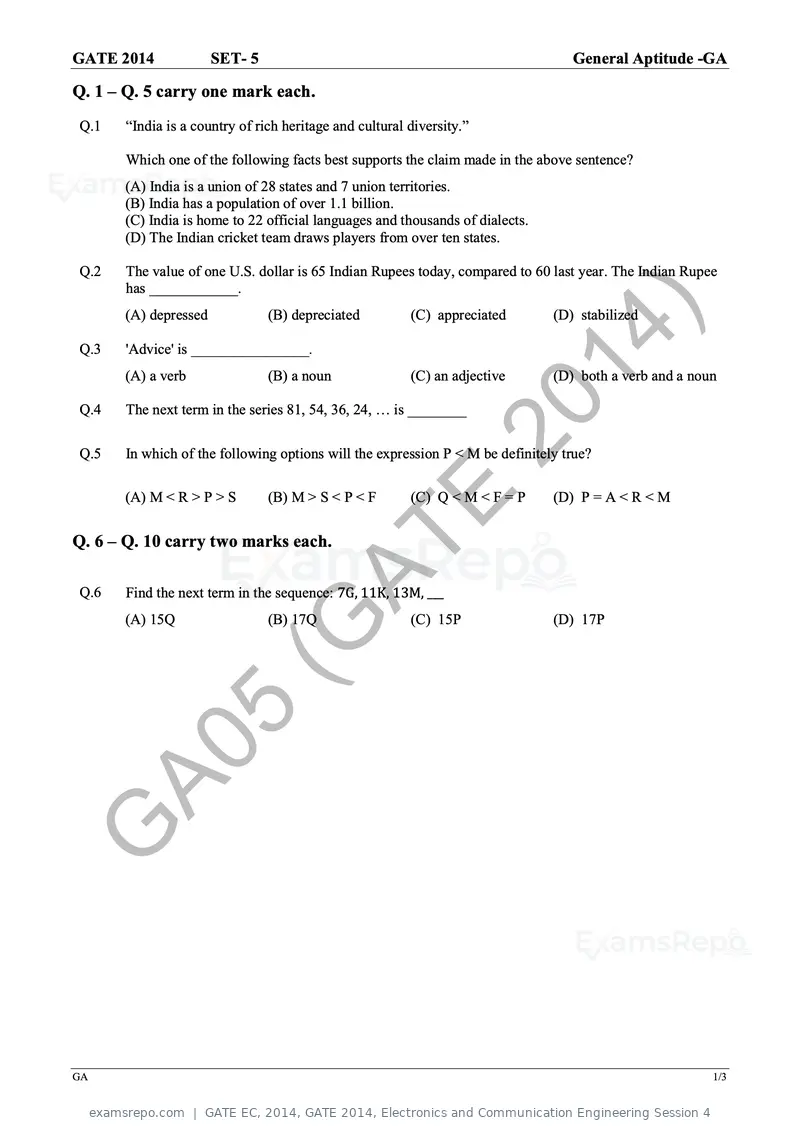
Text of page 45
GATE 2014             SET- 5                                                      General Aptitude -GA

Q. 1 – Q. 5 carry one mark each.
Q.1    “India is a country of rich heritage and cultural diversity.”

       Which one of the following facts best supports the claim made in the above sentence?
      (A) India is a union of 28 states and 7 union territories.
      (B) India has a population of over 1.1 billion.
      (C) India is home to 22 official languages and thousands of dialects.
      (D) The Indian cricket team draws players from over ten states.

Q.2    The value of one U.S. dollar is 65 Indian Rupees today, compared to 60 last year. The Indian Rupee
       has ____________.


Q.3
      (A) depressed             (B) depreciated

       'Advice' is ________________.
      (A) a verb                (B) a noun
                                                                20
                                                         (C) appreciated


                                                                  14
                                                         (C) an adjective
                                                                               (D) stabilized


                                                                               (D) both a verb and a noun

Q.4

Q.5
       The next term in the series 81, 54, 36, 24, … is ________

                                                                     )
       In which of the following options will the expression P < M be definitely true?

      (A) M < R > P > S

                                      AT
                                (B) M > S < P < F


Q. 6 – Q. 10 carry two marks each.
                                                         (C) Q < M < F = P     (D) P = A < R < M


Q.6                                      E
       Find the next term in the sequence: 7G, 11K, 13M, ___
      (A) 15Q                   (B) 17Q                  (C) 15P               (D) 17P

                         (G
                5
     A0
G

GA                                                                                                      1/3
Text of page 46
GATE 2014             SET- 5                                                              General Aptitude -GA
Q.7   The multi-level hierarchical pie chart shows the population of animals in a reserve forest. The
      correct conclusions from this information are:


                                                                 2014 )
                                      AT
      (i) Butterflies are birds
                                         E
      (ii) There are more tigers in this forest than red ants
      (iii) All reptiles in this forest are either snakes or crocodiles
      (iv) Elephants are the largest mammals in this forest


Q.8
                         (G
      (A) (i) and (ii) only
      (C) (i), (iii) and (iv) only
                                                          (B) (i), (ii), (iii) and (iv)
                                                          (D) (i), (ii) and (iii) only

      A man can row at 8 km per hour in still water. If it takes him thrice as long to row upstream, as to

               5
      row downstream, then find the stream velocity in km per hour.


     A0
G

GA                                                                                                          2/3
Text of page 47
GATE 2014            SET- 5                                                       General Aptitude -GA
Q.9    A firm producing air purifiers sold 200 units in 2012. The following pie chart presents the share of
       raw material, labour, energy, plant & machinery, and transportation costs in the total manufacturing
       cost of the firm in 2012. The expenditure on labour in 2012 is Rs. 4,50,000. In 2013, the raw
       material expenses increased by 30% and all other expenses increased by 20%. If the company
       registered a profit of Rs. 10 lakhs in 2012, at what price (in Rs.) was each air purifier sold?


                                                             2014 )
Q.10
                                    AT
       A batch of one hundred bulbs is inspected by testing four randomly chosen bulbs. The batch is


                                       E
       rejected if even one of the bulbs is defective. A batch typically has five defective bulbs. The
       probability that the current batch is accepted is


                        (G   END OF THE QUESTION PAPER


               5
     A0
G

GA                                                                                                        3/3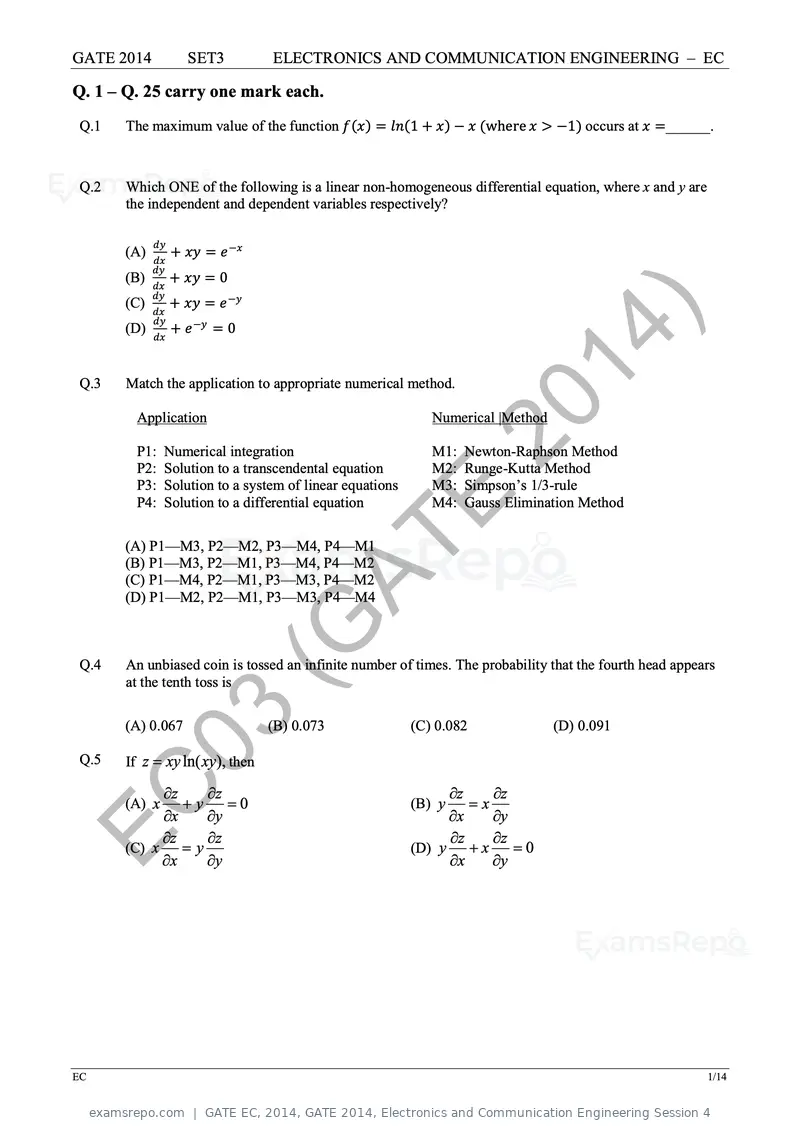
Text of page 48
GATE 2014          SET3           ELECTRONICS AND COMMUNICATION ENGINEERING – EC

Q. 1 – Q. 25 carry one mark each.
 Q.1   The maximum value of the function ff(xx) = llll(1 + xx) − xx (where xx > −1) occurs at xx =______.


 Q.2   Which ONE of the following is a linear non-homogeneous differential equation, where x and y are
       the independent and dependent variables respectively?

           dddd
       (A)      + xxxx = ee −xx
           dddd
           dddd
       (B) dddd + xxxx = 0
           dddd
       (C) dddd + xxxx = ee −yy
       (D)
           dddd
                + ee −yy = 0
                                                                                     )
 Q.3
           dddd


       Match the application to appropriate numerical method.

         Application
                                                             2014
                                                           Numerical |Method

         P1: Numerical integration                         M1: Newton-Raphson Method
         P2: Solution to a transcendental equation         M2: Runge-Kutta Method
         P3: Solution to a system of linear equations      M3: Simpson’s 1/3-rule


                                       AT
         P4: Solution to a differential equation

       (A) P1—M3, P2—M2, P3—M4, P4—M1
                                                           M4: Gauss Elimination Method


       (B) P1—M3, P2—M1, P3—M4, P4—M2
       (C) P1—M4, P2—M1, P3—M3, P4—M2
       (D) P1—M2, P2—M1, P3—M3, P4—M4     E
 Q.4                       (G
       An unbiased coin is tossed an infinite number of times. The probability that the fourth head appears
       at the tenth toss is


 Q.5
         03
       (A) 0.067

       If z = xy ln( xy ), then
                                  (B) 0.073             (C) 0.082              (D) 0.091


EC     (A) x

       (C) x
             ∂z
             ∂x
             ∂z
             ∂x
                +y

                =y
                   ∂z
                   ∂y
                   ∂z
                   ∂y
                      =
                      0                                 (B) y

                                                        (D) y
                                                              ∂z
                                                              ∂x
                                                              ∂z
                                                              ∂x
                                                                 =x

                                                                 +x
                                                                    ∂z
                                                                    ∂y
                                                                    ∂z
                                                                    ∂y
                                                                       =
                                                                       0


EC                                                                                                       1/14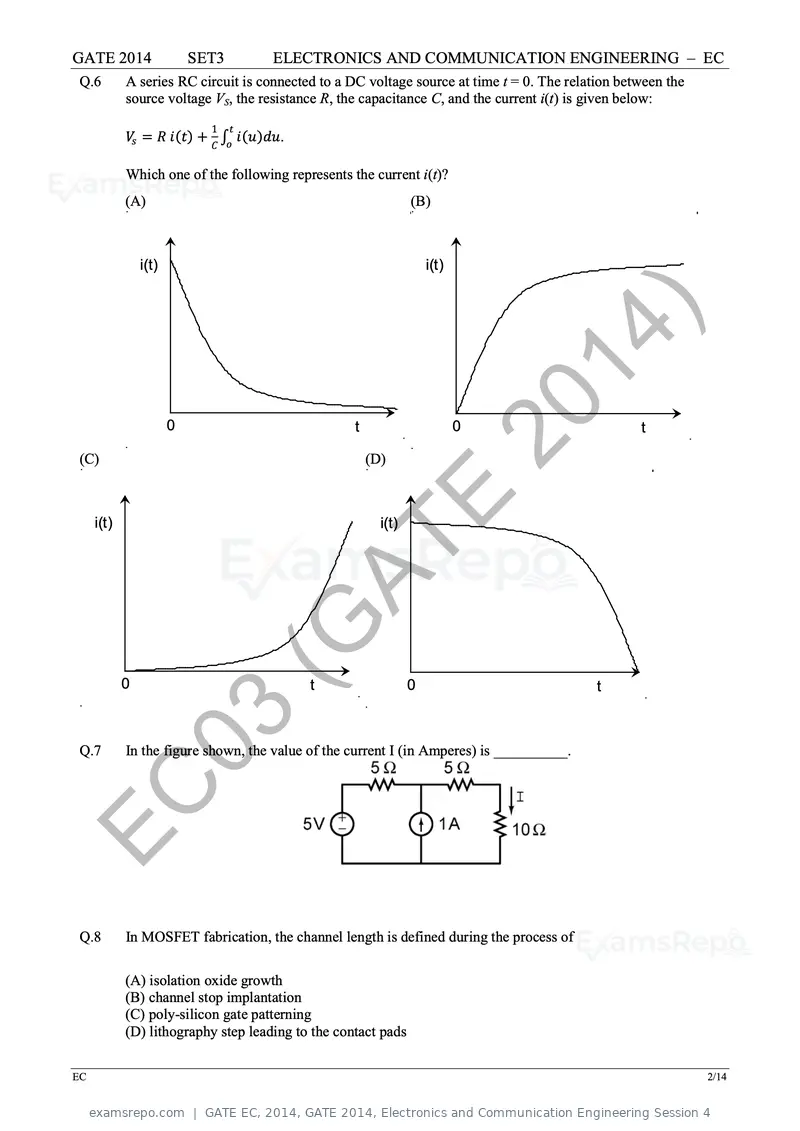
Text of page 49
GATE 2014                  SET3            ELECTRONICS AND COMMUNICATION ENGINEERING – EC
 Q.6        A series RC circuit is connected to a DC voltage source at time t = 0. The relation between the
            source voltage VS, the resistance R, the capacitance C, and the current i(t) is given below:
                              1   tt
            VVss = RR ii(tt) + ∫oo ii(uu)dddd.
                              CC

            Which one of the following represents the current i(t)?
            (A)                                                   (B)


                i(t)                                                  i(t)


                                                                                           )
                       0
                                                                             2014
                                                     t                       0                     t

 (C)                                                     (D)


     i(t)
                                                 AT        i(t)


                                                    E
            0
                                  (G             t                0                         t


 Q.7            03
            In the figure shown, the value of the current I (in Amperes) is __________.


EC
 Q.8        In MOSFET fabrication, the channel length is defined during the process of

            (A) isolation oxide growth
            (B) channel stop implantation
            (C) poly-silicon gate patterning
            (D) lithography step leading to the contact pads

EC                                                                                                            2/14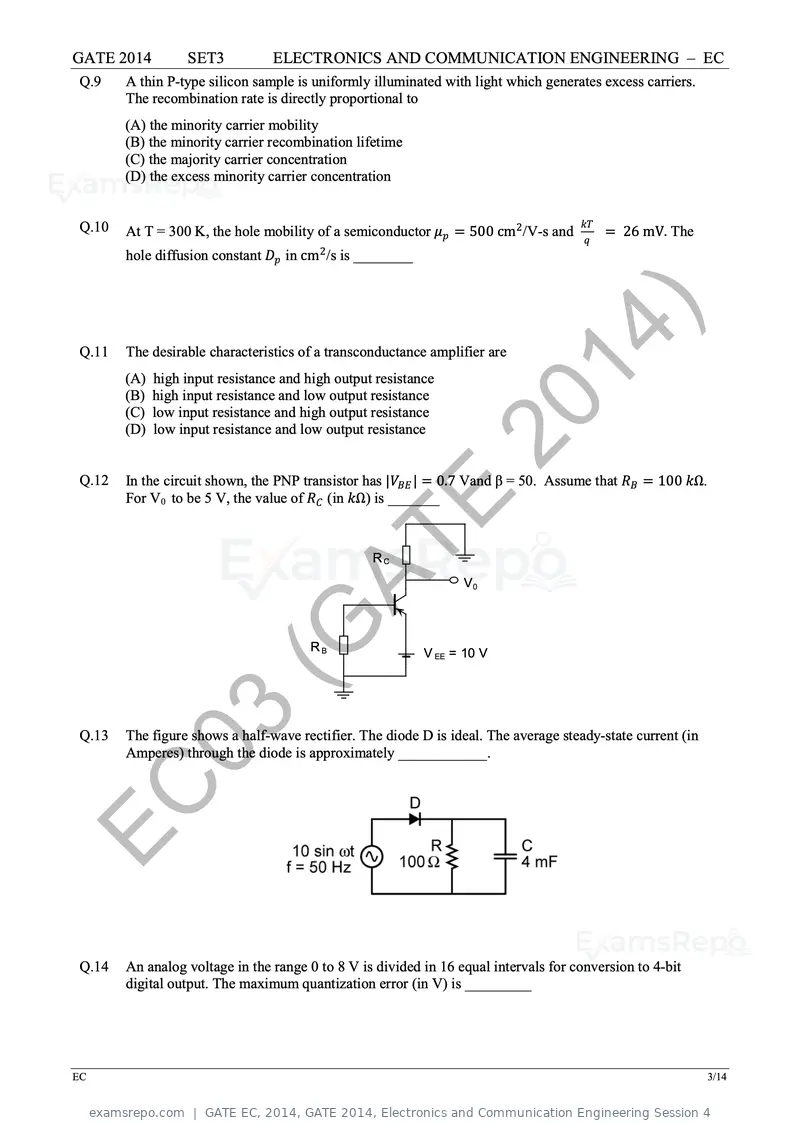
Text of page 50
GATE 2014         SET3           ELECTRONICS AND COMMUNICATION ENGINEERING – EC
 Q.9    A thin P-type silicon sample is uniformly illuminated with light which generates excess carriers.
        The recombination rate is directly proportional to
        (A) the minority carrier mobility
        (B) the minority carrier recombination lifetime
        (C) the majority carrier concentration
        (D) the excess minority carrier concentration


                                                                                      kkkk
 Q.10   At T = 300 K, the hole mobility of a semiconductor μμpp = 500 cm2 /V-s and     qq
                                                                                             = 26 mV. The
        hole diffusion constant DDpp in cm2 /s is ________


                                                                                         )
 Q.11
                                                                20
        The desirable characteristics of a transconductance amplifier are
        (A) high input resistance and high output resistance
        (B) high input resistance and low output resistance
        (C) low input resistance and high output resistance
                                                                  14
        (D) low input resistance and low output resistance


 Q.12   In the circuit shown, the PNP transistor has |VVBBBB | = 0.7 Vand β = 50. Assume that RRBB = 100 kkΩ.
        For V0 to be 5 V, the value of RRCC (in kkΩ) is _______

                                      AT
                                         E         RC
                                                                   V0


                         (G             RB                   V EE = 10 V


 Q.13
         03
        The figure shows a half-wave rectifier. The diode D is ideal. The average steady-state current (in
        Amperes) through the diode is approximately ____________.


EC
 Q.14   An analog voltage in the range 0 to 8 V is divided in 16 equal intervals for conversion to 4-bit
        digital output. The maximum quantization error (in V) is _________


EC                                                                                                              3/14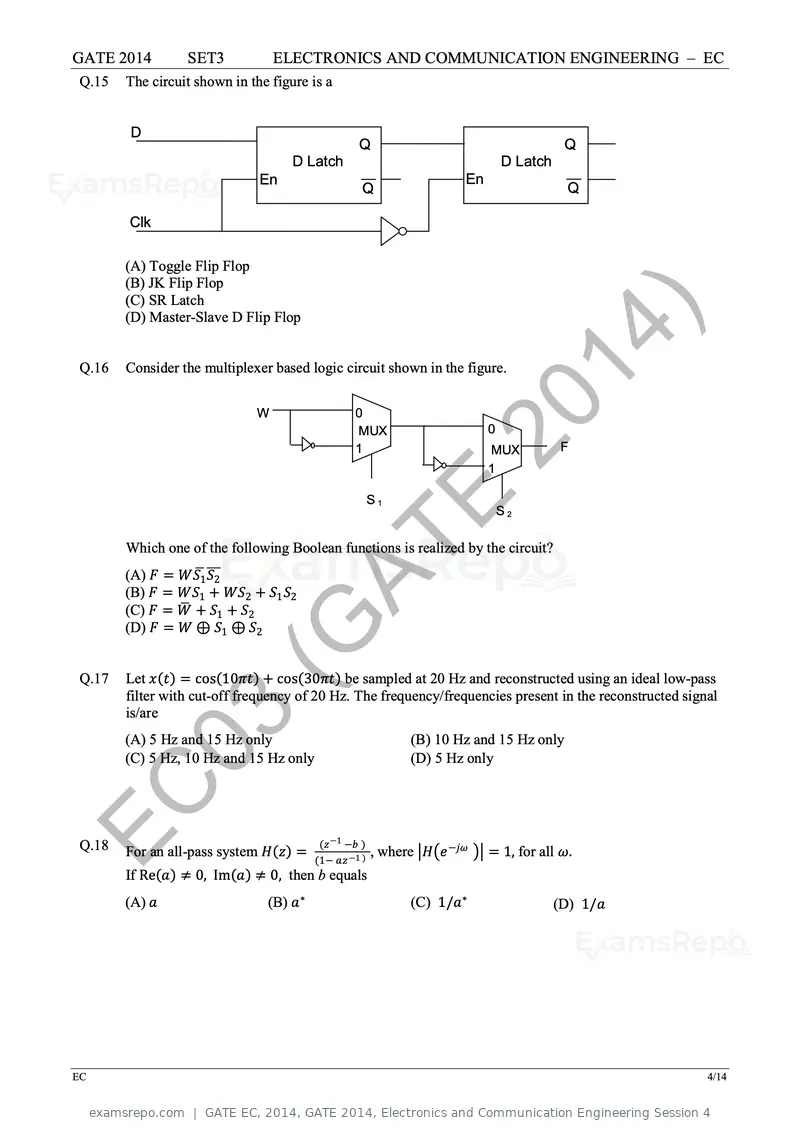
Text of page 51
GATE 2014          SET3              ELECTRONICS AND COMMUNICATION ENGINEERING – EC
 Q.15   The circuit shown in the figure is a


         D
                                                       Q                                     Q
                                        D Latch                                   D Latch
                                 En                                      En
                                                        Q                                     Q

        Clk

        (A) Toggle Flip Flop
        (B) JK Flip Flop
        (C) SR Latch
        (D) Master-Slave D Flip Flop                                                              )
 Q.16
                                                                      20
        Consider the multiplexer based logic circuit shown in the figure.


                                 W                    0
                                                                        14
                                                      MUX                     0
                                                      1                       MUX            F
                                                                              1


                                           AT               S1
                                                                                  S2


                                              E
        Which one of the following Boolean functions is realized by the circuit?
        (A) FF = WWSS�1 SS
                        ���2
        (B) FF = WWSS1 + WWSS2 + SS1 SS2
                  � + SS1 + SS2
        (C) FF = WW


 Q.17
                           (G
        (D) FF = WW ⊕ SS1 ⊕ SS2


        Let xx(tt) = cos(10ππππ) + cos(30ππππ) be sampled at 20 Hz and reconstructed using an ideal low-pass
        filter with cut-off frequency of 20 Hz. The frequency/frequencies present in the reconstructed signal
        is/are

          03
        (A) 5 Hz and 15 Hz only
        (C) 5 Hz, 10 Hz and 15 Hz only
                                                                 (B) 10 Hz and 15 Hz only
                                                                 (D) 5 Hz only


EC
 Q.18                                        (zz −1 −bb )
        For an all-pass system HH(zz) = (1− aazz −1 ) , where �HH�ee −jjjj �� = 1, for all ωω.
        If Re(aa) ≠ 0, Im(aa) ≠ 0, then b equals
        (A) aa                     (B) aa∗                       (C) 1/aa∗                  (D) 1/aa


EC                                                                                                         4/14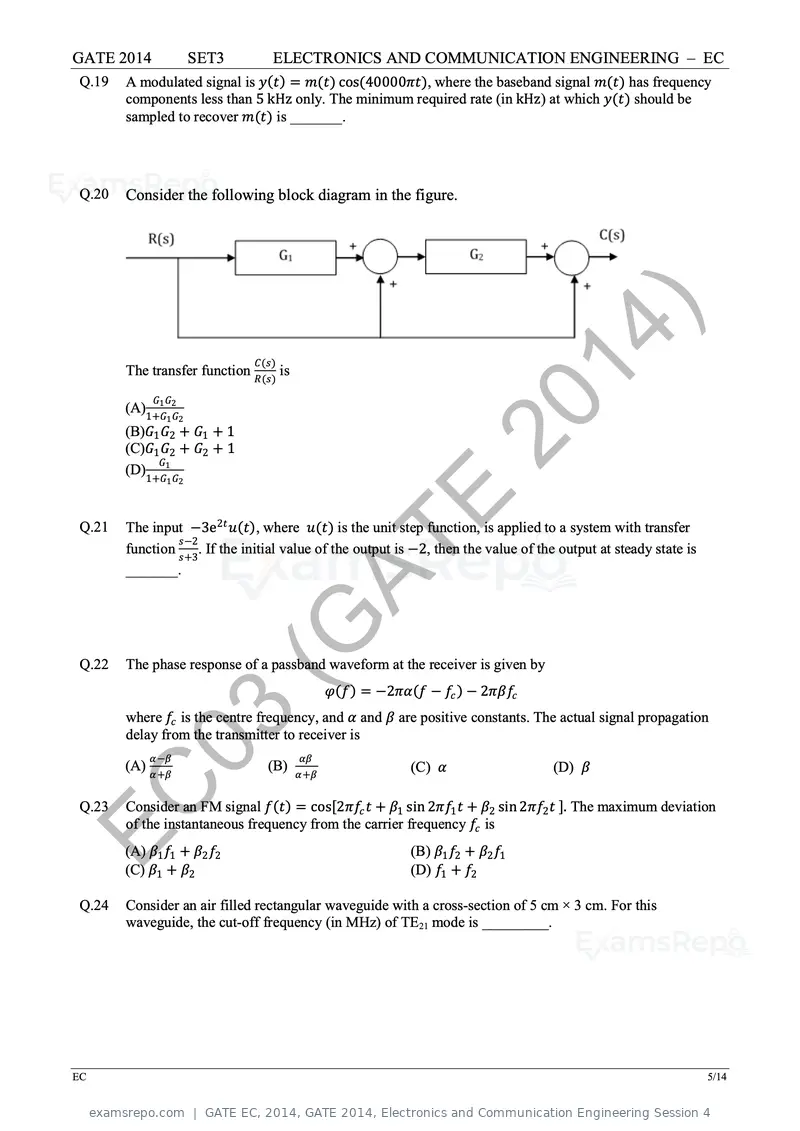
Text of page 52
GATE 2014              SET3         ELECTRONICS AND COMMUNICATION ENGINEERING – EC
 Q.19   A modulated signal is yy(tt) = mm(tt) cos(40000ππππ), where the baseband signal mm(tt) has frequency
        components less than 5 kHz only. The minimum required rate (in kHz) at which yy(tt) should be
        sampled to recover mm(tt) is _______.


 Q.20   Consider the following block diagram in the figure.


                                                                                                      )
        The transfer function
              GG GG
             1 2
        (A)1+GG GG
                 1 2
                                CC(ss)
                                RR(ss)
                                       is
                                                                           2014
        (B)GG1 GG2 + GG1 + 1
        (C)GG1 GG2 + GG2 + 1
              GG
        (D)1+GG1 GG
                 1 2


 Q.21
                                            AT
        The input −3e2tt uu(tt), where uu(tt) is the unit step function, is applied to a system with transfer
                 ss−2
        function ss+3. If the initial value of the output is −2, then the value of the output at steady state is
        _______.
                                               E
 Q.22                           (G
        The phase response of a passband waveform at the receiver is given by
                                                   φφ(ff) = −2ππππ(ff − ffcc ) − 2ππππffcc
        where ffcc is the centre frequency, and αα and ββ are positive constants. The actual signal propagation
          03
        delay from the transmitter to receiver is
             αα −ββ
        (A) αα +ββ                 (B) αα+ββ
                                            αααα
                                                                    (C) αα                   (D) ββ


EC
 Q.23   Consider an FM signal ff(tt) = cos[2ππffcc tt + ββ1 sin 2ππff1 tt + ββ2 sin 2ππff2 tt ]. The maximum deviation
        of the instantaneous frequency from the carrier frequency ffcc is
        (A) ββ1 ff1 + ββ2 ff2
        (C) ββ1 + ββ2
                                                                    (B) ββ1 ff2 + ββ2 ff1
                                                                    (D) ff1 + ff2

 Q.24   Consider an air filled rectangular waveguide with a cross-section of 5 cm × 3 cm. For this
        waveguide, the cut-off frequency (in MHz) of TE21 mode is _________.


EC                                                                                                                  5/14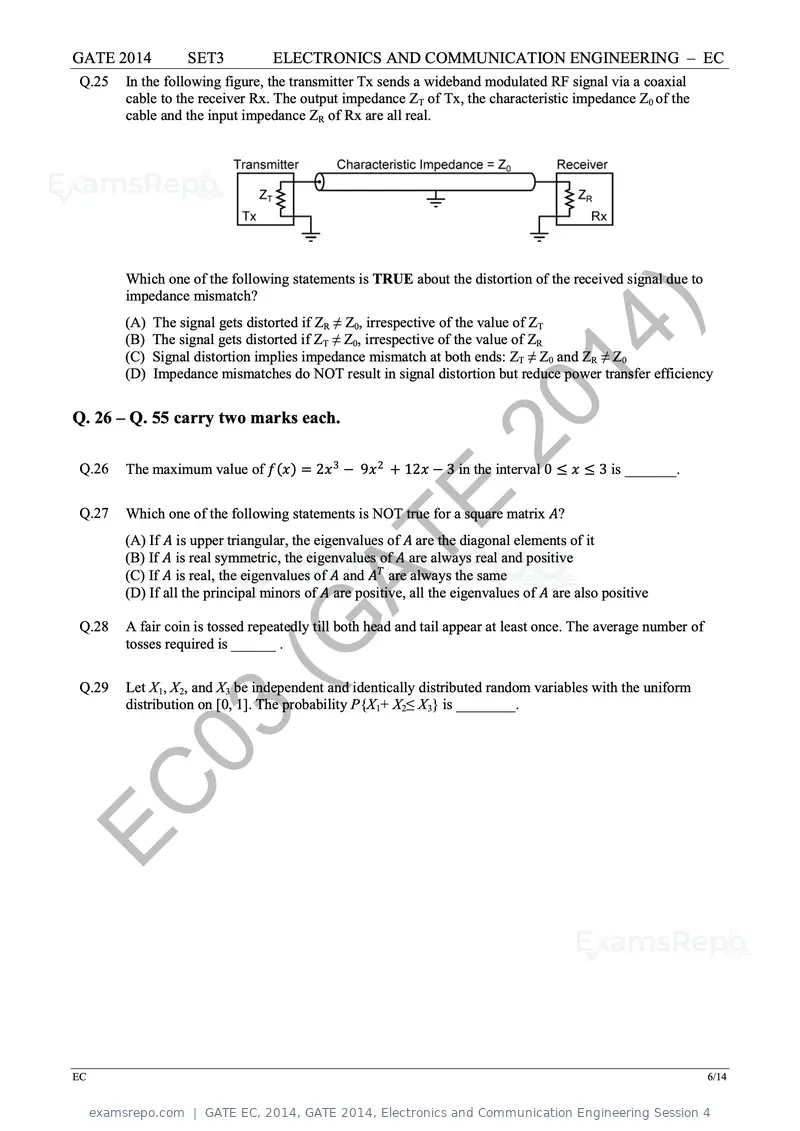
Text of page 53
GATE 2014          SET3           ELECTRONICS AND COMMUNICATION ENGINEERING – EC
 Q.25   In the following figure, the transmitter Tx sends a wideband modulated RF signal via a coaxial
        cable to the receiver Rx. The output impedance ZT of Tx, the characteristic impedance Z0 of the
        cable and the input impedance ZR of Rx are all real.


        Which one of the following statements is TRUE about the distortion of the received signal due to
        impedance mismatch?
        (A) The signal gets distorted if ZR ≠ Z0, irrespective of the value of ZT           )
                                                                  20
        (B) The signal gets distorted if ZT ≠ Z0, irrespective of the value of ZR
        (C) Signal distortion implies impedance mismatch at both ends: ZT ≠ Z0 and ZR ≠ Z0
        (D) Impedance mismatches do NOT result in signal distortion but reduce power transfer efficiency


Q. 26 – Q. 55 carry two marks each.                                 14
 Q.26   The maximum value of ff(xx) = 2xx 3 − 9xx 2 + 12xx − 3 in the interval 0 ≤ xx ≤ 3 is _______.

 Q.27
                                       AT
        Which one of the following statements is NOT true for a square matrix AA?
        (A) If AA is upper triangular, the eigenvalues of AA are the diagonal elements of it


                                          E
        (B) If AA is real symmetric, the eigenvalues of AA are always real and positive
        (C) If AA is real, the eigenvalues of AA and AATT are always the same
        (D) If all the principal minors of AA are positive, all the eigenvalues of AA are also positive

 Q.28


 Q.29
                          (G
        A fair coin is tossed repeatedly till both head and tail appear at least once. The average number of
        tosses required is ______ .

        Let X1, X2, and X3 be independent and identically distributed random variables with the uniform
        distribution on [0, 1]. The probability P{X1+ X2≤ X3} is ________.

         03
EC

EC                                                                                                             6/14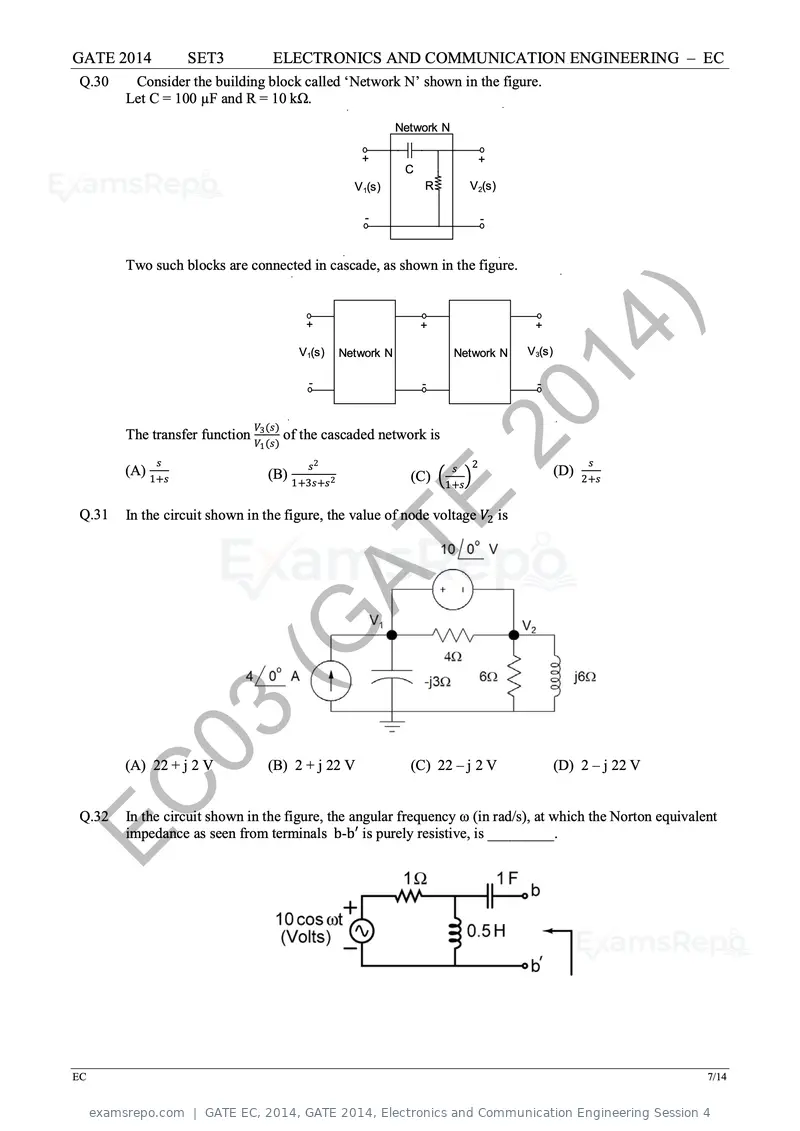
Text of page 54
GATE 2014          SET3              ELECTRONICS AND COMMUNICATION ENGINEERING – EC
 Q.30    Consider the building block called ‘Network N’ shown in the figure.
        Let C = 100 µF and R = 10 kΩ.
                                                                Network N

                                                          +                          +
                                                                 C
                                                       V1(s)         R           V2(s)

                                                          -                          -


        Two such blocks are connected in cascade, as shown in the figure.


                                           +                         +                    +
                                                                                                       )
                               VV (ss)
                                          V1(s)

                                            -
                                                      C
                                                          R N
                                                     Network

                                                                     -   20 Network N


                                                                           14
                                                                                         V3(s)

                                                                                          -


        The transfer function VV3 (ss) of the cascaded network is
                                1
             ss                             ss 2                                 2                    ss
        (A) 1+ss                                                            ss                   (D) 2+ss
                                    (B) 1+3ss+ss 2                (C) �1+ss�

 Q.31
                                          AT
        In the circuit shown in the figure, the value of node voltage VV2 is


                                             E
                          (G
         03
        (A) 22 + j 2 V              (B) 2 + j 22 V                (C) 22 – j 2 V                 (D) 2 – j 22 V


EC
 Q.32   In the circuit shown in the figure, the angular frequency ω (in rad/s), at which the Norton equivalent
        impedance as seen from terminals b-b′ is purely resistive, is _________.


EC                                                                                                                7/14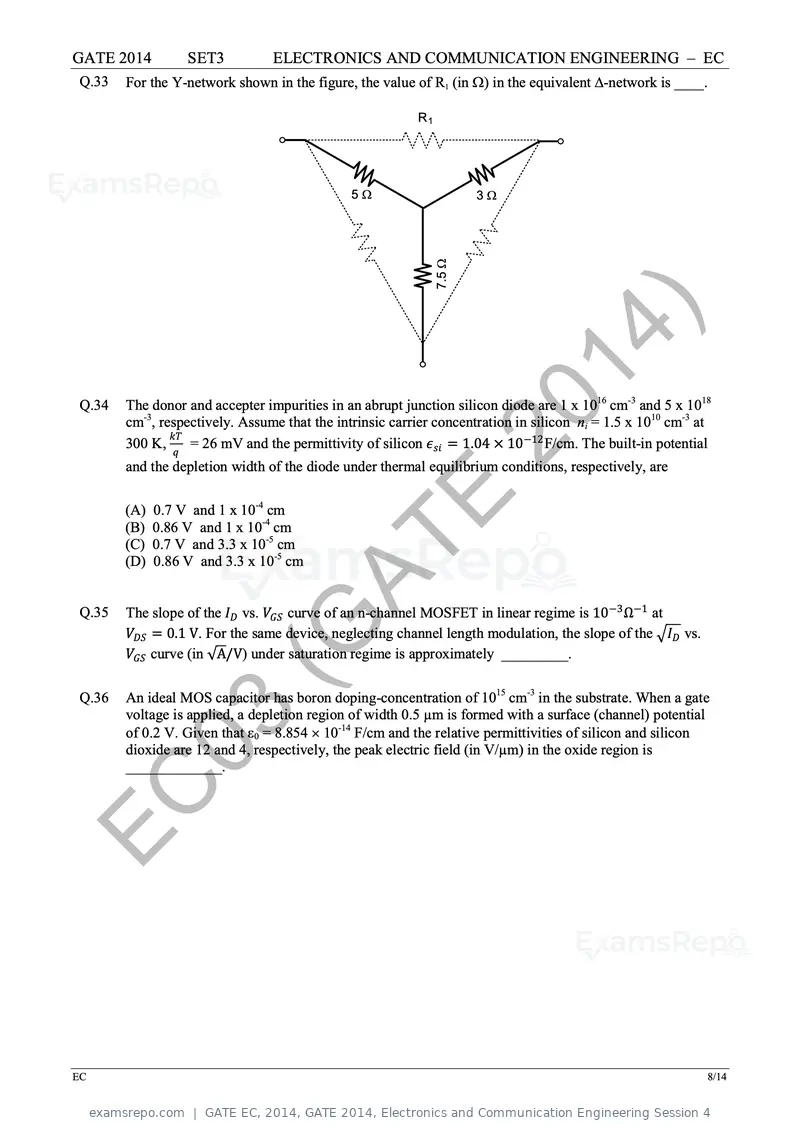
Text of page 55
GATE 2014            SET3        ELECTRONICS AND COMMUNICATION ENGINEERING – EC
 Q.33   For the Y-network shown in the figure, the value of R1 (in Ω) in the equivalent ∆-network is ____.

                                                           R1


                                               5Ω                       3Ω


                                                                7.5 Ω

                                                                                         )
 Q.34
                                                                   2014
        The donor and accepter impurities in an abrupt junction silicon diode are 1 x 1016 cm-3 and 5 x 10¹⁸
        cm-3, respectively. Assume that the intrinsic carrier concentration in silicon ni = 1.5 x 1010 cm-3 at
                kkkk
        300 K,       = 26 mV and the permittivity of silicon εεssss = 1.04 × 10⁻¹² F/cm. The built-in potential
                qq
        and the depletion width of the diode under thermal equilibrium conditions, respectively, are

        (A) 0.7 V and 1 x 10⁻⁴ cm
        (B) 0.86 V and 1 x 10⁻⁴ cm
        (C) 0.7 V and 3.3 x 10⁻⁵ cm   AT
 Q.35
        (D) 0.86 V and 3.3 x 10⁻⁵ cm

                                         E
        The slope of the IIDD vs. VVGGGG curve of an n-channel MOSFET in linear regime is 10−3 Ω−1 at


 Q.36
                            (G
        VVDDDD = 0.1 V. For the same device, neglecting channel length modulation, the slope of the �IIDD vs.
        VVGGGG curve (in √A/V) under saturation regime is approximately _________.

        An ideal MOS capacitor has boron doping-concentration of 1015 cm-3 in the substrate. When a gate


         03
        voltage is applied, a depletion region of width 0.5 µm is formed with a surface (channel) potential
        of 0.2 V. Given that ε0 = 8.854 × 10⁻¹⁴ F/cm and the relative permittivities of silicon and silicon
        dioxide are 12 and 4, respectively, the peak electric field (in V/µm) in the oxide region is
        _____________.


EC

EC                                                                                                              8/14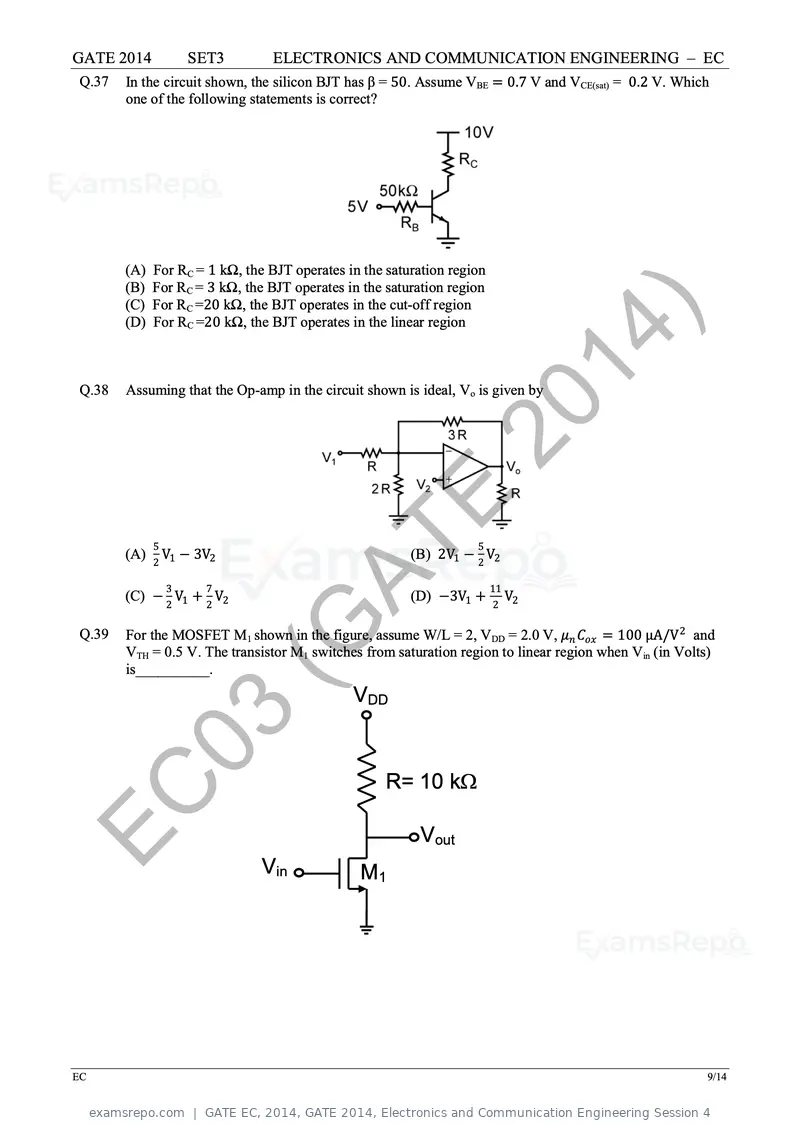
Text of page 56
GATE 2014           SET3        ELECTRONICS AND COMMUNICATION ENGINEERING – EC
 Q.37   In the circuit shown, the silicon BJT has β = 50. Assume VBE = 0.7 V and VCE(sat) = 0.2 V. Which
        one of the following statements is correct?


        (A) For RC = 1 kΩ, the BJT operates in the saturation region
        (B) For RC = 3 kΩ, the BJT operates in the saturation region
        (C) For RC =20 kΩ, the BJT operates in the cut-off region
        (D) For RC =20 kΩ, the BJT operates in the linear region                      )
 Q.38
                                                             2014
        Assuming that the Op-amp in the circuit shown is ideal, Vo is given by


            5                        AT                            5
        (A) 2 V1 − 3V2

                3
        (C) − V1 + V2
                2
                      7
                      2
                                        E              (B) 2V1 − 2 V2

                                                       (D) −3V1 +
                                                                       11
                                                                          V
                                                                        2 2

 Q.39
                           (G
        For the MOSFET M1 shown in the figure, assume W/L = 2, VDD = 2.0 V, μμnn CCoooo = 100 μA/V 2 and
        VTH = 0.5 V. The transistor M1 switches from saturation region to linear region when Vin (in Volts)
        is__________.
                                              VDD

         03                                        R= 10 kΩ

EC                            Vin
                                                         Vout
                                               M1


EC                                                                                                       9/14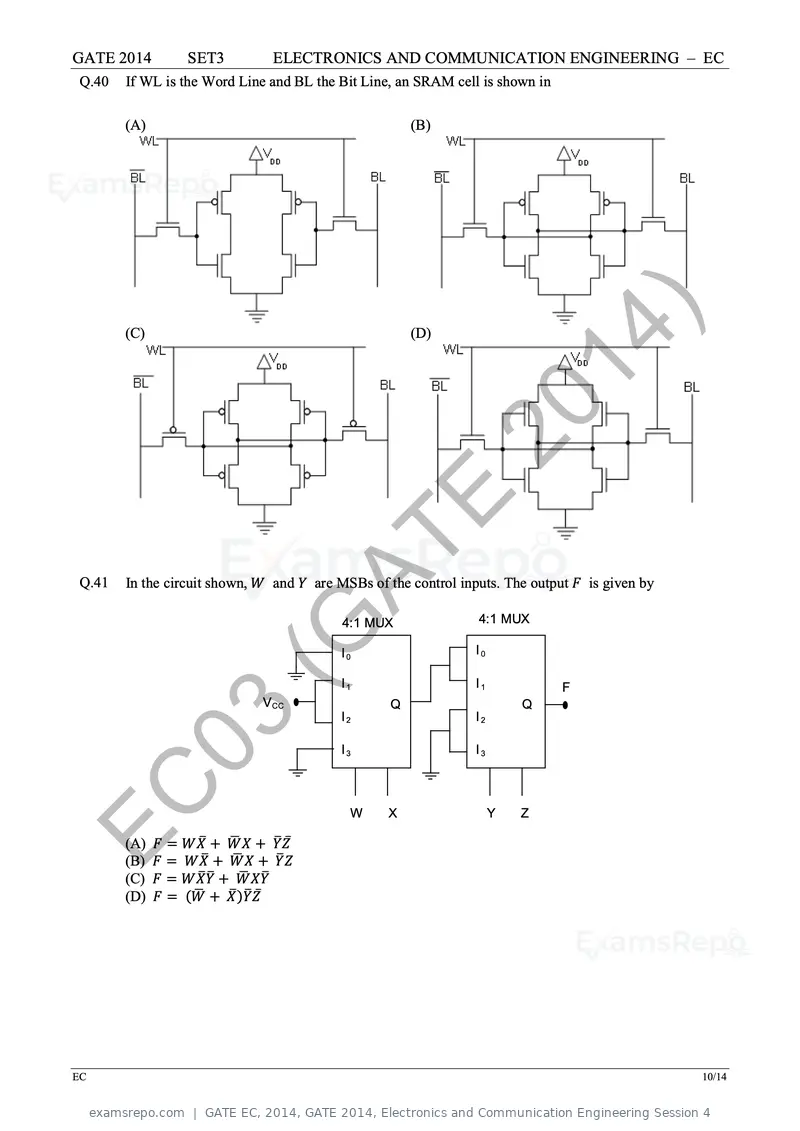
Text of page 57
GATE 2014          SET3            ELECTRONICS AND COMMUNICATION ENGINEERING – EC
 Q.40   If WL is the Word Line and BL the Bit Line, an SRAM cell is shown in

        (A)                                             (B)


                                                                                      )
                                                              20
        (C)                                             (D)


                                                                14
                                          AT
 Q.41
                                             E
        In the circuit shown, WW and YY are MSBs of the control inputs. The output FF is given by

                                                                   4:1 MUX


                          (G     VCC
                                            4:1 MUX

                                            I0

                                            I1
                                                    Q
                                                                  I0

                                                                  I1
                                                                           Q
                                                                                 F


         03                                 I2

                                            I3
                                                                  I2

                                                                  I3


EC      (A) FF = WWXX� + WW
                     �
        (B) FF = WWXX + WW
                          � XX + YY�ZZ̅
                          � XX + YY�ZZ
                                             W      X                  Y   Z


                    � �    � XXYY�
        (C) FF = WWXXYY + WW
                   � + XX�)YY�ZZ̅
        (D) FF = (WW


EC                                                                                                  10/14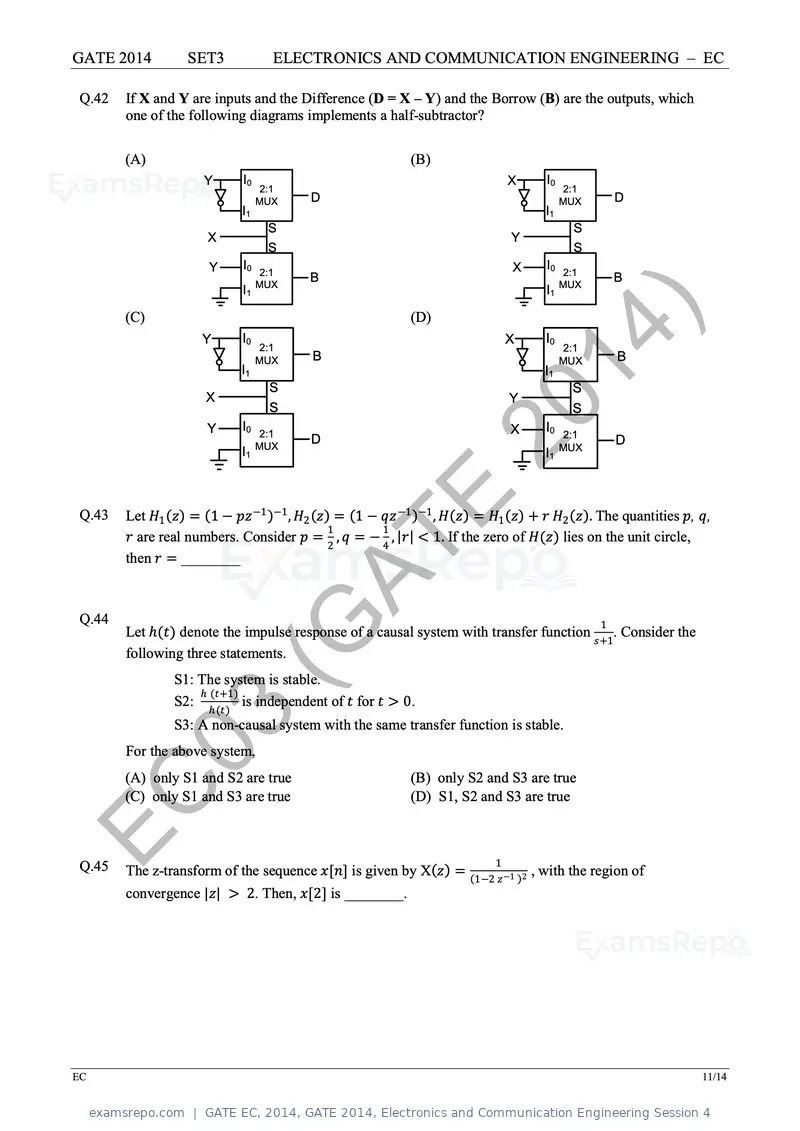
Text of page 58
GATE 2014           SET3                ELECTRONICS AND COMMUNICATION ENGINEERING – EC

 Q.42   If X and Y are inputs and the Difference (D = X – Y) and the Borrow (B) are the outputs, which
        one of the following diagrams implements a half-subtractor?

        (A)                                                      (B)
                       Y         I0                                                    X     I0
                                      2:1                                                         2:1
                                      MUX    D                                                    MUX       D
                                 I1                                                          I1
                                       S                                                           S
                        X                                                              Y
                                       S                                                           S
                        Y        I0 2:1                                                X     I0 2:1
                                      MUX
                                             B                                                              B
                                 I1                                                          I1 MUX

        (C)                                                      (D)                                    )
                       Y


                        X
                                 I0

                                 I1
                                      2:1
                                      MUX

                                       S
                                       S
                                              B
                                                                         2014
                                                                                       X


                                                                                       Y
                                                                                             I0

                                                                                             I1
                                                                                                  2:1
                                                                                                  MUX

                                                                                                   S
                                                                                                   S
                                                                                                            B


                        Y        I0 2:1                                                X     I0 2:1
                                      MUX
                                             D                                                              D
                                 I1                                                          I1 MUX


 Q.43
                                            AT
        Let HH1 (zz) = (1 − ppzz −1 )−1 , HH2 (zz) = (1 − qqzz −1 )−1 , HH(zz) = HH1 (zz) + rr HH2 (zz). The quantities pp, qq,
                                                  1       1
        rr are real numbers. Consider pp = , qq = − , |rr| < 1. If the zero of HH(zz) lies on the unit circle,
                                                  2       4


 Q.44
        then rr = ________

                                               E
                             (G                                                                         1
        Let ℎ(tt) denote the impulse response of a causal system with transfer function ss+1. Consider the
        following three statements.
                 S1: The system is stable.
                 S2:
                     ℎ (tt+1)
                              is independent of tt for tt > 0.
                        ℎ (tt)


          03     S3: A non-causal system with the same transfer function is stable.
        For the above system,
        (A) only S1 and S2 are true                              (B) only S2 and S3 are true


EC
 Q.45
        (C) only S1 and S3 are true                              (D) S1, S2 and S3 are true


                                                                                   1
        The z-transform of the sequence xx[nn] is given by X(zz) = (1−2 zz −1 )2 , with the region of
        convergence |zz| > 2. Then, xx[2] is ________.


EC                                                                                                                           11/14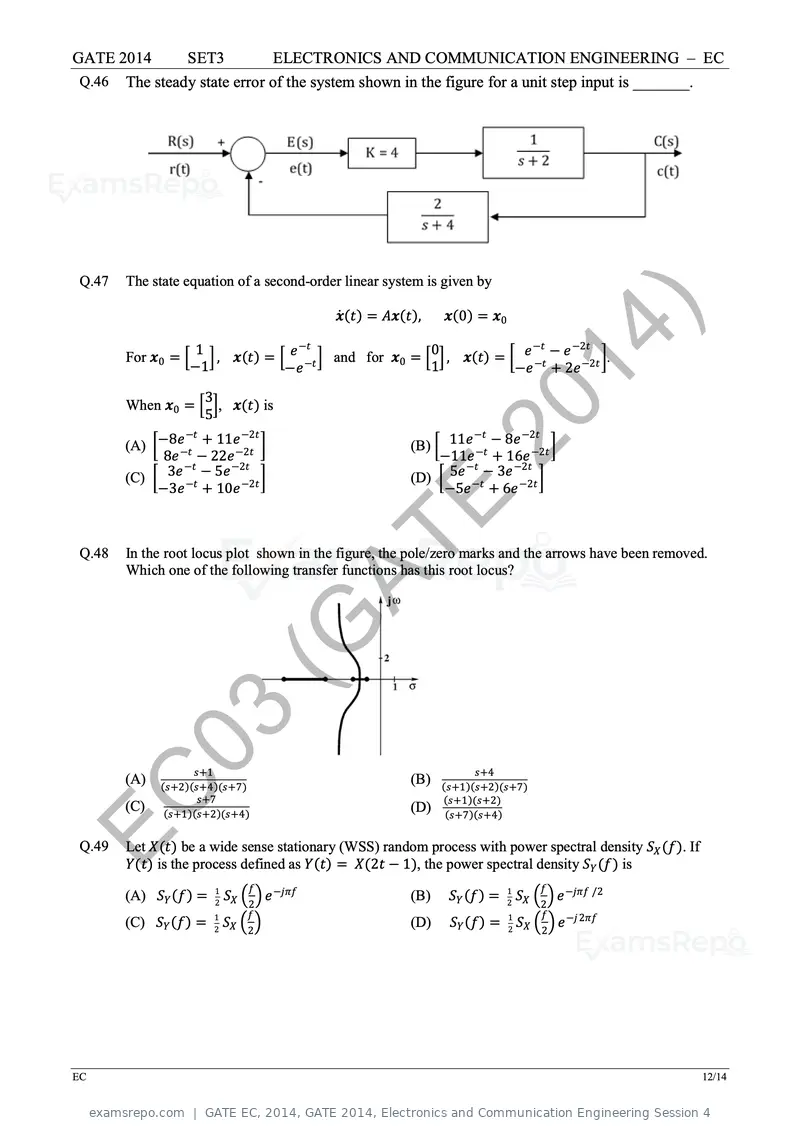
Text of page 59
GATE 2014      SET3          ELECTRONICS AND COMMUNICATION ENGINEERING – EC
 Q.46 The steady state error of the system shown in the figure for a unit step input is _______.


 Q.47   The state equation of a second-order linear system is given by

                                                  xẋ (tt) = AAxx(tt),   xx(0) = xx0                         )
                    1                −tt                   0

                                                                         20  −tt      −2tt
        For xx0 = � � , xx(tt) = � ee −tt � and for xx0 = � � , xx(tt) = � ee −tt − ee −2tt �.
                   −1

                    3
        When xx0 = � �, xx(tt) is
                    5
                                  −ee                      1              −ee + 2ee


                                                                           14
                  −tt       −2tt                                                −tt        −2tt
        (A) �−8ee−tt + 11ee−2tt �                                  (B) � 11ee −tt − 8ee −2tt �
              8ee − 22ee                                                −11ee + 16ee
                  −tt      −2tt                                             −tt      −2tt
        (C) � 3ee −tt − 5ee −2tt �                                 (D) � 5ee −tt− 3ee −2tt �
             −3ee + 10ee                                                −5ee + 6ee


                                                  AT
 Q.48

                                                     E
        In the root locus plot shown in the figure, the pole/zero marks and the arrows have been removed.
        Which one of the following transfer functions has this root locus?


                               (G
          03
        (A)
                       ss+1
                (ss+2)(ss+4)(ss+7)
                                                                   (B)
                                                                                ss+4
                                                                         (ss+1)(ss+2)(ss+7)


EC
 Q.49
        (C)
                        ss+7
                 (ss+1)(ss+2)(ss+4)
                                                                   (D)
                                                                         (ss+1)(ss+2)
                                                                          (ss+7)(ss+4)


        Let XX(tt) be a wide sense stationary (WSS) random process with power spectral density SSXX (ff). If
        YY(tt) is the process defined as YY(tt) = XX(2tt − 1), the power spectral density SSYY (ff) is
                                   ff                                                             ff
        (A) SSYY (ff) = 12 SSXX �2 � ee −jjjjjj                    (B)    SSYY (ff) = 12 SSXX �2 � ee −jjjjjj /2
                                   ff                                                             ff
        (C) SSYY (ff) = 12 SSXX �2 �                               (D)    SSYY (ff) = 12 SSXX �2 � ee −jj 2ππππ


EC                                                                                                                 12/14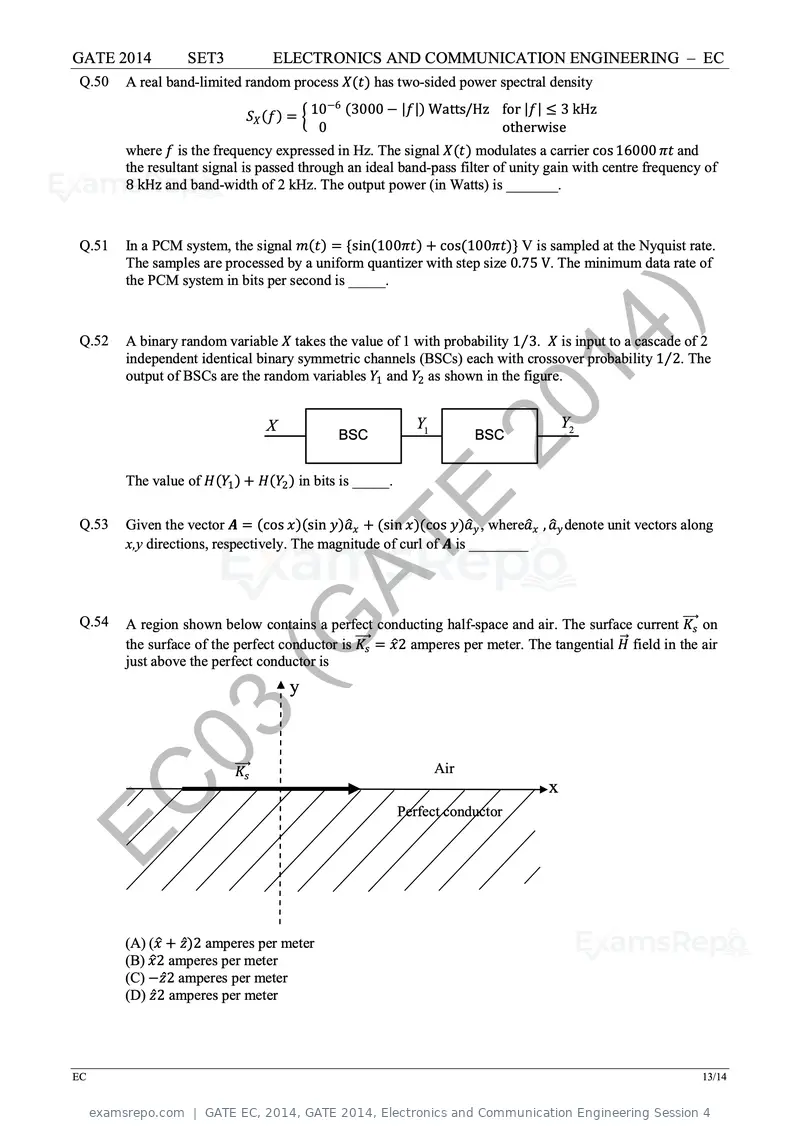
Text of page 60
GATE 2014           SET3             ELECTRONICS AND COMMUNICATION ENGINEERING – EC
 Q.50   A real band-limited random process XX(tt) has two-sided power spectral density
                                                   −6 (3000
                                SSXX (ff) = � 10              − |ff|) Watts/Hz for |ff| ≤ 3 kHz
                                               0                               otherwise
        where ff is the frequency expressed in Hz. The signal XX(tt) modulates a carrier cos 16000 ππππ and
        the resultant signal is passed through an ideal band-pass filter of unity gain with centre frequency of
        8 kHz and band-width of 2 kHz. The output power (in Watts) is _______.


 Q.51   In a PCM system, the signal mm(tt) = {sin(100ππππ) + cos(100ππππ)} V is sampled at the Nyquist rate.
        The samples are processed by a uniform quantizer with step size 0.75 V. The minimum data rate of
        the PCM system in bits per second is _____.

                                                                                                   )
 Q.52

                                                                        20
        A binary random variable XX takes the value of 1 with probability 1⁄3. XX is input to a cascade of 2
        independent identical binary symmetric channels (BSCs) each with crossover probability 1⁄2. The
        output of BSCs are the random variables YY1 and YY2 as shown in the figure.


                                     X                            Y1      14                  Y2
                                                    BSC                      BSC


        The value of HH(YY1 ) + HH(YY2 ) in bits is _____.

 Q.53
                                             AT
        Given the vector AA = (cos xx)(sin yy)aa�xx + (sin xx)(cos yy)aa�yy , whereaa�xx , aa�yy denote unit vectors along
        x,y directions, respectively. The magnitude of curl of AA is ________


 Q.54
                                                E
        A region shown below contains a perfect conducting half-space and air. The surface current ����⃗        KKss on

                           (G                   ����⃗ss = xx�2 amperes per meter. The tangential �HH⃗ field in the air
        the surface of the perfect conductor is KK
        just above the perfect conductor is
                                         y


         03                  ����⃗
                             KKss                                      Air
                                                                                          x

EC                                                             Perfect conductor


        (A) (xx� + zẑ )2 amperes per meter
        (B) xx�2 amperes per meter
        (C) −zẑ 2 amperes per meter
        (D) zẑ 2 amperes per meter


EC                                                                                                                     13/14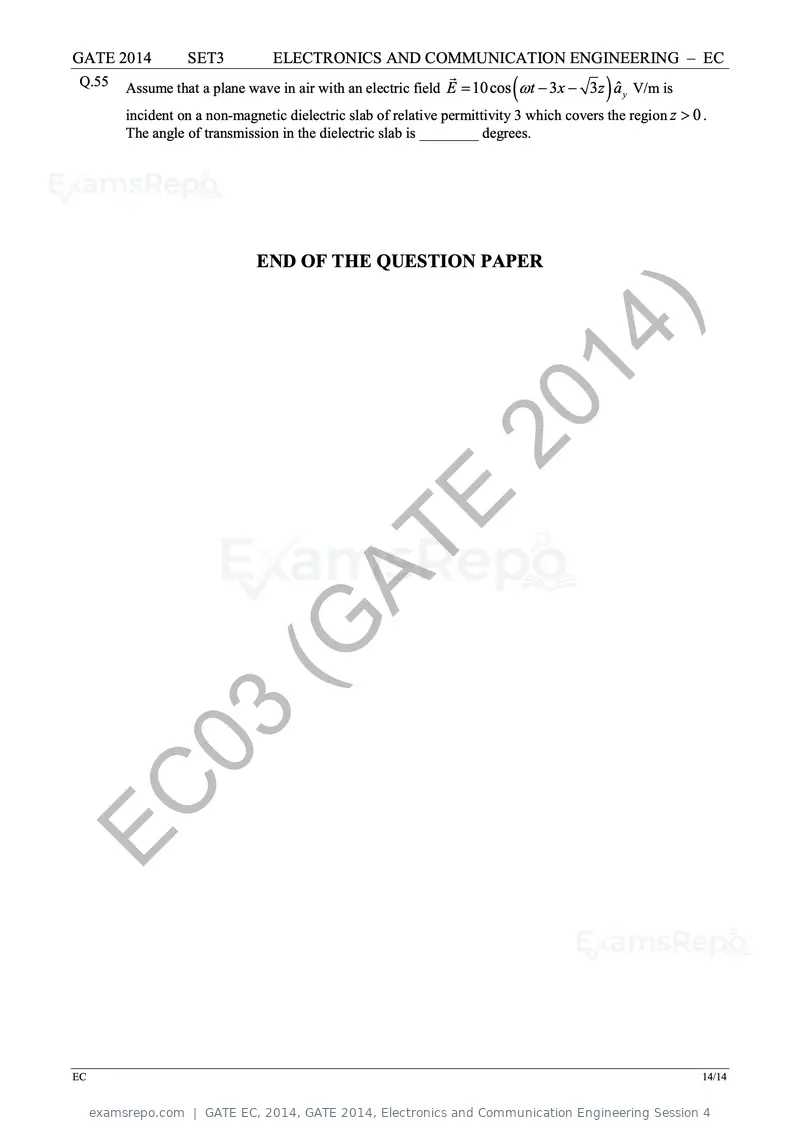
Text of page 61
GATE 2014 SET3 ELECTRONICS AND COMMUNICATION ENGINEERING – EC
Q.55 =
Assume that a plane wave in air with an electric field ( )
E 10 cos ωt − 3 x − 3 z aˆ y V/m is
incident on a non-magnetic dielectric slab of relative permittivity 3 which covers the region z > 0 .
The angle of transmission in the dielectric slab is ________ degrees.
END OF THE QUESTION PAPER
)
2014
AT
E
(G
03
EC
EC 14/14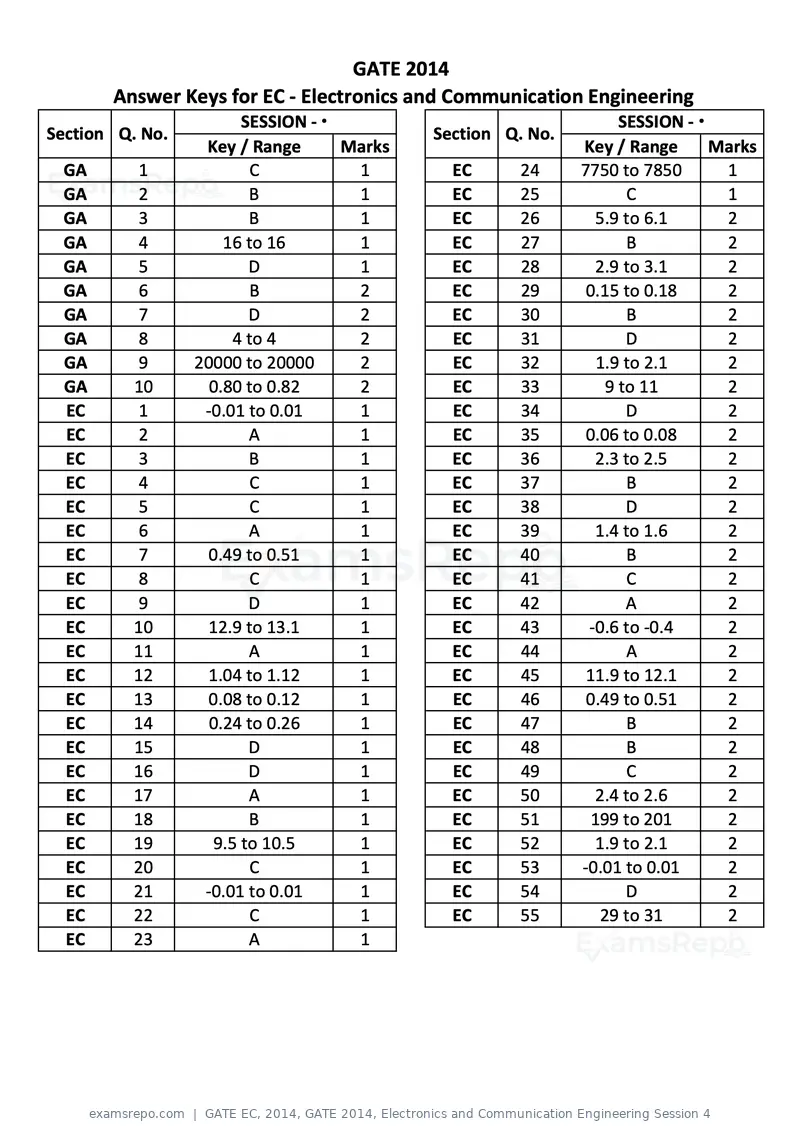
Text of page 62
GATE 2014
       Answer Keys for EC ‐ Electronics and Communication Engineering
                       SESSION ‐ ϯ                                SESSION ‐ ϯ
Section Q. No.                             Section Q. No.
                  Key / Range      Marks                    Key / Range       Marks
 GA        1            C           1        EC      24     7750 to 7850       1
 GA        2            B           1        EC      25            C           1
 GA        3            B           1        EC      26       5.9 to 6.1       2
 GA        4         16 to 16       1        EC      27            B           2
 GA        5            D           1        EC      28       2.9 to 3.1       2
 GA        6            B           2        EC      29      0.15 to 0.18      2
 GA        7            D           2        EC      30            B           2
 GA        8          4 to 4        2        EC      31            D           2
 GA        9     20000 to 20000     2        EC      32       1.9 to 2.1       2
 GA       10       0.80 to 0.82     2        EC      33         9 to 11        2
 EC        1      ‐0.01 to 0.01     1        EC      34            D           2
 EC        2            A           1        EC      35     0.06 to 0.08       2
 EC       3             B           1        EC      36       2.3 to 2.5       2
 EC        4            C           1        EC      37            B           2
 EC        5            C           1        EC      38            D           2
 EC        6            A           1        EC      39       1.4 to 1.6       2
 EC        7      0.49 to 0.51      1        EC      40            B           2
 EC        8            C           1        EC      41            C           2
 EC        9            D           1        EC      42            A           2
 EC       10      12.9 to 13.1      1        EC      43      ‐0.6 to ‐0.4      2
 EC       11            A           1        EC      44            A           2
 EC       12      1.04 to 1.12      1        EC      45      11.9 to 12.1      2
 EC       13       0.08 to 0.12     1        EC      46      0.49 to 0.51      2
 EC       14       0.24 to 0.26     1        EC      47            B           2
 EC       15            D           1        EC      48            B           2
 EC       16            D           1        EC      49            C           2
 EC       17            A           1        EC      50       2.4 to 2.6       2
 EC       18            B           1        EC      51      199 to 201        2
 EC       19       9.5 to 10.5      1        EC      52       1.9 to 2.1       2
 EC       20            C           1        EC      53     ‐0.01 to 0.01      2
 EC       21      ‐0.01 to 0.01     1        EC      54            D           2
 EC       22             C          1        EC      55        29 to 31        2
 EC       23            A           1
Text of page 63
SESSION - 4
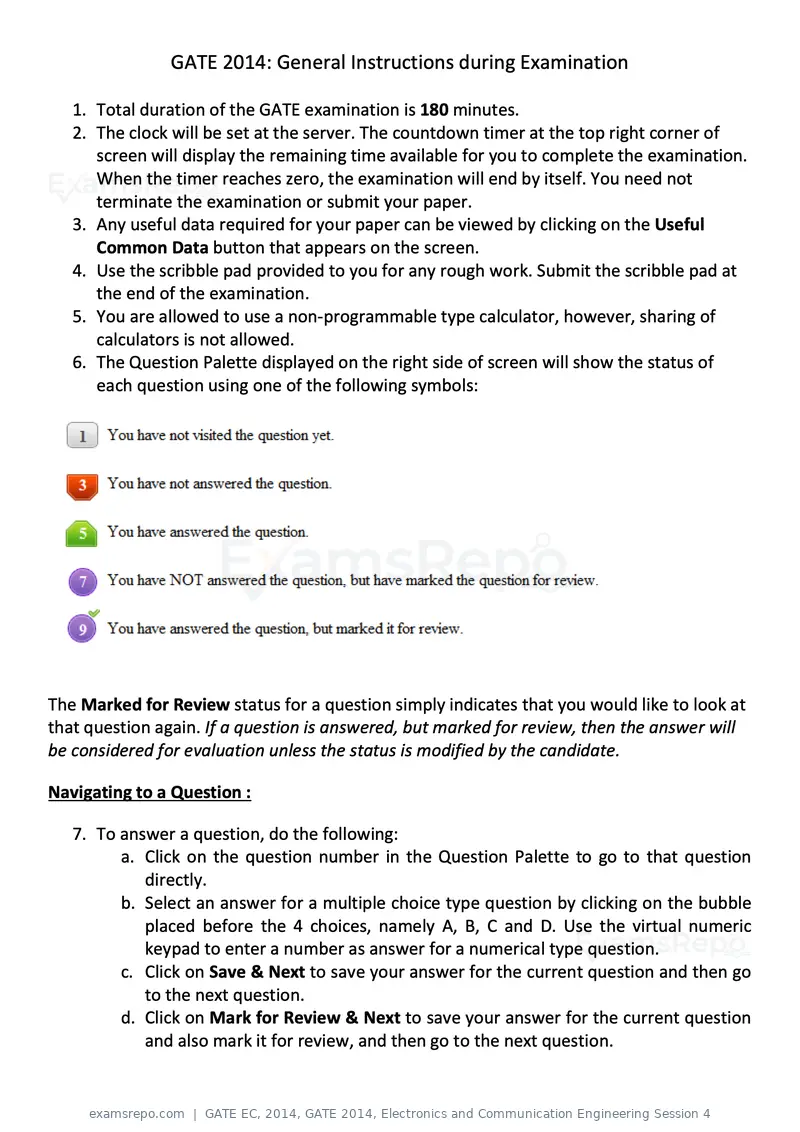
Text of page 64
GATE 2014: General Instructions during Examination

   1. Total duration of the GATE examination is 180 minutes.
   2. The clock will be set at the server. The countdown timer at the top right corner of
      screen will display the remaining time available for you to complete the examination.
      When the timer reaches zero, the examination will end by itself. You need not
      terminate the examination or submit your paper.
   3. Any useful data required for your paper can be viewed by clicking on the Useful
      Common Data button that appears on the screen.
   4. Use the scribble pad provided to you for any rough work. Submit the scribble pad at
      the end of the examination.
   5. You are allowed to use a non-programmable type calculator, however, sharing of
      calculators is not allowed.
   6. The Question Palette displayed on the right side of screen will show the status of
      each question using one of the following symbols:


The Marked for Review status for a question simply indicates that you would like to look at
that question again. If a question is answered, but marked for review, then the answer will
be considered for evaluation unless the status is modified by the candidate.

Navigating to a Question :

   7. To answer a question, do the following:
         a. Click on the question number in the Question Palette to go to that question
            directly.
         b. Select an answer for a multiple choice type question by clicking on the bubble
            placed before the 4 choices, namely A, B, C and D. Use the virtual numeric
            keypad to enter a number as answer for a numerical type question.
         c. Click on Save & Next to save your answer for the current question and then go
            to the next question.
         d. Click on Mark for Review & Next to save your answer for the current question
            and also mark it for review, and then go to the next question.
Text of page 65
Caution: Note that your answer for the current question will not be saved, if you navigate
to another question directly by clicking on a question number without saving the answer to
the previous question.

You can view all the questions by clicking on the Question Paper button. This feature is
provided, so that if you want you can just see the entire question paper at a glance.

Answering a Question :

   8. Procedure for answering a multiple choice (MCQ) type question:
         a. Choose one answer from the 4 options (A,B,C,D) given below the question,
            click on the bubble placed before the chosen option.
         b. To deselect your chosen answer, click on the bubble of the chosen option again
            or click on the Clear Response button.
         c. To change your chosen answer, click on the bubble of another option.
         d. To save your answer, you MUST click on the Save & Next button.

   9. Procedure for answering a numerical answer type question:
         a. To enter a number as your answer, use the virtual numerical keypad.
         b. A fraction (e.g. -0.3 or -.3) can be entered as an answer with or without '0'
             before the decimal point. As many as four decimal points, e.g. 12.5435 or
             0.003 or -932.6711 or 12.82 can be entered.
         c. To clear your answer, click on the Clear Response button.
         d. To save your answer, you MUST click on the Save & Next button
   10. To mark a question for review, click on the Mark for Review & Next button. If an
      answer is selected (for MCQ) or entered (for numerical answer type) for a question
      that is Marked for Review, that answer will be considered in the evaluation unless
      the status is modified by the candidate.

   11. To change your answer to a question that has already been answered, first select
      that question for answering and then follow the procedure for answering that type of
      question.
   12. Note that ONLY Questions for which answers are saved or marked for review after
      answering will be considered for evaluation.


      Choosing a Section :

   13. Sections in this question paper are displayed on the top bar of the screen. Questions
      in a Section can be viewed by clicking on the name of that Section. The Section you
      are currently viewing will be highlighted.
   14. A checkbox is displayed for every optional Section, if any, in the Question Paper. To
      select the optional Section for answering, click on the checkbox for that Section.
   15. If the checkbox for an optional Section is not selected, the Save & Next button and
      the Mark for Review & Next button will NOT be enabled for that Section. You will
Text of page 66
only be able to see questions in this Section, but you will not be able to answer
      questions in the Section.
   16. After clicking the Save & Next button for the last question in a Section, you will
      automatically be taken to the first question of the next Section in sequence.
   17. You can move the mouse cursor over the name of a Section to view the answering
      status for that Section.


Changing the Optional Section :

   18. After answering the chosen optional Section, partially or completely, you can change
      the optional Section by selecting the checkbox for a new Section that you want to
      attempt. A warning message will appear along with a table showing the number of
      questions answered in each of the previously chosen optional Sections and a
      checkbox against each of these Sections. Click on a checkbox against a Section that
      you want to reset and then click on the RESET button. Note that RESETTING a Section
      will DELETE all the answers for questions in that Section. Hence, if you think that you
      may want to select this Section again later, you will have to note down your answers
      for questions in that Section. If you do not want to reset the Section and want to
      continue answering the previously chosen optional Section, then click on the BACK
      button.

   19. If you deselect the checkbox for an optional Section in the top bar, the following
      warning message will appear: "Deselecting the checkbox will DELETE all the answers
      for questions in this Section. Do you want to deselect this Section?” If you want to
      deselect, click on the RESET button. If you do not want to deselect, click on the BACK
      button.

   20. You can shuffle between different Sections or change the optional Sections any
      number of times.
Text of page 67
GATE 2014 Examination
                        EC: Electronics & Communications Engineering
Duration: 180 minutes                                                                        Maximum Marks: 100

Read the following instructions carefully.

    1. To login, enter your Registration Number and password provided to you. Kindly go through the various
       symbols used in the test and understand their meaning before you start the examination.
    2. Once you login and after the start of the examination, you can view all the questions in the question
       paper, by clicking on the View All Questions button in the screen.
    3. This question paper consists of 2 sections, General Aptitude (GA) for 15 marks and the subject
       specific GATE paper for 85 marks. Both these sections are compulsory.
       The GA section consists of 10 questions. Question numbers 1 to 5 are of 1-mark each, while question
       numbers 6 to 10 are of 2-mark each.
       The subject specific GATE paper section consists of 55 questions, out of which question numbers 1 to
       25 are of 1-mark each, while question numbers 26 to 55 are of 2-mark each.
    4. Depending upon the GATE paper, there may be useful common data that may be required for
       answering the questions. If the paper has such useful data, the same can be viewed by clicking on the
       Useful Common Data button that appears at the top, right hand side of the screen.
    5. The computer allotted to you at the examination center runs specialized software that permits only one
        answer to be selected for multiple-choice questions using a mouse and to enter a suitable number for
        the numerical answer type questions using the virtual keyboard and mouse.
    6. Your answers shall be updated and saved on a server periodically and also at the end of the
        examination. The examination will stop automatically at the end of 180 minutes.
    7. In each paper a candidate can answer a total of 65 questions carrying 100 marks.
    8. The question paper may consist of questions of multiple choice type (MCQ) and numerical answer
        type.
    9. Multiple choice type questions will have four choices against A, B, C, D, out of which only ONE is the
        correct answer. The candidate has to choose the correct answer by clicking on the bubble (⃝) placed
        before the choice.
    10. For numerical answer type questions, each question will have a numerical answer and there will not be
        any choices. For these questions, the answer should be enteredby using the virtual keyboard that
        appears on the monitor and the mouse.
    11. All questions that are not attempted will result in zero marks. However, wrong answers for multiple
        choice type questions (MCQ) will result in NEGATIVE marks. For all MCQ questions a wrong
        answer will result in deduction of⅓ marks for a 1-mark question and ⅔ marks for a 2-mark question.
    12. There is NO NEGATIVE MARKING for questions of NUMERICAL ANSWER TYPE.
    13. Non-programmable type Calculator is allowed. Charts, graph sheets, and mathematical tables are NOT
        allowed in the Examination Hall. You must use the Scribble pad provided to you at the examination
        centre for all your rough work. The Scribble Pad has to be returned at the end of the examination.

    Declaration by the candidate:

    “I have read and understood all the above instructions. I have also read and understood clearly the
    instructions given on the admit card and shall follow the same. I also understand that in case I am found to
    violate any of these instructions, my candidature is liable to be cancelled. I also confirm that at the start of
    the examination all the computer hardware allotted to me are in proper working condition”.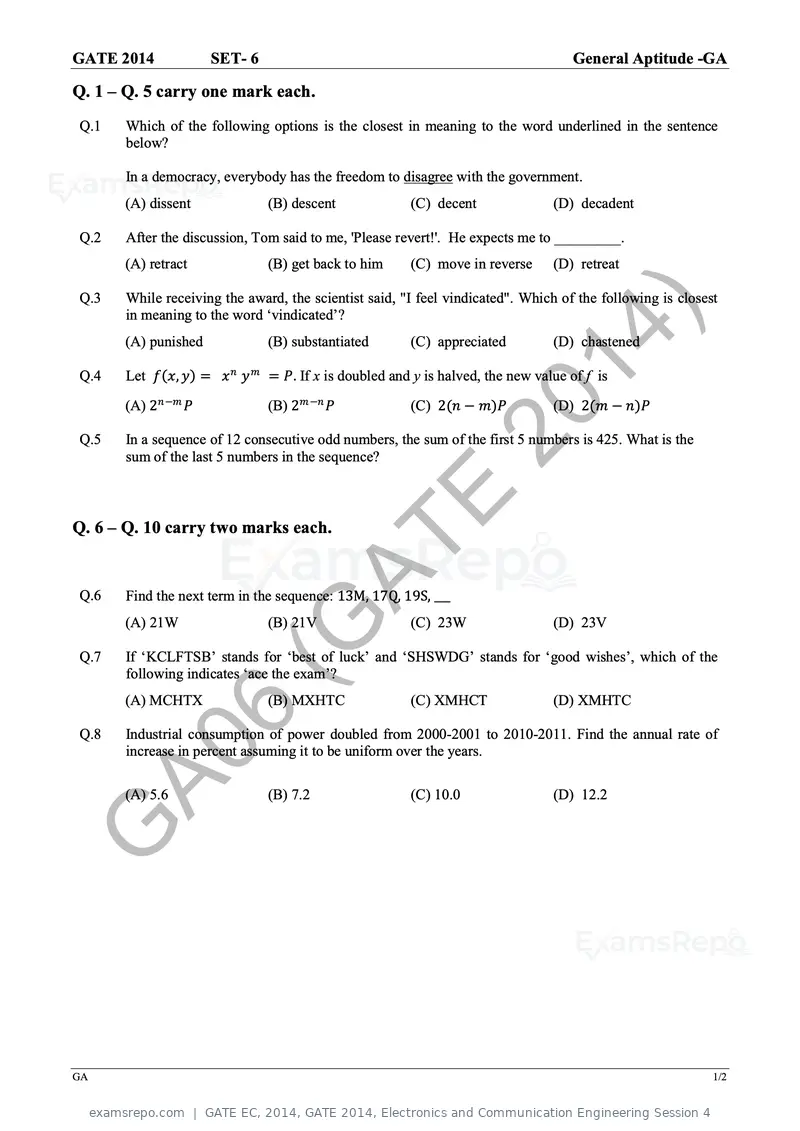
Text of page 68
GATE 2014             SET- 6                                                             General Aptitude -GA

Q. 1 – Q. 5 carry one mark each.
Q.1    Which of the following options is the closest in meaning to the word underlined in the sentence
       below?

       In a democracy, everybody has the freedom to disagree with the government.
      (A) dissent                (B) descent               (C) decent                (D) decadent

Q.2    After the discussion, Tom said to me, 'Please revert!'. He expects me to _________.
      (A) retract                (B) get back to him       (C) move in reverse       (D) retreat

Q.3    While receiving the award, the scientist said, "I feel vindicated". Which of the following is closest


Q.4
       in meaning to the word ‘vindicated’?
      (A) punished               (B) substantiated
                                                                  20
                                                           (C) appreciated


                                                                    14
                                                                                     (D) chastened

       Let ff(xx, yy) = xx nn yy mm = PP. If x is doubled and y is halved, the new value of f is


Q.5
      (A) 2nn−mm PP              (B) 2mm −nn PP

                                                                       )
                                                           (C) 2(nn − mm)PP          (D) 2(mm − nn)PP

       In a sequence of 12 consecutive odd numbers, the sum of the first 5 numbers is 425. What is the
       sum of the last 5 numbers in the sequence?


Q. 6 – Q. 10 carry two marks each.
                                        AT
Q.6                                        E
       Find the next term in the sequence: 13M, 17Q, 19S, ___


Q.7
      (A) 21W

                          (G     (B) 21V                   (C) 23W                   (D) 23V

       If ‘KCLFTSB’ stands for ‘best of luck’ and ‘SHSWDG’ stands for ‘good wishes’, which of the
       following indicates ‘ace the exam’?
      (A) MCHTX                  (B) MXHTC                 (C) XMHCT                 (D) XMHTC

Q.8             6
       Industrial consumption of power doubled from 2000-2001 to 2010-2011. Find the annual rate of


     A0increase in percent assuming it to be uniform over the years.

      (A) 5.6                    (B) 7.2                   (C) 10.0                  (D) 12.2


G

GA                                                                                                         1/2
Text of page 69
GATE 2014            SET- 6                                                       General Aptitude -GA
Q.9    A firm producing air purifiers sold 200 units in 2012. The following pie chart presents the share of
       raw material, labour, energy, plant & machinery, and transportation costs in the total manufacturing
       cost of the firm in 2012. The expenditure on labour in 2012 is Rs. 4,50,000. In 2013, the raw
       material expenses increased by 30% and all other expenses increased by 20%. What is the
       percentage increase in total cost for the company in 2013?


                                                             2014 )
                                    AT
Q.10


                                       E
       A five digit number is formed using the digits 1,3,5,7 and 9 without repeating any of them. What is
       the sum of all such possible five digit numbers?
       (A) 6666660             (B) 6666600             (C) 6666666             (D) 6666606


                        (G   END OF THE QUESTION PAPER


               6
     A0
G

GA                                                                                                           2/2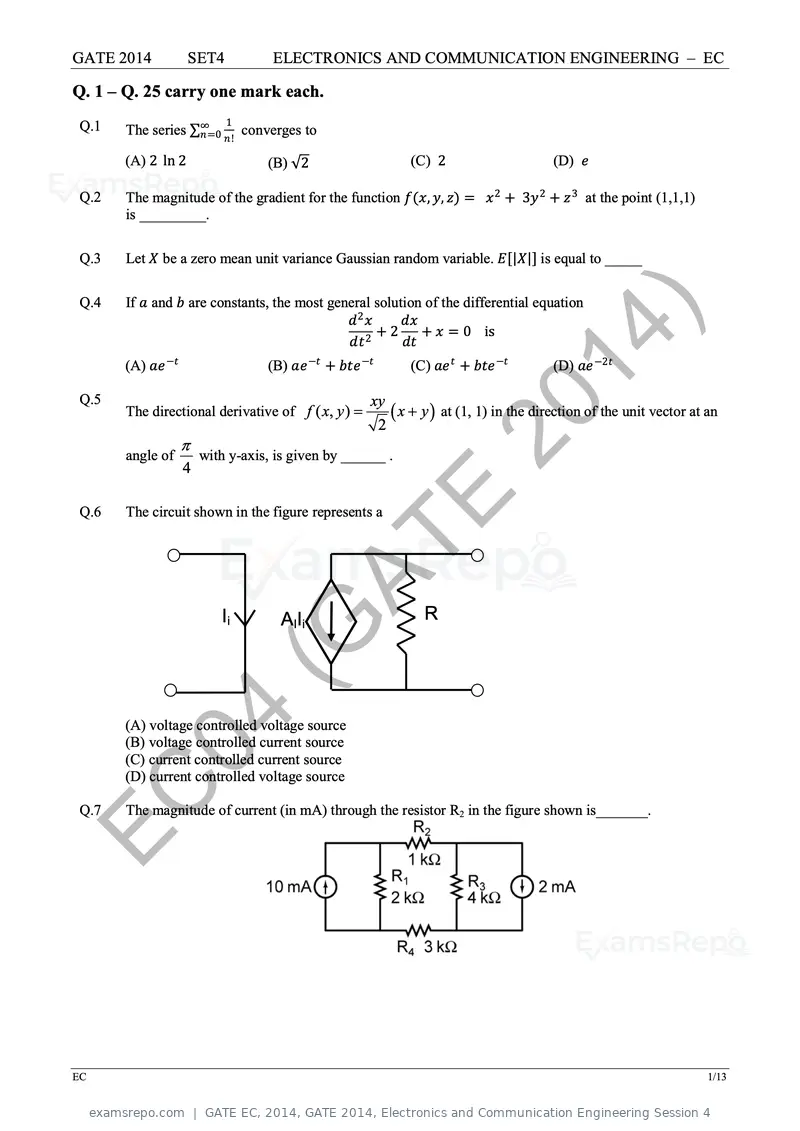
Text of page 70
GATE 2014             SET4            ELECTRONICS AND COMMUNICATION ENGINEERING – EC

Q. 1 – Q. 25 carry one mark each.
                              1
 Q.1   The series ∑∞
                   nn=0 nn! converges to

       (A) 2 ln 2                    (B) √2                         (C) 2                      (D) ee

 Q.2   The magnitude of the gradient for the function ff(xx, yy, zz) = xx 2 + 3yy 2 + zz 3 at the point (1,1,1)
       is _________.

 Q.3   Let XX be a zero mean unit variance Gaussian random variable. EE[|XX|] is equal to _____

 Q.4   If aa and bb are constants, the most general solution of the differential equation
                                               dd2 xx
                                                      +2
                                                         dddd
                                                              + xx = 0 is
                                                                                                        )
 Q.5
       (A) aaee −tt
                                               ddtt 2    dddd
                                     (B) aaee −tt + bbbbee −tt


                                       =
       The directional derivative of f ( x, y)
                                                             xy
                                                              2
                                                                            20
                                                                    (C) aaaa tt + bbbbbb −tt


                                                                              14
                                                                                               (D) aaaa −2tt


                                                                ( x + y ) at (1, 1) in the direction of the unit vector at an
                      π
       angle of           with y-axis, is given by ______ .
                      4

 Q.6

                                            AT
       The circuit shown in the figure represents a


                             Ii         AIIi
                                               E                       R

                              (G
         04
       (A) voltage controlled voltage source
       (B) voltage controlled current source
       (C) current controlled current source
       (D) current controlled voltage source


EC
 Q.7   The magnitude of current (in mA) through the resistor R2 in the figure shown is_______.


EC                                                                                                                         1/13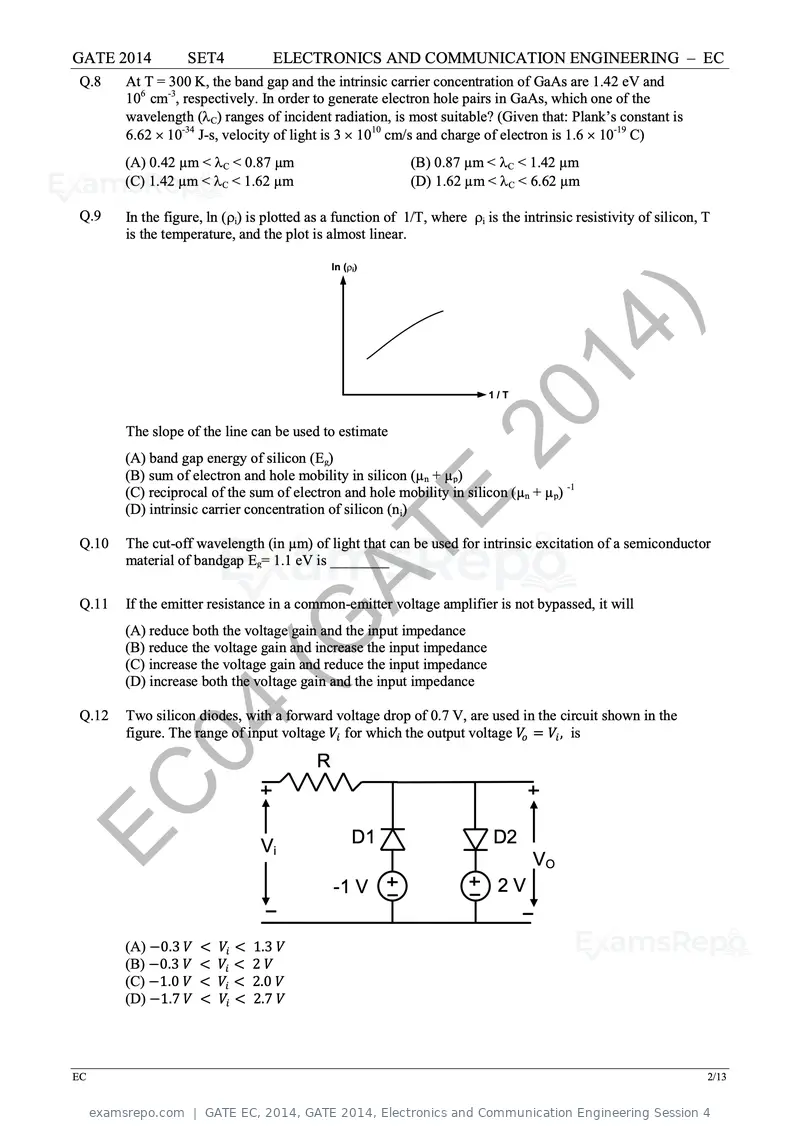
Text of page 71
GATE 2014          SET4           ELECTRONICS AND COMMUNICATION ENGINEERING – EC
 Q.8    At T = 300 K, the band gap and the intrinsic carrier concentration of GaAs are 1.42 eV and
        106 cm-3, respectively. In order to generate electron hole pairs in GaAs, which one of the
        wavelength (λC) ranges of incident radiation, is most suitable? (Given that: Plank’s constant is
        6.62 × 10⁻³⁴ J-s, velocity of light is 3 × 1010 cm/s and charge of electron is 1.6 × 10⁻¹⁹ C)
        (A) 0.42 µm < λC < 0.87 µm                          (B) 0.87 µm < λC < 1.42 µm
        (C) 1.42 µm < λC < 1.62 µm                          (D) 1.62 µm < λC < 6.62 µm

 Q.9    In the figure, ln (ρi) is plotted as a function of 1/T, where ρi is the intrinsic resistivity of silicon, T
        is the temperature, and the plot is almost linear.

                                               ln (ρi)


                                                                                             )
                                                                  2014    1/T


        The slope of the line can be used to estimate
        (A) band gap energy of silicon (Eg)
        (B) sum of electron and hole mobility in silicon (µn + µp)
        (C) reciprocal of the sum of electron and hole mobility in silicon (µn + µp) -1


 Q.10                                  AT
        (D) intrinsic carrier concentration of silicon (ni)

        The cut-off wavelength (in µm) of light that can be used for intrinsic excitation of a semiconductor


 Q.11
                                          E
        material of bandgap Eg= 1.1 eV is ________

        If the emitter resistance in a common-emitter voltage amplifier is not bypassed, it will


                          (G
        (A) reduce both the voltage gain and the input impedance
        (B) reduce the voltage gain and increase the input impedance
        (C) increase the voltage gain and reduce the input impedance
        (D) increase both the voltage gain and the input impedance

 Q.12

         04
        Two silicon diodes, with a forward voltage drop of 0.7 V, are used in the circuit shown in the
        figure. The range of input voltage VVii for which the output voltage VVoo = VVii , is
                                           R


EC                              Vi                  D1                     D2
                                                                                  VO
                                               -1 V                         2V


        (A) −0.3 VV < VVii < 1.3 VV
        (B) −0.3 VV < VVii < 2 VV
        (C) −1.0 VV < VVii < 2.0 VV
        (D) −1.7 VV < VVii < 2.7 VV


EC                                                                                                                2/13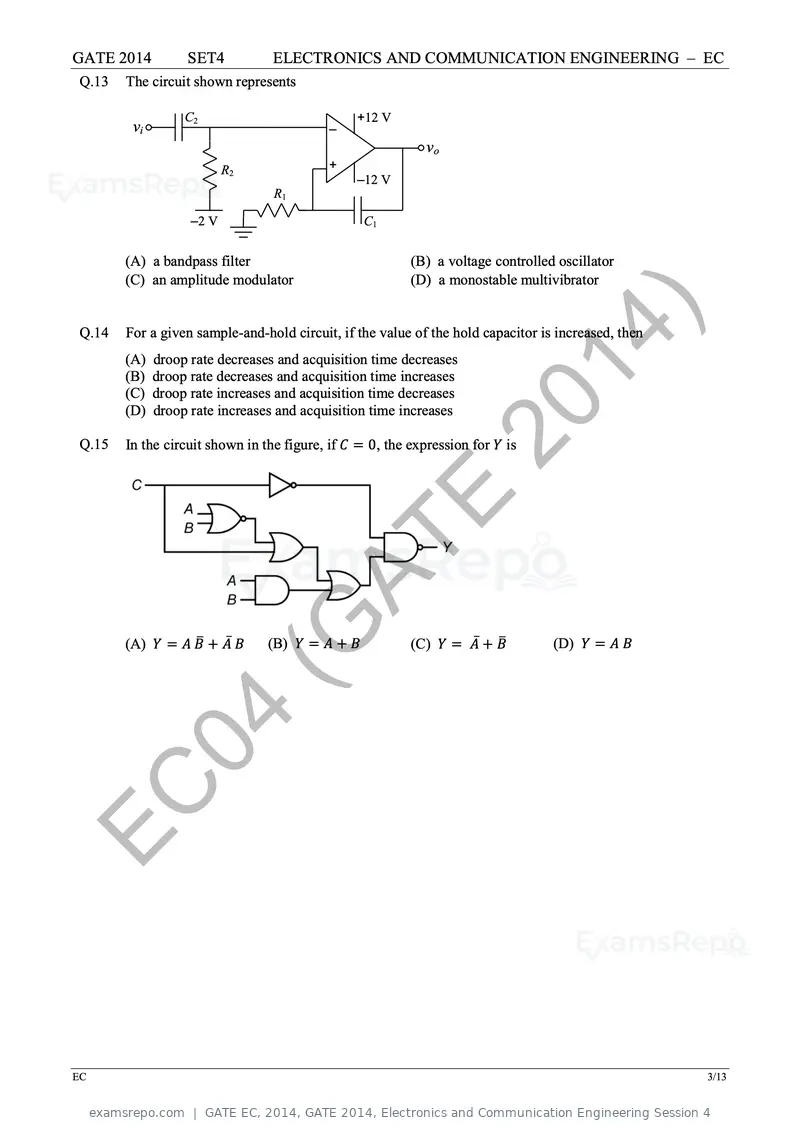
Text of page 72
GATE 2014           SET4           ELECTRONICS AND COMMUNICATION ENGINEERING – EC
 Q.13   The circuit shown represents

                   C2                             +12 V
         vi                                  –
                                                              vo
                            R2               +
                                                  –12 V
                                    R1

                     –2 V                             C1


        (A) a bandpass filter                              (B) a voltage controlled oscillator
        (C) an amplitude modulator                         (D) a monostable multivibrator

                                                                                          )
                                                                   20
 Q.14   For a given sample-and-hold circuit, if the value of the hold capacitor is increased, then
        (A) droop rate decreases and acquisition time decreases
        (B) droop rate decreases and acquisition time increases


 Q.15
        (C) droop rate increases and acquisition time decreases
        (D) droop rate increases and acquisition time increases
                                                                     14
        In the circuit shown in the figure, if CC = 0, the expression for YY is


                                         AT
                                            E
                            (G
        (A) YY = AA BB� + AA̅ BB   (B) YY = AA + BB        (C) YY = AA̅ + BB�      (D) YY = AA BB


          04
EC

EC                                                                                                   3/13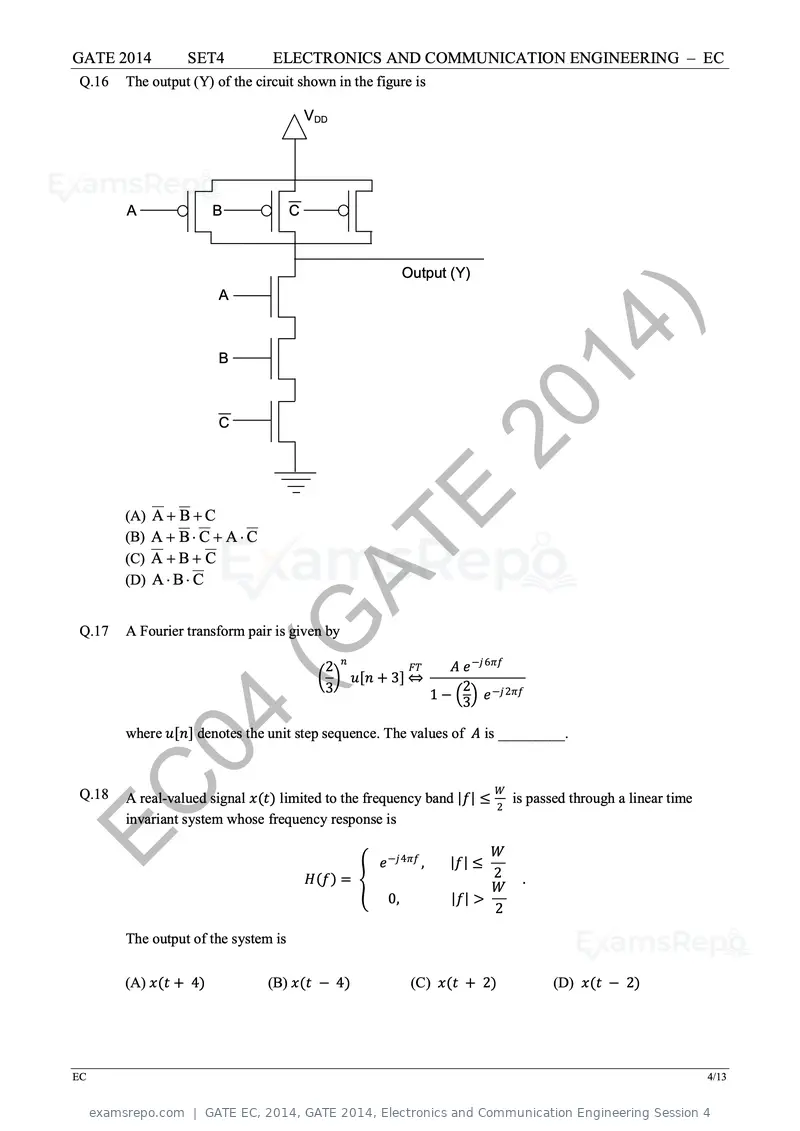
Text of page 73
GATE 2014         SET4           ELECTRONICS AND COMMUNICATION ENGINEERING – EC
 Q.16   The output (Y) of the circuit shown in the figure is

                                          VDD


        A                B            C


                                                              Output (Y)
                         A
                                                                                                )
                         B


                         C
                                                                        2014
        (A) A + B + C
        (B) A + B ⋅ C + A ⋅ C             AT
        (C) A + B + C
        (D) A ⋅ B ⋅ C
                                             E
 Q.17
                             (G
        A Fourier transform pair is given by

                                             2 nn          FFFF
                                            � � uu[nn + 3] ⇔
                                             3
                                                                   AA ee −jj 6ππππ
                                                                      2
                                                                1 − �3� ee −jj 2ππππ


         04
        where uu[nn] denotes the unit step sequence. The values of AA is _________.


EC
 Q.18                                                                            WW
        A real-valued signal xx(tt) limited to the frequency band |ff| ≤ is passed through a linear time
        invariant system whose frequency response is

                                                       ee −jj 4ππππ ,
                                                                        2


                                                                        |ff| ≤
                                                                               WW
                                                                               2
                                          HH(ff) = �                                  .
                                                                               WW
                                                         0,             |ff| >
                                                                                2

        The output of the system is

        (A) xx(tt + 4)          (B) xx(tt − 4)                  (C) xx(tt + 2)            (D) xx(tt − 2)


EC                                                                                                         4/13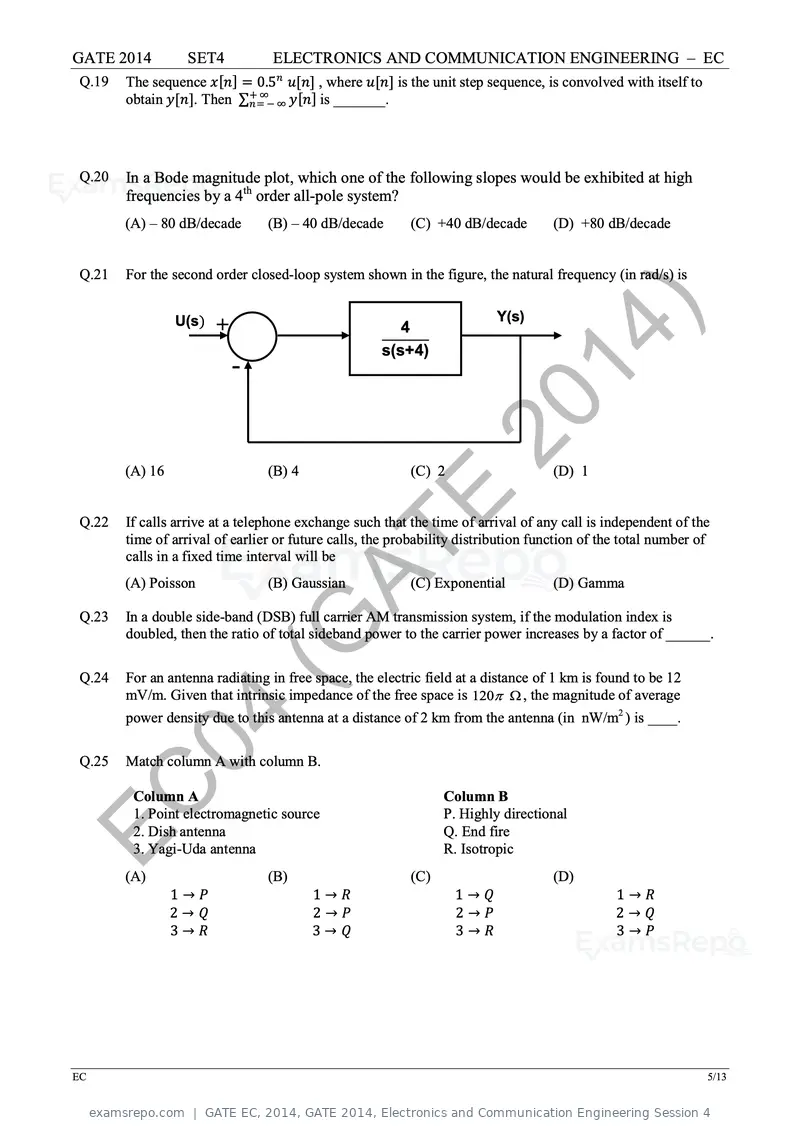
Text of page 74
GATE 2014          SET4           ELECTRONICS AND COMMUNICATION ENGINEERING – EC
 Q.19   The sequence xx[nn] = 0.5nn uu[nn] , where uu[nn] is the unit step sequence, is convolved with itself to
        obtain yy[nn]. Then ∑+ ∞
                             nn= − ∞ yy[nn] is _______.


 Q.20   In a Bode magnitude plot, which one of the following slopes would be exhibited at high
        frequencies by a 4th order all-pole system?
        (A) – 80 dB/decade        (B) – 40 dB/decade       (C) +40 dB/decade         (D) +80 dB/decade


 Q.21   For the second order closed-loop system shown in the figure, the natural frequency (in rad/s) is


                 U(s)     +                              4
                                                                            Y(s)             )
                              -
                                                      s(s+4)
                                                                 2014
        (A) 16                    (B) 4                    (C) 2                     (D) 1


 Q.22
                                          AT
        If calls arrive at a telephone exchange such that the time of arrival of any call is independent of the
        time of arrival of earlier or future calls, the probability distribution function of the total number of


 Q.23
                                             E
        calls in a fixed time interval will be
        (A) Poisson               (B) Gaussian             (C) Exponential           (D) Gamma

        In a double side-band (DSB) full carrier AM transmission system, if the modulation index is


 Q.24
                          (G
        doubled, then the ratio of total sideband power to the carrier power increases by a factor of ______.

        For an antenna radiating in free space, the electric field at a distance of 1 km is found to be 12
        mV/m. Given that intrinsic impedance of the free space is 120π Ω , the magnitude of average


 Q.25
         04
        power density due to this antenna at a distance of 2 km from the antenna (in nW/m2 ) is ____.

        Match column A with column B.


EC       Column A
         1. Point electromagnetic source
         2. Dish antenna
         3. Yagi-Uda antenna
                                                                 Column B
                                                                 P. Highly directional
                                                                 Q. End fire
                                                                 R. Isotropic
        (A)                       (B)                      (C)                       (D)
                 1 → PP                   1 → RR                   1 → QQ                       1 → RR
                 2 → QQ                   2 → PP                   2 → PP                       2 → QQ
                 3 → RR                   3 → QQ                   3 → RR                       3 → PP


EC                                                                                                                 5/13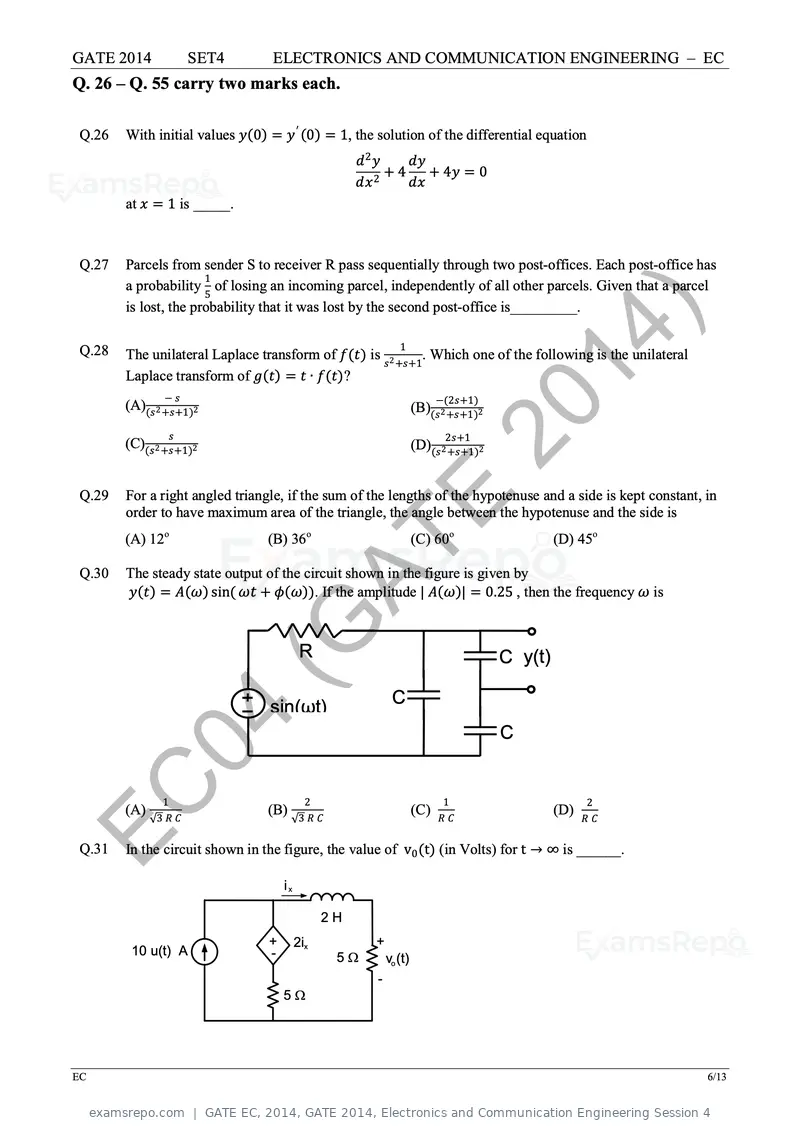
Text of page 75
GATE 2014               SET4      ELECTRONICS AND COMMUNICATION ENGINEERING – EC
Q. 26 – Q. 55 carry two marks each.

 Q.26   With initial values yy(0) = yy ′ (0) = 1, the solution of the differential equation
                                                     dd2 yy    dddd
                                                          2
                                                            +4      + 4yy = 0
                                                     ddxx      dddd
        at xx = 1 is _____.


 Q.27   Parcels from sender S to receiver R pass sequentially through two post-offices. Each post-office has
                       1
        a probability of losing an incoming parcel, independently of all other parcels. Given that a parcel
                       5
        is lost, the probability that it was lost by the second post-office is_________.
                                                                                                          )
 Q.28                                                           1


                                                                             20
        The unilateral Laplace transform of ff(tt) is ss 2 +ss+1. Which one of the following is the unilateral
        Laplace transform of gg(tt) = tt ∙ ff(tt)?
                 − ss
        (A)(ss 2 +ss+1)2
                                                                               14
                                                                           −(2ss+1)
                                                                      (B)(ss 2 +ss+1)2
                  ss                                                         2ss+1
        (C)(ss 2 +ss+1)2                                              (D)(ss 2 +ss+1)2


                                           AT
 Q.29   For a right angled triangle, if the sum of the lengths of the hypotenuse and a side is kept constant, in
        order to have maximum area of the triangle, the angle between the hypotenuse and the side is
        (A) 12o                  (B) 36o                              (C) 60o                     (D) 45o

 Q.30
                                              E
        The steady state output of the circuit shown in the figure is given by
        yy(tt) = AA(ωω) sin( ωωωω + φφ(ωω)). If the amplitude | AA(ωω)| = 0.25 , then the frequency ωω is


                               (G          R

                                                              C
                                                                                         C y(t)

                                  sin(ωt)
          04                                                                             C


EC
 Q.31
        (A)
                1
              √ RR CC
               3
                                 (B)
                                         2
                                       √ RR CC
                                        3
                                                                             1
                                                                      (C) RR CC

        In the circuit shown in the figure, the value of v0 (t) (in Volts) for t → ∞ is ______.
                                                                                                  (D)
                                                                                                         2
                                                                                                        RR CC


                                     ix

                                                2H
                                 +        2ix           +
         10 u(t) A               -               5Ω          vo (t)
                                                         -
                                     5Ω


EC                                                                                                               6/13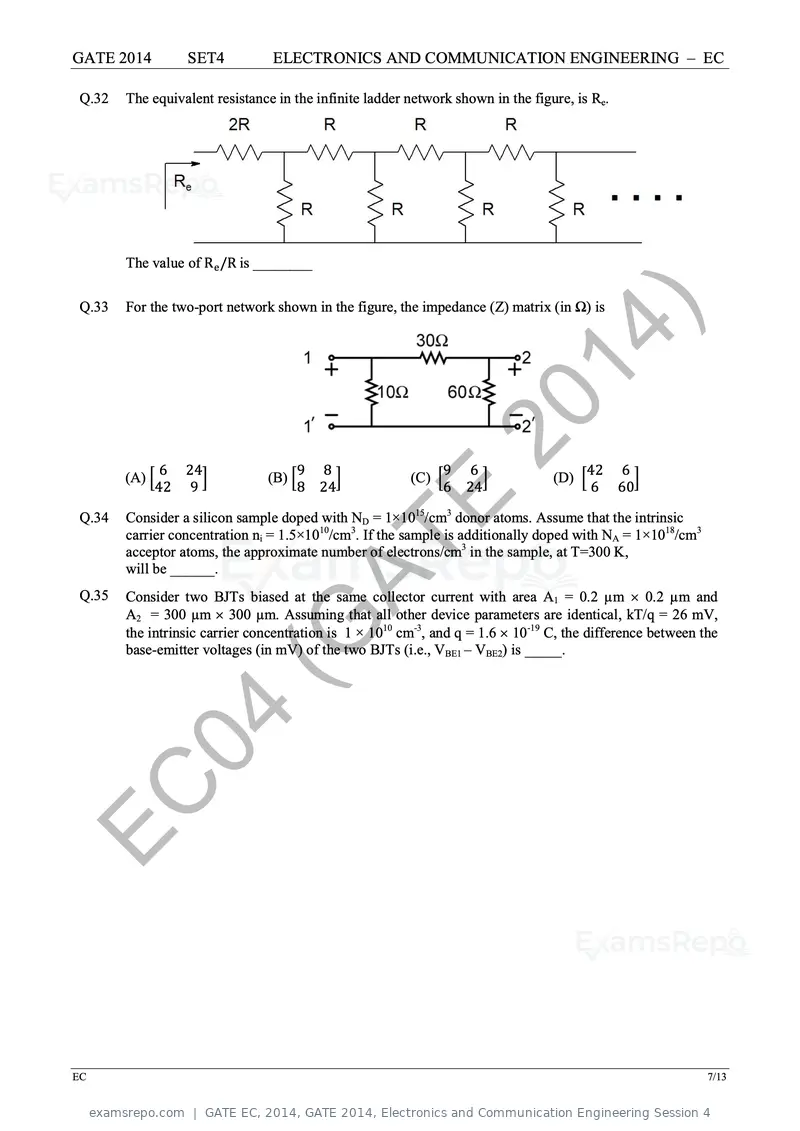
Text of page 76
GATE 2014          SET4          ELECTRONICS AND COMMUNICATION ENGINEERING – EC

 Q.32   The equivalent resistance in the infinite ladder network shown in the figure, is Re.


        The value of R e /R is ________

 Q.33   For the two-port network shown in the figure, the impedance (Z) matrix (in Ω) is
                                                                                          )
                                                                 2014
                6 24                    9 8                      9 6                      42 6
        (A) �        �          (B) �        �           (C) �        �           (D) �        �
                42 9                    8 24                     6 24                     6 60

 Q.34
                                        AT
        Consider a silicon sample doped with ND = 1×10¹⁵/cm3 donor atoms. Assume that the intrinsic
        carrier concentration ni = 1.5×10¹⁰/cm3. If the sample is additionally doped with NA = 1×10¹⁸/cm3


 Q.35                                      E
        acceptor atoms, the approximate number of electrons/cm3 in the sample, at T=300 K,
        will be ______.
        Consider two BJTs biased at the same collector current with area A1 = 0.2 µm × 0.2 µm and
        A2 = 300 µm × 300 µm. Assuming that all other device parameters are identical, kT/q = 26 mV,

                          (G
        the intrinsic carrier concentration is 1 × 1010 cm-3, and q = 1.6 × 10⁻¹⁹ C, the difference between the
        base-emitter voltages (in mV) of the two BJTs (i.e., VBE1 – VBE2) is _____.


         04
EC

EC                                                                                                           7/13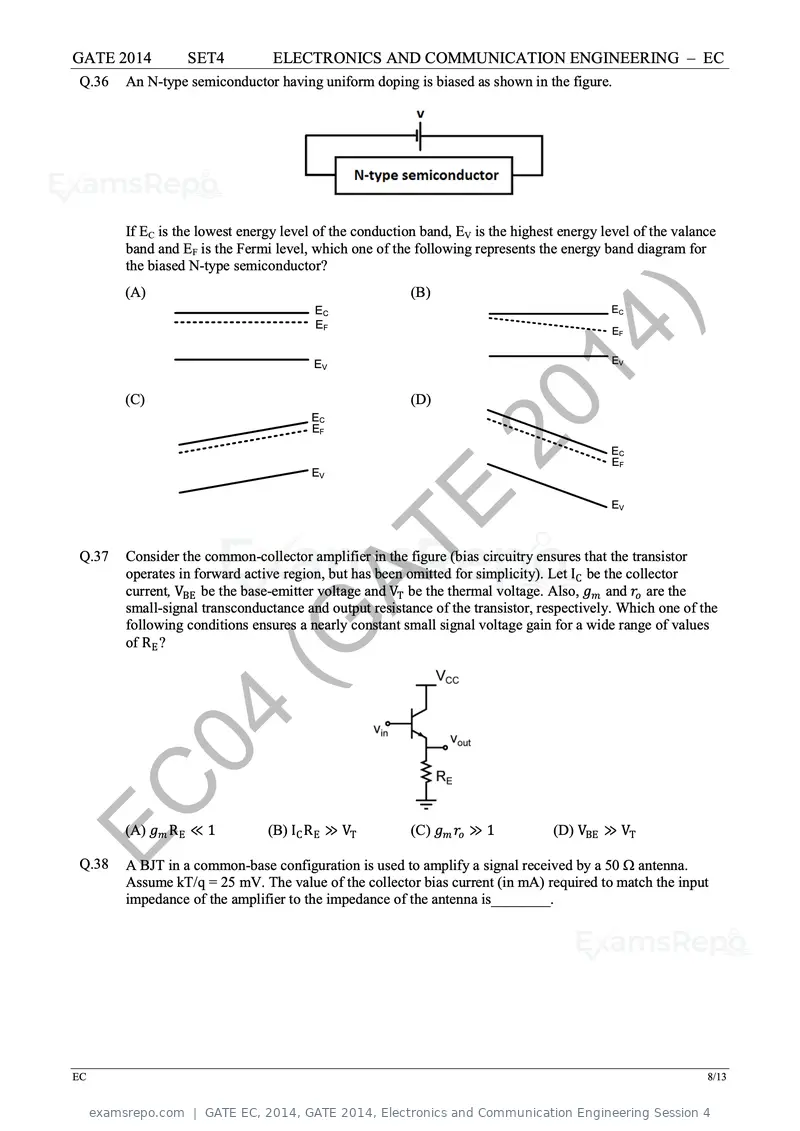
Text of page 77
GATE 2014          SET4          ELECTRONICS AND COMMUNICATION ENGINEERING – EC
 Q.36   An N-type semiconductor having uniform doping is biased as shown in the figure.


        If EC is the lowest energy level of the conduction band, EV is the highest energy level of the valance
        band and EF is the Fermi level, which one of the following represents the energy band diagram for
        the biased N-type semiconductor?
        (A)                                              (B)
                                        EC
                                        EF
                                                                                        )  EC


                                                               20
                                                                                           EF


                                        EV                                                 EV


        (C)
                                        EC
                                        EF
                                                         (D)
                                                                 14                        EC
                                                                                           EF
                                        EV


                                      AT                                                   EV


 Q.37

                                         E
        Consider the common-collector amplifier in the figure (bias circuitry ensures that the transistor
        operates in forward active region, but has been omitted for simplicity). Let IC be the collector
        current, VBE be the base-emitter voltage and VT be the thermal voltage. Also, ggmm and rroo are the
        small-signal transconductance and output resistance of the transistor, respectively. Which one of the


                           (G
        following conditions ensures a nearly constant small signal voltage gain for a wide range of values
        of R E ?


         04
EC
 Q.38
        (A) ggmm R E ≪ 1        (B) IC R E ≫ VT          (C) ggmm rroo ≫ 1       (D) VBE ≫ VT

        A BJT in a common-base configuration is used to amplify a signal received by a 50 Ω antenna.
        Assume kT/q = 25 mV. The value of the collector bias current (in mA) required to match the input
        impedance of the amplifier to the impedance of the antenna is________.


EC                                                                                                          8/13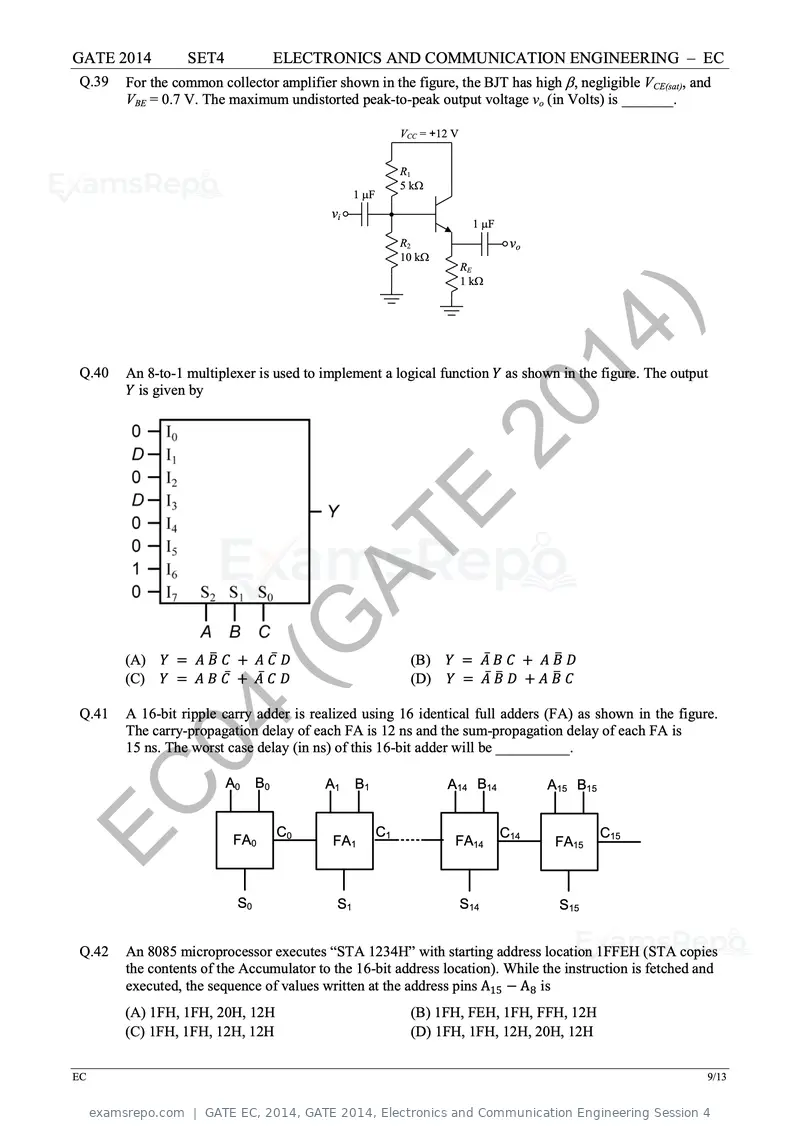
Text of page 78
GATE 2014          SET4        ELECTRONICS AND COMMUNICATION ENGINEERING – EC
 Q.39   For the common collector amplifier shown in the figure, the BJT has high β, negligible VCE(sat), and
        VBE = 0.7 V. The maximum undistorted peak-to-peak output voltage vo (in Volts) is _______.

                                                             VCC = +12 V


                                                             R1
                                                             5 kΩ
                                                 1 µF
                                           vi            •
                                                                             1 µF
                                                             R2                      vo
                                                             10 kΩ
                                                                           RE
                                                                           1 kΩ


                                                                                                  )
 Q.40                                                                20
        An 8-to-1 multiplexer is used to implement a logical function YY as shown in the figure. The output
        YY is given by

                                                                       14
                                           AT
                                              E
                          (G
        (A) YY = AA BB� CC + AA CC̅ DD
        (C) YY = AA BB CC̅ + AA̅ CC DD
                                                               (B) YY = AA̅ BB CC + AA BB� DD
                                                               (D) YY = AA̅ BB� DD + AA BB� CC

 Q.41

         04
        A 16-bit ripple carry adder is realized using 16 identical full adders (FA) as shown in the figure.
        The carry-propagation delay of each FA is 12 ns and the sum-propagation delay of each FA is
        15 ns. The worst case delay (in ns) of this 16-bit adder will be __________.

                          A0     B0        A1    B1                  A14 B14              A15 B15

EC                         FA0
                                      C0
                                            FA1
                                                        C1
                                                                       FA14
                                                                                    C14
                                                                                           FA15
                                                                                                    C15


                            S0              S1                             S14             S15


 Q.42   An 8085 microprocessor executes “STA 1234H” with starting address location 1FFEH (STA copies
        the contents of the Accumulator to the 16-bit address location). While the instruction is fetched and
        executed, the sequence of values written at the address pins A15 − A8 is
        (A) 1FH, 1FH, 20H, 12H                                 (B) 1FH, FEH, 1FH, FFH, 12H
        (C) 1FH, 1FH, 12H, 12H                                 (D) 1FH, 1FH, 12H, 20H, 12H

EC                                                                                                         9/13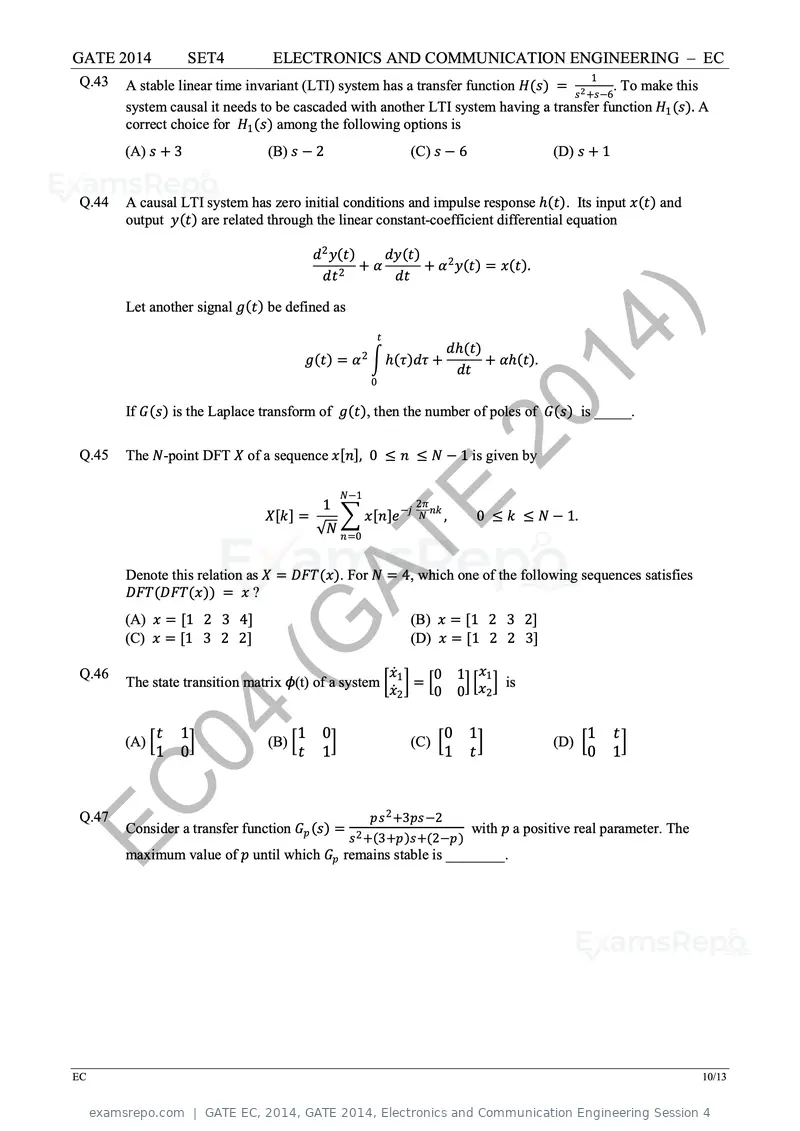
Text of page 79
GATE 2014            SET4         ELECTRONICS AND COMMUNICATION ENGINEERING – EC
 Q.43                                                                                                      1
        A stable linear time invariant (LTI) system has a transfer function HH(ss) = ss 2 +ss−6. To make this
        system causal it needs to be cascaded with another LTI system having a transfer function HH1 (ss). A
        correct choice for HH1 (ss) among the following options is
        (A) ss + 3               (B) ss − 2                         (C) ss − 6                     (D) ss + 1


 Q.44   A causal LTI system has zero initial conditions and impulse response ℎ(tt). Its input xx(tt) and
        output yy(tt) are related through the linear constant-coefficient differential equation

                                            dd2 yy(tt)      dddd(tt)
                                                   2
                                                       + αα          + αα 2 yy(tt) = xx(tt).
                                              ddtt            dddd

        Let another signal gg(tt) be defined as
                                                                                                           )
                                                       2
                                                               tt

                                         gg(tt) = αα � ℎ(ττ)dddd +
                                                           0                  20
                                                                              ddℎ(tt)
                                                                                dddd


                                                                                14
                                                                                      + ααℎ(tt).


        If GG(ss) is the Laplace transform of gg(tt), then the number of poles of GG(ss) is _____.

 Q.45   The NN-point DFT XX of a sequence xx[nn], 0 ≤ nn ≤ NN − 1 is given by

                                                  NN−1

                                 XX[kk] =
                                         AT   1                      2ππ
                                                  � xx[nn]ee −jj NN nnnn ,
                                            √NN nn=0
                                                                                   0 ≤ kk ≤ NN − 1.


                                            E
        Denote this relation as XX = DDDDDD(xx). For NN = 4, which one of the following sequences satisfies
        DDDDDD(DDDDDD(xx)) = xx ?
        (A) xx = [1 2 3 4]                                          (B) xx = [1 2 3 2]


 Q.46
        (C) xx = [1 3 2 2]
                            (G                         xẋ
        The state transition matrix φφ(t) of a system � 1 � = �
                                                       xẋ 2
                                                                    (D) xx = [1 2 2 3]

                                                                0 1 xx1
                                                                   � � � is
                                                                0 0 xx2


         04
        (A) �
                tt 1
                1 0
                    �            (B) �
                                         1 0
                                         tt 1
                                             �                      (C) �
                                                                              0 1
                                                                              1 tt
                                                                                   �               (D) �
                                                                                                           1 tt
                                                                                                           0 1
                                                                                                                �


EC
 Q.47
        Consider a transfer function GGpp (ss) =
                                                           ppss 2 +3pppp −2
                                                   ss 2 +(3+pp)ss+(2−pp)
        maximum value of pp until which GGpp remains stable is ________.
                                                                                  with pp a positive real parameter. The


EC                                                                                                                         10/13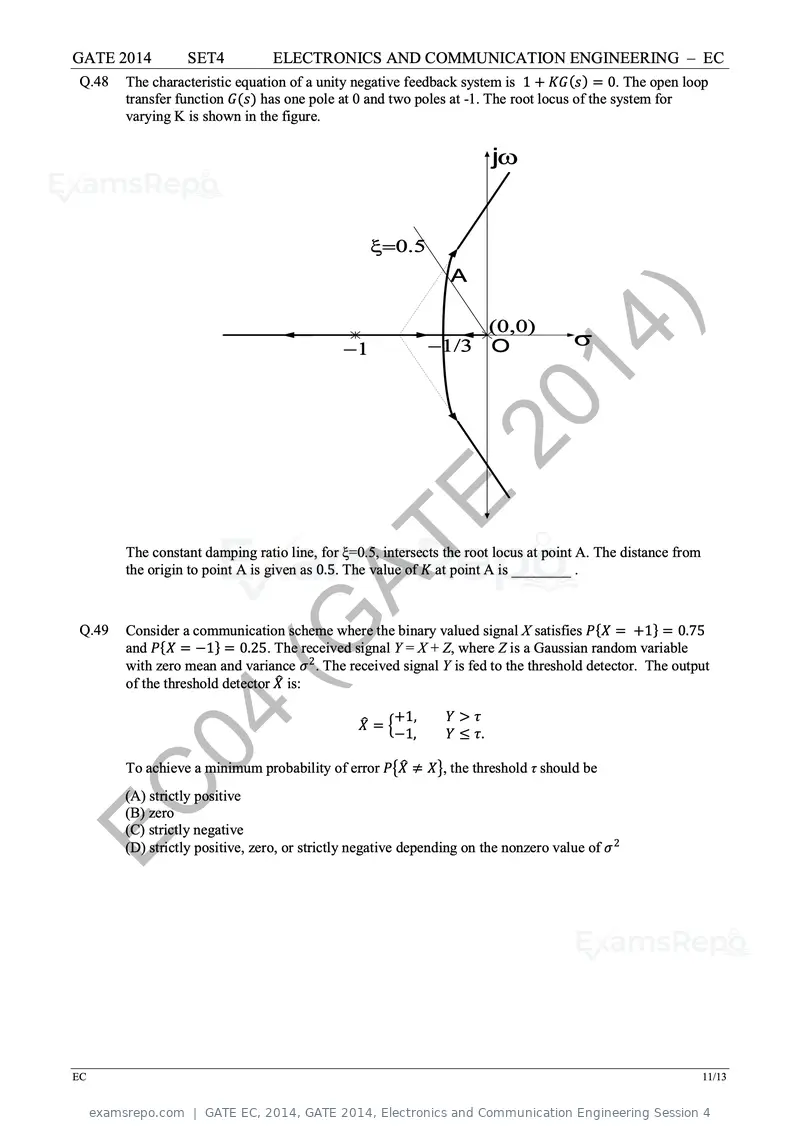
Text of page 80
GATE 2014          SET4           ELECTRONICS AND COMMUNICATION ENGINEERING – EC
 Q.48   The characteristic equation of a unity negative feedback system is 1 + KKKK(ss) = 0. The open loop
        transfer function GG(ss) has one pole at 0 and two poles at -1. The root locus of the system for
        varying K is shown in the figure.

                                                                            jω


                                                   ξ=0.5
                                                                 A

                                                                    (0,0)
                                                                                       σ
                                                                                          )
                                              −1
                                                                20
                                                               −1/3 O


                                                                  14
                                       AT
                                          E
        The constant damping ratio line, for ξ=0.5, intersects the root locus at point A. The distance from
        the origin to point A is given as 0.5. The value of KK at point A is ________ .


 Q.49
                          (G
        Consider a communication scheme where the binary valued signal X satisfies PP{XX = +1} = 0.75
        and PP{XX = −1} = 0.25. The received signal Y = X + Z, where Z is a Gaussian random variable
        with zero mean and variance σσ 2 . The received signal Y is fed to the threshold detector. The output
        of the threshold detector XX� is:

                                                         +1,     YY > ττ
         04                                      XX� = �
                                                        −1,      YY ≤ ττ.

        To achieve a minimum probability of error PP�XX� ≠ XX�, the threshold τ should be


EC      (A) strictly positive
        (B) zero
        (C) strictly negative
        (D) strictly positive, zero, or strictly negative depending on the nonzero value of σσ 2


EC                                                                                                            11/13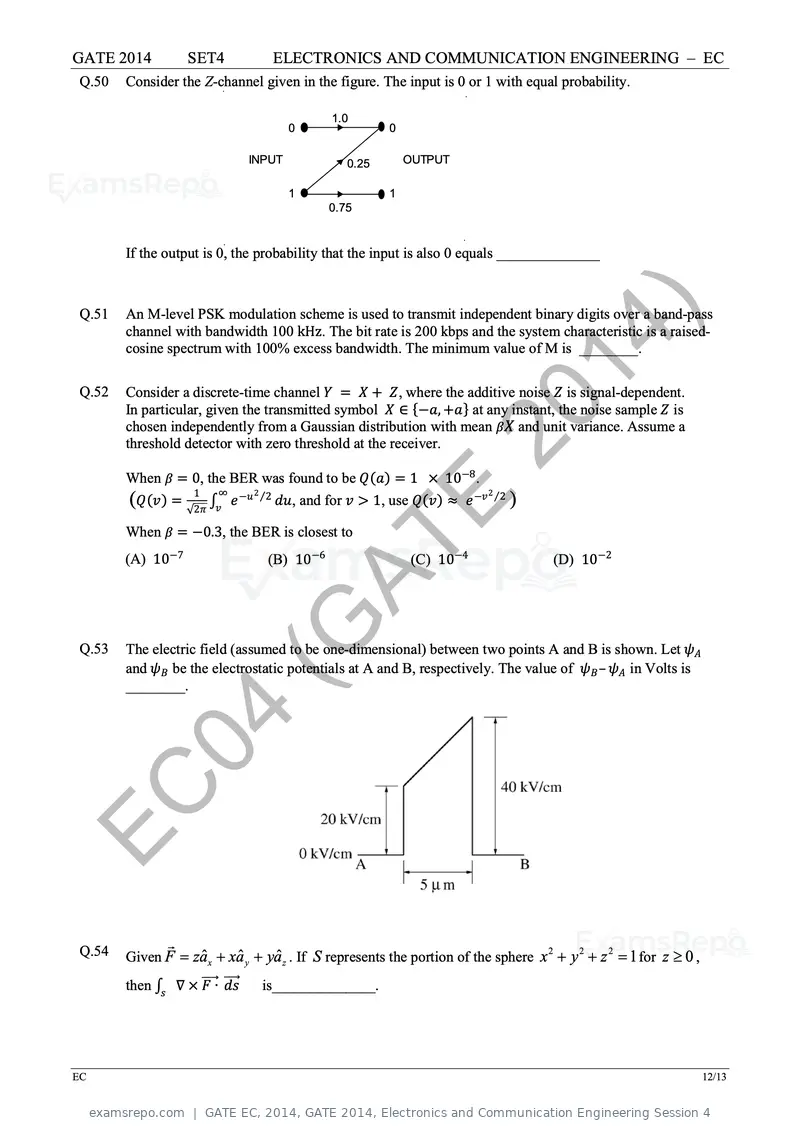
Text of page 81
GATE 2014 SET4 ELECTRONICS AND COMMUNICATION ENGINEERING – EC
Q.50 Consider the Z-channel given in the figure. The input is 0 or 1 with equal probability.
1.0
0 0
INPUT 0.25 OUTPUT
1 1
0.75
If the output is 0, the probability that the input is also 0 equals ______________
Q.51 )
An M-level PSK modulation scheme is used to transmit independent binary digits over a band-pass
channel with bandwidth 100 kHz. The bit rate is 200 kbps and the system characteristic is a raised-
Q.52
20
cosine spectrum with 100% excess bandwidth. The minimum value of M is ________.
14
Consider a discrete-time channel YY = XX + ZZ, where the additive noise ZZ is signal-dependent.
In particular, given the transmitted symbol XX ∈ {−aa, +aa} at any instant, the noise sample ZZ is
chosen independently from a Gaussian distribution with mean ββXX and unit variance. Assume a
threshold detector with zero threshold at the receiver.
When ββ = 0, the BER was found to be QQ(aa) = 1 × 10⁻⁸ .
(QQ(vv) = 12ππ ∫vv∞ ee −uu 2 ⁄2 dddd, and for vv > 1, use QQ(vv) ≈ ee −vv 2 ⁄2 )
√
When ββ = −0.3, the BER is closest to
AT
(A) 10−7 (B) 10−6
E (C) 10−4 (D) 10−2
Q.53
(G
The electric field (assumed to be one-dimensional) between two points A and B is shown. Let ψψAA
and ψψBB be the electrostatic potentials at A and B, respectively. The value of ψψBB – ψψAA in Volts is
________.
04
EC
Q.54 Given F = zaˆ x + xaˆ y + yaˆ z . If S represents the portion of the sphere x + y + z 1
= for z ≥ 0 ,
2 2 2
FF ∙ ����⃗
then ∫ss ∇ × ����⃗ dddd is______________.
EC 12/13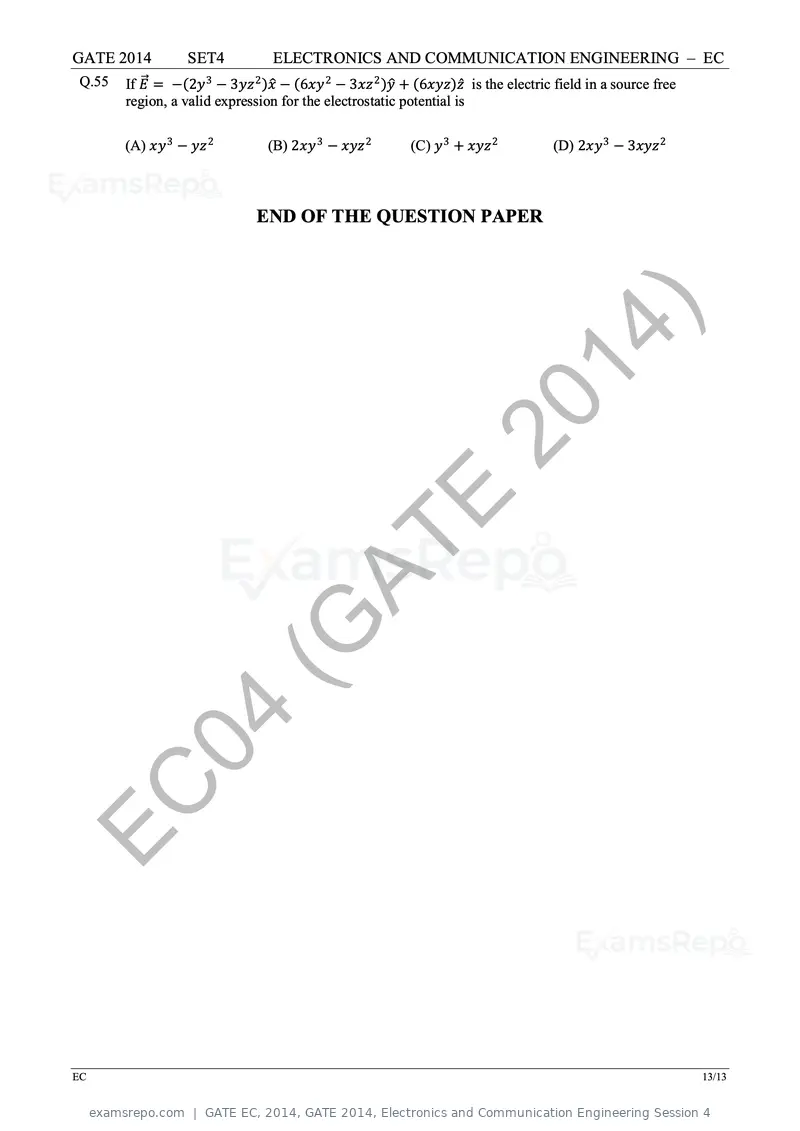
Text of page 82
GATE 2014            SET4            ELECTRONICS AND COMMUNICATION ENGINEERING – EC
 Q.55   If EE�⃗ = −(2yy 3 − 3yyzz 2 )xx� − (6xxxx 2 − 3xxzz 2 )yy� + (6xxxxxx)zẑ is the electric field in a source free
        region, a valid expression for the electrostatic potential is

        (A) xxyy 3 − yyzz 2         (B) 2xxyy 3 − xxxxzz 2        (C) yy 3 + xxxxzz 2          (D) 2xxyy 3 − 3xxxxzz 2


                                  END OF THE QUESTION PAPER


                                                                                                      )
                                                                         2014
                                           AT
                                              E
                              (G
          04
EC

EC                                                                                                                         13/13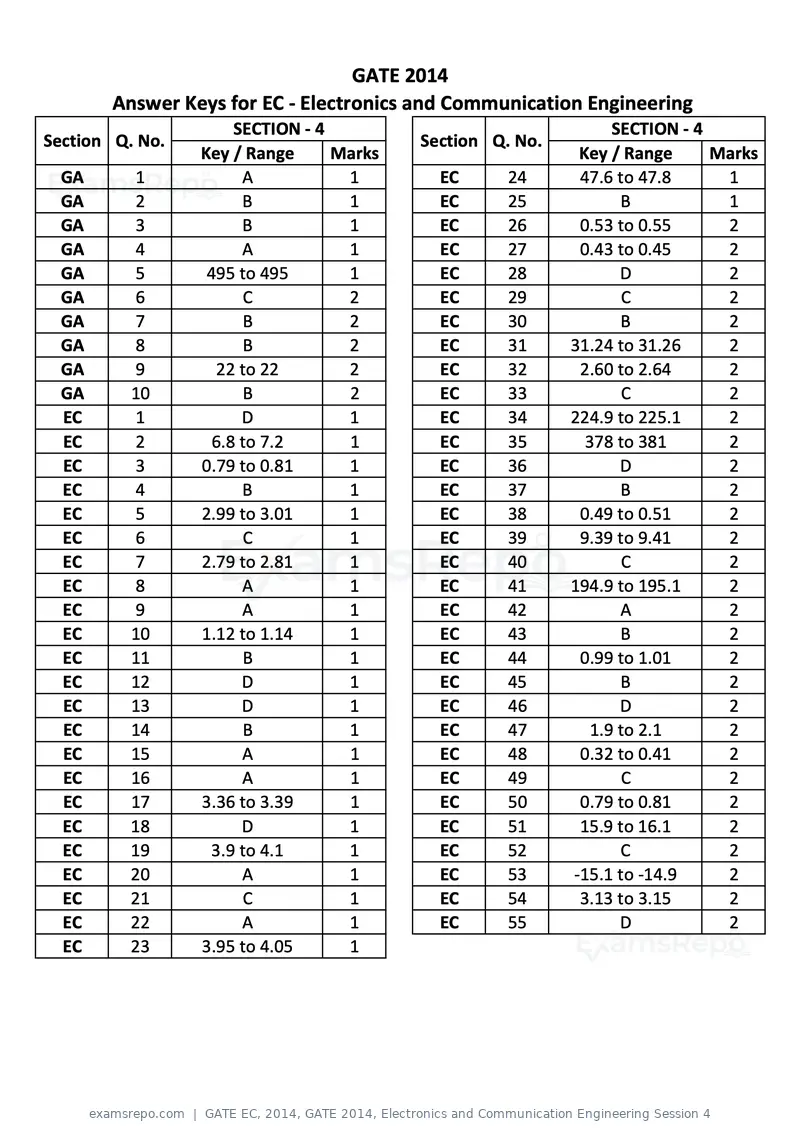
Text of page 83
GATE 2014
       Answer Keys for EC ‐ Electronics and Communication Engineering
                      SECTION ‐ 4                               SECTION ‐ 4
Section Q. No.                            Section Q. No.
                 Key / Range      Marks                     Key / Range     Marks
 GA        1           A           1        EC      24      47.6 to 47.8     1
 GA        2           B           1        EC      25           B           1
 GA        3           B           1        EC      26      0.53 to 0.55     2
 GA        4           A           1        EC      27      0.43 to 0.45     2
 GA        5      495 to 495       1        EC      28           D           2
 GA        6           C           2        EC      29            C          2
 GA        7           B           2        EC      30           B           2
 GA        8           B           2        EC      31     31.24 to 31.26    2
 GA        9       22 to 22        2        EC      32      2.60 to 2.64     2
 GA       10           B           2        EC      33            C          2
 EC        1           D           1        EC      34     224.9 to 225.1    2
 EC        2       6.8 to 7.2      1        EC      35       378 to 381      2
 EC        3     0.79 to 0.81      1        EC      36           D           2
 EC       4            B           1        EC      37           B           2
 EC        5     2.99 to 3.01      1        EC      38      0.49 to 0.51     2
 EC        6           C           1        EC      39      9.39 to 9.41     2
 EC        7     2.79 to 2.81      1        EC      40            C          2
 EC        8           A           1        EC      41     194.9 to 195.1    2
 EC        9           A           1        EC      42           A           2
 EC       10     1.12 to 1.14      1        EC      43           B           2
 EC       11           B           1        EC      44      0.99 to 1.01     2
 EC       12           D           1        EC      45           B           2
 EC       13           D           1        EC      46           D           2
 EC       14           B           1        EC      47       1.9 to 2.1      2
 EC       15           A           1        EC      48      0.32 to 0.41     2
 EC       16           A           1        EC      49            C          2
 EC       17     3.36 to 3.39      1        EC      50      0.79 to 0.81     2
 EC       18           D           1        EC      51      15.9 to 16.1     2
 EC       19      3.9 to 4.1       1        EC      52            C          2
 EC       20           A           1        EC      53     ‐15.1 to ‐14.9    2
 EC       21           C           1        EC      54      3.13 to 3.15     2
 EC       22           A           1        EC      55           D           2
 EC       23     3.95 to 4.05      1
Official key not published for this paper.
Page 1 of 83
Source: GATE. Question paper published by GATE.