
GATE Life Sciences 2014
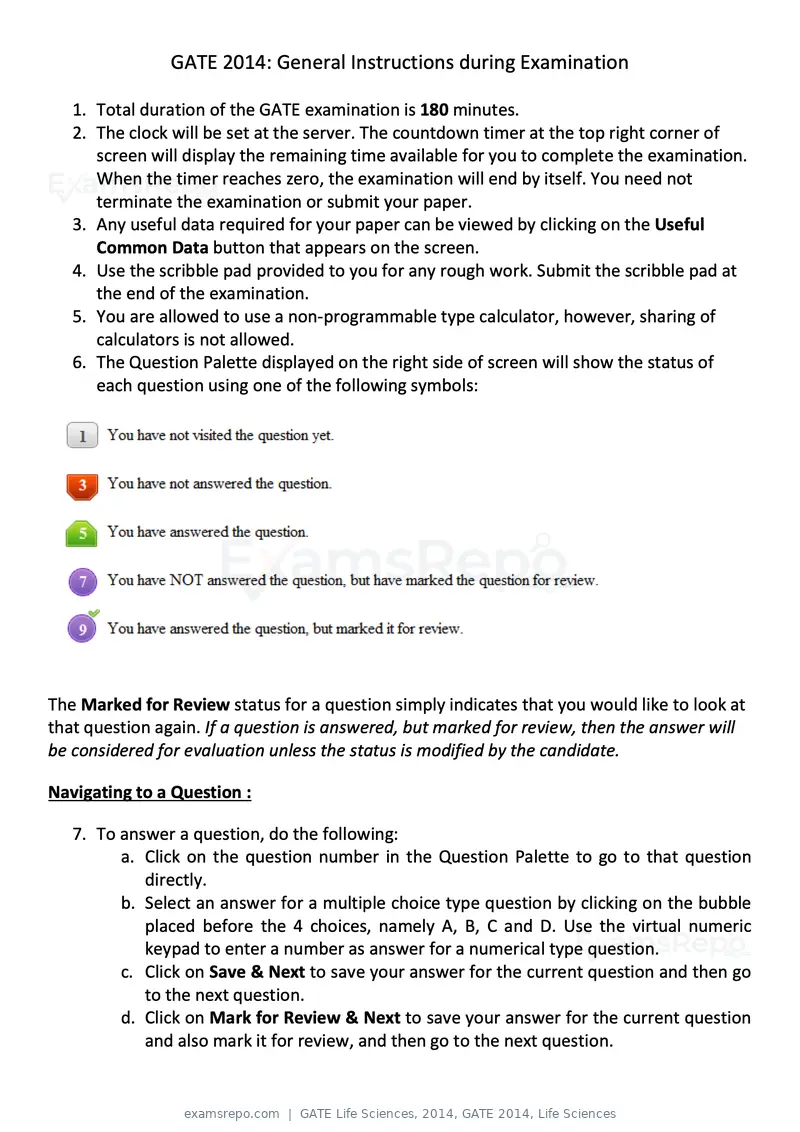
Text of page 1
GATE 2014: General Instructions during Examination

   1. Total duration of the GATE examination is 180 minutes.
   2. The clock will be set at the server. The countdown timer at the top right corner of
      screen will display the remaining time available for you to complete the examination.
      When the timer reaches zero, the examination will end by itself. You need not
      terminate the examination or submit your paper.
   3. Any useful data required for your paper can be viewed by clicking on the Useful
      Common Data button that appears on the screen.
   4. Use the scribble pad provided to you for any rough work. Submit the scribble pad at
      the end of the examination.
   5. You are allowed to use a non-programmable type calculator, however, sharing of
      calculators is not allowed.
   6. The Question Palette displayed on the right side of screen will show the status of
      each question using one of the following symbols:


The Marked for Review status for a question simply indicates that you would like to look at
that question again. If a question is answered, but marked for review, then the answer will
be considered for evaluation unless the status is modified by the candidate.

Navigating to a Question :

   7. To answer a question, do the following:
         a. Click on the question number in the Question Palette to go to that question
            directly.
         b. Select an answer for a multiple choice type question by clicking on the bubble
            placed before the 4 choices, namely A, B, C and D. Use the virtual numeric
            keypad to enter a number as answer for a numerical type question.
         c. Click on Save & Next to save your answer for the current question and then go
            to the next question.
         d. Click on Mark for Review & Next to save your answer for the current question
            and also mark it for review, and then go to the next question.
Text of page 2
Caution: Note that your answer for the current question will not be saved, if you navigate
to another question directly by clicking on a question number without saving the answer to
the previous question.

You can view all the questions by clicking on the Question Paper button. This feature is
provided, so that if you want you can just see the entire question paper at a glance.

Answering a Question :

   8. Procedure for answering a multiple choice (MCQ) type question:
         a. Choose one answer from the 4 options (A,B,C,D) given below the question,
            click on the bubble placed before the chosen option.
         b. To deselect your chosen answer, click on the bubble of the chosen option again
            or click on the Clear Response button.
         c. To change your chosen answer, click on the bubble of another option.
         d. To save your answer, you MUST click on the Save & Next button.

   9. Procedure for answering a numerical answer type question:
         a. To enter a number as your answer, use the virtual numerical keypad.
         b. A fraction (e.g. -0.3 or -.3) can be entered as an answer with or without '0'
             before the decimal point. As many as four decimal points, e.g. 12.5435 or
             0.003 or -932.6711 or 12.82 can be entered.
         c. To clear your answer, click on the Clear Response button.
         d. To save your answer, you MUST click on the Save & Next button
   10. To mark a question for review, click on the Mark for Review & Next button. If an
      answer is selected (for MCQ) or entered (for numerical answer type) for a question
      that is Marked for Review, that answer will be considered in the evaluation unless
      the status is modified by the candidate.

   11. To change your answer to a question that has already been answered, first select
      that question for answering and then follow the procedure for answering that type of
      question.
   12. Note that ONLY Questions for which answers are saved or marked for review after
      answering will be considered for evaluation.


      Choosing a Section :

   13. Sections in this question paper are displayed on the top bar of the screen. Questions
      in a Section can be viewed by clicking on the name of that Section. The Section you
      are currently viewing will be highlighted.
   14. A checkbox is displayed for every optional Section, if any, in the Question Paper. To
      select the optional Section for answering, click on the checkbox for that Section.
   15. If the checkbox for an optional Section is not selected, the Save & Next button and
      the Mark for Review & Next button will NOT be enabled for that Section. You will
Text of page 3
only be able to see questions in this Section, but you will not be able to answer
      questions in the Section.
   16. After clicking the Save & Next button for the last question in a Section, you will
      automatically be taken to the first question of the next Section in sequence.
   17. You can move the mouse cursor over the name of a Section to view the answering
      status for that Section.


Changing the Optional Section :

   18. After answering the chosen optional Section, partially or completely, you can change
      the optional Section by selecting the checkbox for a new Section that you want to
      attempt. A warning message will appear along with a table showing the number of
      questions answered in each of the previously chosen optional Sections and a
      checkbox against each of these Sections. Click on a checkbox against a Section that
      you want to reset and then click on the RESET button. Note that RESETTING a Section
      will DELETE all the answers for questions in that Section. Hence, if you think that you
      may want to select this Section again later, you will have to note down your answers
      for questions in that Section. If you do not want to reset the Section and want to
      continue answering the previously chosen optional Section, then click on the BACK
      button.

   19. If you deselect the checkbox for an optional Section in the top bar, the following
      warning message will appear: "Deselecting the checkbox will DELETE all the answers
      for questions in this Section. Do you want to deselect this Section?” If you want to
      deselect, click on the RESET button. If you do not want to deselect, click on the BACK
      button.

   20. You can shuffle between different Sections or change the optional Sections any
      number of times.
Text of page 4
GATE 2014 Examination
                                            XL: Life Sciences
Duration: 180 minutes                                                                    Maximum Marks: 100

Read the following instructions carefully.

    1. To login, enter your Registration Number and password provided to you. Kindly go through the various
        symbols used in the test and understand their meaning before you start the examination.
    2. Once you login and after the start of the examination, you can view all the questions in the question
        paper, by clicking on the View All Questions button in the screen.
    3. This paper consists of 7sections: GA (General Aptitude), H (Chemistry), I (Biochemistry), J (Botany),
        K (Microbiology), L (Zoology) and M (Food Technology).
        Section GA (General Aptitude) and Section H (Chemistry) are compulsory.
        Attempt any 2 sections out of the 5 optional Sections I through M.
        There are 10 questions carrying 15 marks in the compulsory General Aptitude (GA) section.
        Questions 1 to 5 of this section carry 1 mark each, and questions 6 to 10 carry 2 marks each.
        There are 15 questions carrying 25 marks in Section H (Chemistry), which is compulsory. Questions
        1 to 5 of this section carry 1 mark each and questions 6 to 15 carry 2 marks each.
        Each of the optional sections (Sections I through M) contains 20 questions carrying 30 marks. In these
        sections, questions 1 to 10 are of 1 mark, while questions 11 to 20 are of 2 marks.
    4. Depending upon the GATE paper, there may be useful common data that may be required for
        answering the questions. If the paper has such useful data, the same can be viewed by clicking on the
        Useful Common Data button that appears at the top, right hand side of the screen.
    5. The computer allotted to you at the examination center runs specialized software that permits only one
        answer to be selected for multiple-choice questions using a mouse and to enter a suitable number for
        the numerical answer type questions using the virtual keyboard and mouse.
    6. Your answers shall be updated and saved on a server periodically and also at the end of the
        examination. The examination will stop automatically at the end of 180 minutes.
    7. In each paper a candidate can answer a total of 65 questions carrying 100 marks.
    8. The question paper may consist of questions of multiple choice type (MCQ) and numerical answer
        type.
    9. Multiple choice type questions will have four choices against A, B, C, D, out of which only ONE is the
        correct answer. The candidate has to choose the correct answer by clicking on the bubble (⃝) placed
        before the choice.
    10. For numerical answer type questions, each question will have a numerical answer and there will not be
        any choices. For these questions, the answer should be enteredby using the virtual keyboard that
        appears on the monitor and the mouse.
    11. All questions that are not attempted will result in zero marks. However, wrong answers for multiple
        choice type questions (MCQ) will result in NEGATIVE marks. For all MCQ questions a wrong
        answer will result in deduction of⅓ marks for a 1-mark question and ⅔ marks for a 2-mark question.
    12. There is NO NEGATIVE MARKING for questions of NUMERICAL ANSWER TYPE.
    13. Non-programmable type Calculator is allowed. Charts, graph sheets, and mathematical tables are NOT
        allowed in the Examination Hall. You must use the Scribble pad provided to you at the examination
        centre for all your rough work. The Scribble Pad has to be returned at the end of the examination.

    Declaration by the candidate:

    “I have read and understood all the above instructions. I have also read and understood clearly the
    instructions given on the admit card and shall follow the same. I also understand that in case I am found to
    violate any of these instructions, my candidature is liable to be cancelled. I also find at the start of the
    examination that all the computer hardware allotted to me is in proper working condition”.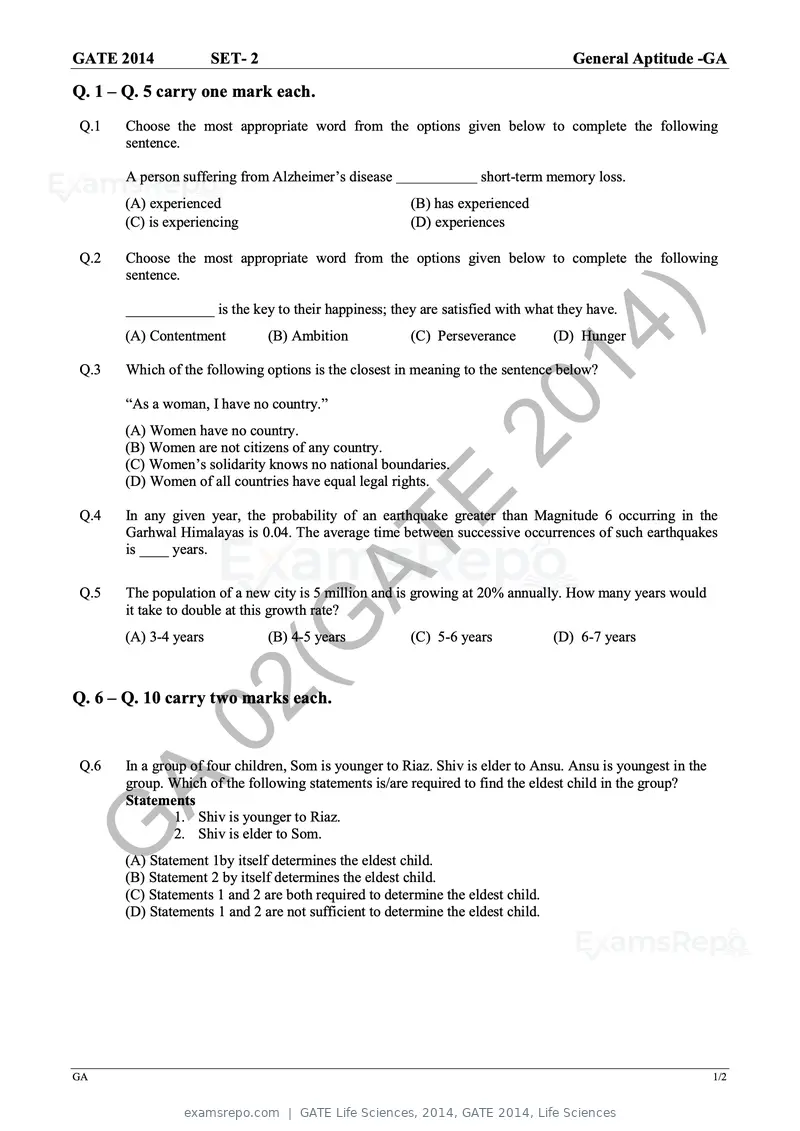
Text of page 5
GATE 2014             SET- 2                                                        General Aptitude -GA

Q. 1 – Q. 5 carry one mark each.
Q.1    Choose the most appropriate word from the options given below to complete the following
       sentence.

       A person suffering from Alzheimer’s disease                 short-term memory loss.
      (A) experienced                                  (B) has experienced
      (C) is experiencing                              (D) experiences

Q.2    Choose the most appropriate word from the options given below to complete the following
       sentence.

       ____________ is the key to their happiness; they are satisfied with what they have.


Q.3
      (A) Contentment          (B) Ambition
                                                             20
                                                       (C) Perseverance


                                                                14
                                                                                 (D) Hunger

       Which of the following options is the closest in meaning to the sentence below?

       “As a woman, I have no country.”
      (A) Women have no country.
      (B) Women are not citizens of any country.
      (C) Women’s solidarity knows no national boundaries.
      (D) Women of all countries have equal legal rights.
                                                                  )
Q.4                                                E
       In any given year, the probability of an earthquake greater than Magnitude 6 occurring in the
       Garhwal Himalayas is 0.04. The average time between successive occurrences of such earthquakes
       is ____ years.

                        (G
Q.5

                          AT
       The population of a new city is 5 million and is growing at 20% annually. How many years would
       it take to double at this growth rate?
      (A) 3-4 years            (B) 4-5 years           (C) 5-6 years             (D) 6-7 years


            02
Q. 6 – Q. 10 carry two marks each.


Q.6    In a group of four children, Som is younger to Riaz. Shiv is elder to Ansu. Ansu is youngest in the
       group. Which of the following statements is/are required to find the eldest child in the group?
     A Statements
               1. Shiv is younger to Riaz.

G              2. Shiv is elder to Som.
      (A) Statement 1by itself determines the eldest child.
      (B) Statement 2 by itself determines the eldest child.
      (C) Statements 1 and 2 are both required to determine the eldest child.
      (D) Statements 1 and 2 are not sufficient to determine the eldest child.


GA                                                                                                           1/2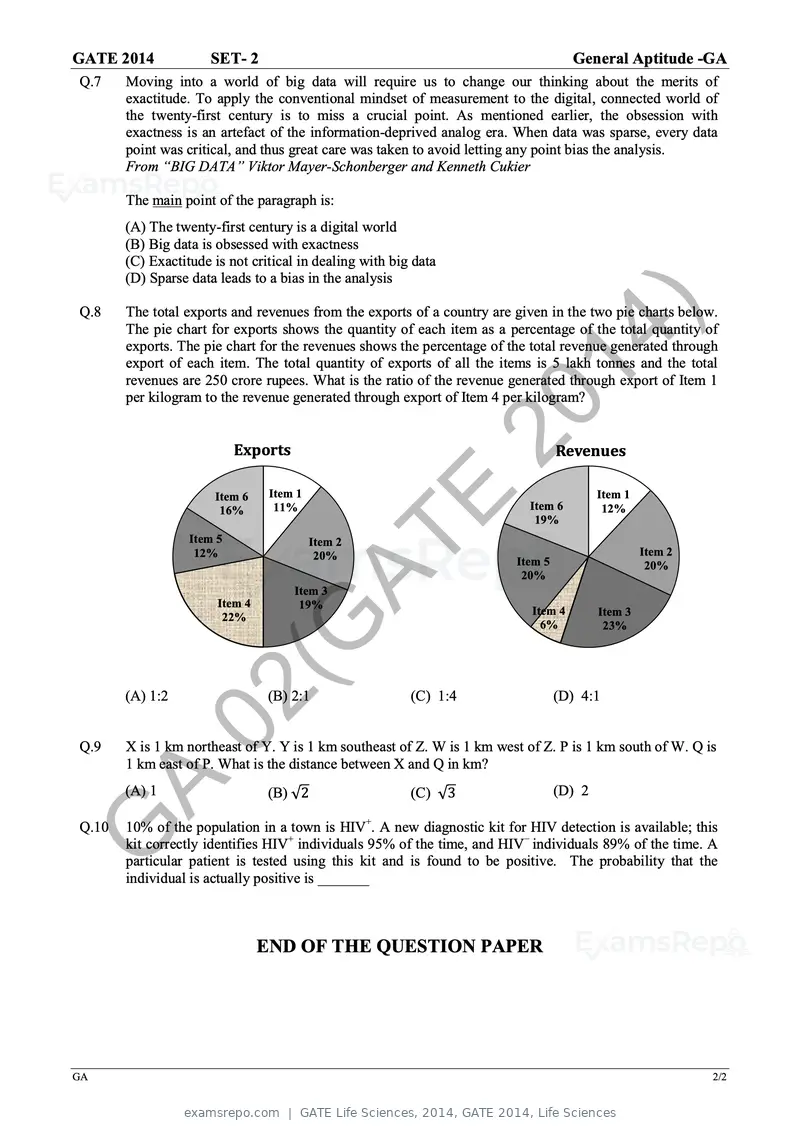
Text of page 6
GATE 2014             SET- 2                                                        General Aptitude -GA
Q.7    Moving into a world of big data will require us to change our thinking about the merits of
       exactitude. To apply the conventional mindset of measurement to the digital, connected world of
       the twenty-first century is to miss a crucial point. As mentioned earlier, the obsession with
       exactness is an artefact of the information-deprived analog era. When data was sparse, every data
       point was critical, and thus great care was taken to avoid letting any point bias the analysis.
       From “BIG DATA” Viktor Mayer-Schonberger and Kenneth Cukier

       The main point of the paragraph is:
       (A) The twenty-first century is a digital world
       (B) Big data is obsessed with exactness
       (C) Exactitude is not critical in dealing with big data
       (D) Sparse data leads to a bias in the analysis

Q.8


                                                                 20
       The total exports and revenues from the exports of a country are given in the two pie charts below.
       The pie chart for exports shows the quantity of each item as a percentage of the total quantity of
       exports. The pie chart for the revenues shows the percentage of the total revenue generated through


                                                                    14
       export of each item. The total quantity of exports of all the items is 5 lakh tonnes and the total
       revenues are 250 crore rupees. What is the ratio of the revenue generated through export of Item 1
       per kilogram to the revenue generated through export of Item 4 per kilogram?


                           Exports                                    )          Revenues

                      Item 6
                       16%
                                 Item 1
                                  11%
                                                     E                    Item 6
                                                                           19%
                                                                                         Item 1
                                                                                          12%


                           (G
                  Item 5                  Item 2
                   12%                     20%                                                    Item 2
                                                                        Item 5                     20%
                                                                         20%

                       Item 4
                        22%
                             AT      Item 3
                                      19%
                                                                           Item 4
                                                                             6%
                                                                                         Item 3
                                                                                          23%


Q.9
       (A) 1:2
               02               (B) 2:1                  (C) 1:4                 (D) 4:1


       X is 1 km northeast of Y. Y is 1 km southeast of Z. W is 1 km west of Z. P is 1 km south of W. Q is
       1 km east of P. What is the distance between X and Q in km?

     A (A) 1                    (B) √2                   (C) √3                  (D) 2

       10% of the population in a town is HIV+. A new diagnostic kit for HIV detection is available; this
G
Q.10
       kit correctly identifies HIV+ individuals 95% of the time, and HIV− individuals 89% of the time. A
       particular patient is tested using this kit and is found to be positive. The probability that the
       individual is actually positive is _______


                                END OF THE QUESTION PAPER


GA                                                                                                         2/2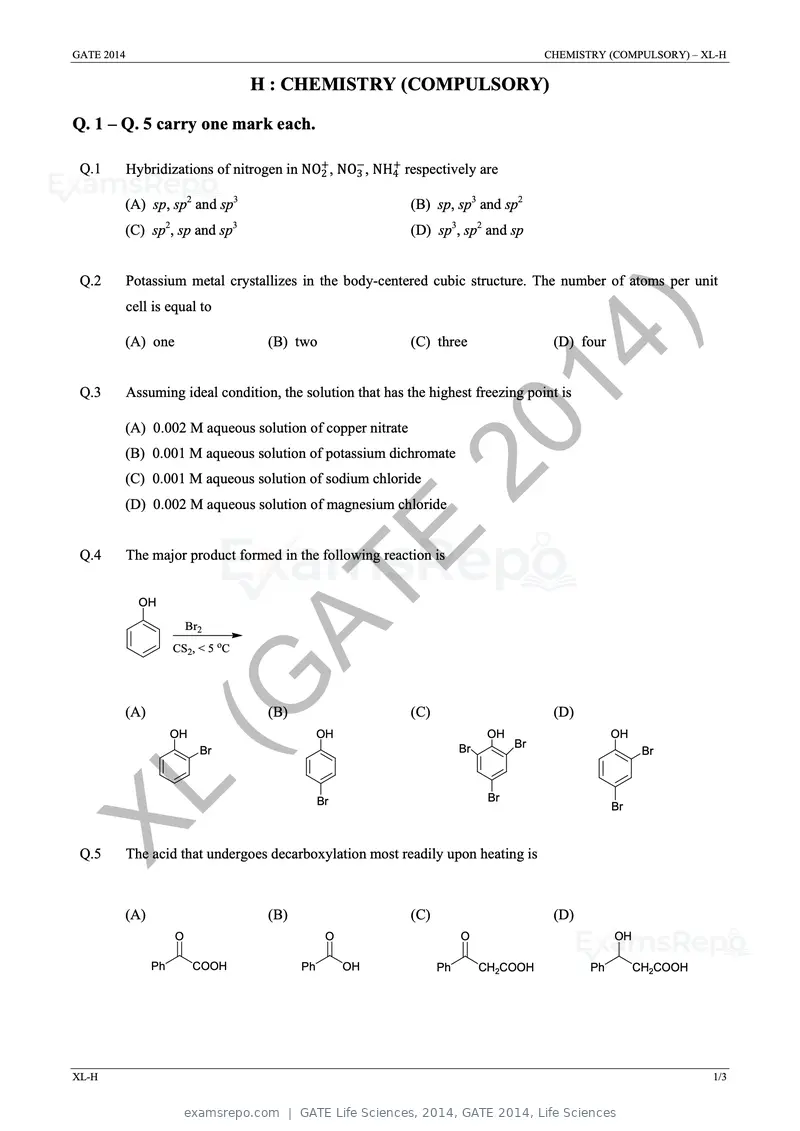
Text of page 7
GATE 2014                                                                               CHEMISTRY (COMPULSORY) – XL-H

                                     H : CHEMISTRY (COMPULSORY)

Q. 1 – Q. 5 carry one mark each.

 Q.1        Hybridizations of nitrogen in NO+     −     +
                                            2 , NO3 , NH4 respectively are

            (A) sp, sp2 and sp3                              (B) sp, sp3 and sp2
            (C) sp2, sp and sp3                              (D) sp3, sp2 and sp


 Q.2        Potassium metal crystallizes in the body-centered cubic structure. The number of atoms per unit
            cell is equal to

            (A) one                   (B) two                (C) three                  4)
                                                                                         (D) four


 Q.3

                                                            20
            Assuming ideal condition, the solution that has the highest freezing point is

            (A) 0.002 M aqueous solution of copper nitrate


                                                               1
            (B) 0.001 M aqueous solution of potassium dichromate
            (C) 0.001 M aqueous solution of sodium chloride
            (D) 0.002 M aqueous solution of magnesium chloride


 Q.4

                                     AT
            The major product formed in the following reaction is


              OH
                           Br2
                       CS2, < 5 oC      E
            (A)
                  (G   OH
                             Br
                                      (B)
                                                 OH
                                                             (C)

                                                                        Br
                                                                              OH
                                                                                   Br
                                                                                         (D)
                                                                                                    OH
                                                                                                          Br


XL
 Q.5
                                                 Br                           Br


            The acid that undergoes decarboxylation most readily upon heating is
                                                                                                    Br


            (A)                       (B)                    (C)                         (D)
                       O                          O                     O                           OH

                  Ph        COOH            Ph        OH           Ph        CH2COOH           Ph        CH2COOH


XL-H                                                                                                               1/3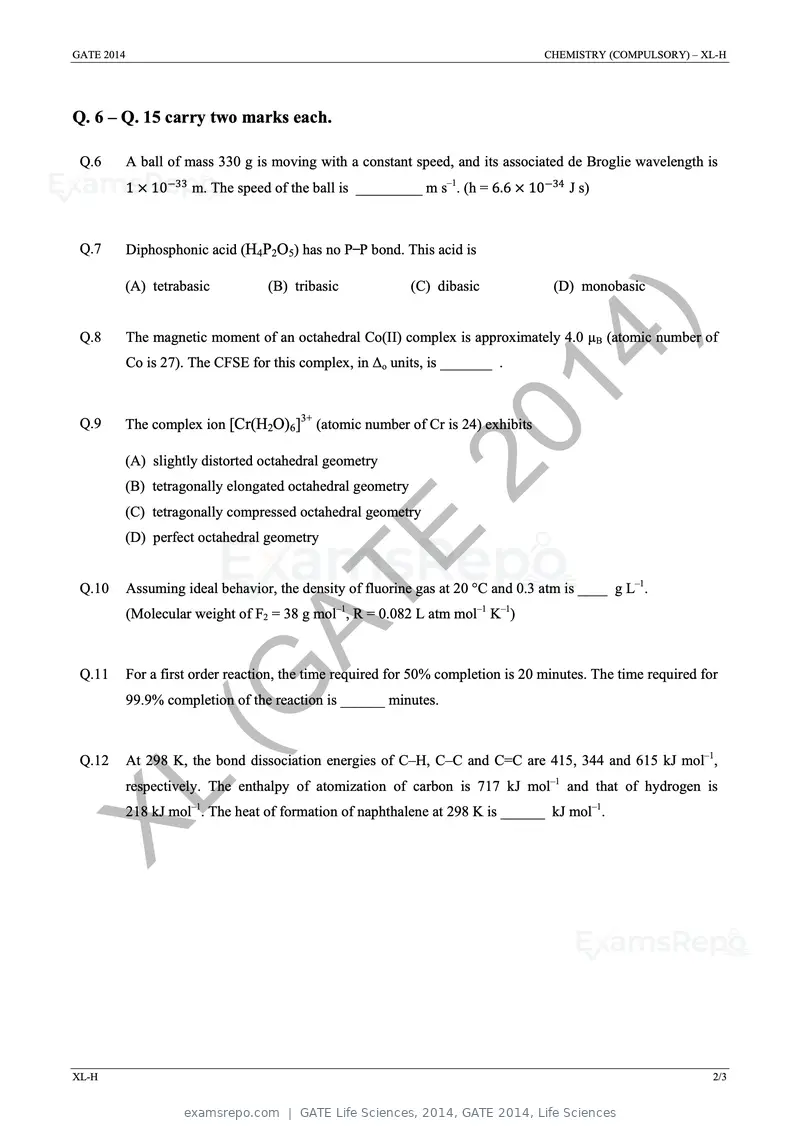
Text of page 8
GATE 2014                                                                            CHEMISTRY (COMPULSORY) – XL-H


Q. 6 – Q. 15 carry two marks each.

 Q.6        A ball of mass 330 g is moving with a constant speed, and its associated de Broglie wavelength is
            1 × 10⁻³³ m. The speed of the ball is _________ m s–1. (h = 6.6 × 10⁻³⁴ J s)


 Q.7        Diphosphonic acid (H4P2O5) has no P ̶ P bond. This acid is

            (A) tetrabasic          (B) tribasic             (C) dibasic              (D) monobasic


 Q.8
                                                                                 4)
            The magnetic moment of an octahedral Co(II) complex is approximately 4.0 µB (atomic number of
            Co is 27). The CFSE for this complex, in Δo units, is _______ .


 Q.9        The complex ion [Cr(H2O)6]
                                         3+
                                                            20
                                              (atomic number of Cr is 24) exhibits

            (A) slightly distorted octahedral geometry
            (B) tetragonally elongated octahedral geometry     1
            (C) tetragonally compressed octahedral geometry


 Q.10                         AT
            (D) perfect octahedral geometry


            Assuming ideal behavior, the density of fluorine gas at 20 °C and 0.3 atm is ____ g L–1.


 Q.11
                                 E
            (Molecular weight of F2 = 38 g mol–1, R = 0.082 L atm mol–1 K–1)


            For a first order reaction, the time required for 50% completion is 20 minutes. The time required for


 Q.12
                (G
            99.9% completion of the reaction is ______ minutes.


            At 298 K, the bond dissociation energies of C–H, C–C and C=C are 415, 344 and 615 kJ mol–1,
            respectively. The enthalpy of atomization of carbon is 717 kJ mol–1 and that of hydrogen is

XL          218 kJ mol–1. The heat of formation of naphthalene at 298 K is ______ kJ mol–1.


XL-H                                                                                                            2/3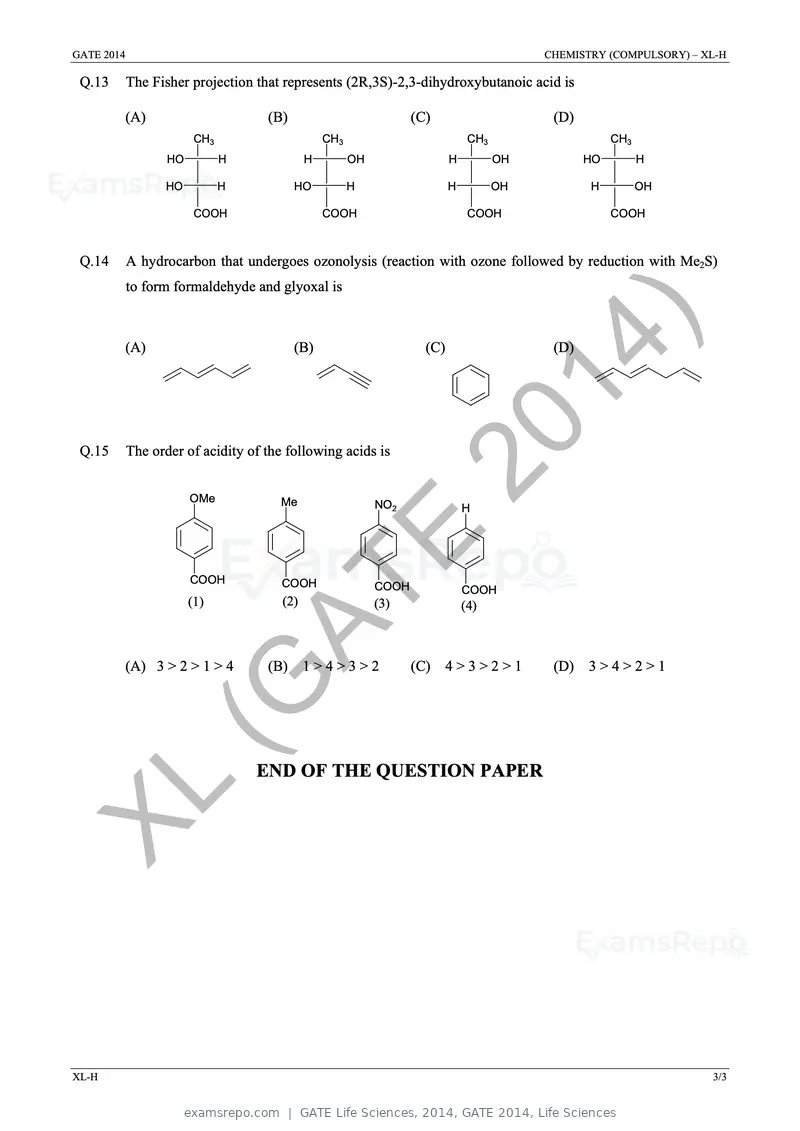
Text of page 9
GATE 2014                                                                                  CHEMISTRY (COMPULSORY) – XL-H

 Q.13       The Fisher projection that represents (2R,3S)-2,3-dihydroxybutanoic acid is

            (A)                     (B)                            (C)                      (D)
                         CH3                     CH3                            CH3                    CH3
                   HO          H             H         OH                  H          OH          HO         H

                  HO           H          HO           H                   H          OH          H          OH

                         COOH                    COOH                           COOH                   COOH


 Q.14       A hydrocarbon that undergoes ozonolysis (reaction with ozone followed by reduction with Me2S)
            to form formaldehyde and glyoxal is


            (A)                           (B)                        (C)                   4)
                                                                                            (D)


 Q.15       The order of acidity of the following acids is
                                                                  20 1
                        OMe            Me                   NO2                H


                        COOH
                                   AT  COOH                 COOH               COOH
                        (1)


            (A) 3 > 2 > 1 > 4
                                      E
                                    (B)
                                       (2)


                                             1>4>3>2
                                                            (3)


                                                                   (C)
                                                                               (4)


                                                                         4>3>2>1            (D)   3>4>2>1


                  (G               END OF THE QUESTION PAPER

XL

XL-H                                                                                                                 3/3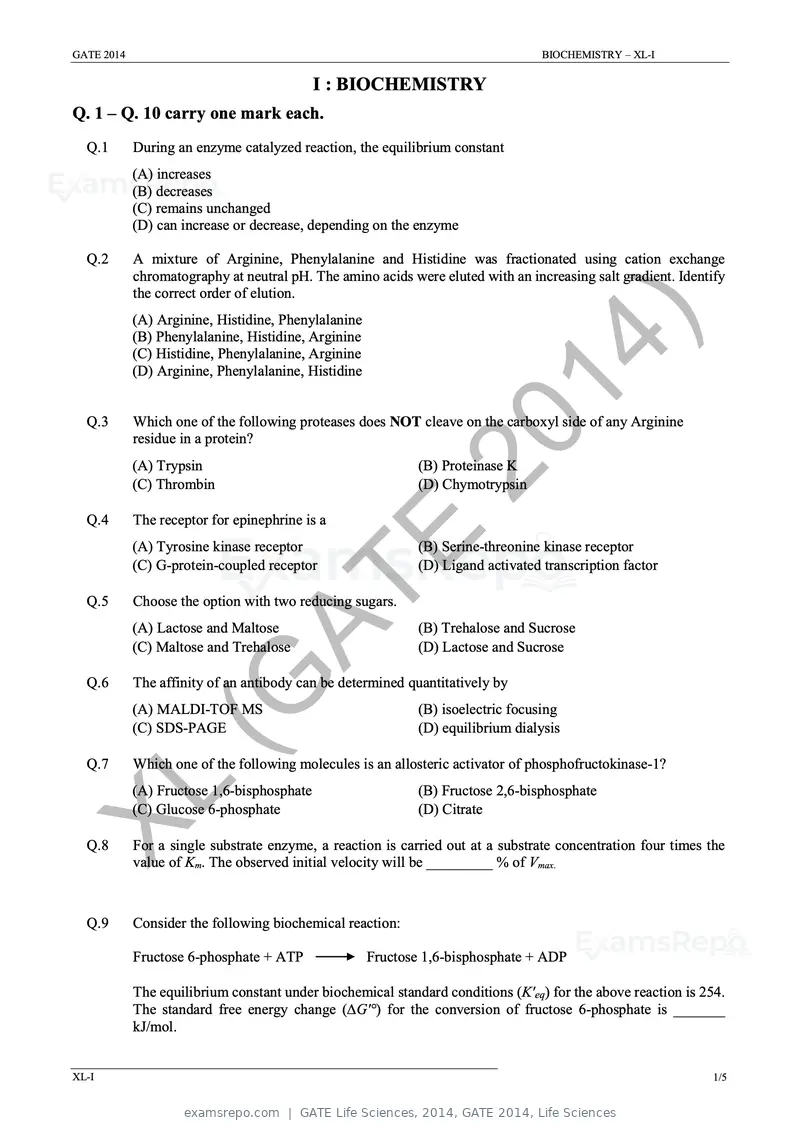
Text of page 10
GATE 2014                                                                        BIOCHEMISTRY – XL-I

                                            I : BIOCHEMISTRY
Q. 1 – Q. 10 carry one mark each.
  Q.1       During an enzyme catalyzed reaction, the equilibrium constant
            (A) increases
            (B) decreases
            (C) remains unchanged
            (D) can increase or decrease, depending on the enzyme

  Q.2       A mixture of Arginine, Phenylalanine and Histidine was fractionated using cation exchange
            chromatography at neutral pH. The amino acids were eluted with an increasing salt gradient. Identify
            the correct order of elution.
            (A) Arginine, Histidine, Phenylalanine
            (B) Phenylalanine, Histidine, Arginine
            (C) Histidine, Phenylalanine, Arginine
            (D) Arginine, Phenylalanine, Histidine
                                                                               4)
  Q.3
                                                           20
            Which one of the following proteases does NOT cleave on the carboxyl side of any Arginine
            residue in a protein?
            (A) Trypsin
            (C) Thrombin                                      1
                                                            (B) Proteinase K
                                                            (D) Chymotrypsin

  Q.4       The receptor for epinephrine is a


                             AT
            (A) Tyrosine kinase receptor
            (C) G-protein-coupled receptor
                                                            (B) Serine-threonine kinase receptor
                                                            (D) Ligand activated transcription factor

  Q.5


                                E
            Choose the option with two reducing sugars.
            (A) Lactose and Maltose
            (C) Maltose and Trehalose
                                                            (B) Trehalose and Sucrose
                                                            (D) Lactose and Sucrose

  Q.6


  Q.7
               (G
            The affinity of an antibody can be determined quantitatively by
            (A) MALDI-TOF MS
            (C) SDS-PAGE
                                                            (B) isoelectric focusing
                                                            (D) equilibrium dialysis

            Which one of the following molecules is an allosteric activator of phosphofructokinase-1?


XLQ.8
            (A) Fructose 1,6-bisphosphate
            (C) Glucose 6-phosphate
                                                            (B) Fructose 2,6-bisphosphate
                                                            (D) Citrate

            For a single substrate enzyme, a reaction is carried out at a substrate concentration four times the
            value of Km. The observed initial velocity will be _________ % of Vmax.


  Q.9       Consider the following biochemical reaction:

            Fructose 6-phosphate + ATP               Fructose 1,6-bisphosphate + ADP

            The equilibrium constant under biochemical standard conditions (K'eq) for the above reaction is 254.
            The standard free energy change (∆G'°) for the conversion of fructose 6-phosphate is _______
            kJ/mol.


XL-I                                                                                                          1/5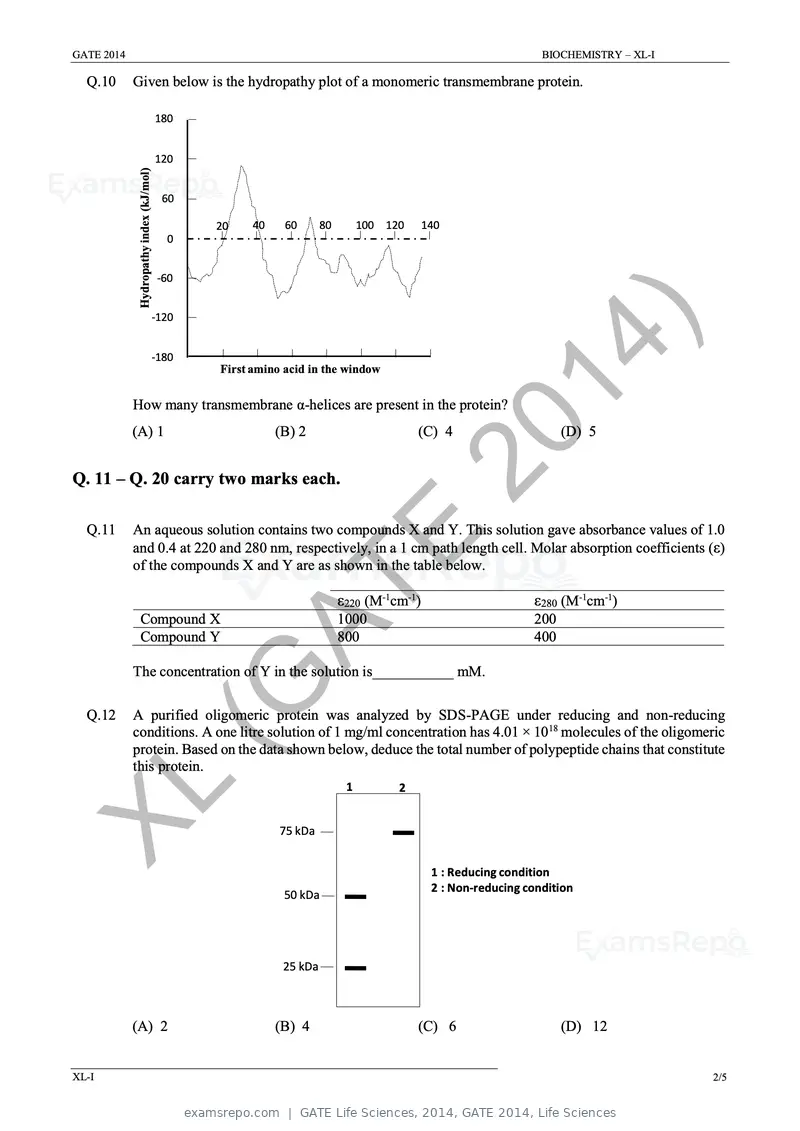
Text of page 11
GATE 2014                                                                                                       BIOCHEMISTRY – XL-I

  Q.10      Given below is the hydropathy plot of a monomeric transmembrane protein.

                                         180


                                         120


             Hydropathy index (kJ/mol)
                                          60

                                                20    40    60       80        100 120     140
                                           0


                                          -60


                                         -120


                                         -180
                                                First amino acid in the window
                                                                                                              4)
            How many transmembrane α-helices are present in the protein?
            (A) 1


Q. 11 – Q. 20 carry two marks each.
                                                           (B) 2                     20 1(C) 4                      (D) 5


  Q.11      An aqueous solution contains two compounds X and Y. This solution gave absorbance values of 1.0


                                                     AT
            and 0.4 at 220 and 280 nm, respectively, in a 1 cm path length cell. Molar absorption coefficients (ε)
            of the compounds X and Y are as shown in the table below.


             Compound X
             Compound Y
                                                        E
            The concentration of Y in the solution is___________ mM.
                                                                          ε220 (M-1cm-1)
                                                                          1000
                                                                          800
                                                                                                              ε280 (M-1cm-1)
                                                                                                              200
                                                                                                              400


  Q.12                                   (G
            A purified oligomeric protein was analyzed by SDS-PAGE under reducing and non-reducing
            conditions. A one litre solution of 1 mg/ml concentration has 4.01 × 10¹⁸ molecules of the oligomeric
            protein. Based on the data shown below, deduce the total number of polypeptide chains that constitute
            this protein.


XL                                                         75 kDa
                                                                           1         2


                                                                                            1 : Reducing condition
                                                                                            2 : Non-reducing condition
                                                            50 kDa


                                                            25 kDa


            (A) 2                                          (B) 4                         (C) 6                      (D) 12


XL-I                                                                                                                                  2/5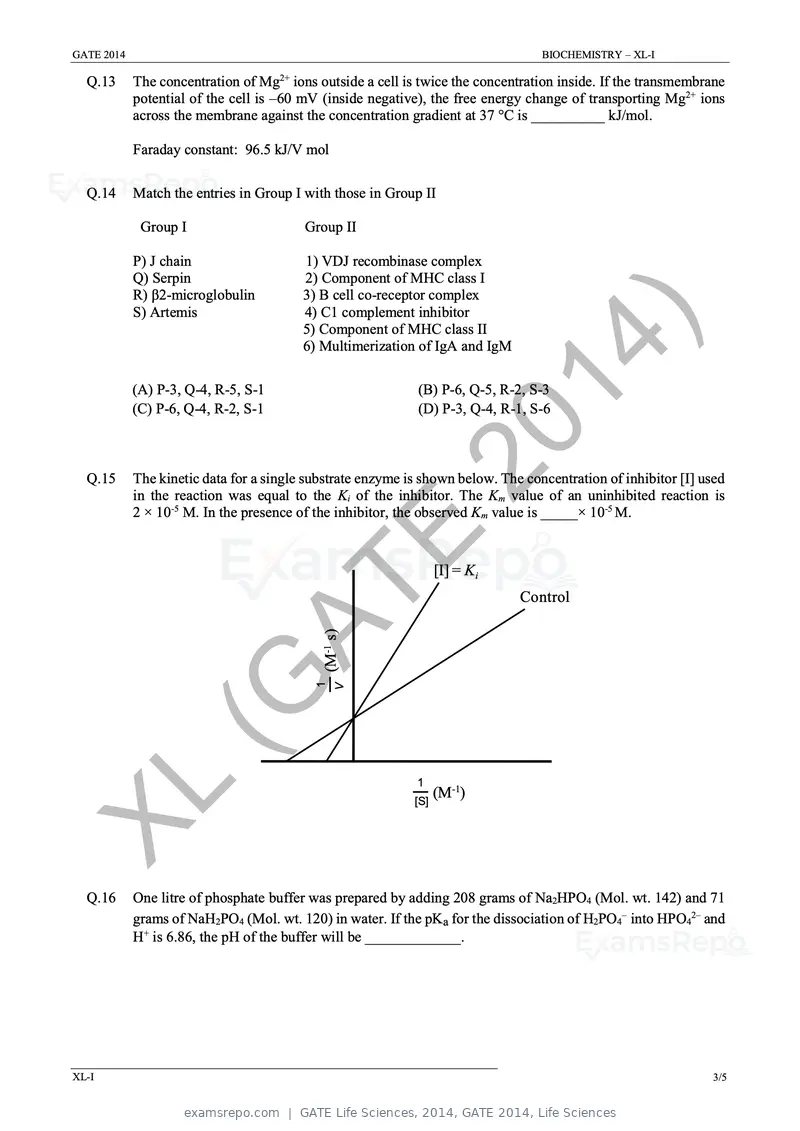
Text of page 12
GATE 2014                                                                         BIOCHEMISTRY – XL-I

  Q.13      The concentration of Mg2+ ions outside a cell is twice the concentration inside. If the transmembrane
            potential of the cell is –60 mV (inside negative), the free energy change of transporting Mg2+ ions
            across the membrane against the concentration gradient at 37 °C is __________ kJ/mol.

            Faraday constant: 96.5 kJ/V mol

  Q.14      Match the entries in Group I with those in Group II

             Group I                     Group II

            P) J chain                   1) VDJ recombinase complex
            Q) Serpin                    2) Component of MHC class I
            R) β2-microglobulin          3) B cell co-receptor complex
            S) Artemis                   4) C1 complement inhibitor
                                         5) Component of MHC class II
                                         6) Multimerization of IgA and IgM      4)
  Q.15
            (A) P-3, Q-4, R-5, S-1
            (C) P-6, Q-4, R-2, S-1
                                                          20 (B) P-6, Q-5, R-2, S-3
                                                             (D) P-3, Q-4, R-1, S-6


                                                             1
            The kinetic data for a single substrate enzyme is shown below. The concentration of inhibitor [I] used
            in the reaction was equal to the Ki of the inhibitor. The Km value of an uninhibited reaction is
            2 × 10⁻⁵ M. In the presence of the inhibitor, the observed Km value is _____× 10-5 M.


                             AT                                 [I] = Ki


                                E           ―
                                            V
                                              (M-1 s)
                                                                              Control


               (G                          1


                                                            1


XL                                                         ―
                                                           [S]
                                                               (M-1)


  Q.16      One litre of phosphate buffer was prepared by adding 208 grams of Na2HPO4 (Mol. wt. 142) and 71
            grams of NaH2PO4 (Mol. wt. 120) in water. If the pKa for the dissociation of H2PO4– into HPO42– and
            H+ is 6.86, the pH of the buffer will be _____________.


XL-I                                                                                                           3/5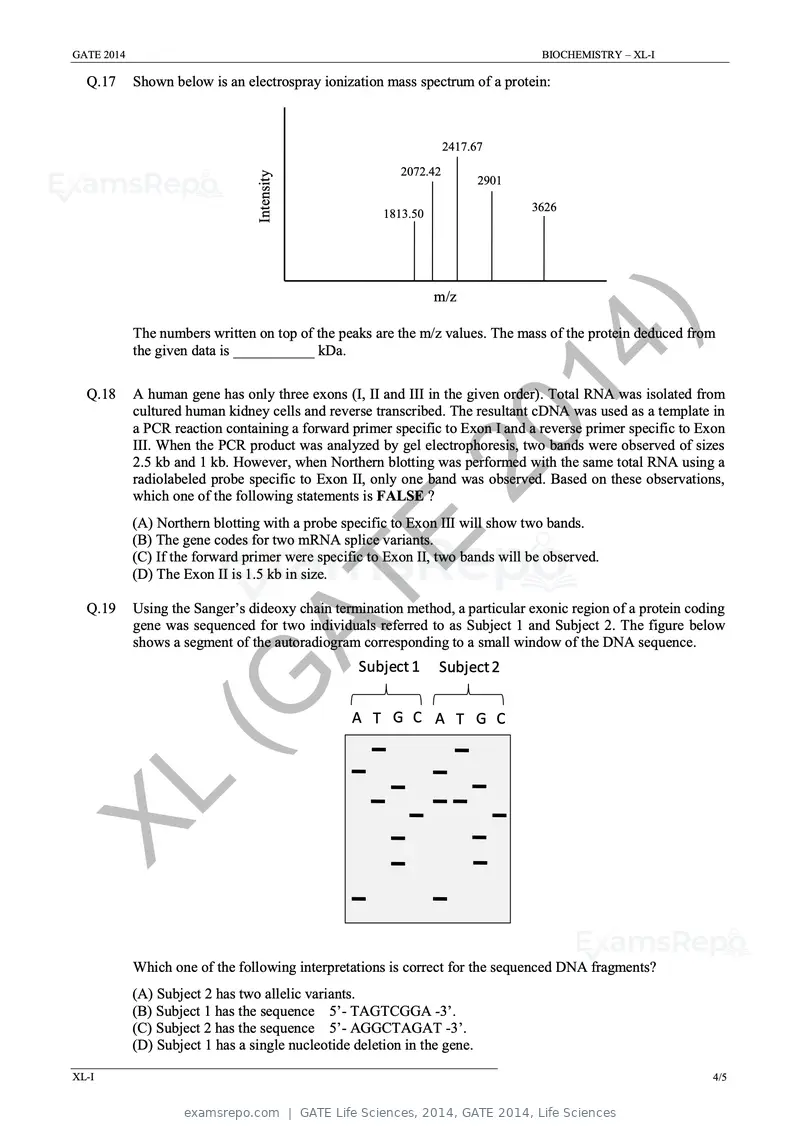
Text of page 13
GATE 2014                                                                         BIOCHEMISTRY – XL-I

  Q.17      Shown below is an electrospray ionization mass spectrum of a protein:


                                                                    2417.67
                                                          2072.42

                                 Intensity
                                                                          2901

                                                                                 3626
                                                       1813.50


                                                                 m/z


                                                                                 4)
            The numbers written on top of the peaks are the m/z values. The mass of the protein deduced from
            the given data is ___________ kDa.

  Q.18

                                                          20
            A human gene has only three exons (I, II and III in the given order). Total RNA was isolated from
            cultured human kidney cells and reverse transcribed. The resultant cDNA was used as a template in
            a PCR reaction containing a forward primer specific to Exon I and a reverse primer specific to Exon


                                                             1
            III. When the PCR product was analyzed by gel electrophoresis, two bands were observed of sizes
            2.5 kb and 1 kb. However, when Northern blotting was performed with the same total RNA using a
            radiolabeled probe specific to Exon II, only one band was observed. Based on these observations,
            which one of the following statements is FALSE ?
            (A) Northern blotting with a probe specific to Exon III will show two bands.


                             AT
            (B) The gene codes for two mRNA splice variants.
            (C) If the forward primer were specific to Exon II, two bands will be observed.
            (D) The Exon II is 1.5 kb in size.

  Q.19

                                E
            Using the Sanger’s dideoxy chain termination method, a particular exonic region of a protein coding
            gene was sequenced for two individuals referred to as Subject 1 and Subject 2. The figure below
            shows a segment of the autoradiogram corresponding to a small window of the DNA sequence.
                                                   Subject 1     Subject 2


               (G                                A T G C A T G C


XL
            Which one of the following interpretations is correct for the sequenced DNA fragments?
            (A) Subject 2 has two allelic variants.
            (B) Subject 1 has the sequence 5’- TAGTCGGA -3’.
            (C) Subject 2 has the sequence 5’- AGGCTAGAT -3’.
            (D) Subject 1 has a single nucleotide deletion in the gene.

XL-I                                                                                                        4/5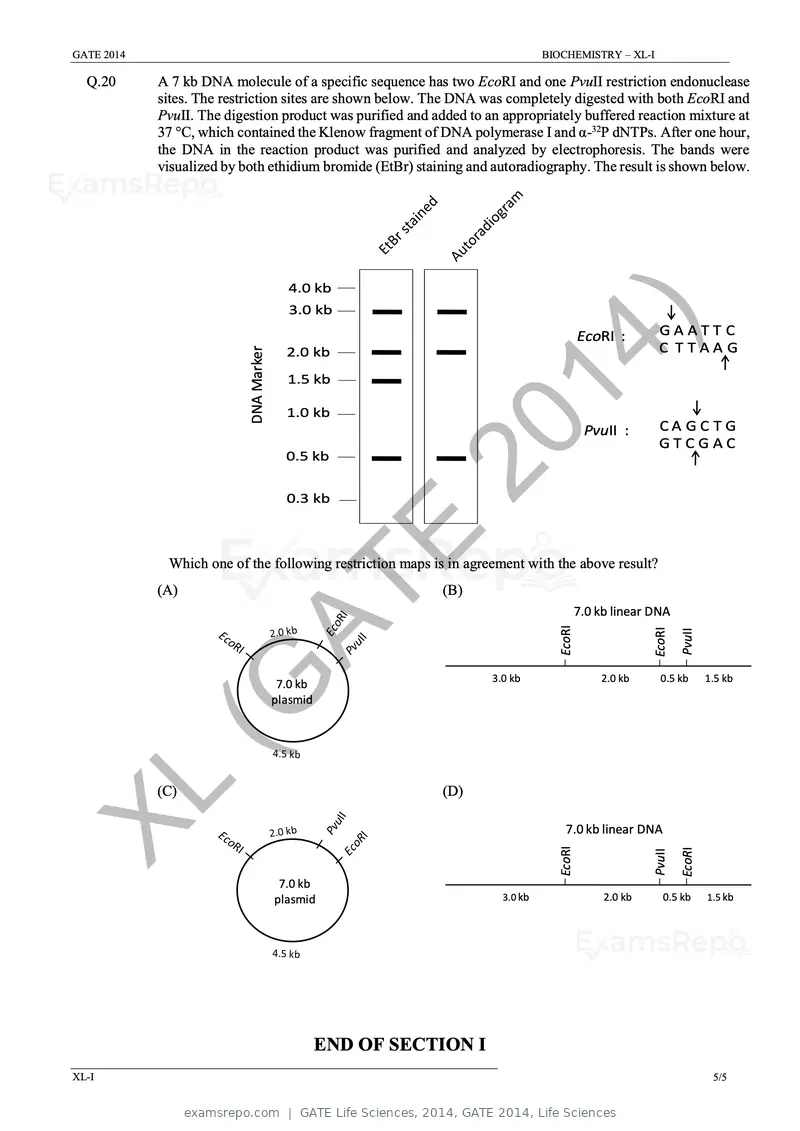
Text of page 14
GATE 2014                                                                                                                       BIOCHEMISTRY – XL-I

  Q.20       A 7 kb DNA molecule of a specific sequence has two EcoRI and one PvuII restriction endonuclease
             sites. The restriction sites are shown below. The DNA was completely digested with both EcoRI and
             PvuII. The digestion product was purified and added to an appropriately buffered reaction mixture at
             37 °C, which contained the Klenow fragment of DNA polymerase I and α-32P dNTPs. After one hour,
             the DNA in the reaction product was purified and analyzed by electrophoresis. The bands were
             visualized by both ethidium bromide (EtBr) staining and autoradiography. The result is shown below.


                                                                          EtBr staining      Autoradiograph

                                                 4.0 kb
                                                  3.0 kb

   Autoradiograph


                                 DNA Marker
                                                 2.0 kb                                                                         4)        EcoRI :        GAATT C
                                                                                                                                                         C TTAAG


                                  DNA marker
                                                 1.5 kb
       EtBr staining


                        4.0 kb    3.0 kb
                                                 1.0 kb


                                                    2.0 kb
                                                 0.5 kb
                                                               1.5 kb      1.0 kb
                                                                                          20 1
                                                                                          0.5 kb              0.3 kb
                                                                                                                                           PvuII :       CA GC TG
                                                                                                                                                         GTCGAC


                                                 0.3 kb
                                                              DNA marker


                           AT
              Which one of the following restriction maps is in agreement with the above result?
             (A)                                                PvuII :                       (B)  EcoRI :


                              E                              CA GC TG
                                                             GTCGAC
                                                                                           GAATT C
                                                                                           C TTAAG
                                                                                                                                  EcoRI
                                                                                                                                          7.0 kb linear DNA

                                                                                                                                                        EcoRI   PvuII


            (G                                  7.0 kb
                                               plasmid
                                                                                                                3.0 kb                        2.0 kb      0.5 kb        1.5 kb


XL           (C)                                                                              (D)

                                                                                                                                    7.0 kb linear DNA

                                                                                                                                  EcoRI                 PvuII   EcoRI
                                                7.0 kb
                                               plasmid                                                                 3.0 kb                  2.0 kb      0.5 kb       1.5 kb


                                                         END OF SECTION I
XL-I                                                                                                                                                                     5/5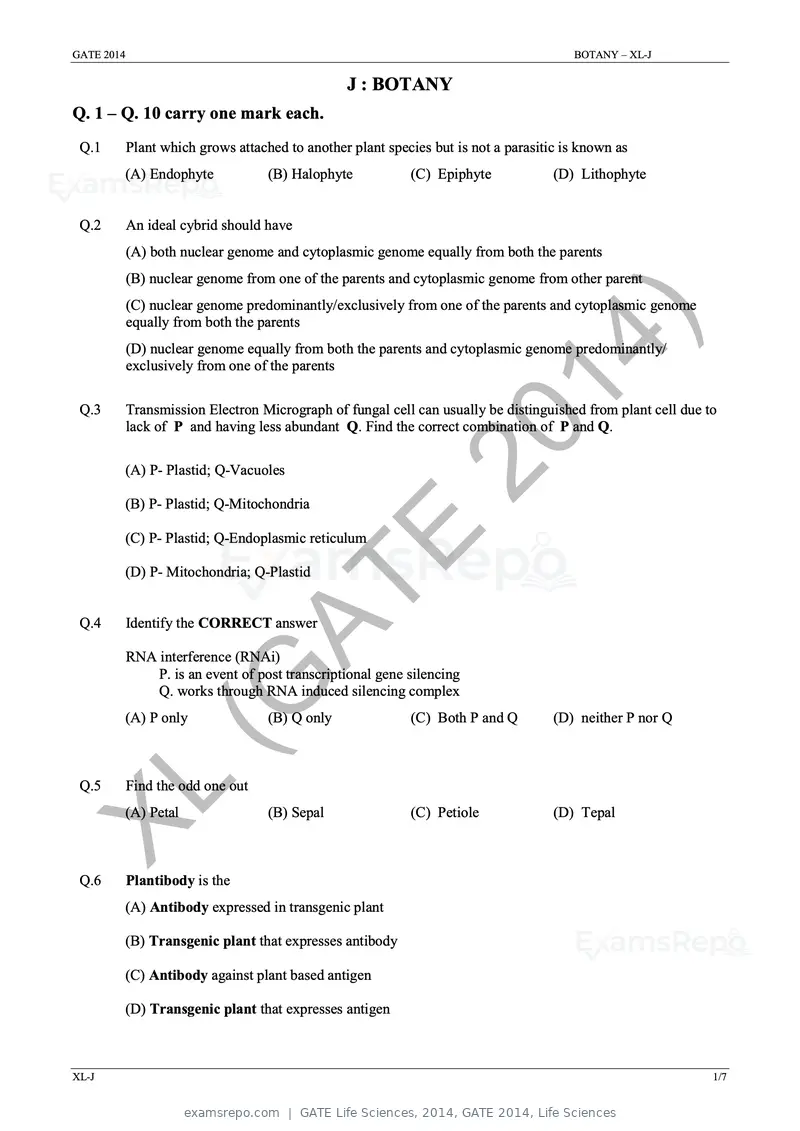
Text of page 15
GATE 2014                                                                               BOTANY – XL-J

                                                 J : BOTANY
Q. 1 – Q. 10 carry one mark each.
 Q.1        Plant which grows attached to another plant species but is not a parasitic is known as
        (A) Endophyte               (B) Halophyte           (C) Epiphyte             (D) Lithophyte


 Q.2        An ideal cybrid should have
            (A) both nuclear genome and cytoplasmic genome equally from both the parents
            (B) nuclear genome from one of the parents and cytoplasmic genome from other parent
            (C) nuclear genome predominantly/exclusively from one of the parents and cytoplasmic genome
            equally from both the parents
                                                                                 4)
            (D) nuclear genome equally from both the parents and cytoplasmic genome predominantly/
            exclusively from one of the parents

 Q.3
                                                           20
            Transmission Electron Micrograph of fungal cell can usually be distinguished from plant cell due to
            lack of P and having less abundant Q. Find the correct combination of P and Q.

        (A) P- Plastid; Q-Vacuoles
                                                              1
        (B) P- Plastid; Q-Mitochondria


                                AT
        (C) P- Plastid; Q-Endoplasmic reticulum

        (D) P- Mitochondria; Q-Plastid


 Q.4
                                   E
            Identify the CORRECT answer

            RNA interference (RNAi)
                P. is an event of post transcriptional gene silencing


                (G
                Q. works through RNA induced silencing complex
        (A) P only                  (B) Q only              (C) Both P and Q         (D) neither P nor Q


XL
 Q.5        Find the odd one out
        (A) Petal                   (B) Sepal               (C) Petiole              (D) Tepal


 Q.6        Plantibody is the
        (A) Antibody expressed in transgenic plant

        (B) Transgenic plant that expresses antibody

        (C) Antibody against plant based antigen

        (D) Transgenic plant that expresses antigen


XL-J                                                                                                          1/7
Text of page 16
GATE 2014                                                                                BOTANY – XL-J

 Q.7        In a typical oil-seed crop, the matured seeds are enriched with
        (A) Phospholipid            (B) Galactolipid         (C) Neutral lipid        (D) Sphingolipid


 Q.8        Match the following products (Column I) with the corresponding plant species (Column II )


             Column I                           Column II
             P. Saffron                         1. Garcinia sp.
             Q. Gamboge                         2. Rocella tinctoria
             R. Litmus                          3. Crocus sativus
             S. Turmeric                        4. Curcuma sp.
        (A)                         (B)                      (C)                      (D)
        P-4
        Q-2
        R-1
        S-3
                                  P-3
                                  Q-4
                                  R-1
                                  S-2
                                                              P-2
                                                              Q-3
                                                              R-2
                                                              S-1
                                                                                 4)    P-3
                                                                                       Q-1
                                                                                       R-2
                                                                                       S-4

 Q.9
                                                            20
            The semi-dwarf trait of corn, wheat and rice plants used in breeding program during 1960s resulted
            in green revolution. Later this ‘green-revolution gene’ has been identified to be involved in either
            signal transduction pathway or biosynthesis of
        (A) Auxin                   (B) Gibberellin
                                                               1
                                                             (C) Cytokinin            (D) Ethylene


 Q.10

                               AT
            In classical model to explain the plant-pathogen interaction, the host will not develop the disease
            upon the pathogen attack when


                                  E
        (A) The resistance gene (R) is non-functional

        (C) Both R and Avr are non-functional
                                                             (B) The avirulence gene (Avr) is non-functional

                                                             (D) Both R and Avr are functional


                (G
XL

XL-J                                                                                                              2/7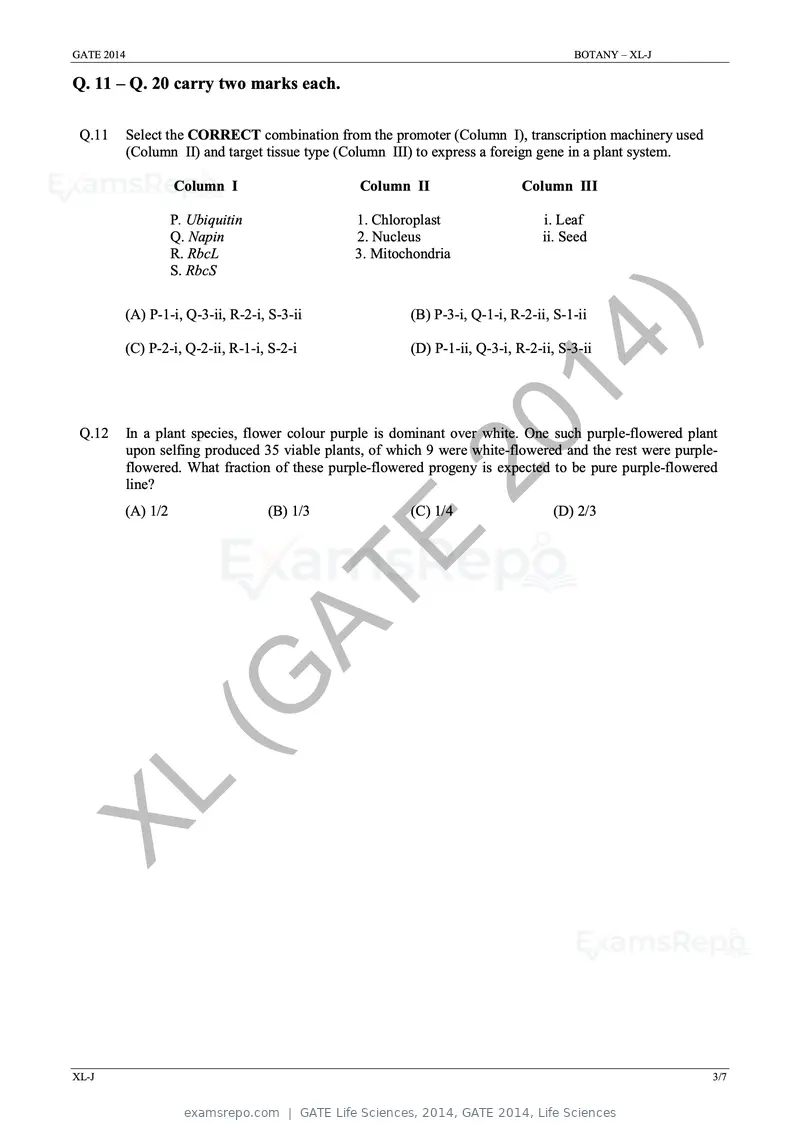
Text of page 17
GATE 2014                                                                              BOTANY – XL-J

Q. 11 – Q. 20 carry two marks each.

 Q.11       Select the CORRECT combination from the promoter (Column I), transcription machinery used
            (Column II) and target tissue type (Column III) to express a foreign gene in a plant system.

                   Column I                      Column II                    Column III

                   P. Ubiquitin                  1. Chloroplast                   i. Leaf
                   Q. Napin                      2. Nucleus                       ii. Seed
                   R. RbcL                       3. Mitochondria
                   S. RbcS

        (A) P-1-i, Q-3-ii, R-2-i, S-3-ii                  (B) P-3-i, Q-1-i, R-2-ii, S-1-ii

        (C) P-2-i, Q-2-ii, R-1-i, S-2-i                                        4)
                                                          (D) P-1-ii, Q-3-i, R-2-ii, S-3-ii


 Q.12                                                    20 1
            In a plant species, flower colour purple is dominant over white. One such purple-flowered plant
            upon selfing produced 35 viable plants, of which 9 were white-flowered and the rest were purple-
            flowered. What fraction of these purple-flowered progeny is expected to be pure purple-flowered
            line?
        (A) 1/2                    (B) 1/3                (C) 1/4                   (D) 2/3


                              AT
                                 E
                (G
XL

XL-J                                                                                                       3/7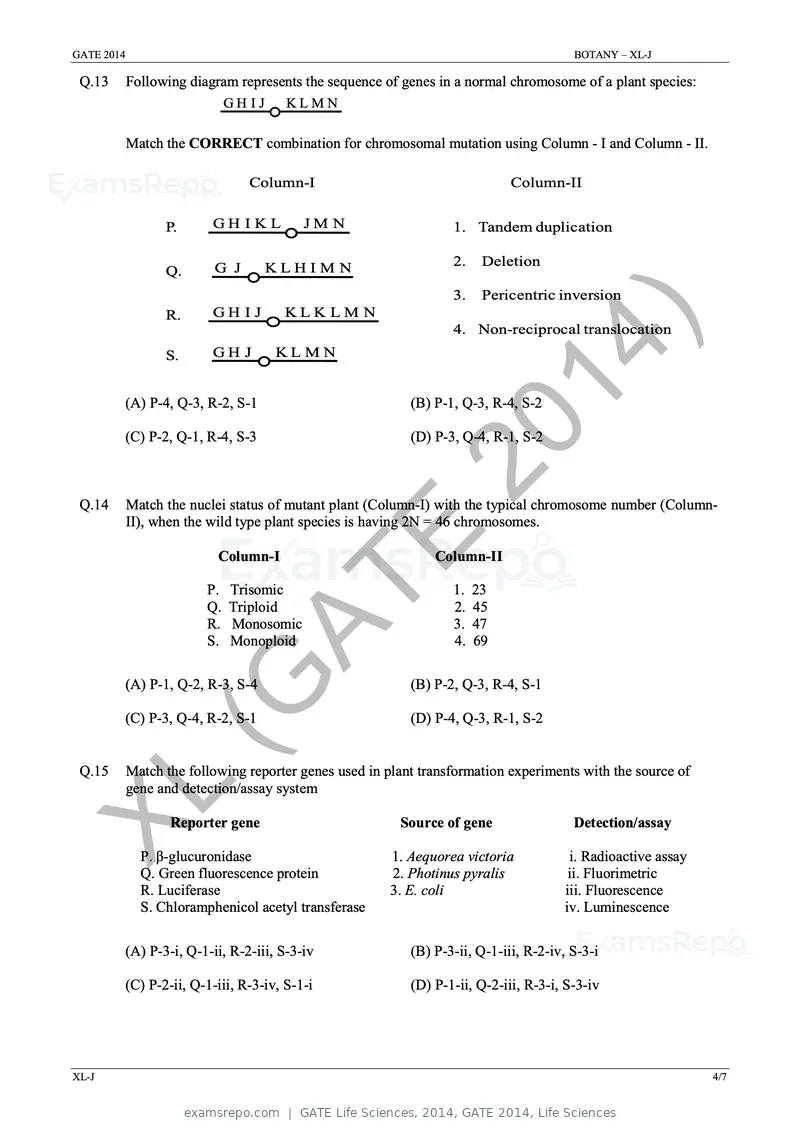
Text of page 18
GATE 2014                                                                               BOTANY – XL-J

 Q.13       Following diagram represents the sequence of genes in a normal chromosome of a plant species:
                            GH IJ     KLMN

            Match the CORRECT combination for chromosomal mutation using Column - I and Column - II.

                                Column-I                                     Column-II


                  P.      GH IKL         JM N                     1. Tandem duplication

                          G J       KLHIM N                       2.   Deletion
                  Q.
                                                                  3.   Pericentric inversion
                  R.      GH IJ       KLKLM N


                  S.      GH J      KLMN                                        4)
                                                                  4. Non-reciprocal translocation


        (A) P-4, Q-3, R-2, S-1

        (C) P-2, Q-1, R-4, S-3                            20
                                                           (B) P-1, Q-3, R-4, S-2


                                                             1
                                                           (D) P-3, Q-4, R-1, S-2


 Q.14       Match the nuclei status of mutant plant (Column-I) with the typical chromosome number (Column-
            II), when the wild type plant species is having 2N = 46 chromosomes.


                              AT
                           Column-I

                         P. Trisomic
                                                               Column-II

                                                                  1. 23


                                 E
                         Q. Triploid
                         R. Monosomic
                         S. Monoploid
                                                                  2. 45
                                                                  3. 47
                                                                  4. 69


 Q.15
                (G
        (A) P-1, Q-2, R-3, S-4

        (C) P-3, Q-4, R-2, S-1
                                                           (B) P-2, Q-3, R-4, S-1

                                                           (D) P-4, Q-3, R-1, S-2


            Match the following reporter genes used in plant transformation experiments with the source of


XL          gene and detection/assay system

                   Reporter gene

              P. β-glucuronidase
              Q. Green fluorescence protein
                                                         Source of gene

                                                        1. Aequorea victoria
                                                        2. Photinus pyralis
                                                                                        Detection/assay

                                                                                       i. Radioactive assay
                                                                                       ii. Fluorimetric
              R. Luciferase                             3. E. coli                    iii. Fluorescence
              S. Chloramphenicol acetyl transferase                                   iv. Luminescence

        (A) P-3-i, Q-1-ii, R-2-iii, S-3-iv                 (B) P-3-ii, Q-1-iii, R-2-iv, S-3-i

        (C) P-2-ii, Q-1-iii, R-3-iv, S-1-i                 (D) P-1-ii, Q-2-iii, R-3-i, S-3-iv


XL-J                                                                                                          4/7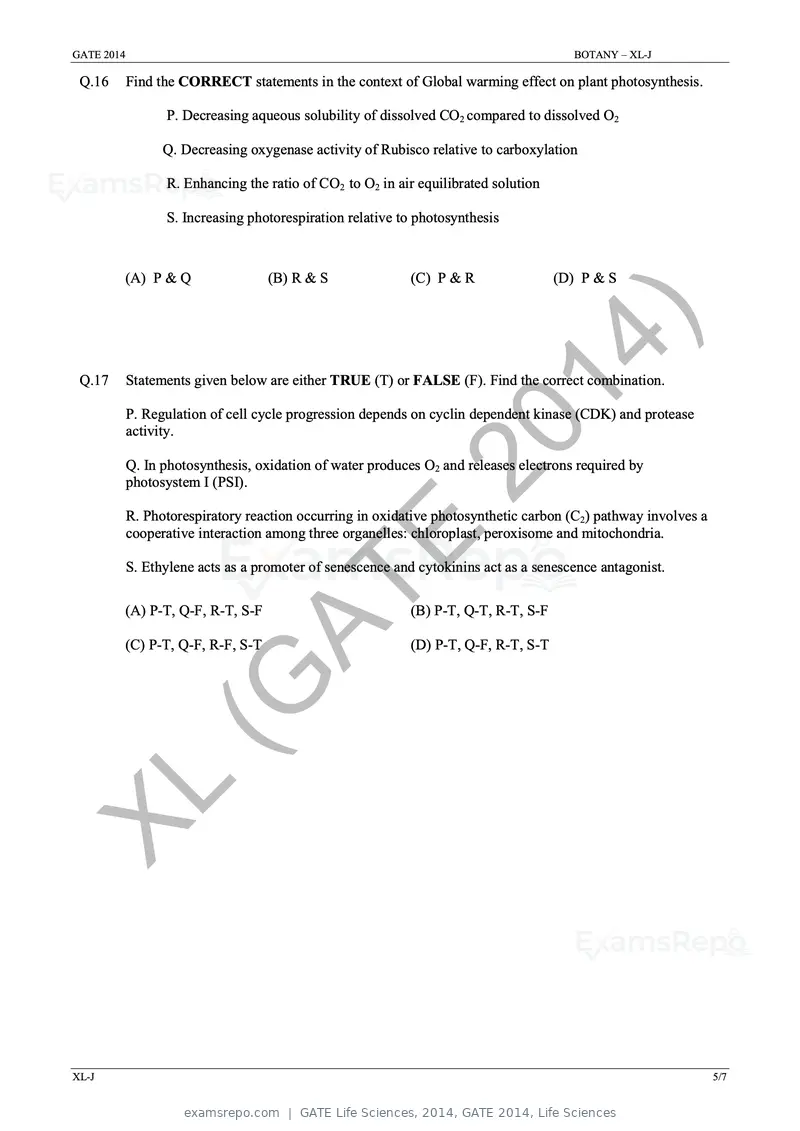
Text of page 19
GATE 2014                                                                              BOTANY – XL-J

 Q.16       Find the CORRECT statements in the context of Global warming effect on plant photosynthesis.

                  P. Decreasing aqueous solubility of dissolved CO2 compared to dissolved O2

                  Q. Decreasing oxygenase activity of Rubisco relative to carboxylation

                  R. Enhancing the ratio of CO2 to O2 in air equilibrated solution

                  S. Increasing photorespiration relative to photosynthesis


        (A) P & Q                  (B) R & S                (C) P & R                (D) P & S


 Q.17
                                                                                4)
            Statements given below are either TRUE (T) or FALSE (F). Find the correct combination.


                                                          20
            P. Regulation of cell cycle progression depends on cyclin dependent kinase (CDK) and protease
            activity.


                                                             1
            Q. In photosynthesis, oxidation of water produces O2 and releases electrons required by
            photosystem I (PSI).

            R. Photorespiratory reaction occurring in oxidative photosynthetic carbon (C2) pathway involves a


                              AT
            cooperative interaction among three organelles: chloroplast, peroxisome and mitochondria.

            S. Ethylene acts as a promoter of senescence and cytokinins act as a senescence antagonist.

        (A) P-T, Q-F, R-T, S-F

        (C) P-T, Q-F, R-F, S-T   E                          (B) P-T, Q-T, R-T, S-F

                                                            (D) P-T, Q-F, R-T, S-T


                (G
XL

XL-J                                                                                                            5/7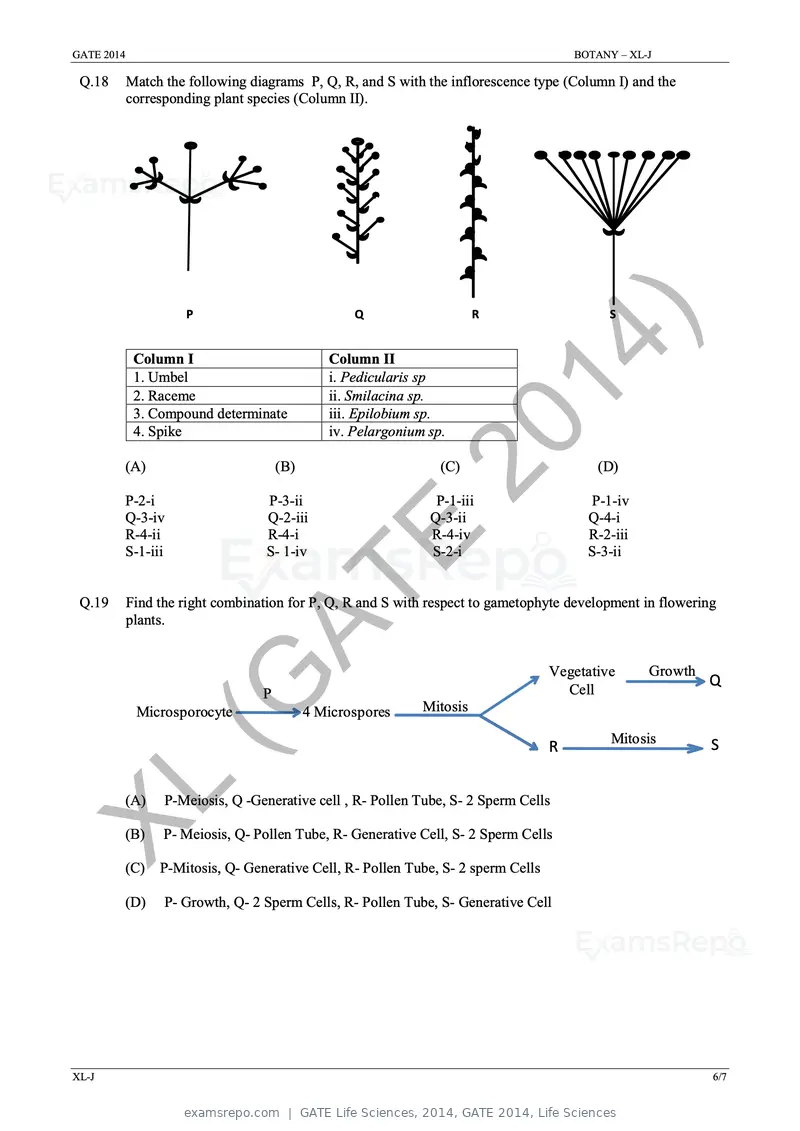
Text of page 20
GATE 2014                                                                              BOTANY – XL-J

 Q.18       Match the following diagrams P, Q, R, and S with the inflorescence type (Column I) and the
            corresponding plant species (Column II).


                                                       v


                     P                             Q                    R                   S


             Column I
             1. Umbel
                                               Column II
                                               i. Pedicularis sp
                                                                              4)
        (A)
             2. Raceme
             3. Compound determinate
             4. Spike

                                      (B)
                                                            20
                                               ii. Smilacina sp.
                                               iii. Epilobium sp.
                                               iv. Pelargonium sp.


                                                               1 (C)                       (D)

        P-2-i                      P-3-ii                       P-1-iii                   P-1-iv
        Q-3-iv                     Q-2-iii                     Q-3-ii                    Q-4-i
        R-4-ii
        S-1-iii

                              AT   R-4-i
                                   S- 1-iv
                                                               R-4-iv
                                                               S-2-i
                                                                                         R-2-iii
                                                                                         S-3-ii


 Q.19

                                 E
            Find the right combination for P, Q, R and S with respect to gametophyte development in flowering
            plants.


                                                                                   Vegetative      Growth
                                                                                                            Q

                (G
             Microsporocyte
                                  P
                                            4 Microspores     Mitosis

                                                                                   R
                                                                                     Cell


                                                                                             Mitosis        S


XL      (A)

        (B)

        (C)
                  P-Meiosis, Q -Generative cell , R- Pollen Tube, S- 2 Sperm Cells

                  P- Meiosis, Q- Pollen Tube, R- Generative Cell, S- 2 Sperm Cells

                 P-Mitosis, Q- Generative Cell, R- Pollen Tube, S- 2 sperm Cells

        (D)       P- Growth, Q- 2 Sperm Cells, R- Pollen Tube, S- Generative Cell


XL-J                                                                                                        6/7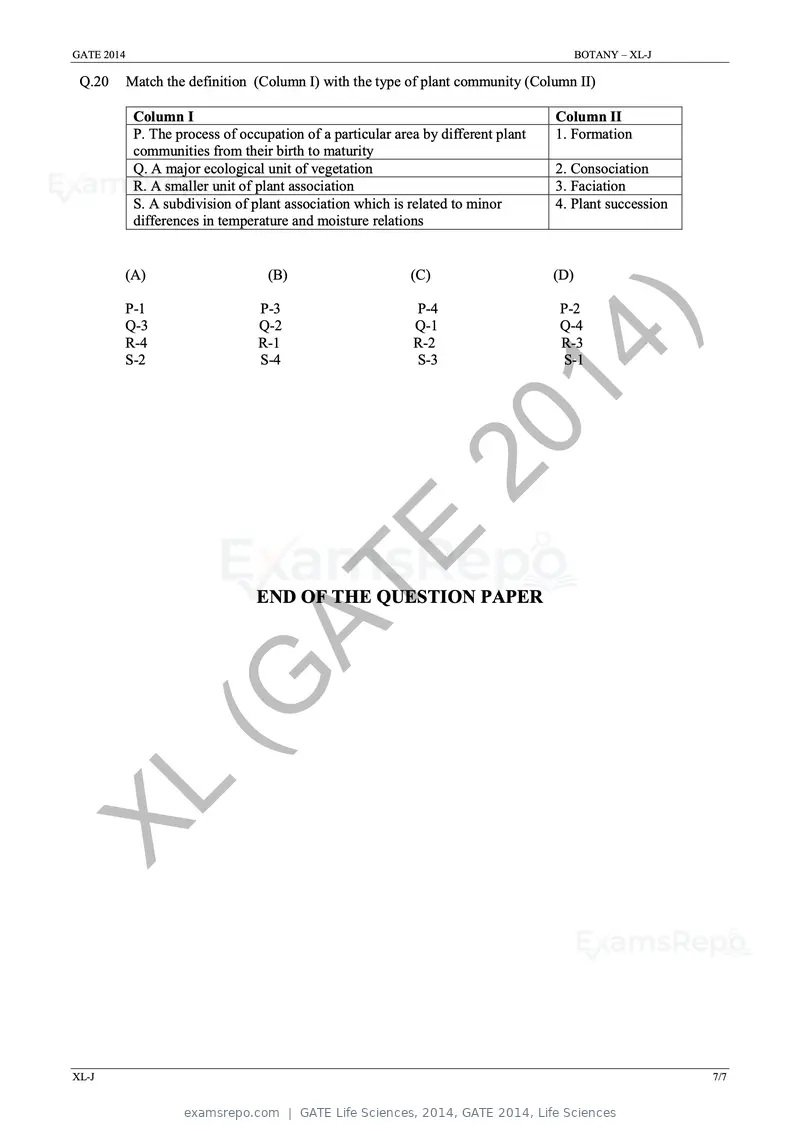
Text of page 21
GATE 2014                                                                                 BOTANY – XL-J

 Q.20       Match the definition (Column I) with the type of plant community (Column II)

             Column I                                                               Column II
             P. The process of occupation of a particular area by different plant   1. Formation
             communities from their birth to maturity
             Q. A major ecological unit of vegetation                               2. Consociation
             R. A smaller unit of plant association                                 3. Faciation
             S. A subdivision of plant association which is related to minor        4. Plant succession
             differences in temperature and moisture relations


        (A)                         (B)                      (C)                    (D)

        P-1                       P-3                        P-4                    P-2
        Q-3
        R-4
        S-2
                                  Q-2
                                  R-1
                                  S-4
                                                             Q-1
                                                             R-2
                                                             S-3
                                                                                    4)
                                                                                    Q-4
                                                                                    R-3
                                                                                    S-1


                                                           20 1
                              AT
                                 EEND OF THE QUESTION PAPER


                (G
XL

XL-J                                                                                                      7/7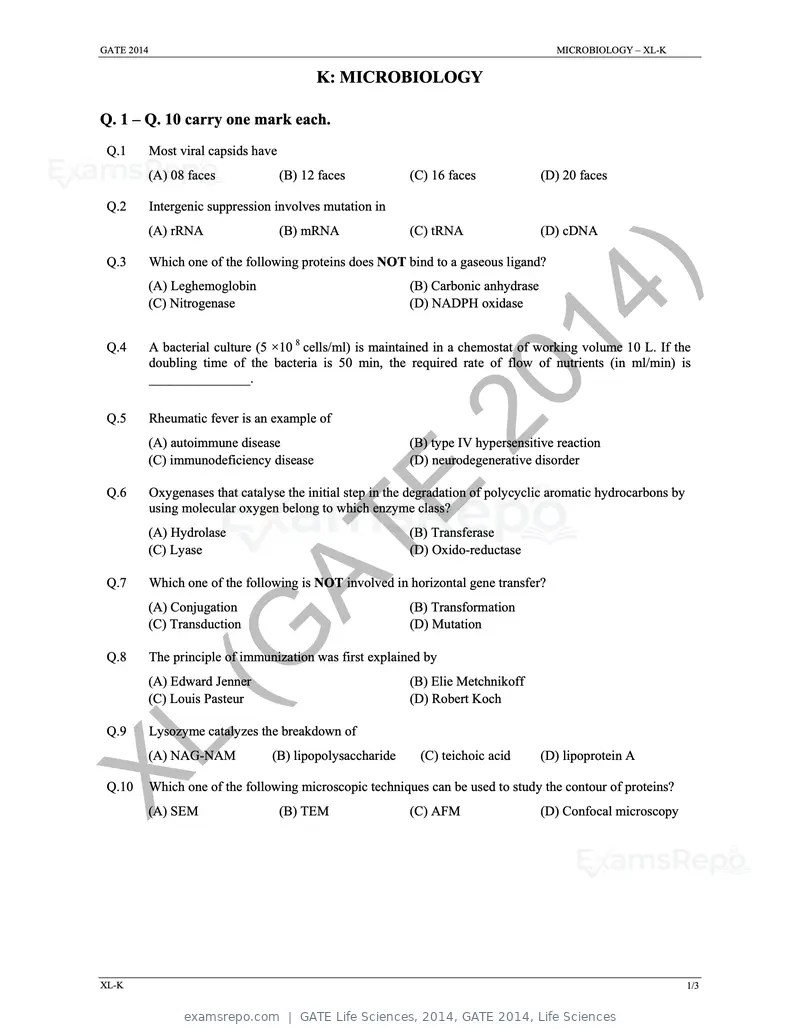
Text of page 22
GATE 2014                                                                              MICROBIOLOGY – XL-K

                                            K: MICROBIOLOGY

Q. 1 – Q. 10 carry one mark each.
 Q.1        Most viral capsids have
        (A) 08 faces                  (B) 12 faces          (C) 16 faces             (D) 20 faces

 Q.2        Intergenic suppression involves mutation in
        (A) rRNA                      (B) mRNA              (C) tRNA                 (D) cDNA

 Q.3        Which one of the following proteins does NOT bind to a gaseous ligand?


 Q.4
        (A) Leghemoglobin
        (C) Nitrogenase
                                                           20
                                                            (B) Carbonic anhydrase
                                                            (D) NADPH oxidase


                                                             14
            A bacterial culture (5 ×10 8 cells/ml) is maintained in a chemostat of working volume 10 L. If the
            doubling time of the bacteria is 50 min, the required rate of flow of nutrients (in ml/min) is


                                                               )
            _______________.

 Q.5        Rheumatic fever is an example of
        (A) autoimmune disease                              (B) type IV hypersensitive reaction
        (C) immunodeficiency disease                        (D) neurodegenerative disorder

 Q.6
                                                E
            Oxygenases that catalyse the initial step in the degradation of polycyclic aromatic hydrocarbons by
            using molecular oxygen belong to which enzyme class?
        (A) Hydrolase                                       (B) Transferase


 Q.7
        (C) Lyase

                            AT                              (D) Oxido-reductase

            Which one of the following is NOT involved in horizontal gene transfer?
        (A) Conjugation
        (C) Transduction
                                                            (B) Transformation
                                                            (D) Mutation

 Q.8
            (G
            The principle of immunization was first explained by
        (A) Edward Jenner
        (C) Louis Pasteur
                                                            (B) Elie Metchnikoff
                                                            (D) Robert Koch

 Q.9        Lysozyme catalyzes the breakdown of


XL
 Q.10
        (A) NAG-NAM               (B) lipopolysaccharide      (C) teichoic acid      (D) lipoprotein A

            Which one of the following microscopic techniques can be used to study the contour of proteins?
        (A) SEM                       (B) TEM               (C) AFM                  (D) Confocal microscopy


XL-K                                                                                                              1/3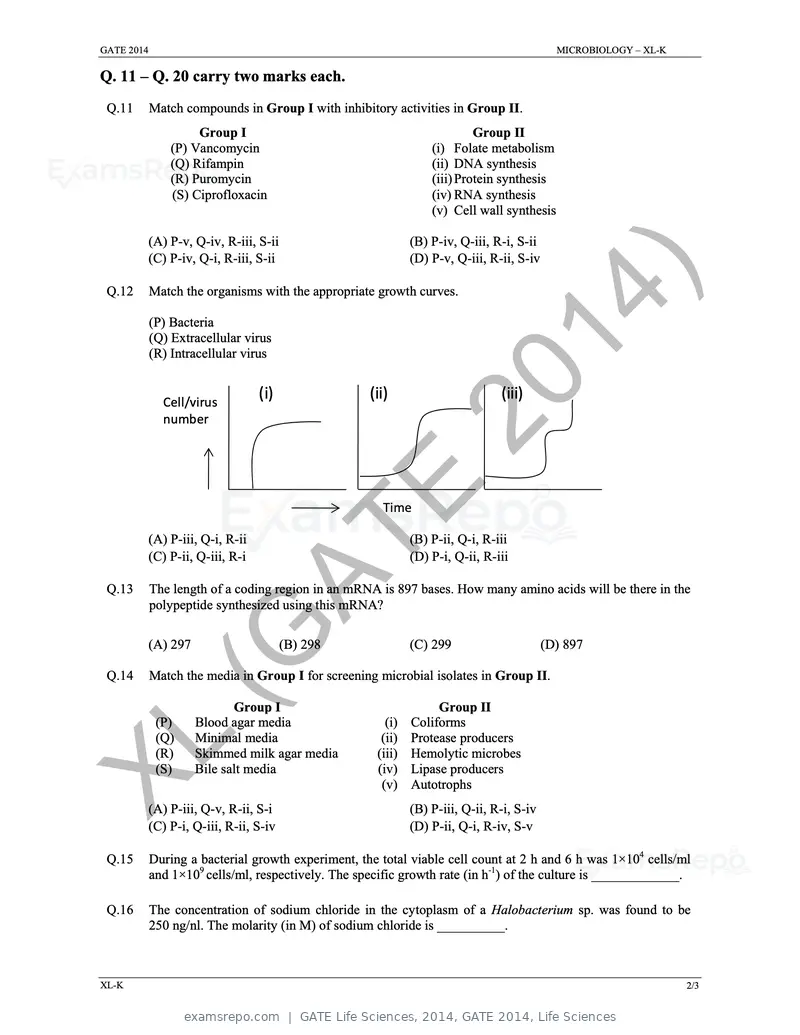
Text of page 23
GATE 2014                                                                                    MICROBIOLOGY – XL-K

Q. 11 – Q. 20 carry two marks each.
 Q.11       Match compounds in Group I with inhibitory activities in Group II.
                     Group I                                               Group II
                (P) Vancomycin                                    (i) Folate metabolism
                (Q) Rifampin                                      (ii) DNA synthesis
                (R) Puromycin                                     (iii) Protein synthesis
                (S) Ciprofloxacin                                 (iv) RNA synthesis
                                                                  (v) Cell wall synthesis

        (A) P-v, Q-iv, R-iii, S-ii                            (B) P-iv, Q-iii, R-i, S-ii
        (C) P-iv, Q-i, R-iii, S-ii                            (D) P-v, Q-iii, R-ii, S-iv

 Q.12

                                                              20
            Match the organisms with the appropriate growth curves.

            (P) Bacteria
            (Q) Extracellular virus
            (R) Intracellular virus
                                                                14
              Cell/virus
               Cell/virus
              number
               Number
                                (i)                 (ii)

                                                                  )             (iii)


                                                E      Time
                                                         (Time)


 Q.13
        (A) P-iii, Q-i, R-ii
        (C) P-ii, Q-iii, R-i
                            AT                                (B) P-ii, Q-i, R-iii
                                                              (D) P-i, Q-ii, R-iii

            The length of a coding region in an mRNA is 897 bases. How many amino acids will be there in the
            polypeptide synthesized using this mRNA?


 Q.14       (G
        (A) 297                       (B) 298                 (C) 299

            Match the media in Group I for screening microbial isolates in Group II.


             (P)
                           Group I
                    Blood agar media                    (i)
                                                                   Group II
                                                              Coliforms
                                                                                           (D) 897


XL           (Q)
             (R)
             (S)
                    Minimal media
                    Skimmed milk agar media
                    Bile salt media

        (A) P-iii, Q-v, R-ii, S-i
        (C) P-i, Q-iii, R-ii, S-iv
                                                       (ii)
                                                      (iii)
                                                      (iv)
                                                       (v)
                                                              Protease producers
                                                              Hemolytic microbes
                                                              Lipase producers
                                                              Autotrophs
                                                              (B) P-iii, Q-ii, R-i, S-iv
                                                              (D) P-ii, Q-i, R-iv, S-v

 Q.15       During a bacterial growth experiment, the total viable cell count at 2 h and 6 h was 1×10⁴ cells/ml
            and 1×10⁹ cells/ml, respectively. The specific growth rate (in h-1) of the culture is _____________.

 Q.16       The concentration of sodium chloride in the cytoplasm of a Halobacterium sp. was found to be
            250 ng/nl. The molarity (in M) of sodium chloride is __________.


XL-K                                                                                                               2/3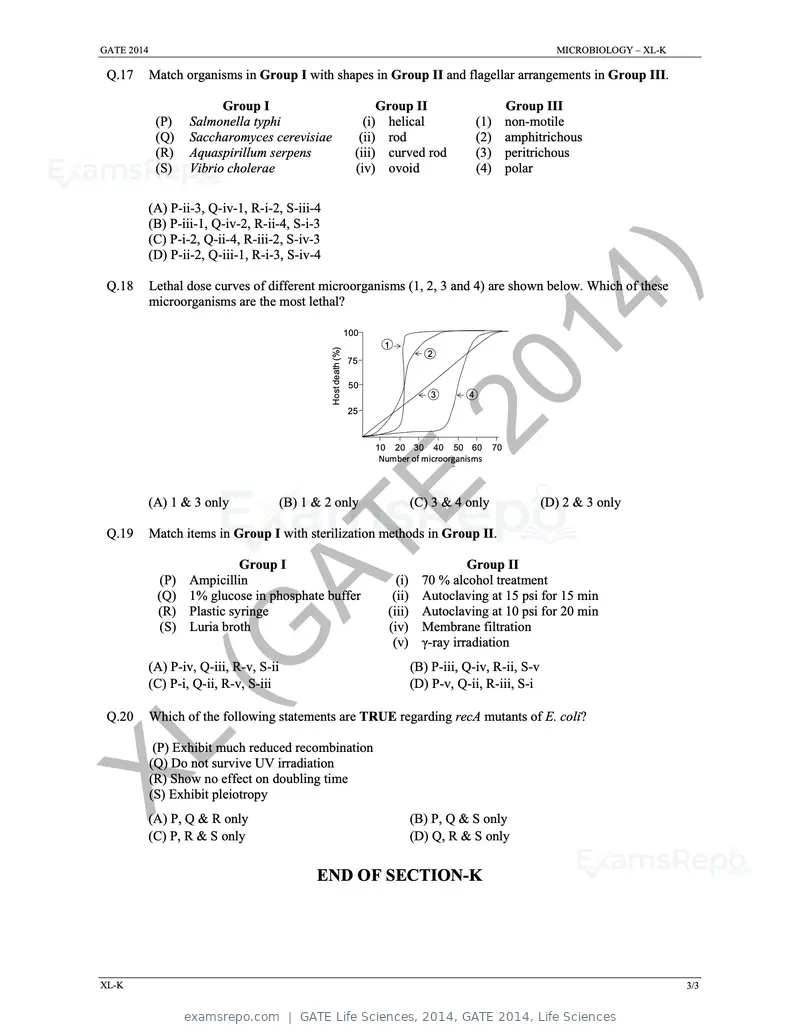
Text of page 24
GATE 2014                                                                                                              MICROBIOLOGY – XL-K

 Q.17       Match organisms in Group I with shapes in Group II and flagellar arrangements in Group III.

                         Group I                                      Group II                                 Group III
             (P)   Salmonella typhi                                (i) helical                      (1)        non-motile
             (Q)   Saccharomyces cerevisiae                       (ii) rod                          (2)        amphitrichous
             (R)   Aquaspirillum serpens                         (iii) curved rod                   (3)        peritrichous
             (S)   Vibrio cholerae                               (iv) ovoid                         (4)        polar

        (A) P-ii-3, Q-iv-1, R-i-2, S-iii-4
        (B) P-iii-1, Q-iv-2, R-ii-4, S-i-3
        (C) P-i-2, Q-ii-4, R-iii-2, S-iv-3
        (D) P-ii-2, Q-iii-1, R-i-3, S-iv-4

 Q.18


                                                                             20
            Lethal dose curves of different microorganisms (1, 2, 3 and 4) are shown below. Which of these
            microorganisms are the most lethal?

                                                               100
                                                                      1


                                                                               14
                                              Host death (%)
                                                                                     2
                                                               75

                                                               50

                                                               25


                                                                     10
                                                                     Number
                                                                           20 30
                                                                     Numberof
                                                                                 )    3


                                                                                         40
                                                                               microorganisms
                                                                            of microorganism
                                                                                                4


                                                                                              50 60       70


 Q.19
        (A) 1 & 3 only
                                              E
                                     (B) 1 & 2 only

            Match items in Group I with sterilization methods in Group II.
                                                                                  (C) 3 & 4 only                    (D) 2 & 3 only


             (P)
             (Q)
             (R)
             (S)
                           AT
                   Ampicillin
                             Group I

                   1% glucose in phosphate buffer
                   Plastic syringe
                   Luria broth
                                                                            (i)
                                                                           (ii)
                                                                          (iii)
                                                                          (iv)
                                                                                             Group II
                                                                                    70 % alcohol treatment
                                                                                    Autoclaving at 15 psi for 15 min
                                                                                    Autoclaving at 10 psi for 20 min
                                                                                    Membrane filtration


 Q.20
            (G
        (A) P-iv, Q-iii, R-v, S-ii
        (C) P-i, Q-ii, R-v, S-iii
                                                                           (v)      γ-ray irradiation
                                                                                  (B) P-iii, Q-iv, R-ii, S-v
                                                                                  (D) P-v, Q-ii, R-iii, S-i

            Which of the following statements are TRUE regarding recA mutants of E. coli?


XL           (P) Exhibit much reduced recombination
            (Q) Do not survive UV irradiation
            (R) Show no effect on doubling time
            (S) Exhibit pleiotropy
        (A) P, Q & R only                                                         (B) P, Q & S only
        (C) P, R & S only                                                         (D) Q, R & S only


                                           END OF SECTION-K


XL-K                                                                                                                                         3/3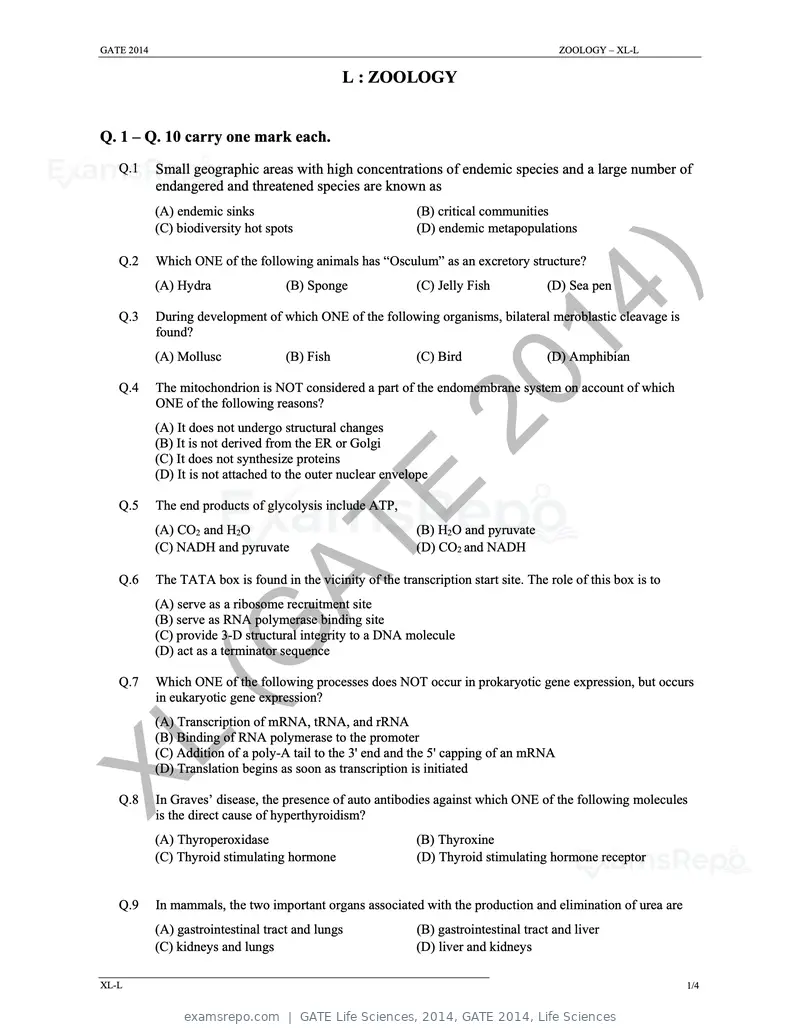
Text of page 25
GATE 2014                                                                                 ZOOLOGY – XL-L

                                                L : ZOOLOGY


Q. 1 – Q. 10 carry one mark each.
   Q.1      Small geographic areas with high concentrations of endemic species and a large number of
            endangered and threatened species are known as
            (A) endemic sinks                                 (B) critical communities
            (C) biodiversity hot spots                        (D) endemic metapopulations

   Q.2      Which ONE of the following animals has “Osculum” as an excretory structure?


   Q.3
            (A) Hydra                (B) Sponge


                                                           20 (C) Jelly Fish           (D) Sea pen

            During development of which ONE of the following organisms, bilateral meroblastic cleavage is
            found?
            (A) Mollusc              (B) Fish
                                                             14
                                                              (C) Bird                 (D) Amphibian

   Q.4


                                                               )
            The mitochondrion is NOT considered a part of the endomembrane system on account of which
            ONE of the following reasons?
            (A) It does not undergo structural changes
            (B) It is not derived from the ER or Golgi
            (C) It does not synthesize proteins
            (D) It is not attached to the outer nuclear envelope

   Q.5
                                                E
            The end products of glycolysis include ATP,
            (A) CO2 and H2O                                   (B) H2O and pyruvate


   Q.6                     AT
            (C) NADH and pyruvate                             (D) CO2 and NADH

            The TATA box is found in the vicinity of the transcription start site. The role of this box is to
            (A) serve as a ribosome recruitment site
            (B) serve as RNA polymerase binding site


   Q.7
            (G
            (C) provide 3-D structural integrity to a DNA molecule
            (D) act as a terminator sequence

            Which ONE of the following processes does NOT occur in prokaryotic gene expression, but occurs
            in eukaryotic gene expression?
            (A) Transcription of mRNA, tRNA, and rRNA


XL Q.8
            (B) Binding of RNA polymerase to the promoter
            (C) Addition of a poly-A tail to the 3' end and the 5' capping of an mRNA
            (D) Translation begins as soon as transcription is initiated

            In Graves’ disease, the presence of auto antibodies against which ONE of the following molecules
            is the direct cause of hyperthyroidism?
            (A) Thyroperoxidase                               (B) Thyroxine
            (C) Thyroid stimulating hormone                   (D) Thyroid stimulating hormone receptor


   Q.9      In mammals, the two important organs associated with the production and elimination of urea are
            (A) gastrointestinal tract and lungs              (B) gastrointestinal tract and liver
            (C) kidneys and lungs                             (D) liver and kidneys

XL-L                                                                                                            1/4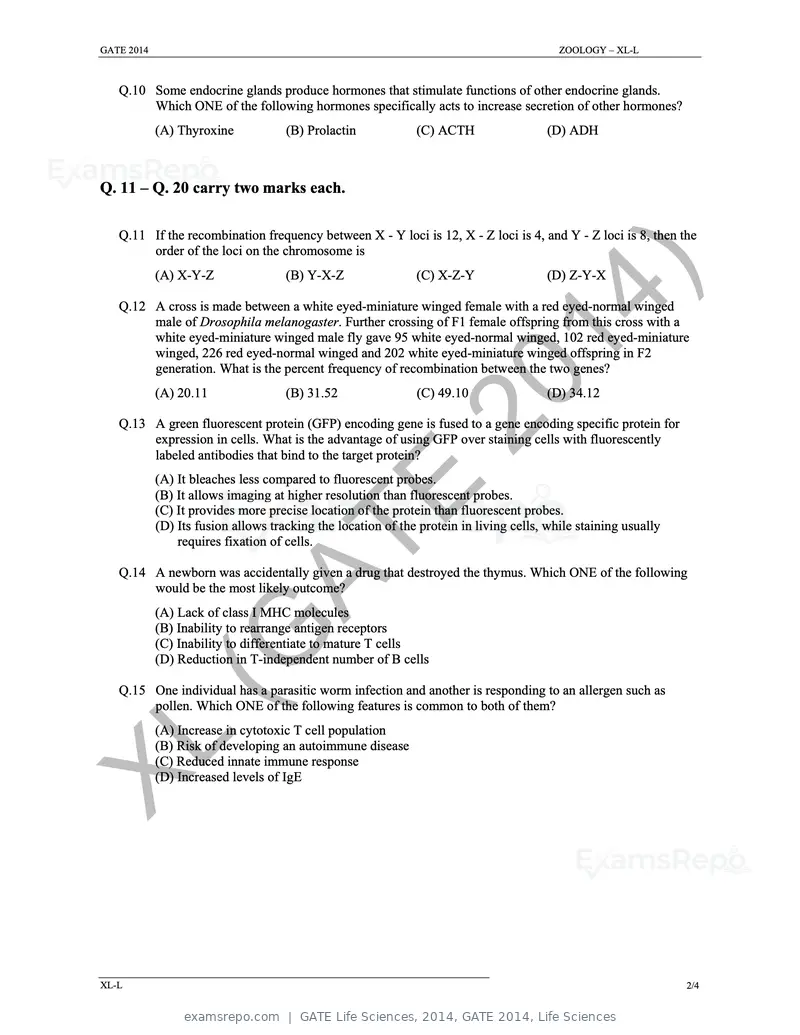
Text of page 26
GATE 2014                                                                                 ZOOLOGY – XL-L


   Q.10 Some endocrine glands produce hormones that stimulate functions of other endocrine glands.
        Which ONE of the following hormones specifically acts to increase secretion of other hormones?
            (A) Thyroxine            (B) Prolactin            (C) ACTH                  (D) ADH


Q. 11 – Q. 20 carry two marks each.

   Q.11 If the recombination frequency between X - Y loci is 12, X - Z loci is 4, and Y - Z loci is 8, then the
        order of the loci on the chromosome is
            (A) X-Y-Z                (B) Y-X-Z


                                                            20(C) X-Z-Y                 (D) Z-Y-X

   Q.12 A cross is made between a white eyed-miniature winged female with a red eyed-normal winged
        male of Drosophila melanogaster. Further crossing of F1 female offspring from this cross with a


                                                              14
        white eyed-miniature winged male fly gave 95 white eyed-normal winged, 102 red eyed-miniature
        winged, 226 red eyed-normal winged and 202 white eyed-miniature winged offspring in F2
        generation. What is the percent frequency of recombination between the two genes?
            (A) 20.11                (B) 31.52

                                                                )
                                                              (C) 49.10                 (D) 34.12

   Q.13 A green fluorescent protein (GFP) encoding gene is fused to a gene encoding specific protein for
        expression in cells. What is the advantage of using GFP over staining cells with fluorescently
        labeled antibodies that bind to the target protein?
            (A) It bleaches less compared to fluorescent probes.

                                              E
            (B) It allows imaging at higher resolution than fluorescent probes.
            (C) It provides more precise location of the protein than fluorescent probes.
            (D) Its fusion allows tracking the location of the protein in living cells, while staining usually


                            AT
                requires fixation of cells.

   Q.14 A newborn was accidentally given a drug that destroyed the thymus. Which ONE of the following
        would be the most likely outcome?
            (A) Lack of class I MHC molecules
            (B) Inability to rearrange antigen receptors


            (G
            (C) Inability to differentiate to mature T cells
            (D) Reduction in T-independent number of B cells

   Q.15 One individual has a parasitic worm infection and another is responding to an allergen such as
        pollen. Which ONE of the following features is common to both of them?
            (A) Increase in cytotoxic T cell population


XL          (B) Risk of developing an autoimmune disease
            (C) Reduced innate immune response
            (D) Increased levels of IgE


XL-L                                                                                                             2/4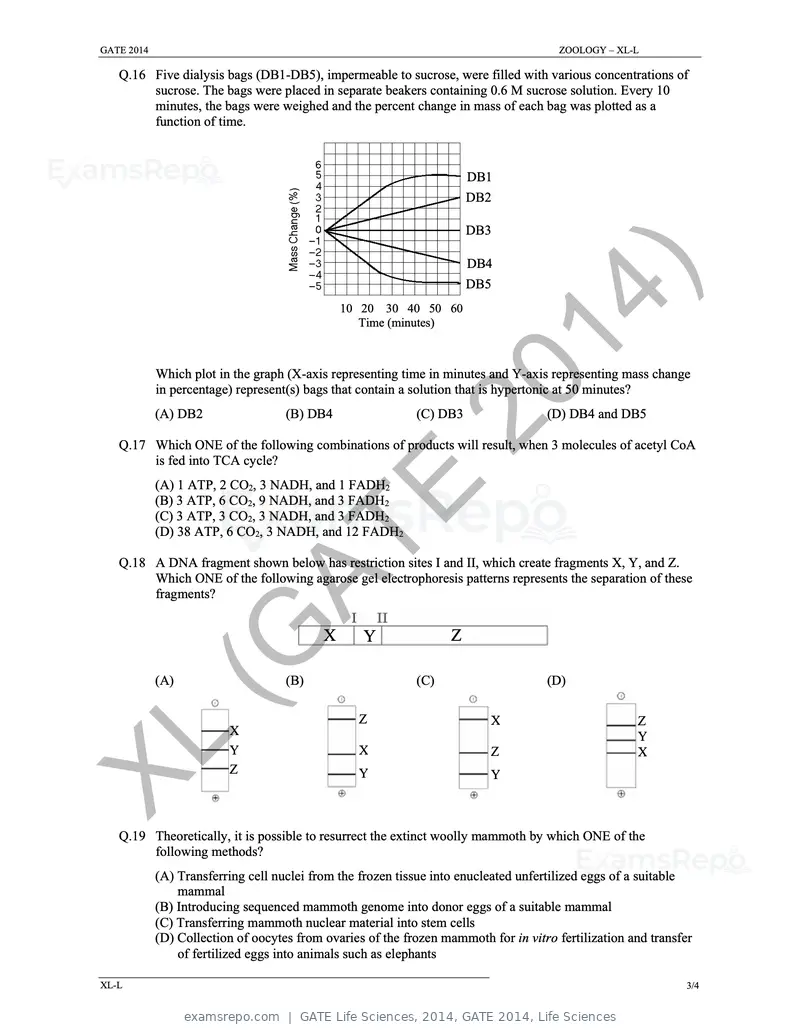
Text of page 27
GATE 2014                                                                              ZOOLOGY – XL-L

   Q.16 Five dialysis bags (DB1-DB5), impermeable to sucrose, were filled with various concentrations of
        sucrose. The bags were placed in separate beakers containing 0.6 M sucrose solution. Every 10
        minutes, the bags were weighed and the percent change in mass of each bag was plotted as a
        function of time.


                                                                       DB1
                                                                       DB2

                                                                       DB3

                                                                       DB4


                                                          20
                                               10 20 30 40 50 60


                                                            14
                                                  Time (minutes)
                                                                       DB5


            Which plot in the graph (X-axis representing time in minutes and Y-axis representing mass change


                                                              )
            in percentage) represent(s) bags that contain a solution that is hypertonic at 50 minutes?
            (A) DB2                 (B) DB4                 (C) DB3                 (D) DB4 and DB5

   Q.17 Which ONE of the following combinations of products will result, when 3 molecules of acetyl CoA
        is fed into TCA cycle?


                                              E
            (A) 1 ATP, 2 CO2, 3 NADH, and 1 FADH2
            (B) 3 ATP, 6 CO2, 9 NADH, and 3 FADH2
            (C) 3 ATP, 3 CO2, 3 NADH, and 3 FADH2
            (D) 38 ATP, 6 CO2, 3 NADH, and 12 FADH2


                           AT
   Q.18 A DNA fragment shown below has restriction sites I and II, which create fragments X, Y, and Z.
        Which ONE of the following agarose gel electrophoresis patterns represents the separation of these
        fragments?


            (G
            (A)                     (B)
                                           X


                                                 Z
                                                  Y

                                                            (C)
                                                                   Z


                                                                          X
                                                                                     (D)


                                                                                                     Z
                         X


XL                       Y
                         Z
                                                 X
                                                 Y
                                                                          Z
                                                                          Y
                                                                                                     Y
                                                                                                     X


   Q.19 Theoretically, it is possible to resurrect the extinct woolly mammoth by which ONE of the
        following methods?
            (A) Transferring cell nuclei from the frozen tissue into enucleated unfertilized eggs of a suitable
                mammal
            (B) Introducing sequenced mammoth genome into donor eggs of a suitable mammal
            (C) Transferring mammoth nuclear material into stem cells
            (D) Collection of oocytes from ovaries of the frozen mammoth for in vitro fertilization and transfer
                of fertilized eggs into animals such as elephants

XL-L                                                                                                          3/4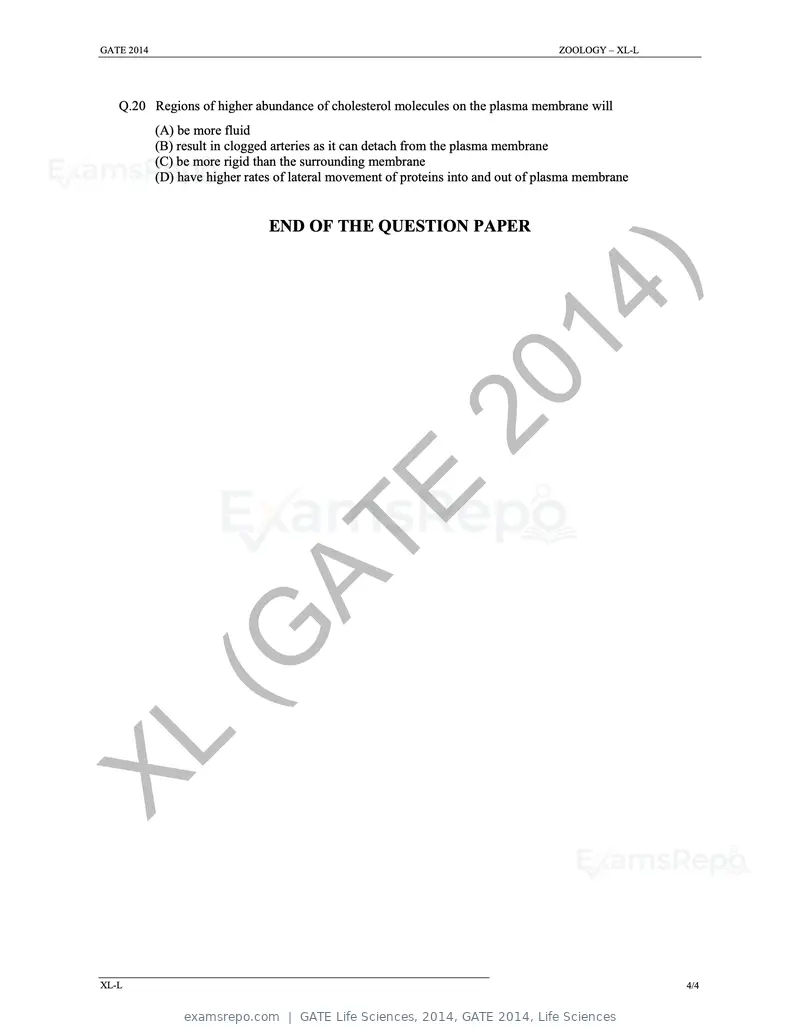
Text of page 28
GATE 2014                                                                           ZOOLOGY – XL-L


   Q.20 Regions of higher abundance of cholesterol molecules on the plasma membrane will
            (A) be more fluid
            (B) result in clogged arteries as it can detach from the plasma membrane
            (C) be more rigid than the surrounding membrane
            (D) have higher rates of lateral movement of proteins into and out of plasma membrane


                                END OF THE QUESTION PAPER


                                                        2014)
                                           E
                          AT
            (G
XL
XL-L                                                                                                 4/4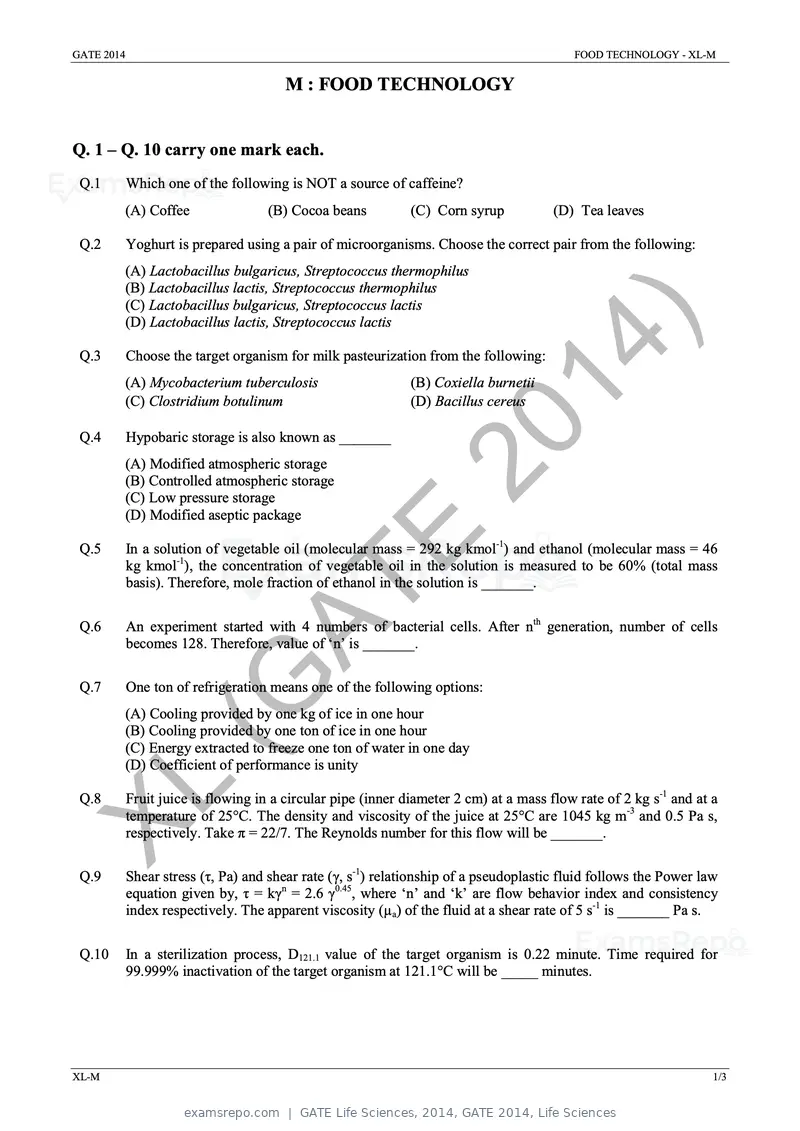
Text of page 29
GATE 2014                                                                                 FOOD TECHNOLOGY - XL-M

                                        M : FOOD TECHNOLOGY


Q. 1 – Q. 10 carry one mark each.
 Q.1        Which one of the following is NOT a source of caffeine?
        (A) Coffee                  (B) Cocoa beans           (C) Corn syrup           (D) Tea leaves

 Q.2        Yoghurt is prepared using a pair of microorganisms. Choose the correct pair from the following:
        (A) Lactobacillus bulgaricus, Streptococcus thermophilus
        (B) Lactobacillus lactis, Streptococcus thermophilus
        (C) Lactobacillus bulgaricus, Streptococcus lactis


 Q.3
        (D) Lactobacillus lactis, Streptococcus lactis

            Choose the target organism for milk pasteurization from the following:
        (A) Mycobacterium tuberculosis
                                                                                  4)
                                                              (B) Coxiella burnetii


 Q.4
        (C) Clostridium botulinum

            Hypobaric storage is also known as _______
        (A) Modified atmospheric storage
        (B) Controlled atmospheric storage
                                                            20(D) Bacillus cereus


                                                               1
        (C) Low pressure storage
        (D) Modified aseptic package

 Q.5

                               AT
            In a solution of vegetable oil (molecular mass = 292 kg kmol-1) and ethanol (molecular mass = 46
            kg kmol-1), the concentration of vegetable oil in the solution is measured to be 60% (total mass
            basis). Therefore, mole fraction of ethanol in the solution is _______.

 Q.6
                                  E
            An experiment started with 4 numbers of bacterial cells. After nth generation, number of cells
            becomes 128. Therefore, value of ‘n’ is _______.

 Q.7

                (G
            One ton of refrigeration means one of the following options:
        (A) Cooling provided by one kg of ice in one hour
        (B) Cooling provided by one ton of ice in one hour
        (C) Energy extracted to freeze one ton of water in one day
        (D) Coefficient of performance is unity


XL
 Q.8


 Q.9
            Fruit juice is flowing in a circular pipe (inner diameter 2 cm) at a mass flow rate of 2 kg s-1 and at a
            temperature of 25°C. The density and viscosity of the juice at 25°C are 1045 kg m-3 and 0.5 Pa s,
            respectively. Take π = 22/7. The Reynolds number for this flow will be _______.

            Shear stress (τ, Pa) and shear rate (γ, s-1) relationship of a pseudoplastic fluid follows the Power law
            equation given by, τ = kγn = 2.6 γ0.45, where ‘n’ and ‘k’ are flow behavior index and consistency
            index respectively. The apparent viscosity (µa) of the fluid at a shear rate of 5 s-1 is _______ Pa s.

 Q.10       In a sterilization process, D121.1 value of the target organism is 0.22 minute. Time required for
            99.999% inactivation of the target organism at 121.1°C will be _____ minutes.


XL-M                                                                                                               1/3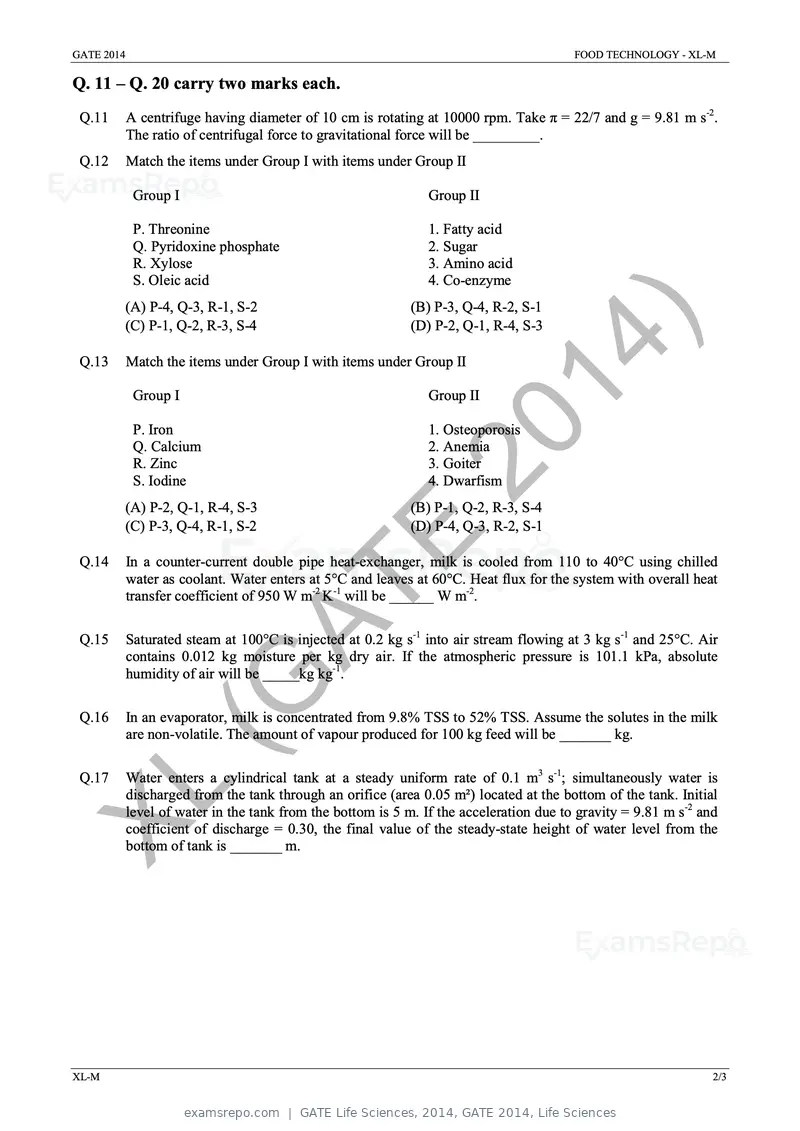
Text of page 30
GATE 2014                                                                                FOOD TECHNOLOGY - XL-M

Q. 11 – Q. 20 carry two marks each.
 Q.11       A centrifuge having diameter of 10 cm is rotating at 10000 rpm. Take π = 22/7 and g = 9.81 m s-2.
            The ratio of centrifugal force to gravitational force will be _________.
 Q.12       Match the items under Group I with items under Group II

             Group I                                            Group II

             P. Threonine                                       1. Fatty acid
             Q. Pyridoxine phosphate                            2. Sugar
             R. Xylose                                          3. Amino acid
             S. Oleic acid                                      4. Co-enzyme
        (A) P-4, Q-3, R-1, S-2                               (B) P-3, Q-4, R-2, S-1


 Q.13
        (C) P-1, Q-2, R-3, S-4
                                                                                  4)
                                                             (D) P-2, Q-1, R-4, S-3

            Match the items under Group I with items under Group II

             Group I

             P. Iron
             Q. Calcium
             R. Zinc
             S. Iodine
                                                           20 1
                                                                Group II

                                                                1. Osteoporosis
                                                                2. Anemia
                                                                3. Goiter
                                                                4. Dwarfism
        (A) P-2, Q-1, R-4, S-3                               (B) P-1, Q-2, R-3, S-4
        (C) P-3, Q-4, R-1, S-2                               (D) P-4, Q-3, R-2, S-1

 Q.14
                               AT
            In a counter-current double pipe heat-exchanger, milk is cooled from 110 to 40°C using chilled
            water as coolant. Water enters at 5°C and leaves at 60°C. Heat flux for the system with overall heat


 Q.15
                                  E
            transfer coefficient of 950 W m-2 K-1 will be ______ W m-2.

            Saturated steam at 100°C is injected at 0.2 kg s-1 into air stream flowing at 3 kg s-1 and 25°C. Air
            contains 0.012 kg moisture per kg dry air. If the atmospheric pressure is 101.1 kPa, absolute
            humidity of air will be _____kg kg-1.

 Q.16           (G
            In an evaporator, milk is concentrated from 9.8% TSS to 52% TSS. Assume the solutes in the milk
            are non-volatile. The amount of vapour produced for 100 kg feed will be _______ kg.

 Q.17       Water enters a cylindrical tank at a steady uniform rate of 0.1 m3 s-1; simultaneously water is


XL          discharged from the tank through an orifice (area 0.05 m²) located at the bottom of the tank. Initial
            level of water in the tank from the bottom is 5 m. If the acceleration due to gravity = 9.81 m s-2 and
            coefficient of discharge = 0.30, the final value of the steady-state height of water level from the
            bottom of tank is _______ m.


XL-M                                                                                                             2/3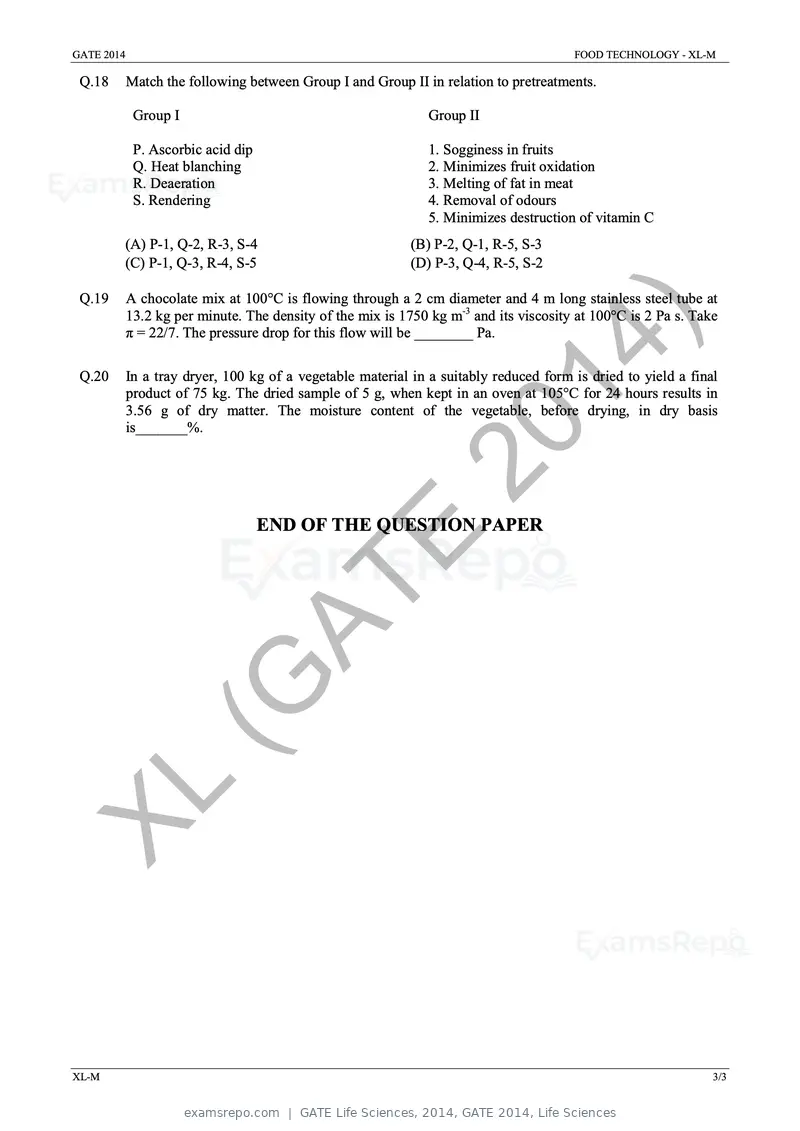
Text of page 31
GATE 2014                                                                              FOOD TECHNOLOGY - XL-M

 Q.18       Match the following between Group I and Group II in relation to pretreatments.

             Group I                                           Group II

             P. Ascorbic acid dip                              1. Sogginess in fruits
             Q. Heat blanching                                 2. Minimizes fruit oxidation
             R. Deaeration                                     3. Melting of fat in meat
             S. Rendering                                      4. Removal of odours
                                                               5. Minimizes destruction of vitamin C
        (A) P-1, Q-2, R-3, S-4                              (B) P-2, Q-1, R-5, S-3
        (C) P-1, Q-3, R-4, S-5                              (D) P-3, Q-4, R-5, S-2

 Q.19       A chocolate mix at 100°C is flowing through a 2 cm diameter and 4 m long stainless steel tube at
            13.2 kg per minute. The density of the mix is 1750 kg m-3 and its viscosity at 100°C is 2 Pa s. Take


 Q.20
            π = 22/7. The pressure drop for this flow will be ________ Pa.
                                                                                4)
            In a tray dryer, 100 kg of a vegetable material in a suitably reduced form is dried to yield a final


                                                           20
            product of 75 kg. The dried sample of 5 g, when kept in an oven at 105°C for 24 hours results in
            3.56 g of dry matter. The moisture content of the vegetable, before drying, in dry basis
            is_______%.


                                                              1
                                    END OF THE QUESTION PAPER


                              AT
                                 E
                (G
XL

XL-M                                                                                                           3/3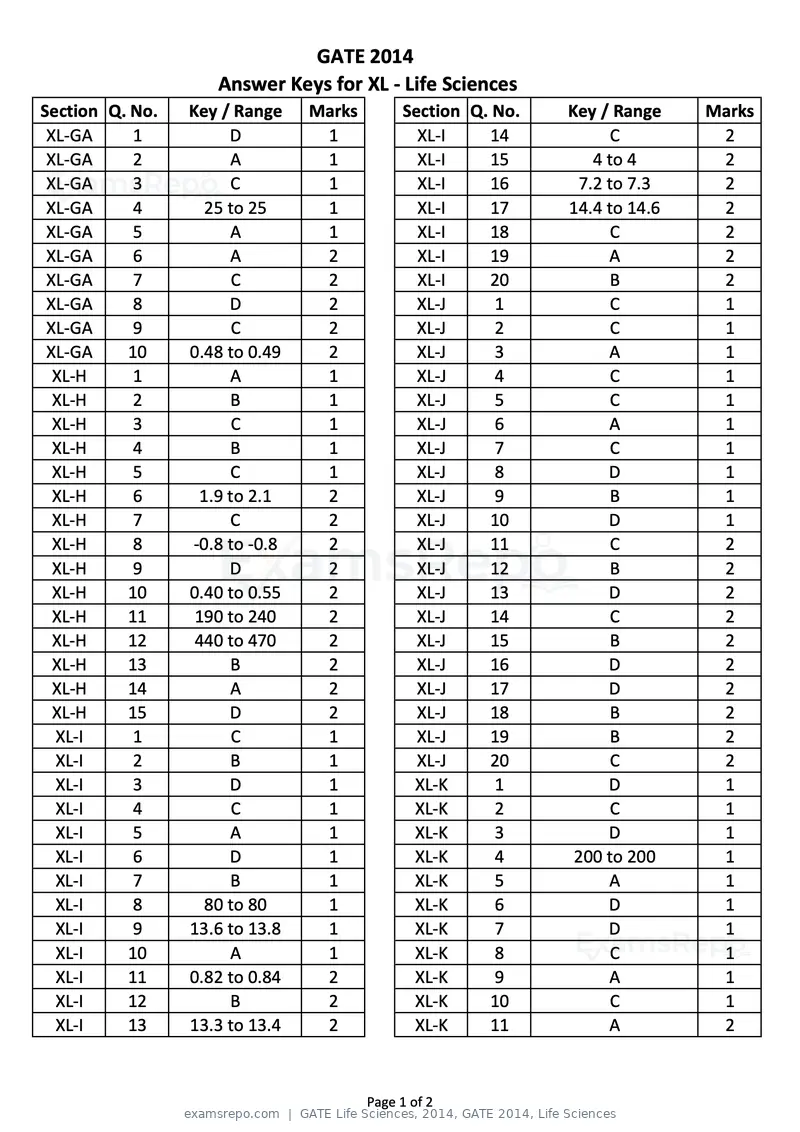
Text of page 32
GATE 2014
                    Answer Keys for XL ‐ Life Sciences
Section Q. No.   Key / Range    Marks        Section Q. No.   Key / Range    Marks
 XL‐GA     1          D          1             XL‐I    14          C          2
 XL‐GA     2          A          1             XL‐I    15        4 to 4       2
 XL‐GA     3          C          1             XL‐I    16      7.2 to 7.3     2
 XL‐GA     4       25 to 25      1             XL‐I    17     14.4 to 14.6    2
 XL‐GA     5          A          1             XL‐I    18          C          2
 XL‐GA     6          A          2             XL‐I    19          A          2
 XL‐GA     7          C          2             XL‐I    20          B          2
 XL‐GA     8          D          2             XL‐J     1          C          1
 XL‐GA     9          C          2             XL‐J     2          C          1
 XL‐GA    10     0.48 to 0.49    2             XL‐J     3          A          1
  XL‐H     1          A          1             XL‐J     4          C          1
  XL‐H     2          B          1             XL‐J     5          C          1
  XL‐H     3          C          1             XL‐J     6          A          1
  XL‐H     4          B          1             XL‐J     7          C          1
  XL‐H     5          C          1             XL‐J     8          D          1
  XL‐H     6      1.9 to 2.1     2             XL‐J     9          B          1
  XL‐H     7          C          2             XL‐J    10          D          1
  XL‐H     8     ‐0.8 to ‐0.8    2             XL‐J    11          C          2
  XL‐H     9          D          2             XL‐J    12          B          2
  XL‐H    10     0.40 to 0.55    2             XL‐J    13          D          2
  XL‐H    11      190 to 240     2             XL‐J    14          C          2
  XL‐H    12      440 to 470     2             XL‐J    15          B          2
  XL‐H    13          B          2             XL‐J    16          D          2
  XL‐H    14          A          2             XL‐J    17          D          2
  XL‐H    15          D          2             XL‐J    18          B          2
  XL‐I     1          C          1             XL‐J    19          B          2
  XL‐I     2          B          1             XL‐J    20          C          2
  XL‐I     3          D          1            XL‐K      1          D          1
  XL‐I     4          C          1            XL‐K      2          C          1
  XL‐I     5          A          1            XL‐K      3          D          1
  XL‐I     6          D          1            XL‐K      4      200 to 200     1
  XL‐I     7          B          1            XL‐K      5          A          1
  XL‐I     8       80 to 80      1            XL‐K      6          D          1
  XL‐I     9     13.6 to 13.8    1            XL‐K      7          D          1
  XL‐I    10          A          1            XL‐K      8          C          1
  XL‐I    11     0.82 to 0.84    2            XL‐K      9          A          1
  XL‐I    12          B          2            XL‐K     10          C          1
  XL‐I    13     13.3 to 13.4    2            XL‐K     11          A          2


                                        Page 1 of 2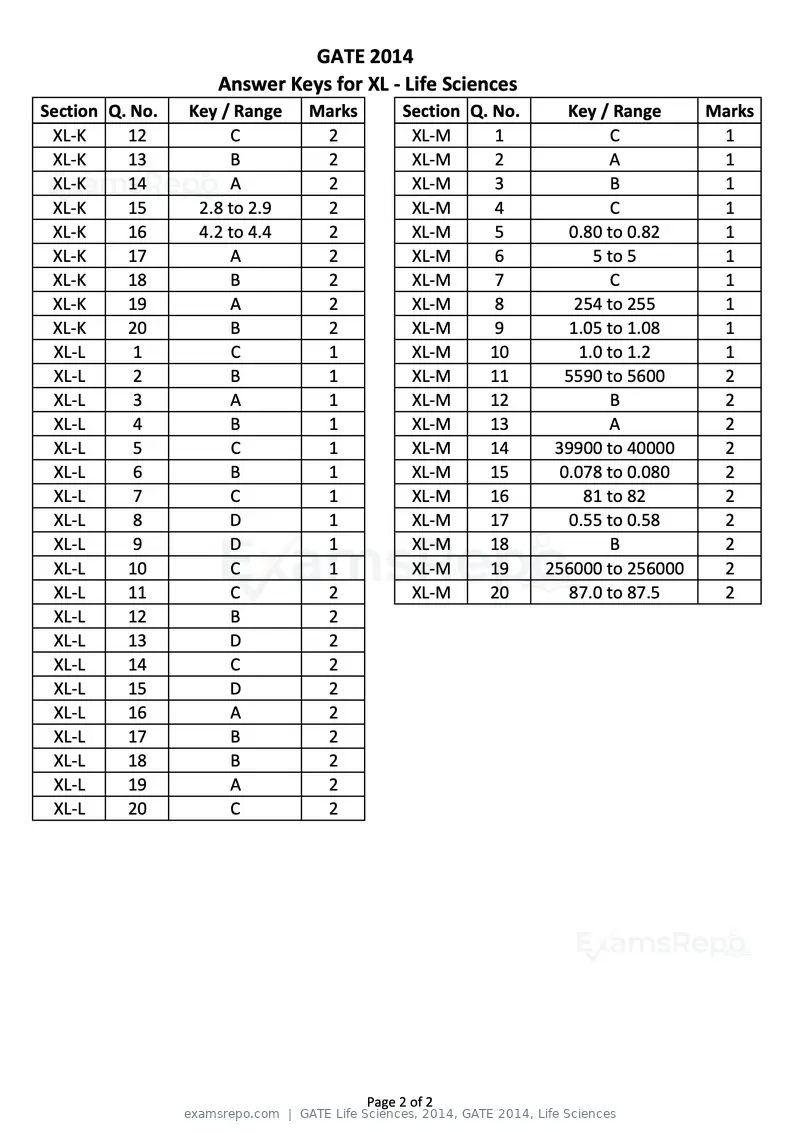
Text of page 33
GATE 2014
                    Answer Keys for XL ‐ Life Sciences
Section Q. No.   Key / Range   Marks        Section Q. No.     Key / Range      Marks
 XL‐K     12          C         2            XL‐M      1             C           1
 XL‐K     13          B         2            XL‐M      2             A           1
 XL‐K     14          A         2            XL‐M      3             B           1
 XL‐K     15      2.8 to 2.9    2            XL‐M      4             C           1
 XL‐K     16      4.2 to 4.4    2            XL‐M      5       0.80 to 0.82      1
 XL‐K     17          A         2            XL‐M      6           5 to 5        1
 XL‐K     18          B         2            XL‐M      7             C           1
 XL‐K     19          A         2            XL‐M      8        254 to 255       1
 XL‐K     20          B         2            XL‐M      9        1.05 to 1.08     1
 XL‐L      1          C         1            XL‐M     10         1.0 to 1.2      1
 XL‐L      2          B         1            XL‐M     11       5590 to 5600      2
 XL‐L      3          A         1            XL‐M     12             B           2
 XL‐L      4          B         1            XL‐M     13             A           2
 XL‐L      5          C         1            XL‐M     14      39900 to 40000     2
 XL‐L      6          B         1            XL‐M     15      0.078 to 0.080     2
 XL‐L      7          C         1            XL‐M     16          81 to 82       2
 XL‐L      8          D         1            XL‐M     17       0.55 to 0.58      2
 XL‐L      9          D         1            XL‐M     18             B           2
 XL‐L     10          C         1            XL‐M     19     256000 to 256000    2
 XL‐L     11          C         2            XL‐M     20       87.0 to 87.5      2
 XL‐L     12          B         2
 XL‐L     13          D         2
 XL‐L     14          C         2
 XL‐L     15          D         2
 XL‐L     16          A         2
 XL‐L     17          B         2
 XL‐L     18          B         2
 XL‐L     19          A         2
 XL‐L     20          C         2


                                       Page 2 of 2
Official key not published for this paper.
Page 1 of 33
Source: GATE. Question paper published by GATE.