
GATE Life Sciences 2018
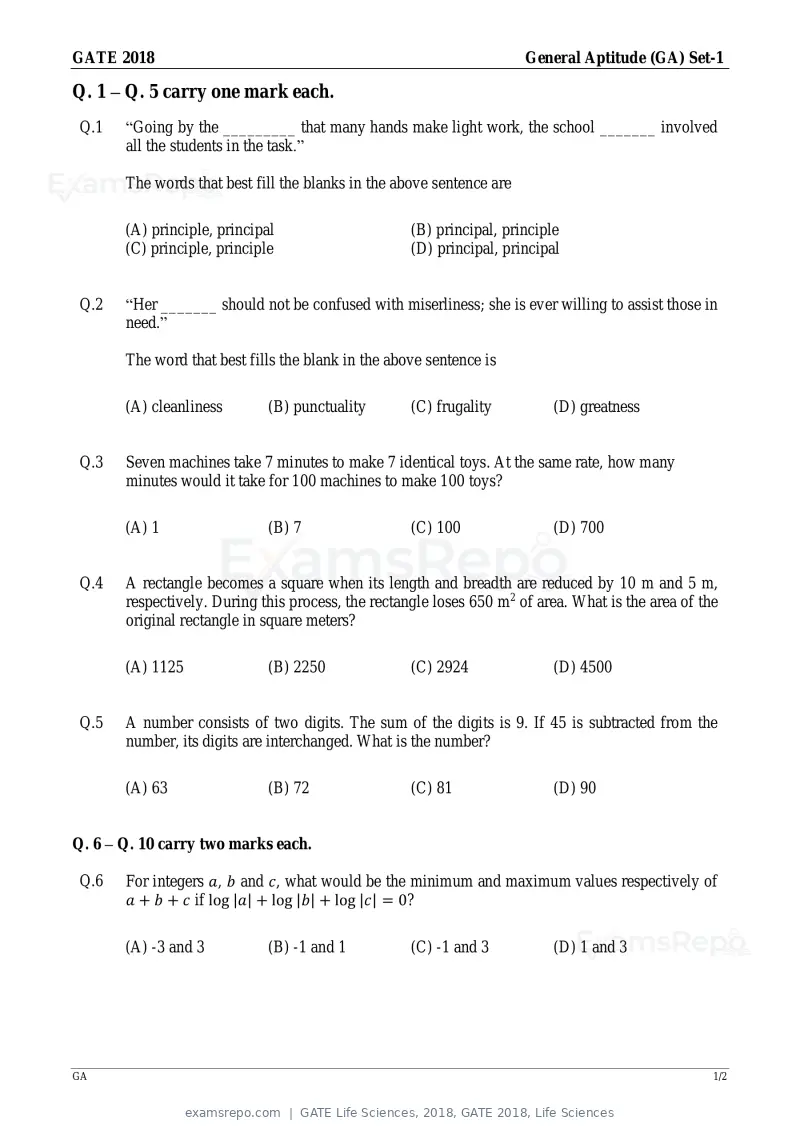
Text of page 1
GATE 2018                                                              General Aptitude (GA) Set-1

Q. 1 – Q. 5 carry one mark each.
 Q.1   “Going by the _________ that many hands make light work, the school _______ involved
       all the students in the task.”

       The words that best fill the blanks in the above sentence are

       (A) principle, principal                     (B) principal, principle
       (C) principle, principle                     (D) principal, principal


 Q.2   “Her _______ should not be confused with miserliness; she is ever willing to assist those in
       need.”

       The word that best fills the blank in the above sentence is

       (A) cleanliness       (B) punctuality        (C) frugality         (D) greatness


 Q.3   Seven machines take 7 minutes to make 7 identical toys. At the same rate, how many
       minutes would it take for 100 machines to make 100 toys?

       (A) 1                 (B) 7                  (C) 100               (D) 700


 Q.4   A rectangle becomes a square when its length and breadth are reduced by 10 m and 5 m,
       respectively. During this process, the rectangle loses 650 m2 of area. What is the area of the
       original rectangle in square meters?

       (A) 1125              (B) 2250               (C) 2924              (D) 4500


 Q.5   A number consists of two digits. The sum of the digits is 9. If 45 is subtracted from the
       number, its digits are interchanged. What is the number?

       (A) 63                (B) 72                 (C) 81                (D) 90


Q. 6 – Q. 10 carry two marks each.

 Q.6   For integers a, b and c, what would be the minimum and maximum values respectively of
       a + b + c if log |a| + log |b| + log |c| = 0?

       (A) -3 and 3          (B) -1 and 1           (C) -1 and 3          (D) 1 and 3


GA                                                                                                  1/2
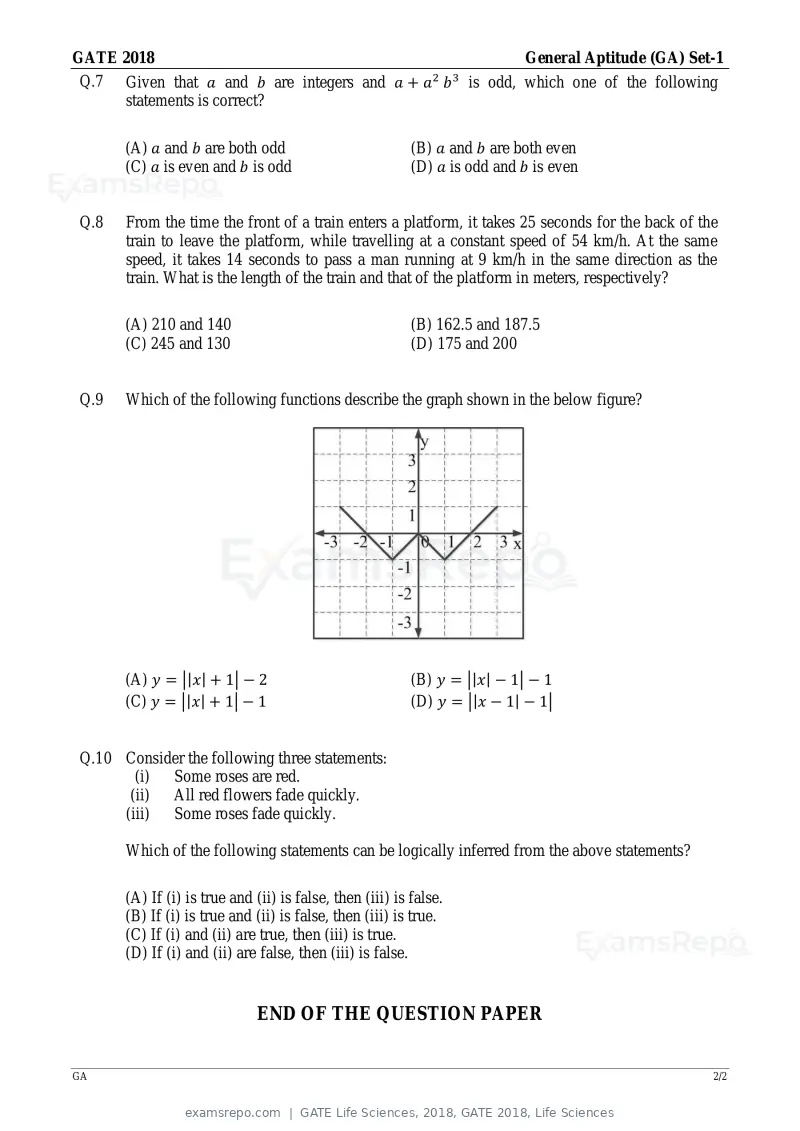
Text of page 2
GATE 2018                                                   General Aptitude (GA) Set-1
 Q.7 Given that a and b are integers and a + a2 b 3 is odd, which one of the following
     statements is correct?

       (A) a and b are both odd                            (B) a and b are both even
       (C) a is even and b is odd                          (D) a is odd and b is even


Q.8    From the time the front of a train enters a platform, it takes 25 seconds for the back of the
       train to leave the platform, while travelling at a constant speed of 54 km/h. At the same
       speed, it takes 14 seconds to pass a man running at 9 km/h in the same direction as the
       train. What is the length of the train and that of the platform in meters, respectively?

       (A) 210 and 140                                     (B) 162.5 and 187.5
       (C) 245 and 130                                     (D) 175 and 200


Q.9    Which of the following functions describe the graph shown in the below figure?


       (A) y = ||x| + 1| − 2                               (B) y = ||x| − 1| − 1
       (C) y = ||x| + 1| − 1                               (D) y = ||x − 1| − 1|


Q.10 Consider the following three statements:
       (i) Some roses are red.
      (ii) All red flowers fade quickly.
     (iii) Some roses fade quickly.

       Which of the following statements can be logically inferred from the above statements?

       (A) If (i) is true and (ii) is false, then (iii) is false.
       (B) If (i) is true and (ii) is false, then (iii) is true.
       (C) If (i) and (ii) are true, then (iii) is true.
       (D) If (i) and (ii) are false, then (iii) is false.


                              END OF THE QUESTION PAPER


GA                                                                                                 2/2
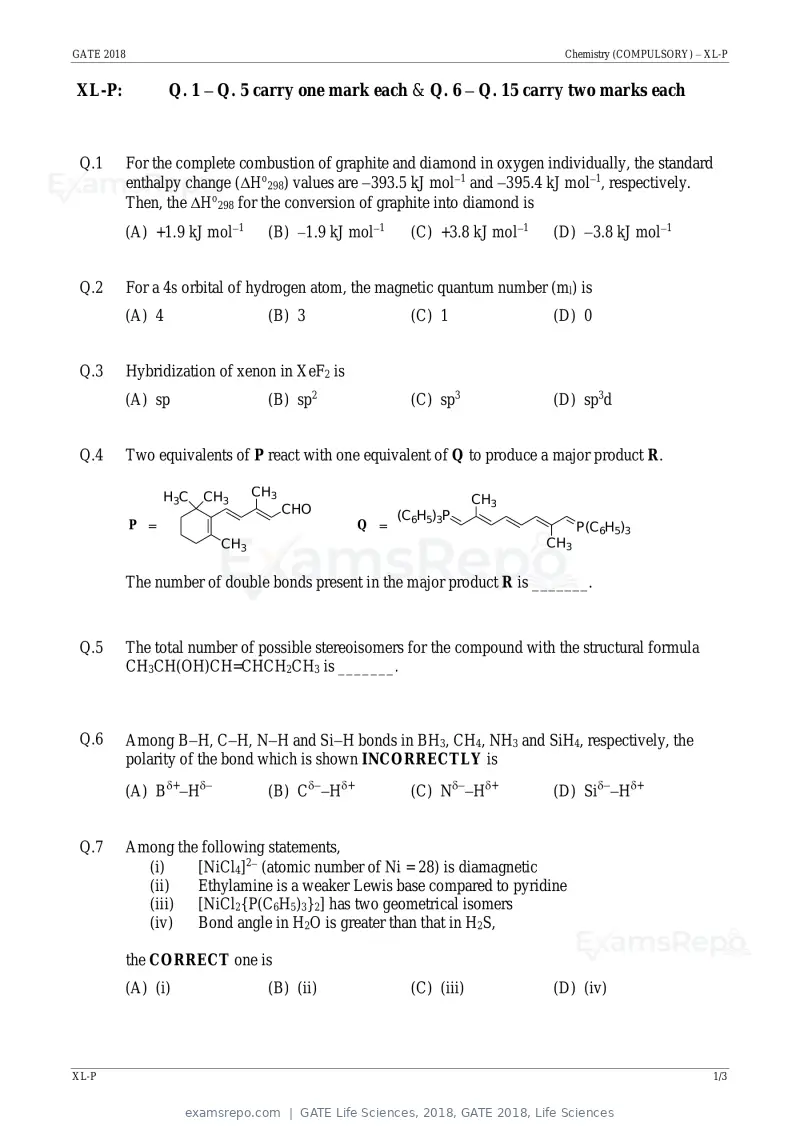
Text of page 3
GATE 2018 Chemistry (COMPULSORY) – XL-P
XL-P: Q. 1 – Q. 5 carry one mark each & Q. 6 – Q. 15 carry two marks each
Q.1 For the complete combustion of graphite and diamond in oxygen individually, the standard
enthalpy change (Ho298) values are 393.5 kJ mol1 and 395.4 kJ mol1, respectively.
Then, the Ho298 for the conversion of graphite into diamond is
(A) +1.9 kJ mol1 (B) 1.9 kJ mol1 (C) +3.8 kJ mol1 (D) 3.8 kJ mol1
Q.2 For a 4s orbital of hydrogen atom, the magnetic quantum number (ml) is
(A) 4 (B) 3 (C) 1 (D) 0
Q.3 Hybridization of xenon in XeF2 is
(A) sp (B) sp2 (C) sp3 (D) sp3d
Q.4 Two equivalents of P react with one equivalent of Q to produce a major product R.
H3C CH3 CH3
CH3
CHO (C6H5)3P
P = Q = P(C6H5)3
CH3 CH3
The number of double bonds present in the major product R is _______.
Q.5 The total number of possible stereoisomers for the compound with the structural formula
CH3CH(OH)CH=CHCH2CH3 is _______.
Q.6 Among BH, CH, NH and SiH bonds in BH3, CH4, NH3 and SiH4, respectively, the
polarity of the bond which is shown INCORRECTLY is
(A) B+H (B) CH+ (C) NH+ (D) SiH+
Q.7 Among the following statements,
(i) [NiCl4]2 (atomic number of Ni = 28) is diamagnetic
(ii) Ethylamine is a weaker Lewis base compared to pyridine
(iii) [NiCl2{P(C6H5)3}2] has two geometrical isomers
(iv) Bond angle in H2O is greater than that in H2S,
the CORRECT one is
(A) (i) (B) (ii) (C) (iii) (D) (iv)
XL-P 1/3
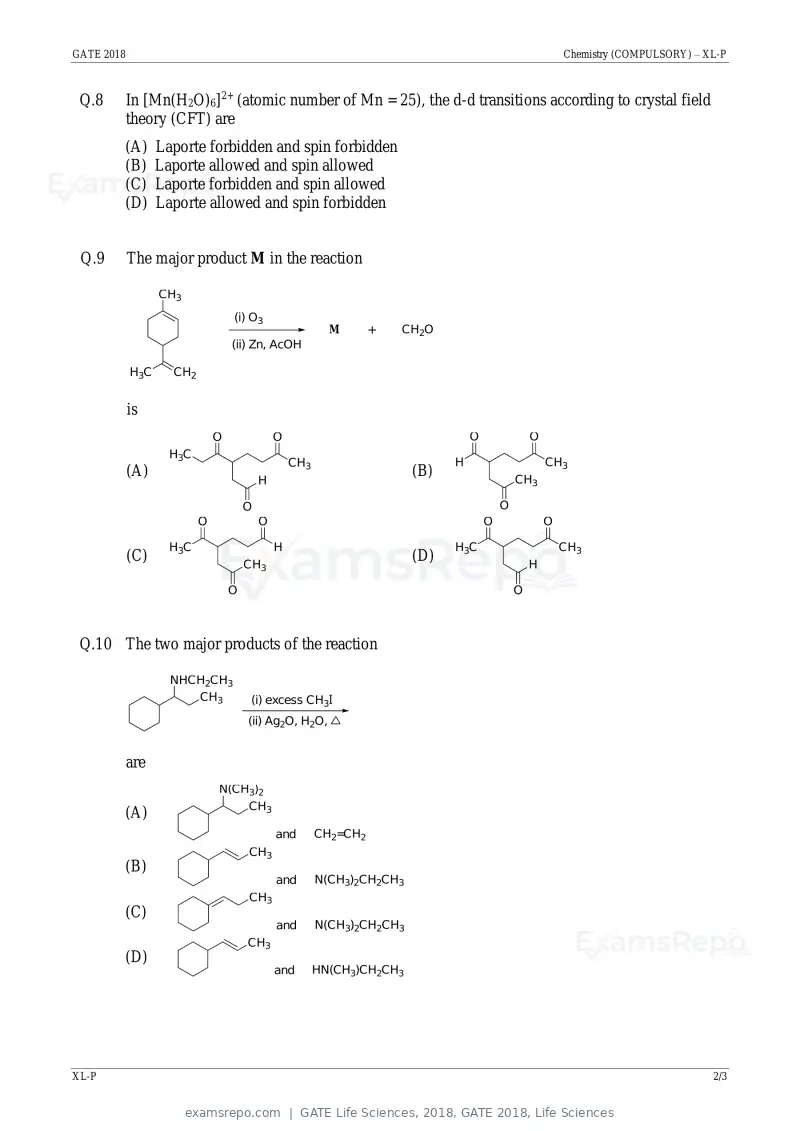
Text of page 4
GATE 2018                                                                                                 Chemistry (COMPULSORY) – XL-P


 Q.8        In [Mn(H2O)6]2+ (atomic number of Mn = 25), the d-d transitions according to crystal field
            theory (CFT) are
        (A) Laporte forbidden and spin forbidden
        (B) Laporte allowed and spin allowed
        (C) Laporte forbidden and spin allowed
        (D) Laporte allowed and spin forbidden


 Q.9        The major product M in the reaction

                  CH3
                                  (i) O3
                                                          M       +   CH2O
                                  (ii) Zn, AcOH

            H3C     CH2


            is
                              O               O                                   O               O
                   H3C
                                                  CH3                         H                       CH3
            (A)                                                         (B)                   CH3
                                          H

                                      O                                                   O
                          O               O                                           O               O

                   H3C                        H                               H3C                         CH3
            (C)                       CH3
                                                                        (D)                       H

                                  O                                                           O


 Q.10 The two major products of the reaction

                   NHCH2CH3
                      CH3              (i) excess CH3I
                                      (ii) Ag2O, H2O,


            are
                              N(CH3)2
                                  CH3
        (A)
                                              and       CH2=CH2
                                      CH3
        (B)
                                              and       N(CH3)2CH2CH3
                                      CH3
        (C)
                                              and       N(CH3)2CH2CH3
                                      CH3
        (D)
                                              and       HN(CH3)CH2CH3


XL-P                                                                                                                                2/3
Text of page 5
GATE 2018 Chemistry (COMPULSORY) – XL-P
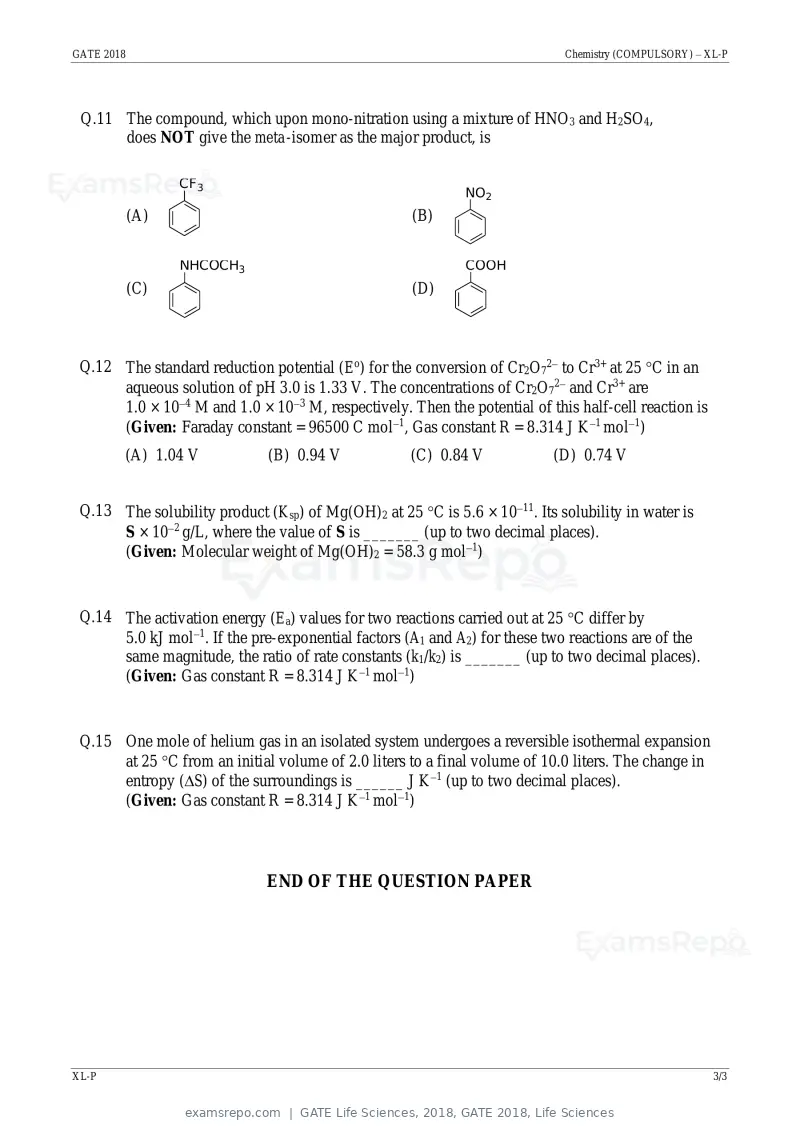
Q.11 The compound, which upon mono-nitration using a mixture of HNO3 and H2SO4,
does NOT give the meta-isomer as the major product, is
CF3
NO2
(A) (B)
NHCOCH3 COOH
(C) (D)
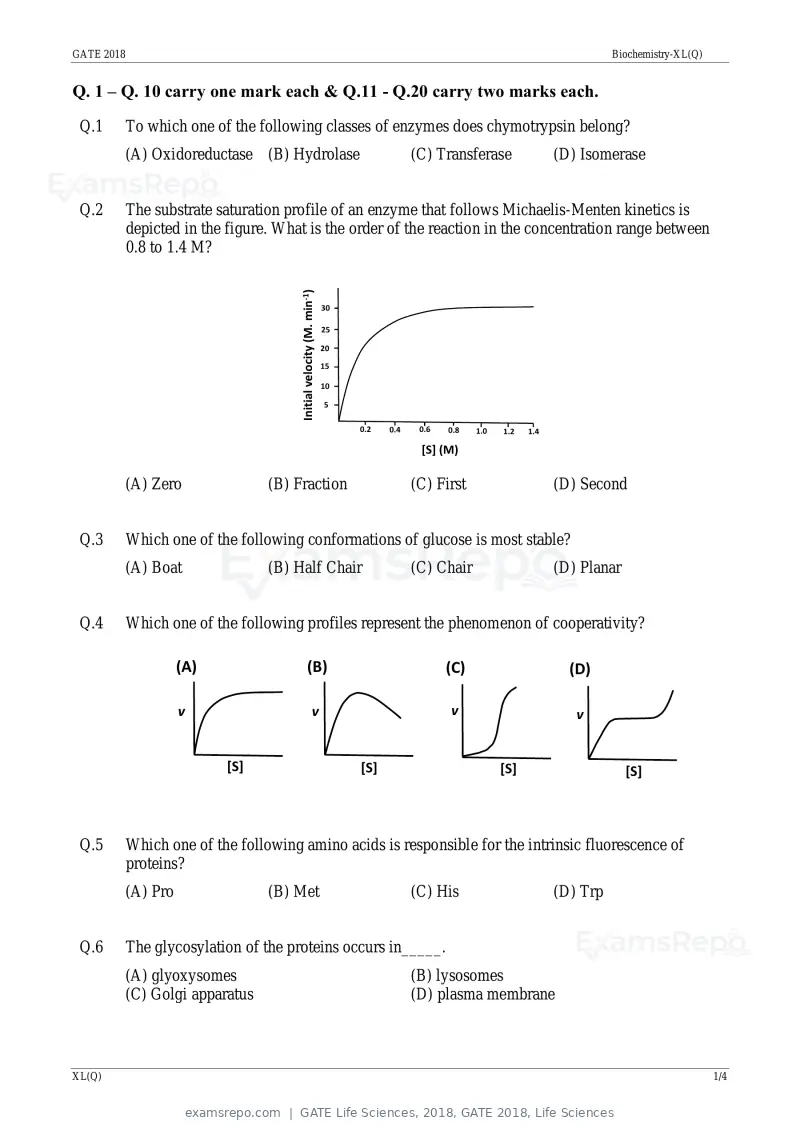
Q.12 The standard reduction potential (Eo) for the conversion of Cr2O72 to Cr3+ at 25 C in an
aqueous solution of pH 3.0 is 1.33 V. The concentrations of Cr2O72 and Cr3+ are
1.0 × 10⁴ M and 1.0 × 10³ M, respectively. Then the potential of this half-cell reaction is
(Given: Faraday constant = 96500 C mol1, Gas constant R = 8.314 J K1 mol1)
(A) 1.04 V (B) 0.94 V (C) 0.84 V (D) 0.74 V
Q.13 The solubility product (Ksp) of Mg(OH)2 at 25 C is 5.6 × 10¹¹. Its solubility in water is
S × 102 g/L, where the value of S is _______ (up to two decimal places).
(Given: Molecular weight of Mg(OH)2 = 58.3 g mol1)
Q.14 The activation energy (Ea) values for two reactions carried out at 25 C differ by
5.0 kJ mol1. If the pre-exponential factors (A1 and A2) for these two reactions are of the
same magnitude, the ratio of rate constants (k1/k2) is _______ (up to two decimal places).
(Given: Gas constant R = 8.314 J K1 mol1)
Q.15 One mole of helium gas in an isolated system undergoes a reversible isothermal expansion
at 25 C from an initial volume of 2.0 liters to a final volume of 10.0 liters. The change in
entropy (S) of the surroundings is ______ J K1 (up to two decimal places).
(Given: Gas constant R = 8.314 J K1 mol1)
END OF THE QUESTION PAPER
XL-P 3/3
Text of page 6
GATE 2018                                                                                                                      Biochemistry-XL(Q)


Q. 1 – Q. 10 carry one mark each & Q.11 - Q.20 carry two marks each.
 Q.1        To which one of the following classes of enzymes does chymotrypsin belong?
        (A) Oxidoreductase (B) Hydrolase                                              (C) Transferase                (D) Isomerase


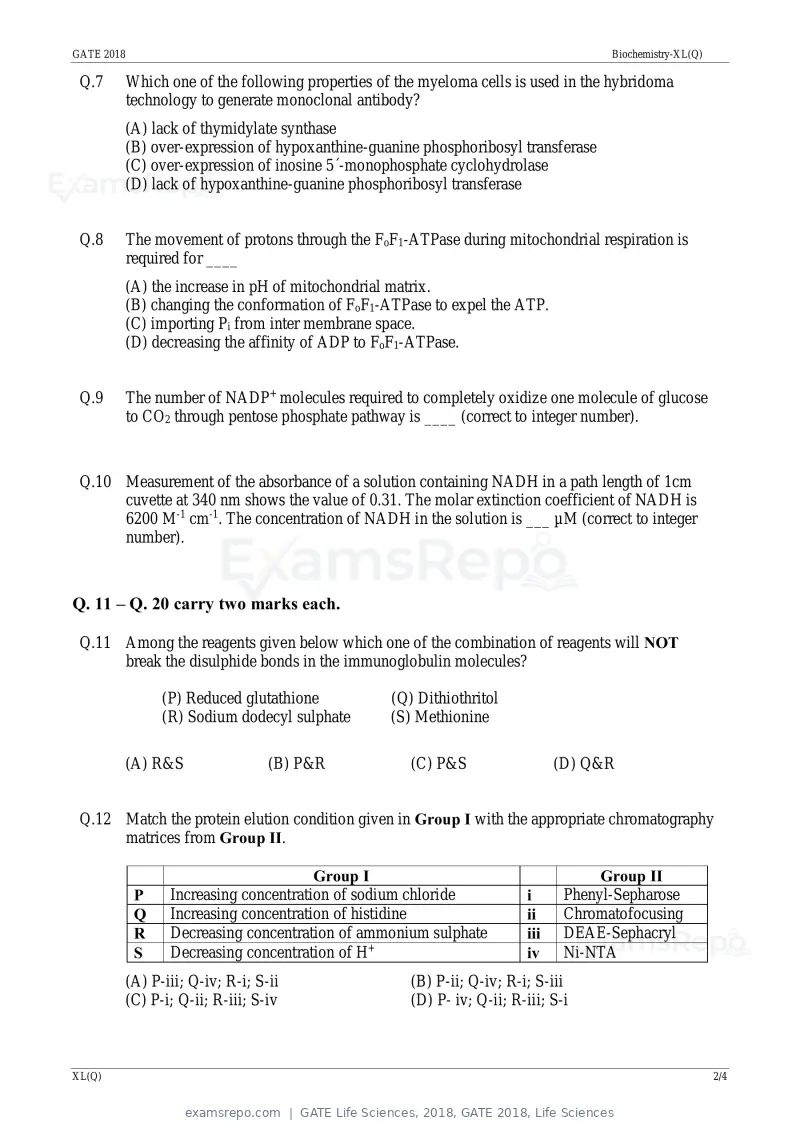
 Q.2        The substrate saturation profile of an enzyme that follows Michaelis-Menten kinetics is
            depicted in the figure. What is the order of the reaction in the concentration range between
            0.8 to 1.4 M?


                                       Initial velocity (M. min-1)   30

                                                                     25

                                                                     20

                                                                     15

                                                                     10

                                                                     5

                                                                          0.2   0.4    0.6   0.8   1.0   1.2   1.4

                                                                                       [S] (M)

        (A) Zero                  (B) Fraction                                        (C) First                      (D) Second


 Q.3        Which one of the following conformations of glucose is most stable?
        (A) Boat                  (B) Half Chair                                      (C) Chair                      (D) Planar


 Q.4        Which one of the following profiles represent the phenomenon of cooperativity?

                   (A)                           (B)                                         (C)                       (D)

                    v                                     v                                  v                          v


                           [S]                                            [S]                            [S]                      [S]


 Q.5        Which one of the following amino acids is responsible for the intrinsic fluorescence of
            proteins?
        (A) Pro                   (B) Met                                             (C) His                        (D) Trp


 Q.6        The glycosylation of the proteins occurs in_____.
        (A) glyoxysomes                                                               (B) lysosomes
        (C) Golgi apparatus                                                           (D) plasma membrane


XL(Q)                                                                                                                                               1/4
Text of page 7
GATE 2018                                                                              Biochemistry-XL(Q)

 Q.7        Which one of the following properties of the myeloma cells is used in the hybridoma
            technology to generate monoclonal antibody?
        (A) lack of thymidylate synthase
        (B) over-expression of hypoxanthine-guanine phosphoribosyl transferase
        (C) over-expression of inosine 5´-monophosphate cyclohydrolase
        (D) lack of hypoxanthine-guanine phosphoribosyl transferase


 Q.8        The movement of protons through the FoF1-ATPase during mitochondrial respiration is
            required for ____
        (A) the increase in pH of mitochondrial matrix.
        (B) changing the conformation of FoF1-ATPase to expel the ATP.
        (C) importing Pi from inter membrane space.
        (D) decreasing the affinity of ADP to FoF1-ATPase.


 Q.9        The number of NADP+ molecules required to completely oxidize one molecule of glucose
            to CO2 through pentose phosphate pathway is ____ (correct to integer number).


 Q.10 Measurement of the absorbance of a solution containing NADH in a path length of 1cm
      cuvette at 340 nm shows the value of 0.31. The molar extinction coefficient of NADH is
      6200 M-1 cm-1. The concentration of NADH in the solution is ___ µM (correct to integer
      number).


Q. 11 – Q. 20 carry two marks each.

 Q.11 Among the reagents given below which one of the combination of reagents will NOT
      break the disulphide bonds in the immunoglobulin molecules?

                 (P) Reduced glutathione            (Q) Dithiothritol
                 (R) Sodium dodecyl sulphate        (S) Methionine

        (A) R&S                  (B) P&R               (C) P&S                  (D) Q&R


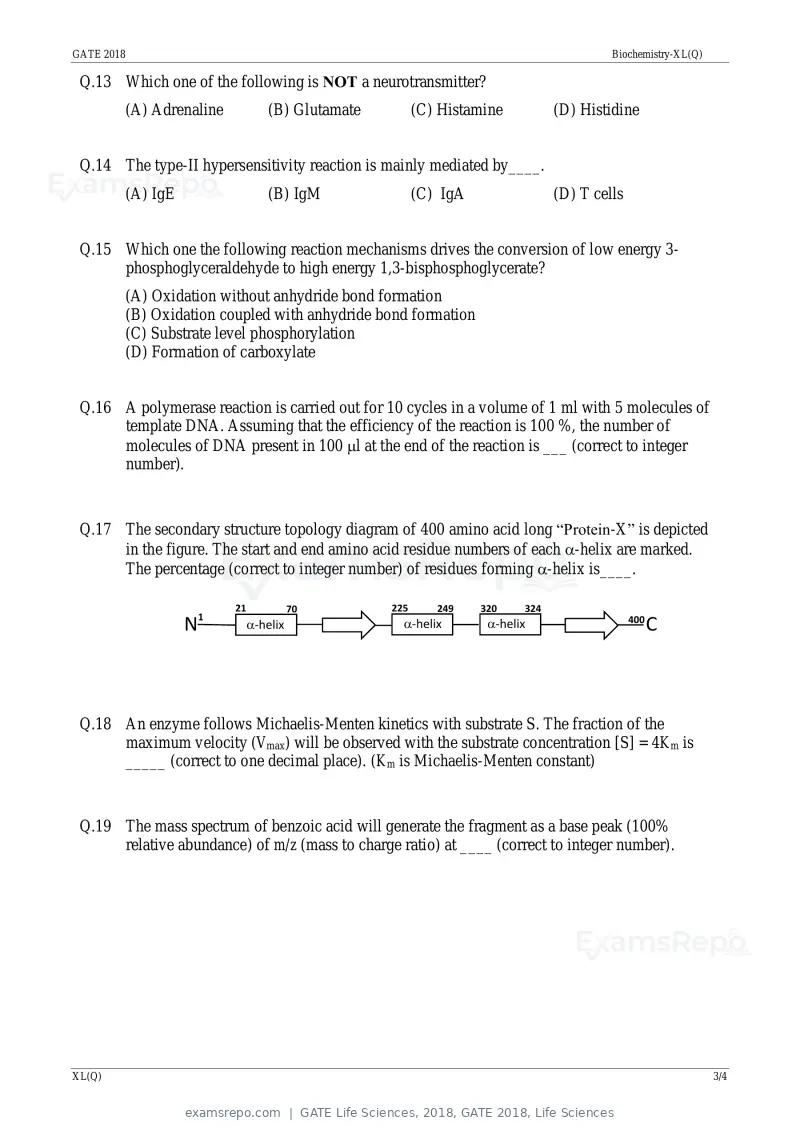
 Q.12 Match the protein elution condition given in Group I with the appropriate chromatography
      matrices from Group II.

                                        Group I                                       Group II
             P    Increasing concentration of sodium chloride             i      Phenyl-Sepharose
             Q    Increasing concentration of histidine                   ii     Chromatofocusing
             R    Decreasing concentration of ammonium sulphate           iii    DEAE-Sephacryl
             S    Decreasing concentration of H+                          iv     Ni-NTA
        (A) P-iii; Q-iv; R-i; S-ii                     (B) P-ii; Q-iv; R-i; S-iii
        (C) P-i; Q-ii; R-iii; S-iv                     (D) P- iv; Q-ii; R-iii; S-i


XL(Q)                                                                                                       2/4
Text of page 8
GATE 2018 Biochemistry-XL(Q)
Q.13 Which one of the following is NOT a neurotransmitter?
(A) Adrenaline (B) Glutamate (C) Histamine (D) Histidine
Q.14 The type-II hypersensitivity reaction is mainly mediated by____.
(A) IgE (B) IgM (C) IgA (D) T cells
Q.15 Which one the following reaction mechanisms drives the conversion of low energy 3-
phosphoglyceraldehyde to high energy 1,3-bisphosphoglycerate?
(A) Oxidation without anhydride bond formation
(B) Oxidation coupled with anhydride bond formation
(C) Substrate level phosphorylation
(D) Formation of carboxylate
Q.16 A polymerase reaction is carried out for 10 cycles in a volume of 1 ml with 5 molecules of
template DNA. Assuming that the efficiency of the reaction is 100 %, the number of
molecules of DNA present in 100 l at the end of the reaction is ___ (correct to integer
number).
Q.17 The secondary structure topology diagram of 400 amino acid long “Protein-X” is depicted
in the figure. The start and end amino acid residue numbers of each -helix are marked.
The percentage (correct to integer number) of residues forming -helix is____.
21 70 225 249 320 324
1
N -helix -helix -helix 400
C
Q.18 An enzyme follows Michaelis-Menten kinetics with substrate S. The fraction of the
maximum velocity (Vmax) will be observed with the substrate concentration [S] = 4Km is
_____ (correct to one decimal place). (Km is Michaelis-Menten constant)
Q.19 The mass spectrum of benzoic acid will generate the fragment as a base peak (100%
relative abundance) of m/z (mass to charge ratio) at ____ (correct to integer number).
XL(Q) 3/4
Text of page 9
GATE 2018 Biochemistry-XL(Q)
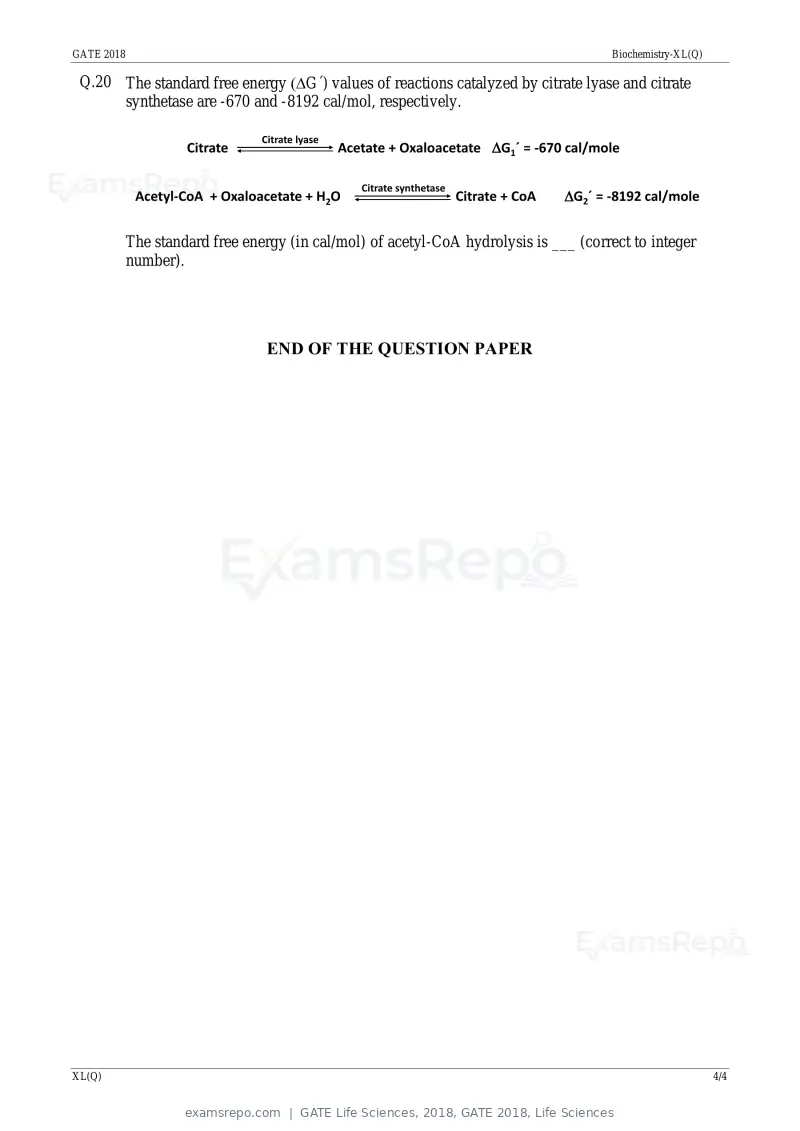
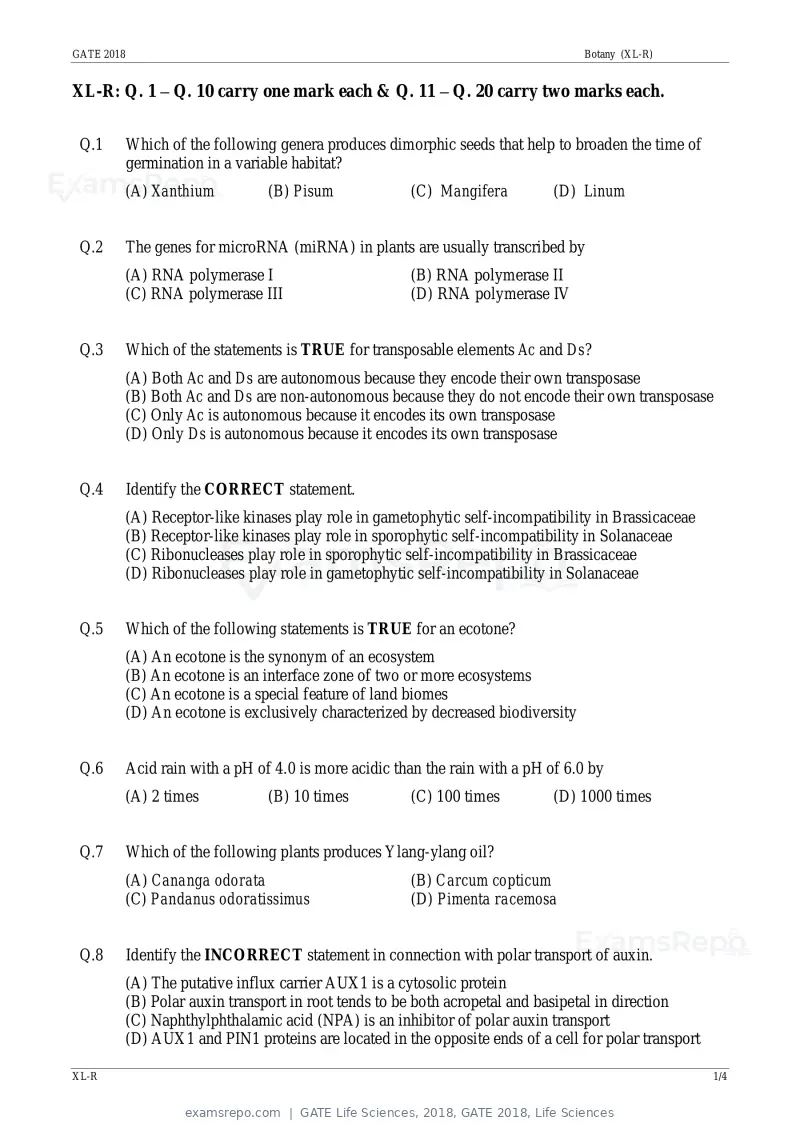
Q.20 The standard free energyG´) values of reactions catalyzed by citrate lyase and citrate
synthetase are -670 and -8192 cal/mol, respectively.
Citrate lyase
Citrate Acetate + Oxaloacetate G1´ = -670 cal/mole
Citrate synthetase
Acetyl-CoA + Oxaloacetate + H2O Citrate + CoA G2´ = -8192 cal/mole
The standard free energy (in cal/mol) of acetyl-CoA hydrolysis is ___ (correct to integer
number).
END OF THE QUESTION PAPER
XL(Q) 4/4
Text of page 10
GATE 2018                                                                          Botany (XL-R)


XL-R: Q. 1 – Q. 10 carry one mark each & Q. 11 – Q. 20 carry two marks each.


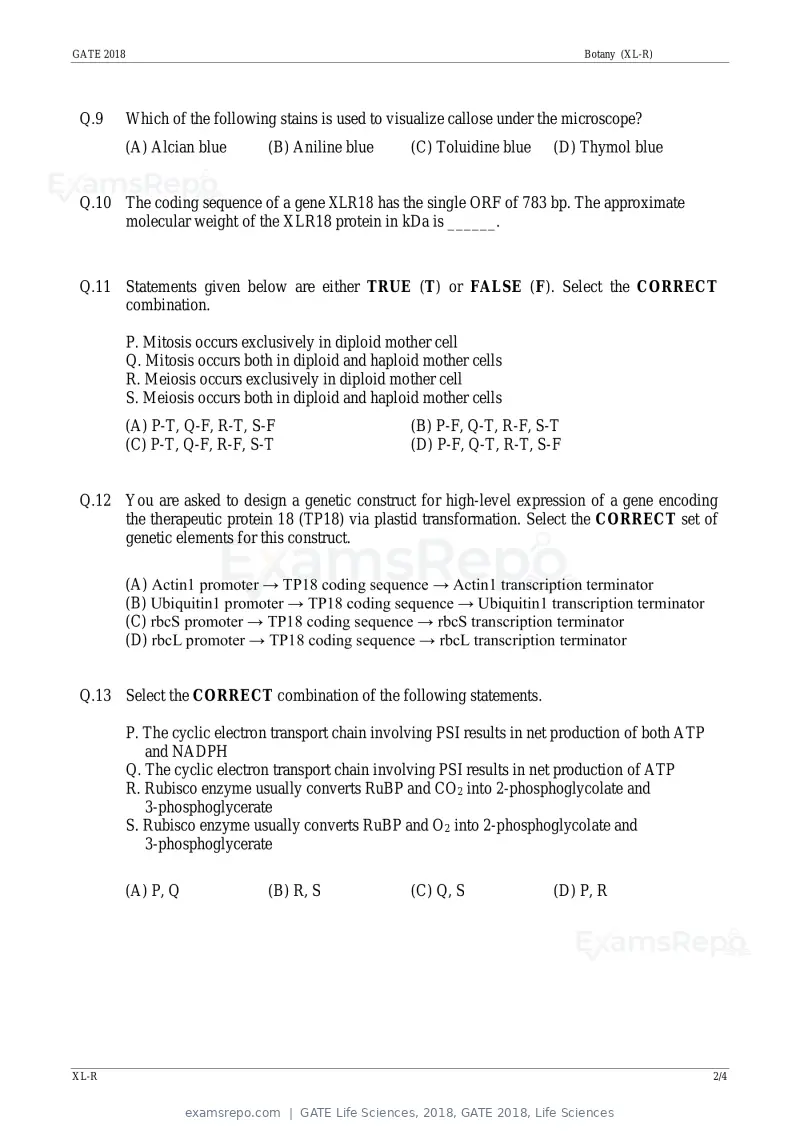
 Q.1        Which of the following genera produces dimorphic seeds that help to broaden the time of
            germination in a variable habitat?
        (A) Xanthium              (B) Pisum             (C) Mangifera          (D) Linum


 Q.2        The genes for microRNA (miRNA) in plants are usually transcribed by
        (A) RNA polymerase I                            (B) RNA polymerase II
        (C) RNA polymerase III                          (D) RNA polymerase IV


 Q.3        Which of the statements is TRUE for transposable elements Ac and Ds?
        (A) Both Ac and Ds are autonomous because they encode their own transposase
        (B) Both Ac and Ds are non-autonomous because they do not encode their own transposase
        (C) Only Ac is autonomous because it encodes its own transposase
        (D) Only Ds is autonomous because it encodes its own transposase


 Q.4        Identify the CORRECT statement.
        (A) Receptor-like kinases play role in gametophytic self-incompatibility in Brassicaceae
        (B) Receptor-like kinases play role in sporophytic self-incompatibility in Solanaceae
        (C) Ribonucleases play role in sporophytic self-incompatibility in Brassicaceae
        (D) Ribonucleases play role in gametophytic self-incompatibility in Solanaceae


 Q.5        Which of the following statements is TRUE for an ecotone?
        (A) An ecotone is the synonym of an ecosystem
        (B) An ecotone is an interface zone of two or more ecosystems
        (C) An ecotone is a special feature of land biomes
        (D) An ecotone is exclusively characterized by decreased biodiversity


 Q.6        Acid rain with a pH of 4.0 is more acidic than the rain with a pH of 6.0 by
        (A) 2 times               (B) 10 times          (C) 100 times          (D) 1000 times


 Q.7        Which of the following plants produces Ylang-ylang oil?
        (A) Cananga odorata                             (B) Carcum copticum
        (C) Pandanus odoratissimus                      (D) Pimenta racemosa


 Q.8        Identify the INCORRECT statement in connection with polar transport of auxin.
        (A) The putative influx carrier AUX1 is a cytosolic protein
        (B) Polar auxin transport in root tends to be both acropetal and basipetal in direction
        (C) Naphthylphthalamic acid (NPA) is an inhibitor of polar auxin transport
        (D) AUX1 and PIN1 proteins are located in the opposite ends of a cell for polar transport

XL-R                                                                                                  1/4
Text of page 11
GATE 2018                                                                          Botany (XL-R)


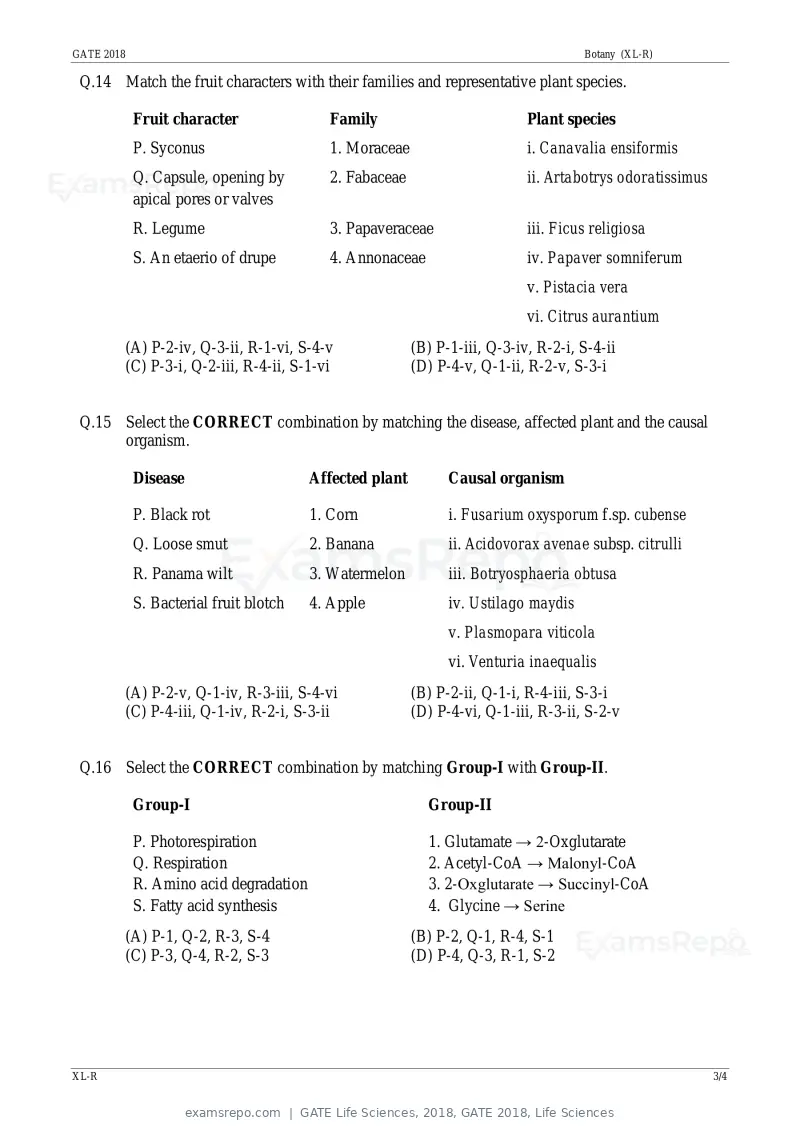
 Q.9        Which of the following stains is used to visualize callose under the microscope?
        (A) Alcian blue           (B) Aniline blue      (C) Toluidine blue    (D) Thymol blue


 Q.10 The coding sequence of a gene XLR18 has the single ORF of 783 bp. The approximate
      molecular weight of the XLR18 protein in kDa is ______.


 Q.11 Statements given below are either TRUE (T) or FALSE (F). Select the CORRECT
      combination.

            P. Mitosis occurs exclusively in diploid mother cell
            Q. Mitosis occurs both in diploid and haploid mother cells
            R. Meiosis occurs exclusively in diploid mother cell
            S. Meiosis occurs both in diploid and haploid mother cells
        (A) P-T, Q-F, R-T, S-F                          (B) P-F, Q-T, R-F, S-T
        (C) P-T, Q-F, R-F, S-T                          (D) P-F, Q-T, R-T, S-F


 Q.12 You are asked to design a genetic construct for high-level expression of a gene encoding
      the therapeutic protein 18 (TP18) via plastid transformation. Select the CORRECT set of
      genetic elements for this construct.

        (A) Actin1 promoter → TP18 coding sequence → Actin1 transcription terminator
        (B) Ubiquitin1 promoter → TP18 coding sequence → Ubiquitin1 transcription terminator
        (C) rbcS promoter → TP18 coding sequence → rbcS transcription terminator
        (D) rbcL promoter → TP18 coding sequence → rbcL transcription terminator


 Q.13 Select the CORRECT combination of the following statements.

            P. The cyclic electron transport chain involving PSI results in net production of both ATP
               and NADPH
            Q. The cyclic electron transport chain involving PSI results in net production of ATP
            R. Rubisco enzyme usually converts RuBP and CO2 into 2-phosphoglycolate and
               3-phosphoglycerate
            S. Rubisco enzyme usually converts RuBP and O2 into 2-phosphoglycolate and
               3-phosphoglycerate

        (A) P, Q                  (B) R, S              (C) Q, S              (D) P, R


XL-R                                                                                                     2/4
Text of page 12
GATE 2018                                                                            Botany (XL-R)

 Q.14 Match the fruit characters with their families and representative plant species.

            Fruit character               Family                            Plant species
            P. Syconus                    1. Moraceae                       i. Canavalia ensiformis
            Q. Capsule, opening by        2. Fabaceae                       ii. Artabotrys odoratissimus
            apical pores or valves
            R. Legume                     3. Papaveraceae                   iii. Ficus religiosa
            S. An etaerio of drupe        4. Annonaceae                     iv. Papaver somniferum
                                                                            v. Pistacia vera
                                                                            vi. Citrus aurantium
        (A) P-2-iv, Q-3-ii, R-1-vi, S-4-v                (B) P-1-iii, Q-3-iv, R-2-i, S-4-ii
        (C) P-3-i, Q-2-iii, R-4-ii, S-1-vi               (D) P-4-v, Q-1-ii, R-2-v, S-3-i


 Q.15 Select the CORRECT combination by matching the disease, affected plant and the causal
      organism.

            Disease                     Affected plant         Causal organism

            P. Black rot                1. Corn                i. Fusarium oxysporum f.sp. cubense
            Q. Loose smut               2. Banana              ii. Acidovorax avenae subsp. citrulli
            R. Panama wilt              3. Watermelon          iii. Botryosphaeria obtusa
            S. Bacterial fruit blotch   4. Apple               iv. Ustilago maydis
                                                               v. Plasmopara viticola
                                                               vi. Venturia inaequalis
        (A) P-2-v, Q-1-iv, R-3-iii, S-4-vi               (B) P-2-ii, Q-1-i, R-4-iii, S-3-i
        (C) P-4-iii, Q-1-iv, R-2-i, S-3-ii               (D) P-4-vi, Q-1-iii, R-3-ii, S-2-v


 Q.16 Select the CORRECT combination by matching Group-I with Group-II.

            Group-I                                        Group-II

            P. Photorespiration                            1. Glutamate → 2-Oxglutarate
            Q. Respiration                                 2. Acetyl-CoA → Malonyl-CoA
            R. Amino acid degradation                      3. 2-Oxglutarate → Succinyl-CoA
            S. Fatty acid synthesis                        4. Glycine → Serine
        (A) P-1, Q-2, R-3, S-4                           (B) P-2, Q-1, R-4, S-1
        (C) P-3, Q-4, R-2, S-3                           (D) P-4, Q-3, R-1, S-2


XL-R                                                                                                       3/4
Text of page 13
GATE 2018                                                                           Botany (XL-R)

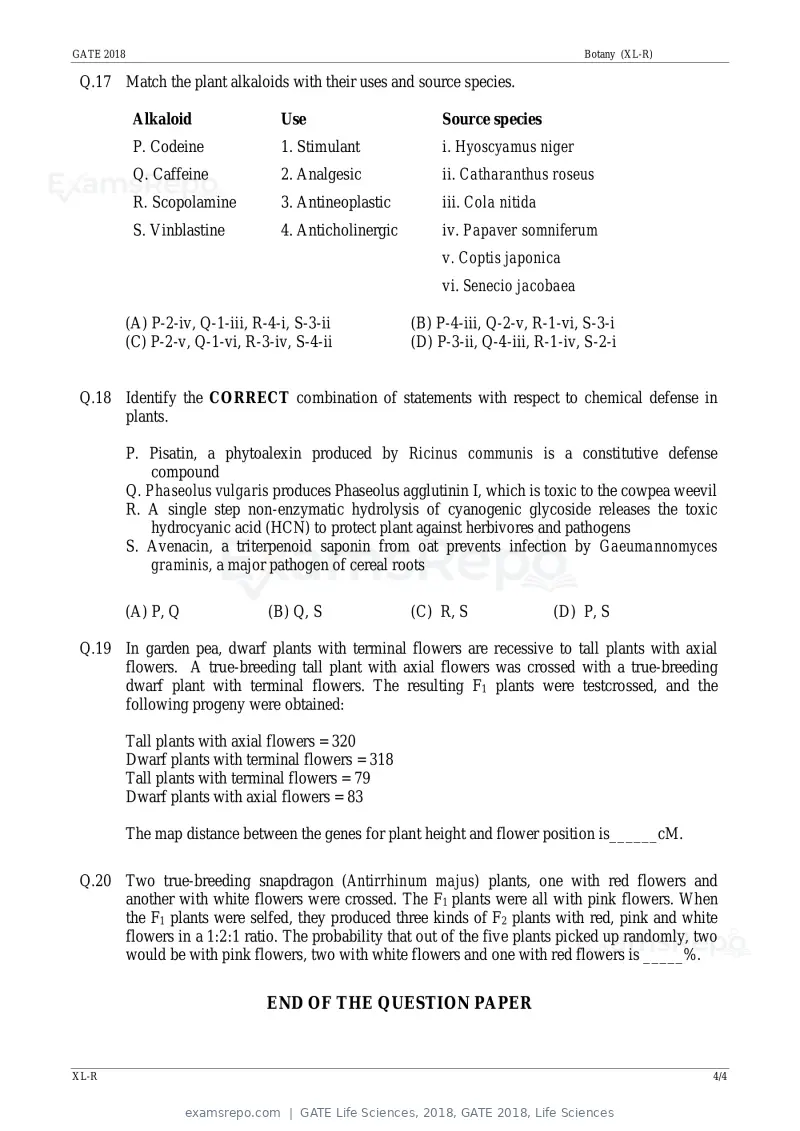
 Q.17 Match the plant alkaloids with their uses and source species.

             Alkaloid              Use                       Source species
             P. Codeine            1. Stimulant              i. Hyoscyamus niger
             Q. Caffeine           2. Analgesic              ii. Catharanthus roseus
             R. Scopolamine        3. Antineoplastic         iii. Cola nitida
             S. Vinblastine        4. Anticholinergic        iv. Papaver somniferum
                                                             v. Coptis japonica
                                                             vi. Senecio jacobaea

        (A) P-2-iv, Q-1-iii, R-4-i, S-3-ii              (B) P-4-iii, Q-2-v, R-1-vi, S-3-i
        (C) P-2-v, Q-1-vi, R-3-iv, S-4-ii               (D) P-3-ii, Q-4-iii, R-1-iv, S-2-i


 Q.18 Identify the CORRECT combination of statements with respect to chemical defense in
      plants.

            P. Pisatin, a phytoalexin produced by Ricinus communis is a constitutive defense
                compound
            Q. Phaseolus vulgaris produces Phaseolus agglutinin I, which is toxic to the cowpea weevil
            R. A single step non-enzymatic hydrolysis of cyanogenic glycoside releases the toxic
                hydrocyanic acid (HCN) to protect plant against herbivores and pathogens
            S. Avenacin, a triterpenoid saponin from oat prevents infection by Gaeumannomyces
                graminis, a major pathogen of cereal roots

        (A) P, Q                 (B) Q, S               (C) R, S                (D) P, S

 Q.19 In garden pea, dwarf plants with terminal flowers are recessive to tall plants with axial
      flowers. A true-breeding tall plant with axial flowers was crossed with a true-breeding
      dwarf plant with terminal flowers. The resulting F1 plants were testcrossed, and the
      following progeny were obtained:

            Tall plants with axial flowers = 320
            Dwarf plants with terminal flowers = 318
            Tall plants with terminal flowers = 79
            Dwarf plants with axial flowers = 83

            The map distance between the genes for plant height and flower position is______cM.

 Q.20 Two true-breeding snapdragon (Antirrhinum majus) plants, one with red flowers and
      another with white flowers were crossed. The F1 plants were all with pink flowers. When
      the F1 plants were selfed, they produced three kinds of F2 plants with red, pink and white
      flowers in a 1:2:1 ratio. The probability that out of the five plants picked up randomly, two
      would be with pink flowers, two with white flowers and one with red flowers is _____%.


                                 END OF THE QUESTION PAPER


XL-R                                                                                                 4/4
Text of page 14
GATE 2018 Microbiology (XL-S)
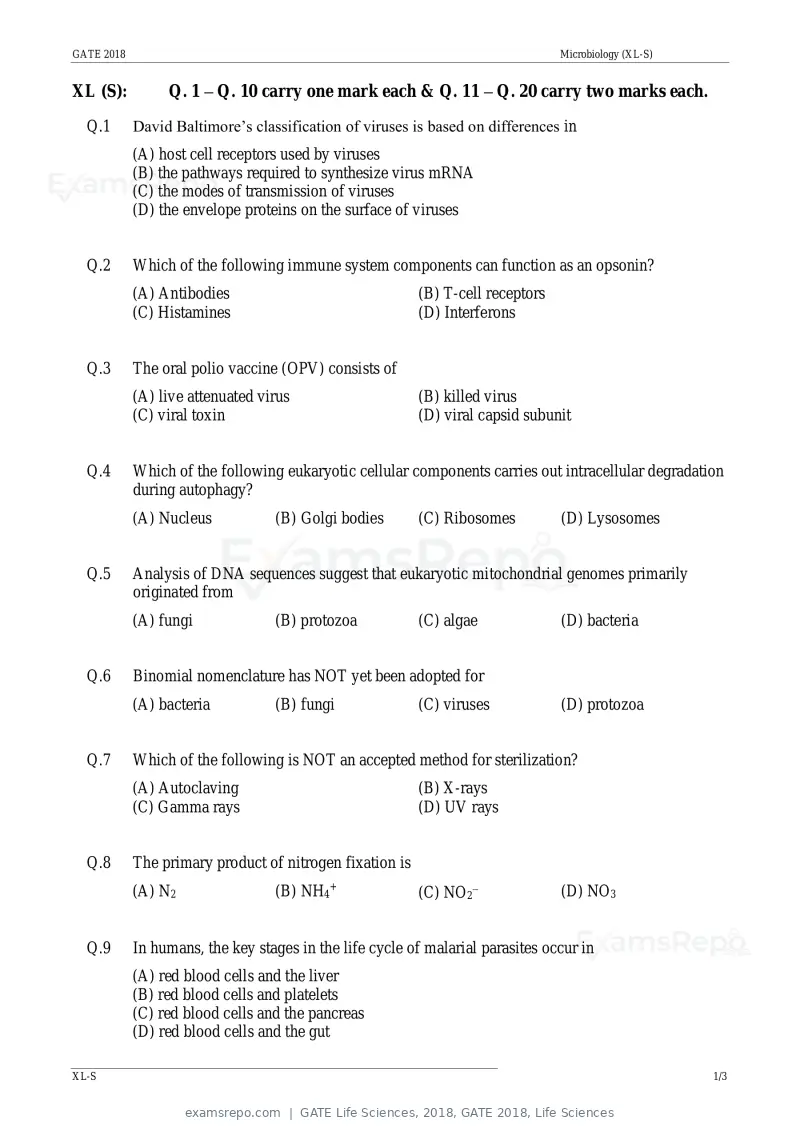
XL (S): Q. 1 – Q. 10 carry one mark each & Q. 11 – Q. 20 carry two marks each.
Q.1 David Baltimore’s classification of viruses is based on differences in
(A) host cell receptors used by viruses
(B) the pathways required to synthesize virus mRNA
(C) the modes of transmission of viruses
(D) the envelope proteins on the surface of viruses
Q.2 Which of the following immune system components can function as an opsonin?
(A) Antibodies (B) T-cell receptors
(C) Histamines (D) Interferons
Q.3 The oral polio vaccine (OPV) consists of
(A) live attenuated virus (B) killed virus
(C) viral toxin (D) viral capsid subunit
Q.4 Which of the following eukaryotic cellular components carries out intracellular degradation
during autophagy?
(A) Nucleus (B) Golgi bodies (C) Ribosomes (D) Lysosomes
Q.5 Analysis of DNA sequences suggest that eukaryotic mitochondrial genomes primarily
originated from
(A) fungi (B) protozoa (C) algae (D) bacteria
Q.6 Binomial nomenclature has NOT yet been adopted for
(A) bacteria (B) fungi (C) viruses (D) protozoa
Q.7 Which of the following is NOT an accepted method for sterilization?
(A) Autoclaving (B) X-rays
(C) Gamma rays (D) UV rays
Q.8 The primary product of nitrogen fixation is
(A) N2 (B) NH4+ (C) NO2 (D) NO3
Q.9 In humans, the key stages in the life cycle of malarial parasites occur in
(A) red blood cells and the liver
(B) red blood cells and platelets
(C) red blood cells and the pancreas
(D) red blood cells and the gut
XL-S 1/3
Text of page 15
GATE 2018                                                                            Microbiology (XL-S)


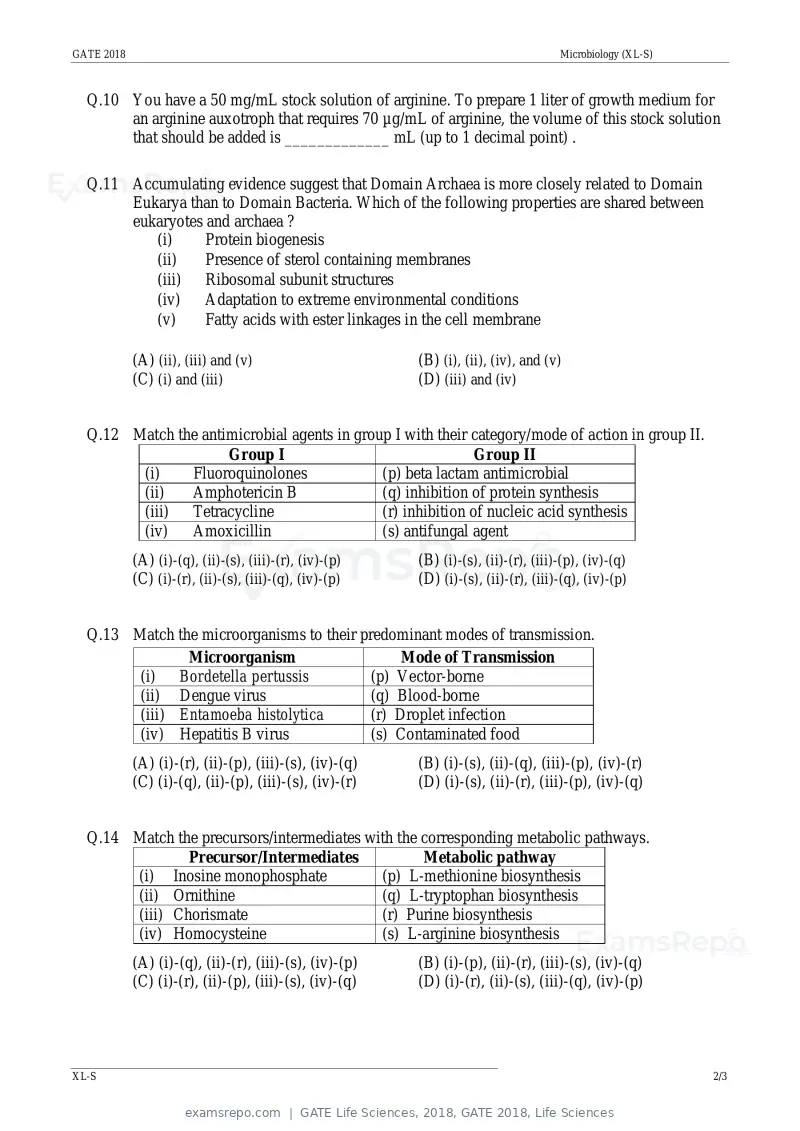
  Q.10 You have a 50 mg/mL stock solution of arginine. To prepare 1 liter of growth medium for
       an arginine auxotroph that requires 70 µg/mL of arginine, the volume of this stock solution
       that should be added is _____________ mL (up to 1 decimal point) .

  Q.11 Accumulating evidence suggest that Domain Archaea is more closely related to Domain
       Eukarya than to Domain Bacteria. Which of the following properties are shared between
       eukaryotes and archaea ?
          (i)     Protein biogenesis
          (ii)    Presence of sterol containing membranes
          (iii) Ribosomal subunit structures
          (iv)    Adaptation to extreme environmental conditions
          (v)     Fatty acids with ester linkages in the cell membrane

            (A) (ii), (iii) and (v)                      (B) (i), (ii), (iv), and (v)
            (C) (i) and (iii)                            (D) (iii) and (iv)


  Q.12 Match the antimicrobial agents in group I with their category/mode of action in group II.
                     Group I                                 Group II
        (i)    Fluoroquinolones              (p) beta lactam antimicrobial
        (ii)   Amphotericin B                (q) inhibition of protein synthesis
        (iii)  Tetracycline                  (r) inhibition of nucleic acid synthesis
        (iv)   Amoxicillin                   (s) antifungal agent
            (A) (i)-(q), (ii)-(s), (iii)-(r), (iv)-(p)   (B) (i)-(s), (ii)-(r), (iii)-(p), (iv)-(q)
            (C) (i)-(r), (ii)-(s), (iii)-(q), (iv)-(p)   (D) (i)-(s), (ii)-(r), (iii)-(q), (iv)-(p)


  Q.13 Match the microorganisms to their predominant modes of transmission.
               Microorganism                   Mode of Transmission
        (i) Bordetella pertussis          (p) Vector-borne
        (ii) Dengue virus                 (q) Blood-borne
        (iii) Entamoeba histolytica       (r) Droplet infection
        (iv) Hepatitis B virus            (s) Contaminated food
            (A) (i)-(r), (ii)-(p), (iii)-(s), (iv)-(q)   (B) (i)-(s), (ii)-(q), (iii)-(p), (iv)-(r)
            (C) (i)-(q), (ii)-(p), (iii)-(s), (iv)-(r)   (D) (i)-(s), (ii)-(r), (iii)-(p), (iv)-(q)


  Q.14 Match the precursors/intermediates with the corresponding metabolic pathways.
               Precursor/Intermediates             Metabolic pathway
       (i) Inosine monophosphate            (p) L-methionine biosynthesis
       (ii) Ornithine                       (q) L-tryptophan biosynthesis
       (iii) Chorismate                     (r) Purine biosynthesis
       (iv) Homocysteine                    (s) L-arginine biosynthesis
            (A) (i)-(q), (ii)-(r), (iii)-(s), (iv)-(p)   (B) (i)-(p), (ii)-(r), (iii)-(s), (iv)-(q)
            (C) (i)-(r), (ii)-(p), (iii)-(s), (iv)-(q)   (D) (i)-(r), (ii)-(s), (iii)-(q), (iv)-(p)


XL-S                                                                                                       2/3
Text of page 16
GATE 2018 Microbiology (XL-S)
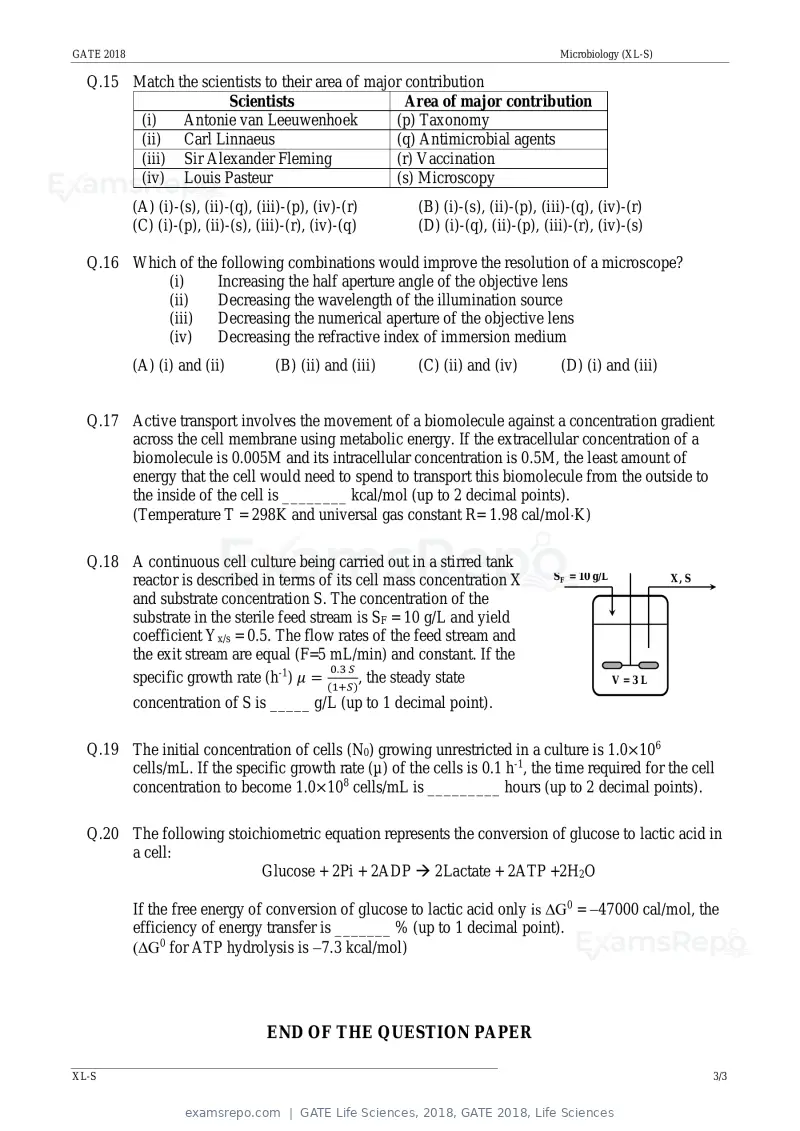
Q.15 Match the scientists to their area of major contribution
Scientists Area of major contribution
(i) Antonie van Leeuwenhoek (p) Taxonomy
(ii) Carl Linnaeus (q) Antimicrobial agents
(iii) Sir Alexander Fleming (r) Vaccination
(iv) Louis Pasteur (s) Microscopy
(A) (i)-(s), (ii)-(q), (iii)-(p), (iv)-(r) (B) (i)-(s), (ii)-(p), (iii)-(q), (iv)-(r)
(C) (i)-(p), (ii)-(s), (iii)-(r), (iv)-(q) (D) (i)-(q), (ii)-(p), (iii)-(r), (iv)-(s)
Q.16 Which of the following combinations would improve the resolution of a microscope?
(i) Increasing the half aperture angle of the objective lens
(ii) Decreasing the wavelength of the illumination source
(iii) Decreasing the numerical aperture of the objective lens
(iv) Decreasing the refractive index of immersion medium
(A) (i) and (ii) (B) (ii) and (iii) (C) (ii) and (iv) (D) (i) and (iii)
Q.17 Active transport involves the movement of a biomolecule against a concentration gradient
across the cell membrane using metabolic energy. If the extracellular concentration of a
biomolecule is 0.005M and its intracellular concentration is 0.5M, the least amount of
energy that the cell would need to spend to transport this biomolecule from the outside to
the inside of the cell is ________ kcal/mol (up to 2 decimal points).
(Temperature T = 298K and universal gas constant R= 1.98 cal/molK)
Q.18 A continuous cell culture being carried out in a stirred tank
reactor is described in terms of its cell mass concentration X SF = 10 g/L X, S
and substrate concentration S. The concentration of the
substrate in the sterile feed stream is SF = 10 g/L and yield
coefficient Yx/s = 0.5. The flow rates of the feed stream and
the exit stream are equal (F=5 mL/min) and constant. If the
0.3 S
specific growth rate (h-1) μ = (1+S), the steady state V=3L
concentration of S is _____ g/L (up to 1 decimal point).
Q.19 The initial concentration of cells (N0) growing unrestricted in a culture is 1.0×10⁶
cells/mL. If the specific growth rate (µ) of the cells is 0.1 h-1, the time required for the cell
concentration to become 1.0×10⁸ cells/mL is _________ hours (up to 2 decimal points).
Q.20 The following stoichiometric equation represents the conversion of glucose to lactic acid in
a cell:
Glucose + 2Pi + 2ADP 2Lactate + 2ATP +2H2O
If the free energy of conversion of glucose to lactic acid only is ∆G0 = 47000 cal/mol, the
efficiency of energy transfer is _______ % (up to 1 decimal point).
(∆G0 for ATP hydrolysis is 7.3 kcal/mol)
END OF THE QUESTION PAPER
XL-S 3/3
Text of page 17
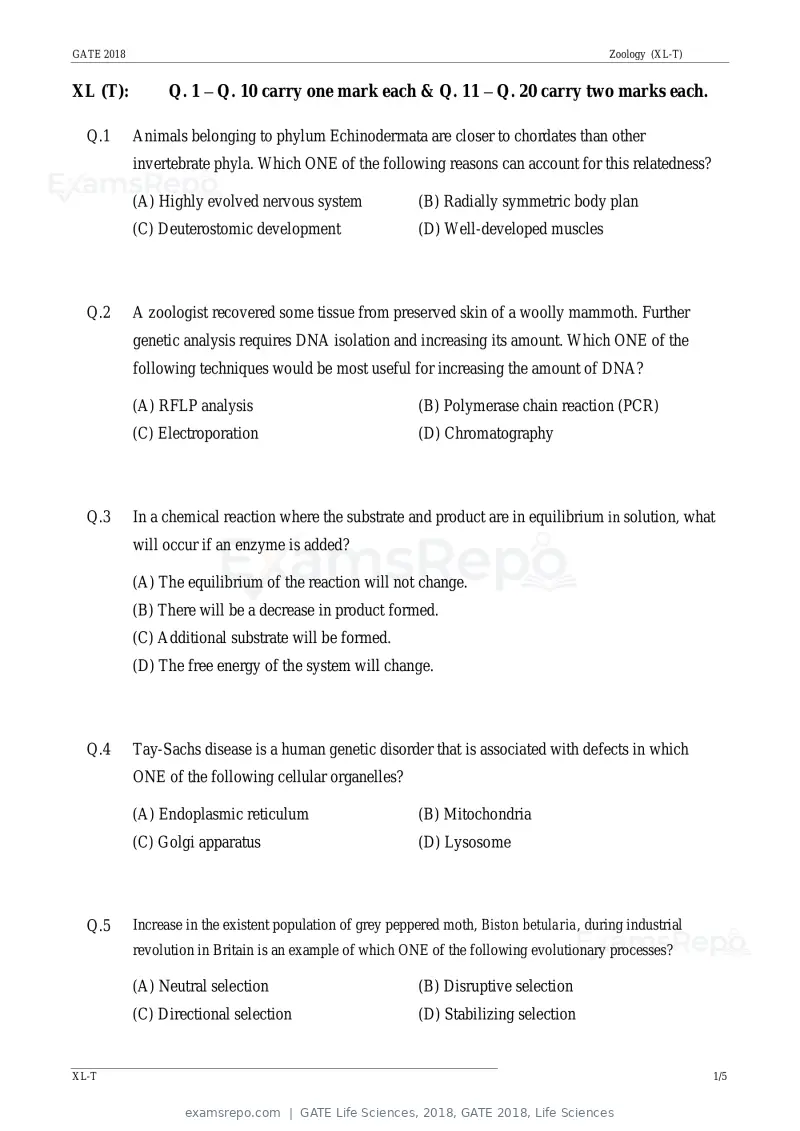
GATE 2018                                                                                    Zoology (XL-T)


XL (T):           Q. 1 – Q. 10 carry one mark each & Q. 11 – Q. 20 carry two marks each.

  Q.1       Animals belonging to phylum Echinodermata are closer to chordates than other
            invertebrate phyla. Which ONE of the following reasons can account for this relatedness?

            (A) Highly evolved nervous system               (B) Radially symmetric body plan
            (C) Deuterostomic development                   (D) Well-developed muscles


  Q.2       A zoologist recovered some tissue from preserved skin of a woolly mammoth. Further
            genetic analysis requires DNA isolation and increasing its amount. Which ONE of the
            following techniques would be most useful for increasing the amount of DNA?

            (A) RFLP analysis                               (B) Polymerase chain reaction (PCR)
            (C) Electroporation                             (D) Chromatography


  Q.3       In a chemical reaction where the substrate and product are in equilibrium in solution, what
            will occur if an enzyme is added?

            (A) The equilibrium of the reaction will not change.
            (B) There will be a decrease in product formed.
            (C) Additional substrate will be formed.
            (D) The free energy of the system will change.


  Q.4       Tay-Sachs disease is a human genetic disorder that is associated with defects in which
            ONE of the following cellular organelles?

            (A) Endoplasmic reticulum                       (B) Mitochondria
            (C) Golgi apparatus                             (D) Lysosome


  Q.5       Increase in the existent population of grey peppered moth, Biston betularia, during industrial
            revolution in Britain is an example of which ONE of the following evolutionary processes?

            (A) Neutral selection                           (B) Disruptive selection
            (C) Directional selection                       (D) Stabilizing selection


XL-T                                                                                                          1/5
Text of page 18
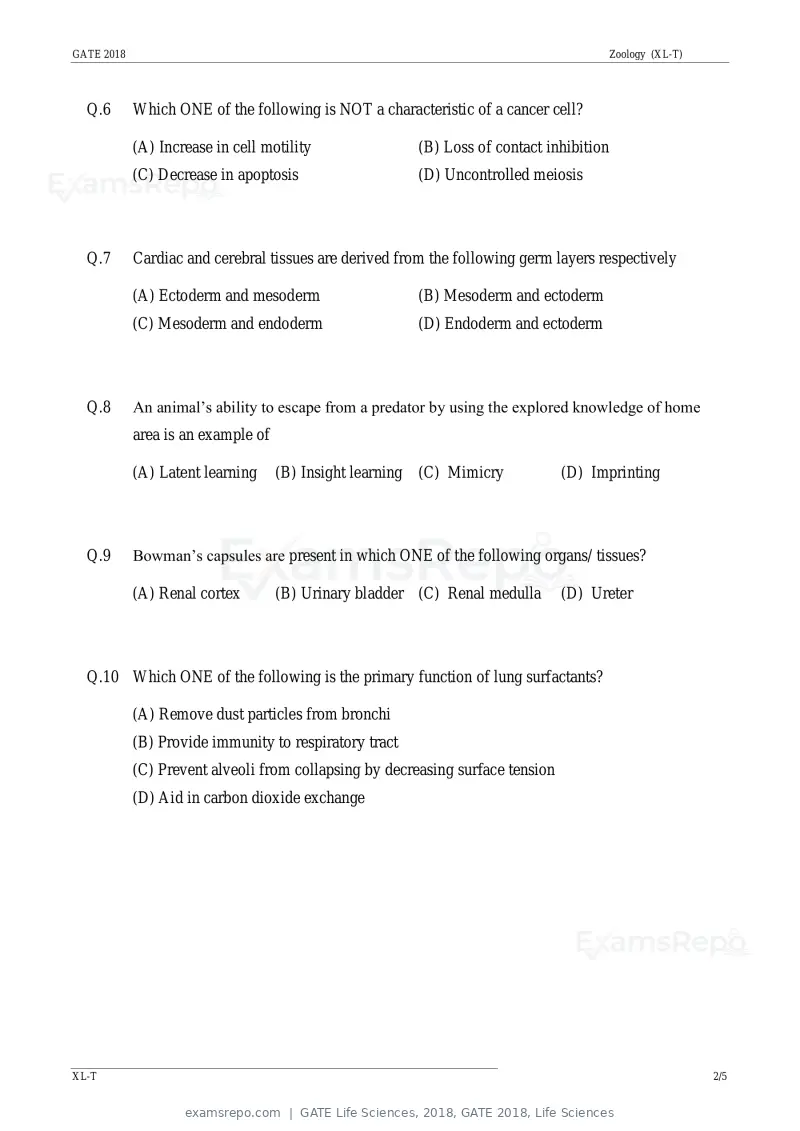
GATE 2018                                                                                Zoology (XL-T)


  Q.6       Which ONE of the following is NOT a characteristic of a cancer cell?

            (A) Increase in cell motility               (B) Loss of contact inhibition
            (C) Decrease in apoptosis                   (D) Uncontrolled meiosis


  Q.7       Cardiac and cerebral tissues are derived from the following germ layers respectively

            (A) Ectoderm and mesoderm                   (B) Mesoderm and ectoderm
            (C) Mesoderm and endoderm                   (D) Endoderm and ectoderm


  Q.8       An animal’s ability to escape from a predator by using the explored knowledge of home
            area is an example of

            (A) Latent learning     (B) Insight learning (C) Mimicry            (D) Imprinting


  Q.9       Bowman’s capsules are present in which ONE of the following organs/ tissues?

            (A) Renal cortex        (B) Urinary bladder (C) Renal medulla       (D) Ureter


  Q.10 Which ONE of the following is the primary function of lung surfactants?

            (A) Remove dust particles from bronchi
            (B) Provide immunity to respiratory tract
            (C) Prevent alveoli from collapsing by decreasing surface tension
            (D) Aid in carbon dioxide exchange


XL-T                                                                                                      2/5
Text of page 19
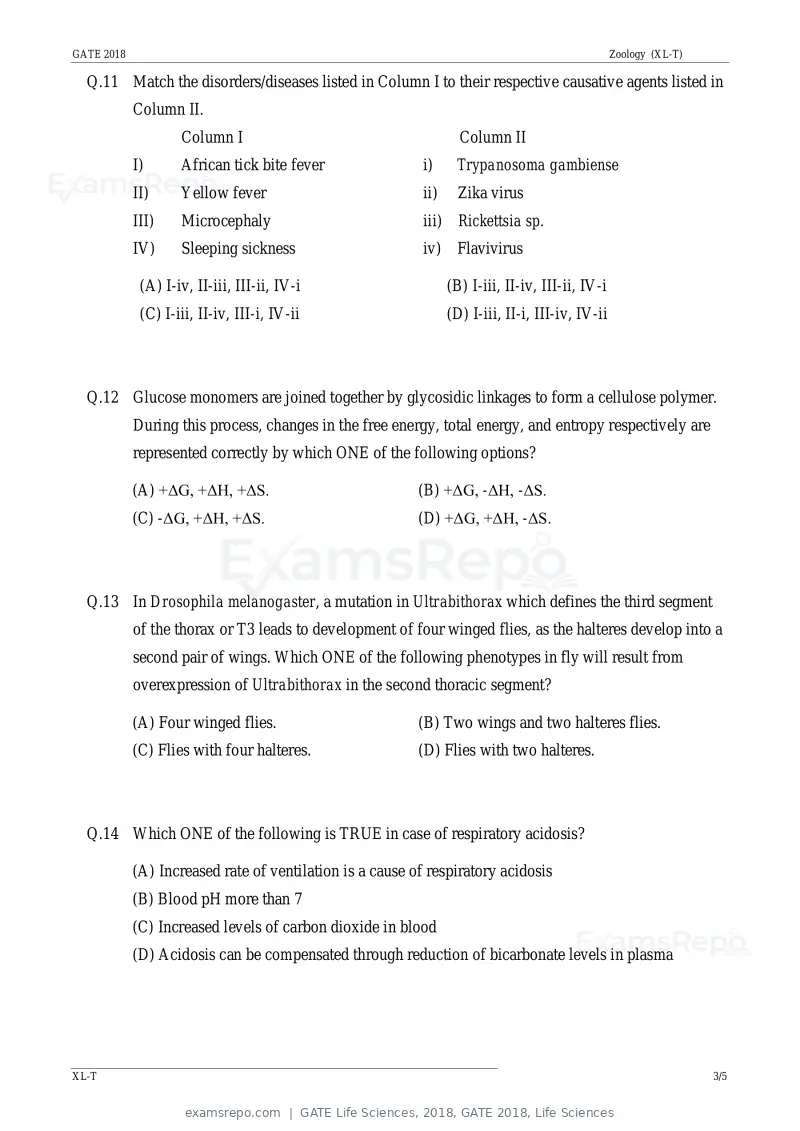
GATE 2018                                                                                         Zoology (XL-T)

  Q.11 Match the disorders/diseases listed in Column I to their respective causative agents listed in
            Column II.
                    Column I                                       Column II
            I)      African tick bite fever                i)     Trypanosoma gambiense
            II)     Yellow fever                           ii)     Zika virus
            III)    Microcephaly                           iii) Rickettsia sp.
            IV)     Sleeping sickness                      iv) Flavivirus

             (A) I-iv, II-iii, III-ii, IV-i                      (B) I-iii, II-iv, III-ii, IV-i
             (C) I-iii, II-iv, III-i, IV-ii                      (D) I-iii, II-i, III-iv, IV-ii


  Q.12 Glucose monomers are joined together by glycosidic linkages to form a cellulose polymer.
            During this process, changes in the free energy, total energy, and entropy respectively are
            represented correctly by which ONE of the following options?

            (A) +ΔG, +ΔH, +ΔS.                            (B) +ΔG, -ΔH, -ΔS.
            (C) -ΔG, +ΔH, +ΔS.                            (D) +ΔG, +ΔH, -ΔS.


  Q.13 In Drosophila melanogaster, a mutation in Ultrabithorax which defines the third segment
            of the thorax or T3 leads to development of four winged flies, as the halteres develop into a
            second pair of wings. Which ONE of the following phenotypes in fly will result from
            overexpression of Ultrabithorax in the second thoracic segment?

            (A) Four winged flies.                        (B) Two wings and two halteres flies.
            (C) Flies with four halteres.                 (D) Flies with two halteres.


  Q.14 Which ONE of the following is TRUE in case of respiratory acidosis?

            (A) Increased rate of ventilation is a cause of respiratory acidosis
            (B) Blood pH more than 7
            (C) Increased levels of carbon dioxide in blood
            (D) Acidosis can be compensated through reduction of bicarbonate levels in plasma


XL-T                                                                                                               3/5
Text of page 20
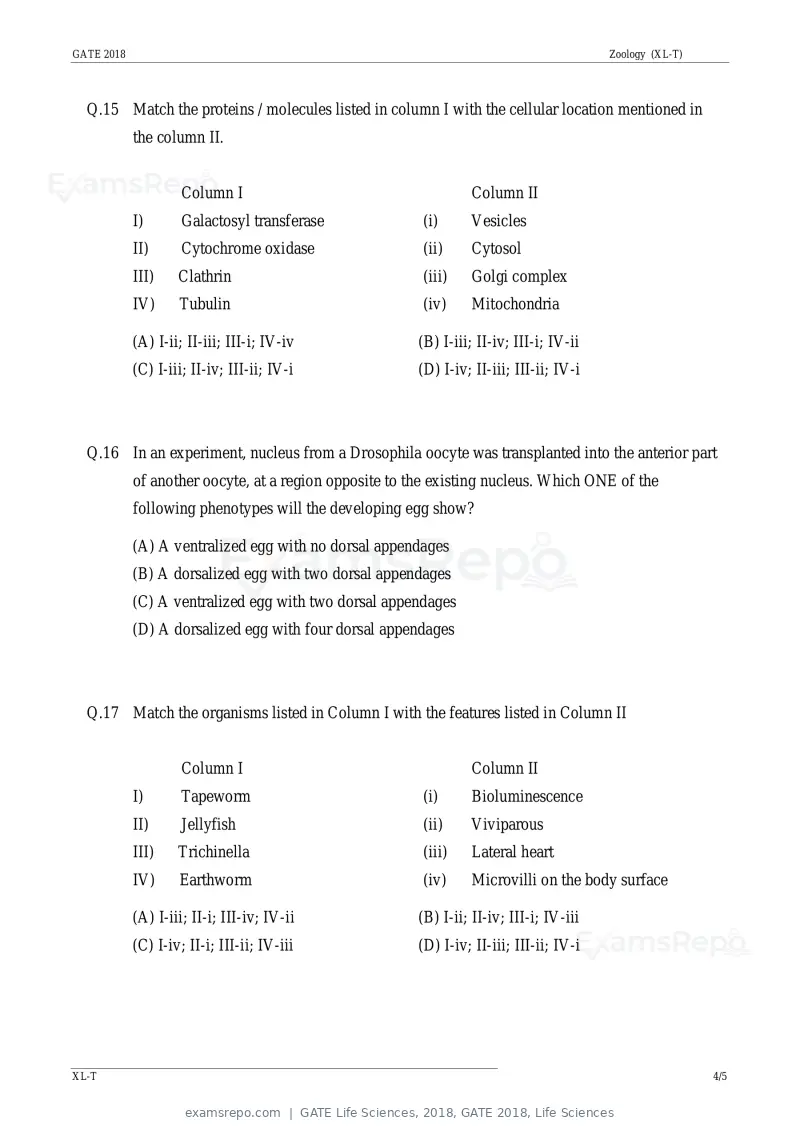
GATE 2018                                                                               Zoology (XL-T)


  Q.15 Match the proteins / molecules listed in column I with the cellular location mentioned in
            the column II.


                     Column I                                   Column II
            I)       Galactosyl transferase             (i)     Vesicles
            II)      Cytochrome oxidase                 (ii)    Cytosol
            III)    Clathrin                            (iii)   Golgi complex
            IV)     Tubulin                             (iv)    Mitochondria

            (A) I-ii; II-iii; III-i; IV-iv             (B) I-iii; II-iv; III-i; IV-ii
            (C) I-iii; II-iv; III-ii; IV-i             (D) I-iv; II-iii; III-ii; IV-i


  Q.16 In an experiment, nucleus from a Drosophila oocyte was transplanted into the anterior part
            of another oocyte, at a region opposite to the existing nucleus. Which ONE of the
            following phenotypes will the developing egg show?

            (A) A ventralized egg with no dorsal appendages
            (B) A dorsalized egg with two dorsal appendages
            (C) A ventralized egg with two dorsal appendages
            (D) A dorsalized egg with four dorsal appendages


  Q.17 Match the organisms listed in Column I with the features listed in Column II


                     Column I                                   Column II
            I)       Tapeworm                           (i)     Bioluminescence
            II)      Jellyfish                          (ii)    Viviparous
            III)    Trichinella                         (iii)   Lateral heart
            IV)     Earthworm                           (iv)    Microvilli on the body surface

            (A) I-iii; II-i; III-iv; IV-ii             (B) I-ii; II-iv; III-i; IV-iii
            (C) I-iv; II-i; III-ii; IV-iii             (D) I-iv; II-iii; III-ii; IV-i


XL-T                                                                                                     4/5
Text of page 21
GATE 2018                                                                                 Zoology (XL-T)


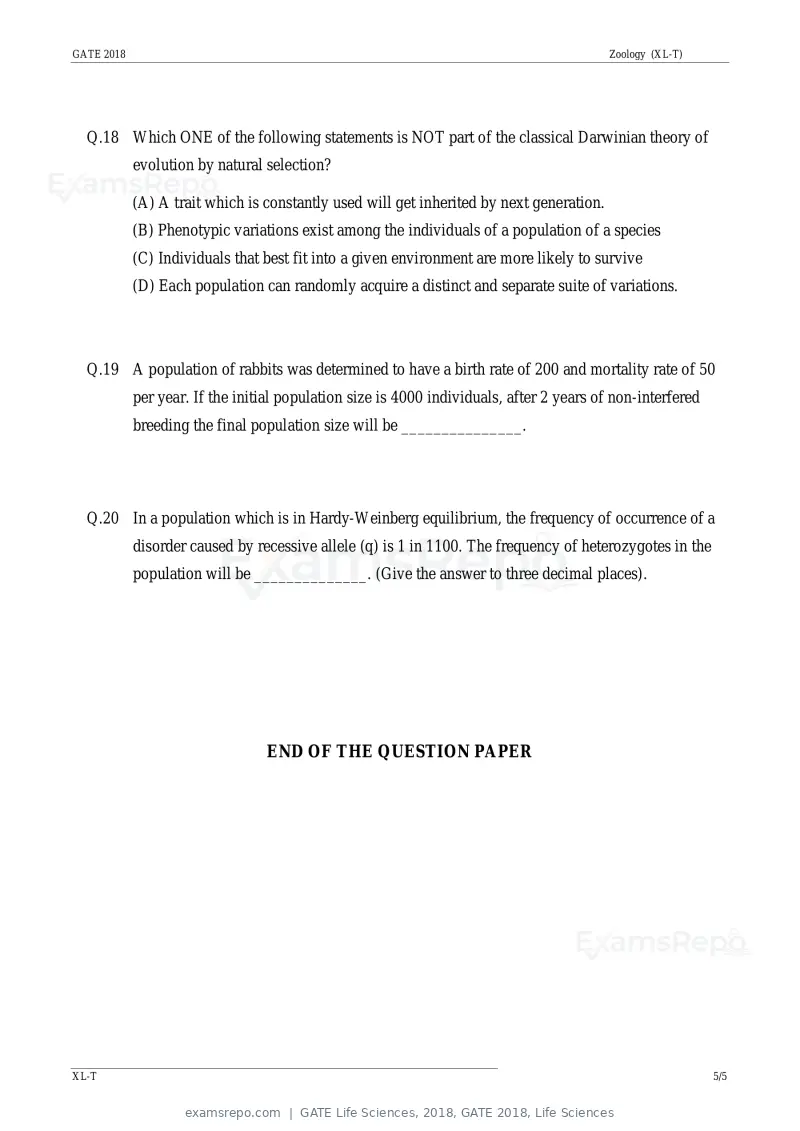
  Q.18 Which ONE of the following statements is NOT part of the classical Darwinian theory of
            evolution by natural selection?

            (A) A trait which is constantly used will get inherited by next generation.
            (B) Phenotypic variations exist among the individuals of a population of a species
            (C) Individuals that best fit into a given environment are more likely to survive
            (D) Each population can randomly acquire a distinct and separate suite of variations.


  Q.19 A population of rabbits was determined to have a birth rate of 200 and mortality rate of 50
            per year. If the initial population size is 4000 individuals, after 2 years of non-interfered
            breeding the final population size will be _______________.


  Q.20 In a population which is in Hardy-Weinberg equilibrium, the frequency of occurrence of a
            disorder caused by recessive allele (q) is 1 in 1100. The frequency of heterozygotes in the
            population will be ______________. (Give the answer to three decimal places).


                                 END OF THE QUESTION PAPER


XL-T                                                                                                        5/5
Text of page 22
GATE 2018                                                                     Food Technology ( XL-U)


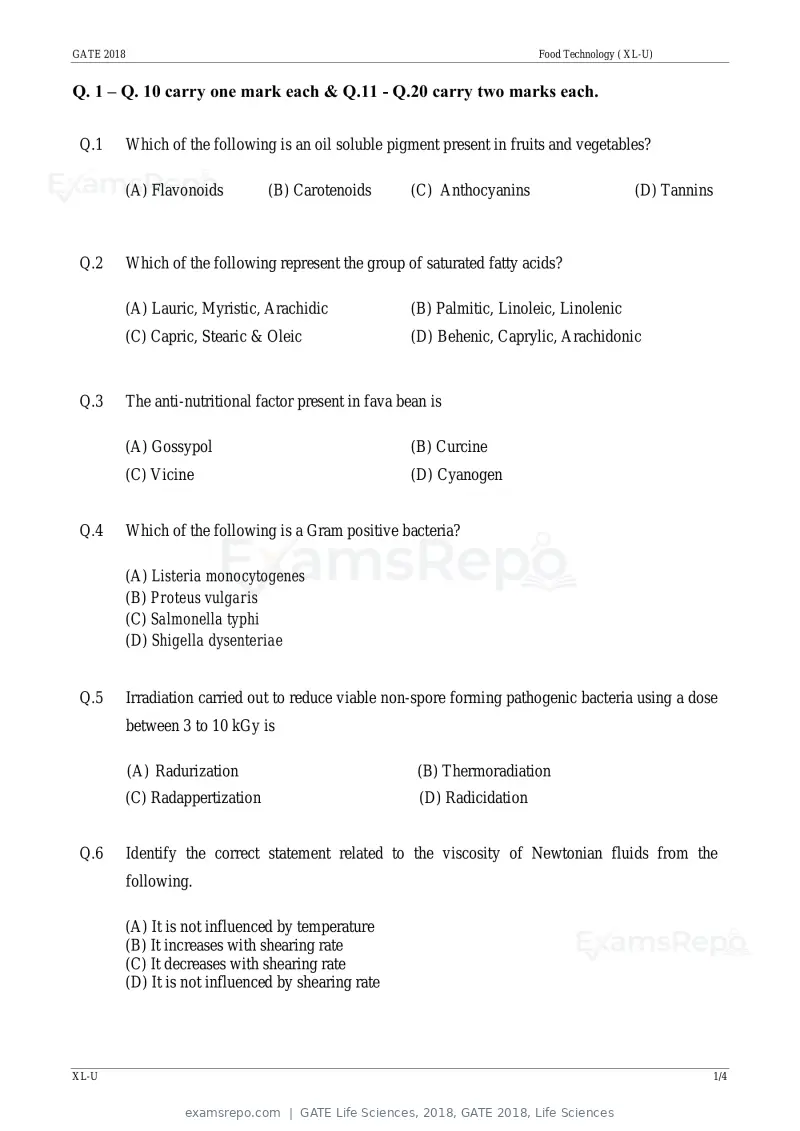
Q. 1 – Q. 10 carry one mark each & Q.11 - Q.20 carry two marks each.


 Q.1        Which of the following is an oil soluble pigment present in fruits and vegetables?

        (A) Flavonoids            (B) Carotenoids         (C) Anthocyanins                       (D) Tannins


 Q.2        Which of the following represent the group of saturated fatty acids?

        (A) Lauric, Myristic, Arachidic                   (B) Palmitic, Linoleic, Linolenic
        (C) Capric, Stearic & Oleic                       (D) Behenic, Caprylic, Arachidonic


 Q.3        The anti-nutritional factor present in fava bean is

        (A) Gossypol                                      (B) Curcine
        (C) Vicine                                        (D) Cyanogen


 Q.4        Which of the following is a Gram positive bacteria?

        (A) Listeria monocytogenes
        (B) Proteus vulgaris
        (C) Salmonella typhi
        (D) Shigella dysenteriae


 Q.5        Irradiation carried out to reduce viable non-spore forming pathogenic bacteria using a dose
            between 3 to 10 kGy is

            (A) Radurization                               (B) Thermoradiation
        (C) Radappertization                               (D) Radicidation


 Q.6        Identify the correct statement related to the viscosity of Newtonian fluids from the
            following.

        (A) It is not influenced by temperature
        (B) It increases with shearing rate
        (C) It decreases with shearing rate
        (D) It is not influenced by shearing rate


XL-U                                                                                                           1/4
Text of page 23
GATE 2018                                                                    Food Technology ( XL-U)

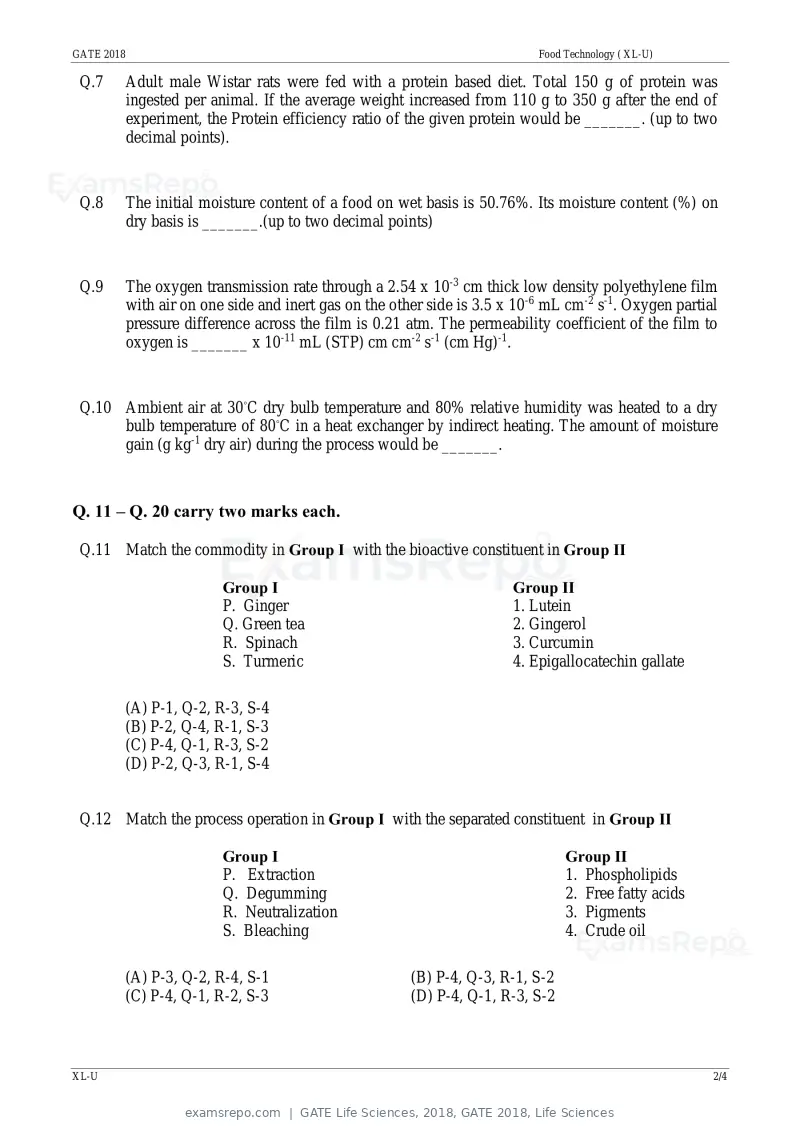
 Q.7        Adult male Wistar rats were fed with a protein based diet. Total 150 g of protein was
            ingested per animal. If the average weight increased from 110 g to 350 g after the end of
            experiment, the Protein efficiency ratio of the given protein would be _______. (up to two
            decimal points).


 Q.8        The initial moisture content of a food on wet basis is 50.76%. Its moisture content (%) on
            dry basis is _______.(up to two decimal points)


 Q.9        The oxygen transmission rate through a 2.54 x 10⁻³ cm thick low density polyethylene film
            with air on one side and inert gas on the other side is 3.5 x 10⁻⁶ mL cm-2 s-1. Oxygen partial
            pressure difference across the film is 0.21 atm. The permeability coefficient of the film to
            oxygen is _______ x 10-11 mL (STP) cm cm-2 s-1 (cm Hg)-1.


 Q.10 Ambient air at 30◦C dry bulb temperature and 80% relative humidity was heated to a dry
      bulb temperature of 80◦C in a heat exchanger by indirect heating. The amount of moisture
      gain (g kg-1 dry air) during the process would be _______.


Q. 11 – Q. 20 carry two marks each.

 Q.11 Match the commodity in Group I with the bioactive constituent in Group II

                           Group I                                       Group II
                           P. Ginger                                     1. Lutein
                           Q. Green tea                                  2. Gingerol
                           R. Spinach                                    3. Curcumin
                           S. Turmeric                                   4. Epigallocatechin gallate

        (A) P-1, Q-2, R-3, S-4
        (B) P-2, Q-4, R-1, S-3
        (C) P-4, Q-1, R-3, S-2
        (D) P-2, Q-3, R-1, S-4


 Q.12 Match the process operation in Group I with the separated constituent in Group II

                           Group I                                                Group II
                           P. Extraction                                          1. Phospholipids
                           Q. Degumming                                           2. Free fatty acids
                           R. Neutralization                                      3. Pigments
                           S. Bleaching                                           4. Crude oil

        (A) P-3, Q-2, R-4, S-1                           (B) P-4, Q-3, R-1, S-2
        (C) P-4, Q-1, R-2, S-3                           (D) P-4, Q-1, R-3, S-2


XL-U                                                                                                     2/4
Text of page 24
GATE 2018                                                              Food Technology ( XL-U)

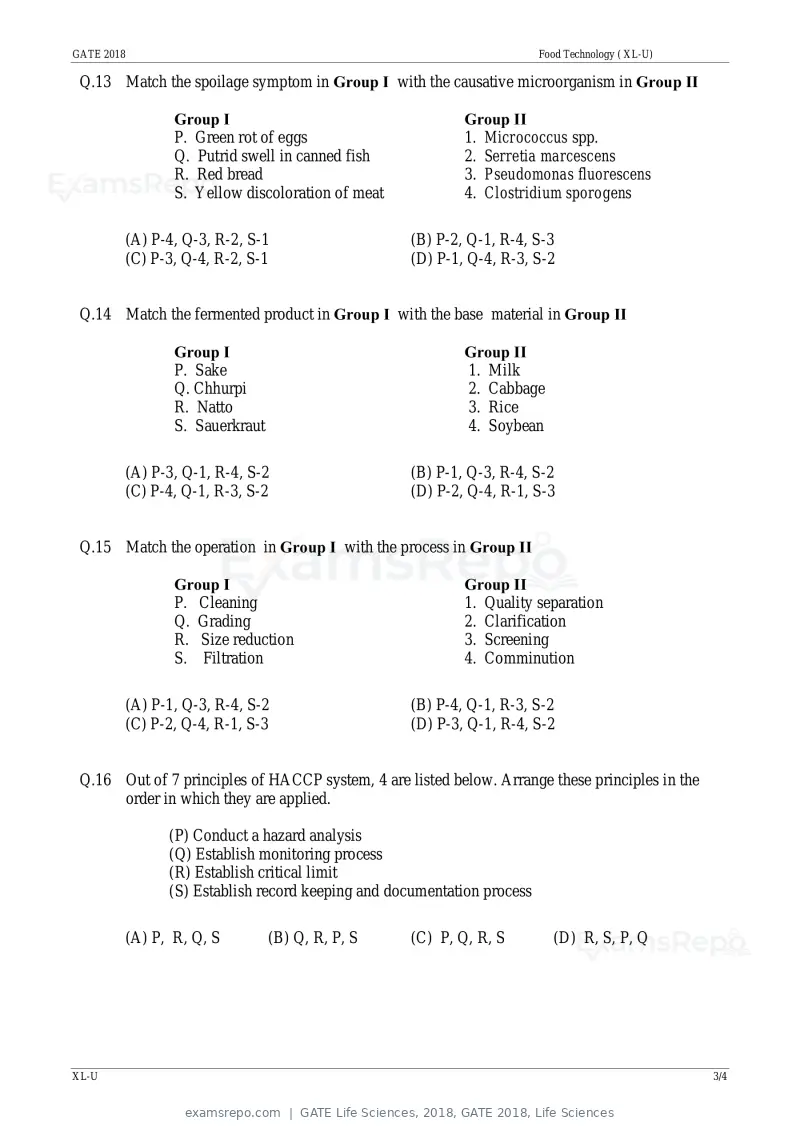
 Q.13 Match the spoilage symptom in Group I with the causative microorganism in Group II

               Group I                                    Group II
               P. Green rot of eggs                       1. Micrococcus spp.
               Q. Putrid swell in canned fish             2. Serretia marcescens
               R. Red bread                               3. Pseudomonas fluorescens
               S. Yellow discoloration of meat            4. Clostridium sporogens

        (A) P-4, Q-3, R-2, S-1                    (B) P-2, Q-1, R-4, S-3
        (C) P-3, Q-4, R-2, S-1                    (D) P-1, Q-4, R-3, S-2


 Q.14 Match the fermented product in Group I with the base material in Group II

               Group I                                    Group II
               P. Sake                                    1. Milk
               Q. Chhurpi                                 2. Cabbage
               R. Natto                                   3. Rice
               S. Sauerkraut                              4. Soybean

        (A) P-3, Q-1, R-4, S-2                    (B) P-1, Q-3, R-4, S-2
        (C) P-4, Q-1, R-3, S-2                    (D) P-2, Q-4, R-1, S-3


 Q.15 Match the operation in Group I with the process in Group II

               Group I                                    Group II
               P. Cleaning                                1. Quality separation
               Q. Grading                                 2. Clarification
               R. Size reduction                          3. Screening
               S. Filtration                              4. Comminution

        (A) P-1, Q-3, R-4, S-2                    (B) P-4, Q-1, R-3, S-2
        (C) P-2, Q-4, R-1, S-3                    (D) P-3, Q-1, R-4, S-2


 Q.16 Out of 7 principles of HACCP system, 4 are listed below. Arrange these principles in the
      order in which they are applied.

              (P) Conduct a hazard analysis
              (Q) Establish monitoring process
              (R) Establish critical limit
              (S) Establish record keeping and documentation process

        (A) P, R, Q, S         (B) Q, R, P, S     (C) P, Q, R, S          (D) R, S, P, Q


XL-U                                                                                             3/4
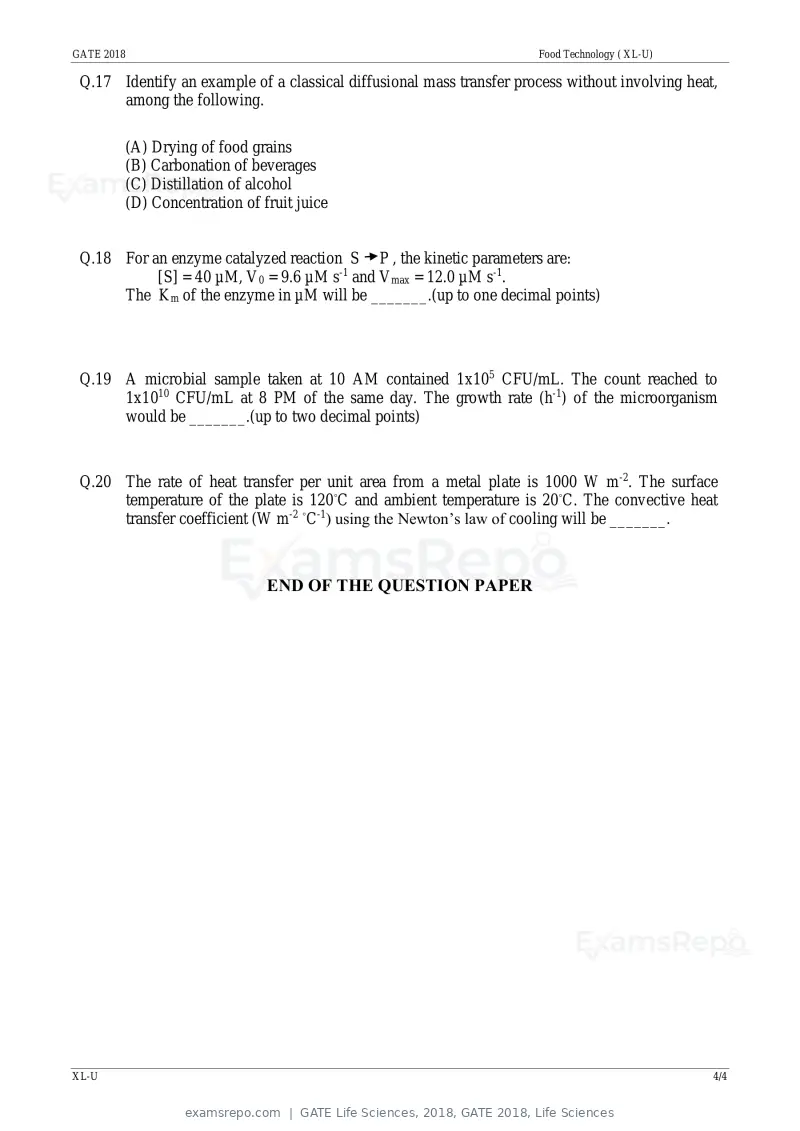
Text of page 25
GATE 2018                                                             Food Technology ( XL-U)

 Q.17 Identify an example of a classical diffusional mass transfer process without involving heat,
      among the following.

        (A) Drying of food grains
        (B) Carbonation of beverages
        (C) Distillation of alcohol
        (D) Concentration of fruit juice


 Q.18 For an enzyme catalyzed reaction S P , the kinetic parameters are:
           [S] = 40 µM, V0 = 9.6 µM s-1 and Vmax = 12.0 µM s-1.
      The Km of the enzyme in µM will be _______.(up to one decimal points)


 Q.19 A microbial sample taken at 10 AM contained 1x10⁵ CFU/mL. The count reached to
      1x10¹⁰ CFU/mL at 8 PM of the same day. The growth rate (h-1) of the microorganism
      would be _______.(up to two decimal points)


 Q.20 The rate of heat transfer per unit area from a metal plate is 1000 W m-2. The surface
      temperature of the plate is 120◦C and ambient temperature is 20◦C. The convective heat
      transfer coefficient (W m-2 ◦C-1) using the Newton’s law of cooling will be _______.


                              END OF THE QUESTION PAPER


XL-U                                                                                             4/4
Text of page 26
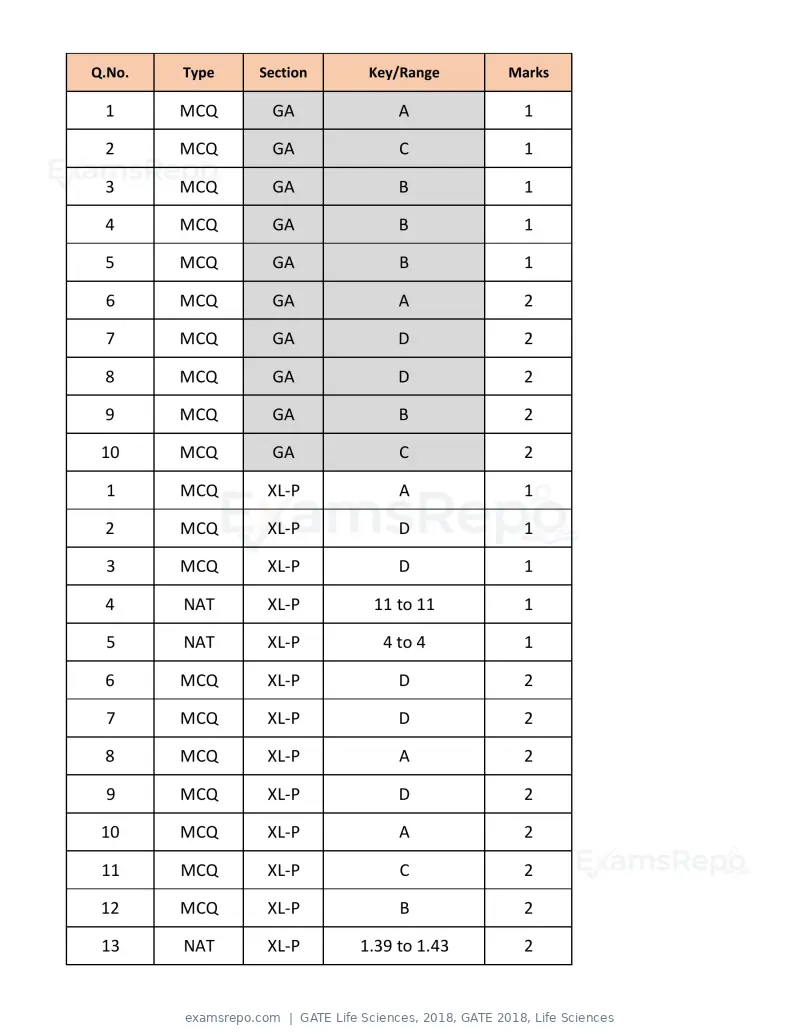
Q.No.   Type   Section    Key/Range     Marks

 1      MCQ     GA            A          1

 2      MCQ     GA            C          1

 3      MCQ     GA            B          1

 4      MCQ     GA            B          1

 5      MCQ     GA            B          1

 6      MCQ     GA            A          2

 7      MCQ     GA            D          2

 8      MCQ     GA            D          2

 9      MCQ     GA            B          2

 10     MCQ     GA            C          2

 1      MCQ     XL‐P          A          1

 2      MCQ     XL‐P          D          1

 3      MCQ     XL‐P          D          1

 4      NAT     XL‐P      11 to 11       1

 5      NAT     XL‐P        4 to 4       1

 6      MCQ     XL‐P          D          2

 7      MCQ     XL‐P          D          2

 8      MCQ     XL‐P          A          2

 9      MCQ     XL‐P          D          2

 10     MCQ     XL‐P          A          2

 11     MCQ     XL‐P          C          2

 12     MCQ     XL‐P          B          2

 13     NAT     XL‐P     1.39 to 1.43    2
Text of page 27
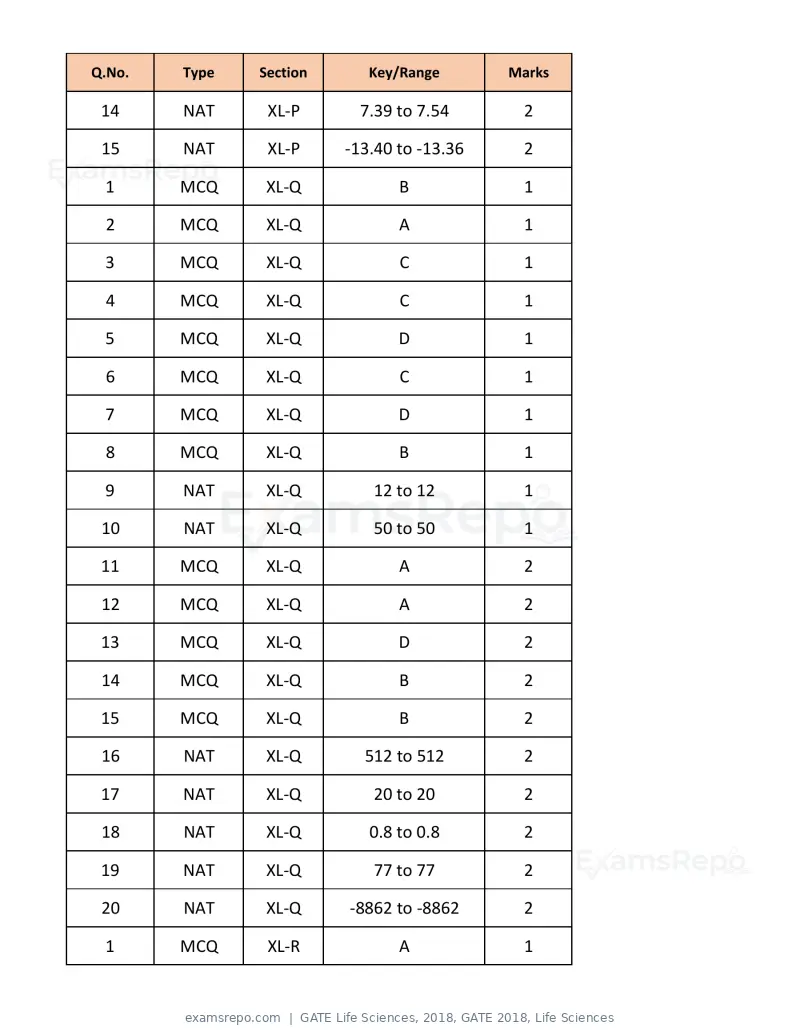
Q.No.   Type   Section      Key/Range       Marks

 14     NAT     XL‐P       7.39 to 7.54      2

 15     NAT     XL‐P     ‐13.40 to ‐13.36    2

 1      MCQ     XL‐Q            B            1

 2      MCQ     XL‐Q            A            1

 3      MCQ     XL‐Q            C            1

 4      MCQ     XL‐Q            C            1

 5      MCQ     XL‐Q            D            1

 6      MCQ     XL‐Q            C            1

 7      MCQ     XL‐Q            D            1

 8      MCQ     XL‐Q            B            1

 9      NAT     XL‐Q        12 to 12         1

 10     NAT     XL‐Q        50 to 50         1

 11     MCQ     XL‐Q            A            2

 12     MCQ     XL‐Q            A            2

 13     MCQ     XL‐Q            D            2

 14     MCQ     XL‐Q            B            2

 15     MCQ     XL‐Q            B            2

 16     NAT     XL‐Q       512 to 512        2

 17     NAT     XL‐Q        20 to 20         2

 18     NAT     XL‐Q        0.8 to 0.8       2

 19     NAT     XL‐Q        77 to 77         2

 20     NAT     XL‐Q     ‐8862 to ‐8862      2

 1      MCQ     XL‐R            A            1
Text of page 28
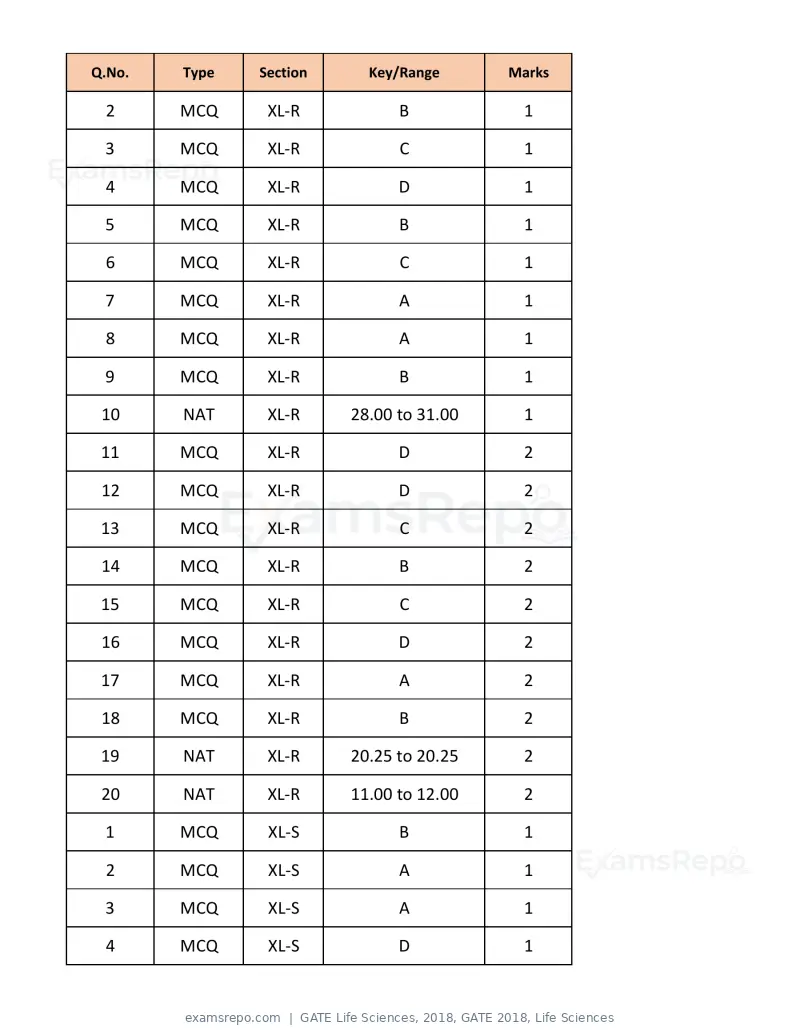
Q.No.   Type   Section     Key/Range      Marks

 2      MCQ     XL‐R           B           1

 3      MCQ     XL‐R           C           1

 4      MCQ     XL‐R           D           1

 5      MCQ     XL‐R           B           1

 6      MCQ     XL‐R           C           1

 7      MCQ     XL‐R           A           1

 8      MCQ     XL‐R           A           1

 9      MCQ     XL‐R           B           1

 10     NAT     XL‐R     28.00 to 31.00    1

 11     MCQ     XL‐R           D           2

 12     MCQ     XL‐R           D           2

 13     MCQ     XL‐R           C           2

 14     MCQ     XL‐R           B           2

 15     MCQ     XL‐R           C           2

 16     MCQ     XL‐R           D           2

 17     MCQ     XL‐R           A           2

 18     MCQ     XL‐R           B           2

 19     NAT     XL‐R     20.25 to 20.25    2

 20     NAT     XL‐R     11.00 to 12.00    2

 1      MCQ     XL‐S           B           1

 2      MCQ     XL‐S           A           1

 3      MCQ     XL‐S           A           1

 4      MCQ     XL‐S           D           1
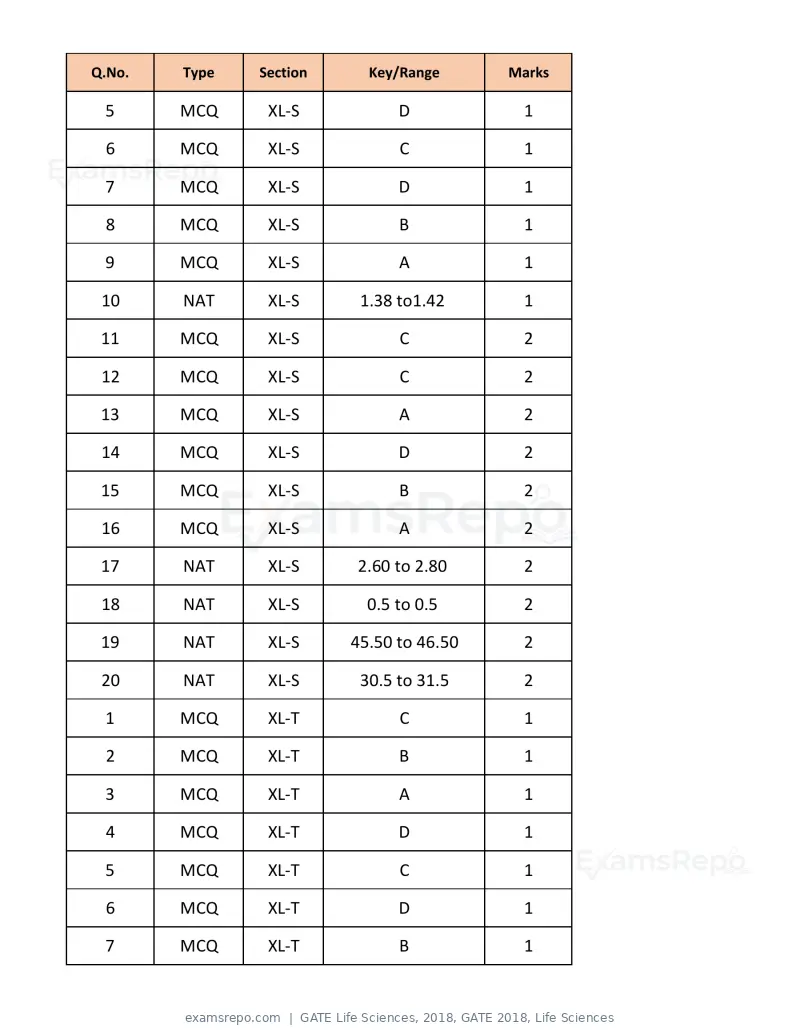
Text of page 29
Q.No.   Type   Section     Key/Range      Marks

 5      MCQ     XL‐S           D           1

 6      MCQ     XL‐S           C           1

 7      MCQ     XL‐S           D           1

 8      MCQ     XL‐S           B           1

 9      MCQ     XL‐S           A           1

 10     NAT     XL‐S      1.38 to1.42      1

 11     MCQ     XL‐S           C           2

 12     MCQ     XL‐S           C           2

 13     MCQ     XL‐S           A           2

 14     MCQ     XL‐S           D           2

 15     MCQ     XL‐S           B           2

 16     MCQ     XL‐S           A           2

 17     NAT     XL‐S     2.60 to 2.80      2

 18     NAT     XL‐S       0.5 to 0.5      2

 19     NAT     XL‐S     45.50 to 46.50    2

 20     NAT     XL‐S      30.5 to 31.5     2

 1      MCQ     XL‐T           C           1

 2      MCQ     XL‐T           B           1

 3      MCQ     XL‐T           A           1

 4      MCQ     XL‐T           D           1

 5      MCQ     XL‐T           C           1

 6      MCQ     XL‐T           D           1

 7      MCQ     XL‐T           B           1
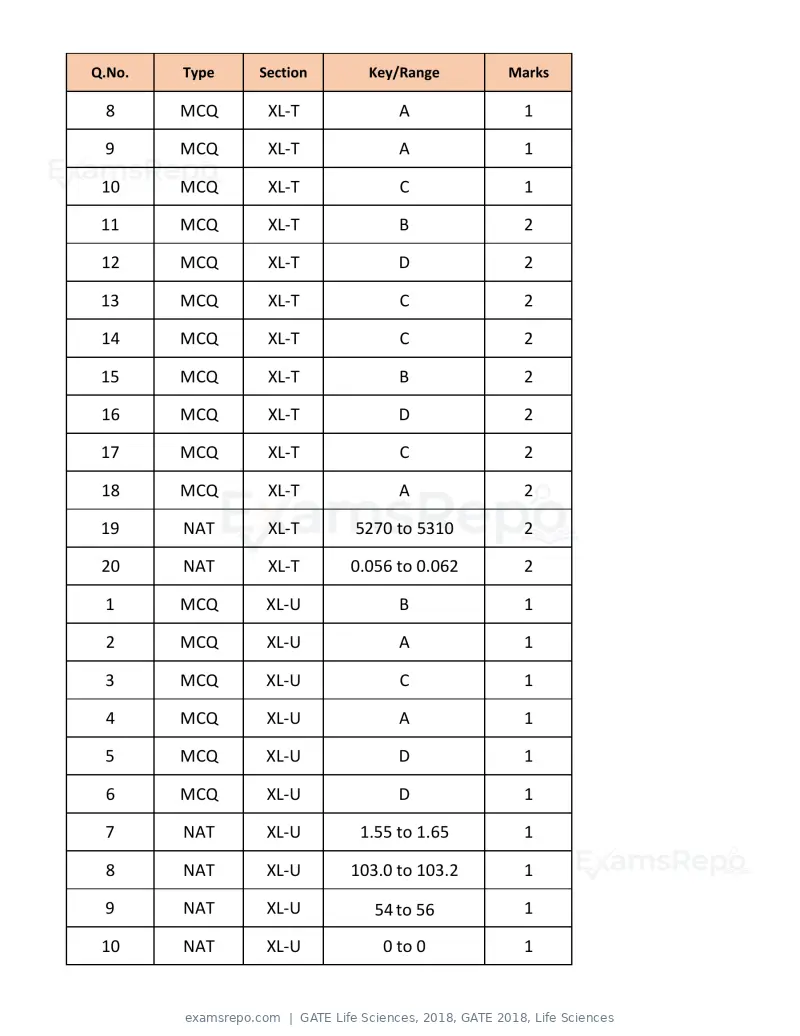
Text of page 30
Q.No.   Type   Section     Key/Range      Marks

 8      MCQ     XL‐T           A           1

 9      MCQ     XL‐T           A           1

 10     MCQ     XL‐T           C           1

 11     MCQ     XL‐T           B           2

 12     MCQ     XL‐T           D           2

 13     MCQ     XL‐T           C           2

 14     MCQ     XL‐T           C           2

 15     MCQ     XL‐T           B           2

 16     MCQ     XL‐T           D           2

 17     MCQ     XL‐T           C           2

 18     MCQ     XL‐T           A           2

 19     NAT     XL‐T     5270 to 5310      2

 20     NAT     XL‐T     0.056 to 0.062    2

 1      MCQ     XL‐U           B           1

 2      MCQ     XL‐U           A           1

 3      MCQ     XL‐U           C           1

 4      MCQ     XL‐U           A           1

 5      MCQ     XL‐U           D           1

 6      MCQ     XL‐U           D           1

 7      NAT     XL‐U      1.55 to 1.65     1

 8      NAT     XL‐U     103.0 to 103.2    1

 9      NAT     XL‐U        54 to 56       1

 10     NAT     XL‐U         0 to 0        1
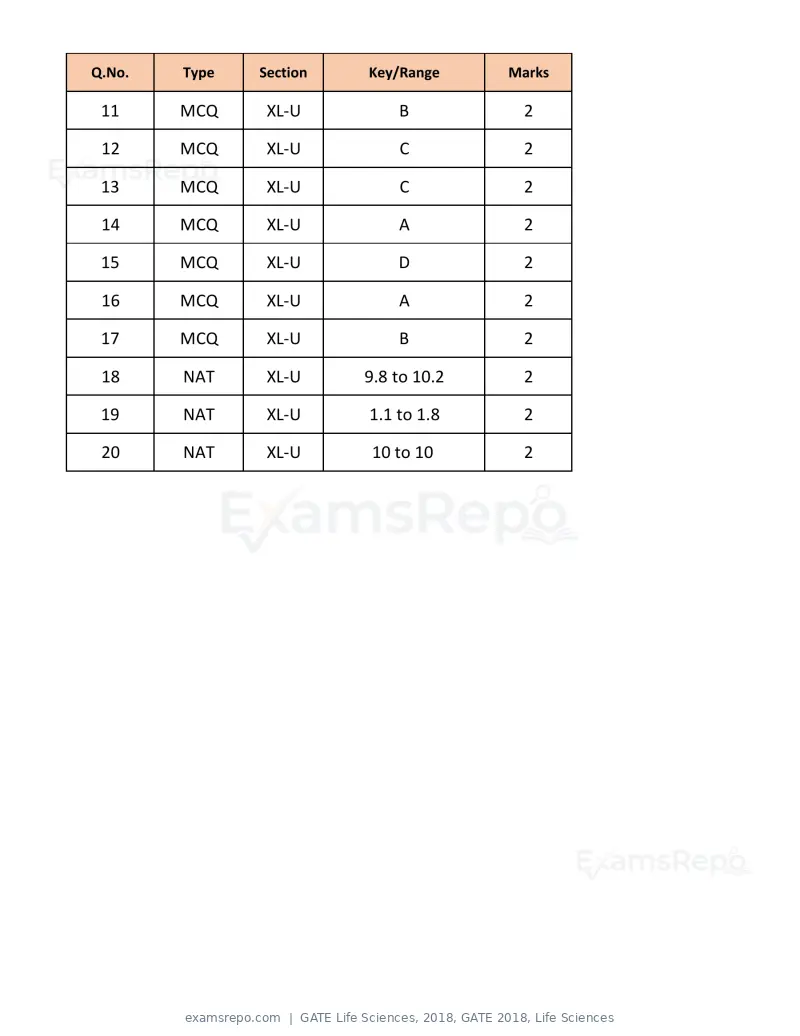
Text of page 31
Q.No.   Type   Section   Key/Range     Marks

 11     MCQ     XL‐U         B          2

 12     MCQ     XL‐U         C          2

 13     MCQ     XL‐U         C          2

 14     MCQ     XL‐U         A          2

 15     MCQ     XL‐U         D          2

 16     MCQ     XL‐U         A          2

 17     MCQ     XL‐U         B          2

 18     NAT     XL‐U     9.8 to 10.2    2

 19     NAT     XL‐U     1.1 to 1.8     2

 20     NAT     XL‐U      10 to 10      2
Official key not published for this paper.
Page 1 of 31
Source: GATE. Question paper published by GATE.