
GATE Life Sciences 2026
Text of page 1
Life Sciences (XL)


General Aptitude (GA)
Q.1 – Q.5 Carry ONE mark Each

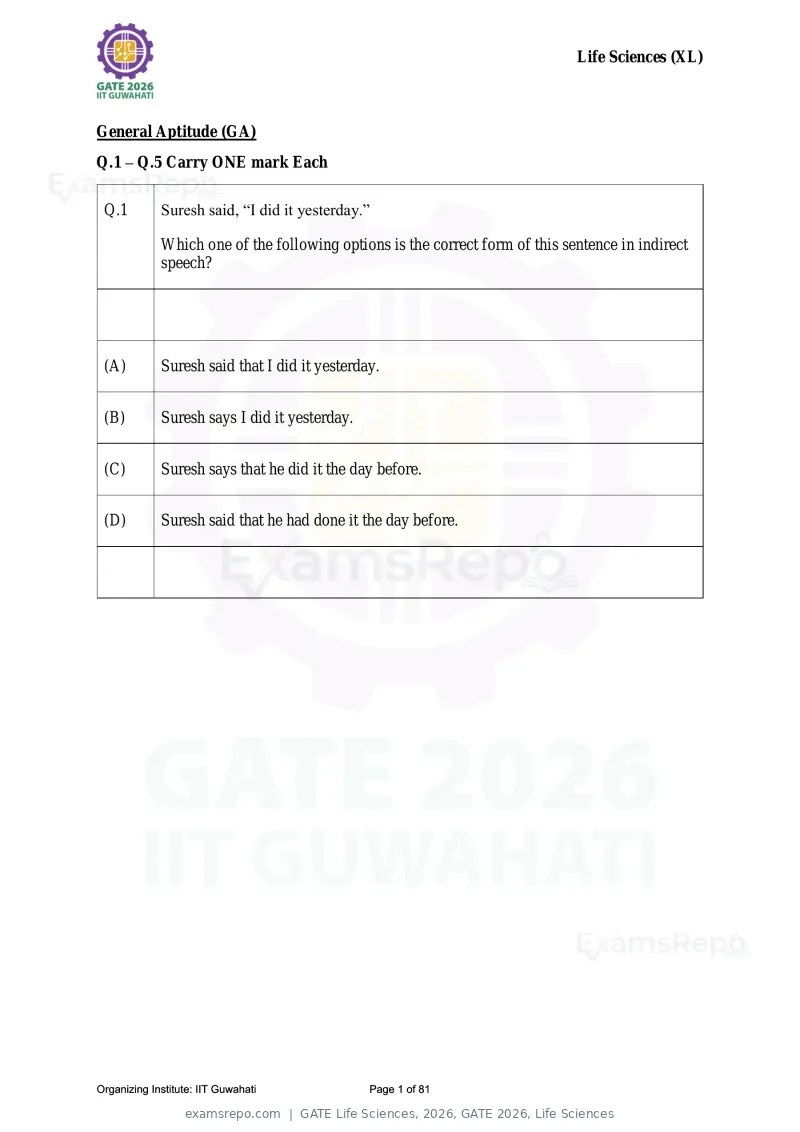
 Q.1         Suresh said, “I did it yesterday.”

             Which one of the following options is the correct form of this sentence in indirect
             speech?


 (A)         Suresh said that I did it yesterday.


 (B)         Suresh says I did it yesterday.


 (C)         Suresh says that he did it the day before.


 (D)         Suresh said that he had done it the day before.


Organizing Institute: IIT Guwahati             Page 1 of 81
Text of page 2
Life Sciences (XL)


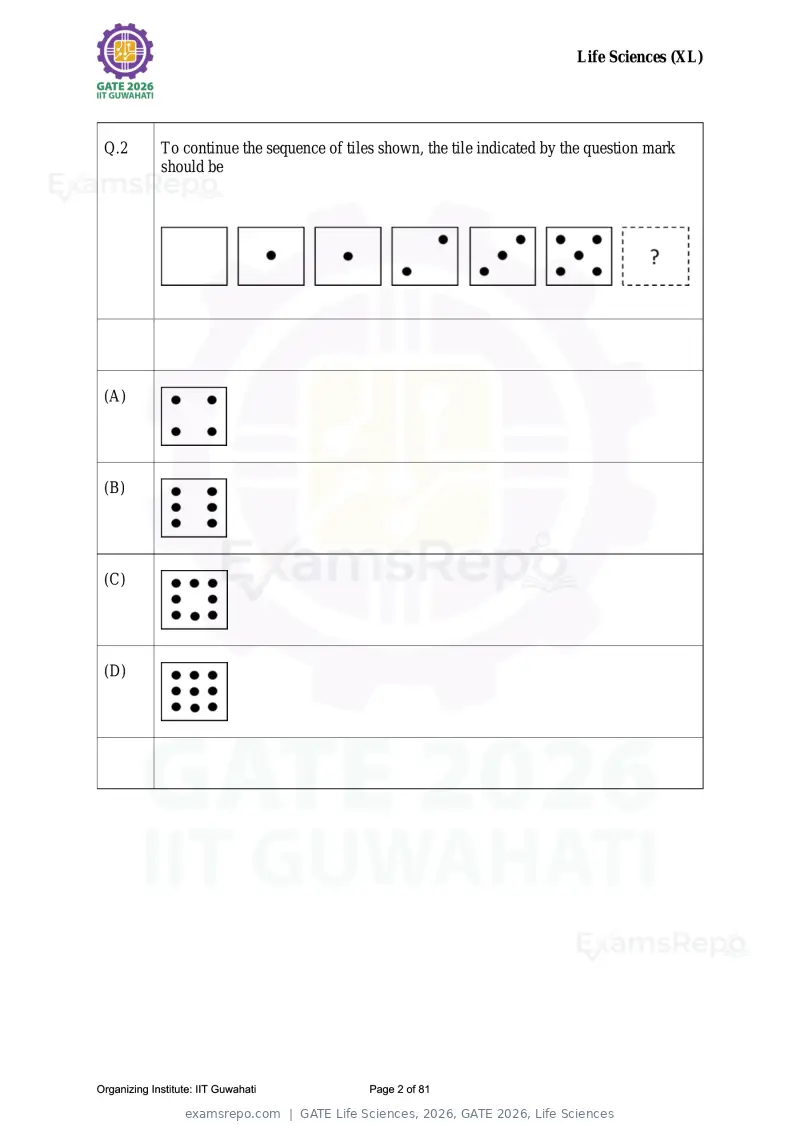
 Q.2         To continue the sequence of tiles shown, the tile indicated by the question mark
             should be


 (A)


 (B)


 (C)


 (D)


Organizing Institute: IIT Guwahati           Page 2 of 81
Text of page 3
Life Sciences (XL)


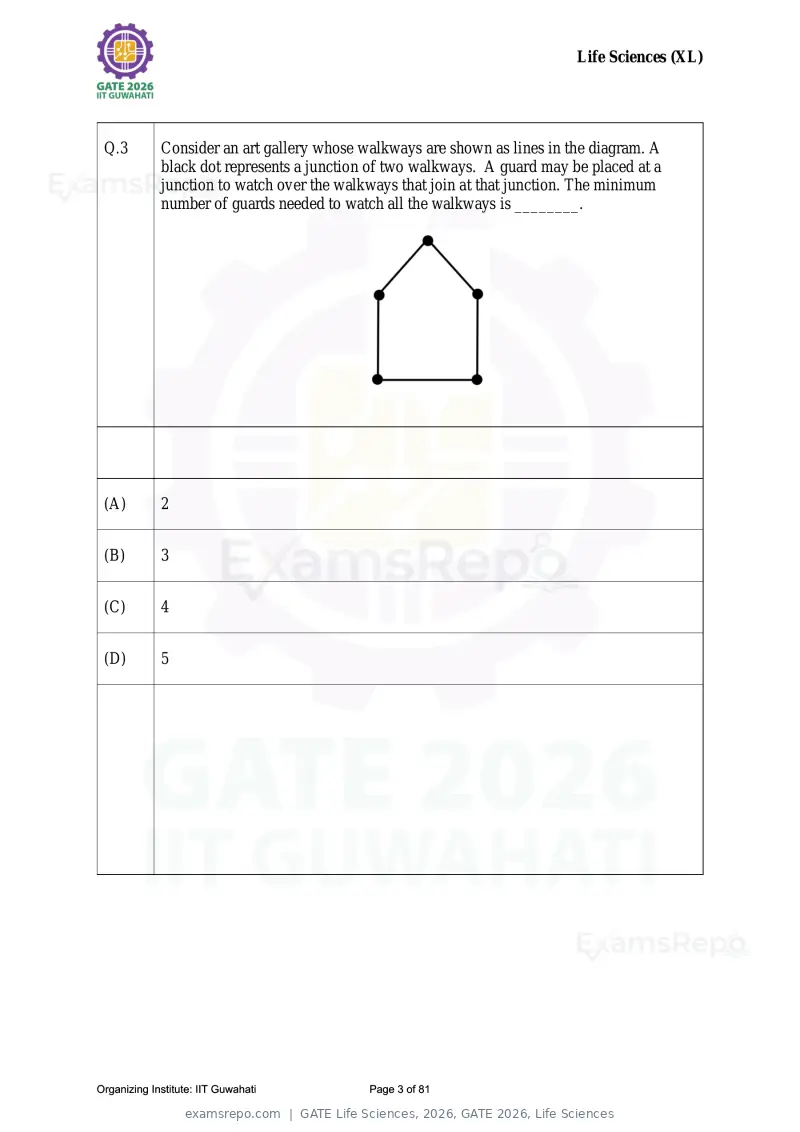
 Q.3         Consider an art gallery whose walkways are shown as lines in the diagram. A
             black dot represents a junction of two walkways. A guard may be placed at a
             junction to watch over the walkways that join at that junction. The minimum
             number of guards needed to watch all the walkways is ________.


 (A)         2


 (B)         3


 (C)         4


 (D)         5


Organizing Institute: IIT Guwahati          Page 3 of 81
Text of page 4
Life Sciences (XL)


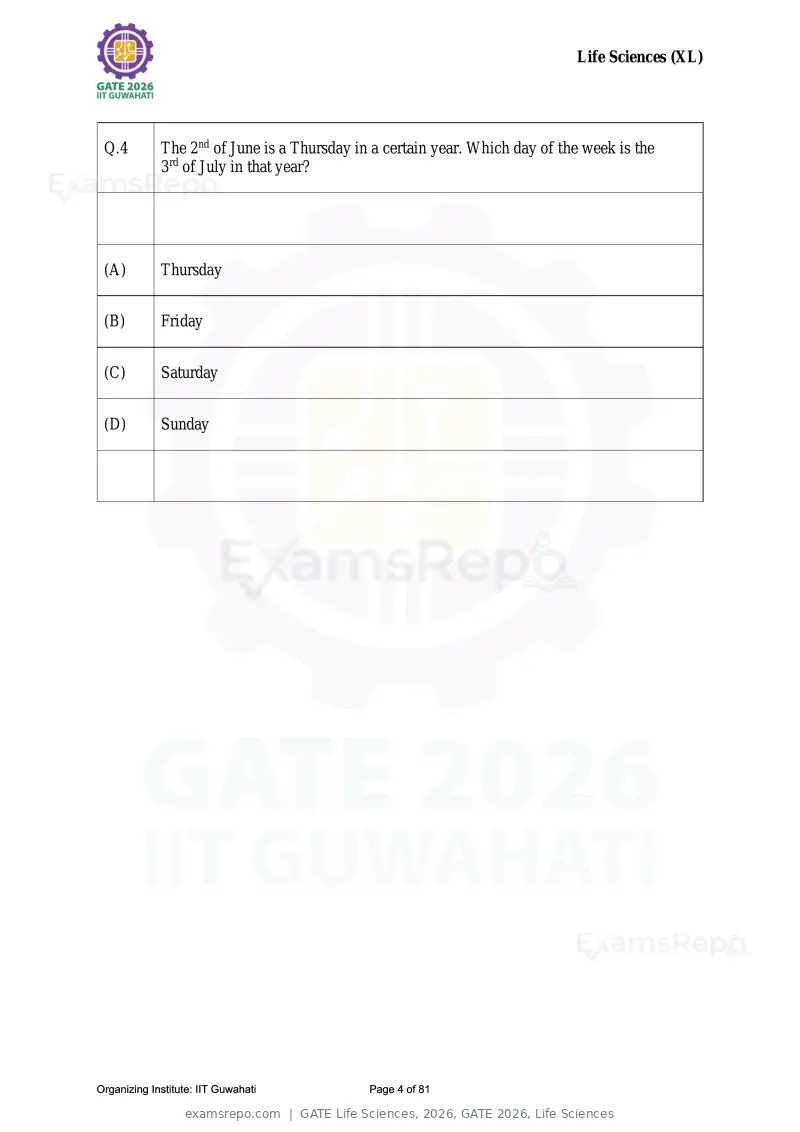
 Q.4         The 2nd of June is a Thursday in a certain year. Which day of the week is the
             3rd of July in that year?


 (A)         Thursday


 (B)         Friday


 (C)         Saturday


 (D)         Sunday


Organizing Institute: IIT Guwahati           Page 4 of 81
Text of page 5
Life Sciences (XL)


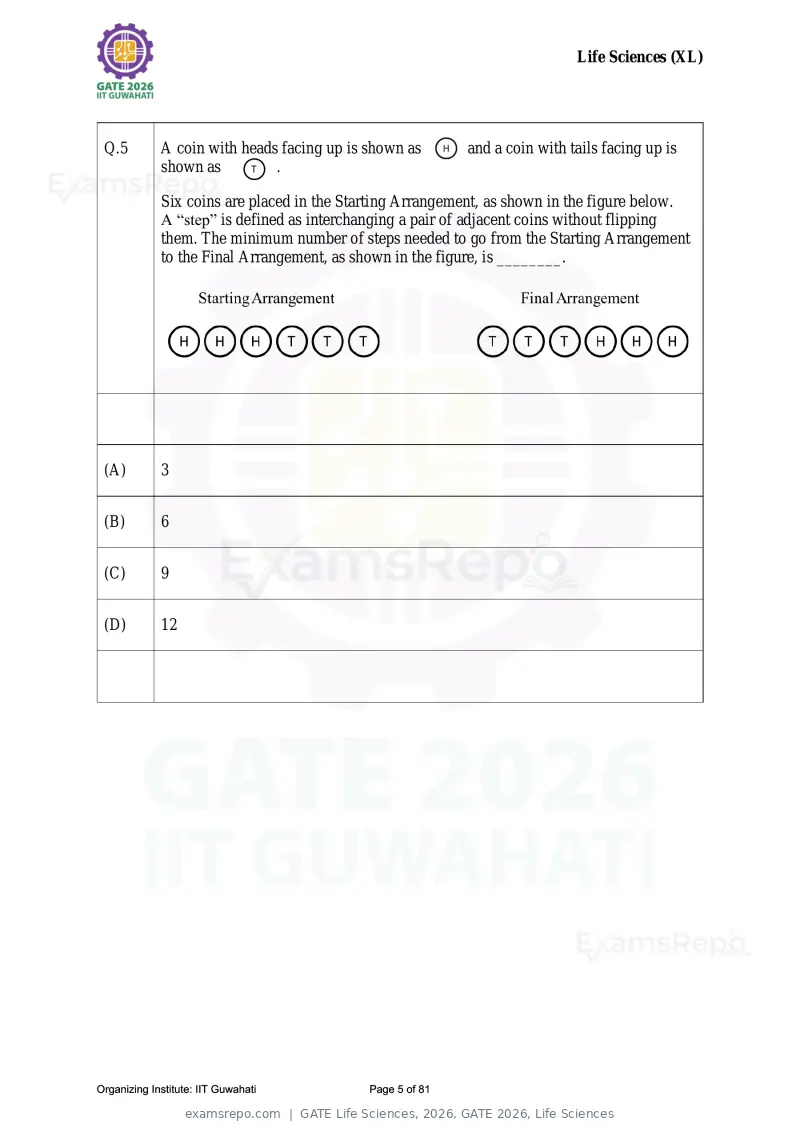
 Q.5         A coin with heads facing up is shown as       and a coin with tails facing up is
             shown as         .

             Six coins are placed in the Starting Arrangement, as shown in the figure below.
             A “step” is defined as interchanging a pair of adjacent coins without flipping
             them. The minimum number of steps needed to go from the Starting Arrangement
             to the Final Arrangement, as shown in the figure, is ________.


 (A)         3


 (B)         6


 (C)         9


 (D)         12


Organizing Institute: IIT Guwahati          Page 5 of 81
Text of page 6
Life Sciences (XL)


Q.6 – Q.10 Carry TWO marks Each

 Q.6         Exacerbate : Mitigate :: ___________

             Choose the option with the correct pair of words to fill the blank.


 (A)         Aggravate : Alleviate


 (B)         Alleviate : Precipitate


 (C)         Aggravate : Precipitate


 (D)         Emancipate : Exonerate


Organizing Institute: IIT Guwahati            Page 6 of 81
Text of page 7
Life Sciences (XL)


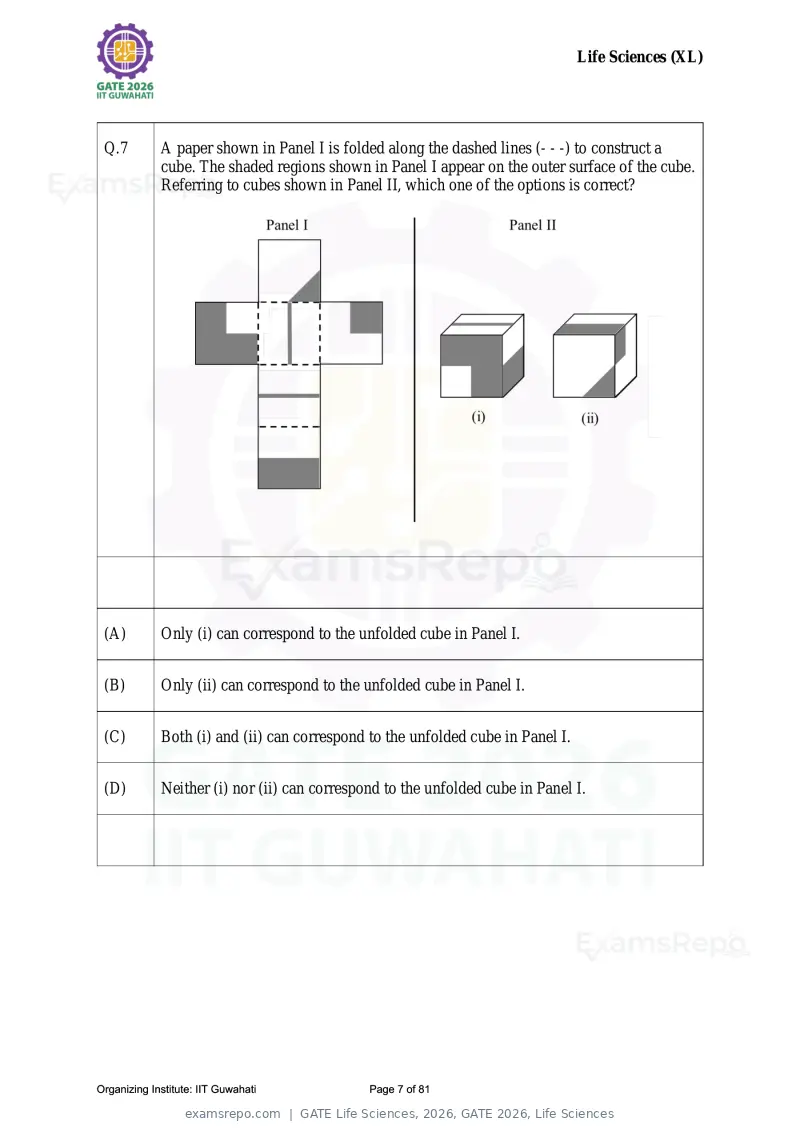
 Q.7         A paper shown in Panel I is folded along the dashed lines (- - -) to construct a
             cube. The shaded regions shown in Panel I appear on the outer surface of the cube.
             Referring to cubes shown in Panel II, which one of the options is correct?


 (A)         Only (i) can correspond to the unfolded cube in Panel I.


 (B)         Only (ii) can correspond to the unfolded cube in Panel I.


 (C)         Both (i) and (ii) can correspond to the unfolded cube in Panel I.


 (D)         Neither (i) nor (ii) can correspond to the unfolded cube in Panel I.


Organizing Institute: IIT Guwahati            Page 7 of 81
Text of page 8
Life Sciences (XL)


 Q.8         In a population, patients who have high cholesterol also have high blood-pressure
             (BP). Some patients with high BP also have diabetes. There are no patients who
             have both high cholesterol and diabetes. Furthermore,

                  1.    the total number of patients with at least one of these conditions is 75,
                  2.    the number of patients with high cholesterol is 10,
                  3.    the number of patients with high BP is 45, and
                  4.    the number of patients with only high BP and no other conditions is 20.

             Then the number of patients who have both diabetes and high BP is _______


 (A)         0


 (B)         15


 (C)         20


 (D)         10


Organizing Institute: IIT Guwahati               Page 8 of 81
Text of page 9
Life Sciences (XL)


 Q.9         Four people P, Q, R, and S, of different ages, make the following observations.

             P – I am younger than S.

             Q – I am neither the youngest nor the oldest.

             R – P is older than me.

             Based on these observations, the youngest person is ______.


 (A)         P


 (B)         Q


 (C)         R


 (D)         S


Organizing Institute: IIT Guwahati           Page 9 of 81
Text of page 10
Life Sciences (XL)


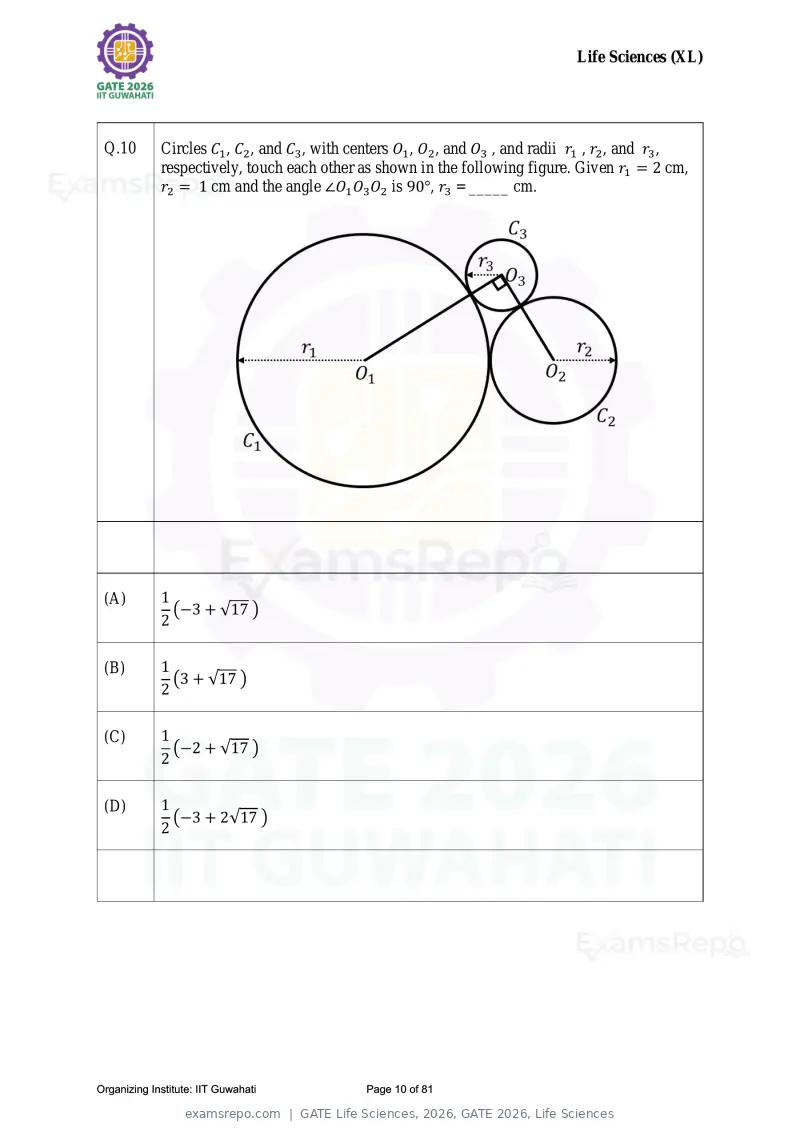
 Q.10        Circles C1 , C2 , and C3 , with centers O1, O2, and O3 , and radii r1 , r2 , and r3 ,
             respectively, touch each other as shown in the following figure. Given r1 = 2 cm,
             r2 = 1 cm and the angle ∠O1 O3 O2 is 90°, r3 = _____ cm.


 (A)         1
               (−3 + √17 )
             2

 (B)         1
               (3 + √17 )
             2

 (C)         1
               (−2 + √17 )
             2

 (D)         1
               (−3 + 2√17 )
             2


Organizing Institute: IIT Guwahati            Page 10 of 81
Text of page 12
Chemistry (XL-P)


 Q.12        Upon hydrolysis of the pentapeptide Glu-Arg-Gly-Phe-Ala (represented from N- to
             C- terminus) with trypsin, the peptide fragments obtained are


 (A)         Glu-Arg and Gly-Phe-Ala


 (B)         Glu-Arg-Gly-Phe and Ala


 (C)         Glu and Arg-Gly-Phe-Ala


 (D)         Glu-Arg-Gly and Phe-Ala


Organizing Institute: IIT Guwahati         Page 12 of 81
Text of page 13
Chemistry (XL-P)


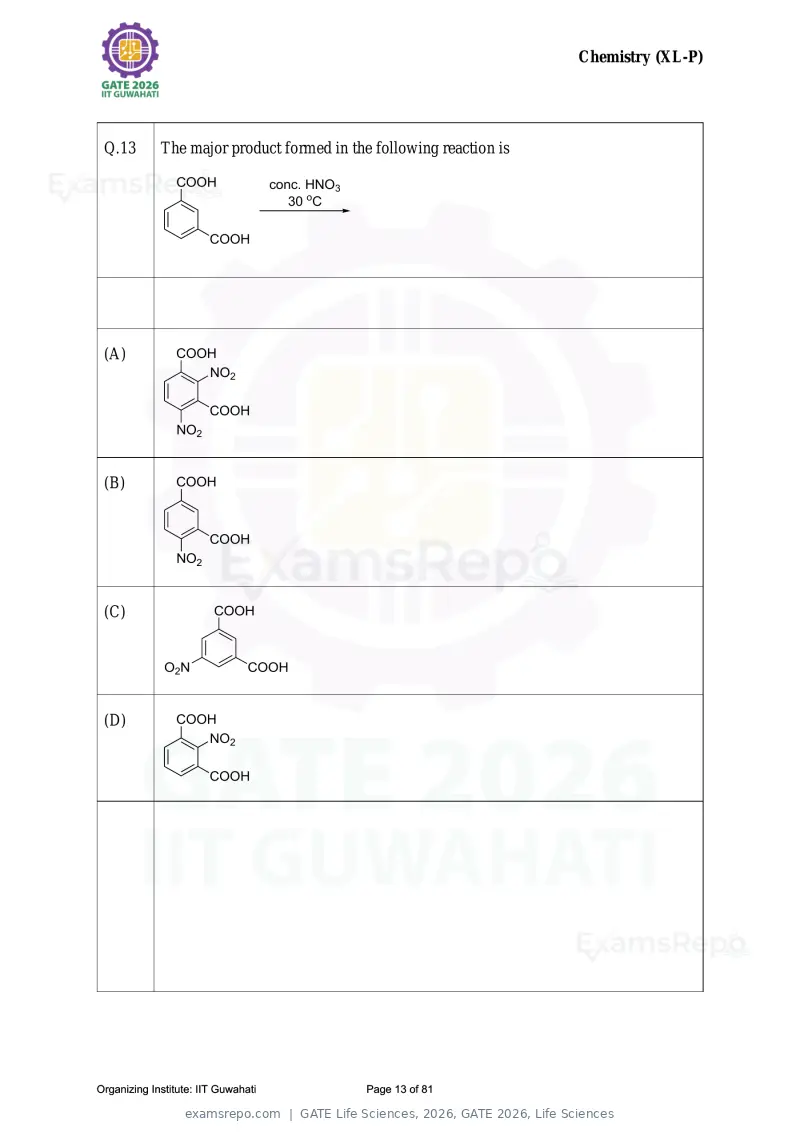
 Q.13        The major product formed in the following reaction is

                COOH                 conc. HNO3
                                        30 oC

                        COOH


 (A)            COOH
                   NO2

                        COOH
                NO2


 (B)            COOH


                        COOH
                NO2


 (C)                    COOH


              O2N               COOH


 (D)            COOH
                   NO2

                        COOH


Organizing Institute: IIT Guwahati                Page 13 of 81
Text of page 15
Chemistry (XL-P)


 Q.15        The CORRECT combination(s) of element and their ground state electronic
             configuration is/are

             (Atomic Numbers: Ar-18, Sc-21, Cr-24, Mn-25 and Fe-26)


 (A)         Sc – [Ar] 4s2 3d1


 (B)         Cr – [Ar] 4s2 3d4


 (C)         Mn – [Ar] 4s2 3d5


 (D)         Fe – [Ar] 4s2 3d6


 Q.16        The major component(s) of phosphate buffer at physiological pH of 7.4 is/are


 (A)         H3PO4


 (B)         H2PO4─


 (C)         HPO42─


 (D)         PO43─


Organizing Institute: IIT Guwahati          Page 15 of 81
Text of page 16
Chemistry (XL-P)


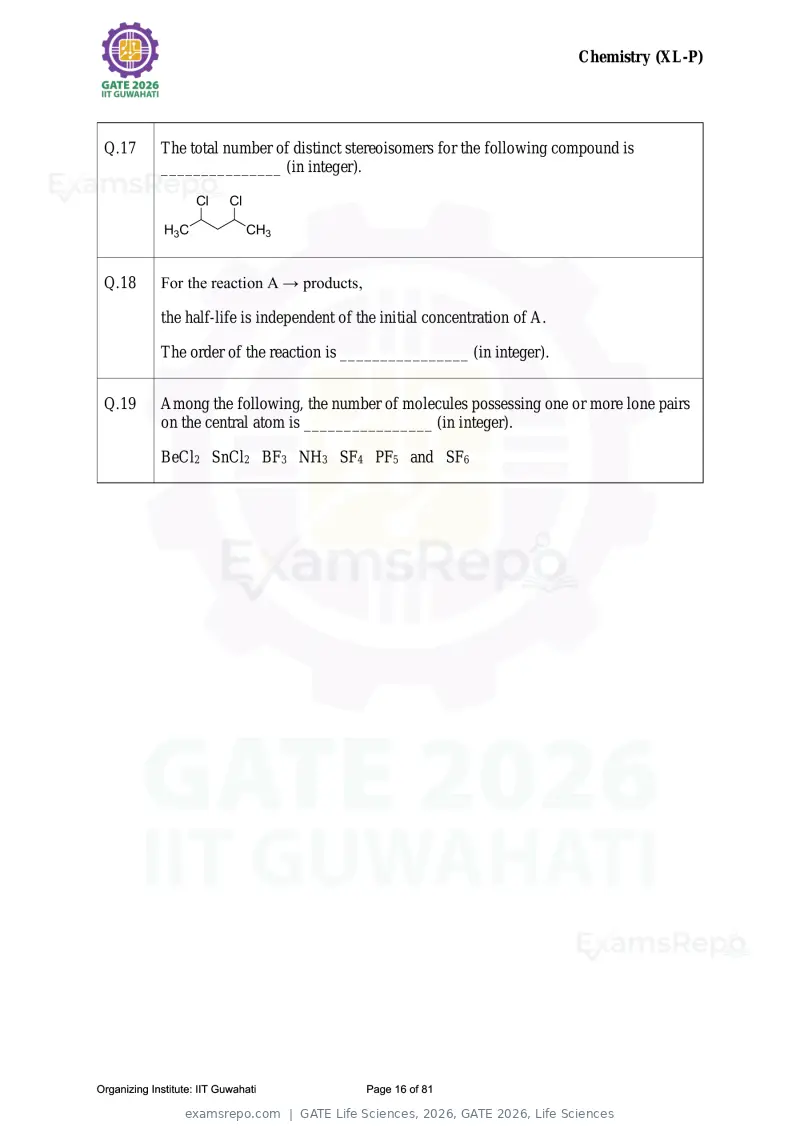
 Q.17        The total number of distinct stereoisomers for the following compound is
             _______________ (in integer).

                     Cl     Cl

              H3C                CH3


 Q.18        For the reaction A → products,

             the half-life is independent of the initial concentration of A.

             The order of the reaction is ________________ (in integer).


 Q.19        Among the following, the number of molecules possessing one or more lone pairs
             on the central atom is ________________ (in integer).

             BeCl2 SnCl2 BF3 NH3 SF4 PF5 and SF6


Organizing Institute: IIT Guwahati            Page 16 of 81
Text of page 17
Chemistry (XL-P)


Q.20 – Q.27 Carry TWO marks Each

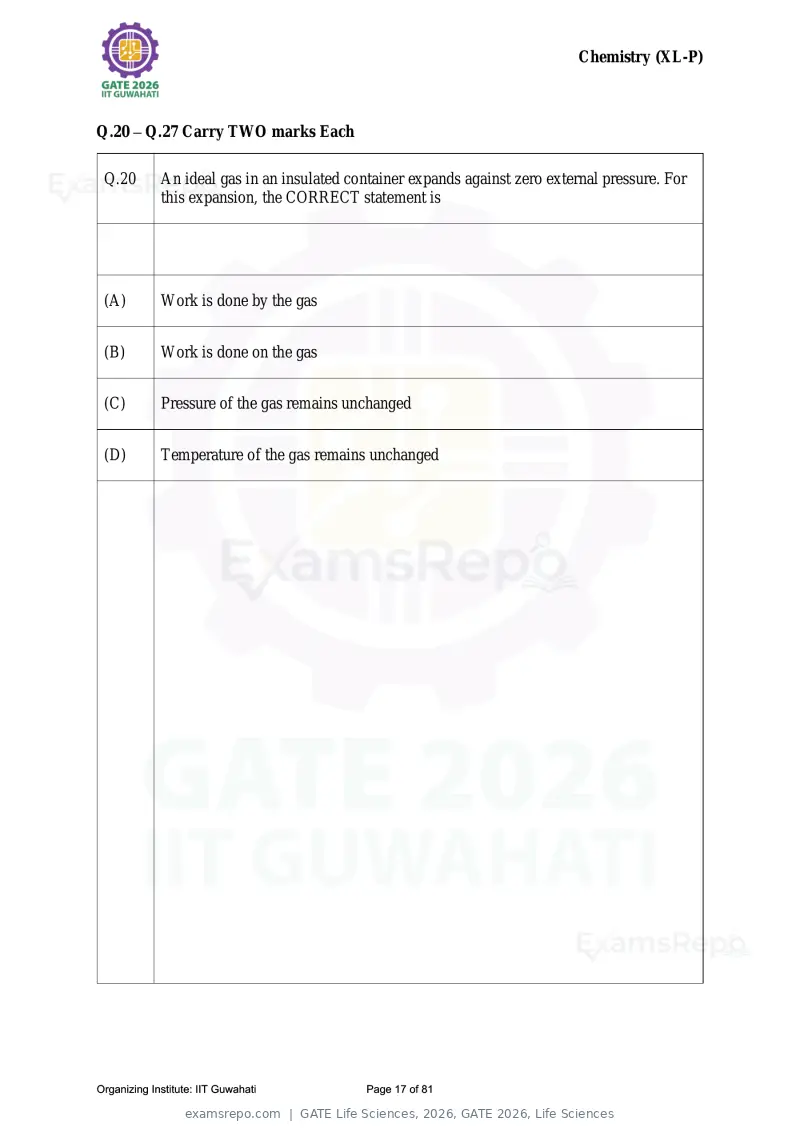
 Q.20        An ideal gas in an insulated container expands against zero external pressure. For
             this expansion, the CORRECT statement is


 (A)         Work is done by the gas


 (B)         Work is done on the gas


 (C)         Pressure of the gas remains unchanged


 (D)         Temperature of the gas remains unchanged


Organizing Institute: IIT Guwahati           Page 17 of 81
Text of page 18
Chemistry (XL-P)


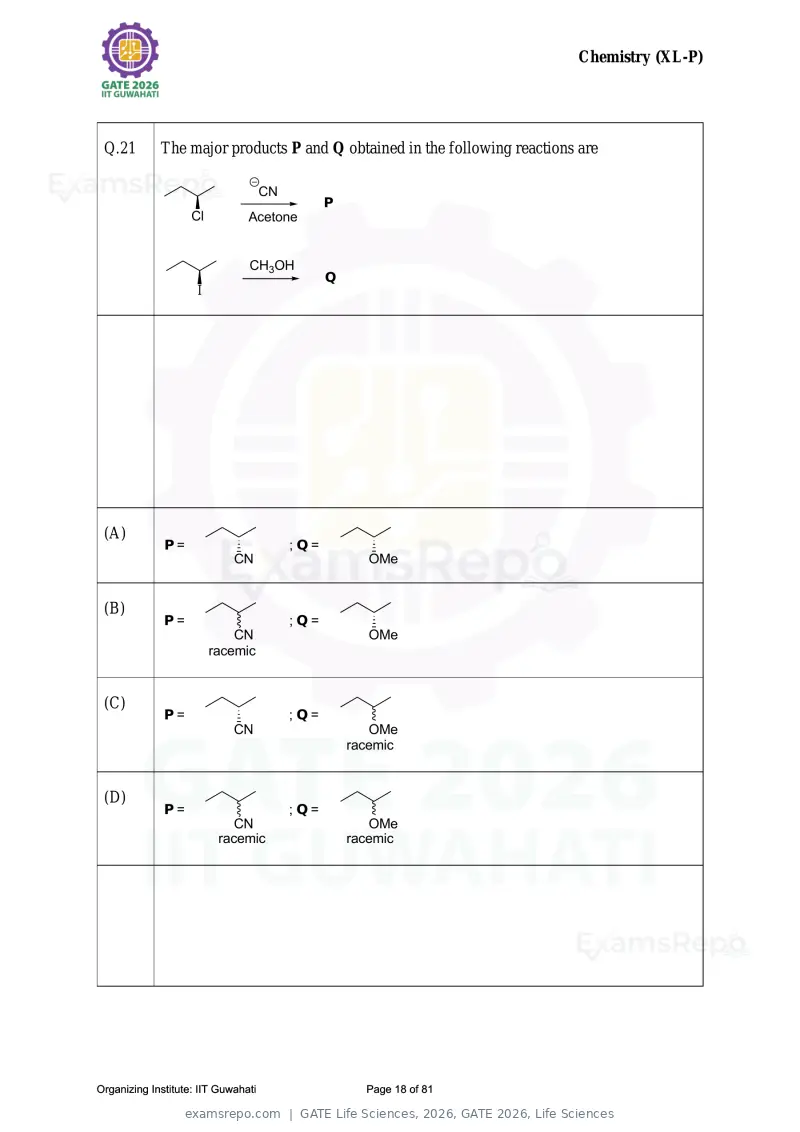
 Q.21        The major products P and Q obtained in the following reactions are

                                     CN
                                                P
                    Cl          Acetone


                                CH3OH
                                                Q
                     I


 (A)
              P=                          ;Q=
                             CN                        OMe


 (B)
              P=                          ;Q=
                             CN                        OMe
                         racemic


 (C)
              P=                          ;Q=
                             CN                        OMe
                                                    racemic


 (D)
              P=                          ;Q=
                             CN                        OMe
                          racemic                   racemic


Organizing Institute: IIT Guwahati                    Page 18 of 81
Text of page 20
Chemistry (XL-P)


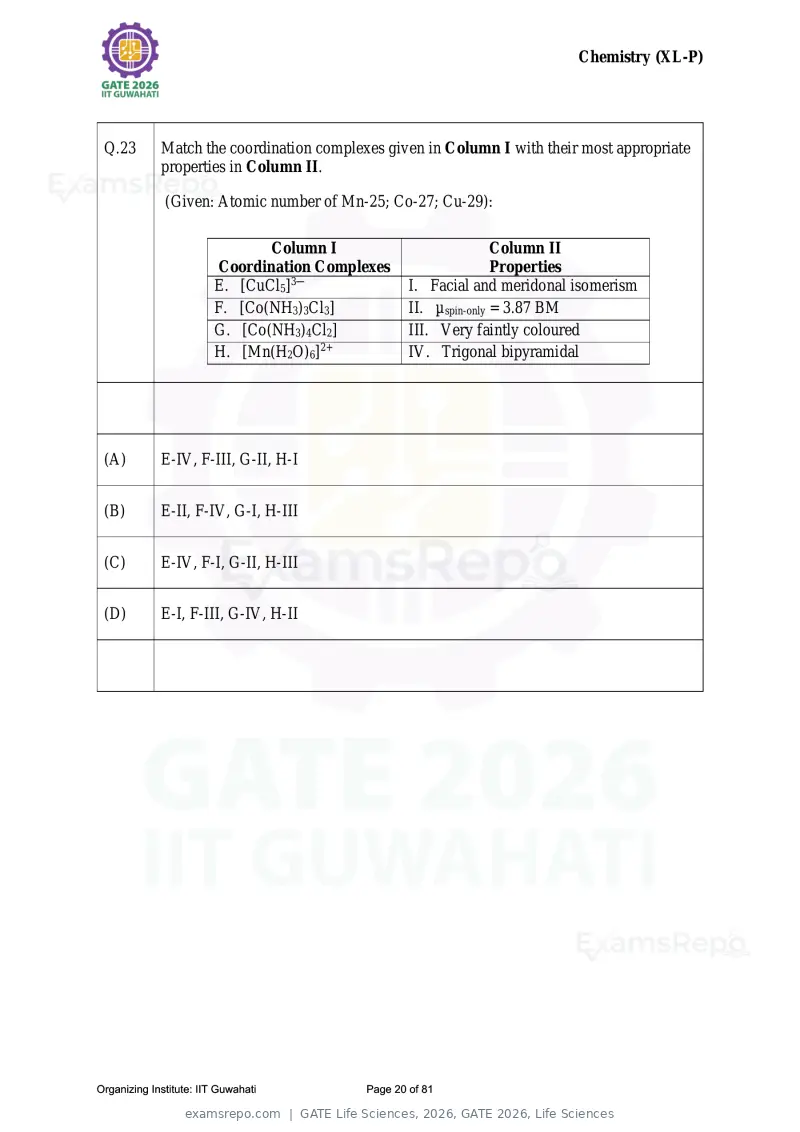
 Q.23        Match the coordination complexes given in Column I with their most appropriate
             properties in Column II.

              (Given: Atomic number of Mn-25; Co-27; Cu-29):

                                Column I                           Column II
                         Coordination Complexes                    Properties
                         E. [CuCl5]3─               I. Facial and meridonal isomerism
                         F. [Co(NH3)3Cl3]           II. µspin-only = 3.87 BM
                         G. [Co(NH3)4Cl2]           III. Very faintly coloured
                         H. [Mn(H2O)6]2+            IV. Trigonal bipyramidal


 (A)         E-IV, F-III, G-II, H-I


 (B)         E-II, F-IV, G-I, H-III


 (C)         E-IV, F-I, G-II, H-III


 (D)         E-I, F-III, G-IV, H-II


Organizing Institute: IIT Guwahati          Page 20 of 81
Text of page 21
Chemistry (XL-P)


 Q.24        The CORRECT statement(s) about a competitive inhibitor of an enzyme is/are


 (A)         The competitive inhibitor binds to the substrate-binding site of the enzyme


 (B)         The competitive inhibitor binds to the substrate


 (C)         The competitive inhibitor is less effective at higher substrate concentration


 (D)         The competitive inhibitor is more effective at higher substrate concentration


Organizing Institute: IIT Guwahati           Page 21 of 81
Text of page 22
Chemistry (XL-P)


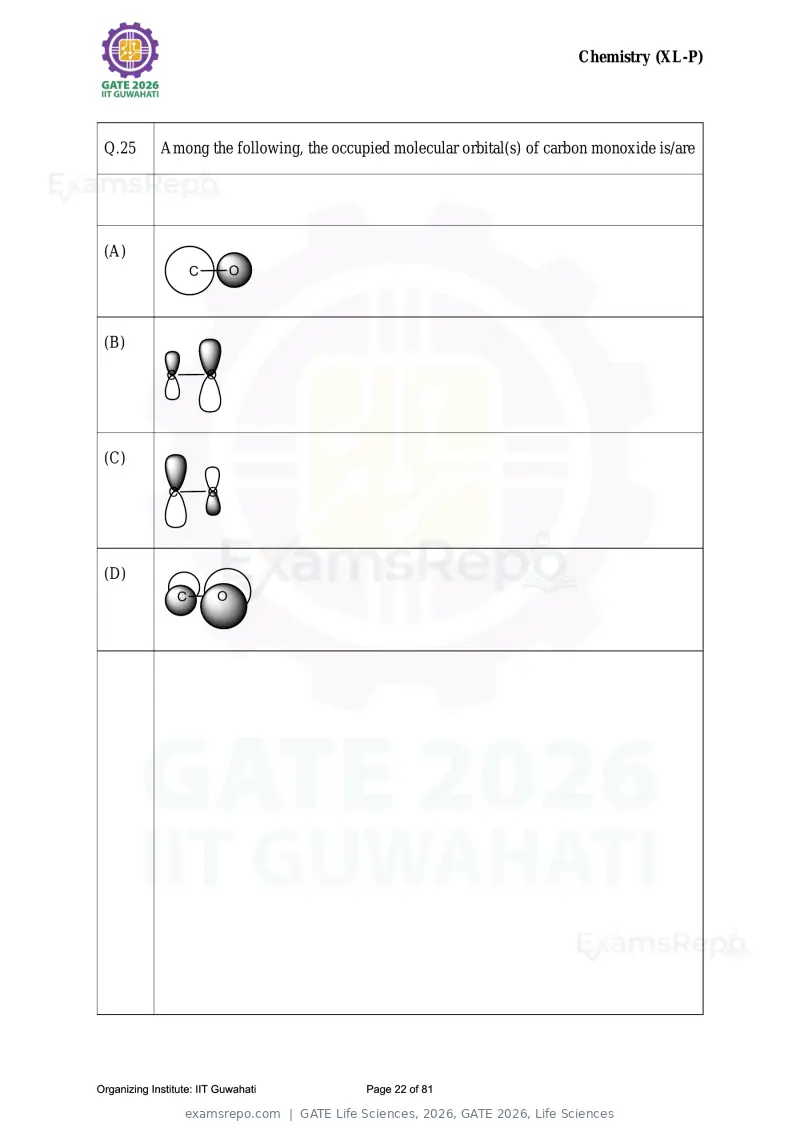
 Q.25        Among the following, the occupied molecular orbital(s) of carbon monoxide is/are


 (A)
                      C           O


 (B)
              C           O


 (C)

               C          O


 (D)
                  C           O


Organizing Institute: IIT Guwahati         Page 22 of 81
Text of page 23
Chemistry (XL-P)


 Q.26        The option(s) with the CORRECT order of ionisation energy is/are


 (A)         Al+ < Al2+ < Al3+ < Al4+


 (B)         Al4+ < Al3+ < Al2+ <Al+


 (C)         Cl─ < Cl < Cl+


 (D)         Cl+ < Cl < Cl─


 Q.27        The pH of 10─8 M HCl (aq.) is ____________ (rounded off to two decimal
             places).

             Given, pKw = 14.


Organizing Institute: IIT Guwahati         Page 23 of 81
Text of page 24
Biochemistry (XL-Q)


Q.28 – Q.35 Carry ONE mark Each


 Q.28        Which one of the following immunoglobulins is known for its role in both allergy
             and asthma?


 (A)         IgA


 (B)         IgM


 (C)         IgD


 (D)         IgE


 Q.29        In which kind of organism, the glycerol moiety of lipid is found primarily in the
             R-configuration?


 (A)         Bacteria


 (B)         Mammals


 (C)         Archaea


 (D)         Yeast


Organizing Institute: IIT Guwahati          Page 24 of 81
Text of page 25
Biochemistry (XL-Q)


 Q.30        The Kennedy pathway of cellular phospholipid biosynthesis is associated
             with ______ .


 (A)         peroxisome


 (B)         mitochondria


 (C)         nucleus


 (D)         endoplasmic reticulum


 Q.31        Which of the following options show(s) the correct pairing of a complement protein
             with its function?


 (A)         C5a : inflammation


 (B)         C3b : opsonization


 (C)         C3a : opsonization


 (D)         C5b : inflammation


Organizing Institute: IIT Guwahati          Page 25 of 81
Text of page 26
Biochemistry (XL-Q)
Q.32 Fluorescence is a result of which one or more of the following?
(A) The transition of electrons from singlet ground state to singlet transition state.
(B) The transition of electrons from lower singlet excited state to singlet ground state.
(C) The release of energy in the form of light of wavelength higher than the incident
wavelength.
(D) The release of energy in the form of light of lower wavelength than the incident
wavelength.
Q.33 A 25 amino acid α-helical protein is spanning the thickness of a mammalian cell
membrane. Using the average dimensional parameters of a typical -helix, the
thickness of the membrane will be ______ Å (rounded off to one decimal place).
Q.34 The oxidative phase of the hexose monophosphate pathway generates __________
moles of NADPH per mole of glucose 6-phosphate (answer in integer).
Organizing Institute: IIT Guwahati Page 26 of 81
Text of page 27
Biochemistry (XL-Q)


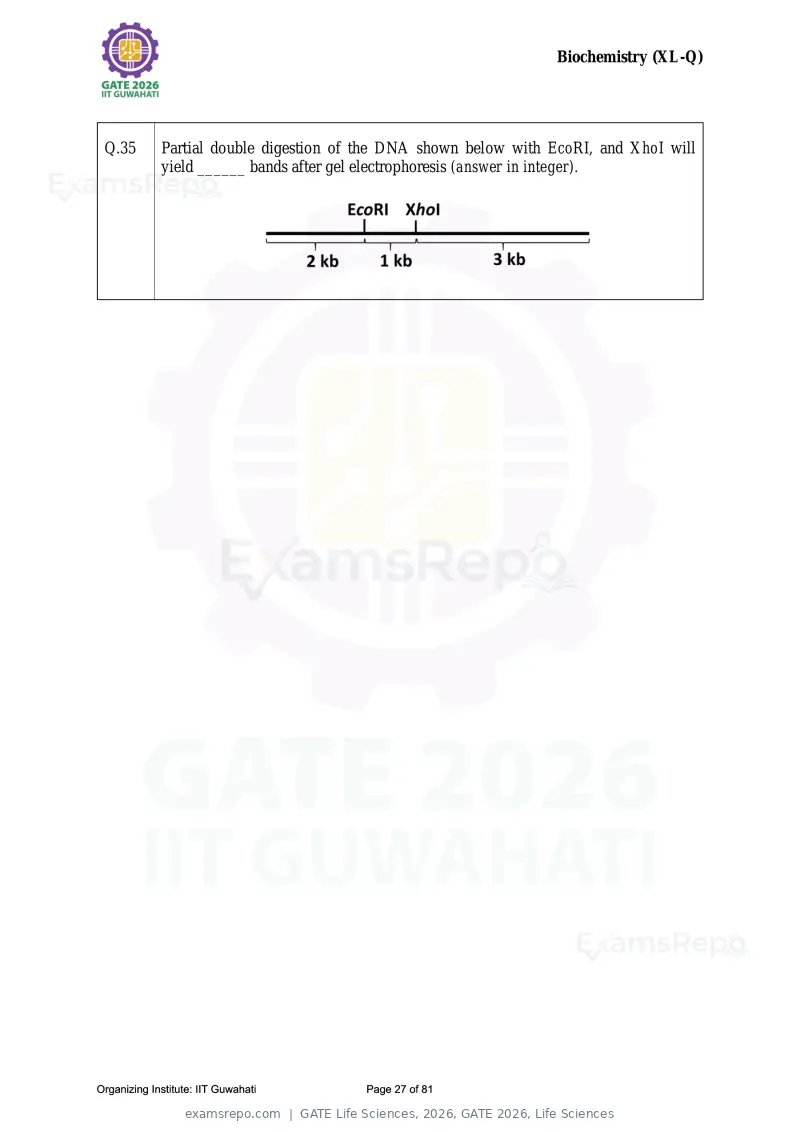
 Q.35        Partial double digestion of the DNA shown below with EcoRI, and XhoI will
             yield ______ bands after gel electrophoresis (answer in integer).


Organizing Institute: IIT Guwahati      Page 27 of 81
Text of page 28
Biochemistry (XL-Q)


Q.36 – Q.46 Carry TWO marks Each


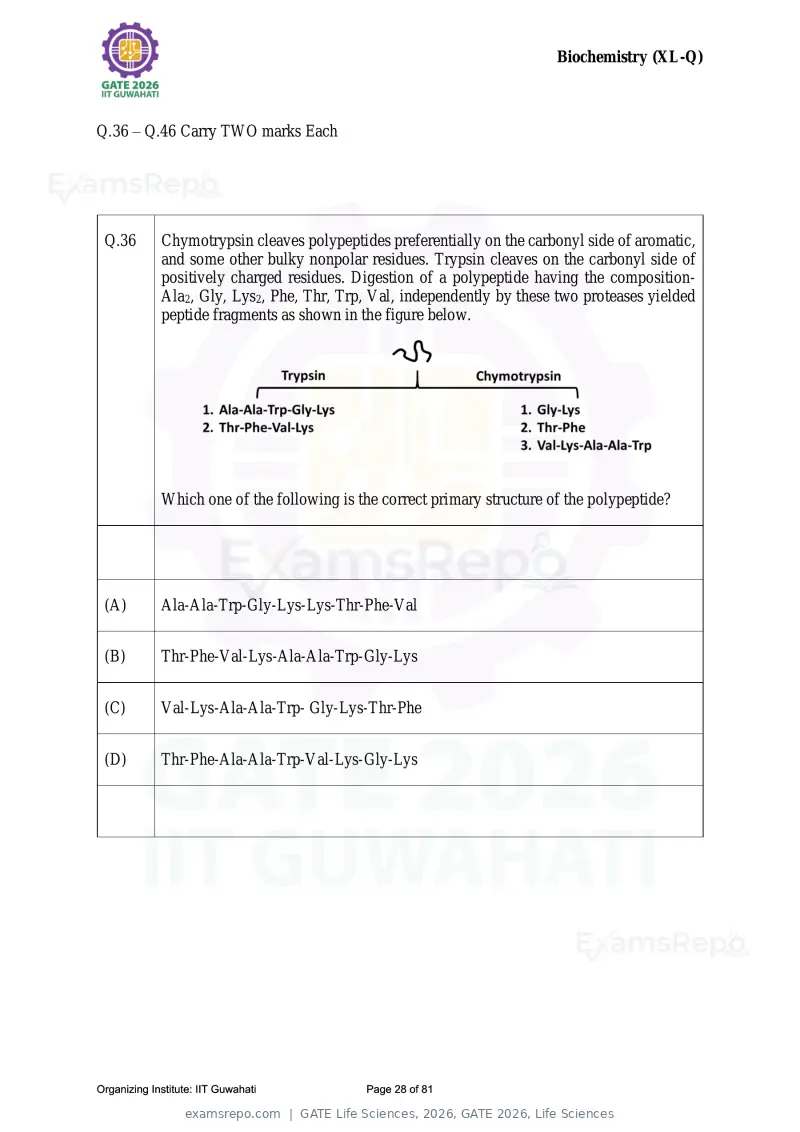
 Q.36        Chymotrypsin cleaves polypeptides preferentially on the carbonyl side of aromatic,
             and some other bulky nonpolar residues. Trypsin cleaves on the carbonyl side of
             positively charged residues. Digestion of a polypeptide having the composition-
             Ala2, Gly, Lys2, Phe, Thr, Trp, Val, independently by these two proteases yielded
             peptide fragments as shown in the figure below.


             Which one of the following is the correct primary structure of the polypeptide?


 (A)         Ala-Ala-Trp-Gly-Lys-Lys-Thr-Phe-Val


 (B)         Thr-Phe-Val-Lys-Ala-Ala-Trp-Gly-Lys


 (C)         Val-Lys-Ala-Ala-Trp- Gly-Lys-Thr-Phe


 (D)         Thr-Phe-Ala-Ala-Trp-Val-Lys-Gly-Lys


Organizing Institute: IIT Guwahati          Page 28 of 81
Text of page 29
Biochemistry (XL-Q)


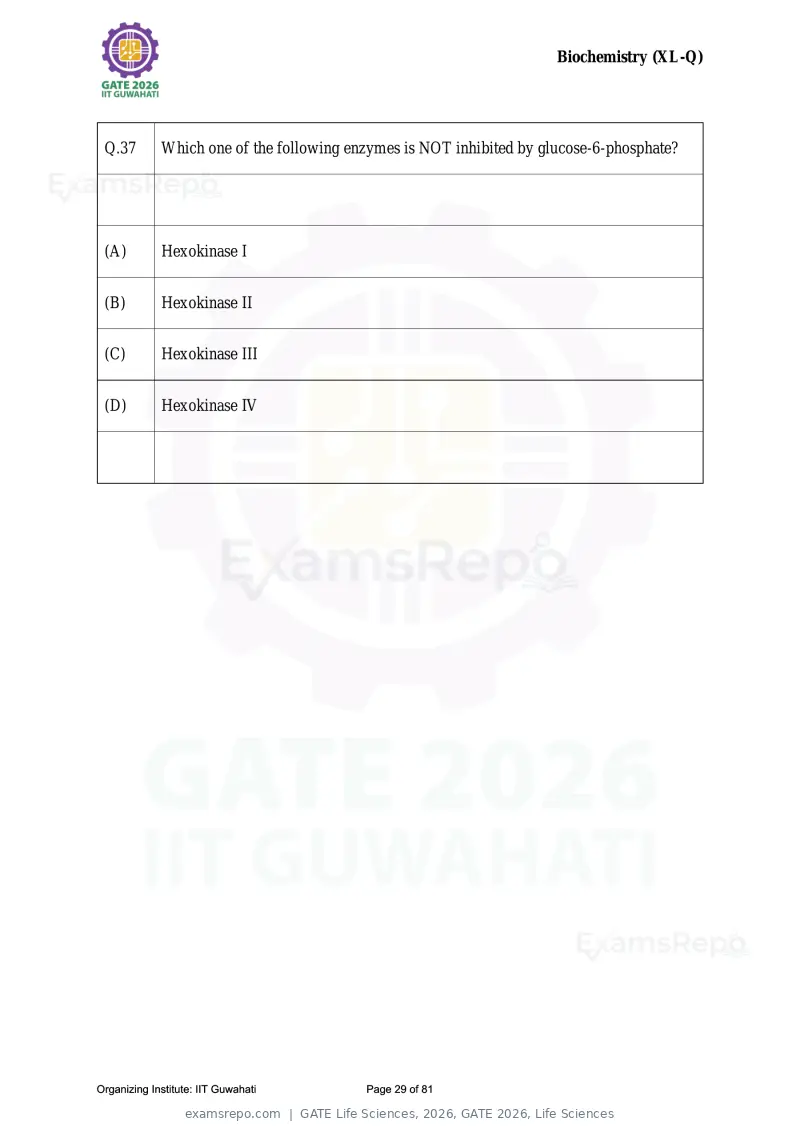
 Q.37        Which one of the following enzymes is NOT inhibited by glucose-6-phosphate?


 (A)         Hexokinase I


 (B)         Hexokinase II


 (C)         Hexokinase III


 (D)         Hexokinase IV


Organizing Institute: IIT Guwahati        Page 29 of 81
Text of page 30
Biochemistry (XL-Q)


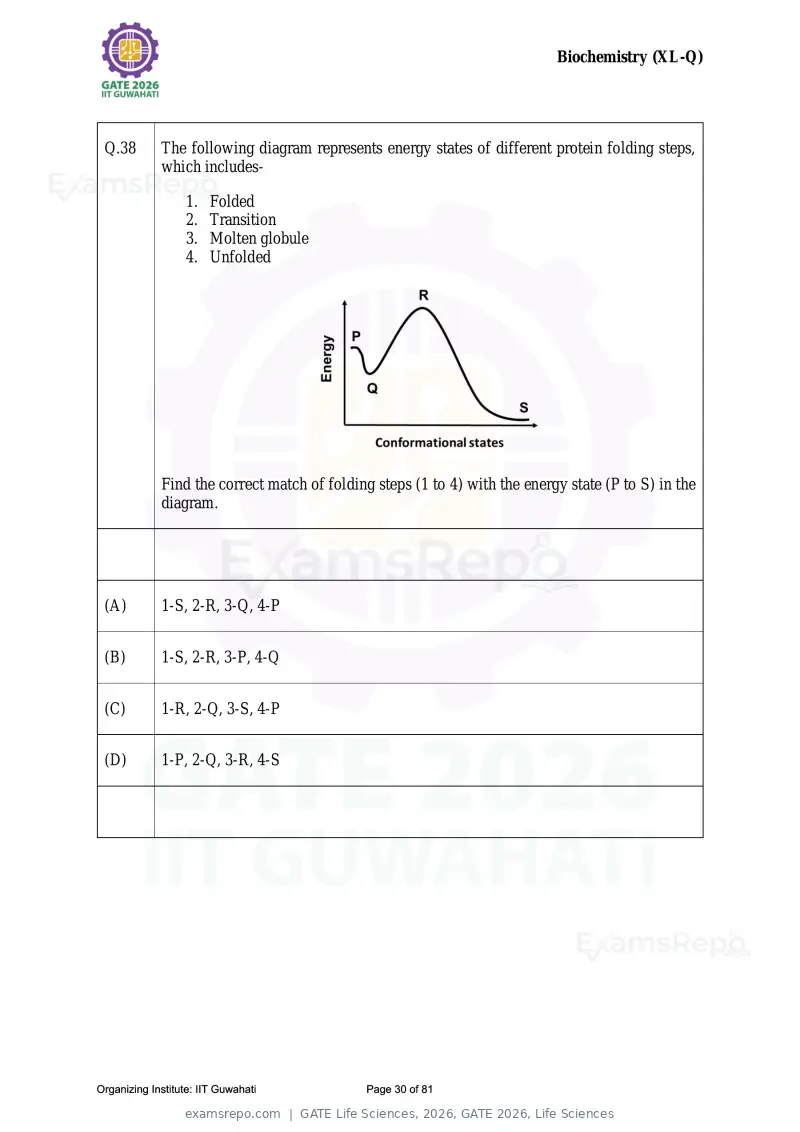
 Q.38        The following diagram represents energy states of different protein folding steps,
             which includes-

                  1.    Folded
                  2.    Transition
                  3.    Molten globule
                  4.    Unfolded


             Find the correct match of folding steps (1 to 4) with the energy state (P to S) in the
             diagram.


 (A)         1-S, 2-R, 3-Q, 4-P


 (B)         1-S, 2-R, 3-P, 4-Q


 (C)         1-R, 2-Q, 3-S, 4-P


 (D)         1-P, 2-Q, 3-R, 4-S


Organizing Institute: IIT Guwahati           Page 30 of 81
Text of page 31
Biochemistry (XL-Q)


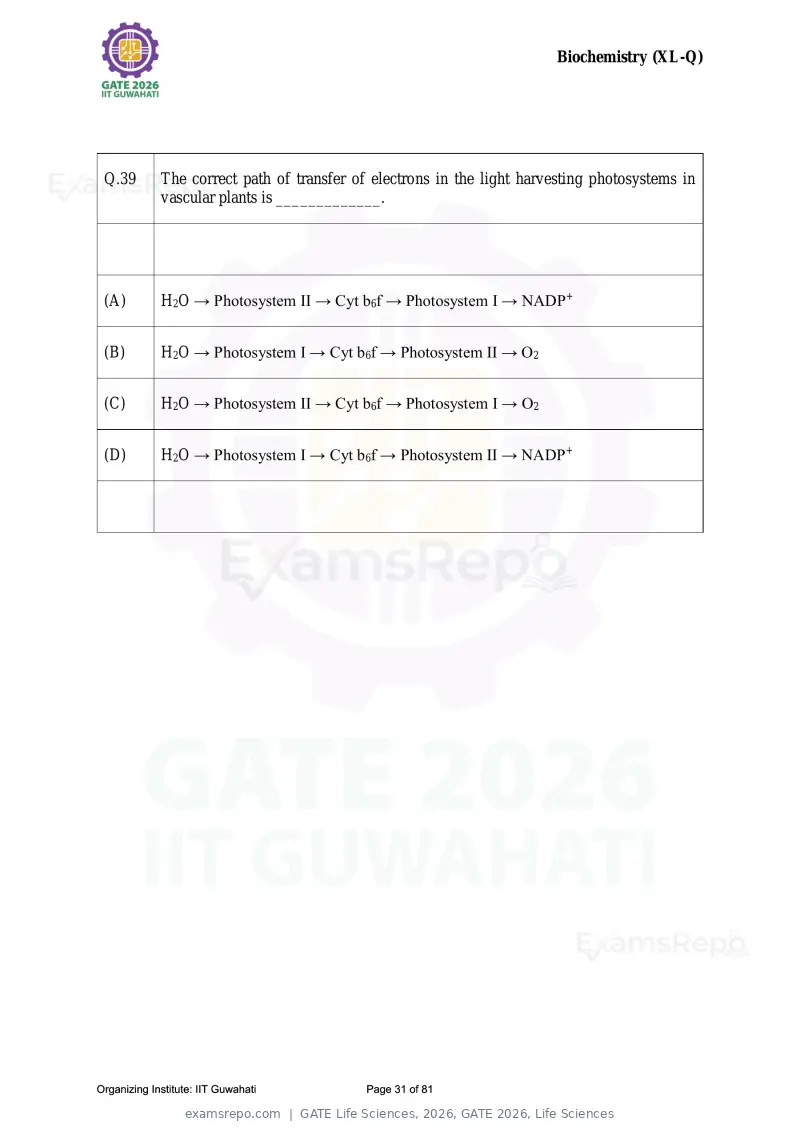
 Q.39        The correct path of transfer of electrons in the light harvesting photosystems in
             vascular plants is _____________.


 (A)         H2O → Photosystem II → Cyt b6f → Photosystem I → NADP+


 (B)         H2O → Photosystem I → Cyt b6f → Photosystem II → O2


 (C)         H2O → Photosystem II → Cyt b6f → Photosystem I → O2


 (D)         H2O → Photosystem I → Cyt b6f → Photosystem II → NADP+


Organizing Institute: IIT Guwahati          Page 31 of 81
Text of page 32
Biochemistry (XL-Q)


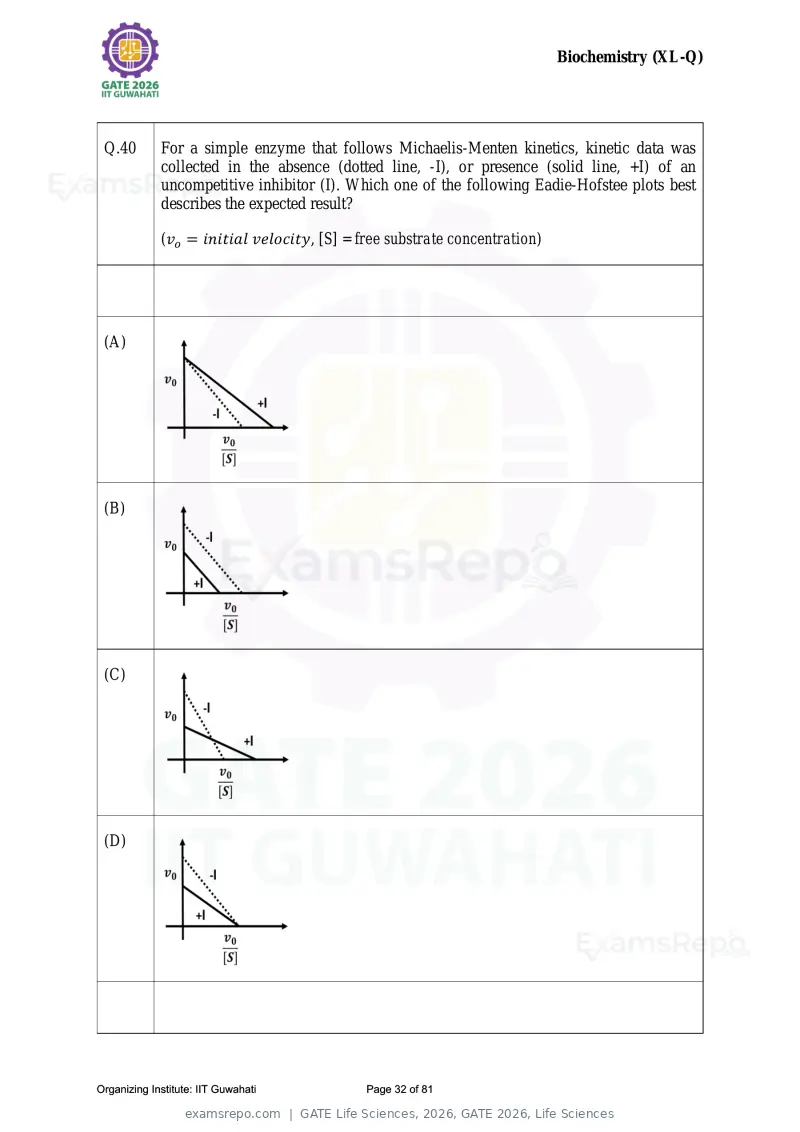
 Q.40        For a simple enzyme that follows Michaelis-Menten kinetics, kinetic data was
             collected in the absence (dotted line, -I), or presence (solid line, +I) of an
             uncompetitive inhibitor (I). Which one of the following Eadie-Hofstee plots best
             describes the expected result?

             (vo = initial velocity, [S] = free substrate concentration)


 (A)


 (B)


 (C)


 (D)


Organizing Institute: IIT Guwahati          Page 32 of 81
Text of page 33
Biochemistry (XL-Q)
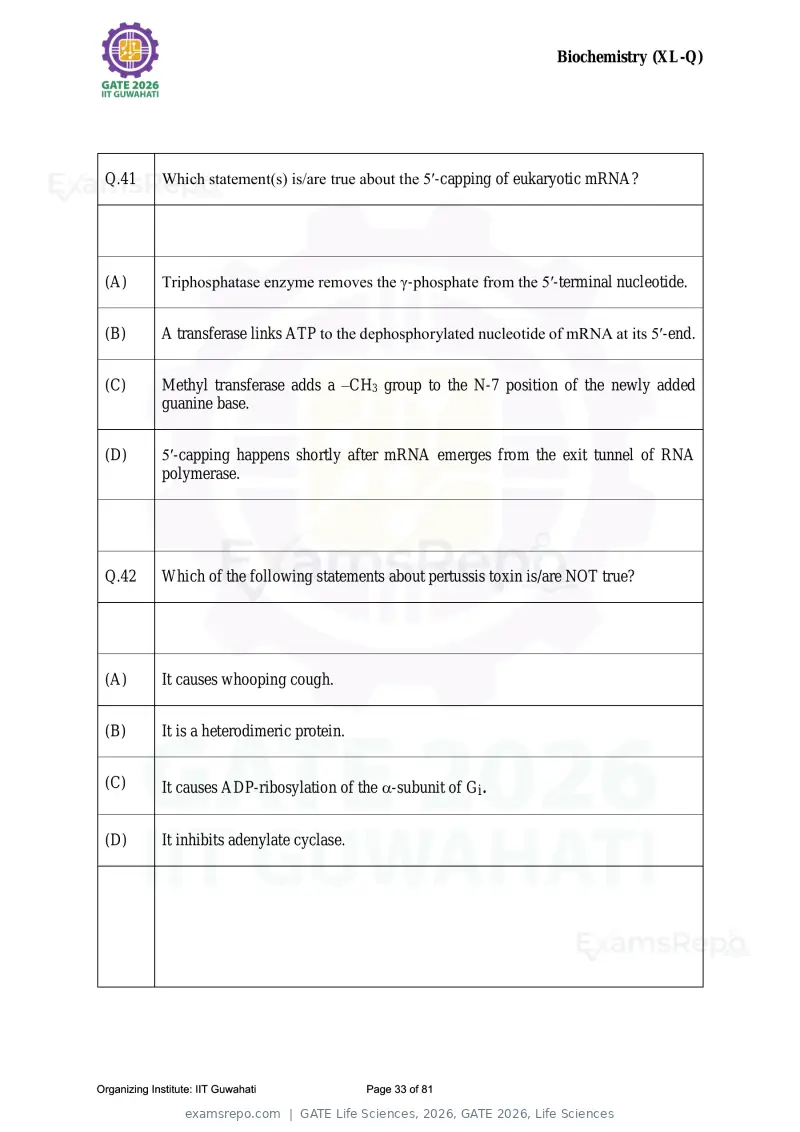
Q.41 Which statement(s) is/are true about the 5′-capping of eukaryotic mRNA?
(A) Triphosphatase enzyme removes the γ-phosphate from the 5′-terminal nucleotide.
(B) A transferase links ATP to the dephosphorylated nucleotide of mRNA at its 5′-end.
(C) Methyl transferase adds a –CH3 group to the N-7 position of the newly added
guanine base.
(D) 5′-capping happens shortly after mRNA emerges from the exit tunnel of RNA
polymerase.
Q.42 Which of the following statements about pertussis toxin is/are NOT true?
(A) It causes whooping cough.
(B) It is a heterodimeric protein.
(C) It causes ADP-ribosylation of the -subunit of Gi.
(D) It inhibits adenylate cyclase.
Organizing Institute: IIT Guwahati Page 33 of 81
Text of page 34
Biochemistry (XL-Q)


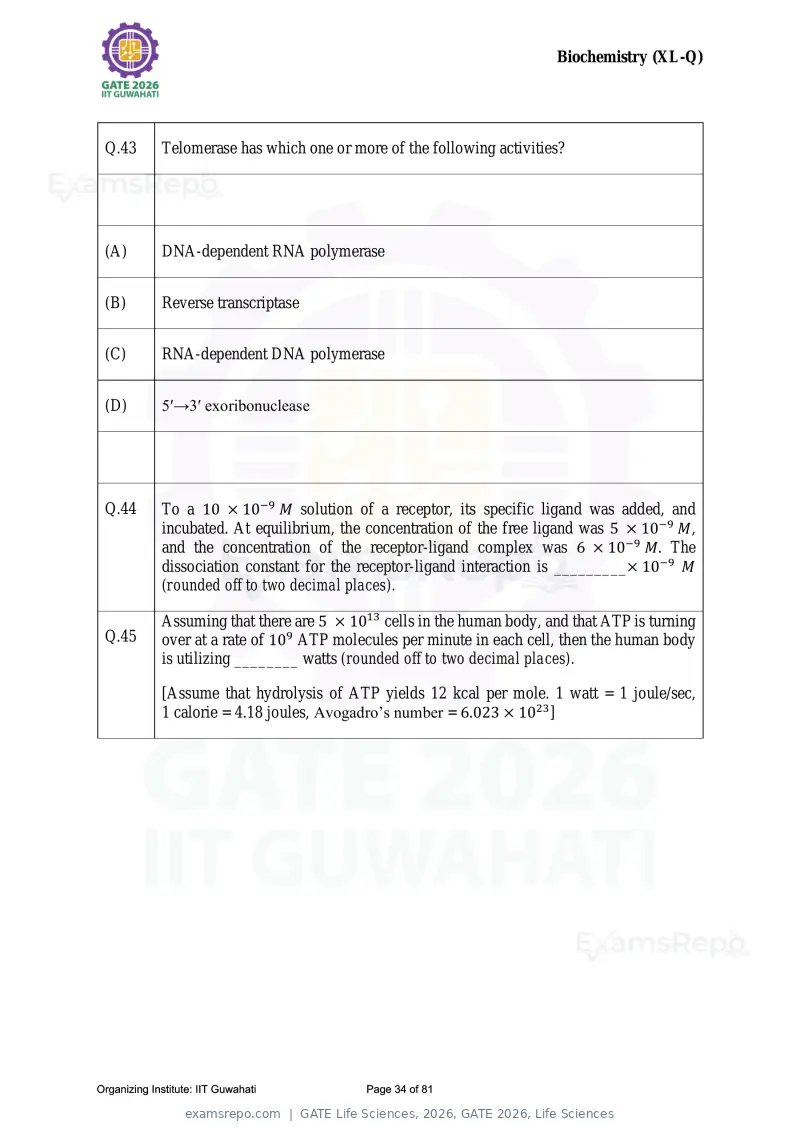
 Q.43        Telomerase has which one or more of the following activities?


 (A)         DNA-dependent RNA polymerase


 (B)         Reverse transcriptase


 (C)         RNA-dependent DNA polymerase


 (D)         5′→3′ exoribonuclease


 Q.44        To a 10 × 10−9 M solution of a receptor, its specific ligand was added, and
             incubated. At equilibrium, the concentration of the free ligand was 5 × 10⁻⁹ M,
             and the concentration of the receptor-ligand complex was 6 × 10⁻⁹ M. The
             dissociation constant for the receptor-ligand interaction is _________× 10−9 M
             (rounded off to two decimal places).

             Assuming that there are 5 × 10¹³ cells in the human body, and that ATP is turning
 Q.45        over at a rate of 109 ATP molecules per minute in each cell, then the human body
             is utilizing ________ watts (rounded off to two decimal places).

             [Assume that hydrolysis of ATP yields 12 kcal per mole. 1 watt = 1 joule/sec,
             1 calorie = 4.18 joules, Avogadro’s number = 6.023 × 10²³ ]


Organizing Institute: IIT Guwahati          Page 34 of 81
Text of page 35
Biochemistry (XL-Q)


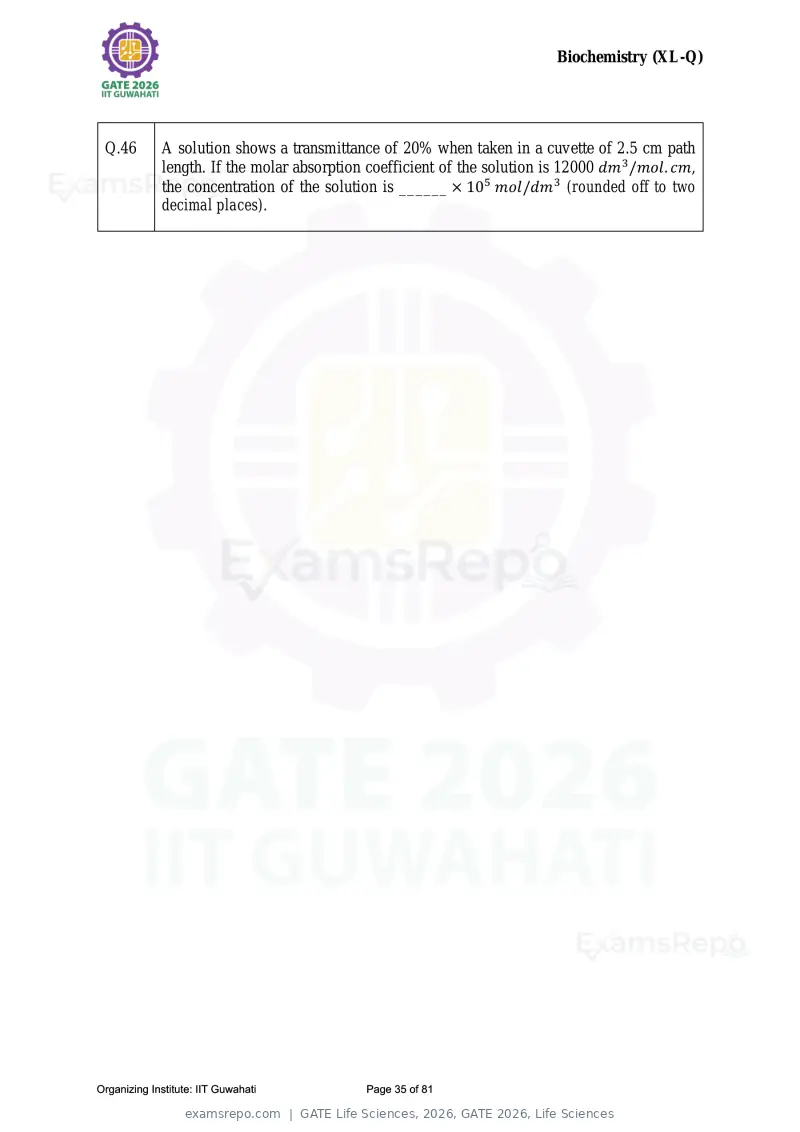
 Q.46        A solution shows a transmittance of 20% when taken in a cuvette of 2.5 cm path
             length. If the molar absorption coefficient of the solution is 12000 dm3 /mol. cm,
             the concentration of the solution is ______ × 105 mol/dm3 (rounded off to two
             decimal places).


Organizing Institute: IIT Guwahati          Page 35 of 81
Text of page 36
Botany (XL-R)


Q.47 – Q.54 Carry ONE mark Each

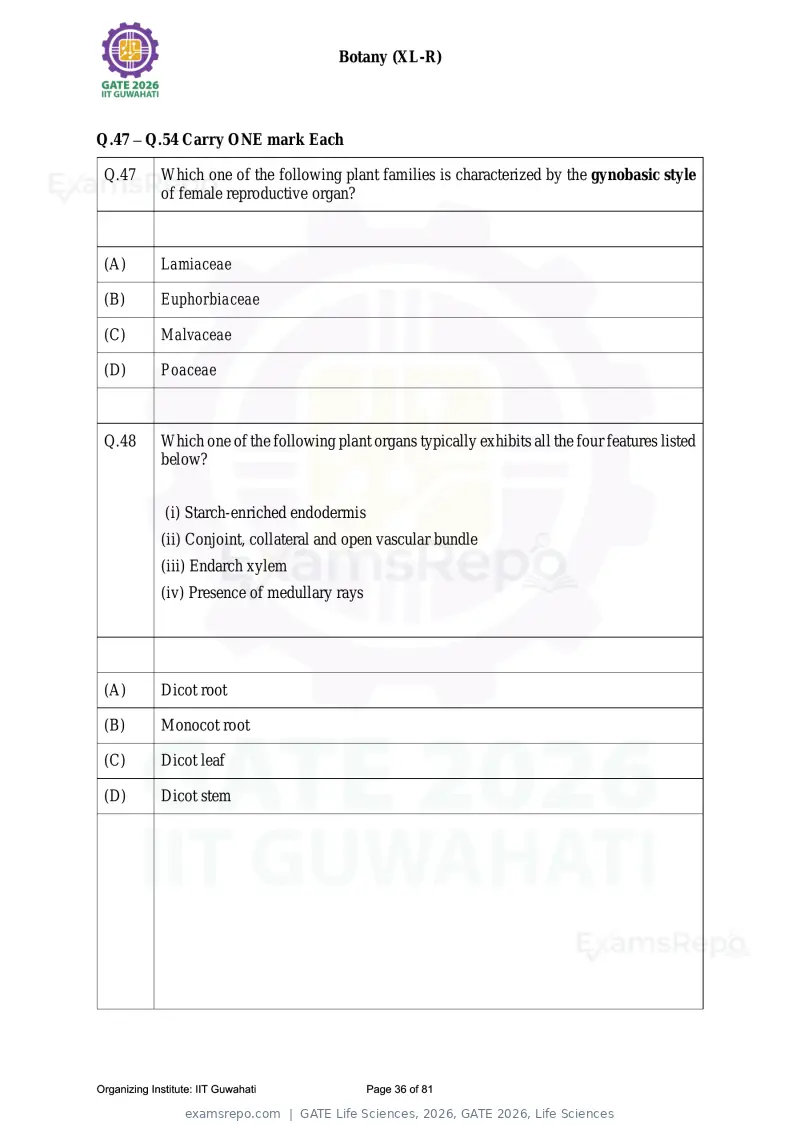
 Q.47        Which one of the following plant families is characterized by the gynobasic style
             of female reproductive organ?


 (A)         Lamiaceae

 (B)         Euphorbiaceae

 (C)         Malvaceae

 (D)         Poaceae


 Q.48        Which one of the following plant organs typically exhibits all the four features listed
             below?


              (i) Starch-enriched endodermis
             (ii) Conjoint, collateral and open vascular bundle
             (iii) Endarch xylem
             (iv) Presence of medullary rays


 (A)         Dicot root

 (B)         Monocot root

 (C)         Dicot leaf

 (D)         Dicot stem


Organizing Institute: IIT Guwahati             Page 36 of 81
Text of page 37
Botany (XL-R)


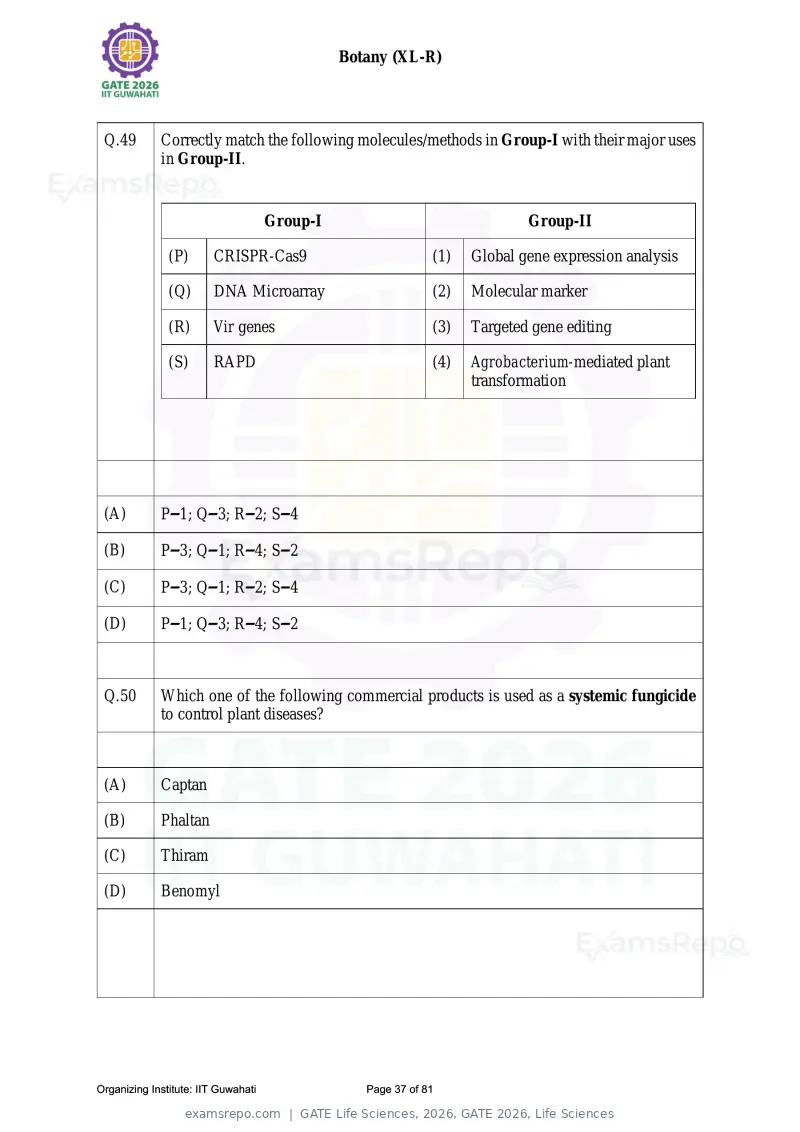
 Q.49        Correctly match the following molecules/methods in Group-I with their major uses
             in Group-II.


                                     Group-I                                Group-II

               (P)      CRISPR-Cas9                           (1)   Global gene expression analysis

               (Q)      DNA Microarray                        (2)   Molecular marker

               (R)      Vir genes                             (3)   Targeted gene editing

               (S)      RAPD                                  (4)   Agrobacterium-mediated plant
                                                                    transformation


 (A)         P−1; Q−3; R−2; S−4

 (B)         P−3; Q−1; R−4; S−2

 (C)         P−3; Q−1; R−2; S−4

 (D)         P−1; Q−3; R−4; S−2


 Q.50        Which one of the following commercial products is used as a systemic fungicide
             to control plant diseases?


 (A)         Captan

 (B)         Phaltan

 (C)         Thiram

 (D)         Benomyl


Organizing Institute: IIT Guwahati                Page 37 of 81
Text of page 38
Botany (XL-R)


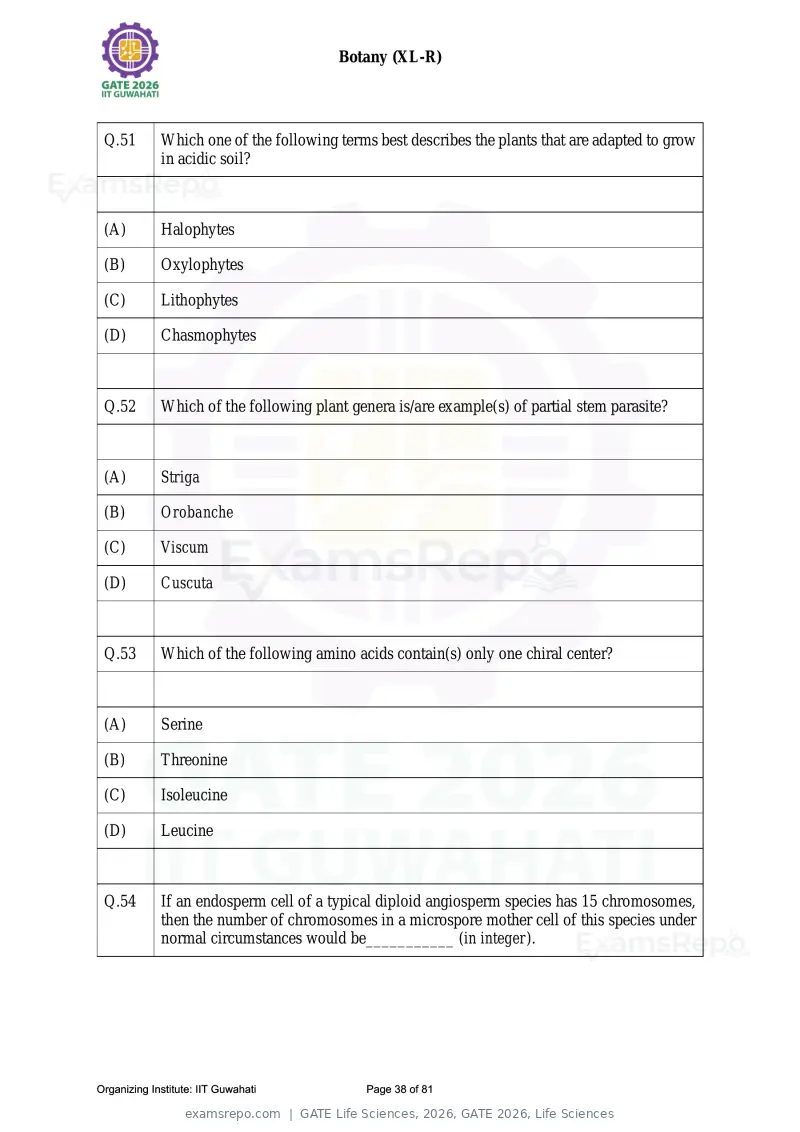
 Q.51        Which one of the following terms best describes the plants that are adapted to grow
             in acidic soil?


 (A)         Halophytes

 (B)         Oxylophytes

 (C)         Lithophytes

 (D)         Chasmophytes


 Q.52        Which of the following plant genera is/are example(s) of partial stem parasite?


 (A)         Striga

 (B)         Orobanche

 (C)         Viscum

 (D)         Cuscuta


 Q.53        Which of the following amino acids contain(s) only one chiral center?


 (A)         Serine

 (B)         Threonine

 (C)         Isoleucine

 (D)         Leucine


 Q.54        If an endosperm cell of a typical diploid angiosperm species has 15 chromosomes,
             then the number of chromosomes in a microspore mother cell of this species under
             normal circumstances would be___________ (in integer).


Organizing Institute: IIT Guwahati          Page 38 of 81
Text of page 39
Botany (XL-R)


Q.55 – Q.65 Carry TWO marks Each

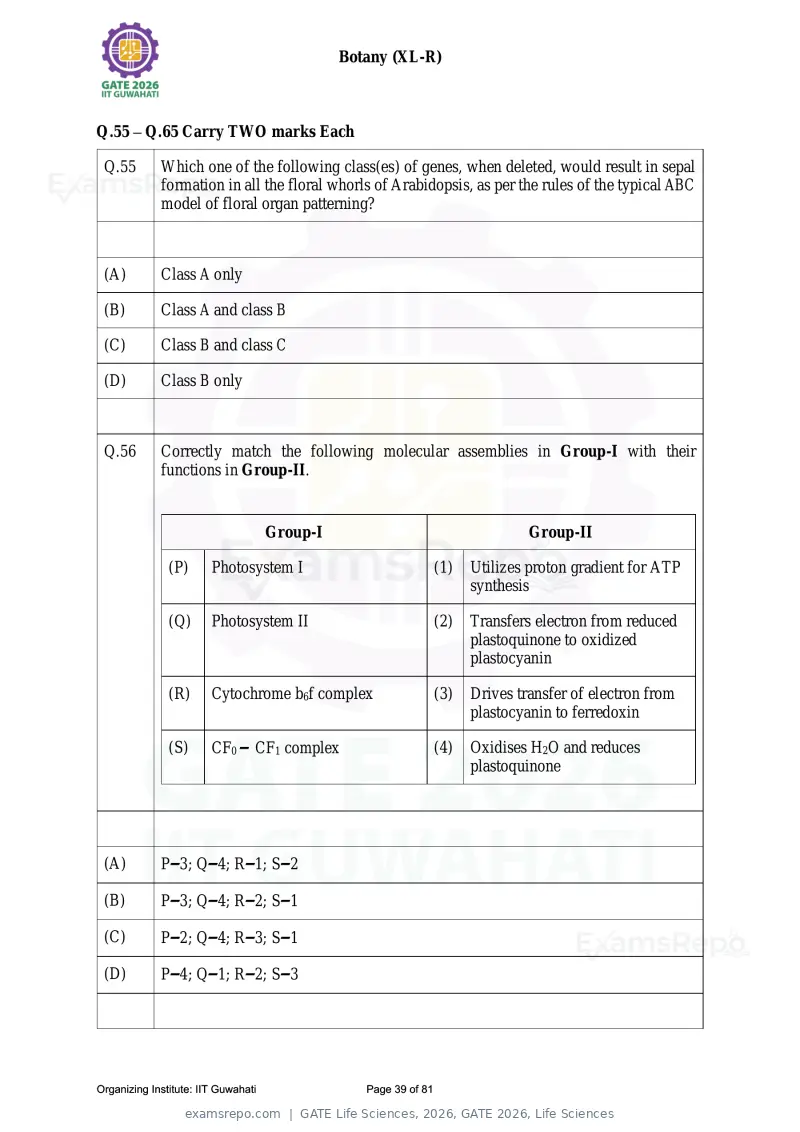
 Q.55        Which one of the following class(es) of genes, when deleted, would result in sepal
             formation in all the floral whorls of Arabidopsis, as per the rules of the typical ABC
             model of floral organ patterning?


 (A)         Class A only

 (B)         Class A and class B

 (C)         Class B and class C

 (D)         Class B only


 Q.56        Correctly match the following molecular assemblies in Group-I with their
             functions in Group-II.


                                     Group-I                                     Group-II

               (P)      Photosystem I                             (1)   Utilizes proton gradient for ATP
                                                                        synthesis

               (Q)      Photosystem II                            (2)   Transfers electron from reduced
                                                                        plastoquinone to oxidized
                                                                        plastocyanin

               (R)      Cytochrome b6f complex                    (3)   Drives transfer of electron from
                                                                        plastocyanin to ferredoxin

               (S)      CF0 − CF1 complex                         (4)   Oxidises H2O and reduces
                                                                        plastoquinone


 (A)         P−3; Q−4; R−1; S−2

 (B)         P−3; Q−4; R−2; S−1

 (C)         P−2; Q−4; R−3; S−1

 (D)         P−4; Q−1; R−2; S−3


Organizing Institute: IIT Guwahati                Page 39 of 81
Text of page 40
Botany (XL-R)


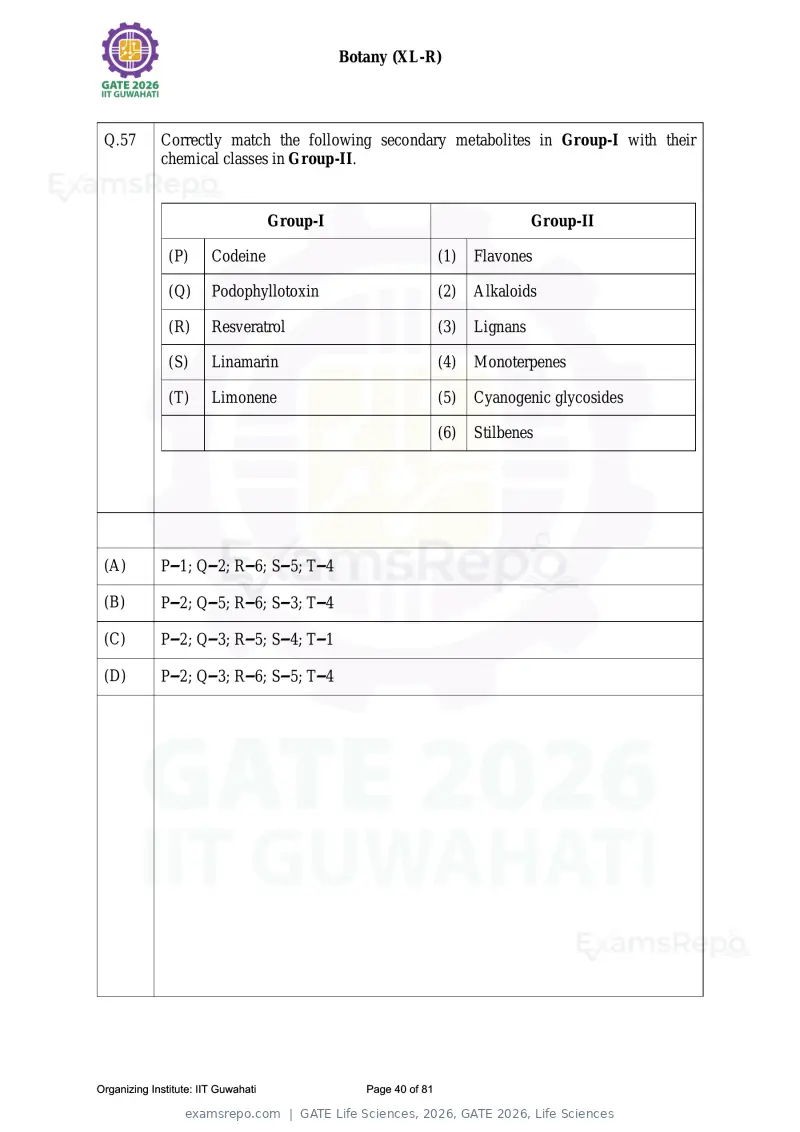
 Q.57        Correctly match the following secondary metabolites in Group-I with their
             chemical classes in Group-II.


                                     Group-I                                      Group-II

               (P)      Codeine                                   (1)   Flavones

               (Q)      Podophyllotoxin                           (2)   Alkaloids

               (R)      Resveratrol                               (3)   Lignans

               (S)      Linamarin                                 (4)   Monoterpenes

               (T)      Limonene                                  (5)   Cyanogenic glycosides

                                                                  (6)   Stilbenes


 (A)         P−1; Q−2; R−6; S−5; T−4

 (B)         P−2; Q−5; R−6; S−3; T−4

 (C)         P−2; Q−3; R−5; S−4; T−1

 (D)         P−2; Q−3; R−6; S−5; T−4


Organizing Institute: IIT Guwahati                Page 40 of 81
Text of page 41
Botany (XL-R)


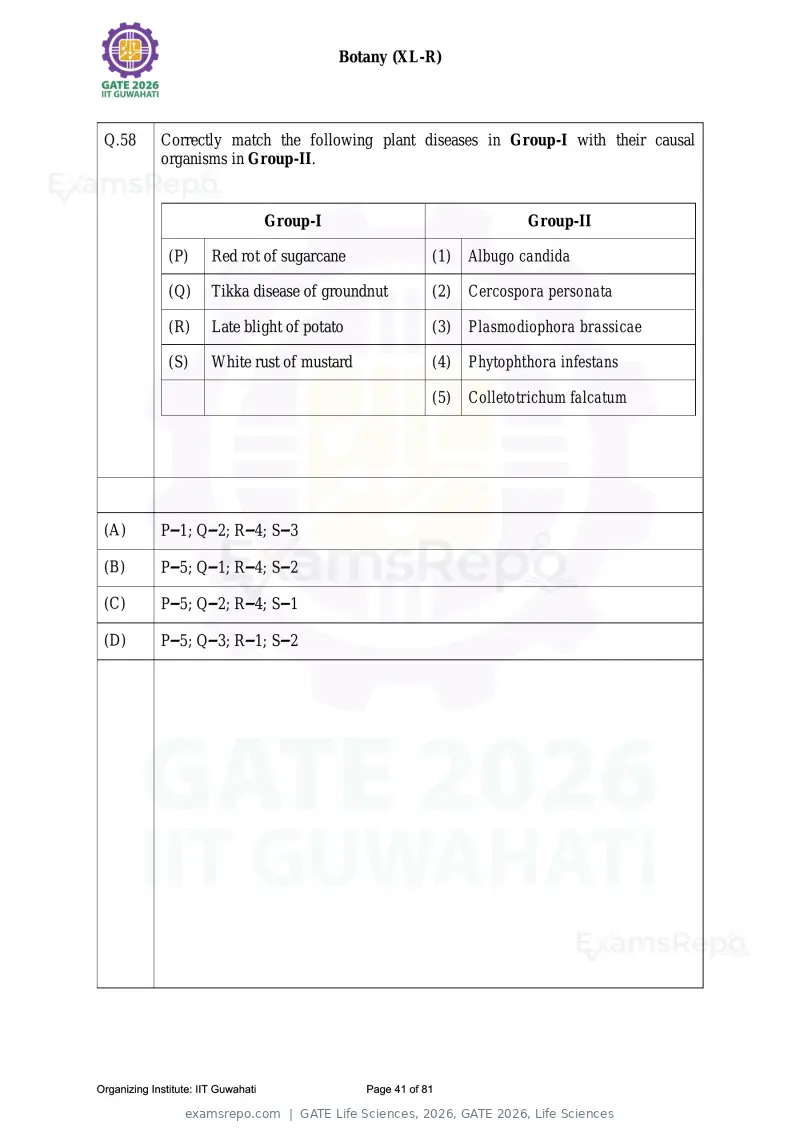
 Q.58        Correctly match the following plant diseases in Group-I with their causal
             organisms in Group-II.


                                     Group-I                                Group-II

               (P)      Red rot of sugarcane                  (1)   Albugo candida

               (Q)      Tikka disease of groundnut            (2)   Cercospora personata

               (R)      Late blight of potato                 (3)   Plasmodiophora brassicae

               (S)      White rust of mustard                 (4)   Phytophthora infestans

                                                              (5)   Colletotrichum falcatum


 (A)         P−1; Q−2; R−4; S−3

 (B)         P−5; Q−1; R−4; S−2

 (C)         P−5; Q−2; R−4; S−1

 (D)         P−5; Q−3; R−1; S−2


Organizing Institute: IIT Guwahati                Page 41 of 81
Text of page 42
Botany (XL-R)


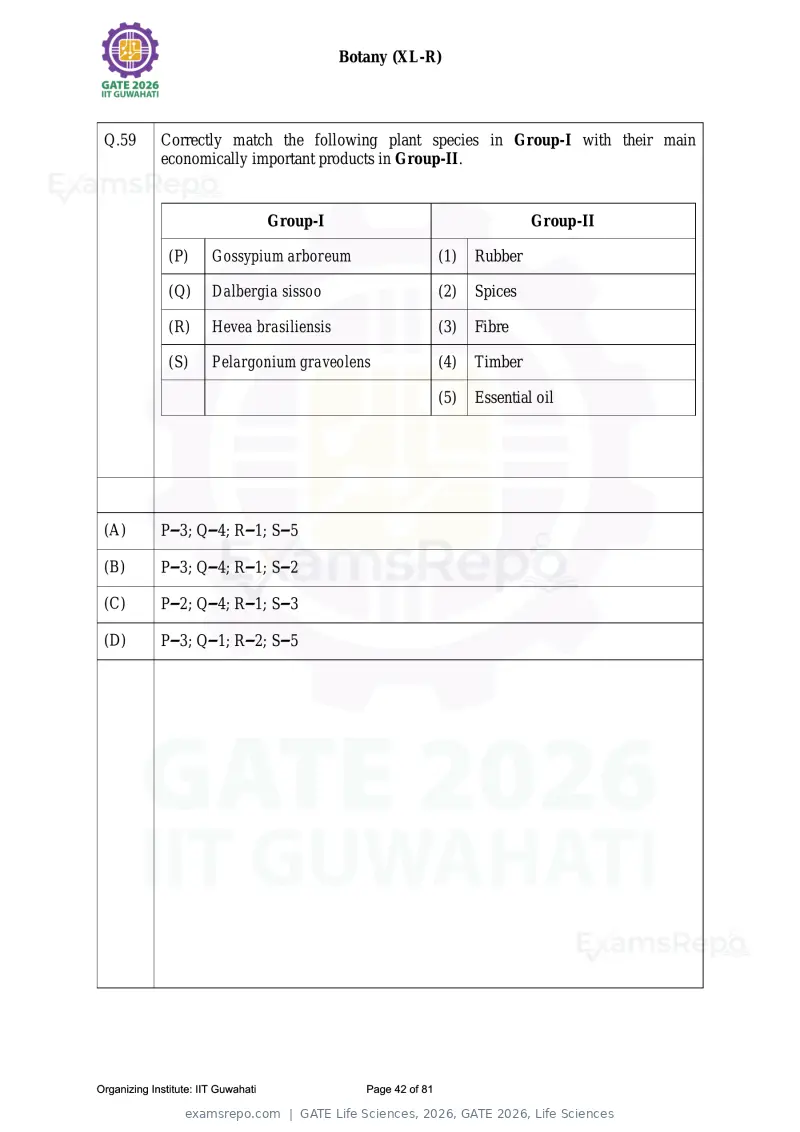
 Q.59        Correctly match the following plant species in Group-I with their main
             economically important products in Group-II.


                                     Group-I                                     Group-II

               (P)      Gossypium arboreum                        (1)   Rubber

               (Q)      Dalbergia sissoo                          (2)   Spices

               (R)      Hevea brasiliensis                        (3)   Fibre

               (S)      Pelargonium graveolens                    (4)   Timber

                                                                  (5)   Essential oil


 (A)         P−3; Q−4; R−1; S−5

 (B)         P−3; Q−4; R−1; S−2

 (C)         P−2; Q−4; R−1; S−3

 (D)         P−3; Q−1; R−2; S−5


Organizing Institute: IIT Guwahati                Page 42 of 81
Text of page 43
Botany (XL-R)


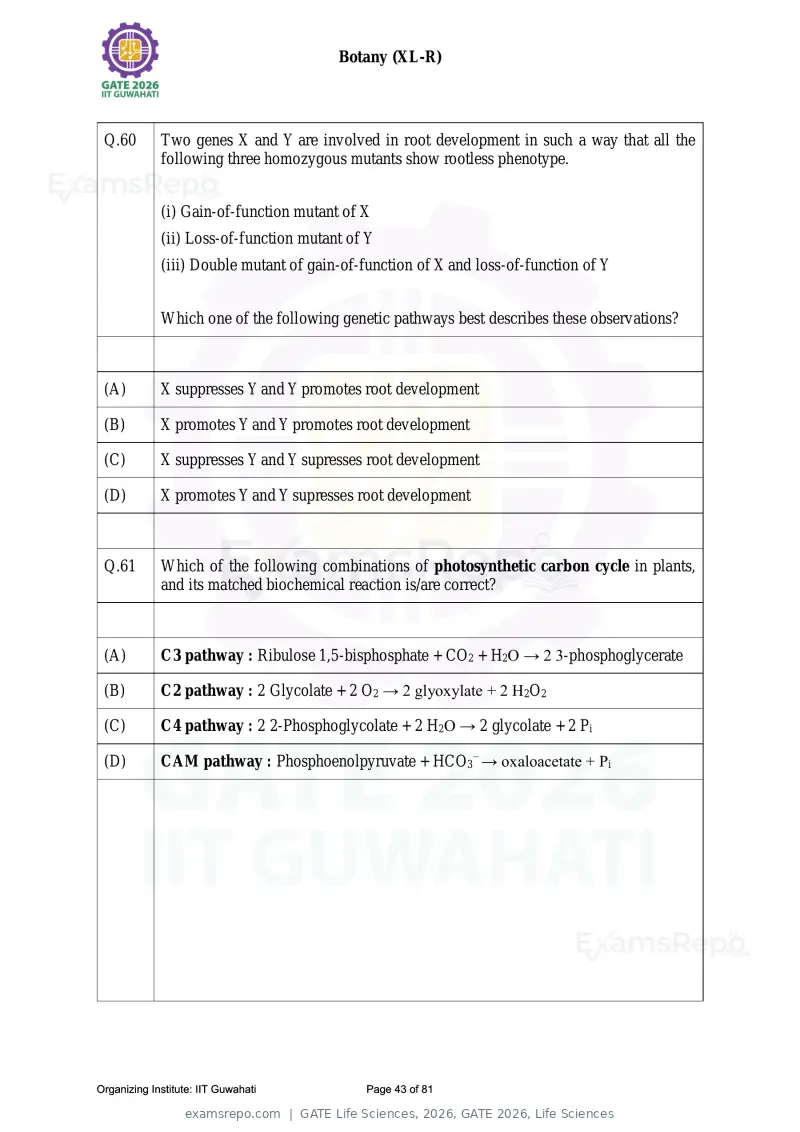
 Q.60        Two genes X and Y are involved in root development in such a way that all the
             following three homozygous mutants show rootless phenotype.


             (i) Gain-of-function mutant of X
             (ii) Loss-of-function mutant of Y
             (iii) Double mutant of gain-of-function of X and loss-of-function of Y


             Which one of the following genetic pathways best describes these observations?


 (A)         X suppresses Y and Y promotes root development

 (B)         X promotes Y and Y promotes root development

 (C)         X suppresses Y and Y supresses root development

 (D)         X promotes Y and Y supresses root development


 Q.61        Which of the following combinations of photosynthetic carbon cycle in plants,
             and its matched biochemical reaction is/are correct?


 (A)         C3 pathway : Ribulose 1,5-bisphosphate + CO2 + H2O → 2 3-phosphoglycerate

 (B)         C2 pathway : 2 Glycolate + 2 O2 → 2 glyoxylate + 2 H2O2

 (C)         C4 pathway : 2 2-Phosphoglycolate + 2 H2O → 2 glycolate + 2 Pi

 (D)         CAM pathway : Phosphoenolpyruvate + HCO3− → oxaloacetate + Pi


Organizing Institute: IIT Guwahati           Page 43 of 81
Text of page 44
Botany (XL-R)


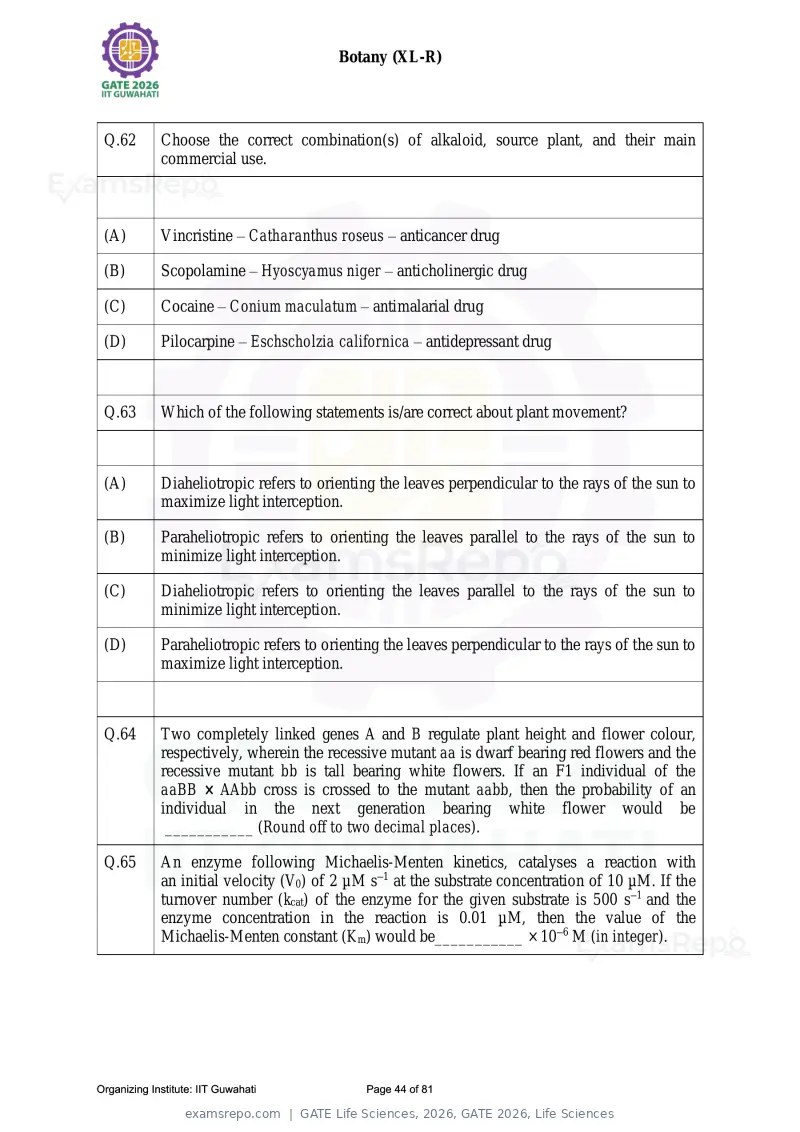
 Q.62        Choose the correct combination(s) of alkaloid, source plant, and their main
             commercial use.


 (A)         Vincristine – Catharanthus roseus – anticancer drug

 (B)         Scopolamine – Hyoscyamus niger – anticholinergic drug

 (C)         Cocaine – Conium maculatum – antimalarial drug

 (D)         Pilocarpine – Eschscholzia californica – antidepressant drug


 Q.63        Which of the following statements is/are correct about plant movement?


 (A)         Diaheliotropic refers to orienting the leaves perpendicular to the rays of the sun to
             maximize light interception.

 (B)         Paraheliotropic refers to orienting the leaves parallel to the rays of the sun to
             minimize light interception.

 (C)         Diaheliotropic refers to orienting the leaves parallel to the rays of the sun to
             minimize light interception.

 (D)         Paraheliotropic refers to orienting the leaves perpendicular to the rays of the sun to
             maximize light interception.


 Q.64        Two completely linked genes A and B regulate plant height and flower colour,
             respectively, wherein the recessive mutant aa is dwarf bearing red flowers and the
             recessive mutant bb is tall bearing white flowers. If an F1 individual of the
             aaBB × AAbb cross is crossed to the mutant aabb, then the probability of an
             individual in the next generation bearing white flower would be
              ___________ (Round off to two decimal places).

 Q.65        An enzyme following Michaelis-Menten kinetics, catalyses a reaction with
             an initial velocity (V0) of 2 µM s−1 at the substrate concentration of 10 µM. If the
             turnover number (kcat) of the enzyme for the given substrate is 500 s−1 and the
             enzyme concentration in the reaction is 0.01 µM, then the value of the
             Michaelis-Menten constant (Km) would be___________ × 10−6 M (in integer).


Organizing Institute: IIT Guwahati            Page 44 of 81
Text of page 45
Microbiology (XL-S)


Q.66 – Q.73 Carry ONE mark Each

 Q.66        Which one of the following statements about microbiological stains is CORRECT?


 (A)         Acid-fast stain is a simple stain.


 (B)         Gram stain is used to visualize endospores.


 (C)         Methylene blue is an acidic dye.


 (D)         India ink is used to visualize capsules.


 Q.67        The genome of which one of the following viruses encodes reverse transcriptase?


 (A)         Human immunodeficiency virus


 (B)         Influenza virus


 (C)         Poliovirus


 (D)         Rabies virus


Organizing Institute: IIT Guwahati            Page 45 of 81
Text of page 46
Microbiology (XL-S)


 Q.68        Protoplasts can be generated from


 (A)         Streptococcus pneumoniae.


 (B)         Brucella abortus.


 (C)         Pasteurella multocida.


 (D)         Shigella flexneri.


 Q.69        Which one of the following molecules is the master regulator of the planktonic-
             surface transition in Pseudomonas aeruginosa during biofilm formation?


 (A)         Cyclic thiolactone


 (B)         Cyclic dimeric guanosine monophosphate


 (C)         Cyclic triadenylate


 (D)         Cyclohexamide


Organizing Institute: IIT Guwahati         Page 46 of 81
Text of page 47
Microbiology (XL-S)


 Q.70        Which one of the following is a protozoal disease?


 (A)         Cholera


 (B)         Gonorrhea


 (C)         Kala-azar


 (D)         Syphilis


 Q.71        Which one of the following drugs is a viral protease inhibitor?


 (A)         Acyclovir


 (B)         Nevirapine


 (C)         Ritonavir


 (D)         Zidovudine


Organizing Institute: IIT Guwahati           Page 47 of 81
Text of page 48
Microbiology (XL-S)


 Q.72        In Escherichia coli, the minimum number of crossovers required between
             F − genome and the linear DNA transmitted by Hfr to form a viable recombinant is
             _____. (Answer in integer)


 Q.73        The decimal reduction time of Escherichia coli at a particular temperature is one
             minute. Assuming no bacterial growth and constant death rate, the time required for
             one million bacteria to get reduced to one viable bacterium is _____minutes.
             (Answer in integer)


Organizing Institute: IIT Guwahati          Page 48 of 81
Text of page 49
Microbiology (XL-S)


Q.74 – Q.84 Carry TWO marks Each

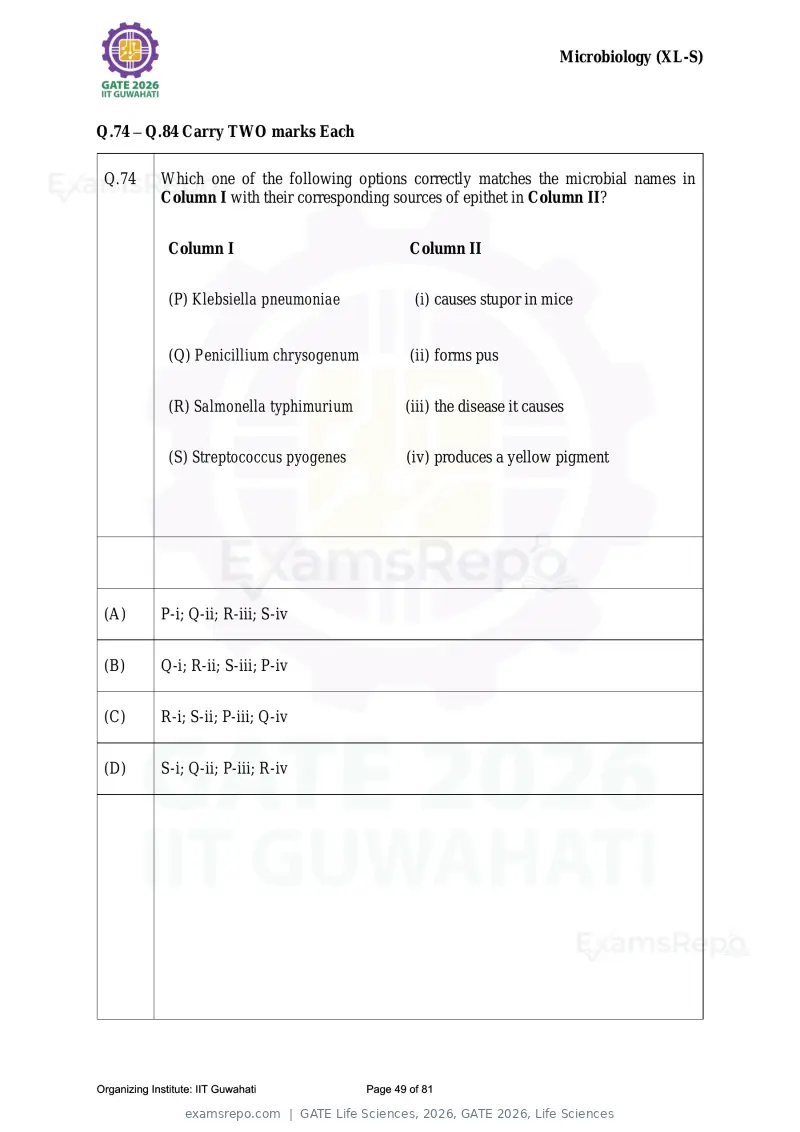
 Q.74        Which one of the following options correctly matches the microbial names in
             Column I with their corresponding sources of epithet in Column II?


               Column I                              Column II


               (P) Klebsiella pneumoniae              (i) causes stupor in mice


               (Q) Penicillium chrysogenum           (ii) forms pus


               (R) Salmonella typhimurium           (iii) the disease it causes


               (S) Streptococcus pyogenes           (iv) produces a yellow pigment


 (A)         P-i; Q-ii; R-iii; S-iv


 (B)         Q-i; R-ii; S-iii; P-iv


 (C)         R-i; S-ii; P-iii; Q-iv


 (D)         S-i; Q-ii; P-iii; R-iv


Organizing Institute: IIT Guwahati           Page 49 of 81
Text of page 50
Microbiology (XL-S)


 Q.75        Determine the correctness or otherwise of the following Assertion [a] and the
             Reason [r].

             Assertion [a]: Silver and copper display bacteriocidal or antiseptic activity.

             Reason [r]: Silver and copper effectively demonstrate oligodynamic action.


 (A)         Both [a] and [r] are true and [r] is the correct reason of [a].


 (B)         Both [a] and [r] are true but [r] is not the correct reason of [a].


 (C)         Both [a] and [r] are false.


 (D)         [a] is true but [r] is false.


 Q.76        When tryptophan level is low in Escherichia coli, the expression of tryptophan
             biosynthesis genes is turned on through an antiterminator stem-loop formation
             between


 (A)         regions 1 and 2 of the leader sequence (trpL) of mRNA.


 (B)         regions 2 and 3 of the leader sequence (trpL) of mRNA.


 (C)         regions 2 and 4 of the leader sequence (trpL) of mRNA.


 (D)         regions 3 and 4 of the leader sequence (trpL) of mRNA.


Organizing Institute: IIT Guwahati             Page 50 of 81
Text of page 51
Microbiology (XL-S)


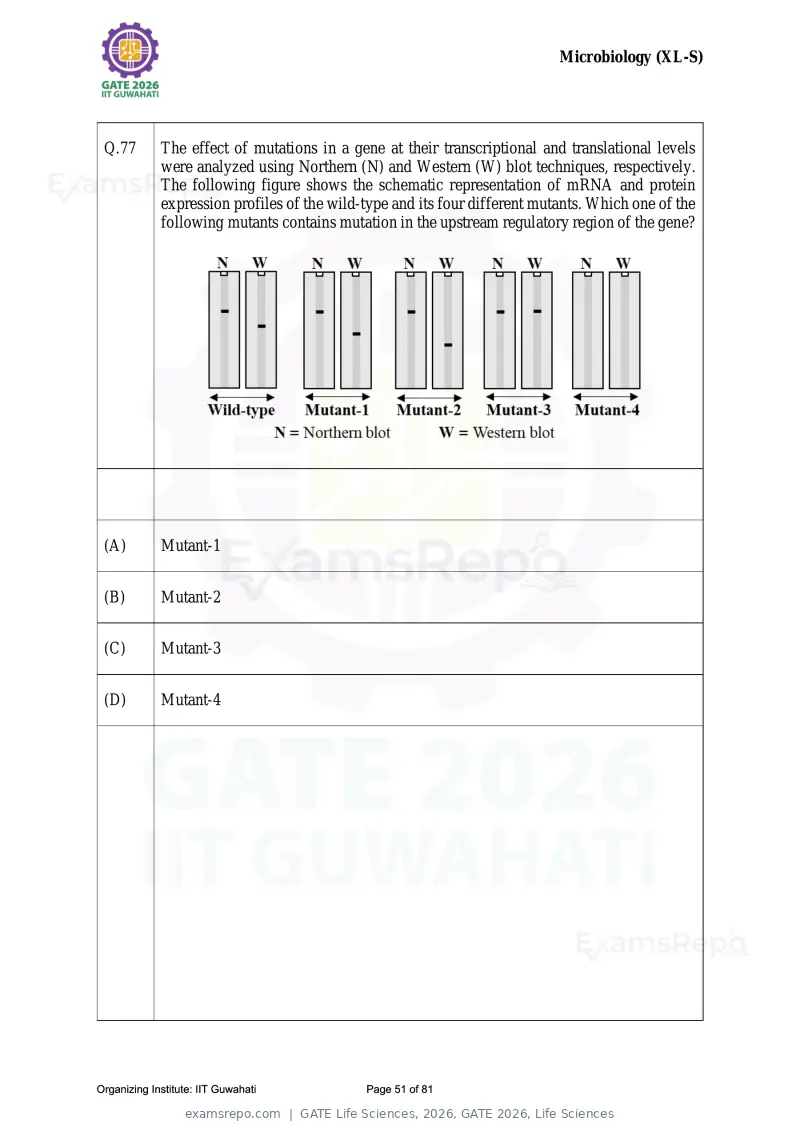
 Q.77        The effect of mutations in a gene at their transcriptional and translational levels
             were analyzed using Northern (N) and Western (W) blot techniques, respectively.
             The following figure shows the schematic representation of mRNA and protein
             expression profiles of the wild-type and its four different mutants. Which one of the
             following mutants contains mutation in the upstream regulatory region of the gene?


 (A)         Mutant-1


 (B)         Mutant-2


 (C)         Mutant-3


 (D)         Mutant-4


Organizing Institute: IIT Guwahati           Page 51 of 81
Text of page 52
Microbiology (XL-S)


 Q.78        Which one of the following leukocytes is the most abundant in a healthy human?


 (A)         Basophils


 (B)         Eosinophils


 (C)         Monocytes


 (D)         Neutrophils


 Q.79        DNA amplification in the polymerase chain reaction is


 (A)         linear.


 (B)         parabolic.


 (C)         sigmoidal.


 (D)         exponential.


Organizing Institute: IIT Guwahati         Page 52 of 81
Text of page 53
Microbiology (XL-S)


 Q.80        In bacteriophage lambda (λ) life cycle, binding of Cro protein to cI gene operator
             region


 (A)         activates cI gene expression.


 (B)         directs towards the lysogenic state.


 (C)         directs towards the lytic cycle.


 (D)         prevents cI gene expression.


 Q.81        Which of the following is/are ring(s) of bacterial flagellum?


 (A)         C ring


 (B)         L ring


 (C)         P ring


 (D)         Z ring


Organizing Institute: IIT Guwahati              Page 53 of 81
Text of page 54
Microbiology (XL-S)


 Q.82        Which of the following bacteria is/are uncultivable?


 (A)         Borrelia burgdorferi


 (B)         Leptospira interrogans


 (C)         Mycobacterium leprae


 (D)         Treponema pallidum


 Q.83        Which of the following antibiotic(s) inhibit(s) bacterial protein synthesis?


 (A)         Erythromycin


 (B)         Tetracycline


 (C)         Bacitracin


 (D)         Vancomycin


Organizing Institute: IIT Guwahati           Page 54 of 81
Text of page 55
Microbiology (XL-S)


 Q.84        Scientist(s) who contributed in disproving the theory of spontaneous generation
             is/are


 (A)         Ferdinand Cohn.


 (B)         John Needham.


 (C)         John Tyndall.


 (D)         Louis Pasteur.


Organizing Institute: IIT Guwahati         Page 55 of 81
Text of page 56
Zoology (XL-T)


Q.85 – Q.92 Carry ONE mark Each

 Q.85        A researcher sets up ten large outdoor tanks, each containing the same amount of
             algae and the same number of guppies (herbivorous fish). In five of these tanks,
             she also adds gourami fish, which are predators of guppies. Tanks were covered in
             mesh so no new species could enter. After 2 months, the researcher counted the
             number of guppies and gouramies, and measured the amount of algae. She found
             that the amount of algae was much higher in the tanks with gourami fish
             compared to those without gourami fish. Which one of the following processes
             best explains the differences in amounts of algae between these tanks?


 (A)         Competition-colonisation trade-off


 (B)         Competitive exclusion principle


 (C)         Interference competition


 (D)         Trophic cascade


 Q.86        Immunoglobulins are classified into the following isotypes: IgG, IgM, IgA, IgD,
             IgE. What region of the immunoglobulin is used to determine this classification?


 (A)         The constant region of the heavy chain only


 (B)         The constant region of the light chain only


 (C)         The variable region of both the heavy and light chains


 (D)         The constant region of both the heavy and light chains


Organizing Institute: IIT Guwahati           Page 56 of 81
Text of page 57
Zoology (XL-T)


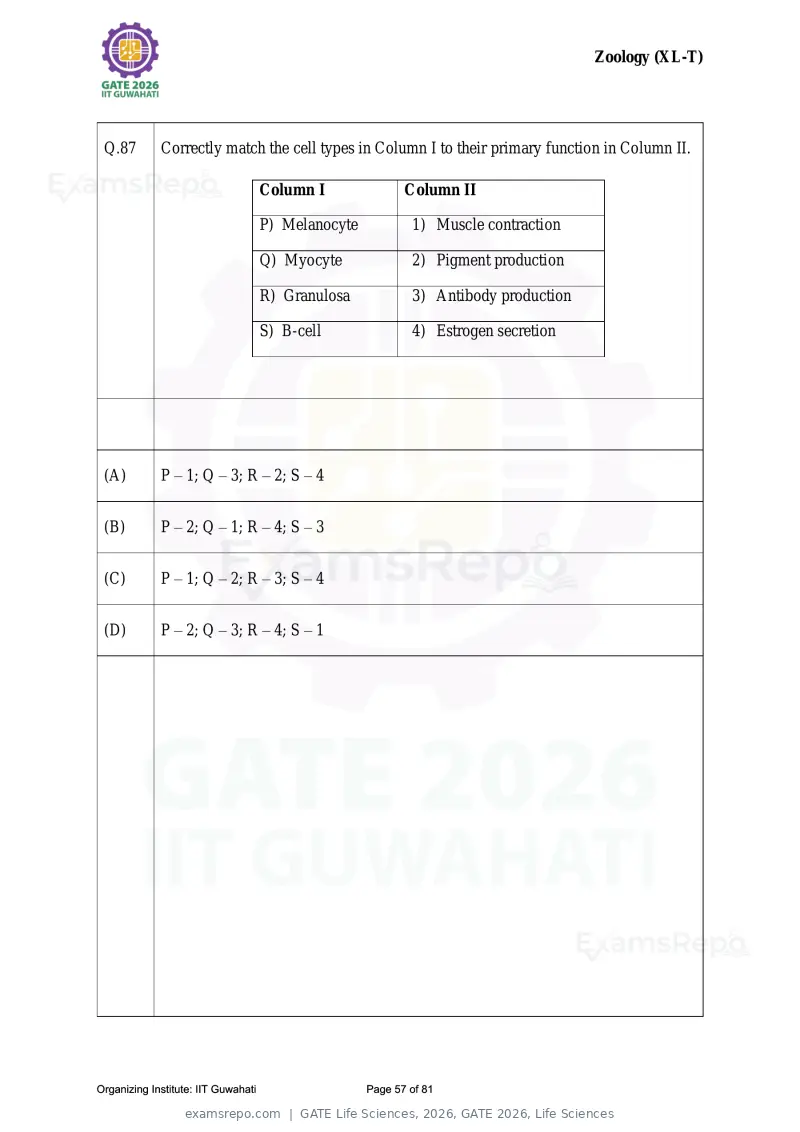
 Q.87        Correctly match the cell types in Column I to their primary function in Column II.

                                     Column I               Column II

                                     P) Melanocyte           1) Muscle contraction

                                     Q) Myocyte              2) Pigment production

                                     R) Granulosa            3) Antibody production

                                     S) B-cell               4) Estrogen secretion


 (A)         P – 1; Q – 3; R – 2; S – 4


 (B)         P – 2; Q – 1; R – 4; S – 3


 (C)         P – 1; Q – 2; R – 3; S – 4


 (D)         P – 2; Q – 3; R – 4; S – 1


Organizing Institute: IIT Guwahati                   Page 57 of 81
Text of page 58
Zoology (XL-T)


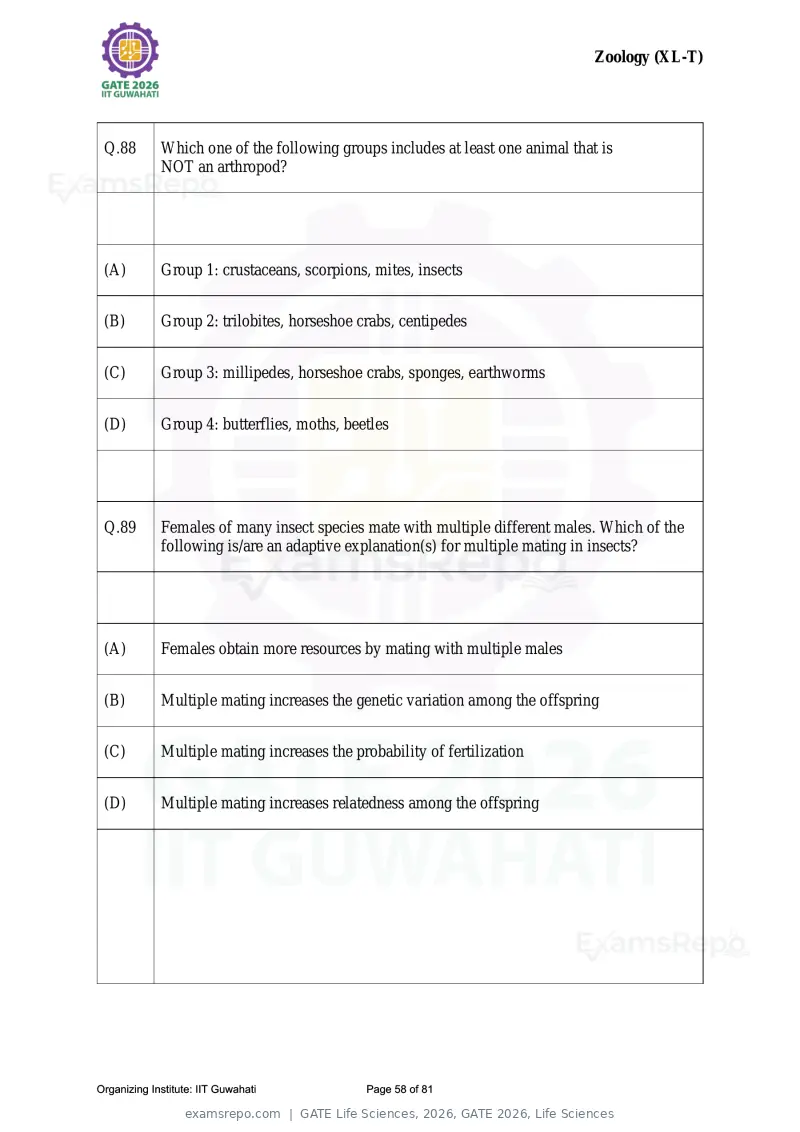
 Q.88        Which one of the following groups includes at least one animal that is
             NOT an arthropod?


 (A)         Group 1: crustaceans, scorpions, mites, insects


 (B)         Group 2: trilobites, horseshoe crabs, centipedes


 (C)         Group 3: millipedes, horseshoe crabs, sponges, earthworms


 (D)         Group 4: butterflies, moths, beetles


 Q.89        Females of many insect species mate with multiple different males. Which of the
             following is/are an adaptive explanation(s) for multiple mating in insects?


 (A)         Females obtain more resources by mating with multiple males


 (B)         Multiple mating increases the genetic variation among the offspring


 (C)         Multiple mating increases the probability of fertilization


 (D)         Multiple mating increases relatedness among the offspring


Organizing Institute: IIT Guwahati           Page 58 of 81
Text of page 59
Zoology (XL-T)


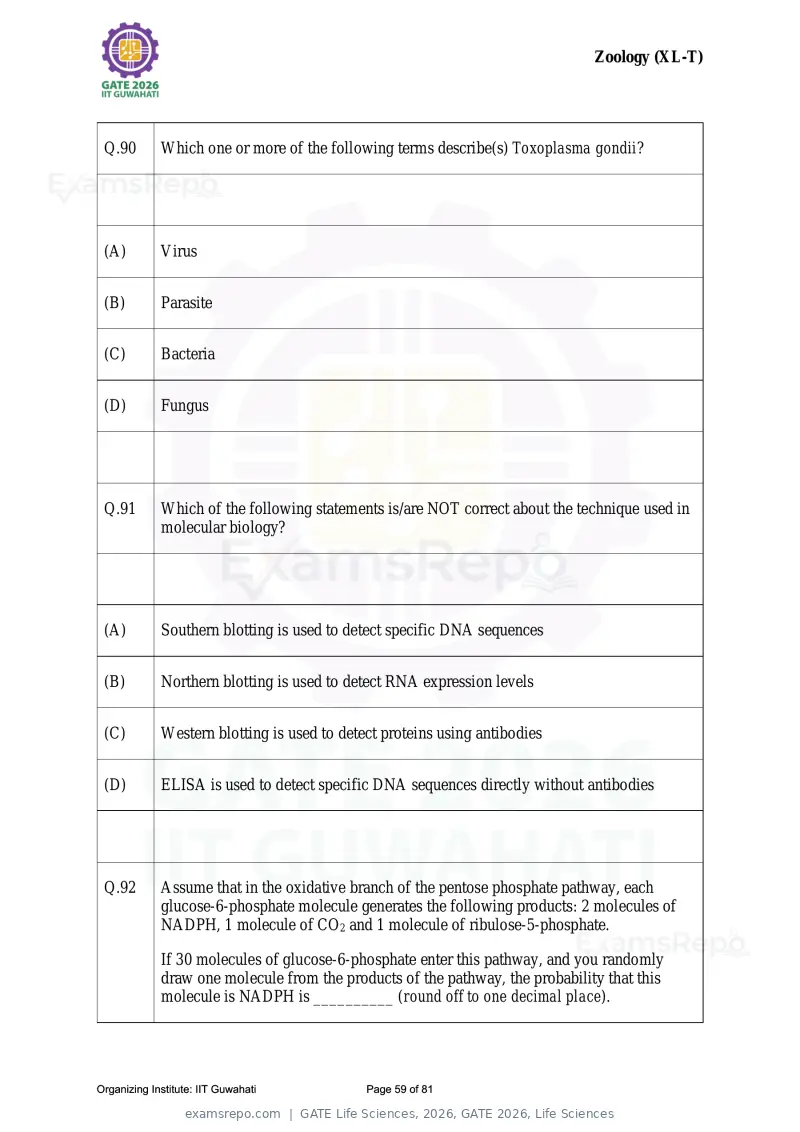
 Q.90        Which one or more of the following terms describe(s) Toxoplasma gondii?


 (A)         Virus


 (B)         Parasite


 (C)         Bacteria


 (D)         Fungus


 Q.91        Which of the following statements is/are NOT correct about the technique used in
             molecular biology?


 (A)         Southern blotting is used to detect specific DNA sequences


 (B)         Northern blotting is used to detect RNA expression levels


 (C)         Western blotting is used to detect proteins using antibodies


 (D)         ELISA is used to detect specific DNA sequences directly without antibodies


 Q.92        Assume that in the oxidative branch of the pentose phosphate pathway, each
             glucose-6-phosphate molecule generates the following products: 2 molecules of
             NADPH, 1 molecule of CO2 and 1 molecule of ribulose-5-phosphate.

             If 30 molecules of glucose-6-phosphate enter this pathway, and you randomly
             draw one molecule from the products of the pathway, the probability that this
             molecule is NADPH is __________ (round off to one decimal place).


Organizing Institute: IIT Guwahati           Page 59 of 81
Text of page 60
Zoology (XL-T)


Q.93 – Q.103 Carry TWO marks Each

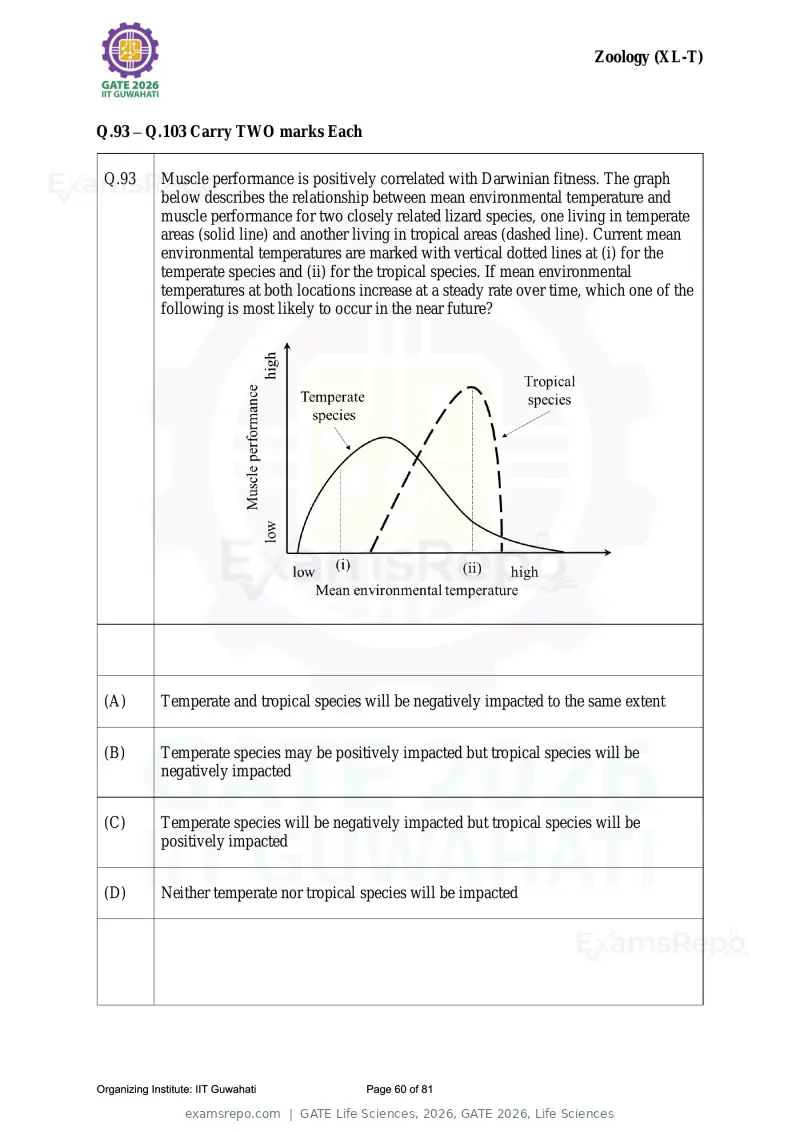
 Q.93        Muscle performance is positively correlated with Darwinian fitness. The graph
             below describes the relationship between mean environmental temperature and
             muscle performance for two closely related lizard species, one living in temperate
             areas (solid line) and another living in tropical areas (dashed line). Current mean
             environmental temperatures are marked with vertical dotted lines at (i) for the
             temperate species and (ii) for the tropical species. If mean environmental
             temperatures at both locations increase at a steady rate over time, which one of the
             following is most likely to occur in the near future?


 (A)         Temperate and tropical species will be negatively impacted to the same extent


 (B)         Temperate species may be positively impacted but tropical species will be
             negatively impacted


 (C)         Temperate species will be negatively impacted but tropical species will be
             positively impacted


 (D)         Neither temperate nor tropical species will be impacted


Organizing Institute: IIT Guwahati           Page 60 of 81
Text of page 61
Zoology (XL-T)


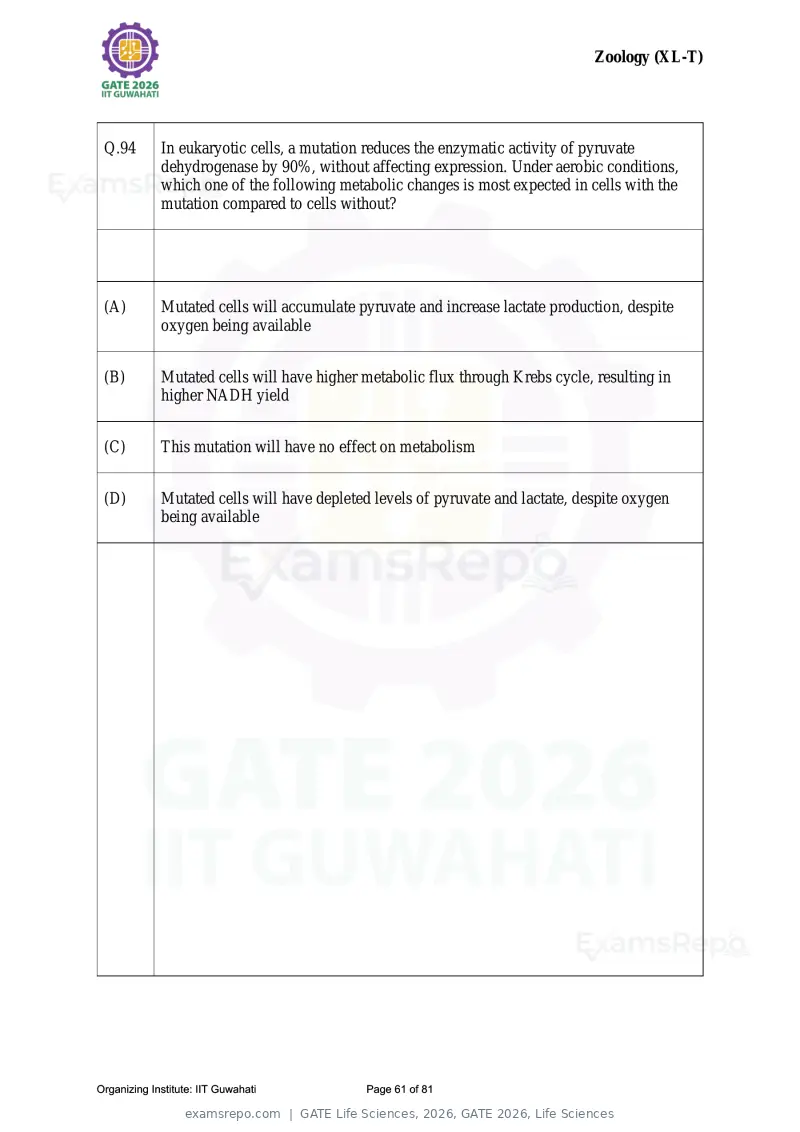
 Q.94        In eukaryotic cells, a mutation reduces the enzymatic activity of pyruvate
             dehydrogenase by 90%, without affecting expression. Under aerobic conditions,
             which one of the following metabolic changes is most expected in cells with the
             mutation compared to cells without?


 (A)         Mutated cells will accumulate pyruvate and increase lactate production, despite
             oxygen being available


 (B)         Mutated cells will have higher metabolic flux through Krebs cycle, resulting in
             higher NADH yield


 (C)         This mutation will have no effect on metabolism


 (D)         Mutated cells will have depleted levels of pyruvate and lactate, despite oxygen
             being available


Organizing Institute: IIT Guwahati          Page 61 of 81
Text of page 62
Zoology (XL-T)


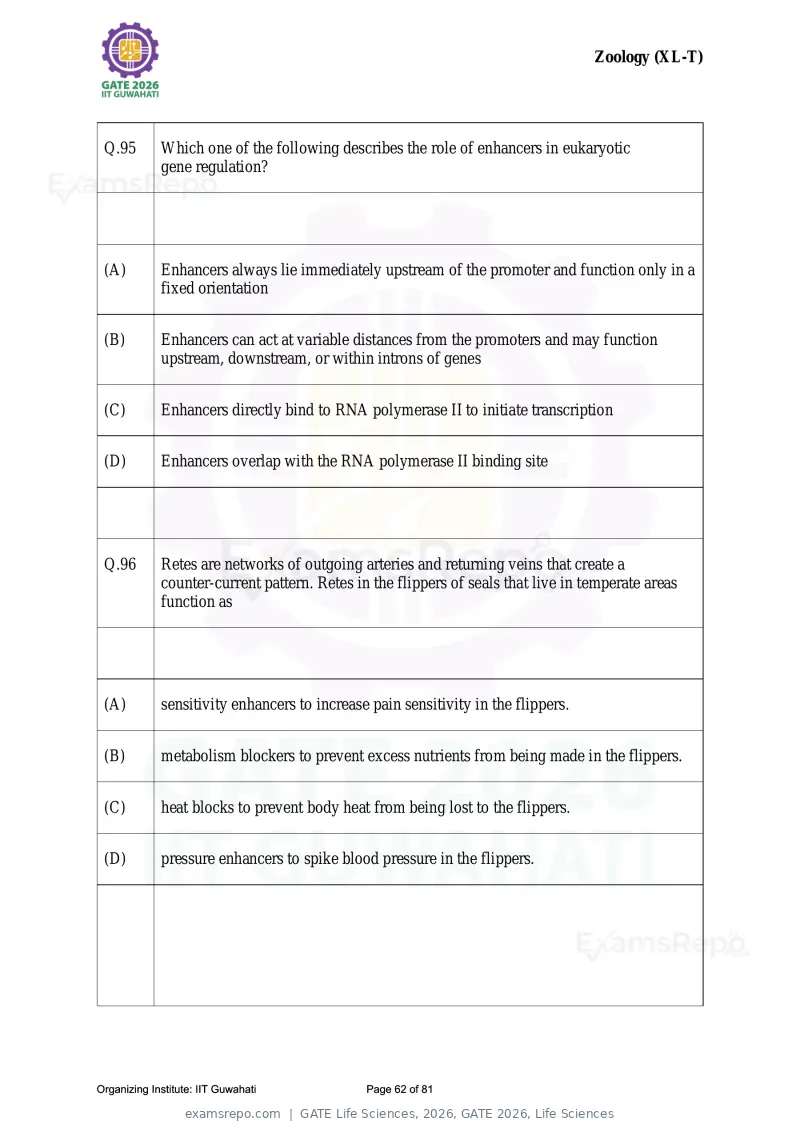
 Q.95        Which one of the following describes the role of enhancers in eukaryotic
             gene regulation?


 (A)         Enhancers always lie immediately upstream of the promoter and function only in a
             fixed orientation


 (B)         Enhancers can act at variable distances from the promoters and may function
             upstream, downstream, or within introns of genes


 (C)         Enhancers directly bind to RNA polymerase II to initiate transcription


 (D)         Enhancers overlap with the RNA polymerase II binding site


 Q.96        Retes are networks of outgoing arteries and returning veins that create a
             counter-current pattern. Retes in the flippers of seals that live in temperate areas
             function as


 (A)         sensitivity enhancers to increase pain sensitivity in the flippers.


 (B)         metabolism blockers to prevent excess nutrients from being made in the flippers.


 (C)         heat blocks to prevent body heat from being lost to the flippers.


 (D)         pressure enhancers to spike blood pressure in the flippers.


Organizing Institute: IIT Guwahati            Page 62 of 81
Text of page 63
Zoology (XL-T)
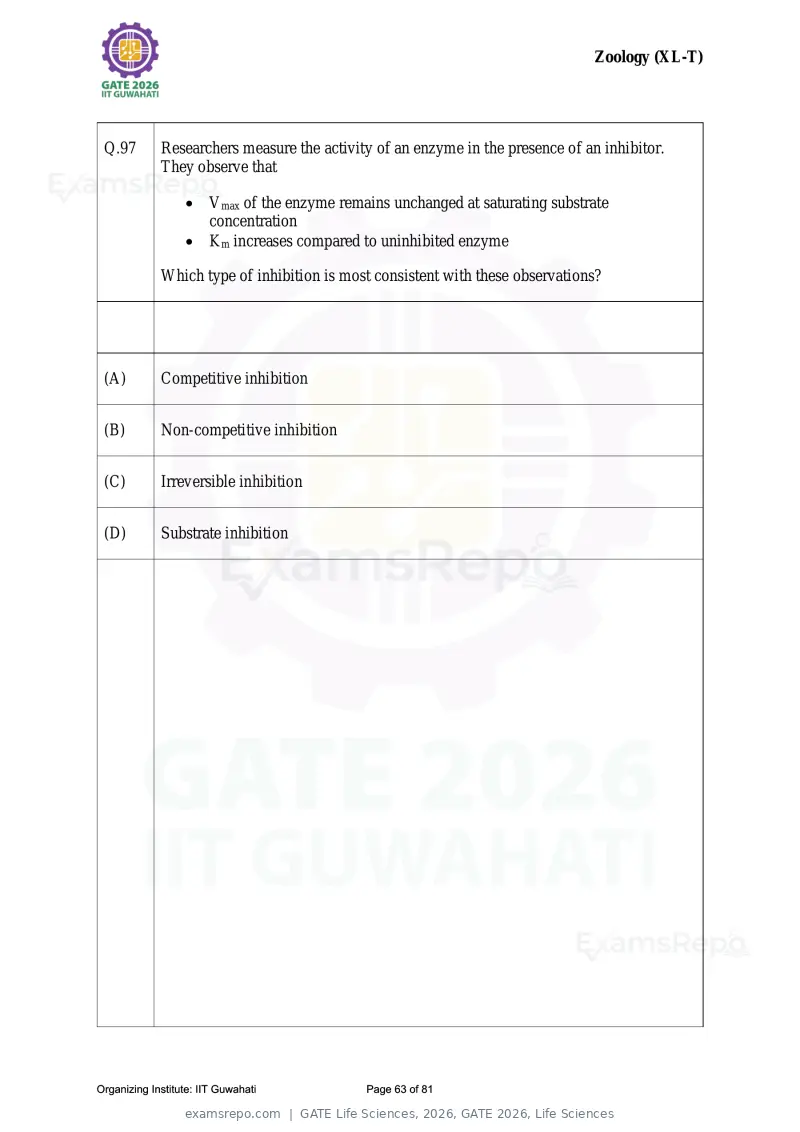
Q.97 Researchers measure the activity of an enzyme in the presence of an inhibitor.
They observe that
Vmax of the enzyme remains unchanged at saturating substrate
concentration
Km increases compared to uninhibited enzyme
Which type of inhibition is most consistent with these observations?
(A) Competitive inhibition
(B) Non-competitive inhibition
(C) Irreversible inhibition
(D) Substrate inhibition
Organizing Institute: IIT Guwahati Page 63 of 81
Text of page 64
Zoology (XL-T)


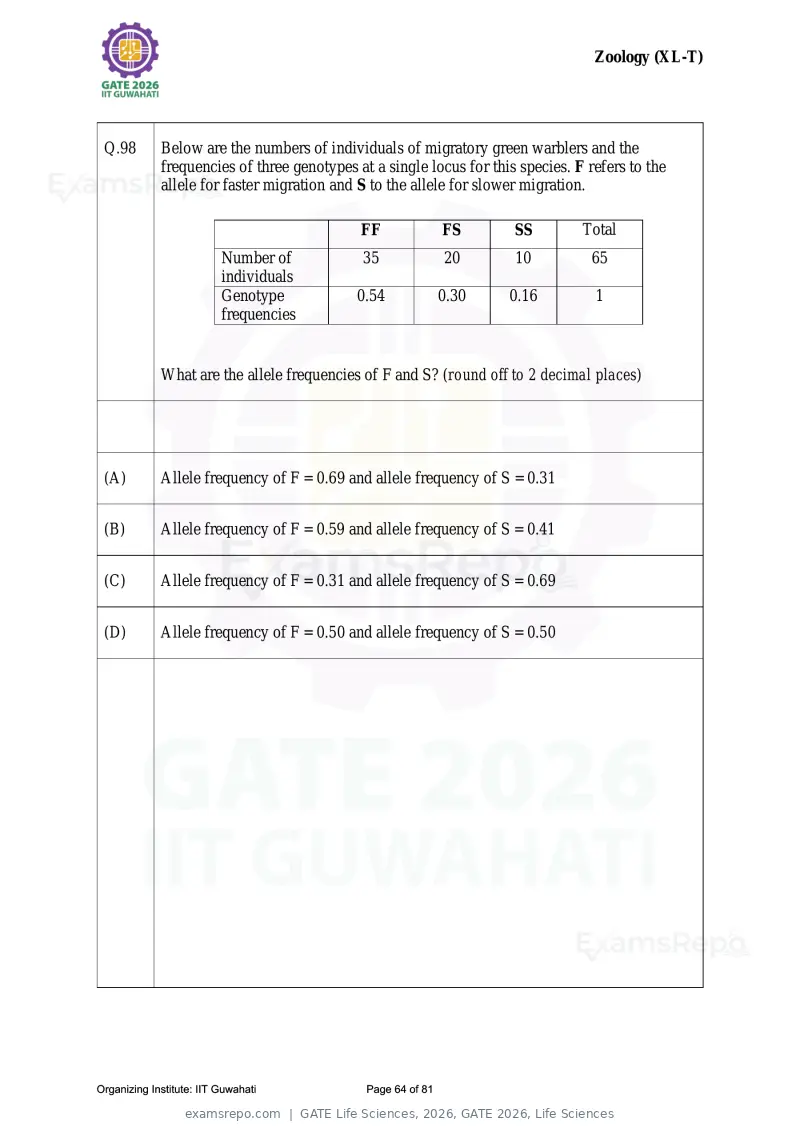
 Q.98        Below are the numbers of individuals of migratory green warblers and the
             frequencies of three genotypes at a single locus for this species. F refers to the
             allele for faster migration and S to the allele for slower migration.

                                             FF               FS      SS         Total
                          Number of          35               20      10          65
                          individuals
                          Genotype          0.54              0.30   0.16          1
                          frequencies


             What are the allele frequencies of F and S? (round off to 2 decimal places)


 (A)         Allele frequency of F = 0.69 and allele frequency of S = 0.31


 (B)         Allele frequency of F = 0.59 and allele frequency of S = 0.41


 (C)         Allele frequency of F = 0.31 and allele frequency of S = 0.69


 (D)         Allele frequency of F = 0.50 and allele frequency of S = 0.50


Organizing Institute: IIT Guwahati            Page 64 of 81
Text of page 65
Zoology (XL-T)


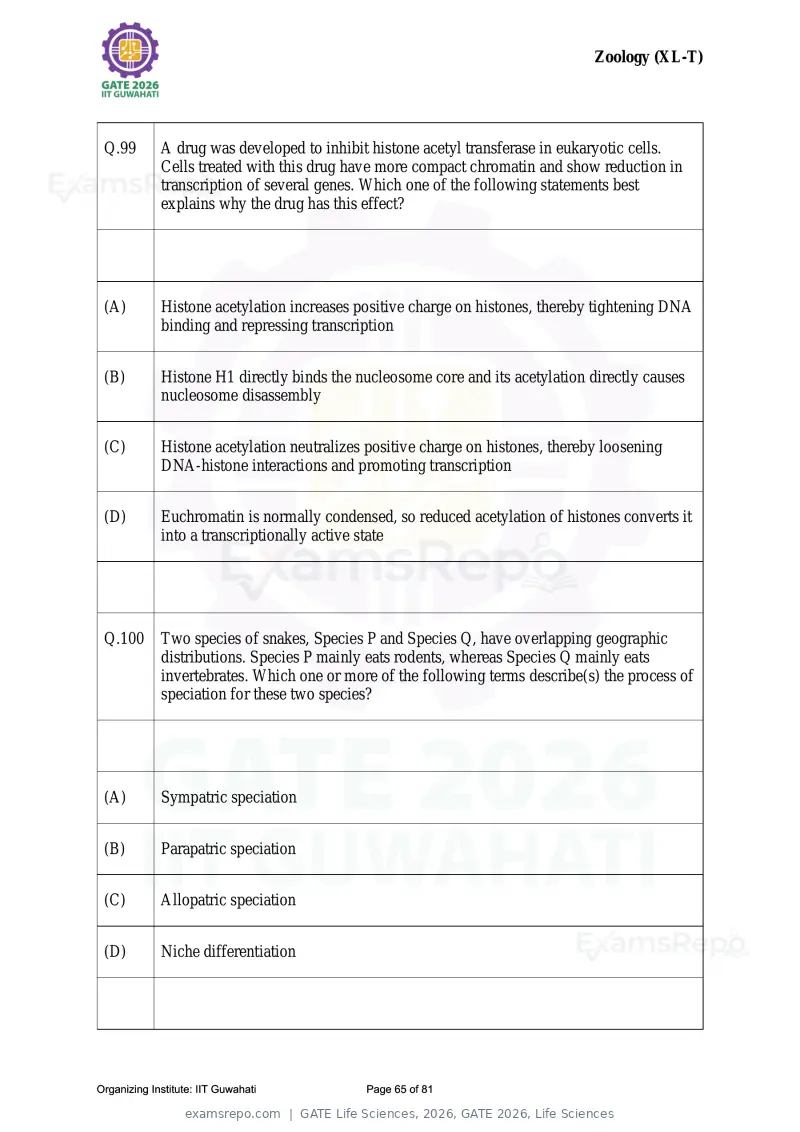
 Q.99        A drug was developed to inhibit histone acetyl transferase in eukaryotic cells.
             Cells treated with this drug have more compact chromatin and show reduction in
             transcription of several genes. Which one of the following statements best
             explains why the drug has this effect?


 (A)         Histone acetylation increases positive charge on histones, thereby tightening DNA
             binding and repressing transcription


 (B)         Histone H1 directly binds the nucleosome core and its acetylation directly causes
             nucleosome disassembly


 (C)         Histone acetylation neutralizes positive charge on histones, thereby loosening
             DNA-histone interactions and promoting transcription


 (D)         Euchromatin is normally condensed, so reduced acetylation of histones converts it
             into a transcriptionally active state


 Q.100       Two species of snakes, Species P and Species Q, have overlapping geographic
             distributions. Species P mainly eats rodents, whereas Species Q mainly eats
             invertebrates. Which one or more of the following terms describe(s) the process of
             speciation for these two species?


 (A)         Sympatric speciation


 (B)         Parapatric speciation


 (C)         Allopatric speciation


 (D)         Niche differentiation


Organizing Institute: IIT Guwahati          Page 65 of 81
Text of page 66
Zoology (XL-T)


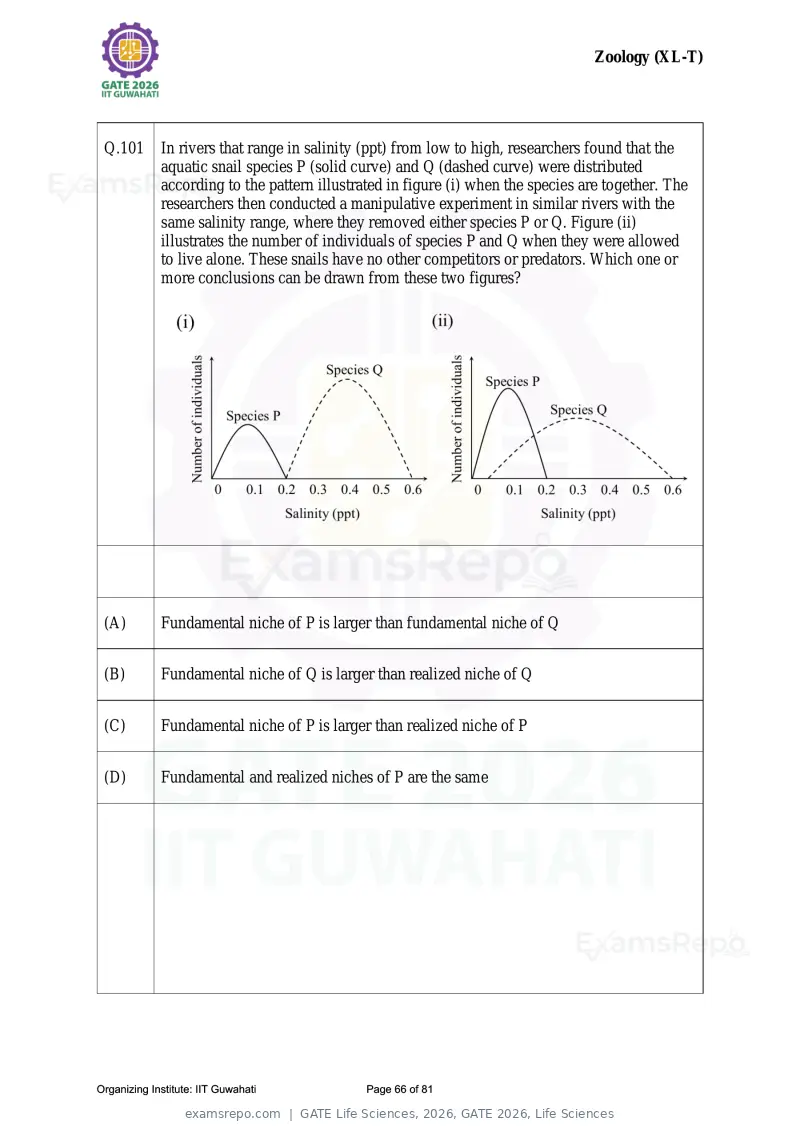
 Q.101       In rivers that range in salinity (ppt) from low to high, researchers found that the
             aquatic snail species P (solid curve) and Q (dashed curve) were distributed
             according to the pattern illustrated in figure (i) when the species are together. The
             researchers then conducted a manipulative experiment in similar rivers with the
             same salinity range, where they removed either species P or Q. Figure (ii)
             illustrates the number of individuals of species P and Q when they were allowed
             to live alone. These snails have no other competitors or predators. Which one or
             more conclusions can be drawn from these two figures?


 (A)         Fundamental niche of P is larger than fundamental niche of Q


 (B)         Fundamental niche of Q is larger than realized niche of Q


 (C)         Fundamental niche of P is larger than realized niche of P


 (D)         Fundamental and realized niches of P are the same


Organizing Institute: IIT Guwahati            Page 66 of 81
Text of page 67
Zoology (XL-T)


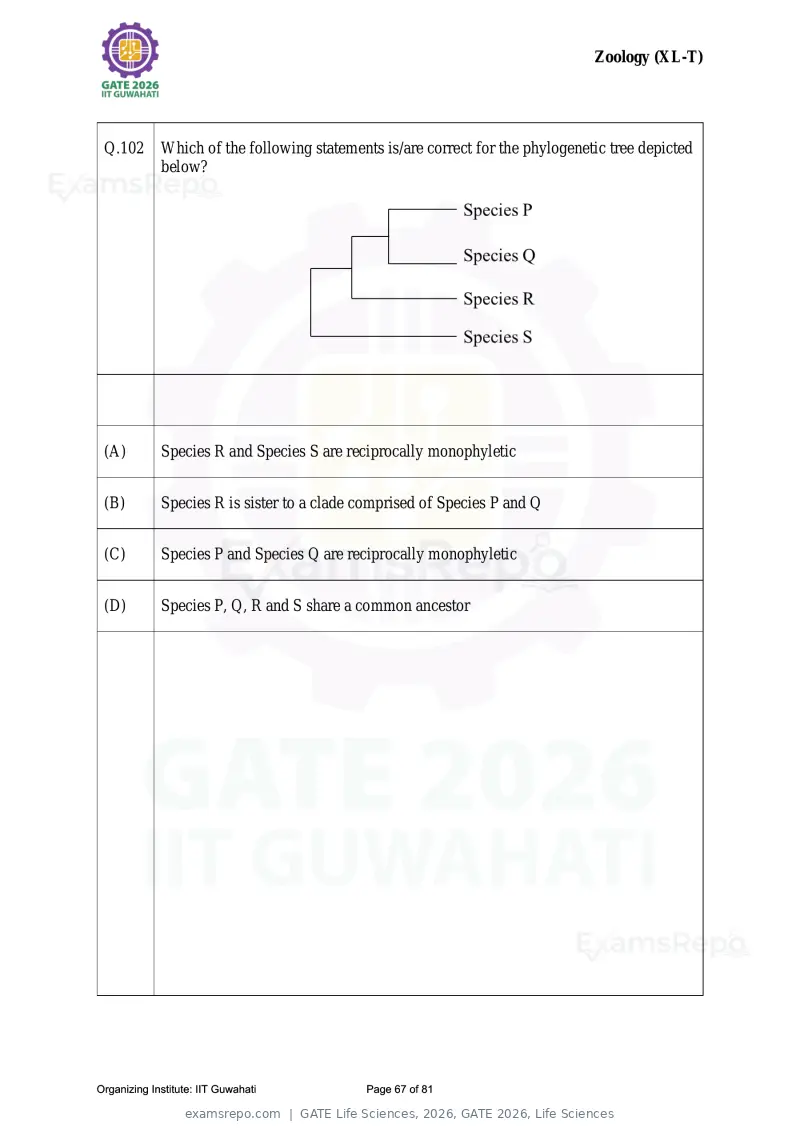
 Q.102       Which of the following statements is/are correct for the phylogenetic tree depicted
             below?


 (A)         Species R and Species S are reciprocally monophyletic


 (B)         Species R is sister to a clade comprised of Species P and Q


 (C)         Species P and Species Q are reciprocally monophyletic


 (D)         Species P, Q, R and S share a common ancestor


Organizing Institute: IIT Guwahati           Page 67 of 81
Text of page 68
Zoology (XL-T)


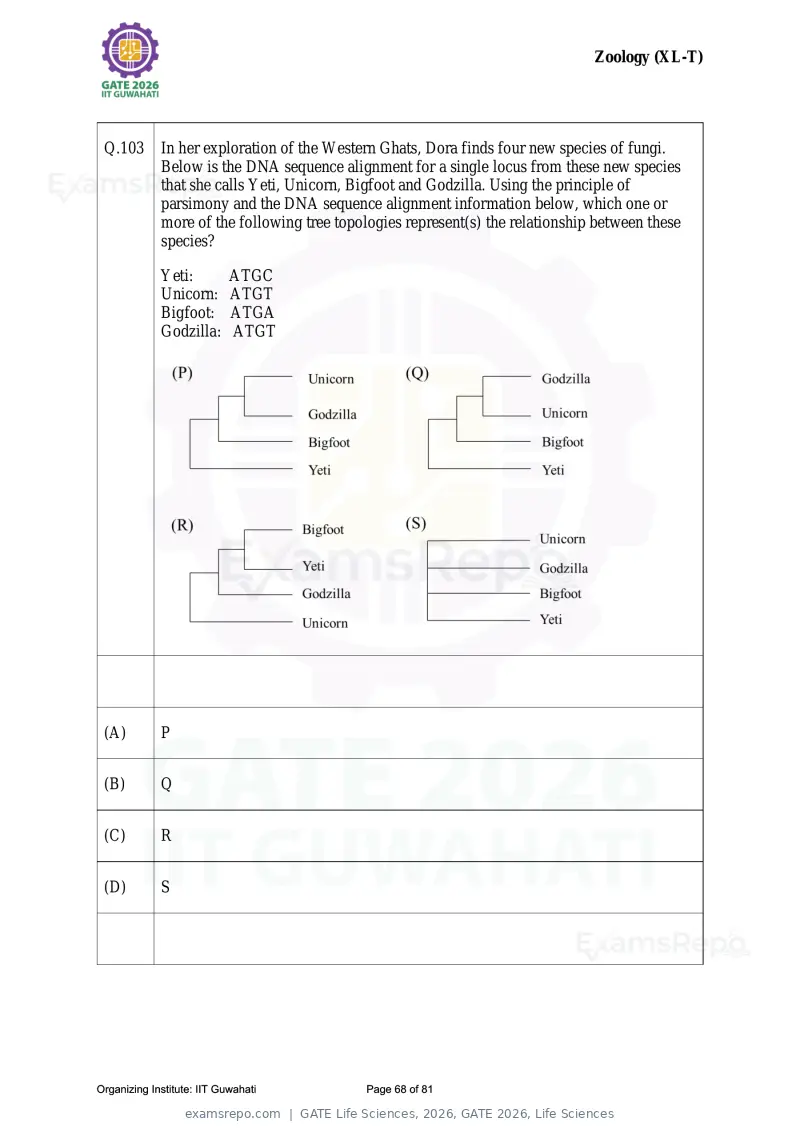
 Q.103       In her exploration of the Western Ghats, Dora finds four new species of fungi.
             Below is the DNA sequence alignment for a single locus from these new species
             that she calls Yeti, Unicorn, Bigfoot and Godzilla. Using the principle of
             parsimony and the DNA sequence alignment information below, which one or
             more of the following tree topologies represent(s) the relationship between these
             species?

             Yeti:     ATGC
             Unicorn: ATGT
             Bigfoot: ATGA
             Godzilla: ATGT


 (A)         P


 (B)         Q


 (C)         R


 (D)         S


Organizing Institute: IIT Guwahati          Page 68 of 81
Text of page 69
Food Technology (XL-U)


Q.104 – Q.111 Carry ONE mark Each

 Q.104       Ergotism is caused by ingestion of grains infected with


 (A)         Clostridium perfringens


 (B)         Rhizopus stolonifer


 (C)         Lactococcus lactis


 (D)         Claviceps purpurea


Organizing Institute: IIT Guwahati          Page 69 of 81
Text of page 70
Food Technology (XL-U)


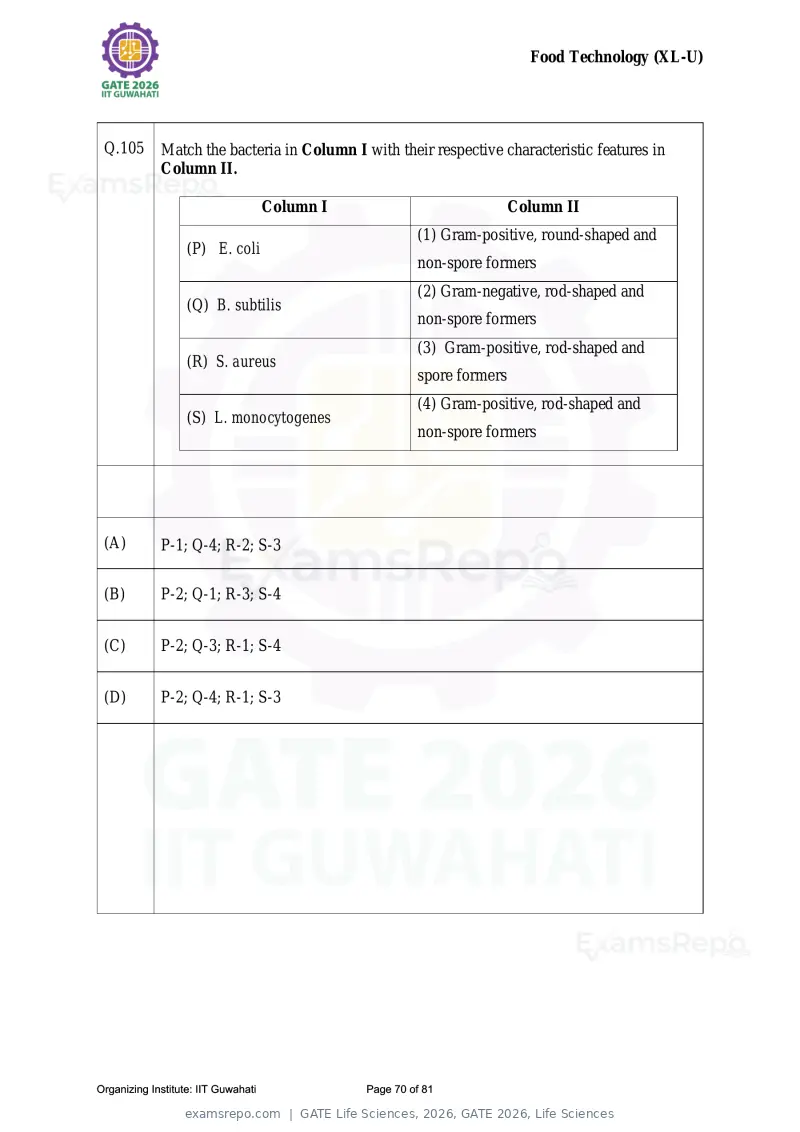
 Q.105       Match the bacteria in Column I with their respective characteristic features in
             Column II.

                                     Column I                            Column II
                                                         (1) Gram-positive, round-shaped and
                   (P) E. coli
                                                         non-spore formers
                                                         (2) Gram-negative, rod-shaped and
                   (Q) B. subtilis
                                                         non-spore formers
                                                         (3) Gram-positive, rod-shaped and
                   (R) S. aureus
                                                         spore formers
                                                         (4) Gram-positive, rod-shaped and
                   (S) L. monocytogenes
                                                         non-spore formers


 (A)         P-1; Q-4; R-2; S-3


 (B)         P-2; Q-1; R-3; S-4


 (C)         P-2; Q-3; R-1; S-4


 (D)         P-2; Q-4; R-1; S-3


Organizing Institute: IIT Guwahati              Page 70 of 81
Text of page 71
Food Technology (XL-U)


 Q.106       Carmine, a food colorant, is derived from


 (A)         Curcuma longa


 (B)         Dactylopius coccus


 (C)         Beta vulgaris


 (D)         Monascus purpureus


 Q.107       Which one of the following carbohydrates is NOT a storage polysaccharide?


 (A)         Starch


 (B)         Glycogen


 (C)         Chitin


 (D)         Dextran


Organizing Institute: IIT Guwahati          Page 71 of 81
Text of page 72
Food Technology (XL-U)


 Q.108       Which one of the following statements is true for a high-pressure homogenizer?


 (A)         Homogenization takes place only due to uniform mixing of solid and liquid


 (B)         Solid particles in the suspension are disintegrated due to the high shear rate
             exerted by the liquid


 (C)         High pressure steam is injected to dissolve the solids


 (D)         Solid particles in the suspension are compressed into a cake under high pressure


 Q.109       Coconut oil contains a small fraction of unsaturated fatty acids, but still has a low
             melting point due to the presence of


 (A)         large amounts of long chain saturated fatty acids


 (B)         mostly medium chain saturated fatty acids such as lauric acid


 (C)         few hydrogen bonds per fatty acid chain


 (D)         higher cholesterol content


Organizing Institute: IIT Guwahati            Page 72 of 81
Text of page 73
Food Technology (XL-U)


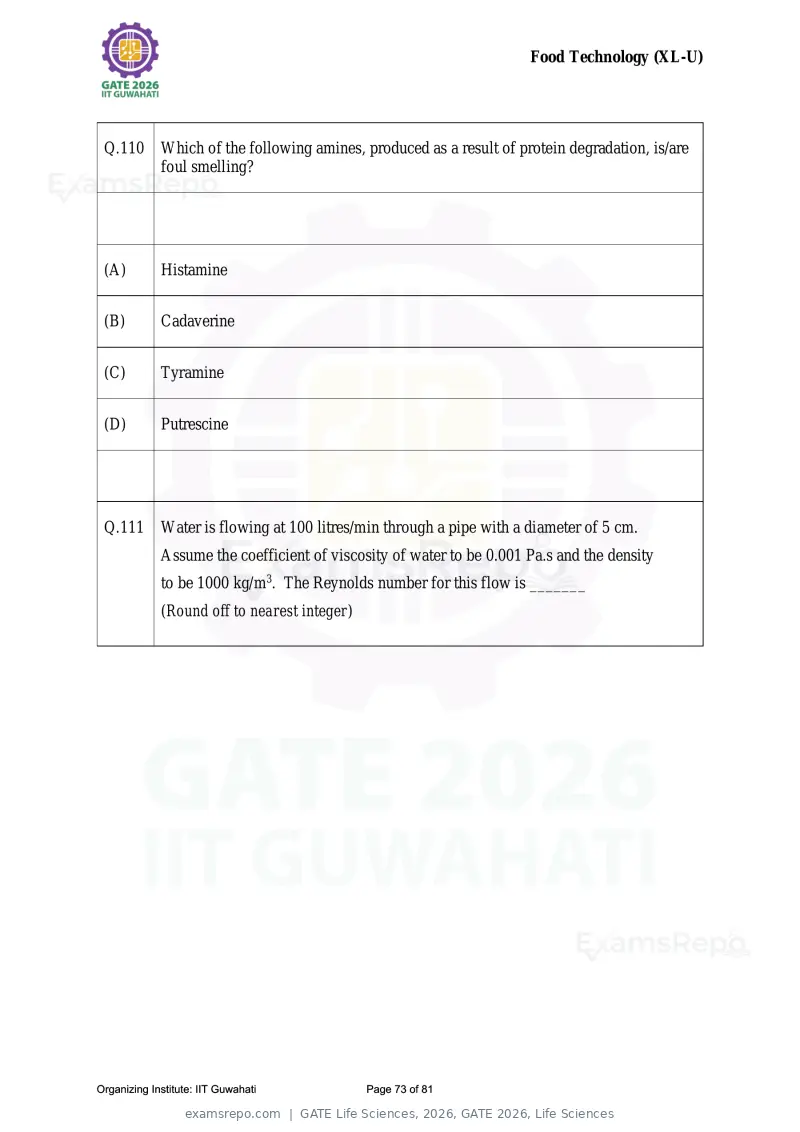
 Q.110       Which of the following amines, produced as a result of protein degradation, is/are
             foul smelling?


 (A)         Histamine


 (B)         Cadaverine


 (C)         Tyramine


 (D)         Putrescine


 Q.111       Water is flowing at 100 litres/min through a pipe with a diameter of 5 cm.
             Assume the coefficient of viscosity of water to be 0.001 Pa.s and the density
             to be 1000 kg/m3. The Reynolds number for this flow is _______
             (Round off to nearest integer)


Organizing Institute: IIT Guwahati            Page 73 of 81
Text of page 74
Food Technology (XL-U)


Q.112 – Q.122 Carry TWO marks Each


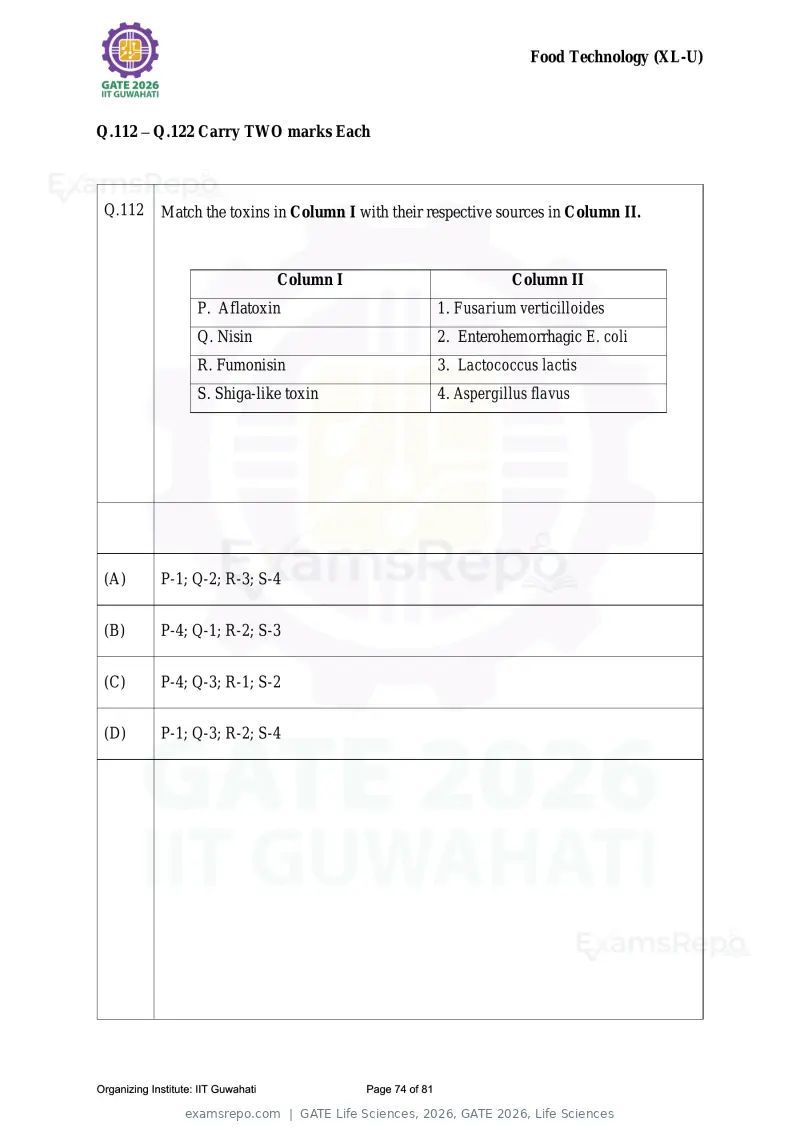
 Q.112       Match the toxins in Column I with their respective sources in Column II.


                                     Column I                              Column II
                     P. Aflatoxin                               1. Fusarium verticilloides
                     Q. Nisin                                   2. Enterohemorrhagic E. coli
                     R. Fumonisin                               3. Lactococcus lactis
                     S. Shiga-like toxin                        4. Aspergillus flavus


 (A)         P-1; Q-2; R-3; S-4


 (B)         P-4; Q-1; R-2; S-3


 (C)         P-4; Q-3; R-1; S-2


 (D)         P-1; Q-3; R-2; S-4


Organizing Institute: IIT Guwahati              Page 74 of 81
Text of page 75
Food Technology (XL-U)


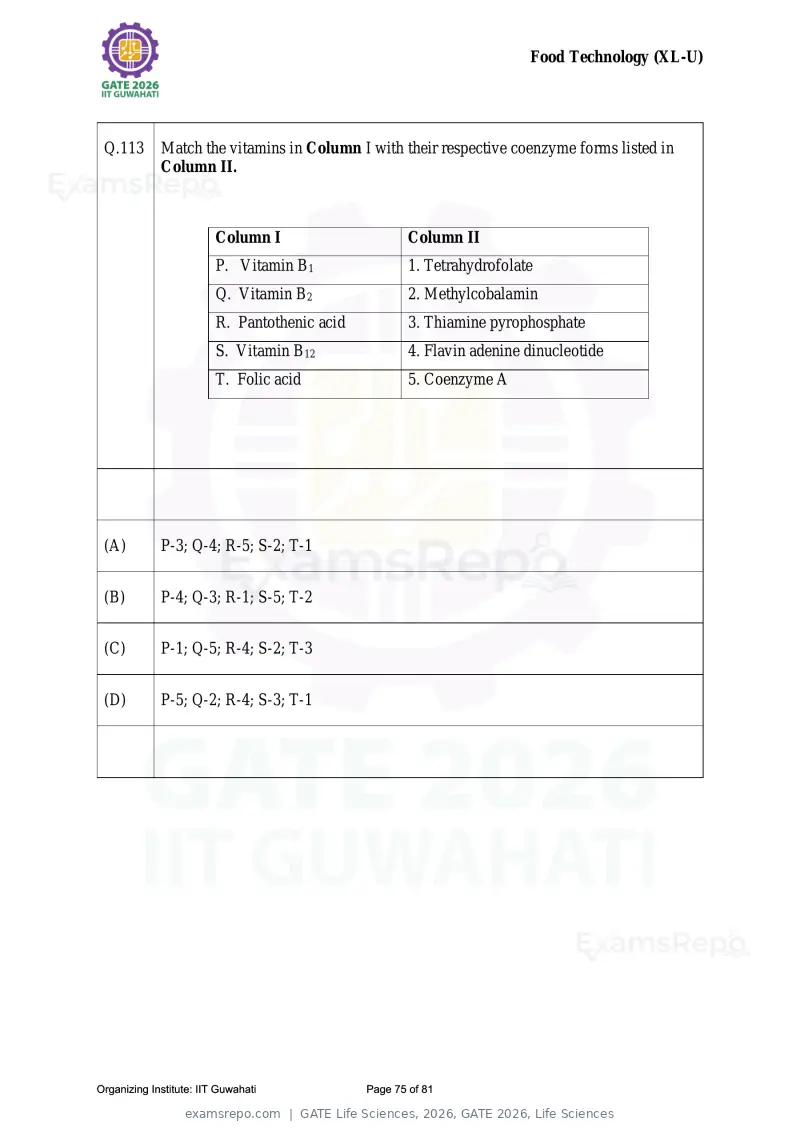
 Q.113       Match the vitamins in Column I with their respective coenzyme forms listed in
             Column II.


                         Column I                      Column II
                         P. Vitamin B1                 1. Tetrahydrofolate
                         Q. Vitamin B2                 2. Methylcobalamin
                         R. Pantothenic acid           3. Thiamine pyrophosphate
                         S. Vitamin B12                4. Flavin adenine dinucleotide
                         T. Folic acid                 5. Coenzyme A


 (A)         P-3; Q-4; R-5; S-2; T-1


 (B)         P-4; Q-3; R-1; S-5; T-2


 (C)         P-1; Q-5; R-4; S-2; T-3


 (D)         P-5; Q-2; R-4; S-3; T-1


Organizing Institute: IIT Guwahati             Page 75 of 81
Text of page 76
Food Technology (XL-U)


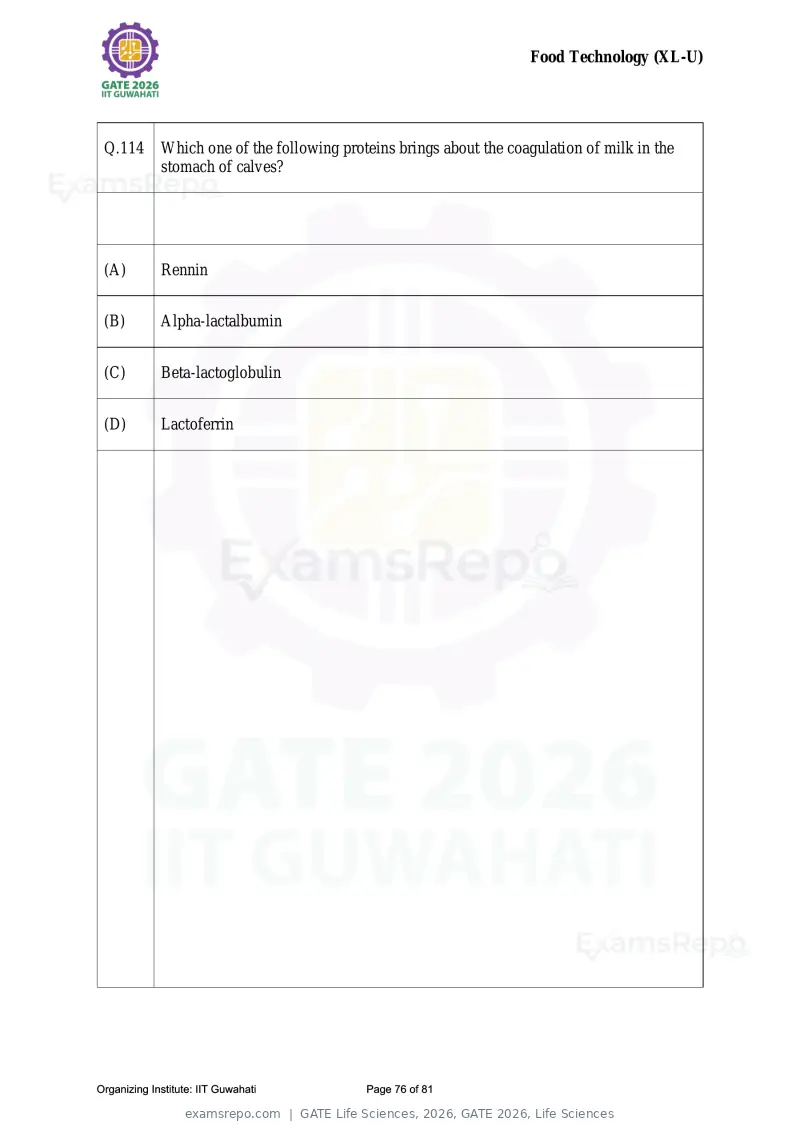
 Q.114       Which one of the following proteins brings about the coagulation of milk in the
             stomach of calves?


 (A)         Rennin


 (B)         Alpha-lactalbumin


 (C)         Beta-lactoglobulin


 (D)         Lactoferrin


Organizing Institute: IIT Guwahati          Page 76 of 81
Text of page 77
Food Technology (XL-U)


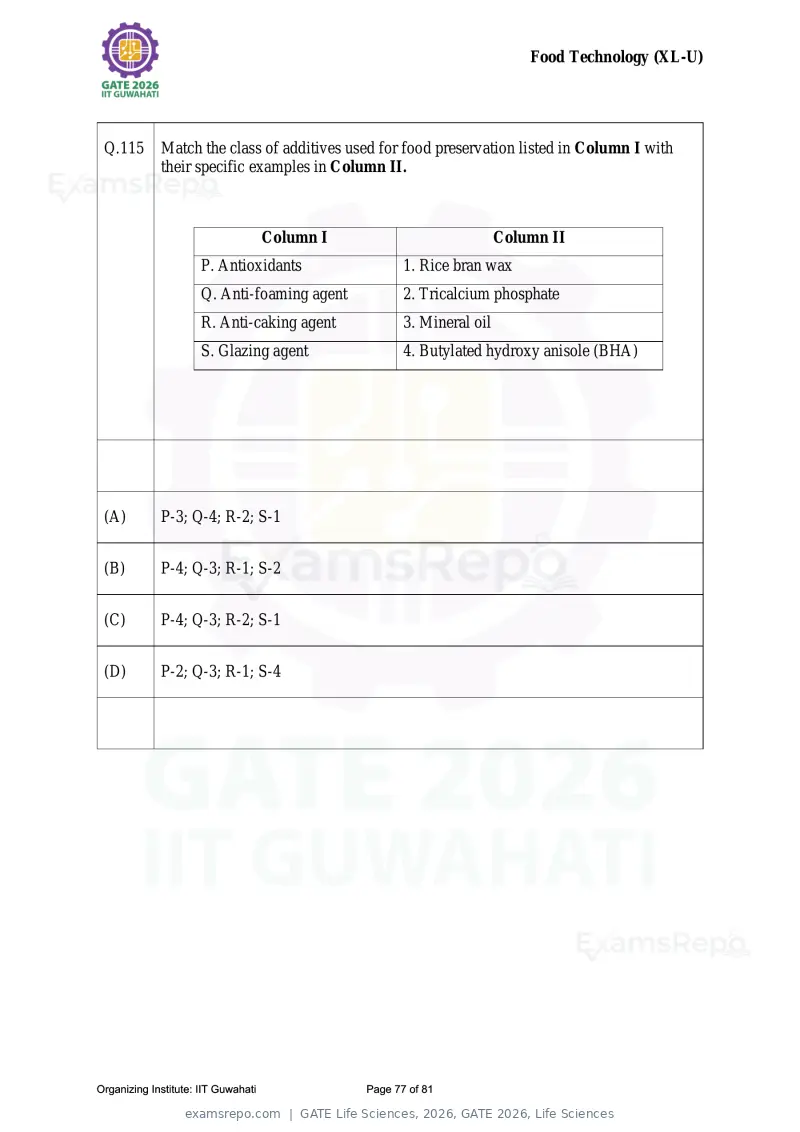
 Q.115       Match the class of additives used for food preservation listed in Column I with
             their specific examples in Column II.


                                     Column I                           Column II
                      P. Antioxidants                  1. Rice bran wax
                      Q. Anti-foaming agent            2. Tricalcium phosphate
                      R. Anti-caking agent             3. Mineral oil
                      S. Glazing agent                 4. Butylated hydroxy anisole (BHA)


 (A)         P-3; Q-4; R-2; S-1


 (B)         P-4; Q-3; R-1; S-2


 (C)         P-4; Q-3; R-2; S-1


 (D)         P-2; Q-3; R-1; S-4


Organizing Institute: IIT Guwahati              Page 77 of 81
Text of page 78
Food Technology (XL-U)


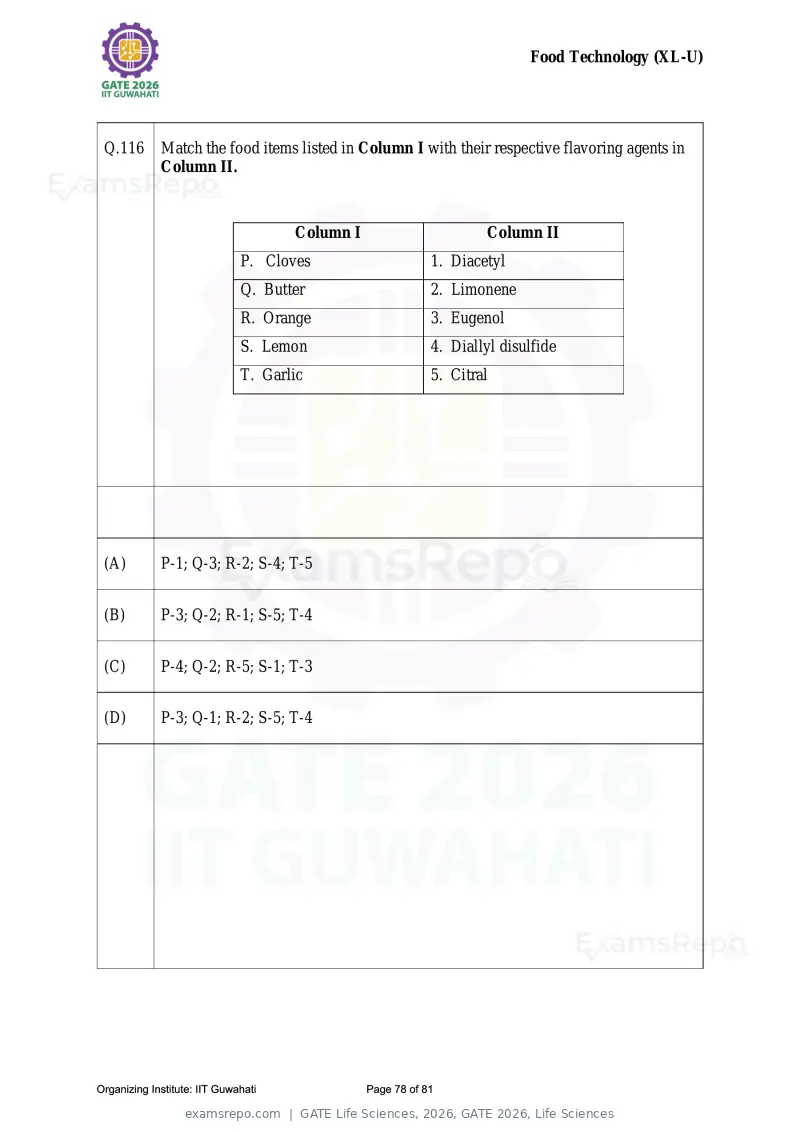
 Q.116       Match the food items listed in Column I with their respective flavoring agents in
             Column II.


                                     Column I                        Column II
                              P. Cloves                     1. Diacetyl
                              Q. Butter                     2. Limonene
                              R. Orange                     3. Eugenol
                              S. Lemon                      4. Diallyl disulfide
                              T. Garlic                     5. Citral


 (A)         P-1; Q-3; R-2; S-4; T-5


 (B)         P-3; Q-2; R-1; S-5; T-4


 (C)         P-4; Q-2; R-5; S-1; T-3


 (D)         P-3; Q-1; R-2; S-5; T-4


Organizing Institute: IIT Guwahati              Page 78 of 81
Text of page 79
Food Technology (XL-U)


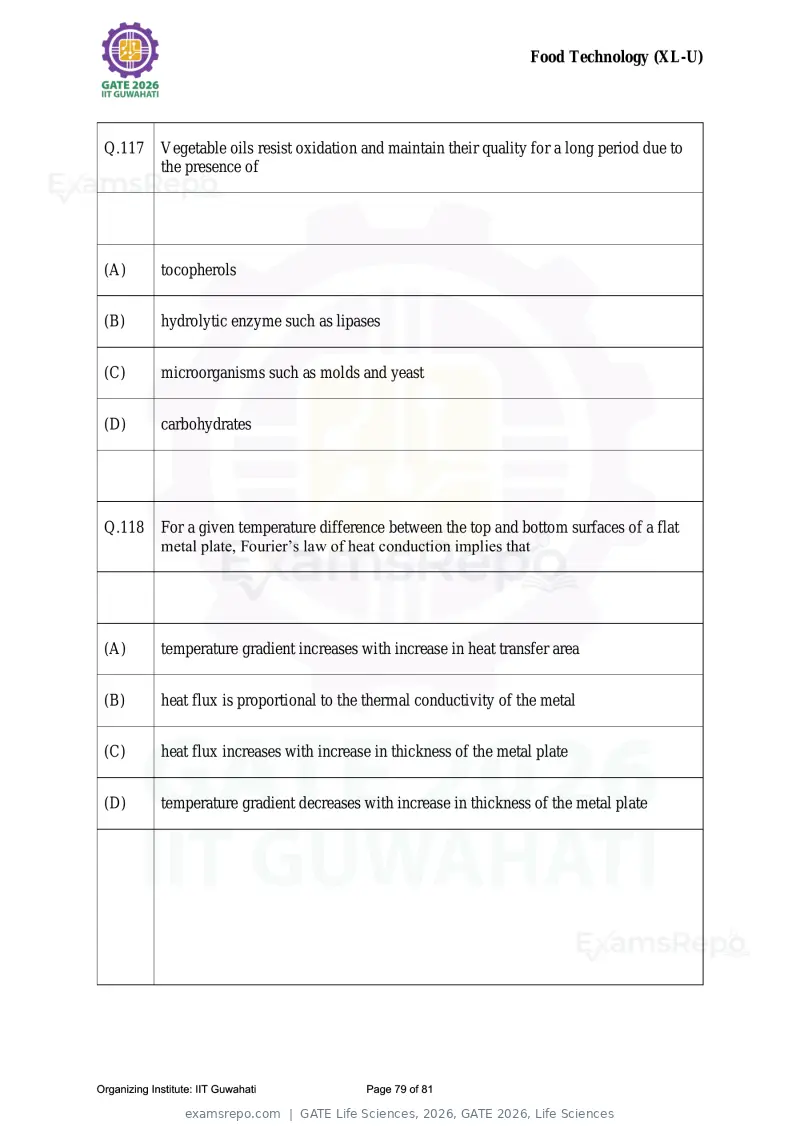
 Q.117       Vegetable oils resist oxidation and maintain their quality for a long period due to
             the presence of


 (A)         tocopherols


 (B)         hydrolytic enzyme such as lipases


 (C)         microorganisms such as molds and yeast


 (D)         carbohydrates


 Q.118       For a given temperature difference between the top and bottom surfaces of a flat
             metal plate, Fourier’s law of heat conduction implies that


 (A)         temperature gradient increases with increase in heat transfer area


 (B)         heat flux is proportional to the thermal conductivity of the metal


 (C)         heat flux increases with increase in thickness of the metal plate


 (D)         temperature gradient decreases with increase in thickness of the metal plate


Organizing Institute: IIT Guwahati           Page 79 of 81
Text of page 80
Food Technology (XL-U)


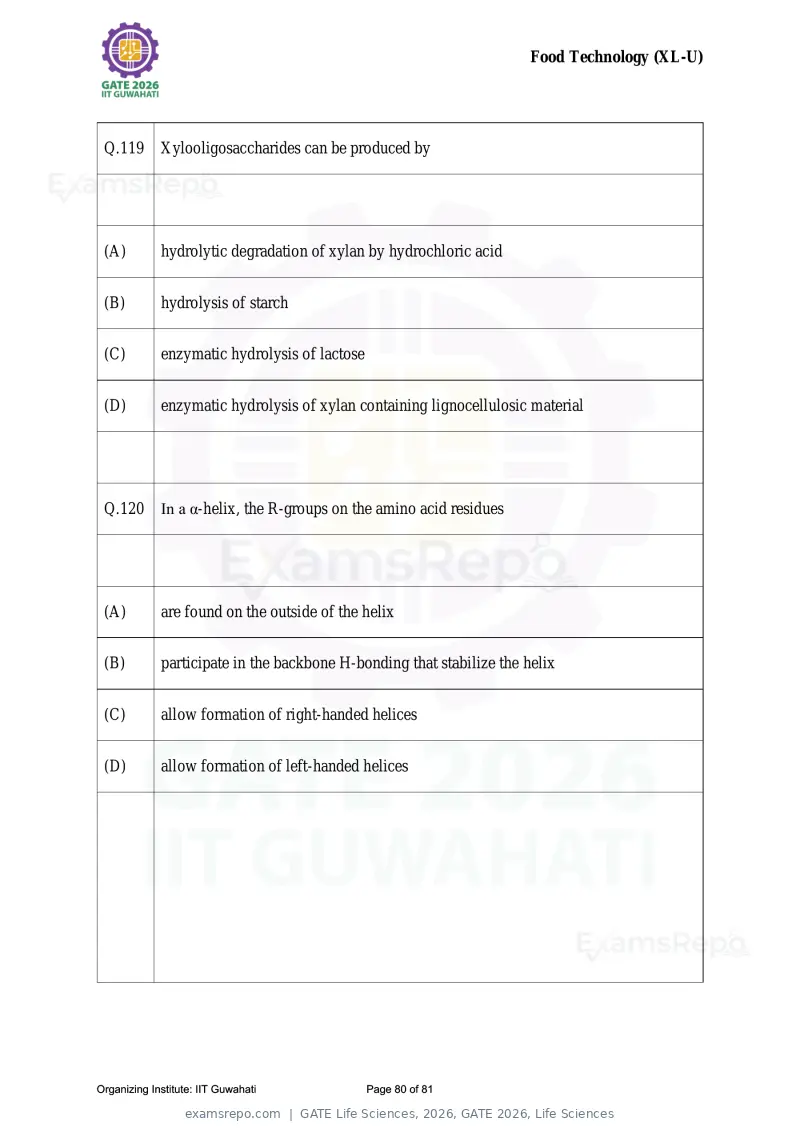
 Q.119       Xylooligosaccharides can be produced by


 (A)         hydrolytic degradation of xylan by hydrochloric acid


 (B)         hydrolysis of starch


 (C)         enzymatic hydrolysis of lactose


 (D)         enzymatic hydrolysis of xylan containing lignocellulosic material


 Q.120       In a α-helix, the R-groups on the amino acid residues


 (A)         are found on the outside of the helix


 (B)         participate in the backbone H-bonding that stabilize the helix


 (C)         allow formation of right-handed helices


 (D)         allow formation of left-handed helices


Organizing Institute: IIT Guwahati             Page 80 of 81
Text of page 81
Food Technology (XL-U)


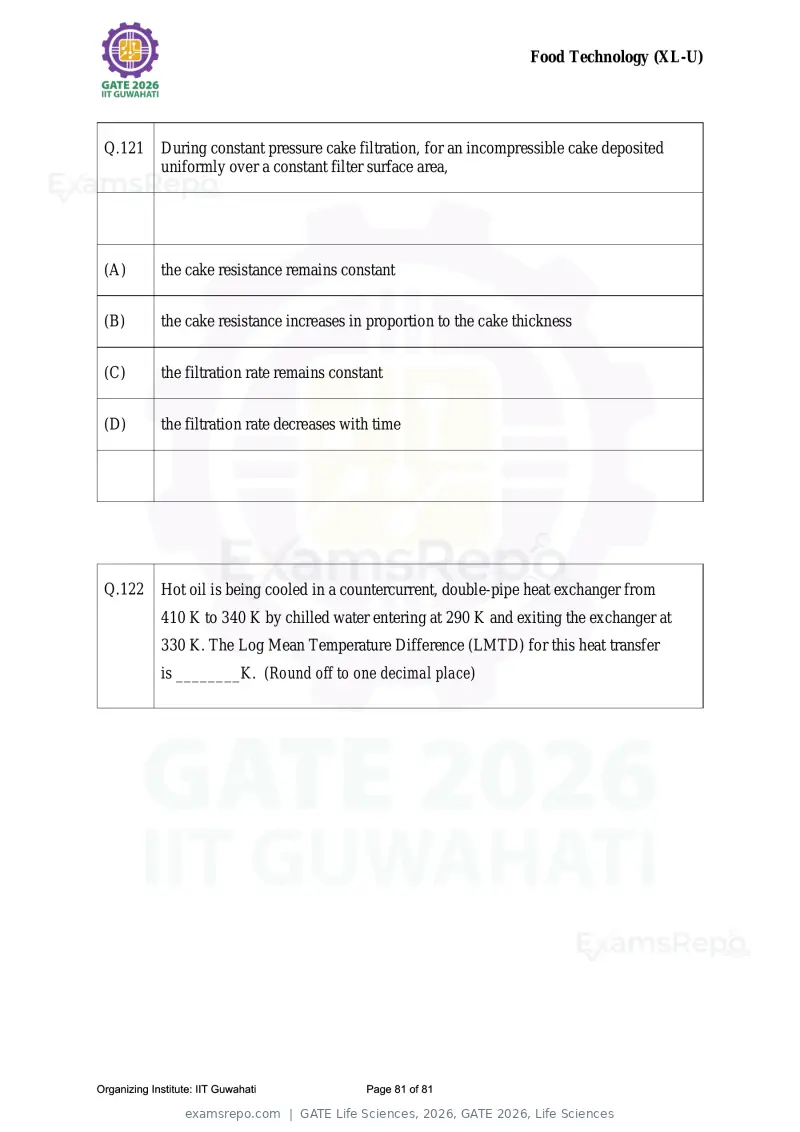
 Q.121       During constant pressure cake filtration, for an incompressible cake deposited
             uniformly over a constant filter surface area,


 (A)         the cake resistance remains constant


 (B)         the cake resistance increases in proportion to the cake thickness


 (C)         the filtration rate remains constant


 (D)         the filtration rate decreases with time


 Q.122       Hot oil is being cooled in a countercurrent, double-pipe heat exchanger from
             410 K to 340 K by chilled water entering at 290 K and exiting the exchanger at
             330 K. The Log Mean Temperature Difference (LMTD) for this heat transfer
             is ________K. (Round off to one decimal place)


Organizing Institute: IIT Guwahati            Page 81 of 81
Text of page 1
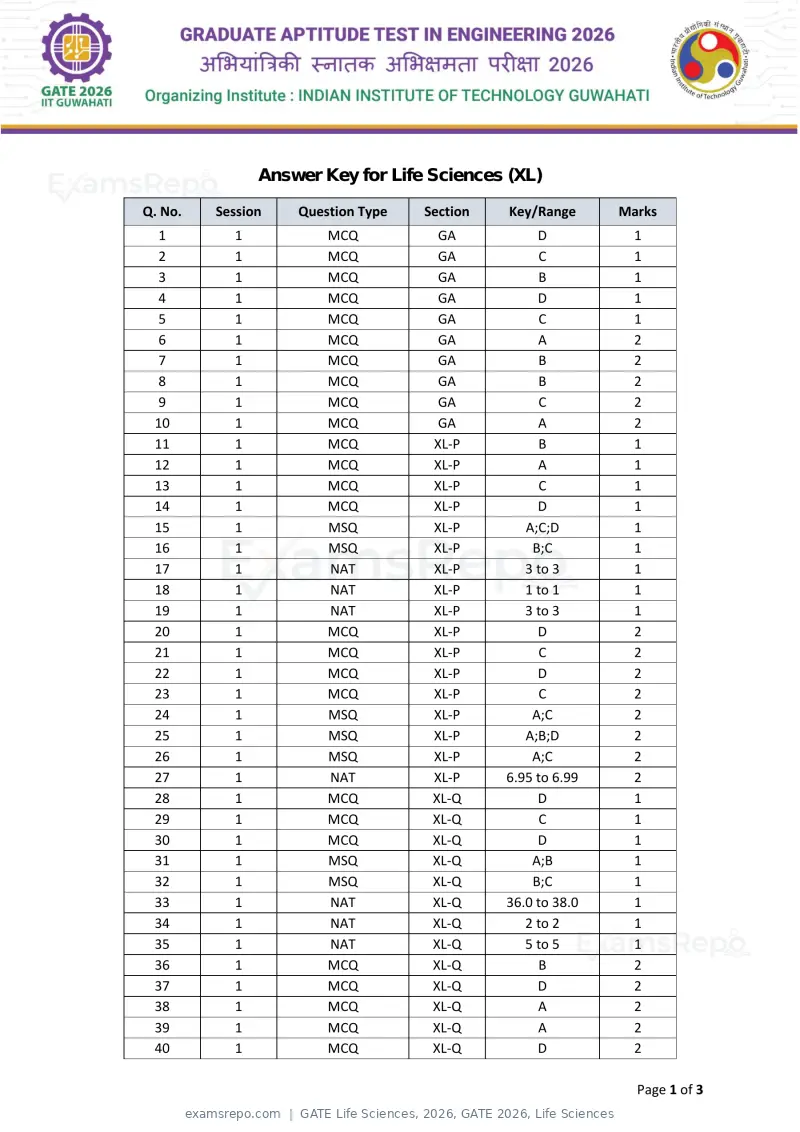
Answer Key for Life Sciences (XL)

Q. No.   Session   Question Type   Section   Key/Range      Marks
  1        1           MCQ           GA           D           1
  2        1           MCQ           GA            C          1
  3        1           MCQ           GA           B           1
  4        1           MCQ           GA           D           1
  5        1           MCQ           GA            C          1
  6        1           MCQ           GA           A           2
  7        1           MCQ           GA           B           2
  8        1           MCQ           GA           B           2
  9        1           MCQ           GA            C          2
 10        1           MCQ           GA           A           2
 11        1           MCQ          XL-P          B           1
 12        1           MCQ          XL-P          A           1
 13        1           MCQ          XL-P           C          1
 14        1           MCQ          XL-P          D           1
 15        1           MSQ          XL-P        A;C;D         1
 16        1           MSQ          XL-P         B;C          1
 17        1           NAT          XL-P        3 to 3        1
 18        1           NAT          XL-P        1 to 1        1
 19        1           NAT          XL-P        3 to 3        1
 20        1           MCQ          XL-P          D           2
 21        1           MCQ          XL-P           C          2
 22        1           MCQ          XL-P          D           2
 23        1           MCQ          XL-P           C          2
 24        1           MSQ          XL-P         A;C          2
 25        1           MSQ          XL-P        A;B;D         2
 26        1           MSQ          XL-P         A;C          2
 27        1           NAT          XL-P     6.95 to 6.99     2
 28        1           MCQ          XL-Q          D           1
 29        1           MCQ          XL-Q           C          1
 30        1           MCQ          XL-Q          D           1
 31        1           MSQ          XL-Q         A;B          1
 32        1           MSQ          XL-Q         B;C          1
 33        1           NAT          XL-Q     36.0 to 38.0     1
 34        1           NAT          XL-Q        2 to 2        1
 35        1           NAT          XL-Q        5 to 5        1
 36        1           MCQ          XL-Q          B           2
 37        1           MCQ          XL-Q          D           2
 38        1           MCQ          XL-Q          A           2
 39        1           MCQ          XL-Q          A           2
 40        1           MCQ          XL-Q          D           2

                                                              Page 1 of 3
Text of page 2
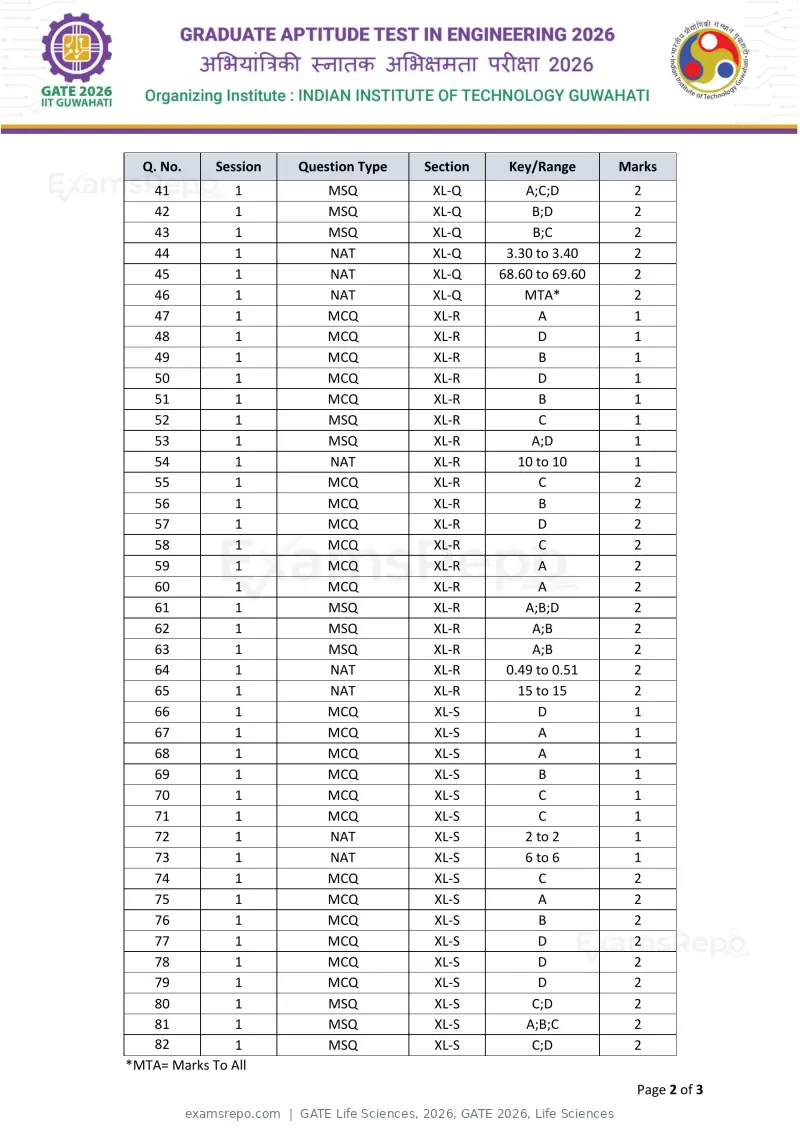
Q. No.     Session   Question Type   Section    Key/Range       Marks
   41          1           MSQ          XL-Q         A;C;D          2
   42          1           MSQ          XL-Q          B;D           2
   43          1           MSQ          XL-Q          B;C           2
   44          1           NAT          XL-Q      3.30 to 3.40      2
   45          1           NAT          XL-Q     68.60 to 69.60     2
   46          1           NAT          XL-Q         MTA*           2
   47          1           MCQ          XL-R           A            1
   48          1           MCQ          XL-R           D            1
   49          1           MCQ          XL-R           B            1
   50          1           MCQ          XL-R           D            1
   51          1           MCQ          XL-R           B            1
   52          1           MSQ          XL-R            C           1
   53          1           MSQ          XL-R          A;D           1
   54          1           NAT          XL-R        10 to 10        1
   55          1           MCQ          XL-R            C           2
   56          1           MCQ          XL-R           B            2
   57          1           MCQ          XL-R           D            2
   58          1           MCQ          XL-R            C           2
   59          1           MCQ          XL-R           A            2
   60          1           MCQ          XL-R           A            2
   61          1           MSQ          XL-R         A;B;D          2
   62          1           MSQ          XL-R          A;B           2
   63          1           MSQ          XL-R          A;B           2
   64          1           NAT          XL-R      0.49 to 0.51      2
   65          1           NAT          XL-R        15 to 15        2
   66          1           MCQ          XL-S           D            1
   67          1           MCQ          XL-S           A            1
   68          1           MCQ          XL-S           A            1
   69          1           MCQ          XL-S           B            1
   70          1           MCQ          XL-S            C           1
   71          1           MCQ          XL-S            C           1
   72          1           NAT          XL-S         2 to 2         1
   73          1           NAT          XL-S         6 to 6         1
   74          1           MCQ          XL-S            C           2
   75          1           MCQ          XL-S           A            2
   76          1           MCQ          XL-S           B            2
   77          1           MCQ          XL-S           D            2
   78          1           MCQ          XL-S           D            2
   79          1           MCQ          XL-S           D            2
   80          1           MSQ          XL-S          C;D           2
   81          1           MSQ          XL-S         A;B;C          2
   82          1           MSQ          XL-S          C;D           2
*MTA= Marks To All
                                                                    Page 2 of 3
Text of page 3
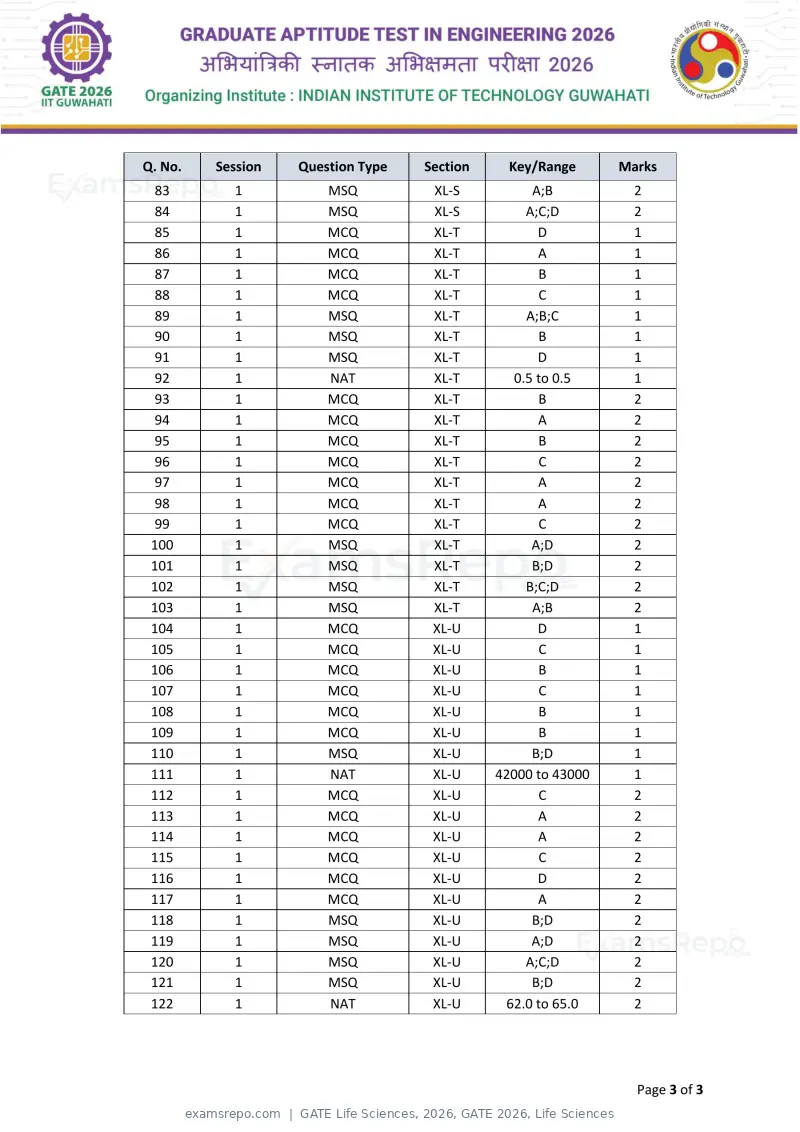
Q. No.   Session   Question Type   Section     Key/Range      Marks
 83        1           MSQ          XL-S          A;B           2
 84        1           MSQ          XL-S         A;C;D          2
 85        1           MCQ          XL-T           D            1
 86        1           MCQ          XL-T           A            1
 87        1           MCQ          XL-T           B            1
 88        1           MCQ          XL-T            C           1
 89        1           MSQ          XL-T         A;B;C          1
 90        1           MSQ          XL-T           B            1
 91        1           MSQ          XL-T           D            1
 92        1           NAT          XL-T       0.5 to 0.5       1
 93        1           MCQ          XL-T           B            2
 94        1           MCQ          XL-T           A            2
 95        1           MCQ          XL-T           B            2
 96        1           MCQ          XL-T            C           2
 97        1           MCQ          XL-T           A            2
 98        1           MCQ          XL-T           A            2
 99        1           MCQ          XL-T            C           2
 100       1           MSQ          XL-T          A;D           2
 101       1           MSQ          XL-T          B;D           2
 102       1           MSQ          XL-T         B;C;D          2
 103       1           MSQ          XL-T          A;B           2
 104       1           MCQ          XL-U           D            1
 105       1           MCQ          XL-U            C           1
 106       1           MCQ          XL-U           B            1
 107       1           MCQ          XL-U            C           1
 108       1           MCQ          XL-U           B            1
 109       1           MCQ          XL-U           B            1
 110       1           MSQ          XL-U          B;D           1
 111       1           NAT          XL-U     42000 to 43000     1
 112       1           MCQ          XL-U            C           2
 113       1           MCQ          XL-U           A            2
 114       1           MCQ          XL-U           A            2
 115       1           MCQ          XL-U            C           2
 116       1           MCQ          XL-U           D            2
 117       1           MCQ          XL-U           A            2
 118       1           MSQ          XL-U          B;D           2
 119       1           MSQ          XL-U          A;D           2
 120       1           MSQ          XL-U         A;C;D          2
 121       1           MSQ          XL-U          B;D           2
 122       1           NAT          XL-U      62.0 to 65.0      2


                                                                Page 3 of 3
Page 1 of 81
Source: GATE. Question paper published by GATE.