
GATE Mathematics 2012
Text of page 1
2012                                                                                            MATHEMATICS – MA

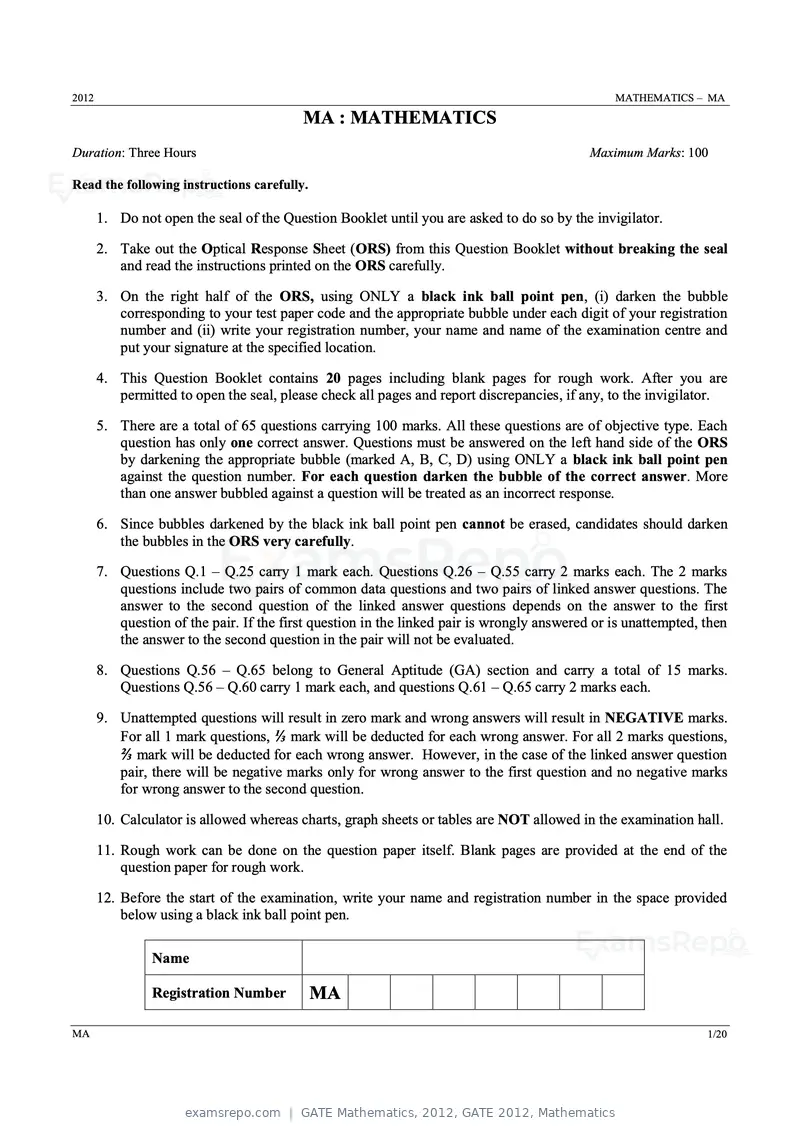
                                          MA : MATHEMATICS
Duration: Three Hours                                                                       Maximum Marks: 100

Read the following instructions carefully.

       1. Do not open the seal of the Question Booklet until you are asked to do so by the invigilator.

       2. Take out the Optical Response Sheet (ORS) from this Question Booklet without breaking the seal
          and read the instructions printed on the ORS carefully.

       3. On the right half of the ORS, using ONLY a black ink ball point pen, (i) darken the bubble
          corresponding to your test paper code and the appropriate bubble under each digit of your registration
          number and (ii) write your registration number, your name and name of the examination centre and
          put your signature at the specified location.

       4. This Question Booklet contains 20 pages including blank pages for rough work. After you are
          permitted to open the seal, please check all pages and report discrepancies, if any, to the invigilator.

       5. There are a total of 65 questions carrying 100 marks. All these questions are of objective type. Each
          question has only one correct answer. Questions must be answered on the left hand side of the ORS
          by darkening the appropriate bubble (marked A, B, C, D) using ONLY a black ink ball point pen
          against the question number. For each question darken the bubble of the correct answer. More
          than one answer bubbled against a question will be treated as an incorrect response.

       6. Since bubbles darkened by the black ink ball point pen cannot be erased, candidates should darken
          the bubbles in the ORS very carefully.

       7. Questions Q.1 – Q.25 carry 1 mark each. Questions Q.26 – Q.55 carry 2 marks each. The 2 marks
          questions include two pairs of common data questions and two pairs of linked answer questions. The
          answer to the second question of the linked answer questions depends on the answer to the first
          question of the pair. If the first question in the linked pair is wrongly answered or is unattempted, then
          the answer to the second question in the pair will not be evaluated.

       8. Questions Q.56 – Q.65 belong to General Aptitude (GA) section and carry a total of 15 marks.
          Questions Q.56 – Q.60 carry 1 mark each, and questions Q.61 – Q.65 carry 2 marks each.

       9. Unattempted questions will result in zero mark and wrong answers will result in NEGATIVE marks.
          For all 1 mark questions, ⅓ mark will be deducted for each wrong answer. For all 2 marks questions,
          ⅔ mark will be deducted for each wrong answer. However, in the case of the linked answer question
          pair, there will be negative marks only for wrong answer to the first question and no negative marks
          for wrong answer to the second question.

       10. Calculator is allowed whereas charts, graph sheets or tables are NOT allowed in the examination hall.

       11. Rough work can be done on the question paper itself. Blank pages are provided at the end of the
           question paper for rough work.

       12. Before the start of the examination, write your name and registration number in the space provided
           below using a black ink ball point pen.

                Name

                Registration Number          MA

MA                                                                                                              1/20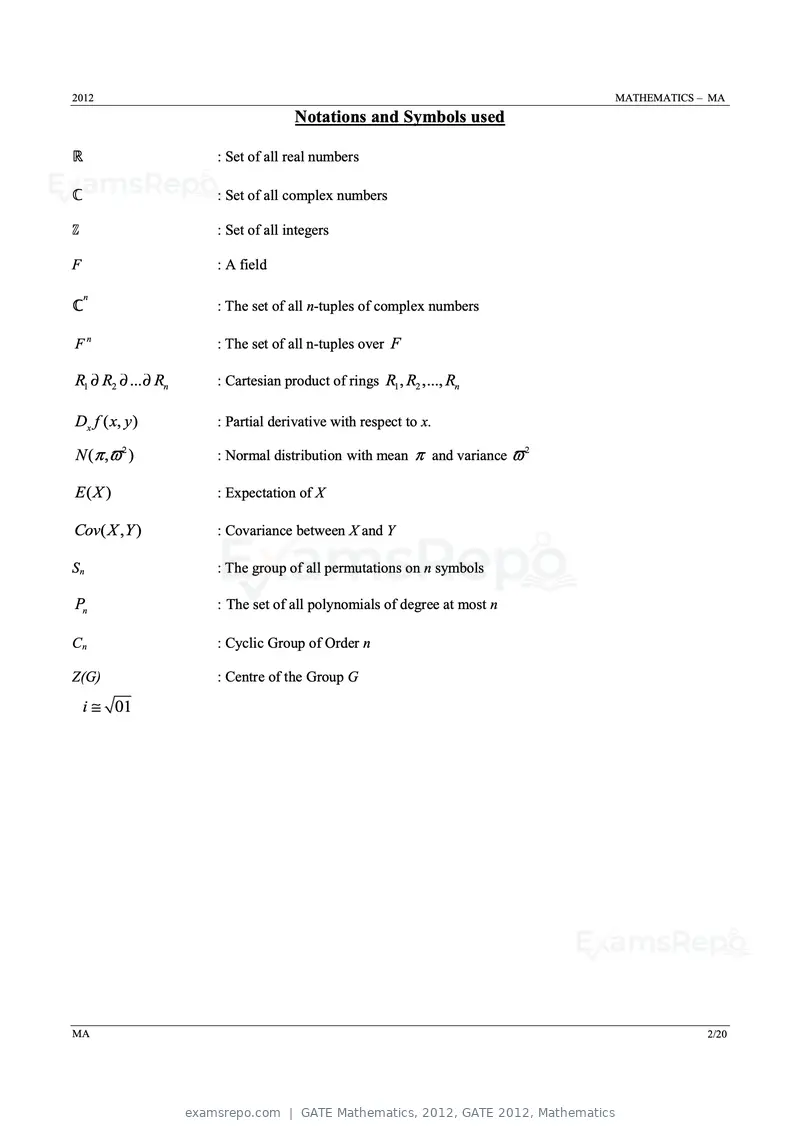
Text of page 2
2012 MATHEMATICS – MA
Notations and Symbols used
ℝ : Set of all real numbers
ℂ : Set of all complex numbers
ℤ : Set of all integers
F : A field
n
ℂ : The set of all n-tuples of complex numbers
Fn : The set of all n-tuples over F
R1 R2 ... Rn : Cartesian product of rings R1 , R2 ,..., Rn
Dx f ( x, y) : Partial derivative with respect to x.
N ( , 2 ) : Normal distribution with mean and variance 2
E( X ) : Expectation of X
Cov( X , Y ) : Covariance between X and Y
Sn : The group of all permutations on n symbols
Pn : The set of all polynomials of degree at most n
Cn : Cyclic Group of Order n
Z(G) : Centre of the Group G
i 1
MA 2/20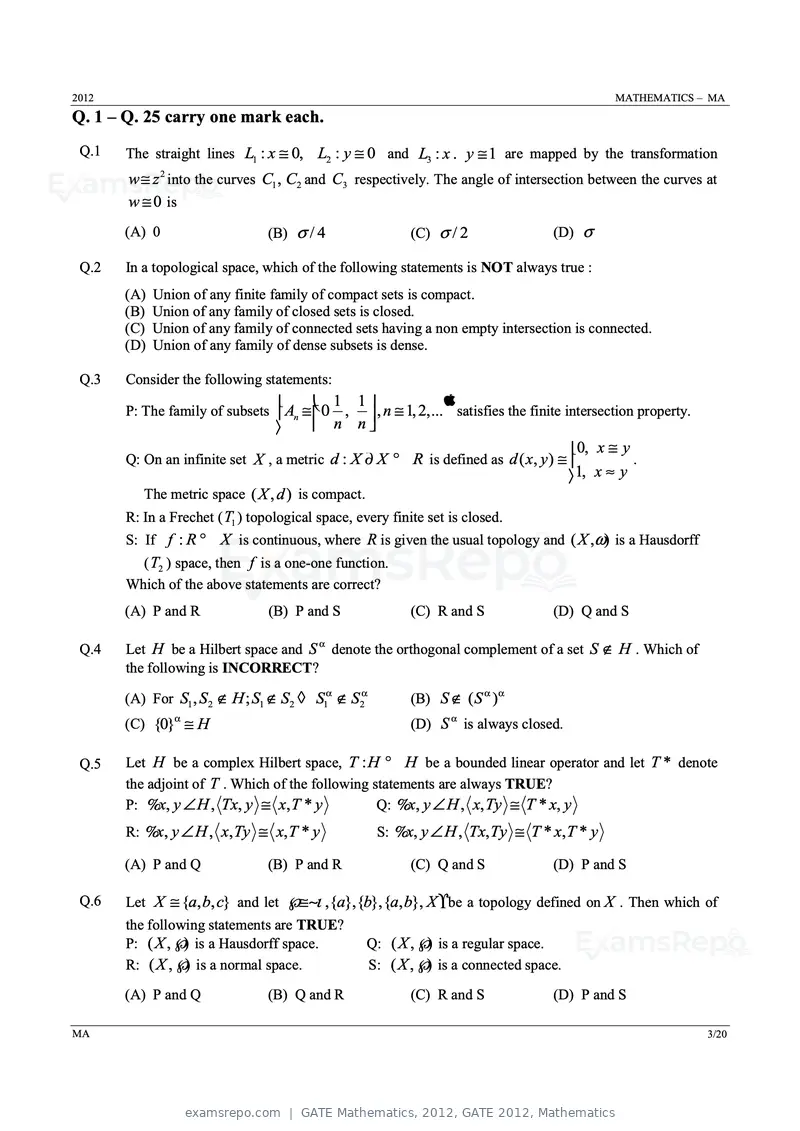
Text of page 3
2012 MATHEMATICS – MA
Q. 1 – Q. 25 carry one mark each.
Q.1 The straight lines L1 : x 0, L2 : y 0 and L3 : x y 1 are mapped by the transformation
w z 2 into the curves C1 , C2 and C3 respectively. The angle of intersection between the curves at
w 0 is
(A) 0 (B) / 4 (C) / 2 (D)
Q.2 In a topological space, which of the following statements is NOT always true :
(A) Union of any finite family of compact sets is compact.
(B) Union of any family of closed sets is closed.
(C) Union of any family of connected sets having a non empty intersection is connected.
(D) Union of any family of dense subsets is dense.
Q.3 Consider the following statements:
1 1
P: The family of subsets An , , n 1, 2,... satisfies the finite intersection property.
n n
0, x y
Q: On an infinite set X , a metric d : X X R is defined as d ( x, y ) .
1, x y
The metric space ( X , d ) is compact.
R: In a Frechet ( T1 ) topological space, every finite set is closed.
S: If f : R X is continuous, where R is given the usual topology and ( X , ) is a Hausdorff
( T2 ) space, then f is a one-one function.
Which of the above statements are correct?
(A) P and R (B) P and S (C) R and S (D) Q and S
Q.4 Let H be a Hilbert space and S denote the orthogonal complement of a set S H . Which of
the following is INCORRECT?
(A) For S1 , S2 H ; S1 S2 S1 S2 (B) S ( S )
(C) {0} H (D) S is always closed.
Q.5 Let H be a complex Hilbert space, T : H H be a bounded linear operator and let T * denote
the adjoint of T . Which of the following statements are always TRUE?
P: x, y H , Tx, y x, T * y Q: x, y H , x, Ty T * x, y
R: x, y H , x, Ty x, T * y S: x, y H , Tx, Ty T * x, T * y
(A) P and Q (B) P and R (C) Q and S (D) P and S
Q.6 Let X {a, b, c} and let ,{a},{b},{a, b}, X be a topology defined on X . Then which of
the following statements are TRUE?
P: ( X , ) is a Hausdorff space. Q: ( X , ) is a regular space.
R: ( X , ) is a normal space. S: ( X , ) is a connected space.
(A) P and Q (B) Q and R (C) R and S (D) P and S
MA 3/20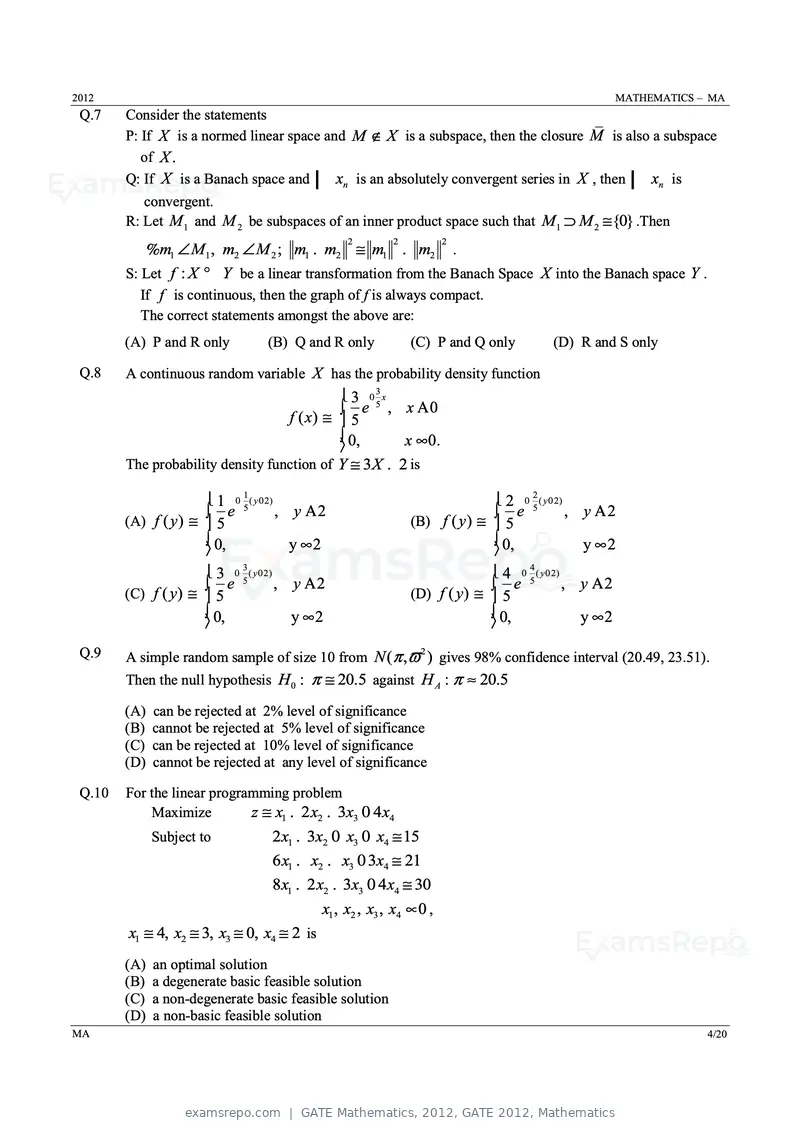
Text of page 4
2012 MATHEMATICS – MA
Q.7 Consider the statements
P: If X is a normed linear space and M X is a subspace, then the closure M is also a subspace
of X .
Q: If X is a Banach space and xn is an absolutely convergent series in X , then xn is
convergent.
R: Let M 1 and M 2 be subspaces of an inner product space such that M1 M 2 {0} .Then
m1 M1 , m2 M 2 ; m1 m2 m1 m2 .
2 2 2
S: Let f : X Y be a linear transformation from the Banach Space X into the Banach space Y .
If f is continuous, then the graph of f is always compact.
The correct statements amongst the above are:
(A) P and R only (B) Q and R only (C) P and Q only (D) R and S only
Q.8 A continuous random variable X has the probability density function
3 53 x
e , x0
f ( x) 5
0, x 0.
The probability density function of Y 3 X 2 is
1 15 ( y 2) 2 52 ( y 2)
e , y2 e , y2
(A) f ( y ) 5 (B) f ( y ) 5
0, y2 0, y2
3 53 ( y 2) 4 54 ( y 2)
e , y2 e , y2
(C) f ( y ) 5 (D) f ( y ) 5
0, y2 0, y2
Q.9 A simple random sample of size 10 from N ( , 2 ) gives 98% confidence interval (20.49, 23.51).
Then the null hypothesis H 0 : 20.5 against H A : 20.5
(A) can be rejected at 2% level of significance
(B) cannot be rejected at 5% level of significance
(C) can be rejected at 10% level of significance
(D) cannot be rejected at any level of significance
Q.10 For the linear programming problem
Maximize z x1 2 x2 3x3 4 x4
Subject to 2 x1 3x2 x3 x4 15
6 x1 x2 x3 3x4 21
8x1 2 x2 3x3 4 x4 30
x1 , x2 , x3 , x4 0 ,
x1 4, x2 3, x3 0, x4 2 is
(A) an optimal solution
(B) a degenerate basic feasible solution
(C) a non-degenerate basic feasible solution
(D) a non-basic feasible solution
MA 4/20
Text of page 5
2012 MATHEMATICS – MA
Q.11 Which one of the following statements is TRUE?
(A) A convex set cannot have infinite many extreme points.
(B) A linear programming problem can have infinite many extreme points.
(C) A linear programming problem can have exactly two different optimal solutions.
(D) A linear programming problem can have a non-basic optimal solution.
Q.12 Let e2 i / 5 and the matrix
1 2 3 4
4
0
2 3
M 0 0 2 3 4 .
0 0 0 3 4
0 0 0 0
4
Then the trace of the matrix I M M 2 is
(A) 5 (B) 0 (C) 3 (D) 5
Q.13 Let V = ℂ2 be the vector space over the field of complex numbers and B {(1, i),(i,1)} be a given
ordered basis of V. Then for which of the following, B * { f1 , f 2 } is a dual basis of B over ℂ?
1 1
(A) f1 ( z1 , z2 ) ( z1 iz2 ) , f 2 ( z1 , z2 ) ( z1 iz2 )
2 2
1 1
(B) f1 ( z1 , z2 ) ( z1 iz2 ) , f 2 ( z1 , z2 ) (iz1 z2 )
2 2
1 1
(C) f1 ( z1 , z2 ) ( z1 iz2 ) , f 2 ( z1 , z2 ) (iz1 z2 )
2 2
1 1
(D) f1 ( z1 , z2 ) ( z1 iz2 ) , f 2 ( z1 , z2 ) (iz1 z2 )
2 2
Q.14 Let R = ℤℤℤ and I = ℤℤ{0}. Then which of the following statement is correct?
(A) I is a maximal ideal but not a prime ideal of R .
(B) I is a prime ideal but not a maximal ideal of R .
(C) I is both maximal ideal as well as a prime ideal of R .
(D) I is neither a maximal ideal nor a prime ideal of R .
Q.15 The function u (r , ) satisfying the Laplace equation
2u 1 u 1 2u
2 0, e r e2
r 2
r r r 2
subject to the conditions u(e, ) 1, u(e2 , ) 0 is
r e2
(A) ln(e / r ) (B) ln(e / r )2 2
(C) ln(e / r ) (D) 2
n 1 e e
sin n
Q.16 The functional
1
y ( y 2 y) y kxyy y dx , y(0) 0, y(1) 1, y(0) 2, y(1) 3
2 2
0
is path independent if k equals
(A) 1 (B) 2 (C) 3 (D) 4
MA 5/20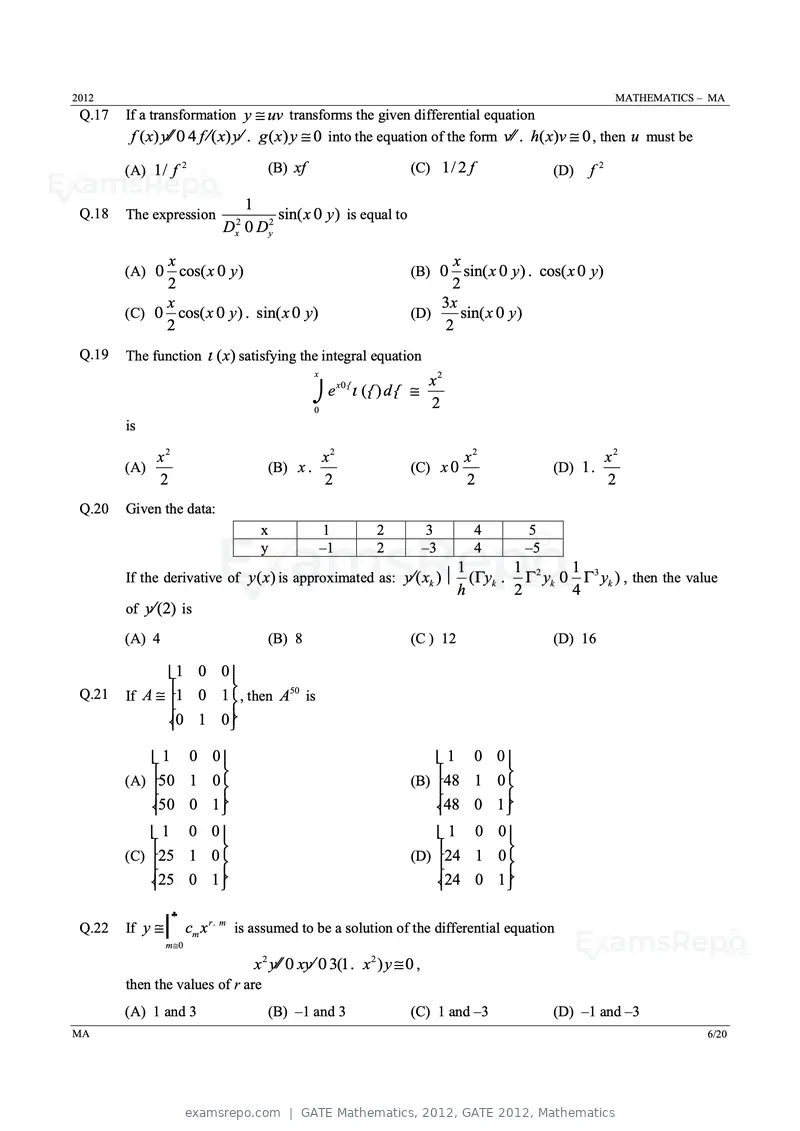
Text of page 6
2012 MATHEMATICS – MA
Q.17 If a transformation y uv transforms the given differential equation
f ( x) y 4 f ( x) y g ( x) y 0 into the equation of the form v h( x)v 0 , then u must be
(A) 1/ f 2 (B) xf (C) 1/ 2 f (D) f2
1
Q.18 The expression sin( x y ) is equal to
D Dy2
2
x
x x
(A) cos( x y ) (B) sin( x y ) cos( x y )
2 2
x 3x
(C) cos( x y ) sin( x y ) (D) sin( x y )
2 2
Q.19 The function ( x) satisfying the integral equation
x
x2
e ( ) d
x
0
2
is
x2 x2 x2 x2
(A) (B) x (C) x (D) 1
2 2 2 2
Q.20 Given the data:
x 1 2 3 4 5
y –1 2 –3 4 –5
1 1 1
If the derivative of y ( x) is approximated as: y( xk ) (yk 2 yk 3 yk ) , then the value
h 2 4
of y(2) is
(A) 4 (B) 8 (C ) 12 (D) 16
1 0 0
Q.21
If A 1 0 1 , then A50 is
0 1 0
1 0 0 1 0 0
(A) 50 1 0
(B) 48 1 0
50 0 1 48 0 1
1 0 0 1 0 0
(C) 25 1 0
(D) 24 1 0
25 0 1 24 0 1
Q.22 If y c x
m 0
m
r m
is assumed to be a solution of the differential equation
x2 y xy 3(1 x2 ) y 0 ,
then the values of r are
(A) 1 and 3 (B) –1 and 3 (C) 1 and –3 (D) –1 and –3
MA 6/20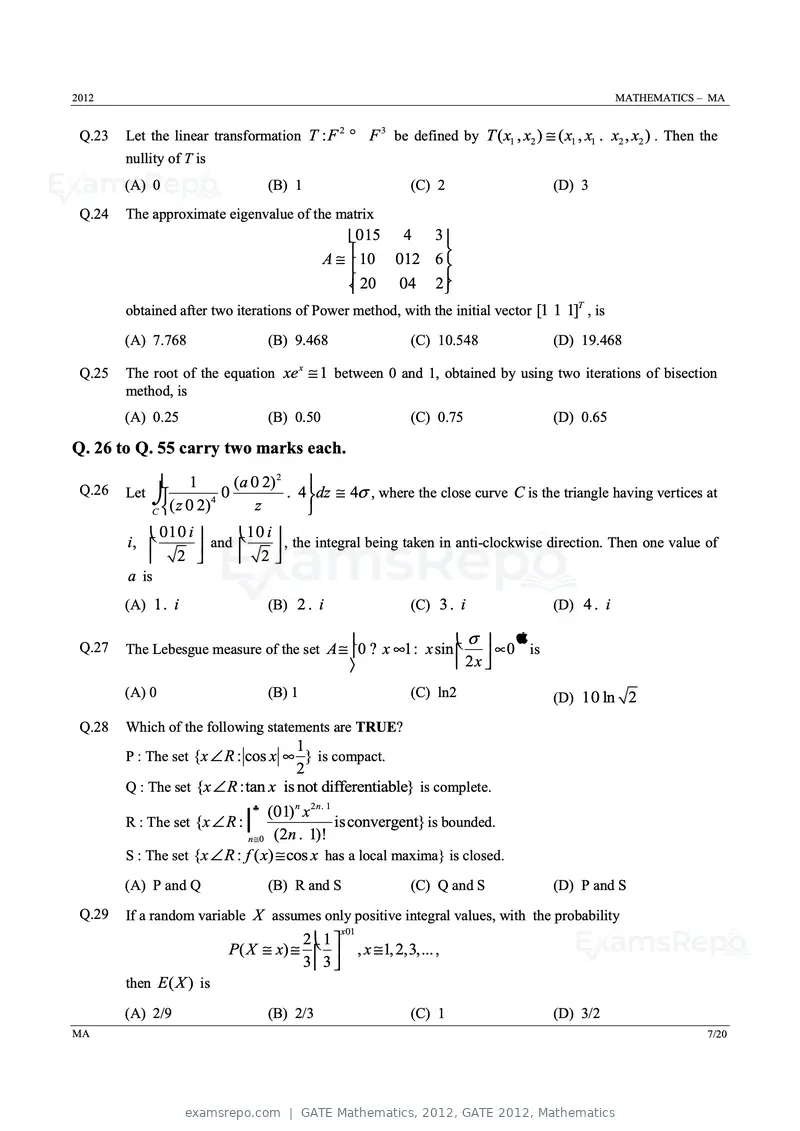
Text of page 7
2012 MATHEMATICS – MA
Q.23 Let the linear transformation T : F 2 F 3 be defined by T ( x1 , x2 ) ( x1 , x1 x2 , x2 ) . Then the
nullity of T is
(A) 0 (B) 1 (C) 2 (D) 3
Q.24 The approximate eigenvalue of the matrix
15 4 3
A 10 12 6
20 4 2
obtained after two iterations of Power method, with the initial vector [1 1 1]T , is
(A) 7.768 (B) 9.468 (C) 10.548 (D) 19.468
Q.25 The root of the equation xe x 1 between 0 and 1, obtained by using two iterations of bisection
method, is
(A) 0.25 (B) 0.50 (C) 0.75 (D) 0.65
Q. 26 to Q. 55 carry two marks each.
1 (a 2) 2
Q.26 Let C ( z 2)4
z
4 dz 4 , where the close curve C is the triangle having vertices at
1 i 1 i
i, and , the integral being taken in anti-clockwise direction. Then one value of
2 2
a is
(A) 1 i (B) 2 i (C) 3 i (D) 4 i
Q.27 The Lebesgue measure of the set A 0 x 1: x sin 0 is
2x
(A) 0 (B) 1 (C) ln2 (D) 1 ln 2
Q.28 Which of the following statements are TRUE?
1
P : The set {x R : cos x } is compact.
2
Q : The set {x R :tan x is not differentiable} is complete.
(1)n x 2 n1
R : The set {x R : n 0 (2n 1)!
is convergent} is bounded.
S : The set {x R : f ( x) cos x has a local maxima} is closed.
(A) P and Q (B) R and S (C) Q and S (D) P and S
Q.29 If a random variable X assumes only positive integral values, with the probability
x 1
21
P( X x) , x 1, 2,3,... ,
33
then E ( X ) is
(A) 2/9 (B) 2/3 (C) 1 (D) 3/2
MA 7/20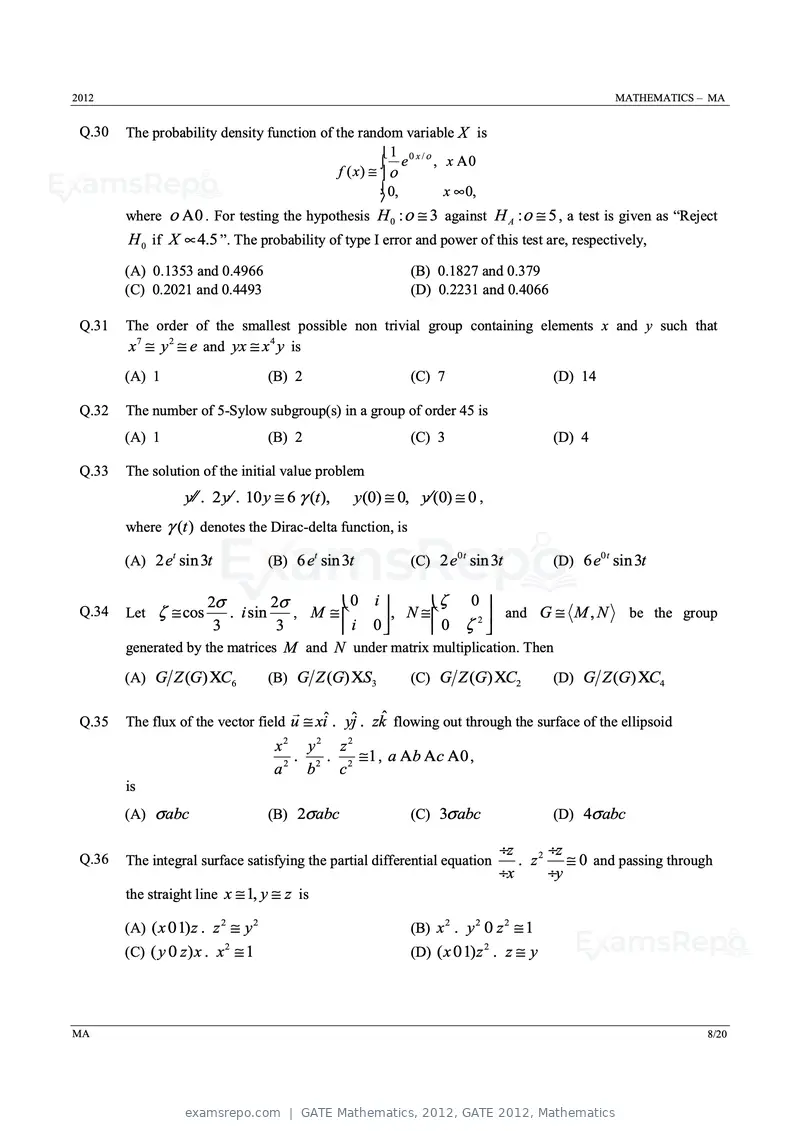
Text of page 8
2012 MATHEMATICS – MA
Q.30 The probability density function of the random variable X is
1 x/
e , x0
f ( x)
0, x 0,
where 0 . For testing the hypothesis H 0 : 3 against H A : 5 , a test is given as “Reject
H 0 if X 4.5 ”. The probability of type I error and power of this test are, respectively,
(A) 0.1353 and 0.4966 (B) 0.1827 and 0.379
(C) 0.2021 and 0.4493 (D) 0.2231 and 0.4066
Q.31 The order of the smallest possible non trivial group containing elements x and y such that
x7 y 2 e and yx x 4 y is
(A) 1 (B) 2 (C) 7 (D) 14
Q.32 The number of 5-Sylow subgroup(s) in a group of order 45 is
(A) 1 (B) 2 (C) 3 (D) 4
Q.33 The solution of the initial value problem
y 2 y 10 y 6 (t ), y(0) 0, y(0) 0 ,
where (t ) denotes the Dirac-delta function, is
(A) 2 et sin 3t (B) 6 et sin 3t (C) 2 et sin 3t (D) 6 et sin 3t
2 2 0 i 0
Q.34 Let cos i sin , M , N 2
and G M , N be the group
3 3 i 0 0
generated by the matrices M and N under matrix multiplication. Then
(A) G Z (G) C6 (B) G Z (G) S3 (C) G Z (G) C2 (D) G Z (G) C4
Q.35 The flux of the vector field u xiˆ yjˆ zkˆ flowing out through the surface of the ellipsoid
x2 y 2 z 2
1 , a b c 0 ,
a 2 b2 c 2
is
(A) abc (B) 2 abc (C) 3 abc (D) 4 abc
z z
Q.36 The integral surface satisfying the partial differential equation z 2 0 and passing through
x y
the straight line x 1, y z is
(A) ( x 1) z z 2 y 2 (B) x 2 y 2 z 2 1
(C) ( y z ) x x 2 1 (D) ( x 1) z 2 z y
MA 8/20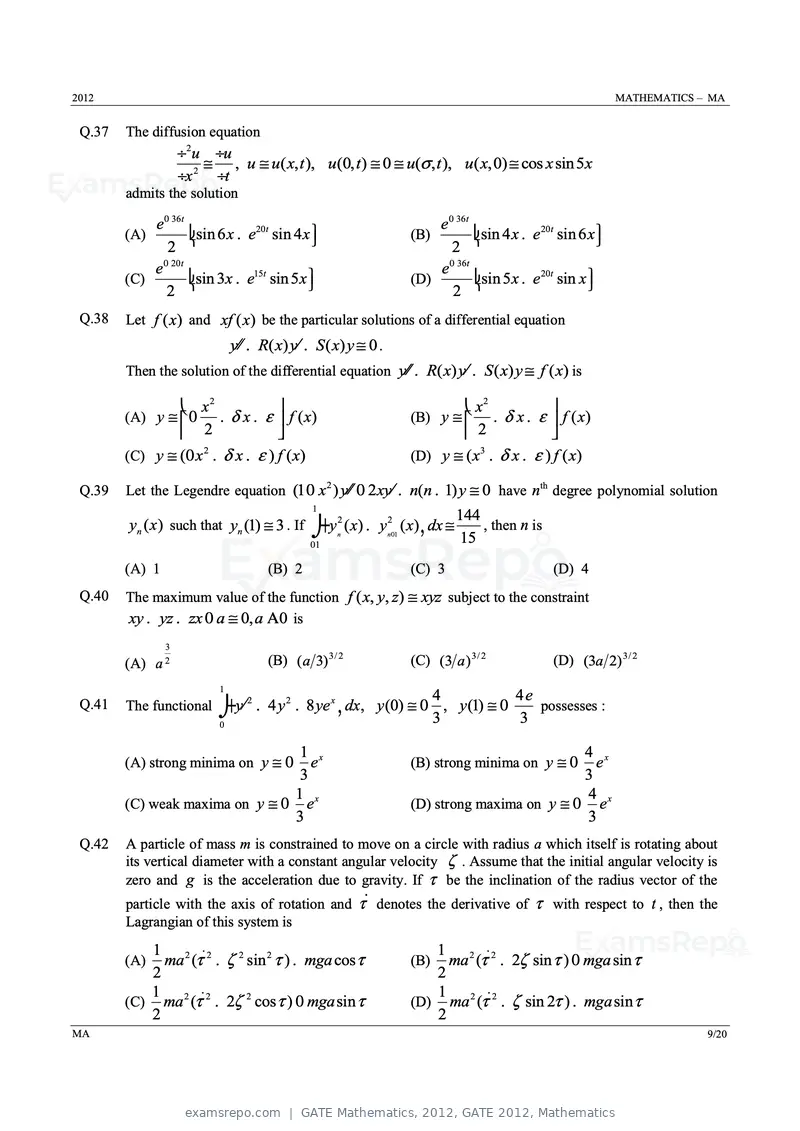
Text of page 9
2012 MATHEMATICS – MA
Q.37 The diffusion equation
2u u
, u u( x, t ), u(0, t ) 0 u( , t ), u( x,0) cos x sin 5x
x 2 t
admits the solution
e 36t e 36t
(A) sin 6 x e20t sin 4 x (B) sin 4 x e20t sin 6 x
2 2
e 20t e 36t
(C) sin 3x e15t sin 5 x (D) sin 5 x e20t sin x
2 2
Q.38 Let f ( x) and xf ( x) be the particular solutions of a differential equation
y R( x) y S ( x) y 0 .
Then the solution of the differential equation y R( x) y S ( x) y f ( x) is
x2 x2
(A) y x f ( x) (B) y x f ( x)
2 2
(C) y ( x 2 x ) f ( x) (D) y ( x3 x ) f ( x)
Q.39 Let the Legendre equation (1 x2 ) y 2 xy n(n 1) y 0 have nth degree polynomial solution
1
yn ( x) such that yn (1) 3 . If y n2 ( x) y n21 ( x) dx
144
15
, then n is
1
(A) 1 (B) 2 (C) 3 (D) 4
Q.40 The maximum value of the function f ( x, y, z ) xyz subject to the constraint
xy yz zx a 0, a 0 is
3
(A) a 2 (B) (a 3) 3 / 2 (C) (3 a ) 3 / 2 (D) (3a 2) 3 / 2
1
y 4 y 8 ye dx, y(0) 3 , y(1) 3 possesses :
2 2 x 4 4e
Q.41 The functional
0
1 x 4 x
(A) strong minima on y e (B) strong minima on y e
3 3
1 4
(C) weak maxima on y e x (D) strong maxima on y e x
3 3
Q.42 A particle of mass m is constrained to move on a circle with radius a which itself is rotating about
its vertical diameter with a constant angular velocity . Assume that the initial angular velocity is
zero and g is the acceleration due to gravity. If be the inclination of the radius vector of the
particle with the axis of rotation and denotes the derivative of with respect to t , then the
Lagrangian of this system is
1 2 2 1 2 2
(A) ma ( 2 sin 2 ) mga cos (B) ma ( 2 sin ) mga sin
2 2
1 1
(C) ma 2 ( 2 2 2 cos ) mga sin (D) ma 2 ( 2 sin 2 ) mga sin
2 2
MA 9/20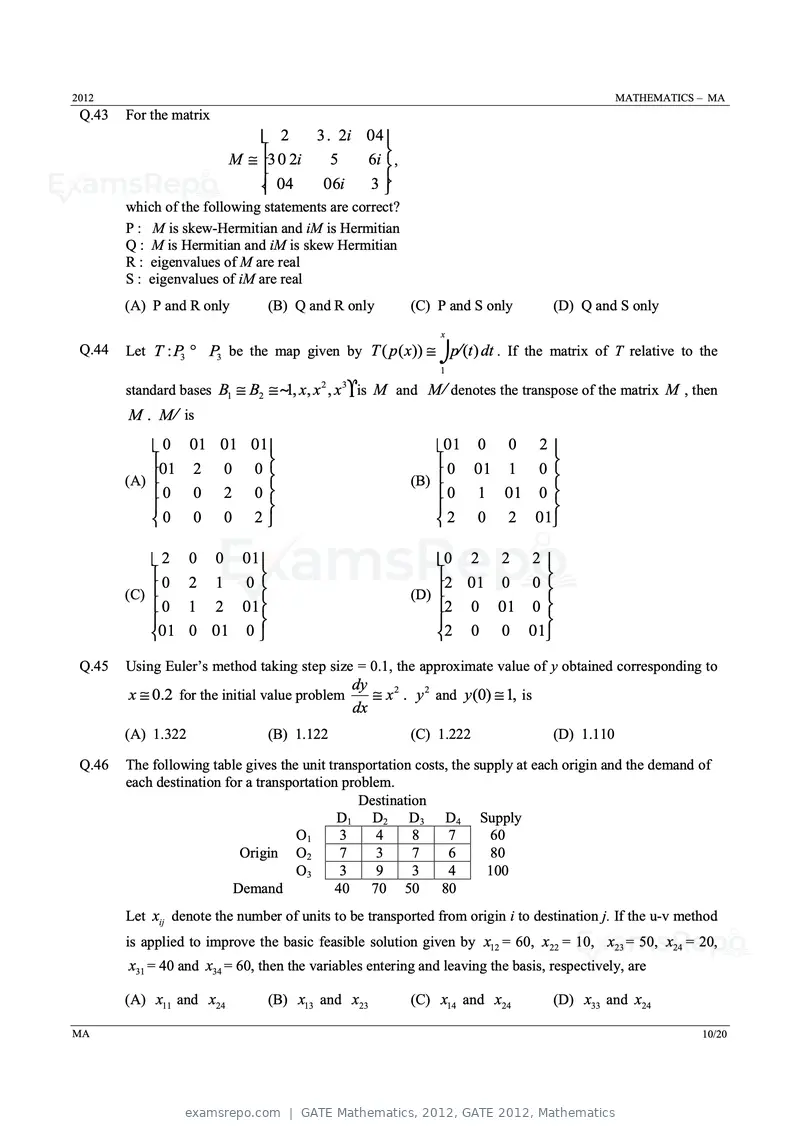
Text of page 10
2012 MATHEMATICS – MA
Q.43 For the matrix
2 3 2i 4
M 3 2i 5 6i ,
4 6i 3
which of the following statements are correct?
P : M is skew-Hermitian and iM is Hermitian
Q : M is Hermitian and iM is skew Hermitian
R : eigenvalues of M are real
S : eigenvalues of iM are real
(A) P and R only (B) Q and R only (C) P and S only (D) Q and S only
x
Q.44 Let T : P3 P3 be the map given by T ( p( x)) p(t ) dt . If the matrix of T relative to the
1
standard bases B1 B2 1, x, x , x
2 3
is M and M denotes the transpose of the matrix M , then
M M is
0 1 1 1 1 0 0 2
1 2 0 0 0 1 1 0
(A) (B)
0 0 2 0 0 1 1 0
0 0 0 2 2 0 2 1
2 0 1
0 0 2 2 2
0 2 1 0 2 1 0 0
(C) (D)
0 1 2 1 2 0 1 0
1 0 1 0 2 0 0 1
Q.45 Using Euler’s method taking step size = 0.1, the approximate value of y obtained corresponding to
dy
x 0.2 for the initial value problem x 2 y 2 and y(0) 1, is
dx
(A) 1.322 (B) 1.122 (C) 1.222 (D) 1.110
Q.46 The following table gives the unit transportation costs, the supply at each origin and the demand of
each destination for a transportation problem.
Destination
D1 D2 D3 D4 Supply
O1 3 4 8 7 60
Origin O2 7 3 7 6 80
O3 3 9 3 4 100
Demand 40 70 50 80
Let xij denote the number of units to be transported from origin i to destination j. If the u-v method
is applied to improve the basic feasible solution given by x12 = 60, x22 = 10, x23 = 50, x24 = 20,
x31 = 40 and x34 = 60, then the variables entering and leaving the basis, respectively, are
(A) x11 and x24 (B) x13 and x23 (C) x14 and x24 (D) x33 and x24
MA 10/20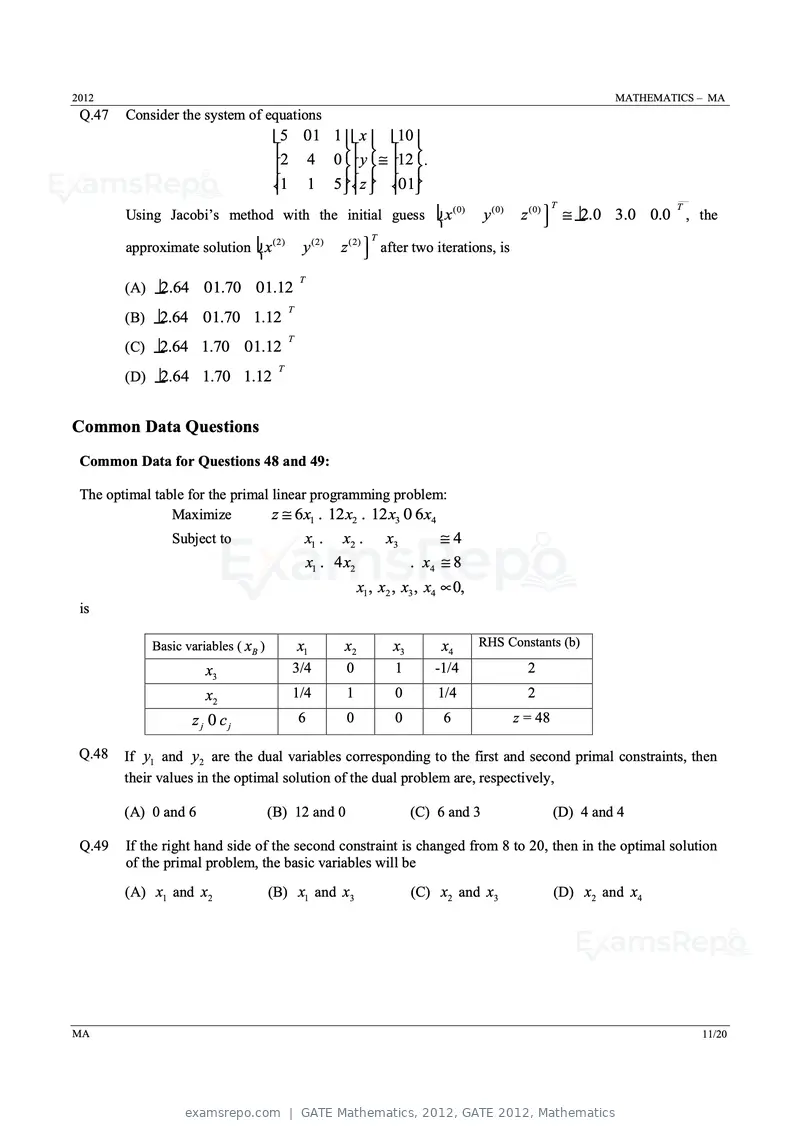
Text of page 11
2012 MATHEMATICS – MA
Q.47 Consider the system of equations
5 1 1 x 10
2 4 0 y 12 .
1 1 5 z 1
z (0) 2.0 3.0 0.0 , the
T
Using Jacobi’s method with the initial guess x(0)
T
y (0)
T
approximate solution x(2) y (2) z (2) after two iterations, is
(A) 2.64 1.70 1.12
T
(B) 2.64 1.70 1.12
T
(C) 2.64 1.70 1.12
T
(D) 2.64 1.70 1.12
T
Common Data Questions
Common Data for Questions 48 and 49:
The optimal table for the primal linear programming problem:
Maximize z 6 x1 12 x2 12 x3 6 x4
Subject to x1 x2 x3 4
x1 4 x2 x4 8
x1 , x2 , x3 , x4 0,
is
Basic variables ( xB ) x1 x2 x3 x4 RHS Constants (b)
x3 3/4 0 1 -1/4 2
x2 1/4 1 0 1/4 2
zj cj 6 0 0 6 z = 48
Q.48 If y1 and y2 are the dual variables corresponding to the first and second primal constraints, then
their values in the optimal solution of the dual problem are, respectively,
(A) 0 and 6 (B) 12 and 0 (C) 6 and 3 (D) 4 and 4
Q.49 If the right hand side of the second constraint is changed from 8 to 20, then in the optimal solution
of the primal problem, the basic variables will be
(A) x1 and x2 (B) x1 and x3 (C) x2 and x3 (D) x2 and x4
MA 11/20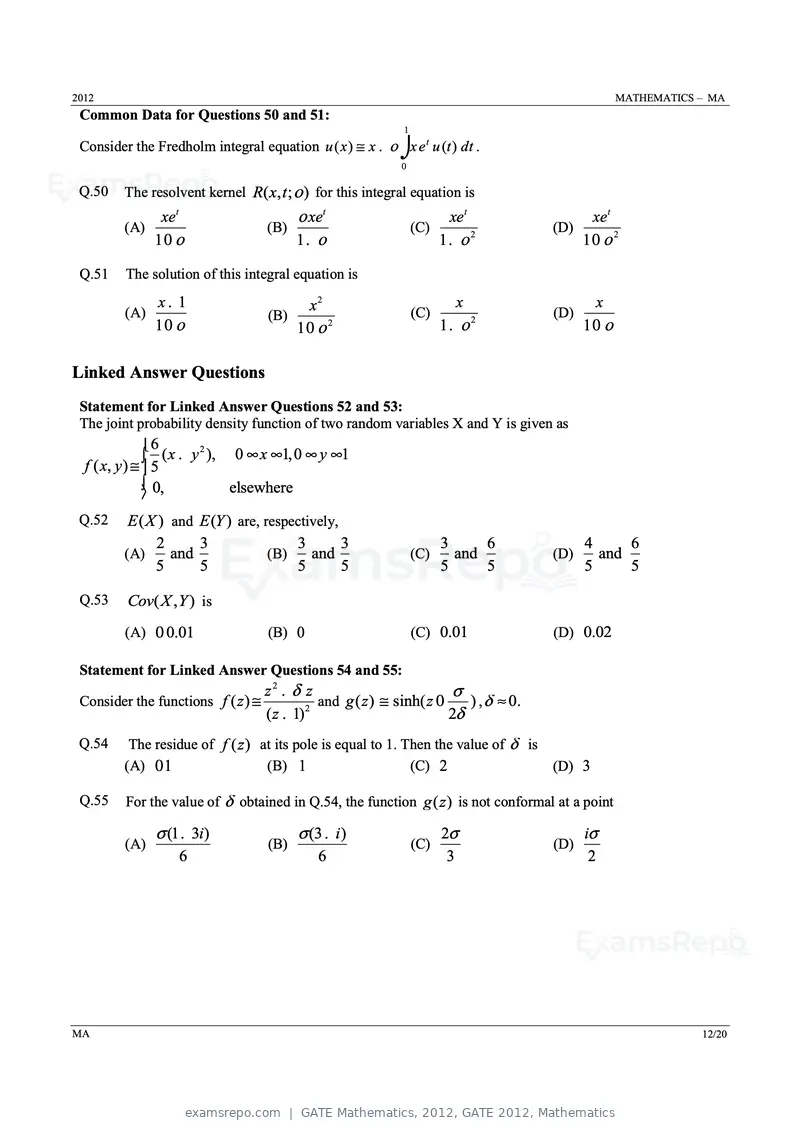
Text of page 12
2012 MATHEMATICS – MA
Common Data for Questions 50 and 51:
1
Consider the Fredholm integral equation u ( x ) x x e t u (t ) dt .
0
Q.50 The resolvent kernel R( x, t; ) for this integral equation is
xet xet xet xet
(A) (B) (C) (D)
1 1 1 2 1 2
Q.51 The solution of this integral equation is
x 1 x2 x x
(A) (B) (C) (D)
1 1 2 1 2 1
Linked Answer Questions
Statement for Linked Answer Questions 52 and 53:
The joint probability density function of two random variables X and Y is given as
6
( x y ), 0 x 1, 0 y 1
2
f ( x, y ) 5
0, elsewhere
Q.52 E ( X ) and E (Y ) are, respectively,
2 3 3 3 3 6 4 6
(A) and (B) and (C) and (D) and
5 5 5 5 5 5 5 5
Q.53 Cov( X , Y ) is
(A) 0.01 (B) 0 (C) 0.01 (D) 0.02
Statement for Linked Answer Questions 54 and 55:
z2 z
Consider the functions f ( z ) and g ( z ) sinh( z ) , 0.
( z 1) 2
2
Q.54 The residue of f ( z ) at its pole is equal to 1. Then the value of is
(A) 1 (B) 1 (C) 2 (D) 3
Q.55 For the value of obtained in Q.54, the function g ( z ) is not conformal at a point
(1 3i) (3 i ) 2 i
(A) (B) (C) (D)
6 6 3 2
MA 12/20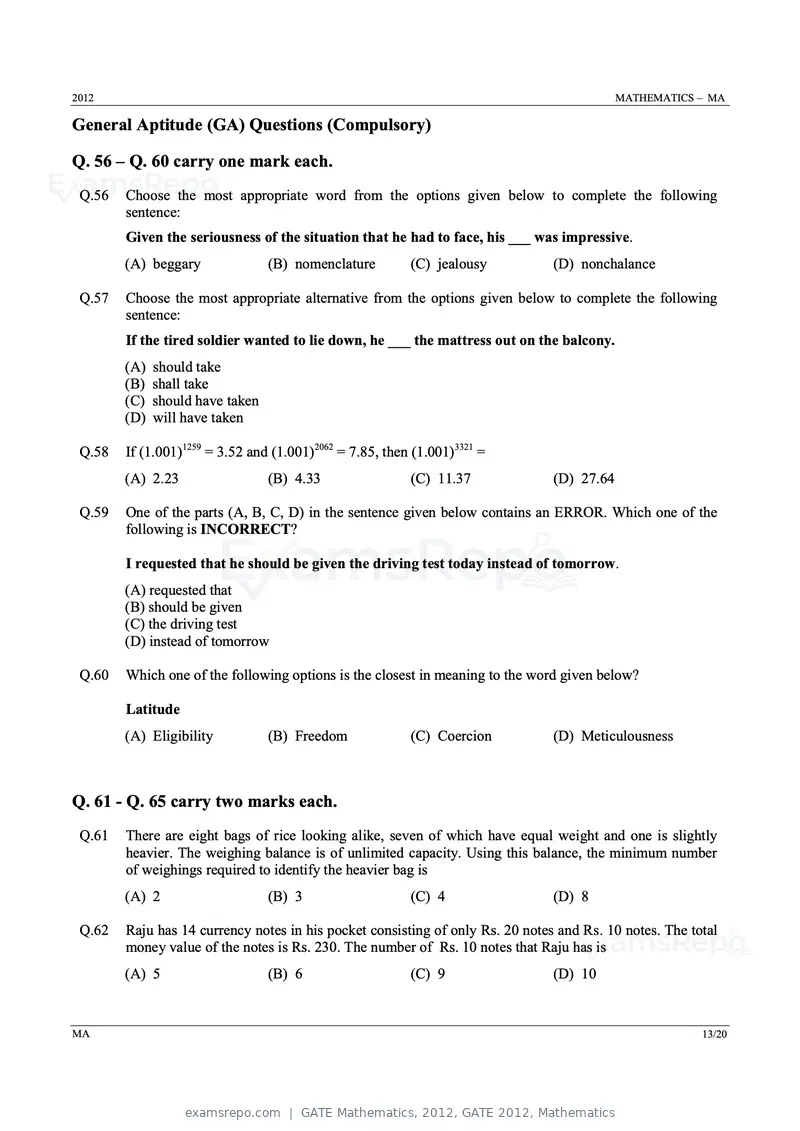
Text of page 13
2012                                                                                        MATHEMATICS – MA

General Aptitude (GA) Questions (Compulsory)

Q. 56 – Q. 60 carry one mark each.
 Q.56   Choose the most appropriate word from the options given below to complete the following
        sentence:
        Given the seriousness of the situation that he had to face, his ___ was impressive.
        (A) beggary              (B) nomenclature         (C) jealousy          (D) nonchalance

 Q.57   Choose the most appropriate alternative from the options given below to complete the following
        sentence:
        If the tired soldier wanted to lie down, he ___ the mattress out on the balcony.
        (A) should take
        (B) shall take
        (C) should have taken
        (D) will have taken

 Q.58   If (1.001)1259 = 3.52 and (1.001)2062 = 7.85, then (1.001)3321 =
        (A) 2.23                 (B) 4.33                 (C) 11.37             (D) 27.64

 Q.59   One of the parts (A, B, C, D) in the sentence given below contains an ERROR. Which one of the
        following is INCORRECT?

        I requested that he should be given the driving test today instead of tomorrow.
        (A) requested that
        (B) should be given
        (C) the driving test
        (D) instead of tomorrow

 Q.60   Which one of the following options is the closest in meaning to the word given below?

        Latitude
        (A) Eligibility          (B) Freedom              (C) Coercion          (D) Meticulousness


Q. 61 - Q. 65 carry two marks each.
 Q.61   There are eight bags of rice looking alike, seven of which have equal weight and one is slightly
        heavier. The weighing balance is of unlimited capacity. Using this balance, the minimum number
        of weighings required to identify the heavier bag is
        (A) 2                    (B) 3                    (C) 4                 (D) 8

 Q.62   Raju has 14 currency notes in his pocket consisting of only Rs. 20 notes and Rs. 10 notes. The total
        money value of the notes is Rs. 230. The number of Rs. 10 notes that Raju has is
        (A) 5                    (B) 6                    (C) 9                 (D) 10


MA                                                                                                       13/20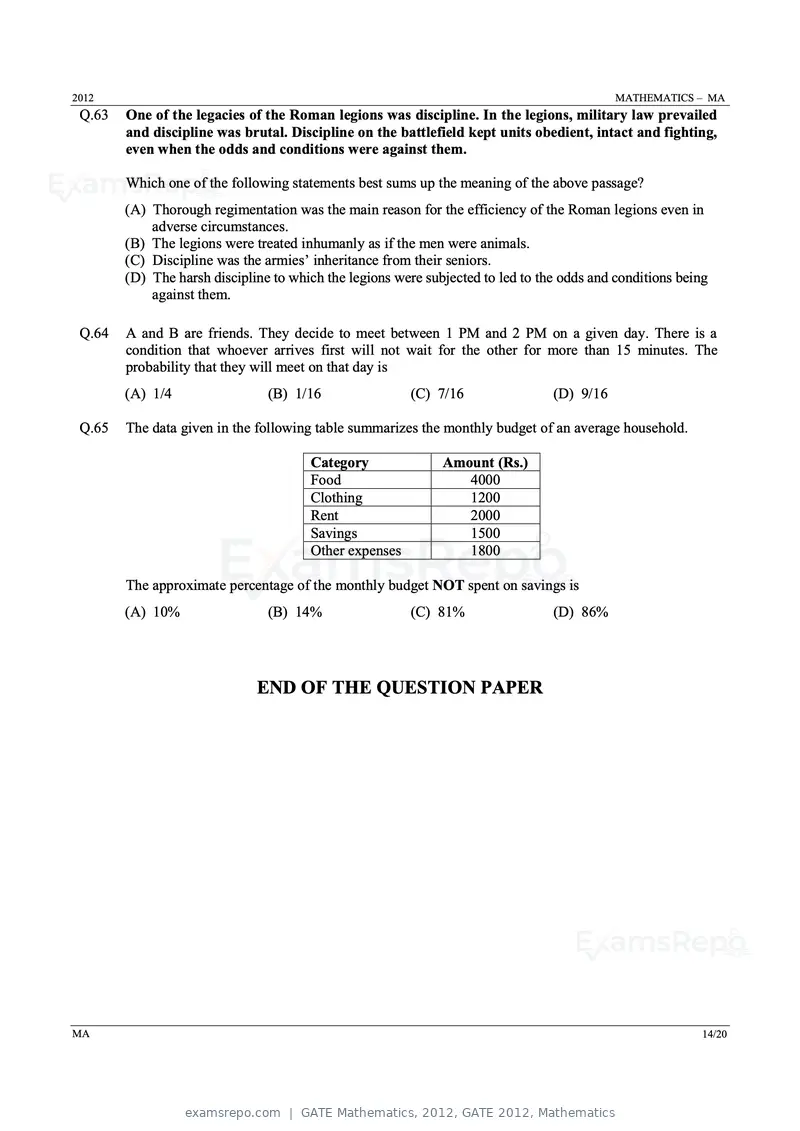
Text of page 14
2012                                                                                        MATHEMATICS – MA
 Q.63   One of the legacies of the Roman legions was discipline. In the legions, military law prevailed
        and discipline was brutal. Discipline on the battlefield kept units obedient, intact and fighting,
        even when the odds and conditions were against them.

        Which one of the following statements best sums up the meaning of the above passage?
        (A) Thorough regimentation was the main reason for the efficiency of the Roman legions even in
            adverse circumstances.
        (B) The legions were treated inhumanly as if the men were animals.
        (C) Discipline was the armies’ inheritance from their seniors.
        (D) The harsh discipline to which the legions were subjected to led to the odds and conditions being
            against them.

 Q.64   A and B are friends. They decide to meet between 1 PM and 2 PM on a given day. There is a
        condition that whoever arrives first will not wait for the other for more than 15 minutes. The
        probability that they will meet on that day is
        (A) 1/4                 (B) 1/16                (C) 7/16                 (D) 9/16

 Q.65   The data given in the following table summarizes the monthly budget of an average household.

                                       Category               Amount (Rs.)
                                       Food                      4000
                                       Clothing                  1200
                                       Rent                      2000
                                       Savings                   1500
                                       Other expenses            1800

        The approximate percentage of the monthly budget NOT spent on savings is
        (A) 10%                 (B) 14%                 (C) 81%                  (D) 86%


                              END OF THE QUESTION PAPER


MA                                                                                                         14/20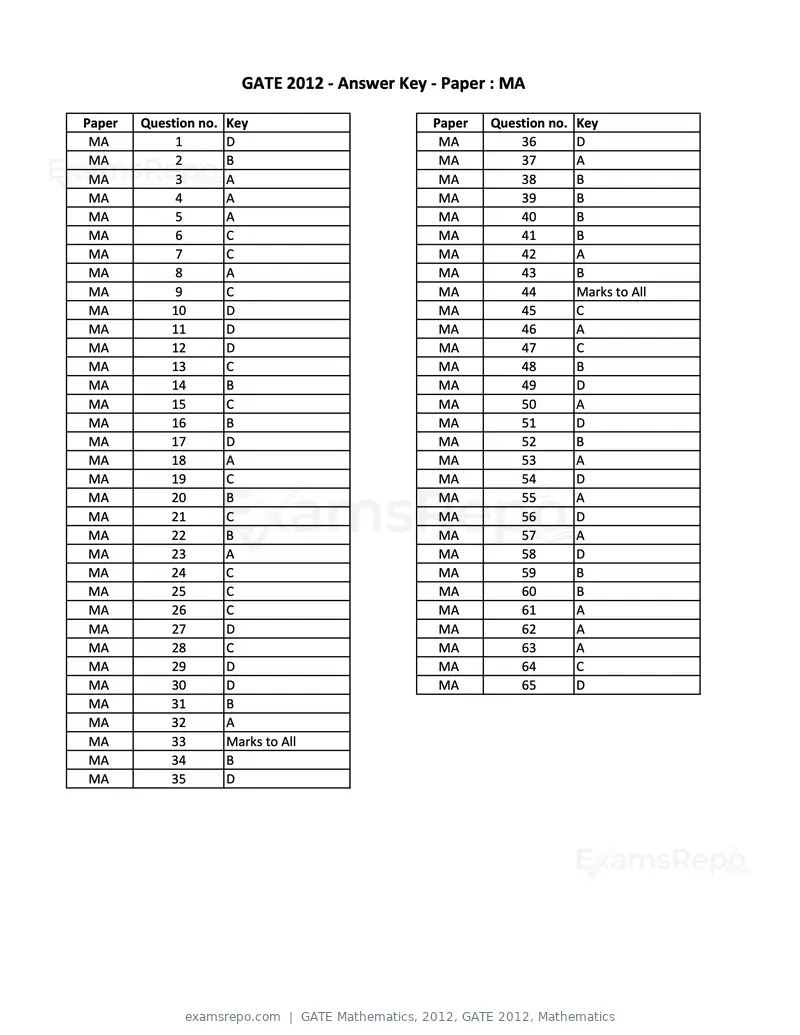
Text of page 15
GATE 2012 ‐ Answer Key ‐ Paper : MA

Paper   Question no. Key                       Paper   Question no. Key
 MA          1       D                          MA         36       D
 MA          2       B                          MA         37       A
 MA          3       A                          MA         38       B
 MA          4       A                          MA         39       B
 MA          5       A                          MA         40       B
 MA          6       C                          MA         41       B
 MA          7       C                          MA         42       A
 MA          8       A                          MA         43       B
 MA          9       C                          MA         44       Marks to All
 MA         10       D                          MA         45       C
 MA         11       D                          MA         46       A
 MA         12       D                          MA         47       C
 MA         13       C                          MA         48       B
 MA         14       B                          MA         49       D
 MA         15       C                          MA         50       A
 MA         16       B                          MA         51       D
 MA         17       D                          MA         52       B
 MA         18       A                          MA         53       A
 MA         19       C                          MA         54       D
 MA         20       B                          MA         55       A
 MA         21       C                          MA         56       D
 MA         22       B                          MA         57       A
 MA         23       A                          MA         58       D
 MA         24       C                          MA         59       B
 MA         25       C                          MA         60       B
 MA         26       C                          MA         61       A
 MA         27       D                          MA         62       A
 MA         28       C                          MA         63       A
 MA         29       D                          MA         64       C
 MA         30       D                          MA         65       D
 MA         31       B
 MA         32       A
 MA         33       Marks to All
 MA         34       B
 MA         35       D
Official key not published for this paper.
Page 1 of 15
Source: GATE. Question paper published by GATE.