
GATE Mathematics 2013
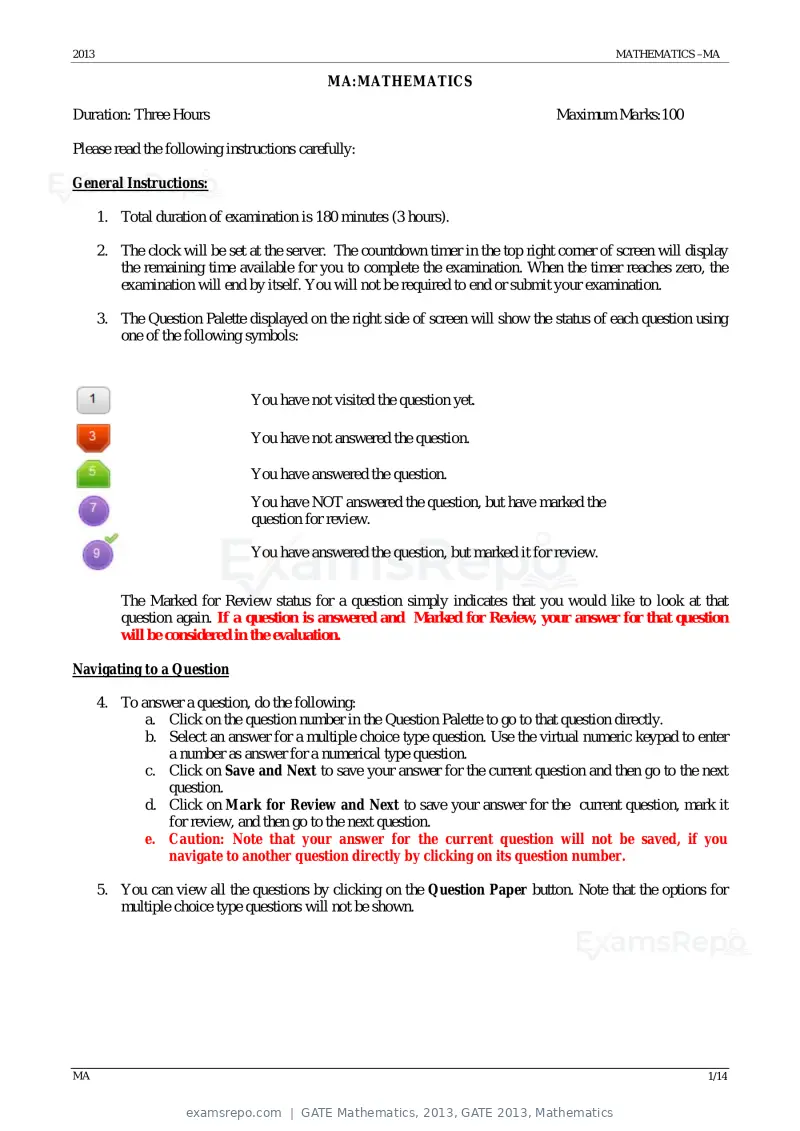
Text of page 1
2013                                                                                          MATHEMATICS –MA

                                             MA:MATHEMATICS

Duration: Three Hours                                                               Maximum Marks:100

Please read the following instructions carefully:

General Instructions:

       1. Total duration of examination is 180 minutes (3 hours).

       2. The clock will be set at the server. The countdown timer in the top right corner of screen will display
          the remaining time available for you to complete the examination. When the timer reaches zero, the
          examination will end by itself. You will not be required to end or submit your examination.

       3. The Question Palette displayed on the right side of screen will show the status of each question using
          one of the following symbols:


                                You have not visited the question yet.

                                You have not answered the question.

                                You have answered the question.
                                You have NOT answered the question, but have marked the
                                question for review.

                                You have answered the question, but marked it for review.


           The Marked for Review status for a question simply indicates that you would like to look at that
           question again. If a question is answered and Marked for Review, your answer for that question
           will be considered in the evaluation.

Navigating to a Question

       4. To answer a question, do the following:
              a. Click on the question number in the Question Palette to go to that question directly.
              b. Select an answer for a multiple choice type question. Use the virtual numeric keypad to enter
                 a number as answer for a numerical type question.
              c. Click on Save and Next to save your answer for the current question and then go to the next
                 question.
              d. Click on Mark for Review and Next to save your answer for the current question, mark it
                 for review, and then go to the next question.
              e. Caution: Note that your answer for the current question will not be saved, if you
                 navigate to another question directly by clicking on its question number.

       5. You can view all the questions by clicking on the Question Paper button. Note that the options for
          multiple choice type questions will not be shown.


MA                                                                                                           1/14
Text of page 2
2013                                                                                         MATHEMATICS –MA

Answering a Question

       6. Procedure for answering a multiple choice type question:
              a. To select your answer, click on the button of one of the options
              b. To deselect your chosen answer, click on the button of the chosen option again or click on the
                 Clear Response button
              c. To change your chosen answer, click on the button of another option
              d. To save your answer, you MUST click on the Save and Next button
              e. To mark the question for review, click on the Mark for Review and Next button. If an
                 answer is selected for a question that is Marked for Review, that answer will be considered
                 in the evaluation.

       7. Procedure for answering a numerical answer type question:
              a. To enter a number as your answer, use the virtual numerical keypad
              b. A fraction (eg.,-0.3 or -.3) can be entered as an answer with or without ‘0’ before the decimal
                 point
              c. To clear your answer, click on the Clear Response button
              d. To save your answer, you MUST click on the Save and Next button
              e. To mark the question for review, click on the Mark for Review and Next button. If an
                 answer is entered for a question that is Marked for Review, that answer will be considered
                 in the evaluation.

       8. To change your answer to a question that has already been answered, first select that question for
          answering and then follow the procedure for answering that type of question.

       9. Note that ONLY Questions for which answers are saved or marked for review after answering will be
          considered for evaluation.


MA                                                                                                          2/14
Text of page 3
2013                                                                                          MATHEMATICS –MA

Paper specific instructions:


       1. There are a total of 65 questions carrying 100 marks. Questions are of multiple choice type or
          numerical answer type. A multiple choice type question will have four choices for the answer with
          only one correct choice. For numerical answer type questions, the answer is a number and no choices
          will be given. A number as the answer should be entered using the virtual keyboard on the monitor.

       2. Questions Q.1 – Q.25 carry 1mark each. Questions Q.26 – Q.55 carry 2marks each. The 2marks
          questions include two pairs of common data questions and two pairs of linked answer questions. The
          answer to the second question of the linked answer questions depends on the answer to the first
          question of the pair. If the first question in the linked pair is wrongly answered or is not attempted,
          then the answer to the second question in the pair will not be evaluated.

       3. Questions Q.56 – Q.65 belong to General Aptitude (GA) section and carry a total of 15 marks.
          Questions Q.56 – Q.60 carry 1mark each, and questions Q.61 – Q.65 carry 2marks each.

       4. Questions not attempted will result in zero mark. Wrong answers for multiple choice type questions
          will result in NEGATIVE marks. For all 1 mark questions, ⅓ mark will be deducted for each wrong
          answer. For all 2 marks questions, ⅔ mark will be deducted for each wrong answer. However, in the
          case of the linked answer question pair, there will be negative marks only for wrong answer to the
          first question and no negative marks for wrong answer to the second question. There is no negative
          marking for questions of numerical answer type.

       5. Calculator is allowed. Charts, graph sheets or tables are NOT allowed in the examination hall.

       6. Do the rough work in the Scribble Pad provided.


MA                                                                                                           3/14
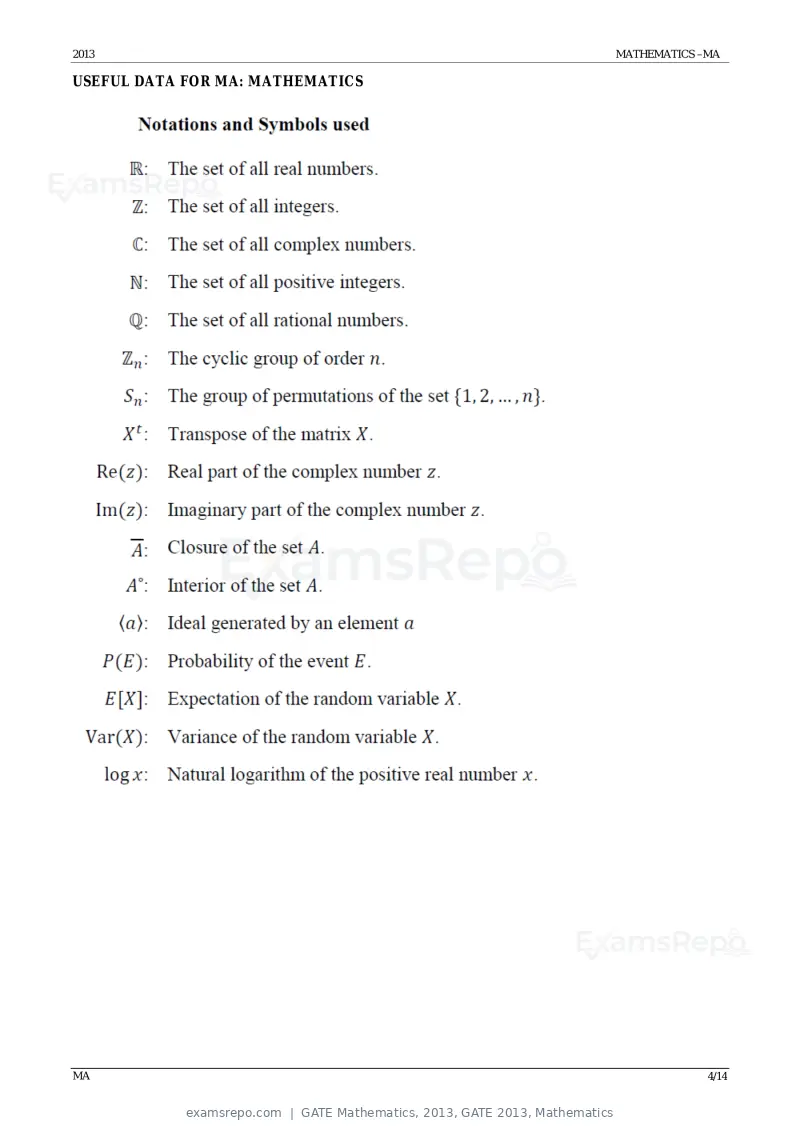
Text of page 4
2013                              MATHEMATICS –MA

USEFUL DATA FOR MA: MATHEMATICS


MA                                             4/14
Text of page 5
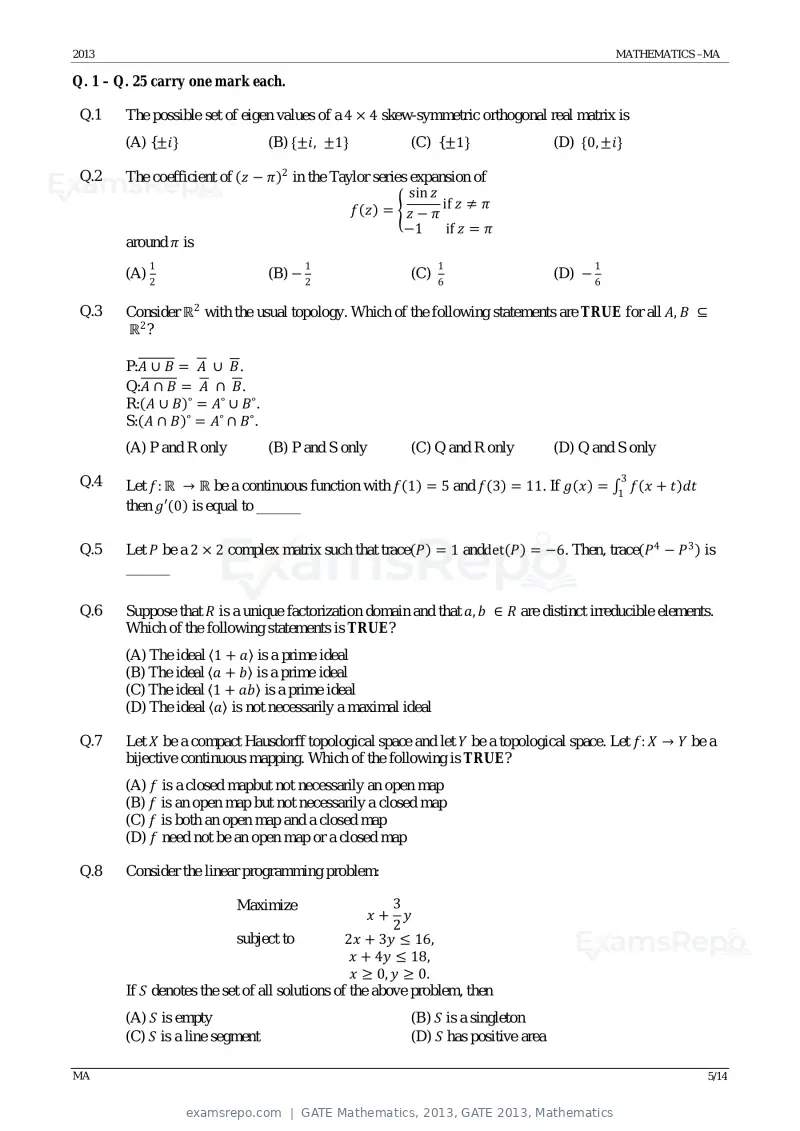
2013                                                                                                MATHEMATICS –MA

Q. 1 – Q. 25 carry one mark each.

 Q.1    The possible set of eigen values of a 4 × 4 skew-symmetric orthogonal real matrix is
        (A) {±ii}                   (B) {±ii, ±1}             (C) {±1}                   (D) {0, ±ii}

 Q.2    The coefficient of (zz − ππ)2 in the Taylor series expansion of
                                                            sin zz
                                                ff(zz) = � zz − ππ if zz ≠ ππ
                                                          −1        if zz = ππ
        around ππ is
            1                             1                        1                            1
        (A) 2                       (B) − 2                   (C) 6                      (D) − 6

 Q.3    Consider ℝ2 with the usual topology. Which of the following statements are TRUE for all AA, BB ⊆
        ℝ2 ?

        P:AA ∪ BB = AA ∪ BB.
        Q:AA ∩ BB = AA ∩ BB.
        R:(AA ∪ BB)˚ = AA˚ ∪ BB˚.
        S:(AA ∩ BB)˚ = AA˚ ∩ BB˚.
        (A) P and R only            (B) P and S only          (C) Q and R only           (D) Q and S only

 Q.4                                                                                                3
        Let ff: ℝ → ℝ be a continuous function with ff(1) = 5 and ff(3) = 11. If gg(xx) = ∫1 ff(xx + tt)dddd
        then gg′(0) is equal to ______

 Q.5    Let PP be a 2 × 2 complex matrix such that trace(PP) = 1 anddet(PP) = −6. Then, trace(PP4 − PP3 ) is
        ______

 Q.6    Suppose that RR is a unique factorization domain and that aa, bb ∈ RR are distinct irreducible elements.
        Which of the following statements is TRUE?
        (A) The ideal 〈1 + aa〉 is a prime ideal
        (B) The ideal 〈aa + bb〉 is a prime ideal
        (C) The ideal 〈1 + aaaa〉 is a prime ideal
        (D) The ideal 〈aa〉 is not necessarily a maximal ideal

 Q.7    Let XX be a compact Hausdorff topological space and let YY be a topological space. Let ff: XX → YY be a
        bijective continuous mapping. Which of the following is TRUE?
        (A) ff is a closed mapbut not necessarily an open map
        (B) ff is an open map but not necessarily a closed map
        (C) ff is both an open map and a closed map
        (D) ff need not be an open map or a closed map

 Q.8    Consider the linear programming problem:

                             Maximize                      3
                                                      xx + yy
                                                           2
                             subject to          2xx + 3yy ≤ 16,
                                                  xx + 4yy ≤ 18,
                                                  xx ≥ 0, yy ≥ 0.
        If SS denotes the set of all solutions of the above problem, then
        (A) SS is empty                                       (B) SS is a singleton
        (C) SS is a line segment                              (D) SS has positive area

MA                                                                                                               5/14
Text of page 6
2013                                                                                                         MATHEMATICS –MA


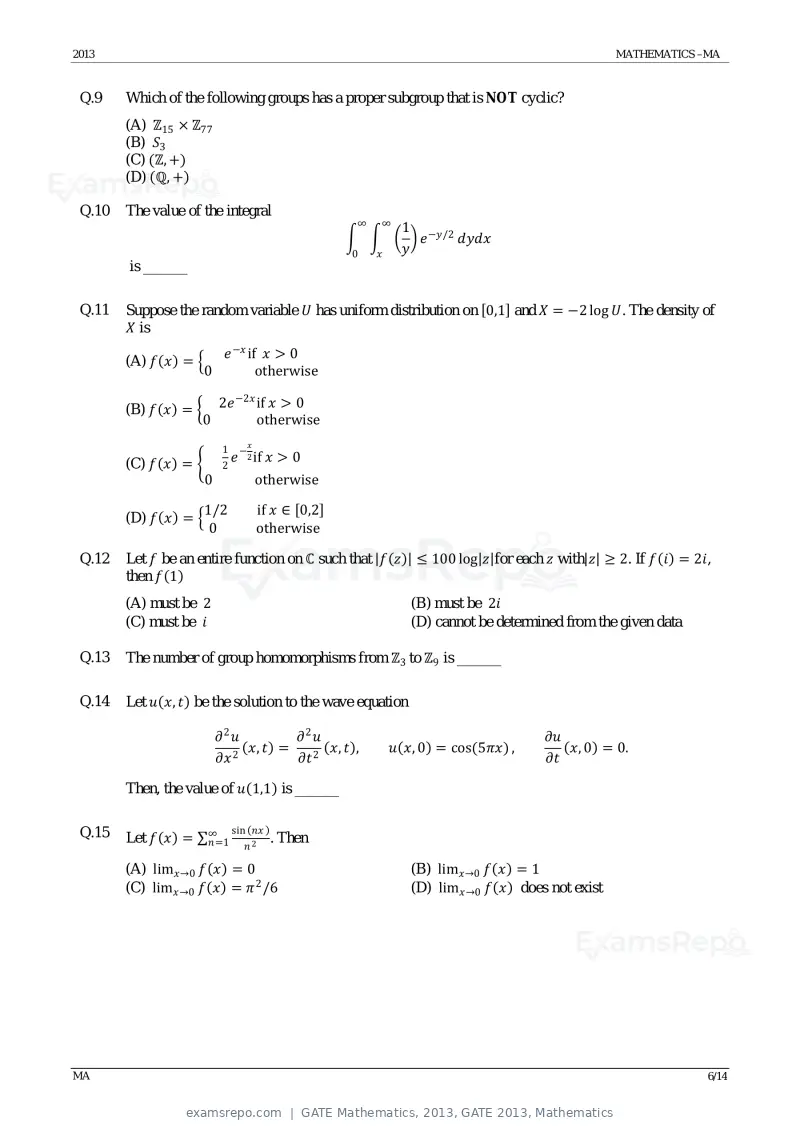
 Q.9    Which of the following groups has a proper subgroup that is NOT cyclic?
        (A) ℤ15 × ℤ77
        (B) SS3
        (C) (ℤ, +)
        (D) (ℚ, +)

 Q.10   The value of the integral
                                                               ∞ ∞
                                                                    1
                                                             � � � � ee −yy/2 dddddddd
                                                              0  xx yy
        is ______

 Q.11   Suppose the random variable UU has uniform distribution on [0,1] and XX = −2 log UU. The density of
        XX is
                               ee −xx if xx > 0
        (A) ff(xx) = �
                      0                 otherwise

        (B) ff(xx) = �     2ee −2xx if xx > 0
                         0          otherwise
                              1 −xx
        (C) ff(xx) = �        2
                                ee 2 if xx > 0
                         0            otherwise

                      1/2              if xx ∈ [0,2]
        (D) ff(xx) = �
                       0               otherwise

 Q.12   Let ff be an entire function on ℂ such that |ff(zz)| ≤ 100 log|zz|for each zz with|zz| ≥ 2. If ff(ii) = 2ii,
        then ff(1)
        (A) must be 2                                                   (B) must be 2ii
        (C) must be ii                                                  (D) cannot be determined from the given data

 Q.13   The number of group homomorphisms from ℤ3 to ℤ9 is ______

 Q.14   Let uu(xx, tt) be the solution to the wave equation

                             ∂∂ 2 uu            ∂∂ 2 uu                                        ∂∂∂∂
                                     (xx, tt) =         (xx, tt),   uu(xx, 0) = cos(5ππππ) ,        (xx, 0) = 0.
                             ∂∂xx 2             ∂∂tt 2                                         ∂∂∂∂

        Then, the value of uu(1,1) is ______

                                 sin (nnnn )
 Q.15   Let ff(xx) = ∑∞
                      nn=1          nn 2
                                            . Then

        (A) limxx→0 ff(xx) = 0                                          (B) limxx→0 ff(xx) = 1
        (C) limxx→0 ff(xx) = ππ 2 /6                                    (D) limxx→0 ff(xx) does not exist


MA                                                                                                                        6/14
Text of page 7
2013                                                                                                MATHEMATICS –MA

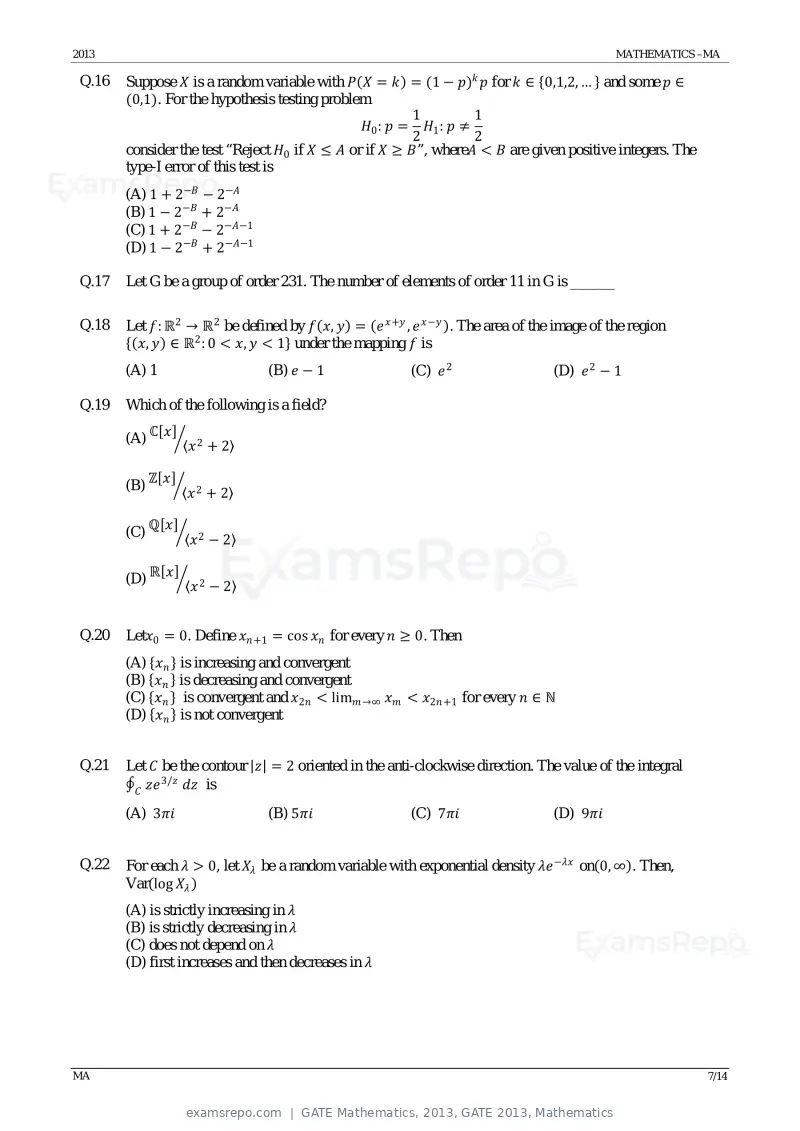
 Q.16   Suppose XX is a random variable with PP(XX = kk) = (1 − pp)kk pp for kk ∈ {0,1,2, … } and some pp ∈
        (0,1). For the hypothesis testing problem
                                                             1           1
                                                   HH0 : pp = HH1 : pp ≠
                                                             2           2
        consider the test “Reject HH0 if XX ≤ AA or if XX ≥ BB”, whereAA < BB are given positive integers. The
        type-I error of this test is
        (A) 1 + 2−BB − 2−AA
        (B) 1 − 2−BB + 2−AA
        (C) 1 + 2−BB − 2−AA−1
        (D) 1 − 2−BB + 2−AA−1

 Q.17   Let G be a group of order 231. The number of elements of order 11 in G is ______

 Q.18   Let ff: ℝ2 → ℝ2 be defined by ff(xx, yy) = (ee xx+yy , ee xx−yy ). The area of the image of the region
        {(xx, yy) ∈ ℝ2 : 0 < xx, yy < 1} under the mapping ff is
        (A) 1                     (B) ee − 1                 (C) ee 2                   (D) ee 2 − 1

 Q.19   Which of the following is a field?

        (A) ℂ[xx]�〈xx 2
                          + 2〉

        (B) ℤ[xx]�〈xx 2
                          + 2〉

        (C) ℚ[xx]�〈xx 2
                          − 2〉

        (D) ℝ[xx]�〈xx 2
                          − 2〉


 Q.20   Letxx0 = 0. Define xxnn+1 = cos xxnn for every nn ≥ 0. Then
        (A) {xxnn } is increasing and convergent
        (B) {xxnn } is decreasing and convergent
        (C) {xxnn } is convergent and xx2nn < limmm →∞ xxmm < xx2nn+1 for every nn ∈ ℕ
        (D) {xxnn } is not convergent


 Q.21   Let CC be the contour |zz| = 2 oriented in the anti-clockwise direction. The value of the integral
        ∮CC zzee 3/zz dddd is
        (A) 3ππππ                 (B) 5ππππ                  (C) 7ππππ                  (D) 9ππππ


 Q.22   For each λλ > 0, let XXλλ be a random variable with exponential density λλee −λλλλ on(0, ∞). Then,
        Var(log XXλλ )
        (A) is strictly increasing in λλ
        (B) is strictly decreasing in λλ
        (C) does not depend on λλ
        (D) first increases and then decreases in λλ


MA                                                                                                               7/14
Text of page 8
2013                                                                                                     MATHEMATICS –MA

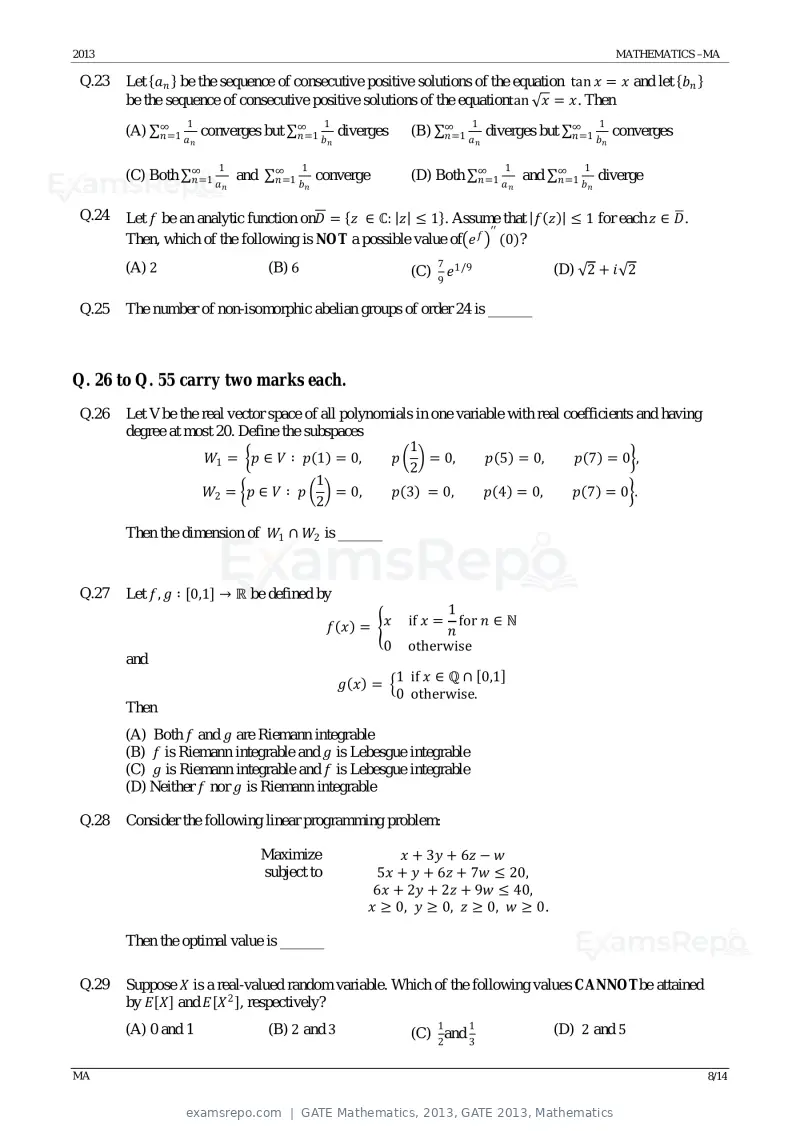
 Q.23   Let {aann } be the sequence of consecutive positive solutions of the equation tan xx = xx and let {bbnn }
        be the sequence of consecutive positive solutions of the equationtan √xx = xx. Then
                   1                          1                           1                         1
        (A) ∑∞                      ∞
             nn=1 aa converges but ∑nn=1 bb diverges           (B) ∑∞                     ∞
                                                                    nn=1 aa diverges but ∑nn=1 bb converges
                   nn                         nn                              nn                    nn

                        1                1                                         1          1
        (C) Both ∑∞            ∞
                  nn=1 aa and ∑nn=1 bb converge                (D) Both ∑∞            ∞
                                                                         nn=1 aa and ∑nn=1 bb diverge
                         nn              nn                                        nn          nn


 Q.24                                                                                                    �.
        Let ff be an analytic function onDD = {zz ∈ ℂ: |zz| ≤ 1}. Assume that |ff(zz)| ≤ 1 for each zz ∈ DD
                                                                     ff ′′
        Then, which of the following is NOT a possible value of�ee � (0)?
        (A) 2                    (B) 6                              7
                                                               (C) 9 ee 1/9               (D) √2 + ii√2

 Q.25   The number of non-isomorphic abelian groups of order 24 is ______


Q. 26 to Q. 55 carry two marks each.
 Q.26   Let V be the real vector space of all polynomials in one variable with real coefficients and having
        degree at most 20. Define the subspaces
                                                         1
                      WW1 = �pp ∈ VV ∶ pp(1) = 0,    pp � � = 0,      pp(5) = 0,      pp(7) = 0�,
                                                         2
                                          1
                     WW2 = �pp ∈ VV ∶ pp � � = 0,    pp(3) = 0,       pp(4) = 0,     pp(7) = 0�.
                                          2

        Then the dimension of WW1 ∩ WW2 is ______


 Q.27   Let ff, gg ∶ [0,1] → ℝ be defined by
                                                                    1
                                              ff(xx) = �xx     if xx =
                                                                    nn
                                                                       for nn ∈ ℕ
                                                        0      otherwise
        and
                                                             1 if xx ∈ ℚ ∩ [0,1]
                                                   gg(xx) = �
                                                             0 otherwise.
        Then
        (A) Both ff and gg are Riemann integrable
        (B) ff is Riemann integrable and gg is Lebesgue integrable
        (C) gg is Riemann integrable and ff is Lebesgue integrable
        (D) Neither ff nor gg is Riemann integrable

 Q.28   Consider the following linear programming problem:

                                Maximize                      xx + 3yy + 6zz − ww
                                subject to                5xx + yy + 6zz + 7ww ≤ 20,
                                                         6xx + 2yy + 2zz + 9ww ≤ 40,
                                                        xx ≥ 0, yy ≥ 0, zz ≥ 0, ww ≥ 0.

        Then the optimal value is ______

 Q.29   Suppose XX is a real-valued random variable. Which of the following values CANNOTbe attained
        by EE[XX] and EE[XX 2 ], respectively?
        (A) 0 and 1              (B) 2 and 3                        1     1               (D) 2 and 5
                                                               (C) 2and 3

MA                                                                                                                    8/14
Text of page 9
2013                                                                                                          MATHEMATICS –MA


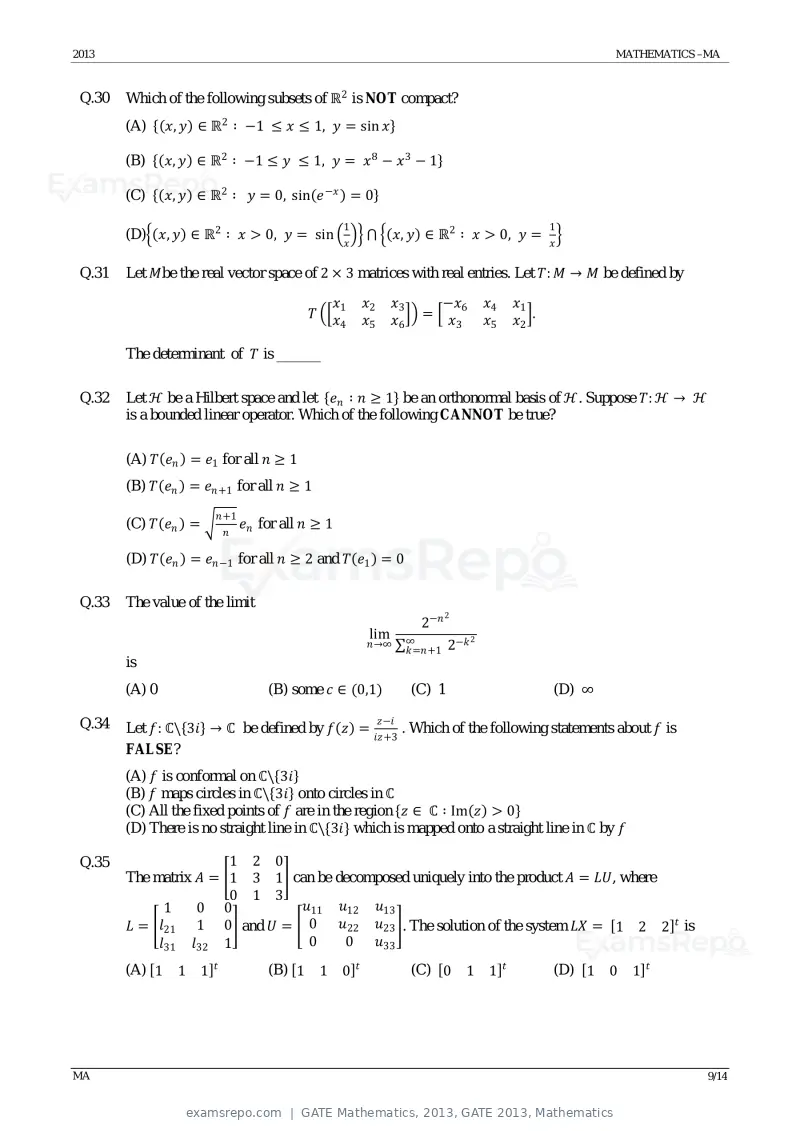
 Q.30   Which of the following subsets of ℝ2 is NOT compact?
        (A) {(xx, yy) ∈ ℝ2 ∶ −1 ≤ xx ≤ 1, yy = sin xx}

        (B) {(xx, yy) ∈ ℝ2 ∶ −1 ≤ yy ≤ 1, yy = xx 8 − xx 3 − 1}

        (C) {(xx, yy) ∈ ℝ2 ∶ yy = 0, sin(ee −xx ) = 0}

                                                    1                                                1
        (D)�(xx, yy) ∈ ℝ2 ∶ xx > 0, yy = sin �xx �� ⋂ �(xx, yy) ∈ ℝ2 ∶ xx > 0, yy = xx �

 Q.31   Let MMbe the real vector space of 2 × 3 matrices with real entries. Let TT: MM → MM be defined by
                                                  xx1    xx2       xx3       −xx6    xx4    xx1
                                             TT ��xx     xx5       xx6 �� = � xx3    xx5    xx2 �.
                                                   4

        The determinant of TT is ______

 Q.32   Let ℋ be a Hilbert space and let {eenn ∶ nn ≥ 1} be an orthonormal basis of ℋ. Suppose TT: ℋ → ℋ
        is a bounded linear operator. Which of the following CANNOT be true?

        (A) TT(eenn ) = ee1 for all nn ≥ 1
        (B) TT(eenn ) = eenn+1 for all nn ≥ 1
                         nn+1
        (C) TT(eenn ) = � nn eenn for all nn ≥ 1

        (D) TT(eenn ) = eenn−1 for all nn ≥ 2 and TT(ee1 ) = 0

 Q.33   The value of the limit
                                                                               2
                                                                        2−nn
                                                          lim             −kk 2
                                                          nn→∞ ∑∞
                                                                kk=nn+1 2
        is
        (A) 0                       (B) some cc ∈ (0,1)                (C) 1                         (D) ∞

 Q.34                                                          zz−ii
        Let ff: ℂ\{3ii} → ℂ be defined by ff(zz) = iiii+3 . Which of the following statements about ff is
        FALSE?
        (A) ff is conformal on ℂ\{3ii}
        (B) ff maps circles in ℂ\{3ii} onto circles in ℂ
        (C) All the fixed points of ff are in the region {zz ∈ ℂ ∶ Im(zz) > 0}
        (D) There is no straight line in ℂ\{3ii} which is mapped onto a straight line in ℂ by ff

 Q.35                    1 2 0
        The matrix AA = �1 3 1� can be decomposed uniquely into the product AA = LLLL, where
                         0 1 3
                1    0 0          uu11 uu12 uu13
        LL = �ll21 1 0� and UU = � 0 uu22 uu23 �. The solution of the system LLLL = [1 2 2]tt is
              ll31 ll32 1           0    0 uu33
        (A) [1    1 1]tt            (B) [1      1 0]tt                 (C) [0      1 1]tt            (D) [1   0 1]tt


MA                                                                                                                         9/14
Text of page 10
2013                                                                                               MATHEMATICS –MA

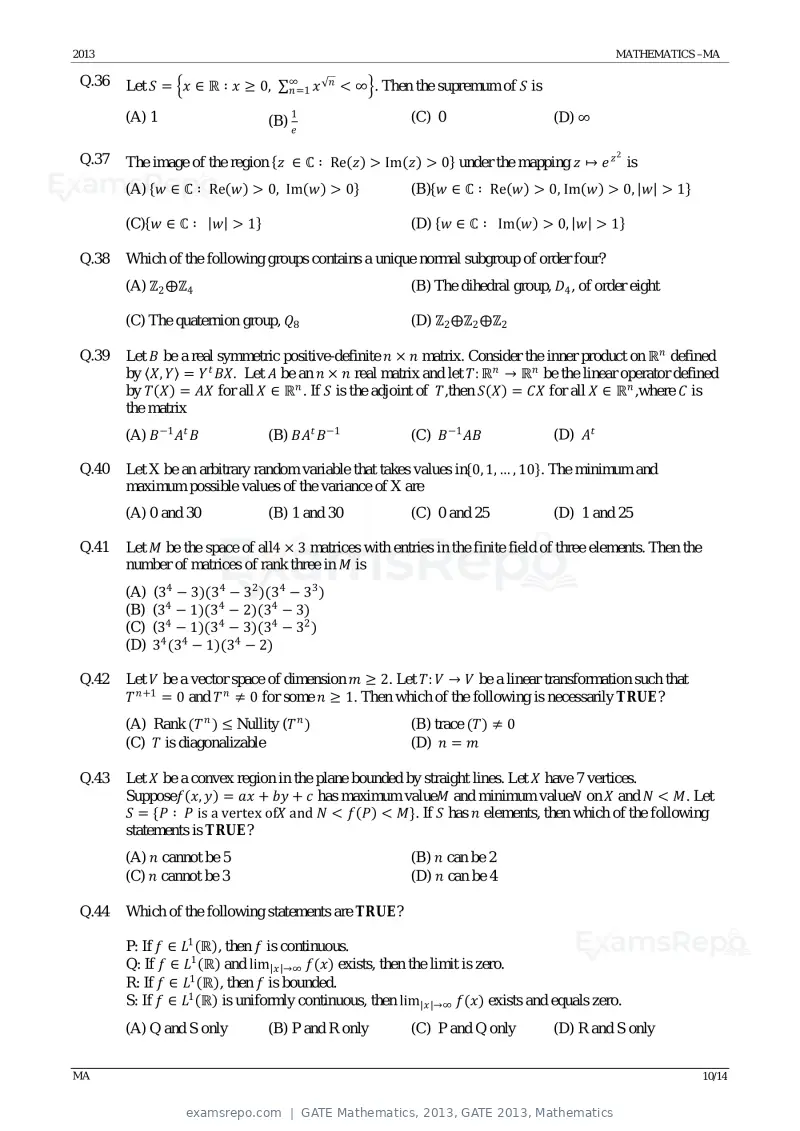
 Q.36   Let SS = �xx ∈ ℝ ∶ xx ≥ 0, ∑∞
                                    nn=1 xx
                                            √nn < ∞�. Then the supremum of SS is


        (A) 1                           1                    (C) 0                      (D) ∞
                                   (B) ee

                                                                                                    2
 Q.37   The image of the region {zz ∈ ℂ ∶ Re(zz) > Im(zz) > 0} under the mapping zz ↦ ee zz is
        (A) {ww ∈ ℂ ∶ Re(ww) > 0, Im(ww) > 0}                (B){ww ∈ ℂ ∶ Re(ww) > 0, Im(ww) > 0, |ww| > 1}

        (C){ww ∈ ℂ ∶ |ww| > 1}                               (D) {ww ∈ ℂ ∶ Im(ww) > 0, |ww| > 1}

 Q.38   Which of the following groups contains a unique normal subgroup of order four?
        (A) ℤ2 ⨁ℤ4                                           (B) The dihedral group, DD4 , of order eight

        (C) The quaternion group, QQ8                        (D) ℤ2 ⨁ℤ2 ⨁ℤ2

 Q.39   Let BB be a real symmetric positive-definite nn × nn matrix. Consider the inner product on ℝnn defined
        by 〈XX, YY〉 = YY tt BBBB. Let AA be an nn × nn real matrix and let TT: ℝnn → ℝnn be the linear operator defined
        by TT(XX) = AAAA for all XX ∈ ℝnn . If SS is the adjoint of TT,then SS(XX) = CCCC for all XX ∈ ℝnn ,where CC is
        the matrix
        (A) BB−1 AAtt BB           (B) BBAAtt BB−1           (C) BB−1 AAAA              (D) AAtt

 Q.40   Let X be an arbitrary random variable that takes values in{0, 1, … , 10}. The minimum and
        maximum possible values of the variance of X are
        (A) 0 and 30               (B) 1 and 30              (C) 0 and 25               (D) 1 and 25

 Q.41   Let MM be the space of all4 × 3 matrices with entries in the finite field of three elements. Then the
        number of matrices of rank three in MM is
        (A) (34 − 3)(34 − 32 )(34 − 33 )
        (B) (34 − 1)(34 − 2)(34 − 3)
        (C) (34 − 1)(34 − 3)(34 − 32 )
        (D) 34 (34 − 1)(34 − 2)

 Q.42   Let VV be a vector space of dimension mm ≥ 2. Let TT: VV → VV be a linear transformation such that
        TT nn+1 = 0 and TT nn ≠ 0 for some nn ≥ 1. Then which of the following is necessarily TRUE?
        (A) Rank (TT nn ) ≤ Nullity (TT nn )                 (B) trace (TT) ≠ 0
        (C) TT is diagonalizable                             (D) nn = mm

 Q.43   Let XX be a convex region in the plane bounded by straight lines. Let XX have 7 vertices.
        Supposeff(xx, yy) = aaaa + bbbb + cc has maximum valueMM and minimum valueNN on XX and NN < MM. Let
        SS = {PP ∶ PP is a vertex ofXX and NN < ff(PP) < MM}. If SS has nn elements, then which of the following
        statements is TRUE?
        (A) nn cannot be 5                                   (B) nn can be 2
        (C) nn cannot be 3                                   (D) nn can be 4

 Q.44   Which of the following statements are TRUE?

        P: If ff ∈ LL1 (ℝ), then ff is continuous.
        Q: If ff ∈ LL1 (ℝ) and lim|xx|→∞ ff(xx) exists, then the limit is zero.
        R: If ff ∈ LL1 (ℝ), then ff is bounded.
        S: If ff ∈ LL1 (ℝ) is uniformly continuous, then lim|xx|→∞ ff(xx) exists and equals zero.
        (A) Q and S only           (B) P and R only          (C) P and Q only           (D) R and S only


MA                                                                                                                  10/14
Text of page 11
2013                                                                                                          MATHEMATICS –MA

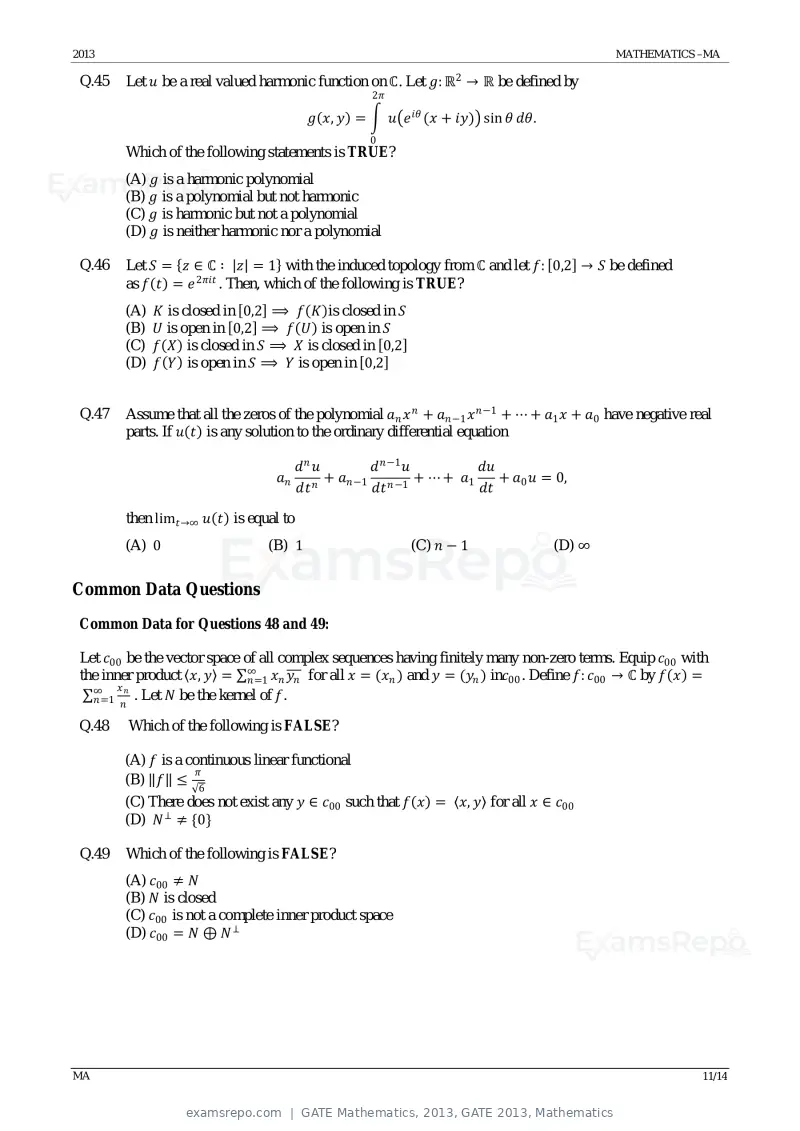
 Q.45     Let uu be a real valued harmonic function on ℂ. Let gg: ℝ2 → ℝ be defined by
                                                              2ππ

                                                gg(xx, yy) = � uu�ee iiii (xx + iiii)� sin θθ dddd.
                                                              0
          Which of the following statements is TRUE?
         (A) gg is a harmonic polynomial
         (B) gg is a polynomial but not harmonic
         (C) gg is harmonic but not a polynomial
         (D) gg is neither harmonic nor a polynomial

 Q.46     Let SS = {zz ∈ ℂ ∶ |zz| = 1} with the induced topology from ℂ and let ff: [0,2] → SS be defined
          as ff(tt) = ee 2ππππππ . Then, which of the following is TRUE?
         (A) KK is closed in [0,2] ⟹ ff(KK)is closed in SS
         (B) UU is open in [0,2] ⟹ ff(UU) is open in SS
         (C) ff(XX) is closed in SS ⟹ XX is closed in [0,2]
         (D) ff(YY) is open in SS ⟹ YY is open in [0,2]


 Q.47     Assume that all the zeros of the polynomial aann xx nn + aann−1 xx nn−1 + ⋯ + aa1 xx + aa0 have negative real
          parts. If uu(tt) is any solution to the ordinary differential equation

                                              ddnn uu          ddnn−1 uu           dddd
                                       aann        nn
                                                      + aann−1      nn−1
                                                                         + ⋯ + aa1      + aa0 uu = 0,
                                              ddtt             ddtt                dddd

          then limtt→∞ uu(tt) is equal to
         (A) 0                       (B) 1                             (C) nn − 1                     (D) ∞


Common Data Questions
 Common Data for Questions 48 and 49:

 Let cc00 be the vector space of all complex sequences having finitely many non-zero terms. Equip cc00 with
 the inner product 〈xx, yy〉 = ∑∞
                               nn=1 xxnn yynn for all xx = (xxnn ) and yy = (yynn ) incc00 . Define ff: cc00 → ℂ by ff(xx) =
   ∞    xx nn
  ∑nn=1 . Let NN be the kernel of ff.
        nn

 Q.48        Which of the following is FALSE?

         (A) ff is a continuous linear functional
                      ππ
         (B) ‖ff‖ ≤ 6
                      √
         (C) There does not exist any yy ∈ cc00 such that ff(xx) = 〈xx, yy〉 for all xx ∈ cc00
         (D) NN ⊥ ≠ {0}

 Q.49     Which of the following is FALSE?
         (A) cc00 ≠ NN
         (B) NN is closed
         (C) cc00 is not a complete inner product space
         (D) cc00 = NN ⊕ NN ⊥


MA                                                                                                                        11/14
Text of page 12
2013                                                                                                           MATHEMATICS –MA

 Common Data for Questions 50 and 51:

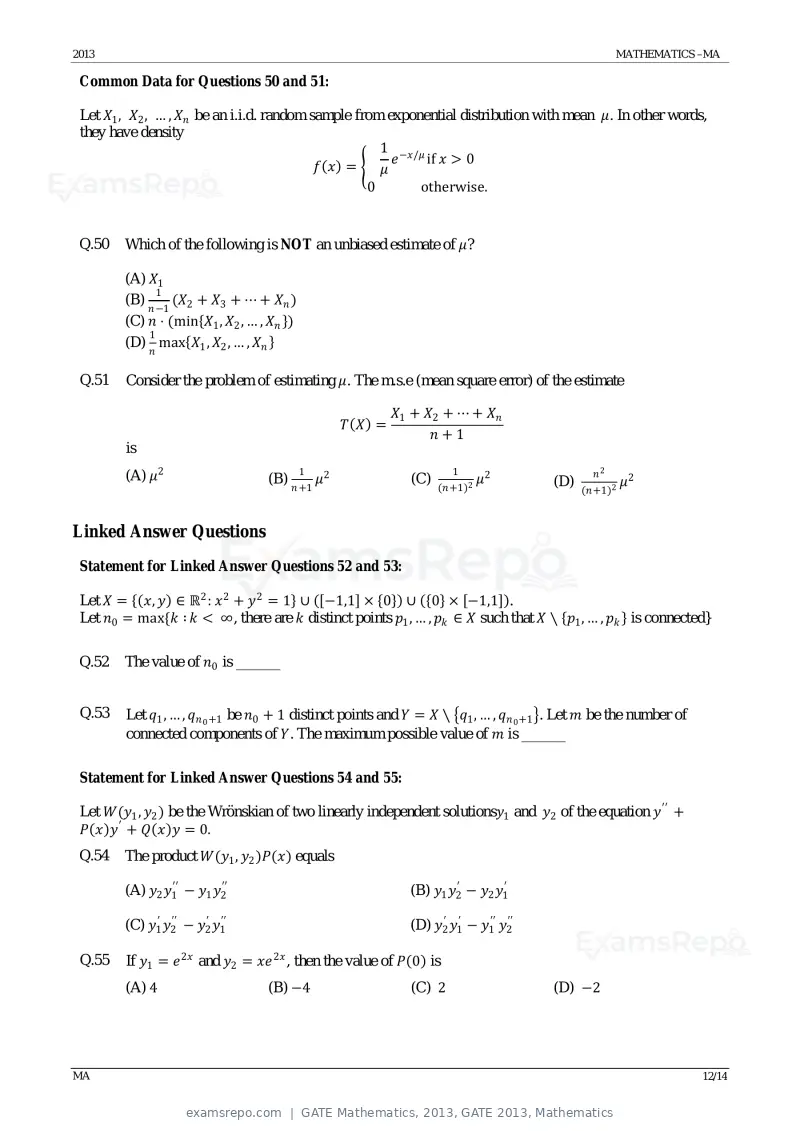
 Let XX1 , XX2 , … , XXnn be an i.i.d. random sample from exponential distribution with mean μμ. In other words,
 they have density
                                                           1 −xx/μμ
                                                             ee     if xx > 0
                                               ff(xx) = � μμ
                                                         0        otherwise.


 Q.50    Which of the following is NOT an unbiased estimate of μμ?

         (A) XX1
               1
         (B) nn−1 (XX2 + XX3 + ⋯ + XXnn )
         (C) nn ⋅ (min{XX1 , XX2 , … , XXnn })
             1
         (D) max{XX1 , XX2 , … , XXnn }
               nn

 Q.51    Consider the problem of estimating μμ. The m.s.e (mean square error) of the estimate

                                                                 XX1 + XX2 + ⋯ + XXnn
                                                      TT(XX) =
                                                                        nn + 1
         is
         (A) μμ2                                 1
                                       (B) nn+1 μμ2
                                                                               1
                                                                    (C) (nn+1)2 μμ2               (D)
                                                                                                           nn 2
                                                                                                                μμ2
                                                                                                        (nn+1)2


Linked Answer Questions
 Statement for Linked Answer Questions 52 and 53:

 Let XX = {(xx, yy) ∈ ℝ2 : xx 2 + yy 2 = 1} ∪ ([−1,1] × {0}) ∪ ({0} × [−1,1]).
 Let nn0 = max{kk ∶ kk < ∞, there are kk distinct points pp1 , … , ppkk ∈ XX such that XX ∖ {pp1 , … , ppkk } is connected}

 Q.52    The value of nn0 is ______


 Q.53    Let qq1 , … , qqnn 0 +1 be nn0 + 1 distinct points and YY = XX ∖ �qq1 , … , qqnn 0 +1 �. Let mm be the number of
         connected components of YY. The maximum possible value of mm is ______

 Statement for Linked Answer Questions 54 and 55:

 Let WW(yy1 , yy2 ) be the Wrönskian of two linearly independent solutionsyy1 and yy2 of the equation yy ′′ +
 PP(xx)yy ′ + QQ(xx)yy = 0.
 Q.54    The product WW(yy1 , yy2 )PP(xx) equals

         (A) yy2 yy1′′ − yy1 yy2′′                                  (B) yy1 yy2′ − yy2 yy1′

         (C) yy1′ yy2′′ − yy2′ yy1′′                                (D) yy2′ yy1′ − yy1′′ yy2′′

 Q.55    If yy1 = ee 2xx and yy2 = xxxx 2xx , then the value of PP(0) is
         (A) 4                         (B) −4                       (C) 2                         (D) −2


MA                                                                                                                          12/14
Text of page 13
2013                                                                                           MATHEMATICS –MA

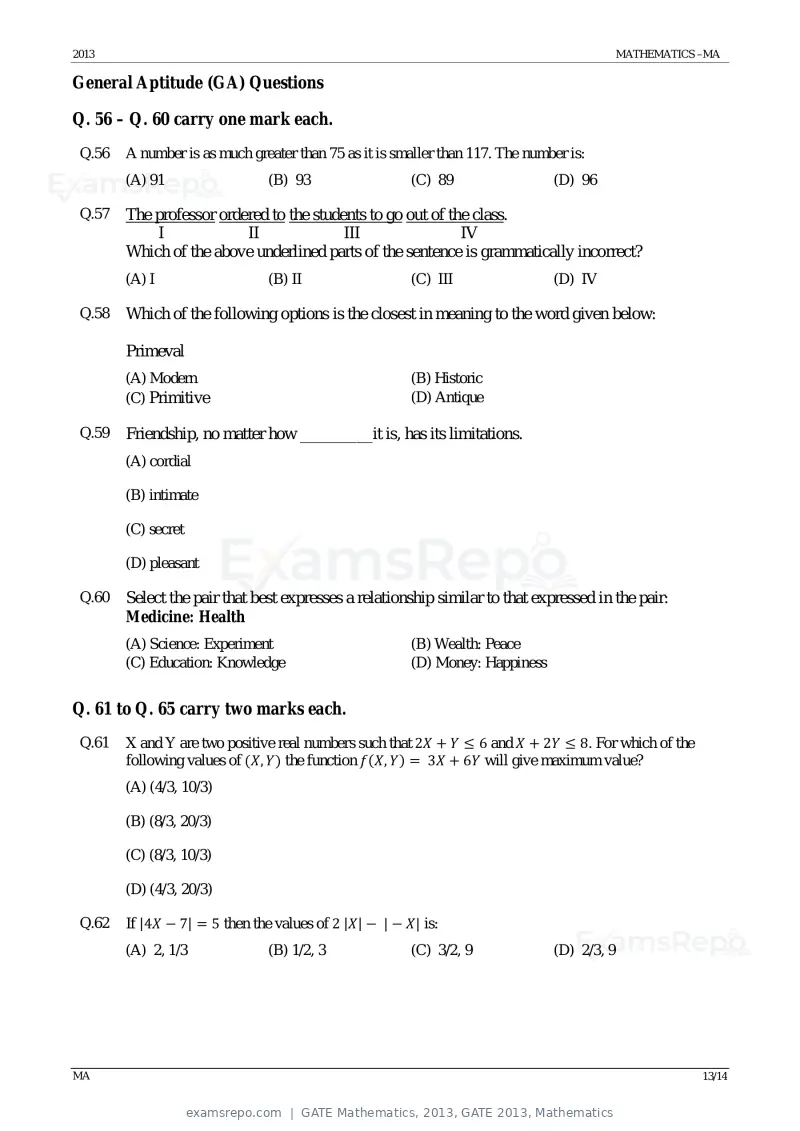
General Aptitude (GA) Questions

Q. 56 – Q. 60 carry one mark each.
 Q.56   A number is as much greater than 75 as it is smaller than 117. The number is:
        (A) 91                   (B) 93                    (C) 89                 (D) 96

 Q.57   The professor ordered to the students to go out of the class.
            I             II              III                IV
        Which of the above underlined parts of the sentence is grammatically incorrect?
        (A) I                    (B) II                    (C) III                (D) IV

 Q.58   Which of the following options is the closest in meaning to the word given below:

        Primeval
        (A) Modern                                         (B) Historic
        (C) Primitive                                      (D) Antique

 Q.59   Friendship, no matter how _________it is, has its limitations.
        (A) cordial

        (B) intimate

        (C) secret

        (D) pleasant

 Q.60   Select the pair that best expresses a relationship similar to that expressed in the pair:
        Medicine: Health
        (A) Science: Experiment                            (B) Wealth: Peace
        (C) Education: Knowledge                           (D) Money: Happiness


Q. 61 to Q. 65 carry two marks each.
 Q.61   X and Y are two positive real numbers such that 2XX + YY ≤ 6 and XX + 2YY ≤ 8. For which of the
        following values of (XX, YY) the function ff(XX, YY) = 3XX + 6YY will give maximum value?
        (A) (4/3, 10/3)

        (B) (8/3, 20/3)

        (C) (8/3, 10/3)

        (D) (4/3, 20/3)

 Q.62   If |4XX − 7| = 5 then the values of 2 |XX| − | − XX| is:
        (A) 2, 1/3               (B) 1/2, 3                (C) 3/2, 9             (D) 2/3, 9


MA                                                                                                         13/14
Text of page 14
2013                                                                                       MATHEMATICS –MA

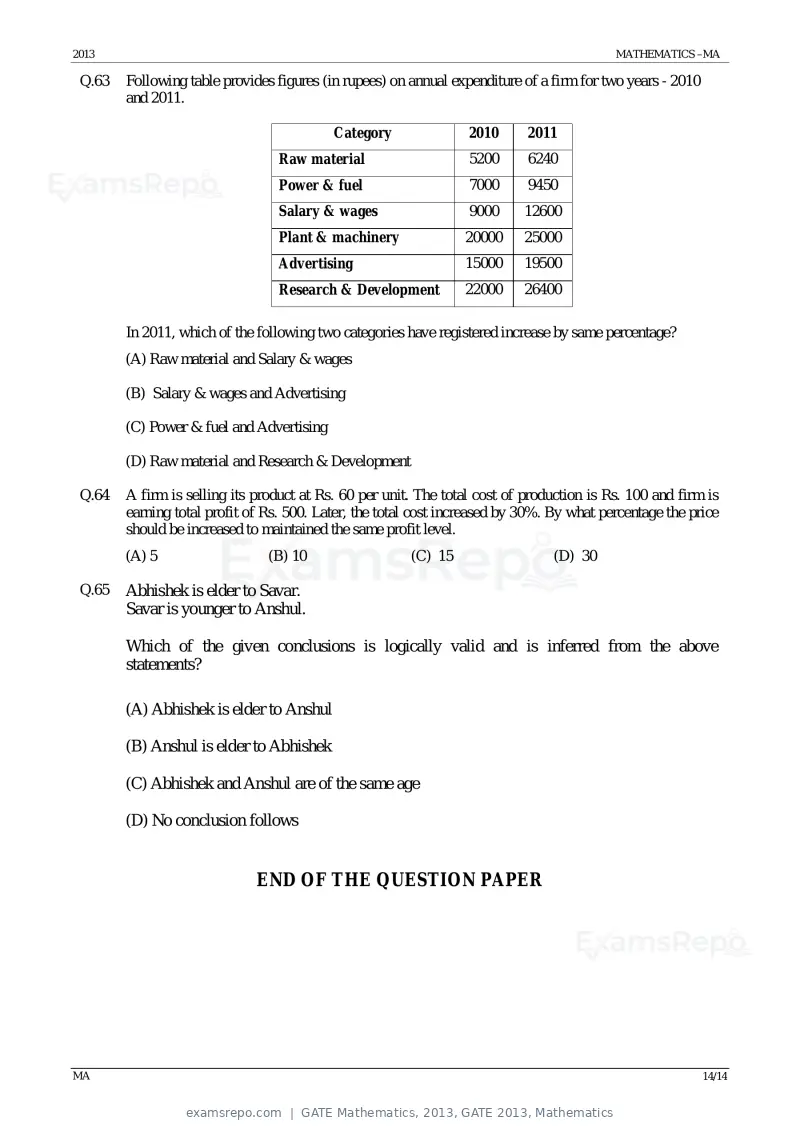
 Q.63   Following table provides figures (in rupees) on annual expenditure of a firm for two years - 2010
        and 2011.

                                           Category               2010      2011
                                  Raw material                    5200      6240
                                  Power & fuel                    7000      9450
                                  Salary & wages                  9000     12600
                                  Plant & machinery              20000     25000
                                  Advertising                    15000     19500
                                  Research & Development         22000     26400

        In 2011, which of the following two categories have registered increase by same percentage?
        (A) Raw material and Salary & wages

        (B) Salary & wages and Advertising

        (C) Power & fuel and Advertising

        (D) Raw material and Research & Development

 Q.64   A firm is selling its product at Rs. 60 per unit. The total cost of production is Rs. 100 and firm is
        earning total profit of Rs. 500. Later, the total cost increased by 30%. By what percentage the price
        should be increased to maintained the same profit level.
        (A) 5                   (B) 10                  (C) 15                  (D) 30

 Q.65   Abhishek is elder to Savar.
        Savar is younger to Anshul.

        Which of the given conclusions is logically valid and is inferred from the above
        statements?

        (A) Abhishek is elder to Anshul

        (B) Anshul is elder to Abhishek

        (C) Abhishek and Anshul are of the same age

        (D) No conclusion follows


                              END OF THE QUESTION PAPER


MA                                                                                                          14/14
Official key not published for this paper.
Page 1 of 14
Source: GATE. Question paper published by GATE.