
GATE Mathematics 2014
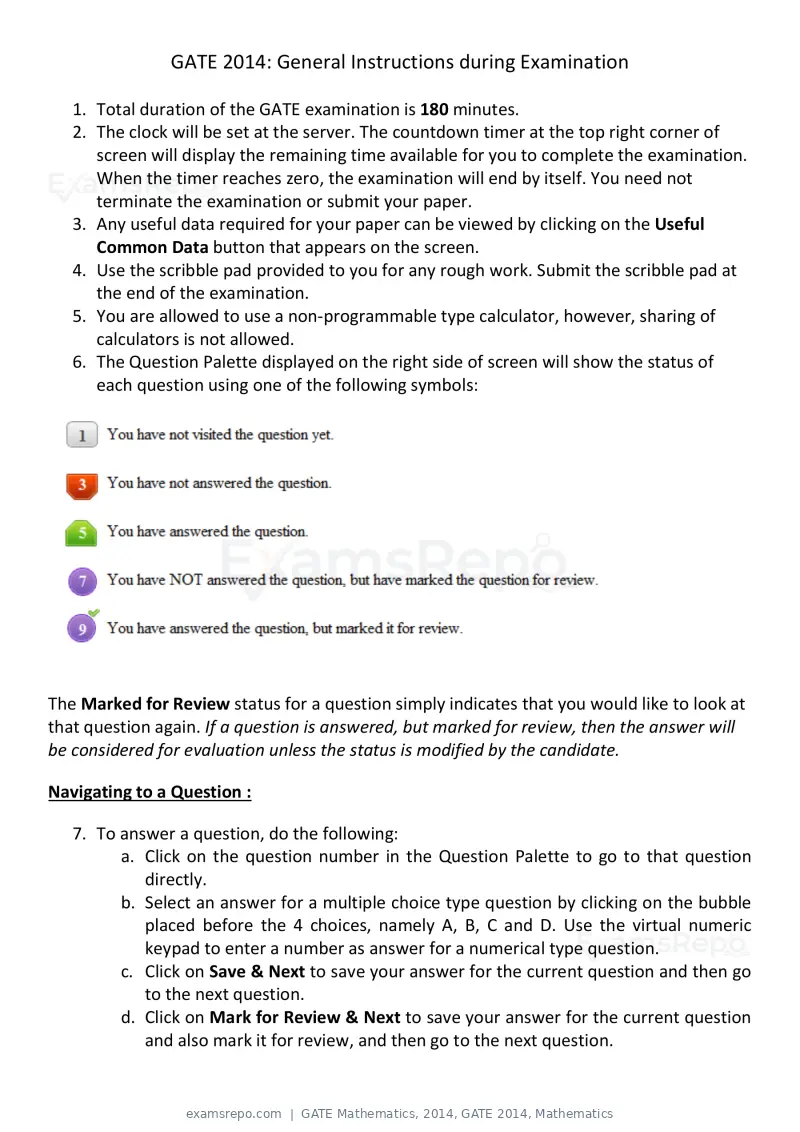
Text of page 1
GATE 2014: General Instructions during Examination

   1. Total duration of the GATE examination is 180 minutes.
   2. The clock will be set at the server. The countdown timer at the top right corner of
      screen will display the remaining time available for you to complete the examination.
      When the timer reaches zero, the examination will end by itself. You need not
      terminate the examination or submit your paper.
   3. Any useful data required for your paper can be viewed by clicking on the Useful
      Common Data button that appears on the screen.
   4. Use the scribble pad provided to you for any rough work. Submit the scribble pad at
      the end of the examination.
   5. You are allowed to use a non-programmable type calculator, however, sharing of
      calculators is not allowed.
   6. The Question Palette displayed on the right side of screen will show the status of
      each question using one of the following symbols:


The Marked for Review status for a question simply indicates that you would like to look at
that question again. If a question is answered, but marked for review, then the answer will
be considered for evaluation unless the status is modified by the candidate.

Navigating to a Question :

   7. To answer a question, do the following:
         a. Click on the question number in the Question Palette to go to that question
            directly.
         b. Select an answer for a multiple choice type question by clicking on the bubble
            placed before the 4 choices, namely A, B, C and D. Use the virtual numeric
            keypad to enter a number as answer for a numerical type question.
         c. Click on Save & Next to save your answer for the current question and then go
            to the next question.
         d. Click on Mark for Review & Next to save your answer for the current question
            and also mark it for review, and then go to the next question.
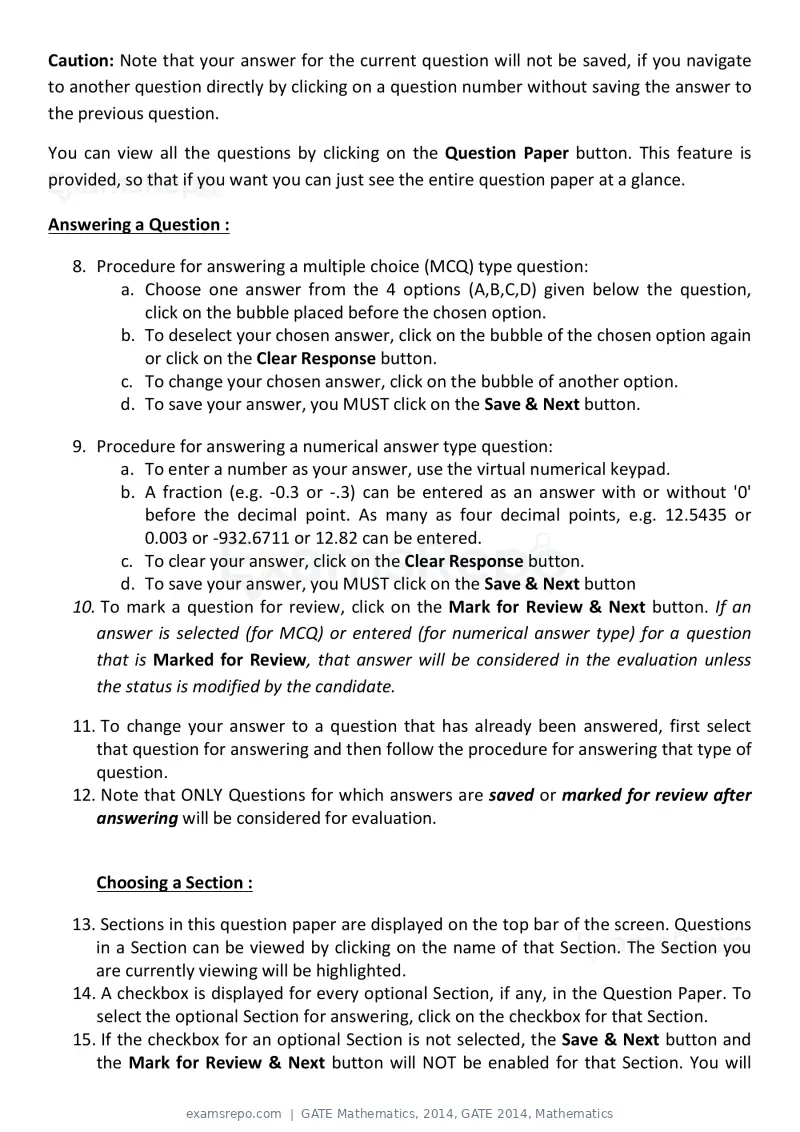
Text of page 2
Caution: Note that your answer for the current question will not be saved, if you navigate
to another question directly by clicking on a question number without saving the answer to
the previous question.

You can view all the questions by clicking on the Question Paper button. This feature is
provided, so that if you want you can just see the entire question paper at a glance.

Answering a Question :

   8. Procedure for answering a multiple choice (MCQ) type question:
         a. Choose one answer from the 4 options (A,B,C,D) given below the question,
            click on the bubble placed before the chosen option.
         b. To deselect your chosen answer, click on the bubble of the chosen option again
            or click on the Clear Response button.
         c. To change your chosen answer, click on the bubble of another option.
         d. To save your answer, you MUST click on the Save & Next button.

   9. Procedure for answering a numerical answer type question:
         a. To enter a number as your answer, use the virtual numerical keypad.
         b. A fraction (e.g. -0.3 or -.3) can be entered as an answer with or without '0'
             before the decimal point. As many as four decimal points, e.g. 12.5435 or
             0.003 or -932.6711 or 12.82 can be entered.
         c. To clear your answer, click on the Clear Response button.
         d. To save your answer, you MUST click on the Save & Next button
   10. To mark a question for review, click on the Mark for Review & Next button. If an
      answer is selected (for MCQ) or entered (for numerical answer type) for a question
      that is Marked for Review, that answer will be considered in the evaluation unless
      the status is modified by the candidate.

   11. To change your answer to a question that has already been answered, first select
      that question for answering and then follow the procedure for answering that type of
      question.
   12. Note that ONLY Questions for which answers are saved or marked for review after
      answering will be considered for evaluation.


      Choosing a Section :

   13. Sections in this question paper are displayed on the top bar of the screen. Questions
      in a Section can be viewed by clicking on the name of that Section. The Section you
      are currently viewing will be highlighted.
   14. A checkbox is displayed for every optional Section, if any, in the Question Paper. To
      select the optional Section for answering, click on the checkbox for that Section.
   15. If the checkbox for an optional Section is not selected, the Save & Next button and
      the Mark for Review & Next button will NOT be enabled for that Section. You will
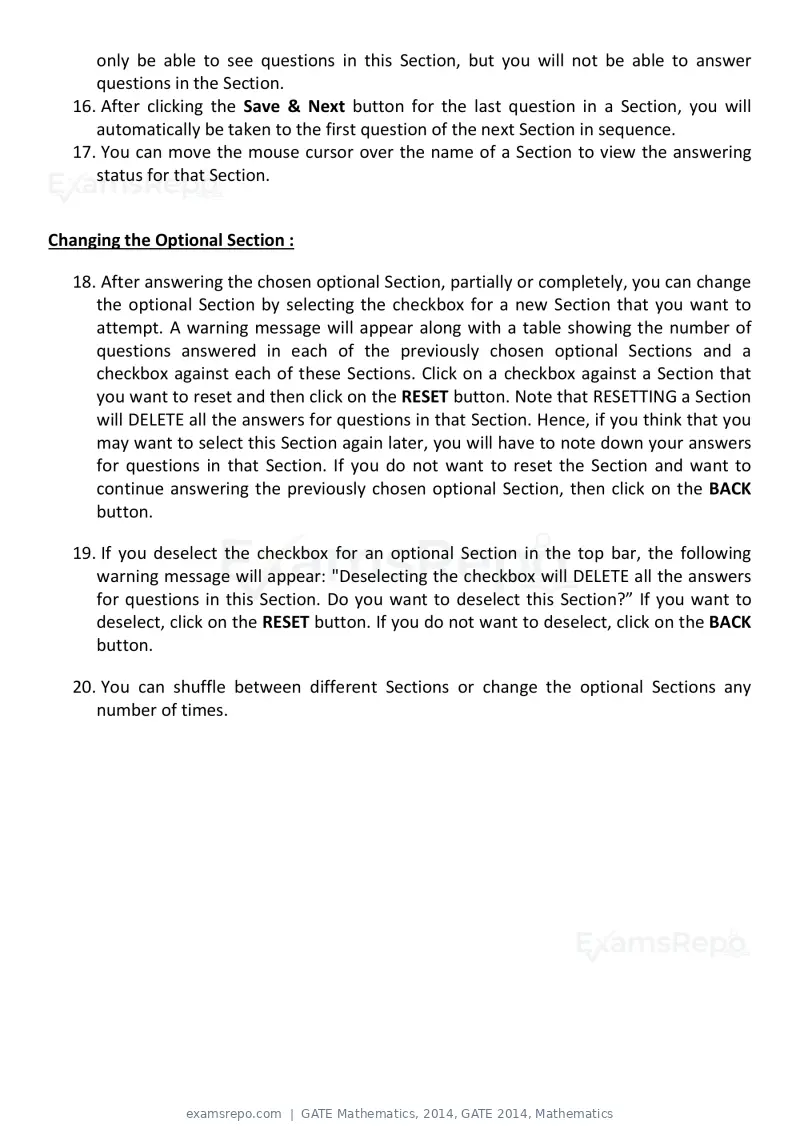
Text of page 3
only be able to see questions in this Section, but you will not be able to answer
      questions in the Section.
   16. After clicking the Save & Next button for the last question in a Section, you will
      automatically be taken to the first question of the next Section in sequence.
   17. You can move the mouse cursor over the name of a Section to view the answering
      status for that Section.


Changing the Optional Section :

   18. After answering the chosen optional Section, partially or completely, you can change
      the optional Section by selecting the checkbox for a new Section that you want to
      attempt. A warning message will appear along with a table showing the number of
      questions answered in each of the previously chosen optional Sections and a
      checkbox against each of these Sections. Click on a checkbox against a Section that
      you want to reset and then click on the RESET button. Note that RESETTING a Section
      will DELETE all the answers for questions in that Section. Hence, if you think that you
      may want to select this Section again later, you will have to note down your answers
      for questions in that Section. If you do not want to reset the Section and want to
      continue answering the previously chosen optional Section, then click on the BACK
      button.

   19. If you deselect the checkbox for an optional Section in the top bar, the following
      warning message will appear: "Deselecting the checkbox will DELETE all the answers
      for questions in this Section. Do you want to deselect this Section?” If you want to
      deselect, click on the RESET button. If you do not want to deselect, click on the BACK
      button.

   20. You can shuffle between different Sections or change the optional Sections any
      number of times.
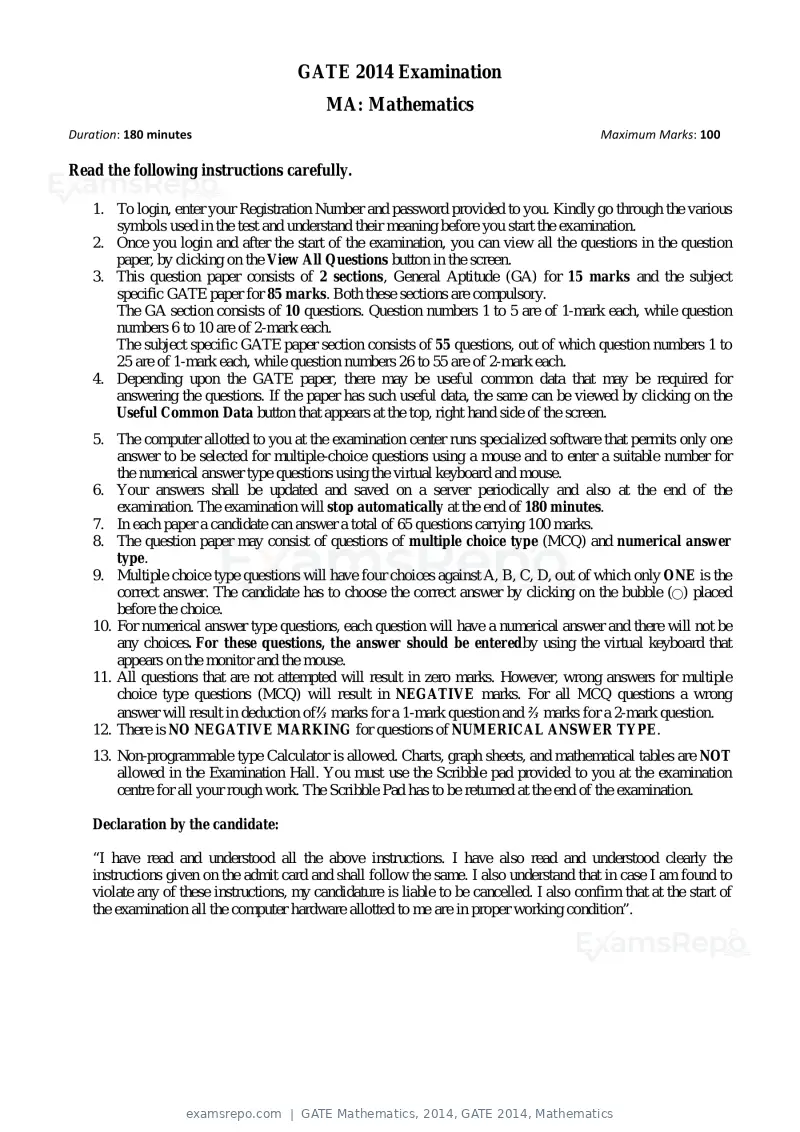
Text of page 4
GATE 2014 Examination
                                             MA: Mathematics
Duration: 180 minutes                                                                        Maximum Marks: 100

Read the following instructions carefully.

    1. To login, enter your Registration Number and password provided to you. Kindly go through the various
       symbols used in the test and understand their meaning before you start the examination.
    2. Once you login and after the start of the examination, you can view all the questions in the question
       paper, by clicking on the View All Questions button in the screen.
    3. This question paper consists of 2 sections, General Aptitude (GA) for 15 marks and the subject
       specific GATE paper for 85 marks. Both these sections are compulsory.
       The GA section consists of 10 questions. Question numbers 1 to 5 are of 1-mark each, while question
       numbers 6 to 10 are of 2-mark each.
       The subject specific GATE paper section consists of 55 questions, out of which question numbers 1 to
       25 are of 1-mark each, while question numbers 26 to 55 are of 2-mark each.
    4. Depending upon the GATE paper, there may be useful common data that may be required for
       answering the questions. If the paper has such useful data, the same can be viewed by clicking on the
       Useful Common Data button that appears at the top, right hand side of the screen.
    5. The computer allotted to you at the examination center runs specialized software that permits only one
        answer to be selected for multiple-choice questions using a mouse and to enter a suitable number for
        the numerical answer type questions using the virtual keyboard and mouse.
    6. Your answers shall be updated and saved on a server periodically and also at the end of the
        examination. The examination will stop automatically at the end of 180 minutes.
    7. In each paper a candidate can answer a total of 65 questions carrying 100 marks.
    8. The question paper may consist of questions of multiple choice type (MCQ) and numerical answer
        type.
    9. Multiple choice type questions will have four choices against A, B, C, D, out of which only ONE is the
        correct answer. The candidate has to choose the correct answer by clicking on the bubble (⃝) placed
        before the choice.
    10. For numerical answer type questions, each question will have a numerical answer and there will not be
        any choices. For these questions, the answer should be enteredby using the virtual keyboard that
        appears on the monitor and the mouse.
    11. All questions that are not attempted will result in zero marks. However, wrong answers for multiple
        choice type questions (MCQ) will result in NEGATIVE marks. For all MCQ questions a wrong
        answer will result in deduction of⅓ marks for a 1-mark question and ⅔ marks for a 2-mark question.
    12. There is NO NEGATIVE MARKING for questions of NUMERICAL ANSWER TYPE.
    13. Non-programmable type Calculator is allowed. Charts, graph sheets, and mathematical tables are NOT
        allowed in the Examination Hall. You must use the Scribble pad provided to you at the examination
        centre for all your rough work. The Scribble Pad has to be returned at the end of the examination.

    Declaration by the candidate:

    “I have read and understood all the above instructions. I have also read and understood clearly the
    instructions given on the admit card and shall follow the same. I also understand that in case I am found to
    violate any of these instructions, my candidature is liable to be cancelled. I also confirm that at the start of
    the examination all the computer hardware allotted to me are in proper working condition”.
Text of page 5
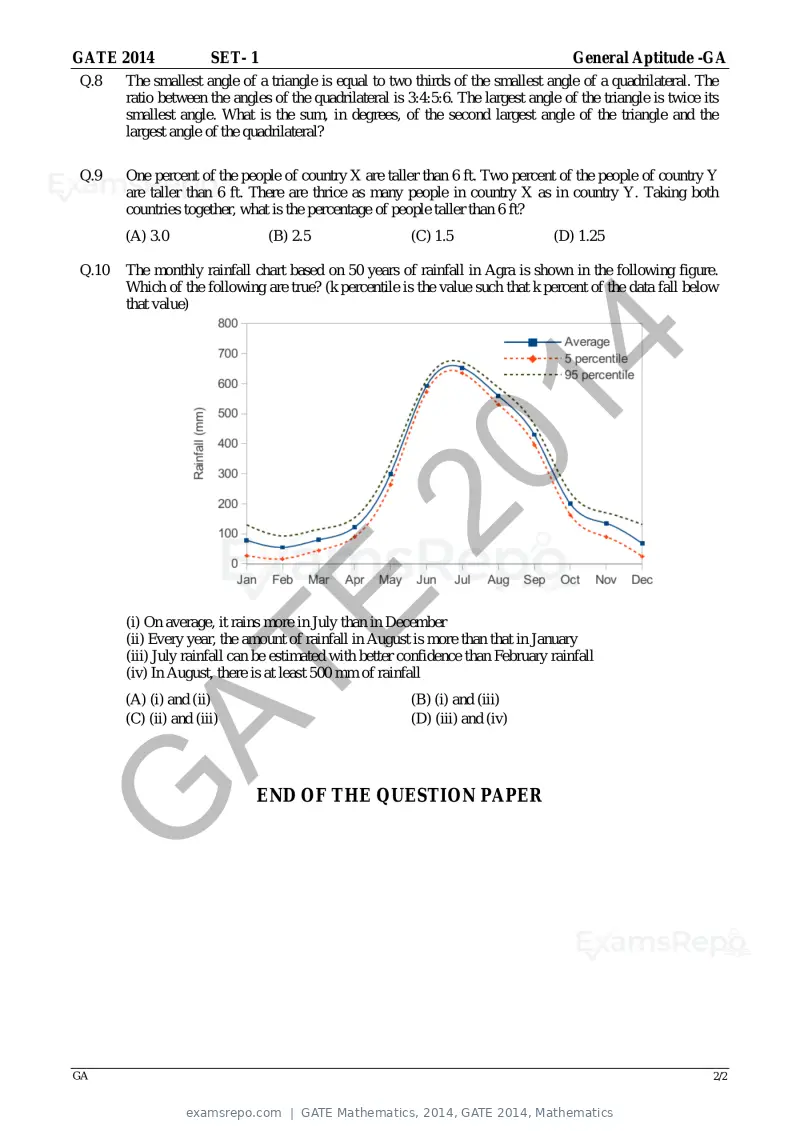
GATE 2014             SET- 1                                                         General Aptitude -GA

Q. 1 – Q. 5 carry one mark each.
Q.1    A student is required to demonstrate a high level of comprehension of the subject, especially in the
       social sciences.

       The word closest in meaning to comprehension is
      (A) understanding          (B) meaning              (C) concentration       (D) stability

Q.2    Choose the most appropriate word from the options given below to complete the following
       sentence.

       One of his biggest ______ was his ability to forgive.
      (A) vice                   (B) virtues              (C) choices             (D) strength


                                             14
Q.3    Rajan was not happy that Sajan decided to do the project on his own. On observing his
       unhappiness, Sajan explained to Rajan that he preferred to work independently.

       Which one of the statements below is logically valid and can be inferred from the above sentences?
      (A) Rajan has decided to work only in a group.
      (B) Rajan and Sajan were formed into a group against their wishes.


Q.4
                                           20
      (C) Sajan had decided to give in to Rajan’s request to work with him.
      (D) Rajan had believed that Sajan and he would be working together.

       If y = 5x2 + 3, then the tangent at x = 0, y = 3
      (A) passes through x = 0, y = 0                     (B) has a slope of +1
      (C) is parallel to the x-axis                       (D) has a slope of −1

Q.5    A foundry has a fixed daily cost of Rs 50,000 whenever it operates and a variable cost of Rs 800Q,
                          E
       where Q is the daily production in tonnes. What is the cost of production in Rs per tonne for a daily
       production of 100 tonnes?
 AT


Q. 6 – Q. 10 carry two marks each.

Q.6    Find the odd one in the following group: ALRVX, EPVZB, ITZDF, OYEIK
      (A) ALRVX                  (B) EPVZB                (C) ITZDF               (D) OYEIK
G


Q.7    Anuj, Bhola, Chandan, Dilip, Eswar and Faisal live on different floors in a six-storeyed building
       (the ground floor is numbered 1, the floor above it 2, and so on). Anuj lives on an even-numbered
       floor. Bhola does not live on an odd numbered floor. Chandan does not live on any of the floors
       below Faisal’s floor. Dilip does not live on floor number 2. Eswar does not live on a floor
       immediately above or immediately below Bhola. Faisal lives three floors above Dilip. Which of the
       following floor-person combinations is correct?

                          Anuj          Bhola        Chandan         Dilip        Eswar           Faisal
           (A)             6              2             5             1             3               4
           (B)             2              6             5             1             3               4
           (C)             4              2             6             3             1               5
           (D)             2              4             6             1             3               5


GA                                                                                                         1/2
Text of page 6
GATE 2014              SET- 1                                                        General Aptitude -GA
Q.8    The smallest angle of a triangle is equal to two thirds of the smallest angle of a quadrilateral. The
       ratio between the angles of the quadrilateral is 3:4:5:6. The largest angle of the triangle is twice its
       smallest angle. What is the sum, in degrees, of the second largest angle of the triangle and the
       largest angle of the quadrilateral?

Q.9    One percent of the people of country X are taller than 6 ft. Two percent of the people of country Y
       are taller than 6 ft. There are thrice as many people in country X as in country Y. Taking both
       countries together, what is the percentage of people taller than 6 ft?
       (A) 3.0                  (B) 2.5                  (C) 1.5                  (D) 1.25

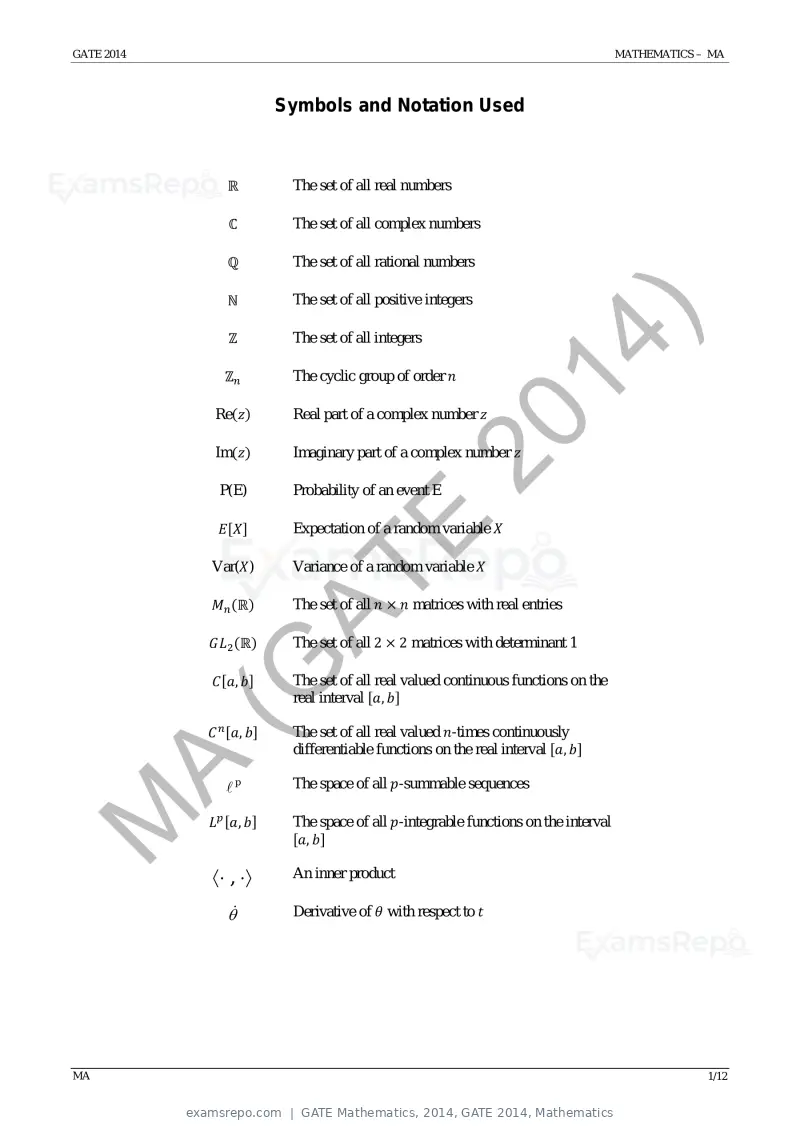
Q.10   The monthly rainfall chart based on 50 years of rainfall in Agra is shown in the following figure.
       Which of the following are true? (k percentile is the value such that k percent of the data fall below
       that value)


                                            14
                                          20
                            E
       (i) On average, it rains more in July than in December
       (ii) Every year, the amount of rainfall in August is more than that in January
       (iii) July rainfall can be estimated with better confidence than February rainfall
 AT


       (iv) In August, there is at least 500 mm of rainfall
       (A) (i) and (ii)                                  (B) (i) and (iii)
       (C) (ii) and (iii)                                (D) (iii) and (iv)
G


                             END OF THE QUESTION PAPER


GA                                                                                                            2/2
Text of page 7
GATE 2014 MATHEMATICS – MA
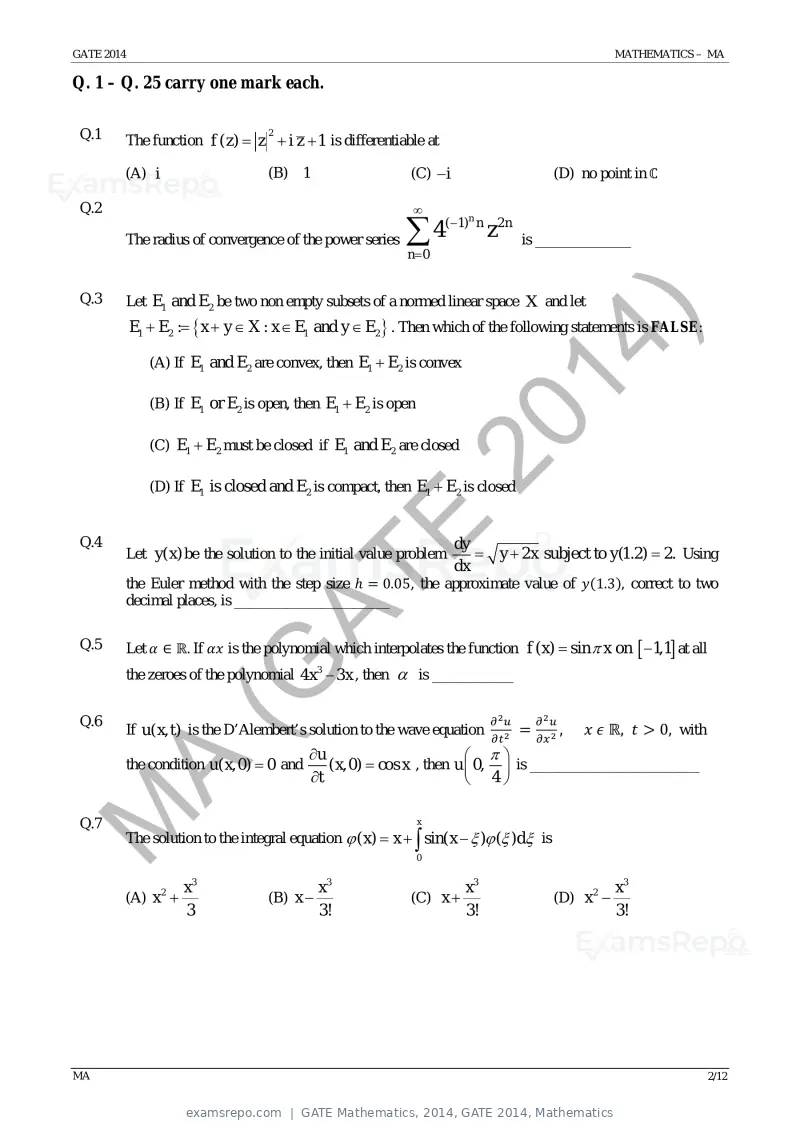
Symbols and Notation Used
ℝ The set of all real numbers
ℂ The set of all complex numbers
ℚ The set of all rational numbers
ℕ The set of all positive integers
)
ℤ The set of all integers
14
ℤn The cyclic group of order n
Re(z) Real part of a complex number z
20
Im(z) Imaginary part of a complex number z
P(E) Probability of an event E
E
E[X] Expectation of a random variable X
Var(X) Variance of a random variable X
AT
Mn (ℝ) The set of all n × n matrices with real entries
GL2 (ℝ) The set of all 2 × 2 matrices with determinant 1
(G
C[a, b] The set of all real valued continuous functions on the
real interval [a, b]
C n [a, b] The set of all real valued n-times continuously
differentiable functions on the real interval [a, b]
A
p The space of all p-summable sequences
M
Lp [a, b] The space of all p-integrable functions on the interval
[a, b]
〈⋅ , ⋅〉 An inner product
θ Derivative of θ with respect to t
MA 1/12
Text of page 8
GATE 2014 MATHEMATICS – MA
Q. 1 – Q. 25 carry one mark each.
Q.1 The function f ( z ) = z + i z + 1 is differentiable at
2
(A) i (B) 1 (C) −i (D) no point in ℂ
Q.2 ∞
The radius of convergence of the power series ∑
4( −1) n z 2 n is _____________
n
n =0
Q.3 Let E1 and E2 be two non empty subsets of a normed linear space X and let
)
E1 + E2 := { x + y ∈ X : x ∈ E1 and y ∈ E2 } . Then which of the following statements is FALSE:
14
(A) If E1 and E2 are convex, then E1 + E2 is convex
(B) If E1 or E2 is open, then E1 + E2 is open
20
(C) E1 + E2 must be closed if E1 and E2 are closed
(D) If E1 is closed and E2 is compact, then E1 + E2 is closed
E
Q.4 dy
Let y ( x) be the solution to the initial value problem =
y + 2 x subject to y (1.2) =
2. Using
dx
AT
the Euler method with the step size ℎ = 0.05, the approximate value of y(1.3), correct to two
decimal places, is _____________________
Q.5 =
Let α ∈ ℝ. If αx is the polynomial which interpolates the function f ( x) sin π x on [ −1,1] at all
(G
the zeroes of the polynomial 4 x 3 − 3 x , then α is ___________
Q.6 ∂2 u ∂2 u
If u ( x, t ) is the D’Alembert’s solution to the wave equation = ∂x 2 , x ε ℝ, t > 0, with
∂t 2
∂u π
the condition u ( x, 0) = 0 and ( x, 0) = cos x , then u 0, is _______________________
A
∂t 4
M
Q.7 x
The solution to the integral equation ϕ ( x) = ∫
x + sin( x − ξ )ϕ (ξ )d ξ is
0
x3 x3 x3 x3
(A) x + 2
(B) x − (C) x + (D) x −
2
3 3! 3! 3!
MA 2/12
Text of page 9
GATE 2014 MATHEMATICS – MA
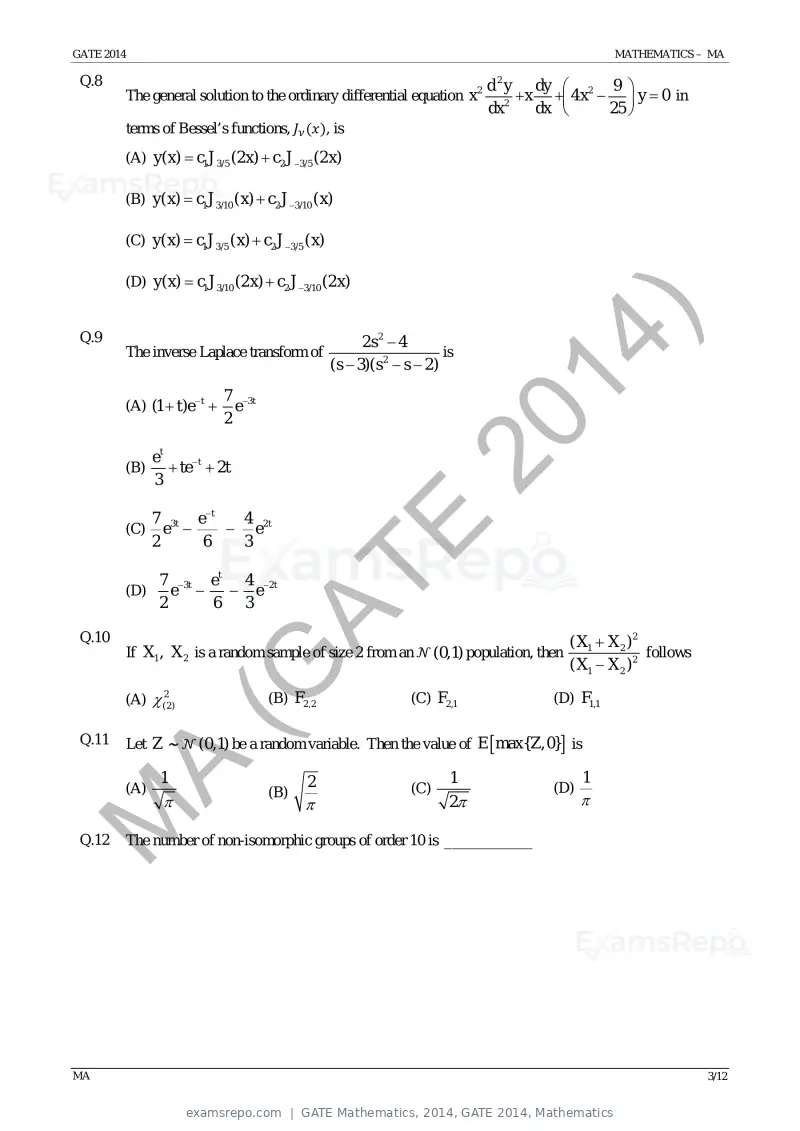
Q.8 d2y dy 9
The general solution to the ordinary differential equation x 2 +x + 4 x 2 − y =
0 in
dx 2
dx 25
terms of Bessel’s functions, Jν (x), is
=
(A) y ( x) c1 J 3/5 (2 x) + c2 J −3/5 (2 x)
=
(B) y ( x) c1 J 3/10 ( x) + c2 J −3/10 ( x)
=
(C) y ( x) c1 J 3/5 ( x) + c2 J −3/5 ( x)
=
(D) y ( x) c1 J 3/10 (2 x) + c2 J −3/10 (2 x)
)
Q.9 2s 2 − 4
14
The inverse Laplace transform of is
( s − 3)( s 2 − s − 2)
7 −3t
(A) (1 + t )e − t + e
2
20
et
(B) + te − t + 2t
3
7 3t e − t 4
E
(C) e − − e 2t
2 6 3
AT
7 −3t et 4 −2t
(D) e − − e
2 6 3
Q.10 ( X 1 + X 2 )2
If X 1 , X 2 is a random sample of size 2 from an NN (0,1) population, then follows
( X1 − X 2 )2
(G
(A) χ (2)
2
(B) F2,2 (C) F2,1 (D) F1,1
Q.11 Let Z ~ NN (0,1) be a random variable. Then the value of E [ max{Z , 0}] is
A
1 2 1 1
(A) (B) (C) (D)
π π 2π π
M
Q.12 The number of non-isomorphic groups of order 10 is ___________
MA 3/12
Text of page 10
GATE 2014 MATHEMATICS – MA
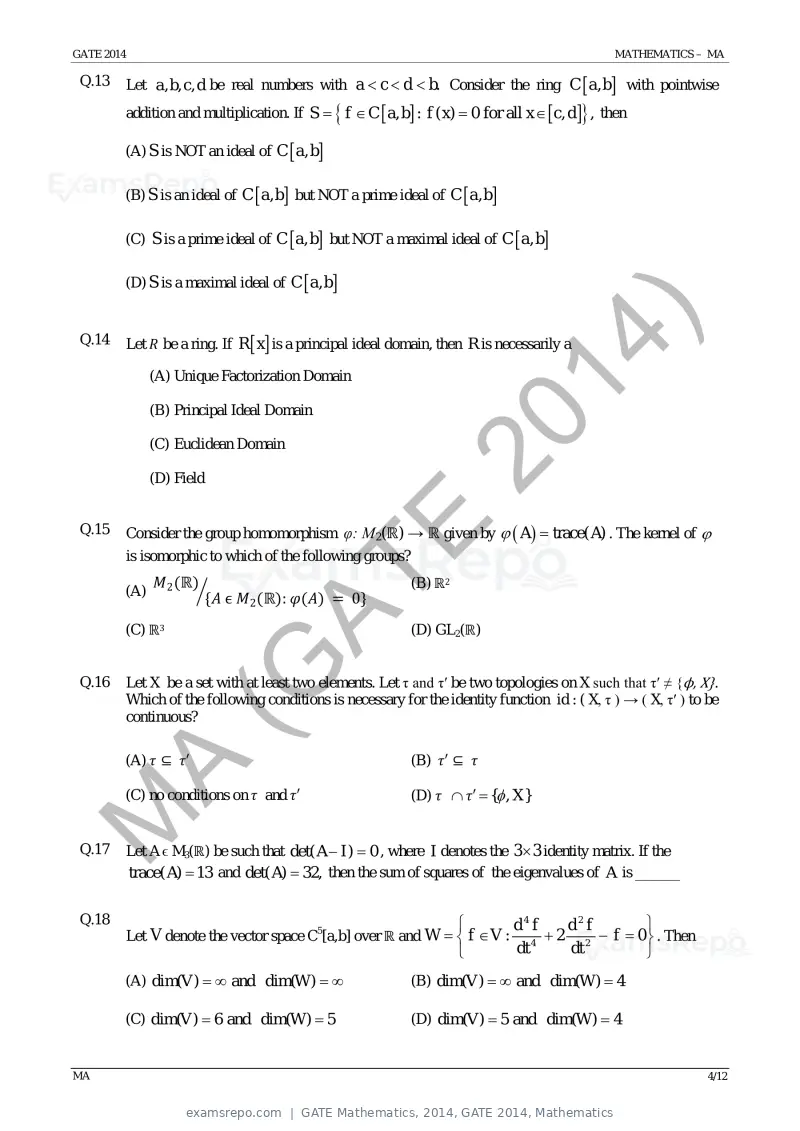
Q.13 Let a, b, c, d be real numbers with a < c < d < b. Consider the ring C [ a, b ] with pointwise
{
f ∈ C [ a, b ] : f ( x) =∈
addition and multiplication. If S = }
0 for all x [ c, d ] , then
(A) S is NOT an ideal of C [ a, b ]
(B) S is an ideal of C [ a, b ] but NOT a prime ideal of C [ a, b ]
(C) S is a prime ideal of C [ a, b ] but NOT a maximal ideal of C [ a, b ]
(D) S is a maximal ideal of C [ a, b ]
)
Q.14 Let R be a ring. If R [ x ] is a principal ideal domain, then R is necessarily a
14
(A) Unique Factorization Domain
(B) Principal Ideal Domain
20
(C) Euclidean Domain
(D) Field
E
Q.15 Consider the group homomorphism φ: M2(ℝ) → ℝ given by ϕ ( A ) = trace( A) . The kernel of ϕ
is isomorphic to which of the following groups?
AT
M2 (ℝ) (B) ℝ2
(A) �
{A ϵ M2 (ℝ): φ(A) = 0}
(C) ℝ3 (D) GL2(ℝ)
(G
Q.16 Let X be a set with at least two elements. Let τ and τ′ be two topologies on X such that τ′ ≠ {ϕ, X}.
Which of the following conditions is necessary for the identity function id : ( X, τ ) → ( X, τ′ ) to be
continuous?
(A) τ ⊆ τ′ (B) τ′ ⊆ τ
A
(C) no conditions on τ and τ′ (D) τ ∩ τ′ = {φ , X }
M
Q.17 0 , where I denotes the 3 × 3 identity matrix. If the
Let A ϵ M3(ℝ) be such that det( A − I ) =
trace( A) = 13 and det( A) = 32, then the sum of squares of the eigenvalues of A is ______
Q.18 d4 f d2 f
Let V denote the vector space C [a,b] over ℝ and W = f ∈ V : 4 + 2 2 − f = 0 . Then
5
dt dt
(A) dim(V ) =
∞ and dim(W ) =
∞ (B) dim(V ) =
∞ and dim(W ) =
4
=
(C) dim(V ) 6=
and dim(W ) 5 =
(D) dim(V ) 5=
and dim(W ) 4
MA 4/12
Text of page 11
GATE 2014 MATHEMATICS – MA
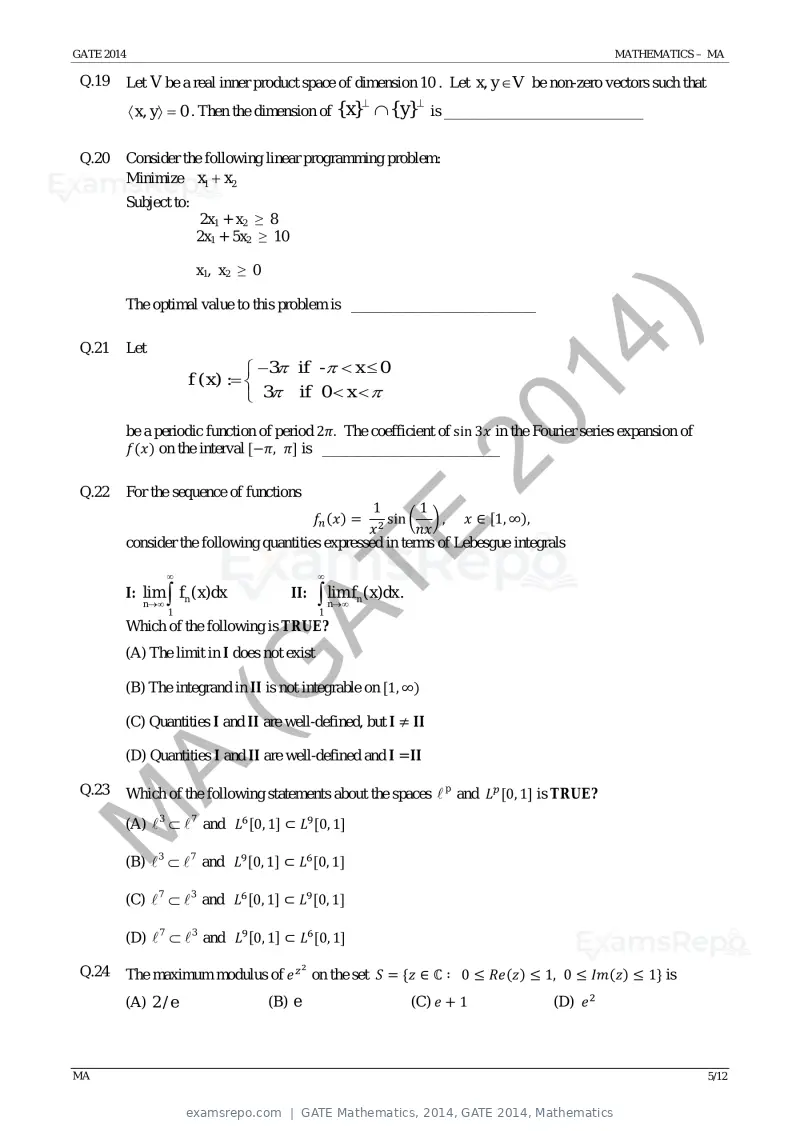
Q.19 Let V be a real inner product space of dimension 10 . Let x, y ∈ V be non-zero vectors such that
⊥
〈 x, y〉 =0 . Then the dimension of {x} ∩ { y}⊥ is ___________________________
Q.20 Consider the following linear programming problem:
Minimize x1 + x2
Subject to:
2x1 + x2 ≥ 8
2x1 + 5x2 ≥ 10
x1, x2 ≥ 0
The optimal value to this problem is _________________________
)
14
Q.21 Let
−3π if -π < x ≤ 0
f ( x) :=
3π if 0 < x < π
20
be a periodic function of period 2π. The coefficient of sin 3x in the Fourier series expansion of
f(x) on the interval [−π, π] is ________________________
Q.22 For the sequence of functions
1 1
sin � � , x ∈ [1, ∞),
fn (x) =
E
x 2 nx
consider the following quantities expressed in terms of Lebesgue integrals
AT
∞ ∞
I: lim
n →∞ ∫ f ( x)dx
1
n II: ∫ lim f ( x)dx .
1
n →∞
n
Which of the following is TRUE?
(A) The limit in I does not exist
(G
(B) The integrand in II is not integrable on [1, ∞)
(C) Quantities I and II are well-defined, but I ≠ II
(D) Quantities I and II are well-defined and I = II
A
Q.23 Which of the following statements about the spaces p and Lp [0, 1] is TRUE?
M
(A) 3 ⊂ 7 and L6 [0, 1] ⊂ L9 [0, 1]
(B) 3 ⊂ 7 and L9 [0, 1] ⊂ L6 [0, 1]
(C) 7 ⊂ 3 and L6 [0, 1] ⊂ L9 [0, 1]
(D) 7 ⊂ 3 and L9 [0, 1] ⊂ L6 [0, 1]
2
Q.24 The maximum modulus of e z on the set S = {z ∈ ℂ ∶ 0 ≤ Re(z) ≤ 1, 0 ≤ Im(z) ≤ 1} is
(A) 2 / e (B) e (C) e + 1 (D) e 2
MA 5/12
Text of page 12
GATE 2014                                                                                                             MATHEMATICS – MA

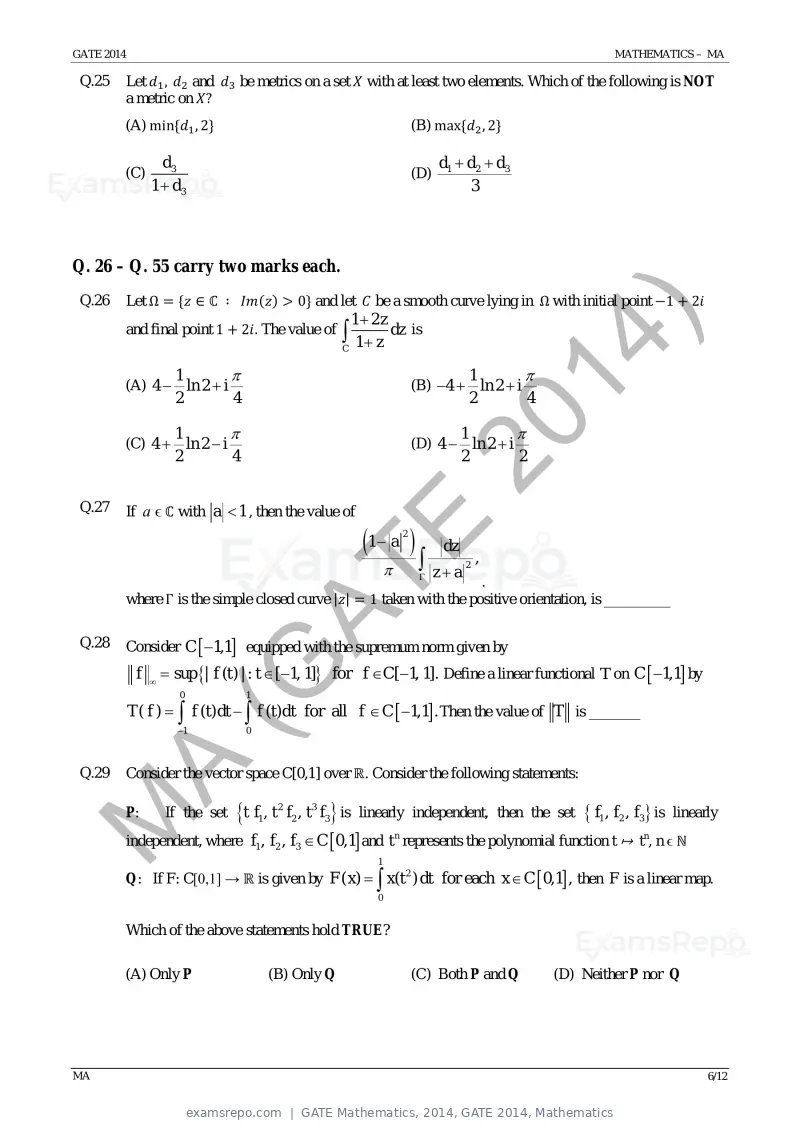
 Q.25       Let d1 , d2 and d3 be metrics on a set X with at least two elements. Which of the following is NOT
            a metric on X?
        (A) min{d1 , 2}                                                          (B) max{d2 , 2}

                   d3                                                                  d1 + d 2 + d3
        (C)                                                                      (D)
                 1 + d3                                                                      3


Q. 26 – Q. 55 carry two marks each.
 Q.26       Let Ω = {z ∈ ℂ ∶ Im(z) > 0} and let C be a smooth curve lying in Ω with initial point −1 + 2i
                                                                 1+ 2 z


                                                                                                               )
            and final point 1 + 2i. The value of             ∫ 1 + z dz is


                                                                                                  14
                                                             C


                     1          π                                                            1          π
        (A) 4 −        ln 2 + i                                                  (B) −4 +      ln 2 + i
                     2          4                                                            2          4


                                                                                 20
                     1          π                                                           1          π
        (C) 4 +        ln 2 − i                                                  (D) 4 −      ln 2 + i
                     2          4                                                           2          2


 Q.27       If ɑ ϵ ℂ with a < 1 , then the value of
                                                             E
                                                                  (1 − a )   2
                                                                                       dz
                                                                         π        ∫ z+a ,   2
                                        AT

                                                                                  Γ
                                                                        .
            where Γ is the simple closed curve |z| = 1 taken with the positive orientation, is _________

 Q.28       Consider C [ −1,1] equipped with the supremum norm given by
  f ∞ sup {| f (t ) | : t ∈ [−1, 1]} for f ∈C[−1, 1]. Define a linear functional T on C [ −1,1] by
                    (G


 =
                     0              1
            T=
             (f)     ∫ f (t )dt − ∫ f (t )dt for all f ∈ C [ −1,1]. Then the value of T is _______
                     −1             0
     A


 Q.29       Consider the vector space C[0,1] over ℝ. Consider the following statements:

            P:     If the set   {t f , t f , t f } is linearly independent, then the set { f , f , f } is linearly
                                             2       3
M


                                        1        2       3                                                        1   2   3

            independent, where f1 , f 2 , f 3 ∈ C [ 0,1] and t n represents the polynomial function t ↦ tn, n ϵ ℕ
                                                                     1
            Q: If F: C[0,1] →=
                             ℝ is given by F ( x)                    ∫ x(t ) dt for each x ∈ C [0,1] , then F is a linear map.
                                                                             2

                                                                     0


            Which of the above statements hold TRUE?

        (A) Only P                          (B) Only Q                           (C) Both P and Q           (D) Neither P nor Q


MA                                                                                                                                 6/12
Text of page 13
GATE 2014 MATHEMATICS – MA
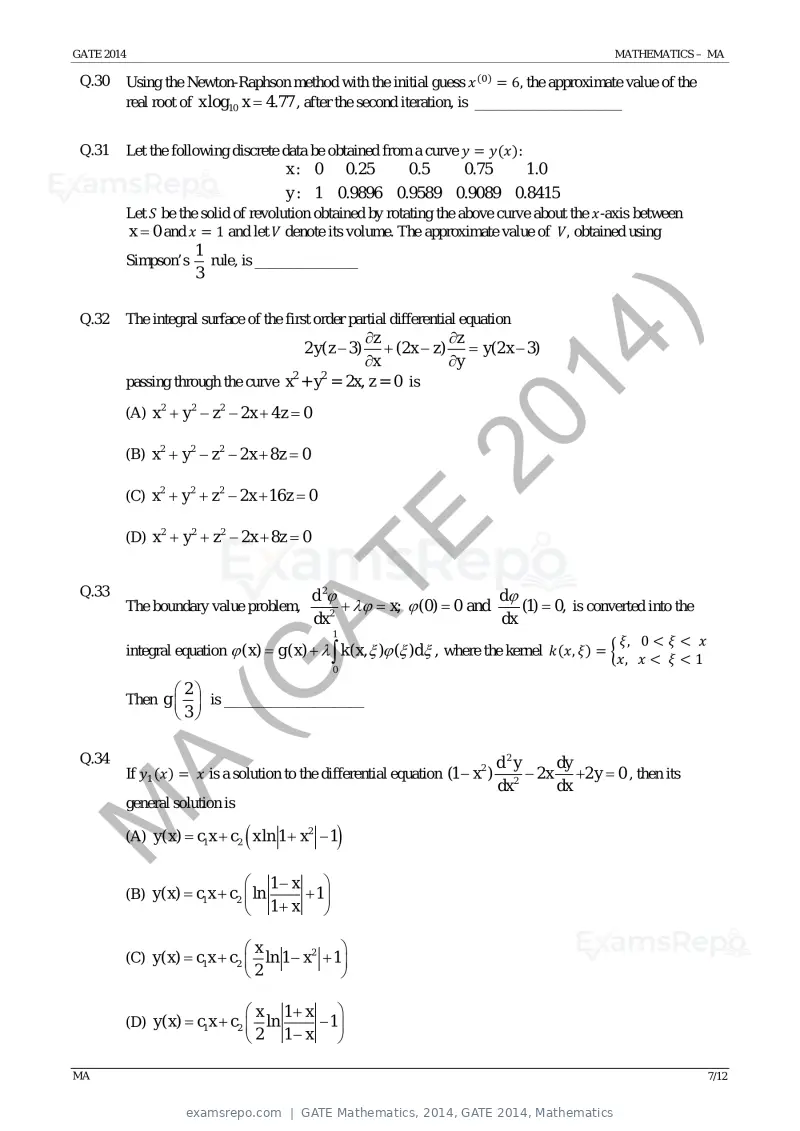
Q.30 Using the Newton-Raphson method with the initial guess x (0) = 6, the approximate value of the
real root of x log10 x = 4.77 , after the second iteration, is ____________________
Q.31 Let the following discrete data be obtained from a curve y = y(x):
x : 0 0.25 0.5 0.75 1.0
y : 1 0.9896 0.9589 0.9089 0.8415
Let S be the solid of revolution obtained by rotating the above curve about the x-axis between
x = 0 and x = 1 and let V denote its volume. The approximate value of V, obtained using
1
Simpson’s rule, is ______________
3
)
Q.32 The integral surface of the first order partial differential equation
∂z ∂z
14
2 y ( z − 3)
+ (2 x − z ) = y (2 x − 3)
∂x ∂y
2 2
passing through the curve x + y = 2x, z = 0 is
(A) x 2 + y 2 − z 2 − 2 x + 4 z =
0
20
(B) x 2 + y 2 − z 2 − 2 x + 8 z =
0
(C) x 2 + y 2 + z 2 − 2 x + 16 z =
0
E
(D) x 2 + y 2 + z 2 − 2 x + 8 z =
0
AT
Q.33 d 2ϕ dϕ
The boundary value problem, 2
+ λϕ
= x; ϕ (0)
= 0 and =
(1) 0, is converted into the
dx dx
1
ξ, 0 < ξ < x
integral equation ϕ= ∫
( x) g ( x) + λ k ( x, ξ )ϕ (ξ )d ξ , where the kernel k(x, ξ) = �
x, x < ξ < 1
(G
0
2
Then g is ___________________
3
Q.34 d2y dy
A
If y1 (x) = x is a solution to the differential equation (1 − x 2 ) 2
− 2 x +2 y =
0 , then its
dx dx
general solution is
M
(
(A) y ( x) = c1 x + c2 x ln 1 + x 2 − 1 )
1− x
(B) y ( x) =
c1 x + c2 ln + 1
1+ x
x
(C) y ( x) = c1 x + c2 ln 1 − x 2 + 1
2
x 1+ x
(D) y ( x) =
c1 x + c2 ln − 1
2 1− x
MA 7/12
Text of page 14
GATE 2014 MATHEMATICS – MA
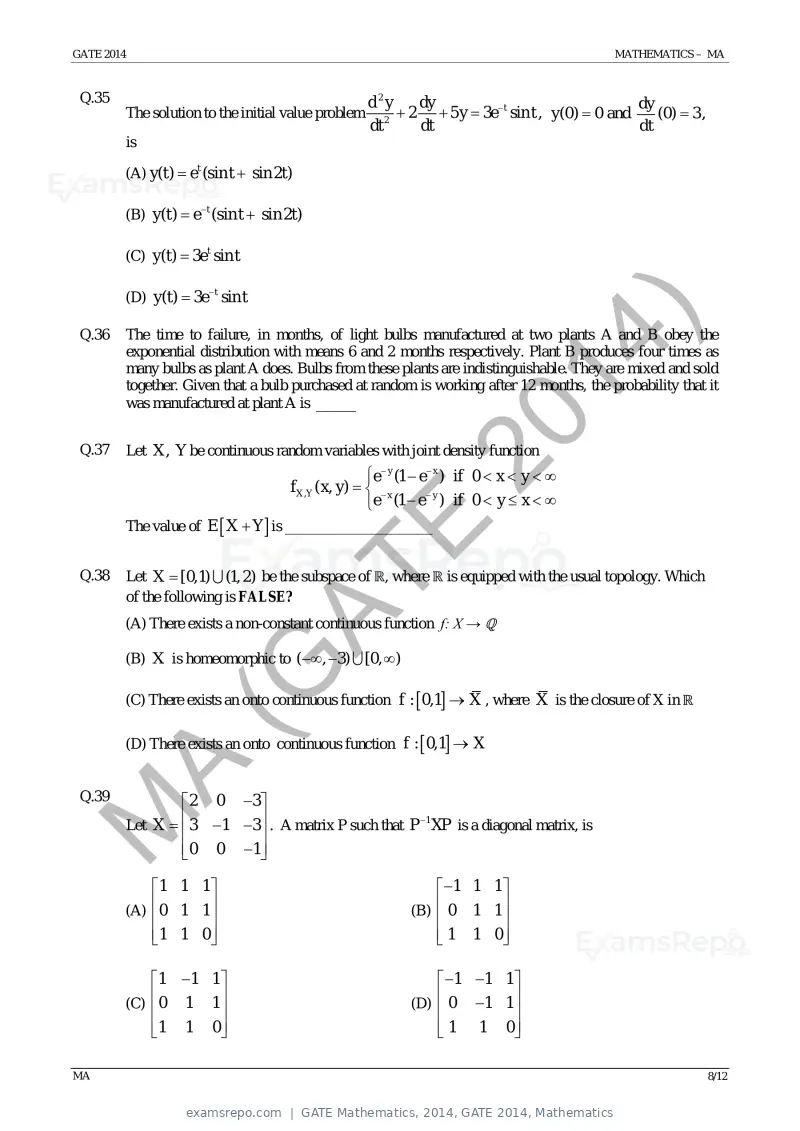
Q.35 d2y dy dy
The solution to the initial value problem 2
3e −=
+ 2 + 5y = t
sin t , y (0) 0=
and (0) 3,
dt dt dt
is
=
(A) y (t ) et (sin t + sin 2t )
=
(B) y (t ) e − t (sin t + sin 2t )
(C) y (t ) = 3et sin t
(D) y (t ) = 3e − t sin t
)
Q.36 The time to failure, in months, of light bulbs manufactured at two plants A and B obey the
14
exponential distribution with means 6 and 2 months respectively. Plant B produces four times as
many bulbs as plant A does. Bulbs from these plants are indistinguishable. They are mixed and sold
together. Given that a bulb purchased at random is working after 12 months, the probability that it
was manufactured at plant A is _____
20
Q.37 Let X , Y be continuous random variables with joint density function
e − y (1 − e − x ) if 0 < x < y < ∞
f X ,Y ( x, y ) = − x −y
e (1 − e ) if 0 < y ≤ x < ∞
The value of E [ X + Y ] is ____________________
E
AT
Q.38 Let X = [0,1) (1, 2) be the subspace of ℝ, where ℝ is equipped with the usual topology. Which
of the following is FALSE?
(A) There exists a non-constant continuous function f: X → ℚ
(B) X is homeomorphic to (−∞, −3) [0, ∞)
(G
(C) There exists an onto continuous function f : [ 0,1] → X , where X is the closure of X in ℝ
(D) There exists an onto continuous function f : [ 0,1] → X
A
Q.39 2 0 −3
M
Let X = 3 −1 −3 . A matrix P such that P −1 XP is a diagonal matrix, is
0 0 −1
1 1 1 −1 1 1
(A) 0 1 1
(B) 0 1 1
1 1 0 1 1 0
1 −1 1 −1 −1 1
(C) 0 1 1
(D) 0 −1 1
1 1 0 1 1 0
MA 8/12
Text of page 15
GATE 2014 MATHEMATICS – MA
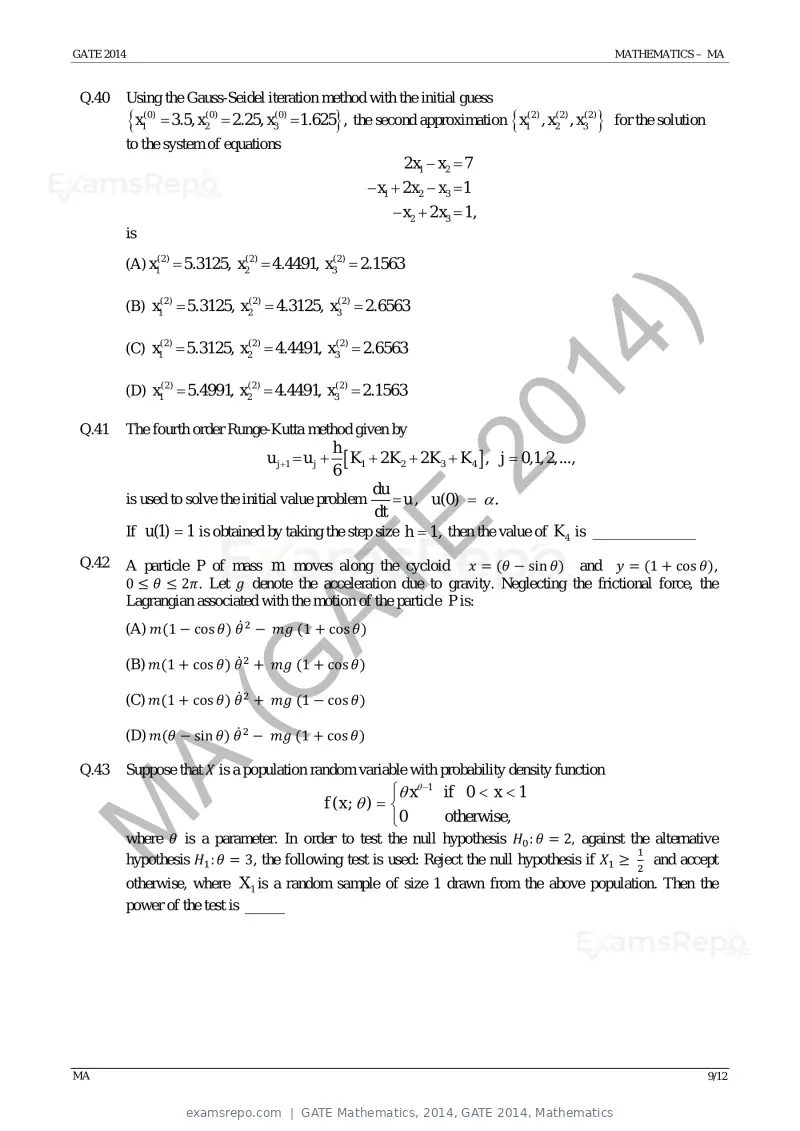
Q.40 Using the Gauss-Seidel iteration method with the initial guess
{ x1(0) 3.5,
= = =
x2(0) 2.25, x3(0) 1.625} , the second approximation { x1(2) , x2(2) , x3(2) } for the solution
to the system of equations
2 x1 − x2 =
7
− x1 + 2 x2 − x3 =
1
− x2 + 2 x3 =
1,
is
= =
(A) x1(2) 5.3125, =
x2(2) 4.4491, x3(2) 2.1563
= =
(B) x1(2) 5.3125, =
x2(2) 4.3125, x3(2) 2.6563
)
14
= =
(C) x1(2) 5.3125, =
x2(2) 4.4491, x3(2) 2.6563
= =
(D) x1(2) 5.4991, =
x2(2) 4.4491, x3(2) 2.1563
20
Q.41 The fourth order Runge-Kutta method given by
h
u j +1 =uj + [ K1 + 2 K 2 + 2 K3 + K 4 ] , j =0,1, 2,...,
6
du
is used to solve the initial value problem = u , u (0) = α .
dt
E
If u (1) = 1 is obtained by taking the step size h = 1, then the value of K 4 is ______________
Q.42 A particle P of mass m moves along the cycloid x = (θ − sin θ) and y = (1 + cos θ),
AT
0 ≤ θ ≤ 2π. Let g denote the acceleration due to gravity. Neglecting the frictional force, the
Lagrangian associated with the motion of the particle P is:
(A) m(1 − cos θ) θ̇ 2 − mg (1 + cos θ)
(B) m(1 + cos θ) θ̇ 2 + mg (1 + cos θ)
(G
(C) m(1 + cos θ) θ̇ 2 + mg (1 − cos θ)
(D) m(θ − sin θ) θ̇ 2 − mg (1 + cos θ)
A
Q.43 Suppose that X is a population random variable with probability density function
θ xθ −1 if 0 < x < 1
f (x ; θ ) =
M
0 otherwise,
where θ is a parameter. In order to test the null hypothesis H0 : θ = 2, against the alternative
1
hypothesis H1 : θ = 3, the following test is used: Reject the null hypothesis if X1 ≥ and accept
2
otherwise, where X 1 is a random sample of size 1 drawn from the above population. Then the
power of the test is _____
MA 9/12
Text of page 16
GATE 2014 MATHEMATICS – MA
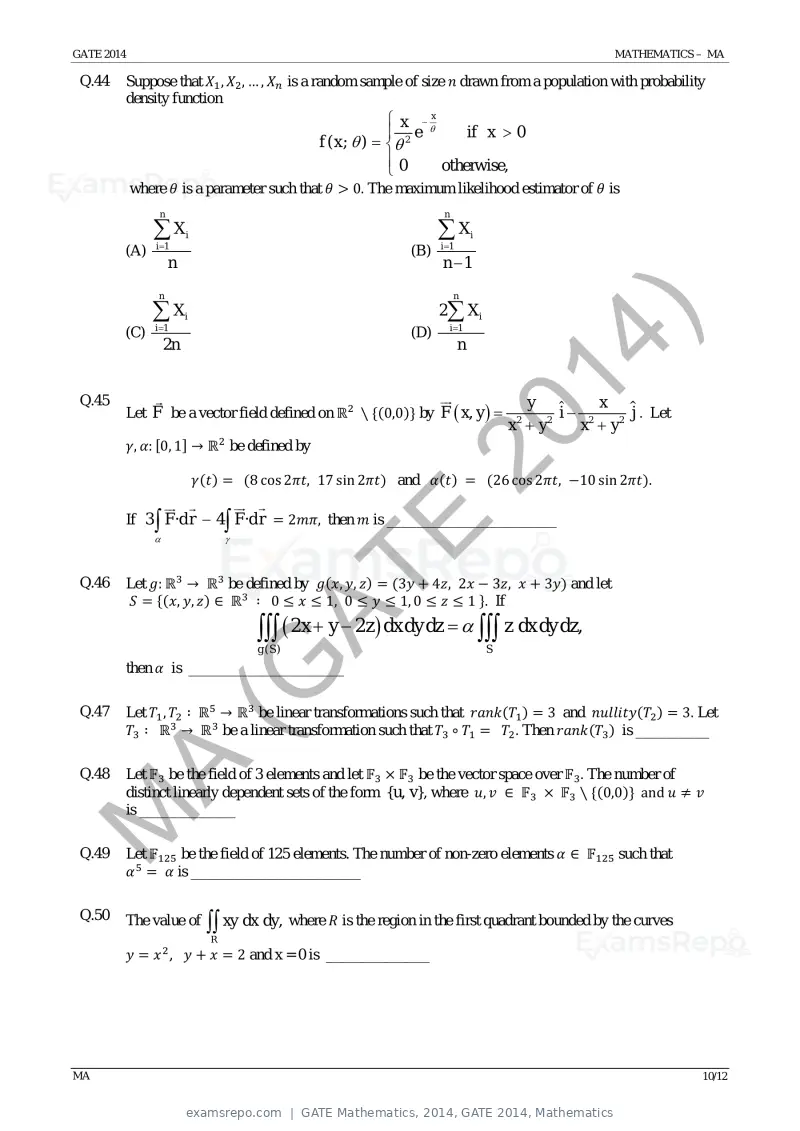
Q.44 Suppose that X1 , X2 , … , Xn is a random sample of size n drawn from a population with probability
density function
x − θx
e if x > 0
f ( x ; θ ) = θ 2
0
otherwise,
where θ is a parameter such that θ > 0. The maximum likelihood estimator of θ is
n n
∑ Xi
i =1
∑X i
(A) (B) i =1
n n −1
n n
∑ Xi 2∑ X i
)
(C) i =1 (D) i =1
14
2n n
Q.45 y
F ( x, y )
Let F be a vector field defined on ℝ2 ∖ {(0,0)} by = i − x j . Let
x +y x2 + y 2
20
2 2
γ, α: [0, 1] → ℝ2 be defined by
γ(t) = (8 cos 2πt, 17 sin 2πt) and α(t) = (26 cos 2πt, −10 sin 2πt).
∫ ∫γ
If 3 F ·d r − 4 F ·d r = 2mπ, then m is _______________________
E
α
AT
Q.46 Let g: ℝ3 → ℝ3 be defined by g(x, y, z) = (3y + 4z, 2x − 3z, x + 3y) and let
S = {(x, y, z) ∈ ℝ3 ∶ 0 ≤ x ≤ 1, 0 ≤ y ≤ 1, 0 ≤ z ≤ 1 }. If
∫∫∫ ( 2 x + y − 2 z ) dx dy dz =
g (S )
α ∫∫∫ z dx dy dz ,
S
then α is _____________________
(G
Q.47 Let T1 , T2 ∶ ℝ5 → ℝ3 be linear transformations such that rank(T1 ) = 3 and nullity(T2 ) = 3. Let
T3 ∶ ℝ3 → ℝ3 be a linear transformation such that T3 ∘ T1 = T2 . Then rank(T3 ) is __________
A
Q.48 Let F3 be the field of 3 elements and let F3 × F3 be the vector space over F3 . The number of
distinct linearly dependent sets of the form {u, v}, where u, v ∈ F3 × F3 ∖ {(0,0)} and u ≠ v
is _____________
M
Q.49 Let F125 be the field of 125 elements. The number of non-zero elements α ∈ F125 such that
α 5 = α is _______________________
Q.50 The value of ∫∫ xy dx dy, where R is the region in the first quadrant bounded by the curves
R
y = x 2 , y + x = 2 and x = 0 is ______________
MA 10/12
Text of page 17
GATE 2014                                                                                    MATHEMATICS – MA

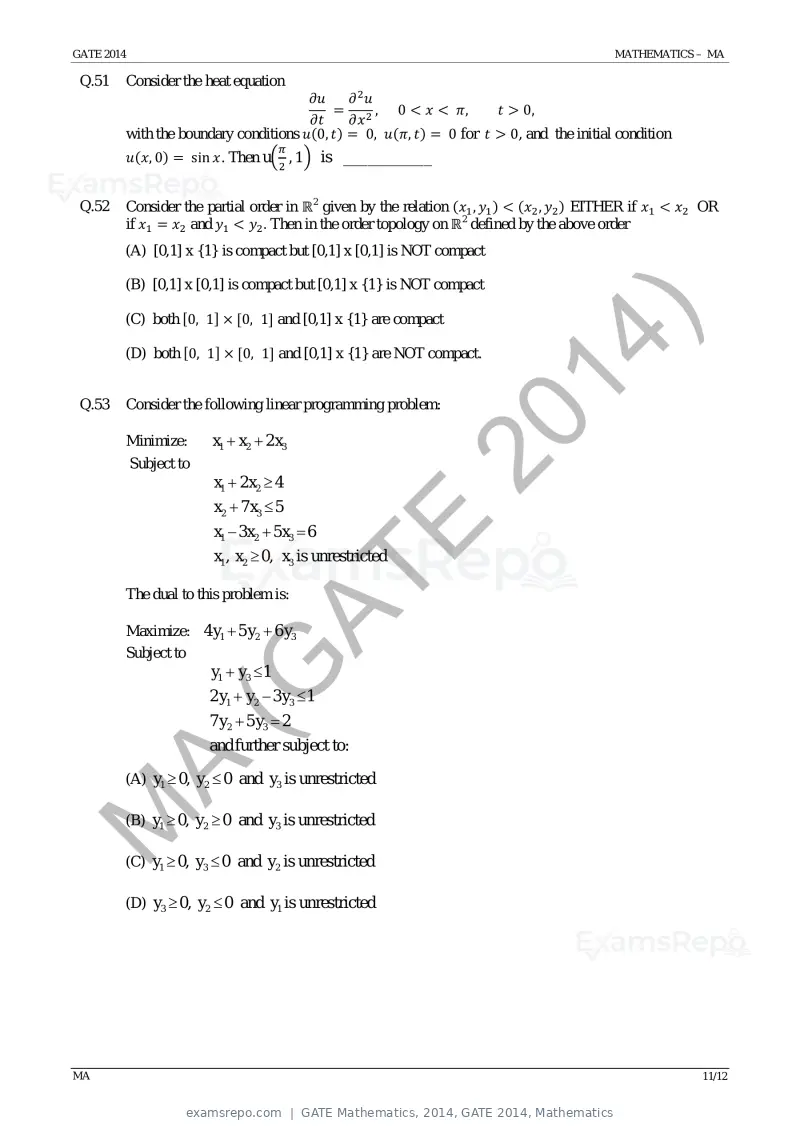
 Q.51       Consider the heat equation
                                          ∂u     ∂2u
                                              = 2 , 0 < x < π,          t > 0,
                                          ∂t     ∂x
            with the boundary conditions u(0, t) = 0, u(π, t) = 0 for t > 0, and the initial condition
                                       π
            u(x, 0) = sin x. Then u� , 1� is ___________
                                       2


 Q.52       Consider the partial order in ℝ2 given by the relation (x1 , y1 ) < (x2 , y2 ) EITHER if x1 < x2 OR
            if x1 = x2 and y1 < y2 . Then in the order topology on ℝ2 defined by the above order
        (A) [0,1] x {1} is compact but [0,1] x [0,1] is NOT compact

        (B) [0,1] x [0,1] is compact but [0,1] x {1} is NOT compact

        (C) both [0, 1] × [0, 1] and [0,1] x {1} are compact


                                                                                       )
                                                                         14
        (D) both [0, 1] × [0, 1] and [0,1] x {1} are NOT compact.


 Q.53       Consider the following linear programming problem:


                                                             20
            Minimize:     x1 + x2 + 2 x3
            Subject to
                           x1 + 2 x2 ≥ 4
                           x2 + 7 x3 ≤ 5
                                                  E
                           x1 − 3 x2 + 5 x3 =
                                            6
                           x1 , x2 ≥ 0, x3 is unrestricted
                                  AT

            The dual to this problem is:

            Maximize: 4 y1 + 5 y2 + 6 y3
            Subject to
                   (G


                          y1 + y3 ≤1
                          2 y1 + y2 − 3 y3 ≤ 1
                          7 y2 + 5 y3 =
                                      2
                          and further subject to:
     A


        (A) y1 ≥ 0, y2 ≤ 0 and y3 is unrestricted
M


        (B) y1 ≥ 0, y2 ≥ 0 and y3 is unrestricted

        (C) y1 ≥ 0, y3 ≤ 0 and y2 is unrestricted

        (D) y3 ≥ 0, y2 ≤ 0 and y1 is unrestricted


MA                                                                                                          11/12
Text of page 18
GATE 2014                                                                                    MATHEMATICS – MA

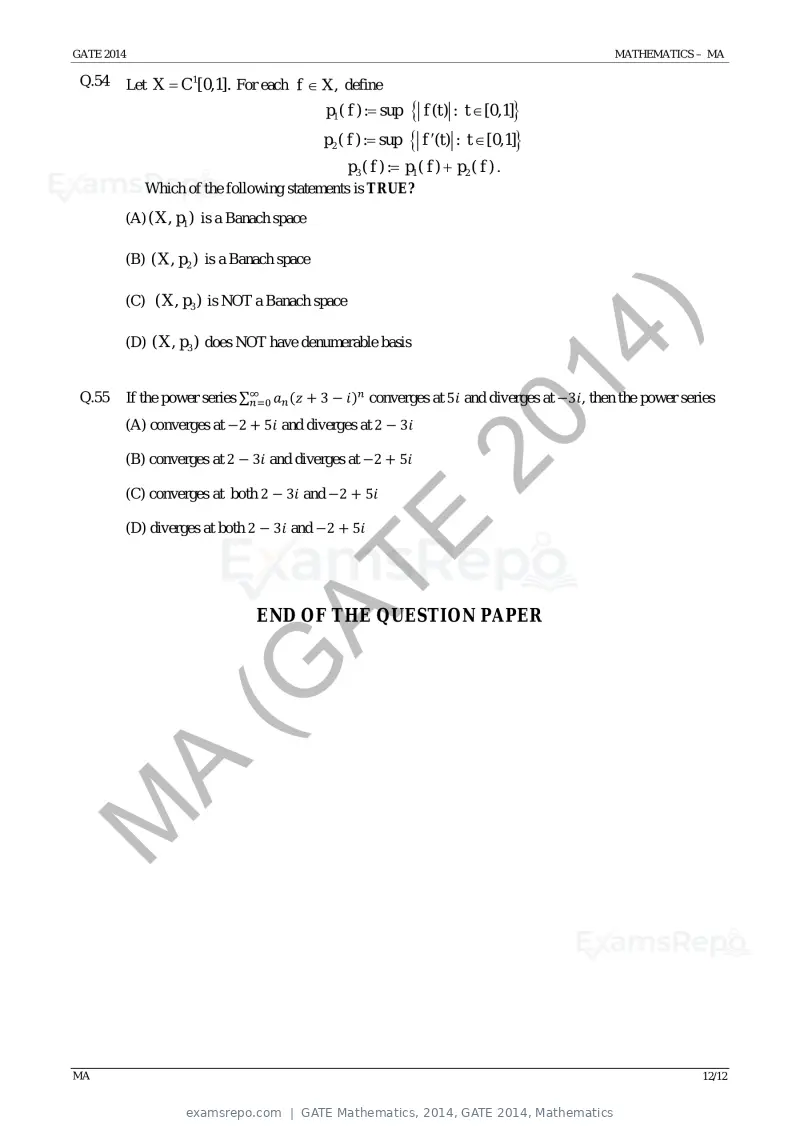
 Q.54       Let X = C 1[0,1]. For each f ∈ X , define
                                     =p1 ( f ) : sup { f (t ) : t ∈ [0,1]}
                                     =p2 ( f ) : sup { f ′(t ) : t ∈ [0,1]}
                                                p3=
                                                  ( f ) : p1 ( f ) + p2 ( f ) .
               Which of the following statements is TRUE?

        (A) ( X , p1 ) is a Banach space

        (B) ( X , p2 ) is a Banach space

        (C) ( X , p3 ) is NOT a Banach space


                                                                                       )
                                                                             14
        (D) ( X , p3 ) does NOT have denumerable basis


 Q.55       If the power series ∑∞                 n
                                 n=0 an (z + 3 − i) converges at 5i and diverges at −3i, then the power series


                                                             20
        (A) converges at −2 + 5i and diverges at 2 − 3i

        (B) converges at 2 − 3i and diverges at −2 + 5i

        (C) converges at both 2 − 3i and −2 + 5i
                                                E
        (D) diverges at both 2 − 3i and −2 + 5i
                                AT

                                 END OF THE QUESTION PAPER
                   (G
     A
M


MA                                                                                                         12/12
Text of page 19
GATE 2014
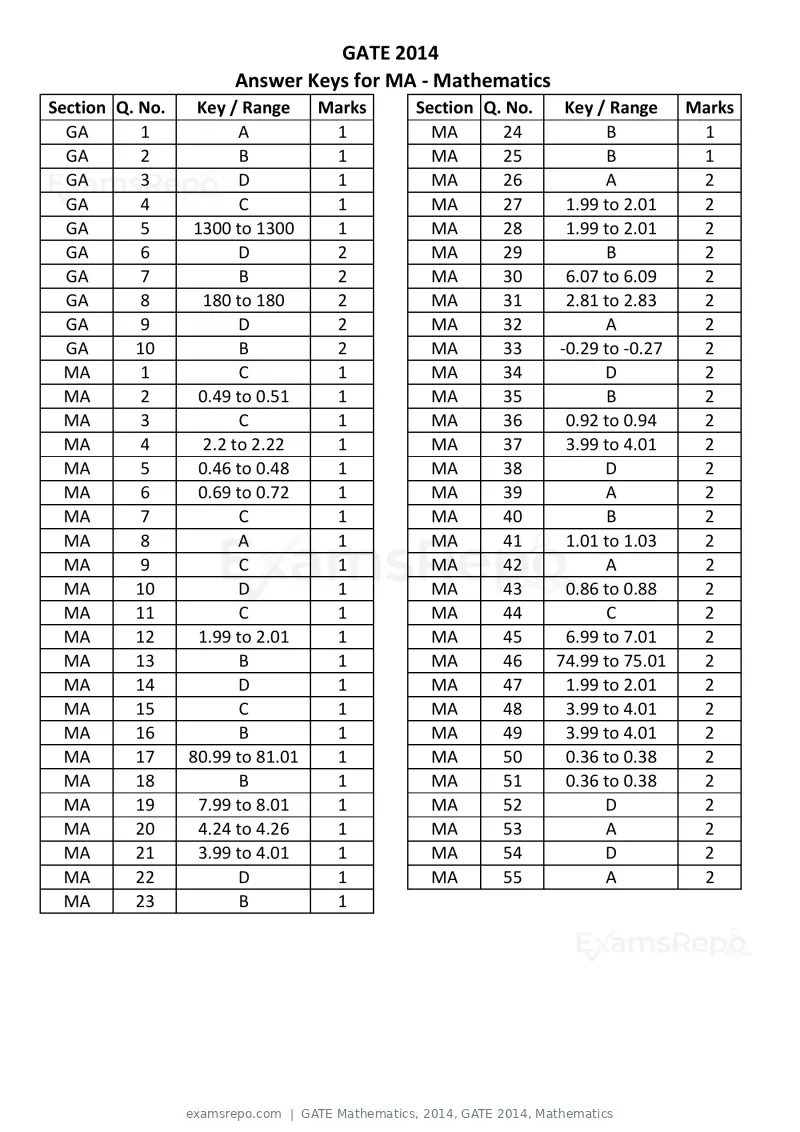
                      Answer Keys for MA ‐ Mathematics
Section Q. No.    Key / Range     Marks   Section Q. No.    Key / Range     Marks
  GA       1            A          1        MA      24           B           1
  GA       2            B          1        MA      25           B           1
  GA       3            D          1        MA      26           A           2
  GA       4            C          1        MA      27      1.99 to 2.01     2
  GA       5     1300 to 1300      1        MA      28      1.99 to 2.01     2
  GA       6            D          2        MA      29           B           2
  GA       7            B          2        MA      30      6.07 to 6.09     2
  GA       8       180 to 180      2        MA      31      2.81 to 2.83     2
  GA       9            D          2        MA      32           A           2
  GA      10            B          2        MA      33     ‐0.29 to ‐0.27    2
  MA       1            C          1        MA      34           D           2
  MA       2      0.49 to 0.51     1        MA      35           B           2
  MA       3            C          1        MA      36      0.92 to 0.94     2
  MA       4       2.2 to 2.22     1        MA      37      3.99 to 4.01     2
  MA       5      0.46 to 0.48     1        MA      38           D           2
  MA       6      0.69 to 0.72     1        MA      39           A           2
  MA       7            C          1        MA      40           B           2
  MA       8            A          1        MA      41      1.01 to 1.03     2
  MA       9            C          1        MA      42           A           2
  MA      10            D          1        MA      43      0.86 to 0.88     2
  MA      11            C          1        MA      44           C           2
  MA      12      1.99 to 2.01     1        MA      45      6.99 to 7.01     2
  MA      13            B          1        MA      46     74.99 to 75.01    2
  MA      14            D          1        MA      47      1.99 to 2.01     2
  MA      15            C          1        MA      48      3.99 to 4.01     2
  MA      16            B          1        MA      49      3.99 to 4.01     2
  MA      17     80.99 to 81.01    1        MA      50      0.36 to 0.38     2
  MA      18            B          1        MA      51      0.36 to 0.38     2
  MA      19      7.99 to 8.01     1        MA      52           D           2
  MA      20      4.24 to 4.26     1        MA      53           A           2
  MA      21      3.99 to 4.01     1        MA      54           D           2
  MA      22            D          1        MA      55           A           2
  MA      23            B          1
Official key not published for this paper.
Page 1 of 19
Source: GATE. Question paper published by GATE.