
GATE Physics 2012
Text of page 1
2012                                                                                                    PHYSICS – PH

                                                  PH : PHYSICS
Duration: Three Hours                                                                       Maximum Marks: 100

Read the following instructions carefully.

       1. Do not open the seal of the Question Booklet until you are asked to do so by the invigilator.

       2. Take out the Optical Response Sheet (ORS) from this Question Booklet without breaking the seal
          and read the instructions printed on the ORS carefully.

       3. On the right half of the ORS, using ONLY a black ink ball point pen, (i) darken the bubble
          corresponding to your test paper code and the appropriate bubble under each digit of your registration
          number and (ii) write your registration number, your name and name of the examination centre and
          put your signature at the specified location.

       4. This Question Booklet contains 20 pages including blank pages for rough work. After you are
          permitted to open the seal, please check all pages and report discrepancies, if any, to the invigilator.

       5. There are a total of 65 questions carrying 100 marks. All these questions are of objective type. Each
          question has only one correct answer. Questions must be answered on the left hand side of the ORS
          by darkening the appropriate bubble (marked A, B, C, D) using ONLY a black ink ball point pen
          against the question number. For each question darken the bubble of the correct answer. More
          than one answer bubbled against a question will be treated as an incorrect response.

       6. Since bubbles darkened by the black ink ball point pen cannot be erased, candidates should darken
          the bubbles in the ORS very carefully.

       7. Questions Q.1 – Q.25 carry 1 mark each. Questions Q.26 – Q.55 carry 2 marks each. The 2 marks
          questions include two pairs of common data questions and two pairs of linked answer questions. The
          answer to the second question of the linked answer questions depends on the answer to the first
          question of the pair. If the first question in the linked pair is wrongly answered or is unattempted, then
          the answer to the second question in the pair will not be evaluated.

       8. Questions Q.56 – Q.65 belong to General Aptitude (GA) section and carry a total of 15 marks.
          Questions Q.56 – Q.60 carry 1 mark each, and questions Q.61 – Q.65 carry 2 marks each.

       9. Unattempted questions will result in zero mark and wrong answers will result in NEGATIVE marks.
          For all 1 mark questions, ⅓ mark will be deducted for each wrong answer. For all 2 marks questions,
          ⅔ mark will be deducted for each wrong answer. However, in the case of the linked answer question
          pair, there will be negative marks only for wrong answer to the first question and no negative marks
          for wrong answer to the second question.

       10. Calculator is allowed whereas charts, graph sheets or tables are NOT allowed in the examination hall.

       11. Rough work can be done on the question paper itself. Blank pages are provided at the end of the
           question paper for rough work.

       12. Before the start of the examination, write your name and registration number in the space provided
           below using a black ink ball point pen.


                Name
                Registration
                Number
                                             PH
PH                                                                                                              1/20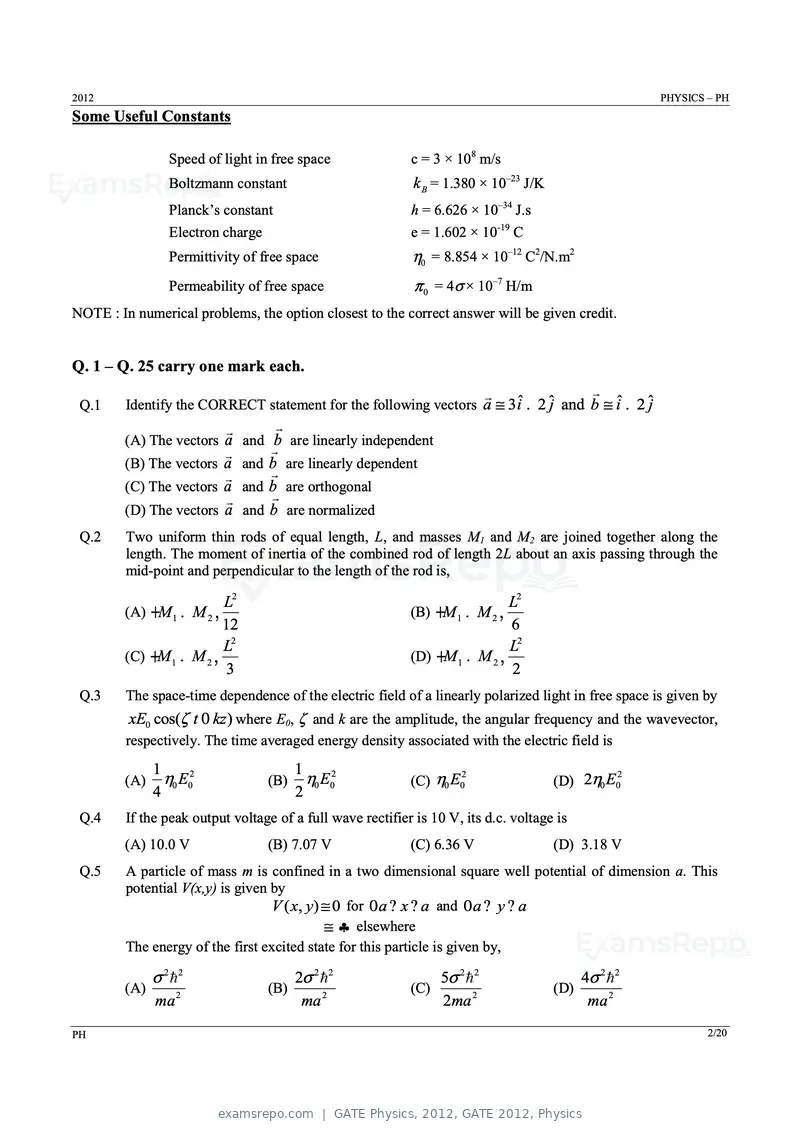
Text of page 2
2012 PHYSICS – PH
Some Useful Constants
Speed of light in free space c = 3 × 10⁸ m/s
Boltzmann constant k B = 1.380 × 10⁻²³ J/K
Planck’s constant h = 6.626 × 10⁻³⁴ J.s
Electron charge e = 1.602 × 10⁻¹⁹ C
Permittivity of free space 0 = 8.854 × 10⁻¹² C2/N.m2
Permeability of free space 0 = 4 × 10⁻⁷ H/m
NOTE : In numerical problems, the option closest to the correct answer will be given credit.
Q. 1 – Q. 25 carry one mark each.
Q.1 Identify the CORRECT statement for the following vectors a 3 iˆ 2 ˆj and b iˆ 2 ˆj
(A) The vectors a and b are linearly independent
(B) The vectors a and b are linearly dependent
(C) The vectors a and b are orthogonal
(D) The vectors a and b are normalized
Q.2 Two uniform thin rods of equal length, L, and masses M1 and M2 are joined together along the
length. The moment of inertia of the combined rod of length 2L about an axis passing through the
mid-point and perpendicular to the length of the rod is,
L2 L2
(A) M 1 M 2 (B) M 1 M 2
12 6
L2 L2
(C) M 1 M 2 (D) M 1 M 2
3 2
Q.3 The space-time dependence of the electric field of a linearly polarized light in free space is given by
xE0 cos( t kz ) where E0, and k are the amplitude, the angular frequency and the wavevector,
respectively. The time averaged energy density associated with the electric field is
1 1
(A) 0 E02 (B) 0 E02 (C) 0 E0
2
(D) 2 0 E0
2
4 2
Q.4 If the peak output voltage of a full wave rectifier is 10 V, its d.c. voltage is
(A) 10.0 V (B) 7.07 V (C) 6.36 V (D) 3.18 V
Q.5 A particle of mass m is confined in a two dimensional square well potential of dimension a. This
potential V(x,y) is given by
V ( x, y) 0 for a x a and a y a
elsewhere
The energy of the first excited state for this particle is given by,
2 2 2 2 2 5 2 2 4 2 2
(A) (B) (C) (D)
ma 2 ma 2 2ma 2 ma 2
PH 2/20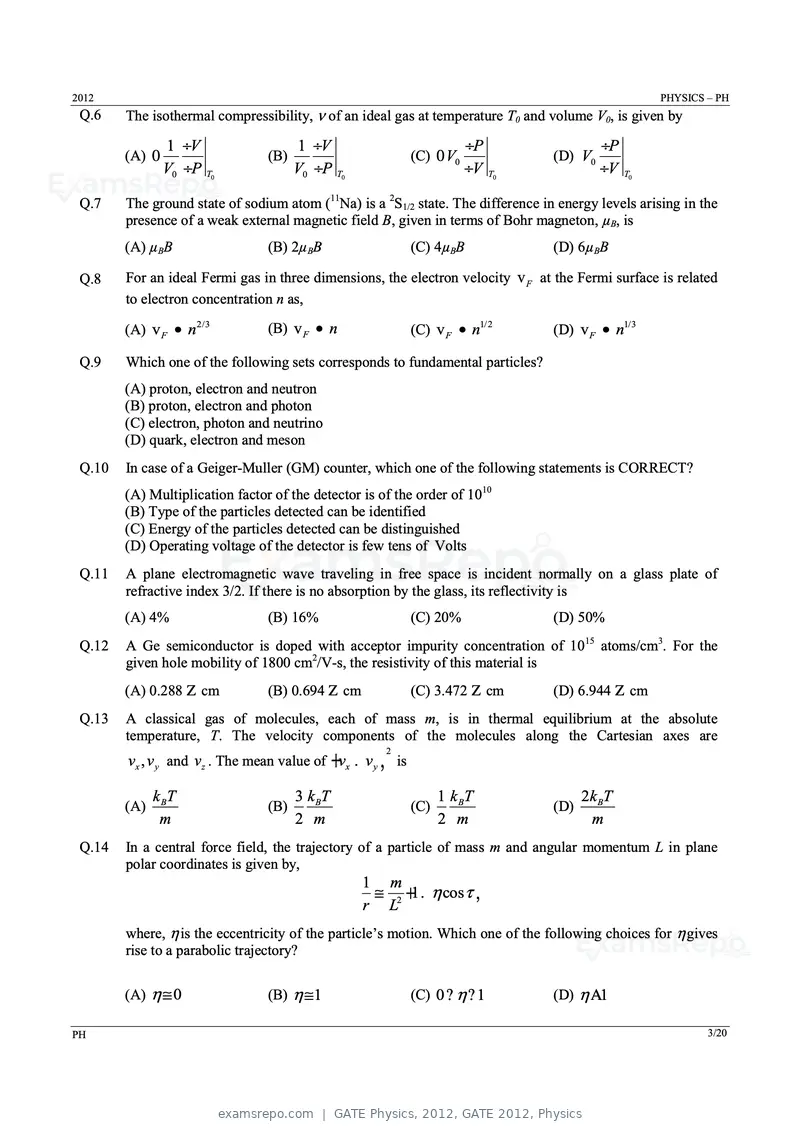
Text of page 3
2012 PHYSICS – PH
Q.6 The isothermal compressibility, of an ideal gas at temperature T0 and volume V0, is given by
1 V 1 V P P
(A) (B) (C) V0 (D) V0
V0 P T0 V0 P T0 V T0 V T0
Q.7 The ground state of sodium atom (11Na) is a 2S1/2 state. The difference in energy levels arising in the
presence of a weak external magnetic field B, given in terms of Bohr magneton, µB, is
(A) µBB (B) 2µBB (C) 4µBB (D) 6µBB
Q.8 For an ideal Fermi gas in three dimensions, the electron velocity v F at the Fermi surface is related
to electron concentration n as,
(A) v F n2/3 (B) v F n (C) v F n1/2 (D) v F n1/3
Q.9 Which one of the following sets corresponds to fundamental particles?
(A) proton, electron and neutron
(B) proton, electron and photon
(C) electron, photon and neutrino
(D) quark, electron and meson
Q.10 In case of a Geiger-Muller (GM) counter, which one of the following statements is CORRECT?
(A) Multiplication factor of the detector is of the order of 1010
(B) Type of the particles detected can be identified
(C) Energy of the particles detected can be distinguished
(D) Operating voltage of the detector is few tens of Volts
Q.11 A plane electromagnetic wave traveling in free space is incident normally on a glass plate of
refractive index 3/2. If there is no absorption by the glass, its reflectivity is
(A) 4% (B) 16% (C) 20% (D) 50%
Q.12 A Ge semiconductor is doped with acceptor impurity concentration of 1015 atoms/cm3. For the
given hole mobility of 1800 cm2/V-s, the resistivity of this material is
(A) 0.288 cm (B) 0.694 cm (C) 3.472 cm (D) 6.944 cm
Q.13 A classical gas of molecules, each of mass m, is in thermal equilibrium at the absolute
temperature, T. The velocity components of the molecules along the Cartesian axes are
vx , v y and vz . The mean value of vx v y is
2
k BT 3 k BT 1 k BT 2 k BT
(A) (B) (C) (D)
m 2 m 2 m m
Q.14 In a central force field, the trajectory of a particle of mass m and angular momentum L in plane
polar coordinates is given by,
1 m
1 cos
r L2
where, is the eccentricity of the particle’s motion. Which one of the following choices for gives
rise to a parabolic trajectory?
(A) 0 (B) 1 (C) 0 1 (D) 1
PH 3/20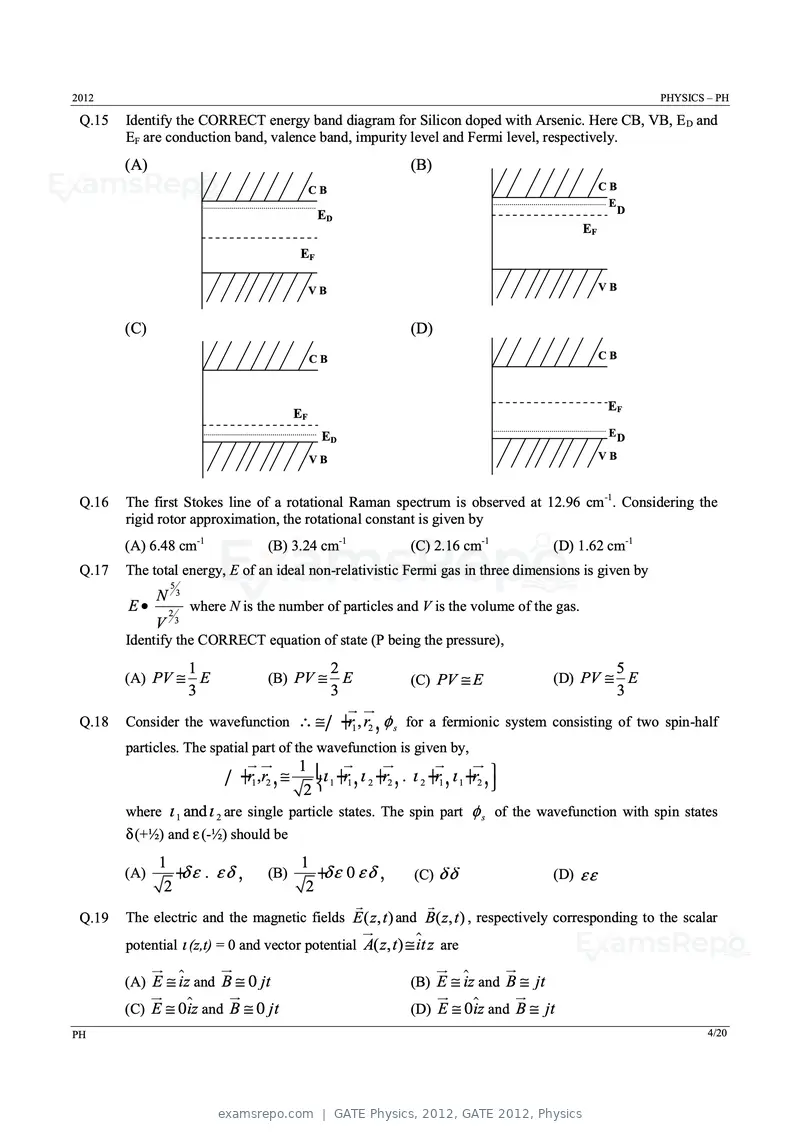
Text of page 4
2012 PHYSICS – PH
Q.15 Identify the CORRECT energy band diagram for Silicon doped with Arsenic. Here CB, VB, ED and
EF are conduction band, valence band, impurity level and Fermi level, respectively.
(A) (B)
CB CB
E
ED D
EF
E
EF
VB VB
(C) (D)
CB CB
EF
EF
ED ED
VB VB
Q.16 The first Stokes line of a rotational Raman spectrum is observed at 12.96 cm-1. Considering the
rigid rotor approximation, the rotational constant is given by
(A) 6.48 cm-1 (B) 3.24 cm-1 (C) 2.16 cm-1 (D) 1.62 cm-1
Q.17 The total energy, E of an ideal non-relativistic Fermi gas in three dimensions is given by
5
N 3
E 2
where N is the number of particles and V is the volume of the gas.
V 3
Identify the CORRECT equation of state (P being the pressure),
1 2 5
(A) PV E (B) PV E (C) PV E (D) PV E
3 3 3
Q.18
Consider the wavefunction r1 , r2 s for a fermionic system consisting of two spin-half
particles. The spatial part of the wavefunction is given by,
r1 ,r2
1
2
1 r1 2 r2 2 r1 1 r2
where 1 and 2 are single particle states. The spin part s of the wavefunction with spin states
(+½) and (-½) should be
1 1
(A) (B) (C) (D)
2 2
Q.19 The electric and the magnetic fields E ( z, t ) and B( z, t ) , respectively corresponding to the scalar
potential (z,t) = 0 and vector potential A( z, t ) it z are
(A) E iz and B jt (B) E iz and B jt
(C) E iz and B jt (D) E iz and B jt
PH 4/20
Text of page 5
2012 PHYSICS – PH
Q.20 Consider the following OP-AMP circuit.
+ 10 V
Vin +
+5V Vout
4 k
1 k - 10 V
Which one of the following correctly represents the output Vout corresponding to the input Vin?
(A) (B)
+5V +5V
Vin Vin
+1V +1V
0V 0V
t® t®
+ 10 V + 10 V
Vout Vout
t® t®
- 10 V - 10 V
(C) (D)
+5V +5V
Vin Vin
0V 0V
t® t®
+ 10 V + 10 V
Vout Vout
t® t®
- 10 V - 10 V
Q.21 Deuteron has only one bound state with spin parity 1+, isospin 0 and electric quadrupole moment
0.286 efm2. These data suggest that the nuclear forces are having
(A) only spin and isospin dependence
(B) no spin dependence and no tensor components
(C) spin dependence but no tensor components
(D) spin dependence along with tensor components
PH 5/20
Text of page 6
2012 PHYSICS – PH
Q.22 A particle of unit mass moves along the x-axis under the influence of a potential,
V ( x) x x 2 . The particle is found to be in stable equilibrium at the point x 2 . The time
2
period of oscillation of the particle is
3
(A) (B) (C) (D) 2
2 2
Q.23 Which one of the following CANNOT be explained by considering a harmonic approximation for
the lattice vibrations in solids?
(A) Debye’s T 3 law (B) Dulong Petit’s law
(C) Optical branches in lattices (D) Thermal expansion
Q.24 A particle is constrained to move in a truncated harmonic potential well (x > 0) as shown in the
figure. Which one of the following statements is CORRECT?
V(x)
x
(A) The parity of the first excited state is even
(B) The parity of the ground state is even
1
(C) The ground state energy is
2
7
(D) The first excited state energy is
2
Q.25 The number of independent components of the symmetric tensor Aij with indices i, j = 1, 2, 3 is
(A) 1 (B) 3 (C) 6 (D) 9
Q. 26 to Q. 55 carry two marks each.
1 0
Q.26 Consider a system in the unperturbed state described by the Hamiltonian, H 0 . The system
0 1
is subjected to a perturbation of the form H , where 1 . The energy eigenvalues of
the perturbed system using the first order perturbation approximation are
(A) 1 and (1+2) (B) (1+) and (1-)
(C) (1+2) and (1-2) (D) (1+) and (1-2)
PH 6/20
Text of page 7
2012 PHYSICS – PH
Q.27 Inverse susceptibility (1/) as a function of temperature, T for a material undergoing paramagnetic
to ferromagnetic transition is given in the figure, where O is the origin. The values of the Curie
constant, C, and the Weiss molecular field constant, , in CGS units, are
1
600 K
O T
2 104
(CGS unit)
(A) C 5105 , 3 102 (B) C 3 102 , 5105
(C) C 3 102 , 2 104 (D) C 2 104 , 3 102
Q.28 A plane polarized electromagnetic wave in free space at time t 0 is given by
E ( x, z) 10 j exp[i(6 x 8z )] . The magnetic field B( x, z, t ) is given by
(A) B( x, z, t )
1
c
6k 8i exp[i(6 x 8 z 10ct )]
1
(B) B( x, z, t ) 6k 8i exp[i(6 x 8 z 10ct )]
c
1
(C) B( x, z, t ) 6k 8i exp[i(6 x 8 z ct )]
c
1
(D) B( x, z, t ) 6k 8i exp[i(6 x 8 z ct )]
c
0 1 0
Q.29 The eigenvalues of the matrix 1 0 1 are
0 1 0
1 1
(A) 0, 1, 1 (B) 0, 2, 2 (C) , ,0 (D) 2, 2, 0
2 2
Q.30 Match the typical spectroscopic regions specified in Group I with the corresponding type of
transitions in Group II.
Group I Group II
(P) Infra-red region (i) electronic transitions involving valence electrons
(Q) Ultraviolet-visible region (ii) nuclear transitions
(R) X-ray region (iii) vibrational transitions of molecules
(S) -ray region (iv) transitions involving inner shell electrons
(A) (P, i); (Q, iii); (R, ii); (S, iv) (B) (P, ii); (Q, iv); (R, i); (S, iii)
(C) (P, iii); (Q, i); (R, iv); (S, ii) (D) (P, iv); (Q, i); (R, ii); (S, iii)
PH 7/20
Text of page 8
2012 PHYSICS – PH
Q.31 In the following circuit, for the output voltage to be Vo = ( – V1 + V2 /2), the ratio R1/R2 is
R
+ VCC
R
V1
Vo
+
V2
R1 - VCC
R2
(A) 1/2 (B) 1 (C) 2 (D) 3
Q.32 The terms j1 , j2 J arising from 2s13d1 electronic configuration in j-j coupling scheme are
1 3 1 5 1 1 1 3
(A) , and , (B) , and ,
2 2 2,1 2 2 3,2 2 2 1,0 2 2 2,1
1 1 1 5 3 1 1 5
(C) , and , (D) , and ,
2 2 1,0 2 2 3,2 2 2 2,1 2 2 3,2
Q.33 In the following circuit, the voltage drop across the ideal diode in forward bias condition is 0.7 V.
12 k
+ 24 Volt
+
–
+
6 k 3.3k
The current passing through the diode is
(A) 0.5 mA (B) 1.0 mA (C) 1.5 mA (D) 2.0 mA
Q.34 Choose the CORRECT statement from the following.
(A) Neutron interacts through electromagnetic interaction
(B) Electron does not interact through weak interaction
(C) Neutrino interacts through weak and electromagnetic interaction
(D) Quark interacts through strong interaction but not through weak interaction
Q.35 A rod of proper length l0 oriented parallel to the x-axis moves with speed 2c/3 along the x-axis in the
S-frame, where c is the speed of the light in free space. The observer is also moving along the x-axis
with speed c/2 with respect to the S-frame. The length of the rod as measured by the observer is
(A) 0.35 l0 (B) 0.48 l0 (C) 0.87 l0 (D) 0.97 l0
PH 8/20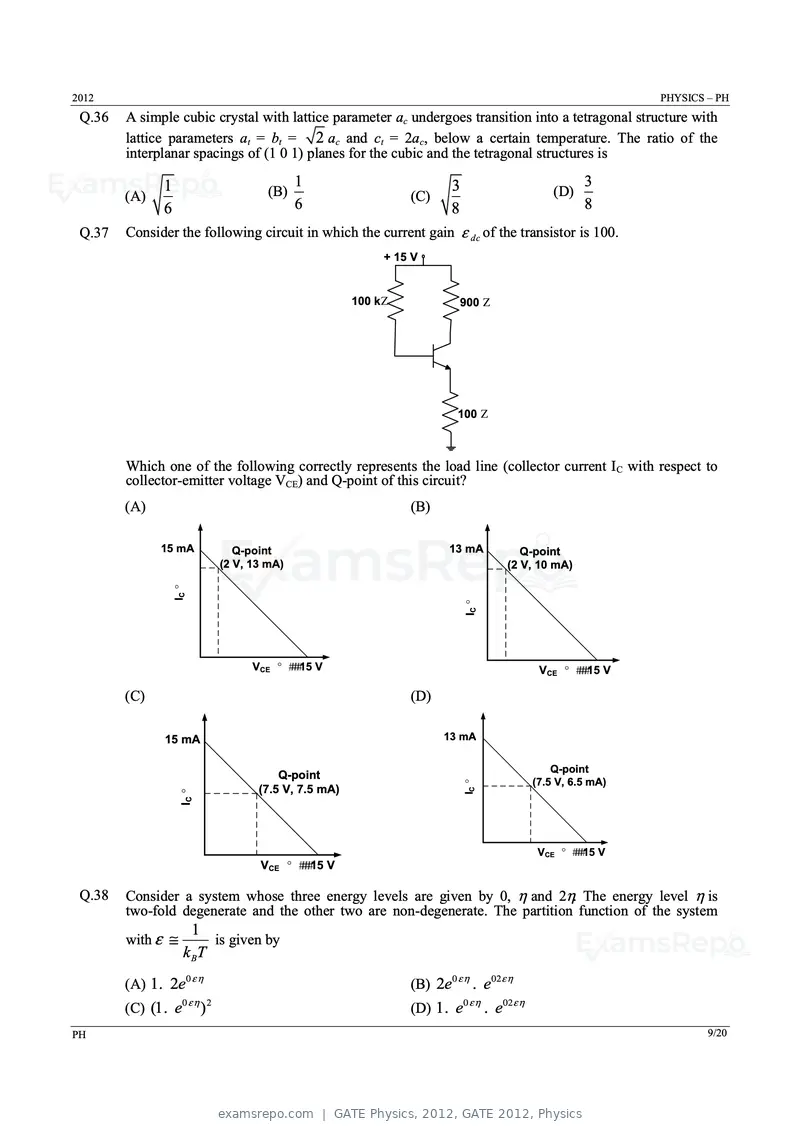
Text of page 9
2012 PHYSICS – PH
Q.36 A simple cubic crystal with lattice parameter ac undergoes transition into a tetragonal structure with
lattice parameters at = bt = 2 ac and ct = 2ac, below a certain temperature. The ratio of the
interplanar spacings of (1 0 1) planes for the cubic and the tetragonal structures is
1 1 3 3
(A) (B) (C) (D)
6 6 8 8
Q.37 Consider the following circuit in which the current gain dc of the transistor is 100.
+ 15 V
100 k 900
100
Which one of the following correctly represents the load line (collector current IC with respect to
collector-emitter voltage VCE) and Q-point of this circuit?
(A) (B)
15 mA Q-point 13 mA Q-point
(2 V, 13 mA) (2 V, 10 mA)
IC ®
IC ®
VCE ® 15 V VCE ® 15 V
(C) (D)
15 mA 13 mA
Q-point
Q-point
IC ® (7.5 V, 6.5 mA)
IC ®
(7.5 V, 7.5 mA)
VCE ® 15 V
VCE ® 15 V
Q.38 Consider a system whose three energy levels are given by 0, and 2. The energy level is
two-fold degenerate and the other two are non-degenerate. The partition function of the system
1
with is given by
k BT
(A) 1 2e (B) 2e e2
(C) (1 e )2 (D) 1 e e2
PH 9/20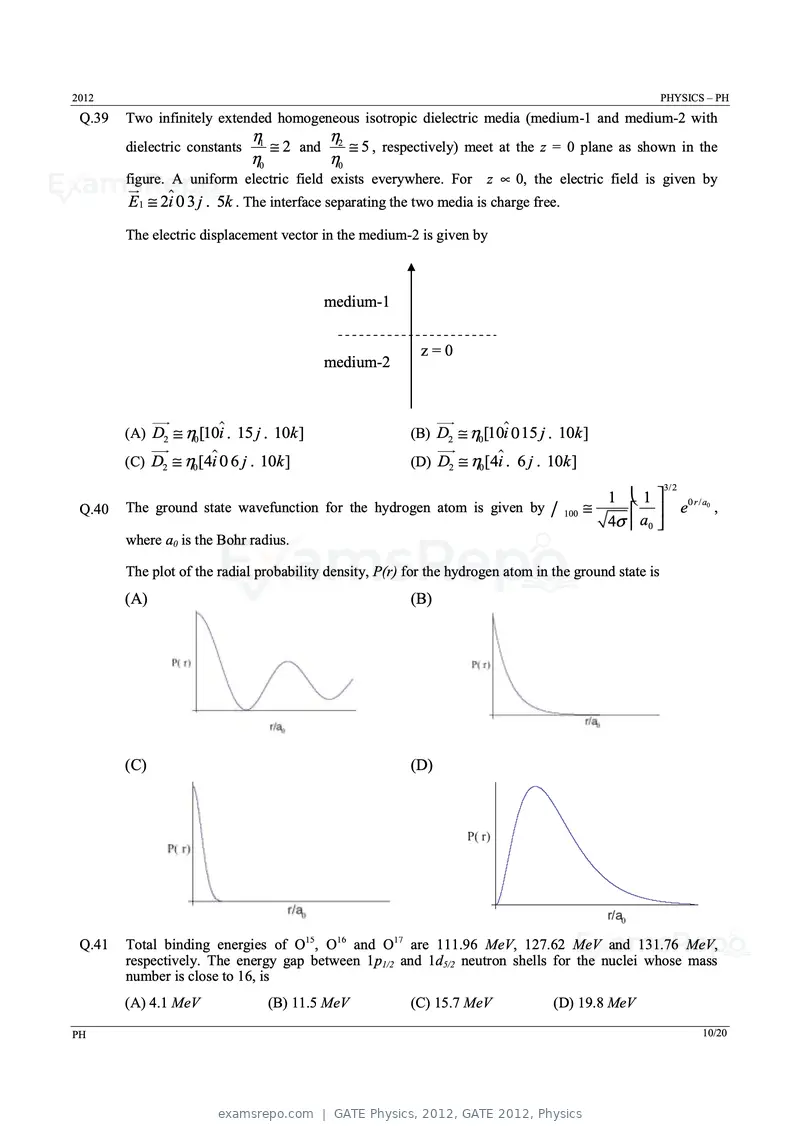
Text of page 10
2012 PHYSICS – PH
Q.39 Two infinitely extended homogeneous isotropic dielectric media (medium-1 and medium-2 with
1
dielectric constants 2 and 2 5 , respectively) meet at the z = 0 plane as shown in the
0 0
figure. A uniform electric field exists everywhere. For z 0, the electric field is given by
E1 2i 3 j 5k . The interface separating the two media is charge free.
The electric displacement vector in the medium-2 is given by
medium-1
z=0
medium-2
(A) D2 0 [10i 15 j 10k ] (B) D2 0 [10i 15 j 10k ]
(C) D2 0 [4i 6 j 10k ] (D) D2 0 [4i 6 j 10k ]
3/2
1 1
Q.40 The ground state wavefunction for the hydrogen atom is given by 100 e r / a0 ,
4 a0
where a0 is the Bohr radius.
The plot of the radial probability density, P(r) for the hydrogen atom in the ground state is
(A) (B)
(C) (D)
Q.41 Total binding energies of O15, O16 and O17 are 111.96 MeV, 127.62 MeV and 131.76 MeV,
respectively. The energy gap between 1p1/2 and 1d5/2 neutron shells for the nuclei whose mass
number is close to 16, is
(A) 4.1 MeV (B) 11.5 MeV (C) 15.7 MeV (D) 19.8 MeV
PH 10/20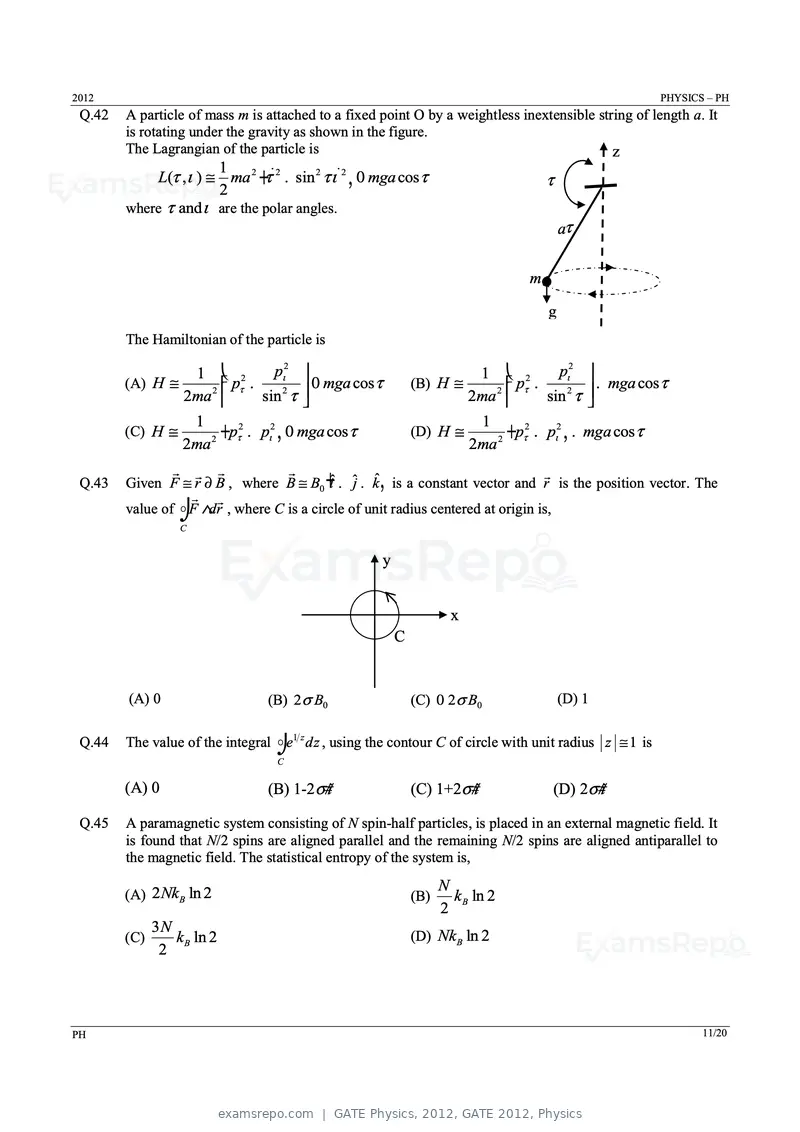
Text of page 11
2012 PHYSICS – PH
Q.42 A particle of mass m is attached to a fixed point O by a weightless inextensible string of length a. It
is rotating under the gravity as shown in the figure.
The Lagrangian of the particle is z
L( , )
1 2 2
2
ma sin 2 2 mga cos
where and are the polar angles.
a
m
g
The Hamiltonian of the particle is
1 2 p2 1 2 p2
(A) H p 2 mga cos (B) H p 2 mga cos
2ma 2 sin 2ma 2 sin
2
p 2 p2 mga cos 2
p 2 p2 mga cos
1 1
(C) H (D) H
2ma 2ma
Q.43
Given F r B , where B B0 iˆ ˆj kˆ is a constant vector and r is the position vector. The
value of F dr , where C is a circle of unit radius centered at origin is,
C
y
x
C
(A) 0 (B) 2 B0 (C) 2 B0 (D) 1
e dz , using the contour C of circle with unit radius z 1 is
1z
Q.44 The value of the integral
C
(A) 0 (B) 1-2 i (C) 1+2 i (D) 2 i
Q.45 A paramagnetic system consisting of N spin-half particles, is placed in an external magnetic field. It
is found that N/2 spins are aligned parallel and the remaining N/2 spins are aligned antiparallel to
the magnetic field. The statistical entropy of the system is,
N
(A) 2 NkB ln 2 (B) k B ln 2
2
3N
(C) k B ln 2 (D) NkB ln 2
2
PH 11/20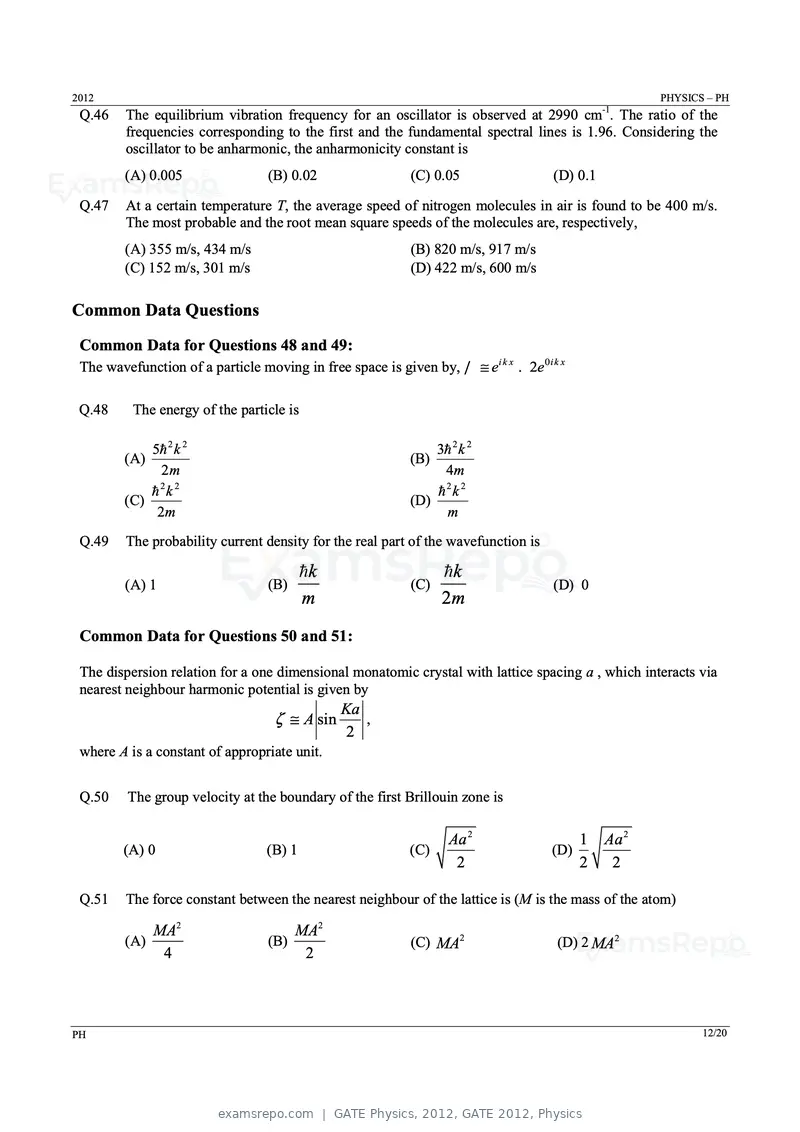
Text of page 12
2012 PHYSICS – PH
-1
Q.46 The equilibrium vibration frequency for an oscillator is observed at 2990 cm . The ratio of the
frequencies corresponding to the first and the fundamental spectral lines is 1.96. Considering the
oscillator to be anharmonic, the anharmonicity constant is
(A) 0.005 (B) 0.02 (C) 0.05 (D) 0.1
Q.47 At a certain temperature T, the average speed of nitrogen molecules in air is found to be 400 m/s.
The most probable and the root mean square speeds of the molecules are, respectively,
(A) 355 m/s, 434 m/s (B) 820 m/s, 917 m/s
(C) 152 m/s, 301 m/s (D) 422 m/s, 600 m/s
Common Data Questions
Common Data for Questions 48 and 49:
The wavefunction of a particle moving in free space is given by, ei k x 2e i k x
Q.48 The energy of the particle is
5 2 k 2 3 2 k 2
(A) (B)
2m 4m
2 2
k 2k 2
(C) (D)
2m m
Q.49 The probability current density for the real part of the wavefunction is
k k
(A) 1 (B) (C) (D) 0
m 2m
Common Data for Questions 50 and 51:
The dispersion relation for a one dimensional monatomic crystal with lattice spacing a , which interacts via
nearest neighbour harmonic potential is given by
Ka
A sin ,
2
where A is a constant of appropriate unit.
Q.50 (The group velocity at the boundary of the first Brillouin zone is
Aa 2 1 Aa 2
(A) 0 (B) 1 (C) (D)
2 2 2
Q.51 The force constant between the nearest neighbour of the lattice is (M is the mass of the atom)
MA2 MA2
(A) (B) (C) MA2 (D) 2 MA2
4 2
PH 12/20
Text of page 13
2012 PHYSICS – PH
Linked Answer Questions
Statement for Linked Answer Questions 52 and 53:
In a hydrogen atom, consider that the electronic charge is uniformly distributed in a spherical volume of
radius a (= 0.5 10-10 m) around the proton. The atom is placed in a uniform electric field E = 30 105 V/m.
Assume that the spherical distribution of the negative charge remains undistorted under the electric field.
Q.52 In the equilibrium condition, the separation between the positive and the negative charge centers is
(
(A) 8.66 10-16 m (B) 2.60 10-15 m (C) 2.60 10-16 m (D) 8.66 10-15 m
Q.53 The polarizability of the hydrogen atom in unit of (C2m/N) is
(A) 2.0 10-40 (B) 1.4 10-41 (C) 1.4 10-40 (D) 2.0 10-39
Statement for Linked Answer Questions 54 and 55:
A particle of mass m slides under the gravity without friction along the parabolic path y ax 2 as shown in
the figure. Here a is a constant.
y
m
x
Q.54 The Lagrangian for this particle is given by,
1 2 1
(A) L mx mgax 2 (B) L m(1 4a 2 x 2 ) x 2 mgax 2
2 2
1 2 1
(C) L mx mgax 2 (D) L m(1 4a 2 x 2 ) x 2 mgax 2
2 2
Q.55 The Lagranges equation of motion of the particle is
(A) x 2 gax (B) m(1 4a 2 x2 ) x 2mgax 4ma 2 xx 2
(C) m(1 4a 2 x 2 ) x 2mgax 4ma 2 xx 2 (D) x 2 gax
PH 13/20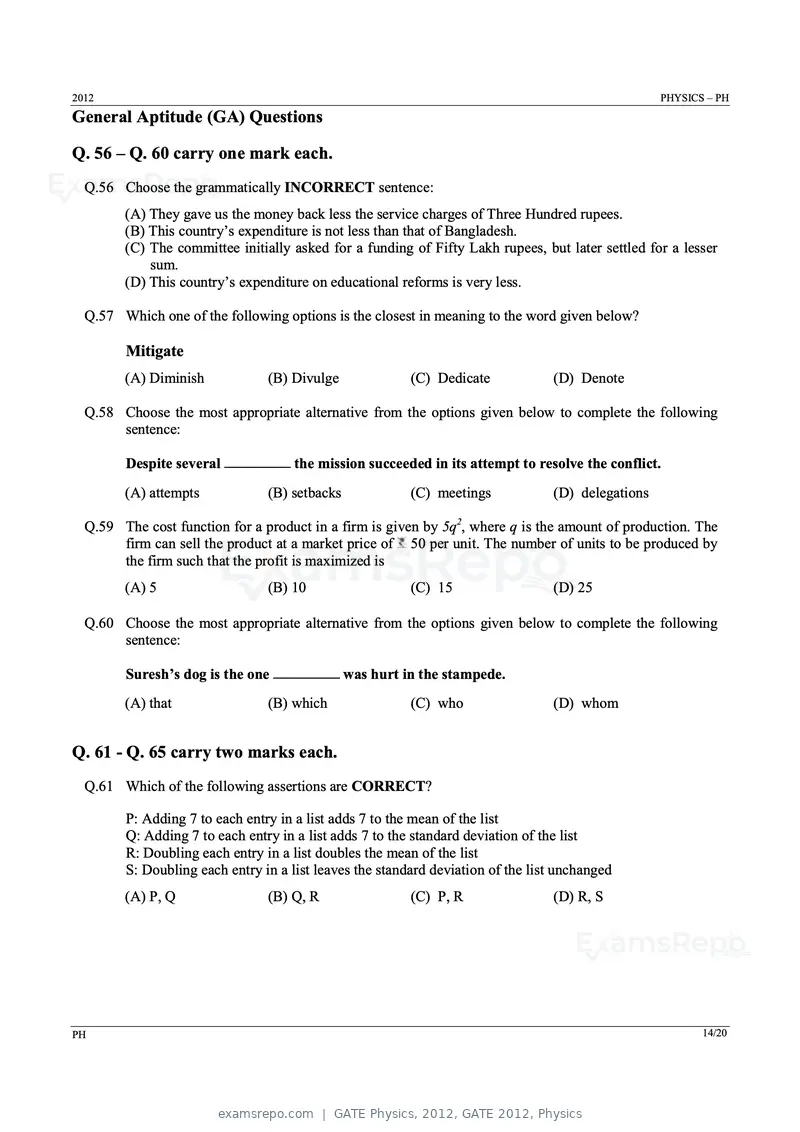
Text of page 14
2012                                                                                               PHYSICS – PH
General Aptitude (GA) Questions

Q. 56 – Q. 60 carry one mark each.
  Q.56 Choose the grammatically INCORRECT sentence:
        (A) They gave us the money back less the service charges of Three Hundred rupees.
        (B) This country’s expenditure is not less than that of Bangladesh.
        (C) The committee initially asked for a funding of Fifty Lakh rupees, but later settled for a lesser
            sum.
        (D) This country’s expenditure on educational reforms is very less.

  Q.57 Which one of the following options is the closest in meaning to the word given below?

        Mitigate
        (A) Diminish            (B) Divulge              (C) Dedicate            (D) Denote

  Q.58 Choose the most appropriate alternative from the options given below to complete the following
       sentence:

        Despite several ––––––––– the mission succeeded in its attempt to resolve the conflict.
        (A) attempts            (B) setbacks             (C) meetings            (D) delegations

  Q.59 The cost function for a product in a firm is given by 5q2, where q is the amount of production. The
       firm can sell the product at a market price of 50 per unit. The number of units to be produced by
       the firm such that the profit is maximized is
        (A) 5                   (B) 10                   (C) 15                  (D) 25

  Q.60 Choose the most appropriate alternative from the options given below to complete the following
       sentence:

        Suresh’s dog is the one ––––––––– was hurt in the stampede.
        (A) that                (B) which                (C) who                 (D) whom


Q. 61 - Q. 65 carry two marks each.
  Q.61 Which of the following assertions are CORRECT?

        P: Adding 7 to each entry in a list adds 7 to the mean of the list
        Q: Adding 7 to each entry in a list adds 7 to the standard deviation of the list
        R: Doubling each entry in a list doubles the mean of the list
        S: Doubling each entry in a list leaves the standard deviation of the list unchanged
        (A) P, Q                (B) Q, R                 (C) P, R                (D) R, S


PH                                                                                                        14/20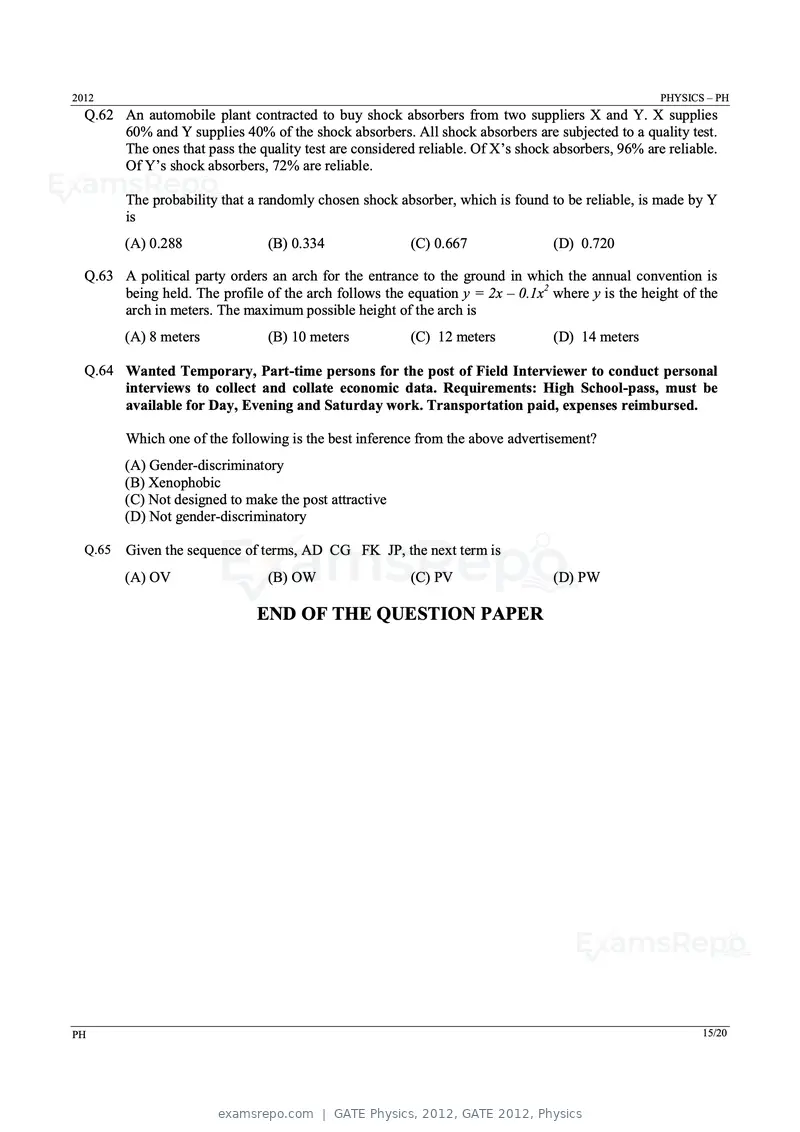
Text of page 15
2012                                                                                               PHYSICS – PH
  Q.62 An automobile plant contracted to buy shock absorbers from two suppliers X and Y. X supplies
       60% and Y supplies 40% of the shock absorbers. All shock absorbers are subjected to a quality test.
       The ones that pass the quality test are considered reliable. Of X’s shock absorbers, 96% are reliable.
       Of Y’s shock absorbers, 72% are reliable.

         The probability that a randomly chosen shock absorber, which is found to be reliable, is made by Y
         is
         (A) 0.288               (B) 0.334               (C) 0.667               (D) 0.720

  Q.63 A political party orders an arch for the entrance to the ground in which the annual convention is
       being held. The profile of the arch follows the equation y = 2x – 0.1x2 where y is the height of the
       arch in meters. The maximum possible height of the arch is
         (A) 8 meters            (B) 10 meters           (C) 12 meters           (D) 14 meters

  Q.64 Wanted Temporary, Part-time persons for the post of Field Interviewer to conduct personal
       interviews to collect and collate economic data. Requirements: High School-pass, must be
       available for Day, Evening and Saturday work. Transportation paid, expenses reimbursed.

         Which one of the following is the best inference from the above advertisement?
         (A) Gender-discriminatory
         (B) Xenophobic
         (C) Not designed to make the post attractive
         (D) Not gender-discriminatory

  Q.65   Given the sequence of terms, AD CG FK JP, the next term is
         (A) OV                  (B) OW                  (C) PV                  (D) PW

                               END OF THE QUESTION PAPER


PH                                                                                                        15/20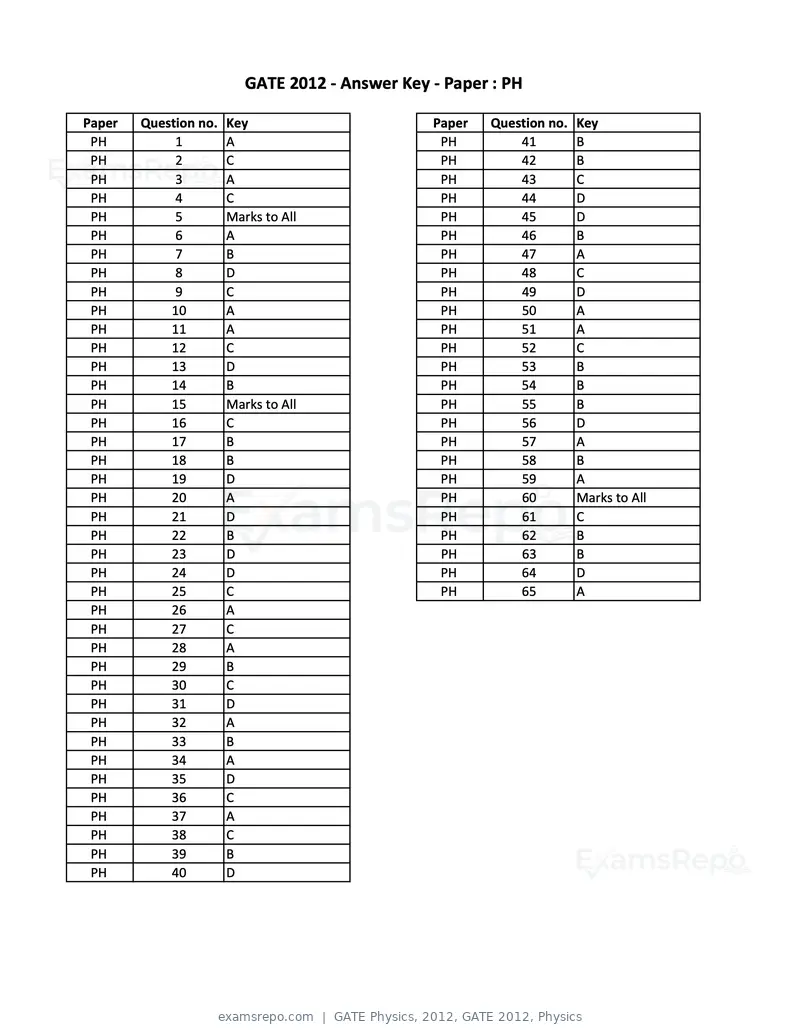
Text of page 16
GATE 2012 ‐ Answer Key ‐ Paper : PH

Paper   Question no. Key                       Paper   Question no. Key
 PH          1       A                          PH         41       B
 PH          2       C                          PH         42       B
 PH          3       A                          PH         43       C
 PH          4       C                          PH         44       D
 PH          5       Marks to All               PH         45       D
 PH          6       A                          PH         46       B
 PH          7       B                          PH         47       A
 PH          8       D                          PH         48       C
 PH          9       C                          PH         49       D
 PH         10       A                          PH         50       A
 PH         11       A                          PH         51       A
 PH         12       C                          PH         52       C
 PH         13       D                          PH         53       B
 PH         14       B                          PH         54       B
 PH         15       Marks to All               PH         55       B
 PH         16       C                          PH         56       D
 PH         17       B                          PH         57       A
 PH         18       B                          PH         58       B
 PH         19       D                          PH         59       A
 PH         20       A                          PH         60       Marks to All
 PH         21       D                          PH         61       C
 PH         22       B                          PH         62       B
 PH         23       D                          PH         63       B
 PH         24       D                          PH         64       D
 PH         25       C                          PH         65       A
 PH         26       A
 PH         27       C
 PH         28       A
 PH         29       B
 PH         30       C
 PH         31       D
 PH         32       A
 PH         33       B
 PH         34       A
 PH         35       D
 PH         36       C
 PH         37       A
 PH         38       C
 PH         39       B
 PH         40       D
Official key not published for this paper.
Page 1 of 16
Source: GATE. Question paper published by GATE.