
GATE Physics 2014
Text of page 1
GATE 2014: General Instructions during Examination

   1. Total duration of the GATE examination is 180 minutes.
   2. The clock will be set at the server. The countdown timer at the top right corner of
      screen will display the remaining time available for you to complete the examination.
      When the timer reaches zero, the examination will end by itself. You need not
      terminate the examination or submit your paper.
   3. Any useful data required for your paper can be viewed by clicking on the Useful
      Common Data button that appears on the screen.
   4. Use the scribble pad provided to you for any rough work. Submit the scribble pad at
      the end of the examination.
   5. You are allowed to use a non-programmable type calculator, however, sharing of
      calculators is not allowed.
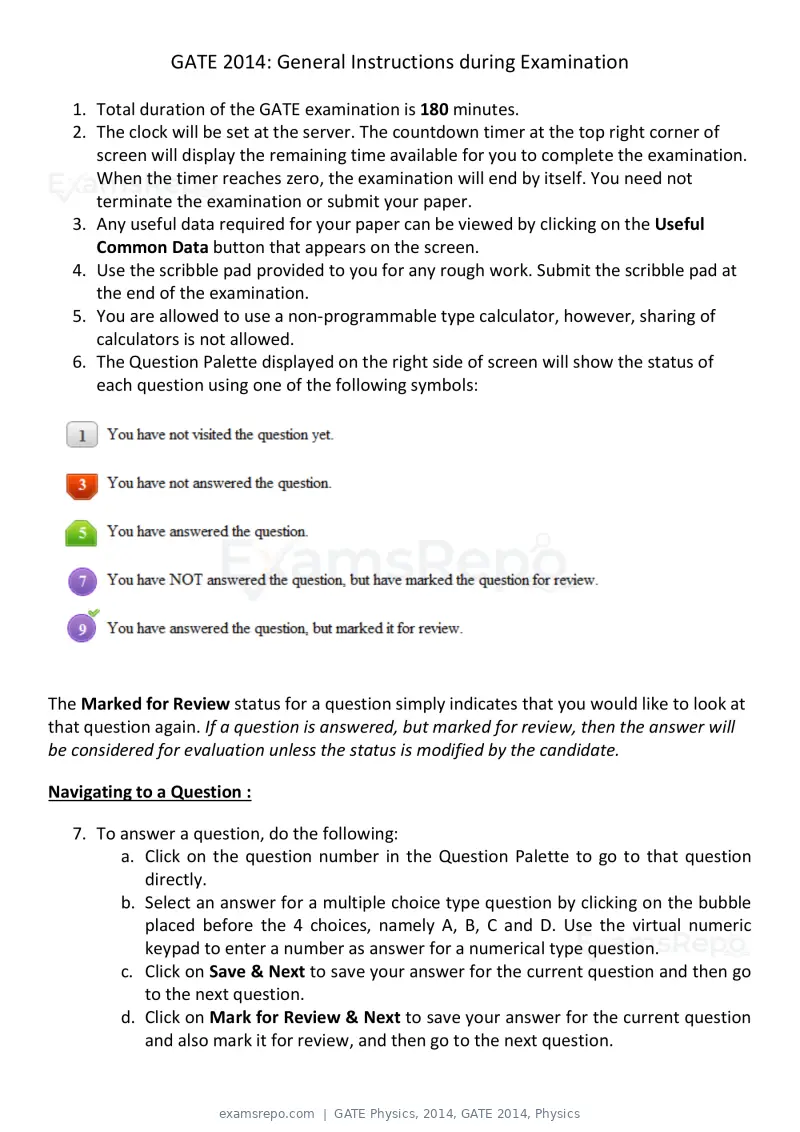
   6. The Question Palette displayed on the right side of screen will show the status of
      each question using one of the following symbols:


The Marked for Review status for a question simply indicates that you would like to look at
that question again. If a question is answered, but marked for review, then the answer will
be considered for evaluation unless the status is modified by the candidate.

Navigating to a Question :

   7. To answer a question, do the following:
         a. Click on the question number in the Question Palette to go to that question
            directly.
         b. Select an answer for a multiple choice type question by clicking on the bubble
            placed before the 4 choices, namely A, B, C and D. Use the virtual numeric
            keypad to enter a number as answer for a numerical type question.
         c. Click on Save & Next to save your answer for the current question and then go
            to the next question.
         d. Click on Mark for Review & Next to save your answer for the current question
            and also mark it for review, and then go to the next question.
Text of page 2
Caution: Note that your answer for the current question will not be saved, if you navigate
to another question directly by clicking on a question number without saving the answer to
the previous question.

You can view all the questions by clicking on the Question Paper button. This feature is
provided, so that if you want you can just see the entire question paper at a glance.

Answering a Question :

   8. Procedure for answering a multiple choice (MCQ) type question:
         a. Choose one answer from the 4 options (A,B,C,D) given below the question,
            click on the bubble placed before the chosen option.
         b. To deselect your chosen answer, click on the bubble of the chosen option again
            or click on the Clear Response button.
         c. To change your chosen answer, click on the bubble of another option.
         d. To save your answer, you MUST click on the Save & Next button.

   9. Procedure for answering a numerical answer type question:
         a. To enter a number as your answer, use the virtual numerical keypad.
         b. A fraction (e.g. -0.3 or -.3) can be entered as an answer with or without '0'
             before the decimal point. As many as four decimal points, e.g. 12.5435 or
             0.003 or -932.6711 or 12.82 can be entered.
         c. To clear your answer, click on the Clear Response button.
         d. To save your answer, you MUST click on the Save & Next button
   10. To mark a question for review, click on the Mark for Review & Next button. If an
      answer is selected (for MCQ) or entered (for numerical answer type) for a question
      that is Marked for Review, that answer will be considered in the evaluation unless
      the status is modified by the candidate.

   11. To change your answer to a question that has already been answered, first select
      that question for answering and then follow the procedure for answering that type of
      question.
   12. Note that ONLY Questions for which answers are saved or marked for review after
      answering will be considered for evaluation.


      Choosing a Section :

   13. Sections in this question paper are displayed on the top bar of the screen. Questions
      in a Section can be viewed by clicking on the name of that Section. The Section you
      are currently viewing will be highlighted.
   14. A checkbox is displayed for every optional Section, if any, in the Question Paper. To
      select the optional Section for answering, click on the checkbox for that Section.
   15. If the checkbox for an optional Section is not selected, the Save & Next button and
      the Mark for Review & Next button will NOT be enabled for that Section. You will
Text of page 3
only be able to see questions in this Section, but you will not be able to answer
      questions in the Section.
   16. After clicking the Save & Next button for the last question in a Section, you will
      automatically be taken to the first question of the next Section in sequence.
   17. You can move the mouse cursor over the name of a Section to view the answering
      status for that Section.


Changing the Optional Section :

   18. After answering the chosen optional Section, partially or completely, you can change
      the optional Section by selecting the checkbox for a new Section that you want to
      attempt. A warning message will appear along with a table showing the number of
      questions answered in each of the previously chosen optional Sections and a
      checkbox against each of these Sections. Click on a checkbox against a Section that
      you want to reset and then click on the RESET button. Note that RESETTING a Section
      will DELETE all the answers for questions in that Section. Hence, if you think that you
      may want to select this Section again later, you will have to note down your answers
      for questions in that Section. If you do not want to reset the Section and want to
      continue answering the previously chosen optional Section, then click on the BACK
      button.

   19. If you deselect the checkbox for an optional Section in the top bar, the following
      warning message will appear: "Deselecting the checkbox will DELETE all the answers
      for questions in this Section. Do you want to deselect this Section?” If you want to
      deselect, click on the RESET button. If you do not want to deselect, click on the BACK
      button.

   20. You can shuffle between different Sections or change the optional Sections any
      number of times.
Text of page 4
GATE 2014 Examination
                                                 PH: Physics
Duration: 180 minutes                                                                        Maximum Marks: 100

Read the following instructions carefully.

    1. To login, enter your Registration Number and password provided to you. Kindly go through the various
       symbols used in the test and understand their meaning before you start the examination.
    2. Once you login and after the start of the examination, you can view all the questions in the question
       paper, by clicking on the View All Questions button in the screen.
    3. This question paper consists of 2 sections, General Aptitude (GA) for 15 marks and the subject
       specific GATE paper for 85 marks. Both these sections are compulsory.
       The GA section consists of 10 questions. Question numbers 1 to 5 are of 1-mark each, while question
       numbers 6 to 10 are of 2-mark each.
       The subject specific GATE paper section consists of 55 questions, out of which question numbers 1 to
       25 are of 1-mark each, while question numbers 26 to 55 are of 2-mark each.
    4. Depending upon the GATE paper, there may be useful common data that may be required for
       answering the questions. If the paper has such useful data, the same can be viewed by clicking on the
       Useful Common Data button that appears at the top, right hand side of the screen.
    5. The computer allotted to you at the examination center runs specialized software that permits only one
        answer to be selected for multiple-choice questions using a mouse and to enter a suitable number for
        the numerical answer type questions using the virtual keyboard and mouse.
    6. Your answers shall be updated and saved on a server periodically and also at the end of the
        examination. The examination will stop automatically at the end of 180 minutes.
    7. In each paper a candidate can answer a total of 65 questions carrying 100 marks.
    8. The question paper may consist of questions of multiple choice type (MCQ) and numerical answer
        type.
    9. Multiple choice type questions will have four choices against A, B, C, D, out of which only ONE is the
        correct answer. The candidate has to choose the correct answer by clicking on the bubble (⃝) placed
        before the choice.
    10. For numerical answer type questions, each question will have a numerical answer and there will not be
        any choices. For these questions, the answer should be enteredby using the virtual keyboard that
        appears on the monitor and the mouse.
    11. All questions that are not attempted will result in zero marks. However, wrong answers for multiple
        choice type questions (MCQ) will result in NEGATIVE marks. For all MCQ questions a wrong
        answer will result in deduction of⅓ marks for a 1-mark question and ⅔ marks for a 2-mark question.
    12. There is NO NEGATIVE MARKING for questions of NUMERICAL ANSWER TYPE.
    13. Non-programmable type Calculator is allowed. Charts, graph sheets, and mathematical tables are NOT
        allowed in the Examination Hall. You must use the Scribble pad provided to you at the examination
        centre for all your rough work. The Scribble Pad has to be returned at the end of the examination.

    Declaration by the candidate:

    “I have read and understood all the above instructions. I have also read and understood clearly the
    instructions given on the admit card and shall follow the same. I also understand that in case I am found to
    violate any of these instructions, my candidature is liable to be cancelled. I also confirm that at the start of
    the examination all the computer hardware allotted to me are in proper working condition”.
Text of page 5
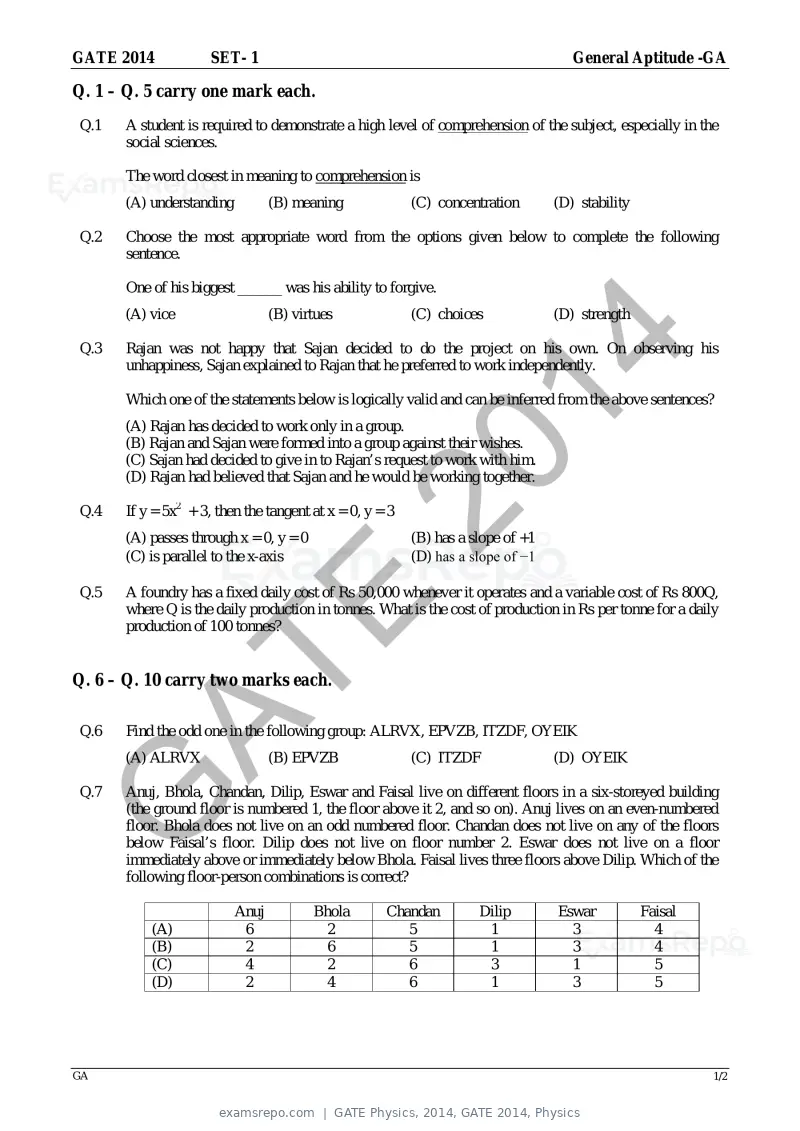
GATE 2014             SET- 1                                                         General Aptitude -GA

Q. 1 – Q. 5 carry one mark each.
Q.1    A student is required to demonstrate a high level of comprehension of the subject, especially in the
       social sciences.

       The word closest in meaning to comprehension is
      (A) understanding          (B) meaning              (C) concentration       (D) stability

Q.2    Choose the most appropriate word from the options given below to complete the following
       sentence.

       One of his biggest ______ was his ability to forgive.
      (A) vice                   (B) virtues              (C) choices             (D) strength


                                             14
Q.3    Rajan was not happy that Sajan decided to do the project on his own. On observing his
       unhappiness, Sajan explained to Rajan that he preferred to work independently.

       Which one of the statements below is logically valid and can be inferred from the above sentences?
      (A) Rajan has decided to work only in a group.
      (B) Rajan and Sajan were formed into a group against their wishes.


Q.4
                                           20
      (C) Sajan had decided to give in to Rajan’s request to work with him.
      (D) Rajan had believed that Sajan and he would be working together.

       If y = 5x2 + 3, then the tangent at x = 0, y = 3
      (A) passes through x = 0, y = 0                     (B) has a slope of +1
      (C) is parallel to the x-axis                       (D) has a slope of −1

Q.5    A foundry has a fixed daily cost of Rs 50,000 whenever it operates and a variable cost of Rs 800Q,
                          E
       where Q is the daily production in tonnes. What is the cost of production in Rs per tonne for a daily
       production of 100 tonnes?
 AT


Q. 6 – Q. 10 carry two marks each.

Q.6    Find the odd one in the following group: ALRVX, EPVZB, ITZDF, OYEIK
      (A) ALRVX                  (B) EPVZB                (C) ITZDF               (D) OYEIK
G


Q.7    Anuj, Bhola, Chandan, Dilip, Eswar and Faisal live on different floors in a six-storeyed building
       (the ground floor is numbered 1, the floor above it 2, and so on). Anuj lives on an even-numbered
       floor. Bhola does not live on an odd numbered floor. Chandan does not live on any of the floors
       below Faisal’s floor. Dilip does not live on floor number 2. Eswar does not live on a floor
       immediately above or immediately below Bhola. Faisal lives three floors above Dilip. Which of the
       following floor-person combinations is correct?

                          Anuj          Bhola        Chandan         Dilip        Eswar           Faisal
           (A)             6              2             5             1             3               4
           (B)             2              6             5             1             3               4
           (C)             4              2             6             3             1               5
           (D)             2              4             6             1             3               5


GA                                                                                                         1/2
Text of page 6
GATE 2014              SET- 1                                                        General Aptitude -GA
Q.8    The smallest angle of a triangle is equal to two thirds of the smallest angle of a quadrilateral. The
       ratio between the angles of the quadrilateral is 3:4:5:6. The largest angle of the triangle is twice its
       smallest angle. What is the sum, in degrees, of the second largest angle of the triangle and the
       largest angle of the quadrilateral?

Q.9    One percent of the people of country X are taller than 6 ft. Two percent of the people of country Y
       are taller than 6 ft. There are thrice as many people in country X as in country Y. Taking both
       countries together, what is the percentage of people taller than 6 ft?
       (A) 3.0                  (B) 2.5                  (C) 1.5                  (D) 1.25

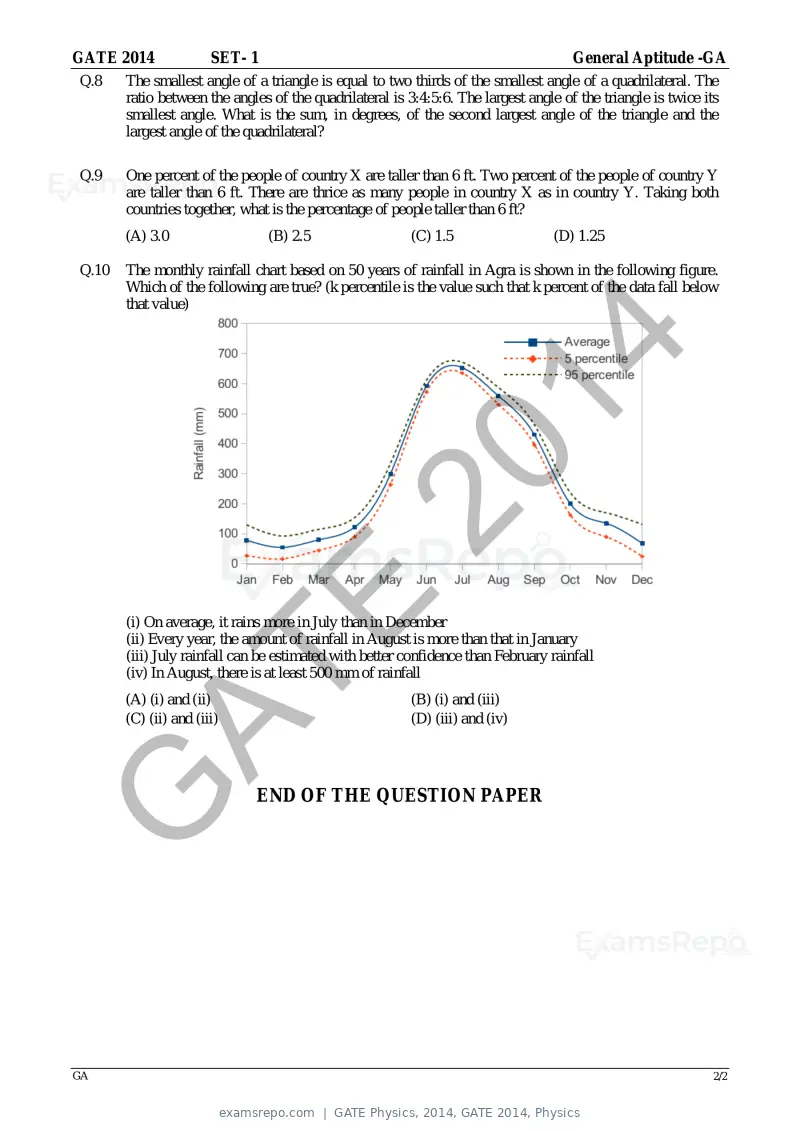
Q.10   The monthly rainfall chart based on 50 years of rainfall in Agra is shown in the following figure.
       Which of the following are true? (k percentile is the value such that k percent of the data fall below
       that value)


                                            14
                                          20
                            E
       (i) On average, it rains more in July than in December
       (ii) Every year, the amount of rainfall in August is more than that in January
       (iii) July rainfall can be estimated with better confidence than February rainfall
 AT


       (iv) In August, there is at least 500 mm of rainfall
       (A) (i) and (ii)                                  (B) (i) and (iii)
       (C) (ii) and (iii)                                (D) (iii) and (iv)
G


                             END OF THE QUESTION PAPER


GA                                                                                                            2/2
Text of page 7
GATE 2014                       SET 1                           PHYSICS-PH


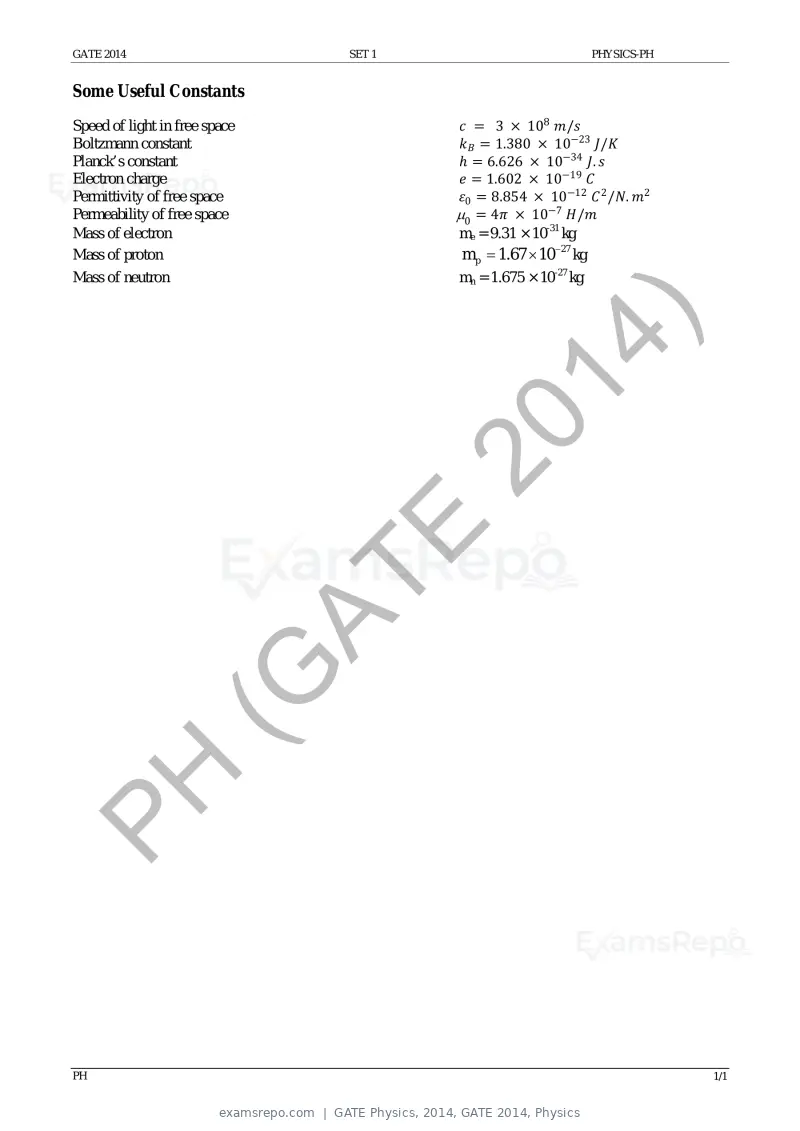
Some Useful Constants
Speed of light in free space            cc = 3 × 108 mm/ss
Boltzmann constant                      kkBB = 1.380 × 10⁻²³ JJ/KK
Planck’s constant                       ℎ = 6.626 × 10⁻³⁴ JJ. ss
Electron charge                         ee = 1.602 × 10⁻¹⁹ CC
Permittivity of free space              εε0 = 8.854 × 10⁻¹² CC 2 /NN. mm2
Permeability of free space              µ0 = 4ππ × 10−7 HH/mm
Mass of electron                        me = 9.31 × 10⁻³¹ kg
Mass of proton                           m p = 1.67 × 10 −27 kg
Mass of neutron                         mn = 1.675 × 10⁻²⁷ kg


                                            )
                                          14
                                        20
                                E
                               AT
               (G
PH


PH                                                                           1/1
Text of page 8
GATE 2014 SET 1 PHYSICS-PH
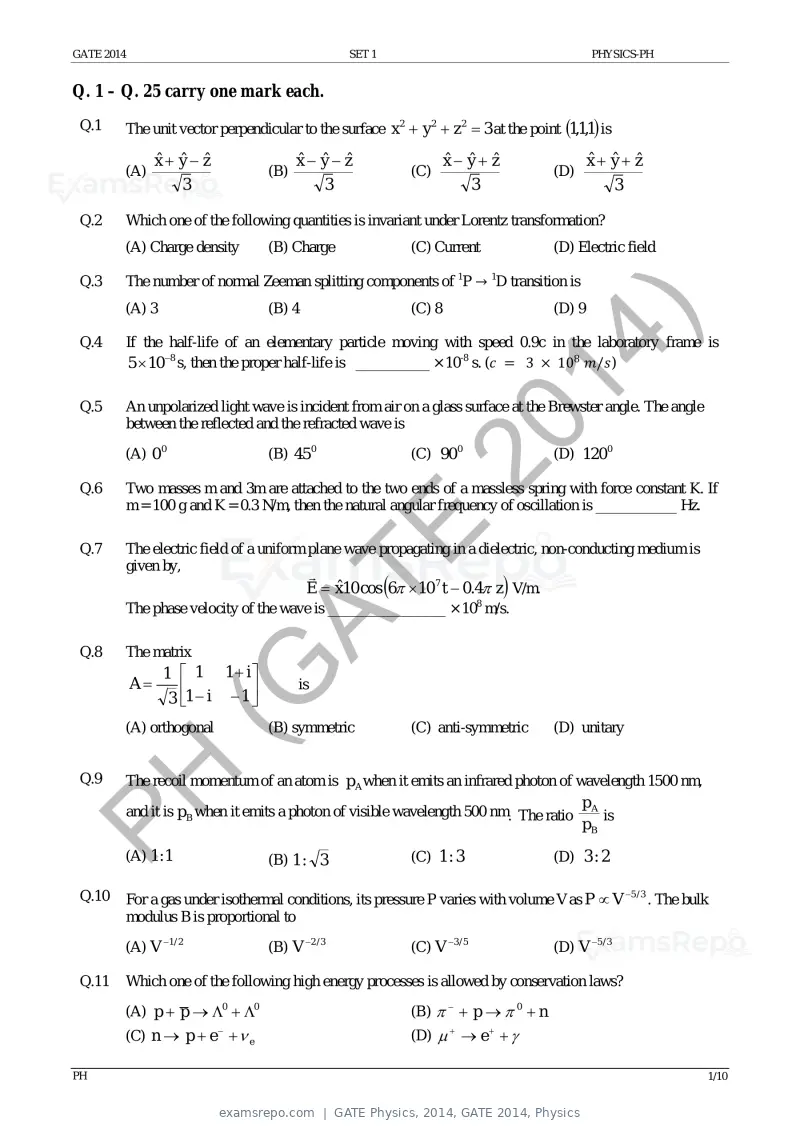
Q. 1 – Q. 25 carry one mark each.
Q.1 The unit vector perpendicular to the surface x 2 + y 2 + z 2 = 3 at the point (1,1,1) is
xˆ + yˆ − zˆ xˆ − yˆ − zˆ xˆ − yˆ + zˆ xˆ + yˆ + zˆ
(A) (B) (C) (D)
3 3 3 3
Q.2 Which one of the following quantities is invariant under Lorentz transformation?
(A) Charge density (B) Charge (C) Current (D) Electric field
Q.3 The number of normal Zeeman splitting components of 1P → 1D transition is
(A) 3 (B) 4 (C) 8 (D) 9
)
14
Q.4 If the half-life of an elementary particle moving with speed 0.9c in the laboratory frame is
5 × 10 −8 s, then the proper half-life is __________ × 10-8 s. (cc = 3 × 108 mm/ss)
Q.5 An unpolarized light wave is incident from air on a glass surface at the Brewster angle. The angle
20
between the reflected and the refracted wave is
(A) 0 0 (B) 45 0 (C) 90 0 (D) 120 0
Q.6 Two masses m and 3m are attached to the two ends of a massless spring with force constant K. If
m = 100 g and K = 0.3 N/m, then the natural angular frequency of oscillation is ___________ Hz.
E
Q.7 The electric field of a uniform plane wave propagating in a dielectric, non-conducting medium is
given by,
( )
AT
E = xˆ 10 cos 6π × 10 7 t − 0.4π z V/m.
8
The phase velocity of the wave is ________________ × 10 m/s.
Q.8 The matrix
1 1 1 + i
(G
A= is
3 1 − i − 1
(A) orthogonal (B) symmetric (C) anti-symmetric (D) unitary
PH
Q.9 The recoil momentum of an atom is p A when it emits an infrared photon of wavelength 1500 nm,
pA
and it is p B when it emits a photon of visible wavelength 500 nm. The ratio is
pB
(A) 1 : 1 (B) 1 : 3 (C) 1 : 3 (D) 3 : 2
Q.10 For a gas under isothermal conditions, its pressure P varies with volume V as P ∝ V −5 / 3 . The bulk
modulus B is proportional to
(A) V −1/ 2 (B) V −2 / 3 (C) V −3 / 5 (D) V −5 / 3
Q.11 Which one of the following high energy processes is allowed by conservation laws?
(A) p + p → Λ0 + Λ0 (B) π − + p → π 0 + n
(C) n → p + e − + ν e (D) µ + → e + + γ
PH 1/10
Text of page 9
GATE 2014 SET 1 PHYSICS-PH
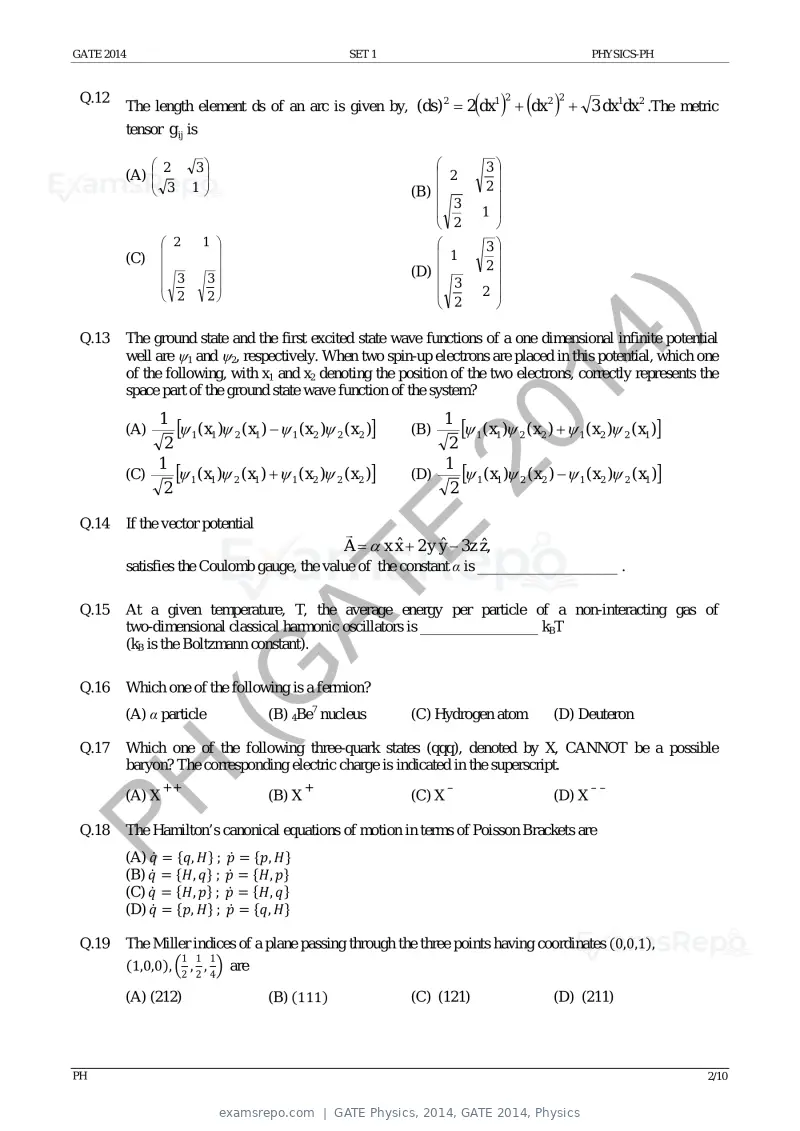
Q.12
The length element ds of an arc is given by, (ds ) 2 = 2 dx1 ( ) + (dx ) + 3 dx dx .The metric
2 2 2 1 2
tensor g ij is
2 3
2 3
(A)
3 1 (B) 2
3
1
2
2 1 3
1
(C) 2
3 3
(D)
3
2 2 2
2
)
Q.13 The ground state and the first excited state wave functions of a one dimensional infinite potential
14
well are ψ1 and ψ2, respectively. When two spin-up electrons are placed in this potential, which one
of the following, with x1 and x2 denoting the position of the two electrons, correctly represents the
space part of the ground state wave function of the system?
1
[ψ 1 ( x1 )ψ 2 ( x1 ) − ψ 1 ( x2 )ψ 2 ( x2 )] 1
[ψ 1 ( x1 )ψ 2 ( x2 ) + ψ 1 ( x2 )ψ 2 ( x1 )]
20
(A) (B)
2 2
(C)
1
[ψ 1 ( x1 )ψ 2 ( x1 ) + ψ 1 ( x2 )ψ 2 ( x2 )] (D)
1
[ψ 1 ( x1 )ψ 2 ( x2 ) − ψ 1 ( x2 )ψ 2 ( x1 )]
2 2
Q.14 If the vector potential
E
A = α x xˆ + 2 y yˆ − 3 z zˆ,
satisfies the Coulomb gauge, the value of the constant α is ___________________ .
AT
Q.15 At a given temperature, T, the average energy per particle of a non-interacting gas of
two-dimensional classical harmonic oscillators is ________________ kBT
(kB is the Boltzmann constant).
(G
Q.16 Which one of the following is a fermion?
(A) α particle (B) 4Be7 nucleus (C) Hydrogen atom (D) Deuteron
Q.17 Which one of the following three-quark states (qqq), denoted by X, CANNOT be a possible
baryon? The corresponding electric charge is indicated in the superscript.
PH
++ + – ––
(A) X (B) X (C) X (D) X
Q.18 The Hamilton’s canonical equations of motion in terms of Poisson Brackets are
(A) qq̇ = {qq, HH} ; pṗ = {pp, HH}
(B) qq̇ = {HH, qq} ; pṗ = {HH, pp}
(C) qq̇ = {HH, pp} ; pṗ = {HH, qq}
(D) qq̇ = {pp, HH} ; pṗ = {qq, HH}
Q.19 The Miller indices of a plane passing through the three points having coordinates (0,0,1),
1 1 1
(1,0,0), � , , � are
2 2 4
(A) (212) (B) (111) (C) (121) (D) (211)
PH 2/10
Text of page 10
GATE 2014                                           SET 1                                            PHYSICS-PH


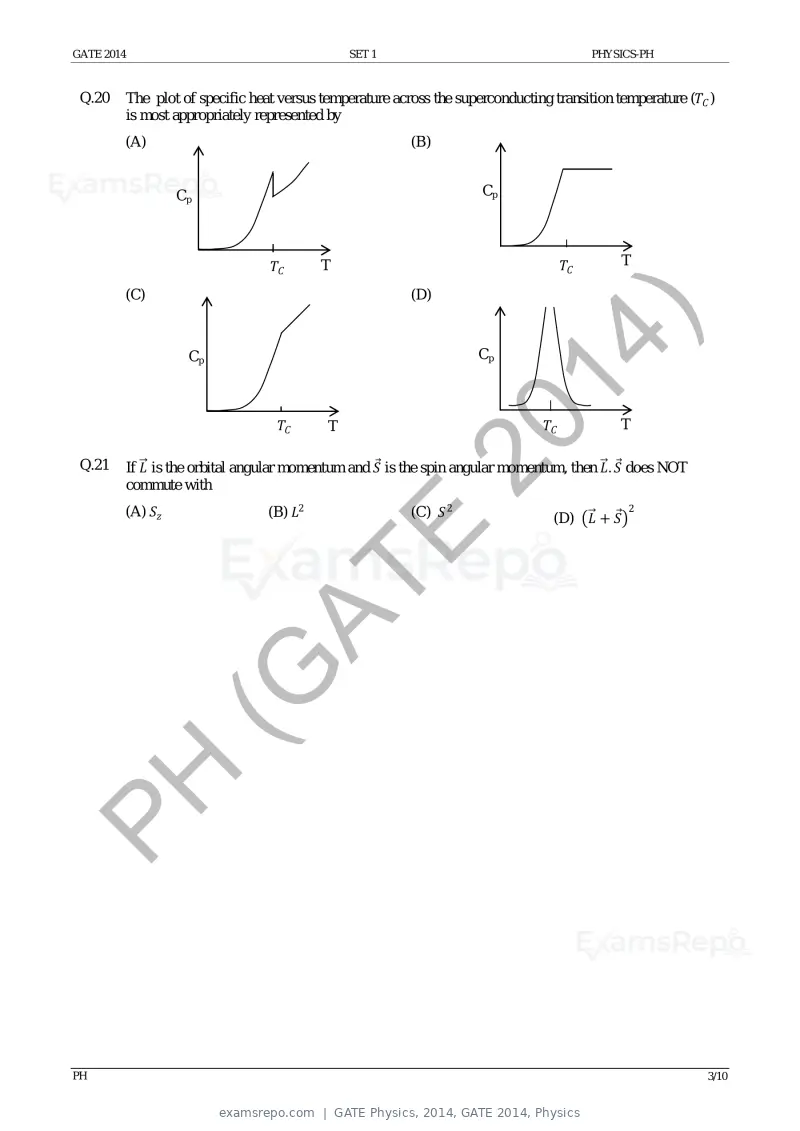
 Q.20       The plot of specific heat versus temperature across the superconducting transition temperature (TTCC )
            is most appropriately represented by
        (A)                                                    (B)


                     Cp                                                     Cp


                                      TTCC     T                                              TTCC       T

        (C)                                                    (D)


                                                                   )
                                                                 14
                       Cp                                                  Cp


                                        TTCC                                           TTCC


                                                               20
                                                T                                                        T

 Q.21       If LL�⃗ is the orbital angular momentum and SS⃗ is the spin angular momentum, then LL�⃗. SS⃗ does NOT
            commute with
        (A) SSzz                     (B) LL2                   (C) SS 2                  (D) �LL�⃗ + SS⃗�
                                                                                                           2
                                                    E
                                 AT
                   (G
PH


PH                                                                                                                  3/10
Text of page 11
GATE 2014                                                    SET 1                              PHYSICS-PH

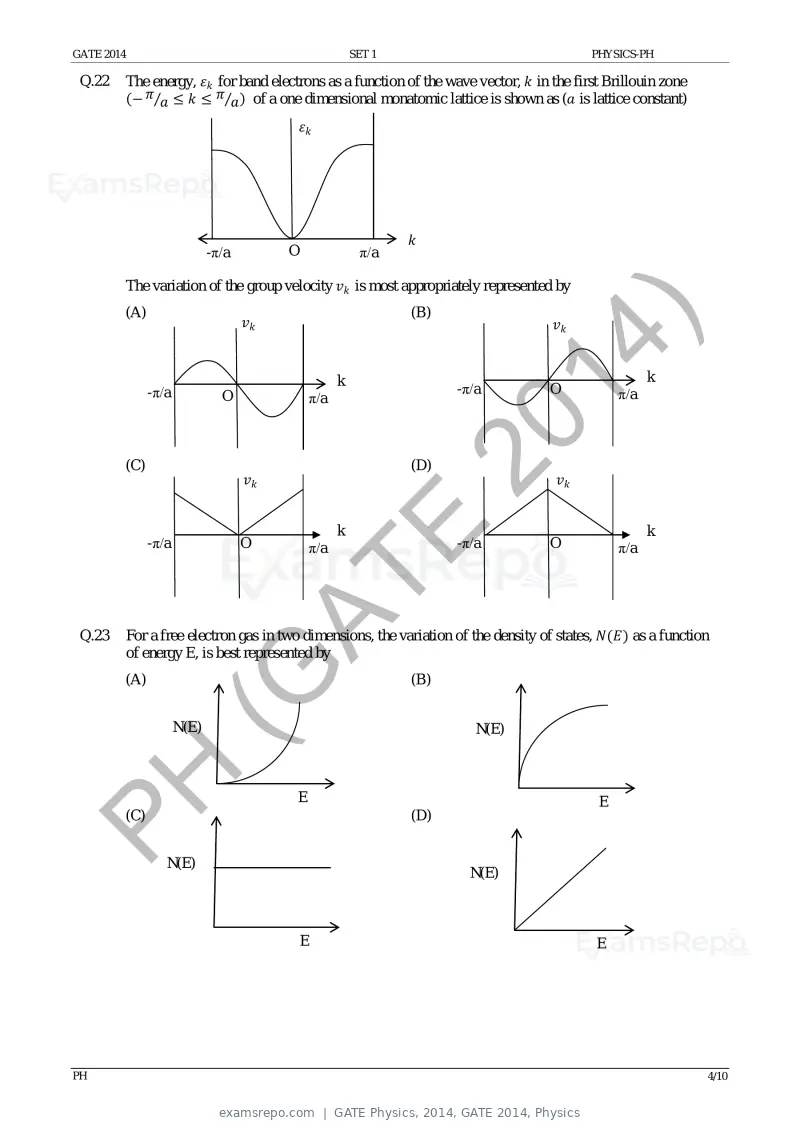
 Q.22       The energy, εεkk for band electrons as a function of the wave vector, kk in the first Brillouin zone
            (− ππ⁄aa ≤ kk ≤ ππ⁄aa) of a one dimensional monatomic lattice is shown as (aa is lattice constant)
                                           εεkk


                                                                     kk
                             -π/a          O                  π/a

            The variation of the group velocity vvkk is most appropriately represented by
        (A)                                                          (B)


                                                                         )
                                    vvkk                                                vvkk


                                                                       14
                                                         k                                                 k
               -π/a                                                        -π/a        O             π/a
                               O                   π/a


        (C)
                                    vvkk

                                                                     20
                                                                     (D)
                                                                                         vvkk
                                                         E
                                                         k                                                 k
               -π/a                 O              π/a                     -π/a        O             π/a
                                     AT

 Q.23       For a free electron gas in two dimensions, the variation of the density of states, NN(EE) as a function
            of energy E, is best represented by
                  (G


        (A)                                                          (B)


                      N(E)                                                    N(E)
PH


                                           E                                                     E
        (C)                                                          (D)


                   N(E)
                                                                             N(E)


                                               E                                                E


PH                                                                                                                 4/10
Text of page 12
GATE 2014                                          SET 1                                 PHYSICS-PH

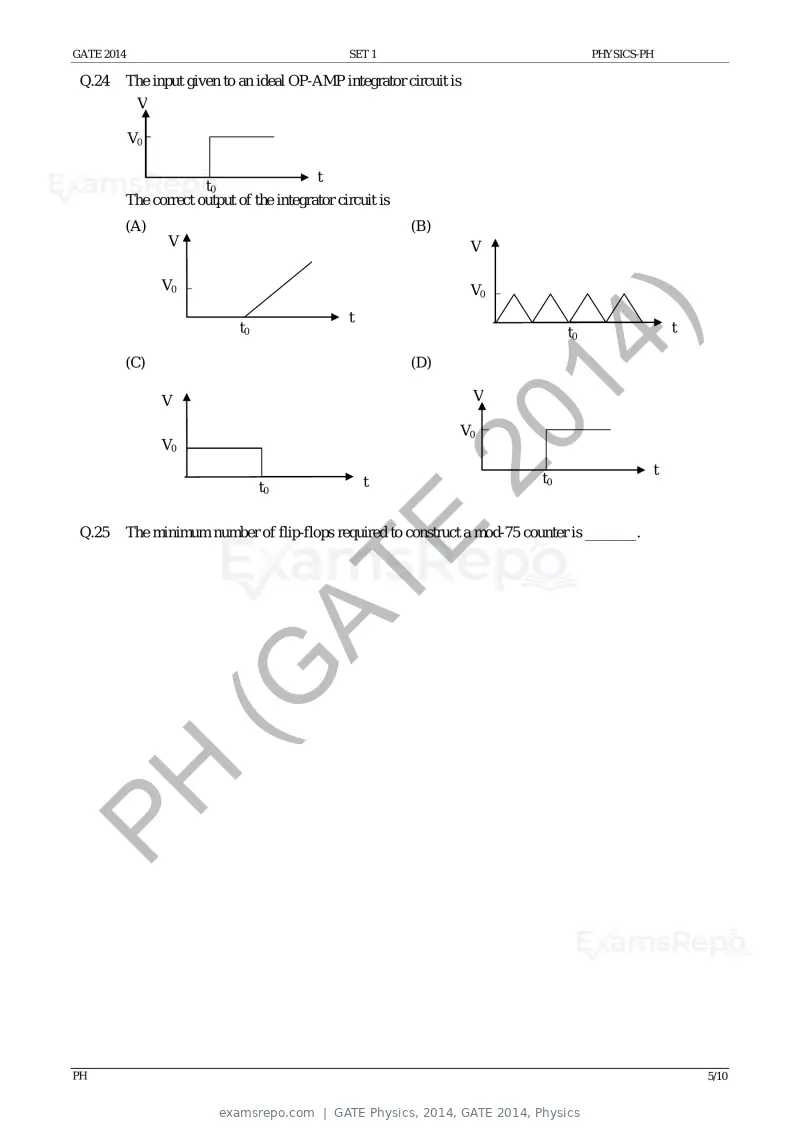
 Q.24       The input given to an ideal OP-AMP integrator circuit is
              V

            V0

                                             t
                         t0
            The correct output of the integrator circuit is
        (A)                                                   (B)
                   V                                                    V

                  V0                                                    V0


                                                                  )
                                                   t
                                t0                                                  t0                    t


                                                                14
        (C)                                                   (D)

                  V                                                     V


                                                              20
                                                                       V0
                  V0
                                                                                                      t
                                                       t                       t0
                                     t0
                                                  E
 Q.25       The minimum number of flip-flops required to construct a mod-75 counter is _______.
                                 AT
                  (G
PH


PH                                                                                                            5/10
Text of page 13
GATE 2014 SET 1 PHYSICS-PH
Q. 26 – Q. 55 carry two marks each.
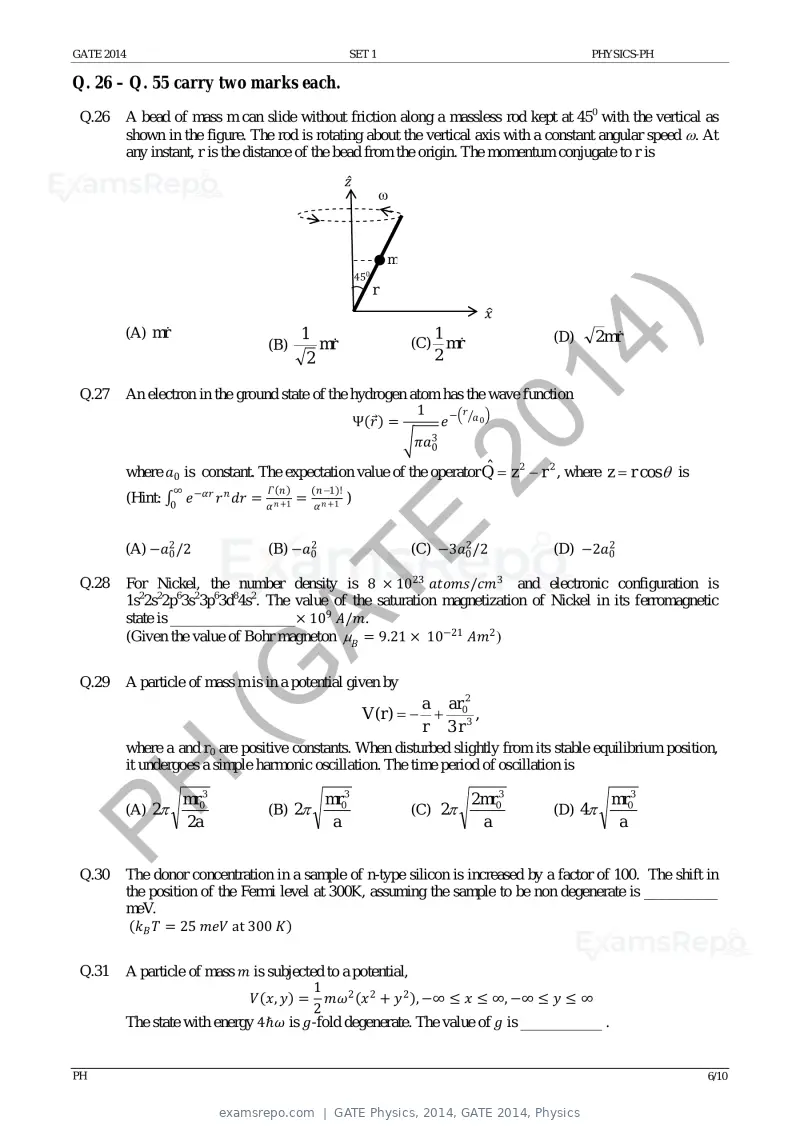
Q.26 A bead of mass m can slide without friction along a massless rod kept at 450 with the vertical as
shown in the figure. The rod is rotating about the vertical axis with a constant angular speed ω. At
any instant, r is the distance of the bead from the origin. The momentum conjugate to r is
zẑ
ω
m
450
r
xx�
)
(A) mr 1 1 (D) 2mr
mr mr
14
(B) (C)
2 2
Q.27 An electron in the ground state of the hydrogen atom has the wave function
1 −�rr �
Ѱ(rr⃗) = ee �aa 0
20
�ππaa03
where aa0 is constant. The expectation value of the operator Qˆ = z 2 − r 2 , where z = r cos θ is
∞ ΓΓ(nn) (nn −1)!
(Hint: ∫0 ee −αααα rr nn dddd = = αα nn +1 )
αα nn +1
E
(A) −aa02 /2 (B) −aa02 (C) −3aa02 /2 (D) −2aa02
AT
Q.28 For Nickel, the number density is 8 × 10²³ aaaaaaaaaa/cccc3 and electronic configuration is
1s22s22p63s23p63d84s2. The value of the saturation magnetization of Nickel in its ferromagnetic
state is _________________× 109 AA/mm.
(Given the value of Bohr magneton µBB = 9.21 × 10⁻²¹ AAmm2 )
(G
Q.29 A particle of mass m is in a potential given by
a ar 2
V (r ) = − + 03 ,
r 3r
where a and r0 are positive constants. When disturbed slightly from its stable equilibrium position,
it undergoes a simple harmonic oscillation. The time period of oscillation is
PH
mr03 mr03 2mr03 mr03
(A) 2π (B) 2π (C) 2π (D) 4π
2a a a a
Q.30 The donor concentration in a sample of n-type silicon is increased by a factor of 100. The shift in
the position of the Fermi level at 300K, assuming the sample to be non degenerate is __________
meV.
(kkBB TT = 25 mmmmmm at 300 KK)
Q.31 A particle of mass mm is subjected to a potential,
1
VV(xx, yy) = mmωω2 (xx 2 + yy 2 ), −∞ ≤ xx ≤ ∞, −∞ ≤ yy ≤ ∞
2
The state with energy 4ℏωω is gg-fold degenerate. The value of gg is ___________ .
PH 6/10
Text of page 14
GATE 2014 SET 1 PHYSICS-PH
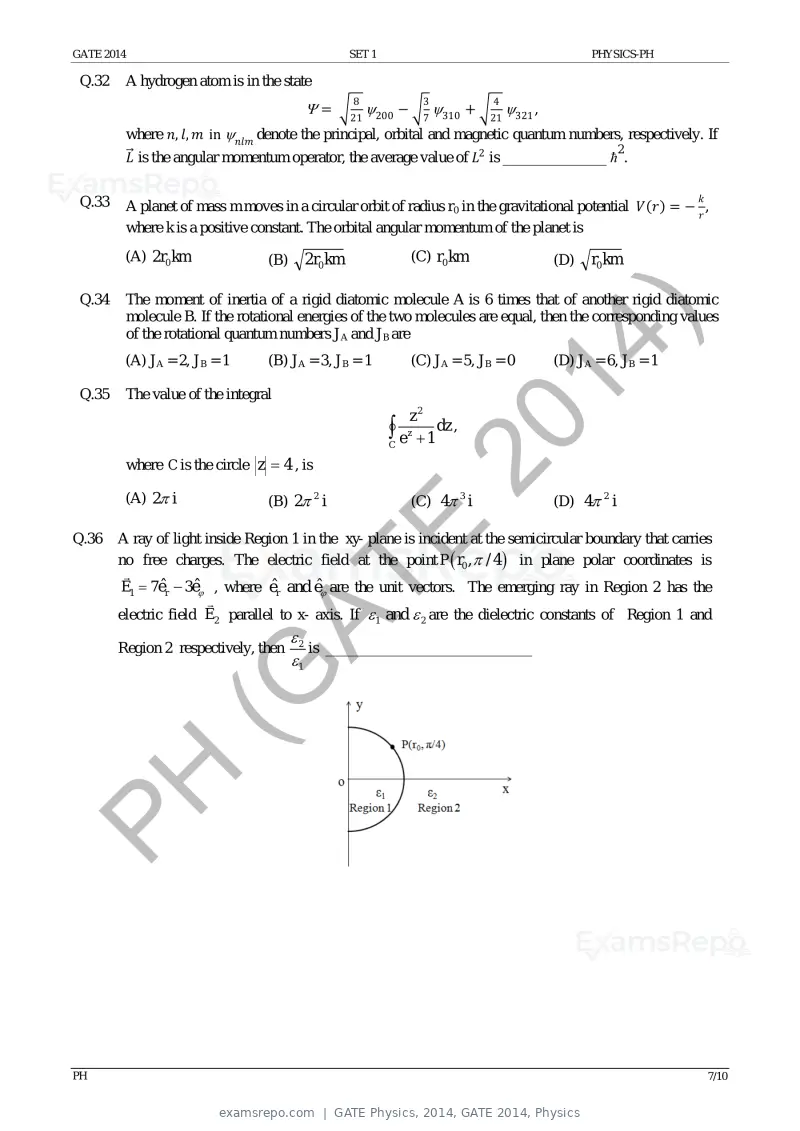
Q.32 A hydrogen atom is in the state
8 3 4
Ψ = �21 ψ200 − �7 ψ310 + �21 ψ321 ,
where nn, ll, mm in ψnnnnnn denote the principal, orbital and magnetic quantum numbers, respectively. If
2
LL�⃗ is the angular momentum operator, the average value of LL2 is ______________ ħ .
Q.33 kk
A planet of mass m moves in a circular orbit of radius r0 in the gravitational potential VV(rr) = − rr ,
where k is a positive constant. The orbital angular momentum of the planet is
(A) 2r0 km (B) 2r0 km (C) r0 km (D) r0 km
Q.34 The moment of inertia of a rigid diatomic molecule A is 6 times that of another rigid diatomic
)
molecule B. If the rotational energies of the two molecules are equal, then the corresponding values
of the rotational quantum numbers JA and JB are
14
(A) JA = 2, JB = 1 (B) JA = 3, JB = 1 (C) JA = 5, JB = 0 (D) JA = 6, JB = 1
Q.35 The value of the integral
z2
∫ e z + 1 dz ,
20
C
where C is the circle z = 4 , is
(A) 2π i (B) 2π 2 i (C) 4π 3 i (D) 4π 2 i
E
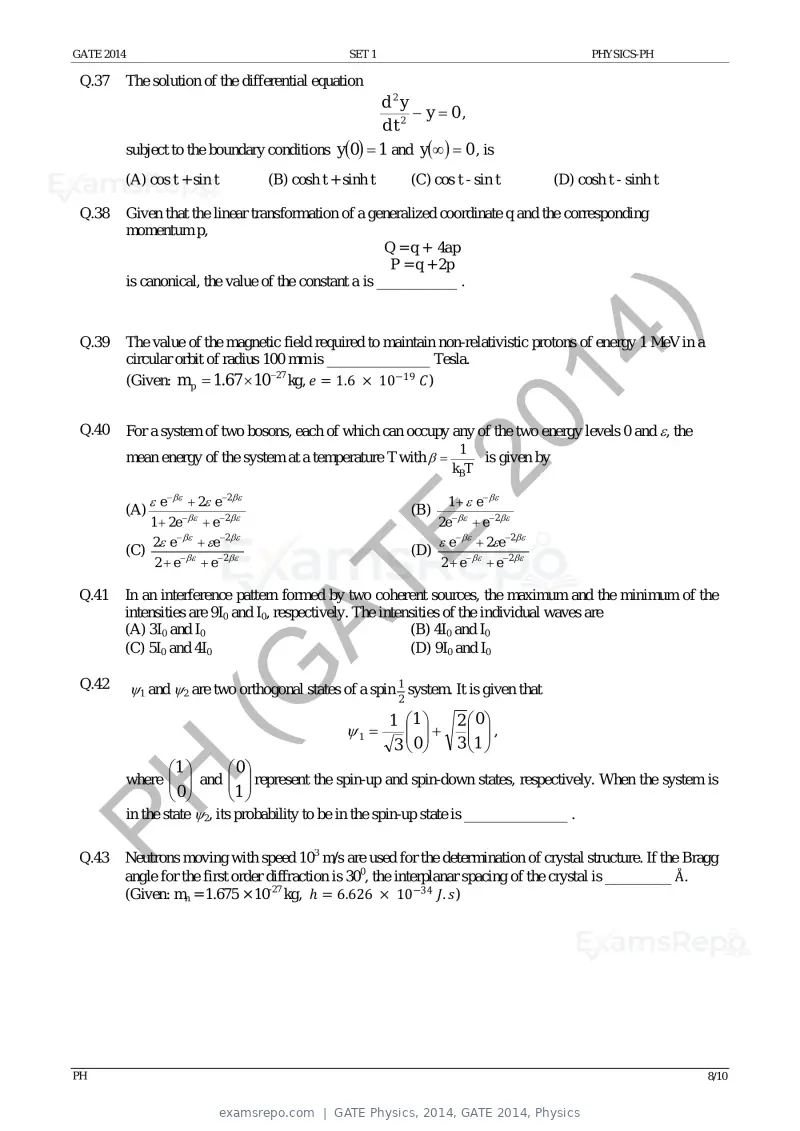
Q.36 A ray of light inside Region 1 in the xy- plane is incident at the semicircular boundary that carries
no free charges. The electric field at the point P ( r0 , π / 4 ) in plane polar coordinates is
AT
E1 = 7eˆr − 3eˆϕ , where eˆr and eˆϕ are the unit vectors. The emerging ray in Region 2 has the
electric field E2 parallel to x- axis. If ε1 and ε 2 are the dielectric constants of Region 1 and
ε2
Region 2 respectively, then is ____________________________
ε1
(G
PH
PH 7/10
Text of page 15
GATE 2014 SET 1 PHYSICS-PH
Q.37 The solution of the differential equation
d2y
− y = 0,
d t2
subject to the boundary conditions y (0 ) = 1 and y (∞ ) = 0 , is
(A) cos t + sin t (B) cosh t + sinh t (C) cos t - sin t (D) cosh t - sinh t
Q.38 Given that the linear transformation of a generalized coordinate q and the corresponding
momentum p,
Q = q + 4ap
P = q + 2p
is canonical, the value of the constant a is ___________ .
)
14
Q.39 The value of the magnetic field required to maintain non-relativistic protons of energy 1 MeV in a
circular orbit of radius 100 mm is ______________ Tesla.
(Given: m p = 1.67 × 10 −27 kg, ee = 1.6 × 10⁻¹⁹ CC)
20
Q.40 For a system of two bosons, each of which can occupy any of the two energy levels 0 and ε, the
1
mean energy of the system at a temperature T with β = is given by
k BT
ε e − βε + 2ε e −2 βε 1 + ε e − βε
(A) − βε − 2 βε
(B)
1 + 2e +e 2e − βε + e −2 βε
E
2ε e − βε + εe −2 βε ε e − βε + 2εe −2 βε
(C) (D)
2 + e − βε + e −2 βε 2 + e − βε + e −2 βε
AT
Q.41 In an interference pattern formed by two coherent sources, the maximum and the minimum of the
intensities are 9I0 and I0, respectively. The intensities of the individual waves are
(A) 3I0 and I0 (B) 4I0 and I0
(C) 5I0 and 4I0 (D) 9I0 and I0
(G
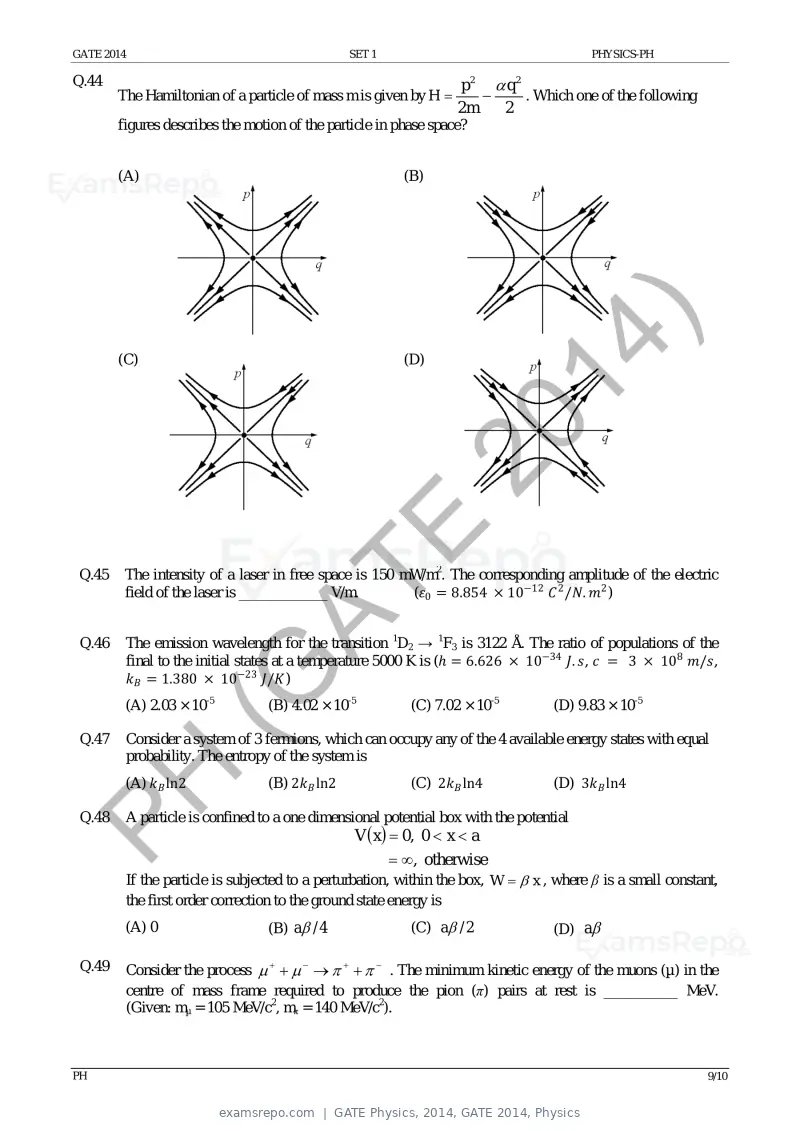
Q.42 ψ1 and ψ2 are two orthogonal states of a spin 1 system. It is given that
2
1 1 2 0
ψ1 = + ,
3 0 3 1
1 0
PH
where and represent the spin-up and spin-down states, respectively. When the system is
0 1
in the state ψ2, its probability to be in the spin-up state is ______________ .
Q.43 Neutrons moving with speed 103 m/s are used for the determination of crystal structure. If the Bragg
angle for the first order diffraction is 300, the interplanar spacing of the crystal is _________ Å.
(Given: mn = 1.675 × 10⁻²⁷ kg, ℎ = 6.626 × 10⁻³⁴ JJ. ss)
PH 8/10
Text of page 16
GATE 2014                                           SET 1                                   PHYSICS-PH

Q.44                                                                   p2 α q2
        The Hamiltonian of a particle of mass m is given by H =           −    . Which one of the following
                                                                       2m   2
        figures describes the motion of the particle in phase space?


        (A)                                                   (B)


                                                                   )
                                                                 14
        (C)                                                   (D)


                                                               20
                                                    E
 Q.45    The intensity of a laser in free space is 150 mW/m2. The corresponding amplitude of the electric
                                AT

         field of the laser is ____________ V/m.        (εε0 = 8.854 × 10⁻¹² CC 2 /NN. mm2 )


 Q.46       The emission wavelength for the transition 1D2 → 1F3 is 3122 Å. The ratio of populations of the
            final to the initial states at a temperature 5000 K is (ℎ = 6.626 × 10⁻³⁴ JJ. ss, cc = 3 × 108 mm/ss,
                  (G


            kkBB = 1.380 × 10⁻²³ JJ/KK)
         (A) 2.03 × 10⁻⁵            (B) 4.02 × 10⁻⁵            (C) 7.02 × 10⁻⁵       (D) 9.83 × 10⁻⁵

 Q.47       Consider a system of 3 fermions, which can occupy any of the 4 available energy states with equal
            probability. The entropy of the system is
PH


         (A) kkBB ln2               (B) 2kkBB ln2              (C) 2kkBB ln4         (D) 3kkBB ln4

 Q.48       A particle is confined to a one dimensional potential box with the potential
                                                     V (x ) = 0, 0 < x < a
                                                            = ∞, otherwise
            If the particle is subjected to a perturbation, within the box, W = β x , where β is a small constant,
            the first order correction to the ground state energy is
         (A) 0                      (B) aβ / 4                 (C) aβ / 2            (D) aβ

 Q.49       Consider the process µ + + µ − → π + + π − . The minimum kinetic energy of the muons (µ) in the
            centre of mass frame required to produce the pion (π) pairs at rest is __________ MeV.
            (Given: mµ = 105 MeV/c2, mπ = 140 MeV/c2).


PH                                                                                                              9/10
Text of page 17
GATE 2014 SET 1 PHYSICS-PH
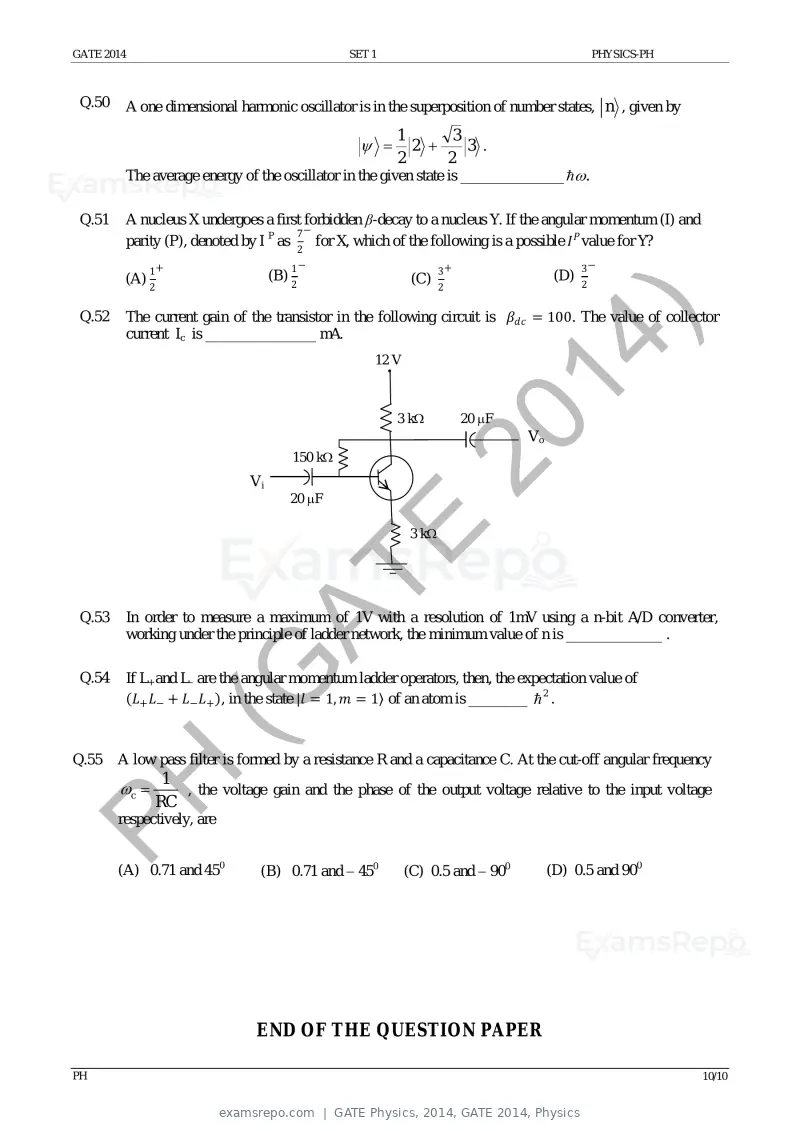
Q.50 A one dimensional harmonic oscillator is in the superposition of number states, n , given by
1 3
ψ = 2 + 3 .
2 2
The average energy of the oscillator in the given state is ______________ ω.
Q.51 A nucleus X undergoes a first forbidden β-decay to a nucleus Y. If the angular momentum (I) and
7−
parity (P), denoted by I P as for X, which of the following is a possible II PP value for Y?
2
1+ 1− 3+ 3−
(A) 2 (B) 2 (C) 2 (D) 2
The current gain of the transistor in the following circuit is ββdddd = 100. The value of collector
)
Q.52
current Ic is _______________ mA.
14
12 V
3 kΩ 20 µF
20
Vo
150 kΩ
Vi
20 µF
E
3 kΩ
AT
Q.53 In order to measure a maximum of 1V with a resolution of 1mV using a n-bit A/D converter,
working under the principle of ladder network, the minimum value of n is _____________ .
(G
Q.54 If L+ and L– are the angular momentum ladder operators, then, the expectation value of
(LL+ LL− + LL− LL+), in the state |ll = 1, mm = 1〉 of an atom is ________ 2 .
Q.55 A low pass filter is formed by a resistance R and a capacitance C. At the cut-off angular frequency
PH
1
ωc = , the voltage gain and the phase of the output voltage relative to the input voltage
RC
respectively, are
(A) 0.71 and 450 (B) 0.71 and − 450 (C) 0.5 and − 900 (D) 0.5 and 900
END OF THE QUESTION PAPER
PH 10/10
Text of page 18
GATE 2014
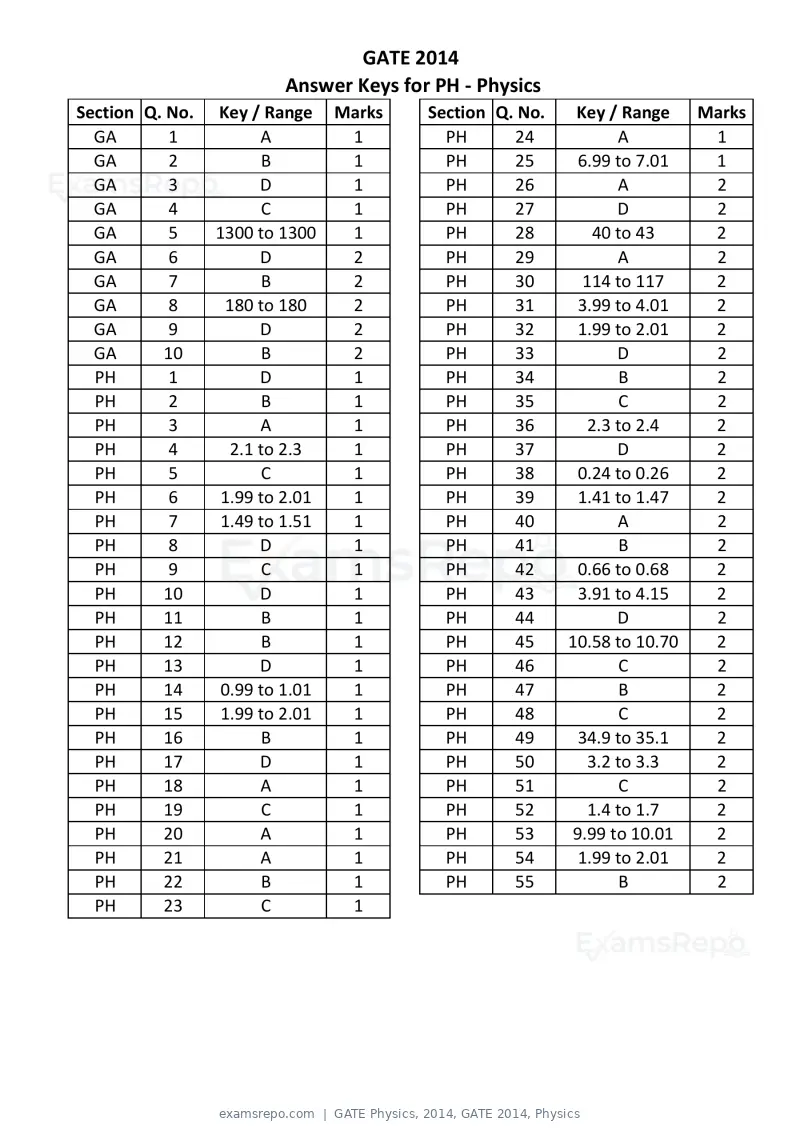
                        Answer Keys for PH ‐ Physics
Section Q. No.   Key / Range Marks     Section Q. No.    Key / Range     Marks
  GA       1          A       1          PH      24           A           1
  GA       2          B       1          PH      25      6.99 to 7.01     1
  GA       3          D       1          PH      26           A           2
  GA       4          C       1          PH      27           D           2
  GA       5     1300 to 1300 1          PH      28        40 to 43       2
  GA       6          D       2          PH      29           A           2
  GA       7          B       2          PH      30       114 to 117      2
  GA       8      180 to 180  2          PH      31      3.99 to 4.01     2
  GA       9          D       2          PH      32      1.99 to 2.01     2
  GA      10          B       2          PH      33           D           2
  PH       1          D       1          PH      34           B           2
  PH       2          B       1          PH      35           C           2
  PH       3          A       1          PH      36       2.3 to 2.4      2
  PH       4      2.1 to 2.3  1          PH      37           D           2
  PH       5          C       1          PH      38      0.24 to 0.26     2
  PH       6     1.99 to 2.01 1          PH      39      1.41 to 1.47     2
  PH       7     1.49 to 1.51 1          PH      40           A           2
  PH       8          D       1          PH      41           B           2
  PH       9          C       1          PH      42      0.66 to 0.68     2
  PH      10          D       1          PH      43      3.91 to 4.15     2
  PH      11          B       1          PH      44           D           2
  PH      12          B       1          PH      45     10.58 to 10.70    2
  PH      13          D       1          PH      46           C           2
  PH      14     0.99 to 1.01 1          PH      47           B           2
  PH      15     1.99 to 2.01 1          PH      48           C           2
  PH      16          B       1          PH      49      34.9 to 35.1     2
  PH      17          D       1          PH      50       3.2 to 3.3      2
  PH      18          A       1          PH      51           C           2
  PH      19          C       1          PH      52       1.4 to 1.7      2
  PH      20          A       1          PH      53     9.99 to 10.01     2
  PH      21          A       1          PH      54      1.99 to 2.01     2
  PH      22          B       1          PH      55           B           2
  PH      23          C       1
Official key not published for this paper.
Page 1 of 18
Source: GATE. Question paper published by GATE.