
GATE PI 2013: Production and Industrial Engineering

Text of page 1
SESSION - 1
Text of page 2
2013                                                                         Question Booklet Code
                                                                                                          A
                  PI : PRODUCTION AND INDUSTRIAL ENGINEERING
Duration: Three Hours                                                                        Maximum Marks: 100
Read the following instructions carefully.

       1. Do not open the seal of the Question Booklet until you are asked to do so by the invigilator.
       2. Take out the Optical Response Sheet (ORS) from this Question Booklet without breaking the seal
           and read the instructions printed on the ORS carefully. If you find that either
           a. The Question Booklet Code printed at the right hand top corner of this page does not match with
                the Question Booklet Code at the right hand top corner of the ORS or
           b. The Question Paper Code preceding the Registration number on the ORS is not PI,
          then exchange the booklet immediately with a new sealed Question Booklet.
       3. On the right hand side of the ORS, using ONLY a black ink ballpoint pen, (i) darken the appropriate
          bubble under each digit of your registration number and (ii) write your registration number, your name
          and name of the examination centre and put your signature at the specified location.
       4. This Question Booklet contains 16 pages including blank pages for rough work. After you are
          permitted to open the seal, check all pages and report discrepancies, if any, to the invigilator.
       5. There are a total of 65 questions carrying 100 marks. All these questions are of objective type. Each
          question has only one correct answer. Questions must be answered on the left hand side of the ORS
          by darkening the appropriate bubble (marked A, B, C, D) using ONLY a black ink ballpoint pen
          against the question number. For each question darken the bubble of the correct answer. More
          than one answer bubbled against a question will be treated as an incorrect response.
       6. Since bubbles darkened by the black ink ballpoint pen cannot be erased, candidates should darken the
          bubbles in the ORS very carefully.
       7. Questions Q.1 – Q.25 carry 1 mark each. Questions Q.26 – Q.55 carry 2 marks each. The 2 marks
          questions include two pairs of common data questions and two pairs of linked answer questions. The
          answer to the second question of the linked answer questions depends on the answer to the first
          question of the pair. If the first question in the linked pair is wrongly answered or is not attempted,
          then the answer to the second question in the pair will not be evaluated.
       8. Questions Q.56 – Q.65 belong to General Aptitude (GA) section and carry a total of 15 marks.
          Questions Q.56 – Q.60 carry 1 mark each, and questions Q.61 – Q.65 carry 2 marks each.
       9. Questions not attempted will result in zero mark and wrong answers will result in NEGATIVE
          marks. For all 1 mark questions, ⅓ mark will be deducted for each wrong answer. For all 2 marks
          questions, ⅔ mark will be deducted for each wrong answer. However, in the case of the linked
          answer question pair, there will be negative marks only for wrong answer to the first question and no
          negative marks for wrong answer to the second question.
       10. Calculator is allowed whereas charts, graph sheets or tables are NOT allowed in the examination hall.
       11. Rough work can be done on the Question Booklet itself. Blank pages are provided at the end of the
           Question Booklet for rough work.
       12. Before the start of the examination, write your name and registration number in the space provided
           below using a black ink ballpoint pen.

              Name

              Registration Number       PI

PI-A                                                                                                         1/16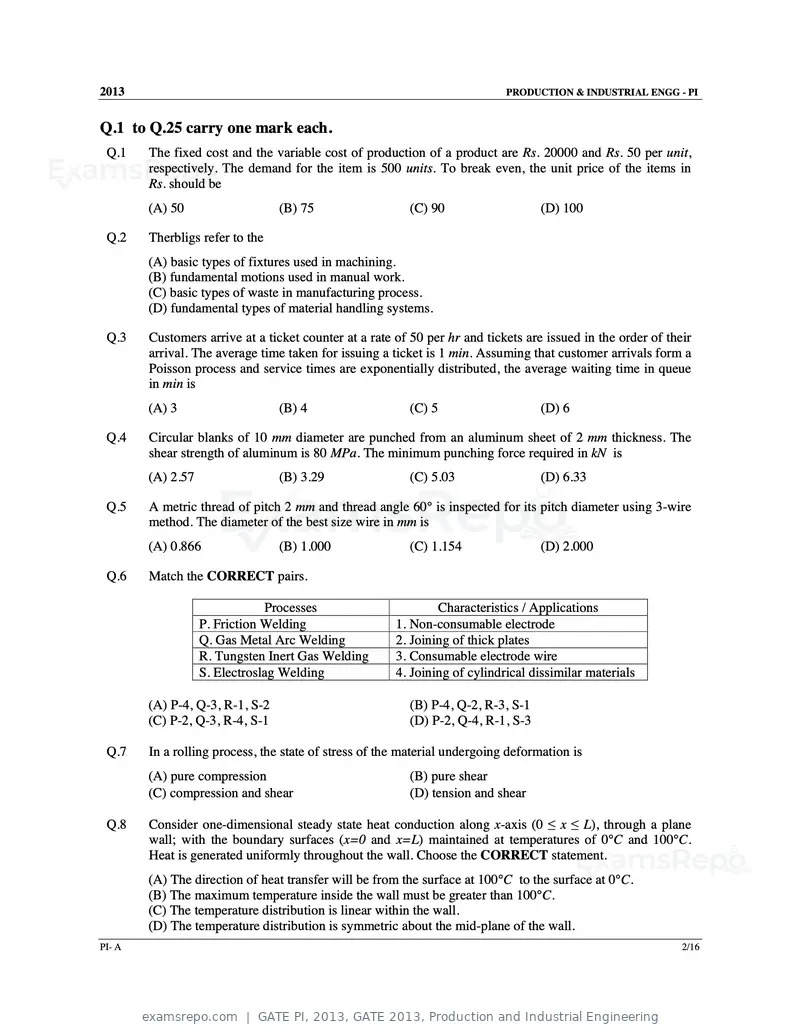
Text of page 3
2013                                                                        PRODUCTION & INDUSTRIAL ENGG - PI


Q.1 to Q.25 carry one mark each.
 Q.1    The fixed cost and the variable cost of production of a product are Rs. 20000 and Rs. 50 per unit,
        respectively. The demand for the item is 500 units. To break even, the unit price of the items in
        Rs. should be
        (A) 50                   (B) 75                   (C) 90                   (D) 100

 Q.2    Therbligs refer to the
        (A) basic types of fixtures used in machining.
        (B) fundamental motions used in manual work.
        (C) basic types of waste in manufacturing process.
        (D) fundamental types of material handling systems.

 Q.3    Customers arrive at a ticket counter at a rate of 50 per hr and tickets are issued in the order of their
        arrival. The average time taken for issuing a ticket is 1 min. Assuming that customer arrivals form a
        Poisson process and service times are exponentially distributed, the average waiting time in queue
        in min is
        (A) 3                    (B) 4                    (C) 5                    (D) 6

 Q.4    Circular blanks of 10 mm diameter are punched from an aluminum sheet of 2 mm thickness. The
        shear strength of aluminum is 80 MPa. The minimum punching force required in kN is
        (A) 2.57                 (B) 3.29                 (C) 5.03                 (D) 6.33

 Q.5    A metric thread of pitch 2 mm and thread angle 60° is inspected for its pitch diameter using 3-wire
        method. The diameter of the best size wire in mm is
        (A) 0.866                (B) 1.000                (C) 1.154                (D) 2.000

 Q.6    Match the CORRECT pairs.

                               Processes                       Characteristics / Applications
                   P. Friction Welding                 1. Non-consumable electrode
                   Q. Gas Metal Arc Welding            2. Joining of thick plates
                   R. Tungsten Inert Gas Welding       3. Consumable electrode wire
                   S. Electroslag Welding              4. Joining of cylindrical dissimilar materials

        (A) P-4, Q-3, R-1, S-2                            (B) P-4, Q-2, R-3, S-1
        (C) P-2, Q-3, R-4, S-1                            (D) P-2, Q-4, R-1, S-3

 Q.7    In a rolling process, the state of stress of the material undergoing deformation is
        (A) pure compression                              (B) pure shear
        (C) compression and shear                         (D) tension and shear

 Q.8    Consider one-dimensional steady state heat conduction along x-axis (0 ≤ x ≤ L), through a plane
        wall; with the boundary surfaces (x=0 and x=L) maintained at temperatures of 0°C and 100°C.
        Heat is generated uniformly throughout the wall. Choose the CORRECT statement.
        (A) The direction of heat transfer will be from the surface at 100°C to the surface at 0°C.
        (B) The maximum temperature inside the wall must be greater than 100°C.
        (C) The temperature distribution is linear within the wall.
        (D) The temperature distribution is symmetric about the mid-plane of the wall.
PI- A                                                                                                         2/16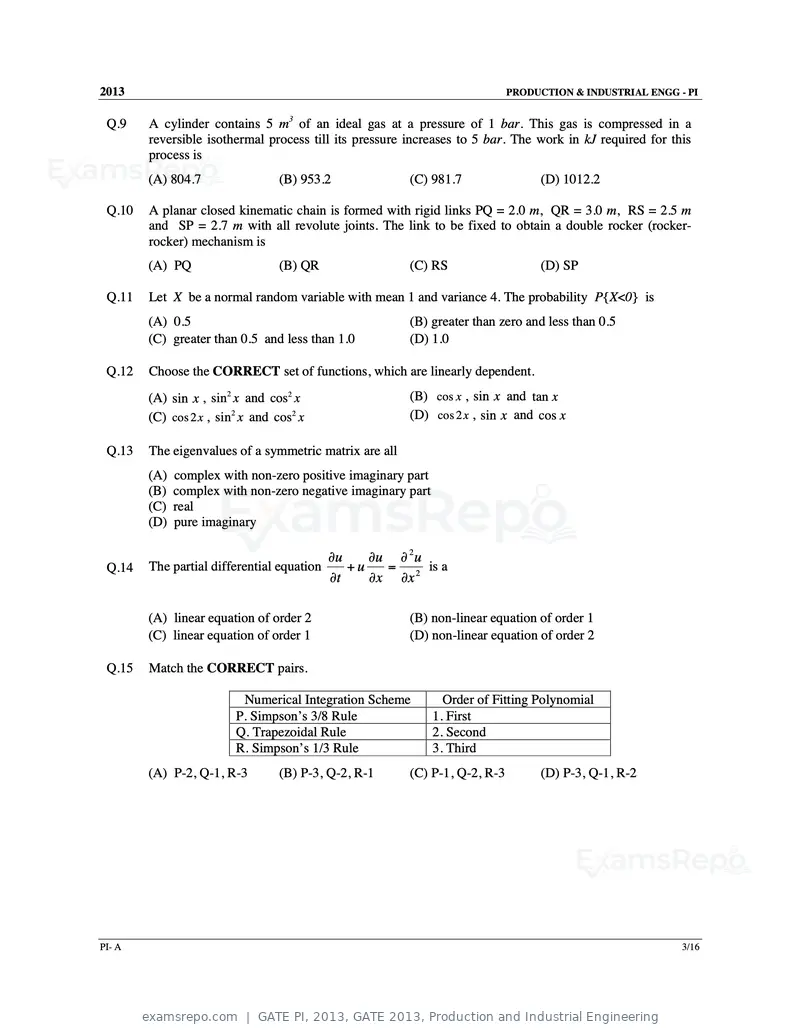
Text of page 4
2013                                                                         PRODUCTION & INDUSTRIAL ENGG - PI


 Q.9    A cylinder contains 5 m3 of an ideal gas at a pressure of 1 bar. This gas is compressed in a
        reversible isothermal process till its pressure increases to 5 bar. The work in kJ required for this
        process is
        (A) 804.7                (B) 953.2               (C) 981.7                (D) 1012.2

 Q.10   A planar closed kinematic chain is formed with rigid links PQ = 2.0 m, QR = 3.0 m, RS = 2.5 m
        and SP = 2.7 m with all revolute joints. The link to be fixed to obtain a double rocker (rocker-
        rocker) mechanism is
        (A) PQ                   (B) QR                  (C) RS                   (D) SP

 Q.11   Let X be a normal random variable with mean 1 and variance 4. The probability P{X<0} is
        (A) 0.5                                          (B) greater than zero and less than 0.5
        (C) greater than 0.5 and less than 1.0           (D) 1.0

 Q.12   Choose the CORRECT set of functions, which are linearly dependent.
        (A) sin x , sin2 x and cos2 x                    (B) cos x , sin x and tan x
        (C) cos 2x , sin2 x and cos2 x                   (D) cos 2x , sin x and cos x

 Q.13   The eigenvalues of a symmetric matrix are all
        (A) complex with non-zero positive imaginary part
        (B) complex with non-zero negative imaginary part
        (C) real
        (D) pure imaginary

                                            ∂u    ∂u ∂ 2 u
 Q.14   The partial differential equation      +u   =      is a
                                            ∂t    ∂x ∂x 2

        (A) linear equation of order 2                   (B) non-linear equation of order 1
        (C) linear equation of order 1                   (D) non-linear equation of order 2

 Q.15   Match the CORRECT pairs.

                         Numerical Integration Scheme          Order of Fitting Polynomial
                        P. Simpson’s 3/8 Rule                1. First
                        Q. Trapezoidal Rule                  2. Second
                        R. Simpson’s 1/3 Rule                3. Third
        (A) P-2, Q-1, R-3        (B) P-3, Q-2, R-1       (C) P-1, Q-2, R-3        (D) P-3, Q-1, R-2


PI- A                                                                                                      3/16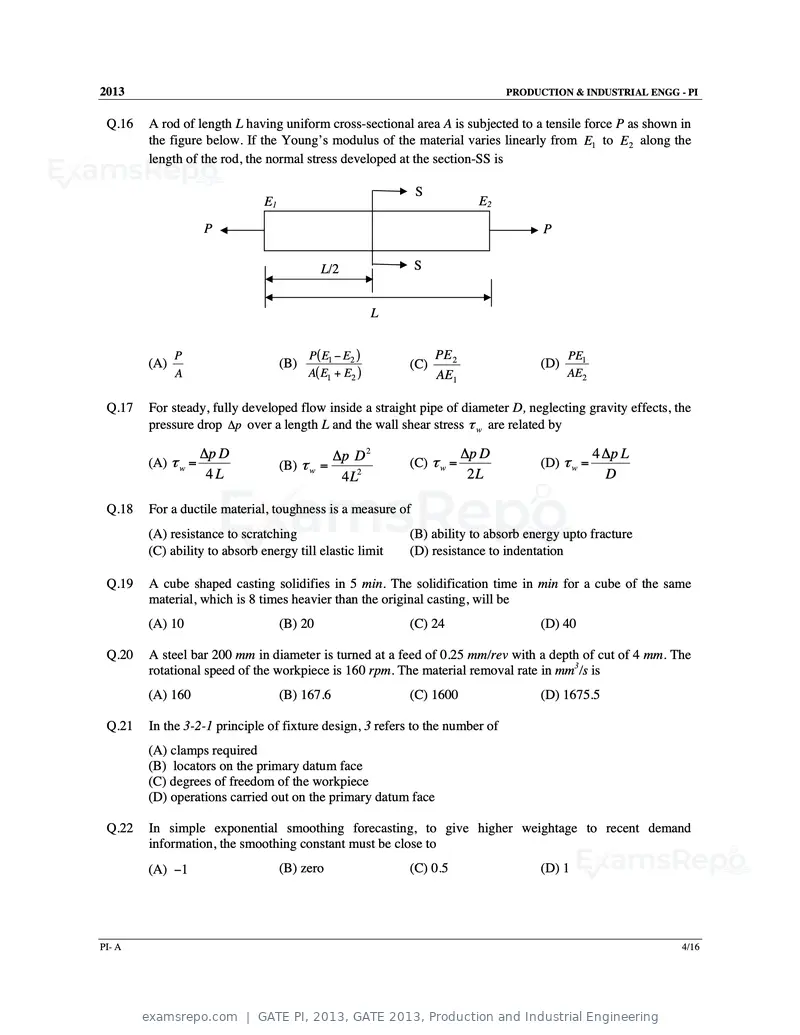
Text of page 5
2013                                                                             PRODUCTION & INDUSTRIAL ENGG - PI


 Q.16   A rod of length L having uniform cross-sectional area A is subjected to a tensile force P as shown in
        the figure below. If the Young’s modulus of the material varies linearly from E1 to E2 along the
        length of the rod, the normal stress developed at the section-SS is

                                                              S
                               E1                                           E2

                    P                                                                  P

                                             L/2             S


                                                         L


              P                           P( E1 − E2 )             PE 2                     PE1
        (A)                         (B)                      (C)                      (D)
              A                           A( E1 + E2 )             AE1                      AE2

 Q.17   For steady, fully developed flow inside a straight pipe of diameter D, neglecting gravity effects, the
        pressure drop ∆p over a length L and the wall shear stress τ w are related by

                    ∆p D                        ∆p D 2                    ∆p D                    4 ∆p L
        (A) τ w =                   (B) τ w =                (C) τ w =                (D) τ w =
                     4L                          4L2                       2L                       D

 Q.18   For a ductile material, toughness is a measure of
        (A) resistance to scratching                         (B) ability to absorb energy upto fracture
        (C) ability to absorb energy till elastic limit      (D) resistance to indentation

 Q.19   A cube shaped casting solidifies in 5 min. The solidification time in min for a cube of the same
        material, which is 8 times heavier than the original casting, will be
        (A) 10                      (B) 20                   (C) 24                   (D) 40

 Q.20   A steel bar 200 mm in diameter is turned at a feed of 0.25 mm/rev with a depth of cut of 4 mm. The
        rotational speed of the workpiece is 160 rpm. The material removal rate in mm3/s is
        (A) 160                     (B) 167.6                (C) 1600                 (D) 1675.5

 Q.21   In the 3-2-1 principle of fixture design, 3 refers to the number of
        (A) clamps required
        (B) locators on the primary datum face
        (C) degrees of freedom of the workpiece
        (D) operations carried out on the primary datum face

 Q.22   In simple exponential smoothing forecasting, to give higher weightage to recent demand
        information, the smoothing constant must be close to
        (A) −1                      (B) zero                 (C) 0.5                  (D) 1


PI- A                                                                                                          4/16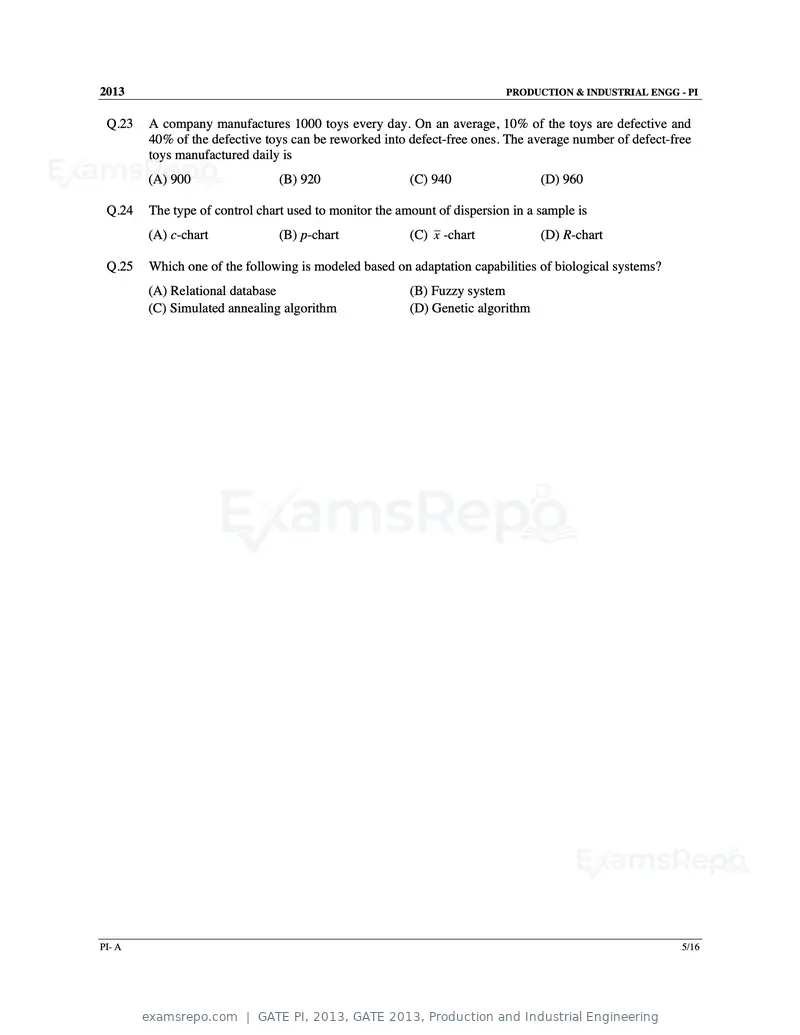
Text of page 6
2013                                                                      PRODUCTION & INDUSTRIAL ENGG - PI


 Q.23   A company manufactures 1000 toys every day. On an average, 10% of the toys are defective and
        40% of the defective toys can be reworked into defect-free ones. The average number of defect-free
        toys manufactured daily is
        (A) 900                 (B) 920                 (C) 940                 (D) 960

 Q.24   The type of control chart used to monitor the amount of dispersion in a sample is
        (A) c-chart             (B) p-chart             (C) x -chart            (D) R-chart

 Q.25   Which one of the following is modeled based on adaptation capabilities of biological systems?
        (A) Relational database                         (B) Fuzzy system
        (C) Simulated annealing algorithm               (D) Genetic algorithm


PI- A                                                                                                   5/16
Text of page 7
2013                                                                      PRODUCTION & INDUSTRIAL ENGG - PI


Q.26 to Q.55 carry two marks each.
 Q.26   A company plans to purchase a machine whose uptime needs to be atleast 95%. They have
        shortlisted two models of the machine with the following operational characteristics:

                                  Machine           MTBF (hr)       MTTR (hr)
                                  Model M            60              4
                                  Model N            48              2

        The company should buy
        (A) only Model M                               (B) only Model N
        (C) either Model M or N                        (D) neither Model M nor N

 Q.27   A manufacturer produces bars designed to be of 10 mm diameter with a tolerance of ±0.1 mm.
        Historical data indicates that manufactured bars have an average diameter of 9.98 mm with a
        standard deviation of 0.15 mm. The process capability index is
        (A) 0.08               (B) 0.12                (C) 0.18                (D) 0.27

 Q.28   Let (P) denote the linear programming formulation of a transportation problem with m sources and
        n destinations. Then, the dual linear program of (P) has
        (A) m × n variables and m × n constraints      (B) m × n variables and m + n constraints
        (C) m + n variables and m + n constraints      (D) m + n variables and m × n constraints

 Q.29   Following data refers to an automat and a center lathe, which are being compared to machine a
        batch of parts in a manufacturing shop.

                                                                Automat     Center Lathe
                         Machine Set-up Time in min               120            30
                         Machine Set-up Cost in Rs./min           800           150
                         Machining Time per piece in min           2            25
                         Machining Cost in Rs./min                500           100

        Automat will be economical if the batch size exceeds
        (A) 28                 (B) 32                  (C) 61                  (D) 75

                               + 0 .020
 Q.30   Cylindrical pins of 25 + 0.010 mm diameter are electroplated in a shop. Thickness of the plating is
        30 ±2.0 micron. Neglecting gage tolerances, the size of the GO gage in mm to inspect the plated
        components is
        (A) 25.042             (B) 25.052              (C) 25.074              (D) 25.084

 Q.31   During the electrochemical machining (ECM) of iron (atomic weight = 56, valency = 2) at current
        of 1000 A with 90% current efficiency, the material removal rate was observed to be 0.26 gm/s. If
        Titanium (atomic weight = 48, valency = 3) is machined by the ECM process at the current of
        2000 A with 90% current efficiency, the expected material removal rate in gm/s will be
        (A) 0.11               (B) 0.23                (C) 0.30                (D) 0.52


PI- A                                                                                                    6/16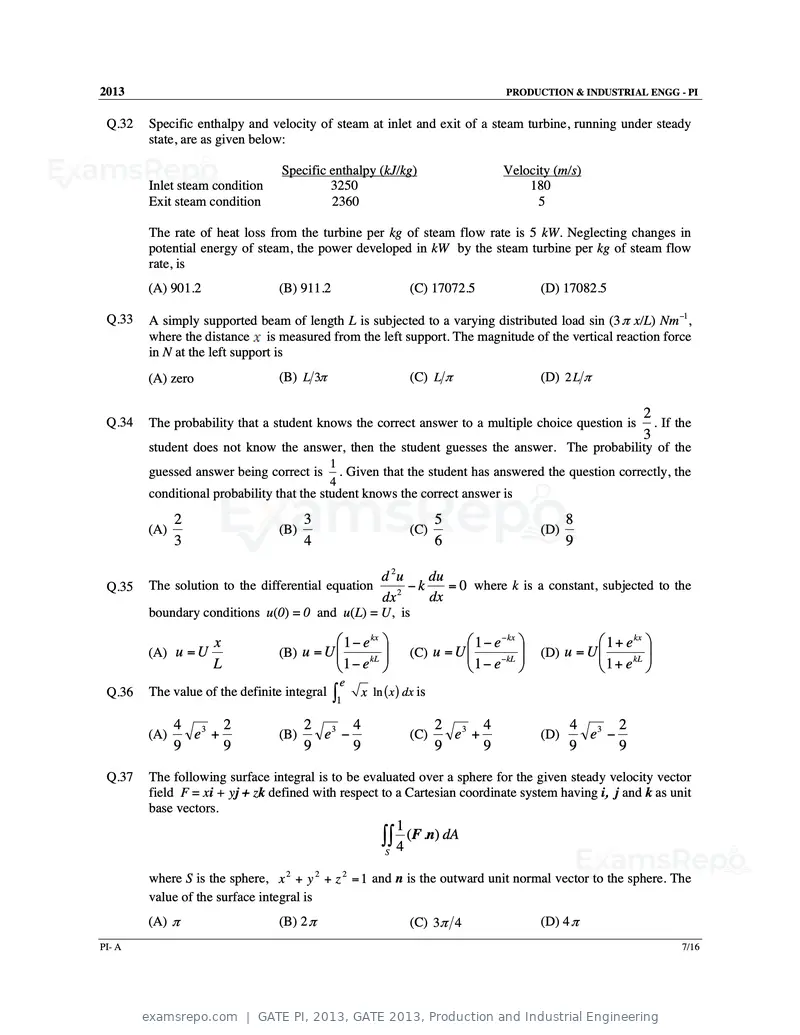
Text of page 8
2013 PRODUCTION & INDUSTRIAL ENGG - PI
Q.32 Specific enthalpy and velocity of steam at inlet and exit of a steam turbine, running under steady
state, are as given below:
Specific enthalpy (kJ/kg) Velocity (m/s)
Inlet steam condition 3250 180
Exit steam condition 2360 5
The rate of heat loss from the turbine per kg of steam flow rate is 5 kW. Neglecting changes in
potential energy of steam, the power developed in kW by the steam turbine per kg of steam flow
rate, is
(A) 901.2 (B) 911.2 (C) 17072.5 (D) 17082.5
Q.33 A simply supported beam of length L is subjected to a varying distributed load sin (3 π x/L) Nm−1,
where the distance is measured from the left support. The magnitude of the vertical reaction force
in N at the left support is
(A) zero (B) L 3π (C) L π (D) 2 L π
2
Q.34 The probability that a student knows the correct answer to a multiple choice question is . If the
3
student does not know the answer, then the student guesses the answer. The probability of the
1
guessed answer being correct is . Given that the student has answered the question correctly, the
4
conditional probability that the student knows the correct answer is
2 3 5 8
(A) (B) (C) (D)
3 4 6 9
d 2u du
Q.35 The solution to the differential equation 2
−k = 0 where k is a constant, subjected to the
dx dx
boundary conditions u(0) = 0 and u(L) = U, is
x 1 − e kx 1 − e − kx 1 + e kx
(A) u = U (B) u = U kL
(C) u = U −kL
(D) u = U kL
L 1− e 1− e 1+ e
e
Q.36 The value of the definite integral ∫ x ln ( x ) dx is
1
4 3 2 2 3 4 2 3 4 4 3 2
(A) e + (B) e − (C) e + (D) e −
9 9 9 9 9 9 9 9
Q.37 The following surface integral is to be evaluated over a sphere for the given steady velocity vector
field F = xi + yj + zk defined with respect to a Cartesian coordinate system having i, j and k as unit
base vectors.
1
∫∫ 4 (F .n) dA
S
where S is the sphere, x 2 + y 2 + z 2 = 1 and n is the outward unit normal vector to the sphere. The
value of the surface integral is
(A) π (B) 2 π (C) 3π 4 (D) 4 π
PI- A 7/16
Text of page 9
2013                                                                                     PRODUCTION & INDUSTRIAL ENGG - PI


                                                                                d2 f
 Q.38       The function f (t ) satisfies the differential equation                  + f = 0 and the auxiliary conditions,
                                                                                dt 2
                             df
                f (0) = 0,      (0) = 4 . The Laplace transform of f (t ) is given by
                             dt
                      2                           4                         4                          2
            (A)                           (B)                      (C)                         (D)
                    s +1                        s +1                      s +1
                                                                            2
                                                                                                     s +1
                                                                                                     4


 Q.39       A flywheel connected to a punching machine has to supply energy of 400 Nm while running at a
            mean angular speed of 20 rad/s. If the total fluctuation of speed is not to exceed ±2%, the mass
            moment of inertia of the flywheel in kg-m2 is
            (A) 25                        (B) 50                   (C) 100                     (D) 125

 Q.40       A single riveted lap joint of two similar plates as shown in the figure below has the following
            geometrical and material details.

                                                                         plate width w = 200 mm
                                                                  P      plate thickness t = 5 mm
        P              w                         w                       number of rivets n = 3
                                                                         rivet diameter dr = 10 mm
                                                                         rivet hole diameter dh = 11 mm
                                                                         allowable tensile stress of plate σp = 200 MPa
            t
                                                              t          allowable bearing stress of rivet σc = 150 MPa


            If the plates are to be designed to avoid tearing failure, the maximum permissible load P in kN is

            (A) 83                        (B) 125                  (C) 167                     (D) 501

 Q.41       Two cutting tools are being compared for a machining operation. The tool life equations are:

                       Carbide tool:       VT 1.6 = 3000
                       HSS tool:           VT 0.6 = 200

            where V is the cutting speed in m/min and T is the tool life in min. The carbide tool will provide
            higher tool life if the cutting speed in m/min exceeds
            (A) 15.0                      (B) 39.4                 (C) 49.3                    (D) 60.0

 Q.42       In a CAD package, mirror image of a 2D point P(5,10) is to be obtained about a line which passes
            through the origin and makes an angle of 45° counterclockwise with the X-axis. The coordinates of
            the transformed point will be
            (A) (7.5, 5)                  (B) (10, 5)              (C) (7.5, −5)               (D) (10, −5)


PI- A                                                                                                                   8/16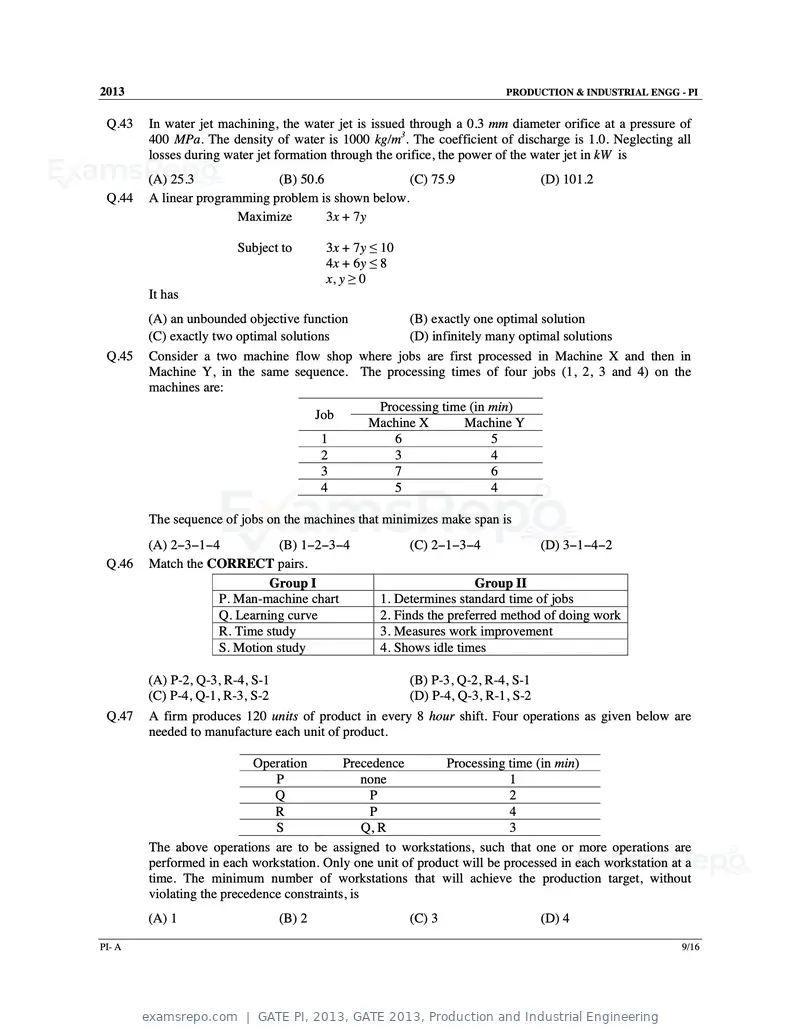
Text of page 10
2013                                                                     PRODUCTION & INDUSTRIAL ENGG - PI


 Q.43   In water jet machining, the water jet is issued through a 0.3 mm diameter orifice at a pressure of
        400 MPa. The density of water is 1000 kg/m3. The coefficient of discharge is 1.0. Neglecting all
        losses during water jet formation through the orifice, the power of the water jet in kW is
        (A) 25.3              (B) 50.6               (C) 75.9                    (D) 101.2
 Q.44   A linear programming problem is shown below.
                        Maximize       3x + 7y

                        Subject to       3x + 7y ≤ 10
                                         4x + 6y ≤ 8
                                         x, y ≥ 0
        It has
        (A) an unbounded objective function             (B) exactly one optimal solution
        (C) exactly two optimal solutions               (D) infinitely many optimal solutions
 Q.45   Consider a two machine flow shop where jobs are first processed in Machine X and then in
        Machine Y, in the same sequence. The processing times of four jobs (1, 2, 3 and 4) on the
        machines are:
                                            Processing time (in min)
                                  Job
                                          Machine X        Machine Y
                                   1           6                5
                                   2           3                4
                                   3           7                6
                                   4           5                4

        The sequence of jobs on the machines that minimizes make span is
        (A) 2−3−1−4           (B) 1−2−3−4               (C) 2−1−3−4              (D) 3−1−4−2
 Q.46   Match the CORRECT pairs.
                            Group I                                 Group II
                   P. Man-machine chart           1. Determines standard time of jobs
                   Q. Learning curve              2. Finds the preferred method of doing work
                   R. Time study                  3. Measures work improvement
                   S. Motion study                4. Shows idle times

        (A) P-2, Q-3, R-4, S-1                          (B) P-3, Q-2, R-4, S-1
        (C) P-4, Q-1, R-3, S-2                          (D) P-4, Q-3, R-1, S-2
 Q.47   A firm produces 120 units of product in every 8 hour shift. Four operations as given below are
        needed to manufacture each unit of product.

                           Operation        Precedence       Processing time (in min)
                               P                 none                    1
                               Q                  P                      2
                               R                  P                      4
                               S                 Q, R                    3
        The above operations are to be assigned to workstations, such that one or more operations are
        performed in each workstation. Only one unit of product will be processed in each workstation at a
        time. The minimum number of workstations that will achieve the production target, without
        violating the precedence constraints, is
        (A) 1                    (B) 2                  (C) 3                    (D) 4

PI- A                                                                                                   9/16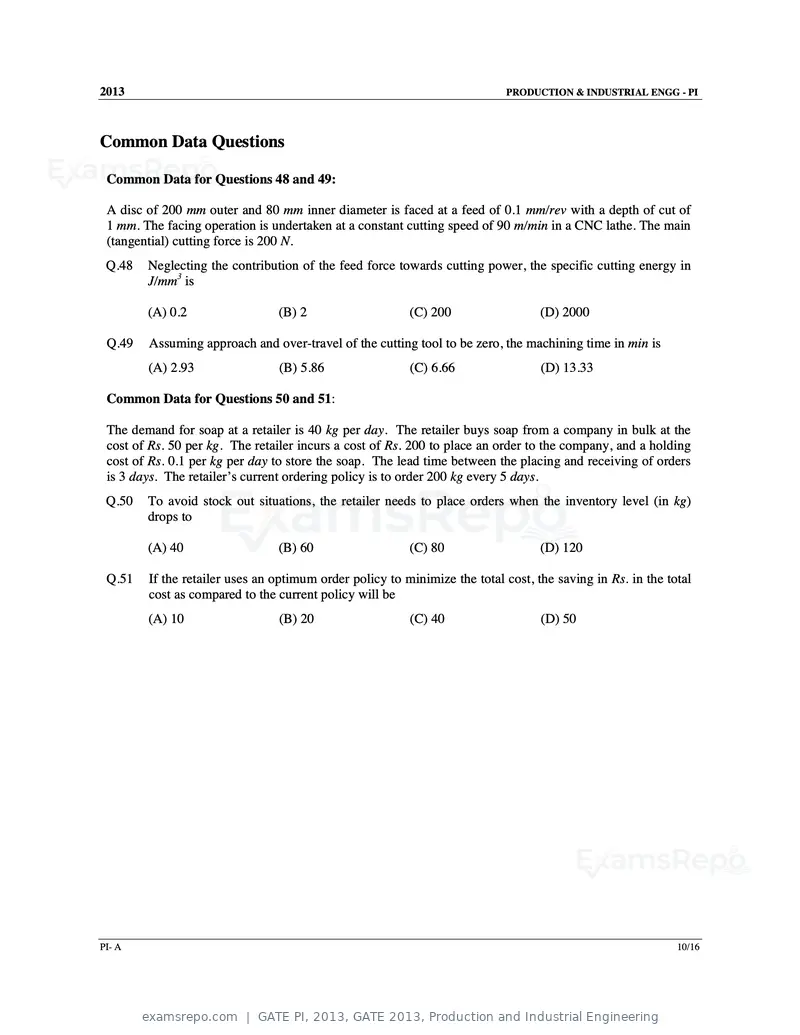
Text of page 11
2013                                                                       PRODUCTION & INDUSTRIAL ENGG - PI


Common Data Questions

 Common Data for Questions 48 and 49:

 A disc of 200 mm outer and 80 mm inner diameter is faced at a feed of 0.1 mm/rev with a depth of cut of
 1 mm. The facing operation is undertaken at a constant cutting speed of 90 m/min in a CNC lathe. The main
 (tangential) cutting force is 200 N.
 Q.48   Neglecting the contribution of the feed force towards cutting power, the specific cutting energy in
        J/mm3 is

        (A) 0.2                 (B) 2                    (C) 200                  (D) 2000

 Q.49   Assuming approach and over-travel of the cutting tool to be zero, the machining time in min is
        (A) 2.93                (B) 5.86                 (C) 6.66                 (D) 13.33

 Common Data for Questions 50 and 51:

 The demand for soap at a retailer is 40 kg per day. The retailer buys soap from a company in bulk at the
 cost of Rs. 50 per kg. The retailer incurs a cost of Rs. 200 to place an order to the company, and a holding
 cost of Rs. 0.1 per kg per day to store the soap. The lead time between the placing and receiving of orders
 is 3 days. The retailer’s current ordering policy is to order 200 kg every 5 days.
 Q.50   To avoid stock out situations, the retailer needs to place orders when the inventory level (in kg)
        drops to

        (A) 40                  (B) 60                   (C) 80                   (D) 120

 Q.51   If the retailer uses an optimum order policy to minimize the total cost, the saving in Rs. in the total
        cost as compared to the current policy will be
        (A) 10                  (B) 20                   (C) 40                   (D) 50


PI- A                                                                                                       10/16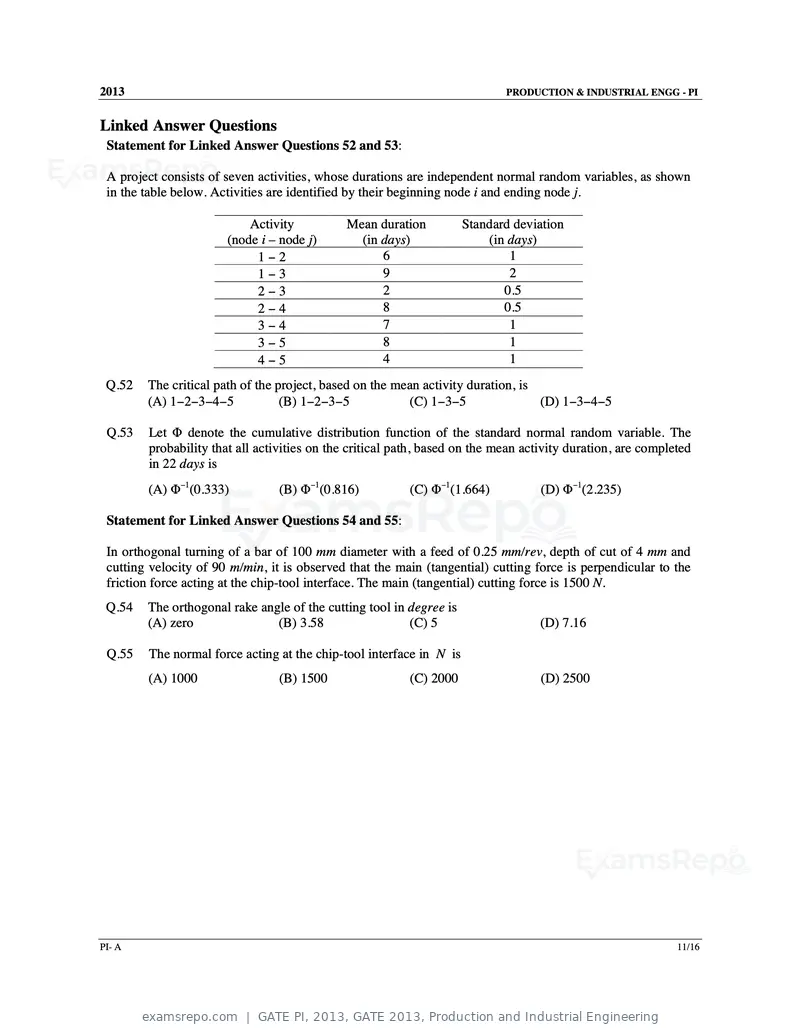
Text of page 12
2013                                                                        PRODUCTION & INDUSTRIAL ENGG - PI


Linked Answer Questions
 Statement for Linked Answer Questions 52 and 53:

 A project consists of seven activities, whose durations are independent normal random variables, as shown
 in the table below. Activities are identified by their beginning node i and ending node j.

                           Activity          Mean duration           Standard deviation
                       (node i – node j)       (in days)                 (in days)
                            1−2                    6                         1
                            1−3                    9                         2
                            2−3                    2                        0.5
                            2−4                    8                        0.5
                            3−4                    7                         1
                            3−5                    8                         1
                            4−5                    4                         1
 Q.52   The critical path of the project, based on the mean activity duration, is
        (A) 1−2−3−4−5             (B) 1−2−3−5            (C) 1−3−5                (D) 1−3−4−5

 Q.53   Let Φ denote the cumulative distribution function of the standard normal random variable. The
        probability that all activities on the critical path, based on the mean activity duration, are completed
        in 22 days is
        (A) Φ−1(0.333)           (B) Φ−1(0.816)           (C) Φ−1(1.664)           (D) Φ−1(2.235)

 Statement for Linked Answer Questions 54 and 55:

 In orthogonal turning of a bar of 100 mm diameter with a feed of 0.25 mm/rev, depth of cut of 4 mm and
 cutting velocity of 90 m/min, it is observed that the main (tangential) cutting force is perpendicular to the
 friction force acting at the chip-tool interface. The main (tangential) cutting force is 1500 N.
 Q.54   The orthogonal rake angle of the cutting tool in degree is
        (A) zero               (B) 3.58                  (C) 5                     (D) 7.16

 Q.55   The normal force acting at the chip-tool interface in N is
        (A) 1000                 (B) 1500                 (C) 2000                 (D) 2500


PI- A                                                                                                        11/16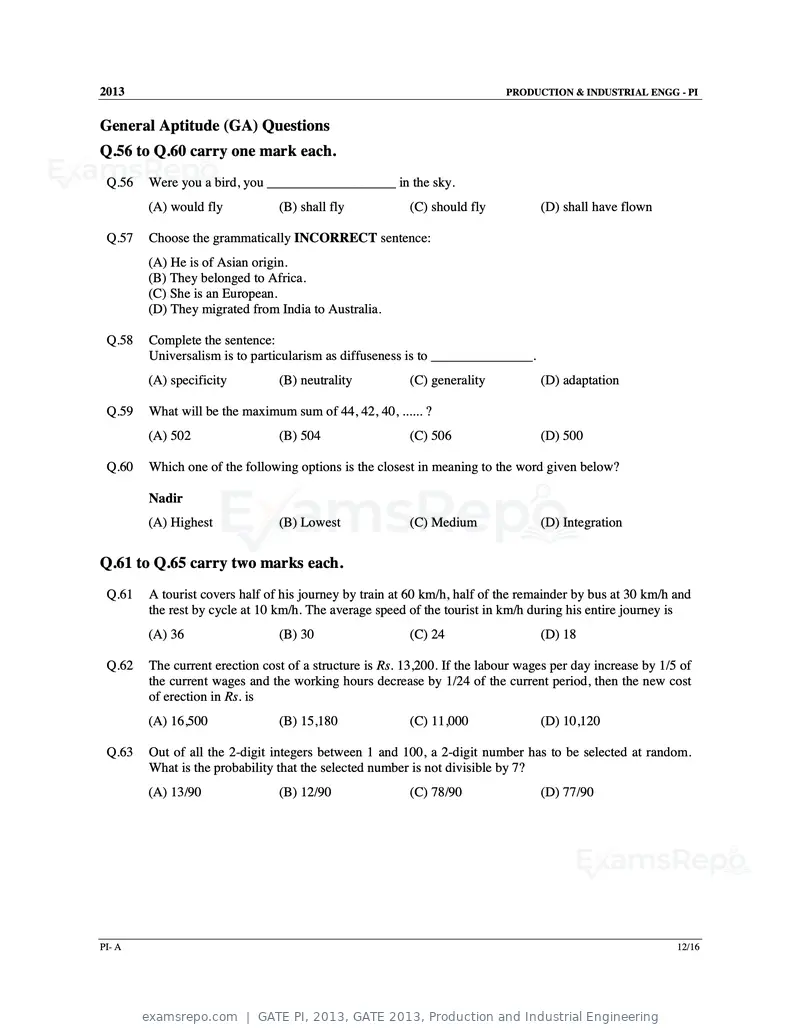
Text of page 13
2013                                                                       PRODUCTION & INDUSTRIAL ENGG - PI


General Aptitude (GA) Questions
Q.56 to Q.60 carry one mark each.
 Q.56   Were you a bird, you ___________________ in the sky.
        (A) would fly           (B) shall fly            (C) should fly          (D) shall have flown

 Q.57   Choose the grammatically INCORRECT sentence:
        (A) He is of Asian origin.
        (B) They belonged to Africa.
        (C) She is an European.
        (D) They migrated from India to Australia.

 Q.58   Complete the sentence:
        Universalism is to particularism as diffuseness is to _______________.
        (A) specificity         (B) neutrality           (C) generality          (D) adaptation

 Q.59   What will be the maximum sum of 44, 42, 40, ...... ?
        (A) 502                 (B) 504                  (C) 506                 (D) 500

 Q.60   Which one of the following options is the closest in meaning to the word given below?

        Nadir
        (A) Highest             (B) Lowest               (C) Medium              (D) Integration


Q.61 to Q.65 carry two marks each.
 Q.61   A tourist covers half of his journey by train at 60 km/h, half of the remainder by bus at 30 km/h and
        the rest by cycle at 10 km/h. The average speed of the tourist in km/h during his entire journey is
        (A) 36                  (B) 30                   (C) 24                  (D) 18

 Q.62   The current erection cost of a structure is Rs. 13,200. If the labour wages per day increase by 1/5 of
        the current wages and the working hours decrease by 1/24 of the current period, then the new cost
        of erection in Rs. is
        (A) 16,500              (B) 15,180               (C) 11,000              (D) 10,120

 Q.63   Out of all the 2-digit integers between 1 and 100, a 2-digit number has to be selected at random.
        What is the probability that the selected number is not divisible by 7?
        (A) 13/90               (B) 12/90                (C) 78/90               (D) 77/90


PI- A                                                                                                      12/16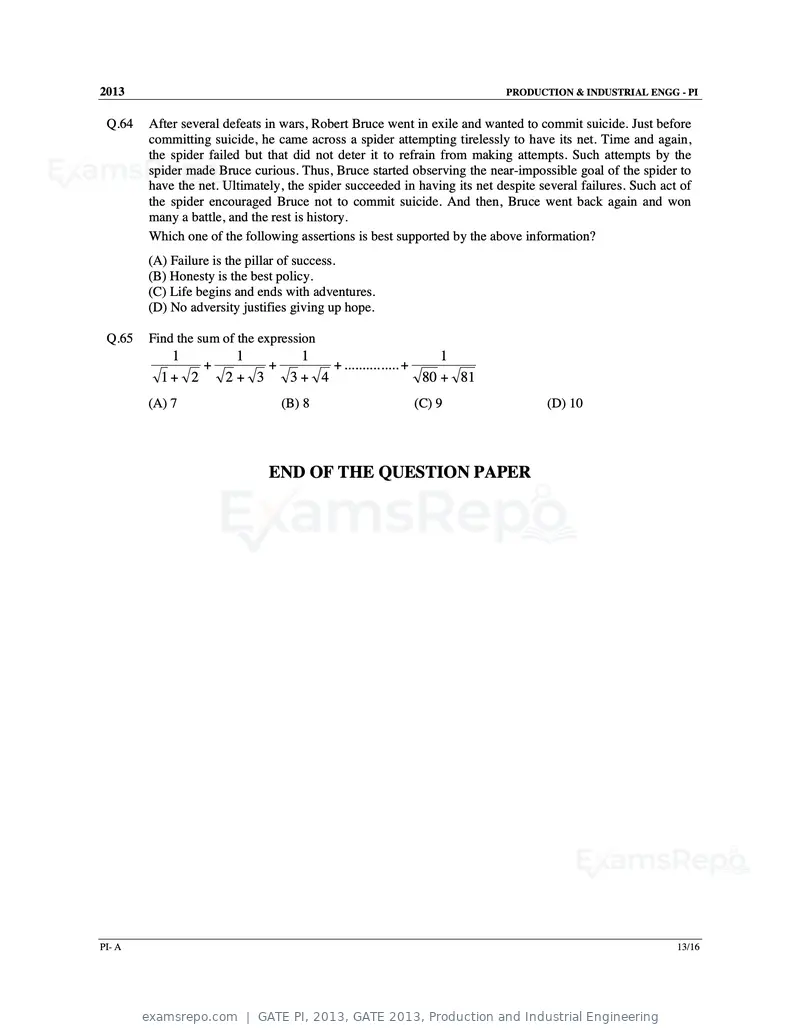
Text of page 14
2013                                                                       PRODUCTION & INDUSTRIAL ENGG - PI


 Q.64   After several defeats in wars, Robert Bruce went in exile and wanted to commit suicide. Just before
        committing suicide, he came across a spider attempting tirelessly to have its net. Time and again,
        the spider failed but that did not deter it to refrain from making attempts. Such attempts by the
        spider made Bruce curious. Thus, Bruce started observing the near-impossible goal of the spider to
        have the net. Ultimately, the spider succeeded in having its net despite several failures. Such act of
        the spider encouraged Bruce not to commit suicide. And then, Bruce went back again and won
        many a battle, and the rest is history.
        Which one of the following assertions is best supported by the above information?
        (A) Failure is the pillar of success.
        (B) Honesty is the best policy.
        (C) Life begins and ends with adventures.
        (D) No adversity justifies giving up hope.

 Q.65   Find the sum of the expression
           1      1      1                           1
               +      +      + .......... ..... +
          1+ 2   2+ 3   3+ 4                      80 + 81
        (A) 7                   (B) 8                    (C) 9                    (D) 10


                              END OF THE QUESTION PAPER


PI- A                                                                                                      13/16
Text of page 15
SESSION - 2
Text of page 16
2013                                                                         Question Booklet Code
                                                                                                          B
                  PI : PRODUCTION AND INDUSTRIAL ENGINEERING
Duration: Three Hours                                                                        Maximum Marks: 100
Read the following instructions carefully.

       1. Do not open the seal of the Question Booklet until you are asked to do so by the invigilator.
       2. Take out the Optical Response Sheet (ORS) from this Question Booklet without breaking the seal
           and read the instructions printed on the ORS carefully. If you find that either
           a. The Question Booklet Code printed at the right hand top corner of this page does not match with
                the Question Booklet Code at the right hand top corner of the ORS or
           b. The Question Paper Code preceding the Registration number on the ORS is not PI,
          then exchange the booklet immediately with a new sealed Question Booklet.
       3. On the right hand side of the ORS, using ONLY a black ink ballpoint pen, (i) darken the appropriate
          bubble under each digit of your registration number and (ii) write your registration number, your name
          and name of the examination centre and put your signature at the specified location.
       4. This Question Booklet contains 16 pages including blank pages for rough work. After you are
          permitted to open the seal, check all pages and report discrepancies, if any, to the invigilator.
       5. There are a total of 65 questions carrying 100 marks. All these questions are of objective type. Each
          question has only one correct answer. Questions must be answered on the left hand side of the ORS
          by darkening the appropriate bubble (marked A, B, C, D) using ONLY a black ink ballpoint pen
          against the question number. For each question darken the bubble of the correct answer. More
          than one answer bubbled against a question will be treated as an incorrect response.
       6. Since bubbles darkened by the black ink ballpoint pen cannot be erased, candidates should darken the
          bubbles in the ORS very carefully.
       7. Questions Q.1 – Q.25 carry 1 mark each. Questions Q.26 – Q.55 carry 2 marks each. The 2 marks
          questions include two pairs of common data questions and two pairs of linked answer questions. The
          answer to the second question of the linked answer questions depends on the answer to the first
          question of the pair. If the first question in the linked pair is wrongly answered or is not attempted,
          then the answer to the second question in the pair will not be evaluated.
       8. Questions Q.56 – Q.65 belong to General Aptitude (GA) section and carry a total of 15 marks.
          Questions Q.56 – Q.60 carry 1 mark each, and questions Q.61 – Q.65 carry 2 marks each.
       9. Questions not attempted will result in zero mark and wrong answers will result in NEGATIVE
          marks. For all 1 mark questions, ⅓ mark will be deducted for each wrong answer. For all 2 marks
          questions, ⅔ mark will be deducted for each wrong answer. However, in the case of the linked
          answer question pair, there will be negative marks only for wrong answer to the first question and no
          negative marks for wrong answer to the second question.
       10. Calculator is allowed whereas charts, graph sheets or tables are NOT allowed in the examination hall.
       11. Rough work can be done on the Question Booklet itself. Blank pages are provided at the end of the
           Question Booklet for rough work.
       12. Before the start of the examination, write your name and registration number in the space provided
           below using a black ink ballpoint pen.

              Name

              Registration Number       PI

PI-B                                                                                                         1/16
Text of page 17
2013                                                                         PRODUCTION & INDUSTRIAL ENGG - PI


Q.1 to Q.25 carry one mark each.
 Q.1   The type of control chart used to monitor the amount of dispersion in a sample is
       (A) c-chart               (B) p-chart             (C) x -chart             (D) R-chart

 Q.2   Which one of the following is modeled based on adaptation capabilities of biological systems?
       (A) Relational database                           (B) Fuzzy system
       (C) Simulated annealing algorithm                 (D) Genetic algorithm

 Q.3   A company manufactures 1000 toys every day. On an average, 10% of the toys are defective and
       40% of the defective toys can be reworked into defect-free ones. The average number of defect-free
       toys manufactured daily is
       (A) 900                   (B) 920                 (C) 940                  (D) 960

 Q.4   In simple exponential smoothing forecasting, to give higher weightage to recent demand
       information, the smoothing constant must be close to
       (A) −1                    (B) zero                (C) 0.5                  (D) 1

 Q.5   In the 3-2-1 principle of fixture design, 3 refers to the number of
       (A) clamps required
       (B) locators on the primary datum face
       (C) degrees of freedom of the workpiece
       (D) operations carried out on the primary datum face

 Q.6   A steel bar 200 mm in diameter is turned at a feed of 0.25 mm/rev with a depth of cut of 4 mm. The
       rotational speed of the workpiece is 160 rpm. The material removal rate in mm3/s is
       (A) 160                   (B) 167.6               (C) 1600                 (D) 1675.5

 Q.7   A cube shaped casting solidifies in 5 min. The solidification time in min for a cube of the same
       material, which is 8 times heavier than the original casting, will be
       (A) 10                    (B) 20                  (C) 24                   (D) 40

 Q.8   For a ductile material, toughness is a measure of
       (A) resistance to scratching                      (B) ability to absorb energy upto fracture
       (C) ability to absorb energy till elastic limit   (D) resistance to indentation

 Q.9   For steady, fully developed flow inside a straight pipe of diameter D, neglecting gravity effects, the
       pressure drop ∆p over a length L and the wall shear stress τ w are related by

                   ∆p D                      ∆p D 2                  ∆p D                     4 ∆p L
       (A) τ w =                 (B) τ w =               (C) τ w =                (D) τ w =
                    4L                        4L2                     2L                        D


PI-B                                                                                                       2/16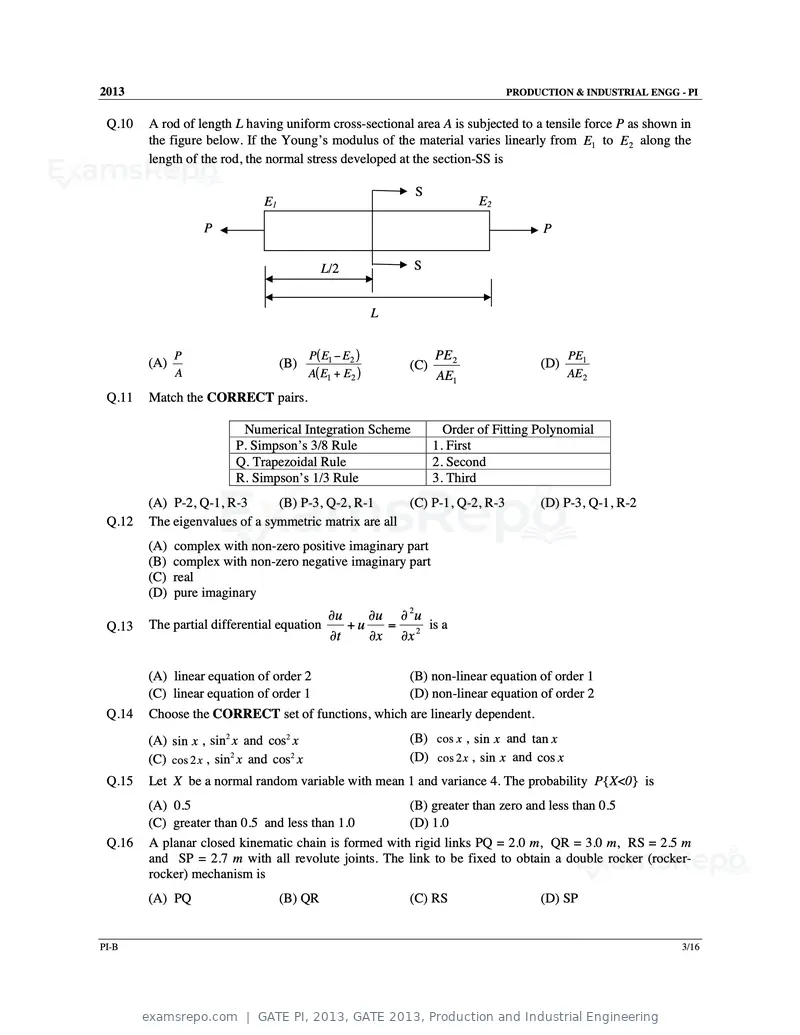
Text of page 18
2013                                                                            PRODUCTION & INDUSTRIAL ENGG - PI


 Q.10   A rod of length L having uniform cross-sectional area A is subjected to a tensile force P as shown in
        the figure below. If the Young’s modulus of the material varies linearly from E1 to E2 along the
        length of the rod, the normal stress developed at the section-SS is

                                                              S
                               E1                                          E2

                   P                                                                  P

                                             L/2             S


                                                         L


              P                           P( E1 − E2 )             PE 2                      PE1
        (A)                         (B)                      (C)                      (D)
              A                           A( E1 + E2 )             AE1                       AE 2
 Q.11   Match the CORRECT pairs.

                          Numerical Integration Scheme               Order of Fitting Polynomial
                         P. Simpson’s 3/8 Rule                     1. First
                         Q. Trapezoidal Rule                       2. Second
                         R. Simpson’s 1/3 Rule                     3. Third
        (A) P-2, Q-1, R-3      (B) P-3, Q-2, R-1      (C) P-1, Q-2, R-3               (D) P-3, Q-1, R-2
 Q.12   The eigenvalues of a symmetric matrix are all
        (A) complex with non-zero positive imaginary part
        (B) complex with non-zero negative imaginary part
        (C) real
        (D) pure imaginary
                                              ∂u    ∂u ∂ 2 u
 Q.13   The partial differential equation        +u   =      is a
                                              ∂t    ∂x ∂x 2

        (A) linear equation of order 2                       (B) non-linear equation of order 1
        (C) linear equation of order 1                       (D) non-linear equation of order 2
 Q.14   Choose the CORRECT set of functions, which are linearly dependent.
        (A) sin x , sin2 x and cos2 x                        (B) cos x , sin x and tan x
        (C) cos 2 x , sin2 x and cos2 x                      (D) cos 2 x , sin x and cos x
 Q.15   Let X be a normal random variable with mean 1 and variance 4. The probability P{X<0} is
        (A) 0.5                                       (B) greater than zero and less than 0.5
        (C) greater than 0.5 and less than 1.0        (D) 1.0
 Q.16   A planar closed kinematic chain is formed with rigid links PQ = 2.0 m, QR = 3.0 m, RS = 2.5 m
        and SP = 2.7 m with all revolute joints. The link to be fixed to obtain a double rocker (rocker-
        rocker) mechanism is
        (A) PQ                      (B) QR                   (C) RS                   (D) SP


PI-B                                                                                                          3/16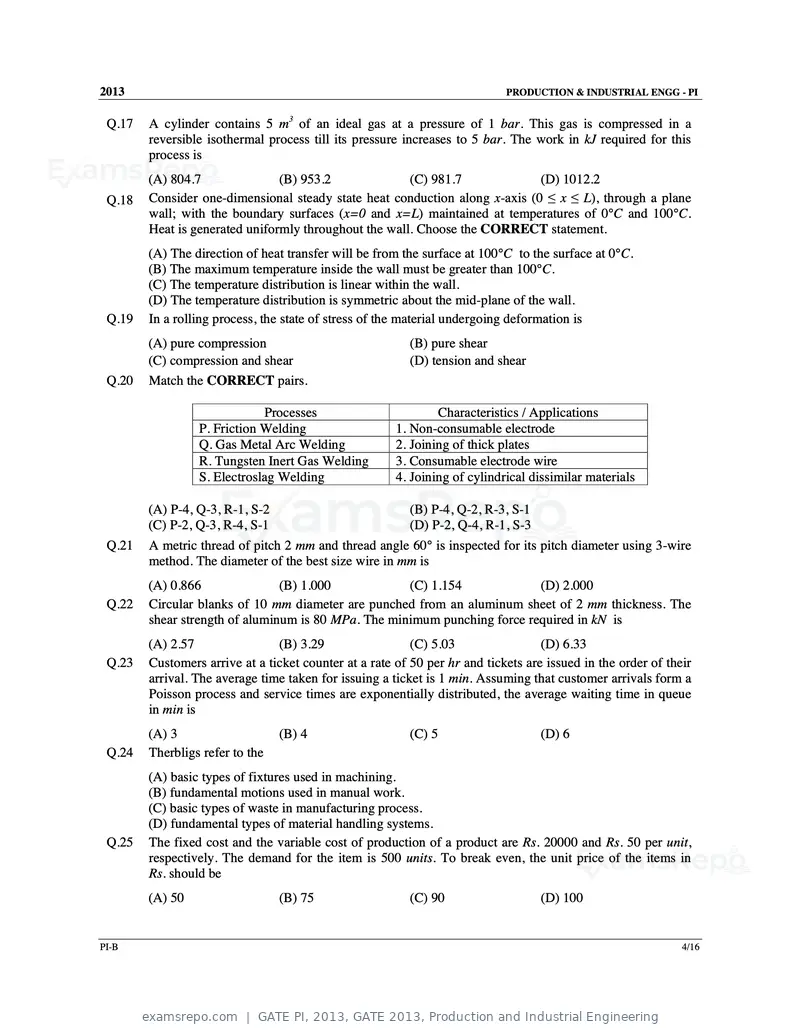
Text of page 19
2013                                                                        PRODUCTION & INDUSTRIAL ENGG - PI


 Q.17   A cylinder contains 5 m3 of an ideal gas at a pressure of 1 bar. This gas is compressed in a
        reversible isothermal process till its pressure increases to 5 bar. The work in kJ required for this
        process is
        (A) 804.7               (B) 953.2              (C) 981.7             (D) 1012.2
 Q.18   Consider one-dimensional steady state heat conduction along x-axis (0 ≤ x ≤ L), through a plane
        wall; with the boundary surfaces (x=0 and x=L) maintained at temperatures of 0°C and 100°C.
        Heat is generated uniformly throughout the wall. Choose the CORRECT statement.
        (A) The direction of heat transfer will be from the surface at 100°C to the surface at 0°C.
        (B) The maximum temperature inside the wall must be greater than 100°C.
        (C) The temperature distribution is linear within the wall.
        (D) The temperature distribution is symmetric about the mid-plane of the wall.
 Q.19   In a rolling process, the state of stress of the material undergoing deformation is
        (A) pure compression                              (B) pure shear
        (C) compression and shear                         (D) tension and shear
 Q.20   Match the CORRECT pairs.

                             Processes                         Characteristics / Applications
                 P. Friction Welding                   1. Non-consumable electrode
                 Q. Gas Metal Arc Welding              2. Joining of thick plates
                 R. Tungsten Inert Gas Welding         3. Consumable electrode wire
                 S. Electroslag Welding                4. Joining of cylindrical dissimilar materials

        (A) P-4, Q-3, R-1, S-2                         (B) P-4, Q-2, R-3, S-1
        (C) P-2, Q-3, R-4, S-1                         (D) P-2, Q-4, R-1, S-3
 Q.21   A metric thread of pitch 2 mm and thread angle 60° is inspected for its pitch diameter using 3-wire
        method. The diameter of the best size wire in mm is
        (A) 0.866               (B) 1.000            (C) 1.154             (D) 2.000
 Q.22   Circular blanks of 10 mm diameter are punched from an aluminum sheet of 2 mm thickness. The
        shear strength of aluminum is 80 MPa. The minimum punching force required in kN is
        (A) 2.57                (B) 3.29                  (C) 5.03                 (D) 6.33
 Q.23   Customers arrive at a ticket counter at a rate of 50 per hr and tickets are issued in the order of their
        arrival. The average time taken for issuing a ticket is 1 min. Assuming that customer arrivals form a
        Poisson process and service times are exponentially distributed, the average waiting time in queue
        in min is
        (A) 3                    (B) 4                    (C) 5                    (D) 6
 Q.24   Therbligs refer to the
        (A) basic types of fixtures used in machining.
        (B) fundamental motions used in manual work.
        (C) basic types of waste in manufacturing process.
        (D) fundamental types of material handling systems.
 Q.25   The fixed cost and the variable cost of production of a product are Rs. 20000 and Rs. 50 per unit,
        respectively. The demand for the item is 500 units. To break even, the unit price of the items in
        Rs. should be
        (A) 50                   (B) 75                   (C) 90                   (D) 100


PI-B                                                                                                          4/16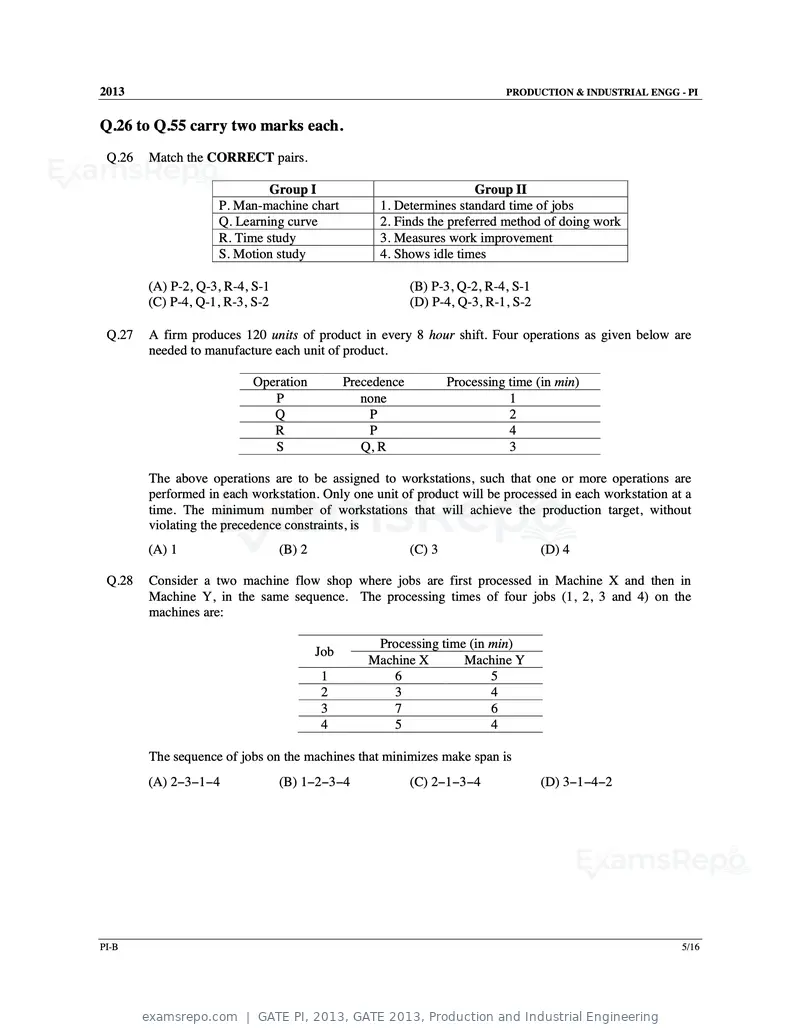
Text of page 20
2013                                                                          PRODUCTION & INDUSTRIAL ENGG - PI


Q.26 to Q.55 carry two marks each.
 Q.26   Match the CORRECT pairs.

                             Group I                                   Group II
                    P. Man-machine chart             1. Determines standard time of jobs
                    Q. Learning curve                2. Finds the preferred method of doing work
                    R. Time study                    3. Measures work improvement
                    S. Motion study                  4. Shows idle times

        (A) P-2, Q-3, R-4, S-1                              (B) P-3, Q-2, R-4, S-1
        (C) P-4, Q-1, R-3, S-2                              (D) P-4, Q-3, R-1, S-2

 Q.27   A firm produces 120 units of product in every 8 hour shift. Four operations as given below are
        needed to manufacture each unit of product.

                          Operation            Precedence           Processing time (in min)
                             P                    none                         1
                             Q                     P                           2
                             R                     P                           4
                             S                    Q, R                         3

        The above operations are to be assigned to workstations, such that one or more operations are
        performed in each workstation. Only one unit of product will be processed in each workstation at a
        time. The minimum number of workstations that will achieve the production target, without
        violating the precedence constraints, is
        (A) 1                    (B) 2                      (C) 3                    (D) 4

 Q.28   Consider a two machine flow shop where jobs are first processed in Machine X and then in
        Machine Y, in the same sequence. The processing times of four jobs (1, 2, 3 and 4) on the
        machines are:

                                                    Processing time (in min)
                                         Job
                                                   Machine X       Machine Y
                                         1            6                 5
                                         2            3                 4
                                         3            7                 6
                                         4            5                 4

        The sequence of jobs on the machines that minimizes make span is
        (A) 2−3−1−4              (B) 1−2−3−4                (C) 2−1−3−4              (D) 3−1−4−2


PI-B                                                                                                        5/16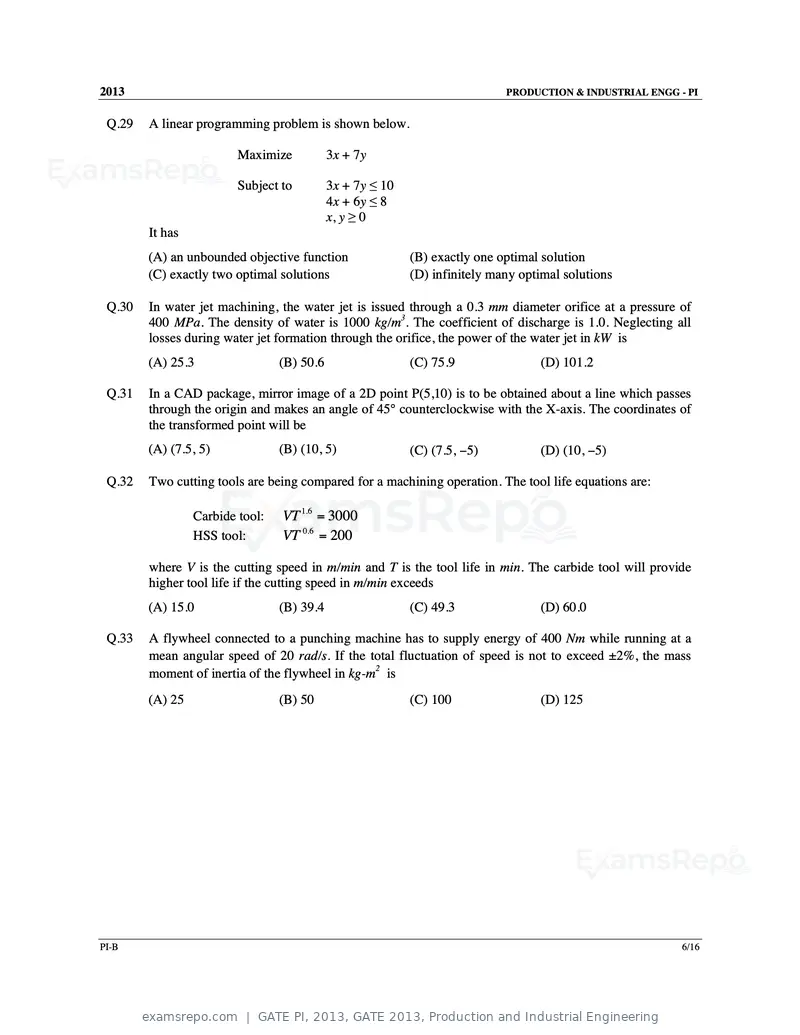
Text of page 21
2013                                                                        PRODUCTION & INDUSTRIAL ENGG - PI


 Q.29   A linear programming problem is shown below.

                         Maximize           3x + 7y

                         Subject to         3x + 7y ≤ 10
                                            4x + 6y ≤ 8
                                            x, y ≥ 0
        It has
        (A) an unbounded objective function                (B) exactly one optimal solution
        (C) exactly two optimal solutions                  (D) infinitely many optimal solutions

 Q.30   In water jet machining, the water jet is issued through a 0.3 mm diameter orifice at a pressure of
        400 MPa. The density of water is 1000 kg/m3. The coefficient of discharge is 1.0. Neglecting all
        losses during water jet formation through the orifice, the power of the water jet in kW is
        (A) 25.3                 (B) 50.6                  (C) 75.9               (D) 101.2

 Q.31   In a CAD package, mirror image of a 2D point P(5,10) is to be obtained about a line which passes
        through the origin and makes an angle of 45° counterclockwise with the X-axis. The coordinates of
        the transformed point will be
        (A) (7.5, 5)             (B) (10, 5)               (C) (7.5, −5)          (D) (10, −5)

 Q.32   Two cutting tools are being compared for a machining operation. The tool life equations are:

                 Carbide tool:   VT 1.6 = 3000
                 HSS tool:       VT 0.6 = 200

        where V is the cutting speed in m/min and T is the tool life in min. The carbide tool will provide
        higher tool life if the cutting speed in m/min exceeds
        (A) 15.0                 (B) 39.4                  (C) 49.3               (D) 60.0

 Q.33   A flywheel connected to a punching machine has to supply energy of 400 Nm while running at a
        mean angular speed of 20 rad/s. If the total fluctuation of speed is not to exceed ±2%, the mass
        moment of inertia of the flywheel in kg-m2 is
        (A) 25                   (B) 50                    (C) 100                (D) 125


PI-B                                                                                                      6/16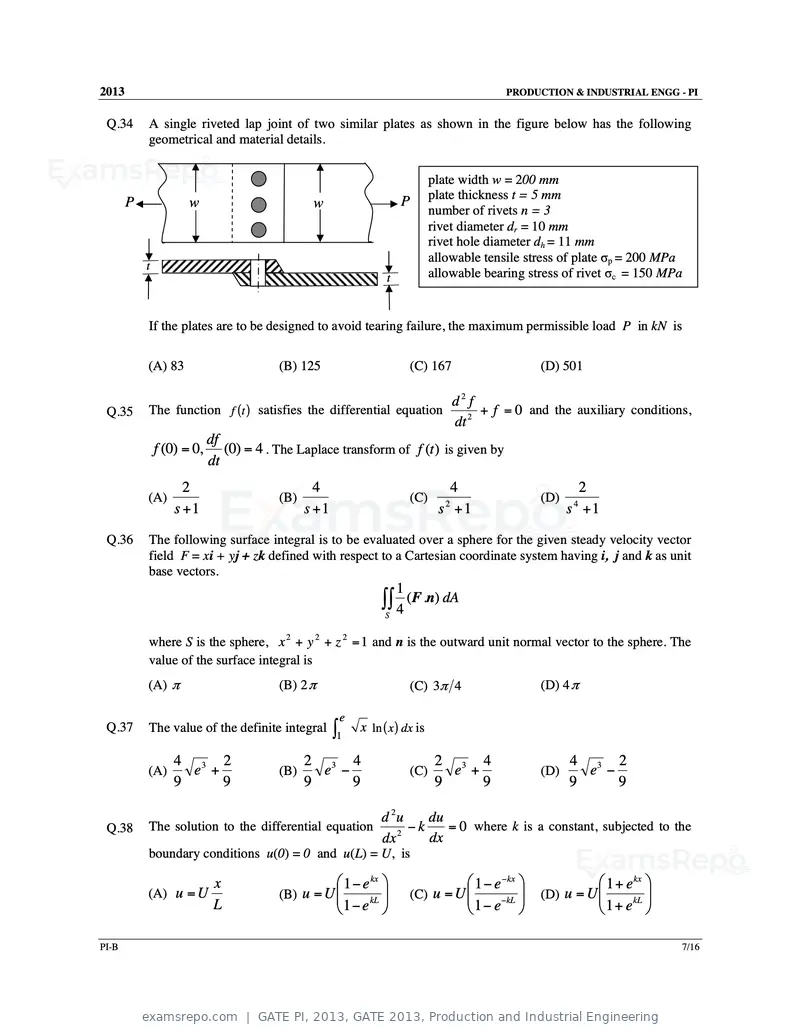
Text of page 22
2013 PRODUCTION & INDUSTRIAL ENGG - PI
Q.34 A single riveted lap joint of two similar plates as shown in the figure below has the following
geometrical and material details.
plate width w = 200 mm
P plate thickness t = 5 mm
P w w number of rivets n = 3
rivet diameter dr = 10 mm
rivet hole diameter dh = 11 mm
allowable tensile stress of plate σp = 200 MPa
t
t allowable bearing stress of rivet σc = 150 MPa
If the plates are to be designed to avoid tearing failure, the maximum permissible load P in kN is
(A) 83 (B) 125 (C) 167 (D) 501
d2 f
Q.35 The function f (t ) satisfies the differential equation + f = 0 and the auxiliary conditions,
dt 2
df
f (0) = 0, (0) = 4 . The Laplace transform of f (t ) is given by
dt
2 4 4 2
(A) (B) (C) (D)
s +1 s +1 s +1
2
s +1
4
Q.36 The following surface integral is to be evaluated over a sphere for the given steady velocity vector
field F = xi + yj + zk defined with respect to a Cartesian coordinate system having i, j and k as unit
base vectors.
1
∫∫ 4 (F .n) dA
S
where S is the sphere, x 2 + y 2 + z 2 = 1 and n is the outward unit normal vector to the sphere. The
value of the surface integral is
(A) π (B) 2 π (C) 3π 4 (D) 4 π
e
Q.37 The value of the definite integral ∫ x ln ( x ) dx is
1
4 3 2 2 3 4 2 3 4 4 3 2
(A) e + (B) e − (C) e + (D) e −
9 9 9 9 9 9 9 9
d 2u du
Q.38 The solution to the differential equation 2
−k = 0 where k is a constant, subjected to the
dx dx
boundary conditions u(0) = 0 and u(L) = U, is
x 1 − e kx 1 − e − kx 1 + ekx
(A) u = U (B) u = U kL
(C) u = U −kL
(D) u = U
kL
L 1− e 1− e 1+ e
PI-B 7/16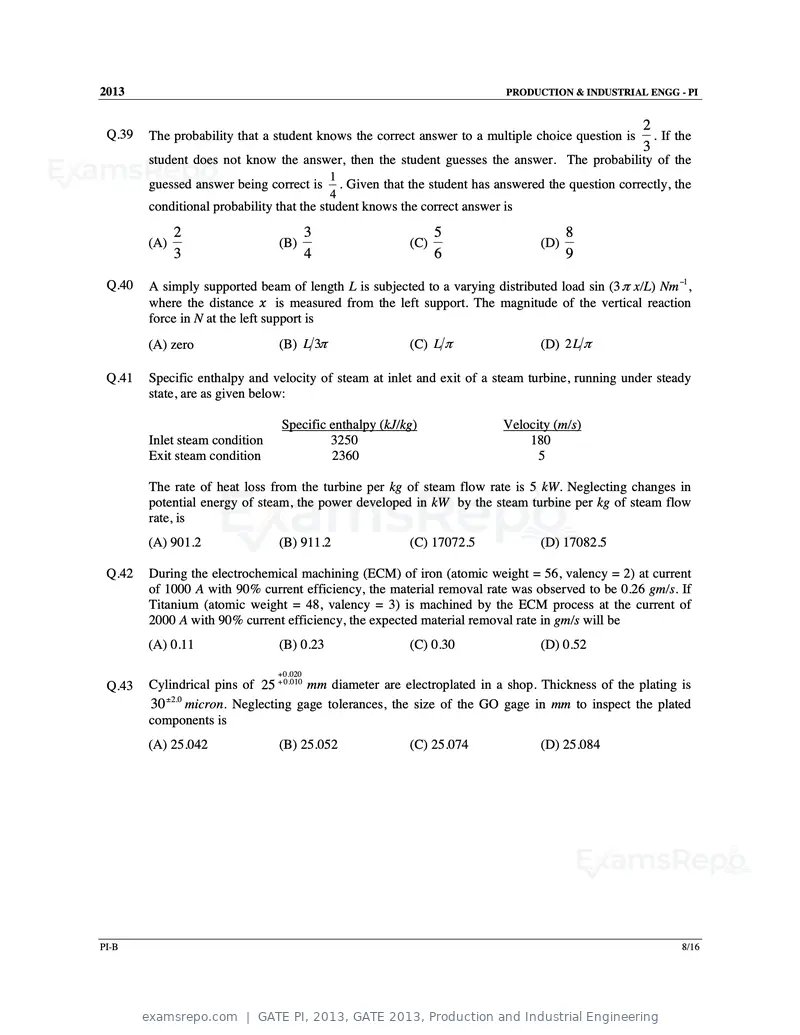
Text of page 23
2013                                                                           PRODUCTION & INDUSTRIAL ENGG - PI


                                                                                                         2
 Q.39   The probability that a student knows the correct answer to a multiple choice question is           . If the
                                                                                                         3
        student does not know the answer, then the student guesses the answer. The probability of the
                                               1
        guessed answer being correct is          . Given that the student has answered the question correctly, the
                                               4
        conditional probability that the student knows the correct answer is
              2                            3                       5                        8
        (A)                     (B)                          (C)                      (D)
              3                            4                       6                        9

 Q.40   A simply supported beam of length L is subjected to a varying distributed load sin (3 π x/L) Nm−1,
        where the distance  is measured from the left support. The magnitude of the vertical reaction
        force in N at the left support is
        (A) zero                (B) L 3π                     (C) L π                  (D) 2 L π

 Q.41   Specific enthalpy and velocity of steam at inlet and exit of a steam turbine, running under steady
        state, are as given below:

                                 Specific enthalpy (kJ/kg)                     Velocity (m/s)
        Inlet steam condition             3250                                     180
        Exit steam condition              2360                                       5

        The rate of heat loss from the turbine per kg of steam flow rate is 5 kW. Neglecting changes in
        potential energy of steam, the power developed in kW by the steam turbine per kg of steam flow
        rate, is
        (A) 901.2               (B) 911.2                    (C) 17072.5              (D) 17082.5

 Q.42   During the electrochemical machining (ECM) of iron (atomic weight = 56, valency = 2) at current
        of 1000 A with 90% current efficiency, the material removal rate was observed to be 0.26 gm/s. If
        Titanium (atomic weight = 48, valency = 3) is machined by the ECM process at the current of
        2000 A with 90% current efficiency, the expected material removal rate in gm/s will be
        (A) 0.11                (B) 0.23                     (C) 0.30                 (D) 0.52

                                + 0 .020
 Q.43   Cylindrical pins of 25 + 0.010 mm diameter are electroplated in a shop. Thickness of the plating is
        30 ±2.0 micron. Neglecting gage tolerances, the size of the GO gage in mm to inspect the plated
        components is
        (A) 25.042              (B) 25.052                   (C) 25.074               (D) 25.084


PI-B                                                                                                             8/16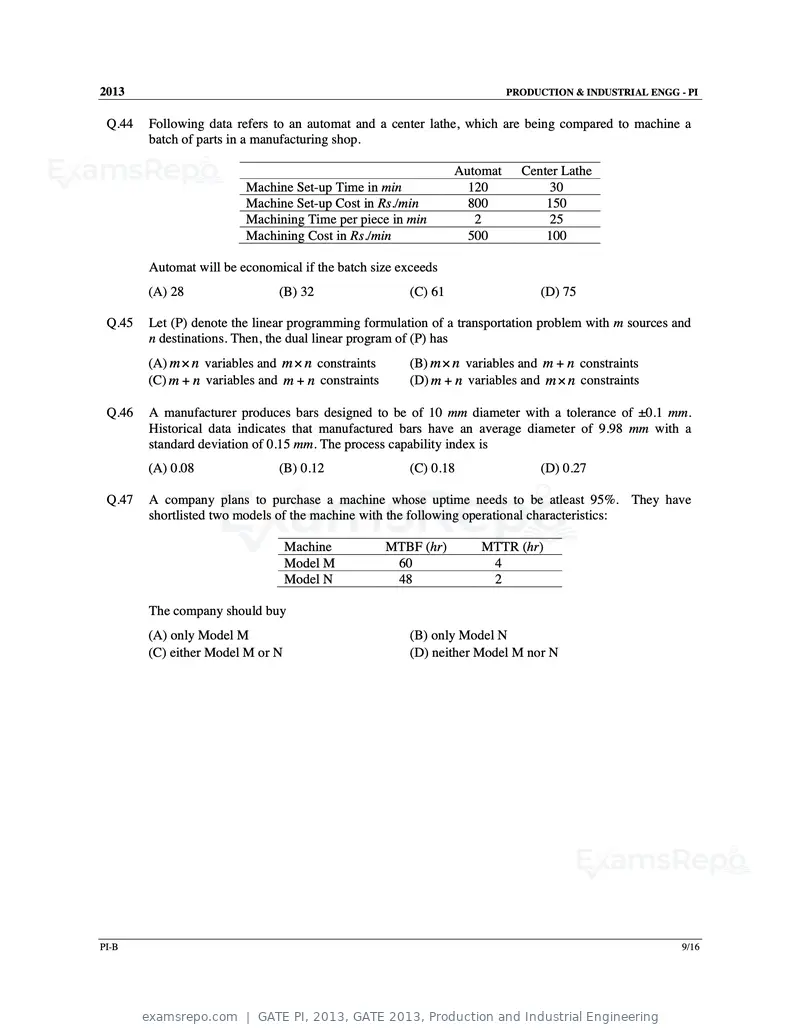
Text of page 24
2013                                                                      PRODUCTION & INDUSTRIAL ENGG - PI


 Q.44   Following data refers to an automat and a center lathe, which are being compared to machine a
        batch of parts in a manufacturing shop.

                                                                Automat     Center Lathe
                         Machine Set-up Time in min               120           30
                         Machine Set-up Cost in Rs./min           800           150
                         Machining Time per piece in min           2            25
                         Machining Cost in Rs./min                500           100

        Automat will be economical if the batch size exceeds
        (A) 28                 (B) 32                  (C) 61                  (D) 75

 Q.45   Let (P) denote the linear programming formulation of a transportation problem with m sources and
        n destinations. Then, the dual linear program of (P) has
        (A) m × n variables and m × n constraints      (B) m × n variables and m + n constraints
        (C) m + n variables and m + n constraints      (D) m + n variables and m × n constraints

 Q.46   A manufacturer produces bars designed to be of 10 mm diameter with a tolerance of ±0.1 mm.
        Historical data indicates that manufactured bars have an average diameter of 9.98 mm with a
        standard deviation of 0.15 mm. The process capability index is
        (A) 0.08               (B) 0.12                (C) 0.18                (D) 0.27

 Q.47   A company plans to purchase a machine whose uptime needs to be atleast 95%. They have
        shortlisted two models of the machine with the following operational characteristics:

                                  Machine           MTBF (hr)      MTTR (hr)
                                  Model M            60             4
                                  Model N            48             2

        The company should buy
        (A) only Model M                               (B) only Model N
        (C) either Model M or N                        (D) neither Model M nor N


PI-B                                                                                                    9/16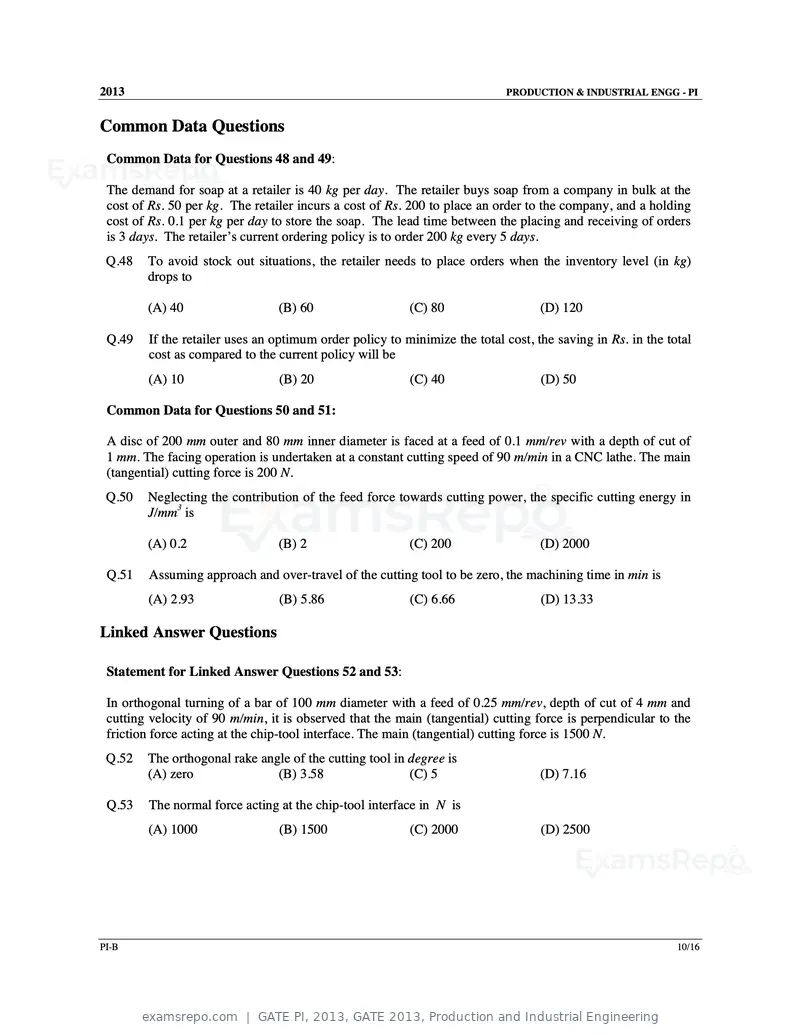
Text of page 25
2013                                                                       PRODUCTION & INDUSTRIAL ENGG - PI


Common Data Questions
 Common Data for Questions 48 and 49:

 The demand for soap at a retailer is 40 kg per day. The retailer buys soap from a company in bulk at the
 cost of Rs. 50 per kg. The retailer incurs a cost of Rs. 200 to place an order to the company, and a holding
 cost of Rs. 0.1 per kg per day to store the soap. The lead time between the placing and receiving of orders
 is 3 days. The retailer’s current ordering policy is to order 200 kg every 5 days.
 Q.48   To avoid stock out situations, the retailer needs to place orders when the inventory level (in kg)
        drops to

        (A) 40                   (B) 60                  (C) 80                   (D) 120

 Q.49   If the retailer uses an optimum order policy to minimize the total cost, the saving in Rs. in the total
        cost as compared to the current policy will be
        (A) 10                   (B) 20                  (C) 40                   (D) 50

 Common Data for Questions 50 and 51:

 A disc of 200 mm outer and 80 mm inner diameter is faced at a feed of 0.1 mm/rev with a depth of cut of
 1 mm. The facing operation is undertaken at a constant cutting speed of 90 m/min in a CNC lathe. The main
 (tangential) cutting force is 200 N.
 Q.50   Neglecting the contribution of the feed force towards cutting power, the specific cutting energy in
        J/mm3 is

        (A) 0.2                  (B) 2                   (C) 200                  (D) 2000

 Q.51   Assuming approach and over-travel of the cutting tool to be zero, the machining time in min is
        (A) 2.93                 (B) 5.86                (C) 6.66                 (D) 13.33

Linked Answer Questions

 Statement for Linked Answer Questions 52 and 53:

 In orthogonal turning of a bar of 100 mm diameter with a feed of 0.25 mm/rev, depth of cut of 4 mm and
 cutting velocity of 90 m/min, it is observed that the main (tangential) cutting force is perpendicular to the
 friction force acting at the chip-tool interface. The main (tangential) cutting force is 1500 N.
 Q.52   The orthogonal rake angle of the cutting tool in degree is
        (A) zero               (B) 3.58                  (C) 5                    (D) 7.16

 Q.53   The normal force acting at the chip-tool interface in N is
        (A) 1000                 (B) 1500                (C) 2000                 (D) 2500


PI-B                                                                                                        10/16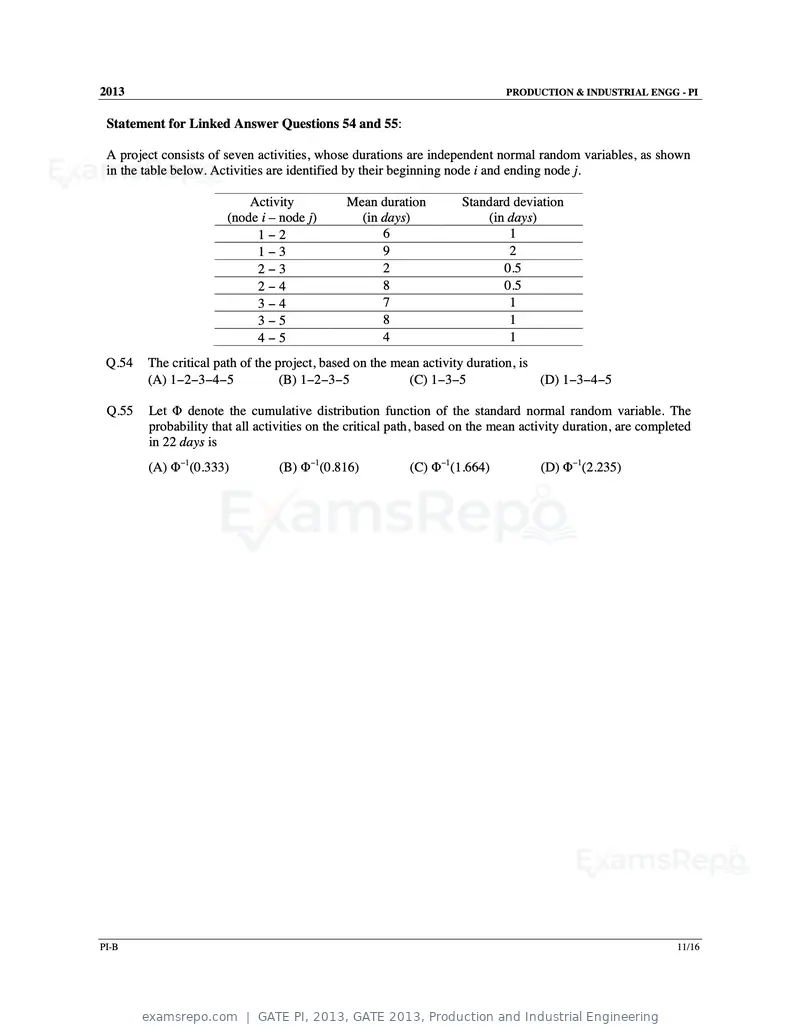
Text of page 26
2013                                                                        PRODUCTION & INDUSTRIAL ENGG - PI


 Statement for Linked Answer Questions 54 and 55:

 A project consists of seven activities, whose durations are independent normal random variables, as shown
 in the table below. Activities are identified by their beginning node i and ending node j.

                           Activity          Mean duration          Standard deviation
                       (node i – node j)       (in days)                (in days)
                            1−2                    6                        1
                            1−3                    9                        2
                            2−3                    2                       0.5
                            2−4                    8                       0.5
                            3−4                    7                        1
                            3−5                    8                        1
                            4−5                    4                        1
 Q.54   The critical path of the project, based on the mean activity duration, is
        (A) 1−2−3−4−5             (B) 1−2−3−5            (C) 1−3−5                (D) 1−3−4−5

 Q.55   Let Φ denote the cumulative distribution function of the standard normal random variable. The
        probability that all activities on the critical path, based on the mean activity duration, are completed
        in 22 days is
        (A) Φ−1(0.333)          (B) Φ−1(0.816)            (C) Φ−1(1.664)           (D) Φ−1(2.235)


PI-B                                                                                                         11/16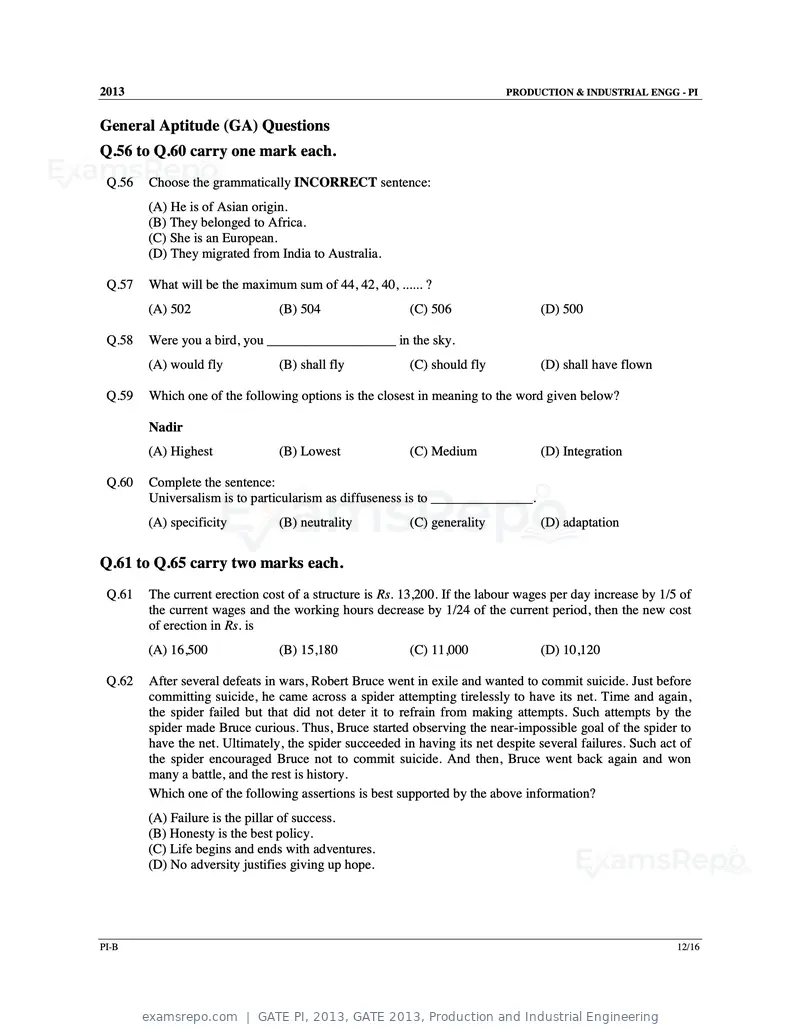
Text of page 27
2013                                                                       PRODUCTION & INDUSTRIAL ENGG - PI


General Aptitude (GA) Questions
Q.56 to Q.60 carry one mark each.
 Q.56   Choose the grammatically INCORRECT sentence:
        (A) He is of Asian origin.
        (B) They belonged to Africa.
        (C) She is an European.
        (D) They migrated from India to Australia.

 Q.57   What will be the maximum sum of 44, 42, 40, ...... ?
        (A) 502                 (B) 504                  (C) 506                 (D) 500

 Q.58   Were you a bird, you ___________________ in the sky.
        (A) would fly           (B) shall fly            (C) should fly          (D) shall have flown

 Q.59   Which one of the following options is the closest in meaning to the word given below?

        Nadir
        (A) Highest             (B) Lowest               (C) Medium              (D) Integration

 Q.60   Complete the sentence:
        Universalism is to particularism as diffuseness is to _______________.
        (A) specificity         (B) neutrality           (C) generality          (D) adaptation


Q.61 to Q.65 carry two marks each.
 Q.61   The current erection cost of a structure is Rs. 13,200. If the labour wages per day increase by 1/5 of
        the current wages and the working hours decrease by 1/24 of the current period, then the new cost
        of erection in Rs. is
        (A) 16,500              (B) 15,180               (C) 11,000              (D) 10,120

 Q.62   After several defeats in wars, Robert Bruce went in exile and wanted to commit suicide. Just before
        committing suicide, he came across a spider attempting tirelessly to have its net. Time and again,
        the spider failed but that did not deter it to refrain from making attempts. Such attempts by the
        spider made Bruce curious. Thus, Bruce started observing the near-impossible goal of the spider to
        have the net. Ultimately, the spider succeeded in having its net despite several failures. Such act of
        the spider encouraged Bruce not to commit suicide. And then, Bruce went back again and won
        many a battle, and the rest is history.
        Which one of the following assertions is best supported by the above information?
        (A) Failure is the pillar of success.
        (B) Honesty is the best policy.
        (C) Life begins and ends with adventures.
        (D) No adversity justifies giving up hope.


PI-B                                                                                                       12/16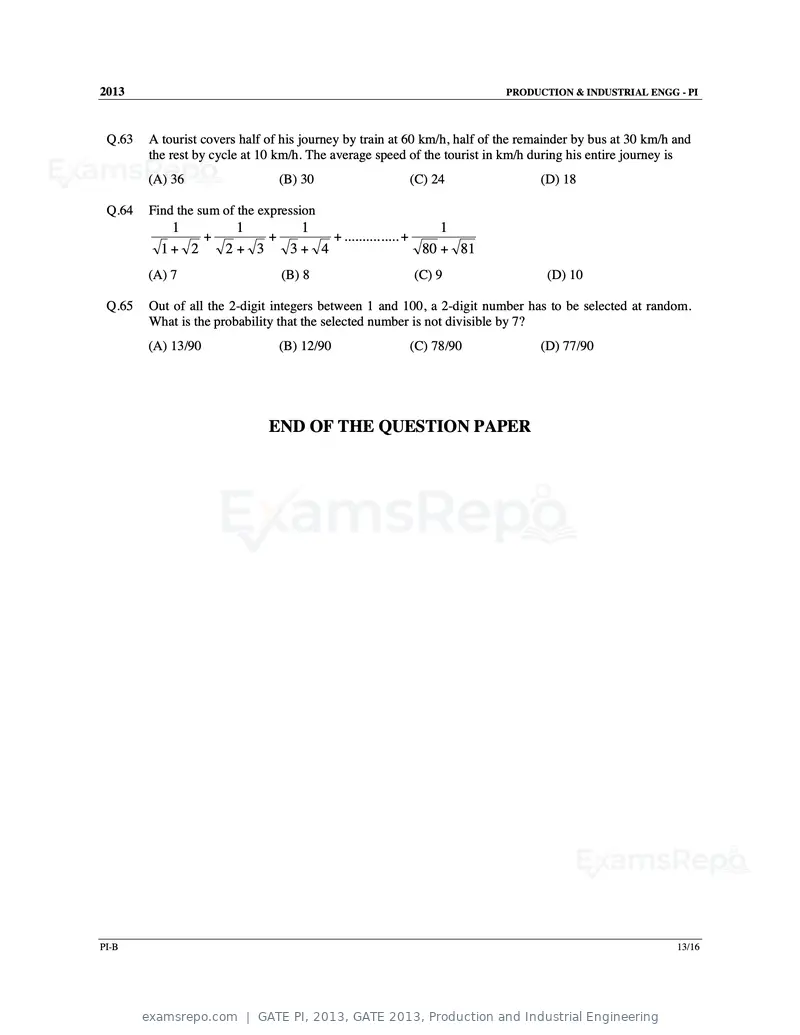
Text of page 28
2013                                                                      PRODUCTION & INDUSTRIAL ENGG - PI


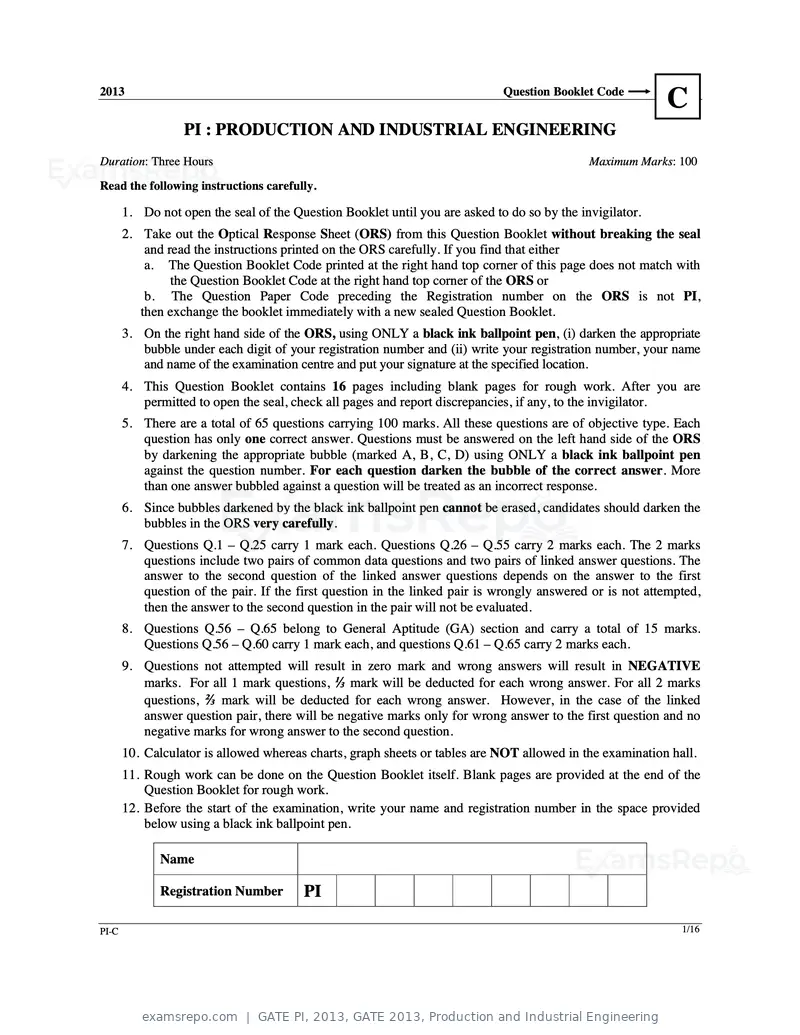
 Q.63   A tourist covers half of his journey by train at 60 km/h, half of the remainder by bus at 30 km/h and
        the rest by cycle at 10 km/h. The average speed of the tourist in km/h during his entire journey is
        (A) 36                  (B) 30                  (C) 24                   (D) 18

 Q.64   Find the sum of the expression
           1      1      1                           1
               +      +      + .......... ..... +
          1+ 2   2+ 3   3+ 4                      80 + 81
        (A) 7                   (B) 8                    (C) 9                    (D) 10

 Q.65   Out of all the 2-digit integers between 1 and 100, a 2-digit number has to be selected at random.
        What is the probability that the selected number is not divisible by 7?
        (A) 13/90               (B) 12/90               (C) 78/90                (D) 77/90


                              END OF THE QUESTION PAPER


PI-B                                                                                                      13/16
Text of page 29
SESSION - 3
Text of page 30
2013                                                                         Question Booklet Code
                                                                                                          C
                  PI : PRODUCTION AND INDUSTRIAL ENGINEERING
Duration: Three Hours                                                                        Maximum Marks: 100
Read the following instructions carefully.

       1. Do not open the seal of the Question Booklet until you are asked to do so by the invigilator.
       2. Take out the Optical Response Sheet (ORS) from this Question Booklet without breaking the seal
           and read the instructions printed on the ORS carefully. If you find that either
           a. The Question Booklet Code printed at the right hand top corner of this page does not match with
                the Question Booklet Code at the right hand top corner of the ORS or
           b. The Question Paper Code preceding the Registration number on the ORS is not PI,
          then exchange the booklet immediately with a new sealed Question Booklet.
       3. On the right hand side of the ORS, using ONLY a black ink ballpoint pen, (i) darken the appropriate
          bubble under each digit of your registration number and (ii) write your registration number, your name
          and name of the examination centre and put your signature at the specified location.
       4. This Question Booklet contains 16 pages including blank pages for rough work. After you are
          permitted to open the seal, check all pages and report discrepancies, if any, to the invigilator.
       5. There are a total of 65 questions carrying 100 marks. All these questions are of objective type. Each
          question has only one correct answer. Questions must be answered on the left hand side of the ORS
          by darkening the appropriate bubble (marked A, B, C, D) using ONLY a black ink ballpoint pen
          against the question number. For each question darken the bubble of the correct answer. More
          than one answer bubbled against a question will be treated as an incorrect response.
       6. Since bubbles darkened by the black ink ballpoint pen cannot be erased, candidates should darken the
          bubbles in the ORS very carefully.
       7. Questions Q.1 – Q.25 carry 1 mark each. Questions Q.26 – Q.55 carry 2 marks each. The 2 marks
          questions include two pairs of common data questions and two pairs of linked answer questions. The
          answer to the second question of the linked answer questions depends on the answer to the first
          question of the pair. If the first question in the linked pair is wrongly answered or is not attempted,
          then the answer to the second question in the pair will not be evaluated.
       8. Questions Q.56 – Q.65 belong to General Aptitude (GA) section and carry a total of 15 marks.
          Questions Q.56 – Q.60 carry 1 mark each, and questions Q.61 – Q.65 carry 2 marks each.
       9. Questions not attempted will result in zero mark and wrong answers will result in NEGATIVE
          marks. For all 1 mark questions, ⅓ mark will be deducted for each wrong answer. For all 2 marks
          questions, ⅔ mark will be deducted for each wrong answer. However, in the case of the linked
          answer question pair, there will be negative marks only for wrong answer to the first question and no
          negative marks for wrong answer to the second question.
       10. Calculator is allowed whereas charts, graph sheets or tables are NOT allowed in the examination hall.
       11. Rough work can be done on the Question Booklet itself. Blank pages are provided at the end of the
           Question Booklet for rough work.
       12. Before the start of the examination, write your name and registration number in the space provided
           below using a black ink ballpoint pen.

              Name

              Registration Number       PI

PI-C                                                                                                         1/16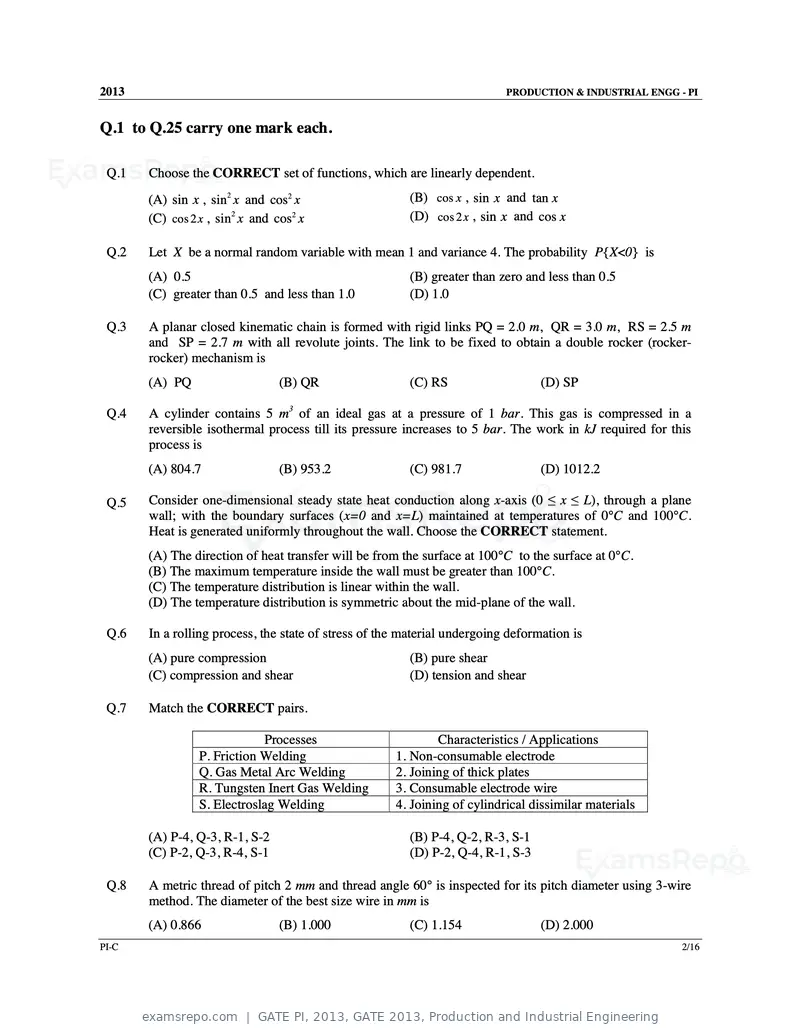
Text of page 31
2013                                                                       PRODUCTION & INDUSTRIAL ENGG - PI


Q.1 to Q.25 carry one mark each.

 Q.1   Choose the CORRECT set of functions, which are linearly dependent.
       (A) sin x , sin2 x and cos2 x                    (B) cos x , sin x and tan x
       (C) cos 2x , sin2 x and cos2 x                   (D) cos 2x , sin x and cos x

 Q.2   Let X be a normal random variable with mean 1 and variance 4. The probability P{X<0} is
       (A) 0.5                                          (B) greater than zero and less than 0.5
       (C) greater than 0.5 and less than 1.0           (D) 1.0

 Q.3   A planar closed kinematic chain is formed with rigid links PQ = 2.0 m, QR = 3.0 m, RS = 2.5 m
       and SP = 2.7 m with all revolute joints. The link to be fixed to obtain a double rocker (rocker-
       rocker) mechanism is
       (A) PQ                   (B) QR                  (C) RS                    (D) SP

 Q.4   A cylinder contains 5 m3 of an ideal gas at a pressure of 1 bar. This gas is compressed in a
       reversible isothermal process till its pressure increases to 5 bar. The work in kJ required for this
       process is
       (A) 804.7                (B) 953.2               (C) 981.7                 (D) 1012.2

 Q.5   Consider one-dimensional steady state heat conduction along x-axis (0 ≤ x ≤ L), through a plane
       wall; with the boundary surfaces (x=0 and x=L) maintained at temperatures of 0°C and 100°C.
       Heat is generated uniformly throughout the wall. Choose the CORRECT statement.
       (A) The direction of heat transfer will be from the surface at 100°C to the surface at 0°C.
       (B) The maximum temperature inside the wall must be greater than 100°C.
       (C) The temperature distribution is linear within the wall.
       (D) The temperature distribution is symmetric about the mid-plane of the wall.

 Q.6   In a rolling process, the state of stress of the material undergoing deformation is
       (A) pure compression                             (B) pure shear
       (C) compression and shear                        (D) tension and shear

 Q.7   Match the CORRECT pairs.

                            Processes                         Characteristics / Applications
                P. Friction Welding                   1. Non-consumable electrode
                Q. Gas Metal Arc Welding              2. Joining of thick plates
                R. Tungsten Inert Gas Welding         3. Consumable electrode wire
                S. Electroslag Welding                4. Joining of cylindrical dissimilar materials

       (A) P-4, Q-3, R-1, S-2                           (B) P-4, Q-2, R-3, S-1
       (C) P-2, Q-3, R-4, S-1                           (D) P-2, Q-4, R-1, S-3

 Q.8   A metric thread of pitch 2 mm and thread angle 60° is inspected for its pitch diameter using 3-wire
       method. The diameter of the best size wire in mm is
       (A) 0.866                (B) 1.000               (C) 1.154                 (D) 2.000
PI-C                                                                                                     2/16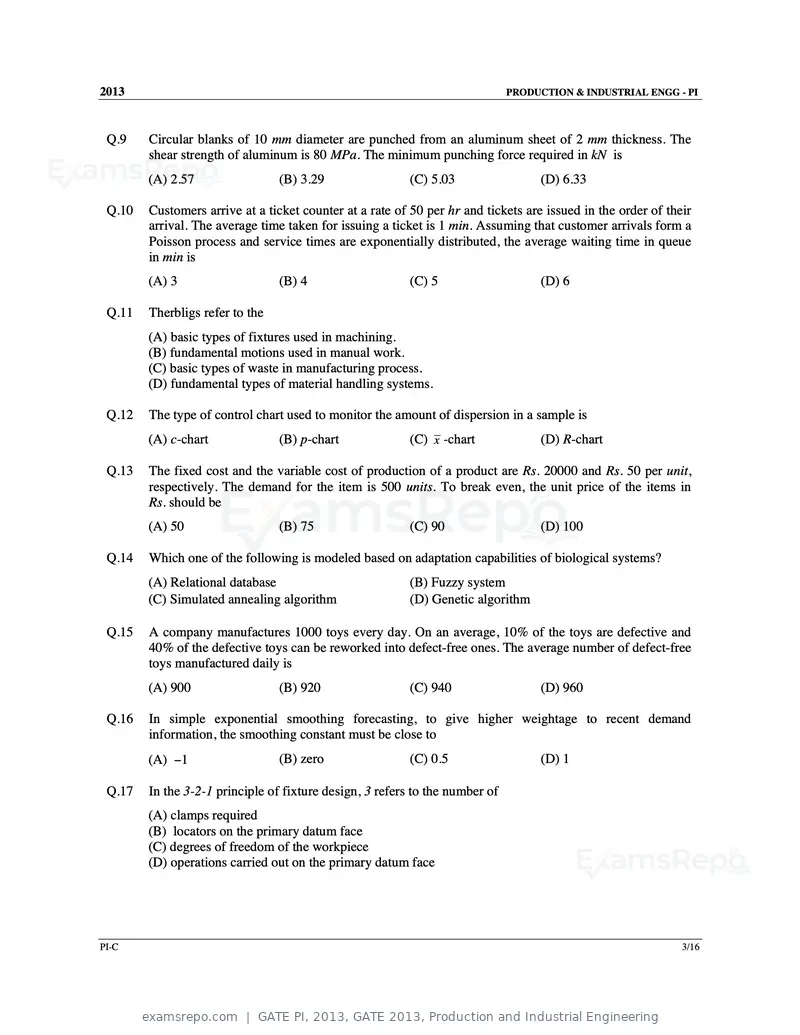
Text of page 32
2013                                                                          PRODUCTION & INDUSTRIAL ENGG - PI


 Q.9    Circular blanks of 10 mm diameter are punched from an aluminum sheet of 2 mm thickness. The
        shear strength of aluminum is 80 MPa. The minimum punching force required in kN is
        (A) 2.57                 (B) 3.29                 (C) 5.03                 (D) 6.33

 Q.10   Customers arrive at a ticket counter at a rate of 50 per hr and tickets are issued in the order of their
        arrival. The average time taken for issuing a ticket is 1 min. Assuming that customer arrivals form a
        Poisson process and service times are exponentially distributed, the average waiting time in queue
        in min is
        (A) 3                    (B) 4                    (C) 5                    (D) 6

 Q.11   Therbligs refer to the
        (A) basic types of fixtures used in machining.
        (B) fundamental motions used in manual work.
        (C) basic types of waste in manufacturing process.
        (D) fundamental types of material handling systems.

 Q.12   The type of control chart used to monitor the amount of dispersion in a sample is
        (A) c-chart              (B) p-chart              (C) x -chart             (D) R-chart

 Q.13   The fixed cost and the variable cost of production of a product are Rs. 20000 and Rs. 50 per unit,
        respectively. The demand for the item is 500 units. To break even, the unit price of the items in
        Rs. should be
        (A) 50                   (B) 75                   (C) 90                   (D) 100

 Q.14   Which one of the following is modeled based on adaptation capabilities of biological systems?
        (A) Relational database                           (B) Fuzzy system
        (C) Simulated annealing algorithm                 (D) Genetic algorithm

 Q.15   A company manufactures 1000 toys every day. On an average, 10% of the toys are defective and
        40% of the defective toys can be reworked into defect-free ones. The average number of defect-free
        toys manufactured daily is
        (A) 900                  (B) 920                  (C) 940                  (D) 960

 Q.16   In simple exponential smoothing forecasting, to give higher weightage to recent demand
        information, the smoothing constant must be close to
        (A) −1                   (B) zero                 (C) 0.5                  (D) 1

 Q.17   In the 3-2-1 principle of fixture design, 3 refers to the number of
        (A) clamps required
        (B) locators on the primary datum face
        (C) degrees of freedom of the workpiece
        (D) operations carried out on the primary datum face


PI-C                                                                                                          3/16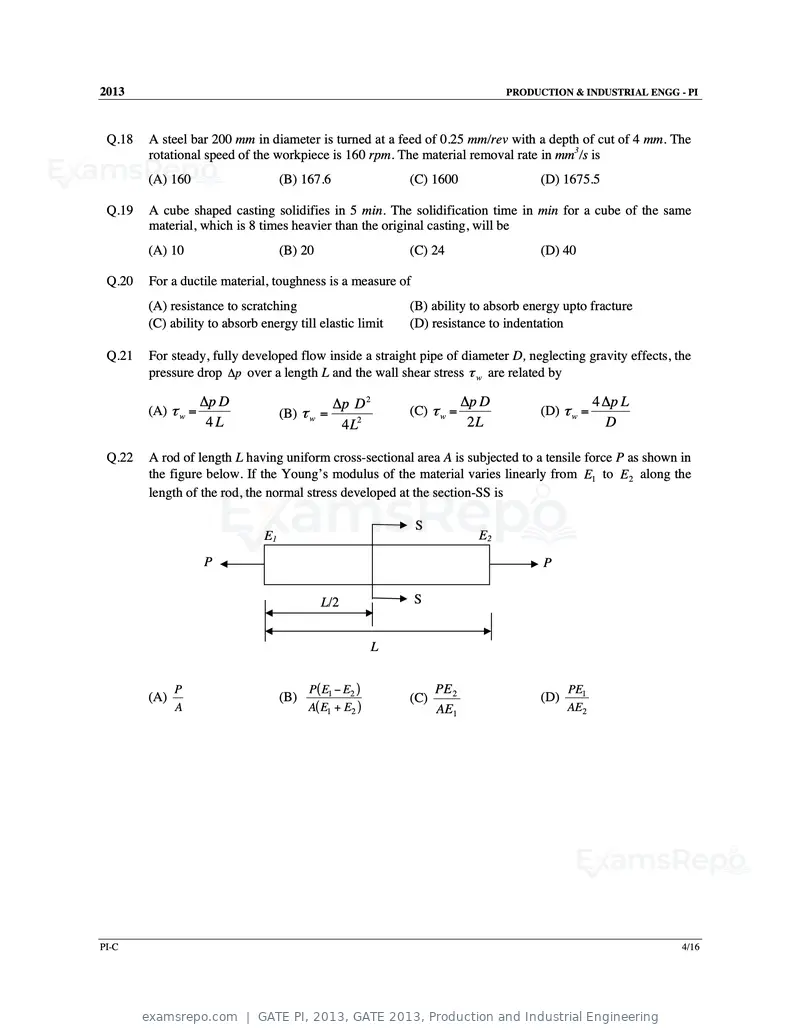
Text of page 33
2013                                                                             PRODUCTION & INDUSTRIAL ENGG - PI


 Q.18   A steel bar 200 mm in diameter is turned at a feed of 0.25 mm/rev with a depth of cut of 4 mm. The
        rotational speed of the workpiece is 160 rpm. The material removal rate in mm3/s is
        (A) 160                     (B) 167.6                (C) 1600                 (D) 1675.5

 Q.19   A cube shaped casting solidifies in 5 min. The solidification time in min for a cube of the same
        material, which is 8 times heavier than the original casting, will be
        (A) 10                      (B) 20                   (C) 24                   (D) 40

 Q.20   For a ductile material, toughness is a measure of
        (A) resistance to scratching                         (B) ability to absorb energy upto fracture
        (C) ability to absorb energy till elastic limit      (D) resistance to indentation

 Q.21   For steady, fully developed flow inside a straight pipe of diameter D, neglecting gravity effects, the
        pressure drop ∆p over a length L and the wall shear stress τ w are related by

                    ∆p D                        ∆p D 2                    ∆p D                    4 ∆p L
        (A) τ w =                   (B) τ w =                (C) τ w =                (D) τ w =
                     4L                          4L2                       2L                       D

 Q.22   A rod of length L having uniform cross-sectional area A is subjected to a tensile force P as shown in
        the figure below. If the Young’s modulus of the material varies linearly from E1 to E2 along the
        length of the rod, the normal stress developed at the section-SS is

                                                              S
                               E1                                           E2
                    P                                                                  P

                                             L/2             S


                                                         L


              P                           P( E1 − E2 )             PE 2                     PE1
        (A)                         (B)                      (C)                      (D)
              A                           A( E1 + E2 )             AE1                      AE2


PI-C                                                                                                           4/16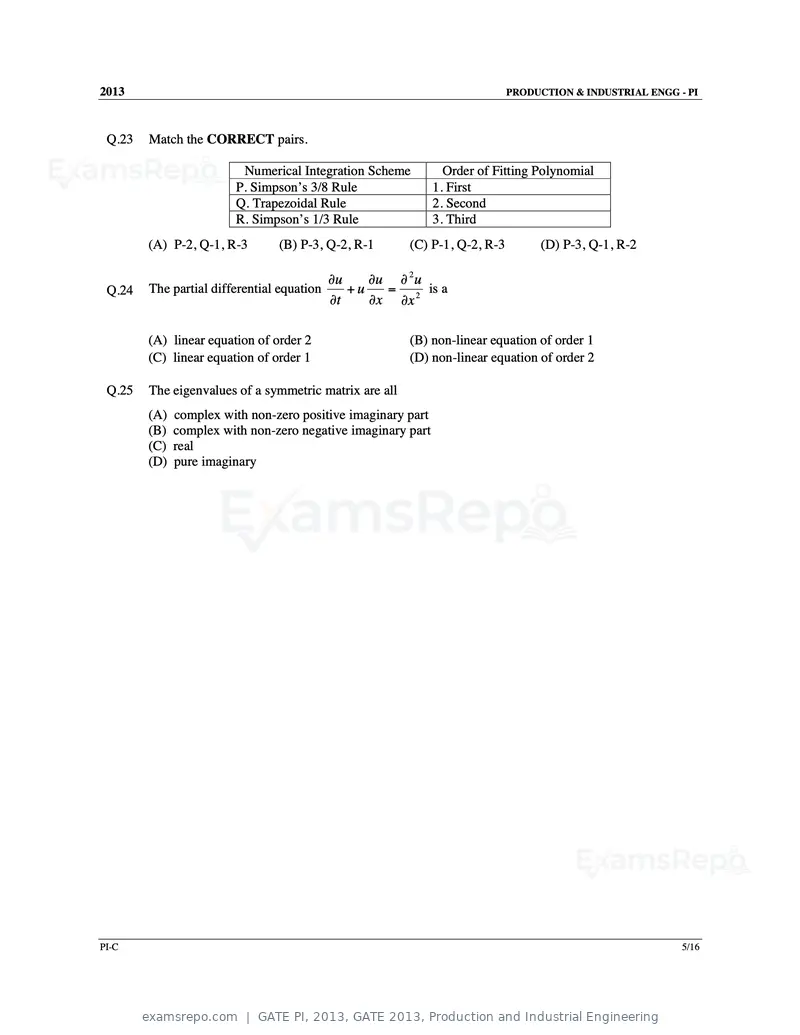
Text of page 34
2013                                                                         PRODUCTION & INDUSTRIAL ENGG - PI


 Q.23   Match the CORRECT pairs.

                         Numerical Integration Scheme          Order of Fitting Polynomial
                        P. Simpson’s 3/8 Rule                1. First
                        Q. Trapezoidal Rule                  2. Second
                        R. Simpson’s 1/3 Rule                3. Third
        (A) P-2, Q-1, R-3       (B) P-3, Q-2, R-1        (C) P-1, Q-2, R-3        (D) P-3, Q-1, R-2

                                            ∂u    ∂u ∂ 2 u
 Q.24   The partial differential equation      +u   =      is a
                                            ∂t    ∂x ∂x 2

        (A) linear equation of order 2                   (B) non-linear equation of order 1
        (C) linear equation of order 1                   (D) non-linear equation of order 2

 Q.25   The eigenvalues of a symmetric matrix are all
        (A) complex with non-zero positive imaginary part
        (B) complex with non-zero negative imaginary part
        (C) real
        (D) pure imaginary


PI-C                                                                                                       5/16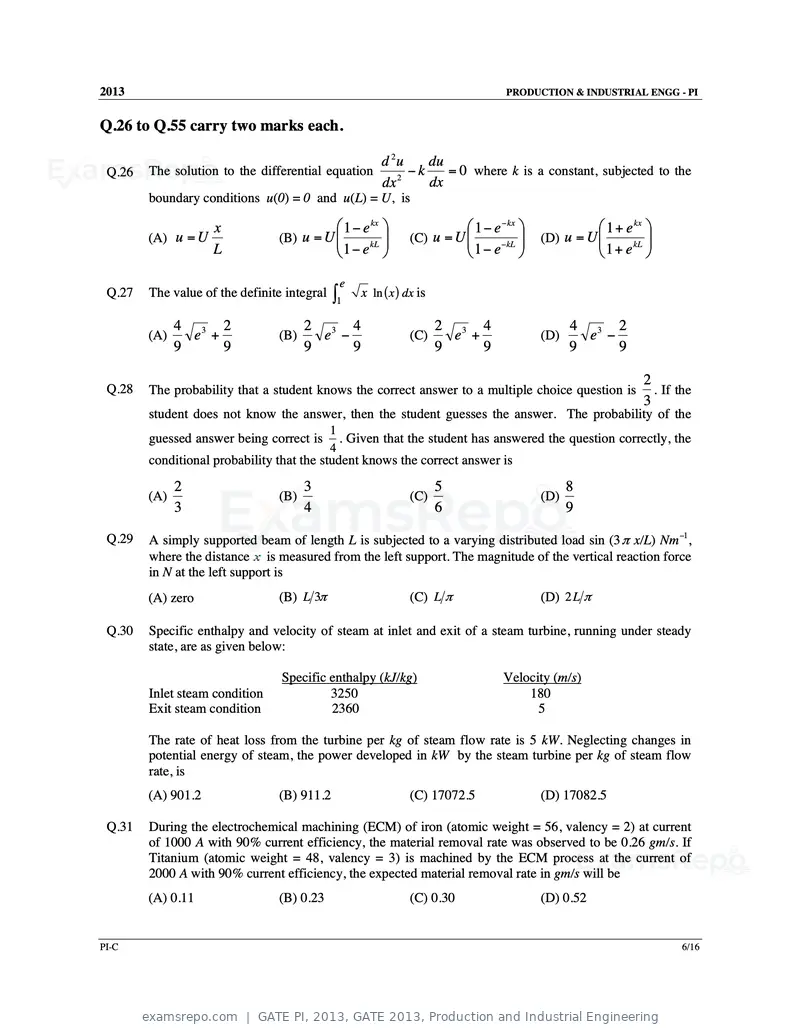
Text of page 35
2013 PRODUCTION & INDUSTRIAL ENGG - PI
Q.26 to Q.55 carry two marks each.
d 2u du
Q.26 The solution to the differential equation 2
−k = 0 where k is a constant, subjected to the
dx dx
boundary conditions u(0) = 0 and u(L) = U, is
x 1 − e kx 1 − e − kx 1 + e kx
(A) u = U (B) u = U kL
(C) u = U −kL
(D) u = U kL
L 1− e 1− e 1+ e
e
Q.27 The value of the definite integral ∫ x ln ( x ) dx is
1
4 3 2 2 3 4 2 3 4 4 3 2
(A) e + (B) e − (C) e + (D) e −
9 9 9 9 9 9 9 9
2
Q.28 The probability that a student knows the correct answer to a multiple choice question is . If the
3
student does not know the answer, then the student guesses the answer. The probability of the
1
guessed answer being correct is . Given that the student has answered the question correctly, the
4
conditional probability that the student knows the correct answer is
2 3 5 8
(A) (B) (C) (D)
3 4 6 9
Q.29 A simply supported beam of length L is subjected to a varying distributed load sin (3 π x/L) Nm−1,
where the distance is measured from the left support. The magnitude of the vertical reaction force
in N at the left support is
(A) zero (B) L 3π (C) L π (D) 2 L π
Q.30 Specific enthalpy and velocity of steam at inlet and exit of a steam turbine, running under steady
state, are as given below:
Specific enthalpy (kJ/kg) Velocity (m/s)
Inlet steam condition 3250 180
Exit steam condition 2360 5
The rate of heat loss from the turbine per kg of steam flow rate is 5 kW. Neglecting changes in
potential energy of steam, the power developed in kW by the steam turbine per kg of steam flow
rate, is
(A) 901.2 (B) 911.2 (C) 17072.5 (D) 17082.5
Q.31 During the electrochemical machining (ECM) of iron (atomic weight = 56, valency = 2) at current
of 1000 A with 90% current efficiency, the material removal rate was observed to be 0.26 gm/s. If
Titanium (atomic weight = 48, valency = 3) is machined by the ECM process at the current of
2000 A with 90% current efficiency, the expected material removal rate in gm/s will be
(A) 0.11 (B) 0.23 (C) 0.30 (D) 0.52
PI-C 6/16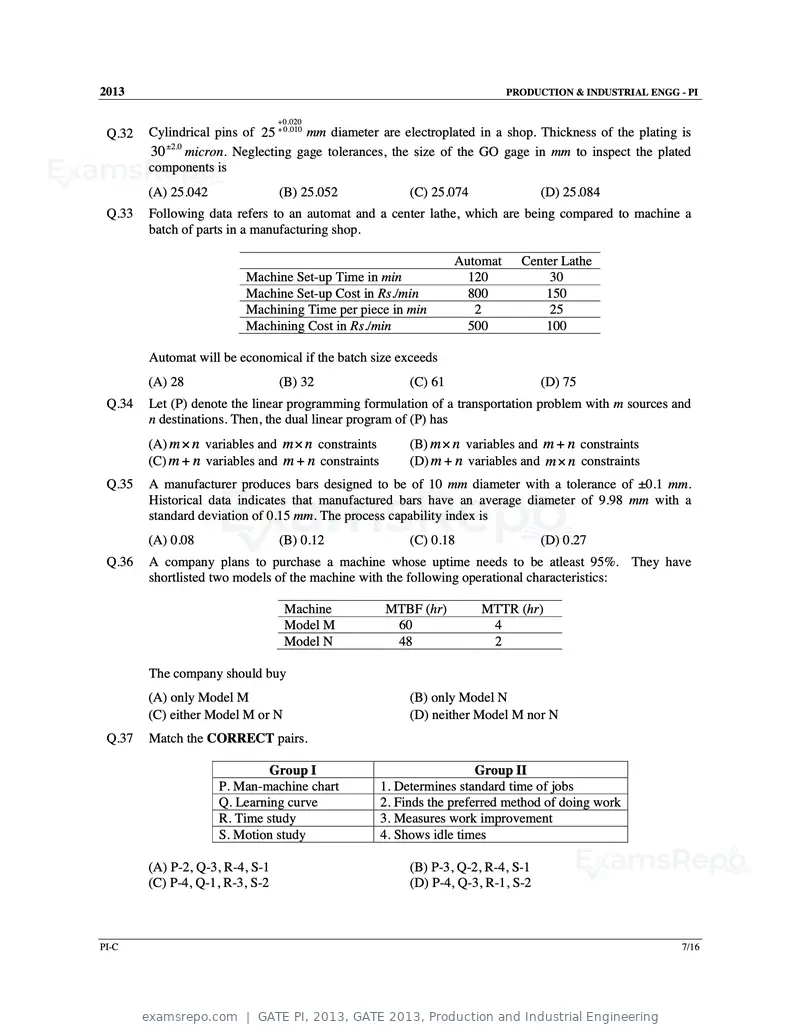
Text of page 36
2013                                                                        PRODUCTION & INDUSTRIAL ENGG - PI

                                 + 0 .020
 Q.32   Cylindrical pins of 25 + 0.010 mm diameter are electroplated in a shop. Thickness of the plating is
        30 ±2.0 micron. Neglecting gage tolerances, the size of the GO gage in mm to inspect the plated
        components is
        (A) 25.042               (B) 25.052              (C) 25.074               (D) 25.084
 Q.33   Following data refers to an automat and a center lathe, which are being compared to machine a
        batch of parts in a manufacturing shop.

                                                                  Automat     Center Lathe
                         Machine Set-up Time in min                 120            30
                         Machine Set-up Cost in Rs./min             800           150
                         Machining Time per piece in min             2            25
                         Machining Cost in Rs./min                  500           100

        Automat will be economical if the batch size exceeds
        (A) 28                   (B) 32                  (C) 61                   (D) 75
 Q.34   Let (P) denote the linear programming formulation of a transportation problem with m sources and
        n destinations. Then, the dual linear program of (P) has
        (A) m × n variables and m × n constraints        (B) m × n variables and m + n constraints
        (C) m + n variables and m + n constraints        (D) m + n variables and m × n constraints
 Q.35   A manufacturer produces bars designed to be of 10 mm diameter with a tolerance of ±0.1 mm.
        Historical data indicates that manufactured bars have an average diameter of 9.98 mm with a
        standard deviation of 0.15 mm. The process capability index is
        (A) 0.08                 (B) 0.12                (C) 0.18                 (D) 0.27
 Q.36   A company plans to purchase a machine whose uptime needs to be atleast 95%. They have
        shortlisted two models of the machine with the following operational characteristics:

                                   Machine          MTBF (hr)         MTTR (hr)
                                   Model M           60                4
                                   Model N           48                2

        The company should buy
        (A) only Model M                                 (B) only Model N
        (C) either Model M or N                          (D) neither Model M nor N
 Q.37   Match the CORRECT pairs.

                              Group I                                 Group II
                     P. Man-machine chart           1. Determines standard time of jobs
                     Q. Learning curve              2. Finds the preferred method of doing work
                     R. Time study                  3. Measures work improvement
                     S. Motion study                4. Shows idle times

        (A) P-2, Q-3, R-4, S-1                           (B) P-3, Q-2, R-4, S-1
        (C) P-4, Q-1, R-3, S-2                           (D) P-4, Q-3, R-1, S-2


PI-C                                                                                                      7/16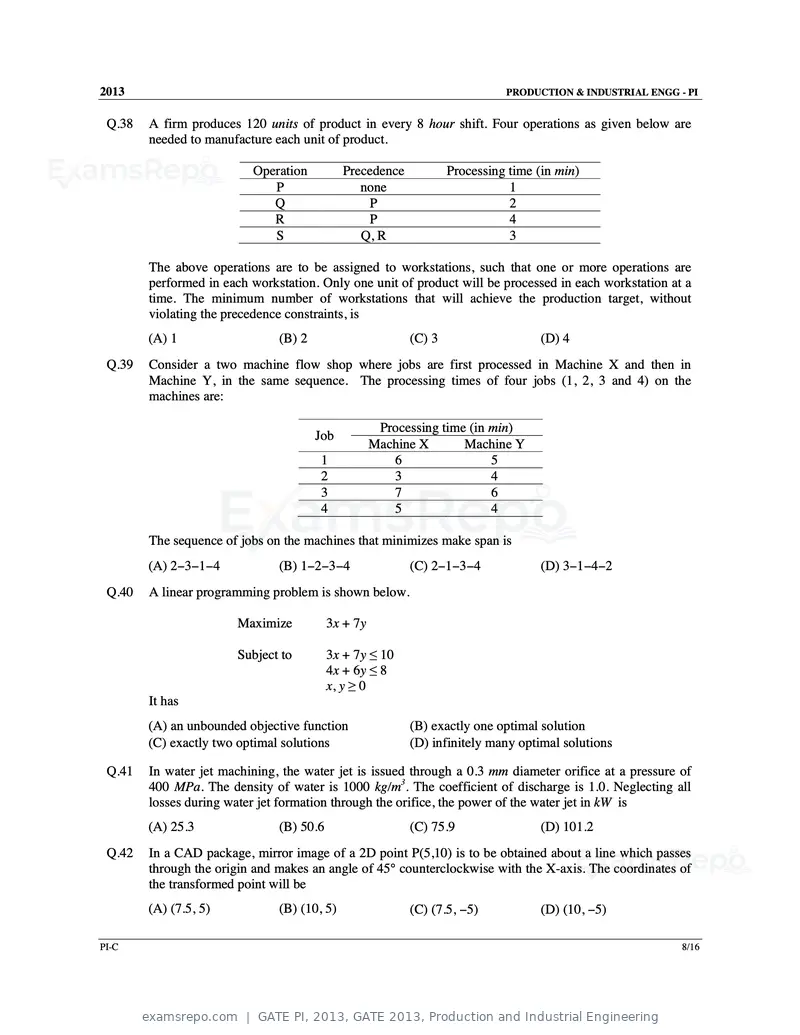
Text of page 37
2013                                                                        PRODUCTION & INDUSTRIAL ENGG - PI


 Q.38   A firm produces 120 units of product in every 8 hour shift. Four operations as given below are
        needed to manufacture each unit of product.

                          Operation          Precedence           Processing time (in min)
                             P                  none                         1
                             Q                   P                           2
                             R                   P                           4
                             S                  Q, R                         3

        The above operations are to be assigned to workstations, such that one or more operations are
        performed in each workstation. Only one unit of product will be processed in each workstation at a
        time. The minimum number of workstations that will achieve the production target, without
        violating the precedence constraints, is
        (A) 1                  (B) 2                      (C) 3                    (D) 4
 Q.39   Consider a two machine flow shop where jobs are first processed in Machine X and then in
        Machine Y, in the same sequence. The processing times of four jobs (1, 2, 3 and 4) on the
        machines are:

                                                     Processing time (in min)
                                       Job
                                                    Machine X       Machine Y
                                       1               6                 5
                                       2               3                 4
                                       3               7                 6
                                       4               5                 4

        The sequence of jobs on the machines that minimizes make span is
        (A) 2−3−1−4            (B) 1−2−3−4                (C) 2−1−3−4              (D) 3−1−4−2
 Q.40   A linear programming problem is shown below.

                        Maximize          3x + 7y

                        Subject to        3x + 7y ≤ 10
                                          4x + 6y ≤ 8
                                          x, y ≥ 0
        It has
        (A) an unbounded objective function               (B) exactly one optimal solution
        (C) exactly two optimal solutions                 (D) infinitely many optimal solutions

 Q.41   In water jet machining, the water jet is issued through a 0.3 mm diameter orifice at a pressure of
        400 MPa. The density of water is 1000 kg/m3. The coefficient of discharge is 1.0. Neglecting all
        losses during water jet formation through the orifice, the power of the water jet in kW is
        (A) 25.3               (B) 50.6                   (C) 75.9                 (D) 101.2
 Q.42   In a CAD package, mirror image of a 2D point P(5,10) is to be obtained about a line which passes
        through the origin and makes an angle of 45° counterclockwise with the X-axis. The coordinates of
        the transformed point will be
        (A) (7.5, 5)           (B) (10, 5)                (C) (7.5, −5)            (D) (10, −5)

PI-C                                                                                                      8/16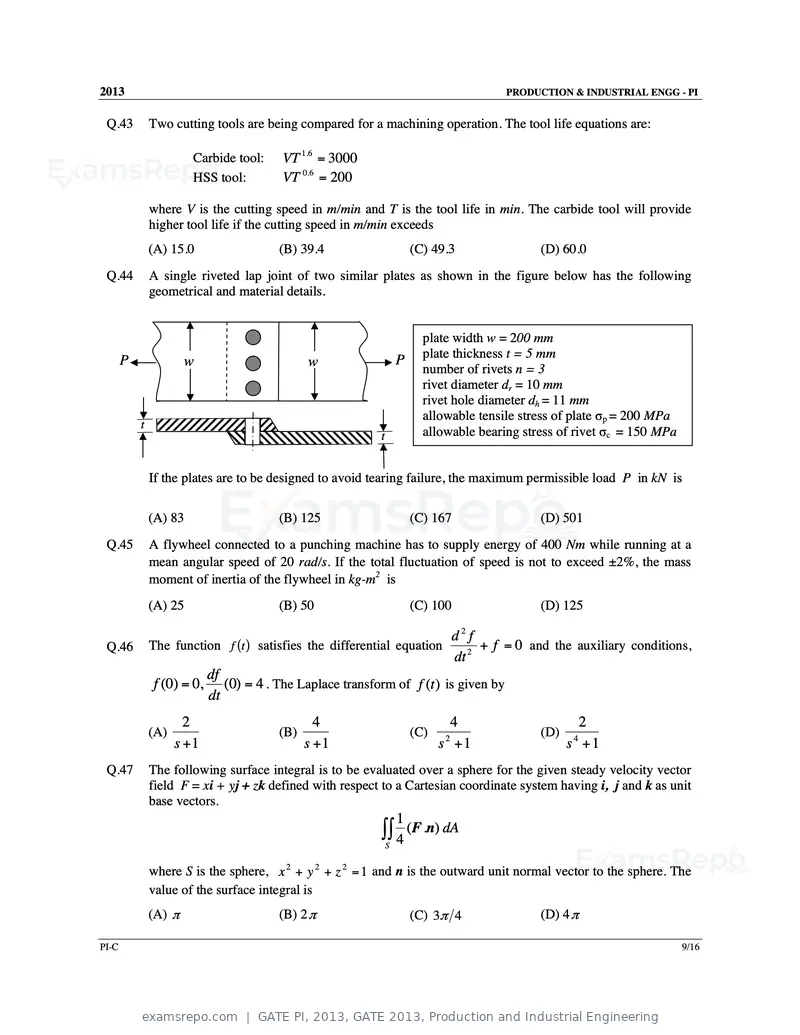
Text of page 38
2013                                                                                       PRODUCTION & INDUSTRIAL ENGG - PI


 Q.43          Two cutting tools are being compared for a machining operation. The tool life equations are:

                        Carbide tool:     VT 1.6 = 3000
                        HSS tool:         VT 0.6 = 200

               where V is the cutting speed in m/min and T is the tool life in min. The carbide tool will provide
               higher tool life if the cutting speed in m/min exceeds
               (A) 15.0                  (B) 39.4                       (C) 49.3                 (D) 60.0
 Q.44          A single riveted lap joint of two similar plates as shown in the figure below has the following
               geometrical and material details.


                                                                          plate width w = 200 mm
                                                                    P     plate thickness t = 5 mm
       P               w                       w                          number of rivets n = 3
                                                                          rivet diameter dr = 10 mm
                                                                          rivet hole diameter dh = 11 mm
                                                                          allowable tensile stress of plate σp = 200 MPa
           t
                                                            t             allowable bearing stress of rivet σc = 150 MPa


               If the plates are to be designed to avoid tearing failure, the maximum permissible load P in kN is

               (A) 83                    (B) 125                        (C) 167                  (D) 501
 Q.45          A flywheel connected to a punching machine has to supply energy of 400 Nm while running at a
               mean angular speed of 20 rad/s. If the total fluctuation of speed is not to exceed ±2%, the mass
               moment of inertia of the flywheel in kg-m2 is
               (A) 25                    (B) 50                         (C) 100                  (D) 125

                                                                                  d2 f
 Q.46          The function f (t ) satisfies the differential equation                 + f = 0 and the auxiliary conditions,
                                                                                  dt 2
                            df
               f (0) = 0,      (0) = 4 . The Laplace transform of f (t ) is given by
                            dt
                       2                         4                              4                        2
               (A)                       (B)                            (C)                      (D)
                     s +1                      s +1                           s +1
                                                                              2
                                                                                                       s +1
                                                                                                       4


 Q.47          The following surface integral is to be evaluated over a sphere for the given steady velocity vector
               field F = xi + yj + zk defined with respect to a Cartesian coordinate system having i, j and k as unit
               base vectors.
                                                                    1
                                                            ∫∫ 4 (F .n) dA
                                                                S


               where S is the sphere, x 2 + y 2 + z 2 = 1 and n is the outward unit normal vector to the sphere. The
               value of the surface integral is
               (A) π                     (B) 2 π                        (C) 3π 4                 (D) 4 π

PI-C                                                                                                                       9/16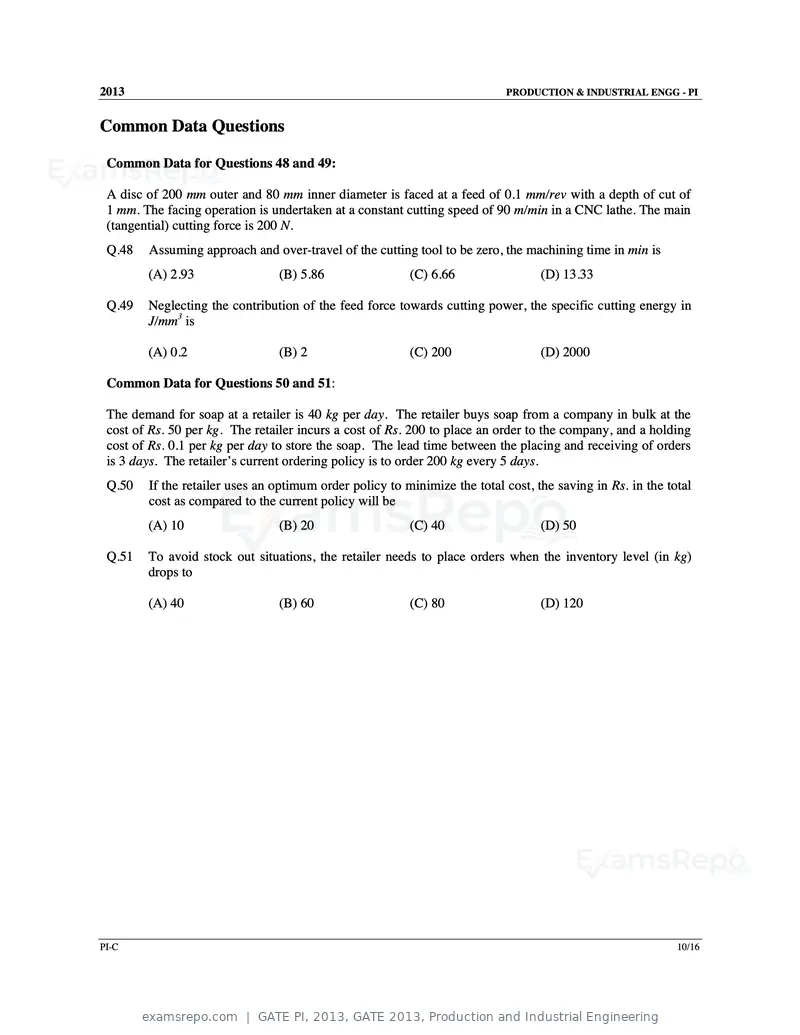
Text of page 39
2013                                                                       PRODUCTION & INDUSTRIAL ENGG - PI


Common Data Questions

 Common Data for Questions 48 and 49:

 A disc of 200 mm outer and 80 mm inner diameter is faced at a feed of 0.1 mm/rev with a depth of cut of
 1 mm. The facing operation is undertaken at a constant cutting speed of 90 m/min in a CNC lathe. The main
 (tangential) cutting force is 200 N.
 Q.48   Assuming approach and over-travel of the cutting tool to be zero, the machining time in min is
        (A) 2.93                (B) 5.86                 (C) 6.66                 (D) 13.33

 Q.49   Neglecting the contribution of the feed force towards cutting power, the specific cutting energy in
        J/mm3 is

        (A) 0.2                 (B) 2                    (C) 200                  (D) 2000

 Common Data for Questions 50 and 51:

 The demand for soap at a retailer is 40 kg per day. The retailer buys soap from a company in bulk at the
 cost of Rs. 50 per kg. The retailer incurs a cost of Rs. 200 to place an order to the company, and a holding
 cost of Rs. 0.1 per kg per day to store the soap. The lead time between the placing and receiving of orders
 is 3 days. The retailer’s current ordering policy is to order 200 kg every 5 days.
 Q.50   If the retailer uses an optimum order policy to minimize the total cost, the saving in Rs. in the total
        cost as compared to the current policy will be
        (A) 10                  (B) 20                   (C) 40                   (D) 50

 Q.51   To avoid stock out situations, the retailer needs to place orders when the inventory level (in kg)
        drops to

        (A) 40                  (B) 60                   (C) 80                   (D) 120


PI-C                                                                                                        10/16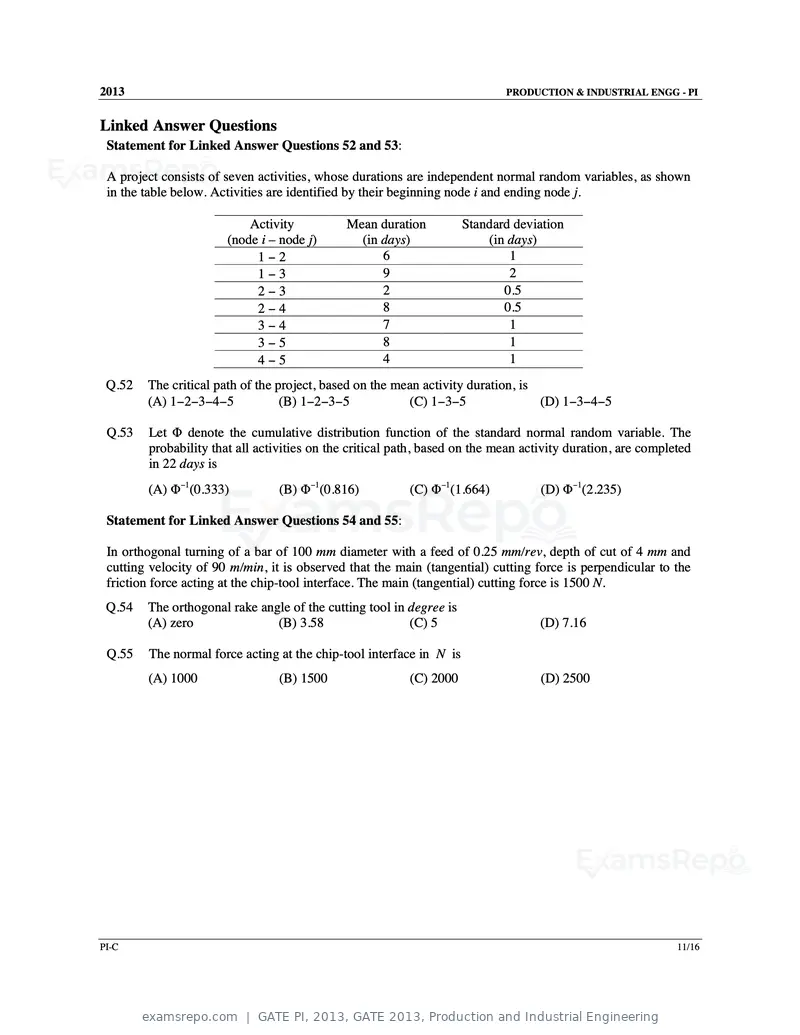
Text of page 40
2013                                                                        PRODUCTION & INDUSTRIAL ENGG - PI


Linked Answer Questions
 Statement for Linked Answer Questions 52 and 53:

 A project consists of seven activities, whose durations are independent normal random variables, as shown
 in the table below. Activities are identified by their beginning node i and ending node j.

                           Activity          Mean duration           Standard deviation
                       (node i – node j)       (in days)                 (in days)
                            1−2                    6                         1
                            1−3                    9                         2
                            2−3                    2                        0.5
                            2−4                    8                        0.5
                            3−4                    7                         1
                            3−5                    8                         1
                            4−5                    4                         1
 Q.52   The critical path of the project, based on the mean activity duration, is
        (A) 1−2−3−4−5             (B) 1−2−3−5            (C) 1−3−5                (D) 1−3−4−5

 Q.53   Let Φ denote the cumulative distribution function of the standard normal random variable. The
        probability that all activities on the critical path, based on the mean activity duration, are completed
        in 22 days is
        (A) Φ−1(0.333)           (B) Φ−1(0.816)           (C) Φ−1(1.664)           (D) Φ−1(2.235)

 Statement for Linked Answer Questions 54 and 55:

 In orthogonal turning of a bar of 100 mm diameter with a feed of 0.25 mm/rev, depth of cut of 4 mm and
 cutting velocity of 90 m/min, it is observed that the main (tangential) cutting force is perpendicular to the
 friction force acting at the chip-tool interface. The main (tangential) cutting force is 1500 N.
 Q.54   The orthogonal rake angle of the cutting tool in degree is
        (A) zero               (B) 3.58                  (C) 5                     (D) 7.16

 Q.55   The normal force acting at the chip-tool interface in N is
        (A) 1000                 (B) 1500                 (C) 2000                 (D) 2500


PI-C                                                                                                         11/16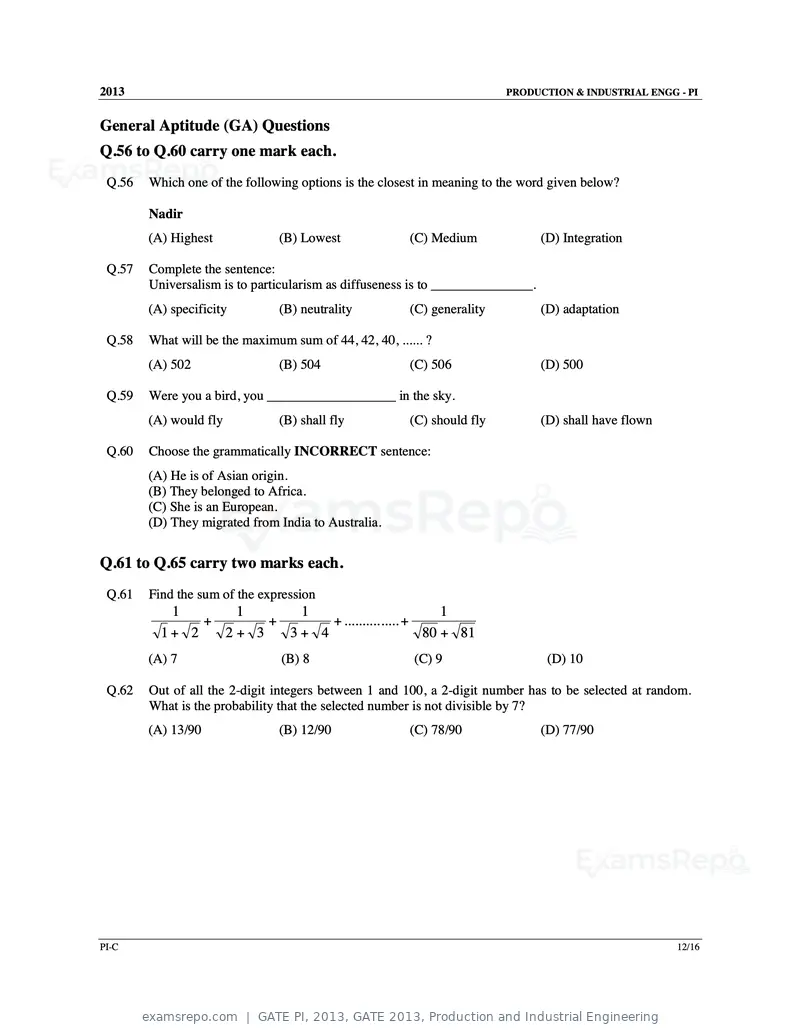
Text of page 41
2013                                                                    PRODUCTION & INDUSTRIAL ENGG - PI


General Aptitude (GA) Questions
Q.56 to Q.60 carry one mark each.
 Q.56   Which one of the following options is the closest in meaning to the word given below?

        Nadir
        (A) Highest            (B) Lowest              (C) Medium                (D) Integration

 Q.57   Complete the sentence:
        Universalism is to particularism as diffuseness is to _______________.
        (A) specificity        (B) neutrality          (C) generality            (D) adaptation

 Q.58   What will be the maximum sum of 44, 42, 40, ...... ?
        (A) 502                (B) 504                 (C) 506                   (D) 500

 Q.59   Were you a bird, you ___________________ in the sky.
        (A) would fly          (B) shall fly           (C) should fly            (D) shall have flown

 Q.60   Choose the grammatically INCORRECT sentence:
        (A) He is of Asian origin.
        (B) They belonged to Africa.
        (C) She is an European.
        (D) They migrated from India to Australia.


Q.61 to Q.65 carry two marks each.
 Q.61   Find the sum of the expression
           1      1      1                           1
               +      +      + .......... ..... +
          1+ 2   2+ 3   3+ 4                      80 + 81
        (A) 7                   (B) 8                   (C) 9                     (D) 10

 Q.62   Out of all the 2-digit integers between 1 and 100, a 2-digit number has to be selected at random.
        What is the probability that the selected number is not divisible by 7?
        (A) 13/90              (B) 12/90               (C) 78/90                 (D) 77/90


PI-C                                                                                                    12/16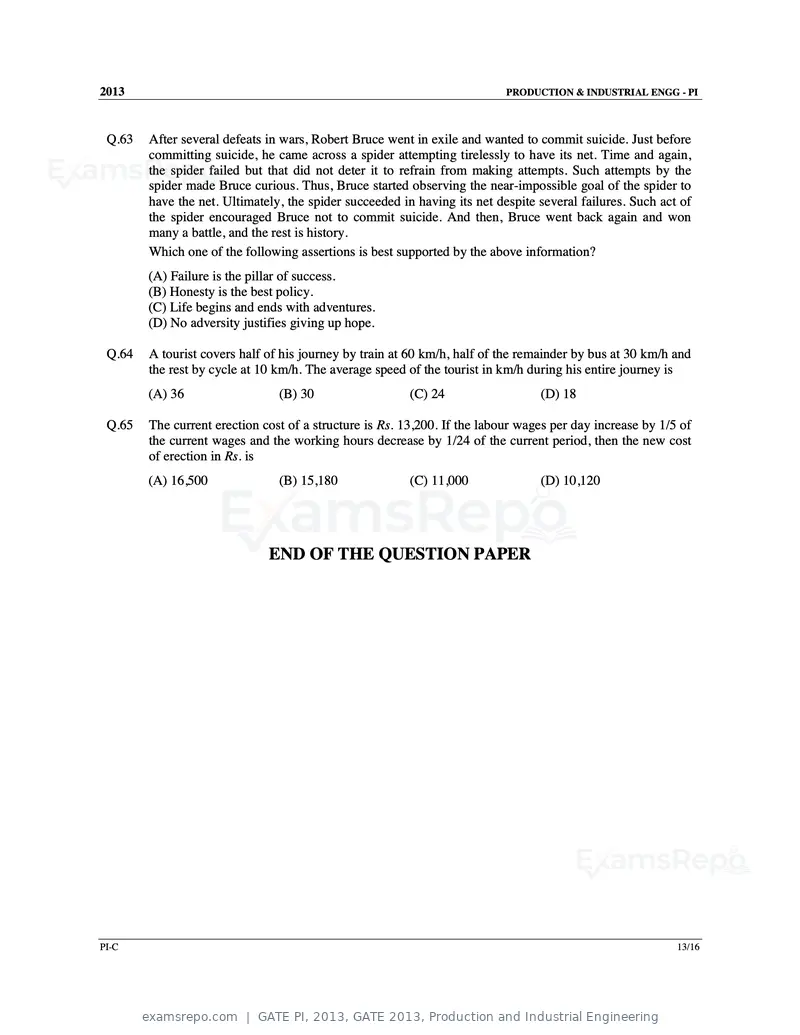
Text of page 42
2013                                                                       PRODUCTION & INDUSTRIAL ENGG - PI


 Q.63   After several defeats in wars, Robert Bruce went in exile and wanted to commit suicide. Just before
        committing suicide, he came across a spider attempting tirelessly to have its net. Time and again,
        the spider failed but that did not deter it to refrain from making attempts. Such attempts by the
        spider made Bruce curious. Thus, Bruce started observing the near-impossible goal of the spider to
        have the net. Ultimately, the spider succeeded in having its net despite several failures. Such act of
        the spider encouraged Bruce not to commit suicide. And then, Bruce went back again and won
        many a battle, and the rest is history.
        Which one of the following assertions is best supported by the above information?
        (A) Failure is the pillar of success.
        (B) Honesty is the best policy.
        (C) Life begins and ends with adventures.
        (D) No adversity justifies giving up hope.

 Q.64   A tourist covers half of his journey by train at 60 km/h, half of the remainder by bus at 30 km/h and
        the rest by cycle at 10 km/h. The average speed of the tourist in km/h during his entire journey is
        (A) 36                  (B) 30                   (C) 24                  (D) 18

 Q.65   The current erection cost of a structure is Rs. 13,200. If the labour wages per day increase by 1/5 of
        the current wages and the working hours decrease by 1/24 of the current period, then the new cost
        of erection in Rs. is
        (A) 16,500              (B) 15,180               (C) 11,000              (D) 10,120


                              END OF THE QUESTION PAPER


PI-C                                                                                                       13/16
Text of page 43
SESSION - 4
Text of page 44
2013                                                                         Question Booklet Code
                                                                                                          D
                  PI : PRODUCTION AND INDUSTRIAL ENGINEERING
Duration: Three Hours                                                                        Maximum Marks: 100
Read the following instructions carefully.

       1. Do not open the seal of the Question Booklet until you are asked to do so by the invigilator.
       2. Take out the Optical Response Sheet (ORS) from this Question Booklet without breaking the seal
           and read the instructions printed on the ORS carefully. If you find that either
           a. The Question Booklet Code printed at the right hand top corner of this page does not match with
                the Question Booklet Code at the right hand top corner of the ORS or
           b. The Question Paper Code preceding the Registration number on the ORS is not PI,
          then exchange the booklet immediately with a new sealed Question Booklet.
       3. On the right hand side of the ORS, using ONLY a black ink ballpoint pen, (i) darken the appropriate
          bubble under each digit of your registration number and (ii) write your registration number, your name
          and name of the examination centre and put your signature at the specified location.
       4. This Question Booklet contains 16 pages including blank pages for rough work. After you are
          permitted to open the seal, check all pages and report discrepancies, if any, to the invigilator.
       5. There are a total of 65 questions carrying 100 marks. All these questions are of objective type. Each
          question has only one correct answer. Questions must be answered on the left hand side of the ORS
          by darkening the appropriate bubble (marked A, B, C, D) using ONLY a black ink ballpoint pen
          against the question number. For each question darken the bubble of the correct answer. More
          than one answer bubbled against a question will be treated as an incorrect response.
       6. Since bubbles darkened by the black ink ballpoint pen cannot be erased, candidates should darken the
          bubbles in the ORS very carefully.
       7. Questions Q.1 – Q.25 carry 1 mark each. Questions Q.26 – Q.55 carry 2 marks each. The 2 marks
          questions include two pairs of common data questions and two pairs of linked answer questions. The
          answer to the second question of the linked answer questions depends on the answer to the first
          question of the pair. If the first question in the linked pair is wrongly answered or is not attempted,
          then the answer to the second question in the pair will not be evaluated.
       8. Questions Q.56 – Q.65 belong to General Aptitude (GA) section and carry a total of 15 marks.
          Questions Q.56 – Q.60 carry 1 mark each, and questions Q.61 – Q.65 carry 2 marks each.
       9. Questions not attempted will result in zero mark and wrong answers will result in NEGATIVE
          marks. For all 1 mark questions, ⅓ mark will be deducted for each wrong answer. For all 2 marks
          questions, ⅔ mark will be deducted for each wrong answer. However, in the case of the linked
          answer question pair, there will be negative marks only for wrong answer to the first question and no
          negative marks for wrong answer to the second question.
       10. Calculator is allowed whereas charts, graph sheets or tables are NOT allowed in the examination hall.
       11. Rough work can be done on the Question Booklet itself. Blank pages are provided at the end of the
           Question Booklet for rough work.
       12. Before the start of the examination, write your name and registration number in the space provided
           below using a black ink ballpoint pen.

              Name

              Registration Number       PI

PI-D                                                                                                         1/16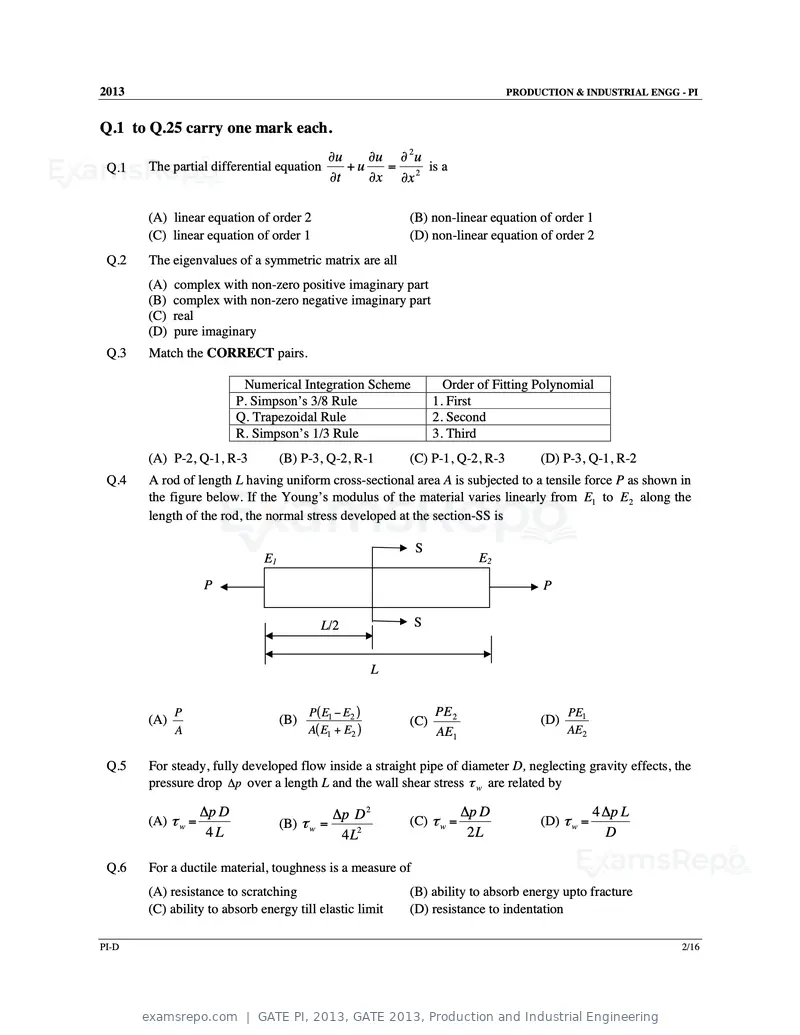
Text of page 45
2013                                                                            PRODUCTION & INDUSTRIAL ENGG - PI


Q.1 to Q.25 carry one mark each.
                                             ∂u    ∂u ∂ 2 u
 Q.1   The partial differential equation        +u   =      is a
                                             ∂t    ∂x ∂x 2

       (A) linear equation of order 2                       (B) non-linear equation of order 1
       (C) linear equation of order 1                       (D) non-linear equation of order 2
 Q.2   The eigenvalues of a symmetric matrix are all
       (A) complex with non-zero positive imaginary part
       (B) complex with non-zero negative imaginary part
       (C) real
       (D) pure imaginary
 Q.3   Match the CORRECT pairs.

                           Numerical Integration Scheme             Order of Fitting Polynomial
                          P. Simpson’s 3/8 Rule                   1. First
                          Q. Trapezoidal Rule                     2. Second
                          R. Simpson’s 1/3 Rule                   3. Third
       (A) P-2, Q-1, R-3           (B) P-3, Q-2, R-1        (C) P-1, Q-2, R-3        (D) P-3, Q-1, R-2
 Q.4   A rod of length L having uniform cross-sectional area A is subjected to a tensile force P as shown in
       the figure below. If the Young’s modulus of the material varies linearly from E1 to E2 along the
       length of the rod, the normal stress developed at the section-SS is

                                                             S
                              E1                                           E2
                   P                                                                  P

                                           L/2              S


                                                        L


             P                           P( E1 − E2 )             PE 2                     PE1
       (A)                         (B)                      (C)                      (D)
             A                           A( E1 + E2 )             AE1                      AE2

 Q.5   For steady, fully developed flow inside a straight pipe of diameter D, neglecting gravity effects, the
       pressure drop ∆p over a length L and the wall shear stress τ w are related by

                   ∆p D                        ∆p D 2                    ∆p D                    4 ∆p L
       (A) τ w =                   (B) τ w =                (C) τ w =                (D) τ w =
                    4L                          4L2                       2L                       D

 Q.6   For a ductile material, toughness is a measure of
       (A) resistance to scratching                         (B) ability to absorb energy upto fracture
       (C) ability to absorb energy till elastic limit      (D) resistance to indentation

PI-D                                                                                                          2/16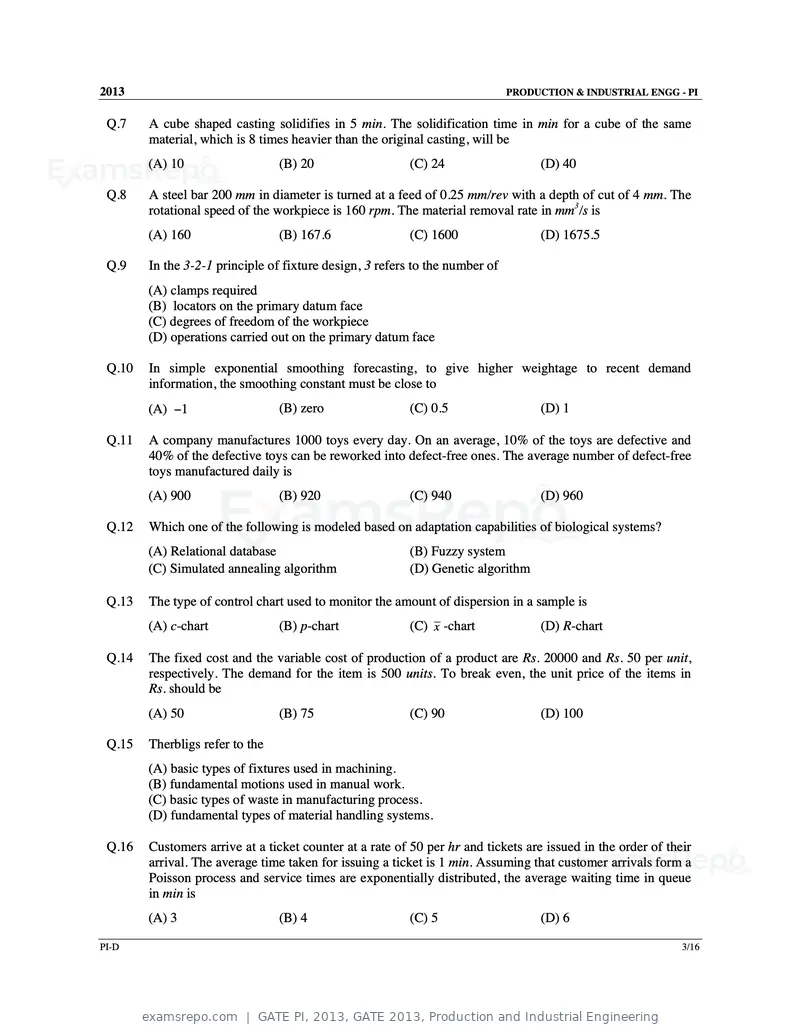
Text of page 46
2013                                                                          PRODUCTION & INDUSTRIAL ENGG - PI


 Q.7    A cube shaped casting solidifies in 5 min. The solidification time in min for a cube of the same
        material, which is 8 times heavier than the original casting, will be
        (A) 10                   (B) 20                   (C) 24                   (D) 40

 Q.8    A steel bar 200 mm in diameter is turned at a feed of 0.25 mm/rev with a depth of cut of 4 mm. The
        rotational speed of the workpiece is 160 rpm. The material removal rate in mm3/s is
        (A) 160                  (B) 167.6                (C) 1600                 (D) 1675.5

 Q.9    In the 3-2-1 principle of fixture design, 3 refers to the number of
        (A) clamps required
        (B) locators on the primary datum face
        (C) degrees of freedom of the workpiece
        (D) operations carried out on the primary datum face

 Q.10   In simple exponential smoothing forecasting, to give higher weightage to recent demand
        information, the smoothing constant must be close to
        (A) −1                   (B) zero                 (C) 0.5                  (D) 1

 Q.11   A company manufactures 1000 toys every day. On an average, 10% of the toys are defective and
        40% of the defective toys can be reworked into defect-free ones. The average number of defect-free
        toys manufactured daily is
        (A) 900                  (B) 920                  (C) 940                  (D) 960

 Q.12   Which one of the following is modeled based on adaptation capabilities of biological systems?
        (A) Relational database                           (B) Fuzzy system
        (C) Simulated annealing algorithm                 (D) Genetic algorithm

 Q.13   The type of control chart used to monitor the amount of dispersion in a sample is
        (A) c-chart              (B) p-chart              (C) x -chart             (D) R-chart

 Q.14   The fixed cost and the variable cost of production of a product are Rs. 20000 and Rs. 50 per unit,
        respectively. The demand for the item is 500 units. To break even, the unit price of the items in
        Rs. should be
        (A) 50                   (B) 75                   (C) 90                   (D) 100

 Q.15   Therbligs refer to the
        (A) basic types of fixtures used in machining.
        (B) fundamental motions used in manual work.
        (C) basic types of waste in manufacturing process.
        (D) fundamental types of material handling systems.

 Q.16   Customers arrive at a ticket counter at a rate of 50 per hr and tickets are issued in the order of their
        arrival. The average time taken for issuing a ticket is 1 min. Assuming that customer arrivals form a
        Poisson process and service times are exponentially distributed, the average waiting time in queue
        in min is
        (A) 3                    (B) 4                    (C) 5                    (D) 6

PI-D                                                                                                          3/16
Text of page 47
2013                                                                        PRODUCTION & INDUSTRIAL ENGG - PI


 Q.17   Circular blanks of 10 mm diameter are punched from an aluminum sheet of 2 mm thickness. The
        shear strength of aluminum is 80 MPa. The minimum punching force required in kN is
        (A) 2.57                 (B) 3.29                (C) 5.03                  (D) 6.33
 Q.18   A metric thread of pitch 2 mm and thread angle 60° is inspected for its pitch diameter using 3-wire
        method. The diameter of the best size wire in mm is
        (A) 0.866                (B) 1.000               (C) 1.154                 (D) 2.000
 Q.19   Match the CORRECT pairs.

                               Processes                       Characteristics / Applications
                   P. Friction Welding                 1. Non-consumable electrode
                   Q. Gas Metal Arc Welding            2. Joining of thick plates
                   R. Tungsten Inert Gas Welding       3. Consumable electrode wire
                   S. Electroslag Welding              4. Joining of cylindrical dissimilar materials

        (A) P-4, Q-3, R-1, S-2                           (B) P-4, Q-2, R-3, S-1
        (C) P-2, Q-3, R-4, S-1                           (D) P-2, Q-4, R-1, S-3
 Q.20   In a rolling process, the state of stress of the material undergoing deformation is
        (A) pure compression                             (B) pure shear
        (C) compression and shear                        (D) tension and shear

 Q.21   Consider one-dimensional steady state heat conduction along x-axis (0 ≤ x ≤ L), through a plane
        wall; with the boundary surfaces (x=0 and x=L) maintained at temperatures of 0°C and 100°C.
        Heat is generated uniformly throughout the wall. Choose the CORRECT statement.
        (A) The direction of heat transfer will be from the surface at 100°C to the surface at 0°C.
        (B) The maximum temperature inside the wall must be greater than 100°C.
        (C) The temperature distribution is linear within the wall.
        (D) The temperature distribution is symmetric about the mid-plane of the wall.
 Q.22   A cylinder contains 5 m3 of an ideal gas at a pressure of 1 bar. This gas is compressed in a
        reversible isothermal process till its pressure increases to 5 bar. The work in kJ required for this
        process is
        (A) 804.7                (B) 953.2               (C) 981.7                 (D) 1012.2
 Q.23   A planar closed kinematic chain is formed with rigid links PQ = 2.0 m, QR = 3.0 m, RS = 2.5 m
        and SP = 2.7 m with all revolute joints. The link to be fixed to obtain a double rocker (rocker-
        rocker) mechanism is
        (A) PQ                   (B) QR                  (C) RS                    (D) SP
 Q.24   Let X be a normal random variable with mean 1 and variance 4. The probability P{X<0} is
        (A) 0.5                                          (B) greater than zero and less than 0.5
        (C) greater than 0.5 and less than 1.0           (D) 1.0
 Q.25   Choose the CORRECT set of functions, which are linearly dependent.
        (A) sin x , sin2 x and cos2 x                    (B) cos x , sin x and tan x
        (C) cos 2x , sin2 x and cos2 x                   (D) cos 2 x , sin x and cos x

PI-D                                                                                                      4/16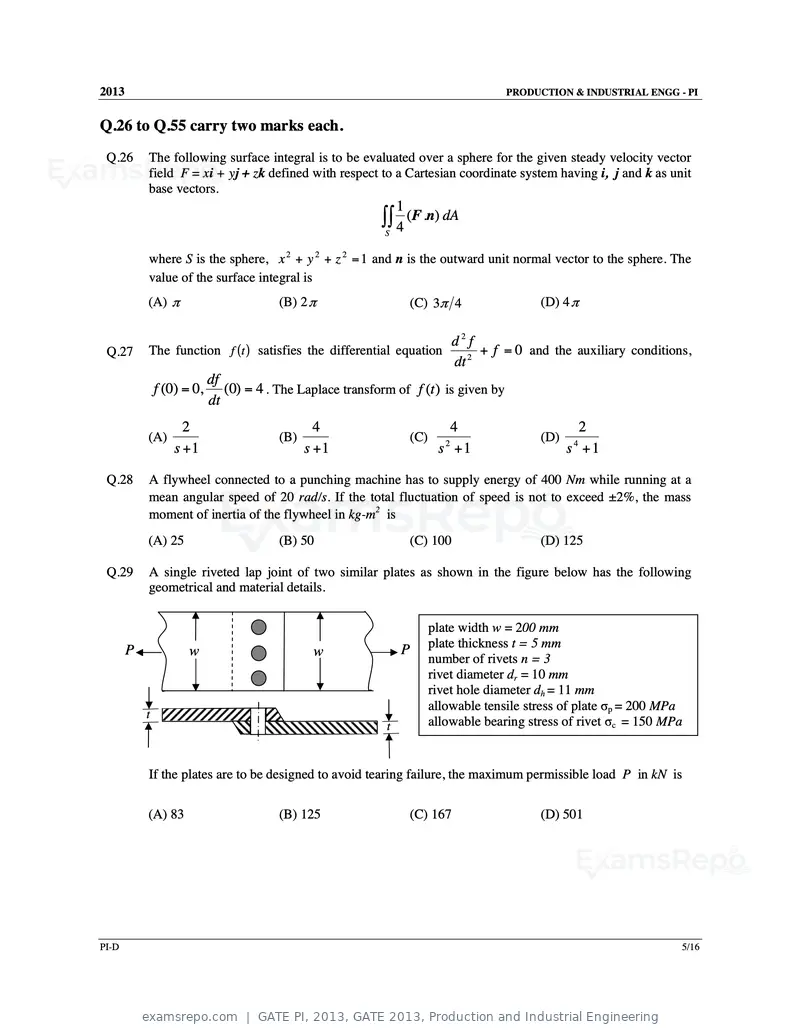
Text of page 48
2013                                                                                       PRODUCTION & INDUSTRIAL ENGG - PI


Q.26 to Q.55 carry two marks each.
 Q.26      The following surface integral is to be evaluated over a sphere for the given steady velocity vector
           field F = xi + yj + zk defined with respect to a Cartesian coordinate system having i, j and k as unit
           base vectors.
                                                                 1
                                                            ∫∫ 4 (F .n) dA
                                                             S


           where S is the sphere, x 2 + y 2 + z 2 = 1 and n is the outward unit normal vector to the sphere. The
           value of the surface integral is
           (A) π                         (B) 2 π                     (C) 3π 4                    (D) 4 π

                                                                                  d2 f
 Q.27      The function f (t ) satisfies the differential equation                     + f = 0 and the auxiliary conditions,
                                                                                  dt 2
                            df
               f (0) = 0,      (0) = 4 . The Laplace transform of f (t ) is given by
                            dt
                     2                           4                            4                          2
           (A)                           (B)                         (C)                         (D)
                   s +1                        s +1                         s +1
                                                                              2
                                                                                                       s +1
                                                                                                       4


 Q.28      A flywheel connected to a punching machine has to supply energy of 400 Nm while running at a
           mean angular speed of 20 rad/s. If the total fluctuation of speed is not to exceed ±2%, the mass
           moment of inertia of the flywheel in kg-m2 is
           (A) 25                        (B) 50                      (C) 100                     (D) 125

 Q.29      A single riveted lap joint of two similar plates as shown in the figure below has the following
           geometrical and material details.

                                                                           plate width w = 200 mm
                                                                 P         plate thickness t = 5 mm
       P              w                         w                          number of rivets n = 3
                                                                           rivet diameter dr = 10 mm
                                                                           rivet hole diameter dh = 11 mm
                                                                           allowable tensile stress of plate σp = 200 MPa
           t
                                                             t             allowable bearing stress of rivet σc = 150 MPa


           If the plates are to be designed to avoid tearing failure, the maximum permissible load P in kN is

           (A) 83                        (B) 125                     (C) 167                     (D) 501


PI-D                                                                                                                      5/16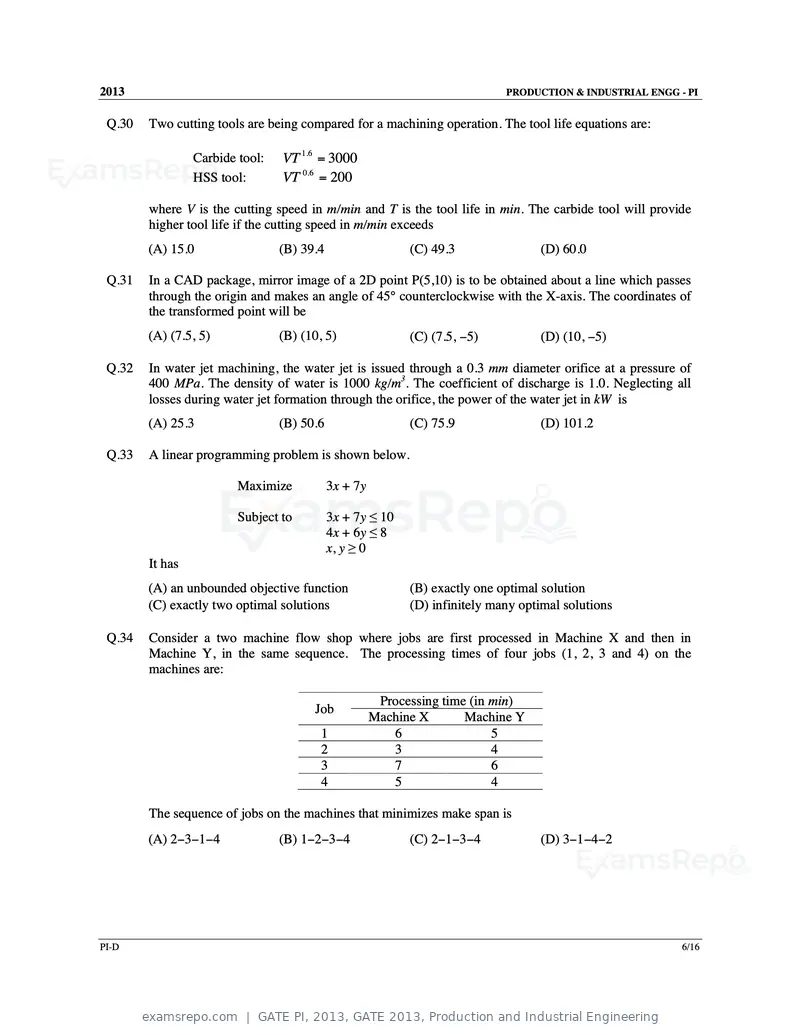
Text of page 49
2013                                                                         PRODUCTION & INDUSTRIAL ENGG - PI


 Q.30   Two cutting tools are being compared for a machining operation. The tool life equations are:

                 Carbide tool:   VT 1.6 = 3000
                 HSS tool:       VT 0.6 = 200

        where V is the cutting speed in m/min and T is the tool life in min. The carbide tool will provide
        higher tool life if the cutting speed in m/min exceeds
        (A) 15.0                 (B) 39.4                   (C) 49.3               (D) 60.0

 Q.31   In a CAD package, mirror image of a 2D point P(5,10) is to be obtained about a line which passes
        through the origin and makes an angle of 45° counterclockwise with the X-axis. The coordinates of
        the transformed point will be
        (A) (7.5, 5)             (B) (10, 5)                (C) (7.5, −5)          (D) (10, −5)

 Q.32   In water jet machining, the water jet is issued through a 0.3 mm diameter orifice at a pressure of
        400 MPa. The density of water is 1000 kg/m3. The coefficient of discharge is 1.0. Neglecting all
        losses during water jet formation through the orifice, the power of the water jet in kW is
        (A) 25.3                 (B) 50.6                   (C) 75.9               (D) 101.2

 Q.33   A linear programming problem is shown below.

                         Maximize           3x + 7y

                         Subject to         3x + 7y ≤ 10
                                            4x + 6y ≤ 8
                                            x, y ≥ 0
        It has
        (A) an unbounded objective function                 (B) exactly one optimal solution
        (C) exactly two optimal solutions                   (D) infinitely many optimal solutions

 Q.34   Consider a two machine flow shop where jobs are first processed in Machine X and then in
        Machine Y, in the same sequence. The processing times of four jobs (1, 2, 3 and 4) on the
        machines are:

                                                       Processing time (in min)
                                       Job
                                                      Machine X       Machine Y
                                         1               6                 5
                                         2               3                 4
                                         3               7                 6
                                         4               5                 4

        The sequence of jobs on the machines that minimizes make span is
        (A) 2−3−1−4              (B) 1−2−3−4                (C) 2−1−3−4            (D) 3−1−4−2


PI-D                                                                                                       6/16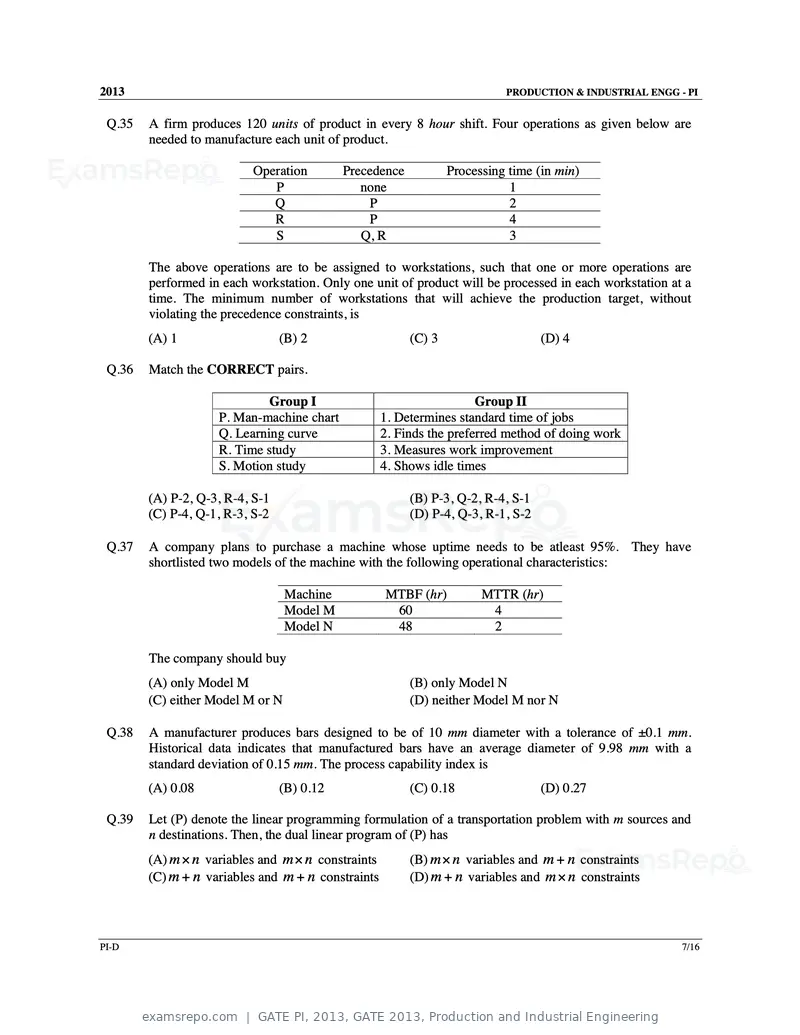
Text of page 50
2013                                                                       PRODUCTION & INDUSTRIAL ENGG - PI


 Q.35   A firm produces 120 units of product in every 8 hour shift. Four operations as given below are
        needed to manufacture each unit of product.

                          Operation         Precedence           Processing time (in min)
                             P                 none                         1
                             Q                  P                           2
                             R                  P                           4
                             S                 Q, R                         3

        The above operations are to be assigned to workstations, such that one or more operations are
        performed in each workstation. Only one unit of product will be processed in each workstation at a
        time. The minimum number of workstations that will achieve the production target, without
        violating the precedence constraints, is
        (A) 1                    (B) 2                   (C) 3                    (D) 4

 Q.36   Match the CORRECT pairs.

                             Group I                                  Group II
                    P. Man-machine chart            1. Determines standard time of jobs
                    Q. Learning curve               2. Finds the preferred method of doing work
                    R. Time study                   3. Measures work improvement
                    S. Motion study                 4. Shows idle times

        (A) P-2, Q-3, R-4, S-1                           (B) P-3, Q-2, R-4, S-1
        (C) P-4, Q-1, R-3, S-2                           (D) P-4, Q-3, R-1, S-2

 Q.37   A company plans to purchase a machine whose uptime needs to be atleast 95%. They have
        shortlisted two models of the machine with the following operational characteristics:

                                  Machine           MTBF (hr)          MTTR (hr)
                                  Model M            60                 4
                                  Model N            48                 2

        The company should buy
        (A) only Model M                                 (B) only Model N
        (C) either Model M or N                          (D) neither Model M nor N

 Q.38   A manufacturer produces bars designed to be of 10 mm diameter with a tolerance of ±0.1 mm.
        Historical data indicates that manufactured bars have an average diameter of 9.98 mm with a
        standard deviation of 0.15 mm. The process capability index is
        (A) 0.08                 (B) 0.12                (C) 0.18                 (D) 0.27

 Q.39   Let (P) denote the linear programming formulation of a transportation problem with m sources and
        n destinations. Then, the dual linear program of (P) has
        (A) m × n variables and m × n constraints        (B) m × n variables and m + n constraints
        (C) m + n variables and m + n constraints        (D) m + n variables and m × n constraints


PI-D                                                                                                     7/16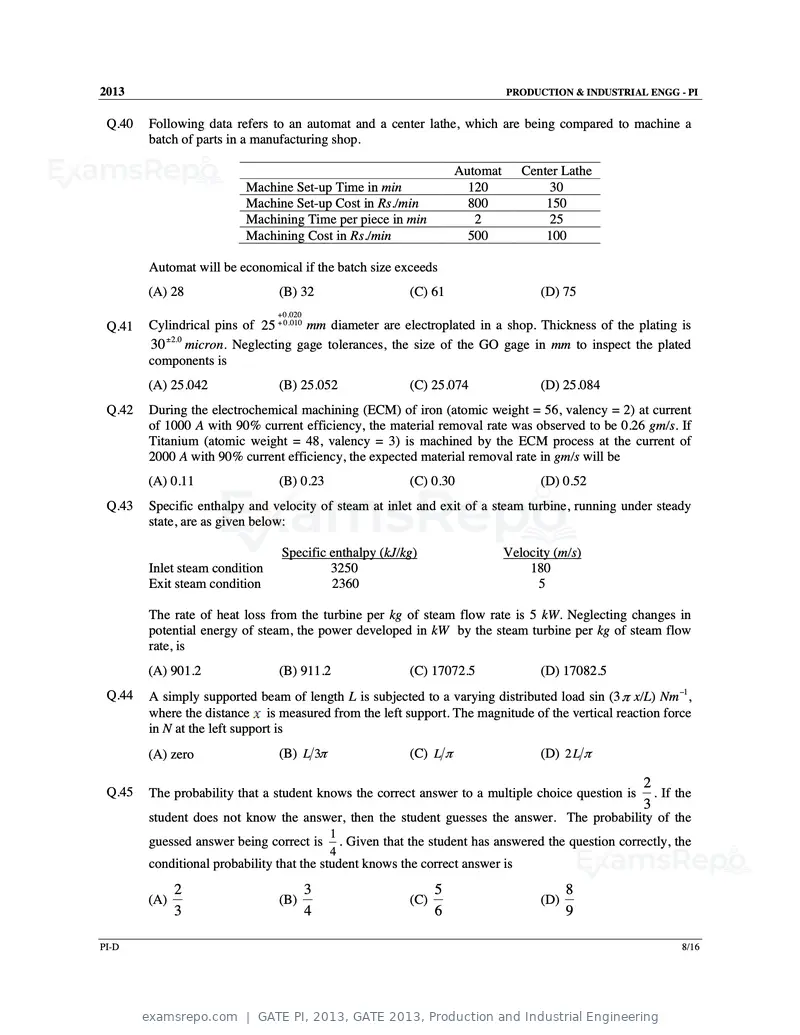
Text of page 51
2013                                                                             PRODUCTION & INDUSTRIAL ENGG - PI


 Q.40   Following data refers to an automat and a center lathe, which are being compared to machine a
        batch of parts in a manufacturing shop.

                                                                       Automat      Center Lathe
                          Machine Set-up Time in min                     120            30
                          Machine Set-up Cost in Rs./min                 800            150
                          Machining Time per piece in min                 2             25
                          Machining Cost in Rs./min                      500            100

        Automat will be economical if the batch size exceeds
        (A) 28                  (B) 32                       (C) 61                    (D) 75
                                + 0 .020
 Q.41   Cylindrical pins of 25 + 0.010 mm diameter are electroplated in a shop. Thickness of the plating is
        30 ±2.0 micron. Neglecting gage tolerances, the size of the GO gage in mm to inspect the plated
        components is
        (A) 25.042              (B) 25.052                   (C) 25.074                (D) 25.084
 Q.42   During the electrochemical machining (ECM) of iron (atomic weight = 56, valency = 2) at current
        of 1000 A with 90% current efficiency, the material removal rate was observed to be 0.26 gm/s. If
        Titanium (atomic weight = 48, valency = 3) is machined by the ECM process at the current of
        2000 A with 90% current efficiency, the expected material removal rate in gm/s will be
        (A) 0.11                (B) 0.23                     (C) 0.30                  (D) 0.52
 Q.43   Specific enthalpy and velocity of steam at inlet and exit of a steam turbine, running under steady
        state, are as given below:

                                 Specific enthalpy (kJ/kg)                       Velocity (m/s)
        Inlet steam condition             3250                                       180
        Exit steam condition              2360                                         5

        The rate of heat loss from the turbine per kg of steam flow rate is 5 kW. Neglecting changes in
        potential energy of steam, the power developed in kW by the steam turbine per kg of steam flow
        rate, is
        (A) 901.2               (B) 911.2                    (C) 17072.5               (D) 17082.5
 Q.44   A simply supported beam of length L is subjected to a varying distributed load sin (3 π x/L) Nm−1,
        where the distance is measured from the left support. The magnitude of the vertical reaction force
        in N at the left support is
        (A) zero                (B) L 3π                     (C) L π                   (D) 2 L π

                                                                                                         2
 Q.45   The probability that a student knows the correct answer to a multiple choice question is           . If the
                                                                                                         3
        student does not know the answer, then the student guesses the answer. The probability of the
                                               1
        guessed answer being correct is          . Given that the student has answered the question correctly, the
                                               4
        conditional probability that the student knows the correct answer is
              2                            3                       5                         8
        (A)                     (B)                          (C)                       (D)
              3                            4                       6                         9

PI-D                                                                                                             8/16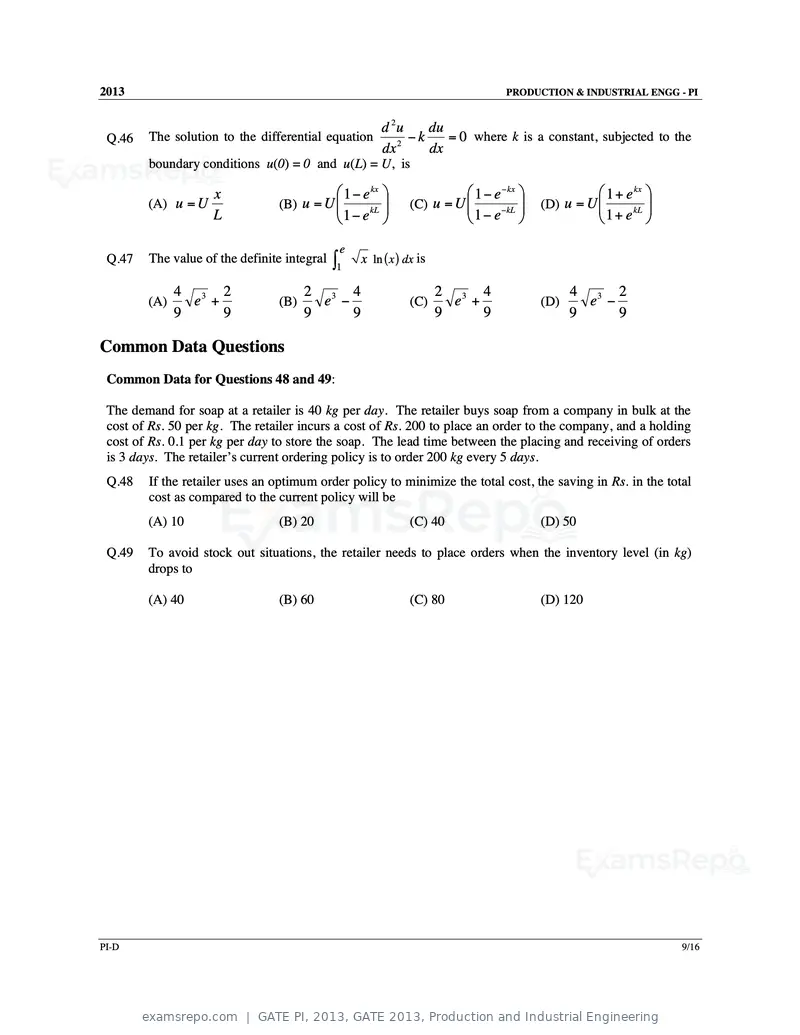
Text of page 52
2013 PRODUCTION & INDUSTRIAL ENGG - PI
d 2u du
Q.46 The solution to the differential equation 2
−k = 0 where k is a constant, subjected to the
dx dx
boundary conditions u(0) = 0 and u(L) = U, is
x 1 − e kx 1 − e − kx 1 + e kx
(A) u = U (B) u = U kL
(C) u = U −kL
(D) u = U kL
L 1− e 1− e 1+ e
e
Q.47 The value of the definite integral ∫ x ln ( x ) dx is
1
4 3 2 2 3 4 2 3 4 4 3 2
(A) e + (B) e − (C) e + (D) e −
9 9 9 9 9 9 9 9
Common Data Questions
Common Data for Questions 48 and 49:
The demand for soap at a retailer is 40 kg per day. The retailer buys soap from a company in bulk at the
cost of Rs. 50 per kg. The retailer incurs a cost of Rs. 200 to place an order to the company, and a holding
cost of Rs. 0.1 per kg per day to store the soap. The lead time between the placing and receiving of orders
is 3 days. The retailer’s current ordering policy is to order 200 kg every 5 days.
Q.48 If the retailer uses an optimum order policy to minimize the total cost, the saving in Rs. in the total
cost as compared to the current policy will be
(A) 10 (B) 20 (C) 40 (D) 50
Q.49 To avoid stock out situations, the retailer needs to place orders when the inventory level (in kg)
drops to
(A) 40 (B) 60 (C) 80 (D) 120
PI-D 9/16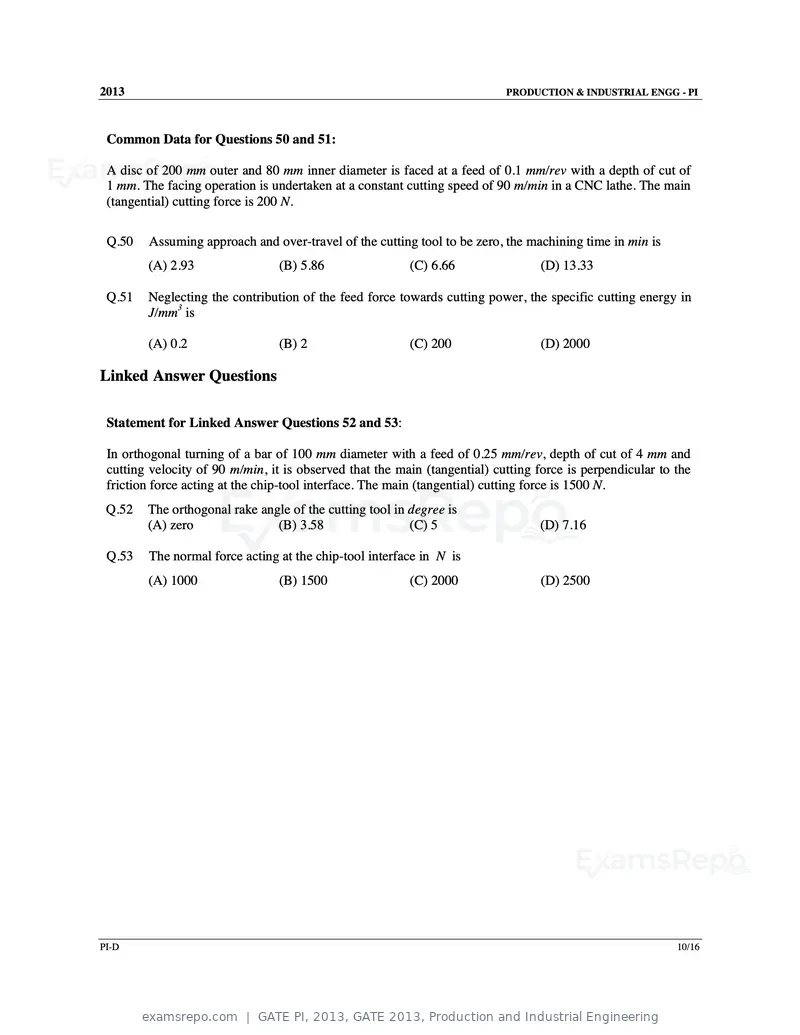
Text of page 53
2013                                                                       PRODUCTION & INDUSTRIAL ENGG - PI


 Common Data for Questions 50 and 51:

 A disc of 200 mm outer and 80 mm inner diameter is faced at a feed of 0.1 mm/rev with a depth of cut of
 1 mm. The facing operation is undertaken at a constant cutting speed of 90 m/min in a CNC lathe. The main
 (tangential) cutting force is 200 N.

 Q.50   Assuming approach and over-travel of the cutting tool to be zero, the machining time in min is
        (A) 2.93                 (B) 5.86                (C) 6.66                 (D) 13.33

 Q.51   Neglecting the contribution of the feed force towards cutting power, the specific cutting energy in
        J/mm3 is

        (A) 0.2                  (B) 2                   (C) 200                  (D) 2000

Linked Answer Questions

 Statement for Linked Answer Questions 52 and 53:

 In orthogonal turning of a bar of 100 mm diameter with a feed of 0.25 mm/rev, depth of cut of 4 mm and
 cutting velocity of 90 m/min, it is observed that the main (tangential) cutting force is perpendicular to the
 friction force acting at the chip-tool interface. The main (tangential) cutting force is 1500 N.
 Q.52   The orthogonal rake angle of the cutting tool in degree is
        (A) zero               (B) 3.58                  (C) 5                   (D) 7.16

 Q.53   The normal force acting at the chip-tool interface in N is
        (A) 1000                 (B) 1500                (C) 2000                 (D) 2500


PI-D                                                                                                       10/16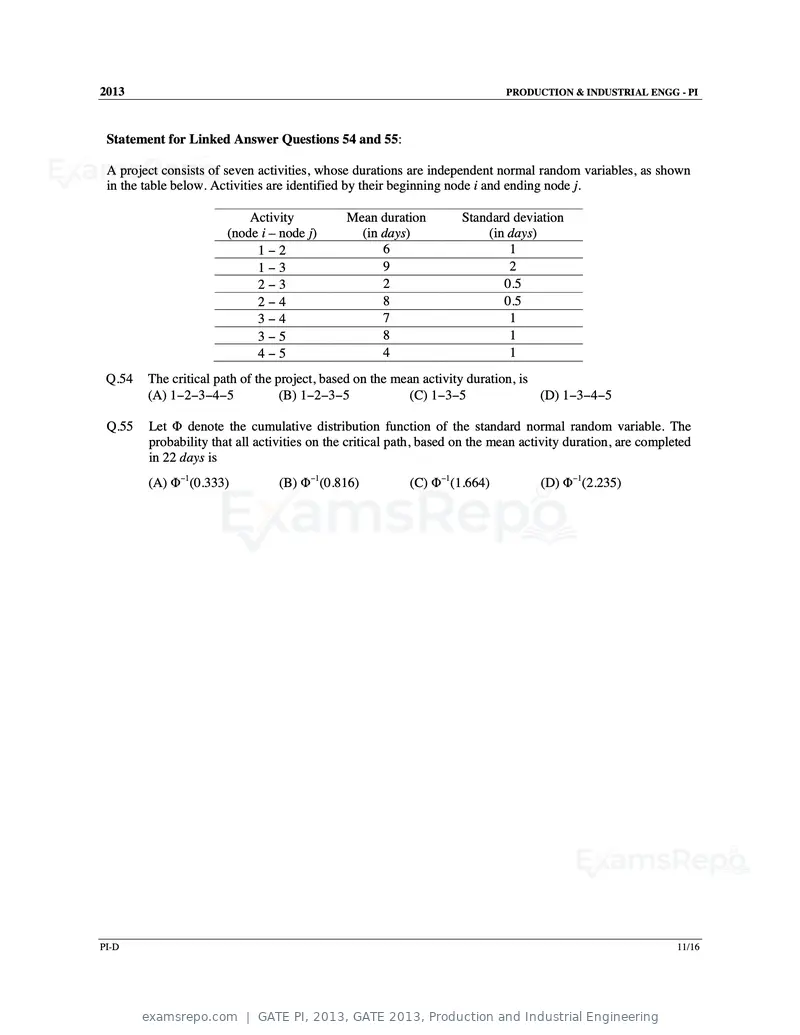
Text of page 54
2013                                                                        PRODUCTION & INDUSTRIAL ENGG - PI


 Statement for Linked Answer Questions 54 and 55:

 A project consists of seven activities, whose durations are independent normal random variables, as shown
 in the table below. Activities are identified by their beginning node i and ending node j.

                           Activity          Mean duration          Standard deviation
                       (node i – node j)       (in days)                (in days)
                            1−2                    6                        1
                            1−3                    9                        2
                            2−3                    2                       0.5
                            2−4                    8                       0.5
                            3−4                    7                        1
                            3−5                    8                        1
                            4−5                    4                        1
 Q.54   The critical path of the project, based on the mean activity duration, is
        (A) 1−2−3−4−5             (B) 1−2−3−5            (C) 1−3−5                (D) 1−3−4−5

 Q.55   Let Φ denote the cumulative distribution function of the standard normal random variable. The
        probability that all activities on the critical path, based on the mean activity duration, are completed
        in 22 days is
        (A) Φ−1(0.333)          (B) Φ−1(0.816)            (C) Φ−1(1.664)           (D) Φ−1(2.235)


PI-D                                                                                                         11/16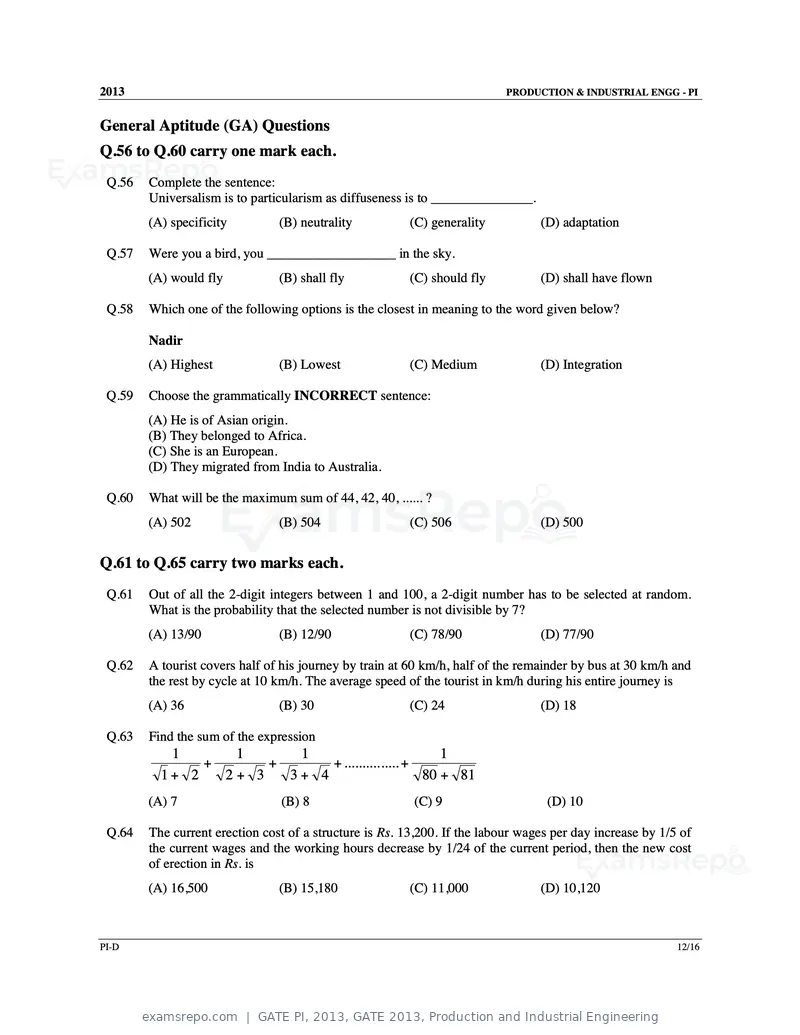
Text of page 55
2013                                                                       PRODUCTION & INDUSTRIAL ENGG - PI


General Aptitude (GA) Questions
Q.56 to Q.60 carry one mark each.
 Q.56   Complete the sentence:
        Universalism is to particularism as diffuseness is to _______________.
        (A) specificity         (B) neutrality           (C) generality          (D) adaptation

 Q.57   Were you a bird, you ___________________ in the sky.
        (A) would fly           (B) shall fly            (C) should fly          (D) shall have flown

 Q.58   Which one of the following options is the closest in meaning to the word given below?

        Nadir
        (A) Highest             (B) Lowest               (C) Medium              (D) Integration

 Q.59   Choose the grammatically INCORRECT sentence:
        (A) He is of Asian origin.
        (B) They belonged to Africa.
        (C) She is an European.
        (D) They migrated from India to Australia.

 Q.60   What will be the maximum sum of 44, 42, 40, ...... ?
        (A) 502                 (B) 504                  (C) 506                 (D) 500


Q.61 to Q.65 carry two marks each.
 Q.61   Out of all the 2-digit integers between 1 and 100, a 2-digit number has to be selected at random.
        What is the probability that the selected number is not divisible by 7?
        (A) 13/90               (B) 12/90                (C) 78/90               (D) 77/90

 Q.62   A tourist covers half of his journey by train at 60 km/h, half of the remainder by bus at 30 km/h and
        the rest by cycle at 10 km/h. The average speed of the tourist in km/h during his entire journey is
        (A) 36                  (B) 30                   (C) 24                  (D) 18

 Q.63   Find the sum of the expression
           1      1      1                           1
               +      +      + .......... ..... +
          1+ 2   2+ 3   3+ 4                      80 + 81
        (A) 7                   (B) 8                    (C) 9                    (D) 10

 Q.64   The current erection cost of a structure is Rs. 13,200. If the labour wages per day increase by 1/5 of
        the current wages and the working hours decrease by 1/24 of the current period, then the new cost
        of erection in Rs. is
        (A) 16,500              (B) 15,180               (C) 11,000              (D) 10,120


PI-D                                                                                                       12/16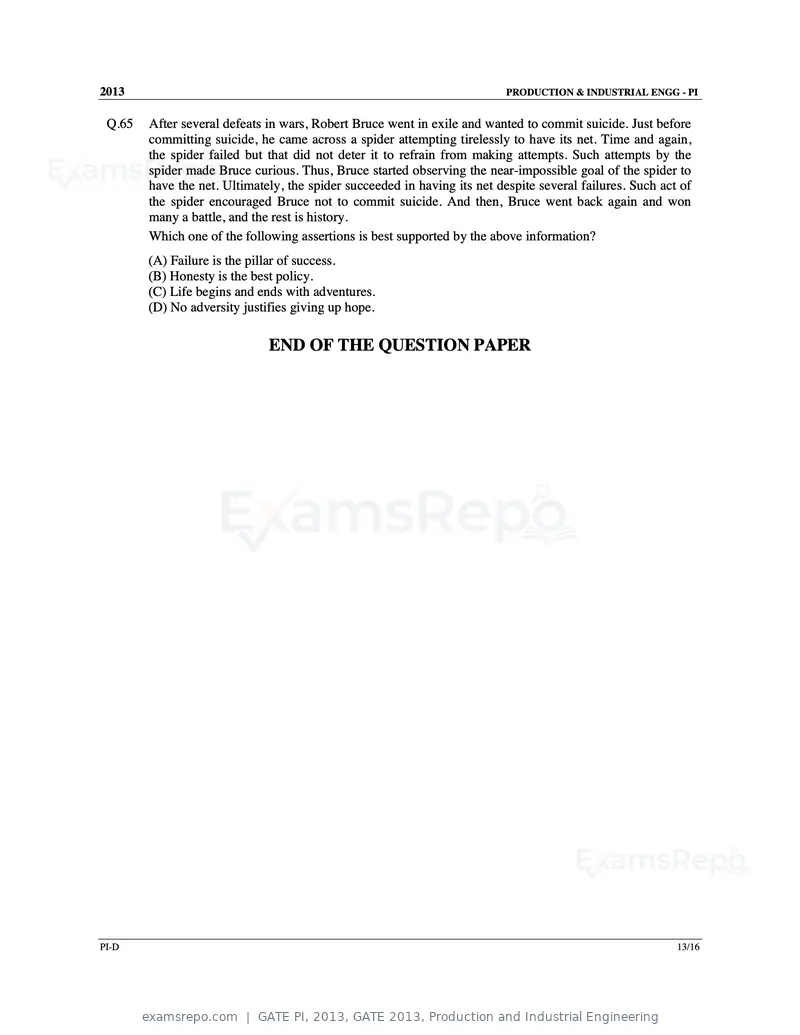
Text of page 56
2013                                                                       PRODUCTION & INDUSTRIAL ENGG - PI


 Q.65   After several defeats in wars, Robert Bruce went in exile and wanted to commit suicide. Just before
        committing suicide, he came across a spider attempting tirelessly to have its net. Time and again,
        the spider failed but that did not deter it to refrain from making attempts. Such attempts by the
        spider made Bruce curious. Thus, Bruce started observing the near-impossible goal of the spider to
        have the net. Ultimately, the spider succeeded in having its net despite several failures. Such act of
        the spider encouraged Bruce not to commit suicide. And then, Bruce went back again and won
        many a battle, and the rest is history.
        Which one of the following assertions is best supported by the above information?
        (A) Failure is the pillar of success.
        (B) Honesty is the best policy.
        (C) Life begins and ends with adventures.
        (D) No adversity justifies giving up hope.

                              END OF THE QUESTION PAPER


PI-D                                                                                                       13/16
Official key not published for this paper.
Page 1 of 56
Source: GATE. Question paper published by GATE.