
GATE XE 2013: Engineering Sciences
Text of page 1
2013                                                                                 ENGINEERING SCIENCES – XE


                                  XE : ENGINEERING SCIENCES
Duration: Three Hours                                                               Maximum Marks:100

Please read the following instructions carefully:

General Instructions:

       1. Total duration of examination is 180 minutes (3 hours).

       2. The clock will be set at the server. The countdown timer in the top right corner of screen will display
          the remaining time available for you to complete the examination. When the timer reaches zero, the
          examination will end by itself. You will not be required to end or submit your examination.

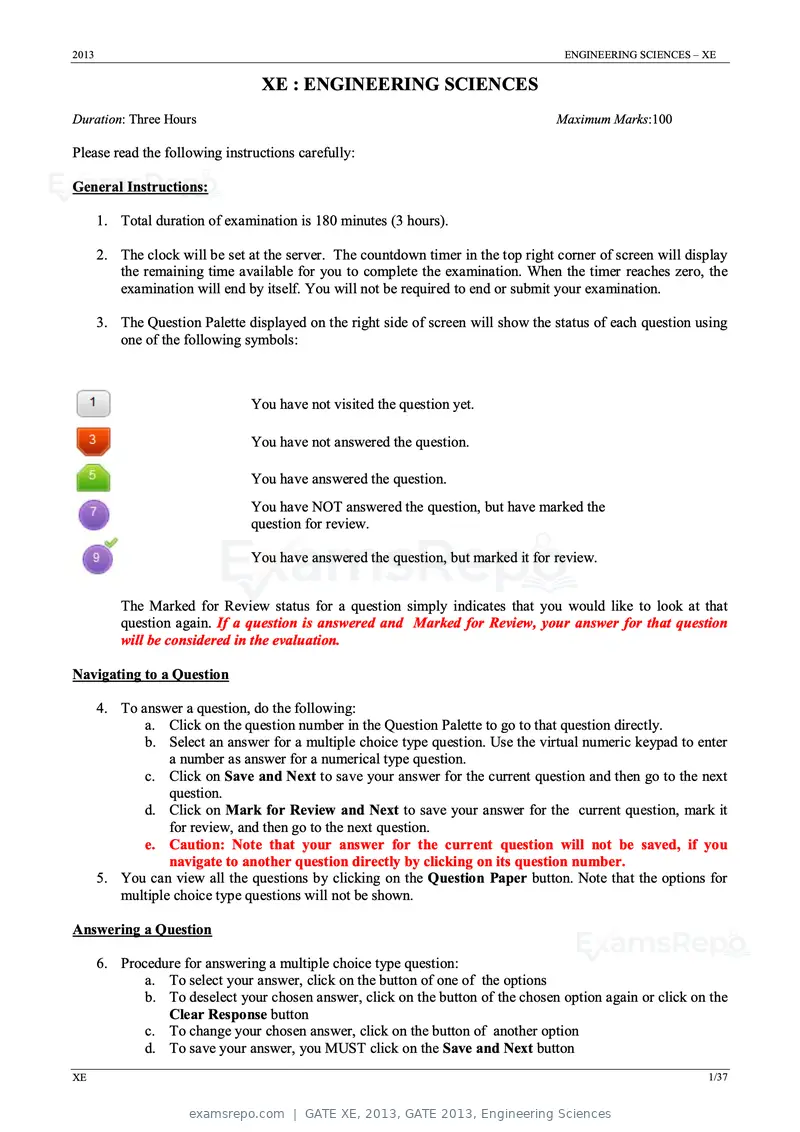
       3. The Question Palette displayed on the right side of screen will show the status of each question using
          one of the following symbols:


                                You have not visited the question yet.

                                You have not answered the question.

                                You have answered the question.
                                You have NOT answered the question, but have marked the
                                question for review.

                                You have answered the question, but marked it for review.


           The Marked for Review status for a question simply indicates that you would like to look at that
           question again. If a question is answered and Marked for Review, your answer for that question
           will be considered in the evaluation.

Navigating to a Question

       4. To answer a question, do the following:
              a. Click on the question number in the Question Palette to go to that question directly.
              b. Select an answer for a multiple choice type question. Use the virtual numeric keypad to enter
                  a number as answer for a numerical type question.
              c. Click on Save and Next to save your answer for the current question and then go to the next
                  question.
              d. Click on Mark for Review and Next to save your answer for the current question, mark it
                  for review, and then go to the next question.
              e. Caution: Note that your answer for the current question will not be saved, if you
                  navigate to another question directly by clicking on its question number.
       5. You can view all the questions by clicking on the Question Paper button. Note that the options for
          multiple choice type questions will not be shown.

Answering a Question

       6. Procedure for answering a multiple choice type question:
              a. To select your answer, click on the button of one of the options
              b. To deselect your chosen answer, click on the button of the chosen option again or click on the
                 Clear Response button
              c. To change your chosen answer, click on the button of another option
              d. To save your answer, you MUST click on the Save and Next button
XE                                                                                                           1/37
Text of page 2
2013                                                                                  ENGINEERING SCIENCES – XE

               e. To mark the question for review, click on the Mark for Review and Next button. If an
                  answer is selected for a question that is Marked for Review, that answer will be considered
                  in the evaluation.

       7. Procedure for answering a numerical answer type question:
              a. To enter a number as your answer, use the virtual numerical keypad
              b. A fraction (eg.,-0.3 or -.3) can be entered as an answer with or without ‘0’ before the decimal
                 point
              c. To clear your answer, click on the Clear Response button
              d. To save your answer, you MUST click on the Save and Next button
              e. To mark the question for review, click on the Mark for Review and Next button. If an
                 answer is entered for a question that is Marked for Review, that answer will be considered
                 in the evaluation.

       8. To change your answer to a question that has already been answered, first select that question for
          answering and then follow the procedure for answering that type of question.

       9. Note that ONLY Questions for which answers are saved or marked for review after answering will be
          considered for evaluation.

Choosing an Optional Section

       10. Sections in this question paper are displayed on the top bar of the screen. Questions in a Section can
           be viewed by clicking on the name of that Section. The Section you are currently viewing is
           highlighted.

       11. A checkbox is displayed for every optional Section in the Question Paper. To select an optional
           Section for answering, click on the checkbox for that Section.

       12. If the checkbox for an optional Section is not selected, the Save and Next button and the Mark for
           Review and Next button will NOT be enabled for that Section. You will be able to only see
           questions in the Section, but you will not be able to answer questions in the Section.

       13. After clicking the Save and Next button for the last question in a Section, you will automatically be
           taken to the first question of the next Section in sequence.

       14. You can move the mouse cursor over the name of a Section to view the answering status for that
           Section.

Changing the Optional Section

       15. After answering the chosen optional Sections, partially or completely, you can change an optional
           Section by selecting a checkbox for a new Section that you want to attempt. A warning message will
           appear along with a table showing the number of questions answered in each of the previously chosen
           optional Sections and a checkbox against each of these Sections. Click on a checkbox against a
           Section that you want to reset and then click on the RESET button. Note that RESETTING a
           Section will DELETE all the answers for questions in that Section. Hence, if you think that you
           may want to select this Section again later, you will have to note down your answers for
           questions in that Section. If you do not want to reset any Section and want to continue answering the
           previously chosen optional Sections, then click on the BACK button.

       16. If you deselect the checkbox for an optional Section in the top bar, the following warning message
           will appear: "Deselecting the checkbox will DELETE all the answers for questions in this Section.
           Do you want to deselect this Section?" If you want to deselect, click on the RESET button. If you do
           not want to deselect, click on the BACK button.

       17. You can shuffle between different Sections any number of times. You can change the optional
           Sections any number of times.
XE                                                                                                             2/37
Text of page 3
2013                                                                                   ENGINEERING SCIENCES – XE

Paper specific instructions:

       1. There are a total of 65 questions carrying 100 marks. The question paper consists of questions of
          multiple choice type and numerical answer type. Multiple choice type questions will have four
          choices for the answer with only one correct choice. For numerical answer type questions, the answer
          is a number and no choices will be given. A number as the answer should be entered using the
          virtual keyboard on the monitor.

       2. There are Eight sections: GA (General Aptitude), A (Engineering Mathematics), B (Fluid
          Mechanics), C (Materials Science), D (Solid Mechanics), E (Thermodynamics), F (Polymer Science
          & Engineering) and G (Food Technology).

       3. Section GA (General Aptitude) and Section A (Engineering Mathematics) are compulsory. Attempt
          any two optional Sections B through G.

       4. There are 10 questions carrying 15 marks in General Aptitude (GA) section, which is compulsory.
          Questions Q.1 – Q.5 carry 1 mark each, and questions Q.6 – Q.10 carry 2 marks each.

       5. There are 11 questions carrying 15 marks in Section A (Engineering Mathematics), which is
          compulsory. Questions Q.1 - Q.7 carry 1 mark each and questions Q.8- Q.11 carry 2 marks each.

       6. Each of the other sections (Sections B through G) contains 22 questions carrying 35 marks. Questions
          Q.1 - Q.9 carry 1 mark each and questions Q.10 - Q.22 carry 2 marks each. The 2 marks questions
          include two pairs of common data questions and one pair of linked answer questions. The answer to
          the second question of the linked answer questions depends on the answer to the first question of the
          pair. If the first question in the linked pair is wrongly answered or is not attempted, then the answer to
          the second question in the pair will not be evaluated

       7. Questions not attempted will result in zero mark. Wrong answers for multiple choice type questions
          will result in NEGATIVE marks. For all 1 mark questions, ⅓ mark will be deducted for each wrong
          answer. For all 2 marks questions, ⅔ mark will be deducted for each wrong answer. However, in the
          case of the linked answer question pair, there will be negative marks only for wrong answer to the
          first question and no negative marks for wrong answer to the second question. There is no negative
          marking for questions of numerical answer type.

       8. Calculator is allowed. Charts, graph sheets or tables are NOT allowed in the examination hall.

       9. Do the rough work in the Scribble Pad provided.


XE                                                                                                              3/37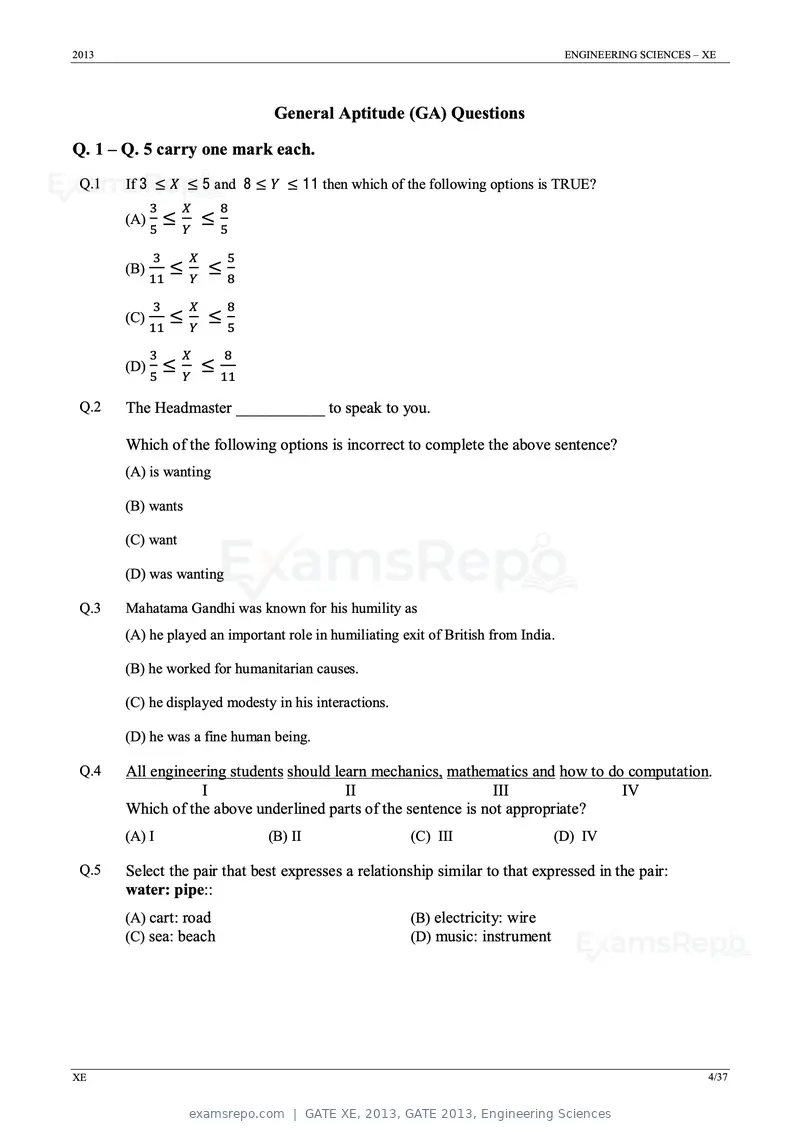
Text of page 4
2013                                                                                ENGINEERING SCIENCES – XE


                                   General Aptitude (GA) Questions

Q. 1 – Q. 5 carry one mark each.
 Q.1   If 3 ≤       ≤ 5 and 8 ≤      ≤ 11 then which of the following options is TRUE?

       (A)     ≤     ≤

       (B)      ≤     ≤

       (C)      ≤     ≤

       (D)     ≤     ≤

 Q.2   The Headmaster ___________ to speak to you.

       Which of the following options is incorrect to complete the above sentence?
       (A) is wanting

       (B) wants

       (C) want

       (D) was wanting

 Q.3   Mahatama Gandhi was known for his humility as
       (A) he played an important role in humiliating exit of British from India.

       (B) he worked for humanitarian causes.

       (C) he displayed modesty in his interactions.

       (D) he was a fine human being.

 Q.4   All engineering students should learn mechanics, mathematics and how to do computation.
                  I                      II                     III              IV
       Which of the above underlined parts of the sentence is not appropriate?
       (A) I                      (B) II                (C) III                 (D) IV

 Q.5   Select the pair that best expresses a relationship similar to that expressed in the pair:
       water: pipe::
       (A) cart: road                                   (B) electricity: wire
       (C) sea: beach                                   (D) music: instrument


XE                                                                                                         4/37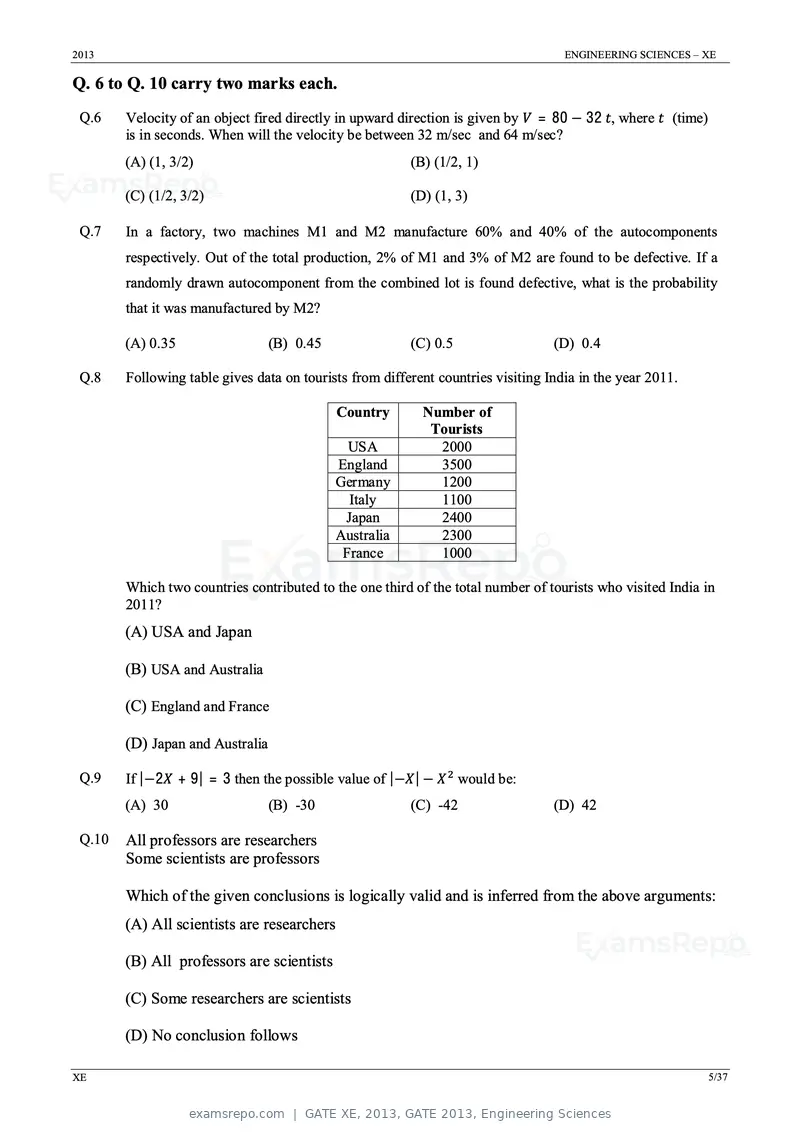
Text of page 5
2013                                                                                ENGINEERING SCIENCES – XE

Q. 6 to Q. 10 carry two marks each.
 Q.6    Velocity of an object fired directly in upward direction is given by = 80 − 32 , where         (time)
        is in seconds. When will the velocity be between 32 m/sec and 64 m/sec?
        (A) (1, 3/2)                                     (B) (1/2, 1)

        (C) (1/2, 3/2)                                   (D) (1, 3)

 Q.7    In a factory, two machines M1 and M2 manufacture 60% and 40% of the autocomponents
        respectively. Out of the total production, 2% of M1 and 3% of M2 are found to be defective. If a
        randomly drawn autocomponent from the combined lot is found defective, what is the probability
        that it was manufactured by M2?

        (A) 0.35                  (B) 0.45               (C) 0.5                  (D) 0.4

 Q.8    Following table gives data on tourists from different countries visiting India in the year 2011.

                                             Country       Number of
                                                            Tourists
                                               USA           2000
                                             England         3500
                                             Germany         1200
                                               Italy         1100
                                              Japan          2400
                                             Australia       2300
                                              France         1000

        Which two countries contributed to the one third of the total number of tourists who visited India in
        2011?
        (A) USA and Japan

        (B) USA and Australia

        (C) England and France

        (D) Japan and Australia

 Q.9    If |−2 + 9| = 3 then the possible value of |− | −          would be:
        (A) 30                    (B) -30                (C) -42                  (D) 42

 Q.10   All professors are researchers
        Some scientists are professors

        Which of the given conclusions is logically valid and is inferred from the above arguments:
        (A) All scientists are researchers

        (B) All professors are scientists

        (C) Some researchers are scientists

        (D) No conclusion follows

XE                                                                                                              5/37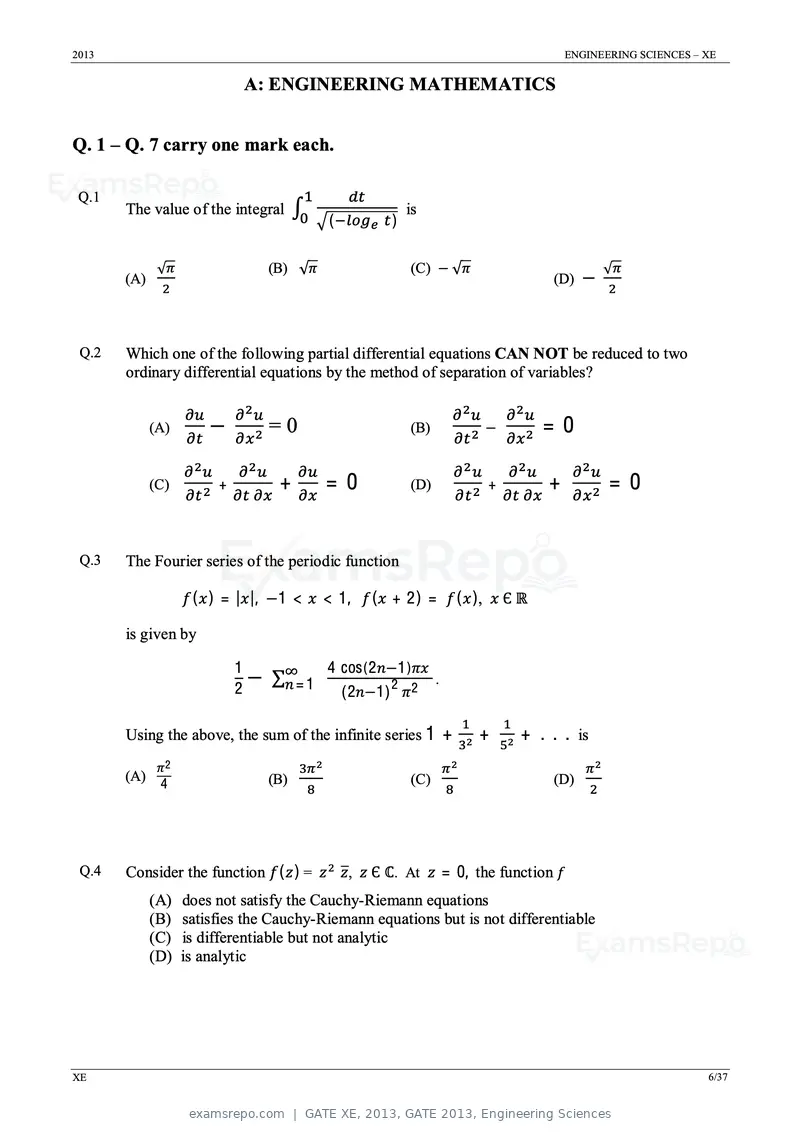
Text of page 6
2013                                                                                  ENGINEERING SCIENCES – XE


                            A: ENGINEERING MATHEMATICS


Q. 1 – Q. 7 carry one mark each.

 Q.1
       The value of the integral ∫                    is
                                        (         )


              √                (B) √                  (C) − √                               √
       (A)                                                                          (D) −


 Q.2   Which one of the following partial differential equations CAN NOT be reduced to two
       ordinary differential equations by the method of separation of variables?


             (A)      −        =0                     (B)                −        =0

             (C)       +        +      =0             (D)                +        +         =0


 Q.3   The Fourier series of the periodic function

                   ( ) = | |, −1 <     < 1,     ( + 2) =          ( ),       Єℝ

       is given by

                           1        4 cos(2 −1)
                             − ∑∞=1         2               .
                           2          (2 −1) 2

       Using the above, the sum of the infinite series 1 +           +        + . . . is
               2
       (A) 4                   (B)                    (C)                           (D)


 Q.4   Consider the function ( ) =          ,   Є ℂ. At         = 0, the function
             (A) does not satisfy the Cauchy-Riemann equations
             (B) satisfies the Cauchy-Riemann equations but is not differentiable
             (C) is differentiable but not analytic
             (D) is analytic


XE                                                                                                           6/37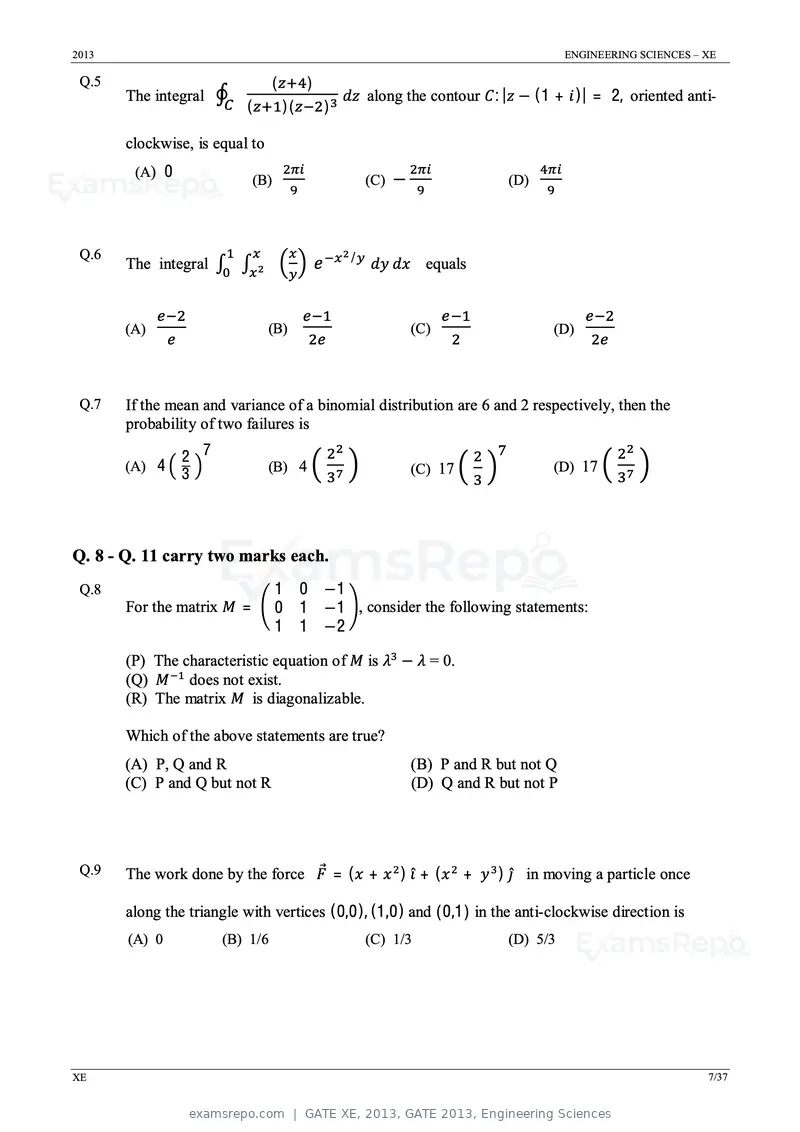
Text of page 7
2013                                                                                    ENGINEERING SCIENCES – XE

 Q.5                              (         )
       The integral ∮                                   along the contour : | − (1 + )| = 2, oriented anti-
                           (          )(        )

       clockwise, is equal to
        (A) 0
                            (B)                         (C) −                 (D)


 Q.6                                                /
       The integral ∫ ∫                                           equals


       (A)                      (B)                             (C)                  (D)


 Q.7   If the mean and variance of a binomial distribution are 6 and 2 respectively, then the
       probability of two failures is

                2 7
       (A) 4                    (B) 4                           (C) 17               (D) 17
                3


Q. 8 - Q. 11 carry two marks each.
 Q.8                              1        0 −1
       For the matrix     =       0        1 −1 , consider the following statements:
                                  1        1 −2

       (P) The characteristic equation of is                 −    = 0.
       (Q)      does not exist.
       (R) The matrix     is diagonalizable.

       Which of the above statements are true?
       (A) P, Q and R                                           (B) P and R but not Q
       (C) P and Q but not R                                    (D) Q and R but not P


 Q.9   The work done by the force ⃗ = ( +                    ) ̂+(       +   ) ̂ in moving a particle once

       along the triangle with vertices (0,0), (1,0) and (0,1) in the anti-clockwise direction is
       (A) 0            (B) 1/6                         (C) 1/3               (D) 5/3


XE                                                                                                             7/37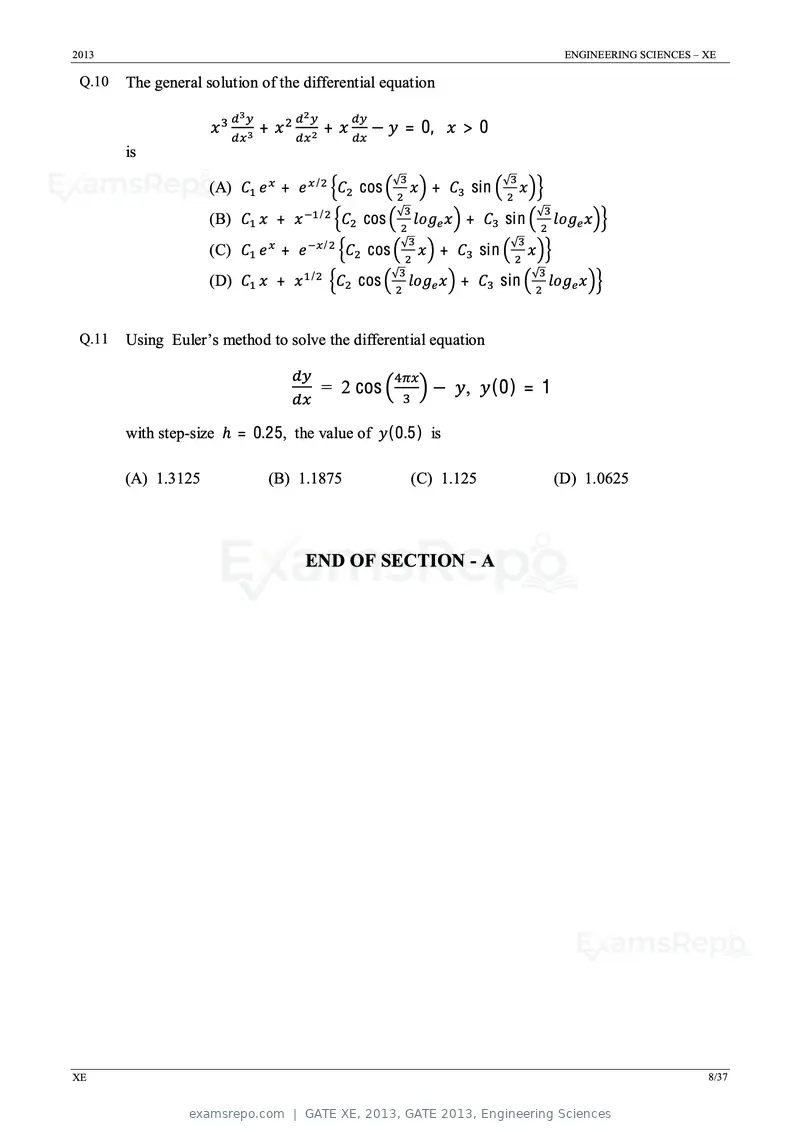
Text of page 8
2013                                                                                       ENGINEERING SCIENCES – XE

 Q.10   The general solution of the differential equation

                            +            +      −       = 0,       >0
        is
                                     /              √                         √
                     (A)        +            cos              +        sin
                                         /           √                                √
                     (B)        +            cos                   +          sin
                                         /              √                         √
                     (C)        +             cos              +        sin
                                     /              √                                 √
                     (D)        +            cos                   +          sin


 Q.11   Using Euler’s method to solve the differential equation


                                         = 2 cos              −    ,     (0) = 1

        with step-size ℎ = 0.25, the value of       (0.5) is

        (A) 1.3125            (B) 1.1875                    (C) 1.125                     (D) 1.0625


                                    END OF SECTION - A


XE                                                                                                                8/37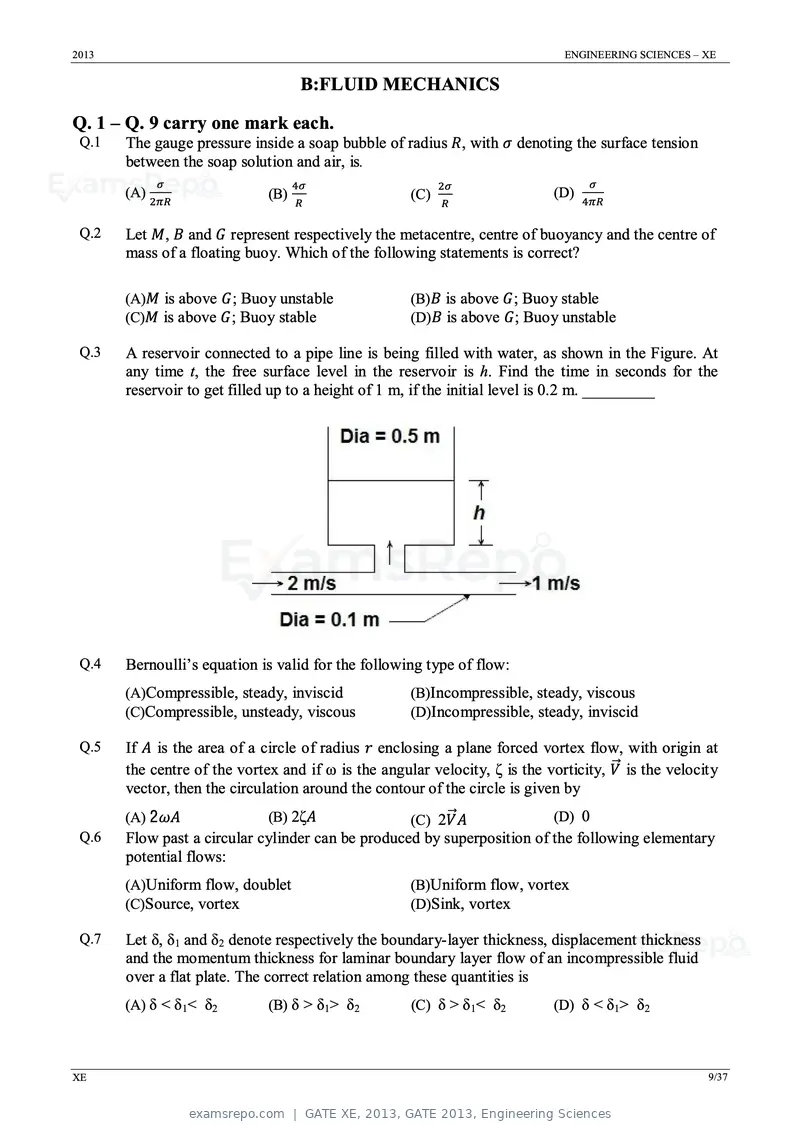
Text of page 9
2013                                                                          ENGINEERING SCIENCES – XE


                                    B:FLUID MECHANICS

Q. 1 – Q. 9 carry one mark each.
 Q.1   The gauge pressure inside a soap bubble of radius , with        denoting the surface tension
       between the soap solution and air, is.
       (A)                    (B)                    (C)                    (D)

 Q.2   Let , and represent respectively the metacentre, centre of buoyancy and the centre of
       mass of a floating buoy. Which of the following statements is correct?

       (A)     is above ; Buoy unstable              (B) is above ; Buoy stable
       (C)     is above ; Buoy stable                (D) is above ; Buoy unstable

 Q.3   A reservoir connected to a pipe line is being filled with water, as shown in the Figure. At
       any time t, the free surface level in the reservoir is h. Find the time in seconds for the
       reservoir to get filled up to a height of 1 m, if the initial level is 0.2 m. _________


 Q.4   Bernoulli’s equation is valid for the following type of flow:
       (A)Compressible, steady, inviscid             (B)Incompressible, steady, viscous
       (C)Compressible, unsteady, viscous            (D)Incompressible, steady, inviscid

 Q.5   If is the area of a circle of radius enclosing a plane forced vortex flow, with origin at
       the centre of the vortex and if ω is the angular velocity, ζ is the vorticity, ⃗ is the velocity
       vector, then the circulation around the contour of the circle is given by
       (A) 2                  (B) 2ζ                 (C) 2 ⃗                (D) 0
 Q.6   Flow past a circular cylinder can be produced by superposition of the following elementary
       potential flows:
       (A)Uniform flow, doublet                      (B)Uniform flow, vortex
       (C)Source, vortex                             (D)Sink, vortex

 Q.7   Let δ, δ1 and δ2 denote respectively the boundary-layer thickness, displacement thickness
       and the momentum thickness for laminar boundary layer flow of an incompressible fluid
       over a flat plate. The correct relation among these quantities is
       (A) δ < δ1< δ2         (B) δ > δ1> δ2         (C) δ > δ1< δ2         (D) δ < δ1> δ2


XE                                                                                                    9/37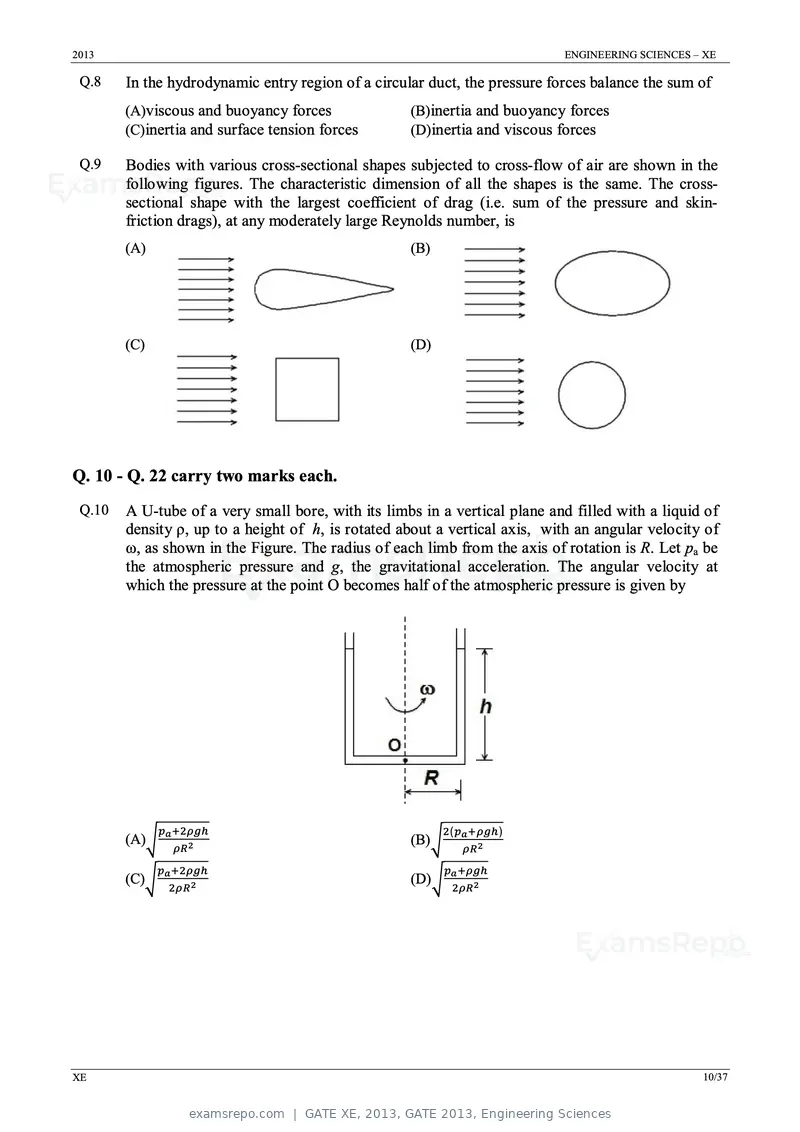
Text of page 10
2013                                                                        ENGINEERING SCIENCES – XE

 Q.8    In the hydrodynamic entry region of a circular duct, the pressure forces balance the sum of
        (A)viscous and buoyancy forces              (B)inertia and buoyancy forces
        (C)inertia and surface tension forces       (D)inertia and viscous forces

 Q.9    Bodies with various cross-sectional shapes subjected to cross-flow of air are shown in the
        following figures. The characteristic dimension of all the shapes is the same. The cross-
        sectional shape with the largest coefficient of drag (i.e. sum of the pressure and skin-
        friction drags), at any moderately large Reynolds number, is
        (A)                                         (B)


        (C)                                         (D)


Q. 10 - Q. 22 carry two marks each.
 Q.10   A U-tube of a very small bore, with its limbs in a vertical plane and filled with a liquid of
        density ρ, up to a height of h, is rotated about a vertical axis, with an angular velocity of
        ω, as shown in the Figure. The radius of each limb from the axis of rotation is R. Let pa be
        the atmospheric pressure and g, the gravitational acceleration. The angular velocity at
        which the pressure at the point O becomes half of the atmospheric pressure is given by


                                                          (       )
        (A)                                         (B)

        (C)                                         (D)


XE                                                                                                10/37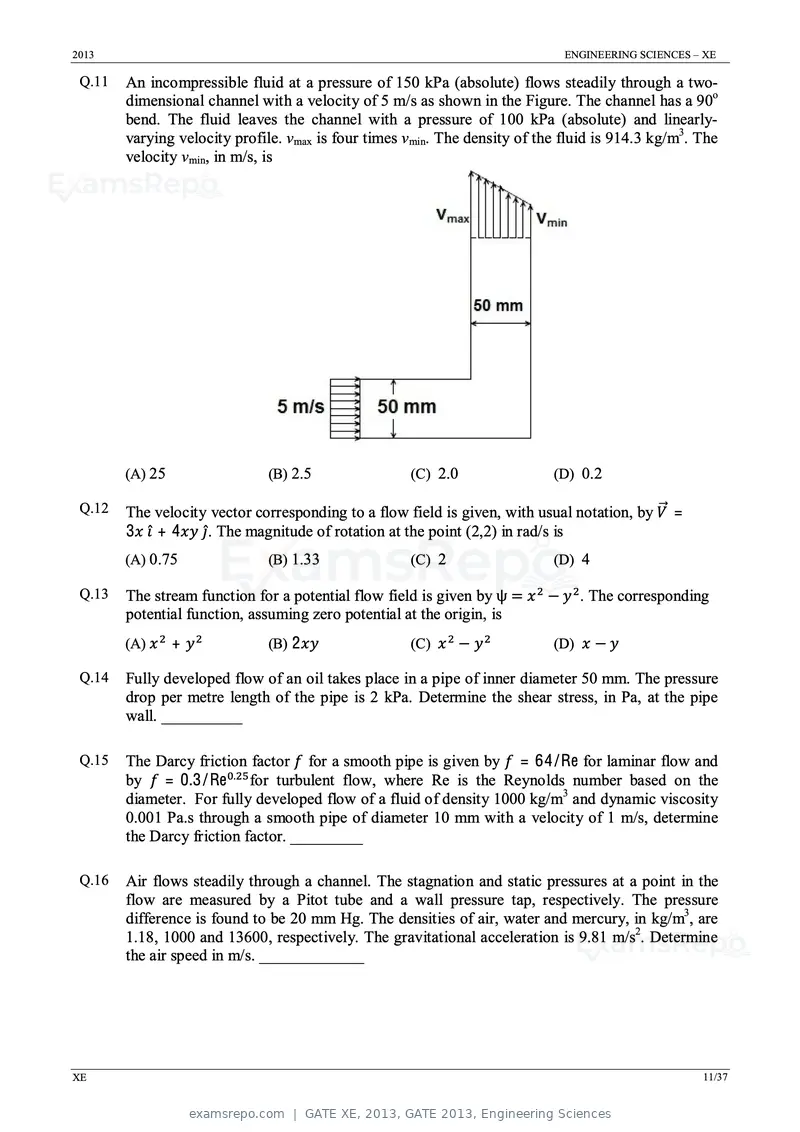
Text of page 11
2013                                                                           ENGINEERING SCIENCES – XE

 Q.11   An incompressible fluid at a pressure of 150 kPa (absolute) flows steadily through a two-
        dimensional channel with a velocity of 5 m/s as shown in the Figure. The channel has a 90o
        bend. The fluid leaves the channel with a pressure of 100 kPa (absolute) and linearly-
        varying velocity profile. vmax is four times vmin. The density of the fluid is 914.3 kg/m3. The
        velocity vmin, in m/s, is


        (A) 25                (B) 2.5                (C) 2.0                (D) 0.2

 Q.12   The velocity vector corresponding to a flow field is given, with usual notation, by ⃗ =
        3 ̂+4       ̂. The magnitude of rotation at the point (2,2) in rad/s is
        (A) 0.75              (B) 1.33               (C) 2                  (D) 4

 Q.13   The stream function for a potential flow field is given by ψ =     −      . The corresponding
        potential function, assuming zero potential at the origin, is
        (A)      +            (B) 2                  (C)     −              (D)     −

 Q.14   Fully developed flow of an oil takes place in a pipe of inner diameter 50 mm. The pressure
        drop per metre length of the pipe is 2 kPa. Determine the shear stress, in Pa, at the pipe
        wall. __________

 Q.15   The Darcy friction factor for a smooth pipe is given by = 64/Re for laminar flow and
        by = 0.3/Re . for turbulent flow, where Re is the Reynolds number based on the
        diameter. For fully developed flow of a fluid of density 1000 kg/m3 and dynamic viscosity
        0.001 Pa.s through a smooth pipe of diameter 10 mm with a velocity of 1 m/s, determine
        the Darcy friction factor. _________

 Q.16   Air flows steadily through a channel. The stagnation and static pressures at a point in the
        flow are measured by a Pitot tube and a wall pressure tap, respectively. The pressure
        difference is found to be 20 mm Hg. The densities of air, water and mercury, in kg/m3, are
        1.18, 1000 and 13600, respectively. The gravitational acceleration is 9.81 m/s2. Determine
        the air speed in m/s. _____________


XE                                                                                                   11/37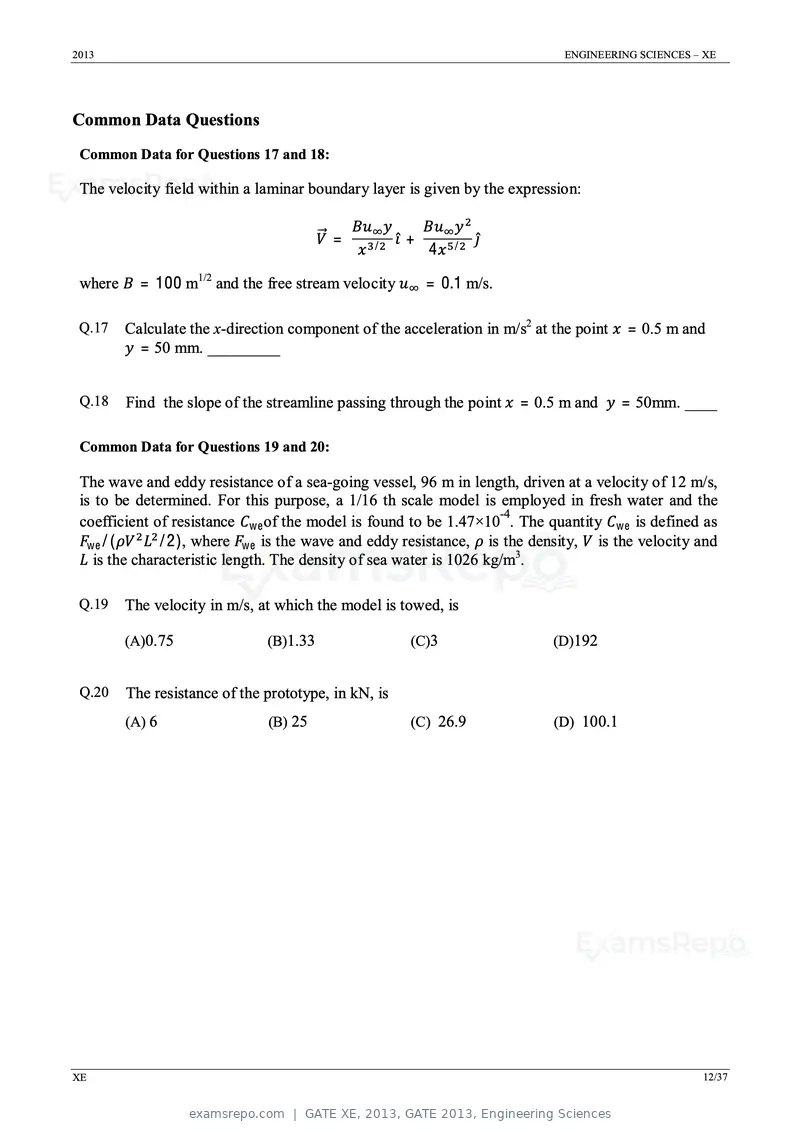
Text of page 12
2013                                                                          ENGINEERING SCIENCES – XE


Common Data Questions
 Common Data for Questions 17 and 18:

 The velocity field within a laminar boundary layer is given by the expression:

                                         ⃗=           ̂+           ̂
                                                /          4   /


 where     = 100 m1/2 and the free stream velocity         = 0.1 m/s.

 Q.17    Calculate the x-direction component of the acceleration in m/s2 at the point   = 0.5 m and
          = 50 mm. _________


 Q.18    Find the slope of the streamline passing through the point     = 0.5 m and     = 50mm. ____

 Common Data for Questions 19 and 20:

 The wave and eddy resistance of a sea-going vessel, 96 m in length, driven at a velocity of 12 m/s,
 is to be determined. For this purpose, a 1/16 th scale model is employed in fresh water and the
                                                                    -4
 coefficient of resistance we of the model is found to be 1.47×10 . The quantity we is defined as
  we /(       /2), where we is the wave and eddy resistance, is the density, is the velocity and
   is the characteristic length. The density of sea water is 1026 kg/m3.

 Q.19    The velocity in m/s, at which the model is towed, is

         (A)0.75               (B)1.33                 (C)3                 (D)192


 Q.20    The resistance of the prototype, in kN, is
         (A) 6                 (B) 25                  (C) 26.9             (D) 100.1


XE                                                                                                  12/37
Text of page 13
2013                                                                         ENGINEERING SCIENCES – XE

Linked Answer Questions
 Statement for Linked Answer Questions 21 and 22:

 Water enters a symmetric forked pipe and discharges into atmosphere through the two branches as
 shown in the Figure. The cross-sectional area of section-1 is 0.2 m2 and the velocity across
 section-1 is 3 m/s. The density of water may be taken as 1000 kg/m3. The viscous effects and
 elevation changes may be neglected.


 Q.21   The gauge pressure at section-1, in kPa, is

        (A)0.6                (B)13.5                 (C)135               (D)600


 Q.22   The magnitude of the force, in kN, required to hold the pipe in place, is
        (A) 2.7               (B) 5.4                 (C) 19               (D) 27


                                    END OF SECTION - B


XE                                                                                                 13/37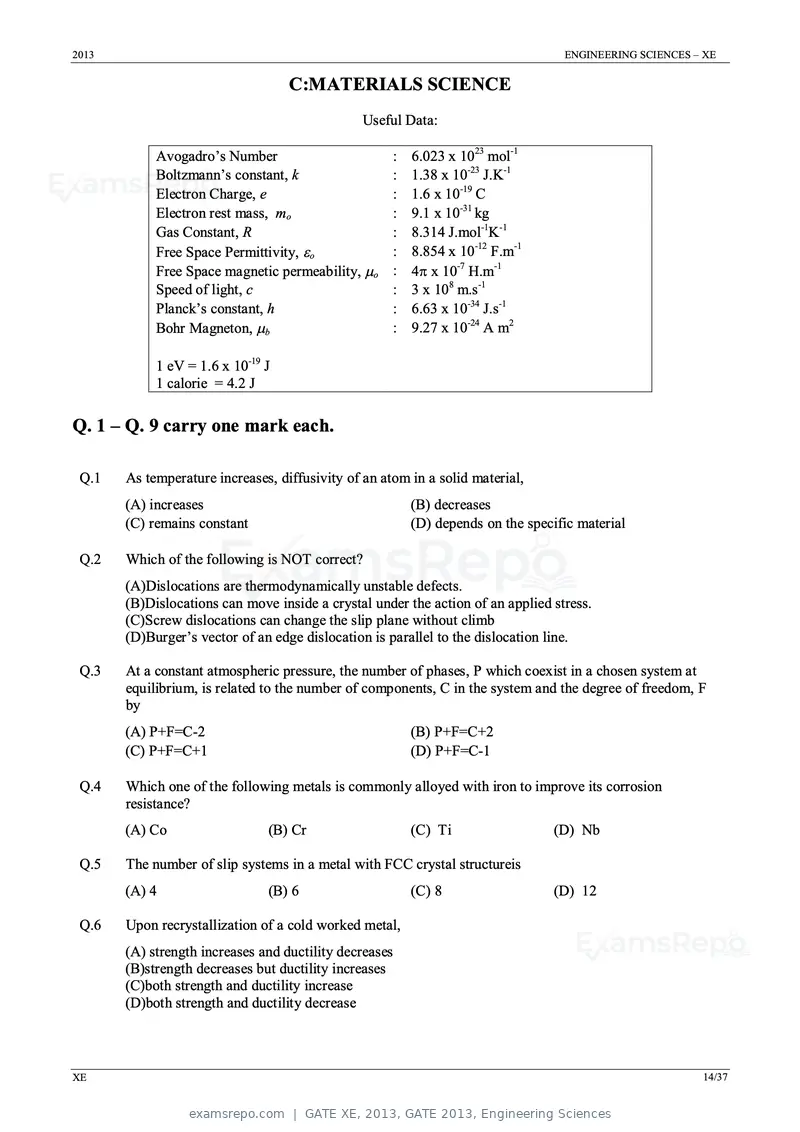
Text of page 14
2013 ENGINEERING SCIENCES – XE
C:MATERIALS SCIENCE
Useful Data:
Avogadro’s Number : 6.023 x 10²³ mol-1
Boltzmann’s constant, k : 1.38 x 10⁻²³ J.K-1
Electron Charge, e : 1.6 x 10⁻¹⁹ C
Electron rest mass, mo : 9.1 x 10⁻³¹ kg
Gas Constant, R : 8.314 J.mol-1K-1
Free Space Permittivity, o : 8.854 x 10⁻¹² F.m-1
Free Space magnetic permeability, o : 4 x 10⁻⁷ H.m-1
Speed of light, c : 3 x 10⁸ m.s-1
Planck’s constant, h : 6.63 x 10⁻³⁴ J.s-1
Bohr Magneton, b : 9.27 x 10⁻²⁴ A m2
1 eV = 1.6 x 10⁻¹⁹ J
1 calorie = 4.2 J
Q. 1 – Q. 9 carry one mark each.
Q.1 As temperature increases, diffusivity of an atom in a solid material,
(A) increases (B) decreases
(C) remains constant (D) depends on the specific material
Q.2 Which of the following is NOT correct?
(A)Dislocations are thermodynamically unstable defects.
(B)Dislocations can move inside a crystal under the action of an applied stress.
(C)Screw dislocations can change the slip plane without climb
(D)Burger’s vector of an edge dislocation is parallel to the dislocation line.
Q.3 At a constant atmospheric pressure, the number of phases, P which coexist in a chosen system at
equilibrium, is related to the number of components, C in the system and the degree of freedom, F
by
(A) P+F=C-2 (B) P+F=C+2
(C) P+F=C+1 (D) P+F=C-1
Q.4 Which one of the following metals is commonly alloyed with iron to improve its corrosion
resistance?
(A) Co (B) Cr (C) Ti (D) Nb
Q.5 The number of slip systems in a metal with FCC crystal structureis
(A) 4 (B) 6 (C) 8 (D) 12
Q.6 Upon recrystallization of a cold worked metal,
(A) strength increases and ductility decreases
(B)strength decreases but ductility increases
(C)both strength and ductility increase
(D)both strength and ductility decrease
XE 14/37
Text of page 15
2013                                                                                ENGINEERING SCIENCES – XE

 Q.7    In carbon fiber reinforced resin composites, for a given fiber volume content, Young’s modulus
        depends on the orientation of the fiber with respect to the applied load. Which orientation of the
        fibers will give the maximum value of Young’s modulus?
        (A)transverse                                     (B)longitudinal
        (C)random                                         (D)both transverse and longitudinal

 Q.8    Vulcanization is related to
        (A)strengthening of rubber                        (B)extrusion
        (C)injection moulding                             (D)addition polymerisation

 Q.9    Which one of the following oxides crystallizes into fluorite structure?
        (A) UO2                   (B) MgO                 (C) BaTiO3               (D) MgAl2O4


Q. 10 - Q. 22 carry two marks each.

 Q.10   Match the conventional ceramic materials listed in Column I with their respective common
        applications in Column II

                       Column I                             Column II
         P. Lead Zirconate Titanate (PZT)           1. cutting tool
         Q. Zinc Oxide (ZnO)                        2. thermal barrier coating
         R. Silicon Carbide (SiC)                   3. actuator
         S. Zirconia (ZrO2)                         4. varistor
                                                    5. super conductor
        (A) P-1, Q-2, R-3, S-5                            (B) P-3, Q-2, R-1, S-5
        (C) P-2, Q-1, R-5, S-3                            (D)P-3, Q-4, R-1, S-2

 Q.11   Match the terminologies given in Column Iwith theirrelations listed in Column II

                   Column I                             Column II
         P. domain wall                     1. superconductors
         Q. Fick’s law                      2. mechanical properties
         R. Matthiessen’s rule              3. ferromagnetic materials
         S. Hall-Petch relation             4. resistivity of impure metals
         T. Meissner effect                 5. diffusion

        (A) P-1, Q-3, R-5, S-2, T-4                       (B) P-3, Q-5, R-2, S-4, T-1
        (C) P-3, Q- 5, R-4, S-2, T-1                      (D) P-3, Q-4, R-3, S-2, T-4

 Q.12   Match the microscopes listed in Column I with their principle of operation listed in Column II

                        Column I                                              Column II
         P. Scanning Electron Microscope (SEM)                 1. van der Waals forces between atoms
         Q. Transmission Electron Microscope                   2. electrons to jump across a potential
            (TEM)                                                 barrier
         R. Scanning Tunnelling Microscope (STM)               3. diffraction of electrons
         S. Atomic Force Microscope (AFM)                      4. detection of secondary electrons
                                                               5. photo emission of electrons

        (A) P-2, Q-5, R-3, S-1                            (B)P-3, Q-4, R-5, S-2
        (C) P-4, Q-3, R-2, S-1                            (D)P-4, Q-3, R-5, S-2

XE                                                                                                           15/37
Text of page 16
2013 ENGINEERING SCIENCES – XE
Q.13 X-rays of unknown wavelength are diffracted by an FCC metal with a lattice parameter of 0.352
nm. The measured ‘2’ angle for the {200} peak is 61.08. Calculate the wavelength of the X-
ray used, in nm. ___________
Q.14 A metal with HCP crystal structure has lattice constants a = 0.30 nm and c = 0.56 nm. Determine
the volume of the unit cell of this metal, in nm3. _________
Q.15 The band gap of a semiconducting material used to make an LED is 1.43 eV. What will be the
minimum wavelength ofthe radiation emitted by this LED, in µm? __________
Q.16 For automatic control of household electric water heater a relay switch is activated by thermal
expansion of a brass rod of length 50 cm as shown in the schematic below. The distance
between the rod and the lever, x, is adjusted by moving the base of the rod. As the water gets
heated the rod expands and as soon as the rod touches the lever, the circuit is broken
disconnecting the heater from the power supply. Find the distance, x, in mm, to be set at water
temperature of 20oC such that the circuit is broken at 70oC. The coefficient of linear thermal
expansion of brass is 20 x 10-6 oC-1 ______________
230 V,
AC
x
Brass Rod
XE 16/37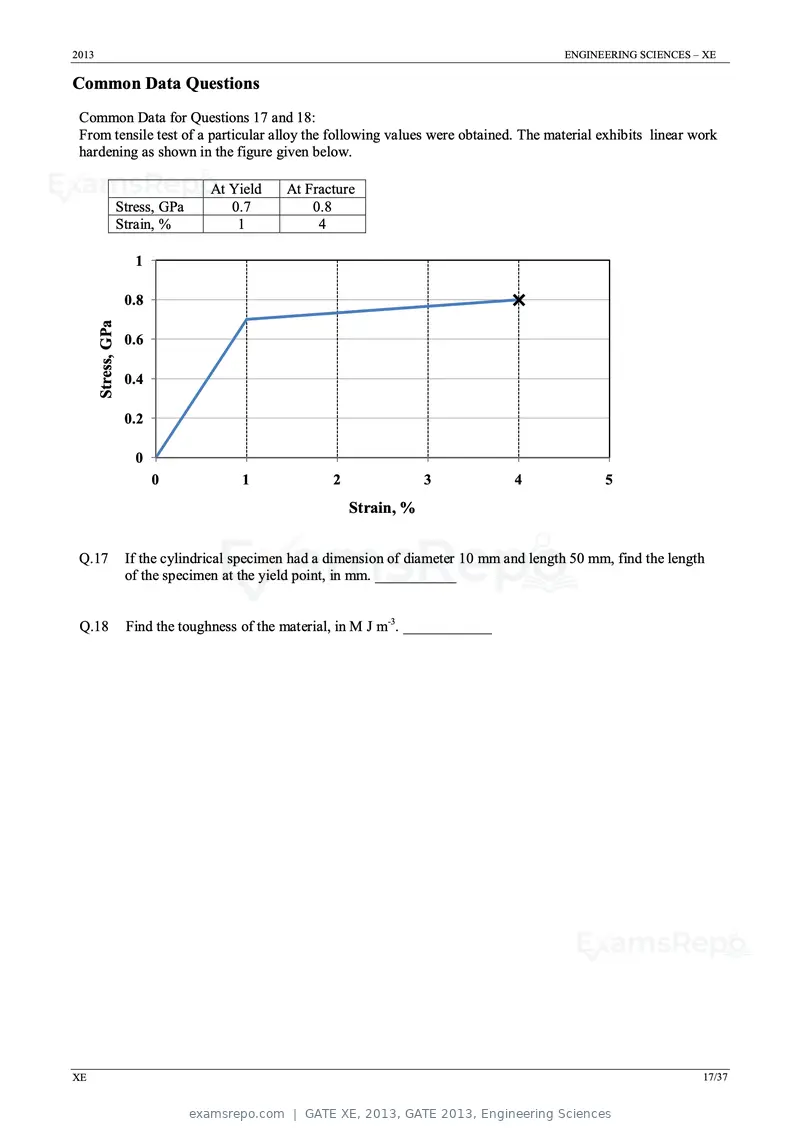
Text of page 17
2013                                                                                          ENGINEERING SCIENCES – XE

Common Data Questions
 Common Data for Questions 17 and 18:
 From tensile test of a particular alloy the following values were obtained. The material exhibits linear work
 hardening as shown in the figure given below.

                                    At Yield    At Fracture
                     Stress, GPa       0.7          0.8
                     Strain, %          1            4

                        1

                      0.8


       Stress, GPa
                      0.6

                      0.4

                      0.2

                        0
                            0            1              2               3            4              5
                                                            Strain, %


 Q.17                 If the cylindrical specimen had a dimension of diameter 10 mm and length 50 mm, find the length
                      of the specimen at the yield point, in mm. ___________


 Q.18                 Find the toughness of the material, in M J m-3. ____________


XE                                                                                                                  17/37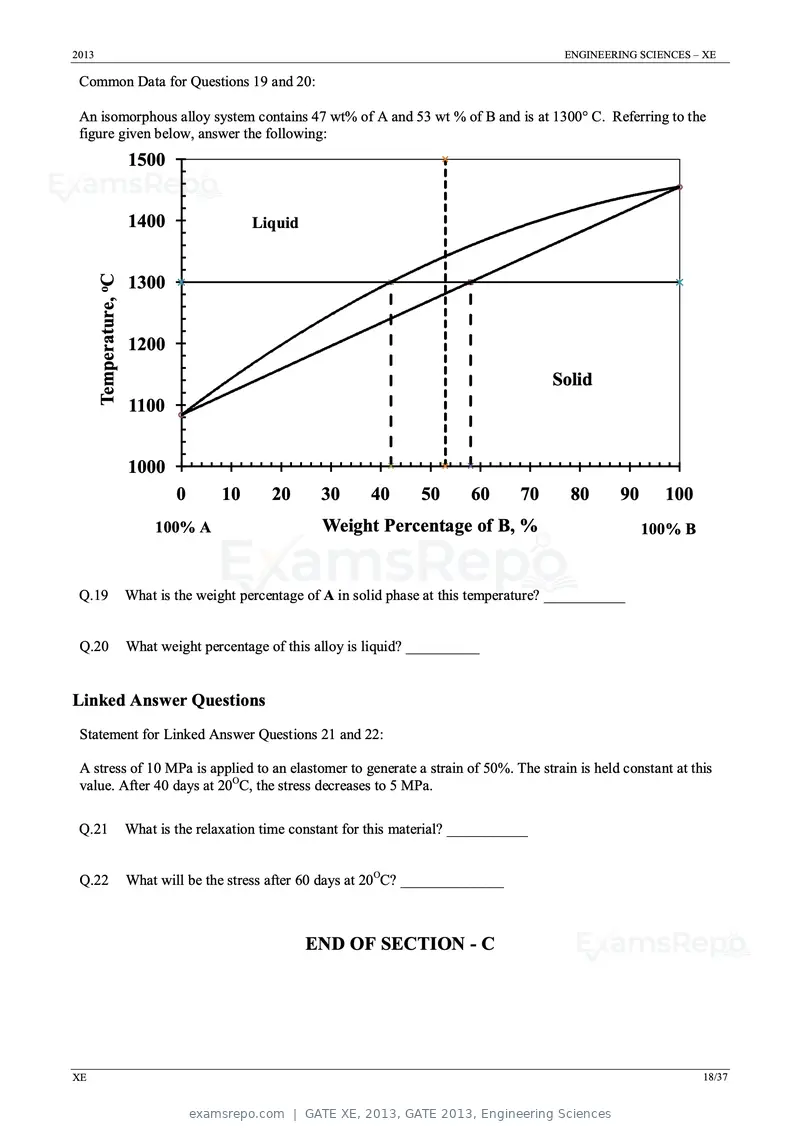
Text of page 18
2013 ENGINEERING SCIENCES – XE
Common Data for Questions 19 and 20:
An isomorphous alloy system contains 47 wt% of A and 53 wt % of B and is at 1300 C. Referring to the
figure given below, answer the following:
1500
1400 Liquid
Temperature, oC
1300
1200
Solid
1100
1000
0 10 20 30 40 50 60 70 80 90 100
100% A Weight Percentage of B, % 100% B
Q.19 What is the weight percentage of A in solid phase at this temperature? ___________
Q.20 What weight percentage of this alloy is liquid? __________
Linked Answer Questions
Statement for Linked Answer Questions 21 and 22:
A stress of 10 MPa is applied to an elastomer to generate a strain of 50%. The strain is held constant at this
value. After 40 days at 20OC, the stress decreases to 5 MPa.
Q.21 What is the relaxation time constant for this material? ___________
Q.22 What will be the stress after 60 days at 20OC? ______________
END OF SECTION - C
XE 18/37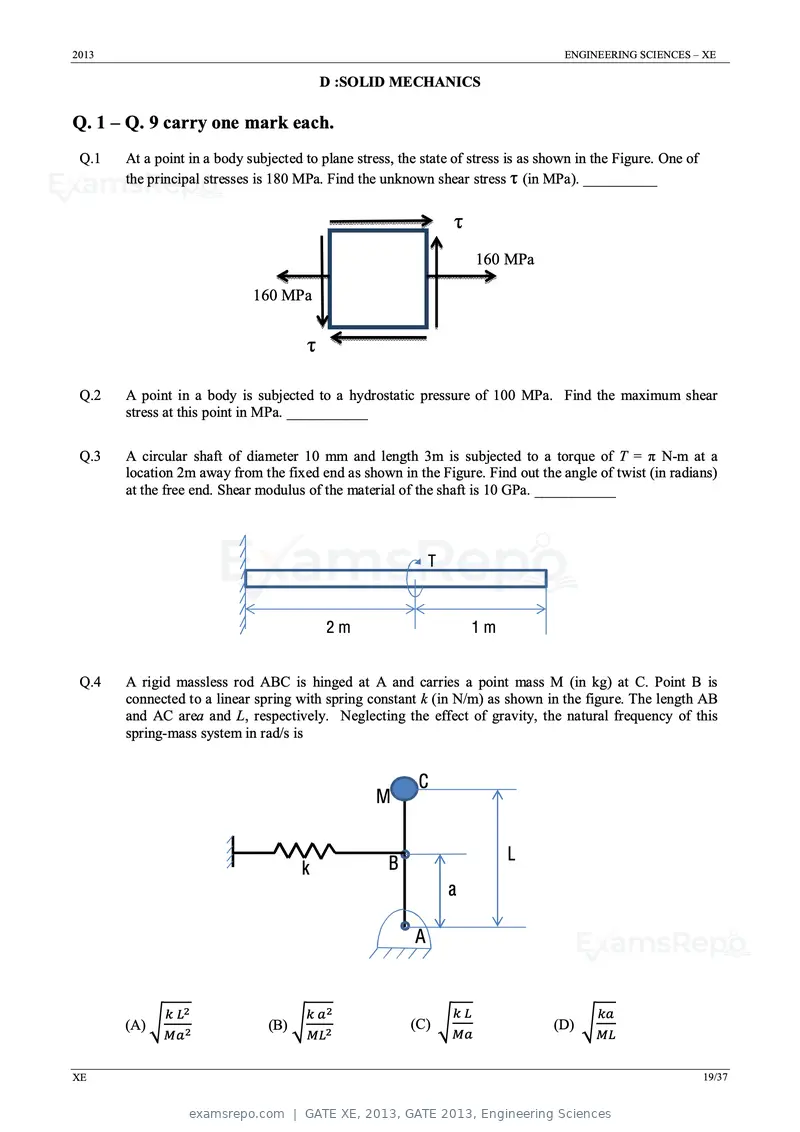
Text of page 19
2013                                                                                ENGINEERING SCIENCES – XE

                                          D :SOLID MECHANICS

Q. 1 – Q. 9 carry one mark each.
 Q.1   At a point in a body subjected to plane stress, the state of stress is as shown in the Figure. One of
       the principal stresses is 180 MPa. Find the unknown shear stress τ (in MPa). __________

                                                                 τ
                                                                     160 MPa

                             160 MPa


                                      τ

 Q.2   A point in a body is subjected to a hydrostatic pressure of 100 MPa. Find the maximum shear
       stress at this point in MPa. ___________

 Q.3   A circular shaft of diameter 10 mm and length 3m is subjected to a torque of T = π N-m at a
       location 2m away from the fixed end as shown in the Figure. Find out the angle of twist (in radians)
       at the free end. Shear modulus of the material of the shaft is 10 GPa. ___________


                                                             T


                                          2m                         1m


 Q.4   A rigid massless rod ABC is hinged at A and carries a point mass M (in kg) at C. Point B is
       connected to a linear spring with spring constant k (in N/m) as shown in the figure. The length AB
       and AC area and L, respectively. Neglecting the effect of gravity, the natural frequency of this
       spring-mass system in rad/s is


                                                          C
                                                   M


                                                     B                    L
                                      k
                                                                 a

                                                         A


       (A)                      (B)                      (C)                      (D)


XE                                                                                                             19/37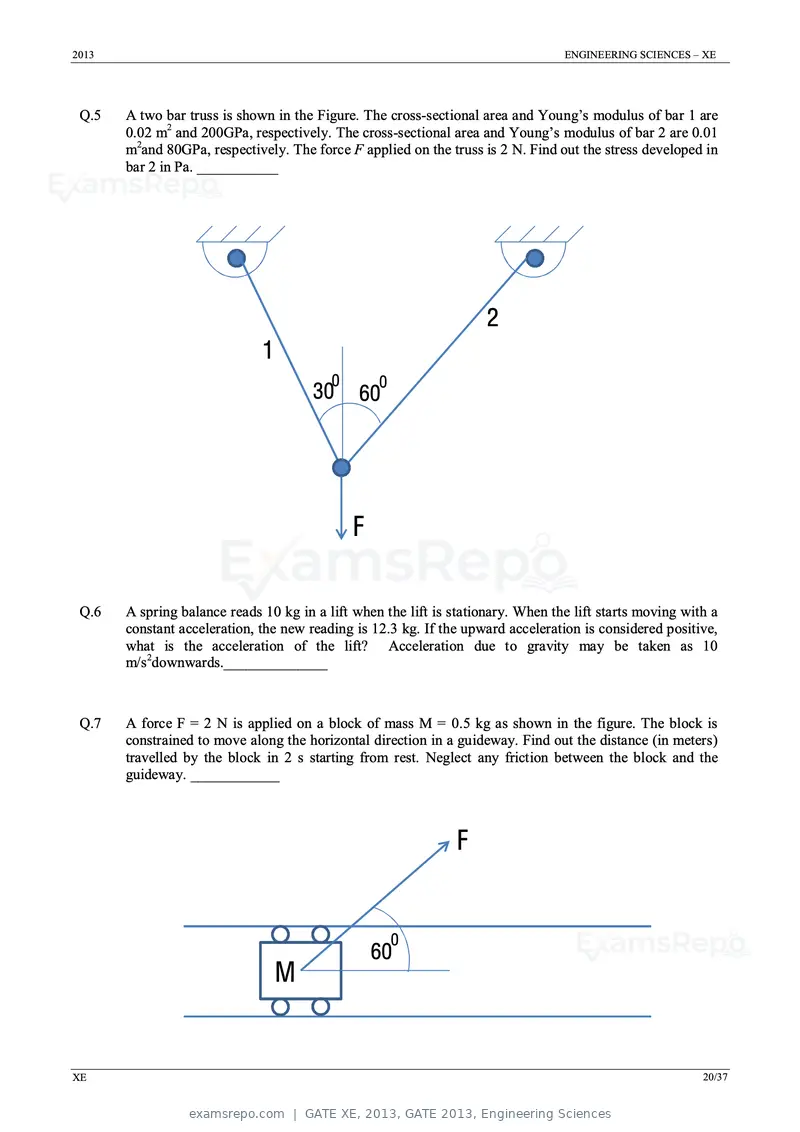
Text of page 20
2013                                                                              ENGINEERING SCIENCES – XE


 Q.5   A two bar truss is shown in the Figure. The cross-sectional area and Young’s modulus of bar 1 are
       0.02 m2 and 200GPa, respectively. The cross-sectional area and Young’s modulus of bar 2 are 0.01
       m2and 80GPa, respectively. The force F applied on the truss is 2 N. Find out the stress developed in
       bar 2 in Pa. ___________


                                                                     2
                              1
                                          0       0
                                       30      60


                                              F

 Q.6   A spring balance reads 10 kg in a lift when the lift is stationary. When the lift starts moving with a
       constant acceleration, the new reading is 12.3 kg. If the upward acceleration is considered positive,
       what is the acceleration of the lift? Acceleration due to gravity may be taken as 10
       m/s2downwards.______________


 Q.7   A force F = 2 N is applied on a block of mass M = 0.5 kg as shown in the figure. The block is
       constrained to move along the horizontal direction in a guideway. Find out the distance (in meters)
       travelled by the block in 2 s starting from rest. Neglect any friction between the block and the
       guideway. ____________


                                                               F


                                                      0
                                                  60
                                M


XE                                                                                                        20/37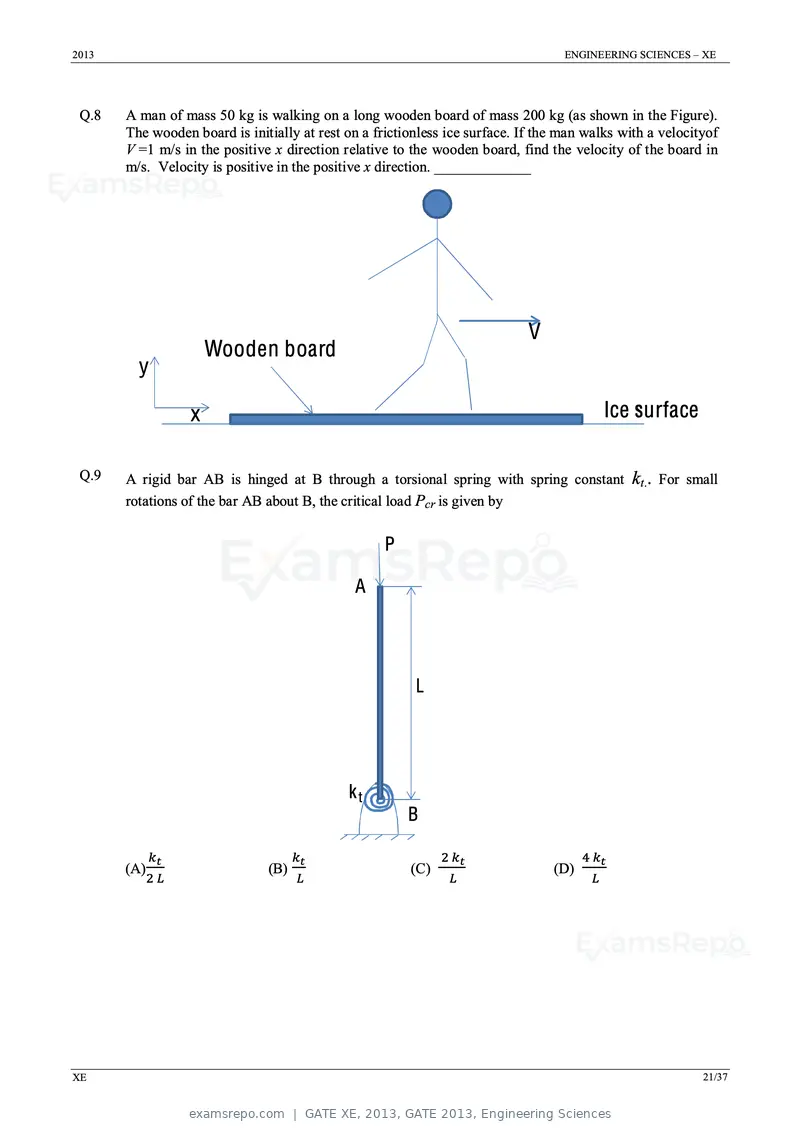
Text of page 21
2013                                                                               ENGINEERING SCIENCES – XE


 Q.8   A man of mass 50 kg is walking on a long wooden board of mass 200 kg (as shown in the Figure).
       The wooden board is initially at rest on a frictionless ice surface. If the man walks with a velocityof
       V =1 m/s in the positive x direction relative to the wooden board, find the velocity of the board in
       m/s. Velocity is positive in the positive x direction. _____________


                                                                             V
                      Wooden board
         y

                  x                                                                       Ice surface

 Q.9   A rigid bar AB is hinged at B through a torsional spring with spring constant kt.. For small
       rotations of the bar AB about B, the critical load Pcr is given by


                                                    P

                                              A


                                                         L


                                             kt
                                                        B

       (A)                     (B)                      (C)                      (D)


XE                                                                                                         21/37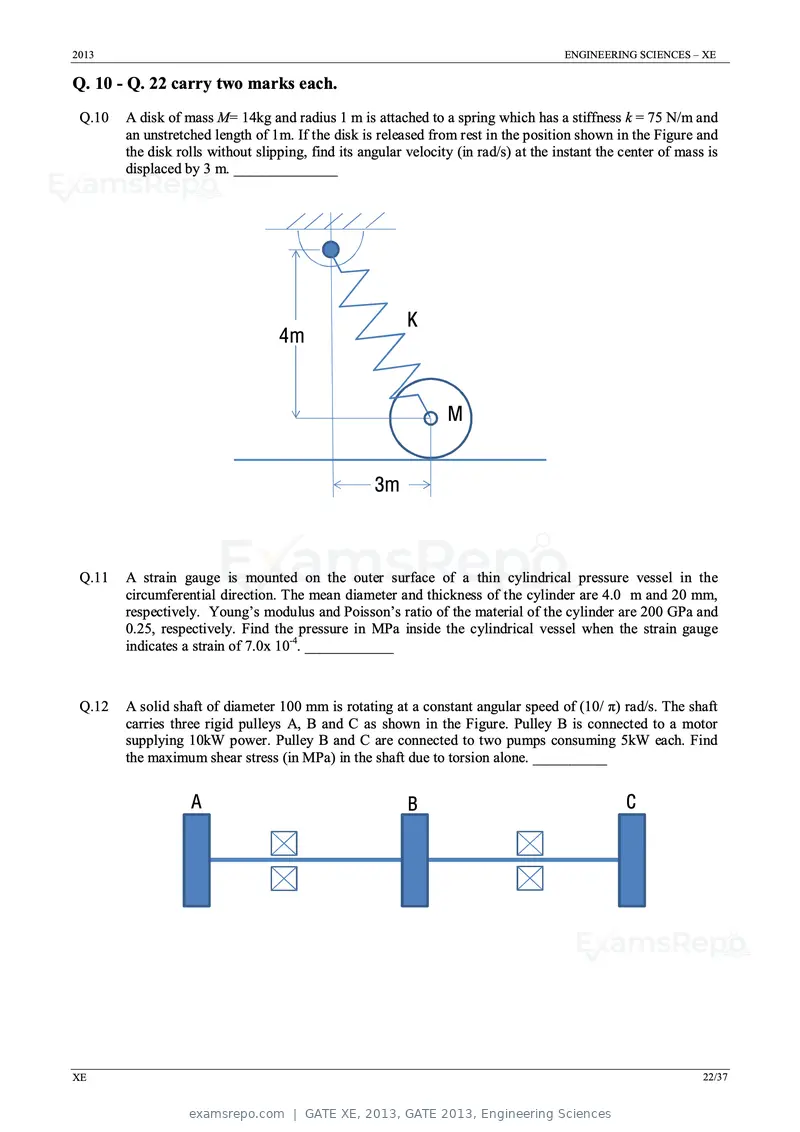
Text of page 22
2013                                                                                  ENGINEERING SCIENCES – XE

Q. 10 - Q. 22 carry two marks each.
 Q.10   A disk of mass M= 14kg and radius 1 m is attached to a spring which has a stiffness k = 75 N/m and
        an unstretched length of 1m. If the disk is released from rest in the position shown in the Figure and
        the disk rolls without slipping, find its angular velocity (in rad/s) at the instant the center of mass is
        displaced by 3 m. ______________


                                                          K
                                   4m


                                                                 M


                                                    3m


 Q.11   A strain gauge is mounted on the outer surface of a thin cylindrical pressure vessel in the
        circumferential direction. The mean diameter and thickness of the cylinder are 4.0 m and 20 mm,
        respectively. Young’s modulus and Poisson’s ratio of the material of the cylinder are 200 GPa and
        0.25, respectively. Find the pressure in MPa inside the cylindrical vessel when the strain gauge
        indicates a strain of 7.0x 10⁻⁴. ____________


 Q.12   A solid shaft of diameter 100 mm is rotating at a constant angular speed of (10/ π) rad/s. The shaft
        carries three rigid pulleys A, B and C as shown in the Figure. Pulley B is connected to a motor
        supplying 10kW power. Pulley B and C are connected to two pumps consuming 5kW each. Find
        the maximum shear stress (in MPa) in the shaft due to torsion alone. __________


                   A                                      B                                      C


XE                                                                                                             22/37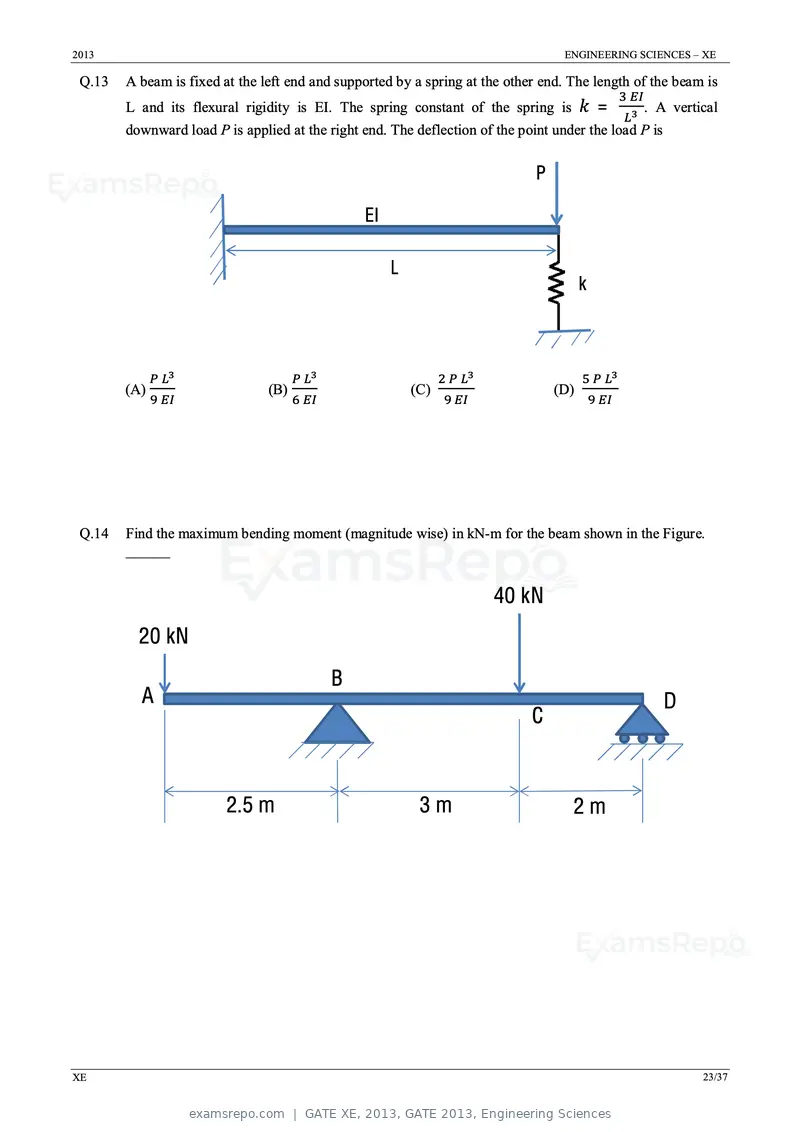
Text of page 23
2013                                                                               ENGINEERING SCIENCES – XE

 Q.13   A beam is fixed at the left end and supported by a spring at the other end. The length of the beam is
        L and its flexural rigidity is EI. The spring constant of the spring is             =   . A vertical
        downward load P is applied at the right end. The deflection of the point under the load P is


                                                                              P

                                                EI

                                                     L
                                                                                        k


        (A)                     (B)                      (C)                      (D)


 Q.14   Find the maximum bending moment (magnitude wise) in kN-m for the beam shown in the Figure.
        ______


                                                                       40 kN
          20 kN
                                           B
          A                                                                                            D
                                                                             C


                         2.5 m                            3m                        2m


XE                                                                                                         23/37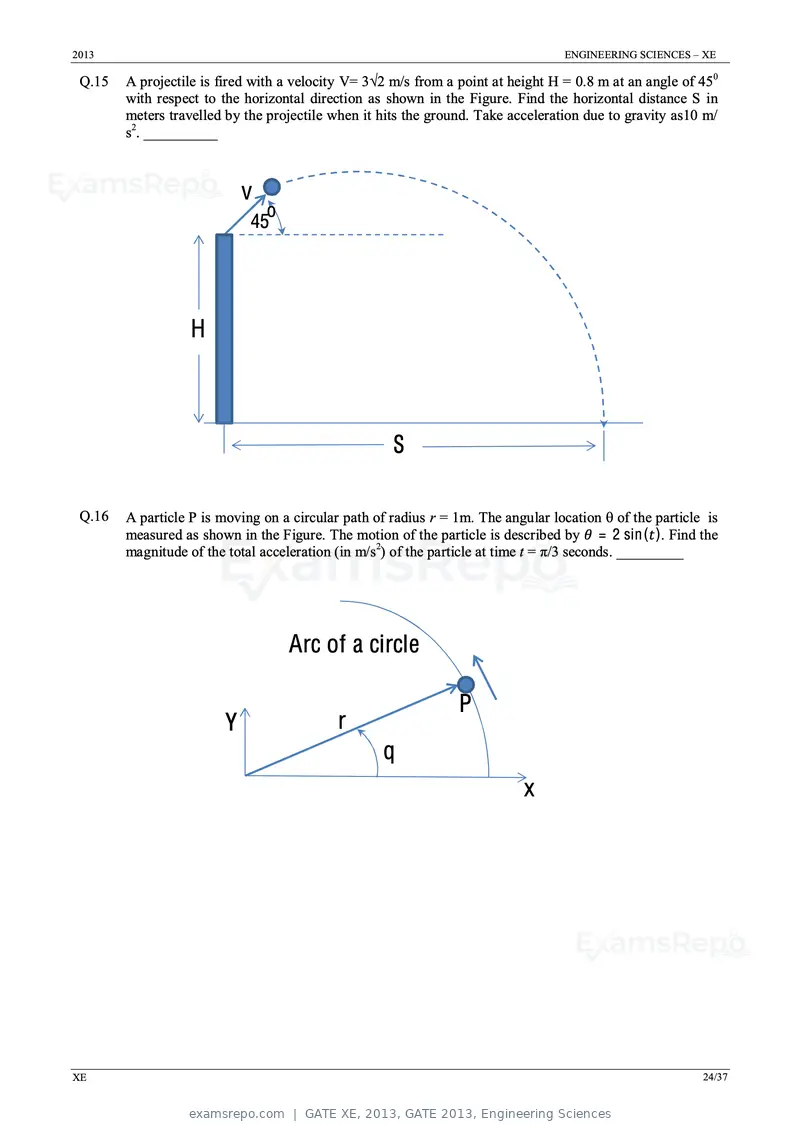
Text of page 24
2013 ENGINEERING SCIENCES – XE
Q.15 A projectile is fired with a velocity V= 3√2 m/s from a point at height H = 0.8 m at an angle of 450
with respect to the horizontal direction as shown in the Figure. Find the horizontal distance S in
meters travelled by the projectile when it hits the ground. Take acceleration due to gravity as10 m/
s2. __________
v
o
45
H
S
Q.16 A particle P is moving on a circular path of radius r = 1m. The angular location of the particle is
measured as shown in the Figure. The motion of the particle is described by = 2 sin( ). Find the
magnitude of the total acceleration (in m/s2) of the particle at time t = π/3 seconds. _________
Arc of a circle
P
Y r
q
x
XE 24/37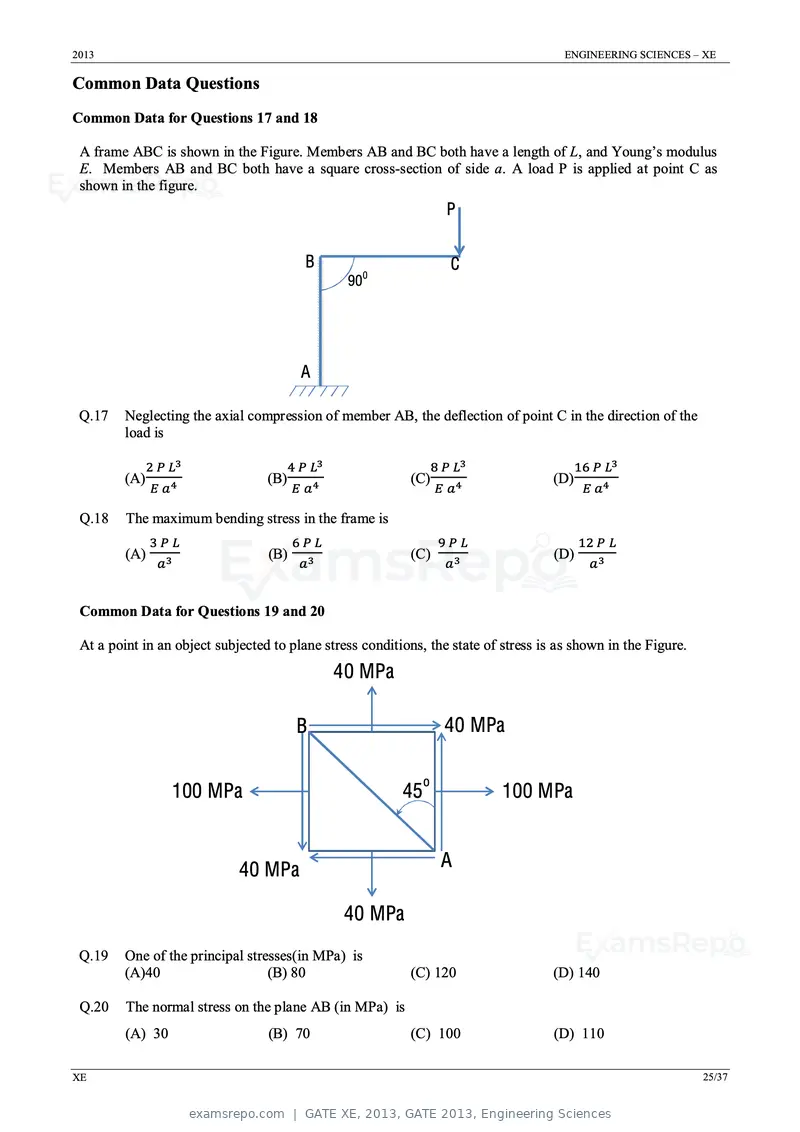
Text of page 25
2013                                                                                   ENGINEERING SCIENCES – XE

Common Data Questions
Common Data for Questions 17 and 18

 A frame ABC is shown in the Figure. Members AB and BC both have a length of L, and Young’s modulus
 E. Members AB and BC both have a square cross-section of side a. A load P is applied at point C as
 shown in the figure.
                                                                  P


                                         B                        C
                                                900


                                        A

 Q.17    Neglecting the axial compression of member AB, the deflection of point C in the direction of the
         load is


         (A)                      (B)                      (C)                       (D)

 Q.18    The maximum bending stress in the frame is

         (A)                      (B)                      (C)                       (D)


 Common Data for Questions 19 and 20

 At a point in an object subjected to plane stress conditions, the state of stress is as shown in the Figure.
                                              40 MPa

                                        B                         40 MPa

                                                              o
                  100 MPa                                 45                100 MPa


                             40 MPa                               A

                                                40 MPa

 Q.19    One of the principal stresses(in MPa) is
         (A)40                    (B) 80                   (C) 120                   (D) 140

 Q.20    The normal stress on the plane AB (in MPa) is
         (A) 30                   (B) 70                   (C) 100                   (D) 110

XE                                                                                                              25/37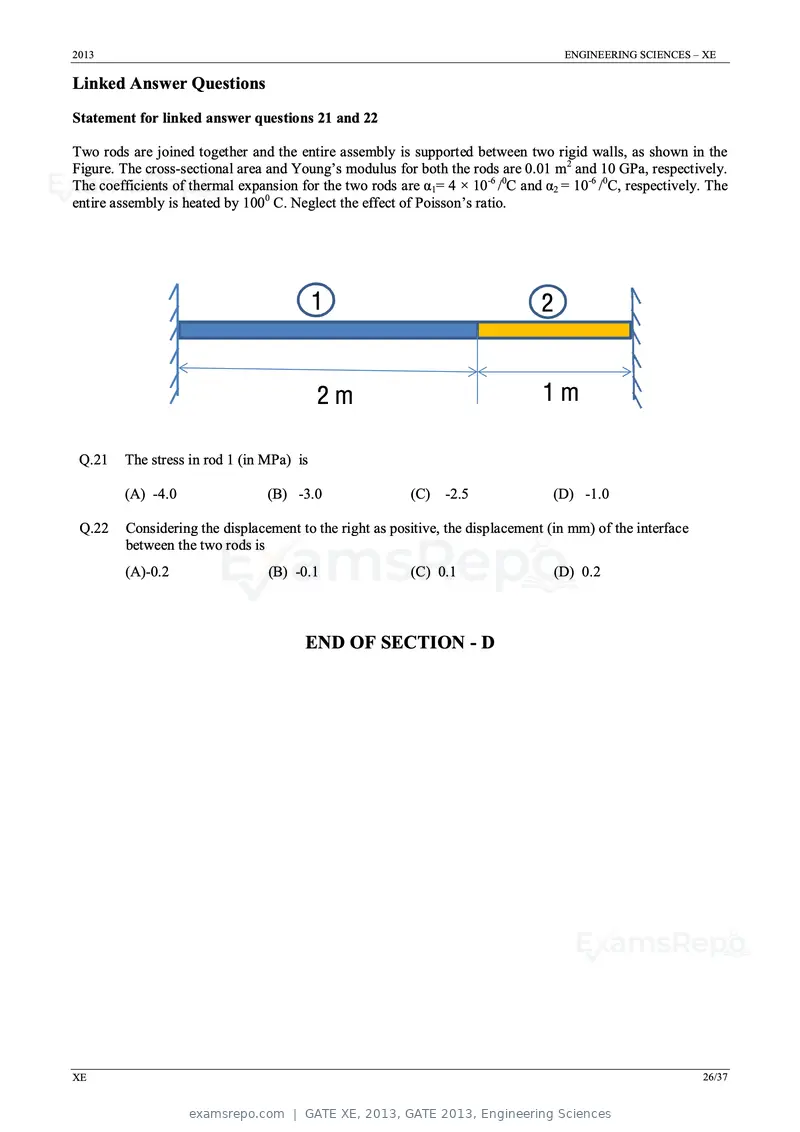
Text of page 26
2013                                                                                 ENGINEERING SCIENCES – XE

Linked Answer Questions
Statement for linked answer questions 21 and 22

Two rods are joined together and the entire assembly is supported between two rigid walls, as shown in the
Figure. The cross-sectional area and Young’s modulus for both the rods are 0.01 m2 and 10 GPa, respectively.
The coefficients of thermal expansion for the two rods are α1= 4 × 10⁻⁶ /0C and α2 = 10-6 /0C, respectively. The
entire assembly is heated by 1000 C. Neglect the effect of Poisson’s ratio.


                                          1                                     2


                                          2m                                    1m

 Q.21   The stress in rod 1 (in MPa) is

        (A) -4.0                 (B) -3.0                (C)   -2.5               (D) -1.0

 Q.22    Considering the displacement to the right as positive, the displacement (in mm) of the interface
         between the two rods is
         (A)-0.2                 (B) -0.1                (C) 0.1                    (D) 0.2


                                       END OF SECTION - D


XE                                                                                                          26/37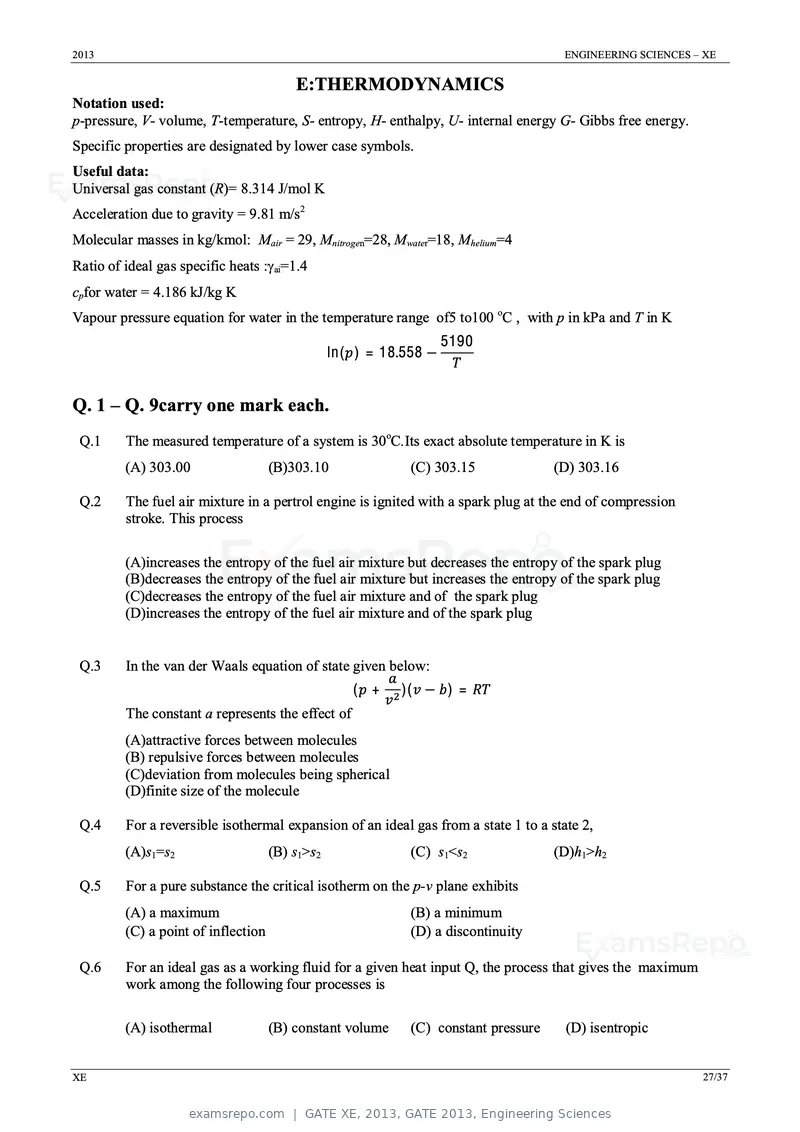
Text of page 27
2013 ENGINEERING SCIENCES – XE
E:THERMODYNAMICS
Notation used:
p-pressure, V- volume, T-temperature, S- entropy, H- enthalpy, U- internal energy G- Gibbs free energy.
Specific properties are designated by lower case symbols.
Useful data:
Universal gas constant (R)= 8.314 J/mol K
Acceleration due to gravity = 9.81 m/s2
Molecular masses in kg/kmol: Mair = 29, Mnitrogen=28, Mwater=18, Mhelium=4
Ratio of ideal gas specific heats :ai=1.4
cpfor water = 4.186 kJ/kg K
Vapour pressure equation for water in the temperature range of5 to100 oC , with p in kPa and T in K
5190
ln( ) = 18.558 −
Q. 1 – Q. 9carry one mark each.
Q.1 The measured temperature of a system is 30oC.Its exact absolute temperature in K is
(A) 303.00 (B)303.10 (C) 303.15 (D) 303.16
Q.2 The fuel air mixture in a pertrol engine is ignited with a spark plug at the end of compression
stroke. This process
(A)increases the entropy of the fuel air mixture but decreases the entropy of the spark plug
(B)decreases the entropy of the fuel air mixture but increases the entropy of the spark plug
(C)decreases the entropy of the fuel air mixture and of the spark plug
(D)increases the entropy of the fuel air mixture and of the spark plug
Q.3 In the van der Waals equation of state given below:
( + )( − ) =
The constant a represents the effect of
(A)attractive forces between molecules
(B) repulsive forces between molecules
(C)deviation from molecules being spherical
(D)finite size of the molecule
Q.4 For a reversible isothermal expansion of an ideal gas from a state 1 to a state 2,
(A)s1=s2 (B) s1>s2 (C) s1<s2 (D)h1>h2
Q.5 For a pure substance the critical isotherm on the p-v plane exhibits
(A) a maximum (B) a minimum
(C) a point of inflection (D) a discontinuity
Q.6 For an ideal gas as a working fluid for a given heat input Q, the process that gives the maximum
work among the following four processes is
(A) isothermal (B) constant volume (C) constant pressure (D) isentropic
XE 27/37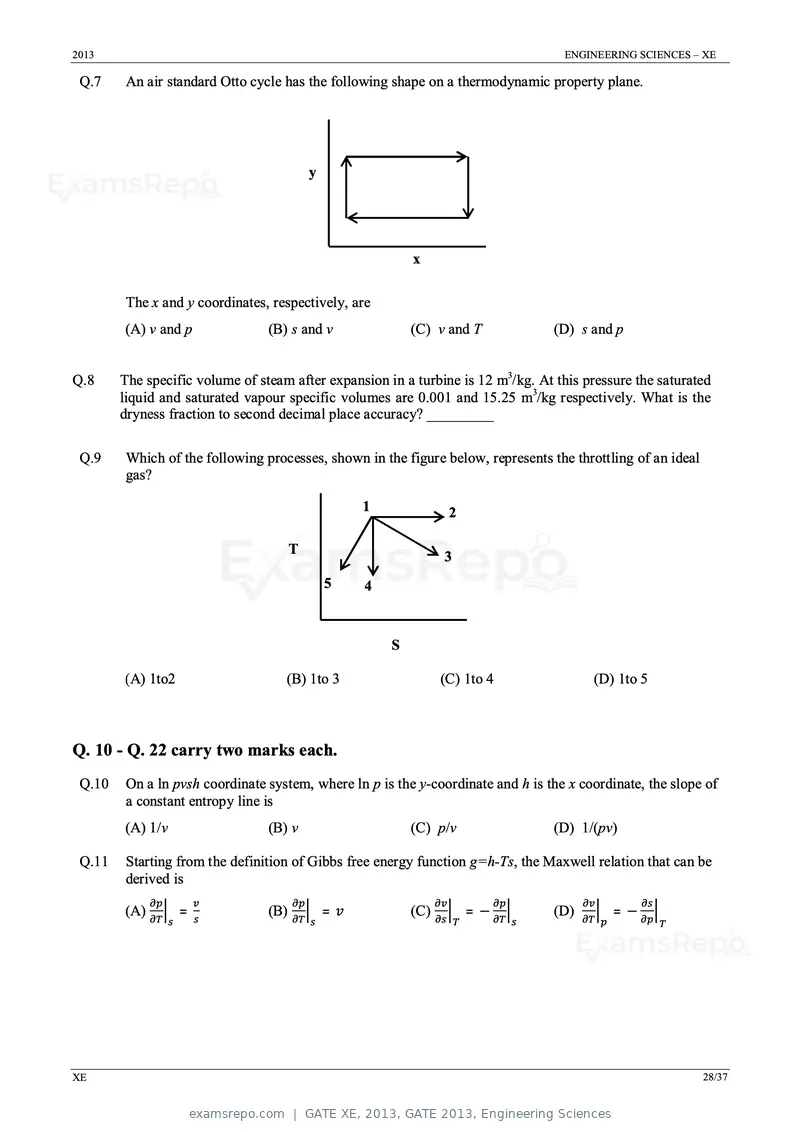
Text of page 28
2013                                                                               ENGINEERING SCIENCES – XE

 Q.7    An air standard Otto cycle has the following shape on a thermodynamic property plane.


                                           y


                                                           x

        The x and y coordinates, respectively, are
        (A) v and p              (B) s and v               (C) v and T            (D) s and p


Q.8     The specific volume of steam after expansion in a turbine is 12 m3/kg. At this pressure the saturated
        liquid and saturated vapour specific volumes are 0.001 and 15.25 m3/kg respectively. What is the
        dryness fraction to second decimal place accuracy? _________

 Q.9    Which of the following processes, shown in the figure below, represents the throttling of an ideal
        gas?

                                                   1              2

                                       T                         3
                                               5   4


                                                       S

        ((A) 1to2                   (B) 1to 3                    (C) 1to 4              (D) 1to 5


Q. 10 - Q. 22 carry two marks each.
 Q.10   On a ln pvsh coordinate system, where ln p is the y-coordinate and h is the x coordinate, the slope of
        a constant entropy line is
        (A) 1/v                  (B) v                     (C) p/v                (D) 1/(pv)

 Q.11   Starting from the definition of Gibbs free energy function g=h-Ts, the Maxwell relation that can be
        derived is

        (A)         =            (B)           =           (C)        =−          (D)      =−


XE                                                                                                           28/37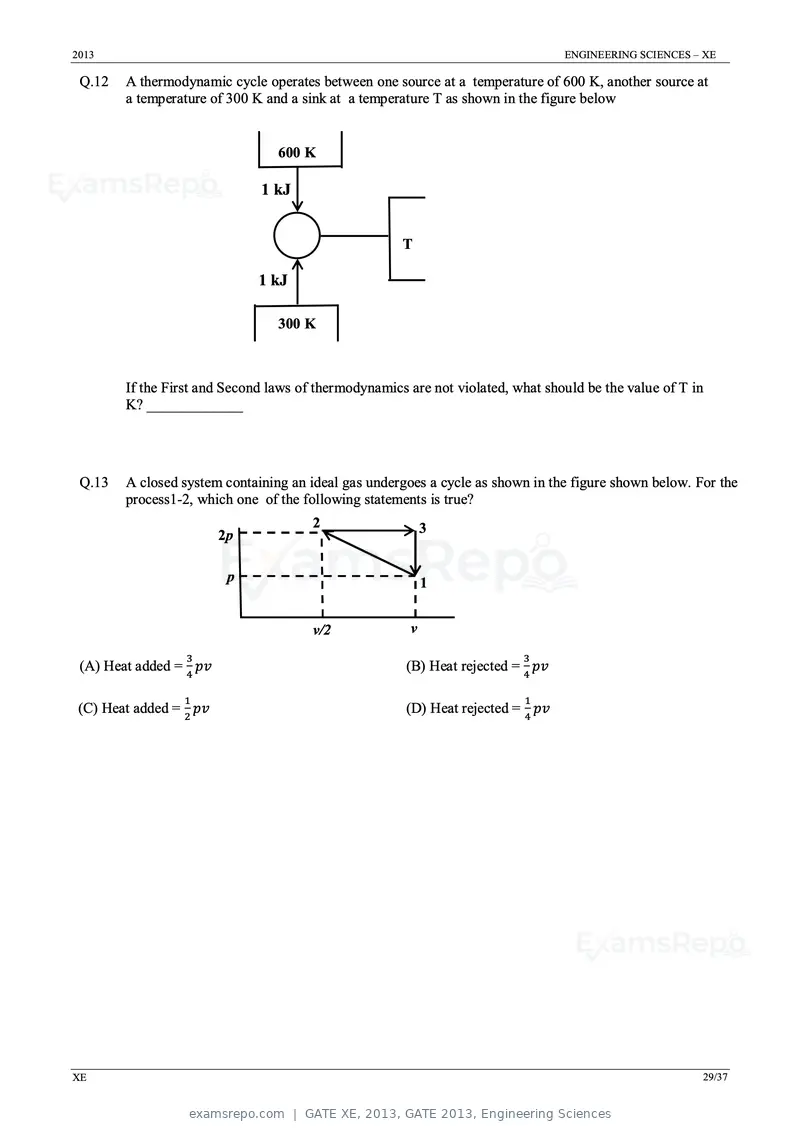
Text of page 29
2013                                                                             ENGINEERING SCIENCES – XE

 Q.12   A thermodynamic cycle operates between one source at a temperature of 600 K, another source at
        a temperature of 300 K and a sink at a temperature T as shown in the figure below


                                 600 K

                              1 kJ


                                                      T

                              1 kJ

                                 300 K


        If the First and Second laws of thermodynamics are not violated, what should be the value of T in
        K? _____________


 Q.13   A closed system containing an ideal gas undergoes a cycle as shown in the figure shown below. For the
        process1-2, which one of the following statements is true?
                                       2                   3
                       2p

                         p                                 1


                                       v/2             v

 (A) Heat added =                                      (B) Heat rejected =

 (C) Heat added =                                      (D) Heat rejected =


XE                                                                                                      29/37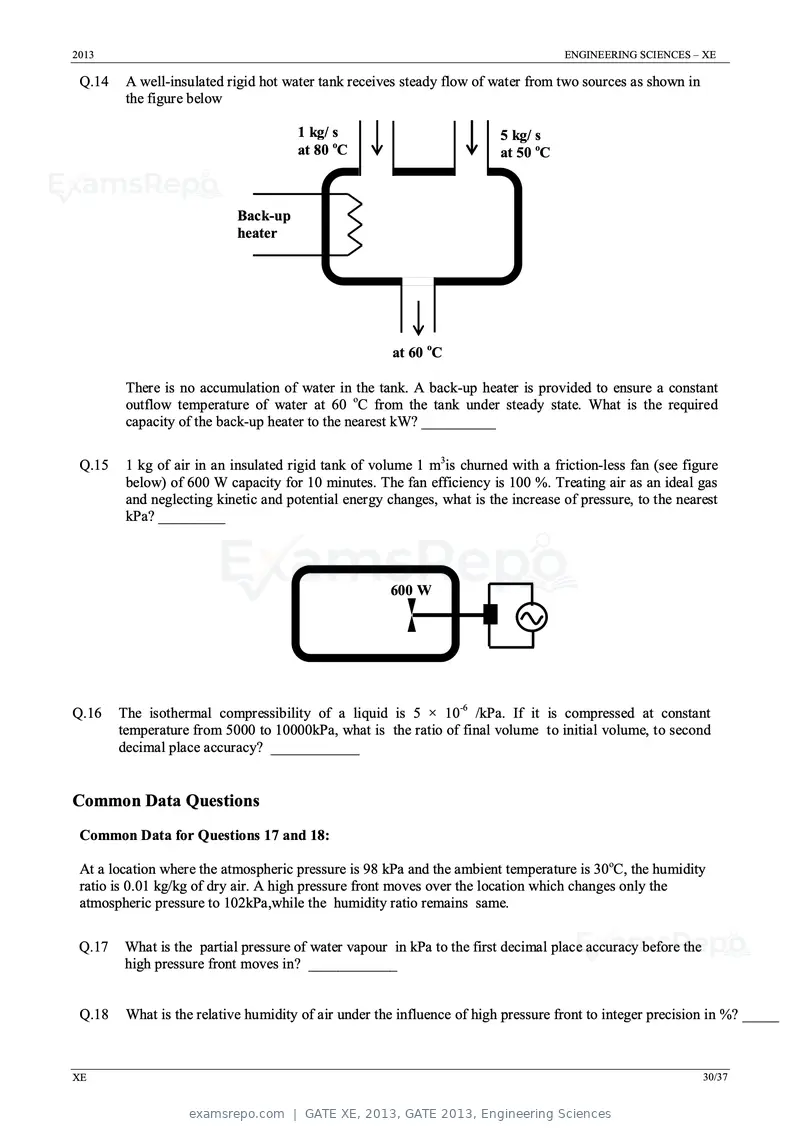
Text of page 30
2013                                                                                ENGINEERING SCIENCES – XE

 Q.14    A well-insulated rigid hot water tank receives steady flow of water from two sources as shown in
         the figure below

                                      1 kg/ s                            5 kg/ s
                                      at 80 oC                           at 50 oC


                            Back-up
                            heater


                                                      at 60 oC

         There is no accumulation of water in the tank. A back-up heater is provided to ensure a constant
         outflow temperature of water at 60 oC from the tank under steady state. What is the required
         capacity of the back-up heater to the nearest kW? __________

 Q.15    1 kg of air in an insulated rigid tank of volume 1 m3is churned with a friction-less fan (see figure
         below) of 600 W capacity for 10 minutes. The fan efficiency is 100 %. Treating air as an ideal gas
         and neglecting kinetic and potential energy changes, what is the increase of pressure, to the nearest
         kPa? _________


                                                      600 W


Q.16    The isothermal compressibility of a liquid is 5 × 10⁻⁶ /kPa. If it is compressed at constant
        temperature from 5000 to 10000kPa, what is the ratio of final volume to initial volume, to second
        decimal place accuracy? ____________


Common Data Questions
 Common Data for Questions 17 and 18:

 At a location where the atmospheric pressure is 98 kPa and the ambient temperature is 30oC, the humidity
 ratio is 0.01 kg/kg of dry air. A high pressure front moves over the location which changes only the
 atmospheric pressure to 102kPa,while the humidity ratio remains same.

 Q.17    What is the partial pressure of water vapour in kPa to the first decimal place accuracy before the
         high pressure front moves in? ____________


 Q.18    What is the relative humidity of air under the influence of high pressure front to integer precision in %? _____


XE                                                                                                            30/37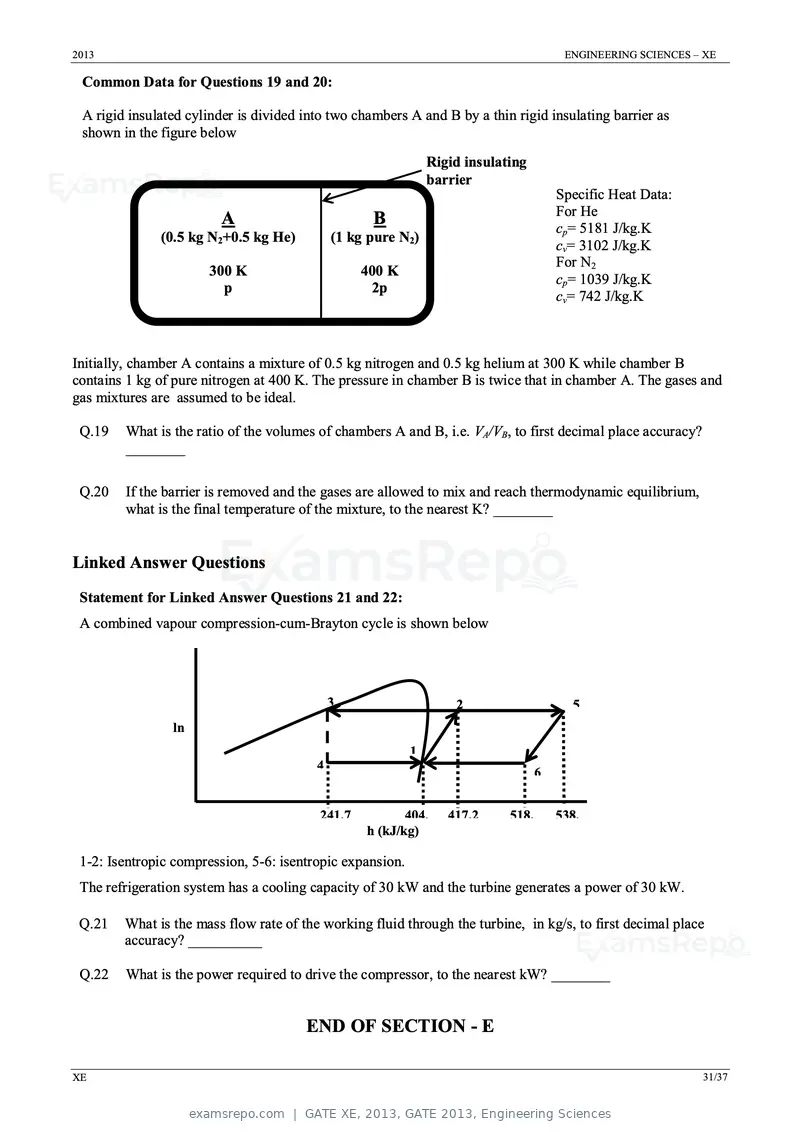
Text of page 31
2013                                                                                    ENGINEERING SCIENCES – XE

 Common Data for Questions 19 and 20:

 A rigid insulated cylinder is divided into two chambers A and B by a thin rigid insulating barrier as
 shown in the figure below
                                                               Rigid insulating
                                                               barrier
                                                                                       Specific Heat Data:
                                                                                       For He
                        A                          B                                   cp= 5181 J/kg.K
              (0.5 kg N2+0.5 kg He)          (1 kg pure N2)
                                                                                       cv= 3102 J/kg.K
                                                                                       For N2
                      300 K                      400 K
                                                                                       cp= 1039 J/kg.K
                        p                         2p
                                                                                       cv= 742 J/kg.K


Initially, chamber A contains a mixture of 0.5 kg nitrogen and 0.5 kg helium at 300 K while chamber B
contains 1 kg of pure nitrogen at 400 K. The pressure in chamber B is twice that in chamber A. The gases and
gas mixtures are assumed to be ideal.

 Q.19   What is the ratio of the volumes of chambers A and B, i.e. VA/VB, to first decimal place accuracy?
        ________

 Q.20   If the barrier is removed and the gases are allowed to mix and reach thermodynamic equilibrium,
        what is the final temperature of the mixture, to the nearest K? ________


Linked Answer Questions
 Statement for Linked Answer Questions 21 and 22:
 A combined vapour compression-cum-Brayton cycle is shown below


                                             3                     2                     5
                ln
                p
                                                           1
                                         4
                                                                                   6


                                         241.7           404.     417.2     518.       538.
                                                  h (kJ/kg)

 1-2: Isentropic compression, 5-6: isentropic expansion.
 The refrigeration system has a cooling capacity of 30 kW and the turbine generates a power of 30 kW.

 Q.21   What is the mass flow rate of the working fluid through the turbine, in kg/s, to first decimal place
        accuracy? __________

 Q.22   What is the power required to drive the compressor, to the nearest kW? ________


                                       END OF SECTION - E

XE                                                                                                            31/37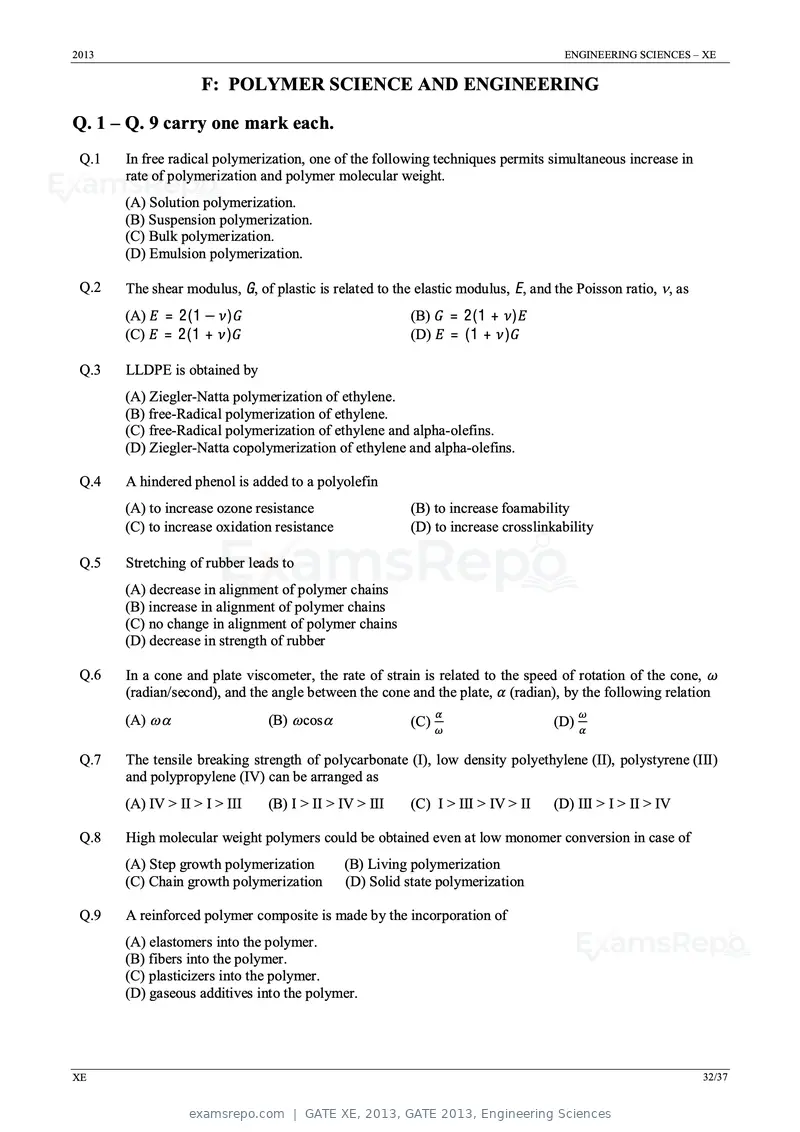
Text of page 32
2013 ENGINEERING SCIENCES – XE
F: POLYMER SCIENCE AND ENGINEERING
Q. 1 – Q. 9 carry one mark each.
Q.1 In free radical polymerization, one of the following techniques permits simultaneous increase in
rate of polymerization and polymer molecular weight.
(A) Solution polymerization.
(B) Suspension polymerization.
(C) Bulk polymerization.
(D) Emulsion polymerization.
Q.2 The shear modulus, G, of plastic is related to the elastic modulus, E, and the Poisson ratio, , as
(A) = 2(1 − ) (B) = 2(1 + )
(C) = 2(1 + ) (D) = (1 + )
Q.3 LLDPE is obtained by
(A) Ziegler-Natta polymerization of ethylene.
(B) free-Radical polymerization of ethylene.
(C) free-Radical polymerization of ethylene and alpha-olefins.
(D) Ziegler-Natta copolymerization of ethylene and alpha-olefins.
Q.4 A hindered phenol is added to a polyolefin
(A) to increase ozone resistance (B) to increase foamability
(C) to increase oxidation resistance (D) to increase crosslinkability
Q.5 Stretching of rubber leads to
(A) decrease in alignment of polymer chains
(B) increase in alignment of polymer chains
(C) no change in alignment of polymer chains
(D) decrease in strength of rubber
Q.6 In a cone and plate viscometer, the rate of strain is related to the speed of rotation of the cone,
(radian/second), and the angle between the cone and the plate, (radian), by the following relation
(A) (B) cos (C) (D)
Q.7 The tensile breaking strength of polycarbonate (I), low density polyethylene (II), polystyrene (III)
and polypropylene (IV) can be arranged as
(A) IV > II > I > III (B) I > II > IV > III (C) I > III > IV > II (D) III > I > II > IV
Q.8 High molecular weight polymers could be obtained even at low monomer conversion in case of
(A) Step growth polymerization (B) Living polymerization
(C) Chain growth polymerization (D) Solid state polymerization
Q.9 A reinforced polymer composite is made by the incorporation of
(A) elastomers into the polymer.
(B) fibers into the polymer.
(C) plasticizers into the polymer.
(D) gaseous additives into the polymer.
XE 32/37
Text of page 33
2013                                                                               ENGINEERING SCIENCES – XE

Q. 10 - Q. 22 carry two marks each.
 Q.10   Match the following for free-radical copolymerization of two monomers with reactivity ratios, r1
        and r2.
                Reactivity Ratios                    Copolymer Nature
                P. r1 = r2 = 0                 1. Random copolymer
                Q. r1 = r2 = 1                 2. Alternate copolymer
                R. r1 >1, r2 > 1               3. Block copolymer
                S. 0 < r1r2 < 1                4. Random-Block copolymer
        (A) P-2; Q-1; R-3; S-4                           (B) P-3; Q-1; R-2; S-4
        (C) P-2; Q-4; R-3; S-1                           (D) P-2; Q-3; R-1; S-4

 Q.11   The relative viscosity of a 1% solution (weight/volume) of a given polymer was found to be 1.1.
        The inherent viscosity of this polymer will be
        (A) 0.065 dl/g           (B) 0.075 dl/g          (C) 0.085 dl/g           (D) 0.095 dl/g

 Q.12   Match the following in case of step-growth polymerization, where A reacts only with B, and B
                                                                     B
        reacts only with A (Note: A A is expressed as A2, and A         is expressed as AB2).
                                                                     B
                  Monomers                            Polymer
                P. A2 + AB3               1. Hyperbranched Polymer
                Q. AB2                    2. Crosslinked Polymer
                R. AB + B3                3. Star Polymer
                S. A2 + B2                4. Linear Polymer
        (A) P-2; Q-3; R-1; S-4                           (B) P-2; Q-1; R-3; S-4
        (C) P-1; Q-2; R-3; S-4                           (D) P-2; Q-4; R-1; S-3

 Q.13   Match each of the following additives for plastics with its function
                  Additive                             Function
                P. α-Cellulose                    1. Flame retarder
                Q. Zinc chromate                  2. Plasticizer extender
                R. Alumina trihydrate             3. Organic fibrous filler
                S. Chlorinated paraffin wax       4. Colorant
        (A) P-1; Q-2; R-3; S-4                           (B) P-2; Q-3; R-4; S-1
        (C) P-3; Q-4; R-1; S-2                           (D) P-4; Q-1; R-2; S-3

 Q.14   The length of a glass fiber reinforced polymer increased by 0.03mm, from its initial length of
        100mm, when the temperature was changed from –30oC to +30oC. The coefficient of linear thermal
        expansion is
        (A) 1.03 x 10⁻⁵ oC-1     (B) 9.82 x 10⁻⁶ oC-1    (C) 5.00 x 10⁻⁶ oC-1     (D) 14.4 x 10⁻⁵ oC-1

 Q.15   A 40mm x 40mm square polymer composite sample with 5mm thickness (heat transfer distance)
        exhibited a heat flow rate of 60W, when the temperatures of the warm and cold surfaces were 90oC
        and 25oC respectively. The thermal conductivity of the sample in W.m-1.K-1is
        (A) 5.67                 (B) 15.3                (C) 2.88                 (D) 0.667

 Q.16   An extruder is supplied with 40 kW of power. The mass flow rate of a polymer through the
        extruder is 240 kg h-1 and the specific heat capacity of the polymer is 4 kJ kg-1 K-1. The maximum
        possible temperature rise in the polymer is
        (A) 150 K                (B) 100 K               (C) 600 K                (D) Zero

XE                                                                                                       33/37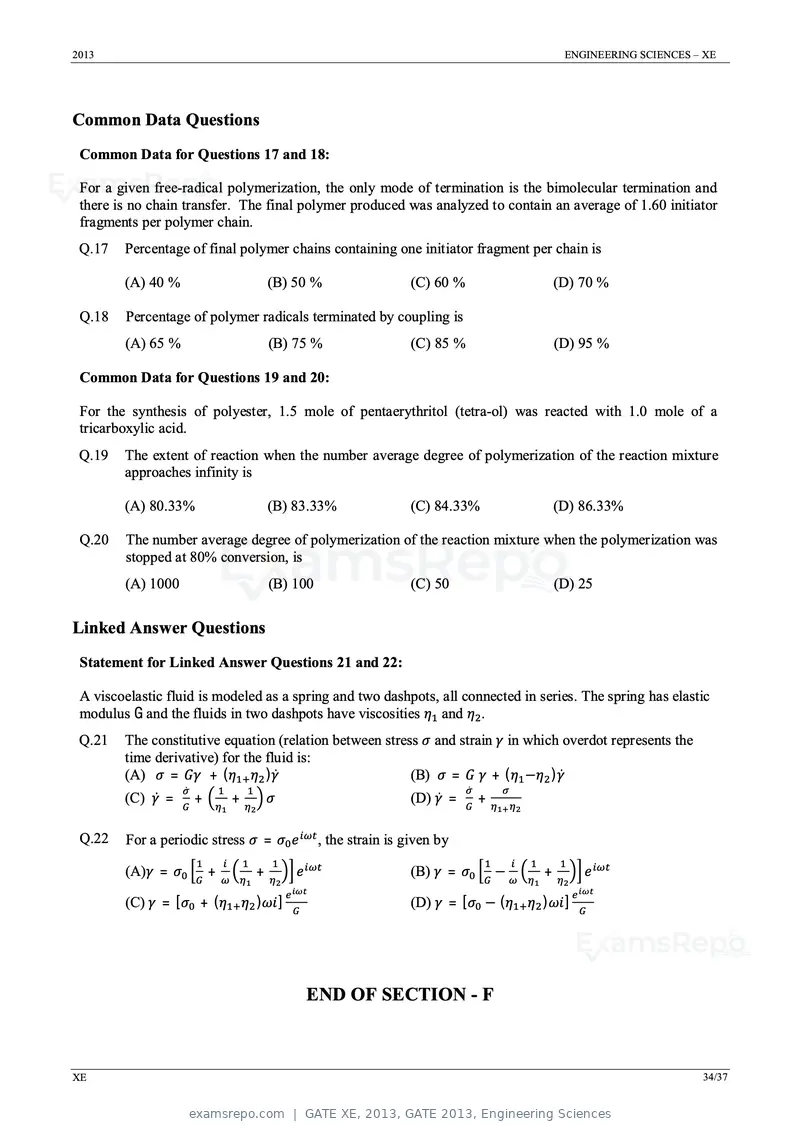
Text of page 34
2013                                                                                           ENGINEERING SCIENCES – XE


Common Data Questions
 Common Data for Questions 17 and 18:

 For a given free-radical polymerization, the only mode of termination is the bimolecular termination and
 there is no chain transfer. The final polymer produced was analyzed to contain an average of 1.60 initiator
 fragments per polymer chain.
 Q.17   Percentage of final polymer chains containing one initiator fragment per chain is

        (A) 40 %                        (B) 50 %                   (C) 60 %                   (D) 70 %

 Q.18   Percentage of polymer radicals terminated by coupling is
        (A) 65 %                        (B) 75 %                   (C) 85 %                   (D) 95 %

 Common Data for Questions 19 and 20:

 For the synthesis of polyester, 1.5 mole of pentaerythritol (tetra-ol) was reacted with 1.0 mole of a
 tricarboxylic acid.
 Q.19   The extent of reaction when the number average degree of polymerization of the reaction mixture
        approaches infinity is

        (A) 80.33%                      (B) 83.33%                 (C) 84.33%                 (D) 86.33%

 Q.20   The number average degree of polymerization of the reaction mixture when the polymerization was
        stopped at 80% conversion, is
        (A) 1000                        (B) 100                    (C) 50                     (D) 25


Linked Answer Questions
 Statement for Linked Answer Questions 21 and 22:

 A viscoelastic fluid is modeled as a spring and two dashpots, all connected in series. The spring has elastic
 modulus G and the fluids in two dashpots have viscosities and .
 Q.21   The constitutive equation (relation between stress and strain in which overdot represents the
        time derivative) for the fluid is:
        (A)    =      +(         ) ̇                     (B) =       +( − ) ̇
                    ̇                                                         ̇
        (C) ̇ =         +       +                                  (D) ̇ =        +

 Q.22   For a periodic stress           =         , the strain is given by

        (A) =               +       +                              (B)   =            −   +

        (C)    =[       +(          )       ]                      (D)   =[       −(      )    ]


                                                END OF SECTION - F


XE                                                                                                                   34/37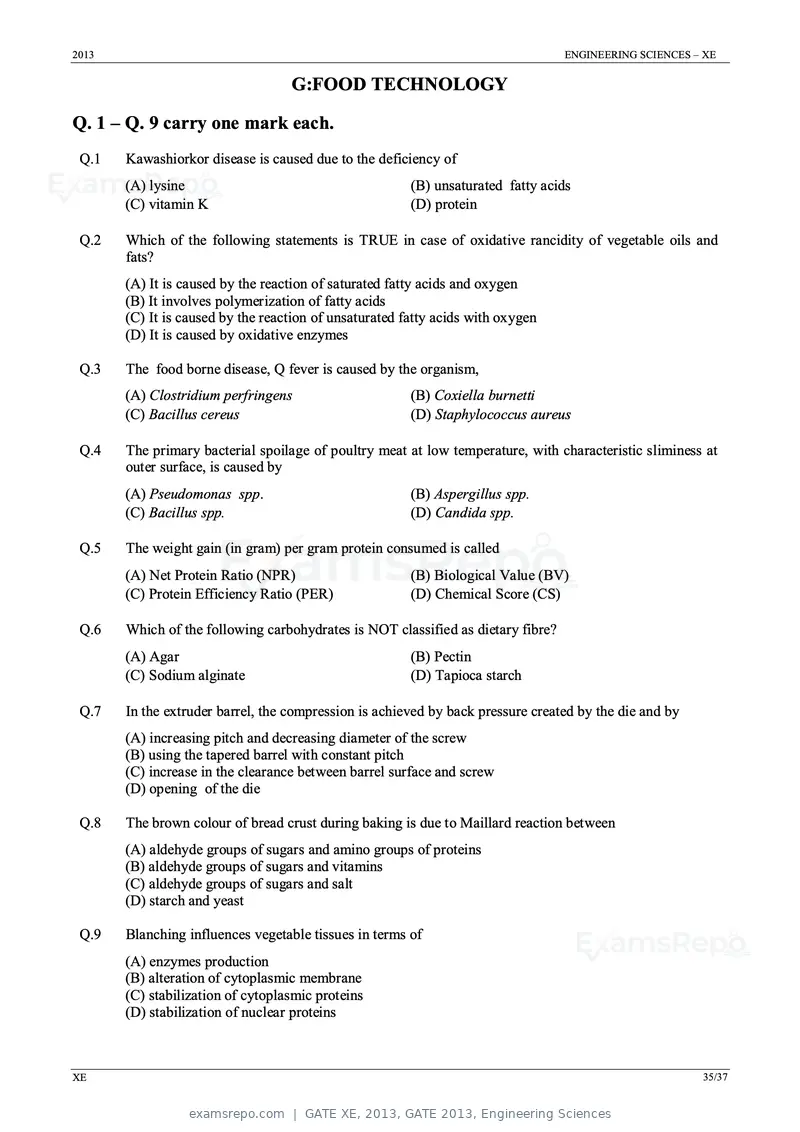
Text of page 35
2013                                                                              ENGINEERING SCIENCES – XE


                                   G:FOOD TECHNOLOGY

Q. 1 – Q. 9 carry one mark each.
 Q.1   Kawashiorkor disease is caused due to the deficiency of
       (A) lysine                                       (B) unsaturated fatty acids
       (C) vitamin K                                    (D) protein

 Q.2   Which of the following statements is TRUE in case of oxidative rancidity of vegetable oils and
       fats?
       (A) It is caused by the reaction of saturated fatty acids and oxygen
       (B) It involves polymerization of fatty acids
       (C) It is caused by the reaction of unsaturated fatty acids with oxygen
       (D) It is caused by oxidative enzymes

 Q.3   The food borne disease, Q fever is caused by the organism,
       (A) Clostridium perfringens                      (B) Coxiella burnetti
       (C) Bacillus cereus                              (D) Staphylococcus aureus

 Q.4   The primary bacterial spoilage of poultry meat at low temperature, with characteristic sliminess at
       outer surface, is caused by
       (A) Pseudomonas spp.                             (B) Aspergillus spp.
       (C) Bacillus spp.                                (D) Candida spp.

 Q.5   The weight gain (in gram) per gram protein consumed is called
       (A) Net Protein Ratio (NPR)                      (B) Biological Value (BV)
       (C) Protein Efficiency Ratio (PER)               (D) Chemical Score (CS)

 Q.6   Which of the following carbohydrates is NOT classified as dietary fibre?
       (A) Agar                                         (B) Pectin
       (C) Sodium alginate                              (D) Tapioca starch

 Q.7   In the extruder barrel, the compression is achieved by back pressure created by the die and by
       (A) increasing pitch and decreasing diameter of the screw
       (B) using the tapered barrel with constant pitch
       (C) increase in the clearance between barrel surface and screw
       (D) opening of the die

 Q.8   The brown colour of bread crust during baking is due to Maillard reaction between
       (A) aldehyde groups of sugars and amino groups of proteins
       (B) aldehyde groups of sugars and vitamins
       (C) aldehyde groups of sugars and salt
       (D) starch and yeast

 Q.9   Blanching influences vegetable tissues in terms of
       (A) enzymes production
       (B) alteration of cytoplasmic membrane
       (C) stabilization of cytoplasmic proteins
       (D) stabilization of nuclear proteins


XE                                                                                                      35/37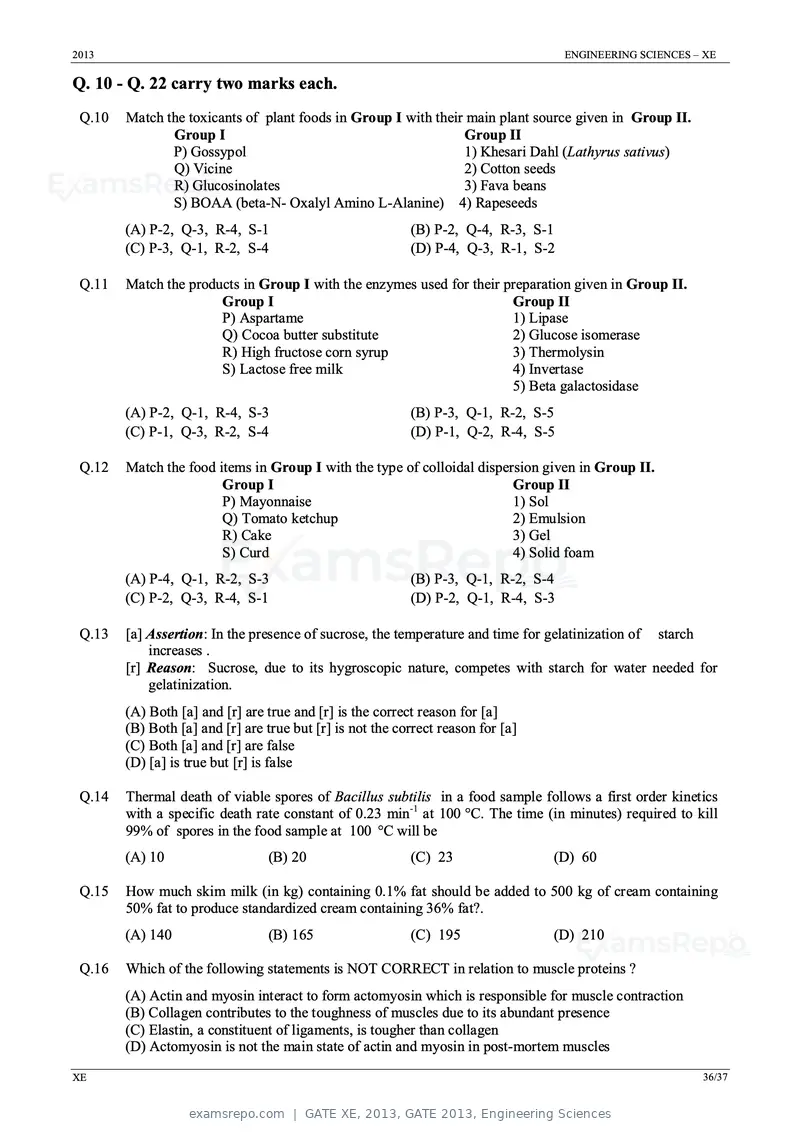
Text of page 36
2013                                                                                ENGINEERING SCIENCES – XE

Q. 10 - Q. 22 carry two marks each.
 Q.10   Match the toxicants of plant foods in Group I with their main plant source given in Group II.
               Group I                                          Group II
               P) Gossypol                                      1) Khesari Dahl (Lathyrus sativus)
               Q) Vicine                                        2) Cotton seeds
               R) Glucosinolates                                3) Fava beans
               S) BOAA (beta-N- Oxalyl Amino L-Alanine) 4) Rapeseeds
        (A) P-2, Q-3, R-4, S-1                             (B) P-2, Q-4, R-3, S-1
        (C) P-3, Q-1, R-2, S-4                             (D) P-4, Q-3, R-1, S-2

 Q.11   Match the products in Group I with the enzymes used for their preparation given in Group II.
                       Group I                                         Group II
                       P) Aspartame                                    1) Lipase
                       Q) Cocoa butter substitute                      2) Glucose isomerase
                       R) High fructose corn syrup                     3) Thermolysin
                       S) Lactose free milk                            4) Invertase
                                                                       5) Beta galactosidase
        (A) P-2, Q-1, R-4, S-3                             (B) P-3, Q-1, R-2, S-5
        (C) P-1, Q-3, R-2, S-4                             (D) P-1, Q-2, R-4, S-5

 Q.12   Match the food items in Group I with the type of colloidal dispersion given in Group II.
                        Group I                                          Group II
                        P) Mayonnaise                                    1) Sol
                        Q) Tomato ketchup                                2) Emulsion
                        R) Cake                                          3) Gel
                        S) Curd                                          4) Solid foam
        (A) P-4, Q-1, R-2, S-3                             (B) P-3, Q-1, R-2, S-4
        (C) P-2, Q-3, R-4, S-1                             (D) P-2, Q-1, R-4, S-3

 Q.13   [a] Assertion: In the presence of sucrose, the temperature and time for gelatinization of starch
            increases .
        [r] Reason: Sucrose, due to its hygroscopic nature, competes with starch for water needed for
            gelatinization.
        (A) Both [a] and [r] are true and [r] is the correct reason for [a]
        (B) Both [a] and [r] are true but [r] is not the correct reason for [a]
        (C) Both [a] and [r] are false
        (D) [a] is true but [r] is false

 Q.14   Thermal death of viable spores of Bacillus subtilis in a food sample follows a first order kinetics
        with a specific death rate constant of 0.23 min-1 at 100 °C. The time (in minutes) required to kill
        99% of spores in the food sample at 100 °C will be
        (A) 10                   (B) 20                    (C) 23                 (D) 60

 Q.15   How much skim milk (in kg) containing 0.1% fat should be added to 500 kg of cream containing
        50% fat to produce standardized cream containing 36% fat?.
        (A) 140                  (B) 165                   (C) 195                (D) 210

 Q.16   Which of the following statements is NOT CORRECT in relation to muscle proteins ?
        (A) Actin and myosin interact to form actomyosin which is responsible for muscle contraction
        (B) Collagen contributes to the toughness of muscles due to its abundant presence
        (C) Elastin, a constituent of ligaments, is tougher than collagen
        (D) Actomyosin is not the main state of actin and myosin in post-mortem muscles

XE                                                                                                        36/37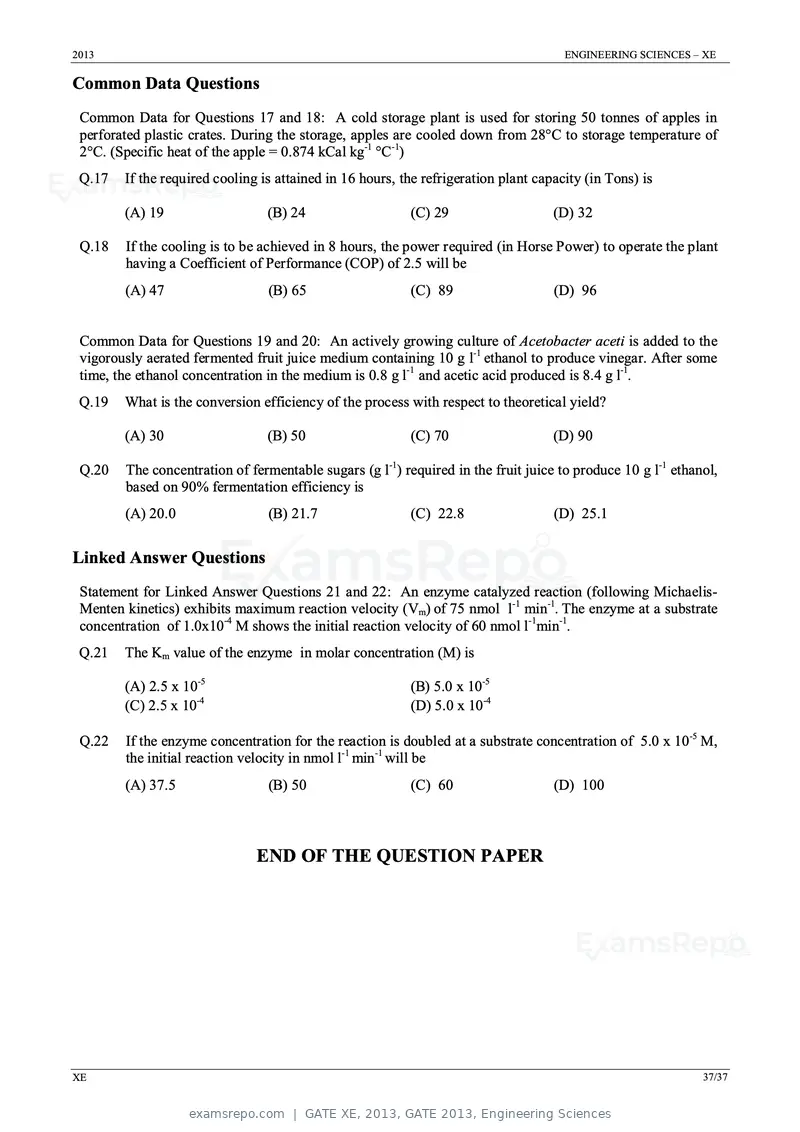
Text of page 37
2013                                                                                  ENGINEERING SCIENCES – XE

Common Data Questions
 Common Data for Questions 17 and 18: A cold storage plant is used for storing 50 tonnes of apples in
 perforated plastic crates. During the storage, apples are cooled down from 28°C to storage temperature of
 2°C. (Specific heat of the apple = 0.874 kCal kg-1 °C-1)
 Q.17   If the required cooling is attained in 16 hours, the refrigeration plant capacity (in Tons) is

        (A) 19                   (B) 24                   (C) 29                    (D) 32

 Q.18   If the cooling is to be achieved in 8 hours, the power required (in Horse Power) to operate the plant
        having a Coefficient of Performance (COP) of 2.5 will be
        (A) 47                   (B) 65                   (C) 89                    (D) 96


 Common Data for Questions 19 and 20: An actively growing culture of Acetobacter aceti is added to the
 vigorously aerated fermented fruit juice medium containing 10 g l-1 ethanol to produce vinegar. After some
 time, the ethanol concentration in the medium is 0.8 g l-1 and acetic acid produced is 8.4 g l-1.
 Q.19   What is the conversion efficiency of the process with respect to theoretical yield?

        (A) 30                   (B) 50                   (C) 70                    (D) 90

 Q.20   The concentration of fermentable sugars (g l-1) required in the fruit juice to produce 10 g l-1 ethanol,
        based on 90% fermentation efficiency is
        (A) 20.0                 (B) 21.7                 (C) 22.8                  (D) 25.1


Linked Answer Questions
 Statement for Linked Answer Questions 21 and 22: An enzyme catalyzed reaction (following Michaelis-
 Menten kinetics) exhibits maximum reaction velocity (Vm) of 75 nmol l-1 min-1. The enzyme at a substrate
 concentration of 1.0x10⁻⁴ M shows the initial reaction velocity of 60 nmol l-1min-1.
 Q.21   The Km value of the enzyme in molar concentration (M) is

        (A) 2.5 x 10⁻⁵                                    (B) 5.0 x 10⁻⁵
        (C) 2.5 x 10⁻⁴                                    (D) 5.0 x 10⁻⁴

 Q.22   If the enzyme concentration for the reaction is doubled at a substrate concentration of 5.0 x 10⁻⁵ M,
        the initial reaction velocity in nmol l-1 min-1 will be
        (A) 37.5                 (B) 50                   (C) 60                    (D) 100


                               END OF THE QUESTION PAPER


XE                                                                                                           37/37
Official key not published for this paper.
Page 1 of 37
Source: GATE. Question paper published by GATE.