
GATE XE 2014: Engineering Sciences
Text of page 1
GATE 2014: General Instructions during Examination

   1. Total duration of the GATE examination is 180 minutes.
   2. The clock will be set at the server. The countdown timer at the top right corner of
      screen will display the remaining time available for you to complete the examination.
      When the timer reaches zero, the examination will end by itself. You need not
      terminate the examination or submit your paper.
   3. Any useful data required for your paper can be viewed by clicking on the Useful
      Common Data button that appears on the screen.
   4. Use the scribble pad provided to you for any rough work. Submit the scribble pad at
      the end of the examination.
   5. You are allowed to use a non-programmable type calculator, however, sharing of
      calculators is not allowed.
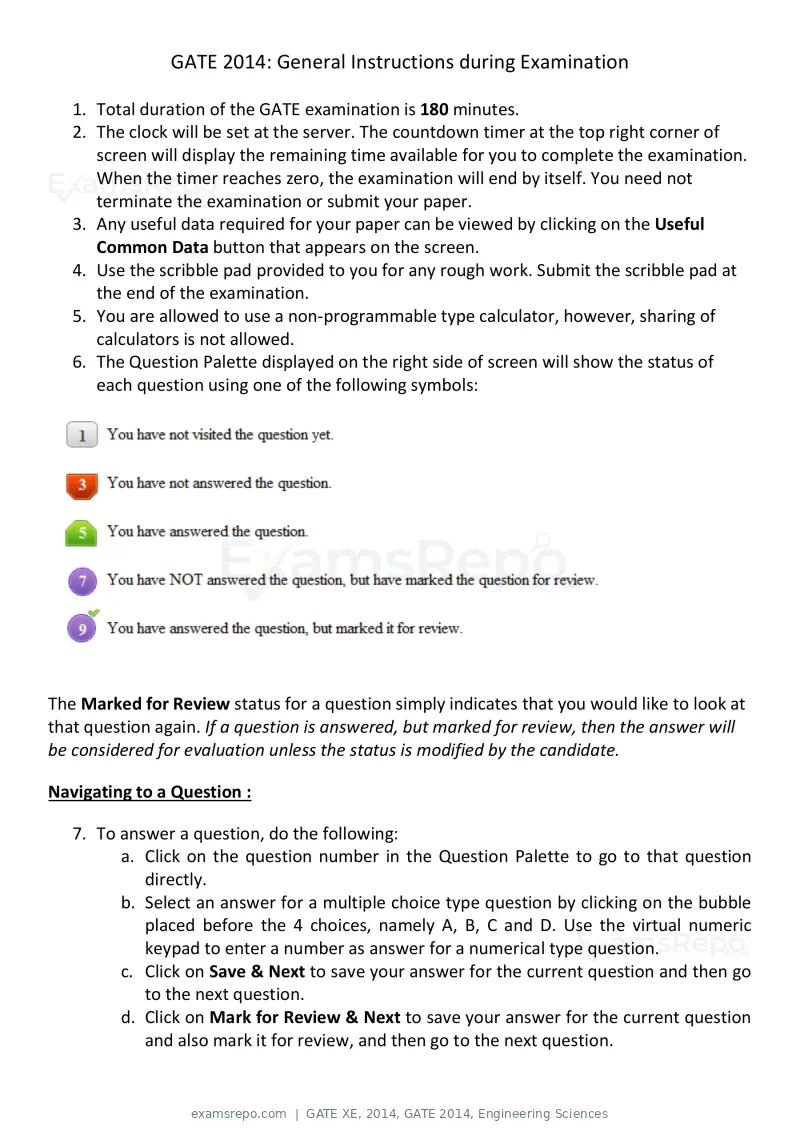
   6. The Question Palette displayed on the right side of screen will show the status of
      each question using one of the following symbols:


The Marked for Review status for a question simply indicates that you would like to look at
that question again. If a question is answered, but marked for review, then the answer will
be considered for evaluation unless the status is modified by the candidate.

Navigating to a Question :

   7. To answer a question, do the following:
         a. Click on the question number in the Question Palette to go to that question
            directly.
         b. Select an answer for a multiple choice type question by clicking on the bubble
            placed before the 4 choices, namely A, B, C and D. Use the virtual numeric
            keypad to enter a number as answer for a numerical type question.
         c. Click on Save & Next to save your answer for the current question and then go
            to the next question.
         d. Click on Mark for Review & Next to save your answer for the current question
            and also mark it for review, and then go to the next question.
Text of page 2
Caution: Note that your answer for the current question will not be saved, if you navigate
to another question directly by clicking on a question number without saving the answer to
the previous question.

You can view all the questions by clicking on the Question Paper button. This feature is
provided, so that if you want you can just see the entire question paper at a glance.

Answering a Question :

   8. Procedure for answering a multiple choice (MCQ) type question:
         a. Choose one answer from the 4 options (A,B,C,D) given below the question,
            click on the bubble placed before the chosen option.
         b. To deselect your chosen answer, click on the bubble of the chosen option again
            or click on the Clear Response button.
         c. To change your chosen answer, click on the bubble of another option.
         d. To save your answer, you MUST click on the Save & Next button.

   9. Procedure for answering a numerical answer type question:
         a. To enter a number as your answer, use the virtual numerical keypad.
         b. A fraction (e.g. -0.3 or -.3) can be entered as an answer with or without '0'
             before the decimal point. As many as four decimal points, e.g. 12.5435 or
             0.003 or -932.6711 or 12.82 can be entered.
         c. To clear your answer, click on the Clear Response button.
         d. To save your answer, you MUST click on the Save & Next button
   10. To mark a question for review, click on the Mark for Review & Next button. If an
      answer is selected (for MCQ) or entered (for numerical answer type) for a question
      that is Marked for Review, that answer will be considered in the evaluation unless
      the status is modified by the candidate.

   11. To change your answer to a question that has already been answered, first select
      that question for answering and then follow the procedure for answering that type of
      question.
   12. Note that ONLY Questions for which answers are saved or marked for review after
      answering will be considered for evaluation.


      Choosing a Section :

   13. Sections in this question paper are displayed on the top bar of the screen. Questions
      in a Section can be viewed by clicking on the name of that Section. The Section you
      are currently viewing will be highlighted.
   14. A checkbox is displayed for every optional Section, if any, in the Question Paper. To
      select the optional Section for answering, click on the checkbox for that Section.
   15. If the checkbox for an optional Section is not selected, the Save & Next button and
      the Mark for Review & Next button will NOT be enabled for that Section. You will
Text of page 3
only be able to see questions in this Section, but you will not be able to answer
      questions in the Section.
   16. After clicking the Save & Next button for the last question in a Section, you will
      automatically be taken to the first question of the next Section in sequence.
   17. You can move the mouse cursor over the name of a Section to view the answering
      status for that Section.


Changing the Optional Section :

   18. After answering the chosen optional Section, partially or completely, you can change
      the optional Section by selecting the checkbox for a new Section that you want to
      attempt. A warning message will appear along with a table showing the number of
      questions answered in each of the previously chosen optional Sections and a
      checkbox against each of these Sections. Click on a checkbox against a Section that
      you want to reset and then click on the RESET button. Note that RESETTING a Section
      will DELETE all the answers for questions in that Section. Hence, if you think that you
      may want to select this Section again later, you will have to note down your answers
      for questions in that Section. If you do not want to reset the Section and want to
      continue answering the previously chosen optional Section, then click on the BACK
      button.

   19. If you deselect the checkbox for an optional Section in the top bar, the following
      warning message will appear: "Deselecting the checkbox will DELETE all the answers
      for questions in this Section. Do you want to deselect this Section?” If you want to
      deselect, click on the RESET button. If you do not want to deselect, click on the BACK
      button.

   20. You can shuffle between different Sections or change the optional Sections any
      number of times.
Text of page 4
GATE 2014 Examination
                                       XE: Engineering Sciences
Duration: 180 minutes                                                               Maximum Marks: 100

Read the following instructions carefully.

    1. To login, enter your Registration Number and password provided to you. Kindly go through the various
       symbols used in the test and understand their meaning before you start the examination.
    2. Once you login and after the start of the examination, you can view all the questions in the question
       paper, by clicking on the View All Questions button in the screen.
    3. This paper consists of 8sections: GA (General Aptitude), A (Engineering Mathematics), B (Fluid
       Mechanics), C (Materials Science), D (Solid Mechanics), E (Thermodynamics), F (Polymer Science &
       Engineering) and G (Food Technology).
       Section GA (General Aptitude) and Section A (Engineering Mathematics) are compulsory.
       Attempt any 2 sections out of the 6 optional Sections B through G.
       There are 10 questions carrying 15 marks in the compulsory General Aptitude (GA) section.
       Question numbers 1 to 5 of this section carry 1 mark each, and question numbers 6 to 10 carry 2 marks
       each.
       There are 11 questions carrying 15 marks in Section A(Engineering Mathematics).
       Question numbers 1 to 7 of this section carry 1 mark each, and question numbers 8 to 11 carry 2 marks
       each.
       Each of the other sections (Sections B through G) contains 22 questions carrying 35 marks.
       In each of these sections, question numbers 1 to 9 carry 1 mark each and question numbers 10 to 22
       carry 2 marks each.
    4. Depending upon the GATE paper, there may be useful common data that may be required for
       answering the questions. If this paper has such useful data, the same can be viewed by clicking on the
       Useful Common Data button that appears at the top, right hand side of the screen.
    5. The computer allotted to you at the examination center runs specialized software that permits only one
        answer to be selected for multiple-choice questions using a mouse and to enter a suitable number for
        the numerical answer type questions using the virtual keyboard and mouse.
    6. Your answers shall be updated and saved on a server periodically and also at the end of the
        examination. The examination will stop automatically at the end of 180 minutes.
    7. In each paper a candidate can answer a total of 65 questions carrying 100 marks.
    8. The question paper may consist of questions of multiple choice type (MCQ) and numerical answer
        type.
    9. Multiple choice type questions will have four choices against A, B, C, D, out of which only ONE is the
        correct answer. The candidate has to choose the correct answer by clicking on the bubble (⃝) placed
        before the choice.
    10. For numerical answer type questions, each question will have a numerical answer and there will not be
        any choices. For these questions, the answer should be entered by using the virtual keyboard that
        appears on the monitor and the mouse.
    11. All questions that are not attempted will result in zero marks. However, wrong answers for multiple
        choice type questions (MCQ) will result in NEGATIVE marks. For all MCQ questions a wrong
        answer will result in deduction of⅓ marks for a 1-mark question and ⅔ marks for a 2-mark question.
    12. There is NO NEGATIVE MARKING for questions of NUMERICAL ANSWER TYPE.
    13. Non-programmable type Calculator is allowed. Charts, graph sheets, and mathematical tables are NOT
        allowed in the Examination Hall. You must use the Scribble pad provided to you at the examination
        centre for all your rough work. The Scribble Pad has to be returned at the end of the examination.

    Declaration by the candidate:

    “I have read and understood all the above instructions. I have also read and understood clearly the
    instructions given on the admit card and shall follow the same. I also understand that in case I am found to
    violate any of these instructions, my candidature is liable to be cancelled. I also confirm that at the start of
    the examination all the computer hardware allotted to me is in proper working condition”.
Text of page 5
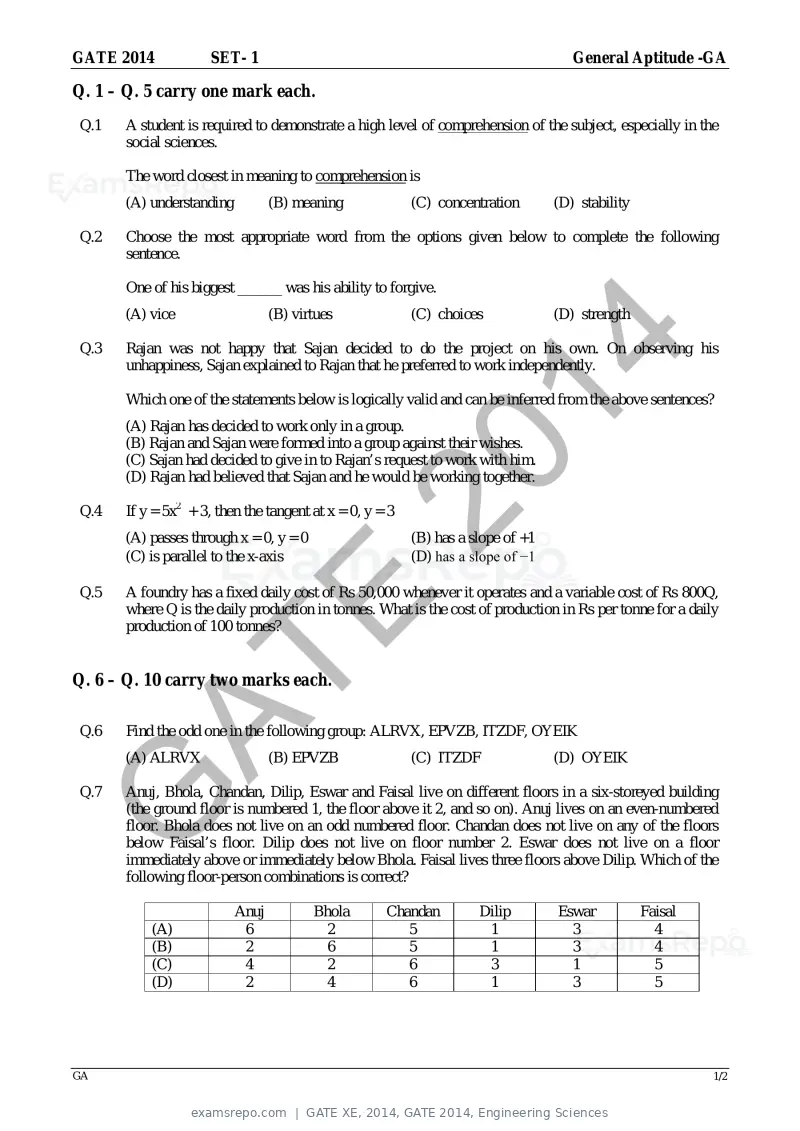
GATE 2014             SET- 1                                                         General Aptitude -GA

Q. 1 – Q. 5 carry one mark each.
Q.1    A student is required to demonstrate a high level of comprehension of the subject, especially in the
       social sciences.

       The word closest in meaning to comprehension is
      (A) understanding          (B) meaning              (C) concentration       (D) stability

Q.2    Choose the most appropriate word from the options given below to complete the following
       sentence.

       One of his biggest ______ was his ability to forgive.
      (A) vice                   (B) virtues              (C) choices             (D) strength


                                             14
Q.3    Rajan was not happy that Sajan decided to do the project on his own. On observing his
       unhappiness, Sajan explained to Rajan that he preferred to work independently.

       Which one of the statements below is logically valid and can be inferred from the above sentences?
      (A) Rajan has decided to work only in a group.
      (B) Rajan and Sajan were formed into a group against their wishes.


Q.4
                                           20
      (C) Sajan had decided to give in to Rajan’s request to work with him.
      (D) Rajan had believed that Sajan and he would be working together.

       If y = 5x2 + 3, then the tangent at x = 0, y = 3
      (A) passes through x = 0, y = 0                     (B) has a slope of +1
      (C) is parallel to the x-axis                       (D) has a slope of −1

Q.5    A foundry has a fixed daily cost of Rs 50,000 whenever it operates and a variable cost of Rs 800Q,
                          E
       where Q is the daily production in tonnes. What is the cost of production in Rs per tonne for a daily
       production of 100 tonnes?
 AT


Q. 6 – Q. 10 carry two marks each.

Q.6    Find the odd one in the following group: ALRVX, EPVZB, ITZDF, OYEIK
      (A) ALRVX                  (B) EPVZB                (C) ITZDF               (D) OYEIK
G


Q.7    Anuj, Bhola, Chandan, Dilip, Eswar and Faisal live on different floors in a six-storeyed building
       (the ground floor is numbered 1, the floor above it 2, and so on). Anuj lives on an even-numbered
       floor. Bhola does not live on an odd numbered floor. Chandan does not live on any of the floors
       below Faisal’s floor. Dilip does not live on floor number 2. Eswar does not live on a floor
       immediately above or immediately below Bhola. Faisal lives three floors above Dilip. Which of the
       following floor-person combinations is correct?

                          Anuj          Bhola        Chandan         Dilip        Eswar           Faisal
           (A)             6              2             5             1             3               4
           (B)             2              6             5             1             3               4
           (C)             4              2             6             3             1               5
           (D)             2              4             6             1             3               5


GA                                                                                                         1/2
Text of page 6
GATE 2014              SET- 1                                                        General Aptitude -GA
Q.8    The smallest angle of a triangle is equal to two thirds of the smallest angle of a quadrilateral. The
       ratio between the angles of the quadrilateral is 3:4:5:6. The largest angle of the triangle is twice its
       smallest angle. What is the sum, in degrees, of the second largest angle of the triangle and the
       largest angle of the quadrilateral?

Q.9    One percent of the people of country X are taller than 6 ft. Two percent of the people of country Y
       are taller than 6 ft. There are thrice as many people in country X as in country Y. Taking both
       countries together, what is the percentage of people taller than 6 ft?
       (A) 3.0                  (B) 2.5                  (C) 1.5                  (D) 1.25

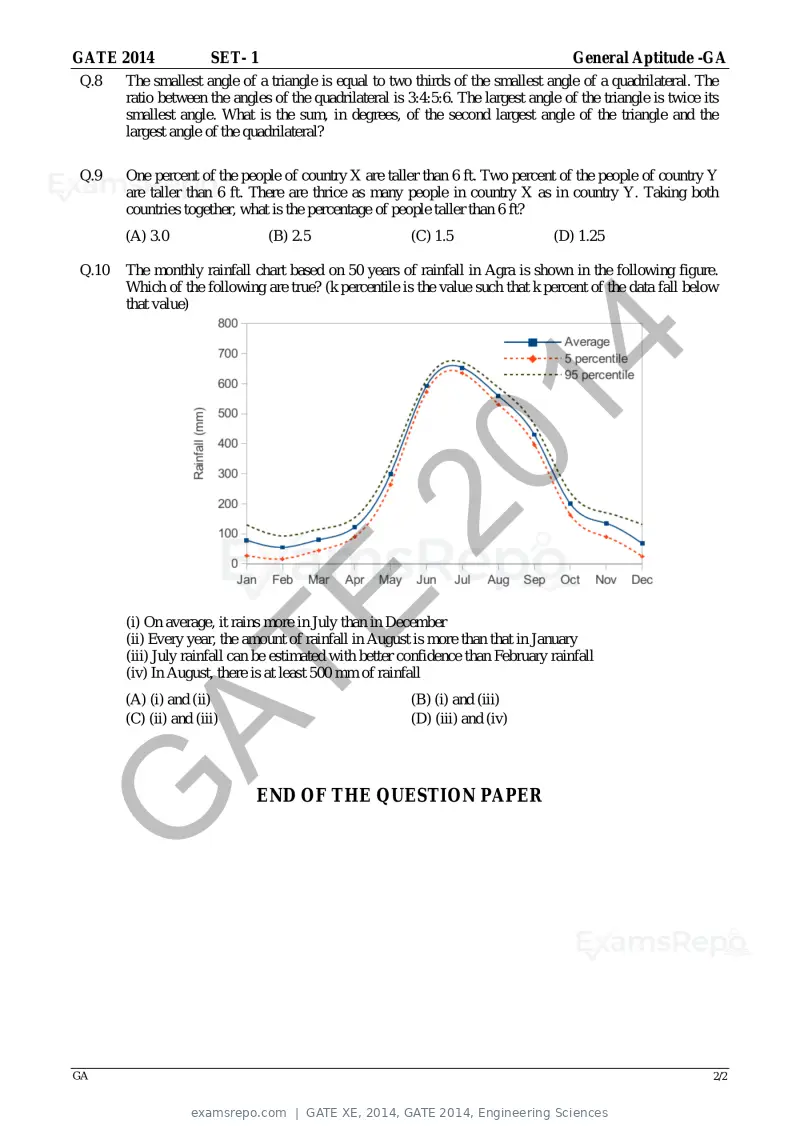
Q.10   The monthly rainfall chart based on 50 years of rainfall in Agra is shown in the following figure.
       Which of the following are true? (k percentile is the value such that k percent of the data fall below
       that value)


                                            14
                                          20
                            E
       (i) On average, it rains more in July than in December
       (ii) Every year, the amount of rainfall in August is more than that in January
       (iii) July rainfall can be estimated with better confidence than February rainfall
 AT


       (iv) In August, there is at least 500 mm of rainfall
       (A) (i) and (ii)                                  (B) (i) and (iii)
       (C) (ii) and (iii)                                (D) (iii) and (iv)
G


                             END OF THE QUESTION PAPER


GA                                                                                                            2/2
Text of page 7
GATE 2014 ENGINEERING MATHEMATICS (COMPULSORY) – XE-A
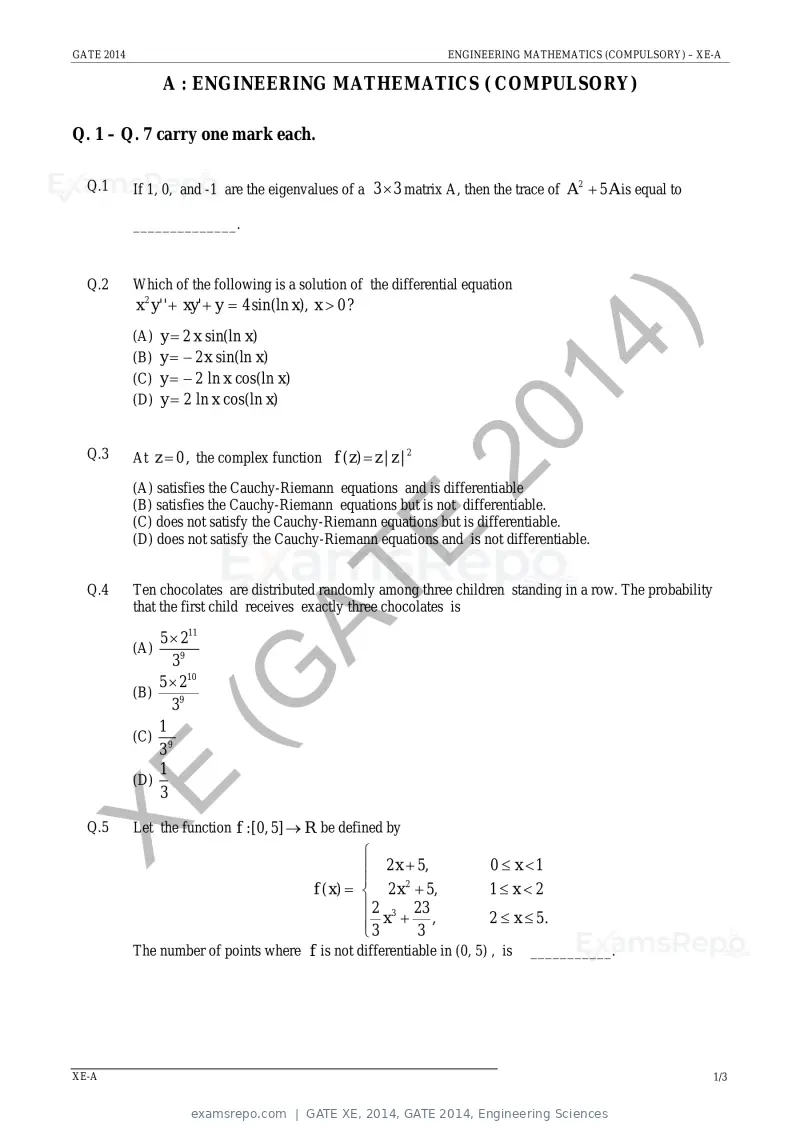
A : ENGINEERING MATHEMATICS ( COMPULSORY)
Q. 1 – Q. 7 carry one mark each.
Q.1 If 1, 0, and -1 are the eigenvalues of a 3 3 matrix A, then the trace of A 2 5 A is equal to
______________.
Q.2 Which of the following is a solution of the differential equation
x 2 y ' ' xy ' y 4 sin(ln x), x 0 ?
)
(A) y 2 x sin(ln x )
14
(B) y 2 x sin(ln x )
(C) y 2 ln x cos(ln x )
(D) y 2 ln x cos(ln x )
20
At z 0 , the complex function f ( z ) z | z | 2
Q.3
(A) satisfies the Cauchy-Riemann equations and is differentiable
(B) satisfies the Cauchy-Riemann equations but is not differentiable.
(C) does not satisfy the Cauchy-Riemann equations but is differentiable.
E
(D) does not satisfy the Cauchy-Riemann equations and is not differentiable.
AT
Q.4 Ten chocolates are distributed randomly among three children standing in a row. The probability
that the first child receives exactly three chocolates is
5 211
(A)
39
(G
5 210
(B)
39
1
(C) 9
3
1
XE
(D)
3
Q.5 Let the function f : [0, 5] R be defined by
2 x 5, 0 x 1
f (x ) 2 x 2 5, 1 x 2
2 3 23
3 x 3 , 2 x 5.
The number of points where f is not differentiable in (0, 5) , is ___________.
XE-A 1/3
Text of page 8
GATE 2014 ENGINEERING MATHEMATICS (COMPULSORY) – XE-A
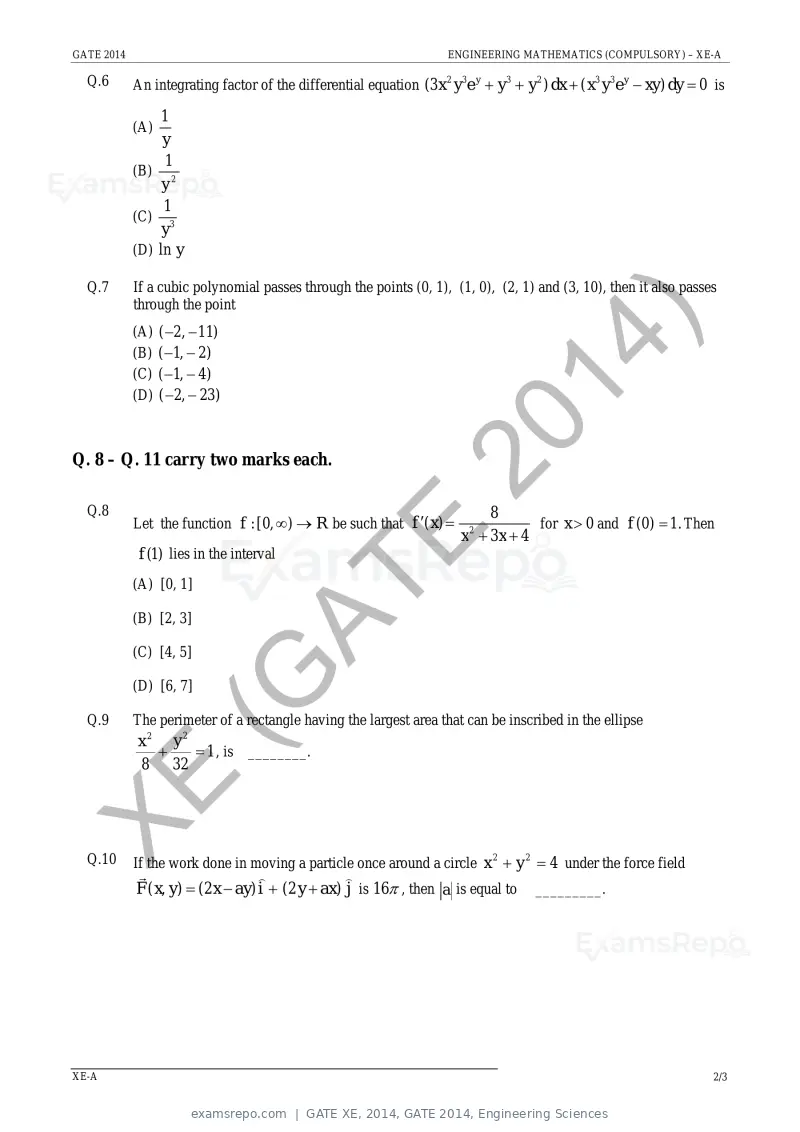
Q.6 An integrating factor of the differential equation (3 x 2 y 3e y y 3 y 2 ) dx ( x 3 y 3e y xy ) dy 0 is
1
(A)
y
1
(B) 2
y
1
(C) 3
y
(D) ln y
Q.7 If a cubic polynomial passes through the points (0, 1), (1, 0), (2, 1) and (3, 10), then it also passes
through the point
)
(A) ( 2, 11)
14
(B) ( 1, 2)
(C) ( 1, 4)
(D) ( 2, 23)
Q. 8 – Q. 11 carry two marks each.
Q.8 20
Let the function f : [0, ) R be such that f ( x)
8
for x 0 and f (0) 1. Then
E
x 3x 4
2
f (1) lies in the interval
AT
(A) [0, 1]
(B) [2, 3]
(C) [4, 5]
(G
(D) [6, 7]
Q.9 The perimeter of a rectangle having the largest area that can be inscribed in the ellipse
x2 y2
1 , is ________.
8 32
XE
Q.10 If the work done in moving a particle once around a circle x 2 y 2 4 under the force field
F ( x, y) (2 x ay) i (2 y ax) j is 16 , then a is equal to _________.
XE-A 2/3
Text of page 9
GATE 2014 ENGINEERING MATHEMATICS (COMPULSORY) – XE-A
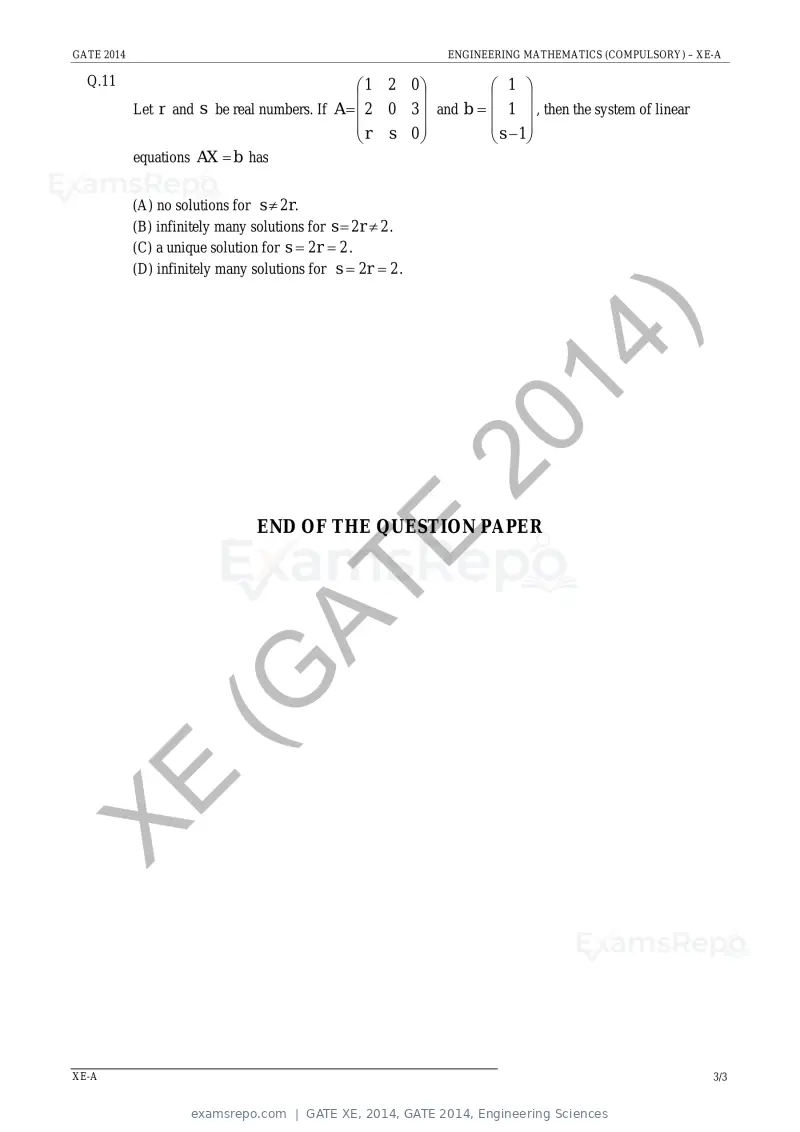
Q.11 1 2 0 1
Let r and s be real numbers. If A 2 0 3 and b 1 , then the system of linear
r s 0 s 1
equations AX b has
(A) no solutions for s 2r .
(B) infinitely many solutions for s 2 r 2 .
(C) a unique solution for s 2r 2 .
(D) infinitely many solutions for s 2r 2 .
)
14
END OF THE QUESTION PAPER
20
E
AT
(G
XE
XE-A 3/3
Text of page 10
GATE 2014 FLUID MECHANICS – XE-B
B : FLUID MECHANICS
Q. 1 – Q. 9 carry one mark each.
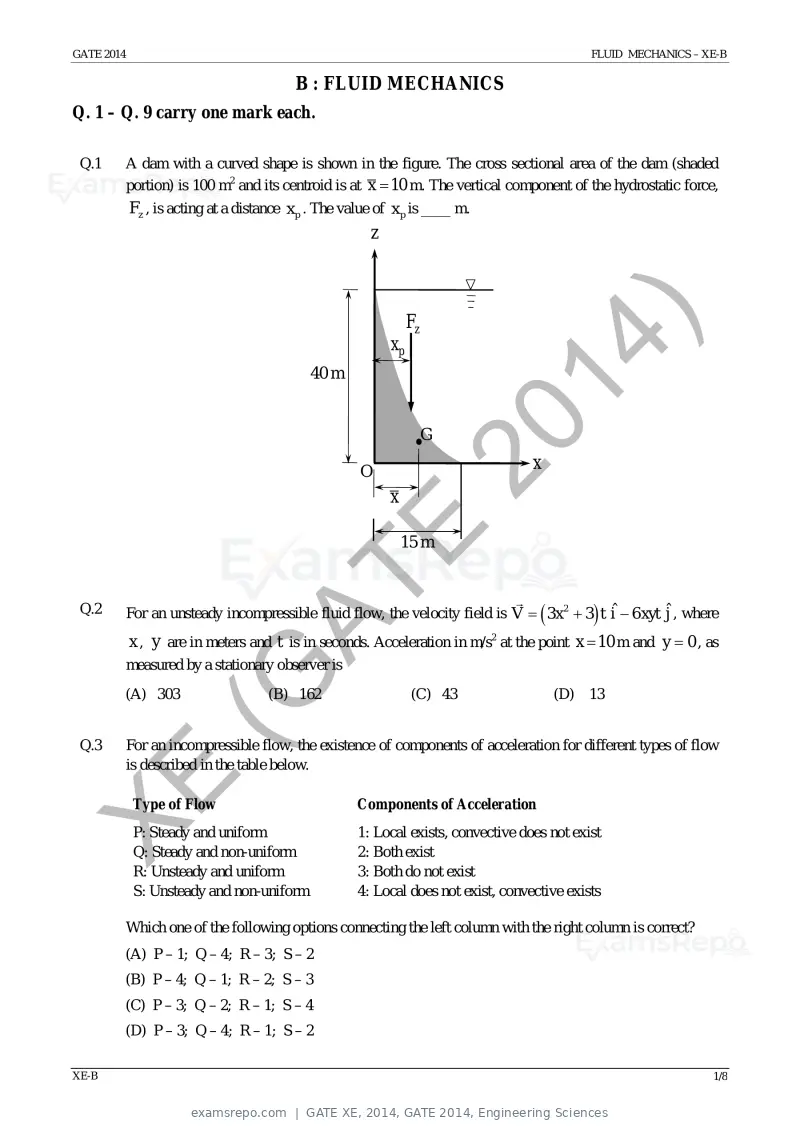
Q.1 A dam with a curved shape is shown in the figure. The cross sectional area of the dam (shaded
portion) is 100 m2 and its centroid is at x = 10 m. The vertical component of the hydrostatic force,
Fz , is acting at a distance x p . The value of x p is ____ m.
z
)
Fz
14
xp
40 m
20
G
O x
x
E
15 m
AT
Q.2 ( )
For an unsteady incompressible fluid flow, the velocity field is V = 3 x 2 + 3 t iˆ − 6 xyt ˆj , where
x , y are in meters and t is in seconds. Acceleration in m/s2 at the point x = 10 m and y = 0 , as
measured by a stationary observer is
(G
(A) 303 (B) 162 (C) 43 (D) 13
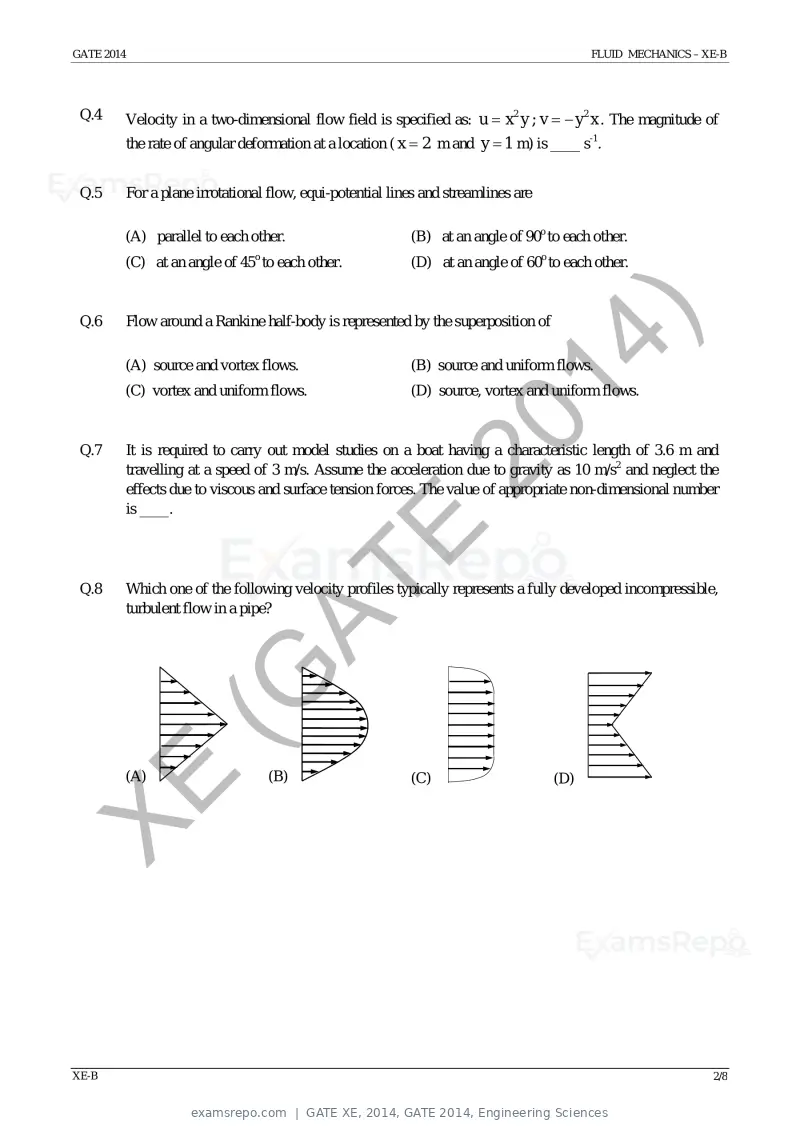
Q.3 For an incompressible flow, the existence of components of acceleration for different types of flow
is described in the table below.
XE
Type of Flow Components of Acceleration
P: Steady and uniform 1: Local exists, convective does not exist
Q: Steady and non-uniform 2: Both exist
R: Unsteady and uniform 3: Both do not exist
S: Unsteady and non-uniform 4: Local does not exist, convective exists
Which one of the following options connecting the left column with the right column is correct?
(A) P – 1; Q – 4; R – 3; S – 2
(B) P – 4; Q – 1; R – 2; S – 3
(C) P – 3; Q – 2; R – 1; S – 4
(D) P – 3; Q – 4; R – 1; S – 2
XE-B 1/8
Text of page 11
GATE 2014                                                                                   FLUID MECHANICS – XE-B


 Q.4        Velocity in a two-dimensional flow field is specified as: u = x 2 y ; v = − y 2 x . The magnitude of
            the rate of angular deformation at a location ( x = 2 m and y = 1 m) is ____ s-1.


 Q.5        For a plane irrotational flow, equi-potential lines and streamlines are

        (A) parallel to each other.                          (B) at an angle of 90o to each other.
        (C) at an angle of 45o to each other.                (D) at an angle of 60o to each other.


                                                                             )
 Q.6        Flow around a Rankine half-body is represented by the superposition of


                                                                           14
        (A) source and vortex flows.                         (B) source and uniform flows.
        (C) vortex and uniform flows.                        (D) source, vortex and uniform flows.


                                                             20
 Q.7        It is required to carry out model studies on a boat having a characteristic length of 3.6 m and
            travelling at a speed of 3 m/s. Assume the acceleration due to gravity as 10 m/s2 and neglect the
            effects due to viscous and surface tension forces. The value of appropriate non-dimensional number
            is ____.
                                                 E
                                AT

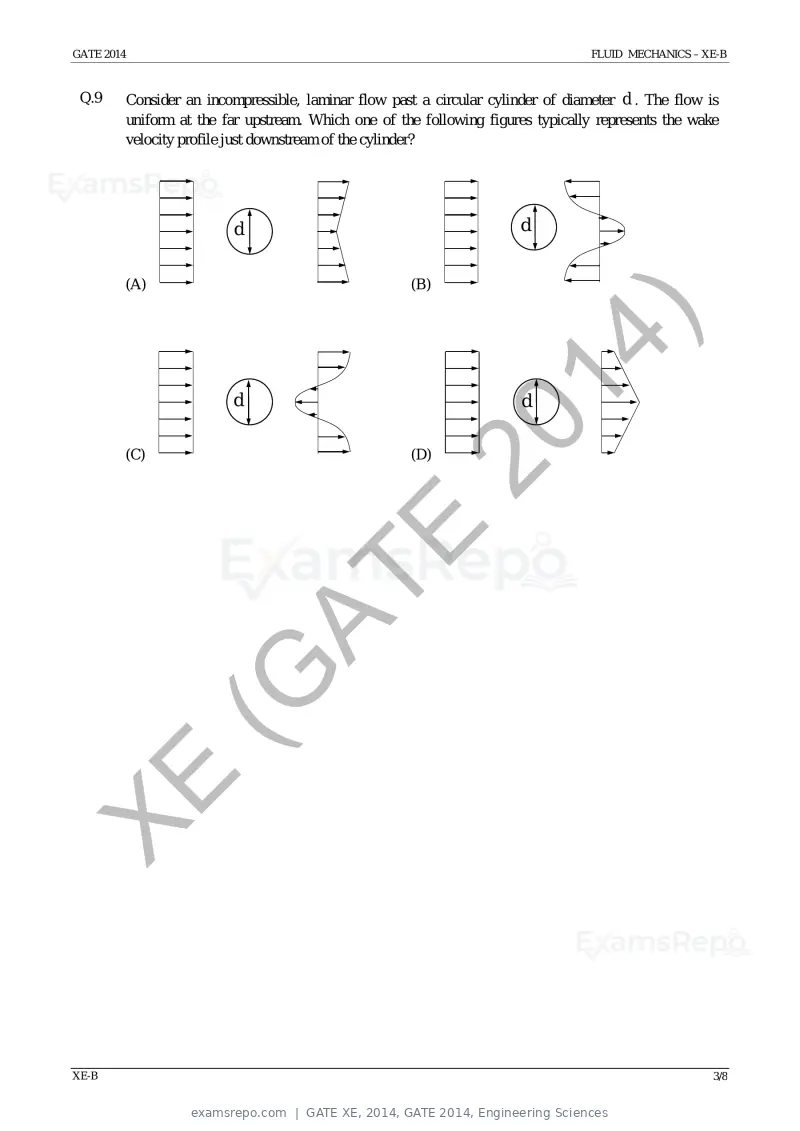
 Q.8        Which one of the following velocity profiles typically represents a fully developed incompressible,
            turbulent flow in a pipe?
                  (G
XE


        (A)                         (B)                      (C)                      (D)


XE-B                                                                                                           2/8
Text of page 12
GATE 2014                                                                            FLUID MECHANICS – XE-B


 Q.9        Consider an incompressible, laminar flow past a circular cylinder of diameter d . The flow is
            uniform at the far upstream. Which one of the following figures typically represents the wake
            velocity profile just downstream of the cylinder?


                            d                                            d


        (A)                                             (B)


                                                                       )
                                                                     14
                            d                                             d


                                                        20
        (C)                                             (D)
                                             E
                                AT
                 (G
XE


XE-B                                                                                                    3/8
Text of page 13
GATE 2014 FLUID MECHANICS – XE-B
Q. 10 – Q. 22 carry two marks each.
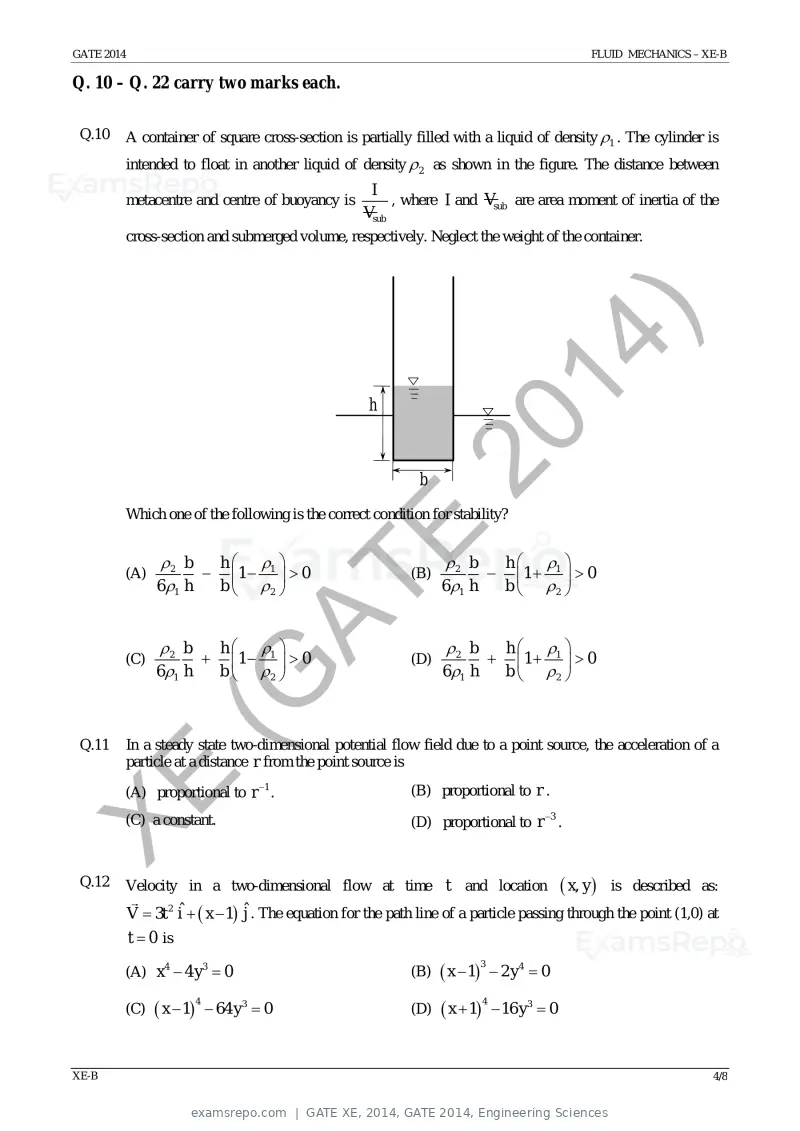
Q.10 A container of square cross-section is partially filled with a liquid of density ρ1 . The cylinder is
intended to float in another liquid of density ρ 2 as shown in the figure. The distance between
I
metacentre and centre of buoyancy is , where I and Vsub are area moment of inertia of the
Vsub
cross-section and submerged volume, respectively. Neglect the weight of the container.
)
14
h
20b
Which one of the following is the correct condition for stability?
E
ρ2 b h ρ ρ2 b h ρ
(A) − 1 − 1 > 0 (B) − 1 + 1 > 0
AT
6 ρ1 h b ρ2 6 ρ1 h b ρ2
ρ2 b h ρ ρ2 b h ρ
(C) + 1 − 1 > 0 (D) + 1 + 1 > 0
6 ρ1 h b ρ2 6 ρ1 h b ρ2
(G
Q.11 In a steady state two-dimensional potential flow field due to a point source, the acceleration of a
particle at a distance r from the point source is
XE
(A) proportional to r −1 . (B) proportional to r .
(C) a constant. (D) proportional to r −3 .
Q.12 Velocity in a two-dimensional flow at time t and location ( x, y ) is described as:
V= 3t 2 iˆ + ( x − 1) ˆj . The equation for the path line of a particle passing through the point (1,0) at
t = 0 is
(A) x 4 − 4 y 3 = (B) ( x − 1) − 2 y 4 =
3
0 0
(C) ( x − 1) − 64 y 3 = (D) ( x + 1) − 16 y 3 =
4 4
0 0
XE-B 4/8
Text of page 14
GATE 2014                                                                                       FLUID MECHANICS – XE-B

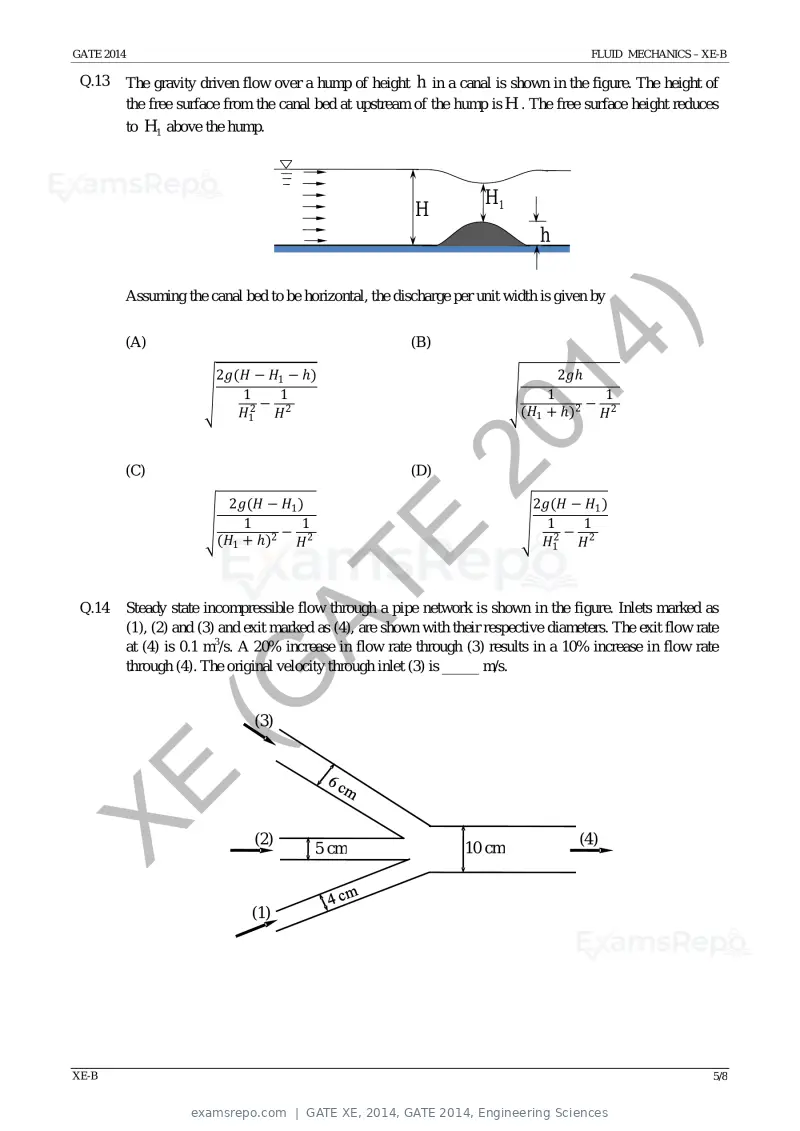
 Q.13       The gravity driven flow over a hump of height h in a canal is shown in the figure. The height of
            the free surface from the canal bed at upstream of the hump is H . The free surface height reduces
            to H1 above the hump.


                                                                         H1
                                                             H
                                                                                     h

            Assuming the canal bed to be horizontal, the discharge per unit width is given by


                                                                            )
                                                                          14
        (A)                                                  (B)

                           2gg(HH − HH1 − ℎ)                                             2ggℎ
                         �      1     1                                       �        1      1
                                   −                                                        −
                               HH12 HH 2                                          (HH1 + ℎ)2 HH 2


        (C)


                         �
                             2gg(HH − HH1 )
                                1          1
                                                            20
                                                             (D)

                                                                                   2gg(HH − HH1 )
                                                                                  � 1       1
                                                 E
                                      −                                                 −
                           (HH1 + ℎ)2 HH 2                                          HH12 HH 2
                                AT

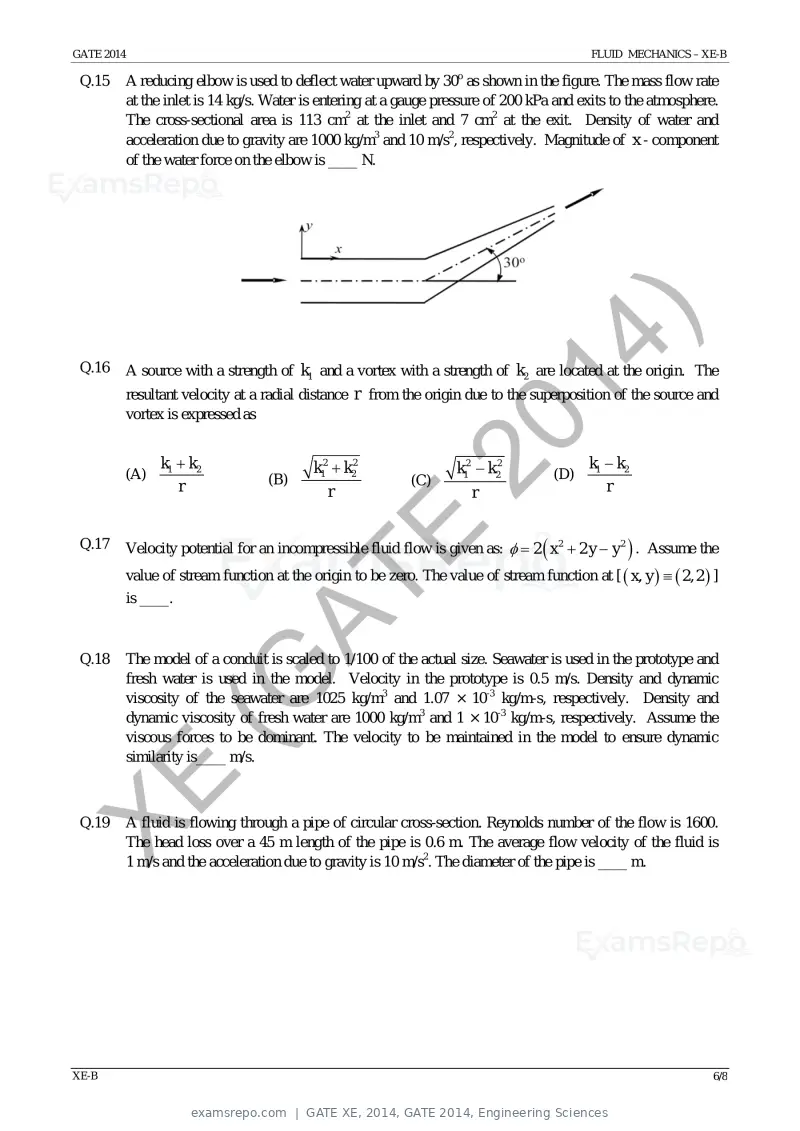
 Q.14       Steady state incompressible flow through a pipe network is shown in the figure. Inlets marked as
            (1), (2) and (3) and exit marked as (4), are shown with their respective diameters. The exit flow rate
            at (4) is 0.1 m3/s. A 20% increase in flow rate through (3) results in a 10% increase in flow rate
            through (4). The original velocity through inlet (3) is _____ m/s.
                 (G


                                  (3)
XE


                                  (2)                                                       (4)
                                               5 cm                   10 cm


                                 (1)


XE-B                                                                                                               5/8
Text of page 15
GATE 2014                                                                                       FLUID MECHANICS – XE-B

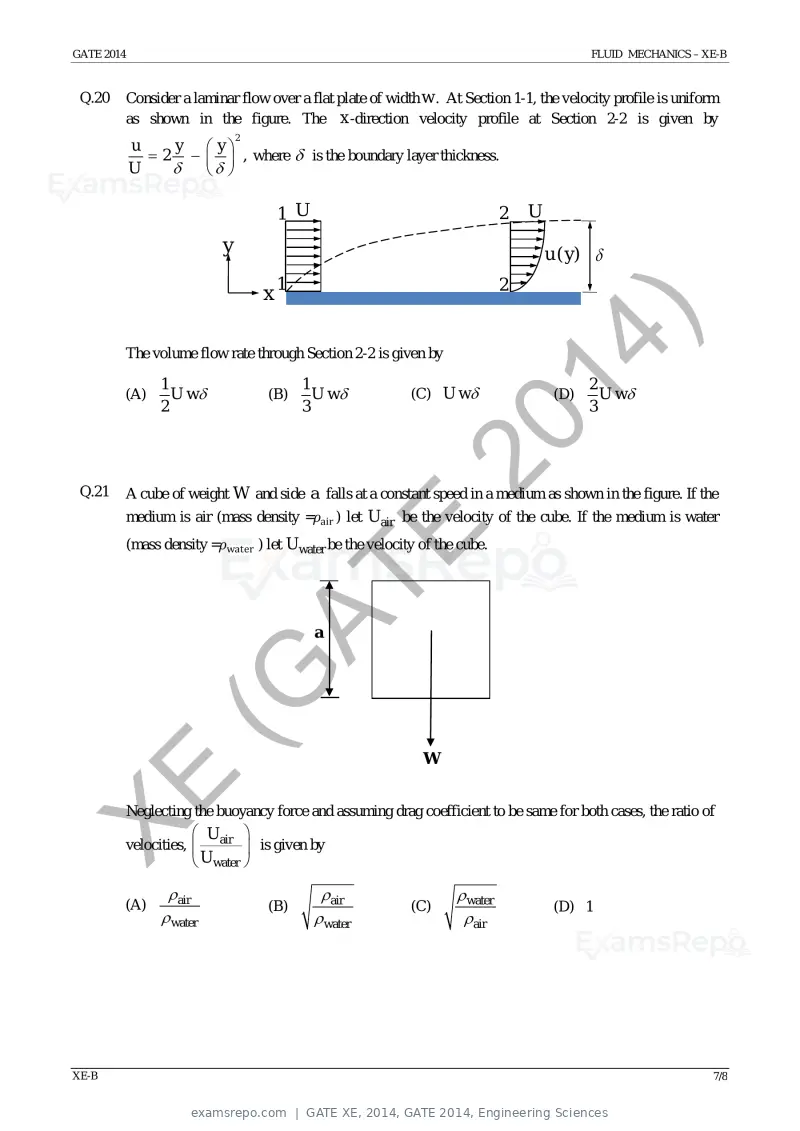
 Q.15       A reducing elbow is used to deflect water upward by 30o as shown in the figure. The mass flow rate
            at the inlet is 14 kg/s. Water is entering at a gauge pressure of 200 kPa and exits to the atmosphere.
            The cross-sectional area is 113 cm2 at the inlet and 7 cm2 at the exit. Density of water and
            acceleration due to gravity are 1000 kg/m3 and 10 m/s2, respectively. Magnitude of x - component
            of the water force on the elbow is ____ N.


                                                                                )
                                                                              14
 Q.16       A source with a strength of k1 and a vortex with a strength of k2 are located at the origin. The
            resultant velocity at a radial distance r from the origin due to the superposition of the source and
            vortex is expressed as


        (A)
                  k1 + k2
                     r               (B)
                                             k12 + k22
                                                r
                                                              20
                                                               (C)
                                                                       k12 − k22
                                                                          r
                                                                                          (D)
                                                                                                k1 − k2
                                                                                                   r
                                                  E
 Q.17                                                                                 (               )
            Velocity potential for an incompressible fluid flow is given as: φ= 2 x 2 + 2 y − y 2 . Assume the
            value of stream function at the origin to be zero. The value of stream function at [ ( x, y ) ≡ ( 2, 2 ) ]
                                AT

            is ____.


 Q.18       The model of a conduit is scaled to 1/100 of the actual size. Seawater is used in the prototype and
                  (G


            fresh water is used in the model. Velocity in the prototype is 0.5 m/s. Density and dynamic
            viscosity of the seawater are 1025 kg/m3 and 1.07 × 10⁻³ kg/m-s, respectively. Density and
            dynamic viscosity of fresh water are 1000 kg/m3 and 1 × 10⁻³ kg/m-s, respectively. Assume the
            viscous forces to be dominant. The velocity to be maintained in the model to ensure dynamic
            similarity is____ m/s.
XE


 Q.19       A fluid is flowing through a pipe of circular cross-section. Reynolds number of the flow is 1600.
            The head loss over a 45 m length of the pipe is 0.6 m. The average flow velocity of the fluid is
            1 m/s and the acceleration due to gravity is 10 m/s2. The diameter of the pipe is ____ m.


XE-B                                                                                                                 6/8
Text of page 16
GATE 2014 FLUID MECHANICS – XE-B
Q.20 Consider a laminar flow over a flat plate of width w . At Section 1-1, the velocity profile is uniform
as shown in the figure. The x -direction velocity profile at Section 2-2 is given by
2
u y y
= 2 − , where δ is the boundary layer thickness.
U δ δ
1 U 2 U
y u ( y) δ
1 2
x
)
14
The volume flow rate through Section 2-2 is given by
1 1 2
(A) U wδ (B) U wδ (C) U w δ (D) U wδ
2 3 3
Q.21
20
A cube of weight W and side a falls at a constant speed in a medium as shown in the figure. If the
medium is air (mass density =ρρair ) let U air be the velocity of the cube. If the medium is water
E
(mass density =ρρwater ) let U water be the velocity of the cube.
AT
a
(G
W
XE
Neglecting the buoyancy force and assuming drag coefficient to be same for both cases, the ratio of
U air
velocities, is given by
U water
ρair ρair ρ water
(A) (B) (C) (D) 1
ρ water ρ water ρair
XE-B 7/8
Text of page 17
GATE 2014                                                                                  FLUID MECHANICS – XE-B

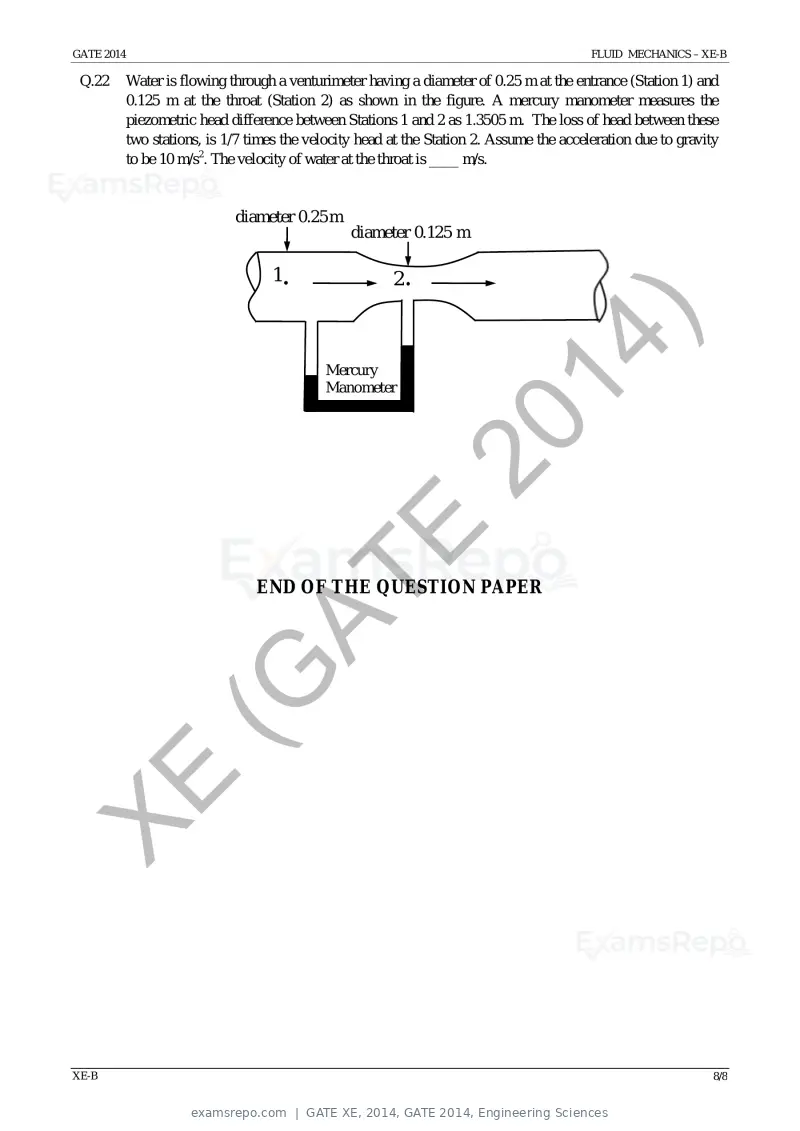
 Q.22       Water is flowing through a venturimeter having a diameter of 0.25 m at the entrance (Station 1) and
            0.125 m at the throat (Station 2) as shown in the figure. A mercury manometer measures the
            piezometric head difference between Stations 1 and 2 as 1.3505 m. The loss of head between these
            two stations, is 1/7 times the velocity head at the Station 2. Assume the acceleration due to gravity
            to be 10 m/s2. The velocity of water at the throat is ____ m/s.


                              diameter 0.25 m
                                                  diameter 0.125 m

                                    1•                   2•


                                                                            )
                                                                          14
                                              Mercury
                                              Manometer


                                                            20
                                                E
                               AT

                                  END OF THE QUESTION PAPER
                 (G
XE


XE-B                                                                                                            8/8
Text of page 18
GATE 2014                                                                                   MATERIAL SCIENCE- XE-C

                                        C : MATERIALS SCIENCE
Useful constants
Avogadro’s Number                   : 6.023 x 10²³ mol-1
Boltzmann’s constant, k             : 1.38 x 10⁻²³ J.K-1
Electron Charge, e                  : 1.6 x 10⁻¹⁹ C
Electron rest mass, mo              : 9.1 x 10⁻³¹ kg
Universal gas constant, R           : 8.314 J.mol-1.K-1
Speed of light, c                   : 3 x 10⁸ m.s-1
Planck’s constant, h                : 6.63 x 10⁻³⁴ J.s
1 eV = 1.6 x 10⁻¹⁹ J


Q. 1 – Q. 9 carry one mark each.


                                                                             )
 Q.1        Neoprene is rendered non-inflammable because


                                                                           14
        (A) it has a highly cross-linked structure
        (B) it has a highly linear chain structure
        (C) of the presence of chlorine atom in the structure
        (D) of the absence of chlorine atom in the structure


                                                             20
 Q.2        Nylon-6 is manufactured from
        (A) caprolactum
        (B) adipic acid and hexamethylene diamine
        (C) maleic anhydride and hexamethylene diamine
        (D) sebasic acid and hexamethylene diamine
                                                  E
 Q.3        At room temperature, the typical barrier potential for silicon p-n junction in Volt (V) is
                                AT

        (A) 0.7x10⁻²³               (B) 0.07                 (C) 0.70                 (D) 7.0

 Q.4        Quantitative measurement of the roughness of a polysilicon wafer can be performed with
        (A) scanning tunneling microscopy                    (B) scanning electron microscopy
        (C) transmission electron microscopy                 (D) atomic force microscopy
                  (G


 Q.5        The temperature of the antiferromagnetic-to-paramagnetic transition is called
        (A) Curie temperature                                (B) Curie-Weiss temperature
        (C) Neel temperature                                 (D) Debye temperature
XE


 Q.6        At low injection level, a forward biased p-n junction would have
            (A) no charge carriers
            (B) minority carrier concentration much more than majority carrier concentration
            (C) minority carrier concentration equal to majority carrier concentration
            (D) minority carrier concentration much less than majority carrier concentration

 Q.7        Which of the following mechanical properties of a material depend on the mobile dislocation
            density in it.
            (P) Young’s modulus       (Q) yield strength       (R) ductility      (S) fracture toughness
        (A) P, Q, R                 (B) Q, R, S              (C) P, R, S              (D) S, P, Q

 Q.8        The equilibrium concentration of vacancies in a pure metal
        (A) increases exponentially with temperature (B) decreases exponentially with temperature
        (C) varies linearly with temperature          (D) is independent of temperature

XE-C                                                                                                            1/4
Text of page 19
GATE 2014                                                                                    MATERIAL SCIENCE- XE-C


 Q.9        The materials belonging to which one of the following crystal classes would be both piezoelectric
            and ferroelectric
        (A) 222                             (B) 4mm            (C) 1�                   (D) 2/m


Q. 10 – Q. 22 carry two marks each.

 Q.10       Polymerized isotactic polybutadiene has a molecular weight of 3 x 10⁵ g/mol. The degree of
            polymerization is _______________.


                                                                               )
 Q.11       A bar of Ti with Young’s modulus of 110 GPa and yield strength of 880 MPa is tested in tension. It


                                                                             14
            is noticed that the alloy does not exhibit any strain hardening and fails at a total strain of 0.108. The
            mechanical energy that is necessary to break the material in MJ/m3 is ____________.

 Q.12       A copper cup weighing 140 g contains 80 g of water at 4 °C. Specific heats of water and copper are


                                                              20
            4.18 and 0.385 J/g °C, respectively. If 100 g of water that is at 90 °C is added to the cup, the final
            temperature of water in °C is ______________.

 Q.13       Match the reaction in Column I with its name in Column II.

            L – liquid, α, β, γ – different solid solution phases
                                                      E
        Column I                                               Column II
                 cccccccccccccc                                (1) peritectic
        (P) L �⎯⎯⎯⎯� α + β
                                            AT

                           cccccccccccccc                      (2) eutectic
        (Q) L + β �⎯⎯⎯⎯� γ                                     (3) monotectic
                  cccccccccccccc
        (R) α �⎯⎯⎯⎯� β + γ                                     (4) eutectoid

        (A) P-1, Q-4, R-3                                      (B) P-2, Q-1, R-4
                  (G


        (C) P-2, Q-3, R-1                                      (D) P-4, Q-2, R-3

 Q.14       The Young’s modulus of a unidirectional SiC fiber reinforced Ti matrix composite is 185 GPa. If
            the Young’s moduli of Ti and SiC are 110 and 360 GPa respectively, the volume fraction of fibers
            in the composite is _________.
XE


 Q.15       Match the composite in Column I with the most suitable application in Column II.

            Column I                                       Column II
            (P) Glass fibre reinforced plastic               (1) Missile cone heads
            (Q) SiC particle reinforced Al alloy             (2) Commercial automobile chasis
            (R) Carbon-carbon composite                      (3) Airplane wheel tyres
            (S) Metal fibre reinforced rubber                (4) Car piston rings
                                                             (5) High performance skate boards

        (A) P-4, Q-5, R-1, S-2                                 (B) P-3, Q-5, R-2, S-4
        (C) P-5, Q-4, R-1, S-3                                 (D) P-4, Q-2, R-3, S-1


XE-C                                                                                                                2/4
Text of page 20
GATE 2014                                                                                   MATERIAL SCIENCE- XE-C

 Q.16       Which among the following rules need to be satisfied for obtaining an isomorphous phase diagram
            in a binary alloy system?

            (P) The atomic size difference should be less than 15%.
            (Q) Both the end components should have the same crystal structure
            (R) The valency of the end components should be the same.
            (S) The end components should have dissimilar electronegativities
        (A) P, Q, R                 (B) Q, R, S              (C) R, S, P              (D) S, P, Q

 Q.17       The energy in eV and the wavelength in µm, respectively, of the photon emitted when an electron
            in a hydrogen atom falls from n = 4 to n = 2 state is
        (A) 3.0, 0.413              (B) 2.55, 0.365          (C) 2.75, 0.451          (D) 2.55, 0.487


                                                                             )
 Q.18       The weight in kg of gallium (Ga) to be mixed with arsenic (As) for obtaining 1.0 kg of gallium
            arsenide (GaAs) is ______________.                    (MGa = 69.72 g/mol; MAs = 74.92 g/mol)


                                                                           14
 Q.19       Match the material in Column I with the property in Column II

            Column I                                          Column II


                                                             20
            (P) Pb(Zr,Ti)O3                                   (1) Shape memory alloy
            (Q) Ni50Ti50                                      (2) Piezoelectric ceramic
            (R) GaAs                                          (3) High temperature superconductor
            (S) YBa2Cu3O7                                     (4) Optoelectronic semiconductor
        (A) P-1, Q-2, R-3, S-4                               (B) P-2, Q-3, R-4, S-1
                                                  E
        (C) P-4, Q-1, R-2, S-3                               (D) P-2, Q-1, R-4, S-3

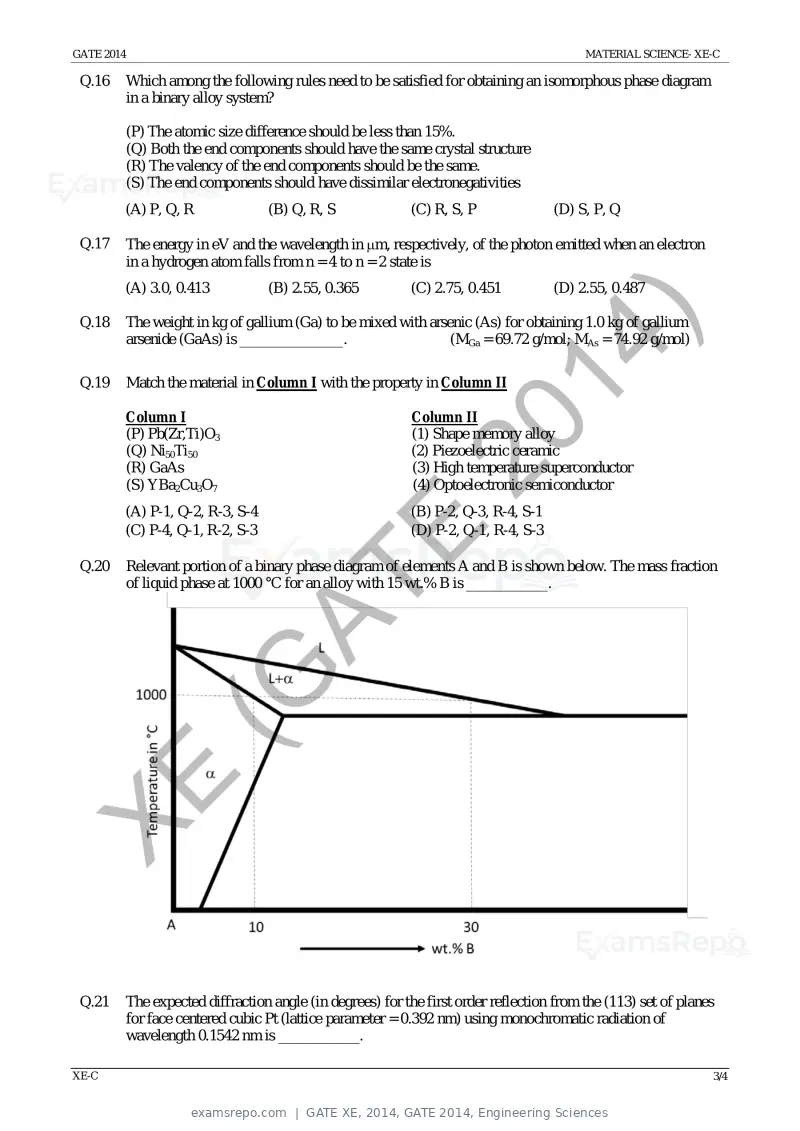
 Q.20       Relevant portion of a binary phase diagram of elements A and B is shown below. The mass fraction
                                AT

            of liquid phase at 1000 °C for an alloy with 15 wt.% B is ___________.
                  (G
XE


 Q.21       The expected diffraction angle (in degrees) for the first order reflection from the (113) set of planes
            for face centered cubic Pt (lattice parameter = 0.392 nm) using monochromatic radiation of
            wavelength 0.1542 nm is ___________.

XE-C                                                                                                              3/4
Text of page 21
GATE 2014                                                                                MATERIAL SCIENCE- XE-C


 Q.22       The diffusion coefficients of Mg in Al at 500 and 550 °C are 1.9x10⁻¹³ and 5.8x10⁻¹³ m2/s
            respectively. The activation energy for diffusion of Mg in Al in kJ/mol is ___________.


                                  END OF THE QUESTION PAPER


                                                                           )
                                                                         14
                                                           20
                                               E
                               AT
                 (G
XE


XE-C                                                                                                         4/4
Text of page 22
GATE 2014                                                                                    SOLID MECHANICS – XE-D

                                          D: SOLID MECHANICS


Q. 1 – Q. 9 carry one mark each.
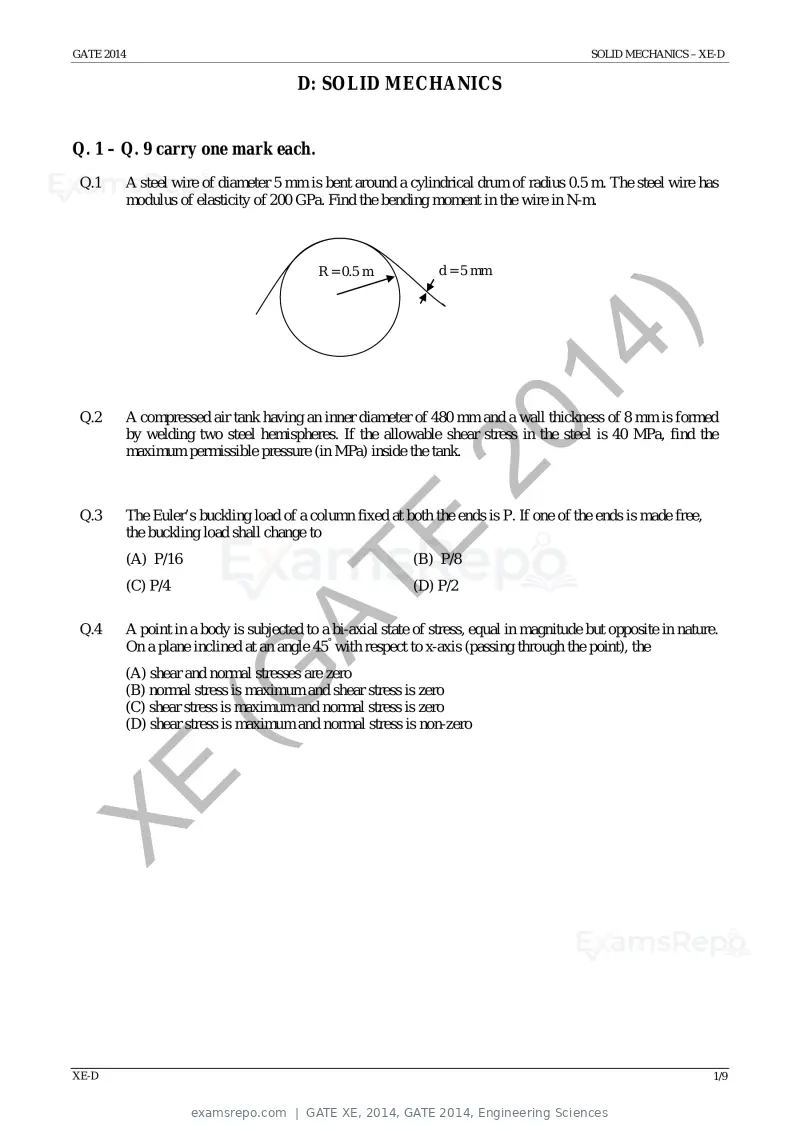
 Q.1        A steel wire of diameter 5 mm is bent around a cylindrical drum of radius 0.5 m. The steel wire has
            modulus of elasticity of 200 GPa. Find the bending moment in the wire in N-m.


                                             R = 0.5 m            d = 5 mm


                                                                               )
                                                                             14
 Q.2        A compressed air tank having an inner diameter of 480 mm and a wall thickness of 8 mm is formed


                                                             20
            by welding two steel hemispheres. If the allowable shear stress in the steel is 40 MPa, find the
            maximum permissible pressure (in MPa) inside the tank.


 Q.3        The Euler’s buckling load of a column fixed at both the ends is P. If one of the ends is made free,
                                                 E
            the buckling load shall change to
            (A) P/16                                          (B) P/8
                                AT

            (C) P/4                                           (D) P/2

 Q.4        A point in a body is subjected to a bi-axial state of stress, equal in magnitude but opposite in nature.
            On a plane inclined at an angle 45° with respect to x-axis (passing through the point), the
                  (G


        (A) shear and normal stresses are zero
        (B) normal stress is maximum and shear stress is zero
        (C) shear stress is maximum and normal stress is zero
        (D) shear stress is maximum and normal stress is non-zero
XE


XE-D                                                                                                               1/9
Text of page 24
GATE 2014                                                                                               SOLID MECHANICS – XE-D

 Q.7        The supporting structure of a water tank is made of reinforced concrete (RC) with a tubular cross
            section of inner diameter di, outer diameter do, height l, and Young’s modulus E. The mass of the
            tank is m. If mass of the supporting structure is neglected, then the natural frequency of the water
            tank in transverse direction is


                  3ππππ �dd oo4 − dd ii4 �                           ππππ �dd oo4 − dd ii4 �
        (A) �                                                (B) �
                       64ll 3 mm                                           8ll 3 mm


                   384ππππ �dd oo4 − dd ii4 �                         ππππ �dd oo4 − dd ii4 �
        (C) ) �                                              (D) �
                          360ll 3 mm                                       64ll 3 mm


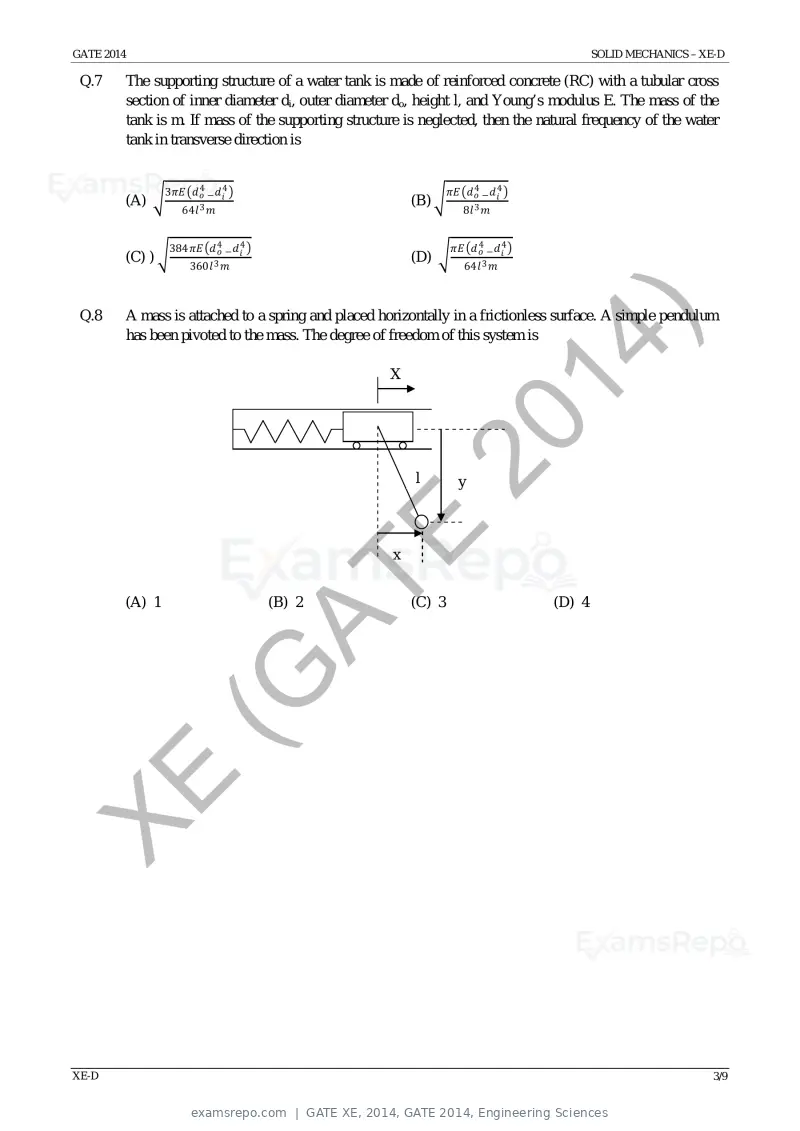
 Q.8        A mass is attached to a spring and placed horizontally in a frictionless surface. A simple pendulum


                                                                                        )
            has been pivoted to the mass. The degree of freedom of this system is


                                                                                      14
                                                        X


                                                             20
                                                             l           y
                                                        E
                                                         x
                                             AT

        (A) 1                                   (B) 2        (C) 3                              (D) 4
                 (G
XE


XE-D                                                                                                                        3/9
Text of page 25
GATE 2014                                                                                   SOLID MECHANICS – XE-D

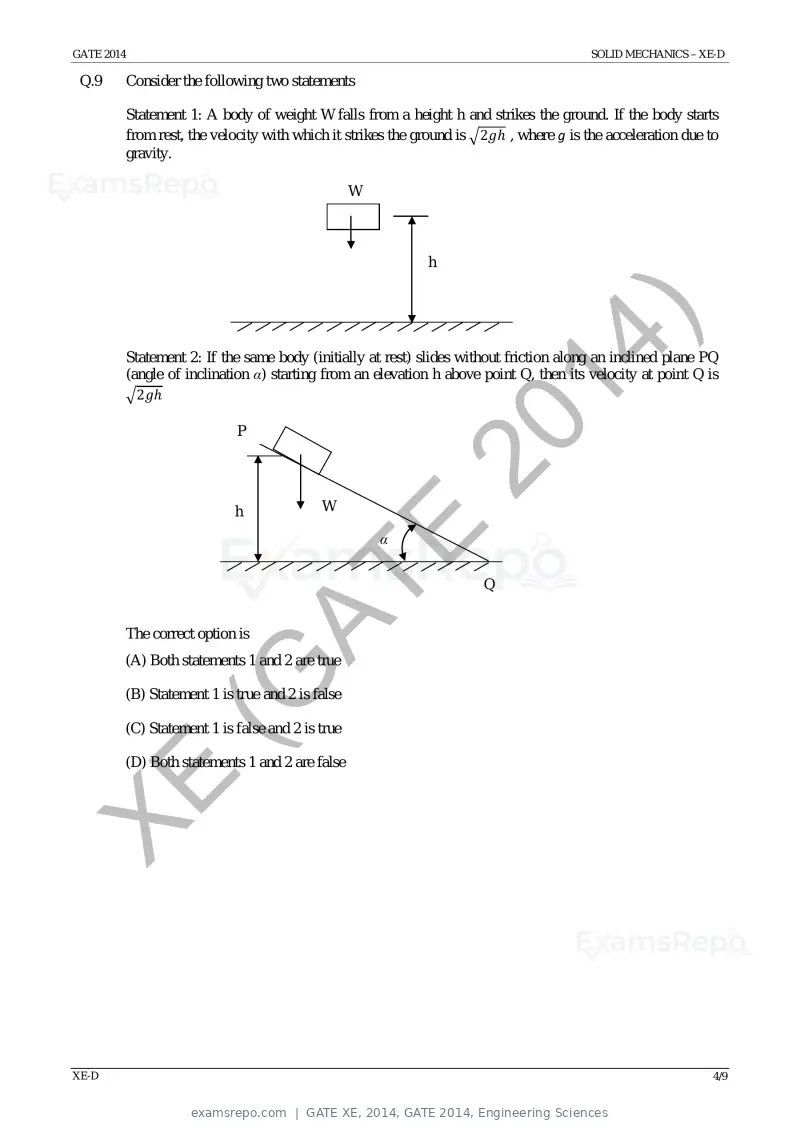
 Q.9        Consider the following two statements

            Statement 1: A body of weight W falls from a height h and strikes the ground. If the body starts
            from rest, the velocity with which it strikes the ground is �2ggℎ , where g is the acceleration due to
            gravity.

                                                  W


                                                                h


                                                                            )
                                                                          14
            Statement 2: If the same body (initially at rest) slides without friction along an inclined plane PQ
            (angle of inclination α) starting from an elevation h above point Q, then its velocity at point Q is
            �2ggℎ


                                                            20
                               P


                              h              W
                                                 E
                                                       α
                                  AT

                                                                         Q


            The correct option is
        (A) Both statements 1 and 2 are true
                 (G


        (B) Statement 1 is true and 2 is false

        (C) Statement 1 is false and 2 is true

        (D) Both statements 1 and 2 are false
XE


XE-D                                                                                                             4/9
Text of page 26
GATE 2014                                                                                     SOLID MECHANICS – XE-D

Q. 10 – Q. 22 carry two marks each.

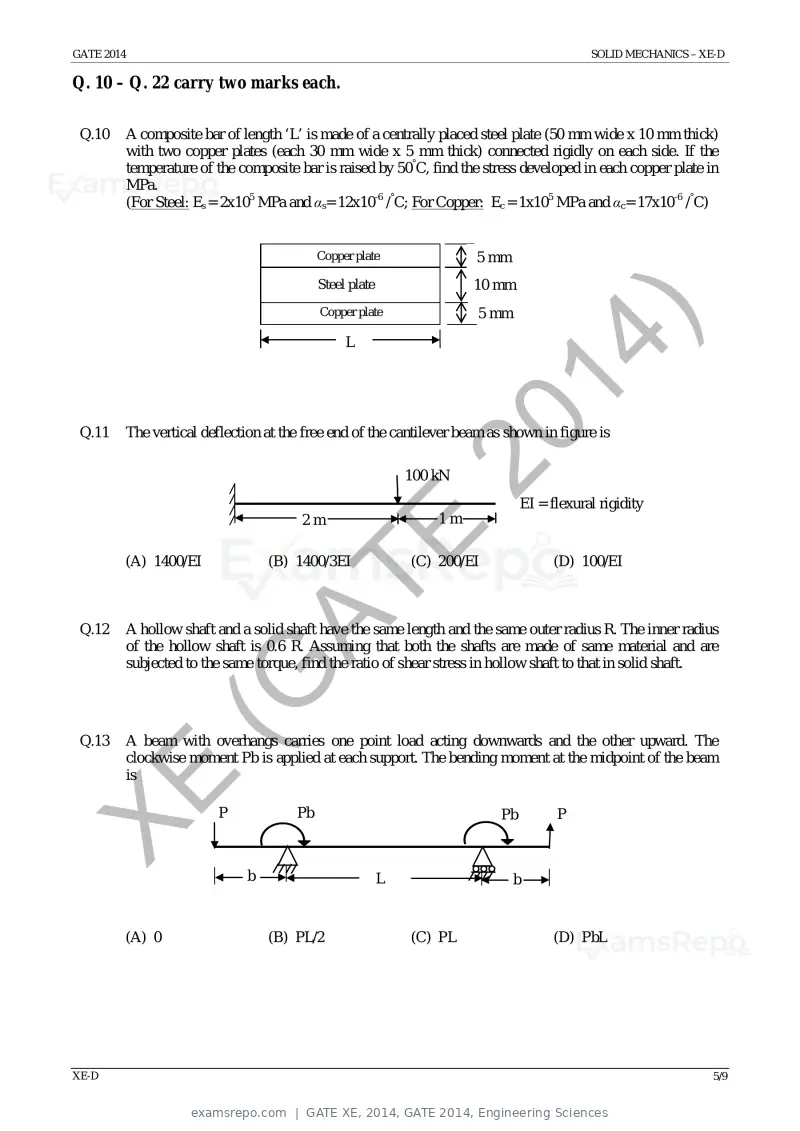
 Q.10       A composite bar of length ‘L’ is made of a centrally placed steel plate (50 mm wide x 10 mm thick)
            with two copper plates (each 30 mm wide x 5 mm thick) connected rigidly on each side. If the
            temperature of the composite bar is raised by 50°C, find the stress developed in each copper plate in
            MPa.
            (For Steel: Es = 2x10⁵ MPa and αs= 12x10-6 /°C; For Copper: Ec = 1x10⁵ MPa and αc= 17x10-6 /°C)


                                              Copper plate               5 mm
                                              Steel plate                10 mm
                                              Copper plate               5 mm


                                                                               )
                                                                             14
                                                   L


                                                                20
 Q.11       The vertical deflection at the free end of the cantilever beam as shown in figure is

                                                                100 kN
                                                                                  EI = flexural rigidity
                                          2m                        1m
                                                  E
        (A) 1400/EI                  (B) 1400/3EI               (C) 200/EI              (D) 100/EI
                                AT

 Q.12       A hollow shaft and a solid shaft have the same length and the same outer radius R. The inner radius
            of the hollow shaft is 0.6 R. Assuming that both the shafts are made of same material and are
            subjected to the same torque, find the ratio of shear stress in hollow shaft to that in solid shaft.
                 (G


 Q.13       A beam with overhangs carries one point load acting downwards and the other upward. The
            clockwise moment Pb is applied at each support. The bending moment at the midpoint of the beam
            is
XE


                            P            Pb                                  Pb         P


                                 b                          L                   b


        (A) 0                        (B) PL/2                   (C) PL                  (D) PbL


XE-D                                                                                                              5/9
Text of page 27
GATE 2014                                                                                     SOLID MECHANICS – XE-D

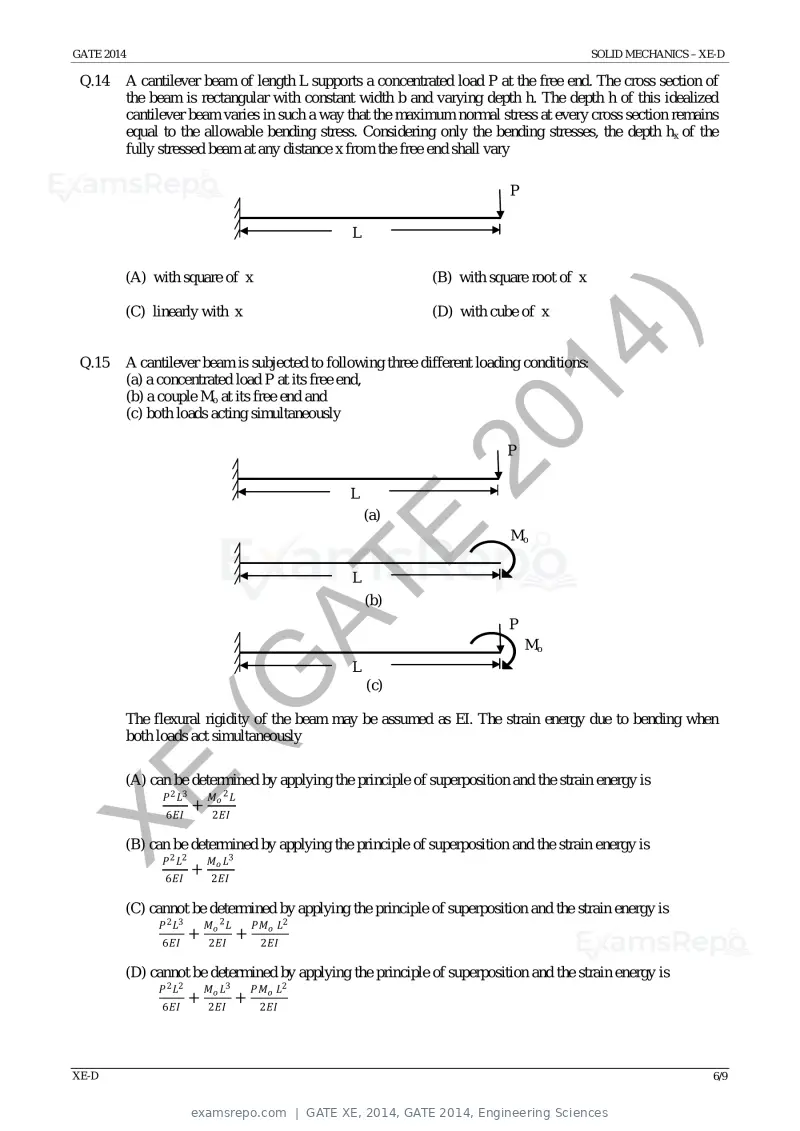
 Q.14       A cantilever beam of length L supports a concentrated load P at the free end. The cross section of
            the beam is rectangular with constant width b and varying depth h. The depth h of this idealized
            cantilever beam varies in such a way that the maximum normal stress at every cross section remains
            equal to the allowable bending stress. Considering only the bending stresses, the depth hx of the
            fully stressed beam at any distance x from the free end shall vary

                                                                             P

                                                    L


        (A) with square of x                                    (B) with square root of x

        (C) linearly with x                                     (D) with cube of x


                                                                            )
                                                                          14
 Q.15       A cantilever beam is subjected to following three different loading conditions:
            (a) a concentrated load P at its free end,
            (b) a couple Mo at its free end and
            (c) both loads acting simultaneously


                                                              20
                                                                             P

                                                    L
                                                        (a)
                                                    E
                                                                             Mo
                                       AT

                                                    L
                                                        (b)
                                                                             P
                                                                                 Mo
                                                    L
                 (G


                                                        (c)

            The flexural rigidity of the beam may be assumed as EI. The strain energy due to bending when
            both loads act simultaneously
XE


        (A) can be determined by applying the principle of superposition and the strain energy is
                  PP 2 LL3   MM 2 LL
                            oo
                         + 2EEEE
                   6EEEE

        (B) can be determined by applying the principle of superposition and the strain energy is
                  PP 2 LL2   MM LL3
                            oo
                         + 2EEEE
                   6EEEE

        (C) cannot be determined by applying the principle of superposition and the strain energy is
                 PP 2 LL3  ooMM 2 LL   PPMMoo LL2
                        + 2EEEE +
                  6EEEE                  2EEEE

        (D) cannot be determined by applying the principle of superposition and the strain energy is
                 PP 2 LL2  ooMM LL3    PPMMoo LL2
                        + 2EEEE +
                  6EEEE                  2EEEE


XE-D                                                                                                              6/9
Text of page 28
GATE 2014                                                                                        SOLID MECHANICS – XE-D

 Q.16       A tapered rod has diameter d1 at one end which reduces uniformly to a diameter d2 over the length
            (L). If the modulus of elasticity of the material is E, the change in the length of the rod due to the
            application of axial force (P) is

                   4PPPP                        4PPPP                      PPPP                     2PPPP
        (A)                         (B)                          (C)                    (D)
                ππππ dd 1 dd 2            ππππ �dd 12 −dd 22 �         ππππ dd 1 dd 2         ππππ �dd 12 −dd 22 �


 Q.17       For a point in a body subjected to a plane stress condition (σx= 100 MPa,                   σy= 50 MPa and
            τxy = τyx = 25 MPa), the maximum principal stress in MPa is_____________


            An isotropic body is subjected to a state of stress given by: σx= 10 MPa and τxy = τyx = −20 MPa.


                                                                                          )
 Q.18
            Assuming G = 0.4E, the volumetric strain is


                                                                                        14
        (A) 5/E                     (B) 7.5/E                    (C) 10/E               (D) 15/E


                                                                 20
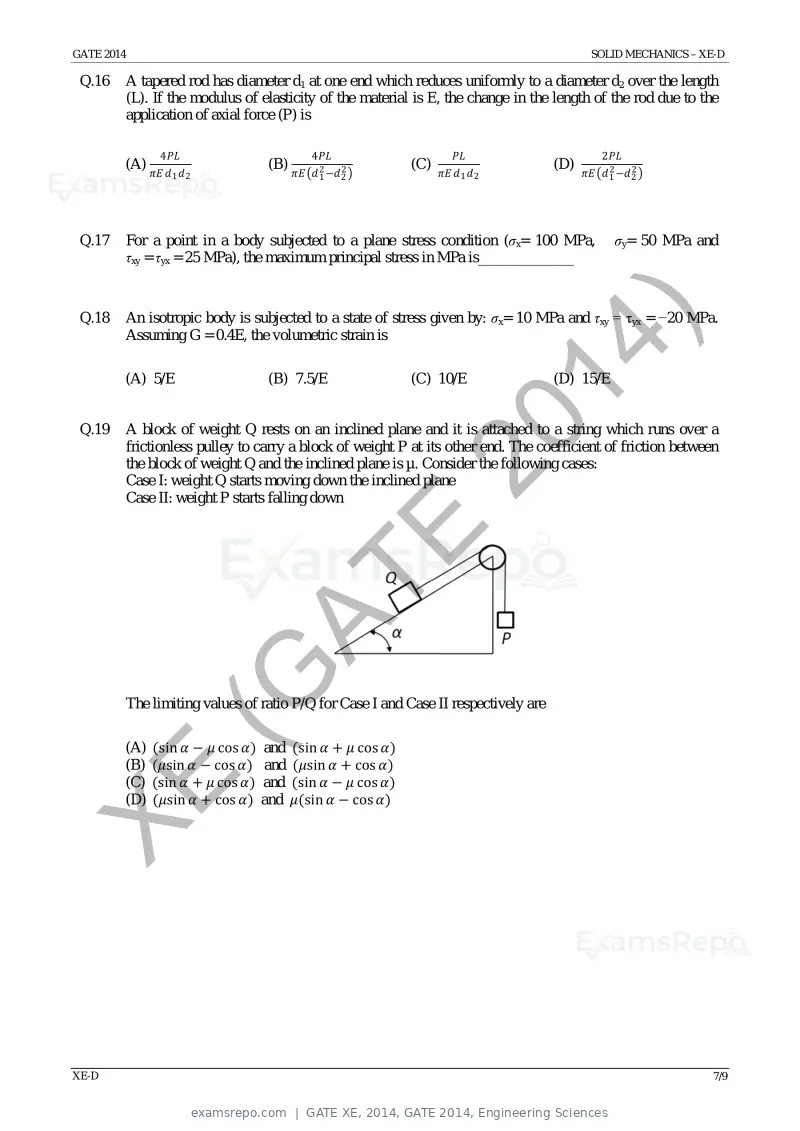
 Q.19       A block of weight Q rests on an inclined plane and it is attached to a string which runs over a
            frictionless pulley to carry a block of weight P at its other end. The coefficient of friction between
            the block of weight Q and the inclined plane is µ. Consider the following cases:
            Case I: weight Q starts moving down the inclined plane
            Case II: weight P starts falling down
                                                         E
                                 AT
                   (G


            The limiting values of ratio P/Q for Case I and Case II respectively are

        (A) (sin αα − μμ cos αα) and (sin αα + μμ cos αα)
        (B) (μμsin αα − cos αα) and (μμsin αα + cos αα)
XE


        (C) (sin αα + μμ cos αα) and (sin αα − μμ cos αα)
        (D) (μμsin αα + cos αα) and μμ(sin αα − cos αα)


XE-D                                                                                                                 7/9
Text of page 29
GATE 2014                                                                                            SOLID MECHANICS – XE-D

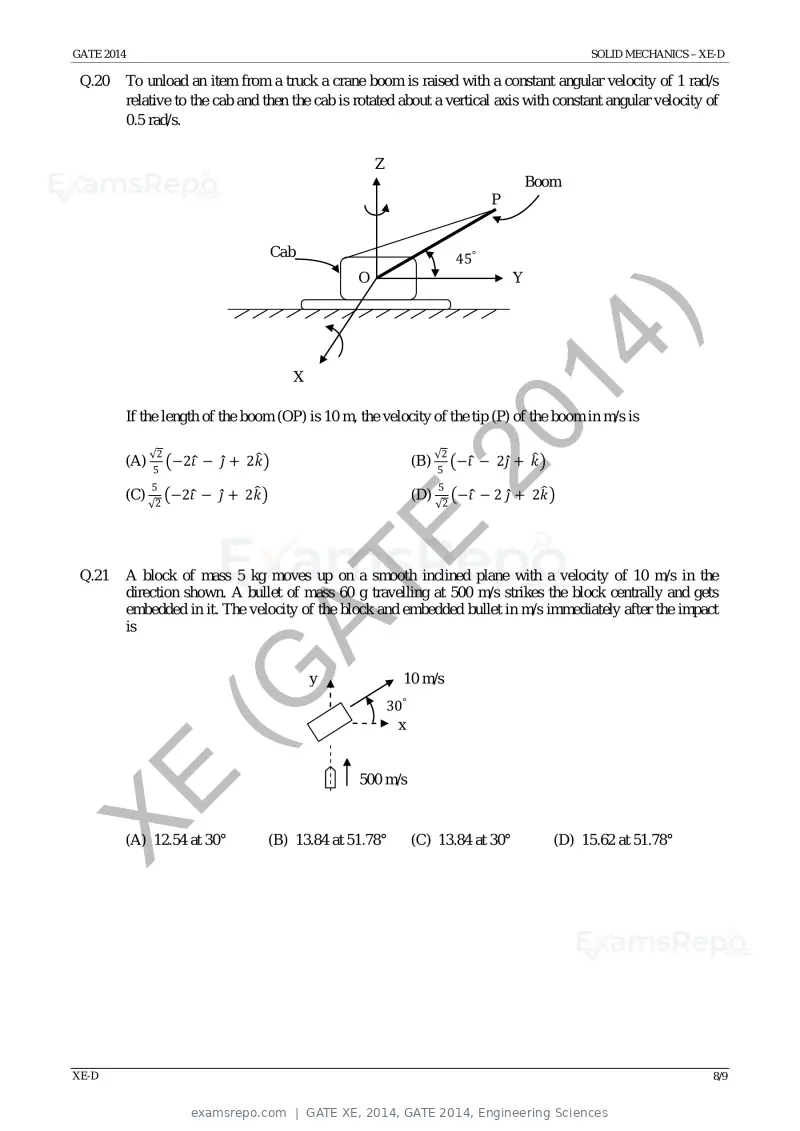
 Q.20       To unload an item from a truck a crane boom is raised with a constant angular velocity of 1 rad/s
            relative to the cab and then the cab is rotated about a vertical axis with constant angular velocity of
            0.5 rad/s.

                                                        Z
                                                                                            Boom
                                                                                   P


                                          Cab                                45°
                                                    O                                   Y


                                                                                     )
                                                                                   14
                                            X

            If the length of the boom (OP) is 10 m, the velocity of the tip (P) of the boom in m/s is


                                                                  20
                √2                                                      √2
        (A) 5 �−2ii� − jĵ + 2kk� �                               (B) 5 �−ii� − 2jĵ + kk� �
               5                                                        5
        (C)       �−2ii� − jĵ + 2kk� �                           (D)      �−ii� − 2 jĵ + 2kk� �
               √2                                                       √2
                                                    E
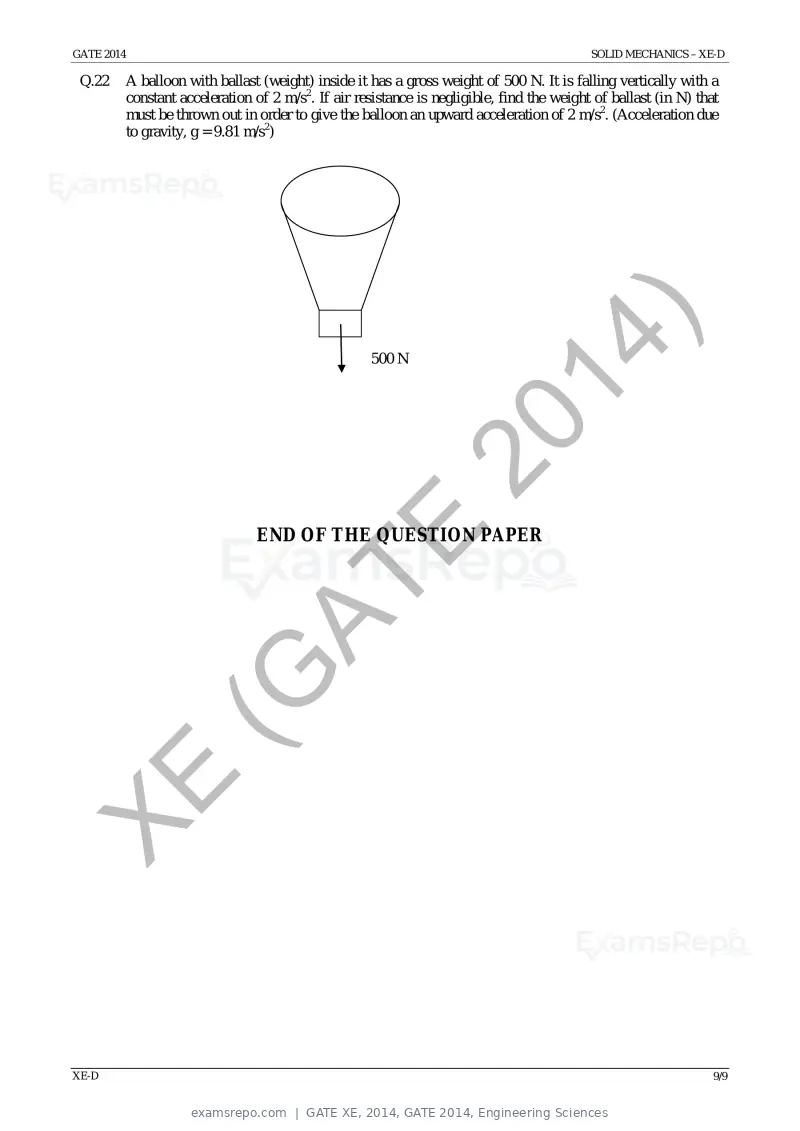
 Q.21       A block of mass 5 kg moves up on a smooth inclined plane with a velocity of 10 m/s in the
                                 AT

            direction shown. A bullet of mass 60 g travelling at 500 m/s strikes the block centrally and gets
            embedded in it. The velocity of the block and embedded bullet in m/s immediately after the impact
            is
                 (G


                                                y             10 m/s
                                                            30°
                                                             x
XE


                                                    500 m/s


        (A) 12.54 at 30°              (B) 13.84 at 51.78°         (C) 13.84 at 30°              (D) 15.62 at 51.78°


XE-D                                                                                                                     8/9
Text of page 30
GATE 2014                                                                                    SOLID MECHANICS – XE-D

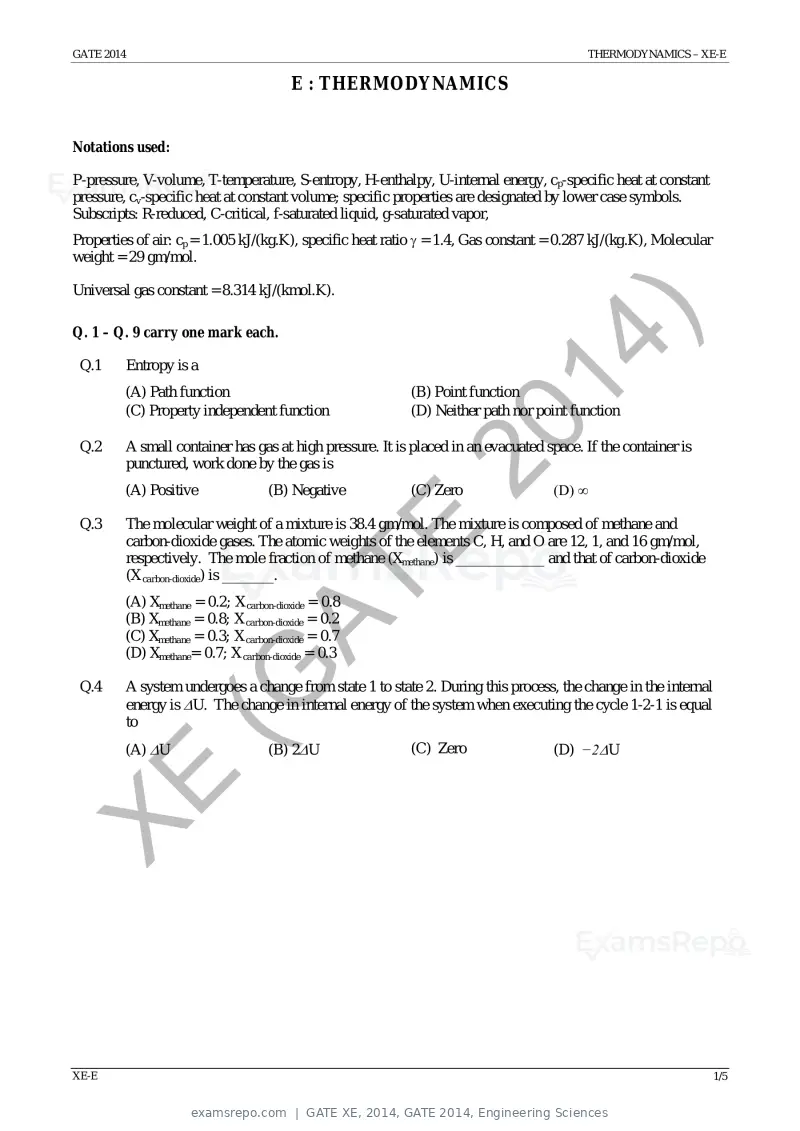
 Q.22       A balloon with ballast (weight) inside it has a gross weight of 500 N. It is falling vertically with a
            constant acceleration of 2 m/s2. If air resistance is negligible, find the weight of ballast (in N) that
            must be thrown out in order to give the balloon an upward acceleration of 2 m/s2. (Acceleration due
            to gravity, g = 9.81 m/s2)


                                                                              )
                                                                            14
                                                       500 N


                                                               20
                                                 E
                                  END OF THE QUESTION PAPER
                                AT
                  (G
XE


XE-D                                                                                                               9/9
Text of page 31
GATE 2014                                                                                   THERMODYNAMICS – XE-E

                                         E : THERMODYNAMICS


Notations used:

P-pressure, V-volume, T-temperature, S-entropy, H-enthalpy, U-internal energy, cp-specific heat at constant
pressure, cv-specific heat at constant volume; specific properties are designated by lower case symbols.
Subscripts: R-reduced, C-critical, f-saturated liquid, g-saturated vapor,
Properties of air: cp = 1.005 kJ/(kg.K), specific heat ratio γ = 1.4, Gas constant = 0.287 kJ/(kg.K), Molecular
weight = 29 gm/mol.

Universal gas constant = 8.314 kJ/(kmol.K).


                                                                             )
Q. 1 – Q. 9 carry one mark each.


                                                                           14
 Q.1        Entropy is a
         (A) Path function                                   (B) Point function
         (C) Property independent function                   (D) Neither path nor point function


                                                             20
 Q.2        A small container has gas at high pressure. It is placed in an evacuated space. If the container is
            punctured, work done by the gas is
         (A) Positive               (B) Negative             (C) Zero                 (D) ∞

 Q.3        The molecular weight of a mixture is 38.4 gm/mol. The mixture is composed of methane and
                                                  E
            carbon-dioxide gases. The atomic weights of the elements C, H, and O are 12, 1, and 16 gm/mol,
            respectively. The mole fraction of methane (Xmethane) is ____________ and that of carbon-dioxide
            (X carbon-dioxide) is _______.
                                AT

         (A) Xmethane = 0.2; X carbon-dioxide = 0.8
         (B) Xmethane = 0.8; X carbon-dioxide = 0.2
         (C) Xmethane = 0.3; X carbon-dioxide = 0.7
         (D) Xmethane= 0.7; X carbon-dioxide = 0.3
                  (G


 Q.4        A system undergoes a change from state 1 to state 2. During this process, the change in the internal
            energy is ∆U. The change in internal energy of the system when executing the cycle 1-2-1 is equal
            to
         (A) ∆U                     (B) 2∆U                  (C) Zero                 (D) −2∆U
XE


XE-E                                                                                                               1/5
Text of page 32
GATE 2014                                                                                  THERMODYNAMICS – XE-E

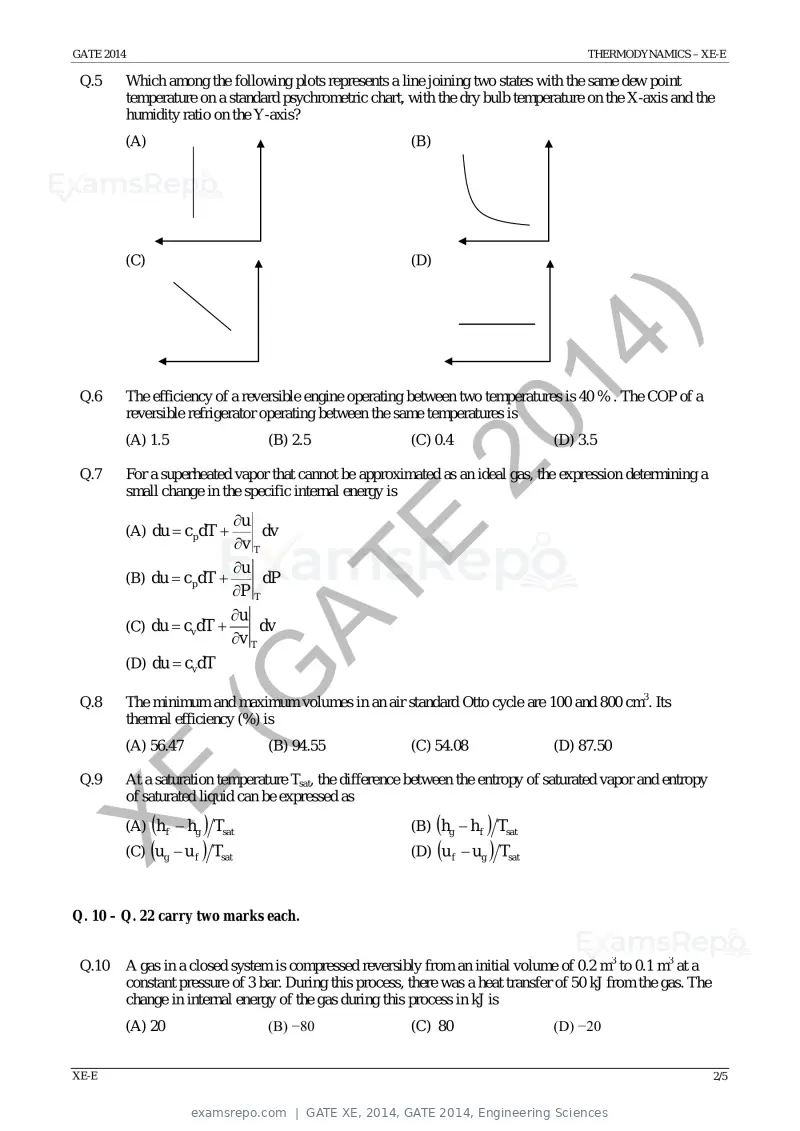
 Q.5        Which among the following plots represents a line joining two states with the same dew point
            temperature on a standard psychrometric chart, with the dry bulb temperature on the X-axis and the
            humidity ratio on the Y-axis?
        (A)                                                  (B)


        (C)                                                  (D)


                                                                               )
                                                                             14
 Q.6        The efficiency of a reversible engine operating between two temperatures is 40 % . The COP of a
            reversible refrigerator operating between the same temperatures is


                                                            20
        (A) 1.5                     (B) 2.5                  (C) 0.4                 (D) 3.5

 Q.7        For a superheated vapor that cannot be approximated as an ideal gas, the expression determining a
            small change in the specific internal energy is

                          ∂u
        (A) du = c p dT +
                                                E
                               dv
                          ∂v T
                          ∂u
        (B) du = c p dT +
                                  AT

                               dP
                          ∂P T
                              ∂u
        (C) du = cv dT +           dv
                              ∂v T
        (D) du = cv dT
                 (G


 Q.8        The minimum and maximum volumes in an air standard Otto cycle are 100 and 800 cm3. Its
            thermal efficiency (%) is
        (A) 56.47                   (B) 94.55                (C) 54.08               (D) 87.50
XE


 Q.9        At a saturation temperature Tsat, the difference between the entropy of saturated vapor and entropy
            of saturated liquid can be expressed as
            (      )
        (A) h f − hg Tsat                                        (      )T
                                                             (B) hg − h f    sat

        (C) (u − u ) T
                  g    f    sat                              (D) (u − u ) T
                                                                    f    g    sat


Q. 10 – Q. 22 carry two marks each.


 Q.10       A gas in a closed system is compressed reversibly from an initial volume of 0.2 m3 to 0.1 m3 at a
            constant pressure of 3 bar. During this process, there was a heat transfer of 50 kJ from the gas. The
            change in internal energy of the gas during this process in kJ is
        (A) 20                      (B) −80                  (C) 80                  (D) −20


XE-E                                                                                                                2/5
Text of page 33
GATE 2014 THERMODYNAMICS – XE-E
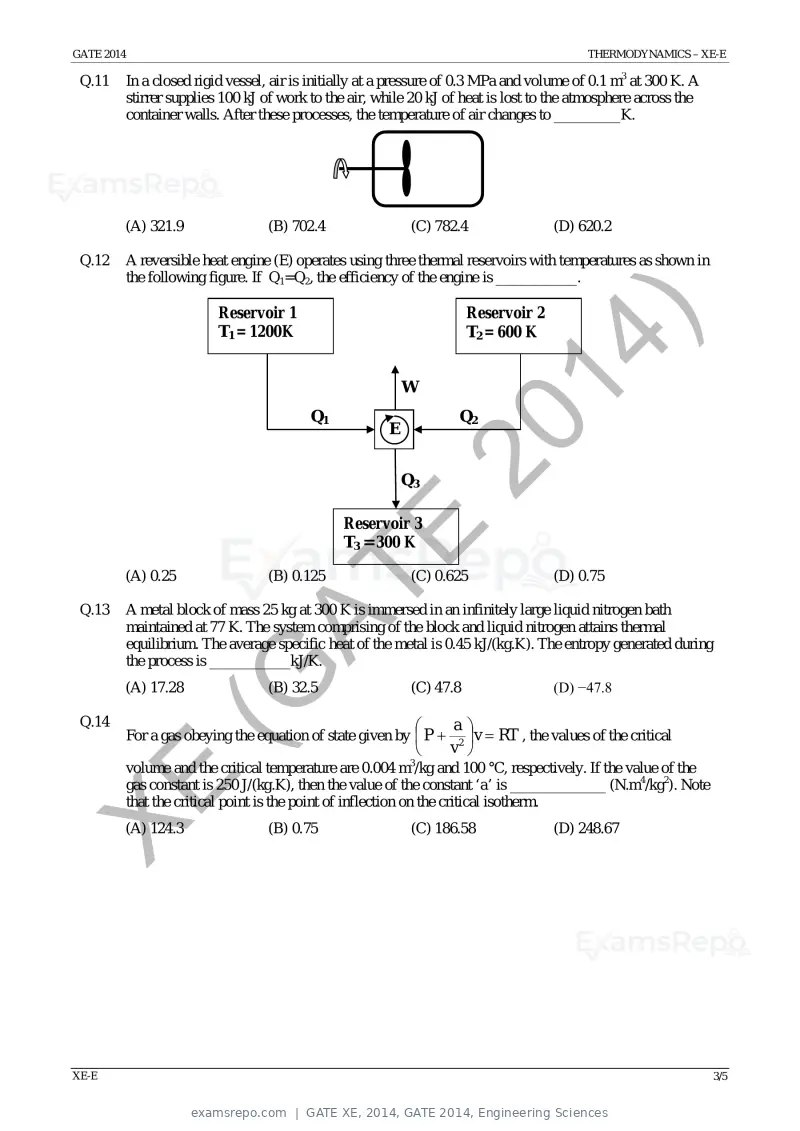
Q.11 In a closed rigid vessel, air is initially at a pressure of 0.3 MPa and volume of 0.1 m3 at 300 K. A
stirrer supplies 100 kJ of work to the air, while 20 kJ of heat is lost to the atmosphere across the
container walls. After these processes, the temperature of air changes to _________K.
(A) 321.9 (B) 702.4 (C) 782.4 (D) 620.2
Q.12 A reversible heat engine (E) operates using three thermal reservoirs with temperatures as shown in
the following figure. If Q1=Q2, the efficiency of the engine is ___________.
Reservoir 1 Reservoir 2
)
T1 = 1200K T2 = 600 K
14
W
Q1 Q2
20
E
Q3
Reservoir 3
E
T3 = 300 K
(A) 0.25 (B) 0.125 (C) 0.625 (D) 0.75
AT
Q.13 A metal block of mass 25 kg at 300 K is immersed in an infinitely large liquid nitrogen bath
maintained at 77 K. The system comprising of the block and liquid nitrogen attains thermal
equilibrium. The average specific heat of the metal is 0.45 kJ/(kg.K). The entropy generated during
the process is ___________kJ/K.
(G
(A) 17.28 (B) 32.5 (C) 47.8 (D) −47.8
Q.14 a
For a gas obeying the equation of state given by P + v = RT , the values of the critical
v2
volume and the critical temperature are 0.004 m3/kg and 100 °C, respectively. If the value of the
XE
gas constant is 250 J/(kg.K), then the value of the constant ‘a’ is _____________ (N.m4/kg2). Note
that the critical point is the point of inflection on the critical isotherm.
(A) 124.3 (B) 0.75 (C) 186.58 (D) 248.67
XE-E 3/5
Text of page 34
GATE 2014 THERMODYNAMICS – XE-E
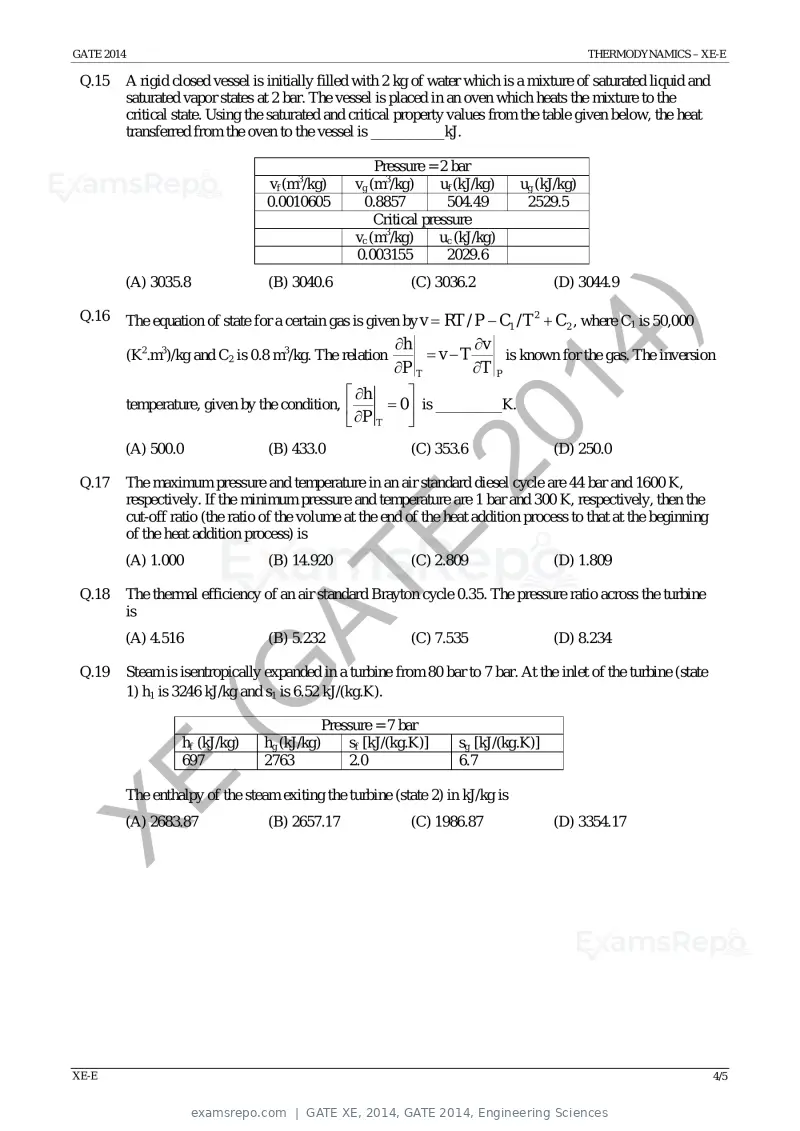
Q.15 A rigid closed vessel is initially filled with 2 kg of water which is a mixture of saturated liquid and
saturated vapor states at 2 bar. The vessel is placed in an oven which heats the mixture to the
critical state. Using the saturated and critical property values from the table given below, the heat
transferred from the oven to the vessel is __________kJ.
Pressure = 2 bar
3
vf (m /kg) vg (m3/kg) uf (kJ/kg) ug (kJ/kg)
0.0010605 0.8857 504.49 2529.5
Critical pressure
vc (m3/kg) uc (kJ/kg)
0.003155 2029.6
(A) 3035.8 (B) 3040.6 (C) 3036.2 (D) 3044.9
Q.16 The equation of state for a certain gas is given by v = RT / P − C1 / T + C2 , where C1 is 50,000
)
2
∂h ∂v
14
(K2.m3)/kg and C2 is 0.8 m3/kg. The relation = v −T is known for the gas. The inversion
∂P T ∂T P
∂h
temperature, given by the condition, = 0 is _________K.
∂P T
20
(A) 500.0 (B) 433.0 (C) 353.6 (D) 250.0
Q.17 The maximum pressure and temperature in an air standard diesel cycle are 44 bar and 1600 K,
respectively. If the minimum pressure and temperature are 1 bar and 300 K, respectively, then the
cut-off ratio (the ratio of the volume at the end of the heat addition process to that at the beginning
E
of the heat addition process) is
(A) 1.000 (B) 14.920 (C) 2.809 (D) 1.809
AT
Q.18 The thermal efficiency of an air standard Brayton cycle 0.35. The pressure ratio across the turbine
is
(A) 4.516 (B) 5.232 (C) 7.535 (D) 8.234
Q.19 Steam is isentropically expanded in a turbine from 80 bar to 7 bar. At the inlet of the turbine (state
(G
1) h1 is 3246 kJ/kg and s1 is 6.52 kJ/(kg.K).
Pressure = 7 bar
hf (kJ/kg) hg (kJ/kg) sf [kJ/(kg.K)] sg [kJ/(kg.K)]
697 2763 2.0 6.7
XE
The enthalpy of the steam exiting the turbine (state 2) in kJ/kg is
(A) 2683.87 (B) 2657.17 (C) 1986.87 (D) 3354.17
XE-E 4/5
Text of page 35
GATE 2014                                                                                   THERMODYNAMICS – XE-E

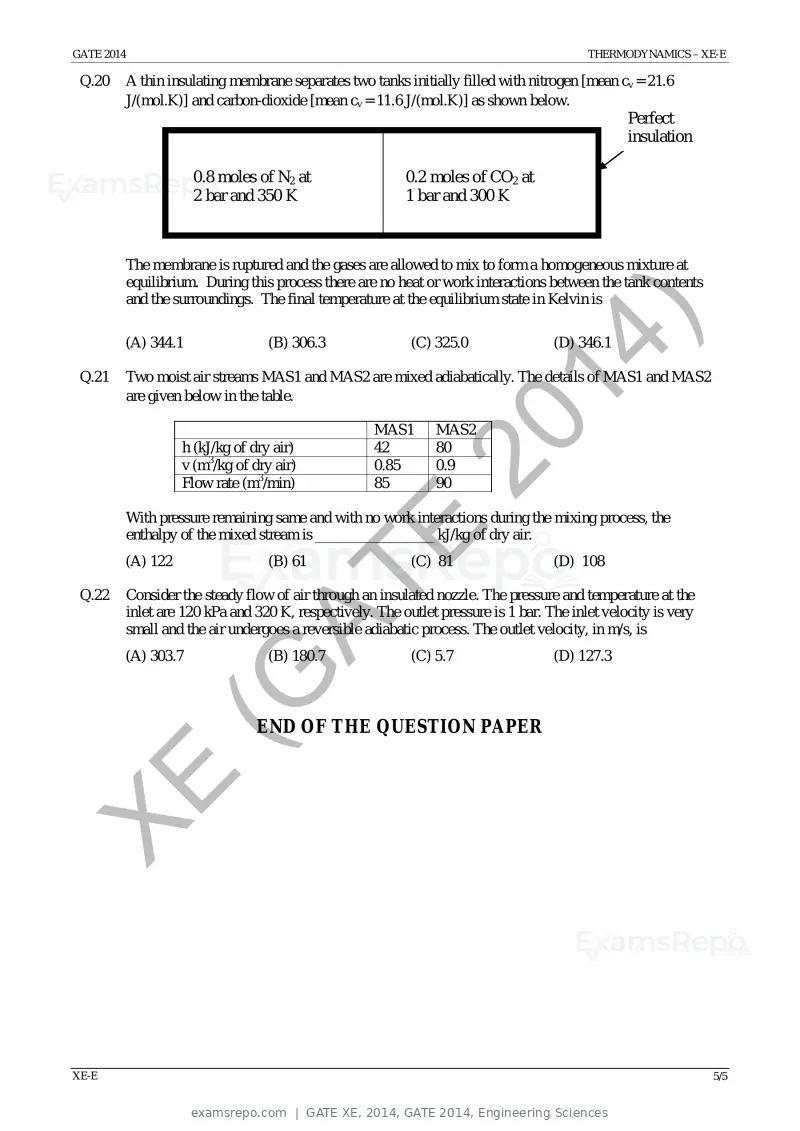
 Q.20       A thin insulating membrane separates two tanks initially filled with nitrogen [mean cv = 21.6
            J/(mol.K)] and carbon-dioxide [mean cv = 11.6 J/(mol.K)] as shown below.
                                                                                                   Perfect
                                                                                                   insulation

                       0.8 moles of N2 at                   0.2 moles of CO2 at
                       2 bar and 350 K                      1 bar and 300 K


            The membrane is ruptured and the gases are allowed to mix to form a homogeneous mixture at
            equilibrium. During this process there are no heat or work interactions between the tank contents
            and the surroundings. The final temperature at the equilibrium state in Kelvin is


                                                                             )
                                                                           14
        (A) 344.1                   (B) 306.3                (C) 325.0                (D) 346.1

 Q.21       Two moist air streams MAS1 and MAS2 are mixed adiabatically. The details of MAS1 and MAS2
            are given below in the table.


                                                             20
                                                       MAS1       MAS2
                     h (kJ/kg of dry air)              42         80
                     v (m3/kg of dry air)              0.85       0.9
                     Flow rate (m3/min)                85         90

            With pressure remaining same and with no work interactions during the mixing process, the
                                                E
            enthalpy of the mixed stream is ________________ kJ/kg of dry air.
        (A) 122                     (B) 61                   (C) 81                   (D) 108
                                AT

 Q.22       Consider the steady flow of air through an insulated nozzle. The pressure and temperature at the
            inlet are 120 kPa and 320 K, respectively. The outlet pressure is 1 bar. The inlet velocity is very
            small and the air undergoes a reversible adiabatic process. The outlet velocity, in m/s, is
        (A) 303.7                   (B) 180.7                (C) 5.7                  (D) 127.3
                 (G


                                  END OF THE QUESTION PAPER
XE


XE-E                                                                                                              5/5
Text of page 36
GATE 2014                                                                    POLYMER SCIENCE AND ENGINEERING – XE-F

                         F : POLYMER SCIENCE AND ENGINEERING


Q. 1 – Q. 9 carry one mark each.
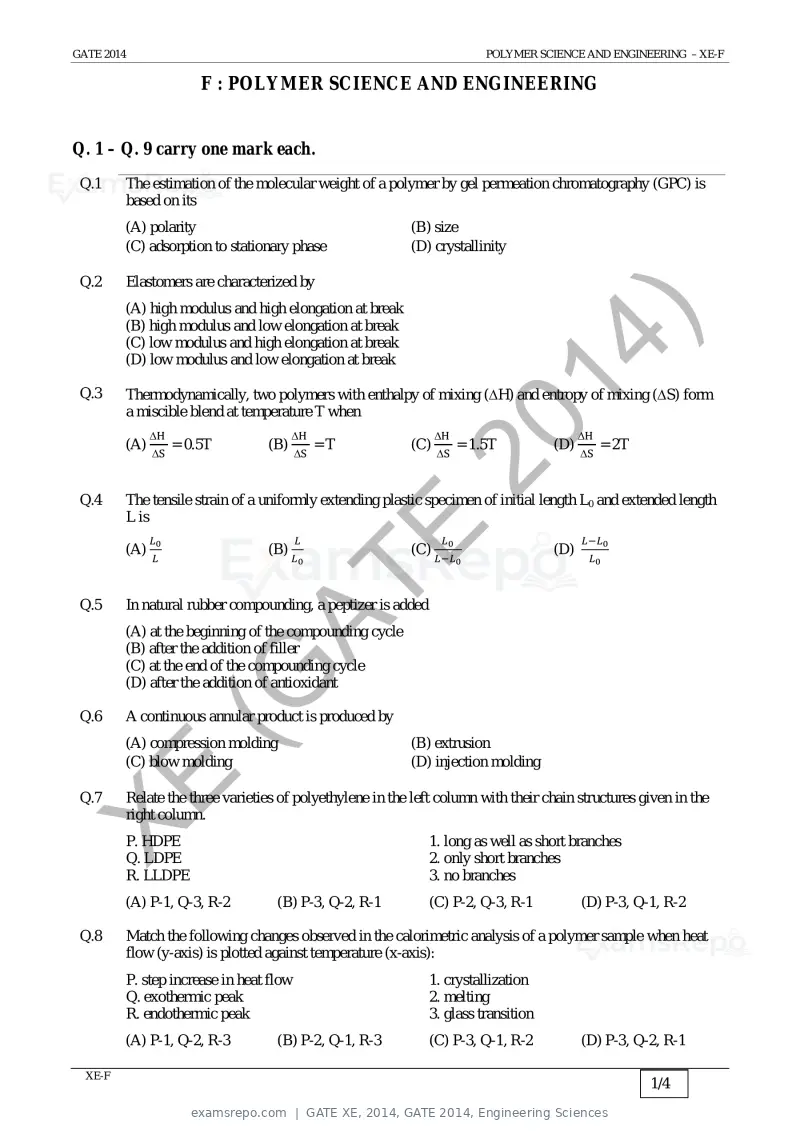
 Q.1        The estimation of the molecular weight of a polymer by gel permeation chromatography (GPC) is
            based on its
         (A) polarity                                        (B) size
         (C) adsorption to stationary phase                  (D) crystallinity

 Q.2        Elastomers are characterized by
         (A) high modulus and high elongation at break


                                                                                )
         (B) high modulus and low elongation at break


                                                                              14
         (C) low modulus and high elongation at break
         (D) low modulus and low elongation at break

 Q.3        Thermodynamically, two polymers with enthalpy of mixing (∆H) and entropy of mixing (∆S) form
            a miscible blend at temperature T when


                                                             20
                ∆H                        ∆H                       ∆H                        ∆H
         (A)         = 0.5T         (B)          =T          (C)         = 1.5T        (D)        = 2T
                ∆S                          ∆S                     ∆S                        ∆S


 Q.4        The tensile strain of a uniformly extending plastic specimen of initial length L0 and extended length
            L is
                                                      E
                L                           L                       L0                       L−L0
         (A) 0                      (B)                      (C)                       (D)
                L                         L0                       L−L0                       L0
                                AT

 Q.5        In natural rubber compounding, a peptizer is added
         (A) at the beginning of the compounding cycle
         (B) after the addition of filler
         (C) at the end of the compounding cycle
                    (G


         (D) after the addition of antioxidant

 Q.6        A continuous annular product is produced by
         (A) compression molding                             (B) extrusion
         (C) blow molding                                    (D) injection molding
XE


 Q.7        Relate the three varieties of polyethylene in the left column with their chain structures given in the
            right column.
            P. HDPE                                              1. long as well as short branches
            Q. LDPE                                              2. only short branches
            R. LLDPE                                             3. no branches
         (A) P-1, Q-3, R-2            (B) P-3, Q-2, R-1          (C) P-2, Q-3, R-1           (D) P-3, Q-1, R-2

 Q.8        Match the following changes observed in the calorimetric analysis of a polymer sample when heat
            flow (y-axis) is plotted against temperature (x-axis):
            P. step increase in heat flow                        1. crystallization
            Q. exothermic peak                                   2. melting
            R. endothermic peak                                  3. glass transition
         (A) P-1, Q-2, R-3            (B) P-2, Q-1, R-3          (C) P-3, Q-1, R-2           (D) P-3, Q-2, R-1

  XE-F
                                                                                                         1/4
Text of page 37
GATE 2014                                                                       POLYMER SCIENCE AND ENGINEERING – XE-F


 Q.9        A Bingham plastic fluid is flowing under gravity, down a vertical plate, as a film. Find the
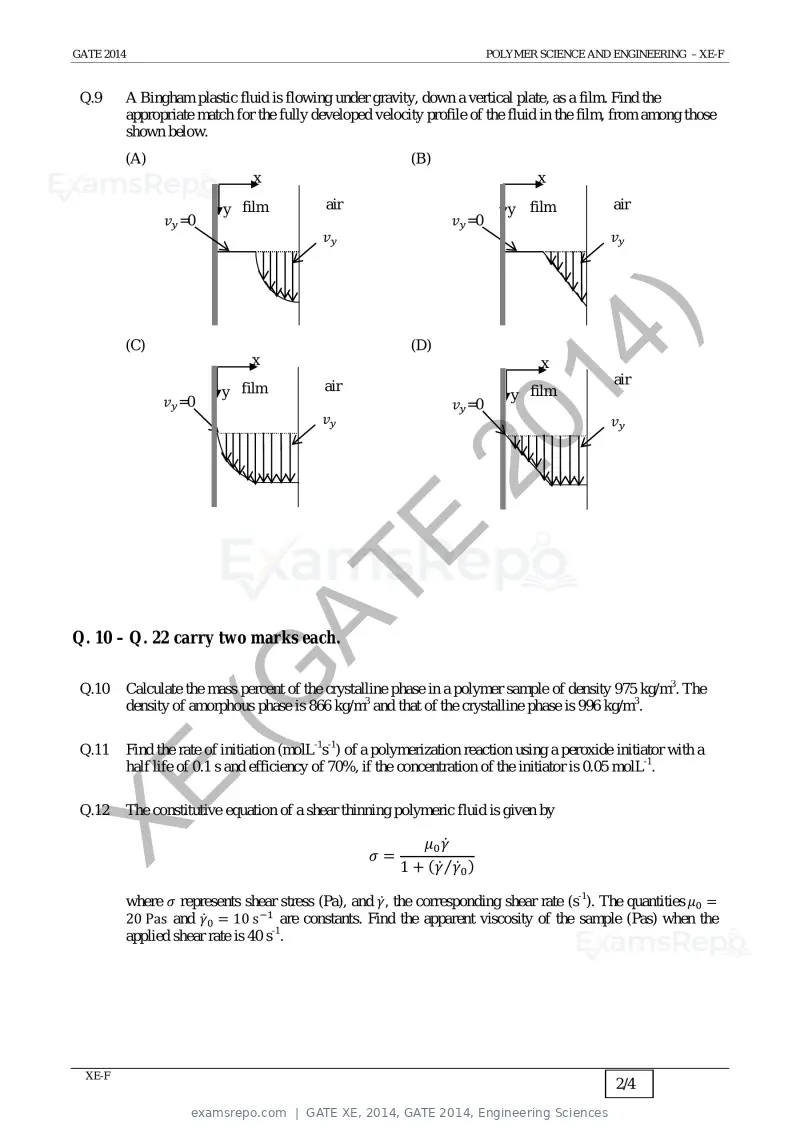
            appropriate match for the fully developed velocity profile of the fluid in the film, from among those
            shown below.
         (A)                                                  (B)
                                  x                                                     x

                             y film            air                                 y   film         air
                  vvyy =0                                             vvyy =0
                                              vvyy                                                 vvyy


                                                                                  )
                                                                                14
         (C)                                                  (D)
                                  x                                                     x
                                               air                                                  air
                            y film                                                  y film
                  vvyy =0                                             vvyy =0
                                              vvyy                                                  vvyy


                                                             20
                                                     E
                                AT

Q. 10 – Q. 22 carry two marks each.
                  (G


 Q.10       Calculate the mass percent of the crystalline phase in a polymer sample of density 975 kg/m3. The
            density of amorphous phase is 866 kg/m3 and that of the crystalline phase is 996 kg/m3.

 Q.11       Find the rate of initiation (molL-1s-1) of a polymerization reaction using a peroxide initiator with a
            half life of 0.1 s and efficiency of 70%, if the concentration of the initiator is 0.05 molL-1.
XE


 Q.12       The constitutive equation of a shear thinning polymeric fluid is given by

                                                               μ0 γ̇
                                                      σ=
                                                            1 + (γ̇ ⁄γ̇ 0 )

            where σ represents shear stress (Pa), and γ̇ , the corresponding shear rate (s-1). The quantities μ0 =
            20 Pas and γ̇ 0 = 10 s −1 are constants. Find the apparent viscosity of the sample (Pas) when the
            applied shear rate is 40 s-1.


  XE-F
                                                                                                     2/4
Text of page 38
GATE 2014                                                                        POLYMER SCIENCE AND ENGINEERING – XE-F

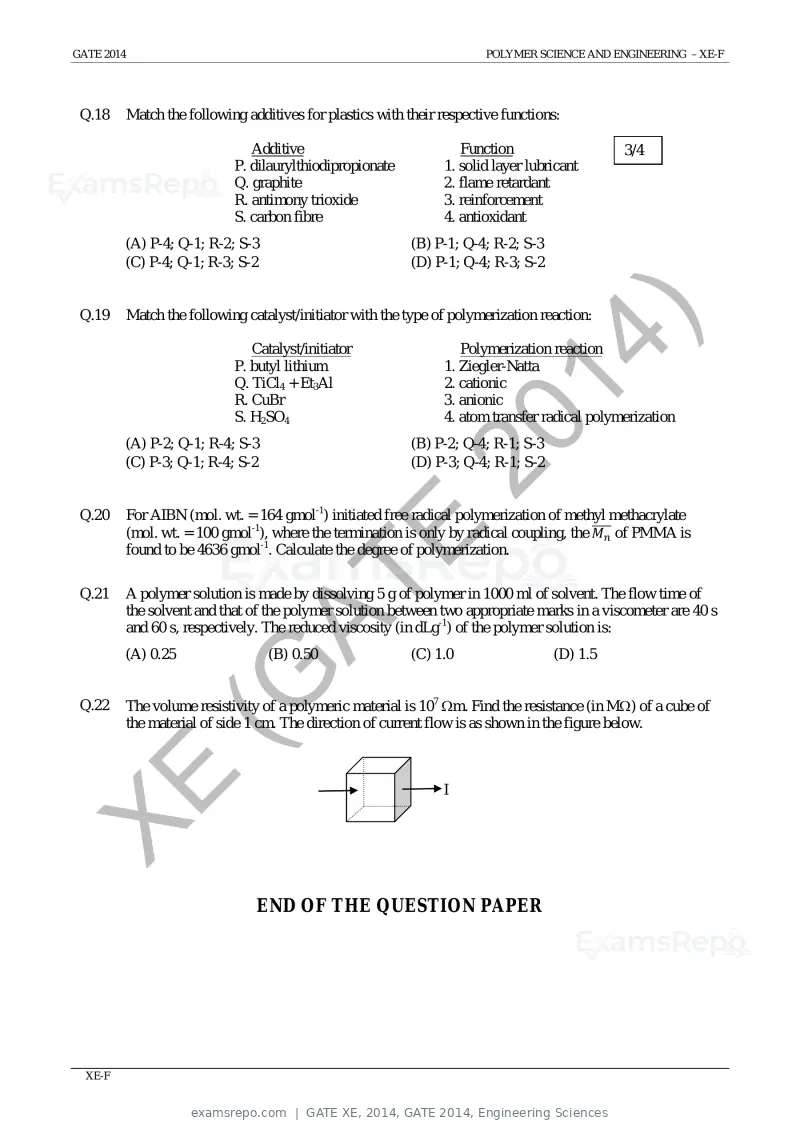
 Q.13       Identify the monomer for the polymer shown below prepared by ring opening metathesis
            polymerization.


                                                                                           n


                                                                                    )
                                                                                  14
         (A)                                                    (B)


         (C)

                                                                20
                                                                (D)
                                                   E
 Q.14       The most appropriate order of toughness of nylon based materials is
         (A) talc filled nylon < dry nylon < wet nylon
         (B) dry nylon < wet nylon < talc filled nylon
                                    AT

         (C) wet nylon < dry nylon < talc filled nylon
         (D) wet nylon < talc filled nylon < dry nylon


 Q.15       The shear rates involved in calendering (γ̇ cal), compression molding (γ̇ comp), extrusion (γ̇ ext), and
            injection molding (γ̇ inj) processes follow the order
                  (G


         (A) γ̇ inj < γ̇ cal < γ̇ ext < γ̇ comp                 (B) γ̇ comp < γ̇ ext < γ̇ cal < γ̇ inj
         (C) γ̇ comp < γ̇ inj < γ̇ ext < γ̇ cal                 (D) γ̇ comp < γ̇ cal < γ̇ ext < γ̇ inj
XE


 Q.16       The dynamic mechanical response of a thermoplastic automotive component has shown a loss
            angle of 45° and storage modulus of 3500 MPa. Calculate the loss modulus (MPa) of the
            component.


 Q.17       Match the terms in Column A with the appropriate terms in Column B:

                                     Column A                             Column B
                                  P. processability                    1. Rockwell scale
                                  Q. moisture permeation               2. rubber modification
                                  R. hardness                          3. melt flow index
                                  S. fracture toughening               4. Fick's law

         (A) P-3; Q-4; R-2; S-1                                 (B) P-3; Q-4; R-1; S-2
         (C) P-4; Q-3; R-1; S-2                                 (D) P-4; Q-3; R-2; S-1

  XE-F
Text of page 39
GATE 2014                                                                 POLYMER SCIENCE AND ENGINEERING – XE-F


 Q.18       Match the following additives for plastics with their respective functions:

                                 Additive                            Function                   3/4
                              P. dilaurylthiodipropionate         1. solid layer lubricant
                              Q. graphite                         2. flame retardant
                              R. antimony trioxide                3. reinforcement
                              S. carbon fibre                     4. antioxidant
         (A) P-4; Q-1; R-2; S-3                              (B) P-1; Q-4; R-2; S-3
         (C) P-4; Q-1; R-3; S-2                              (D) P-1; Q-4; R-3; S-2


 Q.19       Match the following catalyst/initiator with the type of polymerization reaction:


                                                                             )
                                                                           14
                                 Catalyst/initiator                  Polymerization reaction
                              P. butyl lithium                    1. Ziegler-Natta
                              Q. TiCl4 + Et3Al                    2. cationic
                              R. CuBr                             3. anionic
                              S. H2SO4                            4. atom transfer radical polymerization


                                                            20
         (A) P-2; Q-1; R-4; S-3                              (B) P-2; Q-4; R-1; S-3
         (C) P-3; Q-1; R-4; S-2                              (D) P-3; Q-4; R-1; S-2


 Q.20       For AIBN (mol. wt. = 164 gmol-1) initiated free radical polymerization of methyl methacrylate
                                                                                            ����
                                                E
            (mol. wt. = 100 gmol-1), where the termination is only by radical coupling, the M  n of PMMA is
                                  -1
            found to be 4636 gmol . Calculate the degree of polymerization.
                                AT

 Q.21       A polymer solution is made by dissolving 5 g of polymer in 1000 ml of solvent. The flow time of
            the solvent and that of the polymer solution between two appropriate marks in a viscometer are 40 s
            and 60 s, respectively. The reduced viscosity (in dLg-1) of the polymer solution is:
         (A) 0.25                   (B) 0.50                 (C) 1.0                  (D) 1.5
                 (G


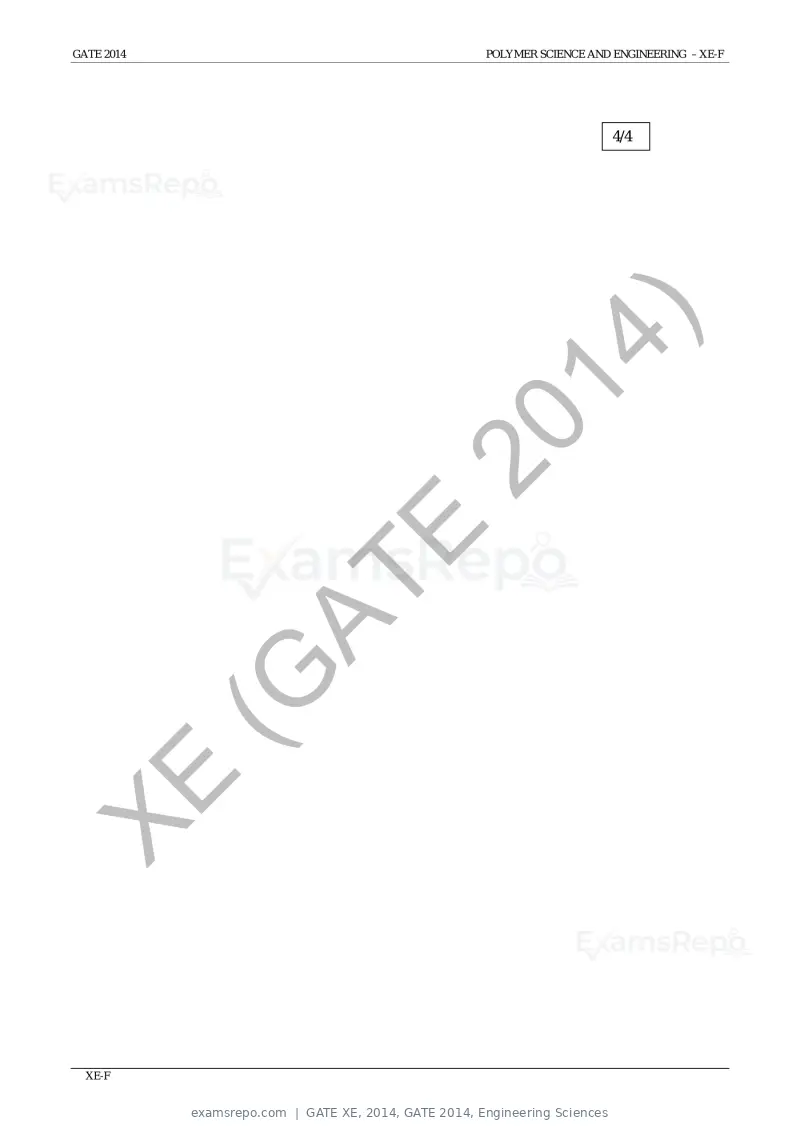
 Q.22       The volume resistivity of a polymeric material is 107 Ωm. Find the resistance (in MΩ) of a cube of
            the material of side 1 cm. The direction of current flow is as shown in the figure below.
XE


                                                                  I


                                  END OF THE QUESTION PAPER


  XE-F
Text of page 40
GATE 2014            POLYMER SCIENCE AND ENGINEERING – XE-F


                                         4/4


                       )
                     14
                 20
                 E
             AT
            (G
XE


  XE-F
Text of page 41
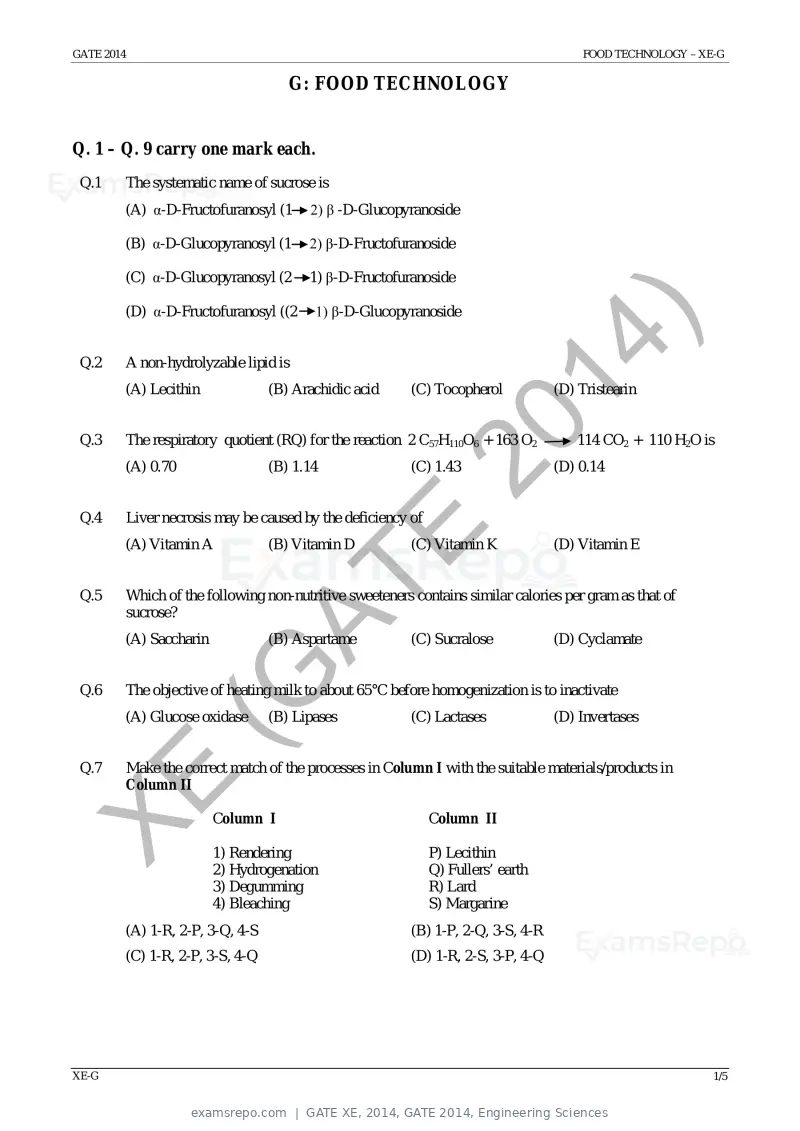
GATE 2014                                                                                FOOD TECHNOLOGY – XE-G

                                          G: FOOD TECHNOLOGY


Q. 1 – Q. 9 carry one mark each.
 Q.1        The systematic name of sucrose is
        (A) α-D-Fructofuranosyl (1         2) β -D-Glucopyranoside

        (B) α-D-Glucopyranosyl (1          2) β-D-Fructofuranoside

        (C) α-D-Glucopyranosyl (2          1) β-D-Fructofuranoside

        (D) α-D-Fructofuranosyl ((2         1) β-D-Glucopyranoside


                                                                             )
                                                                           14
 Q.2        A non-hydrolyzable lipid is
        (A) Lecithin                (B) Arachidic acid      (C) Tocopherol           (D) Tristearin


                                                           20
 Q.3        The respiratory quotient (RQ) for the reaction 2 C57H110O6 + 163 O2         114 CO2 + 110 H2O is
        (A) 0.70                    (B) 1.14                (C) 1.43                 (D) 0.14


 Q.4        Liver necrosis may be caused by the deficiency of
                                                  E
        (A) Vitamin A               (B) Vitamin D           (C) Vitamin K            (D) Vitamin E
                               AT

 Q.5        Which of the following non-nutritive sweeteners contains similar calories per gram as that of
            sucrose?
        (A) Saccharin               (B) Aspartame           (C) Sucralose            (D) Cyclamate
                 (G


 Q.6        The objective of heating milk to about 65°C before homogenization is to inactivate
        (A) Glucose oxidase         (B) Lipases             (C) Lactases             (D) Invertases


 Q.7        Make the correct match of the processes in Column I with the suitable materials/products in
XE


            Column II

                          Column I                              Column II

                          1) Rendering                          P) Lecithin
                          2) Hydrogenation                      Q) Fullers’ earth
                          3) Degumming                          R) Lard
                          4) Bleaching                          S) Margarine
        (A) 1-R, 2-P, 3-Q, 4-S                              (B) 1-P, 2-Q, 3-S, 4-R
        (C) 1-R, 2-P, 3-S, 4-Q                              (D) 1-R, 2-S, 3-P, 4-Q


XE-G                                                                                                         1/5
Text of page 42
GATE 2014                                                                                      FOOD TECHNOLOGY – XE-G

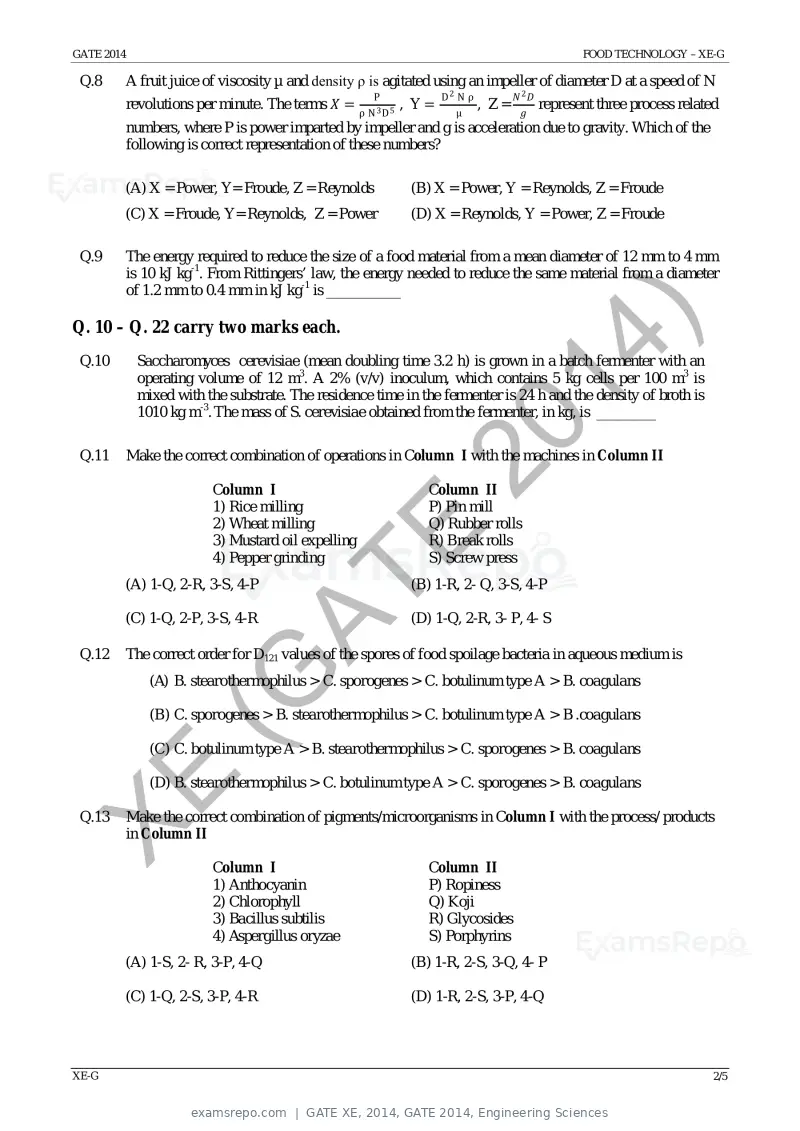
 Q.8        A fruit juice of viscosity µ and density ρ is agitated using an impeller of diameter D at a speed of N
                                                       P             D2 N ρ       NN 2 DD
            revolutions per minute. The terms XX = ρ N 3 D 5 , Y =      µ
                                                                            , Z =   gg
                                                                                          represent three process related
            numbers, where P is power imparted by impeller and g is acceleration due to gravity. Which of the
            following is correct representation of these numbers?

        (A) X = Power, Y= Froude, Z = Reynolds               (B) X = Power, Y = Reynolds, Z = Froude
        (C) X = Froude, Y= Reynolds, Z = Power               (D) X = Reynolds, Y = Power, Z = Froude

 Q.9        The energy required to reduce the size of a food material from a mean diameter of 12 mm to 4 mm
            is 10 kJ kg-1. From Rittingers’ law, the energy needed to reduce the same material from a diameter
            of 1.2 mm to 0.4 mm in kJ kg-1 is __________


                                                                                )
Q. 10 – Q. 22 carry two marks each.


                                                                              14
 Q.10        Saccharomyces cerevisiae (mean doubling time 3.2 h) is grown in a batch fermenter with an
             operating volume of 12 m3. A 2% (v/v) inoculum, which contains 5 kg cells per 100 m3 is
             mixed with the substrate. The residence time in the fermenter is 24 h and the density of broth is
             1010 kg m-3. The mass of S. cerevisiae obtained from the fermenter, in kg, is ________


                                                             20
 Q.11       Make the correct combination of operations in Column I with the machines in Column II

                           Column I                             Column II
                           1) Rice milling                      P) Pin mill
                           2) Wheat milling                     Q) Rubber rolls
                                                 E
                           3) Mustard oil expelling             R) Break rolls
                           4) Pepper grinding                   S) Screw press
                                AT

        (A) 1-Q, 2-R, 3-S, 4-P                               (B) 1-R, 2- Q, 3-S, 4-P

        (C) 1-Q, 2-P, 3-S, 4-R                               (D) 1-Q, 2-R, 3- P, 4- S

 Q.12       The correct order for D121 values of the spores of food spoilage bacteria in aqueous medium is
                  (G


                (A) B. stearothermophilus > C. sporogenes > C. botulinum type A > B. coagulans

                (B) C. sporogenes > B. stearothermophilus > C. botulinum type A > B .coagulans

                (C) C. botulinum type A > B. stearothermophilus > C. sporogenes > B. coagulans
XE


                (D) B. stearothermophilus > C. botulinum type A > C. sporogenes > B. coagulans

 Q.13       Make the correct combination of pigments/microorganisms in Column I with the process/ products
            in Column II

                           Column I                             Column II
                           1) Anthocyanin                       P) Ropiness
                           2) Chlorophyll                       Q) Koji
                           3) Bacillus subtilis                 R) Glycosides
                           4) Aspergillus oryzae                S) Porphyrins
        (A) 1-S, 2- R, 3-P, 4-Q                              (B) 1-R, 2-S, 3-Q, 4- P

        (C) 1-Q, 2-S, 3-P, 4-R                               (D) 1-R, 2-S, 3-P, 4-Q


XE-G                                                                                                                    2/5
Text of page 43
GATE 2014                                                                                      FOOD TECHNOLOGY – XE-G

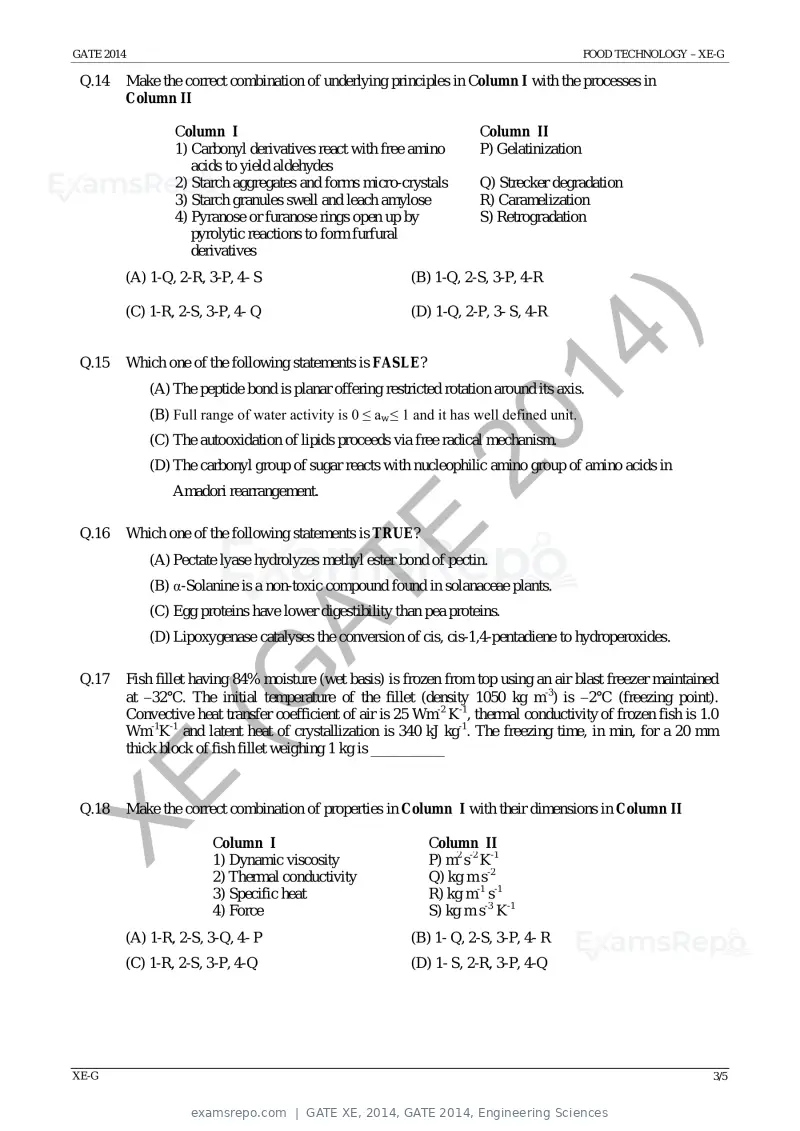
 Q.14       Make the correct combination of underlying principles in Column I with the processes in
            Column II

                    Column I                                              Column II
                    1) Carbonyl derivatives react with free amino         P) Gelatinization
                       acids to yield aldehydes
                    2) Starch aggregates and forms micro-crystals         Q) Strecker degradation
                    3) Starch granules swell and leach amylose            R) Caramelization
                    4) Pyranose or furanose rings open up by              S) Retrogradation
                       pyrolytic reactions to form furfural
                       derivatives
        (A) 1-Q, 2-R, 3-P, 4- S                               (B) 1-Q, 2-S, 3-P, 4-R

        (C) 1-R, 2-S, 3-P, 4- Q                               (D) 1-Q, 2-P, 3- S, 4-R


                                                                              )
                                                                            14
 Q.15       Which one of the following statements is FASLE?
                (A) The peptide bond is planar offering restricted rotation around its axis.
                (B) Full range of water activity is 0 ≤ aw ≤ 1 and it has well defined unit.


                                                             20
                (C) The autooxidation of lipids proceeds via free radical mechanism.
                (D) The carbonyl group of sugar reacts with nucleophilic amino group of amino acids in
                    Amadori rearrangement.
                                                 E
 Q.16       Which one of the following statements is TRUE?
                (A) Pectate lyase hydrolyzes methyl ester bond of pectin.
                                AT

                (B) α-Solanine is a non-toxic compound found in solanaceae plants.
                (C) Egg proteins have lower digestibility than pea proteins.
                (D) Lipoxygenase catalyses the conversion of cis, cis-1,4-pentadiene to hydroperoxides.
                 (G


 Q.17       Fish fillet having 84% moisture (wet basis) is frozen from top using an air blast freezer maintained
            at −32°C. The initial temperature of the fillet (density 1050 kg m-3) is −2°C (freezing point).
            Convective heat transfer coefficient of air is 25 Wm-2 K-1, thermal conductivity of frozen fish is 1.0
            Wm-1K-1 and latent heat of crystallization is 340 kJ kg-1. The freezing time, in min, for a 20 mm
            thick block of fish fillet weighing 1 kg is __________
XE


 Q.18       Make the correct combination of properties in Column I with their dimensions in Column II

                           Column I                              Column II
                           1) Dynamic viscosity                  P) m2 s-2 K-1
                           2) Thermal conductivity               Q) kg m s-2
                           3) Specific heat                      R) kg m-1 s-1
                           4) Force                              S) kg m s-3 K-1
        (A) 1-R, 2-S, 3-Q, 4- P                               (B) 1- Q, 2-S, 3-P, 4- R
        (C) 1-R, 2-S, 3-P, 4-Q                                (D) 1- S, 2-R, 3-P, 4-Q


XE-G                                                                                                               3/5
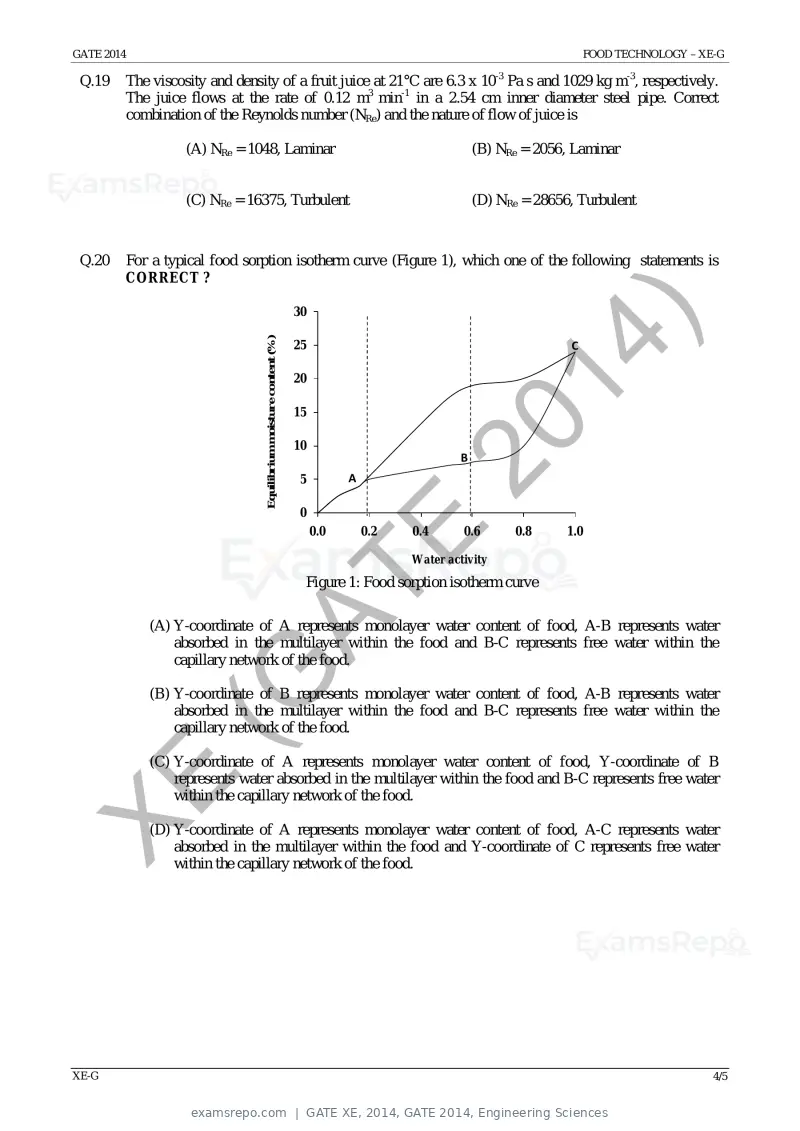
Text of page 44
GATE 2014                                                                                                                   FOOD TECHNOLOGY – XE-G

 Q.19       The viscosity and density of a fruit juice at 21°C are 6.3 x 10⁻³ Pa s and 1029 kg m-3, respectively.
            The juice flows at the rate of 0.12 m3 min-1 in a 2.54 cm inner diameter steel pipe. Correct
            combination of the Reynolds number (NRe) and the nature of flow of juice is

                      (A) NRe = 1048, Laminar                                                            (B) NRe = 2056, Laminar


                      (C) NRe = 16375, Turbulent                                                         (D) NRe = 28656, Turbulent


 Q.20       For a typical food sorption isotherm curve (Figure 1), which one of the following statements is
            CORRECT ?

                                                                       30


                                                                                                               )
                                    Equilibrium moisture content (%)


                                                                                                             14
                                                                       25                                               C

                                                                       20

                                                                       15


                                                                                            20
                                                                       10
                                                                                                     B
                                                                       5          A

                                                                       0
                                                                                  E
                                                                            0.0       0.2   0.4      0.6       0.8      1.0

                                                                                            Water activity
                               AT

                                                                        Figure 1: Food sorption isotherm curve

                (A) Y-coordinate of A represents monolayer water content of food, A-B represents water
                    absorbed in the multilayer within the food and B-C represents free water within the
                    capillary network of the food.
                 (G


                (B) Y-coordinate of B represents monolayer water content of food, A-B represents water
                    absorbed in the multilayer within the food and B-C represents free water within the
                    capillary network of the food.

                (C) Y-coordinate of A represents monolayer water content of food, Y-coordinate of B
XE


                    represents water absorbed in the multilayer within the food and B-C represents free water
                    within the capillary network of the food.

                (D) Y-coordinate of A represents monolayer water content of food, A-C represents water
                    absorbed in the multilayer within the food and Y-coordinate of C represents free water
                    within the capillary network of the food.


XE-G                                                                                                                                            4/5
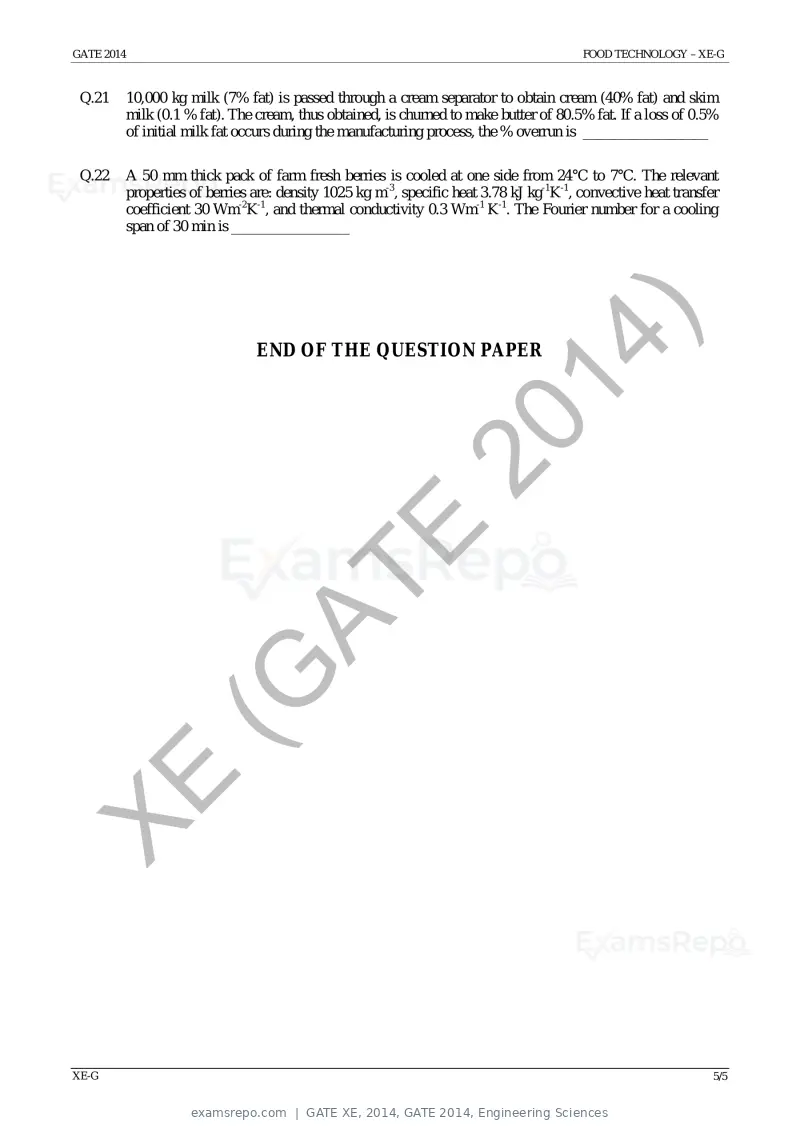
Text of page 45
GATE 2014                                                                                  FOOD TECHNOLOGY – XE-G


 Q.21       10,000 kg milk (7% fat) is passed through a cream separator to obtain cream (40% fat) and skim
            milk (0.1 % fat). The cream, thus obtained, is churned to make butter of 80.5% fat. If a loss of 0.5%
            of initial milk fat occurs during the manufacturing process, the % overrun is _________________

 Q.22       A 50 mm thick pack of farm fresh berries is cooled at one side from 24°C to 7°C. The relevant
            properties of berries are: density 1025 kg m-3, specific heat 3.78 kJ kg-1K-1, convective heat transfer
            coefficient 30 Wm-2K-1, and thermal conductivity 0.3 Wm-1 K-1. The Fourier number for a cooling
            span of 30 min is ________________


                                                                             )
                                                                           14
                                  END OF THE QUESTION PAPER


                                                             20
                                                E
                                AT
                 (G
XE


XE-G                                                                                                              5/5
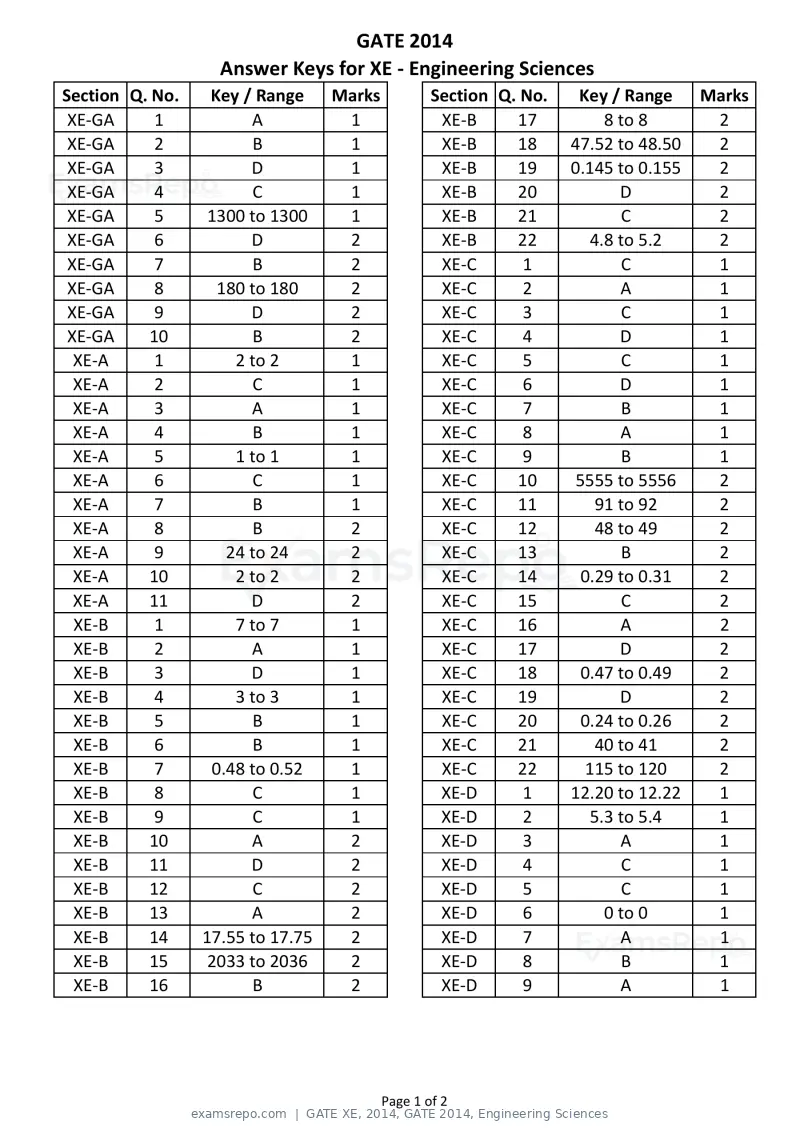
Text of page 46
GATE 2014
                   Answer Keys for XE ‐ Engineering Sciences
Section Q. No.    Key / Range     Marks           Section Q. No.    Key / Range     Marks
 XE‐GA     1           A           1               XE‐B     17          8 to 8       2
 XE‐GA     2           B           1               XE‐B     18     47.52 to 48.50    2
 XE‐GA     3           D           1               XE‐B     19     0.145 to 0.155    2
 XE‐GA     4           C           1               XE‐B     20            D          2
 XE‐GA     5     1300 to 1300      1               XE‐B     21            C          2
 XE‐GA     6           D           2               XE‐B     22        4.8 to 5.2     2
 XE‐GA     7           B           2               XE‐C      1            C          1
 XE‐GA     8       180 to 180      2               XE‐C      2            A          1
 XE‐GA     9           D           2               XE‐C      3            C          1
 XE‐GA    10           B           2               XE‐C      4            D          1
  XE‐A     1         2 to 2        1               XE‐C      5            C          1
  XE‐A     2           C           1               XE‐C      6            D          1
  XE‐A     3           A           1               XE‐C      7            B          1
  XE‐A     4           B           1               XE‐C      8            A          1
  XE‐A     5         1 to 1        1               XE‐C      9            B          1
  XE‐A     6           C           1               XE‐C     10     5555 to 5556      2
  XE‐A     7           B           1               XE‐C     11        91 to 92       2
  XE‐A     8           B           2               XE‐C     12        48 to 49       2
  XE‐A     9        24 to 24       2               XE‐C     13            B          2
  XE‐A    10         2 to 2        2               XE‐C     14      0.29 to 0.31     2
  XE‐A    11           D           2               XE‐C     15            C          2
  XE‐B     1         7 to 7        1               XE‐C     16            A          2
  XE‐B     2           A           1               XE‐C     17            D          2
  XE‐B     3           D           1               XE‐C     18      0.47 to 0.49     2
  XE‐B     4         3 to 3        1               XE‐C     19            D          2
  XE‐B     5           B           1               XE‐C     20      0.24 to 0.26     2
  XE‐B     6           B           1               XE‐C     21        40 to 41       2
  XE‐B     7      0.48 to 0.52     1               XE‐C     22       115 to 120      2
  XE‐B     8           C           1               XE‐D      1     12.20 to 12.22    1
  XE‐B     9           C           1               XE‐D      2        5.3 to 5.4     1
  XE‐B    10           A           2               XE‐D      3            A          1
  XE‐B    11           D           2               XE‐D      4            C          1
  XE‐B    12           C           2               XE‐D      5            C          1
  XE‐B    13           A           2               XE‐D      6          0 to 0       1
  XE‐B    14     17.55 to 17.75    2               XE‐D      7            A          1
  XE‐B    15     2033 to 2036      2               XE‐D      8            B          1
  XE‐B    16           B           2               XE‐D      9            A          1


                                          Page 1 of 2
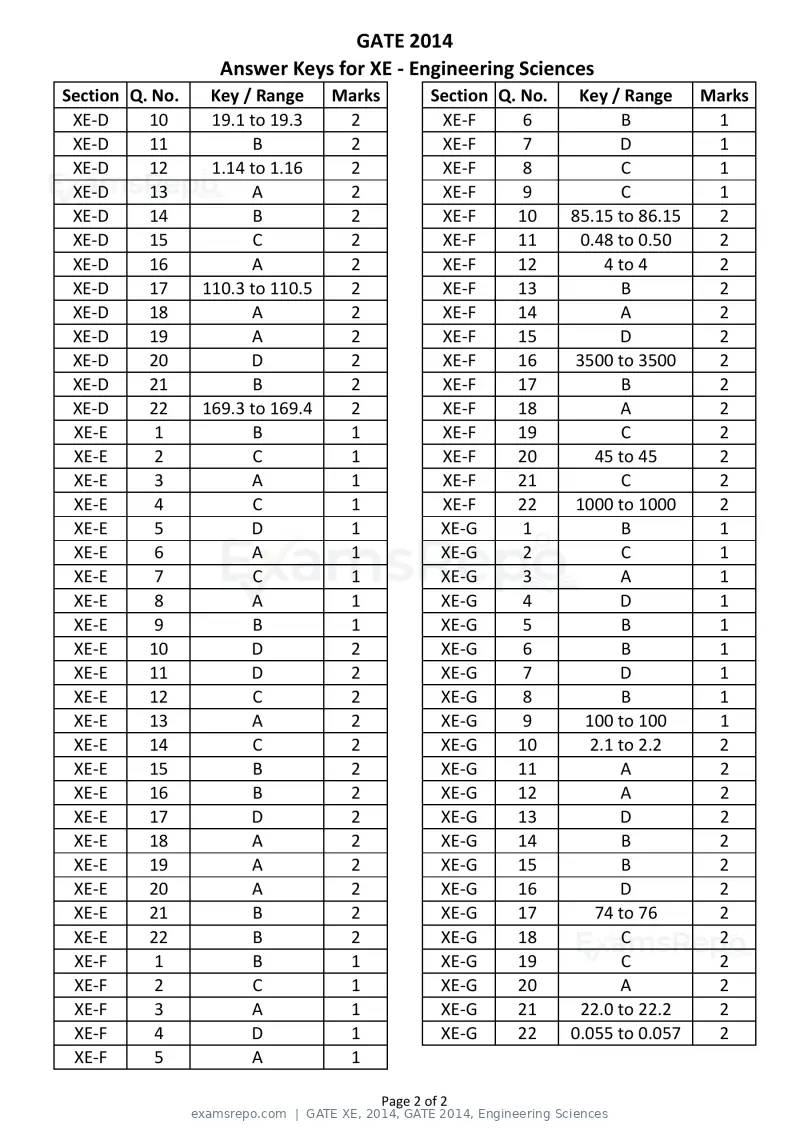
Text of page 47
GATE 2014
                   Answer Keys for XE ‐ Engineering Sciences
Section Q. No.    Key / Range     Marks           Section Q. No.    Key / Range     Marks
 XE‐D     10      19.1 to 19.3     2               XE‐F      6             B         1
 XE‐D     11           B           2               XE‐F      7             D         1
 XE‐D     12      1.14 to 1.16     2               XE‐F      8             C         1
 XE‐D     13           A           2               XE‐F      9             C         1
 XE‐D     14           B           2               XE‐F     10     85.15 to 86.15    2
 XE‐D     15           C           2               XE‐F     11      0.48 to 0.50     2
 XE‐D     16           A           2               XE‐F     12           4 to 4      2
 XE‐D     17     110.3 to 110.5    2               XE‐F     13             B         2
 XE‐D     18           A           2               XE‐F     14             A         2
 XE‐D     19           A           2               XE‐F     15             D         2
 XE‐D     20           D           2               XE‐F     16      3500 to 3500     2
 XE‐D     21           B           2               XE‐F     17             B         2
 XE‐D     22     169.3 to 169.4    2               XE‐F     18             A         2
 XE‐E      1           B           1               XE‐F     19             C         2
 XE‐E      2           C           1               XE‐F     20         45 to 45      2
 XE‐E      3           A           1               XE‐F     21             C         2
 XE‐E      4           C           1               XE‐F     22     1000 to 1000      2
 XE‐E      5           D           1               XE‐G      1             B         1
 XE‐E      6           A           1               XE‐G      2             C         1
 XE‐E      7           C           1               XE‐G      3             A         1
 XE‐E      8           A           1               XE‐G      4             D         1
 XE‐E      9           B           1               XE‐G      5             B         1
 XE‐E     10           D           2               XE‐G      6             B         1
 XE‐E     11           D           2               XE‐G      7             D         1
 XE‐E     12           C           2               XE‐G      8             B         1
 XE‐E     13           A           2               XE‐G      9        100 to 100     1
 XE‐E     14           C           2               XE‐G     10         2.1 to 2.2    2
 XE‐E     15           B           2               XE‐G     11             A         2
 XE‐E     16           B           2               XE‐G     12             A         2
 XE‐E     17           D           2               XE‐G     13             D         2
 XE‐E     18           A           2               XE‐G     14             B         2
 XE‐E     19           A           2               XE‐G     15             B         2
 XE‐E     20           A           2               XE‐G     16             D         2
 XE‐E     21           B           2               XE‐G     17         74 to 76      2
 XE‐E     22           B           2               XE‐G     18             C         2
 XE‐F      1           B           1               XE‐G     19             C         2
 XE‐F      2           C           1               XE‐G     20             A         2
 XE‐F      3           A           1               XE‐G     21       22.0 to 22.2    2
 XE‐F      4           D           1               XE‐G     22     0.055 to 0.057    2
 XE‐F      5           A           1

                                          Page 2 of 2
Official key not published for this paper.
Page 1 of 47
Source: GATE. Question paper published by GATE.